Kansas City Sun
Saturday, March 4, 1916
Kansas City, Missouri
Page text (machine-generated)
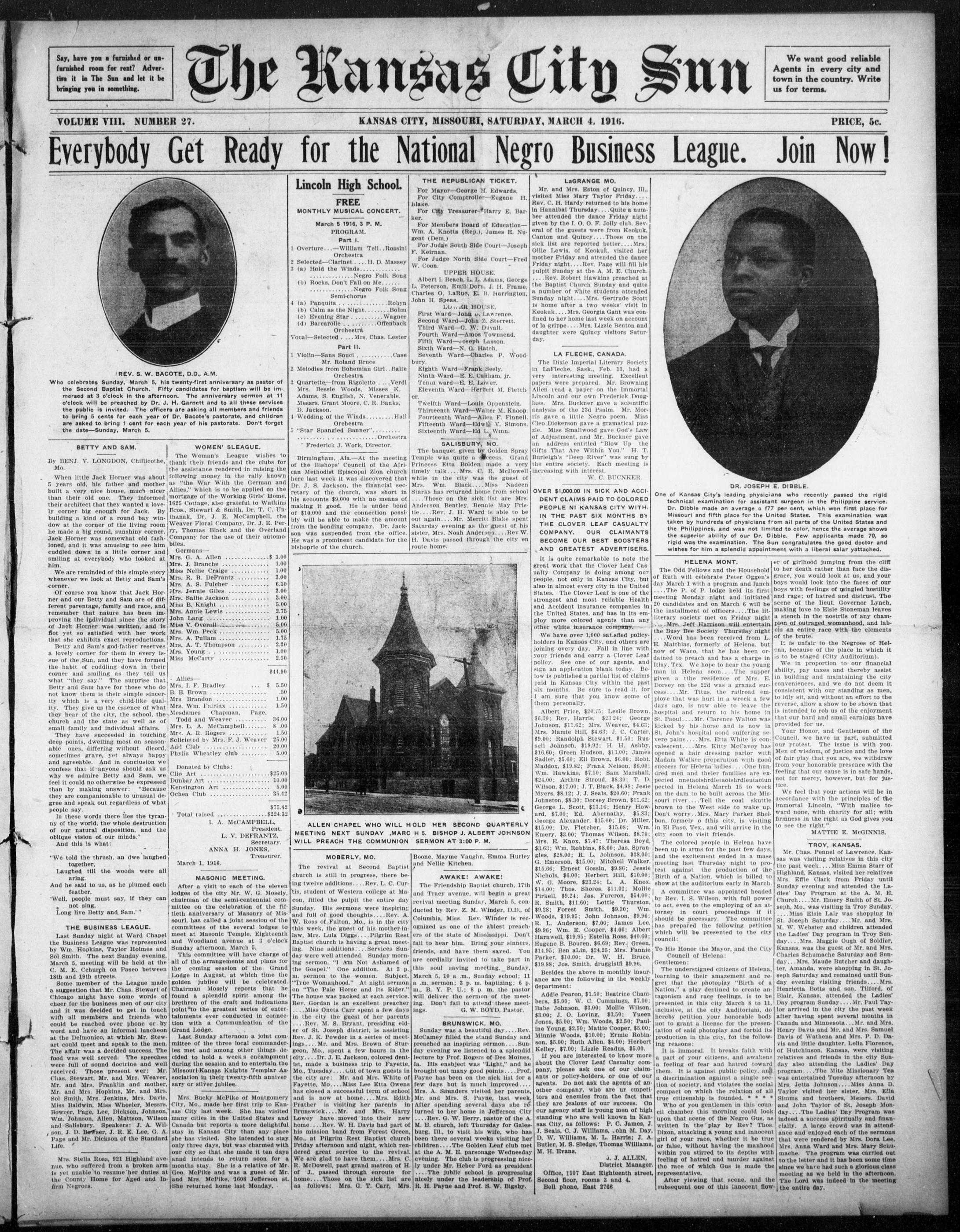
Everybody Get Ready for the National Negro Business League. Join Now!
Say, have you a furnished or unfurnished room for rent? Advertise it in The Sun and let it be bringing you in something.
VOLUME VIII. NUMBER 27.
Everybody Get R
REV. S. W. BACOTE, D.D., A.M.
Who celebrates Sunday, March 5, his twenty- the second Baptist Church. Fifty candid mersed at 3 o'clock in the afternoon. The o'clock will be preached by Dr. J. H. Garm the public is invited. The officers are ask to bring 5 cents for each year of Dr. Bac are asked to bring 1 cent for each year of the date—Sunday, March 5.
Who celebrates Sunday, March 5, his twenty-first anniversary as pastor of the Second Baptist Church. Fifty candidates for baptism will be immersed at 3 o'clock in the afternoon. The anniversary sermon at 11 o'clock will be preached by Dr. J. H. Garnett and to all these services the public is invited. The officers are asking all members and friends to bring 5 cents for each year of Dr. Bacote's pastorate, and children are asked to bring 1 cent for each year of his pastorate. Don't forget the date—Sunday, March 5.
BETTY AND SAM.
BY BENJ. V. LONGDON, Chillicothe, Mo.
When little Jack Horner was about 5 years old, his father and mother built a very nice house, much nicer than their old one. They informed their architect that they wanted a lovely corner big enough for Jack. By building a kind of a round bay window at the corner of the living room he made a big round, sunshine corner. Jack Horner was somewhat old fashioned, and it was amusing to see him cuddled down in a little corner and smiling at everybody who looked at him.
We are reminded of this simple story whenever we look at Betty and Sam's corner.
Of course you know that Jack Horner and our Betty and Sam are of different parentage, family and race, and remember that nature has been improving the lpidividual since the story of Jack Horner was written, and is flot yet so satisfied with her work that she exhibits exact reproductions.
Betty and Sam's god-father reserves a lovely corner for them in every issue of the Sun, and they have formed the habit of cuddling down in their corner and smiling as they tell us what "they say." The surprise that Betty and Sam have for those who do not know them is their simple sincerity which is a very child-like quality. They give us the essence of what they hear of the city, the school, the church and the state as well as of small family and individual affairs. They have succeeded in touching deep points, dwelling on most seasonable ones, differing without discord, sometimes grave, yet always happy and agreeable. And in conclusion we confess that if anyone should ask us why we admire Betty and Sam, we feel it could no otherwise be expressed than by making answer: "Because they are companionable to unusual degree and speak out regardless of what people say.
In these words there lies the tyranny of the world, the whole destruction of our natural disposition, and the oblique vision of our minds."
And this is what:
"We told the thrush, an dwe laughed together,
Laughed till the woods were all aring.
And he said to us, as he plumed each feather.
'Well, people must say, if they can not sing.
Long live Betty and Sam.'
THE BUSINESS LEAGUE
Last Sunday night at Ward Chapel the Business League was represented by Wm. Hopkins, Taylor Holmes and Sol Smith. The next Sunday evening, March 5, meeting will be held at the C. M. E. Cechurh on Paseo between 18th and 19th streets.
Some member of the League made a suggestion that Mr. Chas. Stewart of Chicago might have some words of cheer for the business men of our city and it was decided to get in touch with all members and friends who could be reached over phone or by word and have an informal luncheon at the Delmonico, at which Mr. Stewart could meet and speak to the men. The affair was a decided success. The food was well served. The speeches were full of sound doctrine and well received. Those present wer: Mr. Chas. Stewart, Mr. and Mrs. Weaver, Mr. and Mrs. Franklin and mother, Mr. and Mrs. Hopkins, Mr. and Mrs. Sol Smith, Mrs. Jenkins, Mrs. Davis, Miss Baldwin, Miss Wheeler, Messrs. Bower, Page, Lee, Dickson, Johnson, Wm. Johnson, Allen, Mattson, Wilson and Salisbury, Speakers: J. A. Wilson, J. D. Bewser, J. R. E. Lee, G. A. Page and Mr. Dickson of the Standard Life.
Mrs. Stella Ross, 921 Highland avenue, who suffered from a broken arm is yet unable to resume her duties at the County Home for Aged and In firm Negroes.
The Kansas City Sun
WOMEN' SLEAGUE.
The Woman's League wishes to thank their friends and the clubs for the assistance rendered in raising the following money in the rally known as "the War With the German and Allies," which is to be applied on the mortgage of the Working Girls' Home, 1625 Cottage, also grateful to Watkins Bros., Stewart & Smith, Dr. T. C. Unthanak, Dr. J. E. McCampbell, the Weaver Floral Company, Dr. J. E. Pery, Thomas Black and the Overland Company for the use of their automobiles.
March 1, 1916.
MASONIC MEETING.
After a visit to each of the eleven lodges of the city Mr. W. G. Mosely, chairman of the semi-centennial committee on the celebration of the fifteenth anniversary of Masonry of Missouri, has called a joint session of the committees of the several lodges to meet at Masonic Temple, Eighteenth and Woodland avenue at 3 o'clock Sunday afternoon, March 5.
This committee will have charge of all of the arrangements and plans for the coming session of the Grand Lodge in August, at which time the golden jubilee will be celebrated. Chairman Mosely reports that he found a splendid spirit among the brethren of the craft and indications point<sup>2</sup> to the greatest series of entertainments ever conducted in connection with a Communication of the Grand Lodge.
Last Sunday afternoon a joint committee of the three local commanderies met and among other things decided to hold a week's encampment during the session and to entertain the Missouri-Kansas Knights Templar Association in their twenty-fifth anniversary sary or silver jubilee.
Mrs. Bucky McPike of Montgomery City, Mo., made her first trip to Kansas City last week. She has visited many cities in the United States and Canada but reports a more delightful stay in Kansas City than any place she has visited. She intended to stay only three days, but was charmed with our city so that she made it ten days and intends to return soon for a month stay. She is a relative of Mr. Geo. McPike and was a guest of Mr. and Mrs. McPike, 1608 Jefferson st. She returned home last Monday.
KANSAS CITY, MISSOURI, SATURDAY, MARCH 4. 1916.
THE CHURCH OF THE LORD'S PRAYER
ALLEN CHAPEL WHO WILL HOLD HER SECOND QUARTERLY MEETING NEXT SUNDAY ,MARC H 5. BISHOP J. ALBERT JOHNSON WILL PREACH THE COMMUNION SERMON AT 3:00 P. M.
ALLEN CHAPEL WHO WILL HOLD HER SECOND QUARTERLY MEETING NEXT SUNDAY ,MARC H 5. BISHOP J. ALBERT JOHNSON WILL PREACH THE COMMUNION SERMON AT 3:00 P. M.
Lincoln High School.
FREE
MONTHLY MUSICAL CONCERT.
1 Overture . . .—William Tell . . Rossini
Orchestra
2 Selected—Clarinet . . . H. D. Massey
3 (a) Hold the Winds . . .
.....Negro Folk Song
(b) Rocks, Don't Fall on Me . . .
.....Negro Folk Song
Semi-chorus
4 (a) Panquita . . . Robyn
(b) Calm as the Night . . . Bohm
(c) Evening Star . . . Wagner
(d) Barcarolle . . . Offenback
Orchestra
Vocal—Selected . . . Mrs. Chas. Lester
Part II.
1 Violin—Sans Souci . . . Case
Mr. Roland Bruce
2 Melodies from Bohemian Girl . Balfe
Orchestra
3 Quartette—from Rigoletto . . Verdi
Mrs. Bessie Woods, Misses K.
Adams, S. English, N. Venerable.
Messrs. Grant Moore, C. R. Banks,
D. Jackson.
4 Wedding of the Winds . . . Hall
Orchestra
5 "Star Spangled Banner".....Orchestra
* Frederick J. Work, Director.
Birmingham, Ala.—At the meeting of the Bishops' Council of the African Methodist Episcopal Zion church here last week it was discovered that Dr. J. S. Jackson, the financial secretary of the church, was short in his accounts $9,000 with no means of making it good. He is under bond of $10,000 and the connection possibly will be able to make the amount from the bonding company. Dr. Jackson was suspended from the office. He was a prominent candidate for the bishopric of the church.
ALLEN CHAPEL WHO WILL H
MEETING NEXT SUNDAY ,MARC
WILL PREACH THE COMMUNION
MOBERLY, MO.
The revival at Second Baptist church is still in progress, there being twelve additions.... Rev. L. C. Curtis, student of Western college at Macon, filled the pulpit the entire day Sunday. His sermons were inspiring and full of good thoughts.... Rev. A. W. Ross of Fulton, Mo., is in the city this week, the guest of his mother-in-law, Mrs. Lula Diggs.... Pilgrim Rest Baptist church is having a great meeting. Nine additions.... Services Sunday were well attended. Sunday morning sermon, "I Am Not Ashamed of the Gospel." One addition. At 3 p.m. m.sermon to the subject. "True Womanhood." At night sermon on "The Pale Horse and Its Rider." The house was packed at each service. Gordan is an excellent preacher.... Miss Oneta Carr spent a few days in the city the guest of her parents.... Rev. M. S. Bryant, presiding elder of St. Joseph district, is assisting Rev. J. K. Powder in a series of meetings.... Mr. and Mrs. Brown of Sturgeon, Mo., spent a few hours in the city.... Dr. J. E. Jackson, colored dentist, made a business trip to Fayette Mo. Tuesday.... Out of town guests in the city are: Mr. and Mrs. White of Fayette, Mo.... Miss Lee Etta Owens has closed a successful term of school and is now at home.... Mrs. Edith Prather is visiting her parents in Brunswick.... Mr. and Mrs. Harry Lowey have moved into their new home.... Rev. W. H. Davis had part of his mission band from Forest Green Mo., at Pilgrim Rest Baptist church Friday afternoon and night, which renamed great service to the revival We are glad to have them.... Mrs. C. R. McDowell, past grand matron of H of J., passed through enroute for home.... Those on the sick list are as follows: Mrs. G. T. Carr, Mrs
THE REPUBLICAN TICKET.
For Mayor—George H. Edwards.
For City Comptroller—Eugene H. Blake.
For City Treasurer—Harry E. Barker.
For Members Board of Education—Wm. A. Knottus (Rep.), James E. Nugent (Dem.)
For Judge South Side Court—Joseph F. Keirnan.
For Judge North Side Court—Fred W. Coon.
UPPER HOUSE.
Albert L. Beach, L. L. Adams, George L. Peterson, Emil Dorn, J. H. Frame, Charles O. LaRue, E. B. Harrington, John H. Speas.
LO., ER HOUSE.
First Ward—John D. Lawrence.
Second Ward—John Z. Sterrett.
Third Ward—G. W. Duvall.
Fourth Ward—Amos Townsend.
Fifth Ward—Joseph Lasson.
Sixth Ward—N. G. Hatch.
Seventh Ward—Charles P. Woodbury.
Eighth Ward—Frank Seely.
Ninth Ward—E. Caham, jr.
Tenth Ward—E. E. Lower.
Eleventh Ward—Hargest M. Flatch
Eleventh Ward—Herbert M. Fletcher.
Twelfth Ward—Louis Oppenstein.
Thirteenth Ward—Walter M. Knoop.
Fourteenth Ward—Allen F. Finnell
Fifteenth Ward—Edwis V. Simons
Sixteenth Ward—Ed L. Winn.
SALISBURY, MO.
The banquet given by Golden Spray Temple was quite a success. Grand Princess Etta Bolden made a very timely talk....Mrs. C. R. McDowell while in the city was the guest of Mrs. Wm. Black....Miss Nadeen Starks has returned home from school. Those on the sick list are Mrs. Anderson Bentley, Bennie May Fristie. ...Rev. J. H. Ward is able to be out again. ...Mr. Merritt Blake spent Saturday evening as the guest of his sister, Mrs. Noah Anderson. ...Rev W. H. Davis passed through the city en route home.
HOLD HER SECOND QUARTERLY
C H 5. BISHOP J. ALBERT JOHNSON
SERMON AT 3:00 P. M.
Boone, Mayme Vaughn, Emma Hurley and Nellie Kitchen.
AWAKE! AWAKE!
The Friendship Baptist church, 17th and Tracy avenue, will begin a great revival meeting Sunday, March 5, conducted by Rev. Z. M. Winder, D.D., of Columbia, Miss. Rev. Winder is recognized as one of the ablest preachers of the state of Mississippi. Don't fall to hear him. Bring your sinners, friends, and have them saved. You are cordially invited to take part in this soul saving meeting. Sunday, March 5, 10 a. m., Sunday school; 11 a. m. sermon; 3 p. m. baptizing; 6 p. m., B. Y. P. U.; 8 p. m. the pastor will deliver the sermon of the meeting. Don't fail to attend these meetings. G. W. BOYD, Pastor.
BRUNSWICK, MO.
Sunday was a beautiful day....Rev McCamey filled the stand Sunday and preached an inspiring sermon....Sunday evening we listened to a splendid lecture by Prof. Rogers of Des Moines, Ia. His ensbject was "Light," and he brought out many good points....Prof. Payne has been on the sick list for a few days but is much improved....Mrs. A. Saunders visited her parents. Mr. and Mrs. S. Payne, last week. After spending several days she returned to her home in Jefferson City....Rev G. W. Berry, pastor of the A. M. E. church, left Thursday for Galesburg, Ill, to visit his wife, who has been there several weeks visiting her children....The Golden Leaf club met at the A. M. E. parsonage Wednesday evening. The club is progressing nicely under Mr. Heber Ford as president....The public school is progressing nicely under the leadership of Prof. R. H. Payne and Prof. S. W. Bigsby.
LaGRANGE MO.
Mr. and Mrs. Eston of Quincy, Ill., visited Miss Mary Taylor Friday.... Rev. C. H. Hardy returned to his home in Hannibal Thursday.... Quite a number attended the dance Friday night given by the I. O. O. F. Jolly club. Several of the guests were from Keokuk, Canton and Quincy.... Those on the sick list are reported better.... Mrs. Ollie Lewis, of Keokuk, visited her mother Friday and attended the dance Friday night.... Rev. Page will fill his pulpit Sunday at the A. M. E. Church.... Rev. Robert Hawkins preached at the Baptist Church Sunday and quite a number of white students attended Sunday night.... Mrs. Gertrude Scott is home after a two weeks' visit in Keokuk.... Mrs. Georgia Gant was confined to her home last week on account of la gripe.... Mrs. Lizzie Benton and daughter were Quincy visitors Saturday.
LA FLECHE, CANADA
The Dixie Imperial Literary Society in LaFleche, Sask., Feb. 13, had a very interesting meeting. Excellent papers were prepared. Mr. Browning Allen read a paper on the Immortal Lincoln and our own Frederick Douglass. Mrs. Buckner gave a scientific analysis of the 23d Psalm. Mr. Morris gave a little Negro poem. Miss Cleo Dickerson gave a grammatical puzzle. Miss Smallwood gave God's Law of Adjustment, and Mr. Buckner gave an address entitled "Blow Up the Gifts That Are Within You." H. T. Burleigh's "Deep River" was sung by the entire society. Each meeting is increasing with interest. W. C. BUCNKER.
OVER $1,000.00 IN SICK AND ACCIDENT CLAIMS PAID TO COLORED PEOPLE NI KANSAS CITY WITH IN THE PAST SIX MONTHS BY THE CLOVER LEAF CAUSALTY COMPANY. OUR CLAIMANTS BECOME OUR BEST BOOSTERS AND GREATEST ADVERTISERS.
It is quite remarkable to note the great work that the Clover Leaf Casualty Company is doing among our people, not only in Kansas City, but also in almost every city in the United States. The Clover Leaf is one of the strongest and most reliable Health and Accident insurance companies in the United States, and has in its employ more colored agents than any other white insurance company.
We have over 1,000 satisfied policyholders in Kansas City, and others are joining every day. Fall in line with your friends and carry a Clover Leaf policy. See one of our agents, and sign an application blank today. Below is published a partial list of claims paid in Kansas City within the past six months. Be sure to read it, for I am sure that you know some of them personally.
Albert Price, $20.15; Leslie Brown, $6.30; Rev. Harris, $23.24; George Johnson, $11.62; Mrs. Weaver, $4.63; Mrs. Mamie Hill, $4.63; J. C. Carter, $9.00; Randolph Stewart, $1.50; Rusell Johnson, $19.92; H. H. Ashby, $16.60; Green Hudson, $13.00; James Sadler, $5.60; Ell Brown, $6.00; Robt Maddox, $19.82; Frank Nelson, $6.00; Wm. Hawkins, $7.50; Sam Marshall, $24.00; Arthur Stroud, $8.20; T. D. Wilson, $17.00; J. T. Black, $4.98; Jesie Myers, $8.12; J. J. Seals, $6.00; Frank Johnston, $8.30; Dorsey Brown, $11.62; George L. Scott, $13.16; Henry Howard, $7.00; Ed. Abernathy, $5.83; George Alexander, $15.00; Dr. Miller, $15.00; Dr. Fletcher, $15.08; Wm Emery, $3.00; Thomas Wilson, $8.70; Mrs. E. Knox, $7.47; Theresa Boyd, $3.63; Wm. Robbins, $8.00; Jas. Spanles, $28.00; R. L. Johnson, $38.00; G. Emerson, $15.00; Mitchell Walker, $15.66; Ernest Gossin, $9.86; Jessie Nichols, $6.00; Herbert Hill, $10.00; W. G. Moore, $23.24; L. A. Knox, $14.00; Thos. Shores, $11.02; Mollie Pirkell, $9.24; Jas. Furcron, $54.00; R. Smith, $11.60; Lottle Thurston, $9.28; Forest Smith, $9.30; Wm Woods, $19.95; John Johnson, $9.96; R. L. Anderson, $7.00; James Lee, $9.96; Wm. E. Cooper, $4.06; Albert Harnwell, $19.95; Estella Ross, $40.60; Eugene B. Bouren, $6.69; Rev. Green, $14.95; Ben Aln, $24.25; Mrs. Fannie Parker, $10.00; Dr. W. H. Bruce, $19.88; Jos. Smith, drugistgif, $9.96.
Besides the above in monthly insurance are the following in the weekly department:
Addie Pearon, $1.50; Beatrice Chambers, $5.00; W. C. Cummings, $7.00; Babe Johnson, $3.00; Mollie Wilson, $3.00; J. O. Loving, $3.50; Yueen Jones, $5.00; Wm. Woods, $2.50; Pauline Young, $2.50; Mattie Wilson, $5.00; Minnie Woods, $10.00; Ermie Robinson, $5.00; Ruth Allen, $4.00; Herbert Kelley, $7.00; Lizzie Readus, $5.00.
If you are interested to know more about the Clover Leaf Casualty company, please ask one of our claimants or policy-holders, or one of our agents. Do not ask the agents of another company, who are our competitors and enemies from the fact that they are jealous of our success. On our agency staff is young men of high standing who are well known in Kansas City, as follows: P. C. James, J. Seals, C. J. Williams, ohn M. Day D. W. Williams, M. L. Harris; J. A. Butler, M. S. Sledge, Thomas Williams M. H. Evans.
Office, 1507 East Eighteenth street Second floor, rooms 3 and 4. Bell phone, East 2766
[Name not visible]
DR. JOSEPH E. DIBBLE.
One of Kansas City's leading physicians who recently passed the rigid technical examination for assistant surgeon in the Philippine service. Dr. Dibble made an average o f77 per cent, which won first place for Missouri and fifth place for the United States. This examination was taken by hundreds of physicians from all parts of the United States and the Philippines, and was not limited to color, hence the average shows the superior ability of our Dr. Dibble. Few applicants made 70, so rigid was the examination. The Sun congratulates the good doctor and wishes for him a splendid appointment with a liberal salar yattached.
The Odd Fellows and the Household of Ruth will celebrate Peter Oggen's day March 1 with a program and lunch.... The P. of P. lodge held its first meeting Monday night and initiated 20 candidates and on March 6 will be the installment of officers.... The lit literary society met on Friday night.... Mrs. Jeff Harrison will entertain the Busy Bee Society Thursday night
...Word has been received from L. E. Matthias, formerly of Helena, but now of Waco, that he has been ordained to preach and has a charge in Itlay, Tex. We hope to hear the young man in Helena soon....The supper given a tthe residence of Mrs. E. Dorsey on the 22d was a granad success....Mrs. Titus, the railroad employee that was hurt in a wreck a few days ago, is now able to leave the hospital and return to his home in St. Paoul....Mrs. Clarence Walton was kicked by his horse and is now in St. John's hospital and suffering severe pains....Mrs. Etta White is convalescent....Mrs. Kitty McCavoy has opened a hair dressing parlor with Madam Walker preparation with good success for Helena ladies....One hun dred men and their families are expected nmetaiohdrldaiohrdleutaoium pected in Helena March 15 to work on the dam to be built across the Missouri river....Tell the coal skuttle brown to the West side to wake up Don't worry. Mrs. Mary Parker Shell, formerly of this city, is visiting in El Paso, Tex. and will arrive in the city soon to visit friends.
The colored people in Helena have been up in arms for the past few days; and the excitement ended in a mass meeting last Thursday night to protest against the production of the Birth of a Nation, which is billed to show at the auditorium early in March. A committee was appointed headed by Rev. I. S. Wilson, with full power to act, even to the employing of an attorney in court proceedings if it should be necessary. The committee has prepared the following petition which will be presented to the city council:
To His Honor the Mayor, and the City Council of Helena:
Gentlemen:
The understigned citizens of Helena, learning to their amazement and regret that the photoplay "Birth of a Nation," a play destined to create antagonism and race feelings, is to be presented in this city March 8 to 11, inclusive, at the city Auditorium, do hereby petition your honorable body not to grant a license for the presentation of said photoplay and forbid its production in this city, for the following reasons:
It is immoral. It breaks faith with a part of your citizens, and awakens a feeling of fear and hatred toward them. It is against public policy, and a discrimination against a single section of society, and violates the social compact on which the relation of all true citizenship is founded. * * * *
Who of you gentlemen in this council chamber this morning could look upon that scene of the Negro Gus, as written in the play by Rev? Thos. Dixon, attacking a young and innocent girl of your race, whether it be true or false, without having the manhood within you stirred to its depths with feeling of hatred and murder against the race of which Gus is made the representative.
After viewing that scene, and the subsequent one of this innocent flow-
HELENA MONT
We want good reliable Agents in every city and town in the country. Write us for terms.
Join Now!
ians who recently passed the rigid ant surgeon in the Philippine service. 77 per cent, which won first place for United States. This examination was from all parts of the United States and cited to color, the average shows bibble. Few applicants made 70, so sun congratulates the good doctor and ment with a liberal salar yattached.
er of girlhood jumping from the cliff to her death rather than face the disgrace, you would look at us, and your boys would look into the faces of our boys with feelings of mingled hostility and rage; of hatred and distrust. The scene of the lieut. Governor Lynch, making love to Elsie Stoneman leaves a stench in the nostrils of any champion of outraged womanhood, and labels an entire race with the elements of the brute.
It is unfair to the Negroes of Helena, because of the place in which it is to be staged (City Auditorium).
We in proportion to our financial ability, pay taxes and thereby assist in building and maintaining the city conveniences, and we do not deem it consistent with our standing as men, to idly sit, and without an effort to the reverse, allow a show to be shown that is intended to rob us of the enjoyment that our hard and small earnings have provided for us.
Your Honor, and Gentlemen of the Council, we have in part, submitted our protest. The issue is with you. Men of wisdom, of justice and the love of fair play that you are, we withdraw from your honorable presence with the feeling that our cause is in safe hands, not for mercy, however, but for justice.
We feel that your actions will be in accordance with the principles of the immortal Lincoln, "With malice toward none, with charity for all; with firmness in the right as God gives you to see the right."
Mr. Chas, Pennel of Lawrence, Kansas was visiting relatives in this city the past week....Miss Emma Starr of Highland, Kansas, visited her relatives Mrs. Effie Clark from Friday until Sunday evening and attended the Ladies' Day Program at the A. M. E. Church....Mr. Emery Smith of St. Joseph, Mo. was visiting in Troy Sunday....Miss Elsie Lair was shopping in St. Joseph Saturday....Mr. and Mrs. M. W. Webster and children attended the Ladies' Day program in Troy Sunday....Mrs. Maggie Ough of Soldier, Kansas, was the guest of Mr. and Mrs. Charles Schumache Saturday and Sunday....Mrs. Maude Butcher and daughter, Amanda, were shopping in St. Joseph Saturday and remained until Sunday evening visiting friends....Mrs. Henrietta Botts and son, Tilford, of Blair, Kansas, attended the Ladies' Day program Sunday....Mr. Taylor arrived in the city the past week after having spent several months in Canada and Minnesota....Mr. and Mrs. Henry Davis and Minnesota....Mr. and Samuel Davis of Wathena and Mrs. P. D. Davis and little daughter, Lella Florence, of Hutchinson, Kansas, were visiting relatives and friends in the city Sunday also attending the Ladies' Day program....The Mite Missionary Tea was entertained Tuesday afternoon by Mrs. Jetta Johnson....Miss Anna D. Taylor visited her sister, Mrs. Ella Simms and brothers, Messrs. David and John Taylor of St. Joseph Monday....The Ladies' Day Program was indeed a success spiritually and financially. A large crowd was in attendance and enjoyed each of the sermons that were rendered by Mrs. Dora Lee, Mrs. Anna Ward and Mrs. Mary Schmache. The program was carried out to the letter and it has been some time since we have had such a glorious class meeting as we held in the afternoon. The Lord was indeed in the meeting the entire day.
PRICE, 5c.
MATTIE E. McGINNIS.
TROY, KANSAS.
INTERNATIONAL
SUNDAY SCHOOL
LESSON
(By E. O. SELLERS, Acting Director of
School Course, Moody Bible
Institute).
THE DEATH OF STEPHEN.
LESSON TEXT—Acts 7:1-8:3.
GOLDEN TEXT-Be those faithful unto
death and I will give the crown of
Life.-Rev. 2:10.
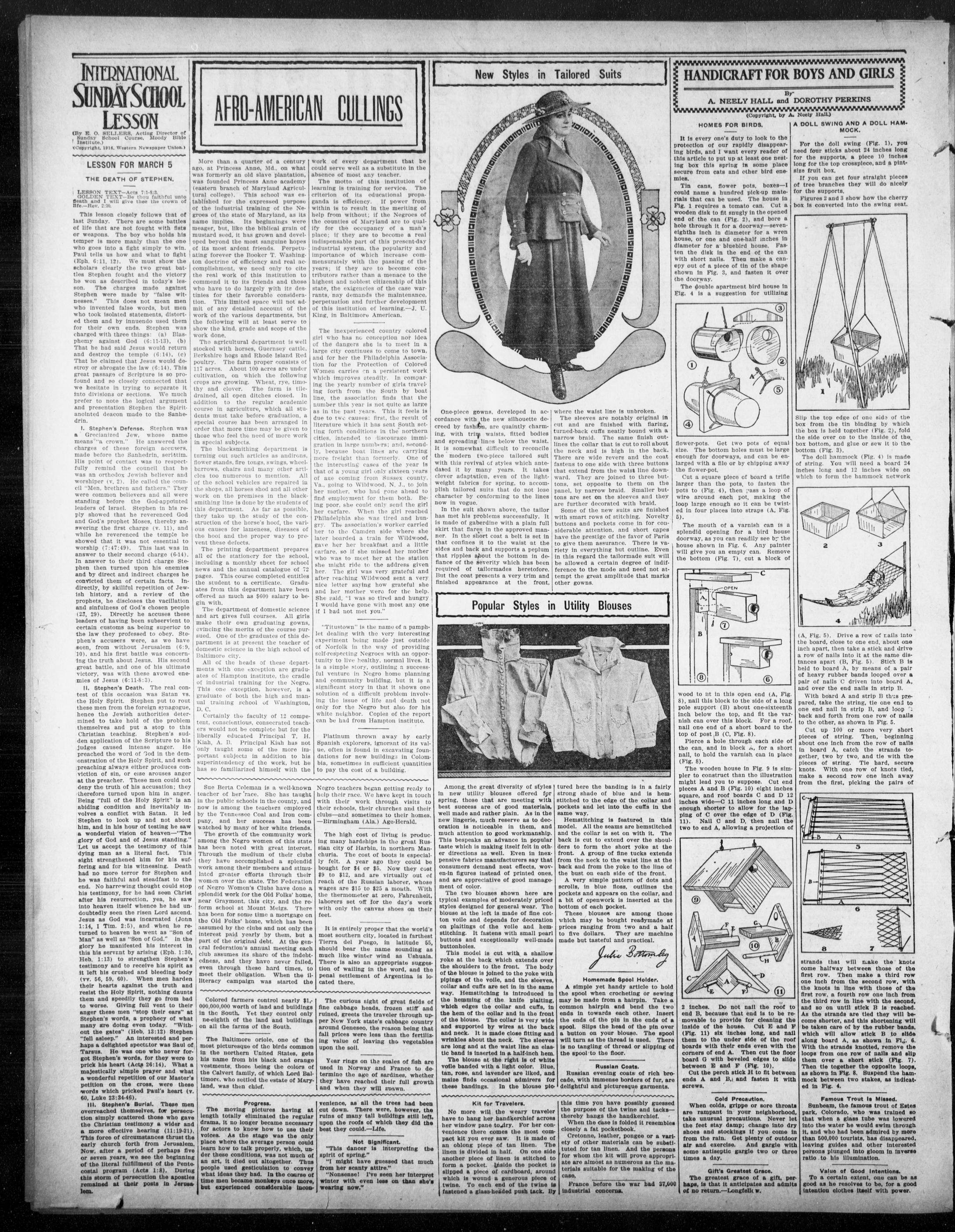
This lesson closely follows that of last Sunday. There are some battles of life that are not fought with fists or weapons. The boy who holds his temper is more manly than the one who goes into a fight simply to win. Paul tells us how and what to fight (Eph. 6:11, 12). We must show the scholars clearly the two great battles Stephen fought and the victory he was as described in today's lesson. The charges made against Stephen were made by (a "false witnesses." This does not mean men who invented false words, but men who took isolated statements, distorted them and by innuendo used them for their own ends. Stephen was charged with three things: (a) Blasphemy against God (6:11-13), (b) That he had said Jesus would return and destroy the temple (6:14), (c) That he claimed that Jesus would destroy or abrogate the law (6:14). This great passage of Scripture is so profound and so closely connected that we hesitate in trying to separate it into divisions or sections. We much prefer to note the logical argument and presentation Stephen the Spirit anointed deacon made to the Sanhe drin.
1. Stephen's Defense. Stephen was a Grecian Jew, whose name means "a crown." He answered the charges of these foreign accusers, made before the Sanhedrin, seriatim. His point of contact was to respectfully remind the council that he was an orthodox Jewish believer and worshiper (v. 2). He called the council "Men, brethren and fathers." They were common believers and all were standing before the God-appointed leaders of Israel. Stephen in his reply showed that he reverenced God and God's prophet Moses, thereby answering the first charge (v. 11), and while he reverenced the temple he showed that it was not essential to worship (7:47:49). This last was in answer to their second charge (6:14). In answer to their third charge Stephen then turned upon his enemies and by direct and indirect charges he convicted them of certain facts. Indirectly, by skillful repetition of Jewish history, and a review of the prophets, he discloses the vacillation and sinfulness of God's chosen people (23, 29). Directly he accuses these leaders of having been subservient to certain customs as being superior to the law they professed to obey. Stephen's accusers were, as we have seen, from without Jerusalem (6:9 10), and his first battle was concerning the truth about Jesus. His second great battle, and one of his ultimate victory, was with these avowed enemies of Jesus (6:11-8:3).
11. Stephen's Death. The real contest of this occasion was Satan vs. the Holy Spirit. Stephen put to rout these men from the foreign synagogue, hence the Jewish authorities determined to take hold of the problem themselves and put a stop to this Christian teaching. Stephen's sudden application of the Scripture to his judges caused intense anger. He preached the word of God in the demonstration of the Holy Spirit, and such preaching always either produces conviction of sin, or else arouses anger at the preacher. These men could not deny the truth of his accusation; they therefore turned upon him in anger. Being "full of the Holy Spirit" is an abiding condition and inevitably involves a conflict with Satan. It led Stephen to look up and not about him, and in his hour of testing he saw a wonderful vision of heaven—"The glory of God and of Jesus standing." Let us accept the testimony of this dying man as a literal fact. This sight strengthened him for his suffering and his witnessing. Death had no more terror for Stephen and he was faithful and steadfast to the end. No harrowing thought could stop his testimony, for he had seen Christ after his resurrection, ye, he saw into heaven itself whence he had doubtedly seen the risen Lord ascend. Jesus as God was incarnated (Jonn 1:14, I Tim 2:5), and when he returned to heaven he went as "Son of God" as well as "Son of God." In the glory he manifested his interest in this his servant by arising (Eph. 1:30, Heb. 1:13) to strengthen Stephen's testimony and to receive his spirit as it left his crushed and bleeding body (vv. 56, 59, 60). When men harden their hearts against the truth and resist the Holy Spirit, nothing daunts them and speedily they go from bad to worse. Giving full vent to their anger these men "stop their ears" at Stephen's words, a prophecy of what many are doing even today. "With out the gates" (Heb. 13:12) Stephen "fell asleep." An interest and per haps a delighted spectator was Saul of Tarsus. He was one who never for got Stephen's words, for they were to prick his heart (Acts 26:14). What a majestically simple prayer and a wonderful repetition of our Master's petition on the cross, were these words which pricked Paul's heart (v60, Luke 23:34-46).
III. Stephen's Burial. These men overreached themselves, for persecution simply scattered those who gave the Christian testimony a wider and a more effective hearing (11:19-21). This force of circumstances thrust the early church forth from Jerusalem. Now, after a period of perhaps five or seven years, we see the beginning of the literal fulfillment of the Pentecostal program (Acts 1:8). During this storm of persecution the apostles remained at their posts in Jerusalem.
AFRO-AMERICAN CULLINGS
---
More than a quarter of a century ago, at Princess Anne, Md., on what was formerly an old slave plantation, was founded Princess Anne academy (eastern branch of Maryland Agricultural college). This school was established for the expressed purpose of the industrial training of the Negroes of the state of Maryland, as its name implies. Its beginnings were meager, but, like the biblical grain of mustard seed, it has grown and developed beyond the most sanguine hopes of its most ardent friends. Perpetuating forever the Booker T. Washington doctrine of efficiency and real accomplishment, we need only to cite the real work of this institution to commend it to its friends and those who have to do largely with its destinies for their favorable consideration. This limited space will not admit of any detailed account of the work of the various departments, but the following will at least serve to show the kind, grade and scope of the work done.
The agricultural department is well stocked with horses, Guernsey cattle, Berkshire hogs and Rhode Island Red poultry. The farm proper consists of 117 acres. About 100 acres are under cultivation, on which the following crops are growing. Wheat, rye, timothy and clover. The farm is tiled drained, all open ditches closed. In addition to the regular academic course in agriculture, which all students must take before graduation, a special course has been arranged in order that more time may be given to those who feel the need of more work in special subjects.
The blacksmithing department is turning out such articles as andirons, flower stands, fire tongs, swings, wheelbarrows, chairs and many other articles too numerous to mention. All of the school vehicles are repaired in the shops, all horses shod and all other work on the premises in the blacksmithing line is done by the students of this department. As far as possible, they take up the study of the construction of the horse's hoof, the various causes for lameness, diseases of the hoof and the proper way to prevent these defects.
The printing department prepares all of the stationery for the school, including a monthly sheet for school news and the annual catalogue of 72 pages. This course completed entitles the student to a certificate. Graduates from this department have been offered as much as $600 salary to begin with.
The department of domestic science and art gives full courses. All girls make their own graduating gowns, evincing the merits of the course pursued. One of the graduates of this department is at present the teacher of domestic science in the high school of Baltimore city. All of the heads of these departments with one exception are graduates of Hampton institute, the cradle of industrial training for the Negro. This one exception, however, is a graduate of both the high and manual training school of Washington, D. C. Certainly the faculty of 12 competent, conscientious, consecrated teachers would not be complete but for the liberally educated Principal T. H. Kiah, A. B. Principal Kiah has not only taught some of the more important subjects in addition to his superintendency of the work, but he has so familiarized himself with the
Sue Berta Coleman is a well-known teacher of her trace. She has taught in the public schools in the county, and now is among the teachers employed by the Tennessee Coal and Iron company, and her success has been watched by many of her white friends. The growth of the community work among the Negro women of this state has been noted with great interest. Through the medium of their clubs they have accomplished a splendid work among their members and stimulated greater efforts through their women over the state. The Federation of Negro Women's Clubs have done a splendid work for the Old Folks' home, near Graymont, this city, and the reform school at Mount Meigs. There has been for some time a mortgage on the Old Folks' home, which has been assumed by the clubs and not only the interest paid yearly by them, but a part of the original debt. At the general federation's annual meeting each club assumes its share of the indebtedness, and they have never failed, even through these hard times, to meet their obligation. When the illiteracy campaign was started the
Colored farmers control nearly $1,000,000,000 worth of land and buildings in the South. Yet they control only neighthigh of the land and buildings on all the farms of the South.
The Baltimore oriole, one of the most picturesque of the birds common in the northern United States, gets his name from his black and orange vestments, those being the colors of the Calvert family, of which Lord Baltimore, who settled the estate of Maryland, was then chief.
Progress.
The moving pictures having at length totally eliminated the regular drama, it no longer became necessary for actors to know how to use their voices. As the stage was the only place where the average person could learn how to talk properly, which, under these conditions, was not much of an art, it died out altogether. Thus people used gesticulation to convey what ideas they had. In the course of time men became monkeys once more, but experienced considerable incom-
work of every department that he could serve well as a substitute in the absence of most any teacher. The motto of this institution of learning is training for service. The criterion of its educational propaganda is efficiency. If power from within is to result in the meriting of help from without; if the Negroes of the counties of Maryland are to qualify for the occupancy of a man's place; if they are to become a real indispensable part of this present-day industrial system, the popularity and importance of which increase commensurately with the passing of the years; if they are to become contributors rather than a menace to the highest and noblest citizenship of this state, the exigencies of the case warrants, nay demands the maintenance, perpetuation and further development of this institution of learning—J. U. King, in Baltimore American.
The inexperienced country colored girl who has no conception nor idea of the dangers she is to meet in a large city continues to come to town, and for her the Philadelphia Association for the Protection of Colored Women carries in a persistent work which improves steadily. In comparing the yearly number of girls traveling forth from the South by boat line, the association finds that the number this year is not quite as large as in the past years. This it feels is due to two causes: first, the result of literature which it has sent South setting forth conditions in the northern cities, intended to discourage immigration in large numbers; and, secondly, because boat lines are carrying more freight than formerly. One of the interesting cases of the year is that of a young girl only sixteen years of age coming from Sussex county, Va., going to Wildwood, N. J., to join her mother, who had gone ahead to find employment for them both. Being poor, she could only send the girl her carfare. When the girl reached Philadelphia she was tired and hungry. The association's worker carried her to the Camden side where she later boarded a train for Wildwood, gave her her breakfast and a little carfare, so if she missed her mother who was to meet her at the station she might ride to the address given her. The girl was very grateful and after reaching Wildwood sent a very nice letter saying how grateful she and her mother were for the help She said, "I was so tired and hungry I would have gone with most any one if I had not met you."
"Titustown" is the name of a pamphlet dealing with the very interesting experiment being made just outside of Norfolk in the way of providing self-respecting Negroes with an opportunity to live healthy, normal lives. It is a simple story, outlining a successful venture in Negro home planning and community building, but it is a significant story in that it shows one solution of a difficult problem involving the issue of life and death not only for the Negro but also for his white neighbor. Copies of the report can be had from Hampton institute.
Platinum thrown away by early Spanish explorers, ignorant of its value, often is found in excavating foundations for new buildings in Colombia, sometimes in sufficient quantities to pay the cost of a building.
Negro teachers began getting ready to help their race. We have kept in touch with their work through visits to their schools, their churches and their clubs—and sometimes to their homes. —Birmingham (Ala.) Age-Herald.
The high cost of living is producing many hardships in the great Russian city of Harbin, in northern Manchuria. The cost of boots is especially felt. A year ago they could be bought for $4 or $5. Now they cost $9 to $12, and are virtually out of reach of the Russian laborer, whose wages are $15 to $25 a month. With the thermometer at zero, Fahrenheit, laborers set off for the day's work with only the canvas shoes on their feet.
It is entirely proper that the world's most southern city, located in farthest Tierra del Fuego, in latitude 55, should bear the name sounding as much like winter wind as Ushuaia. There is also an appropriate suggestion of wailing in the word, and the penal settlement of Argentina is located there.
The curious sight of great fields of fine cabbage heads, frozen stiff and ruined, greets the traveler through upper New York state's cabbage country around Geneseo, the reason being that fall prices were less than the fertilizing value of leaving the vegetables upon the soil.
Year rings on the scales of fish are used in Norway and France to determine the age of sardines, whether they have reached their full growth and when they will swain.
venience, as all the trees had been cut down. There were, however, the ruins of many tall buildings still left, upon the roofs of which they did the best they could.—Life.
Not Significant.
"This dancer is interpreting the spirit of spring."
"I might have guessed that much from her scanty attire."
"Nonsense! I've seen her interpret winter with even less on than she's wearing now."
J
Popular Styles in Utility Blouses
One-piece gowns, developed in accordance with the new silhouette decreed by fashion, are quaintly charming, with trim waists, fitted bodies and spreading lines below the waist. It is somewhat difficult to reconcile the modern two-piece tailored suit with this revival of styles which anteceded it by many years. It takes clever adaptation, even of the light weight fabrics for spring, to accomplish tailored suits that do not lose character by conforming to the lines now in vogue.
In the suit shown above, the tailor has met his problems successfully. It is made of gaberdine with a plain full skirt that flares in the approved manner. In the short coat a belt is set in that confines it to the waist at the sides and back and supports a peplum that ripples about the bottom in defiance of the severity which has been required of tailormades heretofore. But the coat presents a very trim and finished appearance at the front,
Popular Styles in
Among the great diversity of styles in new utility blouses offered for spring, those that are meeting with best success are of good materials, well made and rather plain. As in the new lingerie, much reserve as to decoration is noticeable in them, and much attention to good workmanship. This bespeaks an advance in popular taste which is making itself felt in other directions as well. Even in inexpensive fabrics manufacturers say that consumers demand neat effects, woven-in figures instead of printed ones, and are appreciative of good management of color.
The two blouses shown here are typical examples of moderately priced styles designed for general wear. The blouse at the left is made of fine cotton voile and depends for decoration on plaitings of the voile and hem-stitching. It fastens with small pearl buttons and exceptionally well-made buttonholes.
This model is cut with a shallow yoke at the back which extends over the shoulders to the front. The body of the blouse is joined to the yoke with pipings of the volle, and the sleeves, collar and cuffs are set in in the same way. Hemstitching is introduced in the hemming of the knife plaiting, which edges the collar and cuffs, in the hem of the collar and in the front of the blouse. The collar is very wide and supported by wires at the back and neck. It is made close fitting and wrinkles about the neck. The sleeves are long and at the waist line an elastic band is inserted in a half-inch hem. The blouse at the right is of white volle banded with a light color. Blue, tan, rose, and lavender are liked, and maize finds occasional admirers for these bandings. In the blouse plo-
Kit for Travelers.
No more will the weary traveler have to hang her handkerchief across her window pane to dry. For her convenience there comes the most compact kit you ever saw. It is made of an oblong piece of tan linen. The linen is divided in half. On one side another piece of linen is stitched to form a pocket. Inside the pocket is slipped a piece of cardboard, around which is wound a generous piece of twine. To each end of the twine is fastened a glass-headed push tack. By
where the waist line is unbroken.
The sleeves are notably original in cut and are finished with flaring, turned-back cuffs neatly bound with a narrow braid. The same finish outlines the collar that is cut to roll about the neck and is high in the back. There are wide revers and the coat fastens to one side with three buttons that extend from the waist line downward. They are joined to three buttons, set opposite to them on the panel, by narrow braid. Smaller buttons are set on the sleeves and they are further decorated with braid.
Some of the new suits are finished with smart rows of stitching. Novelty buttons and pockets come in for considerable attention, and short capes have the prestige of the favor of Paris to give them assurance. There is variety in everything but outline. Even in this regard the tailormade suit will be allowed a certain degree of indifference to the mode and need not attempt the great amplitude that marks other gowns.
n Utility Blouses
tured here the banding is in a fairly strong shade of blue and is hemstitched to the edge of the collar and pockets and let into the cuffs in the same way.
Hemstitching is featured in this model. All the seams are hemstitched and the collar is set on with it. The back is cut to extend over the shoulders to form the short yoke at the front. A group of fine tucks extends from the neck to the waist line at the back and from the yoke to the line of the bust on each side of the front.
A very simple pattern of dots and scrolls, in blue floss, outlines the pockets and appears on the collar, and a bit of openwork is inserted at the bottom of each pocket.
These blouses are among those which may be bought readymade at prices ranging from two and a half to five dollars. They are machine made but tasteful and practical.
Julie Bottomley
Homemade Spool Holder.
A simple yet handy article to hold the spool when crocheting or sewing may be made from a hairpin. Take a common hairpin and bend the two ends in towards each other. Insert the ends of the pin in the ends of a spool. Slips the head of the pin over a button on your blouse. The spool will turn as the thread is used. There is no tangling of thread or slipping of the spool to the floor.
Russian Coats.
Russian evening coats of rich brocade, with immense borders of fur, are delightful and picturesque garments.
this time you have possibly guessed the purpose of the twine and tacks—thereby hangs the handkerchief.
When the case is folded it resembles closely a fat pocketbook.
Cretonne, leather, pongee or a variety of other materials can be substituted for tan linen. And the persons for whom the kit will prove appropriate are almost as numerous as the materials suitable for the making of the case.
France before the war had 37,000 industrial concerns.
HANDICRAFT FOR BOYS AND GIRLS
A. NEELY HALL and DOROTHY PERRAINS
www.neelyhall.com
(Copyright by A. Neely Hall)
HOMES FOR BIRDS.
It is every one's duty to look to the protection of our rapidly disappearing birds, and I want every reader of this article to put up at least one nesting box this spring in some place secure from cats and other bird enemies.
Tin cans, flower pots, boxes—I could name a hundred pick-up materials that can be used. The house in Fig. 1 requires a tomato can. Cut a wooden disk to fit smugly in the opened end of the can (Fig. 2), and bore a hole through it for a doorway—seven-eighths inch in diameter for a wren house, or one and one-half inches in diameter for a bluebird house. Fasten the disk in the end of the can with short nails. Then make a canopy out of a piece of tin of the shape shown in Fig. 3, and fasten it over the doorway.
The double apartment bird house in Fig. 4 is a suggestion for utilizing
flower-pots. Get two pots of equal size. The bottom holes must be large enough for doorways, and can be enlarged with a file or by chipping away the flower-pot.
Cut a square piece of board a trifle larger than the pots, to fasten the pots to (Fig. 4), then pass a loop of wire around each pot, making the loop large enough so it can be twisted in four places into straps (A, Fig. 6).
The mouth of a varnish can is a splendid opening for a bird house doorway, as you can readily see by the house shown in Fig. 6. Any painter will give you an empty can. Remove the bottom (Fig. 7), cut a block of
wood to it in this open end (A, Fig. 8), nail this block to the side of a long pole support (B) about one-sixteenth inch below the top, and fit the var nish can over this block. For a roof nail one end of a short board to the top of post B (C, Fig. 8).
Pierce a hole through each side of the can, and in block A, for a short nail, to hold the varnish can in place (Fig. 8).
The wooden house in Fig. 9 is simpler to construct than the illustration might lead you to suppose. Cut end pieces A and B (Fig. 10) eight inches square, and roof boards C and D 12 inches wide—C 11 inches long and D enough shorter to allow for the lapping of C over the edge of D (Fig. 11). Nail C and D, then nail the two to end A, allowing a projection of
$\textcircled{9}$
$\textcircled{10}$
$\textcircled{11}$
2 inches. Do not nail the roof to end B, because that end is to be removable to provide for cleaning the inside of the house. Cut E and F (Fig. 11) six inches long, and nail them to the under side of the roof boards with their ends even with the corners of end A. Then cut the floor board G with beveled edges to slide between E and F (Fig. 10). Cut the perch stick H to fit between ends A and B, and fasten it with screws.
Cold Precaution.
When colds, gripie or sore throats are rampant in your neighborhood, take unusual precautions. Never let the feet stay damp; change into dry shoes and stockings if you come in from the rain. Get plenty of outdoor air and exercise. And gargle with some antiseptic gargle two or three times a day.
Gift's Greatest Grace
The greatest grace of a gift, perhaps, is that it anticipates and admits of no return.—Longfelt w.
A DOLL SWING AND A DOLL HAM-MOCK.
For the doll swing (Fig. 1), you need four sticks about 24 inches long for the supports, a piece 10 inches long for the top crosspiece, and a pint-size fruit box.
If you can get four straight pieces of tree branches they will do nicely for the supports.
Figures 2 and 3 show how the cherry box is converted into the swing seat.
X
Slip the top edge of one side of the box from the tin binding by which the box is held together (Fig. 2), fold the side over on to the inside of the box bottom, and glue or sew it to the bottom (Fig. 3).
The doll hammock (Fig. 4) is made of string. You will need a board 24 inches long and 12 inches wide on which to form the hammock network
2 3
4
(A, Fig. 5). Drive a row of nails into the board, close to one end, about one inch apart, then take a stick and drive a row of nails into it at the same distances apart (B, Fig. 5). Stick B is held to board A, by means of a pair of heavy rubber bands looped over a pair of nails C driven into board A, and over the end nails in strip B.
With board A and strip B thus prepared, take the string, the one end to one end nail in strip B, and loop back and forth from one row of nails to the other, as shown in Fig. 5.
Cut up 100 or more very short pieces of string. Then, beginning about one inch from the row of nails in board A, catch the strands together, two by two, and tie with the pieces of string. Tie hard, secure knots. With one row of knots tied, make a second row one inch away from the first, picking the pairs of
5
6
8 7
strands that will make the knots come halfway between those of the first row. Then make a third row one inch from the second row, with the knots in line with those of the first row, a fourth row one inch from the third row in line with the second, and so on until stick B is reached. As the strands are tied they will become shorter, and this shortening will be taken care of by the rubber bands, which will allow stick B to slide along board A, as shown in Fig. 6. With the strands knotted, remove the loops from one row of nails and slip them over a short stick (Fig. 7). Then tie together the opposite loops, as shown in Fig. 8. Suspend the hammock between two stakes, as indicated in Fig. 4.
Famous Trout Is Missed
Sunbeam, the famous trout of Estes park, Colorado, who was trained so that when a glass tube was lowered into the water he would swim through it, and who had been admired by more than 500,000 tourists, has disappeared, leaving guides and other interested persons plunged into gloom in inverse ratio to his illumination.
Value of Good Intentions.
To a certain extent, one can be as good as he resolves to be, for a good intention clothes itself with power.
LOSE 1,400 MEN
OUT OF 1,500 IN
ONE BATTALION
British Force Is Almost Completely Annihilated in Battle in France.
CORPORAL TELLS THE STORY
English Gunners Alm Badly, Dropping Shells in Comrades' Trenches, Which Become So Filled With Dead That Retirement Is All but Impossible.
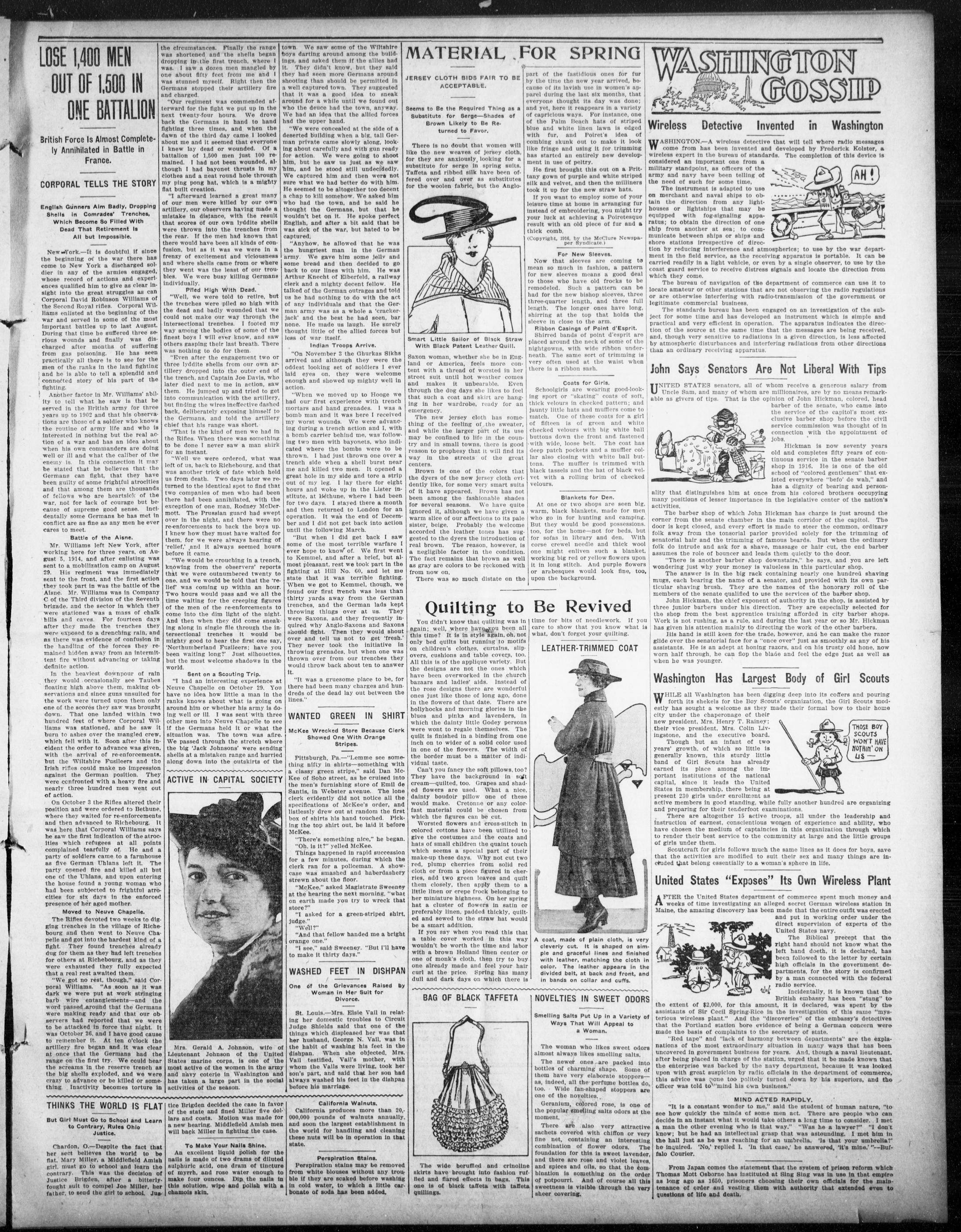
New York.—It is doubtful if since the beginning of the war there has come to New York a discharged soldier in any of the armies engaged, whose record of actions and experiences qualified him to give as clear insight into the great struggles as can Corporal David Robinson Williams of the Second Royal rifles. Corporal Williams enlisted at the beginning of the war and served in some of the most important battles up to last August. During that time he suffered three serious wounds and finally was discharged after months of suffering from gas poisoning. He has seen practically all there is to see for the men of the ranks in the land fighting and he is able to tell a splendid and connected story of his part of the fighting.
Another factor in Mr. Williams' ability to tell what he saw is that he served in the British army for three years up to 1902 and that his observations are those of a soldier who knows the routine of army life and who is interested in nothing but the real action of a war and has an idea about when his own commanders are doing well or ill and what the caliber of the enemy is. In this connection it may be stated that he believes that the Germans can fight, that they have been guilty of some frightful atrocities and that among them are thousands of fellows who are heartsick of the war, not for lack of courage but because of supreme good sense. Incidentally some Germans he has met in conflict are as fine as any men he ever cares to meet.
Battle of the Aisne.
Mr. Williams left New York, after working here for three years, on August 5, 1914, and after enlisting was sent to a mobilization camp on August 29. His regiment was immediately sent to the front, and the first action they took part in was the battle of the Alsne. Mr. Williams was in Company C of the Third division of the Seventh brigade, and the sector in which they were stationed was a mass of chalk hills and caves. For fourteen days after they made the trenches they were exposed to a drenching rain, and as there was evidence of confusion in the handling of the forces they remained hidden away from an intermittent fire without advancing or taking definite action.
In the heaviest downpour of rain they would occasionally see Taubes floating high above them, making observations and since guns unsuited for the work were turned upon them only one of the scores they saw was brought down. That one landed within two hundred feet of where Corporal Williams was stationed, and he saw it burn to ashes over the mangled crew, which fell with it. Soon after this incident the order to advance was given, with the arrival of re-enforcements, but the Wiltshire Fusileers and the Irish rifles could make no impression against the German position. They were confronted with a heavy fire and nearly three hundred men went out of action.
On October 3 the Rifles altered their position and were ordered to Bethune, where they waited for re-enforcements and then advanced to Richebourg. It was here that Corporal Williams says he saw the first indication of the atrocities which refugees at all points complained tearfully of. He and a party of soldiers came to a farmhouse as five German Uhlans left it. The party opened fire and killed all but one of the Uhlans, and upon entering the house found a young woman who had been subjected to frightful atrocities for six days in the enforced presence of her aged mother.
Moved to Neuve Chapelle.
The Rifles devoted two weeks to digging trenches in the village of Richebourg and then went to Neuve Chapelle and got into the hardest kind of a fight. They found trenches already dug for them as they had left trenches for others at Richebourg, and as they were exhausted they fully expected that a real rest awaited them.
"We got no rest, though," said Corporal Williams. "As soon as it was dark we were put at work stringing barb wire entanglements—and the word passed around that the Germans were making ready and that our observers had reported that we were to be attacked in force that night. It was October 26, and I have good cause to remember it. At ten o'clock the artillery fire began and it was clear at once that the Germans had the range on the first try. We could hear the screams in the reserve trench as the big shells exploded, and we were crazy to advance or be killed or something Inactivity becomes torture in
But Girl Must Go to School and Learn to Contrary, Rules Ohio Justice.
Chardon, O.—Despite the fact that her sect believes the world to be flat, Mary Miller, a Middlefield Amish girl, must go to school and learn the contrary. This was the decision of Justice Bridgen, after a bitterly-fought suit to compel Joe Miller, her father, to send the girl to school, Ju-
the circumstances. Finally the range was shortened and the shells began dropping in the first trench, where I was. I saw a dozen men mangled by one about fifty feet from me and I was stunned myself. Right then the Germans stopped their artillery fire and charged.
"Our regiment was commended afterward for the fight we put up in the next twenty-four hours. We drove back the Germans in hand to hand fighting three times, and when the dawn of the third day came I looked about me and it seemed that everyone I knew lay dead or wounded. Of a battalion of 1,500 men just 100 remained. I had not been wounded, although I had bayonet thrusts in my clothes and a neat round hole through my ping pong hat, which is a mighty flat built creation.
"I afterward learned a great many of our men were killed by our own artillery, our observers having made a mistake in distance, with the result that scores of our own lydite shells were thrown into the trenches from the rear. If the men had known that there would have been all kinds of confusion, but as it was we were in a frenzy of excitement and viciousness and where shells came from or where they went was the least of our troubles. We were busy killing Germans individually.
Piled High With Dead.
"Well, we were told to retire, but the trenches were piled so high with the dead and badly wounded that we could not make our way through the intersectional trenches. I footed my way among the bodies of some of the finest boys I will ever know, and saw others gasping their last breath. There was nothing to do for them.
"Even after the engagement two or three lyddite shells from our own artillery dropped into the outer end of the trench, and Captain Joe Davis, who later died next to me in action, saw them. He jumped up and tried to get into communication with the artillery, but finding the wires ineffective dashed back, deliberately exposing himself to the Germans, and told the artillery chief that his range was short.
"That is the kind of men we had in the Rifles. When there was something to be done I never saw a man shirk for an instant.
"Well we were ordered, what was left of us, back to Richebourg, and that was another trick of fate which held us from death. Two days later we returned to the identical spot to find that two companies of men who had been there had been annihilated, with the exception of one man, Rodney McDermott. The Prussian guard had swept over in the night, and there were no re-enforcements to back the boys up. I knew how they must have waited for them, for we were always hearing of 'relief', and it always seemed hours before it came.
"We would be crouching in a trench, knowing from the observers' reports that we were outnumbered twenty to one, and we would be told that the 'relief' was coming up within an hour. Two hours would pass and we all the time waiting for the creeping figures of the men of the re-enforcements to come into the dim light of the night. And then when they did come sneaking along in single file through the intersection trenches it would be mighty good to hear the first one say, 'Northumberland Fusileers; have you been waiting long?' Just silhouettes, but the most welcome shadows in the world.
Sent on a Scouting Trip.
"I had an interesting experience at Neuve Chapelle on October 29. You have no idea how little a man in the ranks knows about what is going on around him or whether his army is doing well or ill. I was sent with three other men into Neuve Chapelle to see if the Germans held it or what the situation was. The town was afire. We passed through the stretch where the big 'Jack Johnsons' were sending shells at a mistaken range and hurried along down into the outskirts of the
ACTIVE IN CAPITAL SOCIETY
Mary
Mrs. Gerald A. Johnson, wife of Lieutenant Johnson of the United States marine corps, is one of the most active of the women in the army and navy coterie in Washington and has taken a large part in the social activities of the season.
tice Brigden decided the case in favor of the state and fined Miller five dollars and costs. Motion was made for a new hearing. Middlefield Amish men will back Miller in fighting the case.
To Make Your Nails Shine.
An excellent liquid polish for the nails is made of two drams of diluted sulphuric acid, one dram of tincture of myrth, and rose water enough to make four ounces. Dip the nails in this solution, wipe and polish with a chamois skin.
town. We saw some of the Wiltshire boys darting around among the buildings, and asked them if the allies had it. They didn't know, but they said they had seen more Germans around shooting than should be permitted in a well captured town. They suggested that it was a good idea to sneak around for a while until we found out who the deuce had the town, anyway. We had an idea that the allied forces had the upper hand.
"We were concealed at the side of a deserted building when a big, tall German private came slowly along, looking about carefully and with gun ready for action. We were going to shoot him, but he saw us just as we saw him, and he stood still undecidedly. We captured him and then were not sure what we had better do with him. He seemed to be altogether too decent a chap to kill somehow. We asked him who had the town, and he said he thought the Germans, but that he wouldn't bet on it. He spoke perfect English, and after a bit said that he was sick of the war, but hated to be captured.
"Anyhow, he allowed that he was the hungriest man in the German army. We gave him some jelly and some bread and then decided to go back to our lines with him. He was Arthur Knecht of Elberfeld, a railway clerk and a mighty decent fellow. He talked of the German outrages and told us he had nothing to do with the act of any individuals and that the German army was as a whole a 'cracker-jack' and the best he had seen, bar none. He made us laugh. He surely thought little of the allied forces but less of war itself.
Indian Troops Arrive.
"On November 3 the Ghurkas Sikhs arrived and although they were the oddest looking set of soldiers I ever laid eyes on, they were welcome enough and showed up mighty well in action.
"When we moved up to Hooge we had our first experience with trench mortars and hand grenades. I was a bomb man and it was here I received my worst wounds. We were advancing during a trench action and I, with a bomb carrier behind me, was following two men with bayonets, who indicated where the bombs were to be thrown. I had just thrown one over a trench side when a shell burst near me and killed two men. It opened a great hole in my side and tore a strip out of my leg. I lay there for eight hours and woke up in the Lister institute, at Bethune, where I had been for two days. I stayed there a month and then returned to London for an operation. It was the end of December and I did not get back into action until the following March.
"But when I did get back I saw some of the most terrible warfare I ever hope to know of. We first went to Kemmel, and after a brief, but almost pleasant, rest we took part in the fighting at Hill No. 60, and let me state that it was terrible fighting. When we got to Kemmel, though, we found our first trench was less than thirty yards away from the German trenches, and the German lads kept throwing things over at us. They were Saxons, and they frequently inquired why Anglo-Saxons and Saxons should fight. Then they would shout over and tell us not to get 'fresh'. They never took the initiative in throwing grenades, but when one was thrown over from our trenches they would throw back about ten to answer it.
"It was a gruesome place to be, for there had been many charges and hundreds of the dead lay out between the lines."
WANTED GREEN IN SHIRT
McKee Wrecked Store Because Clerk
Showed One With Orange
Stripes.
Pittsburgh, Pa.—"Lemme see something nifty in shirts—something with a classy green stripe," said Dan McKee of Soho street, as he cruised into the men's furnishing store of Emil de Santis, in Webster avenue. The lone clerk evidently did not notice all the specifications of McKee's order, and listlessly drew out at random the first box of shirts his hand touched. Pickling the top shirt out, he laid it before McKee.
"There's something nice," he began.
"Oh, is it?" yelled McKee.
Things happened in rapid succession for a few minutes, during which the clerk ran for a policeman. A showcase was smashed and haberdashery strewn about the floor.
"McKee," asked Magistrate Sweeney at the hearing the next morning, "what on earth made you try to wreck that store?" "I asked for a green-striped shirt, judge." "Well?" "And that fellow handed me a bright orange one." "I see," said Sweeney. "But I'll have to make it thirty days."
WASHED FEET IN DISHPAN
One of the Grievances Raised by Woman in Her Suit for Divorce.
St. Louis.—Mrs. Elsie Vall in relating her domestic troubles to Circuit Judge Shields said that one of the things which displeased her was that her husband, George N. Vall, was in the habit of washing his feet in the dishpan. When she objected, Mrs. Vall testified. Vall's mother, with whom the Valls were living, took her son's part, and said that her son had always washed his feet in the dishpan before his marriage.
California produces more than 20,000,000 pounds of walnuts annually, and soon the largest establishment in the world for handling and cleaning these nuts will be in operation in that state.
Perspiration Stains
Perspiration stains may be removed from white blouses without any trouble if they are scaked before washing in cold water, to which a little carbonate of soda has been added.
MATERIAL FOR SPRING
Quilting to Be Revived
JERSEY CLOTH BIDS FAIR TO BE
ACCEPTABLE.
Seems to Be the Required Thing as a Substitute for Serge—Shades of Brown Likely to Be Returned to Favor.
There is no doubt that women will like the new weaves of jersey cloth, for they are anxiously, looking for a substitute for serge in spring suits, Taffeta and ribbed silk have been offered over and over as substitutes for the woolen fabric, but the Anglo-
Smart Little Sailor of Black Straw With Black Patent Leather Quill.
Saxon woman, whether she be in England or America, feels more content with a thread of worsted in her street suit until hot weather comes and makes it unbearable. Even through the dog days she likes to feel that such a coat and skirt are hanging in her wardrobe, ready for an emergency. The new jersey cloth has something of the feeling of the sweater, and while the larger part of its use may be confined to life in the country and in small towns, there is good reason to prophesy that it will find its way in the streets of the great centers.
Brown is one of the colors that the dyers of the new jersey cloth evidently like, for some very smart suits of it have appeared. Brown has not been among the fashionable shades for several seasons. We have quite ignored it, although we have given a warm slice of our affections to its pale sister, beige. Probably the welcome accorded the leather tones has suggested to the dyers the introduction of real brown. The reason, however, is a negligible factor in the condition. The fact remains that brown as well as gray are colors to be reckoned with from now on. There was so much distate on the
You didn't know that quilting was in again; well, where have you been all this time? It is in style again, oh, not only bed quilts but running to motifs on children's clothes, curtains, slipovers, cushions and table covers, too. All this is of the appliqué variety. But the designs are not the ones which have been overworked in the church bazaars and ladies' aids. Instead of the rose designs there are wonderful ones just like those of long ago, done in the flowers of that date. There are hollyhocks and morning glories in the blues and pinks and lavenders, in which the dainty little Godey persons were wont to regale themselves. The quilt is finished in a binding from one inch on to wider of a solid color used in one of the flowers. The width of the border must be a matter of individual taste.
Can't you fancy the soft pillows, too? They have the background in soft cream—quilted, too. Grapes and shaded flowers are used. What a nice, dainty boudoir pillow one of these would make. Cretonne or any colorfast material could be chosen from which the figures can be cut. Worsted flowers and cross-stitch in colored cottons have been utilized to give the costumes and the coats and hats of small children the quaint touch which seems a special part of their make-up these days. Why not cut two red, plump cherries from solid red cloth or from a piece figured in cherries, add two green leaves and quilt them closely, then apply them to a little linen or crepe frock belonging to her miniature highness. On her spring hat a cluster of flowers in satin or preferably linen, padded thickly, quilted and sewed to the straw hat would be a smart addition.
If you say when you read this that a table cover worked in this way wouldn't be worth the time and labor with a brown Holland linen center or one of monk's cloth, then try to buy one already made and feel your hair curl at the price. Spring has many dull and dark days on which there is
T
The wide beruffled and crinoline skirts have brought into fashion ruffled and flared effects in bags. This one is of black taffeta with taffeta quillings.
part of the fastidious ones for fur by the time the new year arrived, because of its lavish use in women's apparel during the last six months, that everyone thought its day was done; and yet, here it reappears in a variety of capricious ways. For instance, one of the Palm Beach hats of striped blue and white linen lawn is edged with fur, and Poiret's idea of combing skunk out to make it look like fringe and using it for trimming has started an entirely new development in use of peltry.
He first brought this out on a Prittany gown of purple and white striped silk and velvet, and then the milliners took it up for the new straw hats.
If you want to employ some of your leisure time at home in arranging fur instead of embroidering, you might try your luck at achieving a Poiretesque result with an old piece of fur and a thick comb.
(Copyright, 1915, by the McClure Newspaper Syndicate.)
For New Sleeves
Now that sleeves are coming to mean so much in fashion, a pattern for new sleeves means a good deal to those who have old frocks to be remodeled. Such a pattern can be bad for the new bishop sleeves, three three-quarter length, and three full length. The longer ones have long, shirring at the top that holds the sleeve in close to the arm.
Ribbon Casings of Point d'Esprit.
Shirred bands of point d'esprit are placed around the neck of some of the nightgowns, with wide ribbon underneath. The same sort of trimming is very often used at the waist when there is a ribbon sash.
Coats for Girls.
Schoolgirls are wearing good-looking sport or "skating" coats of soft, thick velours in checked pattern; and jaunty little hats and mufflers come to match. One of these coats for a girl of fifteen is of green and white checked velours with big white ball buttons down the front and fastened with wide, loose belt. The coat has deep patch pockets and a muffler collar also closing with white ball buttons. The muffler is trimmed with black tassels and the hat of black velvet with a rolling brim of checked velours.
Blankets for Den.
At one or two shops are seen big, warm, black blankets, made for men who go in for hunting and camping. But they would be good possessions. too, for the home—not for beds, but for sofas in library and den. With corse crewel needle and thick wool one might enliven such a blanket, working big red or yellow flowers upon it in long stitch. And purple flowers or arbesques would look fine, too, upon the background.
time for bits of needlework. If you care to show that you know what is what, don't forget your quilting.
M
A coat, made of plain cloth, is very cleverly cut. It is shaped on simple and graceful lines and finished with leather, matching the cloth in color. The leather appears in the divided belt, at back and front, and in bands on collar and cuffs.
Smelling Salts Put Up in a Variety of Ways That Will Appeal to a Woman.
The woman who likes sweet odors almost always likes smelling salts.
The newer ones are packed into bottles of charming shape. Some of them have very elaborate stoppers—as, indeed, all the perfume bottles do, too. Wide fan-shaped stoppers are one of the novelties.
Geranium, colored rose, is one of the popular smelling salts odors at the moment.
There are also very attractive sachets covered with chiffon or very fine net, containing an interesting combination of flower odors. The foundation for this is sweet lavender, and there are rose and violet leaves, and spices and oils, so that the combination is something on the order of potpourri. And of course all this sweetness is visible through the very sheer covering.
WASHINGTON GOSSIP
WASHINGTON.—A wireless detective that will tell where radio messages come from has been invented and developed by Frederick Kolster, a wireless expert in the bureau of standards. The completion of this device is considered an important one from a military standpoint, as officers of the army and navy have been telling of the need of such for some time.
The instrument is adapted to use on merchant and naval ships to obtain the direction from any lighthouses or lightships that may be equipped with fog-signaling apparatus; to obtain the direction of one ship from another at sea; to communicate between ships or ships and shore stations irrespective of direc-
tion by reducing interference and atmospherics; to use by the war department in the field service, as the receiving apparatus is portable. It can be carried readily in a light vehicle, or even by a single observer, to use by the coast guard service to receive distress signals and locate the direction from which they come.
tion by reducing interference and atmo-
ment in the field service, as the receiv-
carried readily in a light vehicle, or ever
coast guard service to receive distress
which they come.
The bureau of navigation of the de-
locate amateur or other stations that are
or are otherwise interfering with radio
legitimate commercial business.
The standards bureau has been eng
ject for some time and has developed
practical and very efficient in operation
of the source at the same time tha
and, though very sensitive to radiations
by atmospheric disturbances and interfe
than an ordinary receiving apparatus.
John Says Senators Are
UNITED STATES senators, all of wi
Uncle Sam, and many of whom are
able as givers of tips. That is the opi
face and atmospheres; to be the receiving apparatus vehicle, or even by a single active distress signals and locution of the department of observations that are not observing with radio-transmission灵敏ness, has been engaged on an instrument in operation. The apparatus same time that the messes to radiations in a given does and interfering radiation apparatus.
Tors Are Not Likers, all of whom receive of whom are millionaires, that is the opinion of John
The bureau of navigation of the department of commerce can use it to locate amateur or other stations that are not observing the radio regulations or are otherwise interfering with radio-transmission of the government or legitimate commercial business.
The standards bureau has been engaged on an investigation of the subject for some time and has developed an instrument which is simple and practical and very efficient in operation. The apparatus indicates the direction of the source at the same time that the messages are being received, and, though very sensitive to radiations in a given direction, is less affected by atmospheric disturbances and interfering radiations from other directions than an ordinary receiving apparatus.
John Says Senators Are Not Liberal With Tips
UNITED STATES senators, all of whom receive a generous salary from Uncle Sam, and many of whom are millionsaires, are by no means remarkable as givers of tips. That is the opinion of John Hickman, colored, head barber of the senate, who came into the service of the capitol's most exclusive barber shop before the civil service commission was thought of in connection with the appointment of jobs.
Hickman is now seventy years old and completes fifty years of continuous service in the senate barber shop in 1916. He is one of the old school of "colored gentlemen" that existed everywhere "befo' de wah," and
ality that distinguishes him at once many positions of lesser importance in activities.
The barber shop of which John His corner from the senate chamber in the door is kept closed, and every effort is folk away from the tonsorial parlor of senatorial hair and the trimming of a folk do intrude and ask for a shave, assumes the role of bouncer and leads.
"There is another barber shop do wondering just why your money is val.
The answer is in the big rack co mugs, each bearing the name of a sen ticular shaving brush. They are the members of the senate qualified to use.
John Hickman, the chief exponent of three junior barbers under his directi tshop from the best apprentice tr y Work is not rushing, as a rule, and du has given his attention mainly to directi t.
His hand is still keen for the trade glide over the senatorial face for a "one assistants. He is an adept at honing r worn half through, he can flop the bla when he was younger.
Washington Has Larges
WHILE all Washington has been dig forth its shekels for the Boy Scoutly has sought a welcome as they city under the chaperonage of their new president, Mrs. Henry T. Rainey; their vice president, Mrs. Colin Livingstone, and the executive board.
ality that distinguishes him at once from his colored brothers occupying many positions of lesser importance in the legislative center of the nation's activities.
him at once from his col- importance in the legislat- which John Hickman has c o chamber in the main corri- every effort is made to steer parlor parlor provided sole slimming of famous beards. for a shave, massage or a rer and leads them quietly ber shop downstairs," he money is valueless in this big rack containing near name of a senator, and pr they are the names of t alified to use the services ef exponent of authority ier his direction. They are apprentice training aff a rule, and during the last mainly to directing the work for the trade, however, an ace for a "once over" just at honing razors, and on flop the blade and feel Largest Body has been digging deep in the Boy Scouts' organiza- me as they made their fo- of their
The barber shop of which John Hickman has charge is just around the corner from the senate chamber in the main corridor of the capitol. The door is kept closed, and every effort is made to steer the common, ordinary folk away from the tonsorial parlor provided solely for the trimming of senatorial hair and the trimming of famous beards. But when the ordinary folk do intrude and ask for a shave, massage or hair cut, the end barber assumes the role of bouncer and leads them quietly to the door.
"There is another barber shop downstairs," he says, and you are left wondering just why your money is valueless in this particular shop.
The answer is in the big rack containing nearly one hundred shaving mugs, each bearing the name of a senator, and provided with its own particular shaving brush. They are the names of the honorary roll of the members of the senate qualified to use the services of the barber shop.
John Hickman, the chief exponent of authority in the shop, is assisted by three junior barbers under his direction. They are especially selected for the shop from the best apprentice training afforded in city barber shops. Work is not rushing, as a rule, and during the last year or so Mr. Hickman has given his attention mainly to directing the work of the other barbers.
His hand is still keen for the trade, however, and he can make the razor glide over the senatorial face for a "once over" just as smoothly as any of his assistants. He is an adept at honing razors, and on his trusty old hone, now worn half through, he can flop the blade and feel the edge just as well as when he was younger.
Washington Has Largest Body of Girl Scouts
WHILE all Washington has been digging deep into its coffers and pouring forth its shekels for the Boy Scouts' organization, the Girl Scouts modestly has sought a welcome as they made their formal bow to their home
Though but an infant of two years' growth, of which so little is generally known, this sturdy little band of Girl Scouts has already earned its place among the important institutions of the national capital, since it leads the United States in membership, there being at present 230 girls under enrollment as
active members in good standing, while and preparing for their tenderfoot exam. There are altogether 15 active instruction of earnest, conscientious have chosen the medium of captaincy to render their best service to the con of girls under them. Scoutcraft for girls follows much that the activities are modified to sucended that belong essentially to a work
United States "Exposes"
AFTER the United States department weeks of time investigating an all Maine, the amazing discovery has been
standing, while fully another
underdoor examinations.
or 15 active troops, all u
conscientious women of ex-
of captaincies in this orde
ce to the community at h
follows much the same line
modified to suit their sex
ally to a woman's sphere i
Exposes" Its Own
es department of commer-
ating an alleged secret O
very has been made that
active members in good standing, while fully another hundred are organizing and preparing for their tenderfoot examinations.
There are altogether 15 active troops, all under the leadership and instruction of earnest, conscientious women of experience and ability, who have chosen the medium of captaincies in this organization through which to render their best service to the community at large and the little groups of girls under them.
Scoutcraft for girls follows much the same lines as it does for boys, save that the activities are modified to suit their sex and many things are included that belong essentially to a woman's sphere in life.
United States "Exposes" Its Own Wireless Plant
AFTER the United States department of commerce spent much money and weeks of time investigating an alleged secret German wireless station in Maine, the amazing discovery has been made that the entire outfit was erected and put in working order under the direct supervision of experts of the United States navy.
The Biblical precept that the right hand should not know what the left hand doeth, it is declared, has been followed to the letter by certain high officials in the government departments, for the story is confirmed by a man connected with the federal radio service.
Incidentally, it is known that the
the extent of $2,000, for this amount assistants of Sir Cecil Spring-Rice in terious wireless plant." And the "did that the Portland station bore evidence made the basis of complaints to the "Red tape" and "lack of harmony nations of the most extraordinary ship uncovered in government business for after being placed in charge of the star the enterprise was backed by the nav upon with great suspicion by radio of this advice was none too politely to officer was told to mind his own bus
the extent of $2,000, for this amount, it is declared, was spent by the assistants of Sir Cecil Spring-Rice in the investigation of this same "mysterious wireless plant." And the "discoveries" of the embassy's detectives that the Portland station bore evidence of being a German concern were made the basis of complaints to the secretary of state.
for this amount, it is de-
spiring-Rice in the investig-
ation. And the "discoveries" of
nore evidence of being
attains to the secretary of
a lack of harmony between de-
pronodary situation in n
business for years. And,
urge of the station, urged
tied by the navy department
by radio officials in the
policely turned down h
his own business."
"Red tape" and "lack of harmony between departments" are the explanations of the most extraordinary situation in many ways that has been uncovered in government business for years. And, though a naval lieutenant, after being placed in charge of the station, urged that it be made known that the enterprise was backed by the navy department, because it was looked upon with great suspicion by radio officials in the department of commerce, this advice was gone too politely turned down by his superiors, and the officer was told to mind his own business."
MIND ACTED RAPIDLY
"It is a constant wonder to me," see how quickly the minds of some decide in an instant what it would tak a man the other evening who is that know; but he had an intellectual gra the hall just as he was reaching for he inquired. 'No,' replied I. 'In that falo Courier.
From Japan comes the statement Thomas Mott Osborne has instituted as long ago as 1650, prisoners chosen tenance of order and vesting them questions of life and death.
nder to me," said the students of some men act. The it would take others a lot who is that way." "We intellectual grasp that was reaching for an umbrella, and I. 'In that case,' he an-
the statement that the system was instituted at Sing Sing prisoners choosing their own testing them with authority.
"It is a constant wonder to me," said the student of human nature, "to see how quickly the minds of some men act. There are people who can decide in an instant what it would take others a long time to consider. I met a man the other evening who is that way." "Was he a lawyer?" "I don't know; but he had an intellectual grasp that was astounding. I met him in the hall just as he was reaching for an umbrella. 'Is that your umbrella?' he inquired. 'No,' replied I. 'In that case,' he answered, 'it's mine.'"—Buffalo Courier.
From Japan comes the statement that the system of prison reform which Thomas Mott Osborne has instituted at Sing Sing was in use in that empire as long ago as 1650, prisoners choosing their own officials for the maintenance of order and vesting them with authority that extended even to questions of life and death.
AH!
physicers; to use by the war depart-
ing apparatus is portable. It can be
open by a single observer, to use by the
signals and locate the direction from
department of commerce can use it to
are not observing the radio regulations
no-transmission of the government or
engaged on an investigation of the sub-
an instrument which is simple and
n. The apparatus indicates the direc-
t that the messages are being received,
as in a given direction, is less affected
offering radiations from other directions
Be Not Liberal With Tips
whom receive a generous salary from
millionaires, are by no means remark-
ination of John Hickman, colored, head
barber of the senate, who came into the service of the capitol's most exclusive barber shop before the civil service commission was thought of in connection with the appointment of jobs.
Hickman is now seventy years old and completes fifty years of continuous service in the senate barber shop in 1916. He is one of the old school of "colored gentlemen" that existed everywhere "befo' de wah," and has a dignity of bearing and person-
from his colored brothers occupying in the legislative center of the nation's Hickman has charge is just around the main corridor of the capitol. The is made to steer the common, ordinary provided solely for the trimming of famous beards. But when the ordinary massage or hair cut, the end barber is them quietly to the door. downstairs," he says, and you are left elusive in this particular shop, containing nearly one hundred shaving anator, and provided with its own parame names of the honorary roll of the the services of the barber shop. of authority in the shop, is assisted by action. They are especially selected for training afforded in city barber shops. during the last year or so Mr. Hickman acting the work of the other barbers. He, however, and he can make the razor face over" just as smoothly as any of his razors, and on his trusty old hone, now blade and feel the edge just as well as
First Body of Girl Scouts
ugging deep into its coefers and pouring out's organization, the Girl Scouts mod- made their formal bow to their home
THOSE BOY
SCOUTS
WON'T HAVE
NOTHIN' ON
US
able fully another hundred are organizing examinations.
troops, all under the leadership and women of experience and ability, who lives in this organization through which community at large and the little groups
the same lines as it does for boys, save suit their sex and many things are inman's sphere in life.
"Its Own Wireless Plant
ent of commerce spent much money and alleged secret German wireless station in made that the entire outfit was erected and put in working order under the direct supervision of experts of the United States navy.
The Biblical precept that the right hand should not know what the left hand doeth, it is declared, has been followed to the letter by certain high officials in the government departments, for the story is confirmed by a man connected with the federal radio service. Incidentally, it is known that the British embassy has been "stung" to hunt, it is declared, was spent by the in the investigation of this same "mysiscoveries" of the embassy's detectivesence of being a German concern were secretary of state. ay between departments" are the exhastuation in many ways that has been ery years. And, though a naval lieutenant, nation, urged that it be made known that navy department, because it was looked officials in the department of commerce, turned down by his superiors, and the business."
he said the student of human nature, "too many men act. There are people who can make others a long time to consider. I met at way." "Was he a lawyer?" "I don't know that was astounding. I met him in an umbrella. 'Is that your umbrella?' at case," he answered, "it's mine." "--Buff
at that the system of prison reform which at Sing Sing was in use in that empire losing their own officials for the main with authority that extended even to
THE KANSAS CITY SUN
Bell Phone East 999.
Entered as second-class matter, August
12, 1908, at the postoffice at Kansas City
Mo., under the act of March 3, 1879.
Nelson C. Crews.....Editor and Owner
Willa B. Glenn.....General Manage
SUBSCRIPTION RATES:
One Year ..... $1.50
Six Months ..... 7.0
Three Months ..... 5.0
CHURCH DIRECTORY
Bethel A. M. E. Church, 24th and Flora.
St. Stephen's Baptist Church, 604 Charlotte St.
Gustavial M. E. Church, 19th and Woodland.
Second Baptist Church, 10th and Charlotte.
Hen Chapel A. M. E. Church, 10th and Charlotte.
Kansas Ave. Baptist Church, 46th and Kansas.
Ebenezer A. M. E. Church, 17th and Troost.
St. Augustine's P. E. Church, 11th and Troost.
Vine St. Baptist Church, 1825 Vine St.
St. Chapel A. M. E. Church, 115th and Woodland.
Blue Valley Baptist church, 1129 Crystal avenue.
Jebus's A. M. E. Church, 1743 Belieview.
Seventh Day Adventist, 23rd and Woodside.
8. Monica's Catholic, 17th and Lydia.
Morning Star Baptist Church, 3311 Vine,
Highland Avenue Baptist Church, 1111
Highland.
Centropolis A. M. E. Church, Centropolis,
Mo.
St. James A. M. E. Z. Church, 1823
Woodland Ave.
Third Baptist Church, Roundtop.
People's Mission, 30th and Genesee.
St. Paul's Baptist Church, 19th and
Highland.
Friendship Baptist Church, 17th and Tracy Avenue.
Pilgrim Baptist Church, 614 Charlotte
t.
Pleasant Green Baptist Church, Independence Avenue and Tracy.
Calvary Baptist Church, 19th and Akew.
Bigelow A. M. E. Mission, 5th and Lyda.
Progressive Baptist Church, 29th and
$ summit.
C. M. E. Church, 1817 Flora St.
St. James Baptist Church, 4059 Mill St.
St. Luke's A. M. E. Church, 43rd and
Prospect Place.
A. M. E. Mission, 565 Grand Ave.
CLARK CHAPEL M. E. CHURCH,
1664 Madison Ave.
KANSAS CITY, KAN, CHURCHES.
First A. M. E. Church, 5th and Neb.
First Green Baptist Church, 1st and
$ pilgrimage.
Eighth St. Baptist Church, 8th and Oakland
Ninth Baptist Church, 9th and Washington.
Bethel A. M. E. Church, Water and Steward Streets.
St. Paul A. M. E. Church, 21st and Ruby.
First Baptist Church, 5th and Neb.
King Solomon Baptist, 3rd and Rush
Quindardo A. M. E. Church, Quindardo
Pasan Valley Baptist Church, Rosedale
Kasan
M. E. Church, 9th and Oakland.
A. M. E. Church, 4th and Oakland.
Salter Mission, A. M. E. Church, South Park. Kan.
Protestant Episcopal, 3rd and Stewart.
Second Baptist Church, 24th and Ruby.
Wesley Chapel M. E., 106 Shawnee.
Paul A. M. A. M. E. Zion Church, 400 Am
Bethel A. M. E. Church, Roseale, Kan
Mt. Zion Baptist Church, 4th and Virginia.
Nasser A. M. E. Church, Sanford and
Tremont.
Mt. Zion Primitive Baptist Church
welcome avenue and Tangent street,
Rosedale
EDITORIALS
Winter may be sitting in the lap of Spring, but no one is sitting in the lap of the G. O. P. just now. It's too busy spreading the feast in honor of its returning sons.
There'll be no occasion for Negro democrats or for Jost republicans this year. Just come back home under the bannor for which your old fathers fought—the banner of Lincoln.
The sensible man is the one who does a few things well. The foolish man wants to be into everything, dabble with everything and do nothing real well—a sort of four-fusher.
Up to the present time President Wilson has not given any serious attention to the recent open letter addressed to him by Bishop Walters. President Wilson never was much on answering letters anyway.
If democrats are really more friendly and sympathetic toward Negroes than are republicans, why is it that every section of the country which fosters lynchings and race persecution is so strongly democratic?
Just as the Sun predicted, St. Louis with its big republican majority has adopted the race segregation ordinance by a vote of more than three to one. In crucial tests wherein there is any semblance of that dreadful bugbear, social equality, the white people always think together, vote together or dynamite together, which ever appears to be necessary. The Negro all this time is wasting his virility in divisions and contentions from within.
At the recent Republican city convention J. Silas Harris, representing the Negroes upon the committee on resolutions, asked for the incorporation of the following planks in the platform:
First—That the Republican party of Kansas City in convention assembled, unreservedly go on record as being opposed to segregation.
Second—That in view of the fact that the Negro schools had for years been neglected, and that millions had been voted for the building and repairing of the schools, yet not one dollar had gone to the Negro schools, and that the Republicans declare themselves in favor of building modern houses for Negro children.
Third—That the Republican party of Kansas City favored giving the Negro recognition in proportion to their voting strength.
He says the failure of the passage or adoption of these resolutions was due to the cowardly attitude of the Negro "pie hunters" in the convention. But Mr. Harris says that every Negro Republican to a man stood by him in his fight against H. L. McCune for re-election to the school board.
THE "INDEFINITE LEAVE OF AB-
SENCE" BILL.
Introduced i in the Senate by Boise Pen-
rose and Known as S. 3081, and in
the House by Daniel J. Griffin and
Known as H. R. 6915.
Provides for indefinite leave of ab-
sence at $600 per annum for old and
worn out employees in the post office
service.
Miles M. Dawson, an actuary of na-
tional repute, reports that the cost to
the government would be about three-
tenths of 1 per cent of the salaries now
paid in the service, or 362,250$, to put
this law into effect.
It is also estimated that there will be a saving of more than this amount by putting young men in their places. This is a very sensible and just measure and should be adopted by congress and every person who appreciates the faithful and cheerful services of their carrier should write a letter to their congressman urging them to hasten its passage of this meritorious measure.
A REMINISCENCE
Hon. N. C. Crews, Editor the Sun;
I was in Chillicothe Sunday, February 20, and after visiting and looking over the city I strolled down on Slack street and then my memory ran back to the days of the famous "Big Black Boom Minstrel" days. How the rehearsals under the direction of Henry Hutchinson were trying for all, except the orchestra, which had no string instruments and which was composed of mouthpieces. You were the interlocutor and sang "Mary's Gone With a Coon." The end men, Joseph Murray sang "Tm Mamma's Black Baby Boy," and Eugene Hillman sang "Pretty Lips, Sweeter Than Cherries or Plums." And there were other songs and melodies which caused encores one after the other. How well do I remember Pat Berry in his stump speech about "lasses and coffee fighting," and "lasses getting licked. Then there was Wabash Dick (Rich Gardner) in his what we would call now an aerial flight from that pile of boxes. Ora Hicks was on with the Old Man's stick dance and the closing act Jasper's birthday was something worth the money. Well, Crews, those days have gone by to return no more, and the roster of names that made up the famous minstrels has been thinned by the Grim Reaper until there are not many left to recall the few remarks I have made. But what few are left, and when the opportunity affords, I am always glad to grasp the hand of one who has been a member of the "Big Black Boom Minstrel" thirty two years ago. SILAS CLARK.
St. Joseph Mo.
Y. M. C. A. NOTES
Within the next two weeks the Y. M. C. A. membership is to be called together in the members' annual meeting.
Indoor tennis taking hold of the followers of this game. Saturday afternoon the gym floor, which has a splendid single court, is open to members of the physical department who wish to indulge in this sport.
The grade school boys are working in earnest on their part in the big physical exhibition. Some unique features of physical education will be worked out with these boys who average 12 years in age.
Dr. D. D. Munro will deliver his stereopticon travel lecture on "Germany" March 10 at 8 p. m. in the gymnasium. The membership card will be the means of admission. Each member has the privilege of bringing one other person.
"Our Concern," the address February 27 given by the Rev. Isaacs of the Western University Theological school, gripped the men and sent them out from the meeting determined to give themselves in a greater degree to the services of the community. Mr. Chas. Stewart, connected with the Associated Press, made some interesting comments. A good rousing meeting is expected next Sunday at 3:30 p. m. All men are invited.
HOUSEHOLD HINTS
A wet thread will cut butter much neater than any knife and with less waste.
Iron pots and skillets can be kept looking bright and clean by scouring with wood ashes after they are used.
By using a clothespin to slip over a clothes hook it may be easily screwed into the wall where wanted.
Tomato juice will readily remove rust from tinware. Cover the rusty spots and after a few minutes wash and dry.
When cereals or vegetaoles that are cooking begin to scorch, remove immediately and put the kettle in a pan of cold water. The scorched taste is said to pass away quickly.
Corn meal must be cooked a long time to be palatable and nutritious. To cook corn meal without its becoming lumpy, it should be perfectly dry and sifted slowly into the boiling water.
An old trick of housewives to keep bread from running over the edges of the baking pans is to pin a strip of paper around the outside of the pan letting it extend upward twor or three inches.
To turn a jelly out of a mold without breaking it, try rubbing a very little of the best olive oil on the shape before pouring in the jelly. If you do this you will never have another broken jelly.
One of the uses to which the ever handy vaseline may be put is to dress shoes or other leather that is exposed to weather and rough usage. Vase-
line is particularly useful ni keeping children's shoes looking well.
Fine white fabrics that have become yellow may be greatly helped by putting into thin boiling hot starch that is slightly blued, after washing in the usual manner. All white goods need the bright sun when drying.—Woman's Home Companion.
In making soups, if your stock is not as rich as you wish, add half a teaspoon or less of grated cheese. You will be surprised to see how greatly it will improve the soup. Save bits of cheese left over, grate and keep in a covered glass vessel ready to use as wanted.
LITTLE CORNER
—That segregation is like the measles—it's liable to break out anywhere.
—That it will be a long time before we produce two men like Bishop Grant and Booker T. Washington.
—That the new Masonic lodge being set up tonight is going to be one of the best in the jurisdiction.
—That there are few preachers who could stay in one pulpit twenty-one years and have the clean record that Dr. Bacote possesses.
—That that Negro scoundrel who inveigled a respectable married woman to his room and with threats of violence assaulted her, deserves to be hung. Amen!
—That a well known brother who had been actively working in a recent revival was arrested three times in one week for playing policy. "Lawd help."
—That the new shoes ladies are wearing come high, but the only complaint men make is that they can't see how high they come. Oh, you naughty man.
—That a certain miss between whose legs you can roll a barrel, is wondering how she will be able to wear the short skirts this spring and be fashionable.
—That in a certain Negro school there is a pile of bricks in a corner to be used by the Sixth Grade Community Improvement Association to repair a sidewalk in front of the building. What effect on segregation movements would more such work have?
—That if we would spend our nickels and dimes with our own people and have a little more confidence and patience in each other and be loyal to racial enterprises we would be more respected and better treated by other races. Hallelujah! Hold me, brother, kase I'm happy.
—That the coming to this city of the Grand Chapter O. E. S., the Grand Lodge of Masons in its fiftieth golden jubilee, the National Negro Business League, the National Negro Medical Society and the National Baptist convention will sure make this a great old town next summer.
—That a certain Negro was arrested for stealing some electric light globes and a Bible from a church recently, and when the judge asked him what he did it for, the Negro with a solemn look on his face, said: "Jedge, yo honah. I wanted light." And after the judge had come out of his faint he gave him six months at "light" labor.
The Moses Dickson Regalia and Supplies Co.
Kansas City, Mo.
LODGE ROOM FURNITURE MADE TO ORDER
Souvenir Badges for All Conventions
KELLEY'S FLOUR
BEST
HIGH PATENT
Kelley's Best
Beat all the Rest.
Kelley Milling Co.
K.C. U.S.A.
THEY
After "Poro" Humbugs
Mr. L. M. Singleton, field agent for the "Poro" College, St. Louis, Mo., spent ten days in Kansas City, Mo., and Kansas City, Kans., getting evidence against persons claiming to make "Poro" and selling unsealed goods without labels or revenue stamps as "Poro." He states that the people throughout the country are being beaten out of their money by such practice an dthat "Poro" is made only by Mrs. Pope-Turnbo-Malone, St. Louis, Mo. Persons who have been thus victimized will please notify Mrs. Pope-Turnbo-Malone, 3100 Pine street, St. Louis, Mo.
CHRISTIAN CHURCH.
Twenty-fourth and Woodland.
Sunday school at 9:45 a.m. Preaching at 11:00 a.m. m. and 7:45 p. m. Christian Endeavor at 6:45 p. m. R. C. Pierce, pastoring.
Ex-Judge Mayo of Chicago will preach Sunday evening. All invited.
SAY BROTHER! Have you seen the beautiful tri-colored cards, letter heads, bill heads and beautiful artistic work A. W. Har is, the commercial printer, 1515 East 18th st., has been putting on the market recently? It's the finest ever. His phone is Bell East 2782. Call him and he'll tell you all about the cost of them.
Quinoleum Is Queen
YES, I Use Quinoleum, and like it fine.
JUST FOLLOW DIRECTIONS.
Ours are the finest made preparations for the hair and face.
Quinoleum Hair Grower.....50c
Quinoleum Hair Tonic.....50c
Quinoleum Hair Shampoo.....50c
Face Preparations.
Quinoleum Face Bleach.....25c
Quinoleum Face Cream.....25c
Quinoleum Camphor Ice.....25c
A liberal sample of our new preparations, a fragrantly perfumed toilet powder and a velvety face powder in pink and flesh colors (brown) sent free with any order.
Call Bell Phone West 1757.
26th and Parkway, Kansas City, Kass
QUINOLEUM MANUFACTURING COMPANY.
We are the largest manufacturer of colored women's hair, and are clear to introduce our goods we are sending free our latest book, showing styles of colored women, in the latest hair dressing.
Every colored woman should have one. We wear money refunded. All hair will positively stand combing and washing the same as your own.
We manufacture a STRAIGHTENING COMB of solid brass, with extra heavy back, absolutely the best wig, and we make it only guaranteed. With each comb we sell at the low price of 89 cents we give a lamp cup free. Send your order for this straightening comb today.
Sent postpaid for 89c
A FULL LINE of Hair Brushes,
Nets and Toilet Articles is illustrated
and can be bought for less than
offered elsewhere.
We are the largest man-
ufacturer of colored wom-
en's hair, skin,
and clothing to introducte
our goods we are
free to use our latest
book, styles f or
colored womens in the
latest hair dressing
Address Department 100
Negro Business and Professional Directory of Greater Kansas City
BEAUTY PARLORS AND HAIR DRESSERS.
J. E. LAING, 1715 East 18th St.
MESDAMES JACKSON & JOHNSON, 18th and Highland Ave. Bell phone E. 4788.
MRS. CADDIE WITCHER, 1708 Michigan Ave. Madame Walker's Hair and Scalp Treatment. Bell phone. East 4167X.
CAFES.
DELMONICA CAFE. 1512 East 18th St. Bell phone, East 618.
COAL AND FEED.
, 1902 1-2 Vine St. Bell phone, East 559 CLEANERS, DYERS AND TAILORS. ROS., 1831 Paseo. Bell Phone East 701.
W. W. PAYNE, 1902 1-2 Vine St. Bell phone, East 559; Home phone, East 4132.
WORTHAM BROS. 1831 Paseo. Bell Phone East 701.
DRUG STORES.
SMITH, 1301 East 18th St. Bell phone
n 5467.
BUG STORE, 18th and Paseo. Bell phi
4082.
R'S PHARMACY—18th and Woodland
East 272, Home phone East 4070.
DRY GOODS AND NOTIONS.
MES & CO., 2409 Vine Street.
THEODORE SMITH, 1301 East 18th St. Bell phone Grand 4591 Home Main 5467.
PEOPLE'S DRUG STORE, 18th and Paseo. Bell phone East 1814 Home East 4082.
R. W. FOSTER'S PHARMACY—18th and Woodland. Bell phone East 272, Home phone East 4070.
DRY GOODS AND NOTIONS.
TAYLOR-HOLMES & CO., 2409 Vine Street.
EXPRESS AND BAGGAGE
THOS. JACKSON, 1816 Highland, Bell phone, East 2377J.
MOVING VANS, F. W. DAVIS. Moving, packing and storing household goods. Home phone, East 2158. Residence, 1229 Woodland.
FLORISTS.
CROSTHWAIT FLORAL CO., 1801 East 18th St. Bell phone, East 272. Home phone, East 4070.
INSURANCE
STANDARD LIFE INSURANCE CO., 1507 East 18th St., Bell phone
Grand 2666J, T. A. Ross.
JEWELERS
J. A. WILSON, 1616 West 9th St., Bell phone, Main 6248R.
LAWYERS
WAY, 601 Delaware, Home phone M58, Bailices in all courts.
DON, 601 Delaware, Home phone M58, Bail advice. Practices in all courts.
LEFORD, Attorney at Law, 516 Minnes Kas. Bell phone, West 3866.
C. H. CALLOWAY, 601 Delaware, Home phone M58, Bell phone Main 448. Practices in all courts.
W. C. HUESTON, 601 Delaware, Home phone M58, Bell phone Main 448. Legal advice. Practices in all courts.
E. A. SHACKLEFORD, Attorney at Law, 516 Minnesota Ave., Kansas City, Kas. Bell phone, West 3866.
MILLINERY.
MRS. T. A. HOLLAND, Fashionable Dressmaking and Tailoring. Bell phone, East 4600, 1706 East 19th.
PHOTOGRAPHERS
C. BRUCE SANTEE, Proprietor The Fad, 1607 East 18th St. Bell phone Ead 1643.
PRINTERS.
C. A. FRANKLIN. 1008 East 18th St. Bell phone Grand 2988.
REAL ESTATE and EMPLOYMENT.
ICAN REAL ESTATE & INVESTMENT
11 McGee street.
The 751 Main. Home Pl
YMENT AND INVESTMENT CO., 500
Kansas City, Kans. Bell phone, We
est 1036. C. W. Neloms, Mgr.
OPLE'S INVESTMENT CO., 2427 Vine
Home East 4011. Sol Smith, Pres
AFRO-AMERICAN REAL ESTATE & INVESTMENT CO., Help furnished. 911 McGee street. Bell Phone 751 Main. Home Phone 7555 Main.
ABC EMPLOYMENT AND INVESTMENT CO., 500 Minnesota Ave. (upstairs) Kansas City, Kans. Bell phone, West 1743; Home phone, West 1036. C. W. Neloms, Mgr.
COLORED PEOPLE'S INVESTMENT CO., 2427 Vine St. Bell Phone East 1011, Home East 4011. Sol Smith, Pres
SECOND-HAND GOODS.
W. G. HOPKINS. 2122 Vine St. Bell phone East 3851
SHOE STORE.
G. A. PAGE'S SHOE STORE, 1507 East 18th street. Bell phone East 1328.
UNDERTAKERS
ROS. & GREEN, 19th and Vine streets.
REE, Licensed Embalmer, 2220 Vine St., Lone East 3341.
ROS., 1729 Lydia Ave. Bell Phone Gr.
D. Res., Bell East 3281.
CALDWELL & CHAPPEL
Ir and Millin
18th and Paseo, Kansas City, Mo.
Home Phone East 4009
Payment a Specialty. Caldwell's Pomade and
Cows Hair. Try it. Save your combings, cu
and any old hat you may have.
Red From Samples. Feathers and Hats Clea
Agents for Spirella Corsets. Mail orders answ
GUARANTEED. LIVE AGENTS W
URING
FACIAL M
ADKINS BROS. & GREEN, 19th and Vine streets. Both phones, East 4349.
WATKINS BROS., 1729 Lydia Ave. Bell Phone Grand 987, Home
Main 7989. Res. Bell East 3281.
CALDWELL & CHAPMAN Hair and Millinery 18th and Paseo, Kansas City, Mo.
Scalp Treatment a Specialty. Caldwell's Pomade and Tonic really Grows Hair. Try it. Save your combings, cut hair and any old hat you may have.
Hair Matched From Samples. Feathers and Hats Cleaned, Dyed and Blocked. Agents for Spirella Corzets. Mail orders answered promptly
WORK GUARANTEED. LIVE AGENTS WANTED
We teach the work we do
Say Friend!
Say Friend!
TELL ME WHERE IS THE BEST PLACE
Bags, Toilet Articles and
Prescriptions Filled?
Sure
AT-
FOSTER'S PHARMAC
18TH AND WOODLAND AVE
y, they fill and deliver prescriptions to
fill call for them, too.
PH PHONES: Bell East 272. Home Ea
CAN YOU TELL ME WHERE IS THE BEST PLACE TO BUY Drugs, Toilet Articles and have Prescriptions Filled?
Sure
—AT—
By the way, they fill and deliver prescriptions to any part of the city; they will call for them, too.
Remember the Place EIGHTEENTH and WOODLAND
Officers—1915-16.
N. C. Crews, Kansas City, Grand Master.
Deputy Grand Master, Richard Young, Lincoln, Neb.
Wm. Green, Plattsburg, Mo., Grand Senior Warden.
Crittenden C. Clark, St. Louis, Grand Junior Warden.
H. H. Walker, St. Joseph, Grand Treasurer.
Geo. W. K. Love, Grand Secretary,
Kansas City, Mo.
W. W. Fields, Secretary of Masonite
Relief, Cameron, Mo.
P. L. Pratt, Kansas City, Mo., Grand
Lecturer.
Royal Arch Masons:
Grand High Priest—Geo. Bloomfield,
St. Louis.
Deputy Grand High Priest—T. G. McCampbell, Kansas City.
Grand King—A. L. Thomas, Jefferson City.
Grand Scribe—J. P. Moffett, Sedalia.
Grand Treasurer—Chas. Griggsby,
Liberty.
Grand Secretary—E. S. Baker, Kansas City.
Grand Lecturer—W. H. McAdams,
Springfield.
Grand Chaplain—Rev. R. Barber.
Knights Templars:
Right Eminent Grand Commander
—Willis G. Moseley, Kansas City.
Deputy R. E. . C.-Peter Kincade,
Kansas City.
Grand Inspector—T. G. McCampbell,
Kansas City.
Grand Captain General—James W.
Beard, St. Louis.
Grand Senior Warden—Geo A.
Johnson, Kansas City.
Grand Generalissimo—Joseph H.
Cherwood, St. Paul, Minn.
Grand Junior Warden—B. F. Gray,
St. Joseph.
Grand Prelate—Henry Roan, St.
Louis.
Grand Recorder—James T. Cannon,
St. Louis.
W. G. Moseley, Chairman.
E. S. Baker, Secretary.
R. W. Foster, Treasurer.
W. C. Mallory, Sandy Meyers,
Wm. Washington, L. P. Porteet,
T. W. H. Williams, R. T. Coles,
J. E. Herriford, E. G. Lacey,
Geo. Johnson, Robt. Wiley.
Lodge Directory
G
M. J.
Pritchard M. Lodge No. 42, A. P. and A. M., meets the 2nd and 4th Monday in each month. All Master Masons in good standing welcome. Cecil Thompson, W, S. SUPERIOR
G
WESTMINSTER
Rone Lodge No. 25. A. F. and
A. M. meets the 1st and 2nd
week in each month.
Master Mason goes to
welcome. J. C. Granger, W.
M.; T. J. McCampbell, Sec'y.
Mt. Olive Lodge No. 53. A. F. and
A. M. meets the 2nd and
4th Friday in every month. Visiting Master Masons are wel-
lited Sandy Myers. W. M.; Frank Secretary, 121 Baltimore Ave.
G
GREATER MIDWEST
Liberty Lodge No. 37, A. F.
& A. M., Liberty, Mo, meets the
seats, and fourth on Saturday
Saturdays, and V. T. Starks,
W. S., Acting Master;
Nelson Wallar, Sec'y.
Lebanon Lodge No. 128, A. F.
& A. M., Lincoln, Mo, meets the
seats, and the month. All Master Masons
good standing are welcome.
John C. Galbreath, W. M.; Wills
W. Mosey, Sec'y, 1353 Rose
G
Queen Esther Court No. 43.
Hale from the I. O. I. meets the
Kansas City team on month at 2:30 p.m., m. at the hall,
10th and Campbell St., Kansas City,
Jayhill, Jayhill, Jayhill,
M. B. Q. Rosa L. Jones, Chesapeake,
1406 North 3d St., Kansas City,
```markdown
```
U. B. F.
King of the West Lodge
No. 218 meets first and third
Mondays in each month at
583 Grand avenue C. F.
Wilson, W. W. D. M. West.
1718 Euclid Ave., Secretary.
Queen Etta Temple, S. M. T., meets
the second Saturday of each month at
2:30 at 824 East Tenth street.
PEARL M. DABNEY,
Worthy Princess.
LELIA M. ALLEN,
Worthy Secretary.
THE WOMEN'S CHURCH
Rev. Sister Pearl has just made her arrival in this city from Battle Creek, Mich., where she has been successful in holding a series of meetings. After resting up for a few days she has now gone East where she has several calls that she will answer before she returns to Kansas City. After leaving here her first stop will be in Pittsburgh, Kas., where she will fill an appointment. All expenses for herself and lady companion were forwarded.
WANTED—Colored man or woman with capital as business partner in Undertaking Establishment in or out of Kansas City, Mo. For further information call home phone 1237 or write Geo. Hall, 4418 Main street, Kansas City, Mo.
Mrs. Pearl Riley of 23d and Vine, is quite ill.
Mrs. Maude Gamble is ill at her residence, 1628 Agnes.
Mrs. Caddia Wiether, of 1708 Michigan, is indisposed this week.
Mrs. Maud Gamble, of 1628 Agnes, has been quite ill during the past two weeks.
Mrs. T. A. Holland of 1706 East 19th street is up again from a week's illness.
Mrs. M. G. Brookins received a telegram stating the death of her father at Chicago on February 26.
Mrs. Elizabeth Jackson, 1021 Highland avenue, left Tuesday for Sedalia to attend the bedside of her mother.
Letters are at the Sun office for J. D. Bowser, A. A. Anderson, Richard B. Harrison and Miss Belle Marshall.
Mrs. Mayme Webster, 1222 Woodland avenue, is convalescent after being quite ill and confined to her home.
Mrs. G. H. Purnell, 1322 Vine street, who has been quite ill, is improving rapidly, to the pleasure of her many friends.
Mrs. Josie Finney, 1425 East 18th street, has been ill for the past week. The Sun and her many friends wish for her a speedy recovery.
Mrs. W. C. Hueston, wife of the well known attorney, who has been at the bedside of her mother, Mrs. Elizabeth Washington, 1921 11th street N. W., Washington, D. C., who died recently, is now ill herself.
IN MEM
In loving memory of my zealo
ma, who fell asleep in Jesus
IN MEMORIAM.
In loving memory of my zealous and earnest hearted child, Emma, who fell asleep in Jesus March 4, 1914:
A precious one from us is gone,
A voice we loved is stilled.
A place is vacant in my home
Which never can be filled.
MRS. JOSEPHINE SMITH, Mother.
915 Woodland.
Eldridge Kennedy, an old resident of this city, died at the age of 70 years at his residence on the North side last Thursday, February 24. He was a member of the Ebenezer A. M. E. church and the funeral services were held February 26 from the residence. He leaves to mourn his demise four daughters and four sons and many friends.
IN MEMORIAM
of
WENDELL CREWS
who passed out February 29, 1915
Dearest son and brother, how we
you,
None but God could ever tell;
Yet we cannot doubt his wisdom.
S. W. Henderson, 2122 Woodland, has been appointed traveling chef of the Pullman company in a competitive examination where he and four white chefs were interested. He had the highest percentage. He is a member of the Y. M. C. A., Ebenezer chapel and is to be made a Mason tonight.
On Feb. 27 Mrs. Lillie Williams, of 2914 Woodland avenue, left the city for New York for a stay of six weeks or more. While there she will be the guest of Dr. and Mrs. York Russel of 221 West 131st street. Mrsfl Williams' object for going to New York is to finish her course in cutting, designing and dressmaking. Her many friends wish her much success in her undertaking.
A CORRECTION.
The Logan family desires to correct the error that crept into their card of thanks last week. They want to thank Western Queen Court No. 5 and Zorah Chapter No. 25.
CARD OF THANKS.
Mrs. Addie Fisher, 1724 Euclid ave nue, who has been confined to her bed for two weeks, is now convlvles cent, wishes to thank her many friends and neighbors for their kindness. Also New Hope Temple No. 138 who was so attentive.
PUBLIC STENOGRAPHER
GOOD LETTERS PAY.
Letters, circulars, etc., done quickly and neatly at prices that you will appreciate. Office hours 9 a. m. to 4 p. m. 1022 Michigan ave. Home on Sundays after 1:30 p. m. Bell phone East 3918W.
A CORRECTION.
In our last week's issue we attributed the brilliant speech as well as the attendance at the Western States Republican conference to N. G. Fulbright instead of the one who should have been properly credited, Mr. W. R. Fulbright. Mr. N. G. Fulbright is a government employee and takes no part in politics.
IN MEMORIAM.
In loving memory of our husband and father, Chas. Pullam, who died one year ago today, March 2, 1915.
Dear husband how we miss you,
Never will your memory fade.
Sweet thoughts will ever linger
Around the spot where you are laid.
Sadly missed by
MRS. EMMA PULLAM,
Wife.
ARTHUR PULLAM,
WM. HOUSTON,
Sons and Grandchildren.
CITY NEWS.
Allen chapel who will hold her second quarterly meeting next Sunday. Bishop J. Albert Jhonson will preach the communion sermon at 3 p. m.
Mrs. Sarah Perkins arrived in the city Sunday and is with her daughter, Mrs. C. H. Curry, 1917 Howard street, who has been quite ill but is now rapidly recovering.
Word was received in Kansas City Wednesday of the death in Los Angeles, Cal., of Mrs. Josephine Rowe, daughter of Mr. Taylor Jackson, 1131 Armstrong avenue, Kansas City, Kas, and sister to Mrs. Ida Nickens, 2928 Belleview street, Kansas City, Mo.
Mrs. Florence Crews, wife of Mr. James Crews, is seriously ill at Ball Memorial hospital and her husband, a veteran mall carrier, and friends are deeply concerned about her condition. Everything that can be done is being done for her. Her physicians hold out scant encouragement.
Miss Lula May Smith and Mr. Edward S. Logan were married Sunday evening, Feb. 20. Rev. Dudley Williams, assisted by Rev. Frank Stevens, officiated. Miss Smith wore a dress of pink messaline with white tulle. The room was decorated throughout in pink and white. The wedding march was played by Miss Gladiars Carson of Leavenworth, Kas.
W. H. Monroe has recently purchased an interest in the Leader barber shop and billiard hall at 2330 Vine street, of which J. C. Hobbs is the proprietor. They intende making this the most up-to-date and best equipped place for Negroes n the city. Mr. Monroe has recently come from Texas, where he has been engaged in a very lucrative and successful business venture and has the best wishes of all his friends in this new undertaking.
MRS. JOSEPHINE SMITH, Mother.
915 Woodland.
of
WENDEL CREWS
who passed out February 29, 1912.
Dearest son and brother, how we miss
you.
None but God could ever tell;
Yet we cannot doubt his wisdom,
For he doeth all things well.
Yes, we feel that you are happy
With the loved ones gone before.
And ere long we hope to meet you
On the bright celestial shore.
We wish to thank our many friends for their kindness and beautiful floral offerings at the death of our little daughter and granddaughter, Sylvia Theresa.
VINE STREET BAPIST CHURCH.
All services were well attended Sunday and two additions to the church....Revival services began Sunday. All are invited to attend....Miss Eva Moore has been very sick and at this writing is no better....Mrs. James Graham has been on the sick list but is much improved....Mrs. Fred Harris of Boise, Mont., spent two weeks in our city and was the guest of Mrs. George A. McFadden, 2626 Euclid avenue. Mrs. Harris made many friends in our city and they would be glad to have her visit them again....The B. Y. P. U. was highly entertained by Mrs. P. L. Black, who gave a scripture recitation, Miss C. S. Freeman gave a reading from Dunbar, Mrs. Warron made a short talk on B. Y. P. U. work. Everyone enjoyed the program.
Bishop Johnson preached last Sunday morning to a large congregation. Kansas City was eager to hear him. Services began promptly at 11 o'clock. The opening was No. 280 in the Great Revival Hymnal "Guide Me O Thou Great Jehovah." Prayer was offered by Dean Vaughan of Western University. The first Scripture lesson was the 53d Psalm, read by President H. T. Kealing of Western University. The second Scripture lesson was read by Bishop Johnson. It was the 15th chapter of St. John. Dr. Wm. H. Thomas in introducing Bishop Johnson styled him as the erudite scholar, brilliant lecturer and eloquent preacher, and after hearing him we believed him to be all that and more too. At the evening services the minister preached from the 24th chapter of Luke and the 32d verse, which is: "Did not our hearts burn within us as he talked with us by the way?" The Presiding Elders' Council will convene in Allen chapel next Tuesday, March 7. Some of the best teachers in the Methodis church will be here.
---
IN MEMORIAM
Mr. and Mrs. Jas. H. Crews,
Parents.
Osborne Crews,
Blanton Crews,
Brothers.
CARD OF THANKS
MRS. MARY JOHNSON,
Mother.
MR. ARTHUR JOHNSON,
Father.
MRS. M. E. ANDERSON,
Grandmother.
Women's Clubs.
The S. R. B. club was entertained by Miss Scottie P. Davis at the home of Mrs. Marquess March 2. All members were present and enjoyed a dainty luncheon.
A grand flower ball, given by Right Hand club and the South Side Do Right club at Lyric hall, 1731 Lydia avenue, Monday night, March 6. Admission 15 cents.
The Federation of Women's Clubs, The Federated Alumni and the Parent-Teachers Clubs of the various schools met at Lincoln High School Thursday evening to make arrangements for interesting our people in "Baby Week." A large number were present.
Progress Study club, composed of many of the most intellectual women of the city, was entertained by a most profound and pleasing address from Prof. J. R. E. Lee, principal of Lincoln High School. Many members and friends were in attendance.
STEWARDESS COUNCIL
The Stewardess Council will have a sermon preached at 2:30 p. m. March 7. The Stewardess auxiliaries are requested to be present.
MISS LILLIAN TOOLEY,
Founder and President.
AN INVITATION
The Social Side club invites its many friends to the feast of the Seven Tables, given at Lyric hall March 10 Feast served from 5 to 9. Tickets 21 cents. MRS. CHAS. FIELDS. President. MRS. LOSSIE PENN. Secretary.
OAK LEAF ART CLUB.
The Oak Leaf Art club held their regular meeting last Friday and donated two baskets of food to the Children's Home, 2446 Michigan avenue After a pleasant meeting the club ad journed to meet March 10 with Mrs Yancy, 1408 Lydia avenue.
MRS. TONEY. President. MISS WANZER. Secretary.
COTERIE CLUB.
The Coterie Art club will meet at the residence of Mrs. Lillian Johnson, 1508 East 18th street, Wednesday March 8.
MRS. MARY E. BOYD,
President.
MRS. CAFFIE BOWMAN,
Secretary.
THE GRAECO ART CLUB.
The embroidery library set given by the Graeco Art club February 14 was won by Mr. Jess Hayes. The club feels grateful to all who help to make their third annual exhibit a success.
MRS. MINNE ADAMS,
President.
MRS. BETTIE OFFICER,
Secretary.
KNIGHTS OF FRIENDSHIP OF THE U. B. F.
The first annual ball of the Knights of Friendship will be given Monday evening, March 27, at Lyric hall, 1731 Lydia avenue.
First Prize—Diamond lavaliere.
Second Prize—$2.50 in gold to the one selling the largest amount of tickets.
WIFE WANTED!
I want a settled, up-to-date, middle-aged woman with one child. Send answer to John Lawrence Truex, Gallatin, Mo.
716 E. 12th St., Kansas City, Mo.
Office Hours—10-12 a. m.; 3-5; 2-
p. m. Office phone, Bell Grand 2553W
Residence phone Bell East 3398.
Residence—2447 High Ave.
DR. A. D. BRADBURY
Office, 821 Indep. Ave., Bell Phone
Main 4438.
Residence, 531 Tracy Ave.
Office hours—9:00 to 12:00 a. m.
2:00 to 5:00 and 5:00 to 9:00 p. m.
A HANDSOME AUTOMOBILE
The new 1916 7-Passenger
BROWN CLIPPER
Is here.
The car of class, driven by owner.
W. H. HUBBELL.
Both phones—
Bell East 2013W.
Home East 4159.
PRINTING?
SEE FRANKLIN.
Bell phone Grand 2988.
Everything it takes to make
Printing pleasing and attractive—
why he's got it.
* "He Delivers the Goods." *
* 1008 East 18th Street. *
* (Near 18th and Troost). *
Miss DeKonza, special stenographer in the Clover Leaf Casualty insurance office, from 10 a. m. to 4 p. m. Can take your dictation and typewrite the work. Also can rearrange your material to make it more grammatical or business-like. No job for less than 25 cents considered. Ask for terms on your circular letters or lengthy manuscripts. 1507 East Eighteenth street, upstairs at the left. Room 3.
KANSAS CITY, KAS.
By MRS. KITTY B. DAVIS.
Mrs. Siney Brown, 953 New Jersey, is confined to her bed from illness.
Prof. Chas. Stewart lectured to a large audience Sunday. Subject "Morals."
Miss Maude Turner and Mrs. Sellars were visitors at Western University Saturday.
Mr. and Mrs. John Sellers left Monday night for Chicago where they will visit for awhile.
Mrs. Tilford Davis spent a day last week in the capital city in the interests of her lodge.
One of the greatest lessons that we, as a race, must learn is how to begin and when to stop.
Several commissions for the cadets and that of Major N. C. Smith were presented by Dr. Kealing.
The commercial department under Prof. J. H. Foster and Miss Simmons is making a record this year.
The boys have played several games of basket ball and have several more scheduled. The girls have a game for March 17.
Mrs. Mary DeLoach, who has been visiting her daughter, Mrs. Marian Hobson, at San Francisco, Cal., has returned home.
All the religious and literary organizations have had their election of officers and have shown good judgment in the selections.
A surprise party was given Mrs. J. K Thompson February 29 at her home, Tenth and Freeman avenue, by some of her lady friends.
Growth physically is as essential as growth mentally. Gymnastics and athletics under the supervision of Prof. P. L. Jacobs are not being slighted.
Mrs. Radford, 1005 Freeman avenue, was frightened very much Saturday night by a fire which caught her home by an overheated stove. Damage was slight.
A post course has been added and the two members of that class have completed Rowe's banking set in book-keeping and are taking up Klein's elements of accounting.
The chapel exercises under the guidance of Prof. Isaacss have been unusually interesting this month. We regret very much to see the 29th come, as this is the terminus of his month.
A little said anad truly said,
Can greater good impart.
Than hosts of words that reach the head
And never reach the heart.
The A normal class visited the High school of Kansas City, Mo., last week under the chaperonage of Prof. Gregg. They bring back an inspiring report and we are expecting better work as a result.
Sumner Alumna was organized February 28 and the members present were graduates from 1907 to 1915. Dr. Radford was elected president. All graduates are requested to be present March 12 at 2:30.
A delightful leap year entertainment was given at the Metropolitan Baptist church last Monday evening. Dr. Stewart gave another of his interesting addresses and Rev. Holmes made a pleasing talk.
The leap year banquet given at the First Baptist church the night of February 29 was one of the swellest of the season. The ladies turned out in full bloom, taking the initiative and bearing all expenses.
The public is very much interested in the unique bazar of imported aprons to be held March 17 by the chair of the Metropolitan Baptist church. Already friends from thirty cities have sent aprons and still they come.
The chorus has been practicing violently and even vehemently on "Hiawatha," one of Coleridge Taylor's productions, and the doubts on the part of many as to whether it could be mastered by them or not has served as an inspiration to work harder. Among the many interesting features can be mentioned: The entertainment by the Victrola, the Lincoln, Douglass and Washington programs and the appearance of the "unknown quantity" o the freshman class on the 25th. This was their first plunge into the sea of activity and they came out safely, having provided themselves with life savers of preparation. They deserve special applause.
The military social given at Western University Feb. 18 in honor of the cadets and at which Sergeant Saddler gave us a splendid address on "Preparedness and the Advantage of Military Training in the Schools," was indeed a success and marks an epoch in the history of our alma mater.
The Grand Court of Calanthe, K. of P. E. and W. H., jurisdiction of Kansas, held their semi-annual grand session February 25 with Naomi Court No. 6. Mrs. Maggie L. Hulsey delivered an eloquent address and the following courts were represented: Queen of the West No. 1, Golden Rule No. 2, Silver Shield No. 3, Melrose No. 4 and Maggie L. No. 5.
The Citizens' Forum opened Sunday at 4 p.m. President Marquess presided. Current events were led by Mrs. E. Buckner and M. Morris. Coronet solo was rendered by T. J. Jackson. A magnificent address, "The Gospel of Today and the Gospel of Tomorrow," was made by Miss Bowles of New York, here in the interest of the Y.
W. C. A.; also an address by N. B. Robinson on "Co-operation." Both were well received.
Sumner night school commencement exercises were held last Tuesday night at the High school auditorium. The doors were opened at 7 p. m. Throngs poured in until the capacity was taxed to its limit when acres were turned back. The program began at 8 sharp. There was quite an improvement in every department over the previous year. A special feature was the play rendered in the Spanish language by the Spanish class, who also sang Spanish songs. The extensive work accomplished by Prof. King and his teachers is very complimentary and it is predicted that the opening of Douglas school and the addition of other teachers will come next year.
SMITH'S HAIR GROWER.
Madame C. A. Smith announces to the public that her marvelous hair grower and scalp treatment has been tested out thoroughly and proven to be the
MOST WONDERFUL TREATMENT FOR THE HAIR
She has ever used or seen used.
Every ingredient safe and harmless.
Patients received from 8:30 a. m. to 6 p. m.
Bell phone East 4975.
1100 Highland Ave.
Winter Shoes
FOR
Men, Women, Children
Dependable Footwear
Prices are Right
Rubbers--Rubbers
G. A. PAGE, Prop.
1507 EAST 18th STREET
BELL PHONE, EAST 1328
Rooms to Rent
For Rent—One nicely furnished
room; one modern unfurnished room.
2325 Michigan ave., upstairs. Miss
Inez Page.
For Rent—Large cozy room with alcove; privilege of bath and phone; private home; desirable location. 1011 Michigan.
FOR RENT—Furnished rooms, modern. Mrs. Jessie Smith, 1822 Woodland. —Mar11
Lot, for Sale—By owner; 50v200 feet; Bryn Mawr addition, 21st st., Rosedale, Kas. ;terms reasonable. Bell phone Merriam 150. J. D. Maxey.
For Rent—Apartment upstairs; 4 rooms, gas and water; $12 per month. Wm. H. Bradford. 2517 Michigan.
FOR RENT
1509 East 18th, 2r. 11.00
2631 Euclid, 5r, part mod, br. vacant
arc, 6th. 17.50
2635 Michigan, 4r. 10.50
2743 Norton, 4r. 6.00
1909 A. E, 13th, 4r, mod. 20.00
1308 Cherry (rear) 7r. 12.00
1408 John, 4r. 10.50
1613 East 22d, 4r. 10.50
1719 Agnes, 6r. 15.00
501-509 E. 6th, 5r. $9.00 to $12.00
510 E. W. stooroom 30.00
1311 E. 5th, 4r. 10.50
1312 E. 13th (rear) mod, 6r. 17.00
2302 Forest, 7r. 17.00
1711 Virginia, 2 rooms; rear 17.00
1715 Wynn, 4r. mod. 16.00
1717-17, 17th, 6r. 17.00
704 W. 30th, 8r. 12.00
1241 Pacific, 5r. 10.00
1715 W. prospect, 3r. 8.00
E. 5th, 4r.屯蓄 8.00
423 East 6th, 4r, 1st floor 12.00
1108 Vine, 5r. 10.00
2218 Michigan, 7r. 15.00
2218 Euclid, 5r, part modern 15.00
510-12 E. 6th, 4r. 15.00
2958 Norton, 7r. mod. 15.00
FOR SALE
2313 Woodland, 8r, modern, br., $2,500; $200 down at 18 per month without interest.
1118 Vine, 4r, part modern cottage, $1,700; $200 down and $12 per month.
Truck Farm on Bonner Springs line—4 acres, 4-room house, lots of fruit, $1,000; $300 down and $50 every six months.
2621 Euclid, 5 rooms, modern, brick bungeal, Price $2,200; $200 down, $20 per month.
Vacant lot on Highland between 24th and Howard, 75x130. Price, $1,250.
Vacant lot, 1618 Agnes, 25x125—$600.00; $50.00 down, $10.00 per month.
E15. E 17th St.-5-room cottage, newly decorated in 12 per month. Price, $1,300; $100 down and $12 per month.
Persons renting or buying from us will be charged on all employment in our employment department.
AFRO-AMERICAN
$11 McGee St.
Phones:—Home, 7555 M; Bell, 751 M.
Cheap John's Place
2122 VINE STREET
WM. HOPKINS, Proprietor
New and Second Hand Furniture
Bought, Sold and Exchanged
Great Bargains in stoves, $2.00 and
$3.00 and up. Bell phone East 3851.
TO THE PUBLIC:
We want you to come to us for DRUGS, MEDICINES, TOILET ARMS, BRUSHES, MADAM WALKER, STRAIGHTENING. We recommend and guarantee exactly as represented. WE DO NOT take other brands than you ask for we want you to have it.
OUR PRICES:
All down the line. We give care by courteous and fair treatment customers. When you think of D. THEO. SMITH.
No demand is too difficult for to come to our store, phone us you Mail Orders Solicited
Theo. Smith
Bell Phone 4591 Grand.
1301 E. 18th St.
The Password of
PORO
REGISTERED ON DAY OF HAIR GROWER
MADE ONLY BY
Mrs. Amilissa Shuko
Malone
FOR HAIR FALLING IN
ITCHING SOUL
GIVING LOVE
BEAUTY, CO
AND ABUNDANCE
GROWTH
ALCOHOL
u to come to us for everything carried by a Drug Store,
OICINES, TOILET ARTICLES, RUBBER GOODS, COMBS,
MADAM WALKER HAIR-GROWER-DRYING COMBS,
STRAIGHTENING COMBS, ETC.
ammend and guarantee everything offered for sale to be
presented. WE DO NOT "SUBSTITUTE" nor ask you to
bands than you ask for. You "want what you want" and
to have it.
OUR PRICES ARE RIGHT
Online. We give careful attention to all orders, and alm
and fair treatment to give perfect satisfaction to our
When you think of Drugs think of
THEO. SMITH'S PHARMACY.
and is too difficult for us to supply. If you are too busy
our store, phone us your wants and we will do the rest.
Mail Orders Solicited and Promptly Filled.
Theo. Smith's Drug Store.
Phone 4591 Grand. Home Phone 5467 Maln.
St. KANSAS CITY, MO.
We want you to come to us for everything carried by a Drug Store. DRUGS, MEDICINES, TOILET ARTICLES, RUBBER GOODS, COMBS, BRUSHES, MADAM WALKER HAIR-GROWER-DRYING COMBS, STRAIGHTENING COMBS, ETC.
We recommend and guarantee everything offered for sale to be exactly as represented. WE DO NOT "SUBSTITUTE" nor ask you to take other brands than you ask for. You "want what you want" and we want you to have it.
OUR PRICES ARE RIGHT
All down the line. We give careful attention to all orders, and alm by courteous and fair treatment to give perfect satisfaction to our customers. When you think of Drugs think of THEO. SMITH'S PHARMACY.
No demand is too difficult for us to supply. If you are too busy to come to our store, phone us your wants and we will do the rest.
Mail Orders Solicited and Promptly Filled.
Theo. Smith's Drug Store.
Bell Phone 4591 Grand. Home Phone 5467 Maln.
1301 E. 18th St. KANSAS CITY, MO.
PORO
TRADE
MARK
"PORO"
REGISTERED US PAYMENT
HAIR GROWER
MADE ONLY BY
Mrs. Amelia Thompson
Malone
ST. LOUIS, MISSOURI
FOR DANDRIFTING
FALLING HAIR
GIVING IT
BEAUTY CO
AND ABUNDANCE
GROWTH
ALCOHOL
PORO
HAIR GROWER
REGISTERED US PAYMENT
MADE ONLY BY
Mrs. Amelia Thompson
Malone
ST. LOUIS, MISSOURI
DRESSERS
One Street, Dept. G., St. Louis, Mo.
CALL US UP
(At Eighteenth & Paseo)
Bell Phone
East 1814
Articles Delivered
Scripts filled accurately and promptly
by Graduate Registered Pharmacists.
Peoples Drug Store
Everything
for the
Toilet
The HAIR GROWER
The Pass-word of
All Good
Dresser
3100 Pine Street, Dept. G., St. Louis, Mo.
Toilet Article
Prescriptions filled acce
by Graduate Regi
Anything
in
Drug Line Peoples D
Prescriptions filled accurately and promptly by Graduate Registered Pharmacists.
Bell Phone E. 4394Y THE Modern I
dern Builders Co.
THE Modern Builders Co.
A. E. ESTES, President
General Contractor
Repairing a Special
SATISFACTION GUARANTY
Laing's New Patent Incline
ening Comb Just Our
general Contracting
pairing a Specialty
TISFACTION GUARANTEED
New Patent Incline Straight-
ening Comb Just Out.
General Contracting Repairing a Specialty
SATISFACTION GUARANTEED
Laing's New Patent Incline Straightening Comb Just Out.
CROSS SECTION OF COMB
THE KING OF ALL STRAIGHTENERS
3¼-inch wide, 9¼-inches long, guaranteed or money refunded.
Retail.....$1.00 EACH
These Combs are Sold in Wholesale and Job Lots.
The hair is immediately straightened while it passes between these wide teeth of the comb from the roots to the ends. The comb can be used both ways, right or left hand, by exchanging handle; a hole at each end. The comb will straighten the shortest hair around the neck and edges. The only reversible comb made on the market.
Combs are Sold in Wholesale and Job Lots. hair is immediately straightened while it passes be- wide teeth of the comb from the roots to the ends. can be used both ways, right or left hand, by ex- tandle; a hole at each end. The comb will straighten hair around the neck and edges. The only re- mb made on the market.
These Combs are Sold in Wholesale and Job Lots.
The hair is immediately straightened while it passes between these wide teeth of the comb from the roots to the ends. The comb can be used both ways, right or left hand, by exchanging handle; a hole at each end. The comb will straighten the shortest hair around the neck and edges. The only reversible comb made on the market.
HAIR DRESSING PARLOR
J. E. LAING
Hair Dressing Taught in All Bissage, also Hair Dressers' Suit
We guarantee to Cure D
Giving Different
Manufacturer of instantan and blonde.
Manufacturer of all kind bleach, and dye, any shade.
Manufacturer of wigs, to ing on nets made to order.
Manufacturer of Shampoo United States Patent Office, W
Manufacturer of face and Colored People's Goods a Sp
MAIN OFFICE, 1718
KANSAS
ing Taught in All Branches, Manicuring, Facial Mas-
co Hair Dressers' Supplies, Combings Made Over.
guarantee to Cure Different Scalp Diseases by
Giving Different Scientific Treatments.
racturer of instantaneous hair dye in black, brown,
racturer of all kinds of human hair goods, refined,
dye, any shade.
racturer of wigs, toupes, doll wigs, French ventilat-
made to order.
racturer of Shampoo Drier and straightening combs.
ates Patent Office, Washington, D. C., Serial 798947.
racturer of face and hair toilet articles.
People's Goods a Specialty—Mail Orders Promptly
Filled.
MAIN OFFICE, 1715 EAST 18TH STREET
KANSAS CITY, MO.
Hair Dressing Taught in All Branches, Manicuring, Facial Massage, also Hair Dressers' Supplies, Combings Made Over. We guarantee to Cure Different Scalp Diseases by Giving Different Scientific Treatments.
Manufacturer of instantaneous hair dye in black, brown, and blonde.
Manufacturer of all kinds of human hair goods, refined, bleach, and dye, any shade.
Manufacturer of wigs, toupes, doll wigs, French ventilating on nets made to order.
Manufacturer of Shampoo Drier and straightening combs. United States Patent Office, Washington, D. C., Serial 798947.
Manufacturer of face and hair toilet articles.
Colored People's Goods a Specialty—Mail Orders Promptly Filled.
MAIN OFFICE, 1715 EAST 18TH STREET
KANSAS CITY, MO.
AGENTS WANTED EVERYWHERE.
Home Phone
East 4082
JELAING
MFR ACMO
PAT AUG 15A
Bell Phone East 1814
Office 2460 Waldrond Ave.
Retail.....$1.00 EACH
The Straight Tip
By
EVANS MACAULAY RANDALL
(Copyright, 1916, by W. G. Chapman.)
"I'm through!"
Roland Dalton looked it. Young, handsome, well dressed, sober, energetic, ambitious—this had been his record "on the Board" for two years, but just now there was in his face an appalling discouragement.
"See here, Jerry," he said to his trader and manager, "there's no need to publish it, but I don't dare to go any further. If I did, it would be on baseless credit and I'll take no chance with other people's money."
"But, sir, we owe nothing, the decks are clear—"
"And I'm going to quit, while they are. You follow orders. Pay off every bill and close up the office. I'll pay you and Miss Blount a month's salary ahead. I'll leave each of you a first-class recommendation to Burtelle & Co., who will be glad of your services. I'm going up into Wisconsin and get as far away from the hubbub and worry as I can for a month. Then I think I'll strike out for the coast and begin all over again."
Loyal Jerry Watson's lips puckered, Marcia Blount, at the typewriter, was white as a sheet. Dalton stole a glance at her and he gulped down a sigh. Shattered business, a shattered, though half-fledged, romance—it was pitiful!
"Close up Watson's office and tell any inquirer that I'm off for a rest," proceeded Dalton. "but taylor everybody
(The Times)
"I'm Through!"
and let Dalton & Co. fade away without any sensation."
"But, sir," expostulated Jerry, "things aren't so bad as you think. We're square. Well, then, how about the big broomcorn consignment?"
Dalton shook his head drearily.
"Jerry," he said, "the market's down on that, and may stay down."
"But the ten thousand dollar option, sir."
"I'll lose it rather than take the lot and involve others in loss. No, I'm through, I tell you, for good."
"Then Roland Dalton went away, reckless, desperate. Jerry stood looking about him like a lost soul. Miss Blount was crying softly.
"I never thought he'd flunk!" muttered Jerry. "Well, we're through, too. It's a new job for both of us, I'm thinking."
"I will stay and get everybody checked up," volunteered the pretty stenographer. "You're feeling blue, sir. Go home and forget it all."
Jerry was seated in the midst of his family that evening when Miss Blount unexpectedly intruded. She looked excited and exhilarated.
"Mr. Watson," she announced, "two strange things happened at the office after you left."
"Yes?" murmured Jerry, interrogatively.
"The first was a notification that our people at Aberdeen had shipped the entire broomcorn consignment." "Why!" fairly shouted Jerry, in dire consternation. "a million dollars' worth! No market! Freight charges a small fortune in themselves! A ten-thousand dollar forfeit up!" "Don't you see?" suggested Marcia, eagerly. "they are banking on the good credit of our house. They are not afraid to trust Mr. Dalton." "Put, my dear Miss Blount," exclaimed Jerry, "there is absolutely no demand for the stuff, the quotations are disastrously below the profit point, no one can handle it on our contract price without a disastrous loss, and we simply cannot take it!"
"We must!"
Never had Jerry Watson seen so determined a look on the little lady's face. There was power unutterable in the expression.
"Mr. Watson," she said, resolutely, and there was a tremulous thrill in her voice. "I am not willing that an opportunity should be allowed to pass unregarded, after his extreme kindness to us, that may mean the rehabilitation of Mr. Dalton's business."
"But that is impossible!"
"So I thought until, just after receiving the telegram from the broomcorn people, Ned Prosee came into the office."
"That kid," ejaculated Watson, dubiously. "What's he got to do with it?"
"Everything. You remember I got him his position with Vermilie & Co. He is a grateful little fellow. He always boasted he would do great things for us some day. Well, he comes into the office this afternoon, all excitement. 'I've got the straight tip,' he declared. 'Vermilie & Co. are going to run a corner in stock feed and brooomcorn. They are going to rush the market up twenty to thirty points delivery day, and hold it there. It's a sure play—any good to you?' Mr.
Watson, it is more than good to us—it is the salvation of our business!" "Allowing we can depend upon the tip, where is the capital coming from to carry the stuff until settling day?" "I have thought it all out," responded Marcia. "The Daiton credit is good—isn't the Daiton word a power everywhere? We will go to the bank and borrow sufficient to cover carrying charges. Then—oh! I have blocked it all out. We cannot fail. We will send confidential word to all our clients. We will give them the tip of a corner. We will guarantee ten points profit within thirty days." "A daring scheme!" fairly gasped Jerry. "And how about the payments to the broomcorn people?"
"Why, that is simple. As we sell to our clients, we will borrow on our bills of lading. That will make us square all the way around. We can certainly place half our consignment for cash. The amount we realize will satisfy our shippers. When the squeeze comes in this market we will release the actual stuff in warehouse to supply the shorts, to give the highest price and close out at a big profit." "It's a dream!" spoke Jerry, musingly—"but it looks tangible. I willing. Go ahead with the scheme." Three weeks later Roland Dalton left his remote solitude, which no gossip or newspaper had invaded. On the train bound for the city he sat spellbound, as his eye scanned the commercial column of the first newspaper; he had seen for nearly a month.
It was the graphic story of the broomcorn corner in Chicago. It told of the wonderful coup that had given Dalton & Co. practical control of the market and a profit of a quarter of a million dollars!
Dalton burst into the office two days later. It wore an air of briskness and prosperity. Jerry beamed upon hlm. Marcia stood flushing, eager, trembling like a child who had assumed a daring initiative and wondered if the result would be punishment or appreciation.
"What have you two been doing here?" challenged Dalton, and then Jerry told, and Dalton added, "Come into my private office until I discipline you."
Out of it Jerry came a few minutes later. His eyes were aglow. He held in his hand a little strip of paper. It was a check for more money than he had ever thought of possessing. He nodded to Marcia, who took her way to the "inquisitorial room."
Roland Dalton poured forth his surging soul to the loyal girl who had saved the house on the point of collapse.
Dalton & Co. were to take in two new partners—herself and Jerry. She was to send to her widowed mother in a distant country town sufficient to make her comfortable for life.
Further:
"I say, they're in there a long time!" murmured Jerry Watson, and then, as the door finally opened and Marcia and Dalton came forth hand in hand, the chuckling old fellow understood that love as well as success had come to the house of Dalton & Co.
Why "Pin Money."
For a long time after pins were invented in the fourteenth century they were used only by the wealthy. It cost so much to manufacture them that the poor and even the middle classes could not afford them. Each pin was made by filling one end of a wire of the proper length to a point, and then twisting a piece of finer wire about the other end. The complete process is said to have involved about thirteen different operations, requiring as many different persons. In 1797 Timothy Harris of England succeeded in making the first solid-headed pin. In 1824 an American named Wright made a great improvement over Harris' method, and in 1831 John I. Howe of New York city invented a machine for making pins as we now have them. At one period, when pins were expensive luxuries, it was customary to give a young lady a certain amount on her marriage for "pin money." The custom disappeared long ago, but the term "pin money" remains.
Snowsheds a Necessity
Travelers passing through the Sierra Nevada during the winter are familiar with the peculiar sights that follow a heavy snowfall not accompanied with wind, for they have seen buildings completely buried from view, the only indication of their presence being a mound of snow shaped like the roof. They have seen small buildings with snow perhaps ten feet deep on the roof, and posts with such a big white cap that they looked like giant mushrooms.
At numerous points snow twenty-five feet deep on the level is not uncommon, and a one-story building, buried to the eaves, is a frequent sight. This peculiar condition in the Sierra was the cause for building the snowsheds, which extend 32 miles along the railway tracks between Blue canyon and the Truckee. Without these sheds the railroad could not be operated, but their cost is enormous.
Unexpected Cigar Smoker
James Payn tells us that Harriet Martineau smoked cigars! She was told it was good for deafness and tried it. He supplied her with a mild brand, and says he smoked with her often. Yet she would be the last guess, the most unlikely puffer of the weed in the whole category of famous women! One would almost as soon think of Hannah More or Susannah Wesley having an after-dinner cigarette!
Horse Not Really Intelligent
Horses are generally given credit for a great deal more intelligence than they actually possess. Scientific tests show that in wisdom such as human beings display, horses are hopelessly outclassed by dogs, monkeys, and even by cats. The horse can be taught to do certain things just because he is too stupid to have ideas of his own. Like many human prize pupils, he can learn but cannot think.
Screw Propeller Old Device
That a patent for a screw-propelled steam vessel had been issued as far back as 1803 recently was discovered in the French patent office.
The GRAND SENUSSI and HIS CITY FROM time to time there have appeared in the newspapers reports that the Senussi were chapel contains the tombs of women. Noar one of the doors, under the arcades, is the tomb of the maternal
about to begin a holy war on the allies, having been persuaded to take this action by the machinations of Teutonic emissaries. Indeed, once or twice there have been stories of actual hostilities on the part of these dwellers in the desert of Sahara. Curiosity concerning this great body of Mohammedan people has naturally been aroused, but information about them is not plentiful.
The following account of the Senussi and Djaraboub, their capital, is part of an article by George Remond published in L'Illustration of Paris some two years ago, incorporating the experiences of a member of Enver Bey's mission to the Senussi in 1912:
Djaraboub is built on one of the hillocks which cover this part of the country. Sidi Mohammed el Senussi, passing through it in 1858, "by order of God" founded a little zaouia. This was the beginning of Djaraboub. This holy man was an Algerian, plous and learned, who had done the pilgrimage to Mecca several times. He received hospitality from the tribes to whom he commented on the Koran, gaining thereby a great reputation for wisdom and knowledge. Seeing in what state of barbarism and ignorance the inhabitants of Cyrenaica lived, he decided to teach them the word of God, and built in the Green mountain the first zaouia, which got the name of zaouia el Beida (the white), taught his disciples, and founded a religious order the authority of which extended throughout the country, and has spread today in the greater part of the Mosfem world. He died at Djaraboub and was buried there, and his son, Sidi el Mahdil, set up a magnificent tomb in his memory.
There are now 140 Senussi zajacus in Africa, eleven or thirteen of which are in Egypt, five or six in the Tripolitania, the remainder in Cyrenaica and the Sudan.
The zaoula of Djarabou is surrounded by an enclosure to which five doors give access. The houses, built of stone, are two-storied; each has its own bath. The population is of 350 inhabitants; there are neither merchants nor shopkeepers nor cafes, which are to be found in all places where Arabs
DOLDE CITY OF DARURO
DESERT CITY OF DJARABOUB
congregate. It is a large convent or sanctuary; the population consists chiefly of pious people who ask the Senussi's permission to settle down there with their families. They thus form part of a religious order, are not allowed to leave the town without the sheik's permission, and spend their life in prayer. The tribes send a certain number of their children to be taught the Koran in a school adjoining the mosque. They must supply their own food and requirements; that is to say, when they first arrive they bring with them a few bags of barley, which they set against the wall of their little room, a blanket and a mat. There are also 80 black slaves who tend the mosque, the tomb and the gardens—for there are gardens.
Great Mosque of Diarabouh
Great Mosque of Djaraboub.
One large mosque, an extraordinary erection in this desert, consists of a rectangular court, 35 meters long and 30 meters wide, and bordered by arcades. These give access by doors of sculptured wood, brought from India, of fine workmanship, into a nave of columns seven meters high, covered by a rounded ceiling, then into a chapel with cupola (the "Turbe"), where is the coffin of the founder of the sect. This wooden coffin is covered with stuffs, and rests on a large marble slab, and is surrounded by a wrought-copper railing into the inside of which one gets through a door adorned with silver plaques. An inscription shows the genealogy of Senussi from the prophet Mohammed, his ancestor. A passage-behind the
An Electric Floor Brush.
An improved electric brush for polishing wood floors uses an electric motor at the top and a large round flat brush underneath the motor. To keep the motor from turning about along with the brush, there is used a steadying device in the shape of a pair of square-shaped flat brushes at the sides of the central one. Each square brush is mounted on the end of a shaft projecting from the middle casing and is geared up so that the shaft works in and out as a plunger, so as to produce a to-and-fro movement of the side brushes. This steadies the whole set and at the same time allows of moving the whole very rapidly over the floor by means of the long handle.
One of Three Worst Wives.
St. Giles, Camberwell, whose vicar, Canon Kelly, has just resigned, is the burial place of Mrs. John Wesley, wife of the famous preacher. Southey grouped Mrs. Wesley with the partners of Socrates and Job among the three worst wives in history, and she seems to have deserved the distinction. One of Wesley's friends, says
chapel contains the tombs of women. Near one of the doors, under the arcades, is the tomb of the maternal grandfather of the present Senuscii. At one of the angles of the court a minaret rises, and on one of the sides above the arcades are the private apartments of the Senuscii and an open gallery with three columns, where he spends the day, prays and gives audiences. On another side are the bath, the school and the cells of the pupils.
While the second Senussi, Sidi el Mahdi, lived at Djaraboub, the population reached to more than three thousand inhabitants. He had four artesian wells made, one of which, near the mosque, is 135 meters in depth, and supplies the whole town; the three others are in the gardens. Sidi el Mahdi had an active mind and was curious of novelities. He had twenty gardens planted outside the town, and had them surrounded by walls; and 20 rose gardens around the mosque. Dates, pomegranates, olives and various kinds of vegetables were planted in these gardens. Water is abundantly supplied by the wells. Outside the walls of Djaraboub can also be seen five mills, also erected by his orders, but they are no longer in use, and are falling to pieces.
Sidi Mohammed el Mahdi is still the most venerated and popular figure of Cyrenaica and the Soudan. He is always being quoted or asked for help. About 1896 he left Djaraboub, uneasy on account of the proximity of the British, not liking that of the Turks, and took refuge at Kufra. In 1902 he was either killed or wounded in an encounter with the French somewhere about the Kanem frontier; the faithful say he ascended to heaven, from whence he will return some day to make the prophet's standard, united to that of the Senuscii, triumphant throughout the world. The greater part of the Djaraboub population followed him to Kufra, but Djaraboub has kept its character as the sanctuary of Senuscium to such an extent that any member of the sect who has made a pilgrimage to Mecca without having made one to Djaraboub cannot have the title of hadj (l. e. pilgrim). A sheik is appointed by the Grand Senuscii to represent him in the holy city, over whose inhabitants he exercises all authority. He receives pil-
OF DJARABOUB
grims and caravans on the march and
gives them hospitality for three days.
Another interesting people of the African desert—the masked Tuaregs—are thus described in a bulletin of the National Geographic society;
Masked Tuaregs are Berber nomads, a white desert people, whose country is probably the most inaccessible on earth. Even before Egyptian civilization began to leave coherent records of its history the Tuaregs, or Berbers, were long established along northern Africa. The great Arab invasion of the eleventh century displaced them from their possessions upon the seacoast and drove them into the savage area of the interior desert, where, with their hands raised against all who come into their pathless country, they have maintained themselves through the intervening centuries, despite lack of water, sandstorms and lack of farming land, requisitioning by force of arms from the Arabs and Egyptians, to the north and east, and from the blacks of the Sudan, in the south, such necessities and luxuries as their cheerless portion of mother earth cannot supply them.
There are five main tribes in the Tuareg confederation, and they inhabit the desert from Tuat to Timbuktu and from Fezzan to Zinder. Their homes are reared in the heart of arid wastes, where vast solitudes, unnatural heats and unmarked distances shroud everything in uncanny mystery. They are masters of an area half that of the United States.
the London Chronicle, records having seen him dragged round the room by his hair by the powerful virage, and she seems to have made the poor man's life a misery for twenty years. At last, to his great relief, she decamped, carrying away many of his papers simply to annoy him, and he saw her no more. She died in October, 1781.
City of Departed Glory
Compared with Nineveh and Babylon, hoary-headed in iniquity, Bagdad, a ragged city of 150,000, full of great ruined mosques today, is a mere child. The fabled city of Harun-al-Rashid, dingy today, unsanitary, with its low windowless houses and its narrow, unspeakable streets, has long clung to a certain importance, none the less, because of its place on the overland trail from the Orient.
Not every man can own an auto, but every man can go about deploring the price of gasoline and letting owners draw their own conclusions.—Milwaukee Journal.
Good Bluff.
FOR THE BREAKFAST TABLE
Preparation That Is Well Worth Trying—Both Nourishing and Economical.
Ingredients—One breakfast cupful of Egyptian lentils, three onions (medium size), one heaped tablespoonful of curry powder, one breakfast cupful of water, one and a half breakfast cupfuls of rice, three ounces of butter (or margarine).
Method—Wash and soak the lentils in plenty of water for some hours, then drain. Next take the three onions and mince them as finely as possible, meanwhile letting the butter (or margarine) melt gently in a frying pan. Then add the minced onions and fry until they are a golden brown. Next take your curry powder and mix it in gently with the onions, allow it to fry gradually from 10 to 15 minutes, moving it all the while with a wooden spoon in order to prevent it from burning. Now add a breakfast cupful of water and the lentils. Let all slimmer slowly until it appears to have the consistency of thick porridge. Then add the pepper and salt to taste, and serve hot with some dry boiled rice in a separate dish.
Method for Boiling Rice—Wash the rice three or four times in cold water, then place it in a saucepan with plenty of cold water and put it on the fire. Allow it to come to the boil quickly. When sufficiently cooked it should be soft enough to crumble when rubbed between the finger and thumb. Wash well again, this time in hot water to prevent the rice from getting chilled, then strain it and put it on a dish with a clean cloth over the top. Place it on the stove to dry, and serve with the curried lentils when ready.
ALL AROUND HOUSE
Use warm water to sprinkle starched cloths and the effect will be twice as satisfactory.
A painter's brush may be used to dislodge dust from cracks and crevices about the house.
Try removing mildew by soaking in a weak solution of chloride of lime, then rinsing in cold water.
Elasticity is restored to rubber by cooking in one part ammonia and two parts water.
Smoked ceiling should be washed with soda water.
Salt will remove the stain from silver caused by eggs, when applied dry with a soft cloth.
To remove stains from tableware a little saleratus rubbed on with the fingers or a bit of cloth will remove stains from cups and other articles of tableware and tinware and marbleized oil cloth.
Rust—Wet with lemon juice and rub with salt and lay in sun.
Cooking Sausage.
If sausages are cooked on a plate in the oven they will not be unpleasantly odorous. An old platter will do, and they will take from twenty minutes to half an hour. Prick them and arrange side by side. When the fat has fried out pour it off and turn each sausage and they will be far drier and crisper than if cooked on top of the stove. Spread the drained-off fat on slices of crustless bread and brown them in the oven or in a hot frying pan, or choose a crisp apple, peel and cut in rather thick slices and fry in the drained-off fat, and serve on the same platter with the sausages.
Mincemeat.
Boll a fresh tongue and chop fine. Chop fine three-quarters of a pound of meat, two pounds of seeded raisins, two pounds of washed currants, one pound of mixed peel chopped fine, one pound chopped figs, two pounds best brown sugar, cinnamon and nutmeg to taste, a pinch of mace, one of salt, one pound of shelled and blanched almonds chopped fine, and juice of three lemons, three oranges, the grated rind of one lemon, one orange and four pounds of chopped apples. Mix well, put in a covered stone crock, moisten it with a little brandy.
Apple, Corn Bread Pudding
One pint of corn or brown bread crumbs, one pint of chopped apples, one half cupful of finely-chopped suet, one cupful of raisins, one egg, a tablespoonful of flour and a half a teaspoonful of salt; mix with half a pint of milk. Boil in buttered mold two hours or bake one-half hour. Serve with sauce.
Sauce—One tablespoonful butter, one tablespoonful flour and one cupful of sugar; mix sugar and flour and cream with the butter. Add two cupfuls of boiling water and cook until it boils. Flavor with lemon.
Home-Made Breakfast Food
I take all my stale bread, whether wheat, rye or graham, roast it in the oven until thoroughly brown, grind it in the food chopper, using the coarse knife, and have then a very delicious breakfast food. If possible, I use some rye bread with caraway seeds in it. This gives a flavor which my folks like very much. If put in a tin can, such as coffee comes in, it will keep crisp and fresh for a long time.—Good Housekeeping.
Halibut Rabbit.
Melt one teaspoonful butter, add a few drops of onion juice and one tablespoonful cornstarch mixed with one-fourth teaspoonful paprika, then pour on gradually one cupful of milk, add three-fourths cupful of soft cheese, cut fine, and one cupful cold, flaked, cooked hallbut. When cheese is melted, add one egg, slightly beaten, and one tablespoonful lemon juice. Serve on crackers.
Novelty Potatoes.
Chop very fine one quart cold boiled potatoes, put them into a saucepan with one cupful cream, two tablespoonfuls butter, salt and pepper, set on fire, stir until hot, then turn into a baking dish. Cover with bread or cracker crumbs and bake brown in oven.
THE VENICE OF AMERICA
MAIN
STREET
of
TANGIER
ONE
OF THE
CANALS
THE little island of Tangier, lying in Chesapeake bay opposite the mouth of the Potomac river, and famed for its fine oysters, crabs and fish, was recently made the subject of an article in which the island, its population and their customs were described with a greater attention to effect than to truth. The description was of a quaint, old fashioned, superstitious community, far removed from the affairs of the busy world. But real pictures of the island of Tangier do not bear out all the assertions made. At one time these descriptions might have represented conditions there fairly well, just as they might have represented scores of other communities in the United States; but the Tangier of today is vastly different from the Tangier of years ago.
The island is one of the most beautiful bits of land that dot the bay from Baltimore to the capes of Virginia. It has a population of about 1,500 persons, who make their living largely by catching the famous Tangier oysters, crabs, fish and diamond-back terrapin, with which the surrounding waters abound. Seventhents of the soft crabs shipped from Crisfield, Md., to all parts of the country are caught in the waters of Tangier.
Much of the history of the island is lost previous to the year 1812. But in the War of 1812 the British troops, on their way to Baltimore, halted there on what were then called the camp grounds—a tract long since claimed by the inroads of the bay. During the stay of the British a local preacher named Joshua Thomas was invited to preach to the men. Without fear he roundly braided the
MAIN
STREET
OF
TANGIER
British commander, General Ross, for his intention to destroy Baltimore, and informed him that he would be killed. Students of history know that the prediction came true.
Bright With Gardens and Paint.
The Tangier of today is about five miles long and three-quarters of a mile in width. The main street of the town is banked on each side with clean, whitewashed railings and tall poplar trees. Connected with the homes are small canals which lead to the creek that flows through the island. These canals answer the purpose of roads, and most of the goods coming to the people from the mainland are ferried up the tiny waterways in small boats. For this reason the citizens take pride in calling Tangier the "Venice of America."
Although there is little tillable land —nothing but small truck patches for family use—small flower gardens are attached to each home, with but few exceptions, and these lend their charm to the picturesque landscape in the summer season. There are about 400 houses, all built of wood and costing from $500 to $1,500 each. They are pretty in design and are kept as bright as paint can make them.
One writer in a recent article stated that the homes were all built of logs, that the men wore nothing but blue jeans and brogans, and the women dressed in calico and went in their bare feet. This assertion was far from the truth. There is not one log house on Tangier. As for dress, the tailoring firms in Baltimore are said to do an annual business of $5,000 with the people of the island, in addition to the ready-made clothing that is bought at Crisfield. There also are seven stores in Tangier, three in particular carrying large stocks of merchandise, and two milliners cater to the feminine portion of the population with the latest styles in women's finery.
The town of Tangier is incorporated
Cold Compresses.
Cold compresses today are generally advised and have taken the place of various hot applications previously thought to be the correct mode of treatment. This method of reducing irritation should be employed in the beginning whenever possible so the relief will be all the more rapid.
One of the simplest compresses is made from a small towel or cloth laid in several folds, dipped in cold water, wrung out and applied to the throat of the patient, completely encircling it. Over this at once is placed a dry towel covering the wet one so as to exclude the air, otherwise a chill is likely to follow. The wet cloth is moist only, with no tendency to drip. So soon as the bandage becomes warm another one is immediately placed and the air not allowed to reach the throat any more than is necessary. Mustard plasters are sometimes advised for a sore throat.
Made Slight Mistake.
This may be old enough to raise whiskers, but a newspaper friend relates it as a recent happening.
and is governed by a mayor and five councilmen. A deputy sheriff maintains order. Daily mails arrive from Crisfield and five steamers from Baltimore touch the island each week. In addition, magazines and metropolitan newspapers are found on the news stands.
Excellent School System.
Tangier High school, with an attendance of about 400 pupils, is conducted by a principal and five teachers. There is also a small schoolhouse and chapel combined on the north end of the island, presided over by one teacher. Parents are eager that their children should receive a good education and zealously co-operate with the instructors. As a result, the school system of Tangier compares favorably with many other systems that make far greater pretensions.
The health of the people is looked after by a graduate of the University of Maryland. A justice of the peace, elected by the people of Accomack county, Virginia, of which Tangier is a part, metes out justice with a strong hand. The handsome Methodist church, which is the center of the island's religious life, cost $16,000, is heated by steam, lighted by electricity, and is modern in every respect. Brought up in this wholesome environment, several former residents of the island have achieved striking success in other localities. A number are flourishing business men in Baltimore and one is a member of the Baltimore city bar.
The wonderful health of the people can be traced to their clean and regular habits. No liquor has been lawfully sold on the island for the last 40 years. There is no fanatical opposition to it, however, and those who indulge are permitted to bring it from
ONE
OF THE
CANALS
Baltimore and Norfolk so long as they cause no disturbance. On all sides the visitor is struck by the liberal views and open-mindedness of the people.
THEIR WRITING TOO FANCY
At Least One Woman Has No Faith in Gen. George Washington and Mr. Thomas Jefferson.
"Signatures of General Washington and President Jefferson. Take one."
Most every customer did. One woman an gave, in return, an opinion—for the benefit of the woman with her;
"If I couldn't write a better hand than those two I'd lose my job and deserve it. Neither of them could earn salt directing envelopes, no editor would stand for their copy, and the civil service would turn 'em down so quick they wouldn't know whether they were afoot or horseback
"Talk about character in chirography—huh! You see anything to suggest Valley Forge in those curly-macues? I reckon Father George is all his cracked up to be, but—honest, I don't see how any man with an idea in his head could fall for penmanship like that—and when it comes to Jeffersonian simplicity—what object do you suppose Thomas had in changing his two small, but entirely competent fs into one sprawly "y"? Which seems to show that for one woman, anyhow, two great men lived in vain.
"Brown is independently wealthy, is he not?" "He's wealthy enough, but as for being independent—well, you know, of course, that he's married."
Lines to Be Remembered
teacher in one of the New York schools instructed her class of boys to write an essay on "judicious." One youngster, a Jewish lad, raised his hand first. The teacher instructed him to read his essay on judicious. "On our holidays," he began, "we have mazotos and other Jew dishes."
Get Salt From the Ocean.
Guam has no salt deposits unless the great Pacific ocean which surrounds it can be called such. All the salt consumed in the island is evaporated from sea water in kettles in the age-old fashion employed by the natives of all sea-coast countries and islands. When a "boiling" is in progress the natives take occasion to produce a quantity of sugar as well as salt, the sugar being derived from evaporating the sap from the cocoanut tree.
A Helpmeet.
him."
"Yes?"
"Why, she lets him do all the house-
work and does away with the neces-
sity of hiring a maid."
A Friend in Need
By
Florence Lillian Henderson
(Copyright, 1916, by W. G. Chapman.)
Maurice Steele sat sipping a fragrant cup of mocha in a respectable, but low-priced cafeteria. His fashionable friends would have wondered had they seen this favored son of fortune amid such humble surroundings.
But Maurice had even been democratic at heart. There was storm and sleet outside. He had experienced chill and discomfort from the biting blast. Half way home to his elegant bachelor quarters the scent of real good coffee wafted from the cafeteria had tempted him to warm up on a cup of his favorite beverage.
He fell to musing and watching the patrons of the restaurant come and go. It was a perfectly respectable place, and the visitors comprised clerks, stenographers and older men and women who saw an economy in the really wholesome and palatable food furnished by the place. Then, directly opposite him at another table his attention became fixed on a young girl of about eighteen.
Her coat still showed the rain she had gone through, her thin, shabby boots looked as if they were soaked through. She had brought a cup of tea and some biscuits only to the table, the lowest priced articles in the bill of fare. She drained the last drop and swept up the last crumb. Her face was a set picture of resignation. Her mournful eyes grew slightly humid as she emptied her purse on the table. A sidelong glance revealed the contents to Maurice Steele—three
Slip in a Twenty-Dollar Bill.
dimes, a quarter, a nickel and a couple of pennies.
The girl studied the wretched little heap and fell into a dreamy spell of thought. Then she picked up the evening newspaper. Maurice noticed that she scanned the column devoted to board and lodgings. It was among the briefer advertisements that she sought some cheap rate that she could hope to pay.
The quest seemed hopeless. The girl looked out at the rain and she shivered. A scared look had come into her face. She took up her empty tumbler to fill it at the water cooler twenty feet away.
For a moment only her back was turned to the table where she had left her little purse. That was time sufficient, however, for Marrice to speed across the aisle, open the purse, slip in a twenty-dollar bill, reclose the purse and regain his seat.
The girl returned to the table, but did not sit down again. She slowly drew on her faded, well-patched gloves, turned up the collar of her coat and walked towards the cashier's desk, a dull despair in her tired eyes. Maurice's back was toward her. He hoped the episode would end with no investigation. He turned at a quick rustle at his side. The girl faced him challengingly.
"It could be only you," she spoke, her voice full of tears, "who—who—"
"Sought to ease your hard way for the sake of a dead sister, who bade me never turn from a woman in distress. Forget the incident and me," spoke Maurice in a clear, manly fashion.
"I cannot take it," said the girl stonily and placed the bank note on the table.
"You must take it. Listen, young lady," said Maurice, hastily and persuasively, "I shall be unhappy if you refuse. It is more than a free gift, for I have plenty. Not as a gift, then, my dear miss, a loan."
She hesitated. She thought of the dark, gloomy streets, a doorway shelter, lurking, sinister birds of evil prey. He had taken out his card case. He pressed card and money into her faltering clasp. "See, this is my name and address," he went on, "when you get work send the money back to me, if you choose. Good night, and heaven guard you!"
Her eyes were swimming with tears. She was sobbing convulsively so that she could not speak. She took up his hand and lifted it to her lips.
"I will prove myself worthy of your confidence," she finally brokenly uttered. Then she left his side and the place.
It was a new Winnie Vaughan who proudly inclosed a twenty-dollar money order in an envelope at the post office three months later, directed to "Mr. Maurice Steele, Temple Apartments."
"If he knew the grateful heart behind it," she murmured—"if he realized what that loan meant to me!"
The episode passed, but never the memory of the noble soul that had come to her rescue so opportunely. More than that, his handsome, open face was ever before her. She marveled what joy ineffable it must be to some woman to be beloved by this
HOW UNC SAM MAKES HIS MONEY
firm about nieces.
nieces.
This governmental factory produces paper money, bonds, revenue, postage and custom stamps, checks, drafts and all the important documents printed from engraved plates. The director of the bureau of engraving and printing is Joseph E. Ralph. He might be called the foreman of the greatest money-making shop in the United States of America and perhaps in the world. From Director Ralph's own words we learn something specific about the activities of this big shop of the capital city:
"The daily output of United States notes, gold and silver certificates and national bank notes, is two and one-quarter million notes, having a face value of nine million dollars and weighing over three and a half tons. If laid out flat they would cover nine acres, and if placed end to end the daily output would make a chain two hundred and fifty miles long.
"Each day forty million postage stamps are manufactured, which would cover approximately seven acres, or make a chain of stamps six hundred and twenty miles long. The value of each day's stamp output is nearly seven hundred and fifty thousand dollars. Six hundred employees are engaged in stamp manufacture, in fifty-one different kinds of postage stamps, in denominations from one cent to five dollars, are made for the United States and its insular possessions. They are printed in fifteen distinctive colors.
"Another important part of the bureau's work is internal revenue stamps, through which an annual income of over five hundred million dollars is collected for Uncle Sam. These stamps are of larger size than postage stamps, and while the daily output is only twenty million stamps, they would cover twenty acres if spread out in single sheets, and they weigh six and a half tons. More than three hundred different varieties are issued."
In Uncle Sam's workshop is made all the paper money for the United States government. This means that every man who has a dollar bill in his hand, or who is lucky enough to have a bill of larger denomination, may know of a certainty that its origin was in a factory situated at the corner of Fourteenth and C streets, S. W., in the city of Washington, D. C.
And speaking of counterfeits, there is a thing of marked interest which might be said. The bureau, of engraving and printing was organized under an act of July 11, 1862. From that day to this the government has done its own work. It has employed the most skillful engravers that it can find and it is a matter of pride today to this government that never in the history of the bureau has one of its employees been engaged in the work of counterfeiting. It is true that counterfeiting goes on occasionally in different places throughout the United States, but in the hundreds of arrests which have been made of men and women engaged in the work, not one ever had been in the employment of the government, and not one was found to be in collusion with any of Uncle Sam's workmen.
This governmental factory produces paper money, bonds, revenue, postage and custom stamps, checks, drafts and all the important documents printed from engraved plates. The director of the bureau of engraving and printing is Joseph E. Ralph. He might be called the foreman of the greatest money-making shop in the United States of America and perhaps in the world. From Director Ralph's own words we learn something specific about the activities of this big shop of the capital city:
"The daily output of United States notes, gold and silver certificates and national bank notes, is two and one-quarter million notes, having a face value of nine million dollars and weighing over three and a half tons. If laid out flat they would cover nine acres, and if placed end to end the daily output would make a chain two hundred and fifty miles long.
"Each day forty million postage stamps are manufactured, which would cover approximately seven acres, or make a chain of stamps six hundred and twenty miles long. The value of each day's stamp output is nearly seven hundred and fifty thousand dollars. Six hundred employees are engaged in stamp manufacture. Fifty-one different kinds of postage stamps, in denominations from one cent to five dollars, are made for the United States and its insular possessions. They are printed in fifteen distinctive colors.
"Another important part of the bureau's work is internal revenue stamps, through which an annual income of over five hundred million dollars is collected for Uncle Sam. These stamps are of larger size than postage stamps, and while the daily output is only twenty million stamps, they would cover twenty acres if spread out in single sheets, and they weigh six and a half tons. More than three hundred varieties are issued."
In Uncle Sam's workshop is made all the paper money for the United States government. This means that every man who has a dollar bill in his hand, or who is lucky enough to have a bill of larger denomination, may know of a certainty that its origin was in a factory situated at the corner of Fourteenth and C streets, S. W., in the city of Washington, D. C.
And speaking of counterfeits, there is a thing of marked interest which might be said. The bureau of engraving and printing was organized under an act of July 11, 1862. From that day to this the government has done its own work. It has employed the most skillful engravers that it can find and it is a matter of pride today to this government that never in the history of the bureau has one of its employees been engaged in the work of counterfeiting. It is true that counterfeiting goes on occasionally in different places throughout the United States, but in the hundreds of arrests which have been made of men and women engaged in the work, not one ever had been in the employment of the government, and not one was found to be in collusion with any of Uncle Sam's workmen.
Concerning the matter of engraving, Director Ralph of the bureau has had this to say:
"The engraving division is the corner stone of the bureau and the bulwark of our securities. In this division every form of security has its origin, and the most artistic and skilled engravers that the world produces are employed here.
"Steel engraving is the perfection of art as applied to securities; it differs from painting and sculpturing, inasmuch as the engraver who carves his work on steel plates must deliberately study the effect of each infinitesimal line. Free hand, with a diamond-pointed tool, known as a graver, alided by a powerful magnifying glass, he carves away, conscious that one false cut or slip of his tool, or miscalculation of depth or width of line will destroy the artistic merit of his creation, and weeks or months of labor will have been in vain.
"The engraving division is the corner stone of the bureau and the bulwark of our securities. In this division every form of security has its origin, and the most artistic and skilled engravers that the world produces are employed here.
"Steel engraving is the perfection of art as applied to securities; it differs from painting and sculpturing, inasmuch as the engraver who carves his work on steel plates must deliberately study the effect of each infinitesimal line. Free hand, with a diamond-pointed tool, known as a graver, aided by a powerful magnifying glass, he carves away, conscious that one false cut or slip of his tool, or miscalculation of depth or width of line will destroy the artistic merit of his creation, and weeks or months of labor will have been in vain.
Chemical blondes are giving vent to their joy. Peroxide prices are coming down. Now for the blonde tresses again, the golden, shimmering locks, the flowing masses of yellow hair of yesterear. Show girls, who have in anguished silence seen their hair turn back to its original raven hue, can shake off that feeling of despair. Forget the anguish which beset their hearts when they rose each morning to find, by the aid of the mirror, there was another dark streak in their golden hair. Not one of them will be forced to remain a brunette against her will. Great Britain has
Chemical blondes are giving vent to their joy. Peroxide prices are coming down. Now for the blonde tresses again, the golden, shimmering locks, the flowing masses of yellow hair of yester-year. Show girls, who have in anguished silence seen their hair turn back to its original raven hue, can shake off that feeling of despair. Forget the anguish which beset their hearts when they rose each morning to find, by the aid of the mirror, there was another dark streak in their golden hair. Not one of them will be forced to remain a brunette against her will. Great Britain has
grand, noble being, who had pitied her as though she had been some dear sister.
Another three months passed away. Winnie had a pleasant, permanent, and well-paid position at a hotel telephone exchange. She was on the night shift, and about nine o'clock one evening as she was attending to calls a striking incident came to her notice.
Someone, a man, was connected from the buffet with a man at another hotel. As she caught the name, "Maurice Steele," all of her interest was immediately aroused.
"Get into action at once," went over the wire. "It's a sure job and an easy one—Temple apartments. I'll meet you outside and we'll trim this Steele bloke. He's been sick, and I happen to know that the man attending him is off duty till midnight. Steele has all kinds of dough. Get busy!"
"Maurice Steele—Temple apartments! These were thieves in confab! And he was threatened—the man she adored! Winnie formed a speedy decision. She found a substitute, threw on her hat and coat and hastened to the Temple apartments. Winnie remembered the number of the suite occupied by Mr. Steele. She reached the floor where it was located. Was she in time to warn him? She tried a door. It opened to her touch. Three apartments en suite showed, a light in only one at the remote end, where she made out the object of her solicitude reading at a table.
As she hastened across the two intervening rooms she uttered a wild scream. Two men were lurking in the shadow. They sought to stop her. She broke loose from a staying hand. She heard the ruffians pursuing. Where a hat rack stood was a heavy cane. She turned at bay.
"Mr. Steeel!" she cried sharply, "Here are thieves." and she swung the cane. And then a shot, and she knew no more till morning.
She lay on a couch in the Steele apartments and the steward's wife bent over her. She told Winnie that her wound was slight, that the robbers had been captured, that Mr. Steeel had given up his apartments to her.
He came in as the doctor left that morning. Her eyes were tender, yet radiant.
"Bread cast on the water," he said softly—"you have saved my property and perhaps my life."
"I-I must get back to work," murmured Winnie confusedly.
"Unless you will stay here—as my wife. Little girl, there is a fate in all this, don't you think so?"
She did think so, and Winnie Vaughan ended her hard battle as a working girl, and Maurice Steele was lonely no longer.
Where Panaws Are Giants
Where Papaws Are Giants.
Upon the premises of "Reve d Eto," the beautiful southern home estate of the late Charles I. Cragin, the manager, H. E. Sealey, has managed to force a growth of the papaya (or papaw) plant which seems most remarkable, the Palm Beach (Fla.) Post states. There is a fine growth attained by nearly all plant life upon that well-cared-for tract — but the growth made by the papaw plants set out from the tiny pot last May, and then not more than five inches in height, has been enough to draw attention to them. They are now nearly fifteen foot tall—and some of the trees have a diameter of fully seven inches. This tale may sound much exaggerated to many readers, but the trees are there to speak for themselves, and the records kept of all work done and achievements made during each day of the year can prove the accuracy of this statement of growth.
Alaska's Natural Submarines
The channels of the Alaskan waterways vary as you sail on to the northward. Now they widen into great lakes, now they are rivers as narrow as the Hudson or Rhine. At times you pass through gorges walled by islands and the mainland, and at times you are in flords like those formed by the half-sunken Andes along western Patagonia near the Strait of Magellan. This part of our territory is made up of the heads of submerged mountains and in places there are great rocks as steep, as high, and as sharp as the Washington monument, which come within twenty or thirty feet of the surface. These are the terrible pinnacle rocks that rip open the hulls of the steamers. They are now being searched for and marked with buoys by the wire drag of our coast and geodetic survey.—The Christian Herald.
Metal Weather Strips Best.
Metal weather strips are far more practical than those of wood, rubber or other material, says the House Beautiful.
They are made entirely of zinc or bronze, both being metals not affected by moisture, and will last as long as the building itself.
They are easily installed and do not disfigure the framework, being quite out of sight when the door or window is closed.
"Little Pitchers."
Johnny's mother is not always as careful as she should be when talking about her friends before the children. The other day a woman called who bored her considerably by trying to persuade her to take part in a charitable entertainment. When the visitor left she remarked to her husband that Mrs. B. is "certainly a pill." The next day her small boy told her that he had met the "castor oil lady" when he was coming from school.
Anthrax Father of All Germs.
The anthrax germ is the father of all germs since it was the first discovered by the weak microscopes of half a century ago. That was because the germ was so big. The microscopes could not show the smaller germs. It was the anthrax germ, therefore, that led to the development of the microbe theory which has caused such an advance in medicine.
Something of a Novelity.
"Shall we go to the movies, play bridge, or stay home?" "Why not stay home? We can always go to the movies or play bridge."—Judge.
COPYRIGHT BY WESTERN NEWSPAPER UNION
ABOUT NINE MILLION DOLLARS IN CURRENCY IS PRODUCED EVERY DAY AT THE GREAT NEWPLANTOFTHE BUREAU OF ENGRAVING AND PRINTING AT WASHINGTON
By EDWARD B. CLARK
I
N ONE building during the year ending June 30, 1915, Uncle Sam made thirty and a half billion dollars. This money factory is called the bureau of engraving and printing. Uncle Sam is the head of the corporation which is actively engaged in the production of wealth, and he has with him as other members of the one hundred million newhews, and
Blondes Again Happy
UNCLE
PRINTING
DIVISION
REST ROOM
EXAMINING DIVISION
"In no other form of printing can the beautiful soft and yet strong effects in black and white be obtained as in steel engraving. The introduction of cheap mechanical process work has superseded the beautiful creations of our master engraver commercially, and now we find the art limited to the engraving of securities as applied in the government's bureau of engraving and printing."
"In no other form of printing can the beautiful soft and yet strong effects in black and white be obtained as in steel engraving. The introduction of cheap mechanical process work has superseded the beautiful creations of our master engraver commercially, and now we find the art limited to the engraving of securities as applied in the government's bureau of engraving and printing."
In the engraving division of the big shop the work is so divided and classified that the engravers individually become skilled in some particular branch of the art. Therefore, it is that they are classified as portrait, script, square letter and ornamental engravers. When the classification and division have been made each workman is made to confine himself to his own specialty, and so it is that he becomes extraordinarily expert. The result of this system is that not only better execution is secured, but a much greater amount is turned out in a given time, and what, of course, is of much greater importance, increased safety for Uncle Sam's belongings is obtained.
Everything which is issued from the engraving department of Uncle Sam's bureau combines evidences of the individual skill and characteristics of a number of men. Inasmuch as the handiwork of several men appears upon each plate, it readily can be understood how difficult a thing it is for any one engraver to make a perfect reproduction of one of these plates. The combination of different styles of workmanship, all excellent, on a single plate makes counterfeiting one of the most difficult things possible.
Everything which is issued from the engraving department of Uncle Sam's bureau combines evidences of the individual skill and characteristics of a number of men. Inasmuch as the handiwork of several men appears upon each plate, it readily can be understood how difficult a thing it is for any one engraver to make a perfect reproduction of one of these plates. The combination of different styles of workmanship, all excellent, on a single plate makes counterfeiting one of the most difficult things possible.
In the halls of the bureau specimens of the work are to be seen and examples of the money are shown in different stages of the progress of the work. No one is allowed to see the engravers at their work. It is absolutely necessary that the plates should be guarded against theft, and so it is that they are under watch all through daylight hours, and at night they are safely placed within great valuits. One curious thing is to be noted, the government never prints from the original plate. A duplicate of it is made and this is used for the printing. If this were not done and something should happen to the plate first made, its place would have to be taken by a new one, and even if the skill of the engraver should produce one almost exactly like the original, it would at best be only a copy of it, and anything that was printed from the new plate would in a way be a counterfeit, provided, of course, the original plate had been used for printing purposes.
Visitors to the bureau are shown the printing of the notes. There are six or seven hundred employees engaged in this work. The paper is a silk-fibered material and the process of its manufacture is safeguarded, because it must be kept as a trade secret. Anyone who is found with paper of this kind in his possession, or an imitation of it, is a violator of the law.
All of the printing is done on hand presses. A man with a woman assistant are at each press. There are four notes to each sheet, and each pressman turns out about five hundred sheets a day printed on one side only. A most careful count is kept of the sheets. The counting is done by several persons, and after it is done the notes are sent to numbering machines, where blue ink is used to mark the series letter and each note's number.
Every day in the year except Sunday a steel conveyance goes from the bureau of engraving and printing to the treasury department, carrying as its come to the rescue of the harassed blonde. Pity has softened the heart of the war office. They have raised the ban on the export of peroxide of hydrogen to America and the antiseptic will hereafter be shipped in sufficient quantities to insure an adequate supply for even the most ambitious of blondes. Because of the lifting of the ban, within 30 days the price has decreased until it is now eight dollars a gross and still dropping.
All of the printing is done on hand presses. A man with a woman assistant are at each press. There are four notes to each sheet, and each pressman turns out about five hundred sheets a day printed on one side only. A most careful count is kept of the sheets. The counting is done by several persons, and after it is done the notes are sent to numbering machines, where blue ink is used to mark the series letter and each note's number.
Every day in the year except Sunday a steel conveyance goes from the bureau of engraving and printing to the treasury department, carrying as its come to the rescue of the harassed blonde. Pity has softened the heart of the war office. They have raised the ban on the export of peroxide of hydrogen to America and the antiseptic will hereafter be shipped in sufficient quantities to insure an adequate supply for even the most ambitious of blondes. Because of the lifting of the ban, within 30 days the price has decreased until it is now eight dollars a gross and still dropping.
Trouble Is Their Meat
"I never knew a man yet who wanted to listen to other people's troubles."
"Then I guess you've never known any lawyers."
precious freight about one million dollars in paper money. It is in the treasury department that the sheets of four notes each are recounted by five different persons. After this is done the red seal of the register of the treasury is stamped upon them. Then a cutting machine separates each sheet into four notes. Then one thousand sheets become four thousand bills and then the money once more is counted by several experts.
Money which is worn by use is sent back to the treasury department for redemption. Now, of course, for every bill which is received a new bill of like denomination must be issued. So it is that several more counts must be made in order to guard against the peradventure of an error. The counters invariably are women, as they are believed to be much more accurate at the work than men. About a million dollars a day is received by the treasury for redemption purposes. In one of the rooms of the treasury there is what is called
a macerate in which canceled bills are destroyed. The macerate in a great big potlike receptacle made of steel. In its interior are knives set closely together. They revolve through water, which wets the bills, and grind them into fine pulp. About a million dollars a day is thus destroyed, but, of course, it must be understood that another million takes its place. The bureau of engraving and printing, to which we will return from the treasury department, is a new structure. It has been occupied only since the spring of 1914. The officials made every effort to erect a building on lines which would improve the welfare of the employees and increase their efficiency standards. The hygienic conditions are of the best. Uncle Sam has found that where the conditions are right employees give in return their best physical efforts, and, therefore, the money which is spent to make proper their surroundings is money well spent. Director Ralph says plainly that the employees in the old building were compelled to work under hygienic conditions "that were criminal and such as should not have been permitted by the government." Further he says:
"Had a private corporation operated and maintained its plant under like conditions the attention of the authorities no doubt would have been called to it with a view to having these conditions changed, perhaps to the extent of closing up the factory."
In the building the government has provided for co-operative lunchrooms. It has furnished the necessary fixtures, kitchen utensils, heat, light and fuel, while the employees have organized themselves into a co-operative society, assessing each member a nominal sum as a membership fee to create a fund necessary to commence business. The society has its officers and appoints a board to superintend the conduct of the business, purchase the necessary food and cook it, and serve it to the employees at cost.
There is a special emergency hospital in the bureau of engraving and printing, with separate wards for men and women. It is finely equipped and an experienced physician is on duty at all times, so that injured or sick employees may receive immediate attention. Of course, this treatment is in the nature of first aid, the afflicted ones being sent as quickly as possible either to their homes or to the city hospitals.
Uncle Sam makes a lot of money. He doesn't pay high salaries to either the men or the women who help him make it. The salary figures are what might be called comfortable, perhaps, and nothing more. So it is that some hundreds of people daily in Washington handle more money than a millionaire sees in a year, and yet they are not allowed to use any of it for themselves. Familiarity, however, breeds contempt, and it is said that the government's employees who finger fortunes every day never have any itching desire to close their hands upon wealth and attempt to make way with it.
There is a special emergency hospital in the bureau of engraving and printing, with separate wards for men and women. It is finely equipped and an experienced physician is on duty at all times, so that injured or sick employees may receive immediate attention. Of course, this treatment is in the nature of first aid, the afflicted ones being sent as quickly as possible either to their homes or to the city hospitals.
Uncle Sam makes a lot of money. He doesn't pay high salaries to either the man or the women who help him make it. The salary figures are what might be called comfortable, perhaps, and nothing more. So it is that some hundreds of people daily in Washington handle more money than a millionaire sees in a year, and yet they are not allowed to use any of it for themselves. Familiarity, however, breeds contempt, and it is said that the government's employees who finger fortunes every day never have any itching desire to close their hands upon wealth and attempt to make way with it.
AS TO FEEDING BABIES
In a discussion at a recent meeting of the New York Academy of Medicine on severe diarrhea with acidity of the stomach, Dr. Abraham Jacobi said one cause of it was excessive feeding of fats. He also urged physicians to stop prescribing milk sugar. He himself never used it, because he considered babies got enough of it in their milk foods. And he said milk should not be given without barley or oatmeal water.
Drawback.
Schools in the trenches is the latest innovation of war carried in the reports. The whole war in all its variations has been educational from the start. The main drawback to its value is the uncertainty of graduating into a graveyard or a hospital.
Drawback.
Schools in the trenches is the latest innovation of war carried in the reports. The whole war in all its variations has been educational from the start. The main drawback to its value is the uncertainty of graduating into a graveyard or a hospital.
America's Gold Production
The value of new gold added to the home supply from mills and smelters operating on domestic ores (including those of Alaska, the Philippines, and Porto Rico) in 1915 was practically $99,000. 000. This shows the substantial increase of $4,359,300 over the preceding year.
The value of new gold added to the home supply from mills and smelters operating on domestic ores (including those of Alaska, the Philippines, and Porto Rico) in 1915 was practically $99,000. 000. This shows the substantial increase of $4,359,300 over the preceding year.
Home Town Helps
Architect Thinks It Should Be a Part of the Curriculum of the Country's Public Schools.
Frederic L. Ackerman, a member of the committee on town planning in the American Institute of Architects, advocates the teaching of city planning in the public schools. It is his idea that only by educating succeeding generations of the public through the medium of the public school may we acquire correct standards for remaking our present cities and for building new ones, and he brought it out in a recent address on "The Architectural Side of City Planning."
Mr. Ackerman's theory is more concerned with education than with architecture. His main theme is that the architectural side of city planning is dependent upon proper methods of educating future citizens up to high standards of architectural beauty. Architecture depends so utterly upon the physical conditions of an environment, he says, that, unless these conditions be reasonable, architecture can do nothing. The reasonableness of a set of conditions depends, according to Mr. Ackerman, upon the people living under them.
He refuses to limit his definition of the term, city planning. It is not merely a series of legislative acts imposing a set of conditions to which a people's life must be worked into conformity, says Mr. Ackerman, nor is it merely the carrying out of certain theories developed by city planners, engineers and students of social and economic conditions, or of the ideals of an architect. It is not merely providing for adequate transportation, proper sanitation, better housing or more beautiful surroundings; it is all of these, with more added to the list. City planning, in brief, is provision for a more adequate physical expression of the composite ideals of groups of people thrown together by social and economic forces.
Mr. Ackerman's method for teaching city planning to the school child would begin with making it clear to the child that there are things for him to consider in our towns and cities which are vital t his comfort and well being, and which, incidentally, have to do with architecture and art. The idea is to instill in the child's mind a keen interest in the various phases of his physical environment and its possible improvement.
STREET CLOCK PLACED HIGH
Idea is Somewhat New, But Would Seem to Have Many Points of Advantage.
In placing a large double-faced clock on a Los Angeles building, the usual practice o. employing brackets to support it over the sidewalk was discarded and the dials were put on adjacent sides of the corner column of the
X
structure between the fourth and fifth floors, relates Popular Mechanics Magazine. The reason for placing it at this rather unusual height was the belief that at such a point it could be readily seen by more persons than if it were set closer to the street level. The faces of the clock are five feet in diameter, while its finish is made to harmonize with that of the building, which is constructed of light-colored brick.
Exterior Colorings
Exterior coloring for suburban houses deserve more attention than is usually receives. An experiment that sounds in the telling too ideal to be authentic, but which nevertheless was said to have been actually carried out some years ago in an eastern community, was the painting of all the buildings in a certain village, both residential and commercial, in colors that blended together harmoniously.
While perhaps artistic effects of this sort may never become plentiful, every homebuilder should do his share toward the good work by making his own structure a subordinate part of the landscape.
No More Expected.
Sporting Editor—Blink, the new heavyweight champion has a vocabulary of only eighty-seven words. Get a story and a list of the words. Reporter—Not a chance. We could only use seventeen of them.
He Didn't Require Any.
Mrs. Mutherly—That young Vader vard is far too attentive to you, my dear. Don't give him any encouragement.
Miss Mutherly—Mamma, he doesn't need any.
MADAM KATIE MARTIN'S "Sanitary" Hair Preparations
"Sanitary" Hair Preparations are just what the name implies. They cleanse and cure the scalp of all diseases, such as Dandruff, Tetter or Eczema, and finally produce a thick growth of hair.
T. E. HARRIS
has given a careful study to hair and hands of the people. She manufact
Madam Katie Martin has given a careful paed to meet the demands of the people.
I have been taking treatment from Mme. Martin for about three months. My hair has grown wonderfully—three inches. My scalp is perfectly clean of disease, which was never so before. Sanitary Hair preparations have given me perfect satisfaction. I recommend them highly.
MRS. KATIE BROOKS,
2112 W. Prospect,
Kansas City, Mo.
I began to use Madam Martin's "Sanitary Hair Preparations" March 1st, 1915. I can positively say that no other done. My scalp
When writing to Madam Martin Manufacturer if answer is desired.
DIRECT ROAD TO MAJORS
OXFORD COLLEGE OF HAIR CULTURE
Hair Grower 50c per box
4246 W. Belle Pl., St. Louis, Mo.
MRS. BIRDIE JACKSON
DESIGNER AND DRESSMAKER
Latest Styles
MME LIN
HAIR DRESS
SP
Scalp Tren
Latest and Mo
Madam Katie Martin has given a careful study to hair and scalp culture and is prepared to meet the demands of the people. She manufactures all of her preparations
it from months. her preparations are wonderful. Before using my hair was very thin on account of my bad scalp, but now it is thicker than it has been for years and it has grown several inches since March 1st, 1915.
I have been taking treatment from Mme. Martin for about three months. My hair has grown wonderfully—three inches. My scalp is perfectly clean of disease, which was never so before. Sanitary Hair preparations have given me perfect satisfaction. I request them highly.
her preparations are wonderful. Before using my hair was very thin on account of my bad scalp, but now it is thicker than it has been for years and it has grown several inches since March 1st, 1915.
MRS. G. H. SMITH
condition; my hair was about $1\frac{1}{2}$ inches in length, but after three months' treatment with Mme. Martin's Sanitary Hair Preparations my hair has grown $3\frac{1}{4}$ inches.
For many years I tried many other preparations, but found nothing that would heal my scalp and grow my
Madam Martin's "Sanitary Hair Preparations" have produced results that no other preparations have done. My scalp was in a very bad condition.
Madam Martin Manufacturing Co. encloses OORS' BARD COLLEGE OF HAIR CULTURE.
THE BEST FOR SPEED & QUALITY
r box
is, Mo.
on and Beauty Parlor
I began to use Madam Martin's Preparations" have produced results "Sanitary Hair Preparations" March that no other preparations have 1st, 1915. I can positively say that done. My scalp was in a very bad
MRS. HARRIET FRISTO,
2223 Woodland Ave.,
Kansas City, Mo.
When writing to Madam Martin Manufacturing Co. enclose two-cent stamp for postage if answer is desired.
DIRECT ROAD
TO
MAJORS'
OXFORD COLLEGE
OF
HAIR CULTURE
THE BEST
FOR
SPEED & QUALITY
MENTHOL MINT BLEACH CREAM
25¢
WRITE FOR HISTORY OF COLLEGE
COMPLETE COURSE $25
AGTS. EVERYWHERE
Hair Grower 50c per box
4246 W. Belle Pl., 'St. Louis, Mo.
---
Palace of Fashion and Beauty Parlor
MME LILLIE JOHNSON
HAIR DRESSER AND BEAUTY
SPECIALIST
Scalp Treatment a Specialty
Latest and Most Approved Methods
in-
Manicuring and Massaging
Expert Dental Spee
tal Specialists
---
Expert Dental Specialists
OF KANSAS CITY
Our work has stood the test. We have been doing high
tal Work for the past 29 years. We have thousands of
REMEMBER, IN BUSINESS 29 YEAR
All work kept in repair free of charge
SAVE MONEY EXAMINATION FREE All work guaranteed 20 years.
The doctor who extracts your teeth here has undoubtedly
in this line than any other dentist in the city, so you get
Ice.
BRIDGE
have been doing high class guaranteed Den-
We have thousands of satisfied patients.
IN BUSINESS 29 YEARS
in repair free of charge.
INATION FREE
guaranteed 20 years.
GET THE BEST
here has undoubtedly had more experience
in the city, so you get the most expert serv-
BRIDGE WORK
Our work has stood the test. We have been doing high class guaranteed Dental Work for the past 29 years. We have thousands of satisfied patients.
REMEMBER, IN BUSINESS 29 YEARS
All work kept in repair free of charge.
SAVE MONEY EXAMINATION FREE All work guaranteed 20 years. GET THE BEST
The doctor who extracts your teeth here has undoubtedly had more experience in this line than any other dentist in the city, so you get the most expert services.
BRIDGE WORK
Spaces where from one to ten teeth have been lost we replace with bridge work. It looks the same as natural teeth, lasts a lifetime and requires no plate. Broken down teeth we restore to beauty and usefulness with crowns of porcelain and gold.
GOLD CROWNS, $3, $4 AND $5
WHITE CROWNS, $3, $4 AND
SET OF TEETH, UPPER AND LOWER,
NEW YORK DENT
1017-19 Walnut St
Over Jaccard's Jewelry Store, 1 door north Emery,
CROWNS, $3, $4 AND $5
UPPER AND LOWER, $5.00 AND UP
K DENTAL CO.
Walnut Street
o, 1 door north Emery, Bird, Thayer Co.
WHITE CROWNS, $3, $4 AND $5
SET OF TEETH, UPPER AND LOWER, $5.00 AND UP
Over Jaccard's Jewelry Store, 1 door north Emery, Bird, Thayer Co.
A six weeks' trial treatment will convince any one of the value of Madam Martin's Sanitary Hair Preparations. A six weeks' trial treatment consisting of Sanitary Shampoo, 50c; Sanitary Grower, 50c; Sanitary Glossine, 35c; Sanitary Temple Grower, 35c, will be sent to any address in United States, prepaid, for $1.70.
No goods sent C. O. D.
AGENTS WANTED!
GOOD PROFIT!
We Alter and Repair Clothing
```markdown
```
TESTIMONIALS
MRS. G. H. SMITH,
3406 E. 6th St.,
Kansas City, Mo
Madam Martin Method
—of—
Treating Scalps and Growing
Hair
Taught for $25.00
Write for Information.
MME. KATE MARTIN
Scalp Specialist
2220 MICHIGAN AVENUE
KANSAS CITY, MO.
BELL PHONE, E. 3936W.
and scalp culture and is pre-
tures all of her preparations
condition; my hair was about 1½
inches in length, but after three
months' treatment with Mme. Martin's Sanitary Hair Preparations my
hair has grown 3¼ inches.
For many years I tried many other preparations, but found nothing that would heal my scalp and grow my hair, until I used Mme Martin's Preparations. I highly recommend them.
Any information desired consult,
MRS. HARRIET FRISTO,
2223 Woodland Ave.,
Kansas City, Mo.
ENTHOL MINT BLEACH CREAM
25¢
WRITE FOR HISTORY OF COLLEGE
COMPLETE COURSE $25
TS. EVERYWHERE
FLOURNOY'S
Medicated Healer
Guaranteed to Cure
Hog Cholera, Chicken Cholera,
Worms, Gapes, Etc.
Made and Sold only by E. Flournoy
723 Tracy Ave., Kansas City, Mo.
FOR HOGS: One-half pint to one pint for Chol
era, two to three times a day.
FOR CHICKENS: Put one pint in one-half gal
on of water.
```markdown
```
H. P. 7555 Main. B. P. 4798 East.
WEAVER
FLORAL CO.
All Kinds of Fruit.
Cut Flowers and
Potted Plants
For all Occasions, From the Cradle to
the Grave.
We Please the People.
1510 E 18th St. Kansas City, Mo.
By JOE E. HERRIFORD, P. M.
Chapter 22.
People were still complaining of "hard times" when the Grand Lodge met in Lexington Aug. 20, 1895. Thirty-eight lodges were represented by "proxy," which meant that 115 votes were placed where they did not belong and to be used only in the election of officers.
However, through some organizing, reorganizing and consolidating the Grand Master claimed a numerical increase of nearly 200 besides a financial increase. The summarized records fail to substantiate these claims. About this time the custom prevailed of establishing what might be called fungus lodges in little out of the way places, sparsely settled and poorly supported. These rarely got a good start and in very few cases proved worth while at all. In the long run they proved really hurtful to Masonry, for they merely created an order of fraternal stragglers who propagated
[Image of a man in a suit and bow tie].
the doctrine "Once a Mason, always a Mason," regardless of what else they did or did not.
In consistent as it may appear, nearly all the lodges at this time and prior to this found that the greatest difficulty with which they had to contend was to get the brethren to pay their monthly dues. Just how they figured that the fraternity could be supported without funds no one can understand, but so it was. Scarcely a lodge could be found free from this evil. In many cases brethren would neglect their dues as long as one or two years all the time contending that they could not legally be suspended for this shortcoming, that Masonry and money were two wholly separate considerations. At the Lexington meeting the Grand Master declared that no less than $7,000 in delinquent dues was held against the brethren, an average of more than $2 per member in good standing. This was properly pointed out as a deplorable condition from a moral as well as from a financial standpoint. It may be said here that if the members of the Masonic fraternity had from the very beginning of their work in Missouri up to this time been more liberal in their financial support of the order great monuments would have been built where now there is nothing and there would have been less competition in the form of other societies.
There was also another fallacy. It was the opinion among many of the brethren that a member of a lodge even though suspended for failure to pay dues, might remain out as long as he pleased and return by simply paying the amount for which he was suspended and without any voice on vote of the lodge. Thus it often happened that members would do this very thing. They would remain out—Masonic loafers—for several years or until they found their health slipping then with long faces and penitent would come back to the lodge with as much sang froid as if they were conferring an honor upon the faithful brethren who sympathetically received them back to die upon the comforting bosom of the relief department.
Grand Master Pelham went after these evils in a manner entirely too mild, being satisfied with merely orating against them once in a while, and it was left to his successors to actually break up the practices by the laying on of strong hands.
The practice of requiring unaffiliated members to secure so-called restoration papers came into vogue about this time and naturally met with a great deal of objection from what the Grand Master called "sunshine Masons." The rule required each applicant for restoration to go through the form of securing and paying for a regulation certificate before reassuming membership in a lodge.
An effort was made at this session to establish an official journal. A paper called the Brotherhood, edited by H. R. Graham, Grand Lecturer, and others received the indorsement of the Grand Lodge and $15. The latter no doubt went for board and railroad fare while the former was discounted. The election of grand officers featured the second day as usual. Grand Master Pelham was re-elected. Brother A. J. Nash of Kansas City became Deputy Grand Master, Brother O. H. Winston advanced to Senior Grand Warden and the writer was elected Junior Grand Warden.
The real politics came in on the selection of the next place of meeting. A committee named for that purpose had recommend Jefferson City and the offer was approved. But that was the year when the people of the state had been called upon to vote upon the proposition for the removal of the capital from Jefferson City to Sedalia Naturally each of these cities was looking out for friends and each wanted the Grand Lodge meeting. Liberal promises and bonuses came down from Sedalia through Brother J. H. Jenkins and it was voted to rescind the vote by which Jefferson City was chosen. Then came the eloquent Inman E. Page, president of Lincoln Institute at
Jefferson City, and saved the day for his town. Sedalia was turned down and the Grand Lodge voted to stand by the interests of Lincoln Institute.
CENTENNIAL CHURCH
"The Price of Salvation" was the subject of a very beautiful sermon delivered by the pastor Sunday morning at Centennial, from 1st Cor. 6th chapter. So impressive was this discourse that three strong young men came forward and united with the church. All converts of the week.
Rev. Moore and quartet of Kansas City, Kas, gave two splendid numbers. In the evening Rev. J. Frank McDonald preached for us in his own way, his subject being "She Has Changed His Plans."
Tuesday afternoon Mrs. Dowell of Des Moines, Ia., gave an interesting lecture on foreign missionary work, inspiring all who listened with new zeal to do more for his cause. Collections for charity Sunday alone were $11.45.
SECOND BAPTIST CHURCH.
Prof. Lee, principal of Lincoln High school, made an excellent talk in the B. Y. P. U. last Sunday. Mrs. Oxley opened the lesson tipc. The attendance was 120. Next Sunday Miss Anna Jones, principal of Douglass, will address the union.
She revival services which closed last week was quite a success. The number of additions to the church was nearly 100, of which 50 are candidates for baptism.
Last Sunday this church observed girls' day by a special sermon by the pastor, Dr. Bacote, and a special program was rendered by the girls at the morning session.
Next Sunday the pastor will celebrate his twenty-first anniversary of his church by baptizing 50 candidates in the afternoon at 3 o'clock to which everyone is invited.
ARGENTINE, KANSAS.
Mrs. Lena Roberts, Miss Bertie Williams and Mr. George Tywater are on the sick list.
Mrs. Carrie Ross entertained a few friends on last Thursday evening in honor of her husband's birthday.
Anyone wishing to subscribe for the Sun will notify Mrs Orphelia Jackson by calling Bell phone Argentine 860.
Mrs. Simpson, who has been sick for several weeks, is gradually improving, but her husband, Mr. M. Simpson, is very sick.
Dr. Porter Davis gave a very interesting and beneficial lecture to a large crowd on hygiene and sanitation at the Baptist church on Tuesday evening.
The executive board of the Kaw Valley district of the Baptist church will be in session at the Second Baptist church on Friday. Among the visitors will be Rev H. J. Monroe of Topeka, Kas., corresponding secretary, and Rev G. W. Cook of Lawrence, moderator.
INDEPENDENCE. MO.
Rev. J. B. Beckham will baptize 16 converts Sunday afternoon at 3 o'clock. The baptismal sermon will be preached by Rev. Hurse of Kansas City, who conducted a recent revival ...Mrs. Celia Evans of Higginsville, Mo., was the guest of Mr. and Mrs. Garrett Tanner a few days last week ...Mrs. C. R. McDowell of Hannibal was a recent visitor in our city ...Abe Henry Hawkins, little son of Mrs. Corine Hawkins, is very ill ...Mr. Albert Raglain, formerly of this city, but now of Booneville, was called home last week on account of the j illness of his mother and sister. After a very short illness Miss Gladys Pearl Raglain, 18 years old, died at the home of her mother, Mrs. Mary Raglain, February 23. The funeral was conducted from White Oak Street M. E. church February 25. ...Mrs. Raglain, who has been confined to her bed for about six months was unable to attend the funeral. ...Mr. Lionel Turner is still very ill at the home of his parents, Mr. and Mrs. Ed Turner. ...Mr. Edison Jackson is very ill at the home of his mother, Mrs. George Chrisman, on White Oak street. ...Mrs. Stokes, mother of Mrs. J. B. Beckham, died at the residence of Rev. and Mrs. Beckham February 27, after a long illness. The body was taken to Illinois for burial.
ST. JOSEPH, MISSOURI
Dr. Beshears is on the sick list this week... Mrs. Ellen Shearls is on the sick list... The Orealnt Music club gave an entertainment at Tabor hall on Feb. 24, under the direction of Mr. Raymond Robinson... Mrs. Sam Todd is very sick at this writing... Dr. E. Y. Straun has bought a beautiful home on 19th and Messima streets, and has moved his office to his home... Mrs. Pearl Johnson, Miss Ela Saxon and Mrs. Lizzie Tack were hostesses at a coffee given at the home of Mrs. Tack on Sunday afternoon for the benefit of the welfare board of the A. M. E. church, Third and Antoine, which was a great success financially
...Mrs. Ollie Robinson, Mrs. Pearl Bell, Mrs. Ada Bell and Mrs. Bell McGee gave a musicale at the home of Mrs. Robinson for the benefit of the welfare board of the A. M. E. church, Third and Antoine, on Tuesday evening.... The Eureka Fine Art club met at the home of Mrs. Butler last Thursday afternoon. These members were present: Miss Pearl Bailey, Mrs. Pearl Browning, Miss Ida Johnson, Miss Jessie Wilkerson, Mrs. Laura McGee, Mrs. Brown, Mrs. Richardson, Mrs. Logan Harvey, Mrs. Iola Payne and the hostess....Mr. S. M. Tally of Mississippi arrived here the 24th and had an enjoyable trip, finding mother and father well....Wm. Hayden is on the sick list....Mr. and Mrs. George Walker are on the sick list.
HIGGINSVILLE, MO.
The Douglas day program rendered at the Douglass school was as follows: Song, "America," school welcome ad-
dress, in the Lord" school; paper, "It is Easy," Ella Williams; essay, Hon. Fred Douglass, Edmonia Smith; song, "Sweet and Low," school; paper, Negro Process, Laura Brown; song, parody on "Old Kentucky Home," school; address, Frederick Douglass, His Life and Achievements, W. R. Fulbright. At the close of the program the superintendent of city schools, Professor Brannon, spoke in complimentary terms of the program as rendered and concluded by giving the pupils some advice and encouragement.
An amusing story of how he won the title of being the champion cocoanut shier among the clergy is told by the bishop of Chelmsford. He informed a gathering of clergymen, says the London Chronicle, that when vicar of Bethnal Green he took a party of workingmen to Epping forest and was there challenged to have a shy at the cocoanuts. He accepted and, paying his sixpence, was given seven balls. Then something happened which would not happen again were to live to be as old as Methuselah. With those seven balls he knocked off seven cocoanuts. He has lived on the reputation of that feat ever since, and when anyone asked him to have a cocoanut shy, he said, "You go and knock seven off with seven balls and then I will speak to you."
The reliable place to learn the ar of
Expert Teachers in Attendance. Recognized authority in advanced styles. Coats, _suits and fancy dresses made to order. Bring your material and make your own suits and dresses under expert instructors. For further information call on or address MRS. ALICE STEELE. President
PAY RENT?
beautiful strictly modern Home just completed
own and balance like rent. It has six large airy
full cemented basement, laundry and furnace
aments in and paid. Everything new and
created in a high class Negro neighborhood.
rooms to suit. Will be glad to call and show it to
d in buying a home.
four-room modern cottages that will be com-
s. PRICE, $1,500.
IN INVESTMENT CO., 911 McGEE ST.
WHY PA
When you can buy this beautiful st
for a small payment down and bal
rooms and bath with a full cement
heat. All street improvements in
ready to be occupied, located in a
PRICE $2,750. Terms to suit.
any one who is interested in buying
We also have some four-room
pleated within a few days. PRICE
AFRO-AMERICAN INVEST
Home Phone 7555 Main.
WHY PAY RENT?
1920
When you can buy this beautiful stricty modern Home just completed for a small payment down and balance like rent. It has six large airy rooms and bath with a full cemented basement, laundry and furnace heat. All street improvements in and paid. Everything new and ready to be occupied, located in a high class Negro neighborhood.
PRICE $2,750. Terms to suit. Will be glad to call and show it to any one who is interested in buying a home.
We also have some four-room modern cottages that will be completed within a few days. PRICE, $1,500.
A WONDERFUL HAIR DRESSER AND GROWER
We one thousand agents wanted. Good money made. We want agents in every city and village to sell THE STAR HAIR GROWER. This is a wonderful preparation. Can be used with or without straightening irons. Sells for 25c per box—one 25c box will prove its value. Any person that will use a 25c box will be convinced. No matter what has failed to grow your hair just give THE STAR HAIR GROWER a trial and be convinced. Send 25c for full size box. If you wish to be an agent send $1.00 and we will send you a full supply that you can begin work with at once; also agents' terms. Send all money by Money Order to THE STAR HAIR GROWER MFGR.
1113 Clark Street.
For Biscuits Fine
And Cakes Divine
Bakes Perfect Bread
All The Time
Corn Meal Too
---
---
How Bishop Won Fame.
National Colored Dressmaking College
12th and Vine Streets
Kansas City, Mo.
Ladies' Tailoring and Fancy Dressmaking
A
ISMERT-HINCKE MILLING CO.
The Handy Colored Store
2409 Vine St.
Ladies' and Gent's Furnishing
Goods and Notions
FURNISHING GOODS KINGSTON
HARDWARE DEPARTMENT
Enamelware, Pocket Knives,
Fire Shovels, Iron Handles,
Padlocks, Coal Hods, Stove
Pipe, Elbows, Nails, Curtain
Rods.
Hinges and Hasps, Bolts,
Screws, etc., Window Shades,
Fixtures, Moulding, Hooks,
Brass Cup Hooks, Mouse and
Rat Traps.
SPECIAL BARGAINS IN OUR
NOTION DEPARTMENT
AND HAIR GOODS.
Help Make Our Store, Your Store, Our
Customers Your Friends
Special Values in Furnishings for
Men, Women and Children.
GIVE US A CALL.
Taylor Holmes & Co.
Mrs. Annie Holmes, Mngr.
2409 VINE ST., Kansas City, Mo.
Bell Phone 751 Main
Evanston, III.
ISMERT-HINCKE
MILLING CO.
I-H
BEST PATENT
HARD WHEAT FLOUR.
KANSAS CITY. U.S.A.
I-H