Kansas City Sun
Saturday, March 11, 1916
Kansas City, Missouri
Page text (machine-generated)
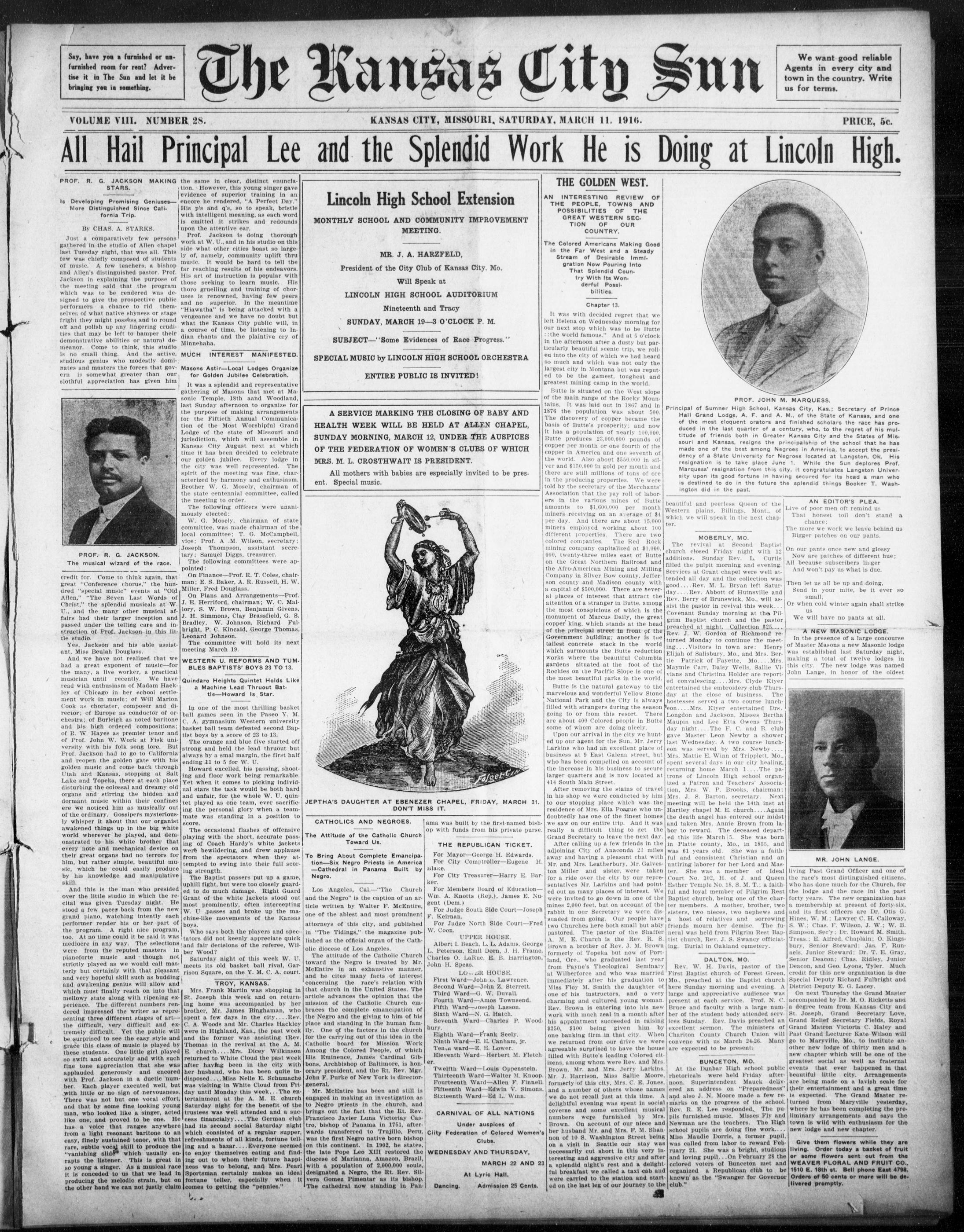
All Hail Principal Lee and the Splendid Work He is Doing at Lincoln High.
VOLUME VIII. NUMBER 28.
Say, have you a furnished or unfurnished room for rent? Advertise it in The Sun and let it be bringing you in something.
PROF. R. G. JACKSON MAKING STARS.
Is Developing Promising Geniuses—More Distinguished Since California Trip.
By CHAS. A. STARKS.
Just a comparatively few persons gathered in the studio of Allen chapel last Tuesday night, that was all. This few was chiefly composed of students of music. A few teachers, a bishop and Allen's distinguished pastor. Prof. Jackson in explaining the purpose of the meeting said that the program which was to be rendered was designed to give the prospective public performers a chance to rid themselves of what native shyness or stage fright they might possess and to round off and polish up any lingering crudities that may be left to hamper their demonstrative abilities or natural demeanor. Come to think, this studio is no small thing. And the active, studious genius who modestly dominates and masters the forces that govern is somewhat greater than our slothful appreciation has given him
PROF. R. G. JACKSON.
The musical wizard of the race.
credit for. Come to think again, that great "Conference chorus," the hundred "special music" events at "Old Allen," "The Seven Last Words of Christ," the splendid musicals at W. U., and the many other musical affairs had their larger inception and passed under the telling care and instruction of Prof. Jackson in this little studio.
Yes, Jackson and his able assistant, Miss Beulah Douglass.
And we have not realized that we had a great exponent of music—for the many, a live worker, a practical musician until recently. We have read with enthusiasm of Madam Hackley of Chicago in her school settlement work in music; of Will Marion Cook as chorister, composer and director; of Europe as conductor of orchestra; of Burleigh as noted baritone and his high ordered compositions; of R. W Hayes as premier tenor and of Prof. John W. Work at Fisk university with his folk song lore. But Prof. Jackson had to go to California and reopen the golden gate with his golden music and come back through Utah and Kansas, stopping at Salt Lake and Topeka, there at each place disturbing the colossal and dreamy old organs and stirring the hidden and dormant music within their confines ere we noticed him as musically out of the ordinary. Gossips mysteriously whisper it about that our organist awakened things up in the big white world wherever he played, and demonstrated to his white brother that every note and mechanical device on their great organs had no terrors for him, but rather simple, beautiful music, which he could easily produce by his knowledge and manipulative skill.
And this is the man who presided over the little studio in which the recital was given Tuesday night. He stood a few paces back from the new grand piano, watching intently each performer render his or her part of the program. A right nice program, too. At no time could it be said it was mediocre in any way. The selections were from the reputed masters in pianoforte music and though not strictly played as we would call masterly but certainly with that pleasant and very hopeful skill such as budding and awakening genius will allow and which must finally reach on into that mellow state along with ripening experience. The different numbers rendered impressed the writer as representing three different stages of art—the difficult, very difficult and extremely difficult. Yet the public will be surprised to see the easy style and grace this class of music is played by these students. One little girl played so swift and accurately and with such fine tone appreciation that she was applauded generously and enclosed with Prof. Jackson in a duetic number. Each player executed well, but with little or no sign of nervousness. There was not but one vocal effort, and that by some fine looking young man, who looked like a singer, acted like one, and proved to be one. He has a voice that ranges anywhere from a light resonant baritone to an easy, finely sustained tenor, with that rare, subtle vocal skill to produce the "vanishing slide" which usually enrapts the listener. This is great in so young a singer. As a musical race it is conceded to us that we lead in producing the melodic strain, but on the other hand we can not just claim
The Kansas City Sun
the same in clear, distinct enunciation. However, this young singer gave evidence of superior training in an encore he rendered, "A Perfect Day." His p's and q's, so to speak, bristle with intelligent meaning, as each word is emitted it strikes and redounds upon the attentive ear. Prof. Jackson is doing thorough work at W. U., and in his studio on this side what other cities boast so largely of, namely, community uplift thru music. It would be hard to tell the far reaching results of his endeavors. His art of instruction is popular with those seeking to learn music. His thorou gruelling and training of choruses is renowned, having few peers and no superior. In the meantime "Hiawatha" is being attacked with a vengeance and we have no doubt but what the Kansas City public will, in a course of time, be listening to Indian chants and the plaintive cry of Minnehaha.
MUCH INTEREST MANIFESTED.
Masons Astir—Local Lodges Organize for Golden Jubilee Celebration.
It was a splendid and representative gathering of Masons that met at Masonic Temple, 18th and Woodland, last Sunday afternoon to organize for the purpose of making arrangements for the Fiftieth Annual Communication of the Most Worshipful Grand Lodge of the state of Missouri and jurisdiction, which will assemble in Kansas City August next at which time it has been decided to celebrate our golden jubilee. Every lodge in the city was well represented. The spirit of the meeting was fine, characterized by harmony and enthusiasm. Brother W. G. Mosely, chairman of the state centennial committee, called the meeting to order.
The following officers were unanimously elected:
W. G. Mosely, chairman of state committee, was made chairman of the local committee; T. G. McCampbell, vice; Prof. A. M. Wilson, secretary; Joseph Thompson, assistant secretary; Samuel Diggs, treasurer.
The following committees were appointed:
On Finance—Prof. R. T. Coles, chairman; E. S. Baker, A. R. Russell, H. W. Miller, Fred Douglass.
On Plans and Arrangements—Prof. J. E. Herriford, chairman; W. C. Mallory, S. W. Brown, Benjamin Givens, J. H. Simmons, Clay Brassfield, G. S. Bradley, W. Johnson, Richard Fulbright, P. C. Kincaid, George Thomas, Leonard Johnson.
The committee will hold its next meeting March 19.
WESTERN U. REFORMS AND TUMBLES BAPTISTS' BOYS 23 TO 13.
Quindaro Heights Quintet Holds Like a Machine Lead Thruout Battle—Howard Is Star.
In one of the most thrilling basket ball games seen in the Paseo Y. M. C. A. gymnasium Western university basket ball team defeated second Baptist boys by a score of 23 to 13.
The orange and blue five started off strong and held the lead thruout but always by a small margin, the first half ending 11 to 5 for W. U.
Howard excelled, his passing, shooting and floor work being remarkable. Yet when it comes to picking individual stars the task would be both hard and unfair, for the whole W. U. quintet played as one team, ever sacrificing the personal glory when a teammate was standing in a position to score.
The occasional flashes of offensive playing with the short, accurate passing of Coach Hardy's white jackets were bewildering, and drew applause from the spectators when they attempted to swing into their full scoring strength. The Baptist passers put up a game, uphill fight, but were too closely guarded to do much damage. Right Guard Grant of the white jackets stood out most prominently, often intercepting W. U. passes and broke up the machine-like movements of the Kansas boys.
Who says both the players and spectators did not keenly appreciate quick and fair decisions of the referee, Wilber Wood?
Saturday night of this week W. U. meets its old basket ball rival, Garrison Square, on the Y. M. C. A. court.
TROY KANSAS
Mrs. Frank Martin was shopping in St. Joseph this week and on returning home was accompanied by her brother, Mr. James Binghaman, who spent a few days in the city...Rev. C. A. Woods and Mr. Charles Hackley were in Highland, Kas., the past week and the former was assisting tRev. Thomas in the revival at the A. M. E. church...Mrs. Dicey Wilkinson returned to White Cloud the past week after having been in the city with her husband, who has been quite indisposed...Miss Nelle E. Schumache was visiting in White Cloud from Friday until Monday this week...The entertainment at the A. M. E. church Saturday night for the benefit of the trustees was well attended and a success financially...The German club had its second social Saturday night which consisted of a regular supper refreshments of all kinds, fortune telling and a bazar...Everyone seemed to enjoy themselves eating and finding out to whom their future happiest was to belong, and Mrs. Pearl Sportsman certainly makes an idea fortune teller, especially when it comes to getting the "pennies."
KANSAS CITY, MISSOURI, SATURDAY, MARCH 11. 1916.
Lincoln High School Extension
MONTHLY SCHOOL AND COMMUNITY IMPROVEMENT MEETING.
SPECIAL MUSIC by LINCOLN HIGH SCHOOL ORCHESTRA
ENTIRE PUBLIC IS INVITED!
A SERVICE MARKING THE HEALTH WEEK WILL BE IN SUNDAY MORNING, MARCH OF THE FEDERATION OF W MRS. M. L. CROSTHWAIT IS
All mothers with babies are ent. Special music.
JEPTHA'S DAUGHTER AT EBENEZ
DON'T M
ANCE MARKING THE CLOSING OF
WEEK WILL BE HELD AT ALL
WARNING, MARCH 12, UNDER THE
OPERATION OF WOMEN'S CLUB
ROSTHWAIT IS PRESIDENT.
Rers with babies are especially invi
music.
HITER AT EBENEZER CHAPEL, FR
DON'T MISS IT.
A SERVICE MARKING THE CLOSING OF BABY AND HEALTH WEEK WILL BE HELD AT ALLEN CHAPEL, SUNDAY MORNING, MARCH 12, UNDER THE AUSPICES OF THE FEDERATION OF WOMEN'S CLUBS OF WHICH MRS. M. L. CROSTHWAIT IS PRESIDENT. All mothers with babies are especially invited to be present. Special music.
Falget Ciu
JEPTHA'S DAUGHTER AT EBENEZER CHAPEL, FRIDAY, MARCH 31.
DON'T MISS IT.
CATHOLICS AND NEGROES.
The Attitude of the Catholic Church Toward Us.
To Bring About Complete Emancipation—Six Negro Priests in America—Cathedral in Panama Built by Negro.
Los Angeles, Cal.—"The Church and the Negro" is the caption of an article written by Walter F. McEntire, one of the ablest and most prominent attorneys of this city, and published in "The Tidings," the magazine published as the official organ of the Catholic diocese of Los Angeles.
The attitude of the Catholic Church toward the Negro is treated by Mr. McEntire in an exhaustive manner, and he cites many facts of interest concerning the race's relation with that church in the United States. The article advances the opinion that the mission of the Catholic Church embraces the complete emancipation of the Negro and the giving to him of his place and standing in the human family. One of the factors in the church for the carrying out of this idea in the Catholic board for Mission Work Among the Colored People, of which His Eminence, James Cardinal Gibbons, Archbishop of Baltimore, is honorary president, and the Rt. Rev. Mgr. John F. Purke of New York is director-general.
Mr. McEntire has been and still is engaged in making an investigation as to Negro priests in the church, and brings out the fact that the Rt. Rev. Francisco Javier Luna Victorian Castro, bishop of Panama in 1751, afterwards transferred to Trujillo, Peru, was the first Negro native born bishop on this continent. In 1902, he states, the late Pope Leo XIII restored the diocese of Marianna, Amazon, Brazil, with a population of 2,000,000 souls, designated a Negro, the Rt. Rev. Silvera Gomez Pimentar as its bishop. The cathedral now standing in Pan-
---
THE CLOSING OF BABY AND
HIELD AT ALLEN CHAPEL,
12, UNDER THE AUSPICES
WOMEN'S CLUBS OF WHICH
PRESIDENT.
e especially invited to be pres-
ER CHAPEL, FRIDAY, MARCH 31.
ISS IT.
ama was built by the first-named bish
op with funds from his private purse
THE REPUBLICAN TICKET
For Mayor—George H. Edwards.
For City Comptroller—Eugene H. Blake.
For City Treasurer—Harry E. Barker.
For Members Board of Education—Wm. A. Knottus (Rep.), James E. Nugent (Dem.)
For Judge South Side Court—Joseph F. Keirnan.
For Judge North Side Court—Fred W. Coon.
UPPER HOUSE.
Albert L. Beach, L. L. Adams, George L. Peterson, Emil Dorn, J. H. Frame, Charles O. LaRue, E. B. Harrington, John H. Speas.
LO., ER HOUSE.
First Ward—John L. Lawrence.
Second Ward—John Z. Sterrett.
Third Ward—G. W. Duvall.
Fourth Ward—Amos Townsend.
Fifth Ward—joseph Lasson.
Sixth Ward—N. G. Hatch.
Seventh Ward—Charles P. Woodbury.
Twelfth Ward—Louis Oppenstein.
Thirteenth Ward—Walter M. Knoop
Fourteenth Ward—Allen F. Finnell
Fifteenth Ward—Edwin V. Simons
Sixteenth Ward—Ed L. Winn.
CARNIVAL OF ALL NATIONS
Under auspices of
Clity Federation of Colored Women's
Clubs.
WEDNESDAY AND THURSDAY,
MARCH 22 AND 23
At Lyric Hall.
Dancing. Admission 25 Cents.
LO., ER HOUSE.
THE GOLDEN WEST.
AN INTERESTING REVIEW OF THE PEOPLE, TOWNS AND POSSIBILITIES OF THE GREAT WESTERN SECTION OF OUR COUNTRY.
The Colored Americans Making Good in the Far West and a Steady Stream of Desirable Immigration Now Pouring Into That Splendid Country With Its Wonderful Possibilities.
Chapter 13.
It was with decided regret that we left Helena on Wednesday morning for our next stop which was to be Butter :: the world famous." And at 5 o'clock in the afternoon after a dusty but particularly beautiful scenic trip, we rolled into the city of which we had heard so much and which was not only the largest city in Montana but was reputed to be the gamest, toughest and greatest mining camp in the world.
Butte is situated on the West slope of the main range of the Rocky Mountains. It was laid out in 1867 and in 1876 the population was about 500. The discovery of copper became the basis of Butte's prosperity; and now it has a population of nearly 100,000. Butte produces 23,000,000 pounds of copper per month or one fourth of the copper in America and one seventh of the world. Also about $550,000 in silver and $150,000 in gold per month and there are still millions of tons of ore in the producing properties. We were told by the secretary of the Merchants' Association that the pay roll of laborers in the various mines of Butte amounts to $1,600,000 per month miners receiving on an average of $4 per day. And there are about 15,000 miners employed working about 100 different properties. There are two colored companies. The Red Rock mining company capitalized at $1,000,000, twenty-three miles east of Butte on the Great Northern Railroad and the Afro-American Mining and Milling Company in Silver Bow county, Jefferson county and Madison county with a capital of $500,000. There are several places of interest that attract the attention of a stranger in Butte, among the most conspicuous of which is the monument of Marcus Daily, the great copper king, which stands at the head of the principal street in front of the Government building; another is the tallest concrete stack in the world which surmounts the Butte reduction works where the beautiful Columbia gardens situated at the foot of the Rockies on the Pacific Slope is one of the most beautiful parks in the world. Butte is the natural gateway to the marvelous and wonderful Yellow Stone National Park and the City is always filled with strangers during the season going to or from this resort. There are about 400 Colored people in Butte some of whom are doing nicely.
Upon our arrival in the city we hunted up our agent for the Sun, Mr. Jerry Larkins who had an excellent place of business at 9 East Galena street, but who has been compelled on account of the increase in his business to secure larger quarters and is now located at 414 South Main Street.
After removing the stains of travel in his shop we were conducted by him to our stopping place which was the residence of Mrs. Ella Poague who undoubtedly has one of the finest homes we saw on our entire trip. And it was really a difficult thing to get the Grand Secretary to leave the next day. After calling up a few friends in the adjoining City of Anaconda 23 miles away and having a pleasant chat with Mr. and Mrs. Leatherbury, Mr. Galveston Miller and sister, were taken for a ride over the city by our representatives Mr. Larkins and had pointed out us many places of interest. We were invited to go down in one of the mines 2,000 feet, but on account of the rabbit in our Secretary we were dissuaded from going. Our people have two Churches here both small but ably pastored. The pastor of the Shaffer A. M. E. Church is the Rev. R. S. Brown a brother of Rev. J. M. Brown formerly of Topeka but now of Portland, Ore., who graduated last year from Payne's Theological Seminary at Wilberforce and who was married immediately after his graduation to Miss Floy M. Smith the daughter of one of his instructors, and a very charming and cultured young woman. Rev. Brown is entering into his new work with much zeal in a month after his appointment succeeded in raising $350, $100 being given him by one banking firm in that city. When we returned from our drive we were agreeable surprised to have the house filled with Butte's leading Colored citizens, among whom were Rev. and Mrs Brown. Mr. and Mrs. Jerry Larkins Mr. J. Harrison, Miss Sallie Moore formerly of this city, Mrs. C. E. Jones and a number of others whose names we do not recall just at this time. A delightful evening was spent in social coverse and some excellent musical numbers were furnished by Mrs Brown. On account of our niece and her husband Mr. and Mrs. F. M. Shannon of 10 S. Washington Street being on a visit in Seattle our stay was necessarily cut short in this very interesting and aggressive city and after a splendid night's rest and a delightful breakfast we called a taxi cab and were carried to the station and start ad on the last leg of our journey to the
PROF. JOHN M. MARQUESS.
Principal of Sumner High School, Kansas City, Kas.; Secretary of Prince Hall Grand Lodge, A. F. and A. M., of the State of Kansas, and one of the most eloquent orators and finished scholars the race has produced in the last quarter of a century, who, to the regret of his multitude of friends both in Greater Kansas City and the States of Missouri and Kansas, resigns the principalship of the school that he has made one of the best among Negroes in America, to accept the presidency of a State University for Negroes located at Langston, Ok. His resignation is to take place June 1. While the Sun deplores Prof. Marquess' resignation from this city, it congratulates Langston University upon its good fortune in having secured for its head a man who is destined to do in the future the splendid things Booker T. Washington did in the past.
beautiful and peerless Queen of the Western plains, Billings, Mont., of which we will speak in the next chapter.
AN EDITOR'S PLEA.
Live of poor men oft remind us
That honest toil don't stand a chance;
The revival at Second Baptist church closed Friday night with 12 additions. Sunday Rev. L. Curtis filled the pulpit morning and evening. Services at Grant chapel were well attended all day and the collection was good....Rev. M. L. Bryan left Saturday....Rev. Abbott of Hutensville and R. Berry of Brunswick Mo., will assist the pastor in revival this week....Covenant Sunday morning at the Pilgrim Baptist church and the pastor preached at night. Collection $25....Rev. J. W. Gordon of Richmond returned Monday to continue the meeting....Visitors in town are: Henry Elijah of Salisbury, Mo., and Mrs. Bertie Patrick of Fayette, Mo....Mrs. Maymie Carr, Daisy Wells, Sallie Vivians and Christina Holder are reported convalescing....Mrs. Clyde Klyer entertained the embroidery club Thursday at the close of business. The hostesses served a two course lunch....Mrs. Klyer entertained Drs. Longdon and Jackson, Misses Bertha Maupin and Lee Etta Owens Thursday night....The F. C. and B. club gave Master Leon Newby a shower last Wednesday. A two course lunch was served by Mrs. Newby....Mrs. Mattie E. Winn of Tripplett, Mo, spent several days in the city healing, returning home March 1....The patrons of Lincoln High school organized a Patron and Teachers' Association, Mrs. W. P. Brooks, chairman; Mrs. J. S. Barton, secretary. Next meeting will be held the 14th inst at Hartley chapel M. E. church....Again the death angel has entered our midst and taken Mrs. Annie Brown from labor to reward. The deceased departed this life March 5. She was born in Platte county, Mo., in 1855, and was 61 years old. She was a faithful and consistent Christian and an uniring laborer for her Lord and Master. She was a member of Ideal Court No. 102, H. of J. and Queen Esther Temple No. 18, S. M.枕, a faithful and loyal member of Pilgrim Rest Baptist church, being one of the charter members. A mother, brother, two sisters, two nieces, two nephews and a host of relatives and sorrowing friends mourn her demise. The funeral was held from Pilgrim Rest Baptist church, Rev. J. S. Swancy officiating. Burial in Oakland cemetery.
Rev. W. H. Davis, pastor of the First Baptist church of Forest Green, Mo., preached at the Baptist church here Sunday morning and evening. A large and appreciative audience was present at each service. Prof. N. C Bruce and faculty with a large number of the student body attended services Sunday. Rev Davis preached an excellent sermon. The ministers of Chariton County Church Union will convene with us March 24-26. Many are expected to be present.
BUNCETON, MO.
At the Dunbar High school public rhetoricals were held Friday afternoon. Superintendent Mauck delivered an address on "Preparedness" and also J. N. Moore made a few remarks on the progress of the school. Rev. R. E. Lee responded. The pupils furnished music. Misses Fly and Newman are the teachers. The High school pupils are doing fine work... Miss Maudie Dorris, a former pupil, was called from labor to reward February 21. She was a bright, studious and loving pupil...On February 28 the colored voters of Bunceton met and organized a Republican club to be known as the "Swanger for Governor club."
MOBERLY, MO.
DALTON, MO.
We want good reliable Agents in every city and town in the country. Write us for terms.
incoln High.
Kansas City, Kas.; Secretary of Prince
M. M., of the State of Kansas, and one
and finished scholars the race has pro-
century, who, to the regret of his mul-
er Kansas City and the States of Mis-
principalship of the school that he has
degrees in America, to accept the presi-
Negroes located at Langston, Ok. His
one 1. While the Sun deplores Prof.
City, it congratulates Langston Univer-
wing secured for its head a man who
splendid things Booker T. Wash-
AN EDITOR'S PLEA.
Live of poor men oft remind us
That honest toil don't stand a
chance;
The more we work we leave behind us
Bigger patches on our pants.
On our pants once new and glossy
Now are patches of different hue;
All because subscribers linger
And won't pay us what is due.
Then let us all be up and doing.
Send in your mite, be it ever so
small.
Or when cold winter again shall strike
us
We will have no pants at all.
A NEW MASONIC LODGE
In the presence of a large concourse of Master Masons a new Masonic lodge was established last Saturday night, making a total of twelve lodges in this city. The new lodge was named John Lange, in honor of the oldest
living Past Grand Officer and one of the race's most distinguished citizens, who has done much for the Church, for the lodge and the race in the past forty years. The new organization has a membership at present of forty-six, and its first officers are Dr. Otis G. Hines, W. M.; Lawyer C. H. Calloway, S. W.; Chas. F. Wilson, J. W.; W. B. Simpson, Secy; Dr. Howard M. Smith, Treas.; E. Alfred, Chaplain; O. Kingsbury, Senior Steward; Jas. F. Runnels, Junior Steward; Dr. T. E. Gray, Senior Deacon; Chas. Ridley, Junior Deacon, and Geo. Lyons, Tyler. Much credit for this new organization is due Special Deputy Richard Fulbright and District Deputy E. G. Lacey.
On next Thursday the Grand Master accompanied by Dr. M. O. Ricketts and a degree team from Kansas City and St. Joseph, Grand Secretary Love, Grand Relief Secretary Fields, Royal Grand Matron Victoria C. Haley and Past Grand Lecturer Kate Wilson will go to Maryville, Mo., to institute another new lodge of thirty men and a new chapter which will be one of the greatest social as well as fraternal events that ever happened in that beautiful little city. Arrangements are being made on a lavish scale for their entertainment and a great time is expected. The Grand Master returned from Maryville yesterday, where he has been completing the preliminary arrangements and says the town is wild with enthusiasm for the new lodge and new chapter.
Give them flowers while they are living. Order today a basket of fruit or some flowers sent out from the WEAVER FLORAL AND FRUIT CO., 1510 E. 18th st. Bell phone East 4798. Orders of 50 cents or more will be delivered promptly.
PRICE. 5c.
MR. JOHN LANGE
INTERNATIONAL SUNDAY SCHOOL LESSON
(By E. O. SELLERS, Acting Director of
Sunday School Course, Moody Bible
Institute.)
(Copyright, 1916, Western Newspaper Union.)
LESSON FOR MARCH 12
HEROES AND MARTYRS OF FAITH
LESSON TEXT-Heb. 11:1: 12.3.
GOLDEN TEXT-Let us run with patience the race, set us before us, lifting unto us, the author and perfector of our faith.-Heb. 12:1: 2.
There are two kinds of heroism for which medals are awarded in this country. Congress confers a "medal of honor" for distinguished services and extraordinary heroism in war. The Carnegie "hero fund in peace," bestows medals and pecuniary recognition for heroic deeds performed in preserving and rescuing human life, and the first medal thus issued was given to a boy for rescuing another boy from drowning.
I. Faith Defined, v. 1. This is perhaps the most quoted and succinct definition we have of faith. What follows is but the illustration and application of the fact. Faith is an "assurance" (R. V.). The ground of this assurance and conviction is the word of God. (See Rom. 10:17). The only ground for a dynamic and intelligent faith is God's word: put to the acid test of experience it never fails. Faith is not fatalism. To believe God is to rely upon him unhesitatingly with an unfaltering assurance as to the fulfillment of his promises. (I John 5:10; John 5:24; Act. 27:22; Rom. 4:19-21. II. Faith Declared, vv. 4, 5. Faith had been declared and manifested by many illustrations before the death of Stephen: (a) Abel, at the risk of his brother's anger, obeyed the unseen God and earned his approval; his heroic, martyred spirit still speaks to men (v. 4)
(b) Enoch, the diligent seeker after God, in a world of lawlessness lived a life well-pleasing to him through a faith that made his presence real (v. 5, 6).
(c) Noah (v.7), a lonely man of faith (Gen. 6:5), chose the unseen God and preached righteousness rather than avoid the ridicule of his neighbors. Noah reckoning the invisible as tangible, continued to build his ark and became a blessing to the race.
(d) Abraham and Sarah (8-12). Not knowing whither they went, by faith these lonely pilgrims unerringly followed an invisible God to an unseen country; but a faith greater still led them to "dwell in the land" and not possess it (v. 10). Their faith redeemed them from the mere emigrant character. They "looked for a city, which had foundations, whose builder and maker is God."
(e) Moses (23-28) showed his faith by a right choice. He weighed values and had "respect unto the recompense of reward." His faith "endured, as seeing him who is invisible." Moses saw by faith the "reproach of Christ," that which Christ suffered for the redemption of the world, as being of "greater riches than the treasures of Egypt."
These, and others not mentioned, are summarized by their having accomplished ten different things (32, 40). They performed great deeds of heroism (32-34); they endured great suffering and persecution (35, 36). All of this suffering was to issue in a greater reward with the glory that was to come (Rom. 8:18, II Cor. 4:17, 18). All these men of faith "obtained a good report." These saints had witness borne to them through their faith. Truly witnessing, their names and deeds are recorded for our good, yet even they did not receive the promise, i.e., all that had been promised by God had not been fulfilled in them. Such promises were only fulfilled when Christ the Messiah came. Some thing better than they had received came when he came, and without his coming they were not made perfect. They did not receive, but the promise of God had not failed. They will yet receive his fulfillment when the roll of the heroes of faith is perfected, and we, together with them, "shall be made perfect" (vy. 39, 40).
III. Faith Demanded, 12: 1, 2. The Holy Spirit has given us this long list of heroes as an exhortation to stir up those living to the performance of their duty. The roll call of triumphant heroes is not yet completed. All these mentioned are witnesses, not onlookers. These are they who have testified to God and to the truth of his word. In the light of this testimony and on the same ground of their testimony, we are to do several things: 1. To "lay aside every weight." No runner carries any weight beyond that which is needful. Some things are burdens that are not necessarily sins. Every such thing hinders our running and should be laid aside. 2. "The sin that doth so easily beset us." Literally, that wrap themselves about us as an ill-fitting garment, and which trip or impede the runner's progress. These sins (not sin) are those little devil habits and practices which must, for that reason, be laid aside.
3. "Run with patience the race set before us." There must be steadfastness and endurance. If church members were as faithful in following up as the average business house is, we would have less of lapsed church members and fewer boys and girls who drift away from the Sunday school.
4. "Looking unto Jesus." This is the keynote to this entire epistle and to this category of heroes. He is our "file-leader" and the perfector of our faith. Once we get our eyes off him we will stumble and fall in the race. "For the joy (literally equal fellowship with God) set before him, he endured the cross" (Phil. 2:6-8). If we would win the race, we must despise the sin which lies in the path of absolute loyalty to God.
The work of Jesus and the bestowing of the Holy Spirit who is always with us, is the source, the author of our faith.
AFRO-AMERICAN CULLINGS
---
The Freedmen's Aid society received in the last year 1914-15, $178,000, in collection from annual conferences. In the year 1911-12, there was received from the same source $133,000. The record is that we received $45,000 more during the fourth year of this quadrennium than the first year. This is a larger per cent of increase over our previous income than that of any board save the board of Sunday schools. This large increase is not due solely to the propaganda of the commission of finance. It will be giving credit to the commission to say that $10,000 of it came from that source.
To this writer's view of the matter it is not that the cause is less popular, but because of the exploitation of the progress of the race as a justification of what has been done for the black man—there is too prevalent an impression that he is able to support his schools. It should not be so, for the colored man's per capita wealth is about seven dollars while that of his more fortunate white brother is thirty-three or more. The colored man has had his chance but fifty years with burdensome handicaps. His wage earnings have been small always as compared with others. He pays more for everything and received less with which to pay. He has had more children to educate in the last fifty years than anybody else comparing his numerical strength with others of the American population. The opportunity to educate his children at public expense is of the most meager kind. Think of it.
In Georgia there are 1,421,812 white people and 1,176,987 colored people. The amount of money expended on white schools in 1913-14 was $2,825,588, and on the colored schools $492,906. The white and colored people nearly equal and yet upon the white children there was spent six times more of the public funds for education than upon the colored. The writer is entering no complaint but is trying to impress a few important facts as follows. The colored man cannot yet be expected to anything like meet the demands upon him for the education of his people. Further that public authorities administer the public fund to suit themselves and colored people are helpless. If therefore the masses are to be educated his white friends' North and South must help him.
The colored man will do more year by year. In the Methodist church for this quadrennium we have received through conference channels and special gifts credited to conferences $641, 180.59. Of this amount our colored people gave $148,000 which is a little beyond one-fourth the entire amount given by the church. The colored man is one-tenth the numerical strength of the church and a far less percentage of the per capita wealth of the church, yet gives one-fourth of the amount spent upon his education through the Freedmen's Aid society so far as the voluntary gifts of the conferences are concerned.
Say, brother reader, haven't we everything for which to be thankful and not much over which to be discouraged? Are we not headed onward? If this writer does not mistake the plans now in the making the colored people will do more by double in the next quadrennium. Let us believe that the greater giving upon the part of our white people begins with this Lincoln Sunday for the reason that the
On August 4, 1914, a Negro who called himself Chief Sam, sailed away from New York on the steamship Liberia. With him were a considerable company of Texas Negroes, who acknowledged him as leader and who believed his claim of descent from African rulers. He gave assurance that he had an agreement with twenty kings, and that a rich tract of 184,000 acres had been set aside as a Utopia for the pilgrims from over the sea.
This week three of the pilgrims returned to New York, sped on their way by British charity. Of the others many are dead of starvation. Some have disappeared in the interior of Africa. A few are working on British plantations along the Gold coast. Chief Sam himself is a prisoner at Cape Coast Castle, charged with manslaughter as being responsible for the death of his followers.
No twenty kings met Sam. There was not even one king or one acre of land. There was nothing but disillusionment and misery.
It is no reproach of the Negroes of this country that Sam was able to find
The Chinese are not isolated in their inability to pronounce the letter R. In nearly every case it is the last letter even the English-born child learns to pronounce.
The records show that only 17 per cent of the applicants applying for enlistment in the United States navy are accepted.
A daily paper was recently issued on a train between the cities of Minneapolis and Spokane.
Shamrocks Many Forms.
There is considerable dispute as to what is the true shamrock. The wood sorrel is usually considered so. That is an edible plant of an acid flavor. Fynes Moryson, in 1598, wrote that "The Irish willingly use the herb shamrock, being of a sharp taste, which, as they run and are chased to and fro, they snatch like beasts out of the ditches." While Doctor Pryor records that the plant which has for a long time been worn by the Irish St. Patrick's day is the black nonesuch, oth-
need is greater. Standards are higher. Fifty years is but a day in the solution of such a problem as slavery bequeathed us, that two hundred years and fifty years of unremitting toil cannot be paid in fifty years, that the colored man is a man, not a thing, that we ought to give more and will do it.—Northern Christian Advocate.
The Negro of today has a warm interest in the days when the two races understood each other better—they cling to the stories of their old white folks as they heard them from their parents.
One circumstance that impressed me of this strong sentiment was a few weeks ago, when John Washington, the brother of Booker Washington, visited Birmingham. He looked forward to meeting Mrs. Harry Jones. He had known her as a child, had driven her to school, the daughter of his "young mistress" from Virginia. He recalled the pleasant memories of the past as he told me "Miss Bertha looks as her mother used to." Does this not tell of the spirit of the past? And that sentiment is strong at Tuskegee today.
There are two memories of yesterday that will never die, the faithfulness of the good, old colored friend, and the rhythm of the Negro melodies.
With the hall filled at Tuskegee institute with 3,000 voices, there rang out the wonderful sound of "Sweet Charity." It filled the air and the soul at the same time and closed a wonderful meeting.
If every man and woman of the South could see this factory at the institute at work, in the schoolroom, in the kitchen, in the shop, molding human bodies into intelligent service, teaching them its value, giving them the lesson of making better homes, regarding higher principles and more respectful attention to those in authority, they would recognize it to be a necessity to good citizenship and useful to the community. The results will surely civilize the rural huckwellers and bring greater prosperity to the country industry. "The world wants its work done, and civilization is simply a search for men who can do things. The whole atmosphere of the inclosure, including about 2,500 Negroes, pupils, teachers and their families, is filled with the inspiration of work, and there is no pretense, no presumption, but a spirit of gratitude for the wonderful co-operation of their white friends North and South, East and West. In Carnegie hall, New York, the white friends of Booker T. Washington, held memorial services on February 13, and it is an opportunity time for those of the South to pay a similar tribute to the memory of the greatest Negro the world ever knew, and arrangements are being made to hold these services in the auditorium at Tuskegee institute on the same date--Mrs. J. B. Reid in Birmingham (Ala.) Age-Herald.
The recent reopening of the Parisian opera was decidedly an event, for not only did the motor cars and their human freight give the famous Place de l'Opera a most unwairlike appearance, but the seats sold at prices ranging from $20 for orchestra stalls to $1,000 for boxes, the profits going entirely for Belgian Red Cross work.
Argentina has ten meat freezing plants in active operation and three are contemplated.
followers. Many white men, with schemes even more foolish and preposterous, have mustered their disciples and believers by the hundreds. The story of Sam merely proves that credulity knows no distinction of race or color, and that an impostor with plenty of "nerve" can always find a hearing—Cleveland Plain Dealer.
Duke McLauren is a Negro farmer of Hoke county, North Carolina. His cotton crop last year brought him $3,000 and he has twelve bales yet unsold. He works hard, lives well, owes no debts, and the weekly paper of his county says: "He has set a worthy example to his section and the whole state."
America faces the future with confidence in spite of a tremendous race problem because it knows that the Duke McLaurens are multiplying and will continue to multiply.—Kansas City Star.
A new refuse pan for kitchen sinks is provided with a grease trap to permit only water to enter a drain pipe.
A new holder for index cards is covered with glass to keep them clean, while a mechanical finder on one side is used to select those needed for reference.
The manufacture of ferrosilicon, which is much in demand all over the world, is rapidly increasing in Norway.
Small panes of glass set into the side of a new fountain pen enable the quantity of ink it holds to be seen.
ers state that the clover was commonly supposed to be the shamrock, and that the Irish themselves of late years had the leaves of one kind, Trifolium ripens, as their national badge.
Some authorities even consider that the watercress was termed shamrock in early writings. It is quite possible that was the real plant, the trefoil having usurped its place in order to meet the requirements of the St. Patrick tradition. The plant which has figured upon the coins of the realm is a conventional trefoil.
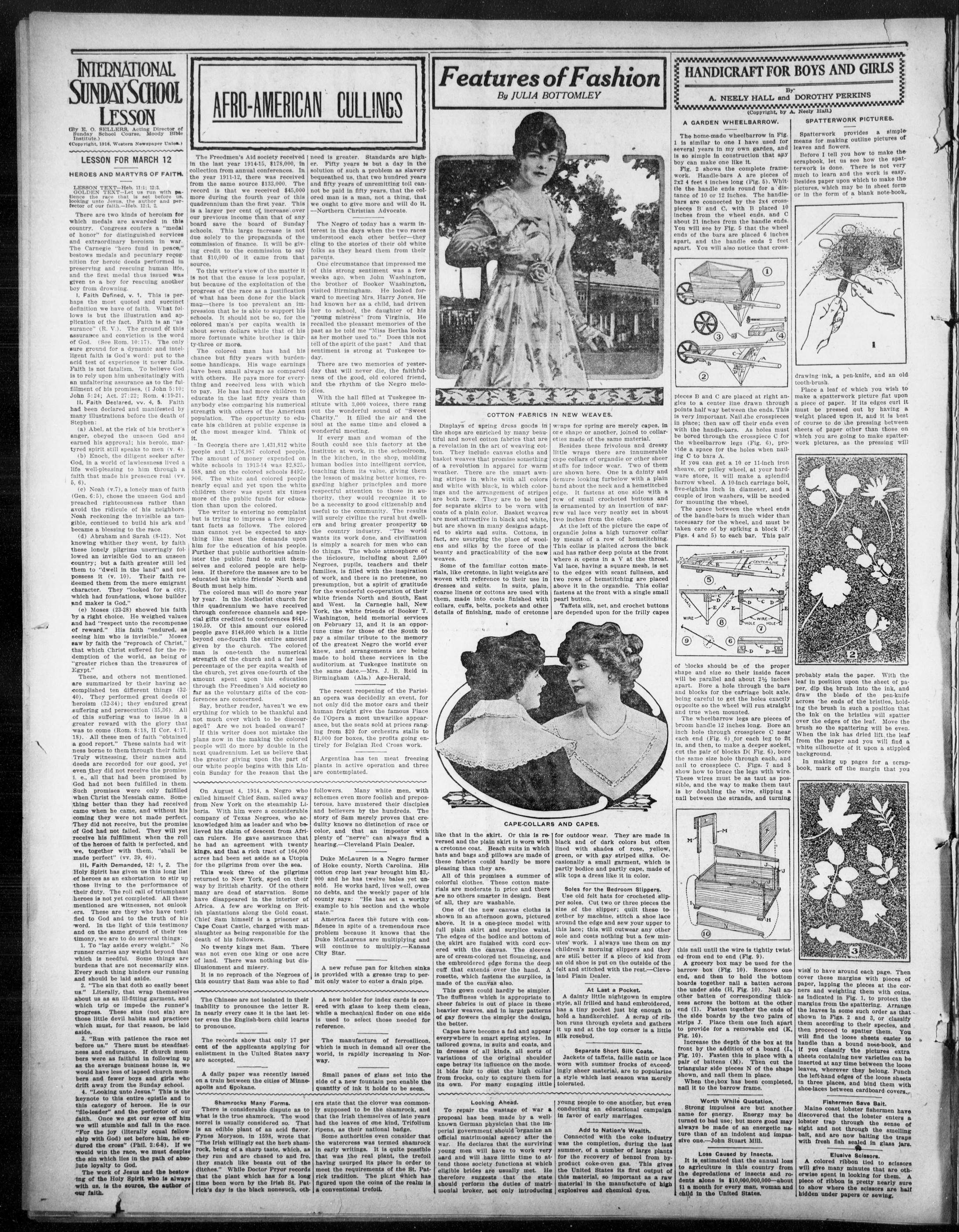
Features of Fashion By JULIA BOTTOMLEY
THE FASHION WEEKLY
COTTON FABRICS IN NEW WEAVES.
Displays of spring dress goods in the shops are enriched by many beautiful and novel cotton fabrics that are a revolution in the art of weaving cotton. They include canvas cloths and basket weaves that promise something of a revolution in apparel for warm weather. There are the smart awning stripes in white with all colors and white with black, in which colors and the arrangement of stripes are both new. They are to be used for separate skirts to be worn with coats of a plain color. Basket weaves are most attractive in black and white, but are shown in many designs adapted to skirts and suits. Cottons, in fact, are usurping the place of woolens and silks by the force of the beauty and practicability of the new weaves.
wraps for spring are one shape or another eties made of the same. Besides these five little wraps there cape collars of organ staffs for indoor wear are shown here. On demure looking furf band about the neck edge. It fastens at row of small crocch is ornamented by an rew val lace very nine two inches from the At the left of the ornament joins a hiby by means of a row This collar is plaited and has rather deep where it opens in a
Some of the familiar cotton materials, like cretonne, in light weights are woven with reference to their use in dresses and suits. In suits, plain, coarse linens or cottons are used with them, made into coats finished with collars, cuffs, belts, pockets and other details of finishing, made of cretonne
10
THE FASHION WEEK
like that in the skirt. Or this is reversed and the plain skirt is worn with a cretonne coat. Beach suits in which hats and bags and pillows are made of these fabrics could hardly be more pleasing than they are.
All of this promises a summer of colorful clothes. These cotton materials are moderate in price and there are no others smarter in design. Best of all, they are washable.
One of the new canvas cloths is shown in an afternoon gown, pictured above. It is a one-piece model with full plain skirt and surplice waist. The edges of the bodice and bottom of the skirt are finished with cord covered with the canvas. The sleeves are of cream-colored net flouncing, and the embroidered edge forms the deep cuff that extends over the hand. A rosette, which fastens the surplice, is made of the canvas also.
for outdoor black and white with slim green, or with casionally a s partly bodice a silk tops a dress
Soles for t Use old felt, per soles. Cut size of the s gether by arm around the edge this lace; this sole and costs work. I children's mo are still better an old shoe is felt and stitch land Plain De
This gown could hardly be simpler. The fluffiness which is appropriate to sheer fabrics is out of place in these heavier weaves, and in large patterns of gay flowers the simpler the design, the better.
Capes have become a fad and appear everywhere in smart spring styles. In tailored gowns, in suits and coats, and in dresses of all kinds, all sorts of variations of the original shoulder cape betray its influence on the mode. It bids fair to dust the high collar from frocks, only to capture them for its own. For many engaging little
At Last a Pocket.
A dainty little nightgown in empire style, all frilled and hand embroidered, has a tiny pocket just big enough to hold a handkerchief. A scrap of ribbon runs through eyelets and gathers it up and at the top corner is a little silk rosebud.
Separate Short Silk Coats.
Jackets of taffeta, fallie satin or lace worn with summer frocks of exceedingly sheer material, are to popularize a style which last season was merely tolerated.
Looking Ahead.
To repair the wastage of war a proposal has been made by a well-known German physician that the imperial government should organize an official matrimonial agency after the war. He declares that the surviving young men will have to work very hard and will have little time to attend those society functions at which eligible brides are usually met. He therefore suggests that the state should perform the duties of matrimonial broker, not only introducing
wraps for spring are merely capes, in one shape or another, joined to collarettes made of the same material. Besides these frivolous and dressy little wraps there are innumerable cape collars of organdie or other sheer staffs for indoor wear. Two of them are shown here. One is a dalnty and demure looking furbelow with a plain band about the neck and a hemstitched edge. It fastens at one side with a row of small crocheted buttons and is ornamented by an insertion of narrow val lace very neatly set in about two inches from the edge.
At the left of the picture the cape of organdie joins a high turnover collar by means of a row of hemstitching. This collar is plaited across the back and has rather deep points at the front where $n$ inserts in a V at the throat. Val lace, having a square mesh, is set to the edges with scant fullness, and two rows of hemstitching are placed above it in the organdie. This collar fastens at the front with a single small pearl button. Taffeta silk, net, and crochet buttons are depended upon for the frilly capes
THE WORLD'S FINEST FASHION
for outdoor wear. They are made in black and of dark colors but often lined with shades of rose, yellow, green, or with gay striped silks. Occasionally a small garment, which is partly bodice and partly cape, made of silk tops a dress like it in color.
Soles for the Bedroom Slippers.
Use old felt hats for crocheted slipper soles. Cut two or three pieces the size of the slipper; quilt these together by machine, stitch a shoe lace around the edge and sew your upper to this lace; this will outwear any other sole and costs nothing but a few minutes' work. I always use them on your children's morning slippers and they are still better if a piece of kid from an old shoe is put on the outside of the felt and stitched with the rest.—Cleveland Plain Dealer.
At Last a Pocket
A dainty little nightgown in empire style, all frilled and hand embroidered, has a tiny pocket just big enough to hold a handkerchief. A scrap of ribbon runs through eyelets and gathers it up and at the top corner is a little silk rosebud.
Separate Short Silk Coats.
Jackets of taffeta, faille satin or lace worn with summer frocks of exceedingly sheer material, are to popularize a style which last season was merely tolerated.
young people to one another, but even conducting an educational campaign in favor of early marriages.
Add to Nation's Wealth
Connected with the coke industry was the completion, during the last summer, of a number of large plants for the recovery of benzol from byproduct coke-oven gas. This gives the United States its first output of this material, so important as a raw material in the manufacture of high explosives and chemical dyes.
HANDICRAFT FOR BOYS AND GIRLS
A GARDEN WHEELBARROW.
The home-made wheelbarrow in Fig. 1 is similar to one I have used for several years in my own garden, and is so simple in construction that any boy can make one like it.
Fig. 2 shows the complete framework. Handle-bars A are pieces of 2x2 4 feet 4 inches long (Fig. 5). Whittle the handle ends round for a distance of 10 or 12 inches. The handle-bars are connected by the 2x4 cross-pieces B and C, with B placed 10 inches from the wheel ends, and C about 21 inches from the handle ends. You will see by Fig. 5 that the wheel ends of the bars are placed 6 inches apart, and the handle ends 2 feet apart. You will also notice that cross-
$\textcircled{1}$
$\textcircled{2}$
$\textcircled{3}$
$\textcircled{4}$
pieces B and C are placed at right angles to a center line drawn through points half way between the ends. This is very important. Nail the crosspieces in place; then saw off their ends even with the handle-bars. As holes must be bored through the crosspiece C for the wheelbarrow legs (Fig. 6), provide a space for the holes when nailing C to bars A.
If you can get a 10 or 11-inch iron sheave, or pulley wheel, at your hardware store, it will make a splendid harrow wheel. A 10-inch carriage bolt, five-eighths inch in diameter, and a needed of iron washers, will be needed for mounting the wheel.
The space between the wheel ends of the handle-bars is much wider than necessary for the wheel, and must be taken care of by spiking a block (F, Figs. 4 and 5) to each bar. This pair
of blocks should be of the proper shape and size so their inside faces will be parallel and about 2½ inches apart. Bore a hole through the bars and blocks for the carriage bolt axle, being careful to get the holes exactly opposite so the wheel will run straight and true when mounted.
The wheelbarrow legs are pieces of broom handle 12 inches long. Bore an inch hole through crosspiece C near each end (Fig. 6) for each leg to fit in, and then, to make a deeper socket, cut the pair of blocks D( Fig. 6), bore the same size hole through each, and nail to crosspiece C. Figs. 7 and 8 show how to brace the legs with wire. These wires must be as taut as possible, and the way to make them taut is by doubling the wire, slipping a nail between the strands, and turning
this nail until the wire is tightly twisted from end to end (Fig. 9).
A grocery box may be used for the barrow box (Fig. 10). Remove one end, and then to hold the bottom boards together nail a batten across the under side (H, Fig. 10). Nail another batten of corresponding thickness across the bottom at the other end (I). Fasten together the ends of the side boards by the two pairs of strips J. Place them one inch apart to provide for a removable end (K, Fig. 10).
Increase the depth of the box at its front by the addition of a board (L, Fig. 10). Fasten this in place with a pair of battens (M). Then cut the triangular side pieces N of the shape shown, and nail them in place.
When the box has been completed, nail it to the barrow frame.
Strong impulses are but another name for energy. Energy may be turned to bad use; but more good may always be made of an energetic nature than of an indolent and impassive one—John Stuart Mill.
Lose Caused by Insects.
It is estimated that the annual loss to agriculture in this country from the depreduations of insects and rodents alone is $10,000,000,000—about 1 a month for every man, woman and child in the United States.
SPATTERWORK PICTURES.
Spatterwork provides a simple means for making outline pictures of leaves and flowers. Before I tell you how to make the scrapbook, let us see how the spatterwork is done. There is not very much to learn and the work is easy. Besides paper upon which to make the pictures, which may be in sheet form or in the form of a blank note-book,
I
drawing ink, a pen-knife, and an old tooth-brush.
Place a leaf of which you wish to make a spatterwork picture flat upon a piece of paper. If its edges curl it must be pressed out by having a weight placed upon it, and it is best of course to do the pressing between sheets of paper other than those on which you are going to make spatterwork pictures, as the pressing will
2
probably stain the paper. With the leaf in position upon the sheet of paper, dip the brush into the ink, and draw the blade of the pen-knife across the ends of the bristles, holding the brush in such a position that the ink on the bristles will spatter over the edges of the leaf. Move the brush so the spattering will be even. When the ink has dried lift the leaf from the paper and you will find a white silhouette of it upon a stippled background. In making up pages for a scrapbook, mark off the margin that you
3
wish to have around each page. Then cover these margins with pieces of paper, lapping the pieces at the corners and weighting them with coins, as indicated in Fig. 1, to protect the margins from the spattering. Arrange the leaves in some such order as that shown in Figs. 2 and 3, or classify them according to their species, and then proceed to spatter them. You will find the loose sheets easier to handle to a bound note-book, and if you classify the pictures extra sheets containing new varieties can be inserted at any time between the loose leaves, wherever they belong. Punch the left-hand edges of the loose sheets in three places, and bind them with shoe-laces between cardboard covers.
Fishermen Save Bait
Maine coast lobster fishermen have discovered that the lobster enters a lobster trap through the sense of sight and not through the smelling bait, and are now baiting the traps with fresh fish sealed in glass fars.
Elusive Scissors.
A colored ribbon tied to scissors will give many minutes that are otherwise spent in looking for them. A piece of ribbon is pretty nearly sure to show where the scissors are half hidden under papers or sewing.
RUFFLE IS COMING IN
BRINGS COSTUMES TO DATE
WILL BE EXTENSIVELY USED
THIS SEASON.
Employed Chiefly to Give Fullness to Skirts—Sleeves to Stand Out From the Arm—Capes Bid Fair to Be General.
Ruffles are used all over a skirt to give it fullness, which is a much pretier method than obtaining width by a plain circular cut which sags at its different points and is apt to look as ragged as the skirt of a gypsy before a month is over.
The deep Spanish ruff will come in with the other Spanish fashions. The
A
This New Model of Blue Straw Is Trimmed With a Large Pink Rose.
lifting of the hips by pliable reeds will go merrily on. The Breton basque will be advocated in all kinds of fabrics. It is mainly accentuated by a full ruffe below the waist.
Sleeves are full, so much so that they are crinolined to stand out from the arm, but they are usually caught in below the armhole in various ways and are either gathered at the wrist and finished with a ruffe, or held into a long, tight cuff that is buttoned up the back.
Coats and blouses are open in front and the eighteenth century collars which are not postillion in shape, will be played up. Capes promise to be so general that they may become common before June. They are put on evening gowns made of bullion lace; they are attached to afternoon gowns made of satin or crepe, and the long ones are worn in the street. These are copied from the capes of the Italian police and sharpshooters. They are not dark in color, however, but are white or pearl gray, or rose pink for the country. They are worn in the approved Italian fashion, with the
Simple Coiffure Is the Best
It is the fashion in Paris to dress the hair exceeding simple. The newest method, however, reminds one of a "bath coiffure"—the hair, slightly waved, being drawn back closely from the face and twisted into a careless knot at the nape of the neck.
The coiffure is eminently becoming to a pretty girl with a well-shaped head. It demands that the hair shall be very silky and possessed of an apparently natural ripple. The chignon is here again. Not a stiff bun but a soft soil, held in place by tortoise shell pins, which rises against the back of the neck, and there is no parting visible in front.
The Parisiennes are also adopting in the evening a style of headdress which calls for the presence of highly ornamental combs. These are combined with a simple, but highly effective coiffure.
The hair, always slightly waved, is drawn back over a light frizette and arranged in a series of small coils and curls at the back of the head, not low down, but, on the other hand, not high up. The coils and curls cover the middle of the head at the back and the comb juts out at one side.
Two Veils Needed.
Twb veils are needed for protection from strenuous winter breezes. One veil is a face veil of fine hexagon mesh, the other is a draped veil which floats over the hat. New veils of the latter sort are called plateau veils. They are of open filadora mesh with a deep, effective border at either end. The veil is thrown across a small hat so that the bordered ends fall at the sides, just below the shoulders, and the fine face veil is draped closely over the hat and face in usual fashion.
Fashions change so rapidly that women of limited means are often sore tried in their attempts to keep up with these periodic and quick movements. A French woman, whose husband was among the first to respond to his country's call, saw her opportunity and seized it. She made the fact known that she was clever at adapting clothing, and that she was ready to exercise her skill on reasonable terms. Plain materials are easily added to, the introduction of contrast is often permissible, and the present vogue for trimming has greatly facilitated her enterprise. The tunic was one of her best resources when she first started her business. Now she finds that the contrast hip yoke and the panel serve her very well.
Frequently sale bargains come in admirably for her purpose, and she is always ready not only to assist in adapting but to give her aid in choosing from the big stocks of rich and beautiful materials which are shown.
right side thrown well over the left shoulder.
Departing from the important features and the silhouette, there are many interesting minor things to be considered about the new fashions, and these interest some women as much as do the larger features.
Stripes, broad and narrow, will be introduced in all kinds of fabrics, including serge, silk, gaberdine, jersey cloth and voile.
There are so many of them that one invariably thinks of the directoire fashions, and yet, the only other hint of this epoch in the incoming styles is the high, rolling collar, the frill of lace in front and a coat or bodice that fits the figure.
There are suits and one-piece frocks made of striped serge and silk, especially in blue and white with pipings of solid blue and there are skirts of old-fashioned ribbed silk made in stripes that are five inches wide which go around the figure. There are suits of jersey cloth and other fabrics that have immense collars, revers, girdles and broad cuffs, some turning back nearly to the elbow, made of striped cloth or silk.
The designers have racked their brains for new ways to use ribbon, but no one has ousted the method of making a gown as though it dripped ribbon. For instance, a silk net evening gown in one color will have hundreds of hanging tails of another color arranged in thick groups. There are few rosettes and bows, as any method that keeps the ribbon from being flattened in to the surface of the frock, is not approved.
(Copyright, 1916, by the McGluce Newspaper Syndicate)
Feminine Fads
Emerald green checks on a white ground are seen among the latest novelty cloths.
A one-sleeved Spanish cloak of sable is one of the fashions favored abroad.
Mandarin yellow velours trimmed with ermine is a favorite combination for theater cloaks.
The new ermine furs are usually small straight choker collars and small rounded muffs.
Bright colored silk fringed sashes are a pretty and dainty finish to many light tulle and lace dancing frocks.
The gay scarfs of fiber silk are among the prettiest of the season, though lacking the cozy look of the wool scarfs.
In the World of Dress.
Long veiled sleeves of tulle are a favorite style for the demi-toilette worn when dining in a restaurant.
The paradise plume is sometimes used as the crown of a hat which has practically nothing otherwise except a turban brim.
Never were such rich all-over patterns seen among veilings as during the present year.
Real laces, especially point Venise, are always in fashion.
A
Small checks play a prominent part in the spring fashion pageant. Here is one of the new coats made of checked cloth, piped with leather and having a leather belt and leather-covered buttons. It is fashionably cut with high collar and ragan sleeve.
A serge gown done up recently had the last season's bodice remodeled into a boiler arranged over an undervest made of a piece of rich silk picked up at a sale and sold off because this winter's patterns will not be brought out again for another season.
Plaited Skirts.
Plaited skirts are not alone fashionable, they are very generally becoming. One is is so arranged as to give the effect of a plain panel at the front and one at the back, also it is cut off at about the hip line and finished with a peplum prettily shaped yoke.
Embroidery in Black.
One of the effective new petticoats is made of white net with ruffles embroidered in tiny pink ivy leaves.
Boudoir Jackets
Boudoir jackets are tighter; they even follow the lines of the old-fashioned basque.
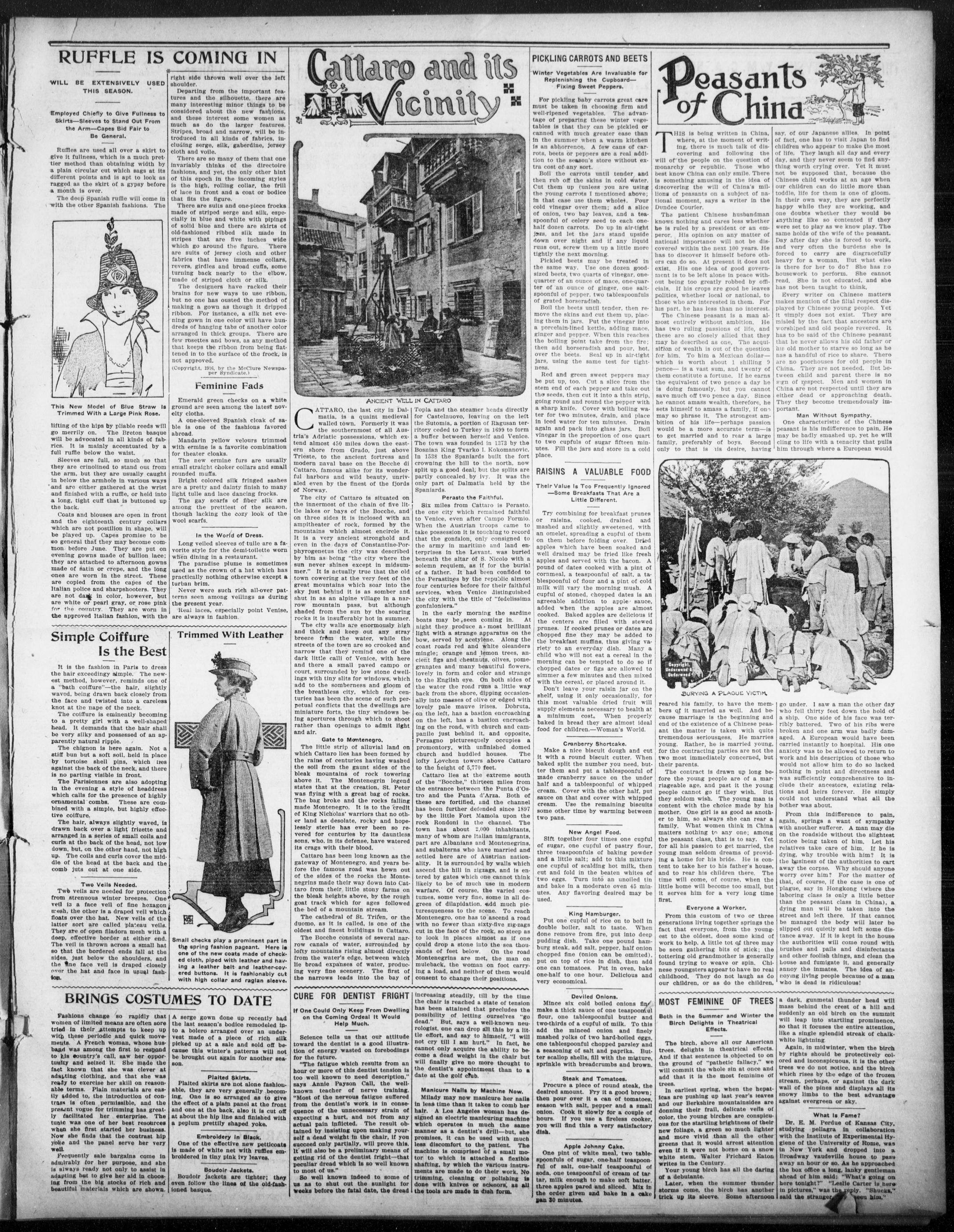
Cattaro and its Vicinity
1
ANCIENT WELL IN CATTARO
the southernmost of all Austria's Adriatic possessions, which extend almost 450 miles down the eastern shore from Grado, just above Trieste, to the ancient fortress and modern naval base on the Bocche di Cattaro, famous alike for its wonderful harbors and wild beauty, unrivaled even by the finest of the flords of Norway.
The city of Cattaro is situated on the innermost of the chain of five little lakes or bays of the Bocche, and on three sides it is inclosed with an amphitheater of rock, formed by the mountains which almost encircle it. It is a very ancient stronghold and even in the days of Constantine-Porphyrogenetus the city was described by him as being "the city where the sun never shines except in midsummer." It is actually true that the old town cowering at the very feet of the great mountains which soar into the sky just behind it is as somber and shut in as an alpine village in a narrow mountain pass, but although shaded from the sun by the soaring rocks it is insufferably hot in summer,
The city walls are enormously high and thick and keep out any stray breeze from the water, while the streets of the town are so crooked and narrow that they remind one of the dark little calli of Venice, with here and there a small paved campo or court, surrounded by low stone dwellings with tiny slits for windows, which add to the somberness and gloom of the breathless city, which for centuries has been the scene of such perpetual conflicts that the dwellings are miniature forts, the tiny windows being apertures through which to shoot rather than openings to admit light and air.
Gate to Montenegro.
The little strip of alluvial land on which Cattaro lies has been formed by the rains of centuries having washed the soil from the gauct sides of the bleak mountains of rock towering above it. The Montenegrin legend states that at the creation, St. Peter was flying with a great bag of rocks. The bag broke and the rocks falling made Montenegro. It is to the credit of King Nicholas' warriors that no other land as desolate, rocky and hopeless sterile has ever been so revered for centuries by its dauntless sons, who, in its defense, have watered its crags with their blood.
Cattaro has been long known as the gateway of Montenegro, and years before the famous road was hewn out of the sides of the rocks the Montenegrins made their way down into Cattaro from their little stony farms on the bleak heights above, by the rough goat track which for ages followed the bed of a mountain stream.
The cathedral of St. Trifan, or the duomo, as it is called, is one of the oldest and finest buildings in Cattaro. The Bocche consists of several narrow canals of water, surrounded by lofty mountains rising almost directly from the water's edge, between which lie broad expanses of water, producing very scenery. The first of the narrows leads into the bay of
CURE FOR DENTIST FRIGHT
If One Could Only Keep From Dwelling on the Coming Ordeal It Would Help Much.
Science tells us that our attitude toward the dentist is a good illustration of energy wasted on forebodings for the future.
"The fatigue which results from an hour or more of this dentist tension is too well known to need description." says Annie Payson Call, the well-known teacher of nerve training.
"Most of the nervous fatigue suffered from the dentist's work is in consequence of the unnecessary strain of expecting a hurt, and not from any actual pain inflicted. The result obtained by insisting upon making yourself a dead weight in the chair, if you succeed only partially, will prove this. It will also be a preliminary means of getting rid of the dentist fright—that peculiar dread which is so well known to most of us."
So well known indeed to some of us as to shut out the sunlight for weeks before the fatal date, the dread
Topia and the steamer heads directly for Castelnuovo, leaving on the left the Sutomia, a portion of Ragusan territory ceded to Turkey in 1899 to form a buffer between herself and Venice. The town was founded in 1373 by the Bosnian King Tvarko I. Kokomanovic. In 1538 the Spaniards built the fort crowning the hill to the north, now split up a good deal, but the spitres are partly concealed by ivy. It was the only part of Dalmatia held by the Spaniards.
S six miles from Cattaro is Perasto, the one city which remained faithful to Venice, even after Campo Formio. When the Austrian troops came to take possession it is touching to record that the gonfalon, only consigned to the army in maritime and land enterprises in the Levant, was buried beneath the altar of S. Nicolo with a solemn requiem, as if for the burial of a father. It had been confided to the Perastines by the republic almost four centuries before for their faithful services, when Venice distinguished the city with the title of "fedelissima gonfaloniera."
In the early morning the sardine boats may be, seen coming in. At night they produce a most brilliant light with a strange apparatus on the bow, served by acetylene. Along the coast roads red and white oleander mingle; orange and lemon trees, ancient figs and chesnuts, olives, pomegranates and many beautiful flowers, lovely in form and color and strange to the English eye. On both sides of the water the road runs a little way back from the shore, dipping occasionally into masses of olive or edged with lovely pale mauve irises. Dobruta, on the left, has a bastion encroaching on the left, has a bastion encroaching on the road, with church and campanile just behind it, and opposite, Perezganz picturesually occupies a promontory, with unfinished domed church and huddled houses. The lofty Lovchen towers above Cattaro to the height of 5,770 feet.
Cattaro lies at the extreme south of the "Bocche," thirteen miles from the entrance between the Punta d'Ostro and the Punta d'Arza. Both of these are fortified, and the channel has been further defended since 1897 by the little Fort Mamula upon the rock Rondoni in the channel. The town has about 2,000 inhabitants, many of whom are Italian immigrants, part are Albanians and Montenegrins, and subalterns who have married and settled here are of Austrian nationality. It is surrounded by walls which ascend the hill in zigzags, and is entered by gates which one cannot think likely to be of much use in modern warfare. Of course, the varied costumes, some very fine, some in all degrees of dilapidation, add much picturesqueness to the scene. To reach Montenegro, one has to ascend a road with no fewer than sixty-five zig-zags cut in the face of the rock, so steep as to look in places almost as if one could drop a stone into the sea thousands of feet below. On the road Montenegrins are met, the man on muleback, the woman on foot carrying a load, and neither of them would consent to change their positions.
increasing steadily, till by the time the chair is reached a state of tension has been attained that precludes the possibility of letting ourselves "go dead." But, says a well-known neurologist, one can drop all this by a little effort, and say to himself, "I will not cry till I am hurt." In fact, he cannot only acquire the ability to become a dead weight in the chair but will finally give no more thought to the dentist's appointment than to a date at the golf club.
Manicure Nails by Machine Now
Milady may now manicure her nails in less time than it takes to comb her hair. A Los Angeles woman has designed an electric manicuring machine which operates in much the same manner as a dentist's drill—but, she promises, it can be used with much less discomfort to the patient. The machine is comprised of a small motor to which is attached a flexible shafting, by which the various instruments are made to do their work. No trimming, cleaning or polishing is done with knives or scissors, as all the tools are made in dish form.
Perasto the Faithful.
PICKLING CARROTS AND BEETS
Winter Vegetables Are Invaluable for Replenishing the Cupboard—Fixing Sweet Peppers.
For pickling baby carrots great care must be taken in choosing firm and well-ripened vegetables. The advantage of preparing these winter vegetables is that they can be pickled or canned with much greater ease than in the summer when a warm kitchen is an abhorrence. A few cans of carrots, beets or peppers are a real addition to the season's store without extra cost of any sort.
Boil the carrots until tender and then rub off the skins in cold water. Cut them up (unless you are using the young carrots I mentioned above; in that case use them whole). Pour cold vinegar over them; add a slice of onion, two bay leaves, and a tea-spoonful of celery seed to each one-half dozen carrots. Do up in air-tight jars, and let the jars stand upside down over night and if any liquid runs out, screw them up a little more tightly the next morning.
Pickled beets may be treated in the same way. Use one dozen good-sized beets, two quarters of vinegar, one-quarter of an ounce of mace, one-quarter of an ounce of ginger, one salt-spoonful of pepper, two tablespoonfuls of grated horseradish.
Boil the beets until tender, then remove the skins and cut them up, placing them in jars. Put the vinegar into a porcelain-lined kettle, adding mace, ginger and pepper. When this reaches the boiling point take from the fire; then add horseradish and pour, hot, over the beets. Seal up in air-tight jars, using the same test for tightness.
Red and green sweet peppers may be put up, too. Cut a slice from the stem end of each pepper and take out the seeds, then cut it into a thin strip, going round and round the pepper with a sharp knife. Cover with boiling water for two minutes, drain, and place in ice water for ten minutes. Drain again and pack into glass jars. Boll vinegar in the proportion of one quart to two cupfuls of sugar fifteen minutes. Fill the jars and store in a cold place.
RAISINS A VALUABLE FOOD
Their Value Is Too Frequently Ignored
—Some Breakfasts That Are a
Little Different.
Try combining for breakfast prunes or raisins, cooked, drained and mashed and slightly sweetened, with an omelet, spreading a cupful of them on them before folding over. Dried apples which have been soaked and well drained may be fried like fresh apples and served with the bacon. A pound of dates cooked with a pint of cornmeal, a teaspoonful of salt, a tablespoonful of flour and a pint of cold milk will vary the morning mush. A cupful of stoned, chopped dates is an agreeable addition to apple sauce, added when the apples are almost cooked. Baked apples are delicious if the centers are filled with stewed prunes. If cooked prunes or dates are chopped fine they may be added to the breakfast muffins, thus giving variety to an everyday dish. Many a child who will not eat a cereal in the morning can be tempted to do so if chopped dates or figs are allowed to simmer a few minutes and then mixed with the cereal, or placed around it.
Don't leave your raisin jar on the shelf, using it only occasionally, for this most valuable dried fruit will supply elements necessary to health at a minimum cost. When properly baked in bread they are almost ideal food for children—Woman's World.
Cranberry Shortcake
Make a nice biscuit dough and cut it with a round biscuit cutter. When baked split the number you need, butter them and put a tablespoonful of made cranberry sauce on the under half and a tablespoonful of whipped cream. Cover with the other half, put sauce on that and cover with whipped cream. Use the remaining biscuits some other time by warming between two pans.
New Angel Food.
Sift together four times one cupful of sugar, one cupful of pastry flour, three teaspoonfuls of baking powder and a little salt; add to this mixture one cupful of scalding hot milk, then cut and fold in the beaten whites of two eggs. Turn into an unoiled tin and bake in a moderate oven 45 minutes. Any flavoring desired may be used.
King Hamburger.
Put one cupful of rice on to boil in double boiler, salt to taste. When done remove from fire, put into deep pudding dish. Take one pound hamburg steak, add salt, pepper, half onion chopped fine (onion can be omitted), put on top of rice in dish, then add one can tomatoes. Put in oven, bake one-half to one hour. Delicious and very economical.
Deviled Onions.
Mince six cold boiled onions fny make a thick sauce of one teaspooilul flour, one tablespoonful butter and two-thirds of a cupful of milk. To this add the minced onion and finely mashed yolks of two hard-boiled eggs, one tablespoonful chopped parsley and a seasoning of salt and paprika. Butter scallop shells, fill with the mixture, sprinkle with breadcrumbs and brown.
Steak and Tomatoes.
Procure a piece of round steak, the desired amount. Fry it a good brown; then pour over it a can of tomatoes, season with salt, pepper and a small onion. Cook it slowly for a couple of hours. If you use a fireless cooker, you will find this a very satisfactory dish.
Apple Johnny Cake.
One pint of white meal, two tablespoonfuls of sugar, one-half teaspoonful of salt, one-half teaspoonful of soda, one teaspoonful of cream of tartar, milk enough to make soft batter, three apples pared and sliced. Mix in the order given and bake in a cake pan 30 minutes.
Peasants of China
Copyright.
Underwood &
Underwood
THIS is being written in China, where, at the moment of writing, there is much talk of discovering and following the will of the people on the question of monarchy or republic. Those who best know China can only smile. There is something amusing in the idea of discovering the will of China's millions of peasants on a subject of national moment, says a writer in the Dundee Courier.
The patient Chinese husbandman knows nothing and cares less whether he is ruled by a president or an emperor. His opinion on any matter of national importance will not be discovered within the next 100 years. He has to discover it himself before others can do so. At present it does not exist. His one idea of good government is to be left alone in peace without being too greatly robbed by officials. If his crops are good he leaves politics, whether local or national, to those who are interested in them. For his part, he has less than no interest.
The Chinese peasant is a man almost entirely without ambition. He has two ruling passions of life, and these are so closely allied that they may be described as one. The acquisition of wealth is out of the question for him. To him a Mexican dollar—which is worth about 1 shilling 9 pence—is a vast sum, and twenty of them constitute a fortune. If he earns the equivalent of two pence a day he is doing famously, but you cannot save much off two pence a day. Since he cannot amass wealth, therefore, he sets himself to amass a family, if one may so phrase it. The strongest ambition of his life—perhaps passion would be a more accurate term—is to get married and to rear a large family, preferably of boys. Second only to that is its desire, having
Copyright
Underwood &
Underwood
BURYING A PLAGUE VICTIM
reared his family, to have the members of it married as well. And because marriage is the beginning and end of the existence of a Chinese peasant the matter is taken with quite tremendous seriousness. He marries young. Rather, he is married young, for the contracting parties are not the two most immediately concerned, but their parents.
The contract is drawn up long before the young people are of a marriageable age, and past it the young people cannot go if they wish. But they seldom wish. The young man is content with the choice made by his mother. One girl is as good as another to him, so always she can rear a family. What women think in China matters nothing to any one; among the peasant class, that is to say. Yet for all his passion to get married, the young man seldom dreams of providing a home for his bride. He is content to take her to his father's house, and to rear his children there. The time will come, of course, when the little home will be too small, but it serves him for a very long time first.
Everyone a Worker.
From this custom of two or three generations living together springs the fact that everyone, from the youngest to the oldest, does some kind of work to help. A little tot of three may be seen gathering bits of stick; the toterting old grandmother is generally found trying to weave or spin. Chinese youngsters appear to have no real childhood. They do not laugh as do our children, or as do the children.
MOST FEMININE OF TREES
Both in the Summer and Winter the Birch Delights in Theatrical Effects.
The birch, above all our American trees, delights in the theatrical effects. And if that sentence is objected to on the ground of "pathetic fallacy," we will commit the whole sin at once and add that it is the most feminine of trees.
In earliest spring, when the hepaticas are pushing up last year's leaves and our Berkshire mountainsides are donning their frail, delicate veils of color, the young birches are conspicuous for the startling brightness of their new foliage, a green so much lighter and more vivid than all the other greens that it would arrest attention even if it were not borne on a snow white stem, Walter Prichard Eaton writes in the Century.
Your young birch has all the daring of a debutante.
Later, when the summer thunder storms come, the birch has another trick up its sleeve. Some afternoon
say, of our Japanese allies. In point of fact, one has to visit Japan to find children who appear to make the most of life. They laugh all day and every day, and they never seem to find anything worth crying over. Yet it must not be supposed that, because the Chinese child works at an age when our children can do little more than toddle, life for them is one of gloom. In their own way, they are perfectly happy while they are working, and one doubts whether they would be anything like so contented if they were set to play as we know play. The same holds of the wife of the peasant. Day after day she is forced to work, and very often the burdens she is forced to carry are disgracefully heavy for a woman. But what else is there for her to do? She has no housework to perform. She cannot read. She is not educated, and she has not been taught to think.
Every writer on Chinese matters makes mention of the filial respect displayed by Chinese young people. Yet it simply does not exist. They are misled by the fact that ancestors are worshiped and old people revered. It has to be said of the Chinese peasant that he never allows his old father or his old mother to starve so long as he has a handful of rice to share. There are no poorhouses for old people in China. They are not needed. But between child and parent there is no sign of respect. Men and women in China are not respected until they are either dead or approaching death. They they become tremendously important.
Man Without Sympathy.
One characteristic of the Chinese peasant is his indifference to pain. He may be badly smashed up, yet he will cling to life with a tenacity that pulls him through where a European would
go under. I saw a man the other day who fell thirty feet down the hold of a ship. One side of his face was terribly battered. Two of his ribs were broken and one arm was badly damaged. A European would have been carried instantly to hospital. His one anxiety was to be allowed to return to work and his description of those who would not allow him to do so lacked nothing in point and directness and was sufficiently comprehensive to include their ancestors, existing relations and heirs forever. He simply could not understand what all the bother was about.
From this indifference to pain, again, springs a want of sympathy with another sufferer. A man may die on the roadside without the slightest notice being taken of him. Let his relatives take care of him. If he is dying, why trouble with him? It is the business of the authorities to cart away the corpse. Why should anyone worry over him? For the matter of that, of course, if the case is one of plague, say in Hongkong (where the laboring class is only a little better than the peasant class in China), a dying man will be taken into the street and left there. If that cannot be managed the body will later be slipped out quietly and left some distance away. If it is kept in the house the authorities will come round with brushes and pails and disinfectants and other foolish things, and clean the house and fumigate it, and generally annoy the inmates. The idea of annoying living people because of a man who is dead is ridiculous!
a dark, gunmetal thunder head will mass behind the crest of a hill and suddenly an old birch on the summit will leap into startling prominence, so that it focuses the entire attention, like a single splendid streak of chalk-white lightning.
Again, in midwinter, when the birch by rights should be protectively colored and inconspicuous, it is the other trees we do not notice, and the birch which rises by the edge of the frozen stream, perhaps, or against the dark wall of the pines and displays all its snowy limbs to the best advantage against evergreen or sky.
What Is Fame?
Dr. E. M. Perdue of Kansas City, studying pellagra in collaboration with the Institute of Experimental Hygiene of the University of Rome, was in New York and dropped into a Broadway vaudeville house to pass away an hour or so. As he approached the box office a long, lanky gentleman ahead of him said: "What's going on here tonight?" "Leslie Carter is here in pictures," was the reply. "Shucks," said the stranger, "seu him."
THE KANSAS CITY SUN
All communications should be addressed
to the Kansas City Sun, 1808 East 18th
Broadway
Bell Phone East 999.
Entered as second-class matter, August
12, 1908, at the postoffice at Kansas City,
Mo., under the act of March 3, 1879.
Nelson C. Crews.....Editor and Owner
Willa B. Glenn.....Managez Managen
SUBSCRIPTION RATES:
ADVERTISING RATE, 50 CENTS PER INCH.
CHURCH DIRECTORY
Bethel A. M. E. Church, 24th and Flora.
St. Stephen's Baptist Church, 604 Charlotte St.
Financial A. M. E. Church, 19th and Woodland.
Second Baptist Church, 10th and Charlotte.
Green Chapel A. M. E. Church, 10th and Charlotte.
Kansas Ave. Baptist Church, 46th and Kansas.
Ebenezer A. M. E. Church, 17th and Tracy.
St. Augustine's P. E. Church, 11th and Troost.
St. St. Baptist Church, 1825 Vine St.
Ward Chapel A. M. E. Church, 11th and Woodland.
Shelley Bay Baptist church, 1120 Crystal Avenue.
St. John's A. M. E. Church, 1743 Belleview.
Seventh Day Adventist, 23rd and Woodland.
St. Monica's Catholic, 17th and Lydia.
Morning Star Baptist Church, 2311 Vine.
Highland Avenue Baptist Church, 1111 Highland.
Centropolis A. M. E. Church, Centropolis, Mo.
St. James A. M. E. Z. Church, 1823 Woodland Ave.
Third Baptist Church, Roundtop.
People's Mission, 30th and Geneese.
St. James's Baptist Church, 19th and Highland.
Friendship Baptist Church, 17th and Tracy Avenue.
Pilgrim Baptist Church, 614 Charlotte St.
Pleasant Green Baptist Church, Independence Avenue and Tracy.
Calvary Baptist Church, 19th and Awkew.
Bigelow A. M. E. Mission, 5th and Lydia.
Progressive Baptist Church, 29th and Summit.
C. M. E. Church, 1817 Flora Ave.
St. James Baptist Church, 4055 Mill St.
St. Luke's A. M. E. Church, 43rd and Ame. M. E. Mission, 585 Grand Ave.
M A E. Mision, 586 Grand Ave.
CLARK 1044 Madison Ave.
CHURCH,
1644 Madison Ave.
KANSAS CITY, KAN. CHURCHES.
First A. M. E. Church, 8th and Neb.
Pleasant Green Baptist Church, 1st and
Splitting.
Eighth St. Baptist Church, 8th and
Oakland.
Pleasant Episcopal Baptist Church, 9th and
Washington.
Bethel A. M. E. Church, Water and
Steward Streets.
M. Paul A. M. E. Church, 21st and
Ruby.
First Baptist Church, 5th and Neb.
King Solomon Baptist Church, 3rd and
King.
Quindaro A. M. E. Church, Quindaro,
Pleasant Valley Baptist Church, Rosedale,
Kan.
M. E. Church, 9th and Oakland.
A. M. E. Church, 4th and Oakland.
Salter Mission, A. M. E. Church, South
Park.
Protestant Episcopal, 3rd and Stewart
Second Baptist Church, 24th and Ruby
Wesley Chapel M. E., 106 Shawnee.
St. Paul A. M. E. Zion Church, 4000
Adams.
Bethel A. M. E. Church, Roselale, Kan.
Mt. Zion Baptist Church, 4th and Virgil.
Ebenezer A. M. E. Church, Sanford and
Tremont.
Pleasant Primitive Baptist Church,
Westport avenue and Tangent street,
Rosedale.
EDITORIALS
Every colored man in this city who is entitled to register should register on March 14, the only day for registration. You can't vote unless you are registered.
---
The splendid ticket nominated by the Republican convention last week should have the hearty indorsement and support of every colored man in this city because in George Edwards are epitomized all those qualities that stand for fair play and justice to all men.
In a St. Louis hotel a Negro was recently arrested for kissing a white girl. Last week a white patron of the same hotel was arrested for attempting to assault a colored maid. Each of these men was apparently in the right church but the wrong new
Upon girst thought we are inclined to feel sorry for little Haiti, now that the United States government has gotten such a strong hold upon her. But if her affairs were managed anything like the affairs of the National Baptist Association or the General Conference of the A. M. E. church, there may be real need for a strong espionage.
Yes; conditions for Negro schools in Kansas City are slowly changing. Principals and teachers are being gradually eliminated from all active participation in local educational meetings. It is said that worn out furniture in the colored schools is only replaced by discarded junk from the white schools and that there are always excuses ready against provisions for larger playgrounds and better conditions for our children.
The editor had the pleasure of being the guest of the graduating class in Domestic Science at the Night High School last Tuesday evening in company with Dr. J. E. Perry, L. A. Knox and Principal Lee, where they were served with a most delightful luncheon in a most approved style. The bill of fare would tempt the palate of an epicurean and under the instruction of Mrs. Dr. Perry the domestic science of this school has been brought to a high state of efficiency.
To those people of the race who have not had the pleasure of hearing Miss Mary G. Evans, the wonderful evangelist now preaching at Ebenezer A. M. E. church, the Sun believes they have missed hearing one of the most remarkable women of the race. Not only is she eloquent, powerful and magnetic in the pulp, but she is of a charming and winsome disposition and possessed of a high order of intelligence that makes her beloved by all who sit under the magic spell of her wonderful face. Don't fail to hear her.
Y. M. C. A. NOTES
Y. M. C. A. NOTES
The members' annual meeting will be held in the association banquet hall March 17 at 8:30 p. m.
Rev. J. M. Booker addressed a small but interested audience at last Sunday's meeting. Next Sunday's meeting is to be addressed by Rev. S. W. Bacote. Subject, "Thou Art the Man."
Prof. Wm. H. Jones of the Bartlett High school of St. Joseph sent in his membership fee this week for the ensuing year. On the association's correspondence membership roll are members from the states of Kansas, Missouri, Illinois, Arizona and Utah.
Last Saturday the boys of the High school and grade school of Kansas City, Kas, were guests of the boy members of the association. Games in the gymnasium and in the boys lobby were enjoyed by all the visitors. The Kansas boys are being organized into a Boy Scout troop with Profs. Will Burn, Jacobs, Mowbrey and King as leaders.
All branches of the physical department are going at full speed. The hand ball court, which was seldom used until recently, now offers daily animated scenes between the many contestants. The railroad men are becoming so numerous in the volleyball class that they have decided to organize a league made up entirely of railroad men. The basket ball leagues are holding the attention of the night classes. The High school and grade school boys are enthusiastic over the physical exhibition to be staged in April.
Five members of the Friday night Bible class expect to take the examinations given by the international committee of the Y. M. C. A. in April. These examinations are given at the same time throughout Canada and the United States. Persons making a grade of 70 per cent or more receive an engraved certificate. The railroad men's class continues to grow in size and interest. This class never comes together. The men receive their lessons through the mail and return the same to the leader or teacher through the mail.
HELENA. MONT.
The Busy Bee's meet at the residence of Mrs. J. Harrison on Hollins avenue. Dainty lunch was served. The next meeting will be with Mrs. Kitty McAvoo on Hollins....We are proud to announce that a professional doctor has arrived in the city, the only one of our race....Jack Napper is quite sick in the hospital....Peter Ogden day was observed March 1. Remarks by the pastor and Noble John Williams on the good of the order and a paper by Mrs. C. Lowery on the H of Ruth; paper by Mrs. C. C. Matthews....Rev. H. C. Parson and family will move from the residence of J. H. Hilliard, 1256 Harrison avenue to 408 West Main. Mr. A. Costello and wife will move in the place made vanant....The K. of P. will hold their banquet on March 20 when wives and their friends will be guests. The Eastern Stars gave their secon entertainment on the 6th at Germanian hall. The coal skuttle Brown of the West side is still tacking it down....The Puget Sound delegates to the general conference in Philadelphia are getting ready to leave in April....When looking for rooms inquire 914 Cannon st. A. E. McGinnis.
LINCOLN, NEB
The Gideon Band and Aid Society of Mt. Zion Baptist church gave their first leap year banquet at the church February 29. Quite a crowd attended. The table decorations were very elaborate. Rev. R. Bell rendered the invocation and encouraging remarks were made by Rev. C. W. Ross. During the luncheon Miss ..... favored the guests with music. Mrs. Shaw, the president, and assistants, are entitled to much credit for the management of the most excellent afair. ..Mr. Chas, H. Coil, who had his leg broken sometime ago by being thrown out of an automobile, is yet confined to his home. ..Mr. Hall Hill man returned home from Excelsior Springs, Mo. Monday, accompanied by his uncle, Rev. B. Hillman, who is very sick and had been to the Springs in the hope of recuperating. The elder was removed to St. Elizabeth's host nital Tuesday and continues quite il
...Mr. David E. Nichols is improving from a recent illness....The A. M. E. church will hold a grand rally March 5. Services will be held all day....Mr. Wm. Chinn, who was ill recently is at work again....The members of Mt. Zion Baptist church regret very much the illness of their pastor, Rev Hillman. Revs Ross and Bell are filling the pulpit during his illness, hence services will be held as usual.
ST. JOSEPH. MO
Mr. Grant Askins died March 1 at the age of 47 of pneumonia at his residence, 120 South Third street. He leaves a wife, three sisters and three brothers, several cousins and a host of friends to mourn his demise. The funeral was held at the A. M. E. church Sunday at 12:30 under the auspices of the Masonic lodge...Mr. Edward Nillmoor was found dead in his room last Wednesday morning and was buried last Friday...Mrs. Lizzie Brown is still confined to her home... The Whatsoever club met at Mrs. Grant Moore's residence on Dewey avenue last Thursday and a splendid time was reported...Mr. Joseph Brown is on the sick list, the result of an attack of apoplexy, but is somewhat better at this writing...A Second arrest has been made for the murder of the boy December 16 by two highwaymen. He was shot at Tenth and Lincoln streets...Rev. C. H. Harris of Gallatin, Mo., preached two able sermons Sunday. Rev. Bryant was not able to be here...Mr. and Mrs. George Crittenden of Elwood, Kas, spent Sunday in St. Joe visiting friends...Mrs. Bell Horner of Denver has returned home for the summer.
The Moses Dickson Regalia and Supplies Co.
Little Corner
—That an ideal is just a reality that lives off the main traveled road.
—That "de ham what am" ain't got nothing on Mammy's home-made jam. Believe me.
—That being a grass widow does not necessarily signify that one is green. Oh, no.
—That po'k chops am gwine up and wages are comin' down. What's de po'h cullud man gwine to do.
—That a certain railroad man leaves more money with a lady friend who meets him at the station than he takes out home to his wife.
—That the wife and mother-in-law of a well known young man made it awfully lively for him the other day. Look out for mothers-in-law boys.
—That a certain June bride is catching fits in some letters Betty and Sam have been receiving during the past two weeks. Better be careful, honey.
—That a certain school teacher insists that she is going to make a fight this spring to permit teachers to marry and still teach. Go to it, honey. Nothing like being married.
—That those swell baskets of delicious fruit and beautiful cut flowers and potted plants being sent out from the Weaver Floral and Fruit Company are making a great hit with the sick
That a certain well known young lady in a spirit of bravado had her picture taken by her chum in robe de nuit and now she is frightened because the photographer developed a number of extra cards which he gave out among his friends labeled "A Modern Venus." Now ain't that a shame. But say, boys, wouldn't you like to have one of the pictures?
The unfair, unwarranted and disgraceful assault the Plaindealer has been making upon Bishop Parks has aroused the anger of every African Methodist in the Fifth Episcopal district, and they are getting ready to fight back. If Nick isn't careful he's going to find himself enmeshed again in the toils of the law.
GLASGOW, MISSOURI
Mrs. Will Evans of Wheeling, W. Va., is here to accompany her sister, Mrs. Emanuel Lewis of Telluride, Colo....Mrs. Evans returned home March 3....Mr. and Mrs. Emanuel Lewis returned home March 4....There was a party given at Mr. and Mrs. Ed Jaco's, in honor of Mrs. Evans and Mrs. Lewis. There was quite a number present....Miss O'Bennetta Craig and sister, Miss Elenora, visited in Glasgow Friday....Prof. Wm. Bailey of Salisbury delivered some of his poems on Glasgow Friday night....Mrs. Sidney Cason and children of Forest Green, visited Mrs. Preston Craig in Glasgow....Mr. Luther Morrison of Forest Green, made a business trip to Glasgow Saturday....Quite a good deal of sickness in this town during this writing....Mrs. Maud Cason is reported very ill at this writing....There will be a leap year super at Shannondale at the First Baptist church....Mr. John Blake was a visitor at the residence of Mrs. Craig
LATHROP, MO.
Mrs. George Tillman is improving....Mrs. Chas. Powell is up again aftert bein ill for several weeks....Grant Askins, a nephew of Chas. Powell, and who was residing in St. Joseph, Mo., passed away March 1....Mrs. Lelia Barnett passed away last Wednesday after a long illness. She was a consistent Christian and a good work-in the Christian family. She was taken to Kansas City, Kas., where the funeral and burial took place. She had in the past years made Kansas City, Kas., here home. We extend our sympathy to the bereaved family and friends....Rev. Newby, the pastor preached a good sermon last Sunday and took up a good collection.
SAY BROTHER! Have you seen the beautiful tri-colored cards, letter heads, bill heads and beautiful artistic work A. W. Harris, the commercial printer, 1515 East 18th st., has been putting on the market recently? It's the finest ever. His phone is Bell East 2782. Call him and he'll tell you all about the cost of them.
After "Poro" Humbugs
Mr. L. M. Singleton, field agent for the "Poro" College, St. Louis, Mo., spent ten days in Kansas City, Mo., and Kansas City, Kans., getting evidence against persons claiming to make "Poro" and selling unsealed goods without labels or revenue stamps as "Poro." He states that the people throughout the country are being beaten out of their money by such practice an dthat "Poro" is made only by Mrs. Pope-Turnbo-Malone, St. Louis, Mo. Persons who have been thus victimized will please notify Mrs. Pope-Turnbo-Malone, 3100 Pine street, St. Louis, Mo.
CHRISTIAN CHURCH
Twenty-fourth and Woodland.
Sunday School at 9:45 a.m. M. Preaching at 11:00 a. m. and 7:45 p. m.
Christian Enavor at 6:45 p. m. R. C. Pierce, pastoring.
Ex-Judge Mayo of Chicago will preach Sunday evening. All invited.
National Colored Dressmaking College
12th and Vine Streets
Kansas City, Mo.
The reliable place to learn the art
of
Ladies' Tailoring and Fancy
Dressmaking
Expert Teachers in Attendance.
Recognized authority in advanced styles. Coats, suits and fancy dresses made to order. Bring your material and make your own suits and dresses under expert instructors.
For further information call on or address
MRS. ALICE STEELE, President
Quinoleum Is Queen
YES, I Use Quinoleum, and like it fine.
Quinoleum Hair Grower..... 50c
Quinoleum Hair Tonic..... 50c
Quinoleum Hair Shampoo..... 50c
Face Preparations.
A liberal sample of our new preparations, a fragrantly perfumed toilet powder and a velvety face powder in pink and flesh colors (brown) sent free with any order. Call Bell Phone West 1757. 26th and Parkway, Kansas City, Kas. QUINOLEUM MANUFACTURING COMPANY.
Free
to
W
191
We are the largest manufacturer of colored men's hair, and we will introduce our goods we are sending and most best book, showing men's colored women, in the latest hair dressing colored woman should have one. We guilden rest, and make available all hair will positively stand combing and washing the same. We manufacture a STRAIGHTENING COMB of solid brass, with extra heavy back, absolutely the best and most sensible comb guaranteed. With each comb we sell at the low price of 99 cents we give a lamp cup free. Send your order for this straightening comb today.
A FULL LINE of Hair Brushes,
Nets and Toll Article is illustrated
and can be bought for less than
offered elsewhere.
Address Department 100
Negro Business and Professional Directory of Greater Kansas City
BEAUTY PARLORS AND HAIR DRESSERS J. E. LAING. 1715 East 18th St.
MESDAMES JACKSON & JOHN
phone E. 4788.
MRS. CADDIE WITCHER, 170
Hair and Scalp Treatment.
DELMONICA CAFE, 1512 East
COAL AX
W. W. PAYNE, 1902 1-2 Vine S
East 4132.
CLEANERS, DY
WORTHAM BROS., 1831 Paseo
DRUIT
THEODORE SMITH, 1301 East
Home Main 5467.
PEOPLE'S DRUG STORE, 181
Home East 4082.
R. W. FOSTER'S PHARMAC
Bell phone E 272, Home
DRY GOOD
TAYLOR-HOLMES & CO., 2402
BACKSON & JOHNSON, 18th and High,
1788.
R WITCHER, 1708 Michigan Ave. Mac
Scalp Treatment. Bell phone, East 4161.
CAFES.
CAFE, 1512 East 18th St. Bell phone, I
COAL AND FEED.
1902 1-2 Vine St. Bell phone, East 559
CLEANERS, DYERS AND TAILORS.
ROS., 1831 Paseo. Bell Phone East 701
MESDAMES JACKSON & JOHNSON, 18th and Highland Ave. Bell phone E. 4788.
MRS. CADDIE WITCHER, 1708 Michigan Ave. Madame Walker's Hair and Scalp Treatment. Bell phone. East 4167X.
W. W. PAYNE, 1902 1-2 Vine St. Bell phone, East 559; Home phone East 4132.
SMITH, 1301 East 18th St. Bell phone on 5467.
BUG STORE, 18th and Paseo. Bell phone 4082.
ER'S PHARMACY—18th and Woodland East 272, Home phone East 4070.
DRY GOODS AND NOTIONS.
MES & CO., 2409 Vine Street.
THEODORE SMITH, 1301 East 18th St. Bell phone Grand 4591, Home Main 5467.
PEOPLE'S DRUG STORE, 18th and Paseo. Bell phone East 1814, Home East 4082.
R. W. FOSTER'S PHARMACY—18th and Woodland.
TAYLOR-HOLMES & CO., 2409 Vine Street. EXPRESS AND BAGGAGE.
THOS. JACKSON, 1816 Highland
MOVING VANS, F. W. DAVIS
hold goods. Home phone, L
FIL
CROSTHWAIT FLORAL CO.,
272. Home phone, East 407
INS
STANDARD LIFE INSURANCE
Grand 2666J. T. A. Ross,
JET
J. A. WILSON, 1616 West 9th S
LA
C. H. CALLOWAY, 601 Delaware
448. Practices in all court
W. C. HUESTON, 601 Delaware
448. Legal advice. Practi
E. A. SHACKLEFORD, Attorn
sas City, Kas. Bell phone,
MIR
MRS. T. A. HOLLAND, Fashion
phone, East 4600. 1706 Ea
CALDWELL CHAPMAN, 18th
PHOTO
C. BRUCE SANTEE, Propriet
phone East 1643.
PR
C. A. FRANKLIN, 1008 East 18
MOVING VANS, F. W. DAVIS. Moving, packing and storing house- hold goods. Home phone, East 2158. Residence, 1229 Woodland.
FLORISTS.
CROSTHWAIT FLORAL CO., 1801 East 18th St. Bell phone, East 272. Home phone, East 4070.
INSURANCE.
STANDARD LIFE INSURANCE CO., 1507 East 18th St., Bell phone Grand 2666J. T. A. Ross,
JEWELERS.
J. A. WILSON, 1616 West 9th St., Bell phone, Main 6248R.
LAWYERS.
C. H. CALLOWAY, 601 Delaware, Home phone M58, Bell phone Main 448. Practices in all courts.
W. C. HUESTON, 601 Delaware, Home phone M58, Bell phone Main 448. Legal advice. Practices in all courts.
E. A. SHACKLEFORD, Attorney at Law, 516 Minnesota Ave., Kansas City, Kas. Bell phone, West 3866.
C. H. CALLOWAY, 601 Delaware, Home phone M58, Bell phone Main 448. Practices in all courts.
W. C. HUESTON, 601 Delaware, Home phone M58, Bell phone Main 448. Legal advice. Practices in all courts.
E. A. SHACKLEFORD, Attorney at Law, 516 Minnesota Ave., Kansas City, Kas. Bell phone, West 3866.
MILLINERY.
MRS. T. A. HOLLAND, Fashionable Dressmaking and Tailoring. Bell phone, East 4600. 1706 East 19th.
CALDWELL CHAPMAN, 18th and Paseo. Home phone East 4009.
PHOTOGRAPHERS.
C. BRUCE SANTEE, Proprietor The Fad, 1607 East 18th St. Bell phone East 1643.
MRS. T. A. HOLLAND, Fashionable Dressmaking and Tailoring. Bell phone, East 4600. 1706 East 19th.
CALDWELL CHAPMAN, 18th and Paseo, Home phone East 4009.
PHOTOGRAPHERS.
C. BRUCE SANTEE, Proprietor The Fad, 1607 East 18th St. Bell phone East 1643.
C. A. FRANKLIN. 1008 East 18th St. Bell phone Grand 2988
REAL ESTATE and EMPLOYMENT.
AFRO-AMERICAN REAL EST nished. 911 McGee street. Bell Phone 751 Main. A B C EMPLOYMENT AND I (upstairs) Kansas City, K phone, West 1036. C. W. N COLORED PEOPLE'S INVES East 1011, Home East 4011.
MICAN REAL ESTATE & INVESTMENT
11 McGee street.
The 751 Main.
Home Pl
YMENT AND INVESTMENT CO., 500
Kansas City, Kans. Bell phone, West
1036. C. W. Neloms, Mgr.
OPLE'S INVESTMENT CO., 2427 Vine
Home East 4011. Sol Smith, Pres
SECOND-HAND GOODS.
INS, 2122 Vine St. Bell phone East 3851
AFRO-AMERICAN REAL ESTATE & INVESTMENT CO., Help furnished. 911 MeGee street. Bell Phone 751 Main. Home Phone 7555 Main.
A B C EMPLOYMENT AND INVESTMENT CO., 500 Minnesota Ave. (upstairs) Kansas City, Kans. Bell phone, West 1743; Home phone, West 1036. C. W. Neloms, Mgr.
COLORED PEOPLE'S INVESTMENT CO., 2427 Vine St. Bell Phone East 1011, Home East 4011. Sol Smith, Pres
SECOND-HAND GOODS.
W. G. HOPKINS. 2122 Vine St. Bell phone East 3851.
G. A. PAGE'S SHOE STORE, 1507 East 18th street. Bell phone East 1328.
UNDERTAKERS.
ADKINS BROS. & GREEN, 19th and Vine streets. Both phones East 4349.
G. H. COUNTEE, Licensed Embalmer, 2220 Vine St., Bell Phone, East 3336, Home East 3341.
WATKINS BROS., 1729 Lydia Ave. Bell Phone Grand 987, Home Main 7989. Res., Bell East 3281.
CALDWELL & CHAPMAN
Hair and Millinery
18th and Paseo, Kansas City, Mo.
ADKINS BROS. & GREEN, 19th and Vine streets. Both phones, East 4349.
C. H. COUNTEE, Licensed Embalmer, 2220 Vine St., Bell Phone, East 3336, Home East 3341.
WATKINS BROS., 1729 Lydia Ave. Bell Phone Grand 987, Home Main 7989. Res., Bell East 3281.
CALDWELL & CHAPMAN Hair and Millinery 18th and Paseo, Kansas City, Mo.
Home Phone East 4009
iment a Specialty. Caldwell's Pomade and
Crows Hair. Try it. Save your combings, cut
and any old hat you may have.
Red From Samples. Feathers and Hats Clear
Agents for Spirella Corsets. Mail orders answ
K GUARANTEED. LIVE AGENTS W
Scalp Treatment a Specialty. Caldwell's Pomade and Tonic really Grows Hair. Try it. Save your combits, cut hair and any old hat you may have.
Hair Matched From Samples. Feathers and Hats Cleaned, Dyed and Blocked. Agents for Spirella Corrents. Mail orders answered promptly
WORK GUARANTEED. LIVE AGENTS WANTED
We teach the work we do
Say Friend!
TELL ME WHERE IS THE BEST PLACE
Tags, Toilet Articles and
Prescriptions Filled?
Sure
—AT—
FOSTER'S PHARMACY
18TH AND WOODLAND AVE.
y, they fill and deliver prescriptions to a
call for them, too.
H PHONES: Bell East 272. Home Ea-
When not Convenient to Come, Call Us
EIGHTEENTH and
CAN YOU TELL ME WHERE IS THE BEST PLACE TO BUY Drugs, Toilet Articles and have Prescriptions Filled?
I phone, East 2377J.
ing, packing and storing hous
S. Residence, 1229 Woodland
S.
East 18th St. Bell phone, East
E.
1507 East 18th St., Bell phone
S.
phone, Main 6248R.
S.
e phone M58, Bell phone Ma
e phone M58, Bell phone Ma
l courts.
Law, 516 Minnesota Ave., Kau
866.
Y.
lessmaking and Tailoring. B
aseo. Home phone East 400
HERS.
Fad, 1607 East 18th St. B
S.
Bell phone Grand 2988.
INVESTMENT CO., Help for
Home Phone 7555 Ma
MENT CO., 500 Minnesota A
bell phone, West 1743; Ho
Mgr.
CO., 2427 Vine St. Bell Pho
with, Pres
GOODS.
Phone East 3851 .
RE.
east 18th street. Bell pho
ERS.
Vine streets. Both pho
2220 Vine St., Bell Phone, E
Bell Phone Grand 987, Ho
CHAPMAN
Millinery
Kansas City, Mo.
est 4009
All's Pomade and Tonic really
our combings, cut hair
may have.
Hats and Hats Cleaned, Dyed and
Mail orders answered promptly
IVE AGENTS WANTED
FACIAL MASSAGE
ck we do
THE BEST PLACE TO BUY
Cycles and have
is Filled?
ARMACY
OBLAND AVE.
prescriptions to any part of the
CAFES.
DRUG STORES
FLORISTS.
INSURANCE
JEWELERS.
LAWYERS.
MILLINERY
PRINTERS.
SHOE STORE
UNDERTAKERS.
N. C. Crews, Kansas City, Grand Master.
Deputy Grand Master, Richard Young, Lincoln, Neb.
Wm. Green, Plattsburg, Mo.. Grand Senior Warden.
Crittenden C. Clark, St. Louis, Grand Junior Warden.
H. H. Walker, St. Joseph, Grand Treasurer.
Geo. W. K. Love, Grand Secretary,
Kansas City, Mo.
W. W. Fields, Secretary of Masonic
Relief, Cameron, Mo.
P. L. Pratt, Kansas City, Mo., Grand Lecturer.
Royal Arch Masons:
Grand High Priest—Geo. Bloomfield, St. Louis.
Deputy Grand High Priest—T. G. McCampbell, Kansas City.
Grand King—A. L. Thomas, Jefferson City.
Grand Scribe—J. P. Moffett, Sedalia.
Grand Treasurer—Chas. Griggsby, Liberty.
Grand Secretary—E. S. Baker, Kansas City.
Grand Lecturer—W. H. McAdams, Springfield.
Right Eminent Grand Commander—Willis G. Moseley, Kansas City Deputy R. E. . C.-Peter Kincade, Kansas City. Grand Inspector—T. G. McCampbell, Kansas City. Grand Captain General—James W. Beard, St. Louis.
Grand Generalissmo—Joseph H.
Cherwood, St. Paul, Minn.
Grand Junior Warden—B. F. Gray,
St. Joseph.
Grand Prelate—Henry Roan, St.
Louis.
Grand Recorder—James T. Cannon.
St. Louis.
MASONIC BUILDING ASSOCIATION
MEMBERS.
W. G. Mosely, Chairman.
E. S. Baker, Secretary.
R. W. Foster, Treasurer.
W. C. Mallory, Sandy Meyera.
Wm. Washington, L. P. Porteer.
T. W. H. Williams, R. T. Coles.
J. E. Herriford, E. G. Lacey.
Geo. Johnson, Robt. Willey.
P. Y. Adkins.
Lodge Directory
G
M. J.
LODGE DIRECTORY
Pritchard Lodge No. 42, A. W.
and A. M., meet on the
4th Monday in each month. All
Master Masons in good standing
welcome. Cecil Thompson, W.
S. SPICENER Secretary
G
Rone Lodge No. 25, A. F. and A. M., meets the 1st and 2nd Master Masons in each room of Master Masons good standing welcome. J. C. Granger, W. M.; T. J. McCampbell, Seey.
Mt. Olive Lodge No. 55, A. F. and A. M., meets the 2nd and 4th Friday in every month Visiting Master Masons are welcome. Same. Myers. W. M.; Frank Lodge, Secretary, 11th Baltimore Ave.
G
SACRED HEART
Liberty Lodge No. 37, A. F.
& A. M., Liberty, M. meets the
seats and fourth Saturday
V. T. Starks, S. W., Acting Master;
Nelson Wallar, Sec'y.
Lebanon Lodge No. 128, A. F.
& A. M., Lincoln, M. meets
and with Tuesdays in the
month. All Master meets in
good standing. Welcome
John C. Galbreath, W. M.; Wills
W. Mosely, Sec'y. 1353 Rose
G
WESTMASONRY
1. 0. 1.
Huey the Ester Court No. 43.
Huey from the I. O. I. meets the
month at 2:30 p.m. m, at the ball,
th and Campbell s. Kansas, Kansas
M. B. Q: Rosa L. Jones, Chron,
1466 North 3d St., Kansas City,
```markdown
```
U. B. F.
King of the West Lodge
No. 218 meets first and third
Mondays in each month at
the Grand avenue. W. F.
Wilson, W. M. D. M. West.
1718 Euclid Ave., Secretary.
Queen Etta Temple, S. M. T., meets
the second Saturday of each month at
2:30 at 824 East Tenth street.
PEARL M. DABNEY,
Worthy Princess.
LELIA M. ALLEN,
Worthy Secretary.
THE WORLD'S LARGEST WOMEN'S HISTORY MUSEUM
Rev. Sister Pearl has just made her arrival in this city from Battle Creek, Mich., where she has been successful in holding a series of meetings. After resting up for a few days she has now gone East where she has several calls that she will answer before she returns to Kansas City. After leaving here her first stop will be in Pittsburg, Kas., where she will fill an appointment. All expenses for herself and lady companion were forwarded.
WANTED—Colored man or woman with capital as business partner in Undertaking Establishment in or out of Kansas City, Mo. For further information call home phone South 1237 or write Geo. Hall, 448 Main street, Kansas City, Mo.
Prof. R. W. Foster, Principal of Wendell Phillips School, is quite ill at his home, 1215 Paseo.
Mrs. Dolly Kincaid of Seattle, Wash., is visiting her cousin, Mrs. John Taylor, 1004 Virginia.
A. C. Cunnigan, 1242 Barnett avenue, Kansas City, Kas., is out again after a serious illness.
Miss E. Juan Blanton, who has been quite ill for the past week with tonsilitis, is able to be out again.
Mrs. Maude Gamble, 1628 Agnes, is improving rapidly from a very serious illness of several weeks' duration.
Mr. Miles Dunn, one of the veteran class leaders of Allen Chapel, has been seriously ill during the past week.
L. E. Woods, 2219 Woodland avenue, who has been ill for several days with tonsilitis, is able to resume work again.
Mrs. Francis Wilson, 913 Woodland avenue, is still confined to her bed. She would like to see her many friends.
Mrs. Geo. W. K. Love, 2418 Flora avenue, has been suffering from the lagripe for the past week, but is much improved.
Mr. E. Eugene Vaughan, who has been ill for the past three weeks, still remains confined to his home, 26th and Parkway, Quindaro, Kas.
Mrs. M. F. Hightower, 1104 Charlotte street, departed for Washington D. C. Sunday to take a special course in dressmaking and domestic science
Mrs. May Woods, 2314 Woodland avenue, who was taken ill while returning from church February 29, is convalescent, but still under the care of a physician.
Mr. Blanton Crews of Chicago, youngest son of Mr. and Mrs. Jas. H. Crews, is in the city at the bedside of his mother, who is seriously ill. Blanton is looking well.
Mrs. Ida Saunders announces the engagement of her daughter, Miss Brunetta, to Dr. Elmer B. Jones of Marshall, Tex. The wedding will take place some time in April.
A surprise party was given in honor of Mrs. Wm. Emery's birthday on March 7, 1916, by her husband, Wm. Emery. A very elaborate luncheon was served. Those present were Mr. and Mrs. C. Walker, Mr. and Mrs. O. B. Ferguson, Mr. and Mrs. R. Johnson and Mr. C. A. Emery.
Messrs. Geo. F. and Robt. Cromwell brought the remains of Logan Harrison here from St. Louis, Mo., for in terment. He was buried Wednesday at Highland cemetery. Mr. Geo. F is from St. Louis and Mr. Robt. C. is from Columbia, Mo. While here they were the guests of Mr. Theo. Rowan
Mrs. Jas. H. Crews was brought home from the hospital last Wednesday and is now in her own home at 2733 Vine street, where she is under the care of Mrs. T. E. Watkins and Mrs. Oxley, two of the best nurses in this city. She is still in a very serious condition, but her multitude of friends are praying for her recovery.
Mrs. Robella Hayes Wesley of Seattle, Wash., is in the city visiting friends. She has been spending the past two months visiting parents at Mexico, Mo., and will possibly spend a month here. She is the guest of Mrs. Willa Henry, 1613 Lydia avenue, and says she is enjoying her visit very much.
CARD OF THANKS.
We wish to thank our many friends and neighbors for their kindness and sympathy shown us at the death of our darling baby. Also the many floral offerings.
R. AND MRS. WM. HOMER JONES
J. F. COLE AND FAMILY.
PUBLIC STENOGRAPHER.
Letters, circulars, etc., done quickly and neatly at prices that you will appreciate. Office hours 9 a. m. to 4 p. m. 1022 Michigan ave. Home on Sundays after 1:30 p. m. Bell phone East 3918W.
VINE STREET BAPTIST CHURCH.
All services were well attended Sunday. Two additions were made....Mrs. James Graham, who has been sick for two weeks, is somewhat better at this writing. We hope she will continue to improve....Mrs. Hattie Brinkley was able to be out to church Sunday....Our revival is going on and many are coming forward for prayer and have professed a hope in Christ. We hope the good work will go on.
ST. JOHN A. M. E. CHURCH.
Services at St. John A. M. E. church
Sunday were all that one could wish
for. The pastor preached in Liberty
at 3 p. m. for Rev. Bowman, pastor of
the A. M. E. church. He reported a
fine time. There will be preaching
Sunday at 11 a. m. and 8 p. m. Come
and hear the man. Mrs. E. N. W.
Wilson, superintendent of Sunday school
Send your children at 10 a. m. Mrs.
M. Hall, president of A. C. E. L.
wishes to see all at 6:30 p. m. A
CITY NEWS.
big concert at St. John's A. M. E. church March 17. Given by Western university and Ward's Progressive club.
KNIGHTS OF FRIENDSHIP OF THE
U. B. F.
The first annual ball of the Knights of Friendship will be given Monday evening, March 27, at Lyric hall, 1731 Lyda avenue.
First Prize—Diamond lavaliere.
Second Prize—$2.50 in gold to the one selling the largest amount of tickets.
SECOND BAPTIST CHURCH.
Miss Anna Jones made an excellent talk to the B. Y. P. U. last Sunday evening. The attendance was 115 Next Sunday Miss Miles will address the Union, also covenant meeting, for the boys and girls, to which every body is invited.....Las Sunday Dr. Bacote celebrated his twenty-first anniversary as pastor of this church. Dr Garnett spoke in the morning. Thirty-eight were baptized. The evening worship ship was devoted to Covenant meeting and the Lord's Supper, which was one of the greatest attended in many years. This great day of spiritual up lift will be long remembered by all who were fortunate enough to be present.
CENTENNIAL M. E. CHURCH.
Sunday was a great day at Centennial. Splendid congregations morning, afternoon and evening. The district superintendent preached two good sermons. Rev. Matthews of the Zion A. M. E. church delivered a very interesting and soul stirring sermon in the afternoon. Four additions were made. Collection was $136.... March 4 was the fourth and last quarterly conference and the district superintendent was with us, holding one of the best conferences we have had. All reports were up to the usual high standard. We pray the return of our beloved pastor for another year.... A series of nightly prayer meetings are being held and many persons are being benefited. A special invitation is extended to all sinners. Come out you Christians, and help us save your sons and daughters as well as brothers and sisters and husbands and wives.
IN MEMORIAM
Entered into eternal rest March 9
1910, our only brother:
CAPT. HARVEY A. THOMPSON.
He rests in peace.
GLADYS J. BROWN.
FANNIE J. DAWLEY.
IN MEMORIAM.
In sad and loving remembrance of our dear husband and father, George Pigeon, who died four years ago, March 5, 1912:
Rest on, dear father, your cares are o'er,
Your willing hands can work no more.
On earth there is grief, in heaven rest,
They miss you most who loved you best.
But when you breathed your last farewell
The blow meant more than words can tell.
Ah! we who linger only know
How much we lost four years ago.
Sadly missed by wife,
MRS. LAURA PIGEON.
And children:
MRS. OPHELIA SCOTT.
MISS LOLA PIGEON.
MISS MARY PIGEON,
MILTON PIGEON.
ROBERT PIGEON.
CHILLICOTHE, MO.
Miss Pearl Perry of Kansas City, Mo., is visiting relatives and friends....On the evening of February 26 Mrs. Robert Anderson was given a surprise party by relatives in honor of her birthday. A delicious two-course luncheon was served....During the last two weeks the Bachelor Girls have been highly entertained by Miss Rebecca Sawyer and Miss Mayne Cabbell at their respective homes....The revival at the Baptist church conducted by Rev. Cobron of St. Joseph, Mo., is a meeting of notice and inquiry. The crowning features of the services last Sunday were the inspirational singing of the Garrison Choral society, accompanied by Miss Blanche Winfy, under the direction of Prof. V. E. Williams and the lecture to the men at 3 p. m. on the subject "How to Succeed in Life," by Rev. Cobron. His pleasing personality and charming lecture won the admiration of the great congregation to hear him. The pastor, members and friends of the church seem to value the personal qualifications and characteristics of Rev. Cobron above all else as factors of efficiency in winning, impressing and instructing others. And it is interesting to note that not only has there been the addition of new members since the revival began, but a number of old members have reaffiliated with the Baptist and the Methodist as well....The declarations of a Republican victory by various leaders of the party do not strike us as egotistic or fanatical when uttered by them. For instance, the uniting of Edward Gillbert with others of our influential men and his election as delegate to the Republican state convention give as assurance of victory to the followers of the G. O. P.
Women's Clubs.
The Lincoln Alumni Association will meet March 15 at 8 p. m. at the Y. M. C. A.
NOONDAY ART AND SOCIAL CLUB.
The Noon Day Art and Social club desires to thank its friends for the assistance rendered in making the bazar a success. The sum of $19.55 was realized.
HELEN LEWIS, President.
HAZEL BLACKBURN, Secretary.
COTERIE ART CLUB.
Mrs. Anna J. Carter will entertain the Coterie Art club at her residence 1314 East 17th street, March 15.
Oak Leaf Art Club will meet Friday. March 17, with Mrs. Thomas of 17 South Harrison street, Kansas City, Kas. We were all pleased to have Mrs. Thomas with us at our last meeting after a short spell of sickness. Mrs Toney, President; Mrs Wauzer, secretary.
WANTED AT ONCE!
To establish agency in every city and town. We have an attractive article for a reliable, hustling agent, a good side line; exclusive agency to right person. Write for particulars and free samples.
R. H. PARKER CO.,
1824 10th St., N. W.
Washington, D. C.
OVER $1,000.00 IN SICK AND ACCIDENT CLAIMS PAID TO COLORED PEOPLE IN KANSAS CITY WITH IN THE PAST SIX MONTHS BY THE CLOVER LEAF CASUALTY COMPANY. OUR CLAIMANTS BECOME OUR BEST BOOSTERS AND GREATEST ADVERTISERS.
It is quite remarkable to note the great work that the Clover Leaf Casualty Company is doing among our people, not only in Kansas City, but also in almost every city in the United States. The Clover Leaf is one of the strongest and most reliable Health and Accident insurance companies in the United States, and has in its employ more colored agents than any other white insurance company.
We have over 1,000 satified policyholders in Kansas City, and others are joining every day. Fall in line with your friends and carry a Clover Leaf policy. See one of our agents, and sign an application blank today. Below is published a partial list of claims paid in Kansas City within the past six months. Be sure to read it, for I am sure that you know some of them personally.
Albert Price, $20.75; Leslie Brown, $6.30; Rev. Harris, $23.24; George Johnson, $11.62; Mrs. Weaver, $4.63; Mrs. Mamie Hill, $4.63; J. C. Carter, $9.00; Randolph Stewart, $1.50; Russell Johnson, $19.92; H. H. Ashby, $16.60; Green Hudson, $13.00; James Sadler, $5.60; Ell Brown, $6.00; Robt. Maddox, $19.82; Frank Nelson, $0.00; Wm. Hawkins, $7.50; Sam Marshall, $24.00; Arthur Stroud, $8.30; T. D. Wilson, $17.00; J. T. Black, $4.98; Jesie Myers, $8.12; J. J. Seals, $20.60; Frank Johnston, $8.30; Dorsey Brown, $11.62; George L. Scott, $13.16; Henry Howard, $7.00; Ed. Abernathy, $5.83; George Alexander, $15.00; Dr. Miller, $15.00; Dr. Fletcher, $15.00; Wm Emery, $3.00; Thomas Wilson, $8.70; Mrs. E. Knox, $7.47; Theresa Boyd, $3.63; Wm. Robbins, $8.00; Jas. Sprangles, $28.00; R. L. Johnson, $38.00; G. Emerson, $15.00; Mitchell Walker $15.66; Ernest Gosselin, $9.86; Jessie Nichols, $6.00; Herbert Hill, $10.00; W. G. Moore, $23.24; L. A. Knox $14.00; Thos. Shores, $11.02; Mollie Pirkell, $9.24; Jas. Furcron, $54.00; R. Smith, $11.60; Lottle Thurston $9.28; Forest Smith, $9.30; Wm Woods, $19.95; John Johnson, $9.96; R. L. Anderson, $7.00; James Lee $9.96; Wm. E. Cooper, $4.06; Albert Harnwell, $19.95; Estella Reynold, $4.06; Eugene B. Bouren, $6.69; Rev. Green $14.95; Ben alin, $24.25; Mrs. Fannie Parker, $10.00; Dr. W. H. Bruce $19.88; Jos. Smith, druggistf $9.96.
Besides the above in monthly insurance are the following in the weekly department:
Addie Pearon, $1.50; Beatrice Chambers, $5.00; W. C. Cummings, $7.00; Babe Johnson, $3.00; Mollie Wilson, $3.00; J. O. Loving, $3.50; Yueen Jones, $5.00; Wm. Woods, $2.50; Pauline Young, $2.50; Mattle Cooper, $5.00; Minnie Woods, $10.00; Ernie Robinson, $5.00; Ruth Allen, $4.00; Herbert Kelley, $7.00; Lizzie Readus, $5.00.
If you are interested to know more about the Clover Leaf Casualty company, please ask one of our claimants or policy-holders, or one of our agents. Do not ask the agents of another company, who are our competitors and enemies from the fact that they are jealous of our success. On our agency staff is young men of high standing who are well known in Kansas City, as follows: P. C. James, J. Seals, C. J. Williams, John M. Day, D. W. Williams, M. L. Harris; J. A. Butler, M. S. Sledge, Thomas Williams, M. H. Evans.
J. J. ALLEN,
District Manager
Office, 1507 East Eighteenth street
Second floor, rooms 3 and 4.
Bell phone, East 2766
KANSAS CITY, KAS.
By MRS. KITTY B. DAVIS.
Fifteen ladies gathered at the home of Mrs. F. P. Perry, 1815 North Third street, Kansas City, Kas., and gave her a delightful birthday surprise party. She received many beautiful present. The table was beautifully decorated with candles. A two-course luncheon was served which consisted of chicken salad, pickles and coffee, brick ice cream and cake, after which every lady departed feeling she had never spent a more enjoyable time.
ARGENTINE, KANSAS.
By MRS. OPHELIA JACKSON
Mrs. Evans Lacy has been indisposed for two weeks...Mrs. H. A. Watts spent the week end with her daughter, Mrs. O. Jackson, and attended the leap year entertainment at St. Paul church March 3...The Patrons' club of Lincoln school met at the building on last Friday afternoon, March 3. A special talk pertaining to "Baby Week" was made by Miss E. Caution Davis of Sumner High school, and she urged the parents to attend all the lectures and demonstrations to be held throughout the week at Sumner High school and the Metropolitan Baptist church, at which time nurses and doctors would tell how to care for babies and prolong their lives...Mrs. Simpson, who has been sick for quite a while, is able to be about, to the delight of her many friends...An operation for abscess of the throat was performed on Mr. Simpson last week...Rev H. D. Harris has requested the parents to bring their children to services on next Sunday morning, March 12. He will preach to them from the text "Knock and it shall be opened unto you." Sunday night Dr. Hayden will lecture on the baby movement...Naomi Court No. 6 entertained the semi-annual session of the Eastern and Western Hemisphere of the Calantheans at St. Paul church February 25. Reports were read by several officers. Mrs. Hulsey, Grand Secretary of Deeds, reported $26.50 collected for the day, and the secretary of the burial board reported on hand $235.75. Most G. W. C. Mrs. Robinzine pleased the meeting. After a pleasant session refreshments were served...Word has been received by Mr. and Mrs. George Tucker of the severe Della Points of Otterville, Mo...Lena, the 9-year-old daughter of Mr. and Mrs. Samuel Robinson, died of spinal meningitis last Sunday and the body was taken to Edwardsville on Sunday...Mrs. Laura Richards is dangerously ill at her home on South 26th street...The leap year entertainment at St. Paul church March 3 was a great success. Sixteen maids and bachelors told in verse why they never married and the verses were interspersed with solos and choruses of old time songs. There were many encore to both verses and songs and from beginning to end there were great peals of laughter. The ladies were costumed as of many years ago. Mrs. Evans Lacy had on a dress 80 years old and waist 40, and a real seal skin "dolma" was morn by Mrs. Owens, which was worn nearly half a century ago. The bachelors were full dress with the exception of Mr. McDaniel who wore a red Prince Albert. The affair was so well received many are hoping for a repetition in the near future. Much credit is due Mrs. Ophela Jackson for the success of the entertainment.
ROSEDALE, KAS.
MRS. ROSA JONES.
Kathryn May, the little daughter of Mr. and Mrs. Joseph Collins, 3921 Lloyd avenue, has almost recovered from her recent illness...Cozetta, the little daughter of Mr. and Mrs. J. H. Thornton, is ill at their residence, 3909 Lloyd avenue...The program rendered by the Jubilee Singers Tuesday evening at the Pleasant Valley Baptist church was very good and was witnessed by a large and appreciative audience. In the voting contest Miss Ethel Gordon was awarded the gold ring. Quite a neat sum was realized...Rev. M. Williams will preach at all services Sunday, March 12. Everyone should hear this splendid speaker.
Mrs. Harry Nolan is ill at her home, 3805 Adams... The Pleasant Valley Mission Circle was entertained by Mrs. T. T. Morton Monday afternoon at her residence, 3829 Adams street... The Tavola club met with Mrs. Belford Green, 515 Tangent street, Saturday afternoon. After the regular routine of business the hosts served a dainty luncheon... Mrs. Susie Craig is president... The revival services at the Pleasant Valley Baptist church Monday evening were successful spiritually and financially. Thirteen additions have been made during Dr. William's stay, six of whom were candidates for baptism. We have raised $58.77. The vesper cake rally given at the church Monday evening was a very pretty affair and was witnessed by a large congregation. The sum of $17.40 was realized. The pastor delivered a fine sermon... Last Tuesday the International Jubilee singers rendered a fine program.
IN MEMORIAM
Sacred to the memory of our dearly beloved son and brother, Granville, aged 13 years, who left us one year ago today, March 9, 1915.
HOUSE PAINTING.
Old English process of Hardwood
Finishing.
Bell E. 1762W. 2103 Bellfontaine.
Winter Shoes
FOR
Men, Women, Children
Dependable Footwear
Prices are Right
Rubbers--Rubbers
G. A. PAGE, Prop.
1507 EAST 18th STREET
BELL PHONE, EAST 1328
Rooms to Rent
For Rent—Nicely furnished front
room; bath, piano and phone; $2.00 a
week. 1026 Woodland, second floor.
Phone Bell East 3234W.
Seven room house in good repair,
good location. 2218 Michigan avenue.
Call Home Phone Main 4663.
For Rent—One nicely furnished
room; one modern unfurnished room.
2325 Michigan ave., upstairs. Miss
Inez Page.
For Rent—Large cozy room with al-
cove; privilege of bath and phone;
private home; desirable location. 1011
Michigan.
Lot for Sale—By owner; 50v200
feet; Bryn Mawr addition, 21st st.
Rosedale, Kas. ;terms reasonable.
Bell phone Merriam 150. J. D. Maxey.
For Rent—Apartment upstairs; 4
rooms, gas and water; $12 per month.
Wm. H. Bradford. 2517 Michigan.
A. B.
FOR RENT
1831 Paseo, 5r.....16.00
1303 East 18th St., 3r.....5.00
1311 East 5th, 4r.....10.00
1509 East 15th, 2r.....11.00
2655 Michigan, 4r.....15.50
2743 Norton, 4r.....6.00
1308 Cherry (rear) 7r.....12.00
1735 Lydia, 3r.....10.00
1613 East 22d, 4r.....10.50
1719 Agnes, 6r.....15.00
501-509 E. 6th, 5r.....$9.00 to $12.00
1516 E. 18th, storeroom.....50.00
1912 E. 13th (rear) mod. 6r.....17.00
2302 Forest, 7r.....17.00
1711 Virginia: 2 rooms; rear.....7.00
3015 Wyan, 1st mod.....30.00
1715-17 E. 11th, 6r.....16.00
704 W. 30th, 5r.....12.00
1421 Pacific, 5r.....10.00
1715 W. Prospect, 3r.....10.00
1424 E. 5th, 3rd cottage.....8.00
423 East 6th, 4r, 1st floor.....12.00
1108 Vine, 5r.....10.00
2218 Michigan, 7r.....15.00
2634 Euclid, 5r, part modern.....17.50
510-12 E. 6th, 40r.....75.00
2958 Norton, 7r. mod.....15.00
FOR SALE
2313 Woodland, 8r, modern, br. $2,500; $200 down $13 per month without interest.
1118 Vine, 4r, part modern cottage, $1,700; $200 down and $12 per month.
Truck Farm on Bonner Springs line. 4 acres, 4-room house, lots of fruit, $1,600; $300 down and $50 every six months.
2821 Euclid. 5 rooms, modern, brick oungaal. Price $2,200; $200 down, $20 per month.
Vacant lot on Highland between 24th and Howard, 75x136. Price, $1,250.
Vacant lot, 1618 Agnes, 25x125=$600.00; $50.00 down, $10.00 per month.
1515 E. 17th St.—5-room cottage, newly decorated and painted. Price, $1,300; $100 down and $12 per month.
Persons renting or buying from us will be given preference on all employment in our employment department.
AFRO-AMERICAN INVESTMENT & EMPLOYMENT Co
Cheap John's Place
2122 VINE STREET
WM. HOPKINS, Proprietor
New and Second Hand Furniture
Bought, Sold and Exchanged
Great Bargains in stoves, $2.00 and
$3.00 and up. Bell phone East 3851
TO THE PUBLIC:
We want you to come to us for DRUGS, MEDICINES, TOILET AID, BRUSHES, MADAM WALKER, STRAIGHTEN. We recommend and guarantee exactly as represented. WE DO take other brands than you ask we want you to have it.
OUR PRICE All down the line. We give care by courteous and fair treatment customers. When you think of it THEO. SMITH No demand is too difficult for to come to our store. phone us Mail Orders Solicitie
Theo. Smith Bell Phone 4591 Grand. 1301 E. 18th St.
The Password of 3100 Pine Street, D
Home Phone East 4082 CALL (At Eighteen Toilet Article Prescriptions filled a by Graduate Reg Anything in Drug Line Peoples
to come to us for everything carried by
CINCED, TOILET ARTICLES, RUBBER GE
GADAM WALKER HAIR-GROWER-DRY
STRAIGHTENING COMBES, ETC.
and guarantee everything offered
presented. WE DO NOT "SUBSTITUTE"
than you ask for. You "want what
have it.
OUR PRICES ARE RIGHT
line. We give careful attention to all o
and fair treatment to give perfect satir
when you think of Drugs think of
THEO. SMITH'S PHARMACY.
It is too difficult for us to supply. If you
store, phone us your wants and we will
All Orders Solicited and Promptly Filed
Theo. Smith's Drug Store
Phone 4591 Grand. Home Phone 5467
t. KANS
We want you to come to us for everything carried by a Drug Store.
DRUGS, MEDICINES, TOILET ARTICLES, RUBBER GOODS, COMB8,
BRUSHES, MADAM WALKER HAIR-GROWER-DRYING COMB8,
STRAIGHTENING COMB5, ETC.
We recommend and guarantee everything offered for sale to be
exactly as represented. WE DO NOT "SUBSTITUTE" nor ask you to
take other brands than you ask for. You "want what you want" and
we want you to have it.
OUR PRICES ARE RIGHT
All down the line. We give careful attention to all orders, and alm
by courteous and fair treatment to give perfect satisfaction to our
customers. When you think of Drugs think of
#
PORO
TRADE
MARK
"PORO"
REGISTERED U.S. PATENT
HAIR-GROWER
MADE ONLY BY
Mrs. Amelia Shirke
Malone
ST. LOUIS, MISSOURI
FOR BANDR
FALLING H
TOMING SO
GIVING L
BEAUTY, CO
AND ABUDA
GROWT
ALCOHOL
IPORO
HAIR-GROWER
The Certified Pharmacist
ST. LOUIS, MISSOURI
The Street, Dept. G., St. Lo
CALL US UP
(At Eighteenth & Paseo)
Articles Deliver
Options filled accurately and pro-
Graduate Registered Pharmacist
Peoples Drug Store
PORO
REGISTERED U.S. PATENT
HAIR GROWER
MADE ONLY BY
Mrs Limpetiuruko
Malone
BY LOUIS MISSEUR
FOR DANDR
FALLING H
ITCHING SO
GIVING
BEAUTY CO
AND ABUND
GROWT
ALCOHOL
PORO
HAIR GROWER
MADE ONLY BY
Mrs Limpetiuruko
Malone
BY LOUIS MISSEUR
DRESSERS
All
Good
Hair
Dressers
3100 Pine Street, Dept. G., St. Louis, Mo.
Prescriptions filled accurately and promptly by Graduate Registered Pharmacists.
Bell Phone E. 4394Y THE Modern
dern Builde A. E. ESTES, President
General Repairing
General Contractor
Repairing a Special
A WONDERFUL HAIR DRESS
One thousand agents wanted.
We want agents in every city
THE STAR HAIR GROWER,
preparation. Can be used with
eniring irons.
Sells for 25c per box—one 2
value. Any person that will u
convince. No matter what
your hair just give THE STAR
trial and be convinced. Send.
If you wish to be an agent se
send you a full supply that
with at once; also agents' term
by Money Order to
THE STAR HAIR GRO
1113 Clark Street.
Repairing a Specialty
A WONDERFUL HAIR DRESSER AND GROWER.
One thousand agents wanted. Good money made.
We want agents in every city and village to sell
THE STAR HAIR GROWER. This is a wonderful
preparation. Can be used with or without straight-
ening irons.
Sells for 25c per box—one 25c box will prove its
value. Any person that will use a 25c box will be
convinced. No matter what has failed to grow
your hair just give THE STAR HAIR GROWER a
trial and be convinced. Send 25c for full size box.
If you wish to be an agent send $1.00 and we will
send you a full supply that you can begin work
with at once; also agents' terms. Send all money
by Money Order to
THE STAR HAIR GROWER MFGR.
1113 Clark Street.
Evanston, Ill.
For Biscuits Fine
And Cakes Divine
Bakes Perfect Bread
All The Time
Corn Meal Too
ISMERT-HINCKE MILLING CO.
Subscribe
bscribe for The
(1)
everything carried by a Drug Store.
VEHICLES, RUBBER GOODS, COMB8,
HAIR-GROWER-DRYING COMB8,
BAG COMB8, ETC.
everything offered for sale to be
NOT "SUBSTITUTE" nor ask you to
buy. You "want what you want" and
ARE RIGHT
ful attention to all orders, and alm
to give perfect satisfaction to our
drugs think of
US PHARMACY.
us to supply. If you are too busy
our wants and we will do the rest.
and Promptly Filled.
us Drug Store.
Home Phone 5467 Main.
KANSAS CITY, MO.
All
Good
Hair
Dressers
pt. G., St. Louis, Mo.
US UP
Bell Phone
East 1814
es Delivered
accurately and promptly
watered Pharmacists.
Drug Store
Everything
for the
Toilet
Office 2460 Waldrond Ave. Builders Co.
Contracting
Data Specialty
PERFUL HAIR DRESSER AND GROWER
thousand agents wanted. Good money made.
agents in every city and village to sell
HAIR HAIR GROWER. This is a wonderful
on. Can be used with or without straight
as.
or 25c per box—one 25c box will prove it
any person that will use a 25c box will be
No matter what has failed to grow
just give THE STAR HAIR GROWER.
be convinced. Send 25c for full size box
to be an agent send $1.00 and we will
a full supply that you can begin work
once; also agents' terms. Send all money
or Order to
THE STAR HAIR GROWER MFGR.
Bark Street.
Evanston, IL
ISMERT-HINGKE
MILLING CO.
I-H
BEST PATENT
HARD WHEAT FLOUR.
KANSAS CITY. U.S.A.
I-H
for The Sun
THE SUPPLANTER
Bv. H. M. EGBERT
Marie Renfrew had thought she was a boy until she was nine years old. Then she learned the truth about her father's obsession. Ten years before Andrew Renfrew, tired of the struggle for life in the cities of eastern Canada, had taken his wife and household goods and moved to the north of Saskatchewan. There he had become a trapper. They lived entirely alone in the wilderness. Their little sod cabin held a good deal of happiness, none the less. Both were satisfied, the woman, because she loved her husband, the man, because some primitive strain in him came out and answered to the call of the far North. Fesides, there was Marie, their only child. Then Maggie Renfrew closed her eyes for ever upon the earthly scene, leaving the desolate man alone with the child. And because he had always longed for a son, he brought her up as a boy.
Her only companions were the Indians who came, rarely enough, to the little place to offer furs—for Andrew had started a small trading post now that he was getting too weak to trap. Once in a great while, too some officer of the police would off-saddle at the little cabin for a day or so and bring news of the outside world.
"You ought to send that girl South to school," said Robert MacFarlane, the second time he came, looking at
SAMUEL H.
The Fugitives Saw Him Five Miles Away.
The Fugitives Saw Him Five Miles Away.
Marie, who, now sixteen, still dressed in a boy's furs, and wore her short-cropped, faxen hair about her ears.
Old Andrew thumped his fist upon the table.
"I've brought her up as a boy," he said. "She's been a son to me. That's enough. I'm not open to argument."
MacFarlane thought it a shame. He began to pass that way more often. Each time it was clearer that Andrew could not live very long.
"I haven't long to live, Robert," he said. "I've been thinking over what you said to me, and—I guess you're right, Bob. But she don't need no schooling. Books she's had a-plenty. I guess she could hold her own with any of them so far as schooling's concerned. But what'll come to her after I gone."
"You ought to take her South," said MacFarlane.
"She wouldn't want to go South," answered the old man. "It may be I made a mistake in bringing her up in the wilds. But it's become nature now, and it's her life. Bob, I want to get her married to a good man. You're only forty, Bob. You never married. What would you think of Marie for a wife?"
As he finished speaking the girl came. She was dressed as a woman now, and she blushed shyly when Bob looked at her. The officer had never thought of her in that way. His heart leaped.
"Think it over, Bob," said old Andrew when they parted. "There's plenty of time. Let me know when you come back next year. I won't be dead by then."
When he had gone Andrew asked Marie:
"How would you like to marry Bob?"
The girl looked at him drearly, "I never thought of marrying, father," she answered.
The following spring Bob came back. With him was a young man of twenty-two, whom he introduced to the old trapper. He did not think it necessary to introduce him to Marie. "This is Mr. Mlivaine, an Englishman," he said. "He takes the factor's place at the Fort next month. I'm showing him the country."
Most Brilliant of Planets.
Venus is the most brilliant of all the planets. When east of the sun she appears in the west after sunset, but when near the western elongation she gives only matinee performances before sunrise. Through the telescope she presents much the appearance of burnished silver without spot or blemish. So dazzling is she that astronomers have been able to discover our neighbor, except that she is surrounded by an atmosphere filled with clouds, making it doubtful whether any view of the solid body of the planet can ever be obtained. Even through that veil she is sometimes so bright as to cast a distinct shadow.
Public Expenditure in Boston
You get a sense everywhere in Boston that they spend money upon public enterprises like statehouses, opera houses, art museums and so forth because there is a need to have such things and the money can be found, not because the money is there and there is need to find some way to spend it—the latter being a much more
Old Andrew grunted and nodded, MacFarlane continued:
"I've been thinking over that proposition of yours all winter, Renfrew, and it suits me. I guess I can make her happy, and forty-one isn't too old, neither."
He did not say that he had thought over the proposition until his whole heart had gone out toward the girl. He wanted her more than anything on earth. But he did not think it necessary to say that, either to Andrew or to the girl.
When Marie came in Andrew took her hand and gave it to Bob.
"You'll suit each other," he said.
"I'll get you to bring the Reverend Spears along with you when you come for her. I will be glad to see her off my hands. I won't last through the year."
He did not last through the month. A stroke during the night left him unconscious, and MacFarlane found himself tied to the place, waiting for old Andrew to breathe his last before taking the girl South to the priest at Fort Barry. Days passed, and Andrew, sinking daily, still continued alive. During that time the girl and Milvaine found themselves constantly together.
He could not take his eyes from her. It seemed to him that he had never seen a woman so beautiful before. And she, vaguely disturbed, allowed herself the happiness of his company without understanding what it portended.
They had been spearing fish together for the night meal when he found himself unable to control what was in his heart.
“Your father will not live long, Marie,” he said. “Next week should see the end of everything.”
"Yes," she said monotonously. "The end of—all."
"The end of our companionship."
She nodded, and two tears stole down her cheeks.
"Do you love MacFarlane, Marie?" asked the young man, taking her hand in his.
"No," she whispered.
"Then why are you going to be his wife?"
"My father wishes it."
Swiftly he caught her in his arms. "But I love you," he cried. "Do you love me? You do. I can see it in your face."
Their lips met in their first kiss. And the world, which had always been so drab, became suddenly heaven to the girl. At once he pressed his plans upon her. As soon as her father was dead they would take the two horses and ride to Fort Barry, to be married there.
"Tomorrow we'll start," he told her that evening, as he went to his bunk. And for the first time it occurred to Marie that he had never kissed her. He did not hear the horses being led out at dawn. Trembling, the girl let Milvaine lift her to the saddle, and they rode away together. Often they reined in their horses to exchange embraces. An hour later MacFarlane arose and discovered what had happened. His slow Scotch blood was afire. He put on his snowshoes and followed doggedly in the horses' wake. He knew that, soft as the ground was with melted snow, a man could travel as fast as a horse.
The fugitives saw him five miles away, from the crest of a hill. They hurried their steeds; but the beasts' hoofs, injured by the plunging through the half-frozen crust, were unable to support them. They let them go, watching them trot back along the trail, and went themselves on snowshoes.
At night MacFarlane was three miles distant. He went more slowly, but tirelessly. All the while, by the light of the moon, he watched the trail. Here they had halted, here they had gone more slowly. He knew they were tired. It would not be dawn before he caught them.
He had let the horses go past him. Afoot he was their match. And alone, unaided by man or beast, he meant to wreak revenge with the revolver carried in his right hand.
The tracks were fresher. He was nearly upon them. And he halted, satisfied to rest for an hour. His prey was almost in his hands.
When the dawn came up in red and gold he continued onward. He saw the tracks turn aside. They led toward a little rocky recess beside the river bank.
And there he found them. They had fallen asleep from exhaustion. They lay sleeping, side by side, their hands still clasped.
MacFarlane stood looking down on them, the weapon in his hand. He had slipped three cartridges into it. He could not kill a sleeping man, but he could awaken him.
The girl smiled in her sleep and her fingers tightened upon those of the young man.
Suddenly MacFarlane felt himself choking. He lowered the revolver. Then, stooping, he laid it softly at the girl's feet and, turning, began to make his way back toward the cabin.
(Copyright. 1916, by W. G. Chapman.)
characteristic American frame of mind. Reason rather than emotion guides New England expenditure, and the result is a cool and restrained distinction which the wanton cities of the South and West never quite attain—Harrison Rhodes, in Harper's Magazine.
The Real Thing.
"I suppose," said the fair maid, as the curtain was let down on the finish of the first act, "that you have seen a good many realistic shows?" "That's what," rejoined the young man who was acting as her escort. "Why, I once saw Hamlet played by a real ham."
The Commercial Teat
There are thousands of persons in our own society who think it essential to teach their children arithmetic, but pernicious to instill into their minds a love of poetry or art. They judge of education by the test—Will it pay? Can this attainment be turned into money? The other question—Will it enrich the nature of the child and of man? is not asked—Marcus Dode.
INTERNATIONAL
NEWS SERVICE
The French army dogs, formerly used in the search for wounded soldiers, are now being trained to mount the parapets and trenches and give warning of the approach of the enemy. One of them is here shown being taught to climb.
Most Traveled Places Chosen in Some Instances.
Fleeing Serblans Plant Valuable in
Cemeteries and Most Unexpected
Places—Bulgars Are Wild
Beasts, Say Fugitives.
Milan, Italy.—There is pathetic faith in the thousands of Serbian refugees who are pouring into Italy seeking work and bread.
"We shall be home again next April," they say simply; what is more, they believe it. Most have come without a cent. Their possessions they left at home—hidden. You have beastened to hear where they lie—away from the gaze of Bulgar or German. They tell you, in that simple way they have, of huge pieces of bacon they have buried underneath "middens." Their most precious things—money, for instance—the have hidden away in the cemeteries, between graves.
"The Bulgars are afraid to touch the dead," they explain.
In general, they fear the Bulgars more than they do the Germans.
"The Germans are calculating; the Bulgars are wild beasts," they say.
All along that Calvary between Belgrade and Monastir are hidden the earthly possessions of these people—money boxes, salted meat, barrels of sirup, coal and flour. They have chosen the beaten track on purpose, because the more frequented a road is the less likely are the invaders to search the earth under it; and such hiding places are easily found—next April. With their peasants "memories, they will remember the exact spot. They have not hidden a single treasure under their homes or churches. Some have chosen the middle of the desolate market place, between two trees or the very edge of the muddy, unpaved street, or near a horse pond, because all who enter that village or town will use that pond, and not one man will think to dig the trodden soil around it for hidden treasures, be it francs or flour. More often they chose open country, on their own little farms, in some ditch, marked by a big stone or on which the shadow falls first at sundown.
"Now the snow has come and covered it all up. But in April the snow will melt and we shall find our things again," they say with the quiet cheerfulness of the Slav.
Many families have left some member behind to let the invaders sweep over them like waves of a tempestuous sea, leaving them where they found them. And most of those who have stopped behind are women. The men will be wanted to rejoin that army that is gathering again in Albania. Women keep the secret of this hidden treasure and may be trusted not to touch it till the family comes back. And a Serb leaves his wife behind in preference to his mother or daughter; the last two might be ill-treated by the enemy; but the wife, after twenty, is like another man, fit for the camp and ready to fight, too. So, few of the Serbian refugees now in Italy have brought their wives.
"They are watching things at home," they tell you confidently.
And the husband knows that the wife will set to and till the soil the moment it is free of the invader.
Shortest Man Marries.
Flushing, N. Y.—William By, who claims he has the shortest name in the world, has been married to Miss Mildred M. Mitchell.
New Style In Frocks
Paris. — Barrel-shaped evening frocks now on exhibition at the fashion shops are the latest in styles for women.
Bride Finds Wealth in Attic.
Point Pleasant, Va.—While rummaging in the attic of her home the day following her recent marriage at Evans, near here, Mrs. John Board found $1,500 in gold and many thousands in currency. The paper was folded together so the bills could not be separated. They were sent to the United States treasury department to be counted. The hoard was concealed under the floor of the attic.
Optimistic Thought.
Insolventy cripples a great spirit.
TIED SLED TO TROLLEY CAR
Three Indiana Youths With Bobsled Outdo Peer Gynt's Sensational Ride on a Deer.
Elkhart, Ind.—Peer Gynt's sensational ride on a mountain deer was a Pullman coach trip compared with the ride of three Elkhart lads on a bobsled which they attached to a southbound interurban car the other evening. The rope caught and they could not unfasten it. The car gained speed and the boys accumulated chills as they passed Prairie street and Indiana avenue and some other things they could not describe. Near station No. 19, and after a wild ride of a mile, the sled upset and the boys were skidded over the ice-covered ground. Marion Schooley, son of J. W. Schooley, of No. 222 Hickory street, was injured, the ligaments of his right shoulder being badly torn. His companions escaped serious injury.
CUTS OFF HAIR IN SLEEP
High School Girl While Dreaming Uses Shears on Her Own Locks.
Hiawatha, Kan.-Miss Winifred Lonneberger, a seventeen-year-old high school girl of this city, while dreaming that someone was trying to cut off her hair, got up in her sleep one night recently and went into the dining room of her home, whee she got the scissors and cut off her hair. Two years ago Miss Lonneberger did the same thing. At that time her hair was in a long braid, and she cut it off. Her hair has not grown long since then, but in her last walking in her sleep she cut off all there was.
ARTIST'S DAUGHTER TO WED
INTERNATIONAL
HEN'S SERVICE
Miss Irene Gibson, daughter of Charles Dana Gibson, the artist, is engaged to George B. Post, Jr., son of the late George B. Post, the architect. Miss Gibson came out this season at a social affair given by her parents in New York.
Never Had Love Affair
Fort Dodge, Ia.—Born during a leap year, 100 years ago, Abraham Barger today admitted that he never had a love affair, but explained that he had never met the right woman.
Cured After Fourteen Years.
Greensburg, Pa.—The sudden healing of Walter McLuchie, for fourteen years a cripple, declared to be the result of his fervent prayers, is regarded as a miracle.
Undyed Hats for Spring.
Danbury, Conn.—Necessity is the mother and the manufacturers are the father of a new style in hats.
Owing to the great shortage in dyes, several hat factories are getting out samples of undyed hats for spring wear. The undyed hats have been made in both the stiff and soft varieties, and they are trimmed with neatly contrasting bands, which add materially to their attractiveness.
self-trust is the first secret of success — Emerson.
PAINTS WAR HORROR
"Death Stalks Everywhere," Writes Bernhard Kellermann. Men Only Parts in Great Machine All the Time Thrills Them Are
Berlin.—Bernhard Kellermann, well known. German novelist, and correspondent of the Berliner Tageblatt, who became seriously ill while in the trenches in France in December, now has recovered and is back on the western front. His first contribution since his illness is a graphic word picture of war conditions now existing on the western front:
"Along the whole front of hundreds of kilometers extending from the North sea to Switzerland the faithful are in their trenches," he writes.
"They are there day and night and at this very moment.
"Up in Flanders the water reaches to the knees. The pumps are working, but the water does not subside. Despite concrete, beams and sandbags, the trenches daily collapse and the sandbags have to be replaced again and again with much labor. If they leave the trenches the soldiers have to wade in water. In the Champagne region the mud is ankle deep, also in the Argonne. Here, too, the pumps are working to free the country of the water.
"In mud and water, behind the sandbags, the soldier stands with his gun in the narrow labyrinth of trenches. Thousands of men are doing this, from the coast where the wintry sea rolls on the beach to Switzerland, where the Alps rise to the sky. Day and night they stand, a few feet apart, and da, and night the machine guns spout and tend out their deadly fire. In damp inclusions are the reserves, ready at a moment's notice to spring to their guns and charge if need be. The water keeps trickling from the walls of the trenches. 'There is deep silence among the men; they are thinking of home. As long as they stand at their guns, in muddy uniforms and boots, they do not think, but as soon as a few hours' rest comes then they think of home and family.
"Remnants of burst shells, rain water, barbed wire and bodies that have lain out there for weeks, and over there the enemy's trenches, that is all the men see. That is their entire world. It is always the same—a monotony to drive men mad. Thousands of fine, healthy men who could be doing good work are thus engaged.
"Death is doing a fine business here. The rats, too, from wrecked French villages near by, are adding to the troubles of the men in the trenches. Added to this is the horrifying shrieks and cry of the ravens. The war is without mercy.
"And here death stalks everywhere. The fire bullets the shells and the hand grenades—all do their deadly work. Officers and men all feel the hand of death upon them. Even in the tired soldier: seek a rest, in the woods, in the air or under the earth, everywhere is death. There is no safe place here.
"This girdle of death extends through France, Belgium and Alsace, and there are particular spots where hell breaks loose. Now it is at Ypress, then at Souchez and Damy, then in the Champagne region or the Argonne. Often for days there is a bombardment, when thousands of shells come crashing into our lines with the regular movements of a sledgehammer. It is then h. the trenches are smashed to dust. We are driven from our trenches, but the reserves are ordered forward; they charge in the deadly fire, and the trenches are again ours.
"This is not a war of man against man. The telephone, the automobile, the railway, the big guns—all have changed the method of warfare. It is now a war of science and chemistry, of brains against brains. The soldier of today is a skilled mechanic who simply adds in operating the gigantic machine of modern warfare.
"A trench is captured, lost and won a,aim. That is all that happens here, and the siege continues.
"The roaring of the shells is constant. Even when lying on his bed of straw the soldier hears them, and then the picture of his home, his wife and family quickly fade away.
"The siege continues, and the soldier is at his post, keen, alert, faithful and true."
SAVES A RARE OLD VIOLIN
Washington Girl Digs Relic from a Trunks as the House Burns to the Ground.
Tacoma.—A rare old violin valued at $700 and owned by Miss Marian Beecher of Puyallup was all that was saved when the little house adjoining the home of John S. Ellegood on South Hill burned to the ground. As Miss Beecher opened the door to enter her room she was met by a cloud of smoke. Her first thought was of the old violin stored in a small iron trunk which had been given to her by her father and which was prized as an heirloom of the family.
Rushing into the smoke she grabbed the trunk, but found it was too heavy to drag out. She lifted the lid, however, lifted out the violin and carried it to safety.
Queer Electric Troubles
The high-tension transmission lines passing through the interior of islands of Japan are seriously embarrassed at times by the short circuits caused by crows and snakes. The birds alight on the wires and cross-arms and cause the trouble by making the contacts while stretching their wings, and the snakes crawl up the poles for the purpose of sunning themselves.
Optimistic Thought.
Not all innovation is progress; but all progress is innovation.
NEWS and GOSSIP of WASHINGTON
Pouch Day in Mailroom of State Department
WASHINGTON.—A beehive is quiet in comparison with the mailroom of the department of state every Friday, which is pouch day, when an average of fifteen great leather sacks, measuring about 3 by $ \frac{1}{2} $ feet, are
embassies and legations and four consulates. These pouches not only carry mail for the department, but also for other offices, especially the department of agriculture, which sends much printed matter abroad. Official supplies are also forwarded in this manner, and to protect the letter mail the latter is inclosed in especially sealed smaller sacks, placed within the larger ones. Each piece of mail is carefully invoiced before it enters its bag. A double check is made to avoid possible errors, and when the bags are received by the diplomatic officers they are opened and again checked against the invoice inclosed. Pouches are of special structure and designed to wear well under all conditions of ill usage. They are strapped and double locked, with peculiarly contrived keys, replicas of which are carefully kept in the missions abroad. Before the bags leave the department they undergo a final inspection by Mr. Clayton, who attaches a lead seal that insures against tampering with the lock. The pouches then are hurried by automobile to the post office, to be sent to the point of sailing.
United States dispatch agents receive the pouches at the ports and see that they are placed aboard ship. Here again a check is made. The department notifies the dispatch agents when the bags leave Washington, and the agents, in turn, promptly report their arrival.
Germs of Good Ideas Found Among Crank Bills
Germs of Good Ideas Found Among Crank Bills
THE files of every congress comprise a large category of crank bills and also a large category of what might be called reform bills. Most of the crank bills propose radical reforms; some of the reform bills plainly belong
idea, for example. For years and years postal savings bank bills were introduced in senate and house before the present system was sanctioned by a Republican administration. And after a few years of trying out, not entirely free of discouragement, the European war has brought an impetus to that kind of banking here, and postoffice officials are ready to say the system is proving a great success.
Penny postage, which means one-cent postage for first-class mail, is a favorite reform topic. At a recent count there were twenty-odd of these bills in the house, and they carried many varieties of proposals. The best authorities seem to believe that the government cannot afford yet to authorize a reduction in the rate on first-class mail, but that does not check the popular demand. Consequently senators and representatives are willing to capitalize this in their political business. Of course, many of them are sincere advocates of the reform.
One could mention such topics by the score, but one of the newer items in that line is a sweeping demand for the democratization of the army and the navy. In other terms, it is proposed to make the commissions of officers in those branches easier for the average man.
Uncle Sam Makes His Own Laboratory Supplies
"IF YOU want a job done well, do it yourself" is a motto that Uncle Sam might very well adopt after some of his experiences growing out of the far-reaching industrial effect that followed the outbreak of the European war.
greater degree, perhaps, than it did for coal-tar dyes, and all imports stopped almost immediately after the war started. Stocks in possession of the bureau of standards of the commerce department—one of the great experimenting and investigating agencies of the government—began to dwindle, and for a while the situation looked grave. Experiments in the production of the desired articles were immediately undertaken, however, by the bureau's specialists, and the filling of all needs has now been practically assured by the production of the essential supplies in the bureau's own laboratories.
Some of the problems solved related to the toughening of the thin, seemingly fragile glass used in the manufacture of beakers, the compounding of a satisfactory white crucible glaze and the manufacture of the heat-resistant pyrometer tubes that are immersed in molten metals as a protection to instruments when it is desired to ascertain the temperature of the fused material. The data gained in the production of the laboratory material have been put by the bureau at the disposal of manufacturers in a position to turn out such supplies, and it is believed that a good opportunity exists as a result for the creation of several new American industries.
Trixy Is the Newest Pet at the National Zoo
KEEPERS at the National Zoological park have a new pet, an Arkansas black wolf, that is as docile and playful as any domestic pup. The animal is a great favorite with visitors because of its friendliness, and has won unusual interest from the zoologists
when Trixy is hearing maturity, Mr. Huey decided not to keep her as a pet about the house any longer, for fear of an outcroping of family traits, and he sent her to the National zoo. Recently Mr. Huey came to Washington to attend the conference of national forest supervisors, and on a Sunday he determined to go to the zoo to see Trixy.
He was greeted noisily. Trixy spied him from afar, and let out yelps that started the whole pack. As Mr. Huey went into the cage Trixy leaped upon him with loud yelps of joy, the scene attracting many Sunday visitors. Trixy was disconsolate when he left.
Visitors to the park were curious, and Mr. Huey told them, that though caged, Trixy was as tame as could be, and that he had not seen the animal for months.
Though familiarly known in her native habitat as a timber wolf, Trixy, strictly speaking, is of the coyote family, and is so known to the scientists. She has a distinctive dark color that is almost solid black.
U.S.M.
U.S.M.
U.S.M.
embassies and legations and four comp
mail for the department, but also for a
of agriculture, which sends much pric
are also forwarded in this manner, and
is inclosed in especially sealed smalle
Each piece of mail is carefully
double check is made to avoid pos
received by the diplomatic officers
against the invoice inclosed.
Pouches are of special structure
conditions of ill usage. They are stru-
ly contrived keys, replicas of which
abroad. Before the bags leave the da
tion by Mr. Clayton, who attaches a lo
with the lock. The pouches then a
office, to be sent to the point of saili
United States dispatch agents reac
that they are placed aboard ship. He
ment notifies the dispatch agents whe
agents, in turn, promptly report their
Germs of Good Ideas F
THE files of every congress compri
also a large category of what migr
crank bills propose radical reforms; to the crank class, but by no means all of them. Some of both kinds of measures emanate from the brains of senators and representatives, while others of them are urged by outsiders, eager for congressional champions and generally very grateful for such help. Now and then a good idea, or the germ of one, is embodied even in bills that are so radical as to be introduced "by request." The gain of some in favor can be noted session by session. There was the postal savings bank
idea, for example. For years and years
produced in senate and house before a
Republican administration. And g
entirely free of discouragement, the b
to that kind of banking here, and po
system is proving a great success.
Penny postage, which means one
favorite reform topic. At a recent a
bills in the house, and they carried n
authorities seem to believe that the g
ge a reduction in the rate on first-cl
popular lemand. Consequently senate
capitalize this in their political busi
sincere advocates of the reform.
One could mention such topics by
in that line is a sweeping demand for
the navy. In other terms, it is propos
in those branches easier for the aver
Uncle Sam Makes His
"IF YOU want a job done well, do it
might very well adopt after some
far-reaching industrial effect that follow
I'LL HAVE TO MAKE
'EM MYSELF
greater degree, perhaps, than it did for almost immediately after the war state reau of standards of the commerce menting and investigating agencies o and for a while the situation looked of the desired articles were immediate reau's specialists, and the filling of assured by the production of the es laboratories.
Some of the problems solved relatingly fragile glass used in the manufa a satisfactory white crucible glaze and pyrometer tubes that are immersed instruments when it is desired to as material. The data gained in the probe been put by the bureau at the disposal out such supplies, and it is believed result for the creation of several new
Trixy Is the Newest P
KEEPERS at the National Zoological black wolf, that is as docile and pla is a great favorite with visitors beck
unusual interest from the zoologists because of an unmistakable displaying of lasting affection and memory for a former master.
The animal was captured when two weeks old by Ralph C. Huey, supervisor of the Arkansas National forest. He took it to his home, where it was named Trixy. At first shy, the little animal was trained as a domestic pet and raised in the family. She was taught canine tricks and canine d'scifiune. Last September, however,
when Trixy was nearing maturity, Mr pet about the house any longer, for foe and he sent her to the National zoo. ton to attend the conference of nations he determined to go to the zoo to see He was greeted noisily. Trixy sp that started the whole pack. As Mr. upon him with loud yelps of joy, the s Trixy was disconsolate when he left. Visitors to the park were curious, caged, Trixey was as tame as could be for months. Though familiarly known in her m strictly speaking, is of the coyote fami he has a distinctive dark color that
crammed with official mail for American missions abroad and started on their long journeys.
Robert Clayton is chief of the mailroom, and under his direction incoming and outgoing pouches are handled expeditiously and without error. Upon his shoulders rests the responsibility for every piece of mail in the pouches coming from and going to all points of the compass.
The state department has diplomatic-phone service with 31 of its
sulates. These pouches not only carry
other offices, especially the department
intended matter abroad. Official supplies
and to protect the letter mail the latter
sack sacks, placed within the larger ones.
invoiced before it enters its bag. A
visible errors, and when the bags are
they are opened and again checked
and designed to wear well under all
apped and double locked, with peculiar
are carefully kept in the missions
department they undergo a final inspec-
seal seal that insures against tampering
are hurried by automobile to the post
gag.
receive the pouches at the ports and see
see again a check is made. The depart-
nent the bags leave Washington, and the
arrival.
Bound Among Crank Bills
Use a large category of crank bills and
not be called reform bills. Most of the
home of the reform bills plainly belong
FREAK BILL FREAK BILL FREAK BILL
ears postal savings bank bills were in the present system was sanctioned by after a few years of trying out, not European war has brought an impetus postoffice officials are ready to say the recent postage for first-class mail, is a count there were twenty-odd of these many varieties of proposals. The best government cannot afford yet to authorise mail, but that does not check theors and representatives are willing to success. Of course, many of them are in the score, but one of the newer items is the democratization of the army and to make the commissions of officers age man.
Own Laboratory Supplies
"Yourself" is a motto that Uncle Sam of his experiences growing out of theved the outbreak of the European war.
One of the effects of the war was an interference with the importation of laboratory supplies such as glass beakers and similar utensils, crucibles, tubes and various other clay, porcelain and glass articles indispensable to the carrying on of chemical' and physical investigations on which work of vital importance to nation, industries and individuals often depends. This country depended on German, for such supplies to be
supplies to an even coal-tar dyes, and all imports stopped red. Stocks in possession of the budepartment—one of the great experi- if the government—began to dwindle, grave. Experiments in the production tely undertaken, however, by the buil- all needs has now been practically sential supplies in the bureau's own led to the toughening of the thin, seem- ture of beakers, the compounding of the manufacture of the heat-resistant in molten metals as a protection to certain the temperature of the fused uction of the laboratory material have of manufacturers in a position to turn that a good opportunity exists as a American industries.
pet at the National Zoo al park have a new pet, an Arkansas yful as any domestic pup. The animal use of its friendliness, and has won
YOW
WOW
Mr. Huey decided not to keep her as a scar of an outcropping of family traits. Recently Mr. Huey came to Washing-land forest supervisors, and on a Sunday Trixy, led him from afar, and let out yelps Huey went into the cage Trixy leaped scene attracting many Sunday visitors. and Mr. Huey told them, that though and that he had not seen the animal native habitat as a timber wolf, Trixy, and is so known to the scientists, is almost solid black.
Little
Humphrey
By
EVA MAY CAMERON
(Copyright, 1916, by W. G. Chapman.)
A second-rate theater dominated by third-rate actors—dingy, old-fashioned, but doing some business, mostly by producing frayed and time-worn plays and, therefore, able to secure the "props," scenery and costumes dirt cheap.
Gabriel Dyke had been an "actor" once, mostly in "supe" parts. His stronghold, however, was in thepromper and stage managing line. Now he had settled down as propryt man of the Bijou, salary fair, ambition dead, accepting life as it came but far from happy.
There was a romance in the life of Gabriel and it may soon be told. He had wedded a star—petite, petted Myra Scott. She was a bright, vivacious creature, even at eighteen taking strictly juvenile parts. For a year they led a happy life in this same great bustling city. A little child was born to them, a pun, angelic-faced little fellow, Humphrey. Then there was a bitter quarrel between husband and wife. Myra was high strung, Gabriel came home one night to find wife and child gone and a note informing him that all was over between them.
Myra did not come back. Gabriel had heard that she had gone to the coast with a stock company, after placing little Humphrey in charge of her relatives. He did not follow her. Time went on. He became inured to
XX
Was Peering Anxiously All About Him.
his sorrows. She would never come back to him, he decided, and he lost courage and ambition, wandering aimlessly all over the country in his theatrical vocation.
Here he was back again in the city where his great misery had come upon him. He welt about his duties in a gloomy, perfunctory way, obliging and faithful, but not saying much to anyone and having little heart for his tasks.
He spurred up mightily that special morning as a keen-eyed, dapper young man appeared at the stage door and beckoned him out in the court beyond.
"Well," he reported, seeing well to it that no eavesdroppers were within hearing. "I've located the boy."
"Oh, thank you! thank you!" cried Gabriel fervently. "And his mother?" The man, a secret inquiry operator, shook his head negatively. "Nothing definite about her," he said. "Last sure trace she was in New Orleans with a theatrical company, playing the 'Two Orphans' and 'East Lynne.' She sends pay for the care of the boy, though, every month regularly. It seems she had him with relatives, but they broke up and the little fellow is in a private home for children."
"Here in the city?" questioned Gabriel eagerly.
"Within a mile of this very spot."
"And comfortable and happy?" pressed Gabriel anxiously.
"Immensely so, only not very strong. He's a weak, sickly lad, not six years old, but all sunshine with his companions and nurses."
"Poor little fellow! Poor little fellow!" sobbed Gabriel, the tears coming down his troubled face. "Tell me all about him."
There was not much to tell. The mother evidently loved the child, and out of her earnings provided regularly not only necessities, but luxuries.
"I have no right to claim the child," said Gabriel. "Oh, I should so like to see him! Can't you arrange it?" "I have arranged it," explained the investigator. "The little fellow can't stand much exertion. An attendant takes him out for an airing every day. He will carry him to you tomorrow and leave him with you from nine until noon. Where shall it be?" "Here—early as he can. Three precious hours! I am so grateful to you!" and Gabriel neither slept nor ate during the intervening hours.
Gabriel was off duty, in a way, that morning. A road company was having a rehearsal of the time-honored "Uncle Tom's Cabin." The visiting troupe carried their own scenery and had their own property man, so Gabriel simply supplied helpers in setting the scenes and the like and had leisure.
At just nine o'clock a stranger, the attendant from the children's home, came behind the scene leading a wan-faced, big-eyed little fellow by the hand. Gabriel had provided an easy chair at a quiet part of the stage. The attendant placed little Humphrey in this and departed with the words: "Back at noon, sharp."
Gabriel Dykre drew a deep breath
and gazed with tremulous, tearful longing at the little mite before him. The child was peering anxiously all about him. As his glance fell to the face of Humphrey those marvelous eyes expanded, he put out a yearning hand and a seraphic smile crossed his face.
"Why," he cried joyfully, "you are my father!"
"What! what?" gasped Gabriel, lost in overpowering wonderment.
"Aren't you?" went on little Humphrey.
"Why, I knew you at once, for I pray for you every night, just as dear mamma told me to, and besides, haven't I your picture—see?" and the child drew forth a locket. It held the picture of husband and wife, taken many years before.
A welling sense of hope and joy thrilled Gabriel. It seemed as though some pitying angel had come with gentle balm for his wounded heart. He swayed as in some rapt vision as the little one prattled on. He learned how faithful the mother had been in caring for him, trusted of necessity, but tenderly, to the charge of others. The new dramatic troupe went on with its rehearsal. Little Humphrey, exhausted with excitement and fatigue, fell into a gentle slumber. Gabriel did not disturb him, but sat devouring with love and longing the sweet cherubic face.
Gabriel paid little attention to the actors and the scenes about him. The grand transformation scene of "Uncle Tom's Cabin" was just finishing when the child awoke. Humphrey rubbed his eyes and stared in ecstasy at the wonderful picture that had always dazzled youthful eyes.
"Mamma!" he suddenly screamed, and put out his arms. "Oh, you said that some day among the angels we should meet dear papa again. It is true—it is true!"
Was the child in delirium? Gabriel started up, alarmed. Then he saw, stepping down from her place as an "angel" in the transformation scene, a woman hastening toward Humphrey—indeed, his mother!
"How did you come here?" she cried, enfolding the child in a glad embrace, and then with a wild start she recognized her husband.
"My soul was hungering to see him!" cried Gabriel incoherently—"as it has been for you, these lonely years!" and Gabriel stumblingly explained, and the little one snuggled up close to both of them.
And both were in tears, contrite, glad of the reunion, happy to revive the old love that had glorified their lives.
"Oh, mamma!" cried little Humphrey, "it's come just as you said it would—the beautiful gold suns, and the angels! You said we would meet dear papa there, some day. Is it heaven?"
Myra Dyke fell into her husband's outstretched arms, subdued, contrite, like a weary bird of passage into the home nest.
"It is, indeed, heaven!" murmured Gabriel Dyke, reverently, and with a soul filled with a new-found happiness.
GIVE FOUNTAIN PEN ITS DUE
Writer Is of Opinion That Old Joke Should Be Relegated to Common Dust Heap.
A great many very funny folks have written disparaging things about fountain pens. Many of these things were humorous as all get-out. In the olden days when fountain pens and automobiles could not be depended upon to get you there and back, perhaps there was much more truth in the stories than there is in the same sort of story if told today of the present model, self-starting, streamline fountain pen.
I am the proud possessor of a fountain pen (name of make supplied for a self addressed stamped envelope) that has seen yeoman service for years. I have used in it everything thinner than cold asphalt, and it still writes whenever it is possessed of the slightest particle of discolored moisture.
I have even filled the poor thing from the open inkstands on hotel writing tables, post office shelves, telegraph office desks and hotel counters. Yet even with this sort of lava in its bunkers it produces the stuff that is as nearly legible as my non-Spencerian handwriting will permit.
No, the fountain pen must no longer be condemned. It has evolved from the joke column, along with the mother-in-law, the hard-cranking automobile, the putting up of stovepipes and the winter-chilled hornets' nest.—Judge.
Use All the Heat.
The good old kitchen stove, or range, is seldom used to half its capacity, even when congested by an overplus of "fodder"—because it is usually misplaced, often against an outside wall, heating only the kitchen and much good heat going to waste when it should heat at least two other rooms, and might heat three, if they are properly located—a bedroom above the kitchen, by means of a double register; a bedroom opening out of the kitchen on the side opposite the stove; and the dining room by having the stove set into a wall—opening between the two rooms—the wall fitted closely about the stove, so that odors need not permeate, from the cooking. A pipe may be made to follow across the dining room, also, or diagonally, if you choose, near the ceiling, connecting (through the wall) with the kitchen pipe for additional heat.
Marvels of Ship Construction.
Each man-of-war is built upon paper before a single plate of steel is forged.
Not only are length and breadth of a ship decided upon, but the naval constructor can tell to an ounce how much water she will displace when her armor and guns are mounted upon her, how many times her propellers will revolve in a minute with a given pressure of steam, and how many tons of coal an hour must be consumed to attain a certain rate of speed.
Hard Times Ahead.
Wifey—They say Paris is crazy over fringe.
Hubby—Well, I'll wear it .on my trousers if you get any more dresses this year.
WHERE THEY MAKE THE MOVIES
A
By J. C. LESSEN.
HE first motion picture maker went to Los Angeles, Cal., to secure scenic or travelogue subjects, having learned from railroad folders of the beautiful scenery there. That was not more than eight years ago. The scenic photographer secured the views desired and left, never once suspecting that the greater part of the industry would
later find California the best place to make pictures. About seven years ago another director discovered that government weather reports showed that full three hundred days of each year the sun shone brightly, and this man. Frank Boggs, induced his employers, the Selig company, with producing plant then located in Chicago, to send a company to Los Angeles to open a studio. All effects of the company were packed in a small trunk. The first studio opened by the organization was on the roof of a downtown building. The first picture cost less than three hundred dollars and consisted of less than a thousand
COTTON BROTHERS
"Go West," became the slogan of makers of "canned amusement," and one after another established plants in or near Los Angeles. Besides the advantageous climatic conditions there are other reasons for film producers going to California. Within a radius of fifty miles of Los Angeles practically any kind of a scene desired may be "shot."
It was not until during the last year or eighteen months that manufacturers came to realize fully that the producing end of the industry should be located in California, and now that some fully appreciate the economy of such a move they are building expensive permanent plants.
Before decisions for this move were reached however, every excuse was offered for continuing in the East, and attempts made to prove the correctness of each one of them; for a big expense is added when the selling department of a concern is located in New York city, three thousand miles from the manufacturing plant.
New York city has always been, and, no doubt will for years remain, the theatrical center of this continent. There it is that all big theatrical producing organizations have their headquarters and as the motion picture has to a very great extent taken the place of legitimate stage drama comedy and musical shows, and is conducter largely by former theatrical men, its headquarters should, the managers think, continue in this eastern metropolis.
With the offices and selling force at one side of the continent and the manufacturing at the other additional expense is caused by the need of each keeping in touch with the other. Practically all of the communications go by wire, and the telegraphic expense of some companies exceeds a thousand dollars per month. In one of two instances wires across the continent are leased from the telegraph companies and operators maintained at the New York office and the studio. In the same manner as newspapers leas wires for news received. This has materially lessened the expense and at the same time added speed and efficiency to the service of the companies.
As the manufacturers come to realize the economic need of continuing permanently the making of motion pictures in California, they have gradually improved their properties there.
The first Universal producing company arrive in Los Angeles Thanksgiving, 1911, and the manager, director, scenario writer, scenic artist property man, laboratory superintendent, and Actor Al. E. Christie, with his band of thirty leased a barn. To save the cost of buying musliu to use as cloth, that there would be no shadow in the pictures and all faces and images be plain he caused the stage—which consisted of a mer flat platform—to be built in the north side of the barn where the players could work all day in the shade without the sun spoiling a single scene.
From this very humble beginning has grown the only municipality in the world devoted exclusively to the manufacture of motion pictures—Universal City, four miles north of Los Angeles. This mammoth plant consists of almost four hundred acres, contains a river, valleys, hill and picturesque nooks suitable for film scenes. The grounds are divided into two sections, be cause of foot hills extending through the center with flat valleys on either side. In front are the
"Go West," became the slogan of makers of "canned amusement," and one after another established plants in or near Los Angeles. Besides the advantageous climatic conditions there are other reasons for film producers going to California. Within a radius of fifty miles of Los Angeles practically any kind of a scene desired may be "shot."
It was not until during the last year or eighteen months that manufacturers came to realize fully that the producing end of the industry should be located in California, and now that some fully appreciate the economy of such a move they are building expensive permanent plants.
Before decisions for this move were reached, however, every excuse was offered for continuing in the East, and attempts made to prove the correctness of each one of them; for a big expense is added when the selling department of a concern is located in New York city, three thousand miles from the manufacturing plant.
New York city has always been, and, no doubt, will for years remain, the theatrical center of this continent. There it is that all big theatrical producing organizations have their headquarters, and as the motion picture has to a very great extent taken the place of legitimate stage drama, comedy and musical shows, and is conducted largely by former theatrical men, its headquarters should, the managers think, continue in this eastern metropolis.
With the offices and selling force at one side of the continent and the manufacturing at the other additional expense is caused by the need of each keeping in touch with the other. Practically all of the communications go by wire, and the telegraphic expense of some companies exceeds a thousand dollars per month. In one or two instances wires across the continent are leased from the telegraph companies and operators maintained at the New York office and the studio, in the same manner as newspapers lease wires for news received. This has materially lessened the expense and at the same time added speed and efficiency to the service of the companies.
As the manufacturers come to realize the economical need of continuing permanently the making of motion pictures in California, they have gradually improved their properties there.
The first Universal producing company arrived in Los Angeles Thanksgiving, 1911, and the manager, director, scenario writer, scenic artist, property man, laboratory superintendent, and Actor Al. E. Christie, with his band of thirty, leased a barn. To save the cost of buying muslin to use as cloths, that there would be no shadows in the pictures and all faces and images be plain, he caused the stage—which consisted of a mere flat platform—to be built in the north side of the barn where the players could work all day in the shade without the sun spoiling a single scene.
From this very humble beginning has grown the only municipality in the world devoted exclusively to the manufacture of motion pictures—Universal City, four miles north of Los Angeles. This mammoth plant consists of almost four hundred acres, contains a river, valleys, hills and picturesque nooks suitable for filming scenes. The grounds are divided into two sections, because of foot hills extending through the center, with flat valleys on either side. In front are the
MANY million dollars are invested in motion picture studios in southern California. Climate and scenery there ideal for "producing" the filmed drama.
Bv J C LESSEN
T
feet. Since that day the greatest motion picture the world has ever seen, costing more than a quarter million, was made but a short distance from the location of the first studio—but that is getting ahead of my story. Cutting cost in production was so pleasing to this one manufacturer that he could not keep the secret of his success. The word reached his competitors, and they investigated statistics compiled by the government, and a few months later sent companies West.
Sterilizing Dentists Tools.
Dr. H. E. Hassettine of the United States Public Health service emphasizes in a recent bulletin the necessity for sterilization of the instruments used by dentists, and the Journal of the American Medical association points out that most dentists are not nearly careful enough about this. Most of their instruments can be sterilized by immersion in water at 176 degrees Fahrenheit, and all others by immersion for at least an hour in 5 per cent solution of carbolic acid.
House of Representatives Scene Reproduced.
Street Scene of Naples.
Scotch Village Street Scene Reproduced.
makers of another es-
sess.
conditions
access going
miles of
scene de-
for eighteen
alize fully
arry should
some fully
the they are
be reached,
continu-
prove the
a big ex-
partment of
city, three
big plant.
no doubt,
enter of this
theatrical
headquarters.
very great
stage drama,
conducted
headquar-
ture in this
administration buildings,
of serving one thousand
manicuring, hair dress
shops; the laboratories,
veloped and a positive
department, where cloth
had at a minute's notice
the army is to represent.
the dressing rooms of t
the carpenter shop, sce-
five mammoth stages wi-
lent to four acres. All
and steel. Beyond the i
and the zoo, which con-
hundred wild animals tra
Across the road from t
ness wild-west horse and
houses for the cowboys
dotted at all times with
that production. On one
mine, while a few feet
from photographs of a
Egypt, or the Bowyer of
typical Scotch scene, or
rican savages. One of
hundred feet long is free
of several thousand dol-
the making of from one
film that will require one
at the theater. It is ve-
setting is used in more t
administration buildings, a cafe with a capacity of serving one thousand people an hour; barber, manicuring, hair dressing and photography shops; the laboratories, where all film is developed and a positive print made; a wardrobe department, where clothing for an army can be had at a minute's notice, no matter what nation the army is to represent. Here, too, will be found the dressing rooms of the five hundred players, the carpenter shop, scene painting studios and five mammoth stages with a floor space equivalent to four acres. All buildings are of concrete and steel. Beyond the foothills are other stages and the zoo, which contains approximately two hundred wild animals trained to work in pictures. Across the road from this is an honest-to-goodness wild-west horse and cattle corral and bunkhouses for the cowboys. The big grounds are dotted at all times with settings built for this or that production. On one side will be seen a coal mine, while a few feet away is a reproduction from photographs of a street scene in Cairo, Egypt, or the Bowery of New York—possibly a typical Scotch scene, or the native huts of African savages. One of these sets, fifty to five hundred feet long is frequently erected at a cost of several thousand dollars and torsd down after the making of from one to three hundred feet of film that will require one to five minutes to show at the theater. It is very seldom that the same setting is used in more than one production.
administration buildings, a cafe with a capacity of serving one thousand people an hour; barber, manicuring, hair dressing and photography shops; the laboratories, where all film is developed and a positive print made; a wardrobe department, where clothing for an army can be had at a minute's notice, no matter what nation the army is to represent. Here, too, will be found the dressing rooms of the five hundred players, the carpenter shop, scene painting studios and five mammoth stages with a floor space equivalent to four acres. All buildings are of concrete and steel. Beyond the foothills are other stages and the zoo, which contains approximately two hundred wild animals trained to work in pictures. Across the road from this is an honest-to-goodness wild-west horse and cattle corral and bunkhouses for the cowboys. The big grounds are dotted at all times with settings built for this or that production. On one side will be seen a coal mine, while a few feet away is a reproduction from photographis of a street scene in Cairo, Egypt, or the Bowyery of New York—possibly a typical Scotch scene, or the native huts of African savages. One of these sets, fifty to five hundred feet long is frequently erected at a cost of several thousand dollars and torr down after the making of from one to three hundred feet of film that will require one to five minutes to show at the theater. It is very seldom that the same setting is used in more than one production.
The world's greatest privately owned collection of wild animals is said to be that at the zoo of the Selig company, located near a public park on historic Mission road, leading into Los Angeles from the famous San Gabriel missions.
spanies ex-
tended in one or
ontinent are
and opera-
ace and the
papers lease
materially
time added
of the com-
munity the eco-
cy the mak-
they have
here.
Any arrived
d the mani-
cric artist,
student,
and of thirty,
muslin
no shadows
is be plain,
of a mere
side of the
day in the
tele scene.
has grown
devoted ex-
pictures—
Los Angeles.
most four
alleys, hills
ling scenes.
actions, be-
the center,
font are the
This big show place,
more than two hundred
tains thirty-eight acres
up in animal houses and
and groves. In all
or more specimens, inch
of elephants, droves of
keys, and many rare ani-
d reptiles from every
are maintained for ex-
tures, and that they ma-
to "work" in, duplicate
have been built on the
ly inclosed to prevent o
ties to employees. W
made all scenes for the
first serial motion picture
Kathlyn," which had a
gether with scores of other
Here also was built an
lage for 'The Spoilers',
by Rex Beach, one of
pictures made.
More than a quarter,
been spent in the build-
at Culver City, a suburb
New York Motion Plec
1310 this company has
consisting of 18,000 acres
of Los Angeles where
conducted in connection
pictures. The reas-
tract was that the com-
making only western dri-
of stories were filmed, a
manager or director. The
TAKEN FROM
This big show place, built at an expense of more than two hundred thousand dollars, contains thirty-eight acres—thirty of which are taken up in animal houses and pens and beautiful lawns and groves. In all there are seven hundred or more specimens, including fifty lions, a herd of elephants, droves of ostrichs, scores of monkeys, and many rare animals, together with birds and reptiles from every part of the world. All are maintained for exclusive use in motion pictures, and that they may have homelike settings to "work" in, duplicates of their native haunts have been built on the grounds, each one strongly inclosed to prevent escape, injuries or fatalities to employees. Within the Sellig zoo were made all scenes for the fifteen episodes of the first serial motion picture, "The Adventures of Kathlyn," which had an East India locale, together with scores of other great anima' pictures. Here also was built and filmed the Alaskan village for "The Spoilers," adapted from the story by Rex Beach, one of the two most profitable pictures made.
More than a quarter of a million dollars is being spent in the building of a mammoth studio at Culver City, a suburb of Los Angeles, by the New York Motion Picture corporation. Since 1910 this company has leased a tract of ground consisting of 18,000 acres thirty miles southwest of Los Angeles where cattle raising has been conducted in connection with the making of motion pictures. The reason for leasing this great tract was that the company originally intended making only western dramas. Later other kinds of stories were filmed, and recently the producing manager or director, Thomas H. Ince, became one.
This big show place, built at an expense of more than two hundred thousand dollars, contains thirty-eight acres—thirty of which are taken up in animal houses and pens and beautiful lawns and groves. In all there are seven hundred or more specimens, including fifty lions, a herd of elephants, droves of ostrichs, scores of monkeys, and many rare animals, together with birds and reptiles from every part of the world. All are maintained for exclusive use in motion pictures, and that they may have homelike settings to "work" in, duplicates of their native haunts have been built on the grounds, each one strongly inclosed to prevent escape, injuries or fatalities to employees. Within the Selig zoo were made all scenes for the eleven episodes of the first serial motion picture, "The Adventures of Kathlyn," which had an East India locale, together with scores of other great anima' pictures. Here also was built and filmed the Alaskan village for "The Spoilers," adapted from the story by Rex Beach, one of the two most profitable pictures made.
More than a quarter of a million dollars is being spent in the building of a mammoth studio at Culver City, a suburb of Los Angeles, by the New York Motion Picture corporation. Since 1910 this company has leased a tract of ground consisting of 18,000 acres thirty miles southwest of Los Angeles where cattle raising has been conducted in connection with the making of motion pictures. The reason for leasing this great tract was that the company originally intended making only western dramas. Later other kinds of stories were filmed, and recently the producing manager or director, Thomas H. Ince, became one
TAKEN FROM EXCHANGES
Damascus, in Syria, is the oldest of all existing cities. Egypt has 26 schools of higher education, technical and agricultural, and 4,000 students are enrolled. Among the lower animals only about five per cent are defective at birth, a much lower ratio than among human beings.
a cafe with a capacity people an hour; barber, bring and photography where all film is desirnt made; a wardrobe in no matter what nation Here, too, will be found the five hundred players, the painting studios and with a floor space equiva-buildings are of concrete booths are other stagesains approximately twoined to work in pictures. this is an honest-to-good-cattle corral and bunk The big grounds are settings built for this or side will be seen a coal away is a reproduction street scene in Cairo, of New York—possibly a the native huts of Afthise sets, fifty to fivequently erected at a costars and torr down after to three hundred feet of to five minutes to show they seldom that the same an one production. tric fans, in sets, furnish studio will organizations tained. Every hour by Keystone Four years sisting of Fred Maclot. Now blocks, pre-ered with pre. P of every plane, are be found the world has Bernard, Bernard, Arbuckle, Murray and have grace the sawdust here a seen players, we even the fences. The pro-most profit Birth of a fith from two city
built at an expense of a thousand dollars, con-
thirty of which are taken
expens and beautiful lawns
here are seven hundred
judging fifty lions, a herd
ostrichs, scores of mon-
mals, together with birds
part of the world. All
useive use in motion pic-
have homelike settings
of their native haunts
grounds, each one strong-
escape, injuries or fatal-
hin the Selig zoo were
fifteen episodes of the
fire, "The Adventures of
in East India locale, to-
ter great anima" pictures.
filmed the Alaskan vil-
adapted from the story
the two most profitable
of a million dollars is
ing of a mammoth studio
of Los Angeles, by the
corporation. Since
leased a tract of ground
is thirty miles southwest
cattle raising has been
with the making of mo-
ton for leasing this great
company originally intended
amas. Later other kinds
and recently the producing
mas H. Ince, became one
he built at the
produce no time
the result
needed for
laboratory
studio now
about five
two hundred
In February
which has
leased by the
producing
picture al
successful since they
ditional g
block 350
The men wille
stage pro-
became th
and they,
ica's great
motion pic-
studio two
reuble sub-
minute.
In a bri
producing
pictures.
Angeles, a
ing at ea
the center
limits in a
or more n
EXCHANGES
New York city is one of the few great ports of the world on a big navigable river below the farthest point upstream to which open going vessels can attain. Cheapness of water transportation as compared with land makes it desirable for ships to penetrate as far inland as possible, other circumstances being equal.
of the three points of the Triangle Film corporation, which inaugurated in New York, Philadelphia and Chicago, motion picture theater programs, where two dollars was charged for the best seats. The new plant will consist of twenty or more concrete and steel fireproof buildings, including nine separate inclosed with ground glass stages—one for each producing organization. The players will have every comfort, including individual dressing rooms, with steam heat, electric fans, and hot and cold water, etc. Factories in connection with the plant will manufacture all sets, furniture and wardrobe needed. The ranch studio will be maintained, and there two big organizations making western drama will be maintained.
Every hamlet in the country has been invaded by Keystone comedies made in Los Angeles. Four years ago the nucleus of this company, consisting of Mack Sennett, Mabel Normand and Fred Mace, arrived there and rented a vacant lot. Now the Keystone studio occupies two city blocks, practically half of which space is covered with stages, where fun making reigns supreme. Padded bricks, billies and trick props of every nature, from a toy warship to an aeroplane, are on hand at every turn, and here are to be found the greatest collection of comedians the world has even known—Weber and Fields, Sam Bernard, Eddie Eoy, Raymond Hitchcock, Roscoe Arbuckle, Chester Conklin, Charlie Murray of Murray and Mack fame, and scores of others who have graced the comedy and vaudeville stage or the sawdust ring, as headliners. Fun making is here a serious proposition and the hundred old players, writers and directors treat it as such—even the famous Keystone cons.
The producing quarters of the maker of the most profitable motion picture ever filmed, "The Birth of a Nation," adapted by David Mark Griffith from the book, "The Clansman," consists of two city blocks at present—one taken up with executive office buildings, stages and dressing rooms, laboratories, and factories, and the other block retained as a site for settings. Mr. Griffith came to Los Angeles in January, 1914, and leased a lot containing a bungalow. Back of this he built a stage and began work. Additions to the producing staff were made so frequently that no time could be given for future planning. As the result scores of buildings were erected as needed for workshops, developing and printing, laboratories, dressing rooms, etc., so that the studio now has a hit-or-miss appearance, where about five hundred people are employed, fully two hundred being actors, actresses and writers.
In February, 1914, a livery stable in Hollywood, which had later been used for a garage, was leased by two men well known in the theatrical producing world, and they began making a motion picture along new lines. That their method was successful is proved by the fact that five times since they have found it necessary to lease additional grounds, and their plant now covers a block 350 by 700 feet, and the studio is crowded. The men were Jesse L. Lasky, previously a vaudeville producer, and Cecil B. de Mille, legitimate stage producer and playwright. Their company became the Jesse L. Lasky Picture Play company, and they, during the last year, introduced America's greatest opera star, Geraldine Farrar, on the motion picture screen. Miss Farrar worked at the studio twelve weeks in the making of three five-reel subjects at a salary of more than a dollar a minute.
In a brief manner the foregoing describes the producing plants of the largest makers of motion pictures. There are many other studies in Los Angeles, with from one to four companies working at each. It would be impossible to go from the center of the business district to the city limits in any direction without coming upon one or more motion picture plants.
Street Scene of Naples, Italy, During the Middle Ages Reproduced.
at three points of the Triangle, which inaugurated in New York and Chicago, motion picture, where two dollars was weathe. The new plant will have concrete and steel for forming nine separate inclined stages—one for each pair of players will have every individual dressing rooms, with windows, and hot and cold water connection with the plant with furniture and wardrobe new will be maintained, and化妆 making western dress. The new hamlet in the country, Keystone comedies made years ago the nucleus of the ring of Mack Sennett, Max Mace, arrived there and Now the Keystone studios, practically half of which with stages, where fun is made. Padded bricks, billiardery nature, from a toy ware are on hand at every round the greatest collection has even known—Webbie, Eddie Foy, Raymond Dickie, Chester Conklin, Gay and Mack fame, and so graced the comedy and the dustwud ring, as headliners a serious proposition and writers, writers and directors the famous Keystone copy the producing quarters of the profitable motion picture of a Nation" adapted by from the book, "The Clan City blocks at present—active office buildings, staff, laboratories, and factors retained as a site for a name to Los Angeles in and a lot containing a bungle built a stage and began weaving staff were made for workshops, developatories, dressing rooms, so now has a hit-or-miss five hundred being actors, act February, 1914, a livery sth had later been used and two men well known in facing world, and they begin along new lines. That successful is proved by the fact they have found it necessary grounds, and their picture 350 by 700 feet, and the men were Jesse L. Lasky, producer, and Cecil B. C. producer and playwright the Jesse L. Lasky picture, during the last year the greatest opera star, Gerald on picture screen. Miss F. two weeks in the min subjects at a salary of mine. A brief manner the forestacing plants of the largest trees. There are many others, with from one to four each. It would be important of the business dogs in any direction without more motion picture plants.
points of the Triangle Film corpora-
inaugurated in New York, Philadelphia, motion picture theater pro-
te two dollars was charged for the
The new plant will consist of twenty
concrete and steel fireproof buildings,
nine separate inclosed with ground
—one for each producing organiza-
ters will have every comfort, including
dressing rooms, with steam heat, elec-
hot and cold water, etc. Factories
on with the plant will manufacture all
ure and wardrobe needed. The ranch
be maintained, and there two big or-
making western drama will be main-
hamlet in the country has been invaded
the comedies made in Los Angeles
ago the nucleus of this company, com-
Mack Sennett, Mabel Normand, and
a arrived there and rented a vacant
the Keystone studio occupies two city
actically half of which space is cov-
stages, where fun making reigns su-
dded bricks, billies and trick props
from a toy warship to an aeron-
hand at every turn, and here are to
the greatest collection of comedians the
even known—Weber and Fields, Sam
Idle Foe, Raymond Hitchcock, Rosecoe
Chester Conklin, Charlie Murray of
Mack fame, and scores of others who
wid the comedy and vaudeville stage or
ring, as headliners. Fun making is
ous proposition and the hundred old
itters and directors treat it as such-
mous Keystone cops.
ducing quarters of the maker of the
table motion picture ever filmed, "The
Nation." adapted by David Mark Griffi-
book, "The Clansman," consists of
docks at present—one taken up with
office buildings, stages and dressing
rateries, and factories, and the other
used as a site for settings. Mr. Griffi-
Los Angeles in January, 1914, and
a containing a bungalow. Back of this
stage and began work. Additions to
staff were made so frequently that
to be given for future planning. As
scenes of buildings were erected as
workshops, developing and printing,
dressing rooms, etc., so that the
has a hit-or-miss appearance, where
hundred people are employed, fully
being actors, actresses and writers.
1914, a livery stable in Hollywood,
later been used for a garage, was
two men well known in the theatrical
world, and they began making a motion
ing new lines. That their method was
is proved by the fact that five times
have found it necessary to lease ad-
ounds, and their plant now covers a
by 700 feet, and the studio is crowded.
here Jesse L. Lasky, previously a vau-
decer, and Cecil B. de Mille, legitimate
ucer and playwright. Their company
Jesse L. Lasky Picture Play company,
during the last year, introduced Amer-
est opera star, Geraldine Farrar, on the
screen. Miss Farrar worked at the
weeks in the making of three five-
at a salary of more than a dollar a
ef manner the foregoing describes the
plants of the largest makers of motion
There are many other studios in Los
with from one to four companies work.
It would be impossible to go from
the business district to the city
direction without coming upon one
motion picture plants.
Somewhat Mixed.
"The transcontinental tour of the liberty bell occasionally revealed a confusion of ideas about United States history on the part of the observers. Take, for instance, the remark of the Englishman as the bell made its triumphal progress through Los Angeles. Removing his hat in solemn respect to the great emblem, he turned to his companion. "But—I say, old chap," he expostulated in puzzled disappointment. "why don't they have the lady clinging to the clapper?"
HOME TOWN HELPS
Great Metropolis of New York Worthy Admiration Accorded It by All Americans.
New York, as the incoming foreigner, full of prejudice, or doubt, or hope, and the returning American, crammed with guide book and catalogue culture, see it, or might see it, rises a vision, a mirage of the lower bay, the color by day more shimmering that Venice, by night more magnificent than London.
In the morning the mountains of buildings hide themselves, to reveal themselves in the rosy steam clouds that chase each other across their flanks. When evening fades they are mighty cliffs glimmering with glistening lights in the magic and mystery of the night. As the steamer moves up the bay on the left the Great Goddess greets you, a composition in color and form with the city beyond, finer than any in any world that ever existed, finer than Claude ever imagined, or Turner ever dreamed. Why did not Whistler see it?
Piling up higher and higher rights before you is New York. And what does it remind you of? San Gimignano of the beautiful towers away off in Tuscany, only here are not eleven, but eleven times eleven; not low, mean brick piles, but noble palaces crowned with gold, with green, with rose; and over them the waving, fluttering plume of steam, the emblem of New York. To the right, filmy and lacelike by day, are the great bridges; by night a pattern of stars that Hiroshige never knew.
You land in streets that are Florence glorified. You emerge in squares more noble than Seville. Golden statues are about you, triumphal arches make splendid frames for endless vistas; and it is all new and untouched, all to be done, and save for the work of a few of us, and we are Americans, all undone.
The Unbelievable City, the city that has been built since I grew up, the city beautiful, built by men I know, built for people I know. The city that inspires me, that I love. And all America is like this, and—all—or nearly all, unseen, unknown, untouched—Joseph Pennell, in Scribner's Magazine.
TO HAVE SUCCESS WITH PEAS
Some Things About Their Planting and Care That the Amateur Gardener Must Remember.
Peas naturally require cool weather and are likely to do badly if planted after weather gets hot. They are about the first seeds to go into the ground.
One peculiarity of peas is that they require to be planted quite deep to do best. How far apart to run the rows depends on the kind of peas being grown. If the low growing varieties are to be grown they may be planted in rows not more than fifteen inches apart. The taller varieties may need to be planted thirty inches apart. The low-growing varieties have never given the writer satisfaction and he will grow them no more. The medium sized vines will produce more peas and continue to produce longer, but they have to be "brushed," that is sustained with brush.
In buying peas to grow for the use of the family do not select small ones like the Alaska. This variety is a great one for the canneries, for they cater to the hotel and restaurant trade, which demand small peas, as they make a better show.
Bungalow Not Always Cheapest Form.
Contrary to the general impression, a bungalow is not the cheapest form of house construction. Comfortable and attractive these dwellings undoubtedly are, when built under favorable conditions, but cheap? No! Quite the reverse.
For to be entirely successful a bungalow must be low and rambling, covering a considerable plot of land and with plenty of ground on all sides. This necessitates a large building site, and a greater amount of cellar and roof than is required in the cottage type of house.
On small lots, tightly crowded into rows, bungalows become merely one story flat buildings, and as such are most uninteresting.
Advertising German Cities
German cities have hit upon a new scheme for advertising themselves. It is in the form of a brief description of the city on the back of a regular mailing envelope. Harry G. Seltzer, American consul at Breslau, Germany, recently sent a sample to the bureau of foreign and domestic commerce at Washington.
Publicity Avoided.
"So you have figured in another automobile accident?"
"Yes, but it wasn't very serious this time."
"Why, I heard your car was completely wrecked and two young women in the party suffered injuries."
"Oh, yes. That's true, but we managed to keep the story out of the newspapers."
Much-Abused Lad.
"Stop crying, Bobbie. Now tell mamma how that brute of a Jimmy Smithers hurt you." "Just as I wuz goin' t' punch him he ducked, an' I skinned my fist on the wall."
Tessie—You are very impertinent.
Of course I won't let you kiss me. I've only known you an hour.
Tom (looking at watch)—Well, how much longer must I know you before I can kiss you?
MADAM KATIE MARTIN'S "Sanitary" Hair Preparations
"Sanitary" Hair Preparations are just what the name implies. They cleanse and cure the scalp of all diseases, such as Dandruff, Tetter or Eczema, and finally produce a thick growth of hair.
A six weeks' trial treatment will convince any one of the value of Madam Martin's Sanitary Hair Preparations. A six weeks' trial treatment consisting of Sanitary Shampoo, 50c; Sanitary Grower, 50c; Sanitary Glossine, 35c; Sanitary Temple Grower, 35c, will be sent to any address in United States, prepaid, for $1.70.
No goods sent C. O. D.
Madam Martin Metz
—of—
Treating Scalps and G
Hair
Taught for $25.00
Write for Information
MME. KATE MAR
Scalp Specialist
AGENTS WANTED!
GOOD PROFIT!
Madam Katie Martin has given
pared to meet the demands of
I have been taking treatment from
Mme. Martin for about three months.
My hair has grownwonderfully—
three inches. My scalp is perfectly
clean of disease, which was never so
before. Sanitary Hair preparations
have given me perfect satisfaction.
I recommend them highly.
Martin has given a careful
the demands of the people
TESTI
ing treatment from
about three months.
brownwonderfully—
scalp is perfectly
which was never so
Hair preparations
perfect satisfaction
highly
her preparation
for using my k
account of my
thicker than
and it has g
since March 1st
I have been taking treatment from Mme. Martin for about three months. My hair has grown wonderfully—three inches. My scalp is perfectly clean of disease, which was never so before. Sanitary Hair preparations have given me perfect satisfaction. I recommend them highly.
MRS. KATIE BROOKS,
2112 W. Prospect,
Kansas City, Mo.
her preparations are wonderful. Before using my hair was very thin on account of my bad scalp, but now it is thicker than it has been for years and it has grown several inches since March 1st, 1915.
MRS. G. H. SMITH,
3406 E. 6th St.,
Kansas City, Mo.
condition; my hair was about 1½ inches in length, but after three months' treatment with Mme. Martin's Sanitary Hair Preparations my hair has grown 3¼ inches.
For many years I tried many other preparations, but found nothing that would heal my scalp and grow my hair, until I used Mme. Martin's Preparations. I highly recommend them.
I began to use Madam Martin's "Sanitary Hair Preparations" March 1st, 1915. I can positively say that
When writing to Madam M. if answer is desired.
NEG
W. L. Majors, the president and founder of the Violet Ray Machine and three of this invention, which is shown above. Oxygen that purifies the scalp and hairfectious diseases. One of these machine City, which is under the supervision of that are to be established this season.
The machine above was exhibited and was viewed by thousands of persons. Without doubt it received the highest by some of the leading physicians of the tional Association of Colored Physicians. Majors Oxford College is using the manufacturing seventeen different preestablishing the Majors Oxford Syst
Palace of Fashion a
ing to Madam Martin Manufactured.
I began to use Madam Martin's "Sanitary Hair Preparations" March 1st, 1915. I can positively say that Madam Martin's "Sanitary Hair Preparations" have produced results that no other preparations have done. My scalp was in a very bad MRS. HARRIET FRISTO, 2223 Woodland Ave., Kansas City, Mo.
When writing to Madam Martin Manufacturing Co. enclose two-cent stamp for postage if answer is desired.
MACHINE
the president and founder of Majors' machine and three other inventions, which is shown above, is a Hot and a Cool of the scalp and hair, stimulates the one of these machines is to be place the supervision of Mme. Rena Fleinished this season. above was exhibited at the Emancipi thousands of persons and received the highest award of any long physicians of the country and of Colored Physicians. College is using the latest ideas and ten different preparations with its Majors, Oxford System.
W. L. Majors, the president and founder of Majors Oxford College of Hair Culture of St. Louis, Mo., inventor of the Violet Ray Machine and three other inventions, is now placing before the public one of his latest machines. This invention, which is shown above, is a Hot and Cold Air Machine with an air suction which increases the Oxygen that purifies the scalp and hair, stimulates the frowth and prevents both operator and customer from infectious diseases. One of these machines is to be placed in the branch office at 49 W. 131st street, New York City, which is under the supervision of Mme. Rena Field-Voting, and will be a part of her New Coffiuer Parlors that are to be established this season.
The machine above was exhibited at the Emancipation Exposition in Chicago during August and September, and was viewed by thousands of persons and received the credit of being an advance idea in the Hair business. Without doubt it received the highest award of any exhibit at this Exposition. This invention has been viewed by some of the leading physicians of the country and by special request was placed on exhibition before the National Association of Colored Physicians.
Majors Oxford College is using the latest ideas and scientific discoveries and is the only school of its kind manufacturing seventeen different preparations with its own boxes. Thousands of dollars have been expended in establishing the Majors, Oxford System.
Palace of Fashion and Beauty Parlor
Palace of Fashion and Beauty Parlor
MRS. BIRDIE JACKSON
DESIGNER AND DRESSMAKER
We Alter and Repair Clothing
Northwest corner 18th St. and Highland Ave.
BELL PHONE—EAST 4788
Expert Dental Specialists
Dental Spee
---
Expert Dental Specialists
OF KANSAS CITY
Our work has stood the test. We have been doing high
tal Work for the past 29 years. We have thousands of
REMEMBER, IN BUSINESS 29 YEAR
All work kept in repair free of charge
SAVE MONEY EXAMINATION FREE All work guaranteed 20 years.
The doctor who extracts your teeth here has undoubtedly
in this line than any other dentist in the city, so you get
ice.
BRIDGE
the test. We have been doing high
last 29 years. We have thousands of
MEMBER, IN BUSINESS 29 YEAR.
All work kept in repair free of charge.
EXAMINATION FREE
All work guaranteed 20 years.
Gets your teeth here has undoubtedly
other dentist in the city, so you get
BRIDGE
Our work has stood the test. We have been doing high class guaranteed Dental Work for the past 29 years. We have thousands of satisfied patients.
REMEMBER, IN BUSINESS 29 YEARS
All work kept in repair free of charge.
SAVE MONEY
EXAMINATION FREE
All work guaranteed 20 years.
GET THE BEST
The doctor who extracts your teeth here has undoubtedly had more experience in this line than any other dentist in the city, so you get the most expert service.
BRIDGE WORK
Spaces where from one to ten teeth have been lost we replace with bridge work. It looks the same as natural teeth, lasts a lifetime and requires no plate. Broken down teeth we restore to beauty and usefulness with crowns of porcelain and gold.
GOLD CROWNS, $3, $4 AND $5
WHITE CROWN
SET OF TEETH, UPPER
NEW YORK
1017-19 Wa
Over Jaccard's Jewelry Store, 1 do
WHITE CROWNS, $3, $4 AND
OF TEETH, UPPER AND LOWER,
YORK DENT
17-19 Walnut St.
Jewelry Store, 1 door north Emery,
WHITE CROWNS, $3, $4 AND $5
SET OF TEETH, UPPER AND LOWER, $5.00 AND UP
Over Jaccard's Jewelry Store, 1 door north Emery, Bird, Thayer Co.
Latest Styles
[Name]
has given a careful study to hair and hands of the people. She manufactur
TESTIMONIALS
t from months. her preparations are wonderful. Before using my hair was very thin on account of my bad scalp, but now it is thicker than it has been for years and it has grown several inches since March 1st, 1915. coni inch nchin't hair F prep
Madam Martin's "Sanitary Hair Preparations" have produced results that no other preparations have done. My scalp was in a very bad
am Martin Manufacturing Co. enclose
NEGRO INVENTS WONDERFUL MACHINE
and founder of Majors Oxford College of Hair
three other inventions, is now placing before the
above, is a Hot and Cold Air Machine with an
and hair, stimulates the frowth and prevents bu
machines is to be placed in the branch office a
session of Mme. Rena Field-Voting, and will be a
exhibited at the Emancipation Exposition in Chicago
of persons and received the credit of being an ad
highest award of any exhibit at this Exposition.
of the country and by special request was pla
physicians.
Using the latest ideas and scientific discoveries are
preparations with its own boxes. Thousands
and System.
MME LILLIE JOHNSON
HAIR DRESSER AND BEAUTY
SPECIALIST
Scalp Treatment a Specialty
Latest and Most Approved Methods
—in—
Manicuring and Massaging
Digital Specialists
KANSAS CITY
have been doing high class guaranteed Den-
We have thousands of satisfied patients.
IN BUSINESS 29 YEARS
in repair free of charge.
INATION FREE
guaranteed 20 years.
GET THE BEST
here has undoubtedly had more experience
in the city, so you get the most expert serv-
BRIDGE WORK
Spaces where from one to ten teeth have been lost we replace with bridge work. It looks the same as natural teeth, lasts a lifetime and requires no plate. Broken down teeth we restore to beauty and usefulness with crowns of porcelain and gold.
CROWNS, $3, $4 AND $5
UPPER AND LOWER, $5.00 AND UP
K DENTAL CO.
Walnut Street
e, 1 door north Emery, Bird, Thayer Co.
MRS. G. H. SMITH.
3406 E. 6th St..
Kansas City, Mo
Madam Martin Method
—of—
Treating Scalps and Growing
Hair
Taught for $25.00
Write for Information.
MME. KATE MARTIN
Scalp Specialist
2220 MICHIGAN AVENUE
KANSAS CITY, MO.
BELL PHONE, E. 3936W.
and scalp culture and is pre-
tures all of her preparations
condition; my hair was about 1½
inches in length, but after three
months' treatment with Mme. Martin's Sanitary Hair Preparations my
hair has grown 3¼ inches.
For many years I tried many other preparations, but found nothing that would heal my scalp and grow my hair, until I used Mime. Martin's Preparations. I highly recommend them.
Any information desired consult,
MRS. HARRIET FRISTO,
2223 Woodland Ave.,
Kansas City, Mo
use two-cent stamp for postage
INE.
Hair Culture of St. Louis, Mo., inventor
the public one of his latest machines,
which an air suction which increases the
its both operator and customer from in-
ce at 49 W. 131st street, New York
e a part of her New Coffiuer Parlors
Chicago during August and September,
on advance idea in the Hair business.
tion. This invention has been viewed
is placed on exhibition before the Na-
s and is the only school of its kind
ands of dollars have been expended in
FLOURNOY'S
Medicated Healer
Guaranteed to Cure
Hog Cholera, Chicken Cholera,
Worms, Gapes, Etc.
Made and Sold only by E. Flournoy,
723 Tracy Ave., Kansas City, Mo.
DOSE
FOR HOGS : One-half pint to one pint for Cholera, two to three times a day.
FOR CHICKENS : Put one pint in one-half gal lon of water.
```markdown
```
H. P. 7555 Main. B. P. 4798 East.
WEAVER
FLORAL CO.
All Kinds of Fruit.
Cut Flowers and
Potted Plants
For all Occasions, From the Cradle to
the Grave.
We Please the People.
1510 B 18th St. Kansas City, Mo
---
By JOE E. HERRIFORD, P. M.
Chapter 23.
In the days of the proxies the men who held high office in the Grand Lodge did not mind at all if the weaker lodges failed to send their masters up to the annual communications, just so the credentials were mailed insigned and sealed and the blanks unfilled so that they might be easily assigned to the boys who talked right. Thus, at the thirtieth annual meeting, which opened in the chamber of the house of representatives, Jefferson City, Tuesday, August 18, 1896, there
P. R.
were thirty-six stay at home lodges, a slight improvement over the year previous. This was the year in which it was voted to move or not to move the capital from Jefferson City to Sedalia, and the hospitality of the Jeffersonians knew no bounds. Visiting Masons declared that they were not allowed to spend their money for anything, not even for small articles purchased in the shops. Long lines of carriages stood waiting to transport sight-seeing parties about the city free of charge, the state prison was made a pleasure resort and Lincoln Institute was a fairyland of smiles. The K. Y. club was in its element during all the week, its meetings were frequent, sometimes long, always delightful.
Perhaps it should be said here that it is a fact worthy the attention of the historian that during all the years—a half century—of the travels of the Grand Lodge about the jurisdiction the private conduct of its members has never cast the slightest reflection upon the honor and dignity of the organization. Such pleasures as the younger set may have pursued during the hours of "refreshment" have always been distinctly moderate and prudent. The atmosphere of the Grand Lodge of Missouri has never been encouraging to the presence of either bad women or bad men. The high order of deportment upon part of our representatives has been the constant theme of admiration from the leading white citizens of each community which we have visited, and it is from these that invitations to return have been most insistent.
Prof. Inman E. Page, the great pioneer Negro educator, president of Lincoln Institute, an orator, real scholar, Christian prince, master of Capital City lodge, bade the visitors a formal welcome and was responded to by Dr. M. O. Ricketts in a manner thoroughly befitting. Several of the state officials listened to this exchange of oratory and rhetoric and observed with unconcealed amazement the marked intelligence of the great body of Negro Masons.
Of course there was a vein of capital removal politics constantly in evidence, but aside from this the meeting was most pleasant and profitable Capital City lodge, under the inspiration of such Masons as Page, Dupee Dorton, Anthony, Dorsey, Carter, Winston and Moore, was capable of large things in the way of entertainment, and none of them were overlooked. The usual street parade was bigger than usual and a picnic was held which brought back memories of old times.
In his annual address Grand Master Pelham was pained to report the death of Brother Amos Johnson, secretary of the Masonic Relief. Brother Amos Johnso had long been regarded as one of the foremost clergymen of the state and had rendered great service to the Masonic fraternity. He was a man of positive character, strong and pronounced in his likes and dislikes, of high ideals and prudent demeanor. His manner of conducting the affairs of his office was subject to almost constant objections from a considerable part of the fraternity, but his strong alliance with the Grand Master protected him from being deposed during his life. Grand Master Pelham appointed Charles G. Williams to fill out the unexpired term and he was rechosen by election. Brother Williams took hold of the somewhat mixed affairs of the office with great energy and ability, and to him is due the placing of the relief work upon a systematic and businesslike basis. He held the office until he was chosen to be Grand Master several years later.
About this time and for several years prior one of the most conspicuous members of the Grand Lodge was the Hon. J. Milton Turner. Brother Turner was a man of really unique character. He was exceptionally alert, commanded a fine range of language and possessed an infallible memory. As a Negro Democratic politician he won fame in two continents and had a wider acquaintance among public men than any Negro who ever lived. He is credited with having founded the first public school for the education of colored youth and he was at all times an audacious champion of the rights of his people, even to the point of actual unselfishness.
At the meetings of the Grand Lodge he was in his happiest element, for he loved Masonry with his whole heart and claimed from it no benefits beyond the satisfaction of service. He
never sought high office in the fraternity though by his fine intelligence the work of the jurisdiction is indelibly stamped through the influences of his life. At the election of grand officers held on the second day, Joseph E. Pelham was given his thirteenth year as Grand Master without opposition. O. H. Winston became Deputy Grand Master, Joe E. Herriford was advanced to the west and Isaac Curl, a bright young Mason from St. Louis, was elected to the south. Marshall won the next place of meeting.
Madame C. A. Smith announces to the public that her marvelous hair grower and scalp treatment has been tested out thoroughly and proven to be the
MOST WONDERFUL TREATMENT
FOR THE HAIR
She has ever used or seen used.
Every ingredient safe and harmless.
Patients received from 8:30 a. m. to
6 p. m.
The Handy Colored Store 2409 Vine St. Ladies' and Gent's Furnishing Goods and Notions
HARDWARE DEPARTMENT
Enamelware, Pocket Knives,
Fire Shovels, Iron Handles,
Padlocks, Coal Hods, Stove
Pipe, Elbows, Nails, Curtain
Rods.
Hinges. and Hasps, Bolts,
Screws, etc., Window Shades,
Fixtures, Moulding, Hooks,
Brass Cup Hooks, Mouse and
Rat Traps.
BARGAINS
SPECIAL BARGAINS IN OUR
NOTION DEPARTMENT
AND HAIR GOODS.
Help Make Our Store, Your Store, Our
Customers Your Friends
Special Values in Furnishings for
Men, Women and Children.
GIVE US A CALL.
Taylor Holmes & Co.
Mrs. Annie Holmes, Mngr.
2409 VINE ST., Kansas City, Mo.
You Should Use
Madam P. M. Dab
XXTH CENTURY
HAIR PREPARATION
XXTH CENTURY HAIR PREPARATIONS
And Have Good Hair
Mme. P. M. Dabney's XXth Century Hair Grower
Madam P. M. Dabney's XXth Century Hair Grower promotes a beautiful growth of hair, stops falling out and breaking of hair, removes dandruff and relieves itching of scalp. It will make YOUR hair grow. For woman, man or child.
PRICE 50c. PER JAR
Mme. P. M. Dabney's XXth Century Hair Grower
TESTIMONIAL
"This is to certify that the writer suffered for four years with danduff and itching of the scalp until practically bald, trying many remedies but of no avail. About six months ago I began to use Madam P. M. Dabney the XXth Century Hair Grower, the results up to date are pleasing. Dandruff removed, itching stopped, good growth of hair started. The remedy is O. K. Yours for succes, Rev. L. W. Harris, Mod. Mt. Zion Baptist Association, Carrollton, Mo."
---
1
2
3
4
5
6
7
8
9
10
11
12
These are a few of the many hundreds that are graduates and holding diplomas and are making a success by the use of the MAJORS OXFORD SYSTEM of treating the scalp, hair and complexion. The only school of its kind which manufactures seventeen preparations and makes its own boxes. This school was awarded the highest honors at the Emancipation Exposition at Chicago in September. A DIPLOMA is awarded all graduates. Write in for history of the College and other literature. School owned by one of our race. Majors Oxford Hair Grower, 50c per box. Minthol Mint Bleach, 25c.
WESTINGTON BROOKS HOTELS
KELLEY'S BEST HIGH PATENT
M. Dabney's
TURY
PARATIONS
"With
Dabney's
arations
inches in
be without
1721 Fo
Mme. P. M. Dabney's XXth Century Pressing Oil
Madam P. M. Dabney's XXth Century Pressing Oil is an ideal hair dressing, having properties which protect the hair from wind, weather and disease, make it soft and glossy; improves the quality of the hair and promotes straightening without irons. For woman, man or child.
PRICE 50c. PER BOX
Mme. P. M. Dabney's XXth Century Pressing Oil
Six Weeks' Treatment $1.25
XXth Century S
Make a course of treatment
which will last six weeks. S
enclosing P. O. money order f
by parcel post prepaid, or write
mation to
Madam P. M. Dabney
HAIR PREPARA
1806 E. 24th St.
Make a course of treatment for the hair and scalp which will last six weeks. Send us an order today enclosing P. O. money order for $1.25 and receive them by parcel post prepaid, or write for literature and information to
Madam P. M. Dabney's XXth Century
HAIR PREPARATIONS CO.
1806 E. 24th St. Kansas City, Mo
LYRIC HALL FOR RENT
For All Entertainments
—See—
C. H. HARRIS, MgT.
1731 Lydia Ave.
FLOUR
Kelley's Best
Beat all the Rest.
Kelley Milling Co.
K.C. U.S.A.
"With the use of Madam P. M. Dabney's XXth Century Hair Preparations my hair has grown four inches in six months. I would not be without them." Mrs. Henderson, 1721 Forest Ave., Kansas City, Mo.
Weeks' Treatment $1.25
One jar Madam P. M. Dabney's
XXth Century Hair Grower
One box Madam P. M. Dabney's
XXth Century Pressing Oil
And one bottle Madam P. M.
Dabney's
XXth Century Shampoo . . .
course of treatment for the hair and scalp
will last six weeks. Send us an order today
P. O. money order for $1.25 and receive them
post prepaid, or write for literature and informo
Madam P. M. Dabney's XXth Century
HAIR PREPARATIONS CO.
---
Hours: 7 to 9 a. m., 12 to 1
p. m. Hall phones, Home
Main 2783, Bell Grand 3352.
Residence 2624 Euclid Ave.
Res. Phone, Bell East 3429W
RATES REASONABLE
TESTIMONIAL
Mme. P. M. Dabney's XXth Century Shampoo
Madam P. M. Dabney's XXth Century Shampoo is the best cleaner for the washing of the heads of colored people. It contains no astringents or other ingredients harmful to the scalp. It promotes hair health and vigor. For woman, man or child.
PRICE 50c. PER BOTTLE
Mme. P. M. Dabney's XXth Century Shampoo
Kansas City, Mo.
St. Louis, Mo.