Kansas City Sun
Saturday, March 18, 1916
Kansas City, Missouri
Page text (machine-generated)
Hear Hon. J.A. Harzfeld, President of the City Club, at Lincoln High, Sunday at 3 P.M.
VOLUME VIII. NUMBER 29.
Hear Hon. J. A.
Edwards or Jost
Economy
George H. Edwards, Republic
Mayor Attacks The Waste
ciency of Shannon-Jost
He Asks How the People's Money
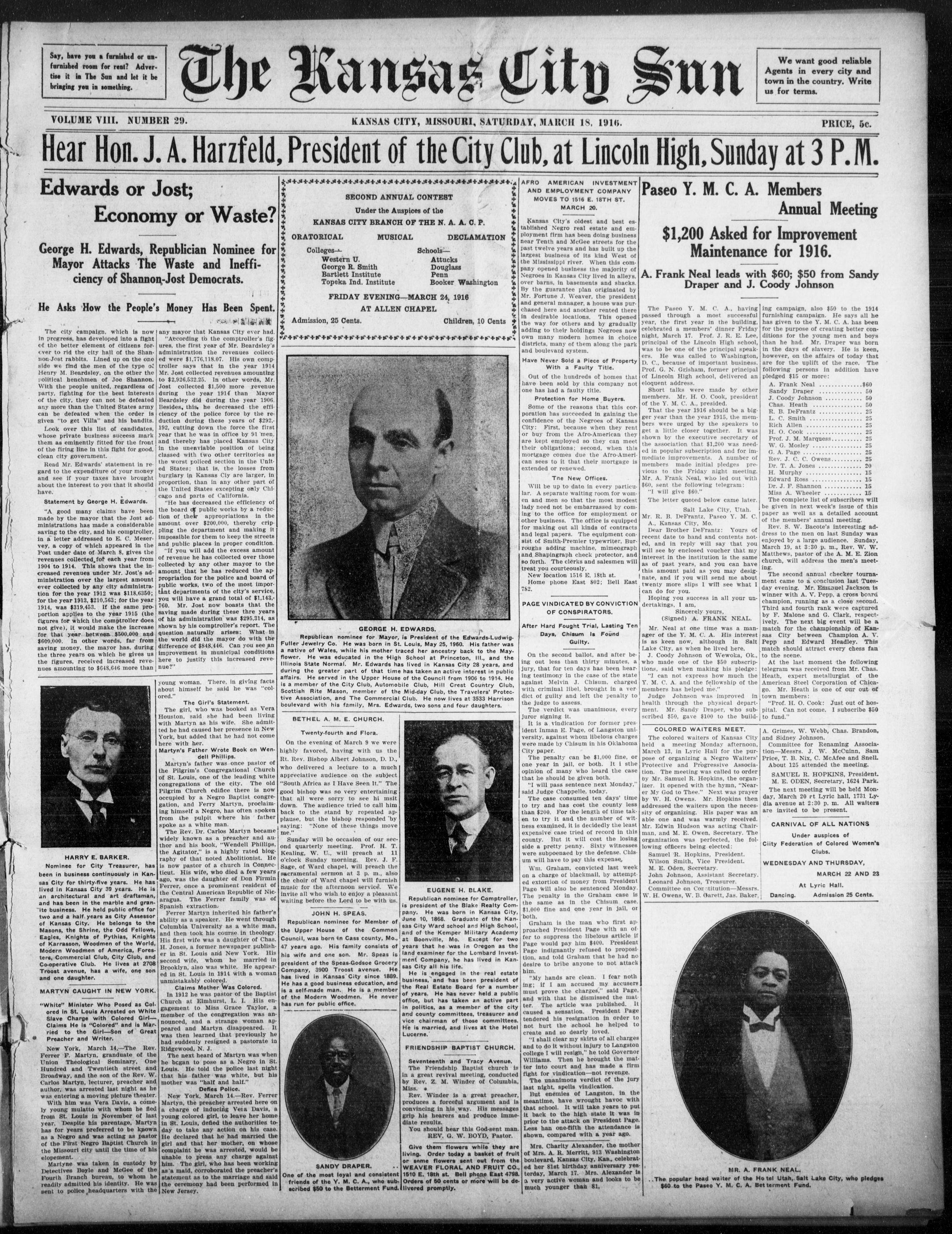
Edwards or Jost; Economy or Waste?
George H. Edwards, Republican Nominee for Mayor Attacks The Waste and Inefficiency of Shannon-Jost Democrats.
He Asks How the People's Money Has Been Spent.
any mayor that Kansas City ever had. "According to the comptroller's figures, the first year of Mr. Beardsley's administration the revenues collected were $1,776,118.07. His own comptroller says that in the year 1914 Mr. Jost collected revenues amounting to $2,926,522.25. In other words, Mr. Jost collected $1,500 more revenue during the year 1914 than Mayor Beardsley did during the year 1906. Besides, this, he decreased the efficiency of the police force by the reduction during these years of $292.192, cutting down the force the first year that he was in office by 91 men, and thereby has placed Kansas City in the unenviable position of being classed with two other territories as the worst policed section in the United States; that is, the losses from burglary in Kansas City are larger, in proportion, than in any other part of the United States excepting only Chicago and parts of California.
"He has decreased the efficiency of the board of public works by a reduction of their appropriations in the amount over $200,000, thereby crippling the department and making it impossible for them to keep the streets and public places in proper condition.
"If you will add the excess amount of revenue he has collected over those collected by any other mayor to the amount that he has reduced the appropriation for the police and board of public works, two of the most important departments of the city's service, you will have a grand total of $1,143,760. Mr. Jost now boasts that the saving made during these three years of his administration was $295,314, as shown by his comptroller's report. The question naturally arises: What in the world did the mayor do with the difference of $848,446. Can you see an improvement in municipal conditions here to justify this increased revenue?"
young woman. There, in giving facts about himself he said he was "colored."
The Girl's Statement.
The girl, who was booked as Vera Houston, said she had been living with Martyn as his wife. She admitted he had caused her presence in New York, but added that he had not come here with her.
Martyn's Father Wrote Book on Wendell Phillips.
Martyn's father was once pastor of the Pilgrim's Congregational Church of St. Louis, one of the leading white congregations of the city. The old Pilgrim Church edifice there is now occupied by a Negro Baptist congregation, and Ferry Martyn, proclaiming himself a Negro, has often spoken from the pulpit where his father spoke as a white man.
The Rev. Dr. Carlos Martyn became widely known as a preacher and author and his book, "Wendell Phillips, the Agitator," is a highly rated biography of that noted Abolitionist. He is now pastor of a church in Connecticut. His wife, who died a few years ago, was the daughter of Don Firmin Ferrer, once a prominent resident of the Central American Republic of Nicaragua. The Ferrer family was of Spanish extraction.
Say, have you a furnished or unfurnished room for rent? Advertise it in The Sun and let it be bringing you in something.
The city campaign, which is now in progress, has developed into a fight of the better element of citizens forever to rid the city hall of the Shannon-Jost rabbits. Lined up on the one side we find the men of the type of Henry M. Beardsley, on the other the political henchmen of Joe Shannon. With the people united, regardless of party, fighting for the best interests of the city, they can not be defeated any more than the United States army can be defeated when the order is given "to get Villa" and his bandits.
Look over this list of candidates, whose private business success mark them as eminently fitted for the front of the firing line in this fight for good, clean city government.
Read Mr. Edwards' statement in regard to the expenditure of your money and see if your taxes have brought about the interest to you that it should have.
Statement by George H. Edwards.
"A good many claims have been made by the mayor that the Jost administrations has made a considerable saving to the city, and his comptroller, in a letter addressed to E. C. Meserve, a copy of which appeared in the Post under date of March 8, gives the revenues collected, for each year from 1904 to 1914. This shows that the increased revenues under Mr. Jost's administration over the largest amount ever collected by any city administration for the year 1912 was $118,6250; for the year 1913, $210,563; for the year 1914, was $319,453. If the same proportion applies to the year 1915 (the figures for which the comptroller does not give), it would make the increase for that year between $500,000 and $600,000. In other words, far from saving money, the mayor has, during the three years on which he gives us the figures, received increased revenues amounting to $648,646 more than
HARRY E. BARKER.
Nominee for City Treasurer, has been in business continuously in Kansas City for thirty-five years. He has lived in Kansas City 39 years. He is an architectural and art draftsman, and has been in the marble and granite business. He held public office for two and a half years as City Assessor of Kansas City. He belongs to the Masons, the Shrine, the Odd Fellows, Eagles, Knights of Pythias, Knights of Karrasson, Woodmen of the World, Modern Woodmen of America, Foresters, Commercial Club, City Club, and Co-operative Club. He lives at 2708 Troost avenue, has a wife, one son and one daughter.
MARTYN CAUGHT IN NEW YORK
"White" Minister Who Posed as Colored in St. Louis Arrested on White Slave Charge with Colored Girl—Claims He is "Colored" and is Married to the Girl—Son of Great Preacher and Writer.
New York, March 14,—The Rev. Ferrer F. Martyn, graduate of the Union Theological Seminary, One Hundred and Twentieth street and Broadway, and the son of the Rev. W. Carlos Martyn, lecturer, preacher and author, was arrested last night as he was entering a moving picture theater.
With him was Vera Davis, a comely young mulatto with whom he fled from St. Louis in November of last year. Despite his parentage, Martyn has for years preferred to be known as a Negro and was acting as pastor of the First Negro Baptist Church in the Missouri city until the time of his elopement.
Martyne was taken in custody by Detectives Boyle and McGee of the Fourth Branch bureau, to whom he readily admitted his identity. He was sent to police headquarters with the
The Kansas City Sun
Ferrer Martyn inherited his father's ability as a speaker. He went through Columbia University as a white man, and then took his course in theology. His first wife was a daughter of Chas. H. Jones, a former newspaper publisher in St. Louis and New York. His second wife, whom he married in Brooklyn, also was white. He appeared in St. Louis in 1914 with a woman unmistakably colored.
Claims Mother Was Colored. In 1912 he was pastor of the Baptist Church at Elmhurst, L. I. His engagement to Miss Grace Taylor, a member of the congregation was announced, and a strange woman appeared and Martyn disappeared. It was then learned that previously he had suddenly resigned a pastorate in Ridgewood, N. J.
The next heard of Martyn was when he began to pose as a Negro in St. Louis. He told the police last night that his father was white, but his mother was "half and half."
New York, March 14.—Rev. Ferrer Martyn, the preacher arrested here on a charge of inducing Veta Davis, a young colored girl, to leave her home in St. Louis, defied the authorities today to take any action on his case. He declared that he had married the girl and that her mother, on whose complaint he was arrested, would be unable to press any charge against him. The girl, who has been working as a maid, corroborated the preacher's statement as to the marriage and said the ceremony had been performed in New Jersey.
KANSAS CITY, MISSOURI, SATURDAY, MARCH 18. 1916.
Colleges
Western U.
George R. Smith
Bartlett Institute
Topeka Ind. Institute
FRIDAY EVENING
AT ALLEN
Admission, 25 Cents.
```markdown
```
M.
GEORGE H. EDWARDS
Republican nominee for Mayor, is President
Fuller Jewelry Co. He was born in St. Louis, May
a native of Wales, while his mother traced her
flower. He was educated in the High School at
Illinois State Normal. Mr. Edwards has lived in H
during the greater part of that time has taken
a affairs. He served in the Upper House of the Cou
is a member of the City Club, Automobile Club,
I Scottish Rite Mason, member of the Mid-day C
tative Association, and The Commercial Club. He
boulevard with his family, Mrs. Edwards, two son
Republican nominee for Mayor, is President of the Edwards-Ludwig-Fuller Jewelry Co. He was born in St. Louis, May 25, 1960. His father was a native of Wales, while his mother traced her ancestry back to the Mayflower. He was educated in the High School at Princeton, Ill., and the Illinois State Normal. Mr. Edwards has lived in Kansas City 28 years, and during the greater part of that time has taken an active interest in public affairs. He served in the Upper House of the Council from 1906 to 1914. He is a member of the City Club, Automobile Club, Hill Crest Country Club, Scottish Rite Mason, member of the Mid-day Club, the Travelers' Protective Association, and The Commercial Club. He now lives at 3533 Harrison boulevard with his family, Mrs. Edwards, two sons and four daughters.
BETHEL A. M. E. CHURCH.
On the evening of March 9 we were highly favored, having with us the Rt. Rev. Bishop Albert Johnson, D. D., who delivered a lecture to a much appreciative audience on the subject "South Africa as I Have Seen It." The good bishop was so very entertaining that all were sorry to see hi mist down. The audience tried to call him back to the stand by repeated applause, but the bishop responded 'by saying: "None of these things move me."
Sunday will be occasion of our second quarterly meeting. Prof. H. T. Kealing, W. U., will preach at 11 o'clock Sunday morning. Rev. J. F. Sage, of Ward chapel, will preach the sacramental sermon at 3 p. m., also the choir of Ward chapel will furnish music for the afternoon service. We invite all who wish to enjoy a pleasant waiting before the Lord to be with us.
Republican nominee for Member of the Upper House of the Common Council, was born in Cass county, Mo., 47 years ago. His family consists of his wife and one son. Mr. Speas is president of the Speas-Godsoe Grocery Company, 3900 Troost avenue. He has lived in Kansas' City since 1889. He has a good business education, and is a self-made man. He is a member of the Modern Woodmen. He never has run for public office.
One of the most loyal and consistent friends of the Y. M. C. A., who subscribed $50 to the Betterment Fund.
JOHN H. SPEAS.
SANDY DRAPER.
```markdown
```
is President of the Edwards-Ludwig-
t. Louis, May 25, 1960. His father was
traced her ancestry back to the May-
n School at Princeton, Ill., and the
has lived in Kansas City 28 years, and
has taken an active interest in public
of the Council from 1906 to 1914. He
Oile Club, Hill Crest Country Club,
Mid-day Club, the Travelers' Protec-
Club. He now lives at 3533 Harrison
ards, two sons and four daughters.
Republican nominee for Comptroller is president of the Blake Realty Company. He was born in Kansas City, June 10, 1868. Graduate of the Kansas City Ward school and High School, and of the Kemper Military Academy at Boonville, Mo. Except for two years that he was in Oregon as the land examiner for the Lombard Investment Company, he has lived in Kansas City all his life.
He is engaged in the real estate business, and has been president of the Real Estate Board for a number of years. He has never held a public office, but has taken an active part in politics, as a member of the city and county committees, treasurer and vice chairman of those committees. He is married, and lives at the Hotel Lucerne.
FRIENDSHIP BAPTIST CHURCH
Seventeenth and Tracy Avenue.
The Friendship Baptist church is in a great revival meeting, conducted by Rev. Z. M. Winder of Columbia, Miss.
Rev. Winder is a great preacher, produces a forceful argument and is convincing in his way. His messages grip his hearers and produce immediate results.
You should hear this God-sent man.
REV. G. W. BOYD, Pastor.
Give them flowers while they are living. Order today a basket of fruit or some flowers sent out from the WEAVER FLORAL AND FRUIT CO.
1510 E. 18th st. Bell phone E798
Orders of 50 cents or more will be delivered promptly.
Children, 10 Cents
EUGENE H. BLAKE
AFRO AMERICAN INVESTMENT AND EMPLOYMENT COMPANY MOVES TO 1516 E. 18TH ST. MARCH 20.
Kansas City's oldest and best established Negro real estate and employment firm has been doing business near Tenth and McGee streets for the past twelve years and has built up the largest business of its kind West of the Mississippi river. When this company opened business the majority of Negroes in Kansas City lived in alleys, over barns, in basements and shacks. By the guarantee plan originated by Mr. Fortune J. Weaver, the president and general manager, a house was purchased here and another rented there in desirable locations. This opened the way for others and by gradually adding to their holdings Negroes now own many modern homes in choice districts, many of them along the park and boulevard system.
Have Never Sold a Piece of Property With a Faulty Title.
Out of the hundreds of homes that have been sold by this company not one has had a faulty title.
Some of the reasons that this corporation has succeeded in gaining the confidence of the Negroes of Kansas City: First, because when they rent or buy from the Afro-American they are kept employed so they can meet their obligations; second, when this mortgage comes due the Afro-American sees to it that their mortgage is extended or renewed.
Tne New Offices.
Will be up to date in every particular. A separate waiting room for women and men so that the most modest lady need not be embarrassed by coming to the office for employment or other business. The office is equipped for making out all kinds of contracts and legal papers. The equipment consist of Smith-Premier typewriter, Burroughs adding machine, mimeograph and Shapingraph check protector, and so forth. The clerks and salesmen will treat you courteously.
New location 1516 E. 18th st.
Home phone East 802; Bell East 752.
PAGE VINDICATED BY CONVICTION OF CONSPIRATORS.
After Hard Fought Trial, Lasting Ten Days, Chisum Is Found Guilty.
On the second ballot, and after being out less than thirty minutes, a jury, that for ten days has been hearing testimony in the case of the state against Melvin J. Chisum, charged with criminal libel, brought in a verdict of guilty and left the penalty to the judge to assess.
The verdict was unanimous, every juror signing it.
It is a vindication for former president Inman I. E. Page, of Langston university, against whom libelous charges were made by Chisum in his Oklahoma City paper.
The penalty can be $1,000 fine, or one year in jail, or both. It I sthe opinion of many who heard the case that he should be given both.
"I will pass sentence next Monday," said Judge Chappelle, today.
The case consumed ten days' time to try and has cost the county less than $200. For the length of time taken to try it and the number of witness examined, it is decidedly the least expensive case tried of record in this county. But it will cost the losing side a pretty penny. Sixty witnesses were subpoenaed by the defense. Chisum will have to pay this expense.
Wm. Graham, convicted last week on a charge of blackmail, by attempted extortion of money from President Page will also be sentenced Monday. The penalty in the Graham case is the same as in the Chisum case, $1,000 fine and one year in jail, or both.
Graham is the man who first approached President Page with an offer to suppress the libelous article if Page would pay him $400. President Page indignantly refused to proposition, and told Graham that he had no desire to bribe anyone to not attack him.
"My hands are clean. I fear nothing; if I am accused my accusers must prove the charges," said Page, and with that he dismissed the matter. The article was published. It caused a sensation. President Page tendered his resignation in order to not hurt the school he helped to create and so dearly loved. "I shall clear my skirts of all charges and to do it without injury to Langston college I will resign," he told Governor Williams. Then he brought the matter into court and has made a firm fight for vindication—not revenge.
The unanimous verdict of the jury last night, spells vindication.
But enemies of Langston, in the meantime, have wrought havoc with that school. It will take years to put it back to the high state it was in prior to the attack on President Page. Less han one-fifth the attendance is shown, compared with a year ago.
Mrs. Charity Alexander, the mother of Mrs. A. R. Merritt, 913 Washington boulevard, Kansas City, Kas, celebrated her 81st birthday anniversary yesterday, March 17. Mrs. Alexander is a very active woman and looks to be much younger than 81.
Paseo Y. M. C. A. Members Annual Meeting $1,200 Asked for Improvement Maintenance for 1916.
A. Frank Neal leads with $60; $50 from Sandy Draper and J. Coody Johnson
The Paseo Y. M. C. A., having passed through a most successful year, the first year in the building, celebrated a members' dinner Friday night, March 17. Prof. J. R. E. Lee, principal of the Lincoln High school, was to be one of the principal speakers. He was called to Washington, D. C., because of important business. Prof. G. N. Grisham, former principal of Lincoln High school, delivered an eloquent address.
Short talks were made by other members. Mr. H. O. Cook, president of the Y. M. C. A., presided.
That the year 1916 should be a bigger year than the year 1915, the members were urged by the speakers to get a little closer together. It was shown by the executive secretary of the association that $1,200 was needed in popular subscription and for immediate improvements. A number of members made initial pledges previous to the Friday night meeting. Mr. A. Frank Neal, who led out with $60, sent the following telegram:
"I will give $60."
The letter quoted below came later.
Salt Lake City, Utah.
Mr. R. B. DeFrantz, Paseo Y. M. C. A., Kansas City, Mo.
Dear Brother DeFrantz: Yours of recent date to hand and contents noted, and in reply will say that you will see by enclosed voucher that my interest in the institution is the same as of past years, and you can have this amount paid as you may designate, and if you will send me about twenty more slips I will see what I can do for you.
Hoping you success in all your undertakings, I am,
Sincerely yours,
(Signed) A. FRANK NEAL.
Mr. Neal at one time was a manager of the Y. M. C. A. His interest is as keen now, although in Salt Lake City, as when he lived here.
J. Cody Johnson of Wewoka, Ok., who made one of the $50 subscriptions, said when making his pledge: "I can not express how much the Y. M. C. A. and the fellowship of the members has helped me."
Judge Johnson was improved in health through the physical department. Mr. Sandy Draper, who subscribed $50, gave $100 to the build
COLORED WAITERS MEET.
The colored waiters of Kansas City held a meeting Monday afternoon, March 13, in Lyric Hall for the purpose of organizing a Negro Waiters' Protective and Progressive Association. The meeting was called to order by Mr. Samuel R. Hopkins, the organizer. It opened with the hymn, "Nearer My God to Thee." Next was prayer by W. H. Owens. Mr. Hopkins then addressed the waiters upon the necessity of organizing. His paper was an able one and was warmly received. Mr. Edwin Hudson was acting Chairman, and M. E. Owen, Secretary. The organization was perfected, the following officers being elected:
Samuel R. Hopkins, President.
Wilson Smith, Vice President.
M. E. Oden, Secretary.
John Johnson, Assistant Secretary.
Leonard Johnson, Treasurer.
Committee on Constitution—Messrs W. H. Owens, W. B. Garett, Jas. Baker
6
MR. A. FRANK NEAL.
MR. A. PRANK NEAL.
..The popular head waiter of the Hotel Utah, Salt Lake City, who pledges $60 to the Paseo Y. M. C. A. Betterment Fund.
We want good reliable Agents in every city and town in the country. Write us for terms.
ay at 3 P.M.
Members
Annual Meeting
for Improvement
re for 1916.
h $60; $50 from Sandy
Coody Johnson
ing campaign, also $50 to the 1914
furnishing campaign. He says all he
has given to the Y. M. C. A. has been
for the purpose of creating better con-
ditions for the young men and boys
than he had. Mr. Draper was born
in the days of slavery. He is keen,
however, on the affairs of today that
are for the uplift of the race. The
following persons in addition have
pledged $15 or more:
A. Frank Neal ..... $60
Sandy Draper ..... 50
J. Coody Johnson ..... 50
Chas. Heath ..... 50
R. B. DeFrantz ..... 25
L. C. Smith ..... 25
Rich Allen ..... 25
H. O. Cook ..... 25
Prof. J. M. Marquess ..... 25
W. G. Mosley ..... 25
G. A. Page ..... 25
Rev. J. C. C. Owens ..... 25
Dr. T. A. Jones ..... 20
H. Murphy ..... 15
Edward Ross ..... 15
Dr. J. F. Shannon ..... 15
Miss A. Wheeler ..... 15
The complete list of subscribers will be given in next week's issue of this paper as well as a detailed account of the members' annual meeting.
Rev. S. W. Bacote's interesting address to the men on last Sunday was enjoyed by a large audience. Sunday, March 19, at 3:30 p. m., Rev. W. W. Matthews, pastor of the A. M. E. Zion church, will address the men's meeting.
The second annual checker tournament came to a conclusion last Tuesday evening. Mr. Emanuel Jackson is winner with A. V. Pepp, a cross board champion, running as a close second. Third and fourth rank were captured by F. Malone and G. Clark, respectively. The next big event will be a match for the championship of Kansas City between Champion A. V. Pepp and Edward Headley. This match should attract every chess fan to the scene.
At the last moment the following telegram was received from Mr. Chas. Heath, expert metallurgist of the American Steel Corporation of Chicago. Mr. Heath is one of our out of town members:
"Prof. H. O. Cook: Just out of hospital. Can not come. I subscribe $50 to fund."
A. Grimes, W. Webb, Chas. Brandon, and Sidney Johnson.
Committee for Renaming Association—Messrs. J. W. McCuinn, Sam Price, T. B. Nix, C. McAfee and Snell. About 125 attended the meeting.
SAMUEL R. HOPKINS, President.
M. E. ODEN, Secretary, 1624 Park.
The next meeting will be held Monday, March 20 at Lyric hall, 1731 Lydia avenue at 2:30 p. m. All walters are invited to be present.
Under auspices of City Federation of Colored Women's Clubs.
WEDNESDAY AND THURSDAY,
MARCH 22 AND 23
At Lyric Hall.
Dancing. Admission 25 Cents.
to tel Utah, Salt Lake City, who pledge
etterment Fund.
PRICE, 5c.
INTERNATIONAL
SUNDAY SCHOOL
LESSON
(By E. O. SELLERS, Acting Director of Sunday School Course of the Moody Bible Institute, Chicago). (Copyright, 1916, Western Newspaper Union.)
LESSON FOR MARCH 19
LESSON TEXT-Acts 8:26, 40.
GOLDEN TEXT-Understandest thou what thou readest?-Acts 8:30.
Beginning at verse four, chapter eight, we enter upon the second great division of the Book of the Acts. It marks the beginning of preaching outside of Jerusalem and also the employment of lay-preachers. The persecution of the Jerusalem church was chiefly led by Paul (v. 3) and resulted in a wider dissemination of the good news (v. 4). Philip the deacon went to Samaria where multitudes heard and saw (vv. 5, 8) and where a remarkable work of grace attended his dealing with Simon Magnus, who thought he could buy the gift of the Holy Spirit bestowed by the apostles (v. 9-24). The apostles returned to Jerusalem (v. 25) leaving Philip to continue his great revival in Samaria.
I. Divine Preparation. vv. 26, 27 a.
The marvelous way God leads us;
ways we do not comprehend, to
accomplish his great designs is nowhere
better illustrated than here. Philip's
work would seem to demand his undivided and personal supervision, but he exhibits his superior wisdom by at once obeying this new command (Heb. 11:8). The Samaritan road joined the great Jerusalem highway to Egypt in the midst of uncultivated pasture land. Philip carried "sealed orders" and as he came to Gaza he met this man from the region south of Egypt, who was probably a Jewish proselyte, having adopted their religion, and was returning from worshiping at Jerusalem.
II. Diligent Study, v. 27:29. Philip overheard this high official as he was reading aloud from the prophecy by Isaiah, probably from the Greek translation. The Spirit directed Philip to join himself to this evidently honest inquirer, not because of his wealth and position but because he was a seeker after truth (John 7:17, Ps. 25:9). This statesman gives us a most simple and practical illustration (v. 28 R. V.) of how to study the Bible and to improve the time occupied in traveling. Both Luke, who wrote the Book of Acts, and Philip, the evangelist, seem to accept all of Isaiah without reservation. This method of reading study is the one that will surely secure for us revelations from God.
III. Direct Instruction. v. 30-35. We do not advocate indiscriminate assault upon every passing stranger in our desire to do personal work. Philip took each step as directed by the Holy Spirit. If we are attuned to the Spirit's "small voice" we will surely hear his "Go near" which will send us to those whom we may win for Christ. It is true that this passage from the prophet Isaiah is somewhat obscure and apart from Jesus of Nazareth, irreconcilable. "In his humiliation his judgment (justice) was taken away"—a fair trial not given; "his generation who shall declare" (Am. R. V.) i. e., his contemporaries who among them considered that he was cut off out of the land of the living (New Cent. Bible). Prof. G. A. Smith has declared that "none but prejudiced Jews have ever denied that this great prophecy, known as the fifty-third of Isaiah, was fulfilled in Jesus of Nazareth, and achieved all of its details in him alone." Philip's question was a pertinent one; good for this present time, and the eunuch's reply was much more frank than many professed Christians of today would be willing to admit. We have one who is ready to guide even as God met this ruler's need (John 14:26; 16:13; 1 Jno. 2:27). The importance of understanding is great (Matt. 13:19; 15:20; 24:15). The two portraits here presented of the Messiah are seemingly irreconcilable and are still a great puzzle to the Jews. Prince of Peace, despised and rejected; Suffering Savior, King eternal; there are many such seeming paradoxes. Infelds and rationalists have propounded such theories as "suffering Israel," but how can the sufferer be represented as suffering for the sins of others than himself? (v. 4, 5, 8, 9, 11, 12) and these others be "my people" (f. e. Israel) verse eight.
Philip "began" at that same point of contact and "preached Jesus," indeed this chapter is full of Christ. Jesus is the central subject of all Scripture. Philip explained the humiliation of Christ and the glories of the Messiah's kingdom. There is no higher work than to help others to a clearer vision.
IV. Declared Faith. v. 36-40. The eunuch had doubtless seen the rite of baptism in Jerusalem and at the first opportunity he desired to make public his new found faith. Baptism is confession and a symbol (Rom. 6:1-6) and immediately after the eunuch's declaration of faith (v. 37) Philip at once administered the rite, after which, his work being done, Philip is whisked away while the eunuch journeyed on "rejoicing."
These two men were total strangers, yet this wayside conversation gains one who must have heralded far the Gospel as he witnessed along his journey and in his home land.
Philip made Caesarea his home and twenty years later met Paul in that city (Acts 21:8).
Philip worked without the machinery of an "organized movement" and evidently without any emphasis upon the offering.
Do we look for the Spirit's personal leadings?
Are we ready for every opportunity?
Can we tell men the way of life, how to become a Christian?
How many Sunday school teachers can intelligently use the word of God in answering the inquiry, "What must I do to be saved?"
AFRO-AMERICAN CULLINGS
Twenty-five years ago Booker T. Washington devised a plan to call the Negro farmers of Alabama, Georgia and other states together once a year for a conference. This conference had been so far-reaching in usefulness that before his death he had planned the program for the "farmers" conference" of 1916.
Wednesday, January 19, was conference day, and there were farmers from all over the southern states, and many from the North and West. Negroes who owned their land, and who had been successful, and others who wanted the experience lessons in order for greater success for their own efforts, writes Mrs. J. B. Reid in the Birmingham (Ala.) Ace-Herald.
The crowd was tremendous. It was estimated that there were as many as three thousand Negroes present at dinner on the lawn, where a barbecue had been arranged, and a bountiful dinner served in picnic style. It was a wonderful sight to behold, and the portion of the grounds designated for "bitching places" looked like the scenes on the old-time camp-meeting grounds
There were many white people in attendance, men and women; in fact, it was a tremendous demonstration of interest in the best methods of farming and home improvement. There were many speakers from among the Negroes telling of practical experiences and of experiments. The boll weevil seems to be the most formidable enemy in every section, and he is usually the conqueror. Nothing said or tried seemed to destroy his appearance. Each farmer starting out as if he had the remedy, but the final result only proved there is but one way from the destructive power, and that was "raise a diversified crop, have more stock and feed the home markets." This is only the extension and purpose of the spirit of Tuskegee in situate.
The Negro is a natural farmer. He loves the soil and the sunshine—and that they are buying homes and using modern methods is an assurance that they are beginning to be more thrifty, and are being benefited by the encouragement and training they have been given.
I had a keen desire to spend a few days in Alabama's most wonderful workshop, and this was an opportunity. The invitation came to be among their white friends for the conference, and I spent three days most profitably within the inclusion of the institution—going every minute, and even then left much to be seen, although this was my second visit.
The spirit of Booker T. Washington lives among the teachers and students; there was evidenced the one great purpose—toiling for service and stronger citizenship—in answer to his call.
There are there now 1,620 students enrolled, 60 per cent of whom are boys, each one learning a trade. Think of what an impetus to labor in the preparation for the better workmanship. Each girl is compelled to learn domestic work—cooking, sewing, washing and household work—and economy is their watchword in these lessons. The entire student body works as one man. Speaking of economy and figuring on good management, the arithmetic used in the school was compiled by a former pupil. The lessons are based on the direct management, income and disbursement of the institute during the year of 1911. Calculating the in-
At a special meeting of the Washington branch of the National Negro Business league, held at Washington, a committee was appointed to draft resolutions expressive of the sorrow of the organization over the death of the founder of the league, Dr. Booker T. Washington. A recommendation was adopted, to be laid before the executive committee of the National Negro Business league, urging the setting apart of a "national Booker T. Washington day," on which occasion each year the colored people all over the land would assemble in their churches, schoolhouses and other public places and emphasize the constructive work done by the deceased for the intellectual, commercial, economic and social uplift of his race.
A second recommendation was ordered to be sent for the consideration of the executive committee of the parent body, to the effect "that it is the sense of the local league that a suitable monument should be erected to the memory of Booker T. Washington; that such a movement should be fostered by the National Negro Busi-
According to the Dutch legation in Stockholm, an extensive aluminum smelter is being organized at Hoyanfjord, Norway, where there is a waterfall which may supply 60,000 horsepower. It is proposed to develop 20,000 horsepower at once, to provide for the production of 4,000 tons of aluminum a year. The capital stock of the company is fixed at $3,350,000, of which $2,680,000 is subscribed.
Pneumatic balls as well as springs support a new bicycle saddle.
Modern War Conditions.
The sword is the costliest single article in the equipment a subaltern officer of the British army must buy, and since under present conditions this weapon is worn only when royalty reviews the troops that form of celebration is proving none too welcome in the new armies. Presumably grandchildren of veterans sixty years or so hence will weep over the dear little rusty tin can in which the old hero carried his boulton to the battle line at Mons.
come from products of all departments, expenditures, insurance, loss and profit, etc. Thus every arithmetic class knows the detail business of the school for that year. As the lesson is local, there is more interest in the study. These figures can be obtained for every day of the year now—for instance, I have before me today the report for January 15, 1916. This report is placed on the desk of John H. Washington, director of industries, and furnishes some interesting facts as regards the detail management of the department, upon which depends the supplies for the table, and buildings and financial success of the institution. There were 78,919 pounds of coal used in 24 hours at a cost of $2.91 a ton.
On January 15 there were 9,825 gallons of milk, containing 5.2 per cent fat, milked and 10 gallons bought extra from farmers. A milk wagon twice a day supplies many families in Tuskegee, and there is also a bread and vegetable wagon operated each day from the bakery and garden.
Bought from farmers same day, 20 gallons of skim milk and 10 gallons of cream.
Churned 209 pounds of cream, test 30 per cent fat; made 75 pounds butter.
Number of dairy cattle on hand, 162; amount of feed used for the day, 250 pounds of cottonseed meal, 25 pounds of oats, 25 pounds bran, 700 pounds of hulls, 700 pounds hay, 1,500 pounds silage.
In the poultry yards there are 583 hens and 51 cocks; 29 dozen eggs laid that day.
This is only to give an idea of the details and careful attention given each department each day; as each department submits an accurate report daily. Another feature of the industry, the institute buys from farmers, white and colored, their surplus, and thus furnishes to them a market and encourages other industry. A cannery for the preservation of their own products is operated, and other growers are encouraged to plant and cultivate a bountiful supply by an arrangement to use the cannery on shares. Every boy or girl near by can make their extra dimes by supplying this market with berries in season, to be preserved for winter. Much canned stuff, with the Tuskegee institute brand, is shipped each year.
Rev. Dr. M. H. Harris, in a sermon at Temple Israel, in Harlem, paid a high tribute to the late Dr. Booker T. Washington, the Negro educator, in which he reviewed his life and dwelt on the lessons to be learned therefrom.
"He not only sought to deepen the respect of the Caucasian for the Negro," he said, "but one of the highest purposes of the Tuskegee Institute was to awaken the respect of the Negro for his own people. For he had found now and then a scorn of the black for the black—a desire, though unavailing, to get away from his own. He taught this lesson by example. He showed them that he, a Negro, was just as proud of being a Negro as a white man could be of being of the white race."
In conclusion Doctor Harris said: "Is not his biography one to inspire the youth of the land? That he, with all his disadvantages, achieved so much, should not I, with my opportunities, do something worth while in the world? A great man helps us all to come nearer to greatness."
ness league, under the sanction of the family of the deceased leader and the trustees of Tuskegee institute, and that the local league pledges its heartiest co-operation with the national league in a movement looking toward that end."
Harry Putnam of Rochester, N. Y., trapped a robin recently and found tied to one of its legs a note written by Miss Beatrice Hinman of Washington, D. C., inviting the finder to address her if he was under thirty, single and good looking. Mr. Putnam replied at once.
They are agitating the question of digging a canal along the south shore of Long Island. Evidently there isn't water enough around Long Island to satisfy them.
Wisconsin was a part successively of Indiana, Illinois and Michigan before it was made a state in 1848.
An English firm puts up tea in blocks like plug tobacco for the convenience of travelers.
Aluminum mined in France will be refined in electric furnaces in Norway at a plant supplied with power by a waterfall where there is 60,000 horse power available.
A gas range has been invented with interchangeable parts that permit it to be fitted to meet the conditions encountered in kitchens of almost any description.
It's their crooked ways that enable some men to make both ends meet.
Sherman's Phrase Indorsed.
General Sherman's epigram, "War is hell," has an apt paraphrase in a personal letter recently received from a surgeon of the British forces in Flanders: "This war, as I see it here, in the trenches," he says, "may be summed up in three words—mud, blood and blasphemy." The atmosphere of Flanders, it will be remembered by readers of "Tristram Shandy," is conducive to profanity—"Our armies swore terribly in Flanders," said Uncle Toby.
Features of Fashion By JULIA BOTTOMLEY
THE BALLROOM
One Thin Fabric Over Another,
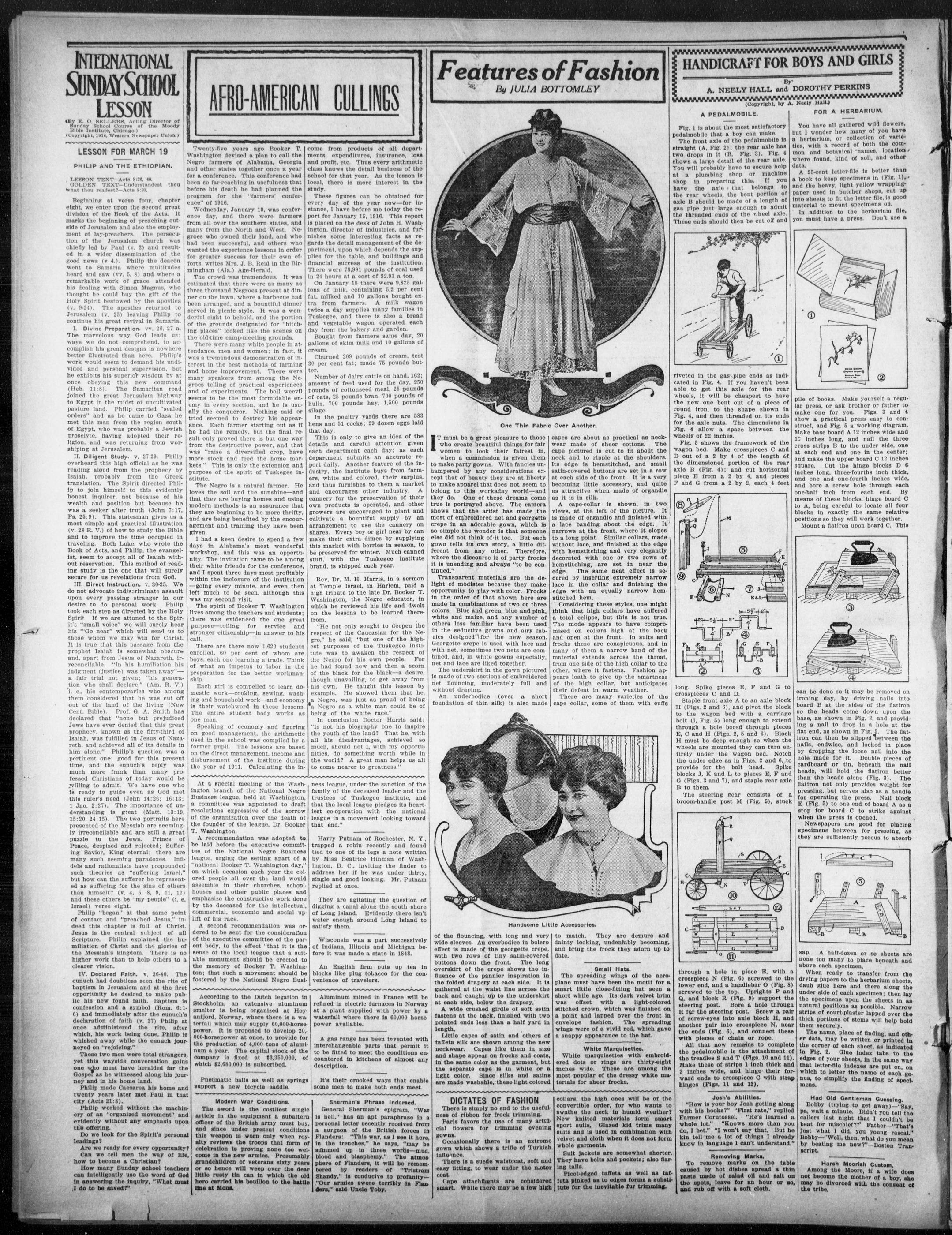
It must be a great pleasure to those who create beautiful things for fair women to look their fairest in, when a commission is given them to make party gowns. With fancies unhampered by any considerations except that of beauty they are at liberty to make apparel that does not seem to belong to this workaday world—and they do. One of these dreams come true is portrayed above. The camera shows that the artist has made the most of embroidered net and georgette crepe in an adorable gown, which is so simple the wonder is that someone else did not think of it too. But each gown tells its own story, a little different from any other. Therefore, where the discourse is of party frocks it is unending and always "to be continued."
capes are about wear made of cape pictured neck and rib Its edge is his becoming little as attractive as it is in silk A cape-cinched views, at the is made of orge a lace banding narrows at the to a long point without lace, a with hemstitch decorated with hemstitching, edge. The so
Transparent materials are the delight of modistes because they make opportunity to play with color. Frocks in the order of that shown here are made in combinations of two or three colors. Blue and green, blue and pink, white and maize, and any number of others less familiar have been used in the seductive gowns and airy fabrics designed for the new season. Georgette crepe is used with lace and with net, sometimes two nets are combined, and, in white gowns especially, net and lace are liked together. The underskirt in the gown pictured is made of two sections of embroidered net flouncing, moderately full and without draping. An underbedice (over a short foundation of thin silk) is also made
M.
I
of the flouncing, with long and very wide sleeves. An overbodice in bolero effect is made of the georgette crepe, with two rows of tiny satin-covered buttons down the front. The long overskirt of the crepe shows the influence of the pannier inspiration in the folded drapery at each side. It is gathered at the waist line across the back and caught up to the underskirt at each side, below the drapery. A wide crushed girdle of soft, satin fastens at the back, finished with two pointed ends less than a half yard in length. Little capes of satin and others of taffeta silk are shown among the new neckwear. Capes like them in size and shape appear on frocks and coats, in the same color as the garment, but the separate cape is in white or a light color. Since silks and satins are made washable, these light colored to match. dainty look and bring the date.
The spread plane must be smart little short while as offset stitched crowns a point and envelope faix wings were of a snappy appo
DICTATES OF FASHION
There is simply no end to the usefulness of ribbon for frock trimming.
Paris favors the use of many artificial flowers for trimming evening gowns.
Occasionally there is an extreme gown which shows a trifle of Turkish influence.
There is a suede waistcoat, soft and easy fitting, to wear under the motor coat.
Cape attachments are considered smart. While there may be a few high
capes are about as practical as neckwear made of sheer cottonts. The cape pictured is cut to fit about the neck and to ripple at the shoulders. Its edge is hemstitched, and small satin-covered buttons are set in a row at each side of the front. It is a very becoming little accessory, and quite as attractive when made of organdie as it is in silk. A cape-collar is shown, in two views, at the left of the picture. It is made of organdie and finished with a lace banding about the edge. It narrows at the front, where it slopes to a long point. Similar collars, made without lace, and finished at the edge with hemstitching and very elegantly decorated with one or two rows of hemstitching, are set in near the edge. The same neat effect is secured by inserting extremely narrow lace in the collar and finishing the edge with an equally narrow hemstitched hem.
Considering these styles, one might think that high collars have suffered a total eclipse, but this is not true. The mode appears to have compromised on collars high at the back and open at the front. In suits and frocks these are conspicuous, and in many of them a narrow band of the material extends across the throat, from one side of the high collar to the other, where it fastens. Fashion appears loath to give up the smartness of the high collar, but anticipates their defeat in warm weather. There are many varieties of the cape collar, some of them with cuffs
M.
to match. They are demure and dainty looking, undenfably becoming, and bring the frock they adorn up to date.
The spreading wings of the aeroplane must have been the motif for a smart little close-fitting hat seen a short while ago. Its dark velvet brim was offset with a light-colored stitched crown, which was finished on a point and lapped over the front in envelope fashion. The spreading wings were of a vivid red, which gave a snappy appearance to the hat.
White Marquisettes.
White marquisettes with embroidered dots or rings are thirty-eight inches wide. These are among the most popular of the dressy white materials for sheer frocks.
collars, the high ones will be of the convertible order, for who wants to swathe the neck in humid weather? New knitted materials form smart sport suits. Glazed kid trims many suits and is used in combination with velvet and cloth when it does not form whole garments.
Suit jackets are somewhat shorter. They have belts and pockets; also flaring tails. Picot-edged taffeta as well as taffeta pinked as to edges forms a substitute for the inevitable fur trimming.
Small Hats.
White Marguisettes
HANDICRAFT FOR BOYS AND GIRLS
Fig. 1 is about the most satisfactory pedalman that a boy can make.
pedalmobile that a boy can make.
The front axle of the pedalmobile is straight (A, Fig. 2); the rear axle has two drops in it (B, Fig. 3). Fig. 4 shows a large detail of the rear axle. You will probably have to secure help at a plumbing shop or machine shop in preparing this. If you have the axle that belongs to the rear wheels, the bent portion of axle B should be made of a length of gas pipe just large enough to admit the threaded ends of the wheel axle. These ends should then be cut off and
$\textcircled{1}$
riveted in the gas pipe ends as indicated in Fig. 4. If you haven't been able to get this axle for the rear wheels, it will be cheapest to have the new one bent out of a piece of round iron, to the shape shown in Fig. 4, and then threaded on its ends for the axle nuts. The dimensions in Fig. 4 allow a space between the wheels of 22 inches.
Fig. 5 shows the framework of the wagon bed. Make crosspieces C and D out of a 2 by 4 of the length $6f$ the dimensioned portion of the rear axle B (Fig. 4); and cut horizontal piece E from a 2 by 4, and pieces F and G from a 2 by 2, each 4 feet
$\textcircled{8}$
$\textcircled{9}$
$\textcircled{5}$
$\textcircled{7}$
$\textcircled{6}$
$\textcircled{7}$
$\textcircled{4}$
$\textcircled{3}$
long. Spike pieces E, F and G to crosspieces C and D.
Staple front axle A to an axle block H (Figs. 2 and 6), and pivot the block to the wagon bed with a carriage bolt I, Fig. 5) long enough to extend through a hole bored through pieces E, C and H (Figs. 2, 5 and 6). Block H must be deep enough so when the wheels are mounted they can turn entirely under the wagon bed. Notch the under edge as in Figs. 2 and 6, to provide for the bolt head. Spike blocks J, K and L to pieces E, F and G (Figs. 3 and 7), and staple rear axle B to them.
The steering gear consists of a broom-handle post M (Fig. 5), stuck
O
R
P
Q
S
F
D
E
G
H
N
T
$\textcircled{10}$
$\textcircled{12}$
S & T.
Y
S
D
C
E
T
G
$\textcircled{11}$
through a hole in piece E, with a crosspiece N (Fig. 6) screwed to the lower end, and a handlebar O (Fig. 8) screwed to the top. Uprights P and Q, and block R (Fig. 9) support the steering post. Bore a hole through R for the steering post. Screw a pair of screw-eyes into axle block H, and another pair into crosspiece N, near the ends (Fig. 6), and connect these with pieces of chain or rope.
All that now remains to complete the pedalmobile is the attachment of the treadles S and T (Figs. 10 and 11). Make these of strips 1 inch thick and 3 inches wide, and hinge their forward ends to crosspiece C with strap hinges (Figs. 11 and 12).
Josh's Abilities.
"How is your boy Josh getting along with his books?" "First rate," replied Farmer Corntosset. "He's learned a whole lot." "Knows more than you do, I bet." "I won't say that. But he kin tell me a lot of things I already know in language I can't understand."
Removing Marks.
To remove marks on the table caused by hot dishes spread a thin paste made of salad oil and salt on the spots, leave for an hour or so, and rub off with a soft cloth.
FOR A HERBARIUM.
You have all gathered wild flowers, but I wonder how many of you have a herbarium, or collection of varieties, with a record of both the common and botanical names, location where found, kind of soil, and other data.
A 25-cent letter-file is better than a book to keep specimens in (Fig. 1), and the heavy, light yellow wrapping-paper used in butcher shops, cut up into sheets to fit the letter file, is good material to mount specimens on.
In addition to the herbarium file, you must have a press. Don't use a
$\textcircled{1}$
$\textcircled{2}$
pile of books. Make yourself a regular press, or ask brother or father to make one for you. Figs. 3 and 4 show a practical press easy to construct, and Fig. 5 a working diagram. Make base board A 12 inches wide and 12 inches long, and nail the three cross strips B to the under side, one at each end and one in the center; and make the upper board C 12 inches square. Cut the hinge blocks D 6 inches long, three-fourths inch thick, and one and one-fourth inches wide, and bore a screw hole through each one-half inch from each end. By means of these blocks, hinge board C to A, be careful to locate all four blocks in exactly the same relative positions so they will work together. Mount a flatiron union board C. This
$\textcircled{3}$
$\textcircled{4}$
can be done so it may be removed on ironing day, by driving nails into board B at the sides of the flatiron so the heads come down upon the base, as shown in Fig. 3, and providing a nail to drop in a hole at the flat end, as shown in Fig. 5. The flatiron can then be slipped between the nails, endwise, and locked in place by dropping the loose nail into the hole made for it. Double pieces of cardboard or tin, beneath the nail heads, will hold the flatiron better than the heads alone (Fig. 3). The flatiron not only provides weight for pressing, but serves also as a handle for operating the press. Nail block E (Fig. 5) to one end of board A as a stop for board C to strike against when the press is opened.
Newspapers are good for placing specimens between for pressing, as they are sufficiently porous to absorb
sap. A half-dozen or so sheets are none too many to place beneath and above each specimen.
When ready to transfer from the drying papers to the herbarium sheets, daub glue here and there along the under side of each specimen; then lay the specimens upon the sheets in natural positions as possible. Narrow strips of court-plaster lapped over the thick portions of stems will help hold them securely.
The name, place of finding, and other data, may be written or printed in the corner of each sheet, as indicated in Fig. 2. Glue index tabs to the edges of your sheets, in the same way that letter-file indexes are put on, on which to letter the name of each genus, to simplify the finding of specimens.
Had Old Gentleman Guessing.
Bobby (trying to get away)—"Say,
pa, wait a minute. Didn't you tell the
callers last night that I couldn't be
beat for mischief?" Father—"That's
just what I did, you young rascal."
Bobby—"Well, then, what do you mean
by beating me now?"—Boston Trans-
cript.
Harsh Moorish Custom.
Among the Moors, if a wife does
not become the mother of a boy, she
may be divorced with the consent of
the tribe.
MADAM KATIE MARTIN'S "Sanitary" Hair Preparations
"Sanitary" Hair Preparations are just what the name implies. They cleanse and cure the scalp of all diseases, such as Dandruff, Tetter or Eczema, and finally produce a thick growth of hair.
A six weeks' trial treatment will convince any one of the value of Madam Martin's Sanitary Hair Preparations. A six weeks' trial treatment consisting of Sanitary Shampoo, 50c; Sanitary Grower, 50c; Sanitary Glossine, 35c; Sanitary Temple Grower, 35c, will be sent to any address in United States, prepaid, for $1.70.
Madam Martin Meth
of
Treating Scalps and G
Hair
Taught for $25.00
Write for Information
MME. KATE MART
No goods sent C. O. D.
AGENTS WANTED!
GOOD PROFIT!
Madam Katie Martin has given pared to meet the demands
I have been taking treatment from Mme. Martin for about three months. My hair has grownwonderfully—three inches. My scalp is perfectly clean of disease, which was never so before. Sanitary Hair preparations have given me perfect satisfaction. I recommend them highly.
Martin has given a careful
the demands of the people
TESTI
ing treatment from
about three months.
brownwonderfully—
scalp is perfectly
which was never so
Hair preparation
perfect satisfaction.
her preparation
fore using my
account of my
is thicker than
and it has g
since March is
highly
I have been taking treatment from Mme. Martin for about three months. My hair has grown wonderfully—three inches. My scalp is perfectly clean of disease, which was never so before. Sanitary Hair preparations have given me perfect satisfaction. I recommend them highly.
MRS. KATIE BROOKS,
2112 W. Prospect,
Kansas City, Mo.
I began to use Madam Martin's "Sanitary Hair Preparations" March 1st, 1915. I can positively say that her preparations are wonderful. Before using my hair was very thin on account of my bad scalp, but now it is thicker than it has been for years and it has grown several inches since March 1st, 1915.
MRS. G. H. SMITH,
3406 E. 6th St.,
Kansas City, Mo.
Madam Martin's "Sanitary Hair Preparations" have produced results that no other preparations have done. My scalp was in a very bad
I began to use Madam Martin's "Sanitary Hair Preparations" March 1st, 1915. I can positively say that
When writing to Madam M. if answer is desired.
NEG
W. L. Majors, the president and founder of the Violet Ray Machine and three of this invention, which is shown above Oxygen that purifies the scalp and hasfectious diseases. One of these machines City, which is under the supervision of that are to be established this season.
The machine above was exhibited and was viewed by thousands of persons. Without doubt it received the highest by some of the leading physicians of the national Association of Colored Physicians. Majors Oxford College is using the manufacturing seventeen different presisting the Majors Oxford System
Palace of Fashion
MRS. BIRDIE JACKSON
DESIGNER AND DRESSMAKER
Latest Styles
Madam Martin's Preparations" March that no other done. My scal
ing to Madam Martin Manufactured.
When writing to Madam Martin Manufacturing Co. enclose two-cent stamp for postage if answer is desired.
THE MACHINE
the president and founder of Majors
machine and three other inventions,
which is shown above, is a Hot and
the scalp and hair, stimulates the
one of these machines is to be play
the supervision of Mme. Rena Fir
finished this season.
Above was exhibited at the Emancip
thousands of persons and received
received the highest award of any
ing physicians of the country and
of Colored Physicians.
College is using the latest ideas and
eighteen different preparations with
Majors Oxford System.
Fashion and Beauty
ACKSON
PRESSMAKER
les
MME LIFE
HAIR DRESS
SR
Scalp Trees
Latest and MME
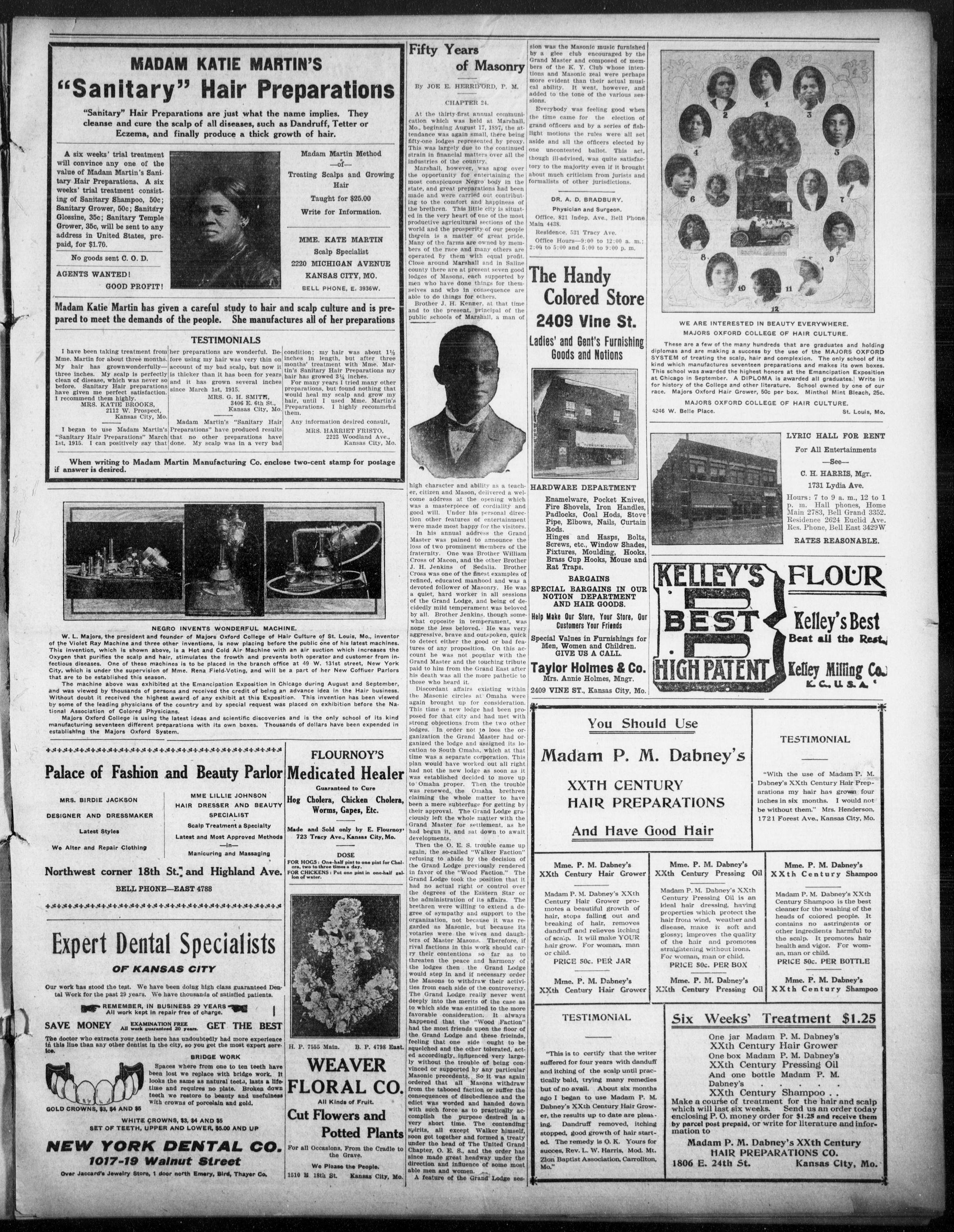
W. L. Majors, the president and founder of Majors Oxford College of Hair Culture of St. Louis, Mo., inventor of the Violet Ray Machine and three other inventions, is now placing before the public one of his latest machines. This invention, which is shown above, is a Hot and Cold Air Machine with an air suction which increases the Oxygen that purifies the scalp and hair, stimulates the frowth and prevents both operator and customer from infectious diseases. One of these machines is to be placed in the branch office at 49 W. W. 131st street, New York City, which is under the supervision of Mme. Rena Field-Voting, and will be a part of her New Coffiuer Parlors that are to be established this season.
The machine above was exhibited at the Emancipation Exposition in Chicago during August and September, and was viewed by thousands of persons and received the credit of being an advance idea in the Hair business. Without doubt it received the highest award of any exhibit at this Exposition. This invention has been viewed by some of the leading physicians of the country and by special request was placed on exhibition before the National Association of Colored Physicians.
Majors Oxford College is using the latest ideas and scientific discoveries and is the only school of its kind manufacturing seventeen different preparations with its own boxes. Thousands of dollars have been expended in establishing the Majors Oxford System.
Palace of Fashion and Beauty Parlor
We Alter and Repair Clothing
Expert Dental Spe
Dental Spee
---
Expert Dental Specialists
OF KANSAS CITY
Our work has stood the test. We have been doing high
tal Work for the past 29 years. We have thousands of
REMEMBER, IN BUSINESS 29 YEA
All work kept in repair free of charge
SAVE MONEY EXAMINATION FREE All work guaranteed 20 years.
The doctor who extracts your teeth here has undoubtedly
in this line than any other dentist in the city, so you get
too.
BRIDGE
the test. We have been doing high
last 29 years. We have thousands of
MEMBER, IN BUSINESS 29 YEAR
I will work kept in repair free of charge
EXAMINATION FREE
All work guaranteed 20 years.
Gives your teeth here has undoubtedly
other dentist in the city, so you get
BRIDGE
Our work has stood the test. We have been doing high class guaranteed Dental Work for the past 29 years. We have thousands of satisfied patients.
REMEMBER, IN BUSINESS 29 YEARS
All work kept in repair free of charge.
SAVE MONEY
EXAMINATION FREE
All work guaranteed 20 years.
GET THE BEST
The doctor who extracts your teeth here has undoubtedly had more experience in this line than any other dentist in the city, so you get the most expert service.
BRIDGE WORK
Spaces where from one to ten teeth have been lost we replace with bridge work. It looks the same as natural teeth, lasts a lifetime and requires no plate. Broken down teeth we restore to beauty and usefulness with crowns of porcelain and gold.
GOLD CROWNS, $3, $4 AND $5
WHITE CROWN
SET OF TEETH, UPPER
NEW YORK
1017-19 Wash
Over Jaccard's Jewelry Store, 1 do
WHITE CROWNS, $3, $4 AND
OF TEETH, UPPER AND LOWER, $
YORK DENT
7-19 Walnut St
Jewelry Store, 1 door north Emery,
WHITE CROWNS, $3, $4 AND $5
SET OF TEETH, UPPER AND LOWER, $5.00 AND UP
Over Jaccard's Jewelry Store, 1 door north Emery, Bird, Thayer Co.
[Image of a woman with dark hair and a light-colored top, looking slightly to the side.]
as given a careful study to hair and hands of the people. She manufacture
TESTIMONIALS
it from months.
finally—
perfectly over so operations
action
her preparations are wonderful. Before using my hair was very thin on account of my bad scalp, but now it is thicker than it has been for years and it has grown several inches since March 1st, 1915.
cone inch tin's hair
F prep
Madam Martin's "Sanitary Hair Preparations" have produced results that no other preparations have done. My scalp was in a very bad
Madam Martin Manufacturing Co. enclose t
NEGRO INVENTS WONDERFUL MACHINE
and founder of Majors Oxford College of Hair Care. Three other inventions, is now placing before the above, is a Hot and Cold Air Machine with an air and hair, stimulates the frowth and prevents brow machines is to be placed in the branch office of Mme. Rena Field-Voting, and will be a season.
Exhibited at the Emancipation Exposition in Chicago of persons and received the credit of being an highest award of any exhibit at this Exposition. Members of the country and by special request was placed Physicians.
Using the latest ideas and scientific discoveries and best preparations with its own boxes. Thousands and System.
MME LILLIE JOHNSON
HAIR DRESSER AND BEAUTY SPECIALIST
Scalp Treatment a Specialty
Latest and Most Approved Methods
—in—
Manicuring and Massaging
8th St. and Highland Ave.
Digital Specialists
KANSAS CITY
we have been doing high class guaranteed Den-
We have thousands of satisfied patients.
IN BUSINESS 29 YEARS
in repair free of charge.
DIMINATION FREE
guaranteed 20 years.
GET THE BEST
th here has undoubtedly had more experience
in the city, so you get the most expert serv-
BRIDGE WORK
Spaces where from one to ten teeth have been lost we replace with bridge work. It looks the same as natural teeth, lasts a lifetime and requires no plate. Broken down teeth we restore to beauty and usefulness with crowns of porcelain and gold.
CROWNS, $3, $4 AND $5
UPPER AND LOWER, $5.00 AND UP
K DENTAL CO.
Walnut Street
e, 1 door north Emery, Bird, Thayer Co.
MRS. G. H. SMITH,
3406 E. 6th St.
Kansas City, Mo
Madam Martin Method
—of—
Treating Scalps and Growing
Hair
Taught for $25.00
Write for Information.
MME. KATE MARTIN
Scalp Specialist
2220 MICHIGAN AVENUE
KANSAS CITY, MO.
BELL PHONE, E. 3936W.
and scalp culture and is pre-tures all of her preparations
condition; my hair was about 1½ inches in length, but after three months' treatment with Mme. Martin's Sanitary Hair Preparations my hair has grown 3½ inches.
For many years I tried many other preparations, but found nothing that would heal my scalp and grow my hair, until I used Mme. Martin's Preparations. I highly recommend them.
Any information desired consult,
MRS. HARRIET FRISTO,
2223 Woodland Ave.,
Kansas City, Mo
use two-cent stamp for postage
INE.
Hair Culture of St. Louis, Mo., inventor
e the public one of his latest machines.
h an air suction which increases the
ts both operator and customer from in-
ce at 49 W. 131st street, New York
e a part of her New Coffiuer Parlors
Chicago during August and September,
in advance idea in the Hair business.
tion. This invention has been viewed
s placed on exhibition before the Na-
s and is the only school of its kind
ands of dollars have been expended in
FLOURNOY'S
Medicated Healer
Guaranteed to Cure
Hog Cholera, Chicken Cholera,
Worms, Gapes, Etc.
Made and Sold only by E. Flournoy
723 Tracy Ave., Kansas City, Mo.
DOSE
FOR HOCS : One-half pint to one pint for Cholera, two to three times a day.
FOR CHICKENS : Put one pint in one-half gal lon of water.
H. P. 7555 Main. B. P. 4798 East.
WEAVER
FLORAL CO.
All Kinds of Fruit.
Cut Flowers and
Potted Plants
For all Occasions, From the Cradle to
the Grave.
We Please the People.
1510 N. 18th St. Kansas City, Mo.
By JOE E. HERRIFORD, P. M.
CHAPTER 24.
At the thirty-first annual communication which was held at Marshall Mo., beginning August 17, 1897, the attendance was again small, there being fifty-one lodges represented by proxy. This was largely due to the continued strain in financial matters over all the industries of the country.
Marshall, however, was agog over the opportunity for entertaining the most conspicuous Negro body in the state, and great preparations had been made and were carried out contributing to the comfort and happiness of the brethren. This little city is situated in the very heart of one of the most productive agricultural sections of the world and the prosperity of our people therein is a matter of great pride. Many of the farms are owned by members of the race and many others are operated by them with equal profit. Close around Marshall and in Saline county there are at present seven good lodges of Masons, each supported by men who have done things for themselves and who in consequence are able to do things for others. Brother J. H. Kenner, at that time and to the present, principal of the public schools of Marshall, a man of
[Name]
high character and ability as a teacher, citizen and Mason, delivered a welcome address at the opening which was a masterpiece of cordiality and good will. Under his personal direction other features of entertainment were made most happy for the visitors.
In his annual address the Grand Master was pained to announce the loss of two prominent members of the fraternity. One was Brother William Cross of Macon, and the other Brother J. H. Jenkins of Sedalia. Brother Cross was one of the finest examples of refined, educated manhood and was a devoted follower of Masonry. He was a quiet, hard worker in all sessions of the Grand Lodge, and being of decidedly mild temperament was beloved by all. Brother Jenkins, though some what opposite in temperament, was none the less beloved. He was very aggressive, brave and outspoken, quick to detect either the good or bad features of any proposition. On this account he was not popular with the Grand Master and the touching tribute paid to him from the Grand East after his death was all the more pathetic to those who heard it.
Discordant affairs existing within the Masonic circles at Omaha were again brought up for consideration. This time a new lodge had been proposed for that city and had met with strong objections from the two other lodges. In order not to loos the organization the Grand Master had organized the lodge and assigned its location to South Omaha, which at that time was a separate corporation. This plan would have worked out all right had not the new lodge as soon as it was established decided to move up to Omaha proper. Then the trouble was renewed, the Omaha brethren claiming the whole matter to have been a mere subterfuge for getting by their approval. The Grand Lodge graciously left the whole matter with the Grand Master for settlement, as he had begun it, and sat down to await developments.
Then the O. E. S. trouble came up again, the so-called "Walker Faction" refusing to abide by the decision of the Grand Lodge previously rendered in favor of the "Wood Faction." The Grand Lodge took the position that it had no actual right or control over the degrees of the Eastern Star or the administration of its affairs. The brethren were willing to extend a degree of sympathy and support to the organization, not because it was regarded as Masonic, but because its votaries were the wives and daughters of Master Masons. Therefore, if rival factions in this work should carry their contentions so far as to threaten the peace and harmony of the lodges then the Grand Lodge would step in and if necessary order the Masons to withdraw their activities from each side of the controversy. The Grand Lodge really never went deeply into the merits of the case as to which side was entitled to the more favorable consideration. It always happened that the "Wood Faction" had the most friends upon the floor of the Grand Lodge and these friends, feeling that one side ought to be squeelched and the other tolerated, acted accordingly, influenced very largely without the trouble of being convinced or supported by any particular Masonic precedents. So it was again ordered that all Masons withdraw from the tabooed faction or suffer the consequences of disobedience and the edict was wored and handed down with such force as to practically accomplish the purpose desired in a very short time. The contending spirits, all except Walker himself, soon got together and formed a treaty under the head of The United Grand Chapter, O. E. S., and the order has since made great headway under the direction and influence of some most able men and women.
A feature of the Grand Lodge ses-
sion was the Masonic music furnished by a glee club encouraged by the Grand Master and composed of members of the K. Y. Club whose intentions and Masonic zeal were perhaps more evident than their actual musical ability. It went, however, and added to the tone of the various sessions.
Everybody was feeling good when the time came for the election of grand officers and by a series of fishlight motions the rules were all set aside and all the officers elected by one uncontested ballot. This act, though ill-advised, was quite satisfactory to the majority even if it brought about much criticism from jurists and formalists of other jurisdictions.
DR. A. D. BRADBURY.
Physician and Surgeon.
Office, 821 Indep. Ave., Bell Phone
Main 4438.
Residence, 531 Tracy Ave.
Office Hours--9:00 to 12:00 a. m.;
2:00 to 5:00 and 5:00 to 9:00 p. m.
The Handy Colored Store 2409 Vine St.
Ladies' and Gent's Furnishing Goods and Notions
HARDWARE DEPARTMENT
Enamelware, Pocket Knives,
Fire Shovels, Iron Handles,
Padlocks, Coal Hods, Stove
Pipe, Elbows, Nails, Curtain
Rods.
Hinges and Hasps, Bolts,
Screws, etc., Window Shades,
Fixtures, Moulding, Hooks,
Brass Cup Hooks, Mouse and
Rat Traps.
BARGAINS
SPECIAL BARGAINS IN OUR
NOTION DEPARTMENT
AND HAIR GOODS.
Help Make Our Store, Your Store, Our
Customers Your Friends
Special Values in Furnishings for
Men, Women and Children.
GIVE US A CALL.
Taylor Holmes & Co.
Mrs. Annie Holmes, Mngr.
2409 VINE ST., Kansas City, Mo.
You Should Use
Madam P. M. Dab
XXTH CENTURY
HAIR PREPARATION
XXTH CENTURY HAIR PREPARATIONS
And Have Good Hair
Mme. P. M. Dabney's XXth Century Hair Grower
Madam P. M. Dabney's XXth Century Hair Grower promotes a beautiful growth of hair, stops falling out and breaking of hair, removes dandruff and relieves itching of scalp. It will make YOUR hair grow. For woman, man or child.
PRICE 50c. PER JAR
Mme. P. M. Dabney's XXth Century Hair Grower
TESTIMONIAL
"This is to certify that the writer suffered for four years with danduff and itching of the scalp until practically bald, trying many remedies but of no avail. About six months ago I began to use Madam P. M. Dabney's XXth Century Hair Grower, the results up to date are pleasing. Dandruff removed, itching stopped, good growth of hair started. The remedy is O. K. Yours for succes, Rev. L. W. Harris, Mod. Mt. Zlon Baptist Association, Carrollton, Mo."
1
2
3
4
5
6
7
8
9
10
11
12
These are a few of the many hundreds that are graduates and holding diplomas and are making a success by the use of the MAJORS OXFORD SYSTEM of treating the scalp, hair and complexion. The only school of its kind which manufactures seventeen preparations and makes its own boxes. This school was awarded the highest honors at the Emancipation Exposition at Chicago in September. A DIPLOMA is awarded all graduates. Write in for history of the College and other literature. School owned by one of our race. Majors Oxford Hair Grower, 50c per box. Minthol Mint Bleach, 25c.
MAJORS OXFORD COLLEGE OF HAIR CULTURE.
4246 W. Belle Place. St. Louis Mo.
BAYTOWN BANK SHOPPING
KELLEY'S BEST HIGH PATENT
M. Dabney's
TURY
PARATIONS
"With
Dabney's
arations
inches in
be without
1721 Fo
Mme. P. M. Dabney's XXth Century Pressing Oil
Madam P. M. Dabney's XXth Century Pressing Oil is an ideal hair dressing, having properties which protect the hair from wind, weather and disease, make it soft and glossy; improves the quality of the hair and promotes straightening without irons. For woman, man or child.
PRICE 50c. PER BOX
Mme. P. M. Dabney's XXth Century Pressing Oil
Six Weeks' Trea
Six Weeks' Treatment $1.25
Make a course of treatment which will last six weeks. Enclosing P. O. money order for by parcel post prepaid, or write mation to Madam P. M. Dabney HAIR PREPARA 1806 E. 24th St.
Make a course of treatment for the hair and scalp which will last six weeks. Send us an order today enclosing P. O. money order for $1.25 and receive them by parcel post prepaid, or write for literature and information to
Madam P. M. Dabney's XXth Century
HAIR PREPARATIONS CO.
1806 E. 24th St. Kansas City, Mo.
LYRIC HALL FOR RENT
For All Entertainments
—See—
C. H. HARRIS, Mgr.
1731 Lydia Ave.
FLOUR Kelley's Best Beat all the Rest.
---
"With the use of Madam P. M. Dabney's XXth Century Hair Preparations my hair has grown four inches in six months. I would not be without them." Mrs. Henderson, 1721 Forest Ave., Kansas City, Mo.
Weeks' Treatment $1.25
One jar Madam P. M. Dabney's
XXth Century Hair Grower
One box Madam P. M. Dabney's
XXth Century Pressing Oil
And one bottle Madam P. M.
Dabney's. . . .
XXth Century Shampoo . .
treatment for the hair and scalp
seeks. Send us an order today
or order for $1.25 and receive them
or write for literature and infor-
Dabney's XXth Century
EPARATIONS CO.
Kansas City, Mo.
Hours: 7 to 9 a. m., 12 to 1
p. m. Hall phones, Home
Main 2783, Bell Grand 3352.
Residence 2624 Euclid Ave.
Res. Phone, Bell East 3429W
RATES REASONABLE.
Kelley Milling Co.
K.C. U.S.A.
TESTIMONIAL
Mme. P. M. Dabney's XXth Century Shampoo
Madam P. M. Dabney's XXth Century Shampoo is the best cleaner for the washing of the heads of colored people. It contains no astringents or other ingredients harmful to the scalp. It promotes hair health and vigor. For woman, man or child.
PRICE 50c. PER BOTTLE
Mme. P. M. Dabney's XXth Century Shampoo
St. Louis, Mo.
THE KANSAS CITY SUN PUBLISHED WEEKLY.
All communications should be addressed to The Kansas City Sun, 1803 East 18th Stret.
Sell Phone East 999.
Entered as second-class matter, August 1903, at the postoffice at Kansas City, under the act of March 3, 1879.
One Year
Five Months
Tares Months
$1.50
$9
$9
There are localities in Missouri in which Negroes cannot live. There are localities in which they live under constant mistreatment and oppression, all rights ignored, all liberties denied. All these localities are strictly democratic in politics.
It may be safely asserted that no man or woman can become very proficient as a teacher, minister, lawyer or physician and at the same time dabble into all sorts of politics, social clubs or other forms of obligations involving absence from study and loss of sleep.
Negroes should be cautious about engaging in the agitation for a new state constitution. A new instrument that would be likely to meet with popular approval would be pretty sure to contain certain open or veiled provisions effecting the rights of the colored citizens of the commonwealth. If the new constitution should appear more generous than the old toward human liberty it would be sure to meet with repudiation at the hands of the white voters.
Dr. Richardson in her brief but pointed talk at Allen Chapel last Sunday, said some sensational things to the colored people. Her strong arraignment of the Negro who neglects his own professional and business people and takes his patronage to white people where he is not wanted or where he is openly slighted will be remembered long by those who heard it. The same condemnation is due the Negro who patronizes the back door of white eating places, the alley doors of white theaters and to the Negro who carries scandal and gossip to the white folks.
```markdown
```
The fight of the Republican party in the present city campaign is one of the most interesting fights waged in recent years. The platform of the party offers a fair proposition to all citizens of Kansas City who wish their city run on an efficient and progressive business plan. The Republican party has always stood for the best interests of the Negro. Therefore every Negro citizen of Kansas City should go to the poles at the April election and "vote 'er straight through." Betty @ Sam's Little Corner
Little Corner
THEY SAY
—That everybody will attend the Knights of Friendship entertainment at Lyric hall Monday, March 27. Betty and Sam are going early to avoid the rush.
—That there were more overcoats "soaked" last Monday than ever before in this old town, but the boys got fooled. Summer isn't here yet.
—That the man who constantly buys on credit soon gets so he can't look anybody in the face.
—That there is a divorce case pending that will make mighty interesting reading when it comes to trial. Betty and Sam are going to be there to hear it.
—That if you advertise in the Sun that you want the colored man's business, you'll get it; if you don't believe it, try.
—That a certain colored brother who bought an automobile some time ago had to give it up because he couldn't buy gasoline to keep it going. Well, you can't do joy riding on 20-cent gasoline and a $7 a week salary. That's a cinch.
—That a certain "star" boarder has been unable to explain to his angry landlord his presence in the landlord's room when he unexpectedly returned from his lodge.
—That one shady house in a block gives the whole block a bad name. That's true, too, brother.
—That every Negro in town who can get hold of a sack of cornmeal, a dozen pig feet, a bucket of "chit lins" and a month's rent opens a "restaurant"—but only for a month.
—That you can go every where in these old United States and after you have visited all its cities and towns you will say: "Old K. C. is the best in the country"—and that's no lie, Sam.
PETER H. BURKE
FRED W. COON.
Nominee for Judge of the Municipal Court of the North Side, was born in Mercer county, Mo., April 13, 1873. He was graduated at the Alvion College at Trenton, Mo. Has been a practicing attorney since 1898. Before coming to Kansas City he served two terms as Judge of the Probate Court of Mercer county, and was Assistant City Attorney for two years, 1906-1908, of Kansas City. He is of German-American ancestry. His family consists of a wife and one child.
ALBERT L. BEACH
Nominee for Member Upper House, was born in Olathe, Kas., July 30, 1883. Graduated from Olathe High School and Kansas University and took degree in law in Washington University, St. Louis, Mo. Elected on Republican ticket as member of the Lower House of the Common Council from the old Fifth Ward, 1910, and re-elected in 1912. Came to Kansas City from St. Louis in 1907, and associated with the law firm of Ward, Hadley and Neel for two years. Now located with offices at 1206-7 Commerce Building. A director and one of the organizers of the Business Men's Accident Association, an accident and health insurance company which has made the most remarkable growth of any company of its kind in the United States. Also director in the Kansas City Protective Association, an accident and health Company. Member of the Bar Association, City Club, and Mission Hills Club.
EDGAR B. HARRINGTON
Republican nominee for Member of the Upper House, is superintendent of the Missouri Valley Press. He was born in Ohio, March 1, 1963, and has lived in Kansas City 26 years. His family consists of his wife and two children. He was educated in the common schools of Kansas, and studied commercial law and accounting in the Commercial College at Abilene, Kas. He served three years as Deputy Circuit Clerk, and two years as Secretary of the Board of Fire and Water Commissioners of Kansas City. He is a member of the Masons and of the Typographical Union. The latter organization he has served as Secretary and as Delegate to two Councils.
LINVILLE L. ADAMS
Nominee for the Upper House. Superintendent of the Metropolitan Life Insurance Company for Kansas City and surrounding territory. He was born in Christian county, Mo., June 17, 1879. He grew up in Christian county and during the war with Spain served a year and a half in the Twentieth Regiment, U. S. Regulars. Saw military service in Cuba. Participated in the battle of El Caney with Roosevelt's Rough Riders. After the close of the Spanish war he came to Kansas City and became an agent for the Metropolitan Life, and by a series of promotions has come to have complete charge of the district.
His family consists of a wife and three children. He is a Mason, member of the City Club, of The Commercial Club, Y. M. C. A., Baptist Church, a member of the Executive Committee of the Life Underwriter's Association, vice president of the Anti-Tubercular Society.
Lincoln High School
MONTHLY SCHOOL AND C
MEET
Lincoln High School Extension
MONTHLY SCHOOL AND COMMUNITY IMPROVEMENT MEETING.
MR. J. A. HARZFELD,
President of the City Club of Kansas
Will Speak at
LINCOLN HIGH SCHOOL AUD
President of the City Club of Kansas City, Mo.
Will Speak at
LINGCOLN HIGH SCHOOL AUDITORIUM
Nineteenth and Tracy
SUNDAY, MARCH 19—3 O'CLOCK P. M.
SUBJECT—"Some Evidences of Race Progress
SPECIAL MUSIC by LINGCOLN HIGH SCHOOL ORCH
SUBJECT—"Some Evidences of Race Progress."
SPECIAL MUSIC by LINCOLN HIGH SCHOOL ORCHESTRA
ENTIRE PUBLIC IS INVITED!
A BEAUTIFUL DANCE PARTY.
A very pretty and formal dance party was given Wednesday evening, March 8, at Lyric hall by Misses Lillian M. Davis, Francis Beecham and Mr. Tapley Berger. The elaborate decorations of Chinese design were from the Weaver Floral Co., and the party was said by all who attended to have been the sweltest affair given this season. About 200 guests attended. Music was furnished by Dude Knox's orchestra. The principal dance of the evening was that in which Chinatown was featured. The beautiful programs were made by the Franklin Printing Co.
EMIL DORN.
Republican nominee for Member of the Upper House, was born in 1867 and has lived in Kansas City for more than seventeen years. As a business man he has been quite successful, being now president of the Dorn-Cloney Laundry Company, which owns not only the Spetch Laundry of this city, but many other laundry companies in different parts of the state. The Speth Laundry of this city is one of the very few companies employing colored women at their boards.
Mr. Dorn is a life member of the Shriners, and holds membership in the Elks, Triangle and Commercial Clubs. He has never held an elective office. His home is at 3117 Penn street.
JAMES H. FRAME
The Republican nominee for Member of the Upper House, was born in Scotland, January 17, 1856. He is president and owner of the J. H. Frame Printing Co., which business he has conducted for forty years. His family consists of his wife and two daughters. Mr. Frame was a member of the Upper House of the Common Council for four years, 1910 until 1914, during which time he made an enviable record for looking after the interests of the city. He served as an alderman in Cameron, Mo., for the four years prior to 1888. Mr. Frame is a member of the Masonic Blue Lodge, the Royal Arch Chapter, Council, Commandery, Shrine, and is also a 32d degree Scottish Rite Mason. Member of the Graphic Arts, Knife & Fork Club and the City Club. He is past Presiding Officer of all Masonic bodies, and he is past president and treasurer of the National Typothete.
JOSEPH F. KEIRNAN
Nominee for Judge of the Municipal Court of the South Side. He was born in Haunton, Mass., July 18, 1883. His family are of Irish extraction, and he is a member of the Knights of Columbus. He is a graduate of the Michigan University Law School, and practiced law in Kansas City since 1909. His family consists of a wife and two children.
CHARLES O. LA RUE. The Republican Nominee for member of the Upper House is president of the LaRue Printing Co., 810 Baltimore avenue. He has been in business in Kansas City 25 years. He was born in Haralsburg, Pa., in 1874, and was educated at a country school, and during the first few years he was in Kansas City, he attended the night school at the Kansas City Business college. He established the LaRue Printing company twenty years ago.
His family consists of his wife and two children, and his home is at 2129 Victor street. He is a member of the Knife and Fork club, Railroad club, City club, Travler's Protective association, Credit Men's association, Elks club, Automobile club of Kansas City, Kansas City Anglers club, United Commercial Travelers, Graphic Arts, Commercial club, Y. M. C. A. He is at present vice president of the T. P. A.
HENRY D. FAXON.
Republican nominee for member of the upper house, has always been active in civic affairs and was prominently mentioned as a possibility for the Nonpartisan nomination for Mayor. However, he refused to accept this position. Mr. Faxon is president of the Faxon-Gallagher Drug Company, having succeeded his father, the late Frank Faxon, who was one of the earliest and most prominent of our citizens. Henry Faxon has always taken an active part in the activities of the Commercial Club. Like the other members of the Republican ticket he is a successful business man and a faithful citizen.
COLORED PEOPLE'S PROGRESS.
A new race history soon to be placed on the market at $1.50. The publishers, Austin-Jenkins Co., Washington, D. C., Warder building, are now placing agents. Anyone wanting to secure the agency may get a fine prospectus FREE for 15 cents in postage.
school Extension
COMMUNITY IMPROVEMENT
TESTING.
Club of Kansas City, Mo.
peak at
SCHOOL AUDITORIUM
ences of Race Progress.'
HIGH SCHOOL ORCHESTRA
The Moses Dickson Re
1217 WOODLA
Kansas O
Regallas, Rituals and
HEROINES OF JERICHO
ORDER EASTERN
MA
Badges and Emblems for U. B. F. &
LODGE ROOM FURNITU
Souvenir Badges fo
The Moses Dickson Regalia and Supplies Co
1217 WOODLAND AVENUE
Kansas City, Mo.
Regallias, Rituals and Ceremonials for
HEROINES OF JERICHO
ORDER EASTERN STAR
MASONIC BODIES
ORDER OF TWELVE
Badges and Emblems for U. B. F. & S. M. T.
Special Catalogues for Each
LODGE ROOM FURNITURE MADE TO ORDER
Souvenir Badges for All Conventions
ALLEN CHAPEL
ALLEN CHAPEL.
Theeregular services at Allen last Sunday were replaced by the observation of "Baby Sunday," under the direction of the Women's Federated clubs. Mrs. Minnie Crosthaite presided. Sunday being an unusually delightful day, a very large audience was in attendance.
Dr. E. C. Bunch made a very interesting and talkive on the care of the baby's teeth.
Miss Hampton, head nurse at the city hospital, gave a splendid talk on the care and training of the baby. Dr Richardson of the Mercy hospital made a most excellent and timely talks filled with truth and good advice to the race.
At the evening services, Rev. Gray preached a splendid sermon on prayer. The second Sunday in April has been designated as rally day. The men will be in charge. They hope to pay the interest on the main debt of the church and renew the insurances.
The ladies of the church have charge of the County Fair. They hope to be able to reduce the mortgage debt of the church. Every member and friend is kindly asked to support this rally and fair.
VINE STREET BAPTIST CHURCH.
All services were well attended Sunday.
Three additions were made to the church. Our revival service is still on and we are meeting with much success...Mrs. Willie Lee Care spent two weeks in our city the guest of her mother and friends, returning home Thursday...Mrs. Clara Adams has returned from an extended trip thru California and Colorado, and a general good time is reported...Mrs. F. D. Michael who fell and fractured her wrist sometime ago, is somewhat improved at this writing...Miss Eva Moore, who was ill, is able to be out to the pleasure of her many friends.... Our pastor made a very interesting talk Sunday morning and said many good things. He said nine out of ten men who do not get converted before the age of 50 die sinners. Seek ye the Lord in your youth.
CENTENNIAL M. E. CHURCH
CENTENNIAL M. E. CHURCH.
Last Sunday was a great day in Centennial M. E. Church. The house was full morning and evening. Our pastor preached to the delight of all that heard him. We had seven additions Sunday, five of whom were converted. We have had 23 additions since the meeting commenced, and 19 conversions. The meeting will continue this week. Our collection was $41. Our pastor is in his closing weeks, and the Church was never in better condition than at this time. We all are praying that the Conference may return him back to us for another year.
National Colored Dressmaking College
12th and Vine Streets
Kansas City, Mo.
The reliable place to learn the art
of
Ladies' Tailoring and Fancy
Dressmaking
Expert Teachers in Attendance.
Recognized authority in advanced styles. Coats, suits and fancy dresses made to order. Bring your material and make your own suits and dresses under expert instructors.
For further information call on or address
MRS. ALICE STEELE. President
Quinoleum Is Queen
YES, I Use Quinoleum, and like it fine.
Face Preparations.
Quinoleum Face Bleach.....25c
Quinoleum Face Cream.....25c
Quinoleum Camphor Ice.....25c
A liberal sample of our new preparations,
a fragrantly perfumed toilet powder and a velvety face powder in pink and flesh colors (brown) sent free with any order.
Call Bell Phone West 1757.
26th and Parkway, Kansas City, Kas.
QUINOLEUM MANUFACTURING COMPANY.
The Kansas City Plan.
The Kansas City Plan.
The Kansas City plan was first proposed at a meeting of the Republican League in November, 1913. At that time, after a considerable discussion of the defects of the present charter, the league authorized W. W. Harnden, then president of that body, to appoint a committee of ten "to outline a plan of simplified city government which will conform with the present laws and constitutional provisions applicable to Kansas City." The chairman was made member of the committee and appointed these newbets to prepare the outline: E. C. Mesery, Solon T. Gilmore, Harry D. Train, W. H. H. Flatt, C. S. Van Noy, Walter A. Evans, B. F. Carter, Charles H. Khrisner, Fred W. Coon and Milford W. Rider. This committee worked for more than a month. The following is the plan outlined. It is not intended to cover all points of a charter, but is intended as a general statement of the main features of a charter which the Republicans promise to submit to the people as soon as a board of freeholders can prepare the details:
"We pledge the party and our nominees, if elected, to cause to be prepared and submitted to the people a new charter which shall contain substantially the following provisions:
"1 As required by the constitution of the state of Missouri, there shall be a mayor and two houses of legislation. The two houses shall be known as the common council.
"They shall be composed of not more than five members each, the total number to be not more than the necessary number of city departments.
"Each member shall be the head of one city department and responsible for its management.
"The members of one house shall be elected by and from the city at large.
"The city shall be divided into as many geographical districts as there are members of the other house, and said members shall be elected one from each district by the people at large.
The mayor and common council shall be the only elective officers.
"The head of each department of the municipal service shall appoint, subject to the civil service rules, all subordinates of his department.
"There shall be provisions made for the appointment by the mayor, without confirmation by the legislative bodies, of a city counselor, judges of the municipal courts and a city auditor, who shall be an expert certified accountant, to examine at reasonable intervals the books and business methods of all departments of the municipal service, and report thereon to the mayor.
"The mayor shall also appoint all other officers provided for by the charter, without confirmation by the council.
"2. The mayor and members of the two legislative houses shall be elected for a term of four years, but the mayor shall not be eligible to succeed himself."
"The right to recall such officers shall be submitted to the people in such form as to the board of free holders seems advisable.
"The mayor shall have the power of absolute veto on all acts of the legislative bodies except those relating to their internal affairs.
"3. For the purpose of a more economical administration, the numerous departments of municipal service now existing shall be so reduced and consolidated as not to exceed the number of the members of the two legislative bodies.
"In addition to his legislative duties each of said members shall serve as the head of one of such departments, thereby eliminating the present numerous expensive boards and heads of departments.
"The mayor and each member of the common council shall be required to spend all their time in the municipal service, receiving reasonable compensation therefor, which shall be fixed in the charter.
"Meetings of the common council shall be held from day t oday, so that the business of the people may be transacted without delay.
"4. The present restrictions which have been so effective in protecting
CALDWELL
Hair and
18th and Paseo, N
Home Phone
Scalp Treatment a Specialty. Cal
Grows Hair. Try it. Sa
and any old hair
Hair Matched From Samples. Feel
Blocked. Agents for Spirella Corse
WORK GUARANTEED.
MANICURING
CALDWELL & CHAPMAN Hair and Millinery 18th and Paseo, Kansas City, Mo.
Scalp Treatment a Specialty. Caldwell's Pomade and Tonic really Grows Hair. Try it. Save your combings, cut hair and any old hat you may have.
Hair Matched From Samples. Feathers and Hats Cleaned, Dyed and Blocked. Agents for Spirella Corsets. Mail orders answered promptly
WORK GUARANTEED. LIVE AGENTS WANTED
Say Friend!
CAN YOU TELL ME WHERE IS THE BEST PLACE TO BUY
Drugs, Toilet Articles and have
Prescriptions Filled?
Sure
—AT—
FOSTER'S PHARMACY
18TH AND WOODLAND AVE.
By the way, they fill and deliver prescriptions to any part of the
city; they will call for them, too.
Remember the Place EIGHTEENTH and WOODLAND
the city's credit, prohibiting officers of the city from anticipating its revenues by appropriations of money or contracts binding the city, shall be retained in the new charter.
Modifications of the present method shall be made reducing the cost of public improvements, retaining only such measures as the courts have held to be essential to the validity of special tax bills.
"5. No general franchise shall be valid until ratified by a vote of the people."
In speaking before the Athenacum society, E. C. Meservey, formerly city Counselor, emphasized among other things, the importance of injecting business methods into the management of the city's affairs.
He explained the "Kansas City Plan" of simplified government which is the most important plank in the Republican platform, saying in part:
"We have combined in this plan the abolishment of ward lines, a mayor and council elected by the whole city, members of the council in session every day, and actually participating in the departmental work of the city, a fixed responsibility which can not be shirked, necessary safeguards to protect the city's credit, a short ballot, and a strict auditing of the account of all departments. The plan can be adopted without any change in the state constitution or by any act of the state legislature. It is admirably adapted to the needs of the city. Under it a municipal administration becomes at once a compact, practical, efficient business organization.
"In this our municipal crisis," Mr. Merservey said, "when the city most needs a man possessed of the highest qualifications, Mr. George H. Edwards was persuaded to become our candidate for mayor. He was not a self-seeking candidate, or the candidate of any group of politicians; he serves no boss, he is owned by no public service corporation. He is the one man at this time best qualified to lead the city in its efforts to secure a better form of government and to honestly and efficiently handle the city's business.
"Mayor Jost has seemed to be utterly oblivious of his duties of mayor Henry L. Jost says he saved you money.
"BEFORE YOU BELIVE HIM LOOK AT YOUR TAX RECEIPTS AND COMPARE THEM WITH THOSE OF REPUBLICAN ADMINISTRATIONS. IF YOU ARE A POOR MAN, REMEMBER JOST RAISED THE MINIMUM ON PERSONAL TAXES FROM $50 TO $70.
"WHY DID JOST RAISE THE MINIMUM TAX VALUATION FROM $50 TO $70?
"BECAUSE HE NEEDED MORE MONEY FOR HIS RABBITS.
"BECAUSE THE POOR MAN COULD NOT FIGHT BACK AND PROBABLY WOULD NOT UNDERSTAND WHY HE WAS FORCED TO PAY HIGHER TAXES.
"BECAUSE THE RABBITS COULD NOT RAISE THE RICH MAN'S TAXES WITHOUT CAUSING A STORM OF PROTEST FROM THOSE WHO COULD FIGHT BACK.
"Where did the million dollars additional revenue Jost raised go?
"It didn't go into the repair of the streets of the cleaning of the streets.
He cut the board of public works down over $300,000 in his first three years.
The streets need repairing, and labor needs the work. Of course the Rabbits don't care to work on the streets.
But they get theirs!
Two terms as president were enough-for Washington, father of his country, but the mighty Henry L. Jost has had two terms as mayor and comes back for a third, alleging the city can not get along without him. This city grew before he was thought of and will after he has been retired in April. This city has given him nearly $2,000,000 more in the last four years than in any previous period of the same length in the city's history. What has he done with it? What benefit have you received? Look at your tax receipts and see how your personal taxes have increased.
& CHAPMAN
Millinery
Kansas City, Mo.
e East 4009
Dwell's Pomade and Tonic really
love your combings, cut hair
if you may have.
Mothers and Hats Cleaned, Dyed and
Hats. Mail orders answered promptly
LIVE AGENTS WANTED
FACIAL MASSAGE
friend!
IS THE BEST PLACE TO BUY
articles and have
ons Filled?
re
T-
HARMACY
ODLAND AVE
A BEAUTIFUL DUPLEX.
An Elegant Residence Being Built by
One of the most ornate and attractive residences owned by colored people is now being built at 1810 East 17th street by Mr. W. H. Watson, one of Kansas City's most progressive and industrious citizens. It is a beautiful two-story stuccoed duplex of five rooms each, absolutely modern in every detail with separate heaters and basement for each apartment, each basement beautifully arranged with stone floor and cemented wall. The rooms arranged with disappearing beds, large airy closets, elegantly equipped kitchens and bath rooms of enamel and imitation marble that are simply a dream. The houses are equipped with gas and electric lights with large room porches, front and back, and is unquestionably the last word in beautiful and substantial construction.
Mr. Watson demonstrates his confidence in his race by such a pleasing investment and said to our reporter that he contemplates erecting, at the completion of these buildings, a strictly modern three-story building with handsome apartments, centrally located and elegantly furnished, to be rented to men, which without doubt, would be a popular and successful investment from the very beginning. Those of our race who are contemplating building and those who want inspiration should look through the beautiful building just being completed by Mr. Watson.
OBITUARY.
Caroline Walker Stevenson was born in Fulton, Mo., October 19, 1848, and died at her home, eight miles south of Sweet Springs, Saline county, Thursday, February 25, 1916, at 5:45 p. m., at the age of 67 years, 2 months and 6 days. She came to Saline county when but a small girl, 7 years of age, was married to the late Lee Stevenson, December 31, 1868. Rev. H. Brown of St. Louis officiated. To this union ten children were born, five girls and five boys. The deceased, Mrs. Lee Stevenson joined the Missionary Baptist church in the year of our Lord, 1866, and she lived a consistent Christian until the end. She was taken ill early in November, 1915. The doctor announced it as being a nervous breakdown of which she never entirely recovered. Last Monday two weeks ago she was taken ill and continued to grow weaker until her death. She was constantly heard during her severe illness calling on the Lord until Wednesday when she lay in a comatose state ad was apparently unaware of her surroundings. The deceased had a premonition of her death. She told her daughters, shortly after her husband's death that she felt as tho she would not be with them all winter. She leaves to mourn her loss, nine children, five girls and four boys, fifteen grandchildren, two sisters and one brother and a host of relatives and friends. But the loss is Heven's gain as the wise Grecians have said, "No man or woman is happy until they are dead." So after life's fitful fever she steps well. To the bereaved you have lost a kind, loving and faithful mother. To the friends, a great woman from you is gone. She was full of sympathy and charity, her heart and hands always went out to do good. She and her husband stood firmly together throut their married life and had accumulated considerable wealth, highly respected by all who knew them, both white and colored. Her remains were placed in a vault and laid to rest in Salt Pond cemetery, Sunday, February 27.
"So let her sleep. Our sorrows clustering 'round her head. Be comforted, ye loved ones who weep; she lives with God. She is not dead."
THE WORLD'S LARGEST MUSEUM
The following are some forceful and helpful scripture lessons which I would be pleased to have my many friends read while thinking of me. Psalms 37: 1-2-9-17-24-37.—Rev. Sister Pearl.
Did you give her a lift? She is a sister of man and bearing about all the burden she can. Did you give her a smile? She was downcast and blue, and a smile would have helped her to battle it through.
Did you give her your hand? She was slipping down hill and the world so fancied was using her ill. Did you give her a word? Did you show her the road? Or did you just let her go on with her load?
Do you know what it means to be losing the fight, when a lift in time might set everything right? Do you know what it means just a clasp of a hand, when a woman's borne about all a woman ought to stand?
Do you ask what it was, why the quivering lips, why the half suppressed sob and the scalding tears drip, were you sister of her when the time came of need? Do you offer to help her or didn't you heed?
Prof. and Mrs. A. R. Chinn of Glasgow, Mo., spent several days in the city attending business connected with the K. of P., and also visiting relatives and friends. They are both looking exceedingly well and report having spent a delightful stay. They returned home Tuesday evening.
Prof. J. H. Kenner of Marshall, Mo., has been seriously indisposed during the past two weeks. His friends are urging him to put aside his school cares and take an indefinite leave of absence. Prof. Kenner is one of the pioneer teachers of the state and a man of unusual attainments and has built up at Marshall one of the best and most complete schools in rural Missouri.
Mrs. Belle Fulcher, 1216 Garfield avenue, is quite ill and would like to see her many friends.
CARD OF THANKS.
We wish to express our sincere thanks to the Princess and sisters of Queen Sophia Temple No. 345 for their kindness and sympathy shown during the illness and death of our mother, Mrs. Emma Fines, also for the services of the Rev. J. W. Hurse, and for the beautiful floral offerings. MRS. STELLA GARTH and little sister MAXINE.
Mrs. John M. Dugan of Chicago, Ill., is here for an indefinite period with her sister, Mrs. W. O. Fisher of Rosedale, Kas., who is under the care of a physician.
CARD OF THANKS.
We wish to express sincere thanks to our friends and relatives for the kindness and sympathy shown during the illness and death of our mother Mrs. Emma Fine, also for the beautiful floral offerings.
MRS. STELLA GARTH and little sister MAXINE.
For Rent—Nicely furnished colored rooming house. Bell phone Main 4289W.
Mrs. W. H. Pickett, one of our loyal subscribers, 2820 Genessee, was called to DeSoto, Mo., last week on account of the illness and death of her brother-in-law, Rev. Geo. Grady, who was well known in that section of the state. The Sun extends sympathy.
Mrs. George Via who was suddenly called to the bedside of her dying sister, Mrs. Cynthia Gardner in Galena, Kas., has returned to her home, 2110 Woodland avenue. She wishes to thank Ruth auxiliary and friends for the many floral offerings.
Mr. and Mrs. B. F. Wilson have moved to Ravenwood station near Independence, Mo.
Miss Helen Hall, 2724 Woodland avenue, celebrated her 10th anniversary last Saturday from 2 to 5. Over fifty children attended the party and lit the Miss Hall received many beautiful presents.
CARD OF THANKS
Mrs. May Woods, 2314 Woodland avenue, wishes to thank her many friends and neighbors for their kindness shown in her recent illness, also the Noon Day Art club, Mrs. Clara Patterson, for beautiful potted plants given and the members of Excelior Court No. 14, E. and W. H., and Progress Temple No. 221, S. M. T., for their faithfulness.
Mrs. Marie James, 628 Campbell street, who has been quite ill, is improving slowly.
Mrs. B. M. Weaver, the florist, returned from St. Louis this week where she attended the conference of the Y. W. C. A. workers and explained the need of a Y. W. C. A. in this city. Many prominent ladies were present from all parts of the country.
For Rent—Furnished rooms, strictly modern, 1329 Michigan ave. Bell phone East 1846.
Prof. D. N. Crosthwait is quite ill at his residence, 1020 Virginia.
Miss Janie L. Patton of Vicksburg, Miss., is in the city on an extended visit to her relatives, Mr. and Mrs. H. Patton, 1415 Michigan, who are the proprietors of My Candy Shop at 1534 East Twelfth street. Miss Patton is a very intelligent and engaging young lady and will be a valuable addition to Kansas City society.
Prof. W. R. Foster, who recently underwent an operation at the Wheatley Provident sanitarium, is improving nicely, to the delight of his friends.
The Sun is in receipt of a letter from Miss. Lillian Hicks Jones of Denver, Col., who is seeking her father, William B. Jones, whom she has not seen for a number of years. Any information concerning him will be forwarded by the Sun to Miss Hicks.
FOR RENT—Ideal three-room cottage, cistern, cellar, two porches, gran-told walks, some fruit, 200 feet from two intercity car lines. Rent $10.00. 437 Walker avenue, Kansas City, Kas. Bell phone, West 209R. A. Crump.
HOME COOKING—Meals served at private residence. Bell phone, East 4732J. 1805 E. 11th st., Mrs. Drummons.
FOR RENT—Furnished rooms, modern. Bell phone, East 2881W. 1011 Tracy. Mrs. Brookins.
CITY NEWS.
KNIGHTS OF FRIENDSHIP OF THE
U. B. F.
The first annual ball of the Knights of Friendship will be given Monday evening, March 27, at Lyric hall, 1731 Lydia avenue.
First Prize—Diamond laviere.
Second Prize—$2.50 in gold to the one selling the largest amount of tickets.
NOTICE.
All present and past M. A. M. are requested to meet at the residence of Mrs. Dickens Friday, March 24, 1725 Woodland avenue, for the election of officers and business of importance. By order of the president.
MRS. S. PAYNE,
MRS. R. HURT WASHINGTON,
Secy.
Mr. and Mrs. George Ray entertained with a line party at the Shubert theater Monday evening, March 6. The play, Mr. David Warfield in "Vanderdecken," was enjoyed and well received by the party. The guests were:
Mr. Oliver C. Walker.
Miss Nannie Isaacs.
Mr. Fred Garrett.
Miss Esther Hurst.
Mr. Leonard Roy.
Miss Margaret Golins.
Mr. Arthur Baskett.
Miss Nellie Donnell.
Mr. Isaac Roy.
Mrs. Velma Roy.
IN MEMORIAM
In sad and loving memory of our dear mother, Mrs. Harriett Reed, who departed this life three years ago to day, March 18, 1913.
For day and night she bore her pain
Physicians were all in vain;
They folded your hands, beloved of ours.
And laid you away amidst beautiful flowers;
In a narrow casket bed
With the calm and peaceful dead.
We miss your dear footsteps;
We miss thee every day.
Your greetings of love and the sweet words you would say
And we wonder why God in His infinite power
Could take from our home our one treasured flower.
Sadly missed by her daughters,
MARY BOYD,
ANNIE JONES.
IN MEMORIAM
Dedicated in loving memory of Robert Wilson Fitzgerald our beloved husband, son and brother who departed this life March 18, 1913.
No earthly clinging, no lingering gaze, But sweetly, gently he passed away.
From the world's dim twilight to endless day.
'Tis slumber to the weary.
'Tis rest to the forlorn, 'tis shelter to the dreary.
'Tis peace amid the storm; 'tis entrance to our home.
To that God who bids his children come
When their weary course is trod.
Lovingly,
MRS. ROBERT W. FITZGERALD,
Wife.
MARY FITZGERALD,
Mother.
NANNIE WASHINGTON,
Sister.
IN MEMORIAM
In sad and loving memory of our dear brother, Attorney W. G. Mott, who passed to his eternal rest March 14, 1913, at Davenport, Ia.
Sadly missed by
MRS. MILDRED MOTT,
MR. CHAS. H. MOTT.
NEGRO BUSINESS LEAGUE
NEGRO BUSINESS LEAGUE.
Our membership campaign is progressing nicely. A good number of our business men and women, also several people who are not in active business, but well wishers, have taken out membership cards. We are out for 1,000 members. No man or woman who wants to be identified with a movement that will uplift our race and give the Negroes of Kansas City a national reputation should fail to join the league at once. Our Sunday night meetings are creating much interest thru the city and suburbs. Sunday night we hold our meeting at the Blue Valley Baptist church, Twelfth and Crystal, Centropolis. The following Sunday we will start our campaign in Kansas City, Kas., at the Metropolitan Baptist church. The league wishes to thank the ministers and churches for the hearty support they are giving the league in carrying on their great work. The appointment of members of the executive board has been completed as follows:
N. C. Crews, chairman; J. Daligas Bowser, W. M. Hopkins, Judge I. F. Bradley, T. B. Watkins, C. H. Calloway, Dr. Wm. J. Thompkins.
We will appoint our other committees soon.
F. J. WEAVER,
President.
CARD OF THANKS.
We wish to thank the friends and relatives who assisted us in the sickness and death of our father, Grigg Grant, and also for the floral offerings.
FANNIE GRANT, and daughters,
BELLE LENOIR,
IDA BROYLES.
Women's Clubs.
The annual Institute of the Alexander Woman's Temperance Union will be held at Allen chapel March 21. Exercises will begin at 10 o'clock in the morning and at 1 o'clock in the afternoon. An interesting program will be rendered. The public is very cordially invited to attend. Admission free.
LADIES COTERIE ART CLUB.
The Ladies' Coterie Art Club will meet with Mrs. Barnes, 1610 Michigan avenue.
MARY E. BOYD, President,
CASSIA M. BOWMAN, Sec.
OAK LEAF ART CLUB.
The Oak Leaf Art Club held its regular session last week and after a pleasant meeting the club adjourned to meet with Mrs. R. W. Huff, 2738 Highland avenue.
THE CLIPPERS
Business meeting was held with Miss E. N. White, March 5, with all members present. Mrs. Crossthwait, president of the city federation, addressed the members. It was decided that the club participate in the activities of Baby week. Under the auspices of the club a Mothers' meeting was held at Garrison Square Thursday March 9. The meeting was addressed by Dr. H. Smith and Miss Hampton. Miss Grace White will entertain the Clippers on March 18. Business meeting will be held with Miss Jacobson, March 19.
THE TIVOLA CLUB
The Tivola club met with Mrs. Mason Banks, 117 Westport avenue, Rosedale, Kas., Saturday afternoon. The hostess served a dainty luncheon. Everybody had an enjoyable time.
MRS. SUSIE CRAIG,
President.
MRS. BELFORD GREER,
Vice President.
LULU MALLORY,
Secretary.
The following appeal is being sent out by the Colored Federated Charities:
"The Colored People's Christian Charity association, is making an effort to meet the running expenses of the Home for Colored Children at 2446 Michigan avenue, where an attempt is being made to house from 35 to 45 children in a fourteen-room house, with no play room and a very, very small play ground.
"This is now the only charitable institution for colored people endorsed by the Board of Public Welfare and the Federation of Colored Charities.
"We hereby appeal to each of the various organizations for a regular monthly donation of $1.00 at least; and as much more as you may be pleased to give.
"Hoping that a greater interest may be aroused in this very necessary work and that your organization will at your earliest convenience communicate with Mrs. Ida B. Boyd, 2446 Michigan avenue.
"We are respectfully yours,
"Mesdames L. WILLIAMS, Crmn,
S. C. ROGERS,
L. B. PRYOR,
EMILY MOTT,
F. GILMORE."
It is hoped that a liberal response will be given to this worthy cause.
MUSICAL AND ORATORICAL CON
TEST.
The second annual oratorical and musical contest will occur March 24 at 8:15 at Allen chapel. Speakers from Western university, George R. Smith, Bartlett Agricultural college, and Topeka Industrial Institute have entered for the college cup. An added feature this year will be two cups offered to the ward schools of our city for the best declamation and best chorus work. Entries thus far are from Attucks, Douglass, Penn and Booker Washington schools.
A vote for George H. Edwards for mayor is a vote for cleaner streets, better city government, better equalization of the burden of taxes. The election of Edwards means that city improvements will go forward. But to make the result complete vote the Republican ticket straight.
"Did you ever notice that it is when the city is doing things that private enterprise makes most progress? The Republican party is constructive. The Jost administration has done practically nothing. It is time for a change."
WANTED AT ONCE!
To establish agency in every city and town. We have an attractive article for a reliable, hustling agent, a good side line; exclusive agency to right person. Write for particulars and free samples.
PUBLIC STENOGRAPHER.
Letters, circulars, etc., done quickly and neatly at prices that you will appreciate. Office hours 9 a. m. to 4 p. m. 1022 Michigan ave. Home on Sundays after 1:30 p. m. Bell phone East 3918W.
By MRS. KITTY B. DAVIS.
The Aesculapian Medical society met with Dr. S. H. Thompson, Tuesday night, March 7
Mrs. Estella Hayden was given a surprise party Tuesday night by some of her lady friends. All spent an enjoyable evening.
The Spanish class of Sumner Night school organized into a summer class electing the following officers: Dr. A. Porter Davis, president; Mrs. Tule, vice president; Mrs. M. C. Matthews, secretary; Mrs. Randolph, treasurer; Mrs. Stovall Lasley, chaplain.
Dr. C. A. McElroy has purchased a new Ford roadster.
Mrs. Dave Turner returned to her home in Denver, Col., after a few weeks of pleasant stay in our city.
The Merry Matrons club met with Mrs. Estella Hayden last Saturday and had a delightful afternoon.
Mr. Sam Cameron, 1107 Freeman avenue met with an accident Monday which is causing her confinement.
The Citizens' Forum celebrated "Baby day" Sunday. Mrs. Dwiggins, vice president, presiding. Many musical numbers were rendered and Miss Caution Davis read a paper on "Bigger and Better Babies."
A thorough score at the opening of the second basketball game this season between Garrison Square and Western U. basket ball teams, drove the Square boys to a safe victory, 23 to 21.
Poor shooting, repeated wasted flashes of more than average team work by the orange and blue team who managed to hold the score 16 to 14 at the close of the first half. The excitement of conflict wore but little on the cool headed players of Garrison, but with W. U. it was different; even Captain Howard, upon whom the squad depends, was guilty of mental lapses at times, DeLeon, at left guard, supplied the first real thrill for Garrison by landing two goals in a whirlwind start in the first half. His work put the square in the lead and also supplied the stimulus which made the W. U. five trail two points behind through out the game. Ashworth proved guard enough for Allen, who was drawn from the game for foul four. If you want to see a real basketball game played by girls, visit Garrison Square Field house at 8:15 p. m., when Western U. and Garrison girls clash for honors
ARGENTINE. KANSAS.
By MRS. OPHELIA JACKSON.
Mr. Geo. Hampton of Minneapolis, Minn., stopped over night with his sister, Mrs. Hettie Cotton, en route to his former home, Oscaloaos, Kas.....Mir. Geo. Bowman departed this life March 11 and was buried from the A. M. E. church March 14. He leaves a wife, two children and many relatives and friends to mourn his demise.....Mrs. Cammie Harper of Washington, D. C., is in the city visiting her sister, Mrs. Laura Richards, who has been seriously ill, but at this writing is much improved. Mrs. Harper will be here two weeks.....Mr. A. R. High, who resides at 37th and Barber ave., left home last Sunday to visit his son in Kansas City, and on leaving the car was stricken with apoplexy from which he died March 13.....The Rev. Bowles, pastor of the Second Baptist church, preached an eloquent sermon last Sunday to a very appreciative congregation..Rev. H. D. Harris requested that the parents send or bring their children to church on last Sunday to hear his special sermon on "Knock and It Should Be Opened Unto You," to which they heartily complied. Rev. Harris prepared his sermon with such simple words and expressions so easily understood by children that from beginning to end they were very much interested, and gave the best of attention. Both services were well attended, the music was very good and the talk in the evening on "Babies" by Dr. Hayden was well received.....The Moore Jubilee Singers will appear at St. Paul chapel March 22. Prizes will be given to the ones selling the largest number of tickets.
SMITH'S HAIR GROWER.
Madame C. A. Smith announces to the public that her marvelous hair grower and scalp treatment has been tested out thoroughly and proven to be the
MOST WONDERFUL TREATMENT
FOR THE HAIR
She has ever used or seen used.
Every ingredient safe and harmless.
Patients received from 8:30 a. m. to
6 p. m.
Bell phone East 4975.
1100 Highland Ave.
716 E. 12th St. Kansas City, Mo.
Office Hours—10-12 a. m.; 3-5; 7-8
p. m. Office phone, Bell Grand 2553W.
Residence phone, Bell East 3398.
A HANDSOME AUTOMOBILE
The New 1916 7-Passenger
BROWN CLIPPER
Is here.
The car of class, driven by owner.
W. H. HUBBELL.
Home East 4159.
Both phones—Bell East 2013.
PRINTING?
SEE FRANKLIN.
Bell phone Grand 2988
Everything it takes to make
Printing pleasing and attractive
—why he's got it.
"He Delivers the Goods."
1008 East 18th Street.
(Near 18th and Troost.)
Spring Line of Shoes and Slippers
Biggest and Best Shown
MEN—WOMEN—CHILDREN
King Quality for Men.
Make your feet look good and feel better.
For Women—Everything new in slippers and boots. All colors and styles.
For Girls and Misses—The very latest in Mary Janes of every color and combination.
Give us the same chance you give any other merchant.
1507 E. 18th St. Kansas City, Mo.
HENRY H. SCOTT
Interior Decorating, Painting,
Paper Hanging.
HOUSE PAINTING.
Old English process of Hardwood
Finishing.
Bell E. 1762W. 2013 Bellfontaine.
Rooms to Rent
For Rent—Nicely furnished front
room; bath, plano and phone; $2.00 a
week. 1026 Woodland, second floor.
Phone Bell East 3234W.
Seven room house in good repair,
good location. 2218 Michigan avenue.
Call Home Phone Main 4663.
For Rent—One nicely furnished
room; one modern unfurnished room.
2325 Michigan ave., upstairs. Miss
Inez Page.
For Rent—Large cozy room with al-
cove; privilege of bath and phone;
private home; desirable location. 1011
Michigan.
Lot for Sale—By owner; 50v200
feet; Bryn Mawr addition, 21st st.,
Rosedale, Kas. ;terms reasonable.
Bell phone Merriam 150. J. D. Maxey.
For Rent—Apartment upstairs; 4
rooms, gas and water; $12 per month.
Wm. H. Bradford, 2517 Michigan.
A. B.
FOR RENT
1509 East 18th, 2r. 11.00
2635 Michigan, 4r. 10.50
2742 Norton, 4r. 6.00
1508 Cherry (rear) 7r. 12.00
1613 East 22d, 4r. 10.50
1719 Agnes, 6r. 15.00
501-509 E. 6th, 5r. $9.00 to $12.00
1812 E. 13th (rear) mod. 6r. 17.00
2302 Forest, 7r. 17.00
1711 Virginia; 2 rooms; rear. 7.00
3015 W. 20th, 10r. 30.00
704 W. 30th, 8r. 12.00
1421 Pacific, 5r. 10.00
1715 W. Prospect, 3r. 10.00
1424 E. 5th, 3rd cottage $8.00
423 East 6th, 4r, 1st floor 12.00
1128 Vine, 5r. 10.00
2218 Michigan, 7r. 15.00
2634 Euclid, 5r. part modern 17.50
510-12 E. 6th, 40r 75.00
2958 Norton, 7r. mod. 15.00
1829 East 11th, 6r. 18.50
2445 Waldron, 3r. 9.00
1902 Paseo, 5r. 14.00
1904 Paseo, 6r. 16.00
2802 Bell, 5r. each 14.00
1830 Paseo, 5r. 16.00
1302 East 19th, 3r. 5.00
1117 East 11th, 6r. 16.00
FOR SALE
2613 Woodland, Sr, modern, br. $2,500;
$200 down $18 per month without interest.
1118 Vine, 4r, part modern cottage,
$1,700; $200 down and $12 per month.
Truck Farm on Bonner Springs line—
4 acres, 4-room house, lots of fruit,
$1,700; $300 down and $50 every six
months.
2631 Euclid, 5 rooms, modern, brick
bungalow. Price $2,200; $200 down, $20
per month.
Vacant lot on Highland between 24th
and Howard, $75x180. Price $1,250.
Vacant lot, 1618 Agnes, 25x125-$600.00;
$50.00 down, $10.00 per month.
1515 E. 17th St.–5-room cottage, newly
decorated and painted. Price $1,390;
$100 down and $12 per month.
Persons renting or buying from us will
be given preference on all employment in
cur employment department.
AFRO-AMERICAN INVESTMENT & EMPLOYMENT Co
811 McGee St.
Phones:—Home, 7555 M; Bell, 751 M.
Cheap John's Place
2122 VINE STREET
WM. HOPKINS, Proprietor
New and Second Hand Furniture
Bought, Sold and Exchanged
Great Bargains in stoves, $2.00 and
$3.00 and up. Bell phone East 8851
TO THE PUBLIC:
We want you to come to us for DRUGS, MEDICINES, TOILET AID, BRUSHES, MADAM WALKER, STRAIGHTEN. We recommend and guarantee exactly as represented. WE DO take other brands than you ask for we want you to have it.
OUR PRICE All down the line. We give care by courteous and fair treatment customers. When you think of D THEO. SMITH. No demand is too difficult for to come to our store, phone us or Mail Orders Solicitor
Theo. Smith Bell Phone 4591 Grand. 1301 E. 18th St.
The Password of 3100 Pine Street, De
Home Phone East 4082 CALL (At Eighteen Toilet Article Prescriptions filled act by Graduate Regi Anything in Drug Line Peoples D
home to us for everything carried
US, TOILET ARTICLES, RUBBEN
RAM WALKER HAIR-GROWER,
STRAIGHTENING COMBS, ETC.
and guarantee everything offered.
WE DO NOT "SUBSTITUTE"
than you ask for. You "want wi
ve it.
OUR PRICES ARE RIGHT
We give careful attention to a
fair treatment to give perfect t
you of drugs Think of the
THEO. SMITH'S PHARMACY.
too difficult for us to supply.
If we, phone us your wants and we
Orders Solicited and Promptly
Reo. Smith's Drug Sto
4591 Grand. Home Phone 5
KA
We want you to come to us for everything carried by a Drug Store DRUGS, MEDICINES, TOILET ARTICLES, RUBBER GOODS, COMBS, BRUSHES, MADAM WALKER HAIR-GROWER-DRYING COMBS, STRAIGHTENING COMBS, ETC.
We recommend and guarantee everything offered for sale to be exactly as represented. WE DO NOT "SUBSTITUTE" nor ask you to take other brands than you ask for. You "want what you want" and we want you to have it.
OUR PRICES ARE RIGHT
All down the line. We give careful attention to all orders, and aim by courteous and fair treatment to give perfect satisfaction to our customers. When you think of Drugs think of THEO. SMITH'S PHARMACY.
No demand is too difficult for us to supply. If you are too busy to come to our store, phone us your wants and we will do the rest.
Mail Orders Solicited and Promptly Filled.
---
PORO
TRADE
MARK
PORO
MASTERED CREATOR OF
BAR GROWER
MADE ONLY BY
the Company of Malawi
ST. LOUIS, MISSOURI
FOR DANDRIFT
FALLING H
STOCKING SO
GIVING L
BEAUTY, CO
AND ABUND
GROWTH
ALCOHOL
PORO
BAR GROWER
MASTERED CREATOR OF
BAR GROWER
ST. LOUIS, MISSOURI
ST. LOUIS, MISSOURI
Street, Dept. G., St.
CALL US UP
At Eighteenth & Paseo)
Articles Del
ons filled accurately and p
Graduate Registered Pharma
Peples Drug Sto
PORO
FLORISTERED BY PATRIA
HAIR GROWER
MADE ONLY BY
Mrs Amelia Dumbo
Malone
ST LOUIS, MISSOURI
FOR DANDRUFF
FALLING HAIR
ITCHING SOUL
GIVING LOVE
BEAUTY, CO
AND ABUNDANCE
GROWTH
ALCOHOL
All
Good
Hair
Dressers
3100 Pine Street, Dept. G., St. Louis, Mo.
Prescriptions filled accurately and promptly by Graduate Registered Pharmacists.
THE Modern
A. E. ESTE
General
Repairing
E. ESTES, President
General Contractor
Hiring a Special
A WONDERFUL HAIR DREW
One thousand agents want
We want agents in every city
THE STAR HAIR GROWER
preparation. Can be used wif
ening irons.
Sells for 25c per box—one
value. Any person that will
convince. No matter what
your hair just give. THE ST
trial and be convinced. Send
If you wish to be an agent,
send you a full supply that
with at once; also agents' t
by Money Order to
THE STAR HAIR G
1113 Clark Street.
THE Modern Builders Co. A.E. ESTES, President General Contracting Repairing a Specialty
A WONDERFUL HAIR DRESSER AND GROWER
One thousand agents wanted. Good money made.
We want agents in every city and village to sell
THE STAR HAIR GROWER. This is a wonderful
preparation. Can be used with or without straight-
ening irons.
Sells for 25c per box—one 25c box will prove its
value. Any person that will use a 25c box will be
convinced. No matter what has failed to grow
your hair just give THE STAR HAIR GROWER a
trial and be convinced. Send 25c for full size box.
If you wish to be an agent send $1.00 and we will
send you a full supply that you can begin work
with at once; also agents' terms. Send all money
by Money Order to
THE STAR HAIR GROWER MFGR.
1113 Clark Street.
Evanston, IL.
For Biscuits Fine And Cakes Divine Bakes Perfect Bread All The Time Corn Meal Too
ISMERT-HINCKE MILLING CO.
Subscribe
cribe for The
Bell Phone E. 4394Y
A
everything carried by a Drug Store. PARTICLES, RUBBER GOODS, COMB8, HAIR-GROWER-DRYING COMB8, DRESS COMB8, ETC.
We everything offered for sale to be NOT "SUBSTITUTE" nor ask you to nor. You "want what you want" and WE ARE RIGHT. Fearful attention to all orders, and aim to give perfect satisfaction to our drugs think of IT'S PHARMACY. For us to supply. If you are too busy your wants and we will do the rest. And Promptly Filled.
It's Drug Store.
Home Phone 5467 Main.
KANSAS CITY, MO.
All
Good
Hair
Dressers
Dept. G., St. Louis, Mo.
US UP
Bell Phone
East 1814
es Delivered
accurately and promptly
registered Pharmacists.
Drug Store
Everything for the Toilet
Office 2460 Waldrond Ave
Builders Co.
US, President
Contracting
a Specialty
PERFUL HAIR DRESSER AND GROWER
thousand agents wanted. Good money made
agents in every city and village to sell
HAIR HAIR GROWER. This is a wonderfu-
n. Can be used with or without straight-
as.
25c per box—one 25c box will prove it
any person that will use a 25c box will be
allowed. No matter what has failed to grow
just give THE STAR HAIR GROWER a
be convinced. Send 25c for full size box
to be an agent send $1.00 and we will
serve a full supply that you can begin work-
ance; also agents' terms. Send all money
by Order to
THE STAR HAIR GROWER MFGR.
Evanston, Ill.
k Street.
ISMERT-HINCKE
MILLING CO.
I-H
BEST PATENT
HARD WHEAT FLOUR.
KANSAS CITY, U.S.A.
I-H
for The Sun
Only a Girl
By George Elmer Cobb
Mabel Stone was a picture of distress and dread as she stood before the closed and locked door of Mason & Co., where she had worked as stenographer for over two years, and she gazed appealingly into the troubled face of John Davis, chief clerk of the establishment.
"It means just what it says," John soberly replied, and his face twitched and he was white to the lips—"gone into the hands of a receiver. That means that the house has gone under, I understand," and there was an unsteady catch in his voice—"I understand that they will not pay ten cents on the dollar."
"Oh, dear!" faltered Miss Stone. "Then we will—there will be no work?"
"None, I fear, for most of us." Then he brightened up momentarily. "As to you, though," he added, "a friend in another office was asking me only yesterday to find him an expert stenographer, and I am sure you can start in your new place at once." "But you?" asked Mabel solicitously. "Always thinking of others! It is to you that I owe my training, my first encouragement when I had no position. Oh, Mr. Davis! I have felt so grateful to you that there is scarcely a letter passes between myself and my mother that we do not mention you. And you have worked so steadily, I can see that you are worn all out. I have saved some money, and mother needs me at home, and I would have left long since if it had not been—if it
RECEIVING
"It Means Just What It Says."
had not been," and she blushed consciously, "that I felt I must be loyal, and might be helpful to you."
"Thank you, Miss Stone," said John graciously, "Such words cheer me and make me feel not utterly friendless. I have received quite a shock in this failure"—and he looked it and Mabel noticed it. "In fact, I have lost every dollar I have in the world."
"Oh, dear!" cried Mabel in dismay and sympathy, and she was nearly crying.
"You see, I had two thousand dollars saved up," explained John. "I loaned a poor inventor one thousand dollars to develop a patent and nothing has come of it. The house here heard of it and ridiculed my 'wildcat' investment, as they called it. They, however, got me to invest my other one thousand dollars with them, promising eight per cent returns. Now—"
John made a feeble movement with his hand. His eyes closed as though he were about to faint and Mabel involuntarily clasped his arm to steady him.
"Why! You are ill," she said solicitously. "Mr. Davis," and she was the directing power now, "this will not do at all. Come with me. I want to talk over something with you."
John was nothing loath, for he was wearied, disheartened, in fact, quite prostrated with the shock of his sudden loss. There was a neat little candy shop where they served soda water. The workers in the various offices were wont at times to eat their lunches there. Mabel led her companion to a table, ordered two cups of steaming coffee and was quite the sisterly comforter.
"I want to ask you to allow me to try and show how I appreciate all you have done for me," she said. "Everybody has seen how you have been working yourself to death at the office. This new trouble has crushed you. Please let me plan a little way into the future, will you not?" The invigorating beverage, the wistful, pleading eyes, the friend in need brought a rare sense of comfort to tired, tempest-tossed John Davis. "You see, down home I have a married sister who lives near us and keeps boarders. Her husband has deserted her. She, too, has heard of you, and you would be a welcome guest until you get rested up. Then there is a place for such a good business mana ger as you are in some of the plants in our home town. I am sure you can do well there. If it is only to get your mind off from your troubles and make a new start in life, follow my advice, won't you, Mr. Davis?"
What balm for his wounded spirit in the gentle earnest interest of this kind, grateful girl! He allowed her to influence his mind and for the time being. With the first scent of country flowers coming through the open car window as the train sped on its way, it seemed to John as though all the servitude and complications of his city
In the navy department in Washington there are the records of American sailors' daring on many high occasions. The seaman always is in danger, being compelled to engage in instant war with the elements. So it is that where there is peace on land the sailor is never sure of peace at sea. Wind, the wave and the lightning always seemingly are ready to declare hostilities, and then there are the other perils of the deep—the derelict, the rock, and, when the fog hangs heavy, the moving ship whose warning signals have been unheard or have been misunderstood.
In the whole record of serious disasters which have overtaken Uncle Sam's ships in time of peace there is not to be found one instance of lack of discipline, carelessness, or cowardice. The stories touching the bearing of officers and crews of American vessels overtaken by tempestuous seas, wrecked or cut to the water's edge by collision, are such as to make every American feel that there has been no degeneracy in discipline since the days of the elder Porter, Bainbridge and Decatur.
In the whole record of serious disasters which have overtaken Uncle Sams's ships in time of peace there is not to be found one instance of lack of discipline, carelessness, or cowardice. The stories touching the bearing of officers and crews of American vessels overtaken by tempestuous seas, wrecked or cut to the water's edge by collision, are such as to make every American feel that there has been no degeneracy in discipline since the days of the elder Porter, Bainbridge and Decatur.
In the number of men lost the accident to the Maine leads all the other casualties in that part of the navy's record written in time of peace
of the navy's record written in one of peace.
In the first month of the year 1870 the United States steam sloop-of-war Onida went to the bottom of the bay of Yeddo, carrying with it 24 officers and 152 men. It is questionable whether the account of the loss of this vessel be pleasant reading for British eyes. It was a dark night and a foggy one. The British merchant steamer Bombay crashed into the stern of the American vessel and practically carried away its whole quarter.
In the first month of the year 1870 the United States steam sloop-of-war Onelida went to the bottom of the bay of Yeddo, carrying with it 24 officers and 152 men. It is questionable whether the account of the loss of this vessel be pleasant reading for British eyes. It was a dark night and a foggy one. The British merchant steamer Bombay crashed into the stern of the American vessel and practically carried away its whole quarter.
The British steamer was uninjured. It proceeded on its way, refusing to answer the hails to "stand by" which came from the deck of the Onelida. A large number of the Onelida's boats were stove in and rendered useless. Into what were left 30 men, told off, were placed. Then the remainder took their places well forward and awaited death. In less than fifteen minutes from the time of the collision the Onelida sank.
Capt. E. P. Williams commanded the Onelida. The men he caused to be placed in the boats were the船's sick. The surgeon was ordered to go with the invalids. Not one man of those to whom death was a certainty murmured at the captain's act. The surgeon and the sick saw the men standing on the deck and fearlessly awaiting the fate which soon came.
It is, perhaps, forgotten outside of naval circles that Rear Admiral Sicard, now deceased, once lost, by wrecking, a vessel under his command. It happened 48 years ago last October, and the scene of the wreck was Ocean island, in the South Pacific. The admiral was a lieutenant commander in charge of the United States steam sloop Saginaw. It was the subsequent heremol of an officer and four men of the Saginaw that marked the account: of this disaster as one of the bright pages of American naval history. The Saginaw ran on a reef in an unexplored sea. It was an early hour in the morning. The commanding officer had been on deck all night alert, knowing that he was coming to the vicinity of Ocean island. Speed was diminished to four and then to two and a half knots, while soundings with the lead were constantly made. There was a breeze dead astern.
Suddenly the lookout called, "Breakers ahead!" The command was given to back the engines. The topsails had been set for an hour and there was not power enough in the vessel's steam plant to drive the ship back while the wind in the filled topsails drove her forward. The Saginaw struck the reef, stove a great hole in her bow, and the crew were compelled to take to the boats. They saved large quantities of stores from the
The British steamer was uninjured. It proceeded on its way, refusing to answer the hails to "stand by" which came from the deck of the Oneida. A large number of the Oneida's boats were stove in and rendered useless. Into what were left 30 men, told off, were placed. Then the remainder took their places well forward and awaited death. In less than fifteen minutes from the time of the collision the Oneida sank.
Capt. E. P. Williams commanded the Oneida. The men he caused to be placed in the boats were the ship's sick. The surgeon was ordered to go with the invalids. Not one man of those to whom death was a certainty murmured at the captain's act. The surgeon and the sick saw the men standing on the deck and fearlessly awaiting the fate which soon came.
It is, perhaps, forgotten outside of naval circles that Rear Admiral Sicard, now deceased, once lost, by wrecking, a vessel under his command. It happened 48 years ago last October, and the scene of the wreck was Ocean island, in the South Pacific. The admiral was then a lieutenant commander in charge of the United States steam sloop Saginaw. It was the subsequent heroism of an officer and four men of the Saginaw that marked the account: of this disaster as one of the bright pages of American naval history. The Saginaw ran on a reef in an unexplored sea. It was an early hour in the morning. The commanding officer had been on deck all night alert, knowing that he was coming to the vicinity of Ocean island. Speed was diminished to four and then to two and a half knots, while soundings with the lead were constantly made. There was a breeze dead astern.
Suddenly the lookout called, "Breakers ahead!" The command was given to back the engines. The topsails had been set for an hour and there was not power enough in the vessel's steam plant to drive the ship back while the wind in the filled topsails drove her forward. The .isaginw struck the reef, drove a great hole in her bow, and the crew were compelled to take to the boats. They saved large quantities of stores from the
---
career had drifted away into a lost memory.
The reception which Mrs. Stone gave him, the homelike, heartfelt welcome of all those close to Mabel, opened a new chapter in the lonely life of John Davis. Within a month he was a fixture at the home of Ruth, the married sister of Mabel. He, too, had secured a pleasant, reasonably-profitable position.
John saw a great deal of Mabel. She came to her sister's daily and he would call at her home several times a week. They attended choir practice together, for both were good singers. Companionship and time were making an ideal life for those two congenial spirits.
"I love her. Oh! Can it be possible that the great happiness of her love in return is to be mine?" he began to tell himself ardently.
Then came a rude shock. Coming from work at dusk one evening, he saw Mabel meet and talk hurriedly, just as though they were close friends, to a tall handsome man, who hurried away as John approached. This was near the Stone home.
The incident worried John, for Mabel made no explanation, and, he fancied, acted troubled, as though concealing something from him. A week later, one night, crossing the space between the two homes he almost ran upon Mabel and the stranger. She was holding his hands and looking earnestly into his face. John heard her speak the words: "Roland, dear!" After that John evaded Mabel. She loved another, that was evident. John decided what he would do. He went to her sister one evening as she sat alone in the little parlor of the boarding house.
John could not refrain from pouring out his soul to her. He bound her to secrecy. Then he told of his growing love for Mabel, of his discovery that she loved another. He was going away, he said, and he pledged Ruth never to tell Mabel of this soul to soul confidence.
"On account of Mabel and because she prefers someone else—nonsense!" cried Ruth.
"But I have seen Mabel with this stranger more than once," explained John. "And once—oh, there can be no doubt of it—I heard her call him 'Roland, dear.'"
Wherewith, to the astonishment of John, Ruth sank white and faint to a chair, gasping out:
"My husband!"
Then it all came out. Mabel had secretly and diligently labored to re-unite husband and wife.
And John did not leave the pretty little town in a week, nor in a month or ever, for all the clouds of suspicion and despair were cleared away and the sunshine of love made all their life radiant.
GIANT POWER OF THE HEART
Dr. J. Strickland Goodall illustrates the enormous power of the human heart in a striking way, remarks an exchange.
Take a two-pound weight in the palm of the hand, resting the elbow upon a table, and raise and lower it from the level of the elbow to the shoulder. This is exactly the work done by the heart at each beat. Do this about seventy or eighty times a minute and see how long you can keep it up.
At each contraction the heart does enough work to lift a two-pound weight one foot. The heart of a young and healthy person is almost immune to weariness or strain. But if its muscles be weakened by the accumulation of body poisons, or by anemia, it is very easily strained. The heart has been known to break from the strain of sudden emotion. Anger will increase the work of the heart from 152 to 224 foot pounds a minute. Therefore keep your temper, is a good psychological advice.
Running to catch a train, running upstairs or any sudden and unusual exertion puts a great extra strain upon the heart. The healthy heart of youth is equal to such strains; not co the heart that has been weakened by disease, dissipation or old age. Doctor Goodall tested the heart of a healthy man before he ran to catch a train; it was beating 76 to the minute and doing 152 foot pounds of work a minute. He tested it immediately after the run; it was beating 180 to the minute and doing 260 foot pounds of work a minute.
Blood as Food Highly Commended.
The present tendency of physicians to ascribe all sorts of illness to a diet that is too high in protein is deprecated by Doctor von Noorden in discussing in the Muenchener Medizinische Wochenschrift a paper on blood as a food. The famous diet specialist says the longer he lives the more firmly convinced is he that a high protein regimen is best. He believes a low protein diet means weaklings in future generations. The Medical Record summarizes this article by saying we must—especially when meat foods are high in price—make an economic use of such foods as blood, naturally in the form of blood pudding or blood and tongue sausage. Blood is even medicinal as a carrier of organic iron. Blood powder and the like may be used for re-enforcing such dishes as soups with protein.
Middle Age.
There comes a clear day when one realizes that clothes are to keep the weather off you, that food is to give you health, that home is shelter and inspiration; that, aside from being clean and inoffensive, one's personal appearance does not signify very much; that the main thing in life is to be going along toward the goal of your ideals. That isn't getting old, it's getting sense. From then on time is not master, but friend.—Collier's Weekly.
Up to Date.
Mr. Wise—I understand that Mrs. Bargain-Hunter is, to be operated upon for appendicitis.
Mrs. Wise—Yes: the doctor offered
Mrs. Wise—Yes; the doctor offered to do the operation for $99.99.
URING the continuance of the present war there have been recorded scores of acts of gallantry and high heroism by the sailors of nearly all the nations engaged. The complete change that has been made in the vessels of war within the last thirty years has had no effect apparently upon the sailor. He is the same fearless and self-sacrificing fighter against man and the elements that ever he was.
In the North sea and in the Mediterranean we read almost daily of feats of conspicuous personal gallantry on the part of the modern seamen. Sailors are said to be much alike the world over. The United States is not engaged in war, but if it were it is believed that our dreadnaughts would be manned by the same kind of men that made famous the Constitution, the Constellation, the Kearsarge, the Hartford and the other old frigates and ships of the line.
In the navy department in Washington there are the records of American sailors' daring on many high occasions. The seaman always is in danger, being compelled to engage in instant war with the elements. So it is that where there is peace on land the sailor is never sure of peace at sea. Wind, the wave and the lightning always seemingly are ready to declare hostilities, and then there are the other perils of the deep—the derelict, the rock, and, when the fog hangs heavy, the moving ship whose warning signals have been unheard or have been misunderstood.
Russian petroleum producers are experiencing much inconvenience from a scarcity of steel wire rope.
Last year the total output of the 5,521 central electric stations in this country was 14,000,000,000 kilowatt hours.
The production of copper in the United States last year exceeded all previous records.
The world's turpentine output exceeds 25,000,000 gallons annually, the United States being the greatest producing nation.
D
CONDENSATION
The latest piece of fire-fighting equipment is a tricar chemical engine. Sediment carried to sea by the Amazon river can be detected 100 miles from the coast. In some parts of Switzerland granite is so plentiful that it is used for telegraph poles. The use of the oxygen inhaler alone has made it possible to make balloon flights above 25,000 feet.
OUR NAVY'S HEROISM RECORD
wreck and with them landed on a desert island, hundreds of miles distant from the nearest point of possible communication with the civilized world. The shipwrecked mariners were far out of the ordinary course of vessels and it seemed probable that only a bare chance could save them from ultimate starvation.
After a week's stay on the bare reef Lieutenant Commander Sicard asked for five volunteers to man a small boat and undertake a perilous voyage of 1,500 miles over a trackless ocean to Honolulu. Nearly every man in the ship's company volunteered to attempt a journey of which there seemed but one chance in a hundred of successful accomplishment. The commanding officer chose Lieutenant Talbot to command the forlorn hope, and chose for service under him Coxswain William Halford, Deane Peter Francis, James Muir and John Andrews. One of the ship's boats was partly decked over with material from the wreck of the Saginaw. A small mast was stepped and provisions and a compass were put on board. Then the expedition started while the wrecked crew cheered from the coral reef.
of the loss of these vessels the recital of a showing heroism, coupled with r to equal in the truthful time of the wrecking of German warships were upon them being much The German vessels we Eber. There was in the same time her majestous vessel was the only one awful hurricane unscant not to superior seamans its powerful engines and there with prow to the On Friday, March 15, afternoon, indications of parent on the horizon was first noticed by the who at once made prep lower yards were left def fires lighted and steam flagship, held the outer held the inner. At three
The frail bark kept on its way day and night for a week, officer and men taking turn and turn about at the oars. At times the wind was with them and then the sail helped wonderfully. At other times, with the breeze dread ahead, they could not but creep along, working laboriously at the oars.
Finally a gale overtook them, and for two days and two nights they expected to be overwhelmed. There was no sleep for any one of the little company, and while two toiled at the oars to keep the craft's head up to the wind the others bailed. At last a respite came, and by lot one man was selected to watch for an hour, while the others slept. For 24 hours they lay to, trying to recover from the effects of the exertion of the struggle with the elements. A large part of the provisions had been almost ruined by sea water and the supply of fresh water ran short. Then there were days of untold suffering. The food was salt-soaked and nauseous and created a burning thirst which the men did not dare to fully gratify because of the shortness of the water supply. Strength was rapidly leaving them, and yet it was necessary to toil at the oars. Lieutenant Talbot was ill almost unto death, yet he kept a cheerful face and inspired the men by his example. He worked with a will born of spirit rather than of strength.
One day, after a computation, Lieutenant Talbot came to the conclusion that owing to an error in an instrument they had gone out of their course. The information came like a deathblow to the men. There was nothing to do, however, to change the vessel's head and go on once more. More days passed by and the exhaustion of two of the men was so great that they could not sit in their places at the oars, but fell inert to the bottom of the boat. The condition of all was desperate. Their tongues were so swollen that they could not swallow the little food they had.
Toward evening of that dreadful day land was sighted. Lieutenant Talbot and Coxswain Halford managed to make some headway with the oars, and a favoring breeze helped. At daylight the next morning the shore lay before them but a mile distant, a heavy line of breakers intervening. Beyond the white wall of surf they saw men on the beach.
At that moment of supreme joy their boat struck a rock and in a moment was overturned. All the members of that heroic crew were too weak to struggle and all save one was drowned when the long-sought land was almost under their feet. Coxswain Halfland managed to struggle for a few minutes with the waves, then he was caught by a breaker and thrown on to the sandy shore. He was resuscitated with difficulty, and then he found he was on the beach of one of the Hawaiian islands, and that he was the only survivor of the boat's crew. He told his story, and within 24 hours two steamers were dispatched from Honolulu to the rescue of Lieutenant Commander Scard and his men, who were found well and hearty, though living on somewhat short rations.
On the sands and reefs of Samoa 27 years ago were wrecked the United States vessels Trenton, Vandalia and Nipsic. Forty-seven American officers and men there lost their lives. The story
of the loss of these vessels and lives has in it the recital of a showing of undaunted American heroism, coupled with romance which it 'sard to equal in the truthful annals of the sea. At the time of the wrecking of the Yankee vessels three German warships were destroyed, the loss o. life upon them being much heavier than. upon ours. The German vessels were the Olga, Adler and Eber. There was in the Samoan harbor at the same time her majesty's ship Callope. This vessel was the only one which went through that awful hurricane unscatched. It owed its safety not to superior seamanship, but to the fact that its powerful engines enabled it to put to sea and there with prow to the blast outside the storm.
On Friday, March 15, 1889, at one o'clock in the afternoon, indications of b.d. weather were apparent on the horizon. The coming d'sturbance was first noticed by the American commanders, who at once made preparations to meet it. The lower yards were left down, the topmasts housed, fires lighted and steam was raised. The Trenton, flagship, held the outer berth, while the Nipisic held the inner. At three o'clock it was blowing a gale. An hour later the port bow cable of the Trenton parted. The Vandalia tried its best to steam out in the face of the gale, but there was not power enough in its engines to keep the vessel's head in the teeth of the blast and the ship went crashing on a reef.
All night long the storm increased in violence. The fagship at daylight lost its wheel, and, though relieving tackle and a spare tiller were instantly attached, it was found that the rudder was broken, and they were useless. The Trenton was leaking badly, and, though bedding was jammed into the fissures and all hands went to work bailing, the water gained and soon put out the fires. Two of the Trenton's anchors held and it was not yet swept from its moorings. At half past nine on the morning of Saturday the hurricane was at its height.
In the afternoon the wind hauled a bit, and the flagship parted its two chains and drifted toward the eastern reef. Magnificent seamanship on the part of Captain Farquhar and his navigating officers kept the vessel from striking the reef. The attempt was made to set storm sails, but it was ineffectual. Then a last hazardous experiment was tried. The men were ordered to the yards, there to form a living sail, as they stood with their bodies in a compact mass side by side and with arms encircled. To attempt to mount aloft in that hurricane seemed certain death. Fearing that there might be hesitancy to obey, Naval Cadet Jackson, little more than a boy, sprang to the ladder and led the way aloft, followed by the crew.
Finally the Trenton reached the vinclity of the Vandalia, which was on the reef, with great seas breaking over it every moment and rapidly going to pieces. Captain Schoonmaker of the Vandalia, with many of his men and officers, had been swept overboard and drowned long before. The commander had been on the bridge through the whole of the storm, and, weakened finally by the constant pounding of the waves, he was unable to stand the strain. His last word was one of encouragement and hope to his men, and, with four others, he was carried to his death. Of the officers and crew of the Vandalia at the time the Trenton came alongside 39 were dead. 'The rest were in the rigging expecting every moment that the masts would go by the board, and that they would meet the fate of their comrades.
When the Trenton's officer saw the perilous position of the Vandalia's crew they resolved to save their brothers. Rockets with lines attached were sent over the Vandalia's rigging, and the the Trenton's men began the dangerous work of saving. Captain Fuarquar ordered the flagship's band into the rigging, where the musicians were lashed. They had their instruments with them.
"Play the 'Star-Spangled Banner,'" ordered Captain Farquhar.
The music came with a will, and the notes of the national anthem rose over the roar of the waters and the howl of the hurricane.
The storm abated. The Nipisic was well beached, but badly broken up. The seven men lost by that vessel were drowned while attempting to launch a boat. The reports of the officers of the three American ships told of the heroism of the common sailors, but said nothing of their own. The story in full came from admiring aliens.
A famous hymn, "The Day Is Past and Over," is believed to be a translation from the Greek and written by St. Anatolius.
Tea leaves are gathered four times a year from the tea plant after its third year.
"Have you any false teeth for sale?" inquired a customer at Jacob Leedon's second-hand store in Bellefontaine, O. Mr. Leedon remembered he had a set of teeth in stock that he had kept for 12 years. The teeth were brought out and suited the customer.
Levelers, members of an organization bent on removing all class distinctions and leveling all titles, who were powerful in the English parliament in 1647, were first heard of in Germany during the sixteenth century, when two men, Munzer and Storck, by their teaching quickly acquired wide influence and accumulated a following of 40,000 men.
A lighthouse on the Japanese coast, constructed of bamboo, has great power of resisting salt water, and does not rot like ordinary wood.
HOME TOWN HELPS
Good Reasons Why Disfiguring Signs Should All Be Removed From the Public Roads.
The city beautifiers who have extended their pulchritudinous measures to the country will be delighted, though somewhat abashed, to note that the state of Pennsylvania has antedated them for some years.
An old and forgotten enactment of the commonwealth forbids the placing, erecting or maintaining along any road within the state, whether state highway, state or county or township road, of signs of any description.
Road employees have been instructed, since this old law has been dug up, to tear down all signs that may be fastened on trees, fences, posts or bowlers along the roads. Where these disfiguring signs are painted on the fences the workmen are instructed to paint them out.
But what of the equally disfiguring signs within the lands inclosed by the fences or bordered by the roads? Is it the idea of the state that only land owners may have license to disfigure the landscape? That law needs amending. Of what avail will it be to paint out the sign, "Take Mapleton's Pills," when it occurs on a fence bordering the highway, and leave untouched the glaring announcement: "A dose of Humfuddlers' Bitters is just the thing you need," simply because it stands inside the highway fence? — Fort Worth Record.
ADD TO CITY'S APPEARANCE
Motor Car Service Depots That Are of Artistic Design and Excellent Construction.
Motor car supply stations, at which gasoline, oil and a limited variety of accessories are dealt in, have been springing up throughout the residential districts of nearly every city of prominence. Often these depots consist of small brick huts, sheet-iron
The Graceful Lines of This Structure, a Motor Car Service Station, Make It Attractive, Rather Than an Eyesore to the Neighborhood in Which It Is Situated.
shacks or frame structures, most of them unsightly buildings which detract from the appearance of the neighborhoods in which they are located. In California, and particularly at Los Angeles, this condition is being ameliorated by the erection of small attractive structures designed after the old Spanish missions of the Pacific coast and Southwest.—Popular Mechanics Magazine.
Don't Knock Your Home Town
The man who talks against his town makes a serious blunder, a serious mistake. To do so is to help to create a sentiment against the place where he makes his living, a place which means much to him at all times and especially when it is prosperous, and this it cannot be if the citizenship is continually finding some excuse to deplore its existence. One of the essential things in all towns is a successful business organization. To attack this organization upon all occasions means that the town is on the downgrade and that the persons making the attacks are assisting the town to go further down. No organization can make headway with the citizenship out campaigning against it when they ought to be out speaking praises for it. If the citizenship expect to build a town by fighting its way for growth and prosperity they are badly mistaken—Greenville (Tex.) Banner.
Health Signs.
Some public-spirited citizens in Virginia have started a system of health advertisements along the roadside in opposition to the unsightly patent medicine advertisements which have to a great extent obscured the view and defaced the scenery in many sections of the country. The former meet with approval generally and have been the means of bringing about a changed condition as far as the public health is concerned. One of the signs reads as follows: "The best farm in this county is the one on which the health of the family is best protected." Another contains the legend, "Beware mosquitoes! They breed in stagnant or slowly-running water."
Old Term Now Widely Used. The term minister was first applied to churches of outlying English parishes in the tenth century. It is now given to a number of the important cathedrals, York, Ripon, Lincoln and Southwell, and to a few large churches and abbeys, such as Sherborne, Winborne and Westminster—London Mall.
A Bad Talker.
First Auditor—That man who is speaking is making himself. He's the architect of his own destiny.
Second Auditor—Well, he talks as if he hasn't got his plans entirely completed.
Now They Don't Speak.
Miss Antique—I understand that Professor Fossil is just crazy to meet me.
Miss Caustique (yawning)—Yes; the professor is greatly interested in prehistoric relics.
DIARY OF A PATROL
Officer Tells of Reconnoitering Duty at Night.
Company Commander Sends Him Out With Squad to Find Out if There Are Any Germans Opposite—Dialikes Commander.
London.—One of the many little magazines published by the soldiers contains the following extract from the diary of an officer commanding a reconnoitering patrol in France:
6 p. m.—Waked from sound sleep.
6:15 p. m.—Met company commander. Told him I didn't believe any Germans opposite. Company commander said in that case I was just the man he wanted, and would I go across at 9:30 p. m. and find out.
6:30 p. m.—Said I would think about it.
6:32 p. m.—Went to think about it in secluded spot.
6:50 p. m.—Still thinking in secluded spot.
6:55 p. m.—Thought I might have left unsaid remark to company commander about no Germans.
7 p. m.—Went to tell off patrol.
7:15 p. m.—Patrol went to think it over in secluded spot (same one).
7:25 p. m.—Observed with telescope four Germans in trenches opposite. Seemed to be large, cheerful men.
7:30 p. m.—Went to think it over in secluded spot.
7:35-8 p. m.—Pretended to eat hearty dinner. Asked company commander whether patrol was necessary, in view of four Germans seen by me. Company commander said four Germans probably caretaker, wife, and two children locking up for the night. Dislike company commander.
8:40 p. m.—Noticed one of patrol writing on black-edged notepaper. Said it was his last will and testament, and would I censor it, as he wished to send it off tonight.
8:45 9 p. m.—Discussed weapons with patrol. Company commander lent me his Colt automatic pistol and explained mechanism.
9:05 p. m.—Let off Colt accidentally. Severely frightened company commander. Felt happier.
9:15 35 p. m.—Enemy's evening "hate."
9:40 p. m.—Went to look for patrol.
9:45 p. m.—Found patrol whistling "Dead March" in unison. Tell patrol we will wait a bit.
9:50 p. m.—Tell patrol I thought we would start.
9:55 p. m.—Tell patrol we ought to start.
10 n. m—We must start.
10:05 p. m.—Company commander came and asked why we hadn't started. Produced Colt as if to load.
10:06 p. m.—Company commander noticed Colt, and pretended adjutant wanted him on telephone.
10:10 p. m.—Patrol started. Night very dark.
11:30 p. m.—Fall into large shell hole getting over parapet. Lose company commander's Colt, probably at bottom of shell hole. Felt happier. Company bomber suggests I should carry the bombs, as am now unarmed. Reprove company bomber for talking. Tread on our listening patrol, all five of us. Listening patrol annoyed. Reprove listening patrol for swearing. Reach our wine front line. Curious smell. Crawl under wire into decaying cow. Remove portions of dead cow from my face. Patrol complain of smell of dead cow. Corporal suggests more open formation. Patrol in succession from the right, fall into dis
FOR "FRESH-AIR·BABIES"
Copyright
Underwood & Underwood
Youngsters may enjoy air and sunshine in a new-styled crib, suspended from windows high above the streets. In the near future, in your travels about the city streets, you will cast your eye upward and see what appears to be a sort of icebox, and not until you see chubby hands wildly gesticulating through the screened sides will you know that this is the latest device, constructed so that baby may have all the air and sunshine there is to be had. In tenement sections as well as in the sections occupied by none but the elite this crib is now being accepted as a necessity for the bringing up of "fresh-air babies." The cribs are close screened and are of welded pressed steel and anchor firmly in any window and are constructed to resist 500 pounds pressure. Wind and storm cannot budge them. They are飞 and mosquito proof.
Title of Indians to Property in Oklahoma Hinges on identity of "Tommy Atkins."
Leavenworth, Kan.-Musty records of a local church and its cemetery, and its faded roll of a school conducted here in 1893 is given in evidence here in the hearing before a commissioner appointed by the federal court in the so-called "Tommy Atkins" oil suit. The United States government
Copyright
Baldwood &
Baldwood
This is a part of one of the camel regiments which the British have concentrated at Calro, together with great numbers of other soldiers, to frustrate the threatened attempt of the Germans and Turks to invade Egypt.
used trench full of water. Fell myself. My order reports his rifle lost. Reprove him for carelessness. Find I have lost my own rifle. Prolonged search for rifles. Ask corporal whether he knows way back. Answer in the negative. Collect opinions of patrol as to direction of our lines. Patrol quite positive on four points of the compass. (One each.) Take my own line. Fall over trip wire into several tn cans. Suspect corporal of using bad language about me. Order corporal to lead the way. Corporal falls over another wire into golconda of tn cans. Swear at corporal. Decide to lie low and listen. Do so. Distinctly hear Private Jones imploring to be allowed to shoot. Platoon sergeant inclined to think it safer to shoot first and inquire afterwards. Recollect telling platoon sergeant that was the thing to do. Shout. Platoon sergeant answers. Saved. Rally patrol, and fall over parapet to fixed bayonet.
11:45 p. m. —My servant brings me rum in my dugout. Notice he is wearing respirator. Discover a good deal of dead cow still adhering.
12:30 to 2:15 a. m. —Write report to headquarters. "Distance covered by patrol estimated at five hundred yards. German trenches overcrowded. Object of patrol attained, etc."
3 a. m. —Went to observe path of patrol by daylight. Distance appears less than it seemed at night.
3 a. m. —Fetch company commander and ask him how far it is. Company commander says about 50 yards. Dislike company commander. Company commander asks for his Colt. Feel happier.
3:30 a. m. —Retire to sleep.
4 a. m. —Waked by company commander who asks me if I realize that I am on duty till 8 a. m. The company commander be—"Strrafered."
SAW MIRAGE OF SELE ALOFT
Austrian Airman When Flying at Height of 4,800 Feet Thought He Met His Double.
Vienna.—Lieutenant Panitza of the Austrian flying corps has reported here the curious phenomenon experienced in a recent flight on the Isonzo front of meeting his double at a height of 4,800 feet in the air. The incident occurred about four o'clock on a moderately clear, sunny afternoon.
After emerging from a cloud bank at the height of almost a mile he observed another aeroplane coming toward him at great speed. He tilted his vertical planes sharply to go below the approaching machine, and it did the same. He then noticed that the machine was the counterpart of his own and that the pilot was a reflection of himself. As he apparently met it in collision he reports a distinct physical shock from a stratum of cold air.
The explanation given by scientific men here is merely that there was a vertical stratum of cold air behind the strata of warm, dense air in which he was flying and that this acted as a mirror. The phenomenon has been reported, it is said, occasionally among aviators.
JURY PAYS THIS MAN'S FINE
Then Came a Check for the Costs and the Prisoner Was Set Free.
Shelbyville, Ind.—A jury in the city court recently found Charles Stafford guilty of assault and battery on William Kloene and handed in a penny with its report to cover the fine of one cent, hoping that Stafford would be freed until he could arrange for paying the costs. When the court demanded an immediate settlement the 12 men announced they would claim nothing for their services, thus reducing the costs to $10. One of the jurors then wrote out a check for $10 and Stafford was allowed to go home. He was arrested because of a fight that resulted when he found Kloene talking with Mrs. Stafford in a hotel. The Staffords are separated, and Stafford blames Kloene for a part of their troubles.
To Wear Simple Colors
Washington.—One hundred thousand members of the Women's Made-in-America league have been asked to "wear simple colors" to conserve the supply of American-made dyes, which are in great demand as a result of the lack of German dyes.
is seeking to revert to the Creek tribe one of the richest allotments of oil-bearing property in Oklahoma. Interests in control of the land claim that it was obtained from a woman known as "Indian Minnie," whose son, Tommy Atkins, owned the property by virtue of tribal allotment.
First Vacation in Thirty-Eight Years. New York.—Stricken with nervus breakdown, Justice Isaac F. Russell has just begun his first vacation in 38 years.
United States Consul Pays Fifteen Dollars for Picture Worth Thou-
Winnipeg, Ont.-Frederick M. Ryder, American consul-general at Winnipeg, will soon be $2,485 richer.
He picked up an old oil painting in a local auction room for which he paid $15. On the advice of several authorities on old masterpieces Ryder had it valued and has been offered $2,500 for it. It is believed to be worth thousands of dollars more than that figure.
The picture is the work of Philipp Peter Roos, who lived in the seventeenth century.
"The works of Roos are rare," said Ryder. "There are eight in the Dresden gallery, seven of which are landscapes or pastoral scenes, and the other represents Noah surrounded by animals from the ark; in the Uffizi gallery at Florence there are two depicting cattle and pasture scenes on the Roman campagna; in the Louvre at Paris there is one representing a wolf devouring sheep, and in Lichtenstein gallery, Vienna, one of a sheep and shepherd."
Foreigners arriving from Austria are bringing paintings of this class, but they do not seem to know their value. Ryder's prize is a view of a herder watching cattle at a river, with a ferryman in the distance pulling to shore.
SURPRISES SMART SET
Mary
Mrs. John James Higgins, formerly Miss Claire Lipscomb, one of the beauties of the resident set of Washington, recently surprised her friends by being quietly wedded in advance of the announced date.
WEALTH REWARDS COURAGE
Man Who Saved Settler From Indians Forty Years Ago Gets Fortune.
Kokomo, Ind.—John W. Boyer, seventy-five years old, has received notice from an attorney at Independence, Kan., that he has inherited a large farm and thousands of dollars' worth of stock from the estate of a wealthy Kansas farmer, John Westfall, who died ten years ago. Fifty years ago Boyer surprised and, single-handed, drove away a band of Indians attacking the home of Westfall, then a poverty-streken settler, saving Westfall, his wife and daughter.
Westfall, on his deathbed, requested his family to reward Boyer. it is said, and Westfall's daughter, who died recently, had instructed her attorney to carry out her father's request.
Enrolling Baldheads
Winsted, Conn.-The president of the Baldhead club of America, with headquarters here, has started enrolling all members of congress eligible to membership.
Lays Two Eggs a Day
Auburn, N. Y.—A local deputy
sheriff has a hen that lays two eggs
daily.
Sometimes a man becomes famous
through the efforts of others to prove
that he isn't.
WHEN THE DINERS ARE LATE
Food May Be Kept in Good Condition
If Requisite Paraphernalia Is
at Hand.
This problem confronts every house-
keeper in all the seasons, and per-
haps it is the lagging breakfast-comers,
and those who are a little uncertain
at the dinner hour who cause her the
most anxiety. However, since the
introduction of hot water plates and platters,
this has ceased to be serious a
question.
The food on these plates, after the nickel reservoir under them has been filled with boiling hot water may be covered with the nickel cover and will keep in perfect condition for a half or even three-quarters of an hour. The vegetables, cooked now in the three-quarter compartment steamers, may be well kept for at least the same length of time. The roast, done in the universal covered roasting pan, will suffer none from the same length delay.
Tiny alcohol burners under the little chafing dishes used for saucers will keep the sauces warm, though perhaps they suffer more than any other one thing by waiting—they get too thick or dry out if allowed to stand, and their flavor is often sacrificed. Soup, of course, can wait without serious injury.
Fish is the hardest article to keep warm unless it is made into a fish turbot. If it has been boiled, then it should be placed on the rack and placed over boiling water, so it is steam-enveloped and covered, but if it is allowed to stand more than ten or fifteen minutes this way it will become woolly and lose its taste. If creamed it will stand all right in a double boiler over hot water for twenty or thirty minutes, after which it begins to get water.
Solid alcohol burners, lighted under the chafing dish long enough at a time to keep the water at boiling point in the water pan, will keep the contents warm without danger of being overcooked, for at least a half-hour.
Any of the plate warmers placed on the dining room radiator will keep the plates warm and ready for serving when needed.
HELPFUL SUGGESTIONS
Add a cupful of cooked rice when making beef loaf and the loaf will be moist and slice firmly and will have a new flavor.
After plucking and singeing fowls, dampen them slightly, sprinkle with flour, rub gently all over and wash in tepid water.
Mix the salt with the flour before milk or water is added in making thickening for gravies, etc., and thereby prevent lumpiness.
Before pouring hot fruit into a glass dish or jar, place the receptacle on a cloth wet in cold water. This prevents the glass from breaking.
To remove oil stains and paint from windows, wet a woolen cloth with ammonia and apply to the spots, rubbing briskly but not too hard.
To prevent cakes, pies and other pastry from burning on the bottom sprinkle the bottom of the oven with fine, dry salt, and your cakes or pies will bake perfectly.
To make a light and dark layer cake first bake the dark part, then when almost done remove from the oven, pour the light part over it, put back in the oven and bake quickly.
Instead of Starch.
If you have found the ordinary starch unsatisfactory when "doing up" your fine white wear try making starch either of borax or gum arabic. The borax method is the simpler in that it is merely added to the rinsing water (two heaping teaspoonfuls of borax to five quarts of water is the proportion) and gives the garments when ironed just the right amount of crispness. To make a gum arabic starch use half an ounce of the gum arabic to a cupful of boiling water. Dilute to suit your taste in stiffness and use as you would the common laundry variety.
Glass Plant Shelf.
It is a good idea to have glass cut to fit a shelf on which plants stand. The glass is easily cleaned and saves the wood underneath. A piece of plate glass cut to fit a window ledge or top of a radiator will often furnish a convenient shelf. A pretty teardoom has its tables covered first with an attractive pattern in cretonne, and this in turn covered with plate glass exactly fitting the tables.
Sauteed Oysters.
To be prepared in the chafing dish. Free the oysters from bits of shell and rinse if gritty, drain and lay on a bed of coarse cracker crumbs, rolled rather coarsely, and seasoned with pepper and salt. Put enough butter into the blazer to more than cover the bottom, lay in the oysters and turn as soon as light brown, adding more butter as needed. Serve with olives or plicalli.
Fruit Cocktail.
Five greening apples, three oranges, two and one-half tablespoonfuls sugar. Remove pulp from oranges and put in bowl. Pare apples and cut in small cubes right over the orange pulp, as the orange juice keeps it from turning dark. Add sugar and mix lightly with a fork; chill thoroughly before serving. Garnish with candied cherries.—Pictorial Review.
Potato Soup.
One large potato, peel and dice. Cook until soft in a pint of water, then rub through sleeve and return to the water it was boiled in and add one pint milk, teaspoonful butter and salt to taste. Let it come to boiling point and then pour it over one egg, which has been well beaten. Stir well. Serve with croutons or crackers.
Apples Red Hot.
Take several apples, pare, core and cut in quarters. Stew them in a little water, but not so long as to allow them to become pulp. Sweeten amply with pounded loaf sugar and flavor to taste with cayenne pepper; color with cochineal.
BOULOGNE
French War Port
UNDERWOOD &
UNDERWOOD
FROM Dover, Folkstone, Brighton and Portsmouth, all war lanes across the English channel lead to Boulogne, the great port for the western entente battle line, safe behind the long rows of trenches in the north and made the principal point for import from England of vast stores of munitions and a steady stream of troops, says a bulletin of the National Geographic society. Boulogne is a vitally important point in the line opposing the Germans in the West; it is the funnel through which the British empire is pouring its contribution to the energies expended on the first of the war theaters.
Mediterranean island battlefield fleets had been struction for se press purpose cision against tl corporal, world with Ale from the begin and those of reconcilled. TI assembled at tory of Nelson forever shatter for the invasio tory, however, and it is crow the emperor.
The French port, always very English and now almost as cosmopolitan as Paris, lies upon the narrowest stretch of the channel. 22 miles southwest of Calais and only 28 miles by sea southeast of the busy English harbor of Folkstone. Paris, with which the city is connected by a brilliant express service over the tracks of the Northern railway, lies 157 miles to the south-southeast. Ports mouth-Boulgne is the most direct line of communication between the great British arsenal and the firing line through Flanders, Artois, Picardy and Champagne. The River Liano divides the town and the improvements at its mouth provide excellent harbors for the unusual stress of shipping that the war has brought about.
Always Closely Related to England. Boulogne has always had more or less close relations with England, friendly and unfriendly. It has even been suggested that it was the Portus Itius where Julius Caesar assembled his fleet. In modern times, Boulogne has been the Englishman's favorite way into France, and, before the war, the passengers from Folkstone to Boulogne totaled about 300,000 annually. The trans-Atlantic liners of the Hamburg-American and the Holland-American companies also made Boulogne a calling point. English business interests in France were largely represented at this port, and the English colony at the outbreak of the war numbered more than 1,500. It has long been said that Boulogne is the most English city on the continent, and, before the war was many months old, the English language and English ways became the accepted currency of the place.
In 1804 Napoleon I selected Boulogne as the starting point for an invasion of England. He assembled an army of 180,000 men and a vast assortment of war stores here for this purpose. The great general was so certain that England was fated to fail before his genius that he had coins struck with which to pay his soldiers on the other side of the channel and inscribed them "minted in London." He also began a column of victory here to cmemorate the conquest about to be realized of his most troublesome opponent. Marshals Soult, Ney Davoust and Victor were to lead the invaders. The harbors of Boulogne were completely hidden under the hulks of the many vessels upon which the expedition was to be transported. A flotilla of 2,413 craft of all sizes had been gathered at the port.
Napoleon's invasion failed.
Preparations for the invasion were admirably made, and the troops waited only for the coming of the protecting French war fleets from Antwerp, Brest, Cadiz and the harbors of the
FRIENDSHIP KNOWS NO 'BUTS'
Too Many Are Fond of Qualifying Their Praise by the Use of That Objectionable Word.
"He's one of the finest men I know, and of course he's a good friend of mine, but—" We're always hearing something like that and probably everyone does more or less of it.
It's too bad that there are very few persons in the whole world who will ever appear to any person as perfect, but it's one of the things that is likely to hold good for human nature. There is a weakness or an element we don't like in almost, if not quite, everyone we know. Even in those we love most we are able to see faults, or what we think are faults. But—it doesn't make us happier to be dwelling on them in our thoughts. It doesn't make us good, loyal friends to be talking about them. We might be untruthful to deny them, but there is no untruthfulness in not being the ones to talk about and publish them.
When we hear that phrase, "Of course, I'm a friend of his, but—"we
Mediterranean to convey them to the island battlefields. The units of these fleets had been in the course of construction for several years or the express purpose of aiding in the decision against England; for the little corporal, willing to divide the world with Alexander of Russia, knew from the beginning that his interests and those of Britain could never be reconciled. The French fleets never assembled at Boulogne, and the victory of Nelson at Trafalgar, in 1805, forever shattered Napoleon's hopes for the invasion. The column of victory, however, was finished in 1841, and it is crowned by a fine statue of the emperor.
Boulogue was an important commercial harbor before the present war. It ranked fourth among the seaports of France, after Marseilles, Le Havre and Bordeaux. It imported jute, wool, skins, thread, coal, timber, iron and steel for the factories of highly industrial northern France; and it exported woven goods, skins, motorcars, forage, cement and wines. It also assembled the fancy vegetables and fine table fruits for the London hotels for export. The average annual value of its exports was $50,000,-000, and that of its imports, $20,000,-000. It was the first fishing port of France, receiving and preparing great quantities of herring and mackerel. A large proportion of the best grades of Spanish mackerel sold in the world's markets bear the trademark of Boulogne. The most important manufacture of this great war port during peace times, strange to say, is that of steel pens, which industry was introduced from England in 1846. It is the chief city in France for this manufacture, and, therefore, probably its greatest fame should be that of pointing the most brilliant pens in the world's most brilliant country.
Anesthetic for the Teeth
There is no local anesthetic that will penetrate dentine, which forms the principal part of a tooth. That is why dentists hurt teeth so much when drilling holes in them for fillings or when grinding them down for gold crowns. Anyone who will invent something that can be put on a tooth to render it insensitive for ten minutes, without injuring it, has a fortune awaiting him. Cocaine and novocaine, which are used as local anesthetics in other parts of the body, have no effect upon the teeth, as they cannot penetrate the hard tissue of which these are composed.
Phrase Traced to Dickens
"You are a daisy" is used by Dickens in "David Copperfield," in the sense of calling a person a daisy to express admiration, and at the same time to laugh at one's credulity. Steerforth says to young Copperfield: "David, my daisy, you are so innocent of the world. Let me call you my daisy, as it is so refreshing to find one in these corrupt days so innocent and unsophisticated. My dear Copperfield, the daisies of the field are not fresher than you."
Butcher—and now, ma'am, how will you have this chicken dressed? Bride of a Day—Er-ah, I hardly know. Would it be too much trouble to show me what they are wearing this season?—Judge.
are generally right in guessing that what comes after is taking a bigger place in the speaker's mind than the friendship. We don't covet that kind of friend. For there are always plenty of persons in the world to point to the faults in any man's character. The part of his friends is to dwell on the good things which make him, after all, worthy of friendship. And people know this pretty well; they don't take much stock in the man who is a friend with a "but."—Milwaukee Journal.
Seltzer water is a natural mineral water, but a good imitation of it may be made in a selzogene or gasogene by using the following to a quart of water: Fused chloride of calcium, four grains; chloride of magnesium, 12 grains; chloride of sodium, 15 grains; citrate of iron one-half grain; tartaric acid, two drachms; bicarbonate of soda, two and one-half drachms. Ordinary soda water may be made by adding a mixture of two drachms tartaric acid and two and one-half drachms bicarbonate of soda to a quart of water.
Dress for a Chicken
Seltzer Water
INSURING GOOD CRUST
CERTAIN RULES MUST BE OBSERVED IN PIE MAKING.
No Reason in the World Why Delicious Form of Dessert Should Ever Have Been Said to Be
Somewhere along in the late eighties or early nineties a loud voice was heard denouncing the great American pie. Pie-making and pie-eating were among the chief industries of our foreparents, and the pronouncement was made that here was to be found the reason for the various assortment of human ills from which they suffered. They did not know they were pie-poisoned. They ate the crisp-crusted, fruit-filled dainties and enjoyed them; they went on their heedless ways ignorant of the crimes they were committing, but according to biblical prophecy their sins were being visited upon their descendants and we were enduring the curse of weakened digestions because of those pie-ous ancestors.
And so the fear of pies was born in us, and it is a heroic hostess who will serve pie as the dessert of a dinner party. If we calmly analyze a pie, though it does not seem so deadly a thing: a little flour, fat, water or milk, and fruit usually, and if these ingredients are skillfully combined, we are willing to take oath as to the wholesomeness of the result.
Here are some simple rules which will insure a good crust, and if we follow them in making our pies we may be able to restore the pie to its old popularity.
The general formula for crust is one and one-half cupfuls of flour, one-half cupful of fat, one and one-half teaspoonfuls of salt, liquid to moisten. This will make one two-crust pie or two one-crust pies. The ingredients must be kept cold. Since the only leavening agent in the crusts is air, and cold air expands on heating, it is reasonable to suppose that the colder the air the greater the expansion and the flakier the crusts. Do not handle the crusts any more than absolutely necessary. Cut the crust a little larger than the tin to allow for shrinking in baking, and be sure to leave no air bubbles between the paste and the tin.
Pastry and modified flour give the best results, and in the case of these less fat is needed. The best crusts are made with one part of lard to four parts of pastry flour. When butter is used two tablespoonfuls more fat to the cupful of flour should be added. Butter in a crust gives it the best flavor, according to some, but lard gives the flakier crust and a good flavor. More liquid is needed with bread flour than with pastry flour. The larger the amount of water the less fat is needed. A very good way to keep the undercrust crisp is to spread egg-white over it and sprinkle with corn starch.
Scalloped Parsnips.
Four or five good-sized parsnips, one tablespoonful - butter, one teaspoonful salt, two tablespoonfuls milk, one teaspoonful black pepper, two tablespoonfuls finely chopped onion, bread crumbs.
Boil the parsnips until tender, and mash smooth. Add the butter, salt, pepper, onion, and milk. Butter a baking-pan and cover the bottom with a layer of parsnips. Cover the top with bread crumbs and dot with butter. Brown in the oven and serve hot.
Cherry Mold.
Wash and soak half a pound of dried cherries. Sift three tablespoonfuls of flour into a basin, gradually add two cupfuls of milk, half a teaspoonful of salt, three tablespoonfuls of sugar, one tablespoonful of melted butter, three well-beaten eggs and the cherries. Pour into a buttered mold lined with cherries, cover with buttered paper and steam for one hour and a half. Turn out and serve with sweet sauce.
To Vary the Children's Supper
A nice supper dish for the children may be made by rubbing a cupful of raisins and prunes cooked together—or either of them separately—and a cupful of rice through the colander, adding the yolk of an egg, a little sugar and squeeze of lemon, thinning with water and cooking a few minutes. Chopped raisins worked into any soft cheese is a nutritious filling for a sandwich.—Woman's World.
Delicious Potato Dish.
Boil three good-sized potatoes, mash fine and stir in one cupful of sugar. When cool, add one egg, three table-spoonsful of butter, one cupful of sweet milk and one teaspoonful of baking powder. Flavor with nutmeg or cinnamon. Add sufficient flour to make a dough that will roll out without sticking, then put in a pan and fry.
Making Cranberries Taste Better.
Cranberries cooked in a double boiler with no water except that in the outer vessel are superior in color and flavor to those stewed in the ordinary way. Their flavor is greatly improved if a small piece of apple, pared and cut in small bits, is added. The proportions should be half an apple to a quart of cranberries.
Variety Salad.
Take three cupfuls finely shaved cabbage, half cupful diced apples, one-quarter cupful diced celery, one cupful grated pineapple, boiled salad dressing, lettuce; mix together the cabbage, apple, celery and pineapple, moisten with salad dressing and serve in lettuce leaves; garnish with whipped cream.
Boiled Soft Custard
Four eggs, one quart of milk, four tablespoonful sugar, a little vanilla, when done. Heat the milk, heat the eggs and sugar. Cook in a double boiler, stirring all the time till thick. Put into tumblers, two-thirds full, to serve. If cooked too long it will curdle.
A NEW, UP-TO-DATE Undertaking Establishment
19th and Vine Sts., Kansas City, Mo.
One of the most successful business enterprises that has been launched by the members of the race in recent years is the new undertaking and embalming establishment of
ADKINS BROS. & GREEN
occupying entire building of the Northeast corner of
NINETEENTH AND VINE STS.
If you want the latest and best in Undertaking Service, coupled with courteous service and prompt attention, call
Their furnishings and equipment is of the very latest model and their popularity and uniform courtesy has made their business an instantaneous success. Not only have they beautiful caskets, costing from fifty to two hundred dollars, but they furnish the most elegant and satisfac
R. F. GREEN.
PHONE: 4349 EAST ADHING BROS. GREEN TOWNSHIP M. DAVIS ST.
OUR CENTRAL LOCATION 19th and Vine Streets
embalmers of the race. And their work has won much favorable comment in the many funerals they have had in both Kansas Cities. Their policy is not to attempt to force shop worn and inferior goods on their patrons, but to be guided by their patrons' desires and give them the very best possible service, whether it represents a ten dollar funeral or a two hundred dollar funeral.
All fraternal society emblems and mottoes furnished on application, as well as floral designs and decorations; also the use of their chapel to those desiring such service.
C. H. ADKINS.
GREEN
ast corner of
STS.
tory caskets for from twenty-five to forty dollars that can be found in this city. They furnish either automobile or carriage service with their funerals as their patrons may desire, and they employ nothing but skillful and careful drivers on either their autos or carriages.
They have one of the best graduate
R. V. ADKINS.
upled with courteous service GREEN
By MRS. NELLE E. HOWARD.
Mr. Willis Brown was shopping in St. Joseph Wednesday of last week....Mrs. Lelia Davis, Mrs. P. D. Davis, Mrs. Florence Jacobsen and Mrs. Ruby Davies of St. Joseph and Wathena were called to the bedside of their brother and uncle, George Wakefield, who is very ill at the home of Bert Wakefield in this city....Mr. Henry Davis and Mr. Carl Holland of Wathena attended the entertainment and bazar given by the German club last Saturday night....Mr. Floyd Holland visited his brother, Mr. Carl Holland, of Wathena, Sunday....Mr. Frank Martin was in St. Joseph the past week giving violin lessons. He has several scholars and is a first class teacher in his profession....Mrs. Mary Schumache and Mrs. Mollie Brown visited in St. Joseph the first of the week and attended the lecture of Bishop Johnson who has just returned from Africa.
FOREST GREEN, MO
Sunday services were well attended; also Sunday chool and Bible class.... Pastor Rev. Davis preached two excellent sermons. Several showed a desire to be saved. Repair work on the church now going on....Miss Ella Bentley and Mrs. Jane McClure were visitors in Dalton this week....The Chariton County Church union will meet with the First Baptist church at Dalton, Mo., March 24, 25 and 26.—Rev F. S. Swancey, pres.; Rev W. H. Davis, secy.
MOBERLY, MO.
By Mrs. W. H. Davis.
Sunday services at Second Baptist were largely attended. Rev. L. M. Curtis of Macon, officiating, morning and evening. Sunday school well attended. The church has extended a call to Rev. J. H. Downey, or Salisbury, Mo.... Services at Grant Chapel, A. M. E. church well attended. A great revival still going on. Rev. Leach will conduct revival this week.... Pilgrim Rest Baptist church had glorious services. Four additions. Revival continues, with twenty additions...Services were well attended at Hartley Chapel M. E. church. Out of town guests: Mesdames Jane Turner and Maggie Galanes. They were the guests of Mrs. L. B. Givanigan....The alendar club met at the residence of Mrs. J. A. Barton, at which time Mrs. L. B. Swanigan and Mrs. Clyde Kizer were awarded handsome prizes for answering the most Bible questions....The Elysian Art club met at the residence of Mrs. Lula Diggs....William Porter and was well attended. After business a three-course luncheon was served....The Bible class met at Miss Janie Minor has been removed to her home at Salisbury, Mo..Mr. John Norman of Omaha, Neb., returned home Saturday, having been called here on account of the death of his sister, Mrs. Annie Brown. Those on the sick list are: Mesdames; Belle Cropp, Daisy Schoolin, Ceola Barnes; Mable Hopkins and Mrs. Boone and Mr. George Holiday..Mrs. Mary Carr is reported much better at this writing.
LINCOLN. NEBRASKA.
March 5 was Woman's day at the A. M. E. church, in which women conducted the entire services held during the day. Financial donations from clubs and collections amounted to $234. The church is struggling to veneer the building....A series of holiness meetings are in progress at the A. M. E. church this week, under the leadership of Rev. and Mrs. Coleman of Indiana....D. E. Nichols is confined to his room with illness....The body of Earl King, who committed suicide last Thursday, was shipped to his home at Leavenworth. Kas., last Saturday for Interment. Mr. W. A. Dalton accompanied the body there....Mrs. Mrs. Laura Johnson left last week to visit her daughter, Mrs. J. Sherman Jones, at Chicago....Rev. B. Hillman, pastor of M. Zion Baptist church, is yet confined to his bed at the parsonage. Last report was doing well. His friends hope for his recovery....Mrs. Lucy Murray died at the home of her daughter, Mrs. James O'Donnell, last Thursday. The funeral was held in the A. M. E. church Saturday at 2:30 p. m. Rev. O. J. Burchardt officiated. Deceased was also the mother of Mrs. Sam McCowan....The Woman's Davis Club is very active now, as they meet regularly and are putting forth efforts to finish paying for the home recently purchased for the old and infirm women and orphan children....A. L. Williams was in Grand Island Tuesday on business....The Gideon Band of Mt. Zion Baptist church is a live wire society as they are ever planning to raise money for the benefit of the church. A sacred program will be given in the church the fourth Sunday in March.
ST. JOSEPH, MO.
Mr. Charley Goodheart is out again after a serious illness.....Bishop J. Albert Johnson, D.D. resident Bishop of the A. M. E. church in South Africa, with headquarters in Capetown, preached Sunday morning and evening at the A. M. E. church. The Bishop has been living in Africa for eight years. Bishop Johnson lectured Monday night and gave stereopticon views of South Africa.....Mrs. Georgia Cooper is quite ill...The Whatsoever club will meet with Mrs. Pearl Belle on Franklin street...Sunday, March 26, will be Woman's day at the A. M. E. church...The A. M. E. church will have a grand jubilee April 71 and celebrate the one hundredth anniversary of African Methodism in the United States and the fiftieth anniversary of Methodism in St. Joseph on April 23. Easter Sunday a $2.00 rally will be held...Mrs. N. C. Burne and Mrs. M. W. Webster spent Friday in Savannah...The Welfare Board gave a musical at Mrs. A. D. Harts Saturday, March 11...Mr. and Mrs. Edward Guerrero and Miss Marguerite Perry are visiting with Miss Perry's parents, Mr. and Mrs. L. E. Perry...Mr. Yvanghan Montgomery has gone to Omaha to remain indefinitely.
Mr. Jackson Haggins is ill.....Mrs.
Viola Wood of Burlington, Ia., was
called here on account of the serious
illness of her mother, Mrs. Eliza Hall
.....P. L. Pratt paid Fidelity Lodge N0
89 a visit Tuesday, March 14.....Born to
Mr. and Mrs. Ben Turpin, a girl...
Mrs. Lizzie Bowen is much improved...
Miss Carrie Turpin is at home for
a visit.....Mr. Ed Bailey is quite ill...
Rev. Ed Green preached two able ser-
mons Sunday at Green Chapel Baptist
church.....Mrs. J. M. Wilson is start-
ing a play for the benefit of the A. M.
E. church.....Mr. John Emerson is not
improved.....Mrs. Tama Price was
called to Palmyra last week to the bed
side of her daughter, Mrs. John Allen
who is seriously sick.
T. E. H.
PLATTSBURG, MISSOURI.
Rev. and Mrs. Wm. Alford were very pleasantly surprised by their members and friends last Tuesday evening. A large number of gifts were brought by the party and placed on a long table reaching almost half across the church. After all had assembled the pastor and wife were sent for and heartily cheered as they were escorted into the church. Mr. B. J. Brooks acted as master of ceremonies, introduced Mrs. Dora Black, who in her pleasing manner made the presentation speech on behalf of the members and friends of the church. Besides the gifts a neat sum of money was presented. The church and all of its auxiliaries are doing good work and are proud of having such noble people as the Rev. and Mrs. Alford as leaders.
INDEPENDENCE, MO
The Arondale club met with Mr. and Mrs. Ollie Jackson...Mr. and Mrs. A. R. Chinn of Glasgow are the guests of the latter's mother, Mrs. Fisher.... Miss Golden Pollard of the Wheatley Provident hospital was granted a leave of absence for ten days on account of illness and is at home with her mother, Mrs. Jennie Pollard...Mr. Lionel Turner is quite ill but-is improving... Rev. C. R. McDowell of Hannibal, Mo. preached quite an able and interesting sermon at the Second Baptist church Sunday evening, March 12..Mrs. Jane Dehoney is dangerously at the home of her son, Mr. George Dehoney on Hacker avenue...Hlawatha Art club met March 3 at the residence of Mrs. F. B. Jones. Next meeting March 17 with Miss Abbie Pollard...Mr. Louis Hendricks is still confined to his home.... Mrs. Minnie Wilson is quite ill at her home on E. White Oak street.... Rev. Green, pastor of St. Paul A. M. E. church, is quite ill. The church granted him an indefinite vacation. He will go to E celsior Springs.
HELENA, MONTANA.
By MRS. MATTIE McGINNIS.
If we try and don't succeed, try try again. Against all our prayers our hopes, "The Birth of a Nation" was presented here. Altho defeated in this, it does not say that we are conquered, but new hope, new vigor and more strength for future crises that arises against us. All honor to the committee, Rev. I. S. Wilson and Mrs. Wilson, who fought so bravely for our rights....The Eastern Star minstrel was simply grand. Such beautiful costumes worn by the ladies with music and dancing and an excellent menu was served....Jack Napper is home from the hospital after a slight operation....Mrs. E. G. Cole leaves soon for Montana to make her home....Miss C. V. Ford had the misfortune to get her wardrobe burned in a fire where she is visiting in Spokane....Mrs. Nora Walker entertained at her home on Fifth avenue in honor of her brother, Mr. A. E. McGinnis, whose birthday on the 10th was attended by a number of friends....Mr. and Mrs. L. T. Day, formerly of Helena, have been transferred from Livingston to St. Paul as head janitor of the N. P. depot....Mr. Joe Bonds, who was hurt this winter when the bridge broke in Spokane, is able to walk around....Mrs. Ada Sallsbury has as her guests Miss Dixon and Mrs. C. Johnson of Deer Lodge....Word has been received that Mrs. Jennie Seals in Kansas is suffering from a fracture of the knee....Has Cupid found his mark with the West side bachelor who is refurnishing his home with chinaware, fine linen and also a chicken incubator?....Miss Olive Lucas will arrive soon to visit friends from Bend, Ore.
ROSEDALE, KANSAS.
The Pleasant Valley Mission Circle was entertained by Mrs. Jennie Greenwood Monday with a delicious Incheon. Mesdames Anna Beasley and Greenwood were visitors and made some very encouraging remarks. A thief entered the Pleasant Valley Baptist church and took all of the electric bulbs...Mrs. Edgar Williams left Sunday for Atlanta, Ga., for the summer...Prof. Rogers, a representative of the National Baptist convention, will lecture at the Pleasant Valley Baptist church Sunday afternoon, March 19. Prof. Rogers is a speaker of note and those who miss hearing him will miss a rare treat. Rev. Williams will also be with us.
Our Asphalt Ornamental Roofing Costs one-third Less Than Shingles. Wears Longer. Cash or Payments
THE HOME ROOFING CO.
SUCCESSORS TO
WILBER RITE ROOFING CO.
1411 WALNUT
Home Phone 7796 Bell Phone Grand 643
OMAHA. NEB.
The Queen Esther Cantata, rendered by a chorus of Omaha's best colored singers at the Boyd Theater Monday evening was an overwhelming success. More than $500 was realized, the credit for which is due to the indefatible efforts of Mrs. W. T. Osborne, promoter and manager. Prof. Ben Stanley, organist of Trinity Cathedral, trained the chorus. There were in the boxes some of the leading white citizens of the city, who paid the highest compliments to the splendid rendition of the Cantata. The audience was well mixed with both races. The proceeds of this Cantata will go toward paying off the $800 mortgage on St. John's A. M. E church, the entire amount being raised by efforts planned and carried out by Mrs. Osborne. She has the confidence of the public, who always give her her hearty cooperation and support, regardless of denomination.
REPUBLICAN TICKET
George H. Edwards, president Ed-
wards-Ludwig-Fuller Jewelry Co.
Comptroller
Eugene H. Blake, president Blake
Realty Co.
Treasurer
Harry E. Barker, president H. E.
Barker & Son Marble Works.
Judge of the North Side Municipal
Court
Fred W. Coon, Lawyer.
Judge of the South Side Municipal
Court
Joseph F. Kiegnan, Lawyer.
Members Upper House.
Albert I. Beach, Lawyer.
J. H. Speas, president Speas &
Godsoe Grocery Co.
Charles O. LaRue, president LaRue
Ptg. Co.
Linville L. Adams, superintendent
Kansas City District of the Met-
ropolitan Ins. Co.
J. H. Frame, president Pantagraph
Ptg. Co.
Emil Dorn, president Dorn Cleaning Dyeing Co.
Edgar B. Harrington, superintendent
Missouri Valley Guide Press.
Henry D. Faxon, president Faxon.
Gallagher Drug Co.
Members Lower House
Ward. Name. Business
1—John B. Lawrence....Accountant
2—John Z. Sterrett....Retail Uigars
3—G. W. Duvall....Lawyer
4—Amos Townsend....Lawyer
5—J. R. Lasson....Boilermaker
6—N. B. Hatch....Retail Grocer
7—Chas. P. Wodbury....Lawyer
8—Frank Seeley....Real Estate
9—Edward E. Canham, Jr....Grocer
10—Elmer E. Lower....Mgr. Credit Dept, Guernsey-Murray
11—H. M. Fletcher....Life Insurance
12—
13—W. M. Knoop....Real Estate
14—Allan T. Finnell....Attorney
15—Edwin V. Simons. Photo Engraver
16—E. L. Winn....General Contractor
Republican Platform
The Republicans of Kansas City in convention assembled, renew their allegiance to those principles of good government and clean and efficient administration, municipal, state and national, for which the party has stood since its organization.
Two years more of Shannon-Jost maladministration furnishes additional proof of the necessity for a new city charter, so urgently demanded by the Republicans of Kansas City two years ago.
We insist that the vital issue of the present campaign is that raised by the overwhelming demand of our citizens for a simplified form of government, in harmony with the spirit of the times, and tending to promote the rapid growth and prosperity of the city.
Each additional year proves the inadequacy of the present charter to the city's necessities. The provision for the election of the members of the upper house for a period of four years, and the holding over of one-half the members of that body after the election of a new administration, has the effect of enabling the members of the minority party in the upper house to obstruct public business, and there by the people are prevented from having their expressed will executed.
The creation of numerous boards, the continuance of the ward system in its present form, the unnecessary number of aldermen, meeting but once a week, have proved expensive, burdensome and inefficient. The members of the council have neither the time nor the opportunity to give citizens a proper hearing on matters of public interest, and the business of the city can not be transacted expeditiously or with a due regard to the requirements of the city.
We again pledge the nominacy of the Republican party, when elected, immediately to cause to be prepared and submitted to the voters a new charter, which shall contain substantially the provisions set forth in the Republican city platform of 1914, known as "the Kansas City Plan."
Briefly stated, this plan provides that the only elective officers shall be a mayor and two houses of legislation, consisting of not more than five members each, who are to give their entire time to the public service, and each member of the council shall be the head of one city department and responsible for its management.
That for the purpose of a more economical administration the numerous departments of municipal service shall be so reduced and consolidated as not
to exceed the number of members of the common council.
This plan can be adopted without either state legislation or any modification of the constitution. It gives to the people immediately, on the one hand, the benefits of a simplified form of government, and on the other hand, preserves the safeguards required by the state constitution to protect the revenues of the city from being squandered and its credit from being impaired.
We denounce the present Shannon-Jost administration of our city's affairs under which conditions have become intolerable, and from the body of our citizenship of all political parties has come an urgent demand for a change.
the restoration of the "spolis system" by the discharge of competent civil service employees in the city government and the substitution of Shannon-Jost political henchmen by means of fraudulent and manipulated examinations, shamelessly conducted in violation of law, has become a public scandal and has filled the city hall with incompetent employees whose services have been of little value but of great expense to the city.
We promise the people that when our nominees are elected, such employees as have been dishonestly placed in public positions, by dishonest examinations, or through evasions of the civil service act, will be immediately removed and their places filled by means of eligible lists honestly created by a fair and impartial board of civil service.
The Republicans of Kansas City believe that it is the first duty of public officials to obey the will of the people. After careful consideration of the public necessities for the purpose of protecting the material welfare and the desires of the people for public improvements in various parts of the city, the mayor and common council were authorized to issue bonds for the purpose of raising funds to construct a number of public improvements deemed to be of vital importance to the growth and prosperity of the city. Influenced solely by partisan motives, and divided into two factions of wrangling ward workers, the Shannon-Jost administration has embroiled the city in an unseemly quarrel over the distribution of jobs, and has failed, neglected and refused to carry out the will of the people by proceeding with any of the improvements mentioned.
We pledge our nominees, when elected, to proceed immediately to take up and deal with each one of the bond propositions separately, for which the people have voted, without reference to any other, and to pass all the necessary ordinances to carry out in good faith and in their true spirit, the wishes of the people clearly expressed by such vote, having due regard to the importance of the public interests involved and the necessity for an economical expenditure of the proceeds derived from the sale of the bonds.
All of the bond proposals, except No. 8, which were submitted to the people at the late bond election, are clear and explicit, and the public improvements therein specified should be made as expeditiously as possible under the law. And to this we pledge the nominees of this convention.
By reason of the fact that by the exercise of the grossest deception by the Shannon-Jost administration, the eighth proposal, providing for the sale of bonds for the improvement of the approaches to the Union Station, was submitted to the people in such form as to mislead them as to the real purpose and intent of said proposition, and to leave entirely in doubt the wishes of the people as expressed in said election. No one is able to determine the real intent and meaning of the ordinance. The only fair and honest thing to do is to resubmit these questions to the people in plain language so that every voter will know for what he is voting, and be able to express his will thereon.
We favor adequate station approaches, and we pledge the people that we will, not later than the date of the proposed charter election, submit to a vote of the people, in alternative form, the character and extent of the proposed improvement, and the method of payment therefor, in order that the wishes of the people may be clearly expressed.
We submit to the people whether the Shannon-Jost administration which has publicly admitted and boasted of the fact that it knowingly deceived the people in this respect, entitles it to be further trusted by our citizens in he execution of important public improvements.
Kansas City is at the threshold of the greatest period of prosperity in its history. In order to keep pace with its sister cities the administration of its public affairs must be conducted on practical methods so that the revenue of the city can be conserved and used for the public benefits rather than for the benefit of politicians or special interests.
When elected, our nominees will at all times be vigilant in their efforts to make public service corporations comply with their contracts with the city. We promise that no ordinance shall be passed granting a new franchise or extending an old one which does not fully protect the rights of the people, both with regard to efficient service and the cost thereof, and no general franchise will be put into effect unless ratified by vote of the people.