Kansas City Sun
Saturday, July 1, 1916
Kansas City, Missouri
Page text (machine-generated)
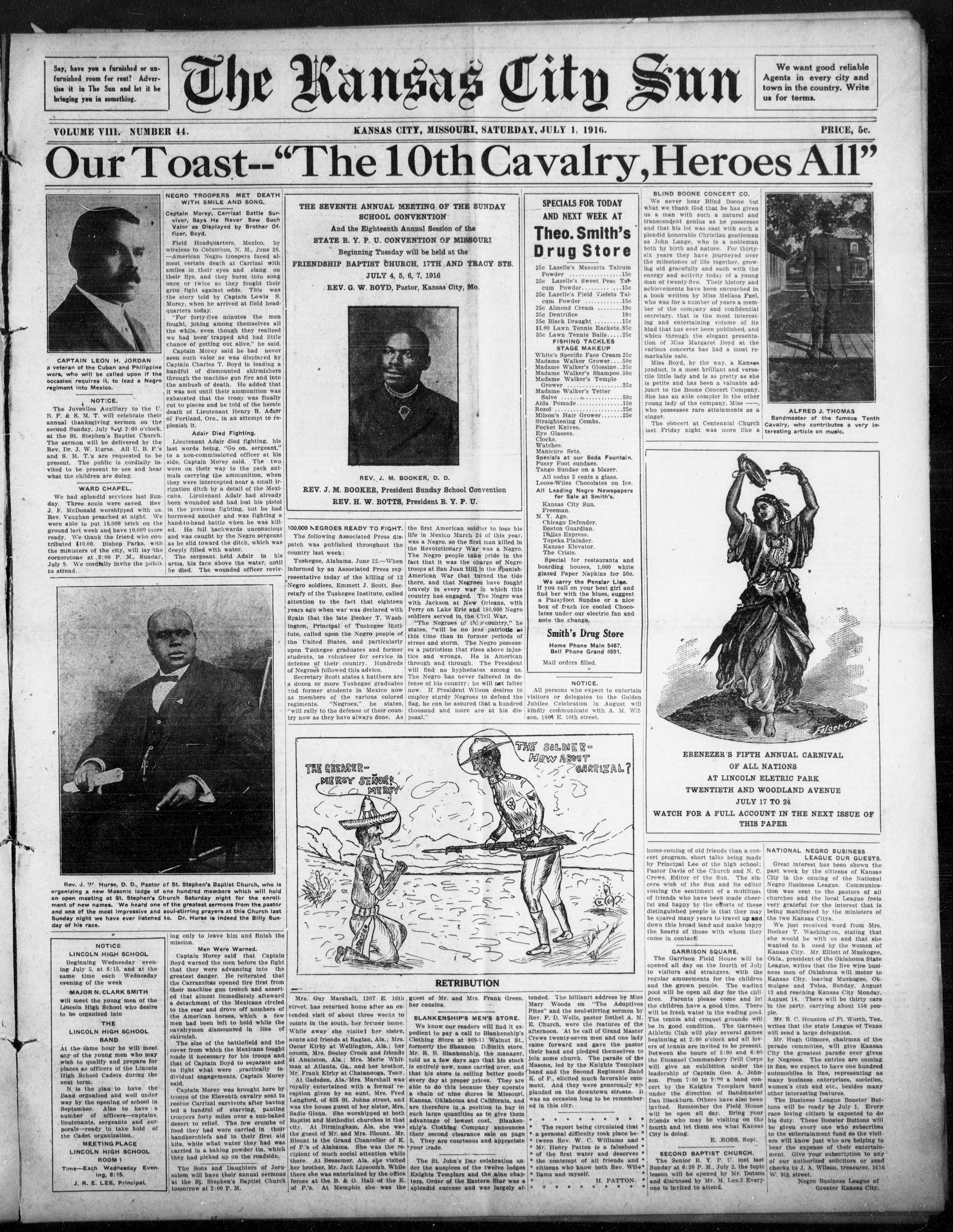
Our Toast--"The 10th Cavalry,Heroes All"
Our To
Rev. J. W. Hurse, D. D., Pastor of St. St. organizing a new Masonic lodge of one hundred open meeting at St. Stephen's Church Service of new names. 'We heard one of the grief and one of the most impressive and soul-stirring Sunday night we have ever listened to. Dr. day of his race.
THE EDITOR
Rev. J. Hurse, D. D., Pastor of St. Stephen's Baptist Church, who is organizing a new Masonic lodge of one hundred members which will hold an open meeting at St. Stephen's Church Saturday night for the enrollment of new names. We heard one of the greatest sermons from the pastor and one of the most impressive and soul-stirring prayers at this Church last Sunday night we have ever listened to. Dr. Hurse is indeed the Billy Sunday of his race.
MEETING PLACE
LINCOLN HIGH SCHOOL
ROOM 1
Time—Each Wednesday Even-
ing, 8:15.
J. R. E. LEE, Principal.
Say, have you a furnished or unfurnished room for rent? Advertise it in The Sun and let it be bringing you in something.
CAPTAIN LEON H. JORDAN
a veteran of the Cuban and Philippine
wars, who will be called upon if the
occasion requires it, to lead a Negro
regiment into Mexico.
NOTICE.
The Juveniles Auxiliary to the U. B. F. & S. M. T. will celebrate their annual thanksgiving sermon on the second Sunday, July 9 at 2:00 o'clock, at the St. Stephen's Baptist Church. The sermon will be delivered by the Rev. Dr. J. W. Wurse, All U. B. F.'s and S. M. T.'s are requested to be present. The public is cordially invited to be present to see and hear what the children are doing.
WARD CHAPEL.
We had splendid services last Sunday. Three souls were saved. Rev J. F. McDonald worshipped with us. Rev Vaughan preached at night. We were able to put 18,000 brick on the ground last week and have 10,000 more ready. We thank the friend who contributed $10.00. Bishop Parks, with the ministers of the city, will lay the cornerstone at 3:00 P. M., Sunday July 9. We cordially invite the public to attend.
NOTICE
LINCOLN HIGH SCHOOL
Beginning Wednesday evening
July 5, at 8:15, and at the
same time each Wednesday
evening of the week
MAJOR N. CLARK SMITH
will meet the young men of the
Lincoln High School who desire
to be organized into
At the same hour he will meet any of the young men who may wish to qualify and prepare for places as officers of the Lincoln High School Cadets during the next term.
It is the plan to have the Band organized and well under way by the opening of school in September. Also to have a number of officers—captains, lieutenants, sergeants and corporals—ready to take hold of the Cadet organization.
The Kansas City Sun
NEGRO TROOPERS MET DEATH WITH SMILE AND SONG.
Captain Morey, Carrizal Battle Survivor, Says He Never Saw Such Valor as Displayed by Brother Officer, Boyd.
Field Headquarters, Mexico, by wireless to Columbus, N. M., June 26. —American Negro troopers faced almost certain death at Carrizal with smiles in their eyes and slang on their lips, and they burst into song once or twice as they fought their grim fight against odds. This was the story told by Captain Lewis S. Morey, when he arrived at field headquarters today.
"For forty-five minutes the men fought, joking among themselves all the while, even though they realized we had been trapped and had little chance of getting out alive," he said.
Captain Morey said he had never seen such valor as was displayed by Captain Charles T. Boyd in leading a handful of dismounted skirmishers through the machine gun fire and into the ambush of death. He added that it was not until their ammunition was exhausted that the troop was finally cut to pieces and he told of the heroic death of Lieutenant Henry R. Adair of Portland, Ore., in an attempt to replenish it.
Lieutenant Adair died fighting, his last words being, "Go on, sergeant," to a non-commissioned officer at his side, Captain Morey said. The two were on their way to the pack animals carrying the ammunition, when they were intercepted near a small irrigation ditch by a detail of the Mexicans. Lieutenant Adair had already been wounded and had lost his pistol in the previous fighting, but he had borrowed another and was fighting a hand-to-hand battle when he was killed. He fell backwards unconscious and was caught by the Negro sergeant as he slid toward the ditch, which was deeply filled with water. The sergeant held Adair in his arms, his face above the water, until he died. The wounded officer reviv-
of St. Stephen's Baptist Church, who is one hundred members which will hold church Saturday night for the enroll- of the greatest sermons from the pastor soul-stirring prayers at this Church last to. Dr. Hurse is indeed the Billy Sun-
ing only to leave him and finish the mission.
Men Were Warned.
Captain Morey said that Captain Boyd warned the men before the fight that they were advancing into the greatest danger. He reiterated that the Carranitzitas opened fire first from their machine gun trench and asserted that almost immediately afterward a detachment of the Mexicans circled to the rear and drove off numbers of the American horses, which a few men had been left to hold while the cavalrymen dismounted in line of skirmish.
The size of the battlefield and the cover from which the Mexicans fought made it necessary for his troops and that of Captain Boyd to separate and to fight what were practically individual engagements, Captain Morey said.
Captain Morey was brought here by troops of the Eleventh cavalry sent to rescue Carranizal survivors after having led a handful of starving, paiting troopers forty miles over a sun-baked desert to relief. The few crumbs of food they had were carried in their handkerchiefs and in their first aid kits, while what water they had was carried in a baking powder tin, which they had picked up on the roadside.
The Sons and Daughters of Jerusalem will have their annual sermons at the St. Stephen's Baptist Church tomorrow at 2:00 P. M.
KANSAS CITY, MISSOURI, SATURDAY, JULY 1, 1916.
THE SEVENTH ANNUAL MEETING OF THE SUNDAY SCHOOL CONVENTION
And the Eighteenth Annual Session of the
STATE B. Y. P. U. CONVENTION OF MISSOURI
Beginning Tuesday will be held at the
FRIENDSHIP BAPTIST CHURCH, 17TH AND TRACY STS.
JULY 4, 5, 6, 7, 1916
REV. G. W. BOYD, Pastor, Kansas City, Mo.
REV. J. M. BOOKER, D. D.
REV. J. M. BOOKER, President Sunday School
REV. H. W. BOTTS, President B. Y.
100,000 NEGROES READY TO FIGHT.
The following Associated Press dispatch was published throughout the country last week:
the first American life in Mexico M was a Negro, so the Revolutionary The N
Tuskegee, Alabama, June 22.—When informed by an Associated Press representative today of the killing of 12 Negro soldiers, Emmett J. Scott, Secretary of the Tuskegee Institute, called attention to the fact that eighteen years ago when war was declared with Spain that the late Booker T. Washington, Principal of Tuskegee Institute, called upon the Negro people of the United States, and particularly upon Tuskegee graduates and former students, to volunteer for service in defense of their country. Hundreds of Negroes followed this advice. Secretary Scott states t hatthe are a dozen or more Tuskegee graduates and former students in Mexico now as members of the various colored regiments. "Negroes," he states, "will rally to the defense of their country now as they have always done. As
THE GREASER-
MERCY SENOR!
MERCY
THE GREASER -
MERCY SENOR!
MERCY
THE SOLDIER -
HOW ABOUT CARRIZAL?
Mrs. Guy Marshall, 1207 E. 16th street, has returned home after an extended visit of about three weeks to points in the south, her former home. While away she visited her sister, aunts and friends at Raglan, Ala.; Mrs. Oscar Kirby at Wellington, Ala.; her cousin, Mrs. Seeley Crook and friends at Anniston, Ala.; Mrs. Marie Whitman at Atlanta, Ga., and her brother, Mr. Frank Kirby at Chatanooga, Tenn. At Gadsden, Ala.; Mrs. Marshall was royally entertained with a formal reception given by an aunt, Mrs. Fred Langford, of 825 St. Johns street, and was the house guest of her sister, Mrs. Sadie Glenn. She worshipped at both Baptist and Methodist churches in that city. At Birmingham, Ala, she was the guest of Mr. and Mrs. Blount. Mr. Blount is the Grand Chancellor of K of P.'s of Alabama. She was the recipient of much social attention while there. At Bessemer, Ala, she visited her brother, Mr. Jack Lipscomb. While there she was entertained by the office forces at the B. & O. Hall of the K of P.'s. At Memphis she was the
OOKER, D. D.
ent Sunday School Convention
President B. Y. P. U.
the first American soldier to lose his life in Mexico March 24 of this year, was a Negro, so the first man killed in the Revolutionary War was a Negro. The Negro people take pride in the fact that it was the charge of Negro troops at San Juan Hill in the Spanish-American War that turned the tide there, and that Negroes have fought bravely in every war in which this country has engaged. The Negro was with Jackson at New Orleans, with Perry on Lake Erie and 180,000 Negro soldiers served in the Civil War.
"The Negroes of this country," he states, "will be no less patriotic this time than in former periods of stress and storm. The Negro possesses a patriotism that rises above injustice and wrongs. He is American through and through. The President will find no hyphenates among us. The Negro has never faltered in defense of his country; he will not falter now. If President Wilson desires to employ sturdy Negroes to defend the flag, he can be assured that a hundred thousand and more are at his disposal."
TA
RETRIBUTION
guest of Mr. and Mrs. Frank Green, her cousins.
BLANKENSHIP'S MEN'S STORE.
We know our readers will find it expedient to pay a call to Blankenship's Clothing Store at 809-11 Walnut St., formerly the Shannon D.Smith store. Mr. R. B. Blankenship, the manager, told us a few days ago that his stock is entirely new, none carried over, and that his store is selling better goods every day at proper prices. They are able to do this because they operate a chain of nine stores in Missouri, Kansas, Oklahoma and California, and are therefore in a position to buy in such large quantities as to give them advantage of lowest cost. Blankenship's Clothing Company announces their second clearance sale on page 5. They are courteous and appreciate your trade.
The St. John's Day celebration under the auspices of the twelve lodges Knights Templars and the nine chapters, Order of the Eastern Star was a splendid success and was largely at-
SPECIALS FOR TODAY AND NEXT WEEK AT Theo. Smith's Drug Store
25c Lazelle's Massatta Talcum
Powder ..... 15c
25c Lazelle's Sweet Peac Talcum
Powder ..... 15c
25c Lazelle's Field Violets Talcum
Powder ..... 15c
25c Almond Cream ..... 19c
25c Dentrifle ..... 19c
25c Black Draught ..... 19c
$1.00 Lawn Tennis Rackets ..... 85c
35c Lawn Tennis Balls ..... 25c
# FISHING TACKLES
# STAGE MAKEUP
White's Specific Face Cream 25c
Madame Walker Grower ..... 50c
Madame Walker's Glossine ..... 50c
Madame Walker's Shampoo ..... 50c
Madame Walker's Temple
Gower.....35c
Madame Walker's Tetter
Salve.....50c
Aida Pomade.....15c
Rozol.....25c
Milton's Hair Grower.....25c
Straightening Combs.
Pocket Knives.
Eye Glasses.
Clocks.
Watches.
Manicure Sets.
Specials at our Soda Fountain.
Pussy Foot sundares.
Tango Sundae on a blazer.
All sodas 5 cents a glass.
Loose-Wiles Chocolates on Ice.
All Leading Negro Newspapers for Sale at Smith's.
Kansas City Sun.
Freeman.
N. Y. Age.
Chicago Defender.
Boston Guardian.
Dallas Express.
Topeka Plainder.
Kansas Elevator.
The Crisis.
Special for restaurants and boarding houses, 1,000 white glazed Paper Napkins for 50c.
We carry the Penslar Line.
If you call on your best girl and find her with the blues, suggest a Pussyfoot Sundae or a nice box of fresh ice cooled Chocolates under our electric fan and note the change.
Smith's Drug Store
Home Phone Main 5467.
Bell Phone Grand 4591.
Mail orders filled.
All persons who expect to entertain visitors or delegates to the Golden Jubilee Celebration in August will kindly communicate with A. M. Wilson, 1804 E. 10th street.
THE SOLDIER-
HOW ABOUT
GARRIZAL?
tended. The brilliant address by Miss Mary Woods on "The Adoptives Pites" and the soul-stirring sermon by Rev. F. D. Wells, pastor Bethel A. M. E. Church, were the features of the afternoon. At he call of Grand Master Crews twenty-seven men and one lady came forward and gave the pastor their hand and pledged themselves to join some church. The parade of the Masons, led by the Knights Templars band and the Second Regiment Band K. of P., elicited much favorable comment. And they were generously applauded on the downtown streets. It was an occasion long to be remembered in this city.
* The report being circulated that * a personal difficulty took place be * tween Rev. W. C. Williams and * Mr. Henry Patton is a falsehood * of the first water and deserves * the contempt of all friends and * citizens who know both Rev. Willi * liams and myself.
H. PATTON.
* * * * * * *
Falger-Cin
BLIND BOONE CONCERT CO.
We never hear Blind Boone but what we thank God that he has given us a man with such a natural and transcendent genius as he possesses and that his lot was cast with such a plenid honorable Christian gentleman as John Lange, who is a nobleman both by birth and nature. For thirty-six years they have journeyed over the milestones of life together, growing old gracefully and each with the energy and activity today of a young man of twenty-five. Their history and achievements have been encouraged in a book written by Miss Melissa Fuel, who was for a number of years a member of the company and confidential secretary, that is the most interesting and entertaining volume of its kind that has ever been published, and which through the elegant presentation of Miss Margaret Boyd at the various concerts has had a most remarkable sale.
Miss Boyd, by the way, a Kansas product, is a most brilliant and versatile little lady and is as pretty as she is petite and has been a valuable adjunct to the Boone Concert Company. She has an able compier in the other young lady of the company, Miss —, who possesses rare attainments as a singer.
The concert at Centennial Church last Friday night was more like a
EBENEZER'S FIFTH
OF ALL N
AT LINCOLN E
TWENTIETH AND W
JULY 17
WATCH FOR A FULL ACCOUNT
THIS P
home-coming of old friends than a concert program, short talks being made by Principal Lee of the high school; Pastor Davis of the Church and N. C. Crews, Editor of the Sun. The shine wish of the Sun and its editor voicing the sentiment of a multitude of friends who have been made cheerful and happy by the efforts of these distinguished people is that they may be spared many years to travel up and down this broad land and make happy the hearts of those with whom they come in contact
GARRISON SQUARE
The Garrison Field House will be opened all day on the fourth of July to visitors and strangers, with the regular amusements for the children and the grown people. The wading pool will be open all day for the children. Parents please come and let the children have a good time. There will be fresh water in the wading pool. The tennis and croquet grounds will be in good condition. The Garrison Athletic Club will play several games beginning at 2:00 o'clock and all lovers of tennis are invited to be present. Between the hours of 5:00 and 6:00 the Emanuel Commandery Drill Corps will give an exhibition under the leadership of Captain Geo. A. Johnson. From 7:00 to 9:00 a band concert by the Knights Templars band under the direction of Bandmaster Dan Blackburn. Others have also been invited. Remember the Field House will be open all day. Bring your friends who may be visiting on the fourth and let them see what Kansas City is doing.
SECOND BAPTIST CHURCH.
The Senior B. Y. P. U. met last Sunday at 6:30 P. M. July 2, the topic lesson will be opened by Mr. Dotson and discussed by Mr. M. Lee.2 Everyone is invited to attend.
We want good reliable Agents in every city and town in the country. Write us for terms.
es All"
ALFRED J. THOMAS
Bandmaster of the famous Tenth Cavalry, who contributes a very interesting article on music.
ALFRED J. THOMAS Bandmaster of the famous Tenth Cavalry, who contributes a very interesting article on music.
I ANNUAL CARNIVAL
NATIONS
ELETRIC PARK
WOODLAND AVENUE
17 TO 24
UNT IN THE NEXT ISSUE OF
PAPER
NATIONAL NEGRO BUSINESS LEAGUE OUR GUESTS.
Great interest has been shown the past week by the citizens of Kansas City in the coming of the National Negro Business League. Communication was sent to the pastors of all churches and the local League feels very grateful for the interest that is being manifested by the ministers of the two Kansas City.
We just received word from Mrs. Booker T. Washington, stating that she would be with us and that she wanted to b used by the women of Kansas City. Mr. Elliott of Muskogee, Okla., president of the Oklahoma State League, writes that the live wire business men of Oklahoma will motor to Kansas City, leaving Muskogee, Okmulgee and Tulsa, Sunday, August 13 and reaching Kansas City Monday, August 14. There will be thirty cars in the party, carrying about 150 people.
Mr. R. C. Houston of Ft. Worth, Tex., writes that the state League of Texas will send a large delegation.
Mr. Hugh Gilmore, chairman of the parade committee, will give Kansas City the greatest parade ever given by Negroes. The entries are coming in fine, we expect to have one hundred automobiles in line, representing as many business enterprises, societies, women's club and etc., besides many other interesting features.
The Business League Booster Buttons will be ready by July 1. Every race loving citizen is expected to do his duty. These Booster Buttons will be given every one who subscribes to the entertainment fund so the visitors will know just who are helping to bear the expense of their entertainment. Give your subscription to any of our authorized solicitors or send checks to J. A. Wilson, treasurer, 1616 W. 9th street.
Negro Business League of Greater Kansas City.
INTERNATIONAL
SUNDAY SCHOOL
LESSON
**By E. O. SELLERS, Acting Director of the Sunday School Course in the Moody Bible Institute of Chicago.**
(Copyright by Western Newspaper Union.)
LESSON FOR JULY 2
PAUL AT THESSALONICA AND BEREA.
LESSON TEXT—Acts 17:1-15 (ef. I Thess. 2:1-12).
GOLDEN TEXT—Him did God exalt with his right hand to be a prince and a Savior. Acts 5:31.
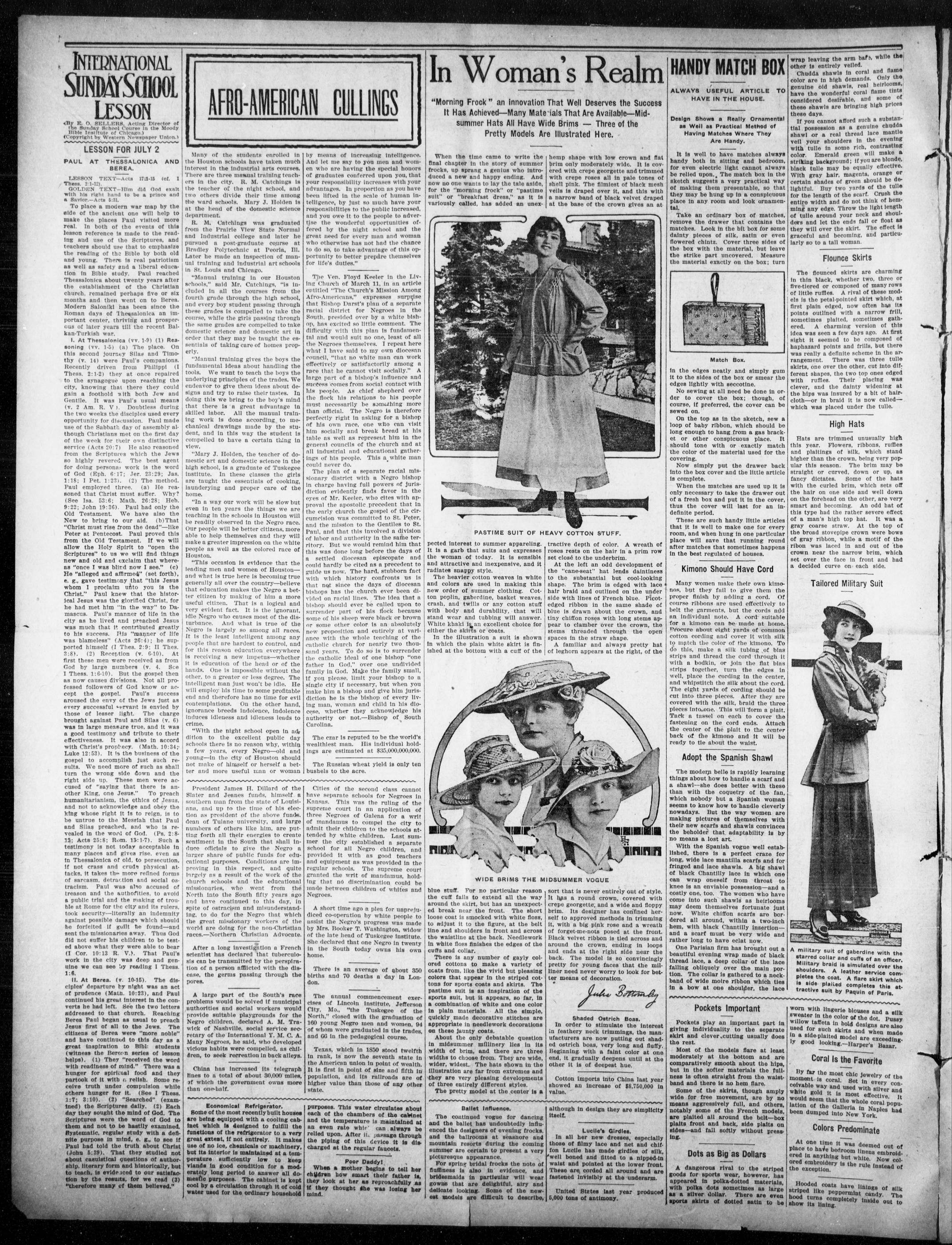
To place a modern war map by the side of the ancient one will help to make the places Paul visited more real. In both of the events of this lesson reference is made to the reading and use of the Scriptures, and teachers should use that to emphasize the reading of the Bible by both old and young. There is real patriotism as well as safety and a liberal education in Bible study. Paul reached Thessalonica about twenty years after the establishment of the Christian church, remained perhaps five or six months and then went on to Berea. Modern Salonikl has been since the Roman days of Thessalonica an important center, thriving and prosperous of later years till the recent Balkan-Turkish war.
11. At Berea. (v. 10:15). The disciples' departure by night was an act of prudence (Math. 10:23), and Paul continued his great interest in the converts he had left. See the two letters addressed to that church. Reaching Berea Paul began as usual to preach Jesus first of all to the Jews. The citizens of Berea were "more noble" and have continued to this day as a great inspiration to Bibl: students (witness the Beren series of lesson helps). (1) They "received the word with readiness of mind." There was a hunger for spiritual food and they partook of it with c. relish. Some receive truth under compulsion while others hunger for it. (See I Thess. 1:7; 3:10). (2) "Searched" (examined) the Scriptures daily. (2) Each day they sought the mind of God. The Scriptures were the word of God to them and not to be hastily examined. Systematic, regular study with a definite purpose in mind, e. g., to see if Paul had told the truth about Christ (John 5:39). That they studied not about casualistic questions of authorship, literary form and historically, but to teach, is evidente to our satisfaction by the results, for we read (3) "therefore many of them believed."
AFRO-AMERICAN CULLINGS
Many of the students enrolled in the Houston schools have taken much interest in the industrial arts courses. There are three manual training teachers in the city. R. M. Catchings is the teacher of the night school, and two others divide their time among the ward schools. Mary J. Holden is at the head of the domestic science department. R. M. Catchings was graduated from the Prairie View State Normal and Industrial college and later he pursued a post-graduate course at Bradley Polytechnic at Peoria, Ill. Later he made an inspection of manual training and industrial art schools in St. Louis and Chicago.
"Manual training in our Houston schools," said Mr. Catchings, "is included in all the courses from the fourth grade through the high school, and every boy student passing through these grades is compelled to take the course, while the girls passing through the same grades are compelled to take domestic science and domestic art in order that they may be taught the essentials of taking care of homes properly.
"Manual training gives the boys the fundamental ideas about handling the tools. We want to teach the boys the underlying principles of the trades. We endeavor to give them ideas about designs and try to raise their tastes. In doing this we bring to the boy's mind that there is a great advantage in skilled labor. All the manual training work is done according to mechanical drawings made by the student, and in this way the student is compelled to have a certain thing in view.
"Mary J. Holden, the teacher of domestic art and domestic science in the high school, is a graduate of Tuskegee institute. In these classes the girls are taught the essentials of cooking, laundering and proper care of the home.
"In a way our work will be slow but even in ten years the things we are teaching in the schools in Houston will be readily observed in the Negro race. Our people will be better citizens, more able to help themselves and they will make a greater impression on the white people as well as the colored race of Houston.
"This occasion is evidence that the leading men and women of Houston—and what is true here is becoming true generally all over the country—believe that education makes the Negro a better citizen by making of him a more useful citizen. That is a logical and very evident fact. It is the ignorant, idle Negro who causes most of the disturbance. And what is true of the Negro is largely so among all races. It is the least intelligent among any people that are hardest to control, and for this reason education everywhere is receiving a new impetus—whether it is education of the head or of the hands. One is impossible without the other, to a greater or less degree. The intelligent man just won't be idle. He will employ his time to some profitable end and therefore has no time for evil contemplations. On the other hand, ignorance breeds indolence, indolence induces idleness and idleness leads to crime.
"With the night school open in addition to the excellent public day schools there is no reason why, within a few years, every Negro—old and young—in the city of Houston should not make of himself or herself a better and more useful man or woman
President James H. Dillard of the Slater and Jeanes funds, himself a southern man from the state of Louisiana, and up to the time of his election as president of the above funds, dean of Tulane university, and large numbers of others like him, are putting forth all their energies to create sentiment in the South that shall induce officials to give the Negro a larger share of public funds for educational purposes. Conditions are improving in this respect, and quite largely as a result of the work of the church schools and the educational missionaries, who went from the North into the South fifty years ago and have continued to this day, in spite of ostracism and misunderstanding, to do for the Negro that which the great missionary workers of the world are doing for the non-Christian races. -Northern Christian Advocate.
After a long investigation a French scientist has declared that tuberculosis can be transmitted by the perspiration of a person afflicted with the disease, the germs passing through the pores.
A large part of the South's race problems would be solved if municipal authorities and social workers would provide suitable playgrounds for the Negro children, declared A. M. Trawick of Nashville, social service secretary of the International Y. M. C. A. Many Negroes, he said, who developed vicious habits were compelled, as children, to seek recreation in back alleys.
China has increased its telegraph lines to a total of about 30,000 miles, of which the government owns more than one-half.
Economical Refrigerator. Some of the most recently built houses are being equipped with a cooling cabinet which is designed to fulfill the functions of the refrigerator to a very great extent, if not entirely. It makes use of no ice, chemicals or machinery, but its interior is maintained at a temperature sufficiently low to keep viands in good condition for a moderately long period to answer all domestic purposes. The cabinet is kept cool by a circulation through it of cold water used for the ordinary household
by means of increasing intelligence. And let me say to you men and women who are having the special honors of graduates conferred upon you, that your responsibility increases with your advantages. In proportion as you have been lifted in the scale of human intelligence, by just so much have your responsibilities to the public increased, and you owe it to the people to advertise the wonderful opportunities offered by the night school and the great need for every man and woman who otherwise has not had the chance to do so, to take advantage of this opportunity to better prepare themselves for life's duties."
The Ven. Floyd Keeler in the Living Church of March 11, in an article entitled "The Church's Mission Among Afro-Americans" expresses surprise that Bishop Darst's plan of a separate racial district for Negroes in the South, presided over by a white bishop, has excited so little comment. The difficulty with this plan is fundamental and would suit no one, least of all the Negroes themselves. I repeat here what I have said to my own diocesan council, "that no white man can work effectively or satisfactorily among a race that he cannot visit socially." A large part of a bishop's influence and success comes from social contact with his people. As chief shepherd over the flock his relations to his people must necessarily be something more than official. The Negro is therefore perfectly right in asking for a bishop of his own race, one who can visit him socially and break bread at his table as well as represent him in the general councils of the church and at all industrial and educational gatherings of his people. This a white man could never do.
The plan of a separate racial missionary district with a Negro bishop in charge having full powers of jurisdiction evidently finds favor in the eyes of Mr. Keeler, who cites with approval the apostolic precedent that In the early church the gospel of the circumcision was committed to St. Peter, and the mission to the Gentiles to St. Paul, and that this involved a division of labor and authority in the same territory. But we would remind him that this was done long before the days of a settled diocesan episcopate and could hardly be cited as a precedent to guide us now. The hard, stubborn fact with which history confronts us is that not since the days of diocesan bishops has the church ever been divided on racial lines. The idea that a bishop should ever be called upon to surrender part of his flock because some of his sheep were black or brown or some other color is an absolutely new proposition and entirely at variance with the whole teaching of the catholic church for nearly two thousand years. To do so is to surrender the catholic ideal of one bishop "one father in God," over one undivided family in God. Make the family small, if you please, limit your bishop to a single city if necessary, but when you make him a bishop and give him jurisdiction he is the bishop of every living man, woman and child in his diocese, whether they acknowledge his authority or not.—Bishop of South Carolina.
The czar is reputed to be the world's wealthiest man. His individual holdings are estimated at $35,000,000,000.
The Russian wheat yield is only ten bushels to the acre.
Cities of the second class cannot have separate schools for Negroes in Kansas. This was the ruling of the supreme court in an application of three Negroes of Galena for a writ of mandamus to compel the city to admit their children to the schools attended by white children. Last summer the city established a separate school for all Negro children, and provided it with as good teachers and equipment as was provided in the regular schools. The supreme court granted the writ of mandamus, holding that no discrimination could be made between children of whites and Negroes.
A short time ago a plea for unprejudiced co-operation by white people to assist the Negro's progress was made by Mrs. Booker T. Washington, widow of the late head of Tuskegee Institute. She declared that one Negro in twenty in the South today owns his own home.
There is an average of about 350 births and 70 deaths a day in London.
The annual commencement exercises of Lincoln Institute, Jefferson City, Mo., "the Tuskegee of the North," closed with the graduation of 100 Negro men and women, 94 of whom were graduated in the trades, and 66 in the pedagogical course.
Texas, which in 1850 stood twelfth in rank, is now the seventh state in the American union in point of wealth. It is first in point of size and fifth in population, and its railroads are of higher value than those of any other state.
purposes. This water circulates about each of the chambers of the cabinet and the temperature is maintained at an even rate while it can always be relied upon. After it, passage through the piping of this device it is discharged at the regular faucets.
Poor Daddy!
When a mother begins to tell her children how smart their father is, they look at her as reproachfully as if they thought she was losing her mind.
In Woman's Realm
"Morning Frook" an Innovation That Well Deserves the Success It Has Achieved—Many Materials That Are Available—Midsummer Hats All Have Wide Brims Three of the Pretty Models Are Illustrated Here.
When the time came to write the final chapter in the story of summer frocks, up sprang a genius who introduced a new and happy ending. And now no one wants to lay the tale aside, for the "morning frock" or "pastime suit" or "breakfast dress," as it is variously called, has added an unex-
1
I
PASTIME SUIT OF HEAVY COTTON STUFF. pected interest to summer apparelling. It is a garb that suits and expresses the woman of today. It is sensible and attractive and inexpensive, and it radiates snappy style. The heavier cotton weaves in white and colors are used in making this new order of summer clothing. Cotton poplin, garbardine, basket weaves, crash, and twills or any cotton stuff with body and durability, that will stand wear and tubbing will answer. White khali is an excellent choice for either the skirts or coats. In the illustration a suit is shown in which the plain white skirt is finished at the bottom with a cuff of the
tractive depth of color. roses rests on the hair if set close to the underbrain. At the left an odd dew the "cane-seat" hat len to the substantial but shape. The brim is edg hair braid and outlined side with lines of French edged ribbon in the sa blue is drawn about the tiny chiffon roses with leopard to clamper over the stems threaded through spaces in the straw shap A familiar and alway of leghorn appears at the
HAT
R
WIDE BRIMS THE MIDSUMMER VOGUE
blue stuff. For no particular reason the cuffs fail to extend all the way around the skirt, but has an unexpected break near the front. The short loose coat is smocked with white floss, to adjust it to the figure, at the belt line and shoulders in front and across the waistline at the back. Needlework in white floss finishes the edges of the cuffs and collar.
There is any number of gayly colored cottons to make a variety of coats from, like the vivid but pleasing colors that appear in the striped cottons for sports coats and skirts. The pastime suit is an inspiration of the sports suit, but it appears, so far, in a combination of white and one color in plain materials. All the simple, quickly made decorative stitches are appropriate in needlework decorations on these lauity coats.
sort that is never end. It has a round crepe georgette, and a brim. Its designer self to approved met it, with a big pink ruffle of forget-me-nots pot Black velvet ribbon around the crown, and ends at the right back. The model is pretty for young female liner need never wear means of decorat
Shaded Ostr
In order to stimulate in feathery neck tri
About the only debatable question in midsummer millinery lies in its width of brim, and there are three widths to choose from. They are wide, wider, widest. The hats shown in the illustration are far from extremes and they are very pleasing developments of three entirely different styles. The pretty model at the center is a
Ballet Influence.
The continued vogue for dancing and the ballet has undoubtedly influenced the designers of evening frocks, and the ballrooms at seasnore and mountain resorts during the coming summer are certain to present a very picturesque appearance.
For spring bridal frocks the note of fluffiness is also in evidence, and bridesmaids in particular will wear gowns that are delightful, airy and delicate looking. Some of the newest models are difficult to describe,
hemp shape with low crown and flat prim only moderately wide. It is covered with crepe georgette and trimmed with crepe roses all in pale tones of shell pink. The filimist of black mesh veils is draped over it, and this with a narrow band of black velvet draped at the base of the crown gives an at-
I
tractive depth of color. A wreath of roses rests on the hair in a prim row set close to the underbrim.
At the left an odd development of the "cane-seat" hat lends daintiness to the substantial but cool-looking shape. The brim is edged with lace hair braid and outlined on the under side with lines of French blue. Picot-edged ribbon in the same shade of blue is drawn about the crown, and tiny chiffon roses with long stems appear to clamber over the crown, the stems threaded through the open spaces in the straw shape.
A familiar and always pretty hat of leghorn appears at the right, of the
B
sort that is never entirely out of style.
It has a round crown, covered with crepe georgette, and a wide and floppy brim. Its designer has confined herself to approved methods in trimming it, with a big pink rose and a wreath of forget-me-nots posed at the front. Black velvet ribbon is tied across and around the crown, ending in loops and ends at the right side near the back. The model is so convincingly pretty for young faces that the milliner need never worry to look for better means of decoration.
Julie Bottomley
Shaded Ostrich Boas.
In order to stimulate the interest in feathery neck trimmings, the manufacturers are now putting out shaded orchid boas, very long and fluffy. Beginning with a faint color at one end, it gradually deepens until at the other it is of deepest hue.
Cotton imports into China last year showed an increase of $8,750,000 in value.
although in design they are simplicity itself.
Lucile's Girdles.
In all her new dresses, especially those of filmy lace and net and chiffon Lucile has made girdles of silk, well boned and fitted to a nipped-in waist and pointed at the lower front. These are corded all around and are fastened invisibly at the underarm.
United States last year produced 5,000 tons of antimony.
---
HANDY MATCH BOX
ALWAYS USEFUL ARTICLE TO HAVE IN THE HOUSE.
Design Shows a Really Ornamental as Well as Practical Method of Having Matches Where They Are Handy.
It is well to have matches always handy both in sitting and bedroom, for even electric light cannot always be relied upon. The match box in the sketch suggests a very practical way of making them presentable, so that they may be hung up in a conspicuous place in any room and look ornamental.
Take an ordinary box of matches, remove the drawer that contains the matches. Look in the bit box for some dainty pieces of silk, satin or even flowered chintz. Cover three sides of the box with the material, but leave the strike part uncovered. Measure the material exactly on the box; turn
Match Box.
In the edges neatly and simply gum it to the sides of the box or smear the edges lightly with seccotine.
No sewing at all need be done in order to cover the box; though, of course, if preferred, the cover can be sewed on.
On the top as in the sketch, sew a loop of baby ribbon, which should be long enough to hang from a gas bracket or other conspicuous place. It should tone with or exactly match the color of the material used for the covering.
Now simply put the drawer back into the box cover and the little article is complete.
When the matches are used up it is only necessary to take the drawer out of a fresh box and put it in the cover, thus the cover will last for an indefinite period.
These are such handy little articles that it is well to make one for every room, and when hung in one particular place will save that running round after matches that sometimes happens in the best regulated of houses.
Kimono Should Have Cord
Many women make their own kimonos, but they fail to give them the proper finish by adding a cord. Of course ribbons are used effectively to belt the garments, but the cords add an individual note. A cord suitable for a kimono can be made at home. Procure about eight yards of common cotton cording and cover it with silk to match the color of the kimono. To do this, make a silk tubing of bias strips and thread the cord through it with a bodkin, or join the flat bias strips together, turn the edges in well, place the cording in the center, and whipstitch the silk about the cord. The eight yards of cording should be cut into three pieces. After they are covered with the silk, braid the three pieces into one. This will form a plait. Tack a tassel on each to cover the fastening on the cord ends. Attach the center of the plait to the center back of the kimono and it will be ready to to the about the waist.
Adopt the Spanish Shawl
The modern belle is rapidly learning things about how to handle a scarf and a shawl—she does better with these than with the coquetry of the fan, which nobody but a Spanish woman seems to know how to handle cleverly nowadays. But the way women are making pictures of themselves with their new scarfs and shawls convinces the beholder that adaptability is by no means a lost art.
With the Spanish vogue well established, there is a perfect craze for long, wide lace mantilla scarfs and for fringed and lace shawls. A big shawl of black Chantilly lace in which one can wrap oneself from throat to knee is an enviable possession—and a costly one, too. The women who have come into such shawls as heirlooms may deem themselves fortunate just now. White chiffon scarfs are bordered all around, within a two-inch hem, with black Chantilly insertion—and a scarf must be very wide and rather long to have eclat now.
One Parisian firm has brought out a beautiful evening wrap made of black thread lace, a deep collar of the lace falling obliquely over the main portion. The collar is gathered to a neckband of wide moire ribbon which ties in a bow at one shoulder, the lace
Pockets Important
Pockets play an important part in giving individuality to the separate skirt and clever, cutting usually does the rest.
Most of the models flare at least moderately at the bottom and are comparatively smooth about the hips, but in the softer materials the fullness is often straight from the waistband and there is no hem flare.
Some of the skirts, though amply wide for free movement, are by no means aggressively full, and others, notably some of the French models, are plaited all around the belt-box plaits front and back, side plaits on sides—and fall softly without pressing.
Dots as Big as Dollars
A dangerous rival to the striped goods for sports wear, however, has appeared in polka-dotted materials, with polka dots sometimes as large as a silver dollar. There are even skirts skirts of dotted satin to be
wrap leaving the arm bals, while the other is entirely veiled. Chudda shawls in coral and flame color are in high demands. Only the genuine old shawls, real heirlooms, have the wonderful coral flame tints considered desirable, and some of these shawls are bringing high prices these days.
If you cannot afford such a substantial possession as a genuine chudda shawl or a real thread lace mantle vell your shoulders in the evening with tulle in some rich, contrasting color. Emerald green will make a striking background; if you are blonde, black tulle may be equally effective. With gray hair, magenta, orange or certain shades of green should be delightful. Buy two yards of the tulle for the length of the scarf. Crush the entire width and do not think of hemming any edge. Throw the light length of tulle around your neck and shoulders and let the ends fall or float as they will over the skirt. The effect is graceful and becoming, and particularly so to a tall woman.
Flounce Skirts
The founced skirts are charming in thin black, whether two, three or five-tiered or composed of many rows of little ruffles. A rival of these models is the petal-pointed skirt which, at first plain edged, now often has its points outlined with a narrow frill, sometimes platted, sometimes gathered. A charming version of this idea was seen a few days ago. At first sight it seemed to be composed of haphazzard points and frills, but there was really a definite scheme in the arrangement. There was three tulle skirts, one over the other, cut into different shapes, the two top ones edged with ruffles. Their placing was clever, and the dainty widening at the hips was insured by a bit of hair-cloth—or in braid it is now called—which was placed under the tulle.
High Hats
Hats are trimmed unusually high this year. Flowers, ribbons, ruffles and plattings of silk, which stand higher than the crown, being very popular this season. The brim may be straight or curved, down or up, as fancy dictates. Some of the hats with the curled brim, which sets off the hair on one side and well down on the forehead on the other, are very smart and becoming. An odd hat of this type had the rather severe effect of a man's high top hat. It was a gray coarse straw. At the top of the broad stevipeir crown were bows of gray ribbon, while a motif of the ribon was laced in and out of the crown near the narrow brim, which set over the face in front and had a decided curve on each side.
Tanored Military Suit
A military suit of gaberdine with the starred collar and cuffs of an officer. Military braid is simulated over the shoulders. A leather service completes the coat. A flare skirt which is side plaited completes this attractive suit by Paquin of Paris.
worn with lingerie blouses and a silk sweater in the color of the dot. Pussy willow taffeta in bold designs are also used for such skirts and when made in a side-plaited model are exceedingly good looking.-Harper's Bazar.
Coral is the Favorite
By far the most chic jewelry of the moment is coral. Set in every conceivable way and used with silver and white gold it is most effective. It would seem that the whole coral population of the Galleria in Naples had been dumped into New York.
Colors Predominate
At one time it was deemed out of place to have bedroom linens embroidered in anything but white. Now colored embroidery is the rule instead of the exception.
Hooded coats have linings of silk striped like peppermint candy. The hood turns completely inside out to show its lining.
MADAM KATIE MARTIN'S "Sanitary" Hair Preparations
"Sanitary" Hair Preparations are just what the name implies. They cleanse and cure the scalp of all diseases, such as Dandruff, Tetter or Eczema, and finally produce a thick growth of hair.
Madam Katie Martin has given a careful study to hair and scalp culture and is prepared to meet the demands of the people. She manufactures all of her preparations
I have been taking treatment from Mme. Martin for about three months. My hair has grown wonderfully—three inches. My scalp is perfectly clean of disease, which was never so before. Sanitary Hair preparations have given me perfect satisfaction.
her preparations are wonderful. Before using my hair was very thin on account of my bad scalp, but now it is thicker than it has been for years and it has grown several inches since March 1st, 1915.
I began to use Madam Martin's "Sanitary Hair Preparations" March 1st, 1915. I can positively say that Madam Martin's "Sanitary Hair Preparations" have produced results that no other preparations have done. My scalp was in a very bad condition.
MRS. HARRIET FRISTO,
2223 Woodland Ave.,
Kansas City, Mo.
When writing to Madam Martin Manufacturing Co. enclose two-cent stamp for postage if answer is desired.
A National Monthly Magazine of Inspiration containing:
History Poetry Literature Business
Society Sports Politics Science
Fashions Fine Arts Music Drama
A copy of the Review and Advertising Rates will be mailed free on request to any part of the United States.
Expert Dental Specialists
Our work has stood the test. We have been doing high class guaranteed Dental Work for the past 29 years. We have thousands of satisfied patients.
REMEMBER, IN BUSINESS 29 YEARS
All work kept in repair free of charge.
SAVE MONEY
EXAMINATION FREE
All work guaranteed 20 years.
GET THE BEST
The doctor who extracts your teeth here has undoubtedly had more experience in this line than any other dentist in the city, so you get the most expert service.
WHITE CROWNS, $3, $3, AND $5
SET OF TEETH, UPPER AND LOWER, $5.00 AND UP
A six weeks' trial treatment will convince any one of the value of Madam Martin's Sanitary Hair Preparations. A six weeks' trial treatment consisting of Sanitary Shampoo, 50c; Sanitary Grower, 50c; Sanitary Glossine, 35c; Sanitary Temple Grower, 35c, will be sent to any address in United States, prepaid, for $1.70.
No goods sent C. O. D.
AGENTS WANTED!
GOOD PROFIT!
Madam Katie Martin has given prepared to meet the demands
I have been taking treatment from Mme. Martin for about three months. My hair has grown wonderfully-three inches. My scalp is perfectly clean of disease, which was never s before. Sanitary Hair preparation have given me perfect satisfaction I recommend them highly.
MRS. KATIE BROOKS,
2112 W. Prospect,
Kansas City, M
I began to use Madam Martin "Sanitary Hair Preparations" March 1st, 1915. I can positively say that
When writing to Madam if answer is desired.
Bell Phone E. 4394Y
THE Modern I
A. E. ESTE
General C
Repairing
"The Foremost Colored
The Colored Art
2305 SEVEN
New Y
A National Monthly Magazine
History Poetry
Society Sports
Fashions Fine Arts
REL
—ALL
The Kansas
FOR $1.75
A copy of the Review and
ed free on request to any part
YOU CAN BE
BEAUTIFUL
LET
US HELP YOU
Expert Dental
OF KAN
Our work has stood the test. We have
tal Work for the past 29 years. We
REMEMBER, IN E
All work kept in n
SAVE MONEY
EXAMINATE
All work guaranteed
The doctor who extracts your teeth has
in this line than any other dentist in t
ice.
GOLD CROWNS, $3, $4 AND $5
WHITE CROWN
SET OF TEETH, UPPE
NEW YORK
1017-19 W
Over Jaccard's Jewelry Store, 1
A.
is given a careful study to hair and hands of the people. She manufact
TESTIMONIALS
her preparations are wonderful. Before using my hair was very thin on account of my bad scalp, but now it is thicker than it has been for years and it has grown several inches since March 1st, 1915.
MRS. G. H. SMITH,
3406 E. 6th St.,
Kansas City, Mo.
Madam Martin's "Sanitary Hair Preparations" have produced results that no other preparations have done. My scalp was in a very bad
Office 2460 Waldrond Ave.
Builders Co.
STES, President
Contracting
ing a Specialty
Olored Magazine in America.'
American Review
SEVENTH AVENUE
New York, N. Y.
Magazine of Inspiration containing:
Literature Business
Politics Science
Music Drama
Religion
ALL WITH——
Kansas City Sun
$1.75 YEARLY.
and Advertising Rates will be mail-
part of the United States.
WE SPECIALIZE IN HAIR GOODS AND SELL
ALL THE LATEST STYLES IN WIGS, PUPPS,
SWITCHES, ETC. ↵
WE GUARANTEE ALL OUR GOODS
MONEY BACK IF NOT SATISFIED.
WE SELL THE FINEST HAIR STRAIGHT-
ENING COMB IN THE WORLD
NONE BETTER MADE
FREE- A CATALOGUE TO EVERYONE
MENTIONING THE NAME OF,
THIS NEWSPAPER.
Halo Hair Company
647 STEINWAY AVENUE
L.I.C. NEW YORK
Total Specialists
KANSAS CITY
have been doing high class guaranteed Den-
We have thousands of satisfied patients.
IN BUSINESS 29 YEARS
in repair free of charge.
NATIONAL FREE
guaranteed 20 years. GET THE BEST
here has undoubtedly had more experienc
in the city, so you get the most expert serv-
BRIDGE WORK
Spaces where from one to ten teeth have been lost we replace with bridge work. It looks the same as natural teeth, lasts a lifetime and requires no plate. Broken down teeth we restore to beauty and usefulness with crowns of porcelain and gold.
CROWNS, $3, $4 AND $5
IPPER AND LOWER, $5.00 AND UP
K DENTAL CO.
Walnut Street
e, 1 door north Emery, Bire, Thayer Co.
Madam Martin Method
of
Treating Scalps and Growing
Hair
Taught for $25.00
Write for Information.
MME. KATE MARTIN
Scalp Specialist
2220 MICHIGAN AVENUE
KANSA' CITY, MO.
BELL PHONE, E. 3936W.
and scalp culture and is pre-tures all of her preparations
condition; my hair was about 1½ inches in length, but after three months' treatment with Mme. Martin's Sanitary Hair Preparations my hair has grown 3½ inches.
For many years I tried many other preparations, but found nothing that would heal my scalp and grow my hair, until I used Mme. Martin's Preparations. I highly recommend them.
Any information desired consult,
MRS. HARRIET FRISTO,
2223 Woodland Ave.,
Kansas City, Mo.
ose two-cent stamp for postage
ON TO BALTIMORE.
For the Colored Club women in August of this year of our Lord A. D. 1916, all roads lead—not to Rome—but to Baltimore, on the Chesapeake. In less than two months there will be assembled under one roof in Baltimore a most remarkable company of women, members of a race downtroden, rapidly advancing to take its place among the most highly civilized nations of modern times.
The 10th Biennial of the N. A. C. W, which opens at Bethel A. M. E. church August 6 bids fair to eclipse all other conventions. Club women all over the country are enthusiastic in their preparations to attend, their slogan being "On to Baltimore"; their watchword, "service," their loyalty concentrated in their leader, Mrs. Booker T. Washington. Among the notable clubwomen of the country who will be heard on the program at Baltimore are: Mrs. Joanna Porter, Chicago; Mrs. Gertrude Ball, Lexington, Mo.; Mrs. D. M. Butler, Mississippi; Mrs. Norris Clarke, Virginia; Mrs. R. L. Smith, Texas; Mrs. Lizzie A. Fouse, Kentucky; Mrs. Mattie'Hicks, Minnesota; Mrs. S. W. Layton, Pennsylvania; Mrs. Ethelyn Collins, Ohio; Miss Judith Horten, Oklahoma; Miss C. N. Doge, Collinia; Miss L. C. Snowden, Kentucky. Miss Anna Jones of Kansas City is chairman of the program committee. There will be an interesting symposium on Women Suffrage and representatives of several national race organizations for uplife will make reports. An interesting feature of the program will be the report of Mrs. Marq B. Talbert, vice president at large, oof her trip across the continent, inspiring and encouraging the women of eleven states with her wonderful personality.
MRS. W. T. FRANCIS,
Chairman Press Committee National
Ass'n Colored Women's Clubs.
Quinoleum Is Queen
YES, I Use Quinoleum, and like it fine
JUST FOLLOW DIRECTIONS.
Ours are the finest made preparations for the hair and face.
Quinoleum Hair Grower.....50c
Quinoleum Hair Tonic.....50c
Quinoleum Hair Shampoo.....25c
Face Preparations.
Quinoleum Face Bleach.....25c
Quinoleum Face Cream.....25c
Quinoleum Camphor Ice.....25c
A liberal sample of our new preparation, a fragrantly perfumed toilet powder and a velvety face powder in pink and flesh colors (brown) sent free with any order.
Call Bell Phone West 1757.
26th and Parkway, Kansas City, Kas.
QUINOLEUM MANUFACTURING COMPANY.
---
Chapter 39.
The appointment of the Grand Lodge to hold its meeting of 1912 in the city of Lincoln, Nebraska, offered a fine pleasure outing as well as a business occupation to the large number of representatives who attended. Brother Richard Young, master of the local lodge, was in charge of the entertainment end of the meeting and proved to be a great success in that capacity.
Richard Young is one of the finest examples of that high order of Masonry and citizenship which maintains the dignity of the craft and the honor of the race. He is open, frank, positive and honest in all things and enjoys the confidence and esteem of both races in the city of Lincoln.
The sessions were held in one of the chambers of the state capitol building and the most delightful homes of the citizens were placed at the disposal of the visitors.
Grand Master Coles reported a better year than that which ended with the previous annual communication. Among other things he had "gone west," as was the custom of Grand Masters at least once during the three years' tenure, and had been wined and dined by the hospitable brethren of the Rockies and the Pacific. Observations upon these visits led to some very practical suggestions to the brethren along general lines and a very bright picture was presented, showing the Masonic and material prosperity existing among the brethren of the west.
Indebtedness upon the Masonic Home had been reduced and the lodges of Kansas City had given a big joint entertainment which netted a neat sum for the benefit of the institution.
While foreign relations were in good shape there were still some specks upon the domestic skies which offered embarrassment to the Grand Master and which on account of their appar-
JOE E. HERRIFORD.
ent complexity led him into some difficulties. These, perhaps, should not be discussed by the historian, but may be referred to and remembered by many as the (1) Jewell Case and the (2) Stevens Case, each of which furnished an arena for some sharp action among the Grand Lodge jurists and brought forth some classic utterances from the committee on complaints formed ostly of lawyers. In all well regulated bodies soothing must happen once in a while in order to keep the members sharpened up. If things move along in an even tenor all the time there is apt to be produced a state of lethargy and inaction which forbodes evil. The two cases referred to gave an outlet for the pent up energies of the brethren and the judicious manner in which each was settled shows that the wisdom of many is far safer than the wisdom of one. In the settlement of the Stevens case the action of the Grand Lodge was somewhat drastic but it placed the body squarely upon record as opposed to all forms of dishonesty and perhaps Stevens was made to pay the penalty of other offenders along with his own
The Eastern Star controversy having died out through the friendly offices of the Grand Lodge, the Scottish Rites brethren had brought their troubles to the parent body for review and judication. That is one faction had come forward and had asked that the other be put out of business. That was the manner in which the Eastern Star agitation had started and the Grand Lodge, ever obliging, promptly granted the request without spending much time deliberating upon the equities in the controversy. It was a sort of "Ask first and ye shall receive" policy just as the biggest piece of pie is dealt out among a long of clamorous youngsters. Both cases are now settled whether they were settled right or not and all the Masonic family in Missouri is at least quiet and tranquil. The Grand Lodge always regarded the rivalries in these factions as more due to the ambitions of opposing leaders than to matters of legitimate rights and in order to settle such contests it were perhaps as well to put the weaker out of its misery by swift decapitation and allow the more useful a better chance to grow.
During the session a resolution was offered by Brother Herriford and passed that fifty-dollar scholarship be annually maintained for the benefit of the daughter of any deceased Mason. This benefit, strangely enough, has seldom if ever been claimed.
It should be said here that the vote of the Grand Lodge which elevated Geo. W. K. Love to the office of Grand Secretary was amply justified in the fine order of service which he rendered. He brought the affairs of the general department under the most perfect system and in this way increased the actual revenue of the Grand Lodge by a strict collection of its revenue.
The proxy system was now done away with and Grand Master Coles declared war upon the station votes of the Grand Lodge, his purpose being to have the laws amended so that one
man should have but one vote except he came to the meetings as the sole representative of a lodge in which case he should have three votes. In all his efforts the Grand Master was most ably supported by Nelson C. Crews, by far the most useful Mason who ever filled the office of Deputy Grand Master. In the elections of officers Past Grand Master Ricklett was elected to the position of Grand Lecturer and the next session was voted to St. Joseph.
SECOND CHRISTIAN CHURCH,
24th and Woodland Avenue.
Bible school at 9:30 A. M.; Preaching and Communion at 11:00 A. M.; Y. P. S. C. E. at 7:00 P. M.; Preaching at 8:15 P. M.; Prayer meeting Wednesday at 8:30 P. M.; Christian Woman's Board of Missions Thursdays at 2:00 P. M.
WILLIAM ALPHIN, Pastor.
A. G. NELSON, Clerk.
WM. WRIGHT.
Propietor of Armory Hall, located at 14th and Michigan, now open for all engagements to lodges and clubs for parties and entertainments at $20 and $25 per night. The coolest, largest and best equipped hall in Greater Kansas City. See him.
1323 Jackson, Ave. Kansas City, Mo.
When you think of your Spring Sewing and a duplicate of your own body on which you can MAKE AND FIT EVERYTHING from the top of your collar to the hem of your skirt without trying on yourself, think of us. See yourself as others see you. First DRESS FORM advertised and made in Kansas City for and by our RACE
When you think of your Spring Sewing and a duplicate of your own body on which you can MAKE AND FIT EVERYTHING from the top of your collar to the hem of your skirt without trying on yourself, think of us. See yourself as others see you. First DRESS FORM advertised and made in Kansas City for and by our RACE. Price reasonable. Call and be convinced.
MRS. AMANDA SIMPSON,
1009 Virginia Street.
SMITH'S HAIR GROWER.
Madame C. A. Smith announces to the public that her marvelous hair grower and scalp treatment has been tested out thoroughly and proven to be the
MOST WONDERFUL TREATMENT
FOR THE HAIR
She has ever used or seen used.
Every ingredient safe and harmless.
Patients received from 8:30 a. m. to 6 p. m.
Bell phone East 4975.
1100 Highland Ave.
The Handy Colored Store
2409 Vine St.
Ladies' and Gent's Furnishing
Goods and Notions
VISIT OUR DRY GOODS AND
HARDWARE DEPT.
BARGAINS
SPECIAL BARGAINS IN OUR
NOTION DEPARTMENT
AND HAIR GOODS.
Help Make Our Store, Your Store, Our Customers Your Friends
Special Values in Furnishings for
Men, Women and Children.
GIVE US A CALL.
The Coleridge-Taylor Music Settlement School N. CLARK SMITH, Director
Summer term of six weeks begins June 19
First A. M. E. Church,
8th and Nebraska, Kansas City, Kans.
VOICE, PIANO, VIOLIN, BAND AND ORCHESTRA
(Other string instruments.)
By Maj. Smith, Prof. T. H. Reynalds, Miss
Effie Grant, Mrs. Lulu Summers
and Miss Anna Smith.
Address or call Mrs. N. C. Smith,
Western University, Kansas City, Kans.
BROADWAY
GROW SOMETHING
Even without considering the advantage the actual saving should give you a something yourself this summer. The best part of your investment but the age of Harden's Seeds has behind it years.
Everything for the Farm and Garden
Two Stores 505 Walnut St. 1418 Grand Ave. BOTH PHONES
Home Phone CALL US East 4082 (At Eighteenth
Toilet Articles Prescriptions filled accurate by Graduate Register
Anything in Drug Line Peoples Dru
For Biscuits Fine
out considering the advantage of fresh, crisp vegetables saving should give you a sufficient reason for growing yourself this summer. The cost of the seeds is the small of your investment but the most important. Every pack- renden's Seeds has behind it the practical experience of 30 anything for the Farm and Garden—Ask for Catalogue. 505 Walnut St. 1418 Grand Ave. The Harden Seed Co.
Even without considering the advantage of fresh, crisp vegetables the actual saving should give you a sufficient reason for growing something yourself this summer. The cost of the seeds is the smallest part of your investment but the most important. Every package of Harnden's Seeds has behind it the practical experience of 30 years.
Everything for the Farm and Garden—Ask for Catalogue.
CALL US UP Bell Phone
(At Eighteenth & Paseo) East 1814
et Articles Delivered
descriptions filled accurately and promptly
by Graduate Registered Pharmacists.
Peoples Drug Store Everything
for the Toilet
Prescriptions filled accurately and promptly by Graduate Registered Pharmacists.
And Cakes Divine
Bakes Perfect Bread
All The Time
Corn Meal Too
ISMERT-HINCKE
MILLING CO.
Our Asphalt Orna Costs one-third Less Wears Longer. Ca WILBERRITE ROOF
Asphalt Ornamental Roofing is one-third Less Than Shingles. Years Longer. Cash or Payments. BERRITE ROOFING & MFG. CO.
WILBERRITE ROOFING & MFG. CO.
1411 WALNUT
Home Phone 7796 Bell Phone Grand 64
Phone, Grand 2129J Bell Phone 2129J.
Not Make Your Hair Look Its Best
BY USING
FULBRIGHT'S WONDER?
member, our Preparation Brings Out these Qualities
of the Hair.
BEAUTY—LIFE—LUSTRE—COLOR
Our Hair Grower Unsurpassed in Producing
the Health and Growth.
16th Street THE E. L. FULBRIGHT-GRANT CO.
Bell Phone, Grand 2129J
Why Not Make Your
BY USE
FULBRIGHT'S
Remember, our Preparation H
of the H
BEAUTY—LIFE—LI
Our Hair Grower Unsure
the Health and
1550 E. 16th Street THE E.
Why Not Make Your Hair Look Its Best BY USING
BEAUTY-LIFE-LUSTRE-COLOR Our Hair Grower Unsurpassed in Producing the Health and Growth. 1550 E. 16th Street THE E. L. FULBRIGHT-GRANT CO.
KELLEY'S
BEST
HIGH PATENT
FLOUR
Kelley's Best
Beat all the Rest.
Kelley Milling Co.
K.C., U.S.A.
[Name]
Home Phone
East 4082
Anything in Drug Line
Hours: 7 to 9 a. m., 12 to 1
p. m. Hall, Phone, Home
Main 2783, Bell Grand 3352.
Residence 2624 Euclid Ave.
Res. Phone, Bell East 3429W
RATES REASONABLE.
TAN3AS CITY, MO.
Bell Phone East 1814
Everything for the Toilet
SMERT-HINGKE
MILLING CO.
I-H
BEST PATENT
HARD WHEAT FLOUR.
KANSAS CITY. U.S.A.
I-H
Bell Phone Grand 643
THEKANSASCITYSUN
All communications should be addressed to The Kansas City Sun, 1803 East 18th Street.
Beil Phone East 999.
Entered as second-class matter, August
, 1908, at the postoffice in Kansas City,
Mo., under the act of March 3, 1879.
Nelson C. Crews.....Editor and Owner
Willa B. Glenn.....General Manager
SUBSCRIPTION RATES:
One Year ..... $1.50
Six Months ..... .75
Three Months ..... .50
ADVERTISING RATE, 50 CENTS PER
INCH.
MEMBER
NATIONAL NEGRO PRESS
ASSOCIATION.
CHURCH DIRECTORY.
Bethel A. M. E. Church, 24th and Flora.
St. Stephen's Baptist Church, 604 Charlotte St.
Centennial M. E. Church, 19th and Woodland.
Second Baptist Church, 10th and Charlotte.
Allen Chapel A. M. E. Church, 10th and Charlotte.
Kansas Ave. Baptist Church, 46th and Kansas.
Ebenezer A. M. E. Church, 17th and Tracy.
St. Augustine's P. E. Church,.11th and Woodland.
Blue Valley Baptist Church, 1120 Crystal avenue.
St. John's A. M. E. Church, 1743 Belleview.
St. Monica's Catholic, 17th and Lydia.
Vine St. Baptist Church, 1825 Vine St.
Ward Chapel A. M. E. Church, 11th and Troost.
Morning Star Baptist Church, 2311 Vine.
Highland Avenue Baptist Church, 1111 Highland.
Centropolis A. M. E. Church, Centropolis, Mo.
James A. M. E. Zion Church, 1823 Woodland Ave.
Second Christian Church, 24th and Woodland.
Christian Church Brownsville
Third Baptist Church, Roundtop.
People's Mission, 20th and Genesee.
Paul's Baptist Church, 19th and
Highland.
Friendship Baptist Church, 17th and Tracy Avenue.
Plgrim Baptist Church, 614 Charlotte St.
Missant Green Baptist Church, Independence Avenue and Tracy.
Calvary Baptist Church, 19th and Askew.
Bigelow A. M. E. Mission, 5th and Lodge.
Progressive Baptist Church, 29th and
Sunny M. E. Church, 1817 Flora Ave.
St. James Baptist Church, 4039 Mill St.
St. James Baptist M. E. Church, 43rd and
Prospect Place.
A. M. E. Mission, 555 Grand Ave.
CLARK CHAPEL M. E. CHURCH,
1664 Madison Ave.
KANSAS CITY, KAN, CHURCHES.
First A. M. E. Church, 8th and Neb.
Pleasant Green Baptist Church, 1st and
Spilling.
St. Eighth St. Baptist Church, 8th and Oakland.
Metropolitan Baptist Church, 9th and
Washington, M. E. Church, Water and
Steward Streets.
Betha A. M. E. Church, 21st and
Paul A. M. E. Church, 21st and
Ruby.
First Baptist Church, 5th and Neb.
King Solomon Baptist Church, 3rd and Sd.
Quindaro A. M. E. Church, Quindaro.
Pleasant Valley Baptist Church, Rosedale, Kan.
M. E. Church, 9th and Oakland.
A. M. E. Church, 4th and Oakland.
Salter Mission A. M. E. Church, South Park, Kan.
Protestant Episcopal, 3rd and Stewart.
Second Baptist Church, 6th and Ruby.
St. Paul Chapel, 106 Shawnee.
St. Paul A. M. E. Zion Church, 4000 Adams.
Bethel A. M. E. Church, Rosedale, Kan.
Mt. Zion Baptist Church, 4th and Virgil
Ebenezer A. M. E. Church, Sanford and Tremont.
T. Mt. Zion Primitive Baptist Church
court avenue and Tangent street,
Rockford
EDITORIALS.
Fake Negro patriots are a nuisance.
The united Republican party will sweep everything before it.
Down in Democratic Houston, Tex.
a city ordinance is said to prohibit Negro men operating "jitneys." Do any reasons still remain for the existence of Negro democrats?
President Wilson will hate to do it but it will be absolutely necessary to send a note to Mexico asking the Carranzistas not to shoot in the direction of the Tenth Cavalry.
A correspondent of the Sun traveling throughout the North and East reports an overwhelming drift of sentiment toward Hughes and Fairbanks, especially is this true among the Negro voters who hold the balance of power in several states.
Highland avenue from 24th to 28th and Woodland avenue from 26th to 28th are two of the most beautiful and well kept streets in this city, occupied by our people. Everyone seems to take special delight in keeping their premises trim and attractive. Let all others do likewise, and you will have no desire to live on streets occupied by whites.
TEN REASONS WHY THE N. N. B LEAGUE SHOULD BE WELCOMED.
No. 10.
(By Mrs. Ida M. Becks.)
For the past nine weeks we have endeavored to give a few of the many reasons why the National Negro Business League should be welcomed. We come now to the tenth and the last, hoping that something has been said that gives inspiration and encouragement to the ones that are indifferent to its coming. The Missourians have established the reputation of wanting right throughout the country, one frequently hears the expression, "I'm from Missouri and you'll have to show
me." It i sa poor rule that won't work but one way.
If Missourlans demand sight let her in turn sight others. This is our opportunity to show the leading people of our race what we are doing in greater Kansas City. We can show them that the Negroes in this section are proud of the work of our great leader, Dr. Booker T. Washington. We can show them what we are endeavoring to do along spiritual, intellectual, social, moral and commercial. lines. While it may be true we have many places that surpass us in the operating of successful business concerns we can show that we are "casting down our buckets where we are." This is our opportunity to show the other fellow how attractive our business places are.
Y. M. C. A.
As here in Kansas City, Mr. H. O. Cook writes that the Chicago building, in which he is stopping this summer, is the headquarters for men from all sections of the country.
The Boys' Camp will be one of the big events of the season. Many men are getting their blankets and outing clothes ready for the trip in the woods. Fishing will be one of the features this year for these men attending camp. Any man may go to camp for a day or more if he desires by notify ing the camp director in advance. Boys are running over with camp enthusiasm.
The Y. M. C. A. work of the world went forward in leaps and bounds when the International Committee a few years ago recommended that the organization extend the work in foreign fields. It has been the ambition of the older secretaries of the Colored department that in time Colored men attached to the International Committee would have a share in the work in Christianizing the foreign field. July 1st Mr. Yergen, a graduate of Shaw University will sail for India, thus becoming the first Colored man to enter the foreign work. All the International secretaries and committeemen were a unit in the selection. Doubtless a new era is opening for the Y. M. C. A. work among Colored men.
Betty & Sam's
Little Corner
—That there is a skeleton in every closet. What's yours?
—That some people are never on time except at quitting time.
—That an overplus of cheap perfume these days indicates an underplus of bath tub. Lawd he'p.
—That the average Negro swells up like a toad when you speak of him as a "prominent citizen."
—That if you get it at White-Woods, it will be right. Go there to destroy that hot, tired feeling. 19th and Vine streets.
—That Mrs. Grace Thomas Martin's place as the fashion plate of Kansas City has never been filled. Well she was sure some stylish dresser.
—That when you meet a buck who says, "Say you're just the man I'm a looking for" he's fixing to make a touch if he can.
—That a certain porter always calls up a certain phone when he goes out and when he comes in and it's not his home number, either. Why?
—That some men forget what they spend for beer and cigars each day, but NEVER FORGET when they give their wives a dime or quarter. Say amen, sisters.
—That a certain society woman slapped her husband right on the street the other day. 'Sposin' it hada been you, brother, what would you 'er done?
—That a certain man was so intent on flirting with another woman that he walked right past his wife and did not know she was anywhere around until she hit him a whack on the jaw and said, "Ise in town, honey."
—That the next Legislature should pass a law compelling every married man to take all his earnings home to his wife and let her decide how much he should have to spend. (Now stop cussin, it's not the law.)
NOTICE
To all the Lodges and Heroines of Jericho of the Free and Accepted Ancient York Masons, Kansas City, Mo., you are hereby notified to attend the Divine services at St. John's A. M. E. Church, in full dress. You will please meet at 1712 Holly street at hall and march to the Church. Rev. T. A. Wilson, M. W. G. M. and N. D. G. D. will preach the sermon. All Heroines of Jericho will please come to the Church. —Advertisement.
THE MUSICAL SECTION.
A Department of Music Devoted to the Theoretical Study of the Composition of Music and Other Musical Articles Edited Exclusively for the "Kansas City Sun" Readers by
A. Jack Thomas, Bandmaster, U. S. A.
Before taking up the theoretical work, it would be well and advisable for those who intend to make a study of the same to keep the following in view at all times:
More than two centuries of continuous constructive progress have been required to bring music in America to its present state of scientific development, for time alone can produce men of genius and inspiration necessary to produce great art. Of all the arts, music is admittedly the last to develop in any given civilization; but one would hardly be justified in inferring from this that the degree of perfection exhibited in the music of any given nation depends necessarily on the higher or lower state of civilization to which that nation has attained. Composers, like poets, are the children of their times, and are greatest when they most vividly reflect the dominant spirit of their race and age.
As a race of Afro-American people we have an eminently original and constructive faculty. This is strongly marked, and when the rapid civilizing and developing processes, which we are now undergoing, shall have given us more leisure and broadened our perceptions to the extent of enabling us to see in the cultivation of the arts in general, and of music in particular, one of the noblest fields for the exercise of human energy, we can confidently hope to see the Afro-American composer take a place in the world of music commensurate with that which has been won by the late S. Coleridge-Taylor.
The true problem of a treatise on Art may be thus expressed:
That it should transmute the most thorough and comprehensive knowledge of art into the consciousness and sensibilities of the student, and immediately incite her or him to artistic activity.
Neither abstract knowledge nor technical instruction can ever secure artistic culture, or even prepare the way for it; both are opposed to the essence of Art; and it is the foul of the old teachers that they have not risen above this unartistic tendency, or been willing to depart from it. As the achievement of the artist born of his own free, truth-pervaded mind, is not an abstract thought, but an embodied spirit, united in as intimate and inseparable a unity as the soul and body of man, so must the science of Art continually strive after the most living and impressive truths, from which it should lead the way to bolder and more joyous achievements. BoBth, however, should be accompanied with that certainty, reposing on the convictions of experience, and that ardent desire for new achievements and progress, which, in my opinion, are the conditions and characteristics of a true artistic life.
This principal, in connection with contemplation on the essence of Art, matured by observation and artistic activity from an early youth, strengthened by a view of the historical development of Art, and by the growing approbation of the most intelligent and continually enlarging experience—this principal is still my law. That the interchange of theory and practice, of law and liberty, of form and essence, of melody and harmony—still, as formerly, called contraries, though in reality united—may become more living, animated and fertile of results, was my principal aim in the work forthcoming.
I would gladly offer to younger teachers (also such matured one who will be benefitted) or to such as have not yet had opportunity for extensive experience, aan intimation of my method of teaching; certainly not with the presumption of being able to say anything new or important, but, as a duty, unassumingly to impart what I have to others of my race. Precisely here, however, is the insufficiency of all writing to supply the place of immediate intuition most strongly felt. Not books, but life educates; and only when life is quickened and wrought on by life can books perform their mightiest and most beneficient office, namely, to unite the experience an intelligence of many lives; to give support and a rallying point, so that every isolated existence—always most limbited in its immediate activity in relation to the whole—may not forever perish; that every worker, unadvised and unquestioned by the mute past and present, may not be forced either to begin his or her task anew, or follow in the gloomy path of transmitted usage, in order to be not wholly without support. Often and long enough has the want of this reciprocal action of doctrine and life in our artistic science made itself most painfully felt. There are those among us who are obliged to see teachers attempting, with words and books, to form artists or connoisseurs, while their own examples proved them to be wanting in the least skill for composition; and, on the other hand, there are composers who venture to neglect if noto treat with disdain, every pedagogic, psychological, or other assistance, even to explain the science of own skill in execution. The former are easily recognized by their deficiency; not so the latter, unless they may be classed under the category of the "Marathon Piano Thumpers" who in extemizingrop, accidently run across some style of inverted "Blues" or other exaggerated syncopated de bauches, pleasing the passing fancy of the public ear, these writers (presuming they do go through the formality of transferring, by their own efforts—and not engaging a professional writer to do their transcribing—their planistic thought to paper) are called composers. I do not claim that the displaced (syncopated) rythm is wrong, far from it; some of our great east masters, Bach, Wagner and Beethoven, have made great use of this oblique rythm and of our latter day writers. I must not omit the great
Madame Page's Criterion Hair Preparations YOU'VE TRIED THE REST, NOW TRY THE REST
MADAME B. R. PAGE Scalp Specialist and Manufacturer of the Criterion Hair Grower 2533 Woodland Ave. Bell East 4205 Kansas City. Mo.
Bohemian composer, Aton Dvorak, and his "New World Symphony," which has for its structure the pure rhythm and scale progression inspired by the study of the songs of our fore-parents.
(To be continued.)
ECONOMY MOVERS and
HOUSE CLEANERS
—TRANSFER—
Family moving, packing, shipping and
storing—Skillful workers—Also
Safety workers
Home Phone East 4536
E. A. ROBINSON
1011 VINE STREET
Bell Phone East 2124J.
Let us figure with you. Our prices are right.
Wm. Dunson, who makes a specialty of fancy paper hanging and imitations of oak, mahogany, walnut and pine woods. His practical experience has made him master of his profession.
All, Work Absolutely Guaranteed.
TELL YOUR FRIENDS
Call before 10:00 a. m., and after
6:00, n. m.
THE
Business Corner Grocery
Fresh Meats.
Come where your nickels and dimes have the most cents.
J. F. HARRIS
TRY MADAME L. MALONE'S NEW HAIR GGROWER DISCOVERY "MERIT."
and Be Convinced.
Absolutely pure—superior in quality. Madame L. Malone's "Merit" Hair Preparations are pure.
Every user of "Merit is a mooster. "Merit" grows hair, removes dandruff. Watch the hair of those who use it. I have made a special study of treatment of scalp disease.
Mme. L. Malone's New Discovery—Hair Grower—"Merit"—50 cents.
Mme. L. Malone's Hair Tonic—50 cents.
Mme. L. Malone's Pressing Oil—25 cents.
Agents Wanted Everywhere.
Write Mme. L. Malone, 2434 Woodland avenue, Kansas City, Mo.
AUTO DIRECTORY
BROWN CLIPPER
40-Horse Power
7-Passenger Automobile. As a pleasure car The Clipper has no equal. Driven by Owner. 24-hour. Stick this near your telephone.
W. H. HUBBELL
Bell Phone East 2013
Home Phone East 2293
BLUNK'S PLACE
15141$ _{1/2}$ East Eighteenth St.
Fills a long felt want among the Color-
ed People of this city.
Headquarters for Auto Service.
Also a fine line of Cigars, and an ele-
gant shoe shining parlor.
For Auto or Taxi stop in or call
BELL EAST 4939.
HOME EAST 3344.
NEW SEVEN-PASSENGER CAR
FOR HIRE
Prompt Service—Best Treatment.
A. T. MOORE.
1820 E. 18th Street.
Phones East 4020 Home. East 4224J Be
Phones:
East 4020 Home. East 4224J Bell.
Criterion stands for qual- ity, as "Sterling" stands for Good Silver.
Criterion has been tested thoroughly and proven to be the most wonderful of all hair preparations.
Scalp Specialist
2533 Woodland
Negro Business and Professional Directory of Greater Kansas City
AUTHORS.
AP. WILLIAMS, Author and Lecturer, Bell phone East 4735.
BUTY PARLORS AND HAIR DRESSING
N STIRMAN, Hair Dressing, Poro Tree
woodland.
BACKSON & JOHNSON, 18th and High
788.
E WITCHER, 1708 Michigan Ave. Ma-
scalp Treatment. Bell phone, East 416.
CAFES.
CAFE, 1512 East 18th St. Bell phone,
CLEANERS, DYERS AND TAILORS,
ROS., 1831 Paseo. Bell Phone East 701.
COAL AND FEED.
1902 1-2 Vine St. Bell phone, East 559
MRS. MARIA P. WILLIAMS, Author and Lecturer, 1204 Highland Avenue, Bell phone East 4735.
BEAUTY PARLORS AND HAIR DRESSERS.
MRS. MARION STIRMAN, Hair Dressing, Poro Treatment, 2320 Woodland.
MESDAMES JACKSON & JOHNSON, 18th and Highland Ave. Bell phone E. 4788.
MRS. CADDIE WITCHER, 1708 Michigan Ave. Madame Walker's Hair and Scalp Treatment. Bell phone East 4167X.
CAFES.
DELMONICA CAFE, 1512 East 18th St. Bell phone, East 618.
CLEANERS, DYERS AND TAILORS.
WORTHAM BROS., 1831 Paseo. Bell Phone East 701.
COAL AND FEED.
W. W. PAYNE, 1902 1-2 Vine St. Bell phone, East 559; Home phone, East 4132.
DRUG STORES
THEODORE SMITH, 1301 East 18th Home Main 5467.
PEOPLE'S DRUG STORE, 18th and Home East 4082.
DRY GOODS AND
TAYLOR-HOLMES & CO., 2409 Vine
SMITH, 1301 East 18th St. Bell phone 5467.
BUG STORE, 18th and Paseo. Bell ph 4082.
DRY GOODS AND NOTIONS.
MES & CO., 2409 Vine Street.
THEODORE SMITH, 1301 East 18th St. Bell phone Grand 4591 Home Main 5467.
PEOPLE'S DRUG STORE, 18th and Paseo. Bell phone East 1814 Home East 4082.
EXPRESS AND BAGGAGE
MOVING VANS, F. W. DAVIS. Moving hold goods. Bell phone, East 529; dence, 1229 Woodland.
HATTER
HARRY J. BROWN, old hats made no Forest, Bell phone Grand 3013J.
FLORIST
CROSTHWAIT FLORAL CO., 1801 B 272. Home phone, East 4070.
JEWELE
J. A. WILSON, 1616 West 9th St., Bell
LAWYER
C. H. CALLOWAY, 601 Delaware, Hom 448. Practices in all courts.
W. C. HUESTON, 601 Delaware, Hom 448. Legal advice. Practices in
E. A. SHACKLEFORD, Attorney at sas City, Kas. Bell phone, West 3
MOVING VANS, F. W. DAVIS. Moving, packing and storing house hold goods. Bell phone, East 529; Home phone, East 2158. Residence, 1229 Woodland.
HATTERS.
HARRY J. BROWN, old hats made new, cleaning and pressing, 1808 Forest. Bell phone Grand 3013J.
FLORISTS.
CROSTHWAIT FLORAL CO., 1801 East 18th St. Bell phone, East 272. Home phone, East 4070.
JEWELERS.
J. A. WILSON. 1616 West 9th St., Bell phone, Main 6248B.
LAWYERS.
WAY, 601 Delaware, Home phone M58, B Practices in all courts.
ON, 601 Delaware, Home phone M58, B Real advice. Practices in all courts.
LEFORD, Attorney at Law, 516 Minne Kas. Bell phone, West 3866.
C. H. CALLOWAY, 601 Delaware, Home phone M58, Bell phone Main 448. Practices in all courts.
W. C. HUESTON, 601 Delaware, Home phone M58, Bell phone Main 448. Legal advice. Practices in all courts.
E. A. SHACKLEFORD, Attorney at Law, 516 Minnesota Ave., Kansas City, Kas. Bell phone, West 3866.
LUNCH ROOMS
THE LITTLE CHICAGO LUNCH ROOM. Mrs. Clara Mosely, Mgr. 1512 East 19th St., Bell Phone East 3485.
MANICURING.
MISS DORA HAYWARD, 1514 E. 18
4119. First class service.
MILLINE
CALDWELL CHAPMAN, 18th and
PHYSICIA
A. D. BRADBURY, M. D., 821 Indep
4438.
MISS DORA HAYWARD, 1514 E. 18th St., Home phone East, 4119. First class service.
MILLINERY.
CHAPMAN, 18th and Paeseo. Home p
PHYSICIANS.
URY, M. D., 821 Independence Ave.
CALDWELL CHAPMAN, 18th and Paseo. Home phone East 4009.
PHYSICIANS.
A. D. BRADBURY, M. D., 821 Independence Ave. Bell phone Main
4438.
PHOTOGRAPHERS
C. BRUCE SANTEE, Proprietor The phone East 1643.
PRINTER
C. A. FRANKLIN, 1309 East 18th St
C. BRUCE SANTEE, Proprietor The Fad, 1607 East 18th St. Bell phone East 1643.
PRINTERS.
C. A. FRANKLIN, 1309 East 18th Street. Bell phone, Grand 2988.
REAL ESTATE and EMPLOYMENT
AFRO-AMERICAN REAL ESTATE &
nished. 911 McGee street.
Bell Phone 751 Main.
A B C EMPLOYMENT AND INVEST
(upstairs) Kansas City, Kans. I
phone, West 1036. C. W. Neloms,
COLORED PEOPLE'S INVESTMENT
East 1011, Home East 4011. Sol Smil
SHOE STO
G. A. PAGE'S SHOE STORE, 1507 I
East 1328.
THEATR
OLD KENTUCKY, 1702 East 12th S
tor, Bell phone East 4735.
CAN REAL ESTATE & INVESTMENT
11 McGee street.
751 Main. Home Pl
YMENT AND INVESTMENT CO., 500
Kansas City, Kans. Bell phone, West
1036. C. W. Neloms, Mgr.
OPLE'S INVESTMENT CO., 2427 Vine
time East 4011. Sol Smith, Pres
AFRO-AMERICAN REAL ESTATE & INVESTMENT CO., Help furnished. 911 McGee street. Bell Phone 751 Main. Home Phone 7555 Main.
A B C EMPLOYMENT AND INVESTMENT CO., 500 Minnesota Ave. (upstairs) Kansas City, Kans. Bell phone, West 1743; Home phone, West 1036. C. W. Neloms, Mgr.
COLORED PEOPLE'S INVESTMENT CO., 2427 Vine St. Bell Phone East 1011, Home East 4011. Sol Smith, Pres
SHOE STORE
G. A. PAGE'S SHOE STORE, 1507 East 18th street. Bell phone East 1328.
THEATRES
OLD KENTUCKY, 1702 East 12th Street, J. L. Williams, proprietor, Bell phone East 4735.
UNDERTAKERS.
H. B. MOORE, 1031 Independence Ave Home phone Main 3341.
C. H. COUNTEE, Licensed Embalmer, 3336, Home East 3341.
WATKINS BROS., 1729 Lydia Ave.
Main 7989. Res., Bell East 3281.
1031 Independence Avenue. Bell phone
line Main 3341.
E, Licensed Embalmer, 2220 Vine St., Belle
East 3341.
OS, 1729 Lydia Ave. Bell Phone Gr
. Res.. Bell East 3281.
H. B. MOORE, 1031 Independence Avenue. Bell phone Main 3398W Home phone Main 3341.
O. H. COUNTEE, Licensed Embalmer, 2220 Vine St., Bell Phone, East 3336, Home East 3341.
WATKINS BROS., 1729 Lydia Ave. Bell Phone Grand 987, Home Main 7989. Res., Bell East 3281.
Rooms to Rent
FOR RENT—Three large rooms—2415 Flora avenue. Gas and water paid. Bell phone Grand 1766w. J. D. Bowser, 2400 Paseo.
FOR RENT—Neatly furnished room. Modern. Bell phone East 2507, 2608 Highland.
FOR RENT — Nicely furnished room; bath, gas and electric lights 2319 Hightland ave. Bell phone East 2690. Mr. and Mrs. Roscoe White.
Madame Page's
ion Hair Prepar
YOU'VE TRIED THE REST,
NOW TRY THE BEST.
The Page's
Fair Preparations
RIED THE REST,
THE BEST.
TOMMY AND MARY
MADAME B. R. PAGE
and Manufacturer of the Criterion
and Ave. Bell East 4205 Kane
E. B. R. PAGE
Tuturer of the Criterion Hair Growth
All East 4205 Kansas City, M
Loving, packing and storing house-
29; Home phone, East 2158. Resi-
new, cleaning and pressing, 1808
1 East 18th St. Bell phone, East
Bell phone, Main 6248R.
VERS.
Home phone M58, Bell phone Main
Home phone M58, Bell phone Main
in all courts.
At Law, 516 Minnesota Ave., Kanst
3866.
ROOMS.
ROOM. Mrs. Clara Mosely, Mgr.,
East 3485.
ING.
18th St., Home phone East.
NERY.
And Paeseo. Home phone East 4009.
CIANS.
Dependence Ave. Bell phone Main
LAPHERS.
The Fad, 1607 East 18th St. Bell
TERS.
Street. Bell phone, Grand 2988.
E & INVESTMENT CO., Help fur-
Home Phone 7555 Main.
INVESTMENT CO., 500 Minnesota Ave.
Bell phone, West 1743; Home
ems, Mgr.
INVESTMENT CO., 2427 Vine St. Bell Phone
Smith, Pres
STORE.
17 East 18th street. Bell phone,
TRES.
n Street, J. L. Williams, proprie-
TAKERS.
Avenue. Bell phone Main 3398W.
ner, 2220 Vine St., Bell Phone, East
ve. Bell Phone Grand 987, Home
381.
FOR RENT—Neatly furnished room. Modern. Bell phone East 2507. 2608 Highland.
FOR RENT — Nicely furnished rooms; bath, gas and electric lights. 2319 Hightland ave. Bell phone East 2690. Mr. and Mrs. Roscoe White.
WHAT THEY WILL DO.
The Criterion preparations will make kinky stubborn hair soft and glossy, cure the scalp of tetter and eczema, remove the dandruff, stop itching and burning of the scalp, stop hair from falling out, promote a growth of long, thick, glossy hair. For man, woman or child.
GE
Perion Hair Grower
Kansas City, Mo.
Officers.
N. C. Crews, Kansas City, Grand Master.
Deputy Grand Master, Richard Young, Lincoln, Neb.
Wm. Green, Plattsburg, Mo., Grand Senior Warden.
Crittenden C. Clark, St. Louis, Grand Junior Warden.
H. H. Walker, St. Joseph, Grand Treasurer.
Geo. W. K. Love, Grand Secretary, Kansas City, Mo.
W. W. Fields, Secretary of Masonic Relief, Cameron, Mo.
P. L. Pratt, Kansas City, Mo., Grand Lecturer.
Royal Arch Masons:
Grand High Priest—Geo. Bloomfield, St. Louis.
Deputy Grand High Priest—T. G. McCampbell, Kansas City.
Grand King—A. L. Thomas, Jefferson City.
Grand Scribe—J. P. Moffett, Sedalia.
Grand Treasurer—Chas. Griggsby, Liberty.
Grand Secretary—E. S. Baker, Kansas City.
Grand Lecturer—W. H. McAdams, Springfield.
Grand Champion—Rev. R. Barber.
Knights Templar:
Right Eminent Grand Commander—Willis G. Moseley, Kansas City.
Deputy R. E. C.—Peter Kincade, Kansas City.
Grand Inspector—T. G. McCampbell,
Kansas City.
Grand Captain General—James W.
Beard, St. Louis.
Grand Senior Warden—Geo. A.
Johnson, Kansas City.
Grand Generalismo—Joseph H.
Cherwood, St. Paul, Minn.
Grand Junior Warden—B. F. Gray,
St. Joseph.
Grand Prelate—Henry Roan, St.
Louis.
Grand Recorder—James T. Cannon,
St. Louis.
MASONIC BUILDING ASSOCIATION
MEMBERS.
W. G. Mosely, Chairman.
E. S. Baker, Secretary.
W. C. Mallory, Sandy Meyers,
Wm. Washington, E. G. Lacey,
T. W. H. Williams Geo. Johnson,
R. Y. Adkins.
Lodge Directory
Pritchard Lodge No. 42, A. F. and A. M. meet every 2nd and 3rd Master Masons in good standing welcome. C. Thompson, W. M. M. J. H. SPIGENER, Secretary.
Rone Lodge No. 28, A. F. and A. M. meet the 1st and 3rd Monday in each month. All Master Masons in good standing welcome. J. C. Granger, M. T.; T. J. McCampbell, Seey.
M. Olive Lodge No. 53, A. F. and A. M. meet every 4th Friday in every month. Visiting Master Masons are welcome. Sandy Myers, W. M. M. meet every 1512 Baltimore Ave.
G
MASONIC
Lebanon Lodge No. 128, A. F. and A. M., Lincoln, Neb., meets in the month. All Master Masons in good standing are welcome. Mang, W. M., 1315 Washington St., S. Smith, Secy. 61, 27 St. Otho
G
MAJOR CITY MASONRY
Liberty Lodge No. 37, A. F. and A. M. Liberty, M. mo. meets and each at the Saturday nights in each month. V. T. Starks, W. Acting Master; Nelson Wallar, Sec'y.
Pioneer Lodge No. 15, A. F. and A. M. Hennessy, Ola. meets each month. Tuesdays of each month. W. H. G. T. Alston, S. W.; Joe Robinson, J. W.; F. F. Bailey, Treas. M. harris, Sec'y; Rev. B. M. Moore, J. McCarthy, John Suler, S. D.; C. J. William D.; G. C. Harris, S. S.; W. R wheatley, J. S. William Smith, Custodian.
St. Stephens Chapter No. 37, Royal Arch Masons, Liberty, M. mo. meets and each at the Saturday nights in each month. W. H. G. H. P. Wm. Caps, Recorder.
II
1. 0. 1.
Queen Esther Court No. 43.
Ralee from the I. O. I. meets the
Kansas City team on month at 2:30 p. m., at the hall,
tenth and Campbell St. Kansas City
M. B. Q. Rosa L. Jones, Chron,
400 North 3d St., Kansas City,
```markdown
```
King of the West Lodge
King of the West Lodge and third
Mondays in early June.
533 Grand Avenue. C. F.
Ford. 1718 Euclid Ave. Secretary.
1718 Euclid Ave. Secretary.
A. H.
With the Clover Leaf Casualty Co., 1507 E. 18th St. Bell phone East 2766.
Mr. James Roy injured in accident Tuesday. Claimed settled in full Thursday morning. Since January 1, 1916, the company has paid out over $1,000 for sickness and accident claims in this city among our people. For further information write or phone
CITY NEWS
---
Mrs. Jas. Booze and niece were in the city last Friday, the guests of Mrs. H. W. Miller, 1621 Norton avenue.
Mrs. Hattie Adams of Dallas, Tex., is in the city visiting her sister, Mrs. Mary E. Segars, 1417 Woodland ave.
Mrs. Silie C. Rogers will be in Chicago this summer taking a six-weeks' course at her Alma Mater, Chicago University.
Mrs. Etta Kenyon will leave July 2 for Colorado and California. She will be accompanied by Mrs. W. M. Oden to Colorado.
Prof. J. E. Herrifod and bride are spending their honeymoon at Detroit and Mackinack Island. They report a pleasant time.
Mrs. J. H. Sample, of 3100 Wabash avenue, left for Chicago last Sunday to visit her daughters and will be gone about three weeks.
Mrs. Mary Fisher Lashley of San Francisco, Calif., will be the house guest of Mrs. Della H. Moses, 2017 Askew avenue, after this week.
Born to Mr. and Mrs. W. F. Johnson, 2442 Euclid avenue, June 19, an eight-pound girl to which they have given the name of Wilma Eloise.
Mrs. Alberta Adams will leave Thursday for Washington, D. C. and Atlantic, N. J. En route there she will visit friends in Chicago.
Mrs. Sallie Jackson, our efficient collector, was called to Los Angeles, Calif. last Tuesday evening, on account of the death of her father, Elisha Woods, who was killed accidentally.
Mrs. Stella Combs of Holden, Mo spent a few days in this city the guest of her sister, enroute to California. She expects to make a brief visit to South America before her return.
Rev. W. Leo Presto of Seattle, Wash., paid a pleasant visit to the office of the Sun last Monday. Mr. Presto is an old newspaper man and an ardent advocate of rights and manhood.
PROFESSOR R. G. JACKSON
School at Allen Chapel this summer
Piano, Organ, Voice and Harmonica
given to those who have never
children between ages of 7 and 12
literature address Box 170, or
KANSAS CITY
PROFESSOR R. G. JACKSON will conduct a Summer Music School at Allen Chapel this summer. There will be classes in Piano, Organ, Voice and Harmony. Special attention will be given to those who have never had lessons before and to children between ages of 7 and 12 years. For catalogue and other literature address Box 170, or call Bell phone West 1032, KANSAS CITY KANSAS
MISSOURI STATE FEDERATED CLUBS
GRAND CONTEST
Under the auspices of the Fee
AT LYR
WEDNESDAY EVEN
MRS. SNOWD
President of Northwestern M
Clubs, W
GOOD MUSIC
Under the auspices of the Federated Clubs of Kansas City AT LYRIC HALL
The sessions of the State Federation of Women's Clubs will be held in the Auditorium of Lincoln High School, 19th and Tracy. The public is invited. Some of the most cultured and intellectual women of the race will be present and speak.
GRAND OPENING, THURSDAY,
JULY 6TH.
Prof. and Mrs. Roscoe White will open at their dancing academy private classes every Thursday afternoon at Cottage and Vine street, from 2:00 to 6:00 P. M. Plenty of teachers. Strictly private. Bell Phone, East 2690.
Mrs. Nellie Emery, 923 Paseo, died at her residence Tuesday, June 20 and her funeral services were held at the Centennial M. E. Church, of which she was a faithful member, June 22. Rev. Richard Davis officiated. She leaves to mourn her loss a husband, four children, four sisters and one grandchild. Interment was made in the Highland Cemetery.
Miss Annie Palmer and Miss Bell White gave a party last week at their home, 1715 Euclid avenue, complimentary to Miss Selima Walker, who left Sunday night for Detroit, Mich. The guests were: Mr. Wilson Clay and Mrs. Clay, Mr. Adkins, Miss Mattle King, Mr. Kincade, Miss Mary Palmer, Mr. Ben Little, Miss Estelle Bruce, Mr. Herrick Hill, Miss Ester Henry, Mr. Bruce Walker and Mr. Edward Day.
The B. Y. P. U. held a very interesting session last Sunday. The topic was well discussed and the music was fine. Also the delegates made excellent reports from the Convention. The attendance was 76. In the morning the services last Sunday were well attended. The Sunday School shows signs of improvement. One candidate received Baptism and twelve additions were made to the Church. The pastor preached at both services.
Mrs. Alice Ross Holts of Chicago is the guest of her sister, Mrs. W. F. Johnson, 2442 Euclid.
Miss Jamie Hoover, hairdresser, 1320 Michigan avenue, is giving reductions to all new customers, one dollar for first treatment and a box of oil free. Call and have your hair beautified.
JOHNSON-PAYNE WEDDING.
The marriage of Miss Erma May Johnson and Mr Lloyd C. Payne took place at 8:15 o'clock Wednesday evening, June 21, at the home of the bride's parents, Mr. and Mrs. Chas, Johnson, 2436 Flora avenue. The Rev. Wm. H. Thomas officiated. The bride wore a gown of white silk net brocaded with velvet roses and silver beads draped over cream satin. Her veil was of tulle, fastened with a wreath of lilies of the valley and her bouquet was of pink roses and lilies of the valley in shower effect. Her only ornament was a lavalier set with three diamonds, the gift of the groom. The party marched down an aisle made by the ribbon bearers, Constance Evans and Vialta Green, by the strains of Mendelsohn's wedding march, played by Mrs. Sallie Jackson.
The groom was attended by Mr. Frank Myers. Following them came the flower girl, Elizabeth Brown, strewing roses from a large basket, then little Alma Pullam followed with a calla lily which held the ring. The bride's maids were beautifully gowned in white dresses with pink silk balerios and touches of rose buds. They carried bouquets of pink roses. Miss Grace Middleton acted as maid of honor. Misses Emma Johnson, and Emma Rector were bridesmaids. Many were present and expressed their congratulations. Mr. and Mrs. L. C. Payne will be at home after July 1 at 2735 Vine street. The bride was given away by her father. The following presents were received:
Silver mustard cup—Curtis Payne, Glasgow, Mo.
Silver syrup pitcher—Mr. and Mrs Freelan an dfamily.
Silver berry spoon—Wm. Jackson Jr.
will conduct a Summer Music
summer. There will be classes in
cony. Special attention will be
had lessons before and to chil-
years. For catalogue and other
or call Bell phone West 1032,
CITY, KANSAS
ST ART EXHIBIT
Federated Clubs of Kansas City
MIC HALL
ENING—JULY 5TH
DEN PORTER,
Federated Colored Womens'
ill Speak.
ADMISSION, 25 CTS.
Mr. and Mrs. Clay Johnson.
Half dozen silver knives and forks—
Mr. and Mrs. L. F. Payne, Glasgow,
Mo.
Half dozen individual butter knives
—Mr. A. Johnson.
Half dozen after-dinner coffee
spoons—Mr. and Mrs. A. V. Barton.
spoons—Mr. and Mrs. A. V. Barton.
Chest of silver (50)—Messrs. Sailor,
Dodd, Hethcoatt, Neal, McAtamney,
King, Seiler, Miller, Woodleaf, Forsythe, Mahan, Smith, Pauschert, Conley, Jacoby, Webb, Hammond, Taylor, Slayback, Clark, Hammer, Leffard, Jones and Miss Freeland.
Silver fruit dish—Mr. and Mrs. Seg Ferguson.
Silver chocolate set (3 pieces)—Messrs. and Mesdames C. Monholland, W. J. Jones, D. A. Willis, McKnight, S. Furnett, S. T. Glass, Tunnely, Baskett, J. D. Watkins, A. B. Gleaves, Alen, A. Young; Mesdames DeVaul Vincent, Anna Wheeler; Misses Clarice Monholland, Mauld Olden, Louise Vincent, Frances Pruitchett, Salie May Nixon, Emma Rector; Messrs. Hamilton, S. Scruggs and Dr. L. J. Holly.
Silver coffee percolator—Mr. and Mrs. L. E. Barne Glasgow, Mo.
Two cut glass vases—Miss Claudia Quarrels, †iss Blanche Quarrels, Mrs. P. Quarrels, Mrs. M. F. Ross, Mr. Smith.
Cut glass vase—Mr. and Mrs. J. Williams.
Silver vegetable dish—Messrs. and Medames Collis Evans, Arthur E Pullam, Jas. A. Lee, Frank A. Harris, Wm. R. Patterson, Don Rife, Edw Arnold, Ernest J. McCampbell, Mesdames L. C. North and C. W. Pullam.
Cut glass berry bowl and reflector—Booster boys.
Cut glass nut dish—Mrs. Sweatman Mrs. Ea L. Moore and Miss Lulu Sweatman.
Cut glass cream and sugar bowls—Mr. and Mrs. A. R. Neal.
Cut glass cream磨汁 Mr. and Mrs. A. R. Neal.
Cut glass vinegar cruit—Mr. and Mrs. Jas. A. Smith. Cut glass perfume bottle—Mrs. H. J Brown.
Cut glass water set—(Name not given).
Startling Clothing Reductions NOT A SPECIAL SALE OF ODDS AND ENDS AND LEFTOVERS
These Suits comprise our regular stock from the modern shops of America's most renowned clothing manufacturers, known from coast to coast. This presents to you the most money-saving clothing event ever seen in Kansas City at this early season. This is our second Clearance Sale. And we will risk the Blankinship's future here on these goods and these prices:
$14 and $17 Suits, $11.75
$21 and $24 Suits, $14.75
$27 and $30 Suits, $18.75
$32 and $34 Suits, $21.75
Alterations Free and the Same Good Service
Half dozen ice tea glasses and spoons with coasters—Mrs. J. M. Fessler.
Half dozen ice tea glasses and coasters—Mr. Joe Coger.
Cut glass almond dish—Mr. and Mrs. H. Murphy.
Cut glass water set—Mr. and Mrs. Green.
Cut glass almond dish—Mr. and Mrs. A. Hampton.
Startling
NOT A
AND E
These Suits comp
ica's most renowned
This presents to you
sas City at this early
risk the Blankinship'
$14 a
$21 a
$27 a
$32 a
Alteration
BLAN
Uncomm
Cut glass olive dish—Mr. Wm. Jack son.
Cut glass marmalade jar—Mr. Edw Ross.
Cut glass cream pitcher (breakfast)
—Mrs. B. Polk.
Half dozen hand-painted pie plates—Mr. and Mrs. N. C. Crews, Miss Willa M. Glenn, Mr. Jas, Crews, Mrs. Mildred Jett, Mrs. Caddie Witcher, Mrs. Sallie Jackson and Mr. W. W. Godwin.
Hand-painted Nippon dish—Mr. and Mrs. Taylor Holmes.
Hand-painted cake plate—Mrs. Lillie Lewis and Miss Odell Locke.
Casserole set—Mrs. Mary Middle ton.
China tea set (12)—Mr. and Mrs Jas. Smith.
China codiment set—Mr. and Mrs L. H. Williams.
China sandwich plate—Mr. and Mrs M. Moore.
China cracker jar—Miss Lelia Warwick.
China water pitcher—Mr. and Mrs. Elmer Jackson.
China bread plate—Mr. and Mrs. Wm. Moss.
Half dozen cups and saucers—Mr. and Mrs. D. Stapleton, Glasgow, Mo.
Cream and sugar—Mrs. M. F. Bradley, Glasgow, Mo.
Pair linen pillow cases—Mr. and Mrs. B. Oliver, West Va.
Two pairs embroidered initial pillow cases—Mr. and Mrs. A. Smith.
Pair embroidered pillow cases and set of doilies—Mrs. Lee and daughter, Denver, Colo.
Pair envelope pillow cases and set of doilies—Mr. McClure.
Pair embroidered initial pillow cases—Miss Myrtle Perry, Higginsville, Mo.
Pair lace pillow cases—Mr. and Mrs. F. M. Brown.
Linen embroidered center pieces—Mrs. B. Polk.
Linen crochet center pieces—Prof. and Mrs. A. R. Chinn, Glasgow, Mo.
Buffet scarf—Mr. and Mrs. E. Barnhill.
Three linen face towels—Mrs. Lulu Frazier and Mr. A. Madison.
Three face towels—Miss Laura McFadden.
Pink silk crochet boudoir cap—Miss Grace Middleton.
Linen face towels—Mr. John Hub bard, Louisana, Mo.
Crochet bath towels—Miss Wilma Hampton.
Three bath towels and wash rags—Mrs. Sarah L. Hammett, Miss Magnolia Lewis, Mrs. Bertie Thurman.
Linen guest towel, crocheted—Mr. and Mrs. R. L. Sailor.
Two initial crochet bath towels—Mr. and Mrs. B. Cliff.
Two bath towels—Mr. and Mrs. Akins.
*Two bath towels—Mr. Paul Cole.
Crochet bath towel and bath rags—Mr. and Mrs. D. Grant.
Bed spread and boaster—Mr. and Mrs. S. Johnson.
Bed spread—Mr. and Mrs. Wm. Ne view, Mr. and Mrs. D. Brown, Mr. Mose Rollin.
Table linen set—Mr. and Mrs. P. Price.
Table linen set—(Name not known).
Mahogany china closet—Gift of the groom.
Mahogany serving stand—Jullus Mc Camey.
China salt and pepper set—Mr. Bruce Walker.
$5.00 worth of groceries—Mr. J. Williams.
China bread plate—Mr. and Mrs. Wadley.
Bath mat—Mrs. Lena Huntley.
Plano—Mr. and Mrs. C. H. Johnson and Miss Emma Johnson, bride's parents and sister.
By Mrs. Zenobia Nelson.
Miss Stella Gant is ill at 614 State avenue.
Mr. and Mrs. J. E. Hardiman, 2111 N. 3rd street, are the proud parents of a baby girl.
Mrs. S. D. Jones of Kansas City, Mo. has moved to 120 Garfield avenue, this city.
Mr. G. W. Wood, 2509 N. 5th street, left Saturday for Excelior Springs to spend a week during his vacation.
Mrs. Kitty B. Davis, 1018 Freeman avenue, left last Tuesday to spend the summer in Kuttawa, Ky.
Mrs. H. T. Day entertained the Metropolitan Sewing Circle last Friday
Clothing R
SPECIAL SALE ON
BENDS AND LEFT
prise our regular stock from the most
clothing manufacturers, known for
the most money-saving clothing ever
season. This is our second Clearance
its future here on these goods and the
and $17 Suits, $
and $24 Suits, $
and $30 Suits, $
and $34 Suits, $
ns Free and the Same Good
NKINS
on Clothes for Men and You
309-11 Walnut Street
and a goodly number attended.
Miss Melonee B. Minor, 315 Nebraska avenue, left for Detroit, Mich.
Friday evening, to attend summer school.
The churches of this city are conducting a kindergarten biblical school at the Metropolitan Church this summer.
Rev. J. R. Richardson, 2400 Allis avenue, left Monday for Atchison, Kansas to assist Rev. Bailey in a series of meetings.
Mrs. D. A. Holmes, superintendent of the Metropolitan Sunday School, returned from the Sunday School Convention, bringing many new ideas.
Mrs. D. W. White, 1936 N. 6th, returned from Parsons, Kansas, where she visited the Federation of Colored Women's Clubs. She spent a week with her sister.
Miss Lenora Jones of Des Moines, la., will be the guest of her grand mother and aunt. Mrs. Lydia Richardson and Mrs. Cora Dameron, 848 New Jersey avenue.
Last Friday, June 23rd, Mrs. Estella Kulbright gave one of the most elaborate birthday stag parties in honor of her husband, Mr. Newton Fulbright, at 2109 N. 3rd street, that has ever been given in this city. Fifty-two of Mr. Fulbright's friends were present and each work a pink and white carnation. The house was beautifully decorated. Music was furnished by Mr. Page of Kansas City, Mo. A fourcourse luncheon was served (European) by expert waiters. He received a number of beautiful presents and everybody enjoyed themselves and departed feeling they had never enjoyed themselves more at any time,
A 14K GOLD WATCH.
14K
B.W.C.CD
Small size worth $25, you can
buy for ..... $15.00
Also a pair of diamond ear
screws for ..... 30.00
Also a lady's ring with three di-
monds and one ruby..... 10.00
Also a diamond stud for..... 10.00
Also a beautiful gold Masonic
ring for ..... 5.00
As well as numerous bargains in
$5 up to ..... 50.00
Ase well as numerous bargains in
a large stock of Jewelry suitable for
PRESENTS or for your own use at
J. A. WILSON'S,
Your Own Jeweler.
1616 West Ninth St.
Bell phone Main 6248R.
VINE STREET BAPTIST CHURCH.
All services were well attended last
Sunday. Three additions were made
to the church.....Mr. D. J. Storey and
James Ford were able to attend the
services Sunday. We were glad to
see them and hope they will continue
to improve.....Mrs. Willie Lee Core
is visiting her mother, Mrs. F. D.
D. Michal, and her many friends. We
hope for her a pleasant stay.
---
TAILORS
Clothes Made
As You Want Them
MASON & MASON
3 Stores
220-22 East 12th Street..
914 Main St. 204 W. 12th St.
Reductions
OF ODDS
TOVERS
modern shops of Amer-
from coast to coast.
event ever seen in Kan-
ce Sale. And we will
these prices:
$11.75
$14.75
$18.75
$21.75
Service
SHIP'S
Young Men
et
CARD OF THANKS.
We wish to thank our friends and neighbors for the many deeds of kindness and words of sympathy and love extended to us during the illness and death of our loving son and brother. We are also grateful to those who sent us floral offerings.
L. D. CARTER, Father,
KATIE D. CARTER, Mother,
BERTHA R. CARTER, Sister.
CARD OF THANKS
We wish to extend thanks to neighbors and friends for their kindness during the illness and death of our husband, father and brother, Mr. Henry Smith, also for the beautiful floral offerings. We wish to thank Rone lodge of Masons for its interest in us in our bereavement.
MRS. CARRIE SMITH,
MRS. MAY TONEY,
MRS. ALICE BROWN,
MR. BYRON SMITH.
Mrs. Mamie Hill, the hairdresser, who has been visiting relatives in Memphis, Tenn., for several months, has returned to the city and is residing at 1520 McGee street. Mrs. Hill wishes to see all her former patrons and friends.
In fallen arches there is one little bone in the foot that has to bear the brunt of all the trouble.
Doctors call this the scaphoid bone. It is the keystone of the foot's arch. When it is displaced—down tumbles the arch and foot-misery follows.
The Crossett "Doctor" Shoe supports every bone in the foot.
The outside of the heel is extended so as to form a sturdy foundation.
The soft, pliable leather of the "upper" is so carefully shaped that it fits as snugly as a bandage.
Try on a pair of Crossett "Doctor" Shoes. You'll at once notice that your arches are not only held in the correct position, but that they are comfortably supported.
As in every Crossett Shoe
your comfort is first in the
Crossett
"Doctor"
Shoe
Supports every bone in the foot
The Crossett Boot Shop
1005 Main Street
KANSAS CITY, MO.
LEWIS A CROSSETT, Inc., Makers
North Abington, Mass.
---
On your Summer Vacation Trip take a Dependable Trunk--- from
Emery, Bird
KANSAS CITY
BAR-BA-LIN
Imery, Bird, Thayer Co.
KANSAS CITY, MISSOURI.
R-BA-LIN HAIR SH
Emery,Bird,Thayer Co. KANSAS CITY, MISSOURI.
BAR-BA-LIN HAIR SHOP
BAR-BA-LIN
BAR-BA-LIN
BAR-BA-LIN
BAR-BA-LIN
BAR-BA-LIN
We guarantee to grow the
rections or money refunded. We
I also teach hair dressing, manic
moval of superfluous hair. I am
Banks, 4957 McPherson avenue
For full information call o
1320 Michigan avenue, Kansas
WHITE-WOOD
guarantee to grow the hair if used according to money refunded. We remove superfluous each hair dressing, manicuring, massaging and of superfluous hair. I am a graduate of Mme 1957 McPherson avenue, St. Louis, Mo. full information call or write Miss Jamie Michigan avenue, Kansas City Agent.
We guarantee to grow the hair if used according to directions or money refunded. We remove superfluous hair. I also teach hair dressing, manicuring, massaging and the removal of superfluous hair. I am a graduate of Mme. Mamie Banks, 4957 McPherson avenue, St. Louis, Mo.
For full information call or write Miss Jamie Hoover, 1320 Michigan avenue, Kansas City Agent.
WHITE-WOOD DRUG STORE
THE QUALITY STORE.
Nineteenth and Vine Sts. (Transfer Point).
Fresh drugs and pure chemicals. Prescriptions are
specialty. Our prescription department is one of the
complete in the city and is in charge of graduate, expe-
cure-taking and registered pharmacists. Other sums
sodas sell at the same price, but don't have that m
fruity taste.
Come where your nickles and dimes have the m
PHONES—HOME EAST 2293, BELL E. 641
with drugs and pure chemicals. Prescriptions are
our prescription department is one of the
in the city and is in charge of graduate, exp
ing and registered pharmacists. Other sum
at the same price, but don't have that m
aste.
Where your nickles and dimes have the m
PHONES—HOME EAST 2293, BELL E. 641
Fresh drugs and pure chemicals. Prescriptions and sodas a specialty. Our prescription department is one of the most complete in the city and is in charge of graduate, experienced, care-taking and registered pharmacists. Other sundaes and sodas sell at the same price, but don't have that refreshing fruity taste.
Come where your nickles and dimes have the most cents.
PHONES—HOME EAST 2293, BELL E. 641.
MOON'S
LIVE AND DRESS
FRESH FROM T
1335 East Eighteenth
LIVE AND DRESSED POULI
FRESH FROM THE COUNTRY
1335 East Eighteenth Street at Lydia
"MY THOUGHT IS OF AMERICA"
President Wilson's timely speech with reference
great country of ours and the advice he gave is wor-
ing and given much publicity. The peace of the w
depend upon "the dignity of self control." Just re-
you are living in the best and soundest country in th
and keep on hustling. If the war fever gets you and
like shooting, shoot your orders into
president Wilson's timely speech with reference country of ours and the advice he gave is worth given much publicity. The peace of the war upon "the dignity of self control." Just real living in the best and soundest country in the top on hustling. If the war fever gets you andooting, shoot your orders into
President Wilson's timely speech with reference to this great country of ours and the advice he gave is worth reading and given much publicity. The peace of the world will depend upon "the dignity of self control." Just remember you are living in the best and soundest country in the world and keep on hustling. If the war fever gets you and you feel like shooting, shoot your orders into
MOON'S
Where poultry abounds in such your marksmanship is bad, you to hit the right thing and at the SPECIAL PRICES E SPRING HENS, PULLETS, DUCK FOR QUICK SERVICE CAT
poultry abounds in such varieties that ever
arksmanship is bad, your aim is good, you
the right thing and at the right place.
SPECIAL PRICES EVERY SATURDAY
ING HENS, PULLETS, BROILERS AND SE
DUCKS.
C QUICK SERVICE CALL BELL, GRAND 12
Where poultry abounds in such varieties that even though your marksmanship is bad, your aim is good, you are sure to hit the right thing and at the right place. SPECIAL PRICES EVERY SATURDAY SPRING HENS, PULLETS, BROILERS AND SPRING DUCKS. FOR QUICK SERVICE CALL BELL, GRAND 1746W
A Smile Beats a Frown
HAVE US GIVE YOU
OF THE COST OF
WHETHER IT IS
ORDER OR A BLE
CAMPA
"GOOD SERVICE" wi
you in Courtesy and
you become a patron,
full count, quick deliv
after you are satisfied
AVE US GIVE YOU AN ESTIMATE
OF THE COST OF YOUR PRINTING
WHEREVER IT IS ONLY A SMALL
ORDER OR A BIG ADVERTISING
CAMPAIGN.
"GOOD SERVICE" with us means please
you in Courtesy and Cheerfulness before
you become a patron, as well as giving you
all count, quick delivery and good we
ter you are satisfied with our prices.
HAVE US GIVE YOU AN ESTIMATE OF THE COST OF YOUR PRINTING, WHETHER IT IS ONLY A SMALL ORDER OR A BIG ADVERTISING CAMPAIGN.
"GOOD SERVICE" with us means pleasing you in Courtesy and Cheerfulness before you become a patron, as well as giving you full count, quick delivery and good work after you are satisfied with our prices.
C. A. FRANKLIN, Printer
1309 East 18th Street
Bell Grand 2988 Kansas City, Mo.
---
---
Thayer Co.
MISSOURI.
HAIR SHOP
MANICURING
FACIAL MASSAGE
Braids of all kinds made to order. Do you believe in Safety First in hair culture? If so, insure safety by using
BAR-BA-LIN HAIR
BEAUTIFUL
if used according to di-
remove superfluous hair.
ring, massaging and the re-
graduate of Mme. Mamie
t. Louis, Mo.
write Miss Jamie Hoover,
city Agent.
DRUG STORE
Prescriptions and sodas
Department is one of the most
age of graduate, experienced
acists. Other sundaes and
don't have that refreshing
dimes have the most cent
2293, BELL E. 641.
N'S
USED POULTRY
THE COUNTRY
Street at Lydia
speech with reference to this
vice he gave is worth read-
the peace of the world will
'control.' Just remember
undest country in the world
ifever gets you and you feel
into
N'S
varieties that even though
aim is good, you are sure
right place.
EVERY SATURDAY
ROILERS AND SPRING
S.
BELL, GRAND 1746W
AN ESTIMATE FOR YOUR PRINTING, ONLY A SMALL ADVERTISING DESIGN.
in us means pleasing cheerfulness before well as giving you joy and good work with our prices.
---
What the Wind Did
Plain David Brown was used to plain and homely things. He was repressed and homely himself, except when his great soul spoke forth. There were occasions where, in his lectures at the town college where he was a professor of metaphysics, the plain simple face was transformed under the influence of eloquence and enthusiasm. It was a windy day—in fact, taking his customary stroll and forced to hold on his broad brimmed hat, David cast his weather-wise eyes across the sky and discerned hurricane conditions. "I'll get back to the college," decided David, but just then he noticed that the Dale place, a cottage that had been for some time without a tenant, showed signs of life and activity. He had heard that a widow with two small children, a Mrs. Briggs, had purchased the place.
"That must be Mrs. Briggs now," ruminated the professor, who took note of everything going on usually.
She was hanging up her washing and it was a big one. She was young-looking, handsome and alert as she moved among the fluttering garments.
"Oh, dear me!" challenged the professor as he turned to regain shelter.
There was a roar, a ripping, tearing sound. Down to earth swooped a mighty wind. The lady grasped at a string of clothes torn loose at both ends. Then, holding the grouped mass in her arms, petrified she saw the second line of clothes wrenched from place and go sailing aloft and then make a dive.
The tangled rope caught the professor about the shoulders, just escaping a plunge into the mud and mire of the street. In fact, caught in a vortex, they wound round and round him.
extraordinary; he uttered.
"Oh, you grand man!" cried the flurried woman, hastening to the spot.
"You've just saved the clothes from
A man in a suit and hat stands in a room with a table and chairs. He holds a book in his left hand and a knife in his right hand.
A Beetle-Browed Individual Occupied the Apartment.
being utterly ruined. That's it—you hold them tight until I remove them, one by one."
"I declare!" muttered the professor, and not displeased. Never had a bonny female face been so close to his. Their hands touched at times and it gave him a tingle and a thrill.
Finally the lady had the clothes in her arms, tightly held. Her animated face regarded him over the top of the white fluttering barrier.
"Are they all safe?" he asked in an embarrassed, hesitating way.
"All but one sheet." was the reply.
"I saw that go over the tops of those trees yonder toward the woods."
"I will look for it," began the professor.
"No, no." objected the lady. "It was old. It may have been caught way up in some branches. It has probably been riddled by this time."
But, consciously flustered by the bright, smiling eyes of the woman, the professor jammed his hat down over his head and started on his self-appointed quest.
He kept looking aloft as he went down the road, but there was no sign of the missing sheet. Before he realized it he was in the woods. It began to rain, but the professor was a persevering man.
"Aha! I've found it."
He had come to a fringe of bushes beyond which lay a mucky stretch. Twenty feet out, caught on a clump of reeds and trailing in the muddy slime, was a sheet—the sheet, of course!
The professor had low shoes. He thought of the lady in whose behalf he was laboring and became reckless, experiencing a keen sense of chivalric devotion. He waded and sank in the boggy soil, but he got the sheet. It was not torn, but the mud had stained it and all he could do was to wad it up in a sort of disreputable roll.
"I won't take it back to Mrs. Briggs in this condition," he decided. "There's the town laundry. I'll have it done up nicely and send it—er, no, I will take it back myself. It may entertain her to know how far the wind carried it."
Several people stared broadly at the wet, muddy and disordered professor. He reached the laundry. The sheet would be all ready for him that evening, he was informed.
It was a few minutes after eight that evening when the professor reached the Briggs cottage. It had warmed his heart every time that day he had thought of the winsome lady. His arder cooled as he neared the house. Its front was shaded and dark. A light showed in the sitting room. He stole around the side of the house and peered in.
"Gracious!" he uttered and shrank back fairly appalled.
P
boy darling from the door as the last signer sets his autograph to the precious parchment and dashing down the street, calling to his grandfather, to "Ring! Oh, ring for liberty."
Our ideal proclamation of the charter of American freedom must be shattered in the cause of truth. The Declaration of Independence was signed behind locked doors, and was not generally signed upon the Fourth of July at all. The city was not breathlessly awaiting the event outside, nor did the Liberty bell peal on that day the triumphal note of freedom.
The accredited historian of the United States department of state is Galliard Hunt, Litt. D., LL.D., now chief of the division of manuscripts in the Library of Congress.
"The there is really no reason for our celebrating the Fourth of July more than July 2 or August 2," said Doctor Hunt recently to an inquirer. "It was not until the latter date that the document was generally signed.
"The bill of rights, of which George Mason was also the author, was drawn up and adopted in the last colonial assembly in Virginia prior to the Revolution. The bill of rights is in effect a part of every constitution in the land today. It is beyond doubt that this famous document, of which his elderly friend was author, was largely drawn upon by Thomas Jefferson when he wrote the Declaration of Independence.
"The fundamental principles of government set forth in Mason's bill of rights were the same as those in the English petitions to the king, the acts of the long parliament and magna charta.
"You know, perhaps, that it was another Virginian, Richard Henry Lee, who presented to congress, on June 7, 1776, a set of resolutions containing the words, "That these united colonies are, and of right ought to be, free and independent states, and that all political connection between them and the state of Great Britain is, and ought to be, totally dissolved."
"It was as a result of the favorable voting upon Lee's resolutions that the well-known committee, composed of Thomas Jefferson, John Adams, Benjamin Franklin, Roger Sherman and Robert R. Livingston, was named to draft the document. The committee assigned the task of preparing the instrument to the Virginian. Jefferson's was the master political mind and it was by no mere chance that he was called upon to write the document which has been termed 'the best-known paper that has ever come from the pen of an individual.'
boy darting from the door as the last seter sets his autograph to the precious parchment and dashing down the street, calling to his grandfather, to "Ring! Oh, ring for liberty!"
Our ideal proclamation of the charter of American freedom must be shattered in the cause of truth. The Declaration of Independence was signed behind locked doors, and was not generally signed upon the Fourth of July at all. The city was not breathlessly awaiting the event outside, nor did the Liberty bell peal forth on that day the triumphal note of freedom.
The accredited historian of the United States department of state is Galliard Hunt, Litt. D., LL. D., now chief of the division of manuscripts in the Library of Congress.
“There is really no reason for our celebrating the Fourth of July more than July 2 or August 2,” said Doctor Hunt recently to an inquirer. “It was not until the latter date that the document was generally signed.
"The Virginia bill of rights, of which George Mason was also the author, was drawn up and adopted in the last colonial assembly in Virginia prior to the Revolution. The bill of rights is in effect a part of every constitution in the land today. It is beyond doubt that this famous document, of which his elderly friend was author, was largely drawn upon by Thomas Jefferson when he wrote the Declaration of Independence.
"The fundamental principles of government set forth in Mason's bill of rights were the same as those in the English petitions to the king, the acts of the long parliament and magna charta.
"You know, perhaps, that it was another Virginian, Richard Henry Lee, who presented to congress, on June 7, 1776, a set of resolutions containing the words, 'That these united colonies are, and of right ought to be, free and independent states, and that all political connection between them and the state of Great Britain is, and ought to be, totally dissolved.'
"It was as a result of the favorable voting upon Lee's resolutions that the well-known committee, composed of Thomas Jefferson, John Adams, Benjamin Franklin, Roger Sherman and Robert R. Livingston, was named to draft the document. The committee assigned the task of preparing the instrument to the Virginian. Jefferson's was the master political mind and it was by no mere chance that he was called upon to write the document which has been termed 'the best-known paper that has ever come from the pen of an individual.'
"Thomas Jefferson was the personification of method," remarked Doctor Hunt, "and immediately upon receiving his commission to write the declaration he retired to the two rooms he rented as a working place at Seventh and Market place, Philadelphia, and prepared to give his country one of the greatest monuments of human freedom.
"The department of state owns the first draft of the Declaration which Jefferson presented to the committee for its approval. His conferrences made a few alterations, which are clearly shown in the text, and Jefferson has written beside each change the name of its author, making the document of inestimable value.
"The fair copy which he made for presentation to congress, and which bears' the congressional amendments and alterations, is lost.
"The latter is the formal Declaration of Independence laid before congress on June 28, 1776. It was then read and ordered to lie on the table until July 1. On July 2 a resolution was passed declaring the independence of the United States, although the exact form of the proclamation as prepared by Jefferson was debated upon until July 4, when, with some alterations and amendments, it was signed by John Hancock, president of the congress, and the signature attested by Charles Thomson, secretary of congress.
"July 2 was actually the date of separation of the colonies from the mother country. On July 3 we find John Adams, whom Jefferson called the 'colossus of the colonies,' writing to his wife, Abigail, in the following words:
"1) yesterday the greatest question which was ever debated in America was decided, and a greater perhaps never was nor will be decided among men."
"Thomas Jefferson was the personification of method," remarked Doctor Hunt, "and immediately upon receiving his commission to write the declaration he retired to the two rooms he rented as a working place at Seventh and Market place. Philadelphia, and prepared to give his country one of the greatest monuments of human freedom.
"The department of state owns the first draft of the Declaration which Jefferson presented to the committee for its approval. His conferes made a few alterations, which are clearly shown in the text, and Jefferson has written beside each change the name of its author, making the document of inestimable value.
"The fair copy which he made for presentation to congress, and which bears' the congressional amendments and alterations, is lost.
"The latter is the formal Declaration of Independence laid before congress on June 28, 1776. It was then read and ordered to lie on the table until July 1. On July 2 a resolution was passed declaring the independence of the United States, although the exact form of the proclamation as prepared by Jefferson was debated upon until July 4, when, with some alterations and amendments, it was signed by John Hancock, president of the congress, and the signature attested by Charles Thomson, secretary of congress.
"July 2 was actually the date of separation of the colonies from the mother country. On July 3 we find John Adams, whom Jefferson called the 'colossus of the colonies,' writing to his wife, Abigail, in the following words:
"Yesterday the greatest question which was ever debated in America was decided, and a greater perhaps never was nor will be decided among men."
"In a second letter, written the same day, he said: 'But the day is past. July 2 will be the most memorable epoch in the history of America. I am apt to believe that it will be celebrated by succeeding generations as the anniversary festival. It ought to be commemorated as the day of deliverance by solemn acts of devotion to God Almighty.'"
"There is little doubt but that the participants in the event considered July 2 as the true date of independence for the colonies, but popular fancy seized upon the 4th, the date of acceptance of Jefferson's formal and detailed setting-forth as the proper date of celebration.
"John Trumbull's famous painting of the scene, hanging in the rotunda of the capitol, is a poetical piece of work and gives many of the portraits of the signers with faithfulness, but it is somewhat fanciful. No silken hangings draped the windows of that stifling room on July 4, 1770, and the beautiful order in which the men are ranged up for signing the immortal document is also fictional.
SIGNERS LIVED TO OLD AGE ninety-three at the age
"In a second letter, written the same day, he said: 'But the day is past. July 2 will be the most memorable epoch in the history of America. I am apt to believe that it will be celebrated by succeeding generations as the anniversary festival. It ought to be commemorated as the day of delivery by solemn acts of devotion to God Almighty.'"
"There is little doubt but that the participants in the event considered July 2 as the true date of independence for the colonies, but popular fancy seized upon the 4th, the date of acceptance of Jefferson's formal and detailed setting-forth as the proper date of celebration.
"John Trumbull's famous painting of the scene, hanging in the rotunda of the capitol, is a poetical piece of work and gives many of the portraits of the signers with faithfulness, but it is somewhat fanciful. No silken hangings draped the windows of that stifling room on July 4, 1776, and the beautiful order in which the men are ranged up for signing the immortal document is also fictional.
Five of Them Had Passed Ninety-Year Mark When Death Claimed Them.
The signers who lived to the greatest age were James Smith of Pennsylvania, the Irish-born signer, who died July 11, 1806, at the age of ninety-six years, and Charles Carroll, who died November 14, 1832, also at the age of ninety-six years. William Pilary died in 1820 at the age of
Lewis, the 1803 at the signers who old were William H. min Frank person, eight eighty-four eighty-four eighty-nine one, and John Ad
A beetle-browed individual occupied the apartment. He had just pried open an escritoire and had taken thence a small lacquered and ivoried box. He tucked it under his arm, picked up from the table a big revolver and started to leave the house by the side door. "A burglar!" gasped the professor. "And I am unarmed! He is coming. Ah! a thought!"
Quick as lightning the professor tore open the package containing the sheet. He grabbed up from the ground a piece of stick. He enfolded himself in the ample folds of the sheet. Holding the fragment of wood, against the light contrast of the sheet resembling the barrel of a pistol, as the burglar opened the door he extended his hand. "Drop everything, or your doom is sealed!" he voiced in a deep, sepulchral tone.
"Ghosts!" yelled the burglar in a wild scream, dropped both pistol and box, and took to his heels. The professor rushed forward and secured both. Then, not knowing why, he pulled the trigger.
Bang, bang, bang—bang—bang, bang, bang!
The side door of the next house opened. Its owner, a brawny fellow, alarmed by the pistol shots, stood peering all about. Following him was his wife and Mrs. Briggs and her two children.
"There's something white moving about the house!" chattered the man's wife.
"Hey! what's all this?" challenged her husband, advancing.
"Your sheet," spoke the excited professor, removing it from his shoulders.
"Your box," he added, tendering the object indicated.
"My jewels, my bonds, all safe, but, oh, how careless I was to leave them almost open to anybody!" cried Mrs. Briggs. "But what does it all mean? Come in, come in, all of you!" and she actually pulled the blushing professor by the arm. Her bright eyes viewed him approvingly as he stumbled through his story.
"Oh, what is a lonely woman without a strong, brave man to protect her?" uttered Mrs. Briggs, and then flushed peony red at the bold intimation, and the professor experienced new thrills.
What came of it all? What could—and did! Widowlike, Mrs. Laura Briggs read the innocent, transparent mind of the professor clearly, and was glad that she had interested him. Ten years later it became a regular event stormy evenings, to have the two children nestle up to their adopted father and beg of him to tell them the sheet story.
Then Laura, his wife, would go to the clothes-press and bring out the cherished sheet. Then the professor would dramatically丹 the sheet, and take up from the mantel the captured weapon, and begin his weird story. And after that he would say, with a quizzical glance at his happy wife. "I had to stay here ever since for fear the burglar might come back again!"
OPPOSES ONE-MAN SYSTEM
Writer Tells of Danger in Allowing Nobody to Work but Father.
Kindly disposed persons who are interested in the prevention of eternal consequences should take note of the fact that our most prized institution, the family, has gone far enough in its exploitation of father's earning ability. Only within the last half century or so has it been the practice for one lone member of the family to grab enough of the world's goods to support all the others in idleness and social hilarity. It hasn't been long since mother and the boys regularly took a hand in getting, and occasionally even the girls helped out a little.
Attention is also called to the fact that the one-man system of support is only an experiment. It is subject to change without notice, and without quarter. Honest, simple-minded folk, and all others, are warned that there will doubtless be a little weeping and gnashing of teeth when the break comes. If we don't take care there may be considerably more than a little, dreams may have to be resorted to, says a writer in Judge.
Some of the more excitable friends of man say that it is high time that our sons and daughters be provided with something other than advantages, and that they be taught to expect something besides allowances and patrimonies. Alarmists are foreseeing all sorts of dire conditions—a race of spineless dependents, trying to collect the living that some fool has said the world owes them not being the least of such conditions. Although it will not be so bad as that, we may with propriety start a modest preparation, by making it a felony for parents to provide their children with nothing but advantages. We may thus in some measure alleviate the misery of tomorrow.
Garden Statuary.
The day when we came unexpectedly on stark and staring iron deer of no particular artistic value in our own and our neighbors' gardens has, fortunately, almost passed. But garden statuary is not amiss if it be of the right sort. A charming fountain in one of the small parks of New York city is of just the sort that a bit of garden statuary should be. It is just at the edge of one of the park paths and yet it possesses an unexpected, fairylike charm. A child faun crouches comfortably under a bowler and over the edge of the bowler appears the friendly face of a sprawling bear cub, clinging flat with all fours to the rock's surface and looking down on this strange little playfellow. There is true beauty in the modeling of this fountain, and it has, moreover, just the sentiment and feeling to make it suitable to the out-of-doors.
Sure Thing
"Money doesn't bring happiness." "Maybe not. But it will help you greatly in going after it."
Some men have no use for the bonds of friendship unless they pay a dividend.—Kansas City Journal.
"Ponce de Leon looked in vain for the elixir of youth." "Seems strange, too. I see plenty on sale."
OUR CHARTER OF FREEDOM
The interesting story of the writing and signing of the Declaration of Independence-July 2 or August 2 better entitled to celebration than July 4.
OPULAR history has fastened upon our impressionable minds a poetic picture of the signing of the Declaration of Independence as a graceful and formal function, taking place July 4, 1776, in a large, handsomely furnished chamber in Independence hall, Philadelphia. To give the necessary touch of vivacity to the picture there is the scene of the small
draft of the
stated to the
crews made
in the
inch change
document
of presentation
progressional
of Inde-
28, 1776.
the table
was passed
States,
information as
until July
judgments,
it
ent of the
Charles
"The draft of the
with the secretary, Charles
the autograph Jefferson
Immediately afterward its
cial printer for congress,
type and several copies
morning the printed copie
tion of Independence we
When he came to write
Fourth of July, 1776, Irg
ress, Charles Thomson, a
left a blank space for the
broadside which now ar
space left for it in the Jec
"This broadside was seen
the states, to the Conti
paper from which the Dec
which was and a great- added among
the day, he will be the of the Amer- cation. Became by theerry festival. of delivery to God Al- participants the scene, a poetical portrait of somewhat the windows and the beau- gged up for eduction.
One hundred and forty hundred men, sent by thecert measures for securi- lishmen," became convin- be obtained save by cew- objects" and declaring thezens."
Let us look behind theimmortal Declaration toand of the people for w was the faith that madethe justice of their causeof their undertaking?
They believed in themdo right and justice. Thepetence of stalwart mansto provide for the com- lieved they could makegovernment than menThey believed in themsAmerica.
Americans of late hafa-fault-finding with Ameri- now as a year or twoa the Atlantic tends to h point to the saying thatwhat make Americans soIn the light of that s
ninety-three, John Adams died in 1825 at the age of ninety-one, and James Lewis, the Welsh-born signer, died in 1803 at the age of ninety-one. Those signers who lived to be eighty years old were Samuel Adams, eighty-one; William Floyd, eighty-seven; Benjamin Franklin, eighty-five; Thomas Jefferson, eighty three; Thomas McKean, eighty-four; Robert Treat Paine, eighty-four; Matthew Thornton, eighty-nine; William Williams, eighty-one, and George Wythe, eighty. John Adams and Thomas Jefferson,
Drafting of the Declaration.
Great Day Was July 2.
THE FORTY-FOURTH STREET
Independence Hall
"The president of the congress, John Hancock, with the secretary, Charles Thomson, alone sign the autograph Jefferson document on that day immediately afterward it was hurried to the official printer for congress, John Dunlap, to put the tape and several copies were made. By now forming the printed copies of Jefferson's Declaration of Independence were in Hancock's hand when he came to write the proceedings for the fourth of July, 1776, into the Journal of Congress, Charles Thomson, secretary of the congress, it a blank space for the Declaration and it is the broadside which now appears wafered into the face left for it in the Journal.
"This broadside was sent out to the governors of the states, to the Continental army, and it is the proper from which the Declaration of Independence
"The president of the congress, John Hancock, with the secretary, Charles Thomson, alone signed the autograph Jefferson document on that date. Immediately afterward it was hurried to the official printer for congress, John Dunlap, to put in type and several copies were made. By next morning the printed copies of Jefferson's Declaration of Independence were in Hancock's hands. When he came to write the proceedings for the Fourth of July, 1776, into the Journal of Congress, Charles Thomson, secretary of the congress, left a blank space for the Declaration and it is this broadside which now appears wafered into the space left for it in the Journal.
"This broadside was sent out to the governors of the states, to the Continental army, and it is the paper from which the Declaration of Independence
THEY BELIEVED IN AMERICA
One hundred and forty years ago some bad hundred men, sent by their communities to court measures for securing their "rights as Enthymen," became convinced that these could not obtained save by ceasing to be "British suchs" and declaring themselves "American chars."
Let us look behind the formal phrases of the immortal Declaration to the faith of these men and of the people for whom they spoke. What was the faith that made vital their appeal to the justice of their cause and the righteousness of their undertaking?
They believed in themselves; in their ability to right and justice. They believed in the existence of stalwart manhood to govern itself and provide for the common welfare. They believed they could make better arrangements for government than men had made before they believed in themselves, in their people, America.
Americans of late have done a great deal in result-finding with America. There is not so much now as a year or two ago. The spectacle across the Atlantic tends to hush it, and to give me point to the saying that "other countries" that make Americans so proud of their own. In the light of that spectacle and of our o
One hundred and forty years ago some half-hundred men, sent by their communities to concert measures for securing their "rights as Englishmen," became convinced that these could not be obtained save by censuring to be "British subjects" and declaring themselves "American citizens."
Let us look behind the formal phrases of the immortal Declaration to the faith of these men and of the people for whom they spoke. What was the faith that made vital their appeal for the justice of their cause and the righteousness of their undertaking?
They believed in themselves; in their ability to do right and justice. They believed in the competence of stalwart manhood to govern itself and to provide for the common welfare. They believed they could make better arrangements in government than men had made before them. They believed in themselves, in their people, in America.
Americans of late have done a great deal of fault-finding with America. There is not so much now as a year or two ago. The spectacle across the Atlantic tends to hush it, and to give new point to the saying that "other countries" are what make Americans so proud of their own.
John Adams and Thomas Jefferson. Thomas Lynch, 1777
I
ince Hall
congress, John Hancock,
is Thomson, alone signed
document on that date.
was hurried to the offi-
John Dunlap, to put in
were made. By next
s of Jefferson's Declara-
rure in Hancock's hands,
the proceedings for the
to the Journal of Con-
secretary of the congress,
Declaration and it is this
pears wafered into the
urnal.
it out to the governors of
nental army, and it is the
daration of Independence
nature, jest
see it with
signatures
date than A
"This is tence now
state," said
sally sealed
order for ve
would have
been made
so faded the
able. Noth-
nently bene
"I believe impression
Monroe. To
give a c
and others,
ink."
history let
years ago some half-
their communities to con-
g their "rights as Eng-
ged that these could not
using to be "British sub-
submselves "American citi-
ne formal phrases of the
the faith of these men
thom they spoke. What
the vital their appeal for
and the righteousness
selves; in their ability to
they believed in the com-
ood to govern itself and
mon welfare. They be-
battered arrangements in
and made before them.
selves, in their people, in
we done a great deal of
n. There is not so much
so. The spectacle across
ush it, and to give new
t "other countries" are
proud of their own.
spectacle and of our own
OF G
The decla-
of unequal-
of that fact
rised to a
of the work
of years it
ple scatter-
lance, to a
people stare
the Atlantic
lands beyond
material
passes the
TRIB
The histo-
in his prin-
other thing
be hung in
blazoned on
If such
was as Pr
Declaration
political tr
altogether
instance with
nature."
dying in 1826, were, excepting Charles Carroll of Maryland, the last survivors of the signers, and it is one of the curiosities of history that both died on the same day—July 4 of that year. Charles Carroll survived until 1832, and was the last of the signers.
The signers who did not live to see the independence of the United States won by arms and acknowledged by England were Button Gwinnett, who died in 1777; Joseph Hewes, died 1779; Philip Livingston, died 1778; Thomas Lynch, 1779; John Horton,
Drafting the Declaration of Independence
was read to the people July 8, when the Liberty bell was rung and the first public celebration was made in honor of the event."
Signed August 2.
"July 19 congress ordered that the Declaration passed the 4th be fairly engrossed. It was very beautifully done on parchment. This is the document which received the signatures of all the members of the Continental congress present In Independence hall. August 2, 1776. By this time, however, the membership had changed slightly, so that the "signers" were not identical with the body of delegates who had declared for independence a month before. Presumably it was at this time that Hancock, making his great familiar signature, jestingly remarked that John Bull could see it without his spectacles. One or two of the signatures were not actually affixed until a later date then August 2.
"This is the treasured Declaration of Independence now in possession of the department of state," said Doctor Hunt. "It is kept in a hermetically sealed case, which is opened only by special order for very especial reasons. It is faded, and it would have been better if this engrossed copy had been made on paper rather than parchment. It is so faded that few of the signatures are recognizable. Nothing can now be done which will permanently benefit it.
"I believe the main cause of the fading was the impression taken in 1823, by order of President Monroe. Two hundred facsimilies were then made to give a copy to each of the then living signers and others. Taking the impression removed the ink."
history let all true Americans today highly resolve on a new birth within their own souls of the faiths of those men 140 years ago, of faith in themselves and of faith in America.
The declaration of American independence was of unequaled moment in history. As the result of that fact, the United States of America has risen to a greatness which has changed the face of the world. In a little less than seven score of years it has changed us from a nation of people scattered thinly along the coast of the Atlantic, to a nation of over a hundred millions of people stretching over the whole continent from the Atlantic to the Pacific, and even into the lands beyond the seas. Moreover, in wealth and in material energy, us in numbers, it new far surpasses the mother country from which it sprang.
The historian Buckle was cordial and sweeping in his praise of the Declaration. He said among other things: "That noble Declaration ought to be hung up in the nursery of every king and blazoned on the porch of every royal palace." If such were the brilliant historian's iden. it was as Professor Tyler remarked, "because the Declaration has become the classic statement of political truths which must at last abolish kings altogether or else teach them to identify their existence with the dignity and happiness of human nature."
Signed August 2.
only 19 congress ordered that the Declaration and the 4th be fairly engrossed. It was beautifully done on parchment. This is the moment which received the signatures of all the members of the Continental congress present in independence hall, August 2, 1776. By this time, ever, the membership had changed slightly, so the "signers" were not identical with the of delegates who had declared for independance a month before. Presumably it was at this time that Hancock, making his great familiar sigre, jestingly remarked that John Bull could not without his spectacles. One or two of theatures were not actually affixed until a later than August 2.
This is the treasured Declaration of Independence now in possession of the department of," said Doctor Hunt. "It is kept in a hermetically sealed case, which is opened only by special for very especial reasons. It is faded, and it have been better if this engrossed copy had made on paper rather than parchment. It is added that few of the signatures are recogniz- Nothing can now be done which will permanently benefit it.
I believe the main cause of the fading was the session taken in 1823, by order of Presidentroe. Two hundred faecesmilies were then made have a copy to each of the then living signers others. Taking the impression removed the
let all true Americans today highly ree on a new birth within their own souls of faiths of those men 140 years ago, of faith inselves and of faith in America.
OF GREAT MOMENT IN HISTORY.
the declaration of American independence was unequaled moment in history. As the result that fact, the United States of America has a to a greatness which has changed the face the world. In a little less than seven score years it has changed us from a nation of peo-ccuttered thinly along the coast of the Atic, to a nation of over a hundred millions of mile stretching over the whole continent from Atlantic to the Pacific, and even into the beyond the seas. Moreover, in wealth and material energy, as in numbers, it new far surges the mother country from which it sprang.
TRIBUTE TO THE DECLARATION.
the historian Buckle was cordial and sweeping in praise of the Declaration. He said among other things: "That noble Declaration ought to bring up in the nursery of every king andoned on the porch of every royal palace,"such were the brilliant historian's idea. It was Professor Tyler remarked, "because theoration has become the classic statement of truths which must at last abolish kings together or else teach them to identify their existence with the dignity and happiness of human are."
Charles 1777; George Ross. 1779; Richard rivivers Stockton, 1781, and George Taylor, 1781.
t year. Most Widely Read Document
1832. One hundred and forty years have
passed since the Fourth of July, 1776,
when the Declaration was signed, but
that epocalal document is still read
and reread with fresh glow. Many a
schoolboy has committed it to memory
and all intelligent men are familiar
with its style and with its statement
of grievances against the British king.
HOME TOWN HELPS
School Gardens Should Be Divided So as to Give an Individual Responsibility.
Pupils should have individual gardens. Give each child a plot and have the responsibility his alone if only a single plant can be grown on that plot, or use a pot plant, advises the Washington Star. Let the child see the result of his care or neglect. This cannot be accomplished where several children work in the same plot or care for the same plant. Not many grown people, if they are really good gardeners, would care to have each of the neighbors come in and take a hand at his garden. Individual work stimulates the interest and pride in the work, encourages skill and judgment that is entirely lost by collective work and at the same time develops the idea of responsibility.
Limited space necessitates the use of only compact, low-growing plants. In vegetables, radishes, lettuce, beans, beets and similar plants. The children should do all the work, preparing the land, planting the seed and caring for the plants, the teacher explaining each step. Bulletin 218 of the department of agriculture describes the work and it is sent free on application. From Washington southward seeds may be planted in the open ground, but in the North the seeds should be sown in boxes and kept growing until the middle of May to the first of June, according to the latitude, when they can be planted in their permanent locations. Flowering plants that are good for the purpose are ageratum, nasturtium, petunia, California poppy, zinnia and portulaca.
THE HOME TOWN
Some folks leave home for money,
And some leave home for fame.
Some seek skies always sunny,
And some depart in shame.
I care not what the reason
Is for me, but for the town.
Or what the month or season,
The home town is the best.
The home town is the glad town
Where something real abides,
The nice town where the town
That all its spirit hides.
Though strangers scoff and flout it
And even jeer its name,
It has a charm about it
No other town can claim.
The home town skies seem blue!
Than skies that stretch away.
The home town friends seem truer
And kinder through the day,
And whether glum or cheery
Light hearted or depressed
Or wanderly or restless
I like the home town best.
Let him who will go wander
To distant towns to live.
Of some things I am fonder
Than all they have to give.
The plot of distant places
Could not repay me quite
For those familiar faces
That keep the home town bright.
-Detroit Free Press
How to Use the Pruning Shears.
Double-cutter shears used in orchard
pruning give good satisfaction when
used upon limbs smaller than three
inches in diameter, writes M. G.
Kains in Farm and Home. When care
is taken to cut through the bark all
around the branches to be removed,
the wounds heal over much better
when the growing layer of bark
and young wood are crushed by being
squeezed from opposite sides without
being cut all around first. One caution
is necessary in using this implement:
When making cuts of forked limbs it is necessary to avoid bearing down, because the main branch to be left is likely to split, and a heavy load of fruit the following summer is almost sure to break the limb at this point. Effort should always be made to lift when making such cuts. Indeed, it is a good plan always to cut off the branch a foot or so beyond the point where the crochet is and then to remove the stub with a second cut.
Advantage of Playground
Some small towns have adopted the plan of providing golf, baseball and tennis grounds for the use of the public, and the experiments made along this line so far have been highly successful. One of the first and most satisfactory results of providing playgrounds is made evident by the young people being content to remain at home rather than to wander off after entertainment and amusement elsewhere. Every step toward taking the dullness out of the small towns will help to lessen the congestion in the large cities.
Make Lawn Attractive
Don't neglect to provide space on the house lot for a flower garden and shrubs. A nice lawn is attractive and needs something to relieve the monotony of color.
City Building Plan Adopted
Sacramento, Cal., recently adopted, through its commissioners, a city plan, which provides that industrial plant's shall be permitted only in designated districts.
Good Paint on Bad Surface.
Good paint on a bad surface is like unto a house bullded upon the sand.
Uncle Eben.
"If time was sure-enough money," said Uncle Eben, "not near so many of us would feel like we could afford to go fishin'."
One Trouble.
The trouble about efficiency is that too many people spend all their time talking about it—Grand Rapid News.
Modern Brickmaking.
Eighteen thousand bricks can be manufactured by the steam process in ten hours.
His Father's House
By
HAROLD CARTER
(Copyright, 1916, by W. G. Chapman.)
"It has always been my practice," said the dean, "to baptize a child on Easter eve. I ask the members of my congregation to help me to continue this practice."
Everybody knew the dean's love of children. He had had three of his own, one, a girl, had died, another girl was married and living in the West; and of the dean's son only a few people knew anything. After a wild college career he had disappeared abruptly from his father's house. The cause of the quarrel nobody knew, but all knew that the fault lay with the son. Since that day father and son had never communicated with each other.
It lacked five days of Easter, and, prolific in births though Madsbury was, no child had been born lately that had not been baptized, except the occasional child that was not destined to be baptized. In vain the good-hearted women of the congregation hunted through the lists of the parishioners.
"There's Mrs. Martin's baby," said one to another, as the news came of the tenth child of the baker's wife. "But you can't take a baby six days old to be christened in weather like this." "We've got to get somebody," said Mrs. Latour. "Have you tried the hospitals, dear?"
They hunted through the hospitals, and at last their quest was rewarded. There was a colored baby, two and a half weeks old, in perfect health. But the parents belonged to an obscure sect which insisted on baptism by its own ministers.
"If you'll help us not disappoint the dean, Mrs. Washington, I'll give you ten dollars," said Mrs. Latour. "And
A
"But I've Never Seen Dean Farrell," a silk dress. And a new suit of clothes for your husband. And a job in our garden."
"Do you think Ah'm going to sell mah baby's soul for silk and gold?" demanded the indignant Mrs. Washington, sitting up fiercely among her pillows.
The women beat a hasty retreat. The last hope seemed gone. And then it was that the great discovery was made.
There was a baby—and Mrs. Latour found it. It had been born three weeks before, in a rooming house at the other end of the town. The mother, a delicate, frail young thing, listened in awe as Mrs. Latour told her of the dean's wish.
"But I've never seen Dean Farrell," she whispered.
"That makes no difference," answered Mrs. Latour. "Now don't be a foolish girl, but do just as I tell you. I'm going to let the dean know an hour or so before the christening."
She did not tell any of the other women of the congregation, and Madsbury was agog to know whether or not Dean Farrell would be able to carry out his long-cherished custom. And, as the days went by, and the scramble to find a baby became more and more acute, without visible result, it was confidently anticipated that the dean would not.
Dean Farrell was greatly distressed. He had kept to his custom for more than thirty years. In fact, the first baby that he had ever baptized had been his own wayward" son, of whom he thought constantly. Like every father, he saw him, not as the grown man who had defied him, but as the little child whom he had held in his arms and yearned over. Where was he now?
His heart was very heavy. The boy might be dead. Worse things than death might have befallen him. Somewhere on the broad face of the earth was the man whom he had held in his arms at the baptismal font and who had filled all his life.
It was at the eleventh hour that Mrs. Latour came to the deanery, when the dean had long given up hope. Her face was alight with triumph.
"I've found him!" she cried happily. "Him!" said the dean vaguely. He had been seated in his office, thinking of his son at the time when she was announced. The words seemed like an answer to his prayer, and he connected them with him.
"The dearest little boy baby. And he'll be here with his mother in half an hour. She's a girl from the other end of the town, and I found her by accident. I'm going to be godmother, my husband will be one godfather, and the verger has just said he'll be the other."
"But the father?" queried the dean. "Dean Farrell," said Mrs. Latour seriously, "you know you said that you would give anything to have a baby to baptize, and it was pretty difficult to get one for you. This is a case of private troubles, and—you mustn't complicate matters by asking questions, please."
"I won't, then," answered the dean. Half an hour later he stood before the christening font, looking thoughtfully into the face of the girl-mother, who was opposite him. Beside her stood Mrs. Latour, holding a baby that behaved with all a baby's traditional goodness at baptism. It neither stirred nor cried, but lay in Mrs. Latour's arms with its blue eyes wide open, and fixed on the Dean's face.
The service proceeded, and all the time he was speaking the Dean was thinking of his own lost child. His son had lain in his arms in the same tranquil way, and he had never guessed what trouble was to come after.
But there was trouble now. There was trouble on the young mother's face. Timid and shy, she seemed unable to conceal her grief. The Dean saw the tears well into her eyes and roll down her cheeks as he took the infant into his arms and asked its name.
After a slight pause Mrs. Latour stepped forward and whispered it. And the Dean stared into the face of the child he held. It was his own name that she had spoken.
One little hand clutched at his surplice. The face, upturned to his, the eyes that looked gravely, almost questioningly, into his own, told him the secret. It was his own grandson that he was holding. He traced his son's features, as a child's, in this child's face; it might have been his own boy that he held in his arms again. His prayer had been answered, although not as he had asked it.
He felt that as he poured the water over the head of the babe. Then the ceremony was over. The mother held the babe in her arms again and the register had been signed. Mrs. Latour and her husband had slipped away. The mother had gone, and Dean Farrell stood alone in the vestry.
Only a minute, but in that minute he summed up an eternity. Then he went through the church. At the door he came upon the young mother. She was just leaving, and at her side, behind the pillar, where he had stood throughout the ceremony, he saw his son. For just one instant the two men hesitated. Then the Dean's arms were about the grown man, as if he were the little boy whom he had lost. "You must come home," he said. "This day I have taken two children into my Father's house."
SOME NATURAL SOAP PLANTS
Weeds of the Southwest That Will Produce a Copious Lather.
In western Nebraska and Kansas, in Colorado, New Mexico and parts of Utah, Arizona, Texas and Mexico, grow the plants commonly known as Spanish bayonet, bear grass or soap weed, the Philadelphia Inquirer observes.
The first name is suggested by the stiff, sharp-pointed leaves that stand like a cluster of bayonets round the crown of the plant, as if to protect the tall spike of large, greenish-white flowers that shoots up during the early summer. The last named comes from the use that the native peoples of these regions have long made of the plant, for it contains a substance known as saponin, which forms a lather in water much like that of soap. The material can be used to wash articles that would be injured by the alkalis of ordinary soaps. The roots of the plant, which contain most of the soap-like substances, are generally used.
The Indians bruise these roots between two stones and put them into cold water to steep for a few minutes. Then they stir the mixture vigorously and rub it between their hands, an operation that soon produces a copious lather. Then they throw away the root fibers and use the suds they have produced.
Soap manufacturers have begun to use soap weed in making a mild soap for the toilet and for washing delicate fabrics. Ranchmen, on whose land the soap weed is a nulsance, can often sell it for enough to pay for clearing the land. The weed can be dug at any time, dried, baled and sent by rail to the soap factories. The species of soap weed most commonly employed is the large fruited Spanish bayonet. Yucca baccata, the fruits of which were formerly eaten, when dried, by the Indians. Another common species, Yucca glauca, is also employed as a source of the vegetable soap.
A Crab's Ingenious Disguise
A Crab's Ingenious Disguise. There is a species of small crab found upon the English coast that is so afraid of its enemies that it has found out, or perhaps been taught, a clever way to hide itself. An Englishman had one of these crabs as a pet, and he was lucky enough to visit the creature when it was in the very act of making his "wig." The crab first tore off a piece of green, ribbonlike seawed with his pincers and placed one end in his mouth. This, he sucked and nibbled and moistened with some secretion of the nature of glue, that hardens under water, and then he pressed the sticky end upon his back. By and by his back was covered with a regular green and waving wig, so that, as he crawled about, he looked like a bunch of seawed in gentle motion. It is to be presumed that such a crab makes a sweet mouthful for a hungry fish, and that he makes the wig to prevent his being gobbled up. From time to time, of course, the wig requires repairing.
Ancient History.
Jonah had just been swallowed by the whale. Gazing about his narrow quarters, he said: "Oh, well, this isn't any worse than the flat I've been living in." Whereupon he doubled himself and proceeded to take a nap.
Result of Association
"This aviator's assistant takes too readily to the business."
"In what way?"
"He has been at it only a week and here he wants a raise."
"Something Just as Good."
During the prevalence of high prices for drugs many citizens have taken to fresh air, sunshine and good foods, with excellent results.—Chicago News.
On the Mighty
Tigris
PICTURESOUE CRAFT ON THE TIGRIS
---
ALONG the flooded banks of the Tigris river the English campaign in Mesopotamia is still being waged. It has brought into the limelight this great water course of western Asia which has almost as many historical associations as the Euphrates, which flowed through the Garden of Eden. A bulletin issued by the National Geographic society gives an interesting account of this highway of ancient civilization, which seems to have assumed once more the role of history maker.
The great Tigris, upon whose banks there flourished the magnificent city of Lagash and the great Babylonian empire more than three thousand years before the Christian era, today has fallen to such lowly estate that even the Turks and Arabs, whom it sustains, scorn to do it honor. Almost contemptuously they have given it the sobriquet, "the cheap cameleler," because it is used by the natives of its upper reaches to bring down rafts or keleeks from Diarbeklr to Bagdad, where the wood is sold while the inflated skins used as floats are deflated
On its turbid course through Mesopotamia, the Tigris, which is traversed by small boats for a distance nearly four times as great as the navigable reaches of the Hudson river, flows past many ruins which have proved an almost inexhaustible mine of information for archeologists. Opposite Mosul, from which we have derived the word muslin, applied to the fabric first imported into Europe from this town in the twelfth century, there are to be found the extensive remains of what was once haughty Nineveh, ever associated in the popular mind with the Biblical account of Jonah, the great fish and the gourd vine.
Ruins of Once Mighty Assur.
Sixty miles down the river from Nileweh, which was the last capital of Assyria, there squats the mean little Arab village of Kal'at-Shergat, on the buried ruins of Assur, the first great city of the Assyrian empire. It was in honor of their god Assur that high priests founded the city of the same name. These priestly builders and administrators were at first under the suzerainty of Babylonia, but when that empire fell into decay they succeeded in establishing themselves as independent kings, founding a dynasty which held ruthless sway over this section of the world for centuries.
Another historic place on the banks of the Tigris is Nimrud, which legend tells us was built by the Biblical hero who in addition to being a mighty hunter is credited with having been the projector of the Tower of Babel, and also with having cast Abraham into the fire because the father of the israelites refused to worship idols.
Not long ago British soldiers were contending with the Turks in the environs of the ancient capital of the Parthian kings. Ctesiphon, a few miles south of Bagdad. Here one finds the ruins of the great palace known as "the throne of Khosrau," the most remarkable example of sassanian architecture extant.
The Tigris has two main sources in the Taurus mountains, at an elevation of 5,000 feet. The headwaters of the western branch are only two or three miles from one of the sources of the Euphrates. After the two branches join the river flows in a southeasterly direction for 800 miles until it unites with the Euphrates 70 miles above the Persian gulf, and forms the Shatt-el-Arab. The two principal towns on this waterway of ancient glory are Bagdad and Basra.
Diarbekir, situated on the upper Tigris, has an impressive situation. Built upon a basaltic table land, surrounded by walls constructed of basaltic rock, the city overlooks a broad bend of the Tigris, which flows by its eastern side. Beneath the walls of the city and within the bend of the river lies a plain covered with vegetation of every shade of green that the East can produce. Few cities of the earth have undergone greater vicissitudes than Diarbekir. Roman and Persian, Armenian and Parthian, Arab and Turk have dis
MAN MUST PAY IN THE END
Social Law Exacts Living Wage From Communities After All—Conditions in New York.
It has been estimated by social scientists that $840 a year is the lowest income on which a family of five can live in decency in New York. The wages paid by New York city to laborers is $480 a year. This is $360 below the mark. But is it $360 saved? It is not, declares Detroit Free Press. There is a law, a natural social law, that when society refuses to pay the price of decency and justice, it pays the price of decency and injustice—and the latter is the heavier price.
Take the case of New York. The worker who earns $360 less than a living wage still lives, but he takes the difference—and more—out of the community. When his children are sick the public doctor attends them. When the child is injured, a public hospital cares for it at public expense. When work is not to be had public funds buy the family its bread and fuel.
When the moral fruits of such a life
puted its possession. In one of its many changes alone, more than 80,000 of its people were put to the sword. So heavy has been the toll that war has levied upon it that where once it was larger than the capital of the United States, today less than 40,000 people dwell there. The city is rich in remnants of its former greatness. Old Jacobite, Greek and Armenian churches raise their spires to heaven along with the minarets of a host of Mohammedan mosques. Silk raising is a principal industry, and the sheaves that the inhabitants bring in there are sheaves of mulberry leaves which serve as fodder for the hungry silkworm. Lettuce is a favorite article of diet, and the Turks eat it all day long. Strange Craft on the Tigris.
Strangest of all the kinds of floating equipment is the kelek, seen on the Tigris. The kelek is probably one of the earliest forms of water transportation used by our ancestors in Asia. It consists of goatskins inflated with air, tied beneath a framework of light poles. Often as many as 800 such skins are used to give the boat the desired buoyancy. The cargo is loaded onto the kelek just as though it were a flat-bottomed barge, after which the craft begins its journey down the Tigris or the Euphrates propelled or guided by oars. When it reaches its journey's end it is broken up and sold as skins and timber.
The two great rivers of Mesopotamia are very crooked and very irregular in their depths. The airline distance between Dlarbekir and Bagdad is 400 miles, while the water route via the Tigris is about 1,000 miles. At many places the river is deep enough to accommodate boats of considerable draft, but at others it is so shallow that a man has difficulty in swimming. But even over shallows where a man cannot go as a swimmer, a well-laden kelek will float without accident. For thousands of years this buoyant boat has helped the people of Mesopotamia to move their commerce over the shoals and shallows of two of the earth's mooiest rivers.
Longest Beard in History
The longest beard in History.
The longest beard referred to in European history is that which adorned the person of John Mayo, painter to Emperor Charles V. It is said of him that though he was very tall his beard was so long that he could tread upon it. Naturally he was very proud of his possession, and took such great care of it that he usually went about with it carefully gathered up in festoons, the points of the hair being looped up and tied with ribbon to a buttonhole of his coat. But sometimes, by the express desire of the emperor, Mayo would untie his beard to its full length, whereupon his majesty would command the windows to be opened so that the beard might have full play. "The emperor," we are informed, "took great sport in watching the wind blow this long beard in the faces of his courtiers."
Satisfied.
Returning home from a scientific meeting one night, a college professor, who was noted for his concentration of thought, was still pondering deeply on the subject that had been under discussion. Upon entering his room he heard a noise that appeared to come from under the bed.
"Is anyone there?" he asked, absently.
"No! professor," answered the intruder, knowing his peculiarities.
"That's strange," murmured the professor. "I was almost sure I heard someone under the bed."—Harper's Magazine.
Reasonable Assumption
"What do you think of a scoundrel who would drive nails through a board and lay it in the road to puncture automobile tires?" "If anyone should play tricks like that on me," said the man, who reads diplomatic notes, "I would consider his act deliberately unfriendly."
manifest themselves in crime, society pays the policeman and supports the penitentiary by which legal expiation is made. And when the wretched parents die, society pays for the funerals and supports the orphans. This is not to mention the moral and physical menace to the community which such an uncared-for family may become.
Count these public "charities" and it becomes clear that the $360 which New York saves on each of the laborers is taken out of New York city's treasury and orderliness and health—and more, too.
Laws of society are like any other laws of the material universe; they are inviolable. Society cannot break them, but society can bruise itself against them. And that is what society has been doing. With this consolation, however, that every bruise society inflicts upon itself awakens its intelligence and concern in that particular direction.
A new motor truck for carrying coal carries the body on a turntable so that it can be unloaded at any angle.
TO MATE WITH AMERICANS
Probable That a Part of the Surplus European Women Will Come to This Country.
For every man that has fallen in the European war a woman somewhere has lost a sweetheart or a husband. The final figures which death, the reaper, will write red at the bottom of his record will correspond with just so many unmated women, unmated with small possibility of marrying while they live in their native lands. The women of the man-reduced nations must either face lives of cellibacy or go elsewhere for their husbands. It is therefore predicted that a vast influx of woman immigrants to America will be witnessed as soon as peace is established.
The question of handling this possible inflow is already being discussed and a large philanthropic land development concern has been suggested to form colonies where the immigrant war widows and others may own and operate farms.
But a woman without a man on a farm would not be a very safe investment even for a philanthropist. So the question of finding husbands for the various nationalities of Europe is one that must be seriously met and solved.
The great percentage of our own women live in the East. And in the middle West and Southwest there are hundreds of thousands of ranch owners, cowboys and miners who have few opportunities for marriage.
But suppose a shipload of fascinating foreign women were transported to the center of the cowboy region—all desiring to make some lonely, healthy and handsome "puncher" a helpful wife. What would be the effect on those sturdy Americans on the range? Suppose another shipload were carried to a prosperous mining town, where thousands of lonely men live in barren boarding houses, or keep bachelor cabins among the hills. Would the cowboys stampede and would the mines drop their muck sticks to marry the transplanted female species?
Both the owners of mines and ranches prefer to have their men married, because in that state they don't drift around from camp to camp so much. They would therefore give such a matrimonial propaganda sufficient and encouraging backing. And as for the bachelors, who among them would not feel the call of romance offered in such a way? French, Russian, Viennese, English and Italian, with a corresponding language and manner to each. The only needs would be a hyphenated dictionary and a hurrying clergyman. Does romance ever need a language when mating does the talking?
Trick to Dodge U-Boats:
There is one trick in the game of beating the submarines which was played very well by the ship that brought me across the Atlantic from Liverpool. She was advertised to sail on a Wednesday at 5 p.m. On Tuesday afternoon each person who had booked passage by her received a personal and private notification from her agents that her sailing had been postponed for two days. Of course, it would be extremely difficult to get that information to any submarine which might be lying in wait for that particular ship in time to do the submarine any good; but, just to make it a little more certain, she did not sail even at the postponed time. The passengers all went up to Liverpool on Friday and aboard ship. The vessel pulled out of the dock and anchored in the stream. There she waited for orders from the admiralty. It was thick and cold, with frequent snow squalls, all day on Saturday—ideal weather for dodging submarines; but the admiralty did not give the word to go until that evening. Then we went out into the murk at top speed. —Oscar King Davis in the Saturday Evening Post.
Animals Can Swim.
The author of a book on animals once said "Sheep-cannot swim." The statement was accepted because no contradictory evidence could be found, and there seemed to be a prevailing belief in its accuracy. But now Mr. C. H. Hammond, Newton, Kan, writes: "Please take this back. Some years ago a large flock of sheep owned by a Mr. Berryman did swim the North Fork of White river in Arkansas. The sheep were being taken from Arkansas to Howell county, Missouri. The river at that point was over a hundred yards wide, and the current swift."
This seems to settle an interesting point in natural history. That is, it shows that sheep can swim, though it does not make quite clear whether they do so voluntarily, or just how much persuasion was necessary to induce them to enter the water. Even cats and fowls float, so that, when forced into the water in any way, they make some kind of desperate struggle to reach the land.
Denies He Was Eaten by Fish
George H. Baldwin positively denied that he had been eaten by a shark, despite seemingly overwhelming evidence to the contrary. Recently a man-eating shark was killed off Catalina island, and when its interior was examined fragments of a man's coat were found, to which was attached a pin of the American Society of Civil Engineers bearing Baldwin's name. His demise was announced in Los Angeles newspapers, and his wife began to receive scores of telegrams and letters of condolence.
Mrs. Baldwin some months ago gave away one of Baldwin's old coats, from which she forgot to remove the pin.—Berkeley (Cal.) Dispatch to San Francisco Chronicle.
Plenty of Blunders.
"That 'Charge of the Light Brigade' was a great poem. What a ringing refrain-'Someone had blundered.'" "Was that the idea that inspired the
"Was that the idea that inspired the poem?"
"You may say so."
"Gee, what a lot of poetry this war ought to bring forth."—Louisville Courter Journal.
NEWS and GOSSIP of WASHINGTON
Marie Gets Autograph, but Not One She Expected
WASHINGTON.—A smiling gentleman with eyeglasses walked down the curved path on the White House lawn and was stepping through the gate, when one of two youngish women, just about to enter, gushed up to him with extended hand. The gentleman lifted his hat and shook the hand.
"Pardon me, Mr. President, but I just can't help telling you how perfect-ly lovely we think you are. Marie, this is Mr. Wilson. She lives in Wilkes-Barre and has never seen you—"
Marie from Wilkes-Barre ventured out a hand and the gentleman shook it.
"I knew you the minute I saw you, Mr. President. Anybody would know you by your smile. You recognize him by his pictures, don't you, Marie? And,
oh, Mr. President, will you mind giving Marie your autograph? It would be per-feet-ly lovely to show it to them at home. Give the president your note book, Marie."
oh, Mr. President, will you mind give be per-feect- lovely to show it to the note book, Marie." Marie held out the note book. The "John T. Brown, Chicago." It's all right to give his name. H
Labor Department to Have
CONTRACTS have been awarded for modern office building for the depa- department of labor is to include man-
at, will you mind giving Marie your autu-
vely to show it to them at home. Give
it out the note book. The gentleman took it
crown, Chicago." to give his name. He told it himself to a
Department to Have Handsome N
have been awarded for the construction
building for the department of labor. The
labor is to include many features not often
Marie held out the note book. The gentleman took it and wrote: "John T. Brown, Chicago." It's all right to give his name. He told it himself to a newspaper man,
Labor Department to Have Handsome New Building
Labor Department to Have Handsome New Building
CONTRACTS have been awarded for the construction of a thoroughly modern office building for the department of labor. The new home of the department of labor is to include many features not often found in ever the most modern office buildings. Commodious rest rooms for man and woman employees and a roof garden, are among these features, which also include the probability of a cafe and restaurant for the use of employees of the department.
The new building is to occupy a site 92 by 101 feet on the south side of G street, just west of the corner of Seventeenth street, opposite the department's present home in the Mills
buildings that have stood since before
occupied as a branch of the Association
ornamental cement works now occupy
The building is to be nine stories
be such as to provide ample light a
attention is being given in the prepar
comfort and health of employees of t
the new building, when completed, is a
to the use of government departments
Materials to be used are buff br
of the new building to be somewhat s
by the department of commerce at
avenue.
The department of labor has a lea
at an annual rental of $24,000.
Neither "Eels" or "Snak
W HEN John S. Ward of Cherrydale,
the other day he managed to c
memorable day when Detective Patric
doorkeeper looked at Ward suspi-
ciously.
buildings that have stood since before the Civil war—one of which has been occupied as a branch of the Associated Charities—and a marble yard and ornamental cement works now occupy the site.
have stood since before the Civil war—one of branch of the Associated Charities—and a present works now occupy the site. It is to be nine stories in height, and the provide ample light and ventilation on all given in the preparation of the plans to a fourth of employees of the department, and, when completed, is to be a model among government departments. It be used are buff brick and stone trim, tiling to be somewhat similar to that of the element of commerce at Nineteenth street. Element of labor has a lease on the building for rental of $24,000.
"Lels" or "Snakes;" Merely
W. Ward of Cherrydale, Va., sauntered into the day he managed to create a sensation unce when Detective Patrick O'Brien shaved off his skins at Ward suspi-
The building is to be nine stories in height, and the arrangement is to be such as to provide ample light and ventilation on all sides. Especial attention is being given in the preparation of the plans to provisions for the comfort and health of employees of the department, and it is claimed that the new building, when completed, is to be a model among buildings devoted to the use of government departments.
Materials to be used are buff brick and stone trim, the general style of the new building to be somewhat similar to that of the building occupied by the department of commerce at Nineteenth street and Pennsylvania avenue.
The department of labor has a lease on the building for a term of years at an annual rental of $24,000.
Neither "Eels" or "Snakes;" Merely Stringbeans
Neither "Eels" or "Snakes;" Merely Stringbeans
WHEN John S. Ward of Cherrydale, Va., sauntered into the District building the other day he managed to create a sensation unequaled since that memorable day when Detective Patrick O'Brien shaved off his mustache. The doorkeeper looked at Ward suspiciously.
"I'm not sure you can bring eels into this place," he said.
Ward, lightly twirled the three-foot, limp and lifeless things that dangled from his right hand.
"They're not eels," he stated, confidently.
Then the elevator boy saw them.
"Snakes!" he exclaimed, with sincere emotion. "Oh, my Lawd!"
And the elevator bounded skyward, with the elevator boy praying wouldn't ride to the top floor. However, that is what Ward did carried his treasure into one of the "Stringbeans," announced Ward, 6 There was no question about it. one of them was 38 and a fraction of one stringbean, upon which he lavis length of 44 inches, which he states part of the country. Six of Ward's supply for a small family—providing beans. The butt end of these mammoth head of a reptile.
Career of Historic Coast
THE remarkable and historic career in a period of 35 years, is done. I cold, matter-of-fact way in which she is
elevator bounded sky-
elevator boy praying at every jump thru
the top floor.
What is what Ward did. He landed on the
sure into one of the offices.
," announced Ward, calmly. "They're thre-
no question about it. The stringbeans we
were 38 and a fraction of inches in length.
upon which he lavished particular atten-
tions, he states is a stunning record-
entry. Six of Ward's stringbeans will pr
small family—providing the family isn't ove
and of these mammoth beans is strongly re-
se.
Historic Coast Guard Cutter
he and historic career of the coast guard cut
of 35 years, is done. Having "outlived her
act way in which she is thrown into the disc
ated by the officials.
ward, with the elevator boy praying at every jump that the passenger wouldn't ride to the top floor.
However, that is what Ward did. He landed on the fifth floor and carried his treasure into one of the offices.
"Stringbeans," announced Ward, calmly. "They're three feet long, too."
There was no question about it. The stringbeans were measured, and one of them was 38 and a fraction of inches in length. Ward claims that one stringbean, upon which he lavished particular attention, reached the length of 44 inches, which he states is a stunning record-breaker for this part of the country. Six of Ward's stringbeans will provide a sufficient supply for a small family—providing the family isn't overfond of stringbeans.
The butt end of these mammoth beans is strongly reminiscent of the head of a reptile.
Career of Historic Coast Guard Cutter Is Ended
THE remarkable and historic career of the coast guard cutter Thetis, covering a period of 35 years, is done. Having "outlived her usefulness," in the cold, matter-of-fact way in which she is thrown into the discard as superannuated by the officials of the coast guard, who consider only efficiency, she was sold recently for $25,100.
In normal times the Thetis would have fetched, coast guard officials estimate, less than $4,000. The present scarcity of ships caused many firms to submit bids for the vessel. Even at the price $25,100, however, officials believe she virtually will pay for herself on her first commercial trip because of the prevailing high rates of
tis—a Dundee whaler—that found the six surviving companions of the Lady death only a matter of hours, in the civilization. This was the great and a ship, which successfully battled with Bear, in this quest, while a third ship, utmost endeavors.
This was the feat that brought a her commander, then Commander Win of Santiago, and the other naval office this Greely relief expedition.
tis—a Dundee whaler—that found the explorer Lieut. A. W. Greely and his six surviving companions of the Lady Franklin bay Arctic expedition, with death only a matter of hours, in the frozen North and brought them back to civilization. This was the great and glorious accomplishment of this stanch ship, which successfully battled with ice, leading the companion ship, the Bear, in this quest, while a third ship, the Alert, found the way barred to her utmost endeavors.
whaler—that found the explorer Lieut. A. W. companions of the Lady Franklin bay Arctic letter of hours, in the frozen North and browt is was the great and glorious accomplishment successfully battled with ice, leading the contest, while a third ship, the Alert, found the arers.
The feat that brought an undying and unique then Commander Winfield Scott Schley, and the other naval officers and men who acted expedition.
This was the feat that brought an undying and unquestioned glory to her commander, then Commander Winfield Scott Schley, afterward the hero of Santiago, and the other naval officers and men who accompanied him in this Greely relief expedition.
VAST CANADIAN MUNITION PLANT
Scattered over a U-shaped area a powder plant, costing upward of $1.5 months at Drummondville, Quebec, by constructors. Two acid-making plants are been built, at an additional cost of $500 of the Engineering Record, the work is and grading, the construction of 75 con a railroad yard, the installation of he extraordinary quantity of pipe. It will company of Canada for the manufactu
over a U-shaped area a mile long, covering costing upward of $1,500,000, was recently amondville, Quebec, by an American firm two acid-making plants added to the original additional cost of $500,000. As described in Record, the work as a whole required construction of 75 concrete, brick, and time the installation of heavy machinery, and quantity of pipe. It will be operated by theada for the manufacture of guncotton and a
Scattered over a U-shaped area a mile long, covering 450 acres, a great powder plant, costing upward of $1,500,000, was recently completed in five months at Drummondville, Quebec, by an American firm of engineers and constructors. Two acid-making plants added to the original contract have since been built, at an additional cost of $500,000. As described in the current issue of the Engineering Record, the work as a whole required extensive clearing and grading, the construction of 75 concrete, brick, and timber buildings, and a railroad yard, the installation of heavy machinery, and the fitting of an extraordinary quantity of pipe. It will be operated by the Aetna Chemical company of Canada for the manufacture of guncotton and smokeless powder.
HIS HEART IS IN THE RIGHT PLACE.
Among the soldiers in a London fellow with the physiognomy of a pristranger to the tender and sentimental In the same ward lay a drummer boy was entertained. The man puzzled the strangely delayed, though there was no climation, why he should not admit that from the hospital. A watch was set upon him, and it habit of making his way to the side of over him, and generally performing the nurse. It was this devotion to the boy
soldiers in a London military hospital was
physiognomy of a prize-fighter, and appear
gender and sentimental feeling.
Ward lay a drummer boy concerning whom no
The man puzzled the doctors and nurses.
1, though there was no apparent reason, exe-
should not admit that he was all right and f
1.
set upon him, and it was then discovered th
his way to the side of the lad, smoothing hi
generally performing the duty of a watchful
is devotion to the boy which held him to the
Among the soldiers in a London military hospital was a rough-looking fellow with the physiognomy of a prize-fighter, and apparently a complete stranger to the tender and sentimental feeling.
In the same ward lay a drummer boy concerning whom no hope of recovery was entertained. The man puzzled the doctors and nurses. His recovery was strangely delayed, though there was no apparent reason, except his own disinclination, why he should not admit that he was all right and fit to be discharged from the hospital.
A watch was set upon him, and it was then discovered that he was in the habit of making his way to the side of the lad, smoothing his pillow, watching over him, and generally performing the duty of a watchful and affectionate nurse. It was this devotion to the boy which held him to the hospital.
ing Marie your nutograph? It would
come at home. Give the president your
gentleman took it and wrote:
he told it himself to a newspaper man.
The Handsome New Building
for the construction of a thoroughly
department of labor. The new home of the
city features not often found in ever the
most modern office buildings. Commo-
dious rest rooms for man and woman
employees and a roof garden, are
among these features, which also
include the probability of a cafe and
restaurant for the use of employees
of the department. . .
The new building is to occupy a
site 92 by 101 feet on the south side of
G street, just west of the corner of
Seventh street, opposite the de-
partment's present home in the Mills
building. Two dwellings, two old
the Civil war—one of which has been used Charities—and a marble yard and a site. in height, and the arrangement is to and ventilation on all sides. Especialiation of the plans to provisions for the department, and it is claimed that to be a model among buildings devoted to. brick and stone trim, the general style similar to that of the building occupied Nineteenth street and Pennsylvania. case on the building for a term of years.
Kes;" Merely Stringbeans
Va., sauntered into the District building create a sensation unequaled since that k' O'Brien shaved off his mustache. The
ELEVATOR
g at every jump that the passenger
d. He landed on the fifth floor and
offices.
culmly. "They're three feet long, too."
The stringbeans were measured, and
of inches in length. Ward claims that
shed particular attention, reached the
is a stunning record-breaker for this
stringbeans will provide a, sufficient
the family isn't overfond of string-
beans is strongly reminiscent of the
Guard Cutter Is Ended
of the coast guard cutter Thetis, cover-
Having "outlived her usefulness," in the
thrown into the discard as superannu-
ated by the officials of the coast guard,
who consider only efficiency, she was
sold recently for $25,100.
In normal times the Thetis would have fetched, coast guard officials estimate, less than $4,000. The present scarcity of ships caused many firms to submit bids for the vessel. Even at the price $25,100, however, officials believe she virtually will pay for herself on her first commercial trip because of the prevailing high rates of ocean transportation. It was the Thetexer Explorer Lieut. A. W. Greely and his Franklin bay Arctic expedition, with frozen North and brought them back to glorious accomplishment of this stanch ice, lending the companion ship, the The alert, found the way barred to her an undying and unquestioned glory to field Scott Schley, afterward the herers and men who accompanied him in
mile long, covering 450 acres, a great 200,000, was recently completed in five by an American firm of engineers and added to the original contract have since 20,000. As described in the current issue as a whole required extensive clearing acrete, brick, and timber buildings, and heavy machinery, and the fitting of an all be operated by the Aetna Chemical are of guncotton and smokeless powders.
military hospital was a rough-looking size-fighter, and apparently a complete feeling. By concerning whom no hope of recovery doctors and nurses. His recovery was apparent reason, except his own disinhe was all right and fit to be discharged was then discovered that he was in the the lad, smoothing his pillow, watching the duty of a watchful and affectionate which held him to the hospital.
BYRON BROS. 1116 Main St.
4th of July
Specials
That Should Crowd
This Store
Dainty Dresses at $3.95
Beautiful Wash Skirts,
Awning Stripes, Sport
Skirts, etc., - - 1.00
Smart Blouses at 98c.
$1.98 and - - 2.95
Palm Beach Suits, real
$10.00 Suits, at - 5.00
COLUMBIA DISTRICT
CONFERENCE
Mr. Editor:
Please allow space in your paper for me to say a word about the District Conference of the Columbia District of the North Missouri Conference, which convened in Grant Chapel, A. M. E. Church, Wentsville, Mo., June 20, 1916, at 9:00 o'clock, with Rev. P. C. Crews in the chair. All pastors and delegates were present at the opening with the exception of four. After the usual opening exercises the P. E. rose and announced Luke 10:2 from which he preached his annual sermon. He applied the text to the church today and pleased very earnestly for more laborers to go into the Lord's harvest.
The sermon seemed to strike the keynote because after each service the doors of the church were opened and the invitation extended which resulted in 36 coming forward for prayer and 20 happily converted and joined the church during the session. May God give the church more Rev. P. C. Crews to conduct many more district conferences like this one. The session was interspersed with stirring sermons by the Revs. G. M. Tillman of Columbia, Pettigrew of Glasgow, Grey of Centralia, Leach of Mexico and Ponder of Moberly. The following papers were read and discussed:
"The Quiet Hour," by Rev. E. Abbott; "Saloonless Nation by 1920," by Rev. W. M. Alexander; "The Three Great Bulwarks of Civilization," by Rev. G. M. Tillman; "The Preeminence of the Church," Rev. G. E. Pettigrew; "The Bible the text book of the world," Rev. J. K. Ponder. These were indeed strong and helpful papers and brought much discussion. The W. M. M. S., with Mrs. Nellis, G. Wilkins, District President, comes in for its part of commendation. The society reported three new societies organized since last session, an increase of members and an increase of $50.00 over last year. The delegates of the W. M. M. Society of the District showed their appreciation to their president by electing her. The session of the W. M. M. S. was indeed a pleasant one. In the session some very excellent papers were read.
"What the W. M. M. S. contributed to the General Conference Centennial Celebration," by Mrs. Katherine D. Tillman, was indeed a good one and brought applause loud and long when finished. "How to hold a successful meeting in the local society," by Mrs. G. B. Clay of St. Charles, Mo. She brought to us many practical means of holding successful meetings. "Are we developing the spirit of Missions," by Mrs. Nellie G. Wilkins came in for part of applause and discussion.
The District Superintendent of the Sunday School being absent, Mrs. G. B. Clay of St. Charles, was elected to preside in her stead, which she did with grace and dignity to the satisfaction of all so much so that she was afterward elected District Superintendent, without a dissatisfaction voice.
The following papers were read: "Preparedness of the Soul," by Mrs. O. W. Tillman; "How to build up a neglected Sunday School," by Mrs. Pannie Smith of Centralia, Mo.; "Is the Sunday School helping to Christianize the World," by Miss Georgia Jones of Moberly, Mo. and Miss Helen Hyde of Keyteville, Mo.; "Are we developing the spirit of Mission," by Miss Suzie Taylor of Wentzville.
The A. C. E. League held a very interesting session. The District Supt. Rev. E. T. Taylor, after his annual address presided very effectively. Seven leagues reported and read very excellent papers.
Among the visitors were Rev. W. S. Brooks of St. Louis; Miss Ida B Jones and Mrs. Ellis and daughter of St. Charles, Mo.; Mrs. S. E. Crews and Mrs. K. D. Tillman, Secy. and president of Annual Conference Branch of W. M. M. S., Columbia, Mo.; Mr. W. E. Boone, Annual Conference President of A. C. E. L., and Prof. C. W. crews, teacher of English in a Virginia College, who delivered a great lecture on "A Place in the Sun."
Total financial report, collection and contingent $206.84. A resolution was offered and adopted for a Sunday School Institute in connection with the Sunday School Convention and a committee appointed for same. On Thursday night a Literary program was rendered by the delegates and home talent. Music furnished by the Jonesburg choir, which was a rare treat. The proceeds went to the pastor, Rev. E. T. Taylor. It is said by those in authority to know, that hits the best district conference ever held in the district. After the usual fatherly parting words by our dearly beloved Presiding Elder and resolution tendered to the good people of Wentzville for their most cordial hospitality, a strong voice in
a man's voice raised "God bet with you till we meet again." The curtain fell on a very enthusiastic and inspired delegation who bade each good-by-to meet next year at Mexico, Mo.
HELENA MONT.
The K. of P. elected their officers for the next six months as follows: J. Williams, M. W.; A. E. McGinnis, C. C.; and G. M. Lee, Jr., V. C. The remaining officers succeeded themselves.... A banquet held at the Germania Hall June 28 in honor of the graduates was a grand affair. Mr. Arthur Ford returned home Wednesday morning.... Mrs. Mattle McGinnis will leave Saturday morning to spend the 4th ni Missoula, Mont., the guest of her cousin, Mrs. A. E. Douglass.... The Unity Lodge 101, A. F. & A. M. held installation June 19.... The ladies of St. James A. M. E. Church gave an indoor Palm Grove luncheon the Thursday, June 29th. The ladies will start serving at 12:00 A. M.... Mr. and Mrs. H. J. Baker was hostess at a dinner party at her home on Breckenridge street, in honor of Mrs. Olgee York, her niece, who graduated this year. Those present were Misses Carrie Dorsey, Lena Dorsey, Olgee York, Mr. A. Ford, Julian Lee and Geo. Robnett.... The Colored graduates this year were: Olga York, Julian Lee and Lena Dorsey.... Mrs. Ada Salsburg was in Helena the first of the week, but left a day late for Anaconda.... Mrs. Mable Stitch will leave Friday for a short visit to Missoula to visit her sister, Mrs. R. Taylor.... Roy Parson will spend the 4th at Eutte.
MOBERLY, MISSOURI
Sunday services were well attended at all churches. One addition was made at the Second Baptist Church. All churches are preparing for their annual rallies...Mrs. Sylvia Fort, for many years a resident of our city, departed this life June 22 at 4:50, at the age of 68 years. The deceased was a member of the Second Baptist Church and leaves a daughter, a son, a sister, a granddaughter, one niece to mourn her demise. Rev. J. H. Downey officiated, assisted by Rev. J. S. Swancy. Interment was made in Oakland cemetery...Amanda Tymony has returned home from an extended visit in Omaha, Neb....Made Adeline Brown is on the sick list....The Calendar Club gave a lawn social June 29 at the residence of Mrs. Robert Atterbury...The Knights and Daughters of Tabor and maids and pages held their annual Thanksgiving services at Grant Chapel A. M. E. Church, Rev. W. B. Coleman preached the sermon...Star of Hope Commandery No. 11, Moberly, went to Salisbury, Mo., to participate in the celebration of St. John's Day, June 25. Rev. W. H. Davis delivered the sermon to a large and appreciative audience.
MOBERLY, MO.
Reception in Honor of Grand Princess.
Princess Temple No. 17, Moberly, gave a reception in honor of the Grand Princess, Mrs. M. Etta Bolden, Friday evening, June 23, at the A. M. E. Church. Dr. J. H. Williams, G. M.; Prof. S. T. Pettigrew, G. S., and Dr. J. T. Caston were guests or honor.
The Church was artistically decorated in palms and the temple colors. The Grand Princess entered accompanied by the princess of her Temple, Mrs. Myrtle Vaughan Graves and the Princess of St. Phillips Temple, Huntsville, Mo., Minnie Mansfield. As they approached the rostrum they were greeted by an appreciative audience. Dr. H. A. Longdon acted as Master of Ceremonies and delivered the welcome address which covered himself with much honor and credit. Misses Ada, Ruth and Totzella Vaughan furnished appropriate music assisted by Master Elmer Johnson, the accomplished violinist. Mr. Willard Taylor sang a beautiful solo and all the Grand Officers present made interesting addresses concerning the Order and the welfare of the race at large. A delicious luncheon was served by the members of the Temple. At a late hour the crowd dispersed.
BREEDLOVE-VAUGHN.
Mr. Robert Breedlove of Topeka, Kansas and Miss Finetta E. Vaughn of Moberly, were united in marriage at the home of the bride's father, Prof. H. C. Vaughn, Tuesday afternoon, June 27 at 4:00 P. M. Rev. Reeves officiating. Owing to the recent death of the brides sister, Miss Mayme B. Vaughn, the marriage was a quiet affair. A luncheon was served, consisting of bread and butter sandwiches, pressed chicken, fruit salad on lettuce leaf and pickle, coffee, ice cream and cake. Directly after the luncheon the bridal pair took their departure on the 6:00 o'clock train for Topeka, their future home, where the groom has a lucrative position.
CARD OF THANKS.
CARD UP. THANKS.
We desire to thank our many friends for the beautiful floral offerings and the valuable assistance rendered us in the illness and death of our dear wife, mother and sister. We especially desire to thank Rev. and Mrs. Davis, Mrs. Ray, Mrs. Watts, the members of the Worthy Workers' Club, the Junior Stewardess Board, Miss Magnolia Lewis and the acting pall bearers. Your kindness shall ever be remembered and cherished in our hearts and minds.
MR. MATT EMERY, Husband,
WM. EMERY,
CORNELIUS EMERY,
JESSIE EMERY,
MRS. O. B. FERGUSON.
LINCOLN, NEBRASKA,
By W. W. MOSELY.
Rev. D. Pheips of Omaha and former pastor of Mt. Zion Baptist Church spent last Sunday in the city and preached for Rev. B. Hillman... St. John's Day was celebrated by Lebanon Lodge No. 126, A. F. & A. M., last Sunday afternoon in the Third Christian Church, by way of several musical numbers and a sermon on the subject of "Mastery," by Rev. J. C. C. Owens, of Kansas City, Kansas. The words of the speaker were forceful, witty and contained much thought from a practical standpoint of Masonry. The Craft considered the discourse one of the best yet. The Heroines of Jericho and O. E. Star joined with Lebanon in their celebration which was participated in by about thirty brethren with a crowded house... Mr. Geo. B. Evans is confined with illness... Mrs. Victoria C. Haley, G. R. M. A. M. of O. E. Star Chapters of Missouri jurisdiction, was in the city and gave a lecture Monday night in connection with other members and a fair crowd attended, enjoying the program immensely. The affair was under the auspices of the Woman's Davis club, which is purchasing a home f orthe decrepit and orphans... Mrs. Kelles returned to her home in Keokuk, Ia, last Wednesday, after a visit and attending the wedding of her daughter.... Mt. Zion Baptist Church will give their annual 4th of July picnic in the city park next Tuesday... Mrs. J. W. Bedell entertained Mrs. Victoria Clay Haley of St. Louis, Mo. Monday afternoon at her home on Muleberry street.
ARGENTINE. KANSAS.
Mr. Stanifer, who took suddenly ill on Sunday, June 18, died on Friday, June 23 at 4:30 P. M. He was the father of 12 children, nine of whom survive. The family had moved to the farm two miles from here and the funeral services were held from that place Sunday afternoon, June 25. Many from here attended the funeral. ...Mrs. Martha Carter and Mrs. Estella Owens, primary teachers of St. Paul A. M. E. Church entertained their pupils with a party at Mrs. Owens' residence on Friday afternoon, June 23. 30 little ones were present and the afternoon was spent in games and a very enthusiastic baseball game was played by the boys. Rev. H. D. Harris, captain. The children expressed themselves as having had a delightful time. ...Mr. H. M. S. Brown, who recently underwent a minor operation, is improving very rapidly. ...Mr. Robert Jones and Miss Edna Birch were married Friday, June 16 and left immediately for Los Angeles, Calif. where they will spend their honeymoon. ...Mr. Sterling Roland and Miss Martha Lytle were quietly married on Thursday evening, June 29. Miss Lytle graduated last year from Summer High School, is assistant Supt. of St. Paul Sunday School and a prominent singer of St. Paul choir. We congratulate Mr. Roland in his choice and extend our best wishes to Mrs. Roland for a bright and happy future.
...Revival services are in progress at the Second Baptist Church, conducted by Rev. Mose Williams, pastor of a church in Kansas City, Kansas. There have been several converts and on Monday night services will be held. ...Rev. H. D. Harris' sermon on "Following Jesus last Sunday was up to the standard of his pristical discourses. He admonished his hearers to choose Christ as their leader and follow Him and in so doing they will never lose sight of their Christian duties.
BILLINGS, MONT.
On Friday, June 9, the Holy City was given under the auspices of Class No. 2, Mrs. Fannie Joyner leader. It was well received and the first ever given. It was composed of the best of Billings' Colored talent. Each character fitted well to their parts. There was special scenery and electrical effects. Billings is coming to the front even if it is in the war West... Mrs. Lulu Brice Overman of this city is back again from Thermopolis. Wyo., where she spent several weeks at the springs...Mrs. Mary Reed has returned from the Springs...Miss Viven Brooks is improving from her fall... Mrs. William McCabe entertained the Missionary Society at her home Friday, June 23...Mme. K. M. Bell, beauty specialist of Thermopolis, Wyo., is doing a great wokr. She is the only Colored lady that is doing that work. She is a graduate of Prof. T. J. Ryans, Famous Beauty Palace.
WEST PLAINS, MO
Rev. J. Bruce of Cave Springs, Mo.
is holding revival at Mount Olive
Church. He is being assisted by Rev.
J. E. Johnson of Springfield, Mo...
Mrs. Mille Tracy arrived home
Sunday morning after a brief visit in St.
Joseph and Kansas City....Mrs. Minnle
Davis of Kansas City is visiting
her grandparents here....Mr. Oscar
Bell left for Joplin last Monday night.
...Rev. J. M. Givenhand arrived
home Monday after an extended visit
in Nevada, Mo.
HENRY H. SCOTT
Interior Decorating, Painting,
Paper Hanging.
Old English process of Hardwood Finishing.
Political Announcements
AL. HESLIP
Candidate for
SHERIFF
of Jackson County, Missouri
He has been tried and found worthy
Subject to Republican Primary,
August 1, 1916
M. B.
E. H.
CANDIDATE
D.
Fourteen years' prairie
two years Police Judge
tiality to all.—A SAFE M
Subject to Republican Pro
Tuesday, August
CANDIDATE FOR CIRCUIT JUDGE
Division No. 2
eighteen years' practice in the courts of this county
s Police Judge and a record of fairness and impa
to all.—A SAFE MAN.
to Republican Primary Election
Tuesday, August 1, 1916
Fourteen years' practice in the courts of this county, two years Police Judge and a record of fairness and impartiality to all.—A SAFE MAN.
PETER H. BURGESS
W. W.
CAR
PROSECUTION
of Ja
Subject to the action
Au
Qualified in every w
W. W. CALVIN
CANDIDATE FOR
PROSECUTING ATTORNEY
of Jackson County,
rect to the action of the Republican Primaries,
August 1, 1916
ified in every way for the office.
W. W. CALVIN
CANDIDATE FOR
PROSECUTING ATTORNEY
of Jackson County,
Subject to the action of the Republican Primaries,
August 1, 1916
Qualified in every way for the office.
TIN YOUNGS SANITARY BARBER SHOP
21 West 13th Street
MARTIN YOUNGS
21 W
MARTIN YOUNGS SANITARY BARBER SHOP
21 West 13th Street
Hair Cut .....25 Cents
Shave .....10 Cents
The Finest Tonsorial Artist Employed, Everything Stri
Sanitary and Up-to-Date.
MR. TOM SMITH, Foreman
MR. CHARLES CAMPBELL and MR. JIM SMITH are
High-Class Barbers, and agreeable gentlemen.
First Tonsorial Artist Employed, Everything Strictly Sanitary and Up-to-Date.
MR. TOM SMITH, Foreman
CHARLES CAMPBELL and MR. JIM SMITH are all high-Class Barbers, and agreeable gentlemen.
The Finest Tonsorial Artist Employed, Everything Strictly Sanitary and Up-to-Date.
MR. TOM SMITH, Foreman
MR. CHARLES CAMPBELL and MR. JIM SMITH are all High-Class Barbers, and agreeable gentlemen.
CALDWELL & CHAPMAN
Hair and Millinery
18th and Paseo, Kansas City, Mo.
Home Phone East 4009
Scalp Treatment a Specialty. Caldwell's Pomade and Tonic really
Grows Hair. Try it. Save your combings, cut hair
and any old hat you may have.
FRED & EDDIE'S
Two Great Quality Markets
COTTAGE AND VINE STS. 24TH AND WOODLAND
We Want Your Business—We'll Take Care of It.
WE KNOW WE CAN PLEASE YOU!
The only First Class Markets in the Neighborhood. Save
shoe leather by calling.
BELL PHONES, EAST 821-823.
PETER H.
Remember the Date and keep in mind the Candidate for Coroner
Subject to Republican Primary Election August 1,1916
E. F. HALSTEAD
Of Jackson County, Missouri
Republican Primary August 1,
1916.
Chief Deputy for 4 years under
Al Haslip and fully qualified, has
property interests in Kansas
City, a friend of the colored people and a man of unimpeachable integrity.
WM. P. WOOLF
Candidate for the Republican Nomination for
Subject to the Jackson County Primary Election, August 1, 1916
FRESH MEATS, VEGETABLES AND FRUITS Consumers' Cash Market HARRIS & BATRICK 2415-17 VINE STREET
FROM THE FACT THAT WE GIVE THE BEST PRICES AND THE BEST VALUES-WE SOLICIT YOUR PATRONAGE. Prompt Service Courteous Treatment
You Get W
HARR
QU
HOME Phone, E. 617.
The Sp
NO. 23 WEST
MEA
It is an up-to-date in every respect where to come and bring your Parties. Electric fans
23 West 13th Street
BELL
DRUG STOR
R. P. DERR ha macy, 18th and carry a full a FREE AND
You Get What You Want Here
HARRIS & BATRICK
QUALITY GROCERS
Phone, E. 617. BELL Phon
The Spotless Kitchen
NO. 23 WEST THIRTEENTH STREET
Martin Young, Prop.
MEALS AT ALL HOURS
is an up-to-date Lunch Room and Cafe, and is
respect where you and your family are re-
and bring your friends. Special attention g
Electric fans and high class service.
MARTIN YOUNG
13th Street Kansas O
BELL PHONE, GRAND 2863
G STORE CHANGES HA
P. DERR has purchased the Foster Pl
cy, 18th and Woodland Avenue, and we
carry a full and complete line of Drugs.
FREE AND PROMPT DELIVERIES
You Get What You Want Here
It is an up-to-date Lunch Room and Cafe, and sanitary in every respect where you and your family are requested to come and bring your friends. Special attention given to Parties. Electric fans and high class service.
MARTIN YOUNG
23 West 13th Street Kansas City, Mo.
BELL PHONE, GRAND 2863
DRUG STORE CHANGES HANDS
R. P. DERR has purchased the Foster Pharmacy, 18th and Woodland Avenue, and will carry a full and complete line of Drugs.
Bell Phone East 272
A WONDERFUL HAIR DRESSER A
One thousand agents wante. Good
THE STAR HAIR GROWER. This is
preparation. Can be used with or wi
ening irons.
Sells for 25c per box—one 25c box
value. Any person that will use a 25c
convinced. No matter what has
your hair just give THE STAR HAIR
trial and be convinced. Send 25c for
If you wish to be an agent send $1.0
send you a full supply that you can
with at once; also agents' terms. S
by Money Order to
THE STAR HAIR GROWER
1113 Clark Street.
me E. 1473W. 2405 Vi
OTHING TOO GOOD FOR OUR CUSTOMER
```markdown
```
Bell Phone E. 1473W.
NOTHING TOO
Bell Phone E. 1473W. 2405 Vine Street
THE BRUNSWICK
POCKET BILLIAR
Six New Table
Ms
WM. DAVIS, Manager
KET BILLIARD PARLOR and BARBER SIX
Six New Tables. The Best Place in Town to
Make the Best Shots.
VIS, Manager. R. D. JACKSC
POCKET BILLIARD PARLOR and BARBER SHOP Six New Tables. The Best Place in Town to Make the Best Shots.
THE BEST WAY IS THE SAFEST WAY THE SAFEST WAY IS THE SUREST
"PORO" HAIR GROWER LEAD YOUR WAY AND YOU WILL ALWAYS BE SAFE
Poro College Co., 3100 Pine St., Dept. G. St. Louis, Mo.
You Want Here
BATRICK
ROCERS
BELL Phone, E. 227
S Kitchen
SEVENTH STREET
Eng, Prop.
ALL HOURS
room and Cafe, and sanitary
your family are requested
Special attention given to
class service.
LOUNG
Kansas City, Mo.
GRAND 2863
ANGES HANDS
used the Foster Phar-
nd Avenue, and will
ete line of Drugs.
PT DELIVERIES.
Home Phone East 4070
SUL HAIR DRESSER AND GROWER
and agents wante. Good money made.
HAIR GROWER. This is a wonder.
Can be used with or without straig-
t c per box—one 25c box will proven-
person that will use a 25c box will
do matter what has failed to grow.
give THE STAR HAIR GROWER
convined. Send 25c for full size b
be an agent send $1.00 and we w
full supply that you can begin wwo
also agents' terms. Send all morder
TO
STAR HAIR GROWER MFGR.
Street. Evanston,
2405 Vine Street
FOR OUR CUSTOMERS.
A WONDERFUL HAIR DRESSER AND GROWER
Sells for 25c per box—one 25c box will prove its value. Any person that will use a 25c box will be convinced. No matter what has failed to grow your hair just give THE STAR HAIR GROWER a trial and be convinced. Send 25c for full size box. If you wish to be an agent send $1.00 and we will send you a full supply that you can begin work with at once; also agents' terms. Send all money by Money Order to
THE STAR HAIR GROWER MFGR.
1113 Clark Street. Evanston, IL.
DR and BARBER SHOP
First Place in Town to
Just Shots.
R. D. JACKSON, Prop.