Kansas City Sun
Saturday, October 14, 1916
Kansas City, Missouri
Page text (machine-generated)
Every Negro Must Register Oct.14 or Oct.17
G. O. P. Leaders Winning Fight To Redeem State
HALLOWE'EN PARTY
The Sun Goes to 36 States and Canada. Are Your Relatives and Friends Getting It?
VOLUME IX. NUMBER 7.
Every N
G. O. P. Leade
Winning
To Re
Judge Henry Lamm, that distinguished jurist and fearless champion of Republicanism who heads the ticket that promises to redeem Missouri from Democratic misrule and swing the state back into the Republican column on the seventh of November, has surpassed the expectations of his most ardent admirers by the telling effect of the strenuous campaign he is making through the state. The masterly manner in which he is handling the issues of the campaign has aroused interest and enthusiasm and put new life into the cause of Republicanism throughout the state and filled the hearts of the Democratic candidates with consternation.
Judge Lamm is being greeted everywhere by large crowds and has made a most favorable impression on all classes of voters by his unanswerable arguments and the powerful searchlight of exposure he is turning upon the shameless extravagance and the wasteful and incompetent methods of the present Democratic administration. His thorough knowledge and mastery of state affairs mark him as an able and conscientious statemen. His rugged manly bearing and pleasing personality are driving home the conviction that he is a man with the courage of his convictions and a capable leader and is winning for him thousands of supporters among Democrats who are disgusted with the wasteful extravagance of their own pary leaders.
Judge Lamm is a native of Ohio but has been a resident of Missouri for forty-seven years. He is a graduate of the University of Michigan and practiced law in this state for 30 years. He served four years as prosecuting attorney of Pettis county and was for ten years a judge of the Missouri Supreme Court. His fame as a jurist extends far beyond the borders of his own state and is widely known and respected for the wisdom and fearless impartiality of his decisions.
One of the decisions written by Judge Lamm that marked him as an impartial jurist was that in which he ruled that the old soldiers of the Confederate Soldiers' Home, at Higginsville and at the Home for Union Veterans, at St. James, are not paupers, and are entitled to vote. Judge Lamm bears a spotless reputation and is respected by all who know him as a man of the highest character.
ROY F. BRITTON.
Republican Candidate For Lieutenant Governor.
Roy F. Britton, the Republican candidate for lieutenant governor is a brilliant young lawyer who was sent to the legislature from St. Louis County, in 1910, and made an excellent legislative record. He was an ardent supporter of the good roads movement and the working men's compensation law and was one of the leading pro-motors of the law for the regulation of automobiles, which yields the state a revenue of $300,000. He is an able and upright citizen and if called to the governorship would meet all the de-mands of that office. He is a native of Ohio and a graduate of the University of Michigan.
JAMES H. MASON.
Republican Candidate for Attorney General.
James H. Mason, the Republican candidate for Attorney General, is a native of Greene County. He is 42 years old and a graduate of the law He has served as city attorney of department of Missouri University Springfield and was a candidate for attorney general in 1912.
WILLIAM C. ASKIN.
Republican Candidate for Secretary of State.
William C. Askin, the Republican candidate for secretary of state, is a native of Steelville, Crawford County, and is a tineer by trade. He was at one time engaged in the furniture and hardware business. In 1902 he was
HALLOWE'EN
THE WITCHES WILL DINE
HARMONY LITERARY ART
MONDAY, OCTOBER 23—T
ADMISSION 25
Prizes will be awarded to the most comically
The Kansa: City Sun
appointed postmaster of Salem and held the place for 12 years and later became vice president of the National Bank of Salem. He enjoys a high reputation as an efficient business manager. He was for 16 years a member of the Dent County Republican Committee.
GEORGE E. HACKMANN.
Republican Candidate for State Auditor
George E. Hackmann, the Republican candidate for state auditor, is a native of Warren County, where he still resides, was educated in Centra Wesleyan College and in Bryant-Stratton Commercial College and was for several years a travelling salesman.
L. D. THOMPSON.
Republican Candidate for State Treasurer.
L. D. Thompson, the Republican candidate for state treasurer, is a native of Vandalia, Audrain County. He was appointed postmaster of New Bloomfield by President McKinley, and served 17 years. He served 16 years as a member of th Calloway County Republican Committee and was its chairman four years. He was nominated for state treasurer in 1908, when though defeated, ran far ahead of his ticket.
JAMES M. JOHNSON.
Republican Candidate for Supreme Judge, Long Term.
James M. Johnson, Republican candidate for Supreme Judge, long term, is a native of St. Joseph. He was elected judge of the Kansas City Court of Appeals in 1904, in a district that was normally Democratic by 17,000 majority. His election was due to his high reputation as a jurist and his personal popularity. He was the first Republican ever elected. He also served as a member of the faculty of th Kansas City School of Law. He also enjoys a high reputation as a lecturer and is everywhere recognized as a man of the highest personal worth.
EDWARD HIGBEE.
Rpublican Candidate for Supreme Judge, Short Term.
Edward Higbee, the Republican candidate for supreme judge, short term, is a native of Ohio, but has resided in Missouri since 1867. He served as mayor of Lancaster and was elected from Schuyler County to the legislature. He has made his home in Kirksville since 1906, where he has devoted himself to the practice of law and enjoys a high reputation as a jurist. He was elected on September 20th as Grand Master of the Masonic order of Missouri.
I. N. EVRARD.
Republican Candidate for Supreme
Judge. Short Term.
I. N. Evard, the Republican candidate for superintendent of schools, was nominated by the Republican State Committee, to fill the vacancy caused by the death of State Superintendent Gass. He is a native of Franklin County and a graduate of Ozark College, at Greenfield. He took the master degree at Missouri Valley College, of which he is now dean. He has occupied many important positions as an educator in the schools of the state and for the last ten years has been much in demand as a lecturer.
BUCKNER & McELROY TRANSFER CO.
Furniture and Piano Movers, Express and Baggage.
Goods stored, packed and shipped by experienced men.
The right price with truck and wagon service.
1404-6 Holmes Street.
Bell phone Grand 1566-W.
Home phone Main 9172.
KANSAS CITY, MISSOURI, SATURDAY, OCTOBER 14, 1916.
A WHEATLEY-PROVIDENT BENEFIT.
Under the management of Mr. Charles H. Harris, a benefit dance is to be given for the Wealthy-provident on the evening of Friday, October 0. Mr. Harris and his committee have designated the affair as a "country dance" and admission is to be paid in small cash donations or in gifts of provisions, no matter how little or much.
Interested parties have donated the rental of the hall already and the affair promises to be one of unusual interest and pleasure to all charitably inclined citizens. Patrons are asked to wear "Rube" costumes if they choose to do so.
Ex-U. S. Senator E. J. Burkett, of Nebraska, assigned to Missouri by the National Speakers Bureau WILL Speak at the follow-
ing Places.
Monday, Oct. 16, Kansas City Jackson County, 7:30 P. M.
Tuesday, Oct. 17, Greenfield, Dads county, 7:30 P. M.
Wednesday, Oct. 18, Mr. Vernon Lawrence county, 2:00 P. M.
Wednesday, Oct. 18, Aurora, Law
rence county, 7:30 P. M.
Thursday, Oct. 19, Springfield
Greene county, 7:30 P. M.
Friday, Oct. 20, Excelior Springs
Clay county, 7:30 P. M.
Saturday, Oct. 21, Plattsburg, Clinton county, 2:00 P. M.
Saturday, Oct. 21, St. Joseph, Buchanan county, 7:30 P. M.
How to Treat the Editor.
At a recent convention a minister offered the following toast: "To save an editor from starvation, take his paper and pay for it promptly. To save him from bankruptcy, advertise in his paper liberally. To save him from despair, send him every item of news of which you can get hold. To save him from profanity, write plainly on one side of the sheet and send in your contribution as early as possible. To save him from mistakes, bury him. Dead people are the only ones who never make mistakes."
LINCOLN, NEBR.
Bv W W Mosely
By W. W. Moseley.
Mrs. Lizzie Hale returned home from a two weeks' visit with her parents and friends at Kansas City, Kas. .....Rev. H. A. Marangeofa, Malay Missionary, native of Africa, and his wife, spent some time in the city. The missionary lectured on Africa and its people for several white churches, and colored churches. All people seemed to have appreciated his lectures and gave him good audiences. .....Mr. M. Cohrod is improving in health. .....Rev. J. T. Payne has returned to the city to the pastorate of the A. M. P. Church for another year. .....Rev. H. W. Pinkard, a Divine Science Healer of Owoha, Neb., was in the city this week. .....Mr. Samuel Denton returned home from Clinton, Mo., last week where he went on business. .....Mr. Richard Lindsay arrived in to the city from Denver last week. His wife joins him here this week. Mr. Lindsay will be employed at The State Journal Co. .....Mr. Joel Kelley and others gave a dancing party at Walsh's hall last Friday night and a fair crowd was in attendance. The band furnished music. .....Rev. H. A. Marangeofa and wife left Lincoln this week for other points. Rev. Marangeofa is well educated, speaking twenty-seven languages; and the peculiarity of him is, he travels by foot every where he goes, and is termed as carrying the "gospel on foot," while his wife travels on the train. In a short stretch of his life, is reported to have traveled 11,658 miles in the world since Jan. 1st, 1897, and since Aug. 26, 1907, has walked in the Western Hemisphere 16,259 miles in 29 states, and visited 315 cities. The above he solemnly declares is absolutely true. All who heard him in this city agree that he is a wonderful personality. .....The capitol City Forum held a very successful meeting in Mt. Zion Church last Friday night. .....The entertainment given in Masonic hall by ladies of Danis Club was a success.
MOBERLY, MO.
Services at all Churches were well attended, Sunday beng Rally day at Pilgrim Rest Baptist Church. Rev. J. S. Swancy being assisted by Rev. J. H. Downey, and Rev. Reeves. Collection $16. Rev. J. S. Swancy and wife are attending the State Convention at St. Joseph this week....Rev. J. K. Ponder attended A. M. E. Conference at Macon, last week....Mrs. W. B. Coleman remains the same at this writing....Mrs. Callwell and daughter, Fern, departed last Monday for their home in Los Angeles, Calif. ...On Monday at 3:00 P. M. Mr. and Mrs. Dorothy Brown entertained in honor of Misses Fern Callwell, of Los Angeles, and Bernice Bohanon of Sedalia, and Pauline Phillips, of Rocheport. Each one departed, declaring Miss Brown an ideal hostess. ...On October 5th, 1916, C. A. Johnson. E. C. of Gethsemane Commandry No. 5, was laid to rest at Macon, Mo. He was intered, with all Mason, and Knights Templar honors. Members attending from Onward Star Commandry No. 11, Moberly, Mo. W. H. Davis, C. G. Albert Stapel-on, E. C. Geo. Edwards, dist. reply. C. E. John A. Harris. There were a large number of commandries present.
LEAVENWORTH, KANSAS.
ARGENTINE. . .ANSAS.
By Ophelia Jackson.
Mr. Frank Moss who took a trip to Washington, D. C., and other eastern points about 6 weeks ago, has returned and reports a fine trip. . . Mr. and Mrs. William Miller are the proud parents of a 7 lb. girl born Friday, October 6. . . Mrs. Victoria McDaniel will leave the first of the week for Horton, Kas., where she will visit her sister. . . Mr David Mitchel and little daughter, Anna May, of Birmingham, Ala., visited Mr. and Mrs. Arthur Lacy a few days ago. While here, Anna May was given a delightful party by Mrs. Lacy at which time 14 little girls and boys were present. She was the recipient of several souvenirs, and the afternoon was very much enjoiled by the children. . . Mrs. Saran Steward died last Sunday afternoon, Oct. 8, at 2:30 o'clock. She had been ill for some time, but seemed to be improving, when she died very suddenly. Her funeral services were held at St. Paul Chapel Thurs day afternoon at 2:00 o'clock.
"KING COLE" LEADS
No more pleasurable sensation can be felt in an aeroplane ride than by an excursion in the new 1917 8-cylinder Cole the successor to the famous "Brown Clipper," driven by the owner, Mr. W. H. Hubbell.
In the lead, as usual, Mr. Hubbel has very appropriately "christened" his beautiful and copious car the "King Cole." Since the ordinary car does the ordinary thing one would not expect to find the same luxuries in a car of several years ago as in this commodious car superior in quality and in the minutest detail.
To take a ride in King Cole one comes out of the past into the present. So soft and velvety is the motion of the car springs (being long and flat) that they float their load rather than support it, the scientific balance of chassis absorbing all road shock instead of transmitting it to the passengers.
Those desiring to see the city would find no greater pleasure than by securing the King Cole as Mr. Hubbel, the owner, is careful and painstaking and is able to point out all points of interest in the town, at the same time enjoying a luxurious ride.
Mr. Hubbel can be reached by calling Bell phone, East 2013, or Home phone, East 2293.
HOLDEN, MO.
By Chas, Pratt.
Miss Hattie Hanna of Wellington, Mo. is the guest of Mr. and Mrs. Sherman Brown, her cousins. They visited Mr. and Mrs. B. F. Duvall of South Holden. Ices were served and a pleasant evening was spent. Mr. John Comtes is somewhat better at this writing...Mrs. Lillie Freeman of Kansas City attended the funeral of Mr. Tommy Atkins who departed last Friday morning. His funeral was preached last Sunday from the M. E. Church. The Masons turned out and paid their last respect to their deceased brother...The sad news came to Holden from Centerview that our brother in Christ, Mr. Ned Blackburn passed away Monday night and was laid to rest Wednesday in Centerview. Mo...Miss Hattie Hanna and Mrs. Sherman Brown and Mrs. Hannah Jacobs were the guests of Mrs. Chas. Pratt of West Holden last week. The evening spent in crequest and all were requested to go to the residence of Mr. and Mrs. B. F. Duvall in South Holden where a lovely supper was served and a time was spent. The Eastern Star Chapter had a supper last Saturday and a neat sum was realized...Mr. and Mrs. Minor Nelson of Odessa, Mo. came to Holden last Saturday to the supper given by the Chapter...Miss Hattie Hanna of Wellington returned home last Sunday by the way of Odessa, Mo. Mr. and Mrs. Brown took her to Odessa, Miss Hanna spent a wee visiting friends. She reports a lovely time...Mr. Sherman Brown has wheat, corn and potatoes dug so he is tickled to death...The Centerview boys had a great game of ball Saturday and Centerview won...Mr. Ed Dodd and Mr. Homer Clemon went down to play with the Centerview ball boys...An enjoyable time was had at the luncheon served by Mr. and Mrs. B. F. Duvall, Saturday, Oct. 7...Mr. W. O Harden and Mrs Mable Sims, both of Holden, were quietly married last week and left for Kansas City where Mr Harden is employed. Good wishes to them.
HANNIBAL, MISSOURI
On Friday evening last, the home of Prof. Martin Lewis was the scene of an elegant banquet spread by the Masons of Hannibal in honor of their District Grand Master, Mr. Allen R. Bohon. This is the second time Mr. Bohon has been appointed District Grand Master of Masons of the fifth district of Missouri, and in token of their appreciation and encouragement of his efforts, Master Masons assembled at the festal board, to do him honor.
The entire house was beautifully decorated for the occasion and a pretier scene as met the eyes of the Masons as they filed into the dining hall, to the sweet strains of music, has never been had in Hannibal. The table was laden with flowers and insigne of the order, much to the credit of Mrs. Lewis and the other wives of Masons who served the banquet. A five course luncheon was served, after which speeches were indulged in to a late hour.
The spirit of unity of Masons and the upbuilding and perpetuation of its virtues and principles together with the highest praise for the great work done by Mr. Bohon, was the keynote of all the speeches, and every one departed with the inspiration and determination to do more for Masonry in Hannibal than ever before. This banquet points out a new step for Masons in Hannibal which will be productive of great good for the order.
Among those present were: Messrs. J. T. Brown, Arch Harris, Wm. Flannigan, Jesse Thurston, A. C. Macklin, Fred McKinney, C. R. McDowell, Martin Lewis, Harry Barnes, Barn Laken, Jas, Stevens and Allen Boho.
Walter Cekey
To whom Indications Point as the Next Senator for this District.
Lincoln High School Extension.
Monthly Educational and Community Meeting.
THE HON. H. M. BEARDSLEY
Ex-Mayor of Kansas City
WILL DELIVER AN ADDRESS AT LINCOLN HIGH
SCHOOL AUDITORIUM
Nineteenth and Tracy Avenue
SUNDAY,' OCTOBER 15 3:30 P. M.
Members of the Colored Waiters' Progressive Association
and all other hotel men and wives will be our
special guests.
GOOD MUSIC EVERYBODY WELCOME
The Lincoln High School Orchestra and Soloists
will furnish music.
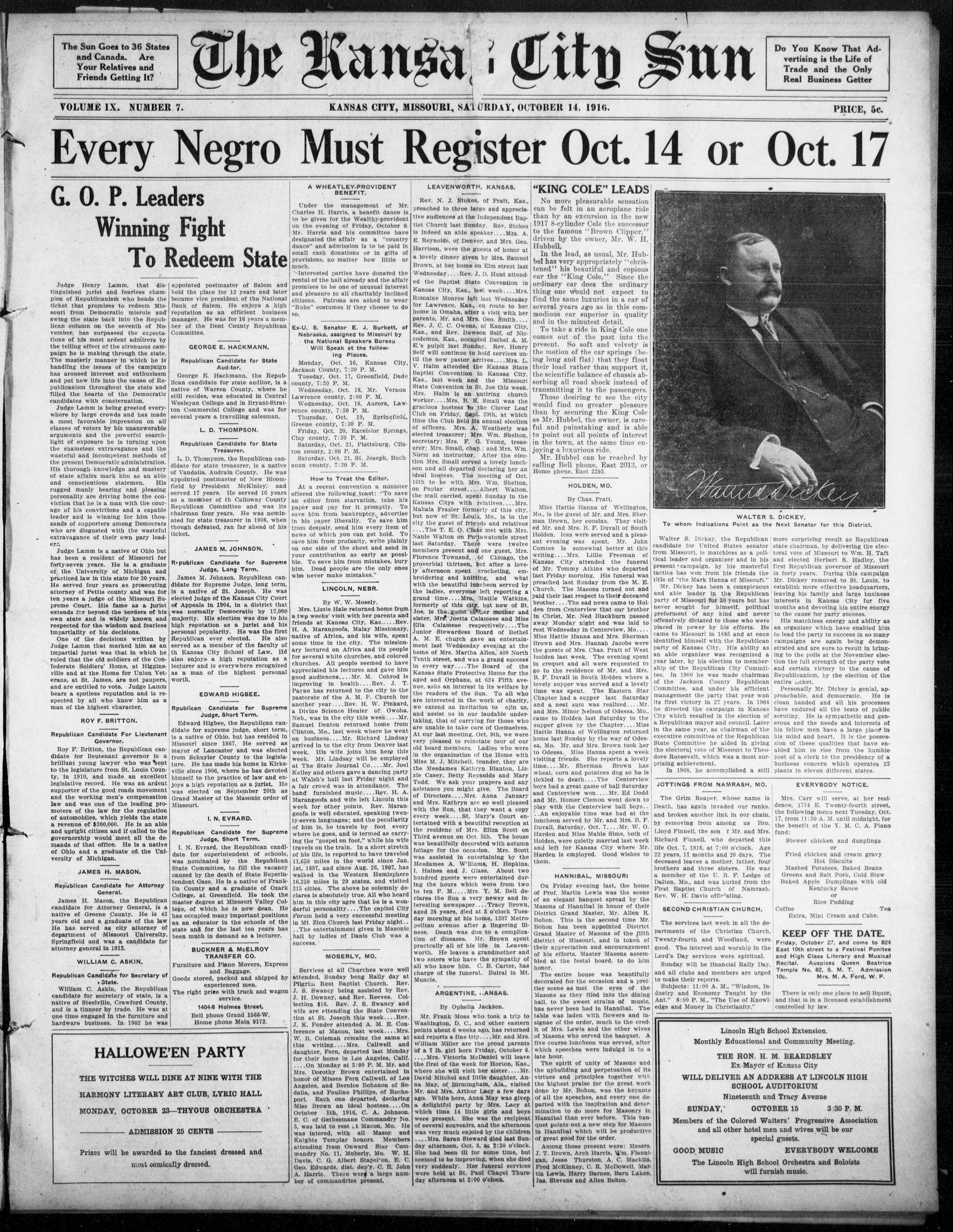
Walter S. Dickey, the Republican candidate for United States senator from Missouri, is matchless as a political leader and organizer and in his present campaign, by his masterful tactics has won from his friends the title of "the Mark Hanna of Missouri." Mr. Dickey has been a conspicuous and able leader in the Republican party of Missouri for 30 years but has never sought for himself, political preferment of any kind and never offensively dictated to those who were placed in power by his efforts. He came to Missouri in 1885 and at once identified himself with the Republican party of Kansas City. His ability as an able organizer was recognized a year later, by his election to membership of the Republican City Committee. In 1900 he was made chairman of the Jackson County Republican Committee, and under his efficient management the party that year won its first victory in 27 years. In 1904 he directed the campaign in Kansas City which resulted in the election of a Republican mayor and council. Later in the same year, as chairman of the executive committee of the Republican State Committee he aided in giving the electoral vote of Missouri to Theodore Roosevelt, which was a most surprising achievement.
In 1908, he accomplished a still
JOTTINGS FROM NAMRASH, MO.
The Grim Reaper, whose name is Death, has again invaded our ranks, and broken another link in our chain, by removing from among us Bro. Lloyd Finnell, the son f Mr. and Mrs. Richard Finnell, who departed this life Oct. 7, 1916, at 7:00 o'clock. Age 22 years, 11 months and 20 days. The deceased leaves a mother, father, four brothers and three sisters. He was a member of the U. B. F. Lodge of Dalton, Mo., and was buried from the First Baptist Church of Namrash. Rev. W. H. Davis office'ating.
SECOND CHRISTIAN CHURCH.
The services last week in all the departments of the Christian Church, Twenty-fourth and Woodland, were good. The interest and worship in the Lord's Day services were spiritual. Sunday will be financial Rally Day, and all clubs and members are urged to make their reports. Subjects: 11:00 A. M., "Wisdom, Industry and Economy Taught by the Ant." 8:00 P. M., "The Use of Knowledge and Money in Christianity."
Do You Know That Advertising is the Life of Trade and the Only Real Business Getter
PRICE. 5c.
Oct. 17
S. DICKEY,
Next Senator for this District.
more surprising result as Republican state chairman, by delivering the electoral vote of Missouri to Wm. H. Taft and elected Herbert S. Hadley, the first Republican governor of Missouri in forty years. During this campaign Mr. Dickey removed to St. Louis, to establish more effective headquarters, leaving his family and large business interests in Kansas City for five months and devoting his entire energy to the cause for party success.
His matchless energy and ability as an organizer which have enabled him to lead the party to success in so many campaigns are again being demonstrated and are sure to result in bringing to the polls at the November election the full strength of the party vote and certain victory to the cause of Republicanism, by the election of the entire ticket.
Personally Mr. Dickey is genial, approachable, and democratic. He is clean handed and all his processes have endured all the tests of public scrutiny. He is sympathetic and generous and the needs and interests of his fellow men have a large place in his mind and heart. It is the possession of these qualities that have enabled him to rise from the humble post of a clerk to the presidency of a business concern which operates 23 plants in eleven different states.
EVERYBODY NOTICE.
Mrs. Carr will serve, at her residence, 1714 E. Twenty-fourth street, the following menu next Tuesday, Oct. 17, from 11:30 A. M. until midnight, for the benefit of the Y. M. C. A. Piano fund:
Stewer chicken and dunplings
Mashed Potatoes, Baked Beans
Greens and Salt Pork, Cold Stew
Baked Apple Dumplings with old
Kentucky Sauce
or
Rice Pudding
Coffee Tea
Extra, Mint Cream and Cake.
KEEP OFF THE DATE.
Friday, October 27, and come to 824 East 10th street to a Festival Pontee and High Class Literary and Musical Recital. Auspices Queen Beatrice Temple No. 82, S. M. T. Admission 10c. Mrs. M. A. Ford, W. P.
There is only one place to sell liquor, and that is in a licensed establishment controlled by law.
School Extension.
and Community Meeting.
M. BEARDSLEY
of Kansas City
ADDRESS AT LINCOLN HIGH
AUDITORIUM
and Tracy Avenue
OCTOBER 15 3:30 P. M.
Attendees' Progressive Association
men and wives will be our
guests.
EVERYBODY WELCOME
AFRO-AMERICAN CULLINGS
One of the outstanding developments of the last few years is the growth of racial consciousness. The latest Negro Year Book reflects this. Not only are the exploits of the heroes of the race recorded but also the individual wealth of Negroes is described with pride.
For example, the rise in the price of oil is said to have boosted the income of Sarah Rector, a young girl of Taft, Okin., to $000 a day. As the descendant of a Creek freedman, she happened to be allotted a piece of land in the oil district. Single taxers would hardly share in the enjoyment of this record. But it has its significance in a cumulative way.
Says Monroe N. Work, editor of the volume:
"Through purchases and increases in values, property holdings of Negroes of the country increased during the year by probably $30,000,000. It is estimated that on the basis of actual values and including exempted and nontaxable property the total wealth of the Negroes of the United States is about $1,000,000,000. They own 21,000,000 acres of land, or more than 32,000 square miles, an area greater than that of the state of South Carolina."
This private accumulation and public emphasis on the power of property is the Negro's answer to the white man's apathy concerning his plight. Rapidly the mere possession of wealth is doing for the Negro what the white man's conscience has failed to do. Racial consciousness is the beginning of racial self-reliance.
In an immense variety of ways the Negro is using his own resources to push forward his race, and, too, from many sources he is being aled. Julius Rosenwald, among others, has made interesting gifts to the rural schools.
All this activity, the training of the Negro for more and more important services, is bound to have its consequences. On the one hand segregation is increasing—since 1911 13 cities and towps have adopted segregation ordinances—and on the other hand the Negroes are shaped by the schools and other institutions to share in the manifold efforts of the country. Here, in truth, is a genuine conflict of forces.
What is the solution? Is it that of the Brazilian statesman who was quoted by Colonel Roosevelt as follows?
"You of the United States are keeping the blacks as an entirely separate element, and you are not treating them in a way that fosters their self-respect. They will remain as a menacing element in your civilization, permanent, and perhaps after a while a growing element. With us this tends to disappear, because the blacks themselves tend to disappear and to become absorbed. In a century there will not be any Negroes in Brazil, while you will have 20,000,000 or 30,000,000 of them." Negroes are being absorbed in the United States, despite our hostility to miscegenation. The number of mulattoes standily increases and the number of blacks decreases, despite the widespread laws forbidding intermarriage between the races. Unless the Negro's attitude toward this absorption changes, the gradual disappearance of a colored race seems to be the prospect in America.—Chicago Herald.
John Frazer came into town and found employment in a pressing club. He washed windows and did errands
Commendation for the progress made by the colored race during the last 50 years in the face of strong race prejudice was bestowed by H. Martin Williams, reading clerk of the house, in an address before the Negro race conference at Mount Carmel Baptist church. Mr. Williams said: "You have faced it like men, and have made your way up in spite of the utmost difficulties."
Following the address of Mr. Williams, the conference took the form of a permanent organization with the election of Rev. W. H. Jernagin of Washington as president, and the election of other officers as follows; Rev. J. Milton Waldron and E. P. Cheek of New Jersey, vice president; W. M. Alexander of Baltimore, secretary; S. L. Carruthers, treasurer; W. A. Taylor, corresponding secretary, and W. D. Norman, chairman of the executive committee.
The organization, on the question of indorsing the Republican nominee for president, voted to appoint a committee of nine to wait upon Mr. Hughes and ascertain his views and purposes in regard to the colored race. The ex-
American lumber, tinned goods, shoes, machinery, motor cars, coal and hardware find a ready market in Apia. If a direct steamer service was 'rustalled between San Francisco and Apia, Australian competition would be almost eliminated.
Gold from lode mines in the Willow Creek district, Alaska, in 1915 was vaulted at $250,000. Government observations prove that there is still an enormous amount of gold in this same viability.
Wounds Caused by Dirt
Wounds caused by earth are the by-effects of the action of projectiles. Exploding bullets and shells drive small particles of dirt into the skin. The neck, face and other exposed portions of the body are usually affected. The mildest form is "tattooed skin," which appears as if covered with dirt, which cannot be removed either with soap or benzine, as the smallest particles of dirt have been driven into the skin. With the second form, abrasions with cyanosis and swelling, deep necrosis
for 30 cents a day, which was fair wages. In his spare moments he watched the workers. Then he took up the iron. Soon he had a table and an iron, and was drawing a wage of $1 a day. For all that he was just a pressing club Negro, Clement Richardson writes in the Southern Workman. Nobody thought of him as anything else. In a few years the owner of the business, a white man, died. Frazer bought the business.
As colored folk came in to bring and take back clothes, they inquired for a barber shop. Frazer fitted up a chair, bought a pair of clippers, and advertised for clients; that is, he at first cut hair for nothing. Then, as he mastered the art, he charged five cents, then ten cents, and so on till he reached the standard price of 25 cents.
Meantime he had bought a farm and a horse. He said: "Till take this horse and land and make it pay for another place." Scarcely had he embarked on this proposition when a few choice acres of land on the west side of Auburn were put up for sale. Strangely enough, it was the land of Frazer's father's master. Frazer bought it. He put up a three-story building. He has abandoned the pressing club, but sells clothing. He still runs a barber shop in the rear of the store. His second floor is an assembly room for lodges and amusements. On the third floor he has an undertaking establishment. A few paces from the store he has built a home. A little further on he has put up a hotel cottage, a rare place in the South, with clean, airy rooms, and up-to-date cooking and service.
Negro problems are to be considered as a part of the course in sociology at Howard university this year. Prof. Kelly Miller is to teach the first semester, and Dr. R. E. Parks, professional lecturer in sociology of Chicago university, is to teach the second semester of the subject.
In order that the course may be available for city school teachers and others interested the time has been set for three o'clock Mondays, Wednesdays and Fridays.
The course is to embrace such topics as growth, distribution and tendency of Negro population, segregation, occupation, crime, vital statistics, education, religious and benevolent organizations, and also the discussion of remedial agencies and the general progress of the race.
The advisability of naming colored bishops in the Protestant Episcopal church will be discussed at the general convention in St. Louis this month. A special commission of bishops, clergymen and laymen, appointed at the 1913 convention to investigate the question, has completed its reports, one a majority favoring the naming of colored bishops, the other a minority report opposing the proposal.
The majority report, which includes the signature of the chairman, and bishops of North Carolina, Texas and Mississippi and the lay members from Virginia and Rhode Island recommends grouping the colored members of the church in the southern dioceses into one or more missionary districts over which colored bishops would be placed. The minority report is signed by the bishops of South Carolina and Georgia, Reverend Doctor Stires of New York and Judge Joseph Packard of Baltimore, who favor election of suffragan bishops for this work.
executive committee opposed the appointment of the committee and urged the immediate indorsement of Mr. Hughes. President Jernagin, in speaking of the conditions among the colored race, said that in the last six months more than 500,000 colored persons had left the South for New York, Pennsylvania, Ohio and northwestern states to take the places of foreign laborers who have returned to their respective countries. He asserted the employers are more than satisfied with them as laborers and are willing to employ 1,000,000 more. He said the leaders of the colored race feel that there are too many of their race in the South yet, and that every effort would be made to secure the migration of the surplus to northern and western states.
Chinese railroad embankments are protected from floods by planting them with a native grass with tenacious roots that resist erosion.
A new steamship line has been started to transport lumber between New Orleans and Cristobal, Colon.
In a Pennsylvania town it was proposed to have Sunday baseball. The burgess declined to license unless the people approved, so boxes were placed in the churches on Sunday. The result was 909 favored and 200 opposed.
Snow took the place of Waters in Main street, Winsted, Conn., when Mrs. J. H. Snow moved from the Huggins place to the Pierre house, while Henry H. Waters moved from the Pierre house to the Huggins place.
may occur. The third variety is the formation of real wounds with irregular edges and subcutaneous hemorrhages; the wound is full of pieces of earth, stone or dirt. In one case one and a half pounds of dirt was found in the wound.
Wanted the Materials.
"Will you start up that fireless cooker, Norah?" said the lady of the house. "Sure I will, mum." replied the green girl. "Where's the matches?"—Yonkers Statesman.
THE KANSAS CITY SUN, SATURDAY, OCTOBER 14, 1916
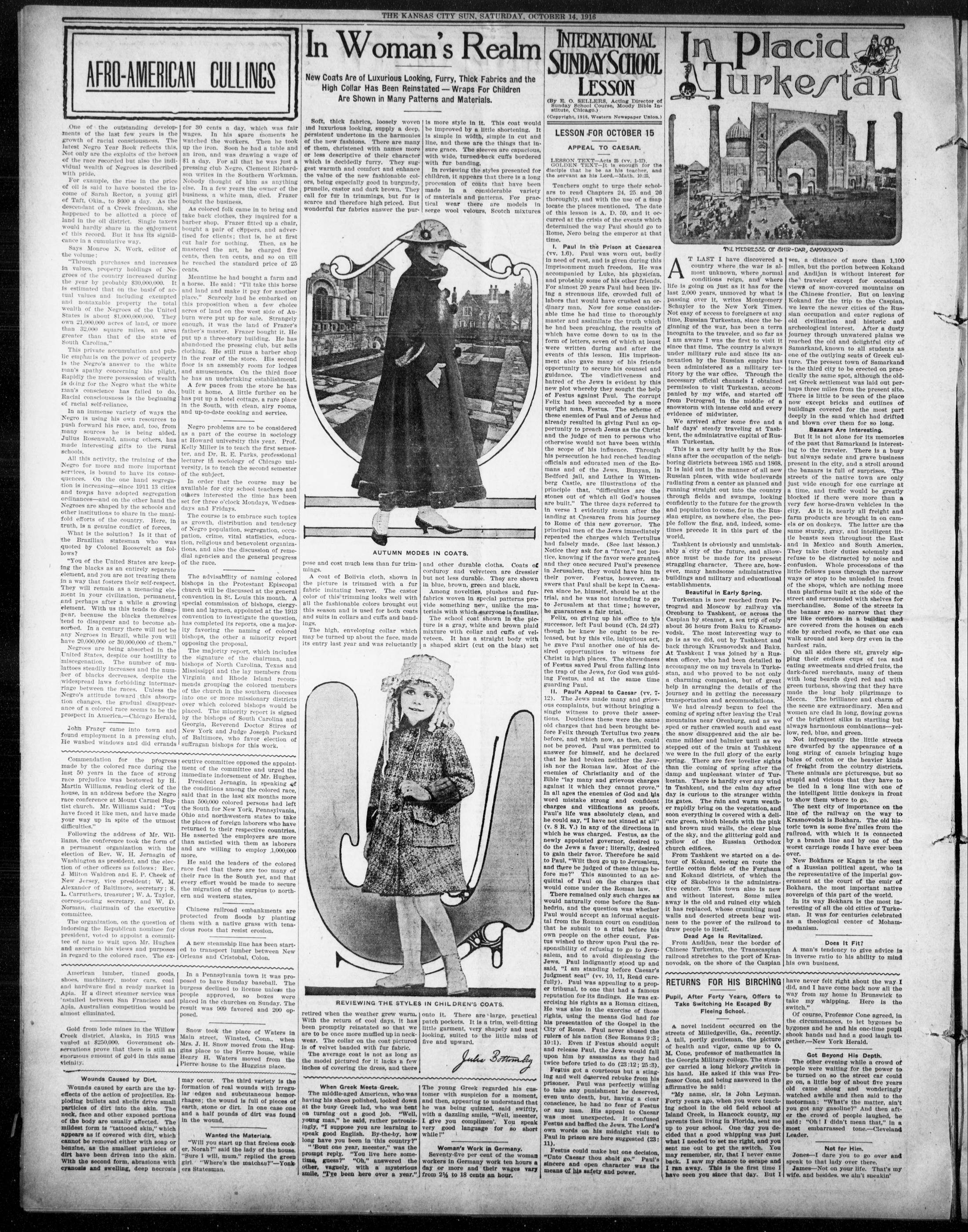
In Woman's Realm
New Coats Are of Luxurious Looking, Furry, Thick Fabrics and the High Collar Has Been Reinstated — Wraps For Children Are Shown in Many Patterns and Materials.
Soft, thick fabrics, loosely woven and luxurious looking, supply a deep, persistent undertone in the harmonies of the new fashions. There are many of them, christened with names more or less descriptive of their character which is decidedly furry. They suggest warmth and comfort and enhance the value of the new fashionable colors, being especially good in burgundy, prunelle, castor and dark brown. They call for fur in trimmings, but fur is scarce and therefore high priced. But wonderful fur fabrics answer the nur-
II
THE FASHION WEEKLY
I
AUTUMN MODES IN COATS.
pose and cost much less than fur trimming.
A coat of Bolivia cloth, shown in the picture is trimmed with a fur fabric imitating beaver. The castor color of this trimming looks well with all the fashionable colors brought out this season and is used for both coats and suits in collars and cuffs and bandings.
The high, enveloping collar which may be turned up about the face, made its entry last year and was reluctantly
REVIEWING THE STYLES
G THE STYLES IN CHILDREN
U
REVIEWING THE STYLES IN CHILDREN'S COATS.
retired when the weather grew warm. With the return of cool days, it has been promptly reinstated so that we are to be once more muffled up in neckwear. The collar on the coat pictured is of velvet banded with fur fabric.
The average coat is not as long as the model pictured for it lacks a few inches of covering the dress, and there onto it. There are large patch pockets. It is a trim, little garment, very shaped looking, suited to the little five and upward.
When Greek Meets Greek
When Greek Meets Greek.
The middle-aged American, who was having his shoes polished, looked down at the busy Greek lad, who was bent on turning out a good job. "Well, young man," he said, rather patronizingly, "I suppose you are learning to speak good English. By-the-by, how long have you been in this country?" "Bout one year, meester" was the prompt reply. "You live here sometime, guess?" "Oh," answered the other, vaguely, with a mysterious smile, "Tye been here over a year."
---
is more style in it. This coat would be improved by a little shortening. It is simple in width, simple in cut and line, and these are the things that insure grace. The sleeves are capacious, with wide, turned-back cuffs bordered with fur banding.
In reviewing the styles presented for children, it appears that there is a long procession of coats that have been made in a considerable variety of materials and patterns. For practical wear there are models in serge wool velours. Scotch mixtures
II
and other durable cloths. Coats of corduroy and velvetteen are dressier but not less durable. They are shown in blue, brown, green and black.
Among novelties, plushes and furfabrics woven in special patterns provide something new, unlike the materials with which everyone is familiar.
The school coat shown in the picture is a gray, white and brown plaid mixture with collar and cuffs of velvetteen. It has a straight body with a shaped skirt (cut on the blas) set
S IN CHILDREN'S COATS.
onto it. There are large, practical patch pockets. It is a trim, well-fitting little garment, very shapely and neat looking, suited to the little miss of five and upward.
Julia Bottomly
The young Greek regarded his customer with suspicion for a moment, and then, appearing to understand that he was being quizzed, said swiftly, with a dazzling smile, "Well, meester, I give you complimen'. You speak very good language for so short while!"
Woman's Work in Germany.
Seventy-five per cent of the woman workers in Germany work ten hours a day or more and their wages vary from 2½ to 18 cents an hour.
---
---
INTERNATIONAL
SUNDAY SCHOOL
LESSON
(By E. O. SELLERS, Acting Director of
Sunday School Course, Moody Bible
Institute, Chicago).
(Copyright, 1918, Western Newspaper Union )
(Copyright, 1916, Western Newspaper Union.)
LESSON FOR OCTOBER 15
APPEAL TO CAESAR.
LESSON TEXT-Acts 25 (vv. 1-12).
GOLDEN TEXT-It is enough for the
disciple that he be as his teacher, and
the servant as his Lord.-Math. 10:25.
Teachers ought to urge their scholars to read Chapters 24, 25 and 26 thoroughly, and with the use of a map locate the places mentioned. The date of this lesson is A. D. 59, and it occurred at the crisis of the events which determined the way Paul should go to Rome, Nero being the emperor at that time.
1. Paul in the Prison at Caesarea (vv. 1.6). Paul was worn out, badly in need of rest, and is given during this imprisonment much freedom. He was accompanied by Luke, his physician, and probably some of his other friends. For almost 20 years Paul had been living a strenuous life, crowded full of labors that would have crushed an ordinary man. Now for some considerable time he had time to thoroughly master and assimilate the truth which he had been preaching, the results of which have come down to us in the form of letters, seven of which at least were written during and after the events of this lesson. His imprisonment also gave many of his friends opportunity to secure his counsel and guidance. The vindictiveness and hatred of the Jews is evident by this new plot whereby they sought the help of Festus against Paul. The corrupt Felix had been succeeded by a more upright man, Festus. The scheme of these enemies of Paul and of Jesus had already resulted in giving Paul an opportunity to preach Jesus as the Christ and the judge of men to persons who otherwise would not have been within the scope of his influence. Through his persecution he had reached leading officials and educated men of the Romans and of the Jews. Bunyan, in Bedford jail, and Luther in Wittenberg Castle, are illustrations of the principle that, "difficulties are the stones out of which all God's houses are built." The three days referred to in verse 1 evidently mean after the landing at Caesarea from his journey to Rome of this new governor. The principal men of the Jews immediately repeated the charges which Tertullius had falsely made. (See last lesson.) Notice they ask for a "favor," not justice, knowing if the favor were granted and they once secured Paul's presence in Jerusalem, they would have him in their power. Festus, however, answers that Paul shall be kept in Caesarea since he, himself, should be at the trial, and he was not intending to go to Jerusalem at that time; however, he guarantees a fair trial.
Felix, on giving up his office to his successor, left Paul bound (Ch. 24:27) though he knew he ought to be released, but by this vile, iniquitous act, he gave Paul another one of his desired opportunities to witness for Christ in high places. The shrewdness of Festus saved Paul from falling into the trap of the Jews, for God was guiding Festus, and at the same time guarding Paul.
II. Paul's Appeal to Caesar (vv. 7-12). The Jews made many and grievous complaints, but without bringing a single witness to prove their assertions. Doubtless these were the same old charges that had been brought before Felix through Tertullius two years before, and which now, as then, could not be proved. Paul was permitted to answer for himself, and he declared that he had broken neither the Jewish nor the Roman law. Most of the enemies of Christianity and of the Bible "lay many and grievous charges against it which they cannot prove." In all ages the enemies of God and his word mistake strong and confident charges and vilifications as proofs. Paul's life was absolutely clean, and he could say, "I have not sinned at all" (v. 8 R. V.) in any of the directions in which he was charged. Festus, as the newly appointed governor, desired to do the Jews a favor; literally, desired to gain their favor. Therefore he said to Paul, "Wilt go up to Jerusalem, and there be judged of these things before me?" This amounted to an acquittal of Paul on the charges that would come under the Roman law.
There remained only such charges as would naturally come before the Sanhedrin, and the question was whether Paul would accept an informal acquittal from the Roman court on condition that he submit to a trial before his own people on the other count. Festus wished to throw upon Paul the responsibility of refusing to go to Jerusalem, and to avoid displeasing the Jews. Paul indignantly stood up and said, "I am standing before Caesar's judgment seat" (vv. 10, 11, Read carefully). Paul was appealing to a proper tribunal, to one that had a famous reputation for its findings. He was exercising his rights as a Roman citizen. He was also in the exercise of those rights, using the means God had for his presentation of the Gospel in the City of Rome. Paul never abused the rulers of his nation (See Romans 9:3; 10:1). Even if Festus should acquit and release Paul, the Jews would fall upon him by assassins as they had twice before tried to do (23:12; 25:3)
Festus got a courteous but a stinging and well deserved rebuke from his prisoner. Paul was perfectly willing to take any punishment he deserved, even unto death, but, having a clear conscience, he had no fear of Festus or any man. His appeal to Caesar was most unexpected. It confused Festus and baffled the Jews. The Lord's own words on his midnight visit to Paul in prison are here suggested (23:11).
Festus could make but one decision, "Unto Caesar thou shalt go." Paul's sincere and open character was the means of his safety and power.
In Placid Turkestan
AT LAST I have discovered a country where the war is almost unknown, where normal conditions reign, and where life is going on just as it has for the last 2,000 years, unmoved by what is passing over it, writes Montgomery Schuyler to the New York Times. Not easy of access to foreigners at any time, Russian Turkestan, since the beginning of the war, has been a terra incognita to the traveler, and so far as I am aware I was the first to visit it since that time. The country is always under military rule and since its annexation by the Russian empire has been administered as a military territory by the war office. Through the necessary official channels I obtained permission to visit Turkestan, accompanied by my wife, and started off from Petrograd, in the middle of a snowstorm with intense cold and every evidence of midwinter.
seen, a distance of miles, but the port and Andijan is with the traveler excels views of snow-cover the Chinese frontier Kokand for the time we leave the newsman occupation an old civilization archeological intercourse through us reached the old armenian Samarkand, known one of the outlying ture. The present is the third city to tically the same spat est Greek settlement haps three miles far There is little to be now except brick buildings covered deeply in the sand.
We arrived after some five and a half days' steady traveling at Tashkent, the administrative capital of Russian Turkestan.
This is a new city built by the Russians after the occupation of the neighboring districts between 1865 and 1868. It is laid out in the manner of all new Russian places, with wide boulevards radiating from a center as planned and running straight out into the country through fields and swamps, looking confidently to the future for the growth and population to come, for in the Russian empire, as nowhere else, the people follow the flag, and, indeed, sometimes precede it in this part of the world.
Tashkent is obviously and unmistakably a city of the future, and allowance must be made for its present straggling character. There are, however, many handsome administrative buildings and military and educational establishments.
Beautiful in Early Spring.
Turkestan is now reached from Petrograd and Moscow by railway via Orenburg to Tashkent, or across the Caspian by steamer, a sea trip of only about 36 hours from Baku to Krasnovodsk. The most interesting way to go is as we did, out by Tashkent and back through Krasnovodsk and Baku. At Tashkent I was joined by a Russian officer, who had been detailed to accompany me on my travels in Turkestan, and who proved to be not only a charming companion, but of great help in arranging the details of the journey and in getting the necessary transportation and accommodations.
We had already begun to feel the coming of spring after leaving the Ural mountains near Orenburg, and as we sped or rather crawled south and east the snow disappeared and the air became milder and balmier until as we stepped out of the train at Tashkent we were in the full glory of the early spring. There are few loveller sights than the coming of spring after the damp and unpleasant winter of Turkestan. There is hardly ever any wind in Tashkent, and the calm day after day is curious to the stranger within its gates. The rain and warm weather rapidly bring on the vegetation, and soon everything is covered with a delicate green, which blends with the pink and brown mud walls, the clear blue of the sky, and the glittering gold and yellow of the Russian Orthodox church edifices.
From Tashkent we started on a detour of Kokand, seeing en route the fertile cotton fields of the Ferghana and Kokand districts, of which the city of Skobelovo is the administrative center. This town also is new and without interest. Some miles away is the old and ruined city which it has replaced, whose crumbling mud walls and deserted streets bear witness to the power of the railroad to draw people to itself.
Dead Age Is Revitalized.
From Andijan, near the border of Chinese Turkestan, the Transcaspian railroad stretches to the port of Krasnovodsk, on the shore of the Caspian over.
New Bokhura or Kagan is the seat of a Russian political agent, who is the representative of the imperial government at the court of the emir of Bokhura, the most important native sovereign of this part of the world.
In its way Bokhura is the most interesting of all the old cities of Turkestan. It was for centuries celebrated as a theological center of Mohammedanism.
Does It Fit?
A man's tendency to give advice is in inverse ratio to his ability to mind his own business.
RETURNS FOR HIS BIRCHING
Pupil, After Forty Years, Offers to Take Switching He Escaped By Fleeing School...
A novel incident occurred on the streets of Milledgeville, Ga., recently. A tall, portly gentleman, the picture of health and vigor, came up to O. M. Cone, professor of mathematics in the Georgia Military college. The stranger carried a long hickory switch in his hand. He asked if this was Professor Cone, and being answered in the affirmative he said:
"My name, sir, is John Leyman. Forty years ago, when you were teaching school in the old field school at Island Creek, in Hancock county, my parents then living in Florida, sent me up to your school. One day you decided that a good whipping was just what I needed to set me right, and you sent me out to get the switch. You may remember, sir, that I never came back. I saw my chance to escape and I ran away. This is the first time I have seen you since that day. But I
seen, a distance of more than 1,100 miles, but the portion between Kokand and Andijan is without interest for the traveler except for occasional views of snow-covered mountains on the Chinese frontier. But on leaving Kokand for the trip to the Caspian, we leave the newer cities of the Russian occupation and enter regions of old civilization and historic and archeological interest. After a dusty journey through unwatered plains we reached the old and delightful city of Samarkand, known to all students as one of the outlying seats of Greek culture. The present town of Samarkand is the third city to be erected on practically the same spot, although the oldest Greek settlement was laid out perhaps three miles from the present site. There is little to be seen of the place now except bricks and outlines of buildings covered for the most part deeply in the sand which had drifted and blown over them for so long.
Bazaars Are Interesting.
Bazaars Are Interesting.
But it is not alone for its memories of the past that Samarkand is interesting to the traveler. There is a busy but always sedate and grave business present in the city, and a stroll around the bazaars is full of surprises. The streets of the native town are only wide enough for one carriage at a time, and traffic would be greatly blocked if there were more than a very few horse-drawn vehicles in the city. As it is, nearly all freight and farm products are brought in on camels or on donkeys. The latter are the same sturdy, gray, and intelligent little beasts seen throughout the East and in Mexico and South America. They take their duties solemnly and refuse to be distracted by noise and confusion. Whole processions of the little fellows pass through the narrow ways or stop to be unloaded in front of the shops, which are nothing more than platforms built at the side of the street and surrounded with shelves for merchandise. Some of the streets in the bazaar are so narrow that they are like corridors in a building and are covered from the houses on each side by arched roofs, so that one can walk around and keep dry even in the hardest rain.
On all sides there sit, gravely slipping their endless cups of tea and eating sweetmeats and dried fruits, the dark-faced merchants, many of them with long beards dyed red and with green turbans, showing that they have made the long holy pilgrimage to Mecca. The brilliance and charm of the scene are extraordinary. Men and women are clad in long, flowing gowns of the brightest silks in startling but always harmonious combinations—yellow, red, blue, and green.
Not infrequently the little streets are dwarfed by the appearance of a long string of camels bringing huge bales of cotton or the heavier kinds of freight from the country districts. These animals are picturesque, but so stupid and vicious that they have to be tied in a long line with one of the intelligent little donkeys in front to show them where to go.
The next city of importance on the line of the railway on the way to Krasnovodsk is Bokhara. The old historic town is some five miles from the railroad, with which it is connected by a branch line and by one of the worst carriage roads I have ever been over.
New Bokhara or Kagan is the seat of a Russian political agent, who is the representative of the imperial government at the court of the emir of Bokhara, the most important native sovereign of this part of the world.
In its way Bokhara is the most interesting of all the old cities of Turkestan. It was for centuries celebrated as a theological center of Mohammedanism.
A man's tendency to give advice is in inverse ratio to his ability to mind his own business.
have never felt right about the way I did, and I have come back now all the way from my home in Brunswick to take my whipping. Here is the switch."
Of course, Professor Cone agreed, in the circumstances, to let bygones be bygones and he and his one-time pupil shook hands and had a good laugh together—New York Herald.
Got Beyond His Depth.
The other evening while a crowd of people were waiting for the power to be turned on so the street car could go on, a little boy of about five years old came along and wonderingly watched awhile and then said to the motorman: "What's the matter, ain't you got any gasoline?" And then after the crowd of people laughed, he said: "Oh! I didn't mean that," in a most embarrassed tone.—Cleveland Leader.
Not for Him.
Jones—I dare you to go over and speak to that lady over there.
James—Not on your life. That's my wife, and besides, we ain't speakin'
Does It Fit?
Expert Dental Specialists OF KANSAS CITY
Our work has stood the test. We have been doing high class guaranteed Dental Work for the past 29 years. We have thousands of satisfied patients.
REMEMBER, IN BUSINESS 29 YEARS
All work kept in repair free of charge.
The doctor who extracts your teeth here has undoubtedly had more experience in this line than any other dentist in the city, so you get the most expert service.
BRIDGE WORK
Spaces where from one to ten teeth have been lost we replace with bridge work. It looks the same as natural teeth, lasts a lifetime and requires no plate. Broken down teeth we restore to beauty and usefulness with crowns of porcelain and gold.
GOLD CROWNS, $3, $4 AND $5
$4 AND $5
WHITE CROWNS, $3, $4 AND $5
OF TEETH, UPPER AND LOWER, $5.00
YORK DENTAL
17-19 Walnut Street
Jewelry Store, 1 door north Emery, Bire
DWELL & CHAPEL
and Millin
North and Paseo, Kansas City, Mo
WHITE C
SET OF TEETH, U
NEW YORK
1017-19
Over Jaccard's Jewelry Store
CALDWEL
Hair and
18th and Pass
Home
Scalp Treatment a Specialty.
Grows Hair. Try it
and any o
Hair Matched From Samples.
Blocked. Agents for Spirella
WORK GUARANTEE
WHITE CROWNS, $3, $4 AND $5
SET OF TEETH, UPPER AND LOWER, $5.00 AND UP
Over Jaccard's Jewelry Store, 1 door north Emery, Bire. Thayer Co.
Home Phone East 4009
At a Specialty. Caldwell's Pomade and
Hair. Try it. Save your combings, cu
and any old hat you may have.
From Samples. Feathers and Hats Clea
ts for Spirella Corsets. Mail orders answ
GUARANTEED. LIVE AGENTS W
RING FACIAL M
Scalp Treatment a Specialty. Caldwell's Pomade and Tonic really Grows Hair. Try it. Save your combings, cut hair and any old hat you may have.
Hair Matched From Samples. Feathers and Hats Cleaned, Dyed and Blocked. Agents for Spirella Correts. Mail orders answered promptly
WORK GUARANTEED. LIVE AGENTS WANTED
Palace of Fashion
MRS. BIRDIE JACKSON
DESIGNER AND DRESSMAKE
Fashion and Beau
Palace of Fashion and Beauty Parlor
We Alter and Repair Clothing
Northwest corner 18
BELL PR
Bell Phone E. 4394Y
THE Modern
A. E. EST.
General
Repairing
Poro College Co., 3100
Corner 18th St. and High
BELL PHONE—EAST 4788
4394Y Office 2460 W
Modern Builder
A. E. ESTES, President
General Contractor
Repairing a Special
---
A.E. ESTES, President General Contracting Repairing a Specialty
Have a Box of
ORO
Sent by
ARCEL
OST
Co., 3100 Pine St., Dept. G.
Poro College Co., 3100 Pine St., Dept. G. St. Louis, Mo.
Please mention name of this paper when writing.
DON'T
Butt
B
Order From
NAFZIG
DON'T FORGET
Butter-Cream
BREAD
er From Your Grocer T
NAFZIGER BAKING CO.
DON'T FORGET
Butter-Cream
BREAD
Order From Your Grocer Today
NAFZIGER BAKING CO.
"The Cleanest Bakery in the world"
BOTH TIME AND MONEY SAVED AT
MANICURING
Latest Styles
BRIDGE WORK
Spaces where from one to ten teeth have been lost we replace with bridge work. It looks the same as natural teeth, lasts a lifetime and requires no plate. Broken down teeth we restore to beauty and usefulness with crowns of porcelain and gold.
CROWNS, $3, $4 AND $5
UPPER AND LOWER, $5.00 AND UP
K DENTAL CO.
Walnut Street
6.1 door north Emery, Bire. Thayer Co.
L & CHAPMAN
d Millinery
seo, Kansas City, Mo.
C. Caldwell's Pomade and Tonic really
t. Save your combings, cut hair
old hat you may have.
S. Feathers and Hats Cleaned, Dyed and
Corsets. Mail orders answered promptly
ED. LIVE AGENTS WANTED
FACIAL MASSAGE
reach the work we do
MME LILLIE JOHNSON
HAIR DRESSER AND BEAUTY
SPECIALIST
Scalp Treatment a Specialty
Latest and Most Approved Methods
—in—
Manicuring and Massaging
8th St. and Highland Ave.
PHONE—EAST 4788
Office 2460 Waldrond Ave
Builders Co.
STES, President
Contracting
ing a Specialty
PORO
HAIR GROWER
THE MAIN CENTER FOR HAIR GROWER
INCORPORATED BY
THE HAIR GROWER ASSOCIATION
INCORPORATED BY
THE HAIR GROWER ASSOCIATION
Have a Box of
ORO
Sent by
ARCEL
OST
T FORGET
Water-Cream
BREAD
Your Grocer Today
GER BAKING CO.
THE KANSAS CITY SUN. SATURDAY. OCTOBER 14. 1916
ANNOUNCEMENT
DR. A. R. EAGLE
who practiced at Guthrie
announces the
Dental Parlors at the
Twelfth and V
Kansas C
In office with D
Kansas News
Told in
DR. A. R. EAGLESON—DENTIST who practiced at Guthrie, Okla., for eight years announces the opening of Dental Parlors at the Northwest Corner of Twelfth and Vine Streets Kansas City, Mo. In office with Dr. L. E. Bailer.
Short Paragraphs
A school of divinity will be established as an adjunct of Kansas University next fall. It will be supported by the members of the Christian churches in Kansas. This announcement was made at Lawrence by Registrar George O. Foster on his return from Independence, Kan., following the close of the annual convention of the Christian churches there.
* * *
The bakeries of McPherson announced recently they have raised the price of a loaf of bread from five to six cents, and that of buns to twelve cents a dozen.
* * *
Alexander H. Brown, 76 years old, one of the earliest settlers of Allen county, is dead at his home in Iola. He came to Southeast Kansas in 1855 with an ox team.
George Smee of Wakeeney was elected president of the K. U. seniors. Theodore Richter is the new junior president; Justin A. Blount, of Larned is sophomore president and Mark Adams, president of the freshmen.
C. M. Lorg and wife of Nardin, Ok., were victims of an overturned motor car near South Haven the other night. Mr. Lorg has a crushed skull and is fatally hurt. His wife was bruised severely.
James B. Funston, a brother of Gen. B. Funston, was married at Olathe the other morning to Mrs. Mittle Harvey. The couple will live at Carlisle.
Leo Peterson, 21 years old, a farmer near Homewood, died recently from injuries received when he fell from a load of hay and his body was impaled on a fork handle.
August 12, the wife of Fred M. Gilmer died at their home, in the eastern port of Finney county and four days later he married again. It is said that he gave a dance in honor of the event. Now Gilmer and his second wife, Delta Gilmer, are in jail, pending an investigation of the death of the first wife, Hannah Gilmer.
While hurrying to the bedside of a sick sister near Andale the other evening Nicholas Phillips of Wichita overturned his car in a ditch near Goddard and was killed.
Adam Stultz, 70 years old, a pioneer at Wellington and a veteran of the Civil War, was found dead in bed early the other day.
John Bolig was killed and George Wurth severely injured when the car in which they were riding became unmanageable and overturned at Ellis the other night. Both the men lived in Ellis.
* * * *
Taylor Riddle, former Kansas live stock sanitary officer and the inspector for the Wichita Live Stock company, is dead at his home in Marion. He was about 60 years old.
* * * *
At a mass meeting held at La Crosse it was decided to call an election to vote on a new water works plant and 24-hour electric light service.
* * * *
The 2-year-old son of August Dielenbrook in the eastern part of Saline county has infantile paralysis, as announced by physicians recently.
Ronald Goode, 17 years old, son of Mayor Goode of Marion, was killed at Florence when he fell underneath a moving train. He was a member of the Marion High school football team.
James Davenport, who shot and wounded his wife last Easter when she returned from town with a new hat, has pleaded guilty in the district court to a charge of assault with intent to do bodily harm and will be sentenced to from one to five years in the state prison.
Rainfall records for September for the last fifty-eight years were broken last month, according to the Septem ber report of the weather station located at the Kansas City Agricultural College. The total precipitation for the month was 8.12 inches.
Ora E. Cooper, 25 years old, a brakeman on the Salina Northern railway, was killed recently, near Lincoln, when an oil car on which he was riding ran off the track. This is the first fatal accident on the new railway.
The Morning Chronicle, a Democratic free daily paper, made its first appearance the other morning. It is Manhattan's third daily. Fred D. Lamb is the publisher.
Out of a gathering of four hundred high school and grade pupils at Belle Plaine only seven were found who had seen a saloon and hardly more than that had seen anyone intoxicated. This surprising result of Kansas prohibition was brought out at a service in commemoration of Frances Willard Day under the auspices of the Women's Christian Temperance Union.
The State bank at Longford was blown open by robbers the other night and about $500 taken. No trace of the robbers has been discovered.
***
---
HAPPENINGS of the week IN MISSOURI
Mystery surrounds the cause of the suicide at Stanberry of L. H. Carlton, superintendent of schools, who shot himself in the head with a shotgun. When found he was dressed in his night clothes, bathrobe and slippers. According to his roommate, G. H. Birchfield, assistant superintendent, Carlton and Birchfield worked late at night and when they went to their room at 12:45 o'clock Carlton seemed in good spirits. Carlton who was 29 years old and unmarried, went there two years ago from Versailles, his home.
Mrs. William D. Steele, president of Ladies' Musical Club at Sedalia and formerly president, has been advised by wire of her appointment as chairman of music in the National Federation of Women's Clubs. The appointment gives to Mrs. Steele the honor and distinction of being the only resident of Missouri holding department chairmanship in the national association.
Representatives of one hundred business, civic and neighborhood associations of Missouri decided, at a meeting at the City Club, to launch a campaign in St. Louis to pledge $150,000 for booster work for Missouri. It was voted to ask Kansas City, St. Joseph, Joplin and other cities to contribute to the fund. The meeting was called by W. H. Bloomer, president of the Missouri Federation of Commercial Clubs.
Crossed electric wires are thought to have been the cause of a fire recently that destroyed the First Presbyterian Church at Carthage. The loss was $24,000.
* * *
Fire, which for awhile threatened to sweep the entire town, destroyed eight buildings at Ilasco, five miles south of Hannibal recently. The loss will be about $35,000.
* * *
The body of Benjamin Mueller, 21 years old, who had been missing from his home in St. Joseph since September 13, was found on a sand bar in the Missouri river near Doniphan, Kas, recently.
Jewell Mayes, secretary of the state board of agricultural of Missouri, took advantage of the American Royal Live Stock show at Kansas City, to talk "Seed Corn Week" to live stock breeders and invariably finds that the man who believes in registered stock also favors pedigreed seed corn. "Seed Corn Week," October 16 to 21, the secretary explained, is a new very important one.
Maj. William Warner, former United States Senator, died the other afternoon at his home, in Kansas City, following an illness that first was considered dangerous September 12. Arterio sclerosis was the cause.
The Bennett-Wheeler warehouse, covering an entire block, burned at Butler recently. It contained more than $15,000 worth of farm machinery, and wagons.
Vincent H. Igo, 50 years old, a farmer, is dead at a hospital in Sedalia. A week ago one of Igo's hands was mangled in a shredder, and lockjaw developed, causing death.
Higginsville recently voted $22,000 for sewer mains and a disposal plant. The complete system will cost $50,000. The vote was 75 to 180.
William H. Kennedy, 75 years old, a farmer of Linn county, died at his home, twelve miles north of Brookfield, the other morning.
Brooding over a love affair, E. C. Greene, 35 years old, a Missouri Pacific fireman, ran amuck on the main street of Sedalia and broke out $800 worth of plate glass windows in downtown stores with his fist.
Lemar G. Mereness is dead at his home east of Liberty, after a ten days' illness. He was a widely known stockman and president of the Missouri Valley Fox Hunters' Association.
The Rev, Calvin Allen, 90 years old, is dead at Brookfield. He was the father of E. B. Allen, until three years ago internal revenue collector in St. Louis.
Four prisoners in the county jail at Macon, set fire to their mattresses and bed clothing and attempted to escape recently, but the officials hurried the prisoners to upstairs cells and firemen put out the blaze.
J. T. Pickens, a clunggist, was killed when a motor car occupied by himself and five others overturned near Joplin the other night. None of the other occupants was hurt.
Miss Louise Disser of Denver lost in the federal district court at St. Louis a suit to establish her claim to a half interest in the $30,000 estate of her great-grandmother, Mrs. Mary Disser of Ferguson. Mrs. Disser, who died in 1914, made a will ten days before her death, providing that her estate should go to her son and her grand-daughter. On the same day a warranty deed was filed in which Mrs. Disser transferred her property to her son. The federal court hid that the warranty deed was genuine.
Does Prohibition Prohibit?
An organized effort is being made by the advocates of Prohibition to extend the enactment of prohibitory laws affecting the manufacture and sale of alcoholic beverages.
We propose to discuss the question of desirability and practicability of Prohibition in a series of short and candid articles. These articles are intended for reasonable, moderate and fair-minded citizens.
We do not need to persuade the converted and we do not expect to convert the extremists. These efforts are intended for the thousands of newspaper readers who are neutral and open to argument and conviction.
Mere assertions and sweeping statements will not make any impression on such persons. They want facts, and sound, valid, honest reasons. They wish to know the merits of the case for Prohibition as well as the merits of the case against it. It is to such as they that we shall address ourselves, avoiding all generalities, assumptions, or question begging.
We shall undertake to prove that Prohibition, wherever adopted, has signally failed; that while Prohibition stops the legal sale of alcoholic beverages, it produces a crop of new evils and problems, infinitely more vexatious than those Prohibition is intended to cure.
A Most Competent Witness:
THE AMERICAN PROHIBITION
YEAR BOOK, 1916, [PAGE
13]
"The liquor question is not settled. In spite of the 'white maps' which deceptively indicate that about three-quarters of the United States is 'dry,' and notwithstanding the claims set forth that one-half of the American people live under prohibition law, the liquor question is diminishing neither in size, importance, or complexity. . . . The application of local prohibition has not only failed to solve the problem, but has tended to aggravate the evil."
The foregoing testimony states the facts truly and accurately and it is the intention of the persons who stand sponsors for the series of articles that are to follow to prove that Prohibition is a failure and inevitably must prove a failure.
Follow the anti-Prohibition articles to which this is the introduction. Ask the Prohibitionists you know personally to read them and answer the arguments that are made in them.
The Testimony of Topeka, Kansas
Prohibition orators like to talk about Kansas. They boast that Prohibition has been proved to be workable in that state. They say "Kansas has solved the liquor problem."
"This capital of Kansas, the citadel of prohibition in the United States, on incomplete reports filed in the office of O. K. Swayzee, County Clerk, consumed in 1915 more than 400,000 quarts of liquor, mostly whiskey. These reports are made by the three railroads and two express companies, and are official. They do not include the large amount of strong drink brought in suit cases and hand baggage. It is estimated that complete reports by the railroads and express companies, coupled with this latter-mentioned way of getting whiskey across the Missouri line, would total 500,000 quarts of liquor brought to Topeka and consumed by its inhabitants last year."
Would not reasonable regulation, strict enforcement of licensing laws; honest dealing with the traffic by protecting the law-abiding dealer through the refusal of license to the unfit, help to solve this vexing problem.
?
Quinoleum Is Queen
YES, I Use Quinoleum, and like it fine. JUST FOLLOW DIRECTIONS. Ours are the finest made preparations for the hair and face.
Quinoleum Hair Grower.....50c
Quinoleum Hair Tonic.....50c
Quinoleum Hair Shampoo.....25c
Face Preparations.
Quinoleum Face Bleach.....25c
Quinoleum Face Cream.....25c
Quinoleum Camphor Ice.....25c
A liberal sample of our new preparation, a fragrantly perfumed toilet powder and a velvety face powder in pink and flesh colors (brown) sent free with any order.
Call Bell Phone West 1757.
26th and Parkway, Kansas City, Kas.
QUINOLEUM MANUFACTURING COMPANY.
At Y. M. C. A.
Wednesday weekly at 8:00 P. M.
Jas. H. Crews, president; Mrs. A.
C. Coleman secretary; Prof. T. B.
Steward, conductor; Mrs. Rogers,
treasurer. The teachers of all the
schools of the city are invited to be
present every Wednesday night the
guests of Ward Chapel Bethel, St.
Lukes, St. John, Ebenezer, Allen
Chapel and others.
MRS. ROBERTS,
Dist. Supt.
MRS. IDA BIRCH,
Supt. of Cradle Roll.
(From the Pittsburg Dispatch, January 23, 1916.)
"Topeka, K.
that, the citadel of prohibition in the United States, of
zyee, County Clerk, consumed in 1915 more than
ports are made by the three railroads and two ex-
ege the large amount of strong drink brought in su-
te rate reports by the railroads and express companies,
whiskey across the Missouri line, would total 500,000
its inhabitants last year."
"Topeka, Kansas, January 20
United States, on incomplete reports filed
2015 more than 400,000 quarts of liquor,
and two express companies, and are
brought in suit cases and hand baggage.
Press companies, coupled with this latter
should total 500,000 quarts of liquor brought
ensing laws; honest dealing with the
visual of license to the unfit, help to
brewery Agents
issouri
S FLOUR
regulation, strict enforcement of licensing laws; be the law-abiding dealer through the refusal of license them.
Brewies ana Brewery
KELLEY'S BEST HIGH PATENT
NT Kelley Milling Co K.C.U.S.A. LOUIS via Missouri Pacific
fine. S. para.
First Out—First In
Lv. Kansas City ..... 9:00 a. m.
Arrive St. Louis ..... 5:30 p. m.
Fast Mid-Day Service
Lv. Kansas City ..... 11:10 a. m.
Arrive St. Louis ..... 7:30 p. m.
Direct connections for East and
Southeast.
or at Union Station
Phones:
Bell, Main 6740. Home, Main 6327.
R. T. G. MATTHEWS;
Assist. General Passenger Agt.
MISSOURI
PACIFIC
IRON
MOUNTAIN
Bust of
T. Washington
FOR SALE
BETA S. COLLINS, AGENT
SEVENTH ST., KANSAS CITY, MO.
Booker T. Washington FOR SALE
By ALBERTA S. COLLINS, AGENT
1419 EAST EIGHTEENTH ST., KANSAS CITY, MO.
Life size busts with a true likeness and durability in bronze.
Every race-booster should have one. Partial payments if so desired.
Call and see it—demonstrated free. Send money order, express order
or registered letter. Price, $3.00.
Suggestion:
of Kansas City, Missouri
Kelley's Best Beat all the Rest
MISSOURI
PACIFIC
IRON
MOUNTAIN
THEKANSASCITYSUN
PUBLISHED WEEKLY
All communications should be addressed to The Kansas City Sun, 1803 East 18th Street.
Bell Phone East 999.
Entered as second-class matter, August 1908, at the postoffice at Kansas City Mo., under the act of March 3, 1879.
Nelson C. Crews.....Editor and Owner
Willa B. Glenn.....General Manager
SUBSCRIPTION RATES
One Year ..... $1.50
Six Months ..... 75
Three Months ..... 50
ADVERTISING RATE, 50 CENTS PER
INCH.
MEMBER
NATIONAL NEGRO PRESS
ASSOCIATION.
CHURCH DIRECTORY.
Bethel A. M. E. Church, 24th and Flora.
St. Stephen's Baptist Church, 604 Charlotte St.
Centennial M. E. Church, 19th and Woodland.
Second Baptist Church, 10th and Charlotte.
Allen Chapel A. M. E. Church, 10th and Charlotte.
Ebenezer A. M. E. Church, 17th and Tracy.
St. Augustine's P. E. Church, 11th and Woodland.
St. John's A. M. E. Church, 1743 Belleview.
Seventh Day Adventist, 23d and Woodland.
St. Monica's Catholic, 17th and Lydia.
Vine St. Baptist Church, 1825 Vine St.
Ward Chapel A. M. E. Church, 11th and Troost.
Morning Star Baptist Church, 2311 Vine.
Highland Avenue Baptist Church, 1111 Highland.
Centropolis A. M. E. Church, Centropolis Mo.
St. James A. M. E. Zlon Church, 1823
Woodland Ave.
Second Christian Church, 24th and Woodland.
St. Paul's Baptist Church, 19th and Highland.
Friendship Baptist Church, 17th and Tracy Avenue.
Pilgrim Baptist Church, 614 Charlotte St.
Pleasant Green Baptist Church, Independence Avenue and Tracy.
Calvary Baptist Church, 19th and Askew.
Mesquiel A. M. E. Mission, 5th and Lydia.
C. M. E. Church, 1817 Flora Ave.
St. James Baptist Church, 4039 Mill St.
St. Luke's A. M. E. Church, 43rd and Prospect Place.
Broadway Baptist Church, 555 Avenue
A. M. E. Mission, 585 Grand Ave.
CLARK CHAPEL M. E. CHURCH,
1664 Madison Ave.
KANSAS CITY, KAN. CHURCHES.
First A. M. E. Church, 8th and Neb
Eighth St. Baptist Church, 8th and
Oakland.
Metropolitan Baptist Church, 9th and Washington. M. E. Church, Water and Steward Streets. Paul A. M. E. Church, 21st and Ruby.
First Baptist Church, 5th and Neb.
Solomon Baptist Church, 3rd and
6th.
Quindaro A. M. E. Church, Quindaro,
Cresant Valley Baptist Church, Rose
Dale
M. E, Church, 9th and Oakland.
M. A. E. Church, 4th and Oakland.
M. A. E. Mission, M. E. Church, South
Park, Kan
Protestant Episcopal, 3rd and Stewart H. Wesley Chapel, M. E., 106 Shawnee, Wesley Chapel M. E., 106 Shawnee, Bethel A. M. E. Church, Rosedale, Kan Zion Baptist Church, 4th and Virgina
Ebenezer A. M. E. Church, Sanford and T emont.
EDITORIALS.
Colonel Gardner, the Democratic candidate for governor, is circulating lithographs showing his own picture, with that of a cow, a horse and a factory, and a slogan in big type, "Let's put Missouri on the map." Judge Lamm, in answering the slogan on the stump, is saying: "If Missouri is not on the map, who in heaven's name is responsible for keeping it off?" Gardner is saying if he is elected governor he will take the police out of politics. Judge Lamm is saying: "If the police are now in politics, who put them in?" Gardner also promises, if elected, to stop the leaks in state finances. Judge Lamm is saying: "If there are leaks in the state's finances, who are responsible for them?"
"Colonel Gardner is the first candidate I ever saw running for office who required an amendment to the state constitution to be electd," says Judg Lamm.
Gardner's Land Bank Bill conflicts with the Constitution of Missouri and cannot be put into operation without a constitutional amendment. It provides for exemption from taxation of more than $40,000,000 of personal property. If this amendment is adopted it will be necessary to increase the tax on land to make up the deficiency in the state revenues. If the farmer receives cheaper mony by increasing his taxes he will cut off his nose to spite his face.
The St. Louis Post-Dispatch says, "Undeniable attractiveness is lent to the Republican platform by its savage condemnation of nepotism and of barbarities at the State Prison and its pledge of home rule and of the introduction of the merit system into Missouri's entire civil service.
"All the Democratic administration needs now to add the climax of damnation to its record is whitewash. A coat of whitewash will not conceal the school fund juggle, the penitentiary mismanagement, the nepotism, the extravagance and other sins of the administration; it will not cover the facts; it will not blind the people; it will only advertise the offenses."—St. Louis Post-Dispatch.
Due to the outrageous extravagance and mismanagement of the Democratis administration at Jefferson City, a deficit of approximately $2,600,000 will meet the incoming administration in 1917. If Col. Gardner claims a deficit of these proportions show good financial management, what kind of a government could the people expect under him.
That there should be lunch rooms
To the W. M., Wardens and Brothers,
Greeting:
The following officers were elected
and installed at the 50th Annual Com-
munication of the M. W. Grand Lodge
of Missouri and Jurisdiction, A. F
and A. M., held in Kansas City, Mo.
August 9th, 10th and 11th:
Brother W. W. Fields, Cameron
Grand Master.
Brother William Green, Plattsburg
Deputy Grand Master.
Brother Crittenden Clark, St. Louis
Senior Grand Warden.
Brother George W. K. Love, Kansas City, Grand Secretary.
Brother Nelson C. Crews, Kansas City, Relief Secretary.
Brother P. L. Pratt, Cameron, Grand Lecturer.
Brother E. J. Cooper, Mexico, Grand Lecturer.
Brother William H. Jones, St. Jo seph. Member of Relief Board.
Brother William F. Botts, Omaha,
Neb, Grand Chaplain.
Place of meeting, 1917, Jefferson
City, Mo.
MASONIC BUILDING ASSOCIATION
W. G. Mosely, President
W. E. Lacey President
T. G. McCampbell, Vice President.
Wm. Washington, Treasurer.
E. S. Baker, Secretary.
T. G. McCampbell, S. H. P. Edwards,
E. G. Lacy, J. E. Rhodes,
T. W. H. Williams, E. S. Baker,
Wm. Washington, R. V. Adkins,
Geo. Johnson, W. G. Mosely,
S. Myers, Richard Harris
Edw. Thompson, R. Fulbright.
Meets fourth Tuesday in each
month.
Lodge Directory
HOC
IM
MINISTRY
Bible school at 9:30 a. m.; preaching and Communion at 11 a. m.; Y. P. S. C. E. at 7 p. m.; preaching at 8:15 p. m., prayer meeting Wednesday at 8:30 p. m.; Christian Woman's Board of Missions Thursdays at 2 p. m.
WILLIAM ALPHIN, Pastor.
A. G. NELSON, Clark.
M
Scalp Specialist
2533 Woodland
in all the larger colored schools in the city is amply demonstrated every school day especially on 18th street by the horde of children crowding the greasy, dirty, unsanitary Greek restaurants scattered along that thoroughfare where they do not hesitate to kill a negro over a five cent account, and where police officers say they have been seen hugging and fondling little school girls. There are number of colored places along the street but for some unaccountable reason they are not patronized by these children. Parents warn your children to stay out of these dumps or prepare to take the consequences which may be a broken heart and a disgraced family.
The physician who participated in the organization of the Gardner-Wilson club this week will doubtless be given the office of "Face-Fixer," that is, he will keep the faces of the members straight while the orators are telling how Prof. Woodrow Wilson loves the "cullud brother."
The introduction of departmental teaching into the upper grades of Lincoln School is announced by the principal to have been a decided success from the very beginning. Teachers and pupils are alike pleased and improvement in the quality of class work is already being noted.
Just keep in mind that the U-53 could have destroyed Manhattan in the same time and manner that the five allied ships were sent to the bottom. We do not want war if it is to be honorably avoided but we ought to have a president who will not dilly-dally if any one shoots at us.
Betty & Sam's Little Corner)
A
THEY SAY
—That consternation reigned when the sheriff appeared at a well known society lady's home and served summons on club members. Some forgetting to be served. Some excitement, eh?
—That a young man who married a young lady was attracted by her voice that he had forgotten to look to her other attainments, so that when they went to retire he was astonished to see a wig come off, next some false teeth, then an arm was laid upon a nearby chair, whereupon he exclaimed: "For de Lawd's sake, Mary, sing, Sing, Mary if yo' wants me to stay here."
—That a primary teacher had just told little Anna to sit down, which Anna immediately did, but in such a manner that the teacher was soon calling out: "Anna, Anna, sit up. Why don't you sit up in that seat," "I can't," sweetly replied little Anna, "'cause you just told me to sit down."
—That a certain man, when asked why he didn't advertise, said: "Well, they'll come anyhow." He was the only undertaker in town. That's a bad jolicy for any Kansas City business man to use, though. The people want to trade with the man they know is doing a big business.
---
—That when the managers of one of the local poultry plants at Springfield heard that the A. M. E. Conference of colored brethren was to be held there, he ordered an extra carload of young springs, and when asked why, replied, "Oh, just to keep the supply normal."
—That the Wattlington or K. of F. of the U. B. F. Drill Co. No. 1, won the first prize, a silver loving cup with gold trimmings, in a competitive drill, Friday evening, October 6th, from the champion drill team of the Odd Fellows or Patriciarle No. 147, of Kansas City, Kansas, at the Armory hall. Col. Neal Range and Adjt. Dan Lucas have a smile on their faces that won't come off.
ON TEMPERANCE.
Applying mathematics to the United States census report you will find that during 1913 the liquor interests contributed $13,485,460 to farm labor.
Six "dry" states, Idaho, Arizona, Oregon, Colorado, North Lakota and Oklahoma have 4,235,948 inhabitants. The City of New York "wet" has 4,776,880 inhabitants.
Eighty per cent of the people in America believe in Commercial and Personal Liberty and advocate Temperance.
Temperance means "Moderation," regulated licensed saloons. Prohibition means "No License;" high taxes and bootleggers.
The Anti-Saloonite says that Prohibition prohibits. Sure it does! It prohibits the licensed, legal, lawful selling of liquor; it prohibits the rightful revenues to go the government.
THE KANSAS CITY SUN, SATURDAY, OCTOBER 14, 1916
Madame Page's Criterion Hair Preparations
Scalp Specialist and Manufacturer of the Criterion Hair Grower 2533 Woodland Ave. Bell East 1358w Kansas City, Mo.
MASONS. ATTENTION.
Official Notice.
Board of Directors:
Pritchard Mason No. 42, A. F.
and A. M., meets every 4th
4th Monday in each month
All Master Masons in good standing
welcome. Wm. Hopkins, W. M.
M. J. H. SPIGENER, Secretary.
Rone Lodge No. 53, A. F. and
A. M., meets the 1st and 2nd
4th Friday in every month.
Master Masons in good standing
welcome. Emmett Spruell, W.
M. C. H. Countee, Sec'y.
Mt. Lebanon Lodge No. 53, A. F.
and A. M., meets the 2nd and
4th Friday in every month. Visiting
Master Masons are wel-
loved. Ease Myers, W. M.
Frank Keeley Secretary, 1812
Baltimore Ave.
Lebanon Lodge No. 126, A. F.
and A. M., Linchco, Neb., meets
the 4th Friday in every month.
All Master Masons in
good standing are welcome
H. R. Young, W. M. 1315 Wash-
ington St. I. B. Smith, Secy.
617 S. 20th St.
G
MASONRY
Liberty Lodge No. 37, A. F
and A. M., Liberty, Mo., meets the 2nd and 4th Saturday nights in each month. William M. W. M., Nelson Wallar Secy. $t. Stephens Chapter No. 37. Royal Arch Masons, Liberty Mo. Meets first Tuesday in each month. M. R. Rousson Mo. W. Caps, Rousson Mo.
```markdown
```
U. B. F.
King of the West Lodge No. 218 meets first and third Mondays in each month at 563 Grand Avenue, C. F. Wilson, W. M.; D. M. Wenney, 1718 Euclid Ave., Secretary
St. Matthew Commandery No. 17, Liberty, Mo. meets the third Saturday night. William Capp, E. C. W. H. Robinson, Recs. C.E.
King Solomon Council No. 1 of the Ancient Sons and Daughters of Jerusalem meet the first and third Thursdays of each month at 1150 Independence avenue. Mattie Burrs, M. S. Secry.
D. OF T.
Primrose Tabernacle meets 1st and 3d Wednesday nights in 11th Floor of Vine Street. All Daughters and Sir Knights in good standing are welcome. Susie Dotson, H. Sir Knights. Susie C. Pitts, C. R., 185 E. 17th.
SECOND CHRISTIAN CHURCH.
24th and Woodland Ave.
Criterion stands for quality, as "Sterling" stands for Good Silver.
Criterion has been tested thoroughly and proven to be the most wonderful of all hair preparations.
AGENTS WANTED.
GOOD PROFIT.
NEGRO DEMOCRACY A COMPLETE FAILURE.
When the blind lead the blind, they both fall into the ditch. The national Negro Democratic organization that has labored in vain for a score of years to seduce the negro voters of the country into the Democratic party, under the leadership of Bishop Alexander Walters, of New York, the leading bishop of the African M. E. Zion church, has proven a colossal failure. The good bishop reached the zenith of his fame as a political prophet and Democratic leader four years ago, when he succeeded by taking advantage of the division in the Republican party ranks, in leading several thousands of his people to follow his leadership in supporting Woodrow Wilson for the presidency.
But the bishop had a rude awakening. His eyes have been opened at last, and so have those of his deluded followers. The hopes of the negro Democratic band have been blasted by the duplicity of President Wilson, who turned his back on them when he entered the White House, and in the four short years he has been in power, has removed nearly every evidence of political advancement of Republican administrations for the last fifty years. Bishop Walters has proved to be a false leader and his followers have deserted him. His aged head is bowed down and his heart is saddene by the evidence of his own duplicity. He has been slaughtered in the house of his false friends, and with all his prestige as a leader gone, he bemoaned his fate in sack cloth and ashes, while he seeks to undo the great wrong to his people, for which he feels keenly the responsibility.
A year ago last March, when Bishop Walters visited St. Louis to aid in the dedication of Metropolitan A. M. E. Zion church, his proud heart overflowed with grief over the disaster he had wrought abong his people, and in the presence of a large audience, composed of many of the most important white and colored people of St. Louis, gave vent to his lamentations, taking President Wilson and his administration severely to task for the outrageous treatment he had meted out to his people.
He declared with the forceful eloquence for which he is noted as a pulpit orator, that President Wilson had misled him and his followers by promises of fair play, prior to his election, and after reaching the White House had ruthlessly undone the work of fifty years of race advancement made by the negroes by the policy of segregation and elimination practiced against them in the various departments of the Federal Government. In a burst of firey eloquence at the close of his address the bishop declared it to be his solemn belief that the only salvation for the negro in the future was to organize themselves and cast a solid vote for the Republican nominee for president in 1916.
In an interview given out to the press a few days prior to his address Bishop Walters expressed himself on the political situation in the following unmistakable language: "Everybody knows, from the very nature of things, there can be no such thing as a negro Democrat, but a few of us thought it a wise thing to play Democratic politics. Our motive was to test the sincerity of the Democratic leaders who had long claimed to be our true friends, but had withheld their political help from us because of our blind allegiance to the Republican party."
"I had known Mr. Wilson as governor of New Jersey, and regarded him as an upright and God fearing man, and when he gave us positive assurances that the people of my race would receive fair play under his administration, if he was elected, I decided to give him my support, and did all in my power to aid him in securing a large share of the negro vote, and I do not think it can be successfully denied that he received the largest negro vote ever cast for a Democratic candidate for the presidency."
"To say that I was disappointed and surprised at Mr. Wilson's course in permitting the heads of the various departments at Washington to utro duce and enforce rules segregating the negro clerks and other employees, thus disturbing the era of good feeling between the races that had existed in the departments for nearly half a century, is putting' the case mildly. I was both grieved and indignant."
"I called, on the president and had a talk with him about the matter, and while he gave me no assurance that he would interfere with the department heads, in their management, I still believe Mr. Wilson meant to do the right thing in the distribution of Federal patronage, when he came to make appointments, but when I saw most of the negroes who held positions
YOU'VE TRIED THE REST,
NOW TRY THE BEST.
of honor and trust under the government replaced by white men, and saw the efforts of Southern congressmen to repeal the Fifteenth Amendment, I became truly alarmed and appealed to the United States senators to stay the hand of Southern prejudice and save us from disfranchisement."
WILD BEASTS ON FIRING LINE
Denizens of the Jungle Prowl Between British and German Armies In East Africa.
The country through which the British forces under command of Gen. J. C. Smuts are operating in their conquest of German East Africa is probably the finest big game field in the world.
"Every description of buck and other game," writes a trooper of the South African horse in a letter home, "can be seen daily ranging the flats, and although the bulk of them have moved away some little distance hardly a morning passes that at dawn we do not see droves of them careering between the various squadrons. They comprise chiefly wildbeest, eland, hartebeest, gemsbok, rookbok, gyrsbok, and springbok. In addition there abound all sorts of wild creatures—lions, leopards, wolves, hyenas, wild pigs, giraffes, also ostriches.
"The noises of the night are most uncanny. Mingled with the howling of the jackals we hear the laugh of hyenas and the deep grintings of pigs. A horse died the other night, and although a sentry was not 20 yards away, only a part of the carcass was left at daybreak.
"The worst enemies' our horses—and ourselves—have to contend with are bush lice. These tenacious vermin are a great source of trouble. They fasten on the legs and muscles of the horses as the latter graze. They are reckoned to be a prolific source of disease, not only among the animals but among human beings."
SWISS RUN MODEL HOTELS
Hostelries In New Helvetia, Uruguay Are a Sample of the Progressive Methods of the Race.
Wherever the Swiss go they establish good hotels. In Uruguay there is a Swiss colony, called New Helvetia, devoted largely to farming.
The land, which was one of the garden spots of Uruguay, was divided into small farms and sold to Swiss colonists more than fifty years ago at a low price and on easy terms. The ordinary products of the farm have found a wider and wider market, and in the last few years the dairy interest has become noted. Grapes and other fruits are also extensively cultivated. Now that the section is reached by railways it is becoming very well known. The good hotels offer a pleasant resting place for excursionists from Montevideo and Buenos Aires. The people are well off and adopt modern methods of living.
Concerning "Slackers."
Concerning "slackers."
Of all the new words that the war has given us, "slackers" is one of the surest to serve. Of course, the word wasn't new in England, but it had no general currency in America before we heard it applied to those who held back from recruiting.
The Continent (Chicago) seizes upon it as a useful whip in the modern religious world. Jesus knew the slackers, says the writer, and he enjoined upon them to "let your loins be girded about, and your lamps burning, and be ye yourselfs like unto men looking for their Lord." The metaphor derives from the flowing robes of the Oriental dress, which, loosened and hanging from the shoulders in times of relaxation, had to be drawn by a tight girdle around the waist when anything was to be done. The writer observes that Jesus very well knew that "any Christian who fell into the way of loosening now and again the service belt of his life would soon forfeit the power to tighten up his belt to the old notch of thoroughness.—Literary Digest.
New Methods at Lloyds.
Old-fashioned business methods in marine insurance, which is centered at Lloyds, in London, have gone by the board as a result of new conditions. Until the first of March a shipowner who wanted insurance approached a broker at Lloyds, who set down the particulars on a slip of paper and passed it to different underwriters, who wrote on it the amount of liability they were willing to assume and appended their initials.
This paper, after several weeks' delay, frequently reached the assured in a torn and grim condition, it is said.
The new scheme provides for a central office with a staff of woman clerks, superintended with an underwriting expert, and policies will be issued the same day they are applied for.
WHAT THEY WILL DO.
The Criterion preparations will make kinky stubborn hair soft and glossy, cure the scalp of tetter and eczema, remove the dandruff, stop itching and burning of the scalp, stop hair from falling out, promote a growth of long, thick, glossy hair. For man, woman or child.
Negro Business and Professional Directory of Greater Kansas City
BAKERIES.
MRS. SUSIE OWENS, 2331 Vine street. Bell phone, East 5017.
BARBER SHOPS
WICK, 2405 Vine Street. Bell, East 14374
EN'S BARBER SHOP, W. F. O'Bonnor
nue.
THE BRUNSWICK, 2405 Vine Street. Bell, East 1437J. R. D. Jackson, Prop.
LABORING MEN'S BARBER SHOP, W. F. O'Bonnon, Prop., 558 Grand Avenue.
BARBECUE STANDS
MRS. A. D. TURNER, Barbecue Stand, 1747 Forest avenue
H. WINN, 2315 Vine Street.
BEAUTY PARLORS AND HAIR DRESSERS.
MISS PEARL WELTON, Poro Hair Dresser, 1010 North 4th St., Kansas City, Kans. Bell phone, West 3741.
MRS. ETHEL E. WILSON, 1609 East 14th, XX Century Hair Grower. Bell phone, East 1871W.
MRS. MARY W. HOGAN, Poro Hair Dresser, 1603 A. E. 14. Bell phone, East 3805M.
MRS. ADDIE COLLINS, Poro Hair Dresser, 2744 Highland Avenue. Bell phone, East 1417W.
MRS. MINNIE DOYLE, Poro Hair Dresser, 2732 Highland Avenue. Bell phone, East 1346W.
MISS MAE BELLE JACKSON, Manufacturer of Wonderful Hair Grower, 1913 East 10th Street, Bell Phone East 3237W.
MRS. DORA B. SYDNOR, Poro Hair Dresser, 1812 East 10th Street, Bell Phone, East 1908.
MRS. DELILAH M. S. DOTTREY, 1102 Highland Avenue. Poro Hair Dresser.
MRS. LUCY BENFORD, 1305 Michigan Avenue. Poro Hair Dresser. Bell Phone, East 2221J.
MRS. L. B. SMITH, 2420 Woodland Avenue, Poro Hair Dresser, Bell Phone, East 2717W.
MRS. URITH U. K. THOMPSON, 1007 Vine St. Bell phone, East 5230. Poro Hair Dresser.
MRS. SUSIE GIBSON, 1725 Michigan Ave. Poro Hair Dresser. Bell phone, East 3058J.
MRS. F. BETTS, 1507 East 17th street. Poro Hair Dresser.
E. L. FULBRIGHT-GRANT, 1204 Highland Ave. Bell phone, Grand 2129J.
MESDAMES JACKSON & JOHNSON, 18th and Highland Ave. Bell phone E. 4788.
MRS. BERTA JOHNSON, 2327 Highland Ave. Poro Hair Dresser. Bell Phone, East 2297
MRS. CADDIE WITCHER, 1510 Michigan Ave. Hair and Sealp Treatment. Bell phone, East 4167X.
MRS. CORA D. WILLIAMS, 1714 East 13th St. Bell phone, East 3610J. Poro Hair Dresser.
MRS. SALLIE LASHLEY, Poro Hair Dresser, 1332 East 16th St.
MRS. F. A. COOK, Poro Hair Dresser, 1226 Vine St. Bell phone, E. 2820.
MRS. ALICE M. THOMAS, Poro Hair Dresser, 1022 West 30th St., Phone, Grand 2456W.
CAFES.
MRS. H. W. DOTSON, 1705 East 12th. Bell Phone, E. 2214.
JONES' CAFE, 2110 Vine Street. Everything to satisfy.
WOODLAND CAFE, Charles E. Gilliam, Prop., 1804 East 12th St.
DELMONICA CAFE, 1512 East 18th St. Bell phone, East 618.
MRS. S. J. BRADLEY, 1519 East 23rd Street.
CLEANERS, DYERS AND TAILORS
THE MID-WEST SANTIARY CLEANERS AND DYERS, William T. Stanley, Prop., 2438 Vine Street. Bell phone, E1206.
COAL AND FEED
W. W. PAYNE, 1902 1-2 Vine St. Bell phone, East 559; Home phone, East 4132.
DRUG STORES.
PEOPLE'S DRUG STORE, 18th and Paseo. Bell phone East 1814, Home East 4082.
FLORISTS.
CROSTHWAIT FLORAL CO., 1801 East 18th St. Bell phone, East 272. Home phone, East 4070.
LAWYERS.
WAY, 601 Delaware, Home phone M58, Practices in all courts.
ON, 601 Delaware, Home phone M58, Real advice. Practices in all courts.
LEFORD, Attorney at Law, 516 Minne Kas. Bell phone, West 3866.
C. H. CALLOWAY, 601 Delaware, Home phone M58, Bell phone Main 448. Practices in all courts.
W. C. HUESTON, 601 Delaware, Home phone M58, Bell phone Main
W. C. HUESTON, 601 Delaware, Home phone M58, Bell phone Main 448. Legal advice. Practices in all courts.
E. A. SHACKLEFORD, Attorney at Law, 516 Minnesota Ave., Kansas City, Kas. Bell phone, West 3866.
LADIES' TAILORING
MRS. ELNORA MOSS, 1300 Woodland Ave. Bell phone, East 4438
JEWELERS
N, 1616 W. 9th street, Kansas City, Mo
R.
' FURNISHINGS, DRY GOODS and N
N, 1313 East 1t8h street.
MANICURING.
HAYWARD, 1514 E. 18th St., Home ph
lass service.
J. A. WILSON, 1616 W. 9th street, Kansas City, Mo. Bell phone, Main 6248R.
GENTS' FURNISHINGS, DRY GOODS and NOTIONS.
W. L. MARTIN, 1313 East 1t8h street.
MANICURING.
MISS DORA HAYWARD, 1514 E. 18th St., Home phone East 4119. First class service.
MESSENGER SERVICE
THE ENTERPRISE, 1521 East 18th Street, Charles A. Starks, Prop Bell phone, East 1521.
PHYSICIANS
A. D. BRADBURY, M. D., 821 Independence Ave. Bell phone Main 4438.
PHOTOGRAPHERS
J. E. MILLER STUDIO, 1622 East 18th Street. Bell phone, E. 91.
PRINTERS.
BILIN, 1309 East 18th Street. Bell phone,
REAL ESTATE and EMPLOYMENT
OYMENT AND INVESTMENT CO., 500
) Kansas City, Kans. Bell phone, West
1036. C. W. Neloms, Mgr.
GOPLE'S INVESTMENT CO., 2427 Vine
time East 4011. Sol Smith, Pres
C. A. FRANKLIN, 1309 East 18th Street. Bell phone, Grand 2988. REAL ESTATE and EMPLOYMENT.
phone, West 1036. C. W. Neloms, Mgr.
COLORED PEOPLE'S INVESTMENT CO., 2427 Vine St. Bell Phone
East 1011, Home East 4011. Sol Smith, Pres
RESTAURANTS.
MRS. FANNIE ISAM. 805 Independence Avenue.
SHOE STORE.
G. A. PAGE'S SHOE STORE, 1507 East 18th street. Bell phone, East 1328.
UNDEBTAKERS
E, 1031 Independence Avenue. Bell phone
phone Main 3341.
EE, Licensed Embalmer, 2220 Vine St., N
line East 3341.
DS. & GREEN, 19th and Vine Sts. Phone
ROS., 1729 Lydia Ave. Bell Phone Gl
9. Res., Bell East 3281.
H. B. MOORE, 1031 Independence Avenue. Bell phone Main 3398W
Home phone Main 3341.
G. H. COUNTER, Licensed Embalmer 2920 Vine St. Bell Phone Fort
G. H. COUNTEE, Licensed Embalmer, 2220 Vine St., Bell Phone, East 3336, Home East 3341.
3336, Home East 3341.
ADKINS BROS. & GREEN, 19th and Vine Sts. Phones, East 4349.
WATKINS BROS., 1729 Lydia Ave. Bell Phone Grand 987, Home
Main 7989. Res. Bell East 3281.
SHOE REPAIRING.
HOE & REPAIR SHOP, J. C. Banks, Pro
pet. Bell phone, East 4939.
GARAGES.
GARAGE, S. A. Robinson, Prop., 1400 I
ne, Grand 2191.
ELECTRIC SHOE & REPAIR SHOP, J.C. Banks, Prop., 1514 $ \frac{1}{2} $ East 18th street. Bell phone, East 4939.
GARAGES
ECONOMY GARAGE, S. A. Robinson, Prop., 1400 East 19th street. Bell phone, Grand 2191.
CITY NEWS
Shoes for growing boys and girls at $2.00, Page's, 1507 East 18th St.
Mrs. Sarah Jones who has been in ill health for the past year left for Colorado Springs to recuperate.
Mr. and Mrs. Anderson, of Los Angeles, California, who have been visiting Mr. S. E. Dean, of this city are now the guests of Mr. and Mrs. Frank Roberts, of Wellington, Kansas.
Franklin's, 1309 E. Eighteenth. Bell Grand 2988.
Mrs. Ida C. Washington Gladney, 916 Garfield avenue, who was injured by a fall September 20, and afterwards removed to the St. Margaret's hospital, has returned to her home and is doing nicely.
LULA C. SUMMERS
Pianist and Teacher
Will open her studios
OCTOBER 2, 1916
2021 North Sixth Street.
Bell Phone West 1753
KANSAS CITY, KANSAS.
Mrs. A. Frank Neal arrived last Saturday morning from Salt Lake City, Utah, where she left her husband in charge of the Hotel Utah. On account of her health, Mrs. Neal will remain permanently at her residence, 1628 Agnes avenue and will be pleased to see her many frinds.
Among the Sun's callers this week were Prof. Inman E. Page, Pres. of Western College; Chas. Stewart, newspaper correspondent; Rev. W. H. Butler of Wichita; Rev. John E. Allen of Hutchinson; who were attending the Kansas State Baptist Convention.
MONEY—MONEY—MONEY.
Furniture loans made to honest people. Pay back in weekly payments. Business strictly confidential.
Rev, and Mrs. E. Thomas Demby, left Saturday, October 7, for St. Louis after spending ten days in the city, being the house guests of Mr. and Mrs. J. H. Knox, 4317 Penn. avenue. Rev. Demby is Archdeacon of the colored work in the diocese of Tennessee, also superintendent of Hoofman St. Mary's Industrial Institute, at Keeling, Tenn. Rev. Damby and wife were very pleased to note the wonderful growth of Kansas City and were especially pleased with the cordial treatment accorded them by friends.
Mrs. S. E. Smith entertained with a Hallowe'en luncheon Friday at her home, 2420 Woodland avenue, complimentary to Mrs. Dr. Reddick, of St. Louis, Mo. Nine guests were present.
The services last Sunday at Allen Chapel were up to the usual high standard. Miss Lulu Mae Butler, the song bird, rendered a number of beautiful selections at the various services, and large and appreciative audiences were present. The minister, R. W. H. Thomas, preached morning • and evening and the Rev. Dr. J. W. Hurse, pastor of St. Stephen's Baptist Church, and his famous choir had charge of the services in the afternoon.
The male quartette of the Dixie Singers entertained the ladies of the same company Monday evening, October 9, at the residence of Mrs. A. Moore, 1705 Forest avenue, and had a delightful time expressing their gratitude to the quartette and appreciation to the hostess.
Full line of School Shoes at Page's 1507 E. 18th St.
In Memoriam.
In loving memory of our dear husband and son, D. A. Doyle, who departed from this world one year ago today, October 14, 1915.
Gone, but not forgotten,
Never shall your memory fade;
Sweetest thoughts will ever linger
Around the spot where you are laid.
Sadly missed by
MRS. MINNIE DOYLE, Wife,
MRS. MENTIE DOYLE, Mother.
Mrs. A. M. Chandler and little son, Coleman Wendell, after spending several months in this city, the house guests of the former's brother, Mr. Jesse Coleman, 2450 Woodland avenue, left Thursday evening for points in the south. En route they will stop at St. Louis, Mo., where Mrs. Chandler has a sister residing. From there they will go to Chicago, Ill.
SECOND BAPTIST CHURCH.
The pastor, Dr. Bacote, preached a soul stirring sermon to a large congregation last Sunday morning. At 3:00 P. M., on request, Dr. Bacote took his choir and many members of his church and went down to Dr. Wells' church, Twenty-fourth and Flora avenue, where he preached a grand sermon, and the choir sang several selections. After which a fine offering was taken for Dr. Wells' conference claims Everybody enjoyed the services.
At the evening worship, Rev. Allen, a young minister, of Kansas City, delivered a fine message. There were six additions to the church.
PRINTING.
When you want it
Where you want it
As you want it
CLUB NOTES
Don't Fail to Attend the Atheenaean
Hallowee'n Black and Yellow
The Tango Club will give a grand
trolley party to the Post Gymnasium,
Ft. Leavenworth, Wednesday, October
18. Mrs. Janie White and Prof.
Frank Buckner and Mr. C. F. Hamp-
ton will greet you with a good time,
round trip, 60 cents. Tickets on sale
at Adkins Bros., 19th and Vine, and
Armory Hall, Cottage and Vine, or
'phone Bell East 2690.
Hair-cutting, 52c.
Shaving, 15c.
Manacuring, 50c.
Magazines and Papers.
Negro Literature
Phone Main 5298.
TUTT'S NEW BARBER SHOP
Toilet Supplies, Brushes, Combs,
Tooth Brushes, Toilet water,
Soap, etc.
300 Main Street,
Seattle, Wash.
Statement of the ownership, management, circulation, etc., required by the Act of Congress of August 24, 1912, of Kansas City Sun, published weekly at Kansas City, Mo., for October 1, 1916.
State of Missouri)
County of Jackson) ss.
Before me a notary public in and for the State and county aforesaid, personally appeared the editor and owner of the Kansas City Sun, and the following is, to the best of his knowledge a true statement of the ownership, management of the aforesaid publication for the date shown in the above caption required by the Act of August 24, 1912, embodied in Section 443, Postal Laws and Regulations printed on the reverse of this form to-wit:
That the names and addresses of the publisher, editor, managing editor and business managers are:
Publisher, Nelson C. Crews, Kansas City, Mo.
Editor, Nelson C. Crews, Kansas City, Mo.
Managing Editor, Nelson C. Crews, Kansas City, Mo.
Business Manager, Willa M. Glenn, Kansas City, Mo.
That the owners are: Nelson C. Crews, Kansas City, Mo.
That the known bondholders, mortgagees and other security holders owning or holding 1 per cent or more of total amount of bonds, mortgagees or other securities are: None.
Subscribed and sworn to before me
this 27th day of September, 1916.
WILLA M. GLENN.
My commission expires April 10,
1918.
VINE STREET BAPTIST CHURCH
All services were well attended Sunday. There was one addition to the church. Mrs. T. W. Glenn is doing fine. We hope she will continue to improve. The Junior choir deserves much credit for the way they sang the famous song, "Old Time Religion." The chorus was under the direction of Mrs. Gertrude Tibbs and Miss Dorphine Cole, pianist. Miss Cole is the coming musician. We hope for her success. The B. Y. P. U. held their election of officers Sunday. The following officers were elected: Miss Bloomer Gilham, president; Mr. P. L. Blackwell, secretary; Mrs. Nettie Cooper, treasurer; Mrs. Gertrude Tibbs C. C. C; Mr. Thos. Pollard missionary. We hope for all of the officers, a successful term and pray that they will advance the B. Y. P. U cause in this our great city.
We desire to express our heart felt thanks to our many friends of the two Kansas Citys for their kindness and sympathy during the short illness and death of our beloved wife, daughter and sister, and also for the many beautiful floral offerings. Mr. Lawrence Easley, Mr. and Mrs. W. H. Wright and family, Mr. George Green
Richmond Lump $4.00; Lexington
Lump, $4.00; Cherokee Lump, $4.50;
Cherokee Nut, $4.00; Diamond Block,
$4.50; Semi-Anthracite Lump, $6.50.
All of our coal is deep shaft. If
not as represented, send it back.
$1.75 and $2.00 will start any child to school with good shoes on. See Page at 1507 E. 18th St.
THE KANSAS CITY SUN, SATURDAY, OCTOBER 14, 1916
By Mrs. Zenobia Nelson.
Mrs. Ann Pollard, of 1236 Barnett avenue, is seriously ill at this writing.
Hon. J. G. Groves and wife attended the Baptist Convention.
Mrs. Wayman Ward of Boulder, Colo., is the guest of her parents, at 937 Washington boulevard.
Mrs. J. C. Ray, of Troupe avenue, left for St. Joseph, Mo., last Sunday, to visit Mrs. J. B. Jones.
Mrs. Lizzie Balls and Mrs. Amanda Moore, of Ottawa, Kas., spent a few days last week with their cousin, Mrs. W. L. Jones, at 1240 Barnett avenue.
Mr. John E. Lewis and daughter, of Wichita, and Prof. Chas. Stewart, of Chicago, attended the state convention.
Hon. Jno. Mitchell, President of the Mechanics Savings Bank, Richmond, Va., addressed the Citizens' Forum Sunday, October 1st.
Mr. Foster Rogers, of 1122 Everett avenue, gave a dinner last Sunday in honor of his sister, Mrs. Fannie Rankins, of Nashville, Tenn.
Mrs. Lizzie Balls and Mrs. Amanda Moore of Ottawa, were the guests of their cousin, Mrs. W. L. Jones, last week at 1240 Barnett avenue.
Prof. and Mrs. H. O. Cook were pleasant visitors at the Forum. The current events by Mrs. Cook were the best ever read before that august body.
Mrs.' Fannie Rankin of Nashville, Tenn., will spend the winter with her brother, Mr. Foster Rogers at 1122 Everett avenue.
Mrs. Estella Fulbright of 2109 North Third, entertained six guests for breakfast Sunday in honor of Mrs. Elizabeth Anderson, 2425 Fifth avenue, Council Bluffs, Ia.
Mr. A. W. Dodson has returned from a two years' visit in Denver, Colo., and other cities. He is the guest of Mr. Cornelius Ewing, at 712 North Twelfth street.
A large crowd attended the A. M. E. Church Sunday morning. Rev. Van Loou, missionary Baptist, preached at the morning services. A number of distinguished visitors were present.
Mrs. Minnie Douglass, of Emporia; Mrs. Levels, of Olathe, and Mrs. Wilson, of Strong City were among the delegates attending the Baptist State Convention.
The Neighborhood Bible class had a good meeting at Mrs. Tilford Davis', and will meet at Mr. and Mrs. Milligan's, 1113 N. Tenth street, Wednesday, October 18, at 7:00 P. M. Lesson: Acts XV.
The Baptist State Convention closed a very profitable session Sunday, October 8th, at the Metropolitan Temple. Some of the grandest sermons ever heard were preached by Rev. Dr. Jordan, of Philadelphia; Rev. Griggs, of Dallas; Rev. Griffith and Prof. Carter, of Topeka; and Prof. Page, of Macon. Rev. Bowren, the president, had a fine address. Mayor Green, Attorney Booker and Prof. Neely made fine welcome addresses, and Mrs. M. Calloway Matthews rendered (by request) an original poem on behalf of the Bible class. It was commended to the highest and ordered printed in the minutes. She also presented a bouquet of Killarney roses t othe President.
Mme. Benton Dean, the popular milliner, resides at 1010 Troost avenue, where she is elegantly located and will be extremely pleased to meet her many friends and customers at that number. Bell phone Main 2102J.
Rooms to Rent
FURNISHED APARTMENTS in single or in two room suites. Strictly modern. 1206 Highland avenue. Bell phone East 3537M. Mrs. V. L. Heuston.
For Sale—One five room and one four room house near 2 acres ground. Brennore edition. Hocker Grave car line. Get off at Twenty-first street, go 2 blocks north. J. T. Haskell. Phone Dr. Lambert, Rosedale 523, and call for Mrs. Haskell before noon.
FOR RENT—Furnished, strictly modern, steam heat. Fred Manuel, 820 Jefferson Ave. Bell phone, Main 2257.
FOR RENT—Strictly modern 6-room apartment; rent reasonable. Bell phone, 2507 East.
For Rent—Nice apartments $12,
$14, $18. Bell phone Grand 2666W.
FOR RENT—Nearly furnished rooms, strictly modern, bath, gas, electricity. Bell phone, East 1327. 1212 Michigan avenue. Mrs. A. Cleveland.
FOR RENT—Strictly modern rooms. $2.50 per week. 1214 E. 22nd street. Mrs. C. Gibson.
THE LAUNDRESS' FRIEND.
This article, we are bound at the outset to say, is an argument in favor of the washing machine. The necessity for this argument arises from the fact that the washing machine daily is "knocked" by the women who earn their living by doing laundry work for families other than their own.
We admit, that it is no more than to be expected that the machine which is designed primarily to prevent backbreaking, knuckle rubbing and other agonies endured by the women of this country on wash day, should be vigorously assailed and denounced by the women for whom it was invented.
It is a well-known fact that all new inventions are considered as having been designed to do away with the work of the laboring class of people, which is untrue from beginning to end, though it seems very often a difficult matter to convince the public that this is true. In the first place, the reason for inventions is that the supply of efficient, capable and painstaking laboring people does not equal the demand. Second, the demand for a product must be supplied if business is to be carried on, so that when the supply of laborers is limited, some sort of machinery must be made that will enable this demand to be met with by a full supply. It is this lack of manufactured products in any line that makes the price go up. Third, the demand for shorter hours and more pay must be met with, and then only by the invention of some sort of machinery that will enable the worker to produce as much goods in the shorter time as the worker formtrily produced in a longer time. Anyone can see this.
How about this washing machine? How many women really have looked into the matter to see just how it can help them? It is pretty conclusive fact that any woman who hires her work done will gladly purchase a washing machine if the "help" wants it. And why then, shouldn't the help want it? It saves energy. And how many women go home nights tired, too tired to cook supper and be as pleasant to the family as they should be Saves energy! Saves your health in other words. And saves her clothes. Show an interest in your employer; she's bound to appreciate it by getting one of these machines. Don't be afraid that she will turn you off. If they're able to buy a machine, they'll still want you to run it, and if you learn to do that well, you've clinched your job, and made the work easier for yourself.
To the women who do laundry work at home, this machine offers an opportunity to more than double your income. Puts out two washings where
WANTED
the SUN----Sat
CALL AT THE
TED-21
Saturday
ALL AT THE SUN
used and Discount
COME TO ME
1 Up-to-date Method
I will CURE YOU,
been making a SPECIAL
SPECIAL and
WOMEN for over
e, that are truly man-
tion and Examination
e arranged to suit you.
WILLIAM FR
(over Physicians Su-
curs 9 a.m. to 8 p.m. -
FORD'S
POMADE
IS HARSH
HAIR SOFTER
MUST BE AND PUT UP
AND PUT UP
ALL PERMIT
A BOTTLE
GENER
HAIR
OUR BRASS
TWING
OUR HAIR
NANAL TOOTH COMB
PATENTED LOCKING
TEE FOR HOLDING TEETH TIGHT
LE
HAMMER
MICROCEIL
STRONG
SPECIAL
HANDLE
$1.00
FORD'S SMALL BRASS
SIZED
NB NO.026
COMB FOR
4
ANES AS DESCRIBED OR MONEY REFU-
DRENT OR DIRECT FROM US UPON RECEIPT.
SEND MONEY BY POST OFFICE OR FIRE.
FOX MARROW C
With my Modern Up-to-date M
ment, I can and will CURE Y
failed. I have been making a
Chronic, NERVOUS, SPECIAL
BOTH MEN AND WOMEN for
Combined with my Elaborate O
cults in your case, that are true
delay. Consultation and Exam
Payments can be arranged to s
319-321
MISSOURI
BUILDING
Office Hours 9 a.m. to 8 p.m.
DR. WILLIAM
(over Physician)
FORD'S
HAIR POMADE
MAKES HARSH
KINNY HAIR SOFTER,
MORE FLABLE, EASER
TO COMB AND QUICKER
IN ANY STYLE THE
LENGTH WILL PERMIT
PRICE 25¢ AND 50¢ A BOTTLE
FORD'S HAIR STRAIGHTENER
NO. 022 STRAIGHTENS THE HAIR
BY ROLLING IT BETWEEN YOUR BRASS
ROLL BEAT AND QUICKER THINGS
WE KNOW OF TO STRAIGHTEN HAIR
PRICE 1.50
PATENTED LOCKING
DEVICE FOR HOLDING TEETH TIGER
FORD'S SPIRAL HANDLE
MAKES STRAIGHTENING AND SHAPING
COMM NO. 024. SOLID BRASS, NICKEL
RATED, LARGE AND VERY STRONG
CAMBER BURN THE OTTOSPIRAL
LOCKING DEVICE HOLDS THE HANDLE
WITHOUT SOLDERING. PRICE $1.00
FORD'S SM
FORD'S MEDIUM SIZED
BRASS SHAMPRO AND
HAIR STRAIGHTENING COMM NO. 024
A GOOD AND SERVICEABLE COMB FOR
THE MONEY, PRICE $0.4
ALL OUR GOODS WARRANTED AS DESCRIBED OR M
FOR SALE BY YOUR REALER OR DIRECT FROM US UPON
PRICE, IN WRITING DIRECT, SEND MONEY BY POST OF
OZONIZED OX MARRO
With my Modern Up-to-date Methods and Special Office Equipment, I can and will CURE YOU, even when all others have failed. I have been making a Speciality of curing Acute and Chronic, NERVOUS, SPECIAL and PRIVATE DISEASES OF BOTH MEN AND WOMEN for over 20 years. My Combined with my machine will produce reactive pain that are truly marvelous. Come today. Don't delay. Consultation and Examination Free. Charges moderate. Payments can be arranged to suit your convenience.
Office Hours 9 a.m. to 8 p.m. - Sundays, 9 to 12 noon
FORD'S
HAIR POMADE
MAKES HARSH
KINNY HAIR SOFTER,
MORE FLIPABLE EASHER
TO COME AND PUT UP
ANY STYLE WITH THE
LENGTH WHILE PERMIT
PRICE 25¢ AND 50¢ A BOTTLE
FORD'S
HAIR STRAIGHTENER
NO. 0.22 STRAIGHTEN THE HAIR
BY ROLLING IT INTEGRATING FOUR BRASS
ROLLS, SKIN AND QUICKEST THING
WE MARRY ON STRAIGHTEN HAIR
PRICE $1.50
FORD'S PATENT
TWO PIECE SHAMPOO
AND HAIR STRAIGHTENING
COMB NO. 0.23, YOU HEAT
THE ROD, NOT THE COMB
THUS SAVING BURNING
THE COMB
RETAINS HEAT LONGER. PRICE $1.50
PATENT SECTIONAL TOOTH COMB
PATENTED LOCKING
DEVICE FOR MOUNTING TEETH TIGHT
NO. 0.23, TEETH IN THIS COMB ARE MADE OF
SEPARATE PIECES OF BRASS, MOUNTED ON ASOUS
STEEL ROOT AND HELD BY A PATENT FERULEE. SHOULD
THE TEETH BECOME LOose, TURN THE FERULEE
BY WINNING THE HANDLE, AND THIS WILL PRESS
THE SLEEVE UP TIGHTLY AGAINST THE TEETH
AND MOLD THEM FIRMLY. PRICE $1.25
FORD'S SPIRAL HANDLE
MAKING A SPIRAL SHAMPOO
COMB NO. 0.25 SOLID BRASS, NICKEL
PLATED, LARGE AND VERY STRONG
CARRIER OF SOFTENED SOLID
LOCKED REVENUE HOLES THE HANDLE
without SOLDERING. PRICE $1.00
FORD'S SMALL BRASS
SHAMPOO AND HAIR STRAIGHTENING
COMB NO. 0.25, WOODEN HANDLE
LARGE AND VERY STRONG. MAKING A WOODEN AND
SERVICIABLE COMB NO. 0.25 NICKEL PLATED. PRICE $1.00
FORD'S MEDIUM SIZED
BRASS SHAMPOO AND
HAIR STRAIGHTENING
COMB NO. 0.26
500 GOD AND SERVICIABLE COMB
FOR THE MONEY. PRICE $50
ALL OUR GOODS WARENED AS DESCRIBED OR MONEY REFUNDED.
FOR SALE IN YOUR BUYER OR DIRECT FROM US UPON RECEIPT OF
PRICE. IN WRITING DIRECT, SEND MONEY BY POST OR EXPRESS MONEY ORDER:
OZONIZED OX MARROW CO. 46 W.KINZIE ST. CHICAGO, ILL.
A
---
---
MEN
319-321
MISSOURI
BUILDING
only one was put out before. Sold on time; sold to everybody; and demonstrations free. The Mola Electric Washing Machine is for sale by the Kansas City Light and Power Company.
Temperance meansself-control, prohibition means controlled by others.
The Prohibitory statutes of Maine, Kansas and the States in the South have not changed the citizens of those states.
MRS. MAMIE HILL,
The Never-Failing, Painstaking and Reliable
HAIRDRESSER,
Wishes to see all old and new customers at her new residence,
1804 East Eleventh Street.
Bell Phone East 2472.
MME. A. MOORE,
TEACHER OF PIANO and VOICE
Also directress for the
Dixie Jubilee Singers
For Engagements, Phone
Bell Grand 3319-W.
THE A. M. E. EPISCOPAL CHURCH
—BIGELOW'S MISSION.
Will hold services at 230 Garfield, third and fourth Sunday of each month. Sunday school at 9 a.m. Preaching at 11 a.m., 3 p.m. and 7 p.m. Every Wednesday 2 p.m. prayer meeting; 7:30 preaching.
New mission connected at 534 Lydia. Every Tuesday evening class and prayer meeting. Also Friday, 1st and 2nd Sunday. Preaching all day and Sunday school at 2:30 every Sunday.
Take the Fifth Street car going east and get off at Garfield. Walk one block north. You will see the sign. All are cordially invited.
2 ambitious hustling boys to sell Saturday and Sunday
THE SUN OFFICE
Discouraged
TO ME
The Methods and Special Office Equipment YOU, even when all others have being a Speciality of curing Acute and Special and PRIVATE DISEASES OF N for over 23 years. My experience Office Equipment will produce re-fully marvelous. Come today. Don't examination Free. Charges moderate. to suit your convenience.
FM FRY, Specialist
Physicians Supply Co.)
1021-1023
GRAND AVENUE
8 p.m. - Sundays, 9 to 12 noon
FORD'S
ROYAL WHITE
SKIN LOTION
MAKES THE SKIN
LOOK WHITER
AS SOON AS IT IS
PUT ON. EXCELERI
FOR RANGE. FORGIVE SKIN AND LOCAL SKIN DISEASES
PRICE $25 A BOTTLE
FORD'S PATENT
TWO PIECE SHAMPOO
AND HAIR STRAIGHTENING
COMB NO.023. YOU HEAT
THE ROD, NOT THE COMB
THUS, SAVING BURNING
AND SOILING THE COMB
RETAINS HEAT LONGER. PRICE $1.50
NO.023. TEETH IN THIS COMB ARE MADE OF
SEPARATE PIECES OF BRASS, MOUNTAIN OR ASOUL
STEEL BEAM AND HELD BY A FRACTURE. SHOULD
THE TEETH BEOME LOOS, YUM. THE FRACTURE
BY TWISTING THE HANDLE AND THIS WILL PRESS
THE SLEEVE UP TIGHTLY AGAINST THE TEETH
AND HOLD THEM FIRMLY. PRICE $1.25
FORD'S LARGE BRASS
SHAMPOO AND HAIR STRAIGHTENING
COMB NO.025. WOODEN HANDLE
LARGE AND VERY STRONG. MAKING A GOOD AND
SERVICEABLE COMB FOR SHIN AND SNAPPY HAIR
NICKEL PLATED. PRICE $1.00
SHAMPOO AND HAIR STRAIGHTENING COMB NO.027,
A SMALL STRONG COMB USED BEST ON REAL SHORT
HAIR. NICKEL PLATED. PRICE $2.50
FORD'S HAIR PRESSER
NO.028. NICKEL
STEEL FRAME, SOIL BRASS
MORES. VERY SERVICEABLE
PRICE $50.
OR MONEY REFUNDED.
UPON RECEIPT OF
POST OFFICE OR EXPRESS MONEY ORDER.
BROW CO. 46 W.KINZIE ST. CHICAGO, ILL.
Fall Dress Up Week
-: at :-
CROSSETT'S
1005 Main Street
The nearest line of shoes for gentlemen and the one place in Kansas City you will find it a pleasure to trade.
---
REV. MRS. L. B. ALEMAN,
534 Lydia avenue.
1021-1023
GRAND
AVENUE
W. D. WALLACE, Manager
We are prepared to help you sleep warm with an extensive line of Comforts and Blankets --in anticipation of the cold weather that will soon be here.
All Wool Blankets Cotton Filled Comforts All Cotton Blankets Wool Filled Comforts Wool and Cotton Mixed Blankets Down Filled Comforts At prices as low or lower than elsewhere, quality for quality
Emery,Bird,Thayer Co. KANSAS CITY, MISSOURI.
About Home Buying and Investments
In olden times the first thing the cave man did, after capturing his bride, is to hunt out a cave and there, upon finding a suitable one, establish her in full glory. It is none the less a first-rate thing for the young man of this day and time to do. Of course, it takes money to do what probably in many cases mere physical prowess accomplish for his prehistoric brother.
As far back as a generation ago it really did take money to buy a home, at least so much more than now that the present payment plan of selling houses practically pooh-pooh any man claiming that he is financially unable to buy his wife a home of her own.
As a matter of fact the thrifty husband hurries to pay for his "place" and with that as a nucleus soon becomes a large property owners.
I have on my lists a good many homes for sale on small payment down, balance monthly, which when paid for afford a working basis upon which to build for a future income during old age.
If you already own a home, see me about investments that I have investigated. If you have a problem in real estate matters which you want information on let me hear from you. Call or write
EUGENE EDWARD VAUGHN
GRAND VIOLIN RECITAL
assisted by rare local talent at
PLEASANT GREEN BAPTIST CHURCH
Cor. Tracy and Independence Aves.
WEDNESDAY EVENING NOVEMBER
at 8:15 p. m.
Under auspices of IDEAL LODGE No. 70, A. F.
F. J. Douglass, W. M.; Clay E. Brassfield, S. W.; L.
J. W.; Olen Schoolen, See'y; Wm. H. Dawley, Jr.
H. Walden, Geo. W. K. Love, Eugene Edward W.
Chairmen.
at 8:15 p. m.
der auspices of IDEAL LODGE No. 70. A. F. J.
uglass, W. M.; Clay E. Brassfield, S. W.; L. V.
Olen Schoolen, See'y; Wm. H. Dawley, Jr.
den, Geo. W. K. Love, Eugene Edward Va-
den.
Under auspices of IDEAL LODGE No. 70, A. F. & A. M.
F. J. Douglass, W. M.; Clay E. Brassfield, S. W.; L. W. Roy,
J. W.; Olen Schoolen, See'y; Wm. H. Dawley, Jr., Treas.;
H. Walden, Geo. W. K. Love, Eugene Edward Vaughan,
Chairmen.
ADMISSION 25 CENTS. No Reserved Seats
WHITE-WOOD DRUG STORE
ITE-WOOD DRUG ST
WHITE-WOOD DRUG STORE
THE QUALITY STORE.
Nineteenth and Vine Sts. (Transfer Point).
Fresh drugs and pure chemicals. Prescriptions are specialty. Our prescription department is one of the complete in the city and is in charge of graduate, exp care-taking and registered pharmacists. Other sum sodas sell at the same price, but don't have that fruity taste.
Come where your nickles and dimes have the m
PHONES—HOME EAST 2293, BELL E. 644
fish drugs and pure chemicals. Prescriptions are
very. Our prescription department is one of the
most in the city and is in charge of graduate, exp
taining and registered pharmacists. Other sums
all at the same price, but don't have that m
aste.
Some where your nickles and dimes have the m
PHONES—HOME EAST 2293, BELL E. 644
Fresh drugs and pure chemicals. Prescriptions and sodas a specialty. Our prescription department is one of the most complete in the city and is in charge of graduate, experienced, care-taking and registered pharmacists. Other sundaes and sodas sell at the same price, but don't have that refreshing fruity taste.
Come where your nickles and dimes have the most cents.
PHONES—HOME EAST 2293, BELL E. 641.
Bell Phone, Grand 2626
---
---
LOOK!
NOVEMBER 8, 1916
15 p. m.
L. LODGE No. 70, A. F. & A. M.
E. Brassfield, S. W.; L. W. Roy,
; Wm. H. Dawley, Jr., Treas.;
ve, Eugene Edward Vaughan,
No Reserved Seats
DRUG STORE
chemicals. Prescriptions and sodas a department is one of the most in charge of graduate, experienced, pharmacists. Other sundaes and but don't have that refreshing es and dimes have the most cents. EAST 2293, BELL E. 641.
Home Phone, Main 3522
Wholesale dealers in
UP-TO-DATE
HOUSE-LIGHTING FIXTURES
and SUPPLIES
at Reasonable Prices.
Estimates given on Fixtures for
new houses. Better buy now be-
fore prices go higher. See our
display room at
1303 GRAND AVENUE
Electric Reading Lamps to cheer
up your home, from $3 up.
ATTEND!!
LISTEN!!!
(Copyright, 1916, by W. G. Chapman.)
Sidney Ward was on the road to success and was both grateful and modest. He had only one care in life —Myra. He did not know if Myra Dalworth knew her mind. He loved her, however., She was kindly and gracious, but he had a rival, Gene Partin. Sidney was a lawyer, but had gradually drifted from his professional capacity into politics. A reform movement had come along and he had been induced to allow his name to be placed on that ticket. The result was that he was elected prosecuting attorney.
At the end of two years the spoilsmen of the party put up a strong local fight. The city needed the right man in the right place. Sidney was elected mayor by a flattering majority. Partin was ousted from a position as assessor, but on the county ticket was made a justice of the peace.
This was quite a come-down for that free-and-easy spendthrift, but he managed to maintain an automobile and wear good clothes, boasting of a rich uncle in another state and a prospective heirship. He had a pleasing way and was popular and Myra's family rather favored him in preference to Sidney, but the latter had heard of some wild doings of his in the city, and, leaving all personal hopes aside, would have grieved to see him the husband of a bright, innocent girl like Myra. Sidney was delighted when Myra and a girl friend, both considerably interested in charitable and humanitarian work about the city, came to his office one day. Myra had a slip of pa-
A
A Poorly Glad Stranger Shuffled Into the Room.
per in her hand on which a name and number were written. She handed it to Sidney.
"Mr. Mayor," she said, "we have come to ask a favor of you in line with the uplift work of our society."
"Jerome Boyce, 971," read Sidney, "wants a position. I suppose—most of my applicants do."
"No, no, Mr. Mayor," explained Myra, quite on her maldenly dignity in treating of official business—"we want a pardon."
"For this man?" inquired Sidney.
"Yes, Mr. Mayor. He has been set at breaking stone. He is old, ill, his friends he can go to. His offense was drinking to excess and Mr. Partin—"
"You mean Mr. Justice of the Peace," reminded Sidney with a smile. "If not, why distinguish in your selection of stiff official names?"
"But a justice is not a mayor," observed Myra, with an expression on her face that emphasized the estimation in which she held his lofty dignity. "Besides, it is a good deal to ask you to turn loose a man on the community who was in the past at least a confessed criminal."
"And you have assured yourself that this Jerome Boyce is worthy of leniency?" interrogated Sidney with businesslike gravity.
"Oh, indeed, yes," replied Myra promptly. "I—I vouch for him."
"That is a full guarrantee for this deportment at all times," declared Sidney, and he felt rewarded by the most grateful glow in Myra's eyes as he filled in a pardon blank.
"How good you are," said Myra, "both to us and to this poor man."
Sidney forgot all about the incident until late in the afternoon. He was about to leave his office for the day when a poorly clad stranger shuffled into the room.
"I'm Jerome Boyce," he announced, "and the young lady said you would help me a bit on my way."
"Oh, yes, I remember," answered Sidney. "What are your needs, my man?
"Just car fare to Hampden. I'm through with the road, and, what's worse, the Jimmy. I've a sister living at Hampden and I can bunk in if I'll be respectable.
"Is that sufficient to carry you through?" asked Sidney, extending a ten-dollar bill.
"Oh, it's only a dollar and a half, the railroad fare."
"Just keep the rest for being honest enough to say so," spoke Sidney. He placed his hand on the shoulder of the man and fixed his glance. "My friend," he said, "if hard lines strike you, and you don't waver from the straight road, let me know and I'll give you a helping hand."
"Bless you!" choked out his pensioner, the tears springing to his eyes — "and the young lady!"
He paused, about to cross the threshold, and regarded Sidney thoughtfully and hesitatingly. Then he looked all around the room as if to as-
sure himself that they were alone. He came neuer to the mayor.
"Ive something to say that my old pals might call 'double crossing,'" he spoke in a low tone, "but you've made me feel like a man and I want to give you a warning. In the jail I met some old pals. They put me wise to a job you're interested in."
"Why, how is that?" inquired the puzzled Sidney.
"You generally carry a big sum in city funds in that safe yonder, don't you?
"On occasions," admitted Sidney, "What of it?
"Someone's after it. See here, there's a part of a city gang hired to tap that strong box some dark night."
"Hired? you mean—"
"The man who sentenced me, your justice of the peace here, is behind the scheme."
"Mr. Partin? Oh, incredible, man! Don't tell me that nonsense!"
"It's true," persisted the man, "and you'll be wise if you heed my warning."
Sidney Ward sat ruminating over the startling disclosure long after his pensioner had departed. He could not but disbelieve any connection of Partin with a scheme of robbery. He had heard that Partin was in narrow ready money straits, but he decided that, out of hatred toward Partin for sentencing him, Boyce had attempted to cast suspicion upon him. Besides that, Partin had gone to the city for a week a few days previous and this did not look as though he was linked up with any local misdoings.
Still, it was best to be on guard, for Boyce had been very earnest in what he had said. Sidney unlocked the safe. From an inner compartment he removed a large box envelope containing the entire local tax collection in large denomination bills to be shipped to the county seat the last day of the month. Then, about to close the safe, a queer smile crossed the face of Sidney. He went over to his desk and fished out a package done up in a newspaper. Opening it, he revealed what looked like thousands and thousands of dollars in government bank bills. This he placed in the safe, relocked it, went to the bank, found some of the clerks there and placed the money envelope in their charge on a trust receipt.
Two nights later the mayor's office was burglarized, the safe blown open. Two days later three men were arrested in a neighboring city for passing counterfeit money. One of them was Gene Partin, and he never returned.
Somehow the wisdom and prudence of the mayor leaked out and he received an ovation. He told Myra confidentially of how her part in bringing Boyce to his notice had defeated the looters.
"You deserve to be mayor," he declared. "You may be mayoress, if you will say the word, Myra. Do I deserve the happiness I crave?"
"You could have asked me that question long since," said Myra.
"And you would have said—"
"Yes, of course," answered Myra, and the official lips greeted her loyal ones with the first love kiss.
Young but Wise.
The old baby crawled along the floor until he came to the side of the crib. Then he pulled himself up until he stood on his feet and looked over and down on the new baby.
"Just arrived?" he said.
"Yes."
"Well, let me give you a piece of advice. I've been hear a couple of months and know the whole game. Don't believe anything you hear, kick off the clothes as much as you can, scream loudly at all hours of the night and make trouble galore for everybody. You are surrounded by criminals. It's the only way you can get even. My boy, you're up against it—hard."
The new baby wriggled a toe and looked bored.
"Keep your advice to yourself," he replied. "You're dotty. By the latest dictum of psychology, the doctrine of nonresistance is the only thing to practice. Go off and mumble to yourself. You belong to a past generation. You're a back number."
Twisting over calmly, he murmured to himself:
"What airs these ancient totterers give themselves!"—Life.
Got the Wholesale Price.
It took a bartender with a pretty good sense of humor to pull this one. One day a nondescript individual sauntered into the barroom where this particular bartender was working and ordered a drink of whisky. The bartender set out the whisky glass and the large glass for the chaser. The customer disregarded the small whisky glass and poured the larger glass almost to the top and drank the flery liquid like so much milk. He then laid a dime down on the bar. The bartender took the coin, rang up a nickel on the cash register and gave him back the change. "Gee, I thought a drink of whisky was a dime here," the stranger said. "Oh, no," returned the bartender. "You see when we sell it like that we give wholesale prices."—Exchange.
Clock Proved a Friend.
Alice takes music lessons and considers it a great hardship to have to practice one-half hour each day. She has a little clock on the piano, and makes sure that she does not spend more than the allotted time at her lesson. One day her mother was talking with a neighbor out in the back yard when Alice ran out in great excitement, calling: "Mother, I can't practice any more. The clock has stopped."
True to Training.
Little Fred, on being taught when he didn't want anything or didn't want to do something, to say, "No, thank you," was visited one day by his uncle, who was a great lover of children. He was teasing little Fred and upon his leave asked him to kiss him. Little Fred turned his head and gave this reply: "No, thank you."
It Was.
The family album of old courting days must have been a consummate bore if it was any worse than the modern kodak album.—Kansas City Star.
MIGHTY ENGINES FOR OUR NEWEST WARSHIPS
THE CALIFORNIA -
NOT YET IN SERVICE -
HAS TURBINE ELECTRIC
DRIVE
TWO hundred thousand horse-power must be concentrated in one ship which attains a speed of 40 land miles an hour. Oilfuel andelectric drive make feat possible
T
Griffin, chief of the according to a record to these engines, w type, are expect through rough knots; that is, the latest United States of a passenger graded road.
When Admiral from his manne he had to do what about it and the gines sprang into the admiral have and it differs in pression.
"Yes," said the appalling when w engines. The la give 25,000 horse were 70,000; and the English Tiger 000 to 120,000. make a leap, and the dark, to pro power. But some right before us itself and fall in was little difficult.
"We saw at to control and a oil fuel and the mercantile ship Waterland we l boats with a sk the last few k Very roughly sping at 15 knots 150 tons of coal between 34 and quantity in one coal required to full speed for a the Atlantic and trained steadily it will take one as that would certain that sus on coal fuel.
"No one the future will battle cruisers convert water it c situate they c hours at full sp transmit to sme screw. Thepee each receiving ble the total greater than the modern merchant.
"If only a low required the would, because lected, but to s be adopted.
"The electric hend if one w way or railway power is create generators or tric current, wh small motors in tem. The mo power and the his lever and the farther over an small motors' s the plan of the operate the generators, and the peller shafts o
Griffin, chief of the bureau of steam engineering, according to a writer in the New York Sun. These engines, which will be of the electric-drive type, are expected to push the 900-foot ships through rough seas at a speed approaching 35 knots; that is, about four knots better than the latest United States destroyers and at the rate of a passenger train running on a carefully graded road.
When Admiral Griffin tells the story one gains from his manner the impression that about all he had to do was to speak to Captain Dyson about it and the design of these $6,000,000 engines sprang into existence, but those who know the admiral have their own opinion about that; and it differs somewhat radically from the impression.
"Yes," said the chief, "at first it was rather appalling when we realized the magnitude of those engines. The largest in any of our battleships give 25,000 horse power; those of the Lusitania were 70,000; and it is said that those which drive the English Tiger at about 30 knots are from 80,000 to 120,000. So one can see that we had to make a leap, and at first it seemed like a leap in the dark, to provide approximately 200,000 horse power. But somehow, when we got the conditions right before us, everything seemed to unfold itself and fall into the right place and there really was little difficulty.
"We saw at the outset that it was impossible to control and apply the power without adopting oil fuel and the electric drive. In the great mercantile ships like the Aquitania and the Vaterland we had examples of the 900-foot boats with a speed of 25 or 26 knots, but it is the last few knots which are so difficult to get. Very roughly speaking, the new cruisers steaming at 15 knots will consume the equivalent of 150 tons of coal a day, and to attain somewhere between 34 and 35 knots will burn up the same quantity in one hour; to put it another way, the coal required to drive one of these cruisers at full speed for a day will drive a battleship across the Atlantic and back. If full speed can be maintained steadily for three days and seven hours it will take one from New York to Liverpool; but as that would one from New York to coal it is certain that such a run will never be attempted on coal fuel.
"No one can tell what the chemist-engineer of the future will do; but until something is found battle cruisers will have to depend upon oil to convert water into steam; and without that substitute they cannot be driven many consecutive hours at full speed. It would not be possible to transmit so much power on one shaft or one screw. Therefore it is distributed to four shafts each receiving about 50,000 horse power, or double the total power in a superdreadnaught and greater than that of any but the largest of the modern merchantmen.
"If only a low or moderate rate of speed were required the old-style reciprocating engine would, because more economical, probably be selected, but to secure the high rates turbines will be adopted.
"The electric drive is not difficult to comprehend if one will think of the familiar trolley, subway or railway car driven by electricity. The power is created by the operation of steam-drive generators or dynamos. They produce the electric current, which is carried by wire to the many small motors in the cars scattered along the system. The motorman or engineer turns on the power and the motor is driven ahead; he moves his lever and the power is shut off; he shoves it further over and reverses his motor. For 'many small motors' say several large ones and you have the plan of the ship's electric drive. The turbine operate the generators of the current for the motors, and the motors turn each of the four propeller shafts of the ship.
Griffin, chief of the bureau of steam engineering, according to a writer in the New York Sun. These engines, which will be of the electric-drive type, are expected to push the 900-foot ships through rough seas at a speed approaching 35 knots; that is, about four knots better than the latest United States destroyers and at the rate of a passenger train running on a carefully graded road.
When Admiral Griffin tells the story one gains from his manner the impression that about all he had to do was to speak to Captain Dyson about it and the design of these $6,000,000 engines sprang into existence; but those who know the admiral have their own opinion about that; and it differs somewhat radically from the impression.
"Yes," said the chief, "at first it was rather appalling when we realized the magnitude of those engines. The largest in any of our battleships give 25,000 horse power; those of the Lusitania were 70,000; and it is said that those which drive the English Tiger at about 30 knots are from 80,000 to 120,000. So one can see that we had to make a leap, and at first it seemed like a leap in the dark, to provide approximately 200,000 horse power. But somehow, when we got the conditions right before us, everything seemed to unfold itself and fall into the right place and there really was little difficulty.
"We saw at the outset that it was impossible to control and apply the power without adopting oil fuel and the electric drive. In the great mercantile ships like the Aquitania and the Vaterland we had examples of the 900-foot boats with a speed of 25 or 26 knots, but it is the last few knots which are so difficult to get. Very roughly speaking, the new cruisers steaming at 15 knots will consume the equivalent of 150 tons of coal a day, and to attain somewhere between 34 and 35 knots will burn up the same quantity in one hour; to put it another way, the coal required to drive one of these cruisers at full speed for a day will drive a battleship across the Atlantic and back. If full speed can be maintained steadily for three days and seven hours it will take one from New York to Liverpool; but as that would require 12,000 tons of coal it is certain that such a run will never be attempted on coal fuel.
"No one can tell the chemist-engineer of the future will do; but until something is found battle cruisers will have to depend upon oil to convert water into steam; and without that substitute they cannot be driven many consecutive hours at full speed. It would not be possible to transmit so much power on one shaft or one screw. Therefore it is distributed to four shafts, each receiving about 50,000 horse power, or double the total power in a superdreadnaught and greater than that of any but the largest of the modern merchantmen.
"If only a low or moderate rate of speed were required the old-style reciprocating engines would, because more economical, probably be selected, but to secure the high rates turbines will be adopted.
"The electric drive is not difficult to comprehend if one will think of the familiar trolley, subway or railway car driven by electricity. The power is created by the operation of steam-driven generators or dynamos. They produce the electric current, which is carried by wire to the many small motors in the cars scattered along the system. The motorman or engineer turns on the power and the motor is driven ahead; he moves his lever and the power is shut off; he shoves it further over and reverses his motor. For 'many small motors' say several large ones and you have the plan of the ship's electric drive. The turbines operate the generators of the current for the motors, and the motors turn each of the four propeller shafts of the ship.
Sweden during the last five years has consumed 1,126,000 tons of bread yearly.
Cortland F. Bishop of Lenox, Mass., has a parrot which has a vocabulary of 75 words.
The two English words of ten letters containing the letters a, b, c, d, e, f are fabricated and bifurcated.
Youngstown, O., with a fine sense of the humorously appropriate, has nominated Caradog Davis for dogcatcher.
Chicago university will add military science to its curriculum.
---
THE KANSAS CITY SUN, SATURDAY, OCTOBER 14, 1916
O DESIGN bigger and more powerful marine engines than ever known, about eight times the power of those on the Pennsylvania or other late superdreadnaughts, is the problem which the authorization of the new battle cruisers for the United States navy has thrown on. Rear Admiral. Robert S.
THE FERRY
THE PENNSYLVANIA - OUR NEWEST FIGHTER - NONE MORE, POWERFUL AFLOAT
"This is the simple scheme of propulsion adopted for these new cruisers. It is known to be effective, but it is not as simple in the application as in the telling. To the troubles of the steam engine are now added the dangers of the electric current, and the engineer must have mastered electricity as well as steam. If the steam from 200,000-horse-power boilers could rend the ship, the current it would generate, misapplied, would work untold harm to ship and crew.
must the s design the eng know the weight before they can
"It seems hard be outlayed for scrap without it unless the nation it is also unfort sort is necessary
"One of the disadvantages of a single engine or a single turbine is that it must be in one large compartment, and if this is broached from the outside the flow of water fills the entire space, puts all the machinery within it out of commission and places the ship in great danger. With the electric drive every motor, generator and turbine can be isolated, thus adding to the safety of the vessel. The electric drive is not an experiment. It has been operated on the naval collier Jupiter and on its trial trips the perfect success of this way of gearing down the power was proved beyond a reasonable doubt. This system is also being installed in the latest battleships, the New Mexico, Tennessee and California.
"There are several reasons why the cruisers must be so much longer than the dreadnaughts—approximately half as long again. The most important of these is to insure the fineness of line forward and the long smooth run indispensable to speed, with sufficient buoyancy to sustain the unavoidably great weights of hull, equipment and engines. Another reason is to provide space enough for the number of boilers which will supply steam to the turbines. The Oklahoma requires 14 water tube boilers to furnish her steam; and on that basis the new ships will require 84, although it probably will not work out in just that way. These boilers will contain many miles of tubing.
"A special problem for the engineer after the design of her hull has been fixed, is to determine the size of each of the propellers, their position and the pitch of the blades. A factor in solving this is the number of revolutions which the engines will give and the number which will give the best results. Although we have built no ships of this size and design and have no relative data to guide us, the solution presents no great difficulty, as Captain Dyson is a recognized expert in this line and will take care of this situation.
"The bureau of steam engineering will have to lay miles of wiring for electric lights and signals in a very limited space, at least as many as a town of 15,000 inhabitants would need. For this purpose we will supply separate generators; but by way of precaution provision will be made for coupling the lighting system with the generators which drive the propellers.
"It is needless to say that in working out the designs there will be constant co-operation between this bureau, the naval constructors, the ordnance department, the builders of the ships
CONDENSATIONS
J. B. Hayes of Randolph, Me., is the owner of 28 Barred Plymouth Rock pullets, hatched March 1, which recently laid 17 eggs in a day.
In Switzerland only small tracts of forests are allowed to be denuded at a time and the parts from which timber is cut are immediately replanted.
A bird that cannot fly is the black woodhen of New Zealand. The industrial accidents of New York state are more than 600 a day. More than 30,000 government civil employees are paid less than $820 a year. Lenox, Mass., has 70 millionaires.
must know the shape of the hull before they can design the engines, but the constructors must know the weights and dimensions of the engines before they can give the last word in the designs. "It seems hard that such enormous sums must be outlayed for ships which in 20 years will be scrap without rendering any very good service unless the nation should become involved in war; it is also unfortunate that a police force of any sort is necessary and that fire insurance premiums must be paid. The only compelling cause for the construction of these ships is that they are a type which other nations possess, and without which the United States will be at a grave disadvantage if opposed to a nation possessing them.
"As commerce destroyers it is plain that their speed and power will enable them to overtake and destroy anything atoat except battleships. The raids made by the German cruisers upon the English coasts show how easily they can slip past a battleship fleet; and the Emden has proved what a swift cruiser can do against an enemy's commerce until a swiffer and more powerful cruiser puts an end to its career. If it were not for the English cruisers, which would seek and cut them down one by one, the German battle cruisers, in spite of all the battleships of the English navy, would go to sea and make all kinds of trouble for the ships bearing to the allies mutilations, food supplies and money paid for the manufactured articles which the allies in their ships are sending to the markets of the world because they have sea control.
"The battle off Jutland most certainly has not established anything not already known against the cruiser. No one ever had the slightest reason to suppose that one could engage a battleship at any range on equal terms. The naval engineers put all the expensive and powerful machinery in them; the designers of the hull gave them the fine lines to keep them at a long range from the backbone of the fleet; and when that speed was used to take them close to the battleships the inevitable happened.
"As a scouting force to locate the enemy these swift powerful ships break through a screen and accomplish what they were intended to do; and there is no doubt that as the swift wing of a fleet they will be invaluable in pursuit of an enemy and in certain other fleet maneuvers. That they cannot be successfully opposed to battleships no more proves that they are unfit for their strategic functions than the inability of English battleships to overtake the German cruiser fleet proves that they are unable to give and receive blows.
"So, because battle cruisers have their own important functions, both in and out of the fleet, the United States navy must have them, and the more of them and the sooner the better; for the navy is the one means of defense against a military nation."
A bird that cannot fly is the black wooden of New Zealand. The industrial accidents of New York state are more than 600 a day. More than 30,000 government civil employees are paid less than $820 a year. Lenox, Mass., has 70 millionaires.
and the manufacturers of the electric machinery. Everyone knows that Admiral Taylor can juggle with ship models and find the one he wants; and it may be taken for granted that the experiments made in the model tanks have produced a hull suitable for the speed required. The questions of armor and armament, of the gun placements, magazines and balanced turrets; the thousand details for the stores, plumbing, drainage, lighting, fuel tanks and engine space and the everlasting question of weights, have received the most careful consideration. Of course, engineers
in the shape of the hull before they can engines, but the constructors must heights and dimensions of the engines can give the last word in the designs. hard that such enormous sums must for ships which in 20 years will be out rendering any very good service nation should become involved in war; undertake that a police force of any necessary and that fire insurance pre- be paid. The only compelling cause construction of these ships is that they which other nations possess, and with the United States will be at a grave age if opposed to a nation possessing commerce destroyers it is plain that their power will enable them to overtake any anything afloat except battleships. made by the German cruisers upon the ships show how easily they can slip past fleet; and the Emden has provedift cruiser can do against an enemy's until a swifter and more powerful is an end to its career. If it were not English cruisers, which the军队 seek and down one by one, the German battle splte of all the battleships of the Engw to go to sea and make all kinds of the ships bearing to the allies muni-supplies and money paid for the manu- ticles which the allies in their ships to the markets in the world because sea control.
battle off Jutland most certainly has not anything not already known against. No one ever had the slightest reason that one could engage the battleship at on equal terms. The naval engineers expensive and powerful machinery in designers of the hull gave them the keep them at a long range from the of the fleet; and when that speed was close to the battleships the in- appened.
outing force to locate the enemy these useful ships break through a screen and what they were intended to do; and doubt that as the swift wing of a fleet be invaluable in pursuit of an enemy stain other fleet maneuvers. That they successfully opposed to battleships no less that they are unfit for their strategic than the inability of English battleships be the German cruiser fleet proves that able to give and receive blows.
cause battle cruisers have their own im- mations, both in and out of the fleet, States navy must have them, and the them and the sooner the better; for the one means of defense against a mill- "
In 1914 the United States manufactured 515,154 talking machines, valued at $15,290,491.
Approximately 40,000 men will be needed in the harvest fields of western Canada. The railroads make special rates for their transportation.
Plows, harrows and corn planters are needed in the state of Sao Paulo, Brazil.
There was an increased demand for antimony during the past year, and ore to the value of $74,000 was mined and shipped from Alaska.
HOME TOWN HELPS FIELD STONES FOR BUILDINGS These Bowlders Are Used Extensively in Constructing Homes in Many Sections of California.
Cobblestones combined with cement are used extensively in the West for all kinds of ornamental and utilitarian construction. From ornamental urns and corner markers to foundations, bandstands, bridges, and even such large structures as two-story houses, churches, and even an observatory, may all be found in California, built of the cobbles that are removed in clearing.
The resulting edifices are of remarkably artistic appearance. The economy of this type of building is well shown by the fact that in the citrus belt near Los Angeles thousands of tons of cobblestones are dug up by the Hindu laborers and piled in great heaps between the groves. These cobble piles are often fifteen feet high and twenty feet broad, and extend for many rods between the cleared fields. They are literally cheaper than dirt.
It is but natural that many of the best specimens of cobble construction are found in that district. The rounded stones merely encumber the ground, and most owners are willing to help pay for their removal to a building site.
In the citrus section may be found an observatory in the grounds of Pomona college, which is a splendid bit of architecture.
Near by is one of the most attractive homes in the West, a great, rambling bungalow of field stones which has for its main interior feature a sun parlor or glass-roofed patio. This is a most attractive detail of a charming home, with ferns and flowers growing as in a conservatory, but in a temperature suited for its use as a general living room.
In Azuza may be found a decidedly artistic cobblestone church, with only a few roughly squared stones used in connection with the natural-shaped bowlers and field stones. San Diego has two large two-story houses formed of this material, and the suggestion of permanence as well as rustic charm is made by the utilization of the big pebbles.
In the larger cities there are countless specimens of public as well as private construction formed of this rough-and-ready material. The parks contain splendid examples of the decorative possibilities of cobblestones. The bridge in Ganesha park is far more in keeping with its surroundings of trees and shrubs than a more formal structure would be, and this applies to the bandstand in the same park and to the drinking fountain in Eastlake park. Los Angeles—Popular Science Monthly.
BE CAREFUL OF HOME PLANS
Don't Forget That Slight Details, Now Overlooked, May Cause Much Dissatisfaction Later On.
When planning the new house, as much attention should be given to the things which should not be done as to those which should be done. Unless thought is given to many details apparently slight, but which may cause much trouble and annoyance later, if not properly planned at the start, dissatisfaction is sure to result when the home is completed and occupied.
Some of the things which should not be done, if future convenience is desired, may be avoided by carefully observing the following "don'ts:"
Don't set your house too low. Better have it a foot high than an inch too low. The street grade may be raised at any time, and if the house sets low this will make it look sounty.
Don't fail to provide proper drainage under the cellar wall and through the center of the cellar, under the concrete floor. This may easily be accomplished by constructing a dry drain or trenches filled with small stone. If this precaution is omitted, a damp cellar will be the result in nine cases out of ten, unless there is a very abrupt slope to the land on which the house stands.
What Baltimore Did.
Which would you rather have, a dirty lot in the rear of your home or a beautiful green garden that produces vegetables, fruit and pretty flowers each year? It is not a hard matter to decide, yet when this question was put up to the people living in a part of Baltimore some few years ago there were many who preferred the dirty back lot. Of course, there were others who desired the pretty garden, and now that the garden is a reality not one person in that neighborhood would take 20 lots for one small section of the green spot.
It was through the efforts of the Woman's Civie league that dirty lots in all sections of that city have been transformed into pretty vegetable and fruit gardens. On the very same spots where boys played ball and people threw all kinds of rubbish, one finds beds of beautiful flowers and rows of potatoes, tomatoes, peas, beans, carrots, onions and corn every summer. Berries of all descriptions in season, and peach, apple and other fruit trees are also to be found there.
He's Busy Now.
"Algie says he doesn't have so much leisure time on his hands as he used to."
"You don't say so! What is he doing?
"He's taken to rolling his own cigarettes."—New York World.
"Did you get that book I recommended to you on the Fourth Dimension?"
"Yes, I got the book, but I couldn't get what the fellow was driving at."
The Money
Speedway
By
GEORGE ELMER COBB
"Don't disturb the waiter, Nixon. Here's the gas convenient," and Dale Newman leaned towards the jet blazing over his head and deliberately lit a five-dollar bill to start his cigar. Walter Nixon was too well-bred to express the startled wonder he experienced. He was awed and his face showed it. Within the hour, ever since he had joined his friend it had been one grand round of expense—an automobile drive to save walking a block, fifty-cent cigars, an eight-dollar dinner and princely tips all along the line.
"If the lake wasn't so choppy I would take you out in my yacht," observed Newman grandly, and Walter was more impressed than ever with the greatness of this Croesus, developed from a poor, idle country boy, all within two years' space of time.
"Glad you looked me up," said Newman, as they arose to leave the cafe, "Won't stay at my apartments for the night? Got to catch the train? Sorry, but arrange to come up to the city later and put in a couple of weeks with me, will you?" "I'll be glad to," voiced Walter, but the tones were not genuine. The vast contrast between their positions pained Walter, for he was proud and ambitious. Despite himself, all the way homeward bound on the train he could not help but envy this fortunate friend. It was only when he came
A
"Going West," Explained Newman.
within the peaceful circle of home,
humble but full of comfort and love,
that he censured himself for allowing
covetousness to disturb the usual
serenity of his mind.
And then Violet Moore, to whom he
was engaged. Gold and luxury were
as dross compared to her, and in their
next happy stroll he confessed the
pangs he had experienced at comparing
his narrow plodding life with the
gay butterfly existence in the magic
city.
Amid the preparations for their wedding Violet and Walter would have forgotten Newman, so happy were they, but for Madge Wilder. She was the chosen friend of Violet. When Dale Newman left Rayfield he was all but engaged to Madge. She had every right to believe that their first correspondence would continue. It did not. Amid the glare and glitter of the city Newman apparently had forgotten all about his village love.
"He did not even ask about her," Walter told Violet.
"Then he has cast away a rare jewel," spoke Violet. "When I see Madge's sad, patient face my only consolation is that he was never worthy of her."
They sent an invitation to the wedding to Newman. Awaiting its acknowledgment Madge was in a rare flutter. In the long past she and Newman had spoken of "standing up" with their two friends. A splendid set of silver duly arrived, and regrets.
"Too busy making money to spare us a few hours," remarked Walter, and the last fond hope of Madge was extinguished.
The wedding took place and Walter and his wife settled down in a pretty cozy home, at which Madge was a welcome visitor. Walter never thought of his old city ambitions now. Life seemed to have brought him its full meed. He had a pleasant working position, many loyal friends and the home cot was a veritable haven of peace.
Walter was coming home' just after dusk one Saturday evening when someone, a satchel in hand, stepped from behind a tree, confronting him.
"Why, Newman!" exclaimed Walter, truly surprised to recognize his long absent friend. He scanned Newman curiously, for the latter seemed nervous, anxious, ill at ease.
"Going West," explained Newman, "and thought I'd give you a call. I'm taking the midnight train."
"Come right up to the house," invited Walter spontaneously. "Violet will be as glad as I am to see you. Why, I declare! it makes me happy to see you again, old chum." "Can't stay but an hour or so," declared Newman. "This your place? It's a gem. Say, Nixon, I just want to sit down on this garden seat and drink in this delightful air and the pretty scene. Why, it's like a glimpse of paradise, after that sweltering, devouring gambling exchange in the city." Walter noticed that Newman kept the satchel close beside him, and, too, a hunted, uneasy look constantly traversed his face. He suggested a per-
son under some vast strain of dread or suspense.
Then gradually a more restful relief was manifest in the troubled eyes. Newman started up as a light was turned on in the little parlor of the house, the open windows of which confronted him. Walter caught the echo of a quick sharp gasp. Well he might! Mrs. Nixon had entered the room and with her was Madge.
Walter did not speak a word or make a move to disturb Newman. He watched him mutely. He could discern that some great impression was being made on the city hardened speculator by the homelike picture before him.
It was indeed a fair scene, an appealing one to Newman. Violet had gone to the piano. She was playing a pretty sentimental strain. Madge sat listening intently, her eyes fixed on vacancy, her beautiful soul expressed in her lovely face. Never had Walter seen her look more attractive. The man beside him must have shared the conception, for abruptly he arose to his feet. He uttered almost a savage groun, like a being in pain, yet Walter caught the gleam of tears in his eyes. "What I have missed!" he muttered bitterly, and then, "but too late now!"
This man was deeply affected. Walter, who comprehended the full situation, half whispered in the ear of his companion.
"The love of a woman like Madge never changes."
"You don't know that!" cried Newman sharply.
"Yes, I do," asserted Walter, and his hand rested lightly on the arm of Newman. "Old friend, stay with us a week, a month, and get back some of the old-time contentment and peace." "If I thought I would be welcome—" "By loyal loving hearts, and one in particular," pledged Walter earnestly. "Don't cast aside the sure anchor of fidelity and happiness." "Till be back, I'll be back here Monday," faltered Newman, and he was like a man groping as he started for the street. "No, I couldn't stay just now. Leave me to myself, Nixon. I'm fighting the crisis of my life." He was true to his word. Walter tried to figure out what evolution this man's mind was undergoing, for when Newman reappeared Monday evening the flash of diamonds was absent, his attire was more in keeping with that of commonplace people, his manner was subdued, or rather, tranquil.
"Pm coming back to stay," he told Nixon two days later, and Madge, happy Madge was at his side as he told it. "I'm through with the city, and when you have time, Nixon, my fiancee and I want to look over the plans of that neat little bungalow of yours."
"It's come out all right!" jubilated Violet that evening. "Mr. Newman has made his peace with Madge and her heart is just singing with delight all of the time."
"Nixon," said Newman somewhat later, "this is between you and me—the others must never know. You remember the night I came down here to go West?"
Walter nodded to his friend.
"In that satchel I carried there was nearly one hundred thousand dollars of other people's money. I was going to leave the country with it. The sight of your happiness, of Madge turned the tide. I haven't got much left, but I put back the money, paid my debts and I'm through with the city. Oh, friends and Madge are worth it all, ten times over!"
Worst Days for Anoplexy
It is the lethargic, full-blooded, thick and short-necked subject who eats and drinks more than is good for him and who does not take sufficient exercise who most frequently falls a victim to apoplectic seizures, according to the New York Medical Journal. Quoting Dr. F. Barlow, it says "the majority of seizures occur on Sunday or Monday, owing probably to the greater indulgence in the joys of the table on the day of rest and the slight increase in excitement consequent on the return to business." Big eaters and cocoa drinkers are just as liable to it as heavy drinkers. "Alcohol is frequently made the scapegoat for an attack of this character, when really excessive eating is to blame." It is easier to prevent than to cure apoplexy. Moderation in eating and drinking and regular action of the bowels are the very best preventives.
Information Desired
The expedition had discovered, far in the interior of Peru, the skeleton of a man which some of the savants believed to be 20,000 years old, while the rest of the scientists argued that the deceased had lived fifty thousand years ago.
"Tush!" we presently fleered, for we had grown weary of their chatter.
"Why contend? The main point is that the gentleman is dead. Were he alive he might give us some interesting information. We should like to ask him how many of the good stories now being told by Chautauqua humorists were new when he was a boy."—Kansas City Star.
Sarcastic Caddle.
A beginner on a brand-new golf course was having a particularly experienced experience on a hole laid across a well-meaning but exasperating plowed field. When he did not miss the ball he hit the ground behind it. His caddle, summing up the position with cold, professional eye, remarked to his companion: "My word! It wouldn't cost him much if he was playin' with new-laid eggs!"
Why She Mourned
He (anxiously, after popping the question)—"Why do you cry, my love? Did I offend you by my proposal?" She (quietly sobbing)—"Oh, no dear. Mamma always said to me, 'Lill, you are such an idiot, that you would not get even a donkey for a lover, and now I have got one, after all.'"
The Change.
"How marriage changes a man. Before we were married Henry's displays of affection were positively overdone." "And now?" "Now they are very rare." —Boston Evening Transcript.
THE KANSAS CITY SUN, SATURDAY, OCTOBER 14, 1916
TO ECONOMIZE DIGESTION
The Eating of Vegetables Without Mastication Is Productive of Gastric Rebellion.
Indigestion is often attributed to hasty eating, and people are reproved and rightly so, for bolting their food; but it is interesting to observe that while the bolting of meat is always severely censured, one never hears any blame attached to those who swallow fruit by the mouthful, and devour uncooked vegetables without any attempt at mastication. Nevertheless, it is the hasty swallower of vegetable fiber who is really the inciter of gastric rebellion. Vegetables are, at all times, very imperfectly digested by the stomach, and require their tough fibers to be thoroughly broken up by the teeth if they are to be dissolved even in the bowel.
There is a well-known saying which avers that digestion waits upon appetite, and there is no doubt that of all the helps to digestion a keen desire for food is the most powerful and important. But appetite itself often depends upon conditions which are independent of the body's absolute necessities. Thus the aspect of the food, its smell, taste and even the manner in which it is served, all help either to stimulate a desire for it, or to induce a sense of aversion, while the environment of the diner often exercises important influence, beneficial or otherwise. Brain work of any kind interferes with the rapid digestion of food, and even the habit of reading during meal times, practiced by so many, is conducive neither to appetite nor digestion. A well-lighted room, music and frivolous conversation will often permit a chronic dyspeptic to enjoy without remorse the pleasures of the table, while a depressing atmosphere, uncongenial company and unappetizing dishes may induce a fit of indigestion in the most healthy individual—Food and Cookery.
COOKING UTENSILS OF GLASS
Baking Dishes Made of New Material Have Been Found Very Satisfactory and Almost Unbreakable.
A new material now on the market for cooking utensils is glass. A great variety of cooking dishes are made, but the baking dishes or casseroles, would probably appeal most to the home-keeper. No silver or copper container is required for the casserole when put on the table and hence they are comparatively inexpensive.
A great variety of dishes have been cooked in the glass casserole with splendid results. The material is cooked uniformly throughout the dish, due to the conductivity of glass and the results have been just as good with a souffle as with a meat plie.
The oven can be better regulated since one can see the material cooking in the dish—i. e. one can see whether it is cooking too fast or too slow.
The utensils are attractive, and seem to be almost unbreakable. The casserole has proved to be the most satisfactory baking dish we have ever used.-Magdalene Hahn, Colorado Agricultural College, Fort Collins, Colo.
Pepper Meat Cups.
Take as many large peppers as you need, either green or red, but of the sweet variety, and as round as you can get them. Cut off the tops, take out the seeds, pour boiling water over them and cook gently for five minutes. Drain well, place in a baking dish and fill with a mixture made according to these directions: Take enough of the white meat of chicken—other meats will do if you have no cooked chicken on hand—fill a cup with the meat chopped fine, one and a half cupfuls of bread crumbs moistened with a little hot water to swell them; also a large tomato peeled and chopped, with two teaspoonfuls of grated or chopped onion, an ounce of butter, a level tablespoonful of chopped parsley, half a teaspoonful of salt, a dash of red pepper and a raw egg well beaten. Pour a little stock or hot water around the peppers and a very little over each one and bake 25 minutes.—New York Sun.
Brine for Pickles
It is the custom with vegetables such as tomatoes and cucumbers to soak them in brine before putting them through the regular pickling process. The brine is probably used because it withdraws moisture from the tissue of the vegetable and makes it possible to obtain a firmer result, renders a milder flavor, gives the desired salt taste, and adds to the keeping quality of the pickles.
The strength of the brine required depends on the length of time the vegetable to be pickled is to remain in the brine.
Too strong a brine softens and spoils the vegetable. The proportions should be: To one quart of water add one-third to one-half cupful salt. The brine should be strong enough to float a fresh egg.
Chocolate Hearts.
Two ounces of butter, two ounces of cornstarch, two ounces of grated chocolate, a tablespoonful of milk, two eggs, one-quarter tablespoonful of baking powder, three ounces of powdered sugar.
Cream the butter and sugar together, beat in the eggs, next add the chocolate, cornstarch, baking powder and sufficient milk to make a thick batter (rather over a tablespoonful may be required).
Have ready 12 little heart-shaped tins well greased. Divide the mixture between them and bake for half an hour in a moderate oven.
Fricassee Giblets.
Thoroughly wash the wings, neck, stomach, heart, liver and feet of any fowl, cut off claws at first joint of each toe and scald feet in boiling water; this loosens scaly cuticle and it is easily removed. Place the other parts in pot with feet and cover with water. Add a small onion, pepper and salt. Boll till tender. When done thicken liquid with browned flour and butter. Stir in a little parsley.
---
THREE PIECE SETS
HAT, SCARF AND MUFF THAT
MATCH ARE MUCH IN FAVOR.
One of Purple Velvet and Erine and Another of Black Velvet and Sapphire Blue Taffetta Are Shown in Sketch.
Hat, scarf and muff or bag that match are quite approved by dame fashion for the coming season, and two very charming sets are shown in the sketch. The upper one employs purple velvet and ermine in its construction. The little toque of velvet is banded in ermine and an ornament in oriental colorings centers the front. The scarf may be worn open, as illustrated, or it may be draped high about the throat. A narrow band of ermine borders the scarf on either side and an ermine-covered button of generous size serves to conceal the scarf's fastening. The small round muff is edged with ermine. Color of velvet used and type of fur may be varied to suit the individual taste. Chinchilla squirrel and silver rabbit are two effective furs that might be attractively combined with velvet in the development of a three-piece set similar to the one sketched. In the lower set, consisting of sports hirt, scarf and bag, black velvet and
THE FASHION OF THE TWENTIETH CENTURY
Smart Three-Piece Sets That May Be Made at Home.
sapphire blue taffeta are combined. An effective method would be to cord the taffeta, thereby making it heavier and richer looking. The hat is turned up at one side and caught with a bright ornament.
Novelty dress accessories may be developed at comparatively small actual expense if patience and some cleverness at designing are possessed, and with the aid of these little odds and ends a very plain gown or suit becomes quite distinguished.
French women are notably well dressed, and in large measure they accomplish this result not so much by the richness and variety of their costumes as by the individuality and smartness of their accessories.
Charming hat shapes may be bought all ready to be covered and trimmed, and either of the sets illustrated could be perfected without a great outlay of either time or money.
One-Piece Frocks Popular.
We are inluded with one-piece frocks made of satin, gabardine, velours and velvet. Chiffon plays a larger part than georgette crepe, and embroidery is spread over the surface of the frocks, but does not touch the tailored suits.
The best choice of material in these is velours. The best style at the present moment is the moderately long and wide skirt arranged to hang limply against the body, and a coat that is reminiscent of the days when men dressed in a more conspicuous manner than they do now—a coat that is tightly buttoned in at the waist, has a full peplum cut on an even line halfway between knees and waist without stint of fullness in its folds, and wide revers and collars that again suggest the directoire.
With these are worn high, draped collars with full frills in front. Those who seek something new in every form
Sequins in Trimmings.
Sequins appear in bands of the elaborate trimming in keeping with the elaboration of this season's styles and materials. They are beautiful and effective in mother of pearl iridescent, in bands set solidly with sequins or the sequins forming patterns on a white net. They also appear in all the new colors. There are bands showing designs in different tones of the wine red, which is one of the new shades; there are the bright blues, sometimes combined with a line of black sequins which strengthens the effect. There are the trimmings in black sequins, solid straight bands, or set solidly in designs giving a fancy edge. There is always the gold and silver embroidery on net in many widths and designs.
To Eliminate Housework.
To make the house beautiful and livable and at the same time easy to care for, try what elimination and organization will do. One would think the bedroom would be difficult to sim
of dress are having neckwear especially copied from old, historic portraits of men who were famous in America during and after the Revolution.
Novel Use for Old Bangle.
Most of us possess an old bangle, and our sketch shows a novel way in which it may be utilized in making it do duty as a safety pin holder. House pins and brooches can also be fastened upon it in the way illustrated. All that has to be done is to tare a pret
Pretty Safety Pin Holder.
tily colored piece of ribbon upon one side of the bangle and arrange it in a long loop that can be slipped over the post of the looking-glass.
Should one be available, an old bracelet with a clasp can be used in the same manner, and will be found even more handy than a bangle, as the bracelet can be unfastened and pins and brooches easily slipped upon it, and also it will form a very safe holder for rings, from which they cannot fall off and get lost.
Fashion's Whims.
Fine metallic thread embroidery is featured in many of the new French model frocks.
In underwear the empire waistline is noticeable this autumn. Another noticeable detail of autumn lingerie is the number of fine pin tucks which appear.
Much lace is used to trim Italian silk underwear.
Ostrich feather for trimming finds a place in autumn fashions. Clipped ostrich feather fans are shown in the smart shops and they will probably be much used with the new evening frocks.
For the Stout Young Lady.
It would appear that Dame Fashion devotes more than enough time to the styles for the slim and well-rounded young lady and gives scant time and attention to her stouter sister, who finds it hard to dress becomingly and in the latest style without accentuating her stoutness. This is one of the many new fall fashions to which much care has been given. It is of plaid taf-
Copyright
Underwood &
Hobartwood
feta overskirt with plain taffeta bodice, sleeves and underskirt. It possesses very effective sleeve gatherings, which are trimmed with buttons. The collar is of taffeta finished with jet ornaments.
plify, but it will bend to the will as readily as the sitting room. Keep in mind just two things—with good outline a bedroom is furnished once in a lifetime. Then remember color. It is astonishing what can be done in the most economical fashion in the world with color in the bedroom.
One does not need a single bit of white from start to finish except in sheets, pillow cases and towels. Plunge into color for the window draperies, for the outside spread for the bed and for the rugs.
Economy in Skirts.
The jersey silk skirts common are rather expensive, whether bought in the shops or made at home, but the same effect may be had in charmeuse for a great deal less. A lovely tub skirt of charmeuse can be made at home for $4, and for $1 more it can have some fancy box plaits. It is equally important to note that white skirts are a great saving of time where the washing is done at home. These can be put into the boiler with the other white clothes.
WASHINGTON GOSSIP
Designing Great Field Howitzers for Our Army
WASHINGTON.—Army ordnance experts are at work on designs for huge field howitzers as large as or larger than the German 42-centimeter guns which wrecked Belgium and French forts early in the war. They will be at
enormous weight of the gun and carriage in such a way that it can be moved over any good road.
That difficulty is a determining factor in heavy artillery designs. Around a few of the largest cities well-ballasted roads which would support the weight of the huge guns can be found, but even such a highway as the post road from Boston to New York, it is said, has many sections so lightly built that the great weight would crush through.
How Four Girls From Ohio Got Coveted Tickets
How Four Girls From Ohio Got Coveted Tickets
OUT in Cleveland, O., there are four young women who are telling how they saw the president deliver his railroad strike message to the joint session of congress. The day the senate and house met together there was the usual
lege and receive it. This might be true if the galleries held 10,000 people instead of 900.
The four young women from Cleveland, luckier than most visitors, received one ticket, to be parceled among the quartet. They were seated in the restaurant of the house of representatives at lunch planning to draw lots to see which one should take the prized ticket, and just as they had settled this point one of them shrieked aloud and jumped from her chair with a brand-new silk dress soaking with coffee.
At the same moment, Theodore Tiller, president of the National Press and veteran of the press gallery of the house, arose with confusion covering him from head to foot. He felt, he said, as if he was about to be hanged. Apologies dripped from him, and he resembled the last rose of summer and other sad spectacles.
There was no question about the dress being spoiled. Tiller had upset a large cup of coffee, and every bit of it had fallen into the young woman's lap.
"Because if you are," continued the coffee-stained one, "if you would get us a ticket to the gallery today I would forgive you." She said that Representative Gordon of Ohio had promised to get one for her, but that he had not shown up.
"Tickets are hard to get" said Tiller. "but I will see what I can do."
"Tickets are hard to get, said Tiller, but I will see what I can do."
He then left the restaurant. In ten minutes Mr. Tiller appeared again with three gallery tickets. Where he got them no one knows, but the lady with the coffee in her lap is understood to have said, just before leaving the capitol:
"Oh, Mr. Tiller, if you get us tickets every time the president speaks, you can pour coffee on me all you want."
Old Civil War Veteran Seeks Small Navy Berth
Old Civil War Veteran Seeks Small Navy Berth
AN OLD man in his eighteenth year, who ran ammunition down the Potomac river during the Civil war and piloted transports that brought the dead and wounded of the battle of the Wilderness to Washington, came to the navy
partment told him all the civilian navy positions were under the civil service.
"Why don't you go to the Soldiers' home?" one of the naval officers asked him.
"Tm a sailor man from tip to toe," the patriarchal Key replied, "and soldiers and sailors don't agree."
The veteran brought with him to the navy department his record, as published by the United States Army and Navy Historical association, and which showed he had been active in the Union side all during the war after he escaped from the Confederate navy, into which he had been conscripted for three months.
"I've never asked the government for anything before," the veteran said when he came to the navy department. "And now I only want some little job that will enable me to keep soul and body together."
The veteran left the navy department disappointed, but not yet ready to give up his quest for a job.
Capitol Employee Posed for Pediment Statuary
JOHN A. MARTIN, electrician employed at the capitol, is the original of the ironworker in the group of statuary recently placed on the pediment of the house wing of the capitol. This fact became known when a letter of the
of the country's prosperity. Mr. Martin, who became acquainted with Paul Bartlett some time ago, was asked by the sculptor to pose for this part of the group. Later Elliott Woods, superintendent of the capitol, wrote the following letter to Martin:
"I am requested to extend the thanks of Paul Bartlett, sculptor, for your kindness in posing for some portions of the modeling for the statuary to be installed in the pediment of the house wing of the capitol. It is a compliment to you that a great artist like Mr. Bartlett should so approve of your physical development as to want you to pose for one of these figures. It ought to be a source of some further gratification that you have contributed in this manner to one of the great pieces of art for the nation's capitol."
A man is running away from a large cannon.
enormous weight of the gun and carri
moved over any good road.
That difficulty is a determining factor
a few of the largest cities well-ballast
weight of the huge guns can be found,
broad from Boston to New York, it is sa
that the great weight would crush throw
How Four Girls From Oh
OUT in Cleveland, O., there are four you
saw the president deliver his railroad
of congress. The day the senate and ho
scramble for seats in the galleries. This privilege is as valuable as a gold-bearing claim in the Rocky mountains. Each senator gets one ticket for the galleries; each representative gets one, and there are a few favored officials of congress who get from five to ten apiece. Upon this occasion there were the usual number of visitors in town, each one of whom believed fervently that all he had to do was to descend upon his representative or senator and ask for the gallery privi-
lege and receive it. This might be true instead of 900.
The four young women from Clevelceived one ticket, to be parceled among a restaurant of the house of representatives see which one should take the prized tip point one of them shrieked aloud and j new silk dress soaking with coffee.
At the same moment, Theodore Ti and veteran of the press gallery of the him from head to foot. He felt, he sai Apologies dripped from him, and he re other sad spectacles.
There was no question about the o a large cup of coffee, and every bit of lap.
Suddenly she said:
"Are you a member of congress?"
Mr. Tiller resented the accusation,
"Because if you are," continued the
us a ticket to the gallery today I would
She said that Representative Gordon
but, that he had not shown up.
"Tickets are hard to get," said Till
He then left the restaurant. In to
with three gallery tickets. Where he
with the coffee in her lap is understoe
the capitol:
"Oh, Mr. Tiller, if you get us tick
you can pour coffee on me all you war
Old Civil War Veteran S
AN OLD man in his eighteenth year, w
river during the Civil war and pile
and wounded of the battle of the Wilder
NAVY DEPT
RECORD
I ONLY WANT
SOME LITTLE
JOB THAT WILL
KEEP SOUL AND
BODY TOGETHER
partment told him all the civilian navy
"Why don't you go to the Soldiers'
him.
"I'm a sailor man from tip to to
soldiers and sailors don't agree."
The veteran brought with him to t
lished by the United States Army and
showed he had been active in the U
escaped from the Confederate navy, in
three months.
"I've never asked the government
when he came to the navy department
job that will enable me to keep soul a
The veteran left the navy departn
give up his quest for a job.
Capitol Employee Posed
JOHN A. MARTIN, electrician emplo
irworker in the group of statua
the house wing of the capitol. This f
sculptor, Paul Bartlett, and one of
Superintendent Elliott Woods of the
capitol were shown to friends by Mr.
Martin.
The ironworker in the group of statuary is an important part of the whole figure, which represents Peace protecting Genius. He is a companion piece to the character in the group which represents agriculture, the sculptor explaining in his address at the unveiling that agriculture and the iron industry form the fundamentals of the country's prosperity. Mr. Mar Bartlett some time ago, was asked by a group. Later Elliott Woods, superintendent letter to Martin:
"I am requested to extend the kindness in posing for some portions installed in the pediment of the housetou to you that a great artist like A physical development as to want you ought to be a source of some further in this manner to one of the great pie
FACTS YOU MAY NOT KNOW
A rifle ball covers 1,200 yards in two seconds.
The telephone system of Japan represents an investment of $26,000,000. By placing a screen over his chimney a resident of Glipville seeks to maintain privacy from itinerant aviators and balloonists. Industrial accidents in Pennsylvania during the first six months of this year resulted in the killing of 954 workers and in the injuring of 100,287 others.
least 16-inch caliber, with a range of 12 to 15 miles, hurling a projectile weighing more than a ton and carrying a large amount of high explosive. In addition to placing several of these mammoth weapons along the const line for mobile defense against naval attack, army officials are now considering the creation of a special regiment, equipped with six howitzers, to work as a unit of the mobile army. The problem confronting the designers in that regard is to distribute the
marriage in such a way that it can be
eater in heavy artillery designs. Around
rusted roads which would support the
it, but even such a highway as the post
said, has many sections so lightly built
rough.
Ohio Got Coveted Tickets
young women who are telling how they
road strike message to the joint session
house met together there was the usual
!
true if the galleries held 10,000 people
eveland, luckier than most visitors, re-
g the quartet. They were seated in the
atives at lunch planning to draw lots to
ticket, and just as they had settled this
jumped from her chair with a brand-
Tiller, president of the National Press
the house, arose with confusion covering
said, as if he was about to be hanged.
resembled the last rose of summer and
e dress being spolled. Tiller had upset
of it had fallen into the young woman's
n.
the coffee-stained one, "if you would get
would forgive you."
dion of Ohio had promised to get one for
tiller, "but I will see what I can do."
ten minutes Mr. Tiller appeared again
e got them no one knows, but the lady
stood to have said, just before leaving
tickets every time the president speaks,
want."
Seeks Small Navy Berth
who ran ammunition down the Potomac
piloted transports that brought the dead
derness to Washington, came to the navy
department the other day looking for a job.
"Ive done too much for my country to be left to starve," he told naval officers to whom he made his application.
"My $24 a month pension is just enough to starve on."
The old man was William Key, who has lived alone in Southwest Washington since his wife died a year ago.
He was unable to see Secretary Daniels, but other officers at the de-
very positions were under the civil service, hers' home?" one of the naval officers asked to toe," the patriarchal Key replied, "and so the navy department his record, as published Navy Historical association, and which Union side all during the war after he into which he had been conscripted for sent for anything before," the veteran said. "And now I only want some little and body together." Department disappointed, but not yet ready to aid for Pediment Statuary
Employed at the capitol, is the original of theuary recently placed on the pediment of fact became known when a letter of the
Martin, who became acquainted with Paul by the sculptor to pose for this part of the attendant of the capitol, wrote the follow- thanks of Paul Bartlett, sculptor, for your use of the modeling for the statuary to be use wing of the capitol. It is a compli- Mr. Bartlett should so approve of your you to pose for one of these figures. It her gratification that you have contributed pieces of art for the nation's capitol."
The United States is now exporting 75,000,000 worth of sugar yearly. Before the war the yearly export was valued at about $5,000,000.
To enable migratory fish to rise over waterfalls, dams and other obstructions in streams, a Canadian fisheries official has invented an automatic elevator.
The electrical energy sold in London, exclusive of that used for traction, increased from 14,206,900 kilowatt-hours in 1894 to 334,442,700 kilowatt-hours in 1914.
Where Your Trade is Appreciated
Lw Flour, 24 pounds.....$1.00
Morning Glory Coffee, per pound.....22c
25-cent Grade Coffee, ground.....15c
25-cent Sack Corn Meal.....20c
14 pounds Sugar, with $4.00 order.....$1.00
Bread, six loaves.....25c
Water Queen or D. C. Soap, 8 bars.....25c
Good Cooking Apples, per bushel.....75c
Potatoes, per peck.....30c
Split Herring, 5c kind, for.....5c
WE NOW HANDLE FOR YOUR CONVENIENCE A LINE
OF STOVE ACCESSORIES—ALSO DRY GOODS.
2415-17 VINE STREET
227. Home N
CALL US UP
(At Eighteenth & Paseo)
Articles Deliver
options filled accurately and pr
Graduate Registered Pharmac
eoples Drug Store
YOU A LAUNDRY
ALL US UP Bell Phone
(Eighteenth & Paseo) East 1814
Articles Delivered
filled accurately and promptly
ate Registered Pharmacists.
es Drug Store Everything
for the Toilet
Toilet Article
Prescriptions filled acco
by Graduate Regist
Anything
in
Drug Line
Peoples D
ARE YOU A
Prescriptions filled accurately and promptly by Graduate Registered Pharmacists.
ARE YOU A LAUNDRESS?
THERE ARE JUST TWO KINDS
The tired, cross and snappish
clothes by rubbing them
and—the happy, plea
laundress wh
-|- USE
MOLA WASHING
It saves her energy, makes the
Tell the lady of the
Washing
$5 DOWN
Kansas City Light
Bell, Grand 60.
cross and snappish laundress, who
by rubbing them all day on a wa-
d—the happy, pleasant and agreea
laundress whose "folks"
-USE A -
A WASHING MACH
energy, makes the family's clothes
tell the lady of the house you want
Washing Machine.
snappish laundress, who tears up the
ing them all day on a washboard,
happy, pleasant and agreeable
andress whose "folks"
USE A WASHING MACHINE
makes the family's clothes wear longer.
adry of the house you want a
Washing Machine.
The tired, cross and snappish laundress, who tears up the clothes by rubbing them all day on a washboard, and—the happy, pleasant and agreeable laundress whose "folks"
MOLA WASHING MACHINE
It saves her energy, makes the family's clothes wear longer. Tell the lady of the house you want a Washing Machine.
City Light & Power Co
60. H
Light & Power Company,
Home, Main 60
Kansas City Light & Power Company,
Bell, Grand 60. Home, Main 60
For Biscuits Fine And Cakes Divine Bakes Perfect Bread All The Time Corn Meal Too
ISMERT-HINCKE
MILLING CO.
A WONDERFUL HAIR DRESS
One thousand agents want
THE STAR HAIR GROWER.
preparation. Can be used with
ening irons.
Sells for 25c per box—one 2
value. Any person that will u
convineed. No matter what
your hair just give THE STAR
trial and be convinced. Send
If you wish to be an agent se
send you a full supply that
with at once; also agents' terr
by Money Order to
A WONDERFUL HAIR DRESSER AND GROWER
One thousand agents wante. Good money made. THE STAR HAIR GROWER. This is a wonderful preparation. Can be used with or without straightening irons.
Sells for 25e per box—one 25c box will prove its value. Any person that will use a 25c box will be convinced. No matter what has failed to grow your hair just give THE STAR HAIR GROWER a trial and be convinced. Send 25e for full size box. If you wish to be an supply send $1.00 and we will send you a full supply that you can begin work with at once; also agents' terms. Send all money by Money Order to
A WONDERFUL HAIR DRESSER AND GROWER.
One thousand agents wante. Good money made.
THE STAR HAIR GROWER. This is a wonderful preparation. Can be used with or without straightening irons.
Sells for 25c per box—one 25c box will prove its value. Any person that will use a 25c box will be convinced. No matter what has failed to grow your hair just give THE STAR HAIR GROWER a trial and be convinced. Send 25c for full size box. If you wish to be an agent supply $1.00 and we will send you a full supply that you can begin work with at once; also agents' terms. Send all money by Money Order to
THE STAR HAIR GROWER MFGR.
1113 Clark Street. Evanston, ILL
Patronize Our
Advertisers
---
---
---
Bell Phone E. 227.
Home Phone
East 4082
(1)
Home Phone E. 617
ONE YEAR TO PAY
ISMERT-HINCKE
MILLING CO.
I-H
BEST PATENT
HARD WHEAT FLOUR.
KANSAS CITY. U.S.A.
I-H
AUTO DIRECTORY
8-Cylinder Cole
Automobile
Driven by Owner
W. H. HUBBELL
Bell Phone East 2013
Home Phone East 2293
Bell Phone
East 1814
THE KANSAS CITY SUN. SATURDAY. OCTOBER 14. 1916
ITALY'S TOURIST TRADE GONE
Nation Is Called Upon to Provide for Loss of Receipts From Hotel Patrons.
The tourist trade as a source of national income and as a substitute for taxation is of enormous value to Italy, says the Nuova Antologia, Rome. Indeed, as a means of settling international obligations, it is almost indispensable for our land. Hence, nothing could be more unreasonable than to let the hotel business become demoralized, as upon it will rest the task of reviving the tourist trade.
This led us to propose a year ago that payment of the rental charge of hotels should be postponed, a proposal that was only adopted in part, payment for half of these rentals being adjourned until the end of the war, interest at the rate of 5 per cent a year to be charged in the meanwhile.
Now, however, in view of the prolongation of the war, it becomes necessary to make similar provisions for the remaining half of the rent. If we are unwilling to allow the manager of a hotel to pay his entire rent in promissory notes or other instruments of credit, a special fund should be established, if necessary, with state aid to finance that half of the rent hotel keepers are now required to pay while the war lasts.
Game Fish Record Broken in Hawaii
James W. Jump of Los Angeles, the holder of the world's record for yellow-fin tuna at Catalina, has broken the world's record for an afternoon catch of game fish with regulation rod and reel off Molokini Island, Maui, Territory of Hawaii, with two yellow-fin tuna, 70 and 62 pounds; two one (a cross between the gankerels and the swordfish), one weighing 61 pounds and measuring six feet in length and the other, five feet, weighing 42 pounds; one barracuda, three feet two inches in length, and a number of smaller game fish, including the oceanic bonito, albacore, etc., a total afternoon's catch of over 200 pounds of game fish—Forest and Stream.
AND OTHER RECTAL DISEASES
CURED WITHOUT BURGERY
BY MY PAINLESS DISSOLVENT
METHOD
No Hospital Expense or Detention from
money loss or emergency safety.
A SATISFACTORY CURE OR YOU
NEED NOT PAY ONE CENT.
Consultation and Examination Free. If
You Cannot Call, Write for Booklet.
DR. JAMES A. BURKE
RECTAL SPECIALIST
321-322 Missouri Building, 1021-1023
Grand Ave., Kansas City Mo.
(Over Physicians' Supply Co.
Dr. E. A. Walker announces
change of Bell Phone to East 4550.
Same location, 18th and Paseo.
The Handy Colored Store 2409 Vine St. Ladies' and Gent's Furnishing Goods and Notions
FURNISHING GOODS & FURNISH
VISIT OUR DRY GOODS AND
HARDWARE DEPT.
BARGAINS
SPECIAL BARGAINS IN OUR
NOTION DEPARTMENT
AND HAIR GOODS.
Help Make Our Store, Your Store, Our
Customers Your Friends
Special Values in Furnishings for
Men, Women and Children.
GIVE US A CALL.
Full Line
of School
Supplies
Taylor Holmes & Co.
Mrs. Annie Holmes, Mngr.
2400 VINE ST., Kansas City, Mo.
Bell Phone East 1298-J.
ORIGINAL
$16
TAILORS
Clothes Made
As You Want Them
MASON & MASON
220-22 East 12th Street.,
914 Main St. 204 W. 12th St.
Y. M. C. A. Notes
The spiritual tone of the Mens' Sunday meeting reached high tide on last Sunday. Two men made clean-cut decisions for the Christian life. All the men left the meeting determined to live stronger over-coming lives. The Gospel team will be invited to be present again, shortly.
Rev. Roy B. Guild, D.D., one of the leading ministers of the east recently made the significant statement that "Exercise of body is as holy a task as prayers." The brisk enrollment of the men in the gymnasium classes this year shows that the Kansas City men are recognizing the real value of systematic scientific exercise that allows no organ or portion of the body to atrophy and thus incapacitate or at least lower their efficiency.
New additions to the physical work in the regular classes are: Rev. J. C. Van Loo, Mr. W. G. Mosely and Mr. H. W. Becks. All classes exceed those of last year at this time. The schedule now consists of four divisions for men and three for boys.
During the past year more than 15,000 men (white) were enrolled in Bible classes in Greater Kansas City. Nearly 200,000 men and boys were enrolled in the Association Bible classes in the United States. This is only a fraction of those in cottage, store, factory and other classes. There is a world wide revival of Bible study by the most thoughtful. Mission stations are not able to supply the demands of the foreign fields for Bibles and sacred literature. The bravest and most capable men of the land are the most studious Bible students.
The following men are offering their services to teach and direct Bible classes in the Y. M. C. A. Bible School which opens Wednesday, October 18th, 7:30 P. M.; J. R. E. Lee, Principal Lincoln High School; H. L. Cox, Principal Wendell Phillips School; J. C. Van Loo, Rector St. Augustine Mission; Jno. L. Steele, Pullman Employee; Wm. A. Hawkins, chauffeur; and Y. M. C. A. secretaries.
We hope you will enrol on the opening evening, Wednesday, October 18th. The pastors of the churches and a number of laymen will give short talks on. "The Value of Bible Study." All men are welcome to enroll. No charges.
ENROLL
IN THE
Bible
School
—FOR—
MEN and BOYS
Practical Courses
Giving a Working Knowledge of the Bible
ALL MEN AND BOYS ARE
ELIGIBLE
(Y. M. C. A. membership
not required. Free instruction.)
TEACHERS and LECTURERS
J. R. E. Lee, Prin. Lincoln High School.
H. L. Cox, Prin. Wendell Phillips.
William Hawkins, Chauefeur.
J. C. Van Loo, Rector St. Augustine Mission.
John L. Steele, Pullman employee.
Y. M. C. A. Secretaries.
OPENS
WEDNESDAY, OCT. 18TH
7:30 P. M.
Edward Ross, Chairman
Religious Committee.
H. W. Becks, V-Chairman
Religious Committee.
HATS MADE TO ORDER—HATS DESIGNED—OLD HATS MADE NEW.
Come in and talk over the subject of Hats for Fall and Winter.
MME. STELLA HUBBARD.
1607 East 18th Street.
Bell Phone East 4730.
The Kansas City Sun can be found on sale in Chicago at A. D. Hayes,
3640 State Street.
ACCOUNTING FOR OLD MAIDS
Various Reasons Why Girls of Home burg Are Living Lives of Single Blessedness.
They say there are one hundred thousand old maids in Massachusetts. I'll bet that's just about the number of Massachusetts young men who have gone West or somewhere, and haven't remembered the things they said at parting as well as the girls did.
We've got plenty of girls in Homeburg who are getting intimately acquainted with the thirties—fine girls, still pretty, bright and keeping up with the world. Young men come into town and do their best to get on a "thou-beside-me" footing, but somehow the girls don't seem to marry. At the root of almost every case there's an old Homeburg boy. Maybe he's making good somewhere, and they're both waiting until he does. Maybe he isn't making good and is too proud to ask her to wait. Maybe she's waiting alone—because some other girl was handler in the new place. And maybe it wasn't a case of wait at all, only the boy who went away looked better to some Homeburg girl than any of those who stayed at home.
There's Carrie Moore. She's our prize maid and dresses like a mail sack full of government seeds, but they say she was the prettiest girl in Homeburg when young Cyrus McCord went to Chicago to carve out his future so that he could come home and marry her. But Cyrus didn't carve out his future. He married it instead, and Carrie is almost sixty now, living alone and getting peculiar, like so many of our lonely old folks do. George Fitch in the American Magazine.
HIS UNLUCKY "DAYS OFF"
Fireman Breaks Ankle, Leg, Foot, Arm, and Head in Five of His Rest Periods.
His left ankle broken when caught with several other firemen under a falling wall at the big fire in Collingswood, Capt. George Wade recalled at the Homeopathic hospital, Camden, that all five serious mishaps he has sustained while in the Camden fire department were met in responding to calls on his day off, says the Philadelphia Record. Such was the case the last time. He just dropped in at fire headquarters to see how things were going when the call for aid came from Collingswood. Of course, he could not resist the temptation to lead his company.
On another of his days off in 1907 he was thrown from the engine and suffered a compound fracture of the left leg. At another time, in a like accident, also on his day off, his right foot was crushed. At still another time, Captain Wade suffered a fracture of his left arm by a fall at a fire at Eleventh and Cooper streets, Fighting a fire at the Graves varnish plant on another day when he just happened around, he sustained a concussion of the brain when struck by a falling cornice. "Still it's all in the game," said the captain, forcing a smile.
Swatting the Fly in Korea.
The Japanese administration of Korea has adopted a queer but very effective method of stamping out disease due to the common fly, says the London Globe. The Anglo-Saxon slogan of "Kill that fly" would probably not stimulate the imagination of a people which regards disease as inevitable, so the administration has hit on the idea of buying flies from the populace, and an illustration in the latest annual report on reforms and progress in Korea bears the enticing headline, "Purchasing flies from natives by government officials."
The report is, however, tantalizingly reticent on a matter of such human interest as the price per pound or by the thousand, and the nature of the local "swaters."
Goldsmith at Edinburgh
The roll of honor in the book, "Famous Edinburgh Students," includes the name of Oliver Goldsmith—which may surprise many people, the fact that he had at any time any association with Scotland being little known, says the London Chronicle. It took several universities to complete the education of Oliver Goldsmith and Edinburgh was one of them. After he graduated at Dublin he spent three years in verse writing, flute playing and in more or less perfunctorily studying law at London and medicine at Leyden and the Scottish capital. He was in Edinburgh somewhat too soon to have met either Burns or Robert Fergusson, both of whom would have been men after his own heart. Each could have piloted him to distinguished and disreputable boozing kens.
Plans Art Education
Isadore Duncan has announced her intention to supply "an art education" to 1,000 children made orphans by the war. She hopes, after the war is ended, to take her present pupils and many others to an island which she has purchased off the coast of Greece. There she expects eventually to teach 1,000 children, 200 each from Germany, France, Belgium, England and Russia, as well as American children who may wish to be included, but for whose support it will be necessary to have subscriptions.
Unquestionably.
"Which would you rather be, a chauffeur or an aviator?"
"Well, the latter is the higher position."
"There's a man who never finds fault."
"Yes," replied Miss Cayenne; "but is it because he is patient and for bearing, or because he is too indolent to notice what is going on?"
Hla Merits.
"We object to the young man who is courting our daughter because he is a shoemaker."
"Why, a shoemaker is the best sort of a man, because he is usually whole soled and well heeled."
REPUBLICAN DAY
Chairman T. W. Hukriede, mittee, has appointed Monday Day in Missouri, and has asked Republicans of the state, with LAR to the fund from which are borne.
You are interested in the manent National Prosperity.
You are deeply concerned, corrupt, incompetent and exJefferson City. The fight to a
The National Committee is paign in Missouri. The Big O ing a penny. The Munitions is led in our success. You must to pay the expenses of organ literature on a large scale, of ting out the vote. If you don done. If it isn't done, the cha
Missouri is rich and Repe wealth. The State Committee in the state who can afford it on Monday, October 16th. victory always means many d from the day laborer up.
It is up to you to help g in the small contribution aske
T. W. HUKRIEDE, Chairman Republican State Commi 421 International Lif St. Louis, Mo.
Dear Sirs: I enclose ONE to Republican success.
Name. Address.
THE HOPKIN
The story of my growth in of those romantic stories such and oil fields and the enriching have been serving the public spot. The story begins when a location of a successful busin place where most of the hom people live. Vine street nature thoroughfare of that class of c In 1910 when I entered busi
Chairman T. W. Hukriede, of the Republican State,
has appointed Monday, October 16th, as Rep.
Missouri, and has asked that it be celebrated
means of the state, with a contribution of ONE
of the fund from which the expenses of the cate-
ne.
You are interested in the fight for the return of
National Prosperity.
You are deeply concerned in the efforts to clean
incompetent and extravagant administration
in City. The fight to clean them out is your
National Committee is giving nothing to the
Missouri. The Big Corporations are not co-
nny. The Munitions Manufacturers are not
our success. You must give the money that is
the expenses of organization, of the distrib-
ure on a large scale, of campaign meetings and
the vote. If you don't the work can't be be
if it isn't done, the chance of victory will be
Missouri is rich and Republican policies will ad-
core. The State Committee is calling on every Re-
state who can afford it to contribute ONE DOLLAR
loday, October 16th. This means you. Re-
always means many dollars in return for every
day laborer up to you to help guarantee this result by
small contribution asked. Use this coupon:
UKRIEDE, Chairman
Publican State Committee,
421 International Life Bldg.,
St. Louis, Mo.
Car Sirs: I enclose ONE DOLLAR as my con-
tributan success.
HOPKINS STO
history of my growth in retail-merchandising in
romantic stories such as the finding of rich
fields and the enriching of poor men over nig-
ten serving the public long years right in
The story begins when I first realized that the
of a successful business among my people
there most of the home-owning, steady and
live. Vine street naturally appealed to me as
mifare of that class of customers whom I seek
when I entered business my sole line con-
Chairman T. W. Hukriede, of the Republican State Committee, has appointed Monday, October 16th, as Republican Day in Missouri, and has asked that it be celebrated by the Republicans of the state, with a contribution of ONE DOLLAR to the fund from which the expenses of the campaign are borne.
You are interested in the fight for the return of a permanent National Prosperity.
You are deeply concerned in the efforts to clean out the corrupt, incompetent and extravagant administration at Jefferson City. The fight to clean them out is your fight.
The National Committee is giving nothing to the campaign in Missouri. The Big Corporations are not contributing a penny. The Muniations Manufacturers are not interested in our success. You must give the money that is needed to pay the expenses of organization, of the distribution of literature on a large scale, of campaign meetings and of getting out the vote. If you don't the work can't be properly done. If it isn't done, the chance of victory will be lessened.
Missouri is rich and Republican policies will add to its wealth. The State Committee is calling on every Republican in the state who can afford it. to contribute ONE DOLLAR on Monday, October 16th. This means you. Republican victory always means many dollars in return for every man, from the day laborer up.
It is up to you to help guarantee this result by sending in the small contribution asked. Use this coupon:
Dear Sirs: I enclose ONE DOLLAR as my contribution to Republican success.
Address.....
THE HOPKINS STORE
The story of my growth in retail-merchandising is not one of those romantic stories such as the finding of rich mineral and oil fields and the enriching of poor men over night, for I have been serving the public long years right in this one spot. The story begins when I first realized that the proper location of a successful business among my people is that place where most of the home-owning, steady and reliable people live. Vine street naturally appealed to me as the main thoroughfare of that class of customers whom I seek to serve. In 1910 when I entered business my sole line consisted of
CLEANING, PRESSING and REPAIRING
After a while my customer new spring, fall and winter s great that I next added
TAILOR
At that time I took orders myself. I soon afterwards t and have since learned to fit in my own show, in exactly a firms downtown. The addit brought me many new custom made regularly twice a year made, tailor-to-fit garment it looks "just a little bit diffe clothes. Wasn't it only natu soon be calling for ties, collars wear, hose supporters, belts, chiefs and jewelry and other boys? To accommodate my c to add still another line—
r a while my customers began to call for pati ring, fall and winter suits. This demand be at I next added
After a while my customers began to call for patterns for new spring, fall and winter suits. This demand became so great that I next added
that time I took orders for suits, doing the mats. I soon afterwards took up the study of how we since learned to do certain parts of work own show, in exactly the same manner as the downtown. The addition of tailoring to my life me many new customers, some of whom have regularly twice a year, observing that a new tailor-to-fit garment feels better, wears long, just a little bit different" to the other. Wasn't it it only natural that these customer calling for ties, collars, shirts (Arrow Brand rose supporters, belts, suspenders, socks, and jewelry and other wearing apparel for To accommodate my customers, therefore, I still another line—
At that time I took orders for suits, doing the measuring myself. I soon afterwards took up the study of tailoring and have since learned to do certain parts of work on suits in my own show, in exactly the same manner as the larger firms downtown. The addition of tailoring to my business brought me many new customers, some of whom have suits made regularly twice a year, observing that a neat, well-made, tailor-to-fit garment feels better, wears longer and looks "just a little bit different" to the other fellow's clothes. Wasn't it only natural that these customers should soon be calling for ties, collars, shirts (Arrow Brand), underwear, hose supporters, belts, suspenders, socks, handkerchiefs and jewelry and other wearing apparel for men and boys? To accommodate my customers, therefore, I just had to add still another line—
GENTS' FURNISHING GOODS
Now you have my story, very few minutes. The next line come to see me. Visitors stock, and it is growing bigg Two assistants and a delivery
If you have my story, six long years, read it in few minutes. The next time you need anything, me to see me. Visitors always welcome. I ha nd it is growing bigger. Let me supply you distants and a delivery boy.
Now you have my story, six long years, read in only a very few minutes. The next time you need anything in my line come to see me. Visitors always welcome. I have a big stock, and it is growing bigger. Let me supply your needs. Two assistants and a delivery boy.
2326 VINE STREET
BELL. EAST 1207J.
Broadway is the stamping ground for "has-been" pugs. Those now pounding the pave have made oodles of the long green stuff in the boxing game, but they have failed to hold on to it. Many of them are living on their reputations, living on the bounty of friends. Disconsolate "Young Corbett," who won the lightweight championship from Terry McGovern, stands in front of a Times Square cafe each day. Fate has made him quit the fighting game, and now he is doing nothing. "The Kid" never smiles, and from his defection there is an indication that tragedy is lurking closely. No saving, no understanding of the uncertainty of the game came to him. On the other hand, there is Kid McCoy. He is prosperous looking, and still has "his." Today he is a "new thoughter" and has the old philosophers for a hobby—New York correspondence Pittsburgh Dispatch.
Criminal to Kill a Bat
It is criminal to kill a bat, according to a letter directed to the public by the state fish and game commission, which is strongly in favor of protecting the displeasing creature of the air because of its fight against destructive insect pests. California has 28 different species of bats, against 541 of birds. The commission points out that in many parts of this state and in Texas laws are in force to protect bats because of their use in checking the undue increase in injurious insects. They hunt by sound, and spend the night about the bright lights capturing bugs.-Sacramento (Cal.) Bee.
Subscri
THE
Subscribe for
THE SUN
Subscribe for
THE SUN
of the Republican State Com-
October 16th, as Republican
that it be celebrated by the
contribution of ONE DOLL
the expenses of the campaign
right for the return of a per-
m in the efforts to clean out the
ravagant administration at
an them out is your fight.
I giving nothing to the cam-
porations are not contribut-
manufacturers are not interest-
ive the money that is needed
ation, of the distribution of
campaign meetings and of get-
the work can't be properly
e of victory will be lessened.
American policies will add to its
calling on every Republican
to contribute ONE DOLLAR
this means you. Republican
ears in return for every man,
guarantee this result by sending
Use this coupon:
e,
Bldg,
DOLLAR as my contribution
NS STORE
tail-merchandising is not one
is the finding of rich mineral
of poor men over night, for I
long years right in this one
first realized that the proper
among my people is that
downing, steady and reliable
my appealed to me as the main
customers whom I seek to serve.
pass my sole line consisted of
BEGAN to call for patterns for suits. This demand became so
BING.
for suits, doing the measuring up the study of tailoring certain parts of work on suits. In same manner as the larger part of tailoring to my business, some of whom have suits observing that a neat, well-its better, wears longer and unt" to the other fellow's that these customers should shirts (Arrow Brand), underuspenders, socks, handkercearing apparel for men and customers, therefore, I just had
long years, read in only a me you need anything in my always welcome. I have a big Let me supply your needs. oy.
Japanese Cotton Industry.
The export of cotton piece goods from Japan has greatly increased since the war, according to the British consul at Osaka. The mills are reporter to have made a big profit in the sale of shirtingts and drills. From May, 1915, the diminution in stocks in Shanghai created a demand for Japanese goods, which increased steadily during the year. The mills, however, adopting the view that prices would go higher, showed no anxiety to push sales. This attitude appears to have been justified by results. It is reported that at the beginning of 1916 the mills were in the comfortable position of having sold their output for six months ahead, and there is a general impression that the position thus gained in the cotton piece goods markets of China and India is one which will be held.
Cat's Daily Lunch a Snake.
Evidently considering a day incomplete unless it includes a lunch on snake meat, a cat belonging to Charles Shultz has set a record for snake catching. The Shultz residence, which is near the Indian school grounds, has been a center for snakes recently. About a week ago the cat brought in a two-foot copperhead in his mouth, and after it had been killed by a member of the family lunched off the choice portions. Three snakes were caught on subsequent days by the animal, and the other day he worked overtime, securing two.-Carlisle (Pa.) dispatch to Philadelphia Record.
be for
SUN
TAILORING