Kansas City Sun
Saturday, March 17, 1917
Kansas City, Missouri
Page text (machine-generated)
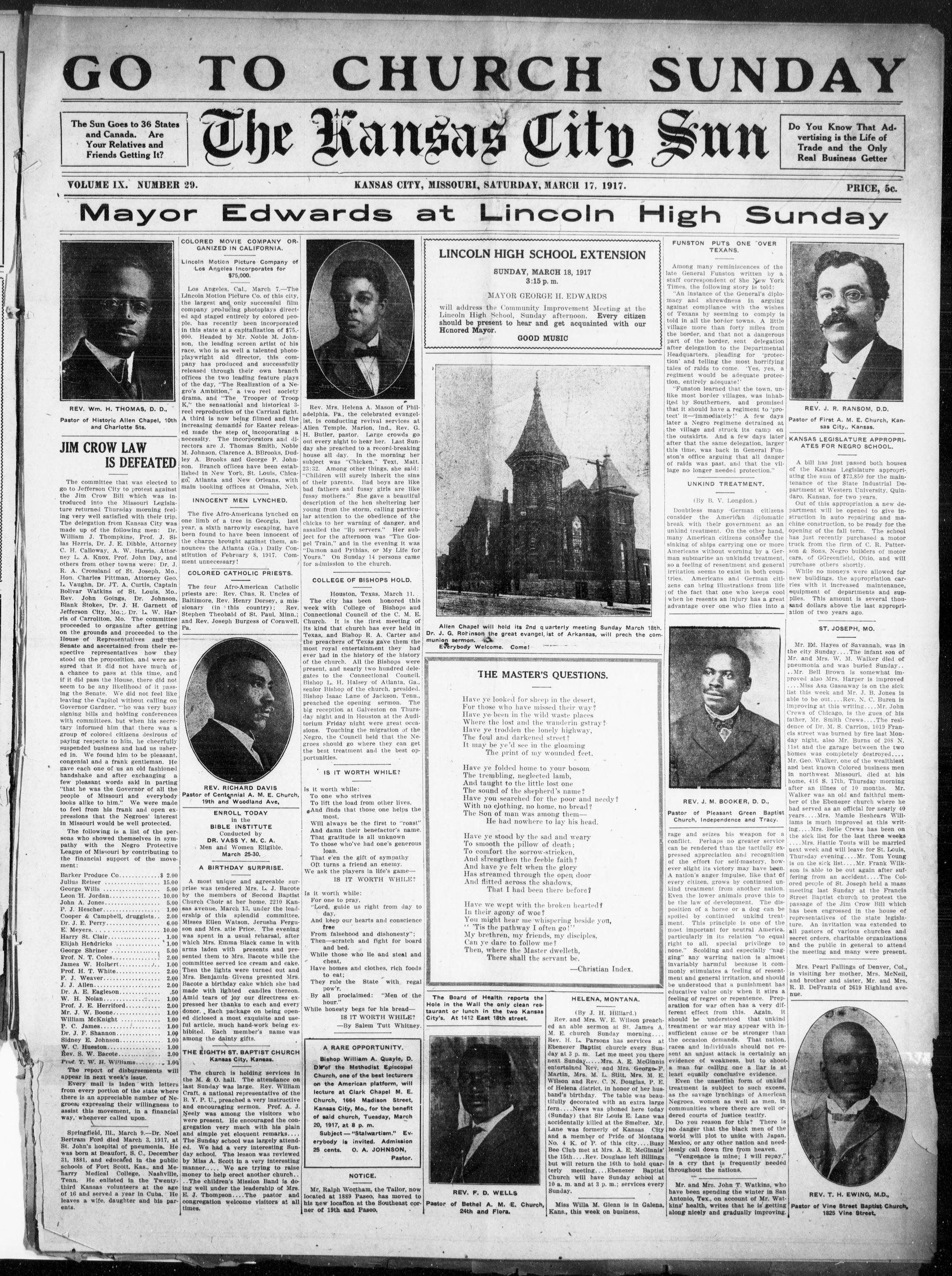
GO TO CHURCH SUNDAY
Mayor Edwards at Lincoln High Sunday
VOLUME IX. NUMBER 29.
REV. Wm. H. THOMAS, D. D.,
Pastor of Historic Allen Chapel, 10th
and Charlotte Sts.
JIM CROW LAW IS DEFEATED
JIM CROW LAW IS DEFEATED
The committee that was elected to go to Jefferson City to protest against the Jim Crow Bill which was introduced into the Missouri Legislature returned Thursday morning feeling very well satisfied with their trip. The delegation from Kansas City was made up of the following men: Dr. William J. Thompkins, Prof. J. Sias Harris, Dr. J. E. Dibble, Attorney C. H. Calloway, A. W. Harris, Attorney L. A. Knox, Prof. John Day, and others from other towns were: Dr. J. R. A. Crossland of St. Joseph, Mon. Hon. Charles Pittman, Attorney Geo. L. Vaughn, Dr. JT. A. Curtis, Captain Bolivar Watkins of St. Louis, Mo. Rev. John Goings, Dr. Johnson, Blank Stokes, Dr. J. H. Garnett of Jefferson City, Mo.; Dr. L. W. Harris of Carrollton, Mo. The committee proceeded to organize after getting on the grounds and proceeded to the House of Representatives and the Senate and ascertained from their respective representatives how they stood on the proposition, and were assured that it did not have much of a chance to pass at this time, and if it did pass the House, there did not seem to be any likelihood of it passing the Senate. We did not feel like leaving the Capitol without calling on Governor Gardner, "who was very busy signing bills and holding conferences with committees, but when his secretary informed him that there was a group of colored citizens desirous of paying respects to him, he cheerfully suspended business and had us ushered in. We found him to be pleasant, congenial and a frank gentleman. He gave each one of us an old fashioned handshake and after exchanging a few pleasant words said in parting "that he was the Governor of all the people of Missouri and everybody looks alike to him." We were made to feel from his frank and open expressions that the Negroes' interest in Missouri would be well protected.
The following is a list of the persons who showed themselves in sympathy with the Negro Protective League of Missouri by contributing to the financial support of the movement:
Barker Produce Co. $ 2.00
Julius Reiser 15.00
George Wills 5.00
Leon H. Jordan 10.00
John A. Jones 5.00
P. J. Hescher 1.00
Cooper & Campbell, druggists 2.00
Dr. J. E. Perry 6.00
E. Meyers 10.00
Harry St. Clair 1.00
Elijah Hendricks 1.00
George Shriner 5.00
Erof. N. T. Coles 2.00
James W. Holbert 1.00
Prof. H. T. White 2.00
F. J. Weaver 2.00
J. J. Allen 2.00
Dr. A. E. Eagleson 5.0
W. H. Nolan 1.00
Prof. J. E. Herriford 2.00
Mr. J. W. Boone 1.00
William McKnight 1.00
P. C. James 1.00
Dr. J. F. Shannon 1.00
Sidney E. Johnson 1.00
W. C. Hueston 1.00
Rev. S. W. Bacote 2.00
Prof. T. W. H. Williams 1.00
The report of disbursements will appear in next week's issue. Every mail is laden with letters from every portion of the state where there is an appreciable number of Negroes, expressing their willingness to assist this movement, in a financial way, whenever called upon.
Springfield, Ill., March 9—Dr. Noel Bertram Ford died March 3, 1917, at St. John's hospital of pneumonia. He was born at Beaufort, S. C., December 31, 1881, and educated in the public schools of Fort Scott, Kas., and Mehary Medical College, Nashville, Tenn. He enlisted in the Twenty-third Kansas volunteers at the age of 16 and served a year in Cuba. He leaves a wife, daughter and his parents.
COLORED MOVIE COMPANY ORGANIZED IN CALIFORNIA.
Lincoln Motion Picture Company of Los Angeles Incorporates for $75,000.
Los Angeles, Cal., March 7.—The Lincoln Motion Picture Co. of this city, the largest and only successful film company producing photoplays directed and staged entirely by colored people, has recently been incorporated in this state at a capitalization of $75,000. Headed by Mr. Noble M. Johnson, the leading screen artist of his race, who is as well a talented photoplaywright aid director, this company has produced and successfully released through their own branch offices the two leading feature plays of the day, "The Realization of a Negro's Ambition," a two reel society drama, and "The Trooper of Troop K," the sensational and historical 3-reel reproduction of the Carrival fight. A third is now being filmed and the increasing demands for Easter released made the step of incorporating a necessity. The incorporators and directors are J. Thomas Smith, Noble M. Johnson, Clarence A. BBrooks, Dudley A. Brooks and George P. Johnson. Branch offices have been established in New York, St. Louis, Chicago, Atlanta and New Orleans, with main booking offices at Omaha, Neb.
INNOCENT MEN LYNCHED
The five Afro-Americans lynched on one limb of a tree in Georgia, last year, a sixth narrowly escaping, have been found to have been innocent of the charge brought against them, announces the Atlanta (Ga.) Daily Constitution of February 8, 1917. Comment unnecessary!
COLORED CATHOLIC PRIESTS.
The four Afro-American Catholic priests are: Rev. Chas. R. Uncles of Baltimore, Rev. Henry Dorsey, a missionary (in this country); Rev. Stephen Theobald of St. Paul, Minn.; and Rev. Joseph Burgess of Cornwell, Pa.
REV. RICHARD DAVIS
Pastor of Centennial A. M. E. Church,
19th and Woodland Ave.
ENROLL TODAY
in the
BIBLE INSTITUTE
Conducted by
DR.VASS Y. M. C. A.
Men and Women Eligible.
March 25-30.
A BIRTHDAY SURPRISE.
A most unique and agreeable surprise was tendered Mrs. L. J. Bacote by the members of Second Baptist Church Choir at her home, 2210 Kansas avenue, March 13, under the leadership of this splendid committee, Misses Ellen Watson, Jerusha Ferguson and Mrs. atie Price. The evening was spent in a usual rehasal, after which Mrs. Emma Black came in with arms laden with presents and presented them to Mrs. Bacote while the committee served ice cream and cake. Then the lights were turned out and Mrs. Benjamin Givens presnted Mrs. Bacote a birthday cake which she had made with lighted candles thereon. Amid tears of joy our directress expressed her thanks to each and every donor. Each package on being open edclosed a most exquisite and useful article, much hand-work being exhibited. Each member's name was among the dainty gifts.
THE EIGHTH ST. BAPTIST CHURCH
Kansas City, Kansas.
The church is holding services in the M. & O. hall. The attendance on last Sunday was large. Rev. William Craft, a national representative of the B. Y. P. U., preached a very instructive and encouraging sermon. Prof. A. J. Neely was among the visitors who were present. He encouraged the congregation very much with his plain and simple yet eloquent remarks. . . The Sunday school was largely attended. We had a very interesting Sunday school. The lesson was reviewed by Miss A. Scott in a very interesting manner. . . We are trying to raise money to help erect another church. . . The children's Mission Band is doing well under the leadership of Mrs. E. J. Thompson. . . The pastor and congregation welcome visitors at all times.
KANSAS CITY, MISSOURI, SATURDAY, MARCH 17. 1917.
A. B. B.
Rev. Mrs. Helena A. Mason of Philadelphia, Pa., the celebrated evangelist, is conducting revival services at Allen Temple, Marion, Ind., Rev. G. H. Butler, pastor. Large crowds go out every night to hear her. Last Sunday she preached to a record-breaking house all day. In the morning her subject was "Chicken." Text, Matt. 23:32. Among other things, she said: "Children will surely inherit the sins of their parents. Bad boys are like bad fathers and fussy girls are like fussy mothers." She gave a beautiful description of the hen sheltering her young from the storm, calling particular attention to the obedience of the chicks to her warning of danger, and assailed the "Iip servers." Her subject for the afternoon was "The Gospel Train," and in the evening it was "Damon and Pythias, or My Life for Yours." On Sunday 14 persons came for admission to the church.
COLLEGE OF BISHOPS HOLD.
Houston, Texas, March 11. The city has been honored this week with College of Bishops and ConNECTIONal Council of the C. M. E. Church. It is the first meeting of its kind that church has ever held in Texas, and Bishop R. A. Carter and the preachers of Texas gave them the most royal entertainment they had ever had in the history of the history of the church. All the Bishops were present, and nearly two hundred delegates to the ConNECTIONal Council. Bishop L. H. Halsey of Atlanta, Ga. senior Bishop of the church, presided. Bishop Isaac Lane of Jackson, Tenn., preached the opening sermon. The big reception at Galveston on Thursday night and in Houston at the Auditorium Friday night were great occasions. Touching the migration of the Negro, the Council held that the Negroes should go where they can get the best treatment and the best opportunities.
IS IT WORTH WHILE?
Is it worth while:
To one who strives
To lift the load from other lives.
And finds that those one helps the most,
must always be the first to "roast"
And damn their benefactor's name.
That gratitude is all unknown
To those who've had one's generous loan.
That e'en the gift of sympathy
Oft turns a friend an enemy.
We ask the players in life's game—
IS IT WORTH WHILE?
Is it worth while:
For one to pray.
"Lord, guide us right from day to day.
And keep our hearts and conscience free
From falsehood and dishonesty";
Then—scratch and fight for board and bed.
While those who lie and steal and cheat.
Have homes and clothes, rich foods to eat;
They rule the State with regal pow'r.
By all proclaimed: "Men of the hour."
While honesty begs for his bread—
IS IT WORTH WHILE?
—By Salem Tutt Whitney.
A RARE OPPORTUNITY.
Bishop William A. Quayle, D. DW of the Methodist Episcopal Church, one of the best lecturers on the American platform, will lecture at Clark Chapel M. E. Church, 1664 Madison Street, Kansas City, Mo., for the benefit of said church, Tuesday, March 20, 1917, at 8 p. m. Subject—"Stalwartism." Everybody is invited. Admission 25 cents. O. A. JOHNSON,
NOTICE
Mr. Ralph Wortham, the Tailor, now located at 1889 Paseo, has moved to his new locafon at the Southeast corner of 19th and Paseo.
LINCOLN HIGH SCHOOL EXTENSION
MAYOR GEORGE H. EDWARDS
will address the Community of Lincoln High School, Sunday should be present to hear an Honored Mayor.
GOOD
Allen Chapel will hold its 2nd q. Dr. J. G. Robinson the great evangelist munion sermon.
Everybody Welcome. Come!
Address the Community Improvement Meeting on High School, Sunday afternoon. Every will be present to hear and get acquainted with the elected Mayor.
GOOD MUSIC
Chapel will hold its 2nd quarterly meeting Sunday Morinson the great evangel, ist of Arkansas, will mon.
Body Welcome. Come!
will address the Community Improvement Meeting at the Lincoln High School, Sunday afternoon. Every citizen should be present to hear and get acquainted with our Honored Mayor.
2
Allen Chapel will hold its 2nd quarterly meeting Sunday March 18th. Dr. J. G. Robinson the great evangel, 1st of Arkansas, will prech the communion sermon.
THE MASTER'S QUESTIONS
Have ye looked for sheep in the desert,
For those who have missed their way?
Have ye been in the wild waste places
Where the lost and the wanderin gstray?
Have ye trodden the lonely highway,
The foul and darkened street?
It may be ye'd see in the gloaming
The print of my wounded feet.
Have ye folded home to your bosom
The trembling, neglected lamb,
And taught to the little lost one
The sound of the shepherd's name?
Have you searched for the poor and need
With no clothing, no home, no bread?
The Son of man was among them—
He had nowhere to lay his head.
Have ye folded home to your bosom
The trembling, neglected lamb,
And taught to the little lost one
The sound of the shepherd's name?
Have you searched for the poor and need;
With no clothing, no home, no bread?
The Son of man was among them—
He had nowhere to lay his head.
Have ye folded home to your bosom
The trembling, neglected lamb,
And taught to the little lost one
The sound of the shepherd's name?
Have you searched for the poor and needy?
With no clothing, no home, no bread?
The Son of man was among them—
He had nowhere to lay his head.
Have ye stood by the sad and weary
To smooth the pillow of death;
To comfort the sorrow-streken,
And strengthen the feeble faith?
And have ye felt when the glory
Has streamed through the open door
And flitted across the shadows,
That I had been there before?
Have we wept with the broken hearted?
In their agony of woe?
You might hear me whispering beside you,
“Tis the pathway I often go!”
My brethren, my friends, my disciples,
Can ye dare to follow me?
Then, where the Master dwelleth,
There shall the servant be.
The Board of Health reports the Hole in the Wall the only clean restaurant or lunch in the two Kansas City's. At 1412 East 18th street.
Pastor of Bethel A. M. E. Church
24th and Flora.
---
Improvement Meeting at the
afternoon. Every citizen
get acquainted with our
MUSIC
quarterly meeting Sunday March 18th.
list of Arkansas, will prech the com-
do your bosom
and lamb,
lost one
erd's name?
the poor and needy?
time, no bread?
long them—
to lay his head.
—Christian Index
HELENA, MONTANA
Rev, and Mrs. W. E. Wilson preached an able sermon at St James A. M. e Church Sunday morning.... Rev. H. L. Parsons has services at Ebenezer Baptist church every Sunday at 3 p. m. Let me meet you there next Sunday....Mrs. A. E. McGinnis entertained Rev. and Mrs. George-F Martin, Mrs. M. L. Litt, Mrs. M. E Wilson and Rev. C. N. Douglas, P. E of Helena district, in honor of her husband's birthday. The table was beautifully decorated with an extra large fern....News was phoned here today (Sunday) that Sir Louis E. Lane was accidentally killed at the Smelter. Mr Lane was formerly of Kansas City and a member of Pride of Montana No. 4 K. of P. of this city....Busy Bee Club met at Mrs. A. E. McGinnis the 15th....Rev Douglass left Billings but will return the 16th to hold quarterly meeting....Ebenezer Baptist Church will have Sunday school at 10 a. m. and at 3 p. m.; services every Sunday.
Miss Willa M. Glenn is in Galena, Kans., this week on business.
---
FUNSTON PUTS ONE OVER TEXANS.
Among many reminiscences of the late General Funston written by a staff correspondent of She New York Times, the following story is told:
"An instance of the General's diplomacy and shrewdness in arguing against compliance with the wishes of Texans by seeming to comply is told in all the border towns. A little village more than forty miles from the border, and that not a dangerous part of the border, sent delegation after delegation to the Departmental Headquarters, pleading for 'protection' and telling the most horrifying tales of raids to come. 'Yes, yes, a regiment would be adequate protection, entirely adequate!'
"Funston learned that the town, unlike most border villages, was inhabited by Southerners, and promised that it should have a regiment to 'protect' it—immediately!' A few days later a Negro regimene detrained at the village and struck its camp on the outskirts. And a few days later this time, was back in General Funston's office arguing that all danger of raids was past, and that the village no longer needed protection."
UNKIND TREATMENT.
(By B. V. Longdon.)
Doubtless many German citizens consider the American diplomatic break with their government as an unkind treatment. On the other hand, many American citizens consider the sinking of ships carrying one or more Americans without worrying by a German submarine an unkind treatment, so a feeling of resentment and general irritation seems to exist in both countries. Americans and German citizens can bring illustrations from life of the fact that one who keeps cool when he resents an injury has a great advantage over one who flies into a
M.
Pastor of Pleasant Green Baptist Church, Independence and Tracy.
rage and seizes his weapon for a conflict. Perhaps no greater service can be rendered than the tactfully expressed appreciation and recognition of the effort for self-mastery, however slight its victory may have been. A nation's anger impulse, like that of every citizen, grows by continued unkind treatment from another nation. Even the lower animals prove this to be the law of development. The disposition of a horse or a dog can be spoiled by continued unkind treatment. This principle is one of the most important for neutral America, particularly in its relation "to equal right to all, special privilege to none." Scolding and especially "nagging" any warring nation is almost invariably harmful because it commonly stimulates a feeling of resentment and general irritation, and should be understood that a punishment has educational value only when it stirs a feeling of regret or repentence. Preparation for war often has a very different effect from this. Again, it should be understood that unkind treatment or war may appear with insufficient cause or be stronger than the occasion demands. That nation races and individuals should not resent an unjust attack is certainly an evidence of weakness, but to shoot a man for calling one a liar is at least equally conclusive evidence.
Even the unselfish form of unkind treatment is subject to such excess, as the savage lynchings of American Negroes, women as well as men, in communities where there are well ordered courts of justice testify.
Do you reason for this? There is no danger that the black men of the world will plot to unite with Japan, Mexico, or any other nation and needlessly call down fire from heaven.
"Vengeance is mine; I will repay," is a cry that is frequently needed throughout the nations.
Mr. and Mrs. John T. Watkins, who have been spending the winter in San Antonio, Tex., on account of Mr. Watkins' health, writes that he is getting along nicely and gradually improving.
PRICE, 5c.
M. B. H.
Pastor of First A. M. E. Church, Kansas City, Kansas.
KANSAS LEGISLATURE APPROPRIATES FOR NEGRO SCHOOL.
A bill has just passed both houses of the Kansas Legislature appropriating the sum of $73,850 for the maintenance of the State Industrial Department at Western University, Quindaro, Kansas, for two years.
Out of this appropriation a new department will be opened to give instruction in auto repairing and machine construction, to be ready for the opening of the fall term. The school has just recently purchased a motor truck from the firm of C. R. Patterson & Sons, Negro builders of motor cars, of Greenfield, Ohio, and will purchase others shortly.
While no money were allowed for new buildings, the appropriation carries with it increased maintenance, equipment of departments and supplies. This amount is several thousand dollars above the last appropriation of two years ago.
ST. JOSEPH, MO.
Mr. Ed. Hayes of Savannah, was in the city Sunday....The infant son of Mr. and Mrs. W. M. Walker died of pneumonia and was buried Sunday....Mr. Bell Brown is somewhat improved also Mrs. Harper is improved....Miss Asa Gassaway is on the sick list this week and Mr. J. B. Jones is able to be out....Rev. N. C. Buren is improving at this writing....Mr. John Crews of Chicago, is the gues of his father, Mr. Smith Crews....The residence of Dr. M. S. Carrion, 1019 Francis street was burned by fire last Monday night, also Mr. Burns of 208 N. 11st and the garage between the two homes was completely destroyed....Mr. Geo. Walker, one of the wealthiest and best known Colored business men in northwest Missouri, died at his home, 416 S. 17th, Thursday morning after an illnes of 10 months. Mr. Walker was an old and faithful member of the Ebenezer church where he had served as an official for nearly 40 years....Mrs. Mamie Beshears Williams is much improved at this writing....Mrs. Belle Crews has been on the sick list for the last three weeks
...Mrs. Hattie Touts will be married next week and will leave for St. Louis, Thursday evening...Mr. Tom Young is on the sick list...Mr. Frank Wilkson is able to be out again after suffering from an accident...The Colored people of St. Joseph held a mass meeting last Sunday at the Francis Street Baptist church to protest the passage of the Jim Crow Bill which has been engrossed in the house of representatives of the state legislature. An invitation was extended to all pastors of various churches and secret orders, charitable organizations and the public in general to attend the meeting and many were present.
Mrs. Pearl Fallings of Denver, Col., is visiting her mother, Mrs. McNeill, and brother and sister, Mr. and Mrs. R. B. DeFrantz of 2619 Highland avenue.
A. B.
If Your Business Is Not Worth Advertising,
If you want the business of 40,000 Negroes who spend approximately $200,000 per month
ADVERTISE YOUR BUSINESS IN The Sun
We reach the buying public of both cities and surrounding communities, and we solicit for them only the most reliable firms. The buying public patronizing our advertisers are certain to be treated courteously, find goods as advertised and receive quality and service
Call Our Advertising Representative for Rates Bell Phone East 999 1803 E.18th Street
A. E.
TEACHER OF PIANO and VOICE
Also directress for the
Dixie Jubilee Singers
For Engagements, Phone
Studio, 1905 East 19th Street.
Bell East 5407.
For Details Write
DO YOU NEED COLORED LOANS?
Working Man and W
Friend.
1507 East 18th St.
DO YOU NEED MONEY?
COLORED LOAN AGENCY
Working Man and Woman's Best
Friend.
1507 East 18th St. (upstairs)
Quick small loans on furniture
salaries and insurance claims
Strictly confidential.
Bell Phone East 2766.
WE ARE A LITTLE PARTICULAR
Whom we accept, but every honest, temperate, industrious man and woman can obtain fraternal insurance and Woodcraft protection in the
AMERICAN WOODMEN of DENVER, COLORADO
Only society extending Wooderaft to Colored people and only society operated ored people able to comply with every requirement of the Insurance Laws of the States. Our rates are those of the National Fraternal Congress Table of Mortalit is what we furnish:
only society operated by Col- lurance Laws of the various press Table of Mortality. This
Only society extending Wooderaft to Colored people and only society operated by Colored people able to comply with every requirement of the Insurance Laws of the various States. Our rates are those of the National Fraternal Congress Table of Mortality. This is what we furnish:
Death Benefit to Beneficiary
Sick Benefit to Member
Accident Benefit to Member
Old Age Annuity to Member
Permanent Disability Benefit to Member
Burial to Member
In
One
Combined
Certificate
No foolish horseplay initiation, no annual, biennial, triennial Grand Lodge or one to work confusion. You pay the same each month. No gorgeous regalia to buy, no parades. The State Insurance Department of Missouri places its stamp of approval American Woodmen. Every certificate guaranteed. Certificates of $250.00; $1,000.00; $1,500.00; $2,000.00.
Kansas City Camp No. 45 now being organized for men and women. All meet and affiliate in same camp. By special dispensation of Supreme Commander the fee now is $2.50, and that pays for Medical Examination.
Office, 1309 East 18th Street. Bell Phone Grand 2988.
Geo. C. Martin and H. L. Billups, National Deputies and Organizers.
Dr. W. H. Bruce, Medical Examiner.
Mr. L. D. Hines and Mr. C. A. Franklin, Special Deputies.
If you want to spend approximately
ADVERTISE Y
We reach the buying communities, reliable firms. Advertisers are goods as adve
The Sun
Call Our A
Social Grand Lodge or other taxious regalia to buy, no annual its stamp of approval on the states of $250.00; $500.00; and women. All meet together time Commander the joining
No foolish horseplay initiation, no annual, biennial, triennial Grand Lodge or other tax to work confusion. You pay the same each month. No gorgeous regalia to buy, no annual parades. The State Insurance Department of Missouri places its stamp of approval on the American Woodmen. Every certificate guaranteed. Certificates of $250.00; $500.00; $1,500.00; $1,500.00; $2,000.00.
Kansas City Camp No. 45 now being organized for men and women. All meet together and affiliate in same camp. By special dispensation of Supreme Commander the joining fee now is $2.50, and that pays for Medical Examination.
---
A Hair Grower That Won For Itself Over 4,000 New Patront Last Year
Poro College Co., 3100 Pine St., Dept. G. St. Louis, Mo.
Death Benefit to Beneficiary
Sick Benefit to Member
Accident Benefit to Member
Old Age Annuity to Member
Permanent Disability Benefit to Member
Burial to Member
NELSON C. CREWS, Editor
THE KANSAS CITY SUN, SATURDAY, MARCH 17, 1917
CALDWELL & CHAPMAN
Hair and Millinery
18th and Paseo, Kansas City, Mo.
Home Phone East 4009
WORK GUARANTEED. LIVE AGENTS WANTED MANICURING FACIAL MASSAGE We teach the work we do
s Is Not Worth
KELLEY'S BEST HIGH PATENT
Scalp Treatment a Specialty. Caldwell's Pomade and Tonic really Grows Hair. Try it. Save your combits, cut hair and any old hat you may have.
Hair Matched From Samples. Feathers and Hats Cleaned, Dyed and Blocked. Agents for Spirella Corsets. Mail orders answered promptly
Colored People Intending to Come North or West--- Take Notice
North or
Notice
FARMERS, farm laborers,
skilled and unskilled
workmen, who intend leav-
ing the south should pro-
tect themselves against
swindlers and chance con-
ditions. The Monitor has taken up this
problem and is able to be of service to you.
Write at once for information and en-
close stamp for reply. Address,
George Wells Parker.
Business Manager of The Monitor,
Omaha, Nebraska.
Our work has stood the test. We have been doing high class guaranteed Dental Work for the past 29 years. We have thousands of satisfied patients.
REMEMBER, IN BUSINESS 29 YEARS
All work kept in repair free of charge.
The doctor who extracts your teeth here has undoubtedly had more experience in this line than any other dentist in the city, so you get the most expert service.
BRIDGE WORK
Spaces where from one to ten teeth have been lost we replace with bridge work. It looks the same as natural teeth, lasts a lifetime and requires no plate. Broken down teeth we restore to beauty and usefulness with crowns of porcelain and gold.
GOLD CROWNS, $3, $4 AND $5
WHITE CROWNS, $3, $4 AND $5
SET OF TEETH, UPPER AND LOWER, $5.00 AND UP
NEW YORK DENTAL CO.
1017-19 Walnut Street
Subscribe for The Sun
T. LOUIS
via
Missouri Pacific
First Out—First In
Lv. Kansas City.....9:00 a. m.
Arrive St. Louis.....5:30 p. m.
Fast Mid-Day Service
Lv. Kansas City.....11:10 a. m.
Arrive St. Louis.....7:30 p. m.
Direct connections for East and
Southeast.
Convention Night Service
Lv. Kansas City.....10:10 p. m.
Arrive St. Louis.....7:25 a. m.
City Ticket Office, 707 Walnut St.
or at Union Station
Phones:
Bell, Main 6740. Home, Main 6327
R. T. G. MATTHEWS,
Assist. General Passenger Agt.
MISSOURI
PACIFIC
IRON
MOUNTAIN
Advertising,
oes who
month
in The Sun
urrounding
e most
g our
y, find
ervice
URNAL
WILLA M. GLENN, Manager
INTERNATIONAL
SUNDAY SCHOOL
LESSON
(By E. O. SELLERS, Acting Director of
Sunday School Course of Moody Bible
Institute.)
(Copyright, 1917, Western Newspaper Union.)
LESSON FOR MARCH 18
JESUS SAVES FROM SIN.
LESSON TEXT 8:12, 31-37, 56-58
(Read entire chapter).
GOLDEN TEXT-If the Son therefore shall make you free, ye shall be free indeed. John 8:39.
Teachers should sketch rapidly in a chronological way the events in the life of our Lord, (See any good harmony) and show that this lesson belongs to the period of the Gallene ministry of Jesus when he had gone up to Jerusalem to attend the feast of the tabernacle (John 7:1-52). Let us be sure to load our guns with temperance ammunition, be familiar with facts, take careful aim, concentrate all we have to say upon one definite aim, and then pull the trigger e.g. be sure to shoot a temperance charge and make a temperance application.
1. The Slavery to Sin. Jesus' previous references to water (Chs. 4 and 7) and to bread (ch. 6) were occasioned by outward occurrences; so with this reference to light. In the treasury (v. 20) near to Jesus as he spake were two colossal, golden lamp stands around which when lighted the people gathered with rejoicing. Amid the blaze of this illumination, Jesus exclaims: "I am the light of the world." What is more beneficient than light as it reveals, cheers and brings life, health and happiness to mankind? Without light there is no vision. Without Jesus there is no spiritual wisdom. Without light we know not whither we are going. Without Jesus we grope in the darkness. Every ray of light, of truth, of holiness and love comes from him, for God is light, and in him is no darkness at all (I John 1:15). Some think that these words were occasioned by the onlookers, seeing what Jesus had written in the sand (vv. 1-11). The first step in the slavery of sin is blindness; the second is habit; and the third is that of absolute slavery (Prov. 5:22). Jesus was the incarnation of the light of God. We cannot conceive of Jesus making such an assertion as this, and being merely a good man. His is a light, not of a single nation nor of a particular church or section of the world. Being the light, it necessarily follows that everyone who follows him "shall not walk in darkness." He enables us to see clearly the dividing line between the two ways of life. He clarifies our vision so that we make our choices knowingly.
II. The Possibility of Freedom (vv. 31-38). These words were spoken to "those which had believed on him," and as the result they were to know the truth, and the truth should make them free. Knowledge and liberty come from a continuance (abiding) in the word of God (John 14:15; 16:12-13). Many men reject Jesus Christ because they claim they wish to have their liberty, and by so doing they lose their liberty. A disciple is a learner; Jesus is the teacher; the entrance examinations to the school of Christ are the simple and necessary condition of believing or accepting him as Lord and teacher. The scholars are all the disciples who continue under his instruction. The object of the schooling is to make perfect men, "unto the measure of the stature of the fulness of Christ" (Eph. 4:22; Col. 4:12). Christ's school is not only in the church and in the Sunday school and Young People's society, but it is everywhere, in the home, in the office, at work and play; wherever one is trying truly to live according to Christ's will, he is in his school, and that school is open both day and night; there are no vacations and no recesses. The text book is the Book of books. We need not argue as to the necessity of sin, but realize the fact that all are under sin (Rom. 5:12), but being under sin does not necessitate our abiding there, nor is sin necessary to our being. This freedom here is from sin and the love of sin and the curse and the penalty of sin and the bondage and corroding care of sin. It is also mental freedom, freedom for Christian activity. A knowledge of the English
Bible is a liberal education, and brings true liberty to those who are thus educated. As contrasted to that we have the slavery of sin (vv. 34, 33). The drunkard is a slave because he is restrained from doing what he knows he ought to do. He cannot even do wrong freely for his conscience constantly upbraids him. He is a slave because he is compelled to bear the consequences of sin against his will. The way of escape (v. 30) is through the son: "If the son therefore shall make you free, ye shall be free indeed." Any other freedom than the freedom granted by the grace of God is temporary, and has no assurance of permanence whatever even in this life, and certainly not in the life which is to come. The way of escape is, first, belief on the Lord Jesus Christ (v. 31); second, continuance in his word (v. 31); third, abiding in his teaching (v. 31); fourth, receiving the knowledge which he alone can give (v. 32). This brings pardon; freedom from punishment. To continue in his word brings freedom from the past and the burdens of the present. His gospel brings freedom from sin and the tyranny of habit. To boast of heredity or to attempt to fulfill the rigors of the law is not freedom, for the only true freedom is the freedom which we have in Christ Jesus. When he sets us free, we are free indeed. The conditions are simple, come to him (6:37); continue in his word (vv. 31, 32).
11. The Authority (vv. 56, 58). The Jews took exception to the words of Jesus (33-55). When did Abraham see Jesus? Read the 18th and 19th chapters of Genesis, and we find that one of the three who visited Abraham was different from the other two, and remained behind while two went on to Sodom. The one who remained was the Lord Jesus, Jehovah appearing in human form before his later incarnation as Jesus of Nazareth.
VALUE OF OUTDOOR LIFE
Only Those Familiar With Freedom of Woods and Fields Enjoy Complete Happiness.
Too many people are merely on speaking terms with nature. Too many are unfamiliar with the wonderful advantage of outdoor. Too many cherish heated comforts. They forget that their ancestors did not know what a stem-heated house meant. It is time to broaden our views and to get closer in touch with the great health-giving life of the open air.
There died not long ago a naturalist, John Muir, who had lived the better part of his life with nature. He loved the mountains and the natural life of all outdoors. His existence was a happy one. He died amid the surroundings of peace, happily, with a contented heart.
It is only those who know the freedom of the woods and the health-giving tonic of the open air who really enjoy complete happiness.
It is related that a sickly mother, not a great many months ago, carried a sickly boy to Doctor Evans, who looked the boy over and smilingly advised the worried parent to turn her boy loose in the parks, "let him live in the open air," he advised, "it is the only medicine that will do him any good."
This same advice can be applied today to thousands of cases. On inclement days it is unwise to expose oneself. But when the sun shines and the air is keen and crisp, is filled with the germs of life, one is extremely foolish not to take advantage of it.
If parents would only see that their youngsters are warmly clothed, that their shoes are sound and that their little legs are well protected, and then turn them out of doors and tell them to stay there, they would find their doctors' bills growing less and the health of their children growing better. They will also see a glow of rosy health in the young cheeks which is a certain indication of expanding youth, of glowing blood, of the creation of good health—Memphis Commercial Appeal.
Feminism.
Feminism is the first attempt since the days of chivalry to think clearly and talk straight on this woman business, to call things by names that shall square with the facts and not with the appearance of the facts. It is woman suffrage with the bark off, for while woman suffrage wants us to change our ways of doing toward women, feminism demands that we change our ways of thinking about women.
Feminism is the crust on the loaf of man's daily bread, and the loafer who knows on which side his bread is buttered will eat crust with crumb. It is the lemon on the peach tree in the garden of love, and wise is the man who has sense enough to give that lemonade. It is the lantern of Diogenes to search out and find an honest man, even under his wife's washstub.
Feminism is the acid test of man's chivalry and of woman's sincerity.—L. Brooke in Pictorial Review.
Indian and Firewater.
The Indian is by no means a stupid fellow and many of them, although not signing the pledge, are in their own way protecting themselves when under the influence of liquor. In Miami, Fla., (among other things a trading post for the Seminoles), the story is current that these Indians always paddle down the Miami river in pairs; that they do their trading, deposit their surplus cash with a certain merchant of tried honesty, and then go off for a debauch, one on the first day and the other the next, the sober fellow refraining from even a drop of "firewater" until his brother has finished his fun. When both have had their day, under the guidance and protection of a sober mate, they reclaim their funds from their merchant depositary and paddle away to their homes in the Everglades.—Case and Comment.
Russia Turns to America.
The British acting consul general as Odessa reports a statement in the Russkoe Slovo (Moscow), to the effect that the Russian minister of agriculture, when introducing his departmental estimates in the duma, stated that the lack of labor was making itself severely felt and that the use of implements and machinery for agricultural purposes in Russia must be largely extended. The department of agriculture, therefore, proposed to give large orders to American firms.
Molybdenum Found in Peru
Molybdenum Found in Peru.
The exhibition of some samples of molybdenum ores taken from a newly discovered deposit in southern Peru, reports Commercial Attache William F. Montavon, is exciting considerable interest in Lima. It is claimed by Senor Eduardo S. Arenas, who brought six tons of the ore to Lima, that the mines are the largest known molybdenum deposits in the world. The ore brought to Lima is still in the School of Mines and has not yet been tested.
"Meticulous."
The use of the word "meticulous" in the sense of "particular," may be understood by the following definitions, which we quote in answer to a request for the citation of authorities: Century Dictionary, "timid; over-careful." New Standard, "over-cautious." Oxford Concise, "over-scrupulous about minute details." The word is from the Latin "meticulous," "full of fear," the derivation being from "metus," "fear."
That's Why.
"Myers is a changed man since he bought that place in the country. When he lived in the city he used to be too lazy to hang up the pictures when he moved from one apartment to another, but now he's always pottering about his house and grounds, making some improvement or other." "Maybe he's trying to fix the place up so he can sell it again."
Little Things Count.
Life is made up, not of great sacrifices or duties, but of little things in which smiles and kindnesses and small obligations, given habitually, are what win and preserve the heart and secure comfort.—Sir Humphrey Davy.
THE KANSAS CITY SUN, SATURDAY, MARCH 17, 1917
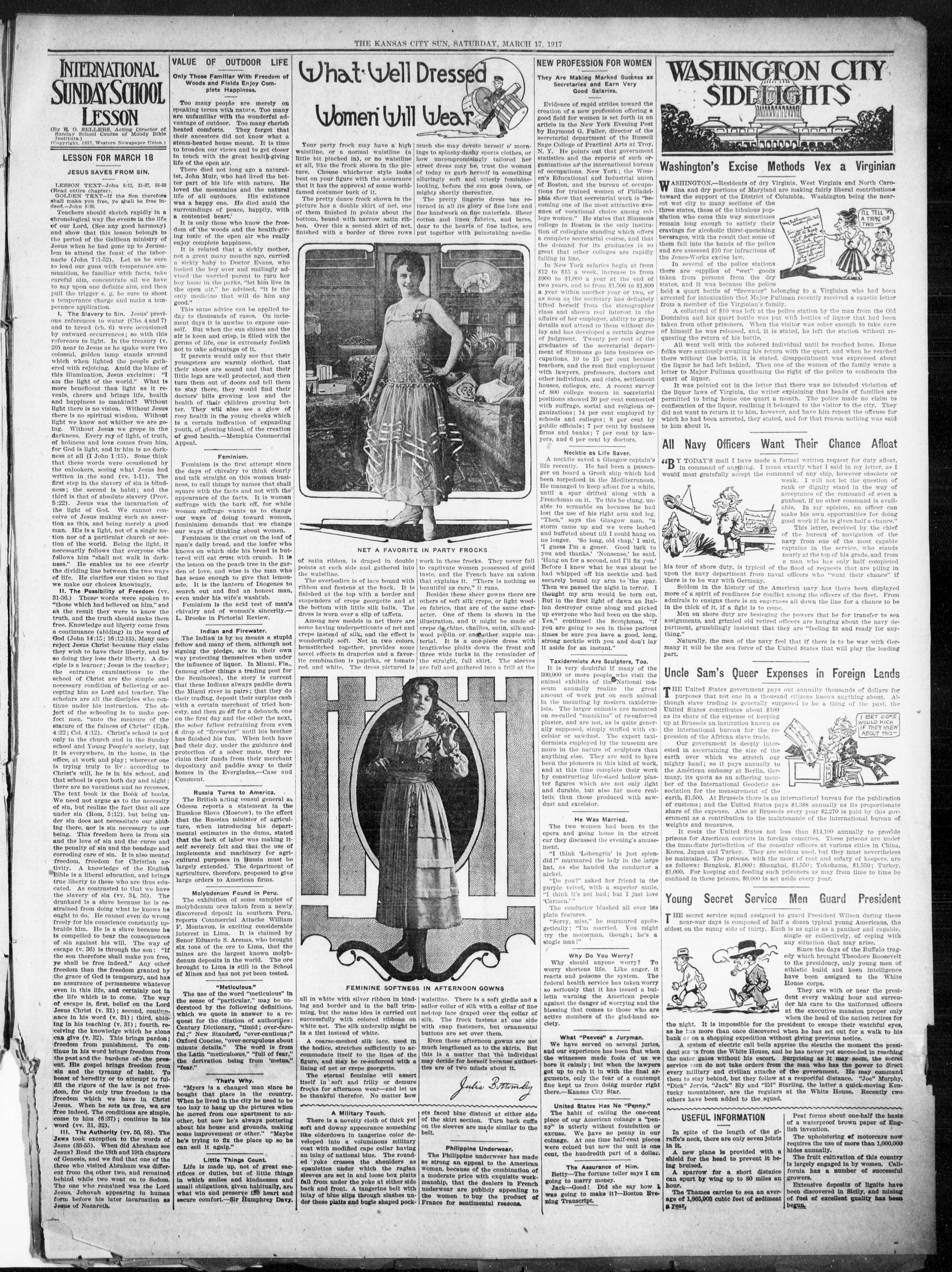
What Well Dressed Women Will Wear
Your party frock may have a high waistline, or a normal waistline (a little bit pinched in), or no waistline at all, like the frock shown in the picture. Choose whichever style looks best on your figure with the assurance that it has the approval of some world-famed costumer back of it.
The pretty dance frock shown in the picture has a double skirt of net, one of them finished in points about the bottom, bound with narrow satin ribbon. Over this a second skirt of net, finished with a border of three rows
THE FASHION WEEKLY
THE FASHION OF THE TWENTIETH CENTURY
THE FASHION WEEKLY
NET A FAVORITE IN PARTY FROCKS
of satin ribbon, is draped in double points at each side and gathered into the waistline. The overbodice is of lace bound with ribbon and fastens at the back. It is finished at the top with a border and suspenders of crepe georgette and at the bottom with little silk balls. The dress is worn over a slip of taffeta. Among new models in net there are some having underpetticcots of net and crepe instead of silk, and the effect is wonderfully soft. Net in two colors, hemstitched together, provides some novel effects in draperies and a favorite combination is paprika, or tomato red, and white. The dress pictured is
FEMININE SOFTNESS
MININE SOFTNESS IN AFTERNOON GO
I
FEMININE SOFTNESS IN AFTERNOON GOWNS
in white with silver ribbon in binding and border and in the ball trimming, but the same idea is carried out successfully with colored ribbons on white net. The silk underslip might be in a tint instead of white.
A coarse-meshed silk lace, used in the bodice, stretches sufficiently to accommodate itself to the lines of the figure, and may be re-enforced with a lining of net or crepe georgette.
The eternal feminine will assert itself in soft and frilly or demure frocks for afternoon wear—and let us be thankful therefor. No matter how waistline. There is a soft gown sailor collar of silk with a coat net-top face draped over the silk. The frock fastens with snap fasteners, but buttons are set over them.
Even these afternoon gown much lengthened as to the this is a matter that the may decide for herself because ties are of two minds about
Julia B
A Military Touch.
There is a novelty cloth of thick yet soft and downy appearance something like eiderdown in tangerine color developed into a voluminous military coat with modified cape collar having an inlay of national blue. The rounded yoke crosses the shoulders as epaulettes under which the raglan sleeves are set in and loose box plaits fall from under the yoke at either side back and front. A tangerine belt with inlay of blue slips through slashes under these plaits and bugle shaped pock-
---
much she may devote herself o' mornings to splashy-dash sports clothes, or how uncompromisingly tailored her street dress may be, trust the woman of today to garb herself in something alluringly soft and utterly feminine-looking, before the sun goes down, or might shortly thereafter.
The pretty lingerie dress has returned in all its glory of fine lace and fine handwork on fine materials. Sheer cotton and linen fabrics, and laces, dear to the hearts of fine ladies, are put together with painstaking needle-
THE BOOKS
work in these frocks. They never fail to captivate women possessed of good taste, and the French have an axiom that explains it. "There is nothing so beautiful as care," it runs.
Besides these sheer gowns there are others of soft silk skirt, or light woolen fabrics, that are of the same character. One of them is shown in the illustration, and it might be made of crepe de chine, challies, satin, silk-and-wool poplin or any other supple material. It is a one-piece dress with lengthwise plaits down the front and three wide tucks in the remainder of the straight, full skirt. The sleeves are full and gathered into a drill at the
GS IN AFTERNOON GOWNS
waistline. There is a soft girdle and a sailor collar of silk with a collar of fine net-top lace draped over the collar of silk. The frock fastens at one side with snap fasteners, but ornamental buttons are set over them.
Even these afternoon gowns are not much lengthened as to the skirts. But this is a matter that the individual may decide for herself because authorities are of two minds about it.
Judith Bottomley
ets faced blue distend at either side of the skirt section. Turn back cuffs on the sleeves are made similar to the belt.
Philippine Underwear
The Philippine underwear has made so strong an appeal to the American woman, because of the combination of a moderate price with exquisite workmanship, that the dealers in French underwear are publicly appealing to the women to buy the product of France for sentimental reasons.
NEW PROFESSION FOR WOMEN
They Are Making Marked Success as Secretaries and Earn Very Good Salaries.
Evidence of rapid strides toward the creation of a new profession offering a good field for women is set forth in an article In the New York Evening Post by Raymond G. Fuller, director of the secretarial department of the Russell Sage College of Practical Arts at Troy, N. Y. He points out that government statistics and the reports of such organizations as the international bureau of occupations, New York; the Women's Educational and Industrial union of Boston, and the bureau of occupations for trained women of Philadelphia show that secretarial work is "becoming one of the most attractive avenues of vocational choice among college women." He states that Simmons college in Boston is the only institution of collegiate standing which offers a complete secretarial course, and that the demand for its graduates is so great that other colleges are rapidly falling in line.
In New York salaries begin at from $12 to $15 a week, increase to from $900 to $1,000 a year at the end of two years, and to from $1,500 to $1,800 a year within another year or two, or as soon as the secretary has definitely lifted herself from the stenographer class and shown real interest in the affairs of her employer, ability to grasp details and attend to them without delay and has developed a certain degree of judgment. Twenty per cent of the graduates of the secretarial department of Simmons go into business occupations, 10 to 15 per cent become teachers, and the rest find employment with lawyers, professors, doctors and other individuals, and clubs, settlement houses, colleges, etc. A recent survey of 800 college women in secretarial positions showed 30 per cent connected with suffrage, social and religious organizations; 14 per cent employed by schools and colleges; 8 per cent by public officials; 7 per cent by business firms and banks; 7 per cent by lawyers, and 6 per cent by doctors.
Necktie as Life Saver.
A necktie saved a Glasgow captain's life recently. He had been a passenger on board a Greek ship which had been torpedoed in the Mediterranean. He managed to keep afloat for a while, until a spar drifted along with a Frenchman on it. To this he clung, unable to scramble on because he had lost the use of his right arm and leg. "Then," says the Glasgow man, "a storm came up and we were lached and buffeted about till I could hang on no longer. 'So long, old chap,' I said, 'I guess I'm a goner. Good luck to you and thanks.' 'Nonsense,' he said, 'Hang on for a second, and I'll fix you.' Before I knew what he was about he had whipped off his necktie and had securely bound my arm to the spar. Then we passed the night in terror. I thought my arm would be torn out. But in the first light of dawn an Italian destroyer came along and picked up everyone who had been on the ship. Yes," continued the Scotchman, "if you are going to sea in these parlous times be sure you have a good, long strong necktie with you and don't lay it aside for an instant."
Taxidermists Are Sculptors. Too
It is very doubtful if many of the 300,000 or more people who visit the animal exhibits of the National museum annually realize the great amount of work put on each animal in the mounting by modern taxidermists. The larger animals are mounted on so-called "manikins" of en-reforced plaster, and are not, as is quite generally supposed, simply stuffed with excelsior or sawdust. The expert taxidermists employed by the museum are more in the nature of sculptors than anything else. They are said to have been the ploneers in this kind of work, and at this time complete their work by constructing life-sized hollow plaster figures which are not only light and durable, but also far more realistic than those produced with sawdust and excelsior.
He Was Married.
The two women had been to the opera and going home in the street car they discussed the evening's amusement.
"I think 'Lohengrin' is just splendid!" murmured the lady in the large hat, as she handed the conductor a nickel.
"Do you?" asked her friend in the purple velvet, with a superior smile.
"I think it's not bad; but I just love 'Carmen.'"
The conductor blushed all over his plain features.
"Sorry, miss," he murmured apologetically; "I'm married. You might try the motorman, though; he's a single man."
Why Do You Worry?
Why should anyone worry? To worry shortens life. Like anger, it reacts and poisons the system. The federal health service has taken worry so seriously that it has issued a bulletin warning the American people against the danger of worrying and the blessing that comes to those who are active members of the glad-hand society.
What "Peeves" a Juryman.
We have served on several juries, and our experience has been that when the witnesses made fools of us we bore it calmly; but when the lawyers got up to rub it in with the final arguments, only in the fear of a contempt fine kept us from doing murder right there.—Kansas City Star.
United States Has No "Penny."
The habit of calling the one-cent piece of our American coinage a "penny" is utterly without foundation or excuse. We have no penny in our coinage. At one time half-cent pieces were coined but now the unit is one cent, the hundredth part of a dollar.
The Assurance of Him.
Betty—The fortune teller says I am going to marry money.
Jack—Good! Did she say how I was going to make it?—Boston Evening Transcript.
WASHINGTON CITY
SIDELIGHTS
Washington's Excise Methods Vex a Virginian
WASHINGTON.—Residents of dry Virginia, West Virginia and North Carolina and dry portions of Maryland are making fairly liberal contributions toward the support of the District of Columbia. Washington being the near-
held a quart bottle of "drewwater" belonging to a Virginian who had been arrested for intoxication that Major Pullman recently received a caustic letter from a member of the Virginian's family.
A collateral of $10 was left at the police station by the man from the Old Dominion and his quart bottle was put with bottles of liquor that had been taken from other prisoners. When the visitor was sober enough to take care of himself he was released, and, it is stated, he left the station without requesting the return of his bottle.
All went well with the sobered individual until he reached home. Home folks were anxiously awaiting his return with the quart, and when he reached there without the bottle, it is stated, disappointment was expressed about the liquor he had left behind. Then one of the women of the family wrote a letter to Major Pullman questioning the right of the police to confiscate the quart of liquor.
It was pointed out in the letter that there was no intended violation of the liquor laws of Virginia, the writer explaining that heads of families are permitted to bring home one quart a month. The police made no claim to confiscation of the liquor, realizing it belonged to the visitor to the city. They did not want to return it to him, however, and have him repeat the offense for which he had been arrested, they stated, and for that reason nothing was said to him about it.
All Navy Officers Want Their Chance Afloat
"BY TODAY'S mall I have made a formal written request for duty affloat, in command of anything. I mean exactly what I said in my letter, as I would most gratefully accept the command of any ship, however obsolete or
his tour of shore duty, is typical of the flood of requests that are piling in upon the海军 department from naval officers who "want their chance" if there is to be war with Germany.
Seldom in the history of the American navy has there been displayed more of a spirit of readiness for conflict among the officers of the fleet. From admirals to ensigns there is an eagerness all down the line for a chance to be in the thick of it, if a fight is to come.
Men on shore duty are besieging the powers that be for transfer to sea assignments, and grizzled old retired officers are hanging about the navy department, grumblingly insistent that they are "feeling fit and ready for anything."
Naturally, the men of the navy feel that if there is to be war with Germany it will be the sea force of the United States that will play the leading part.
Uncle Sam's Queer Expenses in Foreign Lands
THE United States government pays out annually thousands of dollars for purposes that not one in a thousand citizens knows anything about. Although slave trading is generally supposed to be a thing of the past, the
earth, $1,500. At Brussels there is an international bureau for the publication of customs; and the United States pays $1,388 annually as its proportionate share of the expense. Also at Brussels every year $2,270 is paid by this government as a contribution to the maintenance of the international bureau of weights and measures.
It costs the United States not less than $14,100 annually to provide prisons for American convicts in foreign countries. These prisons are under the immediate jurisdiction of the consular officers at various cities in China, Korea, Japan and Turkey. They are seldom used, but they must nevertheless be maintained. The prisons, with the most of rent and salary of keepers, are as follows: Bangkok, $1,000; Shanghai, $1,550; Yokohama, $1,550; Turkey, $1,000. For keeping and feeding such prisoners as may from time to time be confined in these prisons, $9,000 is set aside every year.
Young Secret Service Men Guard President
THE secret service squad assigned to guard President Wilson during these near-war days is composed of half a dozen typical young Americans, the oldest on the sunny side of thirty. Each is as agile as a panther and canable.
the night. It is impossible for the president to escape their watchful eyes, as he has more than once discovered when he has set out for a walk to his bank or on a shopping expedition without giving previous notice.
A system of electric call bells apprise the sleuths the moment the president starts from the White House, and he has never yet succeeded in reaching the outer gates without his escort. Surprising as it may seem, the secret service men do not take orders from the man who has the power to direct every military and civilian attack of the government. He may command them to stay behind, but they follow at a respectful distance. "Joe" Murphy, "Dick" Jervis, "Jack" Sly and "Ed" Starling, the latter a quick-moving Kentucky mountaineer, are the regulars at the White House. Recently two others have been added to the squad.
toward the support of the District, nearest wet city to many sections of the three states, those of the bubulous population who come this way sometimes remain long enough to satisfy their cravings for alcoholic thirst-quenching beverages, with the result that some of them fall into the hands of the police and are assessed $10 for infractions of the Jones-Works excise law. In several of the police stations there are supplies of "wet" goods taken from persons from the dry states, and it was because the police
held a quart bottle of "firewater" be-
arrested for intoxication that Major Pul-
from a member of the Virginian's family.
A collateral of $10 was left at the p
Dominion and his quart bottle was put
taken from other prisoners. When the
of himself he was released, and, it is s
questing the return of his bottle.
All went well with the sobered ind
folks are anxiously awaiting his return
there without the bottle, it is stated,
the liquor he had left behind. Then one
letter to Major Pullman questioning the
quart of liquor.
It was pointed out in the letter that
the liquor laws of Virginia, the writer
permitted to bring home one quart a
confiscation of the liquor, realizing it be-
d did not want to return it to him, however
which he had been arrested, they stated,
to him about it.
All Navy Officers Want
"BY TODAY'S mail I have made a f
in command of anything. I mean
would most gratefully accept the comm
Dame Vincente Saxon
à la maison de la
famille de la ville
de Paris
his tour of shore duty, is typical of the upon the navy department from naval there is to be war with Germany.
Seldom in the history of the Am more of a spirit of readiness for conflict admirals to ensigns there is an eagerness in the thick of it, if a fight is to come.
Men on shore duty are besieging assignments, and grizzled old retired or partment, grumblingly insistent that thing."
Naturally, the men of the navy few many it will be the sea force of the U part.
Uncle Sam's Queer Exp
THE United States government pays purposes that not one in a thousand though slave trading is generally sup United States contributes about $100 as its share of the expense of keeping up at Brussels an institution known as the international bureau for the repression of the African slave trade.
Our government is deeply interested in ascertaining the size of the earth over which we stretch our mighty hand; so it pays annually to the American embassy at Berlin, Germany, its quota as an adhering member of the International Geodetic association for the measurement of the
earth, $1,500. At Brussels there is an
of customs; and the United States par-
share of the expense. Also at Brussels
erment as a contribution to the mair-
weights and measures.
It costs the United States not I
prisons for American convicts in forest
the immediate jurisdiction of the consi-
Korea, Japan and Turkey. They are s
be maintained. The prisons, with the
as follows: Bangkok, $1,000; Shanghai
$1,000. For keeping and feeding such
confined in these prisons, $0,000 is set
Young Secret Service
THE secret service squad assigned to
near-war days is composed of hal-
oldest on the sunny side of thirty. Each
the night. It is impossible for the p as he has more than once discovered, bank or on a shopping expedition with. A system of electric call bells ap dent starts from the White House, and the outer gates without his escort. service men do not take orders from every military and civilian attache o them to stay behind, but they follow a "Dick" Jervis, "Jack" Sly and "Ed" Stucky mountaineer, are the regulars others have been added to the squad.
USEFUL INFORMATION
In spite of the length of the gl
raffe's neck, there are only seven joints
in it.
A new plane is provided with a
shield for the head to prevent it be-
ing brushed.
A sparrow for a short distance
can spurt by wing up to 80 miles an
hour.
The Thames carries to sea an aver-
age of 1,865,903 cubic feet of sediment
a year.
I'LL TELL 'EM
A THING OR
TWO
May God bless
Washington, D.C.
Surely we must
have a better life
with our neighbors
and with our neighbors
who are poor and
who are poor.
We must have a better life
with our neighbors
who are poor and
who are poor.
longing to a Virginian who had been illman recently received a caustic letter by police station by the man from the Old with bottles of liquor that had been visitor was sober enough to take care stated, he left the station without re-individual until he reached home. Home with the quart, and when he reached disappointment was expressed about one of the women of the family wrote a the right of the police to confiscate the that there was no intended violation of explaining that heads of families are month. The police made no claim to belong to the visitor to the city. Theyer, and have him repeat the offense for, and for that reason nothing was said
At Their Chance Afloat
formal written request for duty afloat, in exactly what I said in my letter, as I month of any ship, however obsolete or
weak. I will not let the question of rank or dignity stand in the way of acceptance of the command of even a gunboat, if no other command is available. In my opinion, an officer can make his own opportunities for doing good work if he is given half a chance." This letter, received by the chief of the bureau of navigation of the navy from one of the most capable captains in the service, who stands nearly at the top of his grade, and from a man who has only half completed
the flood of requests that are piling in
al officers who "want their chance" if
american navy has there been displayed
act among the officers of the fleet. From
less all down the line for a chance to be
e. the powers that be for transfer to sea
officers are hanging about the navy de-
they are "feeling fit and ready for any-
eel that if there is to be war with Ger-
United States that will play the leading
expenses in Foreign Lands
is out annually thousands of dollars for
and citizens knows anything about. Al-
posed to be a thing of the past, the
I BET SOME
WOULD KICK
IF THEY KNOW
ABOUT THIS-
international bureau for the publication
mays $1.388 annually as its proportionate
is every year $2.270 is paid by this gov-
tenance of the international bureau of
less than $14,100 annually to provide
sign countries. These prisons are under
solar officers at various cities in China,
seldom used, but they must nevertheless
most of rent and salary of keepers, are
nai, $1.550; Yokohama, $1.550; Turkey,
prisoners as may from time to time be
aside every year.
Men Guard President
to guard President Wilson during these
if a dozen typical young Americans, the
ch is as agile as a panther and capable,
single or collectively, of coping with
any situation that may arise.
Since the days of the Buffalo tragedy which brought Theodore Roosevelt to the presidency, only young men of athletic build and keen intelligence have been assigned to the White House corps.
They are with or near the president every waking hour and surrender his care to the uniformed officers at the executive mansion proper only when the head of the nation retires for president to escape their watchful eyes, when he has set out for a walk to his hout giving previous notice.
oprise the sleuths the moment the president he has never yet succeeded in reaching Surprising as it may seem, the secret in the man who has the power to direct of the government. He may command at a respectful distance. "Joe" Murphy, Starling, the latter a quick-moving Ken's at the White House. Recently two
Peat forms about one-half the basis of a waterproof brown paper of English invention. The upholstering of motorcars now requires the use of more than 1,000,000 hides annually. The fruit cultivation of this country is largely engaged in by women. California has a number of successful growers. Extensive deposits of lignite have been discovered in Sicily, and mining of fuel of excellent quality has been begun.
THE KANSASCITYSUN PUBLISHED WEEKLY
All communications should be addressed to The Kansas City Sun, 1803 East 18th Street.
Bell Phone East 999.
Entered as second-class matter, August, 1908, at the postoffice at Kansas City, Mo., under the act of March 3, 1879.
Nelson C. Crews.....Editor and Owner Willa M. Gleen.....General Manager
SUBSCRIPTION RATES;
One Year ..... $1.50
Six Months ..... .75
Three Months ..... .60
ADVERTISING RATES, $2.00 PER INCH
PER MONTH.
MEMBER
NATIONAL NEGRO PRESS
ASSOCIATION.
U. S. NEWSPAPER LAWS.
Below is the law in regard to newspapers:
First—Subscribers who do not give express notice to the contrary are considered as wishing to continue their subscription.
Second—If the subscriber orders discontinuance of periodical the publisher may continue to send the same until arrears are paid.
Third—if a subscriber neglects or refuses to take the periodicals from the postoffice to which they have been directed he is held responsible till he has settled his bill and ordered the paper discontinued.
Fourth—If the subscriber moves to other places without informing the publisher and the paper is sent to the former direction, they are held responsible.
CHURCH DIRECTORY
Bethel A. M. E. Church, 24th and Flora.
St. Stephen's Baptist Church, 604 Charlotte
St.
Cape Peninsular M. E. Church, 19th and
Woodland.
Second Baptist Church, 10th and Char-
lotte.
Alien Chapel A. M. E. Church, 10th and
Charlotte.
Ebenzer A. M. E. Church, 17th and
Treasure.
St. Augustine's P. E. Church, 11th and
Woodland.
St. John's A. M. E. Church, 1743 Belle-
view.
Seventh Day Adventist, 213 and Woodla-
St. Monica's Catholic, 17th and Lydia.
Vine St. Baptist Church, 1825 Vine St.
Ward Chapel A. M. E. Church, 11th and
Troost.
Mining Star Baptist Church, 331 Vine,
Highland Avenue Baptist Church, 1111
Highland.
St. Paul's Baptist Church, 19th and Highland.
Pleasant Green Baptist Church, Independence Avenue and Tracy. Mary Baptist Church, 19th and Askew. Bigelow A. M. E. Mission, 5th and Lochland. C. M. E. Church, 1817 Flora Ave. St. James Baptist Church, 4038 Mill St. Bigelow C. M. E. Church, 43rd and Prospect Place. A. M. E. Mission, 565 Grand Ave.
CLARK CHAPEL M. E. CHURCH,
1664 Madison Ave.
First A. M. E. Church, 8th and Nees,
St. Baptist Church, 8th and
Oakland.
Metropolitan Baptist Church, 9th and
Washington.
Bethington. M. E. Church, Water and
Steward Streets.
Paul A. M. E. Church, 21st and
Ruby.
First Baptist Church 6th and Neb.
Sloanom Baptist Church 3rd and
State.
Quindardo A. M. E. Church, Quindardo,
Pleasant Valley Baptist Church, Rose-
dale Kan.
M. E. Church, 8th and Oakland,
A. M. E. Church, 4th and Oakland,
Salter Mission A. M. E. Church, South
Park, Kan.
Postmaster Episcopal, 3rd and Stewart,
Second Baptist Church, 24th and Ruby,
Wesley Chapel M. 106 Shawnee,
Bethel A. M. E. Church, Rosedale, Kan.
Mt. Zion Baptist Church, 4th and Virgil,
Ebenerze A. M. E. Church, Sanford and
T emont
EDITORIALS.
When Judge Latshew speaks, he speaks out loud and when he hits, he hits right where he looks. More power to the Judge.
Of course, leaving the South is not going to benefit the idle, improvident Negro, nor will it hurt the idle, improvident white man. Each of these is an industrial zero and standing alone, means nothing.
If you patronize the struggling Negro business enterprise it will grow into a big business and become an object of your own joy. If you neglect your own institutions you will always be weak and helpless. Think of this in all your small purchases.
Passing "jimcrow" laws, discriminating in school facilities and lynching helpless citizens is a fine way to develop national spirit in this critical period of our history. Yet such is the attitude of the dominant race toward the weakest yet most loyal race factor in the republic.
It is coming to pass in the Southland that the Negro who attends to his own business, works and builds up a decent living and tries to educate his children is in more danger from the lynchers than the idle, no account black who commits the conventional crime of saucing a white man or accidentally brushing against a white woman on the street.
The Sun received the sad intelligence from our prominent undertaker, Mr. T. B. Watkins, Grand Master of Odd Fellows, announcing the death of his mother last Tuesday morning at Kokomo, Ind. He was with her at the end, and writes that the funeral and burial will be in the historic little city of Carthage, Ind. The Sun extends its deepest sympathy to the family in their bereavement.
Stop that cough. Smith's Egg Emulsion will do it. Made fresh every week. Price 75 cents. Let us send you a bottle today. 18th and Tracy.
Betty & Sam's Little Corner
A
THEY SAY
—That you chops am out ob sight. Dey am dat.
—That a wholesale shakeup in the teaching force of both Kansas Citys is coming this spring.
—That you can't expect a "jim-crowed" citizen to fight like h—I for anybody's flag. Isn't that common sense?
—That the professional borrower is a nuisance and a pest who ought to be put in the workhouse. Everybody say "Amen."
—That every wife who gets angry nowadays at her husband says, "You see what Mrs. Kreiser done, "don't you?" Poor man.
—That when the 18th street paving is finished the business men, white and colored, ought to put on a big street fair and week of celebration.
—That the way black folks are making the dirt fly for gardens this spring spells sorrow to the hucksters and produce men this summer. Well, that's right.
—That those twelve and fourteen dollar shoes for women are going to break up some happy homes around this old town. Well you better go bare-footed, girls.
—That a certain physician became real angry because the Sun said Negro physicians should patronize Negro drug stores. Is there anything wrong in that boys? Suppose the Negro people should quit patronizing Negro physicians; where would you get your practice?
—That a guest stopping at one of our hotels last Monday looking out of the dining room window at the downpour of rain, said to the waiter; "This certainly looks like the flood." "De what?" said the waiter. "The Flood; surely you have read about the Flood and the Ark and the Dove at Mount Ararat, etc.", and the waiter replied. "Pshaw, man, I've been so busy day walt I ain't read a papah for three days." "Lord help."
—That a preacher was exhorting his membership one day, and among the words used were these: "Some of you are always talking about what God knows about you. Whenever you get in trouble you always say, "God knows I try to live right and do my duty." What do you want to go away to heaven for a witness for; why don't you get your neighbors to testify~your pastor, class leader or landlord—they know you, too. Stay out of heaven hunting up witnesses."
—That a certain sporty young dude who is in the habit of absenting himself from his work when he wants to have a good time asked his boss to let him off the other day. Want to get off again? roared the boss; this is the third time in two weeks; what do you want to get off for today? Well, I've been having trouble with my eyes, and I want to get them examined. Well, said the boss, you can go, and I advise you to get them examined carefully, because you are going to be looking for a job when you come back. Well, that's us.
Y.M.C.A. Notes
Extension work has been started in the packing houses, the West Bottoms Mission School and Garrison Square Field House.
The newly organized Railroad Men's Volley Ball team will play the Vine Street Champions Monday at 3 p. m. The public is invited.
The Bible Institute conducted by Dr. Vass opens Sunday, March 25th at 3:30 p. m. and continues in session through Friday, March 30. Men and women are now being enrolled.
"Ispiration of New Testament Scripture" will be the theme of Dr. Alphin, pastor of the Christian Church on next Sunday, March 18, 3:30 p. m. Dr. Alphin is one of the most thorough Bible students in the city.
The physical department of the Y. M. C. A. will give a program at the Mission School in West Bottoms Friday night. The men taking part will be T. L. Johnson, William H. Washington, U. G. Weston and A. W. Hardy.
"A Bargain Repented of Too Late," the subject on which Dr. Van Loo addressed the men last Sunday was based on the transaction between Jacob and Esau. The gripping manner in which the speaker brought out the lessons of this bargain caused one man to make a profession of Christ Jesus and the Christians present to rededicate themselves to an unselfish service in the community.
THE KANSAS CITY SUN, SATURDAY, MARCH 17, 1917
A. F. and A. M. Mo. Jurisdiction
A. F. and A. M. Mo. Jurisdiction
W. W. Fields, Cameron, Mo., Grand Master.
Master.
Wm. Green, Plattsburg, Mo., Dep.
Grand Master.
C. C. Clark, St. Louis, Mo., Senior
Grand Warden.
Ernest Boone, Louisiana, Mo., Junior
Grand Warden.
H. H. Walker, St. Joseph, Mo., Grand
Treasurer.
Geo. W. K. Love, Kansas City,
Grand Secretary.
Nelson C. Crews, Kansas City, Reilief Secretary.
P. L. Pratt, Cameron, Mo., G. L.
1st District.
E. J. Cooper, Mexico, Mo., G. L.
2nd District.
MASONIC BUILDING ASSOCIATION
W. G. Mosely, President.
T. G. McCampbell, Vice President.
W. Washington, Treasurer.
E. S. Baker, Secretary.
Board of Directors:
T. G. McCampbell, S. H. P. Edwards,
E. G. Lacy, J. E. Rhodes,
T. W. H. Williams, R. S. Baker,
Wm. Washington, R. V. Adkins,
Geo. Johnson, W. G. Moseley,
S. Myers, Richard Harris
Edw. Thompson, R. Fulbright.
Meets fourth Tuesday in each
month.
Lodge Directory
Pritchard Lodge No. 42, A. F
and A. M. meets every 3rd
4th Monday in each month
All Master Masons in good standing
welcome. Wm. Hopkins, W. M.
M. J. H. SPIGENER, Secretary.
Rone Lodge No. 42, A. F, and
A. M. meets the 1st and 3rd
Monday in each month. All
Masons in good standing
welcome. Emma Spruitt,
W. M.; C. H. Counsel, Secy.
G
MASONRY
Mt. Olive Lodge No. 88, A. F. and A. M., meets the 2nd and 3rd Master Masons and welcomes Master Masons are welcome. W. H. Brown, W. M.; Albert Wilson, Secretary, 1820 Highland.
Lebanon Lodge No. 126, A. F. and A. M., Lincoln, Neb., meets the 3rd and 4th month. All Master Masons in good standing are welcome Washington St., I. B. Smith, Secy. 617 S. St.; 20t.
G
MASONRY
Liberty Lodge No. 37, A. 17,
and A. M. Liberty, M. meets
the 2nd and 4th Saturday
nights in each month. William
Parker, W. M.; Nelson Wallar,
Sec'y.
St. Stephens Chapter No. 37,
Royal Arch Masons, Liberty,
M. Meets first Tuesday in
H. P. M. H. Makes Recorders,
H. P. Wm, Caps, Recorders.
```markdown
```
St. Matthieu Commandery
No. 17, Liberty, Mo, meets
William Cayman, Saturday night,
William Cayman, Seymour, W. H.
Robinson, Reco Nes, W. H.
HPC
IN
PRINCES
King of the West Lodge No. 218 meets first and third Wednesday at the beach, mid at 19th and Campbell, C. F. Wilson, W. M.; H. Conway, 586 Tracy Ave., Secy.
D. OF. T. Primrose Tabernacle meets 1st and 3rd Wednesday nights in a manner with Vine street, All Daughters and Sir Knights in good standing are welcome. Susie Dotson, H. F., 165 30th; Estella Pitts, C. R., 1815 E. 17th.
Women's Clubs.
HARMONY LITERARY-ART CLUB.
The Harmony Literary-Art Club will hold their first exhibit and dance Monday night, March 19, at Lyric Hall. There will be a ham raffled off at 10 cents a chance.
THE COLORED WOMEN'S STUDY AND CIVIC CLUB.
The Colored Women's Study and Civic Club of Kansas City, Mo., met at the residence of Mrs. Harry Miller, 1621 Norton. Twenty members were present. After studying and discussing literary and civic conditions the club adjourned to meet with Mrs. Corrine Smith, 2422 Montgall. Mrs. Corrine Smith, President; Mrs. Jessie Novel, Secretary.
PEOPLE DOWN IN TEXAS
By Charles Alexander
De people down in Texas—
De bes 'In all de lan',
Is rich in hospitality,
Dey's lovely an' dey's gran'.
Jes' feed you lac' dey love you—
Dey treat you mighty fine;
Dey give you evah 'tention,
An' opens up dey wine.
I love de folks in Texas—
De gran' and bigges' state
Fur evah man's er col'nel,
An' evah woman's great.
It's dah de fiel's o' cotton
Is, white ez driffin' snow;
De chilln's bright and happy
Mos' evah whah you go.
You wants to go to Texas,
Whah latch-strings hang outside—
De door of hospitality
Is always open wide.
The Standard extends its congratulations and best wishes to Editor Nelson Crews of the K. C. (Mo.) Sun on his recovery from his recent illness. Thanks, Brother Standard—St. Joseph never had a better paper than the Standard.
MRS. MAMIE HILL
the Hairdresser
desires to announce that she is now located at 2301 Vine Street and will be pleased to meet her friends and patrons. :-:-
DRUGS AND PRESCRIPTIONS We do Not Deal With the Crooked Doctors who Demand Percentage for Their Prescriptions. Instant Bicycle Delivery, Day and Night Bell East 5050,-1744 Home East 4250 WE ARE SOLE DISTRIBUTORS OF WONDERFUL 707, the Medicine which makes Rheumatism LOOK FOOLISH 12TH AND WOODLAND AVE.
FOR BEAUTIFUL HAIR
FOR BEAUTIFUL HAIR
SLAUGHTER SYSTEM and LYDA'S HAIR BEAUTIFIER
Guaranteed to grow hair in six treatments
or money refunded.
THE WORLD'S FINEST WOMAN
"Actual results from the Slaughter System and
Lyda's Hair Beautifier."
A guaranteed cure for any Scalp Disease. M
Facial Massage, Braids, and all kinds of Hair Goo
Madam J. H. WARREN
1608 EAST 18TH STREET Bell Phone,
DON'T FORGET
A guaranteed cure for any Scalp Disease. Manicuring, Facial Massage, Braids, and all kinds of Hair Goods.
Madam J. H. WARREN
1608 EAST 18TH STREET Bell Phone, East 5177
Butter-Cream BREAD
Order From Your Grocer Today NAFZIGER BAKING CO. "The Cleanest Bakery in the world"
THIRTY-DAY REMOVAL SALE AT
Edward Light Company
130
Rooms to Rent
FOR RENT—Four-room flat; strictly modern, steam heat and electricity. See Kinsler, Bell Grand 2303R.
FOR RENT—Six apartments, five rooms each, hot and cold water, heat and combination gas stoves. Loundry and lockers, janitor service. 2417 Highland; twenty-two dollars; and twenty-six dollars in the winter. Closet in each room. Call Bell phone E. 2941.
Rooms for rent; modern; private family. Bell phone Grand 4748. Mrs. N. Wright, 1712 Forest, 2d floor south. Gentleman roomers preferred.
MONEY—MONEY—MONEY.
Furniture loans made to honest people. Pay back in weekly payments. Business strictly confidential.
Bell Phone, Grand 2303-R.
CHEAP JOHN'S
SECOND HAND STORE
With a full line of new and second
hand goods doing a good business.
The chance of a lifetime. Located at
2224 VINE STREET
W. C. Huesten, Att'y. for Estate
601 DELAWARE ST.
H. WARREN
T Bell Phone, East 5177
FORGET
Right Company
03 Grand Avenue
Great reductions in prices on all our fixtures, to save expense of moving them. We are making such big reductions that you can't afford not to buy.
Moving to Larger Quarters
1317 GRAND AVE.
Come in and look our big assortment over.
Whole Family Benefited
By Wonderful Remedy There are many little things to annoy us, under present conditions of life. The hurry, hard work, noise and strain all tell on us and tend to provoke nervousness and irritability. We are frequently so worn out we can neither eat, sleep nor work with any comfort. We are out of line with ourselves and others as well. A good thing to do under such circumstances is to take something like
Dr. Miles' Anti-Pain Pills
to relieve the strain on the nerves.
Mrs. J. B. Hartsfield, 82 Plum St., Atlanta Ga., writes:
"I have on several occasions been vastly relieved by the use of your medicines, especially the Anti-Pain Pills, which I continue on hand or the use of myself, husband and two sons. Nothing in the world equals them as a headache remedy. Often I am enabled by the use of one or two of the Pills to continue my housework and to relieve my pain in bed. My husband joins me in my efforts of the Anti-Pain Pills and Nervine."
Dr. Miles' Anti-Pain Pills
are relied upon to relieve pain, nervousness and irritability in thousands of households. Of proven merit after twenty years' use, you can have no reason for being longer without them. "At all Druggists, 25 doses 25 cents. MILES MEDICAL CO., Elkhart, Ind.
Negro Business and Professional Directory of Greater Kansas City
BAKERIES.
S. SUSIE OWENS, 2331 Vine street. Bell
BARBER SHOPS.
ORING MEN'S BARBER SHOP, W. F.
Grand Avenue.
BEAUTY PARLORS AND HAIR.
S. MINNIE DOYLE, Poro Hair Dresser,
Bell phone, East 1346 W.
S. ETHEL E. WILSON, 1008 Woodland
Dresser. Bell phone, E. 5469 W.
S. DELILAH M. S. DOTTREY, 1102 High
Dresser.
S. CORA D. WILLIAMS, 1714 East 13th
3610J. Poro Hair Dresser.
S. F. A. COOK, Poro Hair Dresser, 1226
2820.
CAFES.
S. H. W. DOTSON, 1705 East 12th. Bell N.
MONICA CAFE, 1512 East 18th St. Bell
FLORISTS.
STHWAIT FLORAL CO., 1501 East 19th
LAWYERS.
CALLOWAY, 601 Delaware, Home phone
448. Practices in all courts.
J. HUESTON, 601 Delaware, Home phone
448. Legal advice. Practices in all court.
S. SHACKLEFORD, Attorney at Law, 51
sas City, Kas. Bell phone, West 3866.
MRS. SUSIE OWENS, 2331 Vine street. Bell phone, East 5017.
BARBER SHOPS.
LABORING MEN'S BARBER SHOP, W. F. O'Bonnon, Prop., 558 Grand Avenue.
BEAUTY PARLORS AND HAIR DRESSERS.
MRS. MINNIE DOYLE, Poro Hair Dresser, 2732 Highland avenue. Bell phone, East 1346W.
MRS. ETHEL E. WILSON, 1008 Woodland. XX Century Hair Dresser. Bell phone, E. 5469W.
MRS. DELILAH M. S. DOTTREY, 1102 Highland avenue. Poro Hair Dresser.
MRS. CORA D. WILLIAMS, 1714 East 13th St. Bell phone, East 3610J. Poro Hair Dresser.
MRS. F. A. COOK, Poro Hair Dresser, 1226 Vine St. Bell phone, E. 2820.
CAFES.
MRS. H. W. DOTSON, 1705 East 12th. Bell Phone, E. 2214.
DELMONICA CAFE, 1512 East 18th St. Bell phone, E618
FLORISTS
CROSTHWAIT FLORAL CO., 1501 East 19th. Bell phone, East 272.
LAWYERS.
C. H. CALLOWAY, 601 Delaware, Home phone M58, Bell phone Main
448. Practices in all courts.
W. C. HUESTON, 601 Delaware, Home phone M58, Bell phone Main
448. Legal advice. Practices in all courts.
446. Dega advice. Practices in all courts.
E. A. SHACKLEFORD, Attorney at Law, 511 Minnesota Ave., Kansas City, Kas. Bell phone, West 3866.
JEWELERS.
J. A. WILSON, 1616 W. 9th street, Kansas City, Mo. Bell phone, Main 6248R.
PHOTOGRAPHERS:
MILLER STUDIO, 1622 East 18th Street
REAL ESTATE and EMPLOYMENT AND INVESTMENT
(upstairs) Kansas City, Kans. Bell ph
phone. West 1036. C. W. Neloms, Mgr.
KINSLER, 918 East 21st St. Bell phon
1622 East 18th Street. Bell phone, E. 91.
STATE and EMPLOYMENT.
ND INVESTMENT CO., 500 Minnesota Ave.
city, Kans. Bell phone, West 1743; Home.
W. W. Neloms, Mgr.
t 21st St. Bell phone, Grand 2303R.
A B C EMPLOYMENT AND INVESTMENT CO., 500 Minnesota Ave. (upstairs) Kansas City, Kans. Bell phone, West 1743; Home phone, West 1036. C. W. Neloms, Mgr.
H. L. KINSLER, 918 East 21st St. Bell phone, Grand 2303R.
SHOE STORE.
G. A. PAGE'S SHOE STORE, 1507 East 18th street. Bell phone. East 1328.
UNDERTAKERS
. MOORE, 1031 Independence Avenue. 1 Home phone Main 3341.
KINS BROS., 1729 Lydia Ave. Bell P Main 7989. Res., Bell East 3281.
dependence Avenue. Bell phone Main 3398W
341.
Lydia Ave. Bell Phone Grand 987, Hom
al East 3281.
H. B. MOORE, 1031 Independence Avenue. Bell phone Main 3398W. Home phone Main 3341.
SHOE REPAIRING.
OCTRIC SHOE & REPAIR SHOP, J. C. B.
18th street. Bell phone, East 4939.
"If you have good hair, care for it.
If you have a diseased scalp, treat.
If you have little or no hair—it's you
and a good reason for quick ac
Madame M. B. Jackson's Wonderful Hair
discovery, but has been used for years with
PAIR SHOP, J. C. Banks, Prop., 1514½ East Stone, East 4939.
a good hair, care for it.
a diseased scalp, treat it.
little or no hair—it's your own fault
good reason for quick action."
Jackson's Wonderful Hair Grower is not a new
in used for years with the best results. Both
ELECTRIC SHOE & REPAIR SHOP, J. C. Banks, Prop., 1514½ East 18th street. Bell phone. East 4939.
Madame M. B. Jackson's Wonderful Hair Grower is not a new discovery, but has been used for years with the best results. Both temple grower and grower sell for twenty-five and fifty cents per box. Also a pressing oil at twenty-five cents per box. Madame M. B. Jackson's Hair Grower can be used with or without straightening the hair. A complete course taught by mail or personal instruction. Work guaranteed. Years of experience. Hair matched by sample. We sell all kinds of hair goods. A six weeks' treatment of Madame M. B. Jackson's Wonderful Preparations will be mailed to any one for one dollar and a half. Mall orders promptly filled. Send two-cent stamp for return mail and literature. Agents wanted. Liberal discount.
KANSAS CITY AGENTS:
Mrs. Anna Roberts, 1418 East 24th Street.
Mrs. Florence Fisher, 1611 East Tenth St.
Send all money orders to Madame M. B. Jackson. For further information call
Mme. M. B. Jackson
BELL PHONE, E. 3237W or
MME. M. B. JACKSON, 1913 East Tenth St.
HOURS: 8 A. M. to 5:30 P
BOTH TIME AND MONEY
PHONE, E. 3237W or write
, 1913 East Tenth St., KANSAS CITY, MO.
IRS: 8 A. M. to 5:30 P. M.
AND MONEY SAVED AT
MME. M. B. JACKSON, 1913 East Tenth St., KANSAS CITY, MO
HOURS: 8 A. M. to 5:30 P. M.
BOTH TIME AND MONEY SAVED AT
LADIES AND GENTS
FURNISHING STORE
CLOTHING FOR CHILDREN ALSO
TER GOODS NOW ON DISPLAY
G. W. TUCKER
fully authorized agent for
WALKER'S HAIR PREPARATIONS
in Argentine, Kansas.
Up Treatment Guaranteed to Grow Hair
or Money Refunded.
Cell Phone, Argentine 467.
10 BARBER AVENUE.
Sale also at 1317 Independence Avenue.
AGENTS WANTED
FALL AND WINTER GOODS NO
MRS. G. W. TU
Only authorized agent in Madame C. J. WALKER'S HAIR IN Argentine, Kansas Hair Dressing, Scalp Treatment Guaranty or Money Refunded.
Bell Phone, Argentine 43510 BARBER AVENUE
All preparations on sale also at 1317 In
1,000 AGENTS W
FALL AND WINTER GOODS NOW ON DISPLAY
MRS. G. W. TUCKER
Only authorized agent for MADAME C. J. WALKER'S HAIR PREPARATIONS in Argentine, Kansas. Hair Dressing, Scalp Treatment Guaranteed to Grow Hair or Money Refunded. Bell Phone, Argentine 467. 3510 BARBER AVENUE.
1,000 AGENTS WANTED
1,000 AGENTS WANTED
You have tried the rest now try the Best. The Criterion Hair Grower will cure Scalp or Eczema and Tetter, remove Dandruff, stops Itching and Burning, Stops Hair from Falling immediately, promotes a growth of long, thick, glossy hair for man, woman or child. What we manufacture:
The Criterion Hair Grower will cure Scalp
love Dandruff, stops Itching and Burning, Stops
sely, promotes a growth of long, thick, glossy hair
What we manufacture:
Criterion
GRO
WER
Criterion
SIMPLE
GROWER
Criterion
RESSING
OIL
Criterion
ETTER
Grower will cure Scalp or Eczema and Tetter, re-
ing and Burning, Stops Hair from Falling immed-
of long, thick, glossy hair for man, woman or child.
re:
Criterion
SHAMPOO
Criterion
HAIR
TONIC
Criterion
Criterion
GRO
WER
Criterion
TEMPLE
GROWER
Criterion
PRESSING
OIL
Criterion
TETTER
CURE
Criterion
SHAMPOO
Criterion
HAIR
TONIC
Criterion
BEAUTY
CREAM
Criterion
SKIN
BLEACH
Write today for agents' price list, literatures and information. Enclose stamps
for same.
Criterion Hair and Toilet Preparation Company
2533 Woodland Ave.
Bell Phone E. 1368 W.
KANSAS CITY, MO
Mme. M. B. Jackson
W. L. MARTINS
1318 East 18th Street
Criterion
SHAMPOO
Criterion
HAIR
TONIC
Criterion
BEAUTY
CREAM
Criterion
SKIN
BLEACH
CITY NEWS
---
Mrs. T. A. Holland of 1706 East 19th is seriously ill.
Miss Lelia Elmore, who recently underwent an operation, is improving.
Don't be ashamed to eat clean food. Hole in the Wall only, 1412 East 18th street.
Master Emmett Spurill, Jr., is able to be out, after an illness of one month.
Stop that bad cold. Smith's Vim and Viger Cold Tablets will do it. Price 25 cents. 18th and Tracy.
A position wanted by a competent stenographer; can furnish good reference. Address B, The Kansas City Sun.
Mrs. Pinkie Jones of 1317 Vine is in Chicago visiting her sister, who is ill, but expects to return home in a few days.
Will exchange room and board with some elderly Colored woman for a few hours work daily. Call 1112 Michigan Avenue.
Mr. William Robinson, who has been in Provident-Wheatley hospital for several weeks with a broken leg, is much improved.
Our own Mrs. Caddie Witcher has a very complimentary write up in the Chicago Defender of last week. Caddie is making good in the windy city.
NEW LOCATION:
The Barbecue Meat Stand at 1619 E. 18th Street has moved to 1618 E. 18th Street, opposite Gem Theatre. Everything good to eat. Give us a call.
WANTED—1,000 Negro men and boys to learn the Automobile Business. See our Ad on page 8. A. A. A Training School, 1420 Woodland avenue.
Dr. and Mrs. E. J. Ramsey returned Wednesday from their eastern trip after a pleasant visit in New York Niagara Falls, Baltimore, Washington and Philadelphia.
Mrs. Ella Holvay, who spent the summer in Colorado Springs, was the guest of her brother and sister at T11 Campbell, Mr. and Mrs. E. A. Johnson a few weeks.
Mrs. W. H. Oldham and Mrs. Mamie Leatherbury of Anaconda were pleasant callers at The Sun office this week. They contemplate returning to their Western home in a few days.
The Sun is pleased to note that Dr. Sumner Furniss of Indianapolis has been nominated as aldermanic candidate by the Republicans of the capitol city, and we hope he will be elected by an equally large majority.
DANCING
Friday night of each week at Armory Hall, Cottage and Vine Streets. A place for both social and physical recreation. Lessons from 8:30 to 9:30. *Admission, 25 cents.
INTER-CITY PLEASURE CLUB Drummond Lindsey and Stephen Smith, Floor Managers.
Mr. and Mrs. R. B. DeFrantz of 2619 Highland avenue are the proud parents of a beautiful girl weighing ten pounds and as handsome as her papa and mama. She has been named Adelaide Pearl in honor of her grandma and aunt.
Dr. and Mrs. Edward Ramsey, of Kansas City, Mo., who have been visiting in Philadelphia and Washington are now visiting in the city the guests of Dr. and Mrs. J. C. Robinson, of 1520 E. Monument street
—Baltimore Afro-American.
The Sun is indebted to the Des Moines Bystander, Hon. John L. Thompson, editor, for the cut of the Turmer family, who appeared in the last week's issue of our paper. John says he hopes to have a family of that size himself before he leaves mother earth.
Mrs. H. G. Jones of 2639 Euclid returned from an extended visit to Oklahoma, where she has been for the past month visiting her husband's relatives and friends at Mukogee. She also spent some time at Tulsa with her husband, who operates between there and Wichita, Kas.
MME. MAE C. PORTER.
The Sun is pleased to know through its exchanges that our own prima donna and character singer, Mme. Mae C. Porter, is achieving wonderful success throughout the Southland. She is now en route to St. Augustine, Tampa and Key West, Florida, and if the revolutions have not become serious, expects to go on over to Cuba. One of the most distinguished educators says through one of our exchanges, "I've heard all the great vocal artists that the race has, or had, and I do not hesitate to say that Mrs. Porter's interpretation of song sentiments is the clearest and finest of them all. The Sun is proud of Mrs. Porter's achievements and wishes' her continued success in her chosen field. During the year she has contributed in percentages $1,964 to schools and churches in the Southland.
---
Mr. J. Curtis J. Wright, a prominent attorney of Boston, Mass., who was recently appointed bail commissioner, is a cousin of Dr. Theo Smith, our successful druggist. Dr. Smith will leave for the East in a few days and will join Mr. Wright and his brother, Henry C. Smith. They will visit their old home and friends in North Carolina.
Mrs. N. C. Crews was called to Topeka, Kansas, last Tuesday on account of the death of her niece Beryl Brown, who was 13 years of age, daughter of Mr. and Mrs. Frank Brown. Miss Beryl was operated on for an attack of appendicitis, from which she never rallied. Mrs. Crews was accompanied by her sister. Mrs. Henry Austin, of Kansas City, Kansas.
---
A detachment of the 10th Cavalry spent last Sunday in our city, and while here were the guests of Lester George Akins, a retired member of the Ninth Cavalry, and Theo. Rowan. They were passing through with some prisoners and attended the quarterly meeting services at Bethel A. M. E. Church. They were introduced by Mr. N. C. Crews to a large congregation and were royally received. Among them were Jese Downs, Henry Weaver, Jesse Lightner, Stanley Gooden, Henry Smith, Ben King and R. N. Streetly.
CARD OF THANKS
We desire to thank the friends and neighbors, church and high school for the beautiful floral offerings and assistance during the illness and death of our daughter, sister, niece and cousin. Mr. and Mrs. Brook Brown, Arthur Brown, Lewellyn Brown, Vernon Brown, Seewood Dobbins, uncle; Melinda Brown, aunt.
ST. JAMES BAPTIST CHURCH.
(By Mrs. Cannon.)
Our pastor, Rev. Wilson, preached an able sermon Sunday morning. The services were well attended both morning and evening and everyone felt that it was good to be able to be there. ...This is the second week of our revival services and much good has been accomplished and some souls brought to Christ and the Christians revived. ...Mrs. Wilson, our pastor's wife, has been on the sick list, but we are glad to see her out again.
CARDS OF THANKS
We desire to extend our sincere thanks to all those friends and neighbors who so kindly assisted during the illness and death of our daughter and sister, Josie Hall, and for their beautiful floral offerings.
Mr. and Mrs. Joseph Henderson.
Mr. and Mrs. F. Fields.
Mr. and Mrs. J. F. Weaver
and other brothers and sisters.
VINE STREET BAPSTIST CHURCH.
The services were well attended.
The services were well attended Sunday and one addition to the church...Our revival services ended Sunday with fifteen conversions, and baptizing will be the 17th...The funeral of Mrs. Mary Goings was preached Sunday by our pastor, Rev. T. H. Ewing. She was a faithful member of our church and also member of St. Mark Bible class. We extend our heartfelt sympathy...Master Junior Tibbs, the adopted son of Mr. and Mrs. Lawrence Tibbs, was given a birthday party by Miss Clara Free more at the residence of her sister Mrs. J. W. Wilson, 1421 E22d and fifteen of his little friends were present.
SECOND BAPTIST CHURCH.
Last Sunday this church celebrated Dr. Bacole's 22d anniversary as pastor. At the morning services an excellent program was surrendered, in which a paper was read by Mrs. Addie Tucker. Also the anniversary address was delivered by Hon. Henry M. Beardsley, moderator of the Congregational General Assembly (white). At 3 p. m. the services were conducted by the Inter-Denominational Alliance and a great time was enjoyed by all present....In the evening Dr. Bailey, the great evangelist, preached a grand sermon relative to the work which has been done by this faithful servant of odG during his twenty-two years as pastor of this church....This celebration ended on Monday night in what was called an echo meeting, in which everyone expressed his views on what Dr. Bacole has accomplished and their determination to give him their loyal support....The meeting was full of interest and enthusiasm.
ST. STEPHENS BAPTIST CHURCH
(By Clara Brown.)
The services at St. Stephens Sunday were good all day. At 11 a.m. the pastor preached at 1:30 the funeral of Mr. Crumpton and at 3 the Sunday school; at 5 baptizing; at 6:30 B. Y. P. U., and all were well attended. ...at 8 p. m. Dr. Beason gave us a sermon from his canvas which was helpful to all...Our beloved pastor has just closed a successful ten days meeting in Independence, Mo. There were forty-four additions to the church. He is now getting ready to begin a meeting in Muskogee, Okla. with Rev. S. S. JQJoJes, D. D., on the 26th.
We are glad to report that the pastor's mother and son are both on the mend and are getting ready to go South.... Hur. Vurse's sister, Mrs. Alice Smith, is preparing to return to Denver.... Miss Sallie Kirby, one of our best members, is on the sick list, and we pray for her speedy recovery.... Sunday is our regular Communion day, and th pastor will preach morning and evening.... Baptizing and the Lord's Supper at night.
THE KANSAS CITY SUN. SATURDAY. MARCH 17. 1917
KANSAS CITY. KAS.
(By Miss Zenobia Nelson.)
Miss Cecil Carroll of 1322 North 8th street is ill this week.
Mrs. Lena Hendrick of 845 Freeman is on the sick list this week.
Mr. Buckner of 811 Oakland, who has been ill, is some better at this writing.
Miss Olive Henderson of 942 Washington Boulevard was on the sick list last week.
Miss Viola Redmon of Versalles, Mo., was the guest of her grandparents last week.
Sir Knight Andrew Wilson read an original poem in behalf of his lodge at the funeral of Mr. Wyatt.
Mrs. R. L. King of Lawrence, Kas. is the guest of her daughter and son, Prof. and Mrs. J. P. King, of 920 Nebraska.
The New Dunbar Theater at North 10th street is giving each Saturday afternoon moral and religious moving pictures. This house is a success from the beginning.
Mrs. Josephine Bates of Lexington, Mo., who has been visiting her nephew, Mr. Julius Jones, who has been ill at St. Joseph, Mo., stopped to visit her brother and sister, Mr. and Mrs. J. C. Ray, at 325 Troupe avenue.
An excellent sermon was preached by the pastor of the Metropolitan Temple Sunday. One of the main features was an address by Dr. M. L. Craft of Washington, Tenn., president of National B. Y. P. U. Board.
The meeting of the Forum Sunday afternoon was well attended. The musical numbers were very good. Miss Scotty Davis, teacher at Sumner High School, gave an interesting address on travels through the United States.
Mr. and Mrs. F. A. Harris were the guests of Mr. and Mrs. D. G. Emery at a dinner. It was quite a surprise to Mrs. Harris, as it was her birthday and Mr. Harris did not let her know where they were going until they arrived. After dinner the evening was spent in music.
Sunday services were up to the usual high standard at the A. M. E. Church, and many visitors were present. Rev. Alexander, P. E., expressed himself as being highly pleased and decidedly benefitted in this worship. The choir sang beautifully. The Union revival is doing good work and having great success.
---
Miss Mabel Brown, age 18, prominent senior student of Summer High School, departed this life Tuesday, March 6, 1917. Miss Brown was a member of St. John A. M. E. Church, Kansas City, Mo. Funeral services were conducted from A. M. E. church, 8th and Nebraska, by the pastor of St. John A. M. E. Church.
Resolutions and condolences were read from the church and High school. The principal address was by Prof. J. P. King, from the school, in a touching tribute he told of the work of this young student and pictured her as a bud plucked in youth. He held the silence in silence about twenty-five minutes and said it is the fate for all both young and old. The death knail has tolled, God's will was done. She leaves to mourn her loss a mother, father, three brothers, an uncle and aunt.
Mr. Simon Wyatt, a prominent undertaker of Kansa sCity, Kansas, passed away after a brief illness, March 10, 1917, at the age of 42 years. The leading men of the city paid a magnificent tribute at his funeral, held from the A. M. E. Church on Tuesday, March 13. Rev Ransom delivered the sermon, which was very touching. The body rested amidst an embankment of beautiful flowers, while resolutions and condolences were read from various lodges and churches. He leaves to mourn his loss a wife, son and sister and many friends.
ROSEDALE, KANSAS.
(By Mrs. Rosa Jones.)
(By Mrs. Rosa Jones.)
Mr. James Irving is recovering from an attack of pneumonia...Rev. J. I. Beason will give an illustrated lecture at Wesley Chapel Sunday evening, March 18, and his subject will be "From Hell to Heaven." The public is invited. . . The Pleasant Valley Mission Circle met at the residence of J. W. Watson Monday afternoon. After regular routine of business a delicious repast was served. . . A Chair Social will be given at Pleasant Valley Baptist Church Thursday evening, March 22, at which time the choir will render a program. Everyone is invited to come and bring a chair to seat the church...Little Marie Garner died at the home of her aunt, Mrs. Mary Garth, Wednesday. She is survived by a mother and untie. Her father, Algert Garner, died two months ago.
COAL--COAL--COAL
PLENTY OF COAL
PAYNE'S COAL AND FEED STORE
Bell Ph. East 559. Ph. E. Ph. 4132.
ARGENTINE, KANSAS.
(By Mrs. Ophella JACKSON.) ...
The three-year-old daughter of Mrs. Stitch received a broken arm in a fall last Monday morning.....Rev. W. T. Biggers, a former pastor of St. Paul Chapel, spent Thursday in the city, the guest of his cousin, Mrs. Fannie Carter.....Mrs. Beulah Burke of Omaha, Neb., sister of Mrs. Carrie Ross, is visiting relatives and friends for two weeks.....Mrs. Beulah Burke, Mrs. Carrie Ross and Mrs. Odessa Williams spent last Sunday in Bethel, Kas, the guest of their sister and cousin, Mrs. Mattie Bailey.....Mr. Dewey Turner recently returned from Topela, Kas, and will make his future home with his sister, Mrs. Carrie Ross.....Mrs. Catherine Shields, Mrs. Millie Hamilton and Mrs. Gussie Locke, all of whom have been sick, are able to be out again.....The infant son of Mr. and Mrs. Isaac Manlove is sick.....Mrs. Curtis Frazier, who has been ill and unable to work, received a telegram that his father is not expected to live, and left for Burlingame, Kas, last Sunday morning.....The Patrons' Club of Lewis School held a meeting Friday evening and discussed plans by which more parents may become interested to attend the community meetings held twice a month. A very interesting paper was read by Mrs. Clara Ross, an excellent talk by Dr. A. Porter Davis and timely remarks by Prof. Neely which interested his hearers very much. Mrs. William Freelain presided.....The Argentine Imperial Band has charge of the Casino Skating Rink every Monday night. The proceeds are to be used for the purchase of uniforms.
Sacred to the memory of our loving husband and father, Prof. Rial William Foster, who was called from labor to rest March 18, 1916:
NOTICE! NOTICE!
ne'relevay' home above
Sadly missed by Mrs. R. W. Foster
and family.
In loving memory of our dearly beloved father, Mr. Anthony Perkins, who "fell asleep in Jesus" March 14, 1916:
It seems I can hear his loving voice yet as he sang to us around the fireside these words:
Suffer the children to come unto me, Oh hear his voice.
Let every heart leap forth and rejoice.
Mrs. Virginia Perkins, Mr. and Mrs.
Mason H. Morris, Mrs. Sarah Perkins,
Mrs. Josephine Curry, granddaughter.
IN MEMORIAM.
In sweet and fond remembrance of our husband and father, Charles Henderson, who departed this life one year ago today, March 18, 1916.
Sadly missed, we hope to meet beyond this veil of tears to part no more.
Mrs. Elsie Henderson, wife;
Miss Nettie Henderson, daughter.
Mrs. Jennie Davis, sister.
Mr. Lewie Davis, brother-in-law;
Mrs. Cora Smith, sister-in-law;
Mrs. Bertha Smith, niece;
Mr. William Smith, nephew.
---
---
A Wonderful Hair Dresse and Grower
* One thousand agents wanted. Good money made THE STAR HAIR GROWER. This is a wonderful preparation. Can be used with or without straightening irons.
Sells for 25c per box—one 25c box will prove its value. Any person that will use a 25c box will be convinced. No matter what has failed to grow your hair just give THE STAR HAIR GROWER a trial and be convinced. Send 25c for full size box. If you wish to be an agent send $1.00 and will send you a full supply that you can begin work with at once; also agents' terms. Send all money by Money Order to
Sells for 25c per box-one 25c box will prove its value. Any person that will use a 25c box will be convinced. No matter what has failed to grow your hair just give THE STAR HAIR GROWER a trial and be convinced. Send 25c for full size box. If you cannot be an agent, send 1,000 and we will send you a full supply that you can begin work with at once; also agents' terms. Send all money by Money Order to
Sells for 25c per box—one 25c box will prove its value. Any person that will use a 25c box will be convinced. No matter what has failed to grow your hair just give THE STAR HAIR GROWER a trial and be convinced. Send 25c for full size box. If you wish to be an agent send $1.00 and we will send you a full supply that you can begin work with at once; also agents' terms. Send all money by Money Order to
THE STAR HAIR GROWER MFRS.
1113 Clark Street. Evanston, Ill.
1113 Clark Street.
A POINTER
You endeavor to have the it when in need of an under the humiliation of inexperienced.
All worry is eliminated when
C. H. CO
UNDER
INTER
to have the best
an undertaker
experience and
nated when you
H. COUR
UNDERTAK
---
You endeavor to have the best in life. Why not have it when in need of an undertaker and be protected from the humiliation of inexperience and unreliable persons. All worry is eliminated when you entrust your work to
Either Phone, East 3336.
---
IN MEMORIAM.
IN MEMORIAM.
A
Remember you are never too far to deal with us. We send and ship goods throughout the United States. Phone us or write us your wants and we will do the rest. We carry a full line of everything that can be found in a first class Drug Store.
Fine Macheure Sets, Combs, Brushes, Toilet Articles, Watches, Clocks, Eyeglasses, Straightening and Drying Combs, Curling Irons, Wigs, Transformations, Syringes and Hot Water Bottles, Madam Walker's Hair Grower, Shampoo, Glossine, Temple Grower, Tetter Salve. All kinds of Hair Growers.
We fill and send them by parcel post or express. We carry the leading Negro Newspapers and Magazines, such as the Kansas City Sun, Chicago Defender, Indianapolis Freeman, Topeka Plaindealer, Omaha Monitor, Crisis, Kansas City Independent, Dallas Express, Boston Guardian, New York Age.
Mail Orders Promptly Filled.
THEO SMITH'S DRUG STORE
1301 East 18th St.
KANSAS CITY, MISSOURI.
Home P. M. 54; 47; Bell P. M. 4591
THE STAR HAIR GROWER MERS.
Condensed Official Statement of the Southwest National Bank of Commerce Kansas City
Loans and discounts.....$34,123,503.18
Overdrafts. ..... 2,247.80
Real Estate (bank premis-
ses)..... 400,000.00
U. S. bonds (par)..... 2,103,000.00
Bonds and securities..... 2,282,426.67
Stock in Federal Reserve
bank..... 120,000.00
Cash and sight exchange. 24,125,693.43
Capita
Surplus
prof
Reserve
est a
Circula
Deposi
400,000.00
2,103,000.00
2,282,426.67
ses).....U. S. bonds (par).....Bonds and securities.....Stock in Federal Reserve
bank. 120,000.00
ash and sight exchange. 24,125,693.43
Total Resources. $63,156,871.08
Deposits.
March 7, 1916. $38,101,875.00
December 27, 1916. 51,836,733.00
March 5, 1917. 56,362,087.20
OFFICERS.
J. W. PERRY, President. JAME
JOHN M. MOORE, Vice President. E. P.
W. L. BUECHLE, Vice President. W. H.
CHARLES H. MOORE, Vice President. E. P.
JAMES T. BRADLEY, Ashleigh. A. P.
C. M. VINING, Assistant Chiefer. A. W.
James T. Bradley, Cashier,
W. L. Buechle, Vice President.
Frank G. Crowell, Vice President Hall-Baker
G. G. Company.
G. S. Carker, Goffe & Carkener.
W. S. Dickey, President W. S. Dickey Clay
Manufacturing Company.
Bruce Dodson, Insurance.
Edward Berg, Capitalist.
J. H. Groves, Groves Brothers Real
State and Mortgage Company.
H. A. Guettel, Proprietor Palace Clothing
Company.
J. D. Guyton, President Guyton and Harrington
Company.
W. E. Hatsell, Capitalist.
S. Hartfield, Parisian Cloak Company.
J. J. Heim, President Kansas City Breweries
Company.
George Hicks, Vice President Bowman-
Hicks Lumber Company.
Walter Haccard, President Jaccard Jewelry
Company.
W. D. Johnson, Live Stock and Loans.
NOTICE!
we never too
s. We send
hourglout, the
WHITE-WOOD
THE Q
Fresh drugs and pure specialty. Our prescriptive complete in the city and the care-taking and registered sodas sell at the same pr fruity taste.
Come where your nice PHONES—HON
PRODUCE
PLANT-A-GARD
Everything
HARDEN SEED CO.
Peoples'
Northeast corner of B
can begin work
Send all money
R MFRS.
Evanston, Ill.
P
Bell East 1814
4 BALT
ST
ALL
CORNERS
8TH 8W
9TH 8W
2220 Vire Street.
Surplus and Profits, $1,700,000.00 BUSINESS MARCH 5th. 1917
COMPARATIVE STATEMENT
Deposits.
$38,101,875.00
51,836,733.00
56,362,087.20
Surplus and Un-
divided Profits.
$1,270,675.00
1,629,779.00
1,746,283.00
OFFICERS.
DIRECTORS
TE-WOOD DRUG STORE
WHITE-WOOD DRUG STORE
Nineteenth and Vine Sts. (Transfer Point).
with drugs and pure chemicals. Prescriptions and sodas.
Our prescription department is one of the most
in the city and is in charge of graduate, experien-
tising and registered pharmacists. Other sundaes
are at the same price, but don't have that refresh-
ing store.
Where your nickles and dimes have the most co-
PHONES—HOME EAST 2293, BELL E. 641.
PRODUCE SOMETHING
PLANT-A-GARDEN TESTED SEEDS
Everything for the Farm and Garden
GREEN SEED CO., 505 Walnut St., Kansas City,
Peoples' Drug Store
neast corner of Eighteenth Street and the Paseo
Fresh drugs and pure chemicals. Prescriptions and sodas a specialty. Our prescription department is one of the most complete in the city and is in charge of graduate, experienced, care-taking and registered pharmacists. Other sundaees and sodas sell at the same price, but don't have that refreshing fruity taste.
Come where your nickles and dimes have the most cents.
PHONES—HOME EAST 2293, BELL E. 641.
PRODUCE SOMETHING
PLANT-A-GARDEN TESTED SEEDS
Everything for the Farm and Garden
HARDEN SEED CO., 505 Walnut St., Kansas City, Mo.
Peoples' Drug Store
Northeast corner of Eighteenth Street and the Paseo
For twelve years we have served you. We have never substituted nor given you an inferior article. We carry everything in the Drug line; all the latest and best toilet articles. We deliver anything to any part of the city -- promptly -- call us up.
Bell East 1814 Home East 4082
4 BALTIMORE SHIRT
STORES
ALL
NERS
8TH & WALNUT, 12TH & BALTIMORE
9TH & WYANDOTTE, 12TH & WALNUT
BALTIMORESHIRT
OFFICERS.
Evanston, III
Capital.....$ 3,000,000.00
est and other expenses. 48,500.00
Circulation account.....2,000,000.00
Deposits.....56,362,087.20
TOTAL LIABILITIES. $63,156,871.08
ATEMENT
Surplus and Un-
divided Profits.
$1,270,675.00
$733.00
1,629,779.00
1,746,283.00
JAMES F. MEADE. Assistant Cashier.
E. P. DAVIS. Assistant Cashier.
W. H. GLASKIN. Assistant Cashier.
E. P. WHEAT. Assistant Cashier.
A. B. Eisenhower. Assistant Cashier.
A. W. KENNEDY. Assistant Cashier
R. A. Long, President Long-Bell Lumber Company
John M. Moore, Vice President.
C. H. Moore, Vice President.
Fernando P. Neal, Capitalist.
E. D. Moore, President and Treasurer
Southwestern Bell Telephone Company.
J. W. Perry, President.
A. W. Perry, Vice President Peer Bros, Mfg.
W. A. Pickinger, Vice President W. R. Pickinger Lumber Company.
C. J. Schmizer, President Schmelzer Arms Company.
O. C. Snider, Prescott & Snider.
C. M. Vibing, Assistant Cashier.
S. H. Dietary and General Manager
John Deere Corp.
E. P. Wheat, Assistant Cashier.
C. H. Wheat, Head, President Whitehead Realty Company.
F. D. Whiting, Vice President and Manager City Ice and Storage Company.
Howard J. Underwood, President City Ice Co.
Edwin W. Zucker
THE QUALITY STORE
PHONES
Home East 4082
```markdown
```
How Mason Was Surprised
By HI AKERS
(Copyright, 1917, by W. G. Chapman.)
"Be sure to let me know when you run in to New York," said George Mason to the pretty girl with whom he had just been dancing.
"Yes, I will," she answered. "But I don't think of going in for a while yet. It is too warm."
Just then George wished he might not have to go to New York for some time. It was more to his liking to spend part of the day on the beach talking with this same pretty girl, Grace Parks, and to put in the remainder of the time dancing with her in the evening.
Grace did not live in New York, but she had a cousin there, at whose home she occasionally visited. The prospect of being given a "good time" by young Mason had its allurements for the girl, who had to help out her small income by teaching music. Besides, she had begun to want to see as much as possible of Mason: to put it plainly he had become rather necessary to her happiness.
"Look here, Grace!" said her friend, Amy French, the next morning after the dance, "do you know who that Mr. Mason is?"
"I only know he's a pretty nice chap, and I like him. He has just graduated from Princeton, and—and—well, that's all I know."
"For the amount of time you two have been together that doesn't seem a great deal to be found out. Don't you know anything about his people?"
"I don't think we talked about his people," said Grace quietly.
"It itse not," observed Miss Amy dryly. "Don't you think you'd better?"
"I don't know," answered Grace, drifting off into a kind of blissful dream in which "people" played no part whatever.
Just before dinner Amy French burst into the room bristling with news.
"My dear!" she exploded, "it seems you have landed a whale."
"What do you mean?" gasped Grace in utter amazement.
"Why, Mrs. Dean says Mr. Mason must be the son of Daniel Mason—you know—that millionaire Mason."
Grace regarded her friend in a dazed way without speaking.
"Well, what is the matter? Is it because he is a whale—or you haven't landed him? Which?"
"A little of both, perhaps," answered Grace. "I certainly haven't 'landed' him."
"Well so ahead. Get busy!"
"No—I wish you hadn't told me. If those are his people, they won't—care for me. Oh, well, I needn't worry. I don't know as he cares the least bit for me. And, anyway, that Mrs. Dean is an awful gossip, and half the time doesn't get things straight."
"That's so," rejoined Amy. "She wasn't sure, anyway."
A few days after this Mason told Grace he was obliged to run into town for a little while, and as she had said she might also go to New York in a short time, she must be sure to let him know if she did, and he gave her his telephone number, so she could call him. Less than two days had elapsed when Grace received a letter from her New York cousin, asking her to come to town for a concert which she especially wanted to hear.
Grace had an argument with herself as to whether she should call up the telephone number that had been given her. There seemed to her to be several reasons why she should not, and one overpowering one why she should. She wanted to see him, and the want held the fort, and conquered. There was an unmistakably glad note in the voice at the other end of the wire which asked he should call for her.
The glad look was repeated in his face when he met her. Mason had told her at the beach he would give her a good time, and when they met at about three o'clock, Grace was quite prepared for it. He signaled a bus, they climbed to the top and went up Riverside drive, along the banks of the Hudson to Grant's tomb. Here they discounted, went inside, and viewed the relishes within. Next he suggested a little boat ride from the Battery; so they again boarded the bus, left it at Washington square, took the elevated, and landed at the other end of Manhattan. Here a ferryboat took them to Staten Island and back. It wouldn't have mattered much to Grace where they went. She was too blissful to care. At six she insisted he must return to her cousin's, on account of her evening engagement.
"Oh, I thought you might have dined with me," said Mason, "but, of course,
Early Use of Elevators.
The earliest mention of a device in any way resembling the modern elevator or "lift" may be read in Vitruvius, who describes a holisting machine which was invented by Archimedes. This elevator of the second century B. C. was worked by ropes which were colled upon a winding drum by a capstan and levers. The same writer refers to another similar machine which was made to rotate by a man who walked inside the capstan. Such a primitive elevator is still in use to lift passengers and freight from the first to the second story of a convent on Mt. Sinal.
Diminishing Returns.
I spent Christmas day with my sister who has two boys that were on the sick list with chickenpox. When dinner was announced the boys were told that they could have only their broth, but nothing sold to eat. After the meal had been well under way, Vincent, seven, remarked to his father: "Daddy, don't things taste good when you can't have them?"—Cleveland Lender.
if you have promised, I won't insist."
Notwithstanding her delight at being with him, when Grace thought it all over, a certain conviction forced itself upon her. The "good time" he had given her was not exactly the treat, of a millionaire. He couldn't be the son of Daniel Mason. On the whole, for reasons she had given before, she was rather glad he was not. She went back to the beach, and in 48 hours he followed her.
The first chance they had to speak together alone, she spoke of New York and the "good time" he had given her. She saw a shade of embarrassment, even a heightened color mounting in his face.
"Will you please not be surcastic," he said.
"What do you mean? Didn't you have a good time?" she asked in some surprise.
"I would have had a good time in the Sahara desert if you were there."
His look and tone brought the color in turn to her face.
"Well, why—"
"Why?" he broke in. "to take a girl bus riding up and down Manhattan and—"
"Now, please!" she interrupted. "I did enjoy it so! And let me tell you a little secret. Someone here said you were the son of a very rich man, and I'm so glad you not. Just too glad to tell it all."
"Glad?" he echoed blankly. "Why should you be glad?"
"Because," she said, looking down and digging her hand into the sand. "if—if you like me as much as you said, I should want your people to like me, too, and you see I am not in the fashionable set, so I'm glad you're not so awfully rich."
"But I'm not quite so impecunious as that 'treat' of mine might indicate, it seems to be up to me to explain a little. When I got home I found mother had taken a little trip to Lakewood, and just before you telephoned I lent a fellow some money. On the way down to meet you, I discovered I had just about one dollar and ten cents in my pocket. I had something of a chill, for I thought I had more. The bank had closed, and I only had just enough time to meet you. I felt smaller than a pinhead, but I determined to make the best of it. I think now I'm glad it happened. It has told me something about you—I thought I knew—now I am sure that you're just one girl out
THE LOVE OF THE WEEK
"I Think Now I'm Glad It Happened," of a million. And I've got to make another explanation. If you don't forgive me for what I've got to tell you—well, my life is in your hands."
Grace looked at him with a wondering fear. He went on:
"I'm not the son of Daniel Mason, but I'm his nephew, and own about one-third of the business. So, you see, I can't help it if I am rich. Now can I?"
Grace had to admit that he couldn't.
"And I've got the dandiest mother, She'll love you to death."
It was a most obliging umbrella which hid for about a moment the subsequent proceedings.
The English Tea.
The growth of "ten" into the elaborate meal which some food economists wish to see abolished can be traced in the pages of our novelists. Thus, in "Cranford" tea consisted of nothing but the beverage and very thin bread and butter, Miss Baker being "thought vulgar because she gave seed cake as well." In "Pickwick," too, tea was accompanied only by buttered toast, but in "Bleak House" the high tea which Mrs. Sngsbya provided for Mr. and Mrs. Chadband included "dainty new bread, crusty twists, thin slices of ham, tongue and German sausage, delicate little rows of anchovies nestling in parsley, new-laid eggs brought up warm in a napkin and hot buttered toast!"—Lloydon Chronicle.
Banishing Melancholy.
I once gave a lady two-and-twenty receipts against melanchoy: One was a bright fire; another, to remember all the pleasant things said to her; another, to keep a box of sugarplums on the chimneypiece and a kettle simmering on the hob. I thought this mere trifling at the moment, but have in after life discovered how true it is that these little pleasures often banish melanchoy better than higher and more exalted objects; and that no means ought to be thought too trifling which can oppose it either in ourselves or in others—Sidney Smith.
Apple Purely Gift of Nature
From the days of Adam and Eve man has always hankered for apples and much of his time has been spent in the culture of this king of fruits. There are apples so well-flavored and juicy and tender that they sell for five and ten cents apiece, and each apple lover has his favorite. But how many apple lovers can tell where or how his favorite originated? All the best kinds of apples may "growed," like Topsy. None of them was evolved by propagation.
THE KANSAS CITY SUN, SATURDAY, MARCH 17, 1917
Copyright
Underwood &
Underwood
This picture of Mary Pickford, the motion-picture star, and Owen Moore, her husband, was snapped as they were en route to the Pacific coast, where scenes in a new photoplay featuring the screen idol were to be taken. Mr Moore is able to avoid being known universally as "Mary Pickford's husband" only by reason of the fact that he is a well-known movie actor himself. "Lucky Owen" is the name to which he answers among his associates.
Mother's Cook Book
Feather Ginger Bread.
Sift together the following dry ingredients: One cupful of four, one teaspoonful of each soda, salt, ginger and cinnamon. Blend a quarter of a cupful each of sugar, molasses, melted lard, sweet milk and sour milk. Beat one egg and combine all the ingredients, stirring well. Bake in a dripping pan 20 minutes.
Peanut Soup.
Cook together a cupful of celery, a tablespoonful of onion and a cupful and a half of boiling water; cook the vegetables until tender, keeping the water as it evaporates, to a cupful and a half. Add a cupful of milk to a cupful of peanut butter and blend. Put a tablespoonful of butter in a saucepan and when bubbling hot add a tablespoonful of flour, a teaspoonful of salt and an eighth of a teaspoonful of pepper. Add the stock and cook until smooth, then add two cupfuls of milk, the peanut mixture and three tablespoonfuls of finely chopped red or green peppers.
Fish Souffle.
Make a white sauce of two tablespoonfuls each of flour and butter, a quarter of a teaspoonful of pepper and one and a half cupfuls of milk; add to this a teaspoonful of minced parsley, a tablespoonful of minced onion, a can of fish flakes, which have been carefully picked apart with a fork, then add three beaten egg yolks to this mixture and fold in the beaten whites. Bake in a buttered dish in a moderate oven till firm in the center and serve at once with or without tomato sauce.
Apple Lemon Pie.
Mix together two cupfuls of chopped apples, a half cupful of rolled crackers, the grated rind and juice of two lemons, two well-beaten eggs, two tablespoonfuls of butter and one and three-quarter cupfuls of sugar. Use with a double crust. This makes two small pies or one large one.
Chocolate Sponge Cake.
Beat the yolks of three eggs, add a cupful of sugar and mix until creamy, add three tablespoonfuls of chocolate which has been melted over hot water, then a quarter of a cupful of milk and half a teaspoonful of almond flavoring. Sift a cupful of flour with two teaspoonfuls of baking powder and a pinch of salt, mix well. Add the whites of three eggs beaten stiff at the last. Bake in a tube pan and fill with whipped cream, surrounded with sliced peaches.
Wise and Otherwise.
When the boss is away his assistant poses as a wise guy.
Some matrimonial alliances are defensive as well as expensive.
But what a lot of near truth comes out in a political campaign!
Even a doll-faced girl isn't satisfied with sawdust breakfast food.
Nothing succeeds like success unless it is the way some failures fall.
Farming is a lot of fun—unless you have to do it to make a living by it.
Some men make fools of themselves by doing the fool things they are asked to do.
"Live and learn" is a good motto, but at the age of eight some men begin to live and unlearn.
The man who marries a garrulous woman for her money soon begins to realize the fact that money talks.
A man has a heavy load to carry when his wife tries to share the weight by putting his earnings all on her back.
A hero is a young man who gets married because his best girl told him that it was possible for two to live as cheaply as one.
One Would a Young Animal, Is Advice Given to Parents
If your idea be to train the child as you would train a young animal, so that you can govern him, to the admiration and amusement of your neighbors, so that he will do as you say, and will consult you humbly in all matters, then doubtless punishments and rewards of a very definite order will be necessary. Sugar and bits of meat and judicious whippings and pettings are the only means I know for training little animals, writes Laura Spencer Porter in Mother's Magnazine.
But if your object be, as it should be, to develop his understanding and his character and to make him a sensible, serviceable, self-governing individual, there will be needed two things: A very limited administering of your own variable and whimsical rewards and punishments, and a very extended effort to bring him and yourself to a clear understanding of the invariable and unalterable consequences and results that life continually and inevitably administers.
Not only are most of the punishments we administer stupid, but they are hopelessly inadequate, trifling. I had almost said frivolous. In urging you to punish your child less with your own ill-judged punishments, I am not begging you to be more lenient, but less so.
What I would beg you to do is to better fit him to avoid life's punishments. You punish him illogically when he fails to obey you, by depriving him of a cherished toy or a cherished play; but life, with unfalling logic, punishes him when he goes counter to her commands, by depriving him of love, of happiness, of service, of success. If he continues to do as you tell him not to do, you deny him to come to the table, perhaps, or you send him away for a lonely hour by himself; but if he continues to do what life tells him he must not do, there may be years of loneliness and wretchedness and failure that he must pay
A Few Maxims.
Though you think all the world's a stage, learn to act well your part. The spirit and love of dogmatism characterizes the imperfectly educated. The end of reading (as of everything else we do), should be self-improvement. Education which does not promote conduct bears within it a moral stain. It takes time and pains to learn what it is the most profitable to do. Live thy religion; then, shalt thou not need to argue or dispute about it. Principle is more than knowledge; a loving heart is better than much gold.
round the richest expression of the deep thought.
*Archbishop Spalding.*
Why Soap Removes Dirt.
Although soap has been known for ages, it is only a little more than a century ago that the first scientific explanation of its cleansing action was offered. Everybody, of course, knew that the lather produced through friction from wet soap would remove dirt. But it remained for science to show that, through contact with water, soap is decomposed into fatty acids and an alkali; that impurities are set free by the alkali, and that the fatty acids entangle them, all being removed with the lather.
I Wonder.
A certain professor, who used to work late at night, left his study to get a book from another room. The captain says that his dog improved the opportunity by leaving his place by the stove and making himself comfortable in the professor's cushioned chair.
"Dear me!" said the perplexed man when he returned, "can I have been sitting on that poor creature the whole evening?"
PURE WATER
By DR. SAMUEL G. DIXON,
Commissioner of Health, Pennsylvania.
"Water!—of heaven first born, ever in all ages a sacred emblem from that remote period when the earth was without form and void and darkness was upon the face of the deep and the Spirit of God moved upon the face of the waters. Alas! in these latter days more abused than is any other element."
From the settlement of America by the Spanish, the babbling brooks, up to and including the broad water highways of nations, have been used for the disposal of sewage, and this without restraint, until a few years ago when the work began under the law of 1905 to change this condition, which has resulted in reducing typhoid fever 74 per cent, as well as lessening the suffering and sorrow of thousands of human blinns.
The time consumed in cleansing the streams is not for the want of sufficient legislation; that is ample. The progress has been impeded by the fact that homes and industries have grown since our first civilization very much as Topsy did, without any thought of the morrow. Having this enormity of insanitary conditions to meet, with so many lives depending upon the products of the offending producers, much financing and time must be used to eliminate the death-dealing condition.
The sewage from individual sources has largely been removed from our streams and our industries have removed their wastes gradually and continually. This, however, has been a work that of necessity moves slowly, for upon the great industrial plants our people depend for some of the necessities of living and hundreds of thousands of our people made their bread and butter for their families by working in the great manufacturing plants of the country. It would not have done to arbitrarily have ordered all these industrial wastes out, as we had a high appreciation of the distress to our people by the closing down of our factories, and therefore waited in many ways for Mother Invention to discover ways and means of disposing of industrial wastes without interfering with the great hubs of industries.
Our people during the last decade have been educated to an understanding that pure water is as essential for good health as proper food. This, however, was recognized in the time of Nero; that great and arbitrary emperor was fined for polluting the Nile. To restore our streams to their virgin conditions will of course be somewhat expensive, yet money cannot be better spent, as the health of both man and beast depends upon improving our domestic water supplies—in fact it is a great factor in increasing the power of our nation, because this depends upon the health of our people.
Spanish Woman Does Not Lose
Her Maiden Name at Marriage.
The bride's maiden name is valued in Spain and is not set aside by marriage. When a Spanish woman marries she merely adds her husband's name to her own. But never does she lose her identity by dropping her name entirely and taking over that of her husband. And to her intimates she is known more by her maiden name than her husband's.
More than that, an unmarried person is known by both the mother's and father's name, joined by the letter "y." That makes the formal name. Informally, a son, for instance, is known only by his father's name. Thus a person may be Smith y Brown, or its equivalent, the father being of one surname, and the mother in her maiden days of the other. When that person marries, to avoid complications the mother's name is dropped, and the husband's name tacked on with the aid of the prefix "de." In that way the "senorita" or "senorra" is unnecessary to distinguish married from unmarried women.
HIT AND MISS
Some men never use kind words to there is a club handy. Ah eccentric woman is one who prefers comfort to style.
It fatters a married man to tell him that he doesn't look it.
When fame comes to the average man it roosts upon his monument.
Never lend money to a stranger. If you must have financial transactions with him, borrow.
"Know thyself" is all right as a proverb, but some men who know themselves do not know much.
If your heart prompts you to do a good deed, do it immediately before you have heart failure.
Place to Be Avoided
"I'm not going near that restaurant again."
"Why not?"
"Some fool took my umbrella and left his in its place."
"But you might run across him."
"I don't want to. He left the best umbrella."—London Saturday Journal.
Around the World.
The people in Holland hold the record as coffee drinkers. The Australians are the greatest meat eaters in the world.
There are 25,471 miles of railroad in France, in which are over 60,000,000 ties. The normal daily consumption of milk in Paris and its suburbs exceeds 1,000,000 quarts. A tug dispatcher is employed in New York to control by telephone the movement of a line of tugs in the harbor. Tiny electric Mazda lamps fixed in policemen's helmets serve to direct traffic in the darkened streets of London, England.
F00000000000000000000000000000
Raisins are desirable food for children when they are steamed or cooked. Otherwise the dry skins may be hard for them to digest.
Narrow Skirt Is Fashion's Edict
There are some dressmakers who are still holding out that they will not reduce the width of the hems in frocks or suits, but isn't it rather foolish to hold out against a Paris fashion that has been accepted by the American buyers?
Naturally a change in the silhouette of the skirt is a drastic thing. It cannot be lightly regarded by dressmakers, tailors or the public. It is in this garment that fashion takes its most serious somersaults. The wrong cut of a skirt puts one more completely out of the fashion picture than one likes. Even the stole and the philosopher among women cannot successfully stand this test. If a woman cannot buy a new skirt cut according to the new pattern, she will cook up some scheme in the sewing room by which an old skirt can be let out or drawn in.
The voice of the prophet was lifted early in the winter, foretelling the incoming of narrow skirts in the early spring, but few listened. The dressmakers shrugged their shoulders, the ready-to-wear manufacturers kept on making skirts with four and five vards
THE NEW YORK STREET FASHION BOOK
Separate Sports Skirt From France
of material at the hem, and the high-
class shops offered to women the skirt
that was gathered at the waist and
almost trimmed from the knees down
Hard to Convert
The reporters kept hammering at the fact that the woman of wisdom should not indulge in bargains that were offered in full and flaring skirts, but a great number of women insisted that if the silhouette changed, it was easier to take the fullness out of a skirt than to put it in.
Even as late as the middle of February high-class shops were offering skirts that measured from five to seven yards at the hem. True, these hems did not flare; they hung limply against the figure, but they were not cut according to the prophesied silhouette which has come true.
It may also come about that the greater number of women will not take up the narrow skirt when it appears in most of the French models, but if the past is any forecast of the future, the narrow skirt will grow in strength as the spring advances and will become the accepted silhouette of the summer. Women of judgment and advance taste in gowns already consider the five-yard hem a second-class fashion. The openings in Paris, as they have been outlined to this country, can be summed up briefly as advance information to those who are already looking for new spring clothes. A vast number of separate skirts were turned out by the best designers, through the request of the American buyers, it is said. This fact argues that the American woman will take up the separate skirt with a sports jacket or sweater or a separate coat, as she once indulged in a tailored suit.
Fewer Tailored Suits.
There are fewer tailored suits turned out than usual. The deficit is due to the fact that the men who do this kind of work are under the colors. The one-piece frock, the three-quarter top coat, the separate skirt and the chemise blouse are the garments that are offered instead of the usual coat and skirt of cloth or silk. The majority of one-piece gowns carry loose wraps with them. These capelike garments are made of the same material and faced with an op-
Tie Back.
No matter how careless that man of yours, there is one thing that he is very apt to be careful of, and that is his nectice. He will actually take the trouble to string it on one of the many wooden and metal tie racks if one is placed conveniently near his bureau or chiffonier. The trouble that most women have to find with such racks is that they allow the ties to collect dust, and present an untidy appearance to the room. Here is an idea that both the man and his tidy womenfolks will appreciate: It is a small wooden tie rack, with a linen cover, which folds over the hanging ties and snaps into place. Anyone can make one of these affairs, and can add embroidery or stencliling of a monogram to the cover, too, if she likes. Don't make it too hard to adjust, or you will find the lucky man railing against it rather than blessing it.
New Umbrellas.
The latest umbrella shows a tiny watch in the strap handle. The conservative umbrella is disappearing. Colored umbrellas are the vogue and
posing color, and again, they are of another material and color.
A dignified house like Worth has put emphasis upon sharply tailored skirts to be worn with separate blouses and topped by jackets that are shorter than any we have worn for two years. These jackets are not fitted to the figure, but are a compromise between a cape and a coat.
Worth uses a great deal of serge, also garberdine and the new kind of alpaca which France has been exploiting for two years with little success in America. He also uses a very thin volle and several kinds of Chinese ponges under their various names, such as shantung and tussah.
Worth never goes in for an eccentric silhouette, but this season he has thrown in his lot with those who are making narrow skirts. He has produced the peg-top skirt, as we are beginning to call it over here.
The American buyers are doubtful concerning the fullness that is put into the waistline of this skirt to make the barrel effect at the hips; the older American woman does not care for a thick, bulky waistline, so our shops over here are working on the idea of eliminating the plats which are used now at the waist belt and are thinking out a scheme of substituting yokes and applying the fullness to the lower edge of them.
The High Waistline
Jenny, Doeulillet, Worth and several of their colleagues have introduced the high waistline into afternoon and evening frocks. This is almost as serious a change in the silhouette as the narrowing of the skirt hem. If one is adopted, the other must be, for the low, medieval waistline, which is at the hips, connected with a melon-shaped skirt, is too ugly to think about. Whenever a skirt has been full below the hips and narrow at the ankles, it has been high-waisted. This waistline has been obtained in many ways; sometimes the material is cut to fit a deep inner belt and cord or bound to its upper edge; again, it is plaited in small groups at sides and back. Today the plaits are more universal than the plain effect.
The high waistline on evening gowns has to do with the incoming of the First Empire and Directoire periods, both of which have been suggested in several of the costumes that have been turned out by the French designers during the last six months. It was expected that some definite move in this direction would be made at the spring openings, but, evidently, the designers have contented themselves with a few touches from the fashions of those two periods and have let it go at that. Large revers, a high, turnover collar at the back, long, tight sleeves that flare over the hand, and the high-waisted skirt beneath the short jacket are features of the Directoire period. The evening gown with the negligible bodice, the round decolletage and the high waistline, with the skirt that hangs limply against the figure are features taken from the First empire.
The Round Decolletag
It is quite evident from the unity shown by the different dressmakers in Paris that they intend to bring in the round decolletage of the First and Second empires. Doeullet is one of the designers who indores the court decolletage, as it used to be known. This displays the top of the shoulders and arms, somewhat after the 1840 method which became so well known through the Empress Eugenie, who never failed to display her famous drooping shoulders. With these bodices there are ornamental straps that go across the upper part of the shoulder. Few evening gowns have any other kind of decolletage but the round one. The difficult line of the Renaissance is not again attempted.
None of the Paris gowns shows any especial or striking novelty in fabrics, although Rodier has been working hard at the production of silks, serges and soft Chinese fabrics. There is no one thing, however, that stands out vividly from the rest and proclaims itself as a desirable. (Copyright, 1917, by the McClure Newspaper Syndicate.)
For One-Piece Frocks
All the Chinese fabrics, such as tussor, the new khaki-kool, silk, pongue and Shantung, are among the most acceptable for one-piece frocks and suits. They are embroidered with brilliant floss in primitive designs. Symbolism in embroidery is being strongly taken up by all those looking for novelty. It is easy to get significant symbols from the Indian writings and from the old, ancient and modern Chinese. The designers go to the libraries to copy embroidery motifs from old tablets and mummy cases.
the leather strap handle the height of style and convenience. The newest umbrellas are seen either with leather strap handles or white flat handles just touched with the color of the umbrella. Purple is the favorite shade, though green, navy and burgundy are also used. Many novelty umbrellas show a striped border.
Colors for Spring
Pumpkin yellow, Chinese orange, topaz and Roman gold are the choice shades of yellow. Fuchsia red, Japanese scarlet and Indian crimson are the vivid shades of red that will be used for ornamentation. In blue, we have marine, navy, Egyptian and especially Chinese. In green, they are jade, Nile, Chrysoprase and bottle.
Guimpes.
Appending to feminine fancy are dainty gumipes of plaited skirt chiffon. These come in lovely pastel shades and are trimmed with tiny self colored or pearl buttons and finished with hemstitching.
Diamond Cut Diamond
(Copyright, 1817, by W. G. Chapman.)
"Dead center, every time! She is an expert sportswoman."
"With human hearts as well as with the target inanimate, yes!" observed Roffe Dexter.
There was a somewhat nettled and bitter intonation to the words and Dexter's friend directed a quick, searching look at his face. Dexter, however, pursued the theme no further. They parted and he went his way, his chin on his breast, his eyes glooming, his whole presentment that of a man having a grievance and nursing it.
He and his friend had just passed the home of Eleanor Tyng. Where the lawn ran down to a clear, wide long expanse stood Eleanor and some girl friends. They were superbly equipped with bows and arrows, archery outfit, target and high spirits were all in accord with eager contests of skill.
Eleanor had noted the two passersby. She never looked at Rolfe and bestowed a mere crisp nod upon his friend. The latter had admiringly commented on two center shots Eleanor had compassed before they got out of sight of the fair garden spot.
"She won't have another opportunity to ostracize me," solloquized Rolfe determinedly. "It seems that she has decided to blot me out of her life. All well and good. I will go back to the dull old city law office and forget her."
Porthwith, on his arrival at home, Rolfe sat down promptly and wrote his young law partner, Bert Havens, that he might expect him back next Monday morning for good. In a way, up to a week previous Rolfe had decided to marry Eleanor, locate in Springfield and give up his old ambition to metropolitan fame and wealth.
It was no wonder, for Elenior had been a loving fancee. Everything had gone smoothly until at a lawn party one evening Rolfe had made a good deal of a certain Daisy Worden. It was because Daisy was an old flame of Rolfe's that Elenior took offense. In turn Elenior immediately accepted as an escort Ross Evans. If there was anybody in Springfield whom Rolfe disliked it was this shallow, presumptuous fop. Rolfe escorted Miss Worden to her home, and the last Rolfe saw of Ross the latter was languishing about Elenior with all the airs of a successful rival.
They met the next day, Elennor and Rolfe. It was fatal to the true soulfulness of both that each was headstrong and resentful. A chance imputation of disloyalty from Rolfe was a spark to the tinder of Elennor's quick temper. Her snappish retort made him say more bitter things. The next morning he received by mail the engagement ring. Hotly excited, Rolfe promptly returned to Elennor her letters and some keepsakes she had given him. They had not spoken since.
It took two days to realize the wreck of all his happiness, and Eleanor nearly cried her eyes out over the result of her wretched petitishness. Neither however, would make the first advance. Longing for sympathetic companionship, Rolfe naturally turned to Dalsy. They were a good deal together, but Rolfe very soon realized that no one could fill the void in his life, and Miss Worden was rather bored at the attentions of an escort always depressed and plainly showing that he cared nothing for her at heart.
Eleanor followed the system of all plued maldens. She flirted unmercifully with Ross. The latter took this as homage, for but a marvel he did not infringe on this new friendship. In fact, both he and Dalsy had a specious secret mutually understood, and the existence never guessed at by either Eleanor or Rolfe until a climax came.
It came in time, it seemed, eventuating on the evening of the day before that upon which Rolfe had decided to leave Springfield forever. All day long Eleanor had strolled about the garden in a sadly dispirited frame of mind. Some friends had come over for a bout at her favorite pastime, but Eleanor was in no mood for archery. She excused herself on the plea of a sick headache. Her solitude increased after her friends had left, for her father and mother went away late in the afternoon to be gone on an automobile trip to another town. Eleanor was lying on a couch in her room upstairs when the housemaid intruded apologetically.
"Would you mind, Miss Eleanor, if I took the evening off instead of my regular one, Friday? I have a cousin to my folks, and I'd like to visit with her."
"No, Mary," replied Eleanor, "I shall not need you. In an hour or so I will lock up and go to bed. I am all fired out."
Heartsick, she should have said, but of course she would not tell Mary that Eleanor heard Mary close the front door after her as she left the house. Then she went to the open window and sat down by it and sat staring out at the fast fading landscape. And then her glance became fixed on a lighted window, not a hundred feet distant. The Dexters lived the distance of one intervening lot from the Tyng place. And that light Eleanor well knew was the room occupied by Rolfs when it was at home.
He was home just now, as a matter of fact, but soon to leave it. In fact, it that moment Rolfe was packing his punk for his anticipated journey on the first morning train for the city. Suddenly Eleanor gave a start, a hard and strained her hearing, aree mysterious figures appeared on the nearby shrubbery, stealthy d sinster. "Servant out of sight?" asked one the other. "Yes, the coast is clear of ben."
"And only the pretty girl left in the house?"
"That's right."
"She's upstairs. One of you hold her quiet till we get what is worth carrying away."
"Mercy!" gasped Eleanor.
In an instant she was on her feet. First she thought of the plate, jewelry and money in the little safe in the library. Then of herself. She heard footsteps in the hall. Escape was cut off. What should she do? She might scream, but the burglargs would soon stifle any outcry. "Can I do it?" she panted, as a strange inspiration came to her. She ran to her writing desk. In the semidusk she scrawled the words: "Help, quick!" on a sheet of paper. She hurried to a corner where her archery outfit was. In tremulous Eleanor drove an arrow point through the paper sheet, took up her bow, set the arrow to the taut string and went to the open window. "Tang!" Expert markswoman as she was, all her skill in archery was called into requisition. Swish!-past the head of the amazed Rolfe, tugging at a trunk strap, the arrow sped. A glance at the paper attached to its end, and he guessed all.
He was out of the house, over the hedge, up to the Tyng home within two minutes. Eleanor, upstairs, trembling, agitated, heard a commotion be-
WALTERS
Swish!—Past the Head of the Amazed Rolfe.
Swish!—Past the Head of the Amazed Rolfe.
low; There were the sounds of a scuffle and then the words came floating up to her:
"Whoever is up there come down quickly!"
Faced by her valiant rescuer the three burglaries cowered, for he held a reveler, keeping them at bay. Eleanor telephoned as directed to the police. The police came. Then, the strain all over, she fainted away.
She came back to consciousness, anxiously held in the arms of Rolfe. Then, true children of the heart, like children they made up.
That same evening Daisy and Ross eloped, as they had planned all along. And then it dawned on Rolfe and Eleanor that the wily elopers had used them to conceal their intentions. There was an appeal for a blessing and forgiveness, and everybody in the little social episode was supremely happy.
Battle of Narva
The battle of Narva was fought November 30, 1700, between 8,000 Swedes under Charles XII and 80,000 Russians under General Dolgorukov. The Russians were besieging Narva, and after driving in ten large bodies who occupied advanced positions, Charles boldly attacked their intrenched camp. After a brief cannonade the Swedes stormed the Russian trenches, and although the Russian artillery stood to their guns, the defenders were driven out in disorder after three hours of hard fighting. The Russians lost 18,000 men in the trenches and many more in the open fight; the Swedes only lost 600. Narva was founded by the Danes, and after being held briefly by the Russians passed to the Swedes in 1581 Peter the Great took it in 1704. It is in the government of Petrograd, about 100 miles west-southwest of the capital.
Took Her Down a Peg
One of the anecdotes in Gamallel Bradford's "Portraits of Women" describes an encounter between George Ticknor, the Boston publisher, and Laddy Holland. "I understand, Mr Ticknor," said the haughty ruler of London society, "that New England was originally settled by convicts." "I was not aware of that," Ticknor replied promptly, "but I know that some of the Vassalls, your ancestors, were early settlers in Massachusetts."
Radium Emanations.
The emanations from radium cannot be stopped, but as scarcely any exhaustion of the material is appreciable, despite the fact that a stream of energy is constantly passing off from it, this is of small consequence. If the rays were allowed to escape promiscuously, however, they might do considerable damage; in order to confine them, therefore, a safe has been constructed with a thick lining of lead inside the steel.
Only Right Form of Distinction
Only Right Point of Discussion.
The painter should grind his own colors; the architect work in the mason's yard with his men; the master manufacturer himself a more skillful operator than any man in his mills, and the distinction between one man and another be only in experience and skill and the authority and wealth which these must naturally and justly obtain.—Ruskin.
Sensible Reloinder.
"Don't you think," asked the young man with the long nose, "that Miss Quickstep dresses as much like a man as possible in order to get herself talked about?" "On the supposition that she does," replied the other young man, with a frosty glitter in his eye, "I suggest that we defeat her purpose by not talking about her, Under-stand?"
THE KANSAS CITY SUN. SATURDAY. MARCH 17. 1917
Fight Dry Weat With Holes in the Ground By Robert H.Moulton
Farmers in semi-arid regions of west and Southwest make inexpensive silos by digging pits and lining them with cement::Method may be used profitably in any part of country
N THE pit slo the farmers of the semiarid regions of the Southwest have found a valuable aid in their efforts to wrest a living from the soil. In the winter of 1913-14, following the unprecedented drought of 1913, it proved its value to such an extent that hum-
A
BUILDING UP SECTION OF SILO CURB
tures are resting, has been tested since nearly every successful farmer has come or more of them.
The pit silo is only about three years been in extensive use for only two years a new thing, but it is new in the South it is more valuable than in any other region in the United States. A few silo in use in Iowa, in Illinois, and even in for a number of years, but their use regions has not spread.
A silo is a water-tight structure intitle and other fodder are packed while greed that no space is left for air, and with a ture to insure fermentation. The materially cut into strips not more than are in length. In the winter, after the and curing process have been completed and the "mash" is fed to it is as palatable and nourishing as g and exhaustive and long-continued have proved that beef cattle, milch horses, mules, and sheep thrive on it, preserves about 90 per cent of the for the green fodder. If the fodder is left shocks it loses fully one-half of the through the drying-out process.
In the Southwest last winter and spers of pit silos learned that the immature dried-wool fodder crops, which been practically worthless as dry food, good food when converted into ensialos. One illustration will prove its regard.
J. C. Michael is a farmer in the Lif of El Paso county, in eastern Colorado 1913, when it was apparent that the hot winds had already made it imposs a crop, Michael, assisted by two men odd times, built a 35-ton pit. The was only $4.45. Into this hole in the gr packed the corn from ten acres, the b would not yield more than ten bushes. The corn was immature, and there w for it to improve. If harvested and st as fodder in dry form it would have only a few dollars per acre.
From late fall until spring Mr. Mits enlase to 10 milch cows and 12 heifers a day per head for the cows and five the heifers. No grain was fed, but the given a little millet and oat straw The entire herd kept in good condition ten cows provided Mr. Michael with worth of cream every week.
The pit silos in the Southwest are going more than holes in the ground ment of varying thickness. Some of it structured with a heavy concrete collar the ground caving in and to keep out. Some of them have concrete extens surface of the ground. There are sizes and all shapes and kinds of con the pit silo is still such a new farm has not been standardized. The cost $4.45 cash outlay of Mr. Michael, to larger ones, with an inch cement line concrete collars extending deep into and above-ground extensions. The av the hundreds that have been built ra $15 and $20.
A number of interesting methods brought into use to make the most of of silo. Two brothers, Ray and Fay live near Colby, in western Kansas, ered a method by which they can dig for a pit silo in about two days. The dig pit silos 10 feet in diameter and
tures are resting, has been tested so often that nearly every successful farmer has constructed one or more of them. The pit silo is only about three years old, and has been in extensive use for only two years. It is not a new thing, but it is new in the Southwest, where it is more valuable than in any other farming region in the United States. A few silos have been in use in Iowa, in Illinois, and even in Mississippi, for a number of years, but their use in these regions has not spread.
A few silos have been and even in Mississippi, their use in these re- structure into which corn while green so tightly and with enough mols- The material is gen-
A silo is a water-tight structure into which corn and other drier are packed while green so tightly that no space is left for air, and with enough moisture to insure fermentation. The material is generally cut into strips not more than an inch or two in length. In the winter, after the fermentation and curing process have been completed, the silo is opened and the "mash" is fed to live stock. It is as palatable and nourishing as green fodder, and exhaustive and long-continued experiments have proved that beef cattle, milch cows, hogs, horses, mules, and sheep thrive on it. The process preserves about 90 per cent of the food values of the green fodder. If the fodder is left in stacks or shocks it loses fully one-half of the food value through the drying-out process.
In the Southwest last winter and spring the owners of pit silos learned that the immature and hot-wind dried-out fodder crops, which would have been practically worthless as dry food, made a very good food when converted into ensilage in the pit silos. One illustration will prove its value in this regard.
J. C. Michael is a farmer in the Lincoln district of El Paso county, in eastern Colorado. In August, 1913, when it it apparent that the drought and hot winds had already made it impossible to secure a crop, Michael, assisted by two men working at odd times, built a 35-ton pit silo. The cash outlay was only $4.45. In this hole in the ground Michael packed the corn from ten acres, the best of which would not yield more than ten bushels per acre. The corn was immature, and there was no chance for it to improve. If harvested and stacked for use as fodder in dry form it would have been worth only a few dollars per acre.
From late fall until spring Mr. Michael fed the ensilage to 10 milch cows and 12 heifers, 20 pounds a day per head for the cows and five pounds for the heifers. No grain was fed, but the cattle were given a little millet and oat straw for roughage. The entire herd kept in good condition, and the ten cows provided Mr. Michael with ten dollars' worth of cream every week.
The pit silos in the Southwest are generally nothing more than holes in the ground lined with cement of varying thickness. Some of them are constructed with a heavy concrete collar to prevent the ground caving in and to keep out the moisture.
Some of them have concrete extension above the surface of the ground. There are all sorts and sizes and all shapes and kinds of construction, for the pit silo is still such a new farm device that it has not been standardized. The cost ranges from $4.45 cash outlay of Mr. Michael, to $150 for the larger ones, with an inch cement lining and heavy concrete collars extending deep into the ground and above-ground extensions. The average cost of the hundreds that have been built ranges between $15 and $20.
there are all sorts and kinds of construction, for new farm device that it needs for the farm. The cost ranges from $150 for the cement lining and heavy deep into the ground. The average cost of an built ranges between $40 methods have been the most of this new form and Fay Harner, who in Kansas, have discovery can dig a 30-foot hole days. They contract to meter and 30 feet deep
And Mr. Campbell getter—he hatches 'em or they get beyond the snooled worms with iron are allowed to shoot otherwise make the most eventually—the sword of bell falls. Later, the p as a graduation gift or or suitcase, and he and unmindful of the shatterful tragedy back of the suitcase, treat it shame.
In Texas the farmer crossing them with can raising Chinese pheasans.
Few Attractions
A number of interesting methods have been brought into use to make the most of this new form of silo. Two brothers, Ray and Fay Harner, who live near Colby, in western Kansas, have discovered a method by which they can dig a 30-foot hole for a pit silo in about two days. They contract to dig pit silos 10 feet in diameter and 30 feet deep
City Has Few Attractions
Kushan is perhaps the most typical of Persian cities. It lies on the great roads that run between the two metropolises of Teheran and Ispahan, and is itself a city of no mean size for Persia, containing, as it does, a mixed and
---
---
dreds of them have been constructed by the farmers of western Kansas, Oklahoma, eastern Colorado, northern Texas, and New Mexico. In one Colorado county alone—El Paso—the existence of a few pit silos last fall saved $50,000 worth of live stock which would have perished in the severe winter following the dry summer. There were more than 200 pit silos in this county the past summer. The silo is getting to be an old story on the prosperous farms of the middle West. The value of the great tank to preserve the feed values of forage crops and utilize them through the winter and spring when the pas-
Kashan, In Persia, Offers Little to Recommend it to the Attention of the Tourist.
ther
I
dirt into the receiver. In sandy, loose soil they have sunk a 20-foot hole in eight hours, a task which would require two laborers, working in the usual way, from two to three days to accomplish. The Harners dug one pit 30 feet deep and 12 feet across in 18 hours, the dirt being carried 12 feet above the ground through an opening made
SOME STRANGE FARMS
Turkey has its mosques; Russia has its Cossacks; Germany has its U-boats, and Mexico has its fleas; but the United States has the queerest farms in the world.
At Pasadena, Cal., Edwin Cawston operates what is perhaps the largest ostrich farm in the world. Of course, it isn't everyone who would care to keep ostrichs. But Mr. Cawston doesn't mind it a bit, for he controls a great part of the ostrich-plume supply of the world. If you have ever purchased an ostrich plume of the first grade you may have a faint inkling as to how much money can be made from an ostrich farm, if you know how. Once Pennsylvanians got the fever and started an ostrich farm up near Sunbury, but the poor, unoffending birds refused to become acclimated; said they were not snowbirds, or something to that effect. Be that as it may, Cawston's ostrich farm remains today the greatest in the world.
At Victoria, in Mexico, there is a parrot ranch. And some distance beyond Los Angeles, Cal., there is an immense pigeon farm. There one will find nearly 15,000 pigeons. And almost everybody knows that there is money in pigeons; indeed, where is the schoolboy who hasn't kept a few at one time or another? Also, in Colorado there is a bear farm. And somewhere up in Canada is a man who is making money by rearing wolves; the skins bring handsome prices.
At Hot Springs, Ark., H. J. Campbell has an alligator farm, which is but another of the American queerest farms in the world. But down in Florida, where the alligator grows, the farmers used to shoot the whole blooming family. It is said that between 1890 and 1900 more than 3,000,000 saurians were killed. Of course, perhaps there was ample reason for this wholesale butchery. The alligators seemed to take great delight in depleting the farmers' herds of cattle. Even the doctlec cow was not immune. Naturally, making away with the alligators in wholesale lots caused a shortage in alligator skin, and the leather manufacturers felt the pinch. Alligator farms were the result.
And Mr. Campbell goes Dame Nature one better—he hatches 'em out in incubators. After they get beyond the stage where they look like woolly worms with iron-clad backs, the alligators are allowed to shoot the chutes, play tag and otherwise make the most of life. But eventually—eventually—the sword of not Damocles but Campbell falls. Later, the pride of the family receives as a graduation gift a lovely alligatorskin grip or suitcase, and he and the baggage-smashers, all umnidful of the shattered romance and the pitiful tragedy back of the advent of the grip or suitcase, treat it shamefully. That's life for you.
In Texas the farmer is breeding hufnails and crossing them when they are born. The farmer is raising these animals, but the story of how
miscellaneous population of 40,000 souls. It is noted as the place of the tragic death of Persia's most popular politician, as the abode of scorpions of immense size and unpleasant disposition and as a center for the manufacture of Persian silks. On arriving in Kashan the American traveler is confronted by the problem of obtaining a lodging. The city con-
METHOD OF FILLING SILO
ANGE FAR
means of Money Making in Uni
People Surely Have Unusual Means of Money Making in United States.
test
thees
the child
n'tn't
have
such
you
won
In 1882 an unknown
hold of a steamer bound
than 100 ostriches. No
weigh as much as 200 an-
they are accustomed to
and, above all, fresh
packed in badly ventilate
of a tramp steamer. The
steamer also was r
of many of the birds,
handful of the original
York. Later they were
and still later to Anhei
Joseph Matlack of I
imp-
leves
rip
makes
makes money where other
to be proud of. A
but to be a successful
thing different. Of cour
pig farms which enrich
of them. But in the g
lack is king.—Philladelph
show
tains no European hotels, though the prices generally charged in Persia would indicate that catering to the European traveler is among the most lucrative of occupations, even though a specimen of the genus only appears about once a month. Patient search discloses the fact that the telegraph office, being owned by a European syndicate, though native managed, can be prevailed upon to grant a shelter to the westerner. Thus we have another proof of the economic doctrine that international friendship follows interna-
tional investiture extends as far this case, but
Did Not
She was a Swedish turp held by the Northwest. doorbell and repeating with baga? she r Lindhart. I do not know
USING READER FOR TRUING SIDES OF SILO
for about $35, and their
method is practical
throughout western
Kansas and eastern
Colorado, since there is
very little rock above a
depth of 40 to 30 feet.
The Harner brothers
use the blower of a
threshing machine with
which to remove the
dirt from the pit, blowing it through the air
and so scattering it
about that there is no
unsightly pile of earth
left. A five-horse-power
engine furnishes the
motive power. The
blower and funnel are
lowered into the hole,
and the men throw the
in the roof of the barn and blown to the winds. One man in Oklahoma's Panhandle last year, after he had built or dug a pit silo at a total cost of $10, proved that Russian thistles can be converted into fair stock feed. This man was Albert Stone, who lives near Guyron. When his 15 by 17 silo was finished, with a $2 shed over it, he found he was short of feed, and filled it with thistles, broomcorn, kafir and milo. The thistles were cut too late to make good feed, but in the fermenting process the thorns were softened and the cattle ate them readily. There was not enough from his 30 acres to fill the small silo, but Mr. Stone found that the results were sufficient to repay him. All winter he fed 7 milk cows, 12 horses, 6 calves, and several hogs, feeding them nothing but the silage. It lasted for three months. As dry feed it would have been gone in three weeks. That pit silo was the only source of revenue on the farm for the year, and the milk kept the family in groceries and other necessities.
Experiments covering a period of three years, made at the Kansas Agricultural college, have proved that silage from corn, from kafir and from sorghum have equal feeding value, ton for ton, for both beef cattle and dairy cows, when each variety is placed in the silo at the proper time. This proper time for corn is when the kernels are beginning to dent, for kafir and sorghum when the seeds have grown so hard they cannot be crushed between thumb and forefinger, and while the stalks and leaves are still green. These tests have proved that the practice in the past has been to cut kafir and sorghum too green to get the full feed value in the silage. These tests will have a very important bearing upon farming in the semiarid districts. The best silage crop will be corn where the rainfall is ample, kafir where the rainfall is moderate, and sorghum where it is light. Sorghum is practically a cure crop, where it is well cultivated, in the driest years in western Kansas and Oklahoma, the Panhandle of Texas, and in eastern New Mexico and in Colorado.
Every farmer in the Southwest, it is said, needs a silo as badly as he needs anything; it is further said that not two men in ten are able to build an above-ground silo because of the expense. The pit silo, costing only one-tenth as much, and capable of being built by the farmer himself, is expected to solve this problem until farmers are able to purchase the more expensive and better above-ground silos of woods, tile, concrete or metal.
NGE FARMS
of Money Making in United States.
the ostrich was first introduced to America is one that must be told.
In 1882 an unknown soldier of fortune filled the hold of a steamer bound for New York with more than 100 ostriches. Now, these gigantic birds weigh as much as 200 and 300 pounds, even more. They are accustomed to sunlight, the open range and, above all, fresh air. But here they were, packed in badly ventilated pens in the smelly hold of a tramp steamer. The pitching and tossing of the steamer also was responsible for the death of many of the birds. At any rate, but a mere handful of the original shipment arrived in New York. Later they were shipped to San Francisco, and still later to Anaheim, in Lower California.
In 1882 an unknown soldier of fortune filled the hold of a steamer bound for New York with more than 100 ostriches. Now, these gigantic birds weigh as much as 200 and 300 pounds, even more. They are accustomed to sunlight, the open range and, above all, fresh air. But here they were packed in badly ventilated pens in the smelly hold of a tramp steamer. The pitching and tossing of the steamer also was responsible for the death of many of the birds. At any rate, but a mere handful of the original shipment arrived in New York. Later they were shipped to San Francisco, and still later to Anaheim, in Lower California. Terrapin farming is one of the newer industries. Down on the Isle of Hope, Georgia, is one of the greatest of all terrapin farms. And the United States bureau of fisheries has been studying the diamond-back terrapin for the last eight years down at Beaufort, N. C. There terrapin have been in the pounds for more than six years, and the young have long ago reached the age where they can take care of themselves.
William Hagan has an immense fur plant down along the shores of the Delaware—he raises muskrats, and makes money at it. During the season of 1914-15 Mr. Hagan realized more than $2,000 clear profit on his immense farm, which extends over an acre of 614 acres. But muskrat farming is a very strenuous business. In the first place, the farmer must wait until fall before the real "farming" takes place. It is then that the skins are at their best. The animals are caught; the greater part of them—by means of stake traps; that is, traps attached to stakes. The stakes also serve as a guide. Then, too, the trappers take with them a needle-pointed rapier, used to spear any stray rat which may attempt to fleet at the first warning of danger to him or his. And those hip-booted trappers can spear a rat with all the deftness of a William Tell shooting an apple.
If you have never seen a muskrat farm, drop down to Mr. Hagan's place—you'll be surprised to see how an "underwater" farm is managed, and you'll hardly be able to believe there are so many muskrats in the world. Some days he averages more than 150, and he has come very near to the 200 mark. Yes, there's lots of money in muskrat farming; but unless you've got the constitution of an Alpine chasseur, don't attempt it.
Joseph Matack of Moorestown, N. J., owns what is perhaps the largest guinea-pig farm in the world. This much is uncontradictable. He raises more of them than any grower in America, and makes money where others fail. Now, that's something to be proud of. Any man can be a farmer; but to be a successful farmer—well, that's something different. Of course, there are other guinea-pig farms which enrich their lots—lots and lots of them. But in the guinea-pig world Mr. Matack is king.—Philadelphia North American.
Joseph Matlack of Moorestown, N. J., owns what is perhaps the largest guinea-pig farm in the world. This much is uncontradictable. He raises more of them than any grower in America, and makes money where others fall. Now, that's something to be proud of. Any man can be a farmer; but to be a successful farmer—well, that's something different. Of course, there are other guinea-pig farms which enrich their owners—lots and lots of them. But in the guinea-pig world Mr. Matlack is king.—Philadelphia North American.
though the tional investment. The friendship only in Persia extends as far as a roof and a floor in to the Eu. this case, but is none the less welcome.
Did Not Know the Rutabagas
only appears patient search the telegraph european synaged, can be a shelter to have another trine that in-ows interna- She was not acquainted with the Swedish turnip, known as rutabaga, sold by the street venders in the Northwest. When she answered the doorbell and found a stalwart Swede repeating with rising inflection "Rutabaga?" she replied sweetly: "No, sir; Lindhart. I am Mrs. Lindhart, and I do not know the family."
HOMETOWN HELPS
Impression of "Lopsidedness" May Be Avoided by Using Care in Designing and Planting.
To keep the proper balance in design is a salient point in any garden. To give a concrete example, one may imagine a clump of evergreens in one corner of the garden, and in the opposite corner some flowering shrubs—the other corners may be balanced the same way, which will avoid giving the impression of a lopsided garden; this theme of balance should run through the whole design. The skyline should be broken by occasional accent points of taller-growing plants. In planting the flower beds the taller and lower-growing plants should be intermingled, for this arrangement lends a far more artistic touch than the prevalent mistake of placing all the tail plants in a straight row, and the shorter ones by themselves. Attractive combinations of colors in the blooming seasons are of greatest interest, the pastel shades blending exquisitely, but decided colors should be combined with great care; the different kinds of flowers should be so planted as to be dispersed through the garden, so that when in bloom a few lonely masses of color will not be seen, but the whole garden will be rich in the flowers of each season.
The paths should be governed in width by the size of the garden, and should lead to something definite for the eye to rest upon, which may be a pool, a rustic seat or a sun-dial, etc. If you are fortunate enough to have a view, this will form an excellent axis. A winding stream is no greater an inspiration to the poet than it is to the landscape lower; it truly offers a wonderful opportunity for naturalistic treatment, and with a few plants the fairy touches are made which clothe the stream in beauty.
Just as a garden surrounded with shrubbery planted in clumps affords occasional and unexpected glimpses of the garden within, and thus enhances the beauty of the glimpses by framing them in, so the trees will add greatly to a view by framing in it.
MANAGERS IN FORTY CITIES
New Plan of Municipal Government Has Grown More Rapidly Than Is Generally Known.
If somewhere, sometime, in the ever-booming and quite frequently blooming West there is not evolved the perfect plan for governing a city, it will not be for lack of experimentation with governmental schemes. A good many cities and towns scattered over the map of the United States took up with the idea of government by commission during the first decade of the new century. There was a subsidence to the rush for the commission government scheme about five years ago. Then, in 1913, the Ohio legislature put through a bill formulating what is now known as the city managing scheme.
The idea has been acted upon to an extent that the majority of people are not aware of. Dayton, O., was the first city of over $20,000 population to try-out the manager scheme, but there are now about 40 cities so governed. Twenty urban communities employed a manager last year, Grand Rapids being the largest city next to Dayton trying the new scheme of government. The city manager plan seems to be only a variation of the commission government idea. There is a commission, generally of five, behind the manager, and the commission generally appoints the manager.
The city manager plan has been adopted even in states where there is no statute providing for such a plan of government. The idea involved is being applied in many instances without any change in the framework under the old councilmatic and city mayor forms of government.
Clean-Up Day for State.
The state of Rhode Island appointed a clean-up day and a considerable improvement resulted. One of the special features was the removal of many advertising signs along highways, from fences, trees, poles or other conspicuous points. In several counties loads of waste lumber, consisting of what had formerly been large signs, were distributed as fuel among the poor. A special statute gives any person the right to tear down and destroy all signs of an advertising nature along a public highway in the state of Rhode Island.
Fragrance on Garden Paths
Have all garden paths with some plants of fragrance growing alongside. In some gardens of larger size special fragrant pathways are built where they appear to pass through thickets redolent with pleasant odors. But every path may easily have enough fragrance to keep the mind unconsciously in the garden spirit.
Harmony In Garden Essential
A garden should not be considered as a piece of wild nature, nor plants regarded as architectural ornaments, for one must not do violence to the other. Above all must there be harmony. Otherwise the builder has labored in vain, for he has not made a picture that artists care to reproduce.
Plants Will Cut Drug Bill.
In the average country garden are enough specimens of blossoming plants and plants with pretty leaves, which if dried, would each year cut the family drug bill in half. Then why not cultivate the plants for the flower beds that serve the double purpose of being ornamental and practical at the same time?
It is pleasant to read of a "hack driver" falling heir to a fortune. It shows that the chauffeurs aren't getting all the money.
LY ONE
City records but one real, legitimate,
Negro jeweler, and he is
L. Wilson
Half block west of Wyoming St.
Mr. Wilson sells
thes, Clocks and Staple Jewelry
:: and ::
public satisfactory and proper treatment.
PHONE MAIN 2868W
Emanuel
Commandery
K. T. No. 25
Will give their
annual
Easter Party
Monday Night,
Apr. 9th
Armory Hall,
14th and Michigan
No Drills Dancing
Admission 25c
ONLY ONE
The history of Kansas City records but one real, legitimate, competent, established Negro jeweler, and he is
J. A. Wilson
at 1616 W. 9th St. Half block west of Wyoming St.
Mr. Wilson sells
Diamonds, Watches, Clocks and Staple Jewelry
:: and ::
Guarantees to the public satisfactory and proper treatment.
BELL PHONE MAIN 2868W
n Builders Co.
TESTES, President
Contracting
ing a Specialty
INDIA HAIR GROWER
THE Modern Builders Co. A.E. ESTES, President General Contracting Repairing a Specialty
THE EAST INDIA HAIR GROWER
THE EAST INDIA HAIR GROWER
If you are bothered with Falling Hair, Dandruff, Itching Scalp, or any Hair Trouble, we want you to try a jar of EAST INDIA HAIR GROWER. The remedy contains medical proprieties that go to the roots of the Hair stimulates the skin, helping nature do its work. hair soft and silky. Perfumed with a balm and flowers. The best known remedy for Beautiful Black Eye-Brows, also restores to its Natural Color. Can be used with Hot lightening. Print by Mail, 50c; 10 cExtra for Postage.
Lcaves the hair soft and silky. Perfumed with a balm of a thousand flowers. The best known remedy for Heavy and Beautiful Black Eye-Brows, also restores Gray Hair to its Natural Color. Can be used with Hot Iron for Straightening.
Price, Sent by Mail, 50c; 10 cExtra for Postage.
---
LINCOLN, NEBRASKA.
(By Mrs. Opelia Jackson)
Mrs. W. R. Colly and daughter left last week for Detroit, Mich., where Mrs. Colly joins her husband at their future home.....Mrs. L. B. Moore is able to be out, after some days of sickness.....Mr. Lon B. Thomas was reported ill this week.....Next Sunday afternoon the new windows recently put in the A. M. E. Church by several members and societies will be dedicated and services to that effect will be held in the afternoon with appropriate speeches.....Rev. John McWilliams continue ill.....The B. Y. P. U. held an interesting program at the church last Sunday night.
LEXINGTON, MO.
Rev. J. F. Moten the great evangelist is conducting a wonderful meeting here, he is assisted by Mrs. Moten and the pastors of the city. He reports that his meeting in Columbia, was a great meeting indeed and thought Mrs. Tillman was quite ill necessitating the absence of the pastor frequently yet the collections were over $100. During his stay they were entertained at dinner by P. E. Crews and wife. Rev. W. B. Brook, the pastor here is a strong preacher and an able leader and is serving his second time as pastor of these people. People are attending the meeting from Higginsville, Wellington, Odessa, Richmond, and Werrensburg.
Dr. Moten says the meeting will close here the 20th and he will open in Independence, March 26th.
BUTTE, MONTANA
The GG. U. O. of F. No. 2989 and Household of Ruth No. 715 celebrated the anniversary of Peter Oden March 1 in their lodge room. Program as follows: Song—"Blest Be the Tie"; Prayer, Rev. E. B. Reed; recitation, Mrs. L. C. Foreman; address, Friendship, Love and Truth, by Jesse H. Smith; address, A Sister of Ruth, by Mrs. John Davis; recitation, from Dumbar, by Mrs. F. M. Shannon, and re-
Emanuel
Commandery
K. T. No. 25
Will give their
annual
Easter Party
Monday Night,
Apr. 9th
Armory Hall,
14th and Michigan
No Drills Dancing
Admission 25c
ONLY
The history of Kansas City re
competent, established Negro
J. A. W
at 1616 W. 9th St. Half
Mr. Will
Diamonds, Watches, Clo
:: an
Guarantees to the public satis
BELL PHONE
Bell Phone E. 4394Y
THE Modern H
A. E. ESTES
General C
Repairing
THE EAST INDIA
EASY
any Hair jar of The re that g lates th
Leaves the hair soft of a thousand flowers Heavy and Beautiful Gray Hair to its Nail Iron for Straighten
Price, Sent by M
AGENTS' OUTFIT.
1 Hair Grower, 1 Temple
Oil, 1 Shampoo, 1 Press-
ing Oil, 1 Face Cream and
Direction for Selling, $2.
25c Extra for Postage.
marks by Rev. E. B. Reed...Mr. F. M. Shannon was chairman of program and dainty refreshments were served at the close of the program and all present enjoyed a very pleasant evening... Butte is in the snow path this winter, as we have had plenty of snow with extreme cold weather... We have no serious illness at present, yet we long for the opening of spring.
LEAVENWORTH, KANSAS.
(By MBiss Gladys Young.)
(By MISS Gladys Young.)
If you have any news for The Sun, call 1551W....Mrs. Lucy Murphy of Miami street, who has been ill for the last three weeks, is very much impaired....Mr. Russell Mayfield is able to be out again, after two weeks of illness....Mrs. Turner of 6th avenue, who is more than 90 years old, has been very sick, but is up and able to be out again....The White Rose Court of Calanthe, whose worthy counsel is Mrs. Alice Williams of Klowa street, is preparing for their third aniversary, March 25....The independent Baptist Sunday school, of which Mrs. Rhoda Bernard is superintendent, is doing great work under her leadership. ship....The Sunflower Rifle Club will meet with Mr. C. B. Carter the 1st and 3d Wednesdays of each month. Mr. and Mrs. J. F. Lovell entertained with a lovely dinner party Sunday evening at their home at 2d n Vilas streets. The guests included Mr. and Mrs. George Walker, Mr. and Mrs. William January, Mrs. Betty, Mr. Das Marshall and Miss Gertrude Lamb. The Clover Leaf Art Club will meet with Mrs. B. S. Small on Pottawatomie street Friday afternoon....Rev. and Mrs. J. W. Hayes, Rev. J. D. Hunt and Miss Bertha Harvey attended board meeting in Tonganoxie, Kas., last week....Rev. Beasley, who has been conducting a revival at the First Baptist Church, is a great evangelist and there were three additions to the church last week. The revival will continue the rest of the month.
Stop that bad cold. Smith's Vim and
Vigor Cold Tablets will do it. Price
25 cents. 18th and Tracy.
Office 2460 Waldrond Ave.
Will Promote a Full Growth of Hair; Will also Restore the Strength, Vitality and the Beauty of the Hair. If your Hair is Dry and Wiry Try
EAST INDIA HAIR GROWER
S. D. LYONS, Gen. Agt., 314 East 2d St. Oklahoma City, Okla.
THE KANSAS CITY SUN. SATURDAY. MARCH 17. 1917
SPORTS
These columns are devoted to anyform
numericities interesting to our readers.
Contribure
Major N. Clark' Smith, director of music at Lincoln High School, who furnished such an excellent program at the recent N. E. A. Convention in Convention Hall, has received letters from New York, Maine, Illinois, Virginia and Iowa complimenting him upon the excellent program rendered by his students, and especially upon the wonderful ensemble which is seldom witnessed in high or preparatory schools.
Board of Education,
Albany, New York.
Mr. N. Clark Smith, Director of Music,
Lincoln High School.
I had the pleasure of listening to your program Thursday morning last before the Superintendents' Convention. I wish to congratulate you upon the success of your work. I was particularly interested in the chorus, "Make Good." and am wondering if I can get the words and music of it. If so, will you kindly tell me where? Sincerely yours,
C. EDWARD JONES.
Marshall College.
Huntington, W. Va.
March 9, 1917.
I am writing you this note to express to you my appreciation of the very fine work done by your young people at the recent meeting in Kansas City. I think your ensemble was as good as I have ever heard in high school work and your phrasing was exceptionally fine.
These words are sincere, and I want you to take them for their full face value. I was much interested in the male quartet selections.
I would be much pleased to receive the words and music of them, including your encores. I would be willing to pay for the time of yourself or some student to copy the words and music if you do not have them in music form.
Joe Gans, New Orleans boxer, was matched last night by his manager, Lou Goldman, to box "Kid" McCullough of Olathe, Kan., next Wednesday night at Old Turner hall. Gans has agreed to make 129 pounds at o'clock and McCullough will weigh about 122. They are to box on a winner-take-all basis and for a side bet. The bout is scheduled to go fifteen rounds.
ALLEN CHAPEL.
(BY Mrs. Della Mozeez). A favorable impression was made by the evangelist, Rev. J. G. Robinson, D. D., of Arkansas last Sunday ni the first of his revival sermons and a large number were present to hear him. He is very enthusiastic in his campaign to save souls. He earnestly desires the prayers of all and that every Christian come out and bring an unsaved friend. There were four additions Sunday....All are waiting in pleasant anticipation for the rendition of "Redemption" by Prof. Jackson and his chorus of 110 voices Good Friday evening....Quarterly meeting at Allen Chapel Sunday. March 18, and all are invited to attend these services.
A.
Shampooing and straightening 50
cents. All kinds of hair goods to
order or made over equally as good as
new. Mme. McClelland's guaranteed
hair grower 25 cents. Will call at the
house.
MRS. A. TODD & MRS. B. KNIGHT
1513 Lydia Ave. E. 3956J
Phone G. 1650 1826 Woodland Ave.
For Sale
A Beautiful Upright
KIMBALL PIANO
for sale in fine condition,
on terms.
BY PRIVATE PARTY
Call East 482 Home Phone, or
Sun Office
KING COLE
The Aeroplane
Since the ordinary car does the ordinary things, to take a ride in
KING COLE 8
one comes out of the past into the present :: :: ::
Our car is Steam Heated.
PHONES:
Bell, E. 2013. Home, E. 4349.
W. H. HUBBELL.
My Dear Sir:
Yours cordially.
Kitchens of our leading restaurants and lunch rooms are crimes to humanity. Come and see the Hole in the Wall. You see it cooked. 1412 East 18th street.
"Kid" McCullough knocked out Georgie Lamb in the second round of a scheduled fifteen-round contest at O0ld Turner hall last night. They are Negro lightweights.
Western University Girls' Basket Ball Team, defeated the Teachers' Athletic Club in two games last Wednesday night. Score in first game was 34 to 4, and in the second game the score was 37 to 7.
Mr. Roland W. Hayes, the oBston (Mass.) tenor, was the star of a concert given at the Wabash Y. M. C. A. auditorium Chicago, on Thursday evening, March 15th, in which the Umbrian Glee Club participated.
St. Louis, Mo., March 9.—Well authenticated reports have it that the geniel Charles Mills will not have charge of the St. Louis Giants next season, but that a syndicate of well-knowns Colored men will place a team in the field.
Tulsa, Okla., March 9.—At Billy McClain's Palm Garden A, C., Feb. 23, three knockouts were registered. Rasut Hot Bones dropped Hill Billy in two; Downie Whiteside was put to sleep by Routh House Hollowell in four; Bully Smith stopped Wade Butler in four; Kid Roberts won from Birlégs Collins in four, McClain has secured a license to hold fifteen-round bouts in the ball park, and he wants to hear from six boxers who are willing to fight.
"MULE" COMEDIAN—DEAD.
James E. Arrington, better known as "Mule," died Monday of last week, following a four-month illness. He was 31 years old, and was well known as a comedian, having appeared at theaters in this and other cities. His wife, Mrs. Lillie Arrington, and two children are among the surviving relatives.
PRINTING.
When you want it
Where you want it
As you want it
Franklin's, 1309 E. Eighteenth.
Bell Grand 2988.
Quinoleum Is Queen
YES, I Use Quinoleum, and like it fine
JUST FOLLOW DIRECTIONS.
Ours are the finest made preparations for the hair and face.
What We Manufacture—
Hair Preparations.
Quinoleum Hair Grower.....50c
Quinoleum Hair Tonic.....50c
Quinoleum Hair Shampoo.....25c
Face Preparations.
Quinoleum Face Bleach.....25c
Quinoleum Face Cream.....25c
Quinoleum Camphor Ice.....25c
A liberal sample of our new preparation, a fragrantly perfumed toilet powder and a velvety face powder in pink and flesh colors (brown) sent free with any order.
Call Bell Phone West 1757.
26th and Parkway, Kansas City, Kas.
QUINOLEUM MANUFACTURING
COMPANY.
A SALE Price on a Gas Range
You can save money if you buy this
Special Banner Gas Range NOW
Only $27
Best value in the city. "Compact" Cabinet style; large oven; removable aluminised oven linings; deep broiler; black enamel finish. This Range is a bargain at $27.00. See our large line of Combination Ranges and Coal Heaters. Cash or Terms.
BATHURST STOVE CO.
1232 Walnut St., K. C., Mo.
514 Minnesota Ave., K. C., Ks.
Bowling Football
AUTO TRAINING SCHOOL FOR NEGROES
After taking a course in this school you will be equipped to drive and repair all makes of automobiles and tractor engines successfully. Also special course in Oxy-Aceyfelene Welding Ignition, Electricity and Vulcanizing.
Competent chauffeurs are in demand at good salaries. Negroes should grasp this opportunity and prepare themselves for better wages.
Afro-American Auto Training School
1420-22-24-26 Woodland Ave.
Kansas City, Mo.
DR. MAY B. JONES,
EYE SPECIALIST.
Eyes examined and treated, glasses fitted, satisfaction guaranteed. Hours
9 a. m. to 8 p. m.; Sundays 2 to 5 p. m.
1412 East Eighteenth street. Bell phone Grand 2243.
MISS LILLIE WILLIAMS
MODISTE
Graduate of Royal Pattern Co..
New York City
Dressmaking, Cutting,
Fitting, Designing
Fancy Gowns a Specialty
2418 VINE STREET
Bell Phone East 7768J. KANSAS CITY, MO.
The Handy Colored Store
2409 Vine St.
Ladies' and Gent's Furnishing
Goods and Notions
VISIT OUR DRY GOODS AND
HARDWARE DEPT.
BARGAINS
FURNITURE GOODS & FURNITURE
SPECIAL BARGAINS IN OUR
NOTION DEPARTMENT
AND HAIR GOODS.
Help Make Our Store, Your Store, Our
Customers Your Friends
Special Values in Furnishings for
Men, Women and Children.
GIVE US A CALL.
$2.50 In Goods Free.
WE GIVE SURETY COUPONS.
Vaughan's Values
10 acres Reidy Road, no house..$1,000
4 Five-acre tracts, 1½ miles Leavenworth car ..... 2,000
1½ acres, 4 room house, elec. lights, stone barn, plenty of fruit and berries, 4 blocks car line.....$2,250
40 acres, 50 miles K.C., has new and strictly modern 2-story residence, city water, bath, 6-rooms, also tenant house, 3-apt. chicken house, 12-apt. hog house with gas and water in, garage, barn for horses and cows, everything for successful log, chicken-raising or dairying. Cost $12,500, will sacrifice complete on terms for $10,000
80 acres.3 miles Osawatomie, bottom land; free gas; 6 acres alfalfa, 8-room house, good barn and other outbuildings; worth $100 an acre; inc. $3,500, 6 per cent due according to agreement. Will take some trade and sell for $1,000
A complete list of properties in residences and vacant in both cities. Will build to suit purchaser. Liberal terms on the above properties. Bell W. 1757. 26th & Parkway
Water Damaged Sale!
Women's, Missee' and Children's Shoes, slightly water damaged, go on sale at nearly half the original selling price.
Kelley's Cut Rate Shoe Store
916 MAIN STREET
Great Spring Drive
MASON & MASON
ORIGINAL $16 TAILORS
Our Sentinel, Safely "DOUBLE-LIFE"
(All Suits Made)
March into either of our be captivated by our most Summer Fabries. A Suit sixty expert tailors insure faction. Every Suit depend don't fail to join this great DOUBLE-LIFE SUIT
THREE B
220 East Twelfth Street
204 West
This COMBINATION you have
safely "Intrenched
DOUBLE-LIFE SUITS
Made in Our C
er of our three bu
ur most splendid
A Suit to suit evi
insure Perfect S
t dependable; evi
t is great drive.
LIFE SUITS, $16,
THREE BUSY STO
street
4 West Twelfth S
Our Sentinel, Safely "Intrenched" in One of Our DOUBLE-LIFE SUITS (All Suits Made in Our Own Shop).
March into either of our three busy stores and you will be captivated by our most splendid array of Spring and Summer Fabrics. A Suit to suit every man's taste, and sixty expert tailors insure Perfect Service, Fit, and Satisfaction. Every Suit dependable; every Suit a saving, so don't fail to join this great drive.
It has the bake without the 'AKE'
No More Stooping
Interchangeable for coal in one moment. SEE Avery Fu 1308 and 131
SEE ONE AT
Furniture
and 1310 Grand
Avery Furniture Co. 1308 and 1310 Grand Avenue
Box-back Suits
MARK TWAIN
untrenched" in One of Our LIFE SUITS in Our Own Shop).
e three busy stores and you will splendid array of Spring and so suit every man's taste, and Perfect Service, Fit, and Satis-able; every Suit a saving, so drive.
ITS, $16, $20 and $25.
BUSY STORES
914 Main Street
Twelfth Street
is the
TION RANGE
been wanting
ONE AT
Furniture Co.
10 Grand Avenue
Our Specialty