Kansas City Sun
Saturday, July 7, 1917
Kansas City, Missouri
Page text (machine-generated)
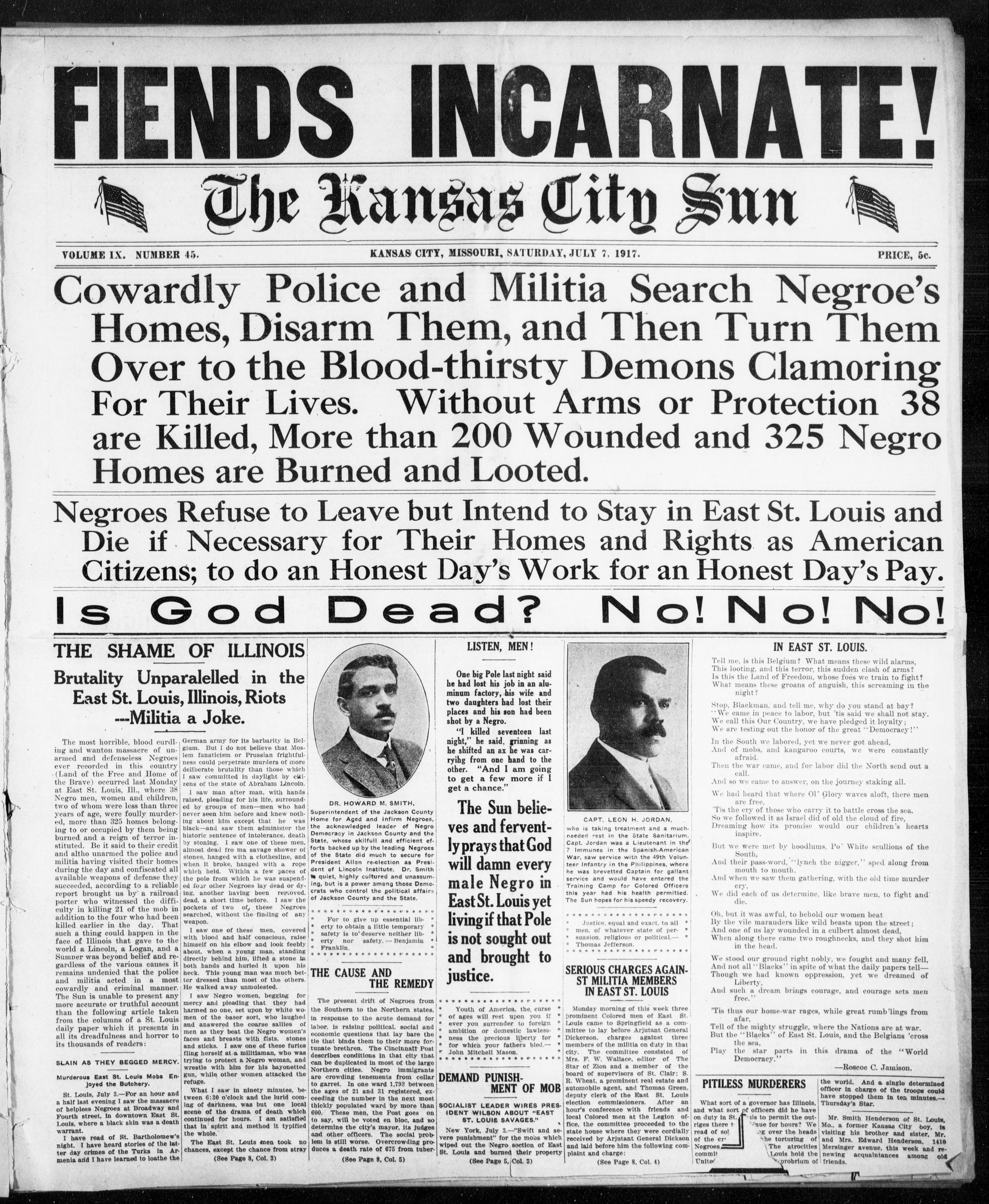
Cowardly Police and Militia Search Negroe's Homes, Disarm Them, and Then Turn Them Over to the Blood-thirsty Demons Clamoring For Their Lives. Without Arms or Protection 38 are Killed, More than 200 Wounded and 325 Negro Homes are Burned and Looted.
Negroes Refuse to Leave but Intend to Stay in East St. Louis and Die if Necessary for Their Homes and Rights as American Citizens; to do an Honest Day's Work for an Honest Day's Pay.
Is God Dead? No! No! No!
VOLUME IX. NUMBER 45.
Coward Homes Over For There are Kill Homes Negroes R Die if N Citizens; IS G THE SHAME O Brutality Unparal East St. Louis, Ill ---Militia a
THE SHAME OF ILLINOIS Brutality Unparalelled in the East St. Louis, Illinois, Riots ---Militia a Joke.
---
The most horrible, blood curdling and wanton massacre of unarmed and defenseless Negroes ever recorded in this country (Land of the Free and Home of the Brave) occurred last Monday at East St. Louis, Ill., where 38 Negro men, women and children, two of whom were less than three years of age, were foully murdered, more than 325 homes belonging to or occupied by them being burned and a reign of terror instituted. Be it said to their credit and altho unarmed the police and militia having visited their homes during the day and confiscated all available weapons of defense they succeeded, according to a reliable report brought us by a railroad porter who witnessed the difficulty in killing 21 of the mob in addition to the four who had been killed earlier in the day. That such a thing could happen in the face of Illinois that gave to the world a Lincoln, a Logan, and a Sumner was beyond belief and regardless of the various causes it remains undenied that the police and militia acted in a most cowardly and criminal manner. The Sun is unable to present any more accurate or truthful account than the following article taken from the columns of a St. Louis daily paper which it presents in all its dreadfulness and horror to its thousands of readers:
SLAIN AS THEY BEGGED MERCY
Murderous East St. Louis Mobs Enjoyed the Butchery.
St. Louis, July 3.—For an hour and a half last evening I saw the massacre of helpless Negroes at Broadway and Fourth street, in downtown East St. Louis, where a black skin was a death warrant.
I have read of St. Bartholomew's night. I have heard stories of the latter day crimes of the Turks in Armenia and I have learned to loathe the
German army for its barbary in Belgium. But I do not believe that Moslem fanaticism or Prussian frightfulness could perpetrate murders of more deliberate brutality than those which I saw committed in daylight by citizens of the state of Abraham Lincoln.
I saw man after man, with hands raised, pleading for his life, surrounded by groups of men—men who had never seen him before and knew nothing about him except that he was black—and saw them administer the historic sentence of intolerance, death by stoning. I saw one of these men, almost dead fro ma savage shower of stones, hanged with a clothesline, and when it broke, hanged with a rope which held. Within a few paces of the pole from which he was suspended four other Negroes lay dead or dying, another having been removed, dead, a short time before. I saw the pockets of two of these Negroes searched, without the finding of any weapon.
I saw one of these men, covered with blood and half conscious, raise himself on his elbow and look feebly about, when a young man, standing directly behind him, lifted a stone in both hands and hurled it upon his neck. This young man was much better dressed than most of the others. He walked away unmolested.
I saw Negro women, begging for mercy and pleading that they had harmed no one, set upon by white women of the baser sort, who laughed and answered the coarse sallies of men as they beat the Negro women's faces and breasts with fists, stones and sticks. I saw one of these furies fling herself at a militiaman, who was trying to protect a Negro woman, and wrestle with him for his bayonetted gun, while other women attacked the refuge.
What I saw in ninety minutes, between 6:30 o'clock and the lurid coming of darkness, was but one local scene of the drama of death which continued for hours. I am satisfied that in spirit and method it typified the whole.
The East St. Louis men took no chances, except the chance from stray (See Page 8. Col 3)
The Kansas City Sun
KANSAS CITY, MISSOURI, SATURDAY, JULY 7, 1917.
DR. HOWARD M. SMITH.
Superintendent of the Jackson County Home for Aged and Infirm Negroes, the acknowledged leader of Negro Democracy in Jackson County and the State, whose skilfull and efficient efforts backed up by the leading Negroes of the State did much to secure for President Allen re-election as President of Lincoln Institute. Dr. Smith is quiet, highly cultured and unassuming, but is a power among those Democrats who control the political affairs of Jackson County and the State.
* For to give up essential libr*
* ery to obtain a little temporary *
* safety is to deserve neither libr*
* ery nor safety. — Benjamin *
* Franklin.
```markdown
```
THE CAUSE AND THE REMEDY
The present drift of Negroes from the Southern to the Northern states, in response to the acute demand for labor, is raising political, social and economic questions that lay bare the tie that blinds them to their more fortunate brethren. The Cincinnati Post describes conditions in that city that can be duplicated in most of the large Northern cities. Negro immigrants are crowding tenements from cellar to garret. In one ward 1,793 between the ages of 21 and 31 registered, exceeding the number in the next most thickly populated ward by more than 600. These men, the Post goes on to say, will be voted en bloc, and so determine the city's mayor, its judges and other officers. The social problem is still worse. Overcrowding produces a death rate of 675 from tuber- (See Page 8, Col. 5)
LISTEN. MEN!
One big Pole last night said he had lost his job in an aluminum factory, his wife and two daughters had lost their places and his son had been shot by a Negro.
"I killed seventeen last night," he said, grinning as he shifted an ax he was carryihg from one hand to the other. "And I am going to get a few more if I get a chance."
The Sun believes and fervently prays that God will damn every male Negro in East St. Louis yet living if that Pole is not sought out and brought to justice.
The Sun believes and fervently prays that God will damn every male Negro in East St. Louis yet living if that Pole is not sought out and brought to justice.
* Youth of America, the curse
* of ages will rest upon you if
* ever you surrender to foreign
* ambition or domestic lawless-
ness the precious liberty for
* for which your fathers bled.—
* John Mitchell Mason.
---
DEMAND PUNISHMENT OF MOB
SOCIALIST LEADER WIRES PRES
IDENT WILSON ABOUT "EAST
ST. LOUIS SAVAGES."
New York, July 3.—"Swift and severe punishment" for the moos which wiped out the Negro section of East St. Louis and burned their property (See Page 5. Col. 3)
CAPT. LEON H. JORDAN
who is taking treatment and a much-needed rest in the State Sanitarium. Capt. Jordan was a Lieutenant in the 7 Immunes in the Spanish-American War, saw service with the 49th Volunteer Infantry in the Philippines, where he was brevetted Captain for gallant service and would have entered the Training Camp for Colored Officers this year had his health permitted. The Sun hopes for his speedy recovery.
Justice, equal and exact, to all men, of whatever state of persuasion, religious or political.— Thomas Jefferson.
SERIOUS CHARGES AGAINST MILITIA MEMBERS IN EAST ST. LOUIS
Monday morning of this week three prominent Colored men of East St. Louis came to Springfield as a committee to lay before Arjantut General Dickerson, charges against three members of the militia on duty in that city. The committee consisted of Mrs. F. W. Wallace, editor of The Star of Zion and a member of the board of supervisors of St. Clair; S. R. Wheat, a prominent real estate and automobile agent, and Thomas Green, deputy clerk of the East St. Louis election commissioners. After an hour's conference with friends and local Colored men at the Legion office, the committee proceeded to the state house where they were cordially received by Arjantut General Dickson and laid before him the following complaint and charge:
(See Page 8. Col. 4)
IN EAST ST. LOUIS.
Tell me, is this Belgium? This looting, and this terrify Is this the Land of Freedom What means these groans, night?
Stop, Blackman, and tell me "We came in peace to labour We call this Our Country, We are testing out the home In the South we labored, y And of mobs, and kangaroo afraid. Then the war came, and for call. And so we came to answer We had heard that where are free, 'Tis the cry of those who o So we followed it as Israel Dreaming how its promise inspire. But we were met by hood South, And their pass-word, "lym mouth to mouth. And when we saw them gaze cry. We did each of us determine die. Oh, but it was awful, to be By the vile marauders like And one of us lay wounded When along there came two in the head. We stood our ground right And not all "Blacks" in spelling Though we had known of Liberty, And such a dream brings free." 'Tis thus our home-war raid afar, Tell of the mighty struggle But the "Blacks" of East the sea, Play the star parts in Democracy."
Belgium? What means these, and this terror, this sudden clash of Freedom, whose foes we see groans of anguish, this is and tell me, why do you sit face to labor, but 'tis said we Country, we have pledged, but the honor of the great "Labored, yet we never got to and kangaroo courts, we came, and for labor did the life to answer, on the journey that where Ol' Glory waves, those who carry it to battle or Israel did of old its promise would our ous determine, like brave men awful, to behold our women in shoulders like wild beasts upon thy wounded in a culbert alm, we came two roughnecks, and did. Found right nobly, we fought reckens" in spite of what the day known oppression, yet dam brings courage, and come-war rages, while great my struggle, where the Nation" of East St. Louis, and the parts in this drama o
Tell me, is this Belgium? What means these wild alarms,
This looting, and this terror, this sudden clash of arms?
Is this the Land of Freedom, whose foes we train to fight?
What means these groans of anguish, this screaming in the
night?
Stop, Blackman, and tell me, why do you stand at bay?
"We came in peace to labor, but 'tis said we shall not stay.
We call this Our Country, we have pledged it loyalty;
We are testing out the honor of the great "Democracy!"
In the South we labored, yet we never got ahead.
And of mobs, and kangaroo courts, we were constantly
afraid.
Then the war came, and for labor did the North send out a
call.
And so we came to answer, on the journey staking all.
We had heard that where Ol' Glory waves aloft, there men are free
Tis the cry of those who carry it to battle cross the sea. So we followed it as Israel did of old the cloud of fire, Dreaming how its promise would our children shear
Dreaming how its promise would our children's hearts inspire.
But we were met by hoodlums, Po' White scullions of the South.
And their pass-word, "lynch the nigger," sped along from mouth to mouth.
And when we saw them gathering, with the old time murder cry.
We did each of us determine, like brave men, to fight and die.
Oh, but it was awful, to behold our women beat
When along there came two roughnecks, and they shot him in the head.
We stood our ground right nobly, we fought and many fell, And not all "Blacks" in spite of what the daily papers tell—Though we had known oppression, yet we dreamed of Liberty, And such a dream brings courage, and courage sets men free."
'Tis thus our home-war rages, while great rumb'lings from afar,
Tell of the mighty struggle, where the Nations are at war.
But the "Blacks" of East St. Louis, and the Belgians 'cross the sea
Play the star parts in this drama of the "World Democracy."
PITILESS MURDERERS
What sort of a governor has Illinois
and what sort of officers did he ha
d duty in St. Louis to permit the
ages there t
neue for hours?
ad of so
g over the he
the cr
he torturing
groves
The atroci
commit
Louis hold
1
egroe's Them moring tion 38 5 Negro Louis and American Day's Pay. ! No!
what means these wild alarms,
this sudden clash of arms?
whose foes we train to fight?
anguish, this screaming in the
why do you stand at bay?
but 'tis said we shall not stay.
have pledged it loyalty;
of the great "Democracy!"
we never got ahead,
courts, we were constantly
abor did the North send out a
in the journey staking all.
'Glory waves aloft, there men
ry it to battle cross the sea.
of old the cloud of fire,
would our children's hearts
ams, Po' White scullions of the
the nigger," sped along from
ring, with the old time murder
, like brave men, to fight and
d our women beat
child beasts upon the street;
a culbert almost dead,
roughnecks, and they shot him
obly, we fought and many fell,
of what the daily papers tell—
ression, yet we dreamed of
courage, and courage sets men
, while great rumb'lings from
where the Nations are at war.
Louis, and the Belgians 'cross
this drama of the "World
—Roscoe C. Jamison.
the world. And a single determined officer in charge of the troops could have stopped them in ten minutes.→ Thursday's Star.
Mr. Smith Henderson of St. Louis, Mo., a former Kansas City boy, is visiting his brother and sister, Mr. and Mrs. Edward Henderson, 1410 Mersinger avenue, this week and renewing acquaintances among old friends.
PRICE, 5c.
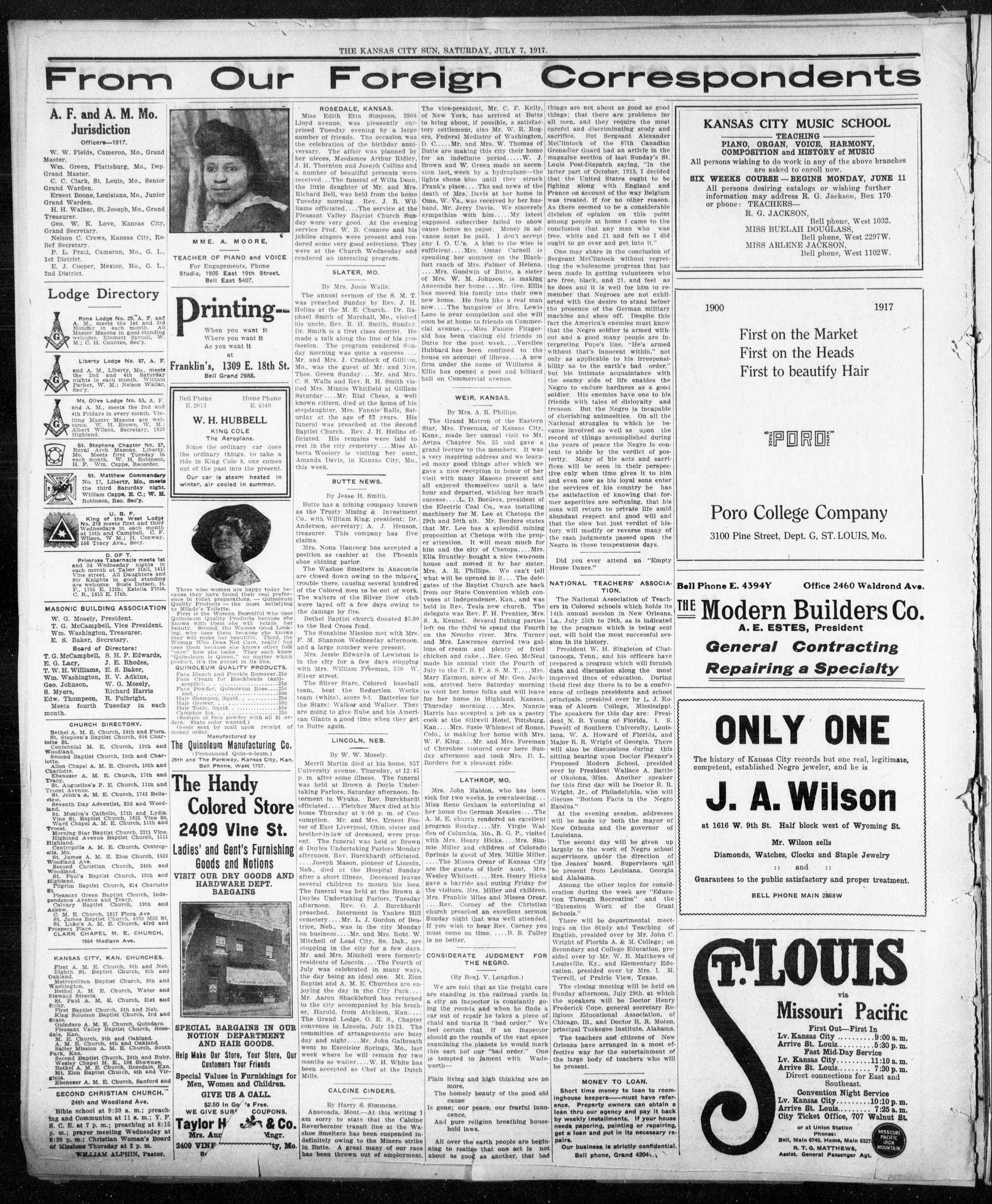
From Our Foreign Correspondents
A. F. and A. M. Mo. Jurisdiction
A. F. and A. M. Mo. Jurisdiction
W. W. Fields, Cameron, Mo., Grand Master.
Wm. Green, Plattsburg, Mo., Dep.
Grand Master.
C. C. Clark, St. Louis, Mo., Senior
Grand Warden.
Ernest Boone, Louisiana, Mo., Junior
Grand Warden.
H. H. Walker, St. Joseph, Mo., Grand
Treasurer.
Geo. W. K. Love, Kansas City, Grand Secretary.
Nelson C. Crews, Kansas City, Reilief Secretary.
P. L. Pratt, Cameron, Mo., G. L., 1st District.
E. J. Cooper, Mexico, Mo., G. L., 2nd District.
Lodge Directory
G
WESTMINSTER MASONRY
Rone Lodge No. 25, A. F. and A. M. meets the lst and 3rd Monday, in each month. All Master Masons in good standing welcome. Emmett Spruell, W. M.; C. H. Countee, Sec'y.
G
Liberty Lodge No. 37, A. F.
and A. M., Liberty, Mo., meets the 2nd and 4th Saturday nights in each month. William Parker, W. M.; Nelson Wallar, Secy.
Mt. Olive Lodge No. 53, A. F. and A. M., meets the 2nd and 4th Fridays in every month. Visiting Master Masons are wel- lored W. H. Brown, W. M. Albert Wilson, Secretary, 1820 Highland.
G
St. Stephens Chapter No. 37, Royal Arch Masons, Liberty, Masonry, and Recorder each month. W. H. Robinson, H. P. Wm. Capps, Recorder.
```markdown
```
St. Matthew Commandery
No. 17, Liberty, Mo., meets
the third Saturday night.
William Capps, E. C.; W. H.
Robinson, Rec. Sec'y.
HPC
IN
MIDDLE
COAST
B. F.
King of the West Lodge
No. 213 meets first and third
Wednesdays in each month
at 10th and Campbell. C. F.
Wilson, W M.; H. Conway,
588 Tracy Ave., Secy.
D. OF T.
Primrose Tabernacle meets 1st
and 3d Wednesday nights in
each month at Tabor Hall, 1413
Vine street. All Daughters and
Sir Knights in good standing
H. F. 1708 E. 12th; Estella Pitts,
C. R. 1815 E. 17th.
MASONIC BUILDING ASSOCIATION
W. G. Mosely, President.
T. G. McCampbell, Vice President.
Wm. Washington, Treasurer.
E. S. Baker, Secretary.
Board of Directors:
T. G. McCampbell, S. H. P. Edwards,
E. G. Lacy, J. E. Rhodes,
T. W. H. Williams, E. S. Baker,
Wm. Washington, R. V. Adkins,
Geo. Johnson, W. G. Mosely,
S. Myers, Richard Harris
Edw. Thompson, R. Fulbright.
Meets fourth Tuesday in each
CHURCH DIRECTORY.
Bethel A. M. E. Church, 24th and Flora.
Stephen's Baptist Church, 604 Charlotte
St.
Charlotte. Ebenezer A. M. E. Church, 17th and
Troy.
St. Augustine's P. E. Church, 11th and Troost Avenue. John's A. M. E. Church, 1743 Belleview. Seventh Day Adventist, 23d and Woodland.
St. Monica's Catholic, 17th and Lydia.
Vine St. Baptist Church, 1825 Vine St.
Ward Chapel A. M. E. Church, 11th and
Troost.
Morning Star Baptist Church, 3213 Vine.
Avenue Baptist Church, 1111
Highland.
Centropolis A. M. E. Church, Centropolis, Mo.
Birmingham Pilgrim Baptist Church, 614 Charlotte St
St. Pleasant Green Baptist Church, Independence Avenue and Tracy.
Catherine Baptist Church, 19th and Askew.
C. M. E. Church, 1817 Flora Ave.
St. James Baptist Church, 4039 Mill St.
St. Joseph Church, M. E. Church, 43rd and Prospect Place.
CLARK CHAPEL M. E. CHURCH,
1664 Madison Ave.
KANSAS CITY, KAN. CHURCHES.
First A. M. E. Church, 8th and Neb.
Eighth St. Baptist Church, 8th and
Oakland.
Metropolitan Baptist Church, 9th and Washington.
Bethel A. M. E. Church, Water and Steward Streets.
St. Paul A. M. E. Church, 21st and Ruby.
First Baptist Church, 5th and Neb.
Solomon Baptist Church, 3rd and
Sta. Guindaro A. M. E. Church, Quindaro.
Nessant Valley Baptist Church, Rosseau.
M. E. Church, 9th and Oakland.
A. M. E. Church, 4th and Oakland.
Salter Mission A. M. E. Church, South Park.
Second Baptist Church, 24th and Ruby.
Wesley Chapel M. E., 106 Shawnee.
Bethel M. E. Church, Rosedale, Kan.
M. Zion Baptist Church, 4th and Viri-
SECOND CHRISTIAN CHURCH.
24th and Woodland Ave.
Bible school at 9:30 a. m.; preaching and Communion at 11 a. m.; Y. P.
S. C. E. at 7 p. m.; preaching at 8:15
p. m.; prayer meeting Wednesday at
8:30 p. m.; Christian Woman's Board
of Missions Thursday at 2 p. m.
WILLIAM ALPHIN, Pastor.
A. E.
TEACHER OF PIANO and VOICE
For Engagements, Phone
Studio, 1905 East 19th Street.
Bell East 5407.
Printing--
When you want it
Where you want it
As you want it
at
Franklin's, 1309 E. 18th St.
Bell Grand 2988.
Bell Phone
E. 2013
Home Phone
E. 4349
Bell Phone E.2013
W. H. HUBBELL
KING COLE
The Aeroplane.
Since the ordinary car does the ordinary things, to take a ride in King Cole 8, one comes out of the past into the present.
Our car is steam heated in winter, air cooled in summer.
Three wise women are happy today because they have found their real preference in toilet preparations. — Quinoleum Quality Products — the most satisfying to Milady's Tollette.
First is the Woman Beautiful who uses Quinoleum Quality Products because she knows with them she will retain her beauty. Second, the Woman Good Looking, who uses them because she knows they will make her beautiful. Third, the Woman Who Does Not Care, really! but uses them because she knows other folk "care" how she looks. They each know Quinoleum is Queen," no matter which product, it's the surrest in its line.
QUINOLEUM QUALITY PRODUCTS.
Face Bleach and Freckle Remover.25c
Face Cream for Blackheads (anti-
sceptic). 25c
Face Powder, Quinoleum Rose.....25c
and.....50c
Hair Shampoo, liquid.....25c
Hair Grower.....50c
Hair Tonic, liquid.....50c
Camphor Ice.....25c
(Sample of face powder with all $1 or
ders. State color wanted.)
Goods sent by mail upon receipt of
(1-700) 616-2500, 1-700-1250
26th and 27th Street, Kaiser, Kananaskis, Kan
Bell Phone, West, 1257
The Handy Colored Store
2409 Vine St.
Ladies' and Gent's Furnishing
Goods and Notions
VISIT OUR DRY GOODS AND
HARDWARE DEPT.
BARGAINS
SPECIAL BARGAINS IN OUR
NOTION DEPARTMENT
AND HAIR GOODS.
Help Make Our Store, Your Store, Our
Customers Your Friends
Special Values in Furnishings for
Men, Women and Children.
GIVE US A CALL.
$2.50 In God's Free.
WE GIVE SURF COUPONS.
Taylor H & Co.
Mrs. Ann
Vngr.
2409 VINE
ty, Mo
THE KANSAS CITY SUN, SATURDAY, JULY 7, 1917.
ROSEDALE, KANSAS.
Miss Edith Etta Simpson, 3908 Lloyd avenue, was pleasantly surprised Tuesday evening by a large number of friends. The occasion was the celebration of the birthday anniversary. The affair was planned by her nieces, Mesdames Arthur Ridley, J. H. Thornton and Joseph Collins and a number of beautiful presents were received...The funeral of Willa Dean, the little daughter of Mr. and Mrs Richard Bell, was held from the home Tuesday morning. Rev. J. R. Williams officiated....The service at the Pleasant Valley Baptist Church Sunday were very good. At the evening service Prof. W. B. Countee and his jubilee singers were present and rendered some very good selections. They were at the Church Wednesday and rendered an interesting program.
SLATER, MO.
Bv Mrs. Josie Walls.
The annual sermon of the S. M. T. was preached Sunday by Rev. J. H. Holins at the M. E. Church. Dr. Raphael Smith of Marshall, Mo., visited his uncle, Rev. R. H. Smith, Sunday. Dr. Smith is a first class dentist. He made a talk along the line of his profession. The program rendered Sunday morning was quite a success.... Mr. and Mrs. J. Craddock of Gilliam Mo., was the guest of Mr. and Mrs. Thos. Green Sunday....Mr. and Mrs. C. S. Walls and Rev. R. H. Smith visited Mrs. Minnie Whitfield at Gilliam Saturday....Mr. Rial Chess, a well known citizen, died at the home of his stepdaughter, Mrs. Fannie Ralls, Saturday at the age of $3 years. His funeral was preached at the Second Baptist Church. Rev. J. H. Holins oficiated. His remains were laid to rest in the city cemetery....Miss Alberta Woolley is visiting her aunt Amanda Davis, in Kansas City, Mo. this week.
BUTTE NEWS.
By Jesse H. Smith.
Butte has a mining company known as the Trusty Mining & Investment Co., with William King, president; Dr. Anderson, secretary; A. J. Henson, treasurer. This company has five claims. Mrs. Nona Hancog has accepted a position as cashier at the Phoenix shoe shining parlor. The Washoe Smelters in Anaconda are closed down owing to the miners' trouble there, causing several hundred of the Colored men to be out of work. The waiters of the Silver Bow club were layed on a few days owing to the damage by fire. Bethel Baptist church donated $5.00 to the Red Cross fund. The Sunshine Mission met with Mrs. F. M. Shannon Wednesday afternoon, and a large number were present.
Mrs. Jessie Edwards of Lewiston is in the city for a few days stopping with Mrs. William Freeman, 530 W. Silver street.
The Silver Stars, Colored baseball team, beat the Reduction Works team (white), score 9-1. Batteries for the Stars: Walker and Walker. They are going to give Rube and his American Giants a good time when they get to Butte again.
LINCOLN, NEB.
By W. W. Mosely
Merril Martin died at his home, 857 University avenue, Thursday, at 12:45 p. m. after some illness. The funeral was held at Brown & Doyle Undertaking Parlors, Saturday afternoon. Interment in Wyuka. Rev. Burckhardt officiated... Fletcher Marx died at his home Thursday at 9:00 p. m. of Consumption. Mr. and Mrs. Ernest Foster of East Liverpool, Ohio, sister and brother-in-law of deceased, were present. The funeral was held at Brown & Doyles Undertaking Parlors Monday afternoon. Rev. Burckhardt officiated.
...Joseph Mason, pioneer of Lincoln, Neb., died at the Hospital Sunday, after a short illness. Deceased leaves several children to mourn his loss. The funeral was held at the Brown & Doyles Undertaking Parlors, Tuesday afternoon. Rev. O. J. Burckhardt preached. Interment in Yankee Hill cemetery...Mr. L. J. Gordon of Beatrice, Neb., was in the city Monday on business...Mr. and Mrs. Robt W. Mitchell of Lead City, So. Dak., are stopping in the city for a few days. Mr. and Mrs. Mitchell were formerly residents of Lincoln...The Fourth of July was celebrated in many ways, the day being an ideal one. Mt. Zion Baptist and A. M. E. Churches are enjoying the day in the City Park...Mr. Aaron Shackleford has returned to the city accompanied by his brother, Harold, from Atchison, Kan...The Grand Lodge, O. E. S., Chapter convenes in Lincoln, July 19-21. The committee of arrangements are busy day and night...Mr. John Galbreath went to Excelsior Springs, Mo., last week where he will remain for two months as waiter...W. H. White has been accepted as Chef at the Dutch Mills.
CALCINE CINDERS
By Harry S. Simmons
Anaconda, Mont.—At this writing I am sorry to state that the Calcine Reverberator transit line at the Washoe Smelters has been suspended indefinitely owing to the Miners strike in Butte. A great many of our race has been thrown out of employment
The vice-president, Mr. C. F. Kelly, of New York, has arrived at Butte to bring about, if possible, a satisfactory settlement, also Mr. W. R. Rogers, Federal Mediator of Washington, D. C....Mr. and Mrs. W. Thomas of Butte are making this city their home for an indefinite period....W. J. Brown and W. Green made an ascension last week by a hydroplane—the lights shone blue until they struck Frank's place. The sad news of the death of Mrs. Davis at her home in Oma, W. Va., was received by her husband, Mr. Jerry Davis. We sincerely sympathize with him....My latest supposed subscriber failed to show cause hence no paper. Money in advance must be paid. I don't accept any I. O. U.'s. A hint to the wise is sufficient....Mrs. Omar Carnell is spending her summer on the Black fort ranch of Mrs. Palmer of Helena....Mrs. Goodwin of Butte, a sister of Mrs. W. M. Johnson, is making Anaconda her home....Mr. Geo. Ellis has moved his family into their own new home. He feels like a real man now....The bungalow of Mrs. Lewis Lane is near completion and she will soon be at home to friends on Commercial avenue....Miss Fannie Fitzgerald has been visiting old friends in Butte for the past week....Vererelle Hubbard has been confined to the house on account of illness....A new firm under the name of Williams & Ellis has opened a pool and billiard hall on Commercial avenue.
WEIR, KANSAS.
By Mrs. A. R. Phillips.
The Grand Matron of the Eastern Star, Mrs. Freeman, of Kansas City, Kans., made her annual visit to Mt. Aetna Chapter No. 35 and gave a grand lecture to the members. It was a very inspiring address and we learned many good things after which we gave a nice reception in honor of her visit with many Masons present and all enjoyed themselves until a late hour and departed, wishing her much success.....L. D. Borders, president of the Electric Coal Co., was installing machinery for M. Lee at Chetopa the 29th and 30th ult. Mr. Borders states that Mr. Lee has a splendid mining proposition at Chetopa with the proper attention. It will mean much for him and the city of Chetopa.....Mrs. Ella Brantley bought a nice two-room house and moved it by her sister. Mrs. A. R. Phillips. We can't tell what will be opened in it.....The delegates of the Baptist Church are back from our State Convention which convenes at Independence, Kan., and was held in Rev. Teals new church. The delegate was Rev. F. H. Prentice, Mrs. S. A. Kennel. Several fishing parties left on the third to spend the Fourth on the Neoho river. Mrs. Turner and Mrs. Lawrence carried two gallons of cream and plenty of fried chicken and cake.....Rev. Geo. McNeal made his annual visit the Fourth of July to the U. B. F. & S. M. T....Mrs. Mary Eatman, niece of Mr. Geo. Jackson, arrived here Saturday morning to visit her home folks and will leave for her home in Highland, Kansas, Thursday morning.....Mrs. Nannie Harris has accepted a job as a pastry cook at the Stilwell Hotel, Pittsburgh, Kan....Mrs. Susie Whisnest of Rouss, Colo., is making her home with Mrs. W. F. King....Mr. and Mrs. Foreman of Cherokee motored over here Sunday afternoon and took Mrs. D. L. Borders for a pleasant ride.
LATHROP, MO.
Mrs. John Mabion, who has been sick for two weeks, is convalescing... Miss Reno Graham is entertaining at her home the German Measles... The A. M. E. church rendered an excellent program Sunday...Mr. Virgine Walden of Columbia, Mo. R. G. P., visited with Mrs. Henry Hicks...Mrs. Simmie Miller and children of Colorado Springs is guest of Mrs. Millie Miller... The Misses Orear of Kansas City are the guests of their aunt, Mrs Wesley Whitsets...Mrs. Henry Hicks gave a hayride and outing Friday for the visitors, Mrs. Miller and children. Mrs. Frankie Miles and Misses Orear... Rev. Corney of the Christian church preached an excellent sermon Sunday night that was well attended. If you wish to hear Rev. Corney you must come on time. ...B. B. Tulley is no better.
CONSIDERATE JUDGMENT FOR
THE NEGRO.
(By Benj. V. Longdon.)
We are told that as the freight cars are standing in the railroad yards in a city an inspector is constantly going the rounds and when he finds a car out of repair he takes a piece of chald and marks it "bad order." We feel certain that if an inspector should go the rounds of the vast space examining the planets he would mark this eart hof our "bad order." One is tempted to lament with Wadsworth—
Plain living and high thinking are no more.
The homely beauty of the good old cause
Is gone; our peace, our fearful innocence,
And pure religion breathing household laws.
All over the earth people are beginning to realize that one act is not about as good as another, that bad
things are not about as good as good things; that there are problems for all men, and they require the most careful and discriminating study and sacrifice. But Sergeant Alexander McClintock of the 87th Canadian Grenadier Guard had an article in the magazine section of last Sunday's St. Louis Post-Dispatch saying, "In the latter part of October, 1915, I decided that the United States ought to be fighting along with England and France on account of the way Belgium was treated, if for no other reason. As there seemed to be a considerable division of opinion on this point among people at home I came to the conclusion that any man who was free, white and 21 and felt as I did ought to go over and get into it."
One may share in the conclusion of Sergeant McClintock without regretting the wholesome progress that has been made in getting volunteers who are free, black, and 21, and feel as he does and it is well for him to remember that Negroes are not exhilarated with the desire to stand befoer the presence of the German military machine and show off. Despite this fact the America's enemies must know that the Negro soldier is armed without and a good many people are interpreting Pope's line, "He's armed without that's innocent within," not only as applicable to his irresponsibility as to the earth's bad order," but his intimate acquaintance with the seamy side of life enables the Negro to endure hardness as a good soldier. His enemies have one to his friends with tales of disloyalty and treason. But the Negro is incapable of cherishing animosities. On all the National struggles in which he became involved as well as upon the record of things accomplished during the years of peace the Negro is content to abide by the verdict of posterity. Many of his acts and sacrifices will be seen in their perspective only when time gives it to him and even now as his loyal sons enter the services of his country he has the satisfaction of knowing that former asperities are softening, that his sons will return to private life amid abundant respect and good will and that the slow but just verdict of history will modify or reverse many of the rash judgments passed upon the Negro in these tempestuous days.
Did you ever attend an "Empty House Dance."
NATIONAL TEACHERS' ASSOCIATION
The National Association of Teachers in Colored schools which holds its 11th annual session in New Orleans, La. July 25th to 29th, as is indicated by the program which is being sent out, will hold the most successful session in its history.
President W. H. Singleton of Chattanooga, Tenn., and his officers have prepared a program which will furnish data and discussion along the most improved lines of education. During their first day there is to be a conference of college presidents and school principals, presided over by L. J. Rowan of Alcorn College, Mississippi. The speakers for this day are: President N. B. Young of Florida, I. S. Powell of Southern University, Louisiana, W. A. Howard of Florida, and Major R. R. Wright of Georgia. There will also be discussions during this sitting bearing upon Doctor Flexner's Proposed Modern School, presided over by President Wallace A. Battle of Okolona, Miss. Another speaker for this first day will be Doctor R. R. Wright, Jr., of Philadelphia, who will discuss "Bottom Facts in the Negro Exodus."
At the evening session, addresses will be made by both the mayor of New Orleans and the governor of Louisiana.
The second day will be given up largely to the work of Negro school supervisors, under the direction of the Jeanes' board. Supervisors will be present from Louisiana, Georgia and Alabama.
Among the other topics for consideration during the week are "Education Through Recreation" and the "Extension Work of the Grant Schools."
There will be departmental meetings on the Study and Teaching of English, presided over by Mr. John C. Wright of Florida A. & M. College; on Secondary and College Education, presided over by Mr. W. B. Matthews of Louisville, Ky., and Elementary Education, presided over by Mrs. I. M. Terrell, of Prairie View, Texas.
The closing meeting will be held on Sunday afternoon, July 29th, at which the speakers will be Doctor Henry Frederick Cope, general secretary Religious Educational Association, of Chicago, Ill., and Doctor R. R. Moten, principal Tuskegee Institute, Alabama. The teachers and citizens of New Orleans have arranged in a most effective way for the entertainment of the large body of teachers who will be present.
MONEY TO LOAN.
Short time money to loan to roominghouse keepers—must have reference. Property owners can obtain a loan thru our agency and pay it back by weekly installments. If your house needs papering, painting or repairing, get a loan and put in its necessary repairs.
Our business is strictly confidential Bell phone, Grand 4204
KANSAS CITY MUSIC SCHOOL
First on the Market First on the Heads First to beautify Hair
Poro Co
3100 Pine Street
---
ro College Compan
Pine Street, Dept. G, ST. LOUIS,
Poro College Company 3100 Pine Street, Dept. G, ST. LOUIS, Mo.
Bell Phone E. 4394Y
THE Moder
Modern Builder
A. E. ESTES, President
General Contractor
Repairing a Special
ONLY ONE
of Kansas City records but one real, I
established Negro jeweler, and he is
A. Wilson
W. 9th St. Half block west of Wyon
Mr. Wilson sells
lands, Watches, Clocks and Staple Jew
:: and ::
to the public satisfactory and proper
BELL PHONE MAIN 2868W
LOUD
via
Missouri Park
First Out—First D
Lv. Kansas City.....1
Arrive St. Louis.....1
Fast Mid-Day Servi
Lv. Kansas City.....1
Arrive St. Louis.....1
Direct connections for E
Southeast.
Convention Night Serv
Lv. Kansas City.....1
Arrive St. Louis.....1
City Ticket Office, 707 W
THE Modern Builders Co. A.E. ESTES, President General Contracting Repairing a Specialty
ONLY ONE
The history of Kansas City records but one real, legitimate, competent, established Negro jeweler, and he is
J. A. Wilson
at 1616 W. 9th St. Half block west of Wyoming St.
Mr. Wilson sells
Diamonds, Watches, Clocks and Staple Jewelry
:: and ::
Guarantees to the public satisfactory and proper treatment.
BELL PHONE MAIN 2868W
---
1900
RO MARK
e Company
t. G, ST. LOUIS, Mo.
PORO
TRADE
MARK
Office 2460 Waldrond Ave.
Builders Co.
US, President
Contracting
a Specialty
Y ONE
records but one real, legitimate,
jeweler, and he is
Wilson
block west of Wyoming St.
Wilson sells
locks and Staple Jewelry
and ::
factory and proper treatment.
MAIN 2868W
OUIS
via
Missouri Pacific
First Out—First In
Kansas City.....9:00 a.m.
St. Louis.....5:30 p.m.
Fast Mid-Day Service
Kansas City.....11:10 a.m.
St. Louis.....7:30 p.m.
set connections for East and
Southeast.
Convention Night Service
Kansas City.....10:10 p.m.
St. Louis.....7:25 a.m.
Ticket Office, 707 Walnut St.
or at Union Station
Phones:
Bell, Main 6740. Home, Main 6327
R. T. G. MATTHEWS,
Aesist. General Passenger Agt.
1917
MISSOURI
PACIFIC
IRON
MOUNTAIN
If Your Business Is Not Worth Advertising,
Palm Beach, Mohair, Serges
Tropical Worsteds, Flannels
$8.50 $10.00 $12.50 $15.00
Daniel Clothing Co. Boley Building Second Floor 12TH and WALNUT
Subscribe Now for The Sun
NELSON C. CREWS, Editor
New Straw Hats
$1.50 to $2.50.
Panamas, $3.50 to $5.50
If you want the business of 40,000 Negroes who spend approximately $200,000 per month
We reach the buying public of both cities and surrounding communities, and we solicit for them only the most reliable firms. The buying public patronizing our advertisers are certain to be treated courteously, find goods as advertised and receive quality and service
Call Our Advertising Representative for Rates Bell Phone East 999 1803 E.18th Street
Silk Shirts, $3.00 to $5.00
Silk Hosiery, 50c.
D. V. D Underwear, $1.00
Soft Shirts, $1.00 to $3.50
thing Co.
Second Floor
12TH and WALNUT
for The Sun
FLOUR
Kelley's Best Beat all the Rest. Kelley Milling Co.
THE KANSAS CITY SUN, SATURDAY, JULY 7, 1917.
AMONG THE CHURCHES
THE MINOR PROPHET SPEAKS.
Time of Revelation Began 8:30 A. M.
June 11, 1917.
Thus saith the Lord of Host concerning Isaiah's vision, the son of Amoz, which he saw concerning Judah and Jerusalem the days Uzzith, Jotham Ahaz and Hezekiah, king of Judah. Thus saith the God of Heavens "Give ear old earth these names are spiritually unto your Country and Government." The vision which troubled Isaiah's head on June 5, 1917, and time of the hour was twelve minutes after twelve; I am Alpha the first and the last. Talking unto him and telling him to write what I reveal unto him, then I wrote what my father revealed unto me. I saw an ark angel by the name of Gabriel who was clothed with majesty with sword in one hand and hell—death and destruction was on New York City. Near the harbor vengeance was sworn on New York City and one-fifth of that city would be destroyed. Your God and Father saith the mystery of the interpretation belongs to Him. The sun, moon and stars obeyed. Thus saith the Lord of Hosts the revelation of mystery of the vision is Revelation, 18th Chapter, 19th verse; Psalms 77, verse 19. Jeremiah, 5th Chapter, 15th verse. God says now that I sent my son in yonder world to testify of the things which shortly cometh to pass who bear the name of Isaiah Minor, prophet, who bear record of me and I of him. Thus saith the Lord of Hosts; Look, behold the record that he bore to me.
Isaiah, first chapter, first verse.
Jeremiah, first chapter, fifth verse.
Ezekiel, first chapter, second verse
Time revelation stopped 10:30 a. m.
Isaiah Minor, prophet.
Finally, sir, we shall not fight
our battles alone. There is a
just God who presides over the
destinies of nations and who
will raise up friends to fight for
us.—Oliver Wolcott.
VINE STREET CHURCH
All services were well attended. One addition was made to the church. ...Mrs. Ella Lawson underwent an operation but she is doing fine. We hope she will continue to improve. ...The funeral of Mrs. Matilda Derrick, who died the 26th of June, was preached Sunday by our pastor. Sister Derrick was a faithful member of our church and did what she could for the advancement of God's kingdom in the world. She was also a member of St. Mark Bible Class No. 2 of the Sunday school department. We extend our heartfelt sympathies to the bereaved family.
SECOND BAPTIST CHURCH
SECOND BAPTIST CHURCH.
All services were well attended last Sunday. At 9:30 the Sunday school held an interesting session. At 11 o'clock the pastor, Dr. Bacote, preached a very instructive sermon on "The Conservation of Food." In the evening Rev. C. C. Harper of Dallas, Tex., preached an excellent sermon on "The Sufferings of Christ Were the Means of His Glory" after which the Lord's Supper was partaken of. During the day ten were added to the church.
Next Sunday morning, by special request, the pastor, Dr. S. W. Bacote, will preach a sermon on "Gossip." Come to church!
ALLEN CHAPEL.
Dr. William H. Thomas, the minister, delivered a sermon on the "Conservation of the Food Supply." It was requested by the U. S. government authorities that this need be impressed upon the minds of the people from the pulpits. The test was "Render therefore unto Caesar the things that are Caesar's and unto God the things that are God's." Matthew 22: 21. There were two additions. At the evening service a prominent social worker made an enlightening talk on "The Reason Why Negroes Were Leaving the South"...The
swimming pool will be open July and August. Come and take a swim. For special arrangements see Mrs. Johnson....The Federated Council of Church Clubs met at Allen Chapel, Monday afternoon, July 2. The Auxiliaries made their reports to the Quarterly Conference last Thursday night. The choir, under Professor Jefson, will furnish a' sacred musical concert next Sunday evening, July 8. Come and bring a friend.
PILGRIM BAPTIST CHURCH
PLEGIRM BAPTIST CHURCH
The services at the Pilgrim Baptist church were up to the usual high standard. Rev. C. C. Calaway, the pastor, preached to an excellent congregation in the morning. In the afternoon the funeral of Sister Lulu Davis was held at which the pastor officiated. Sister Davis having been a faithful member or several years of this church. At the funeral service the pastor became so ill that he was compelled to leave and has not recovered to date. He is spending several days at Excelsior Springs trying to recuperate. Rev. Jobes preached at the evening service and will have charge of the services next Sunday. The whole church as well as friends pray for the speedy recovery of the pastor.
WARD CHAPEL.
Sunday is rally day. We extend a special invitation to all who desire to come. Mrs. Watts, the great singer, will be present and sing for us at the morning and evening services, 1120 Woodland Ave. Rev. J. F. Sage, Pastor.
NOTICE
The Western Baptist Convention will meet at the Maple Street Baptist church, Des Moines, Ia., July 10-15, 1917. This promises to be one of the most interestin gssessions that we have had during the history of the organization. The ministry of the entire community is invited and urged to be present. The people of Des Moines are making extensive preparations and the entertainment will be
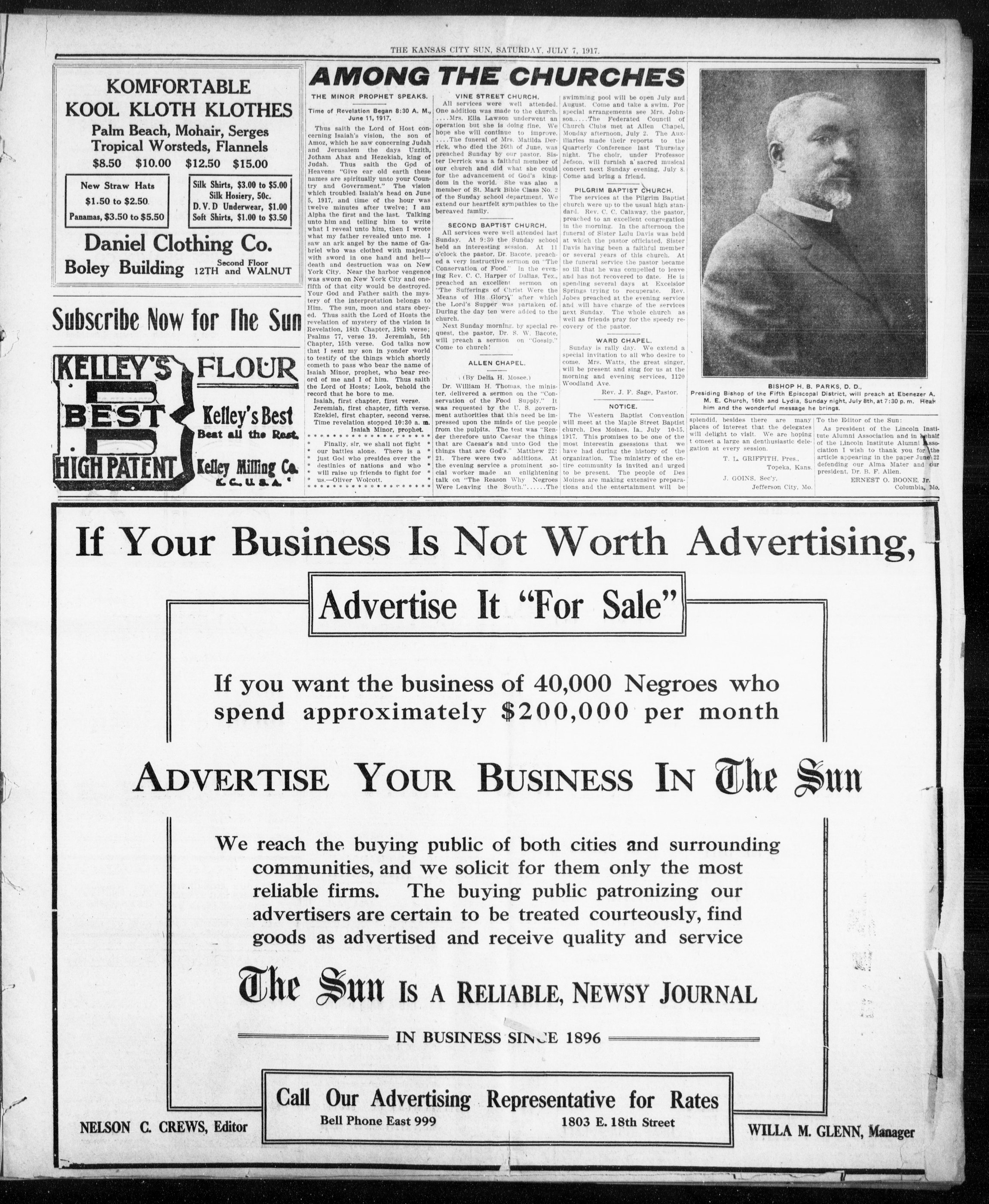
[Picture of a man in a suit with a white shirt and a black tie. He has a white beard and mustache.]
BISHOP H. B. PARKS, D. D.,
Presiding Bishop of the Fifth Episcopal District, will preach at Ebenezer A.
M. E. Church, 16th and Lydia, Sunday night, July 8th, at 7:30 p.m. Heak him and the wonderful message he brings.
splendid, besides there are many places of interest that the delegates will delight to visit. We are hoping t omeet a large an denthusiastic delegation at every session.
T. L. GRIFFITH, Pres.,
Topeka, Kans.
J. GOINS, Sec'y,
Jefferson City, Mo.
To the Editor of the Sun:
As president of the Lincoln Institute Alumni Association and in behal of the Lincoln Institute Alumni Association I wish to thank you for the article appearing in the paper June 2 defending our Alma Mater and our president, Dr. B. F. Allen.
ERNEST O. BOONE, Jr.
Columbia, Mo.
WILLA M. GLENN, Manager
To the Editor of the Sun.
As president of the Lincoln Institute Alumni Association and in behalf of the Lincoln Institute Alumni Association I wish to thank you for the article appearing in the paper June 22 defending our Alma Mater and our president, Dr. B. F. Allen.
ERNEST O. BOONE, Jr.
Columbia, Mo.
THEKANSASCITYSUN PUBLISHED WEEKLY
All communications should be addressed to The Kansas City Sun, 1803 East 18th Street.
Bell Phone East 999.
Entered as second-class matter, August
—, 1908, at the postoffice at Kansas City,
Mo., under the act of March 3, 1879.
Nelson C. Crews.....Editor and Owner
Willa M. Glenn.....General Manager
SUBSCRIPTION RATES:
One Year ..... $1.50
Six Months ..... 75
Three Months ..... 50
ADVERTISING RATES, $2.00 PER INCH
PER MONTH.
MEMBER
NATIONAL NEGRO PRESS
ASSOCIATION.
EDITORIALS.
The Sun is diligently trying to secure a list of the Colored people killed in the massacre at East St. Louis, but has been unable to do so as yet. As soon as obtained we will publish it.
Alderman Lewis B. Anderson, of the Second Ward, Chicago, who succeeded Alderman Oscar DePriest, was presented a $600 diamond studded gold star by the citizens of the Ward and the members of the race in that city, last week. Presentation speech was made by Dr. A. J. Carey, the distinguished pastor of the Institutional A. M. E. Church, and fittingly responded to by Alderman Anderson.
That the Negroes deeply appreciate the employment of a Colored band by the Park Board to furnish music during the summer months in those sections of the city inhabited by Colored people was evidenced last Wednesday afternoon and night by the immense crowds that assembled in Garrison Square and the Parade, 17th and Vine streets. Many white people were present and they expressed themselves as both surprised and highly pleased at the splendid program rendered by this band. The crowds were orderly and well behaved bu The Sun gently suggests that parents keep their children near them and prevent them from disturbing the concert by their prattle and play.
THE JUVENILE COURT AND THE
NEGRO.
The thoughtful farminded people in both races are wondering whether the present political upheaval in Jackson county between the County Court and the Juvenile Court will make any improvement with regard to the consideration and treatment of the Negro. Judge Porterfield of the Juvenile Court, whose record of seven years includes no sincere or substantial effort at conservation or reclaiming weak and delinquent Negro boys and girls has proceeded on the theory which guides many other short sighted persons in similar positions where a fuler conception and a Christlike purpose might render both races a much greater moral service and the taxpayers through reduced criminal tendencies among Negro youth—an economic service.
It is also rumored that one of the certain changes to take place will be the election of Mr. R. E. L. Balley to succeed Dr. W. J. Thompkins as Truant Officer and the fact that Bailey has the endorsement of a number of prominent white Democrats affiliated with Judge Bulger as well as the acative support of Dr. Howard M. Smith, who is the leader among the Bulger-Pendergast Negro Democrats makes it quite probable this change will be made. Judge Porterfield who is affiliated with the "Rabbit" faction moved Mr. Edw. Ross about a year ago that this place might be made for Dr. Thompkins and now the "Goat" faction are determined apparently to fill it with one of their own selection. Mr Bailey is at present Dance Hall Inspector under the Board of Welfare and was for many years the Editor of a democratic newspaper in this city
RACE LOYALTY.
One of the weak places in our rac Fial development is the lack of pride n. and support of Negro enterprises
early all Negro business or professions that has to enter competition with the white man's business of professional activity, has more or less a struggle for existence, because of our non-support. It is a foregone conclusion, prejudice alone will turn the vast majority of other races from the door of Negro establishments and professions, and to live or die according as we have race pride royally to support them. Negro newspapers, the race's greatest mouthpiece for giving other side of discriminatory pictures drawn of us in the white press of the country, are often left suspended for lack of enough paid-up subscribers. It is a splendid thing to subscribe for and read the dailies. We must do so to keep abreast of the times but, it's a sad commentary upon our race loyalty, when numerous Negro families pay for one and two daily pay
hes pay for one and two daily papers that seldom say much of us, but report the Negro who has raided a chicken roost, was arrested for store reaking, or other petty offense, and puse to subscribe for the Negro pa- that sees and tells of the High school graduates; those who finished course in law, medicine or attained less in business, insurance companies that would not
employ a Negro agent, and whose representatives enter Negro homes with cigars lighted and hats on their heads, and call our wives and daughters "Sal," Jane," etc., these folks write the greater part of the Negro insurance, while companies of the race that employ our men, our sons and daughters as agents, clerks and stenographers, and send to our home courteous and respectable representatives, are left by us to make, if they can, or die if they can, or die if they must. Negro physicians also fall to hold the support needed from the race. So with drug stores, grocery stores and almost every other phase of Negro business.
Our progress will be greatly handicapped until, as a people, we get to the place where we will stand by the business and profession endeavors of our own people.—Kentucky Reporter.
Betty & Sam's Little Corner
THEY SAY Our Hearts Are Too Full To
Indulge In Jokes Or Nonsense This
Or
Week.
Betty and Sam
Rooms to Rent
Wanted—Children to care for by the day or week. 1514 E. Tenth street. Bell phone, East 1147-J.
For Sale—A new Duntley Carpet Sweeper taken on advertisement. Cost $6.00; will sell for $2.00.
WANTED.—Two good Colored barbers. Apply 910 East 12th street.—N. Smith.
WANTED—A man and wife to take care of a four-room house, nicely furnished, 2002 Bales avenue, phone, Bell East 2010.
ROOM FOR RENT—Modern, to couple. Nicely located. Call in person. A. G. Nelson, 2631 Highland avenue.
For Sale—Phonograph, forty cylinder records; just the thing to please the children and keep them at home. Only $4.00. Cost $25.00.
★★★★★★★★★★★★★★
* For Sale by Owner—Frame
* duplex; 8 rooms; 35 ft. front;
* water, gas and sewer; Colored
* neighborhood; $1,600.00. $100
* down and $15.00 a month, with
* interest. 2115 Bellefontaine,
* Kansas City, Mo.
*
THE KANSAS CITY SUN, SATURDAY, JULY 7, 1917.
Negro Business and Professional Directory of Greater Kansas City
BAKERIES.
MRS. SUSIE OWENS, 2331 Vine street. Bell phone, East 5017.
BARBER SHOPS.
LABORING MEN'S BARBER SHOP, W. F. O'Bonnon, Prop., 558 Grand avenue.
BEAUTY PARLORS AND HAIR DRESSERS.
MRS. CORA D. WILLIAMS, Poro Hair Dresser, 1714 E. 13th Street. Bell phone, East 3610J.
MRS. SUSIE P. GIPSON, 1725 Michigan avenue. Poro hair dresser. Bell Phone, East 3058J.
MRS. MINNIE DOYLE, Poro Hair Dresser, 2732 Highland avenue. Bell phone, East 1346W.
MRS. ETHEL E. WILSON, 1008 Woodland. XX Century Hair Dresser. Bell phone, E. 5469W.
MRS. DELILAM M. S. DOTTREY, 1102
Highland avenue. Poro Hair Dressers. Bell Phone East 4151-J.
MRS. F. A. COOK, Poro Hair Dressers,
1226 Vine street. Bell phone, E.
2820.
CAFES.
MRS. H. W. DOTSON, 1705 East 12th.
Bell Phone, E. 2214.
DELMONICA CAFE, 1512 East 18th
street. Bell phone, East 618.
COAL AND FEED.
W. W. PAYNE, 19th and Vine streets.
Bell Phone, East 559. Home Phone,
East 4132.
FLORISTS.
CROSTHWAIT FLORAL CO., 1501 E.
Ninth. Bell phone, East 272.
C. H. CALLOWAY, 601 Delaware, Home phone M. 58, Bell phone Main 448. Practices in all courts.
W. C. HUESTON, 601 Delaware, Home phone, M58, Bell phone Main 448. Legal advice. Practices in all courts.
E. A. SHACKLEFORD, Attorney at Law, 511 Minnesota avenue, Kansas City, Kas. Bell phone, West 3866.
JEWELERS.
J. A. WILSON, 1616 W. Ninth street, Kansas City, Mo. Bell phone, Main 6248R.
PHOTOGRAPHERS.
J. E. MILLER STUDIO, 1622 East Eighteenth street. Bell phone, E. 91.
REAL ESTATE and EMPLOYMENT.
COLORED PEOPLES INVESTMENT CO., Solomon Smith, Pres., 2122 Vine St. Bell Phone, East 1011. Home Phone, East 4011.
A B C EMPLOYMENT AND INVESTMENT CO., 500 Minnesota avenue. (Upstairs) Kansas City, Kas. Bell phone, West 1743; Home phone, West 1036. C. W. Neloms, Mgr.
H. L. KINSLER, 918 East Twenty-first street. Bell phone, Grand 4204.
G. A. PAGE'S SHOE STORE, 1507 E.
Eighteenth street. Bell phone, East
1328.
SHOE REPAIRING.
ELECTRIC SHOE & REPAIR SHOP,
J. C. Banks, Prop., 1514½ East Eighteenth street. Bell phone East 4939.
TAILORS.
RALPH WORTHAM, Cleaners and
Dyers, 19th and Paseo.
UNDERTAKERS.
ADKINS BROS. & GREEN, Nineteenth
and Vine streets. Both Phones,
East 4349.
I. G. OLIVER, 415 Minnesota avenue,
Kansas City, Kansas. Bell Phone,
West 4183.
H. B. MOORE, 1031 Independence avenue. Bell phone Main 3298W. Home phone Main 3341.
WATKINS BROS., 1729 Lydia avenue
Bell phone Grand 987, Home Main
7989, Res., Bell East 3281.
Williams Investment Co.
WE HAVE FOR SALE—A four room cottage at Howard and Garfield for $1,150.00. Terms, $50.00 down and $10.00 per month and interest. Both Phones East 1415. Also at 2325 Michigan a splendid 6-room frame, modern and in good condition. White people moving out of neighborhood will sell for $1,600. Terms to suit. Modern brick near 15th street car line. See Williams Realty Co. for a bargain. For sale, 13th and Euclid, 10-room brick, strictly modern, a bargain.
WILLIAMS INVESTMENT CO.
1704 East Twelfth Street.
Both Phones, East 1415.
CHEAP JOHN'S PLACE
Open Office. New management
New and second hand goods bought,
sold and exchanged
Bell Phone, East 3851. 2224 Vine St.
The Spotless Kitchen (All that its name implies)
The best place in Kansas City for a Clean, Wholesome, Satisfying Meal
Special Dinner and Lunch at Noon for those employed down town
MRS. PEARL RILEY, Manager MARTIN YOUNG Proprietor
Women, Girls, Earn Money
My Free Book Tells How.
LEARN TO GROW HAIR
Women, Girls, Earn Money My Free Book Tells How. LEARN TO GROW HAIR
Women, Girls, Earn Money My Free Book Tells How. LEARN TO GROW HAIR
[Name]
President of Eloso College Co., 21
M. M
MERCHAN
President of Eloso College Co., 21 S. Compton Avenue, St. L.
M. MYERS
MERCHANTS TAILOR
HERMAN KATZ, Mgr.
SUITS MADE TO ORDER
Ladies' and Gent's Work a Specialty. Suits Cleaned, Presse
BELL, EAST 1667 W HOME, EAST 2
JITS MADE TO ORDE
Gent's Work a Specialty. Suits Cleaned, Pressed
LL, EAST 1667 W HOME, EAST 2
SUITS MADE TO ORDER Ladies' and Gent's Work a Specialty. Suits Cleaned, Pressed, Repaired BELL, EAST 1667 W HOME, EAST 2192 1518 East 12th Street, Kansas City, Mo.
Season Announcement
1217 Woodland Avenue, Kansas City, Mo.
Everything] For Every Lodge. Ask
everything] For Every Lodge. Ask
A Wonderful Hair Dresser
One thousand agents wanted. Go
THE STAR HAIR GROWER. This
preparation. Can be used with or wi
ening irons.
Sells for 25c per box—one 25c box
value. Any person that will use a
convinced. No matter what has
your hair just give THE STAR HA
trial and be convinced. Send 25c for
If you wish to be an agent send $1
send you a full supply that you c
with at once; also agents' terms.
by Money Order to
Everything] For Every Lodge. Ask Us.
A Wonderful Hair Dresser and Grower
One thousand agents wanted. Good money made. THE STAR HAIR GROWER. This is a wonderful preparation. Can be used with or without straightening irons.
Sells for 25c per box—one 25c box will prove its value. Any person that will use a 25c box will be convinced. No matter what has failed to grow your hair just give THE STAR HAIR GROWER a trial and be convinced. Send 25c for full size box. If you wish to be an agent send $1.00 and we will send you a full supply that you can begin work with at once; also agents' terms. Send all money by Money Order to
1113 Clark Street.
Lunch and Sandwiches
MRS. HATTIE LU
TEA
HATTIE LUCAS RICHARD
TEA ROOM
e East 4818 1831
LAST INDIA HAIR G
MRS. HATTIE LUCAS RICHARDSON
TEA ROOM
Bell Phone East 4818 THE EAST INDI
THE EAST INDIA HAIR GROWER
A.
Leaves the hair s of a thousand fl Heavy and Beau Gray Hair to its Iron for Straight Price, Sent by
Leaves the hair soft and silky. Perfume of a thousand flowers. The best know Heavy and Beautiful Black Eye-Brows Gray Hair to its Natural Color. Can be Iron for Straightening. Price, Sent by Mail, 50c; 10 cExtra fc
Leaves the hair soft and silky. Perfumed with a balm of a thousand flowers. The best known remedy for Heavy and Beautiful Black Eye-Brows, also restores Gray Hair to its Natural Color. Can be used with Hot Iron for Straightening.
Price. Sent by Mail, 50c; 10 cExtra for Postage.
AGENTS' OUTFIT.
1 Hair Grower, 1 Temple
Oil, 1 Shampoo, 1 Pressing
Oil, 1 Face Cream and
Direction for selling, $2.
25c Extra foil postage.
1917
(1)
MARTIN YOUNG
Proprietor
Girls, Earn Money
See Book Tells How.
TO GROW HAIR
Don't struggle along in un-
congenial employment with
long hours and short pay. Edu-
cate yourself to do work that
has little competition; isn't it
better to spend a half-hour daily
and qualify yourself to do work
that everyone else cannot do.
The fields are large.
Instructions by mail or in person. Diplomas to graduates. Agents wanted everywhere; don't delay, write today. A penny will do it. MME. J. NELSON ELOSO HAIR GROWER Manufactured Only By 21 S. Compton Avenue, St. Louis, Mo.
ADE TO ORDER
specialty. Suits Cleaned, Pressed, Repaired
W HOME, EAST 2192
For Every Lodge. Ask Us.
Wonderful Hair Dresser and Grower
One thousand agents wanted. Good money made.
THE STAR HAIR GROWER. This is a wonderful
separation. Can be used with or without straight-
ing irons.
Bells for 25c per box—one 25c box will prove its
use. Any person that will use a 25c box will be
advanced. No matter what has failed to grow
your hair just give THE STAR HAIR GROWER a
al and be convinced. Send 25c for full size box.
you wish to be an agent send $1.00 and we will
and you a full supply that you can begin work
at once; also agents' terms. Send all money
Money Order to
THE STAR HAIR GROWER MERS.
Club and Dinner Parties
E LUCAS RICHARDSON
TEA ROOM
1831 PASEO
INDIA HAIR GROWER
Will Promote a Full Growth of Hair;
Will also Restore the Strength,
Vitality and the Beauty of the
Hair. If your Hair is Dry and
Wiry Try
EAST INDIA HAIR GROWER
If you are bothered with Falling Hair, Dandruff, Itching Scalp, or any Hair Trouble, we want you to try a jar of EAST INDIA HAIR GROWER. The remedy contains medical proprieties that go to the roots of the Hair stimulates the skin, helping nature do its work. Hair soft and silky. Perfumed with a balm and flowers. The best known remedy for Beautiful Black Eye-Brows, also restores so its Natural Color. Can be used with Hot lightening.
Sent by Mail, 50c; 10 cExtra for Postage.
S. D. LYONS, Gen. Agt., 314 East 2d St.
Oklahoma City, Okla.
1917
Evanston, III
1831 PASEO
THE SODA SEASON IS HERE Service and Quality are Paramount at the
WHITE-WOOD DRUG STORE
Bring Your Prescriptions to us and be assured of Absolute Accuracy and Fair Treatment.
OUR STOCK IS COMPLETE IN ALL LINES
N. W. Corner 19th and Vine Streets. (Transfer Point)
PHONES—HOME EAST 2293, BELL E. 641.
SERVICE REALTY CO.
Aside from our special line of
Selling, Renting, Leasing and Exchanging
All kinds of Real Estate
We do general Contracting, such as
BUILDING, REMODELING, PAPERING and
PAINTING
Best workmanship and material furnished.
```markdown
```
826 East 10th St. Bell phone, Main 4464.
MADAM LYDIA GARDNER'S MAGICAL LIP REDUCER
TRADEMARK
BEFORE
AFTER
AGENTS WANTED!
MADAM LYDIA GARDNER'S MAGICAL LIP REDUCER
TRADE MARK
BEFORE
AFTER
AGENTS WANTED!
316 KENTUCKY AVENUE
JOPLIN, MO.
"If you have good hair, care for it.
If you have a diseased scalp, treat it.
If you have little or no hair—it's your own fault
and a good reason for quick action."
Madame M. B. Jackson's Wonderful Hair Grower is not a new discovery, but has been used for years with the best results. Both temple grower and grower sell for twenty-five and fifty cents per box. Also a pressing oil at twenty-five cents per box. Madame M. B. Jackson's Hair Grower can be used with or without straightening the hair. A complete course taught by mail or personal instruction. Work guaranteed. Years of experience. Hair matched by sample. We sell all kinds of hair goods. A six weeks' treatment of Madame M. B. Jackson's Wonderful Preparations will be mailed to any one for one dollar and a half. Mall orders promptly filled. Send two-cent stamp for return mail and literature. Agents wanted. Liberal discount.
P
```markdown
```
MRS. ORA WILLIAMS, Assistant
Mme. M. B. Jackson
MME. M. B. Jackson
Send all money orders to Madame M. B.
Jackson. For further information call
BELL PHONE, E. 3237W or write
MME. M. B. JACKSON, 1913 East Tenth St., KANSAS CITY, MO.
HOURS: 8 A. M. to 5:30 P. M.
BOTH TIME AND MONEY SAVED AT
MME. M. B. JACKSON, 1913 East Tenth St., KANSAS CITY, MO.
HOURS: 8 A. M. to 5:30 P. M.
BOTH TIME AND MONEY SAVED AT
LADIES AND GENTS
FURNISHING STORE
CLOTHING FOR CHILDREN ALSO
W. L. MARTINS
1318 East 18th Street
LADIES AND GENTS
FURNISHING STORE
CLOTHING FOR CHILDREN ALSO
W. L. MARTINS
1318 East 18th Street
FALL AND WINTER GOODS NOW ON DISPLAY
MADAME E. NEFF, Electric Hair Grower
FALL AND WINTER GOODS NOW ON DISPLAY
MADAME E. NEFF, Electric Hair Grower
Guaranteed to Grow Hair in six months.
A. E.
I cure all scalp diseases and stop falling hair. Write the following for reference:
Mrs. J. A. Hensley, 2443 Tremont Pl. Denver, Colo.; Mrs. Della Burns, 913 Everett Ave. Kansas City, Kans.; Mrs. Laura Fields, 1007 East 17th, Kansas City, Mo.; Mrs. Eliza Bradford, 1714 East 18th St., Kansas City, Mo.
Agents Wanted. Write for terms.
MADAME NEFF'S
HAIR DRESSING PARLORS at
1714 EAST 18TH ST.
Bell Phone, East 412W.
CITY NEWS
---
Watch for date of the "Empty House Dance." It will be great.
The Empty House Dance is the latest fad.
Mr. John Denny of Omaha, Neb., is in the city this week visiting friends.
Chauffeurs Gasoline Dance Monday night, July 9.
Don't fail to meet Billy Palmer at the Chauffeurs dance.
Tango Club dance soon. Watch for date.
Miss Minnie DeHaven of St. Louis is the guest of Mrs. William Jefferson of 2542 Michigan avenue.
LOST—A bunch of keyes Thursday at the Lincoln Electric Park. Finder return to K. C. Sun. Reward.—L. K. Berger.
Kenneth H. Oden, of 1808 East 24th street, has been quite ill since Monday with pneumonia but is much improved at this time.
Mrs. Charles Green, 2740 Woodland avenue, left for Gloucester, Mass., to spend the summer and will return about September 15th.
Miss Alena Johnson, a sister of Mrs. M. J. Arthur, of 2206 Grove street, left Saturday for Calvert, Tex., to visit relatives.
DRESSMAKING.
* Plain and fancy by finished dressmakers. Reasonable prices.
* 2639 Euclid avenue. Bell phone,
* Main 3778J.
*
___
Miss Josephine Wright of Boley, Kans., was the guest of Prof. Roscoe Hite's Dancing Academy last Wednesday night.
Mr. Earl D. Thomas has returned home from Chicago where he completed a course in manual arts at Chicago university. He is of summer high school, 1915.
Ernest Jacobs of Richmond, Mo., is very ill with little hope for his recovery. His back was broken by a fall about two weeks ago. He is a cousin of Mr. William A. Underwood of this city.
Rev. and Mrs. Harper of Muskogee, Oklahoma, the Misses Louise and Lillian Ray, teachers of Jefferson, Texas, are house guests of Mrs. V. L. Hueston 1206 Highland Avenue.
Mrs. Cornelia Miller Muse of Anaconda, Mont., is visiting friends in the city and is at present the house guest of Mrs. O. C. Presley, 1329 Michigan avenue. Mrs. Muse is looking exceedingly well and her many friends were very glad to have her pay them this visit.
Mrs. Josephine Fields of Chicago was called here last week on account of the death of her mother, Mrs. Mary Black. She will visit relatives and friends in Chillicothe, Mo., before returning home.
Foster Chapter No. 36, O. E. S., presented Miss Juanita Campbell five dollars as a graduation present in honor of her father, the late Officer Pete Campbell, who was the patron of this Chapter at the time of his death.
The annual sermon of the Ancient Sons and Daughters of Jerusalem was held in the auditorium of the Bethel A. M. E. church. Rev. J. J. James, a member of Rosanna Council No. 11, preached the sermon. All departments of the order was well represented. An excellent program was rendered.
Rev. J. W. Hurse returned from Nashville, Tenn., where he attended the National Baptist Convention and preached at two of the largest churches in the city. Sunday morning he preached at Mt. Olive Baptist church and Sunday night at St. Paul A. M. E. church.
CARD OF THANKS
We wish to thank our many friends for the kind help and sympathy shown us in the death of our son and brother, Enoch Sage; also for the beautiful floral offerings.
REV, and MRS. J. F. SAGE.
ATTENTION, LADIES!
HOUSEKEEPER WANTED — Not over 30 years of age, a Christian woman raised in country or country town with good reference; brown skin or lighter; not over 150 pounds; no objection to one small child. I am brown skin; a real estate man 38 years old. Send photo. -818 Met. Life Bldg. Minneapolis, Minn.
* Miss Goldie Price has opened
a Studio of Music at her home,
1736 Brooklyn Ave. Special attention given to beginners.
Lesson, 25 cents.
Mr. R. B. Connor of 2025 Flora Ave. was drowned in the swimming pool at the Lincoln Electric Park last Friday night.
Attorney E. A. Shackleford of Kansas City, Kans., and Dr. E. C. Bunch of this city, entertained last Wednesday, the Fourth of July, with a picnic at Bonner Springs, Kans. Quite a large number of their friends were present and all returned home in the evening declaring the affair the social event of the season.
Mrs. Virginia Steward Caver of 1108 Highland avenue, died at the Douglass hospital of acute indigestion Saturday night, June 23. Mrs. Caver formerly resided in Brookfield, Mo. The funeral services were held from the Second Baptist church Thursday, June 28, at 2 p. m., Rev. S. W. Bacote officiating. Interment was made in Highland cemetery. She leaves a husband, an uncle and many friends to mourn her demise.
Mrs. Mary F. Harris, 1510 Michigan avenue, was taken suddenly ill Monday morning at 1 o'clock with acute indigestion and was ill but 15 minutes, dying almost instantly. She leaves to mourn her loss a husband, three daughters, one son, two grandchildren, one sister and two brothers, other relatives and a host of friends. She was a loyal and devoted Christian. Sleep on, Sister Harris, it was our loss but heaven's gain.
CARD OF THANKS
We desire to extend our sincere thanks to our friends and neighbors for the kindness and sympathy shown us and for the beautiful floral offerings during the illness and death of our dear mother, Mary Black, who Mrs. Josephine Fields,
Henry Wilson.
Edmond Wilson.
Alec Black, Sons.
Mrs. Mae Caesar Porter, the famous Colored prima donna, gave one of her musicales in Clarksville, Tenn., on the evening of June 26th, under the auspices of the Mt. Olive Baptist church. Rev. J. S. Swift, pastor. The program was par excellent and the audience was amazed at the melody of her beautiful voice only regretting her stay in our city being limited to one night. Another feature of the program was the awarding of a gold medal by Mrs. Porter to the best girl singer between 12 and 18 years of age. There were three contestants each from a different church, Miss Clarice Dix of Fifth Ward Baptist church being the winner.
RECITAL by pupils of Allen
Chapel Summer Music School,
R. G. Jackson, director, Friday,
July 20, 8:15 p.m. at Allen Chapel.
Playing by advanced pupils,
intermediate pupils, by baby pupils, good singing. The recital
is promoted by Allen Chapel
Choir for the benefit of the choir fund. Admission 10 cents.
At the Masonic Temple, 18th and Woodland, the following program will be rendered at 3:30 p.m., Sunday, by the Masonic Forum (formerly the Craftsman's Club):
Opening Hymn—A Charge to Keep I Have.
Invocation—Brother Frank Williams.
Song—"All Hail the Power of Jesus' Name."
An Invitation for New Members—By President Brother W. H. Brown.
Lecture from Entered Apprentice Chart—Brother P. L. Pratt, Grand Lecturer.
Symbolic Masonry—For open discussion led by Brother W. E. Griffen.
Music—Brother W. G. Melford in charge.
Closing Ode—"Blest be the Tie that Binds."
Mrs. Mary Wilson Black, formerly of Chillicothe, Mo., who has resided in Kansas City for a number of years passed away after a long illness June 25 at the residence of her daughter, Mrs. Johnnie May Fesler, 614 Campbell street. The funeral was conducted from the home by Dr. S. W. Bacote, her pastor, and interment was in beautiful Highland Cemetery. All of her children from various cities attended her funeral as well as many old friends and acquaintances. The Sun extends its sincere sympathy to the bereaved family.
THE KANSAS CITY SUN, SATURDAY, JULY 7, 1917.
DEMAND PUNISHMENT. was demanded by the Socialist leader, William English Walling, in a telegram to President Wilson today. "Such punishment is necessary," Walling said, "because of the dangerous effect of race riots in America on revolutionary Russia, South America and Japan." Walling characterized the uprising as partly the result of German agents' efforts to stir up race war to keep American troops at home and partly the result of an attempt by the Southern states to keep the Negro under their thumb.
"Savages at East St. Louis deliberately prepared this riot for a whole month. Without military excuse." Walling wrote, "it was worse, therefore, than anything the Germans did in Belgium, and to be compared only to the Jewish massacres under the czar.
"The pretext of labor invasion is invalid. There is no oversupply of labor anywhere in the country today. The riot was caused by the efforts of the anti-Negro element of the South to check the exodus of Colored labor, which promised to force the South to suspend the reign of terror which has prevailed for half a century and to give Negroes better pay and treat them like human beings.
"The international and military situation calls for immediate action. There must be swift and severe punishment for the mob. But this will not suffice; there should be an immediate presidential proclamation, in the present military exigency, that the full military power of the Nation will be used in defense of the lives and liberty of our Colored fellow citizens."—Tuesday's K. C. Star.
THE DISGRACE OF EAST ST
LOUIS.
How easily we relapse into barbarism has been again demonstrated by the East St. Louis mob. Women and girls have joined men in the outrages until we may expect resolutions of protest to come from the Russian Cossacks, to whom we have so recently offered our sympathy and help.
Explanations, of course, are to be found in the recent influx of Southern Negroes to jobs in East St. Louis—a part of the movement from South to North that has been taking place all over the country under the influence of the scarcity of labor. But no explanation can absolve a community from the odium of wanton cruelty inflicted an innocent persons. East St. Louis has disgraced itself in the eyes of the Nation, and it has disgraced the Nation in the eyes of the world at a time when it is especially important that the United States stand squarely for human rights at home as well as abroad.—Tuesday's Star.
Mr. Chas. D. Frazier of Grand Canyon, Ariz. purchased one hundred dollars worth of Liberty Bonds. This patriotic spirit is in keeping with the usual loyal spirit shown by Brother Frazier.
1930
MR. J. H. SIMMONS
Mh. Simmons, the popular proprietor of the up-to-date well-kept and modern Atlas Hotel, 10th and Oak St. two blocks from the Main Post Office, is now taking a brief vacation and is visiting his brother Hon. A. J. Bowling a member of the Moving Picture Censor Board, Chicago, Ill., who resides at 5406 Dearborn Street. Mr. Bowling is one of the most prominent citizens in that city and a graduate of many institutions. He graduated from Kansas City and Topeka High School, won four diplomas from the Kansas State Normal, obtained his A. B. at the University of Michigan, won special honors in Philosophy yat Northwestern, received his A. M. at Harvard in 1912 and is a member of the N. G. S. of London, England. Mr. Simmons who is an old member of Allen Chapel and a mason of high standing, will tell something of what the Chicago Negro is doing, to the readers of the Sun when he returns from his vacation.
KANSAS CITY, KAS.
By Mrs. Zenobia Nelson.
Mrs. Winifred Jacobs is visiting her parents in Atchison, Kans.
Rev. D. B. Jackson was able to attend services Sunday morning.
Mrs. Bettie Jackson is spending a few weeks in Nicodemus, Kans., visiting friends.
Mrs. Bettie Johnson of Oakland, Calif., will be in the city for a few months visiting friends.
Rev. L. K. Williams of Chicago will deliver the sermon at the Metropolitan Church Sunday morning.
Mrs. Willa Newsome and Mrs. Lucille Littlejohn, 1604 N. 9th street, were indisposed last week.
Mrs. Marguerite Wood of 1945 N.
6th street left Wednesday for Paola,
Kan., and other cities to spend a few
weeks.
Mrs. J. B. Morton and children of
703 Georgia avenue will spend the
summer with her parents at Eudora,
Kans.
The Daily Vacation Bible School
began Monday morning with a large
number of children. All children are
welcome.
Mrs. Alta Wagoner, who has been
visiting her sister, 2100 N. 3rd street,
will leave for her home at Chelsea,
Okla., Sunday.
Mr. Geo. W. Hall lift Monday night for Springfield, Mo. to visit relatives and friends and to attend the wedding of Miss Lizzie Pyles.
Mrs. Mary Wilson and little grand daughter, Cornelia Kay, 325 Troupe avenue, are spending the summer with her daughter of Tahlahasse, Okla.
Mr. Frank Nelson and son, Andrew of Reno, Kans., and Nelson of Lawrence, Kans., were guests of Mr. and Mrs. A. D. Humes of 2118 N. 3rd street.
Mrs. H. M. Cade and three children of Eufalia, Ok., will spend the summer with her daughter and son-in-law Mr. and Mrs. L. B. Blackwell, 712 N. 12th street.
Mrs. Delia Holder of Kansas City, Mo., will make her home with her son, Ed Holder, 202 Stewart. His sister, Mrs. Jennie Ball, is also assisting in caring for her.
Mr. and Mrs. Chas. Starr and children of Washington Blvd. motored to Olathe, Kansas July 4 to see the Sham Battle of the soldiers and exhibits of the Red Cross nurses.
The Sewing Circle of the Eighth Street Baptist Church Tabernacle met at the home of Mrs. Mattie Turner of 930 Everett. A dainty luncheon was served and a pleasant time spent.
Mrs. Lillie McCaine and Allie Gay of Slater, Mo., are guests of Mr. and Mrs. J. C. Ray, 325 Troupe avenue Mrs. Maggie Vaughn of Mayview, Mo. who are guests of M. r. and Mrs. Ray, will leave July 10 for Denver, Colo., and other western cities for an indefinite stay.
Mrs. Geo. W. Hall entertained the Centenniel Ladies Home Missionary Society last Thursday, June 28 at her home, 619 N. 12th Street. A pleasant afternoon was spent graced with the presence of thier popular and attentive pastor Rev. Richd. Davis. The Ladies and pastor seemed greatly pleased with their trip across the river. Ice cream and angel food was served.
MAJOR N. CLARK SMITH SCORES
BIG SONG HIT.
Mr. Roland W. Hayes writes: "Well, the two songs, "In the Heart" and "Good Night," are jewels. I have sung them on two occasions since my return home and the wildest enthusiasm has been made manifest.
"I sing Sunday mornings for a lecturer in one of the fashionable halls here in Boston (white), so last Sunday I closed the service by singing 'In the Heart,' and everybody thought it was simply exquisite. A singer who was present came to me and asked where it could be purchased. I showed her the copy which was presented to me and told her it was yet in manuscript and that I was honored with the dedication of them.
"I think that there will be many, many calls fqr them as they are so very simply, charmingly beautiful. The 'In the Heart' has simply captivated me, and everyone who has heard it, and I go about singing it in spite of myself. I shall sing them on all of my concert programs.
"Most cordially yours,
"ROWLAND W. HAYES."
GRAND SESSION OF K. OF P. E. &
W. H. JURISDICTION
MO. & OKLA.
The Grand Lodge and Grand Court of the Jurisdiction of Mo. & Okla., will hold their Grand Session at Butler, Mo., Tuesday, July 10, 11, 12.
All Grand Lodge Officers and members are notified to be present at 9 o'clock Tuesday morning, July 10th, 1917.
A. C. VERNON,
Grand Chancellor,
C. L. DREW,
G. K. R. S., 1914 East Nineteenth St.
1867 1917
HOWARD UNIVERSITY
Stephen M. Newman, A.M.,D.D.
President.
College of Arts and Sciences.
A. B. and B. S. Courses.
Teachers' College.
A. B. and B. S. Courses in
Education.
School of Manual Arts and
Applied Sciences
B. S. Courses in
Engineering
Home Economics
Manual Arts
Conservatory of Music.
Mus. B. Courses.
Academy.
Two Preparatory Courses:
Classical
Scientific
Commercial College.
Secretarial Course
Accounting Course
General Course
Library Training Class.
PROFESSIONAL SCHOOLS.
School of Theology.
B. D. Courses
Diploma Course.
School of Medicine.
M. D. Courses in Medicine
D. D. S. Courses in Dentistry
Phar. D. Courses in Pharmacy
School of Law.
LL. B. Courses
For catalogue address
HOWARD UNIVERSITY
Washington, D. C.
Vaughan's Values
Perhaps many readers of The Sun would like to know who are taking advantage of these values I offer weekly.
The biggest men in town, they are the ones. Not necessary the man who makes the most money, nor the man largest in size, but every man, rich or poor, who feels that love of wife and family is greater than love of money is a big man. When he reaches the point of buying a home for his family, where the wife can reign supreme, he becomes, indeed, a very big man.
I am selling property right along in the two Kansas Citys. Costs nothing to talk it over. Telephone me, Bell W 1757.
26th and Parkway, Kansas City, Kas.
H. J. JOHNSON
1312 Vine Street
Painting and Paper Hanging
by the job.
Call Bell Phone, East 4915W.
Crossett's Shoe Shop
A Window Filled With
DR. SCHOLL'S
"Foot-Eazers"
Have you noticed our windows?
You'll find things for feet there almost as important as shoes. They are modern devices and appliances for the treatment of all manner of foot troubles. If your feet trouble you, let them bring you around to our store for relief.
DR. SCHOLL'S Foot Comfort Week June 18th to 23rd
A foot comfort specialist is in attendance to look after the troubles of all foot sufferers.
Do your feet ache or pain? Do you find that you cannot stand or walk with comfort? Do you blame the trouble on your shoes, without having given a thought to the proper treatment of your feet?
Come around to our store. Tired, aching, tortured, corred, calloused, bunioned feet are received here and relieved.
This is not merely a shoe store—it is also a foot store. We fit feet for the shoes as well as shoes for the feet—a service rendered free to our patrons.
1005 MAIN STREET
Holeproof Hosiery, fos Men and Women
—the Original Guaranteed Kind.
A Standard Preparation for the Complexion
PILPHINO SNOW CREAM
(Condensed Milk of Almonds.)
Produces a Natural Bleach Effect, Removes Tan, Sunburn,
Freckles and Blemishes, Indicated in Eczema
and Other Skin Diseases.
PRICE.....50 CENTS
DOCIA POMADE
A Standard Prep
Renders Stubborn Hash Ha
Produces a Healthy G
or With
PRICE.....
Prep
Johnson
1614 Lydia Avenue,
FOR SALE by PEOPLE'S
Peoples'
Northeast corner of Eigh
A Standard Preparation for the Hair
Stubborn Hash Hair Soft and Easy to A
produces a Healthy Growth of Hair. Use with
or Without Irons.
PRICE.....50 CENTS
Prepared by
Johnson-Johnson
1614 Lydia Avenue, Kansas City, U. S. A.
LEASE by PEOPLE'S DRUG STORE, Philphin
Peoples' Drug Store
east corner of Eighteenth Street and the L
A Standard Preparation for the Hair Renders Stubborn Hash Hair Soft and Easy to Arrange. Produces a Healthy Growth of Hair. Use with or Without Irons. PRICE 50 CENTS
Peoples' Drug Store
Peoples' Drug Store
Northeast corner of Eighteenth Street and the Paseo
For twelve years we have served you. We have never substituted nor given you an inferior article. We carry everything in the Drug line; all the latest and best toilet articles. We deliver anything to any part of the city - - promptly - - call us up.
PH
Bell East 1814
Peerless
and Tail
WE CLEAN AND BLO
Try Our $30 Suits for
Our $7 Pants for $5
LADEN & DRA
PHONES
East 1814 Home East 4
Peerless Hat Work
and Tailoring Shop
CLEAN AND BLOCK ALL KINDS OF
our $30 Suits for $20
7 Pants for $5
Expert Clean
Dyer
EN & DRAKE,
1610 EAST EIGHTH
Bell Phone Ea
Bell East 1814 Home East 4082
Peerless Hat Works and Tailoring Shop
LADEN & DRAKE. 1610 EAST EIGHTEENTH ST.
Bell Phone East 2324
Phones: Home Linwood 2819
Bell East 2486W
Nuway House an
Rugs and carpets clear
waxed. Wall paper cleaner
s and carpets cleaned, scoured and size Wall paper cleaned. Vacuum cleaner t
Nuway House and Carpet Cleaners
Rugs and carpets cleaned, scoured and sized. Floors waxed. Wall paper cleaned. Vacuum cleaner to rent.
Every Customer Given Satisfaction
Our Prices are Right.
MOON BROS.
OON BRO
MOON BROS.
Wholesale and Retail
LIVE AND DRESSED
POULTRY, EGGS
and GAME
Fresh from the country.
IN ONE EAR AND OUT
THE OTHER
Most verbal appeals fall
down because people are
indifferent to them. Inat-
tention becomes a habit,
in one ear and out the
other. The very existence
of the phrase proves the
point. Visual impressions
get there and stick.
MOON BROS'.
Live and Dressed Poultry, fresh from the country, can give you the impression through the eye that stick. If you see for yourself, you are sure to become a customer.
TURKEYS, GEE
CALL BELL PHONE GRAT
1335 East 1
GO TO MOON'S CAFE
TURKEYS, GEESE, DUCKS, HENS
BELL PHONE GRAND 3765 for SPECIAL
1335 East Eighteenth Street
MOON'S CAFE____1223 BALTIMORE
TURKEYS, GEESE, DUCKS, HENS
CALL BELL PHONE GRAND 3765 for SPECIAL PRICES
1335 East Eighteenth Street
GO TO MOON'S CAFE----1223 BALTIMORE AVE.
Preparation for the Hair
Hair Soft and Easy to Arrange.
Growth of Hair. Use with
without Irons.
.....50 CENTS
Shared by
H-Johnson
Kansas City, U. S. A.
DRUG STORE, Philphino Agts.
Drug Store
Seventh Street and the Paseo
Home East 4082
Hat Works
Foring Shop
LOCK ALL KINDS OF HATS
for $20 Expert Cleaning and
Dyeing
KE, 1610 EASTEIGHTEENTH ST.
Bell Phone East 2324
Frank B. Saunders Mgr.
2810 Norton Ave.
and Carpet Cleaners
cleaned, scoured and sized. Floors
d. Vacuum cleaner to rent.
BROS.
E. LASHER 1930
ESE, DUCKS, HENS
AND 3765 for SPECIAL PRICES
Eighteenth Street
1223 BALTIMORE AVE.
Elva's Profession
(Copyright, 1917, by W. G. Chapman.) Cedric Shaw was intently watching the girl across the room. Sometimes the swaying dancers in the hotel ballroom came between him and her; but always his gaze went back persistently to the bright animated face of a young woman who stood talking with an elderly lady. The first thing that had attracted him was the absence of the painted lips and cheeks, which he saw on almost all of the young girls present. Next to take his attention was the pretty dancing gown, which unlike the others covered her back, and came above the shoulders all around in a becoming line.
The young man could not have been called old-fashioned or "straight laced," but a certain fine respect for womanhood which had been carefully instilled in him by his mother, felt a kind of repulsion at the artificially covered faces and the too scantily covered forms of the girls he met in society everywhere. He felt that this girl must be different, and as he watched her face his conviction grew. He determined to know her, and started out to see if he could find someone to introduce him.
Finally he accomplished his object, and soon found himself guilding Miss Burt through the mazes of the dancers. Yes, decidedly Miss Burt was "different." It was not long before Shaw's heart began to give curious but unmistakable evidences of being considerably off its normal condition.
He managed to get an invitation to call, which was not exactly difficult since Miss Burt was quite as anxious that he should ask as he was to get the permission. If the truth must be told she was at the same time experiencing something like the same alarming symptoms the young man was suffering. She had not analyzed her reasons
63/1943
"He Lights a Bit of Paper So's He Can Look Better."
for being attracted; she simply knew that she was. As these things are happening every second among mortals on this globe it seems a waste of time to librore why.
Elva Burt lived alone in a "furnished room" in the big city. The bed masqueraded as a couch during the day, and a screen covered the stationary washstand. She made it look like a sitting room, and the house was clean and respectable, if not fashionable. Still she felt a slight qualm at receiving the stranger in her humble quarters. He seemed to her like a man used to good society, one used to mingling with cultured people in refined surroundings. In this supposition she was right. The mother of Cedric Shaw had belonged to a family of high social standing, and his father had been president of a college. When a had of twelve, his father had died, leaving a moderate fortune to the wife and son, and at eighteen, Cedric had started in to earn his own living. He and done so well that at twenty-five he was now a junior partner in the concern.
Elva, on the evening Shaw was to call, put on her most becoming frock and sat down to wait for him.
"Oh, dear!" she said to herself, "It isn't very scrumptious," surveying the room. "But if he's what I think he is, he won't mind. If he does—well—" The sentence ended in a sigh.
It did not appear, from the animated conversation and the length of Shaw's call that he did "mind." The next day he wrote a note of apology for having stayed so late, and asked when he might come again.
Even after Shaw had become a frequent visitor and had several times taken Elva to dine and to places of onusement he knew little or nothing lit her circumstances. He had told him her parents lived in a small village or the states, and with the exception of his friends, she was alone in the city. Real was earning her own living. As to why she was earning it she had not inured him, and had easily put him of when he had asked. He concluded mochaps she might have a little
foolish pride about revealing her occupation, and said no more.
The suite of offices occupied by his firm were in a building which had been remodeled from a dwelling house. Next to it stood a residence which the march of business up the avenue had so far left undisturbed, and it was now rented out for bachelor apartments.
One morning the papers had an item on the front page telling how Spray, Galland & Co., diamond importers, had been robbed of valuable gems by the blowing open of a safe. This was Shaw's firm, and that evening he told Elva they were entirely mystified as to how the burglarls had entered. There was a watchman on the outside who could not have failed to see them from the front, and the roof and back of the building showed not the slightest trace of any forcible entrance.
About two days after this, Shaw, in passing the house next his office, saw a young man hastily coming down the front steps. Something about him caused Shaw to curseially at the man. Instantly the man turned away to avoid his scrutiny, and almost stumbled down the remaining steps, Shaw purposely stood in his way, and as the young man dodged him, caught at his arm.
"Elva Burt!" he exclaimed. "What does this mean?"
"Let me go!" she begged. "Let me go quickly!"
"But—" he began. "Don't keep me here!" she urged. And, freeing herself from his grasp she hurried on, hailed a taxi, and had vanished before Cedric Shaw could quite collect his scattered senses. He went to his desk in a dazed state of mind. No woman except a laundress or scrubwoman was ever seen coming out of this house. For the girl whose delicate womanliness had first of all appealed to him to be seen in such a guise, and coming out of bachelor apartments, was a shock from which it was not easy to recover. He had given her the deepest devotion, the love of his life, and he had meant to tell her this. The blow staggered him. He meant to see her again, and at least try to wring from her an explanation, but he felt he could not go that day.
Late in the afternoon the telephone rang, the senior partner took the message, and when he had hung up the receiver he called the heads of the firm together and told them. It was from police headquarters; they had made an important arrest—two men from the house next door. Shaw felt his heart stop beating, and things running before his eyes. What if one of these men was Elva Burt? What if he had to face her in the prisoner's dock? A detective was now on the way up, and they wished someone to remain, and go with him to the cellar. Investigation revealed a tunnel from the house next door, through which the thieves had crawled, and which they must have worked, digging for some time. The police had not yet discovered the gems, but they believed they had got the right men, the janitor and a young fellow. A "young fellow." Shaw shuddered at confronting him. They went down to headquarters. The "young fellow" was short, stumpy, and red-haired, and both men protested their innocence.
"Well," announced the chief, "this was about the neatest bit of detective work you'd pull off in a month of Sundays. The finding of that hole in the cellar was a jim dandy. You see, the detective pretends to go in there to inquire about rooms, and all of a sudden he sniffs something, and he yells out to the janitor he smells fire, and it's coming from the cellar. The minute the man unlocks that cellar door, he's down there ahead of him, and nosing around to beat the band. He lights a bit of paper so he's can look better, puts it out, and sniffs a burnt smell somewhere. But he's got what he came for, the sight of a hole, and bricks and dirt behind a box, and he hasn't let on to the janitor he's seen a thing out of the common, and he's awful sorry he gave him such a scare. He finds out there's only a terribly high-priced apartment to rent, and is awful sorry again, it being too much for his purse, and he gets out, and down here quicker'n lightning. And the two fellows are jailed in just about one hour from that time."
Here one of the partners asked if he might see the detective. The chief said he supposed he might—that is, if he happened to be in.
He went to a door, opened it, looked in, and beckoned to someone. A neatly dressed young woman appeared in the doorway. Shaw gasped.
"Miss Burt," asked the chief, "do you know where Sanderson is?"
She gave him an inquiring look, then she suddenly saw Shaw's eyes upon her. Official caution vanished before the questioning of his gaze.
The elder men, rushing up to her, grasped her hand, expressing their thanks and the desire to make it something more substantial than thanks. Then Shaw said, as he took her hand: "Miss Burt is a very dear friend of mine—but I never knew 'Sanderson.'"
Then he drew her aside as the other men talked, and added: "I wanted to say something more than 'friend'—may I?" Her look prompted him to add: "And you'll never be 'Sanderson' again."
Joy in One's Work.
The idea of joy in one's work has been often ridiculed, but nevertheless it is fast taking root in the minds of many and proving its value and merit. To perform the day's work joyfully and joyously may not be possible, in cases, without effort, but the fact is being realized more and more that it is very much worth while to develop the habit.
© HARRIS & EWING
Uncle Sam's aircraft protection board is co-ordinating the work of airplane manufacturers and makers of allied materials in the interest of standardization and efficiency and will place contracts for everything the government buys in connection with the development of the great air-fighting force which the government plans. Members of this important board, shown in this picture, are: Seated, left to right, Rear Admiral David W. Taylor of the navy; Brig. Gen. George O. Squier, chief signal officer of the army; Howard E. Coffin, chairman of the board and a member of the council of national defense. Standing, left to right, Sidney G. Walden of Detroit, automobile manufacturer; E. A. Deeds of Dayton, O., ignition expert; R. I. Montgomery of New York, a banker.
THREE AGENCIES USED INDIAN IS HEALTHIER
Uncle Sam Has Big Organization in Foreign Trade Work.
Collects Information Through Several Hundred Consuls, Commercial Attaches and Special Agents.
The foreign trade work of Uncle Sam's department of commerce is centered in the bureau of foreign and domestic commerce, which is organized to collect commercial information in foreign countries and to distribute it to American manufacturers and exporters. Its work partakes of the nature of a commercial reconnollsance. For collecting information, it now relies mainly upon three agencies—commercial attache, special agent and the consul.
The ten commercial attaches were sent to their posts about two and a half years ago, when the war started, these posts being at London, Paris, Berlin, Petrograd, Buenos Aires, Rio de Janeiro, Santiago (Chile), Lima (Peru), Peking and Melbourne. These men are highly qualified business diplomats, who are expected to be capable not only of reporting the minor incidents of commercial importance, but of following up the bigger developments, and of detecting and understanding the undercurrents of the business and commercial life of the districts to which they are assigned.
The special agent is a specialist in some one line, and if he proves to be the right man he may be sent to every corner of the earth to study the markets for his line of goods.
The consular service of the state department has long been one of the chief reliances of the bureau, and in this branch of the information-gathering service there are some 230 consuls. These consuls give part of their time to reporting on commercial conditions for the bureau, and in years past the publications of the bureau were based entirely upon the work of the consuls.
CARE OF DIVERS' PERSONNEL
Uncle Sam's Doctors Find That Duty on Undersea Craft Has Effect on Health of Men.
Uncle Sam's medical officers are keeping the closest watch on the health of the personnel on duty in submarines, in order that every manifestation of bodily and mental disorder may be noted quickly. Assistant Surgeon Walter W. Cross of the navy, has compiled some interesting facts as a result of his observations of the personnel attached to submarines. He believes that long continued duty on such craft is conducive to high blood pressure. He says:
"Whether this is due to mental strain, loss of sleep, overeating with lack of exercise, excessive use of tobacco, coffee and tea, or some toxic agent peculiar to submarines, I am unable to say. It is noted that a slight fall occurred after a 47-hour surface run and a three-hour dive. Undoubtedly this could be accounted for by fatigue or lack of all physical exercise during the preceding 48 hours."
One effect, natural under the circumstances, was lack of weight, and it is observable that there is probably no occupation, except that of a boilermaker, giving rise to so many cases of partial deafness as submarine duty. It is not uncommon for men to report to the medical officer that they have increasing difficulty in hearing the commands. This is attributed to the constant vibratory movement of the submarine, the straining of the ears to hear above the noise of the engines, the presence of cold drafts of air down the hatches while operating on the surface, excessive temperature while running submerged, and the inhalation of gases given off by the batteries and fumes from oil tanks. However, it is believed that the number of bacteria and molds present in the air of submarines while running awash and submerged probably is less than in dwellings and battleships.
THE KANSAS CITY SUN, SATURDAY, JULY 7, 1917
Uncle Sam's Fight to Save Race Is Bearing Fruit.
Trachoma Largely Subdued in Schools and Infant Mortality, Once Appalling, Reduced.
Those who think of the Indians as members of a dying race are not acquainted with the progress of the work carried on in their behalf by. Uncle Sam's department of the interior.
To struggle against tuberculosis and trachoma, and the fight to lower a high infant mortality rate, are generally conceded to be the greatest problems confronting medical men of the Indian office. Supplementing the work of regular agency doctors, special physicians at intervals visit the various reservations, performing eye operations, caring for defective teeth and spreading information.
Already trachoma has been very largely subdued in the schools, and such new cases as appear generally come from outside. Acute cases are segregated and treated with regularity, and at present a large majority of the cases known are among the old and feeble. The unhealthy manner of living that marks the period of transition between the old life and the new is fast passing.
The building of sanitary homes is urged and the value of clean food and cooking utensils emphasized. As a result of the campaign, there has been within the last three years a very noticeable falling off in the number of illnesses and deaths from tuberculosis.
Last year structures valued at $775.885.57 were built on Indian reservations, and included practically everything from frame cottages and office buildings to heating plants and flour mills and laundries.
The younger generation now knows that a sturdy child grows into a sturdy man, and great care is taken of the young mother in childbirth. Before the present administration assumed control, three-fifths of the little Indians died before they were five years old. The introduction and enforcement of modern methods has reduced this appalling percentage, and the health of the Indian is now, as a whole, far better than it has been at any other time since he came under the influence of the white man.
WOULD USE MEXICAN GOATS
Head of Breeder's Association Tells Uncle Sam's Experts They Will Help Solve Food Problem.
Civilize the Mexican goat and solve the problem of the poor, was the message carried to Uncle Sam's agricultural experts by S. Douglas Demmon, president of the American Goat Breeders' association.
"Since the time of the Aryan race along the Euphrates the goat has supported the poor," said Mr. Demmon. "Turn him loose on the mountainous lands of the eastern states and he'll sweep through them like the German army, turning shrubbery into meat and milk.
"Goat kid flesh is a delicacy." Demonm said. "The average female goat will produce six kids a year—two or three at a time—and until these kids are six months old the meat is fine if they are fed as lambs are fed."
Mexicans Turn to Business.
To the chamber of commerce at Torreon falls the distinction of being the first chamber to be organized in Coahulu since the beginning of the Mexican revolution, Uncle Sam's consul at Piedras Negras reports. It is actively proceeding with the work of restoring commercial relations with other sections of the state and with the United States and regularly issues an interesting bulletin. There is a great deal of talk among the merchants of other towns relative to the formation of these business clubs.
JUST MAKE A FRESH START
It Is Only Way to Remedy Mistakes
One Has Made as Past Cannot
Be Lived Over Again.
Now and then a man pauses to take account of stock, and looks back ruefully over the course of his life to note the many places where he made the wrong turn or was shoved off the track by adverse circumstances. He says to himself, believing what he says, that if he could retrace his steps and take a fresh start, knowing what he knows now, he would not make such a mess of things again. He can put his finger down on the very spot in the map of his life where he went wrong. There was a blurred place on the trail, where there was no trace of the footprint of any who passed that way and no mark of the woodman's ax upon a tree. It was for him alone to choose the way to take, and in his haste and fever to arrive he chose wrong, and has wandered ever since.
A man plays a game, or runs a race or conducts a business, or marries a wife, or chooses a friend, or elects a calling, or forms a habit—and by and by the conviction is borne in upon him, like a growth weighing on the brain, that he was in error. Now it is too late to retrieve, says the Philadelphia Ledger. He must wear for the remainder of his days the millstone due to the wrong decision. What is he to do? He strangled his chance new-born. He exchanged his birthright for pottage. It is of no avail to plead that he had bad advisers, that he was misled, that he was the tool of environment, that a base heredity rose up to claim him and a latent taint in the blood broke out and wrought an irreparable mischief. The past is there, and its legend is deeply graven on his brow or seared by the brand of the iron that has entered into his soul. Can he go back? The years and the closed doors and the finished chapters tell him no.
But the forward look and the futurity provide him with a better way to take. When Mrs. Peterkin, in the story, had spolled her cup of coffee by putting salt in it and was trying to redeem the error by the neutralizing action of all sorts of chemicals, the lady from Philadelphia suggested that she make a fresh cup. Seeing that you can't go back, why not make a fresh start exactly where you are? Decision has a miraculous way of finding a standpoint of rock in the middle of a quicksand.
The colored laborers who were patching the street for the street car company, were discussing the fate of one Henry they had known.
"Yes, sir," said one, "Henry was found with two bottles of whisky on him last Sunday, and was taken to court."
The crowd stopped work to listen to the tale. The foreman was not in sight.
"Well, when he was taken up in court," the speaker continued, "Judge Deery fined him $10 and sent him off to the workhouse."
All the men glanced hastily around.
"And Henry was there only two days and someone (it is always 'someone') up and made him a guard. Now Henry is working as a guard over the other prisoners and is getting good pay besides."
"But," mourned the youngest one of the crew, "if I had done that they would have kept me there all year." "It's all in the way you apply for the job," said the narrator of the story.—Indianapolis News.
Crow Is Omniverous
In order to get a living in New England during the winter the crow has developed a catholic appetite, and persons who have made a study of the bird and its bill of fare say that the crow is omniverous in the broadest sense of the word. In a pinch he will eat anything. The principal items on his bill of fare are beetles, spliders, weevils, grasshoppers, moths, butterflies, caterpillars, bees, ants, wasps, files, crabs, shrimps, snails, fish, toads, frogs, young chickens, wild birds and their eggs, carrion and all sorts of plants and grains, both wild and cultivated. Corn constitutes a large proportion of the grain eaten, and this is one of the principal grievances of the farmer against the crow. A bird with such a catholic taste in food is obviously well prepared to meet hard times and the high cost of living. The crow will kill and eat small snakes. He will eat small mammals up to the size of a cottontail rabbit.—Hartford Courant.
Simple Instructions
Reginald bought an evening tie, and, wishing to be immaculate, asked the shop assistant to tell him the correct way to tie a bow.
"Well, sir," said the obliging assistant, "you hold the tie in your left hand and your collar in the other. Slip your neck in the collar and cross the left-hand end of the tie over the right with the left hand, steadying the right end with the other hand. Then drop both ends, catching the left with the right and the other with the other. Reverse hands and pick up the loose end with the nearest hand. Pull this end through the loop with your unengaged hand and squeeze. You will find the bow tied, and all you have to do is to disentangle your hands."—Rehoboth Sunday Herald.
Well Provided.
"How was the camping party?" "Enjoyable."
"I presume you ate fish every day?" "Yes. We were thoughtful enough to bring some sardines, canned herring and salmon from town."
WASHINGTON CITY
SIDELIGHTS
WASHINGTON.—These are boom days in Washington. The town is running under full pressure. Fortunes are being made. Every hotel is full and has been full for two months past. The club bedrooms are spoken for
Waiters bring the other man's orders to you, and a third man's bill, and do not stop to argue. They haven't time.
Fifty thousand more clerks will be needed here before the summer is over. Sounds like an exaggeration? All right. Go out and try to locate a stenographer who can take a letter for you in any public place. A big manufacturer typed his own letter to the war department the other day, after renting a typewriter on which to do it. He knew how, for he was once a private secretary.
Others are not so fortunate. They stand and wait until the goddess of the machine can take their dictation. The government seized upon a great part of the available supply of stenographers when the rush began. The others are contented where they are or are entering business for themselves.
Three months ago one of the government bureaus jogged along at its own moderate pace with one clerk and one stenographer. The head of that bureau did not think that anything could ever disturb his pacific routine. He knew there was a war in Europe, but he also knew that the United States would never get into that war. Then he found his people pushed into it. Nowadays he is the more or less perturbed manager of a force of 20 clerks and 40 stenographers, and his family is growing.
Diplomats Sticking Close to National Capital
SUMMER resorts within automobile distance of Washington are having unusual prosperity this season because of the war which is keeping many diplomatists as well as officials in Washington. Blue Ridge Summit. Pa.;
embassy, which will be kept open all summer, the ambassador joining his family as often as he can leave his duties. The nearest neighbors at Monterey to the ambassador and Contessa di Cellere will be Mr. and Mrs. Paul E. Johnson of Washington. The two places adjoin and occupy the center of Monterey circle.
The diplomatic colony there this summer will include the minister of Norway and Mme. Bryn, the minister of Uruguay, Mme. de Pena and the Misses de Pena. Miss Ethel Hundley, daughter of Dr. and Mrs. John Mason Hundley of Baltimore, whose engagement to Mr. Hugo de Pena, first secretary of the legation of Uruguay and son of the minister, recently was announced, has passed her summers at Monterey since she was a small girl, and it was there that she met her fiance.
The minister of Salvador and Senora de Zaldivar already have taken possession of the cottage near the Monterey circle they have leased for the season, and Mrs. W. S. Carroll, accompanied by Miss Grace Carroll, have moved to their cottage.
Notable Summer for Washington's Smart Set
Notable Summer for Washington's Smart Set
WITH the president and Mrs. Wilson planning to remain in the White House all summer with no greater diversion for the former than a game of golf after a seven-o'clock breakfast and a motor ride after a seven-o'clock
visitors is in itself a reason for breakfasts, dinners and receptions such as are rarely seen in Washington except in the height of the official season.
The prince of Udine, the head of the Italian war mission, scored a personal success only second to that of the great Marshal Joffre. Not only has this cousin of a king and a kinsman of that famous Italian visitor of nine years ago, the duke of Abruzzi, dined and breakfasted with the entire official circle, but he has danced with a number of maids and matrons of Washington's smart set, who will remember the war summer of 1917 just as their mothers and grandmothers remember the visit of the prince of Wales and the ball at the White House in the closing days of President Buchanan's administration.
The entertaining of a prince of such social temperament naturally has brought out all that is best in personal adornment from the orders of the ambassadors, and uniforms of the officers of all nations, to the latest thing in ball gowns.
Admiral Peary Urges Department of Aeronautics
REAR ADMIRAL ROBERT E. PEARY told a subcommittee of the senate military committee that the airplane was the cheapest and quickest answer to the submarine, and that if 1,000 airplanes were sent abroad they
the general opinion among experts, he said, is that the war will be decided in the air and that soon airplanes will be fighting in brigades of from 500 to 1,000 filers.
Lieut. Col. L. W. B. Rees of the British Royal Flying corps said the machines used by the British flyers have always been superior to those used by the Germans, and now the personnel of the former also excels. He added that the British casualties have also been less since they have introduced their new machines. Senator Brady asked if by the use of airplanes the landing of a hostile army could be prevented.
"It could," Admilal Peary replied, "but it would mean the use of thousands instead of hundreds of planes."
and has been full for two months pa
weeks ahead. Apartment houses
which a little while ago were only
apartment houses are now blossoming
as hotels. Foresighted people who
rented several flats in anticipation of
the rush are getting rich on the transient trade.
Prices have gone skallyhooting.
The casual finds the Washington bill
of fare resembles that of New York in
everything but variety. House rent is
mounting. Taxicab men forget to turn
on the meter when you go taxicabbing.
Walters bring the other man's orders not stop to argue. They haven't time. Fifty thousand more clerks will over. Sounds like an exaggeration? stenographer who can take a letter for facturer typed his own letter to the wring a typewriter on which to do it. His secretary. Others are not so fortunate. The machine can take their dictation, part of the available supply of stene others are contented where they are o Three months ago one of the gover moderate pace with one clerk and a bureau did not think that anything could knew there was a war in Europe, but would never get into that war. The Nowadays he is the more or less pert and 40 stenographers, and his family Diplomats Sticking Clos SUMMER resorts within automobile unusual prosperity this season because diplomatists as well as officials in W
Blue Ridge Summit
embassy, which will be kept open all family as often as he can leave his duet to the ambassador and Contessa di C Johnson of Washington. The two pl Monterey circle.
The diplomatic colony there this Norway and Mme. Bryn, the minister Misses de Pena. Miss Ethel Hundley, Hundley of Baltimore, whose engagem tary of the legation of Uruguay and nounced, has passed her summers at M it was there that she met her fiance.
The minister of Salvador and Se possession of the cottage near the Mo season, and Mrs. W. S. Carroll, acco moved to their cottage.
Notable Summer for W WITH the president and Mrs. Wils House all summer with no greater of golf after a seven-o'clock breakfast dinner, official society is making its plans to remain if not in town so close as to reach the executive offices, the capitol, or the White House by a short motor run.
Scores of homes usually showing boarded front doors and drawn shades at this date are not only open, but in their summer furnishings are the scene of delightful hospitalities, even though everyone recognizes that a state of war exists. The succession of distinguished
visitors is in itself a reason for break are rarely seen in Washington except in The prince of Udine, the head of sonal success only second to that of this cousin of a king and a kinsman years ago, the duke of Abruzzi, dined a circle, but he has danced with a number's smart set, who will remember the mothers and grandmothers remember the ball at the White House in the closing istation.
The entertaining of a prince of s brought out all that is best in person ambassadors, and uniforms of the office in ball gowns.
Admiral Peary Urges Do REAR ADMIRAL ROBERT E. PEAR military committee that the airp answer to the submarine, and that if
```markdown
```
perts, he said, is that the war will be planes will be fighting in brigades of f. Lleut. Col. L. W. B. Rees of the machines used by the British flyers had by the Germans, and now the personner that the British casualties have also their new machines. Senator Brady a landing of a hostile army could be prey "it could," Admiral Peary replied, sands instead of hundreds of planes."
THIS IS MY BUSY DAY
to you, and a third man's bill, and do
me.
he needed here before the summer is
All right. Go out and try to locate a
car you in any public place. A big manu-
lar department the other day, after rent-
le knew how, for he was once a private
they stand and wait until the goddess of
The government seized upon a great
graphers when the rush began. The
or are entering business for themselves,
gment bureaus jogged along at its own
one stenographer. The head of that
could ever disturb his pacific routine. He
but he also knew that the United States
he found his people pushed into it,
sturbed manager of a force of 20 clerks
is growing.
House to National Capital
The distance of Washington are having
cause of the war which is keeping many
Washington. Blue Ridge Summit, Pa.
Monterey and Buena Vista Springs have each a little colony of diplomatists and official folk. The Argentine ambassador and Mme. Eduardo Naon and the secretary of the treasury and Mrs. William Gibbs McAdoo will be neighbors at Buena Vista. The Italian ambassador and Contessa dl Cellere have leased the house of Mr. and Mrs. Caldwell Hardy of Norfolk, at Monterey, for the summer. So long as the Italian mission stays in Washington they will remain at the
all summer, the ambassador joining his
ties. The nearest neighbors at Monterey
Cellere will be Mr. and Mrs. Paul E.
laces adjoin and occupy the center of
its summer will include the minister of
or of Uruguay, Mme. de Pena and the
daughter of Dr. and Mrs. John Mason
ment to Mr. Hugo de Pena, first secre-
son of the minister, recently was an
Monterey since she was a small girl, and
renora de Zaldivar already have taken
monterey circle they have leased for the
companied by Miss Grace Carroll, have
Washington's Smart Set
ason planning to remain in the White
er diversion for the former than a game
and a motor ride after a seven-o'clock
A large house with a steep roof and a large porch. There are trees and a dome in the background.
breakfasts, dinners and receptions such as in the height of the official season. In the Italian war mission, scored a per- the great Marshal Joffre. Not only has it of that famous Italian visitor of nine and breakfasted with the entire official ber of maids and matrons of Washing- the war summer of 1917 just as their visit of the prince of Wales and the days of President Buchanan's admin- such social temperament naturally has final adornment from the orders of the accers of all nations, to the latest thing
Department of Aeronautics
RY told a subcommittee of the senate plane was the cheapest and quickest 1,000 airplanes were sent abroad ther
would do more to curb the submarine menace than anything else that could be done. "With the same concentration of effort as Von Tirpitz exerted to develop the submarine in Germany, I think we will have an answer to the submarine and a quick decision of the war," he declared.
Admiral Peary appeared in support of a pending bill to establish a department of aeronautics, with a place in the cabinet.
The general opinion among ex-
decided in the air and that soon air-
from 500 to 1,000 fliers.
British Royal Flying corps said the
ave always been superior to those used
of the former also excels. He added
been less since they have introduced
asked if by the use of airplanes the
vented.
"but it would mean the use of thou-
America's Medal of Honor for Bravery
THE FIGHTING
福
THE MEDAL OF HONOR OF THE
UNITED STATES
THE Congressional Medal of Honor
recognizes no rank.
T
It is awarded to the private or the general, the second class seaman or fireman or to the rear admiral for extraordinary courage, valor surpassing even that which is expected from the well-trained, seasoned soldier or sailor. No matter how hazardous a duty well performed, that is not
enough. To win the medal something more than is demanded by duty must be achieved.
Unlike some of the European decorations for bravery, the American Medal of Honor is more difficult for an officer to win than for an enlisted man, because more is expected of an officer.
The medal is a bit of bronze suspended from a ribbon. Its intrinsic value, be it what it may, is of no importance. Into the metal disk are welded all the qualities of man which men admire, even worship. In the archives of the war department are succinct, unimaginative records of the acts which caused the medal to be plinned to the breasts of the men who have won it. The papers will yellow and crumble, the ribbons will rot to dust, the bronze itself will corrode and vanish, but the things the medal stands for will go on and the epic of the Medal of Honor will continue to be inscribed in the hearts of men.
There is no doubt the Medal of Honor will be won in this war, but it will not be won easily, and though millions may be fighting under the American flag it will come to but few to wear this distinguishing mark. In the Spanish war less than 20 medals were awarded. In the Philippines a few were given.
The last two medals to be awarded were presented to Sergt. Maj. Roswell Winans and Corporal Joseph A. Glowin of the marine corps, for their work at the battle of Guayacanes, in Santo Domingo. It is the act itself which wins the medal for a man, and not only does his rank matter not at all, but he may win it in a skirmish or in a battle like that of Gettysburg or of the Marne.
The report of the board of investigation for the navy department in their case follows: "On July 8, 1916, the Twenty-eighth company of marines was engaged with the Dominican armed forces at the battle of Guayacanes. During a running fight of 1,200 yards our forces reached the enemy intrenchment and Corporal Joseph Glowin placed the machine gun of which he had charge behind a large log across the road and immediately opened fire on the trenches. He was struck once but continued firing his gun, but a moment later he was again struck and had to be dragged out of the position into cover. Sergt. Roswell Winans, U. S. M. C., then arrived with a Colt's gun, which he placed in a most exposed position and coolly opened fire on the trenches, and when the gun jammed he stood up and repaired it under fire. All the time Glowin and Winans were handling their guns they were exposed to a very heavy fire which was striking into the logs and around the men, seven men being wounded and one killed within 20 feet. Sergeant Winans continued firing his gun until the enemy had abandoned the trenches."
Sergeant Winan's story in his own words is even more modest than the official report, although it is more vivid and picturesque.
"On the morning of July 3," he said, "we got under way with every one feeling like a new man. Firing on the advance guard began early in the day. Our captain obtained permission to take our platoon forward. We kept the guns on the carriages until within a few yards of the firing line, then transferred them to the tripods and immediately opened fire. The enemy was using mostly old-fashioned breechloaders with big lead bulges.
"The brush was very thick on both sides of the road. Jams were frequent with us and each gun wore out a couple of shell extractors. Difficulty had been experienced all along with our ammunition. Some of it dated back as far as 1907. It had evidently been reloaded many times.
"We found it good policy to change barrels in case of a jam in the chambers. In that way we would be only a minute out of action. A party of the enemy were seen up the road and Corporal Johnson started to put his gun in action. A big lead slug (tin cans, we called them) came riotcaching down the road directly for us. Johnson saw it while kneeling behind his gun. He ducked almost prone, but the thing took a long skip and hit him in the jaw, passed down and lodged back of the shoulder.
"The gun crews promptly gave the place where the shot was fired a good combing. We continued to advance under cover of the bushes and trees. A battalion of infantry was deployed as skirmishers on each side of the road and we were concealed by a turn in the road and high trees and bushes.
"Directly across the road was a huge log. At our end of the log a Benet-Marcter had just commenced roaring, with Corporal Glowins in command of it."
"The captain ordered a gun in action at the butt of the tree. It had no sooner opened up than all the bullets in the world seemed coming
It is bestowed for extraordinary valor only, and the officer must work harder for the bit of ribbon and bronze than the enlisted man—similar foreign honors come easier
our way. The enemy was shooting mighty close too. The trenches were awfully hard to pick up, although we were only about 150 yards away. They were on a hill and had carried their dirt away.
"The battallons made slow progress on the flanks on account of the thick underbrush. The enemy had an immensely strong natural position and had they had a few machine guns and some barbed wire they could not have been rooted out without great loss of life.
"A call went up for a hospital apprentice, as Corporal Frazee had been shot in the head. He had been working hard getting his gun pointed on the enemy and had just succeeded.
"You are right on them now; give them fits!" were the last words he said.
"His pointer was also shot in the head and two others were wounded in the arm. A corporal in the Thirteenth company was shot twice while operating a Benet-Mercer. He refused to leave his gun and had to be carried away, struggling to get back into the fight.
"While this was going on our other guns began to come up one at a time and we obtained fire superiority over the enemy, who shot very wildly from now on. This last is an after judgment. At the time they seemed to be just missing me. I don't know how the other men felt, but I expected to be shot any minute and just wanted to do as much damage as possible to the enemy before cashing in. Several members of our platoon did cool and creditable work in changing cartridge extractors and repairing jams under fire.
"We faced the enemy as much as possible while repairing the guns, as we had a horror of being shot in the back.
"One of the sweetest sounds I ever heard was the cheering of the infantry battallon as it charged the right flank trenches of the enemy. Gunnery Sergeant Ralph was among the first of these. He had a pistol fight with the rebel general in command. Ralph and some other man with a rifle hit him at about the same time. Result—exit general.
"We moved up to the trenches after the battle and reformed, getting our equipment together.
"Corporal Frazee died soon after being hit and was buried within a few feet of the place where he had fought so well. The enemy lost very heavily, and if Santo Domingo was not an island some of those birds would be running yet."
Maj. Gen. J. Franklin Bell, now in command of the eastern department, with headquarters on Governor's island, won the medal in the Philippines. As colonel of the Thirty-sixth infantry he was proceeding along the San Antonio Porac road to head off a band of insurgents who had attacked the Ninth infantry at Guagua and Santa Rita.
Colonel Bell, mounted, was riding near the head of the advance party and had with him Lieut. Col. William R. Grove, Major Straub, two mounted orderlies and about twelve scouts on foot.
Just at dawn the party was fired upon from what seemed a fairly large body of insurgents hidden in the brush. The American fire dislodged the enemy, about seven of them running down the road around a bend. The scouts pursued them, but Colonel Bell saw at once that the men, with their heavy equipment, were being easily outdistanced by the lightly clad Filipinos, and he dashed after them on his horse.
Before Major Straub or the two mounted orderlies knew what he was doing, Colonel Bell was far down the road in the midst of seven struggling insurgents, firing with his revolver and slashing about with his saber.
The mounted men galloped to his assistance and the infantry supported him as best they could with rifle fire, although it was almost impossible to shoot, so tangled up were the insurgents and Colonel Bell.
The officer would have been perfectly justified in remaining with his troops, even behind them and merely directing the dislodging assault, and for charging alone and driving into the jungle at least seven Filipinos, with two officers among them, the Medal of Honor was awarded to him.
Two of the few medals awarded in the war against Spain went to a second class fireman and a copersmith on board the battleship Iowa. While the vessel was cruising in Cuban waters, July 20, 1898, at about seven o'clock in the morning, a manhole gasket blew out in one of the boilers in fire room No. 2.
Under 120-pounds pressure, live steam roared out into the room and boiling water swashed around the floor.
In the adjoining compartment were Robert Penn, second-class fireman, and P. B. Keefer, a copersmith. Hearing the wild roar of the escaping steam they dashed to the door of fire room No. 2.
The men who had been working there, blinded by the escaping steam, floundering in the scalding water, had been so overcome that they could not get out. One of the coal passers had already sunk to his knees and was dropping forward. In a matter of seconds he would have toppled into the water and been bolled to death. Undaunted by the terrifying roar of the steam
THE KANSAS CITY SUN. SATURDAY. JULY 7. 1917.
GOLDE
impossible
LESSO
Ahaz
about 73
dom of J
salem.
end, and
years af
character
question
of his re
of his fe
velopmen
home wh
tion can
eous or
successf
question
and com
I. Ahaz
character
let us
O
SGT. MAJOR ROSWELL
WINANS, US MARINE CORP
and the killing heat, Penn dashed into the room and, lifting the coal passer, staggered to safety with him, the scalding water above his ankles. Ignoring the frightful pain of his scalded, swollen feet, this second-class fireman dashed back into the hell from which he had just dragged one victim and saved another life.
Keefer meanwhile was busy saving the ship from destruction, or at least from the effects of a terrific explosion, for the water escaping from the boiler would soon leave so little there that it would be entirely converted into steam and the pressure would wreck it.
Dashing through the blinding, torturing steam, Keefer, the coppersmith, hauled the fires from under the two inboard furnaces. Meanwhile, Penn, having gotten every one out of the fire room, had turned on the extra feed pump in the after fire hold to keep water in the boilers and built a bridge to the furnaces out of planks laid on top of ash buckets. While Passed Assistant Engineer Stockney held the plank in place Penn hauled the two remaining fires before he was carried to the sick bay where his terribly scalded feet were treated.
Both Penn and Keefer received the Medal of Honor for their acts. That it is only extraordinary bravery which merits the medal accounts for the fact that Fireman Smith did not win the bronze for the same day's work. In helping Keefer he had both legs badly burned, but the opportunity did not offer itself to display the same supercourage which Keefer and Penn exhibited.
Some of the most stirring medal stories are those of the Indian campaigns. For instance, there was Corporal Paul H. Welnert, who expected to be court-martialed for what he did at the battle of Wounded Knee, but instead had the Medal of Honor pinned to his breast.
Another Indian fighter to win the coveted bronze was Sergt. Bernard Taylor of the Fifth cavalry, engaged in fighting the Apaches in Arizona in 1874.
Some of the most distinguished men in the army have worn the medal. Leutj. Gen. Nelson A. Miles won it for continually exposing himself to the fire of the enemy as colonel of the Sixth-first New York volunteers in the Civil war, for no other purpose than to encourage his men by the example.
At Fair Oaks Gen. William R. Shafter was wounded, but when a surgeon was seen approaching he climbed a tree in order not to be sent to the rear. After the surgeon passed Shafter came down and continued to fight until he fell unconscious from loss of blood.
Those who remember General Shafter only as he was in the Cuban campaign will wonder how he got into the tree, but a man can put on a lot of weight in thirty-odd years.
Gen. Francis D. Baldwin won the medal while a first lieutenant in the Fifth Infantry. With two companies under him he rescued two white girls from Indians at McClennan's Creek, Tex., in November, 1874.
Although not so well-known as the Victoria Cross, the Iron Cross or the Medaille Militaire, the Congressional Medal of Honor is much more difficult to attain. It is distributed to very few persons and then only after a sweeping investigation of the circumstances surrounding the act for which it is recommended.
The Medal of Honor was authorized by congress by an act of July 12, 1862. The striking of 2,000 medals was ordered, to be conferred upon privates and non-commissioned officers for acts of bravery surpassing those usually demanded of soldiers. One thousand of these medals were voted to a single organization, the survivors of a Malne regiment which volunteered to remain in service on the eve of the Battle of Gettysburg although their terms had expired. This is the only case of a wholesale distribution of the medal and has been severely criticized.
There are slight variations in the medals as designed for the army, the navy and the marines. The army's medal, as modified in 1905, is a five-pointed star with the trefoils on the tips. The star is superimposed on a wreath. In the center of the star is the head of Minerva, surrounded by the words "United States of America." The medal is suspended from a trophy representing an eagle on a bar with the word "Valor." The whole is suspended from a ribbon.
The original medal bore in the center of the star a figure of America clad as Minerva. Her left hand rested upon the fasces and with a shield in her right she repelled Discord. A band of stars circled the figures. The trophy was an eagle perched on two crossed cannons and a number of cannon balls suspended from a red, white and blue ribbon.
The medal as presented to the marines today is practically like the original medal, except that it is joined to the ribbon by an anchor and the ribbon is worn around the neck.
The navy receives a medal similar to that awarded to marines but worn pinned to the breast suspended from a metal bar by a short ribbon.
The medal is worn only on special parade or at ceremonies with the dress uniform.—New York Herald.
INTERNATIONAL
SUNDAY SCHOOL
LESSON
(By E. O. SELLERS, Acting Director of the Sunday School Course in the Moody Bible Institute of Chicago). (Copyright, 1917, Western Newspaper Union.)
LESSON FOR JULY 8
AHAZ, THE FAITHLESS KING.
LESSON TEXT-II Chron. 28:1-5, 20:27.
GOLDEN TEXT-Without faith it is impossible to please him.-Heb. 11:6.
LESSON TEXT-II Chron. 30:1-13.
Ahaz reigned sixteen years from about 730 to 723 B. C., over the kingdom of Judah, its capital being in Jerusalem. The kingdom was nearing its end, and was destroyed within a few years after the death of Ahaz. His character presents many interesting questions for discussion; the character of his reign, the wealth and prosperity of his father and grandfather, the development of his character from the home wherein he originated, why a nation can be successful and not be righteous or virtuous, that is, outwardly successful, and the application of these questions to our present-day political and commercial lives.
I. Ahaz, the Ruler, (vv. 1-5). The character of Ahaz is not to be admired. He played a prominent and evil part in the history of the Kingdom of Judah. We find his name recorded among the Syrian inscriptions of the year 732 B.C., the Hebrew historian having dropped the prefix "Jeho" from his name. The full name indicates that he had "grasped Jehovah," yet he was untrue to his name. The historian says "he did not that which was right in the sight of the Lord." This puts it mildly, but indeed few of the kings of Judah did otherwise, and he patterned his conduct not after the good model of his father, but the thoroughly bad conduct of the kings of the northern nation, Israel. He was but twenty years of age when he took the throne, but had already entered upon a course of action proposed to that of his father.
II. Ahaz Ruined. The choice lay before him of following in the steps of his grandfather Uzziah and his father Jotham (II Chron. 1:10). He chose to defy God, openly disobeyed him and was disloyal to his God and his country, walking in the ways of the kings of Israel, (v. 2), burnt his children in the fire, after the abominations of the heathen, (v. 3), made molten images of Baal, (v. 2), and spread that worship into the high places on the hills and under every green tree (v. 4), made sacrilegious use of the temple's treasury, and was dishonest as well as profane. He trusted Baalim more than he trusted God.
III. Ahaz Rebuked. God did not allow him to pursue his course of action without protest. When the children of good men go wrong, there is no measuring the extent of depravity to which they will sink. Nevertheless, God was opposed and tried to save the young man and the nation. God used the king of Syria as one agency for rebuking this mad young man. He carried away great multitudes captive, one hundred and twenty thousand in one day (v. 6), and "two hundred thousand women, sons and daughters" (v. 8) at another date. Ahaz himself was filled with terror at the great calamity that overtook him. (Isa. 7:2). While he received temporary help (II Kings 16:9, 10), he received ultimately ruin from the king of Assyria for he became a vassal and was summoned to Damascus to pay homage to that king, as appears from the account II Kings 16:7,9, and also from the Assyrian inscription, above referred to Other enemies also attacked him—Edoumites from the southeast carried away captives, and the Philistines from the southwest invaded the cities of the low plains, south of Judah, and took possession of them (vv. 17:10) and the possession of the Assyrian, which Ahaz led to rob and profane the temple and its treasures in order to buy them off (v. 22:24), completed the ruin of his nation. Ahaz was forced to pay a heavy tribute to the Assyrian king (v. 21), and got no help for his outlay. He put his trust in an arm of flesh instead of in the mighty arm of God, which brought upon him the curse that always comes to those who trust in man (Jer. 17:5, 6). There is a blessing which always awaits those who trust in Jehovah (Jer. 17:7, 8). The wise man turns to God not in the time of his distress but at all times. Instead of sacrificing to the God who saved his father and who would save him, Ahaz sacrificed to the god "which smote him." His defiance knew no bounds (v. 24). He seemed to have dabbled in every known form of false worship, thereby "provoking to anger the Lord God of his fathers" (II Kings 23:11, 12). God is long-suffering to those who wander from him, but there comes an end to his patience (II Peter 2:9, 10).
IV. The Reverse Picture. There are several problems to be solved as we view this picture, for it is a story of real life, not only of the early times but is being repeated even today and in this country. (1) Men will reap that which they sow. One cannot sow wild oats and reap the fruits of righteousness. (2) Jehovah places righteousness above security or prosperity. (3) God's purposes are for the uplift and the making of the nation and the individual better. God never does evil that may come out of it. A loving father must exercise discipline, and let us not be mistaken.
What Well Dressed Women Will Wear
Among the latest efforts of a talented designer, whose products make place for themselves all over this country, appears this handsome afternoon dress. It almost goes without saying that it is of crepe georgette—although it might be of volle or of net. But georgette has become a habit and we have to compel ourselves to think twice in order to consider any other fabric for the light frocks of midsummer.
Even when another material is to be used it borrows something from the merits of georgette and is made up in combination with this lovely fabric. Silk, satin and wool are all used in
1
A
THE WOMAN
this way. But the dress shown in the picture is entirely of the crepe, even to the girdle and sash ends. It is cut with a shaped yoke which extends from the back and front to a point under the arms. Aprons, hemmed and tucked, are gathered into the yoke at the front and back and hang to the bottom of the skirt. The plain underskirt has a tucked panel gathered in at each side. All tucks and seams are hemstitched. The neck and sleeves are finished with a narrow binding of satin and satin-covered buttons are used for a finishing touch on the sleeves. The yoke is embellished with a braided pattern in silk soutache. Silk tassels weight the sash ends; dress and trimmings are all in one color.
but light, and bead of narrow muslin natural color of the braid is laid in Gr the upper brim and the brim edge. "drop" of malinen blim edge. Its na worn turned down the eyes in a way. Small flowers and matching the straa in a wreath about the bunches of silk the colors of the fruit, are set in the A wide milfan, called "sunbeam," graceful shape.
In dresses of soft materials the straight-hanging and simplified modes for midsummer have greatly simplified things for the home dressmaker. Besides, we are assured that the very latest of all fads is the fad for things that have a made-up-home look. Since
A
THE HAT
THE HAT
society is going in for common sense and economy in matters of dress, in order to look the part of devoted patriots, the homemade dress is about to be placed a notch higher than the manufactured dress, and it belongs there.
Midsummer millinery, in dress hats, is the swan song of designers, for the season—their final and supreme ef-
inches wide. The brown at the front and one of others at each side, again the crown. This unusuall called the "East-and-West cognition of its width of side to side.
Julie B.
---
fort in tribute to the glories of summer. For August they presage its passing with plainer headwear in white and black, in light colored, trimmed felts and in new inspirations of similar character that may come to them. But to midsummer belong the loveliest and most alluring harmonies that are ever translated into headwear, the dreams of artists come true. Here are two new arrivals in picturesque hats that remind us of summer days. One of them is of black mallines, with a double crown and a wide, drooping brim. Just how the outside crown is shaped so smoothly is a secret of the milliner. It is bulky
Q
but light, and beautiful with a border of narrow muslin braid about it in the natural color of the strap. The same braid is laid in Greek key sign about the upper brim and used for a finish at the brim edge. A border, called a "drop" of mailines, extends about the prim edge. Its name betrays that it is worn turned down, sometimes, vellining the eyes in a way altogether alluring. Small flowers and leaves in linen color matching the straw braid, are placed in a wreath about the crown, and little bunches of silk-covered grapes, in the colors of the ripened or ripening fruit, are set in the wreath.
A wide mitaf, in the yellow shade called "sunbeam," is pictured in the graceful shape, with sweeping brimlines that are much wider at the sides than in the front and back. Three flat brims—two loops and one end to a bow—provide all the trimming needed on this unusual design. One is in brown, one in matter blue, and one in old rose, all of satin ribbon about four
THE FASHION WEEKLY
laches wide. The brown bow is placed
at the front and one of each of the
others at each side, against the base of
the crown. This unusual model is
called the "East-and-West" hat, in rec
ognition of its width of brim from
side to side.
Julia Bottomley
Music-Baseball-Gym-Theatre-Boxing
The Coleridge-Taylor
Music Settlement School
N. CLARK SMITH, Director
Voice, Piano, Violin, Band, Orchestra
(Other String Instruments)
—2626 Highland Avenue—
Bell Phone East 3175
Why are You Satisfied to
Receive from $40 to $60
WHEN YOU EARN FROM $80 TO $100?
We are in touch with the best jobs in
the city. List your name with us and
Better Your Condition
BUREAU OF DOMESTIC REQUIREMENTS
PHONES
Bell East 4059
Home East 5398
SECOND FLOOR
1509 E. 18TH STREET
Kansas City, Mo.
"BETTER JOBS FOR BETTER PEOPLE"
You endeavor to have the best in life. Why not have it when in need of an undertaker and be protected from the humiliation of inexperience and unreliable persons. All worry is eliminated when you entrust your work to
Something Doing Every Night AT THE Lincoln Electric Park 20th and Woodland
Something Doing Every Night AT THE Lincoln Electric Park 20th and Woodland
Carnival of Nations July 9-16
The renowned Tom Bass with
Bell Beach, his Educated High
School Horse. July 17, 18, 19.
DRAKE & WALKER
With Their Great Eastern Musical
Comedy Co. JULY 22-23.
CHOIR CARNIVAL — AUG. 6-11.
MORE COMING.
The Coleridian
Music Settle
N. CLARK SM
Voice, Piano, Violin
(Other String
—2626 Highland
Bell Phone
Why are You Receive from WHEN YOU EARN F
We are in touch with the city. List your Better You
BUREAU OF DOMES
PHONES
Bell East 4059 150
Home East 5398
"BETTER JOBS FOR
LYRIC HALL FOR RENT
C. H. HARRIS, Mgr.
1731 Lydia Ave.
Hours: to 9 a. m., 12 to 1
p. m. Hall phones, Home
Main 2783, Bell Grand 3352.
Residence, 2624 Euclid Ave.
Res. Phone, Bell East 3429W.
RATES REASONABLE.
A POINTE
M. ROBERT
LINCOLN PARK EMBLEM.
Bridge-Taylor Element School
K. SMITH, Director
Colin, Band, Orchestra
(ing Instruments)
Highland Avenue—
phone East 3175
You Satisfied to
from $40 to $60
FROM $80 TO $100?
with the best jobs in
your name with us and
Your Condition
NESTIG REQUIREMENTS
SECOND FLOOR
1509 E. 18TH STREET
Kansas City, Mo.
FOR BETTER PEOPLE"
NATIONAL FEDERAL EXCHANGE
ER
THE KANSAS CITY SUN, SATURDAY, JULY 7, 1917.
CARNIVAL
OF ALL NATIONS
EBENEZER CHURCH and KNIGHTS OF
PYTHIAS, COURTS OF CALANTHE
OF THE CITY
At LINCOLN ELECTRIC PARK
This will be the Greatest Pageant of Nations ever attempted here
Crowning of the Queen of the Carnival July 16th
Will be one of the Important Features
Ladies' Band will Furnish Music
JULY 9 TO 16
THE SHAME OF ILLINOIS, shots, which every spectator of their acts took. They went in small groups; there was little leadership, but there was a horribly cool deliberateness and a spirit of fun about it. I cannot allow even the doubtful excuse of drink. No man whom I saw showed the effect of liquor.
It was no crowd of hotheaded youths. Young men were in the greater number, but there were the middle aged, no less active in the task of destroying the life of every discoverable black man. It was a shirt sleeve gathering, and the men were mostly working men, except for some who had the aspect of mere loafers. And a volley of the lead would have stopped these murders.
"Get a nigger," was the slogan, and it was varied by the recurrent cry, "get another." It was like nothing so much as the holiday crowd, with thumbs turned down, in the Roman Coliseum, except that here the shouters were their own gladiators and their own wild beasts. When I got off a State Street car on Broadway at 6:30, a fire apparatus was on its way to the blaze in the rear of Fourth street, south from Broadway. A moment's survey showed why this fire had been set, and what it was meant to accomplish. The sheds in the rear of Negroes' houses which were themselves in the rear of the main buildings on Fourth street, had been ignited to drive out the Negro occupants of the houses. And the slayers were waiting for them to come out.
It was stay in and be roasted or come out and be slaughtered. A moment before I arrived one Negro had taken the desperate chance of coming out, and the rattle of revolver shots, which I heard as I approached the corner, was followed by the cry, "They've got him."
And they had. He lay on the pavement, a bullet wound in his head and his skull bare in two places. At every movement of pain which showed that life remained there came a terrific kick in the jaw or the nose, or a crashing stone from some of the men who stood over him.
At the corner, a few steps away, were a sergeant and several guardsmen. The sergeant approached the ring of men around the prostrate Negro.
"This man is done for," he said. "You'd better get him away from here."
No one made a move to lift the blood-covered form, and the sergeant walke daway, remarking when I questioned him about an ambulance, that the ambulances had quit coming. However, an undertaker's ambulance did come fifteen minutes later and took away the lifeless Negro, who had in the meantime been further kicked and stoned—(By Carlos F. Hurd, staff reporter of the St. Louis Post-Dispatch.
His Thanks.
A farmhand saved a train from being wrecked and at a splendid banquet was presented by the railway company with a gold watch in a red morocco case. The company's chairman, at the end of an eloquent speech, handed the watch to the heroic farmhand and waited expectantly to hear the kel'el's grateful thanks. The farmhand opened the morocco case, took the watch from its rich satin bed, turned it ove and over, and then looked up and asked, "And where's the chain?"
A Woman's Discovery.
The wife of Congressman Taylor of Colorado says that the women of that state have found that "it does not take as long to vote as it does to match a piece of silk!"
SERIOUS CHARGES AGAINST THE MILITIA.
"On Saturday night, June 9th, 1917, three members of the militia on duty in East St. Louis, namely: Fred Groomis, Ernest Bradshaw and Jerry Jordan, forcibly entered the business place of William Walker, Sixth and Boismenue avenue, East St. Louis, drank a number of bottles of beer, too kbottles of whiskey, cigars, etc., and otherwise did considerable damage, holding the occupants up and taking from Walker the sum of ten ($10) dollars and from Wilson Young, 1300 Baker avenue, twenty ($20) dollars. None of the articles taken were returned to the proper owners. The soldiers entered the place without any authority from any source. They were subsequently discharged from the custody of the police, although they had disarmed one plain clothesman who entered the place during the depredation and later when about to be arrested ordered the policeman acting to throw up his hands. Witnesses to the above outrage are: Harry Lecrure, Clarence Tendall, 1322 Russell avenue; Matt Haynes, 605 Russell avenue, and Joe Wilson.
General Dickson received the committee cordially and assured them that a thorough investigation would be made and the guilty parties dealt with according to the findings. Springfield News.
To the Kansas City Sun:
There is a rumor affloat to the effect that I have caused some person trouble by my conduct with women. I do not know personally of having caused any person or persons any trouble directly or indirectly but if some person had trouble or has been annoyed in any way on my account it was because some devils wanted to cause that person trouble through me. It has been said and I know every person that has made the remark that I had caused a person trouble, also that no one ever was going to tell me about it, and furthermore that no one was ever going to have anything to do with me any more. This is a large world and I'll make amendments for any wrong that I have done or any trouble that I have caused any person or persons. It doesn't make any difference what has been said about o rdone to me, I'll make a sacrifice for any persons who have been wronged on my account freely. Don't expect anyone to tell me of anything that has been done. Some say that he ought to be shot others say that his is going to be killed. "Sure!" who cares? I expect those things now. I won't ask the cause. The thing to do is not to do much talking but put some of this talk into effect. I don't intend to hide to keep from being seen but I really think if there ever was a man that ought to be killed. I certainly am that man, and they said I am a "bully." Well, I hardly know which is the worst—a bully or a cur to a community, but I guess it is only as one thinks; I naturally think that a cur is, in fact there are more curs 'ar there are bullies and a cur lives long er and has more friends, and just please remember, cut throats, that there isn't any love lost whether I am shot or ever spoken to again, so don' worry.
JIM RHODES.
Where She Came In.
"If I had twenty dollars I would buy more things than this house could hold," said Tommy. "I wouldn't," said Albert. "I would buy—" and, looking at his little sister, continued, "a diamond ring for Mollie." Mollie, suspicious of such generosity, declared: "I would not have your diamond ring, but you'd better pay the nickel you owe me."—Exchange.
THE CAUSE AND REMEDY. culosis among the Negroes, as compared with 224 among the whites. Some progress had been made by the social workers who had succeeded in reducing the Negro death rate, but they are in despair in face of the present immigration.
Is it not a little strange that such a problem should have risen at all? How is it possible that in the richest nation in the world there should be enough native-born citizens lacking an understanding and appreciation of our institutions tothetreaten their stability? These men are not the neglected of other nations thrust upon us full grown, but are men born and nurtured upon America nsoll, and subject throughout their lives to the influence of American institutions. There is not the excuse even that they were formerly slaves, for not one of these immigrants was born a slave.
Is it not another instance of Carlyle's beggar? Organized labor mobs the Negroes brought into strike region because they are unorganized and lack the spirit of solidarity. Yet organized labor has been rather tardy in taking in the black brother. Social workers despair at the Negro's indifference to hygienic laws, and the better class lament the possibilities for evil from having such citizens congregate within control of unscrupulous politicians. But these neglected human beings have been all the time within our borders, and these inevitable evils should long ago have been foreseen by our leaders.
The ignorant, shiftless, unambitious man of any race is a menace. And since a common sense of decency prevents their forcible removal, there is nothing left for the better classes to do but to put them in the way of catching up with their more fortunate brethren. Organized labor must make provision for them. The educated classes must bee to it that their schooling opportunities are increased. But most of all must opportunities for employment and self-government be opened for the Negro.
So long as the Negro is a laborer, union labor should see that he is organized. So long as he is a citizen and a voter, publicists and men of affairs must see that he is raised to the level of his fellows. The strength of society is the strength of its lowest citizens.
The Negro's condition is merely the white man's condition emphasized. Owing to the inequitable distribution of wealth caused by our false economic system, all labor suffers, the ignorant and the illiterate suffering the most. There is need of all the labor in this country. Both food and fuel have reached almost prohibitive prices. Yet the only thing necessary to till the soil and operate the mine is labor. But labor can produce neither the food nor the fuel so long as the owners of the land insist upon holding it idle for speculative purposes. Open up the idle land in the South and the Negro will not be so eager to go North. Open up the idle lands of the North, and if he does go he will not congregate in dangerous numbers in the cities. By taxing idle land the same as used land there will be opportunities for Negro labor, and the funds so derived will be ample for his education and social regeneration.
Whole Story in a Word.
The following note, says the British Farm and Home, containing only one word, was recently handed to a village schoolmaster: "Cepatomtegoataturing." It was brought by one of the boys on behalf of a neighbor's child who was absent. The schoolmaster eventually arrived at a solution—"Kept at home to go a-taturing!"
CALL THEO. SMITH
Home Phone Main 5467
Bell Phone Grand 4591
Drugs, Prescriptions,
Hair Growers, Face Bleaches
Service--Quality--Price
MAIL ORDERS PROMPTLY FILLED
News and Periodicals
1301 E. 18th Street, Kansas City, Mo.
DOW CLOTHING CO.
Palm Beach Suits, $3.45 to $7.50 Panama Hats, $3.00 to $5.00
Price Murder on Men's Suits— $15.00 to $17.50 Suits now $10 They consist of Blue Serge and Fancy Mixtures. We are Agents for the Royal Tailors Made-to-Measure line. Will give you a perfect fit in any style you want. Price $18.50 to $37.50
Try this store and save money
DOW CLOTHING CO. Inc.
1402 GRAND AVE.
PANTS MADE TO ORDER, $ 4.00 AND UP SUITS MADE TO ORDER, $15.00 AND UP We carry a complete line of Imported Suitings and Pants Goods. A large stock to select from. We guarantee a perfect fit. E. W. LADEN & CO. 1431 E. 19th Street BELL PHONE GRAND 4281
Good Bread
is the most nutritious food money
can buy. You'll enjoy it
above everything else if it
is made of
I-H
FLOUR
This flour is famous for its purity,
food value, deliciousness and
economy.
A less expensive flour is
Spread-Eagle War
Flour, which
is very nutritious but not
quite as white
and aristocratic as I-H
flour.
ISMERT-HINCKE MILLING CO. Kansas City, Mo.