Kansas City Sun
Saturday, July 14, 1917
Kansas City, Missouri
Page text (machine-generated)
WHAT ROOSEVELT SAID! The Kansas City Sun
K. C. Negroes Send $111.33 to Refugees
VOLUME IX. NUMBER 46.
ROOSEVELT-GOMPERS ROW.
Carnegie Hall in Uproar as Colonel Accuses Labor Leader of Justifying Murder in East St. Louis Race Riots —Exclaims Later: "I Wish I Could Get My Hands on Him.
Starting most auspiciously with a public welcome amazing in its spontaneity and evident sincerity, the greeting of New York City to the Russian War Mission yesterday ended in hostilities between Colonel Theodore Roosevelt and Samuel Gompers, President of the American Federation of Labor.
Before an audience that filled Carnegie Hall to overflowing, at the mass meeting which marked the end of the days' program, these two men for a few minutes went at each other in a way that caused the eyes of the visitors to open in astonishment, the crowd to gasp, then takes sides and finally become thoroughly disorderly, and the members of the Mayor's Reception Committee to look very much embarrassed.
The end of what would otherwise have been a perfect day was saved by Mayor Mitchel, who succeeded in getting order out of chaos after a little, and by reminding the audience that the purpose of the gathering was the welcoming of the Russians, enabling the new Russian Ambassador to make the speech he had prepared, while Mr. Roosevelt and Mr. Gompers, sitting just behind him, glared at each other.
When the meeting was over friends had to keep the two men apart. The Colonel seemed the more eager for a meeting. Said he, as Police Inspectors Myers and Dillon escorted him to his automobile:
"I wish I could get my hands on him!" And then again: "I can scarcely keep my hands off him!"
He seemed anxious to go back from the Fifty-sixth Street entrance looking for Mr. Gompers. Theodore Roseau and others, however, prevented this, and the Colonel drove away. Then Mr. Gompers, much more cool, came out with Hugh Frayne and Timothy Healy.
Should Put a Stop to Murder Before We Talk of Justice
The Mayor had introduced Mr. Roosevelt as the chief speaker with glowing phrases and the crowd had yelled for "Teddy" as usual. With his manuscript in his hand the Colonel had at once departed from his prepared text and brought in the recent race riots in East St. Louis. He said that before this country began to talk of liberty and justice to others it should see that everything was in order in its own house. He reiterated much he said at Forest Hills on July 4. He touched on the "appaling brutality" of the East St. Louis affair and said that to let such things go unpunished would leave a stain on the name of America.
"Before we congratulate others on having drawn the mote from their eye," he said, "we should see that the beam has been withdrawn from our own eye. So much for this brief eulogy of my fellow citizens. Now for the business of the evening."
When Mr. Roosevelt had concluded his prepared speech the Mayor introduced Mr. Gompers, and the latter told a little story to the effect that had he his own way he would say, "Them's my sentiments," and sit down. Then he turned at once to the East St. Louis matter and said he would yield to none in express detestation of acts of violence.
"Exercise of Tyrannic Power."
"I wish I had brought with me," he went on, "a telegram I received just this evening from the Secretary of the Federation of Labor in Illinois explaining the whole matter. It was not only the labor men in East St. Louis, but a member of the Chamber of Commerce there as well, who warned those who were bringing the colored men from the South that they were to be brought there to undermine the white workers. Yet thousands were brought in and had not a place in which to lay their heads. The whole thing was an exercise of tyranic power like that which existed in old Russia."
There was prolonged applause at this and Colonel Roosevelt looked thoughtful. Mr. Gompers went back to the Declaration of Independence, said that all the ideals of America had not been realized by any means and that "there is too much injustice here," and then slowly worked to the
war and his congratulations to the envoys of new Russia. He was warmly applauded and up to the moment he sat down the peace had not been disturbed.
But when Mayor Mitchel arose to present Ambassador Bakhmetieff, Col. Roosevelt jumped up and determinedly stalked toward the front of the platform.
"Mr. Mayor, may I say one word?" he asked.
"Col. Roosevelt wants to say a word more," said the Mayor and the crowd cheered. Waiting for silence, the Colonel, speaking through his teeth as usual when desiring to be emphatic, said:
"I am not willing that a meeting called to commemorate the birth of democracy in Russia shall even seem to have expressed or to have accepted apologies for the brutal infamies imposed on colored people."
Shakes His Fist at Gompers.
At once a great shout greeted the Colonel. The crowd roared its approval.
"Justice, with me, is not a mere word," went on the Colonel, bringing up his right arm and punching the atmosphere. "It is to be translated into living acts. If we by explanation"—
Here the Colonel turned about and faced Mr. Gompers, shaking his fist at him in a most menacing way—
"by explanation, silence or evasion apologize for murdering helpless women and children, then how can we praise the people of Russia? I have heard very much the same excuse given by the Russian autocracy for the programs against the Jews."
The hall was in an uproar. "Good boy, Teddy," shouted a score and there was a chorus of "Boos" indicating that the crowd was not all with the Colonel.
"Shall we by silence acquiesce in this apology for men, women and children of our own country. I am a democrat of the democrats, and I will do everything for the laboring man except that which is wrong, and that I won't do for any man or any cause."
Again the Colonel turned and faced Mr. Gompers and shook his fist. Mr. Gompers, white-faced, started to rise, thought better of it and sat down. The Colonel continued to talk directly at him.
"I don't care a snap of my fingers for the head of the strongest organization in Illinois," he went on. "This happened in a Northern State where the whites outnumber the blacks twenty to one, and if the white men there cannot protect their rights with their votes against an insignificant minority, and have to resort to the murder of women and children, then the State that gave Abraham Lincoln to the Presidency must bow its head in shame."
Wildly enthusiastic shouts greeted this. Mr. Gompers got up. A large crowd yelled as he cried to the Colonel:
"You ought to investigate first, then make your charges."
Won't Allow Him to Justify Murder. Evidently in a passion the Colonel stalked across to the labor leader, who sat down. The Colonel stood over him, shaking his fist down into his face.
"Murder is murder," he shouted, "and I'll not allow you or any one else to justify it."
Something else was said between the two and the Colonel continued to shake his fist at Gompers. The yelling of the crowd made what was said quite inaudible. "Bravo Teddy!" shouted some; "Answer him," cried others at Gompers. The Colonel stalked back to the center of the stage.
"I will go to any extreme which is necessary to bring justice to the laboring man and assure him his proper place," he said. The Gompers adherents in the crowd saw their chance.
"You never did! You never did!" cried fully a hundred men.
The Colonel went on:
"But when there is murder I will put it down, and I will never submit to an apology for it; I never will!
"We are gathering here to greet and congratulate these men who come to us from a nation that has gained its freedom. On such an evening I will never sit motionless while, directly or indirectly, apology is made for the murder of the helpless. I never will!"
And with that the Colonel took his seat, perfectly white in the face.
KANSAS CITY, MISSOURI, SATURDAY, JULY 14, 1917.
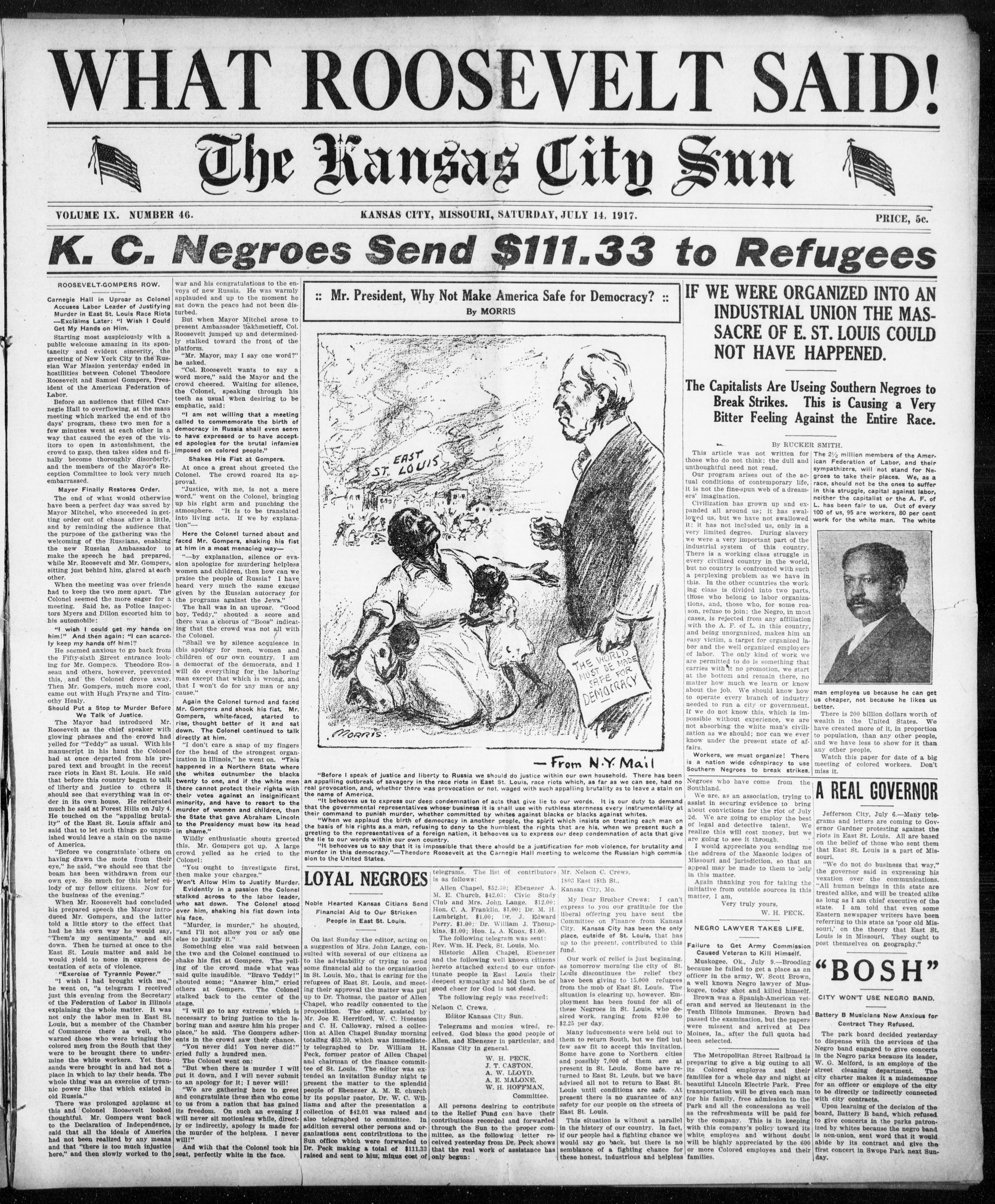
Mr. President, Why Not Make America Safe for Democracy? By MORRIS
EAST
ST. LOUIS
THE WORLD
MUST BE MADE
SAFE FOR
DEMOCRACY
MORRIS.
"Before I speak of justice and liberty to Russia we should do justice within our own household. There has been an appalling outbreak of savagery in the race riots in East St. Louis, race riots which, as far as we can see, had no real provocation, and, whether there was provocation or not, waged with such appalling brutality as to leave a stain on the name of America.
"It behooves us to express our deep condemnation of acts that give lie to our words. It is our duty to demand that the governmental representatives whose business it is shall use with ruthless sternness every instrumentality at their command to punish murder, whether committed by whites against blacks or blacks against whites.
"When we applaud the birth of democracy in another people, the spirit which insists on treating each man on the basis of his rights as a man, refusing to deny to the humblest the rights that are his, when we present such a greeting to the representatives of a foreign nation, it behooves us to express our deep condemnation of acts that give the lie to our words within our own country.
"It behooves us to say that it is impossible that there should be a justification for mob violence, for brutality and murder in this democracy."—Theodore Roosevelt at the Carnegie Hall meeting to welcome the Russian high commission to the United States.
LOYAL NEGROES
LOYAL NEGROES
Noble Hearted Kansas Citians Send Financial Aid to Our Stricken People in East St. Louis.
On last Sunday the editor, acting on a suggestion of Mrs. John Lange, consulted with several of our citizens as to the advisability of trying to send some financial aid to the organization in St. Louis, Mo. that is caring for the refugees of East St. Louis, and meeting their approval the matter was put up to Dr. Thomas, the pastor of Allen Chapel, who readily consented to the proposition. The editor, assisted by Mr. Joe E. Herriford, W. C. Hueston and C. H. Calloway, raised a collection at Allen Chapel Sunday morning totaling $52.30, which was immediately telegraphed to Dr. William H. Peck, former pastor of Allen Chapel and chairman of the finance committee of St. Louis. The editor was extended an invitation Sunday night to present the matter to the splendid people of Ebenezer A. M. E. church by its popular pastor, Dr. W. C. Williams and after the presentation a collection of $42.03 was raised and also telegraphed to committee. In addition several other persons and organizations sent contributions to the Sun office which were forwarded to Dr. Peck making a total of $111.33 raised and sent to him, minus cost of
telegrams. The list of contributors is as follows:
Allen Chapel, $52.30; Ebenezer A. M. E. Church, $42.03; Civic Study Club and Mrs. John Lange, $12.00; Hon. C. A. Franklin, $1.00; Dr. M. H. Lambright, $1.00; Dr. J. Edward Perry, $1.00; Dr. William J. Thompson, $1.00; Hon. L. A. Knox, $1.00.
The following telegram was sent:
Rev. Wm. H. Peck, St. Louis, Mo.
Historic Allen Chapel, Ebenezer and the following well known citizens hereto attached extend to our unfortunate people in East Louis their deepest sympathy and bid them be of good cheer for God is not dead.
The following reply was received:
Nelson C. Crews.
Editor Kansas City Sun.
Telegrams and monies wired, received. God bless the good people of Allen, and Ebenezer in particular, and Kansas City in general.
W. H. PECK,
J. T. CASTON,
A. W. LLOYD,
A. E. MALONE,
W. H. HOFFMAN,
Mr. Nelson C. Crews, 1803 East 18th St., Kansas City, Mo.
My Dear Brother C express to you our liberal offering you Committee on Finance City. Kansas City has place, outside of St. up to the present, fund.
Our work of relief is as tomorrow morning. Louis discontinues the have been giving to from the mob of East situation is clearing up deployment has been for these Negroes in St. sired work, ranging $2.25 per day.
Many inducements w them to return South, few saw fit to accept. Some have gone to L and possibly 7,000 of present in St. Louis, turned to East St. Louis advised all not to re-t Louis until conditions
All persons desiring to contribute to the Relief Fund can have their contributions recorded and forwarded through the Sun to the proper committee, as the following letter received yesterday from Dr. Peck shows that the real work of assistance has only begun:
Kansas City, Mo.
My Dear Brother Crews: I can't express to you our gratitude for the liberal offering you have sent the Committee on Finance from Kansas City. Kansas City has been the only place, outside of St. Louis, that has up to the present, contributed to this fund.
Our work of relief is just beginning, as tomorrow morning the city of St. Louis discontinues the relief they have been giving to 15,000 refugees from the mob of East St. Louis. The situation is clearing up, however. Employment has been found for all of these Negroes in St. Louis, who desired work, ranging from $2.00 to $2.25 per day.
Many inducements were held out to them to return South, but we find but few saw fit to accept this invitation. Some have gone to Northern cities and possibly 7,000 of them are at present in St. Louis. Some have returned to East St. Louis, but we have advised all not to return to East St. Louis until conditions are safe. At present there is no guarantee of any safety for our people on the streets of East St. Louis.
This situation is without a parallel in the history of our country. In fact, if our people had a fighting chance we would say go back, but there is no semblance of a fighting chance for these honest, industrious and helpless
IF WE WERE ORGANIZED INTO AN INDUSTRIAL UNION THE MASSACRE OF E. ST. LOUIS COULD NOT HAVE HAPPENED.
The Capitalists Are Useing Southern Negroes to Break Strikes. This is Causing a Very Bitter Feeling Against the Entire Race.
By RUCKER SMITH.
This article was not written for those who do not think; the dull and unthoughtful need not read.
Our program arises out of the actual conditions of contemporary life, it is not the fine-spun web of a dreamers' imagination.
The $2\frac{1}{2}$ African sympathies groes to a race, show in this st. neither
Civilization has grown up and expanded all around us; it has swallowed us, but we have not swallowed it; it has not included us, only in a very limited degree. During slavery we were a very important part of the industrial system of this country. There is a working class struggle in every civilized country in the world, but no country is confronted with such a perplexing problem as we have in this. In the other countries the working class is divided into two parts, those who belong to labor organizations, and, those who, for some reason, refuse to join; the Negro, in most cases, is rejected from any affiliation with the A. F. of L. in this country, and being unorganized, makes him an easy victim, a target for organized labor and the well organized employers of labor. The only kind of work we are permitted to do is something that carries with it no promotion, we start at the bottom and remain there, no matter how much we learn or know about the job. We should know how to operate every branch of industry needed to run a city or government. If we do not know this, which is impossible without experience, we are not absorbing the white man's civilization as we should; nor can we ever know under the present state of affairs.
Workers, we must organize! There is a nation wide conspiracy to use Southern Negroes to break strikes.
Negroes who have come from the Southland.
We are, as an association, trying to assist in securing evidence to bring about convictions for the riot of July 2d. We are going to employ the best of legal and detective talent. We realize this will cost money, but we are going to see it through.
I would appreciate you sending me the address of the Masonic lodges of Missouri and jurisdiction, so that an appeal may be made to them to help in this matter.
Again thanking you for taking the initiative from outside sources in this matter, I am.
NEGRO LAWYER TAKES LIFE
Failure to Get Army Commission Caused Veteran to Kill Himself.
Muskogee, Ok., July 9.—Brooding because he failed to get a place as an officer in the army, W. Scott Brown, a well known Negro lawyer of Muskogee, today shot and killed himself. Brown was a Spanish-American veteran and served as leutenant in the Tenth Illinois Immunes. Brown had passed the examination, but the papers were missent and arrived at Des Moines, la., after the full quota had been selected.
The Metropolitan Street Railroad is preparing to give a big outing to all its Colored employees and their families for a whole day and night at beautiful Lincoln Electric Park. Free transportation will be given each man for his family, free admission to the Park and all the concessions as well as the refreshments will be paid for by the company. This is in keeping with this company's policy toward its white employees and without doubt will be highly appreciated by the 600 or more Colored employees and their families.
Very truly yours.
Fugees
GANIZED INTO AN
UNION THE MAS-
ST. LOUIS COULD
HAPPENED.
ing Southern Negroes to
this is Causing a Very
ainst the Entire Race.
R SMITH.
The 2½ million members of the American Federation of Labor, and their sympathizers, will not stand for Negroes to take their places. We, as a race, should not be the ones to suffer in this struggle, capital against labor, neither the capitalist or the A. F. of L. has been fair to us. Out of every 100 of us, 95 are workers, 80 per cent work for the white man. The white man employes us because he can get us cheaper, not because he likes us better.
There is 200 billion dollars worth of wealth in the United States. We have created more of it, in proportion to population, than any other people, and we have less to show for it than any other people. Watch this paper for date of a big meeting of colored workers. Don't miss it.
A REAL GOVERNOR
Jefferson City, July 6.—Many telegrams and letters are coming to Governor Gardner protesting against the riots in East St. Louis. All are based on the belief of those who sent them that East St. Louis is a part of Missouri.
"We do not do business that way," the governor said in expressing his vexation over the communications. "All human beings in this state are treated alike, and will be treated alike as long as I am chief executive of the state. I am told that even some Eastern newspaper writers have been referring to this state as 'poor old Missouri,' on the theory that East St. Louis is in Missouri. They ought to post themselves on geography."
"BOSH"
CITY WON'T USE NEGRO BAND.
Battery B Musicians Now Anxious for Contract They Refused.
The park board decided yesterday to dispense with the services of the Negro band engaged to give concerts in the Negro parks because its leader, W. G. Melford, is an employee of the street cleaning department. The city charter makes it a misdemeanor for an officer or employee of the city to be directly or indirectly connected with city contracts.
Upon learning of the decision of the board, Battery B band, which refused to give concerts in the parks patronized by whites because the negro band is non-union, sent word that it would abide by its contract and give the first concert in Swope Park next Sunday.
PRICE, 5c.
From Our Foreign Correspondents
A. F. and A. M. Mo. Jurisdiction
A. F. and A. M. Mo. Jurisdiction
Officers—1917.
W. W. Fields, Cameron, Mo., Grand Master.
Wm. Green, Plattsburg, Mo., Dep.
Grand Master.
C. C. Clark, St. Louis, Mo., Senior Grand Warden.
Ernest Boone, Louisiana, Mo., Junior Grand Warden.
H. H. Walker, St. Joseph, Mo., Grand Treasurer.
Geo. W. K. Love, Kansas City, Grand Secretary.
Nelson C. Crews, Kansas City, Relief Secretary.
P. L. Pratt, Cameron, Mo., G. L., 1st District.
E. J. Cooper, Mexico, Mo., G. L., 2nd District.
Lodge Directory
G
MASONRY
Rone Lodge No. 25, A. F. and A. M. meets the 1st and 3rd Monday in each month. All Master Masons in good standing welcome. Emmett Spruell, W. M.; C. H. Countee, Sec'y.
G
and A. M., Liberty, M., meets the 2nd and 4th Saturday nights in each month. William Parker, W. M.; Nelson Wallar, Sec'y.
Mt. Olive Lodge No. 53, A. F. and A. M., meets the 2nd and 4th Fridays in every month. Visiting Master Masons are wel- lored H. H. Brown, W. M.; Albert Wilson, Secretary, 1820 Highland.
G
St. Stephens Chapter No. 37,
Royal Arch Masons, Liberty,
Meets at the daycare in
much more detail. H. W. Recorder,
H. P. Wm. Caps, Recorder.
```markdown
```
St. Matthew Commandery No. 17, Liberty, Mo., meets the third Saturday night William Capps, E. C.; W. H. Robinson, Rec. Sec'y.
MPC
IN
MPC
MPC
B. F.
King of the West Lodge
2012 meets first and third
Wednesdays in each month
at 10th and Campbell. C. F.
Wilson, W M.; H. Conway,
588 Tracy Ave., Secy.
D. OF T.
Primrose Tabernacle meets 1st
and 3d Wednesday nights in
each month at Tabor Hall, 1413
Vine street. All Daughters and
Sir Knights in good standing
in the Dotson Hall,
H. P. 1705 E. 12th; Estela Pitts,
C. R. 1815 E. 17th.
MASONIC BUILDING ASSOCIATION
W. G. Mosely, President.
T. G. McCampbell, Vice President.
Wm. Washington, Treasurer.
E. S. Baker, Secretary.
Board of Directors:
T. G. McCampbell, S. H. P. Edwards,
E. G. Lacy, E. J. Rhodes,
T. W. H. Williams, E. S. Baker,
Wm. Washington, R. V. Adkins,
Geo. Johnson, W. G. Mosely,
S. Myers, Richard Harris
Edw. Thompson, R. Fulbright.
Meets fourth Tuesday in each month.
CHURCH DIRECTORY.
Bethel A. M. E. Church, 24th and Flora.
St. Stephen's Baptist Church, 604 Char-
tottle.
Centennial M. E. Church, 19th and
Woodland.
Second Baptist Church, 10th and Charlotte.
Allen Chapel A. M. E. Church, 10th and Charlotte.
Ebenezer A. M. E. Church, 17th and Tracy.
A. Augustine's P. E. Church, 11th and Troost Avenue.
St. John's A. M. E. Church, 1743 Belleview.
Seventh Day Adventist, 23d and Woodland.
St. Monica's Catholic, 17th and Lydia. Vine St. Baptist Church, 1825 Vine St. Ward Chapel A. M. E. Church, 11th and Troost.
Morning Star Baptist Church, 2311 Vine
Highland Avenue Baptist Church, 1111
Hilltop
Centropolis A. M. E. Church, Centropolis, Mo.
St. James A. M. E. Zion Church, 1823
Waltham Ave.
Second Christian Church, 24th and
Woodland.
St. Paul's Baptist Church, 19th and
Highland.
Pilgrim Baptist Church, 614 Charlotte
St.
Pleasant Green Baptist Church, Independence Avenue and Tracy.
Salvary Baptist Church, 12th
Askew.
C. M. E. Church, 1817 Flora Ave.
St. James Baptist Church, 4039 Mill St.
St. James Church, M. E. Church, 43rd and
Prospect Place.
CLARK CHAPEL M. E. CHURCH,
1664 Madison Ave.
First A. M. E. Church, 8th and Neb.
First St. Baptist Church, 8th and
Oakland.
Metropolitan Baptist Church, 9th and Washington.
Bethel A. M. E. Church, Water and Steward Streets.
St. Paul A. M. E. Church, 21st and Riverside.
First Baptist Church, 5th and Neb.
King Solomon Baptist Church, 3rd and State.
Guindaro A. M. E. Church, Quindaro.
Pleasant Valley Baptist Church, Rose-
dale, Kan.
M. M. Church, 9th and Oakland.
A. M. E. Church, 4th and Oakland.
Salter Mission A. M. E. Church, South
Park, Kan.
Second Baptist Church, 24th and Ruby.
Wesley Chapel M. E., 106 Shawnee.
Bethel A. M. E. Church, Rosedale, Kan.
M. Zion Baptist Church, 4th and Virgina.
Bible school at 9:30 a. m.; preaching and Communion at 11 a. m.; Y. P. S. C. E. at 7 p. m.; preaching at 8:15 p. m.; prayer meeting Wednesday at 8:36 p. m.; Christian Woman's Board of Missions Thursday at 2 p. m.
WILLIAM ALPHIN, Pastor.
MME. A. MOORE,
TEACHER OF PIANO and VOICE
For Engagements, Phone
Studio, 1905 East 19th Street.
Bell East 5407.
Printing--
When you want it
Where you want it
As you want it
at
Franklin's, 1309 E. 18th St.
Bell Grand 2988.
Bell Phone Home Phone
E. 2013 E. 4349
Home Phone
E.4349
W. H. HUBBELL
KING COLE
The Aeroplane.
Since the ordinary car does the ordinary things, to take a ride in King Cole 8, one comes out of the past into the present.
Our car is steam heated in winter, air cooled in summer.
Three wise women are happy today because they have found their real preference in toilet preparations. — Quinoleum Quality Products — the most satisfying to Milady's Tollette.
First is the Woman Beautiful who uses Quinoleum Quality Products because she knows with them she will retain her beauty. Second, the Woman Good Looking, who uses them because she knows they will make her beautiful. Third, the Woman Who Does Not Care, really! but uses them because she knows other folk "care" how she looks. They each know "Quinoleum is Queen," no matter which product, it's the nurest in its line.
QUINOLEUM QUALITY PRODUCTS.
Face Bleach and Freckle Remover .25c
Face Cream for Blackheads (anti-
sceptic). .25c .25c
Face Powder, Quinoleum Rose .25c
nail. .50c
Hair Shampoo, liquid. .25c
Hair Grower. .50c
Hair Tonic, liquid. .50c
Camphor ice. .25c
(Sand) face powder (with all $1 order.
State color wanted).
Goods sent by mail upon receipt of
money order.
(Pronounced Quin-o-leum.)
26th and The Parkway, Kansas City, Kan
Bell Phone, West 1757.
The Handy Colored Store
2409 Vine St.
Ladies' and Gent's Furnishing
Goods and Notions
VISIT OUR DRY GOODS AND
HARDWARE DEPT.
BARGAINS
FURNISHING GOODS TURNING
SPECIAL BARGAINS IN OUR
NOTION DEPARTMENT
AND HAIR GOODS.
Help Make Our Store, Your Store, Our
Customers Your Friends
Special Values in Furnishings for
Men, Women and Children.
GIVE US A CALL.
$2.50 In Goods Free.
WE GIVE SURETY COUPONS.
Taylor Holmes & Co.
Mrs. Annie Holmes, Mngr.
2409 VINE ST., Kansas City, Mo.
Bell Phone East 42211
THE KANSAS CITY SUN, SATURDAY, JULY 14, 1917
HELENA, MONT.
By J. H. Hilliard.
St. James Junior Mite Missionary Society elected officers July 1st as follows: Miss Florence Matthews, Pres.; Miss Alice Fisher, Vice Pres.; Miss York, Sec.); Mrs. J. E. W. Clark, Treas. ... Mrs. James Polk left for Oakland, Calif., June 24. ... Mrs. Emma Boxley arrived June 20 and is the guest of her son, Mr. Judge D Hart, 1407 N. Benton Avenue. ... Real work has now begun on the Ebenezer Baptist Church, corner Harrison and Wilder avenues. The rally the 24th was a success. Something more than $1,000 was raised. ... Mrs. Eddie Jennings arrived June 19 and is the guest of Mr. and Mrs. Otha Allen, Cutler street. Mrs. Jennings is from Edmonton, Alberta, Canada. ... Mr. and Mrs. Sykes and young son of Spokane, Wash., are visiting in our city. ... St. James A. M. E. Church Choir rendered some beautiful music on Sunday evening, the 24th. The Choir is vested and under the direction of Mrs. R. M. Hawkins. ... The Alpha Glee Club will give a Musical Comedy some time in August. ... Mr. and Mrs. Claude Pope and children of Anaconda, Mont., are visiting Mrs. Pope's mother, Mrs. Marie Bridgewater, 502 Peosta avenue. ... Mrs. Katie Everett and daughters, Annie and Daisy, the 22 ult. and are the guests of the former's sister, H. J. Sould, 829 Denborn avenue. ... Mr. H. J. Sould returned after a two days' visit East on business. ... The Deputy Supreme Chancellor, Sir J. H. Hilliard, will organize the Amalgamate No. 5, K. of lodge, at Anaconda, Mont., this week. ... Mr. John Atkinson of New Berlin, N. C., is the guest of Mr. and Mrs. H. J. Sould. ... Mrs. Sirius Groves of 115 Cutler street will entertain the Earnest Workers of Ebenezer Baptist Church, on July 9 with a fried chicken dinner. ... Bethsheba Chapter No. 10, O. E. S., installed officers for the ensuing year on June 28. After the installation refreshments were served.
...Mrs. Alta Connell is the guest of Mrs. Will Irvin...Mr. and Mrs. Edw. Miller celebrated their woolen wedding the 22nd ult. and quite a few close friends were present.
HELENA, MONT.
The Knights of Pythias elected their officers Monday, July 2, in Pride of Montana Lodge....Chas. E. Smith of Radesburg, died at the residence of his sister-in-law, Mrs. Hettie Gerrell (nee Groves), at 300 State street, the 7th. He was about 59 years of age and a brother of the late Porter Groves. The funeral was held from the Ebenezer Baptist church. Rev. H. C. Parsons officiated....Mr. J. E. W. Clark is on the sick list....A great protest meeting was held at the St. James A. M. E. church against the law and dastardly acts of the people of East St. ouis, both military and civil authorities and endorsing the statement made by Theodore Roosevelt....Mr. A. E. McGinnis is the winner of the medal of the Fishing Contest at Canyon Ferry the 4th....This is your paper and why don't you Masons subscribe for it?
ROSEDALE. KANSAS.
By Mrs. Rosa Jones.
Mr. and Mrs. Fred Smith and children are spending their vacation in Denver, Colorado, and other western cities....The Sunday school of the Pleasant Valley Baptist church accompanied by the teachers and parents, spent a delightful day picnicing last Monday....No. 2 Club met at the residence of Mr. and Mrs. J. L. Pearson, 2719 West Forty-first street last Tuesday....Mrs. Frank Moore left Thursday evening for Lexington, Mo. to attend the funeral of Miss Ollie Hancocks.
WEIR, KANSAS.
By Mrs. A. R. Phillips.
Rev. Geo. McNeal of Kansas City, Kansas, Grand Master of the U. B. F. & S. M. T. of Kansas Jurisdiction made his annual visit July 4th, to the organizations of this city and found them in a flourishing condition. He delivered a noble address on the work after which a reception was tendered him by the members...Mrs. A. R. Phillips visited Mr. and Mrs. D. Edmonson at Cherokee, Kansas, She also visited Mrs. Vanhood while there and was given much encouragement in her work for the Sun...Mrs. Nancy Bery, wife of Rev. B. F. Berry, died at her home Monday morning at 1:30 o'clock. She leaves a husband, three children, two sisters and two brothers to mourn her loss. She was a member of the Tabernacle and of the St. John Baptist church. Rev. F. H. Prentice officiated. A number of out of town people were in attendance at the funeral...Mrs. H. H. Atkins and Mrs. S. A. Kennel left for Omaha, Nebr., Sunday evening to attend the Grand Session G. U. O. of O. F....Mr. M. Lee was up from Chetopa to his family on Saturday evening and returned Sunday...Mrs. Mary Eatman returned to her home Highland, Kansas, last Thursday, accompanied by her sister-in-law, Mrs. W. L. Johnson...The A. M. E. church had a Rally Sunday and Presiding Elder Smith preached three soul-stirring sermons during the day...Miss Dora Foreman of Cherokee is spending the summer vacation with her grandmother, Mrs. Patsy Goodwin.
SLATER, MO.
By Mrs. Josie Walls.
Miss Athleen Walls visited her uncle in Glasgow, Mo., Saturday and Sunday. Mrs. A. C. Lewis is home again from Oafallow, Mo....Mr. and Mrs. J. T. Walker worshipped at the Second Baptist church Sunday. They live near Orearville, Mo....Rev. R. H. Smith preached a fine sermon Sunday night from Matt. 7:7. The sermon was enjoyed by everyone. Miss Ardena and Miss Edesse Walls are visiting their aunt, Amella Williams of Moberly, this week.
LINCOLN NEBR.
By W W Mosely.
Members and friends of Mt. Zion Baptist church and the A. M. E. church spent the 4th peacefully and socially in their picnic celebration in the City Park. A large crowd spent a major part of the day under the shade, running, swinging, ball playing were indulged features of both the young and older people. The affair was a success....Mr. Dooley of Alabama is in the city this week on some educational mission....Mrs. J. W. Bedell and daughter, Miss Zoel are confined to their home with illness....Last Sunday was quarterly meeting at the Newman M. E. church; Presiding Elder S. A. Stripling was present and Lebanon lodge is preparing to initiate a class in the near future....Mrs. D. Phelps of Omaha spent the 4th in the city....John Galbreath has returned from Kansas City....Amaranth Chapter No. 54 O. E. Star has about completed arrangements for caring for the Grand session July 18-21, and are expecting a large number of delegates. The session will be held in the Grand Army Hall Twelfth and N. streets....Anyone wishing to subscribe for the Sun, call on W. W. Mosely, City Nat'l Bank.
KEYTESVILLE, MO.
July 8 was quarterly meeting dav for Rev. W. D. Wilkins, pastor of the A. M. E. church of this place....This was the fourth quarterly meeting for this Conference year and the fifth year of Rev. P. C. Crews' administration as presiding elder of the Columbia District who was well pleased with the reports, condition of the work and success along all lines. The presence of the Lord was felt throughout the services. Three souls were baptized at the close of the morning service. The elder expressed a feeling of admiration for the work by the church and for the leadership of Rev. W. D. Wilkins and wife, Mrs. Nellie G. Wilkins. When the presiding elder and wife entered the church Monday night they were delighted to see the table, pulpit, organ and church walls all decorated with flowers and foliage. The occasion was a special reception to the presiding elder and wife and members. The program followed by a response from the presiding elder, which was the social feature of the evening, after which refreshments were served to all. A purse was presented the presiding elder as a further token of appreciation. The following program was rendered:
Song, "If There's Sunshine in Your Heart". Choir Invocation.....Rev. W. D. Wilkins Solo.....Miss Lottie Ewing Reading.....Miss Ruth Ray Quartette. Mesdames Eva Redding, Wilkins, Miss J. Pullam and Rev. W. D. Wilkins. Address.....Rev. W. D. Wilkins Quintette. Mr. Geo. Monroe, Misses Hyde, Jane and Emma Lou Pullum and Esther Miller. Reading.....Mrs. Nellie G. Wilkins Trio.....Misses Esther Miller, Jane and Emma Lou Pullum Response.....Rev. P. C. Crews Song and Chautauqua Salute.
ARGENTINE, KANSAS.
Mrs. Ophella Jackson.
The Argentine Choral Society will give a farcical play, "Her Weekly Allowance," and flag drill at the Casino Rink Saturday evening, July 14, under the auspices of the Jeptha Chapter. . . . Rev. A. J. Starnes preached a war subject, "Behild we are in war and the time is now" Monday evening, July 9, at the Second Baptist Church. The Choir, under the direction of Mr. Daniels, rendered very good music...Mrs. Samuel T. Bigman became very ill with neuralgia of the heart Saturday morning, July 7. . . . Mesdames Woodford and Glover were at St. Paul Chapel recently in the interest of the Women's Mite Missionary Society and Mrs. Lillie Lacy with her helpers of the Juvenile Department of the Church are hoping to realize quite a sum from the Tom Thumb Wedding and dinner which they gave Thursday night, July 12, for the benefit of the society. . . . The Needlecraft Club will be entertained by Mrs. Murray, 2214 Ruby avenue, Thursday, July 19. . . . Arthur Jackson, 17-year-old son of a widow living just out of Argentine on the rock road, was drowned while swimming in the Kaw river, near Third and Minnesota avenue, Monday afternoon, July 8. . . . Mr. and Mrs. Philip Ross and daughter, Laura, entertained for Mr. Hardiman at their residence on South 27th street, last Thursday evening. Mr. Hardiman is a member of the Kansas City, Mo., Consistory. . . . Mr. John Wightman was overcome by heat while at work on last Friday afternoon...Mrs. Neely, mother of Mrs. Rogers, is very sick. . . . Mr. Laconte
who has been sick for some time, does not improve very rapidly...Mrs. G. W. Tucker and Mrs. Hattie Keizer have opened a hair-dressing parlor at 2113 Metropolitan avenue...Eight couples, young married people of Argentine, spent quite an enjoyable fishing trip at Zara, Kans., July 4. The catch was very good and aside from an excellent lunch they fried fish and made sherbet.
PLEASANT HILL, MO.
Prof. G. W. Wood of Bristow, Okla., is visiting his parents, Mr. and Mrs. G. W. Wood, Sr....Mr. Giles Wood of Warrensburg spent last Sunday with his brother, G. W. Wood....Mrs. Nelson of Kansas City visited her mother, Mrs. Vina Owens, a few days last week....Mrs. Harry Jackson of Harrisonville visited her parents last week....Prof. E. W. Turner was called to Independence by the death of his uncle....Mrs. Lizzie Snead and Mollie Wilson were called to Kansas City to attend the funeral of their niece....Mrs. Rosa Gipson attended the State B. Y. P. U. Convention at Boonville last week....Mrs. Elmore and children are spending a few days in Kansas City....Master J. D. Lindsay visited Kansas City friends last week....The Masons gave an elaborate supper for their wives at the hall Saturday evening. All enjoyed the evening.
New Orleans, La., July 9, 1917. The teachers and citizens of New Orleans have made large plans for the entertainment of the National Association of Teachers in Colonel Schools, July 25 to 29. First of all, as an indication of their professional interest, over ONE HUNDRED of the city teachers under the leadership of Miss Hattie V. Feger have paid their enrollment fee to the National Association in advance.
The local committee has already chartered the boat for the Saturday outing on the gulf. There are more than fifty pastors of the churches of the city who have already asked for visiting educators as speakers in their various churches on Sunday morning, July 29, and all have arranged to take their entire congregations to the Fain Grounds auditorium for the final address of the week by Doctor R. R. Moten, Principal of Tuskegee Institute. Indications are that Doctor Moten will speak to ten thousand people on this afternoon.
FROM ONE OF OUR BOYS,
Justice for the Negro.
Chicago, June 28.—[Editor of The Tribune.]—"To make the world safe for democracy." This is the tocsin, this the battle cry. Never before has war been waged for a cause so altruistic and humanitarian. Why then should we, despite the high sounding and idealistic platitudes that constitute our doctrine of national life and our casus belli, as well deliberately and iniquitously attempt to alienate and stultify the loyalty of our Negro compatriots? Every edition of the press heralds some new discrimination, some added onus. At a time like this is it either sane, logical or fair?
In a nation of no democratic pretensions would not practices of this nature be censurable to an extreme degree, and in a nation of such alleged liberality as ours are they not unspeakable? Are we not giving the lie to ourselves and fostering the very evils we so vigorously and rhetorically decry?
Where is our much vaunted sense of fair play? Where also is our reason? Have we, in our wave of righteous wrath against "Prussian oppression," forgotten the solemn warning of "a house divided against itself cannot stand?"
May some one, actuated by pure and noble patriotism, arise and fearlessly and trenchantly show us the fallacy and hypocrisy of our position. And in the end may we at home see in operation the theories for the establishment of which abroad we gave so freely and unstintedly of our best blood and substance.
PAUL V. CROSTHWAITE,
3902 South State St.
GOOD SAMARITANS OF GEORGIA
DEBARRAGE NEW JERSEY
Athens, Ga., July 4. - Five thousand negroes were here today to attend dedication of new headquarters building of the Improved Order of Samarians which is just completed at a cost of $35,000 all of which is paid. It is a modern office building of brick with two stores on first floor, twelve suits of offices on the second floor and an auditorium on the third floor and was designed and constructed by negroes. B. J. Davis, of Atlanta, well known in negro fraternal circles, delivered the principal address and urged the white people to give his race better treatment and referred to lynching and insufficient school facilities as some of the causes of negro migration.
With millions of Negroes willing and ready to die for their country in these strenuous times, we should let the world know that they are not to die the death of rats as was the case in East St. Louis. Let some one who has the power show the world that when we sing:
"My country 'tis of thee,
Sweet land of liberty—s
our words are words of truth and not simple poetry, jingled to rythm, meaningless and empty.
KANSAS CITY MUSIC SCHOOL
PIANO, ORGAN, VOICE, HARMONY,
COMPOSITION and HISTORY of MUSIC
All persons wishing to do work in any of the above branches
are asked to enroll now.
SIX WEEKS COURSE — BEGINS MONDAY, JUNE 11
All persons desiring catalogs or wishing further
information may address R. G. Jackson, Box 170
or phone: TEACHERS—
R. G. JACKSON,
Bell phone, West 1032.
MISS BUELAH DOUGLASS,
Bell phone, West 2297W.
MISS ARLENE JACKSON,
Bell phone, West 1102W.
FORMULATED 1900
PORO
HAIR GROWER
MADE ONLY BY
Mrs Amelia Pohlurubo
Malloni
ST. LOUIS
MISSOURI
FOR DANDRUFF, FALLING HAIR, ITCHING
SCALP; GIVING LIFE, BEAUTY, COLOR
AND ABUNDANT GROWTH
THIS STYLE OF DOX ADOPTED JUNE 10, 1915
PRICE: 50 CENTS
PORO COLLEGE COMPANY
3100 Pine Street, Dept. G
ST. LOUIS, MISSOURI
Bell Phone E. 4394Y
Eastern Built
M. E. ESTES, President
General Control
fairing a Special
ONLY ONE
Kansas City records but o
published Negro jeweler, an
A. Willy
9th St. Half block west
Mr. Wilson sells
Watches, Clocks and St
:: and ::
the public satisfactory and
THE Modern Builders Co. A.E. ESTES, President General Contracting Repairing a Specialty
ONLY ONE
The history of Kansas City records but one real, legitimate, competent, established Negro jeweler, and he is J. A. Wilson at 1616 W. 9th St. Half block west of Wyoming St.
BELL PHONE MAIN 2868W
T.LOUIS
via
Missouri Pacific
First Out—First In
Lv. Kansas City.....9:00 a.m.
Arrive St. Louis.....5:30 p.m.
Fast Mid-Day Service
Lv. Kansas City.....11:10 a.m.
Arrive St. Louis.....7:30 p.m.
Direct connections for East and
Southeast.
Convention Night Service
Lv. Kansas City.....10:10 p.m.
Arrive St. Louis.....7:25 a.m.
City Ticket Office, 707 Walnut St.
or at Union Station
Phones:
Bell, Main 6740. Home, Main 6327
R. T. G. MATTHEWS,
Assist. General Passenger Agt.
Office 2460 Waldrond Ave.
Builders Co.
S, President
Contracting
a Specialty
Y ONE
records but one real, legitimate,
jeweler, and he is
Wilson
block west of Wyoming St.
sells
locks and Staple Jewelry
d ::
factory and proper treatment.
---
If Your Business Is Not Worth Advertising,
Palm Beach, Mohair, Serges Tropical Worsteds, Flannels $8.50 $10.00 $12.50 $15.00
Daniel Clothing Co. Boley Building Second Floor 12TH and WALNUT
Subscribe Now for The Sun
NELSON C. CREWS, Editor
New Straw Hats
$1.50 to $2.50
Panamas, $3.50 to $5.50
If you want the business of 40,000 Negroes who spend approximately $200,000 per month
We reach the buying public of both cities and surrounding communities, and we solicit for them only the most reliable firms. The buying public patronizing our advertisers are certain to be treated courteously, find goods as advertised and receive quality and service
Call Our Advertising Representative for Rates Bell Phone East 999 1803 E.18th Street
Silk Shirts, $3.00 to $5.00
Silk Hosiery, 50c.
D. V. D Underwear, $1.00
Soft Shirts, $1.00 to $3.50
thing Co.
Second Floor
12TH and WALNUT
for The Sun
FLOUR
Kelley's Best Beat all the Rest Kelley Milling Co.
THE KANSAS CITY SUN, SATURDAY, JULY 14, 1917.
AMONG THE CHURCHES
AMONG THE CHURCHES
CHRISTIAN CHURCH.
The attendance and spirit of worship were splendid. Special attention is being given to the bible school and Christian endeavor with satisfactory results. Two additions to the church. The regular offering showed great sacrifice and was excellent. $604.65 was raised in the financial rally that closed Sunday. Next Sunday morning the pastor's subject will be "Reading." At night "Looking at the Invisible." Everybody welcome to all the services.
VINE STREET BAPTIST CHURCH.
All services were well attended last Sunday....Mrs. Ella Lawson is improving rapidly. We hope she will continue so....Mrs. Mary Harper of Independence, Mo., a member of our Choir, has been sick for some time, but is now able to take her place in the Choir. We are indeed glad to see her....Miss Clara S. Freemore is preparing a fine program to be rendered Sunday, the 15th, for the benefit of the B. Y. P. U. at 5:00 p. m. Among the splendid numbers will be a lecture by Dr. T. A. Fletcher, one of our leading physicians. Don't fail to come. Ice cream served free.
ALLEGED SON OF LATE BISHOP
TURNER SUES.
Atlanta, Ga., July 3.—The slavery romance case, which was on trial in Judge George L. Bell's division of the superior court the greater part of last week, was last Friday night at 7 o'clock declared a mistrial, the jury standing eleven to one in favor of the plaintiff, Charles Turner, colored, who sought to oust J. S. Flipper, also colored, as administrator of the estate of Bishop Henry M. Turner, whose unrecognized son he claimed to be. The case went to the jury at 10 o'clock Friday morning, June 23. Mahale Friday, an aged colored woman, testified that she was married to Bishop Turner "on master's front porch 'way back in slavery times," and that the plaintiff was a son of the marriage. The estate amounted to
several thousand dollars.
Turner was represented in the suit by Dorsey, Shelton & Dorsey, and Flipper by Reuben Arnold, Lamar Hill and Ben Conyers.
SECOND BAPTIST CHURCH
SECOND BAPTIST CHURCH.
All services were well attended last Sunday. In the morning services the pastor, Dr. Bacote, preached a very interesting and instructive sermon on "Gossip." The Sunday School and B. Y. P. U. are progressing nicely. In the evening worship, Dr. L. K. Williams of Chicago preached a powerful sermon on "God's Goodness." During the day 14 souls were added to the Church....On last Monday night the Interdenominational Ministerial Alliance of both Kansas Cities held its final session for the summer in this auditorium. A large congregation was present. Dr. Williams, pastor of Ebenezer, preached the sermon which was greatly enjoyed and the Second Baptist Church Choir furnished the music. May these great gatherings of God's people of all denominations continue and much good be done for the Master.
The ladies of Bethel A. M. E. Church will serve a Feast of Seven Tables on Birch Lawn Saturday, July 14. Come and feast for 25 cents.
ALLEN CHAPEL.
By Delia H. Mosee.
At the Sunday morning service Dr. Wm. H. Thomas delivered an uplifting sermon from the 109 Psalm, 4th verse. "For my love they are my adversaries but I give myself unto prayer." His subject was "The Life Given Up to Prayer" and much inspiration was gained therefrom. In the evening the sacred concert given by the Choir was splendid and highly appreciated. The ladies who worked in the McCall Magazine Campaign have been rewarded for their efforts, the money from which is to be applied on the Church mortgage. The reports made by the Auxiliaries and Junior Departments to the Quarterly Confer
ence were good. Allen feels happy over the report made by the Mite Missionary Society to the District Conference held at St. John's A. M. E. Church Friday evening, July 20, the pupils of Prof. Jackson will appear in concert in Allen Chapel for the benefit of the Choir fund. This is always a musical treat. It took but a few minutes to lift an excellent collection for our suffering brothers and sisters who were so ruthlessly deprived of their homes and rights in the riots of East St. Louis.
AMERICAN WOODMEN WITHOUT
MISREPRESENTATION
The American Woodmen is the cheapest order to get into and live in and yet the best financed Negro order in the world. The only Negro order in the world whose death rate is as low as 7 per thousand. The only Negro order in the world whose policies valuate at 112 per cent. The law requires only 9 per cent. $3.00 pays all expenses of joining at present including doctor's examination. No taxation or extra assessment. Women and men join the samp camp and receive the same benefits. Woodcraft saves you from the annoyance of insurance agents. While we have an impressive lodge system, our insurance features which include accident, sickness, total disability, burial and death benefits are its special inducements. You ought to join and help support such a worthy institution of your race, especially one that gives employment as well as encouragement to the boys and girls and protection to you. We do not ask you to love any race less, but we do beg you to love your own race best.
MR. L. D. HINES.
Recently appointed state supervisor with his corps of special deputies Professors C. C. Trimble, L. B. Alberson and W. G. Banks, all being men of high moral standing, represent the American Woodmen in its true sense. Office 1513 E. Eighteenth street. Phones, Home Main 3963; Bell Grand 317.
RIOTS AND TENANTRY.
Apparently one of the causes for the race war in East St. Louis is the large influx of negro laborers from the South, laborers attracted by the high wages paid in industries of the North. The same migration of negro lebor is to be observed in most of the northern states. The Negro's exodus from the South is an indication of wrong conditions there. The southern Negroes live as tenants upon the soil owned by landlords who do not till it. We have not developed, in this country, the financial mechanism for allowing tenant farmers to become proprietors by buying, on the installment plan, the land which they work. Perhaps the terrible experiences in East St. Louis will help direct the attention of the country to one of the underlying diseases of our agricultural body.-N. Y. Globe.
Madame Cecil Watts is one of the greatest dramatic sopranos of the race. Hear her.
Vaughan's Values
Perhaps many readers of The Sun would like to know who are taking advantage of these values I offer weekly.
The biggest men in town, they are the ones. Not necessary the man who makes the most money, nor the man largest in size, but every man, rich or poor, who feels that love of wife and family is greater than love of money is a big man. When he reaches the point of buying a home for his family, where the wife can reign supreme, he becomes, indeed, a very big man.
I am selling property right along in the two Kansas Citys. Costs nothing to talk it over. Telephone me, Bell W 1757.
26th and Parkway, Kansas City, Kas.
Freeman's Chapel, Hopkinsville, Ky., was filled with a large and enthusiastic audience Friday night, June 29, to hear Mme. Mae Caesar Porter, the only American prima donna, depicting child life in song. All of Mrs. Porter's numbers were heartily applauded by the audience.
* 1867 1917
*
* HOWARD UNIVERSITY
*
* Stephen M. Newman, A.M.,D.D.
* President.
*
* College of Arts and Sciences.
* A. B. and B. S. Courses.
*
* Teachers' College.
* A. B. and B. S. Courses in Education.
School of Manual Arts and
Applied Sciences
B. S. Courses in
Engineering
Home Economics
Manual Arts
Conservatory of Music.
Mus. B. Courses.
Academy.
Two Preparatory Courses:
Classical
Scientific
Commercial College.
Secretarial Course
Accounting Course
General Course
PROFESSIONAL SCHOOLS.
School of Theology.
B. D. Courses
Diploma Course.
School of Medicine.
M. D. Courses in Medicine
D. D. S. Courses in Dentistry
Phar. D. Courses in Pharmacy
For catalogue address
HOWARD UNIVERSITY
Washington, D. C.
THEKANSASCITYSUN PUBLISHED WEEKLY
All communications should be addressed to The Kansas City Sun, 1803 East 18th Street.
Bell Phone East 999.
Entered as second-class matter, August
—, 1908, at the postoffice at Kansas City,
Mo., under the act of March 3, 1879.
Nelson C. Crews.....Editor and Owner
Willa M. Glenn.....General Manager
SUBSCRIPTION RATES:
One Year ..... $1.50
Six Months ..... .78
Three Months ..... .60
ADVERTISING RATES, $2.00 PER INCH
PER MONTH.
MEMBER
NATIONAL NEGRO PRESS
ASSOCIATION.
EDITORIALS
"Rah for "Teddy."
Thus far the good President has not spoken concerning the East St. Louis outrages, but, boys, did you hear what Teddy said?
The invitation, "Come Back Home," set up by the frantic southern press must provoke much merriment among those north-going colored people whose relatives have been maimed, shot and burned by Georgia and Carolina mobs.
* Finally, sir, we shall not fight * our battles alone. There is a * just God who presides over the * destinies of nations and who * will raise up friends to fight for * us—Oliver Wolcott. *
It is pointed out by a Tennessee paper that fewer Negroes than whites claimed exemptions in the military registration. This is easily understood when it is borne in mind that the life of a black man is far more secure upon the German war front than in his home in Memphis.
When the superintendent of the Schenectady, N. Y., electric light company employed Wendell King, an intelligent Negro graduate, in a clerical position in the corporation, six thousand poor white men immediately went upon a strike. The company stood nobly by the young colored man and the six thousand p. w. m. went back to work.
* Youth of America, the curse
* of ages will rest upon you if
* ever you surrender to foreign
* ambition or domestic lawlessness
* the precious liberty for
* for which your fathers bled.—
* John Mitchell Mason.
One of the most amusing things that we have recently come across is a paragraph from the inaugural address of Gov. Hugh M. Dorsey of Georgia in which he declares that better educational facilities must be made for Negro children "as soon as we are able." He doubtless means that such facilities should be made a few days before Judgment.
As brutal and inhuman as the people claim the Germans are, they are angels in comparison to those inhuman wretches in East St. Louis, and the whole police force and state officials deserve to be legally hanged for the part they played in aiding the mob.—Portland Advocate.
* For to give up essential lib-
* erty to obtain a little temporary
* safety is to deserve neither lib-
* erty nor safety.—Benjamin
* Franklin.
WOULD 'LOSE' EAST ST. LOUIS.
St. Louis Representative Will Ask
New Name for Illinois City.
Washington, July 11.—Representative Dyer of St. Louis today announced
he would ask Postmaster General Burleson to issue an executive order
changing the name of the postoffice at East St. Louis, Ill., where race riots
recently occurred.
St. Louis residents, Dyer said, are
being embarrassed by the prevalent
belief that the two cities are one.
Dr. J. T. Caston of St. Louis, Mo. who arrived here Monday morning to attend a meeting of the Western College Board of Trustees of which he is President, received a slight stroke of paralysis immediately after reaching the union station and hurriedly taken to the Y. M. C. A. by friends accompanying him where he was under the care of Dr. J. F. Shannon until Wednesday evening when he left for his home accompanied by his son who resides in this city. The stroke was not very severe but being his second attack his friends were very much alarmed, but he was in fairly good condition when he started home.
* Justice, equal and exact, to all * men, of whatever state of per- * uasion, religious or political.— * Thomas Jefferson.
---
Betty & Sam's Little Corner
MISS CURTIS
—That the fellow who is looking for trouble rarely fails to find it.
—That quite often the people you do the most for are the ones who prove to be the most ungrateful. True, brother, true.
—That every local Colored woman in Kansas City is expected to register July 28. Be ready!
—That the Organization of Neighborhood Improvement and Protective Clubs should begin at once.
—That it's not very edifying to see a lot of men and boys lolling around the entrance of the Y. M. C. A. Go in or get away. It looks bad.
—That when a fool Negro orders a closed car for a white girl he is usually preparing a closed cell for himself.
—That those mothers who send their children into the public parks unattended and allow them to stay all day and far into the night deserve to be severely criticized, and need expect no sympathy if their children go wrong.
—That eventually the whole race will be charged AND MADE TO PAY for the disgusting and disgraceful conditions prevailing around 18th and Forest. What's the matter with the police?
---
That if the resolution should pass, introduced by Congressman Dyer, to change the name of East St. Louis so that it will not bring embarrassment upon Missourians and especially the citizens of St. Louis, in view of the demoniacal conduct of its citizens recently, it should be named H—l.
Rooms to Rent
Wanted—Children to care for by the day or week. 1514 E. Tenth street. Bell phone, East 1147-J.
For Sale—A new Duntley Carpet Sweeper taken on advertisement. Cost $6.00; will sell for $2.00.
WANTED.—Two good Colored barbers. Apply 910 East 12th street.—N. Smith.
For Sale—Phonograph, forty cylinder records; just the thing to please the children and keep them at home. Only $4.00. Cost $25.00.
For Rent.—Two beautiful four-room flats, modern, 1010 Vine and 1324 Vine street. Bell phone, East 4067-J. Mrs. A. E. Jenkins.
For Sale by Owner—Frame duplex; 8 rooms; 35 ft. front; water, gas and sewer; Colored neighborhood; $1,600.00. $100 down and $15.00 a month, with interest. 2115 Bellefontaine, Kansas City, Mo.
FOR RENT — 5-room; newly decorated, $12.00.
FOR SALE — 6-room brick, bath and cellar. Lot 50x130. Barn and chicken house. City water. Price, $2,000.
FOR SALE—Two vacant 25-foot lots.
CALL 2810 NORTON AVE. or BELL PHONE, EAST 2486W.
MR. COLORED MAN
BUY A HOME ON EASY
Seven-room house, 2-story, full cement basement, city water and electric light up and down stairs, newly painted in and outside; large lot 50x 120 ft. Near the Saint Clair Oil Refining Company in Argentine and should rent at $20 per month to two families.
Must sacrifice on small payment down and $15 per month. See us at once.
FARM & CITY EXCHANGE
3013 Strong Ave., Argentine, Kas.
Bell phone, Argentine 530.
THE KANSAS CITY SUN. SATURDAY. JULY 14. 1917
Negro Business and Professional Directory of Greater Kansas City
BAKERIES.
MRS. SUSIE OWENS, 2331 Vine street. Bell phone, East 5017.
BARBER SHOPS.
LABORING MEN'S BARBER SHOP, W. F. O'Bonnon, Prop., 558 Grand avenue.
BEAUTY PARLORS AND HAIR DRESSERS.
MRS. CORA D. WILLIAMS, Poro Hair Dresser, 1714 E. 13th Street. Bell phone, East 3610J.
MRS. SUSIE P. GIPSON, 1725 Michigan avenue, Poro hair dresser. Bell Phone, East 3058J.
MRS. MINNIE DOYLE, Poro Hair Dresser, 2732 Highland avenue. Bell phone, East 1346W.
MRS. ETHEL E. WILSON, 1008 Woodland. XX Century Hair Dresser. Bell phone, E. 5469W.
MRS. DELILAM M. S. DOTTREY, 1102
Highland avenue. Poro Hair Dressers.
Bell Phone East 4151J.
MRS. F. A. COOK, Poro Hair Dresser
1226 Vine street. Bell phone, E
2820.
CAFES.
MRS. H. W. DOTSON, 1705 East 12th,
Bell Phone, E. 2214.
DELMONICA CAFE, 1512 East 18th
street. Bell phone, East 618.
COAL AND FEED.
W. W. PAYNE, 19th and Vine streets,
Bell Phone, East 559. Home Phone,
East 4132.
FLORISTS.
CROSTHWAIT, FLORAL CO., 1501 E.
Ninth. Bell phone, East 272.
LAWYERS.
C. H. CALLOWAY, 601 Delaware,
Home phone M. 58, Bell phone Main
448. Practices in all courts.
W. C. HUESTON, 601 Delaware, Home
phone, M58, Bell phone Main 448.
Legal advice. Practices in all
courts.
E. A. SHACKLEFORD, Attorney at
Law, 511 Minnesota avenue, Kansas
City, Kas. Bell phone, West 3866.
JEWELERS.
J. A. WILSON, 1616 W. Ninth street Kansas City, Mo. Bell phone, Main 6248R.
PHOTOGRAPHERS.
J. E. MILLER STUDIO, 1622 East Eighteenth street. Bell phone, E. 91.
REAL ESTATE and EMPLOYMENT.
COLORED PEOPLES INVESTMENT CO., Solomon Smith, Pres., 2122 Vine St. Bell Phone, East 1011 Home Phone, East 4011.
A B C EMPLOYMENT AND INVESTMENT CO., 500 Minnesota avenue. (Upstairs) Kansas City, Kas. Bell phone, West 1743; Home phone, West 1036. C. W. Neloms, Mgr.
H. L. KINSLER, 918 East Twenty-first street. Bell phone, Grand 42043.
SHOE STORE.
G. A. PAGE'S SHOE STORE, 1507 E. Eighteenth street. Bell phone, East 1328.
SHOE REPAIRING.
ELECTRIC SHOE & REPAIR SHOP,
J. C. Banks, Prop., 1514½ East Eighteenth street. Bell phone East 4939.
TAILORS.
RALPH WORTHAM, Cleaners and Dyers, 19th and Paseo.
UNDERTAKERS.
ADKINS BROS. & GREEN, Nineteenth and Vine streets. Both Phones, East 4349.
I. G. OLIVER, 415 Minnesota avenue, Kansas City, Kansas. Bell Phone, West 4183.
H. B. MOORE, 1031 Independence avenue. Bell phone Main 3398W. Home phone Main 3341.
WATKINS BROS., 1729 Lydia avenue. Bell phone Grand 987. Home Main 7989. Res., Bell East 3281.
Williams Investment Co.
Williams Investment Co.
WE HAVE FOR SALE—A four room cottage at Howard and Garfield for $1,150.00. Terms, $50.00 down and $10.00 per month and interest. Both Phones East 1415. Also at 2325 Michigan a splendid 6-room frame, modern and in good condition. White people moving out of neighborhood will sell for $1,600. Terms to suit. Modern brick near 15th street car line. See Williams Realty Co. for a bargain. For sale, 13th and Euclid, 10-room brick, strictly modern, a bargain.
WILLIAMS INVESTMENT CO.
1704 East Twelfth Street.
Both Phones. East 1415.
CHEAP JOHN'S PLACE
New and second hand goods bought,
sold and exchanged.
Bell Phone, East 3951. 2224 Vine St.
Peerless Hat Works and Tailoring Shop
WE CLEAN AND BLOCK ALL KINDS OF HATS
Try Our $30 Suits for $20
Our $7 Pants for $5
Expert Cleaning and
Dyeing
LADEN & DRAKE.
1610 EASTEIGHTEENTHST.
Bell Phone East 2324
The best place in Kansas City for a Clean, Whole- some, Satisfying Meal
Special Dinner and Lunch at Noon for those employed down town
MRS. PEARL RILEY, Manager MARTIN YOUNG Proprietor
Women, Girls, Earn Money
My Free Book Tells How.
LEARN TO GROW HAIR
Women, Girls, Earn Money My Free Book Tells How. LEARN TO GROW HAIR
Women, Girls, Earn Money My Free Book Tells How. LEARN TO GROW HAIR
[Picture of a woman with dark hair and a white dress. She is looking to the right with a slight smile.]
President of Eloso College Co., 21
Eloso College Co., 21 S. Compton Avenue, St. L
President of Eloso College Co., 21 S. Compton Avenue, St. Louis, Mo.
Season Announcement
1217 Woodland Avenue, Kansas City, Mo.
Everything For Every Lodge. Ask
everything For Every Lodge. Ask
A Wonderful Hair Dresser
One thousand agents wanted. Go
THE STAR HAIR GROWER. This
preparation. Can be used with or wi
ening irons.
Sells for 25c per box—one 25c box
value. Any person that will use a
convinced. No matter what has
your hair just give THE STAR HA
trial and be convinced. Send 25c for
If you wish to be an agent send $1
send you a full supply that you o
with at once; also agents' terms. S
by Money Order to
Everything For Every Lodge. Ask Us.
O
A Wonderful Hair Dresser and Grower
One thousand agents wanted. Good money made. THE STAR HAIR GROWER. This is a wonderful preparation. Can be used with or without straightening irons.
Sells for 25c per box—one 25c box will prove its value. Any person that will use a 25c box will be convinced. No matter what has failed to grow your hair just give THE STAR HAIR GROWER a trial and be convinced. Send 25c for full size box. If you wish to be an agent send $1.00 and we will send you a full supply that you can begin work with at once; also agents' terms. Send all money by Money Order to
Lunch and Sandwiches
MRS. HATTIE LU
TEA
MRS. HATTIE LUCAS RICHARDSON
TEA ROOM
The East 4818 1831
EAST INDIA HAIR GRE
Bell Phone East 4818
THE EAST INDIA HAIR GROWER
Leaves the
of a thousand
Heavy and
Gray Hair to
Iron for Str
Leaves the hair soft and silky. Perfumed with a balm of a thousand flowers. The best known remedy for Heavy and Beautiful Black Eye-Brows, also restores Gray Hair to its Natural Color. Can be used with Hot Iron for Straightening.
Price, Sent by Mail, 50c; 10 cExtra for Postage.
AGENTS' OUTFIT.
1 Hair Grower, 1 Tempel
Oil, 1 Shampoo, 1 Pressing
Oil, 1 Face Cream and
Direction for Selling, $2.
28c Extra for Postage.
1917
MARTIN YOUNG
Proprietor
Girls, Earn Money
See Book Tells How.
TO GROW HAIR
Don't struggle along in un-
congenial employment with
long hours and short pay. Edu-
cate yourself to do work that
has little competition; isn't it
better to spend a half-hour daily
and qualify yourself to do work
that everyone else cannot do.
The fields are large.
50 Cents Per Box
Are seldom equaled and never
excelled
Instructions by mail or in per-
son. Diplomas to graduates.
Agents wanted everywhere;
don't delay, write today.
A penny will do it.
MME. J. NELSON
ELOSO HAIR GROWER
Manufactured Only By
Co., 21 S. Compton Avenue, St. Louis, Mo.
For Every Lodge. Ask Us.
Wonderful Hair Dresser and Grower
One thousand agents wanted. Good money made. THE STAR HAIR GROWER. This is a wonderful separation. Can be used with or without straightening irons.
Sells for 25c per box—one 25c box will prove its due. Any person that will use a 25c box will be convinced. No matter what has failed to grow our hair just give THE STAR HAIR GROWER aal and be convinced. Send 25c for full size box. you wish to be an agent send $1.00 and we will and you a full supply that you can begin work at once; also agents' terms. Send all money Money Order to
THE STAR HAIR GROWER MFRS.
Club and Dinner Parties
NDIA HAIR GROWER Will Promote a Full Growth of Hair; Will also Restore the Strength, Vitality and the Beauty of the Hair. If your Hair is Dry and Wiry Try
EAST INDIA HAIR GROWER
If you are bothered with Falling Hair, Dandruff, Itching Scalp, or any Hair Trouble, we want you to try a jar of EAST INDIA HAIR GROWER. The remedy contains medical proprieties that go to the roots of the Hair stimulates the skin, helping nature do its work. Hair soft and silky. Perfumed with a balm and flowers. The best known remedy for Beautiful Black Eye-Brows, also restores its Natural Color. Can be used with Hot lightening.
Print by Mail, 50c; 10 cExtra for Postage.
S. D. LYONS, Gen. Agt., 314 East 2d St.
Oklahoma City, Okla.
Evanston, III
1831 PASEO
THE SODA SEASON IS HERE Service and Quality are Paramount at the
WHITE-WOOD DRUG STORE
Bring Your Prescriptions to us and be assured of Absolute Accuracy and Fair Treatment.
OUR STOCK IS COMPLETE IN ALL LINES
N. W. Corner 19th and Vine Streets. (Transfer Point)
PHONES—HOME EAST 2293, BELL E. 641.
SERVICE REALTY CO.
Aside from our special line of
Selling, Renting, Leasing and Exchanging
All kinds of Real Estate
We do general Contracting, such as
BUILDING, REMODELING, PAPERING and
PAINTING
Best workmanship and material furnished.
826 East 10th St. Bell phone, Main 4464.
MADAM LYDIA GARDNER'S MAGICAL LIP REDUCER
TRADE MARK
BEFORE
AFTER
MADAM LYDIA GARDNER'S MAGICAL LIP REDUCER
TRADE MARK
BEFORE
AFTER
AGENTS WANTED!
JOPLIN. MO.
"If you have good hair, care for it.
If you have a diseased scalp, treat it.
If you have little or no hair—it's your own fault
and a good reason for quick action."
Madame M. B. Jackson's Wonderful Hair Grower is not a new
discovery, but has been used for years with the best results. Both
temple grower and grower sell for twenty-
Madame M. B. Jackson's Wonderful Hair Grower is not a new discovery, but has been used for years with the best results. Both temple grower and grower sell for twenty-five and fifty cents per box. Also a pressing oil at twenty-five cents per box. Madame M. B. Jackson's Hair Grower can be used with or without straightening the hair. A complete course taught by mail or personal instruction. Work guaranteed. Years of experience. Hair matched by sample. We sell all kinds of hair goods. A six weeks' treatment of Madame M. B. Jackson's Wonderful Preparations will be mailed to any one for one dollar and a half. Mail orders promptly filled. Send two-cent stamp for return mail and literature. Agents wanted. Liberal discount.
A
MRS. ORA WILLIAMS. Assistant
Mme. M. B. Jackson
Mme. M. B. Jackson Send all money orders to Madame M. B. Jackson. For further information call BELL PHONE, E. 3237W or write MME. M. B. JACKSON, 1913 East Tenth St., KANSAS CITY, MO. HOURS: 8 A. M. to 5:30 P. M.
MME. M. B. JACKSON, 1913 East Tenth St., KANSAS CITY, MO.
HOURS: 8 A. m. to 5:30 P. M.
BOTH TIME AND MONEY SAVED AT
LADIES AND GENTS
FURNISHING STORE
CLOTHING FOR CHILDREN ALSO
W. L. MARTINS
1318 East 18th Street
LADIES AND GENTS FURNISHING STORE W. L. MARTINS 1318 East 18th Street CLOTHING FOR CHILDREN ALSO FALL AND WINTER GOODS NOW ON DISPLAY MADAME E. NEFF, Electric Hair Grower
FALL AND WINTER GOODS NOW ON DISPLAY
MADAME E. NEFF, Electric Hair Grower
MADAME E. NEFF, Electric Hair Grower
Guaranteed to Grow Hair in six months.
A. E.
(In business 8 years.)
I cure all scalp diseases and stop falling hair. Write the following for reference:
Mrs. J. A. Hensley, 2443 Tremont Pl., Denver, Colo.; Mrs. Della Burns, 913 Everett Ave., Kansas City, Kans.; Mrs. Laura Fields, 1007 East 17th, Kansas City, Mo.; Mrs. Eliza Bradford, 1704½ E. 18th St., Kansas City, Mo.
Agents Wanted. Write for terms.
MADAME NEFF'S
HAIR DRESSING PARLORS at
1714 EAST 18TH ST.
Bell Phone, East 412W.
CITY NEWS
Watch for date of the "Empty House Dance." It will be great.
The Empty House Dance is the latest fad.
PAY YOUR SUBSCRIPTION.
Hear Madame Cecil Watts at Ward Chapel Friday night.
Mrs. Susie Bates of Oklahoma is visiting her cousin, Mrs. Rena Jones, 1916 Woodland avenue.
Mrs. John M. Dugan of Chicago is visiting her sister, Mrs. W. O. Fisher of Rosedale, Kansas.
Mr. W. G. Banks of San Antonio, Tex., is in the city in the interest of American Woodmen.
Attorney T. W. Bell of Leavenworth, Kan., was in the city last week on business.
Every honest subscriber who feels the necessity of a race paper should pay their subscription if due and help us carry on the work.
Miss Ethel J. Crawford of 2106 Woodland avenue, is visiting Mrs. Rosa C. Gipson at Pleasant Hill, Mo., this week.
Mrs. Wm. Jefferson entertained a few friends Thursday afternoon, July 5, complimentary to Mrs. Minnie DeHaven of St. Louis, Mo.
Miss Christina Smith entertained about30 friends June 27th at a birthday party. Everyone had a delightful time.
WANTED—An experienced lady in hair work and all kinds of beauty culture. Willing to leave the city when necessary. Call Bell Phone, East 2453.
If you miss hearing Madame Cecil Watts at Ward Chapel Friday night, July 20, you will miss hearing one of the greatest events of the season.
Mrs. Claudia Jenkins Wiseman of Oklahoma City, Okla., is visiting her mother, Mrs. A. E. Jenkins, 1324 Vine street, and will return home next week.
Word has just been received that Miss Josephine P. Pinyon, Sumner High School teacher, lost her mother Sunday morning, July 1, at their home in Washington, D. C.
FOR RENT—One furnished front room and one room for light housekeeping. Strictly modern. Bell phone Grand 1856. Mrs. A. Nelson, 1514 Lydia avenue.
Mr. and Mrs. Geo. Smith, 2414 Woodland avenue, announce the marriage of their daughter, Cora, to Mr. Fred Harris of Kansas City, Kans., June 28, 1917.
Enest Thyous, leader of Thyous Orchestra, and Johnny Collins were painfully injured in an auto accident Monday at 15th and Paseo, when a motorcycle they were riding was struck by a Woolf Bros. laundry truck.
Mr. Ralph Timmons of Carthage, Mo., en route to Chicago in his beautiful touring car, stopped over for three days' visit with his sister and brother-in-law, Mr. and Mrs Lawrence Tibbs.
Mrs. Lydia E. Thomas of this city, who was taken seriously ill recently with appendicitis, as soon as able left for Clarinda, Ia., to be with her sister, Mrs. Jas. Pemberton, and at present is improving nicely.
ROOMS WANTED
The Sun has many inquiries each week for rooms, furnished and unfurnished, and persons having rooms for rent would do well to advertise them in this paper if you want quick returns.
Mr. T. A. Ross resigned in June from the American Woodmen as an Organizer. His resignation has been accepted and he no longer represents us.
Miss Minnie DeHaven of St. Louis, Mo., was dinner guest at the home of Mr. and Mrs. C. Horatic Warrick, 1708 East Twenty-eighth street, Sunday, July 8. The guests were: Mr. and Mrs. Jefferson, Mrs. Mamie Anderson. A delightful evening was spent by all present.
The Civic League, composed of representative Colored men, held an executive session at the "Y" Wednesday night. It was decided that an immediate social survey of the Kansas City Negro and his environment should be made and a number of important civic matters touching the Negro were discussed. Next week we shall publish the list of committees and their chairmens.
All persons expecting to attend the Masonic Grand Lodge August 6 to 10,
at Jefferson City, Mo., will please
notify the Rev. John Goins, chairman
of the local committee, 505 Monroe
street, Jefferson City, Mo.
An old-fashioned picnic will be
given at the Heims' Park, East Bottoms, Wednesday, August 1, by the
Sons and Daughters of Jerusalem.
Plenty to eat. Amusements of all kinds. Come and have a good time.
Admission 10 cents.
Harry R. Graham, S. G. K.
T. B. J. Robinson, S. G. S.
We desire to thank our friends for their kindness and sympathy during the illness and death of our beloved wife, mother and sister, Mrs. Mary Harris, also for the beautiful floral offerings.
James M. Harris and family.
Mrs. Birdie Solomon, sister.
SUNDAY SCHOOL C
At Allen Chapel.
The following Sunday School
tist Church, Rev. S. W. Bacote, p.
Rev. W. C. Williams, pastor; Alla
pastor; St. Stephen's Baptist Ch
Pleasant Green Baptist Church, F.
Christian Church, Rev. Wm. Alphif
Rev. Jenkins, pastor; Bethel A. A.
pastor; and First A. M. E. Chur
Griffin, pastor.
The Douglass Hospital Club w
a second prize of $2.50 to the Sun
years writes the best essay on
wishing to contest or for further
MRS. A. E.
1324 Vin
WHY ARE YOU SATISFI
$40 TO $60 WHEN YOU E
WE ARE IN TOUCH WITH
THE CITY. LIST YOUR
Better Your
BUREAU OF DOMES
PHONES
Bell East 4059 150
Home East 5398
"BETTER JOBS FOR
SUNDAY SCHOOL CONTEST, JULY 27.
At Allen Chapel. Admission 10 cents.
The following Sunday Schools are contestants: Second Baptist Church, Rev. S. W. Bacote, pastor; Ebenezer A. M. E. Church, Rev. W. C. Williams, pastor; Allen Chapel, Rev. Wm. H. Thomas, pastor; St. Stephen's Baptist Church, Rev. J. W. Hurse, pastor; Pleasant Green Baptist Church, Rev. J. M. Booker, pastor; Second Christian Church, Rev. Wm. Alphin, pastor; Antioch Baptist Church, Rev. Jenkins, pastor; Bethel A. M. E. Church, Rev. F. D. Wells, pastor; and First A. M. E. Church, Kansas City, Kan., Rev. Dr. Griffin, pastor.
The Douglass Hospital Club will give a first prize of $5.00 and a second prize of $2.50 to the Sunday School whose pupil under 16 years writes the best essay on "Home." Other Sunday Schools wishing to contest or for further information, call
MRS. A. E. JENKINS,
1324 Vine Street.
WHY ARE YOU SATISFIED TO RECEIVE FROM $40 TO $60 WHEN YOU EARN FROM $80 TO $100? WE ARE IN TOUCH WITH THE BEST JOBS IN THE CITY. LIST YOUR NAME WITH US AND
Better Your Condition BUREAU OF DOMESTIC REQUIREMENTS
"BETTER JOBS FOR BETTER PEOPLE"
P. G. Lowery with Carl Hagenback Shows paid a pleasant visit to The Sun office in company with Shad Sprangles, Guy Williams, Eugene Rector and Frank Beatty. Mr. Lowery is looking exceedingly well and is the same finished musician as of yore. He is interested in oil with prospects of a big hit in sight.
Madame Cecil Watts the famous soprano and Gospel singer will give her wonderful musical dramatic rendition of "The Transgressor" at Ward Chapel, Twelfth and Woodland, Friday evening, July 20, for the benefit of the Building fund. Admission 15 cents. All invited.
RECITAL by pupils of Allen Chapel Summer Music School, R. G. Jackson, director, Friday, July 20, 8:15 p.m. at Allen Chapel. Playing by advanced pupils, intermediate pupils, by baby pupils, good singing. The recital is promoted by Allen Chapel Choir for the benefit of the choir fund. Admission 10 cents.
Our Evangelist, Rev. F. F. Moten, who has stirred the hearts of thousands of people in Missouri, Kansas, and Colorado this year, will preach at both services Sunday, the 15th, at Allen Chapel. Dr. Wm. H. Thomas, pastor. The Evangelist brings a burning message which will penetrate the hearts of his hearers. Many will remember his sermons last winter during the first Quarterly meeting of this Conference year. The splendid choir of Allen will render some special music for the occasion and the Evangelist list will sing some of his Old Camp Meeting melodies. A shouting time is expected Sunday morning and evening in old Historic Allen.
The Annual Excursion to Leavenworth, Kan., under the auspices of St. Elmo Drill Team of the Order of Ancient Sons and Daughters of Jerusalem will be given Sunday, July 22. 65 cents round trip. Tickets on sale at Montgomery Hall, 1150 Independence Ave., or from any member of team. Cars leave 4th and Minnesota Avenue, Kansas City, Kan., at 9:15 a. m. and leave Leavenworth at 9:30 p. m.
T. B. J. Robinson, Instructor.
Frederick A. Turner, Mgr.
CARD OF THANKS.
MUSICAL TREAT.
MRS. WILLIAM J. DIXON
Hair Dresser and
Manicurist
Scalp treatment a specialty.
Hair dressing on all occasions.
Would like her friends and old
customers to call her. XX
Hair Preparations used.
Dalhousie Plate No. 1003
★★★★★★★★★★★★★★★
WROTE TO WHITE GIRL.
Negro, Arrested by U. S. Authorities, Admits Sending Letter. R. B. Sales, a Negro, 46 years old, married, and living with his family at 2304 Woodland avenue, was arrested yesterday by J. M. Donaldson, post office inspector, on authority of Francis M. Wilson, United States district attorney. Sales was charged with
CONTEST, JULY 27.
Admission 10 cents.
cols are contestants: Second Bap-
pastor; Ebenezer A. M. E. Church,
allen Chapel, Rev, Wm. H. Thomas,
church, Rev. J. W. Hurse, pastor;
Rev. J. M. Booker, pastor; Second
in, pastor; Antioch Baptist Church,
A. M. E. Church, Rev. F. D. Wells,
arch, Kansas City, Kan., Rev. Dr.
I will give a first prize of $5.00 and
sunday School whose pupil under 16
"Home." Other Sunday Schools
for information, call
ATTED TO RECEIVE FROM
WE EARN FROM $80 TO $100?
WITH THE BEST JOBS IN
OUR NAME WITH US AND
Your Condition
STATIC REQUIREMENTS
SECOND FLOOR
99 E. 18TH STREET
Kansas City, Mo.
R BETTER PEOPLE"
sending an improper letter to a 16-year-old white girl employed at the Peet Bros.' Soap Manufacturing Plant where Sales admits he also worked three months last winter. He was given a preliminary hearing by H. L. Arnold, United States commission, and held for the November federal grand jury under $5,000 bond.
In the letter Sales is said to have expressed a desire to "see your smiling face again" and also suggesting that he would "send a closed car if you will tell me where to meet you." Further, it was said, the letter spoke of giving the girl an Easter present and also a birthday present. It was written March 8 last.
To prove to the girl that he was "in a good business," Sales inclosed a card which heralds him as "manager of Armory hall, Cottage and Vine streets." At the bottom of the card is "Telephone for information."
The letter was signed "Bentley Sales." The prisoner, while admitting writing the letter to the girl, pleaded not guilty to the charge. He was proceeded against under the federal obscene letter statute. The fact that Sales is a Negro and married and the girl a white minor, Senator Wilson said, influenced him in filing an information at once.
On preliminary examination Sales admitted that he had written and mailed the letter, but insisted that he meant no harm.
"What did you mean," asked Senator Wilson, on cross-examination, "when you wrote that you would send a closed car for this girl? You knew she was working in the daytime and would have to come over here after night if she came at all."
"I just wanted to see here and ask how all the folks were getting along at the factory," replied Sales.
"You wanted to send a closed car for a young white girl just to ask her that?"
"Yes, sir; that was all. I meant no harm."
The girl and her mother visited the office of Senator Wilson yesterday afternoon. Sales, the girl said, formerly worked as a janitor in the department in which she is employed at the soap plant. Her father is a foreman in the plant.
"No harm has come to my daughter," said the mother, "but I believe it my duty to turn this matter over to the government for prosecution. It may serve to protect other girls from harm. My daughter brought the letter to me as soon as she received it."—Wednesday's Journal.
THE KANSAS CITY SUN, SATURDAY, JULY 14, 1917.
KANSAS CITY, KAS.
Mrs. J. D. Munroe, 917 Freeman avenue, is ill with tonsilitis.
Mr. Cornelius Crump returned from a trip to Little Rock, Ark.
Mrs. Minnie Johnson of Atchison, Kan., is visiting her niece, Mrs. Effie Porter, 1036 Grandview boulevard.
Mr. and Mrs. Collins of 1415 North 10th street have as guest this week Mrs. Pulley of Larned, Kan.
Miss M. Steward and Miss O. Scott made a good report from the S. S Convention as delegate.
Captain Love of the Goodwill Club will give a reception on the members Thursday night at 728 Walker avenue. They reported $201.23.
The Eighth Street Baptist Church was nicely attended Sunday and Rev. Dotson preached a powerful sermon Sunday night.
Mrs. D. H. Jones and Mrs. G. F. Clinton of Crockett, Tex., are visiting their sister and cousin, Mrs. S. T. Thomas, at 1319 N. 8th street.
Mrs. A. B. Stevens, 1016 Barnett avenue, was called to Independence, Mo., last Sunday on account of the death of her brother, John D. Horney, who was ill for a long time.
Mrs. E. M. J. Simms and Miss Elois Simms of Spokane, Wash., are the guests of their daughter and son-in-law, Mr. and Mrs. W. M. Boone, 1023 Freeman.
Mr. J. W. Washington, Lieutenant of No. 3 Hose Co., at Topeka, Kansas, is visiting the members of No. 11 Hose Co. this week. Checker players wanted.
Rev. D. B. Bowren, Rev. Geo. McNeal, Rev. D. A. Holmes and Mrs. F. B. Watson, Superintendent of the First Baptist Sunday School, left Monday for Des Moines, Ia., to attend the Western Baptist Convention.
Attorney E. A. Shackleford returned from Tipton, Mo., where he visited his mother. While there he was entertained with a fishing party and reports a glorious time spent.
Mr. and Mrs. B. L. Thurston, of Tulsa, Okla., teachers of the city schools of Tulsa are visiting their cousins, Mr. and Mrs. G. A. White.
Kansas City was shocked to hear of the death of Wm. Bolden Town send, the well known attorney of Denver, Colo., formerly of Leavenworth Kan. He was sick only a few days. His funeral was held last Sunday at Shorter Chapel, Denver, Colo., under the auspices of the Knights of Pythias of which he was a grand officer. He leaves a wife and two sisters and a host of friends throughout the West. His last professional act was to secure a divorce for Dr. J. H. B. Westbrook, formerly Grand Chancellor of Colorado.
NEGRO BUSINESS
The "Kansas City Spirit" undoubt edly has taken possession of our people since Eighteenth street has been improved. The outlook to me is very encouraging indeed as my business has increased most wonderfully, there fore with the assurance of a generous patronage from a public which has proven its loyalty I have without fear of loss increased my stock of millinery to meet the demand.
MRS. STELLA HUBBARD.
1607 East Eighteenth street.
Take
One
Pain Pill,
then—
Take
it
Easy.
To Head-Off
a Headache
Nothing is Better than
Dr. Miles' Anti-Pain Pills
They Give Relief Without
Bad After-Effects.
"I can say that Dr. Miles' Remedies have been a godsend to me and my family. I used to have such terrible headaches I would almost be wild for days at a time. I began using Dr. Miles' Anti-Pain Pills and never have those headaches any more. I can speak highly of Dr. Miles' Nervine also for it cured one of my children of a terrible nervous disorder. I can always speak a word or for our Remedies and have recommended them to a good many of my friends who have been well pleased with them."
MRS. GEO. H. BRYAN.
MRS. GEC. H. BRYAN,
Jamoville, Iowa.
For Sale by ALIVANTA.
26 Dozens. 25 Cents.
MILES MEDICAL CO. Elkhard, Ind.
STOP! READ! THINK! ACT!!
At last the long-looked-for opportunity has come to you, the opportunity to make the money you have worked for work for you.
Many men and women work for a salary. Most of these put away a few dollars every month and in due time they save enough money to keep them dry during that much-dreaded "rainy day." Some men and women invest their savings in what are known as "gilt-edge securities." In this way they make their savings earn for them four to six per cent a year. A few men and women, men and women with judgment, courage and foresight, put their savings in reasonably safe investments. The savings of these men and women earn for them a great deal of money and frequently they wake up to find themselves rich. It is from the latter class that come the most of our millionaires.
The reason we have so few millionaires is that we have so few men and women who have the courage to back their judgment with their money. The opportunity to make your money work for you is being offered you by the Birth of a Race Photoplay Corporation. Organized for the production of a million-dollar picture to be produced in association with the Selig Polyscope Co. The Selig Polyscope Co., as you know, is one of the oldest and largest film corporations in the world. The "Million-Dollar Mystery," "The Crisis," "The Spoilers," "The Garden of Allah," all speak for the Selig Polyscope Co. This great twelve-reel photoplay, a whole evening's entertainment, is being produced in the spirit of facts, not fiction, sweetness not bitterness. It will portray the days that were, the days that are, and the days that are yet to be. "The Birth of a Race" has for its theme race prejudice. The curse of civilization—the thing which saps energy, weakens efficiency and blocks the way of progress—is fostered prejudice, often blind and without reason which frequently grows into hate—aye, even into war and death—between races and nationalities. The United States is a melting pot; into it are poured all races. Out of it is born a new race—the American—a race which is to make the nation strong or weak. All races that have helped to make America what she is, have suffered and prospered with the other races. No single race has suffered or prospered alone. "The Birth of a Race" will picture all this and moe. In prophetic vision it will bring close the future in which the races—all races—will see each other as they are. It is well known fact, and one which the reader will readily recognize that the motion picture industry has earned more money in the same length of time than any other industry in the world. Today it stands fifth as compared with all other industries in the United States. The following returns will give you an idea as to the importance of the motion picture industry. These reports and earnings are taken from what we believe it be a thoroughly reliable source.
"The Million Dollar Mystery" earned over 700 per cent.
"Traffic in Souls" paid the producer over 3,000 per cent.
"Neptune's Daughter" has paid 1,200 per cent.
"Civilization" has already paid 400 per cent.
"The Spoilers," a Selig production, is reported to have paid 700 per cent, and is still paying.
"The Crisis," a new Selig production, has already paid more than the cost of production.
The opportunity offered you to invest a few dollars in the "Birth of a Race" Photoplay Corporation and share with hundreds of others of all races, the large returns which this picture is sure to give, will not be yours unless you act today. Because we are placing a limited number of shares in each state and when these are sold there will be no more for sale. The first come, the first served. Full information will be sent you concerning how a few shares of "Birth of a Race" photoplay stock can be had o nour easy-payment plan, if you will fill out and mail coupon today:
(Cut out this coupon and mail today.)
Please send me Free and without any obligation on my part full particulars concerning "Birth of a Race" Photoplay Corporation Stock.
Name.....
Address.....
Town.... State.....
Rev. L. K. Williams delivered an excellent sermon at the Metropolitan Church Sunday morning, taking as his text, "I saw the Lord sitting upon his throne high and lifted up." It seemed to reach the needs of all present. Rev. D. A. Holmes preached at the evening service in his usual spiritual way. A large crowd was present throughout the day.
MONEY TO LOAN
Short time money to loan to roominghouse keepers—must have reference. Property owners can obtain a loan thru our agency and pay it back by weekly installments. If your house needs papering, painting or repairing, get a loan and put in its necessary repairs. Our business is strictly confidential. Bell phone. Grand 4204.
CROSSETT
DOCTOR'S SHOE
FLEXIBLE
SHANK
VICI KID
SEAMLESS
BLUCHER
BUNCH MADE
SUPPORTS
"SCAPHOID"
BONE
EXTENSION
HEEL
"MAKES LIFE'S WALK EASY"
TRADE - MARK
Fancy Silk Hosiery for Men and Women
MAIN STREET W. D. WALLACE, I
Standardized Preparation for the Complexion
ALPHINO SNOW CREAM
(Condensed Milk of Almonds.)
Is a Natural Bleach Effect, Removes Tan, S
Treckles and Blemishes, Indicated in Eczema
and Other Skin Diseases.
PRICE.....50 CENTS
A Standardized Preparation for the Complexion
(Condensed Milk of Almonds.)
Produces a Natural Bleach Effect, Removes Tan, Sunburn,
Freckles and Blemishes, Indicated in Eczema
and Other Skin Diseases.
PRICE.....50 CENTS
DOCIA POMADE
A Standardized Preparation for the Hair Renders Stubborn, Harsh Hair Soft and Easy to Arrange Produces a Healthy Growth of Hair. Use with or Without Irons.
A Standardized Preparation for the Hair
Stubborn, Harsh Hair Soft and Easy to A
produces a Healthy Growth of Hair. Use wit
or Without Irons.
PRICE.....50 CENTS
Prepared by
Johnson-Johnson
1614 Lydia Avenue, Kansas City, U. S. A.
SALE by PEOPLE'S DRUG STORE, Pilphin
Peoples' Drug Store
neast corner of Eighteenth Street and the L
Peoples' Drug Store
Peoples' Drug Store
Northeast corner of Eighteenth Street and the Paseo
For twelve years we have served you. We have never substituted nor given you an inferior article. We carry everything in the Drug line, all the latest and best toilet articles. We deliver anything to any part of the city -- promptly -- call us up.
PHONES
East 1814 Home East 4
Bell East 1814 Home East 4082
We carry a complete line of Imported Sinks and Pants Goods. A large stock to select from. We guarantee a perfect fit.
E. W. LADEN & CO. 1431 E. 19th Street
BELL PHONE GRAND 4281
Mr. Well's
Last Will
By JOHN ELKINS
"I want you to draw up my will, Mr. Bagg, and I want it done right away, so's I can get it off my mind. It ain't because I'm thinking of passing away—don't know as I ever felt better in my life—but that brother of mine has been pestering me every day to 'tend to it; so to stop his nagging, I've come. It ain't so much to get anxious about, any way, just a pretty good farm and some thousands in the bank. You see, my lawyer, Daggett, has gone to California, and Mr. Black sent me to you, being I was coming to the city."
The speaker, a man past middle-age, with iron-gray hair and a rugged face, whose firm, angular jaw and protruding under lip set the lawyer to wondering how any amount of nagging could have affected such an obstinate, determined nature, took from his pocket some papers which he proceeded to sort out as though he expected the attorney to at once accede to his wishes and get to work.
"Yes, Mr. Black has been a client of mine," replied Bagg. "As your brother says, it really is a wise thing for a man to make a will, providing for his family."
"I haven't got any family," said Marcus Wells. "All I have is to go to my brother, except a little something to the church. I had a daughter once—" "Dead?" asked Bagg, as Wells paused, looking away.
"No; I reckon it would be better if she was," he answered. "I want you to make this will so hard and fast she can never touch a cent of my money." "That isn't so easy to do. She is the next of kin, and if she chose to break the will by contesting it, she might win, unless it could be proved she was mentally incompetent." "Oh, she's sound enough in the head, smart as a steel trap, and took to her books all right. Her mother died
A woman stands in front of a desk, holding a book and speaking to two men seated at the desk.
Turned Very White, and Stared at the Man Before Her.
when she was ten years old, and she made me promise to give her a good education. Well, she got it, and she was sent to Sunday school and grounded in religion, so that she joined the church when she was only fifteen. I'm a Baptist, and I took considerable pride in thinking I'd brought up a girl that would be a decent, God-fearing woman, and some comfort to me when I got old. She never went to dances nor card-parties, because I don't believe in 'em. She never gave much of any trouble till she got to be near seventeen. Then she got the bee in her bonnet that she wanted to go down to the city and take a business course. I wouldn't hear of any such foolishness. A woman's place is at home, and she could find plenty to do there. The woman I'd had for a housekeeper was getting old and cranky, and I was looking to my girl to be taking her place before long. Well, she got that restless and flighty I saw I'd got to carry a steady hand."
"Didn't she have any recreation or amusements?" asked the lawyer.
"Why, yes; there were the church doings—socials and meetings, and I didn't object to moving pictures—in moderation. I go "myself" sometimes But no theaters. No, sir. I draw the fine there. I never did approve much of her going with that Bowers girl; they weren't church members, but they were among the biggest in the town, and the young folks sort of bragged over being asked there, so I thought I wouldn't put my foot down against her going. I've wished now, a good many times. I had.
"Well, sir, she met a young fellow there, come down from the city to stay over Sunday, and the minute she brought him to the house, I could see he'd taken a shine to her, and likewise that she thought pretty much of him. He was just the sort a girl might get her head turned with; neat as a pin, clothes right up to date, good, straight form, good-looking, and a talker to beat the band. A girl just natur
ally falls for all that stun, and she did.
any time for all that stout, and she did "I liked the young man pretty well, but I wasn't going to let things go too far without finding out something about him and his business. Well, sir, what do you suppose that wolf in sheep's clothing was?" "A confidence man?" ventured the lawyer. "No, sir; an actor! Well, you'd better believe I put down my foot pretty hard and fast. I told him to never enter my door nor speak to my girl again. I never would have believed it, but she went dead against my wishes; she just defied me, and said she meant to marry him whether I gave my consent or not. I told her the day she went off with that man would be the last time she looked on me, and she could think it over and take her choice. She tried once after that to sort of win me over. But my foot was down good and hard. She went with him."
"Married?" quired Bagg.
"I don't know. Those actors aren't particular about that."
"Oh, yes, they are—just as particular as anybody that's decent."
"Do you think so?" asked Wells, in rather a surprised way.
"I know so," was the emphatic answer. "Has your daughter never written or tried to see you?"
"She wrote two letters. Her address was on the outside, and I sent 'em back unopened. That was more'n a year ago, and I haven't seen her for most three."
"What was his name?"
"Bayard Leslie. I don't suppose it was his own—just took it because it sounded fine."
"Bayard Leslie!" repeated the lawyer. "Why he played here. He was a good actor too. The play wasn't a success, it was taken off, he was out of an engagement for a while, then he was ill for a long time, and the Actor's Fund had to bury him. I remember reading all about it at the time, because it was thought to be an unusually sad and pathetic case, he being so young and promising."
The other man bowed his head and looked down.
"So he's dead," he said in an awed tone. "Did it say anything about his wife?"
"I don't remember."
"If he had one it might not have been my girl."
"Did you keep her address?"
"No, I don't know where she is."
"Miss Storey, my stenographer, might know if Leslie left a wife, she knows some stage people. I'll call her."
He touched a button on his desk, and a pretty, businesslike young woman appeared, notebook in hand. Suddenly she stopped, turned very white and stared at the man before her. He eyes were like one seeing a spectre. He gasped out: "That man—"
She broke in quickly: "Don't speak a word against him! Don't you dare! He was the dearest, finest soul that ever lived. Don't come here to set Mr. Bagg against me. I'm earning my living honestly."
"Were you married to him?" asked the father.
For answer she held up her hand with the plain gold band on the third finger. "I will give you the name and address of the minister. I suppose that is sufficient." She turned to go. Then the old man cried out brokenly: "Jessie! don't go! Don't!"
At the appeal in his voice she turned. "Do you want me father?" she asked.
"Yes," he said. And she went into his outstretched arms. "I'll want to make some changes in that will," he called back to the attorney, as the two left the room together.
On Imitating Shakespeare
There's such a divinity doth hedge our Shakespeare round that we cannot even imitate his style. I tried to imitate his manner in the Remorse and when I had done it I found that I had been tracking Beaumont and Fletcher and Massinger instead. It is really very curious, at first sight, how Shakespeare, and his contemporary dramatists seem to write in style much alike; nothing so easy as to fall into that of Massinger and others; while no one has ever yet produced one scene conceived and expressed in the Shakespeare idiom. I suppose it is because Shakespeare is so universal and, in fact, has no manner; just as you can so much more readily copy a picture than nature herself.—Goethe.
Many Woods Sold as Mahogany.
Many woods from the various tropical regions of the world are sold as mahogany, but those to which the name does not rightfully belong are found by the United States department of agriculture to include as many as 67 species of trees, of 41 genera, scattered through 18 families of the vegetable kingdom. True mahogany is the wood of two closely related species, which grow naturally only from the tropical part of Florida and adjacent keys and islands to northern South America. Even true mahogany has many grades and local varieties, with weight varying from 52% pounds per cubic foot for Florida mahogany to 35 pounds for a Mexican kind.
He Did.
"Hugh is awfully tactless, isn't he?" "That's not the name for it. The other day he was shown through Vandergilf's gallery of ancestors and then asked him if he believed in the Darwinian theory."—The Lamb.
Wrong One.
"The man I recommend to you is a person of unflagging industry."
"He won't do. We want somebody to stop trains."
Old Arab Houses In Algeria
MUSEO DE LA MARRAKECHA
LOGGIAS AT EL BARDO
WITHIN a mile or two of Aligiers, and principally in the suburbs of Mustapha
dens old and new grouped upon the hillside and mostly facing the north, whence they derive the coolness of the breezes wafted across the sea. The climate is admirably suited to the majority of what are generally classified as sub-tropical plants, and there seems to be no limit to the fine effects of plant grouping that may be produced. Here in former days the wealthier Moors had their villas, setting out their garden courts and terraces upon the rising ground, and forcing every spring to deliver its precious fluid to the thirsty land. The want of water is a great natural difficulty of the town, and indeed of the whole province, and the Moors have elaborated their system of irrigation principally by means of aqueducts, some of which are of very ancient construction.
The Moorish country house is always placed upon an admirably chosen site, its high walls forming an effective screen from indiscreet eyes, writes H. Inigo Triggs in Country Life. Few flowers are cultivated in its gardens, and those that find a place are chosen for their bright color and the sweetness of their scent—roses, lilies, jasmine, violets, pinks and geraniums. Once planted, they are allowed to romp over trellis and pergola without restraint. Flat, terraced roofs, small windows and walled-in courts sum up the features of every house, and there is complete irregularity both in the arrangement of the rooms and in their shape. Except by accident, no two lines are ever parallel, the shape of the house being decided by the contour of the site, whatever that may be. The only effort at regularity is to give to the central court a form somewhat approaching a square. These interior courts are real gardens in the sense of being delightful retreats where the glare and heat of the day are tempered by the overspreading trellis of greenery into a soft mysterious light and pervading freshness.
The architecture is characteristic of the race, elegant rather than grand; suggesting a delicate and graceful taste and a disposition to indolent enjoyment. The planning of the houses seems to derive more from Roman than Byzantine origins. The former gave the open courts, the latter some of the forms of decoration used in the treatment of floor and wall surfaces.
Interiors Always "Livable."
Arab writers tell us that the private houses of Damascus were built after the fashion of the later Roman houses, whereas in Persia, and especially in Bagdad, the ancient Persian houses served as an example. The principles that governed the planning of both Arab and Moorish houses were derived from classic models; a featureless exterior and an eminently "livable" interior marked the ancient house of Pompell just as they characterize the Moorish house of Algiers. Such external ornamentation as there may be is concentrated upon the entrance.
The apartments are grouped round courts and gardens with an absolute separation of the rooms for either sex, every effort being made to secure privacy both from the streets outside and from neighboring buildings. To this end the windows and bays of the upper floors are carefully screened by latticed meshrebeehys, whence the dark-cyed beauties of the harem might gaze unseen upon the busy life of the streets, or ceremonies and entertainments of the courts below.
The approach to the harem is usually arranged from a special court, or if only one exists, in the part most remote from the entrance to the house. It is usually through a dark vestibule with a seat for the porter, carefully planned to prevent a direct view being obtained into the building.
Beautiful Dienan-el-MuftI.
Djenan-el-Mufti, in Mustapha Superieur, the residence of Mrs. E. W. Arthur, was built between the years 1590-1583 by Hadj-Chaban Pasha, who later recalled to Constantinople and became by Cyprus. The present owner has succeeded in restoring the best characteristics of the Moorish architecture in a most praiseworthy
manner, and the gardens are maintained in a state of perfection which is the final charm of all good gardens. The house is built upon a hillside, and the ground is therefore laid out in terraces connected by quaint little stairways lined with old tiles. It is perhaps the best-known garden at Mustapha, for it is upon a larger scale than most of the others. The order in which it has been kept and the careful attention it has received for many years render it most attractive.
From the house we pass beneath the guardroom and find ourselves in the fountain court paved with tiles, and cloistered on all sides with delicate spiral shafts of exquisite molding, which support a light arcade of pointed arches. The walls are richly encrusted with Tunisian tiles of very fine design representing an arcade supported on columns with conventional vases and flowers, and panels of the same material serve as an effective contrast to the whitened walls.
The fountain court is extended a short distance to form a terrace overlooking the Orangery and the azure sea beyond. A square pool slightly raised above the pavement contains a massive circular fountain with its everrefreshing murmur of falling water.
EI Bardo Is Well Restored.
El Bardo is another example of a well-restored Moorish house. It is approached from the carriage drive by a broad flight of black marble steps with "risers" in blue and green tiles. Entering through an archway beneath a whitewashed mirador we find ourselves in an irregularly shaped court surrounded by oblong reception rooms, each provided with an open arcade with horseshoe arches and slender columns, single and in groups of two and three. In Arab houses such rooms are known as the Mak' ad. They are usually placed on the south side of the court so as to face the north, and were possibly originally derived from the arcades surrounding the courts of the mosque. They are frequently to be met with in Cairo, where they are often placed on the first floor in imitation of the belvederes or open galleries over the sebeels or public fountains.
At El Bardo the largest of the three apartments overlooking the court is a sort of summer salon with a central marble fountain; cushioned seats on three sides form a divan. Other examples we have seen have little open channels of running water freely circulating through the apartment, as at the Alhambra and the Alcazar at Seville. Purple bougainvillea is trained over the lattice covering the windows, and the sun, shining through the masses of flowers, sheds a soothing light into the apartment. At the back of the reception halls is a delicious little Koubah, divaned on all sides and with a mysterious pierced metal lamp hanging from the ceiling.
The raised flower beds are bordered by low walls of gaily colored tiling, and the whole court is paved in black and white marble squares. The quaint old coffee kitchen is arranged in a corner of the courtyard. It has been conscientiously restored, and its rows of shining pots are arranged on a kind of sideboard with tiled sides. Here are the pestle and mortar for pulverizing the berries, and quaint Mussulman charms rudely painted on the wall.
At one end of the loggia is the delightful little sitting room Le Salon de la favorite, with woodwork delicately treated in pale green, blue and red brown. Four windows overlook the garden at the east end of the court, and above the arched entrance gate is the room where the guard was placed to watch the ladies of the harem.
Any absence of color in the plant life is more than compensated for by the richly tiled wall surfaces. A central fountain in an octagonal pool reflects the blue sky, and a large water tank beyond forms an ideal home for the graceful feathery papyrus. High white walls are clothed with a variety of bougainvillea, plumbago and cluster roses, and the tall, battered looking bananas, the latania, phoenix and other palms preserve all the truly eastern features of a garden of the Arabian Nights.
WAS FILLED WITH CURIOSITY
He Was Just Waiting to See Whether Wife Would Carry Out Threat to Go Back to Mother's.
The man was standing behind a tree in front of an apartment house in a cross street when the cop on that beat came pounding along on the sidewalk. It was close to midnight and naturally the cop stopped and looked at the man standing behind the tree.
"Howdy," says the cop, by way of opening conversation.
"You're another," replied the man good-naturedly.
"Whuchuh doin'—waitin' for somebody?" inquired the brave policeman.
"Nope."
"Just standin' there, hey?"
"You've hit it."
"Live near here, do you?"
"Right in there," says the citizen, jerking his thumb in the direction of the apartment house he was standing in front of. The cop looked at him thoughtfully for a minute. "Mebby it's none of my business," he says, "and then again mebby it is. I don't like to go 'round buttin' into anybody's private affairs, but tell me, neighbor, what's your graft, anyhow?" "Well," loosened up the citizen, "if it's a case of me a-tellin' you or you croakin' from curiosity right in front of my eyes, I'll tell you how it is—provided it don't go any further. My wife says to me when I started downtown this evenin', 'If you're not home by midnight I'm gain' to pack up and go right back to mother's. So there!'" "Well," says the con
"Well," repeated the citizen, "It's just about midnight now, and I'm like you—I've got curiosity. I'm waitin' here to see if she's goin' to keep her word."
The cop's curiosity ceased at that point, and he walked on down the street, whistling, without waiting to see the thing out.—Cleveland Plain Dealer.
Insurance Policy and Marriage
"The important thing is that the insurance policy—big or little—should come into every home with the marriage license. It should precede the savings bank account, the home, yes, even new clothes, or butter on the table. No man has a right to take a girl out of her father's home without protecting her from starvation in case of the accident of death.
"There comes the unhappy word again—death. Yet the shadow of it need not rest heavily upon us. The unfortunate thing about a will is that it is associated in the average man's life only with death. It should be associated with life. The time for a man to make a will is today, while he can do it with a smile on his lips, and the jests and good wishes of his witnesses ringing cheerily in his ears. Such a man cannot cheat death of its ultimate victory; but he robs it of its sting, for he has made death powerless to bring poverty and distress to those who are left behind."—Woman's Home Companion.
Hedges vs. Fences.
In many parts of the country hedges are taking the place of fences, and the change is certainly a desirable one from the standpoint of beauty. They require little, if any, more care than a fence, and are equally as serviceable. Of course, we don't mean that hedges are more desirable for fields than fences, but as a surrounding for the house and yard they are preferable. There are two general kinds of hardy hedges, the deciduous and evergreen, but the former is more common in this country and seems to meet with the most favor. In planting deciduous shrubs, a trench 4 feet wide and 6 inches deep should be dug the length of the row. A drainage should then be-provided of broken stone and the bed filled with the best soil it is possible to obtain. In planting, care should be taken to follow the direction given by the nurseryman, so that when the shrubs mature they will be close enough together—Exchange.
Kissing the Black Stone.
As well die a Jew or a Christian as not make the pilgrimage to Mecca, said Mahomet; and no obligation of Islam is more pliously discharged. It is believed that the ritual connected with the visit to the Ka'aba—the "square building"—and the kissing of the black stone go back to days of idolatry, the "time of ignorance" before the new faith bloomed, says the London Chronicle. The black stone, which measures about six inches by eight, is believed to have fallen from Paradise, to have been guarded during the deluge and handed to Abraham by Gabriel when the Ka'aba was built. Certain parts of the ceremonial—the throwing of stones at the devil, and the imitation of Hagar's distracted wanderings in the desert, are supposed to have had significance for the pre-Mohammedan times as well as for Islam.
Meaning of "America."
What does the word "America" mean? Few know. It is derived from the word Amabric, a proper name which represented the old Germanic ideal of heroism and leadership. Then the Norman French softened it to Amaury. Then in Italy they changed it to Amelricum. But the juxtaposition of the "i" and the "r" bothered the Italians, and it became Amerigo, and finally with one "r." Thus it became the name of Amerigo Vespucci, a Florentine merchant and explorer. And it is in honor of his voyages of exploration to the new world that a German geographer, Martin Waldseemuller by name, gave the name America to the continent—Ladies' Home Journal.
NATIONAL CAPITAL AFFAIRS
WASHINGTON.—Quana Washoshn, as his fellow Comanchians know him, or just plain Capt. H. B. Hicks, Comanche Indian chief of Oklahoma, was in the city recently to pay his respects to President Wilson and to offer his services in whatever capacity he might serve during the war, either in this country or in France.
Captain Hicks was chief of the Indian scouts with the recent Pershing expedition into Mexico, and was wounded in one engagement with the Villa forces. Shortly after war was declared he succeeded in inducing 1,000 of his tribe in far-away Oklahoma to remove their paint, cut their hair and garb themselves in the khaki in place of the Indian blankets. These 1,000
men are now in training at Fort Sill, Okla., and away department that will send them for duty in France, or wherever they are most needed.
Captain Hicks is seventy-four years old, but rest and bubbling over with enthusiasm in the thought that to be of service to the country. He realizes that his well-nigh impossible for him to join the forces in there is opportunity for scout duty, he is ready France as he did for the Pershing forces during the war.
Captain Hicks claims to be the son of George rest in a cemetery in Hyattsville, Md. McAlpin was Baltimore merchant and served the government in during the Civil war. He was also prominent in Mission of the country and founder of Oriental, 289, of Captain Hicks points with pride to the fact that Carlisle Indian school. Globe trotter, champion in pedestrian, are some other references that bring a s and cause him to talk of adventures that have made
Capital Society Women Sewing
FOLLOWING the example set by Mrs. Woodrow R. Marshall, wife of the vice president, nearly official circle here devote many hours daily to sewing only this, but they are organizing other women to help in the good work
Okla., and awaiting word from the war
ity in France, on the Mexican border or
mrs old, but remarkably well preserved
the thought that he may have a chance
realizes that his advanced years make it
the forces in actual fighting. But if
he is ready to do just as much in
less during the expedition in Mexico.
son of George McAlpin, whose remains
McAlpin was at one time a wealthy
government in the purchase of supplies
ominent in Masonic circles in this sec-
ental, 289, of Philadelphia.
to the fact that he is a graduate of the
r. champion rifle shot and champion
that bring a smile to his countenance,
that have made his life worth the living.
Sewing for Red Cross
Mrs. Woodrow Wilson and Mrs. Thomas
ident, nearly all of the women in the
tally to sewing for the Red Cross. Not
men are now in training at Fort Sill, Okla., and awaiting word from the war department that will send them for duty in France, on the Mexican border or wherever they are most needed.
Captain Hicks is seventy-four years old, but remarkably well preserved and bubbling over with enthusiasm in the thought that he may have a chance to be of service to the country. He realizes that his advanced years make it well-nigh impossible for him to join the forces in actual fighting. But if there is opportunity for scout duty, he is ready to do just as much in France as he did for the Pershing forces during the expedition in Mexico.
Captain Hicks claims to be the son of George McAlpin, whose remains rest in a cemetery in Hyattsville, Md. McAlpin was at one time a wealthy Baltimore merchant and served the government in the purchase of supplies during the Civil war. He was also prominent in Masonic circles in this section of the country and founder of Oriental, 289, of Philadelphia.
Captain Hicks points with pride to the fact that he is a graduate of the Carlisle Indian school. Globe trotter, champion rifle shot and champion pedestrian, are some other references that bring a smile to his countenance, and cause him to talk of adventures that have made his life worth the living.
Capital Society Women Sewing for Red Cross
Capital Society Women Sewing for Red Cross
FOLLOWING the example set by Mrs. Woodrow Wilson and Mrs. Thomas R. Marshall, wife of the vice president, nearly all of the women in the official circle here devote many hours daily to sewing for the Red Cross. Not only this, but they are organizing oth-
Sewing Circle
tary of the Interior, was the first to
service. She got together those in her
done an astonishing amount of work.
of the secretary of the treasury, is
tion among the women of the treasury,
secretary of state, is taking steps to
the department and the women employed
on, wife of the secretary of agriculture,
assistant secretary of agriculture, are
similar movement in the department of
nomic club composed of the employees
Secretary Lane is honorary president,
stance to Mrs. Lane in perfecting her
in the headquarters of the club, which
through the officers of the club the rank
tment have been reached.
Will Continue to Operate
Failed of passage in the senate in the
press, Director Ralph of the bureau o
a not at all reassuring, as the bureau
Franklin K. Lane, wife of the secretary of the f
organize the women in the federal service. She g
husband's department and they have done an astor
Mrs. William Gibbs McAdoo, wife of the secret
whipping into shape a similar organization among the
department.
Mrs. Robert Lansing, wife of the secretary of f
bring together the officials of the state department o
there, and Mrs. David Franklin Houston, wife of the
and Mrs. Carl Vrooman, wife of the assistant sec
conferring with a view to starting a similar movem
agriculture.
The Home club, a social and economic club con
of the interior department, of which Secretary Lan
has been the greatest amount of assistance to Mrs
organization. Meetings have been held in the headqu
also serves as a clearing house, and through the offi
and file of the employees of the department have be
Government Laundry Will Continue
WHEN the general deficiency bill failed of pass
closing session of the last congress, Director
engraving found himself in a dilemma not at all n
depends ent
Franklin K. Lane, wife of the secretary of the interior, was the first to organize the women in the federal service. She got together those in her husband's department and they have done an astonishing amount of work. Mrs. William Gibbs McAdoo, wife of the secretary of the treasury, is whipping into shape a similar organization among the women of the treasury department. Mrs. Robert Lansing, wife of the secretary of state, is taking steps to bring together the officials of the state department and the women employed there, and Mrs. David Franklin Houston, wife of the secretary of agriculture, and Mrs. Cpll Vroman, wife of the assistant secretary of agriculture, are conferring with a view to starting a similar movement in the department of agriculture. The Home club, a social and economic club composed of the employees of the interior department, of which Secretary Lane is honorary president, has been the greatest amount of assistance to Mrs. Lane in perfecting her organization. Meetings have been held in the headquarters of the club, which also serves as a clearing house, and through the officers of the club the rank and file of the employees of the department have been reached.
Government Laundry Will Continue to Operate
WHEN the general deficiency bill failed of passage in the senate in the closing session of the last congress, Director Ralph of the bureau o engraving found himself in a dilemma not at all reassuring, as the bureau depends entirely on the general deficiency bill to keep on with its work. There were 50,000,000 stamps a day to be furnished to the post office department for the public service; internal revenue stamps to be turned over by the bureau every day amounting to between $1,500,000 and $1,750,000.
Paper money in various kinds to meet the public demand to the face value of $20,000,000 a day on an average must be turned out, and the bureau had orders for $800,000,000 fed.
eral reserve notes. Of United States notes alone the or 1,300,000 notes of various denominations; approve $9,000,000 a day. Mr. Ralph announced he would pre- ever, buying materials subject to appropriation by co- sibility, of course, resting on the secretary of the directions he will continue. The laundry will run work of engraving and printing could not conti- blankets used by the printers are washed there, presses, the covers and other adjuncts necessary to the stamps and money. The towels used by the 4,08 have a fresh towel daily, and the towels, linens an the hospital are washed and sterilized in this launch. This is the largest of the government laundries, room for the plate blankets and absorbent cloths, a to run it besides a woman superintendent, who inspi- dry before it is sent out.
Watchman Didn't Know Distin
A LONG about the middle of the afternoon a tall, small gray mustache left the elevator at the e- building where the council of national defense and quartered. There was a watchman in the hallway.
notes alone the output is 340,000 sheets,
nations; approximately an average of
and he would proceed with business, how-
appreciation by congress, the direct respon-
secretary of the treasury, under whose
dry will run, because without it the
did not continue, for the hundreds of
ashed there, besides the rags for the
is necessary to the work of turning out
used by the 4,087 employees, all of whom
wels, linens and other articles used in
in this laundry.
ent laundries, having a separate drying
cent cloths, and employs 17 operatives
ident, who inspects every piece of laun-
new Distinguished Visitor
mernoon a tall, solidly built man with a
sculptor at the eighth floor of the Munsey
al defense and the shipping board are
eral reserve notes. Of United States notes alone the output is 340,000 sheets, or 1,360,000 notes of various denominations; approximately an average of $9,000,000 a day. Mr. Ralph announced he would proceed with business, however, buying materials subject to appropriation by congress, the direct responsibility, of course, resting on the secretary of the treasury, under whose directions he will continue. The laundry will run, because without it the work of engraving and printing could not continue, for the hundreds of blankets used by the printers are washed there, besides the rags for the presses, the covers and other adjuncts necessary to the work of turning out the stamps and money. The towels used by the 4,087 employees, all of whom have a fresh towel daily, and the towels, linens and other articles used in the hospital are washed and sterilized in this laundry.
This is the largest of the government laundries, having a separate drying room for the plate blankets and absorbent cloths, and employs 17 operatives to run it besides a woman superintendent, who inspects every piece of laundry before it is sent out.
Watchman Didn't Know Distinguished Visitor
ALONG about the middle of the afternoon a tall, solidly built man with a small gray mustache left the elevator at the eighth floor of the Munsey building where the council of national defense and the shipping board are quartered. There was a watchman in the hallway.
chman was about to pursue the stranger
rator. He happened to be a newspaper
ed.
he hall," said the watchman. "I told him
right in."
corridor at a brisk pace. As the watchman was about to pursue the stranger another person stepped from the elevator. He happened to be a newspaper man and he knew the watchman.
"What's the excitement?" he asked.
"I've got to get that guy down the hall," said the watchman. "I told him we were all closed up, but he butted right in."
"Know who he is?" asked the newspaper man.
"No."
"That's General Goethals."
"Gosh!" cried the watchman.
A second later he was making a record sprint down the hall, in the trail of the general.
"Gosh!" cried the watchman. A second later he was making a record sprint of the general.
A second later he was making a record sprint down the hall, in the trail of the general.
A skull in a feathered headdress stands in front of a cloud of smoke and fire.
Mrs. Marshall has organized the wives of senators and they meet every Monday morning in the headquarters of the Red Cross and make surgical dressings, sew on hospital garments or make themselves useful in other ways. Some of those interested in this class are Mrs. Thomas P. Gore, Mrs. Willard Saulsbury, Mrs. Claude Swanson, Mrs. Ralph Gallinger, Mrs. Frank Kellogg and Mrs. Maurice Sheppard, Mrs.
GENERAL
DEFICIENCY
BILL FAILS
IN CONGRESS
Bureau of
Legal Affairs
"Where can I get hold of a stenographer?" asked the visitor.
"The stenographers are all gone," said the watchman, carelessly.
"Then get me a clerk," said the visitor, imperatively.
"Saturday half holidays have begun in government departments," said the watchman. "They're all gone."
The visitor brushed his way past the watchman and started down the
"What's the excitement?" he asked.
"That's General Goethals."
THE RED CROSS-
WHAT-HOW-WHY
By Charles Lee Bryson
S NOW constituted, the American Red Cross is but 12 years old. It was chartered by congress in 1905, and is protected by various laws passed since that date. But it owes its existence, to the convention of Geneva, held in 1863, and the treaty—often called the Red Cross treaty—of 1864, at which a number of civilized nations agreed that each should form an organization for the relief of the wounded in war, and that this organization of each should be respected by all the others.
The most powerful immediate force making for this treaty was a little paper written by Henri Dunant, a Swiss, describing the horrors of the battlefield of Solferino. He visited that battlefield after the French, Italian and Austrian night over it and had left 30,000 wounded to die uncaused for
armies had fought over it and had left 30,000 w amid agonies that cannot be told. Neither surgeons, nurses nor comrades paid any heed to those 80,000 whose tortured bodies lay for days on the field, until death relieved those who could not crawl away.
But Duntan saw—and heard—the horrors there, and he told so much of it that he was able to get the leading nations to send delegates to the Geneva convention, and so started the movement which has now developed into the Red Cross. A fine account of this achievement was in the Red Cross Magazine of May. 1917.
Though now acclaimed a leader in humanitarian work, the United States was then so little interested in the Red Cross that the treaty was not signed until 1882. But in 1905 the government awoke, at least in part, to the opportunity, and chartered the American Red Cross as it is today. The president of the United States is the active head of the Red Cross, and presides at its meetings. But so little influence has politics in this work of mercy that former President Taft is chairman of the central committee, by appointment of President Wilson. And the present writer wishes to say that, though he has been connected more or less closely with headquarters of the central division for two and a half years, he actually does not know the politics of another officer of either national or local organization. Like snakes in Ireland, politics in the Red Cross is not.
The government of the American Red Cross is vested in a central committee of eighteen members, six appointed by the president of the United States, the others elected by representatives of the members. And since the president himself is chosen by the people, the policy of the entire Red Cross is united very closely alike to the government and to the people. Since a central committee of eighteen is too unwieldy to transact routine business with dispatch, power is further concentrated in an executive committee of seven members, of whom five constitute a quorum. The chairman of the executive committee must, by law, be the chairman of the central committee.
How closely the Red Cross is identified with the government is shown by tracing, briefly, the positions held by its officers. As has been said, the president of the United States is president, and he appoints the chairman of the central committee and six of its members. The chairman of the central committee is also chairman of the executive committee of seven. The treasurer of the Red Cross is John Skelton Williams, comptroller of the currency of the United States, and the counselor of the Red Cross is John W. Davis, United States solicitor general.
Under former President Taft on the central committee are such men as Brig. Gen. Charles Bird of the United States Army; Rear Admiral William C. Branisted, surgeon general of the United States navy; Maj. Gen. William C. Gorgas, surgeon general of the United States army; Robert Lansing, United States secretary of state; Franklin K. Lane, secretary of the interior, and Judge W. W. Morrow.
The work of the national organization is carried on under three great departments: One for military relief; one for civilian relief, and one for chapters. The composition of each will be briefly outlined.
The department of military relief is under Col. Jefferson Randolph Kean, United States army medical corps, a grandson of Thomas Jefferson. Under him are the medical bureau, in charge of the medical personnel of base hospitals, the first aid instruction; the nursing bureau, in charge of nurses and nurses' aids for base hospitals, and women's classes in training; the service units to care for soldiers and sailors—ambulance companies, base hospitals, nurse detachments, sanitary detachments and general hospitals; and the Red Cross supply service, for the buying, storing and shipping of all kinds of supplies.
The department of civilian relief is under Ernest P. Bicknell, director general, with a long record of personal service in disaster relief. His department controls all relief work at domestic and foreign disasters of fire, flood and pestilence; the relief of noncombatants in war, both here and abroad; the care of the families of soldiers and sailors; the town and country nursing service; and the sale of Christmas seals for the stumping out of tuberculosis.
The department of chapters is under E. H. Wells, director of chapters. It deals, through the directors of the nine territorial divisions, with the organization of new chapters, and the membership campaigns in those already formed.
The Red Cross Magazine, at first little more than a monthly bulletin which told, briefly, the doings of the organization, has now grown into a splendid publication (valued recently at $1,000,-000), which tells by clear pictures and vivid stories the history of the Red Cross for each month all over the world.
Each member of the Red Cross above the one-dollar class gets the Red Cross Magazine free, part of the dues going to the publication. The circulation, which was only 25,000 three years ago, is now about 200,000, and growing by leaps of 50,000 at a time. It has been predicted by men in the position to know best that within a few years it will be making $250,000 a year clear profit for the Red Cross, instead of costing $10,000 a month, as it did until a short time ago.
Under the national organization at Washington, the territory of the United States is divided into seven great divisions, each under the supervision of a division director, responsible to Washington, and standing between the national officers and the state and local organizations.
The unit of the Red Cross system is the chapter. This always covers some definite territory, usually
A
Very briefly stated, the American Red Cross is an organization to relieve human suffering, and its aim is to prepare, in time of peace and quiet, for its relief work in war, disaster or pestilence.
It works under the protection and with the aid of the government, and, being international in its scope, is recognized by and works in harmony with similar organizations in all civilized countries. But its strength comes from the people directly, who give of their time, their money and their lives to it.
Its reason for being is the same that has called into existence our hospitals, our asylums, our charity organizations—even our physicians—because it stands for a work which must be done and which cannot be done except by preparation in advance. Until the Red Cross was organized, the wounded on the battlefield and the victims of civil disaster alike had to go without care until amateur relief could be organized after the need had become imperative.
a large city or a county—sometimes several counties. The chapter is governed, on a smaller, scale, very much as the Red Cross as a whole is governed. It has its chairman and other officers, its board of directors and its executive committee, in whose hands the active work is carried on. In large chapters an executive secretary usually does most of the active work of the executive committee. Each chapter is divided into a section for military relief and a section for civilian relief, much as the national organization is divided. And each section has its committees to carry out the various activities. The section for military relief has its committees on: Red Cross; instruction; hospital supplies; warehousing and. shipping; supplies for fighting men, and special committees for such work as organizing hospital companies, sanitary detachments, surgical sections and supply depots.
The section for civilian relief has its committees on: Care of families of soldiers and sailors; relief for noncombatants; care of discharged soldiers and sailors; training in volunteer civilian relief, and special committees as needed on local disaster, care of refugees and other kindred subjects.
How the Red Cross operates is perhaps best told by citing some of the concrete examples of its work. To begin with, two of the most recent instances of civilian disaster relief, take the tornadoes which devastated Newcastle and New Albany, Ind., at intervals of about two weeks.
When Newcastle was laid in ruins with the loss of a score of lives, and several hundred persons made homeless and thrown out of work, the present writer, learning the situation through telegraph and long distance telephone messages to the press, notified Division Director John J. O'Connor of Chicago. Within ten minutes Mr. O'Connor was calling for Red Cross nurses, surgeons, trained investigators, and arranging with Washington for whatever funds might be needed to start the work of rescuing the survivors, feeding and housing them, getting them back to work, and collecting, identifying and burying the dead. All night long, from his room in Chicago, he was putting this, that and the other agency to work at the end of a wire, and the dawn of the next day saw order coming out of chaos.
Then, and not before, Mr. O'Connor took train for the scene, and when he arrived, found his orders being carried out. He took personal charge, aided by the chairman and committees of the Indianapolis and other nearby chapters, and the work of rehabilitation went swiftly forward.
While the director was still at Newcastle he received a message that an even worse disaster had befallen New Albany. Again sending orders by wire for surgeons, nurses, investigators and supplies, he took train for the scene of the latest calamity, and again he arrived to find the system already at work. The living were cared for and work found for them, the dead buried, and all with the least possible delay and disorganization of the daily life of the community. The June number of the Red Cross Magazine contains a succinct account of the splendid relief work accomplished. The work of organizing base hospitals illustrates the forehanded methods of the Red Cross.
With a clarity of vision for which the country now blesses him, Colonel Kean called last autumn for the Red Cross to organize for the army and navy with the least possible delay 36 base hospital units. He did not want hospital buildings—what he wanted was 36 units of surgeons, dentists, apothecaries, orderlies, nurses and assistants, with all the cots, mattresses, bedding, laboratory apparatus, bandages, splints, surgical shirts, bed gowns, and the thousands of things that must be had before a single wounded man can be properly cared for. Each of these 36 base hospital units was to be enrolled and trained, all their permanent equipment bought, and all their consumable supplies bought or made, boxed, labeled and stored, so that the whole could be shipped by train or steamer on notice of a day or two.
Instantly, all over the country, the division directors passed the word to their chapters, and the various committees took up the work of forming base hospital units. Under the supervision of Washington itself the surgeons and nurses were chosen and enrolled. Purchasing agents bought at the lowest possible price the equipment. Under each chapter engaged in the work a committee on hospital supplies got standard patterns and specifications from the war department, and set hundreds and thousands of women to sewing on the bandages, wound dressings and hospital garments. All that was long before the United States
HISTORICAL
UNDERWARDS WORK
THE KANSAS CITY SUN, SATURDAY, JULY 14, 1917.
gave up hope of peace. When, finally, the nation declared war, the 36 base hospitals were completely organized, equipped and supplied, and back of them was a great body of men and women trained to the work of keeping them supplied.
That is how the Red Cross works in all its manifold activities. The heads of the organization—and that means the heads of the nation—determine what is needed, and through the division directors to the chapters goes the word of what Washington wants—and instantly the people, on whom rests the Red Cross, begin to supply it.
Belgium was violated, and ten millions of helpless civilians left starving and freezing. The Red Cross to the rescue, and at President Wilson's call money and supplies were raised and sent over to be there distributed by Red Cross agents.
Serbia was crushed, and stricken with typhus fever. There went the American Red Cross, with strong and capable surgeons and skilled nurses, backed by money and medicines and supplies furnished by the Red Cross. It cost the lives of some of the finest of the Red Cross workers, but typhus was stamped out and thousands upon thousands saved.
There was an earthquake at Messina, Italy. The American Red Cross was there with surgeons and nurses, food and clothing—yes, even with portable frame houses "made in America" to house the victims until they could rebuild their homes.
There was a great famine in China. There, too, was the American Red Cross, not only helping feed the starving, but with a commission of some of the most famous engineers of the war department, to whom China intrusted the task of spending $50,000,000 on a system of works to prevent the overflow of the great river which yearly destroyed crops and caused famine.
That is how the Red Cross works.
Why the work is done by the Red Cross is easiest of all to explain, though perhaps least understood by the public. It is because the work of preparing beforehand to meet unforeseen emergencies, and of alleviating human suffering, has never been undertaken by any other agency. In the words of the old saw, "everybody's business is nobody's business."
It seems almost incredible, but after all the centuries of war and agony, no nation in history ever went to war with an organization capable of caring for the men wounded on the battlefield, to say nothing of the victims of rapine, disease, famine and pestilence that stalked across the land after the armies.
Never, until this present year of grace, has there ever been a base hospital organized, in time of peace, to care for the wounded after a battle. There is a small medical corps with the army, yes; but it can merely pass the wounded back to field and evacuation hospitals, giving only a temporary dressing—often not even that. There are always home hospitals, too. But the gap between them, now filled by base hospital organizations, has never heretofore been filled until thousands lay on the field dying of thirst and fever and loss of blood for lack of that very thing.
After the battle of the Marne, in the present war, the Red Cross facilities were so limited that men lay in the scorching sun on the battlefield for two, three, four, and even five, days with not even a drop of water, nor a bandage on their wounds. It cost thousands of arms and legs that could have been saved, cost many a life needlessly spent, and the anguish endured can never be voiced.
That is why the Red Cross is here. It may be said that the governments of the various countries should have met the need. True—but they never did. All governments are more or less bound down by precedent, constitutional and legislative limitations, politics and short-sightedness. And it has now been found that the Red Cross, protected and encouraged by the government, can do quickly and well many things which the government could not do for itself.
Speaking locally and selfishly, there are strong personal reasons why every American should help the Red Cross. In this war, it may be you or me, your brother or mine, whose life is saved by the bandages the Red Cross is making. Here at home, it may be your house or mine blown up or storm-wrecked or flood-swept; your family or mine left destitute by any one of a score of disasters. And in that case we ourselves would benefit by the ministrations of the Red Cross.
From the standpoint of the business man, a strong and active Red Cross is an insurance policy. When disaster comes, it is always the business man who is called from his office or store to take up the unfamiliar task of raising funds, investigating cases of destitution, overseeing the purchase of supplies and their distribution, and getting the survivors back to where they can earn their living again. But with a trained Red Cross the disturbance of normal life is at a minimum. Almost before a citizen's committee could be called together, capable and experienced men, directed by the head of a division, himself under orders from Washington, lays a firm and steady hand on affairs, and relief is given surely, swiftly, justly, and the business man does not have to spend valuable days and weeks at work for which he has no training. Nationally and locally, the Red Cross is the best accident insurance any people can have.
ISN'T THIS SILLY?
"Arch," she of the high arches and arched eyebrows said, archly, "do you love me?" "Why, of course, why shouldn't I, Gladys? You've got the Gladys rags in this town and when I know you're my own little Glad, I'm Gladys I can be."
INTERNATIONAL SUNDAY SCHOOL LESSON
(By E. O. SELLERS, Acting Director of the Sunday School Course of the Moody Bible Institute of Chicago)
(Copyright, 1917, Western Newspaper Union.
LESSON FOR JULY 15.
HEZEKIAH, THE FAITHFUL KING.
LESSON TEXT-II Chron. 30:1.
GOLDEN TEXT—He that copeth to God must believe that he is, and that he is a rewarder of them that diligently seek him.—Heb. 11:8.
The reformation under Hezekiah is one of the bright and attractive spots in the latter history of the kingdom of Israel. It was a most thorough reformation and God set his seal upon it in many wonderful ways. Teachers ought to give their classes a comprehensive view of all that Hezekiah did, as recorded in II Chron., chapters 29-32.
1. Hezekiah's Proclamation. (vv. 1-6). The proper introduction to this lesson would be to return to chapter twenty-nine and note the restoration of the worship of Jehovah. How it began in one man's heart, Hezekiah; how he called the people to be clean (29:15), then called upon a cleansing of the house of God and its restoration (vv. 18, 19). How he called them to renewed sacrifice and worship (vv. 20, 21). The restoration of the sin offering and of the burnt-offering, and the result of these offerings in the Levitical music and In the worship of the great congregation (29, 28). The sequel of song always follows and accompanies a true revival of religion. Having consecrated themselves unto the Lord, Hezekiah sends out this proclamation. The consecration of the people, as referred in chapter 29, was very complete. (See vv. 31-36.) Hezekiah was a man of deep discernment as well as of true pltery. He saw the meaning of the sacrifice of redemption and put the passover forward as the very heart-center of the worship of Jehovah. (See vv. 1, 2.) Who understands God's way of salvation. (See Exodus 12:13-23; I Cor. 5:7, 8; Rom. 3:25, 26; John 1:29.) Hezekiah did not confine his call to those of Israel alone, but extended it beyond to those of Ephraim, thus manifesting the true missionary spirit. Hezekiah had ample Scriptural warrant keeping this passover out of its regular order (vv. 9-13). God is not a God of time or place. Wherever obedience is possible, whether it be a matter of time or not God approves. Hezekiah, however did not act upon his own initiative but sought counsel. (See v. 2.) The man who is the most clearly led of God is the man who is most eager and anxious to know how God is leading other men and will listen most patiently to their counsel. The fact that the people had not "gathered themselves together at Jerusalem" for a long time, might have warranted a further delay. Not so with this enthusiastic young king. He was not bound by precedent, but was anxious to please God.
II. Hezekiah's Exhortation (vv. 7-13). Hezekiah began his exhortation by calling attention to the trespasses of their fathers (v. 7). At the same time he reminds them that if God gave them over to desolation because they themselves were stiff-necked (v. 8) and yielded not themselves unto the Lord to enter his sanctuary, which he had sanctified unto them, they would come under the fierceness of God's wrath, for they had turned from the Lord; they had "trespassed against the Lord God of their fathers." Because of that trespass God had "given them up to desolation." Literally he had made them "an astonishment." This astonishment and desolation was well known, "as ye see" (v. 7). Anyone with eyes open can see today the desolation of individuals, of families, communities and nations who trespass against God. For a generation we have had the deity of Christ and the inspiration of his Word called into question and that the individual man is the dictator of his own conscience and life, and it is because men have departed from their faithful allegiance to Jesus Christ and fail to obey his command, that we see the strife and desolation of today.
The first departure caused people to be "stiff-necked" and Jehovah is calling them to repentance, but they would not hear (see Ch. 36:13; Ex. 32:9; Rom. 10:21). In place of this "stiff-neckness" of their hearts Hezekiah entreats them to turn again to the Lord and not to be stiff-necked as were their fathers (v. 8), that if they will turn again unto the Lord (v. 9) they will find compassion so that they shall again enter his gracious and merciful dealings. Having yielded themselves they were to enter into communion with him and "enter into his sanctuary, which he had sanctified forever."
They were also to serve him. Most blessed results were to follow for them and for their brethren and their children, but all of this bright prospect is conditioned upon repentance, surrender, communion and service, which is based upon the fact that Jehovah "is gracious and merciful" (Ex. 34:6; 7; Ps. 86:5; Jonah 4:2; Mark 7:18). Then, even as now, there were those who would not yield themselves to God's gracious invitation. As the priests passed through the country of Ephraim and Manasseh, even unto Zebulun, they were "laughed to scorn and some mocked" (v. 10).
Fads And Fancies
Of
Fashion
J
ESTABLISHED VOGUE FOR SUMMER FURS.
The vogue of summer furs appears to be established and the globe-trotting public is probably responsible for it. The whereabouts of those who finally make fashion appear to be determined by the variations of the thermometer and these fleet and fleeting seekers after comfort and change, carry their furs with them to the four corners of the globe. While we are looking for reasons for wearing furs in summer weather we are not to overlook the fact that they are amazingly becoming.
variety. It is so very really blue-black and it is the most reserved and in mortal eyes.
The big black hat knw warning favor, either a winter. One of the pre summer models is shore. It is of black sat border of fancy hairb edge which is bound long sweep of slender little emplacement of trimming exactly suite
But furriers have seen to it that fur garments for summer wear look very different from fur garments for winter wear. Summer furs borrow a summary look from crepe and silk liberally used in combination with them. They do not take the business of providing warmth at all seriously, but are made up usually in small, loose-hanging capes, worn as if slipping off the shoulders. Scraps of white fox furnish one instance of a fur piece good for both summer and winter wear and scarfs in dark gray or taupe, appear among summer furs that will be useful in winter. Small ermine capes and small capes of Hudson seal trimmed with ermine, lead the little procession of summer furs and, next to them, capes of
11
I
shirred silk or crepe banded with furs are conceded the place of honor. Of course not everything that calls itself ermine is really ermine, nor need we inquire too closely into the pedigree of all the neck pieces that are called white fox; furriers are amazingly clever people. Imitations of white fox are especially effective and there with small capes like those shown in the illustration are inexpensive little luxuries that no one will begrudge the summer girl.
In July and August summer is crowned with millinery in black and white. The reign of the all-black hat is shared with the all-white hat and with the cool sparkle of black and white combined. This summer that darkest of blues, called after the raven's wing, is used with white as a substitute for black and just by way of
the new colors, trim rosettes of ribbon, the most elegant ty
Pockets are
One of the attractions of silk, shows hanging from the b hip. This girdle pockets are deep, an interesting accessor a new tone to the f hip is worn. It could be of almost any color, the figure in silk or a ric with a white gris skirt it tops is made
---
variety. It is so very dark that it is really blue-black and the combination is the most reserved and elegant thing in mortal eyes.
The big black hat knows nothing of warning favor, either for summer or winter. One of the pretty and simple summer models is shown in the picture. It is of black satin with a wide border of fancy halbraid about the edge which is bound with satin. A long sweep of slender feathers and a little emplacement of ribbon make a trimming exactly suited to the shape.
A large and picturesque hat is of white georgette crepe with a border about the brim and crown of narrow milan braid. White satin camellias and little white roses are wreathed about the crown, with the small roses clustered in the top crown.
The chic small hat of white crepe georgette, faced with black velvet and finished with a border of white feathers about the upstanding brim is as cool and crisp as frost. It is a late summer hat of the kind that may be worn at almost any time and anywhere.
For sports and outings, rough straw sailors in bright and vivid colors are candidates for favor that are sure to win. Along with them appear soft, exquisite felts in wonderful shades of
11
the new colors, trimmed with compact rosettes of ribbon, in outing hats of the most elegant type.
Julia Bottomley
Pockets and Belts.
One of the attractive new girdles, made of silk, shows two deep pockets hanging from the belt, one over each hip. This girdle is wide, and the pockets are deep, and it is one of those interesting accessories that adds quite a new tone to the frock with which it is worn. It could be developed in silk of almost any color, to harmonize with the figure in silk or cotton or linen fabric with a white ground of which the skirt it tops is made.
---
Tom Bass' Famous Horses at Lincoln Park
Something Doing Every Night AT THE Lincoln Electric Park 20th and Woodland
The renowned Tom Bass with
Bell Beach, his Educated High
School Horse. July 17, 18, 19.
DRAKE & WALKER
With Their Great Eastern Musical
Comedy Co. JULY 22-23.
CHOIR CARNIVAL — AUG. 6-11.
MORE COMING.
ATTENTION!
SUNDAY, JULY 15, AT 5 O'CLOCK P. M.
SECOND REGIMENT R
WILL BE ON D
AND R
They will have
Brigadier General
Music by Second
LINCOLN ELECTRIC PARK
The Colerid
Music Settle
N. CLARK S
Voice, Piano, Violi
SECOND REGIMENT KNIGHTS OF PYTHIAS WILL BE ON DRESS PARADE AND REVIEW. They will have as their guest Brigadier General William H. Butler Music by Second Regiment Band. LINCOLN ELECTRIC PARK. 20th and Woodland Ave.
The Coleridge-Taylor Music Settlement School N. CLARK SMITH, Director
Voice, Piano, Violin, Band, Orchestra
(Other String Instruments)
—2626 Highland Avenue—
Bell Phone East 3175
LYRIC HALL FOR RENT
For All Entertainments
—See—
C. H. HARRIS, Mgr.
1731 Lydia Ave.
Bell Phone East 3175
Hours: to 9 a. m., 12 to 1 p. m. Hall phones, Home Main 2783, Bell Grand 3352. Residence, 2624 Euclid Ave. Res. Phone, Bell East 3429W. RATES REASONABLE.
Phones: Home Linwood 2819 Bell East 2486W
Nuway House and
Rugs and carpets clean
waxed. Wall paper cleaned.
Nuway House and Carpet Cleaners
Rugs and carpets cleaned, scoured and sized. Floors waxed. Wall paper cleaned. Vacuum cleaner to rent.
Every Customer Given Satisfaction
Our Prices are Right.
MOON BROS.
MOON BROS.
Wholesale and Retail LIVE AND DRESSED POULTRY, EGGS and GAME
IN ONE EAR AND OUT THE OTHER
Most verbal appeals fall down because people are indifferent to them. Inattention becomes a habit, in one ear and out the other. The very existence of the phrase proves the point. Visual impressions get there and stick.
MOON BROS'.
Live and Dressed Poultry, fresh from the country, can give you the impression through the eye that stick. If you see for yourself, you are sure to become a customer.
TURKEYS, GEES
CALL BELL PHONE GRAN
1335 East Eig
GO TO MOON'S CAFE
TURKEYS, GEESE, DUCKS, HENS
CALL BELL PHONE GRAND 3765 for SPECIAL PRICES
1335 East Eighteenth Street
GO TO MOON'S CAFE----1223 BALTIMORE AVE.
ALEXANDER
NT KNIGHTS OF PYTHIAS
ON DRESS PARADE
AND REVIEW.
have as their guest
General William H. Butler
Second Regiment Band.
MK, 20th and Woodland Ave.
Bridge-Taylor
Tlement School
BK SMITH, Director
Colin, Band, Orchestra
THE MIDDLE SCHOOL
Frank B. Saunders Mgr. 2810 Norton Ave. Land Carpet Cleaners cleaned, scoured and sized. Floors ned. Vacuum cleaner to rent.
N BROS.
KISM FOC
1936
REESE, DUCKS, HENS
BRAND 3765 for SPECIAL PRICES
At Eighteenth Street
1223 BALTIMORE AVE.
THE KANSAS CITY SUN, SATURDAY, JULY 14, 1917.
(At the request of numerous agents and subscribers of the Sun both in and out of the city are reproducing the splendid and stirring poem by Roscoe C. Jamison of St. Joseph, Missouri.)
IN EAST ST. LOUIS.
Tell me, is this Belgium? When this looting, and this terror, is this the Land of Freedom, what means these groans of the night?
Stop, Blackman, and tell me, "We came in peace to labor, We call this Our Country, we are testing out the honor In the South we labored, yet And of mobs, and kangaroo afraid Then the war came, and for he call. And so we came to answer, one We had heard that where Old are free, 'Tis the cry of those who carry So we followed it as Israel did Dreaming how its promise inspire.
But we were met by hoodlums South, And their pass-word, "lynch mouth to mouth. And when we saw them gather cry, We did each of us determine die.
Oh, but it was awful, to behold By the vile marauders like we And one of us lay wounded in When along there came two in the head.
We stood our ground right now And not all "Blacks" in spite Though we had known oppose Liberty, And such a dream brings free."
Tis thus our home-war rages afar, Tell of the mighty struggle, we But the "Blacks" of East St. the sea, Play the star parts in the Democracy."
Belgium? What means the
tide of this terror, this sudden cree
of Freedom, whose foes we
the groans of anguish, this
and tell me, why do you s
pace to labor, but 'tis said of
the Country, we have pledged
out the honor of the great
labored, yet we never got
and kangaroo courts, we
come, and for labor did the
to answer, on the journey
that where Ol' Glory waves
those who carry it to battle,
as Israel did of old the el-
its promise would our
get by hoodlums, Po' White
word, "lynch the nigger,""
mouth.
new them gathering, with the
us determine, like brave r
awful, to behold our women,
auders like wild beasts upo
y wounded in a culbert al-
we came two roughnecks, and
ground right nobly, we foug-
racks" in spite of what the
known oppression, yet
team brings courage, and o
home-war rages, while great
city struggle, where the Nat-
ties" of East St. Louis, and the
parts in this drama
ry."
Tell me, is this Belgium? What means these wild alarms,
This looting, and this terror, this sudden clash of arms?
Is this the Land of Freedom, whose foes we train to fight?
What means these groans of anguish, this screaming in the
night?
Stop, Blackman, and tell me, why do you stand at bay?
"We came in peace to labor, but 'tis said we shall not stay.
We call this Our Country, we have pledged it loyalty;
We are testing out the honor of the great "Democracy!"
In the South we labored, yet we never got ahead,
And of mobs, and kangaroo courts, we were constantly
afraid.
Then the war came, and for labor did the North send out a call. And so we came to answer, on the journey staking all.
Tis the cry of those who carry it to battle cross the sea. So we followed it as Israel did of old the cloud of fire, Dreaming how its promise would our children's hearts
Dreaming how its promise would our children's hearts inspire.
But we were met by hoodlums, Po' White scullions of the South,
And their pass-word, "lynch the nigger," sped along from mouth to mouth.
And when we saw them gathering, with the old time murder ery. We did each of us determine, like brave men, to fight and die.
When along there came two roughnecks, and they shot him in the head.
We stood our ground right nobly, we fought and many fell. And not all "Blacks" in spite of what the daily papers tell Though we had known oppression, yet we dreamed of Liberty. And such a dream brings courage, and courage sets men free."
Tis thus our home-war rages, while great rumb'lings from afar,
Tell of the mighty struggle, where the Nations are at war.
But the "Blacks" of East St. Louis, and the Belgians 'cross the sea
Play the star parts in this drama of the "World Democracy."
BUSINESS OPPORTUNITIES FOR
NEGROES.
The Wet Wash Laundry Business
The Problems of the Business.
(Copyright, 1917, by J. E. Ormes.) The Colored man entering upon this field will be confronted by a wide variety of problems, all of which, training and study, experience and close attention to the operating end of his plant, will enable him to meet and solve. Some of the most important of these problems may be summed up as follows: 1. The problem of location. The problem of location takes on several forms and is influenced by several factors. a. Size of city. Cities with a population of 5,000 to 25,000, and commercial or industrial centers should furnish a market for the services of a wet wash laundry.
b. Water supply. The water supply of the city in which one is to locate should be looked into, and the composition of the water determined. The right kind of water will materially reduce the endless expense and trouble.
c. Fuel Supply. The cost of fuel or power or both should be determined, as excessive fuel or power costs will materially reduce profits.
d. Competition. The extent and nature or competition to be met should be considered. A Wet Wash Laundry competes neither with the rough-dry
CA
OF
EBENEZER
HARP OF ALL
GENEZER CHUR
CARNIVAL
OF ALL NATIONS
EBENEZER CHURCH and KNIGHTS OF
PYTHIAS, COURTS OF CALANTHE
OF THE CITY
At LINCOLN ELECTRIC PARK
This will be the Greatest Pageant of Nations ever attempted here
Crowning of the Queen of the Carnival July 16th
Will be one of the Important Features
Ladies' Band will Furnish Music
JULY 9 TO 16
at means these wild alarms,
this sudden clash of arms?
whose foes we train to fight?
anguish, this screaming in the
why do you stand at bay?
but 'tis said we shall not stay.
have pledged it loyalty;
of the great "Democracy!"
we never got ahead,
courts, we were constantly
abor did the North send out a
the journey staking all.
Glory waves aloft, there men
y it to battle cross the sea.
of old the cloud of fire,
would our children's hearts
ams, Po' White scullions of the
the nigger," sped along from
ring, with the old time murder
like brave men, to fight and
and our women beat
child beasts upon the street;
a culbert almost dead,
boughnecks, and they shot him
obly, we fought and many fell,
of what the daily papers tell—
pression, yet we dreamed of
courage, and courage sets men
, while great rumb'lings from
where the Nations are at war.
Louis, and the Belgians 'cross
this drama of the "World
nor finished laundry, while in a town with several wet wash laundries or wet wash departments in laundries, the competition would likely be keen. Building and its Location. The building in which the laundry is to be located should be suited to the peculiar needs of a laundry. Its location should be determined not so much with relation to the residence or business section of the town as is the case with other branches of the laundry business, but it may be located largely with relation to convenience of collection and delivery of work, and low rental and land costs.
2. The layout and equipment of the plant. The plant should be laid out and the machines installed in such a manner that the work may be passed progressively from one operation to another, from the time of its receipt until it is ready for delivery. By thus planning the layout of the plant much time and money may be saved in operation expenses. The best equipment possible should be secured, and further expansion should be kept in view in its purchase.
3. The problems of operating. The major operating problems outside of those of a mechanical nature are found in the processes requiring a practical experience with or theoretical knowledge of chemicals and chemical compounds and their effect upon various fabrics. A man with ordinary intelligence should be able to master these problems, and can get plenty of advice and assistance from the manufacturer and dealer in laundry supplies.
RNIV
ALL NATI
4. Other problems are to be found at the outset, which, because of their very nature and the variety of the local conditions under which a laundry may be established, will require the close attention and utmost resourcefulness on the part of the owner of the laundry in their solution. Chief among these are:
(a) Development of family wash trade.
(b) Collecting and delivery of work.
(c) Accounting for and controlling costs and fixing prices on the bases thereof.
Developing the Business.
With an established trade in the Wet Wash Laundry business, equal to the capacity of his plant, the proprietor of the laundry is prepared to consider the question of developing his business in one or more of several directions.
1. Equipment may be added to increase the capacity of the plant for handling wet-wash business. Making a specialty of the wet wash business not only enables one to gather experience in that particular line, but development along that line avoids competition with white laundries engaged in other lines of the laundry business.
2. Equipment could be added to handle rough dry and flat work for families. With an established family trade, in the wet wash business, this would be a logical expansion of the business.
3. Equipment could be added to handle finished laundry work, i. e., starched and ironed work.
4. A linen supply department might be added if the size of the city and the demand for that class of service justified it.
5. A dry cleaning department could be added, to serve tailors and cleaning and pressing establishments in outlying districts and villages.
6. A rug cleaning department could be added, and would fit in well with the trade built up among families in the wet wash laundry business.
Experience gained in the wet wash business would place the proprietor in position to develop his undertaking along the lines suggested, especially those lines representing the general laundry business.
For a number of reasons, it would perhaps be best for the Negro laundryman to limit himself to the west wash, rough dry and flat work business for five or ten years, and develop his
Conclusion.
It is believed by the writer that the Wet Wash Laundry business offers a splendid field for Negro men of the proper calibre.
It is said that Mr. Bragg, of Richmond, Va., a Negro, acquired a fortune of $100,000 in the laundry business, and a Negro man in Springfield, Ohio, is conducting a successful laundry. Recently a similar undertaking was established at Dayton, Ohio.
Much capital now lying dormant in Negro banks, or unprofitably invested, could be turned into the field, and not only would the investment yield a good return, but a desirable field would be opened to Negro labor, in which they would find better laboring conditions, better wages, hours of labor more reasonable, and employers of their own race, more in sympathy with their needs and wants.
And too, with 100 to 200 well-managed Negro laundries in the country a portion of the revenue on Uncle Sam's purse, would find its way into the pocket-book of his dark-skinned brother, where by tradition and heritage it belongs.
Miss Goldie Price has opened a Studio of Music at her home, 1736 Brooklyn Ave. Special attention given to beginners. Lesson, 25 cents.
STANDARD LIFE
INSURANCE COMPANY
The New Standard Policies
are modern and contain DISABILITY BENEFITS, Semiannual, Quarterly or MONTHLY INCOME options and other up-to-date features. These contracts have been approved by the Insurance Departments of nine states and several prominent actuaries as being all that can be given to the insured to protect his family or himself or both at same rates. Each policy has Cash, Loan, Paid-up and Extended Insurance Values.
A Standard Life Insurance Policy, "Completes Your Life-Line" and should be in every home, and YOUR HOME is the one for which you are directly responsible. ACT NOW!
The $125,000.00 capital in addition to the over $100,000.00 accumulated Reserve required by law stands behind every policy issued by the Company.
Send us your name, age and occupation and we will mail full particulars or send a Standard Representative to call upon you.
Standard Life Insurance Co.
LD LINE—LEGAL RESERVE—NOT FRATER NOR ASSESSMENT.
HOME OFFICE, 200 AUBURN AVENUE ATLANTA, GA.
Stewart & Smith
OLD LINE—LEGAL RESERVE—NOT FRATERNAL
NOR ASSESSMENT.
HOME OFFICE, 200 AUBURN AVENUE
ATLANTA, GA.
Agency Directors
1515 EAST 18TH ST., KANSAS CITY, MO.
CALL THEO. SMITH
Home Phone Main 5467
Bell Phone Grand 4591
Drugs, Prescriptions,
Hair Growers, Face Bleaches
Service--Quality--Price
MAIL ORDERS PROMPTLY FILLED
News and Periodicals
1301 E. 18th Street, Kansas City, Mo.
Box Back Tailor Made Suits
BONDED LOAN OFFICE
1428 MAIN STREET
Good Bread
is the most nutritious food money
can buy. You'll enjoy it
above everything else if it
is made of
I-H
FLOUR
This flour is famous for its purity,
food value, deliciousness and
economy.
A less expensive flour is
Spread-Eagle War
Flour, which
is very nutritious but not
quite as white
and aristocratic as I-H
flour.
ISMERT-HINCKE MILLING CO. Kansas City, Mo.