Kansas City Sun
Saturday, October 27, 1917
Kansas City, Missouri
Page text (machine-generated)
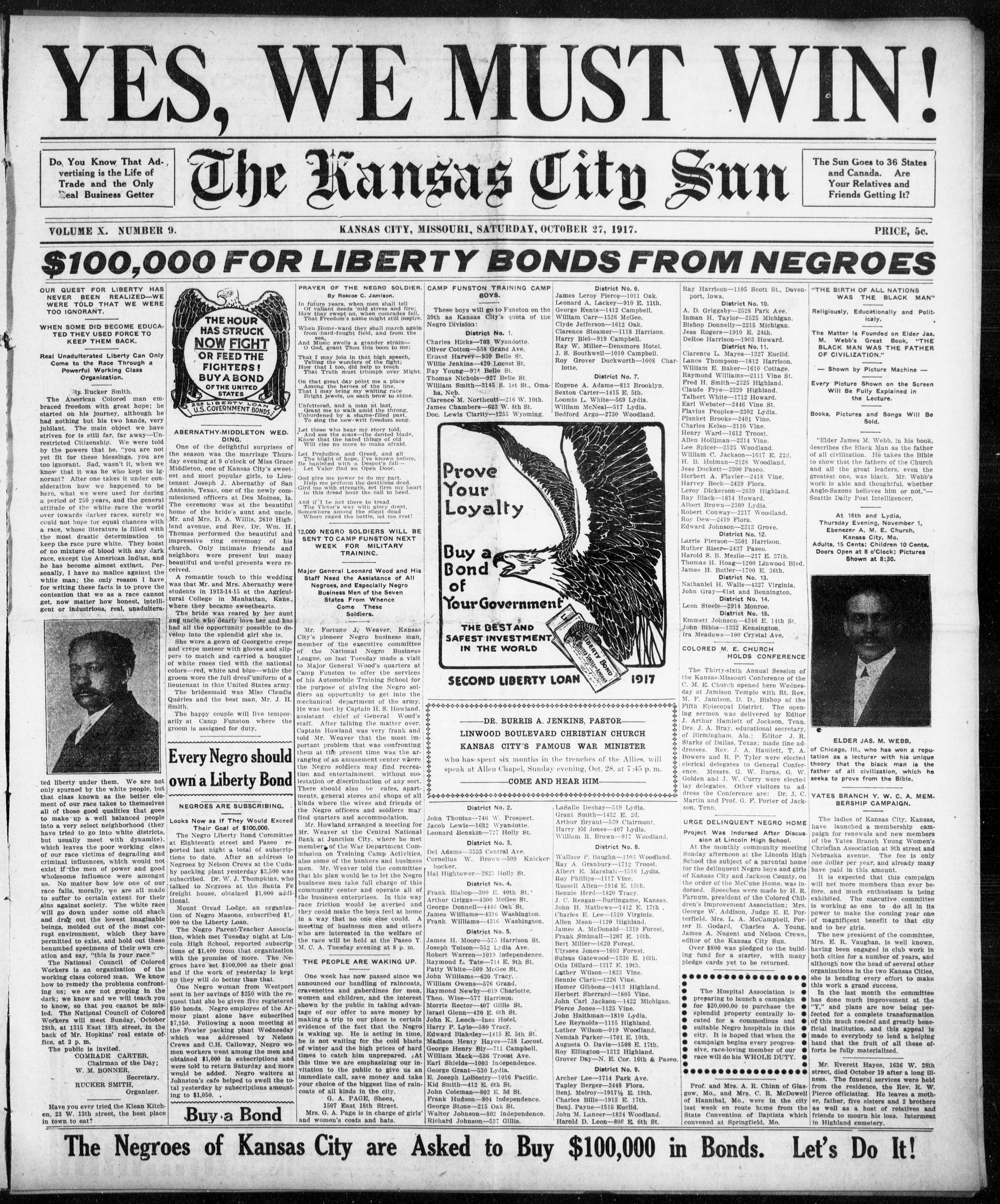
YES, WE MUST WIN!
$100,000 FOR LIBERTY BONDS FROM NEGROES
The Negroes of Kansas City are Asked to Buy $100,000 in Bonds. Let's Do It!
Do You Know That Advertising is the Life of Trade and the Only Real Business Getter
VOLUME X. NUMBER 9.
OUR QUEST FOR LIBERTY HAS NEVER BEEN REALIZED—WE WERE TOLD THAT WE WERE TOO IGNORANT.
WHEN SOME DID BECOME EDUCATED THEY USED FORCE TO KEEP THEM BACK.
Real Unadulterated Liberty Can Only Come to the Race Through a Powerful Working Class Organization.
3x. Rucker Smith.
The American Colored man embraced freedom with great hope; he started on his journey, although he had nothing but his two hands, very jubilant. The main object we have striven for is still far, far away—Unrestricted Citizenship. We were told by the powers that be, "you are not yet fit for these blessings, you are too ignorant. Sad, wasn't it, when we know that it was he who kept us ignorant? After one takes it under consideration how we happened to be here, what we were used for during a period of 250 years, and the general attitude of the white race the world over towards darker races, surely we could not hope for equal chances with a race, whose literature is filled with the most drastic determination to keep the race pure white. They boast of no mixture of blood with any dark race, except the American Indian, and he has become almost extinct. Personally, I have no malice against the white man; the only reason I have for writing these facts is to prove the contention that we as a race cannot get, now matter how honest, intelligent or industrious, real, unadultera-
M.
ted liberty under them. We are not only spurned by the white people, but that class known as the better element of our race takes to themselves all of those good qualities that goes to make up a well balanced people into a very select neighborhood (they have tried to go into white districts, but usually meet with dynamite), which leaves the poor working class of our race victims of degrading and criminal influences, which would not exist if the men of power and good wholesome influence were amongst us. No matter how low one of our race falls, morally, we are all made to suffer to certain extent for their sins against society. The white race will go down under some old shack and drag out the lowest imaginable beings, molded out of the most corrupt environment, which they have permitted to exist, and hold out these benumbed specimens of their own creation and say, "this is your race."
The National Council of Colored Workers is an organization of the working class colored man. We know how to remedy the problems confronting us; we are not groping in the dark; we know and we will teach you to know, so that you cannot be misled. The National Council of Colored Workers will meet Sunday, October 28th, at 1315 East 18th street, in the back of Mr. Hopkins' real estate office, at 3 p. m.
The public is invited.
COMRADE CARTER,
Chairman of the Day;
W. M. BONNER,
Secretary.
RUCKER SMITH,
Organizer.
Have you ever tried the Klean Kitchen, 23 W. 13th street, the best place in town to eat?
The Kansas City Sun
THE HOUR
HAS STRUCK
NOW FIGHT
OR FEED THE
FIGHTERS!
BUY A BOND
OF THE UNITED
STATES
259 LIBERTY LOAN
U.S. GOVERNMENT BONDS
ABERNATHY-MIDDLETON WED-
DING.
One of the delightful surprises of the season was the marriage Thursday evening at 9 o'clock of Miss Grace Middleton, one of Kansas City's sweetest and most popular girls, to Lieutenant Joseph J. Abernathy of San Antonio, Texas, one of the newly commissioned officers at Des Moines, Ia. The ceremony was at the beautiful home of the bride's aunt and uncle, Mr. and Mrs. D. A. Willis, 2610 Highland avenue, and Rev. Dr. Wm. H. Thomas performed the beautiful and impressive ring ceremony of his church. Only intimate friends and neighbors were present but many beautiful and useful presents were received.
A romantic touch to this wedding was that Mr. and Mrs. Abernathy were students in 1913-14-15 at the Agricultural College in Manhattan, Kans, where they became sweethearts.
The bride was reared by her aunt and uncle who dearly love her and has had all the opportunity possible to develop into the splendid girl she is.
She wore a gown of Georgette crepe and crepe meteor with gloves and slippers to match and carried a bouquet of white roses tied with the national colors—red, white and blue—while the groom wore the full dress uniform of a lieutenant in the United States army.
The bridesmaid was Miss Claudia Quarles and the best man, Mr. J. H. Smith.
The happy couple will live temporarily at Camp Funston where the groom is assigned for duty.
Every Negro should own a Liberty Bond
NEGROES ARE SUBSCRIBING.
Looks Now as If They Would Exceed
Their Goal of $100,000.
The Negro Liberty Bond Committee at Eighteenth street and Paseo reported last night a total of subscriptions to date. After an address to Negroes by Nelson Crews at the Cudahy packing plant yesterday $3,500 was subscribed. Dr. W. J. Thompkins, who talked to Negroes at the Santa Fe freight house, obtained $1,000 additional. Mount Oread Lodge, an organization of Negro Masons, subscribed $1,000 to the Liberty Loan. The Negro Parent-Teacher Association, which met Tuesday night at Lincoln High School, reported subscriptions of $1,400 from that organization with the promise of more. The Negroes have set $100,000 as their goal and if the work of yesterday is kept up they will do better than that.
One Negro woman from Westport sent in her savings of $250 with the request that she be given five registered $50 bonds. Negro employees of the Armour plant alone have subscribed $7,150. Following a noon meeting at the Fowler packing plant Wednesday which was addressed by Nelson Crews and C.H. Calloway, Negro women workers went among the men and obtained $1,000 in subscriptions and were told to return Saturday and more would be added. Negro waiters at Johnston's cafe helped to swell the total yesterday by subscriptions amounting to $1,050.
KANSAS CITY, MISSOURI, SATURDAY, OCTOBER 27, 1917.
PRAYER OF THE NEGRO SOLDIER
By Rocose C. Jamison.
In future years, when men shall tell
Of valiant deeds 'mid stress and fire;
How they swept on, when comrades fell,
That Freedom's name might still inspire.
When Home-ward they shall march again
from hard-fought field, and from the
And Music swells a grander strain—
O God, grant Thou this boon to me:
That I may join in that high speech,
Telling the wonders of the fight;
How that I too, did help to teach
That Truth must triumph over Might.
On that great day point me a place
Among the heroes of the line,
That I may bring my waiting race
Bright jewels, on each brow to shine.
Unfettered, and a man at last,
Grant me to walk amid the throng,
Unburdened by a shame-filled past,
To sing the new-writ freedom song.
Let those who hear my story told,
And see the scars—the dented blade,
Know that the hated things of old
Will rise no more to make afraid.
Let Prejudice, and Greed, and all
The blight of hope, I've known before,
Be banished with a Despot's fall—
Let Valor find an Open Door.
God give me power to do my part,
Help me perform the deathless deed.
Gird me with strength, set firm my heart
In this dread hour the call to heed.
And if I be not there to tread
The Victor's way with glory drest,
Somewhere among the silent dead
Where raged the battle, let me rest!
12,000 NEGRO SOLDIERS WILL BE
SENT TO CAMP FUNSTON NEXT
WEEK FOR MILITARY
TRAINING.
Major General Leonard Wood and His Staff Need the Assistance of All Negroes, and Especially Negro Business Men of the Seven States From Whence Come These Soldiers.
Mr. Fortune J. Weaver, Kansas City's pioneer Negro business man, member of the executive committee of the National Negro Business League, on last Tuesday made a visit to Major General Wood's quarters at Camp Funston to offer the services of his Automobile Training School for the purpose of giving the Negro soldiers an opportunity to get into the mechanical department of the army. He was met by Captain H. S. Howland, assistant chief of General Wood's staff. After talking the matter over, Captain Howland was very frank and told Mr. Weaver that the most important problem that was confronting them at the present time was the arranging of an amusement center where the Negro soldiers may find recreation and entertainment, without molestation or discrimination of any sort. There should also be cafes, apartments, general stores and shops of all kinds where the wives and friends of the Negro officers and soldiers may find quarters and accommodation.
Mr. Howland arranged a meeting for Mr. Weaver at the Central National Bank at Junction City, where he met members of the War Department Commission on Training Camp Activities, also some of the bankers and business men. Mr. Weaver told the committee that his plan would be to let the Negro business men take full charge of this community center and operate all of the business enterprises. In this way race friction would be averted and they could make the boys feel at home in a way that no one else could. A meeting of business men and others who are interested in the welfare of the race will be held at the Paseo Y. M. C. A. Tuesday evening at 8 p. m.
THE PEOPLE ARE WAKING UP.
One week has now passed since we announced our handling of raincoats, cravenettes and gaberdines for men, women and children, and the interest shown by the public in taking advantage of our offer to save money by making a trip to our place is certain evidence of the fact that the Negro is waking up. He is acting in time, he is not waiting for the cold blasts of winter and the high prices of hard times to catch him unprepared. At this time we are emphasizing our invitation to the public to give us an immediate call, save money and take your choice of the biggest line of raincoats of all kinds in the city.
G. A. PAGE, Shoes,
1507 East 18th Street.
Mrs. G. A. Page is in charge of girls' and women's coats and hats.
CAMP FUNSTON TRAINING CAMP
BOYS.
These boys will go to Funston on the 30th as Kansas City's quota of the Negro Division:
District No. 1.
Charles Hicks—703 Wyandotte.
Oliver Cotton—558 Grand Ave.
Ernest Harvey—930 Belle St.
Willie Jenkins—420 Locust St.
Ray Young—924 Belle St.
Thomas Nichols—927 Belle St.
William Smith—3145 S. 1st St., Omaha, Neh
na, Neb.
Clarence M. Northecutt—216 W. 10th.
James Chambers—623 W. 8th St.
Doc. Lewis Clearly—125 Wyoming.
Prove
Your
Loyalty
Buy a
Bond
of
Your Government
THE BEST AND
SAFEST INVESTMENT
IN THE WORLD
SECOND LIBERTY
DR. BURRIS A. J.
LINWOOD BOULEVAR
KANSAS CITY'S FAN
who has spent six months in
speak at Allen Chapel, Sunday
Prove
Your
Loyalty
Buy a
Bond
of
Your Government
THE BEST AND
SAFEST INVESTMENT
IN THE WORLD
SECOND LIBERTY LOAN 1917
who has spent six months in the trenches of the Allies, will speak at Allen Chapel, Sunday evening, Oct. 28, at 7:45 p. m.
COME AND HEAR HIM
```markdown
```
John Thomas—746 W. Prospect.
Jacob Lewis—1632 Wyandotte.
Leonard Bensink—727 Holly St.
District No. 3.
Del Adams—3535 Central Ave.
Cornelius W. Brown—509 Knicker
bocker.
Frank Bishop—300 E. 40th St.
Arthur Griggs—4300 McGee St.
George Donnell—4446 Oak St.
James Williams—4316 Washington.
Frank Williams—4316 Washington.
District No. 5.
James H. Moore—575 Harrison St.
Joseph Tolson—552 Lydia Ave.
Robert Warren—1019 Independence.
Raymond L. Tate—714 E. 9th St.
Patty White—509 McGee St.
John Williams—620 Tracy.
William Owens—576 Grand.
Raymond Newby—619 Charlotte.
Theo. Wise—577 Harrison.
Morris Rector—407 Gillis St.
Israel Glenn—420 E. 6th St.
John K. Leech—Inez Hotel.
Harry P. Lyle—580 Tracy.
Edward Blakeley—1415 E. 5th St.
Madison Henry Hayes—738 Locust.
George Henry Bly—711 Campbell.
William Mack—536 Troost Ave.
Earl Shields—1003 Independence.
George Grant—530 Lydia.
E. Joseph LoBostry—1016 Pacific.
Kid Smith—412 E. 6th St.
John Coleman—802 E. 3d St.
Frank Hudson—804 Independence.
George Stone—215 Oak St.
Walter Johnson—802 Independence.
Richard Johnson—537 Gillis.
Asked to Buy
District No. 6.
James Leroy Pierce—1011 Oak.
Leonard A. Lackey—910 E. 11th.
George Kents—1412 Campbell.
William Carr—1526 McGee.
Clyde Jefferson—1612 Oak.
Clarence Steamer—1118 Harrison.
Harry Biel—919 Campbell.
Ray W. Miller—Densmore Hotel.
J. S. Southwell—1010 Campbell.
Roy Grover Duckworth—1008 Char
lotte.
District No. 7.
Eugene A. Adams—813 Brooklyn.
Sexton Carter—1415 E. 5th.
Loomis L. White—569 Lydia.
William McNeal—517 Lydia.
Bedford Argo—2730 Woodland.
LIBERTY BOND
UNITED STATES OF AMERICA
LOAN 1917
ENKINS, PASTOR
D CHRISTIAN CHURCH
MOUS WAR MINISTER
the trenches of the Allies, will
evening, Oct. 28, at 7:45 p. m.
LaSalle Deshay-519 Lydia.
Grant Smith-1432 E. 2d.
Arthur Bryant-539 Clairmont.
Harry Ed Jones-407 Lydia.
William R. Brown-917 Woodland.
Wallace P. Baughn—1193 Woodland.
Ray A. Granbury—1712 Troost.
Albert E. Marshall—1516 Lydia.
Roy Phillips—1117 Vine.
Russell Allen—1916 E. 13th.
Bennie Herd—1820 Tracy.
J. C. Reagan—Burlingame, Kansas.
John H. Mathews—1412 E. 17th.
Charles E. Lee—1520 Virginia.
Allen Mean—1120 Highland.
James A. McDonald—1319 Forest.
Frank Smimall—1207 E. 16th.
Bert Miller—1620 Forest.
Ulysses Jones—1603 Forest.
Sulsus Gatewood—1330 E. 16th.
Otis Dillard—1317 E. 19th.
Luther Wilson—1833 Vine.
Bennie Clark—1226 Vine.
Homer Gibbons—1413 Highland.
Herbert Sherrard—1805 Vine.
John Carl Jackson—1422 Michigan.
Pierce Jones—1125 Vine.
John Halthman—1810 Lydia.
Lee Reynolds—1115 Highland.
Luther Wilson—919 Woodland.
Nemiah Parker—1701 E. 10th.
Augusta O. Davis—1508 E. 17th.
Roy Ellington—1312 Highland.
Grover Day—N. E. Cor. 16th & Pase
Archer Lee—1714 Park Ave.
Tapley Berger—2448 Flora.
Benj. Melroy—1917½ E. 19th.
Charles Bills—1915 E. 17th.
Benj. Payne—1515 Euclid.
John M. Laneer—1824 Woodland.
Harold D. Leon—806 E. 6th St.
District No. 8.
District No. 9.
Ray Harrison—1105 Scott St., Davenport, Iowa.
District No. 10.
A. D. Griggsby—2528 Park Ave.
Inman H. H. Taylor—2525 Michigan.
Bishop Donnelly—2215 Michigan.
Jess Rogers—1910 E. 24th.
DeRoe Harrison—1903 Howard.
District No. 11.
Clarence L. Mayes—1237 Euclid.
Lance Thompson—1812 Harrison.
William E. Baker—1610 Cottage.
Raymond Williams—2111 Vine St.
Fred H. Smith—2325 Highland.
Claude Frye—2329 Highland.
Talbert White—1712 Howard.
Earl Webster—2446 Vine St.
Flavius Peoples—2302 Lydia.
Plunket Brooks—2401 Vine.
Charles Kelso—2110 Vine.
Henry Ward—1612 Troost.
Allen Holliman—2314 Vine.
Lee Spicer—2525 Woodland.
William C. Jackson—1617 E. 22d.
H. B. Holman—2128 Woodland.
Jess Duckett—2300 Paseo.
Herbert A. Flavier—2418 Vine.
Harvey Beck—2429 Flora.
Leroy Dickerson—2639 Highland.
Ray Black—1814 Howard.
Albert Brown—2309 Lydia.
Robert Conway—2217 Woodland.
Roy Dew—2419 Flora.
Edward Johnson—2313 Grove.
Emmett Johnson—4346 E. 14th St.
John Bibbs—1332 Kensington.
Ira Meadows—100 Crystal Ave.
COLORED M. E. CHURCH
HOLDS CONFERENCE
The Thirty-sixth Annual Session of the Kansas-Missouri Conference of the C. M. E. Church opened here Wednesday at Jamison Temple with Rt. Rev. M. F. Jamison, D. D. Bishop of the Fifth Episcopal District. The opening sermon was delivered by Editor J. Arthur Hamlett of Jockson, Tenn. Drs. J. A. Bray, educational secretary, of Birmingham. Ala.; Editor J. R. Starks of Dallas, Texas; made fine addresses. Rev. J. A. Hamlett, T. A. Bowers and R. P. Tyler were elected clerical delegates to General Conference. Messrs. G. W. Burns, G. W. Golden and J. W. Curry were elected lay delegates. Other visitors to address the Conference are: Dr. J. C. Martin and Prof. G. F. Porter of Jackson, Tenn.
URGE DELINQUENT NEGRO HOME
Project Was Indorsed After Discussion at Lincoln School.
sion at Lincoln High School.
At the monthly community meeting Sunday afternoon at the Lincoln High School the subject of a parental home for the delinquent Negro boys and girls of Kansas City and Jackson County, on the order of the McCune Home, was indorsed. Speeches were made by H. R. Farnum, president of the Colored Children's Improvement Association; Mrs. George W. Addison, Judge E. E. Porterfield, Mrs. L. A. McCampbell, Porter B. Godard, Charles A. Young, James A. Nugent and Nelson Crews, editor of the Kansas City Sun.
Over $800 was pledged to the building fund for a starter, with many pledge cards yet to be returned.
```markdown
```
The Hospital Association is preparing to launch a campaign for $20,000.00 to purchase the splendid property centrally located for a commodious and suitable Negro hospitals in this city. It is hoped that when the campaign begins every progressive, race-loving member of our race will do his WHOLE DUTY.
---
Prof. and Mrs. A. R. Chinn of Glasgow, Mo., and Mrs. C. R. McDowell of Hannibal, Mo., were in the city last week en route home from the State Convention of Baptists which convened at Springfield, Mo.
The Sun Goes to 36 States and Canada. Are Your Relatives and Friends Getting It?
PRICE, 5c.
GROES
"THE BIRTH OF ALL NATIONS
WAS THE BLACK MAN"
Religiously, Educationally and Politically.
The Matter Is Founded on Elder Jas.
M. Webb's Great Book, "THE
BLACK MAN WAS THE FATHER
OF CIVILIZATION."
— Shown by Picture Machine —
Every Picture Shown on the Screen
Will Be Fully Explained in
the Lecture.
Books, Pictures and Songs Will Be
Sold.
"Elder James M. Webb, in his book, describes the Black Man as the father of all civilization. He takes the Bible to show that the fathers of the Church and all the great leaders, even the greatest one, was black. Mr. Webb's work is able and thoughtful, whether Anglo-Saxons believes him or not."—Seattle Daily Post Intelligencer.
At 16th and Lydia, Thursday Evening, November 1, Ebenezer A. M. E. Church, Kansas City, Mo.
Adults, 15 Cents; Children 10 Cents, Doors Open at 8 o'Clock; Pictures Shown at 8:30.
P. S. S.
of Chicago, Ill., who has won a reputation as a lecturer with his unique theory that the black man is the father of all civilization, which he seeks to prove from the Bible.
YATES BRANCH Y. W. C. A. MEMBERSHIP CAMPAIGN.
The ladies of Kansas City, Kansas, have launched a membership campaign for renewals and new members of the Yates Branch Young Women's Christian Association at 9th street and Nebraska avenue. The fee is only one dollar per year, and already many have paid in this amount.
It is expected that this campaign will net more members than ever before, and much enthusiasm is being exhibited. The executive committee is working as one to do all in its power to make the coming year one of magnificent benefit to that city and to her girls.
The new president of the committee, Mrs. E. R. Vaughan, is well known, having been engaged in club work in both cities for a number of years, and although now the head of several other organizations in the two Kansas Cities, she is bending every effort to make this work a grand success.
In the last month the committee has done much improvement at the "Y," and plans are now being perfected for a complete transformation of this much needed and greatly beneficial institution, and this appeal is made to everybody to lend a helping hand that the fruit of all these efforts be fully materialized.
Mr. Everett Hayes, 1636 W. 28th street, died October 19 after a long illness. The funeral services were held from the residence, the Rev. R. W. Pierce officiating. He leaves a mother, father, five sisters and 2 brothers as well as a host of relatives and friends to mourn his loss. Interment in Highland cemetery.
From Our Foreign Correspondents
A. F. and A. M. Mo. Jurisdiction
Officers—1917.
W. W. Fields, Cameron, Mo., Grand
Master.
C. C. Clark, St. Louis, Mo., Dep.
Grand Master.
Ernest Boone, Louisiana, Mo., Senior
Grand Warden.
I. H. Bradbury, St. Louis, Mo.
Junior. Grand Warden.
H. H. Walker, St. Joseph, Mo., Grand
Treasurer.
Geo. W. K. Love, Kansas City.
Grand Secretary.
E. G. Lacey, Kansas City, G. L.
1st District.
E. J. Cooper, Mexico, Mo., G. L.
2nd District.
OFFICERS OF GRAND CHAPTER
R. A. M.
Missouri and Jurisdiction, 1917-18.
T. G. McCampbell, G. H. P., Quindaro, Kans.
A. L. Thomas, D. G. H. P., Jefferson City, Mo.
J. P. Moffett, G. King, Sedalia, Mo.
S. A. May, G. Scribe, St. Louis, Mo.
Chas. Griggsby, G. Treas., Liberty, Mo.
E. S. Baker, G. Secretary, Kansas City, Mo.
Lodge Directory
G
MASONRY
Rone Lodge No. 25, A. F. and A. M. meets the first and 3rd Monday in each month. All Master Masons in good standing welcome. Emmett Spruell, W. M.; C. H. Countee, Sec'y.
G
MASONRY
Liberty Lodge No. 37, A. F.
and A. M., Liberty, Mo., meets the 2nd and 4th Saturday nights in each month. William Parker, W. M.; Nelson Wallar, Secy.
Mt. Olive Lodge No. 53, A. F. and A. M., meets the 2nd and 4th Fridays in every month. Visiting Master Masons are wel- lored by H. Brown, W. M.; Albert Wilson, Secretary, 1820 Highland.
G
St. Stephens Chapter No. 37,
Royal Arch Masons, Liberty,
Masonry, and Recorder
each month. W. H. Robinson,
H. P. Wm. Capps, Recorder.
O
St. Matthew Commandery
No. 17, Liberty, M. meets
the third Saturday night
William Capps, E. C.; W. H.
Robinson, Rec. Sec'y.
HOC
IN
HONOR
WITH
FREEDOM
King 6 of the West Lodge No. 218 meets first and third Wednesday in each month at 10th and Campbell. C. F. Wilson, W M.; M. H. Conway, 588 Tracy Ave., Secy.
D. OF T.
Primrose Tabernacle meets fast
and 3d Wednesday nights in
18th Street. All Wives,
Vine Street. All Daughters and
Sir Knights in good standing
are welcome. Susie Dotson, H.
Stella Pitta, C. R. 1815 E. 17th
MASONIC BUILDING ASSOCIATION
T. G. McCampbell, President.
E. B. Thompson, Vice President.
W. H. Washington, Treasurer.
S. H. P. Edwards, Secretary.
Board of Directors:
N. W. Jordan. S. Myers,
W. H. Brown. S. E. Baker,
W. R. Patterson. R. V. Adkins,
B. R. Francis. Richard Harris
Geo. Johnson, R. Fulbright.
Meets second and fourth Tuesday
in each month.
CHURCH DIRECTORY.
Bethel A. M. E. Church, 24th and Flora. St. Stephen's Baptist Church, 604 Charlotte St. Centennial M. E. Church, 19th and Woodland. Second Baptist Church, 10th and Charlotte. Allen Chapel A. M. E. Church, 10th and Charlotte. Ebenezer A. M. E. Church, 17th and Tracy. St. Augustine's P. E. Church, 11th and Troyst Avenue. St. John's A. M. E. Church, 1743 Belleview. Seventh Day Adventist, 23d and Woodland. St. Monica's Catholic, 17th and Lydia. Vine St. Baptist Church, 1825 Vine St. Ward Chapel A. M. E. Church, 11th and Troyst.
Morning Star Baptist Church, 2311 Vine.
Highland Avenue Baptist Church, 1111
Highland.
Centropolis A. M. E. Church, Centropolis
St. James A. M. E. Zion Church, 1823
Woodland Ave.
Second Christian Church, 24th and
Woodland.
Pilgrim Baptist Church, 614 Charlotte
St.
Pleasant Green Baptist Church, Independence Avenue and Tracy.
Calvary Baptist Church, 19th and
Askew.
C. M. E. Church, 1817 Flora Ave.
St. Luke's Baptist Church, 4039 Mill St.
St. Luke's A. M. E. Church, 43rd and
Prospect Place.
KANSAS CITY, KAN. CHURCHES.
Church of Ascension, 3rd and Steward.
First A. M. E. Church, 8th and Neb.
Eighth St. Baptist Church, 8th and Oakland.
First Baptist Church, 5th and Neb.
King Solomon Baptist Church, 3rd and
4th.
Quindaro A. M. E. Church, Quindaro
Pleasant Valley Baptist Church, Rose-
mount
Second Baptist Church, 24th and Ruby, Wesley Chapel M. E., 106 Shawnee, Bethel A. M. E. Church, Rosedale, an Mt. Zion Baptist Church, 4th and Vir
ARGENTINE, KANSAS
By Mrs. Ophelia Jackson.
The first quarterly meeting of this Conference year will be held at the St. Paul Chapel, Sunday, October 28. Rev. H. D. Harris, former pastor of St. Paul, and recently appointed presiding elder of this district, will preside throughout the day....Rev. Everett of St. Paul Chapel is progressing nicely in his new work....Mr. J. H. Allen, who was severely injured several weeks' ago, is slowly recovering....The Needle Craft Club had a delightful meeting with Mrs. Eva Bailey on last Friday afternoon. Their next meeting will be held at the residence of Mrs. Fannie Carter....Mr. Ira Lacount died Saturday, October 19, after a lingering illness and his funeral was held from St. Paul Chapel Monday, October 21....Mr. John Patton, who had been sick for a year, died last week and his funeral was held from the Second Baptist Church Monday afternoon....The Patrons' Club of Lewis School met at the building October 18 and the following officers were elected: Mrs. William Freehain, president; Mrs. John Buford, vice president; Mrs. Ophelia Jackson, secretary, and Mrs. Millie Hamilton, treasurer. The club will meet the second Friday in each month and a program will be rendered by the patrons....The Patrons' Club of Lincoln School met Friday of this week at Lincoln building, Mrs. McReynolds, president....Mr. Middleton, father of Mr. Frank Middleton, the caterer, is very sick....Dr. A. Porter Davis recently purchased a two-story building at the southwest corner of 22d and Metropolitan avenue and has moved his office to the new number. Dr. Gray, the dentist, is also located in the same building.
PLEASANT HILL, MISSOURI:
Mrs. Mollie Wilson, who has been in Kansas City with her brother for several weeks, is home for a short while....Mrs. J. S. Moten is reported on the sick list....The B. Y. P. U. will entertain next Friday night in honor of Mrs. Amanda Wood, who raised the largest amount of money in the rally....Mrs. Easter Dallenger, who was recently married to Mr. Morse while in North Dakota, has come home to reside....Mr. and Mrs. Stanley Nelson were down from the city visiting friends last week....Mrs. Marie Williams accompanied the Reeder family to Kansas City last week in their car....Mrs. Marion Wil
FREE SUIT New 1918 Style
Tailored To Your Measure
To wear, show your friends, tell who made it. Latest model, made in any style, a perfect fit, your choice of any goods.
Not a cent cost to you if you accept our new liberal offer for a few hours work. Big cash profits for your spare time, $100 to $500 a month, introducing us to friends. No experience needed, everything furnished FREE. No matter where you live or what you do, or what your age, send for this free offer at once. Every tailoring agent write us too, no matter who you represent. Send name and address, get book of cloth samples, latest 1918 fashions, beautiful pictures, our big new generous offer, all FREE. Everybody send now, today, this very minute, to LIBERTY TAILORING SOCIETY. Don't 304 CHICAGO
MONEY TO LOAN.
Short time money to loan to room-
inghouse keepers—must have refer-
ence. Property owners can obtain a
loan thru our agency and pay it back
by weekly installments. If your house
needs papering, painting or repairing
get a loan and put in its necessary
repairs.
Our business is strictly confidential
Bell Phone, Grand 4204.
The Handy Colored Store
2409 Vine St.
Ladies' and Gent's Furnishing
Goods and Notions
VISIT OUR DRY GOODS AND
HARDWARE DEPT.
BARGAINS
FURNISHING GOODS INDUSTRIAL
THE KANSAS CITY SUN, SATURDAY, OCTOBER 27, 1917.
liams gave a party in honor of her husband's birthday last Wednesday evening. An enjoyable evening was spent by all present....Prof. G. W. Wood is here from Oklahoma for a visit with his father....Mr. Garland Davis has gone to Higginsville for an indefinite stay....Mrs. Thomas Snead has returned fred Council Bluff, la., where he has been employed as florist.
CHILLICOTHE, MISSOURI.
By B. V. Longdon.
Miss Cozetta Kingsberry of Kansas City, Mo., is the guest of Mr. and Mrs. Bolivar Payne.....Mr. Thompson, editor of the Iowa Bystander, was a business visitor last Monday.....Mr. Clem Agee of Tripolett, Mo., spent Friday with Mr. and Mrs. Jas. Banks.....Mrs. Leatherbury is visiting her sister, Mrs. Flora Tolston.....Mrs. Wilkerson of Des Moines, Ia., was the guest of Mr. and Mrs. Wallace Rowland last week.....Mrs. Katie Nance left last Wednesday for Cedar Rapids, Ia., where she will reside with Mr. and Mrs. Horn during the winter.....Rev. Ward was reappointed pastor of the Bethel A. M. E. Church at the recent annual Conference. He and his wife have resumed their supervision of the church work with their characteristic energy.....Rev. and Mrs. Alford, formerly of Plattsburg, Mo., arrived last Saturday. Rev. Alford accepted the call of the Mt. Zion Baptist Church and his coming seemed to bring renewed interest and loyalty to the entire membership.
BUTTE. MONTANA.
Mrs. B. B. Anderson of Washington, D. C., is now in the city with her husband, and will remain until her health has improved....The Sunshine Mission met in the literary room of the Bethel Baptist Church Wednesday and was entertained by Mrs. E. W. Lee....Mr. and Mrs. Ike Hayes have moved to 211 West Galena street....Rev. Allen and family are now comfortably settled in the parsonage....The Community Bible Class has resumed its work after a long vacation....Prayer meeting tonight at the Bethel Baptist Church, with Patriotic meeting....Mr. D. Walton is on the sick list again. We hope for him a speedy recovery....Mrs. Chas. Poague is still at the pesthouse. The quarantine has been lifted from the home of Mr. and Mrs. H. C. Dunn....The K. P. Club met last Sunday and eighteen were present. There is room for all good men. Hurry and enroll. See Jesse Smith....Oorder a good race book and a large photo of the late Booker T. Washington or Paul Lawrence Dunbart.
LINCOLN, NEBRASKA.
Mr. Herman L. Hale left for Burlington, Ia., last Wednesday, after attending the funeral of his brother, Edward.....Mr. and Mrs. R. Gorham left for their home in Omaha last Wednesday, after attending the funeral of their nephew, Edward Hale..... Rev. B. Hillman was called to Chicago, Ill., last Sunday on urgent business.....Rev. J. S. Payne and wife returned from the Annual Conference and a short visit in Kansas last Thursday.....Mrs. Martha Hale and Mrs. James Ford returned to Kansas City Monday.....Mrs. Emma Riley returned to St. Paul, after some weeks' visit with her mother and sister, Mrs. Clemens and Mrs. Nettie McDonald.....I. B. Smith spent last Friday with friends at Beatrice, Neb.....Rev. Mr. Dent of Beatrice was a visitor in the city this week.....Rev. I. B. Smith filled the pulpit in Rev. B. Hillman's stead Sunday night.
HENNESSEY, OKLAHOMA.
On the 5th of October the Nobles of the Mystic Shrine Aluzza Temple of Hennessey gave their first annual banquet and reception at the city hall. This was the most elaborate attempt of the kind ever taking place among the colored citizens of Hennessey. On tables beautifully and jauntily spread plates were laid for fifty persons and a seven-course dinned was prepared, consisting of the delicacies of the season. The membership, which consists of some thirty odd, and which extends well over Western Oklahoma, was fully represented, with their wives and sweet hearts.
The postprandium consisted of the following: "The Significance of The Craft." Noble M. Harris, Sr.; "The World Outlook for the Negro After the Great War," Noble William R. Patterson; "The Fratral Spirit," Noble F. F. Bailey; "The Patriotism of the Afro-American Versus That of the German-American," Noble A. S. Nixon.
At the conclusion of the feast the Shriners repaired in a body to hear the Williams Colored Singers, after which they returned to the court room of the city hall, where a select crowd "tripped the light fantastic toe" until the wee small hours of the morning.
The principal Shrine officers are as follows: E. H. Hall, illustrious grand potentate; Clois Stewart, chief rab ban; W. S. Price, assistant chief rab ban; M. Harris, Sr., illustrious high priest; J. H. Smith, illustrious recorder; A. S. Nixon, illustrious treasurer; F. F. Bailey, illustrious Oriental guide
ROSEDALE. KANSAS.
The funeral of Mrs. Luvenia Allen,
a resident for a number of years of
this city who died Thursday the 12th, was held at the Pleasant Valley Baptist Church Saturday. She is survived by a husband, three daughters and two sons and other relatives....The Pleasant Valley Mission Circle met at the residence of Mrs. Arthur Douglass Monday afternoon, and after the regular routine of business, dainty refreshments were served by the hostess....The revival services held at the Pleasant Valley Baptist Church are being largely attended. Rev. J. R. Williams, the pastor, invites the public to come....The wedding of Mr. Solomon Banks and Miss Marie Everett was solemnized Thursday evening at Allen Chapel, Quindaro, Kansas....The condition of Mr. Levi Collins, 3904 Lloyd avenue, who is critically ill, remains unchanged.
MARYVILLE, MISSOURI.
Miss Dorothy Palmer has returned from a visit in Clarinda, Ia....Rev. R. H. Longdon came Friday evening and held his first services for this Conference year, Sunday, October 21....Mrs. Everett Page was hostess to a Kensington, Thursday afternoon, October 18, 1917, complimentary to Mrs. Ernest O. Boone, Jr. A dainty two-course luncheon was served and the following ladies spent a pleasant afternoon conversing, knitting, crocheting and sewing: Mrs. Ernest O. Boone, Jr.; Mrs. Dorril Carriger, Mrs. John Gooden, Mrs. B. F. Smart, Mrs. Henry Wilson, Mrs. W. A. Mitchell, Mrs. Mattie Williams, Mrs. J. C. Cooke, Mrs. Page, Mrs. Thomas Jackson, Mrs. Gertie Wells, Mrs. W. M. Palmer....Mrs. Gunn entertained the younger social set with a birthday party for her brother, Paul Smith, Friday evening, October 19. All present report an enjoyable evening playing games and dancing. They were served with the following menu: Punch, salmon salad, hot biscuits, cocoa, brick ice cream, hot coffee, cints....The Senior class of Douglass school gave an entertainment Tuesday evening. All present had an enjoyable time....Mrs. Charity Price, mother of Mrs. James Malcome and Mrs. Gertie Wells, who is paralyzed, is showing no improvement....Mrs. Carrie Bell of Omaha, Neb. was called home on account of the illness of her mother, Mrs. Susan Gunn....The following Masons left Maryville Friday noon for Bedford, Ia., to conduct the funeral rites over the body of the late Brother Boyd of that city, who was a member of Cyrene Lodge No. 58, A. F. and A. M. of Maryville, Mo.: James Palmer, George Ousley, Horley Page, Ophus Gunn, James Malcome, Frank Smith, Thomas Jackson, William Campbell Oliver Vance, Peel, Ernest O. Boone Jr. Brother Boyd departed from this life Wednesday, October 17, leaving no blood relatives but three apetod children....Mr. Frank Boyd spent the week end here with his wife....We wish to thank Mr. J. C. Cooke and Mrs. Onie Gunn for their subscription this week.
WEIR CITY, KANSAS.
By Mrs. A. R. Phillips.
Mrs. Mary E. Davis of Flagstaff, Ariz., and Mrs. M. Russell of Fort Scott, Kan., are visiting their brother, Mr. Loliss, and family...Mrs. L. Davis of Pittsburg, Kan., was a visitor here the 18th...The A. M. E. Church held their First Quarterly meeting for the year. Presiding Elder J. T. Smith preached at 3:00 p. m. the Sacramental sermon. The minister preached at the morning service...Mr. Roy Boyd of Pittsburg died very suddenly and we extend to Mrs. Emma Boyd our heartfelt sympathy...Mrs. Grant Dosty of Cherokee, Kan., was a pleasant caller at Mrs. A. R. Phillips...Mrs. F. H. Prentice is visiting her parents in Girard, Kan., and also an aunt of Iowa who is visiting her mother, Mrs. Mann of that city...The ladies of St. John Baptist Church, who won the rally are patiently awaiting the reception brother. How long will it be? Mr. J. S. Moore is still on the sick list.
COLUMBUS, OHIO.
The L'Allegro Club of this city is going to give a Musicale at the Chamber of Commerce, October 29. The feature of the program being Mr. Wesley Howard, foremost Colored Violinist, and the Deshler Hotel Orchestra. ...Two positions are being held by Columbus men that are worth the thought and consideration of all Colored citizens. Mr. Oscar Coleman has filled the office of Recorder in the Court House here while Mr. Chas. Ward has just been given the place as Mail Clerk in the Post Office. ...Chapman Scott of the 10th Cavalry, now stationed in Arizona, has been appointed Officer in Charge of the Liberty Loan for the 10th Cavalry. Within forty-five minutes after his first day's attempt the sum of $47,000 was raised. On the second day this sum was increased to $120,000.
FOOTBALL AT LINCOLN UNIVER
SITY
Lincoln University has been fortunate in securing the services of H. C. Collins as football coach. He is well known affong college athletic circles as being one of the best players that Lincoln has eber boasted and has come back to us as graduate coach to build up a machine that can conquer her foes. Fifty candidates responded to the first practice call and if the way in which the Varsity fought its
way to victory over the heavy Langston A. C. of Chester, Pa., can be taken as an insignia of Class and ability, Lincoln will once more upset the well laid plans of Howard as she did three years ago when she sent them down to a 12-0 defeat. Howard more than got revenge last year and the Lincolnites are leaving no stone unturned to reverse this defeat. The Lincoln-Howard game takes place November 3. The Hampton-Lincoln game will be played at Hampton some time later in November.
FOR SALE—A good Springfield Rifle; good condition; cheap. Call Bell Phone, Grand 3227W.
PERSIAN CREAM
HAIR GROWER
If a Beautiful Head of Hair Is Your Pride, then
Try this Real Hair Grower, the Most Wonderful Discovery of the Century.
211
PERSIAN CREAM
Affair Grower and Straightener
There is nothing like it on the market—entirely different both in principle as well as in its effect. You can buy a bottle of petroleum, but only the best and finest of oils. We give you a binding guarantee to refund your money if you fail to wear it. You can also fall to improve your hair. Forsan Cream is one of the best insect killer creams to be expensive and easy to at home. Price 90 cents.
U-N-E-E-D-A
DANEPOLE
AND SHAMPOO
For Dandruff, Scales, Itching and Roughness.
Dandruff is a germ disease. It is a parasitical growth affecting the roots of the hair, causing the hair to lose its integrity, grow thin or fall out.
U-N-E-E-D-A Dandrude is a Scientific remedy for scalp troubles.
It also cleans the scalp in a hydric way. It prevents dandruff and stops itching of the scalp.
It also strengthens the hair and helps maintain a healthy scalp condition so that the hair ceases to fall out.
It prevents any unpleasant odor of the scalp or hair and lends a delicate perfume of its own.
Price 25 Cents.
U-N-E-E-D-A
SKIN BLEACH
Cleans and Bleaches the Complexion Instantly.
Makes Dark or Brown Skin Whiter. WHI Not Grow Hair.
Price 50 Cents.
Manufactured only by the RANKIN MANUFACTURING CO., Hair, Tollet and Household Preparations.
Office, 236 W. Walnut Street.
Indianapolis, Indiana.
Take
One
Pain Pill,
then—
Take
it
Easy.
To Head-Off a Headache Nothing is Better than Dr. Miles' Anti-Pain Pills They Give Relief Without Bad After-Effects.
"I can say that Dr. Miles' Remedies have been a godsend to me and my family. I used to have such terrible headaches I would almost be wild for days at a time. I began using Dr. Miles' Anti-Pain Pills and never have those headaches any more. I can speak highly of Dr. Miles' Nervine also for it cured one of my children of a terrible nervous disorder. I can always speak a good word for your Remedies and have recommended them to a good many of my friends who have been well pleased with them."
MRS. GEO. H. BRYAN,
Jamesville, Iowa.
For Sale by All Druggists.
25 Doses, 25 Cents.
MILES MEDICAL CO., Elkhart, Ind.
Three wise women are happy today because they have found their real preference in toilet preparations. - Quinoleum Quality Products — the most satisfying to Milady's Toilet.
First is the Woman Beautiful who uses Quinoleum Quality Products because she knows with them she will retain her beauty. Second, the Woman Good Looking, who uses them because she knows they will make her beautiful. Third, the Woman Who Does Not Care, really! but uses them because she knows other folk "case" how she looks. They each know "Quinoleum is Queen," no matter which product, it's the purest in its line.
QUINOLEUM QUALITY PRODUCTS.
Face Bleach and Frecle Remover .25c
Face Cream for Blackheads (antiseptic). .25c
Face Powder, Quinoleum Rose .25c
and. .25c
Hair Shampoo, liquid. .25c
Hair Grower. .50c
Hair Fonic, liquid. .50c
Campbell's. .50c
(Sample of face powder with all $1 orders. State color wanted.)
Goods sent by mail upon receipt of money order.
Manufactured by
The Quinoleum Manufacturing Co.
29th and The Parkway, Kansas City, Kan.
Bell Phone, West 1757.
KELLEY'S BEST HIGH PATENT FLOUR Kelley's Best Beat all the Rest. Kelley Milling Co. K.C.U.A.A.
1900-1917
FIRST ON THE MARKET
FIRST ON THE HEADS-FIRST TO BEAUTIFY HAIR
FORMULATED 1900
PORO
HAIR GROWER
MADE ONLY BY
Mrs Amber Purubo
-Malone
ST. LOUIS MISSOURI
FOR DANDRUFF, FALLING HAIR, ITCHING
SCALP; GIVING LIFE, BEAUTY, COLOR
AND ABUNDANT GROWTH
THIS STYLE OF BOX ADOPTED JUNE 12,1915
PRICE 50 CENTS
PORO COLLEGE COMPANY
3100 Pine Street, Dept. G
ST. LOUIS, MISSOURI
THE Modern Builders Co. A.E. ESTES, President General Contracting Repairing a Specialty
ONLY ONE
The history of Kansas City records but one real, legitimate, competent, established Negro jeweler, and he is
J. A. Wilson
at 1616 W. 9th St. Half block west of Wyoming St.
Mr. Wilson sells
Diamonds, Watches, Clocks and Staple Jewelry
:: and ::
Guarantees to the public satisfactory and proper treatment.
BELL PHONE MAIN 2868W
Kansas'
Famous Wheat
makes
I-H
FLOUR
Hard, winter, "turkey red" is the world's flour
wheat supreme. Given the benefit of I-H modern
milling, this fine raw product becomes a super-fine
food — I-H Flour—the aristocrat of every
grocery. Try it.
Ismert-Hincke Milling Co.
Kansas City, U. S. A.
Bell Phone E. 4394R
Office 2460 Waldrond Ave.
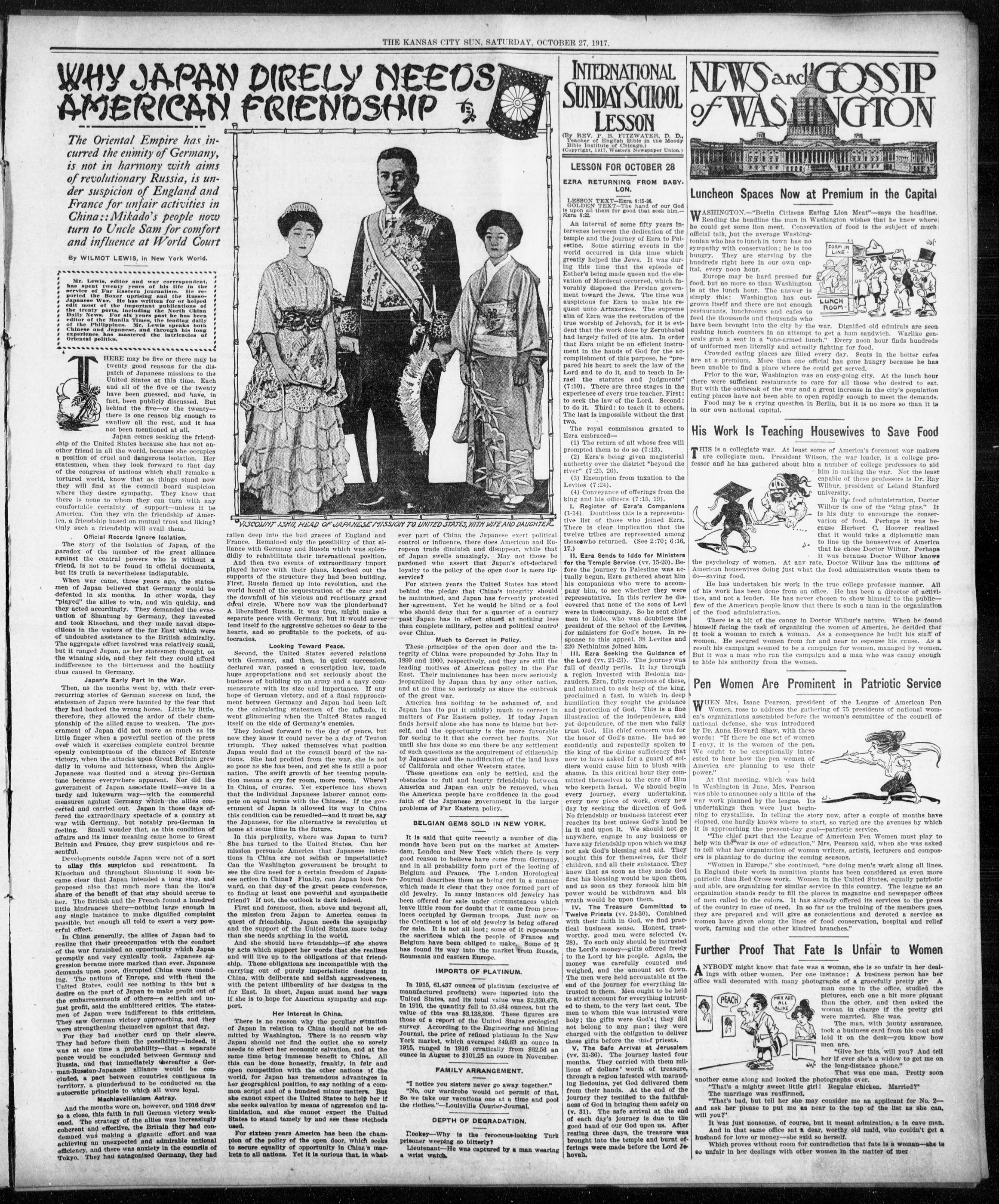
WHY JAPAN DIRELY NEEDS AMERICAN FRIENDSHIP
The Oriental Empire has incurred the enmity of Germany, is not in harmony with aims of revolutionary Russia, is under suspicion of England and France for unfair activities in China:: Mikado's people now turn to Uncle Sam for comfort and influence at World Court By WILMOT LEWIS, in New York World.
Mr. Lewis, editor and war correspondent, has spent twenty years of his life in the service of Far Eastern journalism. He reported the Boxer uprising and the Russo-Japanese War has written for or helped edit most of the important publications of the treaty ports, including the North China Daily News. For six years past he has been editor of the Manila Times, the leading daily of the Philippine News, which is Chinese and Japanese, and through his long experience has mastered the intricacies of Oriental politics.
HERE may be five or there may be twenty good reasons for the dispatch of Japanese missions to the United States at this time. Each and all of the five or the twenty have been guessed, and have, in fact, been publicly discussed. But behind the five—or the twenty—there is one reason big enough to swallow all the rest, and it has not been mentioned at all.
T
Japan comes seeking the friend-
Japan comes seeking the friendship of the United States because she has not another friend in all the world, because she occupies a position of cruel and dangerous isolation. Her statesmen, when they look forward to that day of the congress of nations which shall remake a tortured world, know that as things stand now they will find at the council board suspicion where they desire sympathy. They know that there is none to whom they can turn with any comfortable certainty of support—unless it be America. Can they win the friendship of America, a friendship based on mutual trust and liking? Only such a friendship will avail them.
Official Records Ignore Isolation
The story of the isolation of Japan, of the paradox of the member of the great alliance against the central powers who is without a friend, is not to be found in official documents, but its truth is nevertheless indisputable.
When war came, three years ago, the statesmen of Japan believed that Germany would be defeated in six months. In other words, they "played" the allies to win, and win quickly, and they acted accordingly. They demanded the evacuation of Shantung by Germany, they invested and took Kinochau, and they made naval dispositions in the waters of the far East which were of undoubted assistance to the British admiralty. The aggregate effort involved was relatively small, but it ranged Japan, as her statesmen thought, on the winning side, and they felt they could afford indifference to the bitterness and the hostility thus caused in Germany.
Japan's Early Part in the War.
Then, as the months went by, with their ever-recurring stories of German success on land, the statesmen of Japan were haunted by the fear that they had backed the wrong horse. Little by little, therefore, they allowed the ardor of their championship of the allied cause to weaken. The government of Japan did not move as much as its little finger when a powerful section of the press over which it exercises complete control became openly contemptuous of the chances of Entente victory, when the attacks upon Great Britain grew daily in volume and bitterness, when the Anglo-Japanese was flouted and a strong pro-German tone became everywhere apparent. Nor did the government of Japan associate itself—save in a tardy and lukewarm way—with the commercial measures against Germany which—the allies concerted and carried out. Japan in those days offered the extraordinary spectacle of a country at war with Germany, but notably pro-German in feeling. Small wonder that, as this condition of affairs and its inner meaning came home to Great Britain and France, they grew suspicious and resentful.
Developments outside Japan were not of a sort to allay this suspicion and resentment. In Kiaochau and throughout Shantung it soon became clear that Japan intended a long stay, and proposed also that much more than the lion's share of the benefit of that stay should accrue to her. The British and the French found a hundred little hindrances there—nothing large enough in any single instance to make dignified complaint possible, but enough all told to exert a very powerful effect.
In China generally, the allies of Japan had to realize that their preoccupation with the conduct of the war furnished an opportunity which Japan promptly and very cynically took. Japanese aggression became more marked than ever. Japanese demands upon poor, disrupted China were unending. The nations of Europe, and with them the United States, could see nothing in this but a desire on the part of Japan to make profit out of the embarrassments of others—a selfish and unjust profit, said the embittered critics. The statesmen of Japan were indifferent to this criticism. They saw German victory approaching, and they were strengthening themselves against that day. For they had another card up their sleeve. They had before them the possibility—indeed, it was at one time a probability—that a separate peace would be concluded between Germany and Russia, and that immediately thereafter a German-Russian-Japanese alliance would be concluded, a pact between countries contiguous in territory, a plunderbund to be conducted on the autocratic principle to which all were loyal.
Machiavellianism Astray.
And the months wore on, however, and 1916 drew to a close, this faith in full German victory weakened. The strategy of the allies was increasingly coherent and effective, the Britain they had condemned was making a gigantic effort and was achieving an unexpected and admirable national efficiency, and there was anxiety in the councils of Tokyo. They had antagonized Germany, they had
rallen deep into the bad graces of England and France. Remained only the possibility of that alliance with Germany and Russia which was splendidly to rehabilitate their international position. And then two events of extraordinary import played havoc with their plans, knocked out the supports of the structure they had been building. First, Russia flamed up into revolution, and the world heard of the sequestration of the czar and the downfall of his vicious and reactionary grand ducal circle. Where now was the plunderbund? A liberalized Russia, it was true, might make a separate peace with Germany, but it would never lend itself to the aggressive schemes so dear to the hearts, and so profitable to the pockets, of autocrates.
ever part of China the Japanese exert political control or influence, there does American and European trade diminish and disappear, while that of Japan swells amazingly. May not those be pardoned who assert that Japan's oft-declared loyalty to the policy of the open door is mere lip service?
For sixteen years the United States has stood behind the pledge that China's integrity should be maintained, and Japan has fervently protested her agreement. Yet he would be blind or a fool who should deny that for a quarter of a century past Japan has in effect aimed at nothing less than complete military, police and political control over China.
Looking Toward Peace.
Second, the United States severed relations with Germany, and then, in quick succession, declared war, passed a conscription law, made huge appropriations and set seriously about the business of building up an army and a navy commensurate with its size and importance. If any hope of German victory, and of a final rapprochment between Germany and Japan had been left to the calculating statesmen of the middo, it went glimmering when the United States ranged itself on the side of Germany's enemies.
They looked forward to the day of peace, but now they know it could never be a day of Teuton triumph. They asked themselves what position Japan would find at the council board of the nations. She had profited from the war, she is not so poor as she has been, and yet she is still a poor nation. The swift growth of her teeming population means a cry for room, more room. Where? In China, of course. Yet experience has shown that the individual Japanese laborer cannot compete on equal terms with the Chinese. If the government of Japan is allowed its way in China this condition can be remedied—and it must be, say the Japanese, for the alternative is revolution at home at some time in the future.
In this perplexity, where was Japan to turn? She has turned to the United States. Can her mission persuade America that Japanese intentions in China are not selfish or imperialistic? Can the Washington government be brought to see the dire need for a certain freedom of Japanese action in China? Finally, can Japan look forward, on that day of the great peace conference, to finding at least one powerful and sympathetic friend? If not, the outlook is dark indeed.
First and foremost, then, above and beyond all, the mission from Japan to America comes in quest of friendship. Japan needs the sympathy and the support of the United States more today than she needs anything in the world.
And she should have friendship—if she shows by acts which support her words that she realizes and will live up to the obligations of that friendship. These obligations are incompatible with the carrying out of purely imperialistic designs in China, with deliberate and selfish aggressiveness, with the patent illiberality of her designs in the far East. In short, Japan must mend her ways if she is to hope for American sympathy and support.
Her Interest In China.
There is no reason why the peculiar situation of Japan in relation to China should not be admitted by Washington. There is no reason why Japan should not find the outlet she so sorely needs to effect her economic salvation, and at the same time bring immense benefit to China. All this can be done honestly, frankly, in fair and open competition with the other nations of the world, for Japan has tremendous advantages in her geographical position, to say nothing of a common script and of a hundred minor matters. But she cannot expect the United States to help her if she seeks salvation by means of aggression and intimidation, and she cannot expect the United States to stand tamely by and see these methods used.
For sixteen years America has been the champion of the policy of the open door, which seeks to secure equality of opportunity in Ching's markets to all nations. Yet it is curious that in what-
THE KANSAS CITY SUN, SATURDAY, OCTOBER 27, 1917.
ever part of China the Japanese exert political control or influence, there does American and European trade diminish and disappear, while that of Japan swells amazingly. May not those be pardoned who assert that Japan's oft-declared loyalty to the policy of the open door is mere lip-service?
For sixteen years the United States has stood behind the pledge that China's integrity should be maintained, and Japan has fervently protested her agreement. Yet he would be blind or a fool who should deny that for a quarter of a century past Japan has in effect aimed at nothing less than complete military, police and political control over China.
Much to Correct in Policy.
These principles of the open door and the integrity of China were propounded by John Hay in 1899 and 1900, respectively, and they are still the leading motives of American policy in the Far East. Their maintenance has been more seriously jeopardized by Japan than by any other nation, and at no time so seriously as since the outbreak of the great war.
America has nothing to be ashamed of, and Japan has (to put it mildly) much to correct in matters of Far Eastern policy. If today Japan finds herself alone she has none to blame but herself, and the opportunity is the more favorable for seeing to it that she correct her faults. Not until she has done so can there be any settlement of such questions as the acquirement of citizenship by Japanese and the modification of the land laws of California and other Western states.
These questions can only be settled, and the obstacles to full and hearty friendship between America and Japan can only be removed, when the American people have confidence in the good faith of the Japanese government in the larger problems of Far Eastern policy.
BELGIAN GEMS SOLD IN NEW YORK.
It is said that quite recently a number of diamonds have been put on the market at Amsterdam, London and New York which there is very good reason to believe have come from Germany, and in all probability form part of the looting of Belgium and France. The London Horological Journal describes them as being cut in a manner which made it clear that they once formed part of old jewelry. In many instances old jewelry has been offered for sale under circumstances which leave little room for doubt that it came from provinces occupied by German troops. Just now on the Continent a lot of old jewelry is being offered for sale. It is not all loot; some of it represents the sacrifices which the people of France and Belgium have been obliged to make. Some of it has found its way into the market from Russia, Roumania and eastern Europe.
IMPORTS OF PLATINUM
In 1915, 61,437 ounces of platinum (exclusive of manufactured products) were imported into the United States, and its total value was $2,330,476. In 1916, the quantity fell to 53,484 ounces, but the value of this was $3,138,396. These figures are those of a report of the United States geological survey. According to the Engineering and Mining Journal, the price of refined platinum in the New York market, which averaged $49,63 an ounce in 1915, ranged in 1916 erratically from $62.58 an ounce in August to $101.25 an ounce in November.
FAMILY ARRANGEMENT
"I notice you sisters never go away together." "No, our wardrobe would not permit of that. So we take our vacations one at a time and pool the clothes."—Louisville Courier-Journal.
DEPTH OF DEGRADATION.
Kooley—Why is the ferocious-looking Turk prisoner weeping so bitterly? Lieutenant—He was captured by a man wearing a wrist watch.
INTERNATIONAL
SUNDAY SCHOOL
LESSON
(By REV. P. B. FITZWATER, D. D. Teacher of English in the Moody Bible Institute of Chicago). (Copyright, 1917, Western Newspaper Union.)
LESSON FOR OCTOBER 28
EZRA RETURNING FROM BABY-
LON.
LESSON TEXT-Ezra 8:15:36
GOLDEN TEXT—The basis of our God
takes them for good that we seek him.
Ezra 5:22.
Ezra 5:23.
An interval of some fifty years intervenes between the dedication of the temple and the journey of Ezra to Palestine. Some stirring events in the world occurred in this time which greatly helped the Jews. It was during this time that the episode of Esther's being made queen and the elevation of Mordecai occurred, which favorably disposed the Persian government toward the Jews. The time was auspicious for Ezra to make his request unto Artaxerxes. The supreme aim of Ezra was the restoration of the true worship of Jehovah, for it is evident that the work done by Zerubbabel had largely failed of its aim. In order that Ezra might be an efficient instrument in the hands of God for the accomplishment of this purpose, he "prepared his heart to seek the law of the Lord and to do it, and to teach in Israel the statutes and judgments" (7:10). There are three stages in the experience of every true teacher. First: to seek the law of the Lord. Second: to do it. Third: to teach it to others. The last is impossible without the first two.
The royal commission granted to Ezra embraced—
(1) The return of all whose free will prompted them to do so (7:13).
(2) Ezra's being given magisterial authority over the district "beyond the river" (7:25, 26).
(3) Exemption from taxation to the Levites (7:24).
(4) Conveyance of offerings from the king and his officers (7:15, 19).
1. Register of Ezra's Companions (1-14). Doubtless this is a representative list of those who joined Ezra. There is clear implication that the twelve tribes are represented among those who returned. (See 2:70; 6:16, 17.)
II. Ezra Sends to Iddo for Ministers for the Temple Service (vv. 15-20). Before the journey to Palestine was actually begun, Ezra gathered about him his companions who were to accompany him, to see whether they were representative. In this review he discovered that none of the sons of Levi were in the company. So he sent chief men to Iddo, who was doubtless the president of the school of the Levites, for ministers for God's house. In response to this appeal, 38 Levites and 220 Nethimims joined him.
III. Ezra Seeking the Guidance of the Lord (vv. 21-23). The journey was full of deadly perils. It lay through a region invested with Bedonin marauders. Ezra, fully conscious of these, and ashamed to ask help of the king, proclaimed a fast, in which in deep humiliation they sought the guidance and protection of God. This is a fine illustration of the independence, and yet dependence, of the men who fully trust God. His chief concern was for the honor of God's name. He had so confidently and repeatedly spoken to the king of the divine sufficiency that now to have asked for a guard of soldiers would cause him to blush with shame. In this critical hour they committed themselves to the care of Him who keepeth Israel. We should begin every journey, every undertaking, every new piece of work, every new day by seeking the direction of God. No friendship or business interest ever reaches its best unless God's hand be in it and upon it. We should not go anywhere, engage in any business or have any friendship upon which we may not ask God's blessing and aid. They sought this for themselves, for their children, and all their substance. They knew that as soon as they made God first his blessing would be upon them, and as soon as they forsook him his power would be withdrawn and his wrath would be upon them.
IV. The Treasure Committed to Twelve Priests (vv. 24-30). Combined with their faith in God, we find practical business sense. Honest, trustworthy, good men were selected (v. 28). To such only should be intrusted the Lord's money—gifts offered freely to the Lord by his people. Again, the money was carefully counted and weighed, and the amount set down. The men were held accountable at the end of the journey for everything intrusted to them. Men ought to be held to strict account for everything intrusted to them, to the very last cent. The men to whom this was intrusted were holy; the gifts were God's; they did not belong to any man; they were charged with the obligation to deliver these gifts before the chief priests.
V. The Safe Arrival at Jerusalem (vv. 31-36). The journey lasted four months. They carried with them millions of dollars' worth of treasure, through a region infested with maudaling Bedouins, yet God delivered them from their hands. At the end of the journey they testified to the faithfulness of God in bringing them safely on (v. 31). The safe arrival at the end of each day's journey is due to the good hand of our God upon us. After resting three days, the treasure was brought into the temple and burnt offerings were made before the Lord Jehovah.
NEWS and GOSSIP of WASHINGTON
Luncheon Spaces Now at Premium in the Capital
WASHINGTON.—"Berlin Citizens Eating Lion Meat"—says the headline. Reading the headline the man in Washington wishes that he knew where he could get some lion meat. Conservation of food is the subject of much
have been brought into the city by the war. Dignified old admirals are seen rushing lunch counters in an attempt to get a ham sandwich. Warlike generals grab a seat in a "one-armed lunch." Every noon hour finds hundreds of uniformed men literally and actually fighting for food.
Crowded eating places are filled every day. Seats in the better cafes are at a premium. More than one official has gone hungry because he has been unable to find a place where he could get served.
Prior to the war, Washington was an easy-going city. At the lunch hour there were sufficient restaurants to care for all those who desired to eat. But with the outbreak of the war and a great increase in the city's population eating places have not been able to open rapidly enough to meet the demands.
Food may be a crying question in Berlin, but it is no more so than it is in our own national capital.
His Work Is Teaching Housewives to Save Food
THIS is a collegiate war. At least some of America's foremost war makers are collegiate men. President Wilson, the war leader, is a college professor and he has gathered about him a number of college professors to aid
the psychology of women. At any rate, Doctor Wilbur has the millions of American housewives doing just what the food administration wants them to do—saving food.
He has undertaken his work in the true college professor manner. All of his work has been done from an office. He has been a director of activities, and not a leader. He has never chosen to show himself to the public—few of the American people know that there is such a man in the organization of the food administration.
There is a bit of the canny in Doctor Wilbur's nature. When he found himself facing the task of organizing the women of America, he decided that it took a woman to catch a woman. As a consequence he built his staff of women. He secured women from far and near to espouse his cause. As a result his campaign seemed to be a campaign for women, managed by women. But it was a man who ran the campaign and a man who was canny enough to hide his authority from the women.
Pen Women Are Prominent in Patriotic Service
Pen Women Are Prominent in Patriotic Service
WHEN Mrs. Isaac Pearson, president of the League of American Pen Women, rose to address the gathering of 75 presidents of national women's organizations assembled before the woman's committee of the council of
ning to crystallize. In telling the story now, after a couple of months have elapsed, one hardly knows where to start, so varied are the avenues by which it is approaching the present-day goal—patriotic service.
"The chief part that the League of American Pen Women must play to help win the war is one of education," Mrs. Pearson said, when she was asked to tell what her organization of woman writers, artists, lecturers and composers is planning to do during the coming seasons.
"Women in Europe," she continued, "are doing men's work along all lines. In England their work in munition plants has been considered as even more patriotic than Red Cross work. Women in the United States, equally patriotic and able, are organizing for similar service in this country. The league as an organization stands ready to fill the places in magazine and newspaper offices of men called to the colors. It has already offered its services to the press of the country in case of need. In so far as the training of the members goes, they are prepared and will give as conscientious and devoted a service as women have given along the lines of food conservation, hospital and relief work, farming and the other kindred branches."
Further Proof That Fate Is Unfair to Women
ANYBODY might know that fate was a woman, she is so unfair in her dealings with other women. Per one instance: A business person has her office wall decorated with many photographs of a gracefully pretty girl. A
That was one man. Pretty soon another came along and looked the photographs over.
"That's a mighty sweet little girl! Regular chicken. Married?"
The marriage was reaffirmed.
"That's bad, but tell her she may consider me an applicant for No. 2—and ask her please to put me as near to the top of the list as she can, will you?"
It was just nonsense, of course, but it meant admiration, a la cave man. And in that same office sat a dear, worthy old maid, who couldn't get a husband for love or money—she said so herself.
Which proves without room for contradiction that fate is a woman—she is so unfair in her dealings with other women in the matter of mer
we could get some food more often
official talk, but the average Washingtonian who has to lunch in town has no sympathy with conservation; he is too hungry. They are starving by the hundreds right here in our own capital, every noon hour.
Europe may be hard pressed for food, but no more so than Washington is at the lunch hour. The answer is simply this: Washington has outgrown itself and there are not enough restaurants, lunchrooms and cafes to feed the thousands and thousands who
have been brought into the city by the rushing lunch counters in an attempt erials grab a seat in a "one-armed lun of uniformed men literally and actually Crowded eating places are filled are at a premium. More than one off been unable to find a place where he c Prior to the war, Washington was there were sufficient restaurants to co But with the outbreak of the war and a eating places have not been able to open. Food may be a crying question in in our own national capital.
His Work Is Teaching H
THIS is a collegiate war. At least so are collegiate men. President Wil fessor and he has gathered about him
...
the psychology of women. At any ra-
merican housewives doing just what
do—saving food.
He has undertaken his work in the
of his work has been done from an of-
ties, and not a leader. He has never
few of the American people know that
of the food administration.
There is a bit of the canny in Do
himself facing the task of organizing
it took a woman to catch a woman.
women. He secured women from far
result his campaign seemed to be a car.
But it was a man who ran the campa-
to hide his authority from the women.
Pen Women Are Promising
WHEN Mrs. Isaac Pearson, preside
Women, rose to address the gath-
eo organization addressed before
en's organizations assembled before in national defense, she was introduced by Dr. Anna Howard Shaw, with these words: "If there be one set of women I envy, it is the women of the pen. We ought to be exceptionally interested to hear how the pen women of America are planning to use their power." At that meeting, which was held in Washington in June, Mrs. Pearson was able to announce only a little of the war work planned by the league. Its undertakings then were just begin-
ning to crystallize. In telling the story elapsed, one hardly knows where to st it is approaching the present-day goal. "The chief part that the League help win the war is one of education," to tell what her organization of women is planning to do during the coming. "Women in Europe," she continued. In England their work in munition pla patriotic than Red Cross work. Women and able, are organizing for similar se organization stands ready to fill the pl of men called to the colors. It has a of the country in case of need. In so they are prepared and will give as of women have given along the lines of work, farming and the other kindred.
Further Proof That Fail
ANYBODY might know that fate was wings with other women. Per one office wall decorated with many photo
PEACH MEN ARE ALL ALIKE
another came along and looked the p
"That's a mighty sweet little girl
The marriage was reaffirmed.
"That's bad, but tell her she may
and ask her please to put me as ne
will you?"
It was just nonsense, of course, b
And in that same office sat a dea
husband for love or money—she said d
Which proves without room for co
so unfair in her dealings with other
FORM IN LINE
LUNCH ROOM
e war. Dignified old admirals are seen to get a ham sandwich. Warlike gen- och." Every noon hour finds hundreds by fighting for food. Every day. Seats in the better cafes official has gone hungry because he has could get served. an easy-going city. At the lunch hour are for all those who desired to eat. a great increase in the city's population en rapidly enough to meet the demands. Berlin, but it is no more so than it is
Housewives to Save Food
home of America's foremost war makers, also, the war leader, is a college pro- a number of college professors to aid
him in making the war. Not the least capable of these professors is Dr. Ray Wilbur, president of Leland Stanford university.
In the food administration, Doctor Wilbur is one of the "king plns." It is his duty to encourage the conservation of food. Perhaps it was because Herbert C. Hoover realized that it would take a diplomatic man to line up the housewives of America that he chose Doctor Wilbur. Perhaps it was because Doctor Wilbur knows
state, Doctor Wilbur has the millions of the food administration wants them to the true college professor manner. All office. He has been a director of activi-chosen to show himself to the public—there is such a man in the organization Doctor Wilbur's nature. When he found the women of America, he decided that As a consequence he built his staff of and near to espouse his cause. As a campaign for women, managed by women, sign and a man who was canny enough.
ment in Patriotic Service
Agent of the League of American Pen-tering of 75 presidents of national wom- woman's committee of the council of
(2)
tory now, after a couple of months have start, so varied are the avenues by which al—patriotic service. of American Pen Women must play to Mrs. Pearson said, when she was asked in writers, artists, lecturers and composing seasons. and, "are doing men's work along all lines, plants has been considered as even more men in the United States, equally patriotic service in this country. The league as an places in magazine and newspaper offices already offered its services to the press as the training of the members goes, conscientious and devoted a service as food conservation, hospital and relief branches."
State Is Unfair to Women
as a woman, she is so unfair in her deal- instance: A business person has her photographs of a gracefully pretty girl. A
man came in the office, studied the pictures, each one a bit more piquant than the other, and then asked the woman in charge if the pretty girl were married. She was.
The man, with jaunty assurance, took a business card from his coat and held it on the desk—you know how men are.
"Give her this, will you? And tell her if ever she's a widow to get me on the long-distance phone."
That was one man. Pretty soon photographs over. Girl! Regular chicken. Married?"
My consider me an applicant for No. 2—clear to the top of the list as she can, but it meant admiration, a la cave man, ear, worthy old maid, who couldn't get a so herself. Contradiction that fate is a woman—she is women in the matter of mer
THEKANSASCITYSUN
All communications should be addressed to The Kansas City Sun, 1803 East 18th Street.
Bell Phone East 999.
Entered as second-class matter, August
1908, at the postoffice at Kansas City,
Mo., under the act of March 3, 1879.
Nelson C. Crews.....Editor and Owner
Willa M. Glenn.....General Manager
SUBSCRIPTION RATES:
One Year.....$1.50
Six Months.....75
Three Months.....50
ADVERTISING RATES, $2.00 PER INCH
PER MONTH.
MEMBER
NATIONAL NEGRO PRESS
ASSOCIATION.
When it comes to talking too much, standing in his own light, forgetting that there is a tomorrow, etc., some colored people star in every act.
"They Say" that racial prejudice will be greatly ameliorated after the war. Then let us live until after the war. We'd like to see a colored man ride a chair car into Mississippi.
Every Negro man and woman in Kansas City should be at Allen Chapel Sunday evening to hear first-hand from the lips of Dr. Burris A. Jenkins, the eminent divine of this city, the thrilling story of the world's war now raging in Europe.
---
Buying a Government Bond is merely forcing one's self to save money. And just think how much better we colored people would be off if we should start in to saving our money. Supposing we had started into that habit a half century ago!
It is rumored that the Ivanhoe is soon to launch a lyceum course, a dramatic club and a minstrel organization as a means of greater civic usefulness upon part of that distinguished organization. If true, this enterprising step will prove well worthy of the high order of Ivanhoe talent.
"A LITTLE GIRL IN A BIG CITY."
What is admitted to be the cleverest play dealing with the white slave evil ever written, "A Little Girl in a Big City," will again be seen at the Garden Theater for a week's engagement, starting Sunday, October 28. It is a story of New York life and recites the experiments of a young country girl who goes to the great meropolis in search of work. The play is said to teach a great lesson and should be seen by every gorl.
Starting Sunday with a matinee, October 28, the Dubinsky Brothers' Stock Company at the Grand will produce the play that strikes home, "Turning Over a New Leaf." There are a million plays in the world and a good word can be said for each and every one of them. It is only rarely that it can be truthfully promised that one play is far and away ahead of most of them. No one can fool an audience. So, when it is here stated that "Turning Over a New Leaf" is one of those exceptional offerings that stand out and above most of the others, you can take our word for it that we are not overestimating it one bit.
Hon. Nelson C. Crews,
Editor, Kansas City Sun,
Kansas City, Mo.
My dear old friend Nelson:
Prof. R. G. Jackson, Organist of Allen Chapel, A. M. E. Church, and his accomplished wife, were in our city last Monday evening and Tuesday. They appeared in a recital on Monday evening at the Metropolitan Church. They captured the audience, and for that matter the whole city is captivated, under the matchless musical recital rendered here by them, and every rendition brought great applause. Kansas City ought to be proud of them, and I am sure they are, for Kansas City knows how to appreciate good talent. I remain faithfully yours. B. G. SHAW.
BY YOUR LIBERTY BOND.
Our boys who have gone to the front are offering all to fight for us, for democracy and liberty. They have not asked "Is it a good investment?" They have said it is our duty. They have given up home, father, mother, brother, sister and sweetheart that their dear ones may be saved from the terrors that have come to those across the water.
They are entitled to the best—food, clothes, ammunition—that the war may be ended quickly and they may return. It is up to us to see that they get the best. There is one way—the purchase of Liberty Bonds. Every reader of this paper should have one or more Liberty Bonds. The big drive is on. Do your bit—BUY YOUR LIBERTY GOLD BOND TODAY!
Pianos and Victrolas Easiest Place to Buy is THE JONES STORE CO 3rd Floor 12th & Main Sts.
A
THEY SAY
—That the guy who thinks himself smart is usually a first class fool.
—That a ton of coal in the basement is better than a carload in the mines.
—That wrong may hold sway for a season; right will eventually triumph. Amen.
—That the boys in uniform have got the dudes shoved clear off the boards. Go to it, soldiers.
—That if this weather keeps up the brother who is to preach next Sunday on "A dam hot day" will have to change his subject.
—That a great many failures in business are due to so-called business men paying their bills with promises instead of real money.
—That three cents postage won't stop fool women from writing mushy letters to their pastors. It ought to be 50 cents for them.
—That two "aunties" had a real old time scrap the other day over possession of a lump of coal that fell from a wagon—and both had to pay the "Jedge" two dollars.
—That an old Colored brother went to the city hall last week to get permission from the health board to raise a pig in his kitchen. Well, they say they do it in the "could countree."
Classified Wants and Rooms to Rent
Classified Wants and Rooms to Rent
FOR RENT—5 rooms, electric lights and bath, 2418 Montgall Avenue. Bell Phone East 4282.
FOR RENT—Two furnished rooms, strictly modern, for light housekeeping. Bell phone, East 1270-J. $2.00 per week.
WANTED AT ONCE.
Colored men, women, boys and girls to fill high class jobs and positions. Apply Square Deal Employment Bureau, 1315 E. 18th St.
WANTED—Children to care for by the day or week. 1514 East Tenth street. Bell 'Phone East 1147J.
A middle aged woman with a daughter 14 years old would like a situation as housekeeper in widower's home. No objection to children. Address the Sun office.
FOR RENT—Furnished rooms at 2456 Euclid avenue. Call.
FOR RENT—Neatly furnished room, strictly modern, electric light, both telephones, etc. Inquire at Sun office for location.
NOTICE TO MISTER RENTER.
A very small payment down and the balance like rent will buy you a nice modern home in the most seclusive neighborhood in Kansas City. Begin now. SEE THE SQUARE DEAL REALTY AND INVESTMENT CO., 1315 E. 18th street. Bell phone, Grand 317, Home phone Main 3963. We have the largest and most reasonable list of properties of any Colored real estate firm in the city.
Miss Goldie Price has opened a Studio of Music at her home, 1736 Brooklyn Ave. Special attention given to beginners. Lesson, 25 cents.
MME A. MOORE
Teacher of
Piano and Voice
1905 E. 19th Street
Bell Phone E. 5407
THE KANSAS CITY SUN. SATURDAY. OCTOBER 27. 1917
Negro Business and Professional Directory of Greater Kansas City
BAKERIES.
MRS. SUSIE OWENS, 2331 Vine street
Bell phone, East 5017.
BARBER SHOPS
LABORING MEN'S BARBER SHOP,
W. F. O'Bonnon, Prop., 558 Grand
avenue.
BEAUTY PARLORS AND MAIR
DRESSERS.
MISS ELSIE ROGERS, Poro Hair
Dresser, 1244 Armstrong Avenue,
Kansas City, Kansas.
MRS. CORA D. WILLIAMS, Poro Hair
Dresser, 1319 Euclid Ave. Bell
phone, East 1215-J.
MRS. SUSIE P. GIPSON, 1725 Michl-
gan avenue, Poro hair dresser. Bell
Phone, East 305J8.
CAFES.
MRS. H. W. DOTSON, 1705 East 12th Bell Phone, E. 2214.
DELMONICA CAFE, 1512 East 18th street. Bell phone. East 618.
CROSTHWAIT FLORAL CO., 1501 E 19th, Bell phone, East 272.
LAWYERS.
C. H. CALLOWAY, 601 Delaware, Home phone M. 58, Bell phone Main 448. Practices in all courts.
W. C. HUESTON, 601 Delaware, Home phone, M58, Bell phone Main 448. Legal advice. Practices in all courts.
E. A. SHACKLEFORD, Attorney at Law, 511 Minnesota avenue, Kansas City, Kas. Bell phone, West 3866.
JEWELERS.
J. A. WILSON, 1616 W. Ninth street,
Kansas City, Mo. Bell phone, Main
6248R.
PHOTOGRAPHERS.
J. E. MILLER STUDIO, 1622 East
Eighteenth street. Bell phone, E. 91.
REAL ESTATE and EMPLOYMENT.
COLORED PEOPLES INVESTMENT
CO., Solomon Smith, Pres., 2122
Vine St. Bell Phone, East 1011.
Home Phone, East 4011.
A B C EMPLOYMENT AND INVESTMENT CO., 500 Minnesota avenue.
(Upstairs) Kansas City, Kas. Bell
phone, West 1743; Home phone,
West 221. C. W. Neloms, Mgr.
H. L. KINSLER, 918 East Twenty-first street. Bell phone, Grand
42041.
SHOE STORE.
G. A. PAGE'S SHOE STORE, 1507 E. Eighteenth street. Bell phone, East 1328.
SHOE REPAIRING.
ELECTRIC SHOE & REPAIR SHOP,
J. C. Banks, Prop., 1514½ East Eight
eighth street, Bell phone E 4939.
UNDERTAKERS
ADKINS BROS. & GREEN, Nineteenth and Vine streets.' Both Phones, East 4349.
H. B. MOORE, 1031 Independence avenue. Bell phone Main 3398W. Home phone Main 3341.
WATKINS BROS., 1729 Lydia avenue. Bell phone Grand 987, Home Main 7989. Res., Bell East 3281.
Home Phone
E.4349
Bell Phone E.2013
W. H. HUBBELL
KING COLE
The Aeroplane.
Since the ordinary car does the ordinary things, to take a ride in King Cole 8, one comes out of the past into the present.
Our car is steam heated in winter, air cooled in summer.
Vaughan's Values
U.S.
A Good Citizen Believes in Home Owning and Liberty Bonds
EXCEPTIONAL BARGAINS
WEST 1757, BELL PHONE.
26th and Parkway, Kansas City, Kas.
$200 TONE MENDELSSOHN, $49.50
Cabinet Graphaphone.
$5 down, $1.25 weekly. Plays
and hear it. Concert every day
best on the market for $7.75, P
the records you want, 50 cents
MICHIGAN AVENUE
Twelve Nineteen M
The Spotle
(All that its
23 WEST 13
The best place in Kansas
some, Sati
$1.25 weekly. Plays any make of records. It. Concert every day. The Stewart Phone market for $7.75, plays any make of records you want, 50 cents a month.
MICHIGAN AVENUE RECORD EXCHANGE
Twelve Nineteen Michigan Avenue.
The Spotless Kitch
(All that its name implies)
23 WEST 13th STREET
at place in Kansas City for a Clean, some, Satisfying Meal
$5 down, $1.25 weekly. Plays any make of records. Come and hear it. Concert every day. The Stewart Phonograph, best on the market for $7.75, plays any make of records. All the records you want, 50 cents a month.
MICHIGAN AVENUE RECORD EXCHANGE
Twelve Nineteen Michigan Avenue.
The best place in Kansas City for a Clean, Wholesome, Satisfying Meal
Special Dinner and Lunch at Noon for those employed down town
MRS. PEARL RILEY,
Manager
MARTIN YOUNG
Proprietor
WOMEN, GIRLS, EARN MONEY
MY FREE BOOK TELLS HOW
LEARN TO GROW HAIR
EN, GIRLS, EARN MO
MY FREE BOOK TELLS HOW
EARN TO GROW HAIR
WOMEN, GIRLS, EARN MONEY MY FREE BOOK TELLS HOW LEARN TO GROW HAIR
MME. J. NELSON
Season Announcement
1217 Woodland Avenue, Kansas City, Mo.
Everything For Every Lodge. Ask
everything For Every Lodge. Ask
A Wonderful Hair Dresser
One thousand agents wanted. Good
THE STAR HAIR GROWER. This
preparation. Can be used with or wi
ening irons.
Sells for 25c per box—one 25c box
value. Any person that will use a
convinced. No-matter what has
your hair just give THE STAR HA
trial and be convinced. Send 25c for
If you wish to be an agent send $1
send you a full supply-that you c
with at all; also agents' terms. S
by Money Order to
Everything For Every Lodge. Ask Us.
```markdown
```
A Wonderful Hair Dresser and Grower
One thousand agents wanted. Good money made. THE STAR HAIR GROWER. This is a wonderful preparation. Can be used with or without straightening irons.
Sells for 25c per box—one 25c box will prove its value. Any person that will use a 25c box will be convinced. No matter what has failed to grow your hair just give THE STAR HAIR GROWER a trial and be convinced. Send 25c for full size box. If you wish to be an agent send $1.00 and we will send you a full supply—that you can begin work with at once; also agents' terms. Send all money by Money Order to
1113 Clark Street.
Service and S
Service and Satisfaction
Are what you get when you patronize
Bell phone Grand 2988 THE EAST INDI
EAST INDIA HAIR GE
THE EAST INDIA HAIR GROWER
A.
Leaves the hair so of a thousand fle Heavy and Beau Gray Hair to its Iron for Straight Price, Sent by
Leaves the hair soft and silky. Perfume of a thousand flowers. The best know Heavy and Beautiful Black Eye-Brows Gray Hair to its Natural Color. Can be Iron for Straightening. Price, Sent by Mail, 50c; 10 cExtra f
Leaves the hair soft and silky. Perfumed with a balm of a thousand flowers. The best known remedy for Heavy and Beautiful Black Eye-Brows, also restores Gray Hair to its Natural Color. Can be used with Hot Iron for Straightening.
Price, Sent by Mail, 50c; 10 cExtra for Postage.
AGENTY'S OUTFIT.
1 Hair Grower, 1 Tempel
Oil, 1 Shampoo, 1 Pressing
Oil, 1 Face Cream and
Direction for Selling, $2.
28c Extra for Postage.
Plays any make of records. Come every day. The Stewart Phonograph, 7.75, plays any make of records. All cents a month.
AVENUE RECORD EXCHANGE
Green Michigan Avenue.
Kutless Kitchen
(at its name implies)
T 13th STREET
Kansas City for a Clean, Whole-
Satisfying Meal
MARTIN YOUNG
Proprietor
RLS, EARN MONEY
BOOK TELLS HOW
O GROW HAIR
Don't struggle along in uncon-
genial employment with long hours
and short pay. Educate yourself
to do work that has little competi-
tion; isn't it better to spend a half
hour daily and quality yourself to
do work that everyone else cannot
do? The fields are large.
Are Seldom Equaled and never Excelleled; Instructions by mail or in person. Diplomas to Graduates. Agents wanted everywhere, don't delay, write today. A penny will do it.
ELOSO HAIR GROWER
Manufactured only by
MME. J. NELSON,
President of
ELOSO COLLEGE CO.
21 S. Compton Avenue,
ST. LOUIS, MO.
Every Lodge. Ask Us.
Wonderful Hair Dresser and Grower
one thousand agents wanted. Good money made.
THE STAR HAIR GROWER. This is a wonderful
operation. Can be used with or without straight-
ing irons.
cells for 25c per box—one 25c box will prove its
use. Any person that will use a 25c box will be
advanced. No-matter what has failed to grow
or hair just give THE STAR HAIR GROWER a
al and be convinced. Send 25c for full size box.
you wish to be an agent send $1.00 and we will
send you a full supply that you can begin work
at once; also agents' terms. Send all money
Money Order to
THE STAR HAIR GROWER MERS.
d Satisfaction
C. A. Franklin,
the printer
1309 E. 18th
INDIA HAIR GROWER
Will Promote a Full Growth of Hair;
Will also Restore the Strength,
Vitality and the Beauty of the
Hair. If your Hair is Dry and
Wiry Try
EAST INDIA HAIR GROWER
If you are bothered with Falling Hair, Dandruff, Itching Scalp, or any Hair Trouble, we want you to try a jar of EAST INDIA HAIR GROWER. The remedy contains medical proprieties that go to the roots of the Hair stimulates the skin, helping nature do its work. Hair soft and silky. Perfumed with a balm and flowers. The best known remedy for Beautiful Black Eye-Brows, also restores its Natural Color. Can be used with Hot lightening.
Sent by Mail, 50c; 10 cExtra for Postage.
S. D. LYONS, Gen. Agt., 314 East 2d St.
Oklahoma City, Okla.
1917
Evanston, III
CALL THEO. SMITH
Home Phone Main 5467
Bell Phone Grand 4591
SAVE YOUR MONEY!
The W. L. Martin Ladies' and Gents'
Furnishing Store
Will Show You How to Save Money and Time
Buy Your Children's Clothing Here.
1313 E. 18th STREET.
National Relief Assurance Company
Anyone holding policies with the National, the above company, notify us by phone or mail and we will call.
Have you visited the new, up-to-date
If not, why not?
Hair Dressing, Manicuring and Face Massage
F. K. D. J.
J. M. H.
LOCATED PERMANENTLY AT
BELL PHONE, EA
LOCATED PERMANENTLY AT 1636 EAST 18TH ST.
BELL PHONE, EAST 3955.
M.
MME. LYDIA GARDNER
Originator of
Mme. Lydia Gardner's Lip Reducer.
MADAME E. NEFF,
MADAME E. NEFF, Electric Hair Grower
THE WOMEN'S HISTORY MUSEUM
pressing College?
ny not?
ng and Face Massage
We make switches and transformations from your combits. We guarantee to grow hair with our Perfecto System and Hair Grower in a shorter length of time than any other system in the United States or money refunded. We give diplomas to graduates. 5,000 agents wanted to sell our goods. Liberal discount to agents. Perfecto System taught by Mme. E. Floyd and Miss Willie Maniece, professional hair dressers and scalp specialists.
7 AT 1636 EAST 18TH ST.
E., EAST 3955.
Madam Lydia Gardner's Magic Lip Reducer
This wonderful preparation positively reduces thick lips without injury. Every bottle sold strictly guaranteed. Agents wanted in every town in the United States. My remedy does all I claim for it, or money refunded. Write or call at 316 Kentucky Ave., Joplin, Mo.
$1.00 per Bottle
F, Electric Hair Grower
Guaranteed to Grow Hair In six months.
(In business 8 years.)
I cure all scalp diseases and stop falling hair. Write the following for reference:
Mrs. J. A. Hensley, 2443 Tremont Pl., Denver, Colo.; Mrs. Della Burns, 913 Everett Ave., Kansas City, Kans.; Mrs. Laura Fields, 1007 East 17th, Kansas City, Mo.; Mrs. Eliza Bradford, 1704½ E. 18th St., Kansas City, Mo.
Agents Wanted. Write for terms.
MADAME NEFF'S
HAIR DRESSING PARLORS
at
1714 EAST 18TH ST.
Bell Phone, East 412W.
CITY NEWS
---
The President having the largest number of members present over ten will be awarded a prize of $2.50.
Hear Dr. Burris A. Jenkins Sunday night.
Learn how to dance from Prof. Roscoe White and Mrs. Janie White.
Miss Cozetta Kingsberry is spending a few days with friends at Chillicothe, Mo.
Miss Rose Lee Busch has gone to Dallas, Texas, to visit her brother, Dr. Roy Busch.
The Klean Kitchen, 23 West 13th Street, is the swelest place in town for Colored people.
Dr. Burris A. Jenkins tells a gripping, throbbing story of the world's war now waging. Hear him.
Elder Jas. M. Webb of Chicago, Ill., evangelist and author, is in the city this week and is stopping at the Y. M. C. A.
Mrs. Sarah Lee Hammett, 1402 Euclid avenue, has been quite ill for the past three weeks, but is slowly improving.
Mrs. K. M. Forney left this week for Denvor, Col., where she expects to remain during the winter and recuperate her health.
Dr. and Mrs. T. A. Fletcher are the proud parents of a girl born Saturday, October 13, at 10:30 a. m. to whom they have given the name of Irva Myra.
Mrs. Dora Askins, 2444 Flora avenue, who has been visiting Mrs. Georgia Beshears of St. Joseph, Mo., for two weeks, reports a very pleasant stay.
THE ATHENEAE
will give
ANNUAL BLACK AND YEL
AT LYRIC HALL, MON
ADMISSION
The President having th
present over ten will be award
Mrs. H. M. Whitby, the wife of Dr. Whitby of Houston, Tex., spent the week-end as guest of Mrs. J. D. Bowser en route home after a three weeks' stay in Chicago.
The daughter of Mr. and Mrs. James Jackson passed away Wednesday evening at the residence of her parents, 2102 Harrison street. The funeral was held at Carrolton, Mo., Sunday, the 21st.
The Elite Art Club wishes to have you present at a Hallowe'en Masquerade Party Wednesday, October 31, at at Lyric Hall. Admission 15 cents. Good music. 25 pounds of sugar for ten cents. Try your luck.
Lieut. E. W. Clark, en route to Giddings, Texas, visited with Miss Kittie Savage, 915 Oak street, this city. Lieut. Clark was recently commissioned first lieutenant at Fort Des Moines, Ia., and was a former Kansas Cityan.
Prof. and Mrs. R. G. Jackson were in St. Louis, Mo., last week and rendered a recial at the Metropolitan A. M. E. Zion Church, Dr. G. B. Shaw, pastor, and so well were they that they have been invited to return and give a monster chorus recital in the near future.
The Cosmos Club is giving one of its inimitable masquerade balls next Friday evening, November 2, at the M. & O. Hall, Kansas City, Kansas. Everybody will be masked. Judging from the talk we hear it seems that everybody and his cousin are going. Say, they've got some swell four-piece orchestra over there, too.
The ladies of the Mt. Tabor A. M. E. Church, 34th and Hardesty, will give a reception in honor of the pastor, Rev. J. H. Bush, and Mrs. A. M. Harpole, Superintendent of the Sunday School, Friday evening, November 2, at the Church. The ladies interested in the affair are Mrs. Laura Hurt, Mrs. R. Sheltner, and Mrs. G. A. Gipson. Seasonable refreshments will be served and friends of both parties and the Church are invited to be present.
The people of Kansas City and Missouri must acknowledge that the American Woodmen is second to none. Miss Agnes Jones, who was a member of the Kansas City Camp No. 5, died in Sedalia Saturday, October 20, at 4:00 a. m. Deputy L. D. Hines received a phone message at 10 o'clock. He telegraphed the Main Office at Denver at once. On returning to his office, 1315 E. 18th street, Monday morning at 9:00 o'clock a check_was on his private desk for Anna Wright beneficiary, dated October 20, the
same day of death. You can't beat them. Join them.
Every Negro should own a Liberty Bond
Every Negro should own a Liberty Bond
The funeral of Mrs. Bell Moseley was held Thursday, October 18, from the Ebenezer A. M. E. Church of which she was a member. Rev. Griffin of the First A. M. E. Church, Kansas City, Kans., officiating. We desire to thank the pastor, Sylvester Temple No. 24 and Hosanna Royal House No. 5 under whose auspices the funeral was held, the Junior Stewardess Board, also our many friends for the beautiful floral offerings and sympathy at the death of our dear mother.
Mr. and Mrs. Ben James,
Mr. and Mrs. Geo. Bell,
Children
MRS. LANGE ENTERTAINS.
Mrs. Ruth Lange gave a delightful luncheon at her home, 912 Park avenue, last Thursday afternoon. Mrs. Queenie Cooksey of Muskogee, Okla. was the guest of honor. Five guests were present.
CARD OF THANKS.
We wish to express our sincere gratitude to the many friends, neighbors and the Kansas Avenue Baptist Church for the kindness rendered us in our hour of bereavement at the death of our son and brother, Everett Hayes, and for the beautiful floral designs sent us.
BAUM ART CLUB
save their
YELLOW COSTUME DANCE
SUNDAY, NOVEMBER 12
IN 25 CENTS
the largest number of members
added a prize of $2.50.
CARD OF THANKS.
We desire to thank our many friends for the kindness and beautiful floral offerings during our recent bereave ment in the illness and death of our daughter.
Mr. and Mrs. Jackson, parents.
Catherine Jackson,
Sadie Jackson,
Melissa Simpson, sisters.
IN MEMORIAM
In sad and loving memory of our wife, mother and sister, Mrs. Lucy Nance, who died October 23, 1915. It was autumn time when she left us alone.
It's been two long years since she left our dear home;
But she has gone to a more beautiful home above,
And is waiting there for those she loved.
Sadly missed by
W. H. Nance, husband.
Robert L. Carter, son.
Emma McFadden, sister
IN MEMORIAM
In loving memory of Mrs. Ella Gertrude Marshall, who passed away two years ago today, October 27, 1915:
Dearest Ella, how we miss your foot steps,
None but God can tell;
Yet we cannot doubt his wisdom,
For He doeth all things well.
Yet we know that you are happy,
With the loved ones gone before,
And ere long we hope to meet you
On that bright celestial shore.
Sadly missed by
Mrs. Tennessee Warren, mother;
Mrs. James Smith, sister;
Wm. Warren;
Genola Warren, brothers.
Glenora, Wurrell, Brooks.
Hallowe'en Dance Wednesday night
at Armory Hall, Cottage and Vine
streets.
The following officers recently
commissioned at Fort, Des Moines paid
the Sun office a pleasant visit en
route home: Lieut. P. C. Mason of
Giddings, Texas; Lieut. Jas. L. Horace
of Fort Worth, Texas, and Lieut.
Banks, Gallaird and Hudgens of this
city.
AMERICAN WOODMEN
Is coming into its own since the people of Kansas City have learned what it really stands for under the supervision of Mr. L. D. Hines, who stands for only that which is honest and the "square deal."
---
THE KANSAS CITY SUN, SATURDAY, OCTOBER 27, 1917.
NEW LOCATION.
Dr. Thos. A. Jones, 1612 E. 12th Street, over Cooper's Drug Store Phones, Bell East 3811, Home East 176; Residence phone, Bell Wabash 569 Hours: 8 to 9:30 a. m.; 2 to 4 and 7 to 9 p. m.; Sunday, 10 to 11 a. m. and 6 to 7 p. m.
KANSAS CITY, KAS.
By Mrs. Zenobia Nelson.
Mrs. Ella Jennings, 34 Franklin avenue, is visiting her son at Junction City, Kas.
Mr. Banks of Oklahoma City spent last Wednesday with Mr. and Mrs. H. White, 318 Greely avenue.
Rev. P. C. Dotson preached two soul stiring sermons at the Metropolitan Church Sunday, with two additions.
Mrs. Robert Young of Oklahoma City has returned home after two months' visit with Mrs. S. M. Guest, 320 Greely Ave.
Elite Shining Parlor, 24071½ Vine Street—News, Cigars, Negro Weeklies. We clean and dye choes of all kinds. Work guaranteed.
Mr. Ed Smith of 907 Washington Boulevard is ill, after returning from Chicago, Ill., where she attended the funeral of her cousin.
Mrs. J. C. Tucker and little sons of 1310 North 5th street spent last Sunday at Bonner Springs and were the guests of Mr. and Mrs. John Grear.
Mrs. Hale and Mrs. Edna Ford of 405 Virginia avenue have returned from Lincoln, Neb., where they attended the funeral of their nephew, Mr. A. Hale.
Buy a Bond
FOR RENT—Furnished house, to desirable couple; four rooms; gas, electric lights and city water and fuel furnished. Call Kansas City Sun Office, East 999.
Mrs. P. C. Swancy of 2060 North 3d street gave a pretty dinner party last Thursday in honor of Mrs. Rachel Fullbright of Springfield, Mo. Twelve guests were present.
Mr. Dennis Matthews, formerly a Kansas Citian, stationed at Fort Des Moines, Ia., is visiting relatives and friends here. Mr. Matthews has been living in California for the past eight years.
Mr. David Nelson and Miss Estehr Bird of Lawrence, Kas., were quietly married here last Monday and were the guests of their grandparents, Mr. and Mrs. A. D. Humes, 2118 N. 3d street.
Mr. Massa of Kansas City, Mo., furnished the music for the Forum Sunday, and much praise an decommunication was given him, and congratulations were showered on Mrs. Booker Walker for her very timely address.
Prof. Nutall departed this life October 19. He was a devout Christian, a member of the Home Guards and had many friends. The funeral services were conducted from the Metropolitan Church, of which he was a faithful member. Rev. Banks of Kansas City, Mo., officiated.
Passing Acquaintance
Old man. Soogs says his boy Bill stops at the best hotels in New York. He does. They're on the route of the laundry he drives a wagon for.—Brownling's Magazine.
Something No Girl Wants.
The only way to break a young girl of the pickle-eating habit is to tell her confidentially that if she continues it she will have a red nose, which is something that no girl wants.—New Orleans States.
On account of Illinois coal miners' strike affecting the fire brick factory at Mexico the clay mines near Montgomery were ordered closed until further notice. Manager John Long said recently that he would put his men to work developing coal mines in Caliway county if the coal famine was not ended within a short time.
---
Antone Friendorffer, 67 years old, was burned to death as he lay ill in his bed at his home in St. Joseph. His body was found on the floor beside the bed by firemen. Apparently he had been smoking his daily cigar and had fallen asleep with it lighted in his hand.
. . .
Benjamin Lunn burned himself to death at his home in Charleston in his second attempt at self destruction in twelve hours. Lunn was a recluse, and to force an entrance to his cottage it was necessary to traverse a network of barbed wire entanglements.
. . .
The Rev. E B. Shively, pastor of the Paris Christian Church, expects to start for France as a Y. M. C. A. worker in February. He was notified this week that his application for a commission had been up for consideration by the New York board and that he probably would be appointed.
The United Daughters of the Confederacy, in their state convention at Columbia, sent a telegram to President Wilson pledging themselves to stand by him in the country's crisis and do all in their power to help our soldiers and those of the Allies win the war.
```markdown
```
John Schmoll, director of public welfare in St. Louis, announced recently he will submit to the board of estimate and apportionment a plan for the establishment of municipal coal yards in different parts of the city for the sale of coal in small quantities to persons of moderate means.
* * *
Charles D. Matthews, 74 years old, president of the Bank of Sikeston, died suddenly the other day at his home of heart disease. His fortune is estimated at $10,000,000.
Judge D. P. Dyer of the United States district court has appointed William J. Vance receiver for the Missouri Plate Glass Company of Valley Park, Mo. The action was taken on a petition filed by creditors. The company is capitalized at $1,500,000.
Fire which recently destroyed the shoe department of the Goss & Glenn Clothing Company at Nevada, one of the largest concerns in the city, caused an approximate loss of $50,000, and for a time threatened an entire block in the business district.
---
Mrs. Thomas Wood Parry of Kansas City was elected president of the state division, United Daughters of the Confederacy, at Columbia, over Mrs. Hugh Miller of Kansas City by a vote of 105 to 56.
* * *
A newspaper consolidation deal that has been pending for months has been consummated at Nevada, the Daily Mall buying out the Evening Post. The consolidation becomes effective on November 1. The Mall will continue under its old management, R. W. Curd and Hal Long, owners of the Post, will retire from the newspaper business here.
C. O. Carlson's Sons and Burggreen Brothers are shipping their broomcorn crop, of which there will be twelve carloads, or about 144 tons. The corn has been sold for $310 a ton, or a total of almost $44,000.
Ouster proceedings against Walter Overby, chief of the Augusta detectives, and George Murphy, chief of police of that city, have been filed by Attorney General Brewster and County Attorney R. T. McCluggage. There are twenty counts in the petition against the accused officers.
The Augusta High School has bought two $100 Liberty bonds and gave them to the Red Cross. The 150 students of the school were responsible for the idea and carried it out with little help from the faculty.
Leslie Wilkes, 45 years old, died the other night at his home near Williamsburg. Blood poisoning followed the prick of bramble briar on one of his hands.
...
Julius Leon, 58 years old, vice-president of the Vandeventer Trust Company of St. Louis, died recently in a drug store near the bank. After leaving the bank he went to the drug store and asked for a dose of pepsin. After he drank it he sank to the floor and died in a few minutes.
The trial of Frank H. Faris, Democratic floor leader in the last legislature, and that of Ray H. Cummins, former secretary of the police relief association in this city, have been postponed by Judge Calvin N. Miller until December 19.
Claud Piersol was found guilty of kidnapping Lloyd Keet by the jury at Marshfield recently. He was sentenced to thirty-five years' imprisonment. Counsel for the defense immediately filed a motion for a new trial which will be acted on in November.
Charles Harris, 7 years old, and two brothers, Anthony and Edward, 9 and 12 years old, were taken from a Rock Island train at Pratt affected with diphtheria. Doctor Patterson found one boy suffering with blood poisoning. The car was set out and fumigated. The boys were traveling alone from San Diego, Cal., to Springfield, O., where their father, a United States army officer, resides.
```markdown
```
Apple buyers are offering Reno county orchardists high prices for windfall and waste apples, to be used in making vinegar. A process by which vinegar can be used in making acetic acid, used in high priced explosives, is causing the demand for the apples heretofore regarded as almost a total loss.
J. R. Gawthrop, Burlington's oldest resident, died recently as a result of a stroke of paralysis he received immediately after asking the blessing at the breakfast table. Mr. Gawthrop was more than 93 years old.
A vein of coal was found recently by oil drillers at the depth of 182 feet on the farm of Robert Blackburn, southwest of Buckner, Jackson county. Rowland E. Wiley, driller for W. F. McGinnis, Eldorado, Kan., in charge of sinking an oil well, says the vein is five or six feet deep and the quality of the coal is practically the same as Lexington, though the vein is twice the thickness and much deeper than Lexington.
* * *
The board of estimate and apportionment of St. Louis has approved the plan of the director of public welfare that the city establish twelve coal yards at which fuel will be sold to the poor at a low price.
A coal famine exists at Parsons and dealers hold out no hope for relief. Not a pound of coal could be bought there recently, the dealers even refusing to book orders, declaring they could not learn when they might expect shipments. The power companies, however, have a supply sufficient to last a few days.
Herman Douthitt, professor of zoology at the University of Kansas, and two University of Kansas students are sick with typhoid. Another university student is suspected of having typhoid. Helen Hertzler and Dudley Brown are the two students now ill at the university hospital.
* * *
J. A. Stone, a lineman in the employ of the Kansas Gas and Electric Company at Parsons, was fatally injured when his foot caught in the wheels of a motor truck and he was pulled under the wheels. He died a few hours later at a hospital.
---
The Colorado, Kansas & Oklahoma Railway is now being operated under a receivership. Favorable traffic arrangements with connecting lines have been secured.
```markdown
```
O. T. Powell, a Kaw valley farmer, was internally injured recently when the team of mules he was driving became frightened and ran away near Lawrence.
---
R. J. Hopkins of Garden City was elected president of the Kansas League of Municipalities at the meeting in Witchita. Other officers are: Charles E. Banker, Salina, vice president; Homer Talbot, Lawrence, secretary and treasurer. Trustees are: W. L. Porter of Topeka for cities of the first class, J. L. Morrison of Chanute for cities of the second class and P. J. Wall of Moundridge for third class cities.
Robert S. Withers of Liberty has been appointed by Herbert G. Hoover a member of the state executive committee for the conservation of the food supply, as well as the chairman of the local committee for Clay county.
Four dollars a day, with three square meals, is the price Chase county farmers have been paying farm laborers to help fill silos and care for their fall crops.
Towanda, the new oil town in Butler county, is to have water works and sewers. A contract has been let for a water and sewer system to cost $18,000 and a standpipe to cost $7,000.
A vein of coal four feet thick was penetrated the other day by an oil drill at Curlew, ten miles south of Atchison. It is believed to be neither the Leavenworth or Atchison vein.
Rev. Guy L. Brown, pastor of the First Baptist Church in Wichita for many years, has resigned to go into the United States Army. He will work through the army Y. M. C. A.
***
W. A. Dill, telegraph editor of the Portland Oregonian, has been appointed instructor in the department of journalism at the University of Kansas, to fill the position left vacant by the resignation of Frank Thayer, who went to the University of Iowa.
Fire originating from a gasoline explosion caused nearly $20,000 damage at the National Military Home, south of Leavenworth, recently. A dry cleaning establishment was entirely destroyed and a two-story laundry was damaged.
Emery Bird Thayer Company
complete appart woma furnishing
plete assortment apparel for man woman and child and furnishings for the ho
complete assortments of apparel for man, woman and child and furnishings for the home
and at
Trustworthy Uniformly le
Eleventh and G
THE U
School a
the CROSSETT Shoe
"MAKES LIFES WALK EASY"
Tan
Proof Hosiery,
shades
and Women
PHILPHING
A Physi
Scientif
FOR THE
an excellent combination
of unctuous properties. H
unburn, freckles and b
soft and velvety. Every
PR
Pulla Approved by
Severe, M.D., Ph.C.
nth and Walnut St
and Grand Avenue
THE UNIVERSITY
SCHOOL and College
CROSSETT
Shoe
KEY WALK EASY
$6.50
Crossett Shoe Store
men
W. D. WALLACE
PHINO SNOW C
A Physician's Prescription
Scientifically Compounde
FOR THE COMPLEX
combination of soothing emollients s
properties. Produces a natural bleac
ckles and blemishes. Clears the com
vity. Every ounce guaranteed.
PRICES, 50 CENTS
served by
M.D., Ph.C.
Base Percent
United St
Eleventh and Walnut Streets and Grand Avenue
THE UNIVERSITY for School and College Wear
The CROSSETT Shoe
MAKES LIFE'S WALK EASY
Tan $6.50 Black
Holeproof Hosiery,
all shades
for Men and Women
Crossett Shoe Store 1005
MAIN STREET
W. D. WALLACE, Mgr.
An excellent combination of soothing emollients specially selected for their unctuous properties. Produces a natural bleach effect. Removes tan, sunburn, freckles and blemishes. Clears the complexion. Keeps the skin soft and velvety. Every ounce guaranteed.
PRICES, 50 CENTS
Formula Approved by
W. M. Severe, M.D., Ph.C.
Base Percentage Recognized by
United States P., Aug., 1916
MANUFACTURED BY
JOHNSON-JOHNSON,
Kansas City, Missouri, U. S. A.
FOR SALE by People's Drug Store, Palace Drug Store and Cooper & Campbell Drug Store, White-Wood Drug Store and Philphino Agents.
THE DRUG STORE BEAUTIFUL
Service and Quality are Paramount at the
WHITE-WOOD DRUG STORE
E by People's Drug Store, Palace
Campbell Drug Store, White-Wood
Drugs.
DRUG STORE BEA
Price and Quality are Paramount
FOR SALE by People's Drug Store, Palace Drug Store and Cooper & Campbell Drug Store, White-Wood Drug Store and Philphino Agents.
Service and Quality are Paramount at the
WHITE-WOOD DRUG STORE
Bring Your Prescriptions to us and be assured of Absolute Accuracy and Fair Treatment.
OUR STOCK IS COMPLETE IN ALL LINES
N. W. Corner 19th and Vine Streets. (Transfer Point)
PHONES—HOME EAST 2293, BELL E. 641.
THE MIDDLE SCHOOL
Reliable
and
portments or
for man,
and child
for the home
Merchandise
at
Uniformly low prices
Walnut Street
Avenue
IVERSITY
College W
0 Black
Shoe Store MAN
W. D. WALLACE, Mgr.
NOW CREATE
Prescription
Compounded
COMPLEXION
ing emollients specially selec
natural bleach effect.
Clears the complexion. K
guaranteed.
CENTS
Base Percentage Recogn
United States P., AU
Store. Palace Drug Sto
White-Wood Drug Sto
RE BEAUTI
re Paramount at the
DRUG STO
The Father's Helper
By Osborn Jones
(Copyright, 1917, by the McClure Newspaper Syndicate.)
When Dick Stoner, after a stormy and galloping sort of sensile courtship, had actually heard Madeleine return all his vows of devotion he thought his struggles to win her as his wife were practically over. Madeleine was visiting a boarding school chum when the romance occurred, and for that reason, perhaps, Dick had forgotten that Madeleine probably possessed parents and that those parents might have something to say before permitting their eighteen-year-old beauty to become Mrs. Dick Stoner. But Dick knew that, as parents usually rated sons-in-law-to-be, he was not endurable. His record at college and in business since then, though not actually brilliant, was clean and progressive, and any father-in-law or mother-in-law-to-be would not have much difficulty in discovering that his share of the Stoner fortune was a large one.
So it seemed as if the matter was settled till, after a sudden burst of enthusiasm on the part of Medeleine, as they sauntered in and out around the sand dunes at the seashore, she suddenly changed her tone and her eyes grew round.
"Id forgotten about father," she said. "He will never let us do anything we want to—we are a great trial to him, you know, and I don't know how in the world I can ever be married if he doesn't consent. I just couldn't elope."
Dick didn't like this intrusion of an objecting father-in-law. It was much nicer hearing Medeleine's guideless praise of his own many manly virtues and good features. So he tried to persuade her that the father whom he had never seen was not such a grüff sort after all and that it would be an easy matter to "bring him around."
"You haven't any idea how strict he is," Madeleine protested. "He's a professor of psychology and this year he's trying to write his greatest book and—and, well, it is very hard to be the father of five daughters and Arthur and Bennet and write a book on psychology. It's hard to be the father of five daughters anyhow, he says, especially when they are the kind of daughters that we are."
"Why can't he shift responsibilities till the book is done?" suggested Dick. "Couldn't your mother manage to keep you within bounds?"
"Oh, mother's just as busy as she can be mending us and darning us and planning meals and things. She has a 'mother's helper' to help her and still she never seems to have time to breathe. And poor old father said he was going to try to get a 'father's helper'—to make his task of being our father easy, just as mother does with her 'mother's helper.' So far he hasn't found anyone that wants the job."
"What would this 'father's helper' have to do?" asked Dick, rather amazed at the turn of Madeleine's conversation.
"Oh. I suppose he would have to help Bennet with his Greek and spank Arthur, and he'd have to come to meals and see that we were all there and maybe say grace, and sometimes just happen in the drawing room when Minerva's suitors were there. Minerva's the stunner, you know, and she has just oodles of suitors, and mother says that father ought to appear once in a while just to show that there is someone keeping track of how often they come. But father can't stand that sort of thing. And I suppose the father's helper' would have to scold me sometimes because I am so reckless when I ride—mother keeps at father to scold me for it, but he hates to; and he would have to scold the servants when mother couldn't manage them, and sometimes, if one of us girls didn't have an escort to a dance, I suppose the father's helper' would have to go with us. Father ought to, mother says, but he hates to."
"My Greek is a little rusty," announced Dick, when Madeleine had finished her monologue, "but I think I'll take that position. You say your father hasn't found anyone for it. All right. I'll make tracks for your place tomorrow and by the time you have come home I'll be installed and perhaps one of the first things I can do will be to show father that it is to his interest to let his daughter Madeleine become Mrs. Dick Stoner."
When Madelineine reached home at the end of that week she found the young man whom her father had recently employed to be identical with the man to whom she had recently become engaged, except that he was dressed in dark blue serge and her fiance had inclined to light, tweeds and white flannels. Besides he spoke in a voice that was subdued and the speech was free from slang—not very much like the explosive discourse of the man to whom she had recently engaged herself. And besides, the man she had known at the seashore had been eager to see her alone and often, whereas the new inmate of her father's home, after having been introduced to her, seemed not to notice her. It was not till the following day that they did chance to come upon each other in the library.
"We mustn't try to meet each other on the Q. T. at all." Dick began, "Those brothers of yours are just the sort to find it out, no matter how we try to conceal it. We can stand it this way for a while. Your father has been telling me his troubles this morning. He's especially worried about you—you wretch. He tells me you worry him so he can hardly write, says you ride the wildest horse in the stable, go off in the woods unattended and otherwise render him incapable of the high degree of concentration that he needs to complete his book. He asked me to watch you especially and to suggest a way to tame you. I'd no idea you were such a wild creature—you wonderful, sweetest girl—there, I couldn't help it that time—but I won't steal another till I am no longer playing this role. It would spoil everything if anyone suspected."
The next communication Madeleine had from the new employee was written and slipped into her hand as she passed him one evening on the stairs. It was brief and dictatorial. "In order to accomplish the aim in view you must become even more unruly. Do everything you can except risk your life. Fake a runaway or two and get lost in the mountains if you can do it safely."
Though Mudeleine did not exactly understand Dick's motives in this instruction she followed it to the letter, and even the calm-eyed mother, who took the shocks and anxieties incident upon being the parent of five high-spirited daughters and two sons as serenely as anyone could, became overwrought with worry when, for the second time in a week, Mudeleine returned home from a wild ride only after the faithful blue-serged "father's helper" had gone out in search of her. The next day the professor tried in vain to write a chapter of his book, for his publishers were beginning to press him for the complete manuscript. After wasting hours in the bootless effort he called for the young man he had recently employed.
"Did you reprove Madeleine severely for her escapade yesterday?" he asked. "You know how it tries me to have to attend to that sort of thing—still, unless you are very severe I shall have to take her in hand."
"I reproved her very severely, sin," replied Dick, "but if you will pardon me for saying so, I think reproofs are of little avail."
"Something must be done, man," said the professor peevishly. "I can't let her go on this way wearing out my nerves. Can you think of any possible remedy—some way of calming the wild creature down a little? Mind you, I am very fond of Madeleine—very fond of her—but I can't let her go en in this way."
"I anticipated such a question," said Dick solemnly. "For that reason I studied the girl's nature. Again, pardon my frankness. I think that, young as Madeleine is, she would overcome her rather hoydenish ways if you permitted her to—to become engaged—possibly to contemplate a rather early marriage."
The professor studied the carpet for several minutes, then without looking at Dick, he said: "Yes, that might be just the thing. But Madeleine is not like Minerva. Minerva has some dozen of suitors—they quite drive me distracted. But Madeleine, poor child, has no such charms and fascination as Minerva. Frankly, I do not think there is anyone who wants to marry her, and I am quite sure that she cares for no one."
It was here that Dick hesitated. He had not planned just what to say when he had led the professor up to this point, so he, too, studied the carpet for a full minute and then looked at the professor with embarrassment that he could not conceal.
"But if there were someone who did care for her devotedly and for whom she cared in return—would you consent then?"
The professor was too much of a psychologist not to guess that the young man was speaking of himself, though perhaps in his present mood he could not conceive how a seemingly sane young man would choose to assume the task of being Madeleine's husband.
"Mr. Stoner, my hand. Forgive me when I tell you that from the time I first saw you I realized that there was something in your nature that would find harmony in Madeleine's. My knowledge of psychology is not all theoretical, you see. And, in spite of what I have just said, I realized as you have just done that what Madeleine really needed was a husband. So you see my little scheme has worked. But Madeleine is a very sweet girl, in spite of her hoyen ways, and I know you will be happy."
Motorcycle Knocks Deer Out.
Motorcycle Knocks Deer Out.
Edward Moscow of Carmel, N. Y., was hurled from his speeding motorcycle in a collision with a large deer in the darkness outside this village. He escaped uninjured, but the deer was knocked out, and it lay stunned on the road for an hour. Moscow believed the rays of his searchlight dazzled the deer, for as it emerged from the brush at the roadside and got in his path, it suddenly turned and charged, head-on, catapulted into the ditch and the motorcycle was wrecked. The deer remained motionless. Moscow took his broken motorcycle to a garage, and when he returned for the carcass of the deer, which he supposed was dead, he found it had recovered and fled.
Too Hard to Damage
Rastus—Yo' say yo' wife hit yo' on de haid wid a plate? I don't see no marks on yo' haid.
Ephraim—No, 'but yo' should hab seen fat plate.
THE KANSAS CITY SUN. SATURDAY. OCTOBER 27, 1917.
Fads And Fancies
Of
Fashion
THE NEW YORKER
At the initial style show for the display of apparel for the winter season this Flanders evening gown made a brilliant triumph. In the cold black and white of the picture it is impossible to even hint at the wonderful management of colors and adaptation of materials to effects that made this gown the delight of critics. But they were quick to perceive that the designer understood all the possibilities of her fabrics and she used them with the sure hand of a master.
way of accent. On a rosette of narrow like a blossom of a the use of being s tea aprons.
Sewing aprons but are made of g rials. They are enough to be turned to form a pocket pins, scissors and are also wide end narrow ribbon th
The dancing flames of an early autumn fire might have inspired this gown; at all events its colors and sparkle may be found just there, for the underdress is of flame-colored satin and is cut, after the manner of this season's evening gown, very low at the back. But the back is not left uncovered, for there is an overdress of sapphire blue net that veils the underdress from neck to hem. It supports many bands of blue sequins that catch the light like the little blue flames that play over the glowing coils of a fire. A ruffle about the neck is edged with a single row of sequins and three rows of them extend over the shoulders. The round buttons are covered with them.
The management of the net at the back of the bodice, where it appeared like a cape partly fastened to the skirt, was a matter of much comment. It was new for one thing, and beautiful for another. This gown appeared in a small galaxy of other beautiful eve
I
O
ning gowns and was the bright particular star of the collection.
Along with chrysanthemums, that come with the falling leaves and winds with a tooth in them, that ushers in the winter, a lot of pretty and frivolous tea aprons blossom out in the shops. They foretell the holidays and every year do their bit toward making a joyous season. With them are small, gay sewing aprons, ornamental and useful also. These are made of flowered volle, or lawn and of organdle and batiste, like the tea aprons. Almost any of the sheer fabrics used for midsummer frocks are as well suited to sewing aprons and breakfast jackets.
up again and fin sharp scissors by These buttonholes way for several the stronger after the machine stitches
An Egyptian A delicate negah chine is made on and discloses an empire bodice i egated sizes of h. There is a cap is a reproduction turban with the veil in the back. rose satin with h.
The tea aprons pictured are made of organdie, but batiste and fine volle, or other sheer weaves in cotton do as well. Val lace insertion is set in these aprons and lace edgings finish them. A small motif of Irish crochet lace is given the most conspicuous place in the apron at the left with a little bow of satin ribbon placed on it by
way of accent. On the other apron a rosette of narrow satin ribbon looks like a blossom of some kind. "What's the use of being serious-minded?" say ten aprons.
Sewing aprons are less trimmed—but are made of gayly flowered materials. They are small and cut long enough to be turned up at the bottom to form a pocket for thread, needles, pins, scissors and other things. They are also wide enough to be fulled on narrow ribbon that ties them about the waist, and are cut with square corners, not rounded like the tea aprons. Bright silks may be used for them and needlework, in fancy stitches in decorations, or small ribbon flowers are pretty on them.
There is something charming about these small belongings for home wear that every woman may own. They make always welcomed Christmas gifts and are easy to make at home and inexpensive, even when bought in the shops, ready-made.
Julia Bottomly
The Easiest Way.
If one of your little folks needs an undergarment which you have just completed, all but those "pesky buttonholes," and the garment cannot be worn without them, try this: On the machine stitch the desired length of the buttonhole, then one stitch across.
Q
up again and finish across. Slit with sharp scissors between the stitching. These buttonholes can be worn this way for several days, and will be all the stronger after you buttonhole over the machine stitching.
An Egyptian Type Negligence
A delicate negligee in flesh crepe de chine is made on simple Egyptian lines and discloses an empire front. The empire bodice is outlined with variegated sizes of honey-bird blue beads. There is a cap matching this, which is a reproduction of an Arab's desert turban with the flowing ends as a long veil in the back. Flat-heeled shoes of rose satin with a basket decoration of roses made from ombre ribbon in the seven colors are shown.
Knitted Cotfar and Cuff Sets
Knitted Collar and Cuff Sets.
Hand-knitted collar and cuff sets are the latest neckwear novelty to make a public appearance. A smart girl wearing a braid-bound Oxford suit wore such a set of dull blue wool.
MANY GIRLS ARE SWINDLED
Young girls come to New York by the scores of hundreds, determined to win fame and much money in motion pictures, says Film Fun. They believe they can do this.
In most cases they have only a little money and very few friends wiser than themselves. Sooner or later each receives a card of invitation, signed with an unfamiliar name, but bearing every evidence of good taste and sincerity.
It informs the ambitious one that the writer has learned she is open for an engagement in the pictures, and if this is so will she please call. She does call and is met with a cordiality that might arouse suspicion in a star, but which pleases the Innocent one.
Very adroitly she is put in possession of the information that she is needed in the work, but three or four weeks' training is absolutely necessary to prepare her, even though she may have acted for years on the stage. And the charge will be $50.
Usually, if she secps reluctant, an assistant is called into conference, and presently a special price of $25 is agreed to.
If it may be surmised from the conversation that a larger sum can be obtained, the aspirant for stellar roles is told that stock may be purchased in the corporation in amounts anywhere from $100 to $1,000, and an investor will receive enormous dividends, and the necessary preparation for screen success without tuition. A contract is guaranteed to each investor.
Everybody in flumdem knows of the existence of the concerns, of which there are several that vary but little in their plan of operation. They all carry regular ads in the daily papers. It is from responses to these advertisements that addresses are obtained.
One concern charges an enrollment fee of $5, a dollar each for a course of 20 lessons, and confers a diploma when these have been completed. Then the new actress is advised to have a strip of film made, just to show how well she screens.
The charge for this is only $25. She is assured this is essential to success. The near-riot that often ensues when a young woman shows up with her strip of film and demands the star part which has been guaranteed her, and which she believes she has earned and paid for, would be very funny if it were not in many cases so tragic.
This very thing would happen offender than it does but for the fact that studios and managers are safeguarded against all visitors.
Odd Gifts to Red Cross.
Bullion—heavily twisted fringes made of gold wire—discarded from the epaulets worn by Rear Admiral David G. Farragut, are a notable addition to the strange articles contributed to the Red Cross melting pot, says the Washington Star.
"They were found in a scrapbag once kept by Mrs. Farragut," says a memorandum accompanying the donation, "which with many other relies of the Farragut household, were sent by the trustees of the estate to J. B. Milliner of this city. Mr. Milliner was one of the Hartford's crew, and for many years has been interested in getting together a museum collection of Farragut relies."
A Chinese klimono, valued at at least $40, is another contribution. The donor expects that the Red Cross melting pot will get more than that out of this splendid example of Oriental workmanship.
A most ornately enameled pair of opera glasses, apparently of the period of Louis Quinze, is one of the decorative features of the melting pot overflow. "The widow's mite" was inscribed on a piece of paper accompanying one of the contributions. The offering consisted of two silver spoons of ancient date and long service.
The Crow Must Be Suppressed.
Now that the world is faced with a serious shortage of food, and that the price of seed corn is soaring beyond bounds, it behooves us all to discriminate sharply between those birds that are insectivorous and therefore the friends of man and his crops, and those that are graminivorous and hence peculiarly inimical to human interests. Among the latter family of corvidae, the crow and his cousins—ravens, rooks, magpies, jackdaws, etc.—are adjudged to stand, despite the fact that their diet is more or less omnivorous.
Their depreations in grain fields at the time of sowing are, in fact, so serious that in France the secretary of agriculture has issued bulletins to the various prefects, recommending the destruction of these birds, and offering information to this end.-Scientific American Supplement.
Powderless Gun Deadly.
An American inventive genius has invented a powderless gun, which may revolutionize land attacks. The gun, which might be taken for a large grindstone at a short distance, is revolved at great speed by an electric motor, and is capable of firing hundreds of shots a minute. The bullets are carried in small cups, which hold them until the gun reaches the proper position for their discharge by centrifugal force. The weapon is accurate at five miles, is cheap to operate and is noiseless.—Capper's Weekly.
What Every Man Will Learn.
One lesson which this war is going to teach us before we get through with it, says the Ohio State Journal, is that the individual doesn't amount to so much in the general scheme of things as he thought he did.
Tales of GOTHAM and other CITIES
New York Club's Aim Is Reformation of Felons
New York Club's Aim Is Reformation of Felons
NEW YORK.—There are various classes of clubs in this city, ranging all the way from those with purposes strictly political to those whose aim appears to be nothing more serious than giving a dance and dinner once a year.
for the maintenance of a relief fund for men and boys who come out of prison practically "broke," and each year every member is required to report at least one bona fide employer who has room for a man or boy. When a prisoner is released from a reformatory he is given $10, but out of this he must pay his railroad fare to his destination. Consequently he lands in this city with but a few dollars and but little chance of obtaining a position quickly; and when his funds become exhausted he naturally returns to crime to supply his needs. The club is on the lookout for just such fellows. They take him into the organization, thereby giving him the human comradeship which a man or boy most needs when he leaves the dark, gray walls, see that his immediate wants are supplied from the fund and obtain for him a place at the earliest possible opportunity. If a member of the club learns of an opening he promptly notifies Mr. Rodgers, who does his best to land the boy or man in the vacancy. This system is working out well and hundreds of young men have thereby obtained places which they have filled with credit, who, without the club's assistance, might have had to walk the streets until they again resorted to evil ways. Each member is responsible for the person he places in a position, and he sees to it that his protege goes straight.
Soldier Went to Right Place to Get Mending Done
Soldier Went to Right Place to Get Mending Done
DETROIT.—Artlessly as a little boy coming to mother to have his play-torn knickers mended, a young chap in khaki entered the headquarters of the National League for Woman's Service, thrusting two fingers through holes in
where the machine stitching had come loose, and the little khaki cloth bugle was fraying at the edges. For he was the bugler of the Thirty-third Michigan from one of the companies stationed at Fort Wayne and, having been in need of a little womanly attention, had taken the name of the league "for woman's service" at its word.
"You know I can't do any mending myself," he explained apologetically, "because I haven't a comfort kit. Lots of fellows in our company haven't any either.
"And I haven't a sweater, either," he announced, as he glanced around the room where knitted garments of khaki and gray wool are always in evidence.
"Well, you're going to Waco soon, aren't you, where you'll not need a sweater?" said a league member.
"Oh, but we could use sweaters down at the fort these chilly nights all right," he answered, and the woman was ashamed of having appeared to doubt his pleadings.
In return for having his mending done, the soldier sat down and affixed stamps-to a bundle of letters. He was further rewarded by the gift of a sweater and a comfort kit.
"We've been told that some of the soldiers sell the sweaters and kits that are given them," said Miss Helen E. Keep, Michigan state chairman of the league, "but when a young fellow is frank enough to come in and ask to be fixed up, we're willing to take a chance."
Embryo Soldier Brought His Overalls Along
Embryo Soldier Brought His Overalls Along
KANSAS CITY.—Slightly early for the arrival of the members of the district draft appeal board, but in time to greet the incoming clerks was an Atchison county drafted man. He appeared at the board room in the
Atchison county young man had been certified by his local board to the district board. Did he desire to make an appeal? No, he did not (indignantly). Did he have an industrial claim for exemption that he wanted to present? Most certainly not (frowns replacing smiles). Silence ensued while clerks busied themselves again. Then someone ventured a question as to what the Atchison county young man wanted. The bundle under the muscular right arm was placed on a table. The big frame of the big man leaned forward; earnestly the voice reported: "Well, I'm here and I'm ready to start training for this fighting business—see? Just thought I'd come to town and get an early start for camp. Heard that overalls were in style up at camp and that's what I been a-wearing' for a long time. Got an extra shirt along and the sooner you start me to work the better." The man was sent home by the board, who told him that he would be called in due time.
Gotham Cops "Threatened" With Wrist Watches
Gotham Cops "Threatened" With Wrist Watches
NEW YORK.—Wrist watches for New York policemen? Blessed memories of Rhinelander Waldo and "Big Bill" Devery, what is the force going to do if it has to do wrist watches? Vast excitement has been caused in police
officers wear wrist watches without in any way detracting from their manliness. "Yes," he admitted, as he held up one enormous hand to halt northbound traffic and beckoned on a long line of cross-town trucks, "but some army officers I see around town are carrying swagger sticks, too. Are they going to have us drop the nightstick for the swagger stick? We'll look fine covering the East side gashouse districts at night with these dinky little canes! Why, every gang on the beat would be waiting for you to beat you up. "Nix on the wrist watch for mine. When they put that rule into effect I guess I'll ask to be retired. I'm old enough for it and I guess I can't keep up with all these new wrinkles."
Perhaps the most novel club in New York is the Rodgers-Loyal club in Fifteenth street, with a membership of between three and four hundred men and boys between the ages of sixteen and thirty, every one of whom has done time in the reformatories for offenses sufficiently serious to bring them into the clutches of the police. This club was organized by Henry S. Rodgers, the chief parole agent of this city. The members of this unusual association "chip in" 25 cents a month
for the maintenance of a relief fund prison practically "broke," and each year at least one bona fide employer who is prisoner is released from a reformator must pay his railroad fare to his destiny with but a few dollars and but quickly; and when his funds become crime to supply his needs. The club is They take him into the organization, radeship which a man or boy most need see that his immediate wants are supp a place at the earliest possible opportu of an opening he promptly notifies M the boy or man in the vacancy. This dreds of young men have thereby obtai credit, who, without the club's assistant until they again resorted to evil ways, person he places in a position, and he s Soldier Went to Right Place DETROIT.—Artlessly as a little boy knickers mended, a young chap in National League for Woman's Service,
N.L.W.S.
where the machine stitching had come was fraying at the edges. For he was from one of the companies stationed at of a little womanly attention, had taken service" at its word.
"You know I can't do any mending "because I haven't a comfort kit. Lots either.
"And I haven't a sweater, either," I room where knitted garments of khakli "Well, you're going to Waco soon sweater?" said a league member.
"Oh, but we could use sweaters right," he answered, and the woman was his pleadings.
In return for having his mending stamps-to a bundle of letters. He w sweater and a comfort kit.
"We've been told that some of the are given them," said Miss Helen E. league, "but when a young fellow is fixed up, we're willing to take a chance
Embryo Soldier Brough
KANSAS CITY.—Slightly early for district draft appeal board, but in an Atchison county drafted man. H
federal building with a small bundle under his arm and a smile on his face. About six feet two, muscular and altogether about as happy a prospect for a Sammy as any recruiting officer could wish, he fairly radiated good humor about the room while clerks were dusting off the desks preparatory to the day's work.
Someone asked if anything could be done for him. Again he smiled. A big hand dived into overalls pocket and brought forth a notice that the
Atchison county young man had been c
board. Did he desire to make an a
Did he have an industrial claim for
Most certainly not (frowns replacing
Silence ensued while clerks bus
ventured a question as to what the A
The bundle under the muscular r
big frame of the big man leaned for
"Well, I'm here and I'm ready to s
see? Just thought I'd come to town at
that overalls were in style up at camp
a long time. Got an extra shirt along
the better."
The man was sent home by the l
called in due time.
Gotham Cops "Threaten
NEW YORK.—Wrist watches for New
of Rhinelander Waldo and "Big B
do if it has to don wrist watches? Va
POLICEMEN
TO DON
WRIST
WATCHES
officers wear wrist watches without in-ness. "Yes," he admitted, as he held bound traffic and beckoned on a long army officers I see around town are going to have us drop the nightstick covering the East side gashouse dis-canes! Why, every gang on the bent t- "Nix on the wrist watch for mine guess I'll ask to be retired. I'm old es with all these new wrinkles."
RODGERS
LOYAL CLUB
for men and boys who come out of
car every member is required to report
as room for a man or boy. When a
boy he is given $10, but out of this he
nation. Consequently he lands in this
little chance of obtaining a position
he exhausted he naturally returns to
on the lookout for just such fellows.
thereby giving him the human com-
dies when he leaves the dark, gray walls,
lled from the fund and obtain for him
unity. If a member of the club learns
r. Rodgers, who does his best to land
system is working out well and hun-
ned places which they have filled with
rice, might have had to walk the streets.
Each member is responsible for the
tees to it that his protege goes straight.
pace to Get Mending Done
coming to mother to have his play-torn
khaki entered the headquarters of the
thrusting two fingers through holes in
a pocket of his trousers and asked if he could get a needle and thread to sew them up. He explained that they had been burned in his pocket by a cigarette.
He chanced to approach a very motherly sort of a person, and the two managed to have a glorious time, Mrs. E. O. Mullant sewed the holes in the pocket, then the soldier asked to have the buttons on his shirt fastened more securely, and as a last request pointed woefully to the insignia on his sleeve.
loose, and the little khaki cloth bugle the bugler of the Thirty-third Michigan Fort Wayne and, having been in need in the name of the league "for woman's ing myself," he explained apologetically, of fellows in our company haven't any announced, as he glanced around the and gray wool are always in evidence, aren't you, where you'll not need a down at the fort these chilly nights all is ashamed of having appeared to doubt done, the soldier sat down and affixed as further rewarded by the gift of a soldiers sell the sweaters and kits that Keep, Michigan state chairman of the rank enough to come in and ask to be"
Int His Overalls Along
by the arrival of the members of the time to greet the incoming clerks was appeared at the board room in the
I'M READY TO
START TRAININ'
TO LICK TH'
KAISER—
certified by his local board to the district appeal? No, he did not (indignantly). Or exemption that he wanted to present? smiles). Used themselves again. Then someone in chishon county young man wanted. Right arm was placed on a table. The guard; earnestly the voice reported: start training for this fighting business—and get an early start for camp. Heard he and that's what I been a-wearing' for and the sooner you start me to work board, who told him that he would be
"ed" With Wrist Watches
New York policemen? Blessed memories ill" Devery, what is the force going to most excitement has been caused in police
circles by reason of this rumor, which seems to have originated in the Tenderloin.
"It won't be so bad for some of these here rookies," said one big, burly policeman, a survivor of the palmy days of "Big Bill" Devery, the "best police chief New York ever had," "since they have got more or less used to that sort of thing. But what are us fellows who remember the cops as they were in the old days going to do?" He was reminded that all army
in any way detracting from their mani-lled up one enormous hand to halt north-ing line of cross-town trucks, "but some carrying swagger sticks, too. Are they for the swagger stick? We'll look fine tricts at night with these dinky little would be waiting for you to beat you up. When they put that rule into effect I enough for it and I guess I can't keep up
By Jessie Ethel Sherwin
(Copyright, 1917, Western Newspaper Union.)
"Wild and perverse," proclaimed Rev. Willis Gascoyne. "I must decline to interfere. The girl is willful, her relatives indifferent. What I might say to her would only antagonize her and do no good."
"I think you misjudge her," spoke Bliss Warden warm-heartedly. "She is a child of nature, simply human."
The speaker turned away rather unceremoniously, while the other shrugged his shoulders delicately and resumed the paring of his well-kept finger nails. The latter never mingled in common and unpleasant affairs outside of his ecclesiastical functions. Why should he? Was not his sole duty owing to his devoted flock?
What would become of the charity circle, the Ladies' Aid society, the lawn entertainments, if he wasted his efforts on the outside community?
It was all about a girl, a mere walt on the ocean of life, Lella Trask. She was the neglected drudge of the Merrils, a wretched family living at the edge of the town. Neither toll nor deprivation, however, could beat to earth the cheery, dauntless spirit of the lonely one. She romped with the little ones whenever free from duty and made them love her. She rode the wildest horses in the district, tamed them for their owners. A hoyen who had never known a kiss or a caress, she loved nature and the laughing ways of life and was content.
Bliss Warden was a city lawyer, come down to Summerdale to visit friends and incidentally continue his wooing of proud, aristocratic Marcia Burrell, heiless, beauty and social queen. The day previous he had seen Lella Trask meet a man in the woods. He knew the man at a glance. He had imparted his history to Rev. Willis Gascoyne. She latter betokened interest in the story, but none in the girl.
"A bright young spirit, with a soul clear as crystal," ruminated Warden. "Surely, if I am a real man I will not grudge the time and effort to save her from the wiles of a villain."
So he sought Lella Trask. He found her digging potatoes in the little patch back of the mere hovel in which she lived. He nodded to her in a friendly way. She smiled back radiantly.
"Can I speak with you for a few minutes?" he asked, and she moved to where he stood, looking up into his eyes trustingly.
"You are Mr. Warden," she said. "Little Ned Billings told me how you waded into the creek to save his toy sailboat. You are a good man and you are going to marry Miss Burrell. Oh! how happy she must be, and how lucky to have all those beautiful gowns and jewels."
Her artless innocence appealed to Bliss Warden more strongly than ever.
"I am going to call you 'Lella,'" he said, "because I see you are my friend. Lella, will you trust me as a brother in a matter close to your interest, believing that I seek only to save you from trouble?"
Nodded her head, but staring wonderingly at his earnest, friendly face.
"I saw you with a man near here yesterday. Is he a lover?" She flushed up instantly. The rosebud lips bore a momentary resentful expression. Then she lowered her eyes in confusion. "He says he wants to be my beau," she fluttered. "And I never had one, like other girls, and—and he says he can get me work in the city so I can have fine dresses and a beautiful room, and he will marry me." "I am very sorry to make you feel grieved Lella," said Warden, "but this man is a villain. Twice in the city courts he has been sentenced to prison, the last time for bigamy." The girl swayed as if from a stunning shock. She could not doubt the words spoken. She burst into tears with the passionate outbreak.
"If you know how I long for some one to speak kind to me, to think of me, to love me, you would know how hungry my heart is! Oh! I don't want to see him again, if he is as you say, but oh! I must love somebody, something. Oh! why am I not like other girls—so poor, so lonely, so despised!" Warden quieted the distracted spirit with gentle words. Then he went his way to the village. Within the hour the treacherous ex-convict was ordered to leave the town within twenty-four hours, or the city authorities would be notified. He slunk away like the cur he was.
Perhaps Lella was more subdued and serious after that. The revelation concerning the man she did not love, but whose false, flashing ways had interested her, opened her innocent eyes sorrowfully to the ways of the world. Then, too, a strange peace had stolen over her spirit.
"I must love somebody," she whispered longingly to herself. "No one need know it. He is far high above me and can never be anything to me, but I can love Mr. Warden, and that will fill my poor life."
One day Leila did a wonderful act. Miss Burrell, coming in in her phaeton down the road, dropped both lines as one snapped, and the nettled steed
dashed forward at breakneck speed. Miss Burrell screamed and clung to the seat rail. Lella tore off the ragged skirt she wore, posed to meet the onrushing horse, made a daring spring, flung the skirt over its head and clung to the bridle, dragged, trodden on, and finally flung upon a heap of stones, but the runaway brought to a halt. Lella lay upon her poor bed, bruised and bandaged. The next day when Miss Burrell visited her she drew her skirts closely to evade contact with the bare floor. She sniffed the plebian air of the hovel with contempt. "I am glad you was not hurt," spoke Lella. "That was all I thought of, because you are Mr. Warden's true love, and I would do anything for him; he has done so much for me. Don't tell him," whispered Lella, "but I love him, and that makes me happy all the time. Oh. I would willingly die for him!"
"Indeed?" breathed Miss Burrell loftily, and Lella shrank at the hidden fire of suspicion and hate in those basilisk eyes.
"She is not good enough/for you," the open-souled, artless Lella told Warden, when he, too, came to see how she was getting along, and within a week the amazed young man thought so, too. Miss Burrell had seized upon the circumstance of the mysterious interest of Warden in Lella to create a quarrel. As a matter of fact, her fickle fancy had been transferred to a new flame and she seized a ready excuse to break with her fliance. The enlightened Warden was abashed and hurt, but he kept his suffering to himself. The real soullessness of Miss Burrell showed in her neglect of Lella after one call. It was weeks before Lella could get about.
Warden had returned to the city, but several times he ran down to visit the little invalid and the day she was able, resting on his arm, to go out into the garden, he disclosed to her his future plans.
"I am going away, Lella," he explained—to cure his heartbreak. He did not tell her, but she guessed it, and regarded him pityingly. "I shall be gone, a year. Your people here have agreed that I shall care for you and give you a chance in the world. You are to go to my sister in the city, who will look after you and place you in a school, and help you to enjoy the bright new life your true, gentle spirit deserves."
"I am learning to write, a little scrawl from Lella reached Warden three thousand miles away on his wanderings. "Just see if it isn't plain. I love Mr. Warden more than anybody else in the world."
And a year later, as the travel-weary man was longing to turn his face homewards, in perfect handwriting came a second note. "I can read anything now and they say I am the best writer in the school, see—'I love Mr. Warden and always shall.'"
His heart warmed at the artless message. His gaze took in with surprise and gladness the new Leila Trask who greeted him at his sister's home.
"Kiss me, too," she told him, as he took his sister in his arms, and Bliss Warden recognized the unsullied love of an unspoiled being, and knew that he had found a treasure he must cherish to the end of life.
NOT ONLY INSPIRATION LOST
Error of Ralph Waldo Emerson Left Better Half Mourning Loss of Costly Hair Ornament.
In the days of Ralph Waldo Emerson matches were not sold loose in boxes, but were made up in "cards," as they were called, of a dozen or so, connected by a common wooden base, from which they were broken off as necessity required.
Emerson, so the story goes, used to place a fresh card of matches on a table by his bedside every night, together with a candle and some writing materials, in order that he might jot down at once any valuable thought that came into his mind during the night watches.
One night he wakened with a particularly brilliant idea and bethought himself at once of his canny preparations for such emergencies. Reaching out, he grasped his card of matches, broke off the outer one and struck it sharply on the under side of the table. It failed to ignite. Swiftly he struck the next and the next, but with the same result.
Even so great a philosopher began to grow a little annoyed. Sitting up in bed, with grim determination he broke off one match after another until the card was gone. Not one gave the faintest spark.
By that time the idea was gone, too, and so his only recourse was to lay himself down again to ponder over a new problem, to-wit: "Why wouldn't those matches light?"
Whatever his solution was, however, it probably had to be revised the next morning, when he was wakened by a startled cry from his wife.
"Oh, what can have happened to my best tortolese shell comb?" she said. "I left it on the table at the head of the bed last night, and this morning it's in fragments."—Youth's Companion.
"Trench Foot," New War Disease.
In spite of vaccines and modern hygiene disease still stands close to the enemy in the number of French and British soldiers it destroys. For example, trench warfare has developed a disease of its own, which is called "trench foot," and is a sort of gangrene. It is caused by standing in cold water day after day. A sort of mold enters abrasions in the skin and the foot literally rots away, often rendering an operation necessary.
THE KANSAS CITY SUN, SATURDAY, OCTOBER 27, 1917
HEROINE OF SERBIAN BATTLEFIELDS
Bv G. KAY SPENCER
One of the bitterest contests chronlled during the great war has for its setting that bleak region surrounding Gornitchevo and Kaymakohalan, in the Serbian campaigns to defend their little country from the Teuton octopus. In the Serbian ranks were many heroic women who dressed like the men and fought as unselfishly. But we are to tell about a defense woman—a Scot—who exiled herself from her native hills of old Scotland to march over hard frozen ground powdered with wind-dri sea snow on the hills of Serbia. Her claim to fame would very probably have never been differentiated from that of many another woman trudging in the Serbian ranks had she not been cast by fate into a military hospital maintained by the British on that trait.
In the early winter that saw the beginning of the drives which pushed the Bulgaro-Germans back to the mountain known as Hill No. 1212, this little Scotchwoman was carted to the base hospital with her whole right side, from the shoulder to the knee, a mass of torn flesh and shattered bone.
Miss Flora Sands—for that is the name of this intrepid Scotswoman—began working in Serbia as a Red Cross nurse early in the war. Her sympathy became so aroused by the sufferings and heroism of the people that, when the hospital units were broken up during the great retreat of October and November, 1915, she solicited and obtained permission to enlist as a private soldier in the rear guard that protected the retreating army. Before that army reached the Adriatic she had won promotion. Become Sergeant Sands, she stood high in the regard of both officers and men of the crack regiment to which she still belongs. On the Macedonian front she went through the whole of the arduous and successful campaign that began on September 12.
Foreign Municipalities And Governments Add to Revenue With Side Lines
There are foreign municipalities as well as foreign governments that do not think it beneath them to add to their revenues by "a side line or two." The city of Paris, for instance, increases its revenues by a few francs each year in the cultivation of a little state orchard in the Luxemburg gardens, and the same municipality also takes its share of the receipts of the Eiffel Tower.
A curious revenue accrues to the city of Palermo, which makes commercial use of its snows from the mountains. The Sicilian snow is brought down at night in baskets and shipped to the neighboring towns, where it is sold for refrigerating purposes.
The Greek government has a most profitable side line in its monopoly in playing cards, from which it derives a handsome income.
The Russian government once undertook, to its profit, a deal in junk. It was just after the Crimean war, when for months old iron, shot and shell were picked up around Sebastopol. A regular trade in this junk sprang up, thousands of tons being sold. Finally it struck the government that the idea was such a good one that it would take a hand itself. It thereupon intervened between buyers and sellers, imposing a tax of ten cents per hun-iredweight. It was estimated that the imperial government profited in this way to the extent of $80,000.
One day, at an Irish seaport, a terrible fight was taken place on the pier between a Newfoundland dog and a mastiff, when suddenly both fell into the sea below. The Newfoundland, of course, did not mind this mishap and at once swam to the shore without any difficulty. As soon as he landed he looked around and saw the mastiff who could not swim, being quickly carried out to sea. The noble dog instead of rejoicing over his enemy's misfortune, plunged into the water took the drowning creature by the collar, and keeping his head above water towed him safely to shore. After this the dogs were known to be the best of friends and never to quarrel again.—Our Dumb Animals.
Concerning Women.
Policewomen in Kansas work only eight hours a day.
Rhode Island was the first state to grant presidential suffrage.
New York has more working women than any other state in the Union.
Barnard college girls are knitting sweaters for the soldiers in France.
Wellesley college girls have declared martial law on ice cream and other delicacies.
"What beautiful daughters they have!"
"Yes, indeed. There must be a battle royal at their house every night to decide which one of them is to help their mother with the dishes."
A Friend in Need.
It was in the decisive assaults on the highest crest of Hill No. 1212 that Miss Sands' active career was suddenly cut short. How this happened let her relate in her own words;
"We had been crouching in our shallow pits for hours, waiting impatiently for the order to attack. At seven o'clock in the morning the order came. It was snowing and the snow lay on the ground. I was out of my pit in half a second, and running as fast as my legs would move. I am always the first to leave cover. It is my duty as a non-commissioned officer. But, unfortunately, I am not so nimble as most of my men. So it happens that I am generally among the last to reach an enemy trench. Well, I had nearly reached the brink of the Bulgarian trench in which our men were already at grips with the defenders. I was one of a small group of laggards—perhaps half a dozen—when a well aimed grenade fell in our midst. A couple of men besides myself were in the radius of its explosion and fell wounded, but I seem to have got most of the scatter."
So this Amazon tells her story. Simple it is and self-denying, for a number of her brother officers have stories to tell of the engagement which considerably elaborate upon her terse recital.
In the military hospital of Camp No. 41 she was the only patient of her sex. The camp had accommodation for sixteen hundred sick or wounded, and there is a heavy percentage of women among the Serbian armles.
A few days after her admittance into the hospital a royal side de camp came to her bedside and, on behalf of the prince regent of Serbia, pinned to her breast, with much ceremonial, the gold and silver cross of Kura-George—a rare badge that is given only for conspicuous bravery on the field of battle.
Time Needed to Fatten Poultry
The question is often asked: How long does it take to fatten poultry properly?
The time required to fatten chickens and other poultry for prime market finish depends largely upon what kinds of feeds are given and the range of the birds during the fattening period. If the birds are allowed to run at large and range freely the fattening period is much longer, and in some cases with wide range the birds will never become in prime market condition, no matter how liberally fed. The reason for this is that the birds in walking and roaming over wide areas take too much exercise, and feed that under other conditions would go to form flesh and fat goes to furnish muscular energy, which is lost so far as fattening is concerned.
In the case of turkeys, which are semiwild birds, a limited range for the birds is necessary, especially in early and late fall, when insects, wild seeds, green clover and grasses are still to be secured. Turkeys will grow and take on flesh as long as these wild feeds on the open range can be secured freely. However, as cold weather comes on it is best to supply turkeys with corn and other feeds they will eat close to the barn and poultry quarters, so that they will roam as little as possible as the marketing period approaches. They will not bear confinement and forced feeding like other kinds of poultry. In very close confinement they will worry off more flesh and fat than they will put on, as a rule. With chickens, ducks and geese it is economical to confine them closely and feed heavily a few days before marketing. The confined birds should have all they will possibly eat of mixed
Duty of Public In Wartime
It would seem as though the general public ought to be fully informed on most of the horrors of war, judging by the amount that is printed on this subject. Nevertheless, there is apparently one phase that is not generally appreciated. I refer to the danger from communicable diseases acquired during the hardships of a soldier's life, especially if he happens to be taken prisoner and is thus exposed in confinement with hundreds of his mates. These diseases are carried from place to place wherever soldiers are transported, and often, when soldiers are invalidated and sent home, they bring these communicable diseases with them to distribute among the civil population.
Already we have felt the lack of enough physicians to protect the health of the people at home, and the health officer is somewhat at a loss to know how to enforce his health measures.
The only solution of the problem is for the individual to give time and attention to taking care of himself. He must put himself in a receptive attitude toward the suggestions of the sanitary officer, even though he may think some of the suggestions so trifling as not to be worthy of serious consideration. There is one thing sure, and that is that he will consider it a serious matter if the disease warned against should happen to come his way.
If the writer were to think over
By DR. SAMUEL G. DIXON.
Commissioner of Health of Pennsylvania.
grain, or ground grains and water. The best method is to feed a mixture of ground grains and skim milk. Birds fattened this way in close confinement are known as "milk-fed" poultry, and such when in prime condition command the highest market prices. The time required for fattening is from one week to ten days, after which time the birds will not gain in weight and should be sold immediately.
Suggestions for School Lunches to Stay Kiddies' Craving Until Night Meal
Don't let the school lunch be merely something which will fill the lunch box in the morning and be only a sop to stay the kiddies' appetites from noon until night. Make it a real contribution to the food which the children require to meet the needs of their growing bodies and active brains—to satisfy their appetites and keep them in health. These are the suggestions of home economics specialists of the United States department of agriculture, now that millions of the future citizens of the country are again eating their midday meals from box, basket, bag or confectionery shop instead of from the family table under watchful parental eyes.
The preparation of luncheons which will fill the needs of the child's body, does not mean the use of more expensive foods or the expenditure of greater effort, the specialists paint out. In many cases both expense and work will be lessened. What is needed for the preparation of more satisfactory lunches is merely that parents and "big sisters," or whoever fills the lunch box, shall inform themselves of certain facts in regard to the choice and combination of foods. The need in many cases is for neither more nor less food, but for the representation of needed food groups. The necessary facts are set out plainly in Farmers' Bulletin 712. "School Lunches." The following suggestions are among those made in the bulletin for well-balanced lunches to be carried to school:
2. Sliced meat loaf or bean loaf; bread and butter sandwiches, stewed fruit, small frosted cake.
3. Crisp rolls, hollowed out and filled with chopped meat or fish, moistened and seasoned, or mixed with salad dressing, orange, apple, a mixture of sliced fruits or berries, cake.
4. Lettuce or celery sandwiches, cup custard, jelly sandwiches.
5. Cottage cheese and chopped green pepper sandwiches or a pot of cream cheese with bread-and-butter sandwiches, peanut sandwiches, fruit, cake.
6. Hard-boiled eggs, crisp baking powder biscuits, celery or radishes, brown sugar or maple sugar sandwiches.
7. Bottle of milk, thin corn bread and butter, dates, apples.
8. Raisins or nut bread with butter, cheese, orange, maple sugar.
9. Baked bean and lettuce sandwiches, apple sauce, sweet chocolate.
Onions for Colds.
The efficiency of onions is well known to the singers of Itnly and Spain, who eat them every day to improve the quality of their voices.
Onion plasters are prescribed to break up hard colds. They are made of fried onions placed between two pieces of muslin. The plaster is kept quite hot until the patient is snugly in bed. Then it is placed on the chest to stay over night. Onion sirup is said by some to be unequalled as a cure for a bad cold on the chest.
The Greater Luxury
"I hear Mrs. Gadder is in the hospital again."
"Yes. She wanted a new town car this year, but Mr. Gadder told her firmly that she could not have a new car and an operation, too, so naturally she chose the operation."
some of the most trifling daily habits of everyone, and select the very humdum subject of complaining about the habit many men have of drawing their trousers over their boots in undressing, instead of taking their boots off first, no doubt there would be readers who would take it as an instance of giving weight to trifles.
Yet they would be wrong. I am sure that one product of this habit is the common, yet always annoying and often dangerous boll. A moment's thought will convince you that there is something in the theory. During a day's, walking your boots have gone through miles of filth. When you slip your clothing off over them, you are taking the chance of transferring to your clothes, and thence to your body, whatever disease germs you boots may have picked up in this filth.
So these "trifles" are not always trifles. If we are going to do our duty in preserving the health of the civil population, we must have less cases of sickness than ever before, because we have decidedly less doctors at home to take care of whatever comes up. Later on, when wounded soldiers come home with unsuspected communicable diseases, we must know how to do the best thing for them and the best thing for ourselves, so that we may not have here, as they have had in foreign countries, widespread epidemics among the civil population to be a drain on the vitality of our military efforts.
FINE FOR PICKING FLOWERS
Ordinance Protecting Yards and Parkings of City Prevents Selfish and Thoughtless Mischief.
Of course, in the business sections of a city the front parkings are impracticable and even many shade trees are often not desirable, the attractiveness of the streets depending entirely upon the architectural beauties of the buildings and the cleanliness and good repair of house fronts, sidewalks and pavements, but in residence sections the beauty depends as much upon the condition of the surroundings as upon the houses themselves, and especially upon the flower beds and lawns during at least a part of the year.
It is often very annoying and discouraging to the owner of beautiful flower beds in the front yards, which have been cultivated to a state of high perfection by constant care and strenuous effort, to have their beauty marred or destroyed by mischievous children or covetous adults, who often pluck the flowers and break the plants with seeming impunity. The children should be taught to find pleasure in looking at the flowers without plucking them and an ordinance making it a misdemeanor, punishable by a fine, to pluck or injure flowers or plants in the yards or parkings of others, would be very useful, to restrain adults from their selfish and thoughtless mischief and keep them from being aggressive enemies of the city beautiful.
The back yards, however, protected by fences and gates, are usually safe ground in which the lover of beautiful flowers may employ his taste, knowledge and judgment and expend his efforts to produce results that will afford pleasure to himself and his household, as well as to his neighbors.
KEEP BEAUTY OF ROADSIDE
Some Towns Appreciate the Value of Permitting Flowers and Shrubbery to Grow on Highways.
In many a charming countryside the town road-destroyer with his bush-scrythe garners the beauty and leaves bleakness, a singularly unkempt result of an attempt to clean up. Sometimes it is the village improvement society itself, meaning well, that sends him forth, says the Boston Transcript. More often it is his individual sense of responsibility to the office whose salary he is expected to earn. He, too, means well, and would be greatly indignant if told that his labors tended to drive prosperity away from his district. Yet such is without doubt the fact. The summer visitor loves the country for its wild tangle, its untrammeled growth, its bosky dells and its friendly shrubbery which crowds into the road itself, flaunting dewy fragrance in his face as he walks. When the day comes that he returns and finds in place of these along his accustomed walks dry brush, bare stubble and clumsily unkempt cleanliness, his soul revolts and on the morrow he seeks fresh woods and pastures new. Some country towns seem to have a realizing sense of this purely utilitarian side of the value of roadside beauty. They build good roads, but they take care to leave the roadside growth untrammed that those who pass may enjoy it. It is a business asset.
There is more to it, too, than the fact that sentimentalists and nature lovers come to worship this beauty. The school children of such a town go to school along roads lined with object lessons not only in beauty but in natural science, lessons which they learn without knowing it and which remain with them all their lives.
Landscaping Fundamentals
Every owner of a bit of soil should make a limited study of the art of landscaping so that fundamental mistakes are not made. First, do not plant your space all over, as though it were an orchard. Leave an open center for lawn or even a bare soil and plant only about the borders and in varying widths. Never cumber the center with trees or shrubs. Mass the planting by placing many of a kind together; do not space regularly so each will appear lonely or have an orchard effect. It matters little if they grow together in a mass—nature so disposes them. This effect is more necessary in shrubs than trees but even trees should interlace. In a small garden some or even all of formality must be had but in a place of size we need little or none. In the large places we should avoid straight lines. If one will follow these few simple rules he cannot go far astray in planning his own garden.
Never Too Many Parks.
Some things are never enjoyed in excess. They never breed regrets, says an exchange. Who ever heard of a city that learned, as it grew from youth to maturity, that it had too many parks? Where is the municipality that is sorry it has so many pleasure grounds for the use of its citizens? Was there ever a town which felt that its children enjoyed too much room for their play, its invalids too many quiet nooks for rest and recuperation, its aged and infirm more than sufficient outdoor space for their special wants?
Some Who Do a Day's Work Before Breakfast.
Lord Rhondda and Lloyd-George of England, Roosevelt and Rockefeller Among Quick Thinkers.
Lord Rhondda, the food controller, is one of the greatest business men England has ever produced, London Tit-Bits says. His lordship is accustomed to commence his day's work before he rises in the morning. From then until the time when his dressing is completed he is busy with various problems, and upon many occasions he has actually settled important matters in connection with the department at the breakfast table. Thus, when he arrives at his office he has already done what many men would consider a good day's work.
Perhaps no member of the win-the-war government leads a more strenuous existence than its leader, Lloyd-George. Always up before six in the morning, he is busy even at breakfast when he gives his attention to multitudinous affairs of state. Although he invariably spends his week-ends at his charming house in the country, the prime minister is in constant touch with 10 Downing street by telephone. If any important question arises during his sojourn out of town, less than half an hour finds the premier back at No. 10. This wonderful little Welshman frequently makes an "all-night sitting" in order to solve some problem of momentous importance that has "cropped up."
Our foreign minister, Arthur Balfour, is another expert at time saving. He gets through a large amount of correspondence every day during meals, dictating letters to his secretary between the courses. Although he is seldom seen in the house of common nowadays, it was invariably his practice before the war to compose his speeches while listening to the debates. Ex-President Roosevelt is another celebrity who has reduced time saving to a fine art. He constantly takes a paper and pencil out with him when he is riding on horseback, and at such times decides upon his reply to a difficult question or outlines an article for the press.
J. D. Rockefeller believes in an economy of words. When he has an important piece of business to negotiate, he thinks out beforehand what is the simplest and quickest way of getting it through. Another man who had once to negotiate an important oil deal with him, one involving the transfers of hundreds of thousands of pounds, spent weeks in preparing for the final momentous interview.
Mr. Rockefeller walked into the room where he was sitting with his piles of papers. "How much?" he asked. The man named a figure, though almost surprised into dumbness by the bluntness of the question. "Right," said the millionaire, and left the room, thereupon handing over the other party to some of his subordinates for the completion of details, while he himself gave his attention to other matters. It is part of his system of saving time that his mind and attention shall only be occupied with the settlement of principles, and that thereafter the arrangement of details shall always be taken in hand by his numerous assistants, who are quite competent for the purpose.
Tea Shipments Increase
Tea shipments increase. Apparently the American people are becoming a nation of tea drinkers. Shipments of the tea herb to the United States are far ahead of previous years. The Shizuka Maru of the Nippon Steamship company arrived at Seattle from Yokohama recently with 21,398 packages of tea, each package averaging 85 pounds, says East and West. The cargo is 3,215 packages larger than the shipment from Yokohama by the Tamba Maru, which established a previous season's record. In addition, the Shizuka brought 2,000 packages of raw silk, 2,575 cases of rubber, 2,215 rolls of matting, 598 cases of toys, 897 cases of porcelain, 3,225 cases of manufactured cotton and silk goods and 5,233 sacks of peanuts.
Glass-Bottom Sea Boats
After refusing to accept a $4,000,000 shrapnel order at the beginning of the European conflict from the British government because of humanitarian reasons, Charles R. Bryson, president of the Electric Steel company, has placed his patriotism above his conscientious beliefs and is now aiding Uncle Sams in seeking a solution for the German submarine menace, says a Pittsburgh correspondent of the New York Commercial.
He has submitted plans to the government of his "glass-bottom" patrol boats, which, he declares, can be used as a means to rid the sea of the U-boats, mines and other unseen peril-to-navigation.
Conserving Leather
Leather is one of the materials which must be used economically in order that the army may have shoes, harness, saddles and puttees. The department of agriculture explains that the civilian can conserve leather by making his shoes last as long as possible. Greasing them when the leather gets hard and dry; wearing heel plates or otherwise preventing run-over heels, which ruin the shape of a shoe, and having them half-soled when practicable, will cut the family shoe bill, and help the government keep the soldiers properly shod.
which is Rich in Thrills, Sentiment and Comedy. Not a Moving Picture.
in a class to itself insures against
old age, disability, accident, sickness,
death, burial.
$150,000.00 for Protection of Policy
Holders.
$400,000.00 Paid as Benefits.
$30,000,000.00 of Insurance Written.
This unsolicited letter was
handed to us by Mr. Upton at
the close of our examination,
and after his board had examin-
ed every certificate in force by
the American Woodmen. When
it is remembered that not a half
dozen fraternals have so high a
valuation, we should all rejoice
at this wonderful achievement
of Negro big business.
Mr. J. H. Lightner.
Supreme Clerk, American Wooden.
It affords me great pleasure to inform you that after carefully valuing your certificates for the closed calendar year, I find the American Woodmen stands well in the lead of most Fraternals of America with a valuation of 112.1 per cent.
When it is considered that a large per cent. of the Fraternal Societies of the country have a valuation of less than 75 per cent, you are especially to be congratulated for the very excellent standing of the American Woodmen.
Very truly yours,
JOHN H. UPTON,
Actuary.
This letter proves to you the status of this society. Then you should waste no time to become a member.
Local Office, 1315 E. 18th St. Kansas City, Mo. L. D. HINES, Supervisor. Phones: Bell, Grand 317; Mome Main 3963.
DOW CLOTHING CO.
Moved across the street to
1407 Grand Avenue
GOOD STAPLE MERCHANDISE AT THE LOWEST PRICES
Ready to Wear Men's Suits and Overcoats, $7.00 to $20.00
Boy's Suits $2.00 to $6.00
Ages 3 to 17 Years.
Men's Suits made to order,
$20.00 to $40.00
Hats and Furnishings.
DOW CLOTHING CO., Inc.
1407 Grand Avenue.
Coal and Feed
Don't wait—Order your Coal now.
Full Weight—Quick Delivery.
PAYNE COAL CO.
1902 Vine St.
Phones, Home East 4132—Bell East 559
BELL EAST 4939
Baggage and Express
Shining Parlor
PRICES Evening Bargain Mat.
10c, 20c. Tues., Thurs.
30c, 50c. Sat.
10c, 20,
In a Big City
by Jas. Kyrle Mac Curdy
Sentiment and Comedy.
Driving Picture.
SOCIAL SERVICE LECTURES.
There will be given at Old City Hospital, a series of lectures on Social Service, beginning Wednesday evening, September 19, and every Thursday thereafter throughout the year. These lectures will be given by ex ports along their special lines, as indicated by the following program. They will also be free, and anyone wishing to take advantage of them is invited to attend. They will be given in the nurses' Study Room of the Old City Hospital, and will begin promptly at 8 o'clock p. m.
Oct. 25-Nov. 1: Mr. W. H. Phipps, food and dairy department Board of Health. Subject, "Relation of Safe Food to Public Health, or Kansas City's Food Control."
Nov. 9: Mr. E. J. Fleming, Legal Aid Bureau. Subject, "The Legal Aid Bureau, Its Work and Results."
Nov. 15: Rev. W. H. Thomas, pastor of Allen Chapel. Subject, "The Church and Its Duty."
Nov. 22: Miss Anna M. Barr, R. N. Visiting Nurses Association. Subject, "Public Health Nursing."
Nov. 29: Mr. H. R. Ennis, president Board of Public Welfare. Subject, "Following up the Paroled Prisoner."
Dec. 6: Mrs. T. G. McCampbell, president Federated Colored Women's Clubs. Subject, "Tag-Day."
Dec. 13: Mr. F. F. McClure, superintendent Recreation Department Board of Public Welfare. Subject, "A City Plan for Recreation."
Dec. 20: Miss Stella Coles. Subject, "The Campfire Girls."
Jan. 10, 1918: Mrs. J. E. Dibble, investigator. Provident Association. Subject, "Social Service in the Hospital."
Jan. 17: Mr. J. A. Borron, chief sanitary inspector, Board of Health. Subject, "Sanitation as Related to Social Work." Jan. 24-31: Miss A. J. Sorta, Women's Reformatory. Subject, "Training and Care of Delinquent Girls." Feb. 7: Mrs. T. W. H. Williams. Subject, "The School for Servant Girls." Feb. 14: Mrs. Mary Green, investigator, Provident Association. Feb. 21-28: Mr. J. O. Stutsman, superintendent Municipal Farm. Subject, "Causes of Crime." March 7: Dr. E. L. Mathias, chief probation officer. Subject, "The Juvenile Court." March 14: Dr. Alberta Green, Women's Reformatory. Subject, "Girls." March 21: Prof. J. E. R. Ee, principal, Lincoln High School. Subject, "The School and Social Service."
March 28: Mrs. E. L. Bringham
Helping Hand Association
Helping Train Rescue
April 4: Miss Anna Jones, Lincoln High School. Subject, "The Working Girls' Home."
April 11: Mrs. Margaret Barnett, investigator for Board of Health.
April 18: Mr. James A. Lee, truant officer. Subject, "The Truant Child."
April 25: Miss Beatrice Sydnor. R. N. and Miss Grace White, teacher. Subject, "The Fresh Air School."
May 2: Miss Eva M. Marquis. Subject, "How to Develop the Social Life of the Community."
May 9: Mr. O. J. Hill, president Federated Negro Charities.
May 16: Mrs. Frances J. Jackson County Home for Negroes. Subject, "The County Home."
Free
to Colored
Women, Our
1916 Style Book
We are the largest manufacturer of colored women's hair, and in order to make sure our goods we are sending free our latest book, showing styles for colored women, in the latest hair dressing.
Every colored woman should have one. We guarantee every article we sell or money refunded. All hair will positively stand combing and washing the same as your own.
We manufacture a STRAIGTEN-
TEN heavy tray, the heavy heavy, absolutely the best
and most serviceable made, fully
guaranteed with each comb we sell
and with each price we offer,
a lamp cup free. Send your order
for this straightening comb today
Sent postpaid for 89c.
A FULL LINE of Hair Brushes, Nets and Toilet Articles is illustrated and can be bought for less than offered elsewhere.
Send two-cent stamp for book today AGENTS WANTED.
HUMANIA HAIR COMPANY,
131-187 Park Row. New York.
WM. JOHNSTON, MGR.
AUTO SERVICE
Night or Day for All Occasions
and Cigar Stand
We Guarantee All Shoes We Dye
THE KANSAS CITY SUN, SATURDAY, OCTOBER 27, 1917.
AMONG THE CHURCHES
ALLEN CHAPEL.
By Delia H. Mosee.
The members and friends of Allen Chapel welcome the return of Dr. Wm. H. Thomas for the ensuing year.... October 21 was proclaimed Liberty Bond Sunday in all the Churches. Allen Chapel's pastor made an urgent plea to all to do their patriotic duty by purchasing Liberty Bonds. The Negro Liberty Loan Committee appointed a man to explain and a woman to receive the bond subscriptions in every Negro Church throughout the city.... The Christian Endeavor Societies are asking you to attend their meetings every Sunday evening at 6 p. m.... A members' meeting was held Monday night proceeded by a short class meeting led by the minister.... Allen Chapel will return the visit to St. Stephen's Baptist Church, Sunday afternoon, October 28, at 3:00 p. m. Every Auxiliary of the Church will attend in a body.... The Prayer Meeting Band will have an early meeting in Allen Chapel Sunday morning. Miss Lillia Tolley, leader. Come and enjoy a spiritual treat.... Dr. Burris A. Jenkins, pastor of the Linwood Boulevard Christian Church of this city, who has been six months in the trenches of France and Belgium, will speak in this Church Sunday evening. Do not miss the opportunity of hearing him. Let us have one thousand people present. We cheerfully share our church home with you at all services.
Big Neighborhood
An Evening of Unique E
"Something
MUSIC—VARIETY P
This is what the Parent-Teac
and Teac
Big Neighborhood Halloween Party
An Evening of Unique Entertainment and Pleasure
"Something Different"
MUSIC—VARIETY PROGRAM—"STUNTS"
This is what the Parent-Teacher Association, the Principal and Teachers of the
Wendell Phillips School
Are inviting you to attend
ON WEDNESDAY EVEN
at 8 o'clock
Mr. Charles Howard M
Board of Education, will be
will also have in store for you
ON WEDNESDAY EVENING—OCTOBER 31, 1917
at 8 o'clock "sharp"
Mr. Charles Howard Mills, newly appointed by the Board of Education, will be there with a real message. He will also have in store for you many "surprises."
All parents and the grown-up young people are especially invited.
Children will be admitted only if accompanied by "parents."
If parents find it necessary to bring children in order to attend, the little ones will be given a separate room, or rooms, with good programs of "stories and other STUNTS."
Is The Wendell Phillips School a Social Center? That is a Center of Sociability and Things Worth While, for the people of the neighborhood? If not, why not? What do you think of this?
Come out Wednesday evening, the men cannot afford to miss "this." Bring along a smile and expect to have an enjoyable time.
ALL WORK
CUSTOM
NO DRAY
PRINLESS
EXPRESSION
BY
VITALIZED
AIR
GROWN BRIDGE
&
PLATE WORK
AT THE
PRIGES
BY
CHAPMAN
DENTIST
CALDWELL & CHAPMAN
1804
HAIR OPERATIONS & MILCHERY
WILLIAMS PHOT. C. A.
FRUITS AND VEGETABLES
Everything Fresh and First Class
HOME PHONE 6496 MAIN
SECOND BAPTIST CHURCH.
At 9:30 a. m. the Sunday school held a very interesting session. At 11 o'clock Rev. William L. Craft, field secretary of the National B. Y. P. U. Convention, preached a grand sermon on "Salvation Through the Gospel." In the evening services Rev. Williams preached a beautiful sermon on "Cleanliness in Christianity." Both sermons were enjoyed by those present. During the day four additions were made to the church....Mrs. Adie Collins led the discussion in the meeting of the Mission Circle at the home of Mrs. Allen, 2313 Highland avenue....The Friendship Club met last Friday afternoon at the home of Mrs. Fields, 1313 Vine street....The choir will give a social called "Ankle Excursion" from Kansas City to Boston, Wednesday evening, October 31....Prof. Stewart made very interesting remarks in the B. Y. P. U. last Sunday evening.
VINE STREET BAPTIST CHURCH.
All services were well attended Sunday. Dr. Lambright addressed the audience on the Liberty Loan question and many responded at night; the Prayer Band held services at 5:30 a.m. and 115 were present and all enjoyed a glorious time. The collection was $5.50. The B. Y. P. U. will render a fine program Sunday, the 28th. Mrs. Hill of the South Side
Halloween Party
Entertainment and Pleasure
ing Different"
PROGRAM—"STUNTS"
Other Association, the Principal
owners of the
ills, newly appointed by the there with a real message. He many "surprises." own-up young people are espec- ed only if accompanied by
Juvenile Court will address the Union, also Mr. Ralph Galloway, head salesman at the Richard-Conover Hardware Co., and other prominent speakers. Don't fail to attend at 5:00 p. m. at which time they will install their new piano. Mr. G. W. Finney has been sick but is much better at this writing.
Y. M. C. A. NOTES.
Dr. W. W. Caldwell of Atchison, Kas., has been engaged to take charge of the Physical Department of the "Y" and will reopt for duty the first of the month. Dr. Caldwell is one of the foremost athletes of the middle west and will be of great help to our force.
Next Sunday afternoon at the Men's Meeting one of the ministers in attendance at the Christian Church Conference will be the speaker. We are very anxious that a large crowd of men be present at this meeting. Come and bring another man.
Sunday night the men of the Y. M. C. A. are asked to assemble at Allen Chapel in a body to attend the lecture by Dr. Burris A. Jenkins, who has been doing war work for the "Y" at the front in France. Reservation will be made for you until 7:50. Please be on time.
RECORDS OF SONGS OF BIRDS
Gramophone Has Been Successfully Employed in a New and Interesting Way.
The gramophone is sometimes put to strange uses. The leader of an African hunting expedition, who set out on a motor trip from the Cape of Cairo, recently used it as a decoy for tigers and hippopotami. In tiger-hunting it is usual to tether a lamb to a tree; its bleats attract the tiger within reach of the hunters. Before leaving England the explorer had some records made of bleating lambs, and, says, a recent writer, he tried them on the unsuspecting tigers of the African jungle with considerable success.
The record makers gained one of their greatest triumphs when they succeeded in getting good nightingale and blackbird records. The chief difficulty was the objection that birds had to the sounds of the recording machines. The clever men got round that by setting up a dummy recording machine, in the horn of which they put some of the birds' favorite food.
When the bird entered the horn to get the food the clockwork was set in motion. The little creatures soon grew accustomed to the sound, and so, after much tedious and discouraging labor, successful records were made. These records are selling in thousands all over the world.
Papuans Die Young.
The average duration of life is shorter in Papua or New Guinea than in any other country, possibly owing to the peculiar diet affected by the natives, who devour with gusto the larva of beetles, dug out of decayed tree trunks and habitually drink sea water when near the coast. "The people die off at about 40," we are told in A. E. Pratt's Two Years Among the New Guinea Cannibals. "We saw one very old man, who may have been about 60 years of age—the only example of longevity that we came across. He was bent almost double, and had a long white beard. His fellow tribesmen regarded him as a great curiosity and brought him to see us. Despite the decrepitude of his body, however, there was no trace of senility; his senses were unimpaired, and the poor old creature showed great gratitude for a gift of tobacco."
The Expensive Columbus.
The discovery of America cost a little more than $7,000, at least so say some documents that were found in the archives of Genoa. These documents give the value of Columbus' first fleet as $3,000. The great admiral was paid a salary of $300 a year, the two contains who accompanied him received a salary of $200 each, and the members of the crew were paid at the rate of $2.50 a month each.
Experts Train Canary Birds.
Many owners of canary birds employ expert trainers to educate their pets. Others, folks who have more time and patience, do the work of training themselves. Tutoring high-class canaries has come into its own as a regular business and many persons are now living on the incomes of such "professorships."
Apt to Come.
"I expect it any day now with white paper as high as it is." "What's that you expect?" "An embargo on poetry."—Louisville Courier-Journal.
"So they are going to probe the situation. What will happen then?" "Then you'll know for certain there is nothing to be done about it."
Find it in Their Work.
When men are rightly occupied, their amusement grows out of their work, as the color-petals out of a fruitful flower.—John Ruskin.
"Turning Over a New Leaf"
Starting Sunday Matinee October 28.
NOW PLAYING
Bargain Mats. Sunday, Thursday and Saturday
1,000 seats at 10 cents; a few at 20 cents
Both Phones Main 5859
NEXT WEEK—"POTASH & PERLMUTTER"
Peoples' Drug Store
Northeast corner of Eighteenth Street and the Paseo
For twelve years we have served you. We have never substituted nor given you an inferior article. We carry everything in the Drug line, all the latest and best toilet articles. We deliver anything to any part of the city -- promptly -- call us up.
Our New Plant
Peerless
H. A. LADEN
Have established a Modern C
and an up-to-date Stear
now able to give
MEN'S SUITS cleaned and pr
MEN'S SUITS sponged and pr
MEN'S OVERCOATS cleaned
MEN'S OVERCOATS sponged
MEN'S TROUSERS cleaned and
LADIES' SUITS cleaned and
LADIES' SUITS pressed.....
LADIES' SKIRTS cleaned and
Garments called for and deliver
MEN'S SUITS TAK
SEE US FOR BARGAIN
We have with us MR. M
qualified to please you on or
making you a new one.
1610 EAST E
BELL
LYRIC HALL FOR RENT
For All Entertainments
— See —
C. H. HARRIS, Mgr.
1731 Lydia Ave.
PHONES
East 1814 Home East 4
New Plant Saves You N
nerless Tailoring
A. LADEN and T. J. MITCHE
finished a Modern Cleaning Plant with the late
in up-to-date Steam Presser, with this equipm
now able to give better service at less cost.
PHONES
Bell East 1814 Home East 4082
Our New Plant Saves You Money Peerless Tailoring Co.
H. A. LADEN and T. J. MITCHELL Have established a Modern Cleaning Plant with the latest machinery and an up-to-date Steam Presser, with this equipment are now able to give better service at less cost.
1610 EAST EIGHTEENTH STREET
BELL PHONE E 4202.
Hours: to 9 a. m., 12 to 1 p. m. Hall phones, Home Main 2783, Bell Grand 3352, Residence, 2624 Euclid Ave. Res. Phone, Bell East 3429 W.
RATES REASONABLE.
Why pay to get LIVE AND LET LIVE
T. T.
Why pay more than 50 cents
to get a trunk hauled?
AND LET LIVE AUTO BAGGAGE AND E
T. T. TIVETT
Bell Phone Grand 1266
Why pay more than 50 cents
to get a trunk hauled?
LIVE AND LET LIVE AUTO BAGGAGE AND EXPRESS
T. T. TIVETT
Bell Phone Grand 1266
Stand, 2109 Campbell Street
Haul Everything. KANSAS CITY, MO.
Bell Phone East
2608
Floyd W. Stone
AUTO SERVICE
7 - Passenger Car
Home Phone East 2633
Sightseeing Trips, $2 per Hour
MODERATE RATES
C REFUL DRIVER
Electric lighted, Steam heated car
MONES
Home East 4082
Saves You Money
Tailoring Co.
and T. J. MITCHELL
cleaning Plant with the latest machinery
Presser, with this equipment are
better service at less cost.
NEW PRICES.
Pressed. 750c
Pressed. 350c
and pressed. 900c
and pressed. 400c
and pressed. 350c
Pressed. 750c
400c
and pressed. 500c
operated on time. Special One-Day Service
LORED IN OUR OWN SHOP.
INS IN LEFT OVER CLOTHING
DRAKE, EXPERT HATTER, well
cleaning and blocking your old hats on
EIGHTEENTH STREET
MATLINS SHOE COMPANY
more than 50 cents
a trunk hauled?
AUTO BAGGAGE AND EXPRESS
TIVETT
one Grand 1266