Kansas City Sun
Saturday, November 10, 1917
Kansas City, Missouri
Page text (machine-generated)
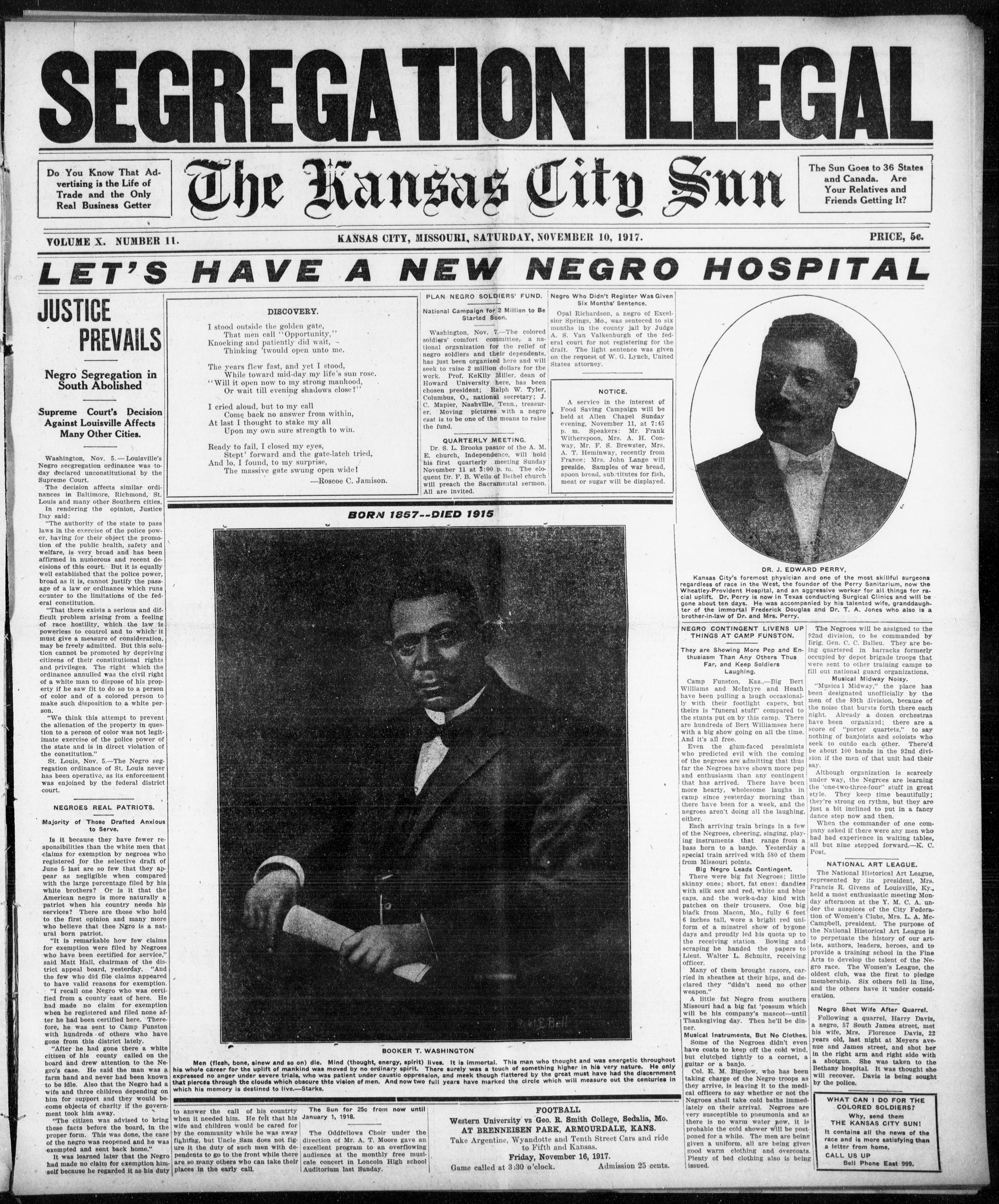
SEGREGATION ILLEGAL
LET'S HAVE A NEW NEGRO HOSPITAL
Do You Know That Advertising is the Life of Trade and the Only Real Business Getter
VOLUME X. NUMBER 11.
JUSTICE PREVAILS
Negro Segregation in South Abolished
Supreme Court's Decision Against Louisville Affects Many Other Cities.
Washington, Nov. 5. — Louisville's Negro secregregation ordinance was today declared unconstitutional by the Supreme Court.
The decision affects similar ordinances in Baltimore, Richmond, St. Louis and many other Southern cities.
In rendering the opinion, Justice Day said:
"The authority of the state to pass laws in the exercise of the police power, having for their object the promotion of the public health, safety and welfare, is very broad and has been affirmed in numerous and recent decisions of this court. But it is equally well established that the police power, broad as it is, cannot justify the passage of a law or ordinance which runs counter to the limitations of the federal constitution.
"That there exists a serious and difficult problem arising from a feeling of race hostility, which the law is powerless to control and to which it must give a measure of consideration, may be freely admitted. But this solution cannot be promoted by depriving citizens of their constitutional rights and privileges. The right which the ordinance annulled was the civil right of a white man to dispose of his property if he saw fit to do so to a person of color and of a colored person to make such disposition to a white person.
"We think this attempt to prevent the alienation of the property in question to a person of color was not legitimate exercise of the police power of the state and is in direct violation of the constitution."
St. Louis, Nov. 5.—The Negro segregation ordinance of St. Louis never has been operative, as its enforcement was enjoined by the federal district court.
NEGROES REAL PATRIOTS
Majority of Those Drafted Anxious to Serve.
Is it because they have fewer responsibilities than the white men that claims for exemption by negroes who registered for the selective draft of June 5 last are so few that they appear as negligible when compared with the large percentage filed by his white brothers? Or is it that the American negro is more naturally a patriot when his country needs his services? There are those who hold to the first opinion and many more who believe that the Ngro is a natural born patriot.
"It is remarkable how few claims for exemption were filed by Negroes who have been certified for service," said Matt Hall, chairman of the district appeal board, yesterday. "And the few who did file claims appeared to have valid reasons for exemption.
"I recall one Negro who was certified from a county east of here. He had made no claim for exemption when he registered and filed none after he had been certified here. Therefore, he was sent to Camp Funston with hundreds of others who have gone from this district lately.
"After he had gone there a white citizen of his county called on the board and drew attention to the Negro's case. He said the man was a farm hand and never had been known to be idle. Also that the Negro had a wife and three children depending on him for support and they would become objects of charity if the government took him away.
"The citizen was advised to bring these facts before the board, in the proper form. This was done, the case of the negro was reopened and he was exempted and sent back home."
It was learned later that the Negro had made no claim for exemption himself because he regarded it as his duty
The Kansas City Sun
DISCOVERY.
I stood outside the golden gate,
That men call "Opportunity,"
Knocking and patiently did wait,
Thinking 'twould open unto me.
The years flew fast, and yet I stood,
While toward mid-day my life's
"Will it open now to my strong man!
Or wait till evening shadows clo
The years flew fast, and yet I stood,
While toward mid-day my life's sun
"Will it open now to my strong manhoo
Or wait till evening shadows close?
The years flew fast, and yet I stood,
While toward mid-day my life's sun rose.
"Will it open now to my strong manhood,
Or wait till evening shadows close?"
I cried aloud, but to my call
Come back no answer from within,
At last I thought to stake my all
Upon my own sure strength to win.
Men (flesh, bone, sinew and so his whole career for the uplift of mankind expressed no anger under severe trials that piercés through the clouds which o' which his memory is destined to live.
Ready to fail, I closed my eyes,
Stept' forward and the gate-latch t
And lo. I found, to my surprise,
The massive gate swung open wide
—Roscoe C.
Ready to fail, I closed my eyes,
Stept' forward and the gate-latch tried,
And lo, I found, to my surprise,
The massive gate swung open wide!
—Roscoe C. Jamison.
BORN 1857 DIED 1918
RALPH E. BELL
Men (flesh, bone, sinew and so on) die. Mind (thought, energy, spirit) lives. It is immortal. This man who thought and was energetic throughout his whole career for the uplift of mankind was moved by no ordinary spirit. There surely was a touch of something higher in his very nature. He only expressed no anger under severe trials, who was patient under caustic oppression, and meek though flattered by the great must have had the discernment that pierces through the clouds which obscure the vision of men. And now two full years have marked the circle which will measure out the centuries in which his memory is destined to live.—Starks.
to answer the call of his country when it needed him. He felt that his wife and children would be cared for by the community while he was away fighting, but Uncle Sam does not figure it the duty of such men with dependents to go to the front while there are so many others who can take their places in the early call.
yet I stood, y my life's sun rose. strong manhood, shadows close?"
ey eyes,
the gate-latch tried,
surprise,
ung open wide!
—Roscoe C. Jamison.
1
n) die. Mind (thought, energy, spirit)
and was moved by no ordinary spirit. T
who was patient under caustic oppress
sure the vision of men. And now two
Starks.
The Sun for 25c from now until
January 1, 1918.
The Oddfellows Choir under the
direction of Mr. A. T. Moore gave an
excellent program to an overflowing
audience at the monthly free musi-
cale concert in Loncoln High school
Auditorium last Sunday.
KANSAS CITY, MISSOURI, SATURDAY, NOVEMBER 10, 1917.
BORN 1857--DIED 1915
A. E.
BOOKER T. WASHINGTON
(thought, energy, spirit) lives. It is immortal
by no ordinary spirit. There surely was a t
ent under caustic oppression, and meek though
of men. And now two full years have mar
PLAN NEGRO SOLDIERS' FUND.
National Campaign for 2 Million to Be Started Soon.
Washington, Nov. 7.—The colored soldiers' comfort committee, a national organization for the relief of negro soldiers and their dependents, has just been organized here and will seek to raise 2 million dollars for the work. Prof. KeKlly Miller, dean of Howard University here, has been chosen president; Ralph W. Tyler, Columbus, O., national secretary; J. C. Mapier, Nashville, Tenn., treasurer. Moving pictures with a negro cast is to be one of the means to raise the fund.
QUARTERLY MEETING.
Dr. S. L. Brooks pastor of the A. M. E. church, Independence, will hold his first quarterly meeting Sunday November 11 at 3:00 p. m. The eloquent Dr. F. B. Wells of Bethel church will preach the Sacramental sermon. All are invited.
R. H.
it) lives. It is immortal. This man who
There surely was a touch of something
session, and meek though flattered by the
two full years have marked the circle w
FO
Western University vs Geo
AT BRENNEISEN PA
Take Argentine, Wyandotte
to Fifth
Friday, N
FOOTBALL
Western University vs Geo. R. Smith College, Sedalia, Mo.
AT BRENNEISEN PARK, ARMOURDALE, KANS.
Take Argentine, Wyandotte and Tenth Street Cars and ride to Fifth and Kansas.
Friday, November 16, 1917.
Game called at 3:30 o'clock. Admission 25 cents.
Negro Who Didn't Register Was Given Six Months' Sentence.
Opal Richardson, a negro of Excelsior Springs, Mo., was sentenced to six months in the county jail by Judge A. S. Van Valkenburgh of the federal court for not registering for the draft. The light sentence was given on the request of W. G. Lynch, United States attorney.
NOTICE.
A service in the interest of Food Saving Campaign will be held at Allen Chapel Sunday evening, November 11, at 7:45 p. m. Speakers: Mr. Frank Witherspoon, Mrs. A. H. Conway, Mr. F. S. Brewster, Mrs. A. T. Heminway, recently from France; Mrs. John Lange will preside. Samples of war bread, spoon bread, subtitutes for fish, meat or sugar will be displayed.
DR. J. EDWARD PERRY,
Kansas City's foremost physician and one of the most skillful surgeons regardless of race in the West, the founder of the Perry Sanitarium, now the Wheatley-Provident Hospital, and an aggressive worker for all things for racial uplift. Dr. Perry is now in Texas conducting Surgical Clinics and will be gone about ten days. He was accompanied by his talented wife, granddaughter of the immortal Frederick Douglas and Dr. T. A. Jones who also is a brother-in-law of Dr. and Mrs. Perry.
NEGRO CONTINGENT LIVENS UP
THINGS AT CAMP FUNSTON.
They are Showing More Pep and Enthusiasm Than Any Others Thus Far, and Keep Soldiers Laughing.
Camp Funston, Kas.,—Big Bert Williams and McIntyre and Heath have been pulling a laugh occasionally with their footlight capers, but theirs is "funeral stuff" compared to the stunts put on by this camp. There are hundreds of Bert Williamses here with a big show going on all the time. And it's all free.
Even the glum-faced pessimists who predicted evil with the coming of the negroes are admitting that thus far the Negroes have shown more pep and enthusiasm than any contingent that has arrived. There have been more hearty, wholesome laughs in camp since yesterday morning than there have been for a week, and the negroes aren't doing all the laughing, either.
Each arriving train brings in a few of the Negroes, cheering, singing, playing instruments that range from a bass horn to a banjo. Yesterday a special train arrived with 580 of them from Missouri points.
Big Negro Leads Contingent.
There were big fat Negroes; little skinny ones; short, fat ones; dandies with silk sox and red, white and blue caps, and the work-a-day kind with patches on their trousers. One big black from Macon, Mo., fully 6 feet 6 inches tall, wore a bright red uniform of a minstrel show of bygone days and proudly led his quota up to the receiving station. Bowing and scraping he handed the papers to Lieut. Walter L. Schmitz, receiving officer.
Many of them brought razors, carried in sheathes at their hips, and declared they "didn't need no other weapon."
A little fat Negro from southern Missouri had a big fat 'possum which will be his company's mascot—until Thanksgiving day. Then he'll be dinner.
Musical Instruments, But No Clothes.
Some of the Negroes didn't even have coats to keep off the cold wind, but clutched tightly to a cornet, a guitar or a banjo.
Col. E. M. Bigelow, who has been taking charge of the Negro troops as they arrive, is leaving it to the medical officers to say whether or not the Negroes shall take cold baths immediately on their arrival. Negroes are very susceptible to pneumonia and as there is no warm water now, it is probable the cold shower will be postponed for a while. The men are being given a uniform, all are being given good warm clothing and overcoats Plenty of bed clothing also is being issued.
The Sun Goes to 36 States and Canada. Are Your Relatives and Friends Getting It?
PITAL
and one of the most skillful surgeons under of the Perry Sanitarium, now the aggressive worker for all things for re-conducting Surgical Clinics and will be anbyl by his talented wife, granddaughs and Dr. T. A. Jones who also is a
The Negroes will be assigned to the 92nd division, to be commanded by Brig. Gen. C. C. Balleu. They are being quartered in barracks formerly occupied by depot brigade troops that were sent to other training camps to fill out national guard organizations.
Musical Midway Noisy.
"Musical Midway," the place has been designated unofficially by the men of the 89th division, because of the noise that bursts forth there each night. Already a dozen orchestras have been organized; there are a score of "porter quartets," to say nothing of banjoists and soloists who seek to outdo each other. There'd be about 100 bands in the 92nd division if the men of that unit had their say.
Although organization is scarcely under way, the Negroes are learning the 'one-two-three-four' stuff in great style. They keep time beautifully; they're strong on rythm, but they are just a bit inclined to put in a fancy dance step now and then.
When the commander of one company asked if there were any men who had had experience in waiting tables, all but nine stepped forward.—K. C. Post.
NATIONAL ART LEAGUE.
The National Historical Art League, represented by its president, Mrs. Francis R. Givens of Louisville, Ky., held a most enthusiastic meeting Monday afternoon at the Y. M. C. A. under the auspices of the City Federation of Women's Clubs, Mrs. L. A. McCampbell, president. The purpose of the National Historical Art League is to perpetuate the history of our artists, authors, leaders, heroes, and to provide a training school in the Fine Arts to develop the talent of the Negro race. The Women's League, the oldest club, was the first to pledge membership. Six others fell in line, and the others have it under consideration.
Following a quarrel, Harry Davis, a negro, 57 South James street, met his wife, Florence Davis, 22 years old, last night at Meyers avenue and James street, and shot her in the right arm and right side with a shotgun. She was taken to the Bethany hospital. It was thought she will recover. Davis is being sought by the police.
Why, send them
THE KANSAS CITY SUN!
It contains all the news of the
race and is more satisfying than
a letter from home.
CALL US UP
Bell Phone East 999.
PRICE, 5c.
From Our Foreign Correspondents
A. F. and A. M. Mo. Jurisdiction
A. F. and A. M. Mo. Jurisdiction
Officers—1917.
W. W. Fields, Cameron, Mo., Grand Master.
C. C. Clark, St. Louis, Mo., Dep.
Grand Master.
Ernest Boone, Louisiana, Mo., Senior Grand Warden.
I. H. Bradbury, St. Louis, Mo.
Junior. Grand Warden.
H. H. Walker, St. Joseph, Mo., Grand Treasurer.
Geo. W. K. Love, Kansas City
Grand Secretary.
Nelson C. Crews, Kansas City, Relief Secretary.
E. G. Lacey, Kansas City, G. L.
1st District.
E. J. Cooper, Mexico, Mo., G. L.
OFFICERS OF GRAND CHAPTER
R. A. M.
Missouri and Jurisdiction, 1917-18.
T. G. McCampbell, G. H. P., Quindaro, Kans.
A. L. Thomas, D. G. H. P., Jefferson City, Mo.
J. P. Moffett, G. King, Sedalia, Mo.
S. A. May, G. Scribe, St. Louis, Mo.
Chas. Griggsby, G. Treas., Liberty, Mo.
E. S. Baker, G. Secretary, Kansas City, Mo.
OFFICERS OF GRAND COMMANDERY, K. T.
Missouri and Jurisdiction
1917-18.
W. G. Mosely, R. E. G. C., Kansas City, Mo.
J. W. Beard, V. E. G. C., St. Louis, Mo.
G W. Lewis, E. G. G., St. Louis, Mo.
C. Brassfield, E. G., Captain General, Kansas City, Mo.
W. A. Ashley, E. G. P., St. Louis,
Mo.
J. H. Kenner, E. G., Treasurer, Marsh
shall. Mo.
J. T. Cannon, E. G., Recorder, St.
Louis, Mo.
George A. Johnson, E. G. S. W.
Kansas City, Mo.
Benjamin F. Graves, E. G. J. W., St.
Joseph, Mo.
Lodge Directory
G
MASONIC
MASONIC
Rone Lodge No. 25, A. F. and A. M. meets the last and 3rd Monday in each month. All Master Masons in good standing welcome. Emmett Spruell, W M.; C. H. Countee, Sec'y.
G
and A. M., Liberty, Mo., meets the 2nd and 4th Saturday nights in each month. William Parker, W. M.; Nelson Wallar, Sec'y.
St. Stephen Chapter No. 37, Rivervale, Mamaroneck Liberty, Mo. Meets first Tuesday in each month. W. H. Robinson, H. P. H., Wm. Caps, Recorder.
```markdown
```
St. Matthew Commandery
No. 17, Liberty, M., meets
the third Saturday night.
William Capps, E. C.; W. H.
Robinson, Rec. Sec'y.
HRC
IN
WINED
U. B. F.
King of the West Lodge
No. 218 meets first and third
month and tenth month
10th and Campbell. C. F.
Wilson, W M.; H. Conway,
588 Tracy Ave., Secy.
T. G. McCampbell, President.
E. B. Thompson, Vice President.
W. H. Washington, Treasurer.
S. H. P. Edwards, Secretary.
Board of Directors:
N. W. Jordan. S. Myers,
W. H. Brown. E. S. Baker,
W. R. Patterson R. V. Adkins,
B. R. Francis. Richard Harris
Geo. Johnson, R. Fulbright.
Meets second and fourth Tuesday
in each month.
CHURCH DIRECTORY.
Bethel A. M. E. Church, 24th and Flora. St. Stephen's Baptist Church, 604 Charlotte St. Centennial M. E. Church, 19th and Woodland. Second Baptist Church, 19th and Charlotte. Allen Chapel A. M. E. Church, 10th and Charlotte. Ebenezer A. M. E. Church, 17th and Tracy. St. Augustine's P. E. Church, 11th and Troost Avenue. St. John's A. M. E. Church, 1743 Belleview. Seventh Day Adventist, 23d and Woodland. St. Monica's Catholic, 17th and Lydia. Vine St. Baptist Church, 1825 Vine St. Ward Chapel A. M. E. Church, 11th and Troost. Morning Star Baptist Church, 2311 Vine. Highland Avenue Baptist Church, 1111 Highland. St. Monica A. M. E. Zlon Church, 1823 Woodland Ave. Second Christian Church, 24th and Woodland. C. M. E. Church, 1817 Flora Ave. St. James Baptist Church, 4039 Mill St. St. Monica A. M. E. Church, 43rd and Prospect Place. CLARK CHAPEL M. E. CHURCH,
KANSAS CITY, KAN. CHURCHES.
First A. M. E. Church, 8th and Neb.
Eighth St. Baptist Church, 8th and
Oakland.
Metropolitan Baptist Church, 9th and
Washington.
Bethel A. M. E. Church, Water and
Steward Streets.
St. Paul A. M. E. Church, 21st and
Rockville.
First Baptist Church, 5th and Neb.
King Solomon Baptist Church, 3rd and
State.
Pleasant Valley Baptist Church, Rose-
dale, Kan.
M. E. Church, 9th and Oakland.
Second Baptist Church, 24th and Ruby.
Bethel A. M. E., 106 Shawnee.
Bethel A. M. E., Rosedale, Kan.
LINCOLN, NEBR.
By W. W. Mosely.
Messrs. Wm. Woods and C. R. Johnson entertained with a Steg party in honor of Lieut. Wm. N. Johnson.... Four drafted men left for Fort Riley, Kansas, last Saturday——Mr. Wm. A. Johnson entertained a number of friends in honor of his son, Lieut. Wm. N. Johnson, who left for Fort Des Moines Saturday. From there he went to Fort Dodge, where he will be stationed to assist in the training of U. S. soldiers....The Ministers of the city held a meeting for the purpose of advertising wheatless and meatless days to aid the war. A large number were present.
HELENA, MONT.
A large crowd met at the Great Northern Depot to bid farewell to the three drafted boys who left for Camp Lewis, last Saturday. Addresses were made by a number of the prominent men of the City.....Mrs. Anderson Green is on the sick list.....Mrs. Ed Johnson visited friends in Butte and Anaconda.....Col. Roscoe Simmons will be in the tSate soon.....Mrs. H. C. Parsons is convalescent.....A class of 25 will be initiated here next week into the K. of P. lodge. The ladies of this city met with Mrs. Wm. Mason, 908 Cannon street to organize a Ladies Club but not agreeing as whom
[Picture of a man in a suit with a tie].
NEW LOCATION.
Dr. Thos. A. Jones, 1612 E. 12th Street, over Cooper's Drug Store, Phones, Bell East 3811, Home East 176; Residence phone, Bell Wabash 569 Hours: 8 to 9:30 a. m.; 2 to 4 and 7 to 9 p. m.; Sunday, 10 to 11 a. m. and 6 to 7 p. m.
Tailored To Your Measure
To wear, show your friends, tell who made it. Latest model, made in any style, a perfect fit, your choice of any goods, your favorite dress, your new liberal offer for a few hours work.
Big cash profits for your sparse time, $100 to $60 a month, introducing you to friends for premier presents. FREE. No matter where you live or what do you, or what you tailoring agent write us too, no matter who book you represent. Send name and address, get your pictures, our big new generous offer all "FREE" pictures, our big new generous offer all "FREE" pictures, our big new generous offer all "FREE"
LIBERTY TAILORING SCHOOL. Dent. 304 318 CHICAGO
MONEY TO LOAN.
Short time money to loan to roominghouse keepers—must have reference. Property owners can obtain a loan thru our agency and pay it back by weekly installments. If your house needs papering, painting or repairing, get a loan and put in its necessary repairs.
Our business is strictly confidential. Bell Phone, Grand 4204.
The Handy Colored Store
2409 Vine St.
Ladies' and Gent's Furnishing
Goods and Notions
VISIT OUR DRY GOODS AND
HARDWARE DEPT.
BARGAINS
FURNISHING & CARE
SPECIAL BARGAINS IN OUR
NOTION DEPARTMENT
AND HAIR GOODS.
Help Make Our Store, Your Store, Our
Customers Your Friends
Special Values in Furnishings for
Men, Women and Children.
GIVE US A CALL.
$2.50 In Goods Free.
WE GIVE SURETY COUPONS.
Taylor Holmes & Co.
Mrs. Annie Holmes, Mngr.
2409 VINE ST., Kansas City, Mo.
Bell Phone East 4221J
THE KANSAS CITY SUN, SATURDAY, NOVEMBER 10, 1917.
the officers should be postponed their meeting indefinitely.
BUTTE. MONT.
Mrs. James of Peublo, Colo., sister of Mapor Vince passed through Butte, on her way to Tacoma, Wash....Mrs. James Bullett left for the East; Mrs. Oneal will accompany her as far as St. Louis, Mo....Mrs. Hell, mother of Mrs. Jerry Larkins returnel from Helena....Mr. Gunn, one of our enterprising men has bought $500 forth of Liberty Bonds....Mr. and Mrs. Jesse H. Smith have moved to 215 S. Montana St., where they will keep furnished rooms also light housekeeping rooms....Mr. J. W. Wilson is still confined to his bed....Mr. John Martin of Heller's barber shop is on the sick list....Johnny, Bird, continues quite ill....Mr. John Nance slipped on the iq steps at the rear of his home, falling a distance of fifteen feet, breaking his neck....Rev. Alen of the A. M. E. church reports all organizations connected with the church in good working order and he asks the earnest cooperation of all....Mr. E. W. Rivers has purchased a Liberty Bird.
Mrs. Gertrude Jenkins of Quindaro, Kansas, spent a few days with her mother last week....Mrs. J. F. Moton our assistant teacher has proven herself very useful in the community....Mrs. Harriett Clark has gone to spend the winter with her daughter in Quindaro, Kansas....Mr. Goshen Winn of Kansas City, visited his mother, Mrs. Spencer Tuesday....Mr. Sam Spears and Alfred Spears of Kansas City, were her Sunday....Mr. and Mrs. R. P. Hemsley attended the funeral of their daughter-in-law in Lees Summit Monday....Mrs. Cordelia Spencer is improving....Mrs. Ethel Davis, Miss A. Gent, Mrs. Harry Brown motored to Harrisonville....Mrs. James Johnson of Freemont, Ohio, is visiting relatives....The banquet given by the B. Y. P. U. in honor of Mrs. Wood was a decided success....Mrs. Gipson and committee of young ladies received much praise.
MARYVILLE, MO
Rev. R. H. Longdon left after services Sunday night to spend the week at his home in Chillicothe with his family. ...Mrs. J. C. Cooke will have as a house guest, Mrs. Emma Phillips of St. Joseph, Mo. ...We are glad to see Mrs. Susan Gunn out again after a severe illness. ...Mr. Paul Smith and Mr. Rufus Palmer attended a Halloween dance in Clarinda, Ia., last week. ...Mrs. Evertt Page was hostess to a six o'clock dinner Thursday evening, November 1, for Rev. R. H. Longdon and Prof. Ernest O. Boone, Jr., wife and son. ...Mrs. J. C. Cooks will entertain with a delightful evening party Friday, November 9, complimentary to her guest. ...All loyal citizens should' join the Hoover Club and help in the conservation of foods. Do you bit and help win the war. ...Maryville citizens both white and colored were shocked and grieved at the sudden death of Mrs. Gloria Mae Carriger. Mrs. Carriger was in the bloom of life being only 19 years old at her death, she will be sadly missed in Maryville. She was a lovable character, always cheerful and no one could resist her sunny and winsome smiles. It was a real pleasure to know her. She was a faithful member and worker in the Methodist church. She was the adopted daughter of Mr. and Mrs. Henry Wilson. She graduated from school and was united in matrimoney with Mr. Dorrill Carriger the following year. She leaves to mourn her loss a husband, two sisters, other relatives and a host of friends. Those from out of town who attended the funeral were: Mrs. Fannie Prior of Kansas City, Mo., Mrs. Palmer of Sturgeon, Mo., Mrs. Pearl Phelps and daughter, Miss Florence Lewis, Miss Rosette Lewis of Savannah, Mo., Mr. and Mrs. Frank Palmer Mr. Donal Palmer, Mr. and Mrs. Anderson and son, Mrs. Nanie Misner Mr. Harold Carriger of St. Joseph Mo., Mrs. Myrtle Martin of Mont. Mr. and Mrs. Joe Graves, Skitmore Mo., Miss Iola Brown, Blanchard, Ia. ...Mrs. Myrtle Martin will visit in Missouri for two months before returning to her home.
ARGENTINE, KANSAS.
By Mrs. Ophelia Jackson.
Mrs. Annie Alston celebrated her birthday anniversary last Friday evening with a party. The house was beautifully decorated and an excellent four-course luncheon was served. Quite a few guests were present and she was the recipient of a number of gifts....Walter Wightman was seriously hurt by jumping from an automobile on last Friday afternoon.... Mr. J. T. Sherman was struck by a car and thrown from his wagon last Saturday and is in the hospital in a serious condition. Mr. Sherman is a hog raiser in Argentine....The patrons of Lewis School met on Wednesday of the week and an interesting program was rendered....The State Teachers are attending the Association at Topeka this week and the children were given Thursday and Friday as holidays....The Needlecraft Club met with Mrs. Fannie Carter last Friday and had a most enjoyable time. The Club is progressing nicely under the instruction of Mrs. Eva Bailey.
PLATTSBURG, MO.
The Washington school under the management of Prof. C. W. Black as principal and Miss Ada Clark assistant is progressing satisfactorily. The enrollment is 98 per cent of the enumeration. We are indebted to Mr. R. A. Shaver, a prominent white man for the gifts of play apparatus for our school. In addition to the above gifts he took fourteen boys of the school and gave them free use of eight acres of land, paid for the preparation of the land for garden use, bought the seed, employed a man to superintend the work, at the close of the season he bought the entire crop when harvested and gave each boy a twenty-two dollar suit of clothes, shoes costing three dollars and fifty cents per pair and a cap worth one dollar. The boys were ebtages of twelve and fourteen years. At Christmas time Mr. Shaver visits each school in the county and gives suitable gifts to each child. During the winter he sends to each needy person of our race in the town a basket of provisions. Our boys who were selected by the draft for the National Army left for Camp Funston the 29. They were given a banquet by the Red Cross Society (white) of this city. Kits were also presented to each drafted man, the same were made and paid for by the white citizens.....G. M. W. W. Fields and wife were Sunday visitors.....
SIR A. FR.
The dignified headwaiter of the fi
is one of the most prominent as well a
is visiting relatives and friends in this
[Name not visible]
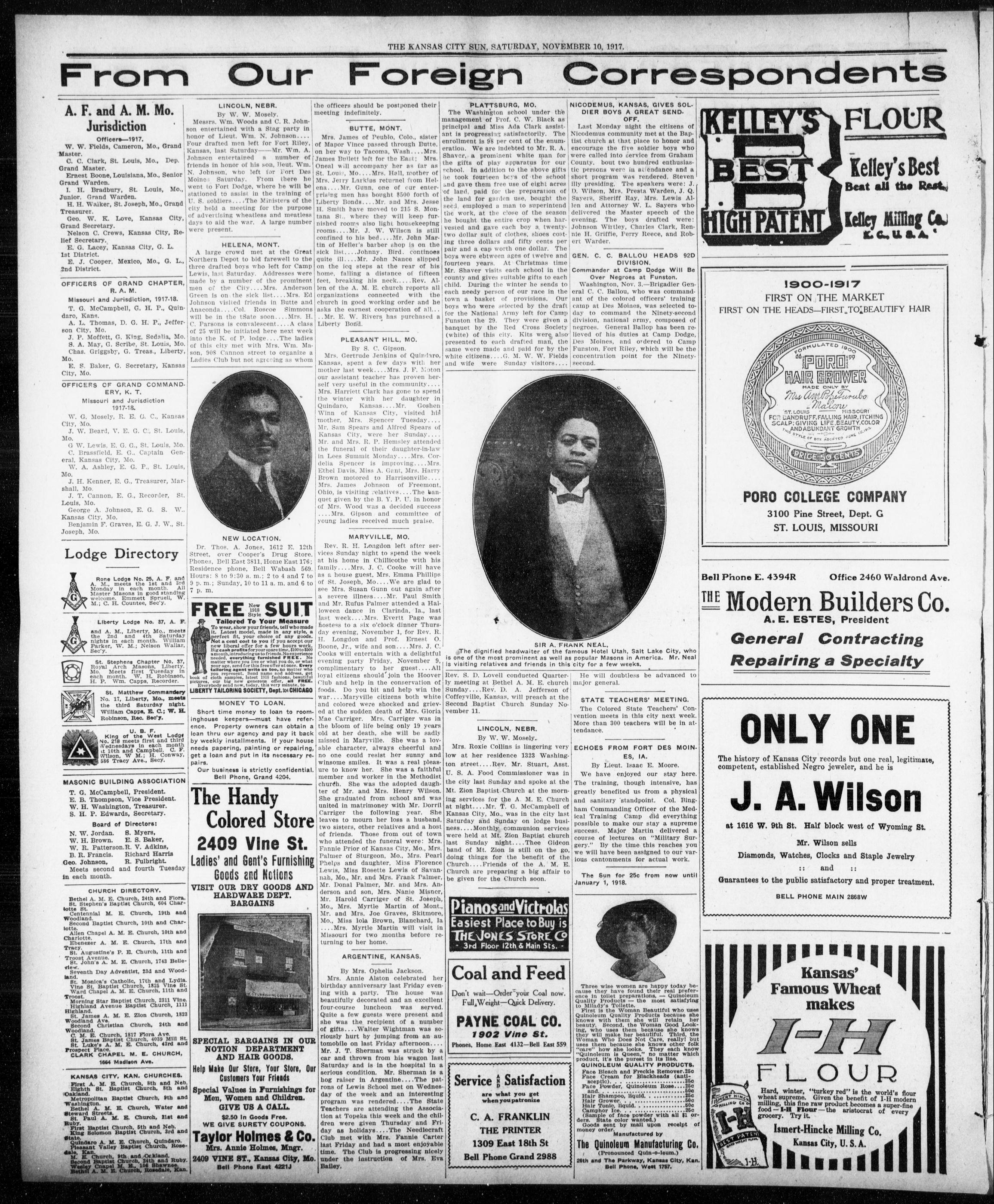
SIR A. FRANK NEAL.
The dignified headwaiter of the famous Hotel Utah, Salt Lake City, who is one of the most prominent as well as popular Masons in America. Mr. Neal is visiting relatives and friends in this city for a few weeks.
Rev. S. D. Lovell conducted Quarterly meeting at Bethel A. M. E. church Sunday....Rev. D. A. Jefferson of Coffeyville, Kansas, will preach at the Second Baptist Church Sunday November 11.
He will doubtless be advanced to major general.
STATE TEACHERS' MEETING.
The Colored State Teachers' Con
Mrs. Roxie Collins is lingering very low at her residence 1323 Washington street....Rev. Mr. Stuart, Asst. U. S. A. Food Commissioner was in the city last Sunday and spoke at the Mt. Zion Baptist Church at the morning services for the A. M. E. Church at night....Mr. T. G. McCampbell of Kansas City, Mo., was in the city last Saturday and Sunday on lodge business....Monthly communion services were held at Mt. Zion Baptist church last Sunday night....Thee Gideon band of Mt. Zion is still on the go, doing things for the benefit of the Church....Friends of the A. M. E. Church are preparing a big affair to be given for the Church soon.
Pianos and Victrolas
Easiest Place to Buy is
THE JONES STORE CO
- 3rd Floor 12th & Main Sts.
Coal and Feed
Don't wait—Order your Coal now.
Full Weight—Quick Delivery.
PAYNE COAL CO.
1902 Vine St.
Phones, Home East 4132—Bell East 559
Service AND Satisfaction
are what you get
when you patronize
C. A. FRANKLIN
THE PRINTER
1900 East 18th St.
LINCOLN, NEBR.
By W. W. Moselv.
NICODEMUS, KANSAS, GIVES SOLDIER BOYS A GREAT SEND-OFF.
Last Monday night the citizens of Nicodemus community met at the Baptist church at that place to honor and encourage the five soldier boys who were called into service from Graham County, bout two hundred enthusiastic persons were in attendance and a short program was rendered. Steven ill presiding. The speakers were: J. D. Wilson, Mrs. Presta Warden, J. Q. Sayers, Sheriff Ray, Mrs. Lewis Allen and Attorney W. L. Sayers who delivered the Master speech of the evening. The boys drafted were: Johnson Wirtley, Charles Clark, Rennie H. Griffie, Perry Reece, and Robert Warder.
GEN. C. C. BALLOU HEADS 92D DIVISION.
Commander at Camp Dodge Will Be
Over Negroes at Fusston
Washington, Nov. 3.—Brigadier General C. C. Ballou, who was commandant of the colored officers' training camp at Des Moines, was selected today to command the Ninety-second division, national army, composed of negroes. General Ballop has been relieved of his duties at Camp Dodge, Des Moines, and ordered to Camp Funston, Fort Riley, which will be the concentration point for the Ninety-second.
[Image of a man in formal attire, wearing a suit and bow tie, with a serious expression. The background is a brick wall.]
He will doubtless be advanced to major general.
STATE TEACHERS' MEETING.
The Colored State Teachers' Convention meets in this city next week. More than 300 teachers will be in attendance.
ECHOES FROM FORT DES MOIN
ES. IA.
We have enjoyed our stay here. The training, though intensive, has greatly benefited us from a physical and sanitary standpoint. Col. Bingham Commanding Officer of the Medical Training Camp did everything possible to make our stay a supreme success. Major Martin delivered a course of lectures on "Military Surgery." By the time this reaches you we will have been assigned to our various cantonments for actual work.
The Sun for 25c from now until January 1, 1918.
Three wise women are happy today because they have found their real preference in toilet preparations. — Quinoleum Quality Products — the most satisfying to Milady's Tollette.
First is the Woman Beautiful who uses Quinoleum Quality Products because she knows with them she will retain her beauty. Second, the Woman Good Looking, who uses them because she knows they will make her beautiful. Third, the Woman Who Does Not Care, really! but uses them because she knows other folk "care" how she looks. They each know "Quinoleum is Queen," no matter which product, it's the purest in its line.
QUINOLEUM QUALITY PRODUCTS.
FACE Bleach and Freckle Remover.25c
Face Cream for Blackheads (anti-sceptic).25c
Face Powder, Quinoleum Rose.25c and...50c
Hair Shampoo, liquid...25c
Hair Grower...50c
Hair Tonic, liquid...50c
Camphor Ice...25c
(Sample of face powder with all $1 orders. State color wanted.)
Goods sent by mail upon receipt of money order.
Manufactured by
The Quinoleum Manufacturing Co.
(Pronounced Quin-o-leum.)
26th and The Parkway, Kansas City, Kan.
Bell Phone, West 1757.
KELLEY'S
BEST
HIGH PATENT
FLOUR
Kelley's Best
Beat all the Rest.
Kelley Milling Co.
K.C.U.S.A.
1900-1917 FIRST ON THE MARKET FIRST ON THE HEADS-FIRST TO BEAUTIFY HAIR
FORMULATED 1900
PORO
HAIR GROWER
MADE ONLY BY
Mrs Amelia Furubo
Mallon
ST. LOUIS
MISSOURI
FOR DANDRUFF, FALLING HAIR, ITCHING
SCALP; GIVING LIFE, BEAUTY, COLOR
AND ABUNDANT GROWTH
THIS STYLE OF BOX ADOPTED JUNE 12,1915
PRICE: 50 CENTS
PORO COLLEGE COMPANY
3100 Pine Street, Dept. G
ST. LOUIS, MISSOURI
THE Modern Builders Co. A.E. ESTES, President General Contracting Repairing a Specialty
The history of Kansas City records but one real, legitimate, competent, established Negro jeweler, and he is
J. A. Wilson
at 1616 W. 9th St. Half block west of Wyoming St.
Mr. Wilson sells
Diamonds, Watches, Clocks and Staple Jewelry
:: and ::
Guarantees to the public satisfactory and proper treatment.
BELL PHONE MAIN 2868W
Kansas'
Famous Wheat
makes
I-H
FLOUR
Hard, winter, "turkey red" is the world's flour
wheat supreme. Given the benefit of I-H modern
milling, this fine raw product becomes a super-fine
food — I-H Flour — the aristocrat of every
grocery. Try it.
Ismert-Hincke Milling Co.
Kansas City, U. S. A.
The Hanging Bough
It Covered a Love
Affair
By Agnes G. Brogan
(Copyright, 1917, Western Newspaper Union.)
It had been a source of annoyance to Gordon from the moment he entered the well appointed new study and tock up his pen to write. Here in the seclusion of the country he had promised himself to finish undisturbed the book which should add to his fame.
Everything had seemed propitious to that end—the small rented bungalow, its peaceful setting of silencing hills, the absence of interrogating friends. Old Martha, the housekeeper whom he had brought with him from the city, attended interdigently to all his wants.
Now, into all this desirableness came the disturbing element, a great evergreen branch hanging like a screening curtain before his very windows. Against its thick fragrance the sun battled hopelessly, while the study remained in semi-gloom. If the bough had been attached to a tree upon his own lawn the matter might have been quickly righted, but the particular tree of this down hanging branch grew on his neighbor's ground, upon the opposite side of the high garden wall. Gordon had carelessly noticed the place as he came along, the old crumbling house, the broken statuary and basins of its gardens bespeaking a time of grandeur long past. Disgustedly at last the author threw down his pen.
"It's no use," he told the attentive but laconic Martha; "we will have to move the study some place else."
"You could not write in the open living room," she answered truly. The old bungalow's space was limited.
"Then I will ask them to cut the bough down," he said, and paused perplexedly. "Who lives there?"
"The name on the door stone is Stuyvesant," Martha replied, "Peter Stuyvesant. That is all I know."
So Gordon decided to pen his request. Being in an impatient frame of mind at the moment, his request was more in the nature of a demand.
"The bough hung before my study window," he wrote, "causes me much inconvenience and annoyance. I must ask that it be immediately removed.
"J. Wesley Gordon," he signed and remembered with satisfaction that there were few to whom the name was unknown.
Martha was dispatched with the note, returning soon to say that, as no one had responded to her ring, she had dropped the missive into the Stuyvesant mail box.
Gordon was folding away the fragmentary work of an unsuccessful afternoon when the answer came, a freckled faced lad being the bearer.
"The impertinent old Dutchman!" he muttered, for this is what he read:
"If you would prefer to have the left wing of our house removed just mention that also. P. Stuyvesant."
The scattered pages of his day's work mocked him. Duskily through the screening branch flickered a shifting light, and heatedly Gordon reached for his pen.
"If that bough," he wrote, "is not cut down by 9 o'clock tomorrow, I will go over and do it myself."
This time he contented himself with signing merely the letters "J. W. G."
When the second note in Martina's apron pocket was passing through the gateway broken in the garden wall, Gordon reflected that he had been rather hasty. The Dutchman's imprudence to a "personality" had rather nettled him. For though the author would not admit the fact to himself, subservience had become a custom.
Back through the broken gateway again came Martha, silently placing a responsive note in his hand.
"Cut the branch down," was scrawled in bold defiant script. "Cut the branch down, if you dare! P. Stuyvesant."
Gordon's brows came together angrily; then he laughed. "A threat, eh?" he said; "all right." He turned to the waiting Martha. "The affair becomes interesting," he said. "I will now get out my gasoline buggy and run into town."
At the very end of the straggling village street he found a hardware shop and bought a saw, then he added to his purchase a small shining ax. He smiled grimly as his car slowed down nearing the great, shabby house next door. From a rear window shone a light. Gordon had a mental picture of a fat, stubborn old Dutchman smoking his evening pipe in the kitchen.
"Preparation for onslaught upon the tree of Peter Stuyvesant," he explained to Martha, as he left his implements in the back hall.
It was in a long forgotten spirit of boyish adventure that he sought them next morning, and sauntered through the break in the stone wall. All was still. The old house and its garden presented an appearance of having been asleep for a hundred years. Gordon was glad he had put on tennis shoes; he would be able to climb up like a squirrel, and when the branch had fallen neatly he would carry it over and place it against their veranda palings, to show his accomplished purpose. What had Stuyvesant meant by writing the words, "if you dare." Did the fellow actually intend to show fight? Gordon smiled involuntarily Well, if he did, the author might "show him" that he had not forgotten college years of athletic training. He was ready; almost, he was eager, then Gordon stopped short in the path-
way. Crouched beneath the offending evergreen tree was a bulldog, a huge, fierce jawed brute, its bloodshot eyes fixed upon the approaching author, its body trembling with rumbling, threatening sounds. So this was the "dare." Strange the possibility had not occurred to him.
To go forward farther was very evidently useless. In flight—at least for the present—lay Gordon's safety. Ignominiously he retreated. As he entered the hallway Martha's eyes asked the question her lips would not.
"I am going out later," Gordon confusedly explained, "to cut the thing down." But when he went out later the dog had advanced to the gap in the wall, his lapping jaws seeming to speak disappointment in the ending of the fray. Gordon smoked his pipe for half an hour that evening in the shelter of the bungalow porch before deciding upon a further course of action.
At last he got up and searched out an old revolver, overlooking its casings. Never before had its protection been needed. He shook his head seriously at old Martha.
"With an ugly brute like that across the way," he explained. Then Gordon wrote his last note of warfare.
"I am going over tomorrow to saw the branch from your tree. If the dog is there I shall shoot him on the spot."
"J. W. GORDON."
Martha's face was quite white when she brought back the reply, "That dog," she explained, "he sits under the tree and growls. It makes me tremble to look at him."
"The dog is a thoroughbred," read the answering note. "If you shoot you will pay every cent he is worth. It's a good deal.
"P. STUYVESANT."
Gordon pondered. Some of these brutes, he realized, were worth thousands of dollars, and the animal being on its owner's premises would make him entirely accountable. It was a confounding situation. Nevertheless he ventured forth upon the following morning; but, while he was formidably armed with saw and ax, the revolver reposed in a drawer of his desk—and the dog was not there. Gordon breathed a sigh of relief. So his threat had frightened old Peter, after all!
It was no task at all to climb to the high base of the drooping branch. Easily he swung himself out upon a neighboring limb and fitted the saw. A panting sound attracted his attention, and he glanced downward. The dog had arrived at his post in a mad rush. The author muttered an imprecation. So this was the plotted scheme to wait and pin him up there helplessly?
He might aim the ax at the dog's head, of course, but the brute was a thoroughbred, and it might mean more perhaps than the launching of his new book. Gordon bent down and whistled peaceably. A fierce growl followed, echoed suddenly by a girl's smothered laughter.
The author wheeled about on his swaying limb. At the back of the tree stood a young woman. That she had been engaged in silent laughter was evident from the furtive dabs at her still glistening eyes.
"Oh, dear!" gasped the girl. "Oh, dear; it was so funny!"
Gordon, speechless, was acutely aware of the beauty of her mass of bronzed hair gleaming in the sunlight, of the full red lips lurping in helpless laughter.
"It has all been so funny," she gurgled—"yesterday when you started over so bravely and—and retreated at the sign of the bulldog, and today when with all those red axes and things you came like a whole fire department." She bent to caress the dog. "What shall we do with him, Bobs?" she asked wickedly. "The poor man is frightened to death."
Gordon made a frantic effort for dignity as he clung to the uncertain bough. "I would like to speak to Peter Stuyvesant," he said stifly.
The girl shook her head. "You can't," she told him. "There isn't any Peter Stuyvesant was my grandfather. I never saw him. Bobs is the only relative I have. We come out to the old place to live every summer."
"But—but the note?" murmured Gordon, perplexed.
The girl's pink cheeks grew pinker. "I wrote them," she confessed. "P. Stuyvesant—that means Polly."
For a long moment the girl's blue eyes looked up into the man's brown ones.
"I had to," she excused, "you were so commanding."
"I was," agreed Gordon. Then the awful thing happened. Bending lower the better to see her face, the man lost his balance and fell, lying there a huddled body at her feet. After one sharp cry she brushed the dog aside and raised Gordon's suffering face in her hands. "It's my leg," he said painfully; "broken, I guess." And it was. Because the physician found it easier to move him into the old house, near by, Martha came down from the bungalow to care for him there. So the days and the weeks drifted by. It was a very repentant and charming young woman who kept Gordon's room sweet with flowers from her garden, who read to him through long afternoons, who sang to him softly in enchanted twilights, whose hands at last clung to his tenderly, responsive, as he held them close to his own.
"Dear," he said to her one evening, while Bob's blinked affectionately at them both—"dear, we must come back here every summer, and when you are my wife you shall fix this old place over to suit yourself. We will take down the Stuyvesant stone and give to the house its name." Polly's radiant eyes twinkled back at her lover. "We will call our summer home the Hanging Bough," she said.
THE KANSAS CITY SUN, SATURDAY, NOVEMBER 10, 1917
Fads And Fancies
of
Fashion
MALE OSTRICK
Sets on Eggs at N
cubation Which
Fifty
After pairing, t
make his nest. I
that performs this
squats upon the g
ing himself up
scratches up the
and throws it be
has dug out enough
him he turns roun
One of those closely buttoned up, trim-looking, high-necked suits, that give to wearers a well-set-up, efficient look, is illustrated here. It is of a sort, like the Russian blouse, that may be made becoming to the slender figure and is sure to be becoming to plumpness, so that it is a happy choice for either.
This suit has taken sides with the advocates of the straight silhouette, so it takes intelligent management on the part of the slim woman to wear it successfully. She must see to it that she does not look too flat chested in
```markdown
```
M
I
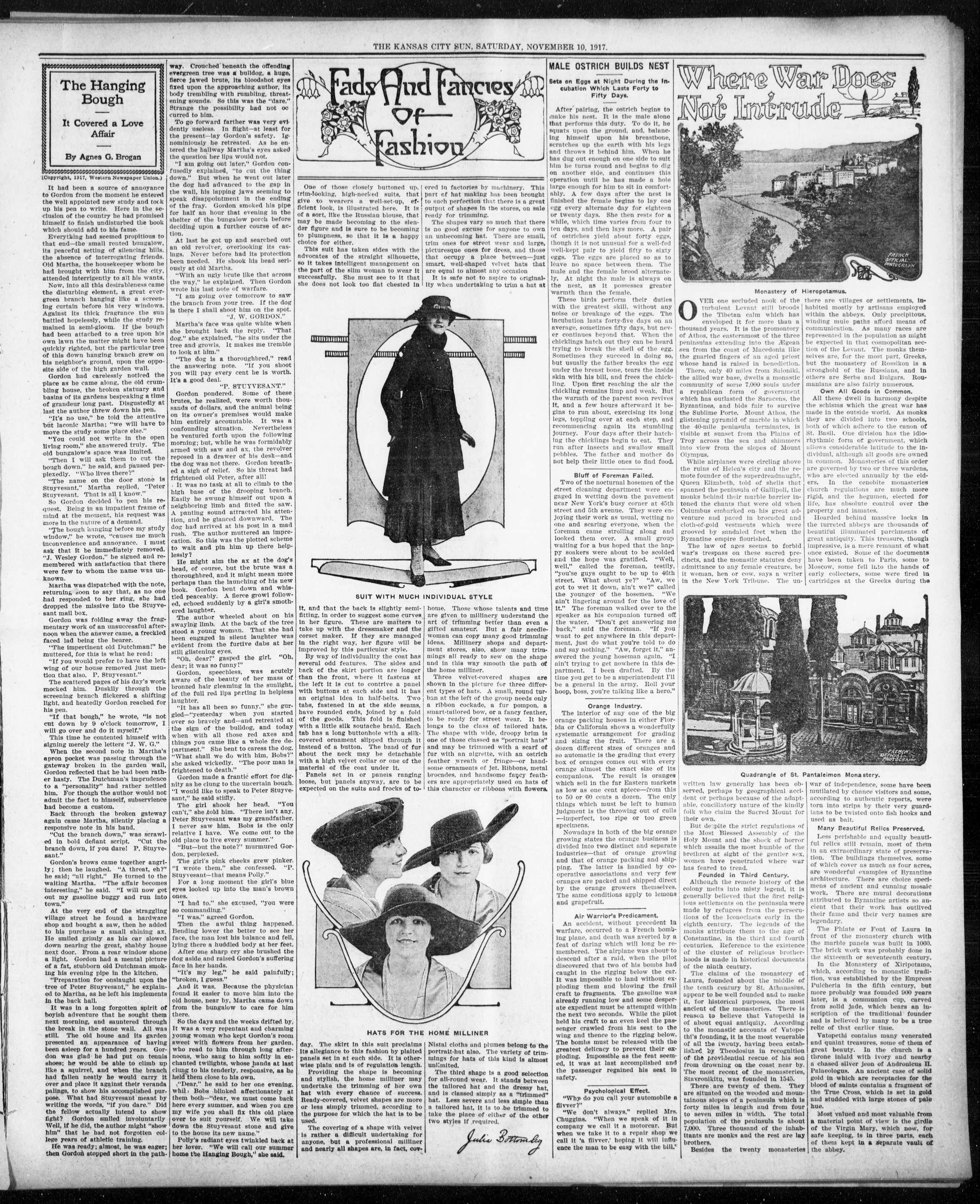
SUIT WITH MUCH INDIVIDUAL STYLE
it, and that the back is slightly semi-fitting, in order to suggest some curves in her figure. These are matters to take up with the dressmaker and the corset maker. If they are managed in the right way, her figure will be improved by this particular style.
home. Those whose are given to milliner art of trimming bet gifted amateur. But woman can copy man ideas. Millinery shent stores, also, s
By way of individuality the coat has several odd features. The sides and back of the skirt portion are longer than the front, where it fastens at the left it is cut to contrive a panel with buttons at each side and it has an original idea in half-belts. Two tabs, fastened in at the side seams, have rounded ends, joined by a fold of the goods. This fold is finished with a little silk soutache braid. Each tab has a long buttonhole with a silk-covered ornament slipped through it instead of a button. The band of fur about the neck may be detachable with a high velvet collar or one of the material of the coat under it. Panels set in or panels ranging loose, but panels anyway, are to be expected on the suits and frocks of to-
1
THE HAT
T
HATS FOR THE HOME MILLINER
day. The skirt in this suit proclaims its allegiance to this fashion by plaited panels set in at each side. It is otherwise plain and is of regulation length. Providing the shape is becoming and stylish, the home milliner may undertake the trimming of her own hat with every chance of success. Ready-covered, velvet shapes are more or less simply trimmed, according to the purpose for which the hat is to be used. The covering of a shape with velvet is rather a difficult undertaking for anyone, but a professional milliner and nearly all shapes are, in fact, cov-
0
ered in factories by machinery. This part of hat making has been brought to such perfection that there is a great output of shapes in the stores, on sale ready for trimming.
The shapes vary so much that there is no good excuse for anyone to own an unbecoming hat. There are small, trim ones for street wear and large, picturesque ones for dress, and those that occupy a place between—just smart, well-shaped velvet hats that are equal to almost any occasion.
It is safe not to aspire to originality when undertaking to trim a hat at
I
home. Those whose talents and time are given to millinery understand the art of trimming better than even a gifted amateur. But a fair needlewoman can copy many good trimming ideas. Millinery shops and department stores, also, show many trimmings all ready to sew on the shape and in this way smooth the path of the home milliner.
Three velvet-covered shapes are shown in the picture for three different types of hats. A small, round turban at the left of the group needs only a ribbon cockade, a fur pompon, a smart-tailored bow, or a fancy feather, to be ready for street wear. It belongs to the class of tailored hats. The shape with wide, droopy brim is one of those classed as "portrait hats" and may be trimmed with a scarf of fur with an algrette, with an ostrich feather wreath or fringe—or handsome ornaments of Jet. Ribbons, metal brocades, and handsome fancy feathers are appropriately used on hats of this character or ribbons with flowers.
L
Nistal cloths and plumes belong to the portrait-hat also. The variety of trim-
mings for hats of this kind is almost unlimited.
The third shape is a good selection for all-round wear. It stands between the tailored hat and the dressy hat,
and is classed simply as a "trimmed" hat. Less severe and less simple than a tailored hat, it is to be trimmed to take the place of either of the other two styles if required.
Julia Bottomley
MALE OSTRICH BUILDS NEST
Sets on Eggs at Night During the Incubation Which Lasts Forty to Fifty Days.
After pairing, the ostrich begins to make his nest. It is the male alone that performs this duty. To do it, he squats upon the ground, and balancing himself upon his breastbone, scratches up the earth with his legs and throws it behind him. When he has dug out enough on one side to suit him he turns round and begins to dig on another side, and continues this operation until he has made a hole large enough for him to sit in comfortably. A few days after the nest is finished the female begins to lay one egg every alternate day for eighteen or twenty days. She then rests for a while, which time varies from four to ten days, and then lays more. A pair of ostriches yield about forty eggs, though it is not unusual for a well-fed well-kept pair to yield fifty to sixty eggs. The eggs are placed so as to leave no space between them. The male and the female brood alternately. At night the male is always on the nest, as it possesses greater warmth than the female.
These birds perform their duties with the greatest skill, without any noise or breakage of the eggs. The incubation lasts forty-five days on an average, sometimes fifty days, but never continues beyond that. When the chicklings hatch out they can be heard trying to break the shell of the egg. Sometimes they succeed in doing so, but usually the father breaks the egg under the breast bone, tears the inside skin with his bill, and frees the chickling. Upon first reaching the air the chickling remains limp and weak. But the warmth of the parent soon revives it, and a few hours afterward it begins to run about, exercising its long legs, toppling over at each step, and recommending again its stumbling journey. Four days after their hatching the chicklings begin to eat. They run after insects and swallow small pebbles. The father and mother do not help their little ones to find food.
Bluff of Foreman Failed.
Bluff of Foreman Failed.
Two of the nocturnal hosemen of the street cleaning department were engaged in wetting down the pavement near New York's busy corner at 45th street and 5th avenue. They were enjoying their work as usual, wetting no one and scaring everyone, when the foreman came strolling along and looked them over. A small group waiting for a bus hoped that the happy soakers were about to be scolded and the hope was gratified. "Well, well," called the foreman, testily, "you're guys ought to be up to 46th street. What about ye?" "Aw, we got to wet it down, ain't we?" called the younger of the hosemen. "We ain't lingering around for the love of it." The foreman walked over to the speaker as his companion turned off the water. "Don't get answering me back," said the foreman. "If you want to get anywhere in this department, just do what you're told to do and say nothing." "Aw, forget it," answered the young hoseman again. "I ain't trying to get nowhere in this department. I been drafted. By the time you get to be a superintendent I'll be a general in the army. Roll your hoop, boss, you're talking like a hero."
Orange Industry.
The interior of any one of the big orange packing houses in either Florida or California shows a wonderfully systematic arrangement for grading and sizing the fruit. There are a dozen different sizes of oranges and so automatic is the grading that every box of oranges comes out with every orange almost the exact size of its companions. The result is oranges which sell in the far Eastern markets as low as one cent aplece—from this to 50 or 60 cents a dozen. The only things which must be left to human judgment is the throwing out of culls—imperfect, too ripe or too green specimens.
Nowadays in both of the big orange growing states the orange business is divided into two distinct and separate industries—that of orange growing and that of orange packing and shipping. The latter is handled by cooperative associations and very few oranges are packed and shipped direct by the orange growers themselves. The same conditions apply to lemons and grapefruit.
Air Warrior's Predicament.
An accident, without precedent in warfare, occurred to a French bombing plane, and death was averted by a feat of daring which will long be remembered. The airplane was about to descend after a raid, when the pilot discovered that two of his bombs had caught in the rigging below the car. It was impossible to land without exploding them and blowing the frail craft to fragments. The gasoline was already running low and some desperate expedient must be attempted within the next two seconds. While the pilot held his craft to an even keel the passenger crawled from his seat to the wing and thence to the rigging below. The bombs must be released with the greatest delicacy to prevent their exploding. Impossible as the feat seemed, it was at last accomplished and the passenger regained his seat in safety.
Psychological Effect
"Why do you call your automobile a flivver?"
"We don't always," replied Mrs. Chuggins. "When we speak of it in company we call it a motorcar. But when we take it to a repair shop we call it 'a flivver,' hoping it will influence the man to be easy with the bill."
Where War Does
Not Intrude
FRENCH
OFFICIAL
PHOTOGRAPH
Monastery of Hieropotamus.
OVER one leaved nook of the turbulent Levant still broods the Tibetan calm which has enveloped it for more than a thousand years. It is the promontory of Athos, the easternmost of the three peninsulas extending into the Aegean sea from the coast of Macedonia like the gnarled fingers of an aged priest whose hand is raised in benediction. There, only 40 miles from Saloniki, the allied war base, dwells a monastic community of some 7,000 souls under a republican form of government which has outlasted the Saracens, the Byzantines, and bids fair to survive the Sublime Porte, Mount Athos, the glistening pyramid of marble in which the 40-mile peninsula terminates, is visible at sunset from the Plains of Troy across the sea and shimmers into view from the slopes of Mount Olympus.
there are villas habitated most within the mule winding mule communication represented in be expected to lion of the Lelves are, for but the monastery stronghold of others are Smanians are Own All
All these of the schisms made in the they are divided both of which St. Basil. O rhythmic for allows consider dividual, alth
While airplanes were circling above the ruins of Helen's city and the remote founder of the superdreadnaught, Queen Elizabeth, told of shells that spanned the peninsula of Gallipoli, the monks behind their marble barrier intoned the chants that were old when Columbus embarked on his great adventure and paced in brocaded and cloth-of-gold vestments which were grooved by sandaled feet when the Byzantine empire flourished.
The law of ages seems to forbid war's trespass on these sacred precincts, and the monastic statutes deny admittance to any female creature, be it woman, hen or cow, says a writer in the New York Tribune. The un-
FRENCH
DEMOCRAT
PHOTOGRAPHY
Quadrangle of St. Pantaleimon Monastery written law generally has been observed, perhaps by geographical accident or perhaps because of the adaptable, conciliatory nature of the kindly folk who claim the Sacred Mount for their own.
But despite the strict regulations of the Most Blessed Assembly of the Holy Mount and the shock of horror which assails the most humble of the brethren at sight of the gentler sex, women have penetrated where war has feared to tread.
war of independence, mutilated by chance according to authenticity torn into strips by the lans to be twisted out used as bait.
Many Beautiful Rea Less perishable and ful relics still remain in an extraordinary station. The buildings of which cover as much
Although the remote history of the colony melts into misty legend, it is generally believed that the first religious settlements on the peninsula were made by refugees from the persecutions of the Iconoclasts early in the eighth century. The legends of the monks attribute them to the age of Constantine, in the third and fourth centuries. Reference to the existence of the cluster of religious brotherhoods is made in historical documents of the ninth century.
The claims of the monastery of Laura, founded about the middle of the tenth century by St. Athanasius, appear to be well founded and to make it, for historical purposes, the most ancient of the monasteries. There is reason to believe that Vatopethi is of about equal antiquity. According to the monastic accounts of Vatopethi's founding, it is the most venerable of all the twenty, having been established by Theodosius in recognition of the providential rescue of his son from drowning on the coast near by. The most recent of the monasteries, Stavrynikitu, was founded in 1545.
There are twenty of them. They are situated on the wooded and mountainous slopes of a peninsula which is forty miles in length and from four to seven miles in width. The total population of the peninsula is about 7,000. Three thousand of the inhabitants are monks and the rest are lay brothers.
Besides the twenty monasteries
there are villages or settlements, inhabited mostly by artisans employed within the abbeys. Only precipitous, winding mule paths afford means of communication. As many races are represented in the population as might be expected in that cosmopolitan section of the Levant. The monks themselves are, for the most part, Greeks, but the monastery of Rossikon is a stronghold of the Russians, and in others are Serbs and Bulgars. Roumanians are also fairly numerous.
Own All Goods In Common.
All these dwell in harmony despite the schisms which the great war has made in the outside world. As monks they are divided into two schools, both of which adhere to the canon of St. Basil. One division has the idiocrhythmic form of government, which allows considerable latitude to the individual, although all goods are owned in common. Monasteries of this order are governed by two or three wardens, who are elected annually by the elders. In the cenobite monasteries church regulations are much more rigid, and the hegumen, elected for life, has absolute control over the property and inmates.
Hoarded behind massive locks in the turreted abbeys are thousands of beautiful illuminated parchments of great antiquity. This treasure, though impressive, is a mere remnant of what once existed. Some of the documents have been taken to Paris, some to Moscow, some fell into the hands of early collectors, some were fired in cartridges at the Greeks during the
FRENCH
DECORATION
PHOTOGRAPHY
war of independence, some have been mutilated by chance visitors and some, according to authentic reports, were torn into strips by their very guardians to be twisted onto fish hooks and used as bait.
Many Beautiful Relics Preserved.
Less perishable and equally beautiful relics still remain, most of them in an extraordinary state of preservation. The buildings themselves, some of which cover as much as four acres, are wonderful examples of Byzantine architecture. There are choice specimens of ancient and cunning mosaic work. There are mural decorations attributed to Byzantine artists so ancient that their work has outlived their fame and their very names are legendary.
The Phlate or Font of Laura in front of the monastery church with the marble panels was built in 1000. The brick work was probably done in the sixteenth or seventeenth century. In the Monastery of Xipirotano, which, according to monastic tradition, was established by the Empress Pulcheria in the fifth century, but more probably was founded 900 years later, is a communion cup, carved from solid jade, which bears an inscription of the traditional founder and is believed by many to be a true relic of that earlier time.
Vatopethi contains many venerated and quaint treasures, some of them of great beauty. In the church is a throne inlaid with ivory and nearby a chased silver jeon of Andronicus II. Palaeologus. An ancient case of solid gold in which are receptacles for the blood of saints contains a fragment of the True Cross, which is set in gold and studded with large stones of pale hue.
Most valued and most valuable from a material point of view is the girdle of the Virgin Mary, which now, for safe keeping, is in three parts, each of them kept in a separate vault of the abbey.
THEKANSASCITYSUN
All communications should be addressed to The Kansas City Sun, 1803 East 18th Street.
Bell Phone East 999.
Entered as second-class matter, August
1908, at the postoffice at Kansas City,
Mo., under the act of March 3, 1879.
Nelson C. Crews.....Editor and Owner
Willa M. Glenn.....General Manager
SUBSCRIPTION RATES:
One Year.....$1.50
Six Months.....75
Three Months.....50
ADVERTISING RATES, $2.00 PER INCH
PER MONTH.
MEMBER
NATIONAL NEGRO PRESS
ASSOCIATION.
EDITORIALS.
A Georgia Negro recently got so "big feelin'" that he bought himself an automobile. On the evening of the first day the "white folks" took him out, whipped him and made him return the auto and get his money back from the dealer. Now some Kansas City Negroes are wishing that "the white folks" would do them the same way.
Things are slowly coming our way. The United States Supreme Court has rendered a decision declaring the Louisville segregation law unconstitutional. The decision will nullify the same prejudiced legislation of Baltimore and other southern cities that have attempted to compel colored people to live upon alleys and unsanitary side streets.
---
The Sun is fully convinced that a housecleaning is badly needed at the City Hall and unless the present weak and vasculating administration does something tangible it will be overwhelmingly defeated next spring. Commission government is better than what we are up against now.
It is said that the local registration board was astonished at the manifest patriotism of the colored men drafted for military service. Very few of these claimed exemptions upon any grounds whatever and all were eager to serve their country. This has been the continual history of our people, gentlemen. Of all the contingents of the American people the Negro is the only race that has never fired up on the stars and stripes.
Now that the "Dear Ole Southern Mammy" is dead, peace to her loving memory, let the adoring white "chilun" whom she nursed and loved show their continued affection by a sympathetic and helpful attitude toward "Ole Mammy's" children and grandchildren. Help make a way for these to live decently, to maintain their moral dignity and self-respect. Let them have the same chance in life that has been accorded to you through the unrequited labors and trials of poor "Ole Mammy."
From all reports, "After Office Hours," which comes to the Garden Theater for an engagement of one week, starting Sunday matinee, November 11th, 1917, is one of the big successes of the season. Written by Roy Foster, staged by James Castle and produced under the progressive management of Wood and Alston at Oscar Hammerstein's Lexington Opera House in New York, it registered an immediate and emphatic triumph, playing to the absolute capacity of the tremendous playhouse at every performance. It is said to be a play of intense interest, dealing with the career of a p pretty little eighteen-year old stenographer, whose unwise affection for her employer is the cause of her undoing. The management promises a sumptuous scenic production and a specially selected cast of Broadway actors.
WHAT EVERY MAN AND WOMAN SHOULD KNOW ABOUT THE BIBLE.
This is the fifth book, by the Kansas City author, Sydney C. Tapp, on the sex of the Bible. In it, Mr. Tapp has laid bare, in no unmistakable terms, the destructible force of lust. He shows that it is lust, which is destroying the human family. The book is not vulgar. It is plain, but it rings with purity, and points to a better life here and hereafter. The great effect, for good, of this book, will be because it portrays the awful destructive force of sin and lust, and the beauty of pure living and holiness. It should be in the camp of the soldiers. Every soldier, now engaged in this great war, should have a copy of it.
MME A. MOORE
Teacher of
Piano and Voice
1905 E. 19th Street
Bell Phone E. 5407
AMERICAN WOODMEN
in a class to itself insures against
old age, disability, accident, sickness,
death, burial.
$150,000.00 for Protection of Policy
Holders.
$400,000.00 Paid as Benefits.
$30,000,000.00 of Insurance Written.
This unsolicited letter was handed to us by Mr. Upton at the close of our examination, and after his board had examined every certificate in force by the American Woodmen. When it is remembered that not a half dozen fraternals have so high a valuation, we should all rejoice at this wonderful achievement of Negro big business. Mr. L. H. Lightner, Supreme Clerk, American Woodmen, Denver, Colo. Dear Sir: It affords me great pleasure to inform you that after carefully valuing your certificates for the closed calendar year, I find the American Woodmen stands well in the lead of most Fraternals of America with a valuation of 112.1 per cent.
When it is considered that a large per cent. of the Fraternal Societies of the country have a valuation of less than 75 per cent, you are especially to be congratulated for the very excellent standing of the American Woodmen. Very truly yours.
This letter proves to you the status of this society. Then you should waste no time to become a member. Local Office, 1315 E. 18th St.,
Phones: Bell, Grand 317; Mome
Main 3963.
Classified Wants and Rooms to Rent
Classified Wants and Rooms to Rent
WANTED AT ONCE.
Colored men, women, boys and girls to fill high class jobs and positions. Apply Square Deal Employment Bureau, 1315 E. 18th street.
FOR RENT—Nicely furnished room; modern, in private family. Modern light housekeeping privileges. Bell Phone, East 1207J.
FOR RENT—Nice front room; modern. Woman employed, or man and wife preferred. Bell phone East 1919W.
FOR RENT—One large furnished front room, modern, to two men. 1908 East 13th St., Bell Phone, East 2028.
FOR RENT—Nicely furnished front room. Man and wife preferred. No objection to one child. C. H. Fowler 1011 Mich. Bell phone East 1654W.
FOR RENT—three rooms furnished—reasonable. Call Bell phone East 4067M.
FOR RENT—Nicely furnished rooms, 1514 E. 17th street. Call Bell phone Grand 3532W.
FOR RENT—Nicely furnished rooms. Strictly modern. $2.00 and $2.25 per week. Bell phone Grand 4204. Mrs. H. L. Kinsler.
NOTICE TO MISTER RENTER.
A very small payment down and the balance like rent will buy you a nice modern home in the most seclusive neighborhood in Kansas City. Begin now. SEE THE SQUARE DEAL REALTY AND INVESTMENT CO., 1315 E. 18th street. Bell phone, Grand 317; Home phone, Main 3963. We have the largest and most reasonable list of properties of any Colored real estate firm in the city.
WANTED—Children to care for by the day or week. 1514 East Tenth street. Bell 'Phone East 1147J.
FOR RENT—3 apartments of 4 large rooms, with closets, hall and bath; porches 10 feet wide and lockers. 1415-17-19 East 22d street, facing Park and Paseo. Burth Investment Co. Home Phone Linwood 70.
HELP WANTED.
Colored laborers with small families for Sunny Side, Utah, to pull and load coke. Wages, $2.25 per oven. Good workers can earn $7.00 to $8.00 per day. Four room cottages with electric lights and running water can be rented for $8.00 monthly or $2.00 a room. Groceries and other provisions are just as cheap as they are in Kansas City. Twenty families have already gone and report everything satisfactory. There are men on these works that have earned $200.00 a month. No labor trouble of any kind. Transportation furnished free. For further particulars see Rivers, Manager Afro-American Employment Co., 1510 East 18th street; Bell Phone, East 782; Home, East 802. Will ship Monday and Tuesday, November 12 and 13.
THE KANSAS CITY SUN, SATURDAY, NOVEMBER 10, 1917.
Negro Business and Professional Directory of Greater Kansas City
BAKERIES.
MRS. SUSIE OWENS, 2331 Vine street.
Bell phone, East 5017.
HOME BAKERY. Mrs. A. Compton,
Prop. 1717 E. 18th street.
BARBER SHOPS
LABORING MEN'S BARBER SHOP,
W. F. O'Bonnon, Prop., 558 Grand
avenue.
BEAUTY PARLORS AND MAIR
DRESSERS.
MISS ELSIE ROGERS, Poro Hair
Dresser, 1244 Armstrong Avenue,
Kansas City, Kansas.
MRS. CORA D. WILLIAMS, Poro Hair
Dresser, 1319 Euclid Ave. Bell
phone, East 1215J.
MRS. SUSIE P. GIPSON, 1725 Michigan
avenue, Poro hair dresser. Bell
Phone, East 305J.
CAFES.
MRS. H. W. DOTSON, 1705 East 12th,
Bell Phone. E. 2214.
FLORISTS.
CROSTHWAIT FLORAL CO., 1501 E.
19th. Bell phone. East 272.
LAWYERS
C. H. CALLOWAY, 601 Delaware, Home phone M. 58, Bell phone Main 448. Practices in all courts.
W. C. HUESTON, 601 Delaware, Home phone, M58, Bell phone Main 448. Legal advice. Practices in all courts.
E. A. SHACKLEFORD, Attorney at Law, 511 Minnesota avenue, Kansas City, Kas. Bell phone, West 3866.
JEWELERS.
J. A. WILSON, 1616 W. Ninth street Kansas City, Mo. Bell phone, Main 6248R.
PHOTOGRAPHERS.
J. E. MILLER STUDIO, 1622 East Eighteenth street. Bell phone, E. 91.
REAL ESTATE and EMPLOYMENT.
COLORED PEOPLES INVESTMENT CO., Solomon Smith, Pres., 2122 Vine St. Bell Phone, East 1011. Home Phone, East 4011.
A B C EMPLOYMENT AND INVESTMENT CO., 500 Minnesota avenue (Upstairs) Kansas City, Kas. Bell phone, West 1742; Home phone, West 221. C. W. Neloms, Mgr.
H. L. KINSLER, 918 East Twenty-first street. Bell phone, Grand 4204
SHOE STORE.
G. A. PAGE'S SHOE STORE, 1507 E. Eighteenth street. Bell phone, East 1328.
SHOE REPAIRING.
ELECTRIC SHOE & REPAIR SHOP,
J. C. Banks, Prop., 1514 $ \frac{1}{2} $ East Eight
teenth street, Bell phone E 4393.
UNDERTAKERS.
ADKINS BROS. & GREEN, Nineteenth and Vine streets. Both Phones, East 4349.
H. B. MOORE, 1031 Independence avenue. Bell phone Main 3398W. Home phone Main 3341.
WATKINS BROS., 1729 Lydia avenue. Bell phone Grand 987, Home Main 7989. Res., Bell East 3281.
Home Phone
E. 4349
Bell Phone E.2013
W. H. HUBBELL
KING COLE
The Aeroplane.
Since the ordinary car does the ordinary things, to take a ride in King Cole 8, one comes out of the past into the present.
Our car is steam heated in winter, air cooled in summer.
SEE THE LUCK MAN.
If you are in, down and out and have lost the grip you had on luck, write or call and see me at once.
DR. W. L. LYONS,
R. 1. Porkertville, Okla.
Vaughan's Values
Miscellaneous
Bargains
Out-of town Moving Picture
Theatre $17.00
CITY: Good Horse Shoe Shop. Can be converted into Garage or Filling Station, $75.
EXCEPTIONAL BARGAINS
WEST 1757, BELL PHONE.
26th and Parkway, Kansas City, Kas.
THE MISSOURI-KANSAS KNIGHTS TEMPLAR ASSOCIATION
ANNUAL CONCLAVE
ACADEMY HALL,
14TH AND MICHIGAN
THANKSGIVING AFTERNOON AND NIGHT
THURSDAY, NOVEMBER 29
Competitive Prize Drills (2:00 to 6:00 p. m.
Competitive Prize Drills
2:00 to 6:00 p. m.
T
Cyrene Commandery
No. 3, Topeka, Kas.
Far West Commandery
No. 3, Kansas City,
Mo.
Northwestern Com-
mandery No. 6, St.
Joseph, Mo.
Mt. Oread Commandery
No. 14, Lawrence,
Kansas.
Emanuel Commandery
No. 25, Kansas City,
Mo.
Willis G. Mosely Com-
mandery No. 7, Kansas
City, Mo.
Reception at night.
Dancing begins at
8:30 p. m.
Admission: Afternoon.
10 cents; Night, 25
cents.
The Spotless Kitch
(All that its name implies)
3 WEST 13th STREET
place in Kansas City for a Clean
some, Satisfying Meal
notless Kitchen
(that its name implies)
5T 13th STREET
Kansas City for a Clean, Whole-
me, Satisfying Meal
The Spotle
(All that its n
23 WEST 13
The best place in Kansas
some, Sati
The best place in Kansas City for a Clean, Whole-
some, Satisfying Meal
Special Dinner and Lunch at Noon
for those employed down town
MRS. PEARL RILEY,
Manager
MARTIN YOUNG
Proprietor
WOMEN, GIRLS, EARN MONEY
MY FREE BOOK TELLS HOW
LEARN TO GROW HAIR
EN, GIRLS, EARN MO
MY FREEBOOK TELLS HOW
EARN TO GROW HA
IRLS, EARN MONEY
EBOOK TELLS HOW
TO GROW HAIR
A. B.
Manufactured only by
MME. J. NELSON,
President of
ELOSO COLLEGE CO.
21 S. Compton Avenue,
ST. LOUIS, MO.
A Wonderful Hair Dresser and Grower
One thousand agents wanted. Good money made.
THE STAR HAIR GROWER. This is a wonderful
preparation. Can be used with or without straight-
ening irons.
Sells for 25c per box—one 25c box will prove its
value. Any person that will use a 25c box will be
convinced. No matter what has failed to grow
your hair just give THE STAR HAIR GROWER a
trial and be convinced. Send 25c for full size box.
If you wish to be an agent send $1.00 and we will
send you a full supply that you can begin work
with at once; also agents' terms. Send all money
by Money Order to
MME. J. NELSON
A Wonderful Hair Dresser
One thousand agents wanted. O
THE STAR HAIR GROWER. The
preparation. Can be used with or
ening irons.
Sells for 25c per box—one 25c
value. Any person that will use
convinced. No matter what ha
your hair just give THE STAR H
trial and be convinced. Send 25c
If you wish to be an agent send
send you a full supply that you
with at once; also agents' terms
by Money Order to
A Wonderful Hair Dresser and Grower
A
One thousand agents wanted. Good money made. THE STAR HAIR GROWER. This is a wonderful preparation. Can be used with or without straightening irons.
Sells for 25c per box—one 25c box will prove its value. Any person that will use a 25c box will be convinced. No matter what has failed to grow your hair just give THE STAR HAIR GROWER a trial and be convinced. Send 25c for full size box. If you wish to be an agent send $1.00 and we will send you a full supply that you can begin work with at once; also agents' terms. Send all money by Money Order to
THE EAST INDIA H
EAST INDIA HAIR G
INDIA HAIR GROWER
THE EAST INDIA HAIR GROWER
A.
Leaves the hair so of a thousand flor Heavy and Beauty Gray Hair to its N Iron for Straighter Price, Sent by
Leaves the hair soft and silky. Perfume of a thousand flowers. The best kno Heavy and Beautiful Black Eye-Brow Gray Hair to its Natural Color. Can be Iron for Straightening.
Price, Sent by Mail, 50c; 10 cExtra
be hair soft and silky. Perfumed with a balm sand flowers. The best known remedy for and Beautiful Black Eye-Brows, also restores to its Natural Color. Can be used with Hot straightening. Sent by Mail, 50c; 10 cExtra for Postage.
Leaves the hair soft and silky. Perfumed with a balm of a thousand flowers. The best known remedy for Heavy and Beautiful Black Eye-Brows, also restores Gray Hair to its Natural Color. Can be used with Hot Iron for Straightening.
Price, Sent by Mail, 50c; 10 cExtra for Postage.
AGENTS OUTFIT.
1 Hair Grower, 1 Temple
Oil 1 Shampoo, 1 Pressing
Oil 1 Face Cream and
Direction for Selling, $2.
28c Extra for Postage.
GOOD MUSIC
MARTIN YOUNG Proprietor
Don't struggle along in uncongenial employment with long hours and take on yourself to do work that has little competition; it isn't better to spend a half hour daily and qualify yourself to do work that everyone else cannot do? The fields are large.
ELOSO HAIR GROWER
50C PER BOX
Are Seldom Equaled and never Excelled; Instructions by mail or in person. Diplomas to Graduates. Agents wanted everywhere, don't delay, write today. A penny will
ELOSO HAIR GROWER
THE STAR HAIR GROWER MERS.
Will Promote a Full Growth of Hair; Will also Restore the Strength, Vitality and the Beauty of the Hair. If your Hair is Dry and Wiry Try
EAST INDIA HAIR GROWER
If you are bothered with Falling Hair, Dandruff, Itching Scalp, or any Hair Trouble, we want you to try a jar of EAST INDIA HAIR GROWER. The remedy contains medical proprieties that go to the roots of the Hair stimulates the skin, helping nature do its work.
S. D. LYONS, Gen. Agt., 314 East 2d St. Oklahoma City, Okla.
Evanston, III.
CALL THEO. SMITH
Home Phone Main 5467
Bell Phone Grand 4591
Drugs, Prescriptions,
Hair Growers, Face Bleaches
Service--Quality--Price
MAIL ORDERS PROMPTLY FILLED
News and Periodicals
1301 E. 18th Street, Kansas City, Mo.
SAVE YOUR MONEY!
The W. L. Martin Ladies' and Gents' Furnishing Store Will Show You How to Save Money and Time Buy Your Children's Clothing Here. 1313 E. 18th STREET.
Season Announcement
The Moses Dickson Regal
1217 Woodland Avenue,
Everything For Every I
Have you visited the n
Perfecto Hair Dress
If not, why n
Hair Dressing, Manicuring
Jackson Regalia and
Woodland Avenue, Kansas
ing For Every Lodge.
you visited the new, up-
Hair Dressing
If not, why not?
ing, Manicuring and F
The Moses Dickson Regalia and Supplies Co. 1217 Woodland Avenue, Kansas City, Mo. Everything For Every Lodge. Ask Us.
Hair Dressing, Manicuring and Face Massage
THE BEST OF THE WORLD
LOCATED PERMANENTLY AT
BELL PHONE, E
PERMANENTLY AT 1636 E
BELL PHONE, EAST 3955
LOCATED PERMANENTLY AT 1636 EAST 18TH ST.
BELL PHONE, EAST 3955.
M. E.
MME. LYDIA GARDNER
Originator of
Mme. Lydia Gardner's Lip Reducer.
Bell Phone East
2608
7 - Passenger Car
Home Phone East 2633 Ele
BELL EAST 4939
Baggage and Express
Shining Parlor and
We Call For and Deliver Shoes
1516 E. 18th Street,
And Express AUTO
Night
ing Parlor and Cigar
deliver Shoes We Guarana
18th Street, Kansai
Baggage and Express AUTO SERVICE Night or Day for All Occasions Shining Parlor and Cigar Stand We Call For and Deliver Shoes We Guarantee All Shoes We Dye 1516 E. 18th Street, Kansas City, Mo.
1917
alia and Supplies Co.
e, Kansas City, Mo.
Lodge. Ask Us.
new, up-to-date
pressing College?
may not?
ing and Face Massage
We make switches and transformations from your combins. We guarantee to grow hair with our Perfecto System and Hair Grower in a shorter length of time than any other system in the United States or money refunded. We give diplomas to graduates. 5,000 agents wanted to sell our goods. Liberal discount to agents. Perfecto System taught by Mme. E. Floyd and Miss Willie Maniece, professional hair dressers and scalp specialists.
AT 1636 EAST 18TH ST.
C., EAST 3955.
Madam Lydia Gardner's Magic Lip Reducer
This wonderful preparation positively reduces thick lips without injury. Every bottle sold strictly guaranteed. Agents wanted in every town in the United States. My remedy does all I claim for it, or money refunded. Write or call at 316 Kentucky Ave., Joplin, Mo.
$1.00 per Bottle
Floyd W. Stone
AUTO SERVICE
Sightseeing Trips, $2 per Hour
MODERATE RATES
CAREFUL DRIVER
Electric lighted,Steam heated car
WM. JOHNSTON, MGR.
AUTO SERVICE
Night or Day for All Occasions
and Cigar Stand
We Guarantee All Shoes We Dye
Kansas City, Mo.
1917
CITY NEWS
---
The Sun for 25c from now until January 1. 1918.
Mrs. Janie White is receiving instruction in voice from Prof. Robert G. Jackson.
Mrs. Ora White of Butler, Mo., and daughter are visiting Prof. and Mrs. Roscoe White.
Rev. Barksdale filled the pulpit at the A. M. E. church, the Dr. Griffen being indisposed.
Have you ever tried the Spotless Kitchen, 23 West 13th street, the best place in town to eat?
Miss Mamie Stewart of 1516 Michigan avenue is improving, after a very serious illness.
Mrs. Lizzie Level, 2521 Grove street lost her aunt, Mrs. Hallie Stevenson, Tuesday October 30, 1917.
Miss Hattie Stevenson died Tuesday, October 30, and the funeral services were held November 1st.
Mrs. Stella Gant Douglass won the prize for the neatest mask at the Odd Fellows' and Ruth entertainment
A. E.
MR. JOHN DONALDSON,
The World's Greatest Negro Baseball
Pitcher.
FOR QUICK SALE—Shining Parlor.
Reason for selling, has been drafted.
2418 Vine street.
Mrs. J. H. Bryant, 2407 Highland
Avenue, left Wednesday for Minneapolis, Minn., for several weeks' visit.
Mrs. Parry Grear and grandson left
Wednesday for Bowling Green, Kentucky, where they will spend the winter.
Edith A. Williams, daughter of Mrs.
T. W. H. Williams, has returned home
from Lincoln Institute on account of illness.
Miss Myrtle Stewart, a teacher of the Stowe Ward School, reports her classes in fine condition and good attendance.
Mrs. Jas, W. Harper of Independence, Mo., was a member of the Ruth choir last Sunday afternoon at the Lincoln High school.
Mr. Felix C. Crite of Poplar Bluff, Mo., is in the city for a few days visiting Miss Daisy Mathena of 2303 Woodland avenue.
Mr. Fannie R. Givens president of the National Historical Society, addressed the Citizens Forum. She explained her work fully.
Grand High Priest T. G. McCampbell instituted a new Chapter and Commandery at Omaha last week. There were 18 men.
Prof. Roscoe White, dancing master of Armory Hall, Cottage and Vine streets, and Mr. Jesse Wilson toured to Excelsior Springs last week.
C. B. Santee, the photographer, paid a flying visit this week to the City. He is doing fine and will locate at Des Moines, Ia., and Camp Dodge permanently.
Mr. and Mrs. David Cleaton, mother and daughter of Mr. Chas. Anderson, of Cameron, Mo., visited in the City last Saturday and were pleasant callers at the Sun office.
IN MEMORIAM
In loving remembrance of our dear
father, Alfred A. Perry, who died Nov-
ember 10, 1914. Sadly missed by
children:
ALFRED PERRY
PEARL JEFFERSON
BERTIE EVANS
WM. PERRY.
It's going to happen in Kansas City. What? The Western University vis. George R. Smith College football game, Friday, November 16, at 3:30 p. m., at Brenneisen Park, Armourdale, Kansas City, Kansas.
Mrs. Minnie McElroy of 1603 Forest avenue, who underwent an operation October 16 at the Wheatley-Provident hospital, has returned to her home and is doing nicely. Dr. W. H. Bruce performed the operation.
Situations of all kinds to be had at all times. Afro-American Employment Office, 1510 E. 18th street; Home Phone, East 802; Bell Phone, East 782. Rivers, Manager.
Big Layman Meeting, Sunday, November 11, 8 p. m., at Friendship Baptist Church, 17th and Tracy avenue. The service will be graced with the following persons appearing on the program: Prof. Harrison, principal of Attucks School; Hon. W. C. Huston, Miss Eva Sweetman Moore, Miss Alice Whiteside, Prof. S. S. Smith of Lincoln High School; vocal solo, May Dixson; cornet solo, Prof. G. A. Page, leader.
A.
MISS ELEANOR WATSON,
Who Became the Bride of Mr. John
Donaldson last Wednesday Evening.
Lieut. Alexander W. Thomas of the
24th Infantry visited his brother, Rev.
Dr. Wm. H. Thomas and family last
Thursday and was a pleasant caller
at The Sun office.
All lovers of sport should attend
the Western University vs. George R.
Smith College game to be played at
the Brenneisen Park at Armourdale,
Kansas City, Kansas, Friday, November
16, 1917.
We teach you how to dance every
Wednesday and Saturday nights from
7:30 to 9:00 at Armory Hall, Cottage
and Vine streets. Prof. Roscoe White
and Mrs. Janie White, Bell Phone,
East 2690.
Patronizing football games encourages clean sport for our college youth. So let us all attend the George R. Smith College-Western University football game, Friday, November 16, at 3:30 p. m., at Brenneisen Park, Armourdale, Kansas City, Kansas.
Mrs. E. D. Moss and daughter, Miss Mabel Cunningham, of 1300 Woodland avenue, returned from a delightful four months' visit in Colorado Springs and Denver, Colo. While there they were the house guests of Mr. and Mrs. R. C. Clark, Colorado Springs.
The Editor received a letter from First Lieutenant John R. Farley, in which he states he is highly pleased with his surroundings at Camp Funston and that both officers and men in the companies to which he has been assigned are exceptional. He has a splendid captain, who is a veteran soldier and served more than 18 years wit the famous Ninth Cavalry.
The Colored Children's Improvement Association will hold its first business meeting at 8 p. m. Monday at the Lincoln High School. Every person who signed a membership card at the Men's Meeting, October 21, is expected to come and bring a new member to help forward our parental home movement.
H. R. FARNUM, Pres.
MYRTLE F. COOK, Sec.
Mrs. Nannie B. Oxley, 1636 Cottage avenue, died last Sunday, November 4, and the funeral services were held Thursday, November 8, under the auspices of Enterprise Court No. 32 O. O. C., at 2 p. m. from the Second Baptist Church, of which she had been a member for a number of years. Rev. S. W. Bacote officiated. Interment in beautiful Highland cemetery. She leaves a sister, three brothers, one nephew and two nieces.
THE KANSAS CITY SUN, SATURDAY, NOVEMBER 10, 1917.
KANSAS CITY, KAS.
By Mrs. Zenobia Nelson.
Mrs. Sarah Williams of San Francisco, Calif., is visiting her niece Mrs. Frye, 807 Oakland Ave.
Rev. J. R. Richardson returned from the South where he held a successful revival meeting.
The N. A. A. C. P. started with renewed energy for the year and elected their officers.
Mrs. Sarah Parks has moved to her beautiful new modern home at 316 Nebraska Ave.
Mrs. Anna Crump of 705 Georgia Avenue returned after a pleasant visit in southeastern Kansas.
Miss Emma Glover, 531 Nebraska Ave., is spending a few days in Topeka the guest of her sister, Mrs. E. W. Beck.
Mrs. Mary F. Woods, one of Wendell Phillips' school's most efficient teachers will address the Citizens Forum, November 18, at 4:00 p. m.
Mrs. Nellie Bibbs of Centralia, Kansas, is visiting her friends in the City. Dr. Mixon has returned from a pleasant visit to Oklahoma.
The Red Cross Auxiliary will meet at the Y. W. C. A. at 9th and Nebraska Ave. All women are urged to take a part in the sewing and knitting.
Mr. Byron Baskerville, of 1061 Walker avenue, who was painfully injured last Wednesday night by a crowd of unknown masked boys is improving nicely.
Mrs. Hattie White and Mrs. C. D. Moss of Topeka, Kansas, enroute to St. Louis, stopped over to see Mrs. Cora Evans, 1412 N. Eighth street and Mrs. Penix, 622 New Jersey Ave.
Covenant meeting and Communion was held Sunday morning at the Metropolitan church. An interesting and uplifting sermon was delivered by Rev. James M. Webb of Chicago. The rally proved to be a success from every standpoint.
Mr. Wm. Joiner died Nov. 2 at the age of 49 years at Bell Memorial Hospital, and the funeral services were held from the Welcome Mission A. M. E. church Tuesday at 2:00 p. m. He leaves a wife, and three daughters. Interment in Woodlawn cemetery. Oliver & Houston were the funeral directors.
Dr. and Mrs. J. Edward Perry accompanied by Dr. T. A. Jones, left Tuesday for Clarksville, Texas, where Dr. Perry has a ten days' engagement with Drs. Geo. M. Munchus and H. C. Wallace to conduct a Surgical Clinic. Dr. Jones has also been employed as special anaesthetist. This is Mrs. Perry's first visit to the Doctor's old home state and she is looking forward to a pleasant stay. Dr. Perry's fame as a surgeon has spread throughout the great Southwest and would he consent, he could be absent from the City two-thirds of his time giving demonstrations or performing operations. The Sun wishes them a pleasant trip.
The opening of the new Literary Society at Ebenezer A. M. E. church will be under the direction of Mrs. W. T. Osborne, November 14, at 8:00 p. m. Special music will be rendered and Madame Booker will address the society on "If—".
NOTICE
The Interdenominational Ministerial Alliance meets Wednesday, Nov. 14, at 1:00 p. m. in the Y. M. C. A. Discussion "Red Cross Among the Negroes." Election of officers for the ensuing year.
S. W. Bacote, D. D., President.
O. A. Johnson, Secy.
LADIES' BAND.
The Ladies' Band played at the Friendship Baptist Church last Sunday afternoon, and will play at the Pilgrim Rest Baptist Church next Sunday, November 11, 1917. Ida B. Saunders, President; Tom Anna Holland, Sec., Bell Phone East 4600.
CARD OF THANKS.
We desire to tender a card of thanks for their solicitation at the illness and death of our beloved husband and stepfather, Mr. James Wilson; especially Mr. S. Derritt and his friends, for the beautiful floral offerings; Dr. T. C. Unthank, for his kind words and sympathy in the hour of his death; Rev. Beckham, for his kind words. He was buried in Independence, Mo. Mr. C. H. Countee, undertaker.
Mrs. Henrietta Mercer Wilson, wife, Stella Mae Williams, daughter.
ROLAND W. HAYES OF BOSTON,
THE RACE'S GREATEST TEN-
OR, WILL BE IN CONVENTION
HALL ON FRIDAY EVENING,
DECEMBER 7TH.
The entire citizenship of our city is bringing Mr. Hayes to Kansas City for a benefit entertainment for the eight thousand Negro soldiers who are in training at Camp Funston. At a meeting this week a general committee was selected, representing every interest in the city, to direct and manage the campaign for the presence of ten thousand people in Convention Hall on December 7th. Prices for admission will be popular, ranging thus:
Box Seats, 50c.
Arena Floor, 25c
Arena Balcony, 25c.
Upper Balcony, 15c.
The prices are placed so that our people from every walk in life will have two opportunities, the one, to make a small contribution to our soldiers, the other, to hear our race's greatest singer. The following names constitute a partial list of the General Committee. These names, together with other citizens interested in our soldiers, are asked to meet Saturday evening, November 10th, at 8 o'clock at the Y. M. C. A.
GENERAL COMMITTEE
J. R. E. Lee, Chairman of General Committee.
For the Baptist Ministers' Alliance
Rev. D. A. Holmes, Pres.
Rev. M. Williams, Sec.
For the Methodist Ministers' Allianc
Rev. F. D. Wells, Pres.
Rev. S. L. Brooks, Sec.
For the Federated and Other
Women's Clubs—
Mrs. L. A. McCampbell, Pres.
Mrs. Lossie Penn, Sec.
For the Ivanhoe Club—
Mr. Joseph E. Herriford, Pres.
Mr. J. J. Allen, Sec.
For the Cosmopolitan Club—
Mr. Eugene Munday, Pres.
For the Lt Premier Club—
Mr. Carpenter, Pres.
For the Bachelors' Club—
Mr. Arthur Toney, Pres.
Mr. S. R. Hopkins, Sec.
For the Musicians' Union—
Mr. Tilford Davis, Pres.
For the U. B. F. Club—
Dr. Williams.
For the Odd Fellows' Club—
Mr. T. B. Watkins.
Mr. E. S. Lewis.
For the Chauffeurs' Club—
Charles Garrett, Pres.
For the Musical Organizations of
Greater Kansas City—
Prof. R. G. Jackson
Major N. Clark Smith
Mrs. S. W. Bacote
Prof. T. M. Reynolds
Mrs. J. F. Shanon
Mrs. Hendricks
Dr. Radword
Mrs. D. A. Holmes
For the Schools of the City—Principals of the Schools of Kansas City,
Mo.—
Mr. J. R. E. Lee
Mr. W. W. Holder
Mr. Wm. E. Griffin
Mr. J. H. Coleman
Mr. W. H. Tompkins *
Mr. R. T. Coles
Mr. Joe E. Herriford
Mr. A. M. Wilson
Mr. H. L. Cox
Mr. John L. F. Talton
Miss Virginia Gerren
Schools of Kansas City, Kansas—
Mrs. Tressie Smothers
Miss Laura Holland
Miss Ella Robinson
Mr. Homer Wilburn
Mr. Woodie Jacobs
Mr. J. A. Hodge
Mr. A. J. Neely
Labor Organizations—
Mr. Charles Harris
Business Men of Greater Kansas City—
Mr. G. A. Page,
Mr. R. Q. Gilmore,
Presidents.
Mr. J. J. Allen, Sec.
Western University—
Prof. H. T. Kealing, Pres.
Mr. French, Vice Pres.
For the Medical Association of Kansas City—
Dr. M. H. Lambright, Pres.
Dr. C. A. M. Kane, Sec.
For the Pythians—
Lawyer L. A. Knox
Mr. Fred Dabney
For the Masons of Kansas City—
Mr. W. G. Mosley
Mr. T. J. McCampbell, Sr.
For the Woodmen—
Mr. L. D. Hines
For the Citizens at Large
Mr. Nelson C. Crews
Lawyer Houston
Lawyer Calloway
Mr. S. L. Hopkins
Dr. Theodore Smith
Rev. J. W. Hurse
Rev. W. H. Thomas
Rev. S. W. Bacote
Lawyer I. F. Bradley
Lawyer Dorsey Green
Lawyer Shackleford
Lawyer R. E. Henderson
Dr. S. H. Tompkins
Rev. Mr. Griffin
Rev. Mr. Bowren
Rev. T. H. Ewing
Rev. R. Davis
Rev. William Alphin
Dr. W. J. Thompkins
Dr T. C. Unthank
---
For the Kansas City Civic League—
Dr. J. F. Shannon, Pres.
Mr. Joseph Butler, Sec.
Mr. John Love, Executive Chairman.
For Other Cities—
St. Joseph—Drs. Crossland and Carrion and Undertaker Ramsey.
nix.
Liberty—Prof, J. A. Gay.
Lexington—Mr. E. B. Conway.
Lawrence—Mrs. Mabel Gleed.
Bonner Springs—Miss Willa Johnson.
Leavenworth—Messrs. Sam'l Jones, B. K. Bruce and Dr. C. M. Moats, Argentine—Mrs. Ophelia Jackson, Rosedale—Mr. R. H. Brown. Note—General Committee Meeting Saturday, 8:00 p. m., Y. M. C. A.
NEGRO RACE UP IN FRONT.
In the great drive all over the country to make the second Liberty loan a success, one of the most marked efforts to do their proportionate share was that of the Negro race. They were eager to make it plain that their people are no less litally interested than the white race in the success of the financial efforts of the United States to make its fight against the enemy as powerful and effective as dollars will make it.
La Follette, and his kind of the Caucasian race, impeded the efforts of the government in its appeal for funds, but there was nowhere any member of the Negro race engaged in such reprehensible tactics. In Duluth the Negroes subscribed liberally of their means. In one hotel alone, $550 was subscribed. Then, within the week, Duluth has seen some worthy representatives of the race of Douglass and Dunbar, Carruthers and Booker Washington, entrain for service in the national army. They will make good. Let no one doubt that. In Kansas City, Mo., where of course the Negro race is very strong numerically as compared to Duluth, $100,000 was subscribed by its members for the second Liberty loan. Duluth News Tribune.
VIOLIN LESSONS GIVEN
By Prof. Frank Martin,
Graduate of Kansas University
Under Prof. Wort S. Morse.
Studio at 1831 Paseo
Lessons from
8:00 a. m. to 5:00 p. m.
Betty & Sam's
Little Corner
A
THEY SAY
—That the average school teacher is ALWAYS "broke." Why?
—That "cullud" folks am eating spah ribs, bones and all dese days. Hoover says; Save!
—That there are yet some fool Negroes in Kansas City who boast of their color. Ain't that silly?
—That when the Government says: Eat more corn bread, it's tickling "de cullud people." Dat's whah we shine.
—That the Negro who tries to "make it" by sharp practices usually comes to an inglorious end. Be square.
—That the average "big to do" Negro is the one who will not pay his debts. Takes all he makes to make an outside show.
—That there's to be a widows' ball next month to which none will be admitted but widows. Well, if you want a good time, that's where to go.
—That there is less religion and more grand standing in one certain big Church than in all the other churches in town combined. Guess which.
—That if the Negroes of Kansas City will rally to our hospital campaign as they did to the Liberty Bonds, we will raise the $20,000 needed in four days. Let's do it.
—That a certain woman has a habit of calling another woman and telling her to have her husband call her on some important business. Some day the wife will "call" and she'll have a full hand of clubs when she does.
Emery, Bird, Thayer Co
Complete assortments of apparel for man, woman and child and furnishings for the home
Reliable and trustworthy merchandise at uniformly low prices Eleventh and Walnut Streets and Grand Avenue
THE UNIVERSITY for School and College Wear
THE CROSSETT Shoe
"MAKES LIFE'S WALK EASY"
TREAD MARK
Tan $6.50 Black
Holeproof Hosiery,
all shades
for Men and Women
Crossett Shoe Store 1005
MAIN STREET
W. D. WALLACE, Mgr.
THE DRUG STORE BEAUTIFUL
Service and Quality are Paramount at the
WHITE-WOOD DRUG STORE
Bring Your Prescriptions to us and be assured of Absolute Accuracy and Fair Treatment.
OUR STOCK IS COMPLETE IN ALL LINES
N. W. Corner 19th and Vine Streets. (Transfer Point)
PHONES—HOME EAST 2293, BELL E. 641.
Coat and Dress at $10
You must see them to appreciate They are beautiful, some actual $20 and $25 Value
Come early and get your Coat and Dress for what you would have to pay for one elsewhere.
National Relief Assurance Company
SICKNESS AND ACCIDENT INSURANCE
OFFICE 1634 E. 18th Street. HOME PHONE 5119 East
DORSEY E. BROWN
Anyone holding policies with the National, the above company, notify us by phone or mail and we will call.
WASHINGTON CITY
SIDELIGHTS
Marriage Bureau Official "Raps" Modern Wives
WASHINGTON.—The ever increasing number of lunchrooms in Washington which keep open day and night and where the hungry rush and devour food in record time has set Col. William A. Krohl, marriage license clerk of
settles down in his own little home and that this place presided over by his wife should have such a thing as a kitchen, or at least kitchenette, where she may practice her culinary accomplishments to the delectation of her loving spouse.
"The large number of quick lunchrooms in this city which are increasing with alarming speed everywhere leads me to believe that the art of home cooking is much neglected and that mere man prefers to seek his favorite lunchroom haunt to still the pangs of hunger to the well-meant cuisine of his other half.
"One should think that with a record year for marriage licenses such as this is, there should be a correspondingly large number of new homes, but such does not seem to be the case.
"The great number of new lunchrooms signify to me the lack of interest on the part of the wives or boarding house keepers in that most important of all functions—the proper feeding of those entrusted to their keeping.
"Instead of taking up the study of typewriting, music, law or other branches of learning prospective brides should take up a course of domestic science along lines laid down by Mr. Hoover. I am sure this would prove more satisfactory to their husbands and the nation would benefit thereby."
Military Officers Welcome Active Duty Call
Military Officers Welcome Active Duty Call
HOSE nice easy jobs in the offices of the war department, that looked so tempting to regular army officers in times of peace, are not nearly so popu lar now. There is not an officer happier than he who has been transferred form game desk is the department to
ders. The mobile division of the general staff lived up to its name. It been so mobile that most of the men in room 218—the office of the division—are gone, among them Col. Robert L. Mitchie, Col.G.B. Duncan, Maj. Douglas MacArthur, Maj. Dennis Nolan. Mitchie is at a New York cantonment; Duncan is in France; MacArthur will soon follow him there with the Rainbow division, and Nolan is intelligence officer at Pershing's headquarters.
Among others already gone are:
From the office of chief of the militia bureau, Maj. Gen. William A. Mann, Brigadier General McIver and Brig. Gen. C. P. Summerall.
From the office of the adjutant general, Maj. Gen. William M. Wright, Brig. Gen. G. W. Reed and Brig. Gen. Peyton March.
Others from the general staff: Maj. Gen. Joseph E. Kuhn, Maj. Gen. C. G. Treat and Francis J. Kernan.
From the office of the judge advocate general, General Crowder himself, who is now completing the mobilization of the draft army; Cols. Blanton Winship, J. J. Mayes and William Bethel.
National Capital Has Become Cosmopolitan City
WAR time in Washington! Who has failed to observe the marked change in the atmosphere of this city in the past six months, a gradual transformation, imperceptible while going on until one suddenly realizes, "Why, what
ing Washingtonian of yore is a bit jostled about. If one is taking the air on the splendid avenue of the Northwest he is again conscious of a busier, more bustling city. There is almost a continuous procession of motorcars of every description and the sidewalks are thronged. No, the writer is not going to say anything about "gay equipages" nor even "nettiesome bays." At certain hours may still be seen an old-time family broughtham, "with the dignified colored driver, looking disgustedly at the new cars, but for the most part it is jitney to limousine.
It is a wondrously beautiful Washington on a crisp autumn day, the city's physical loveliness enhanced by the air of gayety lent by the moving crowds, by the ever-present uniforms of the military, by the hundreds of flags snapping in the bright sunshine and by a certain air of well-being which has ever distinguished Washington from cities where the seamy side borders close upon the velvet and purple.
Uncle Sam Keeps a Record of All in Uniform
ASMALL army of clerks, operating files covering 40,000 square feet of floor space, soon will be employed by the statistical division of the war department to keep the individual record of every man wearing Uncle Sam's uniform.
reports will be made to central office by divisional bureaues, which in turn will receive information from three members of each regiment, specially detailed to the work.
Two filing systems will be maintained. One, containing in alphabetical order the names of every man in the service, has been instituted to serve as a check in referring to the regimental files.
The record of each man will contain the name and address of his nearest relative, to serve as an aid to prompt transmission of cabled reports of deaths and serious illness. The war department also will undertake to give relatives reports of military funerals, location of burial places, and information concerning Americans held in enemy prison camps.
YOU'RE A FINE COOK
settles down in his own little home and wife should have such a thing as a kite may practice her culinary accomplishment spouse.
"The large number of quick lunch with alarming speed everywhere leads cooking is much neglected and that in lunchroom haunt to still the pangs of his other half.
"One should think that with a receipt this is, there should be a corresponding such does not seem to be the case.
"The great number of new lunchroom on the part of the wives or boarding of all functions—the proper feeding of it.
"Instead of taking up the study branches of learning prospective brides science along lines laid down by Mr. more satisfactory to their husbands and
Military Officers Welco
THOSE nice easy jobs in the offices tempting to regular army officers in lar now. There is not an officer happ
from some desk in the department to active service, either at some big army cantonment here, or—more luckily—with Pershing "over there."
And not a few of the men who have been familiar figures in the war department offices here for some time have gone.
Take Maj. Gen. Hugh L. Scott, for instance, retired as chief of staff, and now an officer of the line. He's doing active duty—just "somewhere" because one can't discuss secret orders. The mobile division of the gener so mobile that most of the men in ro gone, among them Col. Robert L. Mitch Arthur, Maj. Dennis Nolan. Mitchile is in France; MacArthur will soon for son, and Nolan is intelligence officer a Among others already gone are:
From the office of chief of the mil-
Brigadier General McIver and Brig. Gen.
From the office of the adjutant g
Brig. Gen. G. W. Reed and Brig. Gen. B.
Others from the general staff: Maji
Treat and Francis J. Kernan.
From the office of the judge advo-
who is now completing the mobilization
ship, J. J. Mayes and William Bethel.
National Capital Has B
WAR time in Washington! Who ha-
in the atmosphere of this city in the
mation, imperceptible while going on,
C
ing Washingtonian of yore is a bit jos-
the splendid avenue of the Northwest
bustling city. There is almost a conti-
description and the sidewalks are t
to say anything about "gay equipages
tain hours may still be seen an old-ti-
colored driver, looking disgustedly at the
titney to limousine.
It is a wondrously beautiful Wash-
physical loveliness enhanced by the air
by the ever-present uniforms of the m
ping in the bright sunshine and by a c
distinguished Washington from cities
upon the velvet and purple.
Uncle Sam Keeps a Re
A SMALL army of clerks, operating t
space, soon will be employed by the
ment to keep the individual record of e
Announcement of the details of this gigantic filing system forcibly brings home the fact that American soldiers will be killed, wounded, and imprisoned in Europe.
The main purpose of the statistics is to provide an accurate means of checking casualty reports. Incidentally, however, the complete army history of the men will be recorded.
Maj. J. J. Jones has charge of the central office in Washington. Another will be established in Europe. Weekly
reports will be made to central office will receive information from three m talled to the work.
Two filing systems will be mainl order the names of every man in the a check in referring to the regiments.
The record of each man will cont relative, to serve as an aid to prompt and serious illness. The war departme reports of military funerals, location corning Americans held in enemy pris
the District, to thinking on the subject. Colonel Kroll is deeply interested in the question of marriage and the resultant establishment of households and the ruining of families. Colonel Kroll himself is a married man and is the father of children and knows all the blessings that flow from a real home where home cooking is the order of the day. Quick lunchrooms do not particularly appeal to him.
"It has always been my impression that when a man gets married he
and that this place presided over by his kitchen, or at least kitchenette, where she moments to the delectation of her loving rooms in this city which are increasing as me to believe that the art of home mere man prefers to seek his favorite hunger to the well-meant cuisine of his record year for marriage licenses such as largely large number of new homes, but rooms signify to me the lack of interest house keepers in that most important of those entrusted to their keeping. of typewriting, music, law or other should take up a course of domestic Hoover. I am sure this would prove and the nation would benefit thereby."
Home Active Duty Call
of the war department, that looked so a times of peace, are not nearly so popu-伯 than he who has been transferred
ORDERS
I'D RATHER BE IN TH' TRENCHES THAN HERE
oral staff lived up to its name. Its been room 218—the office of the division—are Shie, Col. G. B. Duncan, Maj. Douglas Macris at a New York cantonment; Duncan follow him there with the Rainbow divi- tion Pershing's headquarters.
Itta bureau, Maj. Gen. William A. Mann, en. C. P. Summerall.
general, Maj. Gen. William M. Wright, Peyton March.
J. Gen. Joseph E. Kuhn, Maj. Gen. C. G.
locate general, General Crowder himself, en of the draft army; Cols. Blanton Win-
become Cosmopolitan City
has failed to observe the marked change the past six months, a gradual transfor- until one suddenly realizes, "Why, what
a national Washington; shall it be called a world Washington?
One seeking to analyze in what the change consists is impressed first by the fact that some of these "magnificent distances" are becoming populated with animated throngs. On F street, Pennsylvania avenue, Ninth, Seventh, G and H streets it is distinctly noticeable. The pedestrian finds himself in numerous company. Moreover, it is observed that people move with quicker step; the leisurely walk
tled about. If one is taking the air on
he is again conscious of a busier, more
innuous procession of motorcars of every
thronged. No, the writer is not going
"nor even "mettlesome bays." At cer-
mine family brougham, with the dignified
the new cars, but for the most part it is
ington on a crisp autumn day, the city's
air of gayety lent by the moving crowds,
military, by the hundreds of flags snap-
certain air of well-being which has ever
where the seamy side borders close
Record of All in Uniform
files covering 40,000 square feet of floor
the statistical division of the war depart-
every man wearing Uncle Sam's uniform.
I BELIEVE THIS WILL KEEP THE RECORDS STRAIGHT
ce by divisional bureaus, which in turn members of each regiment, specially de- tained. One, containing in alphabetical service, has been instituted to serve as vital files. Bain the name and address of his nearest transmission of cabled reports of deaths. Bain also will undertake to give relatives of burial places, and information conson camps.
THE KANSAS CITY SUN, SATURDAY, NOVEMBER 10, 1917
Health Endangered By High Heels
By DR. SAMUEL DIXON, Commissioner of Health of Pennsylvania.
The present extremely high heels worn by the majority of American women, both old and young, mean deformity of the feet. X-ray pictures indicating the relation of the toes to the ground when they are encased in these high-heeled shoes, show that women are walking on the ends of their five toes. There is food for thought in the fact that the horse nowadays walks on a foot consisting of one toe, while in the more primitive animal there were three or five toes.
The shape of the natural foot of man has a great variety of uses and it is one of the things that has helped to place him first in the life of the earth. The natural foot has been one of the anatomical facts that has helped him to his present high state of efficiency. The form of that foot has enabled him to become a good hunter, a good farmer, a good sailor, a good soldier—in fact, anything he has found it necessary through the ages to become, or finds now essential for the war we are fighting to continue our personal liberty.
Let the butterfly girls and the other high-heeled old and young women stop and realize the value of the normal foot of man. Let them cut off the high heel and substitute the natural level. This might also work out to the interest of direct economy by using the surplus heel to make thicker soles on the shoes.
Let us recognize the models of nature which have led us to success. If man's foot had been abused for an indefinite time in a way to have reduced it to a one-toed foot, resembling the horse's, he would have a hard time trying to fulfill his present duties in life.
The high heel represents the fashion for the women of today and means a great discounting of the value of mankind, particularly if it is continued a long time. The present high heel is not only torturous but of great injury to the health. The mother must remember that she is partly responsible for the feet of her children and that if she wants them to have normal, strong feet she must keep them naturally shod.
RIDDING THE FLOCK OF TUBERCULOSIS
If your chickens are free from tuberculosis, every precaution, within reason, should be taken to keep that freedom. I don't know that it is spreading any faster than usual, but the interchange of birds, the buying of fowls on the open market for fattening purposes and allowing chickens to follow infected herds of cattle are some of the things that spread the disease, says a writer in Farm Progress.
Tuberculosis is tuberculosis wherever it is found. If there happens to be a consumptive patient in the family or near the premises, see that the birds are kept away from any and all the patient's secretions. If the common-sense plan of burning the sputum and all other discharges is adopted, there will be little danger from this source.
A chicken that acquires tuberculosis is a menace to the whole flock. Fowls
FOUR REELS.
AW! JES' ONE
AW-
PLE-E-E-BASE
DAW! SISI
GIVE HIM
ONE! THE
SAID! PLEASE!
AMERICA AND HER ALLIES
AMERICA AND HER ALLIES
By DR WASHINGTON GLADDEN.
(This new national hymn was written in
of the First Congregational Church
the first time at a patriotic service in
the tune "Materna," better known as
O Land of lands, my Fatherland, the
All lands and shores to freedom are
All sons of Freedom hail thy name
While round the world the lists are
Hail sons of France, old comrades de
Hall Belgian martyrs ringed with flame
Hall lovers mailed with light! I
From east to west all lands are kin
Here endeth war! Our bands are s
When lust of blood shall cease to rule
power;
We front the fiend that rends our ra
We break his sceptor, spurn his cro
Now hands all round, our troth we p
To fill all hearts with truth and trust
To free all lands from hate and spite
To make all nations neighbors and th
(This new national hymn was written by Rev. Washington Gladden, pastor of the First Congregational Church of Columbus, O., and was sung for the first time at a patriotic service in his church. The hymn is sung to the tune "Materna," better known as "O Mother Dear Jerusalem."
O Land of lands, my Fatherland, the beautiful, the free,
All lands and shores to freedom are ever dear to thee:
All sons of Freedom hail thy name, and wait thy word of might,
While round the world the lists are joined for liberty and light.
Hail sons of France, old comrades dear! Hall Britons brave and true!
Hall Belgian martyrs ringed with flame! Slavs fired with visions new!
Hall Italian lovers mailed with light! Dark brothers from Japan!
From east to west all lands are kln who live for God and man.
Here endeth war! Our bands are sworn! Now dawns the better hour
When lust of blood shall cease to rule, when Peace shall come with power;
We front the flend that rendes our race and fills our homes with gloom;
We break his sceptor, spurn his crown, and nail him in his tomb!
Now hands all round, our troth we plight to rid the world of lies,
To fill all hearts with truth and trust and willing sacrifice;
To free all lands from hate and spite and fear from strand, to strand;
To make all nations neighbors and the world one Fatherland.
suffering from this disease scatter it through their droppings, from open breaks in the skin and from the secretions of the hose and mouth. The germs of the disease are dropped in the dust, they are scattered through the yards, in the scratching places and the dust holes and on the edges of feeding troughs and watering vessels.
Mother's Cook Book.
If your apparel speaks too loudly it will drown the voice of your personality—R. W. Helms.
Of course the best way of getting rid of the disease is to kill off the whole flock, burn the bodies, disinfect the premises and start all over again. But it is not very practical where you can ill afford the loss of the whole flock, to say nothing of having to start once more at the very beginning. This should not be done unless there is every indication that it is really tuberculosis that is killing off the birds. Sometimes the cholera is at fault when tuberculosis gets all the blame, but one is about as bad as the other.
If the disease is known to exist in the flock and it is decided to fight it, no half-way measures will be of any use. The fight will have to be persistent and radical measures must be used. Every bird that shows signs of the trouble may as well be killed at once. There will be enough of them infected without any early external indications to make the slaying of the evidently diseased ones a necessity. Burn all the carcasses. There is no other way of getting rid of them. Where it is possible new yards and houses should be established for the apparently healthy birds. The old houses may as well be burned to the ground. They would be dangerous for years if allowed to stand.
Where the houses are well built and of a permanent character they should be left standing, but all the fixtures, nesting equipment and other fixtures should be torn out and burned. Keep the droppings cleared away daily and use plenty of germicide on the walls, the floor and the roosts.
Newly Discovered People.
An interesting tribe on the Upper Amazon has been discovered, which, in its division of work, is reminiscent of the guilds of the middle ages. One portion makes clothing and nothing else, another one is purely agricultural; another devotes its time and labor to the construction of weapons and so on. Their pottery, however, is the most notable of their productions. Some of these jars are extremely large but very thin, although strong and durable. Some of the smaller vessels are almost as thin as paper.
Where They Met.
They were both returned soldiers and had just been introduced to each other.
"Do you know," said one, "I can't help but think I have met you before."
"And strangely enough, sir, I have a very similar feeling about you."
"Were you at (censored) last July?"
"I was, sir."
"And were you present at the time the mine exploded and blew up the whole place?"
"I was, sir."
"Then, now I know where I have seen you before. I passed you as you were going up, and I was coming down."—Vera.
Brides and Orange Blossoms.
There is an old Spanish legend that soon after the importation of the orange tree, by the Moors, one of the Spanish monarchs had a specimen of which he was very proud and of which the French ambassador was extremely anxious to obtain an off-shoot. The gardener's daughter was aware of this, and in order to provide herself with the necessary dowry to enable her to marry her lover, she secured a slip which she sold to the ambassador at a high price. On the occasion of her wedding, in recognition of her gratitude to the plant which had procured her happiness, she bound in her hair a wreath of orange blossoms; and thus, so runs the legend, inaugurated the fashion which has become universal.
Salt Superstitions
The kernel of all the salt superstitions seems to be this: Salt cannot be corrupt, and has, therefore, the title to be regarded as a symbol of immortality. In Ireland it was for long the custom to place a pewter plate containing salt upon the heart of the corpse until burial. Then, with coals and holy water, it was thrown into the grave.
by Rev. Washington Gladden, pastor of Columbus, O., and was sung for in his church. The hymn is sung to as "O Mother Dear Jerusalem."
he beautiful, the free,
are ever dear to thee:
me, and wait thy word of might,
are joined for liberty and light.
dear! Hall Britons brave and true!
name! Slavs fired with visions new!
Dark brothers from Japan!
n who live for God and man.
sworn! Now dawns the better hour
le, when Peace shall come with
ace and fills our homes with gloom;
own, and nail him in his tomb!
plight to rid the world of lies,
st and willing sacrifice;
te and fear from strand to strand;
the world one Fatherland.
Mother's Cook Book.
If your apparel speaks too loudly it will
drown the voice of your personality—R.
W. Helms.
Good Things for the Family.
For a make-believe pie pie to serve in a hurry, the following will be a success: Cut a few well-flavored, tart apples, put into a deep granite pie plate, season with sugar, butter, cinnamon, nutmeg or in any way to suit the taste of the family. Over the top place slices of buttered bread, set into the oven and bake until the apple sauce has absorbed and softened the bread. Serve with cream and sugar. Such a pie will be found harmless for the children's dessert. It is also a good way to use left-over slices of bread. However, we are not supposed to have left-over slices of bread these days, as the old custom which was common in grandmother's day is being revived, that of cutting the loaf as the bread is needed on the table. A very economical way of avoiding left-overs.
Prune Ice Cream
Cover a cupful of prunes with cold water, and let them stand over night. In the morning cook in the same water until soft, remove the stones and put the fruit through aastrainer. Add a cupful of sugar, four tablespoonfuls of lemon juice, a pinch of salt and one and a fourth cupfuls of heavy cream, whipped. Freeze.
New England Thanksgiving Pudding.
New England Thanksgiving Pudding.
Roll crackers to measure a cupful and a fourth. Pour over them a quart of scalded milk and let stand until cool; then add one cupful of sugar four eggs, lightly beaten, one-third of a cupful of melted butter, a teaspoonful of salt and one-half a grated nutmeg. Cook a cupful and a half of raisins in just enough fruit juice to cover, or boiling water may be used. Remove when soft and plump. Mix all together and turn into a deep buttered pan. Set the pan in another containing water and bake in a slow oven three hours. Stir after the first half hour to prevent the raisins from settling. Turn on a serving dish and garnish with lemon slices or cubes of jelly, serve with hard sauce.
Beans Without Pork.
Now that pork of all kinds is so expensive try baking beans with olive oil or the still cheaper corn oil, called Mazola. To a pint of beans parboiled, add three tablespoonfuls of the oil, a teaspoonful of each salt and mustard, an onion dropped in whole and buried in the beans, and two tablespoonfuls of molasses. Add boiling water and bake as usual, at least half a day.
Baked Pears.
Put pears, unpeeled but cored, into a baking pan, and sugar, butter, lemon juice or vinegar and baste while baking. Bake in an earthen dish in a slow oven for several hours. The syrup to serve with the pears will be rich and brown by the long cooking.
Neeleie Maxwell
Around the World.
Hawaii has 45 sugar plantations.
India has 35,000 miles of railway.
Hawaii is to have a new sugar factory.
Madras is a large exporter of sandalwood.
Hawaii is increasing sugar storage capacity.
Canada in 1916 produced 14,365,000 tons of coal.
United States will use 300,000,000 gallons of tar this year.
Women Better Students.
According to statistics recently compiled, women at the University of Wisconsin last year attained a higher scholarship than the men students, averaging 82.9 per cent to 80.6 for the men, while the average for men and women undergraduates was 81.3. Women who were members of sororities averaged 84.9, while nonsorority women averaged 82.1, which is contrary to the generally accepted idea that sororities tend to divert attention from work in college.
Tales of GOTHAM and other CITIES
Dorothy's Adventures in Loopland—Two Chapters
Dorothy's Adventures in Loopland—Two Chapters
CHICAGO.—Little Dorothy Crosby, the wistful and the gazelle-eyed, eighteen years old, who up to that day, five weeks ago when she slicked back her hair, pinked her cheeks and lips, bought herself a wedding ring and a
Honolulu so themselves, and she believed them. Advent upon Dorothy's gentle head from the moment she servation platform of the Overland Limited mamma lives, and the wheels began to turn. "Oh, oh!" she cried. "My suitcase! I left. A gallant bird hopped lightly over the brass suitcase, caught the train and Dorothy Moore thereby initiated into the world. The young n and before they got to Chicago he had told her could live cheaply. But she sidestepped the lure. Dutifully she swell home of her aunt and uncle, the Spencer n. Two days of kids and two nights of kids a n. Five weeks later she became a connoisseur the courtroom listened aghast as she unrolled he she had met.
so themselves, and she believed them. Adventure and romance spilled itself upon Dorothy's gentle head from the moment she seated herself upon the observation platform of the Overland Limited in San Francisco, where her mamma lives, and the wheels began to turn.
"Oh, oh!" she cried. "My suitcase! I left it on the platform."
A gallant bird hopped lightly over the brass railing, retrieved the careless, suitcase, caught the train and Dorothy Moore, later Dorothy Crosby, was thereby initiated into the world. The young man was a "millionaire actor," and before they got to Chicago he had told her of a hotel where actor people could live cheaply.
But she sidestepped the lure. Dutifully she reported, she says, to the swell home of her aunt and uncle, the Spencer Crosbys, at Glencoe.
Two days of kids and two nights of kids and Dorothy went away.
Five weeks later she became a connoisseur of cabarets. The rabble in the courtroom listened aghast as she unrolled her stories of the "millionaires" she had met.
Alas, the scene changes:
The girl reporter presented herself at the place where Dorothy was staying, behind the bars. Judge Uhlir had said:
"Let her sleep tonight behind a window with bars. Forget not that she tried to throw herself from a window."
And so it was.
Popular Recruit Bombarded With Wrist Watches
DETROIT.—The popular recruit is having a hard time getting to rights these days. It's pretty hard to think of a fellow's cousins—girl cousins, mind
Popular Recruit Bombarded With Wrist Watches
Popular Recruit Bombarded With Wrist Watches
DETROIT.—The popular recruit is having a hard time getting to rights these days. It's pretty hard to think of a fellow's cousins—girl cousins, mind you—all separately and individually sending him wrist watches. There is a
faced cousin and the cousin with red hair and a
They are all represented by wrist watches, and
that he was a centipede or something that he c
whole bunch of them.
The popular young recruit who will have
who is awfully eligible from every point of view
sent to him by the mammas and aunties of p
leather wall wallets, traveling cases and lea
traveling photograph frames and portfolios and
hangers, trousers hangers, etc., and leather s
outfits and boot polishing outfits and more and
They come to camp by every mail and as
elaborate wrappings his somewhat carping ten
the worst comes to the worst and their boots re
ever expect they will get new ones with so much
Where the Well-Meaning Park
NEW YORK.—When the blue-coated represen
dredth street police station shouldered his s
tion the other afternoon at One Hundred and
faced cousin and the cousin with red hair and the one that turns her toes in. They are all represented by wrist watches, and he wishes with all his heart that he was a centipede or something that he could decorate himself with the whole bunch of them.
The popular young recruit who will have money when he grows up and who is awfully eligible from every point of view has stacks of leather objects sent to him by the mammas and aunties of promising young girls. He has leather wall wallets, travelling cases and leather-backed writing books and travelling photograph frames and portfolios and leather cases containing coat hangers, trousers hangers, etc., and leather shaving cases and playing-card outfits and boot polishing outfits and more and more of them.
They come to camp by every mail and as he disinterms them from their elaborate wrappings his somewhat carpeting tent mates suggest to him that if the worst comes to the worst and their boots really do wear out nobody need ever expect they will get new ones with so much leather in the house.
Where the Well-Meaning Paola "Got in Bad"
NEW YORK.—When the blue-coated representative of the West One Hundredth street police station shouldered his way to the center of the agitation the other afternoon at One Hundred and Fourth street and Amsterdam
whole affair was happening. "Well, what's it man. "Wait—one at a time!"
"I have been trading here with Giovanni December," said Mrs. Hennessy, "and I always This morning I was on my way downto town to a vegetable list of what I wanted with this boy Everything was all right except the two basered, and when I saw them I had to come rl put that sort of stuff over on me. Just look at the policeman obediently gazed at the badness had brought back, and even to his unb need for explanation from Paola.
"All right, kid," he said, turning to the l and tell your little tale. Why did you send suc "But that's what it said on her list," waile of sickly pears,' and I got her the sickliest I co
Carried Off Heavy Furnace
KANSAS CITY.—Three well-dressed, affable truck borrowed a key from Mrs. T. W. street, stole a heavy furnace and all its equ then returned the key, according to complaint made to the police.
whole affair was happening. "Well, what's it all about?" asked the policeman. "Wait—one at a time!"
"I have been trading here with Glovannl for two years now come next December," said Mrs. Hennessy, "and I always got what I wanted before. This morning I was on my way downtown to do some shopping and left my vegetable list of what I wanted with this boy for him to send up to the house. Everything was all right except the two baskets of sickle pears that I ordered, and when I saw them I had to come right down and tell him he can't put that sort of stuff over on me. Just look at 'em!"
The policeman obediently gazed at the baskets of pears which Mrs. Hennessy had brought back, and even to his unbiased mind there appeared the need for explanation from Paola.
"All right, kid," he said, turning to the lad, "jump in the witness chair and tell your little tale. Why did you send such rotten pears to the lady?"
"But that's what it said on her list," wailed Paola. "It said 'two baskets of sickle pears', and I got her the sicklest I could find."
Carried Off Heavy Furnace in Broad Daylight
KANSAS CITY.—Three well-dressed, affable strangers with a yellow motor-truck borrowed a key from Mrs. T. W. McGuire, 3305 East Twentieth street, stole a heavy furnace and all its equipment from Mrs. McGuire and then returned the key, according to
they were electricians and desired to repair Indiana avenue. Mrs. McGuire expressed her key.
A druggist near the Indiana street store a truck dismantling the big exhibition furnace store, and continued whistling and watching it.
Sometime later a yellow truck stopped on home and an affable stranger returned Mrs. wiring was all "O. K."
they were electricians and desired to repair the wiring in the place at 2004 Indiana avenue. Mrs. McGuire expressed her delight—and gave the man the key.
A druggist near the Indiana street store noticed three men with a yellow truck dismantling the big exhibition furnace in the window of the McGuire store, and continued whistling and watching the girls go by.
Sometime later a yellow truck stopped on the corner near the McGuire home and an affable stranger returned Mrs. McGuire a key, telling her the wiring was all "O. K."
Mrs. McGuire thanked him and he left. Now the police are looking for three we motortruck and one furnace with accompany
Now the police are looking for three well-fressed strangers, one yellow motor truck and one furnace with accompanying equipment.
I WON'T FORGET THE EXPERIENCE VERY SOON
Alas, the scene changes:
And so it was.
you—all separately and individually's little blonde cousin—he hates like the dickens to part with her wrist watch. He knows that she went without a new hat to get it, or else got in bad with father by "boning" him for an extra allowance. Then there is the black-eyed cousin—poor kid, she certainly must have been in a heroic mood when she sent on the wrist watch. For if there is anything that the black-eyed cousin doesn't like to part with it is her money. Then there is the freckle-
I GOT HER TH' SICKLIEST OF TH' SICKLY PEARS! COULD FIND — AN' NOW SHE'S KICKIN'
Mrs. McGuire's husband and her two sons have been conducting a sheet metal establishment in a building at 2004 Indiana avenue. Recently, however, one of the boys enlisted and inter the second was drafted. So McGuire closed his shop.
The other afternoon a yellow truck and three men drew up before the McGuire residence, on Twentyth street. The spokesman explained that
phony three-karat diamond ring and chose for herself a mythical dream-husband, had never told a fib in her life.
From that day on, she admits, with a languid droop of her eyelids, she has told little else.
The gay country called Loopland is a bright spot infested with cabarets and cocktails. All men are either rich woolen merchants, steel magnates, wealthy munition makers, plain millionaires or judges—they all told her
Adventure and romance spilled itself moment she seated herself upon the ob-limited in San Francisco, where her turn.
! I left it on the platform."
The brass railing, retrieved the careless, thy Moore, Inter Dorothy Crosby, was young man was a "millionaire actor," told her of a hotel where actor people nuttily she reported, she says, to the Spencer Crosbys, at Glencoe, of kids and Dorothy went away. nonnolseur of cabarets. The rabble in enrolled her stories of the "millionaires"
At the place where Dorothy was stay- said: window with bars. Forget not that she-
ded With Wrist Watches
living a hard time getting to rights these of a fellow's cousins—girl cousins, mind sending him wrist watches. There is a
I SHOULD BE
ACENTIPEDE
hair and the one that turns her toes in. patches, and he wishes with all his heart that he could decorate himself with the will have money when he grows up and ent of view has stacks of leather objects tites of promising young girls. He has and leather-backed writing books and folios and leather cases containing coat leather shaving cases and playing-card more and more of them. ill and as he disinterts them from theiraping tent mates suggest to him that if our boots really do wear out nobody needth so much leather in the house.
Gag Paola "Got in Bad"
representative of the West One Hunered his way to the center of the agitated and Fourth street and Amsterdam
avenue he found two persons attracting more attention than for a moment he could subdue. Finally he injected himself into the conversation and learned that one of the oratorical contestants was Mrs. William Hennessy of One Hundred and Tenth street and Columbus avenue, while the other was a youth sixteen years old. His name, said the youth, was Paola Martine, and he was the second deputy assistant of Glovanni Bertruchi, before whose sidewalk establishment the
"what's it all about?" asked the police-
Glovanni for two years now come next
and I always got what I wanted before,
town to do some shopping and left my
his boy for him to send up to the house,
two baskets of sickle pears that I or-
come right down and tell him he can't
st look at 'em!"
at the baskets of pears which Mrs. Hen-
ho his unblessed mind there appeared the
to the lad, "jump in the witness chair
send such rotten pears to the lady?"
stest," wailed Paola. "It said 'two baskets
largest I could find."
Furnace in Broad Daylight
1, affable strangers with a yellow motor-
s. T. W. McGuire, 3305 East Twentleth
its equipment from Mrs. McGuire and
A man is standing in front of a car, looking at a man who is sitting inside the car. The man is wearing a hat and a scarf. There are scattered petals on the ground.
to repair the wiring in the place at 2004
pressed her delight—and gave the man the
let store noticed three men with a yellow
furnace in the window of the McGuire
catching the girls go by.
stopped on the corner near the McGuire
need Mrs. McGuire a key, telling her the
he left.
three well-dressed strangers, one yellow
accompanying equipment.
DAY OF CIVIL WAR HARDTACK IS GONE
Uncle Sam's Fighting Men Are Assured of "Three Squares" Every Day.
FANCY CHEFS GIVEN LESSON
Best In the Business Are Able to Learn Something From the Manual for Army Cooks, Says Wallace Irwin.
By WALLACE IRWIN
A few weeks ago the quartermaster general's department, faithful to its complicated task of supplying everything from shoes to sugar to a rapidly forming army of over a million men, telegraphed an appeal to 58 leading hotel proprietors throughout the country asking the loan of 3,840 chefs and expert cooks to teach the science of gastronomics to the kitchens of our 16 new cantonments.
Now, the browned-in-the-oven old mess sergeants of our regular army cooking schools—of which four have flourished for many years—are willing and anxious to sit at the feet of the capable wizards who have fed Fifth avenue and Tremont street; but so great is the faith of the mess sergeant in the manual for army cooks, issue of 1916, that they pause reflectively in their scientifically arranged pantries and allow—quite unofficially—that maybe a few of those fancy chefs will go back to their hotels with one or two choice recipes well worth trying on the favored fellow who always gets by the plush rope and calls the head waiter by his first name.
As a matter of fact M. Panchard, famous chef of the Hotel McAlpin, New York, was "loaned" a while back in order to gain sufficient knowledge of army, cookery to instruct National Guard kitchens in various New York armories. M. Panchard spent two days
THE BOAT IS AT THE END OF THE TRAIN. THE BOAT IS AT THE END OF THE TRAIN. THE BOAT IS AT THE END OF THE TRAIN. THE BOAT IS AT THE END OF THE TRAIN.
Bread From Field Bakeries.
at Washington barracks, where he studied the culine for enlisted men; he went back to New York with his observations, together with a copy of the month's menu. Today the McAlpin serves—by the enthusiastic recommendation of M. Panchard—a "military luncheon," which is a duplicate of the noon meal which Uncle Sam dishes up for his boys. The price of this meal is 50 cents; and it is the highest compliment which Broadway can pay the army's camp and field mess.
Embalmed Beef No More.
Embalmed Beer No More.
In fact, the day of Civil war hard-tack and Spanish war embalmed beef is "long gone." Emergency rations, of course, the soldier must carry to tide him over bad situations where the enemy fire is hotter than the bake ovens behind the line. But for feeding his armies in barrack and trench, Uncle Sam has become a domestic scientist who thinks in terms of nutritive values and a psychologist who realizes that the stomach's digestive juices will not respond unless the palate telegraphs its approval to the brain.
Never before in the world's history have commanders of troops realized how absolutely an army "moves on its stomach." It would not be going too far to say that a unit in motion is organized around the commissariat. Closer than the artillery to the infantry, or the aviation division to elfier, comes the group of "rolling kitchens," which, their great kettles boiling merrily all day, go mule drawn into action behind the marching men. Soup is simmering, beef is stewing, the classic beans are heating as the doughy cook wagon bumps along. When the company halts for noon the efficient cook is ready to announce "dinner is served." In appearance it's as simple as the organization of a dining-car service; and in actuality many times as complicated.
In the months to come, when our American "rolling kitchens" are perched reasonably out of range on a scarred field somewhere in France and our boys from home are emptying their plates of a generous helping of "El Rancho" stew, they may lift their bullet-proof helmets to the printed consoler, comforter, and friend which has followed them to the trenches—the manual for army cooks, issue of 1916.
As a matter of history, the present
How Herbert Hoover Impresses Men Arthur L. Millet in Boston Herald
The American who fed stricken Belgium for three years, and who now is head of the United States Food Administration, makes us believe we can do what we ought to do, as a matter of patriotic service—Here's a good pen picture
WASHINGTON.—Things have changed rapidly. The capitol and White House are dimmed by a plain vine-covered, six-story brick building (evidently used to be an apartment house or family hotel) on the corner of I and Sixteenth streets—that would pass unnoticed were it not for a plain black and white sign over one of the entrances which says In modest letters, "FOOD ADMINISTRATION," and the sight-seeing busses as they roll by slack up for an instant while the bally hoo through his megaphone impressively announces, "this is where Mr. Hoover is."
That tells the story. To my mind congress may
that tells the story. To my mind congress may resolute and chatter, the White House wires may whir steadily with messages fraught with grave import, but as I look at it today, the fate of this nation and her allies, the success of our own soldiers on the fields of France, depend in greatest measure on what is being consummated day after day in that unpretentious red brick building wherein sit Food Director Hoover and his food generals. To me that building appears as the very center of the world. I can think of it in no other way.
resolute and chatter, the steadily with messages fraught with grit today, the fate of this nation and her soldiers on the fields of France, depend being consummated day after day in building wherein sit Food Director Horne that building appears as the very case of it in no other way.
I am a case-hardened newspaper man, partielpated in state, national and int’ import, but the most serious session I in the food administration building is serious talk I ever listened to was that at that time.
I have seen activity in many forms speed, great newspaper offices at pre-configurations, congress and parliament been so impressed as with the indie feverish methodical action I saw—no, building, where is being mapped and put battle of the world, a battle in good soldiers and patriots should, the victory will be ours. Here is the deo slogan of the food administration, you power. We were gathered in one of the side of myself the gathering was who tributors who had come for this cone. They represented the largest fish cent this country.
Mr. Hoover quietly entered the room his presence until he had taken a seat the food administration. There he said speakers had finished the thread of a tain point, and then Mr. Fowler, will now hear a few words from Mr.
"A few words!" I wish you would have heard them. He wasted me to cases at once. He outlined condition. With cold figures he impressed upon had been doing in the matter of sense allies, besides doing the fighting for the own food resources to such a serious and its successful outcome actually of food supply from the United States. This with just a perceptible lift of his eyebrow every man in the room, that the people to fall down on the job.
But before we go any further let resourceful man, who has become a world figure, and this is said with all I have in mind, who have done, are do Imagine before you a man of medicine and thick of chest. Place on this body and deep-set eyes well apart; eyes that are instantly helping a big brain behind first glance; eyes, the heavy lines and the stress and strain the man is work give an impression of concentrated in the greatest pair of "I can, I will. I dress this man in an immaculate suit tie to match; part a handsome head middle; fit the whole being with a loe even in tone and seldom raised above rather than raises when he makes his tures just a now and then raising of his auditors; hands resting easily at the table in front of him—that's Hoover.
While we were all forming a one before us, he wasn't losing a minute measure our allies were able to cater wasn't anything reassuring, I can tell figures to prove or back up or intensify immense quantities of grains and meat
I am a case-hardened newspaper man of 27 years experience. I have participated in state, national and international conferences of grave import, but the most serious session I ever sat in was that last week in the food administration building in Washington and the most serious talk I ever listened to was that delivered to us by Mr. Hoover at that time.
I have seen activity in many forms—departments working at high speed, great newspaper offices at press time, firemen battling great conflagrations, congress and parliament in session, but never have I been so impressed as with the indescribable, noiseless, censeless, feverish methodical action I saw—no, I didn't see it; I felt it—in this building, where is being mapped and planned and plotted the bloodless food battle of the world, a battle in which if we will only follow as good soldiers and patriots should, the orders of "General" Hoover, victory will be ours. Here is the doctrine of "Speed up"—that's the slogan of the food administration, you know—exemplified in the nth power. We were gathered in one of the hearing rooms, 68 of us. Outside of myself the gathering was wholly comprised of fish producers and distributors who had come for this conference at the behest of Mr. Hoover. They represented the largest fish centers and the largest fish concerns in this country.
Mr. Hoover quietly entered the room; quietly I say, for no one noticed his presence until he had taken a seat near Kenneth Fowler, fish expert of the food administration. There he sat, an interested spectator, until two speakers had finished the thread of a discussion necessary to clear up a certain point, and then Mr. Fowler, with no fuss and feathers, remarked, "we will now hear a few words from Mr. Hoover."
"A few words!" I wish every man, woman and child in the country could have heard them. He wasted no time on preliminaries. He got down to cases at once. He outlined conditions and then elaborated on every point. With cold figures he impressed upon the gathering what the United States had been doing in the matter of sending supplies to the allies and that the allies, besides doing the fighting for themselves and us, had drawn upon their own food resources to such a serious extent that the continuation of the war and its successful outcome actually depended on their receiving their main food supply from the United States. Then he very quietly, but very gravely said, with just a perceptible lift of his eyebrows and a sweeping glance that took in every man in the room, that the people of the United States were not going to fall down on the job.
But before we go any further let us take a glance at this wonderfully resourceful man, who has become a world figure; perhaps at this time THE world figure, and this is said with all respect to a plentitude of great men I have in mind, who have done, are doing and will continue to do to the end.
Imagine before you a man of medium stature, well set up, broad of shoulder and thick of chest. Place on this body, a well-rounded head, face full cheeked and deep-set eyes well apart; eyes that you can feel, eyes that you realize are instantly helping a big brain behind to make a mental inventory of you at first glance; eyes, the heavy lines around which are the only indication of the stress and strain the man is working under; eyes that once looked into, give an impression of concentrated power, force and absolute confidence; the greatest pair of "I can, I will, I must" eyes I ever gazed into. Now dress this man in an immaculate suit of blue serge, double breasted coat and tie to match; part a handsome head of smooth laid hair absolutely in the middle; fit the whole being with a low intensive voice, a voice wonderfully even in tone and seldom raised above the conversational tone, which lowers rather than raises when he makes his telling points; add for the only gestures just a now and then raising of the eyes and a straight, boring look at his auditors; hands resting easily at his side, in pockets or finger tipped on the table in front of him—that's the Hoover as I saw him.
While we were all forming a once-over mental impression of the man before us, he wasn't losing a minute. In detail he explained in just what measure our allies were able to cater to their own needs and that measure wasn't anything reassuring, I can tell you. He then, always giving the exact figures to prove or back up or intensify his statements, told us exactly of the immense quantities of grains and meets the United States had poured into the
Miss Evie Greene, the musical comedy favorite who has just died, used to tell a story about a ghost which she firmly believed she had seen, says London Tit-Bits. The London correspondent of the Sheffield Daily Telegraph says the vision was at Sunderland, when she was playing principal boy in a pantomime.
Miss Greene was lodging in a fisherman's cottage, and one night, when she and some girls from the pantomime were going to her rooms for supper, there overtook them on the stairs the transparent figure of a little sailor lad, his arms raised, his eyes closed, and his body dripping with water.
The figure hurried up to the attic of the cottage, and Miss Greene and her companions ran trembling into the nearest room. Afterwards they went all over the house, but could discover no trace of the visitor.
Next thing Miss Greene found her landlady grief-stricken. She had just received a telegraph from the owners of a ship in which her boy had sailed, saying that the vessel had been lost with all hands.
Notwithstanding present high prices of platinum, production in the Urals during 1016 showed a further decrease. The total output amounted to 86,508 ounces, as compared with 118,709 ounces in 1015; the production in 1913 and 1914 was 158,084 and 156,755 ounces, respectively, while in 1909 the output amounted to 214,042 ounces.
volume of official recipes is about a dozen years old. It has been collected from many sources by many wise men adorned with uniforms and backed by general orders; but its choicest and best originated in the instinctive inimitable methods of Aunt Diana, who concocted her champion waffles by "des tastin".
Credit to Old Sergeant.
In fact, a large majority of the good and fine points in Uncle Sam's daily menu for his Sammles is due to an old commissary sergeant of Fort Riley. His name was Dunne, and he was one of those "born to the griddle," who has the same advantage over the ordinary aspirant to kitchen honors that Kubelk had from birth over the little girl next door.
He was not a man of education in the ordinary acceptance of the word, but he was a first-class army cook. On scraps of wrapping paper or old bills he kept a copy of every recipe he had ever tried. These were edited by Colonel Holbrook, then in command at Fort Riley, and published in a little book called "Methods of Handling Army Rations," which has developed into the "Manual for Army Cooks," the textbook in the army schools for cooks and bakers started in 1900 by Com. Gen. Sharpe, now quartermaster general. And a perusal of its contents, after sampling the results of its counsel, leaves one little sympathy with the words fitted years ago to the bugler's regular mess call:
Souple, souple, souple,
Without a single bean!
Coffee, coffee, coffee,
Without a drop of cream!
Piggle, piggle, piggle,
Without a streak 'o' lean!
Same Food in Field.
It is rather heartening to think that the men can have the same food in the field as they do in barracks. This is accomplished by the bakeries, which are portable, easily taken down and set up, and by the very remarkable "rolling kitchens," which cook a meal as the army marches, having lunch or supper ready when the order comes to pitch camp. There are several models of this rolling kitchen, some more intricate than others and some very much more substantial than others. The government has ordered a large number of a model which weighs 3,000 pounds. All of these kitchens have stoves for burning oil and also arrangements for the use of coal or wood.
There is also an oven where a roast may be brought to a turn, and, as a surprise to you, a big, smooth plate where flapjacks come to life. One kitchen will feed 200 men, a warstrength company, and it will need three men to operate it at its maximum capacity.
Trailing each kitchen is a fireless cooker with four large compartments.
There are now four regular schools for army cooks—at Fort Sam Houston, Tex.; Fort Riley, Kan.; Monterey, Cal.; and Washington Barracks. The new cantonments will increase these schools manyfold. It takes about four months of rigorous instruction to make a first-class army cook, but under the intensive method the cantonment cooks will be educated in half this time.
Oddly enough, the fact that a man has had previous experience is more apt to be a hindrance than a help, and there is a great deal in his natural endowment. As the sergeant in charge of the cooking school at Washington Barracks said, "You can do more with some men in five minutes' talk than you can with another in a month's hard work." The work begins with a talk on spices, which, to most of us, seems the final touch rather than the rudiments of cooking. But in the army they really begin with the first principles. The desire for food, known as appetite, and certainly spices do much toward making simple dishes tempting and palatable.
Take, for instance, the army Irish stew. It is far removed from the dull wash-day dish which answers to that name in most households. The vegetables are tender and flavorous; the meat (round steak) is very delicious, because it is properly cooked; and the gravy; it's thick, but not thickening, and so very good with the meat juices and vegetable flavorings skillfully accented with spices that there is a justifiable temptation to wipe the last bit of it from the plate with a piece of the excellent army bread.
Bread Without Milk.
To the average cook and housewife this bread is remarkable, for it is made without milk and without lard. When you see it going into action in the floured hands of a squad of bakers your comment is that the shortening is "elbow grease," for it is worked until the dough is perfectly smooth. They "cut it over" five times, which takes about 45 minutes of hard working, so hard no mixing machine is strong enough to do the work.
The most difficult thing to teach the student bakers, or "slick ears," as they are called, is the shaping of a loaf. This must be uniform as there must always be 12 pounds, divided into six equal leaves, in a pan. The recipe for a batch of bread calls for 200 pounds flour, 4 pounds sugar, 4 pounds salt, $1\frac{1}{2}$ pounds yeast, and $13\frac{1}{4}$ gallons of water. The bakery at Washington Barracks turns out 3,500 pounds a day, and every man gets his pound.
There are many very delicious and exceedingly efficient recipes in the manual for army cooks, and Uncle Sam gives his boys all three of their excellent meals for an average of 40 cents a day. If the economy of the army kitchen could be brought into all American homes we would hear little of food conservation, for the utilization of every edible molecule is nothing short of marvelous, as is the system of accounting for every ingredient that comes out of the storeroom
THE KANSAS CITY SUN, SATURDAY, NOVEMBER 10, 1917
ASHINGTON.—Things have changed rapidly. The capitol and White House are dimmed by a plain vine-covered, six-story brick building (evidently used to be an apartment house or family hotel) on the corner of I and Sixteenth streets—that would pass unnoticed were it not for a plain black and white sign over one of the entrances which says in modest letters, "FOOD ADMINISTRATION," and the sight-seeing busses as they roll by shack up for an instant while the bally hoo through his megaphone impressively announces, "this is where Mr. Hoover is."
"That tells the story. To my mind congress may resolute and chatter, the White House wires may whir
Evie Greene's Ghost Story.
Platinum Decrease.
Herbert Hoover
waiting mouths of our allies and impressed on us that this procession of food across the seas must continue in increasing volume.
He explained at length just the food supply condition of the United States at the present time, and at what expense to ourselves we had been supplying the allies. Then again reminding us that the output to the friends "across" must continue in increasing quantities, in a quiet, but most impressive, manner, reminded us that now "our own people" were over there, and that soon there would be more of them. "And you know, gentlemen," he remarked, "what you must do for them, what you will do for them. They are fighting our battle on the forefront. Our duty is to keep them well fed. We will do it."
He then went on to show exactly the foodstuff condition; that the world supply of wheat was short; at the same time giving the encouraging statement that our corn crop probably would exceed last year. He cited the flesh food status, giving in detail just how we stood on our beef, pork and poultry, and what portion of the whole we must send abroad to feed our troops and our allies. He showed, in short, that in order to live up to our food duty abroad, we must eat less wheat and meat at home.
And right here he got down to the fish question. Leaning the tips of his fingers on the table and gazing at every man in that room at once—it seemed so, anyhow—he said quietly: You gentlemen here are going to help your country as a patriotic duty. You must realize from what I have told you today just how your own country and her allies stand in the matter of actual food supply, and what we must do to keep up a food supply for them and ourselves. You are going to increase the fish production of this country by 50 per cent. I am not going to try and tell you how you are going to do it. I have faith in you as patriotic men and business men, who know your own business to the minutest point, that you will make the great effort, and that you will succeed. Remember that this is no personal call to you; it is the call of your whole country.
Now, these are not exactly Mr. Hoover's own words, but that is the way a newspaper man remembers them, and those are the impressions this wonderful talk left in my mind. He was not demonstrative at any point. He was cooler than a college professor explaining a geometry proposition to a class of beginners. He was calmly enthusiastic, if you can sense the scope of that expression.
One or two points more remain in my memory; not his exact words, but what he was driving at. He didn't try to tell us that we were going to starve, but he did try to tell us how to prevent ourselves and our allies from sighting that danger point. He did claim that if the advice, the appeals of the food administration were followed, our armies would be able to fight better, ourselves and allies in Europe, the men, women and children all—would not see the shadow of the gaunt specter of want in their door yards, and that final victory would be ours; in short, that "food will win the war."
He did counsel us to eat less wheat and wheat products, less beef and beef products that they might be sent to supply the abnormal demand abroad, now made even larger by the constant increasing of our own armies across; and to eat in their place more fish, poultry, fruit, vegetables and all cereals except wheat.
Oh, the words and thoughts he crowded into that hour! The former none there can remember, but the thoughts they conveyed will never be forgotten by the men who heard him. He stopped as suddenly as he began, smiled winningly; bowed and walked toward the rear of the room and the door, and then as though imbued with the same feeling of respect and confidence for the man who is carrying such a world-wide burden every man in the room rose to his feet, and as this food Atlas came down through them, gave him a round of applause which must have made him feel, "well, those fellows will help me. I know."
Like the Germans.
Apropos of the murderous German air raids on open towns, Mayor Edwin W. Fiske of the Mount Vernon exemption board said: "Why, the Germans have no more regard for women's and children's lives than the old California justice had for the Chinaman.
And then that body of fishermen got right down to business, talked and planned like all-possessed how to do the bidding of the man who had just left the room, and after two days of intensive labor went their ways to their various homes, each determined that the fish supply of the country should be increased or he'd know the reason why.
"This Chinaman had been killed by a drunken rancher, and the proof against the murderer seemed irrefutable. The justice, however, wound up the case in short order.
It was one of those meetings that tells why the Hoover way is winning all over the country, why the Hoover iden is gradually forcing itself on the public mind as something that MUST be lived up to, why the United States is going to keep on feeding herself and her allies, why "food will win the war." Every man in that assemblage went home "Hooverized" and carried within his busy brain the slogan so aptly suggested by Mr. Fowler, "Catch 'em for Uncle Sam."
"There hain't no use of this here case goin' to the jury," he said, looking up darkly over his spectacles from a law book. "I've studied all through my Law Cyclopedy, and there ain't no law nowhere agin' a man's killin' a Chink. Turn the prisoner loose, sheriff. But, say, young feller, don't you go doin' it agin'. Some justices is more ignorant than me."—Buffalo Express.
I would like to quote a few real Hoover paragraphs shot across the table at us and which to my mind are vital.
"In America there always has been a surplus of foodstuffs, and we have contributed materially to the support of other countries. We have never had to make a particular effort to conserve our food supply or to avoid hunger and starvation by thrift. We now find ourselves the one great source of the surplus food that must reach Europe, if we are to win the war. That surplus will be scanty, particularly this year, because of the comparative use of our supplies and by the most restricted use of food by our European allies.
But He Knew One Kind.
A school teacher had asked a class of grade pupils for compositions on the violet. On looking over the written compositions she found the following:
"The problem of feeding ourselves and feeding our own army abroad and of feeding our allies is the most pressing one that is immediately before each and every individual.
"The violet has sepals, petals, and a gun."
"I feel confident that the splendid volunteer spirit of service of the American people will demonstrate itself in solving our food problem and that all American producers, manufacturers, merchants and consumers will work together toward a common end.
Perplexed, she called the author to her desk and asked what he meant by saying that the violet had a gun. He explained:
"The available supplies this harvest year are less than last year; the demand upon us is greater than last year, and from the last harvest we exported more than we really could afford. We can only meet the call upon us next year by saving and by substitution of commodities which cannot be transferred."
"Why, you told us that the violet had sepals, petals and a pistil, and I couldn't spell pistil."
```markdown
```
By REV. P. B. FITZWATER. D. D.
Teacher of English Bible in the Moody
Bible Institute of Chicago.
(Copyright, 1917, Western Newspaper Union.)
LESSON FOR NOVEMBER 11
LESSON TEXT—Nebamiah 1
LESSON TEXT—Nehemiah 1
GOLDEN TEXT—"Whatsoever we ask,
we will answer." Commandments,
and do these things that
are pleasing in his sight."—I John 3:22.
Some twelve or fourteen years after the revival of the worship of Jehovah under the administration of Ezra, Nehemiah led a company to Jerusalem to restore the city walls and civil authority. The walls and gates of the city had lain in ruins ever since they were broken down by Nebuchadnezzar. In this condition the remnant of the Jews who had gone back to Jerusalem were exposed to the dangers of assaults from the surrounding enemies. Not only was this exposure detrimental to the peace and comfort of the people, but it was a matter of severe reproach to them (v. 3). Nehemiah was a man of strong character. Though occupying a position of high honor and responsibility in the very center of the great heathen capitol, the desire to honor God was uppermost in his heart. He is an example to all young men, demonstrating to them that it is possible to be true to God regardless of the environment in which he may be compelled to live. In order for a man to thus stand, his life must be rooted in Christ, and these roots—our faith—must be watered and kept alive through vital communion with God in prayer and study of His Holy Word.
1. Nehemiah Learns of the Affliction and Reproach of the Returned Remnant in Jerusalem (vv. 1-4).
1. The time (v. 1). It was in a winter month, November or December, in the 20th year of Artaxerxes. He was engaged in the performance of his accustomed duties as cup-bearer to the king, when the news came to him of the deplorable condition of Jerusalem and the remnant who had gone there.
2. The occasion of (vv. 2, 3). The visit of Nehemiah's brother and certain men of Judah made it possible for him to inquire concerning the state of the remnant and the conditions of Jerusalem. They informed him that they were in great affliction and reproach.
3. The effect upon Nehemiah (v. 4). He was greatly moved by the story of the distress of his brethren. Though occupying a position of honor, and enjoying all that heart could desire, he keenly took the misfortune of his brethren to heart. He not only shed tears of sympathy, but took these burdens in prayer to God. This is the proper way to sympathize with the unfortunate. It is manly to weep with those in distress, and to pray for those who have need. Jesus wept over Jerusalem and prayed for his own. Nehemiah exhibited the spirit of true patriotism. The affliction and shame of his own people went close to his own heart. National and racial solidarity constitutes the real basis of patriotism. The reproach and affliction of a nation is the reproach and affliction of every member thereof.
11. Nehemiiah's Prayer for Israel (v. 5-11). We are taught that in the midst of affliction, we should pray. Nehemiiah in this early time practiced this New Testament direction. A study of his prayer is most helpful.
1. It was earnest (v. 4). He fasted and prayed for several days. When men are willing to desist from food and turn aside from their occupations to pray to God, they are unmistakably in earnest. This is true fasting.
2. The ground of (v. 5). He plead covenant relationship and the faithfulness of God in keeping his covenant. It is a good thing always in our praying to plead thus with God. He is delighted when we come as children pleading for the things we need on the basis of our relationship to him.
3. Unselfish (v. 6). He has as his supreme object the welfare of Israel. His personal interests were not affected, either for better or for worse, by the condition of the Jews in Jerusalem. Many prayers do not count with God because they are self-centered.
4. Penitent (vv. 6, 7). He acknowledges that the state of Israel was due to obedience to God's commandments and their corrupt dealings with God. So completely had he identified himself with his people that he included himself with Israel as having sinned.
5. The prayer of faith (vv. 8, 9).
He believed the word which God had spoken to Moses touching his willingness to restore and bless his people, though he was obliged to severely judge them. In our praying, we should be able to point to some definite promise in God's word, as we plead with him. Faith takes God at his word, and holds him to it.
6. Definite (vv. 10, 11).
a. He pointed to the specific people as those redeemed by God's powerful hand.
b. He asked that God would prosper his way and grant him mercy in the sight of the king. This was a part of wisdom on Nehemiah's part. Before going before men for consideration of important interests, we should ask God to prepare their hearts, so that they will listen sympathetically to our plea. This we should do in all things, and we can do it, when our own hearts are right, and we see the good of others and not that of ourselves
Roy Foster's Daring Success AFTER OFFICE HOURS Next—Busby's Minstrels
9
Kansas City's Popular Undertaker Who is the Brilliant Conductor of the Famous Oddfellows Choir.
There will be given at Old City Hospital, a series of lectures on Social Service, beginning Wednesday evening, September 19, and every Thursday thereafter throughout the year. These lectures will be given by experts along their special lines, as indicated by the following program. They will also be free, and anyone wishing to take advantage of them is invited to attend. They will be given in the nurses' Study Room of the Old City Hospital, and will begin promptly at 8 o'clock p. m.
Nov. 9: Mr. E. J. Fleming, Legal Aid Bureau. Subject, "The Legal Aid Bureau, Its Work and Results."
Nov. 15: Rev. W. H. Thomas, pastor of Allen Chapel. Subject, "The Church and Its Duty."
Nov. 22: Miss Anna M. Barr, R. N. Visiting Nurses Association. Subject, "Public Health Nursing."
Nov. 29: Mr. H. R. Ennis, president
Board of Public Welfare. Subject,
"Following up the Paroled Prisoner."
Dec. 6: Mrs. T. G. McCampbell,
president Federated Colored Women's
Clubs. Subject, "Tag-Day."
Dec. 13: Mr. F. F. McClure, super-
intendent Recreation Department
Board of Public Welfare. Subject, "A
City Plan for Recreation."
Dec. 20: Miss Stella Coles. Sub-
ject, "The Campfire Girls."
Jan. 10, 1918: Mrs. J. E. Dibble, in-
vestigator, Provident Association,
Subject, "Social Service in the Hospital."
Jan. 17: Mr. J. A. Borron, chief
MR. A. T.
Kansas City's Popular Undertaker W
Famous Oddf
MR. W. C. MOON RETIRES.
Mr. W. C. Moon, Kansas City's Produce Merchant and Restaurant King, has retired from business, having been called to Elberton, Ga., to take complete charge of an estate of 700 acres owned jointly by four brothers, two of whom have recently been drafted in the United States Army.
Mr. Moon desires to thank the entire public for his success and hopes to meet them again.
Mr. Moon has sold to Mr. Wm. Johnston his produce business at 1335
Along the river more than half the way to
SAINT LOUIS
ON THE
Missouri Pacific
—a delightful ride, day or night
Lv. Kansas City Ar. St. Louis
9:00 a.m. 5:30 p.m.
11:10 a.m. 7:30 p.m.
10:10 p.m. 7:10 a.m.
The Scenic Line Across
Picturesque Missouri
Tickets at 707 Walnut Street
andUnion Station
L. R. WELSH,
Gen. Agent
Either Phone,
Main 6740
MISSOURI
PACIFIC
IRON
MOUNTAIN
---
sanitary inspector, Board of Health. Subject, "Sanitation as Related to Social Work."
Jan. 24-31: Miss A. J. Sorta, Women's Reformatory. Subject, "Training and Care of Delinquent Girls."
Feb. 7: Mrs. T. W. H. Williams, Subject, "The School for Servant Girls."
Feb. 14: Mrs. Mary Green, investigator, Provident Association.
Feb. 21-28: Mr. J. O. Stutsman, superintendent Municipal Farm. Subject, "Causes of Crime."
March 7: Dr. E. L. Mathias, chief probation officer, Subject, "The Juvenile Court."
March 14: Dr. Alberta Green, Women's Reformatory. Subject, "Girls."
March 21: Prof. J. R. E. Lee, principal, Lincoln High School. Subject, "The School and Social Service."
March 28: Mrs. E. L. Bringham,
Helping Hand Association.
April 4: Miss Anna Jones, Lincoln
High School. Subject, "The Working
Girls' Home."
April 11: Mrs. Margaret Barnett,
investigator for Board of Health.
April 18: Mr. James A. Lee, truant
officer. Subject, "The Truant Child."
April 25: Miss Beatrice Sydnor. R.
N. and Miss Grace White, teacher.
Subject, "The Fresh Air School."
May 2: Miss Eva M. Marquis. Subject,
"How to Develop the Social Life
of the Community."
May 9: Mr. O. J. Hill, president
Federated Negro Charities.
May 16: Mrs. Frances J. Jackson,
County Home for Negroes. Subject,
"The County Home."
T. MOORE,
Who is the Brilliant Conductor of the fellows Choir.
East 18th street for a cash consideration of five hundred dollars. Mr. Johnston is one of our hustling young business men and will unquestionably continue to give the same courteous treatment and achieve the same degree of success as Mr. Moon.
HAMMETT-BARTELL WEDDING.
Mrs. Sara Lee Hammett and Mr. Alfred Bartell gave their friends a decided surprise by quietly getting married last Saturday morning in Kansas City, Kansas. The ceremony was performed by the Rev. Dr. J. W. Hurse the popular pastor of St. Stephen's Baptist church of which Mr. Bartell is a deacon and Mrs. Hammett the choir disectress. They were served a wedding breakfast by Mrs. Lulu Beaver of 1410 Euclid Avenue and an elaborate dinner by Miss Elizabeth Wanter, 1010 Woodland avenue. They were the receipients of many congratulations. Mr. Bartell is a trusted employee of the Stowe Implement Co., where he has been for a number of years and owns a beautiful home well furnished at 342 Garfield Avenue, Kansas City, Kans. Mrs. Bartell has one of the most remarkable contralto voices of the race and for many years has sung in Allen Chapel Choir but for the past year has been chorister and director of St. Stephen's Choir which she has brought to a high state of proficiency. Mr. and Mrs. Bartell will be at home to their friends after November 10, at 342 Garfield Avenue Kansas City, Kans.
QUEEN ESTHER CLUB
Queen Esther Club gave a beautiful reception Thursday, November 1, at the home of Mr. and Mrs. Samuel Hill, 2318 Michigan avenue, in honor of Mrs. Ellen Hill of Texas. The guests were: Mesdames Callie Diggs, Sallie Williams, Viola Campbell, Martha Clayton, Cora Palmer, Ella Gilham, Mollie Chambers, Mary L. Garden; Rev. and Mrs. A. E. Johnson,
THE KANSAS CITY SUN, SATURDAY, NOVEMBER 10, 1917.
AMONG THE CHURCHES
ROLAND HAYES
THE GREATEST TENOR
OF THE RACE
IN CONVENTION HALL, FRIDAY, DEC. 7
FOR THE BENEFIT OF A RECREATION FUND
FOR NEGRO SOLDIERS AT CAMP FUNSTON
FURTHER ANNOUNCEMENTS NEXT WEEK
GREAT EVANGELIST HERE.
One of the Negroes' greatest evangelists, A. A. Banks, Ph. D. B. D, known throughout the United States as the famous Orphan Boy Preacher, is conducting an old time revival for the Gallilee Missionary Baptist Church, Rev. A. Moore, pastor, 19th and Highland, from November 7th to 21st. Everybody invited.
WARD CHAPEL.
All of the services were well attended last Sunday. Our opening will be November 18. Bishop Parks, D. D. will preach at 11 a. m., Rev. W. T Osborne at 3 p. m. and Rev. J. L Williams at 7:30. We hope to make this the greatest day in the history of Ward Chapel. This will be our quarterly meeting and rally day, together. Presiding Elders Gilbert and Barksdale will be present.
VINE STREET BAPTIST CHURCH
Al services were well attended last Sunday. The B. Y. P. U. will serve dinner Thanksgiving Day and a concert will be rendered at night. We hope that everyone will help them...Thirty-five Knights Templars will dine with them. Come and get a good dinner. Mrs. Jennie Graham, Chairman...The funeral of Mrs. T. W. Gleen's grandmother was preached last Sunday. We extend our heartfelt sympathy to the bereaved family... On account of the high cost of living, all weekly services except prayer meetings, Friday nights, will be discontinued.
ALLEN CHAPEL
Last Sunday was an ideal day for church going and the sermons deliver
ROLA
THE GR
IN CONVENT
FOR THE B
FOR NEGRO
FURTH
Mr. and Mrs. Wm. Claybook, Mr. and Mrs. James Graham, Mr. and Mrs. Walter Robinson, Mr. and Mrs. Ben Thomas, Mr. and Mrs. George Walker, Mr. and Mrs. Lee Wright; Misses Viola Coleman, Annie Jackson, Bloomer Gillham and Helen Morrow of Texas and Mr. Charles Warner of Camp Funston, Kas.
WATSON-DONALDSON WEDDING.
The marriage of Miss Eleanor Watson to Mr. John Donaldson took place at the home of Mrs. Alberta Adams, 931 Michigan avenue, Wednesday evening, November 7, at 8:30 o'clock. The Rev. F. D. Wells read the service before the fireplace, banked with ferns. Before the ceremony, Mrs. S. H. Griffin of Independence, Mo., sang "Oh Promise Me." Mrs. J. D. Brown played "A Perfect Day" during the ceremony. Mrs. Samuel Butler and Miss Hazel Snowdy assisted. Mr. and Mrs. Donaldson received many beautiful and valuable presents and left immediately for Chicago, Ill.
HOW WE CAN HELP
Washington, D. C.—"What can I do to assist in this great struggle into which our country has been forced?" is the question being asked by Negroes all over this country, for while there are thousands of them who have passed the age limit for army service, yet their loyalty, their love for country, and their patriotism force them to strive to do something. Through the weekly papers of the race throughout the country the United States Food Administration is attempting to answer this question, and show each individual what can be done in this direction—how to help to win the war, for win we must.
Our soldiers who are to do the fighting must be fed and clothed, and the feeding of the American soldiers is up to the United States. Not only must we feed our own, but we must feed the soldiers of the Allies, and we are now trying to make the supply equal to the demand. The food shortage in Europe forces the peoples of Europe to look to us for foodstuffs, and we must supply it. To accomplish this, we must have the co-operation of every American citizen in the matter of conservation of food. It is hoped that every family, every man, woman and child of our race will enter into this work, and study well the information which is being sent to them by the Food Administration, free of charge.
There is no doubt that food is the
---
ed by the minister, Dr. Wm. H. Thomas, were in keeping with the day especially his morning sermon, the text of which was chosen from I Timothy 2-15. "War" was the principal topic of the evening's discourse. There were eight additions. The members of the Deaconess and Auxiliary Boards met Wednesday November 7 at 1620 Howard Avenue. The official members of the Thanksgiving Committee have been chosen as has also the Ladies Thanksgiving committee. It is desired that all babies be entered into the Baby contest Friday evening November 23. Two prizes will be given to the two most popular babies in the two Kansas Cities. Mrs. Fannie Dawley, Mrs. Minnie Crestwaite, Committee. The U. S. Food Administration, Washington, D. C., has appointed Mrs. A. E. Jenkins, General chairman of the Food Conservation Committees of the A. M. E. churches of Kansas City, Mo., a meeting in the interest of the Food Saving Campaign will be held in Allen Chapel Sunday evening, November 11, at 7:45 p. m. under the auspices of Mrs. John Lange Capt, of the Colored Division, War bread, spoon bread and substitutes for sugar, meat and other foods will be exhibited. The Financial Campaign is being launched to wipe out the mortgage debt will last two months. It is hoped that everybody will lend a helping hand. The Christian Endeavor Societies hold interesting meetings every Sunday at 6:00 p. m. Sunday school at 9:30 a. m. You are heartily welcome to all services.
SECOND BAPTIST CHURCH.
After Dr. Bacote's return from the Convention at Springfield, he preached a powerful sermon on "Looking for a Man Standing in the Gap" to a large congregation last Sunday morn-
AND HALL
GREATEST
OF THE RACE
TION HALL, FRI
BENEFIT OF A RECREA
D SOLDIERS AT CAM
HER ANNOUNCEMENTS NEXT
HAYES
ST TEN
RACE
L, FRIDAY, DE
RECREATION FUN
AT CAMP FUNSTO
ENTS NEXT WEEK
deciding factor in this war. Then let us furnish food and back it up with money and men who are true Americans, men who are not afraid to die, men who will fight for the right. Our country is reverently dedicating to the battle of free government the lives of some of our best young men. Not white men alone, nor black men alone, but men—young men of both races, white and black. With hearts
OIL AND
Twelve Hundred Millionaires
A prominent banker told me hundred days the oil and gas fire made five hundred millionaires, were Colored people? None. We leases in proven territory? Your property is owned by Colored people money to buy these leases with yes, the same as the white people some Colored people of Kansas now and organized an oil company as you are right here in the oil sons I could give you for this a opportunities our people have h set idly by, and let pass, but in say that two of the main reasons another, and the other is the nature for fear of non-support of Valley Oil and Gas Co., now we Colored people. We are going and those who join us. Our su an option on an 80-acre oil and just two miles from Humboldt, well in a stone's throw of our Prairie Oil Tank farm and the lease. We are not speculating money to pay for our lease and proven territory. We have a sition to offer a few more of our vest $100.00. No more or less now you will become one of the like to get in on the ground file brilliant possibility of paying m ers you must act at once. "Re gained." At a meeting of the to meet one evening next week
ALLEN &
OIL AND GAS NEWS.
Hundred Millionaires in Five Hundred
banker told me last week that oil and gas fields of Kansas and
and millionaires. How many of the
people? None. Why? Can't Color
territory? Yes. In fact, lots
by Colored people. Haven't Colo
leases with? Individually, no,
the white people are doing. Well
people of Kansas City haven't some
an oil company and made some
there in the oil belt? Well, there
are you for this as well as a number
people have had for making more
let pass, but in answer to those
the main reasons are lack of co
other is the lack of means of so
non-support of his people. How
has Co," now organizing, is comp
We are going after the big mon
in us. Our success is absolutely
800-acre oil and gas lease in Allen
from Humboldt. There is a product
throw of our lease. Our lease
farm and the St. Clair pipe line
not speculating or wild-catting; we
our lease and to drill down for
We have a very attractive grow
few more of our people at this
to more or less would be accepted
some one of the Company's director
the ground floor of an oil comp
t at once. "Remember nothing
meeting of the present investors
going next week to elect our office
ALLEN & CROSS, Agents.
Twelve Hundred Millionaires in Five Hundred Days.
A prominent banker told me last week that in the last five hundred days the oil and gas fields of Kansas and Oklahoma have made five hundred millionaires. How many of these five hundred were Colored people? None. Why? Can't Colored men buy oil leases in proven territory? Yes. In fact, lots of valuable oil property is owned by Colored people. Haven't Colored people the money to buy these leases with? Individually, no, but collectively, yes, the same as the white people are doing. Well, why is it that some Colored people of Kansas City haven't some together before now and organized an oil company and made some real big money, as you are right here in the oil belt?Well, there are many reasons I could give you for this as well as a number of other good opportunities our people have had for making money that we have set idly by, and let pass, but in answer to these questions, I will say that two of the main reasons are lack of confidence in one another, and the other is the lack of means of some one to venture for fear of non-support of his people. However, "The Kaw Valley Oil and Gas Co," now organizing, is composed entirely of Colored people. We are going after the big money for ourselves and those who join us. Our success is absolutely sure. We have an option on an 80-aere oil and gas lease in Allen County, Kansas, just two miles from Humboldt. There is a producing oil and gas well in a stone's throw of our lease. Our lease is adjoining the Prairie Oil Tank farm and the St. Clair pipe line runs across our lease. We are not speculating or wild-catting; we are just raising money to pay for our lease and to drill down for oil; we are in proven territory. We have a very attractive ground floor proposition to offer a few more of our people at this time who can invest $100.00. No more or less would be accepted. If you invest now you will become one of the Company's directors. If you would like to get in on the ground floor of an oil company which has a brilliant possibility of paying millions of dollars to its stock holders you must act at once. "Remember nothing ventured, nothing gained." At a meeting of the present investors we have agreed to meet one evening next week to elect our officers.
Why pay mo
to get a
LIVE AND LET LIVE AUT
T. T.
Why pay more than 50 cents to get a trunk hauled? LIVE AUTO BAGGAGE A T. T. TIVET Bell Phone Grand 1266 Stand, 2109 Campbell Street
Haul Everything.
ng. KANS
ing. The evening services were devoted to Covenant meeting and the Lord's Supper, which were also largely attended. During the day there were seven additions.....Mrs. Mary Ewing led the discussion in the meeting of the Mission Circle which was held at the home of Mrs. Vire at 2210 Woodland avenue last Friday afternoon....We are hoping that the two members of the choir especially who were called to duty at Camp Funston will return to us safely after the war....Prayer meeting was largely attended last Wednesday evening....The Sunday School and B. Y. P. U. are holding interesting sessions. Everybody is welcome to attend all of our services.
Y. M. C. A. NOTES
The Paseo "Y" will have four teams in the big $35,000,000 campaign for war work for the Y. M. C. A. Team No. 1 will be composed of the members of the Interdenominational Ministers' Alliance; No. 2 of the boys of Lincoln High School; No. 3 of the Federated Ladies' Clubs of the city and No. 4 will be headed by the Committee of Managers of the Paseo "Y." The goal is to be $2,500 from Colored people.
Sunday afternoon at 3:30 p. m. Mr. C. G. Lord, General Secretary at Camp Funston, will address an open meeting at the Y. M. C. A. This meeting will be for men and women.
Mr. R. M. Wisdom, Boys' Work Director, left Wednesday evening for Camp Dodge. He was accompanied by Mr. James Anderson, who will be associated with him in war work for the soldiers of that camp. Mr. Edward Ross deft Monday for Camp Funston, where he will do Association work for the soldiers.
YES
TENOR
DAY, DEC. 7
ATION FUND
P FUNSTON
T WEEK
full of love for freedom and democracy, and tears of love for their boys flowing down their cheeks, our mothers are giving to their country their sons. These young men, strong and vigorous, are willing to spill every drop of blood cousing through their veins as did their fathers, when called upon in every conflict in which our country has been engaged.
Ires in Five Hundred Days.
The last week that in the last five weeks of Kansas and Oklahoma have seen How many of these five hundred Why? Can't Colored men buy oil oils. In fact, lots of valuable oil people. Haven't Colored people the? Individually, no, but collectively, people are doing. Well, why is it that City haven't come together before any and made some real big money, belt?Well, there are many reas well as a number of other good and for making money that we have an answer to these questions, I will tons are lack of confidence in one lack of means of some one to ven his people. However, "The Kaw organizing, is composed entirely of after the big money for ourselves access is absolutely sure. We have gas lease in Allen County, Kansas. There is a producing oil and gas lease. Our lease is adjoining the St. Clair pipe line runs across our wild-catting; we are just raising to drill down for oil; we are in every attractive ground floor prop our people at this time who can in-would be accepted. If you invest Company's directors. If you would poor of an oil company which has a millions of dollars to its stock hold-member nothing ventured, nothing present investors we have agreed to elect our officers.
CROSS, Agents.
are than 50 cents
trunk hauled?
TO BAGGAGE AND EXPRESS
TIVETT
KANSAS CITY, MO.
Bell Phone, East 2766
ANNUAL BLACK AND YELLOW COSTUME DANCE AT LYRIC HALL, MONDAY, NOVEMBER 12 ADMISSION 25 CENTS The President having the largest number of members present over ten will be awarded a prize of $2.50.
Peoples' Drug Store
Northeast corner of Eighteenth Street and the Paseo
For twelve years we have served you. We have never substituted nor given you an inferior article. We carry everything in the Drug line, all the latest and best toilet articles. We deliver anything to any part of the city -- promptly -- call us up.
MR. F.
Who collected the largest sum of
Liberty
Our New Plant
Peerless
H. A. LADEN
Have established a Modern C
and an up-to-date Steam
now able to give
MEN'S SUITS cleaned and pr
MEN'S SUITS sponged and pr
MEN'S OVERCOATS cleaned
MEN'S OVERCOATS sponged
MEN'S TROUSERS cleaned a
LADIES' SUITS cleaned and
LADIES' SUITS pressed.....
LADIES' SKIRTS cleaned a
Garments called for and deliver
MEN'S SUITS TAIL
SEE US FOR BARGAIN
We have with us MR. F.
qualified to please you on or
making you a new one.
1610 EAST ED
BELL
MR. FELIX H. PAYNE,
and the largest sum of any Colored man in the city
Liberty Loan Campaign.
New Plant Saves You In
Perless Tailoring
A. LADEN and T. J. MITCHEL
finished a Modern Cleaning Plant with the late
on up-to-date Steam Presser, with this equipm
now able to give better service at less cost.
[Picture of a man in a suit, seated and holding a book].
MR. FELIX H. PAYNE, Who collected the largest sum of any Colored man in the city in the Second Liberty Loan Campaign.
H. A. LADEN and T. J. MITCHELL Have established a Modern Cleaning Plant with the latest machinery and an up-to-date Steam Presser, with this equipment are now able to give better service at less cost.
We have with us MR. E. DRAKE, EXPERT HATTER, well qualified to please you on cleaning and blocking your old hats or making you a new one.
LYRIC HALL FOR RENT
For All Entertainments
— See —
C. H. HARRIS, Mgr.
1731 Lydia Ave.
Hours: to 9 a. m., 12 to 1
p. m. Hall phones, Home
Main 2783, Bell Grand 3352,
Residence, 2624 Euclid Ave.
Res. Phone, Bell East 3429W.
RATES REASONABLE.
---
PHONES
Home East 4082
LIX H. PAYNE,
any Colored man in the city in the Second
Loan Campaign.
Saves You Money
Tailoring Co.
and T. J. MITCHELL
cleaning Plant with the latest machinery,
Presser, with this equipment are
better service at less cost.
NEW PRICES.
essed.....75
ressed.....35
and pressed.....90
d and pressed.....40
nd pressed.....35
pressed.....75
d pressed.....50
ered on time. Special One-Day Service
ORED IN OUR OWN SHOP.
NS IN LEFT OVER CLOTHING
DRAKE, EXPERT HATTER, we
eaning and blocking your old hats o
GHTEENTH STREET
PHONE E 4202.
THE BANK