Kansas City Sun
Saturday, November 17, 1917
Kansas City, Missouri
Page text (machine-generated)
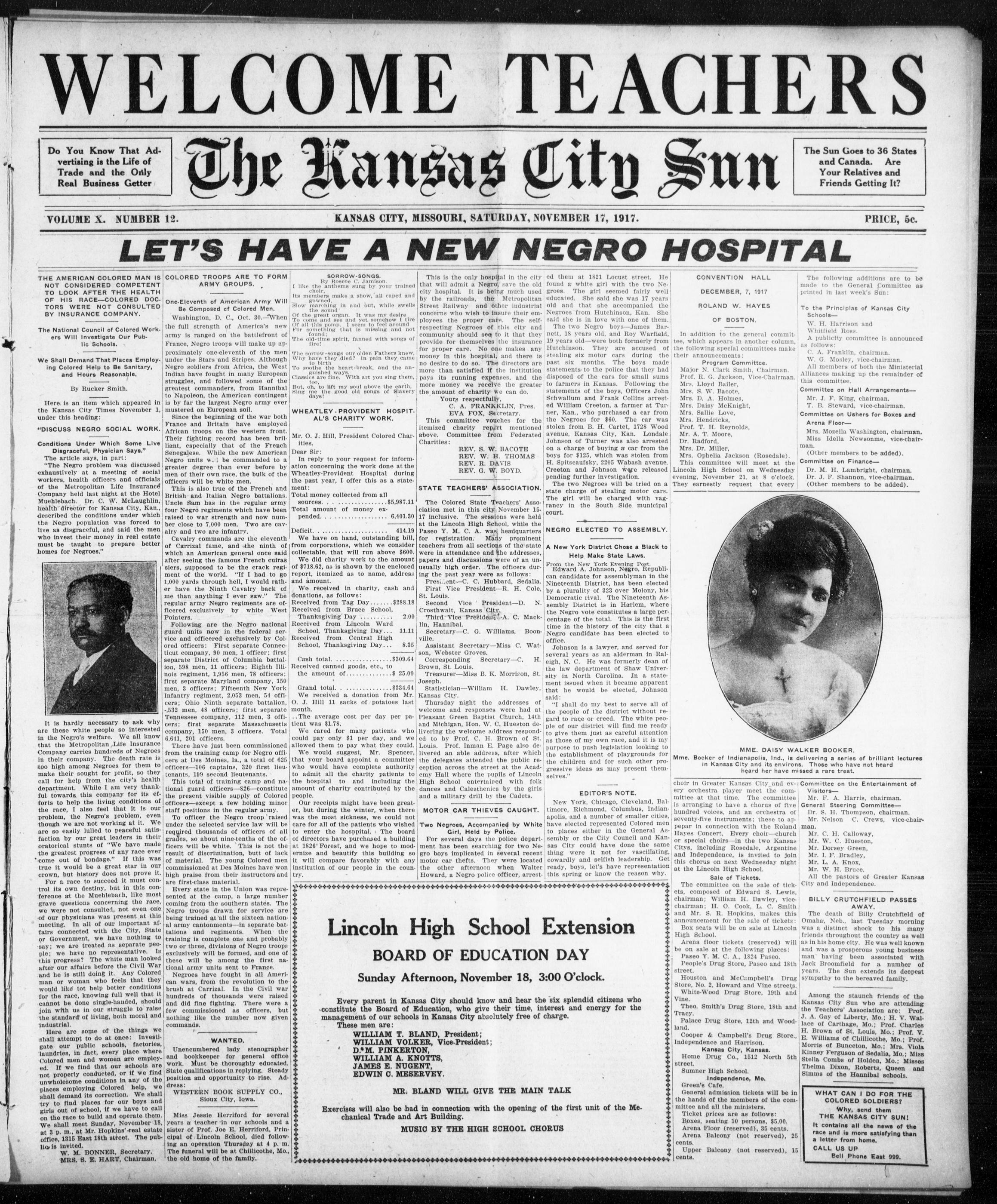
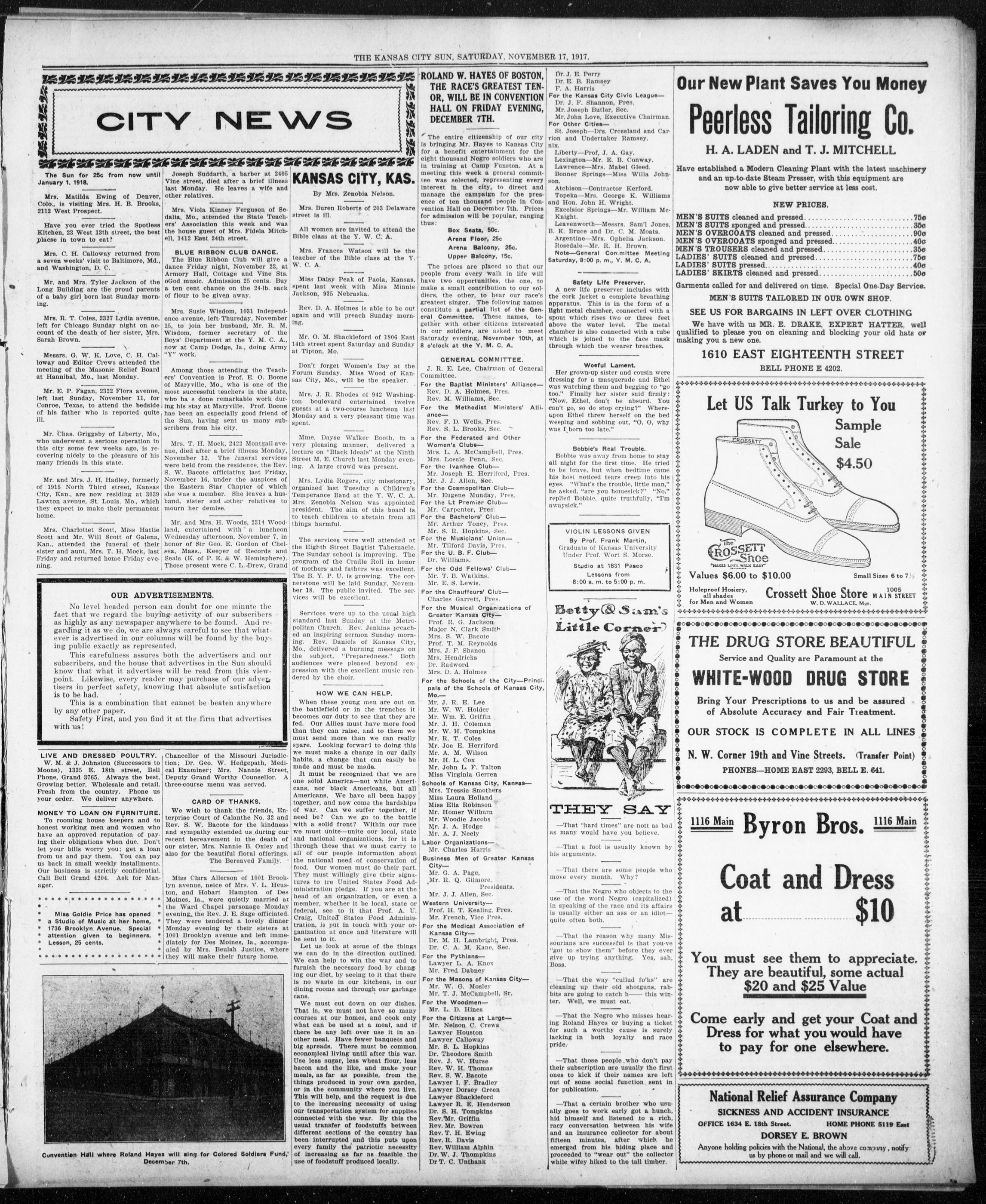
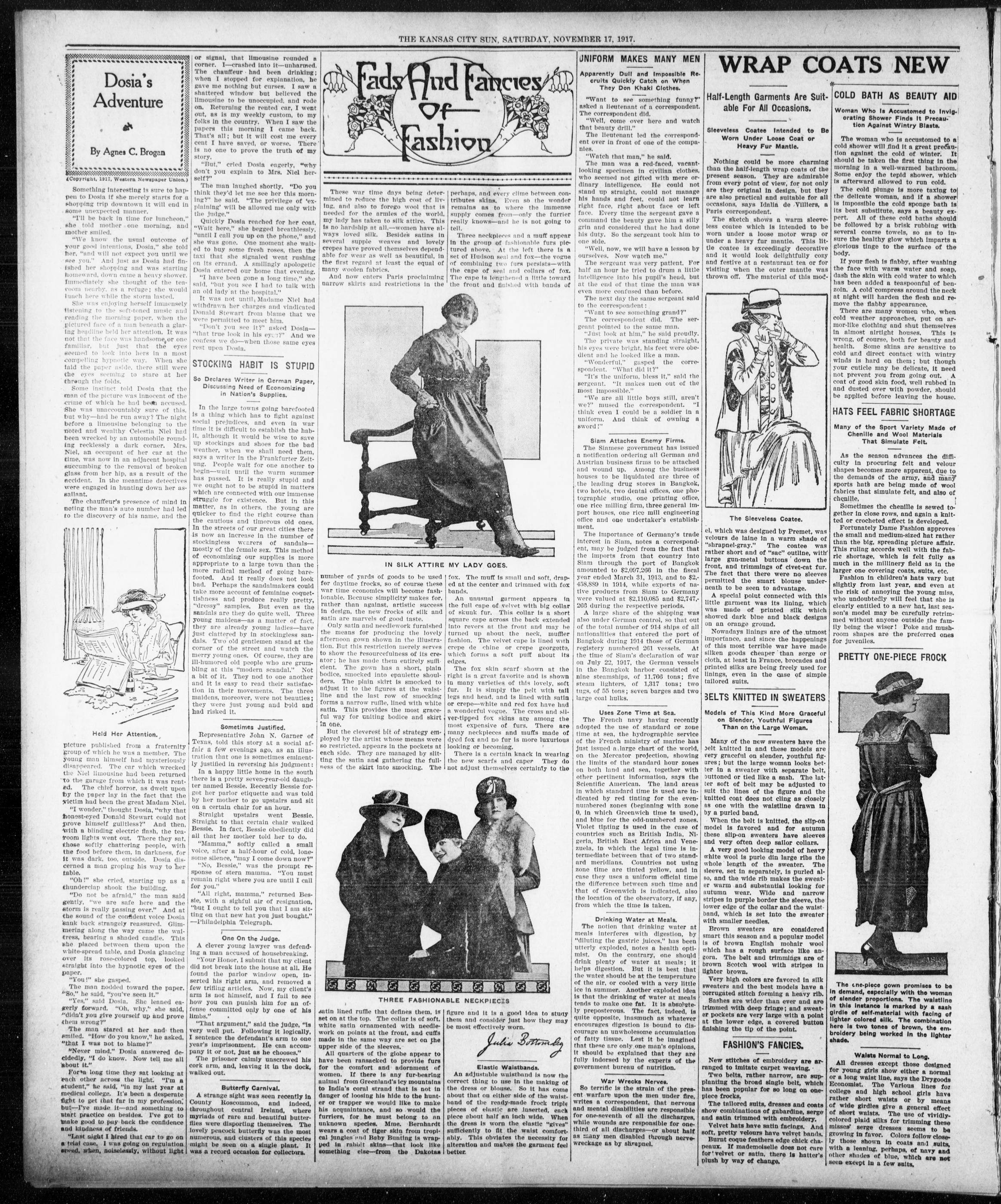
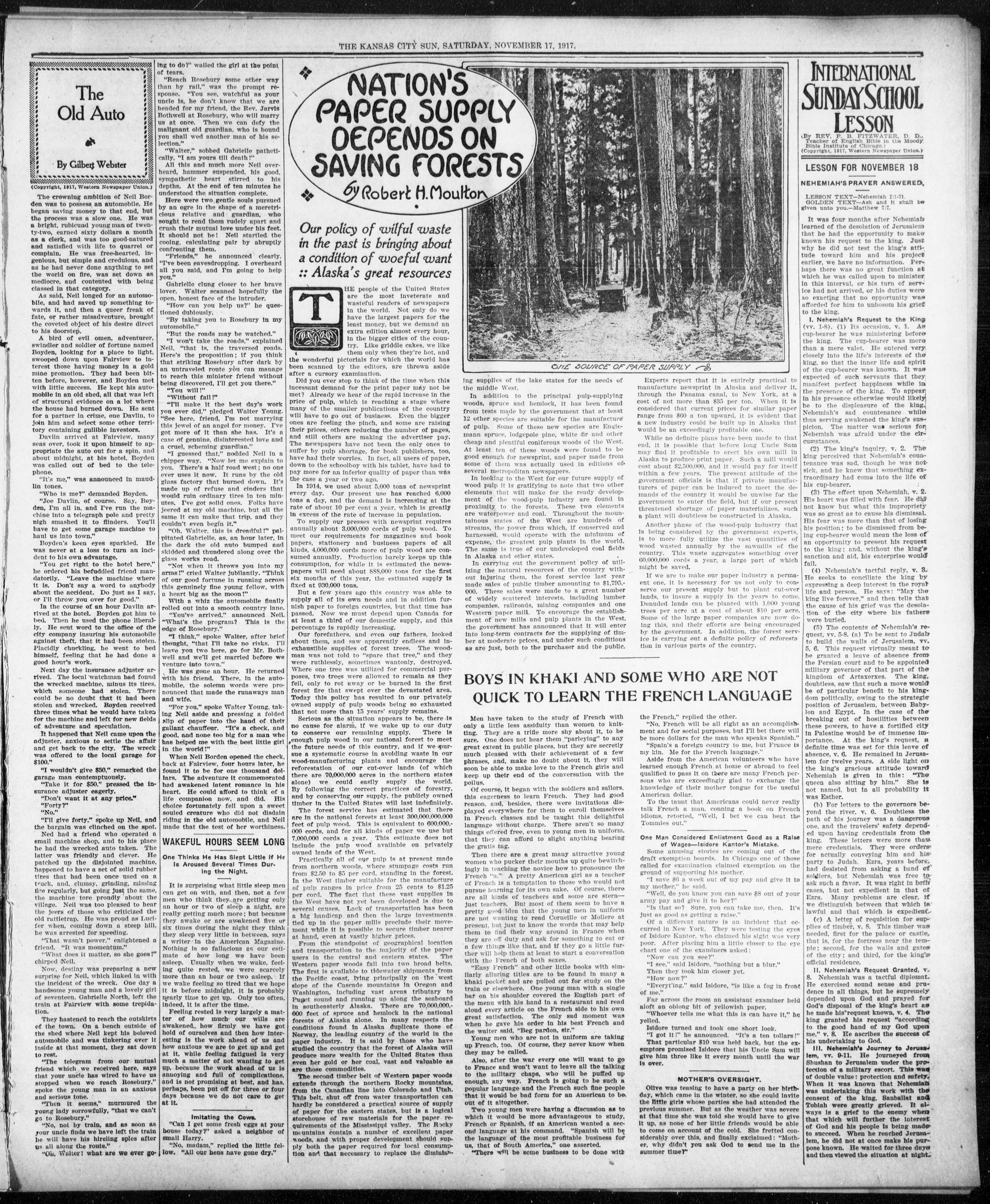
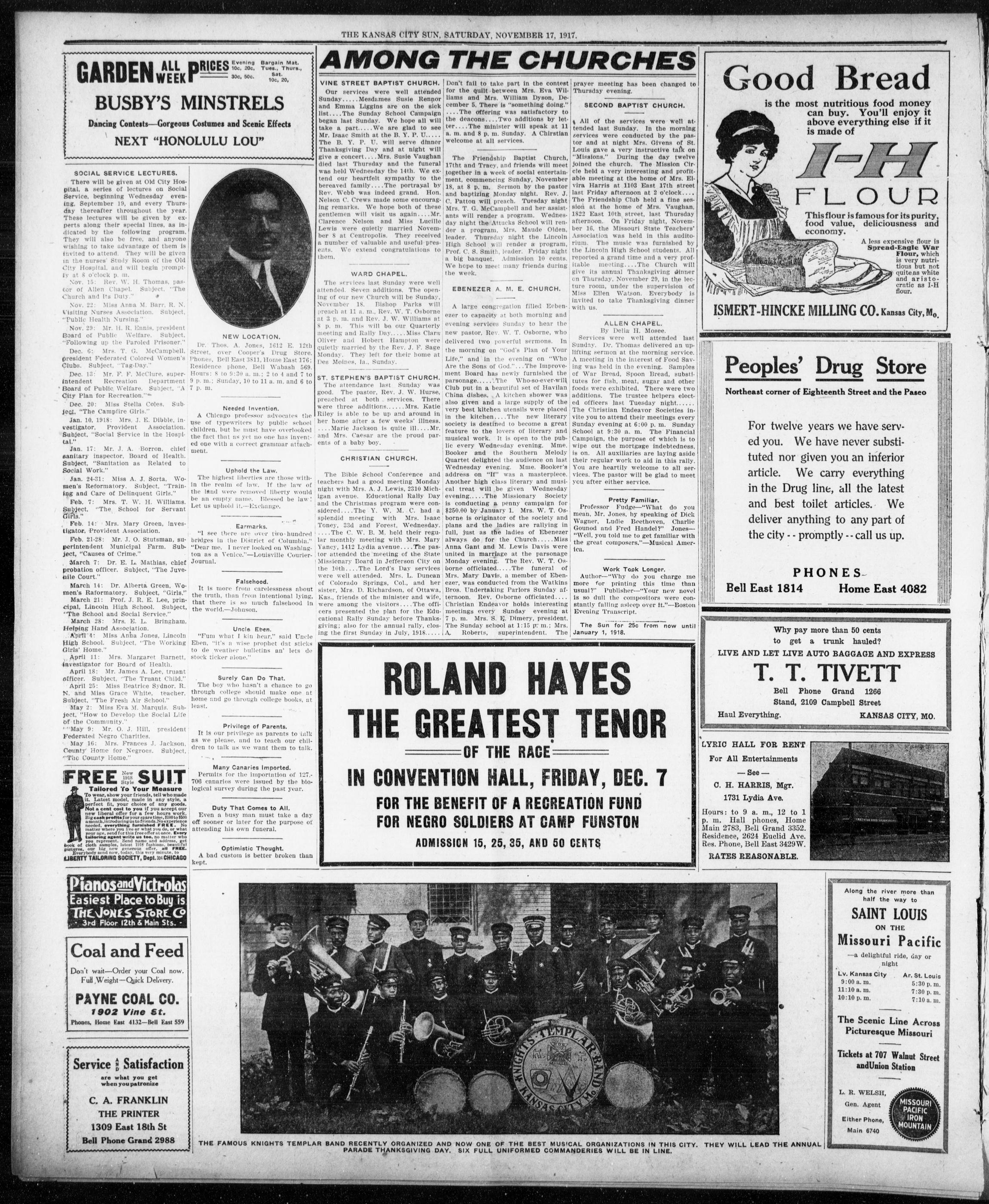
WELCOME TEACHERS
LET'S HAVE A NEW NEGRO HOSPITAL
Do You Know That Advertising is the Life of Trade and the Only Real Business Getter
VOLUME X. NUMBER 12.
THE AMERICAN COLORED MAN IS NOT CONSIDERED COMPETENT TO LOOK AFTER THE HEALTH OF HIS RACE—COLORED DOCTORS WERE NOT CONSULTED BY INSURANCE COMPANY.
The National Council of Colored Workers Will Investigate Our Public Schools.
We Shall Demand That Places Employing Colored Help to Be Sanitary, and Hours Reasonable.
By Rucker Smith
Here is an item which appeared in the Kansas City Times November 1 under this heading:
"DISCUSS NEGRO SOCIAL WORK
Conditions Under Which Some Live Disgraceful, Physician Says."
The article says, in part:
"The Negro problem was discussed exhaustively at a meeting of social workers, health officers and officials of the Metropolitan Life Insurance Company held last night at the Hotel Muechlebach. Dr. C. W. McLaughlin health director for Kansas City, Kan. described the conditions under which the Negro population was forced to live as disgraceful, and said the men who invest their money in real estate must be taught to prepare better homes for Negroes."
[Picture of a man in a suit].
It is hardly necessary to ask why are these white people so interested in the Negro's welfare. We all know that the Metropolitan Life Insurance Company carries hundreds of Negroes in their company. The death rate is too high among Negroes for them to make their sought for profit, so they call for help from the city's health department. While I am very thankful towards this company for its efforts to help the living conditions of the race, I also feel that it is our problem, the Negro's problem, even though we are not working at it. We are so easily lulled to peaceful satisfaction by our great leaders in their oratorical stunts of "We have made the greatest progress of any race ever come out of bondage." If this was true it would be a great star in our crown, but history does not prove it.
For a race to succeed it must control its own destiny, but in this conference at the Muehlebach, like most grave questions concerning the race, we were not consulted, not even one of our physicians was present at this meeting. In all of our important affairs connected with the City, State or Government, we have nothing to say; we are treated as separate people; we have no representative. Is this progress? The white man looked after our affairs before the Civil War and he is still doing it. Any Colored man or woman who feels that they would like to help better conditions for the race, knowing full well that it cannot be done single-handed, should join with us in our struggle to raise the standard of living, both moral and industrial.
Here are some of the things we shall attempt to do at once: Investigate our public schools, factories, laundries, in fact, every place where Colored men and women are employed. If we find that our schools are not properly conducted, or if we find unwholesome conditions in any of the places employing Colored help, we shall demand its correction. We shall try to find places for our boys and girls out of school, if we have to call on the race to build and operate them. We shall meet Sunday, November 18, at 3 p. m., at Mr. Hopkins' real estate office, 1315 East 18th street. The public is invited. W. M. BONNER, Secretary. MRS. S. E. HART, Chairman.
The Kansas City Sun
COLORED TROOPS ARE TO FORM ARMY GROUPS.
One-Eleventh of American Army Will
Be Composed of Colored Man
Washington, D. C., Oct. 30.—When the full strength of America's new army is ranged on the battlefront of France, Negro troops will make up approximately one-eleventh of the men under the Stars and Stripes. Although Negro soldiers from Africa, the West Indian have fought in many European struggles, and followed some of the greatest commanders, from Hannibal to Napoleon, the American contingent is by far the largest Negro army ever mustered on European soil.
Since the beginning of the war both France and Britain have employed African troops on the western front. Their fighting record has been brilliant, especially that of the French Senegalese. While the new American Negro units will be commanded to a greater degree than ever before by men of their own race, the bulk of the officers will be white men.
This is also true of the French and British and Italian Negro battalions. Uncle Sam has in the regular army four Negro regiments which have been raised to war strength and now number close to 7,000 men. Two are cavalry and two are infantry.
Cavalry commands are the eleventh of Carrizal fame, and the ninth of which an American general once said after seeing the famous French cuirassiers, supposed to be the crack regiment of the world. "If I had to go 1,000 yards through hell, I would rather have the Ninth Cavalry back of me than anything I ever saw." The regular army Negro regiments are officered exclusively by white West Pointers.
Following are the Negro national guard units now in the federal service and officered exclusively by Colored officers: First separate Connecticut company, 90 men, 1 officer; first separate District of Columbia battalion, 598 men, 11 officers; Eighth Illinois regiment, 1,956 men, 78 officers; first separate Maryland company, 150 men, 3 officers; Fifteenth New York Infantry regiment, 2,053 men, 54 officers; Ohio Ninth separate battalion, -532 men, 48 officers; first separate Tennessee company, 112 men, 3 officers; first separate Massachusetts company, 150 men, 3 officers. Total 6,641, 201 officers.
There have just been commissioned from the training camp for Negro officers at Des Moines, Ia., a total of 625 officers—106 captains, 320 first lieutenants, 199 second lieutenants.
This total of training camp and national guard officers—826—constitute the present visible supply of Colored officers—except a few holding minor staff positions in the regular army.
To officer the Negro troop raised under the selected service law will be required thousands of officers of all grades, so about nine-tenths of the officers will be white. This is not the result of discrimination, but of lack of material. The young Colored men commissioned at Des Moines have won high praise from their instructors and are first-class material.
Every state in the Union was represented at the camp, a large number coming from the southern states. The Negro troops drawn for service are being trained at all the sixteen national army cantonments—in separate battalions and regiments. When the training is complete one and probably two or three, divisions of Negro troops exclusively will be formed, and one of these will be among the first national army units sent to France.
Negroes have fought in all American wars, from the revolution to the brush at Carrizal. In the Civil war hundreds of thousands were raised and did fine fighting. There were a few commissioned as officers, but nothing like the number now given commands.
WANTED.
Unencumbered lady stenographer and bookkeeper for general office work. Must be thoroughly educated. State qualifications in replying. Steady position and opportunity to rise. Address:
WESTERN BOOK SUPPLY CO.,
Sioux City, Iowa.
Miss Jessie Herriford for several years a teacher in our schools and a sister of Prof. Joe E. Herriford, Principal of Lincoln School, died following an operation Thursday at 4 p. m. The funeral will be at Chillicothe, Mo., the old home of the family.
KANSAS CITY, MISSOURI, SATURDAY, NOVEMBER 17. 1917.
SORROW-SONGS.
By Roscoe C. Jamison.
I like the anthems sung by your trained
choir...
Its members make a show, all caped and gowned
Slow marching in and out, while swells the sound.
the solver
Of the great organ. It was my desire
To come and see and yet somehow I fire
Of all this pomp. I seem to feel around
For something that is missing and not
found;
The old-time spirit, fanned with songs of
fire;
The sorrow-songs our olden Fathers knew,
Why have they died? In pain they came
to birth
(oo)
But, oh, to lift my soul above the earth.
Sing me the good old songs of Slavery
days!
WHEATLEY-PROVIDENT HOSPITAL
AL'S CHARITY WORK.
Mr. O. J. Hill, President Colored Charities.
Dear Sir:
In reply to your request for information concerning the work done at the Wheatley-Provident Hospital during the past year, I offer this as a statement:
Total money collected from all sources. ..... $5,987.11
Total amount of money expended. ..... 6,401.30
Deficit. ..... 414.19
We have on hand, outstanding bills from corporations, which we consider collectable, that will run above $600.
We did charity work to the amount of $718.62, as is shown by the enclosed report, itemized as to name, address and amount.
We received in charity, cash and donations, as follows:
Received from Tag Day.....$288.18
Received from Bruce School,
Thanksgiving Day.....2.00
Received from Lincoln Ward
School, Thanksgiving Day.....11.11
Received from Central High
School, Thanksgiving Day.....8.35
Cash total.....$309.64
Received canned goods, etc., to
the amount of.....$ 25.00
Grand total.....$334.64
We received a donation from Mr.
O. J. Hill 11 sacks of potatoes last
month.
The average cost per day per pa-
tient was $1.78.
We cared for many patients who
could pay only $1 per day, and we
allowed them to pay what they could.
We would suggest, Mr. Spencer,
that your board appoint a committee
who would have complete authority
to admit all the charity patients to
the hospital to and including the
amount of charity contributed by the
people.
Our receipts might have been greater, but during the winter, when there was the most sickness, we could not care for all of the patients who wished to enter the hospital. The board of directors have purchased a building at 1826' Forest, and we hope to modernize and beautify this building so it will compare favorably with any institution of our people in the country.
Lincoln I
BOAR
Sunday Afternoon
Every parent in Kansas constitute the Board of I management of our school.
These men are:
```markdown
```
Lincoln High School Extension BOARD OF EDUCATION DAY
Sunday Afternoon, November 18, 3:00 O'clock.
Every parent in Kansas City should know and hear the six splendid citizens who constitute the Board of Education, who give their time, interest and energy for the management of our schools in Kansas City absolutely free of charge.
These men are:
WILLIAM T. BLAND, President;
WILLIAM VOLKER, Vice-President;
D. M. PINKERTON,
WILLIAM A. KNOTTS,
JAMES E. NUGENT,
EDWIN C. MESERVEY.
MR. BLAND WILL GIVE THE MAIN TALK
Exercises will also be had in connection with the opening of the first unit of the Mechanical Trade and Art Building.
MUSIC BY THE HIGH SCHOOL CHORUS
Exercises will also be had in connection with the opening of the first unit of the Mechanical Trade and Art Building. MUSIC BY THE HIGH SCHOOL CHORUS
Dear Sir:
This is the only hospital in the city that will admit a Negro save the old city hospital. It is being much used by the railroads, the Metropolitan Street Railway and other industrial concerns who wish to insure their employees the proper care. The self respecting Negroes of this city and community should seq to it that they provide for themselves the insurance for proper care. No one makes any money in this hospital, and there is no desire to do so. The directors are more than satisfied if the institution pays its running expenses, and the more money we receive the greater the amount of charity we can do.
This committee vouches for the itemized charity report mentioned above. Committee from Federated Charities:
REV. S. W. BACOTE
REV. W. H. THOMAS
REV. R. DAVIS
REV. G. W. BOYD.
STATE TEACHERS' ASSOCIATION
The Colored State Teachers' Association met in this city November 15-17 inclusive. The sessions were held at the Lincoln High School, while the Paseo Y. M. C. A. was headquarters for registration. Many prominent teachers from all sections of the state were in attendance and the addresses, papers and discussions were of an unusually high order. The officers during the past year were as follows: President—C. C. Hubbard, Sedalia, First Vice President—R. H. Cole, St. Louis. Second Vice President—D. N. Crosthwait, Kansas City. Third Vice President—A. C. Mack lin, Hannibal.
Secretary—C. G. Williams, Boon ville.
Assistant Secretary—Miss C. Watson, Webster Groves.
Corresponding Secretary—C. H. Brown, St. Louis.
Treasurer—Miss B. K. Morrison, St. Joseph.
Statistician—William H. Dawley, Kansas City.
Thursday night the addresses of welcome and responses were had at Pleasant Green Baptist Church, 14th and Michigan, Hon. W. C. Hueston delivering the welcome address responded to by Prof. C. H. Brown of St. Louis. Prof. Inman E. Page also delivered an able address, after which the delegates attended the public reception across the street at the Academy Hall where the pupils of Lincoln High School entertained with folk dances and Calesthenics by the girls and a military drill by the Cadets.
MOTOR CAR THIEVES CAUGHT.
Two Negroes, Accompanied by White Girl, Held by Police.
For several days the police department has been searching for two Negro boys implicated in several recent motor car thefts. They were located the other afternoon when Walter Howard, a Negro police officer, arrests
High School
HEAD OF EDUCATION
Eternoon, November 18, 3
Kansas City should know and hear the Education, who give their time, in Kansas City absolutely free of
ISLAND WILL GIVE THE MAIN
and in connection with the opening of
Art Building.
MUSIC BY THE HIGH SCHOOL CH
ed them at 1821 Locust street. He found a white girl with the two Negroes. The girl seemed fairly well educated. She said she was 17 years old and that she accompanied the Negroes from Hutchinson, Kan. She said she is in love with one of them. The two Negro boys—James Barnett, 18 years old, and Roy Warfield, 19 years old—were both formerly from Hutchinson. They are accused of stealing six motor cars during the past six months. The boys made statements to the police that they had disposed of the cars for small sums to farmers in Kansas. Following the statements of the boys, Officers John Schwallum and Frank Collins arrested William Creeton, a farmer at Turner, Kan., who purchased a car from the Negroes for $60. The car was stolen from B. H. Cartet, 1728 Wood avenue, Kansas City, Kan. Londale Johnson of Turner was also arrested on a charge of buying a car from the boys for $125, which was stolen from H. Splitscaufsky, 2205 Wabash avenue. Creeton and Johnson were released pending further investigation. The two Negroes will be tried on a state charge of stealing motor cars. The girl will be charged with vagrancy in the South Side municipal court.
A New York District Chose a Black to Help Make State Laws.
From the New York Evening Post.
Edward A. Johnson, Negro, Republican candidate for assemblyman in the Nineteenth District, has been elected by a plurality of 323 over Molony, his Democratic rival. The Nineteenth Assembly District is in Harlem, where the Negro vote constitutes a large percentage of the total. This is the first time in the history of the city that a Negro candidate has been elected to office.
Johnson is a lawyer, and served for several years as an alderman in Raleigh, N. C. He was formerly dean of the law department of Shaw University in North Carolina. In a statement issued when it became apparent that he would be elected, Johnson said:
"I shall do my best to serve all of the people of the district without regard to race or creed. The white people of our district will find me ready to give them just as careful attention as those of my own race, and it is my purpose to push legislation looking to the establishment of playgrounds for the children and for such other progressive ideas as may present themselves."
EDITOR'S NOTE
New York, Chicago, Cleveland, Baltimore, Richmond, Columbus, Indianapolis, and a number of smaller cities have elected represented Colored men to places either in the General Assembly or the City Council and Kansas City could have done the same thing were it not for vasculitizing cowardly and selfish leadership. Get ready, boys, let's have representation this spring or know the reason why.
PITAL
In addition to the general committee, which appears in another column, the following special committees make their announcements:
Program Committee.
Major N. Clark Smith, Chairman.
Prof. R. G. Jackson, Vice-Chairman.
Mrs. Lloyd Bailer,
Mrs. S. W. Bacote,
Mrs. D. A. Holmes,
Mrs. Daisy McKnight,
Mrs. Sallie Love,
Mrs. Hendricks,
Prof. T. H. Reynolds,
Mr. A. T. Moore,
Dr. Radford,
Mrs. Dr. Miller,
Committee. Smith, Chairman. Jon, Vice-Chairman. W. G. Mosley. All members of Alliances making this committee. Committee on H Mr. J. F. King. T. B. Steward. Committee on Us Arena Floor—
Mrs. Ophelia Jackson (Rosedale). This committee will meet at the Lincoln High School on Wednesday evening, November 21, at 8 o'clock. They earnestly request that every
[Image of a woman with a cross on her chest].
P
A.
MME. DAISY WALKER BOOKER.
Mme. Bocker of Indianapolis, Ind., is delivering a series of brilliant lectures in Kansas City and its environs. Those who have not heard heard her have missed a rare treat.
Mme. Booker of Indianapolis, Ind., is delivering a series of brilliant lectures in Kansas City and its environs. Those who have not heard heard her have missed a rare treat.
choir in Greater Kansas City and every orchestra player meet the committee at that time. The committee is arranging to have a chorus of five hundred voices, and an orchestra of seventy-five instruments; these to appear in connection with the Roland Hayes Concert. Every choir—church or special choirs—in the two Kansas Citys, including Rosedale, Argentine and Independence, is invited to join this chorus on next Wednesday night at the Lincoln High School.
Committee on the Entertainment of Visitors—
Mr. F. A. Harris, chairman.
General Steering Committee—
Dr. S. H. Thompson, chairman.
Mr. Nelson C. Crews, vice-chairman.
Mr. C. H. Calloway,
Mr. W. C. Hueston,
Mr. Dorsey Green,
Mr. I. F. Bradley,
Mr. L. A. Knox,
Mr. W. H. Bruce.
Sale of Tickets.
The committee on the sale of tickets, composed of Edward S. Lewis, chairman; William H. Dawley, vice-chairman; H. O. Cook, L. C. Smith and Mr. S. R. Hopkins, makes this announcement for the sale of tickets: Box seats will be on sale at Lincoln High School. Arena floor tickets (reserved) will be on sale at the following places: Paseo Y. M. C. A., 1824 Paseo. People's Drug Store, Paseo and 18th street. Houston and McCampbell's Drug Store, No. 2, Howard and Vine streets, White-Wood Drug Store, 19th and Vine. Theo. Smith's Drug Store, 18th and Tracy. Palace Drug Store, 12th and Woodland. Cooper & Campbell's Drug Store., Independence and Harrison. Kansas City, Kansas. Home Drug Co., 1512 North 5th street. Sumner High School. Independence, Mo. Green's Cafe. General admission tickets will be in the hands of the members of the com
---
OF BOSTON
The Sun Goes to 36 States and Canada. Are Your Relatives and Friends Getting It?
The following additions are to be made to the General Committee as printed in last week's Sun:
To the Principias of Kansas City Schools—
W. H. Harrison and
Whitfield Ross.
A publicity committee is announced as follows:
C. A. Franklin, chairman.
W. G. Mosley, vice-chairman.
All members of both the Ministerial Alliances making up the remainder of this committee.
Committee on Hall Arrangements—
Mr. J. F. King, chairman.
T. B. Steward, vice-chairman.
Committee on Ushers for Boxes and
Arena Floor—
Mrs. Mozella Washington, chairman.
Miss Idella Newtonme, vice-chairman.
Dr. M. H. Lambright, chairman.
Dr. J. F. Shannon, vice-chairman.
(Other members to be added).
1917
Committee on the Entertainment of Visitors—
Mr. F. A. Harris, chairman.
General Steering Committee—
Dr. S. H. Thompson, chairman.
Mr. Nelson C. Crews, vice-chairman.
Mr. C. H. Calloway,
Mr. W. C. Hueston,
Mr. Dorsey Green,
Mr. I. F. Bradley,
Mr. L. A. Knox,
Mr. W. H. Bruce.
All the pastors of Greater Kansas City and Independence.
BILLY CRUTCHFIELD PASSES AWAY.
The death of Billy Crutchfield of Omaha, Neb., last Tuesday morning was a distinct shock to his many friends throughout the country as well as in his home city. He was well known and was a prosperous young business man having been associated with Jack Broomfield for a number of years. The Sun extends its deepest sympathy to the bereaved family.
Among the staunch friends of the Kansas City Sun who are attending the Teachers' Association are: Prof. J. A. Gay of Liberty, Mo.; H. V. Wallace of Carthage, Mo.; Prof. Charles H. Brown of St. Louis, Mo.; Prof. V. E. Williams of Chillicothe, Mo.; Prof. Morris of Bunceton, Mo.; Mrs. Viola Kinney Ferguson of Sedalia, Mo.; Miss Stella Combs of Holden, Mo.; Misses Thelma Dixon, Roberts, Queen and Simms of the Hannibal schools.
WHAT CAN I DO FOR THE COLORED SOLDIERS?
Why, send them
THE KANSAS CITY SUN!
It contains all the news of the race and is more satisfying than a letter from home.
CALL US UP
Bell Phone East 999.
---
PRICE. 5c.
From Our Foreign Correspondents
A. F. and A. M. Mo. Jurisdiction
Officers—1917.
W. W. Fields, Cameron, Mo., Grand Master.
C. C. Clark, St. Louis, Mo., Dep.
Grand Master.
Ernest Boone, Louisiana, Mo., Senior Grand Warden.
I. H. Bradbury, St. Louis, Mo.
Junior, Grand Warden.
H. H. Walker, St. Joseph, Mo., Grand Treasurer.
Geo. W. K. Love, Kansas City
Grand Secretary.
Nelson C. Crews, Kansas City, Reilef Secretary.
E. G. Lacey, Kansas City, G. L.
1st District.
E. J. Cooper, Mexico, Mo., G. L.
2nd District.
OFFICERS OF GRAND CHAPTER
R. A. M.
Missouri and Jurisdiction, 1917-18.
T. G. McCampbell, G. H. P., Quindaro, Kans.
A. L. Thomas, D. G. H. P., Jeffers son City, Mo.
J. P. Moffett, G. King, Sedalia, Mo
S. A. May, G. Scribe, St. Louis, Mo
Chas. Griggsby, G. Treas., Liberty Mo.
E. S. Baker, G. Secretary, Kansas City, Mo.
OFFICERS OF GRAND COMMAND
ERY. K. T.
Missouri and Jurisdiction
1917-18.
W. G. Mosely, R. E. G. C., Kansas City, Mo.
J. W. Beard, V. E. G. C., St. Louis, Mo.
G W. Lewis, E. G. G., St. Louis, Mo.
C. Brassfield, E. G., Captain General, Kansas City, Mo.
W. A. Ashley, E. G. P., St. Louis, Mo.
J. H. Kenner, E. G., Treasurer, Marshall, Mo.
J. T. Cannon, E. G., Recorder, St. Louis, Mo.
George A. Johnson, E. G. S. W. Kansas City, Mo. Benjamin F. Graves, E. G. J. W., St Joseph, Mo.
Lodge Directory
G
WESTMINSTER
Rone Lodge No. 25, A. F. and A. M. meets the 1st and 3rd Monday in each month. All Master Masons in good standing welcome. Emmett Spruell, W. M.; C. H. Countee, Sec'y.
G
and A. M., Liberty, M. mo., meets
the 2nd and 4th Saturday
nights in each month. William
Parker, W. M.; Nelson Wallar,
Sec'y.
St. Stephens Chapter No. 37,
Rival Masons, Masonry.
Mo. mo.; first Tuesday,
in each month. W. H. Robinson,
H. P. H., Wm. Caps, Recorder.
```markdown
```
St. Matthew Commandery
No. 17, Liberty, Mo., meets
the third Saturday night
William Capps, E. C.; W. H.
Robinson, Rec. Sec'y.
HRC
IN
VINCES
U. B. F.
King of the West Lodge
No. 28 Incident and third
Wednesdays in each month
at 10th and Campbell. C. F.
Wilson, W M.; H. Conway.
589 Tracy Ave., Secy.
MASONIC BUILDING ASSOCIATION
T. G. McCampbell, President.
E. B. Thompson, Vice President.
W. H. Washington, Treasurer.
S. H. P. Edwards, Secretary.
Board of Directors:
N. W. Jordan. S. Myers,
W. H. Brown. E. S. Baker,
W. R. Patterson. R. V. Adkins,
B. R. Francis. Richard Harris
Geo Johnson, R. Fulbright.
Meets second and fourth Tuesday
in each month.
Bethel A. M. E. Church, 24th and Flora.
St. Stephen's Baptist Church, 604 Charlotte St.
General M. E. Church, 19th and Woodland.
Second Baptist Church, 10th and Charlotte.
Allen Chapel A. M. E. Church, 10th and Charlotte.
E. Gonzalez A. M. E. Church, 17th and Tracy.
St. Augustine's P. E. Church, 11th and Troost Avenue.
St. John's A. M. E. Church, 1743 Bellevue.
Seventh Day Adventist, 23d and Woodland.
St. Monica's Catholic, 17th and Lydia. Vine St. Baptist Church, 1852 Vine St. Chapel A. M. E. Church, 11th and Troost.
Morning Star Baptist Church, 2311 Vine. Highland Avenue Baptist Church, 1111 Highland.
Vines A. M. E. Zion Church, 1823 Woodland Ave.
Second Christian Church, 24th and Woodland.
C. M. E. Church, 1817 Flora Ave.
St. Stephen's Baptist Church, 4039 Mill St. St. Luke's A. M. E. Church, 43rd and Prospect Place.
CLARK CHAPEL M. E. CHURCH,
1664 Madison Ave.
KANSAS CITY, KAN. CHURCHES.
First A. M. E. Church, 8th and Neb.
Eighth St. Baptist Church, 8th and
Oakland.
Metropolitan Baptist Church, 9th and
Washington.
Bethel A. M. E. Church, Water and
Steward Streets.
St. Paul A. M. E. Church, 21st and
Ruby.
First Baptist Church, 5th and Neb.
King Solomon Baptist Church, 3rd and
State.
Quindaro A. M. E. Church, Quindaro.
Pleasant Valley Baptist Church, Rosedale, Kan.
M. Church, 9th and Oakland.
Second Baptist Church, 24th and Ruby.
Wesley Chapel M. E., 108 Shawnee.
Bethel A. M. E. Church, Rosedale, Kan.
The new ladies club, to be known as the Pleasant Hour Club, were entertained at the home of Mrs. Effie Baker Wednesday afternoon.....Mrs. Chas. Oliver is convalescent.....Mrs. James Talbot is on the sick list.... Mrs. Miles York visited her husband at Great Falls recently.....Mrs. Wm Irvin and Mrs. Cora Johnson returned from a trip to Anaconda.....Mrs. Geo F. Martin was called to her home in Missouri last Sunday by the death of her sister.....Mrs. Lucretia H. Pitman president of Woman's Statet Work Council, Rescue Worker and Missionary of St. Paul's Baptist Church, Spokane, Wash., was in our city to raise funds to build a home for the aged in the State of Washington for our people in Oregon, Washington, Montana and Idaho.....Grand Chancellor J. H. Hilliard returned from Billings where he organized the "Montana" Lodge, K. of P., the 6th and made arrangements for Col. Roscoe C. Simmons to speak there December 2....Mrs. James Minor left for Billings the 6th and will be a guest of her daughter, Mrs. Edith Baker, while in that city, as Mrs. Baker has been ill for some time.....Mrs. J. D. Hart entertained a number of ladies the 6th at her residence, 1406 N. Beton avenue. Mrs. Lucretia H. Pittman of Spokane, Wash., was the guest of honor.
SCHOFIELD BARRACKS, H. T.
The 25th U. S. Infantry, Schofield Barracks, H. T., bought two hundred and fifty-one thousand, seven hundred and fifty ($251,750.00) dollars worth of the Second Liberty Bond. The 25th leads while all others follow. The 25th subscribed all told the sum of $325.00 to the N. A. A. C. P., St. Louis, Mo., for the benefit of East St. Louis Refugees. Still we lead. In twelve months the regiment has contributed to different charities $3,602.00 besides having now in the hands of the Chapain nearly $1,000 to begin building an amusement hall, the lower story for general amusements while the upper story will be for lodge meetings.
COLUMBIA MO.
The leading citizens of both races united in giving the Colored soldier boys a big send-off Friday, October 26, at the Second Baptist Church. Lieut. J. E. Coleman of the Spanish-American war presided. Forceful speeches were made by Mayor Bogg, Attorney Anderson and other white citizens. Tumultous applause greeted the addresses of Rev. G. M. Tillman, Prof. Coleman, Lieut. Victor and Rev. E. S. Redd who made many pleas for their people. Blankets and tobacco were given by the white Commercial Club and 85 lunch boxes filled by a community of Colored women for the 42 soldier boys who left for Camp Funston. A large crowd of white and black were at the station to see them off.....Prof. J. E. Jones, principal of Douglass High School, is doing good work. His chorus is receiving much praise.....The Ladies' Art Club is making Red Cross Shirts.....St. Paul A. M. E. Mite Missionary society held its election.....The Trustees Aid gave a pretty Hallowe'en social at the home of Mrs. Alice Williams.....All women's clubs are requested to meet Tuesday, November 20, at 4:00 p.m. to organize a City Federation of Clubs for Community Service at the Douglass High School Auditorium.....Quarterly meeting at St. Paul November 25.....Miss Edith M. Randolph of
The Handy Colored Store
2409 Vine St.
Ladies' and Gent's Furnishing
Goods and Notions
VISIT OUR DRY GOODS AND
HARDWARE DEPT.
BARGAINS
FURNISHING GARDEN FURNITURE
THE KANSAS CITY SUN, SATURDAY, NOVEMBER 17, 1917
Hannibal, Mo., is assisting Rev. G. M
Tillman in his revival service.
SLATER, MISSOURI.
Mrs. A. L. Pryor visited in Boonville, Mo., this week....Quarterly meeting at Abbott Chapel was quite a success. Rev. W. H. Wheel, district superintendent, preached three excellent sermons....Mrs. Nannie Neff has been on the sick list for two weeks. Prof. C. Nasby of Miami, Mo., and Dr. R. Smith of Marshall, Mo., were guests of Miss Athleen Walls Sunday.... The Mission Circle of the Second Baptist Church was entertained at the home of Mrs. Martha Pipers Tuesday evening. The meeting was a pleasant one....Mrs. Angeline Gordon is sick at this writing....The writer gave a reception November 8 in honor of Mrs. Nellie McKim of Chicago. The guests were: Mesdames Maria Ford, Julia Young, Margie Woods, Eliza James McKim, Mr. and Mrs. Edmond Tyer, Mr. and Mrs. Lee Wilson, Mr. and Mrs. Will Freelon, Mr. and Mrs. Walter Neff and Rev. and Mrs. R. H. Smith.
CHILLICOTHE, MISSOURI
By B. V. Longeon
Mr. and Mrs. Thomas Williams of Atchison, Kansas, are visiting Mr. and Mrs. Edward Brown. Mr. Williams owns a handsome touring car... Miss Scottie Green returned from Gallatin Mo., last Tuesday, where she has been at the bedside of her grandfather, Mr. Alex Green, who is improving... Mrs. Thomas Scott received a telegram from Mrs. Lulu Horn of Cedar Rapids, Ia., stating the sudden death of her hubbard. Mrs. Horn is the daughter of Mrs. Katie Nance, and has the sympathy of a host of friends in this city...Mr. Alex Winfrey is again confined to his home from an attack of rheumatism...Profs. Williams and Brown and Miss Odessa Hillman are attending the Teachers' Association at Kansas City, Mo...Mr. Fred Slaughter, a young man who has shown his determination to make good with Uncle Sam, noct as soldier, but in the civil service, is now employed as a mail clerk from St. Louis to Kansas City, Moo. We congratulate Mr. Slaughter for his merited promotion and wish him further success. His wife and family reside in this city...The exterior of the two-story building in the heart of the Negro district and owned by Mr. Edward Gilbert has undergone repairs that add to its attractiveness. Mr. Gilbert is well made as well as self made. He is progressive.
ARGENTINE, KKANSAS.
By Mrs. Opneha Jackson.
The members of the Everett Relief Club met at the parsonage on last Wednesday evening, November 7. The members are collecting gifts to prepare a Christmas box for the soldiers at Camp Funston. The club discussed plans at a meeting at St. Paul Chapel, Wednesday evening, November 14, and went on a hike to the residence of Mrs. William Freelain, Thursday. Mrs. Laura Richards is president and Mrs. Eva Bailey, secretary...Mrs. S. T. Bigman is at the bedside of her mother in Kansas City, Kansas, who is very ill. Mr. Bigman is unable to work on account of illness...Miss Bertie Williams died Wednesday morning at 11:30 o'clock, after a lingering illness. She was the daughter of Mrs. Sarah Williams, who has lived in Argentine for many years...Mrs. Jenkins, wife of Dr. Jenkins, was called to Parsons, Kansas, to see her mother, who was thrown out of a buggy some time ago...Mrs. Hattie Kizer is able to be about after a very serious illness...Two of the Birch children had operations performed for adenoids last Friday and are doing nicely.
PLEASANT HILL, MISSOURI
By S. C. Gibson
Prof. L. Clark and wife are visiting here for a few days.....Mrs. Harry Jackson of Harrisonville is visiting her parents, Mr. and Mrs. P. J. Smith.....Mrs. Nettie Ramsey of Independence is visiting her aunt, Mrs. Eliza Wilkerson, for a few days.....Mr. J. Ingram visited his son in Kansas City last week.....Prof. J. F. Moten, principal of our school, left Wednesday for the State Teachers' Association....Mr. Garland Davis was over from Higginsville Saturday to visit his family....Miss Blanche Bryant came home from Independence for a visit with parents.....Mr. Willie Baker, who is employed in Kansas City, came Saturday for a visit with his parents. Mr. and Mrs. Russell Baker.....Mrs. Si Vernon and children and Mrs. L. Graham of Harrisonville visited Mrs. Harry Brown last week.
ROSEDALE KANSAS
The body of Mrs. Levi Gordon was in his residence Tuesday evening. He had been shot four times by some unknown person. He eis survived by his mother, a daughter and sister.... The condition of Mr. Levi Collins, who is seriously ill at his home, 3904 Lloyd avenue, remains unchanged. His many friends hope for his recovery. ...Mrs. Mattie Ridley returned to her home in Newton, Kansas, after a very pleasant visit with her brother, Mr. Charles Young, and her son, Mr. Arthur Ridley, and Mrs. Ridley. During her stay in the city she was the recipient of a number of social affairs. On Friday before her departure Mr. and Mrs. Charles Young gave a reception complimentary to Mrs. Rid-
ley.....The Pleasant Valley Baptist Church's revival services are still in progress. The pastor preached a good sermon. Much interest is being manifested. There have been two conversions. One was a very aged man, Mr. Allen, and Mrs. Stone.....The Pleasant Valley Mission Circle was delightfully entertained Monday by Mrs. Graham at her residence in Spence Station. A delicious luncheon was served by the hostess. In the bean guessing contest Mrs. Walter Henderson was awarded a very dainty white apron and Mrs. J. L. Pearson a pretty boudoir cap.....Master Thomas Berhardt Henderson was the guest of Mr. George McFadden of Kansas City, Mo., Saturday and Sunday.
MARYVILLE, MISSOURI.
Prof. and Mrs. Ernest O. Boone, Jr., had as dinner guest Wednesday at 6 o'clock Mrs. Helen Martin of Helena, Mont., and Mr. Dorril Carriger....Mr. and Mrs. W. A. Mitchell entertained with a buffet luncheon Thursday evening at 8 o'clock, complimentary to Mrs. Helen Martin. Covers were laid for the guests of honor, Mr. and Mrs. Everett Page, Prof. and Mrs. E. O. Boone, Jr.; Miss Ella Mitchell, Miss Dorothy Palmer and Master E. O. Boone, 3d, the host and hostess....Mr. and Mrs. James Malcone entertained with an elaborate 6 o'clock dinner Saturday, complimentary to Mrs. Helen Martin. Covers were laid for the guest of honor, Mr. Dorril Carriger, Mr. and Mrs. Henry Wilson, Prof. and Mrs. E. O. Boone, Jr., and son, Willie Wells and host and hostess....Rev. R. H. Longdon returned after a pleasant visit at his home....Prof. E. O. Boone, Jr., is spending the week-end in Kansas City, attending the Christian Endeavor, under the leadership of Mrs. E. H. Page, is doing excellent work....Mr. and Mrs. J. L. Gooden had as dinner guests Sunday, Mrs. Helen Martin, Mrs. B. F. Smart, Mr. and Mrs. Henry Wilson, Mr. D. Carriger, Mr. and Mrs. J. C. Cooke....The residence of Mr. and Mrs. J. C. Cooke, at 414 West 5th street, was the scene of one of the most beautiful and elaborate parties ever held in Maryville, Friday, November 9th. The color scheme was pink and white and was carried out in details from the elegant pink and white evening gown of the hostess throughout the elaborate five course luncheon served. Beautiful vases with pink and white carnations and ferns, white center pieces with pink under ground were on each table. Mrs. B
F. Smart presided at the punch table. The hostess and Mrs. E. O. Boone, Jr., greeted the guests at the door. Beautiful strains of music from the Victrola floated melodiously through each room, which was manipulated by Miss Helen Vance; Misses Vera Vance, Lulu White, Dorothy Palmer served the guests. The elaborate decorations and the magnificently gowned guests was a pleasing sight and had no reference whatever to wartimes. Each guest was given a place card with suitable toasts on them, which were read on being seated on their table. The guests enjoyed themselves during the evening with whistt and dominoes. The following menu was served: Hot cocoa, pressed chicken, peas in thinbread, bread and butter sandwiches, fancy cut potatoes, fruit salad, pink and white brick cream, pink and white cake, mints, cigars. The following were present: Mr. and Mrs. James Malcome, Mr. and Mrs. William Campbell, Mr. and Mrs. Orphus Gunn, Mr. and Mrs. W. A. Mitchell, Mr. and Mrs. O. R. Vance, Mr. and Mrs. J. L. Gooden, Mr. and Mrs. E. H. Page, Prof. and Mrs. E. O. Boone, Jr., and son, Mrs. B. F. Smart, Mrs. Mary Smith, Mrs. James Palmer, Mrs. Nannie Fields, Mrs. Gerlie Wells, Mrs. Lena Mosely, Mrs. Henry Johnson of Gravity, Ia.; Miss Mabel Johnson of Gravity, Ia.; Miss Dorothy Palmer, Miss Lula White, Miss Helen Vance, Mr. John Mageeee, Mr. Chas. L. Martin, Mr. Arthur Smith, Mrs. Helen Martin left Monday for Kansas City, where she will visit relatives and friends for a week before returning to her home in Helena, Mont. Mrs. Martin is the wife of Rev. G. F. Martin, one of the progressive young ministers of the A. M. E. Church. We wish for them much success and a safe journey home for the madame.
LINCOLN, NEBRASKA
Mrs. Roxie Collins, wife of J. C. Collins, died at their home, 1323 Washington street, last Thursday at 3 p.m. The funeral services were held at the A. M. E. Church Sunday at 2:30 p.m. The obituary was read by Rev. O. J. Burckhardt, and it was very beautiful, knowing the deceased had lived as such, and unlike others, had prepared for the end. Rev. J. S. Payne preached a fine sermon, followed by Rev. B. Hillman of the Baptist Church, closed by Rev. O. J. Burckhardt. Mrs. Martha Smith of Omaha sang a solo. The floral offerings were immense.... Miss Hazel I. Holcomb and Lawrence A. Dean were quietly married last Tuesday night....Mr. Pat Pharr of Seward, Neb., spent Sunday in the city. Mr. Pharr preached for Rev. Hillman's congregation Sunday night, ...Men of M. Zion Baptist Church gave an entertainment in the church last Thursday and was successful.... Last Sunday and Monday nights were Quarterly meeting nights at the A. M. E. Church. P. E. Kink was present
and preached and gave Communion services.
WEIR, KANSAS.
By Mrs. A. R. Philips.
Rev. J. W. Edwards of Lamar, Mo., passed away Thursday evening, November 8. He was a member of Evergreen Lodge No. 61, A. F. & A. M., and met his death at the home of Mr. and Mrs. Dailley, with whom he had been residing for some time. We extend to his family our heartfelt sympathy.....Miss Ethel Ferguson of Joplin, Mo., visited her parents, Mr. and Mrs. James Ferguson the first of the week.....Miss Helen Hobbs made a flying trip to Columbus, Kan., Wednesday.
GOVERNMENT CAMPAIGN TO IN CREASE PRODUCTION OF POULTRY.
As part of the government's plan to increase the production of poultry and eggs the famous Federal Poultry Exhibit in charge of experts from the Department of Agriculture will be shipped direct from Washington and displayed here in Convention Hall from November 26th to December 2d Inclusive.
This exhibit occupies 2,500 square feet of floor space. It will be part of the Heart-of-America Poultry Exposition at which thousands of prize winning "birds" of all varieties will be entered from every part of the United States.
The Government's exhibit and the poultry husbandmen in charge will demonstrate the most practical and profitable ways to breed poultry and produce eggs according to the experience of the nation's experts on record in Washington.
It will be shown how you can materially lower your living costs and at the same time conserve the country's supply of expensive beef and pork by raising chickens and gathering eggs for your own ttable.
Eggs and poultry meat contain more food value for the money now than beef and pork. An enormous extra production of these delicacies will go far toward augmenting the work of the United States Food Administration.
Eggs and chickens are classed with fish, fruits and vegetables as local foods, which you are expected to consume in preference to less perishable staples, which are needed for shipping to our soldiers and callors and Allies abroad.
LINCOLN UNIVERSITY,
Chester, Pa.
Before a crowd of one thousand people, chiefly Alumni and friends of the two great colleges, Howard University bowed to Lincoln University in an exciting football game with a score of 6-0. The only score of the game came in the first half second quarter with but ten seconds to play. Batey and Archer quickly completed a forward pass, the latter with a bounding leap grabbed the ball and dropped in his tracks for a touchdown. Neither team could score after that, although time and again Lincoln made first downs with 25 yards of Howard's goal only to be held for downs. The frantic holding of the Howard team in their own territory was a feature of the game. The spectacular play of the game came in the second half when Coleman of Howard intercepted a forward pass and made a dash from the center of the field for goal. He had an apparently clear field and the Howardites were wild with joy but Captain Barber of Lincoln coming seemingly from nowhere overtook and downed him on his 20-yard line. Lincoln quickly held them for downs and the game ended with both teams fighting hard for midfield. Both teams have been hit hard by the draft and officers training camp and several of the last year's stars were missing. Lincoln invaded Hampton November 16 and took them by storm.
The Sun for 25c from now until January 1, 1918.
Three wise women are happy today because they have found their real preference in toilet preparations, — Quinoleum Quality Products — the most satisfying to Wise wife Toilette
First is the Woman Beautiful who uses Quinoleum Quality Products because she knows with them she will retain her beauty. Second, the Woman Good Looking, who uses them because she knows they will make her beautiful. Third, the Woman Who Does Not Care, really! but uses them because she knows other folk "care" how she looks. They each know "Quinoleum is Queen," no matter which product, it's the purest in its line.
QUINOLEUM QUALITY PRODUCTS.
Face Bleach and Freckle Remover.25c
Face Cream for Blackheads (anti-sceptic).25c
Face Powder, Quinoleum Rose...25c
and...50c
Hair Shampoo, liquid...25c
Hair Grower...50c
Hair Tonic, liquid...50c
Camphor Ice...25c
(Sample of face powder with all $1 orders. State color wanted.)
Goods sent by mail upon receipt of money order. Manufactured by
The Quinoleum Manufacturing Co.
KELLEY'S FLOUR
BEST
HIGH PATENT
Kelley's Best
Beat all the Rest
Kelley Milling Co.
K.C.U.S.A.
FORMULATED 1900
PORO
HAIR GROWER
MADE ONLY BY
Mrs Ambo Furubo
Malony
ST. LOUIS MISSOURI
FOR DANDRUFF, FALLING HAIR, ITCHING
SCALP; GIVING LIFE, BEAUTY, COLOR
AND ABUNDANT GROWTH
THIS STYLE OF BOX ADOPTED JUNE 13,1915
PRICE 50 CENTS
3100 Pine Street, Dept. G
ST. LOUIS, MISSOURI
Bell Phone E. 4394R Office 2460 Waldrond Ave. THE Modern Builders Co. A. E. ESTES, President General Contracting Repairing a Specialty
The history of Kansas City records but one real, legitimate, competent, established Negro jeweler, and he is
J. A. Wilson
at 1616 W. 9th St. Half block west of Wyoming St.
Mr. Wilson sells
Diamonds, Watches, Clocks and Staple Jewelry
:: and ::
Guarantees to the public satisfactory and proper treatment.
BELL PHONE MAIN 2868W
Kansas'
Famous Wheat
makes
I-H
FLOUR
Hard, winter, "turkey red" is the world's flour
wheat supreme. Given the benefit of I-H modern
milling, this fine raw product becomes a super-fine
food — I-H Flour — the aristocrat of every
grocery. Try it.
Ismert-Hincke Milling Co.
Kansas City, U. S. A.
NATIONAL CAPITAL AFFAIRS
Bureaus Give Out Information Concerning War
Bureaus Give Out Information Concerning War
WASHINGTON.—The committee on public information was created as a war machine. It has been the object of more derision and public ridicule than any other war machine, nevertheless it goes merrily along, grinding out
ing the war. This information, however, is inaccessible to newspaper men. The committee on public information is the one instrument which can dig it out.
In much the same manner as a well-organized newspaper works, so the committee on public information operates. There is an organization for the dissemination of daily news. The editor, formerly a New York newspaper man, directs a staff of reporters.
A staff of feature writers is also maintained by the committee. These writers "dig up" unusual stories about the government and the war. In due time these stories—such as the recent German plot exposure—are released for publication simultaneously throughout the entire United States.
Photographs are recognized as important for news purposes. To this end the committee has set up a photograph department. Official photographers take pictures of war instruments and features. These pictures are then supplied to the newspapers at cost.
To turn the wheels of this information organization, 25 trained newspaper men have been secured. The entire staff of the organization numbers more than 100.
Reward for Doing Helpful Thing on Street Car
HER face was about as sociable looking as a hatchet, but her bundle was heavy, so another woman in the car who knows weariness when she sees it got up and offered her seat. It is venturesome, of course, to tender such a
who was developing a sociability no hatchet could ever hope to achieve.
"Well, that's one thing you got to be thankful for! But are you married?" Her tone of inquiry implied that corns and matrimony were in the same class. The strap-hanger owned to spinstership.
"My, you are a lucky woman! Muster been born with a silver spoon in your mouth!
"I like that suit you got on. Ought to last you years for best. What do you do for a living?"
The woman was not addicted to confiding her affairs to the housetops, but she owned up. Possibly there was a reason.
"My, you must have a head on you! But be careful not to overdo yourself. I had a cousin once by marriage that wrote for Blankses' well-known pills, but she died sudden. They said it was natchrel causes, but I always laid it to her overdosin' herself because she was paid in pills. Must you be goin'?"
Which is just to show, women dear, that no matter how many rebuffs come our way it is always worth while to do the helpful things for the occasional rewards we get, generally in the consciousness of a kindly action done, and once in a while in a thread of a yarn—like this.
"Big Chief" Unrecognized by Washington Crowds
WASHINGTON is a busy city these days. A person has to keep his eyes wide open if he wants to see everything that is going on, and then he is apt to walk right by something or somebody he very much wants to see. One
stripe trousers. He was tall, and carried himself with such a military carriage that one would have taken him for an army officer, if it were not known that all army officers these days must wear their uniforms at all times.
Even at that several persons took him for an army officer. He had a surprisingly good chest on him, and held himself so well. As he crossed Pennsylvania avenue into Madison place automobile horns tooted at him. People scurried out of the usual rush of vehicles at this point, and with them scurried our hero.
Nobody noticed him particularly. A taxi driver scowled at him. A messenger boy from one of the government departments brushed by him with the weight of the whole war on his shoulders. Two women jostled him as they hurried.
If he had been Secretary McAdoo, a hundred and one persons would have turned to look at him. If he had been Secretary Lansing or Secretary Daniels, a hundred and one persons would have turned and looked. But he was none of these.
When Society Reporters Turned Wine Into Water
WHATEVER a congressman does in Washington has got to look right to the folks back home, or they'll want to know the reason why. There's likely more than one politician who leads a dual life, one for home consump-
Any congressman's only daughter was getting married and the occasion was certainly worth a few gallons of champagne, and vintage wine at that. But a still, small voice underneath the congressman's wedding weekmured anxiously that all this hymeneal conviviality wouldn't read so well back home, that champagne, even at long distance, was terrible stuff for one's constituency to digest.
The host looked around apprehensively at the society reporters present. Then he took them into his confidence.
"My district," he said ingratiatingly, "is pretty well disposed toward prohibition. It wouldn't do me any good in my next campaign to be identified in any way with booze. So when you folks send out your stuff, please flavor it with apollinaris and ginger ale and cut out all advertisement of the fizz."
THIS WAR
MACHINE TURNS
OUT SOME
-GREAT NEWS
ing the war. This information, however,
The committee on public information is
out.
In much the same manner as a we
committee on public information operat
dissemination of daily news. The edit
man, directs a staff of reporters.
A staff of feature writers is also a
writers "dig up" unusual stories about
time these stories—such as the recent
for publication simultaneously throughout.
Photographs are recognized as imi
end the committee has set up a photog
take pictures of war instruments and fe
plied to the newspapers at cost.
To turn the wheels of this inform
paper men have been secured. The en
more than 100.
Reward for Doing Helpf
HER face was about as sociable looki
heavy, so another woman in the car
it got up and offered her seat. It is ver
courtsey to a sister in your own age zone—every woman knows why—but nothing is ever an all-round failure in this world. Praise be!
"Thanky, ma'm. I'm half ready to drop. I never look for a man to give me a seat any more—I don't know how it is, but gentlemen seems to be petering out—I've benner runnin' roun' on my two feet ever since sun up. Have you got corns?"
The woman, anchored to a strap, admitted her lack to the other woman,
who was developing a sociability no
"Well, that's one thing you got to be
Her tone of inquiry implied that co
class. The strap-hanger owned to spin
"My, you are a lucky woman! Mu
your mouth!
"I like that suit you got on. Oug
do you do for a living?"
The woman was not addicted to co
she owned up. Possibly there was a r
"My, you must have a head on you
self. I had a cousin once by marriage
pills, but she died sudden. They said
laid it to her overdosin' herself because
goin'?"
Which is just to show, women de
come our way it is always worth while
sional rewards we get, generally in the
and once in a while in a thread of a ya
"Big Chief" Unrecognized
WASHINGTON is a busy city these
wide open if he wants to see every
apt to walk right by something or some
22
stripe trousers. He was tall, and carriage that one would have taken him for that all army officers these days must wield. Even at that several persons took his prisingly good chest on him, and held sylvania avenue into Madison place au scurried out of the usual rush of vscurried our hero. Nobody noticed him particularly. A ger boy from one of the government weight of the whole war on his should hurried. If he had been Secretary McAdoo, turned to look at him. If he had been a hundred and one persons would have of these. He was only President Wilson.
When Society Reporters
WHATEVER a congressman does in the folks back home, or they'll w likely more than one politician who le tion and the real one among the pomps and vanities and the flesh pots of wily Washington.
There was a marriage miracle not long ago in Washington among the smartest of congressional circles, when the wedding wine was turned into w ater rather than the water into wine. A congressman can do most anything acrobatically and diplomatically, just so it listens good back in his district. Constituents are such sensitive plants. They all have to be humored. The
congressman's only daughter was gettainly worth a few gallons of champa still, small voice underneath the con anxiously that all this hymeneal convict that champagne, even at long distance ency to digest.
The host looked around apprehen Then he took them into his confidence "My district," he said ingradiati prohibition. It wouldn't do me any go in any way with booze. So when you it with apollinaris and ginger ale and
war knowledge for the people. At the outset George Creel, chairman, set out to be the official news bureau of the government. He attempted to do the work of the 400 newspaper men sent here by all of the large newspapers and press associations. This policy was soon dropped and today the committee on public information is working for the news that the newspaper men don't get. Dozens of government bureaus have interesting information concern-
wer, is inaccessible to newspaper men.
Is the one instrument which can dig it
well-organized newspaper works, so the
States. There is an organization for the
editor, formerly a New York newspaper
maintained by the committee. These
of the government and the war. In due
at German plot exposure—are released
out the entire United States.
Important for news purposes. To this
graph department, Official photographers
features. These pictures are then sup-
mation organization, 25 trained news-
entire staff of the organization numbers
Ful Thing on Street Car
King as a hatchet, but her bundle was
war who knows weariness when she sees
enturesome, of course, to tender such a
HAVE YE ANY CORNS—AN' ARE YE—MARRIED?
hatchet could ever hope to achieve. Be thankful for! But are you married?" corns and matrimony were in the same mastership. Duster been born with a silver spoon in right to last you years for best. What confiding her affairs to the housetops, but reason. You! But be careful not to overdo yourge that wrote for Blankses' well-known it was natchrel causes, but I always she was paid in pills. Must you be clear, that no matter how many rebuffs he to do the helpful things for the occa-cie consciousness of a kindly action done, earn—like this.
ed by Washington Crowds
be days. A person has to keep his eyes anything that is going on, and then he is nebody he very much wants to see. One
thousand people missed seeing a certain man the other day, although they looked directly at him. He is a man of international renown, particularly well known in the United States.
But he didn't seem so well known to folks on Pennsylvania avenue that morning, as he crossed the wide street in front of the White House. Yet he was a man to command attention anywhere.
He was immaculately dressed in a dark fedora, light gray coat and pin-
married himself with such a military car for an army officer, if it were not known wear their uniforms at all times. Him for an army officer. He had a surred himself so well. As he crossed Penn-automobile horns tooted at him. People vehicles at this point, and with them
A taxi driver scowled at him. A messenger departments brushed by him with the olders. Two women jostled him as they, a hundred and one persons would have Secretary Lansing or Secretary Daniels, we turned and looked. But he was none
Turned Wine Into Water
In Washington has got to look right to want to know the reason why. There's a dual life, one for home consump
COULDN'T YOU
TURN THIS WINE
INTO WATER —
ER-YOU-ER
settling married and the occasion was cer-
mpagne, and vintage wine at that. But a
congressman's wedding weskit murmured
priviality wouldn't read so well back home,
face, was terrible stuff for one's constitu-
sively at the society reporters present
face.
ittingly, "is pretty well disposed toward
good in ivy next campaign to be identi-
fied you folks send out your stuff, please flavo-
and cut out all advertisement of the fizz.
THE KANSAS CITY SUN, SATURDAY, NOVEMBER 17, 1917
BRITISH WOUNDED SEW FOR SYRIANS
THE MILITARY
Convalescent British soldiers quartered in Egypt spend much of their time sewing for the destitute Syrians of Palestine, under the instruction of women of the English V. A. D. A group is shown in the courtyard of the old royal palace.
MESS COOK THE BIG MAN OF ARMY
Even Company Officers Have to Be Considerate to the New Autocrat.
NOBODY "BAWLS HIM OUT"
Any Kicks or Grumbling Against the Worst Cook Are Made in Private
Field Headquarters, American Expeditionary Forces, France.—"Who's the great hero in the estimation of the privates in the American army?" asks the man interested in the psychology of soldiering.
"The commanding general, of course," interrupts his companion, annoyed at the apparently foolish question.
"Naw, not him. I ain't never seen him even," replies a private, kicking his bohnailed shoes into the turf.
"Your captain, then," suggests the wise friend, coming down several ranks.
"Aw, he's all right and we're always there to salute him, but there's others," says the private.
"How about your top sergeant, a veteran 'noncom' with rough talk and a strong right?" asks the friend, losing confidence.
"We're all for him, but there's others just as good as him too," insists the private.
"Put us next, who's the boss of the company?" the first questioner insists.
"The cook, who else?" chorus half a dozen.
That's the hero—the company cook, writes Junius B. Wood, in the Chicago Daily News. The cook may be hot and grouchy, his uniform greasy and his eyes red from smoke, but he is the most respected man in the mess. That is, if he is a good cook. Even if he isn't a good cook, indeed is a very poor cook, which is unusual for our army, nobody "bawls him out" to his face as they might even do to a sergeant major who isn't much of a scrapper. Any kicks or grumbling against even the worst cook are made in private and out of his carrot.
"Say, cook, glimme another helpin' of the 'slum gullion?'" asks a soldier, coming up with his tin mess kit scoured clean with a hunk of bread of all traces of the first helping of stew. "No seconds, tonight," replies the mess sergeant. "Aw, be a good fellow, I'm nearly starved," begs the soldier. "Nothin' doin', some of the fellows haven't got here yet, beat it."
Mess Cook Is Boss.
American soldiers are always hungry and a stand-in with the mess cook is equivalent to one "with the landlady's daughter if you want the second piece of pie." He is the company autocrat.
STARS AND STRIPES
CHEERED IN PARIS
Paris.—The Stars and Stripes still stir up big demonstrations of enthusiasm in the French capital, even though months have elapsed since the United States entered the war.
The grand finale at the Folles Bergere the other night brought out the flags and national anthems of the allied nations a la George Cohan. The British colors and "God Save the King" brought a demonstration and a large number in the audience rose to their feet. The Italian, Belgian, Roumanian, Serbian, Russian and Portuguese flags all brought applause.
Uncle Sam had the big place in the tableaux. When a pretty girl strode on the stage waving the Stars and Stripes and the orchestra swung into "The Star Spangled Banner" the house went mad. A Canadian soldier proposed three cheers for the Yanks. Uncle Sam received an ovation that would have gladdened the hearts of Americans everywhere.
Anybody who has suddenly dropped into a strange company about mess time knows that the chances of dining well, though he may be obliged to squint on the ground, hold the mess plate in one hand and feed with the other, are better if the first call is made on the mess sergeant than if it is made on the captain. The captain possibly eats off a table made out of an old box. Certain formalities, however, are observed among officers. The captain may not always volunteer as host, and it is not good form to invite yourself.
"Say, sarg, any chance of bumming some chow?" is a good formula.
"Don't want to crowd you, and I haven't a mess kit either," you say. "Guess I've got an extra one around. I'll fix you up all right," he says, and you eat.
The American army eats well but it figures closely. Rations are drawn for exactly the number of men and the exact number of days that they are to eat. It is up to the mess sergeant and his cooks to see that everybody gets his share of everything and that nothing is left over. That means close figuring with only his eyes and a big spoon to measure by.
For each infantry company of 204 men there are a mess sergeant and three cooks. Under the old organization there were a sergeant and three cooks for a company of 153 men and officers. The way it works out up to a brigade unit is:
Bat- Regl-
Company. talion ment.Brigade.
Officers and men.204 1 766 2,738 5,493
Mess sergentes..1 1 14 14
Cars..3 11 18 18
Rolling kitchens..1 4 15 30
Ration wagons..1 4 28 58
In the field, officers eat the same food as the men. If they want to purchase some extra dainalties that is their affair. Any man can do the same. The government issues sugar for the coffee, and jam or preserves or dried fruit. At mess time, the men, each carrying his kit, line up in front of the kitchen. As the line passes along, the sergeant dishes up the stew and beans or other vegetables, one of the cooks doles out the bread, another fills the coffee mugs and the third is sweltering over the fire. After all the men have been served, the sergeant fills the officers' tin dishes and carries them to where they are waiting. That is all the extra service they get. It is the same with the marines. It is a wise government regulation. The officer knows what food the men are getting, for he has the same.
MISTAKE FISH FOR U-BOATS
Submarine Chasers Spend Much of Their Time Chasing After Blackfish.
Cleveland, O.—A great percentage of the U-boats sighted by merchant ships going through the submarine zone are just healthy, deep-sea-going blackfish on their way to dinner engagements.
That is why all submarine chasers spend much of their time chasing fish mistaken for submarines.
Lieut. Howard Vickery, home on furlough, expressed that opinion. And Vickery ought to know, for his chaser cruised 23,000 miles after the German sea terrors. His ship is in dry dock now and he has a few days' furlough.
"The U-boats do not bother the American sailors half as much as the mines," he said.
"Many torpedoed ships are lost," he continued, "when they might have been saved, because their skippers steam frantically ahead after being hit until their own speed causes the water to rush in so fast that all the air-tight bulkheads are caved in."
Had Tooth When Born.
Onelda, N. Y.—A daughter has been born to Mr. and Mrs. Louis R. North of No. 118 Madison street. The baby had one tooth at the hour of its birth, this being the first instance, it is believed, where a child has been born in this city with a portion of its teeth equipment. Dr. N. O. Brooks removed the tooth.
Twin bascule bridges, each section of which is operated by electric motors, have been erected over the arm of a European harbor.
Americans Find Comfort in British "Blighty Corner."
Paris.—One place which many American soldiers visit in Paris is the British "Blighty Corner," offically known as the "Foyer du Soldat Anglais." It is conducted by a group of English and American women as a place where Canadian, Australian and New Zealand soldiers who cannot go home for their ten days' leave may find a welcome. It has all the facilities of an up-to-date club, with perhaps a little more of the air of "home" than an ordinary club. Tea is served every afternoon to all comers by the wives of British officers and there is every afternoon and evening a program of music and entertainment.
"My visit has given me much pleasure," wrote the prince of Wales in the visitors' book, "Ditto," wrote the duke of Connaught.
On the occasion of the duke of Connaught's visit the cheers of the Canadian soldiers were so lusty as to offend the ears of some of the residents of a fashionable hotel in the Place Vendome nearby. They filed a complaint with the police, but the police replied: "They are authorized to make as much noise as they please. The British soldiers were not told to make less noise when they blew up the mines at Messines."
Twice a week the men at "Blighty Corner" are taken to visit the old corners of Paris. An interesting incident occurred this week when a party visited the Church of Jeanne d'Arc. The priest presented them with souvenir medals representing Joan of Arc. "But there are only three Catholics among them," he was told. "It does not matter," replied the broad-minded priest. "They all serve the same Master and General."
"SOMEWHERE IN FRANCE"
International Film Service
The photo shows American soldiers cleaning up in a village "Somewhere in France."
TRAIN OVER SLEEPING BABY
Infant Near Ocean City, Del., Was Unhurt and Began to Cry When Picked Up.
Whaleyville, Del.—Asleep in the middle of the railroad track, a 2-year-old girl escaped injury when a fast train bound to Ocean City passed over it.
The train, running about 60 miles an hour, was in charge of Engineer L. H. Wallace. He did not notice the child until only a few feet away. Brakes were applied, and the trainmen ran back and picked up little Annie Kosh, fully dressed and sound asleep, lying face downward.
The child had to be awakened and immediately began to cry. Not a scratch was found on her, notwithstanding the fact that a locomotive and five coaches had passed over her. The child was a member of one of the families working In a canning factory near Mardela.
MINE FIELDS MENACE NORWAY
Ownership of Drifting Agents of Destruction Is Matter of
Christiana.—Drifting mine fields are reported along the whole Norwegian coast from Listerland eastward. Off Hallo, 20 mines were seen drifting north to Christiana fjord, and from Halvo many explosions have been heard.
The drifting mine fields are surrounded by a mass of drifting wreckage. Norwegian motor boats have salved many casks of wine, margarine and whale oil.
The ownership of the drifting mine fields is a matter of doubt. Certainly nobody is anxious to claim them, for they do not conform to the rules of The Hague convention, which prescribes that mines shall be so constructed that they become harmless when adrift.
HAPPENINGS in the BIG CITIES Helpmeet Complains of Hammock-Hugging Husband
DETROIT.—Albert Hodges' hobby was a hammock. He loved to swing to and fro for hours at a time, and loudly protested if anything occurred to interrupt his pleasure, according to his wife, Mary. She says he would climb
expect life on earth to be one round of pleasure. Mrs. Hodges was offered a position as manager of a West Side hotel. She accepted the position and the first person she engaged was her husband, making him janitor of the institution.
About the first thing that he did after taking over the duties of his new job was to sling up his hammock on one of the front porches of the hotel and climb into it. Mrs. Hodges found him and the hammock, and immediately ordered the husband to the rear.
"I didn't care so much about the hammock being slung up in the rear of the place, but I didn't want it in the front," testified Mrs. Hodges in her suit for divorce.
"What happened after you ordered the hammock removed?" asked Judge Tucker.
"I removed it," she said. "But he was so angry that he struck me."
Mrs. Hodges testified that her husband never contributed anything to her personal support.
"Didn't he give you any money for clothes at all?" asked the court.
"No, how could he when he was in the hammock all the time?" she asked.
Jealous Rage Responsible for Double Murder
Jealous Rage Responsible for Double Murder
LOS ANGELES.—Jealousy, whipped to white heat by an overheard telephone conversation, led to the killing of Mrs. J. D. Dele by her husband, an insurance official, who, after slaying his wife, cut his own throat and died
the window, sang cheerily throughout the morning. Yet the fight must have been terrific. Dole's skull was fractured from the blow of a small brass mallet and he was gashed about the head by a kitchen knife with which Mrs. Dole defended herself. The woman was also cut in several places on her arms where she tried to ward off blows Dole aimed at her with a razor.
As he was dying, Dole wrote a note in blood. It consists of only a few words, but explains, the police say, the motive which led to the murder and suicide. Dole gave the name of a man, who relatives say, had aroused his jealousy. The note reads:
"M—— is the man."
There is also an address given in the note as that of the alleged homewrecker. Charles Dole, the son, said that this man had been attentive to Mrs. Dole for a considerable period and that on one occasion he (the boy) thought of slaying the accused man with a hatchet because of his advances to his mother.
Offer Fine Estates for Convalescent Hospitals
NEW YORK.—Rich Americans are following the example of wealthy men of England and France by offering their estates to the government as convalescent hospitals for wounded soldiers. The army medical department has
ings, it is understood, are included in the offers which the owners of palatial homes have made to the government. It is expected that the government, in a short time, will announce the acceptance of the Vincent Astor estate at Rhineliff. Another home which has received the favorable attention of the medical department of the army is Drumthwackett, the M. Taylor Payne home near Princeton, N. J. It is also known that James Speyer is considering turning over Waldhelm, his estate at Scarborough, N. Y., to the government for the period of the war.
Ferncliff, the Vincent Astor home, is one of the most desirable sites in the country. The estate overlooks the Hudson and is valued at $8,000,000. Vincent Astor, who is now in foreign service as an ensign in the Naval Reserve, inherited the estate from his father, Col. John Jacob Astor. At the beginning of the war Vincent Astor gave his yacht Mona to the government. He is now serving aboard that vessel.
Determined to "Do His Bit" in Liberty's Cause
SAN FRANCISCO.—John Stranix, longshoreman, residing with his wife and baby here at 1124 Gough street, was made jubilant by notification that his persistent endeavor to become a soldier had been successful. When Stranix
lon interested Capt. F. L. Goord, who sent a report of it to Maj. G. B. Hall, chief of the Canadian army medical corps at Victoria, B. C., and the major responded that he would not object to Stranix being enlisted in the forestry branch of the service. Hence the jubilation of Stranix.
He is a native of Lurgen, Ireland, served seven years in the British navy, had one of his eyes permanently injured while at work in the famous shipyard of Harland & Wolff, at Belfast, and came to California five years ago. Since then he has been employed along shore.
"My wife and I talked over the idea of my enlistment," he told Captain Goord, "and she agreed with me that it is every white man's duty to do his bit in this war."
D. J.
expect on earth to be one round of a position as manager of a West Side in the first person she engaged was her husband.
About the first thing that he did after job was to sling up his hammock on one climb into it. Mrs. Hodges found him ordered the husband to the rear.
"I didn't care so much about the hail the place, but I didn't want it in the frost for divorce.
"What happened after you ordered a Tucker.
"I removed it," she said. "But he was Mrs. Hodges testified that her husbands personal support.
"Didn't he give you any money for it?
"No, how could he when he was in the Jealous Rage Responsible LOS ANGELES.—Jealousy, whipped the phone conversation, led to the killing an insurance official, who, after slaying
clasping her body to his breast. Nothing is known of the tragedy itself, except the mute proof that was left to show that Dole had attacked his wife, that she had defended herself unsuccessfully, and that after he had accomplished her death he slew himself.
No person was present. Charles Dole, a son, seventeen, and Gladys, a daughter, fourteen, were at Sunday school. Neighbors heard no sounds of struggle. Canary birds, caged outside, the window, sang cheerily throughout it been terrific. Dole's skull was fractured and he was gashed about the head by defended herself. The woman was all where she tried to ward off blows Dole.
As he was dying, Dole wrote a not words, but explains, the police say, the suicide. Dole gave the name of a man jealousy. The note reads:
"M— is the man."
There is also an address given in the wrecker. Charles Dole, the son, said Mrs. Dole for a considerable period and thought of slaying the accused man who to his mother.
Offer Fine Estates for
NEW YORK.—Rich Americans are foll England and France by offering the valescent hospitals for wounded soldier
ings, it is understood, are included in the homes have made to the government. a short time, will announce the accept Rhinecliff. Another home which has a medical department of the army is Drunear Princeton, N. J. It is also known turning over Waldhelm, his estate at for the period of the war. Ferncliff, the Vincent Astor home, the country. The estate overlooks the Vincent Astor, who is now in foreign serve, inherited the estate from his f beginning of the war Vincent Astor go He is now serving aboard that vessel.
Determined to "Do His
SAN FRANCISCO.—John Stranix, lor baby here at 1124 Gough street, war persistent endeavor to become a soldier
applied for enlistment at the British recruiting headquarters a physician subjected him to physical examination and said he was visually defective and unfit to serve in the army. Disappointed, but not discouraged, he haunted the headquarters until at last another doctor "looked him over" and opined he might be eligible for some branch of the service in which perfection of vision is not an absolute necessity. This difference of scientific opin-
ion interested Capt. F. L. Goord, who chief of the Canadian army medical or responded that he would not object to branch of the service. Hence the jubilant He is a native of Lurgen, Ireland, had one of his eyes permanently injured yard of Harland & Wolff, at Belfast. Since then he has been employed alone. "My wife and I talked over the I Goord, "and she agreed with me that bit in this war."
into a hammock at any time or place providing the hammock was strong enough to hold him—he weighed "something" over 200! In the early days of the married life of Albert and Mary Hodges the former swung in his hammock as long and as often as he desired. There was little said about the matter, for Mrs. Hodges was working for her husband. Besides the housework, she says she did a great many things for him. Albert was told that man must
of pleasure. Mrs. Hodges was offered the hotel. She accepted the position and husband, making him janitor of the in- after taking over the duties of his new one of the front porches of the hotel and him and the hammock, and immediately hammock being slung up in the rear of front," testified Mrs. Hodges in her suit and the hammock removed?" asked Judge was so angry that he struck me." band never contributed anything to her clothes at all?" asked the court. in the hammock all the time?" she asked. able for Double Murder to white heat by an overheard tele- ling of Mrs. J. D. Dole by her husband, g his wife, cut his own throat and died
DEALOUSY
CAUSES
TRAGEDY
at the morning. Yet the fight must have
ced from the blow of a small brass mallet
by a kitchen knife with which Mrs. Dole
also cut in several places on her arms
e aimed at her with a razor.
note in blood. It consists of only a few
the motive which led to the murder and
man, who relatives say, had aroused his
u the note as that of the alleged home-
ed that this man had been attentive to
and that on one occasion he (the boy)
with a hatchet because of his advances
Convalescent Hospitals
following the example of wealthy men of
their estates to the government as con-
ers. The army medical department has
already approved Ferncliffe, at Rhinelcliff, N. Y., home of Vincent Astor, and has under consideration offers of other estates near this city. When fully equipped for their new purposes the country estates will receive wounded American soldiers from a great receiving hospital which the government is to build somewhere on Staten island. At the convalescent hospitals the wounded men will have the entire use of the vast estates. Stables, gymnasiums and other outbuild-
in the offers which the owners of palatial
It. It is expected that the government, in
acceptance of the Vincent Astor estate at
received the favorable attention of the
cumhwickett, the M. Taylor Payne home
known that James Speyer is considering
at Scarborough, N. Y., to the government
ne, is one of the most desirable sites in
the Hudson and is valued at $8,000,000.
on service as an ensign in the Naval Re-
father, Col. John Jacob Astor. At the
gave his yacht Mona to the government.
is Bit" in Liberty's Cause
longshoreman, residing with his wife and
was made jubilant by notification that his
dier had been successful. When Stranix
YOU ARE ACCEPTED WHEE
no sent a report of it to Maj. G. B. Hall and corps at Victoria, B. C., and the major it to Stranix being enlisted in the forestry ablation of Stranix. and served seven years in the British navy injured while at work in the famous ship, and came to California five years ago long shore. "An idea of my enlistment," he told Captain that it is every white man's duty to do his
All communications should be addressed to The Kansas City Sun, 1803 East 18th Street.
Bell Phone East 999.
Entered as second-class matter, August
—, 1908, at the postoffice at Kansas City,
Mo., under the act of March 3, 1879.
Nelson C. Crews.....Editor and Owner
Willa M. Glenn.....General Manager
ADVERTISING RATES, $2.00 PER INCH
PER MONTH.
MEMBER
NATIONAL NEGRO PRESS
ASSOCIATION.
EDITORIALS.
"The race problem in America is going to be worked out south of the Mason and Dixon line," said Principal Robert R. Moton, of Tuskegee Institute, when he spoke at Auburn, Ala. October 29, at the dedication of the new Rosenwald School Building for Colored children.
We fight to preserve the Constitution, to support the President in his perpetuation of its principles, to defend all of its loyal citizens and to secure for all men Liberty throughout every land. We will never surrender any right, accorded other American citizens. We demand "Equality before the Law." The Divine prophesies shall be fulfilled. God helps those who first help themselves.—Twin City Star.
REPREHENSIBLE CONDUCT.
The conduct of some of our race, both young and old, in public places and on street cars subject the entire race to much unfavorable criticism and almost discourages that faithful and considerate element who strive so hard to create favorable comment for the race. The loud-mouthed, profane, unkempt and vicious element need a firm hand and Negro police officers and courageous citizens as well should not hesitate to correct or "call down" that heedless unthinking and irresponsible element who are constantly bringing us to the verge of racial despair.
THE SOUTH AGAIN DISLOYAL
At Vicksburg, Miss., this week a Negro commissioned officer of the United States Army was accosted by a crowd of white private soldiers who began to taunt him with oaths and insults. The Negro paid no attention to these tormentors, but attempted to go upon his way. He evidently cared nothing for their refusal to salute him, well knowing the hauteur of ignorant poor white men, but when he was ordered to remove his uniform and leave town, he felt that he might at least find protection at the hands of the local police.
Alas, he was unfamiliar with the ways of the Southern police, for these blue-coated conservators of the peace quickly informed him that he was outside their jurisdiction and that he had better follow the counsel of his brethren and allow them to divide his garments among them, as was done in days of old.
He fled in disguise later and his old mother stealthily carried his uniform to him at Greenville, from which place he escaped the state.
Now, we ask, wasn't this as much disloyalty as if the brutal white soldiers had made the Negro surrender the national flag? Does the fact that he was a Negro, willing to offer up his life for "world democracy," make any difference in the case? What impartial political scion will answer these questions?
In this time of great national stress, when every resource of the country is being tested as never before for the preservation of our national dignity, it is certainly strange that the time and energy of real patriotic citizens should be given over to the national pastime of browbeating black citizens. At any rate, it is a human disgrace, and those who indulge in it in any form are nothing short of tractors to the flag and the principles for which it stands.
The Busby's World's Greatest Minstrel Show, first appearance in Kansas City, opens next Sunday, November 18, at the Garden Theater. It is a Negro minstrel show, in a class by itself. Their grand opening or first part is resplendent in color and richness of costume. The scenic effects are vivid yet pleasing in color and harmonious in the arrangement of characters depicting the Negro pastimes and pleasures. Their principal comedians, Ward, Singleton, Norton
MME A. MOORE
Teacher of
Piano and Voice
1905 E. 19th Street
Bell Phone E. 5407
and Crisby, are fullof vivacity and quick-witted puns and jokes that bring forth much laughter and applause. Jacob Ward's serio-comic song, "I Wasn't Scared, But I Thought I'd Better Go," brings applause and laughter, while the eccentric dancing of Eddy Singleton is warmly received. A laughable burlesque on a boxing match, the principal fun producers being Dock Ward, as Joe Gans, and KiKd Singleton, as Sam Langford. The concluding number, "An Alabama Wedding," is in every detail typically "Way Down South." The startling physical contrast between the towering bride and the diminutive bride groom is the cause of many a laugh. The lively and snappy cake-walk and whirlwind dance by entire company is another feature of this excellent company.
AMERICAN WOODMEN
in a class to itself insures against
old age, disability, accident, sickness,
death, burial.
$150,000.00 for Protection of Policy
Holders.
$400,000.00 Paid as Benefits.
$30,000,000.00 of Insurance Writ-
ten
This unsolicited letter was handed to us by Mr. Upton at the close of our examination, and after his board had examined every certificate in force by the American Woodmen. When it is remembered that not a half dozen fraternals have so high a valuation, we should all rejoice at this wonderful achievement of Negro big business. Mr. J. H. Lightner.
It affords me great pleasure to inform you that after carefully informing your certificates for the closed calendar year, I find the American Woodmen stands well in the lead of most Fraternals of America with a valuation of 112.1 per cent. When it is considered that a large per cent. of the Fraternal Societies of the country have a valuation of less than 75 per cent, you are especially to be congratulated for the very excellent standing of the American Woodmen.
This letter proves to you the status of this society. Then you should waste no time to become a member.
Phones: Bell, Grand 317; Mome
Main 3963.
Classified Wants and Rooms to Rent
FOR RENT—Three furnished rooms or four-room cottage. 2002 Bales Ave. or call Bell Phone, East 4067-M.
FOR RENT—Nicely furnished rooms, 1514 East 17th street. Ball Bell phone Grand 3532W.
FOR RENT—7-room house on Virginia avenue with gas and bath. See A. H. Pigeon, 2207 East 8th street. Bell phone, East 1859-W.
FOR RENT—Rooming house; eight rooms, nicely furnished. Modern 1514 East 10th street. Bell phone East 1147J.
FOR SALE
Beautiful Elburn Piano; mahogany case; fine tone; fine condition. Cheap, easy terms. Answer care of Sun. 2t
NEW HOTEL OPENED
Mrs. Anna Clark has recently opened
the New Era Hotel, 815 McGee street,
26 rooms, strictly modern; bath on
every floor; $2.00 per week and
upwards. Bell phone, Main 3156W.
WANTED AT ONCE.
Office boy with bicycle. Good opportunity for advancement. Apply Square Deal Realty-Employment & Investment Co., 1315 East 18th street; Bell phone, Grand 317; Home, Main 3963.
FOR RENT—Nicely furnished room, modern, in private family. Modern light housekeeping privileges. Bell Phone, East 1270 J.
FOR RENT—One large furnished front room, modern, to two men. 1908 East 13th St., Bell Phone, East 2028.
FOR RENT—Nicely furnished front room. Man and wife preferred. No objection to one child. C. H. Fowler 1011 Mich. Bell phone East 1654W.
WANTED—Children to care for by the day or week. 1514 East Tenth street. Bell 'Phone East 1147J.
FOR RENT-3 apartments of 4 large rooms, with closets, hall and bath; porches 10 feet wide and lockers. 1415-17-19 East 22d street, facing Park and Paseo. Burch Investment Co., Home Phone Linwood 70.
THE KANSAS CITY SUN. SATURDAY, NOVEMBER 17, 1917
Negro Business and Professional Directory of Greater Kansas City
BAKERIES.
MRS. SUSIE OWENS, 2331 Vine street
Bell phone, East 5017.
HOME BAKERY. Mrs. A. Compton
Prop. 1717 E. 18th street.
BARBER SHOPS
LABORING MEN'S BARBER SHOP,
W. F. O'Bonnon, Prop., 558 Grand
avenue.
BEAUTY PARLORS AND MAIR
DRESSERS.
MISS ELSIE ROGERS, Poro Hair
Dresser, 1244 Armstrong Avenue,
Kansas City, Kansas.
MRS. CORA D. WILLIAMS, Poro Hair
Dresser, 1319 Euclid Ave. Bell
phone, East 1215-J.
MRS. SUSIE P. GIPSON, 1725 Michigan
avenue, Poro hair dresser. Bell
Phone, East 2058J.
CAFES.
MRS. H. W. DOTSON, 1705 East 12th,
Bell Phone, E. 2214.
FLORISTS.
CROSTHWAIT FLORAL CO., 1501 E 19th. Bell phone. East 272.
LAWYERS.
C. H. CALLOWAY, 601 Delaware, Home phone M. 58, Bell phone Main 448. Practices in all courts.
W. C. HUESTON, 601 Delaware, Home phone, M58, Bell phone Main 448. Legal advice. Practices in all courts.
E. A. SHACKLEFORD, Attorney at Law, 511 Minnesota avenue, Kansas City, Kas. Bell phone, West 3866.
JEWELERS.
J. A. WILSON, 1616 W. Ninth street Kansas City, Mo. Bell phone, Main 6248R.
PHOTOGRAPHERS.
J. E. MILLER STUDIO, 1622 East Eighteenth street. Bell phone, E. 91.
REAL ESTATE and EMPLOYMENT.
COLORED PEOPLES INVESTMENT CO., Solomon Smith, Pres., 2122 Vine St. Bell Phone, East 1011. Home Phone, East 4011.
A B C EMPLOYMENT AND INVESTMENT CO., 500 Minnesota avenue. (Upstairs) Kansas City, Kas. Bell phone, West 1743; Home phone, West 221. C. W. Neloms, Mgr.
H. L. KINSLER, 918 East Twenty-first street. Bell phone, Grand 42043.
SHOE STORE.
G. A. PAGE'S SHOE STORE, 1507 E. Eighteenth street. Bell phone, East 1328.
SHOE REPAIRING.
ELECTRIC SHOE & REPAIR SHOP
J. C. Banks, Prop., 1514½ East Eight
teenth street. Bell phone East 4939
UNDERTAKERS.
ADKINS BROS. & GREEN, Nineteenth and Vine streets. Both Phones, East 4349.
H. B. MOORE, 1104 Independence avenue. Bell phone Main 3398W. Home phone Main 3341.
WATKINS BROS., 1729 Lydia avenue. Bell phone Grand 987, Home Main 7989. Res., Bell East 2281.
Home Phone
E. 4349
The Aeroplane.
Since the ordinary car does the ordinary things, to take a ride in King Cole 8, one comes out of the past into the present.
Our car is steam heated in winter, air cooled in summer.
SEE THE LUCK MAN.
If you are in, down and out and have lost the grip you had on luck, write or call and see me at once.
DR. W. L. LYONS,
R. 1, Box 1, Rentiesville, Okla.
Vaughan's Values
WAR TIME BARGAINS.
Half acre, worth $800, now...$ 700.00
5-room, water and gas, worth
$3,000, now ..... 2,250.00
Also have properties to trade.
EXCEPTIONAL BARGAINS
WEST 1757, BELL PHONE.
26th and Parkway, Kansas City, Kas.
THE MISSOURI-KANSAS KNIGHTS TEMPLAR ASSOCIATION
ANNUAL CONCLAVE
ACADEMY HALL,
14TH AND MICHIGAN
THANKSGIVING AFTERNOON AND NIGHT
THURSDAY, NOVEMBER 29
Competitive Prize Drills (2:00 to 6:00 p. m.
Competitive Prize Drills
2:00 to 6:00 p. m.
T
Cyrene Commandery No. 3, Topeka, Kas.
Far West Commandery No. 3, Kansas City,
Mo.
Northwestern Commandery No. 6, St.
Joseph, Mo.
Mt. Oread Commandery No. 14, Lawrence,
Kansas.
Emanuel Commandery No. 25, Kansas City,
Mo.
Willis G. Mosely Commandery No. 7, Kansas City, Mo.
Reception at night.
Dancing begins at
8:30 p. m.
GOOD MUSIC
Admission: Afternoon,
10 cents; Night, 25
cents.
The Spotless Kitch
(All that its name implies)
23 WEST 13th STREET
: place in Kansas City for a Clean
some, Satisfying Meal
otless Kitchen
what its name implies)
T 13th STREET
Kansas City for a Clean, Whole-
e, Satisfying Meal
The Spotle
(All that its n
23 WEST 13
The best place in Kansas
some, Sati
The best place in Kansas City for a Clean, Wholesome, Satisfying Meal
Special Dinner and Lunch at Noon for those employed down town
MRS. PEARL RILEY,
Manager
MARTIN YOUNG
Proprietor
GIRLS, EARN MONEY
EBOOK TELLS HOW
TO GROW HAIR
WOMEN, GIRLS
MY FREE BOO
LEARN TO
HEN, GIRLS, EARN M
MY FREE BOOK TELLS HOW
EARN TO GROW HA
MME. J. NELSON
Manufactured only by
MME. J. NELSON,
President of
ELOSO COLLEGE CO.
21 S. Compton Avenue,
ST. LOUIS, MO.
A Wonderful Hair Dresser and Grower
One thousand agents wanted. Good money made. THE STAR HAIR GROWER. This is a wonderful preparation. Can be used with or without straightening irons.
Sells for 25c per box—one 25c box will prove its value. Any person that will use a 25c box will be convinced. No matter what has failed to grow your hair just give THE STAR HAIR GROWER a trial and be convinced. Send 25c for full size box. If you wish to be an agent send $1.00 and we will send you a full supply that you can begin work with at once; also agents' terms. Send all money by Money Order to
A Wonderful Hair Dresser
One thousand agents wanted. On THE STAR HAIR GROWER. The preparation. Can be used with or ening irons.
Sells for 25c per box—one 25c value. Any person that will use convinced. No matter what hair your hair just give THE STAR trial and be convinced. Send 25c If you wish to be an agent send send you a full supply that you with at once; also agents' terms by Money Order to
(1)
A Wonderful Hair Dresser and Grower
One thousand agents wanted. Good money made. THE STAR HAIR GROWER. This is a wonderful preparation. Can be used with or without straightening irons.
Sells for 25c per box—one 25c box will prove its value. Any person that will use a 25c box will be convinced. No matter what has failed to grow your hair just give THE STAR HAIR GROWER a trial and be convinced. Send 25c for full size box. If you wish to be an agent send $1.00 and we will send you a full supply that you can begin work with at once; also agents' terms. Send all money by Money Order to
1113 Clark Street.
1113 Clark Street. Evanston, Ill. INDIA HAIR GROWER
THE EAST INDIA
THE EAST INDIA HAIR GROWER
A.
Leaves the hair soft of a thousand flow Heavy and Beautiful Gray Hair to its N Iron for Straighter Price, Sent by
Leaves the hair soft and silky. Perfume of a thousand flowers. The best kno Heavy and Beautiful Black Eye-Brown Gray Hair to its Natural Color. Can be Iron for Straightening.
Price, Sent by Mail, 50c; 10 cExtra
hair soft and silky. Perfumed with a balm and flowers. The best known remedy for Beautiful Black Eye-Brows, also restores to its Natural Color. Can be used with Hot waightening. Sent by Mail, 50c; 10 cExtra for Postage.
Leaves the hair soft and silky. Perfumed with a balm of a thousand flowers. The best known remedy for Heavy and Beautiful Black Eye-Brows, also restores Gray Hair to its Natural Color. Can be used with Hot Iron for Straightening.
Price, Sent by Mail, 50c; 10 cExtra for Postage.
AGENT'S OUTFIT.
1 Hair Grower, 1 Temple
Oil, 1 Shampoo, 1 Pressing
Oil, 1 Face Cream and
Direction for Selling, $2.
28c Extra for Postage.
MARTIN YOUNG Proprietor
Don't struggle along in uncongenial employment with long hours or do work that has little competition; isn't it better to spend a half hour daily and qualify yourself to do work that everyone else cannot do? The fields are large.
ELOSO HAIR GROWER
50C PER BOX
Are Seldom Equaled and never Excelled; Instructions by mail or in person. Diplomas to Graduates.
Agents wanted everywhere, don't write today. A penny will do it.
ELOSO HAIR GROWER
THE STAR HAIR GROWER MFRS.
Will Promote a Full Growth of Hair; Will also Restore the Strength, Vitality and the Beauty of the Hair. If your Hair is Dry and Wiry Try
EAST INDIA HAIR GROWER
If you are bothered with Falling Hair, Dandruff, Itching Scalp, or any Hair Trouble, we want you to try a jar of EAST INDIA HAIR GROWER. The remedy contains medical proprieties that go to the roots of the Hair stimulates the skin, helping nature do its work.
S. D. LYONS, Gen. Agt., 314 East 2d St. Oklahoma City, Okla.
CALL THEO. SMITH
Home Phone Main 5467
Bell Phone Grand 4591
SAVE YOUR MONEY!
Season Announcement
The Moses Dickson Regal
1217 Woodland Avenue, L
Everything For Every L
Have you visited the ne
Perfecto Hair Dress
If not, why n
Hair Dressing, Manicuring
Everything For Every Lodge. Ask Us.
Hair Dressing, Manicuring and Face Massage
THE BIRD
JAMMU
KING
LOCATED PERMANENTLY AT
BELL PHONE, EA
LOCATED PERMANENTLY AT 1636 EAST 18TH ST.
BELL PHONE, EAST 3955.
M. E. H.
MME. LYDIA GARDNER
Originator of
Mme. Lydia Gardner's Lip Reducer.
Bell Phone East
Bell Phone East
2608
Floyd W. Stone
AUTO SERVICE
7 - Passenger Car
Home Phone East 2633
Sightseeing Trips, $2 per Hour
MODERATE RATES
CAREFUL DRIVER
Electric lighted,Steam heated car
Baggage and Express AUTO SERVICE Night or Day for All Occasions Shining Parlor and Cigar Stand We Call For and Deliver Shoes We Guarantee All Shoes We Dye 1516 E. 18th Street, Kansas City, Mo.
Australia and Supplies Co.
e, Kansas City, Mo.
Lodge. Ask Us.
e new, up-to-date
pressing College?
may not?
ing and Face Massage
We make switches and transformations from your combings. We guarantee to grow hair with our Perfecto System and Hair Grower in a shorter length of time than any other system in the United States or money refunded. We give diplomas to graduates. 5,000 agents wanted to sell our goods. Liberal discount to agents. Perfecto System taught by Mme. E. Floyd and Miss Willie Maniece, professional hair dressers and scalp specialists.
/ AT 1636 EAST 18TH ST.
E, EAST 3955.
Madam Lydia Gardner's Magic Lip Reducer
This wonderful preparation positively reduces thick lips without injury. Every bottle sold strictly guaranteed. Agents wanted in every town in the United States. My remedy does all I claim for it, or money refunded. Write or call at 316 Kentucky Ave., Joplin, Mo.
$1.00 per Bottle
Floyd W. Stone
AUTO SERVICE
Sightseeing Trips, $2 per Hour
1917
CITY NEWS
The Sun for 25c from now until January 1. 1918.
Mrs. Matilda Ewing of Denver, Colo., is visiting Mrs. H. B. Brooks, 2112 West Prospect.
Have you ever tried the Spotless Kitchen, 23 West 13th street, the best place in town to eat?
Mrs. C. H. Calloway returned from a seven weeks' visit to Baltimore, Md., and Washington, D. C.
Mr. and Mrs. Tyler Jackson of the Long Building are the proud parents of a baby girl born last Sunday morning.
Mrs. R. T. Coles, 2327 Lydia avenue, left for Chicago Sunday night on account of the death of her sister, Mrs. Sarah Brown.
Messrs. G. W. K. Love, C. H. Calloway and Editor Crews attended the meeting of the Masonic Relief Board at Hannibal, Mo., last Monday.
Mr. E. P. Fagan, 2322 Flora avenue, left last Sunday, November 11, for Conroe, Texas, to attend the bedside of his father who is reported quite ill.
Mr. Chas. Griggsby of Liberty, Mo., who underwent a serious operation in this city some few weeks ago, is recovering nicely to the pleasure of his many friends in this state.
Mr. and Mrs. J. H. Hadley, formerly of 1915 North Third street, Kansas City, Kan., are now residing at 3039 Lawton avenue, St. Louis, Mo., which they expect to make their permanent home.
Mrs. Charlottet Scott, Miss Hattie Scott and Mr. Will Scott of Galena, Kan., attended the funeral of their sister and aunt, Mrs. T. H. Mock, last Friday and returned home Friday evening.
OUR ADVERTISEMENTS.
No level headed person fact that we regard the buyi as highly as any newspaper a garding it as we do, we are a ever is advertised in our colling public exactly as represen
This carefulness assures subscribers, and the house that know that what it advertises point. Likewise, every reader tisers in perfect safety, know is to be had.
This is a combination th by any other paper.
Safety First, and you fine with us!
No level headed person can doubt for one minute the fact that we regard the buying activity of our subscribers as highly as any newspaper anywhere to be found. And regarding it as we do, we are always careful to see that whatever is advertised in our columns will be found by the buying public exactly as represented.
This carefulness assures both the advertisers and our subscribers, and the house that advertises in the Sun should know that what it advertises will be read from this viewpoint. Likewise, every reader may purchase of our advertisers in perfect safety, knowing that absolute satisfaction is to be had.
This is a combination that cannot be beaten anywhere by any other paper.
Safety First, and you find it at the firm that advertises with us!
LIVE AND DRESSED POULTRY.
W. M. & J. Johnston (Successors to Moons), 1335 E. 18th street, Bell Phone, Grand 3765. Always the best. Growing better. Wholesale and retail. Fresh from the country. Phone us your order. We deliver anywhere.
MONEY TO LOAN ON FURNITURE.
To rooming house keepers and to honest working men and women who have an approved reputation of paying their obligations when due. Don't let your bills worry you; get a loan from us and pay them. You can pay us back in small weekly installments. Our business is strictly confidential. Call Bell Grand 4204. Ask for Manager.
* Miss Goldie Price has opened.
* a Studio of Music at her home,
* 1736 Brooklyn Avenue. Special
* attention given to beginners.
* Lesson, 25 cents.
THE STADIUM
Convention Hall where Roland Hayes will sing for Colored Soldiers Fund, December 7th.
Joseph Suddarth, a barber at 2405 Vine street, died after a brief illness last Monday. He leaves a wife and other relatives.
Mrs. Viola Kinney Ferguson of Sedalia, Mo., attended the State Teachers' Association this week and was the house guest of Mrs. Fidela Mitchell, 1412 East 24th street.
BLUE RIBBON CLUB DANCE.
The Blue Ribbon Club will give a dance Friday night, November 23, at Armory Hall, Cottage and Vine Sts. oGod music. Admission 25 cents. Buy a ten cent chance on the 24-lb. sack of flour to be given away.
Mrs. Susie Wisdom, 1031 Independence avenue, left Thursday, November 15, to join her husband, Mr. R. M. Wisdom, former secretary of the Boys' Department at the Y. M. C. A., now at Camp Dodge, Ia., doing Army "Y" work.
Among those attending the Teachers' Convention is Prof. E. O. Boone of Maryville, Mo., who is one of the most successful teachers in the state, who ha s done remarkable work during his stay at Maryville. Prof. Boone has been an especially good friend of the Sun, having sent us many subscribers from his city.
Mrs. T. H. Mock, 2422 Montgall avenue, died after a brief illness Monday, November 12. The funeral services were held from the residence, the Rev. S. W. Bacote officiating last Friday, November 16, under the auspices of the Eastern Star Chapter of which she was a member. She leaves a husband, sister and other relatives to mourn her demise.
Mr. and Mrs. H. Woods, 2314 Woodland, entertained with a luncheon Wednesday afternoon, November 7, in honor of Sir Geo. E. Gordon of Chelsea, Mass., Keeper of Records and Seals (K. of P. E. & W. Hemisphere). Those present were C. L.-Drew, Grand
can doubt for one minute the
ing activity of our subscribers
anywhere to be found. And re-
ways careful to see that what
mns will be found by the buy-
ted.
both the advertisers and our
at advertises in the Sun should
will be read from this view-
er may purchase of our adve-
ing that absolute satisfaction
at cannot be beaten anywhere
d it at the firm that advertises
Chancellor of the Missouri Jurisdiction; Dr. Geo. W. Hedgepath, Medical Examiner; Mrs. Nannie Street Deputy Grand Worthy Counsellor. A three-course menu was served.
CARD OF THANKS
We wish to thank the friends, Enterprise Court of Calanthe No. 32 and Rev. S. W. Bacote for the kindness and sympathy extended us during our recent bereavement in the death of our sister, Mrs. Nannie B. Oxley and also for the beautiful floral offerings.
Miss Clara Allerson of 1001 Brooklyn avenue, niece of Mrs. V. L. Heuston, and Hobart Hampton of Des Moines, Ia., were quietly married at the Ward Chapel parsonage Monday evening, the Rev. J. E. Sage officiated. They were tendered a lovely dinner Monday evening by their sisters at 1001 Brooklyn avenue and left immediately for Des Moines, Ia., accompanied by Mrs. Beulah Justice, where they will make their future home.
THE STADIUM
---
THE KANSAS CITY SUN, SATURDAY, NOVEMBER 17, 1917
KANSAS CITY, KAS.
By Mrs. Zenobia Nelson.
Mrs. Buren Roberts of 203 Delaware street is ill.
All women are invited to attend the Bible class at the Y. W. C. A.
Mrs. Frances Watson will be the teacher of the Bible class at the Y. W. C. A.
Miss Daisy Peak of Paola, Kansas, spent last week with Miss Minnie Jackson, 935 Nebraska.
Rev. D. A. Holmes is able to be out again and will preach Sunday morning.
Mr. O. M. Shackleford of 1806 East 14th street spent Saturday and Sunday at Tipton, Mo.
Don't forget Women's Day at the Forum Sunday. Miss Wood of Kansas City, Mo., will be the speaker.
Mrs. J. R. Rodes of 942 Washing ton boulevard entertained twelve guests at a two-course luncheon last Monday and a very pleasant time was spent.
Mme. Dayse Walker Booth, in a very pleasing manner, delivered a lecture on "Black Ideals" at the Ninth Street M. E. Church last Monday evening. A large crowd was present.
Mrs. Lydia Rogers, city missionary, organized last Tuesday a Children's Temperance Band at the Y. W. C. A. Mrs. Zenobia Nelson was appointed president. The aim of this board is to teach children to abstain from all things harmful.
The services were well attended at the Eighth Street Baptist Tabernacle. The Sunday school is improving. The program of the Cradle Roll in honor of mothers and fathers was excellent. The B. Y. P. U. is growing. The cornerstone will be laid Sunday, November 18. The public invited. The services will be excellent.
Services were up to the usual high standard last Sunday at the Metropolitan Church. Rev. Jenkins preached an inspiring sermon Sunday morning. Rev. Daniels of Kansas City, Mo., delivered a burning message on the subject, "Preparedness." Both audiences were pleased beyond expression with the excellent music rendered by the choir.
HOW WE CAN HELP
When these young men are out on the battlefield or in the trenches it becomes our duty to see that they are fed. Our Allies must have more food than they can raise, and to them we must send more than we can really spare. Looking forward to doing this we must make a change in our daily habits, a change that can easily be made and must be made.
It must be recognized that we are one solid America—not white Americans, nor black Americans, but all Americans. We have all been happy together, and now come the hardships of war. Can we suffer together, if need be? Can we go to the battle with a solid front? Within our race we must unite—unite our local, state and national organizations, for it is through these that we must carry to all of our people information about the national need of conservation of food. Our women must do their part. They must willingly give their signatures to tre United States Food Administration pledge. If you are at the head of an organization, or even a member, whether it be local, state or federal, see to it that Prof. A. U. Craig, United States Food Administration, is put in touch with your organization at once and literature will be sent to it.
Let us look at some of the things we can do in the direction outlined. We can help to win the war and to furnish the necessary food by changing our diet, by seeing to it that there is no waste in our kitchens, in our dining rooms and through our garbage cans.
We must cut down on our dishes. That is, we must not have so many courses at our homes, and cook only what can be used at a meal, and if there be any left over use it in another meal. Have fewer banquets and big spreads. There must be common economical living until after this war. Use less sugar, less wheat flour, less bacon and the like, and make your meals, as far as possible, from the things produced in your own garden, or in the community where you live. This will help, and the request is due to the increasing necessity of using our transportation system for supplies connected with the war. By this the usual transfer of foodstuffs between different sections of the country has been interrupted and this puts upon every family the patriotic necessity of increasing as far as feasible the use of foodstuff produced locally.
ROLAND W. HAYES OF BOSTON THE RACE'S GREATEST TEN OR, WILL BE IN CONVENTION HALL ON FRIDAY EVENING, DECEMBER 7TH.
The entire citizenship of our city is bringing Mr. Hayes to Kansas City for a benefit entertainment for the eight thousand Negro soldiers who are in training at Camp Funston. At a meeting this week a general committee was selected, representing every interest in the city, to direct and manage the campaign for the presence of ten thousand people in Convention Hall on December 7th. Prices for admission will be popular, ranging thus:
Box Seats, 50c.
Arena Floor, 25c
Arena Balcony, 25c.
Upper Balcony, 15c.
The prices are placed so that our people from every walk in life will have two opportunities, the one, to make a small contribution to our soldiers, the other, to hear our race's greatest singer. The following names constitute a partial list of the General Committee. These names, together with other citizens interested in our soldiers, are asked to meet Saturday evening, November 10th, at 8 o'clock at the Y. M. C. A.
GENERAL COMMITTEE.
J. R. E. Lee, Chairman of General Committee.
For the Baptist Ministers' Alliance—
Rev. D. A. Holmes, Pres.
Rev. M. Williams, Sec.
For the Methodist Ministers' Alliance—
Rev. F. D. Wells, Pres.
Rev. S. L. Brooks, Sec.
For the Federated and Other Women's Clubs—
Mrs. L. A. McCampbell, Pres.
Mrs. Lossie Penn, Sec.
For the Ivanhoe Club—
Mr. Joseph E. Herriford, Pres.
Mr. J. J. Allen, Sec.
For the Cosmopolitan Club—
Mr. Eugene Munday, Pres.
For the Lt Premier Club—
Mr. Carpenter, Pres.
For the Bachelors' Club—
Mr. Arthur Toney, Pres.
Mr. S. R. Hopkins, Sec.
For the Musicians' Union—
Mr. Tilford Davis, Pres.
For the U. B. F. Club—
Dr. Williams.
For the Odd Fellows' Club—
Mr. T. B. Watkins.
Mr. E. S. Lewis.
For the Chauffeurs' Club—
Charles Garrett, Pres.
For the Musical Organizations of Greater Kansas City—
Prof. R. G. Jackson
Major N. Clark Smith
Mrs. S. W. Bacote
Prof. T. M. Reynolds
Mrs. J. F. Shanon
Mrs. Hendricks
Dr. Radword
Mrs. D. A. Holmes
For the Schools of the City—Principals of the Schools of Kansas City Mo.—
Mr. J. R. E. Lee
Mr. W. W. Holder
Mr. Wm. E. Griffin
Mr. J. H. Coleman
Mr. W. H. Tompkins
Mr. R. T. Coles
Mr. Joe E. Herriford
Mr. A. M. Wilson
Mr. H. L. Cox
Mr. John L. F. Talton
Miss Virginia Gerren
Schools of Kansas City, Kansas—
Mrs. Tressie Smothers
Miss Laura Holland
Miss Ella Robinson
Mr. Homer Wilburn
Mr. Woodie Jacobs
Mr. J. A. Hodge
Mr. A. J. Neely
Labor Organizations—
Mr. Charles Harris
Business Men of Greater Kansas City—
Mr. G. A. Page,
Mr. R. Q. Gilmore.
Presidents.
Mr. J. J. Allen, Sec.
Western University—
Prof. H. T. Kealing, Pres.
Mr. French, Vice Pres.
For the Medical Association of Kansas City—
Dr. M. H. Lambright, Pres.
Dr. C. A. M. Kane, Sec.
For the Pythians—
Lawyer L. A. Knox
Mr. Fred Dabney
For the Masons of Kansas City— Mr. W. G. Mosley Mr. T. J. McCampbell, Sr.
For the Woodmen— Mr. L. D. Hines
For the Citizens at Large—
Mr. Nelson C. Crews
Lawyer Houston
Lawyer Calloway
Mr. S. L. Hopkins
Dr. Theodore Smith
Rev. J. W. Hurse
Rev. W. H. Thomas
Rev. S. W. Bacote
Lawyer I. F. Bradley
Lawyer Dorsey Green
Lawyer Shackleford
Lawyer R. E. Henderson
Dr. S. H. Tompkins
Rev. Mr. Griffin
Rev. Mr. Bowren
Rev. T. H. Ewing
Rev. R. Davis
Rev. William Alphin
Dr. W. J. Thompkins
Dr T. C. Unthank
Dr. J. E. Perry
Dr. E. B. Ramsey
F. A. Harris
For the Kansas City Civic League—
Dr. J. F. Shannon, Pres.
Mr. Joseph Butler, Sec.
Mr. John Love, Executive Chairman.
For Other Cities—
St. Joseph—Drs. Crossland and Carrion and Undertaker Ramsey.
nix.
Liberty—Prof, J. A. Gay.
Lexington—Mr. E. B. Conway.
Lawrence—Mrs. Mabel Gleed.
Bonner Springs—Miss Willa Johnson.
Atchison—Contractor Kerford.
Topeka—Mrs. George K. Williams and Hon. John H. Wright.
Excelsior Springs—Mr. William McKnight.
Leavenworth—Messrs. Sam'l Jones, B. K. Bruce and Dr. C. M. Moats.
Argentine—Mrs. Ophelia Jackson.
Rosedale—Mr. R. H. Brown.
Note—General Com-mitte Meeting Saturday, 8:00 p. m., Y. M. C. A.
Safety Life Preserver
A new life preserver includes with the cork jacket a complete breathing apparatus. This is in the form of a light metal chamber, connected with a spout which rises two or three feet above the water level. The metal chamber is also connected with a tube which is joined to the face mask through which the wearer breathes.
Woeful Lament.
Her grown-up sister and cousin were dressing for a masquerade and Ethel was watching them and begging to "go too." Finally her sister said firmly: "Now, Ethel, don't be absurd. You can't go, so do stop crying?" Whereupon Ethel threw herself on the bed weeping and sobbing out, "O, O, why was I born too late."
Bobbie's Real Trouble.
Bobbie was away from home to stay all night for the first time. He tried to be brave, but when bedtime came his host noticed tears creep into his eyes. "What's the trouble, little man," he asked, "are you homesick?" "No," replied Bobbie, quite truthfully, "I'm awaysick."
VIOLIN LESSONS GIVEN
By Prof. Frank Martin,
Graduate of Kansas University
Under Prof. Wort S. Morse.
Studio at 1831 Paseo
Lessons from
8:00 a. m. to 5:00 p. m.
Betty & Sam's
Little Corner?
A
THEY SAY
—That "hard times" are nott as bad as many would have you believe.
—That a fool is usually known by his arguments.
—That there are some people who move every month. Why?
—That the Negro who objects to the use of the word Negro (capitalized) in speaking of the race and its affairs is usually either an ass or an idiot—quite often both.
—That the reason why many Missourians are successful is that you've "got to show them" before they ever give up trying anything. Yes, sah, Boss.
—That the way "cullud fo'ks" are cleaning up their old shotguns, rabbits are going to catch h——this winter. Well, we must eat.
—That the Negro who misses hearing Roland Hayes or buying a ticket for such a worthy cause is surely lacking in both loyalty and race pride.
—That those people who don't pay their subscription are usually the first ones to kick if their names are left out of some social function sent in for publication.
—That a certain brother who usually goes to work early got a hunch, hid himself and listened to a rich, racy conversation between his wife and an insurance collector for about fifteen minutes, after which he emerged from his hiding place and proceeded to "wear out" the collector while wifey hiked to the tall timber.
Our New Plant Saves You Money Peerless Tailoring Co.
H. A. LADEN and T. J. MITCHELL Have established a Modern Cleaning Plant with the latest machinery and an up-to-date Steam Presser, with this equipment are now able to give better service at less cost.
NEW PRICES.
and pressed.....
and pressed.....
cleaned and pressed.....
changed and pressed.....
and pressed.....
and pressed.....
delivered on time.
TAILORED IN O
RAINS IN LEFT
E. E. DRAKE,
on cleaning and
EIGHTEEN
TALL PHONE E 4
Talk Turks
Let US Talk Turkey to You
Sample
Sale
$4.50
The CROSSETT Shoe
"MAKES LIFE'S WALK EASY"
Values $6.00 to $10.00
Crossett Sho
W. D. V
Holeproof Hosiery,
all shades
for Men and Women
Crossett Shoe Store
1005
MAIN STREET
W. D. WALLACE, Mgr.
THE DRUG STORE BEAUTIFUL
Service and Quality are Paramount at the
WHITE-WOOD DRUG STORE
Bring Your Prescriptions to us and be assured of Absolute Accuracy and Fair Treatment.
OUR STOCK IS COMPLETE IN ALL LINES
N. W. Corner 19th and Vine Streets. (Transfer Point)
PHONES—HOME EAST 2293, BELL E. 641.
Coat and Dress at $10
You must see them to appreciate They are beautiful, some actual $20 and $25 Value
Come early and get your Coat and Dress for what you would have to pay for one elsewhere.
National Relief Assurance Company
(Copyright, 1917, Western Newspaper Union.)
Something interesting is sure to happen to Dosia if she merely starts for a shopping trip downtown it will end in some unexpected manner.
"I'll be back in time for luncheon," she told mother one morning, and mother smiled.
"We know the usual outcome of your good intentions, Dosia," she told her, "and will not expect you until we see you." And just as Dosia had finished her shopping and was starting homeward, down came a heavy shower. Immediately she thought of the ten-room nearby, as a refuge; she would lunch here while the storm lasted.
She was enjoying herself immensely listening to the soft-toned music and reading the morning paper, when the pictured face of a man beneath a glaring headline held her attention. It was not that the face was handsome, or one familiar, but just that the eyes seemed to look into hers in a most compelling hypnotic way. When she fold the paper aside, there still were the eyes seeming to stare at her through the folds.
Some instinct told Dosla that the man of the picture was innocent of the crime of which he had been accused. She was unaccountably sure of this, but why—had he run away? The night before a limousine belonging to the noted and wealthy Celestin Niel had been wrecked by an automobile rounding recklessly a dark corner. Mrs. Niel, an occupant of her car at the time, was now in an adjacent hospital succumbing to the removal of broken glass from her hip, as a result of the accident. In the meantime detectives were engaged in hunting down her assailant.
The chauffeur's presence of mind in noting the man's auto number had led to the discovery of his name, and the
THE NEW YORK TIMES
Held Her Attention.
picture published from a fraternity group of which he was a member. The young man himself had mysteriously disappeared. The car which wrecked the Niel limousine had been returned to the garage from which it was rented. The chief horror, as dwelt upon by the paper lay in the fact that the victim had been the great Madam Niel.
"I wonder," thought Dosia, "why that honest-eyed Donald Stewart could not prove himself guiltless?" And then, with a blinding electric flash, the tea room lights went out. There they sat, those softly chattering people, with the food before them, in darkness, for it was dark, too, outside. Dosia discerned a man groping his way to her table.
"Oh!" she cried, starting up as a thunderclan shook the building.
"Do not be afraid," the man said gently, "we are safe here and the storm is really passing over." And at the sound of the confident voice Dosia sank back strangely reassured. Glimmering along the way came the wailress, bearing a shaded candle. This she placed between them upon the white-spread table, and Dosia glancing over its rose-colored top, looked straight into the hypnotic eyes of the paper.
"You!" she gasped.
The man nodded toward the paper. "So," he said, "you've seen it."
"Yes," said Dosia. She leaned eagerly forward. "Oh, why?" she said, "didn't you give yourself up and prove them wrong?"
The man stared at her and then smiled. "How do you know," he asked, "that I was not to blame?"
"Never mind." Dosa answered decidedly, "I do know. Now tell me all about it."
For a long time they sat looking at each other across the light. "I'm a student." he said, "in my last year at medical college. It's been a desperate fight to get that far in my profession, but—I've made it—and something to start practice on besides. I've got to make good to pay back the confidence and kindness of friends.
"Last night I hired that car to go on a trial case. I was going on regulation sweep, when, noiselessly, without light
or signal, that limousine rounded a corner. I—crashed into it—unharmed. The chauffeur·had been drinking; when I stopped for explanation, he gave me nothing but curses. I saw a shattered window but believed the limousine to be unoccupied, and rode on. Returning the rented car, I went out, as is my weekly custom, to my folks in the country. When I saw the papers this morning I came back. That's all; but it will cost me every cent I have saved, or worse. There is no one to prove the truth of my story.
"But," cried Dosla eagerly, "why don't you explain to Mrs. Niel herself?"
The man laughed shortly. "Do you think they'd let me see her this morning?" he said. "The privilege of 'explaining' will be allowed me only with the judge."
Quickly Dosla reached for her coat,
"Wait here," she begged breathlessly,
"until I call you up on the phone," and
she was gone. One moment she waited
to buy some fresh roses, then the
taxi that she signaled went rushing
on its errand. A smilingly apologetic
Dosla entered our home at evening.
"I have been gone a long time," she
said, "but you see I had to talk with
an old lady at the hospital."
It was not until, Madame Niel had
withdrawn her charges and vindicated
Donald Stewart from blame that we
were permitted to meet him.
"Don't you see it?" asked Dosla—
"that true look in his eyes?" And we
confess we do—when those same eyes
rest upon Dosla.
STOCKING HABIT IS STUPID
So Declares Writer in German Paper, Discussing Need of Economizing in Nation's Supplies.
In the large towns going barefooted is a thing which has to fight against social prejudices, and even in war time it is difficult to establish the habit, although it would be wise to save up stockings and shoes for the bad weather, when we shall need them, says a writer in the Frankfurter Zeitung. People wait for one another to begin—wait until the warm summer has passed. It is really stupid and we ought not to be stupid in matters which are connected with our immense struggle for existence. But in this matter, as in others, the young are quicker to find the right course than the cautious and timorous old ones. In the streets of our great cities there is now an increase in the number of stockingless wearers of sandals—mostly of the female sex. This method of economizing is more appropriate to a large town than the more radical method of going barefooted. And it really does not look bad. Perhaps the sandalmakers could take more account of feminine coquettishness and produce really pretty, "dressy" samples. But even as the sandals are they do quite well. Three young maldens—as a matter of fact, they are already young ladies—have just clattered by in stockingless sandals. Two old gentlemen stand at the corner of the street and watch the merry young ones. Of course, they are ill-humored old people who are grumbling at this "modern scandal." Not a bit of it. They nod to one another and it is easy to read their satisfaction in their movements. The three maldens, moreover, were not beauties; they were just young and bold and had risked it.
Sometimes Justified.
Representative John N. Garner of Texas, told this story at a social affair a few evenings ago, as an illustration that one is sometimes eminently justified in reversing his judgment: In a happy little home in the south there is a pretty seven-year-old daughter named Bessie. Recently Bessie forgot her parlor etiquette and was told by her mother to go upstairs and sit on a certain chair for an hour.
Straight upstairs went Bessie. Straight to that certain chair walked Bessie. In fact, Bessie obediently did all that her mother told her to do.
"Mamma," softly called a small voice, after a half-hour of cold, lonesome silence, "may I come down now?" "No, Bessie," was the prompt response of stern mamma. "You must remain right where you are until I call for you."
"All right, mamma," returned Bessie, with a sightful air of resignation, "but I ought to tell you that I am sitting on that new hat you just bought." Philadelphia Telegraph.
One On the Judge.
A clever young lawyer was defending a man accused of housebreaking.
“Your Honor, I submit that my client did not break into the house at all. He found the parlor window open, inserted his right arm, and removed a few trifling articles. Now, my client’s arm is not himself, and I fail to see how you can punish him for an offense committed only by one of his limbs.”
“That argument,” said the judge, “is very well put. Following it logically, I sentence the defendant’s arm to one year’s imprisonment. He can accompany it or not, just as he chooses.”
The prisoner calmly unscrewed his cork arm, and, leaving it in the dock, walked out.
Butterfly Carnival.
A strange sight was seen recently in County Roscommon, and indeed, throughout central Ireland, where myriads of rare and beautiful butterflies were disporting themselves. The lovely peacock butterfly was the most numerous, and clusters of this species might be seen on a single plant. It was a record occasion for collectors.
THE KANSAS CITY SUN, SATURDAY, NOVEMBER 17, 1917
Fads And Fancies
Of
Fashion
UNIFORM MAN
Apparently Dull
cruits Quickly
They Don
"Want to see
asked a lieutenant
The correspondent
"Well, come o
that beauty drill."
The lieutenant
ent over in front
nies.
"Watch that man
The man was
looking specimen
who seemed not
These war time days being determined to reduce the high cost of living, and also to forego wool that is needed for the armies of the world, my lady has taken to silk attire. This is no hardship at all—women have always loved silk. Besides satins in several supple weaves and lovely crepes have proved themselves dependable for wear as well as beautiful, in the first regard at least the equal of many woolen fabrics. And now enters Parlis proclaiming narrow skirts and restrictions in the
...
THE FASHION WEEKLY
IN SILK ATTIRE MY LADY GOES.
number of yards of goods to be used for daytime frocks, so of course these war time economies will become fashionable. Because simplicity makes for, rather than against, artistic success in design, the new frocks of silk and satin are marvels of good taste.
Only satin and needlework furnished the means for producing the lovely afternoon gown shown in the illustration. But this restriction merely serves to show the resourcefulness of its creator; he has made them entirely sufficient. The gown has a short, plain bodice, smocked into epaulette shoulders. The plain skirt is smocked to adjust it to the figures at the waistline and the last row of smocking forms a narrow ruffle, lined with white satin. This provides the most graceful way for uniting bodice and skirt in one.
But the cleverest bit of strategy employed by the artist whose means were so restricted, appears in the pockets at each side. They are managed by slitting the satin and gathering the fullness of the skirt into smocking. The
S
THE FILM "THE MAD HAT" BY JOHN H. HARRIS, WITH JOHN H. HARRIS, AND JOHN H. HARRIS.
satin lined ruffle that defines them, is set on at the top. The collar is of soft, white satin ornamented with needle-work on points at the front, and cuffs made in the same way are set on the upper side of the sleeves.
All quarters of the globe appear to have been ransacked to provide furs for the comfort and adornment of women. If there is any fur-bearing animal from Greenland's ice mountains to India's coral strand that is not in danger of loosing his hide to the hunter or trapper we would like to make his acquaintance, and so would the furriers, for he must belong to an unknown species. Mme. Bernhardt wears a coat of tiger skin from tropical jungles and Baby Bunting is wrapped in rabbit skins—that look like something else—from the Dakotas
figure and it is a gist them and consider you be most effectively w
Elastic Wa
An adjustable waist correct thing to use the dress or blouse about that on either band of the ready-pieces of elastic a piece about half an the dress is worn t sufficiently to fit t ably. This obviates alteration and makes better.
---
perhaps, and every clime between contributes skins. Even so the wonder remains as to where the immense supply comes from—only the furrier really knows—and he is not going to tell.
Three neckpieces and a muff appear in the group of fashionable furs pictureed above. At the left there is a set of Hudson seal and fox—the vogue of combining two furs persists—with the cape of seal and collars of fox. The cape is lengthened a little toward the front and finished with bands of
I
fox. The muff is small and soft, draped at the center and trimmed with fox bands.
An unusual garment appears in the full cape of velvet with big collar of skunk fur. This collar is a short square cape across the back extended into revers at the front and may be turned up about the neck, muffler fashion. The velvet cape is lined with crepe de chine or crepe georgette, which forms a soft puff about its edges.
The fox skin scarf shown at the right is a great favorite and is shown in many varieties of this lovely, soft fur. It is simply the pelt with tail legs and head, and is lined with satin or crepe—white and red fox have had a wonderful vogue. The cross and silver-tipped fox skins are among the most expensive of furs. There are many neckpieces and muffs made of dyed fox and no fur is more luxurious looking or becoming. There is a certain knack in wearing the new scarfs and caper. They do not adjust themselves certainly to the
THE FASHION WEEK
figure and it is a good idea to study them and consider just how they may be most effectively worn.
Julia Bottomley
Elastic Waistbands.
An adjustable waistband is now the correct thing to use in the making of the dress or blouse. So it has come about that on either side of the waistband of the ready-made frock triple pieces of elastic are inserted, each piece about half an inch wide. When the dress is worn the elastic "gives" sufficiently to fit the waist comfortably. This obviates the necessity for alteration and makes the garment feel better.
---
UNIFORM MAKES MANY MEN
Apparently Dull and Impossible Recruits Quickly Catch on When They Don Khaki Clothes.
"Want to see something funny?" asked a lieutenant of a correspondent. The correspondent did.
"Well, come over here and watch that beauty drill."
The lieutenant led the correspondent over in front of one of the companies.
"Watch that man," he said.
Watch that man, he said.
The man was a red-faced, vacant-looking specimen in civilian clothes, who seemed not gifted with mere ordinary intelligence. He could not stand up straight, could not manage his hands and feet, could not learn right face, right about face or left face. Every time the sergeant gave a command the beauty gave him a silly grin and considered that he had done his duty. So the sergeant took him to one side.
"Well, now, we will have a lesson by ourselves. Now watch me."
The sergeant was very patient. For half an hour he tried to drum a little intelligence into his pupil's head, but at the end of that time the man was even more confused than before.
The next day the same sergeant said to the correspondent:
"Want to see something grand?"
The correspondent did. The sergeant pointed to the same man.
"Just look at him," he said proudly.
The private was standing straight, his eyes were bright, his feet were obedient and he looked like a man.
"Wonderful," gasped the correspondent. "What did it?"
"It's the uniform, bless it," said the sergeant. "It makes men out of the most impossible."
"We are all little boys still, aren't we?" mused the correspondent. "I think even I could be a soldier in a uniform. And think of owning a sword."
Siam Attaches Enemy Firms
The Siamese government has issued a notification ordering all German and Austrian business firms to be attached and wound up. Among the business houses to be liquidated are three of the leading drug stores in Bangkok, two hotels, two dental offices, one photographic studio, one printing office, one rice mill firm, three general import houses, one rice mill engineering office and one undertaker's establishment.
The importance of Germany's trade interest in Siam, notes a correspondent, may be judged from the fact that the imports from that country into Siam through the port of Bangkok amounted to $2,097,266 in the fiscal year ended March 31, 1913, and to $2,458,889 in 1914, while exports of native products from Siam to Germany were valued at $2,110,085 and $2,747,263 during the respective periods.
A large share of the shipping was also under German control, so that out of the total number of 914 ships of all nationalities that entered the port of Bangkok during 1914 those of German registry numbered 261 vessels. At the time of Siam's declaration of war on July 22, 1917, the German vessels in the Bangkok harbor consisted of nine steamships, of 11,760 tons; five steam lighters, of 1,317 tons; two tugs, of 55 tons; seven barges and two large coal hulks.
Uses Zone Time at Sea
The French navy having recently adopted the use of standard or zone time at sea, the hydrographic service of the French ministry of marine has just issued a large chart of the world, on the Mercator projection, showing the limits of the standard hour zones on both land and sea, together with other pertinent information, says the Scientific American. The land areas in which standard time is used are indicated by red tinting for the even-numbered zones (beginning with zone 0, in which Greenwich time is used), and blue for the odd-numbered zones. Violet tinting is used in the case of countries such as British India, Nigeria, British East Africa and Venezuela, in which the legal time is intermediate between that of two standard meridians. Countries not using zone time are tinted yellow, and in case they uses a uniform official time the difference between such time and that of Greenwich is indicated, also the location of the observatory, if any, from which the time is taken.
Drinking Water at Meals.
The notion that drinking water at meals interferes with digestion, by "diluting the gastric juices," has been utterly exploded, notes a health optimist. On the contrary, one should drink plenty of water at meals; it helps digestion. But it is best that the water should be at the temperature of the air, or cooled with a very little ice in summer. Another exploded idea is that the drinking of water at meals tends to make one fat. It is absolutely preposterous. The fact, indeed, is quite opposite, inasmuch as whatever encourages digestion is bound to discourage an unwholesome accumulation of fatty tissue. Lest it be imagined that these are only one man's opinions, it should be explained that they are fully indorsed by the experts of the government bureau of nutrition.
War Wrecks Nerves
So terrific is the strain of the present warfare upon the men under fire, writes a correspondent, that nervous and mental disabilities are responsible for one-seventh of all the discharges, while wounds are responsible for one-third of all discharges—or about half as many men disabled through nerve-wreckage as by shrapnel.
WRAP COATS NEW
Half-Length Garments Are Suitable For All Occasions.
Sleeveless Coatee Intended to Be Worn Under Loose Coat or Heavy Fur Mantle.
Nothing could be more charming than the half-length wrap coats of the present season. They are admirable from every point of view, for not only are they original in design, but they are also practical and suitable for all occasions, says Idalia de Villlers, a Paris correspondent.
The sketch shows a warm sleeveless coatee which is intended to be worn under a loose motor wrap or under a heavy fur mantle. This little coatee is exceedingly decorative and it would look delightfully cozy and festive at a restaurant tea or for visiting when the outer mantle was thrown off. The material of this mod-
A
The Sleeveless Coatee.
el, which was designed by Premet, was velours de laine in a warm shade of "shrapnel-gray." The contee was rather short and of "sac" outline, with large gun-metal buttons down the front, and trimmings of civet-cat fur. The fact that there were no sleeves permitted the smart blouse underneath to be seen to advantage.
A special point connected with this little garment was its lining, which was made of printed silk which showed dark blue and black designs on an orange ground.
Nowadays linings are of the utmost importance, and since the happenings of this most terrible war have made silken goods cheaper than serge or cloth, at least in France, brocades and printed silks are being freely used for linings, even in the case of simple tailored suits.
BELTS KNITTED IN SWEATERS
Models of This Kind More Graceful on Slender, Youthful Figures Than on the Large Woman.
Many of the new sweaters have the belt knitted in and these models are very graceful on slender, youthful figures; but the large woman looks better in a sweater with separate belt, buttoned or tied like a sash. The latter soft of belt may be adjusted to suit the lines of the figure and the knitted coat does not cling as closely as one with the waistline drawn in by a purled band.
When the belt is knitted, the slip-on model is favored and for autumn these slip-on sweaters have sleeves and very often deep sailor collars.
A very good looking model of heavy white wool is purle din large ribs the whole length of the sweater. The sleeve, set in separately, is purled also, and the wide rib makes the sweater warm and substantial looking for autumn wear. Wide and narrow stripes in purple border the sleeve, the lower edge of the collar and the waistband, which is set into the sweater with smaller needles. Brown sweaters are considered smart this season and a popular model is of brown English mohair wool which has a rough surface like angora. The belt and trimmings are of brown Scotch wool with stripes in lighter brown. Very high colors are favored in silk sweaters and the best models have a corrugated stitch forming a heavy rib.
Sashes are wider than ever and are trimmed with deep fringe; and sweater pockets are very large with a point at the lower edge, a covered button finishing the tip of the point.
FASHION'S FANCIES
New stitches of embroidery are arranged to imitate carpet weaving.
Two belts, rather narrow, are supplanting the broad single belt, which has been popular for so long on one piece frocks.
The tailored suits, dresses and coats show combinations of gabardine, serge and satin trimmed with embroidery.
Velvet hats have satin facings. And soft, pretty velours have satin hands.
soft, pretty velours have velvet bands. Burnt coat feathers edge chick chapeaux. If mademoiselle does not care for 'velvet or satin, there is hatter's plush by way of change.
COLD BATH AS BEAUTY AID
Woman Who Is Accustomed to Invigorating Shower Finds It Precau-tion Against Wintry Blasts.
The woman who is accustomed to a cold shower will find it a great preca-tion against the cold of winter. It should be taken the first thing in the morning in a well-warmed bathroom. Some enjoy the tepid shower, which is afterward allowed to run cold.
The cold plunge is more taxing to the delicate woman, and if a shower is impossible the cold sponge bath is its best substitute, says a beauty expert. All of these cold baths should be followed by a brisk rubbing with several coarse towels, so as to insure the healthy glow which imparts a glorious tinge to the surface of the body.
If your flesh is flabby, after washing the face with warm water and soap, dash the skin with cold water to which has been added a teaspoonful of benzoin. A cold compress around the neck at night will harden the flesh and remove the flabby appearance.
There are many women who, when cold weather approaches, put on armor-like clothing and shut themselves in almost airtight houses. This is wrong, of course, both for beauty and health. Some skins are sensitive to cold and direct contact with wintry winds is hard on them; but though your cuticle may be delicate, it need not prevent you from going out. A coat of good skin food, well rubbed in and dusted over with powder, should be applied before leaving the house.
HATS FEEL FABRIC SHORTAGE
Many of the Sport Variety Made of Chenille and Wool Materials That Simulate Felt.
As the season advances the difficulty in procuring felt and velour shapes becomes more apparent, due to the demands of the army, and many sports hats are being made of wool fabrics that simulate felt, and also of chenille.
Sometimes the chenille is sewed together in close rows, and again a knitted or crocheted effect is developed.
Fortunately Dame Fashion approves the small and medium-sized hat rather than the big, spreading picture affair.
This ruling accords well with the fabric shortage, which is felt fully as much in the millinery field as in the larger one covering coats, suits, etc.
Fashion in children's hats vary but slightly from last year, and even at the risk of annoying the young miss, who undoubtedly will feel that she is clearly entitled to a new hat, last season's model may be carefully retrimmed without anyone outside the family being the wiser! Poke and mushroom shapes are the preferred ones for juveniles.
PRETTY ONE-PIECE FROCK
1544
The one-piece gown promises to be in demand, especially with the woman of slender proportions. The waistline in this instance is marked by a saush girdle of self-material with facing of lighter colored silk. The combination here is two tones of brown, the embroidery being worked in the lighter shade.
Walts Normal to Long.
All dresses except those designed for young girls show either a normal or a long waist line, says the Drygoods Economist. The Various lines for college and high school girls have rather short waists or by means of wide girdles give a general effect of short waists. The use of vividly-colored plaid silks for trimming these misses' serge dresses seems to be growing in favor. Colors follow closely those shown in coats and suits, with a leaning, perhaps, of navy and other shades of blue, which are not seen except in a few suits.
The
Old Auto
By Gilbert Webster
(Copyright, 1917, Western Newspaper Union.)
The crowning ambition of Neil Borden was to possess an automobile. He began saving money to that end, but the process was a slow one. He was a bright, rubicund young man of twenty-two, earned sixty dollars a month as a clerk, and was too good-natured and satisfied with life to quarrel or complain. He was free-hearted, ingenious, but simple and credulous, and as he had never done anything to set the world on fire, was set down as mediocre, and contented with being classed in that category. As said, Neil longed for an automobile, and had saved up something towards it, and then a queer freak of fate, or rather misadventure, brought the coveted object of his desire direct to his doorstep.
A bird of evil omen, adventurer, swindler and soldier of fortune named Boyden, looking for a place to light, swooped down upon Fairview to interest those having money in a gold mine promotion. They had been bitten before, however, and Boyden met with little success. He kept his automobile in an old shed, all that was left of structural evidence on a lot where the house had burned down. He sent for a partner in crime, one Davlin, to join him and select some other territory containing gullible investors. Davlin arrived at Fairview, many seas over, took it upon himself to appropriate the auto out for a spin, and about midnight, at his hotel, Boyden was called out of bed to the telephone. "It's me," was announced in maudlin tones.
"Who is me?" demanded Boyden.
"Joe Davlin, of course. Say, Boyden, I'm all in, and I've run the machine into a telegraph pole and pretty nigh smashed it to flinders. You'll have to get some garage machine to haul us into town."
Boyden's keen eyes sparkled. He was never at a loss to turn an incident to his own advantage.
"You get right to the hotel here," he ordered his befuddled friend mandatorily. "Leave the machine where it is. Don't say a word to anybody about the accident. Do just as I say, or I'll throw you over for good."
In the course of an hour Davlin arrived at the hotel. Boyden got him to bed. Then he used the phone liberally. He sent word to the office of the city company insuring his automobile against theft, that it had been stolen. Placidly chuckling, he went to bed himself, feeling that he had done a good hour's work.
Next day the insurance adjuster arrived. The local watchman had found the wrecked machine, minus its tires, which someone had stolen. There could be no doubt that it had been stolen and wrecked. Boyden received three times what he would have taken for the machine and left for new fields of adventure and speculation.
It happened that Nell came upon the adjuster, anxious to settle the affair and get back to the city. The wreck was offered to the local garage for $100."
"I wouldn't give $50," remarked the garage man contemptuously.
"Take it for $50," pressed the insurance adjuster eagerly.
"Don't want it at any price."
"Forty?"
"No."
"I'll give forty," spoke up Neil, and the bargain was clinched on the spot. Ned had a friend who operated a small machine shop, and to his place he had the wrecked auto taken. The latter was friendly and clever. He patched up the disjointed machine, happened to have a set of solid rubber tires that had been once used on a truck, and, clumsy, grinding, missing fire regularly, but going just the same, the machine tore proudly about the village. Neil was too pleased to hear the jeers of those who criticized the old rattletrap. He was proud as Lucler when, coming down a steep hill, he was arrested for speeding.
"That wasn't power," enlightened a friend. "It was momentum."
"What does it matter, so she goes!" chirped Nell.
Now, destiny was preparing a new surprise for Nell, which linked in with the incident of the wreck. One day a handsome young man and a lovely girl of seventeen, Gabrielle North, left the train at Fairview with some trepidation.
They hastened to reach the outskirts of the town. On a bench outside of the shed where Nell kept his beloved automobile and was tinkering over it inside at that moment, they sat down to rest.
"The telegram from our mutual friend which we received here, says that your uncle has wired to have us stopped when we reach Rosebury," spoke the young man in an anxious and serious tone.
"Then it seems," murmured the young lady sorrowfully, "that we can't go to Rosebury."
"No, not by train, and as soon as your uncle finds we have left the train he will have his hireling spies after us all along the route."
"Oh, Walter! what are we ever go-
ing to do?" walled the girl at the point of tears.
"Reach Rosebury some other way than by rail," was the prompt response. "You see, watchful as your uncle is, he don't know that we are headed for my friend, the Rev. Jarvis Bothwell at Rosebury, who will marry us at once. Then we can defy the malignant old guardian, who is bound you shall wed another man of his selection."
"Walter," sobbed Gabrielle pathetically, "I am yours till death!"
All this and much more Neil overheard, hammer suspended, his good, sympathetic heart stirred to his depths. At the end of ten minutes he understood the situation complete.
Here were two gentle souls pursued by an ogre in the shape of a meretricious relative and guardian, who sought to rend them rudely apart and crush their mutual love under his feet. It should not be! Nell startled the cooling, calculating pair by abruptly confronting them.
"Friends," he announced clearly, "I've been savesdropping. I overheard all you said, and I'm going to help you."
Gabrielle clung closer to her brave lover. Walter scanned hopefully the open, honest face of the intruder.
"How can you help us?" he questioned dubiously.
"By taking you to Rosebury in my automobile."
"But the roads may be watched."
"I won't take the roads," explained Nell. "that is, the traversed roads. Here's the proposition; if you think that striking Rosebury after dark by an untraveled route you can manage to reach this minister friend without being discovered, I'll get you there."
"You will!"
"Without fall!"
"I'll make it the best day's work you ever did," pledged Walter Young. "See here, friend, I'm not marrying this jewel of an angel for money. I've got more of it than she has. It's a case of genuine, disinterested love and a cruel, scheming guardian."
"I guessed that," nodded Nell in a chipper way. "Now let me explain to you. There's a half road west; no one ever uses it now. It runs by the old glass factory that burned down. It's made up of refuse and cinders that would ruin ordinary tires in ten minutes. I've got solid ones. Folks have jeered at my old machine, but all the same it can make that trip, and they couldn't even begin it."
"Oh, Walter, this is dreadful!" palpitated Gabrielle, as, an hour later, in the dark the old auto bumped and skidded and thundered along over the glass works road.
"Not when it throws you into my arms!" cried Walter jubilantly. "Think of our good fortune in running across this genuinely fine young fellow, with a heart big as the moon!"
With a whiz the automobile finally rolled out into a smooth country lane.
"You've arrived," announced Neil. "What's the program? This is the edge of Rosebury."
"I think," spoke Walter, after brief thought, "that I'll take no risks. I'll leave you two here, go for Mr. Bothwell and we'll get married before we venture into town."
He was gone an hour. He returned with his friend. There, in the automobile, the solemn words were pronounced that made the runaways man and wife.
"For you," spoke Walter Young, taking Nell aside and pressing a folded slip of paper into the hand of their gallant chauffeur. "It's a check, and good, and none too big for a man who has helped me with the best little girl in the world!"
When Nell Borden opened the check, back at Fairview, four hours later, he found it to be for one thousand dollars. The adventure it commemorated had awakened latent romance in his heart. He could afford to think of a life companion now, and did. His choice fortunately fell upon a sweet souped creature who did not disdain riding in the old automobile, and Nell made that the test of her worthiness.
WAKEFUL HOURS SEEM LONG
One Thinks He Has Slept Little if He Is Aroused Several Times During the Night.
It is surprising what little sleep men can get on with, and then, not a few men who think they are getting only an hour or two of sleep a night, are really getting much more; but because they awake or are awakened five or six times during the night they think they sleep very little in between, says a writer in the American Magazine. Nothing is so fallacious as our estimate of how long we have been asleep. Usually when we wake, feeling quite rested, we were scarcely more than an hour or two asleep. If we wake feeling so tired that we hope it is before midnight, it is probably nearly time to get up. Only too often, indeed, it is after the time.
Feeling rested is very largely a matter of how much our wills are awakened., how firmly we have got hold of ourselves and then how interesting is the work ahead of us and how anxious we are to get up and get at it, while feeling fatigued is very much a matter of not wanting to get up, because the work ahead of us is annoying and full of complications, and is not promising at best, and has, perhaps, been put off for three or four days because we do not care to get at it.
Imitating the Cows
"Can I get some fresh eggs at your house today?" asked a neighbor of small Harry.
"No, madam," replied the little fellow. "All our hens have gone dry."
NATION'S PAPER SUPPLY DEPENDS ON SAVING FORESTS by Robert H.Moulton
Our policy of wilful waste in the past is bringing about a condition of woeful want :: Alaska's great resources
HE people of the United States are the most inveterate and wasteful readers of newspapers in the world. Not only do we have the largest papers for the least money, but we demand an extra edition almost every hour, in the bigger cities of the country. Like griddle cakes, we like them only when they're hot, and the wonderful pictorials for which the world has been scanned by the editors, are thrown aside after a cursory examination.
Did you ever stop to think of the time when this incessant demand for the print paper may not be met? Already we hear of the rapid increase in the price of pulp, which is reaching a stage where many of the smaller publications of the country will have to go out of business. Even the bigger ones are feeling the pinch, and some are raising their prices, others reducing the number of pages, and still others are making the advertiser pay. The newspapers have not been the only ones to suffer by pulp shortage, for book publishers, too, have had their worries. In fact, all users of paper, down to the schoolboy with his tablet, have had to pay more for an inferior quality of paper than was the case a year or two ago.
In 1914, we used about 5,000 tons of newsprint every day. Our present use has reached 6,000 tons a day, and the demand is increasing at the rate of about 10 per cent a year, which is greatly in excess of the rate of increase in population.
To supply our presses with newsprint requires annually about 3,000,000 cords of pulp wood. To meet our requirements for magazines and book papers, stationery and business papers of all kinds, 4,000,000 cords more of pulp wood are consumed annually. Production barely keeps up this consumption, for while it is estimated the newspapers will need about $88,000 tons for the first six months of this year, the estimated supply is fixed at 930,000 tons.
But a few years ago this country was able to supply all of its own needs and in addition furnish paper to foreign countries, but that time has passed. Now we must depend upon Canada for at least a third of our domestic supply, and this percentage is rapidly increasing.
Our forefathers, and even our fathers, looked about them, and saw apparently endless and inexhaustible supplies of forest trees. The woodman was not told to "spare that tree," and they were ruthlessly, sometimes wantonly, destroyed. Where one tree was utilized for commercial purposes, two trees were allowed to remain as they fell, only to rot away or be burned in the first forest fire that swept over the devastated area. Today this policy has resulted in our privately owned supply of pulp woods being so exhausted that not more than 15 years' supply remains.
Serious as the situation appears to be, there is no cause for alarm, if we wake up to our duty to conserve our remaining supply. There is enough pulp wood in our national forest to meet the future needs of this country, and if we pursue a systematic course in avoiding waste in our wood-manufacturing plants and encourage the reforestation of our cut-over lands (of which there are 70,000,000 acres in the northern states alone) we could easily supply the world. By following the correct practices of forestry, and by conserving our supply, the publicly owned timber in the United States will last indefinitely. The forest service has estimated that there are in the national forests at least 300,000,000,000 feet of pulp wood. This is equivalent to 600,000,000 cords, and for all kinds of paper we use but 7,000,000 cords a year. This estimate does not include the pulp wood available on privately owned lands of the West.
Practically all of our pulp is at present made from northern woods, where stumpage costs run from $2.50 to $5 per cord, standing in the forest. In the West timber suitable for the manufacture of pulp ranges in price from 25 cents to $1.25 per cord. The fact that these vast supplies in the West have not yet been developed is due to several causes. Lack of transportation has been a big handicap and then the large investments tied up in the paper mills preclude their movement while it is possible to secure timber nearer at hand, even at vastly higher prices.
From the standpoint of geographical location and transportation to the majority of the paper users in the central and eastern states. The Western paper woods fall into two broad belts. The first is available to tidewater shipments from the Pacific coast, lying principally on the west slope of the Cascade mountains in Oregon and Washington, including vast areas tributary to Puget sound and running up along the seaboard in southeastern Alaska. There are 70,000,000.000 feet of spruce and hemlock in the national forests of Alaska alone. In many respects the conditions found in Alaska duplicate those of Norway, the leading country of the world in the paper industry. It is said by those who have studied the country that the forest of Alaska will produce more wealth for the United States than even her gold or her coal, vast and valuable as are those commodities.
The second timber belt of Western paper woods extends through the northern Rocky mountains, from the Canadian line into Colorado and Utah. This belt, shut off from water transportation can hardly be considered a practical source of supply of paper for the eastern states, but is a logical storehouse of raw materials for the paper requirements of the Misstssippl valley. The Rocky mountains contain a number of excellent paper woods, and with proper development should supply both the paper required for local consumption and that necessary to replace the dinulish-
THE KANSAS CITY SUN, SATURDAY, NOVEMBER 17, 1917.
HE people of the United States are the most inveterate and wasteful readers of newspapers in the world. Not only do we have the largest papers for the least money, but we demand an extra edition almost every hour, in the bigger cities of the country. Like griddle cakes, we like them only when they're hot, and
SUPPLY
ON
TESTS
Lton
THE SOURCE OF PAPER SUPPLY
ONE SOURCE OF PAPER SUPPLY
BOYS IN KHAKI AND SOME WHO ARE NOT QUICK TO LEARN THE FRENCH LANGUAGE
ing supplies of the lake states for the needs of the middle West. In addition to the principal pulp-supplying woods, spruce and hemlock, it has been found from tests made by the government that at least 12 other species are suitable for the manufacture of pulp. Some of these new species are Englemann spruce, lodgepole pine, white fir and other cheap and plentiful coniferous woods of the West. At least ten of these woods were found to be good enough for newsprint, and paper made from some of them was actually used in editions of several metropolitan newspapers.
In looking to the West for our future supply of wood pulp it is gratifying to note that two other elements that will make for the ready development of the wood-pulp industry are found in proximity to the forests. These two elements are waterpower and coal. Throughout the mountainous states of the West are hundreds of streams, the power from which, if conserved and harnessed, would operate with the minimum of expense, the greatest pulp plants in the world. The same is true of our undeveloped coal fields in Alaska and other states.
In carrying out the government policy of utilizing the natural resources of the country without injuring them, the forest service last year made sales of public timber amounting to $1,795,000. These sales were made to a great number of widely scattered interests, including lumber companies, railroads, mining companies and one Western paper mill. To encourage the establishment of new mills and pulp plants in the West, the government has announced that it will enter into long-term contracts for the supplying of timber at moderate prices, and under such conditions as are just, both to the purchaser and the public.
Men have taken to the study of French with only a little less assiduity than women to knitting. They are a trifle more shy about it, to be sure. One does not hear them "parleying" to any great extent in public places, but they are secretly much pleased with their achievement of a few phrases, and, make no doubt about it, they will soon be able to make love to the French girls and keep up their end of the conversation with the pollus.
Of course, it began with the soldiers and sailors, this eagerness to learn French. They had good reason, and, besides, there were invitations displayed everywhere for them to enroll themselves in French classes and be taught this delightful language without charge. There aren't so many things offered free, even to young men in uniform, that they can afford to slight anything bearing the gratis tag.
Then there are a great many attractive young women who pucker their mouths up quite bewitchingly in teaching the novice how to pronounce the French "u." A pretty American girl as a teacher of French is a temptation to those who would not pursue learning for its own sake. Of course, there are all kinds of teachers and some are stern—just teachers. But most of them seem to have a pretty good idea that the young men in uniform are not wanting to read Cornellie or Molliere at present, but just to know the words that may help them to find their way around in France when they are off duty and ask for something to eat or a few things like that, and if they go a little further will help them at least to start a conversation with the French of both sexes.
"Easy French" and other little books with similarly alluring titles are to be found in many a khaki pocket and are pulled out for study on the train or elsewhere. One young man with a single bar on his shoulder covered the English part of the menu with his hand in a restaurant and read aloud every article on the French side to his own great satisfaction. The only sad moment was when he gave his order in his best French and the waiter sald, "Beg pardon, slr."
Young men who are not in uniform are taking up French, too. Of course, they never know when they may be called.
Also, after the war every one will want to go to France and won't want to leave all the talking to the military chaps, who will be puffed up enough, any way. French is going to be such a popular language and the French such fine people that it would be bad form for an American to be out of it altogether.
Two young men were having a discussion as to which it would be more advantageous to study, French or Spanish, if an American wanted a second language at his command. "Spanish will be the language of the most profitable business for us, that of South America," one asserted.
Then there are a great many attractive young women who pucker their mouths up quite bewitchingly in teaching the novice how to pronounce the French "u". A pretty American girl as a teacher of French is a temptation to those who would not pursue learning for its own sake. Of course, there are all kinds of teachers and some are stern—just teachers. But most of them seem to have a pretty good idea that the young men in uniform are not wanting to read Cornellie or Moliere at present, but just to know the words that may help them to find their way around in France when they are off duty and ask for something to eat or a few things like that, and if they go a little further will help them at least to start a conversation with the French of both sexes.
"Easy French" and other little books with similarly alluring titles are to be found in many a khaki pocket and are pulled out for study on the train or elsewhere. One young man with a single bar on his shoulder covered the English part of the menu with his hand in a restaurant and read aloud every article on the French side to his own great satisfaction. The only sad moment was when he gave his order in his best French and the waiter said, "Beg pardon, sir." Young men who are not in uniform are taking up French, too. Of course, they never know when they may be called.
Also, after the war every one will want to go to France and won't want to leave all the talking to the military chaps, who will be puffed up enough, any way. French is going to be such a popular language and the French such fine people that it would be bad form for an American to be out of it altogether.
Two young men were having a discussion as to which it would be more advantageous to study, French or Spanish, if an American wanted a second language at his command. "Spanish will be the language of the most profitable business for us, that of South America," one asserted. "There will be some business to be done with
Experts report that it is entirely practical to manufacture newsprint in Alaska and deliver it, through the Panama canal, to New York, at a cost of not more than $35 per ton. When it is considered that current prices for similar paper range from $60 a ton upward, it is evident that a new industry could be built up in Alaska that would be an exceedingly profitable one. While no definite plans have been made to that end, it is possible that before long Uncle Sam may find it profitable to erect his own mill in Alaska to produce print paper. Such a mill would cost about $2,500,000, and it would pay for itself within a few years. The present attitude of the government officials is that if private manufacturers of paper can be induced to meet the demands of the country it would be unwise for the government to enter the field, but if our present threatened shortage of paper materializes, such a plant will doubtless be constructed in Alaska.
Another phase of the wood-pulp industry that is being considered by the government experts, is to more fully utilize the vast quantities of wood wasted annually by the sawmills of the country. This waste aggregates something over 60,000,000 cords a year, a large part of which might be saved.
If we are to make our paper industry a permanent one, it is necessary for us not only to conserve our present supply but to plant cut-over lands, to insure a supply in the years to come. Denuded lands can be planted with 1,000 young trees per acre at a cost of about $10 per acre. Some of the large paper companies are now doing this, and their efforts are being encouraged by the government. In addition, the forest service is carrying out a definite policy of reforestation in various parts of the country.
OME WHO ARE NOT
FRENCH LANGUAGE
the French," replied the other.
"No, French will be all right as an accomplish-
ment and for social purposes, but I'll bet there will
be more dollars for the man who speaks Spanish."
"Spain's a foreign country to me, but France is my kin. Me for the French language."
Aside from the American volunteers who have learned enough French at home or abroad to feel qualified to pass it on there are many French persons who are exceedingly glad to exchange the knowledge of their mother tongue for the useful American dollar.
To the taunt that Americans could never really talk French a man, conning a book on French idioms, retorted, "Well, I bet we can beat the Tommies out."
One Man Considered Enlistment Good as a Raise of Wages—Isidore Kantor's Mistake.
Some amusing stories are coming out of the draft exemption boards. In Chicago one of those called for examination claimed exemption on the ground of supporting his mother.
"I save $6 a week out of my pay and give it to my mother," he said.
"Well, do you know you can save $8 out of your army pay and give it to her?"
"Is that so? Sure, you can take me, then. It's just as good as getting a raise."
Of a different nature is an incident that occurred in New York. They were testing the eyes of Isidore Kantor, who claimed his sight was very poor. After placing him a little closer to the eye chart one of the examiners asked:
"Now can you see?"
"I see," said Isidore, "nothing but a blur."
Then they took him closer yet.
"How now?"
"Everyt'ing," said Isidore, "is like a fog in front of me."
Far across the room an assistant examiner held aloft an oblong bit of yellowish paper.
"Whoever tells me what this is can have it," he yelled.
Isidore turned and took one short look.
"I got it!" he announced. "It's a ten tollars!"
That particular $10 was held back, but the ex-emptors promised Isidore that his Uncle Sam will give him three like it every month until the war is over.
"I got it!" he announced. "It's a ten tollars!" That particular $10 was held back, but the exemptors promised Isidore that his Uncle Sam will give him three like it every month until the war is over.
MOTHER'S OVERSIGHT.
Olive was teasing to have a party on her birthday, which came in the winter, so she could invite the little girls whose parties she had attended the previous summer. But as the weather was severe at that time she was told she would have to give it up, as none of her little friends would be able to come on account of the cold. She fretted considerably over this, and finally exclaimed: "Mother, why didn't you ask God to send me in the summer time?"
Olive was teasing to have a party on her birthday, which came in the winter, so she could invite the little girls whose parties she had attended the previous summer. But as the weather was severe at that time she was told she would have to give it up, as none of her little friends would be able to come on account of the cold. She fretted considerably over this, and finally exclaimed: "Mother, why didn't you ask God to send me in the summer time?"
INTERNATIONAL SUNDAY SCHOOL LESSON
By REV, P. B. FITZWATER, D. D.
Teacher of English Bible in the Moody
Bible Institute of Chicago.
(Copyright, 1917, Western Newspaper Union.)
LESSON FOR NOVEMBER 18
NEHEMIAH'S PRAYER ANSWERED.
LESSON TEXT-Nehemiiah 2:1-11.
GOLDEN TEXT-Ask and it shall be given unto you.-Matthew 7:7.
It was four months after Nehemiiah learned of the desolation of Jerusalem that he had the opportunity to make known his request to the king. Just why he did not test the king's attitude toward him and his project earlier, we have no information. Perhaps there was no great function at which he was called upon to minister in this interval, or his turn of service had not arrived, or his duties were so exacting that no opportunity was afforded for him to unbosom his grief to the king.
1. Nehemiah's Request to the King (vv. 1-8). (1) Its occasion, v. 1. As cup-bearer he was ministering before the king. The cup-bearer was more than a mere valet. He entered very closely into the life's interests of the king, so that the inner life and spirit of the cup-bearer was known. It was expected of such servants that they manifest perfect happiness while in the presence of the king. To appear in his presence otherwise would likely be to the displeasure of the king. Nehemiah's sad countenance while thus serving awakened the king's suspicion. The matter was serious for Nehemiah was afraid under the circumstances.
(2) The king's inquiry, v. 2. The king perceived that Nehemiah's countenance was sad, though he was not sick, and he knew that something extraordinary had come into the life of his cup-bearer.
(3) The effect upon Nehemiiah, v. 2. His heart was filled with fear. He did not know but what this impropriety was so great as to cause his dismissal. His fear was more than that of losing his position; to be dismissed from being cup-bearer would mean the loss of an opportunity to present his request to the king; and, without the king's sanction and aid, his enterprise would fail.
(4) Nehemiiah's tactful reply, v. 3. He seeks to conciliate the king by expressing a deep interest in the royal life and person. He says: "May the king live forever," and then tells that the cause of his grief was the desolation of the city where his fathers were buried.
(5) The contents of Nehemiiah's request, vv. 5-8. (a) To be sent to Judah to build the walls of Jerusalem, vv. 5. 6. This request virtually meant to be granted a leave of absence from the Persian court and to be appointed military governor of that part of the kingdom of Artaxerxes. The king, doubtless, saw that such a move would be of particular benefit to his kingdom politically, owing to the strategic position of Jerusalem, between Babylon and Egypt. In the case of the breaking out of hostilities between these powers, to have a fortified city in Palestine would be of immense importance. At the king's request, a definite time was set for this leave of absence, v. 6. He remained in Jerusalem for twelve years. A side light on the king's gracious attitude toward Nehemiiah is given in this: "The queen also sitting by him." She is not named, but in all probability it was Esther.
(b) For letters to the governors beyond the river, v. 6. Doubtless the path of his journey was a dangerous one, and the travelers' safety depended upon having credentials from the king. These letters were more than mere credentials. They were orders for actually conveying him and his party to Judah. Ezra, years before, had desisted from asking a band of soldiers, but Nehemiah was free to ask such a favor. It was right in both cases, but not expedient in that of Ezra. Many problems are clear, if we distinguish between that which is lawful and that which is expedient. (c) A letter of requisition for supplies of timber, v. 8. This timber was needed, first for the palace or castle, that is, for the fortress near the temple; second, for the walls and gates of the city; and third, for the king's official residence.
11. Nehemiah's Request Granted, v. 8. Nehemiah was a tactful diplomat. He exercised sound sense and prudence in all things, but he supremely depended upon God and prayed for God's disposal of the king's heart as he made his request known, v. 4. The king granted his request "according to the good hand of my God upon me," v. 8. He ascribes the success of his undertaking to God.
111. Nehemiah's Journey to Jerusalem, vv. 9-11. He journeyed from Shushan to Jerusalem under the protection of a military escort. This was of double value: protection and safety. When it was known that Nehemiah was undertaking this work with the consent of the king, Sanballat and Tobiah were greatly grieved. It always is a grief to the enemy when that which will further the interest of God and his people is being made to succeed. When he reached Jerusalem, he did not at once make his purpose known. He waited for three days and then viewed the situation at night.
THE FAMOUS KNIGHTS TEMPLAR BAND RECENTLY ORGANIZED AND NOW ONE OF THE BEST MUSICAL ORGANIZATIONS IN THIS CITY. THEY WILL LEAD THE ANNUAL PARADE THANKSGIVING DAY. SIX FULL UNIFORMED COMMANDERIES WILL BE IN LINE.
SOCIAL SERVICE LECTURES.
There will be given at Old City Hospital, a series of lectures on Social Service, beginning Wednesday evening, September 19, and every Thursday thereafter throughout the year. These lectures will be given by experts along their special lines, as indicated by the following program. They will also be free, and anyone wishing to take advantage of them is invited to attend. They will be given in the nurses' Study Room of the Old City Hospital, and will begin promptly at 8 o'clock p. m.
Nov. 15: Rev. W. H. Thomas, pastor of Allen Chapel. Subject, "The Church and Its Duty."
Nov. 22: Miss Anna M. Barr, R. N. Visiting Nurses Association. Subject, "Public Health Nursing."
Nov. 29: Mr. H. R. Ennis, president Board of Public Welfare, Subject, "Following up the Paroled Prisoner." Dec. 6: Mrs. T. G. McCampbell, president Federated Colored Women's Clubs. Subject, "Tag-Day." Dec. 13: Mr. F. F. McClure, superintendent Recreation Department Board of Public Welfare. Subject, "A City Plan for Recreation." Dec. 20: Miss Stella Coles. Subject, "The Campfire Girls." Jan. 10, 1918: Mrs. J. E. Dibble, investigator, Provident Association. Subject, "Social Service in the Hospital." Jan. 17: Mr. J. A. Borron, chief sanitary inspector, Board of Health. Subject, "Sanitation as Related to Social Work."
Jan. 24-31: Miss A. J. Sorta, Women's Reformatory. Subject, "Training and Care of Delinquent Girls."
Feb. 7: Mrs. T. W. H. Williams. Subject, "The School for Servant Girls."
Feb. 14: Mrs. Mary Green, investigator, Provident Association.
Feb. 21-28: Mr. J. O. Stutsman, superintendent Municipal Farm. Subject, "Causes of Crime."
March 7: Dr. E. L. Mathias, chief probation officer. Subject, "The Juvenile Court."
March 14: Dr. Alberta Green, Women's Reformatory. Subject, "Girls."
March 21: Prof. J. R. E. Lee, principal, Lincoln High School. Subject, "The School and Social Service."
March 28: Mrs. E. L. Bringham, Helping Hand Association.
April 4: Miss Anha Jones, Lincoln High School. Subject, "The Working Girls' Home."
April 11: Mrs. Margaret Barnett, investigator for Board of Health.
April 18: Mr. James A. Lee, truant officer. Subject, "The Truant Child."
April 25: Miss Beatrice Sydnor, R. N. and Miss Grace White, teacher.
Subject, "The Fresh Air School."
May 2: Miss Eva M. Marquis. Subject, "How to Develop the Social Life of the Community."
May 9: Mr. O. J. Hill, president Federated Negro Charities.
May 16: Mrs. Frances J. Jackson, County Home for Negroes. Subject, "The County Home."
FREE SUIT New Style
```markdown
```
Tailored To Your Measure
To wear, show your friends, tell who made it. Latest model, made in any style, a new look. Call us at 212-555-1234. Not a cent cost to you if you accept our new liberal offer for a few hours work. Call us at 212-555-1234. An amouth, introducing us to friends. No experience needed, everything furnished FREE. No phone needed. No money needed your age, send for this free offer at once. Every tailoring agent write us too, no matter who you represent. Send name and address, get your job, send for this free offer at once. Our big new generous offer, all FREE. YAIRLING SOCIETY, Day 24th CHICAGO
Pianos and Victrolas
Easiest Place to Buy is
THE JONES STORE CO
3rd Floor 12th & Main Sts.
Coal and Feed
Don't wait—Order your Coal now.
Full Weight—Quick Delivery.
PAYNE COAL CO.
1902 Vine St.
Phones, Home East 4132—Bell East 559
Service AND Satisfaction
are what you get
when you patronize
C. A. FRANKLIN
THE PRINTER
1309 East 18th St
Bell Phone Grand 2988
---
KNIGHTS·TEMPLAR·BAND
KANSAS CITY MO.
PRICES Evening Bargain Mat.
10c, 20c. Tues., Thurs.,
30c, 50c. Sat.
10c, 20,
MINSTRELS
Costumes and Scenic Effects
OLULU LOU"
[Name]
NEW LOCATION.
Dr. Thos. A. Jones, 1612 E. 12th Street, over Cooper's Drug Store Phones, Bell East 3811, Home East 1763 Residence phone, Bell Wabash 569 Hours: 8 to 9:30 a.m.; 2 to 4 and 7 to 9 p.m.; Sunday, 10 to 11 a.m. and 6 to 7 p.m.
Needed Invention.
A Chicago professor advocates the use of typewriters by public school children, but he must have overlooked the fact that as yet no one has invented one with a correct grammar attachment.
Uphold the Law
The highest liberties are those with in the realm of law. If the law of the land were removed liberty would be an empty name. Blessed be law. Let us unhold it.—Exchange.
Earmarks
"I see there are over two-hundred bridges in the District of Columbia."
"Dear me. I never looked on Washing ton as a Venice."—Louisville Courier Journal.
Falsehood.
It is more from carelessness about the truth, than from intentional lying, that there is so much falsehood in the world.—Johnson.
Uncle Eben.
"Fum what I kin hear," said Unde Eben. "it's a wise prophet dat sticks to de weather bulletins an' lets de stock ticker alone."
Surely Can Do That.
The boy who hasn't a chance to go through college should make one at home and go through college books, at least.
Privilege of Parents.
It is our privilege as parents to talk as we please, and to teach our children to talk as we want them to talk.
Many Canaries Imported.
Permits for the importation of 127.700 canaries were issued by the biological survey during the past year.
Duty That Comes to All.
Even a busy man must take a day off sooner or later for the purpose of attending his own funeral.
Optimistic Thought.
A bad custom is better broken than kept.
#
THE KANSAS CITY SUN, SATURDAY, NOVEMBER 17, 1917
AMONG THE CHURCHES
ROLAND HAYES
THE GREATEST TENOR
OF THE RACE
IN CONVENTION HALL, FRIDAY, DEC. 7
FOR THE BENEFIT OF A RECREATION FUND
FOR NEGRO SOLDIERS AT CAMP FUNSTON
ADMISSION 15, 25, 35, AND 50 CENTS
VINE STREET BAPTIST CHURCH.
Our services were well attended Sunday....Mesdames Susie Renpon and Emma Liggins are on the sick list....The Sunday School Campaign began last Sunday. We hope all will take a part....We are glad to see Mr. Isaac Smith at the B. Y. P. U....The B. Y. P. U. will serve dinner Thanksgiving Day and at night will give a concert....Mrs. Susie Vaughan died last Thursday and the funeral was held Wednesday the 14th. We extend our heartfelt sympathy to the bereaved family....The portrayal by Rev. Webb was indeed grand. Hon. Nelson C. Crews made some encouraging remarks. We hope both of these gentlemen will visit us again....Mr. Clarence Nelson and Miss Lucille Lewis were quietly married November 8 at Centropolis. They received a number of valuable and useful presents. We extend congratulations to them.
WARD CHAPEL.
The services last Sunday were well attended. Seven additions. The opening of our new Church will be Sunday, November 18. Bishop Parks will preach at 11 a. m., Rev. W, T. Osborne at 3 p. m. and Rev. J. W. Williams at 8 p. m. This will be our Quarterly meeting and Rally Day.....Miss Clara Oliver and Hobert Hampton were quietly married by the Rev. J. F. Sage Monday. They left for their home at Des Moines, Ia., Sunday.
ST. STEPHEN'S BAPTIST CHURCH.
The attendance last Sunday was good. The pastor, Rev. J. W. Hurse, preached at both services. There were three additions.....Mrs. Katie Riley is able to be up and around in her home after a few weeks' illness.
...Marie Jackson is quite ill.....Mr. and Mrs. Caesar are the proud parents of a baby boy.
CHRISTIAN CHURCH.
The Bible School Conference and teachers had a good meeting Monday night with Mrs. A. J. Lewis, 2310 Michigan avenue. Educational Rally Day and the Christmas program were considered....The Y. W. M. C. had a splendid meeting with Mrs. Isaac Toney, 33d and Forest. Wednesday....The C. W. B. M. held their regular monthly meeting with Mrs. Mary Yancy, 1412 Lydia avenue....The pastor attended the meeting of the State Missionary Board in Jefferson City on the 10th....The Lord's Day services were well attended. Mrs. L. Duncan of Colorado Springs, Col., and her sister, Mrs. D. Richardson, of Ottawa Kas, friends of the minister and wife were among the visitors....The officers presented the plan for the Educational Rally Sunday before Thanks giving; also for the annual rally, closing the first Sunday in July, 1918....
Don't fail to take part in the contest for the quilt between Mrs. Eva Williams and Mrs. William Dyson, December 5. There is "something doing."....The offering was satisfactory to the deacons....Two additions by letter....The minister will speak at 11 a. m. and 8 p. m. Sunday. A Chirstian welcome at all services.
The Friendship Baptist Church 17th and Tracy, and friends will meet together in a week of social entertainment, commencing Sunday, November 18, at 8 p. m. Sermon by the pastor and baptizing Monday night. Rev. J. C. Patton will preach. Tuesday night Mrs. T. G. McCampbell and her assistants will render a program. Wednesday night the Attucks School will render a program, Mrs. Maude Olden, leader. Thursday night the Lincoln High School will render a program, Prof. C. S. Smith, leader. Friday night a big banquet. Admission 10 cents. We hope to meet many friends during the week.
EBENEZER A. M. E. CHURCH.
A large congregation filled Ebenezer to capacity at both morning and evening services Sunday to hear the new pastor, Rev. W. T. Osborne, who delivered two powerful sermons. In the morning on "God's Plan of Your Life," and in the evening on "Who Are the Sons of God."...The Improvement Board has newly furnished the parsonage....The Who-so-ever-will Club put in a beautiful set of Havilian China dishes. A kitchen shower was also given and a large supply of the very best kitchen utensils were placed in the kitchen....The new literary society is destined to become a great feature to the lovers of literary and musical work. It is open to the public every Wednesday evening. Mme. Booker and the Southern Melody Quartet delighted the audience on last Wednesday evening. Mme. Booker's address on "If" was a masterpiece. Another high class literary and musical treat will be given Wednesday evening....The Missionary Society is conducting a penny campaign for $250.00 by January 1. Mrs. W. T. Osborne is originator of the society and plans and the ladies are rallying in full, just as the ladies of Ebenezer always do for the Church....Miss Anna Gant and M. Lewis Davis were united in marriage at the parsonage Monday evening. The Rev. W. T. Osborne officiated....The funeral of Mrs. Mary Davis, a member of Ebenezer, was conducted from the Watkins Bros. Undertaking Parlors Sunday afternoon. Rev. Osborne officiated....Christian Endeavor holds interesting meetings every Sunday evening at 7 p. m. Mrs. S. E. Dimery, president. The Sunday school at 1:15 p. m.; Mrs. A. Roberts, superintendent.
prayer meeting has been changed to Thursday evening.
SECOND BAPTIST CHURCH.
All of the services were well attended last Sunday. In the morning services were conducted by the pastor and at night Mrs. Givens of St. Louis gave a very instructive talk on "Missions." During the day twelve joined the church. The Mission Circle held a very interesting and profitable meeting at the home of Mrs. Elvira Harris at 1103 East 17th street last Friday afternoon at 2 o'clock.... The Friendship Club held a fine session at the home of Mrs. Vaughan, 1822 East 10th street, last Thursday afternoon. On Friday night, November 16, the Missouri State Teachers' Association was held in this auditorium. The music was furnished by the Lincoln High School students. All reported a grand time and a very profitable meeting....The Church will give its annual Thanksgiving dinner on Thursday, November 29, in the lecture room, under the supervision of Miss Ellen Watson. Everybody is invited to take Thanksgiving dinner with us.
ALLEN CHAPEL
By Delia H. Mosee
Services were well attended last Sunday. Dr. Thomas delivered an uplifting sermon at the morning service. A meeting in the interest of Food Saving was held in the evening. Samples of War Bread, Spoon Bread, substitutes for fish, meat, sugar and other foods were exhibited. There were two additions. The trustee helpers elected officers last Tuesday night.... The Christian Endeavor Societies invite you to attend their meetings every Sunday evening at 6:00 p. m. Sunday School at 9:30 a. m. The Financial Campaign, the purpose of which is to wipe out the mortgage indebtedness, is on. All auxiliaries are laying aside their regular work to aid in this rally. You are heartily welcome to all services. The pastor will be glad to meet you after either service.
Pretty Familiar.
Professor Fudge—"What do you mean, Mr. Jones, by speaking of Dick Wagner, Ludie Beethoven, Charlie Gounod and Fred Handel?" Jones—"Well, you told me to get familiar with the great composers."—Musical America.
Work Took Longer.
Author—"Why do you charge me more for printing this time than usual?" Publisher—"Your new novel is so dull the compositors were constantly falling asleep over it."—Boston Evening Transcript.
The Sun for 25c from now until January 1, 1918.
Good Bread
is the most nutritious food money
can buy. You'll enjoy it
above everything else if it
is made of
I-H
FLOUR
This flour is famous for its purity,
food value, deliciousness and
economy.
A less expensive flour is
Spread-Eagle War
Flour, which
is very nutritious but not
quite as white
and aristo-
cratic as I-H
flour.
ISMERT-HINCKE MILLING CO. Kansas City, Mo.
Peoples' Drug Store
Northeast corner of Eighteenth Street and the Paseo
For twelve years we have served you. We have never substituted nor given you an inferior article. We carry everything in the Drug line, all the latest and best toilet articles. We deliver anything to any part of the city -- promptly -- call us up.
Why pay more than 50 cents
to get a trunk hauled?
GET LIVE AUTO BAGGAGE AND EXPRESS
T. TIVETT
Bell East 1814 Home East 4082
Bell Phone Grand 1266
Stand, 2109 Campbell Street
SAINT LOUIS ON THE Missouri Pacific
Lv. Kansas City Ar. St. Louis
9:00 a. m. 5:30 p. m.
11:10 a. m. 7:30 p. m.
10:10 p. m. 7:10 a. m.
L. R. WELSH,
Gen. Agent
Either Phone,
Main 6740
MISSOURI
PACIFIC
IRON
MOUNTAIN
Haul Everything.
LYRIC HALL FOR RENT
For All Entertainments
— See —
C. H. HARRIS, Mgr.
1731 Lydia Ave.
Hours: to 9 a. m., 12 to 1
p. m. Hall phones, Home
Main 2783, Bell Grand 3352.
Residence, 2624 Euclid Ave.
Res. Phone, Bell East 3429W.
RATES REASONABLE.
PHONES
KANSAS CITY, MO.
A MATERIAL BROADWAY IN PARKING
Along the river more than half the way to
—a delightful ride, day or night
The Scenic Line Across Picturesque Missouri
Tickets at 707 Walnut Street andUnion Station
L. R. WELSH
Gen. Agent
Either Phone,
Main 6740