Kansas City Sun
Saturday, January 5, 1918
Kansas City, Missouri
Page text (machine-generated)
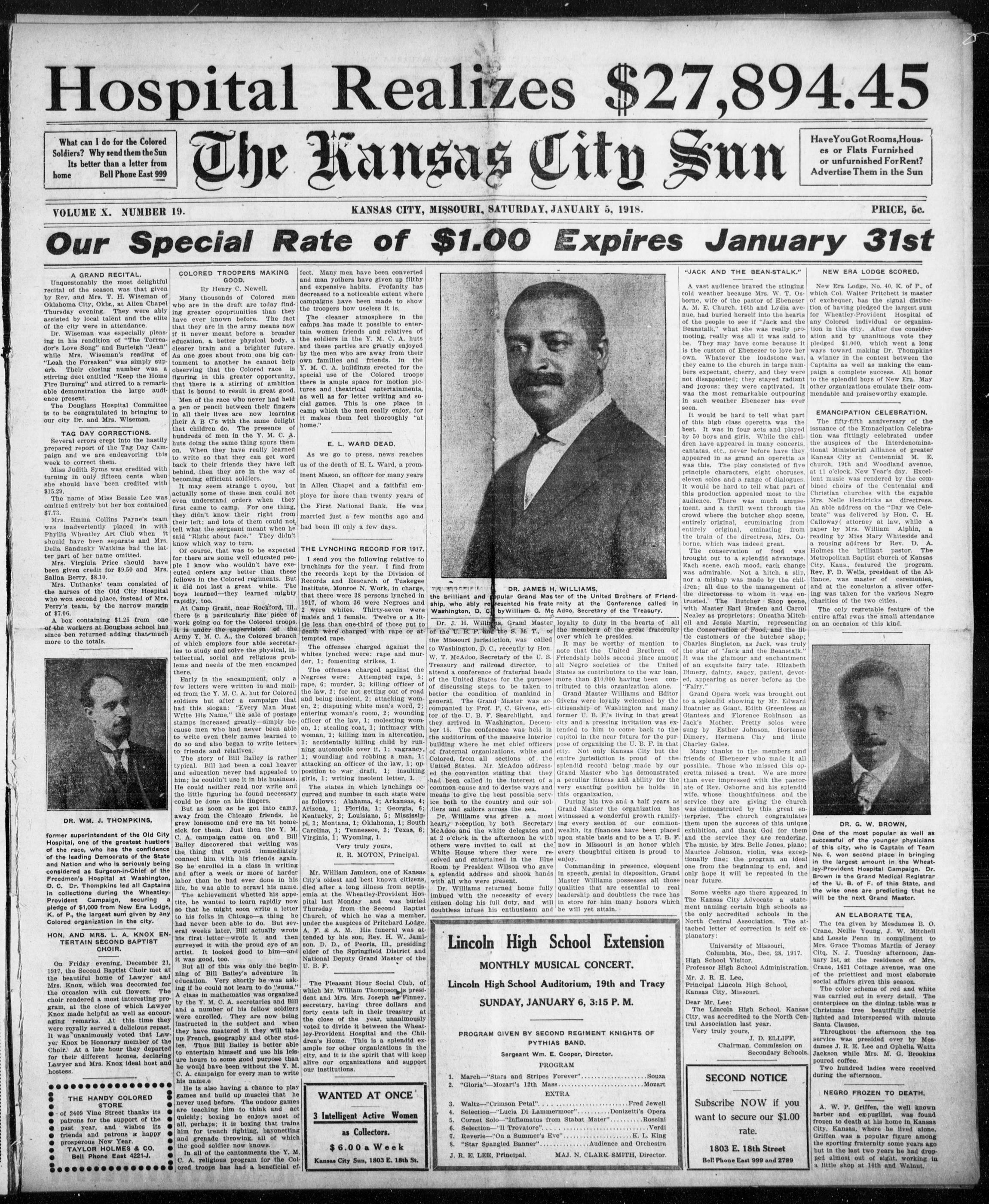
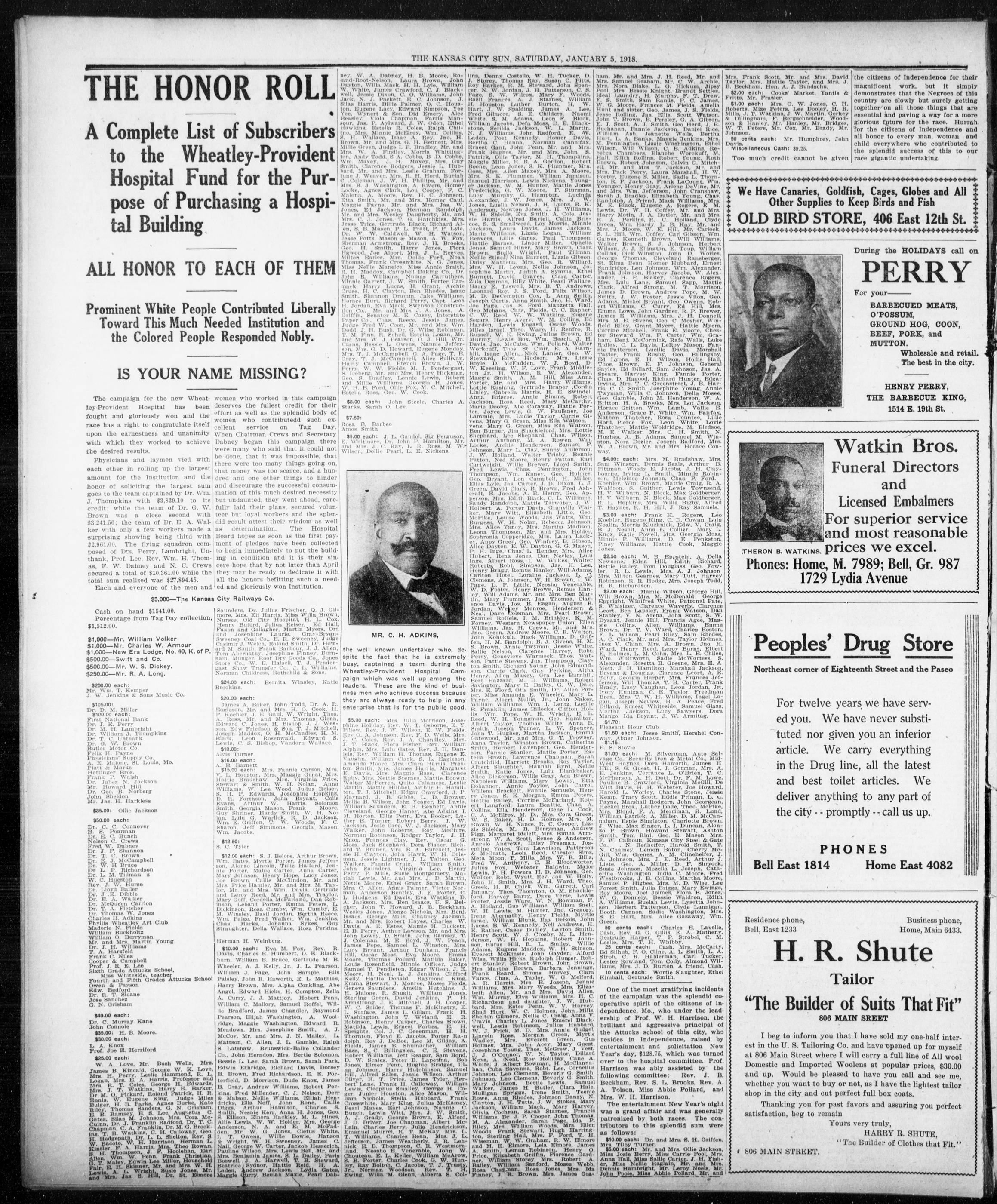
Hospital Realizes $27,894.45
What can I do for the Colored Soldiers? Why send them the Sun Its better than a letter from home Bell Phone East 999
The Kansas City Sun
HaveYouGot Rooms,Houses or Flats Furnished or unfurnished ForRent? Advertise Them in the Sun
Our Special Rate of $1.00 Expires January 31st
VOLUME X. NUMBER 19.
A GRAND RECITAL.
Unquestionably the most delightful recital of the season was that given by Rev. and Mrs. T. H. Wiseman of Oklahoma City, Okla., at Allen Chapel Thursday evening. They were ably assisted by local talent and the elite of the city were in attendance. Dr. Wiseman was especially pleasing in his rendition of "The Torreador's Love Song" and Burleigh "Jean" while Mrs. Wiseman's reading of "Leah the Forsaken" was simply superb. Their closing number was a stirring duet entitled "Keep the Home Fire Burning" and stirred to a remarkable demonstration the large audience present. The Douglass Hospital Committee is to be congratulated in bringing to our city Dr. and Mrs. Wiseman.
TAG DAY CORRECTIONS.
Several errors crept into the hastily prepared report of the Tag Day Campaign and we are endeavoring this week to correct them.
Miss Judith Syms was credited with turning in only fifteen cents when she should have been credited with $15.29.
The name of Miss Bessie Lee was omitted entirely but her box contained $7.73
Mrs. Emma Collins Payne's team was inadvertently placed in with Phyllis Wheatley Art Club when it should have been separate and Mrs. Della Sandusky Watkins had the latter part of her name omitted.
Mrs. Virginia Price should have been given credit for $9.50 and Mrs. Salina Berry, $8.10.
Mrs. Unthanks' team consisted of the nurses of the Old City Hospital who won second place, instead of Mrs. Perry's team, by the narrow margin of $7.06.
A box containing $1.25 from one of the workers at Douglass school has since been returned adding that much more to the totals.
DR. WM. J. THOMPKINS.
former superintendent of the Old City Hospital, one of the greatest hustlers of the race, who has the confidence of the leading Democrats of the State and Nation and who is seriously being considered as Surgeon-in-Chief of the Freedmen's Hospital at Washington, D.C. Dr. Thompkins led all Captains in collections during the Wheatley. Provident Campaign, securing a pledge of $1,000 from New Era Lodge, K. of P., the largest sum given by any Colored organization in the city.
HON. AND MRS. L. A. KNOX EN
TERTAIN SECOND BAPTIST
CHOIR.
On Friday evening, December 21, 1917, the Second Baptist Choir met at the beautiful home of Lawyer and Mrs. Knox, which was decorated for the occasion with cut flowers. The choir rendered a most interesting program, at the close of which Lawyer Knox made helpful as well as encourage remarks. At this time they were royally served a delicious repast. It was unanimously voted that Lawyer Knox be Honorary member of the Choir. At a late hour they departed for their different homes, declaring Lawyer and Mrs. Knox ideal host and hostess.
```markdown
```
THE HANDY COLORED STORE
of 2409 Vine Street thanks its patrons for the support of the past year, and wishes its friends and patrons a happy prosperous New Year. TAYLOR HOLMES & CO. Bell Phone E4221-J.
COLORED TROOPERS MAKING GOOD.
By Henry C. Newell.
Many thousands of Colored men who are in the draft are today finding greater opportunities than they have ever known before. The fact that they are in the army means now if it never meant before a broader education, a better physical body, a clearer brain and a brighter future. As one goes about from one big canonment to another he cannot help observing that the Colored race is figuring in this greater opportunity, that there is a stirring of ambition that is bound to result in great good.
Men of the race who never had held a pen or pencil between their fingers in all their lives are now learning their A B C's with the same delight that children do. The presence of hundreds of men in the Y. M. C. A. huts doing the same thing spurs them on. When they have really learned to write so that they can get word back to their friends they have left behind, then they are in the way of becoming efficient soldiers.
It may seem strange t ooy, but actually some of these men could not even understand orders when they first came to camp. For one thing, they didn't know their right from their left; and lots of them could not tell what the sergeant meant when he said "Right about face." They didn't know which way to turn.
Of course, that was to be expected for there are some well educated people I know who wouldn't have executed orders any better than these fellows in the Colored regiments. But it did not last a great while. The boys learned—they learned mighty rapidly, too.
At Camp Grant, near Rockford, Ill., there is a particularly fine piece of work going on for the Colored troops. It is under the supervision of the Army Y. M. C. A., the Colored branch of which employs four able secretaries to study and solve the physical, intellectual, social and religious problems and needs of the men encamped there.
Early in the encampment, only a few letters were written in and mailed from the Y. M. C. A. hut for Colored soldiers but after a campaign that had this slogan: "Every Man Must Write His Name," the sale of postage stamps increased greatly—simply because men who had never been able to write even their names learned to do so and also began to write letters to friends and relatives.
The story of Bill Bailey is rather typical. Bill had been a coal heaver and education never had appealed to him; he couldn't use it in his business. He could neither read nor write and the little figuring he found necessary could be done on his fingers.
But as soon as he got into camp, away from the Chicago friends, he grew lonesome and eve na bit home-sick for them. Just then the Y. M. C. A. campaign came on and Bill Bailey discovered that writing was the thing that would immediately connect him with his friends again. So he enrolled in a class in writing and after a week or more of harder labor than he had ever done in his life, he was able to scrawl his name.
The achievement whetted his appetite, he wanted to learn rapidly now so that he might soon write a letter to his folks in Chicago—a thing he had never been able to do. But several weeks later, Bill actually wrote his first letter—wrote it and then surveyed it with the proud eye of an artist. It looked good to him—and it was good, too.
But all of this was only the beginning of Bill Bailey's adventure in education. Very shortly he was asking if he could not learn to do "sums." A class in mathematics was organized by the Y. M. C. A. secretaries and Bill and a number of his fellow soldiers were enrolled. They are now being instructed in the subject and when they have mssater it they will take up French, geography and other studies. Thus Bill Bailey is better able to entertain himself and use his leisure hours to some good purpose than he would have been without the Y. M. C. A. campaign for every man to write his name.
He is also having a chance to play games and build up muscles that he never used before. The outdoor games are teaching him to think and act quickly; boxing he enjoys most of all, perhaps; it is boxing that trains him for trench fighting, bayonetting and grenade throwing, all of which the good soldier now knows.
In all of the cantonments the Y. M. C. A. religious program for the Colored troops has had a beneficial ef-
KANSAS CITY, MISSOURI, SATURDAY, JANUARY 5, 1918.
fect. Many men have been converted and man yothers have given up filthy and expensive habits. Profanity has decreased to a noticeable extent where campaigns have been made to show the troopers how useless it is.
The cleaner atmosphere in the camps has made it possible to entertain women friends and relatives of the soldiers in the Y. M. C. A. huts and these parties are greatly enjoyed by the men who are away from their own families and friends. In the Y. M. C. A. buildings erected for the special use of the Colored troops there is ample space for motion pictures and theatrical entertainments, as well as for letter writing and social games. This is one place in camp which the men really enjoy, for it makes them feel thoroughly "at home."
E. L. WARD DEAD
As we go to press, news reaches us of the death of E. L. Ward, a prominent Mason, an officer for many years in Allen Chapel and a faithful employee for more than twenty years of the First National Bank. He was married just a few months ago and had been ill only a few days.
THE LYNCHING RECORD FOR 1917
I send you the following relative to lynchings for the year. I find from the records kept by the Division of Records and Research of Tuskegee Institute, Monroe N. Work, in charge, that there were 38 persons lynched in 1917, of whom 36 were Negroes and 2 were whites. Thirty-seven were males and 1 female. Twelve or a little less than one-third of those put to death were charged with rape or attempted rape.
The offenses charged against the whites lynched were: rape and murder, 1; fomenting strikes, 1.
The offenses charged against the Negroes were: Attempted rape, 5; rape, 6; murder, 3; killing officer of the law, 2; for not getting out of road and being insolent, 2; attacking women, 2; disputing white men's word, 2; entering woman's room, 2; wounding officer of the law, 1; molesting women, 1; stealing coat, 1; intimacy with woman, 1; killing man in altercation, 1; accidentally killing child by running automobile over it, 1; vagrancy, 1; wounding and robbing a man, 1; attacking an officer of the law, 1; opposition to war draft, 1; insulting girls, 1; writing insolent letter, 1.
The states in which lynchings occurred and number in each state were as follows: Alabama, 4; Arkansas, 4; Arizona, 1; Florida, 1; Georgia, 6; Kentucky, 2; Louisiana, 5; Mississippi, 1; Montana, 1; Oklahoma, 1; South Carolina, 1; Tennessee, 3; Texas, 6; Virginia, 1; Wyoming, 1.
Mr. William Jamison, one of Kansas City's oldest and best known citizens, died after a long illness from septi-emia at the Wheatley-Provident Hospital last Monday and was buried Thursday from the Second Baptist Church, of which he was a member, under the auspices of Pritchard Lodge, A. F. & A. M. His funeral was attended by his son, Rev. H. W. Jamison, D. D., of Peoria, Ill., presiding elder of the Springfield District and National Deputy Grand Master of the U. B. F.
The Pleasant Hour Social Club, of which Mr. William Thompson is president and Mrs. Mrs. Joseph ne Finney, secretary, having three dollars and forty cents left in their treasury at the close of the year, unanimously voted to divide it between the Wheatley-Provident Hospital and the Children's Home. This is a splendid example for other organizations in the city, and it is the spirit that will keep alive our organizations and support our institutions.
DR. JAMES H. WILLIAMS,
popular Grand Master of the United Brothers of Friend-
presented his frate nity at the Conference called in
byWilliam G. Mc Adoo, Secretary of the Treasury.
Lincoln High School Extension
MONTHLY MUSICAL CONCERT.
Lincoln High School Auditorium, 19th and Tracy
SUNDAY, JANUARY 6, 3:15 P. M.
PROGRAM GIVEN BY SECOND REGIMENT KNIGHTS OF
PYTHIAS BAND.
Sergeant Wm. E. Cooper, Director.
PROGRAM
1. March—"Stars and Stripes Forever".....Souza
2. "Gloria"—Mozart's 12th Mass.....Mozart
EXTRA
3. Waltz—"Crimson Petal".....Fred Jewell
4. Selection—"Lucia Di Lammermoor".....Donizetti's Opera
5. Cornet Solo—"Inflamatus from Stabat Mater".....Rossini
6. Selection—"Il Trovatore".....Verdi
7. Reverie—"On a Summer's Eve".....K. L. King
8. "Star Spangled Banner".....Audience and Orchestra
J. R. E. LEE, Principal. MAJ. N. CLARK SMITH, Director.
DR. JAMES H the brilliant and popular Grand Mast ship, who ably represented his frate Washington, D. C. by William G. Mc Dr. J. H. Williams, Grand Master of the U. B. F. and the S. M. T., of the Missouri jurisdiction, was called to Washington, D. C., recently by Hon. W. T. McAdoo, Secretary of the U. S. Treasury and railroad director, to attend a conference of fraternal heads of the United States for the purpose of discussing steps to be taken to better the condition of mankind in general. The Grand Master was accompanied by Prof. P. C. Givens, editor of the U. B. F. Searchlight, and they arrived in Washington, December 15. The conference was held in the auditorium of the massive Interior building where he met chief officers of fraternal organizations, white and Colored, from all sections of the United States. Mr. McAdoo addressed the convention stating that they had been called in the interest of a common cause and to devise ways and means to give the best possible service ice both to the country and our soldiers and sailors across the sea.
Dr. Williams was given a most hearty reception by both Secretary McAdoo and the white delegates and at 2 o'clock in the afternoon he with others were invited to call at the White House where they were received and entertained in the Blue Room by President Wilson who gave a splendid address and shook hands with all who were present.
Dr. Williams returned home fully imbued with the necessity of every citizen doing his full duty, and will doubtless infuse his enthusiasm and
loyalty to duty in the hearts of all the members of the great fraternity over which he presides.
It may be worthy of mention to note that the United Brethren of Friendship holds second place among all Negro societies of the United States as contributors to the war loan, more than $10,000 having been contributed to this organization alone.
Grand Master Williams and Editor Givens were loyally welcomed by the citizenship of Washington and many former U. B. F.'s living in that great city and a pressing invitation was extended to him to come back to the capitol in the near future for the purpose of organizing the U. B. F. in that city. Not only Kansas City but the entire jurisdiction is proud of the splendid record being made by our Grand Master who has demonstrated a peculiar fitness and ability for the very exacting position he holds in this organization.
During his two and a half years as Grand Master the organization has witnessed a wonderful growth ramifying every section of our commonwealth, its finances have been placed upon stable basis and to be a U. B. F. now in Missouri is an honor which every thoughtful citizen is proud to enjoy.
Commanding in presence, eloquent in speech, genial in disposition, Grand Master Williams possesses all those qualities that are essential to real leadership and doubtless the race has in store for him many honors which he will yet attain.
"JACK AND THE BEAN-STALK."
A vast audience braved the stinging cold weather because Mrs. W. T. Osborne, wife of the pastor of Ebenezer A. M. E. Church, 16th and Lydia avenue, had buried herself into the hearts of the people to see if "Jack and the Beanstalk," what she was really pro moting, really was all it was said to be. They may have come because it is the custom of Ebenezer to love her own. Whatever the loadstone was they came to the church in large numbers expectant, cherry, and they were not disappointed; they stayed radiant and joyous; they were captivated. It was the most remarkable outpouring in such weather Ebenezer has ever seen.
It would be hard to tell what part of this high class operetta was the best. It was in four acts and played by 50 boys and girls. While the children have appeared in many concerts, cantatas, etc., never before have they appeared in as grand an operetta as was this. The play consisted of five principle characters, eight choruses, eleven solos and a range of dialogues. It would be hard to tell what part of this production appealed most to the audience. There was much amusement, and a thrill went through the crowd where the butcher shop scene, entirely original, eruminating from entirely original, eminating from the brain of the directress, Mrs. Osborne, which was indeed great.
The conservation of food was brought out to a splendid advantage. Each scene, each mood, each change was admirable. Not a hitch, a slip, nor a mishap was made by the children; all due to the management of the directoress to whom it was entrusted. The Butcher Shop scene, with Master Earl Braden and Carrol Nealey as proprietors; Oneatha Mitchell and Jessie Martin, representing the Conservation of Food, and the little customers of the butcher shop; Charles Singleton, as Jack, was truly the star of "Jack and the Beanstalk." It was the glamour and enchantment of an exquisite fairy tale. Elizabeth Dimery, dainty, saucy, patient, devoted, appearing as never before as the "Fairy."
Grand Opera work was brought out to a splendid showing by Mr. Edward Boatnier as Giant, Edith Greenless as Giantess and Florence Robinson as Jack's Mother. Pretty solos were sung by Esther Johnson, Hortense Dimery, Hermena Clay and little Charley Gales.
Many thanks to the members and friends of Ebenezer who made it all possible. Those who missed this operetta missed a treat. We are more than ever impressed with the pastorate of Rev. Osborne and his splendid wife, whose thoughtfulness and the service they are giving the church was demonstrated by this great enterprise. The church congratulates them upon the success of this unique exhibition, and thank God for them and the service they are rendering. The music, by Mrs. Belle Jones, plano; Maurice Johnson, violin, was exceptionally fine; the program an ideal one from the beginning to end, and only hope it will be repeated in the near future.
Some weeks ago there appeared in The Kansas City Advocate a statement naming certain high schools as the only accredited schools in the North Central Association. The attached letter of correction is self explanatory:
University of Missouri,
Columbia, Mo., Dec. 28, 1917.
High School Visitor,
Professor High School Administration
Mr. J. R. E. Lee,
Principal Lincoln High School,
Kansas City, Missouri.
Dear Mr. Lee:
The Lincoln High School, Kansas
City, was accredited to the North Central Association last year.
Very truly yours,
J. D. ELLIFF,
Chairman, Commission on
Secondary Schools
SECOND NOTICE
Subscribe NOW if you want to secure our $1.00 rate.
1803 E. 18th Street
Bell Phone East 999 and 2789
PRICE, 5c.
NEW ERA LODGE SCORED.
New Era Lodge, No. 40, K. of P., of which Col. Walter Pritchett is master of exchequer, has the signal distinction of having pledged the largest sum for Wheatley-Provident Hospital of any Colored individual or organization in this city. After due consideration and by unanimous vote they pledged $1,000, which went a long ways toward making Dr. Thompkins a winner in the contest between the Captains as well as making the campaign a complete success. All honor to the splendid boys of New Era. May other organizations emulate their commendable and praiseworthy example.
EMANCIPATION CELEBRATION.
The fifty-fifth anniversary of the issuance of the Emnacipation Celebration was fittingly celebrated under the auspices of the Interdenominational Ministerial Alliance of greater Kansas City at Centennial M. E. church, 19th and Woodland avenue, at 11 o'clock, New Year's day. Excellent music was rendered by the combined choirs of the Centennial and Christian churches with the capable Mrs. Nelle Hendricks as directress. An able address on the "Day we Celebrate" was delivered by Hon. C. H. Calloway( attorney at law, while a paper by Mrs. William Alphin, a reading by Miss Mary Whiteside and a rousing address by Rev. D. A. Holmes the brilliant pastor. The Metropolitan Baptist church of Kansas City, Kans., featured the program, Rev. F. D. Wells, president of the Alliance, was master of ceremonies, and at the conclusion a silver offering was taken for the various Negro charities of the two cities.
The only regretable feature of the entire affal rwas the small attendance on an occasion of this kind.
DR. G. W. BROWN.
One of the most popular as well as successful of the younger physicians of this city, who is Captain of Team No. 6, won second place in bringing in the largest amount in the Wheatley-Provident Hospital Campaign. Dr. Brown is the Grand Medical Registrar of the U. B. of F. of this State, and the wise ones are predicting that he will be the next Grand Master.
AN ELABORATE TEAC
The tea given by Mesdames B. O. Crane, Nellie Young, J. W. Mitchell and Lossie Penn in compliment to Mrs. Grace Thomas Martin of Jersey Citq, N. J. Tuesday afternoon, January 1st, at the residence of Mrs. Crane, 1621 Cottage avenue, was one of the priettiest and most elaborate social affairs given this season. The color scheme of red and white was carried out in every detail. The centerpiece on the dining table was a Christmas tree beautifully electric lighted and interspersed with minute Santa Clauses. Throughout the afternoon the tea service was presided over by Mesdames J. R. E. Lee and Ophelia Watts Jackson while Mrs. M. G. Brookins poured coffee. Two hundred ladies were received during the afternoon.
NEGRO FROZEN TO DEATH.
A. W. P. Griffen, the well known barber and ex-pugilist, was found frozen to death at his home in Kansas City, Kansas, where he lived alone. Griffen was a popular figure among the sporting fraternity some years ago but in the last two years he had dropped almost out of sigat, working in a little shop at 14th and Walnut.
From Our Foreign Correspondents
A. F. and A. M. Mo. Jurisdiction
Officera—1917.
W. W. Fields, Cameron, Mo., Grand Master.
C. C. Clark, St. Louis, Mo., Dep.
Grand Master.
Ernest Boone, Louisiana, Mo., Senior
Grand Warden.
I. H. Bradbury, St. Louis, Mo.
Junior. Grand Warden.
H. H. Walker, St. Joseph, Mo., Grand Treasurer.
Geo. W. K. Love, Kansas City,
Grand Secretary.
Nelson C. Crews, Kansas City, Relief Secretary.
E. G. Lacey, Kansas City, G. L.
1st District.
E. J. Cooper, Mexico, Mo., G. L.
2nd District.
OFFICERS OF GRAND CHAPTER,
R. A. M.
Missouri and Jurisdiction, 1917-18.
T. G. McCampbell, G. H. P., Quindaro, Kans.
A. L. Thomas, D. G. H. P., Jefferson City, Mo.
J. P. Moffett, G. King, Sedalia, Mo.
S. A. May, G. Scribe, St. Louis, Mo.
Chas. Griggsby, G. Treas., Liberty,
Mo.
E. S. Baker, G. Secretary, Kansas City, Mo.
OFFICERS OF GRAND COMMANDS
FRY. K. T.
W. G. Mosely, R. E. G. C., Kansas City, Mo.
J. W. Beard, V. E. G. C., St. Louis, Mo.
G W. Lewis, E. G. G., St. Louis, Mo.
C. Brassfield, E. G., Captain General, Kansas City, Mo.
W. A. Ashley, E. G. P., St. Louis, Mo.
J. H. Kenner, E. G., Treasurer, Marshall, Mo.
J. T. Cannon, E. G., Recorder, St. Louis, Mo.
George A. Johnson, E. G. S. W., Kansas City, Mo.
Benjamin F. Graves, E. G. J. W., St. Joseph, Mo.
Lodge Directory
G
MASONRY
Rone Lodge No. 25, A. F. and A. M. meets the 1st and 3rd Monday in each month. All Master Masons in good standing welcome. Emmett Spruell, W. M.; C. H. Countee, Sec'y.
G
MAJOR MASONRY
Liberty Lodge No. 37, A. F
and A. M., Liberty, Mo., meets
2nd and 4th Saturday
nights in each month. William
Parker, W. M.; Nelson Wallar,
Sec'y.
St. Stephen Chapter No. 37.
Rival Chapels No. 137.
Mo. Meets first Tuesday
in each month. W. H. Robinson,
H. P. W. Cmps, Recorder.
```markdown
```
St. Matthew Commandery
No. 17, Liberty, Mo., meets
the third Saturday night
William Capps, E. C.; W. W.
Robinson, Rec. Sec'y.
HRC
IN
CHP
HRC
U. B. F
King of the West Lodge No. 218 meets first and third wednesdays in each month at 10th and Campbell. Those Ave. Ave. Chas. Alen. Sec. 142 Admiral Blvd., C. K., Mo.
```markdown
```
MASONIC BUILDING ASSOCIATION
T. G. McCampbell, President.
E. B. Thompson, Vice President.
W. H. Washington, Treasurer.
S. H. P. Edwards, Secretary.
Board of Directors:
N. W. Jordan. S. Myers,
W. H. Brown. E. S. Baker,
W. R. Patterson.R. V. Adkins,
B. R. Francis. Richard Harris
Geo Johnson. R. Fulbright.
Meets second and fourth Tuesday
in each month.
CHURCH DIRECTORY.
Bethel A. M. E. Church, 24th and Flora. St. Stephen's Baptist Church, 604 Charlotte St. Centennial M. E. Church, 19th and Woodland.
Second Baptist Church, 10th and Charlotte St. Allen Chapel A. M. E. Church, 10th and Charlotte.
Ebenezer A. M. E. Church, 17th and Tracy.
St. Augustine's P. E. Church, 11th and Troost Avenue.
St. John's A. M. E. Church, 1743 Belleview.
Seventh Dar Adventist, 23rd and Woodland.
St. Monica's Catholic, 17th and Lydia.
Vine St. Baptist Church, 1825 Vine St Ward Chapel A. M. E. Church, 11th and Troost Avenue.
Morning Star Baptist Church, 2311 Vine Highland Avenue Baptist Church, 1111 Highland.
St. James A. M. F. Zion Church, 1822 Woodland Ave.
Second Christian Church, 24th and Woodland.
C. M. E. Church, 1817 Flora Ave.
St. James Baptist Church, 4039 Mill St. Luke's A. M. E. Church, 43rd and Prospect Place.
POLYMER CITY CLARK CHAPEL M. E. CHURCH, 1664 Madison Ave.
KANSAS CITY, M. E. CHURCH.
First A. M. E. Church, 8th and Neb. Eighth St. Baptist Church, 8th and Oakland. Metropolitan Baptist Church, 9th and Washington. Bethel A. M. E. Water and Steward Streets. St. Paul A. M. E. Church, 21st and Riverside. First Baptist Church, 5th and Neb. King Solomon Baptist Church, 3rd and State. Quindaro A. M. E. Church, Quindaro. Pleasant Valley Baptist Church, Roseale. Kan. M. E. Church, 9th and Oakland. Second Baptist Church, 24th and Ruby. Wesley Chapel. Chapel B. Bethel A. M. E. Church, Roseale. Kan. Tabernacle Baptist Church, 760 Muncie Blvd. Armstrong, Kans. Rev. D. Nor-
HELENA, MONTANA.
The Pride of Montana installed officers as follows: J. E. W. Clark, C. C.; Julian Anderson, V. C.; Will Irvin, M. W.; Arthur Hampton, Pres.; H. J. Soulde, M. Ex.; John Williams, M. F.; Royal Parsns, K. of R. & S.; Trustees, Will Irvin, A. E. McGinnis and Walter Fisher; Albert Dupree, O. G., Sirius F. Grove, I. C.; J. H. Hilliard, Past Grand and Deputy Supreme Chancellor, installing officer....Mrs. Jefferson Harrison, 532 Hollins avenue, entertained a large number of her friends at dinner Christmas....Mrs. A. E. McGinnis, 914 Cannon Drive, entertained at dinner Christmas Mr. and Mrs. A. L. Stitt and family and Mrs. Howard....Mrs. Charles Oliver, 915 Garfield avenue, is still on the sick list....Mrs. Mollie Hammonds of Anaconda was the guest of Mrs. J. T Knaff, 200 State street....Mrs. Ed Glenn returned from the eastern part of the state. It looks like she was Hooverizing, bringing back with her one-half of a hog and lots of other foodstuff....J. H. Hilliard, the Deputy Supreme and Past Grand Chancellor, left for Billings, where he will install the officers of Montana Lodge No. 3. Enroute home he will visit Lewistown and C. Falls, No. 4, in interest of the K. of P.'s....Mrs. C. Bramwell entertained J. H. Hilliard and Mrs. L. B. Walker at dinner Christmas....Now is the time for The Sun—One Dollar this month—Next month, Two Dollars....C. Simmons visit to Montana has been cancelled on account of scarlet fever and small pox in this state....Watch this paper for new date....The reporter wishes to congratulate his many patrons for their patronage of The Sun last year and while we never had any grievance I sincerely hope we will do better this year and that they will subscribe for The Sun while they can get it for One Dollar. In this way the service will be better for some.
NEWTON, KANSAS
By Mrs. Mattie Ridley.
Mrs. Mattle Ridley is not so well... Mrs. Birdie Henderson is sick...Mrs. Carl Gross is able to be up, after a few days' sickness...Mr. J. M. Gross is better...Mrs. Janie Mountjoy, who was shot three times this morning by Myrtle Gray, died a little later. Myrtle is in jail...Mr. Mason Downing went to Emporia to attend a dance and accompany his sister home...Mrs. Macey Johnson is on the sick list...Mr. Clarence Ridley was the guest of Miss Ida McLean Sunday at Emporia. He reports a nice time.
LIBERTY, MISSOURI.
Mrs. Lucy Beanchamp served a most excellent dinner Christmas day. The following were present: Miss Ethelyn E. Hoard, St. Louis; Mrs. B. T. Beanchamp, Kansas City, Kas.; Prof and Mrs. J. A. Gay and Miss Minnie May Beanchamp. They all enjoyed themselves very highly...There was a party at the home of Prof. and Mrs. J. A. Gay, Thursday evening, December 27. The following were present: Miss Aletha Bluford, Mrs. Alice Beanchamp, Miss Ethelyn Hoard, Mr. and Mrs. Sam Stewart, Mr. and Mrs. A. J. Swader, Mr. and Mrs. Oscar Hopes, Mr. and Mrs. Homer Porter. All had a very nice time...Miss Clara Mac Gantt and Mr. Seymour Pearley, who are attending school at Lincoln Institute and Mr. Martin E. Bryant, who is in school at Quindaro, are home visiting...Mr. A. E. Williams, sergeant major of 92d Division, Camp Funston, spent a few hours at the home of Miss Minnie Beanchamp's on New Year's day...A Happy New Year to The Kansas City Sun.
CAMP FUNSTON, KANSAS.
Hon. Nelson Crews.
Dear Sir: I guess you can hardly remember me, Linwood White, the clerk that used to be with McCampbell & Houston, druggists. Since leaving home I am an enlisted man in the Medical Department of the United States Army.
A Christmas box was received by me from McCampbell & Houston and friends, and if I am not asking too much of you I would like for you to find space in your paper, "K. C. Sun," to make mention of it, and thank the following: K. C. Sun, McCampbell & Houston, Johnson's Cafe, waiters and employees; the Coates House waiters, Kupper Hotel waiters; Lige Hendricks and hundreds of other friends that helped put "Fun in Funston." I could mention a thousand boys and other friends of Kansas City made happy by sending the "smokes" at such an opportune time. What made them so appreciative were first to know that we were not forgotten by the ones at nome. Secondly, the time of the month that finds most everyone "broke."
This leaves all the boys well and
doing fine otherwise. I will close,
wishing you and family a prosperous
Ne wYear.
Yours truly,
LINWOOD WHITE
and BOYS,
F H. 367, 92d Div..
Camp Funston, Kas.
BUTTE, MONT.
THE KANSAS CITY SUN, SATURDAY, JANUARY 5, 1918.
mas... Mrs. Sam Freeman is in the city visiting relatives... Miss Corinne Soules of Helena is spending the holidays in the city... Harry Palmer, Jr. spent Christmas day in the city... Jerry Larkins entertained a number of his friends Christmas evening at a smoker... Mr. and Mrs. E. W. Rivers entertained Christmas day in honor of their father. Covers were ladd for ten. Those present were: Mr. and Mrs. Jesse H. Smith, Rev. and Mrs. E. B. Reed, Mr. and Mrs. F. M. Shannon, C. F. Jones, E. W. Rivers, Ss, and the host and hostess... Mrs. R. B. Smith gave a delicious turkey dinner in honor of Rev. E. B. Reed and wife... Rev. E. B. Reed and wife entertained at 12 o'clock dinner Christmas... Nesbitt Frazier won the prize at the school drawing in the Red Cross contest... Ernest Walker is branded a slacker and is being held at the city prison... The 5 o'clock prayer meeting Christmas morning held at the Bethel Baptist church was well attended, fourteen being present... Mrs. Ethel Gunn Hubbard is seriously ill at her home on North Crystal street... George Ellison of Anaconda had the misfortune to break his lex Christmas... All the leading books, magazines and papers may be had at Everybody's News Stand, 215 S. Montana street.
LINCOLN, NEBRASKA
Bv W W Mosely
By W. W. Moseley.
Mr. and Mrs. A. C. Stanley will leave shortly for Junction City, Kas., where they expect to establish a business. ...Mr. J. F. Grattan left Tuesday for Rock Springs, Wyo., where he expects to locate. ...Mrs. L. J. Jordan and Mrs. Robert Scott of Beatrice, Neb., attended the Lebanon banquet. ...Mrs. E. E. Graves of Kansas City spent the holidays with her husband, Dr. E. E. Graves, in this city. ...M. W. G. M. W. W. Fields and Mrs. Fields of Cameron, Mo., were the honored guests at Lebanon lodge banquet which was held Thursday evening, December 27, and without a doubt surpassed all former ones. An informal reception was held in the lodge room from 8:30 to 9:30, at whicheme all Master Masons, families and friends met G. M. Fields and were served an elegant menu in the great dining hall. The invocation was delivered by Rev. O. J. Burckhadt. There were about 150 persons present. The decorations were very elaborate, consisting of plants and cut flowers and American flags. Music was furnished by Mr. James Walker, Major Moore was toastmaster and was introduced by H. M. Hill. The welcome address, Clyde W. Malone; "Lessons From Masonry," I. B. Smith; Song, G. B. Evans; "Earnesty Do We Hope," W. A. Johnson; Solo, Charles Haynes; Address, "Fifty Years' Freedom." T. T. McWilliams; Introduction of Grand Master, Paul L. Moore; Grand Master Fields complimented Lebanon on her excellent showing and said, "I am from Missouri, and Lebanon has shown me that you can do things. I have attended many banquets in my life but this one is the best ever and I am coming again." Mrs. Woods and the general committee did well their parts in framing up plans that were so well carried out with the aid of the patronage. The affair was an abundant success socially and financially. Hence Bill Woods and his committee are to be commended for their arduous work. ...Mr. George Miller is reported quite sick. ...Mt. Zion Baptist Church has the best Sunday school in the city. Annual report was made last Sunday showing an amount of $292.00 having been raised during the year 1917. The school is well regulated and Mrs. L. B. Moore is superintendent. ...The Mount Zion Baptist Church made its financial report Monday night, which showed $1,646 raised from sources during the year and the officers elected were: The same dean con board, with C. R. Young, church clerk, and A. L. Corneal, treasurer. Watch meetings were held at the church Monday night with a good attendance.
ROSEDALE, KANSAS
Miss Hazel Lacey returned to her home at Topeka, Kan., after a very pleasant visit with friends and relatives.....Mr. Hayes Long and Miss Della Johnson were quietly married last Wednesday.....Little Cozetta Thornton is somewhat indisposed.....Mr. Spencer Slater is convalescing from his recent illness.....Mrs. Walter Henderson and two daughters Thelma and Mrs. Hallie Bell, who have been ill the past week, are able to be up again.....Little Misses Florrine and $ivay May Henderson have returned from South Park, Kan., where they spent the holidays with their uncle, Mr. A. Henderson, and Mrs. Henderson.....Masters Thos., Leo and Lawrence Henderson visited relatives and friends in South Park, Kan.
Just Why He Objected:
Jack—"But what does your father see in me to object to?" Edith—"He doesn't see anything in you. That's why he objects."—Boston Transcript
Andrew Griffin, 54 years old, a Negro barber who lived alone at 1104 Wendall avenue, Kansas side, was found dead in his home yesterday by neighbors. Dr. J. W. Hayward, coroner, said Griffin had frozen to death.
Praise of Quiet Life.
Quiet Life.
What sweet delight a quiet life affords.—Drummond.
TO TEN MILLION COLORED CITIZENS OF THE UNITED STATES. Greetings of the Seasons:
The world is engulfed in the red ruin of war. The present titanic conflict is not due to the inherent devilry of one nation or the innate goodness of another. The accumulative energies of society for generations have been damaged up by the barrier of hatred and greed. The stored up power is now breaking through the barrier with cataclysmic outburst. The social fabric is being shaken to its very foundation. As outcome of the war, the re-adjustment of the social structure will be more radical than that effected by the French Revolution. The transforming effect upon the status of the Negro will be scarcely less momentous than the Emancipation Proclamation.
The democratization of the world, coined as a fitting phrase, will be translated into actuality. The Declaration of Independence, penned by a slave holder, sounded the death knell of slavery, although three-quarters of a century elapsed between promise and fulfillment. The democratization of the world is but a restatement of this doctrine in terms of present day attitude of the world. Political autocracy and race autocracy will be buried in the same grave. Hereafter, notation however strong, will be permitted to override a weaker neighbor by sheer dominance of power; and no race will be permitted to impose a ruthless regime upon the weaker breeds of men through sheer assumption of superiority. Hereafter, England will treat the East Indians; Turkey, the Armenians, Russia, the Jews, and America, the Negroes, with a fuller measure of justice and consideration than heretofore.
The peoples of all lands who are heavy laden and overborne will be the chief beneficiaries of this war. The Negro problem is involved in the problem of humanity. The whole is greater than any of its parts. The Negro will share in the general momentum imported to social welfare. Already, he has been admitted to industrial opportunity in the north with manifest reaction upon the harsh regime in the south.
National prohibition, which is borne forward on the wave of the world war, will immensely improve his moral status. Eighty thousand Negro soldiers have been enlisted, and seven hundred Negroes have been commissioned as officers in the army of the United States. Negro has been made assistant cabinet officer whose function is to adjust harmoniously the races' relation to the pending struggle. The improved attitude of the white race towards the Negro is apparent in two affirmative decisions rendered by the Supreme Court of the United States with unanimous concurrence. The Negro will emerge from this war with a double portion of privilege and opportunity.
Every Negro should be loyal and patriotic, although there are injustices and discriminations which try our souls. If we overcome, these trials and tribulations will work out a more exceeding weight of advantage. But if we allow them to overcome us, woeful will be our lot indeed. To stand sulkily by in plaintive aloofness, because of just grievances would be of the same kind of folly as to refuse to help extinguish a conflagration which threatens the destruction of one's native city because he has a complaint against the fire department. Let us help put out the conflagration which threatens the world, and then make the world our lasting debtor. We must stand shoulder to shoulder with our white fellow citizens to fight for the freedom of the world, outside of our own national circle, and then we must hold them to moral consistency of maintaining a just and equitable regime inside of that circle. Democracy like charity, should begin at home or at least it should prevail there. Let us fight to the finish to the effect that no nation shall hereafter dare attempt to make an international treaty a scrap of paper. It must therefore follow them, as corollary that no nation will henceforth allow its own constitution, which is an intra-national treaty, to be made a scrap of paper.
The tide of democracy is sweeping through the world like a mikhty river. The race problem and other social ills are butw as marshes, backwaters, stagnant pools, estuaries which have been shut off from free circulation with the main current. But the freshet of freedom is now overflowing its bed and purifying all the stagnant waters in its onward sweep to the ocean of human liberty and brotherhood. Fortunate indeed are we to be born forward upon its beneficent bosom at such a time as this.
KELLY MILLER,
Howard University, Washington, D. C.
Annowing Fact.
Nothing makes a woman with a real
pearl necklace mudder than to have
the imitations so good.—Ohio State
Journal.
Machine Works Fast
An electrically-driven machine wraps lump sugar in individual papers at a speed of 7,500 lumps an hour.
Fable.
Once upon a time there was a landlord who overlooked ye first of ye month.—Illinois State Journal.
Cats Destroy Birds.
Cats occasionally catch a mouse, but not often. They prefer birds. The obnoxious sparrows are too alert for them, and so their accustomed feathered prey is song birds and other species valuable to man because they are insect destroyers. Fledgling young of such birds, in the nest, are destroyed in immense numbers by cats. Paint-taking study of the subject has convinced me that the average cat captures at least 50 birds per annum.—Exchange.
San Luis Rev.
San Luis Rey is one of the old ruined missions of southern California—one of the few traces left in the land by that kindly, brave old civilization that flourished there in the days when the middle West was given over to the buffalo and the Indian. The old church still stands, but the placita and the arcades, the attendant village and the tributary fields have vanished with the old life and the old builders before the steady march of the years.
The Word Metis.
The word metis, means mixed. It is from the French metis, a derivative of the Latin miscere, to mix. The term was first used in this country by the early French-speaking population of the northwest to designate persons of mixed white and Indian blood. Among the Spanish-speaking population of the Southwest the word mestizo, of the same derivation, is used, but it applies more especially to those of half white and half Indian blood.
America's First Musical Composer.
America's first musical composer of any note was William Billings, who was born in Boston. In his youth he was a tanner, but love for music led him to become a teacher of singing and a composer of psalm tunes, which eventually found their way into every church choir of New England and became great favorites with the people.
Nature Fake.
The heat of pulpit oratory is often responsible for lapses into unconscious humor. There is a story of the minister who solemnly assured his congregation that "Many pesons have one eye on heaven while with the other they are listening to the gossip of earth."
Humility.
Mental education has for its first and last step humility. But the humility will not be founded on comparison of ourselves with the imperfect standards around us, but on the increase of that internal knowledge which alone can make us aware of our internal wants.—Faraday.
Chrysanthemum in England
A few people in England were familiar with the chrysanthemum as long ago as 1764, for it was in that year that a certain Philip Miller received one of these plants from Nimpu and proceeded to cultivate it at the botanical gardens at Chelsea, London.
Inside Information
The Pastor—"So God has sent you two more little brothers, Polly?" Polly (brightly)—"Yes, and he knows where the money's coming from. I heard daddy say so."
The Reason.
A rich rascal writes: "I have five brothers and only four of them say unkind things about me. I never have lent any money to the fifth."—Claude Callan in the Fort Worth Star-Telegram.
More Understandable.
Some wise gent has arisen to inform the less erudite that scriptural references to bottles don't really mean bottles, whereby the implication of a "skin full" takes on a clearer significance.—Washington Post.
Sawed-Off Sermon.
Somehow the people who do just as they please seem to get along just as well as those who are always trying to please others.—Indianapolis Star.
Proud Father.
"He seems proud of his children." "He is. He doesn't care whose time he wastes talking about them."—Detroit Free Press.
Friends and Their Uses.
Use your friends in such a way that they won't mind your using them, and also encourage them in using you the same way.
Wasted.
I've never any pity for conceited people, because I think they carry their comfort about with them.—George Ellot.
"Frozen Music."
The saying "frozen music," as applied to architecture, has often been credited to Mme. de Stael. In "Corinne" she says that "the sight of such a building (St. Peter's) is the ceaseless changeless melody." The dictionaries of quotations usually trace it to the German, Schelling. Eckermann, in his "Conversations," represents Goethe as claiming it.
KELLEY'S
BEST
HIGH PATENT
FLOUR
Kelley's Best
Beat all the Rest.
Kelley Milling Co.
K.C.U.A.A.
FORMULATED 1900
PORO
HAIR GROWER
MADE ONLY BY
Mrs Ambo Furubo
Malone
ST. LOUIS MISSOURI
FOR DANDRUFF, FALLING HAIR, ITCHING
SCALP; GIVING LIFE, BEAUTY, COLOR
AND ADUNDANT GROWTH
THIS STYLE OF BOX ADOPTED JUNE 12, 1915.
PRICE: 50 CENTS
PORO COLLEGE COMPANY
3100 Pine Street, Dept. G
ST. LOUIS, MISSOURI
THE Modern Builders Co. A.E. ESTES, President General Contracting Repairing a Specialty
ONLY ONE
ONLY ONE
The history of Kansas City records but one real, legitimate, competent, established Negro jeweler, and he is
J. A. Wilson
at 1616 W. 9th St. Half block west of Wyoming St.
Mr. Wilson sells
Diamonds, Watches, Clocks and Staple Jewelry
:: and ::
Guarantees to the public satisfactory and proper treatment.
BELL PHONE MAIN 2868W
Kansas'
Famous Wheat
makes
I-H
FLOUR
Hard, winter, "turkey red" is the world's flour
wheat supreme. Given the benefit of I-H modern
milling, this fine raw product becomes a super-fine
food — I-H Flour — the aristocrat of every
grocery. Try it.
Ismert-Hincke Milling Co.
Kansas City, U. S. A.
Bell Phone E. 4394R
2
GET THE HABIT
ELITE SHINING PARLOR
2407½ Vine Street
Agent for Colored Weeklies—
We Clean and Dye Shoes of
All Kinds.
Work Guaranteed.
HENDERSON & NEAL, Props.
MME A. MOORE
Teacher of
Piano and Voice
1619 Cottage
Service AND Satisfaction
are what you get
when you patronize
C. A. FRANKLIN
THE PRINTER
1309 East 18th St
Bell Phone Grand 2988
Coal and Feed
Don't wait—Order your Coal now. Full, Weight—Quick Delivery. PAYNE COAL CO. 1902 Vine St. Phones, Home East 4132-Bell East 559
Vaughan's Values
IDLEWILD!!!
Michigan
THE UNPARALLELED HEALTH
RESORT FOR THE RACE.
11,000 lots, surrounding a lake two
miles long, half mile wide, in which
is an island park of 8 acres, with an
excellent club house. Streets and
boulevards all laid out. Pere Marquette Railroad right through the
town. Has a tent city.
Buy your family a rest home, in a
resort that is being bought up by the
best people throughout the country.
Many cottages already built by both
men and women whom we all have
heard of.
Environment and social contact
assured of the highest.
Lots $24.50 each. $6.00 down, $4.00
per month on one or two lots. Located
near Chicago.
A Fine Christmas Gift.
KANSAS CITY, - - - KANSAS
Bell Phone, West 1757.
The Handy Colored Store 2409Vine St. Ladies' and Gent's Furnishing Goods and Notions VISIT OUR DRY GOODS AND HARDWARE DEPT. BARGAINS
FURNISHING GOODS EXTERIOR
SPECIAL BARGAINS IN OUR
NOTION DEPARTMENT
AND HAIR GOODS.
Help Make Our Store, Your Store, Our
Customers Your Friends
Special Values in Furnishings for
Men, Women and Children.
GIVE US A CALL.
$2.50 In Goods Free.
WE GIVE SURETY COUPONS.
Taylor Holmes & Co.
Mrs. Annie Holmes, Mngr.
2409 VINE ST., Kansas City, Mo.
Bell Phone East 4221J
Tailored To Your Measure
To wear, show your friends, tell who made it. Latest model, made in any style, a business or a choice of you. Not a cent cost to you if you accept our new liberal offer for a few hours work, a month, introduce to friends an amount, introduce to friends No experience needed, everything furnished FREE. No matter where you live or what you do, or what your friends want, tailoring agent write us too, no matter what book of each sample, latest 1928 fashions, beautiful outfits, our new very minute, every day we send you our very minute, to LIBERTY TAILORING SOCIETY, Dept. 301 CHICAGO
Along the river more than half the way to
—a delightful ride, day or night
Lv. Kansas City Ar. St. Louis
9:00 a. m. 5:30 p. m.
11:10 a. m. 7:30 p. m.
10:10 p. m. 7:10 a. m.
The Scenic Line Across Picturesque Missouri
Tickets at 707 Walnut Street
and Union Station
L. R. WELSH,
Gen. Agent
Either Phone,
Main 6740
MISSOURI
PACIFIC
IRON
MOUNTAIN
L. R. WELSH,
Gen. Agent
Either Phone,
Main 6740
SOCIAL SERVICE LECTURES.
There will be given at Old City Hospital, a series of lectures on Social Service, beginning Wednesday evening, September 19, and every Thursday thereafter throughout the year. These lectures will be given by experts along their special lines. as indicated by the following program. They will also be free, and anyone wishing to take advantage of them is invited to attend. They will be given in the nurses' Study Room of the Old City Hospital, and will begin promptly at 8 o'clock p. m.
Jan. 10, 1918: Mrs. J. E. Dibble, investigator, Provident Association. Subject, "Social Service in the Hospital."
Jan. 17: Mr. J. A. Borron, chief sanitary inspector, Board of Health. Subject, "Sanitation as Related to Social Work."
Jan. 24-31: Miss A. J. Sorta, Women's Reformatory. Subject, "Training and Care of Delinquent Girls."
Feb. 7: Mrs. T. W. H. Williams. Subject, "The School for Servant Girls."
Feb. 14: Mrs. Mary Green, investigator, Provident Association.
Feb. 21-28: Mr. J. O. Stutsman, superintendent Municipal Farm. Subject, "Causes of Crime."
March 7: Dr. E. L. Mathias, chief probation officer. Subject, "The Juvenile Court."
March 14: Dr. Alberta Green, Women's Reformatory. Subject, "Girls."
March 21: Prof. J. R. E. Lee, principal, Lincoln High School. Subject, "The School and Social Service."
March 28: Mrs. E. L. Bringham, Helping Hand Association.
April 4: Miss Anna Jones, Lincoln High School. Subject, "The Working Girls' Home."
April 11: Mrs. Margaret Barnett, investigator for Board of Health.
April 18: Mr. James A. Lee, truant officer. Subject, "The Truant Child."
April 25: Miss Beatrice Sydnor. R. N. and Miss Grace White, teacher. Subject, "The Fresh Air School."
May 2: Miss Eva M. Marquis. Subject, "How to Develop the Social Life of the Community."
May 9: Mr. O. J. Hill, president Federated Negro Charities.
May 16: Mrs. Frances J. Jackson, County Home for Negroes. Subject, "The County Home."
Free to Wo
1916
We are the largest manufacturers of men's hair, and in order to introduce our products are sending free our latest book, made of all styles for colored women, in the latest hair dressing. Every colored woman should have one. We guarantee every article of our hair will positively stand combing and washing the same as your own. We manufacture a STRAIGHTENED CHEM OF would brass, with extra heavy back, absolutely the best and most serviceable made, fully guaranteed. With each comb we soak the hair for 45 minutes. We give a lamp cup free. Send your order for this straightening comb today
A. FULL LINE of Hair Brushes,
Nets and Toilet Articles is illustrated
and can be bought for less than
offered elsewhere.
Send two-cent stamp for book today
AGENTS WANTED.
HUMANIA HAIR COMPANY,
181-187 Park Bow, New York.
AMONG THE CHURCHES
VINE STREET BAPSTEET CHURCH.
Services were very poorly attended on account of the cold weather. Miss Maggie Reynolds is somewhat improved. The Junior Choir wore their white robes Sunday morning which was indeed fine. They rendered a fine program. Miss Captola Richardson and Miss Helen Floyd sang "The Star of the East." Many compliments were passed on the ladies. It is hoped that they will sing again. The choir is doing fine under the leadership of Miss Helen Floyd....Mrs. Anna Howard of 1513 East 22d street, was called to her home in Weir, Kas., on account of the illness of her sister. We hope she is better by this time.
SECOND BAPTIST CHURCH
SECOND BAPTIST CHURCH.
On account of illness Rev. Bacoter was confined to his home last Sunday. Rev. Harris preached a beautiful sermon on "Love," to a large congregation. In the evening services Rev. J. A. Sharp, superintendent of the Teachers' Training Service of the National Baptist Publishing Board, preached a grand sermon on "The Race and the Goal," which was enjoyed by all. The Mission Circle met at the home of Miss Ellen Watson, 1424 Independence avenue, last Friday afternoon. The Friendship Club held a very interesting session at the home of Mrs. Virginia Green, 932 Woodland avenue. The funeral of Deacon William Jamison was held in this church last Thursday afternoon at 2 o'clock. The church extends its relatives. Strangers are especially invited to share our church home.
CENTENNIAL M. F. CHURCH
CENTENNIAL M. E. CHURCH.
Centennial M. E. Church choir rendered a splendid program Christmas morning at 5 o'clock, before a large and appreciative audience. This being the first meeting of its kind that was ever held the choir was indeed grateful to see such a splendid crowd. Exactly at 5 o'clock the choir, twenty-four in number, arrayed in white robes with their candles lighted, wended their way down the aisle as did the wise men, seeking the young child, Jesus. This was indeed a beautiful picture, the church being in darkness. The only lights visible were the candles that were carried by each member, while they sweetly sang, "Silent Night." Another special feature was the beautiful reading of Miss Luvenia Franklin, subject, "Christmas."
Under the direction of Mme. Nelle Hendricks, the singing was so angelic that it held the attention of everyone present and many shed tears of joy and appreciation. Dr. Davis delivered an able sermon, the story of the birth of Christ was made so clear that one could form an igaminary point of view. Behold the little babe and his Virgin Mother in the manger.
At the closing the choir sang "Gloria," by Mozart, from the 12th Mass, and as a token of respect and high regards, the president, Miss Ethelyn Crawford, was presented with a genuine pin-seal handbag, and the instructress, Mme Nelle Hendrickski was presented with a baton of ebony, striped
STANDARD LIFE
INSURANCE COMPANY
POLICE
POLICE
I
Take
One
Pain Fill,
then—
Take
it
Easy.
"I can say that Dr. Miles' Remedies have been a godsend to me and my family. I used to have such terrible headaches I would almost be wild for days at a time. I began using Dr. Miles' Anti-Pain Remedies and I have neveraches any more. I can speak highly of Dr. Miles' Nervine also for it cured one of my children of a terrible nervous disorder. I can always speak a good word for your Remedies and have recommended them to a good many of my friends who have been well pleased with them."
THE KANSAS CITY SUN, SATURDAY, JANUARY 5, 1918.
with gold and pearl. Both gifts were
from the choir.
EBENEZER CHURCH
Both services were well attended at Ebenezer on Sunday. The Rev. W. T. Osborne delivered a beautiful sermon on "Home" at the morning service, and on "How to Have Good Wives" at the evening service. Both sermons were practical and instructive. The evening sermon was unusually strong, carrying with it a lesson that will ever have its bearing upon the audience. Collection, $128.60. Standing room was at a premium at Ebenezer Watch Meeting night. Mrs. Hall, the evangelist, preached the watch meeting sermon. A great meeting was enjoyed. The operetta, "Jack and the Bean Stalk," presented by Mrs. Osborne, with fifty children, was a great success in every particular. The children agreeably surprised a very large audience. They went through an hour and a half's performance without a hitch, displaying marked training.
The Christmas tree was largely attended. The program was good. Rev. and Mrs. Osborne were the recipients of many useful gifts. Mesdames Charles Garrett, Ethel Morris and Madlinda Reeves, of Omaha, Neb., were pleasant visitors at the parsonage during the holidays. Mrs. Sadie Dimery will take up the State League work after the first week in January and will visit all A. M. E. churches in the state.
ALLEN CHAPEL.
By Della I. Mosee.
Rev. T. H. Wiseman occupied the pulpit Sunday morning, preaching a powerful sermon, entitled "The Magnetic Power of Christ." Although the temperature was hovering around zero and a strong north wind was blowing, a large number were present to greet Dr. Wiseman, who enhanced his masterly discourse by his charming singing.....Class Monday night, December 31, was followed by the sacred custom of watching the old year out and the New Year in.... Christmas morning, services were repeated Sunday evening by special request....The first, Quarterly Conference was held Wednesday night, many lending their assistance to the establishment of a new Mission church just north of Belvidere Hollow. Your assistance will be appreciated. The Christian Endeavor and Sunday school services grow interested. You are heartily welcome to all these services. Come and be a friend.
AN EPISCOPAL NEGRO BISHOP.
The Rev. E. T. Demby to Work in the Southern States.
New York, Dec. 29.—The Episcopal diocese of Arkansas has taken a step toward the color line that is held to be in advance of any yet taken by any religious body in America, Protestant or Catholic. It is the election of a full blooded Negro to be a bishop. The
E. W. Laden Tailoring Co.
MOVED TO 822 EAST
will tail
A SUIT or an OVERC
PANTS, $5
A large stock of import
CLEANING, PRESSING
Suit cleaned and pressed
$1.00
We desire to have all o
call and see us in our n
Business phone, Bell Grand 42
The LaBelle College
Emporium
MOVED TO 822 EAST EIGHTEENTH ST.
will tailor you
A SUIT or an OVERCOAT for $18.50 and up
PANTS, $5.00 and up
A large stock of imported goods to select from.
CLEANING, PRESSING AND REPAIRING
Suit cleaned and pressed Suit pressed
$1.00 50c
We desire to have all of our old customers to
call and see us in our new up-to-date location
Business phone, Bell Grand 4281. Res., Bell Wabash 1346J
The LaBelle College and Hair Dressing Emporium Manufacturers of Human
A.
Mme. S. E. LA
KANSAS CITY, MO.
man chosen is the Rev. Edward Thomas Demby, archdeacon of Tennessee and principal of an industrial school in that state. He is reported to be a man of scholarly attainments, and to have done sound educational work in Hebrew, Greek, Arabic and German and French philosophy. If he accepts the election, as it is expected he will do, he will be the first Negro bishop to be elected under a plan long discussed North and South, and may be given jurisdiction beyond the state of Arkansas, extending into Texas, Missouri, Kansas and Oklahoma.
Editor's Note: Bishop-elect Demby is well qualified for the responsible position to which he has been chosen. He was educated at Howard and Wilberforce universities and at Matthew Hall, Denver. He was ordered deacon by Bishop Gailor of Tennessee in 1898 and ordained to the priesthood by the same prelate in 1899. He began his ministry as rector of St. Paul's, Mason, Tenn. Subsequent cures held by him were St. Augustine's, Kansas City, Mo.; St. Peter's, Key West, Fla., and Emmanuel, Memphis. In 1912 he was appointed by Bishop Gailor archdeacon in charge of the Colored work in Tennessee, in which position he has shown tact and administrative ability of high order. As a young man he was a successful teacher in Delaware, Texas and British America. He is a man of wide experience and sound scholarship.
He has not yet signified his decision, but it is believed that he will accept the election.
THE DAY WORKERS' INDUSTRIAL UNION.
In view of the fact that living has increased 180 per cent in the last 18 months, the Colored working women of Kansas City have organized into what is known as the Day Workers' Industrial Union, under the American Federation of Labor, for a 50 per cent increase of wages, thus receiving $2.10 per day instead of $1.60 per day. The Union members are demanding the Union wage, $2.10 per day, and all are receiving it with little protest. We are making an earnest appeal to all women that do any kind of work by the day to join this union. Do not be afraid of losing your work, as no one is doing day work but the Colored women, and this is your opportunity to ask for what we want and receive it as well, as the high cost of living makes it necessary. Joining fee, 50 cents. Meetings every Thursday evening, 8 p. m. at the Labor Temple, 14th and Woodland avenue.
Emily Drew, President.
Josephine Abernathy, Fin. Sec
Bethel Northcutt, Rec. Sec.
Josephine Abernathy, Fin. Sec.
Pianos and Victrolas
Easiest Place to Buy is
THE JONES STORE CO
3rd Floor 12th & Main Sts.
FIRST EIGHTEENTH ST.
tailor you
COAT for $18.50 and up
$35.00 and up
otted goods to select from.
ING AND REPAIRING
Suit pressed
50c
of our old customers to
new up-to-date location
281. Res., Bell Wabash 1346J
and Hair Dressing
Manufacturers of Human Hair goods in all styles, viz: Switches, Hair Puffs, etc., Wigs and Toupes made to order. French ventilating on net. Match any shade of hair. We guarantee to grow 4 inches of hair in six months with our Electric Scientific Method. We guarantee to cure all scalp diseases, viz: tetter, eczema, ring worm of scalp, etc., with our scientific preparations, if used according to directions. For all styles of artistic hair dressing for special occasions see Mme. Laing.
We teach Hair Dressing, Wig Making, Hair Manufacture, Manicuring and Facial Massage. Special inducements to apprentices.
AGENTS WANTED everywhere to handle our La Belle Preparations and Hair Goods. Manufactured only by
1607 EAST 18TH ST.
For All Entertainments
— See —
C. H. HARRIS, Mgr.
1731 Lydia Ave.
Hours: to 9 a. m., 12 to 1
p. m. Hall phones, Home
Main 2783, Bell Grand 3352.
Residence, 2624 Euclid Ave.
Res. Phone, Bell East 3429W.
RATES REASONABLE.
Why pay more
to get a t
LIVE AND LET LIVE AUTO
T. T. T
Bell Phone
Stand, 2109 C
Haul Everything.
The Spotle
(All that its
23 WEST 13
The best place in Kansa
some, Sati
Why pay more than 50 cents
to get a trunk hauled?
AND LET LIVE AUTO BAGGAGE AND E
T. T. TIVETT
Bell Phone Grand 1266
Stand, 2109 Campbell Street
everything. KANSAS C
the Spotless Kitch
(All that its name implies)
23 WEST 13th STREET
at place in Kansas City for a Clean
some, Satisfying Meal
Why pay more than 50 cents
to get a trunk hauled?
LIVE AND LET LIVE AUTO BAGGAGE AND EXPRESS
T. T. TIVETT
Bell Phone Grand 1266
Stand, 2109 Campbell Street
Haul Everything. KANSAS CITY, MO.
The best place in Kansas City for a Clean, Wholesome, Satisfying Meal
Special Dinner and Lunch at Noon
for those employed down town
MRS. PEARL RILEY,
Manager
MARTIN YOUNG
Proprietor
WOMEN, GIRLS, EARN MONEY
MY FREE BOOK TELLS HOW
LEARN TO GROW HAIR
MEN, GIRLS, EARN MORE
MY FREE BOOK TELLS HOW
EARN TO GROW HARD
WOMEN, GIRLS, EARN MONEY MY FREE BOOK TELLS HOW LEARN TO GROW HAIR
WOMEN, GIRLS, EARN MONEY MY FREE BOOK TELLS HOW LEARN TO GROW HAIR
MME J. NELSON
A Wonderful Hair Dresser
One thousand agents wanted. Go
THE STAR HAIR GROWER. This
preparation. Can be used with or w
ening irons.
Sells for 25c per box—one 25c b
value. Any person that will use a
convinced. No matter what has
your hair just give THE STAR HA
trial and be convinced. Send 25c
If you wish to be an agent send $
send you a full supply that you
with at once; also agents' terms.
by Money Order to
.
A Wonderful Hair Dresser and Grower
One thousand agents wanted. Good money made, THE STAR HAIR GROWER. This is a wonderful preparation. Can be used with or without straightening irons.
Sells for 25c per box—one 25c box will prove its value. Any person that will use a 25c box will be convinced. No matter what has failed to grow your hair just give THE STAR HAIR GROWER a trial and be convinced. Send 25c for full size box. If you wish to be an agent send $1.00 and we will send you a full supply that you can begin work with at once; also agents' terms. Send all money by Money Order to
THE EAST INDIA H
AST INDIA HAIR GI
THE EAST INDIA HAIR GROWER
A.
Leaves the hair soft of a thousand flow Heavy and Beauti Gray Hair to its N Iron for Straighter Price, Sent by
Leaves the hair soft and silky. Perfume of a thousand flowers. The best know Heavy and Beautiful Black Eye-Brows Gray Hair to its Natural Color. Can be Iron for Straightening.
Price, Sent by Mail, 50c; 10 cExtra f
Leaves the hair soft and silky. Perfumed with a balm of a thousand flowers. The best known remedy for Heavy and Beautiful Black Eye-Brows, also restores Gray Hair to its Natural Color. Can be used with Hot Iron for Straightening.
Price, Sent by Mail, 50c; 10 cExtra for Postage.
AGENTS' OUTFIT.
1 Hair Grower, 1 Temple
Oil, 1 Shampoo, 1 Pressing
Oil, 1 Face Cream and
Direction for Selling, $2.
25c Extra for Postage.
or Postage.
INTERNATIONAL BANK OF AMERICA
may more than 50 cents
a trunk hauled?
THE AUTO BAGGAGE AND EXPRESS
M. TIVETT
Phone Grand 1266
2109 Campbell Street
KANSAS CITY, MO.
Notless Kitchen
(that its name implies)
T 13th STREET
Kansas City for a Clean, Whole-
e, Satisfying Meal
MARTIN YOUNG
Proprietor
RLS, EARN MONEY
THE BOOK TELLS HOW
TO GROW HAIR
Don't struggle along in uncon-
genial employment with long hours
and short pay. Educate yourself
to do work that has little compa-
tition; isn't it better to spend a half
hour daily and qualify yourself to
do work that everyone else cannot
do? The fields are large.
ELOSO HAIR GROWER
50C PER BOX
Are Seldom Equaled and never Excelled: Instructions by mail or in person. Diplomas to Graduates.
Agents wanted everywhere, don't delay, write today. A penny will do it.
ELOSO HAIR GROWER
Manufactured only by
MME, J. NELSON,
President of
ELOSO COLLEGE CO.
21 S. Compton Avenue,
ST. LOUIS, MO.
Wonderful Hair Dresser and Grower
One thousand agents wanted. Good money made. THE STAR HAIR GROWER. This is a wonderful separation. Can be used with or without straightening irons.
Sells for 25c per box—one 25c box will prove its blue. Any person that will use a 25c box will be invinced. No matter what has failed to grow our hair just give THE STAR HAIR GROWER aal and be convinced. Send 25c for full size box. you wish to be an agent send $1.00 and we will and you a full supply that you can begin work with at once; also agents' terms. Send all money Money Order to
THE STAR HAIR GROWER MERS.
INDIA HAIR GROWER
Will Promote a Full Growth of Hair;
Will also Restore the Strength,
Vitality and the Beauty of the
Hair. If your Hair is Dry and
Wiry Try
EAST INDIA HAIR GROWER
If you are bothered with Falling Hair, Dandruff, Itching Scalp, or any Hair Trouble, we want you to try a jar of EAST INDIA HAIR GROWER. The remedy contains medical proprieties that go to the roots of the Hair stimulates the skin, helping nature do its work. hair soft and silky. Perfumed with a balm and flowers. The best known remedy for Beautiful Black Eye-Brows, also restores its Natural Color. Can be used with Hot lightening. Sent by Mail, 50c; 10 cExtra for Postage.
S. D. LYONS, Gen. Agt., 314 East 2d St. Oklahoma City, Okla.
---
Evanston, III.
THEKANSASCITYSUN
PUBLISHED WEEKLY
All communications should be addressed to The Kansas City Sun, 1803 East 18th Street.
Bell Phone East 999.
Bell Phone East 2789
Entered as second-class matter, August
—, 1908, at the postoffice at Kansas City,
Mo., under the act of March 3, 1879.
Nelson C. Crews.....Editor and Owner
Willa M. Glenn.....General Manager
SUBSCRIPTION RATES:
One Year ..... $2.00
Six Months ..... 1.00
Three Months ..... 60
Canada, and Foreign Countries $1.00 additional.
ADVERTISING RATES, $2.00 PER INCH
PER MONTH.
MEMBER
NATIONAL NEGRO PRESS
ASSOCIATION.
Nelson Curry, a prophet who lives
beyond Leeds, says that the war will
end February 1 and that there will be
no more winter after that day. Well
we hope Brother Curry has got the
"right hunch."
Since through the virtuous ideals of race satisfaction the Negro no longer affords an excuse for the spectral dread of the "social equality" spook the fear of civic equality is rising to take its place.
Those high class white men who are fastering race hatred by discouraging Negroes from depositing their savings in the banks are putting up a fine prelude for the great world democracy idea.
---
It's a very shabby Negro who will continue to slip in and out of a place of business after he learns that the trade or patronage of his race is not desired. Be manly! Be loyal to the race. Let us all rise or fall together.
By way of a New Year suggestion we state again that the advertising columns of the Sun are open to that great army of business promoters who continue to make use of the pulpit as an advertising medium and who are at the same time gradually driving the congregations away in disgust.
WOODMEN
1. Because it is an association of Colored people, operated by and for the protection of Colored people, and is not operated for profit.
2. Its rates are those of the National Fraternal Congress and therefore it is enabled to maintain a reserve sufficient to meet the increased mortality of its members in later years without resorting to taxes or extra assessments.
3. Because all certificates carry old age, permanent and total disability, accident, sickness, death, and burial benefits, thereby enabling any member to cover in a single policy such protection as otherwise would require the carrying of two or more policies in different companies at a cost in the aggregate far in excess of the rates offered by the American Woodmen.
4. Because there is no discrimination in rates. The humblest wage-earner pays no more than the professional or business man; age regulates the rate.
5. Because your policy cannot lapse on account of illness or accident unless you so desire, for it pays benefits from beginning of illness or accident until the restoration to health regardless of the time, whether measured in hours, days, weeks, months, or years.
6. In the event of death from whatever cause, there is an amount varying from $250 to $2,000 to maintain and protect those who are left dependent. It has paid within the past sixteen (16) years to its members, $400,000.
7. Because, by giving employment to hundreds of Negroes, it opens the door of hope to you. Its clerical force is composed of young men and women of the race, thereby giving an opportunity to earn a livelihood in a creditable way.
8. Because it is the oldest and strongest fraternal life insurance society for Colored people in America. It has $150,000 for the protection of its policyholders, and its solvency is unquestionable, being valued at one hundred per cent.
9. Because it accepts the membership of women on the same basis as men, and allows them to affiliate in all matters affecting the camp to which they belong.
10. Because of its fraternal feature, large numbers of men and women are brought into personal contact, thereby learning to guard and respect each other's interest, which ultimately develops into a racial love that promotes business.
Then you should waste no time to become a member.
Local Office, 1315 East 18th St.,
Kansas City, Mo.
L. D. HINES, Supervisor.
Phones: Bell, Grand 317; Home,
Main 3963.
THE WILLIS REALTY & INVESTMENT CO.,
2610 Highland Avenue.
Bell Phone East 3440.
HOMES FOR SALE
For $1,000 up on Easy Terms.
Estates Administered—
Properties Taken Care Of Taxes paid for you, which you may repay by weekly or monthly installments.
Betty & Sam's Little Corner)
A
—That every man who grasps your hand is not your friend.
—That many of us saw 1918 come in will never see it go out. Well, such is life.
—That a great many resolutions made New Year's day have already been broken.
—That it's a long lane that has no turn and surely the Negro is at the end of the turning.
—That when it comes to "puffing" one's self, there are Negroes in the two Kansas Cities that take the bakery.
—That the Jim Crowing of Negroes at the Star's picture play during the holidays was to be expected by those who know the policies and disposition of the Star. So why complain?
—That the Negroes of Kansas City should build an up-to-date office building that should house a bank, a modest department store, the professional people of the race, and a great fraternal hall. Can't we do it, folks?
---
—That those skeptics and knockers who not only refused to give to the Hospital Campaign, but who industriously knocked at every opportunity now that it has been an overwhelming success ought to crawl in their holes and pull the hole in after them.
—That if the Negro churches would lay aside their doctrinal prejudices and foolish differences and get to together i na big Union Revival' with a competent revivalist, there could be one of the greatest revivals among Negroes in this city ever held in America. What do you say, brother ministers?
Classified Wants and Rooms to Rent
FOR RENT—Nicely furnished
rooms, 1514 East 17th street. Ball
Bell phone Grand 3532W.
WANTED—Children to care for by
the day or week. 1504 East Tenth
street. Bell 'Phone East 1147J.
FOR RENT—Furnished or unfurnished rooms. Bell phone East 4652J. Mrs. Alexander.
FOR RENT—One apartment, 4
rooms and bath, first floor west in Ala-
pha Flat, 22nd & Paseo. One ap-
artment, 5 rooms and bath, 3rd floor
east Omega Flat, 22nd and Flora Ave.
Inquire Home phone Linwood 70.
Burtch Investment Co.
FOR RENT—Nicely furnished room,
1327 Woodland avenue.—Mrs. Virginia Price.
FOR SALE.
One-ton Ford Truck, in good condition. Can give terms to responsible parties. Call at The Sun office, or at 1700 Prospect avenue; South floor, upstairs, after 6 o'clock.
FOR RENT
By the Willis Realty & Investment Co
2610 Highland Avenue.
5 room apartment, 2607 Highland
Ave., modern, $22.50 per month.
6 rooms on 24th street, lot 31x100
$17.50. $50.00 cash, balance $15.00
monthly.
WANTED.
Colored girls with good education between the ages of 16 and 24, neat, given opportunity to learn a trade on power machines. Business hours: 7:30 a. m. until 5:30 p. m. This is only for girls who will stick to this work. After a few weeks they are able to earn between $8 and $10 a week. This is the only garment factory that employs Colored help and if this is a success the Colored race has a new field open. Apply U. P. Garment Mfg. Co., 915 Broadway.
Putting It Plainly.
For, be it known and confessed, that we must all succeed or fall, survive or perish, with the farmer.—Exchange.
THE KANSAS CITY SUN, SATURDAY, JANUARY 5. 1918
GOOD SEED SCARCE
Few Communities in Kansas Have Surplus of Kafir and Sorghum Grain.
OTHER STATES SHORT, TOO
Texas and Oklahoma Farmers Have No Seed to Spare This Year, Reports Say.
There is a serious shortage of good kafir and sorghum seed. An inquiry made of farmers in practically every section of Kansas indicates that there are very few communities that have a surplus of seed and in most communities seed will be needed to plant a normal acreage of kafir and other sorghum crops next season. There is a fair supply of milo, fetitera, and sudan grass—crops that are early-maturing—but good kafir and sweet sorghum or cane is very scarce.
In past years when there has been a shortage of these crops in Kansas, seed could be secured from Oklahoma and Texas. This season western Oklahoma and Texas are as short of good seed as Kansas. Already farmers and seed dealers in those states are trying to secure seed in Kansas.
Because of the serious shortge of good kafir and cane seed it is important that anyone having grain of these crops suitable for seed hold it for seed purposes and not to use it for feed. Anyone who expects to plant kafir and cane in the spring and does not have sufficient seed should secure the seed needed as soon as possible. It may be impossible to secure good seed at planting time in the spring. The agronomy department of the agricultural college will appreciate the name and address of anyone who has seed for sale and will be glad to assist anyone who wishes to secure seed.
★★
Clay Center Editor Retires.—Fred W. Parrott, part owner and editor of the Clay Center Republican, has sold his interest in the publication and retired as editor. He had been editor for virtually twelve years. Mr. Parrott has been active in Kansas politics. V. G. Scrivener becomes editor for the Republic.
★★
Founder of Emporia Church Dead.—Father Joseph Perrier, for fifty years a priest, missionary and church builder in Kansas, is dead in Los Angeles, Cal. Father Perrier established the first Catholic church in Emporia and started the churches at Clyde, Concordia, Plainville and other Kansas towns.
★ ★ ★
Mining Wage Scale Settled.—The fifth attempt since April to make a wage scale for machine mining work in Osage county has succeeded, President Alexander Howatt of the United Mine Workers announced recently. The men are to be paid $1.50 a ton for loading and taking care of the working place.
★★
Adopts 6-Day School.—The board of education of Stafford decided at a recent meeting to extend the school week to six days for the remainder of the present year. The plan is to release school three weeks earlier to enable the pupils to work on the farms in the spring harvest.
★ ★ ★
Emporia's First Bride Dead—Mrs. Joseph V. Randolph, Emporia's first bride, is dead at her home there. Mrs. Randolph was born in Ohio in 1838 and came to Kansas with her parents in 1858. Her maiden name was Anna Margaret Watson. She was married to J. V. Randolph in Emporia December 22, 1859.
★★
Woman Died of Burns—Mrs. Fay Bryant, 20 years old, wife of Dr. William Bryant of Augusta, is dead at a hospital in Wichita, the result of burns received when her clothing caught fire from an open gas stove. Mrs. Bryant, before her marriage, was Miss Fay Rich of Wichita.
Pioneer Woman Dead.—Mrs. Wash Reed, 67 years old, is dead at her home near Ottawa. She came to Kansas in 1857. Her death is the third to occur in the family in one week from pneumonia.
M. E. Endowment Fund $200,000.—The Methodist Commission on Conference Claimant Endowment Fund met at Hutchinson and decided on a program to present to the General Conference that meets at Pratt, March 6. The commission must obtain $200,000 for retired ministers and widows and orphans of deceased ministers. The Rev. L. M. Riley of Wichita, is the traveling agent for this commission. The General Conference will be told that the ministers themselves should be taxed to pay the remainder of the fund.
★★
Wichita Had Building Boom.—Oil did for Wichita in a year what a dozen wheat crops could not have done. More than 4 million dollars in building permits were taken out in 1917, according to the report of the fire marshal's office.
Would Build New School.—Mayer W. H, Thompson of Junction City has called a special election for January 15 for the purpose of voting on the issuance of bonds aggregating $100,000 for the erection of two new school buildings in Junction City.
TO SAVE MORE FOOD
Food Administrator Mumford Appeals to Missourians to Back Up the Army.
MORE CONSERVATION NEEDED
Soldiers Engaged in Strenuous Training Must Have Plenty of Strong, Wholesome Food.
An appeal to the people of Missouri to reduce their consumption of meat and meat products has been issued by the Federal Food Administration for Missouri. In addition to the meatless day, the administration asks that all other conservation methods possible be used.
"We must save pork especially," the appeal declared, "and its by-products such as sausage, bacon and lard, if we are to supply the needs of our soldiers fighting the battles of democracy on foreign soil.
"At the present time, through our own excessive consumption and an abnormal war demand, a shortage so serious as to jeopardize the plans of the government for feeding the soldiers and the Allies has already arisen.
"Soldiers strenuously engaged must have sustaining food. They need strong meat and an abundant supply of it—beef, mutton and fat. We must not cut down the meat rations of the men in the trenches but must curtail our own extravagant appetites. This can be done to the advantage of our own health by moderate self-restraint and by substitution of poultry, fish and game."
There is a world shortage of 115 million animals of the meat producing type—the shortage in this country being seven million, as compared with seventeen years ago. The meat supply of France has been drained to its lowest ebb and the meat rations of the soldiers cut. In the great Italian drive the soldiers of that country were forced to partially subsist on fish because of the meat shortage. England has only enough meat for her own consumption, and that on reduced rations.
"We cannot expect these nations to feed the American army," the request concludes. "It is for the American people, by conservation, to give meat to their own fighting men and to add strength to the armed forces by additional food supplies."
Piersol Plotted to Escape.
Claude Piersol, under sentence to the penitentiary for the kidnapping of Lloyd Keet, and Taylor Adams, who is awaiting trial for alleged complicity in the crime, have been confined to inner cells of the Webster county jail at Marshfield and many of their privileges taken from them. According to Sheriff Mackey, he overheard Piersol and Adams plotting to make their escape. He said he heard Adams asks Piersol the best means to effect a jail delivery and Piersol suggested to Adams that Adams knock the sheriff down with a club.
Complete Callaway Levee
The first levee of any size built in Callaway county to protect low lands from Missouri river floods was finished at a cost of $10,000. It is known as Reveaux Drainage District and protects 970 acres of land. The cost was $11.62 an acre and the bill was paid by property owners directly.
Father and Son Die of Pneumonia.
Fillmore Lawry, a farmer of Vernon county, is dead following an attack of pneumonia contracted when he went to Camp Doniphan after the body of his son, Edward Lawry, who had succumbed to pneumonia.
Refused to Accept Flag.
The chairman of the Linn County Council of Defense was notified that Superintendent of Public Instruction Lampkin has revoked the life teacher's certificate of J. A. Lind, a rural teacher of that county, who had a hearing before the state superintendent on charges of disloyalty. Lind has been teaching under his life certificate since 1886 and for a number of years was a member of the high school faculty at Moberly, but more recently he has been employed in the rural schools of Linn county. He is not a German, but is a native American of Swedish ancestry.
Student Dies in France.
Irwin H. Shaw, a former student of the University of Missouri, who went to France with the first squad of American aviators, died of ptomaine poison on November 29, according to a recent telegram from the adjunct general at Washington. Mr. Shaw went into the aviation service from Ava, Mo. He was in the signal service in France.
A Chillicothe Depot Burned.
A carelessly dropped match, which fell into inflammable sweeping compound, caused a fire in the Wabash Depot at Chillicothe which destroyed the building. A fire hydrant near the station was frozen.
Mrs. Sarah Burnham Dies.
Mrs. Sarah Angie Burnham, 70 years old, the wife of the Rev. W. H. Burnham, dean of the Baptist ministry of Callaway county and a student of William Jewell, college sixty years ago. is dead.
Negro Business and Professional Directory of Greater Kansas City
BAKERIES
MRS. SUSIE OWENS, 2331 Vine street Bell phone, East 5017.
HOME BAKERY. Mrs. A. Compton Prop. 1717 E. 18th street.
BARBER SHOPS
LABORING MEN'S BARBER SHOP,
W. F. O'Bonnon, Prop., 558 Grand
avenue.
BEAUTY PARLORS AND MAIR
DRESSERS.
MISS ELSIE ROGERS, Poro Hair
Dresser, 1244 Armstrong Avenue,
Kansas City, Kansas.
MRS. CORA D. WILLIAMS, Poro Hair
Dresser, 1319 Euclid Ave. Bell
phone, East 1215J.
MRS. SUSIE P. GIPSON, 1725 Michigan
avenue, Poro hair dresser. Bell
Phone, East 8058J.
CAFES.
MRS. H. W. DOTSON, 1705 East 12th,
Bell Phone, E. 2214.
FLORISTS.
CROSTHAWIT FLORAL CO., 1501 E.
19th. Bell phone. East 272.
LAWYERS.
C. H. CALLOWAY, 601 Delaware, Home phone M. 58, Bell phone Main 448. Practices in all courts.
W. C. HUESTON, 601 Delaware, Home phone, M58, Bell phone Main 448. Legal advice. Practices in all courts.
E. A. SHACKLEFORD, Attorney at Law, 511 Minnesota avenue, Kansas City, Kas. Bell phone, West 3866.
JEWELERS.
J. A. WILSON, 1616 W. Ninth street, Kansas City, Mo. Bell phone, Main 6248R.
PHOTOGRAPHERS
J. E. MILLER STUDIO, 1622 East Eighteenth street. Bell phone, E. 91.
REAL ESTATE and EMPLOYMENT.
COLORED PEOPLES INVESTMENT CO., Solomon Smith, Pres., 2122 Vine St. Bell Phone, East 1011. Home Phone, East 4011.
A B C EMPLOYMENT AND INVESTMENT CO., 500 Minnesota avenue. (Upstairs) Kansas City, Kas. Bell phone, West 1743; Home phone, West 221. C. W. Neloms, Mgr.
H. L. KINSLER, 918 East Twenty-first street. Bell phone, Grand 4204.
SHOE STORE.
G. A. PAGE'S SHOE STORE, 1507 E. Eighteenth street. Pell phone, East 1328.
SHOE REPAIRING.
ELECTRIC SHOE & REPAIR SHOP,
J. C. Banks, Prop., 1514½ East Eighteenth street. Bell phone East 4939.
UNDERTAKERS
ADKINS BROS., Nineteenth and Vine streets. Both Phones, East 4349. East 4349.
H. B. MOORE, 1104 Independence avenue. Bell phone Main 3398W. Home phone Main 3341.
WATKINS BROS., 1729 Lydia avenue. Bell phone Grand 987, Home Main 7989. Res., Bell East 3281.
All the musical talent of greater Kansas City, white and Colored, will hear Roland W. Hayes next Friday night.
MONEY TO LOAN ON FURNITURE.
MONEY TO LOAN ON FURNITURE.
To rooming house keepers and to honest working men and women who have an approved reputation of paying their obligations when due. Don't let your bills worry you; get a loan from us and pay them. You can pay us back in small weekly installments. Our business is strictly confidential. Call Bell Grand 4204. Ask for Manager.
French hand made roses and buds
for all occasions.
MRS. A. W. PORTER
1208 East 16th Street
Bell Phone Grand 2748J
Bell Phone Home Phone
E. 2013 E. 4349
W. H. HUBBELL
KING COLE
The Aeroplane.
Since the ordinary car does
the ordinary things, to take a
ride in King Cole 8, one comes
out of the past into the present.
Our car is steam heated in
winter, air cooled in summer.
Meyers Cleaning Co.
A
KATZ & GERSHON Tailors
Suits Made to
Your Measure
Cleaning, Pressing
and Dyeing
Auto Service
1518 E. 12th Street
THE DRUG STORE
Service and Quality are F
WHITE-WOOD D
Bring Your Prescriptions to
of Absolute Accuracy and
OUR STOCK IS COMPLE
N. W. Corner 19th and Vine S
PHONES—HOME EAST 2
STREET K
BUG STORE BE
and Quality are Paramou
WOOD DRUG
Prescriptions to us are
Accuracy and Fair
THIS COMPLETE
9th and Vine Streets.
—HOME EAST 2293, BE
STORE BEAUTIFUL
City are Paramount at the
DRUG STORE
tions to us and be assured
privacy and Fair Treatment.
COMPLETE IN ALL LINES
Vine Streets. (Transfer Point)
E EAST 2293, BELL E. 641.
Service and Quality are Paramount at the
Bring Your Prescriptions to us and be assured of Absolute Accuracy and Fair Treatment.
OUR STOCK IS COMPLETE IN ALL LINES
N. W. Corner 19th and Vine Streets. (Transfer Point)
PHONES—HOME EAST 2293, BELL E. 641.
Her hair is long
soft and fluffy,
Because she uses
VIM and VIIGOR
Hair Promoter
Her hair is long
soft and fluffy,
Because she uses
VIM and VIIGOR
Hair Promoter
THEO. SMITH
Druggist and Distributor,
1301 E. 18th Street,
KANSAS CITY, MO.
Phones:
OUR MONEY!
tin Ladies' and Gents'
Thing Store
To Save Money and Time
our Children's Clothing Here.
18th STREET.
SAVE YOUR
The W. L. Martin Lack
Furnishing
Will Show You How to Save
Buy Your Child
1313 E. 18th S
YOUR MO
M. Martin Ladies' and
Turnishing Store
How to Save Money
Buy Your Children's
813 E. 18th STREET
SAVE YOUR MONEY!
The W. L. Martin Ladies' and Gents'
Furnishing Store
Will Show You How to Save Money and Time
Buy Your Children's Clothing Here.
1313 E. 18th STREET.
1917 Season Announcement
The Moses Dickson Regalia and
1217 Woodland Avenue, Kansas
Everything For Every Lodge.
Have you visited the new, up-
Perfecto Hair Dressing
If not, why not?
Hair Dressing, Manicuring and Fa
Jackson Regalia and
Woodland Avenue, Kansas
For Every Lodge.
you visited the new, up-
Hair Dressing
If not, why not?
dog, Manicuring and Fa
Regalia and Supplies Co.
Avenue, Kansas City, Mo.
Every Lodge. Ask Us.
ed the new, up-to-date
Dressing College?
not, why not?
icuring and Face Massage
The Moses Dickson Regalia and Supplies Co. 1217 Woodland Avenue, Kansas City, Mo. Everything For Every Lodge. Ask Us.
Hair Dressing, Manicuring and Face Massage
TALISHA
AUTHORITY
NTLY AT 1636 EAST 18TH ST.
PHONE, EAST 3955.
LOCATED PERMANENTLY AT BELL PHONE, EA
ERMANENTLY AT 1636 EAST
BELL PHONE, EAST 3955.
LOCATED PERMANENTLY AT 1636 EAST 18TH ST.
BELL PHONE, EAST 3955.
Home Phone E. 2192
Bell Phone E. 1667W
NO MORE SHORT, HARSH AND UNRULY HAIR
Vim and Vigor Hair Promoter
A new discovery—stops the hair from falling out and makes the hair long, soft and glossy. Thousands are getting results from its use.
Are you? Get a box today and be convinced.
Price 50 cents. For sale by all first class Drug Stores. If your druggist hasn't it, he will get it for you or you may send Money Order or 50 cents in stamps to
Bell Grand 4591 Home Main 5467
All phone and mail orders
promptly filled and delivered.
We make switches and transformations from your combes. We guarantee to grow hair with our Perfecto System and Hair Grower in a shorter length of time than any other system in the United States or money refunded. We give diplomas to graduates. 5,000 agents wanted to sell our goods. Liberal discount to agents. Perfecto System taught by Mme. E. Floyd and Miss Willie Maniece, professional hair dressers and scalp specialists.
Kansas City Mo.
```markdown
```
CITY NEWS
---
THE CATTLE
Have you ever tried the Spotless Kitchen, 23 West 13th street, the best place in town to eat?
Miss Edors Thomas is confined to her home, 3412 E. 21st street, on account of illness.
Mrs. McEhaney will be glad to see her friends at 2802 E. 55th street, the residence of Mr. and Mrs. Hugh Wadley.
Mrs. A. Dickens returned from Moberly, Mo., where she visited friends during the holidays.
Mrs. Fannie Davis of Moberly, Mo., attended the funeral of Mr. Allen of this city.
Mr. John Denny of Omaha, Neb., after spending the holidays with relatives at Chillicothe, Mo., visited friends in this city en route home.
Prof. C. A. Guillot, teacher of French at Howard University, was the guest of Miss Effie Penniston during the holidays.
Lieut. Thompson and wife of Camp Funston, Kansas, are the guests of Mrs. V. L. Heuston, 1206 Highland avenue.
Mrs. Mollie Wayland of 2013 East 9th street, and daughter, Mrs. Emma Todd, and granddaughter, Theresa Coleman, spent the holidays with relatives in Armstrong, Mo.
Mrs. Ben F. Corneal returned to her home in Lincoln, Neb., after a two weeks' visit with Mrs. A. C. Hickum, 2313 Michigan avenue. She spent a most enjoyable time while here.
The Hon. C. M. White, Supreme Commander of the American Woodmen, passed through the city Monday and reported the most successful year that the order has ever had.
Miss Louise M. Troy, who has been spending the holidays with her sister, Mrs. Bowser, leaves for her school at Dayton, Ohio, today.
Mr. J. H. Wilson of Omaha, Neb., enroute to Lawrence, Kans., to spend the holidays, was the guest of his brother, Mr. Charles Wilson, 1209 Vine street.
Mr. Taylor Holmes, proprietor of the Handy Colored Store, 2409 Vine street, who has been confined to his room for the last two weeks, is slowly recovering.
Rev. B. F. Laden of Brinkley, Ark. is in the city and will conduct revival services at the Highland Avenue Baptist Church during the week. He is a brother of our well known tailors, H. and E. W. Laden.
Mrs. Harry Marshall and daughter, Miss Mabel Marshall, and Master Harry Marshall, returned to their home, Carrolton, Mo., after spending the holidays with their brother and sister-in-law, Mr. and Mrs. Jesse Marshall, 1515 East 13th street.
Mr. Isaac Allen, an old and respected citizen living at Howard and Flora avenue, passed away after a brief illness last Saturday and was buried from St. John's A. M. E. Church, of which he was a member for many years, under the auspices of Pritchard Lodge, No. 42, A. F. & A. M. He leaves a widow, other relatives and many friends to mourn his loss.
Mr. Nathan W. Jordan, the well-known expressman and Past Master of Amos Johnson Lodge, A. F. & A. M., dled Monday and will be buried tomorrow at 2 o'clock from Allen Chapel, where he was a class leader, under the auspices of his lodge. The Sun extends its deepest sympathy to the family in its hour of bereavement.
```markdown
```
We are glad to say that Mr. H. F. Floyd is able to be out again after five weeks' illness.
Mrs. J. Dallas Bowser, who, since the middle of October, has been confined to her home, desires to thank the many ind friends whose personal visits, gifts and cards of the season expressed their sympathy and friendly regard. She extends to each and all her best wishes for their happiness and prosperity during the New Year.
Mr. Harrison Clayton entertained the following guests with a New Year's dinner: Mr. and Mrs. M. E. Jones, Mr. and Mrs. J. H. Coleman, Mr. and Mrs. 'Geo Walker, Mr. and Mrs. B. Glaze, Mr. and Mrs. Collins, Mr. and Mrs. Caddell, Mrs. Calle Diggs, Mrs. Mollie Wells, Mr. Leroy Jamison, Miss Grace Spearman, Miss Gerene Hill, Miss Anna Jerdkin, Miss Helen Morrow.
Mrs. Nellie Oneal, 1511 Wyandotte street, entertained a dinner party at her home, Sunday, December 30, in honor of Mr. James Wilson of Omaha, Neb, serving ten courses. Guests present were: Mr. James Wilson, Mr. C. F. Wilson, Mr. F. C. Oliver and Miss Rosalie King, daughter of Mrs. Oneal.
Mrs. Annie Holmes, manager of the Handy Colored Store, 2409 Vine street, who underwent a serious operation, is up again and doing nicely. She also wishes to thank her many friends, the Vine Street Church Choir and Bessie M. Weaver Temple for the many beautiful flowers sent her during her entire illness.
"Two lonely years have passed,
Yet we remember well;
We watched beside your dying bed
To take our last farewell."
Gone but not forgotten.
Sadly missed by
Mrs. V. L Heuston,
Mrs. Etta Johnson,
Daughters.
John Allison,
Lillie Allison,
Eugenia Allison,
Ernest Boyd,
Mrs. Jessie Strong,
Mrs. Clara Hampton.
DR. E. A. WALKER,
Whose team with but six workers, was
third in the W.-P. Hospital Campaign
with a total of $2,961.00.
Colored People Intending to Come North or West--- Take Notice
ditions. The problem and is
Write at once close stamp for
Georgia
Bus
The Monitor has taken up this and is able to be of service to you. Write at once for information and en- camp for reply. Address,
ditions. The Monitor has taken up this problem and is able to be of service to you. Write at once for information and enclose stamp for reply. Address,
George Wells Parker,
Business Manager of The Monitor,
Omaha, Nebraska.
```markdown
```
STOCK FARM, NEAR CARTHAGE, MO.
CARD OF THANKS
CARD OF THANKS
A. E.
THE KANSAS CITY SUN, SATURDAY, JANUARY 5, 1918
CARD OF THANKS.
I wish to thank my many friends for their kindness shown me during the recent illness of my husband, and for the beautiful Christmas cards, letter of sympathy, flowers, fruit, money and presents. Especially are we grateful to Mesdames M. E. Walker, Chloe Clay, Lucinda Nunley, Lula Brown, Sadie Irwin, Mr. Charles H. Adkins and Anna J. Carter Court H. of P. No. 15, and my son Harry.
ANNIE E. FLOYD.
CARD OF THANKS
We desire to express our heartfelt thanks to our friends and neighbors for their kindness during the illness and death of our beloved husband, son and brother, William A. McEhaney also for the beautiful floral offerings We especially thank Rev. R. Davis pastor of Centenniel, his Choir, porter of Jenkins Music Co., and Mrs Blanche Watts for the beautiful solo rendered.
Mrs. Wm. McEhaney, wife.
Mrs. Dora Thornton, mother.
Miss Stella McEhaney, sister
Mrs. Mattie Fidler, sister.
CARD OF THANKS.
The Kansas City Provident Association desires to thank Harmony Art Club for thirty-nine dinners; Elite Art Club for twelve dinners; Clippers for one dinner; Mrs. Harry Motin one dinner; Sorosis Club $5.00 blanket; Ivan hoe Club a bucket of candy; The Eladesor Club $1.50 of candy; Paseo Y. M. C. A. fifteen packages of toys; Ebenezer Sunday School toys, candy fruit to one family; Dr. C. M. Kane for the use of his car in distributing the contributions.
Mrs. M. R. Green.
Mrs. J. E. Dibble.
IN MEMORIAM.
In memory of our dear mother and grandmother, Mary J. Partee, who passed away January 11, 1916:
FARMERS, farm laborers, skilled and unskilled workmen, who intend leaving the south should protect themselves against swindlers and chance con-
1116 Main ByronBros. Main
$10 GOES Further HERE in COATS AND DRESSES
These $20 and $25 Coats were specially bought in New York to answer the great Christmas demand for "Quality at a Price." The beautiful Silk Dresses are Spring, 1918, models and will charm every woman. special at $10.
FUR Trimmed Coat, $10.
FURS ½ PRICE and LESS
Take your pick from Scarfs, Muffs and Satin at "closing out" prices. Every fur you can want at greatly reduced prices.
KANSAS CITY, KAS
By Mrs. Zenobia Nelson.
Born to Mr. and Mrs. D. G. Emery
a girl, December 22.
Mr. and Mrs. Edw. Logan spent the
holidays in Lawrence, Kan.
Mr. Geo. Williams of 732 New Jersey
avenue, entertained a few friends
Monday evening.
Miss Edith Nelson of Reno, Kan,
spent the holiday with her grandparents
at 2116 N. 3rd street.
Miss Queen Penn and Miss Tillie
Goodall of Springfield, Mo., spent the
holidays with Mrs. Jennie Tinnell of
2013 N. 3rd street.
Miss Anna Lee of Omaha, Neb,
spent the holidays with Mrs. Jennie
Brown, 2212 N. 3rd street, the guests
of her uncle and aunt.
On December 27th Mrs. J. C. Ray,
325 Troupe avenue, entertained with
a card party followed by a five-course
luncheon. There were twenty guests.
Mrs. S. Joe Brown of Des Moines,
Ia., attended the Interstate as the
house guest of Dr. and Mrs. S. H.
Thompson, 1321 N. 8th street.
Mr. Whitfield Ross, mother, sister
and family were the guests of Mrs.
Jennie Brown at 2212 N. 3rd street
Christmas day.
Mrs. Mayme Hill of 2100 N. 3rd street gave a dinner party last Saturday in honor of Mrs. Chester Williams, Mrs. Charles Fields and George Campbell of Chanute, Kan.
Mr. T. B. Steward of Kansas City, Mo., was the speaker at the Forum Sunday. A lively discussion followed his address. Miss Algeetha Allsbrook furnished music.
Mrs. S. H. Davidson, 2410 N. 6th street, and small daughter, Margaret, left Wednesday for the South. They will visit cities in Tennessee and Louisiana and expect to be gone until spring.
The Social Committee of the Inter-
state Literary Society is to be con-
gregulated on the entertainment they
provided for the many delegates in
the city during the week. Attorney
E. A. Shackleford was the chairman
Mrs. Wilbur Cummings of 1912 N
3rd street is in Chicago visiting Mrs
John Price and Mrs. Cummings' aunt
Mrs. Walton. She will return via
Omaha to visit a sister. Mrs. Wm
Grant, and another sister Mrs. Jno
Burke, of Lincoln, Neb., returning
home about January 10.
The prizes won at the Interstate Literary Society were: 1st prize in oratory—Wm. Tate of Kansas University; 2nd prize, Margaret Jenkins; 1st prize in music—Miss Hattie Quinn of Lawrence, Kan. Declaration—1st, Edna Hogan, Western University; 2nd, Mrs. T. D. Lee Lawrence. Poetry—1st prize, M. B. Tolson, Lincoln High School. The officers elected were: Mrs. Willa Dwiggins, President; Mrs. Bertha Phoenix, Secretary The next session will be held at Wichita, Kan.
It is generally admitted that no number on the entire program of the Interstate surpassed the Eulogy given by the Chairman of the Executive Committee in her timely introduction of the President. Her eloquence swayed the audience. Everyone listened awe struck. She touched upon religion, democracy, patriotism and service also giving a resume of what the Interstate stood for, concluding with an introduction proper that she could not introduce to them a Susan B. Anthony, Francis Willard, Florence Nightingale, Clara Barton, and Jane Adams but she felt she could present their equal or one in some respects may surpass these noted women the President of 27 anniversary of the Interstate.
The following article from the Missouri Journal of Education is a fine tribute to one of our foremost citizens, and the Sun has no hesitancy in saying that it is fully deserved:
One of the greatest treats enjoyed by all who attended the Teachers' State Convention were the musical numbers rendered by the Lincoln High School Orchestra and Chorus, under the leadership of Major N. Clark Smith.
K. Paul Smith
N. CLARK SMITH
Major Smith formerly had charge of the Tuskegee Institute Band, and while there was closely associated with the illustrious Booker T. Washington. He justly bears the reputation of being one of the most thorough musicians of his race—a reputation which pays tribute to his genius and long years of hard work. The foundation of his musical career was laid during his boyhood while employed in the publishing house of Carl Hoffman of Kansas City, Mo., and of Lyon & Healey of Chicago. His talent for music was so evident that his employers allowed him access to all parts of the plant, and later sent him to Dr. Zeigfeld, president of the Chicago Musical College. Here he received training in composition, modern orchestration and voice, where he became efficient for leadership. Lyon & Healey engaged him as an instructor for bands, and later he was made agent for the firm. His reliable service and large sales soon repaid the firm for the time and labor spent upon him.
At the time of the Paris Exposition Major Smith organized a band, or orchestra and glee club and took them abroad on an extended tour of eighteen months.
This trip took in England and the Continent. Some time later, he carried a similar organization to Australia, New Zealand and other islands of the Pacific. Upon his return he served four years as Bandmaster of the Eighth Regimental Illinois State Militia.
Major Smith has given a great deal of his time to composition work, especially searching out and arranging many Negro folk songs. To do this he spent weeks in remote country districts for the purpose of studying them first hand. Also some of the sweetest and tenderest lullabies of the Negro heart have been composed by Major Smith.
It was from such rich experience that Major Smith went to the world-famed Tuskegee Institute and devoted himself unreservedly to the training of his fellow men there, in a love and appreciation of their own life and song.
The Lincoln High School of Kansas City is indeed fortunate to have the services of a man of such broad experience. The praiseworthy way in which the orchestra and chorus performed before the convention pays tribute to the leader and bears evidence of his skill and merit. May Major Smith long continue in his good service both to the high school and his race.
Hart Schaffner & Marx Suits and Overcoats Reduced
Hart Schaffner & Marx Suits and Overcoats Reduced
haffner & Marx and Kenilworth $20 and
is and Overeoats $1
need to.....$1
haffner & Marx $25.00 and $27.50 Suits a
is reduced for $21
rainee to.....$2
haffner & Marx $30.00 and $32.50 Suits a
is reduced for $25
rainee to.....$25
haffner & Marx $35.00 and $37.50 Suits a
is reduced for $27
rainee to.....$27
haffner & Marx finest $40.00 Suits and O
reduced for $32
rainee to.....$32
haffner & Marx finest $45.00 Suits and O
reduced for $35
rainee to.....$35
ion Auerbach & Guettel Al
The Palace Clothing Co. A
JANUARY—
CROSSE
You Need Real Shoes— OSSETT SHOE
We are offering Wonderful Values in our January Sale of Odd and Discontinued Lines, in both Dress and Business Shoes, correct in Style and Taste. Fit Guaranteed.
W. D. Wallace
Manager
Crossett Shoe Store
1005
MAIN STREET
The Guide to
HIGH
GRADE
FOODS
of your
Grocer's
Lee
TRADE MARK
Sensation
COFFEE
Sensation Coffee is a blend
which satisfies persons of
critical coffee taste. A new
"Sensation" is the printed
guarantee in every package.
In neat, clean
cans and cartons 35c
The H. D. Lee Mercantile Co.
Kansas City, Missouri.
Salina, Kansas.
Abram's Big Shoe Store
MARKED DOWN SALE
This Is the Time When You Can
Save $2 to $4 On the Pair
Ladies' dark brown kid
Dress Shoes, $10.....$7.50
Ladies' gray kid 10-inch
Boots, $8.50.....$6.50
New dark tan calf walk-
ing Boots, $11.....$8.00
Ladies' light gray buck
Dress Boot, $9.....$6.50
Ladies' $8.00 white
washable kid Boots.....$5.75
Ladies' $9.50 cocoa
brown Walking Boot.....$7.00
Men's dark Russia Calf
Bals, $9.00.....$6.75
ABRAM'S BOOTERIE 1025 Main St.
WASHINGTON GOSSIP
Officials Have a Word to Say About Knitting
WASHINGTON.—Girls! Drop a stitch and think a bit! Yes, of course all America is knitting, but is knitting the best thing you can do for your country in the prosecution of this great world war? Knitting is just as popular
ing out an urgent appeal for clerical help in the departments.
Knitting has almost disrupted the efficiency of some of the government departments. Military and naval officials do not look upon the knitting with entire approval. Secretary of War Baker has taken occasion to make deferential remarks about the practice in public. It is claimed here that the percentage of sweaters and wristlets which reach the boys in active service is small. Either this is because the knitters keep their work, once finished, or because of some irregularity and lack of system of distribution. At any rate, several yeomen, permanently stationed in Washington, where there are no bitter winds, were found strutting about clad in sweaters knitted by kind hands. Knitting is, of course, a wonderful war service, if directed in the right way. But there is a fear that knitting is becoming a fad and is occupying the time that might be used to a better advantage in some more permanent sort of war work.
Gorgeous knitting bags of course, add a great deal to the appearance of any street costume, but is it the purpose of this war to make our American girls more fetching?
Are you using all your wool to a good advantage? Do you ever find your handwork too good to be sent away, and keep it yourself as an added but unnecessary garment?
Knit on, girls, but be sure you are right. Don't waste your time dawdling with knitting when you might be in the kitchen cutting down the food consumption, or in Red Cross headquarters making bandages.
Government Printing Office Needs More Room
Government Printing Office Needs More Room
URGENT need for a new building for the government printing office, to cost approximately $2,250,000 and to be located adjoining the present building, at North Capitol and H Streets, is emphasized by Cornellus Ford, the public print-
points out that even for normal work the present structure is inadequate. He says: "Printing and binding for 1917 exceeded that of 1916 by over 30 per cent, and it can readily be seen that if an urgent necessity for more working space existed in 1916, the demand for more room at this time is an imperative one.
"Halls and passageways are now used for storing signatures, and in some cases presses have been stopped on certain work because the bindery or other divisions through which the jobs must progress could not at once accept the work by reason of lack of space. In order to carry on the work at all it has been necessary to use the old building for both storage and production. Condition of this building is bad, and it has been condemned several times; many portions have been re-enforced, the walls have been tied to prevent them falling out. It is built entirely of wood, excepting the exterior brick walls, and for this reason there is constant danger to life and property; in case of fire it does not seem possible that any of the old building could be saved, and the new building would be in grave danger."
War Has Not Extinguished All Sense of Humor
THE senators and representatives are back in town for the biggest session of congress perhaps that this country has ever seen. One and all they are determined to back the president. They are back, and they are back of Wilson.
One representative I know has a sense of humor as big as his body and kindly heart. He asked me not to mention his name in connection with this recital, because he is tender respecting the feelings of "the folks back home." He just got back from the home state.
Those constituents of his hate sham and pretense of all sorts. They hate affectation so much that sometimes—quite often, in fact—they imagine people are "putting on" when they are not.
Some woman, moved away from the old town to a big city, for instance, will come home on a visit one day. She will be well dressed. The women of the town will look her over and say:
"Doesn't she think she's smart!"
Poor lady! That's the last thing she thinks she is. She has been to the city and knows she is not particularly "smart." But those "home folks" know better.
National Capital Has Become Great War Center
"ONE cannot appreciate the things the government is doing in the war until he comes to Washington," remarked J. R. Jackson of Detroit, at the Willard. "If there is activity in other cities, it amounts to almost riot in Washington. One observes this more par-
ment. If the people of every little town and hamlet could get a glimpse of Washington in these days, they would come to a sudden realization perhaps that Uncle Sam means business, and that he has gone into this war to stick until the finish. The pacifists, I imagine, if they could stay in Washington for a few days, would see the futility of their cause. Likewise, I imagine, if the German people could see what is going on in Washington they would not be lulled into sleep by the siren voice of the Prussian militarists, if that is what is keeping the German people in line."
THIS IS SO
GOOD THAT
I'll KEEP
IT FOR
MYSELF
ing out an urgent appeal for clerical help
Knitting has almost disrupted the effec-
departments. Military and naval officials do
entire approval. Secretary of War Baker has
partial remarks about the practice in public. It
age of sweaters and wristlets which reach the
Either this is because the knitters keep the
of some irregularity and lack of system of a
yeomen, permanently stationed in Washing
winds, were found strutting about clad in sw
Knitting is, of course, a wonderful war
way. But there is a fear that knitting is beed
time that might be used to a better advants
of war work.
Gorgeous knitting bags of course, add a
any street costume, but is it the purpose of
girls more fetching?
Are you using all your wool to a good a
handwork too good to be sent away, and kee
necessary garment?
Knit on, girls, but be sure you are right,
with knitting when you might be in the kit
umption, or in Red Cross headquarters
Be sure you are right, then knit ahead.
Government Printing Office
URGENT need for a new building for the approximately $2,250,000 and to be locate North Capitol and H Streets, is emphasized by er, in his annual report to congress.
The report sets forth that the amount of printing and binding produced during the fiscal year 1917 far exceeded that of any previous year. A large portion of this increase was during the last quarter due to preparedness and war activities.
The lack of space to handle properly this rush order of war work is not the only reason for the public printer's urging a new building. He renews a recommendation made last year and
points out that even for normal work the pres-
says: "Printing and binding for 1917 exce-
cent, and it can readily be seen that if an
space existed in 1916, the demand for more
tive one.
"Halls and passageways are now used in
cases presses have been stopped on certain
divisions through which the jobs must progra-
work by reason of lack of space. In order
been necessary to use the old building for b
dition of this building is bad, and it has bee
portions have been re-enforced, the walls ha
hing out. It is built entirely of wood, excep
for this reason there is constant danger to
it does not seem possible that any of the old
new building would be in grave danger."
War Has Not Extinguished
THE senators and representatives are back
congress perhaps that this country has e-
termined to back the president. They are b
WELL, IVE GOT TO GET BUSY
enough business without making it any more dent Wilson finishes sentences that way!) One representative I know has a sense kindly heart. He asked me not to mention rectinal, because he is tender respecting the He just got back from the home state. Those constituents of his hate sham an affectation so much that sometimes—quite ple are "putting on" when they are not. Some woman, moved away from the will come home on a visit one day. She w the town will look her over and say: "Doesn't she think she's smart!"
Poor lady! That's the last thing she city and knows she is not particularly "smarter.
National Capital Has Become
"O NE cannot appreciate the things the g he comes to Washington," remarked hard. "If there is activity in other cities, ington. One observes this more particularly about the hotels, where everything is confusion.
"Everybody who comes to Washington, of course, has some sort of business with the government, and all connected with the war. Traveling on the trains that go through this city one meets all sorts of men, representatives of all sorts of business, and all have some objective that has to do with getting a contract or doing business in some manner with the govern-
ment. If the people of every little town Washington in these days, they would co that Uncle Sam means business, and that until the finish. The pacifists, I imagine for a few days, would see the futility of the German people could see what is goin be lulled into sleep by the siren voice of what is keeping the German people in line
in the war capital as it is anywhere else, but it is just a bit under the shadow of disapproval. In the first place, the thousands of girls employed in the government offices here have become too enthusiastic with their knitting. So much so that they have forgotten their work. Consequently one wanders through those official buildings where entre can be secured and sees throngs of girls sitting at typewriters and desks knitting. At the same time the government is send-
help in the departments.
efficiency of some of the government
mals do not look upon the knitting with
kter has taken occasion to make deferen-
lic. It is claimed here that the percent-
each the boys in active service is small.
up their work, once finished, or because
m of distribution. At any rate, several
Washington, where there are no bitter
in sweaters knitted by kind hands.
war service, if directed in the right
is becoming a fad and is occupying the
advantage in some more permanent sort
add a great deal to the appearance of
pose of this war to make our American
food advantage? Do you ever find your
and keep it yourself as an added but un-
right. Don't waste your time dawdling
the kitchen cutting down the food con-
s making bandages.
nead.
Office Needs More Room
For the government printing office, to cost
located adjoining the present building, at
ized by Cornellius Ford, the public print-
Dear Welle!—
the present structure is inadequate. He exceeded that of 1916 by over 30 per if an urgent necessity for more working or more room at this time is an impera- used for storing signatures, and in some certain work because the bindery or other it progress could not at once accept the order to carry on the work at all it has for both storage and production. Con- has been condemned several times; many walls have been tied to prevent them fall- excepting the exterior brick walls, and eager to life and property; in case of fire the old building could be saved, and the er."
Hed All Sense of Humor
we back in town for the biggest session of has ever seen. One and all they are de- are back, and they are back of Wilson.
These are serious days, big days, days that in years to come will be regarded as epocalyx days.
In the history books all we get are the big events. Getting up in the morning, eating breakfast and hurrying off to work never get into the history books. But it is not left out of our day-by-day life. Even these busy congressmen are still finding time to relish all the fun that crops up.
Truly, we need all the humor we've got in war time. It is serious
by more serious than we have to. (Presi-
way!) Humor lightens the pall of action.
A sense of humor as big as his body and
mention his name in connection with this
ing the feelings of "the folks back home,"
state.
Dam and pretense of all sorts. They hate
—quite often, in fact—they imagine peo-
town.
In the old town to a big city, for instance,
She will be well dressed. The women of
she thinks she is. She has been to the
city "smart." But those "home folks" know
Become Great War Center
is the government is doing in the war until
arked J. R. Jackson of Detroit, at the Wil-
ties, it amounts to almost riot in Wash-
PACIFIST
town and hamlet could get a glimpse of could come to a sudden realization perhaps and that he has gone into this war to stick imagine, if they could stay in Washington city of their cause. Likewise, I imagine, if he is going on in Washington they would not vice of the Prussian militarists, if that is in line."
THE KANSAS CITY SUN, SATURDAY, JANUARY 5, 1918
What Can We Do?
*
Trained nurses are urged by the Red Cross to enroll for service in European hospitals. Nurses who can leave this country at any time, for foreign service, are needed or will be, and it is very necessary that they should enroll at once.
The woman's bureau of the Red Cross has published a leaflet which may be had by applying at any chapter, describing layettes for French or Belgian mothers who may need them. With regard to these simple outfits of warm baby clothes the Red Cross has issued the following:
"The articles and garments in the layette have been chosen upon the advice of the woman's bureau representatives who have returned from a two months' investigation of allied needs in France. The Red Cross is anxious that these baby clothes be made by women working at home instead of in the chapter workrooms.
"The garments are very simple. Great emphasis is laid on the purchase of extremely durable materials, since owing to the coal shortage in France, hot water is available in most villages only twice a week, while the greater part of the laundry work is done in ice streams. The method of cleansing is by pounding with stones. Warm baby clothes will save many a child who otherwise might perish this year.
Attending to
There is no prospect now of a respite from the necessity to knit and if such a respite were in sight there are many women who would not take advantage of it. This knitting for the soldiers turns out to be a fascinating occupation that quietes the nerves and satisfies the heart's desire to do something worth while.
There is no end to the demand for warm sox, for scarfs and sweaters and helmets, and there is no limitation to the willingness of women to make them; so we are destined to go on knitting. Even the end of the war will hardly see the end of our devotion to the good, old-fashioned art. By that time we shall have become addicted to it—and also to the necessity of being useful.
The knitting bag is the outward and visible sign of our patriotic industry and every day brings out new ones. The last arrivals are somewhat smaller than the sweater bags that were so numerous in the summer and fall followed by knitting bags patterned after them. Satin and ribbon are used for making many of these new bags, in plain and printed weaves and in brocaded and embroidered patterns. They are designed so that they can be easily carried on the arm and to make the knitting so accessible that everywhere their wearers sit down for a quarter of an hour, or even less time, the knitting goes faithfully on. Three ribbon bags are shown in the group illustrated. The largest bag is made of rose-colored ribbon in five strips, herringbone-stitched together. The end strips are trimmed in a curve and the edges are finished with a narrow plaiting of inch-wide satin ribbon matching the bag. Small rings with cover of crocheted silk floss suspend the bag
"The layette will, if necessary, serve also for civilian relief here in America.
"Patterns described in the leaflet can be obtained at Red Cross chapters, and at practically every retail dry goods store with a pattern counter. The outfit calls for:
"Two daisy-cloth or outing flannel dresses, one flannel or knitted or crocheted jacket, three bleached muslin jackets, three thin white flannel brassieres, one flannel or daisy-cloth hood, two pairs of bootees, two swaddling cloths or woolen blankets, three flannel binders, twelve diapers, three undershirts, one bonnet and a bug filled with sundries for the little newcomer into a warring world. Wherever possible the Red Cross urges that the layette be completed before it is turned over to the chapters for shipping. Where this is not possible, single articles will be acceptable.
"Members of the Junior Red Cross, little girls in the grammar grade sewing classes, have offered to help with the baby clothes; and many women in rural districts will find these simple contributions to the winning of the great war and the comforting of French motherhood, easier to make than cutting hospital garments for men or struggling with the wool scarcity when they have volunteered to knit."
Our Knitting
from large metal ring handles.
The bag at the lower left of the picture is made of black satin ribbon set at each side of a handsome brocaded ribbon, with black ground and flowers in many rich colors. It is suspended from two narrow metallic rings, one of them set with a few mock jewels in colors. A handsome black silk tassel finishes each end of this dignified bag.
Wide black velvet ribbon at each side of a richly embroidered satin ribbon serves to make the handsome bag at the right. The trumpet flowers embroidered in red silk in a black ground are enriched with silver threads entwining their stems and foliage and brightening the blossoms. This bag is lined with soft green satin and is suspended from large satin-covered rings.
Julia Bottomley
Feather Hats.
The feather hat for afternoon deserves a place all by itself. All the best French milliners have sponsored it and, what is more to the point, have sent over such models that they are sure to be taken up and worn.
After all, in a new mode the principal thing to make it a success is that it shall be so new and attractive that a woman just cannot ignore it.
Embroidery on Velour
Women are used to wool embroidery on street suits. And now they find floral designs, worked in silk, on suits of velour—floral designs such as once could have been considered suitable only for centerpieces!
POSTAL SERVICE IS BETTER
Improvement Throughout the Country In Conduct of Business Is Noted by the Department.
Officials of the post office department claim that it has been proved that the service rendered to the people of the country at post offices has been greatly improved, notes a Washington correspondent, and they substantiate this claim by the diminishing number of complaints that are received and by expressions of approval in the press and elsewhere. In the department, it is also pointed out, correspondence with postmasters is conducted with more facility and expedition than formerly, and the reports of post office inspectors, as well as statements furnished by the auditor of the department indicate that the ability of postmasters to conduct their post offices satisfactorily to the public and to the department is greater than it has been at any time in the past.
The increased efficiency of postmasters has been due, it is asserted, not only to the care exercised in their selection, but also to the kind and amount of service required of them. No postmaster has been permitted to regard his position as a sinecure, but all postmasters have been required to devote not less than eight hours of the day to their official duties and to assume the active direction of the postal operations committed to their charge. Wide discretion has been granted postmasters in the arrangement and adjustment of their facilities to meet local needs and demands for service, but complete subordination and co-operation has been required with respect to the important general policies of the department and the specific directions issued for standardizing the methods of work and organization in post offices. The department has not hesitated to remove such postmasters as have failed, after appointment, to measure up to the required standard of efficiency and performance.
It is stated that practically all postmasters of the fourth class now serving have been appointed as a result of competitive civil service tests. The service in small communities throughout the country has been benefited by the impartial selection of the most competent persons available to serve as postmasters, and by the appointment of those persons in accordance with procedure which makes the civil service status of each unquestionable.
Girl's Hat Halts Traffic.
Old Boreas is no respecter of persons, especially near the tall buildings. Besides showing the male portion all the latest designs in hosiery, he not infrequently steals the dome covering of some fair one who is negotiating a crossing. That is what he did recently, but at the same time there was an exhibition of chivalry, which showed that it was not buried when knighthood passed away. At one of the Broadway corners, notes a New York correspondent, where traffic is exceptionally heavy, a gust of wind caught in its whimsical grip the headgear of a young lady who was crossing the street and caused it to roll merrily past a car and close to the hoofs of a passing team, before the warning hand of the big bluecoat guardian had been raised all traffic was voluntarily halted and he was given opportunity to rescue the undamaged piece of millinery and return it to its embarrassed but grateful owner. A wave of the cop's arm and every vehicle continued its journey, which had been momentarily halted by the girl's mishap. All of which proves that the days of chivalry are still with us.
Alibis Cheerfully Furnished.
There are tricks even in the sailor boy's trade. Consider the one of this young man whose war vessel is anchored somewhere near New York. He came into a hotel in West Forty-second street one night at 3 o'clock, writes a New York correspondent, the clerk pushed the register around and the scaman signed his name. He did not speak. He took his room key and went to his room. Next morning at 11 o'clock he came downstairs in a rage. To the clerk he told the story of having left a call for 5 o'clock, and of not having been called. Then to the manager he rushed. "I have not been called by your clerk, and I am six hours late reporting at my post of duty. It is the fault of the hotel and I demand a written letter from you, the manager, to the commander of my ship, saying the blame is yours, that I was not called when I should have been." The manager didn't even smile. He knew the sailor's game, and hurriedly dashed off a letter, assuming all blame for the young patriot's failure to arrive at his post on time.
The Sound of Guns.
Conflicting statements have been made from time to time as to the distance at which the guns can be heard. On a still night, when an easterly breeze is prevailing I have heard the dull thud quite distinctly in South London, observes a writer in the London Chronicle. It is this disquieting sound, not less than the din of an occasional air raid, which gives Londoners an idea how near the conflict really is. Now records are being prepared which show the extent of the distance at which the guns are heard. Scientists at University college declare they can be distinguished at a range of 200 miles. This would include places like Warwick, Hull, Cromer, Brighton and Weymouth. Sound travels at a rate of about 1,000 feet a second, so that the sound of the guns in Flanders reaches London about twelve and a half minutes after the explosions occur
The KITCHEN CABINET
Not to know at large of things remote from me,
But to know that which before us lies in daily life
Is prime wisdom.
GOOD THINGS AND INEXPENSIVE.
We are learning that good, tasty food need not be of high cost.
mold. Unmold on a large platter and garnish with whipped cream and orange peel.
If the diet is to be healthful and economical, the person who plans it ought to know in a general way how much protein and other nutrients are needed and how much is contained in the different food materials.
WHAT MAY BE DONE WITH WINTER FRUITS.
We have grapefruit, oranges, lemons, bananas and apples in plenty in most markets the year round. In winter when the fresh berries are lacking there are many dalnty ways of using these common fruits.
Banana Salad.—Split bananas in quarters lengthwise and lay on a
Banana Salad.—Split bananas in quarters lengthwise and lay on a bed of shredded lettuce. Sprinkle with finely chopped nuts and serve with French dressing. Chilled bananas served this way make a tasty dessert, using whipped cream in place of the salad dressing.
Celery and Grapefruit Salad.—Cut the grapefruit in thirds, remove the pulp and cut up with an equal amount of celery. Mix with salad dressing and fill the shells with the mixture, garnish with celery tips or watercress.
Mint and Orange Salad.—Take three tablespoonfuls of finely chopped mint, six oranges, the juice of half a lemon and two tablespoonfuls of powdered sugar. Remove the pulp from the oranges, mix with the other ingredients and chill. Serve in dainty glasses.
Grapefruit Cocktail. — Cut each grapefruit carefully to resemble a basket, remove the pulp and scallop the edges. Cut the pulp rather fine and mix with canned white cherries, sweeten to taste. Chill and serve in the baskets. Garnish with red cherries. Other fruit combinations may be used if desired.
Orange Salad.—Peel oranges and slice thin, laying them in overlapping slices on an oblong plate, garnish with powdered sugar and candied cherries, or dress with French dressing and garnish with parsley or watercress.
Apple Cups.—Pretty apples scooped out to form cups and refilled with the minced apple with celery and nuts, make a most attractive salad. Any salad dressing may be used. Slice a small piece from the stem, and, leaving the stem in for a lifter, then with a sharp spoon scoop out the apple; when filled the lid may be replaced, the apple served on a dolly covered plate. Yellow, green and red apples may be used, or one color is preferred. A cocktail may be served in apple cups or any sauces for meats, making a most dainty receptacle.
Be always displeased with what thou art, if thou desire to attain to what thou art not; for where thou hast pleased thyself, there thou abidest.—Quarles.
The housewife of today uses the strictest economy with conservation of resources, without lowering the food value of her menus.
Buckwheat Gems.—Beat a half cupful of sugar with one egg, add three tablespoonfuls of melted fat, add alternately one cupful of milk and a cupful of buckwheat flour, then beat in half a cupful of wheat flour, $1\frac{1}{2}$ teaspoonfuls of baking powder, and a half teaspoonful of salt. Bake in gem pans and serve with honey.
Banana Sour Ice Cream.—Dissolve one cupful of sugar in the juice of two lemons, then add $1\frac{1}{2}$ cupfuls of sour cream and three bananas put through a ricer. Freeze.
Simple Pudding.—Reserve a third of a quart of milk and scald the remaining two-thirds, add a half teaspoonful of salt, and mix with six tablespoonfuls of flour mixed with the third of a quart, when smooth add to the remainder and cook until thick and smooth. Remove from the heat and stir in two well-beaten eggs. Flavor to suit the taste. Put a small portion of a cupful of sugar into a deep dish, pour in the pudding and spread the rest of the sugar over it. Cover the dish and set away where the pudding will cool slowly. These last directions are the most important.
Steamed Date Pudding—Beat one egg, add two teaspoonfuls of butter, one-half a cupful of flour, one-half a cupful of sugar and one-half a teaspoonful of baking powder, two tablespoonfuls of milk and a cupful of chopped dates. If this pudding is steamed in four cups it will take 25 minutes, if in one dish, allow 45 minutes to an hour. Serve with cream.
A New Sandwich Filling—A cupful of finely minced cabbage salad which contained a bit of onion and green pepper chopped and dressed with mayonnaise was a leftover. Bread was buttered and on it was placed thin slices of cheese, then a spoonful of the salad, topping another slice of buttered bread. The combination was especially pleasing.
Add a little sugar to both corn and peas, canned or fresh; it will improve the flavor.
Nellie Maxwell
Not to know at large of things remote from me,
But to know that which before us lies in daily life
Is prince wisdom
GOOD THINGS AND INEXPENSIVE
We are learning that good, tasty food need not be of high cost.
Beef Liver With Onions.-Slice the liver very thin. Remove all veins and dust with seasoned flour. Slice six onions thin and fry them until soft in a little bacon fat. Remove the
Onions.—Slice the liver very thin. Remove all veins and dust with seasoned flour. Slice six onions thin and fry them until soft in a little bacon fat. Remove the onions and fry the liver. When well cooked on one side, turn, put the onions on top and finish cooking. Remove to a hot platter, add a little water to the fat in the pan to make the gravy, then pour it over the liver.
Hominy and Tomato.—Take two cupfuls of hominy and combine with well seasoned tomato, using a cupful seasoned with two tablespoonfuls of each fat and flour cooked together and added with salt and pepper to the tomato. Mix all together and bake in a well buttered baking pan, cover with buttered crumbs the last of the baking. Keep covered until the crumbs are put on, then let them brown and serve hot.
Vegetable Chowder.—Dice six slices of fat bacon and cook it until brown, add two onions sliced thin, and cook until soft in the bacon fat. Combine a can of lima beans with four large potatoes cut in cubes, and a quart of milk. Add the bacon and onions and cook until the potatoes are done. Thicken with two tablespoonfuls of flour mixed with a little of the cold milk, add four and a half teaspoonfuls of salt, a can of okra and stir in a can of tomatoes, adding a fourth of a teaspoonful of soda as they come to the boiling point.
Dried Beans With Cream.—Soak a half cupful of beans, any variety except the navy, and cook in the same water until tender. Season with salt and pepper and sweet cream; two or three tablespoonfuls will be sufficient. This is a most filling and nutritious dish good for a meatless meal.
Bean Loaf.—Take one cupful of lima beans, soak over night and stew until tender, put through a sieve and season well with cream, salt and pepper, with a few dashes of red pepper, add crumbs and form into a loaf, steam or reheat in the oven and serve piping hot.
Rice Cups With Marmalade—Mold in small cups sufficient rice (well cooked) to serve the family. Unmold, brush with butter and put into a hot oven ten minutes to brown. Take orange marmalade—freshly made is better—or heat a glass of the hardened marmalade and pour it rich and thick over the rice cups. Serve with a custard, making a most delicious dessert.
I pray you O excellent wife, not to cumber yourself and me to get a rich dinner for this man or this woman who has hardened your heart and that chamber made ready at too great cost. These things if they are curious in, they may get for a dollar at any village. But let this stranger, if he will, in your looks, in your accent and behavior read your heart and earnestness, you shall not buy with which he can not buy at any price in any village or city.—Emerson.
ORANGE POSSIBILITIES
Oranges are always in season and are usually reasonable in price, so that
they may be freely used as fresh fruit, or as dessert in combination with other materials. Orange Washington Pie.—Cream together half a cupful of butterline and one cupful of powdered sugar, adding
PINEAPPLE
when very light the grated rind and juice of one orange and one well-beaten egg; then stir in alternating half a cupful of milk and a cupful and a quarter of flour sifted with a teaspoonful of baking powder. Bake in two layer cake pans in a quick oven for 15 minutes. For the filling heat a small cupful of cream, add a tablespoonful of gelatin that has been soaked in a tablespoonful of cold water for five minutes, sweeten with a tablespoonful of sugar and flavor with the juice and rind of one orange; strain this into a bowl placed in ice water and whip with an egg beater, adding when quite stiff a cupful of whipped cream and half a cupful of chopped hickory nuts; spread this between the layers, heaping in a small pyramid on top.
Frozen Orange Pudding.—Prepare a custard by using a pint of milk, two eggs and two tablespoonfuls of sugar. Remove from the heat and flavor with the grated rind and juice of one orange. While this is cooling, peel two oranges and remove all of the white and seeds, flaking the pulp in small pieces, sprinkle liberally with powdered sugar and let stand. To the cold custard add a half pint of sweetened whipped cream and turn at once into the freezer, stirring in when half frozen the prepared orange pulp and a small cupful of grated macaroni crumbs; continue the freezing until very stiff and then pack in a melon
most markets the year round. In winter when the fresh berries are lacking there are many dalty ways of using these common fruits.
SIMPLE ECONOMICAL DISHES.
sewife of today uses the
onomy with conservation of
resources, without lowering
the food value of her
menus.
Buckwheat Gems.
Beat a half cupful of
sugar with one egg, add
three tablespoonfuls of
melted fat, add alternately
one cupful of milk
Mrs. Semira Doane was out in her front yard counting her Shirley poppies and admiring their almost infinite variety.
"No two of them seem to be exactly the same tint, and I never had such a lot of them out at one time before," said Miss Semira. She loved flowers and nearly every foot of her small front yard was laid out in beds and mounds. There was not a weed to be seen, and her plants looked thrifty and bore evidence of care. The little white house back of the flower garden had plants in the two front windows, and climbing vines completely covered the small, green lattice-work porch over the front door. All of the flowers and plants were of the old-fashioned varieties. Miss Semira did not care for floral "novelties." She liked her four-o'clocks and ragged robins and lady-in-the-green and bleeding hearts better than any "others" she had ever seen.
Miss Semira was so small and fragile looking, with such delicately tinted pink cheeks, and such fluffy yellow hair that she looked quite like a flower herself as she moved about in her little garden in a blue lawn dress with little white flowers in it, and her lace-trimmed snowy white apron in which there was neither spot nor wrinkle. She was stooping over picking a dead leaf or two from one of her geraniums when a shrill, rasping voice started her by saying.
"How nice your flowers do look, Miss S'mira; an' how sweet they smell. I can smell them clean over to my house when it's still or when the wind is blowin' in that direction. You allus have such good luck with 'em. Flowers grow better for some folks than for others."
Miss Semira looked up and saw a tall, gaunt woman in a chocolate-colored calico dress and green and white checked gingham apron standing at her gate. A red and white tennis cap perched on one side of her iron-gray head gave the woman a grotesque look.
"O, Mrs. Sampson, is it you?" said Miss Semira. "Come in, won't you?" "No, it ain't wuth while little time as I've got to stay. Then I've left some ginger bread in the oven. I want to know if you wouldn't be willing to take a mealer."
"A mealer. Mrs. Sampson?"
"Yes. You see I've got a chance to let my big front room upstairs if I can find a place for the person that wants it to take their meals. I can't undertake to give anyone their meals with my rheumatatiz pesterin' me the way it does, an' Sampson havin' it when I don't. Then I ain't no cook, anyhow. But I do want to let that big front room, an' this person will take it if I can find a mealin' place near by, an' here you are right acroest the road an livin' all alone, an' you as much of a born cook as you are a born flower raiser. An' I've heard you say, that you sometime got dreadful tired o' takin' your meals all by yourself."
"Well, it's a gentleman—but there, you needn't look so scarc. Miss S'mira, for it ain't a young gentleman nor a middle-aged gentleman, but a real nice, fatherly-looking' old gentleman that there'd never be a mite o' talk 'bout you givin' his meals to. He must be old enough to be your father, an' I don't know when I've seen a nicer appearin' man. I'd a sight ruth have him around than nine out o' ten fussy, fault-findin' wimmen. Don't you say no until you think it all over." Miss Semira thought it all over with the result that two days later Mr. Jared Lyster found himself seated at Miss Doane's dainty set table. Miss Semira had often been heard to say:
"I don't mind any part of living alone so much as I mind eating my meals all by myself. If I just had someone that was interesting and pleasant to talk to at meal-time I wouldn't mind the rest. I would take a mealer if I got a good chance."
Mrs. Sampson had gone a trilbe beyond the truth when she had said that Jared Lyster was a "real fatherly looking old gentleman." Miss Semira's mental comment when she saw him was:
"Why, I don't believe that he is a day over fifty-five."
Miss Semira's own years numbered forty-five. She had expected her mealer to be a man of at least sixty-five and possibly seventy years of age, but she did not voice her surprise to Mrs. Sampson. She accepted the situation in a manner that manifested her good sense, and she said to herself:
"There's nothing for people to talk about if he isn't as old as I thought he was. I have lived in this town too long for anyone to gossip about me. He certainly is a very well-favored, gentlemanly person, and there's nothing in me giving him his meals that should set any one's tongue to wagging."
Jared Lyster was a childless widower who had purchased a small store in the town. He was a quiet, gentlemanly man of domestic taste who, it must be confessed, had no intention of going through life homeless. Like most
men he had a fondness for good meals well served and he liked to live in an atmosphere of cleanliness and order. He found this atmosphere in Semira Doane's pretty and well kept little home, and the meals she served were to his entire satisfaction.
Miss Semira, on the other hand, found the society of Jared Lyster to be more agreeable than she would have dared confess. She would not acknowledge even to herself how much she valued his presence when he had been her "mealer" for three months. But she found herself studying his tastes and cooking the dishes she knew he liked. She found herself also putting a red ribbon bow in her hair nearly every day after he had casually remarked that red was his favorite color and that he liked to see the little bow of red in her hair. She found herself watching for his coming and he did not know that she often stood behind the lattice work on her little porch watching him out of sight. Nor did she know what his thoughts were as he walked away. He did not know how tumultously her heart throbbed one evening at the tea table when he said as he slowly and carefully folded his napkin back into its original creases:
"Well, Miss Semira, I think that I must tell you that I have decided to make a change."
"In your business?" she asked with her eyes fixed on her plate.
"Well, yes; the change I have in mind will give me a partner in my business. But what I was going to speak to you about was a change in regard to my meals. It isn't altogether convenient having my room in one place and taking my meals in another. Moreover, I do not quite like being a mealer."
"Of course, if you wish to make a change you are at liberty to do so. I could not promise you any better meals than I have been giving you even if you stayed with me."
"I wouldn't want any better meals any place."
"O. thank you."
"The meals are all right, but I never before was what they call in this town a 'mealer' and I don't like it. I would enjoy my meals a good deal more if they were served by—well, by my wife. There! Semira, don't look so frightened! It is what I have been wanting to say for a long time, almost from the first meal I ate with you! Let me stop being a 'mealer' and let me be your husband instead."
He had reached across the little table and taken her by both hands and was looking into her face with shining eyes. Her eyes met his in a moment and he must have seen something of hope and encouragement for him in them, for he was by her side in a moment with his arm around her waist and his cheek to hers.
The next day Miss Donne received a call from Mrs. Sampson, who said: "Well, S'mira, its turned out just the way Sampson an' me have been sayin' for two months that it would turn out, an' I'm glad of it even if I have lost a roomer. Anyhow, you gained a mealer for life. I wish you joy, I really do."
IRON HADES IN SOUTH WALES
Molten Metal Rolling Down Side of Invisible Wall Turns Heavens Into Great Blaze.
The first night spent by a visitor in South Wales, in the center of the great iron country, is marked by a wonderful impression, says the London Daily Mail.
In the daytime the iron works seem only an ugly cluster of tall chimneys and uneven roofs seen through gray smoke. More insistent are the shrill voices of ragged children and the huddling cottages of the workmen, at whose doors stand careworn women with anxious eyes. And the dim mountains, sometimes half hidden by sweeping rainstorms and sometimes a clear greenish color, every lonely tree on their bare sides silhouetted in a darker hue, force themselves upon the eye with the tragedy of their impotence against the defiling hand of man. When one stands right beneath the tips they stand out against the sky like monstrous caricatures of Swiss peaks. There is something about this place desolate and infinitely depressing.
But at night when all is dark the sky is suddenly lit with a red glare. From the window the stranger sees a ruddy light touching the billowing clouds and glimmering away to blackness between them. He sees roofs and chimneys standing out in startling solidity against the flaming background; the furnaces are opened, and it is as though the lid of hell were lifted. -Then, on top of one of the tips, but appearing as though isolated in the sky, comes a stream of brilliant gold rolling down the side of the invisible wall in molten fire.
Hospital for War Boots.
Hospital for War Boots.
The war girl is again setting new records in a factory near the east end of London. Here, however, it is not shells, but boots which she is turning out. It is more like a surgery for boots than a factory because, within 40 minutes, a pair of boots from Flanders thick with mud and hardly recognizable are completely restored to strength and soundness. The boots are scrubbed in warm water, dressed with castor oil, the heel and tap is stripped off, then the outer skin of the upper part is taken off with a machine invented during the war. The sole and heel are renewed, the whole blocked into shape and finally restrained, polished and made ready for use again in the army; all in 40 minutes. About 300 girls are working in this boot hospital.
THE KANSAS CITY SUN, SATURDAY, JANUARY 5, 1918.
Youthful Favorites of Fortune
June Caprice
Bessie Love
Helen Ferguson
Margarita Fischer
Ruth Clifford
O ATTAIN nation-wide fame while still in the "teens," at the same time acquiring a salary equal to or larger than that of the president of the United States—payable not in stage money but in real coin of the realm—may be said to be quite some feat. Such a feat, however, has been accomplished in the very recent past by several young women.
are "movie" stars goes without saying, of course, as such a thing would be impossible in any other field of endeavor.
That the romance that surrounded the mushroomlike development of the motion-picture industry has not all been dissipated since it has been placed on a modern business basis, is shown by the stories of these young stars who have risen to fame and fortune almost overnight. While they have succeeded, of course, hundreds of others, treading the same path, have failed, but that is another side of the picture. The world is not interested in failures. It is interested in those who have "made good" under unusual circumstances.
It seems probable that some of the leading "movie" stars of today may have had to tell a tiny fib or two to escape the clutches of the millions of the law whose duty it is to enforce the child labor regulations, for some of those who are now in the very center of the spotlight are still far from that age which they must attain, according to the fiction of the law, before they are capable of managing their own affairs.
The case of Bessie Love, one of the most recent youthful stars to flash into view in the "movie" firmament, is typical of that of several others who have gained fame and fortune in the past year or two. Just a little more than a year ago this young star was just "sweet sixteen" and still a pupil in the Los Angeles high school. She admits now that while she pored over her books her thoughts were elsewhere. She dreamed of the time when she might become a "movie" star, but she did not know then how soon her dreams were to come true.
If she hadn't had tonsilitis and had to stop studying, Miss Love would not have been out of high school yet, but the doctor said "no more school for a while," and that dictum resulted in Miss Love becoming a star almost in the twinkling of an eye. Of course she did not become a star the first day she visited a studio, and she worked hard before she reached the top, but her period of probation was a short one, and it was only a few short weeks, after she first went timidly to a studio in Hollywood, the center of the motion-picture industry in Los Angeles, and was given a trial as an extra, that she was playing leads with such actors as William S. Hart, Douglas Fairbanks and De Wolf Hopper. Then it was but a step to the point where it was "Bessie Love in —," when the pictures in which she played came out. She is now a full-fedged star, appearing in her own pictures and still she is only seventeen.
Through it all, Miss Love has remained unspoiled. She is still the modest and unaffected girl of sixteen. Neither she nor her mother, who always travels with her, seems to think that it is anything unusual for a girl just past seventeen to be earning as much money as the president of the United States. Mrs. Love tells how Bessie used to sit up in her high chair and discuss civic matters and religion and music at the age of six, and of how they had planned that she should be a schoolteacher. "And here she is a film actress," says the mother; "but her heart was set on it and I believe that one only does well that which one loves to do." And Bessie declares that she loves her work in the movies.
Then there is Mary Miles Minter, who is not yet sixteen, and is said to be the youngest of all stars receiving the amount of money which is paid to her
in salary each week. Unlike Bessie Love, she was raised in a grease-paint atmosphere, her mother playing with many famous stage stars during the days when she was but a tot. She made her first appearance on the stage when she was so small that she was still taking naps in the tray of her mother's trunk in the dressing room. A few years ago Miss Minter went into the "movies" and she immediately became a star. She is said now to be drawing a fabulous salary.
Miss Minter, like Miss Love, has none of the upstage atmosphere about her that many of the motion picture stars accumulate when their salaries begin to crawl into the five-figure cycle. She is still a merry, unsophisticated child, anxious to succeed in her pictures; but brim full of vivacity and freedom of her youth and reluctant to come into the age when she will have to put up her hair and wear long dresses.
She loves her work, but dislikes very much the ordeals of shopping for clothes, having her pictures taken for personal photographs and being compelled to dress up for company.
Miss Minter gives several hours a day to her tutor, who reads constantly with her young charge. Thus her education is far beyond that of most girls of her age, for her appetite for knowledge often keeps her tutor working nights to keep up with her. She is especially fond of poetry and loves to gather about her an audience of children to whom she tells wondrous fairy tales.
June Caprice is another film star who has had a meteoric career. In March, 1916, she was attending school every day in Arlington, Mass. In March, 1917, she was one of the best-known and most popular of film stars. The story of the intervening twelve months reads like a page from the Arabian Nights.
Toward the end of that first eventful March a motion picture magnate happened to be in Boston on a business trip. He was on the lookout for new picture material. Consequently he kept his eyes more than usually wide open. As he was riding down Huntington avenue one day he saw a pretty little golden-haired girl walking along by herself. He instructed his chauffeur to follow her. The result was that he met her at her home in Arlington. He also met her parents there. He told them his plan. They agreed. A week later June Caprice was in New York.
The scheme was this: Little June, seventeen years old, was to come to New York to submit to a film "test." If this proved that she photographed half as beautiful as she looked in the flesh, June was to be starred. It didn't matter whether she could act; the directors would teach her that. But, as a matter of fact, June had always theatrical ambitions and had spent many moments in amateur acting. So she knew a great deal about the art before she began.
When Miss Caprice arrived in the big city for the first time, she was taken to a fashionable girl's school on West Seventy-second street. There she made her home during the first year of her life in New York. Each morning she would study, each afternoon she would work in the studios, and at night she was early to bed, weary from the day's tasks. Now she is a real honest-to-goodness star with a great big salary.
Ruth Clifford, who is now in the class of high-salaried stars, violated all feminine traditions by pretending to be older than she really was when she was picked out from a big bunch of "extras"
in a California studio, as a result of her work in minor parts, and was offered a fat contract as a regular. In reality she was only eighteen, but she assumed all the dignity and importance of twenty-one so that she might be able to sign her own contract.
Her mother was unable to make the long trip to California in order to perform the necessary normality at the time a contract was offered to the little actress, but she just couldn't wait to become a regular member in good standing of one of the largest film manufacturing concerns in the universe. So she did her best to add cubits to her stature by taking thought, and carried herself with such a grace and stately bearing that she really might have succeeded in getting away with it. However, when the formal, legal-looking document, with its "parties of the first part" and "whereas" and "do hereby agree," and all the other quaint phraseology which is necessary to make a promise really binding, was laid out before her and she took her pen in hand to sign away her services, her courage failed. With nervous haste she declared her really insignificant number of years and the contract had to wait until mother could make the trip to California after all.
Success did not come so easily to Miss Helen Ferguson, although she is now a star at sixteen. Miss Ferguson says that much patience, courage, persistence and hard work were required before she got a start. She now looks upon her first efforts to get a trial as a joke, but it was not so much of a joke then.
"I visited the studio every day it was open for four months," laughed Miss Ferguson. "They wouldn't even give me a chance until one day, in a courtroom scene they had one vacant chair. They had pressed into service stage hands and everyone else obtainable to fill other seats and finally, in desperation, the director grabbed me for the last chair.
"That was the beginning. I made good as a courtroom spectator, so I got extra work from time to time until finally I was a 'regular.'"
Miss Ferguson believes perfect health is the greatest asset of an actress, therefore she taboos late hours and exercises regularly in a gymnasium built especially for her in her home.
"I want to look as young at thirty as I do now," explained the little actress. "The only way I can do that is to safeguard my health. I retire every night at 9:30 o'clock."
Miss Margarita Fischer is a youthful star who is not satisfied with the success which she has already attained, but believes in working hard all the time in an effort to improve her work. She takes life seriously in spite of the fact that most of her pictures do not indicate it. Miss Fischer's chief aid in the work which she does at home is her mother. When she reaches home after a busy afternoon in the studio, her mother has her mall all sorted out for her, and after dinner she retires to her study, where she looks after the answering of an immense correspondence. And after the letters are out of the way, she goes over the plans for her next day's work.
"Co-operation of the star and the director is absolutely necessary for the making of better pictures," she says. "I give an hour every evening to go along the work and thinking out better ways to submit to the director. For you cannot allow yourself a moment's let-up, if you are ambitious to do good work on the screer
IMPROVED UNIFORM INTERNATIONAL SUNDAY SCHOOL LESSON
(By E. O. SELLERS, Acting Director of
the Sunday School Course of the Moody
Bible Institute, Chicago.)
(Copyright, 1917, Western Newspaper Union.)
LESSON FOR JANUARY 6
JOHN PREPARES THE WAY FOR
JESUS.
LESSON TEXT—Mark 1:1-11.
LESSON-TEXT-Mark 13-11.
GOSPEL TEXT—Behold the Lamb of God, that taketh away the sin of the world—John 129.
PRIMARY MEMORY VERSE-Thou shalt call his name Jesus: For it is he that shall save his people from their sins. Matt 121.
PRIMARY MEDIATE, SENIOR AND ADULT TOPIC-Herods of the king.
ADDITIONAL MATERIAL FOR TEACHERS-Iss. 40:3; Mat. 3:1:3; Luke 1:5-25; 98-80; Matt. 3:1-17; Luke 3:1-8; John 1:19-42.
The first lesson for this year marks the introduction of The Improved Uniform series of International Sunday School Lessons. This series has grown out of several years of frank discussion and the presentation of many proposed lesson schemes. It is an effort to conserve the benefits of the uniform system of lessons with the desire to adapt the lessons as thoroughly as possible to the modern pedagogical idea of graded instruction for the various departments of the school: an attempt to provide for the whole school as thorough and as teachable a uniform lesson idea as possible.
Special topics and special memory verses and additional scriptural material have been designated wherever it has been deemed possible whereby to make the lessons more helpful to the pupils of different departments. It is the beginning of an eight-year cycle, chosen with the view first, of incorporating several short topical courses in addition to the usual series on the chronological basis, and second the committee had in mind the desirability of more frequent survey of the entire Bible with varying methods of approach than is possible under a six-years cycle. Finally, to harmonize in the period of the cycle the newly adopted quadrennial conventions of the International Sunday School association. Where no topic, memory verse or additional material is indicated for inter-departments of schools, it is intended that uniform material should be employed for such departments.
Occasionally the general title and lesson may be found to be more helpful than the special topics or additional material as indicated for a given department. Sunday school leaders frankly acknowledge that this new plan is an experiment. It is hoped, however, that the long continued controversies over graded lessons, extrabiblical material and uniform lessons may find a solution in this newer plan.
Mark's Gospel pictures Jesus as the servant; therefore, it makes no reference whatever to his genealogy. The key-word to this gospel is the word "straightway," which is used more than forty times, and it is a suggestion as regards the obedience of a servant.
1. Introduction (vv. 1-3). The beginning of the gospel is meant the beginning of the blessed story as told by the evangelist, Mark. Note it is a fulfilment of prophecy (Mal. 3:1; Isn. 60:3). Mark is here more particularly referring to Isaiah. This is the period in the life of Christ between his temple experience and the day of his baptism, when he first entered publically into the real history of Israel. Jesus must needs have a herald, even as an earthly king is announced before his arrival. Christ himself is the living word (John 1:1), though the voice which announces him is the voice of a man—John the Baptizer. The baptism of John was unto repentance and the remission of sins. It must not be confused with Christian baptism. Some interesting questions arise as to the life of Jesus before this event—his religious habits (Luke 4:16); his attitude toward the word of God and its prophecies (Luke 4:17-21); the work he had been doing in Nazareth (Mark 6:3).
II. The Baptizer. (vv. 4-9). To know what kind of a man John was, we must look up Mark 1:6 and Matt. 3:4. His religious convictions are interesting also. They were a matter of his heart (Luke 3:8), a thing of his daily life (Luke 3:10). He was a man who held to a strict moral standard (Mark 6:18). His method and his message were a protest and a warning as well as a preparation. Repentance is not remission of sin (I John 1:9). John demanded "fruit" which should accompany repentance (Matt. 3:8, 9). His message was not national but individual and his suggestion (Matt. 3:10-12) of future punishment for wrong-doing is only exceeded by the words of our Lord himself.
III. The Baptism (vv. 10, 11). Baptism is always an emblem, a symbol (See Matt. 3:11; Luke 3:6; Mark 1:8; Rom. 6:4). It is a public identification, a public consecration and confession of faith. Jesus Christ himself took the place of sinners (II Cor. 5:21).
While this lesson is a lesson of the herald who preceded our Lord, who came to prepare the way and to usher in his kingdom, still there is the other side which we cannot forget, and in teaching this lesson we must emphasize, the character of the king whom John came to herald.
THE HONOR ROLL
A Complete List of Subscribers to the Wheatley-Provident Hospital Fund for the Purpose of Purchasing a Hospital Building
ALL HONOR TO EACH OF THEM
Prominent White People Contributed Liberally Toward This Much Needed Institution and the Colored People Responded Nobly.
IS YOUR NAME MISSING?
The campaign for the new Wheatley-Provident Hospital has been fought and gloriously won and the race has a right to congratulate itself upon the earnestness and unanimity with which they worked to achieve the desired results.
Physicians and laymen vied with each other in rolling up the largest amount for the Institution and the honor of soliciting the largest sum goes to the team captained by Dr. Wm. J. Thompkins with $3,839.10 to its credit; while the team of Dr. G. W. Brown was a close second with $3,241.50; the team of Dr. E. A. Walker with only a few workers made a surprising showing being third with $2,961.00. The flying squadron composed of Drs. Perry, Lambright, Unthank, Prof. Lee, Rev. Wm. H. Thomas, F. W. Dabney and N. C. Crews secured a total of $10,361.00 while the total sum realized was $27,894.45.
$5,000—The Kansas City Railways Co.
Cash on hand $1541.00.
Percentage from Tag Day collection,
$1,512.00.
$1,000—Mr. William Volker
$1,000—Mr. Charles W. Armour
$1,000—New Era Lodge, No. 40, K. of P.
$500.00—Swift and Co.
$500.00—Mr. W. S. Dickey.
$250.00—Mr. R. A. Long.
$50.00 each:
Dr. C. C. Connover
B. S. Poarman
Dr. E. C. Bunch
Nelson C. Crews
Fraser W. Debryon
Dr. J. F. Shannon
Dr. T. C. Brown
Dr. E. J. McCampbell
Dr. W. H. Bruce
Dr. L. P. Richardson
Dr. L. M. Tillman z
W. C. Hueston
Rev. J. W. Hurse
Dr. Lloyd Baller
Dr. E. E. Dibble
Dr. E. A. Walker
Dr. McQueen Carrion
Dr. T. A. Fletcher
Dr. Thomas W. Jones
Chaples H. Hickson
Paxillus Wheatley Art Club
Madorie N. Fields
William Buckholtz
William O. Berryman
Mr. and Mrs. Martin Young
Dr. J. H. Williams
T. A. Harzfeld
Frank C. Niles
Cooper & Campbell
Prof. L. N. E. Lee
Sixth Grade Attucks School,
Miss Whiteside, teacher
Fourth and Fifth Grades Attucks School
Owen & Payson
Edw. Bedford
Dr. E. T. Stone
Jose Sanchez
G. N. Grisham
W. A. Love, Mr. Bush Wells, Mrs.
James B. Kincaid, George W. K. Love,
Mrs. H. Perry, Leslie Hammond, R. L.
Logan, Mrs. E. A. Harris, Professor and
Mrs. R. T. Coles, George H. Edwards,
Mrs. R. T. Coles, George H. Edwards,
M. O. Pickard, Roland Patrick, H. R.
Ennis, W. Eugene King, Judge Miles
Bulger, H. B. Parks, Agnes Burke, Kate
Riley, Thomas Sanders, G. N. Grisham,
E. B. Ramsey, M. Johnson, Mrs. Cora McCulm,
Dr. J. Franklin Radford, Dr. T. C.
Chapman, C. A. Franklin, Dr. M. G. Brookins, T. B. Watkins, C. H. Calloway, Geo.
H. Hedgepass, W. H. Harrison, B. Bacote, W. H. Harrison, Herman L. Kline, A. Harris, Mrs. Theo Rowan, S. H. Thompson, J. F. Hoolehan, Earl
Allen, Wm. W. Penn, Frank Christian,
G. T. Maley, Edwin Fair, E. H. Harrison, Mr. and Mrs. W. H.
A. L. Wright, Susie Jones, Mr. and
Mrs. Jas. S. Hill, Dr. St. Elmore
$200.00 each:
Mr. Wm. T. Kemper
J. W. Jenkins & Sons Music Co.
$105.00:
Dr. D. M. Miller
$100.00 each:
First National Bank
Dr. J. E. Perry
Dr. M. H. Lambright
Dr. William J. Thompkins
Dr. T. Unhank
Dr. G. W. Brown
Butler Motor Co.
Felix H. Payne
Physicians' Supply Co.
N. E. Malone, St. Louis, Mo.
Flat & Marks
Hettinger Bros.
Frank P. Walsh
Dr. Jabez N. Jackson
Dr. Howard Hill
Dr. Sean B. Norberg
John Sheldon
Mr. Jas. H. Harkless
$40.00 each:
Dr. C. Murray Kane
John Connole
$35.00; H. B. Moore.
$30.00 each:
L. A. Knox
Prof. Joe E. Herriford.
women who worked in this campaign deserves the fullest credit for their effort as well as the splendid body of women who contributed such excellent service on Tag Day. When Chairman Crews and Secretary Dabney began this campaign there were many who said that it could not be done, that it was impossible, that there were too many things going on, that money was too scarce, and a hundred and one other things to hinder and discourage the successful consummation of this much desired necessity but undaunted, they went ahead, carefully laid their plans, secured volunteer but loyal workers and the splendid result attest their wisdom as well as determination. The Hospital Board hopes as soon as the first payment of pledges have been collected to begin immediately to put the building in condition and it is their sincere hope that by not later than April they may be ready to dedicate it with all the honors befitting such a needed and gloriously won Institution.
[Saunders, Dr. Julius Frischer, Q. J. Gillman, Mrs. Eli Harris, Miss Willa Brown, Nurses, Old City Hospital, H. L. Cox, Nurses, Old City Hospital, H. L. Cox, Farnam and Gallashue Murfin Myrs, Orda and Josephine Laurie, Gray-Bryan Sweeney Coal Co. E. R. Ewain, Judge Casimir J. Welch, Roland Smith, Dr. Howtom T. Jawahir, Frank Barbary, J. Ahn Tom Aembera, Josephine Finney, Burnham, Munger, Root Dry Goods Co. Jones Store Co. W. E. Halsell, T. J. Pendergast, Shaw Transfer Co. J. L. Williams, Norman Childress, Rothchild & Sons.
$24.00 each: Bernita Winsley, Katie Brookins.
$20.00 each:
James A. Baker, John Todd, Dr. A. R. Bledson, m. and Mrs. J. Cook, H. W. Wright, Ch. A. Ross, m. and Mrs. Thomas Glenn, Edward C. Jones, H. Hibson, J. B. Wesson, Edw Friedson & Son. T. J. Mitchell, Joseph Maddox, O. H. McCandles, H. M. Leon Rosenwaid, Edward S. Lewis, S. Bishop, Vandern Wallace.
$18.00:
$15.00 each! Mrs. Funnie Carson, Mrs. V. L. Houston, Mrs. Maggie Grat, Mrs. Hattie Bradshaw, Mrs. Virginia Price, Stewart & W. Smith, W. H. Nolan, Anna William, L. Lee, Wood,ulus Hopser, P. Edwards, Lee Wood,ulus Hopser, D. R. Forthson, John Bryant, Cols Evans, Arthur W. Harris, Solomon Smith, Georgia Mason, Frank Moore, Guy Shriner, Hardy Smith, W. H. Nolan, lanl, W. Garlock, W. H. Jackson, E. Erljen, R. Woods, P. C Sharon, Jeff Simmons, Georgia Mason W. Jacobs,
$12.00 each: S. J. Belore, Arthur Brown Wm. Bates, Mytter Porter, James Jefferson, Alonzo Lincoln, Tillie Halford, Jennie Porter, Mable Carter, Anna Carter Mary Johnson, Henry Hope, Lucy Jones, Marian Porter, Marian Porter, Mrs. Price Hamler, Mr. and Mrs. M. Taylor, Mr. and Mrs. Wm. Davis, Gertrude and Leroy Reed, Mr. and Mrs. Traylor Mary Goff, Cordella McFarland, Dan Robinson, Leband Porter, Emma Peters, L. Dickinson, Rosa Curran, Wm. Peters, L. Dickinson, Rosa Curran, Berth. Reece Wm. Paige, Fred Walker, Wm. Jenkins Chas, Marks, Johanna Sykes, Guy Straughter, Della Wallace, Rosa Perkins
Herman H. Weinberg.
$10.00 each: Eva M. M. Fox, Rev. R. Davis, Charles R. Humbert, D. E. Blackburn, William B. Bruce, Gertrude M. B. Wheeler, A. J. Kelly, Jr., J. L. Pearson, William J. Page, John Sample, Ells Paisley, John R. Haworth, E. L. Mathias, Harry Brown, Mrs. Alpha Conkling, Abe Angel, Edward Hicks, H. Compton, Zella A. Curry, J. J. Mattjoy, Hobert Penn, William C. Mallory, Samuel Roffel, Willie Bradford, James Chandler, Raymond Pearson, Elijah Washington, A. Woolridge, Maggie Washington, Edward R. Meadows, Josephine Smith, A. J. McCoy, Mr. and Mrs. J. N. Malley, L. Mattson, C. Allen, J. L. Gamble, Ralph S. Lathaw, Brunswick-Balken Co. John Herndon, Mrs. Bertie Solomon, Bessie L. Lee, Sarah Brown, Sarah Park, Edwin Ethridge, Richard Davis, Dorsey B. Brown, Fred Richardson, E. E. Portfield, D. Morrison, Dude Knox, James B. Gray, Andrew Williams, Robert Perkins, Fred Millender, C. J. Nelson, Derr & Malson, Nelle Williams, Elijah Henderson, Nelle Williams, Elijah Henderson, Caldiggs, Arthur Hamilton, Charles S. Smith, Nestie Kerr, Anna H. Jones, Geo S. Ellison, Elnora Hackley, M. L. Hines, Allie Lews, W. W. Miller, George Anderson, W. W. Miller, Cletus J. M. W. G. Wiles, T. Cletus White, J. Owens, Willie Bowie, Hanson & Wright, W. H. Sweeney, James C. Nall, W. Carter, Jackob Hessler, Pauline Wilson, Mrs. Lewis Bell, Mr. and Mrs. Bainmichael, T. B. Stewart, Sydnor, Hattie Reid, H. A. Laden, Andrew Jackson, Lydia Gates, Maggie Curry, Burial Maxie, Pearl Dab
THE KANSAS CITY SUN, SATURDAY, JANUARY 5. 1918
$8.00 each: John Steele, Charles A.
Starks, Sarah O. Lee.
$7.50:
Rosa B. Barbee
Amos Smith
$8.00 each: J. L. Gandol. Sig Ferguson,
E. Whitmore, Dr. John P. Hamilton, Mr.
and Mrs. J. C. Ray, L. R. Ross, M. W.
Wilson, Dolle Pearl, L. E. Nickens.
MR. C. H. ADKINS.
the well known undertaker who, despite the fact that he is extremely busy, captained a team during the Wheatley-Provident Hospital Campaign which was well up among the leaders. These are the kind of business men who achieve success because they are always ready to help in any enterprise that is for the public good.
$4.00: each: Mrs. M. Bradshaw, Mrs. Sam Winston, Dennis Seals, Arthur B. Pittman, Woody E. Jacobs, J. H. Claybourne, Irving L. Smith, Minnie Robinson, Melcince Johnson, Chas. P. Ford. Koehler, Wm. Brown, Mattie Craig, R. A. Waldron, S. Gaither, Lewis Townsend, H. V. Wilburn, N. Block, Max Goldberger, H. V. Wilburn, N. Block, Max Goldberger, H. V. Hopkins, Mrs. Willa Bigby, Alfred T. Haynes, R. H. Hill, J. Ray Samuels.
$3.00 each: Frank H. Rogers, Leo Koehler, Eugene King, C. D. Cowan, Lulu Noalin, Morris Klucknick, Edw. V. Craig, B. J. Nesbit, Anna L. Collier, Mary L. Knox, Katie Powell, Mrs. Georgia Moss, Minnie P. Williams, D. E. Penkston, Piney Williams, Hattie Cook, Maggie Jones.
$2.50 each: M. B. Epstein, A. Della Newsome, Edna Hill, Edith Richard, Bettie Bailey, Tom Douglass, Geo. Fowler, R. L. Lewis, Mrs. A. J. Johnson, Mrs. Milton Gearnes, Mary Tutt, Harvey Robinson, R. R. Hodge, Mrs. Joseph Todd, H. R. Richardson.
$2.00 each: Mamie Wilson, George Hill, Will Brown, Mrs. M. McDonald, George Eppright, Winifred White, Patronal Pate, Eppright, Winifred White, Patronal Pate, Leont, Bee Lapley, Erwin Wurden, Dan Stanley, V. N. Arena, John Scott, S. W. Dysant, Jennie Hill, Francis Age, Masse Collins, Allen Williams, Emma Collins, T. T. Charles, James Boston, P. L. Wilson, Pearl Riley, Sam Houlton, A. C. Clark, Mr. and Mrs. Taylor Holmes, Inez V. Chinn, Mrs. A. Brown, Jno. H. Ward, Henry Reed, Leroy Burns, Elbert Holm, W. Holm, Whitworth, Sade M. Wortess, Alexander, Rosetta B. Greene, Mrs. E. A Mott, J. H. Hamilton, Marshall Jackson, Bryant & Douglas, Clarence Leort, A. E Tony, George Harper, Mrs. Frances Jeferson, Brady, Lucy Vauhan, Leon Jordan, Jr, Virey Humgan, C. E. Taylor, Freedman Bross, Mrs. T. W. H. Williams, Ingel Garan, Joseph Newview, H. A. Peace, Fred Ernds, hiteside, Samuel Glass, Marthin Jackson, Uley Jayes, Dorn Mango, Ida Bryant, J. W. Armint,
$1.70:
Pleasant Hour Club
$1.50 each: Jesse Smith, Hershel Conway, Abner Johnson.
$1.00 each: M. Silverman, Auto Savage Co., Security Iron & Metal Co., MidWest Haynes, Dora Haworth, James H. Hill, S. G. Guest, H. J. Gorman, Mrs. A. Ejenkins, Terrance L. O'Brien, T. C. Pauline B. Crawford, Virginia McGill, De Witt Davis, H. H. Webster, Joe Howard, Harold L. Worley, Charles Stone, Jessie Kemp, Tracy Scott, Eddie Priman, L. C. Payne, Marshall Rodgers, John Georgean, Mrs. Blond, F. A. Merriman, R. Lund, William Patrick, A. Miller, D. M. McCannah, Espie Singleton, Charlotte Brown, J. Wise, Max Singer, I. Duncan, Alonan Smith, F. A. Merriman, R. Lund, Smith, Tom Rho Geo, E. Mason Mrs. F. W. Calhoun, Kansas City Steel & Gate Co., N. Redheifer, Harold Smith, T. N. Chalney, Lemon Baton, Battery McCillin, Wm. Grenes, J. E. Nineheffer, J. A. Loee, J. A. Geo, A. Miller, D. F. Shrocky, Susie Johnson, Mozella L. Joseph, Catherine Washington, India C. Moore, Fred westbrooks, J. B. Collins, Martha Moore, J. A. Loee, J. A. Geo, A. Miller, D. F. Shrocky, Roy Moore, Joel Jolmes, Flora B. Jones, W. G. Donnelly, Bessie Walden, Edith A. Williams, Buelah Lewis, Lysetta Johnson, Herbert Patterson, Clyde Lannigan, Cannon, Sade Washinton, Wm. Green, Hart, Mrs. Alice Gasaway, Wm. Green
50 cents each: Charles E. Lavelle, Cash, Rev. G. G. Gillis, E. A. Amathey, Gertrude Harper, T. P. Strobel, C. M. Leslie, Mrs. T. H. Whibby, 25 cents each: Cash, Mrs. McCarty, E. Shaw, Gilin L. L. Smith, L. A. Stroch, C. Halderman, Carl Tucker, Lester Rowland, Tom Colly, Almond Williams, Mrs. J. D. Burton, A friend, Cash, 10 cents each: Wortie Slaighter, Ethel Kimball, Gertrude Smith.
One of the most gratifying incidents of the campaign was the splendid cooperative spirit of the citizens of Independence, Mo., who under the leadership of Prof. W. H. Harrison, the brilliant and aggressive principal of the Attucks school of this city, who resides in Independence, raised by entertainment and solicitation New Year's day, $128.75, which was turned over to the hospital committee. Prof. Harrison was ably assisted by the following committee: Rev. J. B. Beckham, Rev. S. L. Brooks, Rev. A. A. Tolson, Miss Abbie Pollard, and Mrs. W. H. Harrison.
The entertainment New Year's night was a grand affair and was generally patronized by both races. The contributors to this splendid sum were as follows:
$10.00 each; Dr. and Mrs. S. H. Griffen, Mrs. Tully Turner.
Mrs. Tilby Turner.
$5.00 each: Mr. and Mrs. Ollie Jackson,
Miss Josie Berry, Miss Carrie Pool, Mrs.
Miss Joan Berry, Miss Carrie Pool, Mrs.
Miss Nellie Raiglain, Mr. and Mrs.
Dennis Hambright, Mr. Leroy Noels, Mr.
John Poole, Miss Abbie Pollard, Mr. and
Mrs. Frank Scott, Mr. and Mrs. David
Taylor, Mrs. Hattie Taylor, and Mrs. J.
B. Beckham, Hon. A. J. Bundschu.
$2.00 each: Cooks' Market, Yantis &
Fritts' Mr. Frader.
Mrs. O. W. Jones, C. H.
Roberts, Mize Peters, Lee Dooley, H. R.
Mills, W. Watkins, J. W. Martin, Gerkey
& Dillingham, F. Bergschauer, Woods
& Hanley, Mr. Hanley, Mr. Bridges,
W. Y. Peters, Mr. Cox, Mr. Brady, Mr.
Johnson.
50 cents each: Mr. Humphrey, John
Davis.
Miscellaneous Cash: $9.25.
Too much credit cannot be given
We Have Canaries, Goldf
Other Supplies to
OLD BIRD STOR
The Canaries, Goldfish, Cages, Globes and Other Supplies to Keep Birds and Fish BIRD STORE, 406 East 12
We Have Canaries, Goldfish, Cages, Globes and All Other Supplies to Keep Birds and Fish OLD BIRD STORE, 406 East 12th St.
M. B.
H
THERON B. WATKINS. pric
Phones: Home, M.
1729 Lyc
Peoples'
Northeast corner of Eigh
B. WATKINS. prices we excel
names: Home, M. 7989; Bell, Gr.
1729 Lydia Avenue
eoples' Drug Sto
east corner of Eighteenth Street and the B
Phones: Home, M. 7989; Bell, Gr. 987 1729 Lydia Avenue
Peoples' Drug Store
Northeast corner of Eighteenth Street and the Paseo
For twelve years we have served you. We have never substituted nor given you an inferior article. We carry everything in the Drug line, all the latest and best toilet articles. We deliver anything to any part of the city -- promptly -- call us up.
Bell East 1814
PHONES
East 1814 Home East 4
Free phone, Business
St 1233 Home, Ma
H. R. Shute
Tailor
The Builder of Suits That
806 MAIN SREET
beg to inform you that I have sold my one-half
the U. S. Tailoring Co. and have opened up for
Main Street where I will carry a full line of A
tie and Imported Woolens at popular prices.
Would be pleased to have you call and
if you want to buy or not, as I have the lighter
the city and cut perfect full box coats.
banking you for past favors and assuring you
tion, beg to remain
Yours very truly,
PHONES
Bell East 1814 Home East 4082
Residence phone, Bell, East 1233
H. R.
Ta
"The Builder o
806 MA
I beg to inform you tha
est in the U. S. Tailoring Co.
at 806 Main Street where I w
Domestic and Imported Wor
and up. Would be pleased
whether you want to buy or
shop in the city and cut perf
Thanking you for past f
satisfaction, beg to remain
"T
H. R. Shute Tailor
I beg to inform you that I have sold my one-half interest in the U. S. Tailoring Co. and have opened up for myself at 806 Main Street where I will carry a full line of All wool Domestic and Imported Woolens at popular prices, $30.00 and up. Would be pleased to have you call and see me, whether you want to buy or not, as I have the lightest tailor shop in the city and cut perfect full box coats.
Thanking you for past favors and assuring you perfect satisfaction, beg to remain
806 MAIN STREET
IN STREET.
---
the citizens of Independence for their magnificent work, but it simply demonstrates that the Negroes of this country are slowly but surely getting together on all those things that are essential and paving a way for a more glorious future for the race. Hurrah for the citizens of Independence and all honor to every man, woman and child everywhere who contributed to the splendid success of this to our race gigantic undertaking.
oldfish, Cages, Globes and All
to Keep Birds and Fish
ORE, 406 East 12th St.
During the HOLIDAYS call on
PERRY
For your——
BARBECUED MEATS,
O'POSSUM,
GROUND HOG, COON,
BEEF, PORK, and
MUTTON.
Wholesale and retail.
The best in the city.
HENRY PERRY,
THE BARBECUE KING,
1514 E. 19th St.
Watkin Bros.
Funeral Directors
and
Licensed Embalmers
For superior service
and most reasonable
prices we excel.
M. 7989; Bell, Gr. 987
Lydia Avenue
Drug Store
Eighteenth Street and the Paseo
HONES
Home East 4082
Business phone,
Home, Main 6433.
K. Shute
Tailor
of Suits That Fit"
MAIN SREET
that I have sold my one-half inter-
Co. and have opened up for myself
I will carry a full line of All wool
Woolens at popular prices, $30.00
used to have you call and see me,
or not, as I have the lightest tailor
perfect full box coats.
fast favors and assuring you perfect
main
Yours very truly,
HARRY R. SHUTE,
"The Builder of Clothes that Fit."