Kansas City Sun
Saturday, January 26, 1918
Kansas City, Missouri
Page text (machine-generated)
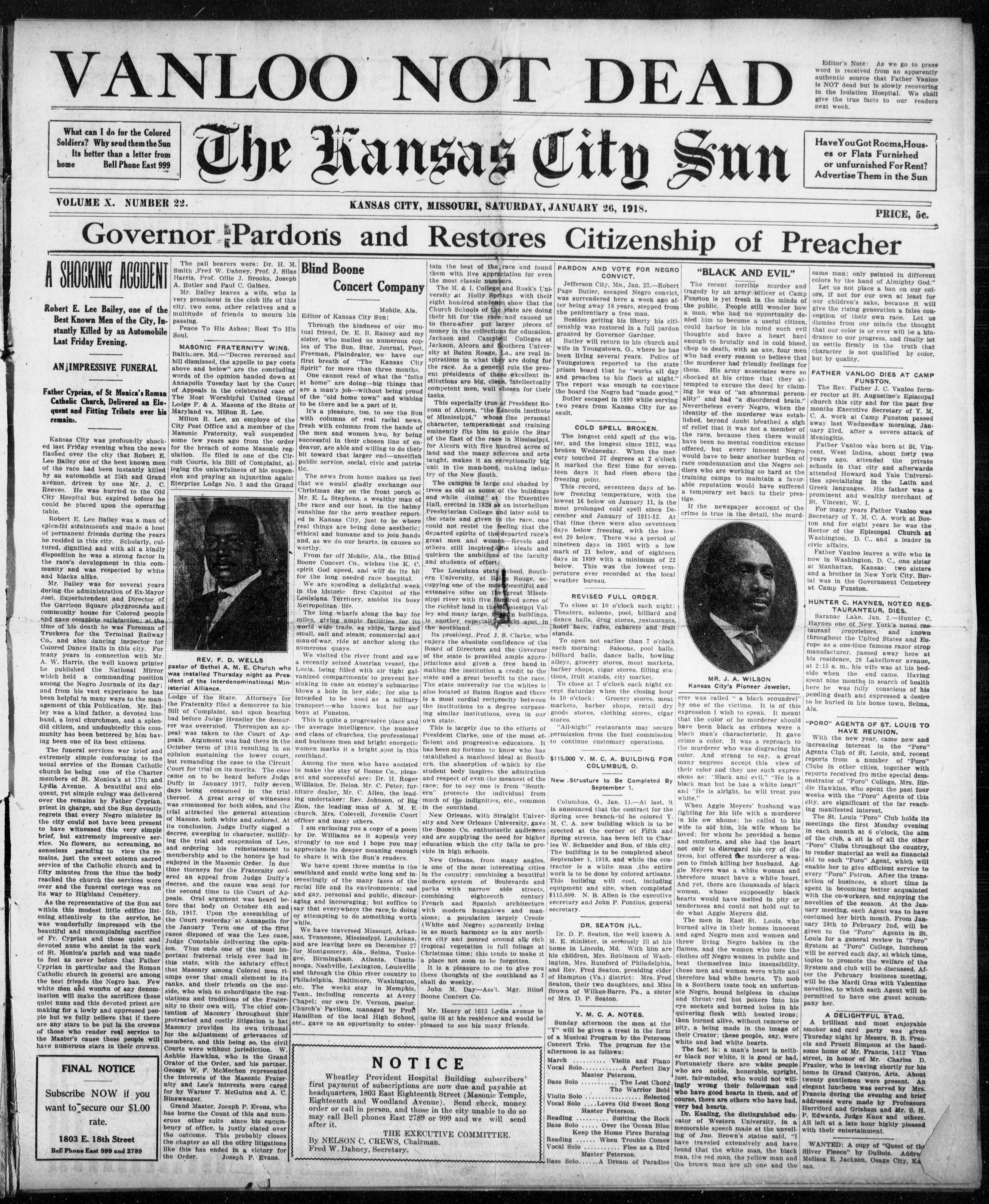
VANLOO NOT DEAD
VOLUME X. NUMBER 22.
What can I do for the Colored Soldiers? Why send them the Sun Its better than a letter from home Bell Phone East 999
A SHOCKING ACCIDENT
Robert E. Lee Bailey, one of the Best Known Men of the City, Instantly Killed by an Automobile Last Friday Evening.
AN IMPRESSIVE FUNERAL
Father Cyprian, of St Monica's Roman Catholic Church, Delivered an Eloquent and Fitting Tribute over his remains.
Kansas City was profoundly shocked last Friday evening when the news flashed over the city that Robert E. Lee Bailey one of the best known men of the race had been instantly killed by an automobile at 25th and Grand avenue, driven by one Mr. J. C. Reeves. He was hurried to the Old City Hospital but expired before he could be placed upon the operating table.
Robert E. Lee Bailey was a man of splendid attainments and made a host of permanent friends during the years he resided in this city. Scholarly, cultured, dignified and with all a kindly disposition he was a strong factor in the race's development in this community and was respected by white and blacks alike.
Mr. Bailey was for several years during the administration of Ex-Mayor Jost, Superintendent and Director of the Garrison Square playgrounds and community house for Colored people and gave complete satisfaction; at the time of his death he was Foreman of Truckers for the Terminal Railway Co., and also dancing inspector for Colored Dance Halls in this city. For many years in connection with Mr. A. W. Harris, the well known printer he published the National Mirror which held a commanding position among the Negro Journals of its day; and from his vast experience he has been helpful in many ways to the management of this Publication. Mr. Bailey was a kind father, a devoted husband, a loyal churchman, and a splendid citizen, and undoubtedly this community has been bettered by him having been one of its best citizens.
The funeral services wer brief and extremely simple conforming to the usual service of the Roman Catholic church he being one of the Charter members of St. Monica's at 17th and Lydia Avenue. A beautiful and eloquent, yet simple eulogy was delivered over the remains by Father Cyprian, priest in charge, and the Sun devoutly regrets that every Negro minister in the city could not have been present to have witnessed this very simple brief, but extremely impressive service. No flowers, no screaming, no senseless parading to view the remains, just the sweet solemn sacred service of the Catholic church and in fifty minutes from the time the body reached the church the services were over and the funeral cortege was on its way to Highland Cemetery.
As the representative of the Sun sat within this modest little edifice listening attentively to the service, he was wonderfully impressed with the beautiful and uncomplaining sacrifice of Fr. Cyprian and those quiet and devoted nuns who assist in the work of St. Monica's parish and was made to feel as never before that Father Cyprian in particular and the Roman Catholic church in general are among the best friends the Negro has. Few white men and women of any denomination will make the sacrifices these quiet nuns and this devoted priest are making for a lowly and oppressed people but we fully believe that if there are any stars to be put in the crowns of those who render real service to the Master's cause these people will have numerous stars in their crowns.
FINAL NOTICE
Subscribe NOW if you want to secure our $1.00 rate.
1803 E. 18th Street
Bell Phone East 999 and 2789
The Kansas City Sun
The pall bearers were: Dr. H. M. Smith F.贺 D. Dabney, Prof. J. Sillas Harris, Prof. Ollie J. Brooks, Joseph A. Butler and Paul C. Gaines.
Mr. Bailey leaves a wife, who is very prominent in the club life of this city, two sons, other relatives and a multitude of friends to mourn his passing.
Peace To His Ashes; Rest To His Soul.
MASONIC FRATERNITY WINS.
Baltimore, Md.—"Decree reversed and bill dismissed, the appelle to pay costs above and below" are the concluding words of the opinion handed down at Annapolis Tuesday last by the Court of Appeals in the celebrated case of The Most Worshipful United Grand Lodge F. & A. Masons of the State of Maryland vs. Milton R. Lee.
Milton R. Lee, an employee of the City Post Office and a member of the Masonic Fraternity, was suspended some few years ago from the order for the breach of some Masonic regulation. He filed in one of the Circuit Courts, his Bill of Complaint, alleging the unlawfulness of his suspension and praying an injunction against Eterprise Lodge No. 3 and the Grand
REV. F. D. WELLS pastor of Bethel A. M. E. Church who was installed Thursday night as President of the Interdenominational Ministerial Alliance.
Lodge of the State. Attorneys for the Fraternity filed a demurrer to his Bill of Complaint, and upon hearing had before Judge Hensilier the demurrer was overruled. Thereupon an appeal was taken to the Court of Appeals. Argument was had there in the October term of 1916 resulting in an opinion sustaining the lower court, but remanding the case to the Circuit Court for trial on its merits. The case came on to be heard before Judge Duffy in January 1917, fully seven days being consumed in the trial thereof. A great array of witnesses was summoned for both sides, and the trial attracted the general attention of Masons, both white and colored. At its conclusion, Judge Duffy sigged a decree, sweeping in character, nullifying the trial and suspension of Lee, and ordering his reinstatement to membership and to the honors he had enjoyed in the Masonic Order. In due time tlorneys for the Fraternity ordered an appeal from Judge Duffy's decree, and the cause was sent for the second time to the Court of Appeals. Oral argument was heard before that body on October 4th and 5th, 1917. Upon the assembling of the Court yesterday at Annapolis for the January Term one of the first cases disposed of was the Lee case, Judge Constable delivering the opinion. Thus ends one of the most important fraternal trials ever had in this state, with the salutary effect that Masonry among Colored men rulps over that small element in its ranks, and their friends on the outside, who wish to subordinate the regulations and traditions of the Fraternity to their own will. The chief contention of Maconry throughout this protracted and costly litigation is hat Masonry provides its own tribunal for the adjustment of grievances of members, and this being so, the civil Courts were without jurisdiction. W. Ashleigh Hawkins, who is the Grand Orator of the Order, and his partner, George W. F. McMechen represented the interests of the Masonic Fraternity and Lee's interests were cared for by Warner T. McGuinn and A. C. Binswanger.
Grand Master, Joseph P. Evens, who has borne the Count of this and numerous other suits since his encumbency of office, is justly elated over the outcome. This probably closes the chapter as all the other litigations like this has ended in a victory for the Order. Joseph P. Evans.
KANSAS CITY, MISSOURI, SATURDAY, JANUARY 26, 1918.
Blind Boone Concert Company
Mobile, Ala.
Editor of Kansas City Sun:
Through the kindness of our mutual friend, Dr. E. B. Ramsy and my sister, who mailed us numerous copies of The Sun, Star, Journal, Post Freeman, Plaindealer, we have our first breath of "The Kansas City Spirit" for more than three months.
One cannot read of what the "folks at home" are doing—big things that are a man's job—without being proud of the "old home town" and wishing to be there and be a part of it.
It's a pleasure, too, to see the Sun with columns of real racial news, fresh with columns from the hands of the men and women hwo, by being successful in their chosen line of endeavor, are able and willing to do their bit toward that larger end—unselfish public service, social, civic and patriotic.
The news from home makes us feel that we would gladly exchange our Christmas day on the front porch of Mr. E. L. Stephens, a wealthy man of the race and our host, in the balmy sunshine for the zero weather reported in Kansas City, just to be where real things are being done aesthetic; ethical and humane and to join hands and, as we do our hearts, in causes so worthy.
From far off Mobile, Ala., the Blind Boone Concert Co., wishes the K. C. spirit God speed, and will do its bit for the long needed race hospital.
We are spending a delightful week in the historic first Capitol of the Louisiana Territory, amidst its busy Metropolitan life.
The long wharfs along the bay for miles, giving ample facilities for its world wide trade, as ships, large and small, sail and steam, commercial and man-of-war, ride at anchor along the numerous quays.
We visited the river front and saw a recently seized Austrian vessel, the Lucia, being filled with air tight galvanized compartments to prevent her sinking in case an enemy's submarine blows a hole in her side; for she is intended to be used as a military transport—who knows but for our boys at Funston.
This is quite a progressive place and the average intelligence, the number and class of churches, the professional and business men and bright energetic women marks it a bright spot in this southland.
Among the men who have assisted to make the stay of Boone Co., pleasant and successful are: Dr. H. Roger Williams, Dr. Belso, Mr. C. Peter, furniture dealer, Mr. C. Allen, the leading undertaker; Rev. Johnson, of Big Zion, the leading man of A. M. E. church, Mrs. Colevell, Juvenile Court officer and many others.
I am enclosing you a copy of a poem by Dr. Williams as it appeals very strongly to me and I hope you may appreciate its deeper meaning enough to share it with the Sun's readers.
We have spent three months in the southland and could write long and interestingly of the many fazes of the racial life and its environments; sad and gay, personal and public, discouraging and encouraging; but suffice to say that everywhere the race is doing or attempting to do something worth while.
We have traversed Missouri, Arkansas, Tennessee, Mississippi, Louisiana, and are leaving here on December 27 for Montgomery, Ala., Selma, Tuskegee, Birmingham, Atlanta, Chattanooga, Nashville, Lexington, Louisville and through the Ohio river country to Philadelphia, Baltimore, Washington, etc. The weeks stay in Memphis, Tenn., including concerts at Avery Chapel; our own Dr. Vernon, pastor. Church's Pavilion, managed by Prof. Hamilton of the local High School, etc., gave us an opportunity to enter-
NOTICE
Wheatley Provident Hospital Building subscribers' first payment of subscriptions are now due and payable at headquarters, 1803 East Eighteenth Street (Masonic Temple, Eighteenth and Woodland Avenue). Send check, money order or call in person, and those in the city unable to do so may call Bell phones East 2789 or 999 and we will send after it.
THE EXECUTIVE COMMITTEE.
By NELSON C. CREWS, Chairman.
Fred W. Dabney, Secretary.
tain the best of the race and found them with live appreciation for even the most classic numbers. The M. & I. College and Rusk's University at Holly Springs with their eight hundred students show that the Church Schools of the state are doing their bit for the race and caused us to there-after put larger pieces of money in the collections for education. Jackson and Campbell Colleges at Jackson, Alcorn and Southern University at Baton Rouge, La., are real inspirations in what they are doing for the race. As a general rule the present presidents of these excellent institutions are big, clean, intellectually competent men, well chosen for their tasks. This especially true of President Rocean of Alcorn, "the Lincoln Institute of Mississippi," whose fine personal character, temperament and training eminently fits him to guide the Star of the East of the race in Mississippi, for Alcorn with five hundred acres of land and the many sciences and arts taught, makes it an exceptionally big unit in the man-hood, making industry of the New South.
The campus is large and shaded by trees as old as some of the buildings and while dining at the Executive Hall, erected in 1828 as an interbellum Presbyterian College and later sold to the state and given to the race, one could not resist the feeling that the departed spirits of the departed race's great men and women - Revels and others still inspired the ideals and quicken the ambitions of the faculty and students of effort.
The Louisiana state school, Southern University, at Baton Rouge, occupying one of the most beautiful and extensive sites on the great Mississippi river with five hundred acres of the richest land in the Mississippi Valley and many large, modern buildings, is another especially bright spot in the southland.
Its president, Prof. J. S. Clarke, who enjoys the absolute confidence of the Board of Directors and the Governor of the state is provided ample appropriations and given a free hand in making the institution a credit to the state and a great benefit to the race. The state university for the whites is also located at Baton Rouge and there is a most cordial reciprocity between the institutions to a degree surpassing similar institutions, even in our own state.
This is largely due to the efforts of President Clarke, one of the most efficient and progressive educators. It has been my fortune to know who has established a manhood ideal at Southern, the absorption of which by the student body inspires the admiration and respect of even the meanest of the race; for to say one is from "Southern" protects the individual from much of the indignities, etc., common in the southland.
New Orleans, with Straight University and New Orleans University, gave the Boone Co. enthusiastic audiences and are supplying the need for higher education which the city falls to provide in high schools.
New Orleans, from many angles, is one of the most interesting cities in the country; combining a beautiful modern system of foulevards and parks with narrow side streets, combining eighteenth century French and Spanish architecture with modern bungalows and mansions; a population largely Creole (White and Negro) apparently living in as much harmony as in any northern city and poured around all rich tropical vegetation in full foliage at Christmas time; this tends to make it a place not soon to be forgotten.
It is a pleasure to me to give you these thoughts of the southland as I shall do weekly.
John M. Day—Ass't. Mgr. Blind Boone Concert Co.
Mr. Henry of 1613 Lydia avenue is quite ill at his residence and would be pleased to see his many friends.
PARDON AND VOTE FOR NEGRO CONVICT.
Jefferson City, Mo., Jan. 23.—Robert Page Butler, escaped Negro convict, was surrendered here a week ago after being away 18 years, stepped from the penitentiary a free man.
Besides getting his liberty his citizenship was restored in a full pardon granted by Governor Gardner.
Butler will return to his church and wife in Youngstown, O., where he has been living several years. Police of Youngstown reported to the state prison board that he "works all day and preaches to his flock at night." The report was enough to convince the board the Negro had "made good."
Butler escaped in 1899 while serving two years from Kansas City for assault.
COLD SPELL BROKEN
The longest cold spell of the winter, and the longest since 1912, was broken Wednesday. When the mercury touched 27 degrees at 2 o'clock it marked the first time for seventeen days it had risen above the freezing point.
This record, seventeen days of below freezing temperature, with the lowest 16 below on January 11, is the most prolonged cold spell since December and January of 1911-12. At that time there were also seventeen days below freezing, with the lowest 20 below. There was a period of nineteen days in 1905 with a low mark of 21 below, and of eighteen days in 1899 with a minimum of 22 below. This was the lowest temperature ever recorded at the local weather bureau.
REVISED FULL ORDER
To close at 10 o'clock each night: Theaters, saloons, pool, billiard and dance halls, drug stores, restaurants, hotel bars, cafes, cabarets and fruit stands.
To open not earlier than 7 o'clock each morning: Saloons, pool halls, billiard halls, dance halls, bowling alleys, grocery stores, meat markets, barber shops, cigar stores, filling stations, fruit stands, city market.
To close at 7 o'clock each night except Saturday when the closing hour is 10 o'clock: Grocery stores, meat markets, barber shops, retail dry goods stores, clothing stores, cigar stores.
"All-night" restaurants may secure permission from the fuel commission to continue customary operations.
$115,000 Y. M. C. A. BUILDING FOR COLUMBUS, O.
New, Struture to Be Completed By September 1.
Columbus, O., Jan. 11. At last, it is announced that the contract for the Spring sree branch of he colored Y. M. C. A. new building which is to be erected at the corner of Fifth and Spring streets, has been left to Charles W. Schneider and Son, of this city. The building is to be completed about September 1, 1918, and while the contractor is a white man, the entire work is to be done by colored artisans. This building will cost, including equipment and site, when completed $115,000. N. B. Allen is the executive secretary and John P. Pontius, general secretary.
DR. SEATON ILL.
Dr. D. P. Seaton, the well known A. M. E. minister, is seriously ill at his home in Lincoln, Md. With him are his children, Mrs. Robinson of Washington, Mrs. Rumford of Philadelphia, and Rev. Fred Seaton, presiding elder of Hampton (Va.) district: Mrs. Fred Seaton, their two daughters, and Miss Brown of Wilkes-Barre, Pa., a sister of Mrs. D. P. Seaton.
Y. M. C. A. NOTES.
Sunday afternoon the men at the "Y" will be given a treat in the form of a Musical Program by the Peterson Concert Trio. The program for the afternoon is as follows:
March ..... Violin and Piano
Vocal Solo ..... A Perfect Day
Master Peterson.
Bass Solo ..... The Lost Chord
The Warrior Bold
Violin Solo ..... Selected
Vocal Solo ..... Loves Old Sweet Song
Master Peterson.
Keep the Home Fires Burning
Reading ..... When Trouble Comes
Vocal Solo ..... Flee as a Bird
"BLACK AND EVIL"
The recent terrible murder and tragedy by an army officer at Camp Funston is yet fresh in the minds of the public. People still wonder how a man, who had no opportunity denied him to become a useful citizen could harbor in his mind such evil thoughts and have a heart hard enough to brutally and in cold blood chop to death, with an axe, four men who had every reason to believe that the murderer had friendly feelings for them. His army associates were so shocked at his crime that they attempted to excuse the deed by claiming he was of "an abnormal personality" and had "a disordered brain." Nevertheless every Negro, when the identity of the murderer was established, beyond doubt breathed a sigh of relief that it was not a member of the race, because then there would have been no mental condition excuse offered, but every innocent Negro would have to bear another burden of race condemnation and the Negro soldiers who are working so hard at the training camps to maintain a favorable reputation would have suffered a temporary set back to their prestige.
If the newspaper account of the crime is true in the detail, the murd-
MR. J. A. WILSON
Kansas City's Pioneer Jeweler.
erer was called "a black scoundrel" by one of the victims. It is of this expression I wish to speak. It meant that the color of he murderer should have been black as crimes were a black man's characteristic. It gave crime a color. It was a reproach to the murderer who was disgracing his color. And strang to say, a great many negroes accept this view of their color and they use such expressions as: "Black and evil," "He is a black man but he has a white heart" and "He is alright, he will treat you white."
When Aggie Meyers' husband was fighting for his life with a murderer in his ow nhome; he called to his wife to aid him, his wife whom he loved; for whom he provided a home and comforts, and she had the heart not only to disregard his cry of distress, but offered the murderer a weapon to finish killing her husband. Aggie Meyers was a white woman and therefore muset have a white heart. And yet, there are thousands of black women, whose supposedly black hearts would have melted in pity or tenderness and could not hold out to do what Aggie Meyers did.
The men in East St. Louis, who burned alive in their homes innocent and aged Negro men and women and threw living Negro babies in the flames, and the women who tore the clothes off Negro women in public and beat themselves into insensibility, these men and women were white and therefore had white hearts. Th mob in a Southern tstate took an unfortunate Negro, bound helpless in chains and thrust red hot pokers into his eye sockets and burned holes in his quivering flesh with heated irons; then burned alive, without remorse or pity, a being made in the image of their Creator; these people, say, were white and had white hearts.
The fact is: a man's heart is neither black nor white, it is good or bad. Fortunately there are white people who are noble, honorable, upright, just, fair-minded, who would not willingly wrong their fellowman and who have good hearts in them, and of course, there are others who have had, very bad hearts.
Dr. Kealing, the distinguished educator of Western University, in a memorable speech made at the unveiling of Jno. Brown's statue said, "I have traveled extensively and have found that the white man, the black man, the red man, the yellow man and the brown man are all one and the
Editor's Note: As we go to press word is received from an apparently authentic source that Father Vanloo is NOT dead but is slowly recovering in the isolation Hospital. We shall give the true facts to our readers next week.
HaveYouGotRooms,Houses or Flats Furnished or unfurnished For Rent? Advertise Them in the Sun
PRICE, 5c.
same man; only painted in different colors by the ban of Almighty God." Let us not place a ban on our colors, if not for our own at least for our children's sake, because it will give the rising generation a false conception of their own race. Let us dismiss from our minds the thought that our color is or ever will be a hindrance to our progress, and finally let us settle firmly in the truth that character is not qualified by color, but by quality.
FATHER VANLOO DIES AT CAMP
FUNSTON.
The Rev. Father J. C. Vanloo former rector at St. Augustine's Episcopal church this city and for the past few months Executive Secretary of Y. M. C. A. work at Camp Funston passed away last Wednesday morning, January 23rd, after a severe attack of Meningitis.
Father Vanloo was born at St. Vincent, West Indies, about forty two years ago, attended the private schools in that city and afterwards attended Howard and Yale Universities specializing in the Latin and Greek languages. His father was a prominent and wealthy merchant of St. Vincent, W. I.
For many years Father Vanloo was Secretary of Y. M. C. A. work at Boston and for eight years he was the Rector of the Episcopal Church at Washington, D. C., and a leader in civic affairs.
Father Vanloo leaves a wife who is now in Washington, D. C., one sister at Manhattan, Kansas; two sisters and a brother in New York City. Burial was in the Government Cemetery at Camp Funston.
HUNTER C. HAYNES, NOTED RESTAURANTEUR, DIES.
Saranac Lake, Jan. 2—Hunter C. Haynes one of New York's noted restaurant proprietors, and known throughout the United States and Europe as a one-time famous razor strop manufacturer, passed away here at his residence, 28 Lakeflower avenue, at 2:15 a. m., his wife was at his bedside when the end came. Having spent nine months in search of health here he was fully conscious of his pending death and expressed a desire to be buried in his home town, Selma, Ala.
"PORO" AGENTS OF ST. LOUIS TO
HAVE REUNION.
With the new year, came new and increasing interest in the "Poro" Agents Club of St. Louis, and, recent reports from a number of "Poro" Clubs in other cities, together with reports received fro mthe special demonstrator of "Poro" College, Mrs. Birdie Hawkins, who spent the past four weeks with the "Poro" Agents of this city, are significant of the far reaching manifested interest.
The St. Louis "Poro" Club holds its meetings the first Monday evening in each month at 6 o'clock, the aim of the club, a sit is of all the other "Poro" Clubs throughout the country, to render material as well as financial aid to each "Poro" Agent, which will enable her to give efficient service to every "Poro" Patron. After the transaction of business, a short time is spent in becoming better acquainted with the co-workers, and enjoying the novelties of the season. At the January meeting, each Agent was to have costumed her birth month. From January 28th to February 2nd, will be given to the "Poro" Agents in St. Louis for a general review in "Poro" System at "Poro" College, luncheon will be served each day, at which time, topics to promote the welfare of the System and club will be discussed. After the February business meeting, will be the Mardi Gras with Valentine novelties, to which each Agent will be permitted to have one guest accompany her.
A DELIGHTFUL STAG.
A brilliant and most enjoyable smoker and card party was given Thursday night by Messrs. B. B. Francis and Pruett Simpson at the handsome home of Mr. Francis, 1412 Vine street, in honor of Mr. Charles D. Frazier, who is leaving shortly for his home in Grand Canyon, Ariz. About twenty gentlemen were present. An elegant luncheon was served by Mrs. Francis during the evening and brief addresses were made by Professors Herriford and Grisham and Mr. S. H. P. Edwards, Judge Knox and others. All left at a late hour highly pleased with their entertainment.
WANTED: A copy of "Quest of the Silver Fleece" by DuBois. Addre Melissa E. Jackson, Osage City, Ka
LE OO ee ee RS ere ae ee ee ee
From Our Foreig Cc dent
A.F. d A. M. M LINCOLN, NEB. most lovable, energetic, christian citi-| in Butte, of which Mr. Jesse H Smith | TEN REASONS WHY YOU SHOULD
. Ff. ane le 0. By W. W. Mosely. zens, Having spent over thirty years is president and Mr. Hubbard, Secre- JOIN THE AMERICAN
Jurisdicti Rev. B. Hillman returned home Sat-|°! his life in this city he was night| tary... The past Grand and Deputy °
jurisdiction bio dae SG Heinle TR St | watchman of the State Savings Bank | Supreme Chancellor has never enjoy: WOODMEN,
Officere—1917. heiptage tae acter ee where}for over ten wtyyears. He was a/ed himself in all his life as well as| 1. Because it fs an association of ¢
. . he has been on business for the past} Charter member of the G. U, 0. of O.| he did on the seventeenth, while en-| Colored people, operated by and for . SS,
'W. W. Fields, Cameron, Mo. Grand ten days. Albert Saunders was re-|F., having the Patriarch degree; ke | route from Butte to Helena. He had | the protection of Colored people, and
Master. ported very ill at the home of her|WaS also a charter member of the| access to the train from the smoker |{s not operated for profit. | S.
C. ©. Clark, St, Louis, Mo, Dep.) Mrs. L. B. Moore was con-| Bethel Baptist church. Mr. Sheets | to the Observation car with Mr. Geo.| 2% Its rates are those of the Na-| |* ‘ 9
Grand Master. Fa he cast ead ithe | Will be greatly missed htroughout this! M. Lee, Sr, and Mr. Jones in the din-|tlonal Fraternal Congress and there:| ' ‘ F ’ e
gue tee Louisiana, Mo., Sentor| te cold... Mrs. Bert Hawkins is|CO™Munity. He leaves a wife and | er and a St, Paul friend in the sleeper| fore it is enabled to maintain a -re-| =~ e S
ran . aver sd to be slowly improving trom{aauehter (Mrs, Jesse H, Smith) to|and Mr, J, A. Callender in charge of| servo sufficient to meet the increased
1. H. Bradbury, St. Louls, Mo,,| reverted He proving trom) mourn hi sloss....The bereaved fami-| the Observation car. He was made) mortality of its members in later Beat all the Rest.,
Junior. Grand Warden. dome weeks past. .We regret the|¥ Wishes to thank their many friends | welcome, | years without resorting to taxes or
H. H, Walker, St, Joseph, Mo., Grand | tre ne a daughter of Mrs, A,|{F the kindnesses during the ‘recent ; Bee extra assessments. °
ree WH Loews, Kenske Clty, | Harding, ts very ill and ty axpouted tolpeew Ok eater cud atec thane the CARROLLTON, MO. 3. Because all certificates carry old) *
Bart ate, be brought here from her home in] and and father: and also thanks te] 4 ....414 program was given at S86 permanent aint total dlapblity,| Kelley Milling Ca:
Naneen C. Crews, Kansas City, Re-|1owa....Mr. George Miller, since go-| Iadse members for the kid SYMDADY |, Virginia St, Baptist chureh, by the |sccldent, sickness, death, and burial} ,
jet euarotacy ing to'Phoenis, Ariz, is reported to be| SHOW and the friends for. eo many| {ie ikea Oe ihe community, benefits, thereby enabling. any mem-| wEGUuaA'
B. G. Lacey, Kansas City, @. L, | YerY Hll....Dr. Ernest E. Graves will poocs napers and magazines on sate| House to be erected at Camp Funston| ber t@ cover in a single poliey, such
Ist District. leave the city next Tuesday to join! (P0yt Pye de ims Staal TT Ane Glonatenoldiers protection abotherwige Would require | _cmrsererneett tee ree eet
EJ. Coaper, Mexico, Mo, G, L,| ls wife at Kansas City and then they |“ 71° § : This exorcise qwas in keeping with | tte, carrying of two or nore policies
2nd District. will go to Indianapolis, Ind., wrere Dr ther oooanlenaetnicty paibuan Wing | different compantes at a Cost IM the | + wnnnnnnnvvvennnnnwvvnnnnnnnnnnmmnnnnnwvnnnnnnnnnnnnnnnns
SEFGERS OF GRAND CHAPTER, ns will practice dentistry. We OMAHA, NEBR. irisla- Waa URI the taare gui: was MESreento. at Jo) Otiene Sf Whe SetbA)
OFFICERS OF GRAND CHA\ ,| regret to have him leave our city and) One of the pleasing surprises of| interspersed by addressed, papers offered by the American Woodmen. « s 4
RAM, his Hoine tor @ hew tbeation,... Atel the week wae Ure mua reagG OF ANS Ws ee EE eco ene |) Tae TERR ULaC Lara Ts Wen ibeM itn ts PORO” is to the scalp as food is to the body.
Missouri and Jurisdiction, 1917-18.
T. G, McCampbell, G. H. P., Quin-
daro, Kans.
A. L. Thomas, D. G. H, P,, Jeffer-
son City, Mo.
J. P, Moffett, G. King, Sedalia, Mo.
8. A. May, G, Scribe, St. Louis, Mo.
Chas. Grigesby, G. Treas. Liberty,
Mo.
E, 8. Baker, G. Secretary, Kansas
City, Mo.
OFFICERS OF GRAND COMMAND.
ERY, K. T.
Missouri and Jurisdiction
1917-18.
W. G. Mosely, R. B. G. C,, Kansas
City, Mo.
J, W, Beard, V. B. G. C,, St. Louis,
Mo.
G W. Lewis, E. G. G., St. Louis, Mo,
©. Brasstield, E.G, Captain Gen.
eral, Kansas City, Mo.
W. A. Ashle;, BE. G. P., St. Louis
Mo.
J. H, Kenner, E, G,, Treasurer, Mar
shall, Mo.
J.T, Cannon, E. G., Recorder, St.
Louis, Mo.
George A. Johnson, E.G. 8. W..
Kansas City, Mo.
Benjamin F, Graves, E. G. J. W., St.
Joseph, Mo.
Lodge Directory
Rone Lodge No. 25, A. ¥, and
ATSte Ged “the ist and Sra
Monday in each month. All
Saath ato i 908 tena
welcome. Emmett Spruell, 6
weeane, ERS abs
Liberty Ledge Ne. a7, AF
and A, 6, Liverty, Dg, meat
the 2nd and 4th Saturday
heuer otal mont, Wit
Ete ence eigen Walla
a
_@t. Stephene, Chapter NO. 37,
povaieeaenere chante’ Nea,
Ee gue Alero teagee ts
Ree Sees ie eae,
a eg
Say, _ Oh Matthew Commancary
SEGA] No. 11, Liberty, Mo,, mesta
es li the third Saturday night,
nr William Capps, B. C.; W. H
= Robinson, Rec. Sec’y.
fa ie ele
ac U, BF:
yh, ing, tines Wnt edoe
Vy No. 218 meets first and third
geese ase tea arn
Feit ce neat eho
A Rect" a carne usta
Bae Mis, Aled Beer tal
WS Admiral Blvd, K. C., Mo.
MASONIC BUILDING ASSOCIATION
'T. G. McCampbell, President.
B. B, Thompson, Vice President.
‘W. H. Washington, Treasurer.
S. H. P, Edwards, Secretary.
f Board of Directors:
N. W. Jordan. 8. Myers,
W.H. Brown. &. S, Baker,
W. R. Patterson.R. V. Adkins,
B,R, Francis. Richard Harris
Geo Johnson, _—R. Fulbright.
Meets second and fourth Tuesday
im each month.
eMuneié mineeToaRy,
Bethe! A. M. E. Church, 24th and Flora.
St. Steptien’s Baptist Church, 604 Char-
‘Geoternial M. E, Church, 19th and
wonnte |. Church, 19th an
1ofteo8d Faptist Church, 10th and Char
‘Allen Chapel A. M. E. Church, 10th and
Ciibeneset A.M. E, Church, 17th anc
newer A. M. B. Chu an
‘Tracy.
‘Bt. Augustine's P, B. Church, 1th and
Troost Avenue.
aby, Sonne 2. M. T Church, 1748 Belle
lew.
Seventh Day Adventist, 284 and Wood.
‘St. Monica's Catholic, 17th and Lydia
Yino St, Baptist Church, 183 Vine St
Ward Chapel 4M, E. Church, 11th an
‘Morning Star Baptist Church, 2811 Vine
Highlana Avenus Baptist Chureh, 111
ee James A. M. R, Zion Church, 182
james , yn Church,
Mesa! Aeauian cours, 20 an
arch,
eek
¢ M. I Church, 1817 Flora Ave.
St James Baptist Church, 4039 Mun St
St, fy A.M. E, Church, 43rd end
Prospect. 5
CLARK CHAPEL M. E. CHURCH,
1664 Madison Ave.
KANSAS CITY, KAN. CHURCHES.
it A. M. BE. Church, Sh and Neb.
c ih St, Baptist Chureh, “Sth and
a politan Baptist Church, 9th end
‘A. M. B, Church, Water and
Staying Streets,
Bt. ‘S.-M. , Chureh, 21st and
ease Beptist Church, Sth and Neb.
‘Baptist Churoh, ard and
M. B. uindaro.
ei r? faildy Bagting Churea, hove-
2 Cuuren,. a Oak!
+ igcond Baptist C Mth and’ Ruby.
§ De fain owas 3
oA ae at church, 760
LINCOLN, NEB,
By W. W. Mosely.
Rey. B. Hillman returned home Sat-
urday from Terre Haute, Ind., where
he has been on business for the past
ten days, Albert Saunders was re-
ported very ill at the home of her
parents....Mrs. L. B. Moore was con-
fined at home the past week with a
severe cold....Mrs, Bert Hawkins is
reported to be slowly improving from
‘a stroke of paralysis. She suffered
dome weeks past....We regret the
report that Dilla, daughter of Mrs. A.
Harding, is very ill and is expected to
be brought here from her home in
lowa....Mr. George Miller, since go-
ing to Phoenix, Ariz., is reported to be
very ill.....Dr, Ernest E. Graves will
eave the city next Tuesday to join
his wife at Kansas City and then they
will go to Indianapolis, Ind., wrere Dr.
Graves will practice dentistry, We
regret to have him leave our city and
his home for a new location, ...Mrs.
Elizabeth Ratley arrived here from
Denver, Colo., last Sunday and will
live with her daughter, Mrs. D. E.
| Nichols. ... Mrs. Jennie Sellers is able
to be out again after her accident...
Only a few days more of the one dol-
lar rate for the Sun. Send your sub.
|scription toda yto W. W. Mosley...
‘The mock trial entertainment at the
|A. ME, church last Thursday was
| success socially and financially.
| Mrs. Mary Williams was reported
on the sick list last week...Mrs, Jen-
‘nie Sellers, on returning to her home
1952 U St. Monday afternoon, was en-
‘tering the house when a man, rushing
from within, knocked her down, injur
‘ing her. Upon investigation it was
| found that she had been robbed of fif-
teen dollars in money. Mrs. Sellers
jis ill from painful injury...Magnolia
Court No. 10 invited quite a class of
| candidates to their lodge last Wednes
|day evening...The Daughters of Tab
Jernacle are taking on quite an in
crease in membership into their lodge
Jot late...Mr, Jones is reported ill as
yet...Miller & Payne, the largest and
| leading Dry Goods store in the city,
employs sixteen colored employees.
This is worthy of appreciation... Mr.
Chas. MeCaw, formerly of Beatrice
Neb,, is employed at the home of Mr
L. J. Dunn, vice president of City Na
tional Bank, as chauffeur and house
| man.
BUTTE, MONT.
By Jesse H. Smith,
Mrs. B. B. Reed is very much im-
proved at this writing... Brennan
King, infant son of Mr. and Mrs. King,
is seriously ill at their home witl
bronchial trouble...Mrs. M. Gardner
has returned home from the hospital
much improved...Mrs, J. Larkins is
a little indisposed, having taken a very
bad cold...J, H. Hilliard, Deputy K.
P. Chancellor of Montana, was in the
city visiting Chancellor Jesse H.
Smith...Sherman Powell was buried
this morning in Holy Cross cemetery,
having been hung January 1ith, for
the murder of J. H. Montgomery. ..
Louis S. Sheets, an old pioneer of
Butte, died very suddenly at his resi:
dence Friday January 11 of heart fail:
ure, The funeral was Sunday after.
noon at two o'clock from the Bethel
Baptist of which he was a member.
Rev. E. 13. Reed officiating, assisted
by Rey. G. S. Allen, Mr, Sheets be-
ing dead, Butte has lost one of its
ae Soe oe ee 8 ine ie es
SOCIAL SERVICE LECTURES.
| There will be given at Old City Hos-
|pital, a series of lectures on Social
| Service, beginning Wednesday even:
|ing, September 19, and every Thurs
|day thereafter throughout the year.
| Taleee lectures will be given by ex:
perts along their special lines. as in.
dicated by the following program.
| They will also be free, and anyone
| wishing to take advantage of them is
| Invited to attend. Te will be given
| the nurses’ Study Room of the Old
| City Hospital, and will begin prompt-
|ly at 8 o'clock p. m.
| Jan, 24-31: Miss A. J. Sorta, Wo:
‘men's Reformatory. Subject, “Train:
ing and Care of Delinquent Girls.”
Feb. 7: Mrs. T. W. H. Williams.
Subject, “The School for Servant
Girls.”
Feb. 14: Mrs. Mary Green, inves:
tigator, Provident Association,
Feb. 21-28: Mr. J. O. Stutsman, su-
perintendent Municipal Farm, Sub-
ject, “Causes of Crime.”
March 7: Dr. EB, L. Mathias, chief
probation officer, Subject, “The Juve
nile Court.”
March 14: Dr. Alberta Green, Wo-
men’s Raformatory. Subject, “Girls.”
March 21: Prof. J. R. E, Lee, prin-
cipal, Lincoln High School, Subject,
“Phe School and Social Service,”
March 28: Mrs. E. L. Bringham,
Helping Hand Association,
April 4: Miss Anna Jones, Lincoln
High School. Subject, “The Working
Girls’ Home.”
April 11: Mrs, Margaret Barnett
investigator for Board of Health.
April 18: Mr, James A. Lee, truant
officer. Subject, “The Truant Child.’
April 25: Miss Beatrice Sydnor. R.
N, and Miss Grace White, teacher.
Subject, “The Fresh Air School.”
May 2: Miss Eva M. Marquis. Sub-
fect, “How to Develop the Social Life
of the Community,”
May 9: Mr, O. J, Hill, president
_. Mar 26; o) OP: no, saan
. Sa eeeeeen. > tide
ae year
THE KANSAS CITY SUN, SATURDAY, JANUARY 26, 1918.
most lovable, energetic, christian citi-
zens, Having spent over thirty years
of his life in this city he was night
watchman of the State Savings Bank
for over ten wtyyears. He was a
Charter member of the G. U. 0. of O.
‘F,, having the Patriarch degree; he
was also a charter member of the
Bethel Baptist church. Mr. Sheets
will be greatly missed htroughout this
community, He leaves a wife and
daughter (Mrs, Jesse H, Smith) to
mourn hi sloss....The bereaved fam:
ily wishes to thank their many friend:
for the kindnesses during the ‘recent
death anr burial of our beloved hus
band and father; and also thanks the
[lodge members for the kind sympathy
shown and the friends for so man}
beautiful floral offerings...Read good
books, papers and magazines on sale
at 215 S. Mont. St.
OMAHA. NEBR.
One of the pleasing surprises of
the week was the marriage of Mr. W.
H. (Bob) Robinson, one of the best
known men in our city and a very effi-
cient secretary of Omaha Lodge 46,
A. F. & A. M. to Miss Eddie Washing.
ton a charming young lady of Kansas
City, Kansas, It was Bob's thirty-
fifth birthday and his friends gave
him such a celebration as he will ul-
ways remember...Among the new
subscribers this week are Mr. P. H,
Jenkins one of Omaha's most success:
ful business men and Mr, Thos. H.
Perkins who evidently know a good
thing in the newspaper line when
they see it...“Jack” Broomfield Oma-
ha’s most successful business man and
one who is devoted to his friends at
all times is doing nicely along busi-
ness lines, He sends his regards to
his myriad friends in Kansas City...
One of the tragedies of the week was
the killing of Marshall Fielding allas
Fred Hall by Johnnie Bell who claim-
ed that he was compelled to shoot
him as Hall was chasing him with a
ragor at the time he was killed. Bell
is a Cornetist with Desdunes famous
band and has always been known for
his peaceful disposition and kindly
manner, He is a cousi of Moses Dan-
ields one of the old pioneer citizens of
Kansas City...The Churches report
a splendid progress.
MARYVILLE. MO.
Mrs. George Williams and Miss
Laura Williams entertained at a birth-
day party complimentary to the Six-
teenth birthday of the former's sister,
Miss Vera Vance Tuesday evening,
January 15th. A very pleasant even
ing was spent at games and enjoying
the music so much so that it was in
the wee hours of morning that the
merry makers departed. The follow.
ing menu was served: Bean salad on
lettuce leaf, hot buttered biscuits,
sardines, pickles, hot cocoa, food for
God with whipped cream, salted al-
monds.
Mrs. BF, Smart has been ill for
the past week but is much better at
this writing. The Sun wishes a speedy
recovery tor her.
Mr. and Mrs, J. L. Gooden had as
dinner guest Sunday Prof, and Mrs.
Ernest O. Boone, Jr. and son Ernest
Sra.
|" Mrs. Mary Smith fs ill at this writ.
| Ing. 5
‘The Mount Zion Baptist Church had
services Sunday and Monday nights
with the Rev. Mr. Davis filling the pul-
pit at both services,
Mrs. Onie Gunn has been very ill
for the past two weeks but is improv-
ing at this writing,
Better hurry and pay up your old
bill or you'll get cut off the gratis list
after the 31st.
‘The Mothers club of Douglass school
had a social last Friday evening. Al
Present spent a very pleasant even:
Ing. The proceeds were sufficient to
make the last payment on the beauti-
ful forty dollar Victrola that they pre-
sented to the school some time ago.
The Lincoln Auxiliary of The Amer.
fean Red Cross with Mrs, Ernest 0.
Boone, Jr., and Mrs. B. F. Smart as
Instructors made 300 surgical dress.
ings the first week they worked,
HELENA, MONT.
By J. H. Hilliard.
The Pleasant Hour Social Club met
at Mrs, Chas. Oliver's on the sixteenth
and Mrs. C. H. Harrell was elected
reporter for the club in order that the
business of the club might be prop.
erly put in the Sun...Mrs. R, 2. Rut.
fins spent a few days in Lewistown,
Mont., with Mrs, Ceaulle...Mr. A. E.
McGinnis is still on the sick list...
‘Mrs, Judia Oliver is convalescent...
Mrs. J. B. Reid is improving...J, H.
Hilliard installed the officers Benevo-
lent Lodge, K. of P., at Anaconda on
the sixteenth and enroute home he
stopped in Butte and enjoyed a few
happy hours with Mr. and Mrs. Jesse
H, Smith, Mr. Smith is one of Butte’s
most progressive men and is doing
many things for the advancement of
the race, by selling all kinds of race
papers, books, magazines and deserves
the support of all...Mr. R. E. Ruffing
was ill a few days...Mr, Junior Saund
ers is on the sick list with a sprained
knee...Calodonna Bramwell is con:
templating a trip to California seon.. .
Mrs. James (Annie Brown) Tolbot it
on the'sick list...Mrs, L. H, Matthews
is sojourning at Mrs. Geo, M, Lee, Sr
at present...J. H. Hilliard came to
Rey, Reid’s at Butte on the seven
teenth and enjoyed a delightful visit
.+.The K, of P's payed its first pol.
icy in Montana on the sixteenth to
Rosa Lane at Ansgonda. This
in Butte, of which Mr. Jesse H. Smith
is president and Mr. Hubbard, Secre-
tary...The past Grand and Deputy
Supreme Chancellor has never enjoy:
ed himself in all his life as well as
he did on the seventeenth, while en.
route from Butte to Helena. He had
Be ee ee the smoker
to the Observation car with Mr. Geo.
M. Lee, Sr., and Mr, Jones in the din-
er and a St, Paul friend in the sleeper
and Mr, J. A, Callender in charge of
the Observation car. He was made
welcome,
CARROLLTON. MO.
A splendid program was given at
the Virginia St, Baptist church, by the
‘citizensfi in belialf of the community,
‘House to be erected at Camp Funston
for the colored soldiers
This exercise was in keeping with
‘the occasion, strictly patriotic. ‘The
music was upete the hour, and was
interspersed by addressed, papers and
poems, ‘The church was beautifully
decorated sun to the evening.
All surrounding assumed an atmos-
pheric appearance of patriotism,
The building was crowded and
standing room was at a premium, but
not with standing this congested con-
dition enthusiasm soared high,
Success crowne( the effort both lit:
erally and financially. Two much
credit cannot be given to Mrs, Benora
E. Highsmith, mistress of ceremony
and the instigator of this very com-
mendable program. She was assist-
ed by Mr, A, A. Sanford, Mrs. O. T.
Sanford and Mr. F. H. Highsmith.
| ROSEDALE, KANSAS.
Little Evaline, the daughter of Mrs,
Ruth Henderson, underwent an opera-
tion at the Bell Memorial Hospital
Monday. Her tonsils were removed
and she is improving nicely.
ARGENTINE. KANSAS.
(0 Ste, Senate | emer ee nen Cente ume ens,
Miss Blanche Bergin is very sick...
Mr, Robert Richards was taken to St,
Margaret’s hospital Monday morning
...The infant daughter of Mr. and
Mrs. John Fields on Thirty-titth and
Barber Ave., met with a painful acci-
dent last Thursday, having fallen on
a stick, lacerattyg her mouth... The
infant daughter of Mr. and Mrs.
James Bailey was knocked uncon.
scious while at play, but for the timely
service of Dr. Davis the result might
have proved « fatal...The _ services
throughout the day at St. Paul Chapel
last Sunday were very good. Rev
Harris, the presiding Blder, preached
a stirring si Sunday morning
Rev. J.C. C. i$, Of Quindaro, de
livered the 1 e in the afternoos
and Prof. Patterson, of Western Uni
versity, preached at night! The churel
was crowded both afternoon and even
ing and it was the best quarterly meet
ing both spiritually and finincially Su.
Pual has had tor some time...The
Needle Sraft Club was entertained by
Mrs. Lulu Lockridge last Friday af
ternoon...Miss Jesse Saunders, teach
er in Lincoln school, is confined to her
bed on account of illness,
PianosandVictrolas
Beaded tr
THENONES STORE C
~ 3rd Floor (2th & Main Sts. -
The Handy
Colored Store
2409 Vine St.
Ladies’ and Gent's Furnishing
~: Goods and Notions
VISIT OUR DRY GOODS AND
HARDWARE DEPT.
BARGAINS
, : a
ene
i aa Lh A
‘ bers .
Pi
SPECIAL BARGAINS IN OUR
_ NOTION DEPARTMENT
| AND HAIR GOODS.
Help Make Our Store, Your Store, Our
Gustomers Your Friends
Special Values in Furnishings for
Men, Women and Children.
GIVE US A CALL.
$2.50 In Goods Free.
WE GIVE SURETY COUPONS.
Taylor Holmes & Co.
Mrs.. Annie Holmes, Mugr.
2409 VINE ST., Kansas City, Mo
Bell Phone East 42214
TEN REASONS WHY YOU SHOULD
JOIN THE AMERICAN
WOODMEN.
S\FLOUR
B sr Kelley's Best
: rT Beat all the Rest.,
1GH PATENT 9 Keley biting Co.
1, Because it is an association of
Colored people, operated by and for
the protection of Colored people, and
is not operated for profit.
2. Its rates are those of the Na-
tional Fraternal Congress and there-
fore it is enabled to maintain a » re-
serve sufficient to meet the increased
mortality of its members in later
years without resorting to taxes or
extra assessments.
3. Because all certificates carry old
age, permanent and total disability,
accident, sickness, death, and burial
benefits, thereby enabling any mem-
ber to cover in a single policy such
protection as otherwise would require
the carrying of two or more policies
in different companies at a cost in the
aggregate far in excess of the rates
offered by the American Woodmen,
4. Because there is no discrimina-
‘tion in rates, The humblest wage-
earner pays no more than the profes-
sional or business man; age regulates
the rate,
5. Because your policy cannot lapse
on account of illness or accident un-
less you so desire, for it pays benefits
from beginning of illness or accident
until the restoration to health regard-
less of the time, whether measured in
hours, days, Weeks, months, or years.
6. In the event of death from what-
ever cause, there is an amount vary-
ing from $250 to $2,000 to maintain
and protect those who are left de-
pendent, It has paid within the past
sixteen (16) years to its members,
$400,000.
7. Because, by giving employment
to hundreds of Negroes, it opens the
door of hope to you. Its clerical force
is composed of young men and women
of the race, thereby giving an oppor-
tunity to earn a livelihood in a credit-
able way.
8. Because it is the oldest and
strongest fraternal life insvsance 60-
ciety for Colored people in America.
It has $150,000 for the protection of
‘its policyholders, and its solvency is
unquestionabie, being valued at one
hundred per cent.
9. Because it accepts the member-
ship of women on the same basis as
'men, and allows them to affiliate in
jall matters affecting the camp to
which they belong.
10. Because of its fraternal feature,
large numbers of men and women are
brought into personal contact, thereby
learning to guard and respect each
other's interest, which ultimately de
velopes into a racial love that pro
motes business.
Then you should waste no time to
become a member.,
Local Office, 1315 East 18th St.,
Kansas City, Mo.,
L. D. HINES, Supervisor.
Phones: Bell, Grand 317; Home,
Main 3963.
“PORO?” is to the scalp as food is to the body.
ALWAYS IN DEMAND
KfSLSLSIRS
gE
OGY” repay rar eos SN
o> aia pane ow
i HAIR GROWER NK
SMI Zw delepcZorube AAI
iy =e Ue
Ali (ron SiiSetee recuse es) AG
SA LAND ABUNDANT EROWTH co (UAT)
VAN ieee ee |
Yh Newent ( Ves
VA carers 77
Wu
SEE
PORO COLLEGE COMPANY
3100 Pine Street, Dept. G
ST. LOUIS, MISSOURI
Bell Phone E. 4394R Office 2460 Waldrond Ave.
iit Modern Builders Co.
A. E. ESTES, President
General Contracting
Repairing a Specialty
?
Vaughan’s Value
IDLEWILD! 1
Michigan
THE UNPARALLELED HEALTH
ee ee eee ee een ers. ta) Obie eT ea eee
The history of Kansas City records but one real, legitimate,
competent, established Negro jeweler, and he is
J A W A i
. A. WiHSOn
Bt 1616 W. 9th St. Half block west of Wyoming St.
Mr. Wilson sells
Diamonds, Watches, Clocks and Staple Jewelry
3 and at
Guarantees to the public satisfactory and proper treatment.
BELL PHONE MAIN 2868w
THE UNPARALLELED HEALTH
RESORT FOR THE RACE.
11,000 lots, surrounding a lake two
miles long, half mile wide, in which
is an island park of 8 acres, with an
excellent club house. Streets and
boulevards all laid out. Pere Mar.
quette Railroad right through the
‘town, Has a tent city.
Buy your family a rest home, in a
resort that is being bought up by the
best people throughout the country,
‘Many cottages already built by both
‘men and women whom we ell have
heard of.
Environment and social contact as:
sured of the highest.
Lots $24.50 each. $6.00 down, $4.00
‘per month on one or two lots. Located
near Chicago.
Free information by
EUGENE EDWARD VAUGHAN,
General Agent,
26th and Parkway,
KANSAS CITY, - - - KANSAS
Bell Phone, West 1757.
Along the river more than
half the way to
ON THE
Missouri Pacific
—a delightful ride, day or
night
Ly. Kansas City Ar. St. Louis
9:00 a, m. 5:30 p.m,
11:10 a, m. 7:80 p.m.
10:10 p.m. 7:10 a.m,
The Scenic Line Across
Picturesque Missouri
Tickets at 707 Walnut Street
andUnion Station
L. R. WELSH, gavin)
Gon. Agent Xa Tae
LC
ome MOUNTAIN
Main 6740
poreeengy
Kansas’
Famous Wheat
makes
s 4
gti visstesionh Cinen ie berstt od Th ec
gis ce milling, ie fine raw ] Rrodpeth becomes * pose
oa erocery- ‘Try it,
ame, ismert-Hincke Milling Co,
Sa Kansas City, U.S.A,
key Wnnenetl
NEWS and GOSSIP of WASHINGTON
Women of Nation Are Doing Their Full Duty
WASHINGTON.—The first flush of war enthusiasm has passed. The nation has settled down to war business. Not to be counted any small factor in the war business are the women. In the first place, of the 75,000 and more clerks in the government department in Washington at least 60 per cent are women. Women are filling the chinks in the departments left vacant by the departure of men to war.
In the great war machinery women are more than half. True it is that in most instances they are but cogs in the great machines, but, nevertheless, they are important cogs, and the machine would not operate without them. Then there are the
ed in war work. The food administra-
great war engines of America, admits
doors if the women of America will not
America are working with it, as the cam-
tainte to pour in.
depends almost entirely upon women
that the Red Cross leaders are men,
the women. You can readily realize this
and watch the mail that goes out, the
a "Mrs." or a "Miss."
official attempted to look into the fu-
r"The hand that rocks the cradle is the
w will not be won without the backing
went wild then, perhaps, for America
ize that it was serious business. Now
important part in the war and the im-
suffragists at the Capital
Boston are the suffragists of the women's
Alice Paul. Miss Paul is not a hand-
cut or even and her complexion is
throughout the nation who are engaged in war work, tion, one of the most important of the great war engine openly that it may as well close its doors if the women work with it. But the women of America are working palign pledges for food conservation continue to pour in. Another great organization which depends almost for its life is the Red Cross. It is a fact that the Red C but the mass of Red Cross workers are women. You can if you visit Red Cross headquarters here and watch the first address line generally begins with a "Mrs." or a "M Way back in April a Washington official attempture. He spoke of the war and said: "The hand that a hand that rules the world, and the war will not be woe of American womanhood." His remark went wild then, was too new in the war game to realize that it was the time has come when woman is an important part in portance of womanhood will increase.
Leaders of Women's Suffragists a
THE most curious women in Washington are the suffi party. Leader of the party is Miss Alice Paul. Miss some woman. Her features are not clear cut or even anything but
throughout the nation who are engaged in war work. The food administration, one of the most important of the great war engines of America, admits openly that it may as well close its doors if the women of America will not work with it. But the women of America are working with it, as the campaign pledges for food conservation continue to pour in.
Another great organization which depends almost entirely upon women for its life is the Red Cross. It is a fact that the Red Cross leaders are men, but the mass of Red Cross workers are women. You can readily realize this if you visit Red Cross headquarters here and watch the mail that goes out, the first address line generally begins with a "Mrs." or a "Miss."
Way back in April a Washington official attempted to look into the future. He spoke of the war and said: "The hand that rocks the cradle is the hand that rules the world, and the war will not be won without the backing of American womanhood." His remark went wild then, perhaps, for America was too new in the war game to realize that it was serious business. Now the time has come when woman is an important part in the war and the importance of womanhood will increase.
Leaders of Women's Suffragists at the Capital
THE most curious women in Washington are the suffraghists of the women's party. Leader of the party is Miss Alice Paul. Miss Paul is not a hand-some woman. Her features are not clear cut or even and her complexion is anything but attractive. But she has wide-open, deep eyes, and back of them a personality. There is something of magnetism about her, and she is a leader, undeniably.
Second in command of the suffrage host is Miss Lucy Burns, a big, brawny woman, militant in her every move. Miss Burns, despite her militant bearing and air, is soft-spoken and a woman of refined training.
Totally different is Mrs. Abby Scott Baker. She is the mother of
three sons, all of them in military service. Mrs. Baker
true Southern lady. Her deep brown eyes speak only
melodious voice brings back memories of a cradle so
rather presiding at the family dinner table rather the
courting arrest.
In and out of the woman's party headquarters the
of motley women. Little, thin, emaciated girls, with
down heels. Little gray-haired women, little pudgy wo
dignified ladies and women of every sort.
There is an air of freedom and camaraderie about
is homelike. They laugh at their jail experiences and
protest against the administration. The spirit of rebell
These are the women who declare they are fight
women. They declare they are fighting the only w
Maybe they are not. At any rate, every one of them is
How Officers Helped Augustus to
ONE more cold-weather story. This is about someti
program when the Drama League Players gave St
His Bit" at a local theater. The performer who was
evening gave such a finished perform-
ance of the role that many in the
audience were heard to remark upon
the completeness of his interpretation.
Service. Mrs. Baker has the grace of a
eyes speak only kindness. Her low,
us of a cradle son. One pictures her
table rather than on the picket line
headquarters there is a steady stream
rated girls, with bobbed hair and run-
little pudgy women of militancy, tall,
ort.
maraderie about the headquarters that
experiences and then they make loud
the spirit of rebellion runs high.
are they are fighting for the cause of
ting the only way. Maybe they are.
ry one of them is in earnest.
augustus to "Do His Bit"
Is about something that wasn't on the
Players gave Shaw's "Augustus Does
former who was the Augustus of the
three sons, all of them in military service. Mrs. Baker has the grace of a true Southern lady. Her deep brown eyes speak only kindness. Her low, melodious voice brings back memories of a cradle son. One pictures her rather presiding at the family dinner table rather than on the picket line courting arrest.
In and out of the woman's party headquarters there is a steady stream of motley women. Little, thin, emaciated girls, with bobbed hair and rundown heels. Little gray-haired women, little pudgy women of militancy, tall, dignified ladies and women of every sort.
There is an air of freedom and camaraderie about the headquarters that is homelike. They laugh at their jail experiences and then they make loud protest against the administration. The spirit of rebellion runs high.
These are the women who declare they are fighting for the cause of women. They declare they are fighting the only way. Maybe they are. Maybe they are not. At any rate, every one of them is in earnest.
How Officers Helped Augustus to "Do His Bit"
ONE more cold-weather story. This is about something that wasn't on the program when the Drama League Players gave Shaw's "Augustus Does His Bit" at a local theater. The performer who was the Augustus of the evening gave such a finished performance of the role that many in the audience were heard to remark upon the completeness of his interpretation.
Every detail of line and action was brought out.
As to costume, Augustus was English army regulation from head to foot.
Those English officers in the left-hand box were responsible for that. They demonstrated that night, unknown to the audience, the sportsman
Certain went up on "Augustus Does His
His American premier that night. The
scenes, and stood talking to Augustus.
g your regulation coat," said Augustus.
and out of his coat he came at once,
clothed in a real English army coat,
g in his costume, and this was spotted
n. "Your collar is white, and it ought
take mine."
famous. It was shortly before the curtain went up on Bit," which, by the way, received its American premi British officers had come behind the scenes, and stood "I want to apologize for not having your regulation "This was the best we could do." "Take mine," said one officer, and out of his co Despite protests Augustus soon stood clothed in a re There was just one fault remaining in his costume at once by another of the Englishmen. "Your collar to be khaki," said the officer. "Here, take mine."
famous. It was shortly before the curtain went up on "Augustus Does His Bit," which, by the way, received its American premier that night. The British officers had come behind the scenes, and stood talking to Augustus.
"I want to apologize for not having your regulation coat," said Augustus. "This was the best we could do."
"Take mine," said one officer, and out of his coat he came at once. Despite protests Augustus soon stood clothed in a real English army coat. There was just one fault remaining in his costume, and this was spotted at once by another of the Englishmen. "Your collar is white, and it ought to be khaki," said the officer. "Here, take mine."
"But I can't take your collar," protested Augustus. "You must," replied the Englishman.
So Augustus did his bit.
And All He Could Do Was Sit and Watch Friend Eat
"BOB" ROBINSON, a resident of the Pacific coast, at large and nowhere in particular, is a visitor here for the purpose of working up interest in an invention which he claims is going to revolutionize things. He hasn't told
And All He Could Do Was Sit and W
"BOB" ROBINSON, a resident of the Pacific coast, and particular, is a visitor here for the purpose of work invention which he claims is going to revolutionize the anybody what
And All He Could Do Was Sit and Watch Friend Eat
"BOB" ROBINSON, a resident of the Pacific coast, at large and nowhere in particular, is a visitor here for the purpose of working up interest in an invention which he claims is going to revolutionize things. He hasn't told anybody what it is yet. It probably has to do with eating, for he tells this story to listeners. His venturesome spirit once led him into the Klondike country during the palmy days of its golden resources, where he proceeded to accumulate and lose a series of fortunes without batting an eye.
The time came when he got to the end of his financial rope. One day he had but ten cents left, and after mature deliberation he concluded to invest in a stew in a cheap hashery
that was the rendezvous of all the down and outs in
"Just as I had finished my repast," he said, "I run
pard who had cleaned up a million by a lucky strike. We
arms like long-lost brothers, and then he said to me:
"Old scout, you're the very man I've been looking
a soul in this town, and I have got to mush back to Ala
so get busy and take me to the swellest grub factory
we'll have the best that money can buy!
"Well, I steered him up against the most expensive
he ordered things that would place a feast for the good
and there I sat, chuck full of stew, and had to watch hi
own and outs in the town at the time.
"he said, 'I ran into an old Klondike
lucky strike. We fell into each other's
he said to me:
I've been looking for! I don't know
mush back to Alaska on the next train,
est grub factory in these diggings and
y!"
he most expensive cafe in the town and
feast for the gods in the plker class—
I had to watch him!"
that was the rendezvous of all the down and outs in the town at the time.
"Just as I had finished my repast," he said, "I ran into an old Klondike pard who had cleaned up a million by a lucky strike. We fell into each other's arms like long-lost brothers, and then he said to me:
"Old scout, you're the very man I've been looking for! I don't know a soul in this town, and I have got to mush back to Alaska on the next train, so get busy and take me to the swellest grub factory in these diggings and we'll have the best that money can buy!"
"Well, I steered him up against the most expensive cafe in the town and he ordered things that would place a feast for the gods in the plker class—and there I sat, chuck full of stew, and had to watch him!"
clerks in the government department in Washington at least 60 per cent are women. Women are filling the chinks in the departments left vacant by the departure of men to war.
In the great war machinery women are more than half. True it is that in most instances they are but cogs in the great machines, but, nevertheless, they are important cogs, and the machine would not operate without them. Then there are the thousands and thousands of women
I'M HERE -F-F
FOR THE CAUSE
OF WOMEN
Every detail of line and action was brought out.
As to costume, Augustus was English army regulation from head to foot.
Those English officers in the left-hand box were responsible for that.
They demonstrated that night, unknown to the audience, the sportsman-like qualities for which the British are
So Augustus did his bit.
STEW
10£
LEAD ME
TO THE BEST
FEED IN
TOWN
THE KANSAS CITY SUN, SATURDAY, JANUARY 26, 1918.
IN THE LIMELIGHT
WILL ASSIST SECRETARY BAKER
WILL ASSIST SECRETARY BAKER
When it became necessary to confer with Secretary of War Baker, Maj. Benedict Crowell was obliged to put on his overcoat and cap and step across the street in Washington to the state, war and navy building. But now he has taken his typewriter from the Mills building to the office of assistant secretary of war.
President Wilson has appointed Major Crowell to help the secretary of war as assistant secretary with some of the difficulties and intricate problems connected with carrying on and winning the war. Major Crowell is an engineer by profession and first showed his merit by his expert advice to the general munitions board, especially concerning steel production immediately after the formation of the national council of defense in Washington. It was in the engineer corps that he was given his commission, and later he was placed in charge of the Washington
office of the Panama canal. Major Crowell is a man thoroughly trained in the technical matters pertaining to the munitions situation, and as he, too, came from Cleveland, O., it is believed that the secretary and his assistant will work in closest harmony.
office of the Panama canal. Major Crop technical matters pertaining to the mu from Cleveland, O., it is believed that the in closest harmony.
SPRECKELS, THE SUGAR MAN
SPRECKELS, THE SUGAR MAN
PETER H. HARRIS
compete with the trust in the Eastern to the American Sugar Refining company then decided to retire from business, family companies, he departed for a y however, found him in Hawaii, in ch of the Hawaii Commercial and Sugar retired from business and traveled in York again, he soon became active as fining company, which was capitalize president, and has held that office ever
compete with the trust in the Eastern market. In 1895 the plant was sold to the American Sugar Refining company at a large profit. Mr. Spreckels then decided to retire from business, and, severing all connections with the family companies, he departed for a year's travel in Europe. The next year, however, found him in Hawaii, in charge of the enormous sugar plantations of the Hawaii Commercial and Sugar company. Five years later he again retired from business and traveled in Europe for three years. Back in New York again, he soon became active as an organizer of the Federal Sugar Refining company, which was capitalized at $10,000,000. He became its first president, and has held that office ever since.
WON FAME AS STATESMAN
WON FAME AS STATESMAN
One of the most picturesque figures in the senate is that of Senator Knute Nelson, whose decision to retire from the senate has met with insistent protest on the part of his friends. But inasmuch as he has the reputation of being "the hardest-headed individual in the senate" it is not thought likely that even President Wilson's letter urging him to return will induce any change of mind. He has been Minnesota's senator for four successive terms, since 1895.
Born in Voss, Norway, in 1843, descended, as he says himself, from a long line of Norwegian pirates, Knute Nelson came to the United States with his mother when six years old, and they made their first American home in Chicago. Knute helped his mother by selling papers in the streets. Later they moved to Wisconsin, and for three years he attended the academy at Albion. In the Civil war he entered
the Fourth Wisconsin Volunteer infantry, serving three years. He studied law after the war, and was admitted to the bar in 1887. He was elected to the house of representatives in 1883, after having served terms in the legislatures of both Minnesota and Wisconsin. After six years in the lower house of congress he tired and resumed his law practice. He was elected governor of Minnesota in 1892 and was re-elected two years later, but resigned in 1895 to become United States senator.
the Fourth Wisconsin Volunteer infant law after the war, and was admitted to the house of representatives in 1883, latures of both Minnesota and Wisconsin of congress he tired and resumed his la Minnesota in 1892 and was re-elected to become United States senator. Senator Nelson is described as "sl
Senator Nelson is described as "short of stature, big boned, well set up."
IS HONORED BY SCIENTISTS
IS HONORED BY SCIENTISTS
PETER H.
stitute of Great Britain (1906), the Royal Berlin Academy of Sciences (1914) association is of comparatively recent meeting in 1898, and a year later was ing last year his eminence in the do worthy candidate for recognition and the greatest honor in its gift.—From
situte of Great Britain (1906), the Royal Academy of Sweden (1907), and the Royal Berlin Academy of Sciences (1909). His membership in the American association is of comparatively recent date; for he joined it only at its Boston meeting in 1898, and a year later was made a fellow. At the New York meeting last year his eminence in the domain of chemistry easily made him a worthy candidate for recognition and the association gladly conferred on him the greatest honor in its gift—From the Scientific American.
Ponte Iron
Western Newmarket
well is a man thoroughly trained in the nitions situation, and as he, too, came the secretary and his assistant will work
Claus A. Spreckels, president of the Federal Sugar Refining company, who, in the recent investigation into the sugar and coal shortage made startling accusations against the government's food administration, and who in turn was accused by Mr. Hoover as being a foe to the food rule, is one of the best-known sugar men in the country. He was born in San Francisco in 1858, of German ancestry. His father, known as the "Sugar King," had established the California Sugar refinery in San Francisco, and it was here, where he went to work at seventeen, that the young Spreckels had his opportunity to study all phases of the sugar business. In 1892, after he had served as secretary of all the Spreckels companies, he was transferred to Philadelphia as vice president and general manager of the Spreckels Sugar Refining company, which had been established two years previously in order to
in market. In 1895 the plant was sold
company at a large profit. Mr. Spreckels
stand, severing all connections with the
year's travel in Europe. The next year,
large of the enormous sugar plantations
or company. Five years later he again
Europe for three years. Back in New
an organizer of the Federal Sugar Re-
d at $10,000,000. He became its first
since.
JOHN H. BURKE
ntry, serving three years. He studied to the bar in 1887. He was elected to after having served terms in the legislin. After six years in the lower house new practice. He was elected governor of two years later, but resigned in 1895 short of stature, big boned, well set up."
Theodore William Richards, president of the American Association for the Advancement of Science, was born in Germantown, Pa., on January 31, 1868, and is the son of William T. Richards, a famous American painter of marine and landscapes, and Anna Matlack Richards, well known for her poetical writings.
Scientific societies at home and abroad have honored him with elections. In the United States he is a member of the American Academy of Arts and Sciences (1891), the American Philosophical society (1903) and since 1899 of the National Academy of Sciences. In 1914 he served the American Chemical society as its president, also he is an honorary member of the Chemists club of New York city. Among his honors abroad are foreign membership in the London Chemical society (1908) and honorary or corresponding membership in the Royal In-
val Academy of Sweden (1907), and the 1909). His membership in the American late; for he joined it only at its Boston made a fellow. At the New York meet- main of chemistry easily made him a the association gladly conferred on him the Scientific American.
LOANS TO OUR ALLIES
LOANS TO OUR ALLIES
Most of the Money Remains Here for War Materials.
Secretary of the Treasury Explains How and Why, and the Benefits Uncle Sam Derives.
The loans made by the United States to the governments at war with Germany are arranged by the secretary of Uncle Sam's treasury and submitted to the president and made with his approval.
The secretary states that his judgment in making these loans is determined largely by the monthly requirements of the applicants. The different powers, through their duly authorized representatives, make their representations as to their necessities for carrying on the war, and after discussion the various amounts are arrived at.
These loans, says the secretary, are essential for our own protection, not only for our protection in a military way, but for our economic protection and welfare. The production of the United States has been speeded up and greatly stimulated. We are producing more than our own needs, and our own economic protection and welfare demand that we sell much of our products to our allies. To accomplish this we must extend these credits to enable them to buy our products.
Their commercial salvation is an essential part of their effectiveness in the war, and their commercial well-being demands that their export trade be maintained in a considerable measure. They must keep their civil population engaged to the extent necessary to sustain their industrial and economic existence. It is sound economic policy on our part to assist them in maintaining their industrial life and economic welfare.
Very little of the money loaned to our allies, the secretary states, goes out of the United States. Most of it is spent right here for war materials and foodstuffs. The money we are advancing is not a contribution; it is a loan, on which they will pay interest and which ultimately will be repaid in full. The allies are looked upon by us as solvent peoples, without ready money but with perfectly good credit.
Their expenditures of this money in this country are supervised by us. Their purchases are made with the advice and assistance of our war industries board. This system not only protects the borrowing ally but prevents competitive bidding against the other allies and the United States itself, and obtains for the borrower the same prices, the same terms, and the same treatment our own government demands in making its own purchases.
When one repembers that the loans made to our allies enable them to do the fighting that otherwise the American army would have to do at much expense, not only of men but of money, money which would not be returned to us and lives that could never be restored, the wisdom of our policy in financing our allies is plain to everyone. It is not only a duty to them that we are performing in lending them part of our great wealth; it is a great duty we are performing to our soldiers and sailors and our nation in making our allies powerful and effective, thus lessening the work and danger and suffering for our own men and in bringing the war to an earlier close.
President Wilson Favors Testaments for Soldiers
A message from President Wilson indorsing the campaign of the American Bible society to raise a fund of $100,000 to supply testaments to men in Uncle Sam's army and navy was read recently by request of the federal council of churches. The president wrote:
"This is an object which I am sure all Christian people will want to see accomplished. I hope that it may be accomplished. I hope that it may be, for the sake of the men who are going to the front. They will need the support of the only book from which they can get it."
The nation-wide campaign also was indorsed by Col. Theodore Roosevelt as a worthy effort to "put the church behind Pershing and the American army abroad."
---
Nonessential Industries.
Assurances that for the present at least nonessential industries would not be disturbed were given recently at a conference of Uncle Sam's new war service committees which have been appointed to co-operate with the council of national defense. The object was touched on by Daniel Willard, chairman of the war industries board; Dr. H. A. Garfield, fuel administrator; and W. S. Glifford, director of the council of national defense. Mr. Willard pointed out that some industries are and will be more essential than others in the winning of the war. Doctor Garfield said that a list had been presented to him of between 500 and 600 industries, in one of which $1,000,000.000 was invested, and which were called nonessential industries. The committees which met in conference represent all the different industries in the country, one committee being appointed for each class of industry.
IN THE CITIES
Kind Old Uncles Sometimes Walk City Streets
PHILADELPHIHA.—As the crowds of shoppers thronged Market street late the other afternoon Detectives John Morgan and Mike Hines noticed a poorly clad woman leading two little girls and carrying a baby, making her
woman and inquired into the cause of her poor her husband was industrious and hardworking, and was unable to work. The children, who had been unable to go to school because they were The heart of the detective was touched. children into a store near by and ordered shoes declined, saying that she had a pair of shoes at but she was wearing slippers so she might store, when the case was explained to him, sale Morgan, and would give the baby a pair of other two pairs at cost, and he would send to children and woman left the store happy, and the kind old uncle was they had found on the
How the Battle of Moquin Grill
NEW YORK—Pale becomes the history of the significant the story of the Somme. Hark to the Moquin Grill. It is at Moquin's where lies pro
woman and inquired into the cause of her poverty, and was told that while her husband was industrious and hardworking, he had been ill for some time and was unable to work. The children, who were eight and ten years old, had been unable to go to school because they had no shoes, the woman said. The heart of the detective was touched. He took the woman and children into a store near by and ordered shoes for all of them. The woman declined, saying that she had a pair of shoes at home which were fairly good, but she was wearing slippers so she might save them. The clerk of the store, when the case was explained to him, said he would come half way with Morgan, and would give the baby a pair of shoes and let Morgan have the other two pairs at cost, and he would send provisions to the house. The children and woman left the store happy, and the children did not know who the kind old uncle was they had found on the street.
How the Battle of Moquin Grill Began and Ended
NEW YORK—Pale becomes the history of the battle of the Marne. Insignificant the story of the Somme. Hark to the engagement magnificent of the Moquin Grill. It is at Moquin's where long-haired artists with flowing
a punk piece of canvas! "But," interspersed painting no recommendation whatsoever—not Gilbert thought profoundly for a space. For a clear.
"But certainly—yes. You see I am fair! I were well painted. I kiss my hand to them.
There was a Peruvian bark. And a shot Senor Beca Flore maybe—the very one who p from another table and the fight was on.
The fist of genius flew against the chin and took the tablecloth and spilled the haric Chateau Pape de Neuf, and a couple of bom not go off. Then—as they do with the colors things up. Walters parted them and there was
Merely Caressed Erring Husba
BOSTON.—The best brand of luck is the va mailed fist, while the correct way to impr jab. These are the maxims torn from a lengthy as read by her in the domestic relations court, pursuant to the appearance there of her husband, Henry Sterling.
a punk piece of canvas! "But," interspersed one of the diners, "has the painting no recommendation whatsoever—not a single good point?" Artist Gilbert thought profoundly for a space. For once his French rang loud and clear.
"But certainly—yes. You see I am fair! The buttons of the coat—they were well painted. I kiss my hand to them. They were great."
There was a Peruvian bark. And a short stout and middle-aged man, Senor Beca Flore maybe—the very one who painted the picture—jumped up from another table and the fight was on.
The fist of genius flew against the chin of genius. M. Gilbert wavered and took the tablecloth and spilled the haricots, the soup, the entrees, the Chateau Pape de Neuf, and a couple of bombs mocha that fortunately did not go off. Then—as they do with the colors on their palettes—they mixed things up. Waiters parted them and there was no decision.
Merely Caressed Erring Husband With Horseshoe
BOSTON.—The best brand of luck is the variety which has back of it the malled fist, while the correct way to impress a husband is with a quick jab. These are the maxims torn from a lengthy oration of Mrs. Rose Sterling.
especially when she came in an armored state of belligerency to collect. "I ain't had a cent from him in three weeks, judge," explained Mrs. Sterling, "so I went to where he works and asked him, ladylike, for my $15. He grinned and said at present writen' he was unable to remit nothin' I told him if he knew what was good for him he would come clean with those 15 bucks. He laughed at me, and then I just had to hand him one in the mouth."
especially when she came in an armored stu
"I ain't had a cent from him in three
Sterling, "so I went to where he works and a
He grinned and sald at present writin' he was
him if he knew what was good for him he w
bucks. He laughed at me, and then I just had
"It was a piece of iron she handed me, you
banged me across the head with a piece of in
card she'll leave with me."
"Madame, you certainly had no right to hi
iron," warned the magistrate, severely. "You
"Aw, shucks, judge," returned Mrs. Sterlin
him. That was only a horseshoe that I had to
Animals in Chicago Zoo Thin
CHICAGO.—The proud old eagle may think
of animal life, but he has nothing on the
Lincoln park. The bears at Lincoln park obser
day, e
"It was a piece of iron she handed me, your honor," broke in Henry. "She banged me across the head with a piece of iron and says that's her visitin' card she'll leave with me."
"Madame, you certainly had no right to hit your husband with a piece of iron," warned the magistrate, severely. "You might have killed him."
"Aw, shucks, judge," returned Mrs. Sterling. "I was just playin' like with him. That was only a horseshoe that I had took along for luck."
Animals in Chicago Zoo Think as Sherman Did
Animals in Chicago Zoo Think as Sherman Did
CHICAGO.—The proud old eagle may think he is the most patriotic form of animal life, but he has nothing on the bears and birds and things at Lincoln park. The bears at Lincoln park observe meatless day, in fact, eatless
thin and temperamental as Russian dancers."
"When do the bears hibernate?" DeVry wrote.
DeVry replied, sadly and patiently, as they were the oldest of old stuff to him: "Bears in a Despite the curtailment of their rations a should be tucked away in a hollow tree suckle the year, the Lincoln park bruis gallop around time, and when the bread cart comes along and bread each they hold a bear jubilee that stirs.
At that, the denizens of the Chicago zoo brothers and sisters domiciled in the menage have all been put on short rations, and it has animals that have been the pride of the Berik sacrificed to furnish a meal for the hungry kaiser's "kultured" realm.
DeVry replied, sadly and patiently, as though the question and answer were the oldest of old stuff to him: "Bears in captivity never hibernate."
Despite the curtailment of their rations and the fact that all good bears should be tucked away in a hollow tree sucking their paws at this season of the year, the Lincoln park brains gallop around their cages like colts in spring-time, and when the bread cart comes along and gives them four loaves of rye bread each they hold a bear jubilee that stirs up all the rest of the animals.
At that, the denizens of the Chicago zoo are no worse off than their brothers and sisters domiciled in the menageries of the old world. They have all been put on short rations, and it has been said that some of the animals that have been the pride of the Berlin zoological gardens have been sacrificed to furnish a meal for the hungry citizens of that center of the kalser's "kultured" realm.
Morgan was attracted by the woman's thin clothing, and on looking at the children he saw that their shoes hardly covered their feet. Water and mud oozed from the thin water-soaked soles. The baby which the woman carried did not have on shoes. Its stockinged feet were exposed to the weather. The detective stopped the
YOU - PERRO -
YOU WILL -
INSULTA THE
PICTURE
YOU !!
!!!!
Mrs. Sterling explained that she had issued a summons against Henry because he had failed to come across weekly with $5.
Henry sandwiched in a little gossip about this point to the effect that he, Henry Sterling, was really the complainant in this case, and not his wife, and he wished a perpetual injunction against any more calls from her,
20
WHY CAN'T WE GET SHOES AN THINGS, MOTHER?
of her poverty, and was told that while working, he had been ill for some time, men, who were eight and ten years old, use they had no shoes, the woman said, touched. He took the woman and child's shoes at home which were fairly good, might save them. The clerk of the him, said he would come half way with pair of shoes and let Morgan have the did send provisions to the house. The emp, and the children did not know who did on the street.
In Grill Began and Ended
ory of the battle of the Marine. Missi-
Hark to the engagement magnificent of
where long-haired artists with flowing
ties prove by argument that they can
draw anything—except salaries. In
Moquin's the other night one saw at
work the fists of fame, the fists of
genius, fists that control brushes that
are gold handled and tipped with
diamonds, palettes inlaid with jade, porphy
ory and pearl.
C. Allan Gilbert was seated at a
table with sculptors and artists. The
subject of a painting of J. P. Morgan
came up. Gilbert exploded about it.
What a dauh! Name of a dog, what
perspersed one of the diners, "has the ever—not a single good point?" Artistie. For once his French rang loud and firm fair! The buttons of the coat—they them. They were great." And a short stout and middle-aged man, he who painted the picture—jumped up on. The chin of genius. M. Gilbert wavered the haricots, the soup, the entrees, the of bombs mocha that fortunately did the colors on their palettes—they mixed there was no decision.
Husband With Horseshoe
Is the variety which has back of it the to impress a husband is with a quick a lengthy oration of Mrs. Rose Sterling,
U
mored state of belligerency to collect
on three weeks, judge," explained Mrs.
ass and asked him, ladylike, for my $15.
"he was unable to remit nothin' I told
him he would come clean with those 15
just had to hand him one in the mouth.
"I me, your honor," broke in Henry. "She
piece of iron and says that's her visitin'
right to hit your husband with a piece of
y. "You might have killed him."
s. Sterling, "I was just playin' like with
I had took along for luck."
To Think as Sherman Did
may think he is the most patriotic form
ing on the bears and birds and things at
ork observe meentless day, in fact, eatless
day, every Sunday and their Monday morning grouch is most pronounced. Every day is a wheatless day with the bruins. They get nothing but rye loaves which have been damaged in the making.
"And the government's making rules about the feeding of seeds to birds," said Cy DeVry, keeper of the animals.
"There isn't a bit of waste in our feeding system nowadays and if we cut down the rations any more the animals are going to begin to get
nancers."
DeVry was asked.
Yly, as though the question and answer bears in captivity never hibernate."
rations and the fact that all good bears see sucking their paws at this season of up around their cages like colts in spring-along and gives them four loaves of rye that stirs up all the rest of the animals.
芝cago zoo are no worse off than their menageries of the old world. They and it has been said that some of the Berlin zoological gardens have been hungry citizens of that center of the
PUBLISHED WEEKLY
‘All communications should be addressed
to'The Kansas City Sun, 1803 Bast 18th
iret.
Bell Phone East 999.
| Bell Phone East 2780
Mantered as second-class matter, Ag
<<, 1908, at the postoffice at Kansas CIty,
‘Mo,, under the act of March 3, 1879.
Nelson 0. Crews, ......Bditor and Owner
Wile ae Gieunes.22.: eGoweral Manager
SUBSCRIPTION RATES:
OAR RRR city scdveviae oe 8200
Wei Meaibas iiissscsescisesscssesscse BOO
Phreg ‘Monthd"v.liuvcilsieieens 26
Canada ond Foreign Counties $1.00. ad-
ditional.
ADVERTISING RATES, $2.00 PER INCH
PER MONTH.
MEMBER
NATIONAL NEGRO PRESS
ASSOCIATION.
EDITORIALS.
Subseribe now
Have you paid your subscriptions
to the Hospital fund?
What has become of the five soldier
boys that were sentenced to be hang-
ed in Texas a few days ago?
Roosevelt has surely been stirring
up the animals in the last few days.
If he keeps it up, our good friend the
Post will die with apoplexy.
The Sun is receiving many new
subscribers these days as well as let-
ters of encouragement and renewal
from old subscribers, all of which is
duly appreciated.
There is an alarming epidemic of
masles, scarlet fever and small-pox in
this city. Foul, crowded picture
shows, dirty closed street cars and
musty rooming places are the feeding
marts of these diseases,
The churches evidently believe in
big funeral lists. They exert every
means to attract great crowds, then
shut the people up in air tight com-
partments at the free mercy of mil-
lions of deadly germs of contagion.
The action of Governor Gardner in
giving absolute pardon to the Negro
Preacher who came to the prison and
gave himself up after 18 years absence
is commendable and demonstrates
that the Governor has a heart for all
humanity whether it be clothed in a
white or black skin.
The Sun takes pleasure in calling
the attention of its many readers to
the splendid article in this week's is.
sue on another page from the pen of
the versatile and scholarly J, A. Wil:
son, Kansas City’s pioneer Negro
Jeweler, What Mr. Wilson has to say
in both a pointed and pleasing man-
nor, always possessing the courage of
his conviction and invariably pointing
a moral and teaching a lesson which
it observed can but be helpful to the
race.
The masterly flaying which Sena-
tor Lodge administered to your
Uncle William Stone this week also
stands as a classic of practical dem-
ocratic freedom of thought. If Re-
publicans had been in power during
the last ten months conditions would
have been quite different from what
they are at present.
“A JIM CROW DEMOCROCY”"
Joseph Pultizere who founded th
New York World, did not live in vain.
Though he died too soon to see the
ripe fruition of his labors; though to-
day those principles of human rights
and equal opportunity for which he
fought have not been secured, that we
ave measurably nearer them in this
Republic than ever before can be seen
by every man who reads the signs of
the times aright. In the grand con-
summation in this land of the free and
home of hte brave we will all have to
give great credit to the spirit of Jo-
Seph Pultizer, whose soul is still
marching on in the editorials of the
New oYkr World, When this Repub-
Ne becomes a democracy in fact as
well as in name, such clarion trum-
pet blasts as the following from the
World's issue of Sunday will survive
in the hearts of a greatful race and a
redeemed country:
“A JIM CROW DEMOCROCY.”
“According to reports from Washing
ton, various Democratic Congressmen
are dubious about the administration
Railroad Bill, because they “fear the
Proposed legislation with the Jim
Crow laws of the South, That i
about what might have been expected
“The Democracy of the South i:
largely a Jim Crow Democracy. Noth
ing else matters much, To keep the
Negro ffom voting, the Fifteentt
Amendment has been nullified, ‘Tc
keep the Negro sober in order that he
will work more steadily, the Souti
proposes to fasten Prohibition upor
the rest of the country. To keep the
Negro out of the white man’s railroad
cars is a subject that would naturally
appeal to the average Southern Demo
erat. It represents the one political
prinetple to which he consistently ad
heres. If Jim Crowism is menaced in
any way by the Administration Rail-
road Bill, Southern Democracy in Con-
gress can be counted on to join hands
with Old Guard Republicans in the
North to Hold up the measure, what
ever rape delay may have on the
5 ora safe for demo-
is no so important as
keeping the South safe for Jim Crow-
ism.”
In behalf of a race whipped with
many stripes, cowered and corrupted
by generations of slavery and super-
stition and division—we say: More
Power to the New York World!—N.
Y. News,
Betty@ Sim's
Little Cormex |
vie eS XS C “hy |
ON SY
FNP ee
UL ee
0 SSC ie
ee WY :
hed et SRY wa
~ aS Pe on 3
com SN Ber
ae Ax:
SE sg
DEY Sia y:
ie Gehan nGe AIG
—That the man who thinks he-
know it all generally marries a woman
who teaches him a lot more.
—That the latest topic for conversa-
tion at any social gathering is: Who
paid the highest price for the last ton
of coal?
—That a lot of people make money
and friends by learning to smile.
Well, that’s cheap—just keep on smil-
ing.
—That a young suitor who was re-
cently dismissed by his sweetheart is
about to “lose his mind” over it. Too
bad, Sonny.
—That a goo many men who are
roaring and cussing about the price of
bacon never fetched any of it home
when it was selling at ten cents a
pound.
—That a little seven-year-old girl
came into the hoitse the other day
chewing gum vigorously; her mother
horrified, ordered her to throw it away
instantly. The usually obedient child
shook her head firmly and sald: 1
can’t throw it away because it ain't
mine; it belongs to a friend of mine
and I must return it this afternoon.’
Ain't that going some?
FOR RENT—Furnished front room,
steam heat, railroad porter preferred.
Call East 3453J, 1415 Michigan,
FOR RENT—Furnished room, mod-
ern, prices $2 to $2.25 per week. Bell
Grand 4204 v
FOR RENT—Nicely furnished
rooms, 1514 East 17th street. Ball
Bell phone Grand 3532W.
For Sale—Three chair barber shop.
Old stand. Must sell at once. Have
other business. $150.00 will obtain
this shop at a sacrifice. 2211 Vine
street. T. B. Grear.
Large front room for rent with use
of dining room and kitchen, Modern
except heat. No objection to one
child. Bell phone East 1654W. 1011
Michigan Avenue.
FOR RENT—Two furnished rooms,
pantry, water in house, gas fixtures,
exclusive use of kitchen and cellar,
privilege of half yard, $3.00. Front
furnished room, $2.25. All first floor.
Inquire 1106 Michigan Ave,
WANTED—Children to care for by
the day or week. 1904 East Tenth
street. Bell ‘Phone East 11473.
FOR RENT—One apartment, 4
rooms and bath, first floor west in Al-
pha Flat, 22nd & Paseo, One apart
ment, 5 rooms and bath, 8rd floor
east Omega Flat, 22nd and Flora Ave.
Inquire Home phone Linwood 70.
Burtch Investment Co.
[A FLYER AT
ADVERTISING
IN THIS PAPER IS NOT AN
AEROPLANIC EXPERIMENT
Our rates are right—they
let people know your
goods and prices are right,
Run a series of ads. in this
paper. If results show,
other conditions being
equal, speak to us about
@ year’s contract = a
THAT PLAN NEVER LOST
A MERCHANT ONE PENNY
ee
(Copyright, lwwiby W. BM. UL)
THE KANSAS CITY SUN, SATURDAY, JANUARY 26, 1918.
ES a
. |
Negro Business and i ene
* io | tJ ad Zh 4 7
Professional Directory ys es
of Greater Kansas City ; te
mak | a ch
. He }
BAKERIES, ane
MRS. SUSIE OWENS, 2331 Vine street.
Bell phone, Bast 5017.
HOME BAKERY. Mrs. A, Compton,
Prop. 1717 H. 18th street.
BARBER SHOPS,
LABORING MEN'S BARBER SHOP,
W. F. O'Bonnon, Prop, 658 Grand
avenue.
BEAUTY PARLORS AND MAIR |
DRESSERS. |
MISS ELSIE ROGERS, Poro Hair)
Dresser, 1244 Armstrong Avenue, |
Kansas City, Kansas.
MRS. CORA D. WILLIAMS, Poro Hair |
Dresser, 1819 Euclid Ave. Bell
phone, Hast 1215-J.
MRS. SUSIE P. GIPSON, 1725 Michl- |
gan avenue, Poro hair dresser. Bell
Phone, East 3058J.
CAFES,
MRS. H. W. DOTSON, 1705 East 12th, |
Beil Phone, B, 2214, '
FLORISTS,
CROSTHWAIT FLORAL CO,, 1501 B
19th. Bell phone, East 272, |
LAWYERS.
©, H, CALLOWAY, 601 Delaware,
Home phone M. 58, Bell phone Main
448. Practices in all courts.
W. C. HUESTON, 601 Delaware, Home
phone, M58, Bell phone Main 448.
Legal advice. Practices in all
courts.
E. A. SHACKLEFORD, Attorney at
| Law, 511 Minnesota avenue, Kansas
| City, Kas, Bell phone, West 3866.
JEWELERS,
'|J, A. WILSON, 1616 W. Ninth street,
| Kansas City, Mo. Bell phone, Main
|| 6248R.
PHOTOGRAPHERS.
@ J... MILLER STUDIO, 1622 fast
"|. Hjghteenth street. Bell phone, B, 91,
3}
y REAL ESTATE and EMPLOYMENT.
| COLORED PEOPLES INVESTMENT
1 €O,, Solomon Smith, Pres. 2122
t| Vine St. Bell Phone, Bast 1011.
* Home Phone, East 4011.
A BC EMPLOYMENT AND INVEST:
MENT CO., 500 Minnesota avenue.
(Upstairs) Kansas City, Kas. Bell
phone, West 1743; Home phone,
‘West 221. C, W. Neloms, Mer.
H. L. KINSLER, 918 East Twenty-
first street. Bell phone, Grand
| 42043
; SHOE STORE,
G. A. PAGE'S SHOE STORE, 1507 E,
. Eighteenth street, Pell phone, East
|| 1828,
SHOE REPAIRING.
| ELECTRIC SHOE & REPAIR SHOP,
J. C. Banks, Prop., 1514% East Eigh-
teenth street. Bell phone East-4939,
| UNDERTAKERS,
:
, ADKINS BROS,, Nineteenth and Vine
»| streets. Both Phones, East 4349,
| Bast 4349.
|H. B, MOORE, 1104 Independence ave
°| nue. Bell phone Main 3398W, Home
| phone Main 2241,
|
1 WATKINS BROS., 1729 Lydia avenue
| Bell phone Grand 987, Home Mair
| 7989, Res., Bell East 3281.
. :
ee rat LE 8
{|THE WILLIS REALTY & INVEST
: MENT CO.,
y 2610 Highland Avenue,
Bell Phone East 2440,
: HOMES FOR SALE
i | _. For $1,000 up on Easy Terms.
Estates Administered—
Properties Taken Care O
| Taxes paid for you, which you may
‘\repay by weekly or monthly install
ane
MONEY TO LOAN ON FURNITURE.
To rooming house keepers and to
honest working men and women who
have an approved reputation of pay.
ing their obligations when due, Don’t
let your bills worry you; get a loan
from us and pay them. You can pay
us back in small weekly Installments.
Our business is strictly confidential.
Call Bell Grand 4294. Ask for Manager.
Bell Phone Home Phone
B, 2018 B. 4349
W. H. HUBBELL
KING COLE
The Aeroplane.
Since the ordinary car does
the ordinary things, to take a
ride in King Cole 8, one comes
out of the past into the present,
Our car is steam heated In
winter, air cooled in summer,
Kansas City, Mo.
1 suffered with) lumbago fora long
time and I heard of Mackey's. Liniment
Tused one bottle of this Liniment and
was ‘entirely’ cured, and T feel. ante. to
say it is the best’ Liniment made and
it’ cannot be beat. I must say Macker's
‘Tiniment will do-all It Is recommended
todo. JOAN SAULSEERRY,
2414 Highland Ave., Bell Bast 819%
Kansas City, Mo.
I want to say I used one. boitle of
Mackey's Liniment and it has done me
tore good than apy medicine t ever Used
For 15 years “f'eatfered with, theuma-
tism ‘and for five years T ‘suffered. with
Severe throat trouble, but_am now. cured.
For thexe, complaints ind nothing t
eduial’ Mackey's Tamtinent.
§ SRS. LZZ1e LOGAN,
ae Independence Ave.
One thousand agents wanted. Good money made
THE STAR HAIR GROWER, This is a wonderful
preparation. Can be used with or without straight
ening irons.
Sells for 25¢ per box—one 25c box will prove its
value. Any person that will use a 25¢ box will he
convinced. No matter what has*failed to grow
your hair just give THE STAR HAIR GROWER ¢
trial and be convinced, Send 25e for, full size box
It you wish to be an agent send $1.00 and we wil
send you a full supply that you can begin work
with at once; also agents’ terms. Send all money
by Money Order to
THE STAR HAIR GROWER MFRS.
1118 Clark Street, Evanston, Il.
s Will Promote a Full Growth of Hair;
a Will also Restore the Strength,
f Vitality and the Beauty of the
Fs Hair. If your Hair is Dry and
ie f Wiry Try
i i
| oe
ee ee) «EAST INDIA HAIR GROWER
bs 4 pe If you are bothered with Falling
1 ‘ oe Hair, Dandruff, Itching Sealp,. or
% ae . any Hair Trouble, we want you to try a
is jar of EAST INDIA HAIR GROWER.
, : The remedy contains medical proprieties
4 that go to the rootsof the Hair stimu-
lates the skin, helping nature do its work
1 Leaves the hair soft and silky. Perfumed with a balm
of a thousand flowers. The best known remedy for
Heavy and Beautiful Black Eye-Brows, also restores
Gray Hair to its Natural Color. Can be used with Hot
Iron for Straightening. :
- Price, Sent by Mail, 50c; 10 cExtra for Postage.
1 eee OUT remoe| 8, D, LYONS, Gen. Agt,, 814 East 2d St,
bit 4 shampoo, 1 Press
Biksetlon ‘tor: selling, #2 Oklahoma City, Okla.
piebe extra Yor Bostade,
The LaBelle! College and Hair Dressing :
Emporium Manufacturers of Human Hair
goods in all styles, viz:
Switches, Hair Puffs, etc., Wigs _
me co and ‘Toupes made’ to ‘order. —
ee French ventilating on net.
unl tha ‘ Match any shade of hair. We
<j eee ewg| suarantee to grow 4 inches of
Raa Tae [7M] hair in six months with our
Ble ey F Electric Scientific Method. We
ee aes Suarantee to cure all scalp dis-
ke | eases, viz: tetter, eczema, ring
: yF | worm of ‘scalp, etc., with our
. i DeSeigiltl| scientific preparations, if used
: 4 Ka according to directions. For all
. Baia! styles of artistic hair’ dressing
| yn a for special occasions see Mme. |
oe \ee ere Laing,
Mee Vig We teach Hair Dressing, Wig
| ee SST) Making, Hair Manufacture,
We se S| Manicuring and Facial. Mas.
| ah aca itd st sage. Special inducements to
SNe ig SSE | apprentices. '
Besa a eR | AGENTS WANTED '
VAAN rene) <7.) everywhere to handle our La
2 s Belle Preparations and Hair
Goods. Manufactured oply by
Mme. S. E. LAING & CO.
KANSAS CITY, MO, 1607 EAST 18TH ST.
Be esis I
-
| ee
ome
PA a re y
re
REV. J. W: HURSE, D. D.
Dr, Hurse has for sometime been
the distributor of Mackey’s Wonderful
Rhelmatic cure has recently purchas-
ed outright the formula for compound:
ing the same and now has the sole
rights for the manufacture and distri:
bution of this wonderful preparation.
‘This is the only ten days’ cure on
the market taking ten days for rheu
matism two hours and immediate re
Her for neuralgia, forty-eight hours for
lumbago, one day for throat trouble,
ten days for asthma and all pains and
stiffness in the body, ten days for lung
‘trouble in first and second stage and
‘a guaranteed remely and destroyer
‘of appendicitis, ‘absolutely guaranteed
under the Pure Food and Drug act,
‘serial No. 44333,
| Sold only by Rey. J. W. Hurse, D
'D., at his Laboratory and residence
13§2 Euclid Avemue, Kansas City, Mo
‘Bell phone East 4880. $1.00 per bot
tle—Agents wanted.
€
SLANG MUST GO.
/ Home Phone E, 2192 Bell Phone E. 1667W
ers By =
Mey ° - “3 a Ay
Cleaning gy XV) WN uy
Co. “SPA. { ras
° CL
KATZ & GERSHON TN it
: ow = : WW 1 N=
it: t EN (i) hii) a es
Your Measure, MRAW/i{ |\\ 4 We"
Cleaning, Pressing - if }
and Dyeing FENG |
Auto Service ee W
1518 E. 12th Street Kansas City Mo.
By Clayton,
‘The slang we hear every day is the
most disgraceful vulgar thing that the
people have ever picked up; and those
whé use it should be taught to leave
ft at home and not use such in their
Churches, theatres, cafes or other pub-
Hic places, where it is sure to make
your company undesirable, I have
known cases where people have been
ejected from Churches or theatres on
account of the excessive use of rough
slang. ‘Then the person or persons
who were ejected thought the entire
audience should become offended and
leave, It must b understood that peo-
ple will not stand behind you when
you bring insult upon yourself. It
|you make yourself undesirable the
people are more than glad to see you
The old saying is “You are judged by
your conversation.” So let the rough
slang go and be decent in your man-
ner of speaking. Many people have
been misunderstood by talking care-
less, The ladies can do more to wipe
ee these evil sayings thany anyone
else, A man is likely to say most any-
thing but if the lady shows that she
‘doesn’t approve of it, he will stop im-
|mediately. I believe when everyone
[realizes the source from whence these
words come they will cease to use it
in public places and in their good
|homes where their children Are. Don't
go to a theatre and other places with
your rough neck foolishness and then
be the first fellow talking race pride
and don’t see why we can’t get better
| accommodations. It is true when one
goes to a banquet he tries to look his
best. You should act and talk ac-
cordingly and the world will respect
l you,
a a a tS eee om tS ee a i Trig erie eee eta S Sat es a See
. THE DRUG STORE BEAUTIFUL |
Service and Quality are Paramount at the
; WHITE-WOOD DRUG STORE
Bring Your Prescriptions to us and be assured ;
of Absolute Accuracy and Fair Treatment.
; OUR STOCK IS COMPLETE IN/ALL ‘LINES :
i \
N. W. Corner 19th and Vine Streets. (Transfer Point) :
: PHONES—HOME EAST 2293, BELL E. 641,
Fn
Evanston, Il.
Dear Editor of the Sun:
Find enclosed check for renewal of
my subscription to the Kansas City
Sun, I take great pleasure in recely-
ing the Sun as I always see what my
friends are doing, 1 also wish to com-
pliment Professor Herriford on the ex-
cellent article he put in the paper last
week. I think every one should agree
with him concerning the length of the
‘burial service.
KATIE HOLMAN.
| Cerra) a me NO MORE SHORT, HARSH
(ire) AR (ees | AND UNRULY HAIR
Pens laced ee Vim and Vigor Hair Promoter
bs (ae ae Seea a A new discovery—stops the hair
Bee: »~ ‘3 from falling out and makes the
LM i Str haa hair long, soft and glossy. Thou-
AOE BD sands are getting results from
VERA ete Pm its use.
meolnee th a Are you? Get a box today and
2 cote eee be convinced
T 4 a ea ae Price 50 cents. For sale by all
} ie first class Drug Stores, If your
a hd druggist hasn't it, he will get it
ad ae ei for you or you may send Money
fi ad ; Hi Order or 50 cents in stamps to
Beh dain THEO. SMITH
Dn Pen ee Druggist and Distributor,
HAYLE AARON 1201 E, 18th Street,
EE ARS KANSAS CITY, MO.
PY KARO Phones:
CUS SSS Bell Grand 4591 Home Main 5467
CHA KSEE All phone and mail orders
[/ SS” promptly filled and delivered.
SAVE YOUR MONEY!
The W: L. Martin Ladies’ and Gents’
Furnishing Store
Will Show You How to Save Money and Time
Buy Your Children’s Clothing Here.
pe 1313 E. 18th STREET. =
1917 Season Announcement 1917
The Moses Dickson Regalia and Supplies Co,
1217 Woodland Avenue, Kansas City, Mo.
Everything For Every Lodge. Ask Us,
Have you visited the new, up-to-date
Perfecto Hair Dressing College?
If not, why not?
Hair Dressing, Manicuring and Face Massage
7 Te ed
eRe ee
eo Ss PG] We make switches and
ie, bse <2bve8| transformations from your
ee ya | combings. We guarantee
a4 PEASE 8 | to grow hair with our Per-
as O Me | fecto System and Hair —
3 er ye) | Grower ina shorter length _
A Vi | | ot time than any other —
ee | system in the United
SD ee a & | States or money refunded,
Pe, dormers ed : $| We give diplomas to grad-
So aba 2 ge | vates, 6,000 agents want-
oe er eae F | 00 to sell our goods. Lib.
eda | eral discount to agents, }
ae ae ares p72, ).| Perfecto Systom taught by
A, aN i | Mme, Floyd and Miss
| gee “S| Willie Maniece, protes-
ee ee ates | sional hair dressers and
Bind ite bjehiak | | scalp specialists, |
“sf ‘
LOCATED PERMANENTLY AT 1636 EAST 18TH ST,
‘ BELL PHONE, EAST 3985,
CITY NEWS
Have you ever tried the Spotless Kitchen, 23 West 13th street, the best place in town to eat?
Miss Anni Jedkins entertained with a theatre party last Friday. There were eight guests.
Rev. John E. Allen, of Hutchison, Kansas, is visiting relatives and preaching for Dr. Hurst at St. Stephen Baptist church.
Miss Janie Dorch, one of the leading society Belles of Little Rock, Ark, is visiting her friend, Mrs. J. B. Lester for two weeks.
Mrs. Sallie Peniston wishes to announce the marriage of her daughter, Lossie Penn to Mr. Will H. Saunders Monday January 21, 1918.
Poro Hairdressing, Singueing, Mani-
curing and Facial massage. Instruc-
tions. Mrs. Hattle Wiley, 329 Parallel
Ave., Kansas City, Kansas., Bell West
2378W.
SAY, YOU! —REMEMBER OUR
SPECIAL RATE EXPIRES JANUARY
31. IF YOU ARE SHUT OUT, BLAME
ONLY YOURSELF.
Blake B. Brown, one of our oldest
and best known citizens, has been seri-
ously ill during the past two weeks at
his residence, on the Paseo near 35th
street.
Miss Elizabeth Wyn and Mr. R. L.
Hopkins we quietly married January
13 at the new home of her foster par-
ents, Rev. and Mrs. G. H. Daniel, 1628
Park Ave.
Mrs. Mary Perkins, who has been the house guest of Miss Sallie Shepherd, 1010 Virginia, for the past two weeks, left to rher home in Colorado Springs, Thursday afternoon.
Mrs. C. H. Harris, 2624 Euclid Avenue, has just returned from Philadelphia, Pa., where he spent two weeks. He attended the Brick-Layers' National Convention.
---
Mr. Nelson C. Crews: After wishing you a prosperous New Year I am sending you my subscription price for another year. I love the Sun for its news from "Home sweet home." Mrs. Emma Denny, East San Diego, Calif.
Messrs. Howard F. Bell and Harry C. Woods of Chicago, Ill., were the guests of Miss Clara Holland Monday. They were on their way to join their regiment at Camp Logan, Houston, Texas.
NOTICE.
W. J. Moore does not represent the Williams and Jackson Realty Company and never has. He is not concerned in the company.
R. T. Williams, President.
Mr. Louis Welch formerly of Independence, Kansas, died Sunday night in this city at teh residence of Mrs. Mattie Good, $807\frac{1}{2}$ Jefferson street His body was sent to Independence, Kansas, for burial where his mother, sister and brother live. A brother, Wallace Welch and a niece, Mrs. Pearl Walger accompanied the body. Mr Welch was an old retired waiter and leaves a host of relatives and friends. He has previously professed a hope in Christ and at the time of his death was 65 years of age.
Mr. and Mrs. C. B. Burton of 1414 Vine street entertained with an elaborate dinner party Sunday evening at 7:00 p. m. in honor of Mrs. Marie O'Neil of Dever, Colo., who has been their house guest for seven days. The guests were: Prof. and Mrs. Joe E. Herriford, Dr. and Mrs. E. C. Bunch, Mr. and Mrs. B. B. Francis, Mr. and Mrs. J. H. Lightner, Mr. and Mrs. L. Harris, Mrs. Julia Rhodes, Miss S. Cooper and Mrs. C. H. Countee.
OBITUARY
Mrs. Catherine Bishop was born about 70 years ago in Boonville, Arkansas. She died January 19, 1918 at 11:00 A. M. in Kansas City, Mo. She was born a slave and was the widow of a soldier of the Grand Army of the Republic. At the time of her death her dutiful daughters, Mrs. Mamile Jones of Casper, Wyo., Mrs. Tillie Miller of Grand Junction, Col. Miss Ollie Bishop and son William Bishop of Kansas City, Mo., were at her bedside. She leaves three daughters, a son, a brother, Stephen Boone of Paris, Texas, and a host of relatives and friends. She was a faithful member of Allen Chapel A. M. E. church, Quindaro, Kansas. She was president of the Stewardess Board; active in the Missionary society and in every phase of Church and community uplift. She was a mother to the students of Western University. They loved her. She lived a faithful christian life and was perfectly willing to go or stay having placed her trust in God.
Mrs. Mahaley Leatherberry, of 1326 Michigan Ave., has been seriously ill for the last three weeks; still continues quite ill. She will be pleased to see her friends at this address.
Editor of the Sun: Please find enclosed Money Order for the renewal of my subscription to the Sun. I wish for you continued merited success in its publication. A. R. Chinn, Glasgow, Mo.
To the Editor: Find enclosed check for the renewal of my subscription. I like it and think it an uplift to the Colored race.—P. T. Ray, Montrose, Mo.
IN MEMORIAM
In memory of my dear husband, William Hopkins, who passed away one year ago, January 25, 1917. Gone but not forgotten. Sadly missed by wife, Josephine Hopkins.
Mrs. Robert Berry, one of the prominent members of the Second Baptist church, has been very active both in securing of the pledges and in the collections of the same for the Wheatley Provident Hospital. Mrs. Berry is one of those practical women who doesn't say much but lets her good deeds speak for her.
Only one service and that at 11:00
A. M. will be held in historic old
Allen tomorrow. Splendid music by
the full surplice choir, powerful sermon by the minister, and a general welcome to all will be the feature of the service. Let's pack Allen to the door, and make the minister's heart feel glad in this crisis through which we are passing.
WANTED: five young men who can play amature baseball. Can earn $3.25 per day at light foundry work until the beginning of the season. Board will cost $5.50 per week. Address: Reita Wazzonee, co Rockford Malleable Iron Co., Rockford, Ill.
Hock Bones, of Rock Island, the champion colored middle weight and his manager, Eugene Graves, spent a few hours with Geo. Willis, the prominent saloon keeper, while enroute to Columbus, N. M., to fight Kid Ross.
IN MEMORIAM
In sad remembrance of my dear husband, William H. Martin, who departed this life January 17, 1917.
One year has passed since you left us How we've missed you all the while But we know that you are resting In the arms of our eternal God.
Sadly missed by lover ones,
Lucile Martin, wife,
Lettie Martin, daughter.
Albuquerque, N. Mex.
The National Baptist Evangelical Board of the National Baptist Convention of the United States of America has moved headquarters from Austin, Texas to Kansas City, Mo. The purpose of this Board is to evangelize the world, save sinners and help the progress of the Colored race. They have twenty National Evangelists in their employ covering a territory of forty moles. This Board publishes The National Soul-Winner, a monthly magazine devoted to the interest of evangelism, religion, educationfl temperance, and morality. The General Secretary is Rev. James S. Anderson 1914 Woodland Avenue.
Optimistic Thought:
Optimistic Thought.
Luck is the explanation of the other fellow's success.
Not an Occasion for Praise.
In doing what we ought we deserve no praise, because it is our duty.—St Augustine.
ONE OF M. O. RICKETT'S BOY.
HOOD FAVORITE SONGS.
By Lydia Page.
At the first sweet dawn of light,
When I gaze upon the deep,
Her form still greets my sight,
While the stars their vigil keep.
When I close my aching eyes,
Sweet dreams, my senses fill;
And from sleep when I arise,
Her bright smile haunts me still.
When I close my aching eyes,
Sweet dreams my senses fill;
And from sleep when I arise,
Her bright smile haunts me still.
I have sailed beneath alien skys,
I have trod the desert path,
I have seen stars arise
Like a giant in his wrath.
Every danger I have known
That wretched life could fill;
Her presence has not flown,
Her bright smile haunts me still,
Every danger I have known
That a wretched life could fill;
Her presence has not flown,
Her bright smile haunts me still.
THE KANSAS CITY SUN, SATURDAY, JANUARY 26, 1918
the supreme Chancellor of the Knights of Pythias of the five Grand Divisions who has given to the fraternity and the race in his home City, New Orleans, a complete and fully equipped seven story office building
WHEATLEY PROVIDENT HOSPI
TAL AUXILIARY No. 1.
TAL AUXILIARY NO. 1.
The Wheatley Provident Hospital
Auxiliary held their first meeting at
the residence of Mrs. N. C. Crews
Organization was effected as follows:
President, Mrs. N. C. Crews; vice
president, Mrs. J. E. Perry; secretary
Mrs. T. A. Jones; treasurer, Mrs. F.
W. Dabney; Mrs. Eva Fox, chairman
of executive committee; Mrs. Mamie
Maxie, chaplain. The meeting ad
journed to meet next Friday afternoon
with the president at her residence
2624 Highland.
Relative Bigness.
It is not the man who wears the biggest hat who has the biggest head nor the man who uses the longest words who has the largest brain.
the supreme Chancellor of the Knig
and the race in his home City, New
Youthful Mothers.
Some of the world's notables have been born of parents well over thirty years of age. Conversely great numbers of them were born of youthful mothers. Abraham Lincoln's mother was only twenty-five at the time of his birth. Napoleon the Great was born of parents twenty-three and nineteen years of age, respectively. The mother of Pasteur, undoubtedly the greatest genius France has set produced, was under thirty, as were the mothers of Herbert Spencer, Michael Farraday and John Stuart Mill.
He Who Toils.
The average man does not love work for its own sake. This is a truism, and a trulism rather mildly worded, muses an exchange. And yet we are convinced that real laziness, real disinclination to bodily or mental effort, is one of the rarest things in the world. Cases of it are unquestionably known to the medical profession and to the poorhouse authorities, but when the cause is not hookworm or anaemia, it is usually a too enthusiastic thermometer.
Making Nails.
An excellent illustration of the difference between old and new methods is the ordinary common nail. Formerly the metal was cut into strips and then forged into shape with hammers, and an expert took about one minute and a half for each nail. Today they are made of steel and are lighter and stronger. Strips are cut with steam shears and fed into automatic machines. One man tends three machines, dropping a nail every second.
NEGRO PYTHIANS CELEBRATE
WHEN DEBTS ARE PAID.
Visit of Grand Chancellor Green
Made Occasion For Jubilee.
The negro Knights of Pythias held a jubilee celebration Monday which was featured by a parade in which the Pythians and Calantheans participated, and which was viewed by thousands of persons as it moved through the principal streets of the city. At night exercises commemorating the freedom from debt of the Pythian Temple were held, and long before the hour of opening the temple was packed with members of the order and their families, who gathered to hear the address of S. W. Green, grand chancellor, and one of the most prominent of negro fraternity officials in the country.
F. B. Smith, attorneyfi chairman of the joint committee, presided and introduced Green. The grand chancellor said the month of January was an auspicious one for the negroes of Louisiana in that it marked the month of their emancipation and commemorated the liberation of their magnificent temple from debt. He spoke of the beauties of fraternalism and complimented the members of his order upon their work in building such a home.
SIR S. W. GREEN
rights of Pythias of the five Grand Division
Orleans, a complete and fully equippe
Mayor Behrman was the next speaker. He said it not only was a pleasure but a duty to come among the negro people of New Orleans and express his appreciation for this laudable enterprise; that it was worthy of note that the order had in such a short time erected such a splendid building and freed it from debt. The mayor commended them for their help in the Red Cross movement, the Liberty Bond campaigns and their co-operation in the thrift stamp campaign. He referred to the general advancement along the line of public education in which the negro children of the city had shared, and made especial reference to the establishment of a high school for negro children. He concluded with an appeal to the negroes to continue their interest in civic improvement and community betterments.
Lynn H. Dinkins, president of the Interstate Trust and Banking Company, and Mr. Young, the trust officer of the bank, told of the systematic plan of designing and completing the structure, and the promptness in meeting financial obligations, and said it was with pleasure they could say the last dollar of the amount borrowed for its construction had been paid.
R. E. Jones, editor of the Southwestern Christian Advocate, spoke in behalf of the negro residents of this section. He asserted the freeing of the building from debt was of more than local significance, and that it revealed the negro is capable of initiating and carrying forward in a businesslike manner a large enterprise. He asserted the entire directing force in the erecting of the temple were negroes; that they conceived and financed it. "All notes and interest have been
---
promptly met, and in carrying forward this proposition of more than $200,000 the Fythians have established in this local commercial center a credit that affects every negro in this section," said he. "It promotes confidence, reveals business ability, and will open the door for similar propositions on the part of other colored fraternal organizations and individuals."
The Pythian Temple is a seven-story structure on the downtown river corner of Gravier and Saratoga streets, of fireproof construction and in every way modern. It has a frontage of sixty-four feet on Gravier street and 101 feet on Saratoga street, and has a height of 102 feet. The building includes many offices, spacious lodge rooms and a large auditorium and banquet hall. The auditorium is along the lines of a theatre with a large stage, fly galleries for the manipulation of scenery, and ornate boxes. The roof is fitted up as a roof garden and should be a delightful gathering place in the hot summer months.
S. W. Green, the grand chancellor, joined the order as a charter member of the Tensas Lodge, No. 21 St. Joseph La., July 17, 1883, and ascended in its ranks through a series of offices until April 3, 1908, when he assumed the duties of supreme chancellor upon the death of S. W. Starks. It was upon his suggestion that the temple was
ions who has given to the fraternity
ed seven story office building
erected in New Orleans. He has been the leading figure in developing the order in Louisiana from one of a small membership and no assets in 1883 until the organization now has 180 lodges in the state with a membership of 9000. Through his efforts the payment of endowment claims within ninety days has been reduced to within thirty days.
OUT OF TOWN SUBSCRIBERS.
We want all of our out of town subscribers to send in their Subscription AT ONCE if they desire to secure our reduced rate, and if the expect to be continued on our subscription list after January 31. The Sun has not missed an issue in ten years, and NEVER WILL under this management. Neither will we carry deadheads nor deadbeats on our subscription list. We serve this last notice that all OUT OF TOWN SUBSCRIBERS now receiving our paper who have not paid up by January 31 will be im-
Graeco Art Club
5th Annual
Exhibit
Monday Evening, Feb. 11, 1918
Lyric Hall
Dance 25c Admission
Don't forget to take a chance on
the ton of coal—10c a chance.
---
809-811WalnutSt
Crossett's Annual Sale
BROADWAY
Hours: to 9 a. m., 12 to 1 p. m. Hall phones, Home Main 2783, Bell Grand 3352. Residence, 2624 Euclid Ave. Res. Phone, Bell East 3429W.
CITY OF BROOKLYN
BROOKLYN, NEW YORK
A Benevolent
Burglar
By Ruth Alden Hayes
(Copyright, 1917, Western Newspaper Union.)
Noiselessly the man with a bent wire opened the gate of a rear court, cautiously he crossed the stone-paved yard. He glanced up at the handsome manston booming before him. It was dark and deserted looking. The intruder fumbled for a tool in his pocket, pushed back a door and was within the house. Burglar Bill Dorsey, if you please—reformed. It did not look that way, but, while the old crafty tricks were brought into force and professional skill exerted to the utmost, he was innocent as a child as to the notion and purpose in view in thus breaking into the house of rich Seth Payne.
Bill groped his way without a misstep, down a corridor and up a flight of stairs, for he had pursued that course only a week agone—and had got away with the swag! In his pocket at the present moment lay that same plunder, a diamond-jeweled wrist watch, a pearl necklace, two valuable rings. He could see a light coming through a keyhole.
"Thunder!" Bill expressed volcelessly. Then he took another peep. He could have guffawed, for the man within his view, kneeling in front of a safe, had on the floor beside him a hammer, a chisel and a screw driver. Bill could not refrain a chuckle at the sight of this kit.
"A rival," he muttered—"but an amateur. Being sincerely reformed, it is my duty to lead this novice out of the downward path. Hello, pal!"
With the hearty salutation, Bill pressed open the door and stepped into the room. The other, a young, handsome man of perhaps twenty-five, made a dive for a coat pocket. Bill put up the hand of vigorous remonstrance.
"Don't draw a gun, pardner," he submitted, "I'm a yegg, too."
"But I am not," declared the other.
"What are you doing here, then?" interrogated Bill pointedly.
"I am trying to get into that safe."
"I see—but you won't, with those carpenter's tools."
"Can you?" pressed the other.
Can you, pressed the other,
"Rather," asserted Bill promptly,
"That's nothing but a cheap old box. I
can open it on the combination alone."
"Do it and I will pay you any price
you ask," urged the young man.
"Do you belong here?" asked Bill.
"Not at all."
"Broke in, like myself?"
"Yes—there was an open window, so
you might say that."
"Sorry," said Bill, shaking his head
slowly, "but, as I told you, I've re-
formed. I've promised Kate, the
sweetest girl in the world, to never
turn a trick again and I mean to keep
my promise."
"Then what are you doing here now?" amazely inquired the other, who was Arthur Ridgely, and a respectable member of society, and an honest man, and free from gullie as a child, but he did not tell Bill this—yet.
"Well," exclaimed Bill bluntly. "I came here to return what I took away a week ago," and he exhibited the packet. "It was my last raid. Kate said she'd never marry me unless I put it back where I found it, we'll say as evidence of my good faith in reforming."
"I see, I see," murmured young Ridgely slowly, as if struck by the oddity of the situation. "You are a good man and I see the hand of destiny in my thus meeting you. I came here like a thief in the night. I made myself amenable to the penalty for housebreaking, but influenced by a pure and holy motive."
"I hope so," said Bill dubiously. "Can you prove it?"
"Yes, I can. If you will open that safe, in the left-hand pigeonhole of the upper row you will find a green envelope. It is of no value, but immensely harmful to innocent, suffering victims. To get that paper means the freedom, perhaps the life of a reputable citizen, the happiness of an innocent, beautiful girl just budding into womanhood. Man, glorify the reformation you boast of, by doing a deed that will bring you blessings your whole life through!"
"Why, you talk like a story book," said Bill. "Say, I'm interested. A regular romance."
"And a tragedy—unless I get that paper."
"All right," nodded Bill definitely, after a moment of thought. "Till help you out. Here's the bargain. I open that safe. I take out a green envelope, nothing more. You are not to touch a single thing. We leave here and you convince me that you need that envelope for a good purpose before I part with it."
"Agreed—oh, gladly! gladly!" spoke the young man with eagerness.
"Staud aside and keep quiet," and Bill got on his knees before the safe. The other watched him with mingled anxiety and admiration. Bill, expert that he was, focused his acute senses of touch and hearing upon the combination disk. Click!—the tumblers grated. the steel door moved, Bill pulled it open. There was bold, bank notes, bulky securities in view, but both passed them by as dross. Bill
located the pigeon hole indicated and pulled it open.
"Is that it?" he questioned, drawing out a green envelope.
"Yes, it must be," said Arthur Ridgely.
"Gather up your truck, then, and let us get out of here while the getting is good," observed Bill tersely. He closed and relocked the safe. He placed the restored fruits of his former visit in the cabinet where he had originally found them. Bill led his companion from the place and left no traces of the double nightly visitation behind them.
"Now, then, for a confab," he observed, as they finally reached the street.
"Where shall we go?"
"Oh, some quiet restaurant." said Bill, "anywhere except a drinking joint. Those are the traps that led me to become what I was. Now, then, let's have the dope," he added ten minutes later, as he and the strange new friend he had made were seated in a secluded corner of an eating room.
"I am Arthur Ridgely," spoke Bill's companion promptly, "reasonably well off and engaged to marry a beautiful young lady. The man whose house we visited tonight admired her, demanded her hand in marriage. Her father was an old business associate. The other held a great power over the father of—oh, I will speak her name, Angela. The possession of a document in that green envelope enabled its holder to disgrace, perhaps imprison Angela's father. To evade the same, broken heartedly she turned me adrift, sacrificing herself to save her father."
"The father had gone wrong, eh?" submitted Bill bluntly.
"Not in a criminal sense. In order that a large but failing business might be reorganized, he took upon himself the risk of an irregularity. He saved the business and no real wrong was done. That was years ago. I learned the truth from his lawyer, who has visited the wretch who held the document, saw it, noticed where he put it in the safe. Now his fangs are drawn, and oh! the relief, the happiness for those I love."
"Take it," said Bill impulsively, and handed the green envelope to Arthur Ridgely.
"I want your address." said the latter, fairly trembling with emotion.
"My city one changes tomorrow, for I am going to get married and leave for a pretty little place in the country," and Bill gave the details as to name and location.
One month later Bill was whistling a cheery tune in the rear yard of his new home, and his happy-faced wife was singing as she bent over the wash-tub under a flowering cherry tree. Abruptly an automobile turned from the road, halted and Arthur Ridgely sprang out.
"Dear friend!" cried the exuberant young man, seizing Bill's hand in a fervor of joy. "We haven't forgotten you."
"My wife," spoke Bill proudly, nodding to the smiling lady at the clothesline.
"Two brides! Angela," called Ridgely, and she alighted from the machine.
"Good friend, Indeed!" she cried to Bill. "You darling!" she directed at Mrs. Dorsey, as she threw her arms around her neck and kissed her.
"You look very happy here, Mr. Dorsey," observed Ridgely.
"Happy!" cried his buxom wife,
"He's whistling at his work all day
long and I have to sing to keep from
crying for joy."
"It's just paradise," declared Bill.
"We've got a lease on the little place
for ten dollars a month and a promise
of the use of five acres adjoining."
"You needn't pay any more rent,"
said Ridgely, and he extended a folded
document.
"What's that?" questioned Bill.
What's that? questioned Bill.
"It's a deed to the house and lot and the five acres, free and clear—a belated wedding present, Angela's and mine," was Arthur Ridgely's reply.
Can't Beat the Kiddies
Children are the original keepers of the shrine of humor, says a writer in the Washington Star.
I have an intellectual friend, who has analyzed h-u-m-or from h to r, and knows more about it than real philosophers. He says humor is based on cruelty, or incongruous happenings and a lack of reason.
The reason children are always saying funny things is because they are often cruel and do not reason, he says.
I don't believe all humor is summed up so, but certainly the following scrap of conversation overheard the other day would tend to bear out his statements:
Two small girls were "playing house" in an apartment house hall.
"Good morning, Mrs. Jones. I just came over to see you," said Mrs. Smith (seven years old).
"Oh, I'm so glad to see you," replied Mrs. Jones (eight years old). "How are you?"
"Oh, Mrs. Jones, I'm in such trouble," sighed Mrs. Smith. "Mr. Smith just died."
"That's too bad," commiserated Mrs. Jones. "Poor Mrs. Smith!"
"But the funeral isn't until three o'clock," said poor Mrs. Smith, "so we've plenty of time to go to the movie show."
When He Quit.
A woman having occasion to go to a small cleaning and dyeing establishment, where she had not been for some months, was surprised to find the store occupied by an entirely different line of business. Going inside, she asked the new shopkeeper why Schmidt had moved away and where he could be found. "Schmidt?" he replied. "Oh, he died and went out of business two months ago."
THE KANSAS CITY SUN. SATURDAY. JANUARY 26. 1918.
T
HAPPY HIGHLANDERS
NEAR YPRES
HAPPY HIGHLANDERS
NEAR YPRES
By EARLE HOOKER EATON.
I
F A MAN wants to fight nowadays there is no reason why he should not be accommodated. The United States is not only a vast recruiting camp for its own armies, but Great Britain is engaged in a strenuous campaign to get every Britisher and Canadian in the United States to volunteer for service under the British flag.
This work is being done pending the outcome of international negotiations at Washington which, if consummated, will permit the British and Canadian recruiting mission under the leadership of Brig. Gen. W. A. White, C. M. G., to draft every Britisher and Canadian now residing in the United States, and the United States to draft every one of its citizens who lives in Great Britain or Canada.
If consummated, will permit the British and Canadian recruiting mission under the leadership of Brig. Gen. W. A. White, C. M. G., to draft every British and Canadian now residing in the United States, and the United States to draft every one of its citizens who lives in Great Britain or Canada.
This is a very important matter, particularly for the Britishers and Canadians, because there are at least 200,000 of them over whom Old Glory waves, and the names and addresses of at least 175,000 of them are known to General White and his staff because they have been taken from the draft records of the United States. Many of these are coming forward every day of their own accord, but the recruiting mission wants every man of them who is physically fit to volunteer for the British or Canadian armies. About 14,000 have already gone into these armies, and in one month recently over half of the recruits secured for the Canadian expeditionary forces came from the United States.
When Brigadier General White asks a man to fight he doesn't ask him to do any more than he has done himself. He is an officer in the regular army of Great Britain, and that he lost no time himself in getting into the fray is shown by the fact that he reached Belgium about August 6, 1914, a few days after the war was declared, and got into action almost immediately. He had general charge of the rear guard actions from Mons to the Marine, in which a small British army ma-
Pineapples Catch Crop
Although pineapples are grown rather extensively in the Straits Settlements, the canning of this fruit being one of the most flourishing of the minor industries, there appears to be little definite information available as to the acreage and actual production in the different localities, according to Consul Harry Campbell, detailed as vice consul at Singapore, Straits Settlements.
Pineapples are for the most part raised as a catch crop in connection with rubber plantations, since they can be grown very easily and with little cost between the rubber trees during the first two or three years of their growth. This procedure has been especially attractive to planters (mostly Chinese) having small holdings on the island of Singapore, as it affords the planter an income during the years that the rubber trees are coming into bearing, while proximity to the canning factories of Singapore makes the marketing simple and inexpensive.
It is estimated that about 2,000 acres of pineapples were planted on rubber estates on the island of Singapore in 1816. Any definite figures as to acreage in other parts of the peninsula are not available, but it appears that the industry in the Federated Malay states is not important, being limited almost entirely to small plots for local market purposes.
It is estimated that about 2,000 acres of pineapples were planted on rubber estates on the island of Singapore in 1916. Any definite figures as to acreage in other parts of the peninsula are not available, but it appears that the industry in the Federated Malay states is not important, being limited almost entirely to small plots for local market purposes.
The value of the exports of pineapples from the Straits Settlements during 1916 was $2,506,910
Britishers in United States Called to Colors
THE HORSE MARKET
torially aided the French in holding back the German hordes under General Von Kluck and made possible the great victory at the Marne planned by General Joffre. After fighting in France and Belgium for almost two years, General White was taken severely ill with appendicitis, and after two operations was invalidated to America on his present recruiting mission.
Anyone who is familiar with the rear-guard actions fought by the British between Mons and the Marne—heart-breaking actions in which the brave men involved, although vastly outnumbered by the army Germany had been getting ready for years, were practically called upon to sacrifice themselves so that Joffre could have time to fully prepare for his wonderful and successful blow against Von Kluck's flank—knows that every Britisher, from general to private, did the full measure of his duty to his country and to civilization, and that thousands of them paid for that duty with their blood or with their lives.
Inspired by such experiences, it is no wonder that General White is a bit impatient with the Britisher or Canadian who has been under the protection of the British flag for years, who has enjoyed the liberty and the various advantages claimed by those living under that flag, and yet who declines to come forward of his own volition and help Great Britain, France and the United States win a war, the object of which is "to make the world safe for democracy."
Several months, no doubt, will pass before the conventions providing reciprocal draft privileges are approved by the United States senate and arrangements are perfected for making the draft effective. The reason the United States senate must first pass on the conventions is because existing treaties between the United States and Great Britain are to be changed somewhat by them.
One odd phase of the situation and one that causes some confusion, is the different age period of the draft in the United States, Great Britain and Canada. Britishers from eighteen to forty-one may be drafted, Canadians between twenty and thirty-four, and citizens of the United States between twenty-one and thirty-one. Still another odd phase is the first papers proposition. The United States draft authorities claim every Britisher and Canadian who has taken out first naturalization papers, but these men are all regarded as British subjects by the British government and as such not only at liberty to volunteer but subject to the British and Canadian draft provisions as soon as they become effective in the United States.
VARIOUS TYPES OF PACKS USED IN BRITISH SERVICE
The United States and British governments, however, are working in harmony in this somewhat complicated international matter because, after all, so long as a man fights it does not make a great deal of difference whether he goes "over the top" under the British flag or the Stars and Stripes. The main proposition is to see that he gets into the firing line in one army or the other and does "his bit" against the Prussian military autocracy.
It is an army axiom that three men are needed behind the lines to keep one soldier in a front line trench ready to go over the top. Men who fight must be backed by men who work, and experts in all sorts of trades are needed. The British and Canadian recruiting mission, for example, is now in urgent need of blacksmiths, boat builders, carpenters, caulkers, drillers, frame benders, heavy timbermen, platers, platers' helpers, pile drivers, quarrymen, riggers, riveters and their mates, scamen, shipwrights, shipyard machinists and stevedores.
The average man of fifty-six thinks that no one wants him for war purposes, but he is mistaken. Let "old Doctor Osler" take notice that the British government thinks that a man of fifty-six, provided he knows his business, is well worth acquiring for its service in the Royal Imperial Engineers. This corps offers a special opening to men between fifty-one and fifty-six, and to younger men who are highly skilled or medically unfit for general service, but who are fit to carry on their trade occupation. They are being enlisted for the duration of the war, and rank from privates to sergeants, a private receiving 76 cents per day, a lance corporal 84 cents, a second corporal $1, a corporal $1.08 and a sergeant $1.28, separation allowances being paid to dependents. The Canadian partriotic fund also gives an allowance to dependents who reside in Canada.
Forty clerks are at work in the New York offices of the British and Canadian recruiting mission on a card index system covering the names of every Britsher and Canadian of draft age in the United States, and Brigadier General White has already sent a strong letter to 100,000 of them explaining why they should volunteer, asking them to volunteer or tell him their reasons why they do not do so, and ending with the pertinent query: "Will you not do your part, a man's part, in this great cause?"
The most interesting war relic ever seen in America will be used in General White's great recruiting campaign. This relic is none other than the tank Britannia, which has already been seen in New York and Canada, but is still a decided novelty to people all over the United States. The Britannia is a genuine British tank, and has seen service on the Flanders front. When it first appeared upon the streets of New York, it caused a great sensation as it lumbered along Fifth avenue, and later on was the biggest hit at the Hero Land bazaar. An extensive itinerary has been laid out for the tank and its crew of veterans, several of whom bear wounds received in the service. This novel land battleship carries six machine guns, and is an awe-inspiring sight as it moves over rough country and deep ditches with the same ease and speed it shows when it attacks the German trenches on the French front.
His Only Chance
It was an old situation. Mother went to the pantry, and found that son had been over cake. She sighed, assumed her seven, and went back into the living room. "Robert," she said, "didn't I tell you such that cake without asking permission? didn't I tell you that you couldn't have an just before meal time?" "Yes'm." "Then why did you take some cake asking permission?" "Because I wanted some cake just before me." His argument was flawless, whatever about his obedience.
It was an old situation. Mother went through the pantry, and found that son had been at the layer cake. She sighed, assumed her severe look, and went back into the living room.
"Robert," she said, "didn't I tell you not to touch that cake without asking permission? And didn't I tell you that you couldn't have any cake just before meal time?"
"Yes'm."
"Then why did you take some cake without asking permission?"
"Because I wanted some cake just before meal time."
His argument was flawless, whatever is said about his obedience.
SOME CONVERSATIONALIST.
The young man had talked for ten or fifteen minutes without a break, when the girl at the other end of the wire interrupted:
"Just a moment, Guy," she said.
"What is it, Fleda?"
"I want to change the receiver to the other ear. This one's tired."
PROBABLE INFORMATION.
"Can you tell me what the day wore when it wore on?"
"Probably, judging from the recent temperatures, it was a sweater."
European Conflict Responsible for America's Unprecedented Business.
ASSUMES NEW PHASE
Uncle Sam's Participation in Hostilities Creates Slogan of "Win the War Rather Than Win Profits."
"The event of transcending importance to the foreign trade of the country during 1917 was the entrance of the United States into the war," declares Burwell S. Cutler in his first annual report as chief of the bureau of foreign and domestic commerce of Uncle Sam's department of commerce.
"From the beginning of the war to the time of our entrance into it," continues Mr. Cutler, "the business of the American manufacturer and exporter was to make the most of new opportunities in the markets of nonbelligerent countries, to take wise and needful steps in preparation for trade after the war, and to sell munitions and supplies to the belligerents.
"These were legitimate activities. They were vital to the industrial life of the nation. But when we entered the war, the perspective changed. Trade with our war associates assumed a new, a different, a much greater significance in our eyes. It became primarily a means of winning the war rather than of winning profits. It became a link between the greatest storehouse in the world and the European nations with whom we had cast our lot in the world struggle.
Prospects for Future.
"Our attitude toward the markets in nonbelligerent countries has also changed as a matter of course. Trade with them must now be conducted with a careful and patriotic deference to the successful prosecution of the war. Preparations that we make to hold our place in those markets and to expand our opportunities must be made for the time being with strict reference to policies which govern our political relations. However, it is confidently expected that our trade with South America, the far East, South Africa, and with Australia will not be too seriously interfered with and that we may reap in the future the benefits of having cultivated those markets so assiduously and intelligently during the past few years.
"Important as it is that we hold our own advantage in these and other markets we must not lose sight of the fact that all such advantages are likely to disappear if we do not come out of the war victoriously."
Greatest Foreign Trade.
The report reviews in an exhaustive manner the foreign trade of the country during the fiscal year ended June 30, 1917, which it refers to as "our greatest year in foreign trade." The statistics are arranged to show the growth of trade month by month since 1913, so that the effect of the war may be easily traced.
Unusual activities of the bureau during the year resulted from the entrance of the United States into the war, these activities including the organization of a staff for licensing exports, work in connection with the tinplate conservation campaign, the collection of information concerning foreign embargo legislation, the facilitation of exports of raw materials from Russia, the protection of American trade-marks in foreign countries, and numerous others, all of which were carried on by the regular bureau staff, except the export license work, for which volunteer work was accepted from the outside.
At the beginning of the fiscal year there were 13 traveling special agents in the employ of the bureau, while at the close of the year this staff had been doubled. The information collected by these agents helps American manufacturers to extend their trade now and is also aimed to help them prepare for trade after the war.
UNCLE SAM'S RECORD CROPS
Country's Farm Products Are Worth $21,000,000,000 More Than in Any Previous Year.
Many crops have exceeded the production of other years, while the value of the country's farm products, with a total estimated unofficially at $21,000,-000,000, far exceeds any other year in history, according to the final estimates of production of the principal farm crops recently announced by Uncle Sam's department of agriculture.
The production estimates are; Corn,
3,159,494,000 bushels; winter wheat,
418,070,000 bushels; spring wheat, 232,
758,000 bushels; all wheat, 650,828,000
bushels; oats, 1,587,286,000 bushels;
barley, 208,975,000 bushels; rye, 60,145,000
bushels; buckwheat, 17,460,000
bushels; beans, 15,701,000 bushels;
kafirs, 75,866,000 bushels; onion, 13,
544,000 bushels; cabbage, 502,700 tons;
hops, 27,778,000 pounds; cranberries,
245,000 barrels; apples, 58,203,000
barrels; peaches, 45,066,000 barrels; pears,
13,281,000 bushels; oranges, 12,832,000
boxes flaxseed, 8,473,000 bushels, rice
36,278,000 bushels; potatoes, 42,536,000
bushels; sweet potatoes, 87,141,000
bushels; hay, tame, 79,528,000 tons;
hay, wild, 15,402,000 tons; tobacco, 1,
106,451,000 pounds; sugar beets, 6,
237,000 tons.
Why United States Is Fighting
Evidence of German Duplicity and Aggression That Has Grown Ever Stronger as the Great World Conflict Has Progressed
By BOOTH TARKINGTON
VERY ordinary man can remember that during his boyhood there was one vital point upon which
he always insisted whenever he was threatened with discipline for getting into a fight: "He began it!"
Boys realize that justice rests upon the question, Who was the assailant? And almost every boy has more than once suffered under the sting of an adult injustice which, declining to investigate, punished him for "fighting" when he had been merely defending himself. Of course, self-defense does not consist entirely of warding gestures, for if it did it could not defend. A person attacked must either be beaten or take his choice of running away or of striking back; and if the assailant is the speedier, running away is a mere postponement of being beaten. But spectators of a conflict (especially if they have not noted or comprehended its beginning) almost always take a superior position of disgusted impartiality. "Brutes!" they say. "Fighting! They ought to be ashamed of themselves!"
I remember such a case. A boy friend of mine, an awkward but spirited ten-year-old, was returning alone from an afternoon's skating when a sturdier, shorter boy the same age, opposed his progress, and addressed to him the provocative formula, "Who you lookin' at, you dern fool you?" My friend replied placatively that he wasn't looking at anything, whereupon the stranger demanded hotly: "You call me nothin', do you?" and, striking him suddenly upon the mouth, snatched his skates and turned to make away with them.
Enter the Peacemaker.
My friend managed to trip the little thief, however, and the latter, risin', struck out fiercely, whereupon a fight of some duration took place. It was interrupted by an elderly pedestrian, shocked and indignant. "You scoundrels!" he said. "Fighting! Stop it!" Then for emphasis he struck my friend a sharp blow across the face with an umbrella, and forced his way between the combatants. "But he's got my skates!" my friend cried. "Shame!" was the response. "If I knew your fathers and mothers I'd see that you were both whipped for fighting. Shame!"
My friend tried desperately to dodge round the peacemaker, hoping to recover his skates from the other boy, but he failed, for the elderly man seized him by the collar. "You would, would you? Trying to get at him again, you little beast! No, you don't! I'll teach you to stop fighting when I tell you to!" Thereupon my friend got the shaking of his life, and, though he tried throughout this martyrdom to convince his shaker that that "didn't begin it" and that the other boy had his skates, and was now running away with them, he was unsuccessful in removing the impression that all belligerents are wicked. "There!" said the elderly man, releasing him at last; "let me catch you fighting again and I'll give you a worse one! Go on home! Get out of this neighborhood! I don't want to listen to you!"
So, bloody and dizzy, my friend went on his way, and the elderly man proceeded, convinced that he had conducted himself in a manner beneficial to public morals.
What Every Boy Understands.
What Every Boy Understands.
Now, as any boy understands that the most important question about any fight is "Who started it?" so any boy also understands that the question next in order and next in importance is "Why did he start it?" Any boy understands that a just peace cannot be made unless it takes these two questions into vital accounts, and that disciplinary measures not founded upon them are arbitrary and unjust and vicious. Any boy understands that a peacemaker or disciplinarian who places both belligerents upon the same plane is not only unjust but, in effect, stupidly partial to the cause of the guilty belligerent—for one belligerent is guilty.
When the war began in August, 1914, all those neutrals who wished to understand the right and wrong of the matter, that their opinions might not be unjust, began to seek every source of information which might help them to learn who started it and why. At first—as the sources of information were not immediately at hand—there seemed room for argument, though on the face of things it was apparent that Austria first declared a war upon Serbia and Germany then declared war upon Russia and France. We saw plainly that Serbia had been begging and squirming to avoid war and that Russia had been working for peace. Austria and Germany were the countries that declared war, and, of course, until somebody did actually declare war or actually make war there was a chance of peace.
What Documents Disclosed.
As soon as the diplomatic documents were published we all saw—any person who could read was able to see—that Austria had been bent upon war with Serbia and that Germany had wanted Austria to make such a war, and, under a rather careless pretext of wishing to preserve the peace, had actually prevented peacemaking on the
part of other governments. It was clear, too, that Russia had been bound to protect Serbia from Austria, and that Germany understood this and knew that Austria's attack on Serbia meant war between Austria and Russia, which also meant, of course, war between Germany and Russia and between Germany and France, since the latter was Russia's ally.
Nothing could have been more significant than this, that Germany, being herself already prepared—down to the last buckle—for immediate war, declared war on Russia for the alleged reason that Russia was getting prepared for war. We know this sort of talk of old in a thousand trials for cold-blooded murder in our own country. "Self-defense!" shouts the murderer's attorney. "The deceased made a motion toward his hip pocket." Germany stood with a bright new automatic revolver in hand, and Russia made a motion toward the hip pocket—where there was later found a penknife with two blades broken. "Self-defense," Germany claimed loudly through her attorneys. "He made a motion toward his hip pocket; so I had to shoot him."
The German chancellor declared in the reichstag that Russia made this fatal motion toward the hip pocket in spite of England's effort to keep peace, Russia "began it," said the chancellor—and then a few days later all Germany began shouting that England "began it!" This was when England fulfilled her oath to Belgium, and Germany broke her own.
Evidence Grows Stronger.
The evidence went more and more against Germany, and there were some vicious sidelights which made the case
MOFFETT
stronger against her. The German army was sent into the peaceful little country of Belgium, which it turned into a slaughterhouse, with the owners for victims, and the German government said that the German army did this because it would help Germany to conquer France. At the same time the Germans in authority told a great number of lies to excuse themselves. They said that they knew they were doing a wrong thing, and that they were breaking the law and violating their oath; and nevertheless they claimed that they were justified because the Belgians were a wicked people and France intended soon to behave (in respect to Belgium) as Germany was behaving. Altogether, the trickiness and cruelty of Germany in the Belgian matter caused our opinions of the German government (concerning who began it) to become much darker. So far as Belgium went, the Germans were finally and absolutely convicted in the plain sight of all men; convicted of lies as odious as they were stupid; convicted of the most abominable, cold-blooded plotting; convicted of a selfishness not seen on earth since the seventeenth century and of a cruelty not known since the sixteenth. Of course, men who were capable of these things in regard to Belgium were of a character distinctly capable of having plotted the great war; and, as they lied about Belgium, they would lie about the rest of it.
Evidence Leaves No Doubt.
Since then evidence has piled up—evidence not circumstantial but so direct that it leaves no doubt. This evidence is colossal and conclusive, and is almost all German. It is no longer possible to debate the question, and the court has decided—the court consisting of the nations of the world. That court found that Germans plotted to dominate the world and decided and attempted to kill the men and women and children of certain other nations, and to continue the killing until these nations submitted to German domination, after which all remaining nations would be compelled to submit.
It seemed incredible that there were such ideas left over in the twentieth century world, but there is no longer
Booth Tarkington.
THE KANSAS CITY SUN, SATURDAY, JANUARY 26, 1918
any doubt of it. It is the preposterous but undeniable truth that there exists a large and powerful group of Germans—prosperous people and of high attainment in certain specialties—who decided to have great numbers of simple-minded men under their orders go out and kill their fellow men, and continue to kill them in order to increase the power of the plotters. The great majority of the men who did the actual killing would obtain no benefit whatever for themselves, and many of these German soldiers might have brought little enthusiasm to their task if they had understood it, so they were told that they were fighting for the "existence" of the "Fatherland" and that "Russia began it" and "England began it."
Of course, a government which believes in violating oaths—that is, violating the honor of the nation which it represents or controls—such a government would lie to its own people. (It made Germany a perjurer, for the German government stands before the world as Germany and acts as and for Germany—until the German people remove it, and only by removing it can Germans regain for Germany something of lost honor.) This government deceived its own people first about the immediate causes of the war, then about the historical causes of the war, and then most vehemently about the character and intentions of the allies opposed to Germany.
Germany's Lies.
Is there a doubt anywhere that the German rulers will lie, in any manner whatsoever, if they believe the lie will result to their own advantage? Then take one lie with which they have filled Germany: That the president of the United States and the American congress, with the American people behind them, declared the United States to be in a state of war with the German empire because the American munition makers wanted to make more money, and Mr. J. P. Morgan was afraid of the depreciation of his loans to England!
There are two significant things about this lie. One is the state of mind of the German politician who puts it forth, and the other is the state of mind of the unfortunate German subject who believes it. The politician must necessarily count on an abysmal ignorance as well as a loyal credulity in the subject; and the politician who uses such lies is of a type we know in our own country, in certain lower forms of slum-precinct manipulation. But in Germany this type—better educated, 'incomparably more powerful, but nevertheless the moral twin of one of our corrupt precinct committeemen of the slums—is in actual high control of the German destiny and has as its obedient machine, not ward heeleds from the barrel houses, but the most terrible army known in history. And if the German spirit truly manifests itself through such an agency, it is a spirit so sinister and of such mighty ill omen to us that we must either exorcise it by high explosives or be its slaves.
Voice From Germany.
For this is the voice that we hear from Germany:
"We Germans," it trumpets, "we are God's chosen people. His special favorites, and God is German himself, God rules over us in the person of our kaiser, whom he appointed for that purpose. We are better than all other people of the earth; we are wiser and purer and nobler and more industrious and more learned and stronger and cleverer and kinder and braver and more spiritual and more warlike than all others.
"We are so much greater than they that whatever we do to advance our own interests, at the cost of thelrs, is right and praiseworthy. If we kill a great many of them, those who survive will in the end be improved, because they will work for us and learn something by observing us. Any deceit is proper and morally correct if it benefits us; and when we practice a policy of terror upon those who oppose us it is really philanthropy and shows how gentle we are, because the survivors learn through our cruelty that it is useless to oppose us, therefore they the sooner submit their wills to ours. We cannot do wrong, no matter what we do, so long as all that we do is for our own benefit. And, since our nature is warlike, war is beautiful and necessary. We study in peace times how to use every man of us in time of war, and that is our great glory. By our bright swords we will take possession of the earth, which ought to belong to us, because we are Germans. We believe in the heaviest possible breeding of babies, that they may grow up and be trained to carry liquid fire and poison against any opposition to us. And, all the same, we are the only real peace lovers in this malign and prejudiced world, which, except for us and the Austrians and the Bulgarians and the Turks, is composed exclusively of stupid ruffians who were so jealous and envious of us that they forced this war upon us, hoping to make some money out of us by annihilating us. We love peace, and are fighting for our mere existence—that is, the right to adjust our frontiers so that they will include the countries which we have conquered by the sword. For instance, we must never again be threatened by an invasion through Belgium. We prepared for this war as no country ever before prepared—not even in 1870, when we made war on France—and we were forced to begin it because we had to begin it before somebody else did."
Protests Are Weak.
That is the German voice as we hear it clamoring with the hundred and hundred thousand tongues of books, of pamphlets, of editorials, of sermons,
of "diplomatic documents," of kaiserly and crown princely and governmental and legislative speeches and writings—a voice whose import is a thousand times confirmed, day after day and year after year, throughout this age of slaughter by the actions of the Germans and their government. Here and there a German cry of protest is heard; there is a sound as of something human wailing for humanity on the vast wind of Germanism. Sometimes for a moment a name is heard out of the fatuous hurricane—a name like Haase or Liebknecht or Harden—and there seems to come the murmur as of a troubled multitude who do not ride the wind; but the sounds are uncertain and come to us but weakly. We can only hope "that there is some one there." Woodrow Wilson has called to them in a loud voice, but they have not known how to answer if they would—or could.
Would Divide United States.
Would Divide United States.
The German kaiser has really thought persistently of all non-Teutonic countries in terms of destruction, and when he has spoken his private thoughts, his speech has always been: "Let us find the best, way to weaken and injure them." Those real thoughts of his came out characteristically when, on his yacht at Kiel, he said that Europe had made a great mistake in not strongly favoring the South during our Civil war, for thus two weak countries might have been created to take the place of the powerful Union. Something might be hoped for even yet, he went on, if the East and West could be sufficiently stirred up against each other. There is the kaiser's foreign policy and the order of his mind and of his heart. What he meant was that it would be a good and beneficial thing if the people of our Eastern and Western states could be brought to kill one another in great numbers and thus the Union yet be divided.
The kaiser twice played wantonly and without the slightest provocation on the verge of war with the United States—once on the coast of Venezuela and once in Manila bay. While Germany was in a state of friendship with England, he proposed to Russia that Russia and Germany attack England; and while Germany was in a state of friendship with the United States he proposed to England that England and Germany seize Mexico and destroy the Monroe doctrine. His agent Zimmerman, asked Mexico to propose treachery to Japan, that the two together might dismember and plunder the United States. His diplomatic agent, resident in Buenos Aires by courtesy of the Argentine government, makes treacherous use of the Swedish legation to send word to Germans how to destroy Argentine ships and "leave no trace." This phrase, with which we are familiar mainly through the impossible "villains" of the "movies" and of old-time dime novels and melodramas—"leave no trace," meaning "sink the ships and murder every soul on board"—this message is not that of a "stage" or movie villain." Not at all! It is a German governmental message regarding ships belonging to citizens of a friendly power, and is sent by a German nobleman in the German diplomatic service to other officials of the German government. More, it is a characteristic work of the German governmental kind. And it is an actual snapshot of the personality of the German government.
The government of the United States and the governments of the world are literally unable to make peace with the people thus revealed.
Why We Entered War.
Why We Entered War.
The people of the United States would have borne almost anything from Germany if they could have believed that the German's cause was originally a good one or that the war was "forced upon Germany." But, knowing what we did, when the Germans, after murdering great numbers of our fellow citizens and quibbling for many, many months about these murders—when they told us to keep our ships in port or they would sink them; we found that Germany's conduct toward us was not to be distinguished from making war upon us, and we decided that our citizens should not be killed continuously by a country which was "at peace" with us, and we would not take orders from Germany to remain in port and away from the high seas. Germany does not make and enforce the laws of and for the United States—not without encountering some resistance from Americans. So we disobeyed Germany, and would not paint the commanded yellow stripes upon the hulls of the one ship a week which was to be permitted upon the Atlantic ocean.
We found ourselves in a state of war because the German government, having forced a war upon Europe with the object of dominating that continent and subsequently the world, including the United States, and having carried on the war with unnecessary cruelty and the employment of treachery whenever it considered treachery useful, we found ourselves in a state of war because the German government was killing our citizens as a means of enforcing its will upon us. That would seem to be war—killing us to make us obey—no? American citizens have their own government and prefer to live under their own laws. That is why we began to fight.
We continue our beginning because the German government is the same government that it was a few months ago when we found that it was making war upon us—and we have no choice but to fight it until either it is thoroughly whipped or some better kind of Germans—Germans of good sense, good feeling, and of an honorable reliability—get control of Germany. Peace will come as soon as they do.
What Can We
Do?
Fads And Fancies
Of
Fashion
CALMLY CONSCIOUS OF HER PRETTY CLOTHES.
In instructing schoolchildren in knitting, they must begin with the simplest things first and advanced to those that are more difficult, as in anything else. Some of the schools started out with the six-inch squares made of colored yarns on No. 3 needles, and after that they undertake mufflers, then wristlets. The squares are used by the Red Cross by joining them to make small quilts or coverlets.
Yarn and knitting needles can be purchased either from stores or Red Cross chapters. The standardized Red Cross needles are in three sizes, and their numbers and sizes are as follows:
Knitting needles, No. 1—135-1,000 inch in diameter.
Knitting needles, No. 2—175-1,000 inch in diameter.
Knitting needles, No. 3—200-1,000 inch in diameter.
The children use No. 3 needles. They are first taught to "cast on" and to avoid making their first stitches too tight. Beginning on the small squares the children practice until they can make the stitches even and firm. They must be taught to pick up a dropped stitch and sometimes ravel out and re-
Fads And
Fash
CALMLY CONSCIOUS OF
Mothers love to make dainty finery for their little girls at any season of the year, but more especially now, at the season when indoors is more inviting than outdoors. In the North the long winter evenings must be filled somehow and leisurely sewing on pretty white clothes is as much pastime as work. Many mothers count on January and February as the time for getting the little one's sewing out of the way, before the approach of Easter compels them to give time and attention to the more important needs of themselves.
In January dry goods stores put on their annual sales of white goods and present their new-season models in children's frocks—assortments are complete and prices low, so the merchant plays into the hands of those patrons who count on making up lingerie and children's clothes at this time. Styles for little folks do not change much; there is so little room for improvement in them. We all like to see the same sheer white fabrics trimmed with the same simple needlework, or fine embroidery and lingerie laces that we have come to associate always with babyhood.
knit a square several times. Both boys and girls like the work.
They are taught to splice the yarn when it must be joined or to leave ends two or three inches long to be darned in. All knots and ridges are to be avoided. When they have learned to knit the squares they can take up the mufflers. For these they must use the regulation gray or khaki colored yarn that is sold for army garments, and one pair of No. 3 needles. For a muffler $2\%$ hanks of yarn (% pound) are needed. Cast on 50 stitches (or a few more or less if necessary) to make a width of 11 inches. Knit in the same way as for the squares, with the plain or garter stitch until the muffler is 68 inches long.
Wristlets may be knitted on No. 2 needles, using one pair. They require $ \frac{1}{2} $ hank of yarn ( $ \frac{1}{8} $ pound). Cast on 48 stitches, knit 2 and purl 2 for 12 inches, and sew up, leaving 2 inches open space for the thumb, 2 inches below the edge. The next garment to be taken up in the course of training is considerably more difficult than the muffler, but only requires two needles. Direction for it will be given in another article.
Fancies
union
HER PRETTY CLOTHES.
Above a dress-up frock for the small lady of three or four years is pictured. It is made of fine batiste and narrow val lace. This is a frock for state occasions, like a birthday party, in the life of the little miss. It is, therefore, indulged in more lace and embroidery than any other of her belongings.
It is cut with a long body and a short, full skirt, scalloped at the bottom. There is a straight piece, of fine swiss embroidery down the front set in with lace insertion at each side. Little jacket fronts are set on at each side with val edging set in a scant ruffle on the edges.
Rosettes of pink satin ribbon at each side of the front emphasize the beginning and the end of a skirt sash that marks the joining of the waist and skirt. A wide soft ribbon makes this sash a very splendid affair that matches up well with the hat of pink ribbon and white lace. There is a miniature rose on its brim. No wonder the little one is calmly conscious of being well dressed!
Julia Bottomly
IMPROVED UNIFORM INTERNATIONAL SUNDAY SCHOOL LESSON
(By E. O. SELLERS, Acting Director of the Sunday School Course of the Moody Bible Institute, Chicago.)
(Copyright, 1917, Western Newspaper Union.)
LESSON FOR JANUARY 27
LESSON TEXT-Mark 2:11-12
GOLDEN TEXT-The Son of Man bath
authority on earth to forgive sn.-Mark
2:10.
ADDITIONAL MATERIAL FOR
TEACHERS-Pa. 32; Luke 15:11-24; 7:36-
50; Matt. 1:21; Heb. 7:25.
PRIMARY MEMORY VERSE-Forgive
your soul and body.
INTERMEDIATE TOPIC-Jesus healing
soul and body.
SENIOR AND ADULT TOPIC-Jesus
meeting man's deepest need.
This is one of the most dramatic, spectacular incidents recorded in the Bible. It is a good illustration for Sunday school teachers on how to tell a story by imagining what one would naturally do. We ought to have our scholars see with their imagination, the story of this lesson as though they were eye-witnesses of the whole scene. The time was about May or June A. 128, the second year of Jesus' ministry, a few weeks following the last lesson, during which time he had been preaching and healing in the surrounding country.
1. Introduction. Jesus could testify in a home as well as before the multitudes. Indeed it was after having testified in the home (v. 1) that the crowds gathered about the doorway, for it was not known that he was there, until some days after he had been in the house. Luke tells us that the crowds which came, came not only from Galilee but Judaea and even Jerusalem. Jesus did his work so well in the home that wherever he was, the world wore a path to his doorway. Notice verse two; when the crowd gathered about, he spoke unto them "the word." In this we see a parable. Many a successful man, when he becomes popular, forgets to preach the pure Gospel, the Word of Life.
II. An Impelling Need (vv. 3:4).
This man who had paralysis, i. e., disabled on one side, was not only deprived of his sensation but his power of motion. As to the cause of his difficulty, his previous character of life, there is no word of suggestion. We see abundant evidence today, however, to know that many such cases are the results of our own debaucheries and one would gather from the course which Jesus pursued with this man that perhaps his case was likewise the result of his early sin. The teacher might well read in this connection Luke 16:11-19. Of course, this man may not have been a prodigal son. Nevertheless, he had as much suffering as though he had been and as far as he himself was concerned, he was helpless, a picture of all sinners. He however, had friends, very enterprising ones. And so putting him upon the double quilt or coverlet, which could be rolled together in a bundle of moderate size, they carried him into the presence of the master.
III. Jesus Forgives and Defends His Rights (vv. 5:12). The crowd was so great about the house that "they could not come nigh unto him for the press." They were not, however, discouraged; but leaving the crowd, they went up the usual outside stairs, bearing the sick man with them unto the roof which "they uncovered"—literally they dug through the flat roof made of branches and twigs and covered with earth, and which could be as easily repaired. Travelers in eastern countries have often seen a similar act performed even in this day. They then let down the bed or mattress by the four corners. The roof was so low that no cords were needed and those below received the man from the hands of the four upon the roof and placed him in front of Jesus. Jesus commends "their deed" as indicated in all three of the Gospel records. Not alone physical obstacles had to be overcome, but the attitude of the scribes (v. 7). Was it right, was it honest to break through the roof of a man's house? Would they make it good? Was the owner glad to have had it done? Jesus did not hesitate or speculate over such questions, but goes at once to the issue and said to the man sick of the palsy, "Son, be of good cheer, thy sins be (are) forgiven thee." See Matthew's and Mark's account. "Son," is a word of endearment; the word "be" is not as strong in the old form as the word "are" forgiven. Jesus went at once to the unhealed wound in the soul, the sense of unforgiven sin. Forgiveness is not of the judge who sentences "not guilty," but a father who welcomes and restores one to sonship. It is restoration to life. The Bible story of the prodigal son and that scene pictured in the seventh chapter of Luke, the feast where Jesus dealt with a woman of the city, who ministers unto him, are good illustrations of the master's attitude of mind on this occasion.
The scribes charged blasphemy which is to slander God and speak treason against him. Blasphemy is practically uttered treason. He perceived their inmost thoughts and answered them (v. 9). To forgive sin, or to command the man to rise were both divine acts; he could do either; he proved one by the use of the other. His command to the young man to take up his bed was a test to be proved by the man's faith. That the cure was complete we know, for he immediately arose. To "arise" was a physical impossibility; to "take up his bed" permitted no relapse.
Mid-Vale Oil & Gas Co.
A limited amount of our stock is now selling at $1.00 Per Share. Money needed to develop our field. First Contract for one well let last week. Drilling to begin immediately. WHEN THE OIL BEGINS TO FLOW, IT WILL BE TOO LATE TO BUY OUR STOCK
Buy Now While You Can
And while the stock is selling at a low price. If we need more money in the future our stock will be sold at a higher price. No less than ten shares sold to any person, but if you haven't all cash to pay for the stock you want, we will accept part cash adn the balance monthly until paid for.
What and Where the Mid-Vale Is
The Mid-Vale Oil and Gas Company is backed by some of Kansas City's most influential, successful and progressive Negroes—men and women who have put their money into the company and who are enthusiastic about its success.
The Company has a lease on eighty acres of some of the most valuable oil land in the Mid-Continent oil and gas district. Notice the accompanying map which shows the exact location of this tract—right next to the Prairie Oil and Gas Company's tank farm, which will enable us to pipe our oil at the very minimum of expense.
We have already been offered a large sum of money for this lease, but instead have let a contract for the drilling of our first well, and are going to drill twenty in all before we stop.
The Mid-Vale is the Company for you to invest your money in for the largest returns on your money. Remember, we are headed toward the millions, and have no intention of stopping with this one lease.
Mid-Continent Oil News Comment
This magazine, which is one of the foremost oil publications in the country, has published this about our Company:
"This lease is considered one of the most valuable leases in the Mid-Continent oil fields and will, without a doubt, when developed, be one of the biggest producers in that section."
GET THE HABIT
ELITE SHINING PARLOR
2407½ Vine Street
Agent for Colored Weeklies—
We Clean and Dye Shoes of
All Kinds.
Work Guaranteed.
HENDERSON & NEAL, Props.
MME A. MOORE
Teacher of
Piano and Voice
Bell Phone East 5407
Alpha Apartments
22d and Paseo
Service AND Satisfaction
are what you get
when you patronize
C. A. FRANKLIN
THE PRINTER
1309 East 18th St
Bell Phone Grand 2988
Coal and Feed
Don't wait—Order your Coal now.
Full Weight—Quick Delivery.
PAYNE COAL CO.
1902 Vine St.
Phones, Home East 4132-Bell East 559
Tailored To Your Measure
To wear, show your friends, tell who made it. Latest model, made in any style, a perfect fit, your choice of any goods. Not a cent cost to you if you accept our new liberal offer for a few hours work. Big cash profits for your spare time, $100 to $500 a month, introducing us to friends. No experience needed, everything furnished FREE. No matter where you live or what you do, or what your age, send for this free offer at once. Every tailoring agent write us too, no matter who you represent. Send name and address, get aཞུ of cloth samples, latest 1918 fashions, beautiful pictures, our big new generous offer, all FREE. Everybody send now, today, this very minute.
Oil Rig
A lim-
Money need
Drilling
Buy Now While
And while the stock is selling at a low
future our stock will be sold at a high
to any person, but if you haven't all c
will accept part cash adn the balance n
What and Where
The Mid-Vale Oil and Gas Company
most influential, successful and progr
have put their money into the company
success.
The Company has a lease on eight
oil land in the Mid-Continent oil and a
map which shows the exact location of
Oil and Gas Company's tank farm, whi
very minimum of expense.
We have already been offered a l
instead have let a contract for the drill
drill twenty in all before we stop.
The Mid-Vale is the Company for
largest returns on your money. Rem
tions, and have no intention of stopping
Mid-Continent Oil
This magazine, which is one of the
try, has published this about our Comp-
"Mr. J. J. Allen and associates ha
Allen County. The Company to be kno-
"They hold eighty acres in 10-26-18
tank farm and right on the inclair pipe.
"This lease is considered one of the
tinent oil fields and will, without a dou
gest producers in that section."
OFFICERS AND DIRECTORS.
PRESIDENT, J. J. ALLEN,
District Manager, Clover Leaf Ins. Co.
1ST VICE-PRES., G. A. PAGE,
Only Negro Shoe Merchant in K. C.
2D VICE-PRES., DR. H. M. SMITH.
Gen'l Offices:
EBENEZER A. M. E. CHURCH.
In spite of the cold weather all services were well attended Sunday. The pastor delivered two powerful sermons. The morning subject "God's plan of your life" was a beautiful discourse: encouraging, inspiring and uplifting. The collection was $87.60. On last Wednesday evening a large appreciative audience greeted Prof. R. G. Jackson and the students from Western University who rendered the best concert of its kind yet given at Ebenezer. The orchestra and violin solo were superb, the vocal solos rich and classy, the choruses enchanting, all this well spiced with humor gave to the audience a great treat. An invitation was extended to Prof. Jackson and students to come again. Door receipts at 15 cents were $58.25. The Whoseover Will club gave a candy pulling Thursday evening and through their president, Mrs. Ola Sewell, presented the Trustees $14.00. The Art Club will give "One Night's" Bazar and the Auctioneer of sixteen beautiful maids Monday evening, January 28. Free admission. Supper will be served. Last week Class 14, Mr. Rather, leader carried off the banner but Mr. Geo. Holler leader of class 3 slipped it back this week. Mr. Gillam is wearing the gold medal but there will be a great race this quarter if the leaders keep the pace they are going. The Stewards' Treasurer reported that the class dues Tuesday night was the largest that had ever been taken in New Ebenezer. The leaders are doing some work. Sunday is "Coal rally day". In spite of the severe cold weather, Ebenezer is being kept warm and comfortable and that is why the congregation holds up. Every member and friend is asked to give 25 cents for coal Sunday. Not an extra 25 cents but let your share in the public collection be 25 cents. An envelope will be given so you may write your name as one who shared in the Coal rally. The improvement Board will give a Cap and Tie entertainment first week in February. The Usher Board will present the Comic Drama "From Punkin Ridge" February 22. The Sunday school has taken on new life. A large number of students young and old have enrolled and the classes are vieing with each other for the financial and attendance. The ladies adult class Mrs. Sewell teacher has held the financial banner for two Sundays. The Boys' class, Mrs. Osborne teacher, still holds the attendance banner. Sunday school at 1:30 p. m.
Cheap John's Furniture Co.
ALLEN CHAPEL.
By Delia Mosee.
The Sunday morning service was held in the lecture room to aid in the
Mid-Vale
Incorporated under
limited amount of needed to develop going to begin immediate BE
You Can
a low price. If we need more money in the higher price. No less than ten shares sold all cash to pay for the stock you want, weance monthly until paid for.
Here the Mid-Vale Is
company is backed by some of Kansas City's progressive Negroes—men and women who company and who are enthusiastic about its
eighty acres of some of the most valuable and gas district. Notice the accompanyingation of this tract—right next to the Prairie, which will enable us to pipe our oil at the
a large sum of money for this lease, but the drilling of our first well, and are going to pay for you to invest your money in for the Remember, we are headed toward the mil-opping with this one lease.
Oil News Comment
of the foremost oil publications in the coun-Company:
ties have organized a company to operate in the known as the Mid-Vale Oil and Gas Co. 0-26-18, joining the Prairie Oil and Gas Co.'s air pipe line.
of the most valuable leases in the Mid-Con-a doubt, when developed, be one of the big-
Vale
under laws, State o
unt of our st
elop our field
mediately. W
BE TOO LAT
THE
HUMBOLDT
T 25 S
R 15 E
Incorporated under laws, State of Missouri. Authorized Capital Stock $30,000.00
Physician-in-Charge, Jackson Co. Home for Aged and Infirm Negroes. 3D VICE-PRES. E. W. BROWN, For ten years with the Pulman Company. SECRETARY, H. C. CROSS, Knows Oil and All the Oil Men.
18th STREET
THE DAY WORKERS' INDUSTRIAL UNION.
In view of the fact that living has increased 180 per cent in the last 18 months, the Colored working women of Kansas City have organized into what is known as the Day Workers' Industrial Union, under the American Federation of Labor, for a 50 per cent increase of wages, thus receiving $2.10 per day instead of $1.60 per day. The Union members are demanding the Union wage, $2.10 per day, and all are receiving it with little protest. We are making an earnest appeal to all women that do any kind of work by the day to join this union. Do not be afraid of losing your work, as no one is doing day work but the Colored women, and this is your opportunity to ask for what we want and receive it as well, as the high cost of living makes it necessary. Joining fee, 50 cents. Meetings every Thursday evening, 8 p. m. at the Labor Temple, 14th and Woodland avenue.
Emily Drew, President.
Anna Roberts, Vice Pres.
Bethel Northcutt, Rec. Sec.
Josephine Abernathy, Fin. Sec.
NEW AND SECOND
HAND GOODS
Bought, Sold, Exchanged
TERMS IF DESIRED
Bell Phone East 3851
2224 Vine Street
Kansas City, Mo.
Eves Examined
If you have discovered that you cannot see so well as you once did, or are troubled with headaches, or eye strain, come to us and we will examine your eyes and tell you whether you need Glasses or not.
Broken Lenses Duplicated in Shortest Possible Time.
ALCO OPTICAL CO.
THE KANSAS CITY SUN. SATURDAY. JANUARY 26. 1918.
AMONG THE CHURCHES
PLAT SHOWING HOLDINGS
IN
ALLEN COUNTY KANSAS
OF
THE MID-VALE OIL & GAS CO
1507 EAST 18 ST KANSAS CITY MO
are it to Sand
2500 Wells in Humboldt
field producing Oil
THE MID VALE OIL & GAS CO.
The Company Oil Co.
has is producing
wells on this property
THE MID VALE OIL & GAS CO.
Pilot Oil Co.
LEGEND: - Oil Wells • Gas Wells
R 19E
FEDALER MAR CO
KANSAS CITY MO
ASST. SECY. H. B. MOORE.
Fifteen years, successful Underaker.
TREAS. D. T. A. JONES.
Official Anaetha Phylliss Wheatley
Hospital
HISTORIC ALLEN CHAPEL
conservation of coal. Dr. Thomas, the pastor, occupied the pulpit and preached a strong energetic sermon—a masterpiece—to an overflowing congregation. He chose for his text, Deut. 32-11, subject: "Stirring," and the hearts of those who listened were stirred and will not forget soon. There were five additibns. An excellent collection was lifted. An after collection was taken and equally divided between the poor of the church and an Asyrian who sought aid for his people...The annual meeting of the corporation of Allen Chapel was held Jan. 22 after class, at which time the annual election of trustees was held...The newly elected Senior and Junior Stewards were presented to the congregation. It is hoped that allwill be in their pews for the processional at our only church service on Sunday at eleven o'clock in the morning. All are welcome to attend.
ST. STEPHEN'S BAPTIST CHURCH.
Many were in attendance last Sunday. Drif Hurse delivered a powerful sermon in the morning on "Denying Christ." In the evening he took for his subject "Betraying your best friend." At 3:30 p.m. one of the greatest covenant meetings was hell. Rev. G. H. Daniels and his congregation from the Morning Star Baptist Church were visitors. Sister Sophis Lyons still continues quite ill...Sister Lizzie Logan remains on the sick list...The funeral of Sister Mary Lane Thomas will be held Sunday morning at 11:00 o'clock from this church under the auspices of J. W. Hurse Temple S. M. T. S...Sisters Mamie Bray and Jane Sims still continue ill...Will llam Hurse, son of our pastor, is quite ill...St. Stephen's chair retained her reputation and acquitted itself with honor i n the rendition of the duett and chorus "For you I am praying" by Mrs. Clara Brown and Nina Sims...At 4:00 o'clock Sunday afternoon the ordination of Deacons. Sermon by Dr. J. E. Allen of Hutchison Kansas
Oil &
of Missouri. Auth
stock is now
old. First C
WHEN THE O
TE TO BUY
PLAT SHOWING HOLDINGS
IN
ALLEN COUNTY KANSAS
OR
MID-VALE OIL & GAS
1507 EAST 18TH ST KANSAS CITY Ma
ase it to Send
THE MID VALE OIL &
LEGEND: - OIL WELLS • G
T, KANSAS
CHAIRMAN BOARD DIRECTORS
DR. MARTIN G. BROOKINS,
Successful Physician and Surgeon.
AUDITOR, DR. D. M. MILLER,
Successful Physician and Surgeon.
who will preach Sunday night and all of next week.
SECOND BAPSTIST CHURCH. All of the services were well tatended last Sunday...In the morning the pastor preached on "Ye must be born again" which was enjoyed by all present...In the evening Rev. Laden preached a beautiful sermon on "Go ye unto all the world and preach the gospel"...During the day eight souls were added to the church...The B. Y. P. U. closed a rail ylast Sunday in which it with the assistance of the Church raised five hundred dollars to pay for the carpet in the auditorium. The Mission circle held a very interesting session at the home of Mrs. Addie Collins 1826 East 19th street last Friday afternoon. During the annual business meeting of the Church two new officers were elected, Mr. Becks, Church Clerk and Mr. Nicholas Smith trustee. The public is invited to attend any and all of our services.
CHRISTIAN CHURCH.
CHRISTIAN CHURCH.
The attendance during the cold period has been fair for the small congregation. The regular services have continued...The Bible school attendance has been remarkably good for the weather...The C.E. Society meetings are good and they are planning for a larger community work...The Young Women's Missionary Circle held one of their best meetings with Mrs. Ernest Everett, 2715 Highland, Wednesday...The Women's Ald Society met at the parsonage; elected officers for the year and considered work for the year. The attendance was good and they will meet Tuesday afternoons here-after instead of night...The Bible School is preparing for its Birthday aBnquet Friday night, February the first...Four additions to the church last Sunday and baptizing Monday night...The annual rally is on to pay the last note on the church property the first of July. The minister will speak at both services Sunday. Subjects: 11 A. M. "Faith, How it contributes to Salvation," 8 p. m. "What is Spiritually required to be a Christian"...All are cordially welcome to all services.
VINE STREET BAPTIST CHURCH.
All services were poorly attended
Sunday on account of the sever weather.
No services were held at night.
Rev. F. A. Boaz and wife are reported
improved. Mr. Geo. Clark and Mrs.
Henderson are both quite ill. Mrs.
Maggie Raynor remains about the same.
Mrs. Florence M. Coles, one for our
loyal subscribers now residing in Chicago, Ill., is seriously ill. Her many
friends in this city wish her a speedy
recovery.
& Gas
authorized Capital Stock
selling at $1
contract for o
IL BEGINS TO
OUR STOCK
Co
62 COMPANIES PUMPING OUT OF HUMBOLT FIELD
5
4
8
9
GAS CO.
17
16
Pilot Oil Co.
20
21
R 19E
PEGULER MAP CO.
KANSAS CITY AO
CITY, MISSO
Peoples' Drug Store
Northeast corner of Eighteenth Street and the Paseo
For twelve years we have served you. We have never substituted nor given you an inferior article. We carry everything in the Drug line, all the latest and best toilet articles. We deliver anything to any part of the city -- promptly -- call us up.
Bell East
The S
23 W
The best place
Special for
MRS. PEARL R
Manager
LIVE AND LE
T.
Haul Everythin
$1.00 Per
or one well
TO FLOW
CK
Mid-Vale New
Developing
Because of this favora
mentioned price—$1.00 per
lease, and to buy other goo
being used in greater quan
supply to equal the deman
trial investment the Colore
Don't Delay
Don't wait until tomorrow
be too late. We may have
veloment needs. Use the
reserved now!
(NOTE—Other arrange
installments.)
MID-VALE OIL AND G
1507 EAST 18TH S
Gentlemen: Please
your Company, for whi
payment in full. Balanc
ments in 30, 60 and 90 d
NAME. . . .
ADDRESS. . .
PHONES
East 1814 Home East 4
The Spotless Kitch
(All that its name implies)
23 WEST 13th STREET
first place in Kansas City for a Clean
some, Satisfying Meal
PHONES
Bell East 1814 Home East 4082
The best place in Kansas City for a Clean, Wholesome, Satisfying Meal Special Dinner and Lunch at Noon for those employed down town
BEARL RILEY, Manager
MARTIN Property
Why pay more than 50 cents to get a trunk hauled?
AND LET LIVE AUTO BAGGAGE AND EXPLORE
T. T. TIVETT
Bell Phone Grand 1266
Stand, 2109 Campbell Street
everything.
KANSAS CITY
Co.
$10,000.00
Per Share.
well let last we
LOW, IT WILL
We Needs Your Money for Shopping
This favorable situation we are offering stock at $1.00 per share. We need your money for development, other good leases and to develop them. Oil in paperier quantities than ever before. The market has the demand. This makes the oil investment the best the Colored people can participate in today.
Delay; Order Today
Until tomorrow to buy stock. Buy it today! Tomorrow may have sold all the stock we need to sell for purchase. Use the coupon below, and order your stock, or arrangements may be made, if necessary, for purchase.
OIL AND GAS COMPANY,
ST 18TH STREET, KANSAS CITY, MO.
Please reserve for me... Shares of stock, for which I inclose herewith $... as paid. Balance (if any) to be paid by me in three equal increments of 90 and 90 days.
Why pay more than 50 cents
to get a trunk hauled?
LIVE AND LET LIVE AUTO BAGGAGE AND EXPRESS
T. T. TIVETT
Bell Phone Grand 1266
Stand, 2109 Campbell Street
Haul Everything. KANSAS CITY, MO.
Mid-Vale Needs Your Money for Developing
Because of this favorable situation we are offering stock at the above-mentioned price—$1.00 per share. We need your money for developing this lease, and to buy other good leases and to develop them. Oil in particular is being used in greater quantities than ever before. The market has not the supply to equal the demand. This makes the oil investment the best industrial investment the Colored people can participate in today.
Don't Delay; Order Today
Don't wait until tomorrow to buy stock. Buy it today! Tomorrow may be too late. We may have sold all the stock we need to sell for present development needs. Use the coupon below, and order your stock, of shares reserved now!
(NOTE—Other arrangements may be made, if necessary, for paying the installments.)
MID-VALE OIL AND GAS COMPANY,
1507 EAST 18TH STREET, KANSAS CITY, MO.
Gentlemen: Please reserve for me.....Shares of stock in
your Company, for which I inclose herewith $.....as part or
payment in full. Balance (if any) to be paid by me in three equal installments in 30, 60 and 90 days.
BOARD OF DIRECTORS
MR. WILLIAM SILVERS,
MR. LOWEI VARNEDO,
MR. WILLIAM YOUNG,
MR. U. M. HARDY,
MRS. JOSEPHINE HOPKINS,
SOURI B
Bell Phone E.27
MONES
Home East 4082
less Kitchen
(its name implies)
13th STREET
Kansas City for a Clean, Whole-
satisfying Meal
more than 50 cents
a trunk hauled?
AUTO BAGGAGE AND EXPRESS
TIVETT
one Grand 1266
09 Campbell Street
KANSAS CITY, MO.
Share.
at last week.
T WILL
Your Money for
on we are offering stock at the above-need your money for developing this and to develop them. Oil in particular is ever before. The market has not the makes the oil investment the best in participate in today.
Order Today
stock. Buy it today! Tomorrow may the stock we need to sell for present delow, and order your stock, of shares be made, if necessary, for paying the
NY,
KANSAS CITY, MO.
me.....Shares of stock in herewith $.....as part or be paid by me in three equal install-
MR. JAMES FURCron,
Mr. LESLIE F. AKINS.
Each of the above named directors own
one hundred, or more shares, fully paid up.
CALL OR WRITE.
Phone E.2766
MARTIN YOUNG Proprietor
Oil rig