Kansas City Sun
Saturday, February 9, 1918
Kansas City, Missouri
Page text (machine-generated)
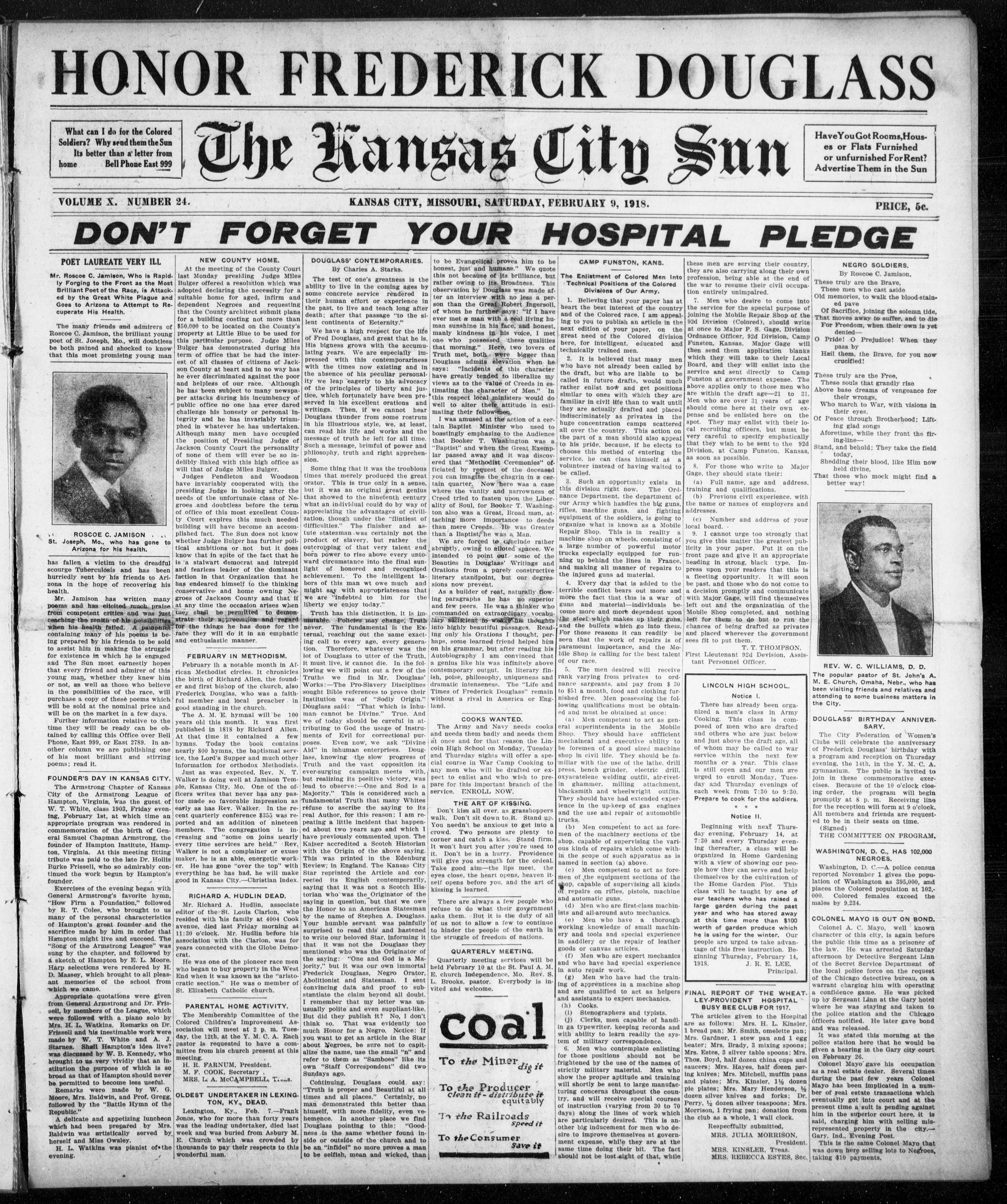
HONOR FREDERICK DOUGLASS
DON'T FORGET YOUR HOSPITAL PLEDGE
VOLUME X. NUMBER 24. DON'T
POET LAUREATE VERY ILL
Mr. Roscoe C. Jamison, Who is Rapidly Forging to the Front as the Most Brilliant Poet of the Race, is Attacked by the Great White Plague and Goes to Arizona to Attempt to Recuperate His Health.
The many friends and admirers of Roscoe C. Jamison, the brilliant young poet of St. Joseph, Mo., will doubtless be both pained and shocked to know that this most promising young man
has fallen a victim to the dreadful scourge Tuberculosis and has been hurriedly sent by his friends to Arizona in the hope of recovering his health.
Mr. Jamison has written many poems and has elicited much praise from competent critics and was just reaching the zenith of his possibilities when his health failed. A pamphlet containing many of his poems is being prepared by his friends to be sold to assist him in making the struggle for existence in which he is engaged and The Sun most earnestly hopes that every friend and admirer of this young man, whether they knew him or not, as well as those who believe in the possibilities of the race, will purchase a copy of these poems which will be sold at the nominal price and will be on the market in a few days.
Further information relative to the time they will be ready can be obtained by calling this Office over Bell Phone, East 999, or East 2789. In another column we are publishing one of his most brilliant and stirring poems; read it.
FOUNDER'S DAY IN KANSAS CITY.
The Armstrong Chapter of Kansas City of the Armstrong League of Hampton, Virginia, was the guest of W. T. White, class 1903, Friday evening, February 1st, at which time an appropriate program was rendered in commemoration of the birth of General Samuel Chapman Armstrong, the founder of Hampton Institute, Hampton, Virginia. At this meeting fitting tribute was paid to the late Dr. Hollis Burke Frissell, who so admirably continued the work begun by Hampton's founder.
Exercises of the evening began with General Armstrong's favorite hymn, "How Firm a Foundation," followed by R. T. Coles, who brought to us many of the personal characteristics of Hampton's great founder and the sacrifice made by him in order that Hampton might live and succeed. The "Song of the Armstrong League" was sung by the chapter, and followed by a sketch of Hampton by E. L. Moore. Harp selections were rendered by H. D. Massey, which brought to all pleasant memories of the school from which we came.
Appropriate quotations were given from General Armstrong and Dr. Frissell, by members of the League, which were followed with a piano solo by Mrs. H. L. Watkins. Remarks on Dr. Frissell and his inestimable work were made by W. T. White and A. J. Starnes. Shall Hampton's idea live? was discussed by W. B. Kennedy, who brought to us very vividly that an institution the purpose of which is so broad as that of Hampton should never be permitted to become less useful.
Remarks were made by W. G. Moore, Mrs. Baldwin, and Prof. Gregg, followed by the "Battle Hymn of the Republic."
A delicate and appetizing luncheon which had been prepared by Mrs. Baldwin was artistically served by herself and Miss Owsley.
H. L. Watkins was pianist of the evening.
The Kansas City Sun
At the meeting of the County Court last Monday presiding Judge Miles Bulger offered a resolution which was adopted declaring the necessity for a suitable home for aged, infirm and dependent Negroes and requesting that the County architect submit plans for a building costing not more than $50,000 to be located on the County's property at Little Blue to be used for this particular purpose. Judge Miles Bulger has demonstrated during his term of office that he had the interest of all classes of citizens of Jackson County at heart and in no way has he ever discriminated against the poor and helpless of our race. Although he has been subject to many newspaper attacks during his incumbency of public office no one has ever dared challenge his honesty or personal integrity and he has invariably triumphed in whatever he has undertaken. Although many men have occupied the position of Presiding Judge of Jackson County Court the personality of none of them will ever be so indelibly linked with this high office as will that of Judge Miles Bulger.
Judges Pendleton and Woodson have invariably cooperated with the presiding Judge in looking after the needs of the unfortunate class of Negroes and doubtless before the term of office of this most excellent County Court expires this much needed building will have become an accomplished fact. The Sun does not know whether Judge Bulger has further political ambitions or not but it does know that in spite of the fact that he is a stalwart democrat and intrepid and fearless leader of the dominant faction in that Organization that he has endeared himself to the thinking conservative and home owning Negroes of Jackson County and that if at any time the occasion arises when they shall be permitted to demonstrate their appreciation and regard for the things he has done for the race they will do it in an emphatic and enthusiastic manner.
FEBRUARY IN METHODISM
February 1h a notable month in African Methodist circles. It chronicles the birth of Richard Allen, the founder and first bishop of the church, also Frederick Douglas, who was a faithful member and local preacher in good standing in the church.
The A. M. E. hymnal will be 100 years old this month. It was first published in 1818 by Richard Allen. At that time it contained a few hymns. Today the book contains nearly 800 hymns, the baptismal service, the Lord's Supper and much other information for orthodox Methodists. Just as was expected, Rev. N. T. Walker is doing well at Jamison Temple, Kansas City, Mo. One of the officers writes that never has any pastor made so favorable impression as early as has Rev. Walker. In the recent quarterly conference $355 was reported and an addition of nineteen members. The congregation is increasing and "some on joins nearly every time services are held." Rev. Walker is not a complainer or exuse maker, he is an able, energetic worker. He has gone "over the top" with everything he has had, he will make good in Kansas City.—Christian Index.
RICHARD A. HUDLIN DEAD.
Mr. Richard A. Hudlin, associate editor of the St. Louis Clarion, who resided with his family at 4004 Cook avenue, died last Friday morning at 11:30 o'clock. Mr. Hudlin before his association with the Clarion, was for years connected with the Globe Democrat.
He was one of the pioneer race men who began to buy property in the West End when it was known as the "aristocratic section." He was o member of St. Elizabeth Catholic church.
PARENTAL HOME ACTIVITY.
The Membership Committee of the Colored Children's Improvement Association will meet at 2 p. m. Tuesday, the 12th, at the Y. M. C. A. Each pastor is requested to have a committee from his church present at this meeting.
H. R. FARNUM, President.
M. F. COOK, Secretary.
MRS. L. A. McCAMPBELL, Treas.
OLDEST UNDERTAKER IN LEXING
TON. KY. DEAD.
Lexington, Ky., Feb. 7.—Frank Jonos, who for more than forty years was the leading undertaker, died last week and was buried from Asbury M. E. Church which was crowded by thousands to pay their respects to this wonderful man.
KANSAS CITY, MISSOURI, SATURDAY, FEBRUARY 9, 1918.
DOUGLASS' CONTEMPORARIES.
By Charles A. Starks.
The test of one's greatness is the ability to live in the coming ages by some concrete service rendered in their human effort or experience in the past, to live and teach long after death; after that passage "to the silent continents of Eeternity."
We have a high respect for the life of Fred Douglass, and great that he is. His bigness grows with the accumulating years. We are especially impressed with this contemporariness with the times now existing and in the absence of his peculiar personality we leap eagerly to his advocacy of the principles of liberty and justice, which fortunately have been preserved in his excellent orations and writings. Then, if we cannot hear Douglass thunder from some rostrum in his illustrious style, we, at least, can read his life and works and the message of truth he left for all time. Such a message, brimful of power and philosophy, truth and right apprehension.
Some thing that it was the troublous times that merely produced the great orator. This is true only in a sense, but it was an original great genius that showed to the nineteenth century what an individual could do by way of appreciating the advantages of civilization, though under the "flintiest of difficulties." The finisher and astute statesman was certainly not the product of slavery, but rather the outropping of that very talent and born power to rise above every untoward circumstance into the final sunlight of honored and recognized achievement. To the intelligent labors of this man wt wte much and might say with appropriateness that we are "indebted to him for the liberty we enjoy today."
Truth has this distinction, it is immutable. Policies may change, Truth never. The fundamental is the External, reaching out the same exact call to every age, every generation. Therefore, whatever was the lot of Douglass to utter of the Truth, it must live, it cannot die. In the following we will point out a few of the Truths we find in Mr. Douglass' Works:—The Pro-Slavery Disciplines sought Bible references to prove their Institution was of "Sodly Origin." Douglass said: "That which is inhuman cannot be Divine." True. And we of today should be careful in attributing to God the usage of Instruments of Evil for correctional purposes. Even now, we ask "Divine Aid" in inhuman enterprises. Douglass, knowing the slow progress of Truth and the vast opposition its ever-surging campaign meets with, but realizing its positive victory, was lead to observe:—One and Sod is a Majority." This is considered such a fundamental Truth that many Whites refuse to ascribe the saying to its real Author, for this reason: I am repeating a little incident that happened about two years ago and which I have previously commented upon. The Kaiser accredited a Scotch Historian with the Origin of the above saying. This was printed in the Edenburg Review, in England. The Kansas City Star reprinted the Article and corrected its English contemporarily, saying that it was not a Scotch Historian who was the Originator of the saying in question, but that we owe the Honor to an American Statesman by the name of Stephen A. Douglass. Your humble servant was painfully surprised to read this and hastened to write our beloved Star, informing it that it was not the Douglass they mentioned who was the Originator of the saying: "One and God is a Majority," but it was our own immortal Frederick Douglass, Negro Orator, Abolitionist and Statesman. I sent convincing data and proof to substantiate the claim beyond all doubt. I remember that my letter was unusually polite and even suppliant-like. But did they publish it? No, I don't think so. That was evidently too much Honor for a Negro. Notice: If you want to get an article in the Star about Negroes, be sure not to capitalize the name, use the small "n" and refer to them as "Samboes" like its own "Staff Correspondent" did two Sundays ago.
Continuing, Douglass could say: "Truth is proper and Beautiful at all times and all places." Certainly, no man demonstrated this better than himself, with more fidelity, even vehemence. In another place we find Douglass pointing to this: "Goodness is the same whether found inside or outside of the church and to be an "infidel" no more proves a man to be selfish, mean and wicked, than
to be Evangelical proves him to be honest, just and humane." We quote this not because of its brilliance, but rather owing to its Broadness. This observation by Douglas was made after an interview with no less a person than the Great Robert Ingersoll of whom he further says: "If I have ever met a man with a real living human sunshine in his face, and honest, manly kindness in his voice, I met one who possessed these qualities that morning." Here, two lovers of Truth met, both were bigger than Douglas admits elevation when he says: "Incidents of this character have greatly tended to liberalize my views as to the value of Creeds in estimating the character of Men." In this respect local ministers would do well to alter their attitude in estimating their fellow-men.
I was amused at the action of a certain Baptist Minister who used to boastingly emphasize to the Audience that Booker T. Washington was a "Baptist" and when the Great Exemplar passed away and it was discovered that "Methodist Ceremonies" officiated by request of the deceased you can imagine the chagrin in a certain quarter. Now here was a case where the vanity and narrowness of Creed tried to fasten upon the Liberality of Soul, for Booker T. Washington also was a Great, Broad man, attaching more importance to deeds than mere Creeds. He was Greater than a Baptist he was a Man. We are forced to conclude rather abruptly, owing to allotted space. We intended to point out some of the Beauties in Douglass' Writings and Orations from a purely constructive literary standpoint, but our degressions now prevent.
As a builder of reat, naturally flowing paragraphs he has no superior and few peers. He was a thinker who commanded on extraordinary vocabulaary sufficient to weaken his thoughts into highly beautiful passages. Reading only his Orations I thought, perhaps, some learned friend helped him on his grammar, but after reading his Autobiography I am convinced that a genius like his was infinitely above contemporary output. In literary finish, poise, philosophy, uniqueness and dramatic intenseness. The "Life and Times of Frederick Douglass" remain without a rival in America or England.
COOKS WANTED
The Army and Navy needs cooks and needs them badly and needs them at once and for that reason the Lincoln High School on Monday, Tuesday and Thursday nights will offer a special course in War Camp Cooking to any men who will be drafted or expect to enlist and who wish to prepare for this important branch of the service. ENROLL NOW.
THE ART OF KISSING
Don't kiss all over, as grasshoppers walk. Don't sit down to it. Stand up. You needn't be anxious to get into a crowd. Two persons are plenty to corner and catch a kiss. Stand firm. It won't hurt you after you're used to it. Don't be in a hurry. Providence will give you strength for the ordeal. Take good aim—the lips meet, the eyes close, the heart opens, heaven it self opens before you, and the art of kissing is learned.
There are always a few people who refuse to do what their government asks them. But it is the duty of all of us not to allow a few to continue to hinder the people of the earth in the struggle of freedom of nations.
QUARTERLY MEETING
Quarterly meeting services will be held February 10 at the St. Paul A. M. E. church Independence, Mo. Rev. S. L. Brooks, pastor. Everybody is invited and welcome.
coal
To the Miner dig it
To the Producer clean it - distribute it equitably
To the Railroads speed it
To the Consumer save it
CAMP FUNSTON, KANS.
The Enlistment of Colored Men Into Technical Positions of the Colored Divisions of Our Army.
1. Believing that your paper has at heart the best interest of the country and of the Colored race, I am appealing to you to publish an article in the next edition of your paper, on the great need of the Colored division here, for intelligent, educated and technically trained men.
2. It is believed that many men who have not already been called by the draft, but who are liable to be called in future drafts, would much rather enlist now and get positions similar to ones with which they are familiar in civil life than to wait until they are actually drafted and placed indiscriminately as privates in the huge concentration camps scattered all over the country. This action on the part of a man should also appeal to his pride, because, if he elects to choose this method of entering the service, he can class himself as a volunteer instead of having waited to be called.
3. Such an opportunity exists in this division right now. The Ordnance Department, the department of our Army which handles the big guns, rifles, machine guns, and fighting equipment of the soldiers, is going to organize what is known as a Mobile Repair Shop. This is in reality a machine shop on wheels, consisting of a large number of powerful motor trucks especially equipped for running up behind the lines in France, and making all manner of repairs to the injured guns ad material.
4. Every day that is added to the terrible conflict bears out more and more the fact that this is a war of guns and material—individuals become more and more dependent upon the steel which makes up their guns, and the bullets which go into them. For those reasons it can readily be seen that the work of repairs is of paramount importance, and the Mobile Shop is calling for the best talent of our race.
5. The men desired will receive rank varying from privates to ordnance sargentals, and pay from $ 30 to $51 a month, food and clothing furnished free. Men possessing the following qualifications must be obtained and must be obtained at once:
(a) Men competent to act as general superintendents in the Mobile Shop. They should have sufficient mechanical and executive ability to be foremen of a good sized machine shop in civil life. They should be familiar with the use of the lathe, drill press, bench grinder, electric drill, oxyacatelene welding outfit, air-rivet in ghammer, milling attachment, blacksmith and wheelwright outfits. They should have had extended experience in the up-keep of gas engines and the use and repair of automobile trucks.
(b) Men competent to act as foremen of the machinery sections of the shop, capable of supervising the various kinds of repairs which come within the scope of such apparatus as is named in section (a) above.
(c) Men competent to act as foremen of the equipment sections of the shop, capable of supervising all kinds of repairs on rifles, pistols, machine and automatic guns.
(d) Men who are first-class machinists and all-around auto mechanics.
(e) Men who have a thorough working knowledge of small machinery and tools and special experience in saddlery or the repair of leather goods or canvas articles.
(f) Men who are expert mechanics and who have had special experience in auto repair work.
(g) Men who have had the training of apprentices in a machine shop and are qualified to act as helpers and assistants to expert mechanics. (h) Cooks. (i) Stenographers and typists. (j) Clerks, men capable of handling ga typewriter, keeping records and with ability to learn readily the system of military correspondence. 6. Men who contemplate enlisting for those positions should not be frightened by the use of the names of strictly military material. Men who show the proper aptitude and training will shortly be sent to large manufacturing concerns throughout the country, and will receive special courses of instruction (varying from 30 to 70 days) along the lines of work which are particularly desired. This is another big inducement for men who desire to improve themselves at government expense, while they are at the same time doing their bit. The fact should not be lost sight of that, while
these men are serving their country, they are also carrying along their own profession, being able at the end of the war to resume their civil occupation entirely unimpaired.
7. Men who desire to come into the service for the special purpose of joining the Mobile Repair Shop of the 92d Division (Colored), should write at once to major P. S. Gage, Division Ordnance Officer, 92d Division, Camp Funston, Kansas. Major Gage will then send them application blanks which they will take to their Local Board, and they will enlist into the service and sent directly to Camp Funston at government expense. The above applies only to those men who are within the draft age—21 to 31. Men who are over 31 years of age should come here at their own expense and be enlisted here on the spot. They may enlist with their local recruiting officers, but must be very careful to specify emphatically that they wish to be sent to the 92d Division, at Camp Funston, Kansas, as soon as possible.
8. For those who write to Major Gage, they should state their:
(a) Full name, age and address, training and qualifications.
(b) Previous civil experience, with the name or names of employers and addresses.
(c) Number and address of your local board.
9. I cannot urge too strongly that you give this matter the greatest publicity in your paper. Put it on the front page and give it an appropriate heading in strong, black type. Impress upon your readers that this is a fleeting opportunity. It will soon be past, and those who do not come to a decision promptly and communicate with Major Gage, will find themselves left out and the organization of the Mobile Shop completed, and nothing left for them to do but to run the chances of being drafted as privates and placed wherever the government sees fit to put them.
T. T. THOMPSON,
First Lieutenant 92d Devision, Assistant Personnel Officer.
LINCOLN HIGH SCHOOL.
There has already been organized a men's class in Army Cooking. This class is composed of men who are drafted and others who are just below and just above the draft age, all of whom may be called to war service within the next few months or a year. This class is still open and our men are urged to enroll Monday. Tuesday and Thursday evenings of each week from 7:30 to 9:30. Prepare to cook for the soldiers.
Notice II.
Beginning with next Thursday evening, February 14, at 7:30 and every Thursday evening thereafter, a class will be organized in Home Gardening with a view of showing our people how they can serve and help themselves by the cultivation of the Home Garden Plot. This class will be taught by one of our teachers who has raised a large garden during the past year and who has stored away at this time more than $100 worth of garden produce which he is using for the winter. Our people are urged to take advantage of this free instruction. Beginning Thursday, February 14, 1918. J. R. E. LEE,
FINAL REPORT OF THE WHEAT-
LEY-PROVIDENT HOSPITAL
BUSY BEE CLUB FOR 1917.
The articles given to the Hospital are as follows: Mrs. H. L. Kinsler, 1 bread pan; Mr. Smith, omelette pan; Mrs. Gardner, 1 stew pan and 1 egg beater; Mrs. Brady, 3 mixing spoons; Mrs. Estes, 3 silver table spoons; Mrs. Thos. Boyd, half dozen china cups and saucers; Mrs. Hayes, half dozen paring knives; Mrs. Mitchell, muffin pans and plates; Mrs. Kinsler, $1\frac{1}{2}$ dozen pie plates; Mrs. Mary Henderson, $1\frac{1}{2}$ dozen silver knives and forks; Dr. Perry, $1\frac{1}{2}$ dozen silver teaspoons; Mrs. Morrison, 1 frying pan; donation from the club as a whole, 1 wall clock.
Respectfully submitted,
MRS. KINSLER, Treas.
MRS. REBECEA, ESTES. Sec.
PRICE, 5c.
NEGRO SOLDIERS.
By Roscoe C. Jamison.
These truly are the Brave,
These men who cast aside
Old memories, to walk the blood-stained pave
Of Sacrifice, joining the solemn tide,
That moves away to suffer, and to die
For Freedom, when their own is yet denied—
O Pride! O Prejudice! When they pass by
Hail them, the Brave, for you now crucified!
These truly are the Free,
These souls that grandly rise
Above base dreams of vengeance for
their wrongs,
Who march to War, with visions in
their eyes.
Of Peace through Brotherhood; Lifting glad songs
Aforetime, while they front the firingline—
Stand, and behold; They take the field today,
Shedding their blood, like Him now
held divine,
That those who mock might find a better way!
A.
The popular pastor of St. John's A. M. E. Church, Omaha, Nebr., who has been visiting friends and relatives and attending to some business matters in the City.
DOUGLASS' BIRTHDAY ANNIVERSARY.
The City Federation of Women's Clubs will celebrate the anniversary of Frederick Douglass' birthday with a program and reception on Thursday evening, the 14th, in the Y. M. C. A. gymnasium. The public is invited to join in these commemorative exercises. Because of the 10 o'clock closing order, the program will begin promptly at 8 p.m. Receiving line for the reception will form at 9 o'clock. All members and friends are requested to be in their seats on time. (Signed) THE COMMITTEE ON PROGRAM.
WASHINGTON, D. C., HAS 102,000
NEGROES.
Washington, D. C.—A police census reported November 1 gives the population of Washington as 395,000, and places the Colored population at 102,000. Colored females exceed the males by 9,234.
COLONEL MAYO IS OUT ON BOND.
COLONEL MAYO IS OUT ON BOND.
Colonel A. C. Mayo, well known character of this city, is again before the public this time as a prisoner of the law. He was arrested Saturday afternoon by Detective Sergeant Linn of the Secret Service Department of the local police force on the request of the Chicago detective bureau, on a warrant charging him with operating a confidence game. He was picked up by Sergeant Linn at the Gary hotel where he was staying and taken to the police station and the Chicago officers notified. He later gave bond and was released.
It was stated this morning at the police station here that he would be given a hearing in the Gary city court on February 26.
Colonel Mayo gave his occupation as a real estate dealer. Several times during the past few years Colonel Mayo has been implicated in a number of real estate transactions which eventually got into court and at the present time a suit is pending against him in the superior court here, it is said, charging him with selling misrepresented property in the city.—Gary, Ind., Evening Post.
This is the same Colonel Mayo that was down here selling lots to Negroes, taking $10 payments.
---
If Your Business Is Not Worth Advertising,
ADVERTISE YOUR BUSINESS IN The Sun
NELSON C. CREWS, Editor
MME A. MOORE
Teacher of
Piano and Voice
Bell Phone East 5407
Alpha Apartments
22d and Paseo
Service AND Satisfaction
are what you get
when you patronize
C. A. FRANKLIN
THE PRINTER
1309 East 18th St
Bell Phone Grand 2988
Coal and Feed
Don't wait—Order your Coal now.
Full Weight—Quick Delivery.
PAYNE COAL CO.
1902 Vine St.
Phones, Home East 4132-Bell East 559
If you want the business of 40,000 Negroes who spend approximately $200,000 per month
We reach the buying public of both cities and surrounding communities, and we solicit for them only the most reliable firms. The buying public patronizing our advertisers are certain to be treated courteously, find goods as advertised and receive quality and service
NEW AND SECOND
HAND GOODS
Bought, Sold, Exchanged
TERMS IF DESIRED
Bell Phone East 3851
2224 Vine Street
Kansas City, Mo.
Eyes Examined
If you have discovered that you cannot see so well as you once did, or are troubled with headaches, or eye strain, come to us and we will examine your eyes and tell you whether you need Glasses or not.
Broken Lenses Duplicated in Shortest Possible Time.
THE KANSAS CITY SUN, SATURDAY, FEBRUARY 9, 1918.
AMONG THE CHURCHES
Call Our Advertising Representative for Rates
Bell Phone East 999 1803 E.18th Street
EBENEZER A. M. E. CHURCH.
The pastor, Rev. Osborne delivered a forceful, instructive gospel sermon Sunday morning to a large audience, subject, "You Are Excused."...Numbers of persons stood for prayer. Collection $108.40....The S. S. Missionary program Sunday afternoon, presided over so gracefully and enthusiastically by Mrs. Josephine Abernathy the President, was in every way uplifting and inspiring. Papers by mesdames Sarah Hopkins, Katie Knox and the address by Rev. T. J. Clark rang with the missionary spirit, the song by little Ruth Ross and Rebecca Smith, readings by Elizabeth Dimery and Edith Greenlee were in keeping and wel lrendered—Mrs. Bessie Mason, President of the Art Club presented the trustees $25 Sunday....The improvement board will give a Valentine entertainment February 14, and a cap and tie will be given each lady and gentleman at the door, also a Valentine Post Office. Mail your friends a Valentine....Brother Geo. Holler who brought in the largest amount of pennies and won the silk shirt, is still holding the banner for Class 3....Rev. W. C. Williams was present at class on Tuesday evening....He told of the great work being done in Omaha....The Usher's board is rehearsing for the great comic Drama "From Pumpkin Ridge," for February 22....Mrs. Katie Brookins entertained at an elaborate six course dinner complimentary to her daughter and husband....Rev. and Mrs. A. B. Harris who left Wednesday night for Grand Junction, Colo. Rev. Harris will have charge of the A. M. E. church at that place....Among the guest present were Rev. W. C. Williams, Rev. and Mrs. W. T. Osborne and Mrs. M. A. Ford....Penny reports were made Sunday by mesdames Edna Johnson, Helen Williams and Miss Fisher....All holding cards will please report....The public is welcomed to all services at Ebenezer....The Sunday school is wonderfully growing....Mrs. Roberts Supt....The Ladies adult class, Mrs. Sewell teacher, the gentleman's Bible class, Mr. Ross teacher, the boys
class, Mrs. Osborne teacher, have doubled in membership....The Christian Endeavor at 7 P. M....Mrs. S. E. Dimery, Pres., is also wide awake ....There is something for everybody to do....Come to Ebenezer and we will do you good.
SECOND BAPTIST CHURCH
All of the services were well attended last Sunday. "In the Image of God" was the pastor, Dr. Bacote's beautiful sermon last Sunday morning which was greatly enjoyed by all present. The evening services were devoted to the regular monthly covenant meeting and the Lord's supper which was partaken of by a representative membership....The Mission circle held its regular weekly meeting at the home of Mrs. J. R. E. Lee, 2400 Flora Avenue last Friday at 2:30 P. M. The meeting was very interesting and profitable....The Church has a service flag in the lecture room containing five stars which indicates that five sons of this Church have answered the call to the colors in the defense of our flag and nation. The Church is holding a series of special prayer meetings in preparation for a great drive to be launched soon with God's help against Satan. All strangers in the city are especially invited to share our church home.
THE Young Women's Missionary Circle had a profitable meeting Wednesday with Mrs. Iva Jackson, 2117 Bellfontaine St....The Banquet given the Bible School Friday night was an extraordinary occasion and was a success both socially and financially.... The Aid Society had a large attendance and a good meeting with Mrs. P. C. Kincade, 1605 Virginia Ave., Tuesday afternoon. They will give a spelling match and program at the church Friday night, February 15th. Reward to the first and second best spellers. Prof. H. L. Cox of "Windel Phillips" is asked to pronounce the words. Free lunch will be served by the society....The Bible school had both an increased attendance and offering Sunday....The church services were well attended in the morn-
VINE. ST. BAPTIST CHURCH.
Services were well attended Sunday
...Mrs. Willie Mack is some better
at this writing....Rev. Boaz, who was
so very sick, is able to be out again
...Mr. Geo. W. Taylor, who was
confined to his bed Sunday and Monday,
is able to be up again. We hope all
the sick will continue to improve.....
The church held its regular election
and re-elected all of the officers of
last year. We hope them much success
during the ensuing year.
ST. STEPHEN'S BAPTIST CHURCH.
All services were well attended Sunday. At 11:00 a.m. m. Dr. A. B. Harris, formerly of Texas, occupied the pulpit and preached from 1 Peter, 1st Chap. 23rd verse on "Standing On a Rock." At 1:00 p. m. the funeral of Sister Virginia Moore was preached by Rev. Hurse, assisted by Rev. Wm. H. Thomas of Allen Chapel. Sister Moore was a faithful member of this Church. The funeral was held under the auspices of Household of Ruth of which she had been a faithful member for thirty years. At 4:00 p. m., Dr. Hurse and congregation visited Morning Star Baptist Church and assisted in the service. The pastor occupied the pulpit at the evening service, preaching on the subject of "Life's Railway to Heaven," after which Mrs. Chester Sims sang very sweetly "Life's Railway to Heaven." There were nine additions and three for baptism. Monday, February 4th, Dr. Hurse, congregation and choir were invited to Mt. Zion Baptist church, Kansas City, Kansas, to preach the installation sermon to the officers of that church. Deacon J. H. Williams and sister, Lillie Gaines were quietly married by Dr. Hurse in
For twelve years we have served you. We have never substituted nor given you an inferior article. We carry everything in the Drug line, all the latest and best toilet articles. We deliver anything to any part of the city -- promptly -- call us up.
WILLA M. GLENN, Manager
Kansas last week. The Choir concert promises to be one of the best ever held in St. Stephen's. Don't forget the date February 22nd.
ALLEN CHAPEL.
Dr. William H. Thomas delivered a fine sermon Sunday morning on the patience of Job, text. Job 42: 10. Subject, "How Job Won." The lecture room was filled to its capacity and everyone seemed to catch the inspiration which was manifested by the speaker....The Intermediate Endeavor Society met at the home of Mrs. Lulu Madison, Sunday, February 3. Officers were installed....The Junior Endeavors met with Miss Dorothy Johnson. Mrs. A. Coleman, leader....The Douglass Hospital Club turned over to the trustees $21.50—one-half of the net proceeds from the Wiseman recital....The four boards of stewardesses met with Mrs. R. W. Foster last Thursday afternoon....Several members of Allen Chapel
subscribed for the "Kansas City Sun" to be sent to Camp Funston.....Mrs. Fannie J. Dawley presented the Allen Service Flag Sunday morning, bearing seven stars.....Get a tag Sunday and tag those who do not come to church regularly and induce them to come to church Sunday, February 17, which is "Everybody at Church Sunday" in Kansas City.....An open letter, written by the young man enroute to Camp Funston from Utah and who joined this church, was read by the pastor to the congregation Sunday morning. We were glad to note several young men in uniform present.....Douglass Day will be observed by the Douglass Hospital Club, Thursday, February 14, at the hospital, 312 Washington boulevard, Kansas City, Kans. Open house from 3 to 5 p. m. Light refreshments served. Addresses will be made by several of our leading men. Everyone is invited to come.
WASHINGTON SIDELIGHTS
Servants Hardest Things to Find in Washington.—"Mrs. Washn't'n, deed Ise gwine t' quit you all. Ise so but Ise got t' do it—Goo'by—Goo'by," said the dusky pantry queen had worked in the senator's family for years with more or less satisfaction
s to Find in Washington need Ise gwine t' quilt you all. Ise sorry, "by," said the dusky pantry queen who or years with more or less satisfaction.
Servants Hardest Things to Find in Washington
WASHINGTON.—"Mrs. Wash'n'tn, deed Ise gwine t' quit you all. Ise sorry, but Ise got t' do it—Goo'by—Goo'by," said the dusky pantry queen who had worked in the senator's family for years with more or less satisfaction.
"You're not going to leave us?" inquired Mrs. Washington.
"Deed Ise got t' leave—goo'by—goo'by," returned Miranda. "Ise gwine t' wo'k in one ob dem musicians factries—gwine t' git three delas uh day an' gits mah nights offen all de time an' mah holidays an' kin go see de parades on dem natural holidays. An' Ah doan haf t' wo'k on Sundays—no more—goo'by."
"But look at the risk you are taking; look at the dangers of working with explosives," cautioned Mrs. Washington, entreating the cook to remain.
"Deed taint no dangers, Mrs. Wash'n'tn, you jes gits blowed up onc in a while. In de kitchen you gits burnt up and scalded an' dar you is; but in de musicians factries you jes gits exploded all t' pieces an' whar is you? Ain't dat better?"
hington, entreating the cook to remain.
sh'n't'n, you jes gits blowed up onct in a
p and scalded an' dar you is; but in de
all t' pieces an' whar is you? Ain't dat
"Deed taint no dangers, Mrs. Washington, encreating the cook to remain.
"Deed taint no dangers, Mrs. Washington'n'tn, you jes gits blowed up onct in a whille. In de kitchen you gits burn up and scalded an' dar you is; but in de musicians factories you jes gits exploded all t' pieces an' whar is you? Ain't dat better?"
"Well, will you send me your sister, Blanches?"
"She bin wo'kin' three months in de 'ospital gittin' two dollars a day."
"How about your other sister, Rose?"
"Mah goodness, she's uh lady! She's runnin' de elevator in dat big depaht-ment house on Connecticut avenue an' gittin' twelve dollars uh week. She doan do nothin' but push uh il' il' han'le, an' ride upstairs an' push uh il' il' han'le again an' say 'Wash, yo' step, please'—real polite, like dat—an' den go downstairs agin an' read uh book all de res' ob de day. She ain't nevah goin' t' wok no more!"
This is not fiction; it is plain, serious fact that confronts the housekeepers in Washington. Servants are the hardest things in this city to find. The call to the factories and the government has depleted their ranks.
Capital Rapidly Becoming an Educational Center
UNLESS present signs fail, one important result of the war which will be of lasting duration will be the making of Washington the most influential publishing and educational center of the United States. This will fulfill one of George Washington's dreams of the
he's runnin' de elevator in dat big depaht-
gittin' twelve dollars uh week. She doan
hide upstairs an' push uh il' han'le again
slite, like dat—an' den go downstairs again
She ain't nevah gain' t wo'k no more!"
ous fact that confronts the housekeepers
best things in this city to find. The call
was depleted their ranks.
ing an Educational Center
Important result of the war which will be of
ing of Washington the most influential
the United States. This will fulfill one
"Mah goodness, she's uh lady! She's runnin' elevator in dat big department house on Connecticut avenue an' gittin' twelve dollars uh week. She doan do nothin' but push uh li'l han'le, an' ride upstairs an' push uh li'l han'le again an' say 'Wash, yo' step, please—real polite, like dat—an' den go downstairs again an' read uh book all de res' ob de day. She sn't nevah goin' t' wo'k no more!" This is not fiction; it is plain, serious fact that confronts the housekeepers in Washington. Servants are the hardest things in this city to find. The call to the factories and the government has depleted their ranks.
Capital Rapidly Becoming an Educational Center
UNLESS present signs fall, one important result of the war which will be of lasting duration will be the making of Washington the most influential publishing and educational center of the United States. This will fulfill one of George Washington's dreams of the
PRINTING CENTRE
EDUCATION
ark incident to the war which the govern-
York and Boston have regarded them-
western hemisphere and of the two New
over, government publications are being
at their prestige is jeopardized. In add-
lure, and it is understood many more are to
cities. Some two hundred periodical
in Washington.
being done at Washington, or at least
at Washington is gaining much prestige
the George Washington university in this
con and it was his dream to make the
ing and education.
is at Washington, and Georgetown uni-
ly, also is located here.
Has Her Day in the House
whom reached the capitol before seven
ing with door tenders in a vain attempt
cries the day of the vote on suffrage, a
the enormous volume of publishing work incident to the war which the government has felt called upon to do. New York and Boston have regarded the selves as the publishing center of the western hemisphere and of the two New York has held the lead. Now, however, government publications are be issued at such a tremendous rate that their prestige is jeopardized. In a nation, many magazines are published here, and it is understood many more are be published, some moving from other cities. Some two hundred period publications are now being mailed from Washington.
So much scientific work now is being done at Washington, or at least directed from the national capital, that Washington is gaining much press as a center of science and education. The George Washington university in city was founded by George Washington and it was his dream to make national capital a great seat of learning and education.
The Catholic University of America is at Washington, and Georgetown university, one of the oldest in the country, also is located here.
Miss Jeannette Rankin Has Her Day in the House
WHILE scores of women, some of whom reached the capitol before seeing o'clock in the morning, were fighting with door tenders in a vain attempt to force their way into the house galleries the day of the vote on suffrage
the enormous volume of publishing work incident to the war which the government has felt called upon to do. New York and Boston have regarded themselves as the publishing center of the western hemisphere and of the two New York has held the lead. Now, however, government publications are being issued at such a tremendous rate that their prestige is jeopardized. In addition, many magazines are published here, and it is understood many more are to be published, some moving from other cities. Some two hundred periodical publications are now being mailed from Washington.
So much scientific work now is being done at Washington, or at least directed from the national capital, that Washington is gaining much prestige as a center of science and education. The George Washington university in this city was founded by George Washington and it was his dream to make the national capital a great seat of learning and education.
The Catholic University of America is at Washington, and Georgetown university, one of the oldest in the country, also is located here.
Miss Jeannette Rankin Has Her Day in the House
WHILE scores of women, some of whom reached the capitol before seven o'clock in the morning, were fighting with door tenders in a vain attempt to force their way into the house galleries the day of the vote on suffrage, a modest little woman, low voiced and rather timid, was sitting among 400 congressmen on the main floor of the house of representatives watching them do exactly what she wanted them to.
That woman was Jeannette Rankin of Montana, the only woman ever elected to congress. It was "her day." Several thousand men and women who filled the galleries of the house looked down on her, and all realized that hers had been no small part in the
victorious fight. The speaker rapped for order. Congressmen opposed suffrage and those for it quarreled over the time the resolution should be bated.
The main doors directly in front of the speaker swung open. Miss Rankin entered. A black stole was thrown over her left arm. She held a bunch sweetheart rosebuds, tied with yellow tulle, in her right hand. From force habit she dropped into a seat in next to the last row.
She got up immediately and went to the big mahogany table half way down the floor. Members taking an active part in the passage of bills alight there. Miss Rankin threw her bouquet carelessly on the table.
Mondell of Wyoming, referred to by "Joe" Fordney of Michigan as "Wyoming geyser," because he gushes so much in debate, leaned over back of Miss Rankin's chair. He gave her a tip on how to get the resolution through. She smiled and nodded understandingly.
Chairman Baker of the suffrage committee left his place at the table. He had brought his committee clerk to the floor to handle his papers. It was first time there ever had been a young woman clerk on the house floor. The will be more when suffrage is universal. She had on a black silk dress, with silk patch pockets, and collar of the same material with two sharp points front.
Walsh of Massachusetts suggested that Baker allow, Miss Rankin to offer the arguments for suffrage. Baker was embarrassed, but agreed. Miss Rankin put her hand on the reading stand and looked at the speaker for recognition. She made a quiet speech for suffrage and was given close attention. It finished before her time expired and returned to her seat amid applause.
Government Clerks Likely to Get More Pay Soon
T SEEMS as if the much-maligned government clerk is soon to come into own. He has suffered for a long time on small wages. But now there several bills in congress designed to help this financial situation. One of the
for order. Congressmen opposed to
or the time the resolution should be de-
fect the speaker swung open. Miss Rankin
over her left arm. She held a bunch of
tuille, in her right hand. From force of
to the last row.
to the big mahogany table half way
active part in the passage of bills always
quiet carelessly on the table.
by "Joe" Fordney of Michigan as the
so much in debate, leaned over the
other a tip on how to get the resolution
standingly.
committee left his place at the table. He
floor to handle his papers. It was the
woman clerk on the house floor. There
l. She had on a black silk dress, white
name material with two sharp points in
that Baker allow Miss Rankin to open
embarrassed, but agreed. Miss Rankin
looked at the speaker for recognition,
and was given close attention. She
returned to her seat amid applause.
How to Get More Pay Soon
Government clerk is soon to come into his
home on small wages. But now there are
up this financial situation. One of these
victorious fight. The speaker rapped for order. Congressmen opposed to suffrage and those for it quarreled over the time the resolution should be debated.
The main doors directly in front of the speaker swung open. Miss Rankin entered. A black stole was thrown over her left arm. She held a bunch of sweetheart rosebuds, tied with yellow tule, in her right hand. From force of habit she dropped into a seat in next to the last row.
She got up immediately and went to the big mahogany table half way down the floor. Members taking an active part in the passage of bills always sit there. Miss Rankin threw her bouquet carelessly on the table.
Mondell of Wyoming, referred to by "Joe" Fordney of Michigan as the "Wyoming geyser," because he gushes so much in debate, leaned over the back of Miss Rankin's chair. He gave her a tip on how to get the resolution through. She smiled and nodded understandingly.
Chairman Baker of the suffrage committee left his place at the table. He had brought his committee clerk to the floor to handle his papers. It was the first time there ever had been a young woman clerk on the house floor. There will be more when suffrage is universal. She had on a black silk dress, white silk patch pockets, and collar of the same material with two sharp points in front.
Walsh of Massachusetts suggested that Baker allow, Miss Rankin to open the arguments for suffrage. Baker was embarrassed, but agreed. Miss Rankin put her hand on the reading stand and looked at the speaker for recognition. She made a quiet speech for suffrage and was given close attention. She finished before her time expired and returned to her seat amid applause.
Government Clerks Likely to Get More Pay Soon
T SEEMS as if the much-maligned government clerk is soon to come into his own. He has suffered for a long time on small wages. But now there are several bills in congress designed to help this financial situation. One of these measures, known as the Keating bill, stipulates temporary salary increases for employees making $2,500 or less. The increases graduate from 5 to 30 per cent.
Another measure, known as the Nolan bill, provides that no person who has been in the employ of the government for three years and who is twenty years old shall receive less than $3 per day, $90 per month, or $1,080 per year.
ills, and it seems likely that one, if not living has increased so much in Washing- clerks to receive higher wages in order is ideal. The Keating bill is only forolan bill the clerks say that there are they receive more than $3 per day, still less there is a strong likelihood that stillification of salaries will be drawn up
congressional committees upon these bills, and it seems likely that one, if not both, will pass congress. The scale of living has increased so much in Washington that it is declared necessary for the clerks to receive higher wages in order to get along.
congressional committees upon these bills, and it seems likely that one, if not both, will pass congress. The scale of living has increased so much in Washin- ton that it is declared necessary for the clerks to receive higher wages in order to get along.
Neither of the bills is regarded as ideal. The Keating bill is only a temporary relief. In the case of the Nolan bill the clerks say that there are many in the ranks who, even though they receive more than $3 per day, so need more money.
Even if both these bills pass congress there is a strong likelihood that so another bill carrying a complete reclassification of salaries will be drawn and present
Neither of the bills is regarded as ideal. The Keating bill is only for temporary relief. In the case of the Nolan bill the clerks say that there are many in the ranks who, even though they receive more than $3 per day, still need more money. Even if both these bills pass congress there is a strong likelihood that still another bill carrying a complete reclassification of salaries will be drawn up and present
PAPAL CITY
ISE GWINE T' WORK IN A MUSICIANS FACTORY MOW-
The government printing office is the biggest printing plant in the world, but since America's entrance into the war the capacity of that plant has been hugely overtaxed. The government has been required to let many printing contracts to private firms, in spite of the fact that the law prohibits such a practice except in case of absolute emergency. But the emergency has been absolute, because of
A woman in a suit stands in front of a window with three men behind her. One man is holding a cup of coffee, and the other two are sitting on the windowsill.
measures, known as the Keating bill, stipulates temporary salary increases for employees making $2,500 or less. The increases graduate from 5 to 30' per cent.
Another measure, known as the Nolan bill, provides that no person who has been in the employ of the government for three years and who is twenty years old shall receive less than $3 per day, $90 per month, or $1,080 per year.
Bearings are now going on before
PUBLIC SAFETY
THE KANSAS CITY SUN, SATURDAY, FEBRUARY 9, 1918
What Well Dressed Women Will Wear
UNDERWOOD &
UNDERWOOD
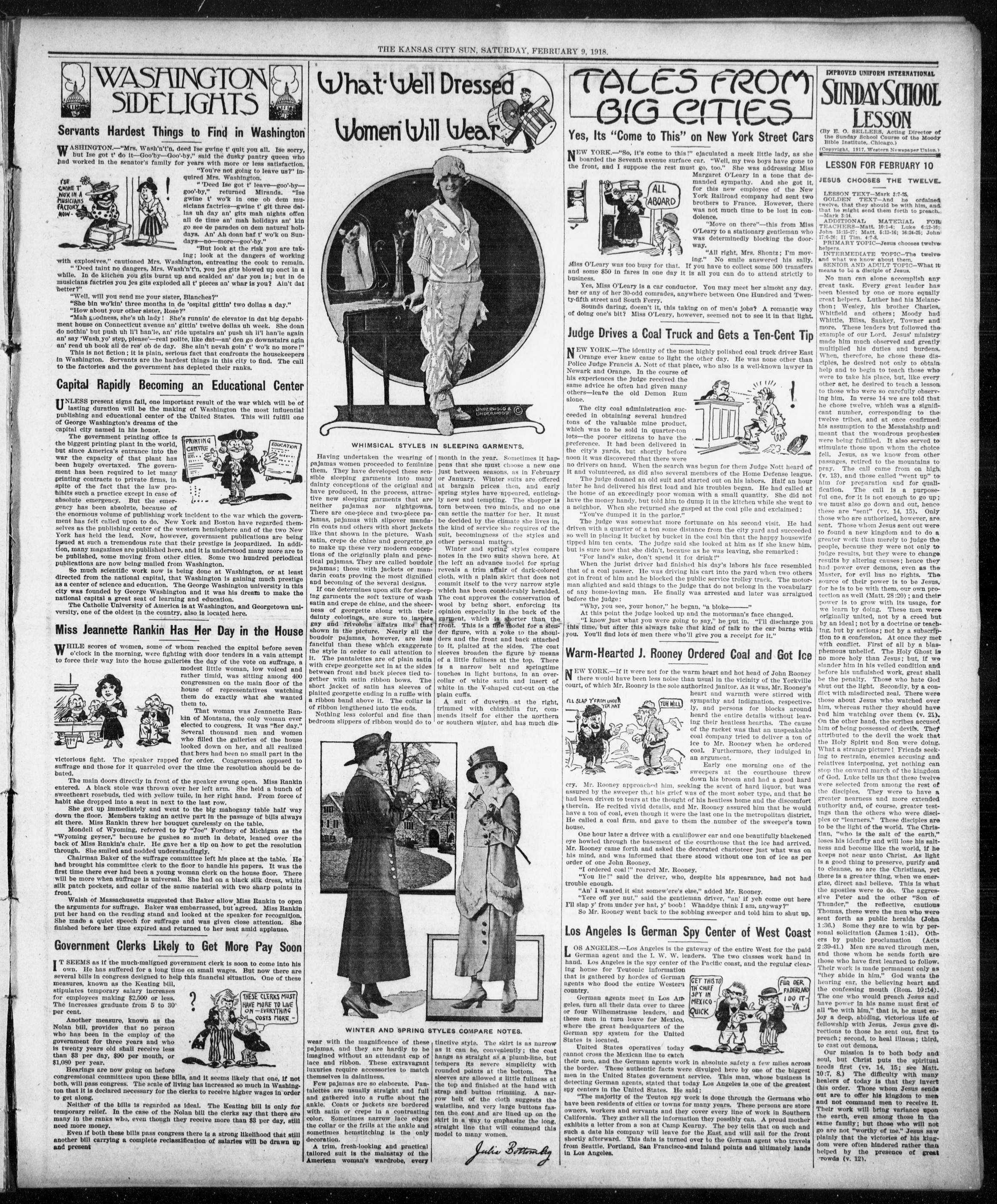
Having undertaken the wearing of pajamas women proceeded to feminize them. They have developed these sensible sleeping garments into many daimy conceptions of the original and have produced, in the process, attractive new sleeping garments that are neither pajamas nor nightgowns. There are one-piece and two-piece pajamas, pajamas with slippover mandarin coats and others with short jackets like that shown in the picture. Wash satin, crepe de chine and georgette go to make up these very modern conceptions of the originally plain and practical pajamas. They are called boudor pajamas; those with jackets or mandarin coats proving the most dignified and becoming of the several designs.
month in the year. Some pens that she must choose just between seasons, as if or January. Winter suits at bargain prices then, spring styles have appeared new and tempting. The torn between two minds, she can settle the matter for he be decided by the climate she the kind of service she reqiuit, becomingness of the other personal matters.
Winter and spring style notes in the two suits show the left an advance model reveals a trim affair of cloth, with a plain skirt the commit itself to the very
If one determines upon silk for sleeping garments the soft texture of wash satin and crepe de cline, and the sheerness of georgette along with their dainty colorings, are sure to inspire gay and frivolous affairs like that shown in the picture. Nearly all the boudoir pajamas, however, are less fanciful than these which exaggerate the style in order to call attention to it. The pantalettes are of plain satin with crepe georgette set in at the sides between front and back pieces tied together with satin ribbon bows. The short jacket of satin has sleeves of platted georgette ending in a ruffle with a ribbon band above it. The collar is of ribbon lengthened into tie ends. Nothing less colorful and fine than bedroom slimpers of ribbon would do to
THE WOOL COAT
THE FASHION OF THE TWENTIETH CENTURY
wear with the magnificence of these pajamas, and they are hardly to be imagined without an attendant cap of lace and ribbon. These extravagant luxuries require accessories to match themselves in daintaintiness.
Few pajamas are so elaborate. Pantalettes are usually straight and full and gathered into a ruffle about the ankle. Coats or jackets are bordered with satin or crepe in a contrasting color. Sometimes narrow lace edges the collar or the frills at the ankle and sometimes hemstitching is the only decoration.
A trim, fresh-looking and practical tailored suit is the mainstay of the American woman's wardrobe, every
tinctive style. The skirt is as it can be, conveniently hangs as straight as a plum tempers its severe simple rounded points at the bottlenecks are allowed a little the top and finished at the strap and button trimming row belt of the cloth suw waistline, and very large between the coat and are lined skirt in a way to emphasize straight line that will com model to many women.
month in the year. Sometimes it happens that she must choose a new one just between seasons, as in February or January. Winter suits are offered at bargain prices then, and early spring styles have appeared, entitleingly new and tempting. The shopper is torn between two minds, and no one can settle the matter for her. It must be decided by the climate she lives in, the kind of service she requires of the suit, becomingness of the styles and other personal matters.
Winter and spring styles compare notes in the two suits shown here. At the left an advance model for spring reveals a trim affair of dark-colored cloth, with a plain skirt that does not commit itself to the very narrow style which has been considerably heralded. The coat approves the conservation of wool by being short, enforcing its opinion especially in the back of the garment, which is shorter than the front. This is a fine model for a slender figure, with a yoke to the shoulders and the front and back attached to it, plaited at the sides. The coat sleeves broaden the figure by means of a little fullness at the top. There is a narrow belt and springtime touches in light buttons, in an overcollar of white satin and insert of white in the V-shaped cut-out on the plain cuffs.
A suit of duvetron at the right, trimmed with chinchilla fur, commends itself for either the northern or southern winter, and has much dis
THE WINTER COAT
tinctive style. The skirt is as narrow as it can be, conveniently; the coat hangs as straight as a plumb-line, but tempers its severe simplicity with rounded points at the bottom. The sleeves are allowed a little fullness at the top and finished at the hand with strap and button trimming. A narrow belt of the cloth suggests the waistline, and very large buttons fasten the coat and are lined up on the skirt in a way to emphasize the long, straight line that will commend this model to many women.
Julia Bottomley
TALES FROM BIG CITIES
Yes, Its "Come to This" on New York Street Cars
NEW YORK.—"So, it's come to this!" ejaculated a meek little lady, as she boarded the Seventh avenue surface car. "Well, my two boys have gone to the front, and I suppose the rest must go, too." She was addressing Miss Margaret O'Leary in a tone that demanded sympathy. And she got it, for this new employee of the New York Railroad company had sent two brothers to France. However, there was not much time to be lost in condolence.
"Move on there"—this from Miss O'Leary to a stationary gentleman who was determinedly blocking the doorway.
"All right, Mrs. Shontz; I'm moving." No smile answered his sally.
Miss O'Leary was too busy for that. If you have to collect some 500 transfers and some $50 in fares in one day it is all you can do to attend strictly to business.
Miss O'Leary was too busy for that. If you have to collect some 500 tran- and some $50 in fares in one day it is all you can do to attend strict business.
Yes, Miss O'Leary is a car conductor. You may meet her almost any her or any of her 30-odd comrades, anywhere between One Hundred and Ty-fifth street and South Ferry.
Sounds daring, doesn't it, this taking on of men's jobs? A romantic of doing one's bit? Miss O'Leary, however, seemed not to see it in that
Judge Drives a Coal Truck and Gets a Ten-Cent
NEW YORK.—The identity of the most highly polished coal truck driver Orange ever knew came to light the other day. He was none other Police Judge Francis A. Nott of that place, who also is a well-known law
If you have to collect some 500 transfers is all you can do to attend strictly to doctor. You may meet her almost any day, where between One Hundred and Twentling on of men's jobs? A romantic way never, seemed not to see it in that light.
K and Gets a Ten-Cent Tip
Most highly polished coal truck driver East the other day. He was none other than face, who also is a well-known lawyer in
Yes, Miss O'Leary is a car conductor. You may meet her almost any day, her or any of her 30-odd comrades, anywhere between One Hundred and Twenty-fifth street and South Ferry. Sounds daring, doesn't it, this taking on of men's jobs? A romantic way of doing one's bit? Miss O'Leary, however, seemed not to see it in that light
Judge Drives a Coal Truck and Gets a Ten-Cent Tip
NEW YORK.—The identity of the most highly polished coal truck driver East Orange ever knew came to light the other day. He was none other than Police Judge Francis A. Nott of that place, who also is a well-known lawyer in Newark and Orange. In the course of his experiences the judge received the same advice he often had given many others—leave the old Demon Rum alone.
The city coal administration succeeded in obtaining several hundred tons of the valuable mine product, which was to be sold in quarter-ton lots—the poorer citizens to have the preference. It had been delivered in the city's yards, but shortly before
was begun for them Judge Nott heard of members of the Home Defense league. started out on his labors. Half an hour and his troubles began. He had called at an with a small quantity. She did not dump it in the kitchen while she went to sped at the coal pile and exclaimed: fortunate on his second visit. He had stance from the city yard and succeeded in the coal bin that the happy housewife she looked at him as if she knew him, he as he was leaving, she remarked: or drink!" heed his day's labors his face resembled in his cart into the yard when two others public service trolley track. The motorgee that do not belong in the vocabulary was arrested and later was arraigned
no drivers on hand. When the search was begun for them Judge Nott hears it and volunteered, as did also several members of the Home Defense lea-
The judge donned an old suit and started out on his labors. Half an later he had delivered his first load and his troubles began. He had call the home of an exceedingly poor woman with a small quantity. She did have the money handy, but told him to dump it in the kitchen while she wa a neighbor. When she returned she gasped at the coal pile and exclaimed "You've dumped it in the parlor."
The judge was somewhat more fortunate on his second visit. He driven with a quarter of a ton some distance from the city yard and succ so well in placing it bucket by bucket in the coal bin that the happy house tipped him ten cents. The judge said she looked at him as if she knew but is sure now that she didn't, because as he was leaving, she remarked
no drivers on hand. When the search was begun for them Judge Nott heard of it and volunteered, as did also several members of the Home Defense league.
it and volunteered, as did also several members of the Home Defense league. The judge donned an old suit and started out on his labors. Half an hour later he had delivered his first load and his troubles began. He had called at the home of an exceedingly poor woman with a small quantity. She did not have the money handy, but told him to dump it in the kitchen while she went to a neighbor. When she returned she gasped at the coal pile and exclaimed: "You've dumped it in the parlor." The judge was somewhat more fortunate on his second visit. He had driven with a quarter of a ton some distance from the city yard and succeeded so well in placing it bucket by bucket in the coal bin that the happy housewife tipped him ten cents. The judge said she looked at him as if she knew him, but is sure now that she didn't, because as he was leaving, she remarked:
"For land's sake, don't spend it for drink!"
When the jurist driver had finished his day's labors his face resent that of a coal passer. He was driving his cart into the yard when two of got in front of him and he blocked the public service trolley track. The man alighted and said things to the judge that do not belong in the vocabulary of any home-loving man. He finally was arrested and later was arrabe before the judge:
When the jurist driver had finished his day's labors his face resembled that of a coal passer. He was driving his cart into the yard when two others got in front of him and he blocked the public service trolley track. The motorman alighted and said things to the judge that do not belong in the vocabulary of any home-loving man. He finally was arrested and later was arraigned before the judge:
"Why, you see, your honor," he began, "a bloke____"
At this point the judge looked up and the motorman's face changed.
"I know just what you were going to say," he put in. "I'll discharge you this time, but after this always take that kind of talk to the car barns with you. You'll find lots of men there who'll give you a receipt for it."
"I know just what you were going to say," he put in. "T'll discharge this time, but after this always take that kind of talk to the car barns you. You'll find lots of men there who'll give you a receipt for it."
Warm-Hearted J. Rooney Ordered Coal and Got
NEW YORK.—If it were not for the warm heart and hot head of John Re there would have been less noise than usual in the vicinity of the York court, of which Mr. Rooney is the sole authorized janitor. As it was, Mr. Roo
g to say," he put in. "I'll discharge you that kind of talk to the car barring with "I'll give you a receipt for it."
Ordered Coal and Got Ice
arm heart and hot head of John Rooney an usual in the vicinity of the Yorkville authorized janitor. As it was, Mr. Rooney's
Warm-Hearted J. Rooney Ordered Coal and Got Ice
NEW YORK.—If it were not for the warm heart and hot head of John Rooney there would have been less noise than usual in the vicinity of the Yorkville court, of which Mr. Rooney is the sole authorized janitor. As it was, Mr. Rooney's heart and warmth were stirred with sympathy and indignation, respectively, and persons for blocks around heard the entire details without leaving their heatless heartths. The cause of the racket was that an unspeakable coal company tried to deliver a ton of ice to Mr. Rooney when he ordered coal. Furthermore, they indulged in an argument.
Early one morning one of the sweepers at the courthouse threw down his broom and had a good hard cry. Mr. Rooney approached him, seeking the scent of hard liquor, but was assured by the sweeper that his grief was of the most sober type, and that he had been driven to tears at the thought of his heatless home and the discomfort therein. He recited vivid details, and Mr. Rooney assured him that he would have a ton of coal, even though it were the last one in the metropolitan district. He called a coal firm, and gave to them the number of the sweeper's town house.
cry. Mr. Rooney approached him, seeking the scent of hard liquor, but assured by the sweeper that his grief was of the most sober type, and that had been driven to tears at the thought of his heatless home and the discomfort therein. He recited vivid details, and Mr. Rooney assured him that he would have a ton of coal, even though it were the last one in the metropolitan district. He called a coal firm, and gave to them the number of the sweeper's house.
One hour later a driver with a cauliflower ear and one beautifully black eye howled through the basement of the courthouse that the ice had arrived. Mr. Rooney came forth and asked the decorated charlotteer just what he his mind, and was informed that there stood without one ton of ice an order of one John Rooney.
king the scent of hard liquor, but was was of the most sober type, and that he of his heatless home and the discomfort Mr. Rooney assured him that he would the last one in the metropolitan district. them the number of the sweeper's town flower ear and one beautifully blackened the courthouse that the ice had arrived. decorated charioteer just what was on ice stood without one ton of ice as per key. despite his appearance, had not had
One hour later a driver with a cauliflower ear and one beautifully blackened eye howled through the basement of the courthouse that the ice had arrived. Mr. Rooney came forth and asked the decorated charioteer just what was on his mind, and was informed that there stood without one ton of ice as per order of one John Rooney.
"I ordered coal!" roared Mr. Rooney.
"You lie!" said the driver, who, despite his appearance, had not had trouble enough.
"An' I wanted it sint somewere's else," added Mr. Rooney.
"I'm not sure here's a case," added Mr. Roobey.
"Yere off yer nut," said the gentleman driver, "an' if yeh come out here I'll slap y' from under yer hat, y' boob! Whaddye think I am, anyway?"
"Yere off yer nut," said the gentleman driver, "an' if yeh come out! I'll slap y' from under yer hat, y' boob! Whaddye think I am, anyway?" So Mr. Rooney went back to the sobbing sweeper and told him to shu
Los Angeles Is German Spy Center of West Coast
LOS ANGELES.—Los Angeles is the gateway of the entire West for the German agent and the I. W. W. leaders. The two classes work hard hand. Los Angeles is the spy center of the Pacific coast, and the regular
man driver, "an' if yeh come out here Whaddye think I am, anyway?" bubbling sweeper and told him to shut up. Spy Center of West Coast gateway of the entire West for the paid leaders. The two classes work hand in the Pacific coast, and the regular clear-
So Mr. Rooney went back to the sobbing sweeper and told him to shut up.
Los Angeles Is German Spy Center of West Coast
Los Angeles Is German Spy Center of West Coast
LOS ANGELES.—Los Angeles is the gateway of the entire West for the paid German agent and the I. W. W. leaders. The two classes work hand in hand. Los Angeles is the spy center of the Pacific coast, and the regular clearing house for Teutonic information that is gathered by hordes of German agents who flood the entire Western country.
German agents meet in Los Angeles, turn all their data over to three or four Wilhemstrasse leaders, and these men in turn leave for Mexico, where the great headquarters of the German spy system for the United States is located.
United States operatives today cannot cross the Mexico-United States border.
in absolute safety a few miles across are divulged here by one of the biggest service. This man, whose business is today Los Angeles is one of the greatest said: Work is done through the Germans who for many years. These persons are store cover every line of work in Southern nation they possibly can. A proud mother learny. The boy tells that on such and for the East and will sail for the front over to the German agent who travels and inland points and ultimately lands
their men, and the German agents work in absolute safety a few miles away to the border. These authentic facts were divulged here by one of the bishops in the United States government service. This man, whose business detecting German agents, stated that today Los Angeles is one of the great spy centers in the United States. He said:
"The majority of the Teuton spy work is done through the Germans, have been residents of cities or towns for many years. These persons are our owners, workers and servants and they cover every line of work in South California. They gather all the information they possibly can. A proud man exhibits a letter from a son at Camp Kearny. The boy tells that on such a date his company will leave for the East and will sail for the West shortly afterward. This data is turned over to the German agent who travels from Seattle, Portland, San Francisco-and inland points and ultimately back in Los Angeles.
their men, and the German agents work in absolute safety a few miles across the border. These authentic facts were divulged here by one of the biggest men in the United States government service. This man, whose business is detecting German agents, stated that today Los Angeles is one of the greatest spy centers in the United States. He said:
"The majority of the Teuton spy work is done through the Germans who have been residents of cities or towns for many years. These persons are store owners, workers and servants and they cover every line of work in Southern California. They gather all the information they possibly can. A proud mother exhibits a letter from a son at Camp Kearny. The boy tells that on such and such a date his company will leave for the East and will sail for the front shortly afterward. This data is turned over to the German agent who travels from Seattle, Portland, San Francisco and inland points and ultimately lands in Los Angeles.
ALL
ABOARD
Newark and Orange. In the course of his experiences the judge received the same advice he often had given many others—leave the old Demon Rum alone.
The city coal administration succeeded in obtaining several hundred tons of the valuable mine product, which was to be sold in quarter-ton lots—the poorer citizens to have the preference. It had been delivered in the city's yards, but shortly before noon it was discovered that there were
I'll SLAP Y FROM LUNDER
YER HAT
YUH WILL
"I ordered coal!" roared Mr. Rooney.
ing house for Teutonic information that is gathered by hordes of German agents who flood the entire Western country. German agents meet in Los Angeles, turn all their data over to three or four Wilhemstrasse leaders, and these men in turn leave for Mexico, where the great headquarters of the German spy system for the United States is located. United States operatives today cannot cross the Mexican line to catch
(By E. O. SELLERS, Acting Director of
the Sunday School Course of the Moody
Bible Institute, Chicago.)
(Copyright 1917 Western Newman Press.)
(Copyright, 1917, Western Newspaper Union.)
LESSON FOR FEBRUARY 10
JESUS CHOOSES THE TWELVE.
LESSON TEXT—Mark 3:7-25.
GOLDEN TEXT—and he ordained
twelve, that they should be with him, and
that he might send them forth to preach.
—Mark 3:14.
ADDITIONAL MATERIAL FOR
TEACHERS—Matt. 10:1-4; Luke 6:12-16;
John 15:15-27; Matt. 5:13-16; 16:24-25; John
17:6-26; II Tim. 4:7-8.
PRIMARY TOPIC—Jesus chooses twelve helpers.
INTERMEDIATE TOPIC-The twelve and what we know about them.
SENIOR AND ADULT TOPIC - What it means to be a priest of Jesus.
No man can alone accomplish any great task. Every great leader has been blessed by one or more equally great helpers. Luther had his Melancon; Wesley, his brother Charles, Whitfield and others; Moody had Whittle, Bliss, Sankey, Towner and more. These leaders but followed the example of our Lord. Jesus' ministry made him much observed and greatly multiplied his duties and burdens. When, therefore, he chose these disciples, he desired not only to obtain help and to begin to teach those who were to take his place, but, like every other act, he desired to teach a lesson to those who were so carefully observing him. In verse 14 we are told that he chose twelve, which was a significant number, corresponding to the twelve tribes, and at once confirmed his assumption to the Messiahship and meant that the wondrous prophesies were being fulfilled. It also served to stimulate those upon whom the choice fell. Jesus, as we know from other passages, retired to the mountains to pray. The call came from on high (v. 13), and those called "went up" to him for preparation and for qualification. The call is a purposeful one, for it is not enough to go up; we must also go down and, hence these are "sent" (vv. 14, 15). Only those who are authorized, however, are sent. Those whom Jesus sent out were to found a new kingdom and to do a greater work than merely to judge the people, because they were not only to judge results, but they were to change results by altering causes; hence they had power over demons, even as the Master, for evil has no rights. The source of their power is to be Jesus, for he is to be with them, our own protection as well (Matt. 28:20); and their power is to grow with its usage, for we learn by doing. These men were originally united, not by a creed but by an ideal; not by a doctrine or teaching, but by actions; not by a subscription to a confession. At once they met with conflict. First of all by a blasphemous unbelief. The Holy Ghost is no more holy than Jesus; but, if we slander him in his veiled condition and before his unfinished work, great shall be the penalty. Those who hate God shut out the light. Secondly, by a conflict with mlsdirected zeal. There were those about Jesus who watched over him, whereas rather they should have bad him watching over them (v. 23). On the other hand, the scribes accused him of being possessed of devils. Their attributed to the devil the work that the Holy Spirit and Son were doing. What a strange picture! Friends seeking to restrain, enemies accusing and relatives interposing, yet nothing can stop the onward march of the kingdom of God. Luke tells us that these twelve were selected from among the rest of the disciples. They were to have a greater nearness and more extended authority and, of course, greater testings than the others who were disciples or "learners." These disciples are to be the light of the world. The Christian, "who is the salt of the earth," loses his identity and will lose his saltness and become like the world, if he keeps not near unto Christ. As light is a good thing to preserve, purify and to cleanse, so are the Christians, yet there is a greater thing, when we energize, direct and believe. This is what the apostles were to do. The aggressive Peter and the other "Son of Thunder," the reflective, cautious Thomas, were the men who were sent forth as public heralds (John 1:36). Some they are to win by personal solicitation (James 1:41). Others by public proclamation (Acts 2:39-41.) Men are saved through men, and those whom he sends forth are those who have first learned to follow. Their work is made permanent only as "they abide in him." God wants the hearing ear, the believing heart and the confessing mouth (Rom. 10:14). The one who would preach Jesus and have power in his name must first of all "be with him," that is, he must enjoy a deep, abiding, victorious life of fellowship with Jesus. Jesus gave directions to those he sent out, first to preach; second, to heal illness; third, to cast out demons.
Our mission is to both body and soul, but Christ puts the spiritual needs first (vv. 14, 15; see Matt. 10:7, 8.) The difficulty with many healers of today is that they invert this order. Those whom Jesus sends out are to offer his kingdom to men and not command men to receive it. Their work will bring variance upon the earth, even among those in the same family; but those who will not go are not "worthy of me." Jesus saw plainly that the victories of his kingdom were often hindered rather than helped by the presence of great crowds (v. 12).
CITY NEWS
Have you ever tried the Spotless Kitchen, 23 West 13th street, the best place in town to eat?
Mr. W. E. Moore of Columbus, O., brother of A. T. and H. B. Moore, attended the funeral of his mother, Mrs. Amanda Moore, last Sunday. He is Deputy County Treasurer of Franklin County, Ohio.
Mr. W. E. Moore, Jr., 24th Infantry Band, now stationed at Columbus, New Mexico, nephew of Mr. A. T. and H. B. Moore, attended the funeral of his grandmother, Mrs. Amanda Moore, last Sunday.
Mrs. Cozetta Kingsberry Graves left Monday en route to Indianapolis where she will join her husband, Dr. E. E. Graves.
Mr. K, M. Forney has returned after spending a week with his family in Denver.
Mrs. Fudella Blakeley is here from Los Angeles, Calif., visiting her mother, Mrs. Clara Harris, 592 Tracy avenue, for an indefinite stay.
ATTENTION
Any young woman desiring training of First Aid Work in Red Cross Work, call Negro Red Cross Headquarters, 18th and Woodland. Bell Phone, East 3014.
IN MEMORIAM
In loving remembrance of our son and brother, William G. Allen, who departed this life January 10, 1914. Gone, but by no means forgotten. We love and cherish his memory.
"Sleep, dear boy, the blessed sleep that knows no waking." Peace be to his soul.
MRS. JAMES ALLEN and FAMILY.
Mr. Amos Randall of Montgall avenue continues quite ill.
Mr. Fred W. Dabney was called to Omaha on business this week.
Mr. Chas. F. Wilson, 1209 Vine street, has been quite ill during the past week, but is gradually improving.
Rev. W. C. Williams, the popular pastor of St. John's A. M. E. Church, Omaha, Neb., and a former pastor and builder of the New Ebenezer in this city, was a welcome visitor in the city this week. Dr. Williams is looking well and is having remarkable success in his new charge.
Mr. Chas. D. Frazier, who has returned to his home at Grand Canyon, Ariz., desires The Sun to thank his many friends for the uniform, courtesies and social attentions shown him during his recent visit in this city and that he shall ever cherish that visit as one of his most pleasant memories.
Mrs. Ida Vaughn entertained the Scientific Reading Club Monday afternoon at her home, 1741 Lydia avenue.
Lieut. B. E. Watkins has returned to Camp Funston after spending the week-end with his mother, Mrs. S. H. Maser, and sister, Mrs. Ida Vaughn, 1741 Lydia avenue.
Madame Sarah Mayes is confined to her bed from ptomaine poison at her home, 1605 Tracy avenue.
The Gresham Thrift Club was entertained Tuesday evening by Cornelius Field at 1015 Euclid avenue. An excellent program was rendered.
Joseph Stokes Jr., celebrated his third birthday anniversary last Saturday February 2. A number of little friends were present and many nice presents were received.
IN MEMORIAM.
In sad and loving memory of our dear husband and father, J. A. Ferguson, who passed away one year ago February 6, 1917:
An angel in the book of life
Wrote down our darling's death;
Too beautiful for earth ,
And while we weep the angels sing
A soft and sweet accord,
To welcome our dear husband
To th eheaven above.
Sadly missed by
MRS. NORA FERGUSON, Wife.
CLARENCE FERGUSON, Son.
WILLIE FERGUSON, Son.
NOTICE.
We regret to announce to our many friends that the dance we contemplated giving February 12, must be postponed on account of all dance halls being closed on that date the fuel shortage being responsible. We hope to entertain in the very near future. Officially. The L. S. P. Club.
In Memoriam.
In loving rembrance of our
Mother
1912—February 9—1918
MOLLIE E. YOUNG,
DORA A. POWELL,
ANNA B. SMITH,
Daughters.
WM. T. THOMAS SMITH,
Grandson.
Sam Few formerly of this city and a well known hotel man died January 21 at Anaconda, Mont., of Acute Rheumatic fever. The body was brought here for interment last Sunday morning. Watkins Bros. had charge of the services. Mr. Few leavts a mother, brother, neice and other relatives and many friends to mourn his demise.
Mr. Forest Stirman, the hustling young Master of Fred Douglass Lodge 86 U. B. F. and K. C. of Watlington Camp 1 Knights of Friendship has just received his Commission as Colonel for the State of Missouri and its jurisdiction to succeed Rev. Neal Range.
CARD OF THANKS
We wish to thank our friend and relatives for their kindness and sympathy during the sickness and death of our mother, Catherine Bishop, who died January 19, 1918, and for the beautiful floral offerings.
MAMIE JONES,
TILLIE MILLER,
OLLIE BISHOP
WM, J. BISHOP,
IN MEMORIAM
In loving memory of our dear daughter, sister and aunt, Mrs. Ida Brown Kelly, who passed awa' two years ago February 6, 1916.
A dear one from us has gone,
The voice we loved is still;
How pleased we are!
Her place is vacant in our home
And never can be filled.
Sadly missed by
Mrs. Lulu Gooden, Mother,
Mrs. Mattie Davis and Family,
2446 Highland Avenue
CARD OF THANKS
We wish to thank our many friends for the hospitality shown us during our dark hour of bereavement in the death of our dear old mother, Virginia Moore, who died January 31 and was buried Sunday, February 3, from the St. Stephen's Baptist church at 1:00 P. M.
In loving re
1912—Febr
We especially wish to thank Revs. J. W. Hurse of the St. Stephens' Baptist church and Wm. H. Thomas of Allen Chapel for the splendid tribute over this veteran saint; St. Stephen's Choir for the excellent music rendered under the direction of Mrs. Sarah Bartell; Mrs. J. T. Watkins for the beautiful solo rendered; the many friends and various organizations for the beautiful floral offerings; Mrs. Minnie L. Crosthwait the florist who so tastefully and skillfully arrange the floral designs; Mr. T. B. Watkins the undertaker who rendered such painstaking and excellent service; the Busy Bee Household of Ruth of Rosedale, Kansas, assisted by the Household of Ruth of Kansas City, Missouri, headed by Mrs. Johnson District Most Noble Governess of the State of Missouri. (Our mother being a Sojourner after having placed her card with Busy Bee Household of Ruth after being a member in Ohio for 30 years.) Interment was in beautiful Highland cemetery. Resolutions read at the funeral service by Mrs. Clara Brown of South Park, Kansas, Mrs. G. Young, of Rosedale, Kansas, and Mrs. J. T. Watkins of the Odd Fellows Choir will be placed on our family record.
A. T. MOORE,
W. E. MOORE,
H. B. MOORE,
JNO. A. MOORE,
PHOEBE DOLMAN,
CLAUDIA MOORE.
Try not to use any more sugar than possible. One sweet dish is enough at a meal.
THE KANSAS CITY SUN, SATURDAY, FEBRUARY 9, 1918.
We wish to announce the death of our beloved mother, Mrs. Mary Hobbs who departed this life January 26 at the age of 74 years, fourteen days at the residence of her daughter, Mrs. D. V. Pearl, 1220 Vine street. Her body was interred in the Home cemetery at Louisiana, Mo., January 29. She leaves to mourn her loss three sons, one daughter, two brothers and a host of relatives and friends. We wish to thank our many friends here in the city and also at Louisiana, Mo. for their many acts of kindness during our bereavement.
We are thinking of you, thinking of you
And the sympathy we have for each other
But unless you've gone through
And your heart broke into
You can never tell the loss of a mother.
J. C. Hobbs, Chicago, Ill.
D. V. Pearl, 1220 Vine St., K. C., Mo.
Miss May Williams, 2410 Flora Ave
nue, returned home from a six weeks
visit with her uncle, Joe Goins at
Richmond, Mo.
A. Jackson Owsley, 71 years of age
died at the residence of his sister
Mrs. Margaret Walker, 2 Lombard
street, Kansas City, Kansas, and was
buried from the A. T. Moore Under
taking establishment last Sunday
brother Owsley was the janitor of
Allen Chapel for a number of years
He left a number of relatives among
where were Mr. and Mrs. Charles
Birch. Burial was in Woodlawn cemetry.
CHICKEN DINNER
The Chicken dinner of Jamison Temple, 1815 Paseo for 25 cents is sure pleasing. Try them once, you will go again. EVERY THURSDAY.
Dr. Paul Crosswaite, a recent arrival from Chicago, is confined to his bed, but we are hoping for a speedy recovery.—Los Angeles Advocate.
emoriam.
membrance of our
other
January 9—1918
MOLLIE E. YOUNG,
DORA A. POWELL,
ANNA B. SMITH,
Daughters.
WM. T. THOMAS SMITH,
Grandson.
CARD OF THANKS.
We thank the First Baptist Church and our friends for the many, many kindnesses to our wife, daughter and sister during her illness; and for the beautiful floral offerings at her death Mrs. Bertie Tibue Tellis was a member of Mary Magdalene Court No. 5 regular and in good financial standing.
Wicks Tellis,
Oliver Tibue,
Mrs. Mollie Tibue Allen,
Mrs. Ella Tibue Starns,
Mrs. Estelle Tibue Craig,
J. E. Tibue.
Miss Nenella Norman and Mr. Rufus Lashley who were quietly married at Topeka, Kansas, at the home of Miss Norman's sister, Mrs. Henrietta Pointer, left last week for Rochester, Minn., to reside permanently. Miss Norman was a former employee of the Kansas City Sun.
Dancing every Wednesday night at Armory Hall, Cottage and Vine Sts., from 8:00 to 12:00, Prof. Roscoe White, dancing master. Mrs. Janie White, teacher.
Mrs. M. Leatherbury of 1326 Michigan, Ave., who has been quite ill continues to improve.
Mrs. Essie Smith departed this life Monday night after a short illness. Funeral services were held at the home, 1118 Everett avenue, Thursday, at 2:00 o'clock.
DR. LON M. TILLMAN.
Dr. L. B. Tilman desires to announce to his many patrons and friends that he is now located in his own building at the northwest corner of 17th and Lydia avenue where he will be pleased to meet his patients and friends. Bell phone Grand 3843.
HAS IT PAID?
To emancipate the Negro from physical servitude of slavery and leave him a spiritual slave; this question has been asked your humble servant and in conversation with some of my friends it has been hinted to me equally as often that the task of answering, when undertaken, must find its way by the overrunning ambition of some humble servant like myself and others. I admit that I have shrunk from the task because of the responsibilities it entails, but realizing that some one no doubt has preceded me along this line and has met with severe criticism and are calling for help, and that others in my class will be likewise unfortunate; gives me courage to ask your hearty co-operation in the task. Only a few man and women can read this article and realize the seriousness of the case without asking themselves the question. Has it Paid?
Here is where our hearts should be pure. Here is where we must stand for the true principles of manhood and pure womanhood. Here is where we must stand for True Race pride. Here is where we must be awakened to the new destinies which await us; made necessary by the growth and development of the times. Therefore, I find myself placed in a position where I am compelled to pass Judgment on my fellowman. But we must not lose sight of the fact that two hundred fifty years of servitude of the Negro for the White man has left a most damnable influence upon the very Houl of the Negro. Time, Death and Education run neck and neck to efface or eliminate. Therefore, my preference along this line is well known to many of my friends and hope my position will be equally well understood.
Then comes the question, who is responsible for the present spiritual slavish ideals of the Masses? Answer: The professional class of the Negroes in every walk of life. (Many exceptions.)
Trying to break into the social enjoyments of the White man; his theatres, parks, schools, hotels, saloons and every place where he has been told that his presence is not wanted. I simply mention these places because of the fact they are places of choice to him (The Negro) and not places of a necessity, as we have them among ourselves. If the White man gives a social entertainment, say at Convention Hall in Kansas City, Mo., and invites the members of his race, without distinction, to attend, the sole purpose is to demonstrate the product of his brain o his people. If the distinguished Mr. Johnson, (colored) hears of said entertainment and the price is not more than two dollars, he (Mr. Johnson) will be on hand, if admitted, for the sole purpose of reproducing the White man's act. In order that he may be called "smart Mr. Johnson" among the Negro people, Mr. Johnson gives a social affair and personally invites Mr. George, (The White man.) to be present. So the White man (Mr. George) is at the "Smart Mr. Johnson's" social affair. His purpose, beyond a reasonable doubt, is to see Mr. Johnson reproduce the acts as they were produced by the White man.
Now those professional men of Mr. Johnson's type is the Negro of whom I am speaking and Kansas City has an inexhaustible supply, leading the masses of ignorant Negroes from the true principles of manhood and womanhood to the slavish ideals of believing the White man produces the best of everything and for that cause, as the White man believes we are depending on him for stepping stones.
To a higher type of civilization by reason of pride and not of choice, he feels justified in saying, "When 'Mr. Johnson' and his people shall visit Mr. George's places of amusement to get his pride wounded for which cause some of the very best Negroes of the two Kansas City's did appoint committees, to ask the Negroe's friend, "The Kansas City Star" "Dir your guest intend to insult us?" The 'Star' for reasons best known to itself, up to the date has failed to give "Mr. Johnson" a satisfactory reply.
Now the question may be asked, "Why do we mingle in street cars where we are not wanted And answered by sayings, "The street car is the poor man's automobile and absolutely unfortunate necessity, while the places of amusement is a matter of choice and taste. Truly did Mr. F. D" Porter of 1121 Woodland Ave.
Kansas City, Mo., in conversation with his friends say, "We should not forget the fact that there is a great social abyss between the Proud Angla-Saxon Race and the Negro Race and that the handwriting on the wall shows plainly that the Negro must change his attitude from being dependent, and assume the responsibility of independence. We have great men and great women that have made footprints upon the sand of time. Why not love and cherish their memories the same as we do Abe Lincoln or John Brown? Only a few days ago one of our Negro teachers of Kansas City, Kansas, spoke very highly of John Brown of Osowatomie as one that tried to free the slaves and we agree that John Brown deserves much credit from the Negro Freedmen. But where is poor old Nat Turner, whose bleaching bones lay buried some where in the Virginia soil and whose martyred blood still cries to an avenging God, "Free my people from under" the yoke of bondage."
Equal Rights 'to all men, special favors to none. Why do you holler? Is it not a privilege of your White brother to choose his company? Does he push himself on you or do you personally invite him to your affairs? Be men, make history for yourself. If you cannot reach the coveted prize at a single leap, advance toward it step by step and be reasonably contented so long as you are actually making some progress in the right direction. Quit being apes, be men. It would be unwise for us to draw the color line, but it is also unwire to think the White man must accept our advances. Let us stop talking Race pride in our Forums and practice what we preach.
KANSAS CITY, KAS.
By Sadie L. Rodgers.
Mrs. Ball of 1052 Freeman has been confined to her home for about a week suffering from a hemorrhage, but is improving.
Little Alice Rodgers of 323 Troupe has been sick for a few days unable to go to school.
The service flag was installed in the First A. M. E. Church Sunday morning with ten stars placed thereupon for those who have already been called to the colors. It is made of wool material and is 3x5 feet and was presented to the church through the efforts of Mrs. Willa Dwiggins and members.
Rev. J. F. Griffin left Sunday for Memphis, Tenn., Louisville, Arkansas and St. Louis.
Mrs. Godfrey of 327 Troupe avenue, who has been sick for some time, is now confined to her bed.
The Eighth Street Baptist Sewing Circle met at the home of Sister Pansy Wilson, 945 Oakland avenue, Thursday, January 31, after a delightful repast was served, they adjourned to meet with Sister Lucy Herman of 322 Troupe, February 7.
They will have a chitterling supper Saturday night, February 9, at 9:45 Washington boulevard. M. Seymour, Pres.
Mrs. Hattie Brown, who has been sick and in the Bell Hospital since November is now at her home, 932 Greely and would appreciate very much her friend's visit.
Mr. Jas. Booze of 2815 North 7th street has been home sick for a week but he is now able to go to his work.
The Communion services at the 8th Street Baptist Church Sunday, February 3, was largely attended all day and very spiritual. There was one addition to the morning services. Brother Washington of 938 Oakland.
The Sunday School is also doing good work. At the evening service Master John Williams, Vice President of the B. Y. P. U., read a very interesting paper on "Success to the Young People." Afterwards Brother Thomas Napper delivered some encouraging remarks, and then the pastor preached a very touching sermon to the young people, his text being "Every Good Purpose Comes Through Counsel."
The B. Y. P. U. service is very inspiring.
The Pleasant Green Baptist Church, Rev. Geo. McNeal, pastor, will have preaching at 11 o'clock Sunday a. m., Communion services at 3:00 and preaching at night.
The First Baptist Church is planning a big rally with 100 clubs divided into two divisions, headed by Mrs. Alice Bailey and Mrs. Lena Downs.
The Sewing Circle is doing good work under the management of Mrs. Anna Scruggs. Also the Mission Circle is succeeding nicely, being presided over by Mrs. Celia Mason.
Special sermons Sunday at 11:00 o'clock and 8 o'clock. Every one invited. Dr. Bowen, pastor.
The C. M. E. Church is doing a good work with the prospects of finishing their church this year. All the auxillaries are doing good work. Rev. H. L. Bolden is pastor.
save
Wheat Flour
By Eatinq
Loyalty
BREAD
Your Grocer will have Loyalty Bread EVERY day of the Week ORDER NOW
CLEANEST BAKERY IN THE WORLD"
U. 8. Food Administration License No. I. 21.567
Why pay more than 50 cents to get a trunk hauled?
LIVE AND LET LIVE T. T.
T. T. TIVETT
LIVE AND LET LIVE AUTO BAGGAGE AND EXPRESS
Bell Phone Grand 1266
Stand, 2109 Campbell Street
Haul Everything.
The Spo
(All tha
23 WEST
The best place in K
some,
Everything. KANSAS CITY
The Spotless Kitch
(All that its name implies)
13 WEST 13th STREET
at place in Kansas City for a Clean
some, Satisfying Meal
The best place in Kansas City for a Clean, Wholesome, Satisfying Meal
Special Dinner and Lunch at Noon
for those employed down town
MRS. PEARL RILEY,
Manager
MARTIN YOUNG
Proprietor
THE DRUG S
Service and Qual
WHITE-WOOD
Bring Your Prescri
of Absolute Accu
OUR STOCK IS C
N. W. Corner 19th an
PHONES—HOM
LYRIC HALL FOR RENT
For All Entertainments
— See —
C. H. HARRIS, Mgr.
1731 Lydia Ave.
DRUG STORE BEAUTY
Service and Quality are Paramount at the
TE-WOOD DRUG STORE
Your Prescriptions to us and be a
Absolute Accuracy and Fair Treatment
STOCK IS COMPLETE IN ALL
Corner 19th and Vine Streets. (Trans
PHONES—HOME EAST 2293, BELL E. 64
Service and Quality are Paramount at the
WHITE-WOOD DRUG STORE
Bring Your Prescriptions to us and be assured of Absolute Accuracy and Fair Treatment.
OUR STOCK IS COMPLETE IN ALL LINES
N. W. Corner 19th and Vine Streets. (Transfer Point)
PHONES—HOME EAST 2293, BELL E. 641.
Hours: to 9 a. m., 12 to 1 p. m. Hall phones, Home Main 2783, Bell Grand 3352, Residence, 2624 Euclid Ave. Res. Phone, Bell East 3429W.
RATES REASONABLE.
丰
THE FIELD
AUTO BAGGAGE AND EXPRESS TIVETT
KANSAS CITY, MO.
less Kitchen
(its name implies)
13th STREET
Kansas City for a Clean, Whole-
Satisfying Meal
MARTIN YOUNG Proprietor
STORE BEAUTIFUL
City are Paramount at the
D DRUG STORE
options to us and be assured
谅acy and Fair Treatment.
COMPLETE IN ALL LINES
Vine Streets. (Transfer Point)
E EAST 2293, BELL E. 641.
BROADWAY MUSEUM
丰
In the Dark
By GERVEISE FLOYD
[Copyright, 1917, Western Newpaper Union.]
They were old, humble, but heart-some people of the old-fashioned kind, simple in their lives, and love and friendship were exemplified as natural earnest emotions, devoid of guile. The young folks had their social gatherings, parties, barn dances and husking bees, custom and mild superstitions, like Hallowe'en fiction lending a charm to especial occasions. Quite in the course of events each Darby found his Joan, and at last Rodney Trumbull was sure he had discovered his.
There was not a sweeter or prettier girl in Rockton than Ivy Lane, and Rodney had known her for about a year. The parents of both smiled indulgedly upon the manifest mutual sentiments of the couple. Rodney regarded Ivy as a being ethereal. He was so imbued with a sense of her priceless perfection that he grew abashed when he dared to hope he was to gain the love of this peerless creature, naturally of a shy nature, he had made little progress in his lovemaking.
There was to be a party at the home of Ivy, and about a week before that Rodney saw her home from a church social. As they were about to part at the garden gate he mustered up the courage to disclose what had been urgently upon his mind for many hours. "Ivy," he said, "when I come to the party at your house next Wednesday, I want you to accept a little keepsake from me. Will you?"
"But you gave me a lovely bouquet of roses only yesterday and—" "But this isn't roses. I want to give you a ring." "Oh, Rodney—shocking!" laughed Ivy. "It's coming from the city, where I have ordered it, and if you will only wear it on your engagement finger—"
"She did not say she wouldn't accept the ring," brenthed Rodney courageously, and counted the hours till the arrival of the evening party. Ivy received him with a gracious smile that set every nerve tingling, but as the hostess of the evening she could give him no further exclusive attention. A Miss Lissle fell to his charge, partly through the efforts of the young lady in question to make it so, and in all courtesy Rodney found himself settled as partner and escort for the occasion to that flashing beauty from the city, temporarily visiting a married sister in Rockton.
Miss Lisle was a siren in a mild way. While she despised what she termed the crude social ways of Rockton, she set herself up as a desperate flirt, and had half the girls by the ears because of her audacious appropriation of their beaux. Now it seemed that she had set about the conquest of Ivy's poor lone lamb, who, although thus singled out by the brilliant queen of beauty, longed only for one moment's sweet converse with the real idol of his heart.
At last Rodney, watching his chance, saw Ivy dart through the doorway of a darkened wing room to reach the front hall as there were some arrivals. Rodney hastened into the unlit apartment. He clutched an escaping figure.
"The ring!" he whispered ardently. "Here it is. You will make me so happy to wear it on your engagement finger."
The yielding form fluttered in his arms.
"You—you wouldn't kiss me, would you?" he added in wild desperation.
A pair of lips met his own. He seemed in paradise. Voices neared. They parted precipitately. Rodney hastened back to a crowded room and sank to a chair, feeling as if the world had been won. He was in such a state of rhapsody that he wished to be alone. He looked up with a shock. He made out Ivy, and smiled at her. She seemed to turn her back on him. She was speaking to Miss Lisle, who was animatedly flourishing a ring on her engagement finger, and glancing knowingly in the direction of Rodney.
The latter was crushed. He realized the truth in a flash. He had not met and kissed Ivy in the dark, but oh; fatal blunder, Miss Lisle. She came toward him now in her artful way of gracefulness.
"I have just been telling our dear mutual friend, Miss Lane, of your pretty present," she said. "And oh! Mr. Trumbull, I promised sister to be home by eleven, and it is now nearly midnight. Won't you see to my wraps," and almost without realizing it Rodney was bustled out of the house and Miss Lisle was languishly hanging on his arm, prattling pretty nothings in the mellow moonlight. He hated himself as an arnant coward as he left Miss Lisle at the door of her sister's home. She was a flashing flame of coquery, she plainly considered that they were engaged, she insisted on his joining herself and her friends in an auto drive the next afternoon.
"I will tell her plainly of the error she is laboring under. And I must see Ivy!" resolved Rodney. But when he rang at the door bell of the Lane home the next day, Mrs. Lane received him coldly and stated that Ivy was indisposed. As Rodney went out of the
yard Ivy's father stepped up to him
yard Ivy's rather stepped up to him.
"Mr. Trumbull," he said sternly. "I don't know what you have said or done to hurt my girl's feelings, but you'll either mend them or stay away from here after this."
Rodney made one final but unsuccessful effort to reach Ivy. He went to the office of a cousin of hers, who called Ivy up on the telephone and then passed the receiver to Rodney.
"It's me, Ivy," began Rodney, tumultuously. "And I want to explain—" The air became void. Ivy had hung up the receiver.
Rodney walked aimlessly in the direction of the river. He sat down on a fallen tree and stared gloomily at the bubbling waters. A shadow caused him to look up. The old siren-like, half scornful smile habitual with her upon her lips, Miss Lisle addressed him.
"And why are you so engrossed in deep meditation, my loyal knight errant," she gibed.
"I was thinking of jumping into the river and ending it all," bluntly declaimed Rodney.
"Ending what?"
"My cowardice, my wretched poltroonly!" he blazed forth. "It was all a mistake. My kissing you."
"I know," calmly pronounced Miss Lisle. "Listen, my friend; I am going to leave Brocton for my city home tomorrow. You shall be free from the leal service I have so cruelly commanded. I fear I am a heartless jade and coquetry my bane. In the su
A man and a woman are kneeling by a stream, with a tree in the background. The man is holding a hat and a stick, while the woman is gesturing towards the stream.
perficial city my wiles harm little. Here, among good, honest souls, it is wicked. I am ashamed of myself." "But Ivy," began Rodney, "and the
"But Ivy," began Rodney, "and the ring?"
She showed him that it was no longer on her hand.
"Come with me," she said, "and I will show you where it is now."
He was puzzled, dejected, hopeful, all at the same time. A stranger to feminine wiles, he did not seem to fathom the variable caprices of the whimsical beauty except by following her dumbly.
She led him to her sister's home, and to the door of its parlor room.
"You will find the ring in there—where it belongs," she said. "I fancied it fine to make sport of a bumpkin lover. Believe me, I have sunk far in my own estimation."
She opened the door, and he saw Ivy. And upon her finger—and on the engagement one—was the ring, and the strenu's reparation was complete. And Ivy put both her hands in his, and there they stood, blissful.
DEPOTS COVER MANY ACRES
Largest Railway Station in the United Kingdom Is Waterloo—Others of Large Size.
The distinction of being the largest railway station in the United Kingdom belongs to Waterloo, the terminus of the London and South-Western railway. This station covers an area of $24\frac{1}{2}$ acres, and has 23 platforms, including two belonging to the Bakerloo railway. The longest platform measures 720 feet, and nearly 1,100 trains arrive and depart daily.
Waverly station, Edinburgh, with 19 platforms, the longest of which is 1,680 feet in length, covers 18 acres; whilst other stations which lay claim to distinction on account of their size are Liverpool street, 18 platforms; Clapham Junction and Glasgow (Central), 17 platforms; Victoria and Crewe, 16 platforms; Euston, Birmingham (New street), and Newcastle (Central), 15 platforms.
Waverly station does not stand alone in the possession of a platform over 1,000 feet in length. Victoria and Crewe have platforms measuring 1,500 feet and 1,509 feet respectively, while at Newcastle (Central) and York stations there are platforms 1,389 feet and 1,480 feet in length.
One thousand seven hundred and thirty trains either pass through or stop at Clapham Junction every 24 hours.
Keep Busy.
Flatbush—I'm afraid I'll get stale on my garden work during the winter.
Bensonhurst—For why? Haven't you got a snow shovel?
THE KANSAS CITY SUN. SATURDAY. FEBRUARY 9. 1918
Cinderella's
Diary
By HILDA MORRIS
(Copyright, 1917, by the McClure Newspaper Syndicate.)
The girl was very young and pretty, but she looked tired. John Arnold, sitting opposite her in the street car, noticed her closed eyes and general air of fatigue. She was eighteen or nineteen years old, he decided, or perhaps twenty. She had a lovely oval face, framed with waves of bright hair, and she looked like a lady in spite of her rather shabby, inexpensive clothes. There was something very attractive about her.
John did not realize that he was staring at the girl until she opened her eyes. She opened them suddenly, as if she had felt his gaze through her closed lids. And she looked directly at him. It was a very impersonal look, casual and a little questioning, perhaps, yet it did a very curious thing to John Arnold. It made him feel very young, or very happy, or very glad of something; he could not analyze the feeling exactly, but at least it was different from anything he had ever experienced before. Perhaps it was because the girl's eyes were so luminous a gray, and so deeply fringed with black. They were very unusual eyes. They closed again, however, almost at once. It was as though she had given him a glimpse of something too precious to be wasted. The car jolted on and the girl still sat with her curling lashes resting on her pale cheek. She was evidently very tired.
"A schoolgirl, perhaps, or else she is taking a course in a business college," John decided, noting her pile of books. "They work hard, too, those girls. She looks as if she needed country air and a good long rest."
The car emptied itself, street by street, until there were few people left besides John and the girl of the curling lashes. As a matter of fact John had passed his street, but for some reason he had forgotten to get off. The tired-looking girl still sat with her eyes closed, resting. But at length she roused herself with a start and got off hurriedly at a noisy street lined with high apartments. John could see her hastening along in the chill dusk, the collar of her thin coat held high about her throat.
It was not until they had gone on some distance that he noticed the book. It lay directly at his feet, a cloth covered "Record" such as people use in offices. It was one of those books the girl had carried. John had particularly noticed its businesslike appearance. He picked it up curiously, and opened to the front page. A school notebook, no doubt, or office accounts. Perhaps it might contain the girl's address, so that he could return it.
The first page, however, dispelled this theory. Across it was printed, in a careful hand:
"Dorothy May Douglas, Her Diary."
Of course John Arnold should not have read the diary, yet its neat pages looked so alluring, and, after all, he thought, it might contain the address. She would want it returned; people do not like to lose such precious things as diaries. So that evening after dinner John settled down in his comfortable bachelor living room and guiltily scanned the pages of the little book.
"Monday—A hard day at the office, Miss Coleman is so difficult to please. When I get to be head of an office force I shall try to make them like me. I'll be nice to girls that have headaches, and I'll never, never speak so sharply that I make them want to cry. Oh, well, I hope I'll never be head of an office. I'd rather have a cottage with white muslin curtains and red gee raniums in the window and keep a cat
"Tuesday—Stupid day at the office. But I saw the loveliest silk dress in a store window as I was coming home. It was just exactly what I would choose, blue with gold embroidery. If I were Cinderella I'd write to my fairy godmother and tell her to bring me a dress just like that for the ball. Perhaps I am a sort of Cinderella, but there isn't any fairy godmother or any prince.
"Wednesday—It was dreadfully cold in the office today. Miss Coleman likes the cold. And now there isn't enough heat in my room tonight, either. I wish I were Cinderella; at least she had a fire to sit by."
In spite of the warnings of his conscience as a gentleman, John skimmed other pages, all pathetic with sordid details of work, wistful with girlish longings.
"I'm invited to a party," read the very last page of all. "A really truly party. It isn't a ball like Cinderella's, and no prince has invited me, but it will be a very grand affair. It's at Mrs. Colton Curtis' house, a dance she is giving for her daughter. I don't know why she invited me. She and mother were school friends, but there are such miles between us now, miles of different circumstances, I mean I've never met the daughter, but I'm sure she wouldn't care for me. I'm not one of the well-dressed, expensive-looking girls whom she associates with. And I haven't anything to wear. Girls can't go to parties in blue serge skirts and shirtwalts. Whatever shall I do?"
John Arnold closed the book with a little sigh. Why should a girl like that, eager and young and charming, have to work and long for the shimmery things that other girls had, all the pink and frivolous things that are the trailing clouds of girlhood! This girl in particular.
Quite suddenly John's eyes fell on an envelope which had dropped from the little book. "Miss Dorothy May Douglas, 634 Pleasant Avenue."
Cinderella's address! John looked at it, and abruptly the vague plan which he had been forming in his mind became a firm resolve. He would be the fairy godmother himself.
It happened that Mrs. Colton Curtis was John's aunt, and after much deliberation he decided to take her into his confidence. Mrs. Curtis was a lady with a love for whatever was unusual and romantic, so she delightedly "cut" an appointment with her own modiste to spend the next morning shopping with her nephew. Her ideas were as lavish as the most exacting fairy godmother could have desired. She bought filmy lingerie, silk hose, gold slippers that could be exchanged if too large for Cinderella's fairy feet, and to crown all, a blue silk dress with gold embroidery. Her purchases were packed in a huge box and addressed to Miss Douglas, but inside John put the missing diary, and a mysterious card—"To Cinderella From Her Fairy Godmother."
After the box had been sent John found himself in a furry of impatience to see Cinderella again, at the party. He wondered what she had thought when she received the box, how she would look in the new clothes—
She looked all that the fairy godmother or the prince could have desired. Her half, seen without a hat, was as gold as the tiny slippers. The blue silk dress made her mysterious eyes look blue, too, and the pale oval of her face was rosy with delight and happiness and wonder and a great many other pleasurable emotions. Moreover, she danced well. John, who danced with her most of the evening, found himself unable to look at any other girls. When she was tired he found a secluded nook in the conservatory and they sat together, a little silent now that they were for the first time alone.
"Do you know." Cinderella said abruptly, "I've seen you before."
"Have you? Where?"
"On the street car, one night. That was the night I lost my diary, too—"
She was silent, her eyes fixed on the distant vista of the ballroom. John's pulses were jumping guiltily.
"Your diary" he questioned.
"Yes. Someone found it and sent it back, with—things. If it hadn't been for that I shouldn't be here now."
"No?"
"You see, I'm not really this—kind of a girl. I work, in an office. And I shouldn't have had these clothes, only the person who found my diary must have felt sorry for me or something. Anyway, she sent me things to wear to this party. Just like Cinderella and the fairy godmother. I wonder who it could have been."
John was silent.
"I'm telling you this," she went on,
"because I thought you might have noticed. Were there any old ladies near us in the car that day—nice, godmotherly old ladies?" He shook his head, and Cinderella sighed a little.
"It's almost twelve," she said. "I mustn't forget that I'm Cinderella and have to work tomorrow. I must go."
"Oh, no," he said. "If you are Cinderella, with a fairy godmother, you must have a prince too. I wonder if—if I could be the prince?"
"You?—Oh—"
"We'll have a house with white muslin curtains and red geraniums in the windows—"
"How did you know about that?" she cried, started. "It couldn't have been you who found the diary—"
"I didn't mean to tell, Cinderella. You see, I'd so much rather be the prince—"
"Oh, well," she said softly. "If you'd rather—I think I should like it best that way, too. I should think I was dreaming, but the clock struck twelve and my dress hasn't turned back to blue serge—"
"It never shall," he promised.
"Never, never, never as long as you live! We'll go ahead and live the rest of Cinderella's story, the part that never was written, and it's going to be the very best part of all."
Drama and Comedy.
M. Sardou, the famous French dramatist, when once asked the difference between a drama and a comedy, said:
"The distinction is very simple. In a drama the plot turns on a murder; in a comedy, on a marriage. The question is, in a comedy, whether the marriage will take place or not; and, in a drama, whether the murder will be accomplished. There will be a marriage, there will be a murder; this is the first act. There will be no marriage or no murder; this is the second act. A new incident happens, a new manner of killing or marrying; that is the third act. An obstacle arises which prevents the killing or marrying; that is the fourth act. In the fifth act the marriage or the murder is consumed or accomplished, because everything must have an end."
Always Removed the Water
The discovery that the removal of water naturally present in foods would arrest decomposition was made many years ago. The ancient Indians and the savage tribes of Africa are known to have dried their surplus meat supplies so that they might not be in want when game was scarce or hunting difficult. Egyptian tradition called for the placing of food in the tombs alongside the dead, and it is said that dried kernels of grain more than 0,000 years old when discovered in the tombs in our time, yielded perfect grain upon planting.
WORLD LEAGUE OF PEACE EXPECTED
SEEMS TO BE THE ONLY GREAT RESULT OF THE WAR THAT CAN BE PREDICTED.
FIERY WORDS FROM KENYON
iowa Senator Declares No One Will Want to Buy German Goods After Conflict Has Ended—King Deplores Political Heresies.
By ARTHUR W. DUNN.
Washington. If the ides of President Wilson and Lloyd-George prevail, one outcome of the great war will be a world league of peace. It is interesting to note that the movement for such a league was started by peace advocates, those who afterward became known as pacifists, but it will be the outcome of the greatest war in history. While this nation was taking no part in the war and doing its utmost to keep neutral, the advocates of a world peace organization were inculcating their doctrines by speeches, lectures and the distribution of literature. It is doubtful whether their efforts had much effect, although indorsed by many prominent, earnest people.
A world peace league is promised as one of the results of war; it is so declared by the two most conspicuous men of the war today. If it can be accomplished it will be a most important outcome of the war, and at this time is about the only great result which can be safely predicted.
A world weary of war will welcome any agreement which might prevent another such cataclysm as that we are passing through.
In the early stages of discussion the world peace league met opposition from those in this country who feared that it meant embroilment in old world affairs and that it would sacrifice our Monroe doctrine. Whether these objections will be raised again cannot be determined until the world peace league takes definite shape at the end of the war.
Trade With Germany.
While the discussion is going on as to whether our people will trade with Germany after the war, perhaps an excerpt from the speech of Senator Kenyon of Iowa would be interesting reading:
"Who will buy German goods after the war?" he asked. "Who wants anything in his home made by the same hands that have shot poor little children and women of Belgium; hands that have bayonetted women and carried away as relics parts of women's breasts? Who wants any utensils made by those who have carried women and children into exile; who have blown up the homes of the people in northern France; who have sent women and children down into the seas with the hellish torpedo and submarine; who have shelled boats in which people were trying to escape from their devilish work; who have let drop the murderous bomb upon hospitals where men were already living in pain; who have blotted out from the sky, contrary to all edicts of warfare, poor men and their families? Who wants anything made by the outlaw? Let her take her products to hell. That is the only place she would find a market."
Senator King of Utah is a Democratic senator who wants to return to what was once the good old Democratic faith. "The people in theory pass their power to the congress," he said in the senate, "and congress passes the power over to the president, executive departments, commissions and bureaus. If we continue our present program there will be no more great captains of industry. We have chloroformed the energies of the people. States have been debauched and bribed by appropriations of the federal government." "Have we as Democrats," said King later, "departed from the faith of the fathers of our party? Since I returned to congress I have been amazed to find so many heresies and isms prevailing."
The real fight over government control of railroads will come on the proposition of surrendering such control after the war. The opponents of government ownership will propose that the railroads shall be restored to the owners after the war closes, either in six months or a year. Doubt is expressed whether such an amendment can be made to the railroad bill in view of the tendency toward government control of everything. Open advocates of government ownership of all public utilities are urging the continued control of the railroads regardless of war. Those who oppose government ownership are looking forward to a hard fight to secure a provision in the railroad bill which will turn the roads back to the owners after the war.
It was only a few years ago—between 1905 and 1909, to be exact—that an antismoke law was vigorously enforced in Washington. After March 4, 1909, it was disregarded, but previous to that time there was every indication that bituminous coal would be driven out of the capital.
But how different now! Our fuel administrators have laid heavy hands on anthracite coal; they have decreed that only persons having ancient introbes, more ancient base burners, and the almost unused hot-air heating plant, shall be permitted to use anthracite coal.
The result has been the extensive use of bituminous coal and volumes of
black smoke pour forth from thousands of chimneys, blackening the sky and covering the fine white buildings of Washington with soot. This is "darker Washington."
The Roosevelt Days.
The casual reader will note the dates 1905 and 1909. In those days "Theodore the First" reigned supreme in Washington. Roosevelt made "smokeless Washington" one of his particular fads and he caused many a fine to be imposed upon corporations which used soft coal and thereby created a smudge, which was very obnoxious to the president.
It would make "Teddy" blink and express himself—which means, an eruption of words—if he could see how the beautiful buildings of Washington are being "limmed darkly against the sky" with the smoke which enshrouds the national capital.
Here is a story told in the speech of Senator Kenyon of Iowa recounting his experiences in France which makes the heart bent quicker. It was in regard to the landing of the "Rainbow division," those sturdy Americans from nearly every state in the Union. The people were all assembled at this unnamed port, for they knew the Americans coming. The band played the "Marsellafalse." On the'dock were a mother and her little girl, the mother trying to explain and answer questions. There were shouts of "Les Americans!' Les Americans!' Then the little girl comprehended and said: "Oh, mother, they have come to save us!" "It is a great thing," remarked Senator Kenyon, "to have a part in saving a nation like France."
"Fathers" Made One Error.
Always in debates involving Constitutional questions great admiration is expressed for the wisdom of the makers of the Constitution. Reverently they are referred to as "the fathers," especially by those who believe that the fundamental law—one of great compromises, to be sure—should not be changed. But it has become quite a common thing to change the Constitution during these later years. Two important changes have been made within a few years, the income tax amendment and the election of senators by direct vote of the people. Within a short time, it seems certain, there will be two other important amendments, prohibition and woman suffrage.
With all their wisdom there was one thing that the fathers did not know; they did not know that the people would be more stable, less inclined to change, and more conservative than the representatives of the people.
For example, it is very doubtful whether the prohibition and woman suffrage amendments could be adopted if submitted to a vote of the people of the several states instead of to the legislatures of the states.
The fathers believed that the chosen representatives of the people would be slow to make changes and could be trusted better than the people, hence they provided that the people could have no direct voice in changing the fundamental law of the land.
Developed in Debate.
These facts were developed during the woman suffrage debate. Several times it was shown that the legislatures were favorable to woman suffrage and had submitted the question again and again, but woman suffrage was defeated by the people. "The only way we can get woman suffrage is by a federal amendment," was the tenor of several speeches, "because," it was explained, "our legislatures will vote to ratify, but our people will not vote for woman suffrage."
Along this same line it was observed that a large majority of representatives in the house from states that had voted down suffrage voted la favor of the amendment.
The late Augustus P. Gardner was really the senior "son-in-law." He came into prominence when he was elected to the Fifty-seventh congress to fill a vacancy caused by the resignation of William H. Moody, whom President Roosevelt appointed secretary of the navy.
Gardner blossomed into notoriously the son-in-law of Senator Lodge. The Massachusetts senator was at that time the second man in the nation or account of his relations with President Roosevelt. Naturally every mention of this bright young man included the words, "he is the son-in-law of Senator Lodge." It was galling to Gardner, although he was a great admirer of the person he frequently referred to as "my respected father-in-law." But the fact remains that Gardner was the "senior son-in-law."
Longworth, "First President."
Whatever may be the position of Nicholas Longworth as a son-in-law, and he claims to be the first president of the "son-in-law club" Gardner was his senior so far as Washington public life is concerned. Gardner had felt the handicap of being the son-in-law of a great man long before Nick had wooed and won Alice Roosevelt as his bride. But the "fierce light which beats upon a throne," naturally brought Longworth into prominence, especially as the son-in-law of such a man as Theodore Roosevelt.
There were many jokes passed back and forth in Washington about sons-in-law, but it is a fact that both Gardner and Longworth had ability enough to stand on their own merits and both won positions of prominence in the house.
Old Bjones—My son, early to bed and early to rise makes a man healthy, wealthy and wise.
Young Bjones—How about the owl!
He's considered the wisest bird, and yet he stays up all night.
CURRENT WIT and HUMOR
HIS ONLY CHANCE.
It was an old situation. Mother went through the pantry, and found that son had been at the layer cake. She sighed, assumed her severe look, and went back into the living room.
"Robert," she said, "didn't I tell you not to touch that cake without asking permission? And didn't I tell you that you couldn't have any cake just before meal time?"
"Yes'm."
"Then why did you take some cake without asking permission?"
"Because I wanted some cake just before meal time."
His argument was flawless, whatever is said about his obedience.
A Busy Line.
"Central, how much longer must I wait to get 4476 Juniper?"
"How long have you been waiting?"
"About ten minutes."
"Judging from the kind of conversation I heard the last time I 'listened in,' there's an engagement ring at 4476 Juniper that is about to be returned. You may have to wait an hour."
Vocally Overzealous.
"Yes, but not always with judgment. He insists on singing 'The Star-Spangled Banner', no matter how he makes it sound."
BENNY BENNETT
"I think we could be very happy together."
"But do you think we could, be as happy as we could apart?"
"He can't get blood from a turnip." When a collector calls, says Will. But the persistent mosquito can When he presents his bill.
"I should think they could easily raise chickens on board ship."
"What are you talking about?"
"Aren't there hatchways convenient and doesn't a ship often lay to?"
Paradoxical Assertion.
"Why does Jim's sit so long in the park?"
"Because he says he has a right to sit there as long as he pleases, and he intends to stand up for his rights."
Friend—That's a wide-awake looking man I met coming out of your office.
Doctor—Yes; I'm treating him for insomnia.
"There is one odd thing about hot competition."
"What is that?" / How it freezes out competitors."
He—My friend says he is very fond of animals.
She—I should think so from the way I had to help him to our roast lamb.
The Language
"I see where the firm of Rags & Tags is going up."
"Yes; I'm sorry they're going under."
"Do you really enjoy Camembert cheese?"
"I'm eating it as a matter of discipline. If I can learn to like it maybe I'll get so I can stand a cold-storage egg."
Unappreciated
The Victim—You said you could give my hair an artistic cut and you've made me look like a wild man."
The Tonsorial Artist—I fear you know nothing of art. I'm an insurgent.
Lincoln's Immortal Gettysburg Address Fell Flat
Lin
Get
Nati
so co
war.
who h
that w
Bu
this g
abov
wh
us-
gav
no
tha
BRAHAM LINCOLN'S Gettysburg address is today ranked as one of the immortal utterances of man. The truth, the faith that are voiced in it are eternal, historians say.
A
From the platforms of little white schoolhouses out on the prairie, from the flag-decorated stands at Fourth of July celebrations, from the solemn rostrums of the centers of learning the Gettysburg address has been repeated times without number and doubtless will continue to be as long as the spirit of democracy lives on.
Yet, with the strangely limited view of those at hand, the great address was considered a failure by many at the time it was delivered. Lincoln himself believed that he had failed to speak anything worthy of the occasion and was greatly downcast. The sense of his failure at such a momentous event added no little to the intolerable burdens that welghed upon him in 1863.
The daily newspapers of the North generally took little notice of Lincoln's words at Gettysburg, but were lavish in their praise of the long address delivered by Edward Everett, the great Boston orator, on the same occasion. The Patriot and Union, an influential newspaper published at Harrisburg, Pa., with an ability for misjudgment almost beyond all belief, said of the address:
"The president succeeded on this occasion because he acted without sense and without constraint in a panorama that was gotten up for the benefit of his party more than for the glory of the Nation and the honor of the dead. . . . We pass over the silly remarks of the president, for the credit of the Nation we are willing that the veil of oblivion be dropped over them and that they shall no more be repeated or thought of."
Even the usually keen-visioned John Hay, then Mr. Lincoln's assistant secretary, erred in his judgment of the comparative importance of the addresses made that November day at Gettysburg. Said Hay in his diary:
"Everett spoke, as he always does, perfectly; and the president, in a firm, free way, with more grace than is his wont, said his half dozen lines of consecration."
In Mr. Hay's mind, as in the minds of nearly all present, Edward Everett's address overshadowed all else on the program. Yet who today remembers a half dozen lines of the two-hour long speech made by the Massachusetts orator?
Edward Everett, almost alone of all the thousands who had gathered at Gettysburg that day, caught the deathless purport of the president's words. He wrote to Mr. Lincoln a congratulatory note, saying:
"I should be glad if I could flatter myself that I came as near to the central idea of the occasion in my two hours as you did in two minutes."
Even this praise from the man who was considered the master speaker of his day did not wholly convince Mr. Lincoln that his own utterances had not fallen short. In his reply to Mr. Everett he said:
"In our respective parts yesterday you could not have been excused to make a short address, nor I a long one. I am pleased to know that, in your judgment, the little I did say was not entirely a failure."
There is every evidence that the president wrote his address hurriedly and at the scant moments of leisure given him in those troubled days. That he did not complete it until a few hours before it was delivered is certain. In fact, he did not know until about two weeks before the date that he was expected to talk at all. The committee that had charge of the arrangements for the consecration of the national cemetery at Gettysburg asked Mr. Everett a long time in advance and had postponed the date of the consecration from October 19 to November 19 at Mr. Everett's request.
David Wills, a public-spirited citizen of Gettysburg and the originator of the idea of a national cemetery there, wrote to President Lincoln on November 2, six weeks after Mr. Everett had been invited to speak, as follows:
"The states having soldiers who were killed at Gettysburg have procured grounds on a prominent part of the field for a cemetery and are having the dead removed to them and properly buried. These grounds will be consecrated and set apart to this sacred purpose by appropriate ceremonies on the 19th. Hon. Edward Everett will deliver the oration. I am authorized by the governors of the different states to invite you to be present and participate in these ceremonies, which will be very imposing end solemnly impressive. It is the desire that, after the oration, you, as chief executive, set apart these grounds to their sacred use by a few appropriate remarks. . . ."
Four score and seven years ago our fathers brought forth upon this continent a new Nation, conceived in liberty and dedicated to the proposition that all men are created equal.
Now we are engaged in a great civil war, testing whether that Nation, or any nation so conceived and dedicated, can long endure. We are met on a great battlefield of the war. We have come to dedicate a portion of that field as a final resting place for those who here gave their lives that that Nation might endure. It is altogether fitting and proper that we should do this.
But, in a larger sense, we cannot dedicate—we cannot consecrate—we cannot hallow—this ground. The brave men, living and dead, who struggled here, have consecrated it far above our poor power to add or detract. The world will little note nor long remember what we say here, but it can never forget what they did here.
It is rather for us, the living, to be here dedicated to the great task remaining before us—that from the honored dead we take increased devotion to that cause for which they gave their last full measure of devotion; that we here highly resolve that these dead shall not have died in vain; that this Nation shall, under God, have a new birth of freedom, and that government of the people, by the people, for the people shall not perish from the earth.
A few days before the consecration Mr. Everett sent to the president a newspaper containing his speech in full—two whole pages. The president, speaking of this act to a friend, said: "It was very kind of Mr. Everett to send me this. I suppose he was afraid I should say something he wanted to say. He reedn't have been alarmed. My speech isn't long. . . . It is short, short, short."
Mr. Lincoln began his address while at the White House, writing it in ink upon a sheet of executive letter paper. He finished it in pencil upon a sheet of foolscap the morning of the day he spoke at Gettysburg.
Some historians have maintained the president wrote his speech while on the train on the way to Gettysburg, but John G. Nicolay, his private secretary, said that this was not the case. Lincoln, he maintained, knew before that time what he should say and was plainly disturbed by the feeling that his address would not prove adequate.
Owing to the presence of thousands of visitors—parents of the dead who were to be buried there, crippled soldiers, sightseers, officials from various states—the president and his party spent the night before the consecration at the Wills home. It was a crystal clear night. From the business section of the village rose the music of many bands that had come to take part in the ceremonies. Crowds of serenaders and glee clubs went from house to house, where there were notables, demanding speeches. Mr. Lincoln responded to a call, but declined to make a speech, saying only:
"In my position it is somewhat important that I should not say any foolish things. It very often happens that the only way to help it is to say nothing at all."
Secretary Seward, who consented to make a speech, made the remarkable error of placing Gettysburg within the state of Maryland. His words rang with reproof, for he believed he was speaking to slaveholders or those who sympathized, at least, with the cause of slavery. David Wills, recalling
Extension for a period of three years after the close of the war of the extraordinary powers now exercised by the government in the regulation of imports and exports is the object of a bill now before parliament, according to commerce reports. This measure, entitled imports and exports (temporary control) bill, presented by the president of the board of trade, embodies the most important legislation thus far initiated with a view to protecting and controlling British trade after the war. Unless extended, present powers of control of exports and imports will to a great extent lapse upon the cessation of hostilities.
Section 1, paragraph 1 of the bill reads as follows:
"The lords of the council on the recommendation of the board of trade may by order prohibit the importation or exportation of goods of any class, description, or origin, or produced or manufactured in whole or in part in any country or place specified in the order, either generally or from or to any country or place named in the order, subject in either case to such exceptions (if any) as may be specified in the order, and to any licenses the grant of which may be authorized by the order."
While ordinary legislation has given authority for certain measures of control in times of peace, the particular powers which it is desired to make effective beyond the duration of the war are the following: Prohibition of importation of goods of specified origin; prohibition of exportation of goods of any kind; prohibition of exportation of all goods to any country or place specified.
The desire on the part of British interests for some action of this nature is shown in a resolution in favor of "restriction, by tariff or otherwise, of the trade relations with enemy countries" adopted by the Association of Chambers of Commerce of the United Kingdom in 1916.
CUBAN AVIATORS TO FRANCE.
Col. Manuel Coronado, member of the Cuban senate, recently announced in Havana the organization of an aviation unit which will be offered to France with complete equipment. Since the declaration of war against Germany on April 8 Cuba has been co-operating with the allies in several ways, but it is probable that the Escadrille Cubaine, as the flying unit will be called, will be the first body of fighting men from Cuba to serve on French soil.—Scientific American.
THE NEXT CAMPAIGN
"Jim, I suppose you are going to vote for me, as usual. My policies—"
"Your policies are all rfight, senator. But there was a mighty pretty girl around today looking for votes."
THE KANSAS CITY SUN, SATURDAY, FEBRUARY 9. 1918
Mr. Seward's speech, said that the secretary used the words:
"This is the first time that ever any people or community on this side of Mason and Dixon's line (meaning the Southern side) was found willing to listen to my voice."
The following morning Mr. Lincoln rode at the head of the procession to the platform at the newly prepared cemetery, his tall, ungainly form slumped over his horse, his face set in its pathetic, homely lines. Only once did he relax. That was when a man held up a little girl as the president rode by. Mr. Lincoln grasped the child in his arms, kissed her and handed her back to the proud father. A shadow of a smile, gentle beyond all description, passed over the drawn face of the president, only to be replaced by that sad, absorbed look that had become so typical of him.
A prayer by Rev. Thomas H. Stockton, chaplain of the United States senate, opened the program. It was an eloquent, though somewhat lengthy, effort and it breathed the spirit of victory rather than of humility. It was noon—the serene, sunlit, crisp noon of a perfect fall day—when the venerable Edward Everett arose to speak. His oration was modeled along classical lines, was filled with the eloquence so popular in that day and it held the multitude in rapt silence. Mr. Everett had long been a figure in public life, an ambassador, a member of the cabinet, a governor, a speaker of great renown. Much was expected of him, and he gave all that was anticipated. The carefully chosen, exquisitely polished phrases, delivered in his deep, sonorous voice, fell with great effectiveness upon his hearers. He reviewed the events that led to the war, described the battle and praised the heroes of the North who had died there. But vivid as was the phraseology, penetrating as was his logic, his address lacked the breadth that would have made it undying. There was a note of bitterness in it when he asked: "Which of the two parties to this war is responsible for all the suffering, for the dreadful sacrifice of life—the lawful and constitutional government of the United States or the ambitious men who have rebelled against it?" That same minor spirit crept into his words again and again when he referred to the "disloyal slaveholders" and the "aspiring politicians" of the South, and near his conclusion, when he said "the bonds of union are of perennial force and energy, while the causes of alienation are imaginary, fictitious and transient." It was essentially a speech of a Northerner for the North. A long roar of applause followed the close of his speech.
After the singing of a hymn the time came for Mr. Lincoln to speak. He arose slowly and for almost a minute he stood silent, surveying from his great height the waves of upturned faces, beyond them the broken stone walls of the bloody angle where Pickett's charge had failed and past that the undulating brown fields where the shattered brigade of the South had turned back. Farther than these things of the moment he must have gazed, off into the illimitable future of mankind for whose guidance he was soon to pronounce one of the most solemn obligations of history.
Then in the curiously high pitched voice that seemed so oddly fitted to his towering body, he began to speak. The crowd that had relaxed when Mr. Everett closed his long address, began to set itself for another lengthy speech. The brevity and simplicity of the president's words caught the crowd unawares. It had scarcely adjusted itself for listening before he had finished. There was silence as he bowed and turned back to his seat. The silence continued for a full minute, to be broken only by scattering applause. There had been handclapping here and at pauses in his address, but it had not been general. The import of his words had not yet reached those who stood that day at Gettysburg. There must have been a throb of deeper pain in the already aching heart of the big, awkward, sad-faced man who walked with so little grace back across the platform and sank into his sent. Doubtless he felt, as he had feared, that his address had been a failure.
The singing of a dirge closed the program, and the president and other notables returned to the village. When the ceremonies were over Mr. Everett was one of the first to reach Lincoln's side.
"Mr. President," he began, "your speech—" but the president interrupted him, that shadow of a smile again crossing his face. He laid his hand upon Mr. Everett's shoulder. "We'll not talk about my speech, Mr. Everett," he said. "This isn't the first time that I've felt that my dignity ought not to permit me to be a public speaker."
After luncheon a reception was held at the home of David Wills and many of the townspeople and visitors greeted the president. Among those who gathered at the Wills home was Prof. Calvin Hamilton, who remarked afterwards upon the expression of sadness upon Mr. Lincoln's face. The president seemed listless, his thoughts far away, as he shook the hands of the hundreds who passed.
Later in the day he walked with John Burns, the village hero, to the town's little Presbyterian church, where a patriotic service was held. He sat with Burns, the cobbler patriot, in one of the high-backed benches of the church, taking no part in the program. He was not asked to speak again while in Gettysburg. He had uttered the "few appropriate remarks" that had been asked of him.
LINCOLN BIG-
HEARTED AS
A BOY
EARLIEST
PORTRAIT
OF LINCOLN
```markdown
```
E
a deep hole of water. "I just poked him my pole," related Mr. Gollahner, "and pulled him to the bank. That was one time 'Little Abe' was scared." continued Mr. Gollahner, "but he was not too badly frightened to grin and say: 'I hope I can do that much for you some day, Austin.' He really wanted something to happen to me that he might be placed in an attitude of having saved my life. 'Little Abe' was full of gratitude and spent a lot of his time trying to find some way to help those who had been good to him. He often said to me that if he ever found a gold mine there were just three people he would take into his confidence; one was myself, and the other two were his mother and Mr. Hodgen, the miller. I asked him whether or not he would tell his father, and he said. 'No, it would worry pa, because he wouldn't want to dig.'
An old woman gave Lincoln a cap which she had made out of fox fur "It was his Sunday cap," said Mr. Golliher, "and Abraham was proud of it. A journeyman preacher passed through the country one day and stopped at the Lincoln cabin. He decided to hold a meeting in the neighborhood. During the series of revivals the preacher lost his hat, and Mrs. Lincoln loaned 'Little Abe's' cap to the minister. It was never returned. Abraham asked me what I thought of the preacher, and I told him that I thought that the fellow was a rascal. 'Well, Austin,' said Abraham, 'you know mother has been telling us about the thief on the cross; I wish the Jews would catch this thief.' 'Little Abe' said that he would always be good, but that he would never join a church. He never forgot the preacher who stole the cap, and he frequently said to me that he never wanted another Sunday cap—one at a time was enough."
Tom Lincoln was of a roving disposition. He was frequently away from home for days at a time. During Tom Lincoln's visits into the wilderness "Little Abe" was his mother's only protection. He never left his mother while Tom Lincoln was away, except to visit his traps, and Mrs. Lincoln often accompanied him on these ramps. Anstall Gollahar told me, a short time before he died, that Tom Lincoln owned two flintlock rifles; one of these guns he carried with him and the other he left at home. "During Tom Lincoln's absence on one occasion," said Mr. Gollahar, "the leader in the larder in the Lincoln home became bare. There was a deep snow upon the ground, and, since the nearest neighbor of the Lincoln's lived several miles away, it was apparent to Mrs. Lincoln that she and 'Little Abe' must find some game close to the Lincoln cabin or perish of hunger, Mrs. Lincoln was a courageous woman; she faced a conflict with as much determination as any woman in the world. Early one morning she told 'Little Abe' of the true condition of the cabin home, and said to him, 'We must go out today and try to find some game.' Abraham insisted upon an early start and he begged that he be permitted to carry the rifle. Mrs. Lincoln consented, and the two started out in the forest in quest of food. They had proceeded but a short distance when Abe
Asphalt varnish is in demand in Lincolnton, Ga.
Seaweed, chemically treated and fireproofed and made into pads, is used as a sound-killing lining for walls.
A market exists in Orlando, Fla., for machinery to clean the inner fiber of Spanish moss.
An Indian firm at Karachi-is in the market for machinery to make woolen goods, buttons, collars, studs, links and brushes.
INTERIOR OF LINCOLN'S BORNOOD HOME
7
BRAHAM LINCOLN, in childhood, as in manhood, possessed a great heart of love. I have been told by those who knew him as a child in LaRue county, Kentucky, where he was born, that he never threw stones at songbirds, or at birds of pretty plumage, and that he
A
never failed to intercede in behalf of the dog that was being kicked by its master, says Rogers Gore, picturing the life of the martyred president as a boy. "Little Abe," as he was known by his limited number of neighbors and acquaintances, was fond of dogs. Austin Gollaher, Lincoln's playmate, who died at Hodgenville in LaRue county, told me the Lincoln family had more dogs than they could support, and that most of the dogs had followed "Little Abe" home at various times. Lincoln's favorite dog was one he found upon the roadside with a broken leg. He carried the dog home in his arms and set the broken limb, "and that dog," said Mr. Gollaher, "was the best rabbit dog Abe ever had."
While trapping in those days was a necessity, young Lincoln disliked it because it caused suffering to God's creatures. I learn this story from the traditions in LaRue county. Tom Lincoln, Abraham Lincoln's father, was fond of trapping. Besides finding much sport in the vocation he provided meat and furs for his family. His traps were scattered along the south fork of Nolynn river, and, of course, his son Abraham knew just where each trap was located. "Little Abe" believed it an unpardonable sin to catch too much game, and he frequently visited the traps and liberated some of the game before his father could make the rounds.
Austin Gollaher related a story to me about a visit he and Abe once made to Tom Lincoln's traps, when they were caught in the act of liberating a red fox from one of the snakes. Tom Lincoln came up, Mr. Gollaher said just as Abraham was about to cut the cord which was looped under the forefeet of the fox. To avoid the whipping Abe knew was forthcoming, he and young Gollaher made for tall timber. Mr. Gollaher said that "Little Abe" never was whipped when Mrs. Lincoln was present to make intercessions. "And for that reason," said Mr. Gollaher, "we endeavored to reach the Lincoln cabin in advance of Tom Lincoln for the ordeal."
Undaunted When Lad In Woods.
Undaunted When Lad in Woods.
In taking an indirect route the boys were lost in the woods. "We spent the entire day," said Mr. Gollahar, "in trying to find the trail, but to no avail. I gave up in despair, but Abe neither showed fear nor discouragement, and was persistent in his endeavors to find a way out of our troubles. Evening was advancing too rapidly to suit me, and I was becoming thoroughly panic-stricken, but the strong heart of Abraham was apparently undaunted. Abe rebuked me for my faint-heartedness, and said: 'Why, we will sharpen a pole and climb a tree, and the wolves cannot get us; we can punch their eyes out when they rear up on the trunk of the tree!' But just as the last streak of daylight was going out I heard a voice, and with all my might I yelled: 'Here we are!' 'Shut your mouth,' said Abe, 'that's pa, and he'll whip me.' Sure enough, it was Tom Lincoln, but Mrs. Lincoln was with him, and Abe did not get the whipping."
Lincoln's wtt developed early in life. I have been told that when he was a mere child his retorts blazed from his droll tongue in a manner that always made the offender wince. A man by the name of Woodson once kicked "Little Abe's" lame dog; the dog retaliated by biting the fellow on the leg. Woodson then decided that the dog should be killed, and in the presence of "Little Abe" made known his decree. "My leg is already swelling" said Woodson, "and I am afraid it will have to be cut off." "If that's so," retorted "Little Abe," "I'm sorry my dog did not bite you on the head."
Austin Gollaher rescued Lincoln from Knob creek, a small river in the vicinity of the Gollaher home. Upon this day Mrs. Lincoln had paid a visit to Mrs. Gollaher, and while the mothers were at their knitting the little sons went fishing. In attempting to cross a footing "Little Abe" fell into
Old British Mints.
Old British Mints.
Wales once had its own mint, more than one in fact—at Aberystwyth and elsewhere. The Isle of Man also minted its own coinage, especially copper coins, which were circulated in large numbers in the early part of the eighteenth century.
Cultivate the Best
Cultivate the habit of always seeing the best in people, and more than that, of drawing forth whatever is best in them.
GATHERED FACTS
heard the brush breaking ahead of him. With a wave of his hand he warned his mother; in a moment a fawn attempted to pass within a few feet of Abe and Mrs. Lincoln. Abe fired and the fawn fell dead in its tracks, a bullet in its heart. The Lincoln had enough meat to last them through the remainder of the winter. 'Little Abe' did not feel proud of having killed the young deer. He said to me the next time I saw him: 'Austin. I killed a little deer; it was a pretty thing, and I hated to kill it, but we needed meat. Mother said it was all right and I guess she knows. I didn't take alm and I know it was an accident.'
Lincoln's Adventurous Spirit.
A quarter of a mile west of Hodgenville there is a cave with an entrance in a cliff overlooking Nolyn河 river. There are few boys who ever lived in Hodgenville any length of time who have not explored this cave. Abraham Lincoln was no exception. A number of years ago an old man by the name of Brownfield told me that Lincoln, when a small child was lost in this particular cavern, and that he spent the entire night in the cave. "He was treed," said Mr. Brownfield, "by his faithful dog the next morning." From notes which I made at the time I am enabled to relate the narrative in Mr. Brownfield's own language, or practically in his own language: "While Lincoln did not possess as adventurous a nature as some boys," said Mr. Brownfield, "he had just enough of the boyish curiosity in him to cause him to attempt the hazardous task of finding 'hidden gold' in caves. It was late in the evening of early spring (I cannot recall the year) that the neighbors were notified that little Abe Lincoln was lost; that he had left home in the afternoon to go to Hodgens' mill, but that late in the evening he had not returned. Tom Lincoln spread the news, telling all the neighbors that 'Little Abe's mamma was beside herself, she being afraid that the Injuns had carried her boy away.' The neighbors gathered at the home of Tom Lincoln, bringing with them torches of pine knots. The woods were scoured, and the hallooing kept up till daylight, but no trace of 'Little Abe' was found. Again the searchers gathered at the Lincoln cabin to consult with each other as to the best course to pursue, but before any plan of search was agreed upon 'Little Abe' and his rabbit dog came moseying up.
Young Lincoln had left his sack of corn at the mill, and while waiting his turn decided to stroll down the river just to see how the "land lay" beyond the confines of Hodgen's mill. He found the cave, hurriedly dreamed a dream of hidden treasures, and in he went, implicitly believing that he would come forth with an abundance of gold. He could neither find gold or the exit of the cave. Early in the morning of the next day his faithful dog, following the trail of 'Little Abe's' footsteps, 'treed him,' and left the way out of the hole in the ground that Abe had pulled in after him. Tom Lincoln plied the hickory, but the good mother took 'Little Abe' to her bosom, bugged him tightly, and then gave freely to him of her cornbread and bacon."
Is That the Reason?
Mrs. Flatbush—What in the world do you suppose makes eggs so high?
Mr. Flatbush—Oh. I don't know, perhaps somebody's discovered radium in 'em.
Art Note.
Personally we don't claim to know much about art, but we do believe that when an artist paints a picture of Beauty at the Bath, Beauty ought to be in the water up to her neck. Galveston News.
From Our Foreign Correspondents
A. F. and A. M. Mo. Jurisdiction
W. W. Fields, Cameron, Mo., Grand Master.
C. C. Clark, St. Louis, Mo., Dep.
Grand Master.
Ernest Boone, Louisiana, Mo., Senior
Grand Warden.
I. H. Bradbury, St. Louis, Mo., Junior. Grand Warden.
H. H. Walker, St. Joseph, Mo., Grand Treasurer.
Geo. W. K. Love, Kansas City,
Grand Secretary.
Nelson C. Crews, Kansas City, Relief Secretary.
E. G. Lacey, Kansas City, G. L.
2nd District.
E. J. Cooper, Mexico, Mo., G. L.
2nd District.
OFFICERS OF GRAND CHAPTER
R. A. M.
Missouri and Jurisdiction, 1917-18. T. G. McCampbell, G. H. P., Quin
daro, Kans.
A. L. Thomas, D. G. H. P., Jefferson City, Mo.
J. P. Moffett, G. King, Sedalia, Mo.
S. A. May, G. Scribe, St. Louis, Mo.
Chas. Griggsby, G. Treas., Liberty, Mo.
E. S. Baker, G. Secretary, Kansas City, Mo.
Missouri and Jurisdiction 1917-18.
W. G. Mosely, R. E. G. C., Kansas City, Mo.
J. W. Beard, V. E. G. C., St. Louis, Mo.
G W. Lewis, E. G. G., St. Louis, Mo.
C. Brassfield, E. G., Captain General, Kansas City, Mo.
W. A. Ashley, E. G. P., St. Louis, Mo.
J. H. Kenner, E. G., Treasurer, Marshall, Mo.
J. T. Cannon, E. G., Recorder, St. Louis, Mo.
George A. Johnson, E. G. S. W., Kansas City, Mo.
Benjamin F. Graves, E. G. J. W., St. Louis, Mo.
Lodge Directory
G
Rone Lodge No. 25, F. F. and A. M. meets the lst and 3rd Monday in each month. All Master Masons in good standing welcome. Emmett Sprueli, W. M.; C. H. Countee, Sec'y.
G
Liberty Lodge No. 37, A. F
and A. M., Liberty, M., meet the 2nd and 4th Saturday nights in each month. William Parker, W. M.; Nelson Wallar, Sec'y.
St. Stephene Chapter No. 37, Roxon Meets Masons, Liberty, Mo. Meets first Tuesday in each month. W. H. Robinson, H. P. Wm. Capps, Recorder.
12
11
10
9
8
7
6
5
4
3
2
1
St. Matthew Commandery
No. 17, Liberty, Mo., meets
the third Saturday night
William Capps, B. C.; W. W.
Robinson, Rec. Se'd.
MISSION
MISSION
E. A. Walker Lodge No. 257, U. B. F., meets the 2nd and 4th Fridays of the month at 1403 Michigan Ave. at 1200 W. 1200 E. 1210 W. 10th St. W. W. Watkins Sec. 1029 Virginia.
E. A. Walker Lodge No
257, U. B. F. meets the 2nd
and 3rd days of the month
at 1403 Michigan Ave. E. B.
Robertson, W. M., 1210
16th St. W. W. Watklin
Sec., 1629 Virginia.
MASONIC BUILDING ASSOCIATION
T. G. McCampbell, President.
E. B. Thompson, Vice President.
W. H. Washington, Treasurer.
S. H. P. Edwards, Secretary.
Board of Directors:
N. W. Jordan. S. Myers,
W. H. Brown. E. S. Baker,
W. R. Patterson.R. V. Adkins,
B. R. Francis. Richard Harris
Geo Johnson. R. Fulbright.
Meets second and fourth Tuesday
in each month.
CHURCH DIRECTORY.
Bethel A. M. E. Church, 24th and Flora.
St. Stephen's Baptist Church, 604 Charlotte.
Centennial M. E. Church, 19th and Woodland.
Second Baptist Church, 10th and Charlotte.
Chin Chapel A. M. E. Church, 10th and Charlotte.
Ebenezer A. M. E. Church, 17th and Tracy.
St. Augustine's P. E. Church, 11th and Troost Avenue.
St. John's A. M. E. Church, 1743 Believer.
Seventh Day Adventist, 23d and Woodland.
St. Monica's Catholic, 17th and Lydia.
Vine St. Baptist Church, 1825 Vine St.
Wake Chapel A. M. E. Church, 11th and Troost.
Morning Star Baptist Church, 2311 Vine.
Highland Avenue Baptist Church, 1111 Highland.
James A. M. E. Zion Church, 1823 Woodland Ave.
Second Christian Church, 24th and Woodland.
C. M. E. Church, 1817 Flora Ave.
St. James Baptist Church, 4630 Hill St.
Wake Chapel A. M. E. Church, 43rd and Prospect Place.
CLARK CHAPEL M. E. CHURCH,
CLARK CHAPEL M. E. CHURCH,
1664 Madison Ave.
KANSAS CITY, KAN. CHURCHES.
Church of the Ascension Episcopal—
Third and Stewart, Kansas City. Kans.
First A. M. E. Church, 8th and Neb.
Eighth St. Baptist Church, 8th and
Metropolitan Baptist Church, 9th and
Washington.
Bethel A. M. E. Church, Water and
steward Streets.
Paul A. M. E. Church, 21st and
Ruby.
First Baptist Church, 5th and Neb.
King Solomon Baptist Church, 3rd and
state.
Sidamara A. M. E. Church, Quindaro.
Pleasant Valley Baptist Church, Rose-
dale, Kan.
M. E. Church, 8th and Oakland.
Second Baptist Church, 8th and Ruby.
Fifth St. Church, 106 Shawnee.
Bethel A. M. E. Church, Rosedale-Kan.
Tabernacle Baptist Church, 760 Muncie
616d. Avgostrong, Kans. Rev. D. Nor-
net, onabr.
ARGENTINE, KANS.
By Mrs. Orphelia Jackson.
The St. Paul Chapel Sunday school is progressing nicely with Miss Rachel Holts as superintendant. The attendance has increased and the pupils manifest much interest...Martha Duvall four years old and Arthur Freelam eight years old celebrated their birthdays with a party at the residence of Mrs. Clara Ross, Tuesday afternoon, February 5, from 4:30 to 5:30 P. M. Eight little guests were present and *a pleasant time was spent...Mrs. Maud Massey has returned from a visit with her sister, Mhs. Sadie Grant of Kansas City, Mo., where she went to recuperate after a severe illness. She is very much improved...Dr. A. Porter Davis has opened an office in Kansas City, Kans., but still has an office in Argentine...Maryland, the son of Mr. and Mrs. Geo. Tucker became very ill Monday geo. and is in a serious condition...Miss Anna Bell Porter, Mrs. Dollie Baldwin, Mrs. A. L. Rogers and Mrs. Sarah Kelton all of whom have been ill are improving...Dr. N. S. Jenkins preached an excellent sermon at St. Paul Chapel Sunday evening from the text "And the righteous shall flourish like the palm tree." The spirit seemed to be present and there were many audible expressions...Mrs. L. J. Forbes, a missionary, is holding prayer meetings at different houses in Argentine and is making quite an impression on the sick...The severe weather of last week caused Lewis school to be closed for two days but the pleasant days ought to increase the attendance.
BUTTE, MONT.
By Jessie H. Smith, Box 1137.
The cold wave didn't miss Butte this time and the mercury has dropped to 15 below zero.....The Mite Mission met at the residence of Mrs. D. W. Walton, January 24. A large number was present. All spent a pleasant evening, lunch being served after all business had been suspended. ....The Sunshine Mission met with Mrs. H. C. Dunn, Wednesday afternoon; important topics were discussed, one of the topics was "Doing Your Bit." After much discussion the meeting adjourned and lunch was served.....Mrs. Cannon, of Helena, has returned to the city for an indefinite period.....A grand masque ball will be given at Thistle hall, January 31. Rance Ware and Lee Marshall, managers.....Mrs. J. W. Brown entertained at breakfast in honor of the Helena visitors, after which they attended the morning services at the Baptist church. Those in the party were: Miss Hooper, Mrs. Lee, Mrs Brown and some others.....The infant son of Mrs. William King is slowly recovering.....Walter King has resumed his studies at the High school. ....Earle Walker has returned to Anaconda......Mrs. Maggie Buckhannon is a little indisposed at this writing. ....All the leading books, magazines and papers of the race may be had at Everybody's News Stand, 215 S. Montana street.
BLUE RAPIDS, KANS
Miss Lulu Ann Martin was born in Plattsburg, Mo., April 2, 1861. From there she came to Doniphan County, Kans., there she unified in marriage with Mr. George Taylor in 1886. During their married life eight children were born, five girls and three boys; viz: Carrie Henderson, Marguerite, Helen, Hattie May, Mattie Nilen, Charlie, George, and Harry Albert Taylor, Mrs. Taylor, formerly Miss Martin joined the Methodist church and lived a Christian life during her stay in Missouri. On coming to Kansas she became a member of the Second Baptist Church of Blue Rapids where her time to Christian and Sunday school work. She has been a member of the Eastern Star Lodge, Silver Spray Chapter, No. 6 for eight years. Mrs. Taylor was loved by all who knew her, having a host of friends wherever she went. She passed away Friday 1st, at twelve fifteen o'clock, 1918. Age 57 years, nine months and twenty nine days. She leaves a host of friends to mourn her loss.
WEIR, KANSAS.
By Mrs. A. P. Phillips.
The Young people of the A. M. E. church had a grand concert Tuesday night January 26th, for the benefit of their church. They had a successful program and one of te ladies was absent and Mr. Wayman, Christian played the part well...The Juveniles of the U. B. F. & S. M. T's are planning for their valentine social February 14...Mrs. A. R. Phillips received a nice box of fruit on February third as a New Year's gift...We received a letter from one of our soldier boys, Mr. Nathan Davis, who is a member of the Ninth Cavalry, now in France. He wishes to hear from his friends in America and we are planning to send him one of the next issues of the "Kansas City Sun" accompanied by a letter from a friend of our community...Mr. Kansas Christian, of Weir, is now in training at Camp Funston and sends encouragig words to his mother and father, who is an invalid, accompanied with fifteen dollars each. He also sends greetings to his friends...Miss Mable Fisher, daughter of Mr. and Mrs. Henry Fisher, is at home with her parents after an absence of five years attending school in Aniston, Alabama. The boys and girls are very glad to have her present once more...St. John Baptist church
THE KANSAS CITY SUN, SATURDAY, FEBRUARY 9, 1918
services were well attended Sunday. Pastor F. H. Prentice preached a very interesting sermon at 11 A. M., subject: "The Barren Fig Tree." At the evening worship he preached a soul stirring sermon, theme, "The Meat of the Soul," closing the day with one addition by restoration....Rev. F. H. Prentice is preparing to take a trip to Missouri, where he expects to spend a few days and probably preach several sermons.
ROSEDALE, KANSAS.
Mrs. Cleveland Bibbs of Cleveland, Ohio has been visiting in Kansas City. ....The funeral of Mrs. Sarah Gray was held from the Gate Undertaking Parlor Tuesday. She was survived by two sons and other relatives.....Mrs. Wm. Tillery is seriously Ill.
LATHROP, MO.
Mr. and Mrs. Wm. Miller spent Sunday and Monday in Kansas City...Rev. White, accompanied by the following members of the Christian church, communed with Prof. B. B. Tully Sunday afternoon:—Brothers General Graham and Merrit McGruda. Sisters Lizzie Grahum, Floszie Tilman and Patsy Goff... Mrs. John Slaughter is no better at this writing...Mrs. H. W. Hicks will entertain The C. W. B. M. Thursday afternoon...Mr. Geo. Hicks attended church at Plattsburg Sunday...Rev. D. L. Lovell closed a four weeks' meeting in Plattsburg Sunday with an addition of thirty-six members. He was assisted by Rev. Spencer Robinson of Lexington Junction...Mr. General Graham went to Kansas City Monday and purchased a horse and returned by land Tuesday...Little Harold J. Hicks, the grand son of Mr. and Mrs. H. W. Hicks, has purchased a Liberty Bond...Douglass school spelling classes are still contesting. The best spellers of the "A" class are Adella Whilsett and Russel Louis "B" Oscar Williamson and Clara Mabion. "C" class are Frank Kidd and Aletha Mabion.
LINCOLN. NEB.
Rev. B. Hillman, who has been pastoring Mt. Zion Baptist church for the past three years, left for Terre Haute, Ind., last Thursday when he had accepted a call on a larger field. Members of the church, friends and community at large, look upon the sudden departure with profound regret. The church and friends have lost a good pastor, a Christian gentleman, a good and fatherly adviser in all church and public matters. He was very successful in every respect. The community has lost a strong man... Miss Alee Parker left Sunday for her home in Chillicothe, Mo., after attending school for some months here. Miss Parker is the niece of Rev. B. Hillman.
.....Word has just been received from Phoenix, Ariz., that Mr. George Miller who left here several Weeks ago to join his family, and with the hopes of bettering his failing health, had died there. The remains were brought to Lincoln for burial in the spring.... The churches were only slightly attended last Sunday, the weather being severely cold.
Rev. John Costello of Omaha, was in the city last week and preached Sunday for Mt. Zion Baptist church during the day....Next Sunday the ten Quarterly meetings at the A. M. E. church....Word comes from Mrs. Miller at Phoenix, Ariz., that she will bring the body of her husband here for burial, later in the spring....Mrs. Carrie Hilman and her nephey, H. L. Hilman left Tuesday to join her husband, Rev. B. Hilman at Terre Haute, Ind. The members of Mt. Zion Baptist church and friends regret to see them leave our midst as they have been truly good workers while with us. We bid them God's speed....Mr. Cecil T. Denton returned home from the Northwest last Thursday after some absence....A mock trial entertainment given by the members of the A. M. E. church in Masonic hall last Thursday evening was well attended and a success.
CAMP GRANT. ILL.
Colonel C. C. Balou who was in command of the 17th Provisional officers training camp at Fort Des Moines, Ia., has been promoted to the rank of Major General National Army and is now in command of the 92nd Division with headquarters at Camp Funston. Fort Riley, Kansas. General Balou has served with Negro troops for many years and states that he is well pleased with the progress the men under his command are making. We understand there will be another Division of the 93rd organized for Negro troops. We will then have two Divisions officered by race men. A rumor is affloat that many of the present officers will be promoted and transferred to the 93rd Division and many of the drafted men will be made Second Lieutenants and Sergeants. ...The 92nd Division is stationed at seven cannonets viz., Camp Grant, Ill., Camp Dodge, Ia., Camp Sherman, O., Camp Funston, Kansas, Fort Riley, Kansas, Camp Meade, Maryland, Camp Dix, N. J., Camp Upton, New York. ...The 183rd Brigade of the 92nd Division stationed at Camp Grant is commanded by Brigadier General M. H. Barnum. This Brigade was visited and inspected last week by Major General C. C. Ballou and his staff. The General addressed the men of this brigade last Friday evening at the Y. M. C. A. auditorium on
the subject "Making of a soldier"...Twenty Camp Grant Negro soldiers after Commissions...They are training for Officers' berths in Uncle Sam's Officers Reserve Corps. These men were taken from the ranks and placed in the third Officer's training camp because of their merit. There are about five hundred men in the training camp. The white and colored are being trained in the same camp under the same instructions. These men who make good will be given commission as Second Lieuteants. Lieut. Col. Hickman is in command of the training camp and expresses himself as being well pleased with the progress the men are making...Sergt. William I. Sexton, a student of the Arkansas Baptist College is one among the number...Many of the officers of the 183 Brigade are receiving special instructions in the following branches of the school of arms, Bayonet fighting, Hand Grenade and Bombing, Stokes Trench Mortor, Lias on service, trench warfare, field for tification, automatic rifle, machine gun and camouflage in war. There are a few subjects in which the press ent war requires each officer and enlisted man to be efficient.
WAR NOTES.
A person who uses soft coal buys as much heat in each pound as a person who uses hard, or anthracite coal. The soft coal is better in every way than the hard coal. The only redeeming feature the hard coal has is this; a hard coal fire does not need to be tended so often—it saves more time—but time is no object to us poor folks, for we have time in abundance.
To sum it all up, it has been very timely stated that we must "Go back to the simple life; he contended with simple food, simple pleasures, simple clothes. Work hard, pray hard, play hard. Work, eat, recreate and sleep. Do it all courageously.
"We have a victory to win."
He that loses his life in helping to free the world from the slavery of an autocratic government will not have lived in vain.
We hope to see that small restaurants and eating places be just as patriotic in refusing to serve meat on meatless days, and wheat bread or wheat griddle cakes or crackers on wheatless days as the big hotels. Persons who do not help to save food by substituting other foods in their stead are helping Germany, which means that they will prolong the war just that much and so cause many more of our boys to lose their lives than ought to be necessary.
The United States Food Administration wishes to have the people in crease their use of Irish potatoes.
The potato today is plentiful, cheap and the best substitute for food staples we are being asked to save for our associates in the war. It furnishes strength, bulk, mineral salts, and helps the stomach to do its work better.
If we are going to win this war, we mush fight Germany man for man, shell for shell, potato for potato.
Try the pinto and other colored beans which have become popular in the West and Middle West as a substitute for the common white or navy bean. In most of the largest cities in these sections, colored beans are used almost entirely.
Colored beans are equal to white in food value, and many claim that they taste better. The housewife may save money by purchasing colored beans.
The Handy Colored Store
2409 Vine St.
Ladies' and Gent's Furnishing
Goods and Notions
VISIT OUR, DRY GOODS AND
HARDWARE DEPT.
BARGAINS
BURNISHING GOODS
for they are one-third cheaper than the white. The Army and the Navy Commissaries are using the colored beans and the soldiers are fond of them.
To increase France's crops and to lighten the burden of toil on her old men, women and children, the United States Food Administration will ship 1,500 farm tractors to that country in time for the sprng farming. The tractors are expected not only to be of immense service to Franch by making it possible for the French people to raise more food on their land, but also through this very fact that they will enable the French to produce more food for their own consumption and thus lessen the demands for food from America, they will relate shipping for the transportation of American soldiers.
Mr. Man( do not hurt your wife's feelings by demanding that she give you your regular pork chops. Let her help in her kitchen way to end the war, so that her men folks will not be called to the front. She may not give you everything you want to eat, but she will give you plenty of food and it will taste good too. Surprise friend wife by asking her to make you a one-dish meal. Yes, the woman in the kitchen is helping to win the war.
January 16, 1918.
To All Officers of the General Recruiting service;
The acceptance of applicants, who are eligible for voluntary enlistment and qualified, for enlistment in the 318th Engineers (Sappers), National Army, at Vancouver Barracks, Washington, and the 319 Engineers (Sappers), National Army, at Camp Fremont, Palo Alto, California, is authorized.
Accepted applicants will be sent for enlistment to the nearest recruit depot post, or military pos, enroute to the salions of these organizations. After enlistment they will be sent without delay to the proper station o report to Commanding Officer, Engineer Troops at that post.
By order of the Secretary of War.
W. T. BATES.
To All Officers of the General Recruiting Service:
About 4,000 suitable men are needed for the Auxiliary Aeamount Depots, Quartermasters Corps, National Army, Effort will be made to provide for the acceptance and enlistment of suitable men for this service who are over draft age and have had experience with horses and are otherwise eligible for enlistment. Applicants will be sent by the Recruiting Officers to the usual depots and depot posts for enlistment and the depot or depot post commanders will report the men so enlisted separately from other Quartermaster Corps recruits in making report and recommendation for assignment. By order of the Secretary of War:
W. T. DAVIS,
Adjustant General.
SOCIAL SERVICE LECTURES.
There will be given at Old City Hospital, a series of lectures on Social Service, beginning Wednesday evening, September 19, and every Thursday thereafter throughout the year. These lectures will be given by experts along their special lines, as indicated by the following program. They will also be free, and anyone wishing to take advantage of them is invited to attend. They will be given in the nurses' Study Room of the Old City Hospital, and will begin promptly at 8 o'clock p. m.
Feb. 14: Mrs. Mary Green, investigator, Provident Association.
Feb. 21-28: Mr. J. O. Stutsman, superintendent Municipal Farm. Subject, "Causes of Crime."
March 7: Dr. E. L. Mathias, chief probation officer. Subject, "The Juvenile Court."
March 14: Dr. Alberta Green, Women's Raformatory. Subject, "Girls."
March 21: Prof. J. R. E. Lee, principal Lincoln High School. Subject, "The School and Social Service."
March 28: Mrs. E. L. Bringham, Helping Hand Association.
Vaughan's Values
IDLEWILD!!
Michigan
THE UNPARALLELED HEALTH
RESORT FOR THE RACE.
11.000 lots, surrounding a lake two miles long, half mile wide, in which is an island park of 8 acres, with an excellent club house. Streets and boulevards all laid out. Pere Marquette Railroad right through the town. Has a tent city. Buy your family a rest home, in a resort that is being bought up by the best people throughout the country. Many cottages already built by both men and women whom we all have heard of. Environment and social contact assured of the highest. Lots $24.50 each. $6.00 down, $4.00 per month on one or two lots. Located near Chicago.
KELLEY'S
BEST
HIGH PATENT
FLOUR
Kelley's Best
Beat all the Rest.
Kelley Milling Co.
K.C.U.S.A.
DON'T BE A SLACKER PORO IS IN 10,000 HOMES Is It In Yours?
FORMULATED 1800
86 PORO
HAIR GROWER
MADE ONLY BY
Mrs Amber Purubo
_Mallory_
ST. LOUIS MISSOURI
FOR DANDRUFF, FALLING HAIR, ITCHING
SCALP; GIVING LIFE, BEAUTY, COLOR
AND ABUNDANT GROWTH
THIS STYLE OF BOX ADDITED JUNE 11,1915
PRICE: 50 CENTS
PORO COLLEGE COMPANY
3100 Pine Street, Dept. G
ST. LOUIS, MISSOURI
Bell Phone E. 4394R Office 2460 Waldrond Ave. THE Modern Builders Co. A. E. ESTES, President General Contracting Repairing a Specialty
ONLY ONE
ONLY ONE
The history of Kansas City records but one real, legitimate, competent, established Negro jeweler, and he is J. A. Wilson at 1616 W. 9th St. Half block west of Wyoming St.
Kansas'
Famous Wheat
makes
I-H
FLOUR
Hard, winter, 'turkey red' is the world's flour
wheat supreme. Given the benefit of I-H modern
milling, this fine raw product becomes a super-fine
food — I-H Flour — the aristocrat of every
grocery. Try it.
Ismert-Hincke Milling Co.
Kansas City, U.S.A.