Kansas City Sun
Saturday, October 19, 1918
Kansas City, Missouri
Page text (machine-generated)
All Churches Will Be Closed Sunday
DOCTOR FINED $1,000.00
If you want a real live up-to-the-minute Negro Newspaper that gives ALL the News in which colored people are interested, subscribe for the SUN. Bell Phone East 999 and 2789
The Kansas City Sun
We have many calls each week for houses and rooms of all descriptions. Why not advertise what you have to rent or selling this paper which reaches all the colored people in greater Kansas City?
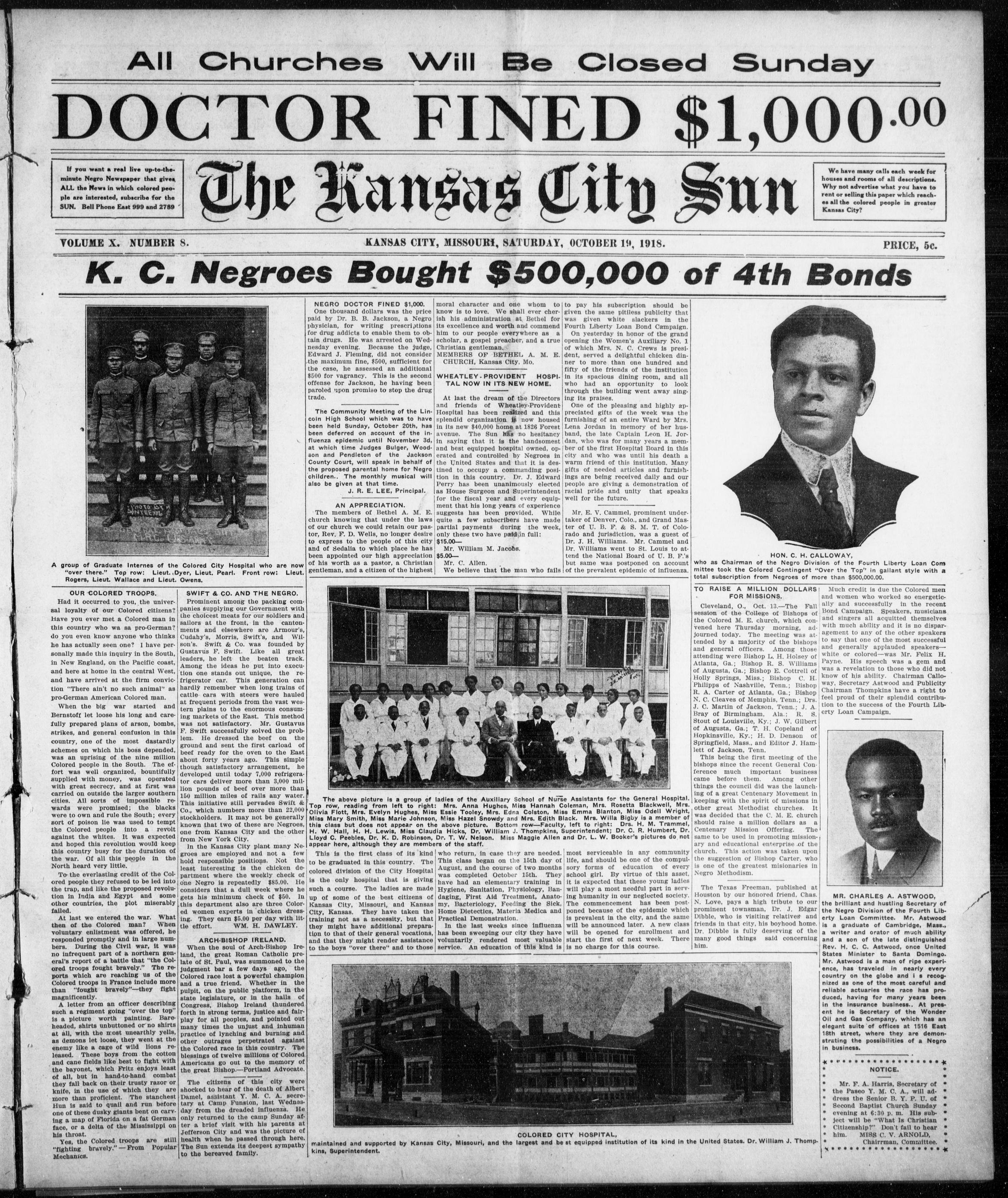
K. C. Negroes Bought $500,000 of 4th Bonds
K. C. Negroes Bought $500,000 of 4th Bonds
PHOTO BY
SYNTEE 786
OCT. 1918
M.R.C. U.S.A.R.C.
A group of Graduate Internes of the Colored City Hospital who are now "over there." Top row: Lieut. Dyer, Lieut. Pearl. Front row: Lieut. Rogers, Lieut. Wallace and Lieut. Owens.
VOLUME X. NUMBER 8.
K. C.
A group of Graduate Internes of the Co.
"over there." Top row: Lieut. Dyer.
Rogers, Lieut. Wallace and Lieut. Ow
OUR COLORED TROOPS.
Had it occurred to you, the universal loyalty of our Colored citizens? Have you ever met a Colored man in this country who wa sa pro-German? do you even know anyone who thinks he has actually seen one? I have personally made this inquiry in the South, in New England, on the Pacific coast, and here at home in the central West, and have arrived at the firm conviction "There ain't no such animal" as pro-German American Colored man.
When the big war started and Bernstoff let loose his long and carefully prepared plans of arson, bombs, strikes, and general confusion in this country, one of the most dastardly schemes on which his boss depended, was an uprising of the nine million Colored people in the South. The effort was well organized, bountifully supplied with money, was operated with great secrecy, and at first was carried on outside the larger southern cities. All sorts of impossible rewards were promised; the blacks were to own and rule the South; every sort of poison lie was used to tempt the Colored people into a revolt against the whites. It was expected and hoped this revolution would keep this country busy for the duration of the war. Of all this people in the North heard very little.
To the everlasting credit of the Colored people they refused to be led into the trap, and like the proposed revolution in India and Egypt and some other countries, the plot miserably failed.
At last we entered the war. What then of the Colored man? When voluntary enlistment was offered, he responded promptly and in large numbers. During the Civil war, it was no infrequent part of a northern general's report of a battle that "the Colored troops fought bravely." The reports which are reaching us of the Colored troops in France include more than "fought bravely"—they fight magnificently.
A letter from an officer describing such a regiment going "over the top" is a picture worth painting. Bare-headed, shirts unbuttoned or no shirts at all, with the most unearthly yells, as demons let loose, they went at the enemy like a cage of wild lions released. These boys from the cotton and cane fields like best to fight with the bayonet, which Fritz enjoys least of all, but in hand-to-hand combat they fall back on their trusty razor or knife, in the use of which they are more than proficient. The stanchest Hun is said to quail and run before one of these dusky giants bent on carving a map of Florida on a fat German face, or a delta of the Mississippi on his throat.
Yes, the Colored troops are still "fighting bravely."—From Popular Mechanics.
SWIFT & CO. AND THE NEGRO. Prominent among the packing companies supplying our Government with the choicest meats for our soldiers and sailors at the front, in the cantonments and elsewhere are Armour's, Cudahy's, Morris, Swift's, and Wilson's. Swift & Co. was founded by Gustavus F. Swift. Like all great leaders, he left the beaten track. Among the ideas he put into execution one stands out unique, the refrigerator car. This generation can hardly remember when long trains of cattle cars with steers were hauled at frequent periods from the vast western plains to the enormous consuming markets of the East. This method was not satisfactory. Mr. Gustavus F. Swift successfully solved the problem. He dressed the beef on the ground and sent the first carload of beef ready for the oven to the East about forty years ago. This simple though satisfactory arrangement, he developed until today 7,000 refrigerator cars deliver more than 3,000 million pounds of beef over more than 150 million miles of rails any water. This initiative still pervades Swift & Co., which numbers more than 22,000 stockholders. It may not be generally known that two of these are Negroes, one from Kansas City and the other from New York City.
In the Kansas City plant many Negroes are employed and not a few hold responsible positions. Not the least interesting is the chicken department where the weekly check of one Negro is repeatedly $8.50. He considers that a dull week where he gets his minimum check of $50. In this department also are three Colored women experts in chicken dressing. They earn $5.00 per day with little effort. WM. H. DAWLEY.
ARCH-BISHOP IRELAND.
When the soul of Arch-Bishop Ireland, the great Roman Catholic prelate of St. Paul, was summoned to the judgment bar a few days ago, the Colored race lost a powerful champion and a true friend. Whether in the pulpit, on the public platform, in the state legislature, or in the halls of Congress, Bishop Ireland thundered forth in strong terms, justice and fairplay for all peoples, and pointed out many times the unjust and inhuman practice of lynching and burning and other outrages perpetrated against the Colored race in this country. The blessings of twelve millions of Colored Americans go out to the memory of the great Bishop—Portland Advocate.
The citizens of this city were shocked to hear of the death of Albert Damel, assistant Y. M. C. A. secretary at Camp Funston, last Wednesday from the dreaded influenza. He only returned to the camp Sunday after a brief visit with his parents at Jefferson City and was the picture of health when he passed through here. The Sun extends its deepest sympathy to the bereaved family.
KANSAS CITY, MISSOURI, SATURDAY, OCTOBER 19, 1918.
JOHNSON
JAMES
JAMES
The above picture is a group of ladies of the Auxiliary School of Nurse Assistants for the General Hospital. Top row, reading from left to right: Mrs. Anna Hughes, Miss Hannah Coleman, Mrs. Rosetta Blackwell, Mrs. Olivia Flott, Mrs. Evelyn Hughes, Miss Essie Tooley, Mrs. Edna Colston, Miss Emma Blanton, Miss Odell Wright, Miss Mary Smith, Miss Marie Johnson, Miss Hazel Snowdy and Mrs. Edith Black. Mrs. Willa Bigy is a member of this class but does not appear on the above picture. Bottom row—Faculty, left to right: Drs. H. M. Trammel, H. W. Hall, H. H. Lewis, Miss Claudia Hicks, Dr. William J. Thompkins, Superintendent; Dr. C. R. Humbert, Dr. Lloyd C. Peebles, Dr. K. D. Robinson, Dr. T. W. Nelson. Miss Maggie Allen and Dr. L. W. Booker's pictures do not appear here, although they are members of the staff.
COLORED CITY HOSPITAL,
maintained and supported by Kansas City, Missouri, and the largest and best equipped institution of its kind in the United States. Dr. William J. Thompkins. Superintendent.
NEGRO DOCTOR FINED $1,000. One thousand dollars was the price paid by Dr. B. B. Jackson, a Negro physician, for writing prescriptions for drug addicts to enable them to obtain drugs. He was arrested on Wednesday evening. Because the judge, Edward J. Fleming, did not consider the maximum fine, $500, sufficient for the case, he assessed an additional $500 for vagrancy. This is the second offense for Jackson, he having been paroled upon promise to stop the drug trade.
The Community Meeting of the Lincoln High School which was to have been held Sunday, October 20th, has been deferred on account of the influenza epidemic until November 3d, at which time Judges Bulger, Woodson and Pendleton of the Jackson County Court, will speak in behalf of the proposed parental home for Negro children.. The monthly musical will also be given at that time.
J. R. E. LEE, Principal.
AN APPRECIATION.
The members of Bethel A. M. E. church knowing that under the laws of our church we could retain our pastor, Rev. F. D. Wells, no longer desire to express to the people of this city and of Sedalia to which place he has been appointed our high appreciation of his worth as a pastor, a Christian gentleman, and a citizen of the highest
The above picture is a group of Top row, reading from left to right, Olivia Flott, Mrs. Evelyn Hughes, Miss Miss Mary Smith, Miss Marie Johnson, this class but does not appear on the H. W. Hall, H. H. Lewis, Miss Claud Lloyd C. Peebles, Dr. K. D. Robinson, appear here, although they are members.
This is the first class of its kind to be graduated in this country. The colored division of the City Hospital is the only hospital that is giving such a course. The ladies are made up of some of the best citizens of Kansas City, Missouri, and Kansas City, Kansas. They have taken the training not as a necessity, but that they might have additional preparation to that of their general vocations, and that they might render assistance to the boys "over there" and to those
moral character and one whom to know is to love. We shall ever cherish his administration at Bethel for its excellence and worth and commend him to our people everywhere as a scholar, a gospel preacher, and a true Christian gentleman.
MEMBERS OF BETHEL A. M. E. CHURCH, Kansas City, Mo.
WHEATLEY- PROVIDENT HOSPI
TAL NOW IN ITS NEW HOME.
At last the dream of the Directors and friends of Wheatley-Provident Hospital has been realized and this splendid organization is now housed in its new $40,000 home at 1826 Forest avenue. The Sun has no hesitancy in saying that it is the handsomest and best equipped hospital owned, operated and controlled by Negroes in the United States and that it is destined to occupy a commanding position in this country. Dr. J. Edward Perry has been unanimously elected as House Surgeon and Superintendent for the fiscal year and every equipment that his long years of experience suggests has been provided. While quite a few subscribers have made partial payments during the week, only these two have paid in full:
$15.00—
Mr. William M. Jacobs.
$5.00—
Mr. C. Allen.
We believe that the man who fails.
Ladies of the Auxiliary School of Nursery:
Mrs. Anna Hughes, Miss Hannah C.
Mrs. Essie Tooley, Mrs. Edna Colston, Mi-
r, Miss Hazel Snowdy and Mrs. Edith B.
are above picture. Bottom row—Faculty
dia Hicks, Dr. William J. Thompkins,
Dr. T. W. Nelson. Miss Maggie Allen
ers of the staff.
who return, in case they are needed. This class began on the 15th day of August, and the course of two months was completed October 15th. They have had an elementary training in Hygiene, Sanitation, Physiology, Bandaging, First Aid Treatment, Anatomy, Bacteriology, Feeding the Sick, Home Dietetics, Materia Medica and Practical Demonstration.
In the last weeks since influenza has been sweeping our city they have voluntarily rendered most valuable service. An education of this kind is
to pay his subscription should be given the same pitiless publicity that was given white slackers in the Fourth Liberty Loan Bond Campaign. On yesterday in honor of the grand opening the Women's Auxiliary No. 1 of which Mrs. N. C. Crews is president, served a delightful chicken dinner to more than one hundred and fifty of the friends of the institution in its spacious dining room, and all who had an opportunity to look through the building went away singing its praises. One of the pleasing and highly appreciated gifts of the week was the furnishing of an entire Ward by Mrs. Lena Jordan in memory of her husband, the late Captain Leon H. Jordan, who was for many years a member of the first Hospital Board in this city and who was until his death a warm friend of this institution. Many gifts of needed articles and furnishings are being received daily and our people are giving a demonstration of racial pride and unity that speaks well for the future.
Mr. E, V. Camel, prominent undertaker of Denver, Colo., and Grand Master of U. B. F. & S. M. T. of Colorado and jurisdiction, was a guest of Dr. J. H. Williams. Mr. Camel and Dr. Williams went to St. Louis to attend the National Board of U. B. F.'s but same was postponed on account of the prevalent epidemic of influenza.
Se Assistants for the General Hospital,
Coleman, Mrs. Rosetta Blackwell, Mrs.
iss Emma Blanton, Miss Odell Wright,
Black. Mrs. Willa Bigby is a member of
y, left to right: Drs. H. M. Trammel,
Superintendent; Dr. C. R. Humbert, Dr.
and Dr. L. W. Booker's pictures do not
most serviceable in any community life, and should be one of the compulsory forms of education of every school girl. By virtue of this asset, it is expected that these young ladies will play a most needful part in serving humanity in our neglected society. The commencement has been postponed because of the epidemic which is prevalent in the city, and the same will be announced later. A new class will be opened for enrollment and start the first of next week. There is no charge for this course.
[Image of a man in a suit and tie].
who as Chairman of the Negro Division of the Fourth Liberty Loan Committee took the Colored Contingent "Over the Top" in gallant style with a total subscription from Negroes of more than $500,000.00.
who as Chairman of the Negro Division of the Fourth Liberty Loan Committee took the Colored Contingent "Over the Top" in gallant style with a total subscription from Negroes of more than $500,000.00.
TO RAISE A MILLION DOLLARS
FOR MISSIONS.
Cleveland, O., Oct. 13.—The Fall session of the College of Bishops of the Colored M. E. church, which convened here Thursday morning, adjourned today. The meeting was attended by a majority of the bishops and general officers. Among those attending were Bishop L. H. Holsey of Atlanta, Ga.; Bishop R. S. Williams of Augusta, Ga.; Bishop E. Cottrell of Holly Springs, Miss.; Bishop C. H. Philipps of Nashville, Teen.; Bishop R. A. Carter of Atlanta, Ga.; Bishop N. C. Cleaves of Memphis, Tenn.; Drs. J. C. Martin of Jackson, Teen.; J. A. Bray of Birmingham, Ala.; R. S. Stout of Louisville, Ky.; J. W. Gilbert of Augusta, Ga.; T. H. Copeland of Hopkinsville, Ky.; H. D. Denson of Springfield, Mass., and Editor J. Hamlett of Jackson, Tenn.
This being the first meeting of the bishops since the recent General Conference much important business came before them. Among other things the council did was the launching of a great Centenary Movement in keeping with the spirit of missions in other great Methodist churches. It was decided that the C. M. E. church should raise a million dollars as a Centenary Mission Offering. The same to be used in promoting missionary and educational enterprise of the church. This action was taken upon the suggestion of Bishop Carter, who is one of the greatest missionaries in Negro Methodism.
The Texas Freeman, published at Houston by our honored friend, Chas. N. Love, pays a high tribute to our prominent townsman, Dr. J. Edgar Dibble, who is visiting relatives and friends in that city, his boyhood home. Dr. Dibble is fully deserving of the many good things said concerning him.
PRICE, 5c.
Bonds
LLOWAY,
Union of the Fourth Liberty Loan Com-
Over the Top" in gallant style with a
more than $500,000.00.
Much credit is due the Colored men and women who worked so energetically and successfully in the recent Bond Campaign. Speakers, musicians and singers all acquitted themselves with much ability and it is no disagreement to any of the other speakers to say that one of the most successful and generally applauded speakers—white or colored—was Mr. Felix H, Payne. His speech was a gem and was a revelation to those who did not know of his ability. Chairman Calloway, Secretary Astwood and Publicity Chairman Thompkins have a right to feel proud of their splendid contribution to the success of the Fourth Liberty Loan Campaign.
A. E.
MR. CHARLES A. ASTWOOD,
the brilliant and hustling Secretary of
the Negro Division of the Fourth Liberty Loan Committee. Mr. Astwood is a graduate of Cambridge, Mass., a writer and orator of much ability and a son of the late distinguished Rev. H. C. C. Astwood, once United States Minister to Santa Domingo. Mr. Astwood is a man of ripe experience, has traveled in nearly every country on the globe and i's recognized as one of the most careful and reliable actuaries the race has produced, having for many years been in the insurance business.. At present he is Secretary of the Wonder Oil and Gas Company, which has an elegant suite of offices at 1516 East 18th street, where they are demonstrating the possibilities of a Negro in business.
Mr. F. A. Harris, Secretary of the Paseo Y. M. C. A., will address the Senior B. Y. P. U. of Second Baptist Church Sunday evening at 6:30 p. m. His subject will be "What Is Christian Citizenship?" Don't fail to hear him. MISS C. V. ARNOLD, Chairrman, Committee.
From Our Foreign Correspondents
A. F. and A. M. Mo. Jurisdiction
W. W. Fields, Cameron, Mo., Grand Master.
C. C. Clark, St. Louis, Mo., Dep.
Grand Master.
Ernest Boone, Louisiana, Mo., Senior
Grand Warden.
I. H. Bradbury, St. Louis, Mo.
Junior. Grand Warden.
H. H. Walker, St. Joseph, Mo., Grand
Treasurer.
Geo. W. K. Love, Kansas City,
Grand Secretary.
Nelson C. Crews, Kansas City, Reillef Secretary.
E. G. Lacey, Kansas City, G. L.
1st District.
E. J. Cooper, Mexico, Mo., G. L.
2nd District.
OFFICERS OF GRAND CHAPTER,
R. A. M.
Missouri and Jurisdiction, 1917-18.
T. G. McCampbell, G. H. P., Quindaro, Kans.
A. L. Thomas, D. G. H. P., Jefferson City, Mo.
J. P. Moffett, G. King, Sedalla, Mo.
S. A. May, G. Scribe, St. Louis, Mo.
Chas. Griggsby, G. Treas., Liberty, Mo.
E. S. Baker, G. Secretary, Kansas City, Mo.
OFFICERS OF GRAND COMMAND
FRY, K. T.
W. G. Mosely, R. E. G. C., Kansas City, Mo.
J. W. Beard, V. E. G. C., St. Louis, Mo.
G W. Lewis, E. G. G., St. Louis, Mo.
C. Brassfield, E. G., Captain General, Kansas City, Mo.
W. A. Ashley, E. G. P., St. Louis, Mo.
J. H. Kenner, E. G., Treasurer, Marshall, Mo.
J. T. Cannon, E. G., Recorder, St. Louis, Mo.
George A. Johnson, E. G. S. W.
Kansas City, Mo.
Benjamin F. Graves, E. G. J. W., St.
Joseph, Mo.
Lodge Directory
Rone Lodge No. 25. A. F. and
A. M. meets the 1st and 3rd
Monday in each month. All
Master Masons in good standing
welcome. F. A. McWilliams, W.
M; C. H. Countee, Sec'y.
G
MASONRY
Liberty Lodge No. 37, A. F.
and A. M. Liberty, Mo. meets
the 2nd and 4th Saturday
nights in each month. Nelson
Wallar, W. M.; Robert Dodd
Sec'y.
St. Stephens Chapter No. 37,
Royal Arch Masons, Liberty
Mo. Meets first Tuesday in
each month. Nelson Wallar
H. P. Wm. Capps, Recorder.
```markdown
```
St. Matthew Commandery
No. 17, Liberty, Mo., meets
the third Saturday night.
V. I. Starks, E. C.; W. M.
M. Robinson, Rec. Sect.
KOE
IN
FACED
FINISHED
E. A. Walker Lodge No.
257, U. B. F., meets the 2nd
and 4th Fridays of the month
at 1403 Michigan Ave.
10th St. W. W. 210 E
16th St. W. W. Watkins
Sec. 1629 Virginia.
```markdown
```
MASONIC BUILDING ASSOCIATION
T. G. McCampbell, President.
E. B. Thompson, Vice President.
W. H. Washington, Treasurer.
W. H. Brown, Secretary.
Board of Directors:
W. G. Mosely, S. Myers,
W. H. Brown. E. S. Baker,
W. R. Patterson. M. W. Wilson,
B. R. Francis. Richard Harris
E. S. Miller. R. Fulbright.
S. H. P. Edwards,
Meets second and fourth Tuesday
in each month.
CHURCH DIRECTORY.
Greenwood Baptist Church, 18th and
Terrace.
Clark Chapel M. E. Church, 1664 Madison
Avenue.
Susan M. E. Church, 24th and Flora.
St. Stephen's Baptist Church, 604 Charlotte St.
Centennial M. E. Church, 19th and
Woodland.
Second Baptist Church, 10th and
Charlotte.
Allen Chapel A. M. E. Church, 10th and
Charlotte.
Benzener A. M. E. Church, 17th and
Tract.
St. Augustine's P. E. Church, 11th and
Troost Avenue.
St. John's A. M. E. Church, 1743 Belle-
view.
Seventh Day Adventist, 23d and Wood-
land.
St. Monton's Catholic, 17th and Lydia.
Vine St. Baptist Church, 1825 Vine St.
Ward Chapel A. M. E. Church, 11th and
Troost.
Morning Star Baptist Church, 2311 Vine.
Highland Avenue Baptist Church, 1111
Hill Street.
St. James A. M. E. Zion Church, 1823
Woodland Ave.
Second Christian Church, 24th and
Woodland.
Friendship Baptist Church, Seventeenth
calendar.
C. M. E. Church, 1817 Flora Ave.
St. James Baptist Church, 4039 Mill St.
St. Luke's A. M. E. Church, 43rd and
Prospect Place.
KANSAS CITY, KAN. CHURCHES.
Church of the Ascension Episcopal—
Third and Stewart, Kansas City, Kans.
First A. M. E. Church, 8th and Neb.
Eastern St. Baptist Church, 8th and
Kansas City.
Metropolitan Baptist Church, 9th and Washington.
Bethel A. M. E. Church, Water and Steward Streets.
St. Paul A. M. E. Church, 21st and Ruby.
First Baptist Church, 5th and Neb.
King Solomon Baptist Church, 3rd and
Gundaro A. M. E. Church, Quindaro.
Pleasant Valley Baptist Church, Rose-
dale, Kan.
Second Church, 8th and Oakland.
Second Baptist Church, 24th and Ruby.
Wesley Chapel M. E., 106 Shawnee.
Bethel A. M. E. Church, Rosedale-Kan.
Tabernacle Baptist Church, 760 Mun-
ney.
Kansas, Keavil, Rev. D. Nor-
Great, pastor.
HELENA, MONT.
By J. E. W. Clark.
"Neither speak well or ill of yourself; if well, men will not believe you, if ill they will believe a great deal more than you say."
Mr. and Mrs. Rube Baker of Columbia, Mo., are making Helena their home for the future.
Rev. George S. Allen, of Schaffer Chapel, Butte, was in the city last week on business and was the guest of Rev. and Mrs. George F. Martin.
Mrs. Jefferson Harrison is confined to her bed with a severe attack of la gripe.
Mr. Arthur E. McGinnis has gone to Bremerton, Wash.
Mrs. George Robnett, who has been visiting in Kansas City and other points in Missouri, is expected home this week.
Miss Alice York, daughter of Mr. and Mrs. Miles York, has gone to Kansas City, and will enter Douglas hospital and also study at Quindaro. Miss York intends taking up Red Cross work.
More than twenty cities of Montana are under quarantine regulations owing to an epidemic of Spanish influenza.
The Juvenile Missionary Society of St. James church rendered an excellent program Sunday afternoon, the 9th.
The Pleasant Hour Club was entertained on the afternoon of the 9th by Mesdames Geraldine Lee and Mrs. Mona aMthis at the residence of Mrs. George M. Lee, Sr. A most interesting meeting was held, and while plans for the Red Cross branch were more fully discussed at this meeting, definite arrangements were not completed for final organization.
Word has been received that Louis Hammer, first class sergeant, has arrived safely in France. Sergeant Jefferson Harrison, retired, is now in the Forrage Dept., at Camp Lewis. Mrs. T. L. Smith is elevator operator at the Montecello. Mrs. William Mason left the city last week for Tacoma, Wash., where she will spend the winter. Mrs. Laura Meek of White Sulphur Springs, who has been stopping with Mrs. Mason, is now domiciled at the residence of Mrs. Charles Oliver, 800 Cannon street. William C. Irvin, expert mixologist and genial steward of the Elks club, resigned to take a position with the famous Montana club. Mrs. Kittie Smith, who has been ill is able to be about again.
The Misse Carolyn and Emma Dorsey have returned to the city from a pleasant visit to Butte.
Our old friend, Miles York, was in the city last week.
Mrs. Elizabeth Goff of Havre, who has been visiting in Great Falls, was the guest of Mrs. Almira Dorsey for a few days, en route to Butte.
The impressive and dignified Senator Murrell has lately been digesting "Riveries of a Bachelor" with much seriousness.
We are pleased to announce that hereafter all Helena news for the Sun will be handled by J. E. W. Clarke Telephone 1821, or address Box 25.
PLATTSBURG, MO.
Rev. Dudley came up from Liberty to preach at the Baptist church but did not do so as all public gatherings are forbidden on account of the influenza.....Grand Master Fields and wife drove down in their car and spent Sunday afternoon with Mr. and Mrs. W. M. Greene.....Mis Willa Greene and Masters Leonard Thompson and Harry Atchison are at home this week as their schools are closed on account of the influenza.....After several weeks' illnes, the little infant daughter of Mr. Hugh Bailey, passed away Friday evening and was buried Saturday. Her mother died two weeks ago.....Mr. Noah Scott of Liberty was a Plattsburg visitor Saturday.....Miss Ada Clark, who is teaching at Hamilton and Mrs. M. Evans who is teaching at Mecca, are both at home this week as their schools are closed.....Mr. Richard Starks of St. Joseph, visited Mr. and Mrs. Silas Coleman, Sunday.....Mr. Alma Wiley of Des Moines, Ia, ivisiting her mother, Mrs. Pinky Bos, well.....Mrs. Estell and Hester Clark are somewhat indisposed.....Mr. and Mrs. Sidney of Excelsior Springs are visiting home folks.....Last Sunday was a "Red Letter Day" for the Second Baptist Church. There was no pastor to fill the stand but the Lord was in our midst and all enjoyed good services the entire day.....The Rally was a success. The Auxiliaries had charge of the day and $101.09 was realized. The Mission Circle raised $17.50, Sunday school $25.50, church proper $19.24, and the B. Y. P. U. raised $38.75.....The B. Y. P. U. had charge of the evening services. The plan in our B. Y. P. U. books was carried out. The discussion was on "Songs" which was very helpful and enthusiastic. The program was dedicated to our boys at the "front." Presentation of service flag by Prof. G. N Abington; a reading "What They Say," Lucile Scott, and an excellent paper, "Youth (Starting Wrong in Life)," by Mrs. Mattie Evans.
JEFFERSON CITY, MO
By U. S. Grant Tayes.
Jefferson City is now being visited by the terrible epidemic the Spanish influenza. About fifty cases throughout the city are announced. Schools, churches, theatres and other places where persons are want to congregate have been closed...Mrs. Ellen Chaney,
THE KANSAS CITY SUN, SATURDAY, OCTOBER 19, 1918.
one of our old residents, died at her home in Jefferson City, October 4. She was a charter member of the S. M. T. and a great church worker. She leaves to mourn her demise many relatives and friends.....Mrs. Alma Cox, a former resident of Jefferson City but later of Chicago, died at her home in Chicago, Saturday. She will be brought here for interment Tuesday. Mrs. Cov was well known in Jefferson City having spent her childhood days here. She was of a lovable disposition and there are many relatives as well as friends who sorrow for her untimely demise.....Mrs. Jessie Roland of St. Louis is here indefinitely visiting her brother, Mr. Henry Howard, and her siter, Laura. This is her childhood home and we are pleased beyond measure to have her here. She was entertained at dinner Sunday by Mr. and Mrs. Hether Rankens. It is unnecessary to say that they had a most enjoyable time for there is no home in the city capable of showing greater hospitality and serving more sumptuous dinners than Mrs. and Miss Rankens.....Mrs. Annie Tattikin visited her brother and wife last week.....Warren Simmon sustained a broken shoulder blade when an automobile knocked him from his wagon last Saturday night between Cedar and Holt's Summit.....Muriell Burgett is visiting his aunt, Mrs. Livingstone Smith, who resides in St. Louis. He accompanied her to St. Louis after she had been a visitor to her sisters, Mrs. Nannie Burgett and Mrs. Eliza White, who reside on Jackson street.....Readers of the Sun will please call up 232 Blue and report your news.....Miss L. Burgett has been indisposed for the past week but is now convalescent.....Miss Maggie White is anticipating a visit to St. Louis....Mr. and Mrs. William G. Flynn entertained the following friends with an auto party to Osage, Mo., Sunday, October 14th: Mr. John Moore, Mrs. E. Hord and daughter Clara, Mrs. L. C. Thomas of Des Moines, Ia.; Paul Moore, little Miss Charlotte Flynn, Miss Bell Enloe and the Misses Mary and Agnes Moore. While in Osage they were entertained at the home of Mrs. Kate Branham.....Miss Marine Dorton, formerly a teacher of Washington Park school district, has been elected to teach in the public schools of Murphysboro, Ill.....Mrs. Irving Nickens, whose husband is fighting with the Colors in France, has succeeded Miss Dorton at Washington Park....Mrs. Jessie Emery and family have moved to Kansas City....Prof. and Mrs. Victor Collins entertained at dinner Sunday, Dr. and Mrs. E. Scruggs and Mr. and Mrs. Duke Diggs.....Mrs. Jones, a reader of the Colors: Oscar, Proctor and Lonnie. She is doing her "bit" to make the whole world safe for democracy.....Mrs. C. A. Rutledge, one of our highly esteemed business ladies, visited her mother in Fulton last week.....Mrs. Heber Rankin and her charming daughter entertained a few members of the Capitol City Alumni Association Friday, at their residence. Fruit ice cream was served in beautiful cut glass dishes. Those members of the association who were not present missed an excellent treat.....We are pleased to number among our new readers of the Sun: Mr. Richard Kelley, Prof. and Mrs. Victor Collins, Mrs. A. Rutledge, Mr. J. Q. Clay, Mrs. Maggie Henderson, Mr. and Mrs. Newt. Wiseman, Miss Clara Davis, Mr. Henry Howard, and sister Jessie and Laura, Mr. and Mrs. Doug lass Gathright, Mr. and Mrs. Andrews Mr. and Mrs. Verdreed Reed, Mr. William Dixon, Herbert Bagby and Miss Celia Blackburn.....Call up 223 Blue or call 528 Lafayette St. See Tayes and drive away the "No New Blues" by reading the Sun.
LATHROP, MISSOURI.
The Christian Church has organized a Union Choir...Mr. and Mrs. George Tillman motored to Excelsior Springs Tuesday...Mrs. Courtney McGruder, the mother of Mr. Merritt McGruder, returned to her home in Taylorsville, Ky. She has spent over a year in Missouri...Mr. Jordan Tolbert of St. Joe visited his sister, Mrs. Harriett Madison, Sunday, whom he had not seen for fourteen years...Mrs. George Powell and grandsons and Mrs. Belle Pierce returned from Neosho Saturday...Miss Channie Golf left for her home last Friday...Mr. and Mrs. Clarence Wisdom, who has been in our midst for several months, went to Kansas City Tuesday. Their many friends will miss them very much...Mr. Fred Hicks of Kansas City spent Sunday with his parents, Mr. and Mrs. George Hicks. They received a card from their son, Allie, stating he had arrived safely overseas...Mrs. John Slaughter is very low at this writing...Mrs. Thomas Graham is improving slowly...Prof. B. B. Tully was worse last week. On account of his illness, Mrs. Wesley Whissett taught in Douglass school...Miss Agatha Orear, who is teaching near Leeton, Mo., writes that she is very much pleased with her school...The members and friends of the A. M. E. Church gave a banquet in honor of the return of Rev. S. D. Lovell. All present had a delightful time.
COLUMBIA, MISSOURI.
Mrs. Florence Taylor has returned from a very pleasant vacation in St. Joseph and Kansas City. While in Kansas City she was the guest of Mrs. Mattle Finley....Mrs. Ethel Mosley is visiting her parents.....Mrs. E. O.
DON'T DRINK SHIPS!
WAR
U. S. Food Administration.
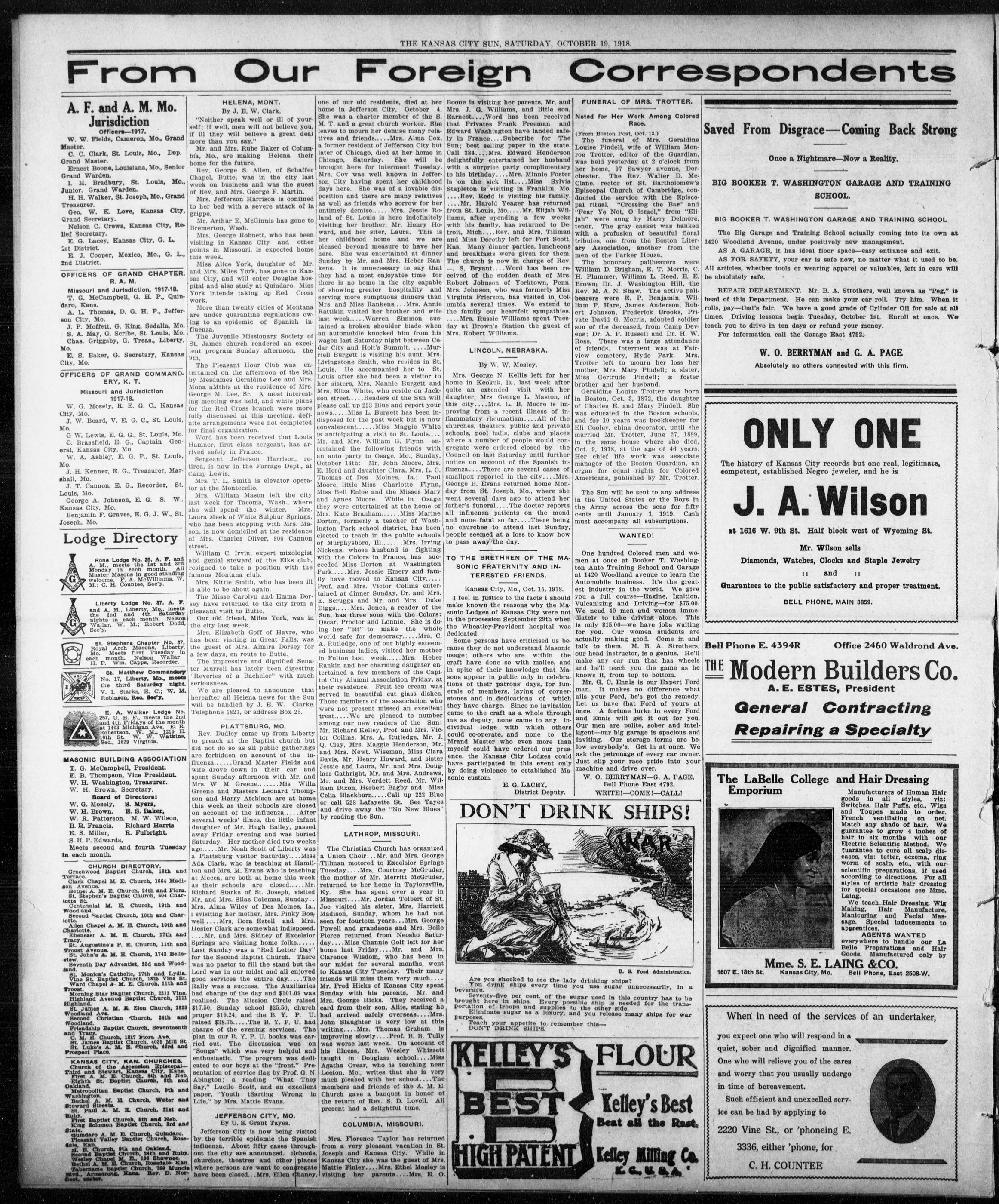
Are you shocked to see the lady drinking ships?
You drink ships every time you use sugar unnecessarily, in a beverage.
Seventy-five per cent. of the sugar used in this country has to be brought here in ships. Every possible ship is needed for the transportation of troops and supplies to the other side. Eliminate sugar as a luxury, and you release many ships for war purposes. Teach your appetite to remember this—DON'T DRINK SHIPS.
KELLEY'S
BEST
HIGH PATENT
FLOUR
Kelley's Best
Beat all the Rest.
Kelley Milling Co.
K.C.U.S.A.
Boone is visiting her parents, Mr. and Mrs. J. G. Williams, and little son, Earnest....Word has been received that Privates Frank Freeman and Edward Washington have landed safely in France....Subscribe for The Sun; best selling paper in the state Call 384....Mrs. Edward Henderson delightfully entertained her husband with a surprise party complimentary to his birthday....Mrs. Minnie Foster is on the sick list....Miss Sylvia Stapleton is visiting Franklin, Mo....Rev. Redd is visiting his family....Mr. Harold Yeager has returned from St. Louis, Mo....Mr. Elijah Williams, after spending a few weeks with his family, has returned to Detroit, Mich....Rev. and Mrs. Tillman and Miss Dorothy left for Fort Scott, Kas. Many dinner parties, luncheons and breakfasts were given for them. The church is now in charge of Rev.--. S. Bryant....Word has been received of the sudden death of Mrs. Robert Johnson of Yorktown, Penn. Mrs. Johnson, who was formerly Miss Virginia Frierson, has visited Columbia several times. We extend to the family our heartfelt sympathies.....Mrs. Russie Williams spent Tuesday at Brown's Station the guest of Mrs. Robert Williams.
LINCOLN. NEBRASKA
Mrs. George N. Kellis left for her home in Keokuk, Ia., last week after quite an extended visit with her daughter, Mrs. George L. Maston, of this city.....Mrs. L. B. Moore is improving from a recent illness of inflammatory rheumatism.....All of the churches, theaters, public and private schools, pool halls, clubs and places where a number of people would congregate were ordered closed by the Council on last Saturday until further notice on account of the Spanish influenza.....There are several cases of smallpox reported in the city.....Mrs. George B. Evans returned home Monday from St. Joseph, Mo., where she went several days ago to attend her father's funeral.....The doctor reports all influenza patients on the mend and none fatal so far.....There being no churches to attend last Sunday, people seemed at a loss to know how to pass away the day.
TO THE BRETHREN OF THE MA
SONIC FRATERNITY AND IN-
TERESTED FRIENDS.
Kansas City, Mo., Oct. 15, 1918. I feel in justice to the facts I should make known the reasons why the Masonic Lodges of Kansas City were not in the process September 29th when the Wheatley-Provident hospital was dedicated
Some persons have criticised us because they do not understand Masonic usage; others who are within the craft have done so with malice, and in spite of their knowledge that Masons appear in public only in celebrations of their patrons' days, for funerals of members, laying of cornerstones and in dedications of which they have charge. Since no invitation came to the craft as a whole through me as deputy, none came to any individual lodge with which others could co-operate, and none to the Mrand Master who even more than myself could have ordered our presence, the Kansas City Lodges could have participated in this event only by doing violence to established Masonic custom.
E. G. LACEY,
District Deputy.
FUNERAL OF MRS. TROTTER.
Noted for Her Work Among Colored Race.
(From Boston Post, Oct. 13.)
The funeral of Mrs. Geraldine Louise Pindell, wife of William Monroe Trotter, editor of the Guardiam, was held yesterday at 2 o'clock from her home, 97 Sawyer avenue, Dorchester. The Rev. Walter D. McClane, rector of St. Bartholomew's Episcopal Church of Cambridge, conducted the service with the Episcopal ritual, "Crossing the Bar" and "Fear Ye Not, O Israel," from "Elijah" were sung by Harry Delmore, tenor. The gray casket was banked with a profusion of beautiful floral tributes, one from the Boston Literary Association, another from the men of the Parker House.
The honorary pallbearers were William D. Brigham, E. T. Morris, C. H. Plummer, William L. Reed, E. E. Brown, Dr. J. Washington Hill, the Rev. M. A. N. Shaw. The active pallbearers were E. P. Benjamin, William P. Hare, James Anderson, Robert Johnson, Frederick Brooks, Private David G. Morris, adopted soldier son of the deceased, from Camp Devens; Dr. A. P. Russell and Dr. H. W. Ross. There was a large attendance of friends. Interment was at Fairview cemetery, Hyde Park. Mrs. Trotter left to mourn her loss her mother, Mrs. Mary Pindell; a sister, Miss Gertrude Pindell; a foster brother and her husband.
Geraldine Louise Trotter was born in Boston, Oct. 3, 1872, the daughter of Charles E. and Mary Pindell. She was educated in the Boston schools, and for 10 years was bookkeeper for Eli Cooley, china decorator, until she married Mr. Trotter, June 27, 1899, in the same house where she died, Oct. 9, 1918, at the age of 46 years. Her chief life work was associate manager of the Boston Guardian, an organ for equal rights for Colored Americans, published by Mr. Trotter.
The Sun will be sent to any address in the United States or the Boys in the Army across the seas for fifty cents until January 1, 1919. Cash must accompany all subscriptions.
WANTED!
One hundred Colored men and women at once at Booker T. Washington Auto Training School and Garage at 1420 Woodland avenue to learn the Automobile business. It's the greatest industry in the world. We give you a full course—Engine, Ignition, Vulcanizing and Driving—for $75.00. We need 40 men and women immediately to take driving alone. This is only $15.00—we have jobs waiting for you. Our women students are actually making good. Come in and talk to them. M. B. A. Strothers, our head instructor, is a genius. He'll make any car run that has wheels and he'll teach you the game as he knows it, from top to bottom.
Mr. G. C. Ennis is our Expert Ford man. It makes no difference what ails your Ford, he's got the remedy. Let us have that Ford of yours at once. A fortune lurks in every Ford and Ennis will get it out for you. Our men are polite, sober and intelligent—our big garage is spacious and inviting. Our storage terms are be low everybody's. Get in at once. We ask the patronage of every car owner. Just slip your race pride into your machine and drive over.
W. O. BERRYMAN—G. A. PAGE,
Bell Phone East 4792.
WRITE!—COME!—CALL!
INK SHIPS!
WAR
U. S. Food Administration.
by drinking ships?
you use sugar unnecessarily, in a
sugar used in this country has to be
visible ship is needed for the trana-
to the other side.
and you release many ships for war
ber this—
FLOUR
Kelley's Best
Saved From Disgrace—Coming Back Strong
Once a Nightmare—Now a Reality.
BIG BOOKER T. WASHINGTON GARAGE SCHOOL.
BIG BOOKER T. WASHINGTON GARAGE A
The Big Garage and Training School actual 1420 Woodland Avenue, under positively new m AS A GARAGE, it has ideal floor space—e AS FOR SAFETY, your car is safe now, no All articles, whether tools or wearing apparel or be absolutely safe.
REPAIR DEPARTMENT. Mr. B. A. Strothe head of this Department. He can make your rolls, pay—that's fair. We have a good grade of times. Driving lessons begin Tuesday, October teach you to drive in ten days or refund your m
MER T. WASHINGTON GARAGE AND TRAINING
Garage and Training School actually coming in
Avenue, under positively new management.
GARAGE, it has ideal floor space—easy entrance
SAFETY, your car is safe now, no matter what
whether tools or wearing apparel or valuables, I
safe.
DEPARTMENT. Mr. B. A. Strothers, well know
department. He can make your car roll. Try
his fair. We have a good grade of Cylinder O
ng lessons begin Tuesday, October 1st. Enrol
drive in ten days or refund your money.
ON GARAGE AND TRAINING
SCHOOL.
GARAGE AND TRAINING SCHOOL
School actually coming into its own at
likely new management.
or space—easy entrance and exit.
We now, no matter what it used to be,
apparel or valuables, left in cars will
A. Strothers, well known as "Peg," is
like your car roll. Try him. When it
had grade of Cylinder Oil for sale at all
y, October 1st. Enroll at once. We
and your money.
East 4792.
BIG BOOKER T. WASHINGTON GARAGE AND TRAINING SCHOOL
The Big Garage and Training School actually coming into its own at 1420 Woodland Avenue, under positively new management.
AS A GARAGE, it has ideal floor space—easy entrance and exit.
AS FOR SAFETY, your car is safe now, no matter what it used to be. All articles, whether tools or wearing apparel or valuables, left in cars will be absolutely safe.
REPAIR DEPARTMENT. Mr. B. A. Strothers, well known as "Peg," is head of this Department. He can make your car roll. Try him. When it rolls, pay—that's fair. We have a good grade of Cylinder Oil for sale at all times. Driving lessons begin Tuesday, October 1st. Enroll at once. We teach you to drive in ten days or refund your money.
For information call the Garage East 4792.
W. O. BERRYMAN and G. A. PAGE
Absolutely no others connected with this firm.
ONLY C
The history of Kansas City records but
competent, established Negro jeweler, a
J. A. Will
at 1616 W. 9th St. Half block west
Mr. Wilson sells
Diamonds, Watches, Clocks and
:: and ::
Guarantees to the public satisfactory and
BELL PHONE, MAIN 385
ONLY ONLY
History of Kansas City records but one real, legal, established Negro jeweler, and he is
I. A. Wilson
6 W. 9th St. Half block west of Wyoming
Mr. Wilson sells
Diamonds, Watches, Clocks and Staple Jewelry
:: and ::
uses to the public satisfactory and proper t
BELL PHONE, MAIN 3859.
ONE
records but one real, legitimate,
jeweler, and he is
Wilson
lock west of Wyoming St.
sells
locks and Staple Jewelry
factory and proper treatment.
MAIN 3859.
ONLY ONE
The history of Kansas City records but one real, legitimate, competent, established Negro jeweler, and he is
J. A. Wilson
at 1616 W. 9th St. Half block west of Wyoming St.
Mr. Wilson sells
Diamonds, Watches, Clocks and Staple Jewelry
:: and ::
Guarantees to the public satisfactory and proper treatment.
BELL PHONE, MAIN 3859.
Office 2460 Waldrond Ave.
THE Modern Buil
A. E. ESTES, Pres
General Cont
Repairing a Sp
The LaBelle College and H
Emporium
Manu
goods
Modern Builder
A. E. ESTES, President
General Contractor
Repairing a Special
aBelle College and Hair Dress
Builders Co.
S, President
Contracting
a Specialty
and Hair Dressing
THE Modern Builders Co.
A. E. ESTES, President
General Contracting
Repairing a Specialty
The LaBelle College and Hair Dressing Emporium Manufacturers of Human
THE WORLD'S FIRST WOMEN'S HOLIDAY
Mme. S. E. LAING
1607 E. 18th St. Kansas City, Mo. Bell
When in need of the services o
Milne. S. E. LAING & CO.
St. Kansas City, Mo. Bell Phone, East
Bell Phone, East 2508-W.
When in need of the services of an undertaker,
you expect one who will respond in a quiet, sober and dignified manner. One who will relieve you of the cares and worry that you usually undergo in time of bereavement. Such efficient and unexcelled service can be had by applying to 2220 Vine St., or 'phoneing E. 3336, either 'phone, for C. H. COUNTEE
Manufacturers of Human Hair goods in all styles, viz: Switches, Hair Puffs, etc., Wigs and Toupes made to order. French ventilating on net. Match any shade of hair. We guarantee to grow 4 inches of hair in six months with our Electric Scientific Method. We guarantee to cure all scalp diseases, viz: tetter, eczema, ring worm of scalp, etc., with our scientific preparations, if used according to directions. For all styles of artistic hair dressing for special occasions see Mme. Laing.
We teach Hair Dressing, Wig Making, Hair Manufacture, Manicuring and Facial Massage. Special inducements to apprentices.
AGENTS WANTED everywhere to handle our La Belle Preparations and Hair Goods. Manufactured only by INC & CO
---
WASHINGTON CITY
SIDELIGHTS
Mr. and Mrs. Officer Seemed to Have Right Idea
Mr. and Mrs. Officer Seemed to Have Right Idea
WASHINGTON.—There are two people in this town good enough to be framed in gold—meaning an army officer and his wife. That they live in the suburbs of Vanity Fair signifies no more than the mere luck of money and
fine capacity of "mother's helper." The young private came whenever he was on leave and everything grooved along beautifully until one day he had to confide to Mrs. Officer an anxiety in regard to his wife. He had money enough for all expenses, but——
Mrs. Officer put an end to his worry right there. She knew more about the case than he did—and he was not to worry; a nice room had been engaged at the hospital and everything was sure to go right—which it did.
After a bit the officer and his wife brought the mother and her baby home and waited on her as tenderly as if she had been their own daughter—and, from the start, you couldn't tell which woman owned the baby.
All sorts of happy luck can happen to a young couple, so, naturally, his being made a corporal was just a matter of course—likewise the indorsement of the baby given by the fellows from camp who came especially to see it, but——
The really worthwhile thing about the incident was the repudiation by the officer and his wife of the salted-down class distinction that puts the mistress a mile above the maid—to say nothing about the good common sense of an army big gun who could see in the young private something more human than an automaton wound up to salute.
Sometimes Nature Seems to Square Things Up
Sometimes Nature Seems to Square Things Up
SHE was a "red seal" young woman, from bronze ties to a plume that was as royally superior to the feather of commerce as, say, a princess on her throne—provided a princess has one—is above the poor girl who gathers
unattainable treasure that she would give her life to own, that another woman, who had been enviously staring at the bronze slippers, the plume and all the stylish gold-brown clothes of her, followed the gaze of the princess to see, for her self, what royalty could be craving that royalty couldn't get. Then she understood, for:
On the opposite side of the car sat the faggot girl who had flown the woods long enough to make a date with a flamboyant youngster whom she doubtless called "her feller." She was tawdry of dress. One cheek was pouched out with chewing gum. The cord that strung the far-distant pearls around her neck was dirt-gray, and her knuckles were grimy. But her cheek, when it got a show, was the oval that Greek Philias put on his statues. Her neck was like the snow drift that distinguished Annie Laurie. Her skin was of the velvety pink of roses that grow in memory's garden. Her teeth were white splendors. And her eyes were midnight suns. All that and some more.
Nature, in a freak of extravagance, had squandered enough beauty on the faggot girl to have gone around among a dozen, and then, in an economic fit, had skimped on the poor dear princess.
Not All Soldiers Seem Inclined to "Talk Shop"
ONE has little trouble starting a conversation with soldier boys, and every one of them talks mightly interestingly about everything except the war—if one will permit them. For instance, I ran into a husky sergeant who wanted to
did you ever notice how cross a kid is when it is cutting its teeth, and do you suppose those Germans who killed babies ever were human beings. He reckoned not, and for that reason he was dead anxious to get across and do his bit by knocking the daylights out of some of those baby killers.
None the less interesting is the fellow who has tried to get into the army and failed. I met one of these, too. He told me that he had been put into class 5, and showed me his card, too. He found, however, that if he loafed around the depot he could meet a lot of men who had seen actual service or who were on their way to the trenches, who had a great many interesting things to tell him.
And not the least interesting of everything one sees about the station are the girl war workers, who come, with smiling lips, to "do their bit." They smile, I say, which shows that they arrive without knowing the current prices of room and board.
Had More Than Their Share of Servant Problem
TWO Frenchwomen, wives of members of one of the French commissions sent to Washington by their government since the United States entered the war, were riding home on the street car the other night. The voices of the
women were talking about. Was it the war? Was it of heroes and heroines? Or the sacrifices of their native land for freedom?
It was the servant problem!
They were not troubled much by inability to get domestics, it seemed. Their trouble was this:
Being themselves able to speak English but imperfectly, they were having a dreadful time, they said, to make their servants understand what they wanted done.
is only mentioned because of the thing that money cannot buy in these days of enlistments and war work—house help. You mustn't say servants any more. One day they got in touch with the young wife of a private in a nearby camp. She had come from the West, where everybody works, and, being a stranger here and unfitted by experience and physical condition for clerical employment, was glad to enter Mrs. Officer's employment in the
fine capacity of "mother's helper." The you leave and everything grooved along beauty to Mrs. Officer an anxiety in regard to his expenses, but——
Mrs. Officer an end to his work the case than he did—and he was not to at the hospital and everything was suicid. After a bit the officer and his wife b and waited on her as tenderly as if she from the start, you couldn't tell which w All sorts of happy luck can happen being made a corporal was just a matter of the baby given by the fellows from but——
The really worthwhile thing about the officer and his wife of the salted-dotress a mile above the maid—to say now an army big gun who could see in the than an automaton wound up to salute.
Sometimes Nature Seem
SHE was a "red seal" young woman, f royally superior to the feather of throne—provided a princess has one-
A. A.
unattainable treasure that she would gif who had been enviously staring at the stylish gold-brown clothes of her, follow her self, what royalty could be craving understood, for:
On the opposite side of the car s woods long enough to make a date w doubttiss called "her feller." She w pouched out with chewing gum. The around her neck was dirt-gray, and her when it got a show, was the oval that neck was like the snow drift that dist of the velvety pink of roses that grow white splendors. And her eyes were m Nature, in a freak of extravagance faggot girl to have gone around among had skimped on the poor dear princes
Not All Soldiers Seem
ONE has little trouble starting a conve of them talks mighty interestingly w will permit them. For instance, I ran
talk about babies. He said that he knew babies had a good deal more sense than folks gave them credit for. As proof of this he declared that his brother-in-law, whom, of course, I never had heard of before, and don't know now, had a two-year-old lad who was just as smart as anybody. Yes, sir, when the soldiers went into the army, more than a year ago, the baby bid him good-by, and the other day, when the soldier came back, that baby knew him right away. As to the war—say,
did you ever notice how cross a kid is suppose those Germans who killed reckoned not, and for that reason he w bit by knocking the daylights out of son None the less interesting is the fe and failed. I met one of these, too. class 5, and showed me his card, too. around the depot he could meet a lot who were on their way to the trench things to tell him. And not the least interesting of are the girl war workers, who come, w smile, I say, which shows that they are of room and board.
Had More Than Their S
TWO Frenchwomen, wives of mem sent to Washington by their gover the war, were riding home on the street
THAT MAID
WAS - SO-
UN SOT A
TRIPLE
ÉTAGE.
women were talking about. Was it th
Or the sacrifices of their native land fo
It was the servant problem!
They were not troubled much by
Their trouble was this:
Being themselves able to speak E
a dreadful time, they said, to make
wanted done.
alb Perez
Young private came whenever he was on beautifully until one day he had to confide his wife. He had money enough for all worry right there. She knew more about no worry; a nice room had been engaged here to go right—which it did. Brought the mother and her baby home she had been their own daughter—and, woman owned the baby. On to a young couple, so, naturally, his order of course—likewise the indorsement in camp who came especially to see it, at the incident was the repudiation by own class distinction that puts the mis-thing about the good common sense of young private something more human to Square Things Up from bronze ties to a plume that was as commerce as, say, a princess on her—is above the poor girl who gathers
faggots in the wood (see movies). But she was not pretty. And she was so thin that even her gimp failed to hide bones that no self-respecting crow would care to pick.
The really surprising thing about her was that she should be riding in a street car when her place was so obviously behind her chauffeur in a machine that cost as much as a house.
She was haughtily erect, and on her face was such concentrated yearning, as if she were looking at some
live her life to own, that another woman,
be bronze slippers, the plume and all the
awed the gaze of the princess to see, for
ing that royalty couldn't get. Then she
sat the faggot girl who had flown the
with a flamboyant youngster whom she
was tawdry of dress. One cheek was
cord that strung the far-distant pearls
her knuckles were grimy. But her cheek,
Greek Phidias put on his statues. Her
stinguished Annie Laurie. Her skin was
naw in memory's garden. Her teeth were
midnight suns. All that and some more.
he had squandered enough beauty on the
g a dozen, and then, in an economic fit,
less.
Inclined to "Talk Shop"
versation with soldier boys, and every one
about everything except the war—if one
in into a husky sergeant who wanted to
THAT BABY IS A WONDER
HONEST, THAT
BABY KNEW
ME RIGHT
AWAY
as when it is cutting its teeth, and do you babies ever were human beings. He was dead anxious to get across and do his some of those baby killers. fellow who has tried to get into the army He told me that he had been put into. He found, however, that if he loafed of men who had seen actual service or ones, who had a great many interesting everything one sees about the station with smiling lips, to "do their bit." They arrive without knowing the current prices
Share of Servant Problem
bers of one of the French commissions department since the United States entered get car the other night. The voices of the
women, although modulated, attracted the attention of passengers near by, as any foreign tongue will. There is always something tantalizing in hearing someone talking brightly while you yourself are utterly unable to understand a thing that persons says.
Persons on the car listened, but very few, indeed, were able to understand a word. Women looked curiously at each other, and would have paid another fare, Tit bet, to have been able to understand what the French
he war? Was it of heroes and herolnes? or freedom?
y inability to get domestics, it seemed.
English but imperfectly, they were having
be their servants understand what they
THE KANSAS CITY SUN. SATURDAY. OCTOBER 19. 1218.
VIEW OF METZ. WHICH THE AMERICANS ARE SHELLING
Copyright
Underproceed & Underrevised
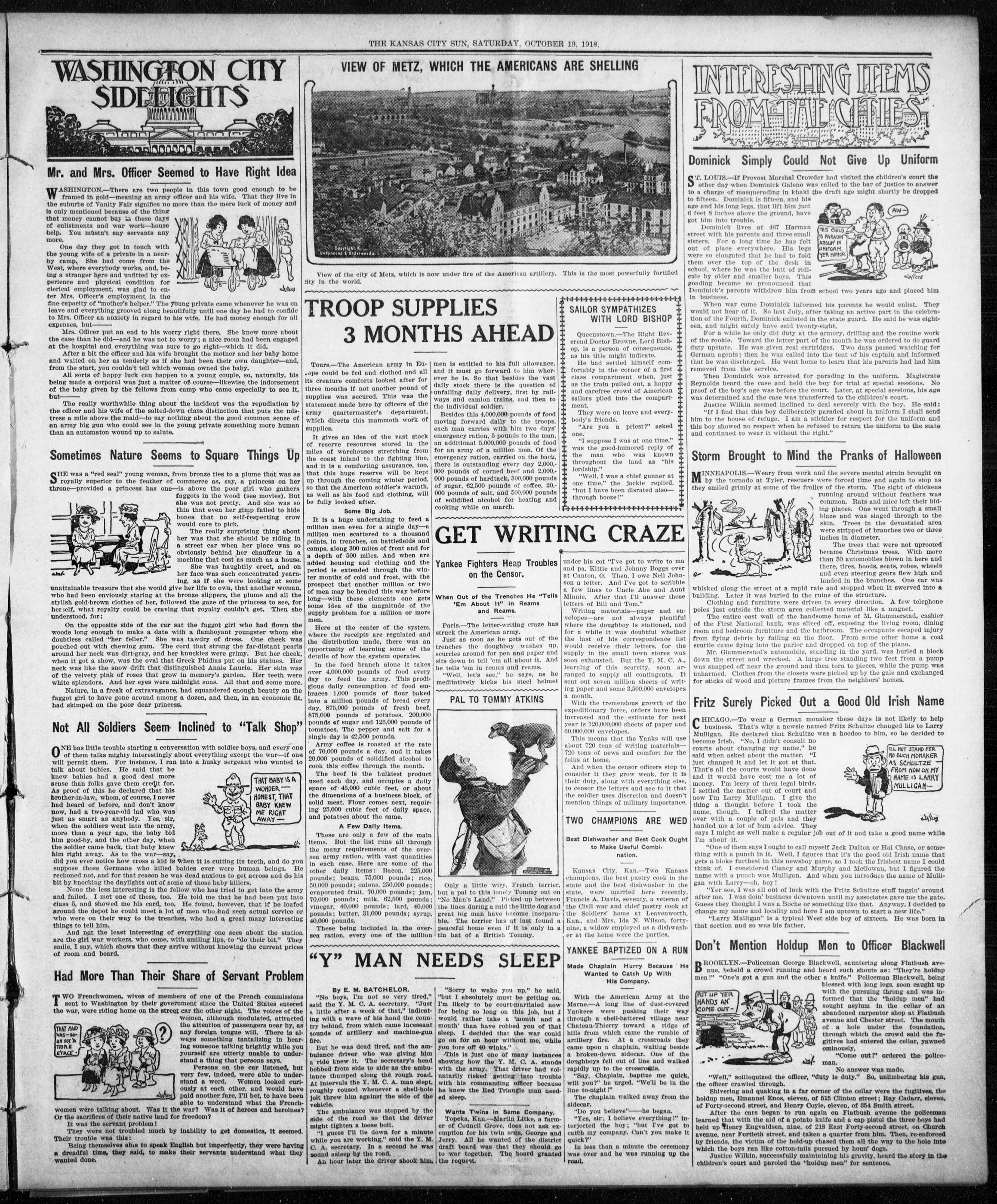
View of the city of Metz, which is now under fire of the American artillery. This is the most powerfully fortified city in the world.
TROOP SUPPLIES 3 MONTHS AHEAD
"Y" MAN NEEDS SLEEP
---
Tours.—The American army in Europe could be fed and clothed and all its creature comforts looked after for three months if not another pound of supplies was secured. This was the statement made here by officers of the army quartermaster's department, which directs this mammoth work of supplies.
It gives an idea of the vast stock of reserve resources stored in the miles of warehouses stretching from the coast inland to the fighting line, and it is a comforting assurance, too, that this huge reserve will be kept up through the coming winter period, so that the American soldier's warmth, as well as his food and clothing, will be fully looked after.
Some Big Job.
It is a huge undertaking to feed a million men even for a single day—a million men scattered to a thousand points, in trenches, on battlefields and camps, along 300 miles of front and for a depth of 500 miles. And when are added housing and clothing and the period is extended through the winter months of cold and frost, with the prospect that another million or two of men may be headed this way before long—with these elements one gets some idea of the magnitude of the supply problem for a million or more men.
Here at the center of the system, where the receipts are regulated and the distribution made, there was an opportunity of learning some of the details of how the system operates.
In the food branch alone it takes over 4,000,000 pounds of food every day to feed the army. This prodigious daily consumption of food embraces 1,000 pounds of flour baked into a million pounds of bread every day, 875,000 pounds of fresh beef, 875,000 pounds of potatoes, 200,000 pounds of sugar and 125,000 pounds of tomatoes. The pepper and salt for a single day is 42,500 pounds.
Army coffee is roasted at the rate of 70,000 pounds a day, and it takes 20,000 pounds of solidified alcohol to cook this coffee through the month.
The beef is the bulkiest product used each day, and occupies a daily space of 45,000 cubic feet, or about the dimensions of a bustiness block, of solid meat. Flour comes next, requiring 25,000 cubic feet of daily space, and potatoes about the same.
A Few Daily Items.
These are only a few of the main items. But the list runs all through the many requirements of the oversea army ration, with vast quantities in each case. Here are some of the other daily items: Bacon, 225,000 pounds; beans, 75,000 pounds; rice, 50,000 pounds; onions, 250,000 pounds; evaporated fruit, 70,000 pounds; jam, 70,000 pounds; milk, 62,500 pounds; vinegar, 40,000 pounds; lard, 40,000 pounds; butter, 31,000 pounds; syrup, 40,000 pounds.
These being included in the oversea ration, every one of the million
By E. M. BATCHELOR.
"No boys, I'm not so very tired," said the Y. M. C. A. secretary. "Just a little after a week of that," indicating with a wave of his hand the country behind, from which came incessant sounds of artillery and machine-gun fire.
But he was dead tired, and the ambulance driver who was giving him a ride knew it. The secretary's head bobbed from side to side as the ambulance thumped along the rough road. At intervals the Y. M. C. A. man slept, roughly roused whenever a shell-hole jolt threw him against the side of the vehicle.
The ambulance was stopped by the side of the road so that the driver might tighten a loose bolt.
"I guess I'll lie down for a minute while you are working," said the Y. M. C. A. secretary. In a second he was sound asleep by the road.
An hour later the driver shook him.
---
GET WRITING CRAZE
men is entitled to his full allowance, and it must go forward to him wherever he is. So that besides the vast daily stock there is the question of unfalling daily delivery, first by railways and camlion trains, and then to the individual soldier.
Besides this 4,000,000 pounds of food moving forward daily to the troops, each man carries with him two days' emergency ration, 5 pounds to the man, an additional 5,000,000 pounds of food for an army of a million men. Of the emergency ration, carried on the back, there is outstanding every day 2,000,000 pounds of corned beef and 2,000,000 pounds of hardtack, 300,000 pounds of sugar, 62,500 pounds of coffee, 20,000 pounds of salt, and 500,000 pounds of solidified alcohol for heating and cooking while on march.
GET WRITI
Yankee Fighters Heap Troubles on the Censor.
When Out of the Trenches He "Tells 'Em About it" in Reams and Reams.
Parls.—The letter-writing craze has struck the American army.
Just as soon as he gets out of the trenches the doughboy washes up scurries around for pen and paper and sits down to tell 'em all about it. And he tells 'em in reams and reams.
"Well, let's see," he says, as he meditatively kicks his steel helmet
PAL TO TOMMY ATKINS
MARK DETROIT
PAPER PRODUCTION
Only a little wiry, French terrier, but a pal to this lonely Tommy out on "No Man's Land." Picked up between the lines during a raid the little dog and great big man have become inseparable. The terrier has at last found a peaceful home even if it is only in a tin hat of a British Tommy.
EEDS SLEEP
"Sorry to wake you up," he said, "but I absolutely must be getting on. I'm likely to be court-martialed now for being so long on this job, but I would rather take a 'month and a month' than have robbed you of that sleep. I decided that the war could go on for an hour without me, while you tore off 40 winks."
This is just one of many instances showing how the Y. M. C. A. stands with the army. That driver had voluntarily risked getting into trouble with his commanding officer because he knew the Red Triangle man needed sleep.
Wants Twins in Same Company.
Topeka, Kan.—Martin Litke, a farmer of Council Grove, does not ask exemption for his twin sons, George and Jerry. All he wanted of the district draft board was that they should go to war together. The board granted the request.
SAILOR SYMPATHIZES
Queenstown.—The Right Reverend Doctor Browne, Lord Bishop, is a person of consequence, as his title might indicate.
He had settled himself comfortably in the corner of a first class compartment when, just as the train pulled out, a happy and carefree crowd of American sailors piled into the compartment.
They were on leave and everybody's friends.
"Are you a priest?" asked one.
"I suppose I was at one time," was the good-humored reply of the man who was known throughout the land as "his lordship."
"Well, I was a chief gunner at one time," the jackle replied, "but I have been disrated also—through booze!"
ING CRAZE
under his cot "I've got to write to ma and pa, Kittle and Johnny Boggs over at Canton, O. Then, I owe Nell Johnson a letter. And I've got to scribble a few lines to Uncle Abe and Aunt Minnie. After that I'll answer those letters of Bill and Tom."
Writing materials—paper and envelopes—are not always plentiful where the doughboy is stationed, and for a while it was doubtful whether the last of his correspondence list would receive their letters, for the supply in the small town stores was soon exhausted. But the Y. M. C. A., learning of this scarcity, soon arranged to supply all contingents. It sent out seven million sheets of writing paper and some 3,500,000 envelopes a month.
With the tremendous growth of the expeditionary force, orders have been increased and the estimate for next year is 120,000,000 sheets of paper and 60,000,000 envelopes.
This means that the Yanks will use about 720 tons of writing materials—720 tons of news and comfort for the folks at home.
And when the censor officers stop to consider it they grow weak, for it is their duty, along with everything else, to censor the letters and see to it that the soldier uses discretion and doesn't mention things of military importance.
TWO CHAMPIONS ARE WED
Best Dishwasher and Best Cook Ought to Make Useful Combi
nation.
Kansas City, Kan.—Two Kansas champions, the best pastry cook in the state and the best dishwasher in the state, were married here recently, Francis A. Davis, seventy, a veteran of the Civil war and chief pastry cook at the Soldiers' home at Leavenworth, Kan., and Mrs. Ida N. Wilson, forty-nine, a widow employed as a dishwasher at the home were the parties.
YANKEE BAPTIZED ON A RUN
Made Chaplain Hurry Because He Wanted to Catch Up With His Company
His Company.
With the American Army at the Marne.—A long line of dust-covered Yankees were pushing their way through a shell-battered village near Chateau-Thierry toward a ridge of hills from which came the rumble of artillery fire. At a crossroads they came upon a chaplain, waiting beside a broken-down sidecar. One of the doughboys fell out of line and walked rapidly up to the crossroads.
"Say, Chaplain, baptize me quick, will you?" he urged. "We'll be in the line to-night."
The chaplain walked away from the sidecar.
"Do you believe"—he began.
"Yes, sir; I believe everything!" interjected the boy; "but I've got to catch my company. Can't you make it quick?"
In less than a minute the ceremony was over and he was running up the road.
INTERESTING ITEMS FROM THE CITIES
Dominick Simply Could Not Give Up Uniform
Sf. LOUIS.—If Provost Marshal Crowder had visited the children's court the other day when Dominick Galeno was called to the bar of justice to answer to a charge of masquerading in khaki the draft age might shortly be dropped
Dominick's parents withdrew him from school two years ago and placed him in business.
When war came Dominick informed his parents he would enlist. They would not hear of it. So last July, after taking an active part in the celebration of the Fourth, Dominick enlisted in the state guard. He said he was eighteen, and might safely have said twenty-eight.
For a while he only did duty at the armory, drilling and the routine work of the rookie. Toward the latter part of the month he was ordered to do guard duty upstate. He was given real cartridges. Two days passed watching for German agents; then he was called into the tent of his captain and informed that he was discharged. He went home to learn that his parents had had him removed from the service.
Then Dominick was arrested for parading in the uniform. Magistrate Reynolds heard the case and held the boy for trial at special sessions. No proof of the boy's age was before the court. Later, at special sessions, his age was determined and the case was transferred to the children's court.
Justice Wilkin seemed inclined to deal severely with the boy. He said:
"If I find that this boy deliberately paraded about in uniform I shall send him to the house of refuge. I am a stickler for respect for the uniform and this boy showed no respect when he refused to return the uniform to the state and continued to wear it without the right."
Storm Brought to Mind the Pranks of Halloween
Storm Brought to Mind the Pranks of Halloween
MINNEAPOLIS.—Weary from work and the severe mental strain brought on by the tornado at Tyler, rescuers were forced time and again to stop as they smiled grimly at some of the frolics of the storm. The sight of chickens
whisked along the street at a rapid rate and stopped when it swerved into a building. Later it was buried in the ruins of the structure.
Clothing and furniture were driven in every direction. A few telephone poles just outside the storm area collected material like a magnet.
The entire east wall of the handsome home of M. Glammerstad, cashier of the First National bank, was sliced off, exposing the living room, dining room and bedroom furniture and the bathroom. The occupants escaped injury from flying debris by falling on the floor. From some other home a coal scuttle came flying into the parlor and dropped on top of the plano.
Mr. Glammerstad's automobile, standing in the yard, was hurled a block down the street and wrecked. A large tree standing two feet from a pump was snapped off near the ground and then torn to pieces, while the pump was unharmed. Clothes from the closets were picked up by the gale and exchanged for sticks of wood and picture frames from the neighbors' homes.
Fritz Surely Picked Out a Good Old Irish Name
HICAGO.—To wear a German monaker these days is not likely to help business. That's why a newsie named Fritz Schultze changed his to Larry Mulligan. He declared that Schultze was a hoodoo to him, so he decided to
says I might as well make a regular job out of it and take a good name while I'm about it.
"One of them says I ought to call myself Jack Dalton or Hal Chase, or something with a punch in it. Well, I figures that it's the good old Irish name that gets a bloke furthest in this newsboy game, so I took the Irishest name I could think of. I considered Clancy and Murphy and McGowan, but I figured the name with a punch was Mulligan. And when you introduce the name of Mulligan with Larry—oh, boy!
"Yer see, I was all out of luck with the Fritz Schultze stuff taggin' around after me. I was doin' business dewntown until my associates gave me the gate. Guess they thought I was a Boche or something like that. Anyway, I decided to change my name and locality and here I am uptown to start a new life."
"Larry Mulligan" is a typical West side boy of sixteen. He was born in that section and so was his father.
Don't Mention Holdup Men to Officer Blackwell
BROOKLYN.—Policeman George Blackwell, sauntering along Flatbush avenue, beheld a crowd running and heard such shouts as: "They're holdup men!" "One's got a gun and the other a knife." Policeman Blackwell, being
"Well," soliloquized the officer, "duty is duty." So, unlimbering his gun, the officer crawled through.
Shivering and quaking in a far corner of the cellar were the fugitives, the holdup men, Emanuel Enos, eleven, of 515 Clinton street; Ray Cadarr, eleven, of Forty-second street, and Henry Coyle, eleven, of 354 Smith street.
After the cars began to run again on Flatbush avenue the policeman learned that with the aid of a potato knife and a cap pistol the three boys had held up Henry Engvaldsen, nine, of 218 East Forty-second street, on Church avenue, near Forttith street, and taken a quarter from him. Then, re-enforced by friends, the victim of the hold-up chased them all the way to the hole into which the boys ran like cotton-tails pursued by houn' dogs.
Justice Wilkin, successfully maintaining his gravity, heard the story in the children's court and paroled the "holdup men" for sentence.
S'T. LOUIS—If Provost Marshal Crow other day when Dominick Galeno we to a charge of masquerading in khakil to fifteen. Dominick is fifteen, and his age and his long legs, that lift him just 6 feet 8 inches above the ground, have got him into trouble.
Dominick lives at 467 Harman street with his parents and three small sisters. For a long time he has felt out of place everywhere. His legs were so elongated that he had to fold them over the top of the desk in school, where he was the butt of ridicule by older and smaller boys. This gondling became so pronounced that
Dominick's parents withdrew him from in business.
When war came Dominick informe- would not hear of it. So last July, afte- of the Fourth, Dominick enlisted in een, and might safely have said twenty. For a while he only did duty at the of the rookie. Toward the latter part of duty upstate. He was given real cartr German agents; then he was called into that he was discharged. He went home removed from the service.
Then Dominick was arrested for Reynolds heard the case and held the proof of the boy's age was before the co was determined and the case was trans- Justice Wilkin seemed inclined to o "If I find that this boy deliberately him to the house of refuge. I am a st this boy showed no respect when he ref and continued to wear it without the ri
Storm Brought to Mind
MINNEAPOLIS.—Weary from work a by the tornado at Tyler, rescues they smiled grimly at some of the froll
A boy and a chicken are playing in a park.
whisked along the street at a rapid ra-
d building. Later it was buried in the r
Clothing and furniture were drive
poles just outside the storm area colli
The entire east wall of the hands
of the First National bank, was sliced
room and bedroom furniture and the b
from flying debris by falling on the
scuttle came flying into the parlor and
Mr. Glammerstad's automobile, stu-
down the street and wrecked. A large
was snapped off near the ground and a
unharmed. Clothes from the closets we
for sticks of wood and picture frames
Fritz Surely Picked Out
CHICAGO.—To wear a German mo-
business. That's why a newsie nane
Mulligan. He declared that Schultze
become Irish. "No, I didn't consult no courts about changing my name," he said when asked about the matter. "I just changed it and let it got at that. That's all the courts would have done and it would have cost me a lot of money. I'm leery of them legal birds. I settled the matter out of court and now I'm Larry Mulligan. I give the thing a thought before I took the name, though. I talked the matter over with a couple of pals and they handed me a lot of hum advice. They
says I might as well make a regular job I'm about it.
"One of them says I ought to call my thing with a punch in it. Well, I figure gets a bloke furthest in this newsboy girl think of. I considered Clancy and M name with a punch was Mulligan. And gan with Larry—oh, boy!
"Yer see, I was all out of luck with after me. I was doin' business downto Guess they thought I was a Boche or so change my name and locality and here
"Larry Mulligan" is a typical We that section and so was his father.
Don't Mention Holdup
BROOKLYN.—Policeman George Blanue, beheld a crowd running and men!" "One's got a gun and the other
PUT UP YER
HANDS AN'
COME OUT-
"Well," solloquized the officer, "of the officer crawled through. Shivering and quaking in a far col holup men, Emanuel Enois, eleven, of Forty-second street, and Henry Cox. After the cars began to run agear learned that with the aid of a potato he held up Henry Engvaldsen, nine, of 2 avenue, near Fortieth street, and taken by friends, the victim of the hold-up of which the boys ran like cotton-tails p. Justice Wilkin, successfully main children's court and paroled the "hol
AW-
THIS CHILD
IS PARADIIN'
AROUM' IN
UNIFORM,
YER HONOR.
school two years ago and placed him
ed his parents he would enlist. They
er taking an active part in the celebra-
the state guard. He said he was eight-
eight.
a armory, drilling and the routine work
of the month he was ordered to do guard
ridges. Two days passed watching for
to the tent of his captain and informed
e to learn that his parents had had him
parading in the uniform. Magistrate
boy for trial at special sessions. No
court. Later, at special sessions, his age
ferred to the children's court.
deal severely with the boy. He said:
paraded about in uniform I shall send
ckicker for return for the uniform and
used to return the uniform to the state
light."
The Pranks of Halloween
and the severe mental strain brought on
were forced time and again to stop as
ces of the storm. The sight of chickens
running around without feathers was common. Rats and mice left their hiding places. One went through a small blaze and was singed through to the skin. Trees in the devastated area were stripped of branches two or three inches in diameter.
The trees that were not uprooted became Christmas trees. With more than 50 automobiles blown in here and there, tires, hoods, seats, robes, wheels and even steering gears flew high and landed in the branches. One car was
ate and stopped when it swerved into a ruins of the structure.
seen in every direction. A few telephone directed material like a magnet.
some home of M. Glammerstad, cashier off, exposing the living room, dining bathroom. The occupants escaped injury in floor. From some other home a coal dropped on top of the plano.
standing in the yard, was hurled a block tree standing two feet from a pump when torn to pieces, while the pump was were picked up by the gale and exchanged from the neighbors' homes.
a Good Old Irish Name
maker these days is not likely to help need Fritz Schultze changed his to Larry was a hoodoo to him, so he decided to
ILL NOT STAND PER
NO SUCH MONAKER
AS SCHULTZE
FROM NOW ON MY
NAME IS LARRY
MULLIGAN
job out of it and take a good name while
myself Jack Dalton or Hal Chase, or some-
ies that it's the good old Irish name that
game, so I took the Irishest name I could
burphy and McGowan, but I figured the
and when you introduce the name of Mulli-
sh the Fritz Schultze stuff taggin' around
down until my associates gave me the gate.
something like that. Anyway, I decided to
I am uptown to start a new life."
first side boy of sixteen. He was born in
Men to Officer Blackwell
Blackwell, sauntering along Flatbush ave-
heard such shouts as: "They're holdup
er a knife." Policeman Blackwell, being
blessed with long legs, soon caught up with the pursuing throng and was informed that the "holdup men" had sought asylum in the cellar of an abandoned carpenter shop at Flatush avenue and Chester street. The mouth of a hole under the foundation, through which the crowd said the fugitives had entered the cellar, yawned ominously. "Come out!" ordered the policeman. No answer was made.
duty is duty." So, unlimbering his gun, corner of the cellar were the fugitives, the 515 Clinton street; Ray Cadarr, eleven, style, eleven, of 354 Smith street. Gain on Flatbush avenue the policeman snife and a cap pistol the three boys had 218 East Forty-second street, on Church on a quarter from him. Then, re-enforced chased all the way to the hole into pursued by houn' dogs. Training his gravity, heard the story in the dup men" for sentence.
THE OPERATORS
The operating room of the City Hospital for Colored people where Negro physicians, internes and nurses have more than made good during the past four years.
THEKANSASCITYSUN
PUBLISHED WEEKLY
All communications should be addressed to The Kansas City Sun, 1803 East 18th Street.
Bell Phone East 999.
Bell Phone East 2789
Entered as second-class matter, August
1908, at the postoffice at Kansas City,
Mo. under the act of March 3, 1879.
Nelson C. Crews.....Editor and Owner
Willa M. Glenn.....General Manager
SUBSCRIPTION RATES:
One Year.....$2.00
Bix Months.....1.00
Three Months.....40
Canada and Foreign Countries $1.00 ad-
ditional.
ADVERTISING RATES, $2.00 PER INCE
PER MONTH.
MEMBER
NATIONAL NEGRO PRESS
ASSOCIATION.
Have you sent any books, papers or magazines to our boys "Over There" or in the Training Camps to read?
Why of course, let's whip Germany to a finish. The colored boys will do it if they are allowed, even if the news of their valor is suppressed through familiar reasons.
The benevolent white people of Arkansas are making much ado because the wives of Negro soldiers will not hire out to pick cotton. This makes us ask, are all the Arkansas soldiers' wives of African descent?
The white press writers may as well be told now that we do not relish those Uncle Rastus dialect stories that are sandwiched into war news about Negro soldiers. The services
The operating room of the City Hospital physicians, internes and nurses during the pa
being rendered by these men are too unselfish and dignified to be made into almanac jokes.
The Sun especially calls the attention of its readers to the advertisement of Dr. Theo. Smith, found on another page of this paper, and unhesitatingly commends the articles contained therein to its thousands of readers. Dr. Smith's name stands as a synonym for square dealing and courteous treatment and the wonderful business he has built up in this city amply at tests that fact.
The Negro contingent engaged in putting over the local quota of the Fourth Liberty Loan worked hard but not hard enough to win a word of commendation from the newspapers or the general committee. A few "Ole Brudder" jokes were edged into the notes published but no expression of appreciation was seen or heard concerning the sacrifices of the men and women who worked night and day doing their bit for the patriotic cause in which we always take the lead.
The Negro who now through the scarcity of labor is able to hold a good job should improve the opportunity, save his money and buy a home. This is not going to last. When the war is over and the white men return home the jobs will be given back to them and the present employees will be out upon the bricks. Be sure of that. The broken and maimed Negro soldiers will also be out there with you and the condition will thus be doubly serious. That will be only one of the features of our "world democracy."
The Sun is in receipt of a copy of the 22d Annual Report of the National Baptist Publishing Board, Dr. R. H. Boyd, secretary, which is as clean, interesting and illuminating as any piece of literature issued this year. It not only gives a resume of the organization, management and work of the Publishing Department, but gives a very interesting and comprehensive report of the great Sunday School Congresshel d in June at Alexandria, La. Every Baptist in America, and for that matter every citizen should send for a copy of this most excellent report.
A TRIAL WILL CONVINCE YOU
That you needn't worry any longer for a Music Teacher. Mrs. C. P. Wilson of Fisk University has recently located here and will be pleased to have you call at 1716 Michigan Avenue, or phone Bell East 4112J. SPECIAL ATTENTION TO BEGINNERS
Classified Wants and Rooms to Rent
FOR RENT—Three nicely furnished rooms at 1706 E. 21st street Charles W. Hogan. 4t
WANTED.
A LADY OR GENT WITH SMALL CAPITAL TO BUY ONE-HALF INTEREST IN WELL ESTABLISHED UNDERTAKING BUSINESS.
Call Sun Office for Particulars.
FOR RENT—Furnished rooms, 2319 Highland avenue. Miss Dora Dorgans, Bell phone East 5294.
FOR RENT — Newly furnished rooms at the Kinsler Apts., 14th and Michigan; strictly modern; Bell phone East 5330W.
* FOR RENT—Furnished or unfurnished three rooms newly newly decorated, water, electricity, cheap. 2435 Woodland.
A COTTAGE BARGAIN.
Nice 4-room cottage, with built-
in china closet, good pantry, fine
8-ft. ceilar; beautiful corner lot;
fine shade trees; 3-ft. terrace;
good barn and coal house; over-
looks both citys. Streets paved on
both sides and most all paid for.
Price $1,600, on terms of $200
down and payments of $20 monthly,
including interest. Call and
see this place at 349 Troup Ave.,
cor. Troup Ave. and Walnut Sts.,
Kansas City, Kas.
---
capital for Colored people where Negroes have more than made good last four years.
FOR RENT—One modern furnished room to men only. 1808 East 10th.
To Whom It May Concern:
WANTED TO RENT—Two nice rooms for light housekeeping, or one neatly furnished room with cooking privileges in modern home. Call Bell Phone, Grand 3822. Mr. Perry.
SEE JOHN LANGE
For Stationery, Advertising, Church,
Lodge and Society Printing
TICKETS AND PROGRAMS
A SPECIALTY
1613 East 18th St.
Bell Phone East 3152.
Service Satisfaction
are what you get
when you patronize
C. A. FRANKLIN
THE PRINTER
1309 East 18th St
Bell Phone Grand 2988
A. E.
MRS. A. MOORE,
Teacher of Piano and Voice.
THE BASKETT,
N. W. Cor. 25th and Flora.
Bell Phone East 5407.
Please Wear
His Suit
YOUR CLOTHES FREE
AND BIG PROFITS
Send name and address for
this great new offer, selection
of fine samples and latest
styles to choose from. All
other tailoring agents write
to. Send now, today, to
BANNER TAILORIN
THE KANSAS CITY SUN, SATURDAY, OCTOBER 19, 1918
Negro Business and Professional Directory of Greater Kansas City
MRS. SUSIE OWENS, 2331 Vine street.
Bell phone, East 5017.
HOME BAKERY. Mrs. A. Compton,
Prop. 1717 E. 18th street.
BEAUTY PARLORS AND MAIR
DRESSERS.
MRS. BERTHA McCAMEY, Poro Hair
Dresser, 818 East Tenth St. Bell
Phone, Main 4756.
Mrs. Cora D. Williams.
Masseuse. Treatments given. Also
residential work. 1317 East 22d St.
Bell phone Grand 2319.
Poro Hairdressing, Singueing, Mani-
curing and Facial Massage. Instructions.
Mrs. Hattie Wiley, 329 Parallel
avenue, Kansas City, Kans., Bell West
2378 W.
MRS. ROSIE B. JONES, Poro Hair
Dresser, 820 South Fourth St., Armourdale, Kans.
BOND CAFE, 815 Independence Ave.
Mrs. Amanda Bond, Prop. Home
Cooking.
DRESSMAKER.
MISS PEARL MAYSE, 1715 E. 18th.
Bell phone, E. 412 W.
DRY GOODS and NOTIONS.
R. L. HOPKINS, 24161½ Vine. Bell
phone, East 4242J.
ICE CREAM PARLOR.
Mrs. Charles Black, 2815 North 5th St.
Kansas City, Kans.
LAWYERS.
E. A. SHACKLEFORD, Attorney-at-
Law, 511 Minnesota Avenue, Kansas
City, Kans. Bell Phone West
3866.
HUESTON & CALLOWAY, Attorneys
at Law, 1612 E. 12th St. Home
Phone, East 2850. Bell Phone, East
4648.
J. A. WILSON, 1616 W. Ninth street, Kansas City, Mo. Bell phone, Main 8859.
PHOTOGRAPHERS.
J. E. MILLER STUDIO, 1622 East Eighteenth street. Bell phone, E. 91.
PRINTERS.
JOHN LANGE, 1613 East 18th St. Bell phone East 3152.
C. A. FRANKLIN, 1309 East 18th St. Bell Phone, Grand 2988.
REAL ESTATE and EMPLOYMENT.
WILLIAMS & JACKSON, 1704 East 12th St. Both phones, East 1415.
COLORED PEOPLES INVESTMENT CO. W. B. Harvey and W. S. Hunter. Office 2122 Vine Street. Bell Phone, East 1011. Home Phone, East 4011.
H. L. KINSLER, 918 East Twenty-first street. Bell phone, Grand 4204. Home Phone, Delaware 950.
G. A. PAGE'S SHOE STORE, 1507 E.
Eighteenth street. Pell phone, East
1328.
SHOE REPAIRING.
ELECTRIC SHOE & REPAIR SHOP,
J. C. Banks, Prop., 1514½ East Eighteenth street. Bell phone East 4939.
UNDERTAKERS.
ADKINS BROS., Nineteenth and Vine streets. Both Phones, East 4349.
East 4349.
H. B. MOORE, 1104 Independence avenue. Bell phone Main 3398 W. Home phone Main 3341.
WATKINS BROS., 1729 Lydia avenue.
Bell phone Grand 987, Home Main 7989. Res., Bell East 3281.
BEAUTIFY YOUR HAIR AND FACE.
Send 10 cents for the secret recipes for Perfection Hair Straightener and Perfection Skin Bleach. Make them at home, use and sell to your friends. Earn big money, be independent. Full particulars of Scherle's System of Beauty Culture with each order. Send dime today. Address H. H. BANK@ New Salem, Pa.
WHY NO
Have Your House Wit
WHY NOT NOW!
Have Your House Wired for Electric Lights.
We carry a select line of
Electric Fixtures, Elec Washing Machi Grills ASK YOUR NEIG
Electric Fixtures, Electric Stoves,
Washing Machines, Vacuum Cleaners
Grills and Irons.
ASK YOUR NEIGHBOR ABOUT US.
All electrical fixtures for the Wheatley-
Provident Hospital were installed by us.
Call us on either phone—
Home South 4399
MAGEL
BAKERIES.
Mrs. Cora D. Williams.
CAFES.
LAWYERS.
JEWELERS.
PRINTERS.
SHOE STORE
UNDERTAKERS
LITTLE CORNER
—That a certain well known brother who has been having some domestic difficulty submitted the following ten rules to his wife at a recent peace table conference which was held with Betty and Sam as arbitrators:
1—That thou shalt have no other man except thy husband; neither shalt thou look at anyone else.
2—That thou shalt not neglect thy home for a bargain sale or club or suffraget propaganda.
3—That thou shalt not be a peach on the street, a pippin in society and lemon in the house.
4—That thou shalt not wear $50.00 hats and imported lingerie when thy husband has only 5-cent socks and hand-me-down trousers.
5—That thou shalt not play bridge whist for gain; neither shalt thou sip the sparkling glass.
6—That thou shalt use the same blandishments on thy husband as thou didst on thy sweetheart, and he shall be thy lover.
7—That thou shalt not nag thy husband, nor thy son, nor thy daughter, nor thy servant.
8—That thou shalt not neglect to pray for thy children; neither shalt thou neglect to spank them.
10—That thou shalt not rear thy children by proxy but thou thyself shall be their mother.
—That at a recent banquet, each guest was requested to give a toast, and when it came to our Betty, she gave the following:
"Here's to the Kaiser, the Limburger cheese.
May the smell in his head go down to his knees:
May he break his d—m neck on the Hindenburg line,
And go to h—l croaking the "Watch on the Rhine."
—CALL WEST 380.
Many a man can see how to get a good wife but can't see how he can keep her. He should have eyes tested and get glasses from Dr. I. M. Horton, 18th and Paseo.
SAVE SUGAR
FOR THE MAN
WHO
FIGHTS
Eye
Office Heurs
9 to 11 a. m.
2 to 8:30 p. m.
Prescription Glasses Prescribed Correctly.
A. B.
REV. J. W. HURSE, D. D.
Mackey's Liniment
Dr. Hurse has for sometime been the distributor of Mackey's Wonderful Rhelmatic cure has recently purchased outright the formula for compounding the same and now has the sole rights for the manufacture and distribution of this wonderful preparation.
This is the only ten days' cure on the market taking ten days for rheumatism two hours and immediate relief for neuralgia, forty-eight hours for lumbago, one week for throat trouble, ten days for asthma and all pains and stiffness in the body, ten days for lung trouble in first and second stage and a guaranteed remedy and destroyer of appendicitis, absolutely guaranteed under the Pure Food and Drug act, serial No. 44333.
Sold only by Rev. J. W. Hurse, D. D., at his Laboratory and residence 1205 Michigan Ave., Kansas City, Mo. Bell phone East 4880. $1.00 per bottle—Agents wanted. Orders out of the city 25c extra for postage.
Kansas City, Mo.
I suffered with lumbago for a long time and I heard of Noley's Liniment. I used one bottle of this Liniment and was entirely cured, and I feel safe to say it is the best Liniment made and it should be beaten. Noley's Liniment will do all it is recommended to do.
JOHN SAULSBERRY,
2414 Highland Ave., Bell East 3757.
April 20, 1918.
This is to certify that I had Rheumatism very badly, limbs swollen tight, pain in the knees, severe bruises. I used Liniment in Miss Lillian Tooley and after trying, according to directions, found more immediate relief than in anything else I had tried.
MRS. LILLIAN B. SMITH,
2401 Flora Ave.
March 21, 1918.
Having bought a bottle of Mackey's
Liniment of Miss Tooley and tried it for
Rheumatism on my son, found it all that
was needed. I will recommend it to any
one for such troubles or neuralgia.
March 18, 1918.
My face was swollen from the most had the lockwair. Mackey's Lliniment was recommended and I purchased a bottle of Miss Lillian Tooley and had one treatment before bedtime. The next morning I was able to eat with ease. I find it instant relief for any disease where lliniment is required. I always expect to keep a bottle on hand.
S. W. HENDERSON,
1727, Fresten, Avenue.
You've Tried the Rest, Now Try the Best.
Driven by the Owner
S. J. HIGHTOWER.
Full 7 Passenger Car
BIG COLE 8 LIMOUSINE.
With Foot and Reading Lights,
Speaking Tube and all Modern Conveniences.
2436 Highland Ave,
Kansas City, Mo.
Call Both Phones.
Day or Night.
Bell East 5395 Home East 906
Do you need money
We have plenty of money to loan to rooming house keepers on short time. Must have reference.
PROPERTY OWNERS
can obtain a loan through our
agency and pay it back by weekly
installments.
IF YOUR HOUSE NEEDS
repairing, painting or papering, get
a loan and put in its necessary
repairs.
Our Business is Strictly
Confidential.
Bell Phone, Grand 4204.
Home, Delaware 950.
WILLA M. GLENN
Notary Public
Business Course at Lincoln Institute
Business Course at Lincoln Institute
BEGINNING OCTOBER FIRST, LINCOLN INSTITUTE WILL OFFER A COURSE IN BUSINESS TRAINING, INCLUDING TYPEWRITING, SHORTHAND, BOOKKEEPING, AND COMMERCIAL LAW. TWO COURSES: NIGHT COURSE, OPEN TO ALL; DAY COURSE, OPEN TO STUDENTS SEEKING A CERTIFICATE.
CLEMENT RICHARDSON, President.
Learn To Grow Hair and Make Money
To Grow Hair and Make
Hair and Make Money
Learn To Grow Hair and Make Money
[Picture of a woman with a feathered dress].
Wonderful Hair Grower
Write for booklet which tells
of the positive cures of all
scalp diseases, stops the hair
from falling out and starts
it at once to growing.
MADAM C. J. WALKER
President, The Museum C. J. Walker
Manufacturing Company and the
Lella College, 640 N. West Street,
Indianapolis, Ind.
ent or Write
J. WALKER MFG. CO.
Indianapolis, Ind.
PORO SYSTEM
ST. LOUIS, MO.
COLLEGE COMPANY
See your nearest Walker Agent or Write
THE MADAM C. J. WALK
640 North West Street,
FIGHTING
FOR
DEMOCRACY
"PORO" COLLEGE
MADAM C. J. WALKER MF
Street, Ind
ATTING
CRACY
POR
RO"COLLEGE COMP
THE MADAM C. J. WALKER MFG. CO.
640 North West Street, Indianapolis, Ind.
FIGHTING
FOR
DEMOCRACY
PORO
HAND COCKTAILS
PORO SYSTEM
ST. LOUIS, MO.
Have you visited the new
Perfecto Hair Dress
If not, why not
Hair Dressing, Manicuring an
Have you visited the new, up-to-date
to Hair Dressing C
If not, why not?
dressing, Manicuring and Face
ed the new, up-to-date
Dressing College?
not, why not?
nicuring and Face Massage
Have you visited the new, up-to-date Perfecto Hair Dressing College?
Hair Dressing, Manicuring and Face Massage
C. M. M. B.
ENTLY AT 1636 EAST 18TH ST.
PHONE, EAST 3955.
LOCATED PERMANENTLY AT 1
BELL PHONE, EAS
TED PERMANENTLY AT 1636 EAST
BELL PHONE, EAST 3955.
LOCATED PERMANENTLY AT 1636 EAST 18TH ST.
BELL PHONE, EAST 3955.
LYRIC HALL FOR RENT
MERCANTILE
For All Entertainments
— See —
C. H. HARRIS, Mgr.
1731 Lydia Ave.
Hours: to 9 a. m., 12 to 1
p. m. Hall phones, Home
Main 2783, Bell Grand 3352.
Residence, 2624 Euclid Ave
Res. Phone, Bell East 3429 W
RATES REASONABLE.
Complete Course by mall or by personal instructions. A diploma from Leila College of Hair Culture is a passport to prosperity. Is your hair short, breaking off, thin or falling out? Have you tetter, eczema? Does your scalp itch? Have you more than a normal amount of dandruff?
MME. C. J. WALKER'S
Beware of imitations—all of the Mme. C. J. Walker Preparations are put up in yellow tin boxes.
A six weeks' trial treatment sent to any address by mail for $1.50. Make all money orders payable to Mme. C. J. Walker. Send stamps for reply. Agents Wanted. Write for terms.
We make switches and transformations from your combings. We guarantee to grow hair with our Perfecto System and Hair Grower in a shorter length of time than any other system in the United States or money refunded. We give diplomas to graduates. 5,000 agents wanted to sell our goods. Liberal discount to agents. Perfecto System taught by Mme. E. Floyd and Miss Willie Maniece, professional hair dressers and scalp specialists.
CITY NEWS
NURSES
A partial group of the House Staff and Nurses of the City Hospital for Colored People, with Dr. William J. Thompkins, Superintendent, sitting in the center, and his beautiful little daughter in his lap. Can you beat it anywhere in America? And yet "poor old St. Louis" wants nothing like this.
A partial group of the House Staff and Nurses of the City Hospital for Colored People, with Dr. William J. Thompkins, Superintendent, sitting in the center, and his beautiful little daughter in his lap. Can you beat it anywhere in America? And yet "poor old St. Louis" wants nothing like this.
This paper has enlisted with the government in the cause of America for the period of the war.
Mrs. Kate Powell, 215 West 37th street, entertained the Phyllis Wheatley Art Club last Thursday.
Mrs. Mollie Wayland of 2013 East 8th street, is visiting relatives and friends in Armstrong, Mo.
Mr. Charles F. Wilson, 1701 East 13th street, who has been ill for the past week, is much improved.
Dr. Geo. W. Hedgpeth, 1705 E. 12th street, who has been ill, is able to resume his practice again to the pleasure of his many patients and friends.
Mrs. Anna Lee of St. Joseph, Mo, returned to her home after spending ten days in the city having some dental work done at the office of Dr. E. C. Bunch.
Mr. and Mrs. John Lightner, 1712 East 13th street, was called to Leavenworth, Kas., last Friday to attend the funeral of Mr. Lightner's sister, Mrs. Mollie Evans.
Mr. N. S. Adkins, Special Deputy for the American Woodmen, was very pleasantly entertained at dinner at the residence of Mr. and Mrs. E. D Barber, 1715 East 18th street. Mrs Barber was formerly Mrs. Ella Neff.
Miss Alberta Cranshaw received word that Claude Frye had arrived safely overseas. Sergt. Mosely Crawford also writes that he is very much pleased in the service.
A partial group of the House St. Thompkins, Superintendent, sitting in where in America? And yet "poor old
Miss Augustine Duncan of New Orleans, La., who has been visiting her cousins, Mr. and Mrs. Edward W. Laden, 2736 Highland avenue, will return home next Thursday. She reports a very pleasant stay here but believes there is no place like home.
Mrs. M. A. Lloyd of Wichita, Kans., who was in the city on business, returned home. While here she was the guest of her daughter and son, Major and Mrs. N. Clark Smith, 2626 Highland avenue.
Dr. and Mrs. T. A. Fletcher entertained last Thursday evening a few friends at dinner in honor of Prof and Mrs. John Love. Prof. Love has been accepted to do Y. M. C. A. work at one of the cantonments and expects to leave the city soon.
Cards were received in this city this week announcing the marriage of Miss Ella Lee Smith to Mr. C. A. Robinson on the 7th of November in Chicago, Ill. Mis Smith is a relative of the Rev. and Mrs. C. L. Scott, well known in this city.
Mr. and Mrs. John W. Sullers of Enid, Okla., were in the city on account of the death of the latter's father, Mr. Thomas M. Holland. Mr. Sullers is engaged in a prosperous business in his city—the Sullers Auto and Electric Company.
Mrs. Rosa Buford returned from Camp Dodge, Ia., where she visited her brother, Mr. William Washington, who is Assistant Secretary in the Y. M. C. A. Department, who has been quite ill. She reports his condition much improved.
Mrs. Nevilles' Corset customers can now call at her corset and millinery shop, 1508 Brooklyn avenue. Hats made up or remodeled very reasonably. A specialty of corsets for the stout. Made to your measure with riveted stays. Standard sizes from $1.50 up. Open from 1 p. m. to 10 p. m.
TO WHOM IT MAY CONCERN.
This is to certify that Mrs. Maggie Hopson spent Thursday night in the Old General Hospital. She came here very much exhausted, having become too warm (heat stroke) as the result of work during the day. She received treatment and is now out of danger.
Mr. E. D. Barber and Mrs. Ella Neff were quietly married at the bride's residence, 1715 East 18th street, Sunday evening, October 6, at 8 o'clock. Rev. A. Moore officiated. Mr. N. S. Adkins, Special Deputy of the American Woodmen, was best man, and Miss Pearl Pool of Independence, Mo., P. G. S. M. H. of J. was maid of honor. Mr. Adkins also made a short talk.
Miss Alberta George White, 2037 E. 18th street, honor student of Lincoln High school and junior at Kansas University, took suddenly ill at the university and was brought home by her mother last Tuesday, October 8th, where she passed away of pneumonia, Saturday, October 12th. A nopen air funeral service was held Wednesday, October 16th, thme Rev, Mr. William H. Thomas officiating. The body was placed in a vault at Highland cemetery. She leaves to mourn her demise a mother, 3 sisters, and one brother. Letters of condolence and resolutions were received from the University of Kansas, the Lincoln High school and the Lincoln Alumni.
Mr. John H. Frye of Chicago, Ill. died Wednesday, October 9th, at his home, that city, and his body was taken to Lawrence, Kans., his old home, for burial. It was accompanied by his wife, Mrs. Nannie Frye, formerly Miss Nannie Hughes, of this city, and her sister, Mrs. Amanda Skinner, also of Chicago. On their return they wre compelled to stop in this city for three days on account of the precarious condition of Mrs. Frye, but left for their home Tuesday evening although Mrs. Frye con-
aff and Nurses of the City Hospital for the center, and his beautiful little daugh St. Louis" wants nothing like this.
tinued very ill. While here they were at the home of Mrs. F. G. Chipley, 1521 East 21st street, who was a sister of Mr. Frye. The Frye family is one of the most prominent families of Lawrence, the late Rrs. Rev. Hurse being one of the sisters of that family.
NOTICE.
The Gregg Shorthand and Typewriting classes dated to begin Monday, October 7th, will be postponed until further notice, on account of the health department trying to check the many cases of influenza. Persons wishing to enroll in the meanwhile may get particulars by calling Wabash 2358W. MRS. K. M. FORNEW
quick bread
U. S. Food Administration.
Baking powder biscuits, coin bread, muffins, brown bread, gridle cakes en waffles is wot dey call "quick breads."
You all makes 'em wid one cup er wheat ter, ter two cups er substitute flour to save all de wheat dat kin be saved yer de solers. Some folks kin git er long without any wheat at all and are glas to help win de war. Dat ain't be glas time to take, fo' who's gwine tu'n' he rose at good co'n bread er biscuits er flapacks?
THE KANSAS CITY SUN. SATURDAY, OCTOBER 19, 1918.
KANSAS CITY, KAN.
Mr. Henderson of Freeman avenue is able to be up again after a serious illness.
Mr. H. G. Dwiggins, 852 Oakland avenue, is convalescing from la gripe and tonsillitis.
The Citizens' Forum will celebrate its 20th anniversary the second Sunday in November.
Mrs. C. C. Breckenridge of Evanston, Ill., is visiting Mrs. G. B. Buster, 1934 North 6th street.
Mr. J. H. Claybourne is all smiles and says that the grocery business was never so flourishing.
Mr. Walter Swain, wounded in France, is the son-in-law of Mr. Harry Berry, 530 Nebraska avenue.
Mrs. Jason Moore, formerly of Lawrence, Kas., now of Iowa, is visiting her niece, Mrs. S. H. Thompson, 1321 North 8th street.
The influenza continues with unabated fury in this city. The schools, churches and all public gatherings discontinued indefinitely.
Among those in the city suffering from influenza are Attorney E. A. Shackleford, Mr. William Miller and Mrs. Travis Davis and daughter.
Mrs. Rosetta White and aunt, Mrs. Pope, attended the funeral of a deceased relative, Mr. Moss, in Bonner Springs, Kas., last Thursday, October 17.
Mrs. Scales Brown, Mrs. Zenobla Nelson, Mr. H. I. Moberly, Rev. D. A. Holmes and Rev. W. A. Bowren, president of the Baptist State Convention, returned after attending the sessions at Topeka, Kas. The convention lasted but one and one-half days on account of the epidemic of influenza.
or Colored People, with Dr. William J. Fighter in his lap. Can you beat it any-
Misses Vivian Anthony, Mae Jones,
Leah Crump, Louise A. Thompson and
Mr. DeCoven, French students at
Kansas University, spent a few days
with parents while the University was
closed on account of influenza.
Friday afternoon, October 18, Mrs.
Perkins entertained a few friends at
cards at her residence on North Sixth
street in honor of Mrs. Murray of Indianapolis, Ind.
Mrs. L. J. Maddux, 853 Freeman,
has remodeled and painted her
grocery store and home. She has indeed
brightened the corner of 9th and Freeman avenue.
Mr. Cyrus Haines, 942 Freeman, died at Camp Funston, Kas., and his body was brought to this city, where a military funeral service was held by the State Guards under command of Major Holmes and Captain Dickerson.
MME E. D. MOSS
FASHIONABLE DRESSMAKER
Desires to announce to her customers, friends and the public that she is now located at 1409 Euclid Avenue, where she will be pleased to see them.
Bell Phone, East 4438.
COAL CONSUMERS MUST BUY WINTER SUPPLY NOW
Consumers must buy their Winter supply of Coal during the Spring and Summer for storage if Production is to be maintained at a maximum and the country enabled to avoid a serious Coal shortage this Winter
N.A. Garfield
1918
MAY-JUNE
JUNE-AUG
WHEAT ACREAGE SHOWS BIG GAINS
MISSOURI FARMERS ADD 900,000
MORE TO LAND UNDER
GRAIN
PROSPECTS LOOKING BETTEP
Corn Will Yield Only About 50 Per Cent of Normal--Potatoes Show Reduction--Other Crops Suffer From Drought.
Jefferson City.
Missouri farmers have added 900,000 acres to their winter wheat sowing, and the state's corn has increased to 149,221,440 bushels, and the final threshing returns show 50,000,000 bushels of winter and spring wheat and 42,920,000 bushels of oats.
Missouri corn now indicates 149,221,440 bushels, against 252,000,000 last year and 276,336,000 for a full crop. Rain helped scattered fields of late corn in all sections.
Potatoes, 53 bushels per acre against 82 last year and 64 average; 5,992,000 bushels, against 9,483,000 last year; many counties now buying from outside. Sweet potatoes, 698,680 bushels, 71 per cent against 85 last year, which produced 896,000 bushels.
Tobacco, 75 per cent, against 89 last year. Flaxseed, 7 bushels per acre and 42,000 in state, against 8.5 and 51,000 last year. Clover seed, 57 per cent, against 75 last year. Alfalfa seed 1.9 bushels, against 2.5 last year; crop mowed largely for hay. Soy beans, 72 per cent. Millet, 67 per cent, against 83 last, year; seed heads short, but well filled and 50 per cent against 75 last year.
Sorghum forage shows great improvement after rains, yet still short in heavy producing counties, 75 per cent against 95 last year. Cowpeas, 65 per cent, against 87 last year. Pastures now look like early spring, 70 per cent, against 71 last year; grazing fair. Live stock are improving and water supply is sufficient.
Names West Pointers.
Senator Wilfley made the following appointments to the West Point military academy:
Principal, Roger S. Miller, Chillicothe, with Josiah Robertson of Mount Leonard and Robert Newberry of Farmington as alternates; principal, Vance Krauthoff of Kansas City, with Schiller Steinwender of St. Louis and Ralph Tucker of Flat River as alternates.
Examinations will be held soon and students will be inducted immediately.
6-Cent Fare Up Nov. 7.
Jefferson City.—The October term of the Supreme Court has begun. The 6-cent street railway fare cases, involving both St. Louis and Kansas City, will be heard as one case Nov. 7.
Fulton, Mo., Installs Pastor.
Fulton—Rev. Belmont A. Klick of St. Louis, a graduate of Eden Theological Seminary, was formally installed as pastor of the Evangelical Church here by Rev. Pfundt of Rhineland.
Report on Fire Risk.
The hearing in the mandamus suit of fire insurance companies against the state insurance superintendent for an increase of 10 per cent in rates was concluded before Commissioner Roy D. Williams of Boonville.
Commissioner Williams will make his report in a few weeks in the Cole county circuit court. Action on the writ will be guided by Williams' recommendations.
Asks for Munition Workers.
Necessity for a readjustment of Missouri's labor quota for government war industries, as a result of the Perth Amboy muntition plant disaster, was announced in telegrams received from Washington by the Missouri Council of Defense. Nathan A. Smyth sent the following telegram to the Missouri division:
"America's biggest shell-loading plant is gone. There are other plants in operation; still others under construction. Work is seriously retarded by lack of labor. The Ordnance Department states immediate labor shortage existing in muntition plants of 139,000 unskilled laborers. Send us men."
Union Electric Gets Increase.
The Missouri Public Service Commission has approved the schedule of the Union Electric Light and Power Co. of St. Louis for increased rates for elevator and motor power. While the schedule of the light company indicates additional revenue of $1,700 monthly, Chief Engineer J. L. Harrop of the Public Service Commission estimates that the increase will amount to $100,000 new revenue annually.
Prison labor will fix the rough spots of the Lemay Ferry and Telegraph roads between the southern limits of St. Louis and Jefferson Barracks, as 35 prisoners from the State Penitentiary at Jefferson City have been put to work. The distance to be reconstructed is two and three-fourths miles. The cost is estimated at $78,000, of which the county will pay one-half and the State the other half. William Elbring, surveyor of St. Louis County, who will have charge of the work, says it will be completed in 90 days.
[Name]
MRS. WILLIAM HOPKINS a successful business woman and proprietor of the Cheap John Furniture Co.
MRS. WILLIAM HOPKINS a successful business woman and proprietor of the Cheap John Furniture Co.
DR FRED PALMERS Skin
Has proved a blessing to her them beautiful, white complexes.
If your skin is dark or ashy—if blackheads, get a box from your tions the pimples and blackheads will be shades lighter.
You can keep your skin soft, w
SkinWhite
DO NOT ACCEPT IMMITATIONS, on both ointment and soap. The price h druggist's, or gint direct upon receipt of JACOBS' PEARMAC
or Fair and
Big Indoor F
starts MON
Academy Hall to be a Lively Sce
There will be Music and Shows—
Big Indoor Fair and Carnival
starts MONDAY, OCT. 28th Lively Scene--Art Clubs and Shows-Dancing will be
There will be Music and Shows—Dancing will be Permitted at All Times.
A. E.
The Only "Bill" Wright. day night will see the delightful hayseed ball. Wednesday (HAL-
A Probability of s This
No Gas T
No Gas This Winter
A word to the wise is sufficient.
We will wire your home and insi fixtures now, and if not convenient t we will do the work on
Monthly
Enjoy the comfort while nation is the thief of time.
Next month may be too la the sharp advance of mater phone us and an experienced
ome and install electric convenient to pay cash
Monthly Payment
comfort while paying for it. Req. of time.
may be too late owing to the scarcce of material. If you can't experienced man will call and
We will wire your home and install electric fixtures now, and if not convenient to pay cash we will do the work on
Monthly Payments
Enjoy the comfort while paying for it. Remember procrastination is the thief of time. Next month may be too late owing to the scarcity of labor and the sharp advance of material. If you can't come downtown, phone us and an experienced man will call and show illustrations.
M.O.K.ELECTRIC CO.
St. 40
3. 1
5.
SEVENTY-SIX
Sure relief for different
kinds of
RHEUMATISM, SCROFULA,
ECZEMA, LUMBAGO
and
INDIGESTION
PRICE...$1.50 A QUART
"Has never failed."
DR. ROBERT C. SHERWOOD
1910 Paseo
KANSAS CITY, MO.
SEE US--SEE BETTER
Too many people wait until their eye-sight falls them before they go to see an optician. Better come down today and let us examine your eyes. It might save you a great deal of trouble.
Courteous Treatment
Prompt Service
Efficient Fitter
We grind our lenses on our own premises.
ALCO
OPTICAL
CO
Opticians and Optometrists
1103 WALNUT
Subscribe for The Sun.
PianosandVictrolas
Easiest Place to Buy is
THE JONES STORE CO
3rd Floor 12th & Main Sts.
Promptly MONDAY EVENING, OCTOBER 28TH the BIG FAIR will start at the old stand 14th and Michigan. This hall is large and ample and just the thing for an indoor carnival. There will be entertainment and amusement along various lines. First, good music will be a constant feature, while the several art clubs will engage in a competitive display of exquisite handiwork. Some of the more prominent ones are as follows: Graeco Athenaeum Clio Phyllis Wheatley Harmony Progressive Study
There will be others not here mentioned. Monday night will feature the GRAND OPENING. Tues
407 East 15th St.
Home Main 4323.
Bell Grand 4436.
RED MERS SkinWhitener
I proved a blessing to hundreds of women by giving beautiful, white complexions.
Your skin is dark or ashy—if you are troubled with pimples or heads, get a box from your druggist. After a few applica-
the pimples and blackheads will disappear, and your skin shades lighter.
You can keep your skin soft, white and beautiful with
SkinWhitener Soap
NOT ACCEPT IMMITATIONS. Look for the name "F. Fred Palmer"
ointment and soap. The price has not advertised; it is 25c each. At your
is, or gant direct upon receipt of price. Manufactured by
JACOBS' PEARMACY CO., Atlanta, Co.
DR FRED PALMER'S SkinWhitener
Has proved a blessing to hundreds of women by giving them beautiful, white complexions.
If your skin is dark or ashy—if you are troubled with pimples or blackheads, get a box from your druggist. After a few applications the pimples and blackheads will disappear, and your skin will be shades lighter.
You can keep your skin soft, white and beautiful with
DO NOT ACCEPT IMMITATIONS. Look for the name "Er. Fred Palmer" on both ointment and soap. The price has not advertised; it is 25c each. At your druggist's, or gant direct upon receipt of price. Manufactured by JACOBS' PHARMACY CO., Atlanta, Ga.
AGENTS WANTED. Write for our Liberal terms. (2)
Fair and Carnival
ene--Art Clubs will Compete for Prizes Dancing will be Permitted at All Times
probability of This Winter
paying for it. Remember procrasti- ate owing to the scarcity of labor and trial. If you can't come downtown, man will call and show illustrations.
K.C. CHANDELIER CO.
NEW AND SECOND HAND GOODS
Bought, Sold, Exchanged
Courteous Treatment
Bell Phone East 3851
2224 Vine Street
Kansas City, Mo.
LOWE'EN NIGHT) will offer the masqueraders a glorious opportunity to indulge in their quaint antics and striking costumes. There will be fun every moment. Thursday the Art Clubs will give a fine display of exquisite handiwork. Friday will see PHYSICAL EXERCISES of the boys and girls of the Lincoln High School. This will be highly interesting. Saturday, a delightful musical contest will be offered as a feature. Don't forget there will be dancing all the time. There will be some added attractions that will please you. Refreshments will be in evidence and it will be a place to spend every evening in the week.
Mr. William Wright may be seen at the hall between 4 and 5 o'clock p. m. by those who desire concessions.
```markdown
```
408 East 15th St.
Home Main 7875.
Bell Grand 1440.
The Appeal
of Khaki
By JANE OSBORN
(Copyright, 1918, by the McClure Newspaper Syndicate.)
(Copyright, 1918, by the McClure Newspaper Syndicate.)
"I shall shriek—I certainly shall shriek if I come to another khaki hero." H. B. Shanley mumbled this rather to herself than aloud as she sat before her high piled desk in the editorial offices of "The Purple Book; all-story, five-cent weekly." H. P. Truman, the remainder of the editorial staff, laid a gentle hand on his bald head and looked over his shell-rimmed spectacles at his colleague on the other side of the room.
He looked just in time to see Miss Shanley dash off her own shell-rimmed spectacles, lean supinely back in her swivel chair and at the same time emit a stifed vell.
"There, I said I'd do it, and I did.
The very next manuscript I turned to began right in the first paragraph with 'Her head dropped on his khaki shoulder. Goodby, she whispered and pushed him away,' and then at the end: 'If I thought you were there waiting for me I could fight a thousand Huns.' They are all like that. If the hero isn't in khaki he is in sailor blue and half the roaines are nurses."
"Was that what made you make that funny little shrieky noise?" asked Mr. Trump, obviously relieved.
"Certainly, why shouldn't I? Every blessed story that comes in is the same. How I am going to get enough possible stories for you to make up the magazine out of here I am sure I don't know. They are all alike. The contribls have lost their balance. They think that all they have to do is bring in a little trench slang, a lot of mush and twaddle about broad khaki shoulders, clinking spurs and that sort of thing and their story is sold."
Mr. Truman suggested that possibly the readers of the Purple Book liked clinking spurs and khaki shoulders; there were a good many men in the camps who read the magazine and they should be catered to.
"To be sure," agreed Miss Shanley, slitting the next large envelope that lay before her and unfolding the manuscript mechanically. "But I've found it out. There are only about seven days a soldier can fall in love, and we've used each one of those plots at least five times over. It's monotonous. There is the man who doesn't know he loves the plain little girl at home till he gets away in the trenches, and there is the girl who doesn't know she loves the awkward, frank-eyed, broad-shouldered hero till he gets away. Then there is the girl who wants to be a suffragette or something and won't marry the man till he's gone and then she gets an idea that she ought to 'keep the fire burning' and she sends for him or something and—"
"Yes, I know," said Truman, who was rather bored than otherwise at his assistant's analyzing tendencies. There were times when she was delightful, really too delightful for his own peace of mind. But in this mood she was trying. "Well, please don't shriek about it next time—you gave me quite a scare. I thought you were having a fit or something."
"I told you I was going to," argued Miss Shanley.
"I thought you were jesting. Suppose instead of doing that you whistle joyously when you come to a hero out of khaki? Really I quite agree with you that we do need some really gripping stories of a nonmilitary nature." Then Mr. Truman went back to his editorial work, and gradually there began to creep over him a pleasurable consciousness. He had had an undercurrent of conviction that his colleague disapproved of him because he had not enlisted; he had feared that it would be necessary as a means of winning her permanent esteem for him to don the khaki or sailor blue. But apparently he had been mistaken. She could not have spoken as she had about broad khaki shoulders if she had admired them as much as most young women were reputed to do.
Suddenly Mr. Truman started in his chair so violently that his spectacles fell off from his nose. Miss Shanley had emitted a whistle so piercing and sharp that it had violently agitated his delicately strung nervous organism.
"That," she announced, "was to let you know I'd found the gripping story you were wishing for. It's a thriller and the hero is an Argentine cowboy, and there isn't one reference to war. I'm going to accept it without waiting for you to read it, I'm so sure it is what you are looking for."
"You might tell the young woman that wrote it that we appreciate not having the hero in khaki and would like more in the same vein," smiled Mr. Truman as Miss Shanley halted the diminutive stenographer from the next room so that she might at once write her letter of acceptance.
"It isn't a young woman—it's one Patrick Henry Madison."
"You never can tell," commented the superior editor. "That's just the sort of name a girl writer would choose.
The letter notifying "Patrick Henry Madison" of the acceptance of his story and the announcement that he would receive his check "on date of publication" was brief but encouraging. It was signed H. B. Shanley, and
left little suspicion in its abrupt businesslike wording that H. stood for Helen and B. for Beatrice. Perhaps Patrick Henry Madison had seldom received editorial letters so encouraging, perhaps he read between the lines—at all events he wrote a letter of considerable length sending in his next nonmilitary story—the hero this time was a South Sea island planter, without a suspicion of khaki—and of so friendly a character that H. B. Shanley was constrained to write an equally friendly letter in reply. Again that editor congratulated him on his rare discernment in keeping his heroes out of the war game. "Unless you can tell your story like a genius and have an entirely new twist, any war story now would be deadwood. They have all been written except the really great ones." The correspondence continued for several months and the stories appeared at close intervals. Then "Patrick Henry" asked permission to meet H. B. Shanley and the interview was carefully arranged to take place in the Purple Book editorial office on the afternoon in the week when Mr. Truman played golf. He had quite set himself at ease on the matter of enlisting now, so sure was he of Helen's attitude on that score, and it was only because he had not definitely decided whether when he did ask this colleague of his to become Mrs. Truman he should stipulate that she should continue her post in the office—he dreaded the presence of anyone else—or whether he should arrange to have her do the housekeeping in some conveniently arranged little flat, that he had not as yet taken her into his full confidence as to his intentions. He was planning to settle this question for himself that afternoon on the golf course. Perhaps the next day he would make his declaration.
But the next day he was in no hurry. Helen was in a wonderfully joyous mood and this seemed decidedly auspicious. It would be time enough at five o'clock to ask her.
"Patrick Henry turned out to be of the feminine gender, I dare say?" he asked, as he glanced over proofs on his desk of that writer's latest contribution.
"Miss nothing," laughed Helen, "and the funny thing was he—"
"So it was a man after all?" Mr. Truman felt an irritation that he could not account for.
"It was so funny. He is really perfectly wonderful. I hadn't told you, but we had got very well acquainted with each other through the letters we have written. I knew I liked him, but I imagined he was going to be some quiet, studious little man of about your build."
"Well?" Mr. Truman was distinctly irritated at that remark.
"Well, he wasn't at all. You see he had discovered in the third letter that I wasn't a man, and—well. I don't know how it happened, but we got awfully fond of each other, and—well, he asked me to marry him, and I said I couldn't say yes till I'd seen him. And he said there was something about him that I might dislike very much. He thought I would, he said, from something I said in one of my first letters. You see I told him I was glad his heroes didn't have broad shoulders, or something like that, and—well, you see he has, and he turned out to be Capt. Patrick Henry Madison. Isn't that wonderful? I explained, of course, that what I said about stories had nothing to do w'th the way I felt as a girl. So I just said 'yes' right away, and I thought I'd tell you first because you and I have always been such good chums, and—Patrick and I will be married in a week or so. I thought you ought to have time to find some one else to fill this chair."
Mr. Truman was signing letters with an air of considerable preoccupation. He gently stroked his bald patch and straightened his blue serge shoulders.
"It's very funny that a man in the service would be content to leave all patriotic flavor out of his stories. I should think he would be so enthusiastic he would want to." Mr. Truman had definitely decided he wouldn't like Captain Patrick.
"Oh, he's enthusiastic, all right, and he's going to write one big thrilling war story. He's just been waiting till he could write a really great one. You'll take it, won't you, Mr. Truman?"
"Yes—unless I'm not here either. You see, I've been thinking of getting into the war myself. There is a mighty strong appeal about khaki and all that sort of thing," and the associate editor assured him that there was.
Why Buttoned Shoes Have Passed.
Every woman with her eyes open must have noticed that button shoes are little worn, and no doubt the fact that lace shoes are as a general thing neater and trimmer and more easily kept in condition has a good deal to do with this.
The fact that button shoes use more leather than lace shoes is the big reason behind their disappearance from fashion, say those who know. It does seem a very little leather to save, doesn't it? But then this is the day when we appreciate the importance of very small things; the saving of a slice of bread a day, a lump of sugar or a half pound of meat—trifles that we are assured amount to enormous proportions in the aggregate.
Gas Meters and Guitars.
The gas meters of the houses in New York city are now recorded by camera, which yields a permanent record of each of the regular readings. The guitar was introduced into Europe by the Spaniards, who copied the instrument from the Moors.
THE KANSAS CITY SUN, SATURDAY, OCTOBER 19, 1918
Vegetables Save Staple Foods Use Products of the Garden and Orchard in Place of Wheat, Meat, Fats and Sugar.
"What am I doing to feed the world?" This question is being asked and answered by every true American. Some have the privilege and responsibility of producing food from the fields or the home garden, while others have the less picturesque but no less responsible part of standing guard over this food supply, to see that every ounce possible of the wheat, meat, fats and sugar needed by our soldiers and allies is saved for their use. There are many substitutes for these things, but "there is no substitute for freedom."
One way to save important staple foods, according to the United States department of agriculture, is to use fresh fruits and vegetables in as large quantities as possible while they are abundant. Potatoes may be used to
37
Saving Vegetables by the Drying Process. A Simple Homemade Dryer in Use. save cereals, and shelled green beans and peas to save meat. All ripe fruits contain sugar, so that melons and other fruits may be used for "desserts" or a fruit salad may replace this course entirely. Vegetables are savers or conservers of other staple foods, and also have their own particular part to play in the diet which neither meats nor cereals nor sweets can play. Besides being appetizers and furnishing fuel, protein and mineral matter to the body, they supply other important substances of which we know but little as yet, but which play an important part in promoting growth in the young and bodily wellbeing for everyone. All kinds of vegetables should be used. They are at their best when fresh, and may be prepared in a variety of ways.
TO SAVE FUEL IN
HOT AIR FURNACE
Rules Given Out by U. S. Fuel
Administrator for Illinois.
Joseph Harrington, United States fuel administrator for Illinois, has issued the following rules for handling hot-air furnaces, steam and hot water plants in the interest of fuel economy:
1. Check draft in stovepipe near the turn damper, as this controls largely the rate at which the fire burns, depending not at all upon the opening and closing of the coaling door.
2. The turn damper should fit loosely within the pipe, same to be kept partly closed in all mild periods—opened wide in the cold.
3. Use slide damper in coaling door only for elimination of gases from soft or bituminous coal after the addition of fresh fuel.
4. Turn extra air into pipe for checking of general draft, same furnishing necessary oxygen for the consumption of gases. Open only draft in ashtir door for more rapid burning.
5. Heat pipes in cellar thoroughly wrapped to prevent loss by radiation.
6. With grates flat a short, quick stroke of shaker for sifting of ashes, with glow only to be shown in most severe weather.
7. Avoid poking of fire bed to save the causing of draft holes.
8. Additional coal to low fire before shaking.
9. Storm windows and storm doors for economy.
10. Temperature generally at 68 degrees or less, except for invalids or children. Unoccupied rooms cooler with use of thermometers recommended.
11. Wasteful to allow unusual drop of temperature at night.
12. Bedrooms should carry lower temperatures than ones used for general living.
13. Two pans or jars of water at registers or radiators for moisture in home.
14. Study system for your home, fuel economy serving to warm the shivering boys in France.
What It Costs Uncle Sam to Draft Men Into Army
Figures compiled from the records of the last draft show that it cost the government almost exactly $5 for each man drafted. All but seven cents of this amount represents the expense of the draft boards. In comparison with this it is interesting to learn that the volunteer system of recruiting cost $24.48 per man in 1914; $19.14 in 1915, and $28.95 between July, 1916, and April, 1917. These latter figures, however, included the recruit's traveling expenses and the cost of his subsistence prior to acceptance.
Highest Radio Aerial.
The highest radio aerial in the world, the cables of a captive balloon. Is in use at the New York navy yard. It was announced that the yard had been in communication with the wireless station at Arcadia, Cal.
TAKE IT FROM FATHER
---
A prescription which but few of us will take.
I have just this bit of counsel which may help you go the distance
Writing iseless or unnecessary stop,
As you might be unseeled of the struggle for existence
Don't you ever try to argue with a cop
There are plenty of adventures which a man may get away with,
Though the world proclaim them hopeless from the start;
You may find a whirring buzz-saw is a pretty thing to play with.
And at times a Bengal tiger has a heart;
Youth is always doing wonders and for-
evermore achieving
While the sages sneer and prophesy
a flop;
But there are some final limits, it's a
fact that's worth believing,
So don't ever try to argue with a coph
You might swim the Whirlpool Rapids,
you might butt your way through
granite.
You might set the Mississippi all afame:
But debating with policemen-take a tip from dad, and can it-
For the issue is infallibly the same;
You are not started
with your tutelie protestations.
So just do the way he tells you, on the hop,
And unless you have a fancy 'or a jail's accommodations
accommodations
Don't you ever try to argue with a cop
-Berton Braley, in Saturday Evening
Post.
Great, but Not Up to Date.
Old Colonel Eve positively refused to wear corset-covers. Hannibal did not use tobacco in any form. Peter the Hermit never spent a cent for phonograph records. Gustavus Adolphus would not patronize the parcel post. Goliath absolutely declined to don B. V. D.'s. Genghis Khan preferred the steps to the elevator. Doctor Johnson would not put his foot in an automobile. Moses had an unconquerable aversion to motorcycles. Nero couldn't be persuaded to buy an electric fan.
---
Pay of Y. M. C. A. Men.
The pay of Y. M. C. A. men in the cantonment service depends on their previous earnings. It is not greater than they have previously been receiving and does not exceed $2,100, even though they have been earning more than that. There is an allowance of $75 for their own expenses and an additional allowance for their families depending on their previous pay, but not exceeding $100 a month.
Searchlight Penetrates Fog.
Great fog penetrating power is claimed for a searchlight that has been invented in France with a greenish yellow glass in front and backed by a reflector that also prevents moisture collecting on the glass.
Stellite, Metal That Will Not Rust—Hardness and Other Qualities of Steel
Everybody knows that metals undergo changes through the influence of oxygen and moisture from the air—these two bodies being always ready for chemical business. Therefore, as everybody also knows, steel knives and other familiar utensils require continual cleaning because they rust so easily. Steel is even more susceptible to rust than iron. The chemists' problem in this case has been to make a metal which is permanent and will not rust, having, at the same time, the hardness and other qualities of steel. That is, a metal as "noble" or permanent as gold and as hard and strong as steel.
Elwood Haynes, a member of the American Chemical society, relates in Metallurgical and Chemical Engineering of a long series of experiments which he made during a period of many years, especially in alloys of cobalt, chromium, tungsten and molybdenum. He finally succeeded in making some of these metals so hard that they can scratch any steel in existence. He has given the name stellite to the series. Stellite may be indefinitely heated without showing oxidation, except for the fact that the surface takes on a permanent blue color. Lathe tools, milling cutters, saws, drawing dies, boring tools, drills, etc., have been made from stellite as well as surgical and dental instruments which have been placed on the market. Table-spoons and small spoons of stellite have been in use for six years and they may last, it appears, for a thousand years more without tarnishing.
Age is another opportunity no less
Than youth itself, though in another
dress;
And as the twilight fades away
The sky is filled with stars invisible by
day.
What to Eat.
If a cupful or more of noodles are left from dinner save them and in a day or two prepare
Ham and Noodles.
Butter an earthen dish, put into the bottom a layer of cold boiled noodles, add a layer of cold boiled ham, cut in bits, then another layer of noodles and so on until the dish is full. Beat an egg with one cupful of milk and pour into the dish. Cover with crumbs, dot with butter and bake in a moderate oven.
Deviled Chicken.
Make a sauce of salt, pepper, dry mustard, paprika, grated lemon peel, lemon juice, Worcestershire sauce and a few drops of tabasco sauce. Add a tablespoonful of batter and cook all together. When the sauce bolls add cubes of cooked chicken; serve when well cooked.
Oysters a la Creole.
Chop fine one clove of garlic, a green pepper and a small onion. Season with salt and paprika and cook in two tablespoonfuls of butter. Add a cupful of tomatoes and a cupful of parboiled oysters. Serve very hot on toast, or cover with buttered crumbs and bake.
Clam Cutlets.
Take a quart of clams, chopped fine and a cupful of dried breadcrumbs. Season with salt and pepper, a teaspoonful of tomato catsup and a teaspoonful of minced parsley. Bind with raw egg or with a very little cream sauce. Shape into cutlets, dip in egg and crumbs and fry in deep fat.
Deviled Crabs.
Take one can of minced crab meat, add the yolks of two hard cooked eggs, mashed fine, a teaspoonful of Worcestershire sauce, salt and paprika, the juice of half a lemon, a teaspoonful of dry mustard, and a few drops of tabasco sauce. Add enough dried breadcrumbs to make a paste. Fill crab shells with the mixture, cover brown. Ramekins may be used if the shells are not at hand.
Panned Oysters
Cover the bottom of a baking dish with oysters and with enough of the liquor to steam them well. Cover tightly and bake from five to ten minutes in a hot oven. Serve on buttered toast and pour the hot juice over the toast.
Sour Cream Pie.
Take one cupful each of sour cream,
raisins, and honey, one egg, a table-
spoonful of vinegar, a half teaspoon-
ful each of salt, cinnamon, and nut-
meg, with a fourth of a teaspoonful of
cloves. Bake in two crusts.
Nellie Maxwell
They Run on Peat
A Norway firm is advertising engines that can be operated with peat gas instead of benzine or gasoline. The alterations have been made in accordance with a Danish invention, which makes it possible to use this fuel. It is claimed several thousand engines are being used in Denmark successfully. The new system is stated to consume from one to two kilos of peat, 2.2 to 4.4 pounds per horse power, according to the quality of the peat.
Re-enter Treadgold
By DOROTHY DOUGLAS
(Copyright, 1915, by the McClure Newspaper Syndicate.)
It was the trailing melancholy of her voice that first stirred Treadgold's lethargic pulse into action. Later he had a too fleeting glimpse of a pale oval face framed in tawny gold as Lida gazed wistfully from the rose-hung gate that opened into her cottage garden.
Treadgold was annoyed with himself that the quality of the girl's voice had twined itself among his senses and indignant at womenkind in general merely because Lida's eyes had stabbed his heart with a silent appeal.
Ever since the day he had donned the khaki uniform and become a soldier to fight for his country Treadgold had eschewed anything even bordering on the feminine. He had shunned that thrill, fascinating, heady world of the gentle sex as if it had the plague running wild within its borders. War was a thing apart—a business that must be sternly followed. There must be no counter-magnet luring the senses from the austere purposes of the fighting man.
During his six months at training camp his brain had been far too busy for the most part in trying master the contents of some twenty or more textbooks, as well as drills, field practice and a few more oddments of learning, to find much time for missing the feminine part of life.
A few more months at camp, where he and many of the field artillery men had been sent to officer the troops, quite rounded off Treadgold's ability to live happily and usefully without the love of woman.
In weaker moments, perhaps under the influence of a glorious moon or the trickle of woodland stream, remembrance of dainty, smiling lips, a swift caress or the fragrance of rumped tresses came to disturb Treadgold's war-filled brain. These had been fleeting, easily banished dreams.
"Ancient past!" the fighting man would mutter grimly.
But in the case of Lida's blue-eyed, wistful face Treadgold found himself up against a power stronger than himself. Unless he took a frightfully circuitous route, his billet led him straight past the cottage, with Lida either in it singing with melancholy sweetness, or gazing appealingly from the garden gate straight into the eyes of the passer-by.
Treadgold was annoyed when he saw her and upset for the day when he didn't see her. He felt that the girl was aware of his presence on the path, whether he passed or didn't pass. This feeling, too, irritated him. He decided, however—and with the decision his jaw clinked—that he would fight this unknown girl's influence, and as successfully as he had fought the lure of all his feminine world when he had first entered the army. Soon France would see him an actual fighter on the battlefield.
"And if I remain on that battlefield when the fight is done," philosophised Treadgold, "there will be less regret, and if I come out whole, then a straight path to something nifty, and not masculine, for me."
"In fact," he decided, "something just about the type of Little Sad Eyes there will be my finish."
So he fought the magnet and conquered. Had Treadgold been another type of man he could have managed to meet the girl who had stirred his pulses, could have loved and sailed away. But he was not that kind of man. Love to Treadgold was a wonderful thing. He could the less happily kill the Boche and destroy mankind greedily were he to be reminded constantly that he had left a wife behind. He knew that ever behind the sword thrust of battle he would sense the humanity side of the question, would realize before killing the man that he was also killing the woman whom that man had left behind—killing her happiness at least.
Besides, Treadgold knew that should he marry a girl like Little Sad Eyes he would be consumed with longing for her every moment that held him from her side. He had not the strength to fight both the enemy and his own emotions.
So when the great ship stole out under cover of darkness from the New York wharf and sailed out toward France Treadgold found himself rejoicing that he was not bringing the tragedy of separation into some one's life.
When the battle raged for him he was still more glad for a nasty bit of shell caught him pretty squarely in the temple.
Treadgold re-entered the world of feminity on a stretcher. In other words, he was carried tenderly if unconsolently into the hospital, where the gentle, shunned sex took him into its wonderful care.
It was many weeks before Treadgold knew that he had re-entered the world where femininity played a vital part for consciousness was long in returning to him. His first waking glimpse was however a most delightful one. Sitting by his bedside was a charming nurse who started immediately to do the hundred and one comforting, soothing, wonderful things about a bedside that only a woman can do. Treadgold fancied he smiled, but his brain was not sufficiently brisk to be certain of anything.
His progress was more rapid after
that first glimpse and he realized that a world with women in it was a good place to get back to. His nurse's hands were slim and caressing and her hair waved softly about her smooth brown. Treadgold wondered if he would eventually find himself in love with her.
He was, in fact, drifting in that direction when, during a dull afternoon in the hospital, he heard the trailing melancholy of a voice. Instantly Treadgold knew that it was the same voice augmented in sweetness and timber that had quickened his lethargic pulse—far back in America. For America seemed frightfully distant to Treadgold after the smoke and fire of battle and the long lapse from consciousness.
He looked eagerly at his nurse.
"Whose voice is that I hear?" he asked her.
The nurse smiled at his excitement, scented a romance and told him all she knew.
"Her name is Lida McVicker, and she is the niece of our staff surgeon. She was pining away by inches, it seems, in America because she couldn't do anything when all her brave countrymen were going off to fight."
"But how did she ever get over here?" burst out Treadgold, "from a cottage with roses—"
The nurse smiled again. "The organizer of a concert party heard her singing and thought her voice held the appeal that our wounded boys would appreciate and—here it is. She sings every afternoon and evening and any other time when her voice is needed. She's happy now—happy as a lark. It's wonderful what doing a little good to others does for oneself," added the nurse.
Treadgold then made a headlong, steady dash right into the heart of a world of femininity. He demanded to see Lida McVicker then and there. When she stood beside him and looked with those wistful eyes straight into his face a deep, happy flush mounted her cheeks and Treadgold knew that recognition was there. Apparently she had not gazed unseeingly nor unfeelingly at him when he had daily passed her cottage gate. "Little Sad Eyes," was what she thought he said by way of greeting, but she was never quite sure about it. There was so much unexpected emotion expressed in the wonderful meeting that words didn't really count. Treadgold had always known that love would completely swamp him when it came, and he told Lida so before many moons had passed over that region of the world.
HIS QUALIFICATIONS FOR BAR
Philadelphia Man Allowed to Practice Law Because He Could Make Excellent Chicken Salad.
There has been a radical change in the method of examining students for admission to the bar in Philadelphia from the practice of a generation or two ago. Recently the state examiners held an examination, and the students found that considerable knowledge of both the theory and practice of the law was essential.
This, in theory, might always have been the case, but in practice the examination was less thorough in the old days.
There is a story of Edward D. Ingraham, one of the leaders of the Philadelphia bar sixty years ago, who was an examiner as well as a noted wilt. Indeed, his capacity for jokes was almost as great as his capacity as a lawyer and as a speaker.
In those days there were not enough students to hold a formal examination, and the appearance, manner and character of the student himself had a great deal to do with passing him for admission.
On one occasion a young man, the son of a wealthy Philadelphiaian and known as a good liver and more or less a man about town, appeared before the lawyer, who was acting as one of the examiners.
Mr. Ingraham knew perfectly well that the applicant had no intention of practicing law. He merely desired to acquire a profession in a graceful, easy manner.
Consequently, Ingraham asked him only one question.
"Mr. G.," he said, after the applicant had been shivering in apprehension of the result, "how do you make chicken salad?"
Not realizing the purport of the question, Mr. G. answered naturally and with superior knowledge on the subject.
"Perfectly satisfactory," said Mr. Ingraham, "I will sign your certificate with great pleasure."
But one can not pass so easily in these times, or every cook could become a member of the bar.
Wasted.
"Iis no passeront pas," cried we at a cabbage worm yesterday, more than anything else just by way of training for our coming exploits on the western front, unfortunately, however, hesitating so much over the phrase and the pronunciation that the enemy, taking full advantage of the unexpected respite, camoufaged himself and disappeared with a chuckle as completely as if the earth had swallowed him up.—Ohio State Journal.
Alds in Picking Fowls.
Picking fowls by hand is a tiresome, troublesome job, but it is no longer necessary. A feather-picking machine is on the market which is quick and cheap and will not injure the fowls.
Moreover, the feathers are kept dry and clean, and where ducks and geese are to be plucked, the machine will soon pay for itself.
Reclaimed Land to be Soldiers' Heritage
O MAKE part of the farm wealth of the nation an assured heritage of the men who fight the nation's war against Germany is the plan of Secretary Lane, who urges a vast reclamation scheme to meet the requirements for returning soldiers after the war.
T
It is Secretary Lane's belief that the time has come when thought should be given to the preparation of plans for providing opportunity for these men. And because his department has handled similar problems in the past, he has made it his duty to bring the matter to the attention of the president and congress. He points out that every country has found itself face to face with this problem at the close of a great war. From Rome under Caesar to France under Napoleon down even to our own Civil war, the problem arose as to what could be done with the soldiers mustered out of military service.
At the close of the Civil war America faced a somewhat similar situation. But fortunately at that time the public domain offered opportunity to the home-returning soldiers. The great part the veterans of that war played in developing the West is one of our epics. The homestead law had been signed by President Lincoln in the second year of the war, so that out of our wealth in lands we had farms to offer the military veterans. It was also the era of transcontinental railway construction. It was likewise the period of rapid, yet broad and full, development of towns and communities and states.
To the great number of returning soldiers in the present war land will undoubtedly offer the great and fundamental opportunity. The experience of wars points out the lesson that our service men, because of army life, with its openness and activity, will largely seek out of doors vocations and occupations.
This fact is accepted by the allied European nations. That is why their programs and policies of relocating and readjustment emphasize the opportunities on the land for the returning soldier. The question then is, "What land can be made available for farm homes for our soldiers?"
We have not the bountiful public domains of the sixties and seventies. In a literal sense, for the use of it on a generous scale for soldier farm homes as in the sixties, the public domain is gone. The official figures at the end of the fiscal year, June 10, 1917, show that we have unappropriated land in the continental United States to the amount of 230,657,755 acres. It is safe to say that not one-half of this land will ever prove to be cultivable in any sense. So we have no land in any way comparable to that in the public domain when Appomattox came—and men turned Westward with army rifle and roll blanket—to begin life anew.
While we do not have that matchless public domain of '65, we do have millions of acres of undeveloped lands in the Northwest, lake states and South, and also swamp lands in the middle West and South, which can be made available through the proper development. Much of this land can be made suitable for farm homes if properly handled.
But it will require that each type of land be dealt with in its own particular fashion. The arid lands will require water, the cut-over land will require clearing and the swamp land must be drained. Without any of these aids they remain largely No Man's Land. The solution of these problems is no new thing. In the admirable achievement of the reclamation service in reclamation and drainage we have abundant proof of what can be done.
Looking toward the construction of additional projects, Secretary Lane announces that plans and investigations have been under way for some time. A survey and study has been in the course of consummation by the reclamation service on the great Colorado basin. That project, undoubtedly, will appeal to the new spirit of America. It would mean the conquest of an empire in the Southwest. It is believed that more than 3,000,000 acres of arid land could be reclaimed by the completion of the upper and lower Colorado basin projects.
It has been officially estimated that more than 15,000,000 acres of irrigable land now remain in the government's hands. This is the great remaining storehouse of government land for reclamation. Under what policy and program millions of these acres could be reclaimed for future farms and homes remains for legislation to determine
The amount of swamp and cut-over lands in the United States available for farming is extensive. Just how much there is has never been determined with any degree of accuracy. Practically all of it has passed into private ownership. For that reason, in considering its use, it would be necessary to work out a policy between the private owners and the government unless the land was purchased. It has been estimated that the total area of swamp and overflowed lands in the United States is between 70,000,000 and 80,000,000 acres. Of this amount, about 60,000,000
THE POTATOES
RECLAIMED LAND IN COLORADO BASIN WHERE GOVERNMENT PLANS EARTHS FOR SOLDIERS
acres can be reclaimed and made profitable for agriculture.
The undeveloped swamp lands lie chiefly in Florida, in the states along the Atlantic and gulf coasts, in the Mississippi delta and in Missouri, Indiana, Michigan, Minnesota, Wisconsin and California.
What amount of land in its natural state unfit for farm homes can be made suitable for cultivation by drainage only thorough surveys and studies will develop. It is known, however, that authentic figures show more than 15,000,000 acres have been reclaimed for profitable farms, most of which lies in the Mississippi river valley.
The amount of cut-over lands in the United States, of course, it is impossible even in approximation to estimate. These lands, however, lie largely in the south Atlantic and gulf states, lake states and the Northwestern states. A rough estimate of their number is about 200,000,000 acres—that is, of land suitable for agricultural development. Substantially all of this cutover or logged-off land is in private ownership. The failure of this land to be developed is largely due to inadequate method of approach. Unless a new policy of development is worked out in cooperation between the federal government, the states and the individual owners a greater part of it will remain unsettled and uncultivated.
The undeveloped cut-over lands lie chiefly in the Pacific Northwest (particularly in Washington and Oregon), in the lake states (Minnesota, Michigan and Wisconsin), and in the south Atlantic and gulf costal states (Virginia, North and South Carolina, Georgia, Florida, Alabama, Mississippi, Louisiana and Texas).
Any plan for the development of land for the returning soldier will come face to face with the fact that a new policy will have to meet the new conditions. The era of free or cheap land in the United States has passed. We must meet the new conditions of developing lands in advance—security must, to a degree, displace speculation. There are certain tendencies which must be faced frankly in our consideration of a policy for land to the home-coming soldier. First, the drift to farm tendency. The experience of the world shows without question that the happiest people, the best farms and the soundest political condition are found where the farmer owns the home and the farm lands. The growth of this tendency in America shows an increase of 32 per cent for the 20 years between 1890 and 1910. Second, the drift to urban life. In 1880 of the total population of the United States, 29.5 per cent of our people resided in cities and 70.5 per cent in the country. At the census of 1910, 46.3 per cent resided in cities and 53.7 per cent remained in the country.
It is evident that since the war in Europe there has been a decided increase in the trend toward the city because of industrial conditions. The adoption by the United States of new policies in its land development plans for returning veterans will also contribute to the amelioration of these two dangers of American life. A plan of land development whereby land is developed in large areas, subdivided into individual farms, then sold to actual, bonafide farmers on a long-time payment basis, has been in force not only in the United States under the reclamation act but also in many other countries for several years. It has proved a complete success. In Denmark, Ireland, New Zealand and the Australian cornea wealth it has completely
THE KANSAS CITY SUN. SATURDAY. OCTOBER 19. 1918.
```markdown
```
IRRIGATION PRODUCES FROST FARMS LIKE THIS ONE IN NORTHWEST changed the land situation. One of the features of this plan is that holders are aided in improving and cultivating the farm. In a word, there is organized community development.
Its beneficial results have been well described by the Canadian commission which was appointed to investigate its results in New Zealand. There, the commission reported, the farmers had built better houses or remodeled their old ones, brought a larger acreage of land under cultivation that would otherwise have remained lying idle; had bought and urged more labor-saving machinery on the farms and in the houses. They kept more sheep and pigs and had so largely increased the revenue from their farms that they were able to meet the payments on the mortgages and to adopt a higher standard of living and a better one. Throughout the country a higher and better civilization was being evolved; the young men and women who were growing up were happy and contented to remain at home on the farm and found ample time and opportunity for recreation and entertainment of a kind more wholesome and elevating than can be obtained in the cities.
It may be said that this country, outside of Alaska, has no frontier today. Of course, Alaska will still offer opportunity for pioneer life. And, of course, Alaska likewise has yet unknown remarkable agricultural possibilities, but unless we make possible the development of this land by the men who desire a life in that field we will lose a great national opportunity. Furthermore, this is an immediate duty. It will be too late for these things when the war is over, and the work of definite planning should be done now.
The plan outlined by Secretary Lane does not contemplate anything like charity to the soldiers. He is not to be given a bounty. He is not to be made to feel that he is a dependent. On the contrary, he is to continue, in a sense, in the service of the government. Instead of destroying our enemies, he is to develop our resources.
The work that is to be done, other than the planning, should be done by the soldier himself. The dam or irrigation project should be built by him; the canals, ditches, the breaking of the land, and the building of the houses should, under proper direction, be his occupation. He should be allowed to make his own home, cared for while he is doing it, and given an interest in the land, for which he can pay through a long period of years—perhaps 80 or 40 years.
The farms should not be turned over as the prairies were—unbroken, unfenced, without accommodations for men or animals. There should be prepared homes, all of which can be constructed by the men themselves and paid for by them under a system of simple devising by which modern methods of finance will be applied to their needs.
THE VOICES OF BULLETS
One hundred steps more would have brought me inside of Cantigny. But I was doomed never to enter Cantigny; just then I went into a shell hole. The reasons that made me drop into the shell hole were, I think, two. For one, there was in the crater a wounded boy, a boy shot through the shoulder, together with three hospital corps men who were starting to dress him, and I went in with some vague idea of offering help.
But also something was after me by that time. I had not noticed it at first; that is, when finally I became aware of it, it was the knowledge that it had been going on for quite a while. Little "zips" were passing by me; small, short whispers, hardly attaining the volume of sound, and gone almost before they were heard—discrete, quick, little zips like the lightest of pencil strokes—zip, zip, zip, and zip.
Now and then, though, just as brief, one reached a higher volume of sound, something like a short cat meow, but more resonant. Pee-a-ooow!—thus—a spiteful cry. Some sharpshooter was after me, some ambushed Boche who did not approve of Collier's Weekly. That is really why I dropped into the shell hole. I think—not so very much to help the three hospital corps men.—James Hopper in Collier's.
(By REV. P. B. FITZWATER, D. D.
Teacher of English Bible in the Moody
Bible Institute of Chicago).
(Copyright, 1918. Western Newspapers
Dublin.)
LESSON FOR OCTOBER 20
ABRAHAM GIVING ISAAC TO GOD.
LESSON TEXT—Genesis 22:1-14.
GOLDEN TEXT—I will give him unto
the Lord all the days of his life. I Sam-
uel.
DEVOTIONAL READING—Luke 14:26-
ADDITIONAL MATERIAL FOR TEACHERS—Genesis 15:1-6; 18:9-15; 21-1-12.
1. Abraham Tested (vx. 1, 2)
1. Abraham Tested (vv. 1, 2).
God does not tempt men to sin (James 1:13), but he subjects them to rigid tests to prove them. In the treatment of Abraham we have a supreme example. God tested Abraham, not Lot. Sodom tested Lot. God tests the man who is proof against the tests of Sodom. God had promised Abraham an heir through whom blessings were to come to the world. For many years his faith was sorely tried in waiting for its fulfillment. At length, his heart rejoiced in the realization of that hope. In the lad in the patriarch's tent were wrapped Abraham's hopes of the future when his seed should be as the stars for multitude. His was no ordinary expectation. The human affections and hopes were, no doubt, included; but a new nation was to spring from him, and Isaac was the sole link making the connection. Then, too, he saw the coming Redeemer, for "Abrham saw my day and was glad" (John 8:56). It is only as we thus see all that Isaac meant to his father and God's purpose for the future of the world, that we really can appreciate the crucial test that came to Abraham. A test in some sense similar comes to many Christian fathers and mothers. God is calling for sons and daughters to be offered on the altar of his service. The test is something terrific, as some who have given up sons and daughters for the mission field can testify. It is only as God is known to be almighty (Genesis 17:1) shall ability be given to give them up.
II. Abraham Standing the Test (vv. 2-10).
1. On the way (vv. 3, 4). Abraham promptly obeyed. There was neither hesitancy nor arguing. God had issued the command. At his call Abraham said: "Here am I" (v. 1). He could not say "No" to God. In the ordinary affairs of life we call a man weak who cannot say "No," who has no will of his own; but the man who could not say "No" to God, we count strong. Early in the morning he was on the way to the place of which God had told him. All who really believe in God will yield themselves to him without question, reserve, or shrinking. Anything short of this is not consecration. We should not stop to ask how or why. It is enough to know that God has spoken.
2. "Abide ye here" (v. 5). This testing experience was too sacred for human eyes to gaze upon. How like this the words of Jesus in Gethsemane: "Tarry ye here." Human sympathy is sweet, and is to be prized, but we need to be alone in times of great testing. There are times when human sympathy hinders us from doing our duty. When Abraham said: "We will come down again to you," he spoke sincerely, for he believed that God would give him Isaac back from the dead (Heb. 11:19).
3. Isaac bearing the wood upon which he is to be offered (vv. 6, 7). This reminds us of Christ bearing the cross on the way to Calvary. Isaac must have been now a young man. He did not resist or cry out, but graciously submitted, showing that he is making a willing sacrifice.
4. The angel of the Lord calls (vv. 8-12). At the critical moment when Abraham's hand had lifted the gleaming blade to make real the offering, God interfered. God did not want human sacrifice as a burnt offering, but he wanted Abraham to give up to him his best, the surrender of his will to him. God is always pleased with submissive obedience. "To obey is better than sacrifice." Many times we are face to face with the test of giving up our fondest hopes and purposes, but when we have met the test as Abraham did, we get back our offering or greater things instead.
III. God Will Provide Himself a Lamb (vv. 13, 14).
Just behind Abraham was a ram caught in a thicket by his horns. Him Abraham offered instead of his son. In the words "God will provide himself a lamb (v. 8) we have the whole plan of redemption outlined. God has provided the costly sacrifice of his Son to satisfy himself.
He who has no taste for order will be often wrong in his judgment and seldom considerate or conscientious in his actions.—Lavater.
Value of the Bible.
The Bible is to us what the star was to the wise men; but if we spend all our time in gazing upon it, observing its motions, and admiring its splendor and are not led to Christ by it, the use of it will be lost to us—T. Adams.
Truths From on High
All human discoveries seem to be made only for the purpose of confirming more and more strongly the truths that come from on high and are contained in the sacred writings.—Herschel.
1
The dressier separate skirts are made of supple weaves in silk; their wearers sharing favors among satins, silk poplin and tricolet. Satin, it almost goes without saying, is first in importance—it is used for about all the outer garments of women, from hats to slippers. Tricolet is a novel fabric by comparison, but is approved by the most smartly dressed women, and poplins are tried and familiar to every one.
Besides these silks for dressy separate skirts there are novelties in heavier weaves for sport skirts. The sport skirt, in fact, has reached heights of beauty and style far in advance of anything in its animated and remarkable history. Possibly the restraint and reserve that marks wartime designing has operated to the advantage of sport apparel. But the time is coming when a new class, with a new name, will be formed for many of the smart, informal garments that now come labeled for sport wear.
A handsome separate skirt, to be worn with a dark or light blouse, presents its new style features in the picture. Of course it has panels to make
Suits Piquant and Plain
1
O
There are suits—and suits, most of them plain, some of them piquant but none of them fussy. With the supply of fabrics growing precious no costumer ventures to use more than the regulation allotment of cloth, therefore skirts are narrow and straight and coats cut to conform to this shortage of material. But the ingenuity of designers, put to the test, has triumphed and given us a variety of new models in coat suits and frocks that do them great credit.
Skirts are a little longer than they have been, since they must be two inches below the shoe tops and shoe tops are not as high as they were. Longer skirts were proclaimed early in the season, but women with a busy winter ahead of them have not been inclined to give up short skirts for street wear. Those in the suits pictured are only two inches below the shoe tops; that is, they are as short as the unwritten law allows.
The suit at the left of the picture
it eligible to the company of other fashionable clothes—the panel is always among those present in any assemblage of new apparel. There are three of them, one at the front and two, shorter, at either side—all finished with fringe. The shaped girdle, with pointed end, is of the satin and the skirt is noticeably longer than skirts have been for several seasons. This particular skirt is in one of the rich shades of terra cotta—which color is called by several new names this sensor as "mahogany," "rust" and "escarole." The last describes it best. But in any of the fashionable colors, it only needs a blouse of georgette to match it to place a handsome costume at the command of its owner. With lighter blouses one has the advantage of variety and it remains a separate skirt.
Gold Brocaded Ribbons.
Metal ribbons and ribbon in brilliant colors such as emerald green, cerise and royal blue, richly brocaded in gold and in contrasting colors, are used for girdles on dark colored or black silk dresses.
I
is in a smooth-surfaced cloth; it might be duvetyn, wool velours or broadcloth, in deep gray with collar and emplacements in the coat of Hudson seal. The coat has a diagonal front, fastening with a very large flat button in gray to the left front. It is extended into points at the front and back. The high muffler collar is convertible—the cuffs very deep, in gauntlet style, and finished with small cloth-covered buttons. In many suits there are combinations of two materials, and this model carries the idea out by uniting cloth and fur. A very simple and practical suit of velours appears at the right, the cont having a skirt portion plaited on to the body. Very narrow tucks across the collar and rather large bone buttons set on to pieces let into the body furnish it with individual touches.
Julia Bottomly
DR. A. A. MAYER
EYE SPIN
Prescription Glasse
SCIENTIFIC BODY MASSAGES
For Various K
EYE SPECIALIST
Prescription Glasses Prescribed Correctly
C BODY MASSAGES and VAPOR BATH TREA
For Various Kinds of Diseases
Prescription Glasses Prescribed Correctly
SCIENTIFIC BODY MASSAGES and VAPOR BATH TREATMENTS
For Various Kinds of Diseases
Special attention given to Rheumatic Troubles
Office Hours: 9 to 11 a. m., 2 to 8:30 p. m.
2111 $ _{1/2} $ VINE STREET
It's All Settled Now—'Live, and Let Live.' AUTO BAGGAGE AND EXPRESS secured a large quantity of boxes and barrels for sale, $1, $1.50 and $2 per load. See at $6.50 per ton, C. O. D. Why pay me shopping early, gentlemen!
It's All Settled Now-
AUTO BAGGAGE
Have secured a large quantity
ing. Kindling for sale, $1, $
abundance at $6.50 per ton,
your shopping early, gentlemen
It's All Settled Now—"Live, and Let Live." AUTO BAGGAGE AND EXPRESS
Have secured a large quantity of boxes and barrels for packing. Kindling for sale, $1, $1.50 and $2 per load. Coal in abundance at $6.50 per ton, C. O. D. Why pay more? Do your shopping early, gentlemen!
T. T. TIVETT
Bell Phone, Grand 1266
Stand: 2109 Campbell Street
Peoples' D
Northeast corner of Eight
Peoples' Drug Store
neast corner of Eighteenth Street and the K
Peoples' Drug Store
Northeast corner of Eighteenth Street and the Paseo
For fourteen years we have served you. We have never substituted nor given you an inferior article. We carry everything in the Drug line, all the latest and best toilet articles. We deliver anything to any part of the city -- promptly -- call us up.
PHONES
PHONES
Bell East 1814
THE DRUG STOCK
Service and Quality
WHITE-WOOD
Bring Your Prescription
of Absolute Accuracy
OUR STOCK IS COM
N. W. Corner 19th and W
PHONES—HOME N
THE EAST INDI
THE DRUG STORE BEAUTY
Service and Quality are Paramount at the
WHITE-WOOD DRUG ST
ing Your Prescriptions to us and be a
Absolute Accuracy and Fair Treatment
STOCK IS COMPLETE IN ALL
Corner 19th and Vine Streets. (Trans
PHONES—HOME EAST 2293, BELL E. 64
EAST INDIA HAIR GR
Bring Your Prescriptions to us and be assured of Absolute Accuracy and Fair Treatment.
OUR STOCK IS COMPLETE IN ALL LINES
N. W. Corner 19th and Vine Streets. (Transfer Point)
PHONES—HOME EAST 2293, BELL E. 641.
THE EAST INDIA HAIR GROWER
A.
Leaves the hair so of a thousand flor Heavy and Beauty Gray Hair to its Iron for Straighten Price, Sent by
Leaves the hair soft and silky. Perfumed of a thousand flowers. The best knows Heavy and Beautiful Black Eye-Brows, Gray Hair to its Natural Color. Can be a Iron for Straightening. Price, Sent by Mail, 50c; 10 cExtra fo
Leaves the hair soft and silky. Perfumed with a balm of a thousand flowers. The best known remedy for Heavy and Beautiful Black Eye-Brows, also restores Gray Hair to its Natural Color. Can be used with Hot Iron for Straightening.
Price. Sent by Mall, 50c; 10 cExtra for Postage.
AGENT'S OUTFIT.
1 Hair Grower, 1 Temp
Oil, 1 Shampoo, 1 Pres
ing Oil, 1 Face Cream
and Direction for Selling, $2.
25c Extra for Postage.
M. C. H.
Glasses Prescribed Correctly
AGES and VAPOR BATH TREATMENTS
ous Kinds of Diseases
Lady Attendant
Now—"Live, and Let Live." MAGGAGE AND EXPRESS Quantity of boxes and barrels for pack- $1, $1.50 and $2 per load. Coal in ton, C. O. D. Why pay more? Do littlemen!
Drug Store
Eighteenth Street and the Paseo
Home East 4082
STORE BEAUTIFUL
Quality are Paramount at the
OD DRUG STORE
Scriptions to us and be assured
accuracy and Fair Treatment.
COMPLETE IN ALL LINES
and Vine Streets. (Transfer Point)
HOME EAST 2293, BELL E. 641.
INDIA HAIR GROWER
Will Promote a Full Growth of Hair; Will also Restore the Strength, Vitality and the Beauty of the Hair. If your Hair is Dry and Wiry Try
EAST INDIA HAIR GROWER
If you are bothered with Falling Hair, Dandruff, Itching Scalp, or any Hair Trouble, we want you to try a jar of EAST INDIA HAIR GROWER. The remedy contains medical proprieties that go to the roots of the Hair stimulates the skin, helping nature do its work. hair soft and silky. Perfumed with a balm and flowers. The best known remedy for Beautiful Black Eye-Brows, also restores to its Natural Color. Can be used with Hot lightening.
Sent by Mall, 50c; 10 cExtra for Postage.
S. D. LYONS, Gen. Agt., 314 East 2d St.
Oklahoma City, Okla.
MISS MAYME LOGAN HAIRDRESSER
Madame Walker's System
I treat the scalp and absolutely guarantee to grow the hair one-half to one inch in a month. Positive cure for all scalp diseases Stops the hair from falling out. Starts it at once to growing.
Bell Phone East 1203
1606 Garfield Ave.
Kansas City, Mo.
THE KANSAS CITY SUN, SATURDAY, OCTOBER 19, 1918.
AMONG THE CHURCHES
Tuesday night class was largely attended. Class No. 3, Brother Holler, leader, is banner...The Willing Workers met with Mrs. Wilson on East 17th street last Thursday. After the business a delightful luncheon was served. The Club planned their work for the year...The Art Club met at the church Thursday afternoon and had a general house cleaning. The varnish was donated by Mr. and Mrs. Rimmer and everything looks like new...Among the sick of the church are Brothers B. B. Officer, Charles Wilson and Sister Susie Duncan...Mrs. Sarah Rucker, president of the Stewardess Board, will leave in a few days for Chicago, where she will spend several weeks...Mrs. Mary Pell, a member of the choir, who has been ill for several weeks, is much better...Mrs. Ethel Shores, one of the popular young matrons of Ebenzer, has returned from an extended visit through Colorado. She reports having a great visit through the Rockies.
The Young Woman's Missionary Circle held their regular meeting with Mr. I. H. Toney, 2304 Troost avenue. They held an encouraging and helpful meeting. Mrs. Freddie Webb read from "Lyrics of Africa," which was
[Image of a woman in a long black dress standing in a room with a plain wall and a window. The woman is facing the camera, and her hands are placed on her lap.]
Mary Ann
REV. VIRGINIA WALLS.
Distinguished evangelist and pastor dist Church, 1613 East 22nd Street, wid of this Church, October 20, 1918, at the delivered. Services will be conducted at Come one, come all. Enjoy a special b
Distinguished evangelist and pastor of Mount Olive Independence Methodist Church, 1613 East 22nd Street, will celebrate her anniversary as pastor of this Church, October 20, 1918, at this Church. Several addresses will be delivered. Services will be conducted at 11 A. M., 2:00 P. M. and 8:00 P. M. Come one, come all. Enjoy a special blessing. Everybody welcome.
freely discussed. The financial reports were good....The Aid Society met with Mr. and Mrs. C. B. Wiley, 1320 East 16th. The attendance was good, interest fine with a full financial report. The Society "pounded" Brother and Sister Wiley, adding much to their pantry and table....The Spanish influenza put the church services out of commission. Only few of the officers and members met and talked and planned for the work with the minister. The series of meetings that was to have begun was postponed until the 4th Sunday. These meetings will be held under the auspices of the City Federation of Christian Churches and Elders A. B. Ross of the city and B. C. Calvert of Jackson, Miss., will have charge....On account of the influenza the congregation will not observe Visiting Day Sunday. Regular services Sunday and the minister will speak at 11 a. m. and 8 p. m. The public is always welcome.
SECOND BAPTIST CHURCH.
On account of the closing order of the Board of Health in their fight against the prevailing epidemic all of the church services and its auxiliary meetings were discontinued last week with the exception of the morning services, which were held in the open air. In the open air services the pastor, Dr. Bacote, preached a beautiful
SEVERAL WAYS TO SAVE S
Our Love Legacy is
Tea and Better
Do not Leaf
The Drink
Coffee
SEVERAL WAYS TO SAVE SUGAR-WHICH IS YOUR WAY!
Use Low Sugar in Tea and Coffee
Do not Leave Sugar in the Bottom of the Coffee Cup
Use Low Candy
Use No Frosting on Cakes
EBENEZER CHURCH.
CHRISTIAN CHURCH.
sermon which was enjoyed by all present. Four souls were added to the church last Sunday.....The dinner given by Mrs. Allen for the benefit of the pipe organ was a grand success.... Next Sunday all of the church services will be opened as usual.....The church is inviting all members and friends of the congregation back to worship with us next Sunday. Come to church!
CAIN MEMORIAL A. M. E. CHURCH
Last Sunday was a quiet day for us. We did not have any services on account of the raging epidemic. Our year, and we are well pleased. They were given a hearty welcome by all the members....Last Saturday night about 9:30 p. m. a great surprise party was given our pastor and family by the members and friends. The table was laden with groceries and money to the amount of $15.00. If the ban is lifted, the pastor will preach his first sermon at 11 o'clock, subject, "My Business Here."....We want to thank the pastors, members and friends of the city that gave us so much help in our Quarterly Meeting. In the afternoon $154.10 was raised. The total from Friday night was $169; $50 in money was carried to the Conference and $40 for other claims. How is that for a church six months old?....On the 7th day of this month the funeral of Mr. Davis was held at this church. He was a member of the
[Name of the person depicted]
istor of Mount Olive Independence Method will celebrate her anniversary as pastor of this Church. Several addresses will be held at 11 A. M., 2:00 P. M. and 8:00 P. M. blessing. Everybody welcome.
U. B. F.'s, and they turned out in honor of him in a great body with the band. We could not find room in the church for the people, which showed us that he was well thought of. Our doors are open to everybody. All are welcome.
VINE STREET BAPTIST CHURCH
All services were abandoned on account of influenza. Services as usual next Sunday....Mrs. Mary Holland, who has been sick for some time, is not so well at this writing....Mrs Maggie Reynolds is somewhat better....Don't fail to attend the B. Y. P. U. Sunday, as it is election of officers We hope every member will be present....Mrs. Agnes Pollard, Josie Graham and Mary Bell are on the sick list. We hope they will be all right in a few days.
FRIENDSHIP BAPTIST CHURCH.
Our services will resume Sunday.
Preaching at 11 a. m., Sunday school at 1 p. m. and B. Y. P. U. at 6:30.....
Beginning Monday night a religious chataque each night throughout the week, conducted by Rev. Doyle of Leavenworth, Kans., and assisted by other ministers and churches....Rev.
N. T. Lane and his workers will be on the scene Sunday, October 27. Free lunch served to everybody....The
SUGAR-WHICH IS YOUR WAY?
Leave Sugar in
portion of the
cake cup
Egg Less Custz
Ham contest which was postponed from October 12, will close Saturday night, October 26. Bring in your tickets. (Note—Two 10-1b hams given away for 10c). Other prizes given.... Our beloved pastor, Rev. G. W. Boyd, who has been confined to his bed for the past ten days very sick, is convalescing slowly....Sister Julia Taylor is very ill at the City hospital....Sisters Lucy Davis, Douglass and Yates are on the sick list.
ST. JAMES BAPSTIST CHURCH,
WESTPORT, MO.
The members and friends of the church delightfully surprised the pastor and his wife on last Thursday night and left them over $50 worth of vegetables and groceries. The pastor and wife sincerely thank all who participated in this pleasant event.... Rev. Wilson was a business visitor at Holiday, Mo., last week....Brother Samuel Powell is on the sick list.... Sister Minnie Green is able to be out again after a serious illness....Mrs. Flora Scales has returned from the South where she went to bury her husband, who was accidentally killed on the railroad.
BIGLOW'S MISSION A. M. E.
CHURCH
534 Lydia Avenue
Kansas City, Mo.
CHURCH SERVICES BEGINNING
FRIDAY NIGHT
Sunday Services.....11:00 A.M.
Sunday School .....2:00 P.M.
Sunday night preaching.....8:00 P.M.
Tuesday Night.....Class Meeting
Will continue services.
The public is cordially invited.
REV. MRS. L. B. ALEMAN
534 Lydia Avenue.
Kansas City, Mo.
No More Short, Harsh and Unruly Hair
if you will insure your Hair and Scalp with the Vim and Vigor Hair and Scalp Treatment. What
Her Hair is Long,
Safe and Fruitful.
Brown and Violet
Virt and VIOR
Hair Promoter
Her Hair is Long,
Safe and Fruitful.
Brown and Violet
Virt and VIOR
Hair Promoter
the Vim and Vigor Treatment will do for your hair and scalp: (1)—Will remove dandruff. (2)—Will increase the growth of the hair. (3)—Will heal the scalp and keep the scalp and hair in a healthy condition. (4)—Will render the hair soft, thick, straight, fluffy and beautiful. Get it today.
The Hair Promoter and Shampoo, 50 cents each, or $1.00 the full treatment. At all drug stores. If your druggist hasn't it he will get it for you, or you may send money order or $1.20 in stamps to
Theo. Smith, Druggist and Distributor, 1301 East 18th Street, Kansas City, Mo.
VIM AND VIGOR SYSTEM
TONER
America's greatest general tonic. It makes rich red blood and builds up a run-down system. Vim and Vigor System Toner is a powerful Alterative (Blood Purifier, Tonic and Appetizer. A wonderful Blood and Rheumatic remedy. If you are troubled with Scrofula, Abscesses, Rickets, Eczema, Catarrh, Falling of the Hair, Tetter, Ringworm, Scald Head, Boils and Various Skin Diseases and Humors of the Blood, give this remedy a trial and be convinced of its great value. Price, $1.00.
Smith's Drug Store
The Store of Service, Quality and Price.
18th and Tracy
Home Phone, Main 5467. Bell, Grand
4591. Free Delivery.
Phone and Mail Orders Promptly Filled.
Every Day is a Busy Day at Our Soda Fountain.
"Brer Tater"
and garden grass
save fat
save sugar
save meat
save wheat
will help feed you
wheat in for soldiers
Erer Tater ain't skerin' up aghos' he wen he w say all mus' eat less wheat in less meat en save all de fat en sugar we kn. We has jist got ter feed dlg big army er fightin' sojer boys, en we kn do hit by eatin' right smart mo' taters en garden sass en eatin' mo' fish en game 'stid er pork and beef. Ef we alls don't gin ter feed dem somers right now we'll be feedin' somebody 'fo' long en it won't be us.
WANTED----500LADIES
To learn Hair Dressing and Handle
SUPERIOR HAIR
For the next 60 days we will Culture by mail, and issue Dippleted for only $10.00, or install formation send stamps for reply tage of our Special Offer.
SUPERIOR CH
350 Beale Ave., Memphis
Departm
MISS CAD
SUPERIOR HAIR PREPARATIONS
next 60 days we will teach a $35.00 Ou
mail, and issue Diplomas when the c
only $10.00, o. installment terms. On w
and stamps for reply. Act at once and
Special Offer.
SUPERIOR CHEMICAL CO.
Beale Ave., Memphis, Tenn., Second I
Department S.
SS CADDIE JET
For the next 60 days we will teach a $35.00 Course in Hair Culture by mail, and issue Diplomas when the course is completed for only $10.00, or installment terms. On writing for information send stamps for reply. Act at once and take advantage of our Special Offer.
350 Beale Ave., Memphis, Tenn., Second Floor. Department S.
MISS CADDIE JETT
Announces that she has opened a New, First-Class, Up-to-Date
BEAUTY
at 1628 E.
Hair Shampood and Dressed
Hair. Manicuring.
Electrical Scalp Tre
Bell Phone East 1722J.
HAVE YOU
WHAT
The Beautiful, U
Spotless Kitchen
1303 Baltimore
The Best Service-
The Best PL
FOR LADIES AN
SAVE YOU
The W. L. Martin
Furnishi
Will Show You How to S
Buy Your
1313 E. 18
Kan
Famous
ma
FLC
Hard, winter, "turk
wheat supreme. Give
milling, this fine raw
food — J-H Flour —
grocery. Try it.
Ismert-Hinch
Kansas C
BEAUTY SHOP
at 1628 E. 18th Street
Lampood and Dressed. Dyeing and
Hair. Manicuring. Facial Massage
Electrical Scalp Treatment a Spec
phone East 1722J.
HAVE YOU SEEN IT?
WHAT?
Beautiful, Up-to-the-m
ess Kitchen Anne
1303 Baltimore Avenue
The Best Service--The Best Food
The Best Place in Town
FOR LADIES AND GENTLEMEN
Martin You
VE YOUR MONE
W. L. Martin Ladies' and
Furnishing Store
Now You How to Save Money and
Buy Your Children's Clos
1313 E. 18th STREET.
Kansas'
Famous Wheat
makes
I-H
FLOUR
Hard, winter, "turkey red" is the word
wheat supreme. Given the benefit of I-H
milling, this fine raw product becomes a su-
food—I-H Flour—the aristocrat of
grocery. Try it.
Ismert-Hincke Milling Co.
Kansas City, U.S.A.
HAVE YOU SEEN IT?
WHAT?
The Beautiful, Up-to-the-minute
Spotless Kitchen Annex Cafe
1303 Baltimore Avenue
The Best Service---The Best Foods---
The Best Place in Town
FOR LADIES AND GENTLEMEN.
Martin Young, Prop.
SAVE YOUR MONEY!
Kansas'
Famous Wheat
makes
I-H
FLOUR
Hard, winter, "turkey red" is the world's flour
wheat supreme. Given the benefit of I-H modern
milling, this fine raw product becomes a super-fine
food — I-H Flour — the aristocrat of every
grocery. Try it.
Ismert-Hincke Milling Co.
Kansas City, U. S. A.
A
Season Announcement
The Moses Dickson R
1217 Woodland Ave
Everything For Eve
ses Dickson Regalia and Su 1217 Woodland Avenue, Kansas City, anything For Every Lodge. A
The Moses Dickson Regalia and Supplies Co. 1217 Woodland Avenue, Kansas City, Mo. Everything For Every Lodge. Ask Us.
PREPARATIONS
and teach a $35.00 Course in Hair
omas when the course is com-
ment terms. On writing for in-
Act at once and take advan-
CHEMICAL CO.
s, Tenn., Second Floor.
ment S.
DIE JETT
Y SHOP
18th Street
Dyeing and Bleaching
Facial Massage
treatment a Specialty.
U SEEN IT?
AT?
Up-to-the-minute
En Annex Cafe
Store Avenue
The Best Foods---
ace in Town
D GENTLEMEN.
Martin Young, Prop.
OUR MONEY!
Ladies' and Gents'
ing Store
Save Money and Time
Children's Clothing Here.
STREET.
asas'
Wheat
Makes
H
OUR
they red'' is the world's flour
in the benefit of I-H modern
product becomes a super-fine
the aristocrat of every
Milling Co.
City, U.S.A.
THE STAR HAIR GROWER
A Wonderful Hair Dressing and Grower
1,000 AGENTS WANTED
Good money made. Want agents in every city and village to sell the STAR HAIR GROWER. This is a wonderful preparation. Can be used with or without Straightening Irons. Sells for 25c per box, one 25c box will prove its value. Any person who will use a 25c box will be convinced. No matter what has failed to grow your hair, just give the
STAR HAIR GROWER
a trial and you will be convinced. Send 25c for full sized box.
If you wish to be an Agent send $1.00 and we will send you a full Supply that you can begin work at once; also agents terms.
Send all money by Money Order to
THE STAR HAIR GROWER MFGR.
Box 812
Greensboro, N. C.
egalia and Supplies Co.
venue, Kansas City, Mo.
ery Lodge. Ask Us.