Lexington Standard
Saturday, November 4, 1911
Lexington, Kentucky
Page text (machine-generated)
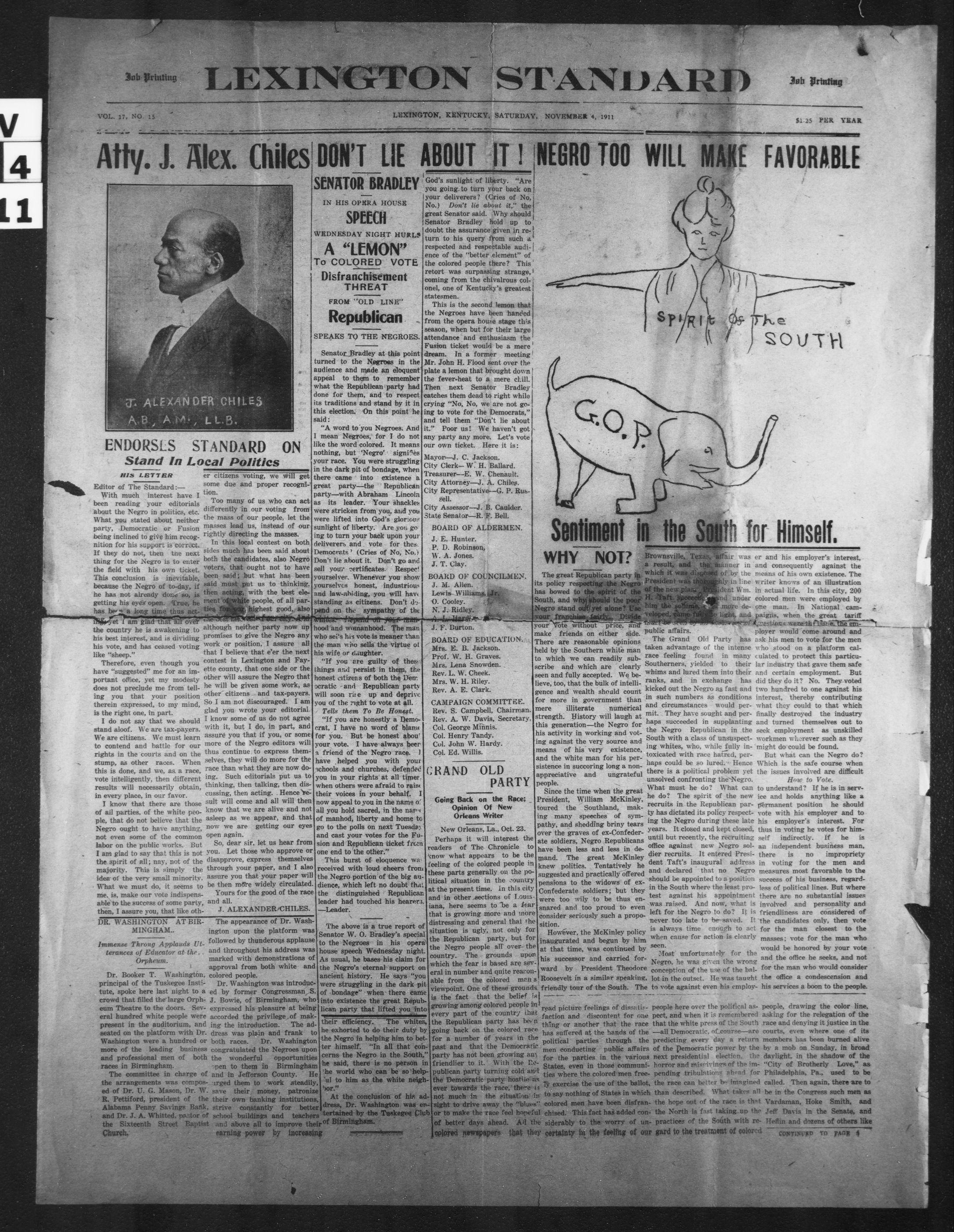
Atty. J. Alex. Chiles DON'T LIE ABOUT IT! NEGRO TOO WILL MAKE FAVORABLE
J. ALEXANDER CHILES
A.B., A.M., LL.B.
ENDORSES STANDARD ON Stand In Local Politics
Job Printing
VOL. 17, NO. 15
Atty. J. Al
J. ALEXANDER
A.B., A.M., L.
ENDORSES ST
Stand In Log
HIS LETTER
Editor of The Standard:—
With much interest have I been reading your editorials about the Negro in politics, etc.
What you stated about neither party, Democratic or Fusion being inclined to give him recognition for his support is correct.
If they do not, then the next thing for the Negro is to enter the field with his own ticket.
This conclusion is inevitable, because the Negro of to-day, if he has not already done so, is getting his eyes open. True, he has been a long time thus act-
in yet I am glad that all over the country he is awakening to his best interest, and is dividing his vote, and has ceased voting like "sheep."
Therefore, even though you have "suggested" me for an important office, yet my modesty does not preclude me from telling you that your position therein expressed, to my mind, is the right one, in part.
I do not say that we should stand aloof. We are tax-payers. We are citizens. We must learn to contend and battle for our rights in the courts and on the stump, as other races. When this is done, and we, as a race, vote intelligently, then different results will necessarily obtain, in every place, in our favor.
I know that there are those of all parties, of the white people, that do not believe that the Negro ought to have anything, not even some of the common labor on the public works. But I am glad to say that this is not the spirit of all; nay, not of the majority. This is simply the idea of the very small minority. What we must do, it seems to me, is, make our vote indispensable to the success of some party, then, I assure you, that like oth- DR. WASHINGTON AT BIRMINGHAM. Immense Throng Applauds Utterances of Educator at the . Orpheum.
Dr. Booker T. Washington, principal of the Tuskegee Institute, spoke here last night to a crowd that filled the large Orpheum Theatre to the doors. Several hundred white people were present in the auditorium, and seated on the platform with Dr. Washington were a hundred or more of the leading business and professional men of both races in Birmingham.
The committee in charge of the arrangements was composed of Dr. U. G. Mason, Dr. W. R. Pettiford, president of the Alabama Penny Savings Bank, and Dr. J. A. Whitted, pastor of the Sixteenth Street Baptist Church.
```markdown
```
LEXINGTON STANDARD
er citizens voting, we will get some due and proper recognition.
Too many of us who can act differently in our voting from the mass of our people, let the masses lead us, instead of our rightly directing the masses.
In this local contest on both sides much has been said about both the candidates, also Negro voters, that ought not to have been said; but what has been said must put us to thinking, then acting, with the best element of white people, of all parties for our highest good, also
although neither party now up promises to give the Negro any work or position, I assure all that I believe that e'er the next contest in Lexington and Fayette county, that one side or the other will assure the Negro that he will be given some work, as other citizens and tax-payers. So I am not discouraged. I am glad you wrote your editorial. I know some of us do not agree with it, but I do, in part, and assure you that if you, or some more of the Negro editors will thus continue to express themselves, they will do more for the race than what they are now doing. Such editorials put us to thinking, then talking, then discussing, then acting. Hence result will come and all will then know that we are alive and not asleep as we appear, and that now we are getting our eyes open again.
So, dear sir, let us hear from you. Let those who approve or disapprove, express themselves through your paper, and I also assure you that your paper will be then more widely circulated. Yours for the good of the race and all.
J. ALEXANDER/CHILES.
The appearance of Dr. Washington upon the platform was followed by thunderous applause and throughout his address was marked with demonstrations of approval from both white and colored people.
Dr. Washington was introduced by former Congressman S. J. Bowie, of Birmingham, who expressed his pleasure at being accorded the privilege of making the introduction. The address was plain and frank to both races. Dr. Washington congratulated the Negroes upon the wonderful opportunities open to them in Birmingham and in Jefferson County. He urged them to work steadily, save their money, patronize their own banking institutions, strive constantly for better school buildings and teachers and above all to improve their earning power by increase
LEXINGTON, KENTUCKY, SATURDAY, NOVEMBER 4, 1911
SPEAKS TO THE NEGROES.
Senator Bradley at this point turned to the Negroes in the audience and made an eloquent appeal to them to remember what the Republican party had done for them, and to respect its traditions and stand by it in this election. On this point he said:
"A word to you Negroes. And I mean Negroes, for I do not like the word colored. It means nothing, but 'Negro' signifies your race. You were struggling in the dark pit of bondage, when there came into existence a great party—the Republican party—with Abraham Lincoln as its leader. Your shackles were stricken from you, and you were lifted into God's glorious sunlight of liberty. Are you going to turn your back upon your deliverers and vote for these Democrats' (Cries of No, No.) Don't lie about it. Don't go and sell your certificates. Respect yourselves. Whenever you show yourselves honest, industrious and law-abiding, you will have standing as citizens. Don't depend on the sympathy of the
writes. Depend on your manhood and womanhood. The man who sei's his vote is meaner than the man who sells the virtue of his wife or daughter.
"If you are guilty of these things and persist in them, the honest citizens of both the Democratic and Republican party will soon rise up and deprive you of the right to vote at all.
Tells them To Be Honest
"If you are honestly a Democrat, I have no word of blame for you. But be honest about your vote. I have always been a friend of the Negro race. I have helped you with your schools and churches, defended you in your rights at all times, when others were afraid to raise their voices in your behalf. I now appeal to you in the name of all you hold sacred, in the name of manhod, liberty and home to go to the polls on next Tuesday and cast your votes for the Fusion and Republican ticket from one end to the other."
This burst of eloquence was received with loud cheers from the Negro portion of the big audience, which left no doubt that the distinguished Republican leader had touched his hearers —Leader.
The above is a true report of Senator W. O. Bradley's special to the Negroes in his opera house speech Wednesday night. As usual, he bases his claim for the Negro's eternal support on ancient history. He says "you were struggling in the dark pit of bondage" when there came into existence the great Republican party that lifted you into their efficiency. The whites, he exhorted to do their duty by the Negro in helping him to better himself. "In all that concerns the Negro in the South," he said, there is no person in the world who can be so helpful to him as the white neigh bor."
At the conclusion of his address, Dr. Washington was entertained by the Tuskegee Club of Birmingham.
God's sunlight of liberty. "Are you going to turn your back on your deliverers? (Cries of No, No.) Don't lie about it," the great Senator said. Why should Senator Bradley hold up to doubt the assurance given in return to his query from such a respected and respectable audience of the "better element" of the colored people there? This retort was surpassing strange, coming from the chivalrous colonel, one of Kentucky's greatest statesmen.
This is the second lemon that the Negroes have been handed from the opera house stage this season, when but for their large attendance and enthusiasm the Fusion ticket would be a mere dream. In a former meeting Mr. John H. Flood sent over the plate a lemon that brought down the fever-heat to a mere chill. Then next Senator Bradley catches them dead to right while crying "No, No, we are not going to vote for the Democrats," and tell them "Don't lie about it." Poor us! We haven't got any party any more. Let's vote our own ticket. Here it is:
Mayor—J. C. Jackson.
City Clerk—W. H. Ballard.
Treasurer—E. W. Chenault.
City Attorney—J. A. Chiles.
City Representative—G. P. Rus-
sell.
City Assessor—J. B. Caulder.
State Senator—R. F. Bell.
BOARD OF ALDERMEN.
J. E. Hunter.
P. D. Robinson;
W. A. Jones.
J. T. Clay.
BOARD OF COUNCILMEN.
J. M. Allen.
Lewis Williams, Jr.
O. Cooley.
N. J. Ridley.
A. L. Hardi
BOARD OF EDUCATION.
Mrs. E. B. Jackson.
Prof. W. H. Graves.
Mrs. Lena Snowden.
Rev. L. W. Cheek.
Mrs. W. H. Riley.
Rev. A. E. Clark.
CAMPAIGN COMMITTEE.
Rev. S. Campbell, Chairman
Rev. A. W. Davis, Secretary
Col. George Minnis.
Col. Henry Tandy.
Col. John W. Hardy.
Col. Ed. Willis.
GRAND OLD
PARTY
Going Back on the Race;
Opinion Of New
Orleans Writer
New Orleans, La., Oct. 23. Perhaps it will interest the readers of The Chronicle to know what appears to be the feeling of the colored people in these parts generally on the political situation in the country at the present time. In this city and in other sections of Louisiana, here seems to be a fear that is growing more and more distressing and general that the situation is ugly, not only for the Republican party, but for the Negro people all over the country. The grounds upon which the fear is based are several in number and quite reasonable from the colored men's viewpoint. One of these grounds is the fact that the belief is growing among colored people in every part of the country that the Republican party has been going back on the colored race for a number of years in the past and that the Democratic party has not been growing any friendlier to it. With the Republican party turning cold and the Democratic party hostile as ever towards the race, there is not much in the situation in sight to drive away the "blues" or to make the race feel hopeful of better days ahead. All the colored newspapers that the
SPIRIT OF THE
SOUTH
G.O.P.
Sentiment in the South for Himself.
WHY NOT?
The great Republican party in its policy respecting the Negro has bowed to the spirit of the South, and why should the poor Negro stand out yet alone? Use your franchise fairly. Divide your vote without price, and make friends on either side. There are reasonable opinions held by the Southern white man to which we can readily subscribe and which are clearly seen and fully accepted. We believe, too, that the bulk of intelligence and wealth should count for more in government than mere illiterate numerical strength. History will laugh at this generation—the Negro for his activity in working and voting against the very source and means of his very existence, and the white man for his persistence in succoring long a nonappreciative and ungrateful people.
Since the time when the great President, William McKinley, toured the Southland, making many speeches of sympathy, and shedding briny tears over the graves of ex-Confederate soldiers, Negro Republicans have been less and less in demand. The great McKinley knew politics. Tentatively he suggested and practically offered pensions to the widows of ex-Confederate soldiers; but they were too wily to be thus ensnared and too proud to ever consider seriously such a proposition.
However, the McKinley policy inaugurated and begun by him at that time, was continued by his successor and carried forward by President Theodore Roosevelt in a similar speaking, friendly tour of the South. The
read picture feelings of dissatisfaction and discontent for one thing or another that the race has suffered at the hands of the political parties through the men conducting public affairs for the parties in the various States, even in those communities where the colored men freely exercise the use of the ballot, to say nothing of States in which colored men have been disfranchised. This fact has added considerably to the worry of uncertainty in the feeling of our
The Grand Old Party has taken advantage of the intense race feeling found in many Southerners, yielded to their whims and lured them into their ranks, and in exchange has kicked out the Negro as fast and in such numbers as conditions and circumstances would permit. They have sought and perhaps succeeded in supplanting the Negro Republican in the South with a class of unsuspecting whites, who, while fully intoxicated with race hatred, perhaps could be so lured. Hence there is a political problem yet unsolved confronting the Negro. What must he do? What can he do? The spirit of the new recruits in the Republican party has dictated its policy respecting the Negro during these late years. It closed and kept closed, until but recently, the recruiting office against new Negro soldier recruits. It entered President Taft's inaugural address and declared that no Negro should be appointed to a position in the South where the least protest against his appointment was raised. And now, what is left for the Negro to do? It is too too late to be saved. It is always time enough to act when cause for action is clearly seen.
Most unfortunately for the Negro, he was given the wrong conception of the use of the ballot in the outset. He was taught to vote against even his employ-
people here over the political aspect, and when it is remembered that the white press of the South all Democratic, of course are predicting every day a return of the Democratic power by the next presidential election, the horror and missevings of the impending tribulations ahead for the race can better be imagined than described. What takes all the hope out of the race is that the North is fast taking up the practices of the South with regard to the treatment of colored
Josh Printing
$1.25 PER YEAR
FAVORABLE
The SOUTH
or Himself.
er and his employer's interest, and consequently against the means of his own existence. The writer knows of an illustration in actual life. In this city, 200 colored men were employed by one man. In National campaigns, when the great tariff questions were the case, the
plover would come around and ask his men to vote for the men who stood on a platform calculated to protect this particular industry that gave them safe and certain employment. But did they do it? No. They voted two hundred to one against his interest, thereby contributing what they could to that which finally destroyed the industry and turned themselves out to seek employment as unskilled workmen wherever such as they might do could be found. But what can the Negro do? Which is the safe course when the issues involved are difficult How to Vote.
to understand? If he is in service and holds anything like a permanent position he should vote with his employer and to his employer's interest. For thus in voting he votes for himself indirectly. If he is an independent business man, there is no impropriety in voting for the men and measures most favorable to the success of his business, regardless of political lines. But where there are no substantial issues involved and personality and friendliness are considered of the candidates only, then vote for the man closest to the masses; vote for the man who would be honored by your vote and the office he seeks, and not for the man who would consider the office a condescension and his services a boon to the people.
people, drawing the color line, asking for the relegation of the race and denying it justice in the courts, even where one of its members has been burned alive by a mob on Sunday, in broad daylight, in the shadow of the "City of Brotherly Love," as Philadelphia, Pa., used to be called. Then again, there are to be in the Congress such men as Vardaman, Hoke Smith, and Jeff Davis in the Senate, and Heflin and dozens of others like
CONTINUED TO PAGE 4
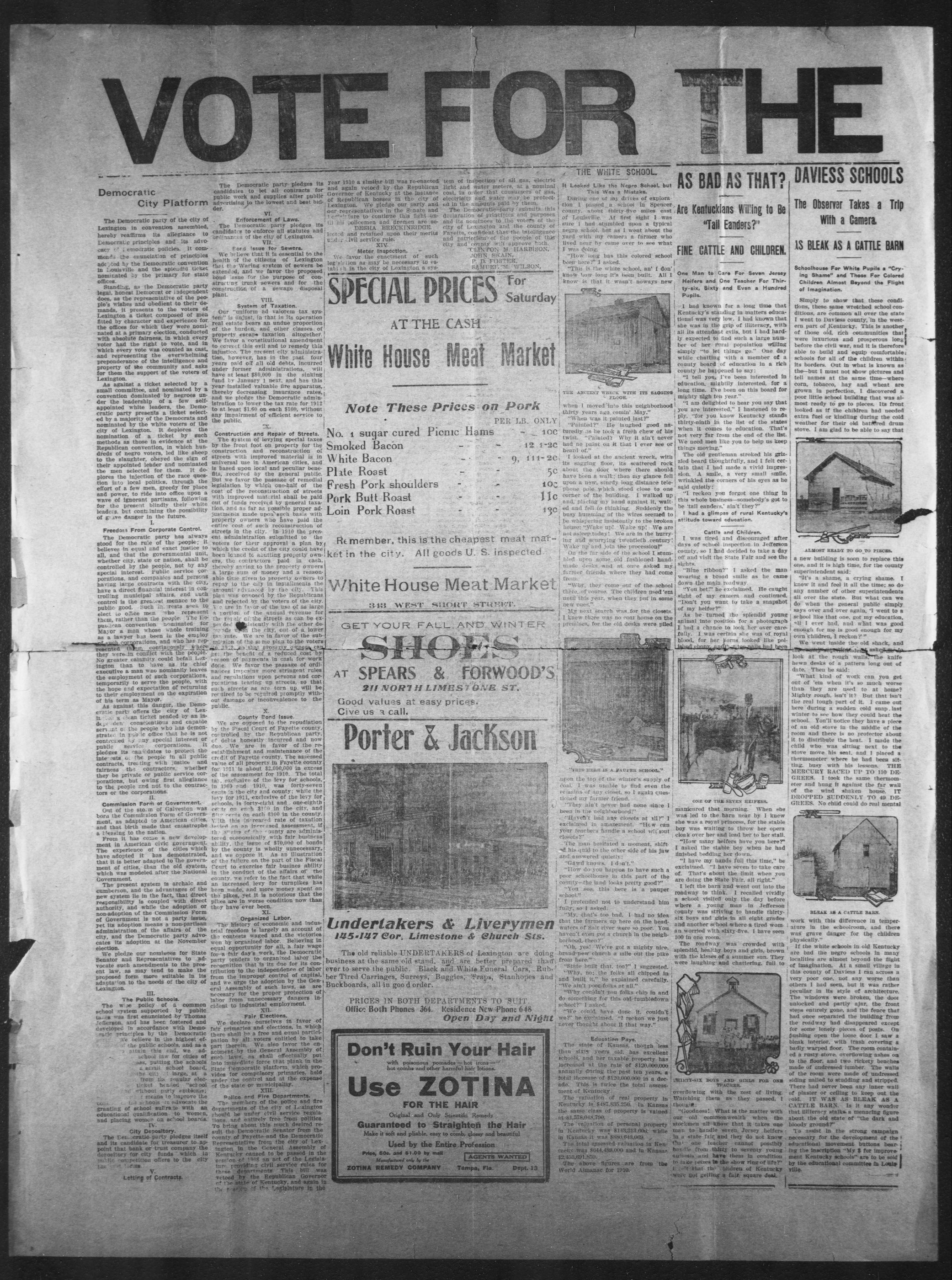
The Democratic party of the city of Lexington in convention assembled, hereby reaffirms its allegiance to Democratic principles and its advocacy of Democratic policies. It commends the caucusation of principles adopted by the Democratic convention in Louisville and the splendid ticket nominated by the primary for state offices. Standing, as the Democratic party legal, honest Democrat or independent does, as the representation of the people and obedient to their demands, it presents to the voters of Lexington a ticket composed of men fitted by character and experience for the offices for which they were nominated at a primary election, conducted with absolute fairness, in which every voter had the right to vote, and in which every vote was counted as cast, and representing the everwhelming preponderance of the intelligence and authority of the community and asks for them the support of the voters of Lexington.
As against a ticket selected by a small committee, and nominated by a convention dominated by negroes under the leadership of a few self-appointed white leaders, the Democratic party presents a ticket selected by a majority of the voters. The Democratic party, white voters of the city of Lexington. It deplores the nomination of a ticket by such methods as those in evidence at the Republican convention, in which hundreds of negro voters, led like sheep to the slaughter, obeyed the sign of their appointed leader and nominated the men selected for them. plores the injection of race questions into the politics, through the effort of a few men, greedy for place and power, to ride into office upon a wave of ignorant partisans, following for the present blindly their white leaders, but containing the possibility of grave danger in the future.
Freedom From Corporate Control.
The Democratic party has always stood for the rule of the people; it believes in equal and exact justice to all, and that the governmental unit, whether city, state or nation, shall be controlled by the people, not by any special interest. Public service corporations, and companies and persons having large contracts with them have a direct interest in con- trol of the public affairs, and such control is the greatest menace to the public good. Such in- rests seek to elect to office men who represent them, rather than the people. The Republican convention nominated for Mayor a man whose whole tenure as a lawyer has been spent, of such an age and who has run for office than continuously where they were in conflict with the people. No greater catality could befall Lexington than to have as its chief executive a man who nominally leaves the employment of such corporations, temporarily to serve the people, the reason for the retention of returning their employment on the expiration of his term as Mayor.
As against this danger, the Democratic party offers the city of Lexington a clean ticket headed by an independent conscientious and capable servant of the people who has demonstrated in public office that he is not constrained by any state laws related public corporations. It uses its candidates to protect the interests of the people in all public contracts, treating with justice and fairness the contractors, whether they be private or public service corporations, but owing first allegiance to the people and not to the contractors or the corporations.
II.
Commission Form of Government.
Out of the storm of Galveston was born the Commission Form of Government, as adapted to American cities, and that birth made that catastrophe a blessing to the nation.
From it has come a new development in American civic government. The experience of the cities which have adopted it as their form, that it is adapted to the government of the cities, than the old system, which was modeled after the National Government.
The present system is archaic and cumberson, and the advantages of the new system lie in the fact, that direct responsibility is coupled with direct authority, and while the adoption or non-adoption of the Commission Form of Government is not a party issue, yet its adoption means a non-partisan administration of the affairs of the city, and the Democratic party catches its adoption at the November election. We pledge our nominees for State Senator and Representatives to advocate such amendments to the present law, as may tend to make the proposed form more suitable in its adaptation to the needs of the city of Lexington.
The Public Schools.
The wise policy of a common school system supported by public taxes was first enunciated by Thomas Jefferson, and has been fostered and developed in accordance with Democratic principles by the Democratic Party.
We believe in the highest efficiency of the public schools to attain this end, we ad-school law for cities of cities, putting the schools a small school board, the city of large, at a distance from the regular elec-ticket headed "school and without party emblems; it means to improve the condition of the schools to advocate the granting of school suffrage with an educational qualification to women, and placing women on school boards.
City Depository.
The Democratic party pledges itself and its candidate for treasurer to appoint that bank or trust company the detoxification for city funds which in public competition offers to the city the best terms.
The Democratic party pledges its candidates to let all contracts for public work and supplies after public advertising to the lowest and best bidder.
VI.
Enforcement of Laws.
The Democratic party pledges its candidates to enforce all statutes and ordinances of the city of Lexington.
VII.
Sord issue for Sewers.
We believe that it is essential to the health of the citizens of Lexington that the Waring system of sewers be extended, and we favor the proposed bond issue for construction trunk sewers and for the construction of a sewage disposal plant.
System of Taxation.
Our "uniform ad valorem tax system" is unjust, in that in its operation real estate bears an undue proportion of the burden, and other classes of property escape taxation altogether. We favor a constitutional amendment to correct this evil and to remedy this injustice. The present city administration has held for four years paid off all old debts, incurred under former administrations, will have at least $80,000 in the sinking fund by January 1 next, and has this year installed valuable fire apparatus, thereby decreasing insurance rates, and we pledge the Democratic administration to lower the tax rate for 1912 to at least $1.60 on each $100, without any impairment of efficient service to the public.
County Bond Issue.
We are opposed to the foundation by the Fiscal Court of Fayette county, controlled by the Republican party, of delis honestly incurred and now due. We are in favor of the reestablishment and maintenance of the credit of Fayette county. The assessed value of all property in Fayette county for 1511 is about $2,000,000 in excess of the assessment of the county for the levy for schools, in 1909 and 1910, was forty-seven cents in the city and county, while the levy for 1611, exclusive of the levy for schools, is forty-eight and one-eighth cents on each $100 in the city, and fifty cents on each $100 in the county. With this increase, we are assessed assessment, if the assets of the county are administered economically with fair business ability, the issue of $70,000 of bonds by the county is wholly unnecessary, and we oppose it. As an illustration of the failure on the part of the Fiscal Court to exercise fair business in the county affairs of the county, we refer to the fact that while an increased levy for tupikes has been made, and more money spent on the pikes, yet it is notorious that the pikes are in worse condition now than they have ever been.
Organized Labor
The history of economic and industrial freedom has only an account of the contents waged and the victories won by organized labor. Believing in equal opportunity for all, a fair wage for a fair day's work, the Democratic party tenders to organized labor the recognition that is its due for its contribution to the independence of labor from the improper control of capital, and we urge the adoption by the General Assembly of such laws, as are necessary for the proper control of labor from unnecessary dangers incident to industrial employment.
XII.
Fair Elections.
We declare ourselves in favor of fair primaries and elections, in which there shall be a free and equal participation by all voters entitled to take part therein. We also favor the enactment by the General Assembly of such laws, as shall be explicitly put into immediate order that bank in the State Democratic platform, which provides compulsory primaries, hold over the control and at the expense of the state or municipality.
XIII.
POLICE and FIRE Departments. The members of the police and fire departments of the city of Lexington should be under civil service regulations, and entirely free from politics. To bring about this much desired result the Democratic Senator from the county of Payette and the Democratic representative from Lexington in General Assembly of Kentucky caused to be passed in the session of 1908 an act of the Legislature building civil service rules for these departments. This bill was vetoed by the Republican Governor of the state of Kentucky, and again in the session of the Legislature in the
SPECIAL PRICES For Saturday
AT THE CASH White House Meat Market
No. 1 sugar cured Picnic Hams 10c
Smoked Bacon 12 1-2c
White Bacon 9, 111-2c
Plate Roast 5c
Fresh Pork shoulders 10c
Pork Butt Roast 11c
Loin Pork Roast 13c
Remember, this is the cheapest meat market in the city. All goods U. S. inspected.
GET YOUR FALL AND WINTER
Good values at easy prices. Cive us a call.
Porter & Jackson
VANCOUVER COUNTY CENTER FOR HOSPITALS
Undertakers & Liverymen
145-147 Cor, Limestone & Church Sts.
The old reliable UNDERTAKERS of Lexington are doing business at the same old stand, and are better prepared than ever to serve the public. Black and White Funeral Cars, Rubber Tired Carriages, Surreys, Buggies, Traps, Stanhopes and Buckboards, all in good order.
Don't Ruin Your Hair
with poisonous pomades — hot irons —
hot combs and other harmful hair lotions.
Use ZOTINA
FOR THE HAIR
Original and Only Scientific Remedy
Guaranteed to Straighten the Hair
Make it soft and pliable, easy to comb, glossy and beautiful
Used by the Entire Profession
Price, 50c. and $1.00 by mail
Manufactured only by the
ZOTINA REMEDY COMPANY
Tampa, Fla. Dept. 13
year 1910 a similar bill was re- enacted and again vetoed by the Republican Governor of Kentucky at the instance of Republican bosses in the city of Lexington. We pledge our party and our representatives in the Senate and Legislature to continue this fight until all policemen and greeters are se-
DESHA BRECKNIRDGE
lected and retained upon their merits
under civil service rule.
XIV.
Meter inspection.
We favor the enactment of such
legislation as may be necessary to
establish in the city of Lexington a sys-
tem of inspection of all oil, electric light and water meters, at a nominal cost, in order that consumers of gas, electricity and water may be protected in the amounts paid by them. The Democratic-party submit this description and purpose, and its nominees to the voters of the city of Lexington and the county of Fayette, confident that the intelligence and patriotism of the people of the city and county will approve both. CLEMEN HARBISON, JOHN SKAIN, P. D. FOSTER, SAMUEL M. WILSON.
It Looked Like The Negro School, but
This Wax = Mirtika
This was a mistress.
During one of my drives of exploration I passed at a school in Spencer county, about thirty-five miles east of Louisville. At first sight I was sure I had stumbled upon a typical negro school, but as I went about the yard with my camera a farmer who lived near by came over to see what I was doing.
"How long has this colored school been here?" I asked.
"This is the white school, an' I don't know how long it's been built. All I know is that it wasn't neways now
THE ANCIENT WRECK WITH ITS SAGGING FLOOR.
when I moved into this neighborhood thirty years ago comin' May."
"When was it painted last?"
"Painted? He laughed good naturally as he took a fresh chew of his twist. "Painted? Why it ain't never had no paint on it that I ever see or heard of."
I looked at the ancient wreck, with its sagging floor, its scattered rock about the door where there should have been a walk; then my glance fell upon a new, sturdy long distance telephone pole which stood close to one corner of the building. I walked up and, placing my hand against it, waited and fell to thinking. Suddenly the busy humming of the wires seemed to be whispering insistently to the broken house: "Wake up! Wake up! We are not asleep today! We are in the hurry and scurrying twentieth century! Wake up! and join the procession"
On the far side of the school I crumbled upon some old fashioned hand-made desks and at once asked my farmer friends where they had come from.
"Why, they come out of the school there, of course. The children used 'em until this year, when they put in new ones."
My next search was for the closets. I knew there was no coat house on the premises, for the old desks were piled
"THIS HERE IS A PAUPER SCHOOL."
upon the top of the winter's supply of coal. I was unable to find even the remains of any closet, so I again questioned my farmer friend.
"They aln't never had none since I been in the neighborhood."
"Haven't had any closets at all?" I
exclaimed in amazement. "How can
your teachers handle a school vwl out
closets?"
"The man besitched a moment, shift
of his guilt to the other side of his jaw
and answered quietly:
"Gawd knows, I don't."
"How do you happen to have such a
poor schoolhouse in this part of the
county—the land looks pretty good?"
"You see, this here is a pauper school."
I pretended not to understand him fully, so I asked:
"My, that's too bad. I had no idea that the farmers up here on the headwaters of Salt river were so poor. You haven't even got a church in the neighborhood, then?
"Oh, yes! We've got a mighty nice, brand new church a mile out the plke from here."
"State built that, too?" I suggested.
"Why, no; the folks all chipped in and built it," he explained carefully.
"We ain't poor folks at all."
"Why couldn't you folks chip in and do something for this old tumbledown school?" I asked.
"No, we could have done it. couldn't we?" he exclaimed.
"I reckon we just never thought about it that way."
Education Pays.
The state of Kansas, though less than sixty years old, has excellent schools and her taxable property has increased at the rate of $120,000,000 annually during the past ten years, a total increase of $120,000,000 in a decade. This is twice the total assessment of Kentucky.
The valuation of real property in Kentucky is $187,835,256. In Kansas the same property is valued at $1,578,048,700.
The valuation of personal property in Kentucky was $148,313,000; while in Kansas it was $880,843,690.
The total assessed valuation in Kentucky was $444,458,000 and in Kansas $2,453,691,853.
The above figures are for 1010.
AS BAD AS THAT?
FINE CATTLE AND CHILDREN
One Man to Care For Seven Jersey Heifers and One Teacher For Thirty-six, Sixty and Even a Hundred Pupils.
I had known for a long time that Kentucky's standing in matters educational was very low. I had known that she was in the grip of illiteracy, with all its attendant evils, but I had hardly expected to find such a large number of her rural population willing simply "to let things go." One day while chatting with a member of a county board of education in a rich county he happened to say:
"I tell you, I've been interested in education, mightily interested, for a long time. I've been on this board for mighty night ten year."
"I am delighted to hear you say that you are interested," I hastened to reply, "for you know Kentucky stands thirty-ninth in the list of the states when it comes to education. That's not very far from the end of the list. We need men like you to help us keep things moving."
The old gentleman stroked his grizzled beard thoughtfully, and I felt certain that I had made a vivid impression. A smile, a very small smile, wrinkled the corners of his eyes as he said quietly:
"I reckon you forgot one thing in this whole business—somebody's got to be 'tail enders,' ain't they"
I had a glimpse of rural Kentucky's attitude toward education.
Cattle and Children.
I was tired and discouraged after days of school inspection in Jefferson county, so I had decided to take a day off and visit the State Fair and see the sights.
"Blue ribbon?" I asked the man wearing a broad smile as he came down the main roadway.
"You bet!" he exclaimed. He caught sight of my camera and continued.
"Don't you want to take a snapshot of my heifer?"
As he turned the splendid young animal into position for a photograph I had a chance to look her over carefully. I was certain she was of royal blood, for her horns looked like polished chinny, and" too nails had been
ONE OF THE SEVEN HEIFERS.
manicured that morning. When she was led to the barn near by I knew she was a royal princess, for the stable boy was waiting to throw her opera clock over her and lead her to her stall. "How many helfers have you here?" I asked the stable boy when he had finished bedding her down. "I have my hands full this time," he exclaimed. "I have seven to take care of. That's about the limit when you are doing the State Fair, all right." I left the barn and went out into the roadway to think. I recalled vividly a school visited only the day before where a young man in Jefferson High School in Indiana thirty-six boys and girls in all eight grades and another school where a tired woman worried with sixty-five. I have seen 100 in one room. The roadway was crowded with splendid, healthy boys and girls, brown with the kisses of a summer sun. They were laughing and chattering full to
MILITARY-SIX BOYS AND GIRLS FOR ONE
TEACHER.
overflowing with the zest of living.
Watching them as they passed. I
thought:
"Goodness! What is the matter with our old commonwealth when the stockmen all know that it takes one man to handle seven Jersey beffers in a state fair and they do not know that one teacher cannot possibly handle from thirty to seventy young appalachians and have them in condition to take prizes in the show ring of life?" I felt that the "children of Kentucky were not getting a fair square deal."
AS BLEAK AS A GATTLE BARN
Schoolhouse For White Pupils a "Crying Shame" and Those For Colored Children Almost Beyond the Flight of Imagination.
Simply to show that these conditions, these same wretched school conditions, are common all over the state I went to Davies county, in the western part of Kentucky. This is another, of those old, rich communities that were luxurious and prosperous long before the civil war, and it is therefore able to build and equip comfortable schools for all of the children within its borders. Out in what is known as the—but I must not show pictures and tell names at the same time—where corn, tobacco, hay and wheat are grown in perfection. I discovered a poor little school building that was almost ready to go to pieces. Its front looked as if the children had needed extra fuel or kindling during the cold weather for their old battered drum stove. I am glad to be able to say that
ALMOST READY TO GO TO PIECES.
a new building is soon to replace this one, and it is high time, for the county superintendent said:
"It's a shame, a crying shame. I know it and feel it all the time; so do any number of other superintendents all over the state. But what can we do when the general public simply says over and over again, 'I went to a school like that, got my education,' all I ever had, and what was good enough for me is good enough for my own children, I reckon?" We went inside the old shack, and the family still thinks asks me to look at the rough walls. The knife hewn desks of a pattern long out of date. Then he said:
"What kind of work can you get out of 'em when it's so much worse than they are used to at home? Mighty rough. isn't it? But that isn't the real tough part of it. I came out here during a sudden cold snap, last winter to see how they could heat the school. You'll notice they have a piece of an old stove in the middle of the room and there is no protector about it to distribute the heat. I made the child who was sitting next to the stove move his seat, and I placed a chair where he had been sittin busy with his homework. MERCURY RACED UP TO 110 DEGREES. I took the same thermometer and hung it against the far wall of the wind shaken house. DROPPED SUDDENLY TO 49 DEGREES. No child could do real mental
BLEAK AS A CATTLE BARN. work with this difference in temperature in the schoolroom, and there was grave danger for the children physically."
If the white schools in old Kentucky are bad the negro schools in many localities are almost beyond the flight of imagination. At a small village in this county of Davies I ran across a very poor one, not any worse than others I had seen, but it was rather peculiar in its style of architecture. The windows were broken, the door unlocked and partly ajar, the front steps entirely gone, and the fence that had once separated the building from the roadway had disappeared except for some lonely pieces of posts. On pushing open the door I saw a bleak interior, with trash covering a badly warped door. The room contained a rusty stove, overflowing ashes on to the floor, and two rickety benches on the floor, with the trash of the room were made of undressed siding malled to studding and stripped. There had never been any inner wall of plaster or ceiling to keep out the cold. IT WAS AS BLEAK AS A CATTLE BARN. Is it any wonder that illiteracy stalks a menacing figure about the old state of "the dark and bloody ground?"
To assist in the strong campaign necessary for the development of the educational movement buttons bearing the inscription "My $ for improvement Kentucky schools" are to be sold by the educational committee in Louisville.
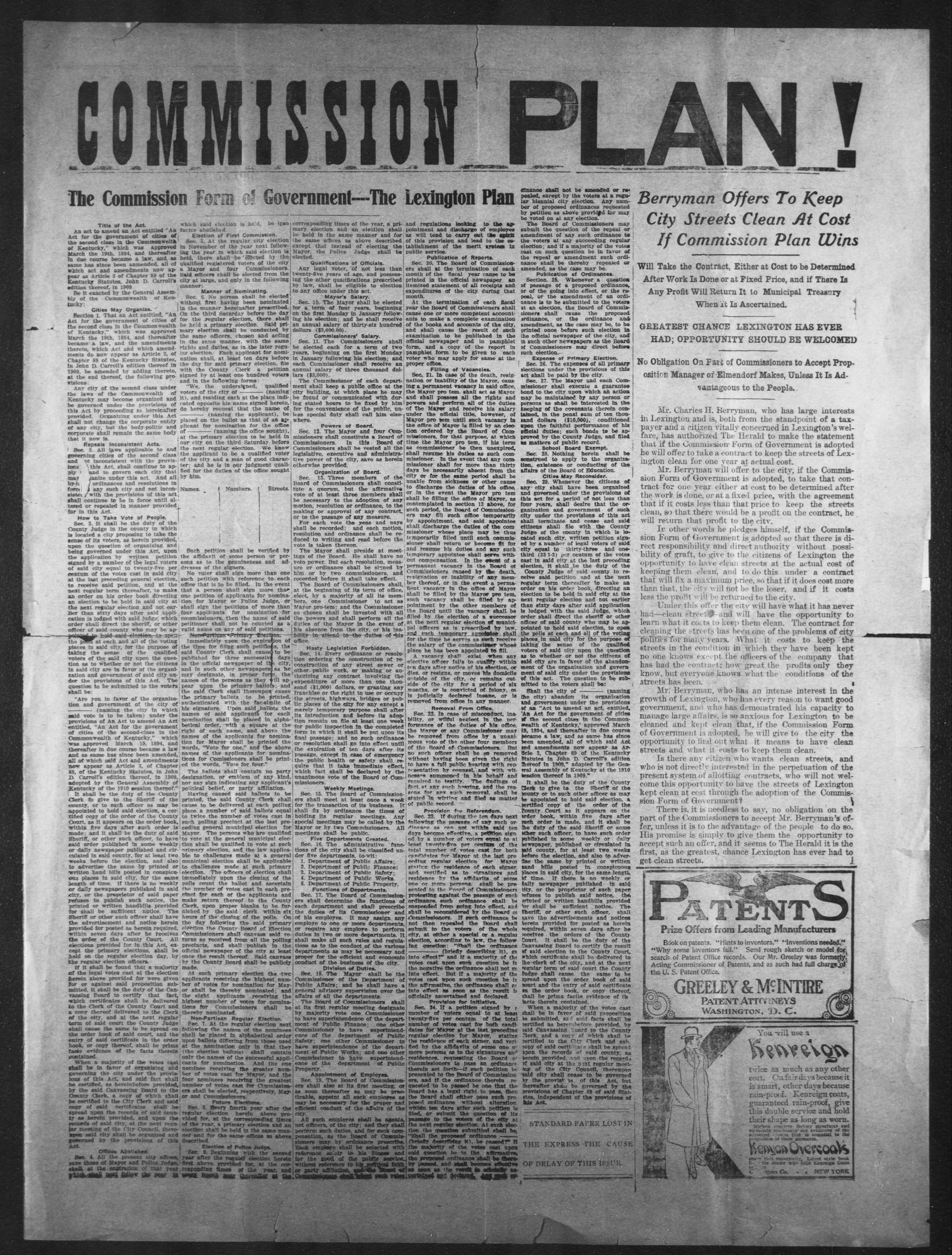
COMMISSION
The Commission Form of Government----The Lexington Plan
Title of the Act
An act to amend an Act entitled "An Act for the government of cities of the second class in the Commonwealth of Kentucky," which was approved March 8, 1894, and thereafter the course became a law, and as same has since been amended, all of which act and amendments now appear as Article 8 of Chapter 89 of the Kentucky Statutes, John D. Carroll's edition thereof, in 1909.
Be it enacted by the General Assembly of the Commonwealth of Kentucky:
Cities May Organize.
Section 1. That an Act entitled, "An Act for the government of cities of the second class in the Commonwealth of Kentucky," which was approved March 19th, 1894, and thereafter became a law, and the amendments thereto, which Act and which amendments do now appear as Article 3, of Chapter 89 of the Kentucky Statutes, John D. Carroll's edition thereof, in 1909, amended by adding thereto, at the end thereof, the following provisions:
Any city of the second class under the laws of the Commonwealth of Kentucky may become organized and be governed under the provisions of this Act by proceeding as hereinafter shall not change the corporate entity of any city, but the body-politic and corporate shall remain the same body that it now is.
Repeals Inconsistent Acts
Sec. 2. All laws applicable to and governing the second class and of inconsistent with the provisions of this Act, shall continue to apply and to govern each city that may organize under this act. And all by-laws ordinances and resolutions in force in any such city and not incomprehensible shall continue to be in force until altered or repealed in manner provided for in this Act.
How to Take Vote of People.
Sec. 3. It shall be the duty of the County Judge in the county in which is located a city proposing to take the sense of its voters, as herein provided, to be governed under this Act, upon the application by written petition signed by a number of the legal voters of said city equal to twenty-five per centum of the votes cast in said city at the last preceding general election, to receive said petition, to receive another officer to make an order on his order book directing an election to be held in said city at the next regular election and not earlier than sixty days after said application is lodged with said judge, which order shall direct the sheriff, or other officer of said county may be appointed to direct the votes of the poes at each and all of the voting places in said city, for the purpose of taking the sense of the qualified voters of the said city upon the question as to whether or not the citizens in said city are in favor of the organization and government of said city and not the question to be submitted to the voters shall be:
"Are you in favor of the organization and government of the city of _____ (naming the city in which said vote is to be taken) under the provisions of An Act to amend An Act entitled, "An Act for the government of cities of the second-class in the Commonwealth of Kentucky," which was approved March 19, 1894, and thereafter in due course became a law and as same law as Act 3 and amendments now appear as Article 3, of Chapter 89, of the Kentucky Statutes, in John D. Carroll's edition thereof, in 1909, adopted by the General Assembly of Kentucky of the 1910 session thereof."
It shall be the duty of the County Clerk to give to the Sheriff of the county, or to such officer as may be appointed to hold said election, a certain number of votes, in the County Court, as it appears on the order book, within five days after such order is made; and it shall be the duty of said Sheriff, or other such officer, to have said order published in some weekly or daily newspaper published and circulated in said county, for at least two weeks before the election, and also to advertise the same by printed or written hand bills posted in conspicuous places, for a length of time. If there is no weekly or daily newspapers published in said city, or the proprietor of said paper refuses to publish such notice, the printed or written handbills provided for shall be sufficient notice. The Sheriff or other such officer shall have the advertisement and notice herein provided for posted as herein required, within seven days after he receives the notice. The elections provided for in this Act, except the primary elections, shall be held on the regular election day, by the regular election officers.
If it shall be found that a majority of the legal votes cast at the election herein above provided for were given for or against said proposition submitted, it shall be the duty of the Canvassing Board to certify that fact which certificates shall be delivered to the Clerk of the County Court and a copy thereof delivered to the Clerk of the city, and at the next regular term of said court the County Judge will determine the same by the order book of said court, and the entry of said certificate in the order book, or copy thereof, shall be prima tide evidence of the facts therein contained.
When a majority of the votes cast shall be in favor of organizing and governing the city under the provisions of this Act, and said fact shall be certified, as herebefore provided, by the said Canvassing Board to the County Clerk, a copy of which shall be certified to the City Clerk and a copy of said certificates shall be spread upon the records of said county and benefit provided to the records of said city, at the net rate the meeting of the City Council, thereupon said city shall be organized and governed by the provisions of this Act.
Office Abolished.
Sec. 4. All the present city offices, save those of Mayor and Police Judge, shall, at the expiration of that year which shall next follow the year in
which said election is held, be ipso factor abolished.
**Election of First Commission.**
Sec. 5. At the regular city election in November of the year next following the year in which said election is held here, the officer registered voters of the city a Mayor and four Commissioners. Sold officers shall be elected from the city at large, and only in the following manner:
**Manner of Nominating.**
Sec. 5. No person shall be elected without first having been nominated in the manner hereafter prescribed in the Constitution. By law, the day for the regular election, there shall be held a primary election. Sold primary election shall be conducted by the same officers, chosen and acting in the same manner, with the same rights and duties, as in the later regular election. Each applicant for nomination shall, at least ten days before the day for said primary election, file a petition signed by at least one hundred voters and in the following forms:
"We, the undersigned, qualified voters of the city of _____ (naming it), and residing each at the place indicated opposite his name signed hereto, do hereby request that the name of _____ (naming the applicant), be placed on the ballot as that of an applicant for nomination for the office of _____ (naming the office sought), at the primary election to be held in our city on the third Saturday before the next regular election. We know the applicant to be a qualified voter of the city and a man of good character; and he is in our judgment qualified for the duties of the office sought by him.
Names. Numbers. Streets.
Such petition shall be verified by the affidavit of some person or persons as to the genuineness and addresses of the signers. No voter shall sign more than one petition for evidence to each office that is to be filled. In the event that a person shall sign more than one petition of applicants for nomination for Mayor or Police Judge, or shall sign the petitions of more than four applicants for nomination for commissioners, then the name of said person shall be affidavit by a valid name on any of said petitions. None Particular Primary Election:
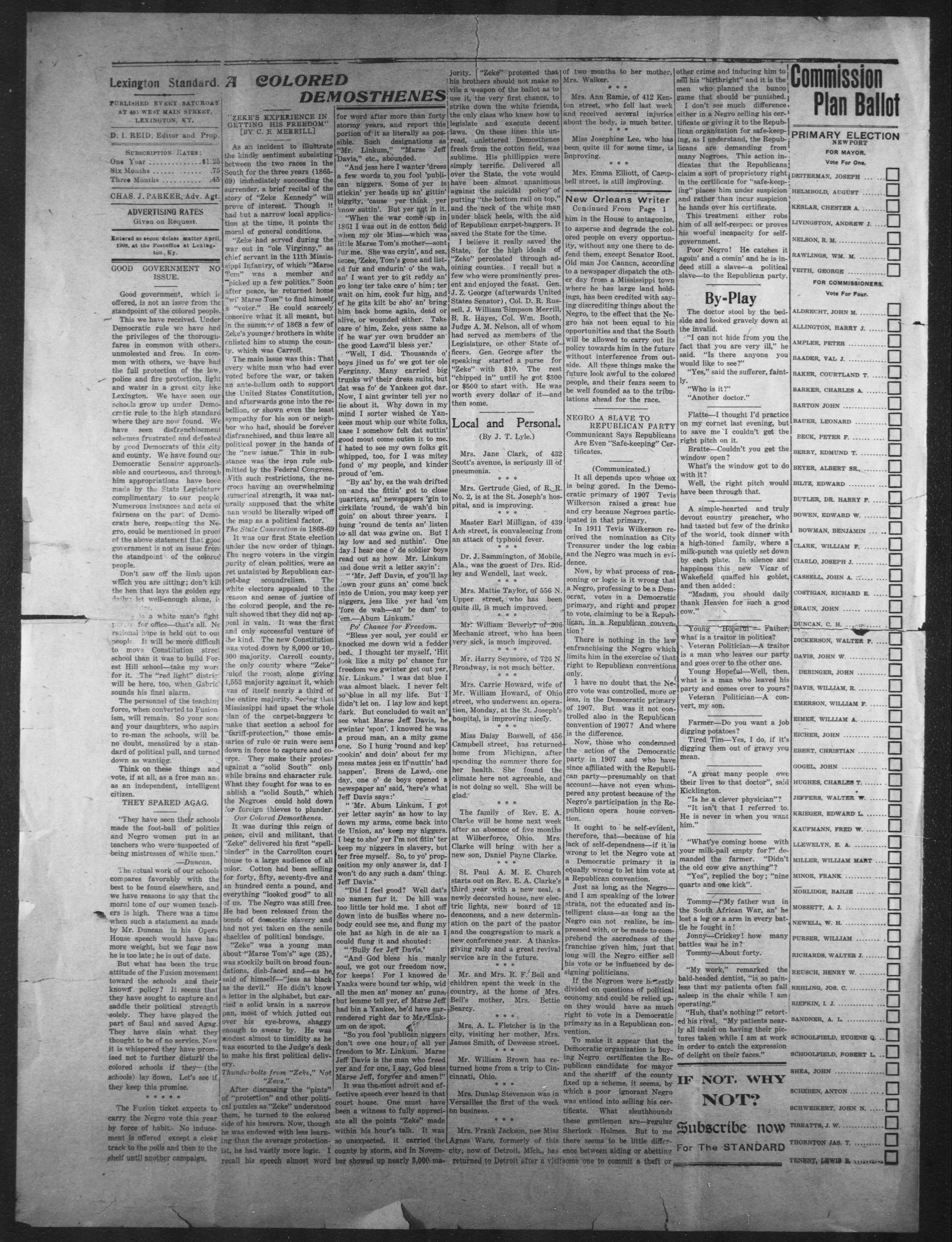
Immediately upon the expiration of the time for filling such petitions, the said County Clerk shall cause to be published for three successive days in the official newspaper of the city, the names of the persons to whom may designate, in proper form, the names of the persons as they will appear upon the primary ballots; and the said Clerk shall thereupon cause the primary ballots to be printed, authenticated with the fac-simile of his signature. Upon said ballots, the names of the applicants for nomination shall be placed alphabetical order, with a square at the right of each name, and above the names of the applicants for nomination for Mayor shall be printed the words, "Vote for one," and the above names of the applicants for nominations for Commissioners shall be printed the words, "Vote for four." The ballots shall contain no party destination, any kind, nor any sign indicating any applicant's political belief, or party affiliation.
Having caused said ballots to be printed, the said County Clerk shall cause to be delivered at each polling place a number of said ballots equal to twice the number of votes cast in such polling precinct at the last preset election. The Mayor. The persons who are qualified to vote at the general municipal election shall be qualified to vote at such primary election, and the law applicable to challenges made at a general municipal election shall be applicable to the primary election. The officers of election shall immediately upon the closing of the polls count the ballot and ascertain the number of votes cast in each preset for each of the applicants and make return thereof to the County Clerk, upon proper blanks to be furnished to the County Board, and for the hours of the closing of the polls. On the day following the said primary election the County Board of Election Commissioners shall canvass said returns so received from all the precincts, and shall publish in the County Board a notice once the result thereof. Said canvass by the County Board shall be publicly made.
At such primary election the two applicants receiving the highest number of votes for nomination for Mayor or shall be thereby nominated; and the eight applicants receiving the highest number of votes for nomination for Commissioners shall be thereby nominated.
Non-Partisan Regular Election.
Sec. 7. At the regular election next following the names of the nominees shall be placed in alphabetical order upon ballots differing from those used at the nomination only in that they (the election ballots) shall contain only the names of the successful applicants for nomination. And the one nominees receiving the greatest number of votes cast for Mayor, and the four nominees receiving the greatest number of votes cast for Commissioners shall be elected, respectively, Mayor and Commissioners.
Future Elections.
Sec. 8. Every fourth year after the regular election herein above provided at the corresponding times of the year for the election and an election shall be held in the same manner and for the same offices as above described.
Election of Police Judge.
Sec. 9. Beginning with the second year after the regular election herein first above provided for, at the corresponding times of the year, and fourth may thereafter at the
corresponding times of the year, a primary election and an election shall be held in the same manner and for the same offices as above described that instead of electing the Mayor, the Police Judge shall be elected.
Qualifications of Officials.
Any legal voter, of not less than twenty-five years of age, and possessing the other qualifications prescribed by law, are eligible to election to any office under this Act.
Mayor's Salary.
Sec. 10. The Mayor shall be elected for a term of four years, beginning on the first Monday in January following his election; and be shall receive an annual salary of thirty-six hundred dollars ($30,000).
Commissioners' Salary.
Sec. 11. The Commissioners shall be elected each for a term of two years, beginning on the first Monday in January following his election; and each Commissioner shall receive an annual salary of three thousand dollars ($30,000).
The Commissioner of each department shall keep a public office at the city building, at which place he may be found or communicated with during stated hours to be fixed by him for the convenience of the public, un less special duty shall call him elsewhere.
Powers of Board
POWER BOARD
Sec. 12.1. Moves to four Commissioners shall constitute a Board of Commissioners. In this Board of Commissioners shall be vested all the legislative, executive and administrative powers of the city, save as herein otherwise provided.
Organization of Board.
Organization of Board.
Sec. 13. Three members of the Board of Commissioners shall constitute quorum, but the affirmative vote at least three members shall be necessary to the adoption of any motion, resolution or ordinance, to the making or approval of any contract, or to the passage of any measure.
For each vote theye say and yea shall be recorded; and each motion, resolution and ordinance shall be reduced to writing and read before the vote is taken thereon.
The vote shall reside at meetings of the Board. He shall have no veto power. But each resolution, measure or ordinance shall be signed by him or by two commissioners, and recorded before it shall take effect.
The Board of Commissioners shall at the beginning of its term of office, elect, by a majority of all its members, one Commissioner to act as Mayor pro-tem; and the Commissioner so chosen will be invested with all the duties of the Mayor in the event of his absence from the city, or his inability to attend to the duties of his office.
Hasty Legislation Forbidden.
Sec. 14. Every ordinance or resolution ordering the construction of reconstruction of any street sewer or other public work, or making or authorizing any contract involving the construction of a street sewer and $1,000 dollars, or granting any franchise or the right to use or occupy the streets, highways, bridges or public places of the city for any except a merely temporary purpose shall after its introduction and before its adoption remain on file at least one week after its introduction and complete form in which it shall be permitted its final passage; and no such ordinance or resolution shall go into effect until the expiration of ten days after its passage, except in case of emergency the public health or safety shall require that it take immediate effect, and shall be declared by the unanimous vote of the Board of Commissioners.
Weekly Meetings
Sec. 17. The Board of Commissioners shall determine the functions of each department and shall prescribe the duties of its Commissioner and of his employees. It may assign any employee to one or more departments, and it may assign any employee to two or more departments. It shall make all such rules and regulations as to the conduct of the various departments as may be necessary and proper for the efficient and economical conduct of the business of the city.
See 18. The Mayor shall be the Commissioner of the Department of Public Affairs; and he shall have a general advisory supervision over the affairs of all the departments.
The Board of Commissioners shall at its first regular meeting designate by majority vote one Commissioner to have superintendence of the department of Public Finance; one other Commissioner to have superintendence of the department of Public Safety; one other Commissioner to have superintendence of the department of Public Property.
Appointment of Employees.
See 19. The Board of Commissioners shall also at its first meeting, or as soon thereafter as may be practiced, appoint a Commissioner as may be necessary for the purposes of efficient conduct of the affairs of the city.
All such employees shall be agents, not officers, of the city; and they shall perform such duties, and for such compensation, as the Board of Commissioners may by ordinance prescribe. Each employee shall be selected with reference so city to his fitness and competence, and without reference to his political faith or party affiliation, and the Board of Commissioners shall select such roles.
and regulations looking to the appointment and discharge of employees as will tend to carry out the spirit of this provision and lead to the establishment of the merit system in public service.
Publication of Reports.
Sec. 20. The Board of Commissioners shall at the termination of each year print an itemized statement of all receipts and expenditures of the city during that month.
At the termination of each fiscal year the Board of Commissioners shall cause one or more competent accounts to make a complete examination of the books and accounts of the city, and shall cause the result of such examination to be published in the official newspaper and in pamphlet form, and a copy of the report in pamphlet form to be given to each voter who may apply for same at the proper office.
Filling of Vacancies.
Sec. 21. In case of the death, resignation or inability of the Mayor, causing a permanent vacancy in said office, the Mayor pro tem shall act as Mayor, shall hold office for rights and powers and perform all of the duties of the Mayor and receive his salary under the official title, however, of Mayor pro tem until such vacancy in the office of Mayor is filled by an election ordered by the Board of Commissioners, for that purpose, at which time the Mayor pro tem, if his term as commissioner be then unexpired, shall hold office for a commissioner. In the event that any commissioner shall for more than thirty days be necessarily absent from the city or for the same period shall be unable from sickness or other cause to discharge the duties of his office, or in the event the Mayor pro tem shall be filling the office of Mayor, as commissioner in the section above, for such period, the office of Commissioner may fill such office temporarily by appointment, and said appointee shall discharge the duties of the commission whose place may be thus temporarily filled until such commissioner shall return or become fit for and resume his duties and any such temporary appointee shall serve with him. The permanent office of permanent vacancy in the Board of Commissioners caused by the death, resignation or inability of any member thereof, or in the event a permanent vacancy in the office of Mayor shall be filled by the Mayor pro tem, such vacancy shall be filled by appointment by the other members of the Board until the vacancy shall be received at the next regular election of pal officers as is prescribed by law, and such temporary appointee shall for the time he serves as such receive the salary of the commissioner whose place he has been appointed to fill.
A vacancy shall exist when any elective officer fails to qualify within ten days after notice of his election, or moves his domicile outside of the city for a period of six months, or is convicted of felony, or is removed from office in any manner.
. Removal From Office.
Sec. 22. In case of misconduct, inability, or willful neglect in the performance of the duties of his office, the Mayor or any Commissioner may be removed from office by a unanous vote of the other four members of the Board of Commissioners. But no such officer shall be so removed without having been given the right to have a full public hearing with representation by counsel, and with witnesses summoned in his behalf and required to testify. The findings of fact at any such hearing, and the reasons for any such removal, shall be stated in writing and filed as matter of public record.
Provision for Referendum.
Sec. 23. If during the ten days next following the passage of any such ordinance as can not within ten days become effective, a petition signed by a number of voters equal to at least twenty-five per cent of the total votes cast for both candidates by May may last until ceding regular election for Mayor stating the residence of each signer and verified as to signatures and residence by the affidavits of some one or more persons. shall be presented to the Board of Commissioners protecting against the passage of such ordinance, such ordinance shall be suspended from going into effect, and shall be reconsidered by the Board of Commissioners. If such ordinance be not then repealed the Board shall be reconsidered by the City, at either a special or a regular election, according to law, the following question: "Shall the ordinance be into effect?" and if a majority of the votes cast upon such question be in the negative the ordinance shall not go into effect. But if a majority of the votes cast upon such question be in the affirmative, the ordinance shall go into effect as soon as the result is officially confirmed. Provision for election.
Provision for initiative.
Sec. 10 petition signed by a number of votes cast by at least twenty-five per cent of the total number of votes cast for both candidates for Mayor at the last preceding regular election for Mayor, stating the residence of each signer, and verified by the andinvita of some one or more persons as to the signatures and the names of the Commissioners to pass an ordinance therein set forth—if such petition be presented to the Board of Commissioners, and if the ordinance therein requested to be passed be one that the Board has a legal right to pass, then the Board shall either pass such pro-posed ordinance or permit within ten days after such petition is filed, or submit the question of its passage to the voters of the city at the next regular election. At such election the question submitted shall be "Shall the proposed ordinance — (Orally describe it), be passed?" If the question is not answered, said question be in the affirmative, the proposed ordinance shall be thereby passed, and shall become effective as soon as the result is officially announced and declared.
PLAN!
finance shall not be amended or repealed, except by the voters at a regular biennial city election. Any number of proposed ordinances requested by petition as above provided for may be voted on at any election.
Berryman Offers To Keep City Streets Clean At Cost If Commission Plan Wins
The Board of Commissioners may submit the question of the repeal or amendment of any such ordinance to the voters at any succeeding regular election; and if a majority of the votes in the repeal or amendment such ordinance shall be thereby repealed or amended, as the case may be.
Will Take the Contract, Either at Cost to be Determined After Work Is Done or at Fixed Price, and if There Is Any Profit Will Return It to Municipal Treasury When it Is Ascertained.
Publication of Ordinances.
Section. 25. Whenever a question of passage of a proposed ordinance, or of the going into effect, or the repeal, or the amendment of an ordinance is to be submitted to the voters at an election, the Board of Commissioners shall cause the proposed ordinance, or the ordinance and amendment, as the case may be, to be printed once before such election in the official newspaper of the city, and in such other newspapers as the Board of Commissioners may direct before such election.
GREATEST CHANCE LEXINGTON HAS EVER HAD; OPPORTUNITY SHOULD BE WELCOMED
Expense of Primary Election.
Sec. 26. The expenses of all primary elections under the provisions of this act shall be paid by the city. The City Commissioner shall execute a guarantee bond to the city upon which an action may be maintained by any person or persons as shall be interested in the keeping of the covenants therein contained. in the penal sum of ten thousand dollars ($10,000), conditioned on the commission being a official duty; such bonds to be approved by the County Judge, and filed as matters of public record.
Mr. Charles H. Berryman, who has large interests in Lexington and is, both from the standpoint of a taxpayer and a citizen vitally concerned in Lexington's welfare, has authorized The Herald to make the statement that if the Commission Form of Government is adopted he will offer to take a contract to keep the streets of Lexington clean for one year at actual cost.
School Board Exempt.
Sec. 2. Nothing further will be construed in any way to the organization, existence or conducting of the affairs of the Board of Education.
Mr. Berryman will offer to the city, if the Commission Form of Government is adopted, to take that contract for one year either at cost to be determined after the work is done, or at a fixed price, with the agreement that if it costs less than that price to keep the streets clean, so that there would be a profit on the contract, he will return that profit to the city.
Cities May Reconsider
Sec. 106 requires the citizens of any city shall have been organized and governed under the provisions of this act for a period of not less than four years, shall desire that the organization and government of such city under the provisions of this act be amended, and citizens shall file with the County Judge of the county in which is located such city, written petition signed by a number of legal voters of said city equal to thirty-three and one-tenth in cast in said city at the last preceding election, it shall be the duty of the
In other words he pledges himself, if the Commission Form of Government is adopted so that there is direct responsibility and direct authority without possibility of graft, to give to the citizens of Lexington the opportunity to have clean streets at the actual cost of keeping them clean, and to do this under a contract that will fix a maximum price, so that if it does cost more than that, the city will not be the loser, and if it costs less the profit will be returned to the city.
County Judge of said county to receive said petition and at the next regular term thereafter to make an election to be held in said county election to be held in said county at the next regular election and not earlier than sixty days after said application is lodged with the said Judge, which order shall direct the sheriff or other officer of said county who may be appointed to vote on the polls at each and all of the voting places in said city for the purpose of taking the sense of the qualified voters of said city upon the question as to whether or not the citizens of said city are in favor of the abandonment of said city under the provisions of this act. The question to be submitted to the voters shall be:
Under this offer the city will have what it has never had—clean street—and will have the opportunity to learn what it costs to keep them clean. The contract for cleaning the streets has been one of the problems of city politics for many years. What it costs to keep the streets in the condition in which they have been kept no one knows except the officers of the company that has had the contract; how great the profits only they know, but everyone knows what the conditions of the streets has been.
Mr. Berryman, who has an intense interest in the growth of Lexington, who has every reason to want good government, and who has demonstrated his capacity to manage large affairs, is so anxious for Lexington to be cleaned and kept clean that, if the Commission Form of Government is adopted, he will give to the city the opportunity to find out what it means to have clean streets and what it costs to keep them clean.
Shall the city of _____ (naming the city) abandon its organization and government under the provisions of an "Act to amend an act, entitled, 'An Act for the government of cities in the state of Kentucky,' wealth of Kentucky, approved March 19, 1834, and thereafter in due course became a law, and as same has since been amended, all of which Act and amendments now appear as Article 3, Chapter 89 of the Kentucky Statutes. The addition of the General Assembly in 1909, adopted by the General Assembly of Kentucky at the 1910 session thereof in 1909."
Is there any citizen who wants clean streets, and who is not directly interested in the perpetuation of the present system of allotting contracts, who will not welcome this opportunity to have the streets of Lexington kept clean at cost through the adoption of the Commission Form of Government?
It shall be the duty of the County Clerk to give to the Sheriff of the county or to such other officer as may be appointed to hold said election, a certified copy of the order of the County Court as it appears on the order book, within five days after each order of the county, or after the death of the said Sheriff or some other such officer, to have such order published in some weekly or daily newspaper, published or circulated in said county, for at least two weeks before the election, and also to advertise the same by printed or written sand bills posted in conspicuous places in said city, for the same length, and in the same manner, in daily newspaper, published in said city, or the proprietor of such paper refuses to publish said notice, the printed or written handbills provided or shall be sufficient notice. The Sheriff, or other such officer, shall have the advertisements and notices herein provided for posted as herein received, within seven days after the death of the said county, or after the county Court. It shall be the duty of the Convassing Board to certify the result of said election to the County Court, which certificate shall be delivered to the clerk of the city, and at the next regular term of said court the County judge shall cause the same to be spread upon the order book, to the county Court, and the order book, or copy thereof, shall be prima facie evidence of facts therein contained.
There is, it is needless to say, no obligation on the part of the Commissioners to accept Mr. Berryman's offer, unless it is to the advantage of the people to do so. His promise is simply to give them the opportunity to accept such an offer, and it seems to The Herald it is the first, as the greatest, chance Lexington has ever had to get clean streets.
PATENTS
Prize Offers from Leading Manufacturers
Book on patents. "Hints to inventors." "Inventions needed."
"Why some inventors fail." Send rough sketch or model for search of Patent Office records. Our Mr. Greeley was formerly Acting Commissioner of Patents, and as such had full charge of the U. S. Patent Office.
GREELEY & M.C. INTIRE
PATENT ATTORNEYS
WASHINGTON, D. C.
You will use a
Kenreign
twice as much as any other coat. On fair days because it is smart, other days because rain-proof. Kenreign coats, guaranteed rain-proof, give this double service and hold their shape as long as worn.
Modern concrete factory structures and web-like machinery are reflections of the advanced system that is essential to the production of these garments.
Kenyon Overcoats
share this superbly. Latest style book for the dealer who sells Kenreign Coats on the Kenyon Co. NEW YORK
When a majority of the votes cast shall be in favor of said proposition to submitted, and said facts shall be certified as hereinafter provided, by said Canvassing Board to the County and shall be certified to the City Clerk, and copy of said certificate shall be spread upon the records of said county, as herein provided, and upon the records of said city at the next regular meeting of the City Council, thereupon said city shall cease to be governed by the provision of this Act, but by the provisions of Chapter 39 of said States, independent of the provisions of this Act.
SUBSCRIPTION RATES:
One Year ..... $1.25
Six Months ..... .75
Three Months ..... .45
CHAS. J. PARKER, Adv. Agt.
ADVERTISING RATES
Given on Request.
Entered as secon dclass matter April,
1908, at the Postoffice at Lexing-
ton, Ky.
GOOD GOVERNMENT NO
ISSUE.
Good government, which is offered, is not an issue from the standpoint of the colored people. This we have received. Under Democratic rule we have had the privileges of the thoroughfares in common with others, unmolested and free. In common with others, we have had the full protection of the law, police and fire protection, light and water in a great city like Lexington. We have seen our schools grow up under Democratic rule to the high standard where they are now found. We have seen disfranchisement schemes frustrated and defeated by good Democrats of this city and county. We have found our Democratic Senator approachable and courteous, and through him appropriations have been made by the State Legislature complimentary to our people. Numerous instances and acts of fairness on the part of Democrats here, respecting the Negro, could be mentioned in proof of the above statement that good government is not an issue from the standpoint of the colored people.
Don't saw off the limb upon which you are sitting; don't kill the hen that lays the golden egg daily; let well-enough alone, is does.
is a white man's fight power for office—that's all. No rational hope is held out to our people. It will be more difficult to move Constitution street school than it was to build Forest Hill school—take my wore for it. The "red light" district will be here, too, when Gabriel sounds his final alarm.
The personnel of the teaching force, when converted to Fusionism, will remain. So your sons and your daughters, who aspire to re-man the schools, will be no doubt, measured by a standard of political pull, and turned down as wanting.
Think on these things and vote, if at all, as a free man and as an independent, intelligent citizen.
THEY SPARED AGAG.
"They have seen their schools made the foot-ball of politics and Negro women put in as teachers who were suspected of being mistresses of white men." —Duncan.
The actual work of our schools compares favorably with the best to be found elsewhere, and we have reasons to say that the moral tone of our women teachers is high. There was a time when such a statement as made by Mr. Duncan in his Opera House speech would have had more weight, but we fear now he is too late; he is out of date.
But what has been the true attitude of the Fusion movement toward the schools and their known policy? It seems that they have sought to capture and saddle their political strength solely. They have played the part of Saul and saved Agag. They have slain what they thought to be of no service. Now it is whispered they have promised not to further disturb the colored schools if they—the schools) lay down. Let's see if they keep this promise.
The Fusion ticket expects to carry the Negro vote this year by force of habit. No inducement is offered except a clear track to the polls and then to the shelf until another campaign.
"Zeke had served during the war out in "ole Virginny," as chief servant in the 11th Mississippi Infantry, of which "Marse Tom" was a member and picked up a few politics." Soon after peace, he returned home "wi' Marse Tom" to find himself a "voter." He could scarcely conceive what it all meant, but in the summer of 1868 a few of Zeke's younger brothers in white enlisted him to stump the county, which was Carroll.
The main issue was this: That every white man who had ever voted before the war, or taken an ante-bellum oath to support the United States Constitution, and afterwards gone into the rebellion, or shown even the least sympathy for his son or neighbor who had, should be forever disfranchised, and thus leave all political power in the hands of the "new issue." This in substance was the iron rule submitted by the Federal Congress. With such restrictions, the negroes having an overwhelming numerical strength, it was naturally supposed that the white man would be literally wiped off the map as a political factor. The State Convention in 1868-69
It was our first State election under the new order of things. The negro voters in the virgin purity of clean politics, were as yet untainted by Republican carpet-bag scoundrelism. The white electors appealed to the reason and sense of justice of the colored people, and the result showed that they did not appeal in vain. It was the first and only successful venture of the kind. The new Constitution was voted down by 8,000 or 10,000 majority. Carroll county, the only county where "Zeke" ruled the roost, alone giving 1,553 majority against it, which was of itself nearly a third of the entire majority. Seeing that Mississippi had upset the whole plan of the carpet-baggers to make that section a school for "fariff-protection," those emissaries of rule or ruin were sent down in force to capture and coerce. They make their protest against a "solid South" only while brains and character rule. What they fought for was to establish a "solid South," which the Negroes could hold down for foreign thieves to plunder.
Our Colored Demosthenes. It was during this reign of peace, civil and militant, that "Zeke" delivered his first "spell-binder" in the Carrollton court house to a large audience of all color. Cotton had been selling for forty, fifty, seventy-five and an hundred cents a pound, and everything "looked good" to all of us. The Negro was still free. He had been released from the bonds of domestic slavery and had not yet taken on the senile shackles of political bondage.
"By an' by, ez the wah drifted on and the fittin' got to close quarters, an' newspapers 'gin to cirkilate 'round, de wah'd bin goin' on about three years. I hung 'round de tents an' listen to all dat was gwine on. But I lay low and sed nuthin'. One day I hear one o' de soldier boys read out as how Mr. Linkum and done writ a letter sayin':
"Mr. Jeff Davis, if you'll lay down your guns an' come back into de Union, you may keep yer niggers, jess like yer had 'em 'fore de wah—an' be dam' to 'em.—Abum Linkum.'
jority. "Zeke" protested that his brothers should not make so vile a weapon of the ballot as to use it, the very first chance, to strike down the white friends, the only class who knew how to legislate and execute decent laws. On these lines this unread, unlettered Demosthenes fresh from the cotton field, was sublime. His phillippies were simply terrific. Delivered all over the State, the vote would have been almost unanimous against the suicidal policy of putting "the bottom rail on top," and the neck of the white man under black heels, with the aid of Republican carpet-baggers. It saved the State for the time.
I believe it really saved the State, for the high ideals of "Zeke" percolated through adoining counties. I recall but a few who were prominently present and enjoyed the feast. Gen. J. Z. George (afterwards United States Senator), Col. D. R. Russell, J. William Simpson Merrill, B. R. Hayes, Col. Wm. Booth, Judge A. M. Nelson, all of whom had served as members of the Legislature, or other State officers. Gen. George after the speaking started a purse for "Zeke" with $10. The rest "chipped in" until he got $300 or $500 to start with. He was worth every dollar of it—and then some.
Local and Personal.
New Orleans Writer Continued From Page 1 him in the House to antagonize, to asperse and degrade the colored people on every opportunity, without any one there to defend them, except Senator Root. Old man Joe Cannon, according to a newspaper dispatch the other day from a Mississippi town where he has large land holdings, has been credited with saying discrediting things about the Negro, to the effect that the Negro has not been equal to his opportunities and that the South will be allowed to carry out its policy towards him in the future without interference from outside. All these things make the future look awful to the colored people, and their fears seem to be well founded as to the tribulations ahead for the race.
By=Play
The doctor stool by the bedside and looked gravely down at the invalid.
"I can not hide from you the fact that you are very ill," he said. "Is there anyone you would like to see?"
"Yes," said the sufferer, faintly.
"Who is it?"
"Another doctor."
Flatte—I thought I'd practice on my cornet last evening, but to save me I couldn't get the right pitch on it.
Bratte—Couldn't you get the window open?
What's the window got to do with it?
Well, the right pitch would have been through that.
A simple-hearted and truly devout country preacher, who had tasted but few of the drinks of the world, took dinner with a high-toned family, where a milk-punch was quietly set down by each plate. In silence and happiness this new Vicar of Wakefield quaffed his goblet, and then added:
"Madam, you should daily thank Heaven for such a good cow."
Young Hopeful — Father, what is a traitor in politics?
Veteran Politician — A traitor is a man who leaves our party and goes over to the other one.
Commission Plan Ballot
DEITERMAN, JOSEPH ...
HELMBOLD, AUGUST ...
KESLAR, CHESTER A. ...
LIVINGSTON, ANDREW J. ...
NELSON, R. M. ...
RAWLINGS, WM. M. ...
VEITH, GEORGE ...
FOR COMMISSIONERS.
Vote For Four.
ALDRECHT, JOHN M. ...
ALLINGTON, HARRY J. ...
AMPLER, PETER ...
BAADER, VAL J. ...
BAKER, COURTLAND T. ...
BARKER, CHARLES A. ...
BARTON JOHN ...
BAUER, LEONARD ...
BECK, PETER F. ...
BERRY, EDMUND T. ...
BEYER, ALBERT SR. ...
BILTZ, EDWARD ...
BUTLER, DR. HARRY P. ...
BOWEN, EDWARD W. ...
BOWMAN, BENJAMIN ...
CLARK, WILLIAM F. ...
CIARLO, JOSEPH J. ...
CASSELL, JOHN A. ...
COSTIGAN, RICHARD E. ...
DRAUN, JOHN ...
DUNCAN, C. H. ...
DICKERSON, WALTER P. ...
DAVIS, JOHN W. ...
DERINGER, JOHN ...
DAVIS, WILLIAM, R. ...
EMERSON, WILLIAM F. ...
EIMER, WILLIAM A. ...
EICHER, JOHN ...
EBERT, CHRISTIAN ...
GOGEL, JOHN ...
HUGHES, CHARLES T. ...
JEFFERS, WALTER W. ...
KRIEGER, EDWARD L. ...
KAUFMANN, FRED W. ...
LLEWELYN, E. A. ...
MILLER, WILLIAM MART ...
MINOR, FRANK ...
MORLIDGE, BAILIE ...
MOSSETT, A. J. ...
NEWELL, W. H. ...
PURSER, WILLIAM ...
RICHARDS, WALTER J. ...
REUSCH, HENRY W. ...
REHLING, JOS. C. ...
RIEFKIN, I. J. ...
SANDNER, A. L. ...
SCHOOLFIELD, EUGENE Q. ...
SCHOOLFIELD, ROBERT L. ...
SHEA, JOHN ...
SCHEBEN, ANTON ...
SCHWEIKERT, JOHN N. ...
TIBBATTS, J. W. ...
THORNTON JAS, T. ...
TENENT, LEWIS B. ...