Metropolis Weekly Gazette
Friday, November 15, 1918
Metropolis, Illinois
Page text (machine-generated)
METROPOLIS WEEKLY GAZETTE
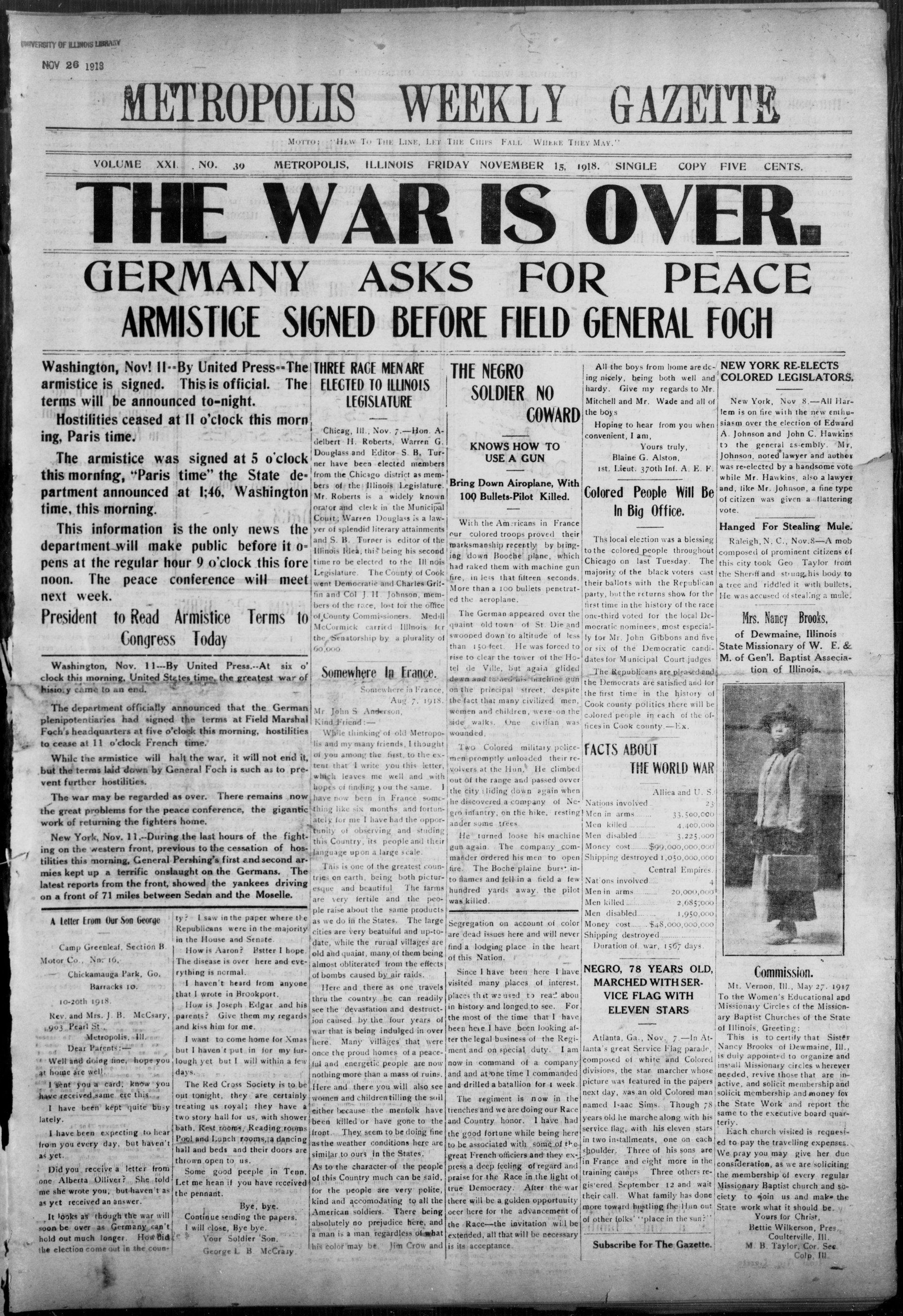
THE WAR IS OVER.
GERMANY ASKS FOR PEACE ARMISTICE SIGNED BEFORE FIELD GENERAL FOCH
Washington, Nov! 11--By United Press--The armistice is signed. This is official. The terms will be announced to-night. Hostilities ceased at 11 o'clock this morning, Paris time. The armistice was signed at 5 o'clock this morning, "Paris time" the State department announced at 1;46, Washington time, this morning. This information is the only news the department will make public before it opens at the regular hour 9 o'clock this fore noon. The peace conference will meet next week.
Washington, Nov. 11---By United Press.--At six o'clock this morning, United States time, the greatest war of history came to an end.
The department officially announced that the German plenipotentiaries had signed the terms at Field Marshal Foch's headquarters at five o'clock this morning, hostilities to cease at 11 o'clock French time.
While the armistice will halt the war, it will not end it, but the terms laid down by General Foch is such as to prevent further hostilities.
The war may be regarded as over. There remains now the great problems for the peace conference, the gigantic work of returning the fighters home.
New York, Nov. 11.--During the last hours of the fighting on the western front, previous to the cessation of hostilities this morning, General Pershing's first and second armies kept up a terrific onslaught on the Germans. The latest reports from the front, showed the yankees driving on a front of 71 miles between Sedan and the Moselle.
UNIVERSITY OF ILLINOIS LIBRARY
NOV 26 1918
Washington, Nov! 11-armistice is signed. terms will be announced. Hostilities ceased ating, Paris time.
The armistice was this morning, "Paris" partment announced time, this morning.
This information department will make pens at the regular noon. The peace next week.
President to Read Congress
Washington, Nov. 11---B clock this morning. United States history came to an end.
The department officially plenipotentiaries had signed Foch's headquarters at five o'clock French.
While the armistice will but the terms laid down by Covent further hostilities.
The war may be regarded the great problems for the work of returning the fighter.
New York, Nov. 11.--During on the western front, pretilities this morning, General mies kept up a terrific on latest reports from the front, on a front of 71 miles between
A Letter Erom Our Son George
Camp Greenleaf, Section B.
Motor Co., Nn. 16.
Chickamauga Park, Go.
Barracks 10.
10-20th 1918.
Rev. and Mrs. J. B. McCsary,
1903. Pearl St.
Metropolis, Ill.
Dear Parents:
Well and doing fine, hope you
at home are well.
I sent you a card, know you
have received same, ere this.
I have been kept quite busy
lately.
I have been expecting to hear
from you every day, but haven't
as yet.
Did you receive a letter from
one Alberta Olliver? She told
me she wrote you, but haven't as
as yet received an answer.
It looks as though the war will soon be over as Germany can't hold out much longer. How did the election come out in the coun-
ty? I saw in the paper where the Republicans were in the majority in the House and Senate.
How is Aaron? Bstter I hope. The disease is over here and everything is normal.
I haven't heard from anyone that I wrote in Brookport.
How is Joseph Edgar and his parents? Give them my regards and kiss him for me.
I want to come home for Xmas but I haven't put in for my furlough yet but I will within a few days.
The Red Cross Society is to be out tonight, they are certainly treating us royal; they have a two story hall for us, with shower bath. Rest rooms, Reading rooms Pool and Lunch rooms, a dancing hall and beds and their doors are thrown open to us.
Some good peeple in Tenn.
Let me hean if you have received
the pennant.
Bye, bye.
Continue sending the papers.
I will close, Bye bye.
Your Soldier Son.
George L. B. McCrazy.
MOTTO: "HEW TO THE LINE, LET THE CHIPS FALL WIKEKE THEY MAY."
THREE RAGE MEN ARE ELECTED TO ILLINOIS LEGISLATURE
Chicag, Ill., Nov. 7.—Hon. Adelbert H. Roberts, Warren G. Douglass and Editor S. B. Turner have been elected members from the Chicago district as members of the Illinois Legislature. Mr. Roberts is a widely known orator and clerk in the Municipal Court; Warren Douglass is a lawyer of splendid literary attainments and S. B. Turner is editor of the Illinois Idea, this being his second time to be elected to the Ill nois Legislature. The County of Cook went Democratic and Charles Griffin and Col. J. H. Johnson, members of the race, lost for the office of County Commissioners. Medill McCormick carried Illnois for the Senatorship by a plurality of 60,000.
Somewhere In France.
Somewhere in France Aug 7. 1918
Mr. John S. Anderson,
Kind Friend:—
While thinking of old Metropolis and my many friends, I thought of you among the first, to the extent that I write you this letter, which leaves me well and with hopes of finding you the same. I have now been in France something like six months and fortunately for me I have had the opportunity of observing and studying this Country, its people and their language upon a large scale.
This is one of the greatest countries on earth, being both picturesque and beautiful. The farms are very fertile and the people raise about the same products as we do in the States. The large cities are very beautiful and up-to-date, while the rural villages are old and quaint, many of them being almost obliterated from the effects of bombs caused by air raids.
Here and there as one travels thru the country he can readily see the devastation and destruction caused by the four years of war that is being indulged in over here. Many villages that were once the proud homes of a peaceful and energetic people are now nothing more than a mass of ruins. Here and there you will also see women and children tilling the soil either because the mentfolk have been killed or have gone to the front. They seem to be doing fine as the weather conditions here are similar to ours in the States. As to the character of the people of this Country much can be said, for the people are very polite, kind and accommodating to all the American soldiers. There being absolutely no prejudice here, and a man is a man regardless of what his color may be. Jim Crow and
THE NEGRO SOLDIER NO COWARD
KNOWS HOW TO USE A GUN
Bring Down Airoplane, With 100 Bullets-Pilot Killed.
With the Americans in France our colored troops proved their marksmanship recently by bringing down Booche plane, which had raked them with machine gun fire, in less that fifteen seconds. More than a 100 bullets penetrated the aeroplane.
The German appeared over the quaint old town of St. Die and swooped down to altitude of less than 150 feet. He was forced to rise to clear the tower of the Hotel de Ville, but again glided down and turned his machine gun on the principal street, despite the fact that many civilized men, women and children, were on the side walks. One civilian was wounded.
Two Colored military policemen promptly unloaded their revolvers at the Hun. He climbed out of the range and passed over the city sliding down again when he discovered a company of Negro infantry, on the hike, resting ander some trees. He turned loose his machine gun again. The company commander ordered his men to open fire. The Boche plaine burst into flames and fell in a field a few hundred yards away, the pilot was killed.
Segregation on account of color are dead issues here and will never find a lodging place in the heart of this Nation.
Since I have been here I have visited many places of interest, places that we used to read about in history and longed to see. For the most of the time that I have been here I have been looking after the legal business of the Regiment and on special duty. I am now in command of a company and at one time I commanded and drilled a batallion for 1 week.
The regiment is now in the trenches and we are doing our Race and Country honor. I have had the good fortune while being here to be associated with some of the great French officers and they express a deep feeling of regard and praise for the Race in the light of true Democracy. After the war there will be a golden opportunity occur here for the advancement of the Race—the invitation will be extended, all that will be necessary is its acceptance.
All the boys from home are doing nicely, being both well and hardy. Give my regards to Mr. Mitchell and Mr. Wade and all of the boys
Hoping to hear from you when convenient, I am,
Yours truly,
Blaine G. Alston,
1st. Lieut. 370th Inf. A. E. F.
Colored People Will Be In Big Office.
This local election was a blessing to the colored people throughout Chicago on last Tuesday. The majority of the black voters cast their ballots with the Republican party, but the returns show for the first time in the history of the race one-third voted for the local Democratic nominees, most especially for Mr. John Gibbons and five or six of the Democratic candidates for Municipal Court judges. The Republicans are pleased and the Democrats are satisfied and for the first time in the history of Cook county politics there will be colored people in each of the offices in Cook county.—Ex.
FACTS ABOUT
THE WORLD WAR
Alliea and U. S.
Nations involved..... 23
Men in arms..... 33,500,000
Men killed..... 4,400,000
Men disabled..... 3,225,000
Money cost..... $99,000,000,000
Shipping destroyed 1,050,000,000
Central Empires.
Nations involved..... 4
Men in arms..... 20,000,000
Men killed..... 2,685,000
Men disabled..... 1,950,000
Money cost..... $48,000,000,000
Shipping destroyed
Duration of war, 1567 days.
NEGRO, 78 YEARS OLD MARCHED WITH SERVICE FLAG WITH ELEVEN STARS
Atlanta, Ga., Nov. 7.—In Atlanta's great Service Flag parade, composed of white and Colored divisions, the star marcher whose picture was featured in the papers next day, was an old Colored man named Isaac Sims. Though 78 years old he marche along with his service flag, with his eleven stars in two installments, one on each shoulder. Three of his sons are in France and eight more in the training camps. Three others registered September 12 and wait their call. What family has done more toward bustling the Hun out of other folks' "place in the sun?"
Subscribe for The Gazette.
NEW YORK RE-ELECTS COLORED LEGISLATORS.
New York, Nov 8.—All Harlem is on fire with the new enthusiasm over the election of Edward A. Johnson and John C. Hawkins to the general assembly. Mr. Johnson, noted lawyer and author was re-elected by a handsome vote while Mr. Hawkins, also a lawyer and, like Mr. Johnson, a fine type of citizen was given a flattering vote.
Hanged For Stealing Mule.
Raleigh, N. C., Nov.8—A mob composed of prominent citizens of this city took Geo Taylor from the Sheriff and strong his body to a tree and riddled it with bullets. He was accused of stealing a mule.
Mrs. Nancy Brooks,
of Dewmaine, Illinois State Missionary of W. E. & M. of Gen'l. Baptist Assecia tion of Illinois.
THE WORLD'S FIRST WOMAN
Commission.
Mt. Vernon, Ill., May 27. 1917 To the Women's Educational and Missionary Circles of the Missionary Baptist Churches of the State of Illinois, Greeting: This is to certify that Sister Nancy Brooks of Dewmaine, Ill., is duly appointed to organize and install Missionary circles wherever needed, revive those that are inactive, and solicit membership and solicit membership and money for the State Work and report the same to the executive board quarterly. Each church visited is requested to pay the travelling expenses. We pray you may give her due consideration, as we are soliciting the membership of every regular Missionary Baptist church and society to join us and make the State work what it should be. Yours for Christ. Bettie Wilkerson, Pres. Coulterville, Ill. M. B. Taylor, Cor. Sec. Colp. Ill.
FIGHT ON HISTORIC GROUND
American Troops Operating in Country for Many Centuries the Scene of Wars and Revolutions.
American soldiers during their brief leisure Moments are wandering through ruins and over fields made familiar to students of history by centuries of wars and revolutions. Some of them have already fought on the scene of some of Napoleon's operations in the region of the Marne.
Some are training over ground where the Normans fought the French and where the French fought the Spaniards. Later they will perhaps be marching in line of battle over the country where the French and the Germans have fought legally and again and where they will help the French and the British and end the last of the wars to devastate the valleys of France for centuries to come.
Nearly the entire history of France is pictured all over the areas occupied by the American in ancient churches, which, along with object lessons in history, will give the attative soldier an enlarged appreciation of art and architecture.
Asked to what extent the men were profiling from these opportunities, an officer of the American forces said that, after getting located, the soldier takes the first opportunity to explore the neighborhood. To use one of the British terms that are taking root among the overseas men, they "push off" into all the nooks and corners. If their conceptions of what they see are often vague at first they soon get the habit of observation which develops into taste and, in a goodly number of cases, becomes a study.
TURNING RATS TO ACCOUNT
Japanese Authorities Anticipate Substantial Revenue From Leather Made From Hides Of Pests.
In the neighborhood of Aomori, Japan, the hides of squirrels are tanned and used as carpets, neckcloths and for other purposes. This has suggested to Doctor Hasegawa Kiyonara, head of the Hasegawa hospital at Osaka, who is a member of the Osaka municipal assembly, the possibility of turning to good account the hides of the numerous rats bought by the municipal authorities, in view of the great advance in the price of hides and leather. Doctor Hasegawa approached the authorities with the proposal, which was favorably received. They accordingly tanned the skins of two rats and sought the opinion of dealers as to what the leather would sell for. The dealers estimated that the skin of one rat was worth 20 sen in its raw condition. The public health authorities are now devising special means of disinfecting and tanning rat skins.
It is estimated that a great sum could have been obtained by tanning the hides of one-third of the rats bought by the Osaka municipal authorities during the first twenty years.
To Pollyfox.
To Pollyfox.
Put down a red mark to the senate's credit for introducing the word "pollyfox." Here we have pussyfooting with characteristics more subtle even than silence. If one pussyfoots, well and good; he does not disturb, and it may reasonably be argued that only those engaged in evil doing or suffering from nerves object to those who come upon one noiselessly.
The pussyfooter may have no objectionable purpose in pussyfooting. He may even be amiably determined not to distract one engaged in pondering a painful problem, as whether it is better to earn an income and be taxed or to escape both and play golf. But, as we understand it, to pollyfox implies a sly purpose. An angel child possessed of a chunk of ice, with its lovely orbs fixed on the invading space between its papa's neck and collar, will pollyfox even if it never heard of the word.
There is much in the contemplation of politics which nukes to welcome the verb "to pollyfox." — New York Sun.
Well, That's Different.
While high-priced lawyers argued wrathfully for their clients over the ownership of a little white Eskimo dog the animal in controversy was brought into court in a sack by a negro, dead. Instantly the contestants changed sides. This was at Atlanta.
"Give it to that woman there," exclaimed Mrs. M. M. Brazell, who had sworn out a possessory warrant for a spitz dog before Judge L. Z. Rosser.
"No, give it to her, I want her to have it," retorted Mrs. Anna Lee, who was contesting the possessory warrant.
The confused negro-left the dog and retreated.
Judge Rosser gave the dead dog to Mrs. Brazell.
A 72-Year-Old Messenger Boy.
Auburn, N. Y., has a seventy-two-year-old messenger boy. Although retired from active work, he decided he could do some war service by taking some young man's place with the telegraph company.
"I have had some amusing experiences," he remarked recently, "I answered one call and the man said 'Are you from the Western Union?' I replied that I was. 'Well,' he said, 'I wanted a boy, not the president of the company.' There was another call to the St. Cloud and I went. The man said 'Are you a boy?' But before I could answer another man remarked facetiously, 'He was when you called.'
STEADIER HOG MARKETS PLANNED
In accordance with the policy of the Food Administration since its foundation to consult representative men in the agricultural industry on occasions of importance to special branches of the industry, on October 24 there was convened in Washington a meeting of the Live Stock Subcommittee of the Agricultural Advisory Board and the special members representing the swine industry to consider the situation in the hog market.
The conference lasted for three days, and during this time met with the executive committee of the fifty packing firms participating in foreign orders for pork products and with the members of the Food Administration directing foreign pork purchases.
The conclusions of the conference
The entire marketing situation has so
changed since the September joint
conference as to necessitate an entire
attention in the price of price stabilization. The current peace talk has
alarmed the holders of corn, and there has
been a price decline of from 25
cents to 10 cents pushed. The fact
that the accumulations of low priced
corn in the Argentine and South Africa
would, upon the advent of peace
and liberal shipping, become available
to the European market has greeted a great deal of apprehension
on the part of corn holders. This decline
has spread fear among swine growers
that a similar reduction in the pieces
of hogs would naturally follow. More
over, the lower range of corn prices
would, if incorporated in a 13 to 1
ratio, obviously result in a continuously
falling price for live hogs. In view
of these changed conditions many
swine producers anticipated lower
prices and as a result rushed their
hogs to market in large numbers, and
this overshipment has added to and
aggravated the decline.
The information of the Department of Agriculture indicates that the supply of hogs has increased about 8 per cent., while the highest unofficial estimate does not exceed 15 per cent; increased production over last year. On the other hand, the arrival of hogs during the last three weeks in the seven great markets has been 27 per cent, more than last year, during the corresponding period, demonstrating the unusually heavy marketing of the available supply. In the face of the excessive receipts some packers have not maintained the price agreed last month. On the other hand, many of the packers have paid over the price offered to them in an endeavor to maintain the agreed price. The result in any event has been a failure to maintain the October price basis determined upon at the September conference and undertaken by the packers. Another factor contributing to the break in prices during the month has been the influenza epidemic; it has sharply curtailed consumption of pork products and temporarily decreased the labor stuff of the packers about 25 per cent.
The exports of 130,000,000 pounds of pork products for October compared with about 62,000,000 pounds in October a year ago, and the export orders placeable by the Food Administration for November, amount to 170,000,000 pounds as contrasted with the lesser exports of 98,000,000 for November, 1917. The increased demands of the allies are continuing, and are in themselves proof of the necessity for the large production for which the Food Administration asked. The increase in export demands appears to be amply sufficient to take up the increase in hog production, but unfavorable market conditions existing in October afford no fair index of the aggregate supply and demand.
It must be evident that the enormous shortage in fats in the Central Empires and neutral countries would immediately upon peace result in additional demands for pork products which, top of the heavy shipments to the Allies, would tend materially to increase the American exports, inasmuch as no considerable reservoir of supplies exists outside of the United States. It seems probable that the present prospective supplies would be inadequate to meet this world demand with the return to peace. So far as it is possible to interpret this fact, it appears that there should be even a stronger demand for pork products after the war, and therefore any alarm of hog producers as to the effect of peace is unwarranted by the outlook.
In the light of these circumstances it is the conclusion of the conference that attempts to hold the price of hogs to the price of corn may work out to the disadvantage of pork producers. It is the conclusion that any interpretation of the formula should be a broad ganged policy applied over a long period. It is the opinion of the conference that in substitution of the previous plans of stabilization the Live Stock Subcommittee of the Agricultural Advisory Board, together with the specially invited swine representatives, should accept the invitation of the Food Administration to Join with the Administration and the packers in determining the prices at which controlled export orders are to be placed. This will be regularly done. The influence of these orders will be directed to the main course of the common object—namely, the stabilization of the
METROPOLIS WEEKLY GAZETTE, METROPOLIS, ILL
were as follows:
producer and the insurance of an adequate future supply.
These foreign orders are placed upon the basis of cost of hogs to the packers.
As the result of long negotiations between this body, and the Packers' Committee, representing the 45 to 50 packers participating in foreign orders, together with the Allied buyers, all under the Chairmanship of the Food Administration, the following undertaking has been given by the packers:
In view of the undertakings on the part of the Food Administration with regard to the co-coordinated purchases of pork products, covered in the attached, it is agreed that the packers participating in these orders will undertake not to purchase hogs for less than the following agreed minimums for the month of November, that is a daily minimum of $17.50 per hundred pounds on average of packers' droves, excluding throw-outs. "Throw-outs" to be defined as pigs under 170 pounds, stags, boars, thin sows and skips. Further that no hogs of any kind shall be bought, except throw-outs, at less than $16.50 per hundred pounds. The average of packers' droves to be construed as the average of the total sales in the market of all hogs for a given day. All the above to be based on Chicago.
We agree that a committee shall be appointed by the Food Administration to check the daily operations in the various markets with a view to supervision and demonstration of the carrying out of the above.
The ability of the packers to carry out this arrangement will depend on there being a normal marketing of hogs based upon the proportionate increase over the receipts of last year. The increase in production appears to be a maximum of about 15 per cent, and we can handle such an increase.
If the producers of hogs should, as they have in the past few weeks, prematurely market hogs in such increasing numbers over the above it is entirely beyond the ability of the packers to maintain these minimums, and therefore we must have the co-operation of the producer himself to maintain these results. It is a physical impossibility for the capacity of the packing houses to handle a similar over-flood of hogs and to find a market for the output. The packers are anxious to co-operate with the producers in maintaining a stabilization of price and to see that producers receive a fair price for their products.
(Signed) THOS. E. WILSON,
Chairman Packers' Committee.
The plan embodied above was adopted by the conference.
The Food Administrator has appointed a committee, comprising Mr. Thomas E. Wilson, chairman of the Packers' Committee; Mr. Everett Brown, president of the Chicago Livestock Exchange; Major Roy of the Food Administration, Louis D. Hall of the Bureau of Markets, to undertake the supervision of the execution of the plan In the various markets. Commission men are asked to co-operate in carrying out the plan embodied in the packers' agreement. It must be evident that offers by commission men to sell hogs below the minimum established above is not fair, either to the producer or the participating packers. Mr. Brown has undertaken on behalf of the commission men in the United States that they will loyalty support the plan.
It is believed by the conference that this new plan, based as it is upon a positive minimum basis, will bring better results to the producer than average prices for the month. It does not limit top prices and should narrow the margins necessary to country buyers in more variable markets. It is believed that the plan should work out close to $18 average.
Swine producers of the country will contribute to their own interest by not flooding the market, for it must be evident that if an excessive over percentage of hogs is marketed in any one month price stabilization and control cannot succeed, and it is certain that producers themselves can contribute materially to the efforts of the conferences if they will do their marketing in as normal a way as possible.
The whole situation as existing at present demands a frank and explicit assurance from the conferees represented—namely, that every possible effort will be made to maintain a live hog price commensurate with swine production costs and reasonable selling values in execution of the declared policy of the Food Administration to use every agency in its control to secure justice to the farmer.
The stabilization methods adopted for November represent the best efforts of the conference, concurred in by the Food Administration and the
Livestock Subcommittee of the Agricultural Advisory Board, together with special swine members and the representatives of the packers, to improve the present unsatisfactory situation, which has unfortunately resulted because of the injection of uncontrollable factors. We ask the producer to co-operate with us in a most difficult task. The members of the Conference were:
Producers—H. C. Stuart, Elk Garden, Va., Chairman Agricultural Advisory Board; W. M. McFudden, Chicago, Ill.; A. Sykes, Ida Grove, In.; John M. Evard, Ames, Ia.; J. H. Mercer, Live Stock Commission for Kansas; J. G. Brown, Monon, Ind.; E. C. Brown, President Chicago Livestock Exchange; N. H. Gentry, Sedalia, Mo.; John Grattian Broomfield, Colo.; Engene Funk, Bloomington, Ill.; Isaac Lincoln, Aberdeen, S. D.; C. W. Hunt, Logan, Ia.; C. E. Yancey, W. R. Dodson.
Food Administration—Herbert Hover, F. S. Snyder, Major E. L. Roy, G. H. Powell.
Department of Agriculture—Louis D. Halt, F. R. Marshall.
The packers present and others sharing in foreign orders were represented by the elected packers' committee. Those represented were:
Making Shrapnel.
New inventions have been made by Americans, and American machine tools for shell making have been sent to Europe and are used in the factories there. The number of shells of shrapnel made in this country is almost beyond computation. Long before we entered the war our different factories were turning out hundreds of thousands of shrapnel a week, and it was due to this demand for munitions that enabled us to turn out the big product we are now making. This is so not only of shrapnel, but of powder and explosives of all kinds. Before the war one company was making about 400,000 pounds of military powders per annum, another was turning out 800 12-inch shells per day, and a third making 600,000 loaded, time fuses a month. The orders of the allies ran into many hundreds of millions of dollars and it is said that almost $2,000,000 worth of war supplies were contracted for by J. P. Morgan & Co. alone.
Tragedy of French Trees.
Broken homes, ruined factories, shattered churches, violated graves, it had seemed to me we had rung all the changes on the destruction of war. But there remained one—the tragedy of the trees. You can rebuild houses, churches, towns even—for that takes only money. But you can't rebuild orchards of fruit trees and avenues of great shade trees—for that takes time. We were seeing them everywhere now—orchards with trees that were but faded, shriveled bunches of brown leaves lying on their sides; orchards, where these had been cleared away, that showed nothing but white-topped stumps. They say that, when the warm spring came, some of those orchard trees, lying on their sides but not wholly severed, leafed gently and then—just before they died—bloomed once again for France—Inez Haynes twain in McClure's Magazine.
Bill's Occupation.
The Actor—What has become of your brother Bill!
The Actress—Brother Bill. Oh! he's a "beauty doctor." Makes real blondes in 20 minutes.
The Actor—Blondes, eh? H'm! I suppose he is doing a fair business.
First Dog Fancier—This dog used to belong to a woman.
Second Dog Fancier—How do you know?
First Dog Fancier—It stops in front of all the store windows.
IN DUEL TO DEATH
Brave Old Buck Proved Himself True Knight.
Exhibition of Woodland Chivalry That Impressed Hunters in the Florida Everglades So Much They Spared the Victor's Life.
A couple of hunters on the border of the Florida Everglades were surprised to hear the wild snorts and whistles of a buck; in fight, mingled with the palintive bleats of a doe in distress—a combination of sounds that was unaccountable. The men crept cautiously up, and in five minutes reached the edge of an open glade.
In the center crouched a doe, wild with terror. By her side was a tawn only a few hours old, still too weak to follow its mother, while the old buck, with bristling hair, and antlers lowered, stood by, snorting in rage and defiance. His eyes, green with rage, followed some object moving in the palmetto scrub on the border of the glade.
Looking carefully, the hunters saw a young panther passing backward and forward in an effort to turn the flank of the defense and get at the fawn. A wiser beast would have abandoned the attack as soon as such a defender went on guard, but this panther was evidently in the full flush of his first strength, and without experience-of the prowess of an old buck at bay.
Forward and back he crawled, spitting and snarling, only to find the buck always between him and the doe. At last he crouched for the spring. The buck, snorting grimly, braced all his muscles for the coming crash; he appreciated his danger, but dared the worst. The doe whimpered and closed her eyes, but did not desert her fawn.
The panther rose in the air and came down within ten feet of the buck. Then the buck went into the air, and falling with his feet together on the struggling cat, seemed to stab him through and through. Immediately the buck rose again and landed a dozen feet away. Then he lowered his head and plunged at the panther. There was a confusion of flying dirt and grass, and again the deer sprang away. There were now deep cuts on his head and neck, and his antlers were splashed with red. The panther now tried to creep away, but again the buck leaped, stabbed with his feet together and sprang away. The cat now lay gasping, while the buck watched him with his hair stiffened into a mane and eyes that nearly bulged from his head. Then the hunters walked forward.
When the buck saw them he must have realized that he was completely in their power. His proud crest fell, and he lost all the swelling part of the victory; but still he showed no intention of deserting the doe, but moved off and stood beside her. She crouched down again with the fawn.
The hunters walked over quietly and examined the panther. He was very badly cut up. Both shoulders were broken, and the antlers had passed repeatedly through his body. During the examination the buck stood quietly in plain view, and no gladiator saluting Caesar and conscious of being about to die ever showed more dignity.
Without a word the hunters walked off the field and left the old knight alone in his glory. Had he not shown knightly qualities—the chivalry that protects the weak, the courage that braves all odds in a good cause, and finally a dignified submission to what seemed the inevitable?
Praised for Devotion to Duty.
When the city of Norfolk, Va., was threatened with the complete destruction by fire of its thriving business section early in January, every available fire-fighting force at hand and from nearby towns was called into the battle. At the height of the fire the enlisted men of the United States navy on duty at the navy yard and in the harbor were called on to help not only in subduing the flames but controlling the crowds. To a man they gave a splendid account of themselves. Among these men was John Joseph McLoughlin, a chief boatswain's mate. Although he had worked all night, had narrow escapes and was drenched to the skin with ice-cold water, McLoughlin declined a relief when it was offered and remained on duty continuously until the danger was passed. For this conspicuous service he has been commended by Secretary of the Navy Daniels. McLoughlin enlisted in the navy in 1908 at New York.
Had Enough Eggs.
First Barber—I bet that fellow is a bum actor.
Second Barber—Why?
Second Barrel—Way 1?
First Barber—When I asked him if he wanted an egg shampoo he put on his hat and walked right out.
Immense Export of Oils.
More mineral oils were exported from the United States during the fiscal year 1917 than ever before, the total amounting to 2,749,438,434 gallons.
Either One.
He—He's got an awfully re nose,
but he swears he never touched a drop
in his life.
Page Thee
UNITED OLD AND NEW WORLD
Atlantic Cable, After Three Distear ening Failures, Was Successfully Laid in July-August, 1858.
Sixty years ago our broad Yankee land awoke and learned that the old country and the new had been united by a magical tie—the Atlantic cable. Through the courage and persistence of three Americans—there were others, but the three were the actual cable sponsors—Cyrus W. Field, his brother David Dudley Field, and that fine of philanthropist, Peter Cooper—the great project was carried over. The total cost was $1,884,500, the cable alone taking $1,256,250, and the line crossed from Trinity bay, Newfoundland, to Valentia, Ireland, the cable being very close to 2,500 miles long.
Three times the attempt to lay the cable had failed, chiefly owing to defects in its material. The fourth attempt was successful. The Niugara, then the largest ship in the United States navy, and the Agamemnon, a British warship, met in midocean on July 29, 1858, each carrying a section of the cable. The ends were carefully spliced and then the two ships turned homeward, moving slowly as they paid out the cable. On August 4 the Niugara reached Trinity bay; the Agamemnon reached Valentia on the 5th. On August 16 the cable was pronounced in working order, and here is the first official message that passed across:
"Europe and America are united by telegraphy. Glory to God in the highest; on earth peace, good will toward men."
Geological Authority Makes Deductions From Shrinking of Great Ice Cap at the South Pole.
Dr. Marsden Manson of San Francisco, an eminent authority on geology, points to the fact established by recent Antarctic explorers that the great ice cap is shrinking. From this he draws the conclusion that the gradual subsidence of the Age of Ice of which the polar ice caps are the existing remnants, is still going on and that we live, so to speak, at the tail end of the glacial period. He expresses the conviction that the same succession of geological climates has prevailed in Antarctic as in other latitudes, and says that the evidence collected in recent Antarctic explorations is corroborated by the comparatively recent uncovering of temperate land areas and the progressive retreat of the snow line to higher elevations in temperate and tropical latitudes and toward the poles at sea level. He comes to the conclusion that the disappearance of the Ice Age is an active present process and must be accounted for by activities and energies now at work. He considers it as proved that the rates and lines of retreat are and have been determined by exposure to solar energy and the temperature established thereby and by the difference in the specific heat of the land and water hemispheres.
The Unexpected.
An amazing instance of the unexpected happening at the front ended in a French and a German pilot landing together. The Frenchman and the German were circling and dipping for battle position. Suddenly, the French pilot, thinking he had the advantage, charged his enemy from the rear. But the German did not swerve sufficiently and the left wing of the French machine struck the right-hand struts of the German. The collision caused the French airplane to spin around violently until its tail whizzed between the wings of the German—and stuck. Apparently being too busy—or perhaps too astonished—to shoot at each other, the opponents spiraled side by side in a close embrace, ultimately crushing into the boughs of some trees. Neither pilot was hurt, so they clambered out, looking at each other—and the German was reminded that he was a prisoner.
Forestry After the War.
Forestry After the War.
Nobody except those of us who have seen something of life at the front during the last four years can realize what an enormous quantity of timber has been taken from this country for war purposes and what an enormous amount of planting and tending of trees will be necessary to replace it. Unfortunately foresters who really understand all that afforestation means are not numerous in England and though the necessity of educating youngsters for the work has received much more serious attention in the last few years than it ever did before, when our methods—as in many other things—were lush hazard, the facilities are still hardly sufficient to give us enough foresters to cope with the demand.—Westminster Gazette.
Where Courage Is Common.
Where Courage is Common.
The Kansas soldier who, after taking part in a battle on the Western front, wrote to his mother, "Say, mother dear. I never knew courage was so common," has expressed the sentiment of the nation. We never knew that there was so much latent heroism among the young fellows in the offices, the factories and on the farms of America. Thank God that to our young Americans, "courage is common."—Lawson Constitution.
A Great Loss.
"Ah, what a loss I have suffered in the death of my mother-in-law!"
"She meant a great deal to you?" "Yes; she was a vegetarian and gave us her meat cauliflower."—A. Pelle Male.
Page four
L. F. PARRISH HOME FURNISHING
and
UNDERTAKING
Calls Answered Day Or Night
PHONE
Officers of Ministers' Alliance.
resident; ..... Elder
..... C W Norment, Carbondale
Vice President
W. P. Washington, Mt Vernon
Recording Secretary
..... J B. McCrary, Metropolis
Corresponding Secretary
..... J, D. Davis, Colp
.....H. C. Armstead, Pulaski
Vigilant Committee
Elder Wm.....Young, Joppa
* D. Parrish, Md. City
* S. H. Pruitt, Duquoin
* F. Bomar, Cairo
* P. B. French, Sparta
* Thos. Morris, Mefropolis
* A. J. Bowers, Dewmaine
Rev. Berry Thomas, Metropolis.
Notice is hereby given that the Executive Board of the Ministers' and Deacons' Union of the Mt. Olive Baptist Association will meet in a special session, Thursday before the 3rd. Sunday in Dec. with the Clover Leaf Baptist Church, Joppa, Ill., R v. D. Parrish, pastor.
Every church in the district is urged to send $1.00 to help delray the expense of the meeting.
Come without fail as there will be business of importance to transact.
S. H. Pruett, President
Edgar S. McCrary
Cor. Sec'y.
Aviator's Lingo
The air service, like most special branches, has its own vocabulary. An officer of flying status, but who for some reason does not fly, is called a "penguin." This name is also applied to a type of training machine which does not rise from the ground. An officer in the flying service without flying status is called a "kiwi" after an Australian bird. A pilot is generally called a "quirk." A flight is called a "flip," and if it is a distinguished failure it is called a "washout." An airplane is usually called a "bus." The great hope of the airman is to "spike-boze," or bring down a "Zepp," or one of the smaller nonrigid dirigibles they call "billips." The airman's pest is the "ouon," or large flaming anti-aircraft shell which "Archie" sends up as a sort of bouquet—with sometimes an unpleasant smell. "Archie" is the general name for the antialrcraft gun.—Everybody's.
Vogue of Initials.
That the new vogue of initials is as bewildering as a writer in the New York Statesman suggests is made abundantly clear by reports of committees dealing with the Prince of Wales' fund. Those who have been initiated into the mysteries of its administration and are familiar with the terminology in use may know that W. C. does not indicate the west central district, but means war committee; that N. R. F. signifies national relief fund, and that L. R. C. is meant local representative committee. But even they must be baffled by the problem, set by such a procession of initials as G. C. P. R. D. and fail to guess what is suggested by them is government committee for the prevention and relief of distress.—London Chronicle.
Eagles Historic in the Navy.
When Secretary Daniels christened Henry Ford's submarine chasers "Eagles" he perpetuated a name that is historic in the navy. According to naval records 15 American fighting ships bearing that name have distinguished themselves in the Revolutionary war, the naval war with France, the War of 1812, the Civil war and the Spanish war.
Read The Gazette.
PHONE
NOTICE
Chasing the Calory.
The first step toward spreading the mysterious cult of the calory has been taken at an opportune time. Unhappy man, deprived of his daily beefsteak and forced to subsist on corn muffins in which many alien hands have experimented, may derive a modicum of comfort from the chase of the calory. Formerly sequestered in domestic science schools, or the exclusive property of those syarbites of the tenement houses, who have proverbially many advantages of which humdum uptown knows nothing, the calorie has at last emerged into relations with the ordinary hungry, quick-lunch-eating populace. On our menu cards now the calorie rides hand in hand with the cost of each dish.—New York Tribune.
Sense of Fitness
Having just learned over the phone that he could not get an ounce of conl, Bangs, the terrible tempered, went into the parlor uttering the most awful imprecations.
"William," exclaimed his wife, "if you must swear, for mercy don't do it standing on the prayer rug."—Boston Transcript.
GRIZZLY BROOKS NO RIVAL
Testimony of Hunters Proves That He Is Beyond Question Supreme in His Own World.
The grizzly was once the monarch of the Western ranges, says Walter Prichard Eaton, in Harper's Magazine. Nothing disputed his title till man came with the rifle. Of man the grizzly now has a most intelligent fear, except in places where he is protected and fed. Fierce and formidable fighter that he is, he doesn't fight man unless he is driven to it, but with the keenness of his tribe (the bear is one of the most Intelligent of beasts) he avoids danger so far as possible, and has developed much cleverness at it.
The testimony of all Western hunters agrees on the great caution a grizzly uses before crossing an open or approaching a dead horse or cow put out for bait, frequently charging all the bushes around to drive out possible foes in ambush as a preliminary to feeding. That the mountain lion is a real foe of the bears our hunter detached. The mountain cat is a coward. Once, he said, he had put out a dead horse for their bait, and watered from a tree two lions feeding on the carcass.
A grizzly (cattled a silvertip by the hunters) approached, shoudered in between the lions and began to feed also. As one fat grizzly can take up considerable room the lions resented this tibird party at the feast and drew off snagling. Then one of them came back and evidently clawed the intruder or bit it. The bear, which had one fore-paw employed, swung with the other, caught the lion a tremendous blow and knocked him 50 feet down the slope. Then Mr. Silvertip resumed his repast asif nothing had happened. He did not even look around to see how far the lion fell or what he was going to do when he got up. Evidently the bear felt quite sure of his position. He was justified in this confidence, for the lion rose and with his mate suited, snarling, off into the timber.
The man who told this story had been a mountain hunter from boyhood, and he is, furthermore, an uncommonly sharp observer whose knowledge has been more than once employed by the federal government. There is no reason to doubt the accuracy of his tale, which seems to bear out the statements of other hunters that the grizzly is supreme in his own world, even contemptuously so.
Hero of Naval Disaster.
The man with the smile and the cheery word, the one who can lift the spirits of his fellows in the hour of danger—here is the man of heroism. And it is for just this quality that praise is given to Lieut. John K. Richards, U. S. N., who was one of the officers on the torpedo destroyer Jacob Jones. The reports of her sinking brought a thrilling story of her commander, her officers and his men, of her bravery and loyalty to the last moment, all equal to the best traditions of the American navy. Lieut. Richards, the gunnery officer, was left in charge of all the rafts. At this post it was noticed that through all the ordeal he was cool and cheerful, putting heart into the men about him and making them all more able to stand the strain. Lieut. Richards is a native of fronton, O., and was born in 1891. He entered the naval academy in 1907, and five years later was made ensign. In 1915 he became a Junior lieutenant and was temporarily appointed lieutenant in 1917.
311
METROPOLIS WEEKLY GAZETTE. METROPOLIS. ILL
GOT THE BANANAS
GOT THE BANANAS
Patriotic American in Border Town Did Extra "Bit."
It is midnight. In the border town across the river the populace has gone to bed. The streets are deserted and silent save for the measured tread of the occasional policeman on his no-turnai rounds. But the lights are still glowing in the railway station on the water front, their brightness intensified by the enveloping gloom. A train of Pilumans rumbles in from the ferry dock with a great jangling of bells and creaking of wheels as the brakes take hold. In the stillness of the night the racket is magnified a thousandfold, but the town slumbers on.
Above the incessant chung of the locomotive bell and the hiss of escaping steam there comes to the ears of the wayfarer from the States a sound that instantly claims his attention—the rhythmic tramp, tramp, of feet, hundreds, thousands of them it seems, as the faint staccato becomes a muffled roar. There is no resisting its lure. The wayfarer turns in his tracks and waits.
"Left—turn!" rings on the crisp command close at hand and, with wheel-like precision, a column of marching men in the familiar olive irb rolls into view around the corner.
"Yanks, sure as I'm alive!" exclaims the man from the States as he falls into step and follows along the sidewalk.
Yes, Yanks—Ucle Sam's own loughboyts on their way to Berlin via the western front, and out to limber up and get a breath of fresh air while a new engine is being hooked up.
On they come, alert, keen-eyed fellows fresh from the training camps, splendid Americans all, and eager for a brush with the Hun.
Still the town slumbers—it is accustomed to such sights; but to the American, taken unawares, it is an inspiring thing.
Far up the street, an oasis in the black desert of night, a friendly light peacocks. As the column approaches the boys recognize the familiar outlines of a fruit stand. The enterprising merchant knows all about these midnight "parades" and is prepared. A thousand pairs of eyes turn hungrily to bunches of yellow bananas dangling from their hooks, but the trim young sergeant is looking straight ahead. They are all business, those sergeants.
The man from the States has seen it all; it is his chance. A crisp American bank note quickly changes hands and presently there is an empty hook where a bunch of bananas hung a moment before. Magically, it seems, the coveted fruit has found its way into the rear ranks. Like a cork in a rough sea the bulky thing is tossed along from line to line, growing constantly smaller until the bure stalk is thrown into the gutter, leaving a hundred ooliging pockets in its wake.
Thus did one patriotic fund subscriber do an extra "bill" for the boys of the olive drab. At any rate, he wore the patriotic fund emblem on his coat.
Get Complete Family Record.
Sugar records now being kept in grocery stores are causing some perurbation on the part of grocery men.
Since the food administration limited the amount of sugar a family can use per month, the grocers have and to keep track of the amount sold to each customer.
For this purpose they use a sort of book, or ledger, in which the customer's name and address, and other information pertaining thereto, are recorded.
Since most of the purchasers are women, it can be imagined that the grocers' task, sometimes, is not so easy, but the women, realizing that the information must be given, have gracefully recorded it.
Nor is that all.
Grocers do tell that they get more information than they have any need or. Here's how it is:
"They insist on telling me all about little Johnny, and what little Susie is doing today, and—why, say, since we started this here sugar record, we know the complete family history of all our customers."
Now what do you know about that?
-Washington Star.
Modern Armor.
The soldiers of old went forth to fight, clad in cumbersome and expensive armor which, while serving as a protection, nevertheless hindered them from putting forth their best fighting strength. Today Martin Jebelian, an inventor of Rhode Island, has made it possible for a soldier to be protected by armor. He is one of several dozen inventors who have reinvented the coat of mail.
The device is a bulletproof metallic structure, which surrounds the body and extends from the top of the shoulders to below the thighs. This steel coat consists of two like parts held together across the chest by means of straps. Hooks attach the coat to semi-cylindrical pieces of metal which fit closely about the upper part of the leg and are fastened behind by straps. The liner, surface of the armor is padded. This head is protected by a hard, much composed of the same metal—Popular Science Monthly.
We, the Minister's of the Mt. Olive and East Mt. Olive Baptist District Associations of Southern Illinois, desirous of a more oneness in perpetuating the principles and Doctrines Legislated by Jesus Christ, and practiced by His Apostles, seeking by the word of God to bring ourselves, and the churches as well, more into the unity of the Faith of Jesus Christ, do now adopt the following Constitution.
Article 1 Name.
Sec.1. This organization shall be called the Missionary Baptist Minister's Alliance of Southern Illinois.
Sec 2 Officers. Its Officers shall consist of a President, two Vice Presidents, Recercirg Secretary, Corresponding Secretary, Treasurer and such committees as may conserve the best interest of the body, all of which shall be elected annually by a majority vote of the body.
Article 2 Membership
Sec. 1. This organization shall be composed of Missionary Baptist Ministers furnishing bonified membership in any regular Missionary Baptist Church, together with his good standing where he now pastors, or where he last pastored, or the church where he worship's with whether he ever pastored or not
Article 3. Authority.
Sec.1. This organization shall have the power to receive to, or drop from its fellowship any Minister or Ministers whom it deems worthy or unworthy of fellowship.
Sec 2 - This Constitution by laws, or regulations, shall by no means conflict with the rules and regulations of the two Associations namely Mt. Olive and East Mt. Olive.
ow
Made to Grow
Long, Soft
and Silky
AMY STARKS says
her hair was nappy
and short until she
can comb it.
now she can comb it.
as it is 35 inches long,
soft and silky.
Amy be fooled all your life by using
some fake preparation which claims
to straighten kinky hair. You are just
trying yourself by using it. Kinky
hair can cause an itch. You
must have hair first. Now this
EXELENTO QUININE
POMADE
is a Hair Grower which feeds the scalp
and roots of the hair and makes kinky
nappy hair grow long, soft and silky.
Hair at once. Price 25e by mail on
receipt of stamps or coin.
AGENTS WANTED EVERYWHERE
Write for Particulars
EXELENTO MEDICINE CO. ATLANTA, GA.
Poor Church Fund.
A fund of $57.80 was raised by the Mt. Olive Baptist Association at Duquoin, last week through the efforts and advice of Moderator McCrary. This fund will be used to aid weak churches when the Fund reaches the amount to justify. The money will be loaned for a short time at a small intrrest.
We have a standing committee to look after this part of the work and we urge every church to establish a Penny hound by lifting a penny collection every Sunday. This is a move that was in hearty accord with the association and was readily approved.
abscribe for The Gazette. Now.
OUR JOB OFFICE
We are prepared for High Grade JOB WORK We have had over 23 years of Active Experience in the printing office and will give you the benefit of same just for the asking on that next job of yours. "Let Us Show You."
Try us. We print from a visiting card to a large size poster. BOOK WORK A
We give courteous attention to all inquiries and your patronage is earnestly solicited. Out of town work done promptly. Send us the next job please?
Letter Heads, Bill Heads. Statements, Envelopes Dodgers, Calling Cards.
HAIR GROWER and BEAUTY SPECIALIST
4743 State Stree. Phone Drexel 1744
Chicago, Illinois.
D. H. Young
staple and Fancy Groceries
Soda Fountain in Connection
which will be in running Order for our many Satisfied Customers April 1st. A nice clean place for every one.
General Merchandise
525 Comick St. Phone 453-R
centralia Illinois.
O
SPECIALTY
attention to all inquiries and earnestly solicited. Out of promptly.
The next job please?
Do all kind of job work
Bill Heads,
Items, Envelopes
Dogers, Calling Cards.
y College
Dam Newell
and BEAUTY SPECIALIST
Phone Drexel 1744
Mago, Illinois.
I. Young
and Fancy Groceries
Main in Connection
Order for our many Satisfied Customers place for every one.
I Merchandise
Phone 453-R
ntralla Illinois.
Mrs. Anna Wade
HAIR CULTURIST
Colp, Illinois, is an expert in
her line of work. Only a
trial will convince you
She presses out the Kinks
The Hair plays an important part
in every woman's life. Have
beautiful hair
For The Gazet