Montana Plaindealer
Friday, December 21, 1906
Helena, Montana
Page text (machine-generated)
THE MONTANA PLAINDEALER
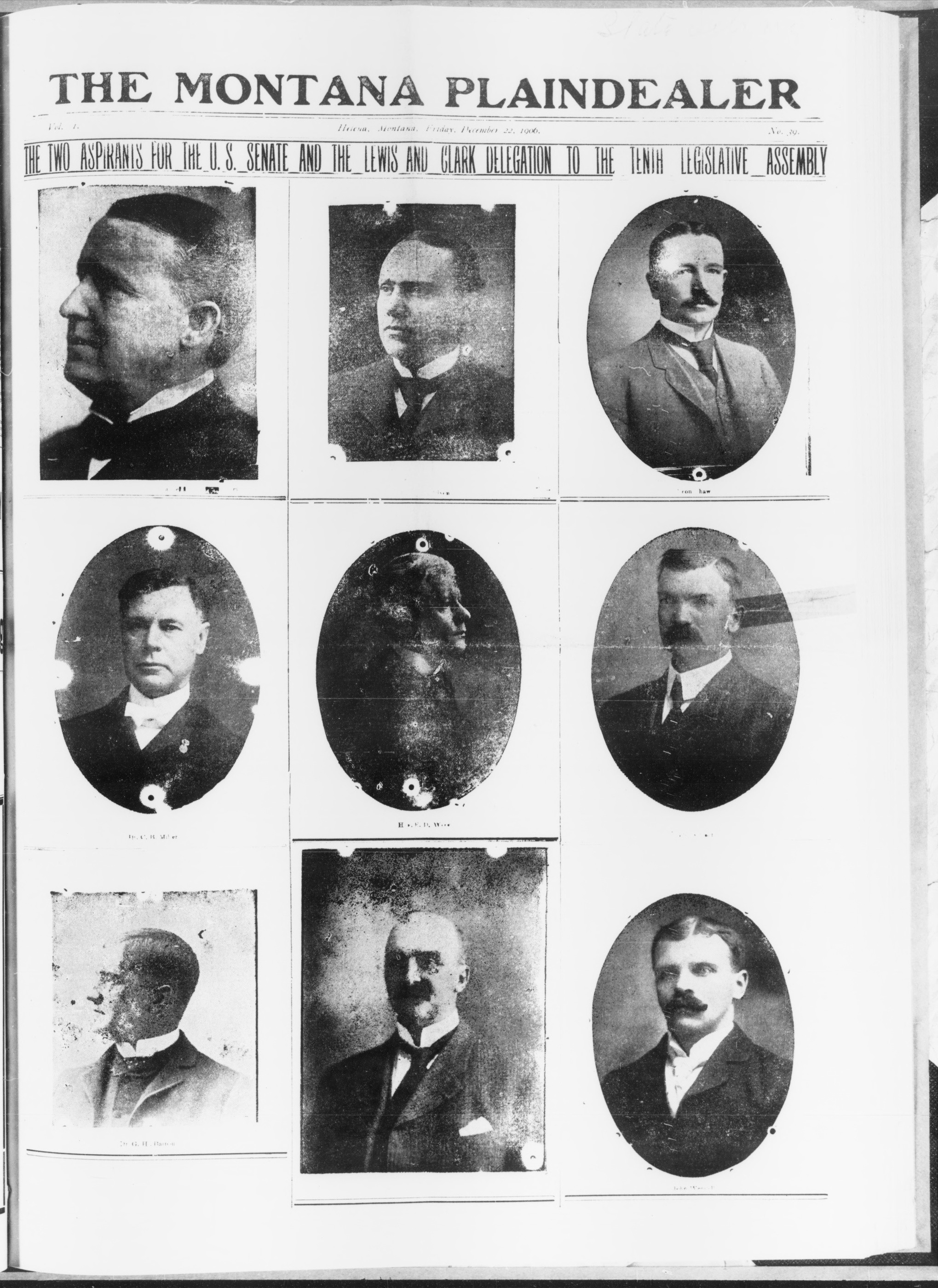
THE TWO ASPIRANTS FOR THE U.S. SENATE AND THE LEWIS AND CLARK DELEGATION TO THE TENTH LEGISLATIVE ASSEMBLY
Dr. C. H. Miller
H. F. D. Worc
Dr. G. H. Barton
John Worc
The Christmas
of Gire
Nadeau
WHEN Pierre Nadeau brought his blooming bride to the River Pachot, he was young and strong, fresh from the lumber camps of Lake St. John. He had been appointed wharf foreman in his new home, and had grown old and gray as time went on, until a small farm and dwelling, bought with the fruits of his toil, provided a shelter for his declining years.
Two sons had been born to the Nadeaus, who, as they grew to manhood, went naturally to the lumber camps. After a time, however, attracted by promises of higher wages and cash payment, in lieu of store trade, they sought the growing West. When they left their home they were clad in provincial fashion; when they returned, on a visit only, they were clad in store clothes and radiant neckwear, and they used strange English, such as made the Pere Nadeau sick at heart. Finally, after unbridled depreciation of the surroundings in which they were born and bred, they departed by schooner and melting finally into the Orient were seen no more.
But their daughter Angeline remained to them, brown of hair and eyes, the trimness of her supple form manifest despite the fashion of dress considered at that early period becoming to the daughters of old France. The long, loose blouse, and short, homespun flannel kirtle, relies of a Norman peasantry, which on other women made them to appear squat, failed to hide her well rounded proportions and maidenly grace.
She had a sharp tongue, had this daughter of the Nadeau, and when she was merry her laugher rang out like sleighbells in winter's frost. Sunday afternoon, when vospers were over, was the time when she would exercise her sharp wit; when, with the other maids of the hamlet she sought the lumber wharf to swap words of badness with the lightermen, deal handlers and trimmers gathered there.
There were no frivolities on week days, however, when Angeline milked the cows, and made tasty butter for the Nadeau table. This done she would seat herself at the loom, which would ring out its rapid click-clack to the push of her vigorous foot, as it turned out its webs of linen, flannel or catelonne, for villag) consumption. She was as quick with her little hands and feet as with that bling, fearful tongue of hers.
Every year, as the big ship Margaret Pollock anchored off the shore for cargo, Captain Locke would pay her a visit the moment he set foot on land. Clean shaven, but for a fringe of fierce red whiskers, his face was vast and lurid as the setting sun. He wore broadcloth on such occasions, with a beaver hat as high as an ordinary chimney; his shirt-front rvlaving in expanse his main t'gallant sail.
He always brought her a present, some trifle picked up in a foreign port, which he would donate in an offhand manner. Sometimes the girl would kiss his gnared cheek, and he would clap her on the shoulder softly with a hand which, clenched, could fell an ox.
One day the schooner Notre Dame des Anges came in, to load farmers' stuff, having been chartered for this purpose by a black-browed man of thirty-five about, who gave his name as Boisvert. He swaggered to a certain extent, and was clad in garments supposed to be of fashionable cut and texture. The women thought him handsome, but his eyes were set rather close together for beauty, and his nose, bent, and with a scar in the concave section, gave to his face a sinister expression. During the intervals of loading he sat much in the house of le pere Nadeau, depreciating their surroundings.
His constant disparagements at length took root in the girl's mind, and her environment grew narrow and bald the more he talked. He assailed the feminine fashions of the port, too; so that when a modiste drifted to the village from St. Michel, with steel engraved fashion plates not three years of age, Angeline became her first customer. One Sunday she went to church in a new gown, of bright color, with a hat decked with red paper flowers, and a ribbon at her neck of poppy hue. M. Boissert was filled with admiration. "How the boys would cast soft eyes at you in St. Roch," he assured her with a melting look.
"Go away, M. Boisvert," was her retort, but it was accompanied with an affected toss of her pretty head, which the old Nadeau and his wife disliked, though they could not just say why. So did Clapha Ouellet. He had been a log jober, and having been successful in his contracts, he had invested his capital in a snug farm in St. Anglee, where his old mother kept his house clean until such time as Angeline would consent to become the mistress. Alas for his hopes; the girl had of late become contemptuous of the prospect.
"It's bad enough here by the sea, but St. Anglee, with nothing but the big woods to see—bah!"
"It's all that Boisvert," said Claphas angrily, "Octave Lavoie, the navigator, says he has a wife and five children in Lorette."
"It's false," snapped Angeline with flashing eyes.
The Notre Dame sailed at length for Quebec; but the supreme content of Claphas and the old Nadeauas was but short-lived. But a few weeks had passed when she returned to her old moorings, laden with wind-blown apples for sale or exchange, with Boisvert, debonaire and cynical as before, at his former post. Captain Locke was in port at the time, and took an instant and unconcealed disbike to him.
One dark fall night, while the hum of a coming easterly wind was heard in the trees which overchanged the river, the Notre
HAPPY YEAR
AQUARIUS PISCES
JANUARY
FEBRUARY
Dame des Anges swung round to the current, and slipped out seaward, with Angeline seated, scared, and already repentant, on a cabin locker.
There was consternation in the Nadeau dwelling when the morning light revealed an empty nest in the old familiar attic, from which she had never been absent for a night since her cradle had been consigned to the barn loft. She had discarded her despised house dress, of blouse and flannel kirtle, woven by her own hands, of striped purple and yellow. The sabot-shaped shoes had been tossed into a corner; all her newer belongings she had taken with her; and the mother Nadeau collected the despised truck and folding them up, laid them carefully away. In the sombre, inarticulate manner of the peasant, they accepted their sorrow.
These were the early, undeveloped days of the East, when the railroad and telegraph were unknown east of Quebec, and
HAPPY NEW YEAR
but a bi-weekly mail, by horse and caileche or sled, carried tidings of the outside world. Once navigation closed, the door was shut upon the dwellers in the eastern hamlets bordering on the guelf. So the snow fell in deep drifts, and the lighters were pack-screwed high above the ice, which rose and fell with the tides, their masts looking ghostlike in the dark winter nights. The once joyous fetes passed unnoticed by Pere Nadeau and his wife—Christmas, New Year's Day—and they sat alone and silent, or went about their daily tasks as best they might. Sometimes the neighbors called, but while they spoke of what was passing; of the cut of logs, of the prospect of a good year's shipping to come, of Angelline they spoke no word. When the summer tides flowed blue and sparkling once more, Claphas Ouellet, embarking his winter's cut of cordwood on the schooner of the navigator, Octave Lavoie, sailed for Quebec, returning after an absence of a couple of weeks. He stepped into the Nadeau dwelling casually on his return.
"Well, Claphas," said the old man in greeting, "your health is good?"
"Yes, thanks."
has
tor,
in
with
for
Cla-
ort-
chen
shake
in
of
the
otre
"The cordwood sell well?"
"Not bad. Twenty-five shillings."
"See anything of my girl?"
"Yes."
"Is she weil?"
"Yes. Works in a hotel."
"Hotel? Not with him, then?"
"No. She left him quick. He had his own wife and family, same as Octave said."
"The accursed. Didn't speak of coming back?"
"No. Wein, I must go; the old mother will be anxious by now for me. If she comes, you will send me word, eh?"
"Yes, we will send you word. Claphas."
Whz. the Margaret Pollock anciored for cargo that fall, and the news of Angeline's abduction was conveyed to Captain Locke. his face grew purple with
fury, and he stormed so terribly on the wharf that the hands, in their terror, hid behind the deal plies, peeping round the corners with scared faces. From Octave, the navigator, he extracted the news of her present circumstances, and became somewhat more calm, though still awful in his frown.
For the second time since the flight of Angeline, Christmas eve came round.
"We will go to church this year, my wife."
"Yes, we will go."
"Yes, we will go."
Having prepared a store of kindling wood against their return, they extinguished their lamps, and locking the door, deposited the key in a secret niche of the porch, known to no outsider. As they turned into the Kempt road, which like a three-mile tunnel, by reason of the spruce boughs which met and interlaced overhead, led to the church, a faint, long drawn wall from the opposite bank of the river came to their ears.
"It is the horn of the mail driver," said Pere Nadeau.
The church was aglow with the light of many candles, set in temporary sconces, on either side, and from the altar and the deep box glove were like great rubies, so hearty were the fires of seasoned wood which crackled within. In the choir loft, fiddles were being tuned, and as the service proceeded there rolled forth to their accompaniment from the vigorous throats of the young farmer choristers, the well-known carols of the season. Then the priest from the rail of the altar spoke in fatherly tones, and the duty of forgiveness, even as we expect to be forgiven, was his theme. Pere Nadeau touched gently his wife's hand, as the words of the preacher touched them both on a hidden, quivering chord, and their old lips moved in unison as they prayed.
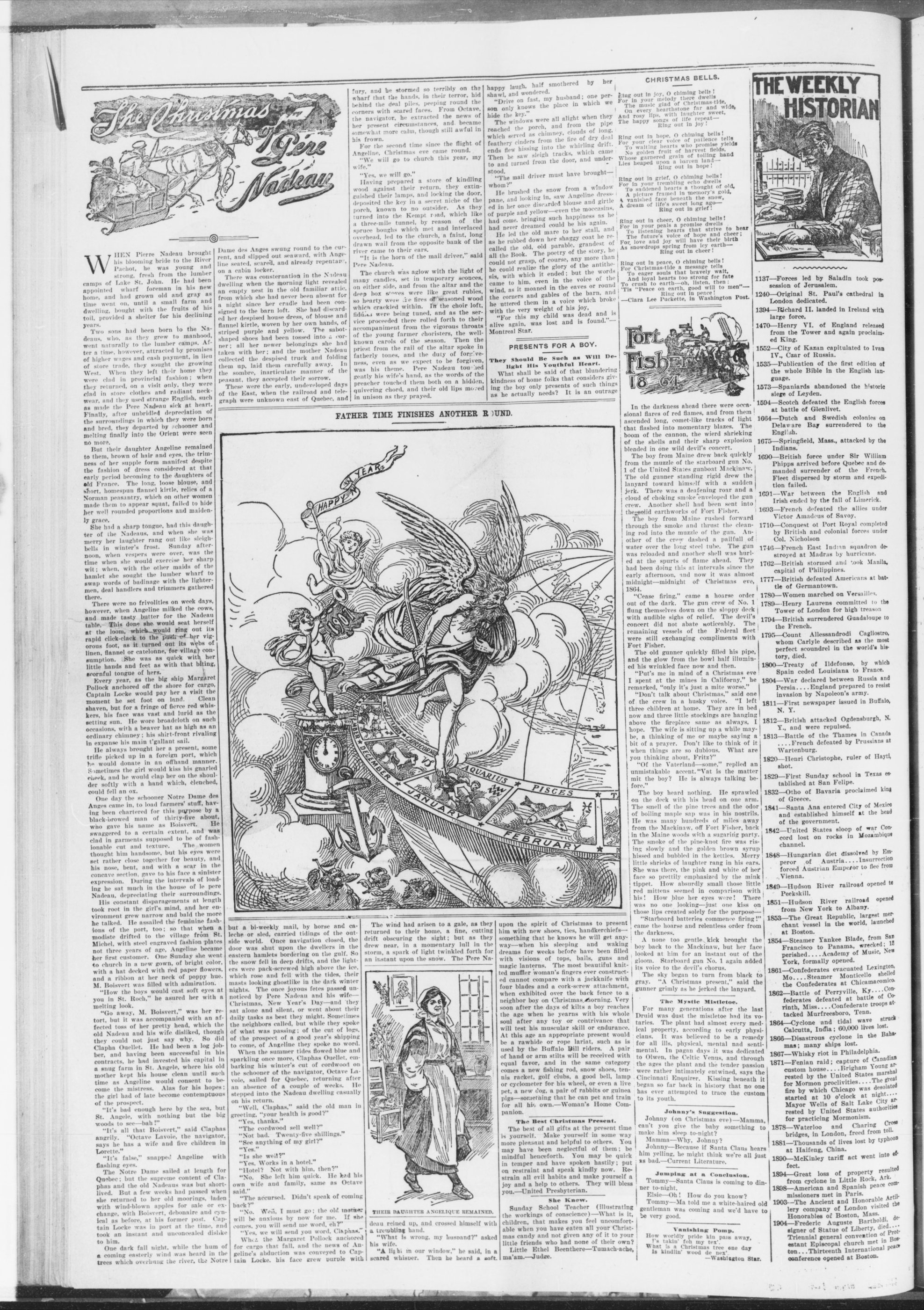
THER TIME FINISHES ANOTHER R U
YEAR
HALF PALMER CHRIST CORNWAL
VS
AQUARIUS
DEGEMBER
JANUARY
The wind had arisen to a gale, as they returned to their home, a fine, cutting drift obscuring the sight; but as they drew near, in a momentary lull in the storm, a spark of light twinkled forth for an instant upon the snow. The Pere Na-
A
THEIR DAUGHTER ANGELIQUE REMAINED.
deau reined up, and crossed himself with a troubling hand.
"What is wrong, my husband?" asked his wife.
"A lihi in our window," he said, in a scared whisper. Then he heard a soft.
happy laugh, half smothered by her shawl, and wondered.
"Drive on fast, my husband; one person only knows the place in which we hide the key."
hide the key.
The windows were all alight when they reached the porch, and from the pipe which served as chimney, clouds of long, feathery cinders from the fire of dry deal ends flew hissing into the whirling drift. Then he saw sleigh tracks, which came to and turned from the door, and under-
stood.
"The mail driver must have brought—whom?" He brushed the snow from a window pane, and looking in, saw Angeline dressed in her once discarded blouse and girdle of purple and yellow—even the moccasins, had come, bringing such happiness as he had never dreamed could be his again.
He led the old mare to her stail, and as he rubbed down her shaggy coat he recalled the old, old parable, grandest of all the Book. The poetry of the story, he could not grasp, of course, any more than he could realize the glory of the antithesis, with which it ended; but the words came to him, even in the voice of the wind, as it meaned in the eaves or round the corners and gables of the barn, and he uttered them in a voice which broke with the very weight of his joy.
with the very
"For this my child was dead and is
alive again, was lost and is found."—
Montreal Star.
PRESENTS FOR A BOY.
They Should Be Such as Will Delight His Youthful Heart. What shall be said of that blundering kindness of home folks that considers giving the boy only presents of such things as, he actually needs? It is an outrage
R OUND.
VIRUS PISCES T
FEBRUARY
upon the spirit of Christmas to present him with new shoes, ties, handkerchiefs—something that he knows he will get anyway—when his sleeping and waking dreams for weeks before have been filled with visions of tops, balls, guns and magic lanterns. The most beautiful knitted muffler woman's fingers ever constructed cannot compare with a jackknife with four blades and a cork-screw attachment, when exhibited over the back fence to a neighbor boy on Christmas morning. Very soon after the days of kilts a boy reaches the age when he years with his whole soul after any toy or contrivance that will test his muscular skill or endurance. At this age an appropriate present would be a rawhide or rope lariat, such as is used by the Buffalo Bill riders. A pair of hand or arm stilts will be received with equal favor, and in the same category comes a new fishing rod, snow shoes, tennis racket, golf clubs, a good bell, lamp or cyclometer for his wheel, or even a live pet, a new dog, a pair of rabbits or guinea pigs—something that he can pet and train for all his, own.—Woman's Home Comanion.
The Best Christmas Present.
The best of all gifts at the present time is yourself. Make yourself in some way more pleasant and helpful to others. You may have been neglectful of them; be mindful henceforth. You may be quick in temper and have spoken hastily; put on restraint and speak kindly now. Restrain all evil habits and make your joy and a help to others. They will bless you—United Presbyterian.
She Knew.
ED. Sunday School Teacher (Illustrating the workings of conscience)—What is it, children, that makes you feel uncomfortable when you have eaten all your Christmas candy and not given any of it to your little friends who had none of their own? Little Ethel Beenthere—Tumach-ache, ma'am.—Judge.
CHRISTMAS BELLS.
Ring out in joy, O chiming bells!
For in your melody there dwells
The music glad and sweet, tide,
And rosy lips, stonehine far and wide,
And rosy lips, with laughter sweet,
The happy songs of life repeat—
Ring out in hope, O chiming bells!
For your clear voice of patient bells
And yeas yields
To walling in,
No fruit of harvest fields,
wherenear grain of toiling hand
Lies heaped upon a barren land—
Ring out in hope!
Ring out in grief, O chiming bells!
For in your trembling echo dwells
Ring out in cheer, O chiming bells!
For in your peals a promise dwells
To listening hearts that strive to hear
The future's voice of hope for cheer;
For love and joy and their birth
As snowdrops from ice earth—
Ring out in cheer!
To eager sons that
And loyal hearts that to strong for fate
To crush to earth, oh listen, then:
Tis "Peace on earth, good will to men"—
Ring out in peace!
Clara Lee Puckette, in Washington Post.
Fort Fisher 18 64
In the darkness ahead there were occasional flares of red flames, and from them ascended long, comet-like tracks of light that flashed into momentary blazes. The boom of the cannon, the wierd shrieking of the shells and their sharp explosion blended in one wild devil's concert.
The boy from Maine drew back quickly from the muzzle of the starboard gun No. 1 of the United States gunboat Mackinaw. The old gunner standing rigid drew the lanyard toward himself with a sudden jerk. There was a deafening roar and a cloud of smoking smoke enveloped the gun crew. Another shell had been sent into the solid earthworks of Fort Fisher. The boy from Maine rushed forward through the smoke and thrust the cleaning rod into the muzzle of the gun. Another of the crew dashed a palfall of water over the long steel tube. The gun was reloaded and another shell was hurled at the spurs of flame ahead. They had been doing this at intervals since the early afternoon, and now it was almost midnight—midnight of Christmas eve, 1804.
"Cease firing," came a hoarse order out of the dark. The gun crew of No. 1 flung themselves down on the sloppy deck with audible sighs of relief. The devil's concert did not abate noticeably. The remaining vessels of the Federal fleet were still exchanging compliments with Fort Fisher. The old gunner quickly filled his pipe, and the glow from the bowl half illuminated his wrinkled face now and then. "Put's me in mind of a Christmas eve I spent at the mines in California," he remarked, "only it's just a mite worse." "Don't talk about Christmas," said one of the crew in a husky voice. "I left three children at home. They are in bed now and three little stockings are hanging above the fireplace same as always. I hope. The wife is sitting up a while maybe, a thinking of me or maybe saying a bit of a prayer. Don't like to think of it when things are so dubious. What are you thinking about, Fritz?"
"Of the Waterland—some," replied an ummistakable accent. "Vat is the matter mit the boy? He is always talking before."
The boy heard nothing. He sprawled on the deck with his head on one arm. The smell of the pine trees and the odor of boiling maple sap was in his nostrils. He was many hundreds of miles away from the Mackinaw, off Fort Fisher, back in the Maine woods with a sugaring party. The smoke of the pine-knot fire was rising slowly and the golden brown syrup hissed and bubbled in the kettles. Merry little shrieks of laughter rang in his ears. She was there, the pink and white of her face so prettily emphasized by the mink tippet. How absurdly small those little red mittens seemed in comparison with his! How blue her eyes were! There was no one looking—just one kiss on those lips created solely for the purpose—"Starboard batteries commence firing!" the haore and relentless order from the darkness.
A none too gentle, kick brought the boy back to the Mackinaw, but her face looked at him for an instant out of the gloom. Starboard gun No. 1 again added its voice to the devil's chorus. The sky began to turn from black to gray. "A Christmas present," said the gunner grimly as he jerked the lanyard.
The Mystic Mistletoe.
For many generations after the last Druid was dust the misledeo had its votaries. The plant had almost every medical property, according to early physicians. It was believed to be a remedy for all lilies, physical, mental and sentimental. In pagan days it was dedicated to Olwen, the Celtic Venus, and through the ages the plant and the tender passion were rather intimately entwined, says the Cincinnati Enquirer. Kissing beneath it began so far back in history that no one has ever attempted to trace the custom to its youth.
Johnny's Suggestion
Johnny (on Christmas eve)—Mamma,
can't you give the baby something to
make him sleep to night?
Mamma—Why, Johnny?
Johnny—Because if Santa Claus hears
him yelling, he might think we're all just
as bad.—Current Literature.
Jumping at a Conclusion.
Tommy—Santa Claus is coming to dinner
to night.
Elsie—Oh! How do you know?
Tommy—Ma told me a white-haired old gentleman was coming and we'd have to be very good.
Vanishing Pomp.
How worldly pride kin pass away,
'Is takin' foh my tex'.
What is a Christmas tree one day
Is kindin' wood de neyn?
Washington Star
THE WEEKLY
HISTORIAN
1137—Forces led by Saladin took possession of Jerusalem.
1240—Original St. Paul's cathedral in London dedicated.
1394—Richard II. landed in Ireland with large force.
1470—Henry VI. of England released from the Tower and again proclaimed King.
1552—City of Kazan capitulated to Ivan IV., Czar of Russia.
1535—Publication of the first edition of the whole Bible in the English language.
1573—Spaniards abandoned the historic siege of Leyden.
1594—Scotch defeated the English forces at battle of Glenlivet.
1604—Dutch and Swedish colonies on Delaware Bay surrendered to the English.
1675—Springfield, Mass., attacked by the Indians.
1690—British force under Sir William Phipps arrived before Quebec and demanded surrender of the French, Fleet dispersed by storm and expedition failed.
1691—War between the English and Irish ended by the fall of Limerick.
1693—French defeated the allies under Victor Amadous of Savoy.
1710—Conquest of Port Royal completed by British and colonial forces under Col. Nicholson.
1746—French East Indian squadron destroyed at Madras by hurricane.
1762—British stormed and took Manila, capital of Philippines.
1777—British defeated Americans at battle of Germantown.
1780—Women marched on Versailles.
1789—Henry Laureens committed to the British truce.
Tower of London for high treason
1794—British surrendered Guadaloupe to the French.
1795—Count Allessandrodi Cagliostro, whom Carlyle described as the most perfect scoundrel in the world's history, died.
1800—Treaty of Ildefonso, by which Spain ceded Louisiana to France.
1804—War declared between Russia and Persia. ...England prepared to resist invasion by Napoleon's army.
1811—First newspaper issued in Buffalo, N. Y.
1812—British attacked Ogdensburgh, N. Y., and were repulsed.
1813—Battle of the Thames in Canada ...French defeated by Prussians at Wartenburg.
1820—Henri Christophe, ruler of Hayt, shot.
1829—First Sunday school in Texas established at San Felipe.
1832—Otho of Bavaria proclaimed king of Greece.
1841—Santa Ana entered City of Mexico and established himself at the head of the government.
1842—United States sloop of war Concord lost on rocks in Mozambique channel.
1848—Hungarian diet dissolved by Emperor of Austria....Insurrection forced Austrian Emperor to flee from Vienna.
1849—Hudson River railroad opened to Peckskill.
1851—Hudson River railroad opened from New York to Albany.
1853—The Great Republic, largest merchant vessel in the world, launched at Boston.
1854—Steamer Yankee Blade, from San Francisco to Panama, wrecked; 15 perished....Academy of Music, New York formally opened.
1861—Confederates evacuated Lexington, Mo....Steamer Monticello shelled the Confederates at Chicamacomico.
1862—Battle of Perryville, Ky....Confederates defeated at battle of Corinth, Miss....Confederate troops attacked Fmresfreesboro, Tenn.
1864—Cyclone and tidal wave struck Calcutta, India; 60,000 lives lost.
1866—Disastrous cyclone in the Bahamas; many ships lost.
1867—Whisky riot in Philadelphia.
1871—Fenian raid; capture of Canadian custom house; Brigham Young arrested by the United States marshal for Mormon proclivities....The great fire by which Chicago was desolated started at 10 o'clock at night....Mayor Wells of Salt Lake City arrested by United States authorities for practicing Mormonism.
1878—Waterloo and Charing Cross bridges, in London, freed from toll.
1881—Thousands of lives lost by typhoon at Hofstown, China.
1890—McKinley tariff act went into effect.
1894—Great loss of property resulted from cyclone in Little Rock, Ark.
1898—American and Spanish peace commissioners met in Paris.
1903—The Ancient and Honorable Artillery company of London visited the Honorables of Boston, Mass.
1904—Frederic Auguste Bartholdi, designer of Statue of Liberty, died.... Triennial general convention of Protestant Episcopal church met in Boston.... Thirteenth International peace conference opened at Boston.
11.2 11.2 11.2 11.2
NEWS OF THE WORLD SHORT DISPATCHES FROM ALL PARTS OF THE GLOBE.
A Review of Happenings in Both Eastern and Western Hemispheres During the Past Week—National, Historical, Political and Personal Events.
Another attempt on the life of Admiral Dubassoff, ex-governor general of Moscow, Russia, was made Saturday afternoon, but he escaped with slight injuries.
Notices have been posted at all cotton mills in Lowell, Mass., of a five per cent increase in wages to go into effect on Monday. About 17,000 operatives are affected.
Members of the house and senate have been denied more salary by a vote of 188 to 106, but house speaker and vice president will draw $12,000 nearly also cabinet members.
Governor Magoon of Cuba has issued a decree directing all rural guardsmen to be especially vigilant in arresting all persons bearing arms without license. Another gubernatorial decree provides for the expenditure of $326,000 for sanitation in various towns throughout the island.
St. Louis, Dec. 15.—Adolphus Busch, the multimillionaire brewer, says he is in favor of an income tax law.
Six more theaters will be added to the Sullivan and Considine circuit of the vaudeville playhouses within a reef.
An unidentified newsboy was killed recently in the gallery of the Majestic theater, Chicago, for applauding a player on the stage with whom George Dunraven, another spectator, was displaced. Dunraven tried to hit the boy with an umbrella. The point of the umbrella penetrated the boy's brain through his left eye. Dunraven was arrested.
Representative Jones has introduced a bill providing that after July 1, 1907, the salary of each and every civil service employee of the government shall be increased twenty per cent.
The condition of Bishop McCabe, suffering from apoplexy, is slightly improved.
Two thousand machinists employed in Denver shops, will receive an advance in wages January 1 ranging from 5 to 15 per cent.
The Standard Oil company announces that it will advance the wages of all its employees now receiving less than $100 a month by 10 per cent, beginning January 1. The interstate commerce commission will investigate into the shortage of cars in hearings which begin at Minneapolis December 17, and extend to Kansas City, St. Louis and Chicago. Flora C. Adams has obtained a divorce in Seattle on a cross complaint from Henry Austin Adams, better known as Vincent Harper, author and magazine contributor.
On the recommendation of the general staff the secretary of war has ordered the trial by courtmartial of Major Macklin of Company C, First battalion of the Twenty-fifth infantry, under the 62d article of war for "conduct to the prejudice of good orer and discipline," in failing in their duties in preventing and suppressing the riot by negro soldiers at Brownsville, Texas, last August.
Simplified spelling has received a final quietus in the house of congress.
The Indian appropriation bill for 1908, carrying about $8,000,000, has been agreed upon by the house committee on Indian affairs. The appropriation for the Indians for 1907 was $8,405,000. The estimates submitted by the bureau of Indian affairs for 1908 aggregated $7,970,000.
Representative Roberts of Massachusetts introduced a bill making the noncommissioned officers and enlisted men of companies B, C and D, 25th infantry, the negroes discharged from the service by the president's order, eligible for reenlistment in the military or naval service. The bill is intended to restore to these men all the rights lost under the order of discharge.
Ex-Mayor W. W. Rose of Kansas City, Kan., has sent to the clerk of the Kansas supreme court a check for $1562 to pay his fine and all costs in the contempt case decided against him. Robbers looted the safe in the bank at Lincoln, Ark., recently, getting away with $1800, all it contained.
The Utah federation of labor has resolved to circulate a petition to congress asking the creation of postal savings banks. The move is said to be under the auspices of the American Federation of Labor, with which the Utah federation is affiliated.
BOY IS NOT MURDERER.
Despite Confession That He Is Slayer of Dona Gilman.
Dayton, Ohio, Dec. 17.—David Curtis, the half-witted newsboy held as a result of his own statement that he is the slayer of Dona Gilman, has been released on the ground that the prosecution had failed to show that he was connected with the crime.
Expert miscroscopists, after a thorough examination, today reported that Dona Gilman was criminally assaulted. This settled all contentions respecting a motive for the murder, for the commission of which several persons, including members of her family, were under arrest.
SPORTING NOTES
The batting averages of the American league, which were given out for publication recently, show that the team with the lowest batting average carried off the championship. The highest average for teams was made by Cleveland, which scored .279. New York was second with .265 and Chicago was last with .230. The individual honors were carried off by Stone of St. Louis and Clarke of Cleveland, both of whom averaged .358. Stone played in 154 games, was at bat 581 times, made 208 hits and 91 runs. Clark was in 57 games, at bat 179 times, made 64 hits and 22 runs. Lajole was third with an average of .355. Chase of New York was fourth with .323 and Conglaton of Cleveland fifth with .320. Chicago's best batter, Smilu, was 16th. He made .293.
The champion rungetter was Flick of Cleveland, who made 98. The record for stolen bases, 29, was made by Flick and Anderson of Washington, jointly. The leading martyr of the season was Jones of St. Louis, who made 40 sacrifice hits, Flick of Cleveland and Anderson of Washington making 39 each.
James J. Drain, formerly adjutant general of the Washington National Guard, has been elected president of the National Rifle association.
Root and Fogler, first; Downing and Hopper, second; Rutt and MacFarland, third.
These teams were winners in the New York six day race concluded Saturday night.
At a meeting recently between Tommy Burns, "Philadelphia" Jack O'Brien and prize fight promoters from two or three cities, Manager Tom McCarey of the Pacific Athletic club, Los Angeles, bid $30,000 for a fight between Burns and O'Brien, to be held there some time next May. This was $5000 more than offered by the Rhoylie Athletic club of Rhoylie, Nev. Burns was willing to sign the agreement to fight for this amount, but O'Brien dissented and the matter was deferred one week. John L. Sullivan has completed arrangements for a grand finale to his stage career by a tour of Mexico and the Central and South American republics. The trip will begin the middle of February and last six months. Incidentally, Sullivan will keep his eyes open for championship timber in the heavyweight class. He has just completed a long tour of the United States and says he has saved $50,000.
F. Nebrick of the New York Athletic club won the individual national cross-country championship at Travers island and Saturday over the Westchester course. The ride was under the auspices of the Amateur Athletic union. The senior team championship went to the Irish-American Athletic club of New York.
BATTLES WITH A HAT PIN.
Chicago Girl Flights Robbers and Saves
$5000.
Battling with a hat pin against five highwaymen who attacked her in broad daylight on a crowded street, Miss May Gates, cashier in a Chicago confectionery company, held her assailants at bay until the police came to her rescue. Her resistance saved her employers $5000, which she was bringing from the bank to meet the company's payroll.
Miss Gates left the bank at noon, took a street car to within a block of the company's office and was almost in the doorway when the five robbers, masked and armed, attacked and dragged her into am alley, struggling to wrest from her the handbag in which she carried the money. Bystanders rushed to the young woman's rescue, but the highwaymen drew their revolvers and fought so desperately that they were not only defying them completely but seemed in a fair way to overpower Miss Gates.
Attracted to the spot by the commotion, a half dozen bluecoats and detectives at last entered the fight. After 20 or 30 shots had been exchanged, the robbers attempted to escape on a passing street car. Three of them eluded the officers. Two, who gave the names of Harry Farnum and Harry Baller, were arrested.
LATE NEWS ITEMS.
Castro is dying again, according to reports.
Four persons were killed and two seriously injured recently in a headon collision between the Cannonball express and a freight train at a long curve near Donaldsonville, La., on the Texas and Pacific railroad.
Interstate Commerce Commissioner Lane will leave Washington in January for the Pacific coast, where he will inquire into the causes of the fuel famine and car shortage. His itinerary will include Butte, Spokane, Seattle, Portland and other points.
Charitable bequests of $460,000 were made by the will of Otto Young, the capitalist who died recently at his home at Lake Geneva, Wis. The principal beneficiary is the Chicago Home for Incurables, which receives $400,000.
Man Doing Horseback Stunt.
William MacBeth, the Scotedale, Pa.
man who on a wager of $20,000 is at-
tempting to visit on horseback all of
the state capitals, called at the White
House Saturday. He has four years'
time in which to complete his trip.
He is not allowed to buy nor beg,
but may accept voluntary offerings.
The Empress Eugenie at one time
owned a wardrobe value at $1,000,000.
Today she spends as little as possible
on herself and dresses invariably in
black.
FRANCE AND CHURCH
FRIENDS OF FRANCE'S PLAN GATHER AT VATIGAN.
Entire Garrison of City Called Out to Disperse It—Hem in Streets—Demonstrators Friendly to France Cry "Down With the Vatican"—Uproar Continues Until Late in the Evening.
Rome, Dec. 17.—Thousands of demonstrators friendly to France and of antivatican tendencies, gathered Sunday night in the plaza adjoining the Farnez palace, the seat of the French embassy, in an endeavor to express pleasure at France's action toward the Catholic church.
The whole garrison of Rome was employed to disperse the demonstrants and to protect the vatican, which is surrounded by cavalry, and the bridges to the apostolic palace are barricaded by troops. All the streets leading to the Palace Farnez are protected by soldiers with fixed bayonets.
Form Mock Possession.
the demonstrators, led by a dozen radical socialists and republican members of the chamber of deputies, including Prince Borghesi, after vainly attempting to break the cordon, provided themselves with candles and formed into a mock procession, intoning the "Missere" as an indication of the death of clericalism, amidst cries of "Long live France," "Long live Clemenceau," and "Down with the vatican." Deputies Costa and De Felice tried to harangue the people, but the police interfered. The demonstration occurred near the monument to Glordano Bruno, the monk philosopher who was burned alive, a victim of religious intolerance. Deputy Costa finally made himself heard. He said:
"Before this monument to Bruno, of free thought, let us send our applause to France for this great people continuing the tradition obstinate struggle against the moth eaten clericalism."
Cavalry Charge Demonstrators.
Fresh attempts were then made to beat back the cordon and the cavalry charged the demonstrators, a few of whom were slightly injured, and several arrested. Amid roars and shouts and the singing of the "Marselliaise," the foment continued until late in the evening.
A committee of the demonstrators was addressed by M. Barrer, the French ambassador, who expressed his appreciation and sympathy for the Roman people.
The stand that the government is taking is that although Italy is friendly to France, she does not wish to take sides in the dispute, and especially when her relations with the church are better now than they have been since 1870.
Orderly Sunday in Paris.
Paris, Dec. 17.—The serious disturbances that it was though would ensue on this, the first Sunday, under the law separating church and state, were not realized. The services in this city in particular passed off quietly. There was a notable increase in the size of the congregations and in them were large bodies of men who were determined to prevent the interruption to masses by rowdies.
Reports from the provinces show that there was great excitement at many places. Large processions chanting psalms accompanied the clergy to and from the churches. Counter demonstrations took place in several cities, notably Perypagnan and Amiens, where the Catholics and Free Thinkers came into collision, necessitating interference by the police, who quickly dispersed the crowds. Several of the demonstrators were injured.
HUGE COPPER COMPANY.
New Concern Capitalized at $50,000,000
—No Public Stock.
The organization of a new $50,000,
000 company to be known as the
Greene Cananea Copper company to
take over the control of the Greene
Consolidated Copper company and the
Cananea Central Copper company, is
announced by William C. Greene.
It is said the new company will issue $50,000,000 stock and will exchange its stock for Greene Consolidated on the basis of $30,000,000 for the property and for the stock of the Cananea Central upon the basis of $20,000,000 for the property. Ample cash has been provided for this plan for enlargement of the plant and development of the property. No stock will be offered to the public. Messrs. Cole, Ryan and Greene will leave shortly for Mexico to inspect the properties and lay out a plan for equipment and development. The company will be incorporated under the laws of Minnesota with nine directors, who will represent all the large interests concerned. Mr. Cole will be its president and Colonel Greene its vice president.
No More Troops.
It is stated at the war department that no order has been issued for the dispatch of more troops to the Hawaiian islands, nor is any such order contemplated. The permanent garrison in Hawaii consists of four companies of regular troops.
The British government gets an income of $25,000,000 from railways, river boats and forests of India.
SHAKEUP IN THE CABINET.
British Statesmen Are Leaving Their Positions.
London.—The first of the impending changes in the cabinet to be announced in the resignation of J. E. Ellis, parliamentary secretary to the Indian office. He is leaving on account of ill health and is going abroad to recuperate. It is understood Walter Runcman, parliamentary secretary to the local government board, will succeed him. It is stated that the marquis of Ripon, lord of the privy seal, and Sir H. Fowler, chancellor of the duchy of Lancaster, will resign, and it is rumored that Herbert Gladstone will leave the home office. Sir Henry Campbell-Bannerman, however, according to the latest political gossip, has decided to remain in the house of commons, in view of a liberal attack that is about to be made on the upper house.
Everything, however, appears to hinge on James Bryce's acceptance of the post of ambassador to the United States.
STEAMER THEMIS A WRECK
Goes Ashore on North Coast of Van couver Island.
Victoria, B. C., Dec. 17.—The Norwegian steamer Themis, from Prince of Wales island to Victoria and Vancouver, with concentrates and salmon, went ashore on Scarlet point, north coast of Vancouver island on Friday and will probably be a total loss. The cargo may be saved. The steamer Salvor of the British Columbia Salvage company, will leave to go to her assistance. The Themis is under time charter to S. F. Mackenzie of Vancouver, and was recently repaired at a cost of $12,000.
The officers and crew, numbering 29, were rescued by the steamer San Juan Saturday morning and landed at Vancouver Sunday night.
SPOKANE'S ATTRACTIONS.
December 23, 24 and 25, "The Strollers."
December 30, "The Yankee Consul."
January 9 and 10, "Sergeant Kitty."
January 11 and 12, "The Heir to the Hoorah."
January 13, "Human Hearts."
January 15, Schumann Heink.
January 25 and 26, "The Sultan of Sulu."
January 27, "Fast Mail."
January 31, "Wm. H. Crane and Ellis Jeffrey's.
"Kerry Gow" at Spokane.
Kerry Gow at Spokane.
Joseph Murphy's followers and numerous friends will welcome the popular Irish play "Kerry Gow," next Friday and Saturday at the Spokane. "Kerry Gow" is as popular as ever, possessing: romance of plot, striking action, literary quality, and scenic beauty, besides developing strong plots of human interest. A former Spokane boy, Eddie Allen Doone, is the star, supported by an excellent company who have for years played the roles assigned to them, and have attained a corresponding degree of proficiency. Doone's impersonation of Dan O'Hara the blacksmith is greatly praised.
"The Strollers."
Next Sunday night marks the appearance of the musical comedy, "The Strollers," at the Spokane, where it remains three nights and for a Christmas matinee. The company includes Aida Hemmi, prima donna soprano; "Teddy" Webb, comedian; Joseph W. Smith, tenor; Francis Carrier, baritone; George Kunkel, basso; Aimee Leicester, comedienne; Frieda Wisher soubrette, and Frank Bertrand, comedian; supported by an excellent chorus.
"Peck's Bad Boy" at Columbia.
There is always a freshness to the story of "Peck's Bad Boy" which has given an unfalling popularity both to the book and to the dramatization of it. The piece opened up for a week's engagement at the Columbia theater with the matinee Sunday afternoon. It will doubtless attract must interest. Former Governor George W. Peck's story is too well known to need any comment, as it is one of the most widely read American novels that have ever been written. Prices, 20c, 30c, 50c. Boxes, 75c. Saturday matinee, 15c, 25c. Next attraction—Christmas week—Zinn's Merry Musical Travesty company.
At the Washington.
The Gordon, Vidcoq, and Flynn trio at the Washington this week are people whose business it is to create laughs by wholesome comedy. As Irish comedians they have made good through the east. The Prentice trio, in acrobatic work and singing and dancing are entertaining.
Clairs Maynard sings "Killarney" and "Annie Laurle" and other beautiful ballads.
Kippe and Kippe are a duo who juggle heavy articles.
George Armstrong, who is a good comedian, with funny stories and songs also appears.
Charles Allman will sing, "Beside the Old Oak Gate."
New York city has the shortest stream of water in the world dignified by the name "river." It is the Harlem river, and is strictly one of the mouths of the Hudson.
Wigg—A bad memory gets a fellow into lots of trouble. Wagg—Yes, it's always springing things on you that you thought you had forgotten."—Philadephia Record.
How to Amuse the Children During the Holidays.
HRISTMAS day games for the children are as necessary as a plum pudding, and the following will please them and are welcome to many grown-ups, says the Chicago Tribune:
C
Santa Claus Pack.
—All form in line
and march to a
lively strain on the
piano to the next
room, where a table
holds the contents of Santa Claus' pack. They look at every object on the table and then march back. The company now divides in half, one half leaving the room, the table and its contents having been covered. Those remaining choose some object which they remember seeing; the piano begins to play again and the others return. The leader gives to the returning party a word which rhymes with the object chosen. Thus, if it was a ball, he might mention the word "hall." The returning party now proceed to guess what object has been chosen, and they express their guess by acting in pantomime. They do not all suggest the object in the same way, but each according to his individual fancy, but they must all agree upon the object they will guess. If wrong they go out for another trial and so on until guessed, when the other half of the company goes out, and they remain and select the object for the others to guess.
Hiding the Mistletoe.—All form in line, single file, and march about the room or several rooms until the music stops. They then proceed to hunt the mistletoe, which the leader carried in his hand and concealed somewhere during the march. The finder must effect return to the starting point without being touched by the leader. Santa Claus'Sleigh.—Six girls are harnessed to a little sleigh or sled, and the white ribbon reins are held by a seventh. The sled is filled with small parcels in colored papers containing Christmas crackers or any trifles as favors. The party goes round the room several times, dispensing the favors to the young men, who proceed to select partners and dance until a signal from the leader calls all to march around the room and back to their places.
Snowball.—A large white ball of tissue paper is suspended well out of the way of bric-a-brac. The young girls take turns at shooting at this ball with a small rubber ball. When hit with sufficient force it breaks and out falls a shower of smaller white balls, perhaps popcorn balls, which are gathered and presented as favors for the next march or dance. As there should be only about half as many balls as there are couples dancing, this will cause a scramble among the small boys who gather them up and who, for fair dealing, should be kept behind a certain line until the ball receives the shot that bursts it.
NEW YEAR'S AGAIN.
Time for Resolving to Do the Best
You Can
New Year's is upon us again. Let us take up the line of march and make the best progress we can through another year. Humanity does not shape an edifying course. Day after day, year after year, it blumers along, as any day's history spelt out in the newspaper will attest. To blumder along seems to be about the best the best of us can do, either as individuals or as a nation. It is not ideal, but it will answer, if so be we can keep pointed in the right direction and proceed in a sagacious spirit, sharing the road with the rest of the folks and not less compassionate of their deviation than of our own. The greatest goals that men have reached they have reached by being stronger than their mistakes. So it was with Lincoln; so with Washington. The great difference between wayfarers, besides the disparity in locomotive power, is that some manage to hold to the right direction and to maintain in spite of blumders the essential spirit. That sort invariably get somewhere where it is worth while to arrive. For the others, speed is nothing if the direction is not right. And to carry along a great load of baggage is far less advantageous than it might be if our job was a permanent job, and if every man of us was not under contract to drop every shred he has and run whenever his hour strikes.—Harper's Weekly.
Christmas Advice for a Millionaire.
Christmas Advice
Although handicapped by your circumstances, it is not impossible for you to extract some comfort from Christmas. One of the best rules is not to allow yourself to think about your condition. You would gladly swap places and stomachs with some poor devil who has to earn his own living, but do not dwell upon this. Instead, ascertain the address of some misguided philanthropist who is in the habit of giving a Christmas dinner to a lot of ragamuffins. Get him to take you to the place and view the moving spectacle. He will be glad to have you see it, and it will be a source of considerable amusement to you. Then, after you have been driven home, you can estimate the cost per plate and the number fed, and easily ascertain how much you have saved by not doing the same thing. This will cast a gentle glow over the remainder of your holiday and help you to enjoy what otherwise might be a cheerless Christmas. —Life.
Papa—Santa Claus may think you're greedy if you hang up both your stockings and may not leave you anything. Bertie—Huh! He won't know they're both mine; he'd think I'm twins.
And he groaned as he said, "I plainly can see
On this Christmas Eve there's no shirking for me.
Not one naughty child in the whole merry stock.
"His plain I must work until five by the clock."
"But, my dear," said his wife, "you ought to be glad
That at last there's not left a child who is bad."
Said the saint, with a smile and a look that was queer,
"They ought to expect me each day in the year."
—Waverley Magazine.
HOW HOPE
WAS BORN
---
THE night was a wild one. Such a night and such weather as only New England can inflict on suffering humanity. The dispensary was in darkness, save a light which gleamed from the windows of the resident physician's room. Dr. Brown, the resident physician, had made a bad day of it, tramping through the snow, making his regular calls on the sick poor of his district. Now he found small comfort in his pipe as he sat by his little stove in the dispensary room. Just now the young doctor suffered from an attack of the blues. He had worked hard, this last year, for his degree, and after graduation had been chosen from among 20 applicants for the post of resident at the dispensary. The position paid in experience and gave a wide field for work among the poor of the district, both at their homes and at the dispensary. The salary was chiefly salary in name, $100 a year and room rent free, not enough to cover expenses; but it was the experience to be gained that paid.
He had been a young man with expectations and had had matrimonial designs on a certain dainty young lady, and what hope was there for a poor dispensary doctor? Only that morning the wealthy Mr. Peabody, her pompous papa, had passed Dr. Brown on the street and had returned his polite "good morning", with a cold look, which seemed to say: "I do not wish to know you, sir." And that, too, when but a few years before the student Brown, with great expectations, had been a welcome guest at the Peabody mansion. Society had gossiped that Dolly Peabody and Harvey Brown would make a match. He had written once since that to Miss Dorothy and his letter had been returned to him unopened. The Peabodys had gone abroad and he had heard no more of them until to-day, when Mr. Peabody had given him the cut direct.
Dr. Brown had worked hard all day, had had a case at a slum tenement house that afternoon and had missed his supper at the boarding house. As he brooded over these things small wonder that the "blue devil's" tormented him.
"Devil of a night out," mused the doctor. "Christmas eve, too! What I won't feel have a call out to night. What an old duffer that Peabody is, anyway. Wonder if Dol—Miss Peabody would cut me like that? Hang it all! A man don't feel good to be frozen out like that just because he has lost his expectations. I thought I knew Dolly—dash it, I do know her! She wouldn't throw a fellow over like that. But why—hang it all, but I do feel empty; pity that boarding house couldn't keep open of a night once in awhile, and I'm broke, too. Well, there's no hope for me with her pater, that's sure!"
The electric bell over his head rang violently and Dr. Brown, stepping to the speaking tube, shouted: "Well, what's wanted?"
"Say, be youse de doctor? Deys a swell bloke up de street wets all smashed up. Dey wants de doctor to get a wiggle on, see?" A few minutes later Dr. Brown was stumbling through the storm in the wake of the small gamin who had summoned him. At the corner two men were holding a frightened horse, to which was hanging the remains of a broken harness. A little further on was an overturned cab, surrounded by a number of residents who had turned out in spite of the storm. They had just pulled from under the wheels an elderly gentleman, whose dress had stamped him as a "swell" with the gamin. Dr. Brown was all professional in an instant, and superintended the carrying of the injured man to the dispensary, where he was placed on the doctor's own cot. Dr. Brown did not need to be told that this victim of a runaway cab was the same Mr. Peabody who had cut him on the street the morning of that same day.
In the doctor's room patient and physician had passed the night in silence, the doctor doing all in his power to soothe his patient, his personal feelings buried deeply under professional zeal.
In the morning Mr. Peabody had made an attempt at conversation, but the doctor would not permit it.
The bell was ringing again and Dr. Brown harried to open the door to Miss Peabody and her father's valet.
"You, Harvey, you?!" Then, blushing like a rose: "Harvey, take me to papa." In another moment she was at her father's side.
But Dr. Brown was happy. She had said "Harvey!" Her eyes—well, only Dr. Brown knew what her eyes said.
As the patient was assisted to his carriage he said: "Dr. Brown, this is your case; I should expect you to finish it, sir. Please call this evening."—Rocky Mountain News.
Published Weekly by The Montana
Plaindealer Company.
J. B. BASS, . . . EDITOR
Subscription $200 per year. Sincerely in Advance. Advertising Rates on Application
Entered as second-class matter April 1,
1906, at the Post Office at Helena, Montana
under the Act of Congress of March 4, 1879
Address all Communications to The Montana
Plaindealer, 19 South Main Street,
Helena, Montana.
PEACE!
PROSPERITY!!
UNION!!!
A Merry Christmas and Happy New Year to you!
Our Mission of Peace, Prosperity and Union holds good for 1907. Join us.
The job hunters will be busy as the time approaches for the convening of the Tenth Legislative Assembly.
One resolution that the Helena Police Force could make with good grace, excusing the genial Chief, for the New Year is that for 1907 they shall be more courteous than in 1906.
The majority of us have no care as to whether we shall have a green or white Christmas, providing we are supplied with the long green.
Make yourself a Christmas present of a subscription of THE MONTANA PLAINDEALER and be happy.
The latest report anent the recent wholesale dismissal, without honor, of a whole battalion of the 25th Infantry, according to an investigation, conducted by the Constitutional League of New York shows very clearly that the President was in error in the premises, and we have an abiding faith that when the same is presented, backed up by indisputable evidence, which they claim they possess, the soldiers will be restored to their rights. Continual abuse of the President will not gain results. Almost everyone thinks that a grievous wrong has been dealt out to them, and the only way to undo it is to show by a preponderance of evidence the injustice done, and thus accomplish its undoing.
In presenting Christmas numbers the News, Miner, and Standard certainly struck a pace which will make some of the Eastern metropolitan journals, as Colonel Jeltz would say, "turn green with envy."
The new Commissioners will assume their official position at the head of the County's affairs Jan. 7th. We sincerely trust, and we believe that they will give recognition to the colored contingent by at least the positions of custodian and assistants at the Court House. One of our trustworthy, young men, Gus Mason, is an aspirant for one of these positions, and we want to say that the Board would have to go a long way to find a man who is better qualified and more trustworthy than Mr. Mason.
The Christmas Plaindealer
Some weeks ago we considered the proposition of getting out a special holiday number of not less than sixteen pages, replete with write-ups, half-tones and advertisements, and much special matter, touching on the progress of the the race, but having been disappointed in procuring the necessary help, and being unequal to the task singlehanded, in connection with the other contracts we had on hand we have had to forego our contemplated edition, and present to our readers a special edition composed of half-tones, write-ups, etc. During the last few weeks we have compiled and published a Directory of Butte's Colored Population, and have spared the time
1. 100
to gain r only a few of the many special features we expected to have for the number. There is no one only those who are acquainted with the ins and outs of running a paper who can comprehend the amount of work and labor connected with the same, especially when it is considered that all of the work save the mechanical end awaits the handwork of one person.
We are sorry that this section is not more prolific of young men and women who have an ambition to grow proficient in some trade, or with the plant located right here for nearly a year. No one yet has been found who is ambitious to become proficient in the printer's art, although they could procure the trade for the asking. For additional help we are compelled to send East.
In every year's work in this section we feel that we have accomplished much good. We have had the support of our best citizens of both races in our efforts for a higher citizenship. We have established a circulation throughout the State, and THE PLAINDEALER is no stranger now, wherever it may go. We have had flattering offers to move our plant to Butte, also Spokane. Aside from other reasons, in justice to our friends who so handsomely assisted us to become what we are, we were compelled to decline. So THE PLAINDEALER can be deemed a permanent fixture in these parts. Commencing the first of the year we shall improve our facilities for job work, and also keep at the standard of the paper which has made for itself more than a passing reputation. With this said, we wish our readers, patrons, and friends A MERRY CHRISTMAS AND A HAPPY NEW YEAR!
Sers a P posible Decline of the President's Great Popularity
Cumulative evidence is now at hand in the matter of the Twenty-fifth United States Infantry, and it seems impossible to concede the merits of the President's action. The major commanding the battalion at Brownsville now comes forward to tell us that on the night of the trouble all the garrison, except three, who were out on pass, were in quarters at eight o'clock. That as soon as he heard of the riot, the assembly sounded and the roll was called within eight minutes. That every man was present and accounted for, except the three referred to, and even while they were rallying in line, the firing was going on in Brownsville; that the firing that night was of mixed arms, and not of Government rifles alone, and that a prejudice existed against the Negro soldiers in Brownsville
This testimony is indeed illuminating and pertinent. As Major Penrose presently will lay these facts before the President, his attitude will be interesting to observe. It is known very generally by all who had any experience with Texas and the military, that there's no love lost between them. It should be noted, however, that this is largely due to the treatment accorded the soldiers by citizens of the Lone Star State in towns near army posts. In Texas strange things happen, and gun-play is an accomplishment more highly cultivated than in our effete but civilized East. The wild and untamable spirit of the West is still to be met with in certain of its states, and, armed with this knowledge, it is passing strange that Mr. Roosevelt could have acted as he did. No president ever possessed a wider familiarity with the West than he possesses. On the other hand, none had ever experienced the worth of the colored soldier as he did at San Juan, when the Tenth (colored) United States Cavalry rendered his Rough Riders such signal assistance!
If Major Penrose can establish what he has so positively stated, then President Roosevelt will be (Continued on Page 8)
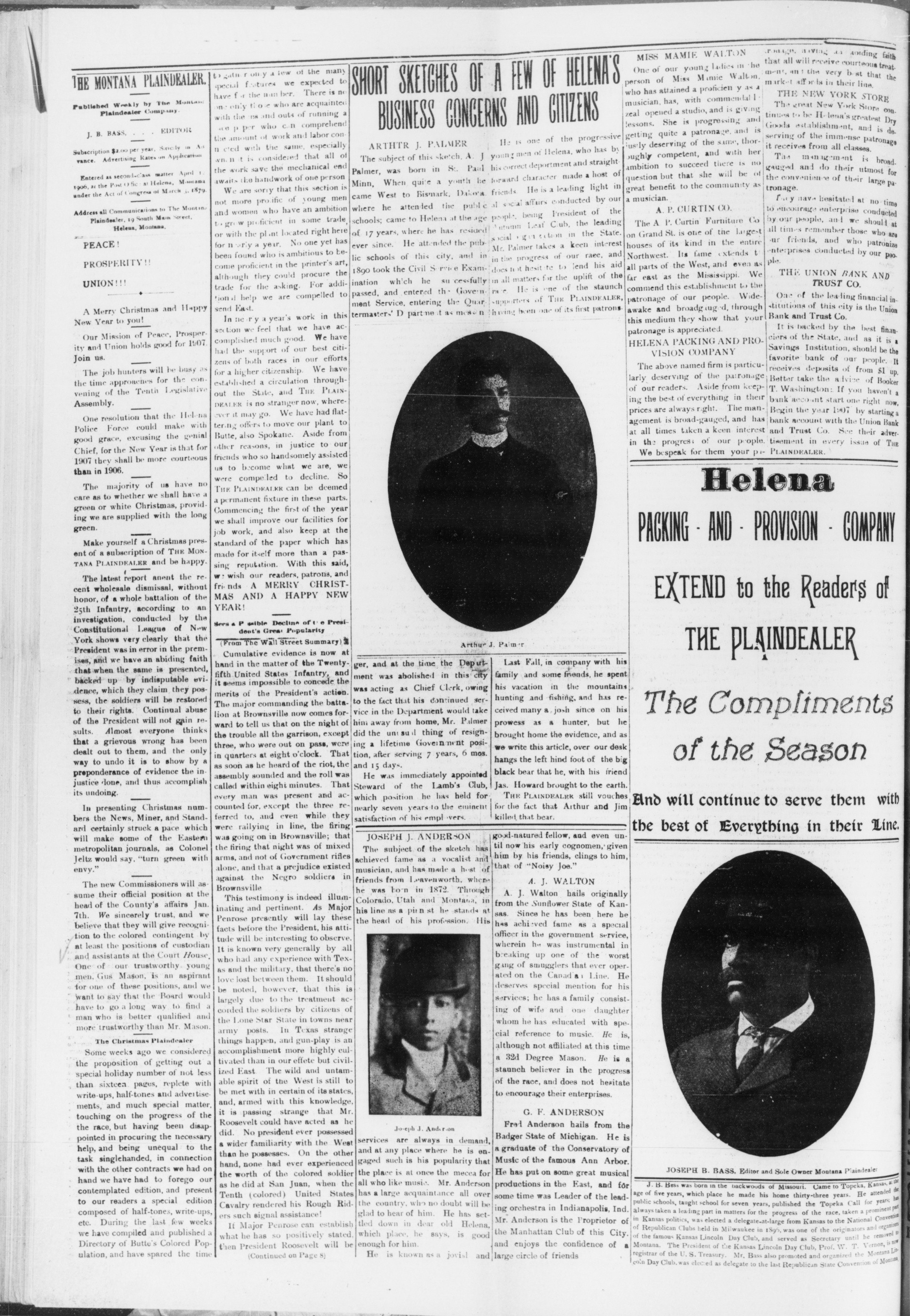
SHORT SKETCHES OF A FEW OF HELENA'S BUSINESS CONGERNS AND CITIZENS
The subject of this sketch, A. J. Palmer, was born in St. Paul Minn. When quite a youth he came West to Bismark, Dakota, where he attended the public schools; came to Helena at the age of 17 years, where he has resided ever since. He attended the public schools of this city, and in 1890 took the Civil Service Examination which he sucessfully passed, and entered the Government Service, entering the Quartermasters' D partiment as mission
Arthur
[Name]
Arthur J. Palmer
ger, and at the time the Department was abolished in this city was acting as Chief Clerk, owing to the fact that his continued service in the Department would take him away from home, Mr. Palmer did the unusual thing of resigning a lifetime Government position, after serving 7 years, 6 mos. and 15 days. He was immediately appointed Steward of the Lamb's Club, which position he has held for nearly seven years to the eminent satisfaction of his employers.
The subject of the sketch has achieved fame as a vocalist and musician, and has made a host of friends from Leavenworth, where he was born in 1872. Through Colorado, Utah and Montana, in his line as a pirnst he stands at the head of his profession. His
1910
services are always in demand, and at any place where he is engaged such is his popularity that the place is at once the mecca for all who like music. Mr. Anderson has a large acquaintance all over the country, who no doubt will be glad to hear of him. He has settled down in dear old Helena, which place, he says, is good enough for him.
He is known as a jovial and
JOSEPH J. ANDERSON
Joseph J. Anderson
He is one of the progressive young men of Helena, who has by his correct deportment and straightforward character made a host of friends. He is a leading light in all social affairs conducted by our people, being President of the Autumn Leaf Club, the leading social organization in the State. Mr Palmer takes a keen interest in the progress of our raee, and does not hesitate to lend his aid in all matters for the uplift of the raee. He is one of the staunch supporters of THE PLAINDEALER having been one of its first patrons
J. Palmer
Last Fall, in company with his family and some friends, he spent his vacation in the mountains hunting and fishing, and has received many a josh since on his prowess as a hunter, but he brought home the evidence, and as we write this article, over our desk hangs the left hind foot of the big black bear that he, with his friend Jas. Howard brought to the earth. THE PLAINDEALER still vouches for the fact that Arthur and Jim killed that bear.
good-natured fellow, and even until now his early cognomen, given him by his friends, clings to him, that of "Noisy Joe."
A. J. Walton hails originally from the Sunflower State of Kansas. Since he has been here he has achieved fame as a special officer in the government service, wherein he was instrumental in breaking up one of the worst gang of smugglers that ever operated on the Canada Line. He deserves special mention for his services; he has a family consisting of wife and one daughter whom he has educated with special reference to music. He is, although not affiliated at this time a 32d Degree Mason. He is a staunch believer in the progress of the race, and does not hesitate to encourage their enterprises.
Fred Anderson hails from the Badger State of Michigan. He is a graduate of the Conservatory of Music of the famous Ann Arbor. He has put on some great musical productions in the East, and for some time was Leader of the leading orchestra in Indianapolis, Ind. Mr. Anderson is the Proprietor of the Manhattan Club of this City. and enjoys the confidence of a large circle of friends
---
A. J. WALTON
G. F. ANDERSON
EXTEND to the Readers of THE PLAINDEALER
And will continue to serve them with the best of Everything in their Line.
J. B. Bess was born in the backwoods of Missouri. Came to Topeka, Kansas, at the age of five years, which place he made his home thirty-three years. He attended the public schools, taught school for seven years, published the Topeka Call for years; has always taken a leading part in matters for the progress of the race, taken a prominent part in Kansas politics, was elected a delegate-at-large from Kansas to the National Convention of Republican Clubs held in Milwaukee in 1890, was one of the originators and organizers of the famous Kansas Lincoln Day Club, and served as Secretary until he removed to Montana. The President of the Kansas Lincoln Day Club, Prof. W. T. Vernon, is now registrar of the U. S. Treasury. Mr. Bass also promoted and organized the Montana Lincoln Day Club, was elected as delegate to the last Republican State Convention of Montana
MISS MAMIE WALTON
One of our young ladies in the person of Miss Munie Walton, who has attained a proficient y as a musician, has, with commendable zeal opened a studio, and is giving lessons. She is progressing and getting quite a patronage, and is justly deserving of the same, thoroughly competent, and with her ambition to succeed there is no question but that she will be of great benefit to the community as a musician.
The A. P. Curtin Furniture Co on Grand St. is one of the largest houses of its kind in the entire Northwest. Its fame extends to all parts of the West, and even as far east as the Mississippi. We commend this establishment to the patronage of our people. Wideawake and broadgauged, through this medium they show that your patronage is appreciated.
HELENA PACKING AND PROVISION COMPANY The above named firm is particularly deserving of the patronage of our readers. Aside from keeping the best of everything in their prices are always right. The management is broad-gauged, and has at all times taken a keen interest in the progress of our people. We work for them your po
We bespeak for them your p
romance, having an aiding faith that all will receive courteous treatment, and the very best that the market affords in their line.
THE NEW YORK STORE
The great New York Store continues to be Helena's greatest Dry Goods establishment, and is deserving of the immense patronage it receives from all classes.
The management is broad-gauged and do their utmost for the convenience of their large patronage.
They have hesitated at no time to encourage enterprise conducted by our people, and we should at all times remember those who are our friends, and who patronize enterprises conducted by our people.
THE UNION BANK AND TRUST CO.
One of the leading financial institutions of this city is the Union Bank and Trust Co.
It is backed by the best financiers of the State, and as it is a Savings Institution, should be the favorite bank of our people. It receives deposits of from $1 up. Better take the advice of Booker T. Washington: If you haven't a bank account start one right now. Begin the year 1807 by starting a bank account with the Union Bank and Trust Co. See their advertisement in every issue of THE PLAINDEALER.
4% COMPOUNDED TWICE A YEAR 4%
Savings Accounts Opened from $1 Upwards
WE RECEIVE DEPOSITS BY MAIL on exactly the same terms as though made in person at the Bank. The mails are entirely safe and are convenient. People in all parts of the country transact banking in this manner.
Deposits may be sent by registered mail, money order, or by bank check. When the first deposit is received it will be entered on our books, and a pass book returned by mail as a receipt for the money deposited. We have issued a small book telling of the simple way in which an account can be opened by mail and we will send a copy free to anyone asking for it.
UNION BANK AND TRUST COMPANY
HELENA, = = MONTANA.
MISS MAM E WALTON, Teacher of
music, Studio 109 Jefferson St.
will be pleased to receive her patrons
any time Music furnished on all
sessions. TERMS EASY.
Theodore Carmen of Great
Wells stopped over in Helena Sun-
den route home from Butte.
Subscribers knowing their sub-
scription to have expired will do
a favor by remitting their sub-
scription or calling at this office
and paying up, or we will send out
collector, as we need the money
we do.
On account of different lodges meeting on Wednesday evenings, the St. James Literary is holding its meetings on Tuesdays for the present.
Please notify this office when you change your address; or if your super does not reach you regularly.
H. W. Robinson was down this week from his mining properties at Elliston.
The ladies of St. James are arranging for an entertainment for the holidays.
The Legislature will convene in this city on the 7th of January; many visitors are expected at that time.
Mrs. J. B. Bass will visit in Butte during the Holidays.
From present indications those who clamor for a white Christmas will not be disappointed.
The Delmonico will be closed for 60 days, but will continue as a rooming house.
There seems to be even yet a ray of hope for the Broadwater to put on a crew of real waiters.
A surprise party was given on the East Side last Monday evening.
J. B. Reid has taken charge of his former position at the Lamb's Club.
The Strutters have been outstone by the Rarebacks.
The Manhattan Club will hold Open House all day Christmas, to which all Club members and their ladies, holding invitations to the series of dances, are cordially invited.
The Literary was quite well attended last Tuesday evening; a debate was the feature of the evening; those taking part were J. W. Clark, Mrs. C. Matthews, in favor of Woman's Suffrage; Sen. Herrill, W. R. Dorsey and J. B. Bass, the negative; the question was put to a vote of the house, and the advocates of Woman's Suffrage were overwhelmingly dedicated.
Mr. William Mason and Mrs. Florence Weeks were quietly married on last Tuesday evening at the home of Mrs. Meeks on Southwing St. The knot was tied in great shape by Rev. W. T. Osborne.
Mr. Chas, Johnson, who has been on the rack list is about again
Invitations have been issued for a Christmas Party and Ball to be given at the Manhattan Club Rooms Tuesday, Dec 29th.
To the surprise of their many friends, Mr. Wm. Mason and Mrs. Florence Meeks were quietly married at the bride's home, 210 So. Ewing St., only relatives and immediate friends being in the secret. The bride wore a gown of gray silk-dotted voille, trimmed in Point de Eprit lace and blue Pann velvet, and made in Empire effect, her only jewel being a diamond sunburst, the gift of the groom. After the ceremony the bride and groom and the guests repaired to the Dining-Room where a dainty supper was served, the ceremony was performed by the Rev. Osborne of St James A. M. E Church.
They will be at home to their friends after Saturday, Dec. 21st, at 321 Spruce St.
We have missed from this sanctum the genial countenance of the East Side Widower, the ladies' favorite, and we are thinking of sending out a search warrant for him. Anyone producing him at the office of THE PLAINDEALER will be liberally rewarded.
The St. James Literary will meet next Wednesday evening. A splendid program will be rendered.
J. Reed has been on the sick list this week.
Mrs. G. Shepard, who left here an employ of officers of the 6th Inft. is now a resident of Detroit, Mich.
Both Byrd Lodge and R. J. Fletcher held their last meeting for the year 1906 last Monday, and Wednesday evenings.
The gentlemen who are organizing an Elks Lodge in this city held a meeting Saturday evening, and formed a temporary organization by electing A. J. Young as Chairman, W. Cole, Secretary, and A. Green as Treasurer, and adjourned to meet again Thursday evening.
Judge Hart is a chauffeur out of a job, as his former employer has gone on an extended trip which will last until April.
The wedding bells did really ring, and we are informed will soon ring again.
Miss Mamie Walton will leave Sunday for a visit in Anaconda and Butte.
The children in the public schools will enjoy a two weeks' holiday, beginning Friday.
Better start in the New Year by subscribing for THE PLAINDEALER.
We thank Byrd Lodge for a nice order of job work, which we delivered last week.
When Grand Deputy C. A. Davis comes to town there will be something doing among the incipient Elks, but he had better bring a heavyweight with Yancey.
A temperance play entitled "Out in the Streets" will be given by the Young People's Dramatic Club of St. James Church during the holidays, for the benefit of the church.
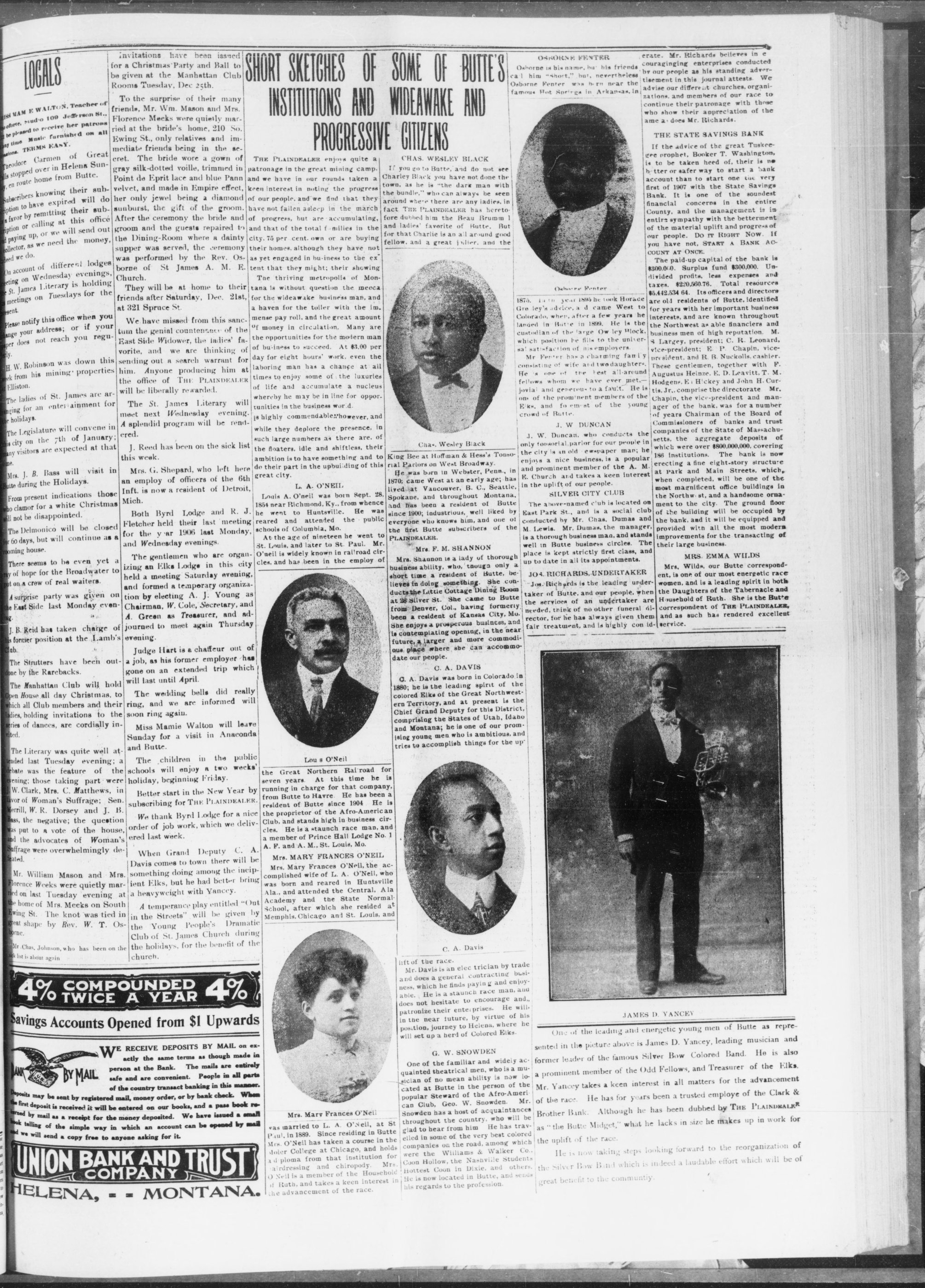
SHORT SKETCHES OF SOME OF BUTTE'S INSTITUTIONS AND WIDEAWAKE AND PROGRESSIVE CITIZENS
THE PLAINDEALER enjoys quite a patronage in the great mining camp, and we have in our rounds taken a keen interest in noting the progress of our people, and we find that they have not fallen asleep in the march of progress, but are accumulating, and that of the total families in the city, 75 per cent. own or are buying their homes, although they have not as yet engaged in buiness to the extent that they might; their showing The thriving metropolis of Montana is without question the meoca for the wideawake business man, and a haven for the toiler with the immense pay roll, and the great amount of money in circulation. Many are the opportunities for the modern man of buiness to succeed. At $3.00 per day for eight hours' work, even the laboring man has a chance at all times to enjoy some of the luxuries of life and accumulate a nucleus whereby he may be in line for opportunities in the business world.
is highly commendable; however, and while they deplore the presence, in such large numbers as there are, of the floaters, idle and shifttless, their ambition is to have something and to do their part in the upbuilding of this great city.
L. A. O'NEIL
Louis A. O'neil was born Sept. 28, 1854 near Richmond, Ky., from whence he went to Huntsville. He was reared and attended the public schools of Columbia, Mo. At the age of nineteen he went to St. Louis, and later to St. Paul. Mr. O'neil is widely known in railroad circles, and has been in the employ of
8
Louis O'Neil
the Great Northern Railroad for seven years. At this time he is running in charge for that company, from Butte to Havre. He has been a resident of Butte since 1904. He is the proprietor of the Afro-American Club, and stands high in business circles. He is a staunch race man, and a member of Prince Hall Lodge No. 1 A. F. and A. M., St. Louis, Mo.
Mrs. MARY FRANCES O'NEIL
Mrs. Mary Frances O'Nell, the accomplished wife of L. A. O'Nell, who was born and reared in Huntsville Ala., and attended the Central, Ala Academy and the State Normal School, after which she resided at Memphis, Chicago and St. Louis, and
[Picture of a woman with dark hair, wearing a light-colored dress with a high collar.]
Mrs. Mary Frances O'Neil was married to L. A. O'Neil, at St Paul, in 1889. Since residing in Butte Mrs. O'Neil has taken a course in the Doler College at Chicago, and holds a diploma from that institution for dressing and chiropody. Mrs. O'Neil is a member of the Household of Ruth, and takes a keen interest in the advancement of the race.
CHAS. WESLEY BLACK
If you go to Butte, and do not see Charley Black you have not done the town, as he is "the dark man with the bundle," who can always be seen around where there are any ladies, in fact THE PLAINDEALER has hercretore fubbed him the Beau Brumm 1 and ladies' favorite of Butte. But for that Charlie is an all around good fellow, and a great jollier, and the
[Name]
Chas. Wesley Black
King Bee at Hoffman & Hess's Tonsorial Parlors on West Broadway.
He was born in Webster, Penn., in 1870; came West at an early age; has lived at Vancouver, B. C., Seattle, Spokane, and throughout Montana, and has been a resident of Butte since 1900; industrious, well liked by everyone who knows him, and one of the first Butte subscribers of the PLAINDEALER.
Mrs. F. M. SHANNON
Mrs. Shannon is a lady of thorough business ability, who, though only a short time a resident of Butte, believes in doing something. She conducts the Little Cottage Dining Room at 26 Silver St. She came to Butte from Denver, Col., having formerly been a resident of Kausaa City, Mo. She enjoys a prosperous business, and is contemplating opening, in the near future, a larger and more commodious place where she can accommodate date our people.
C. A. DAVIS
G. A. Davis was born in Colorado in 1880; he is the leading spirit of the colored Elks of the Great Northwestern Territory, and at present is the Chief Grand Deputy for this District, comprising the States of Utah, Idaho and Montana; he is one of our promising young men who is ambitious, and tries to accomplish things for the up
[Image of a man in a suit with a tie].
C. A. Davis
left of the race.
first of the race.
Mr. Davis is an electrician by trade
and does a general contracting busi-
ness, which he finds paying and enjoy-
able. He is a staunch race man, and
does not hesitate to encourage and,
patronize their enterprises. He will
in the near future, by virtue of his
position, journey to Helena, where he
will set up a herd of Colored Elks.
G. W. SNOWDEN
One of the familiar and widely acquainted theatrical men, who is a musician of no mean ability is now located at Butte in the person of the popular Steward of the Afro-American Club, Geo. W. Snowden. Mr. Snowden has a host of acquaintances throughout the country, who will be glad to hear from him. He has travelled in some of the very best colored companies on the road, among which were the Williams & Walker Co. Coon Hollow, the Nasnville Students Hottest Coon in Dixie, and others. He is now located in Butte, and sends his regards to the profession.
Oakshire is his name, but his friends call him "short," but, nevertheless Oakshire Fenter was born near the famous Hot Springs in Arkansas, in
[Name]
1875. In to year 1895 he took Horace Greley's advice, a dame West to Colorado, when, after a few years he landed in Butte in 1899. He is the custodian of the large Owley Block, which position he fills to the universal satisfaction of his employers. Mr Fenter has a charming family consisting of wife and two daughters. He is one of the best all-around fellows whom we have ever met—jovial and generous to a fault. He is one of the prominent members of the Eiks, and foemest of the young crowd of Butte.
J. W. Duncan, who conducts the only fossorial parlor for our people in the city is an old newspaper man; he enjoys a nice business, is a popular and prominent member of the A. M. E. Church and takes a keen interest in the uplift of our people.
SILVER CITY CLUB
The above-named club is located on East Park St., and is a social club conducted by Mr. Chas, Dumas and M. Lewis. Mr. Dumas, the manager, is a thorough business man, and stands well in Butte business circles. The place is kept strictly first class, and up to date in all its appointments.
IO4 RICHARDS, UNDERTAKER
1910
THE MUSICIAN
JAMES D. YANCEY
ing and energetic you
love is James D. Yance
amous Silver Bow O
of the Odd Fellows, a
when interest in all m
or years been a trust
though he has been d
what he lacks in s
steps looking forward
One of the leading and energetic young men of Butte as represented in the picture above is James D. Yancey, leading musician and former leader of the famous Silver Bow Colored Band. He is also a prominent member of the Odd Fellows, and Treasurer of the Elks. Mr. Yancey takes a keen interest in all matters for the advancement of the race. He has for years been a trusted employee of the Clark & Brother Bank. Although he has been dubbed by THE PLAINDEALER as "the Butte Midget," what he lacks in size he makes up in work for the uplift of the race.
He is now taking steps looking forward to the reorganization of the Silver Bow Band which is indeed a laudable effort which will be of great benefit to the community.
OSSORNE FENTER
Oshure Porter
J. W DUNCAN
SILVER CITY CLUB
erate. Mr. Richards believes in e courageing enterprises conducted by our people as his standing advertisement in this journal attests. We advise our different churches, organizations, and members of our race to continue their patronage with those who show their appreciation of the ame a does Mr. Richards.
THE STATE SAVINGS BANK
If the advice of the great Tuskegee prophet, Booker T. Washington, is to be taken heed of, their is no better or safer way to start a bank account than to start one the very first of 1907 with the State Savings Bank. It is one of the soundest financial concerns in the entire County, and the management is in entire sympathy with the betterment of the material uplift and progress of our people. DO IT RIGHT NOW. If you have not, START A BANK ACCOUNT AT ONCE.
The paid-up capital of the bank is $300,00.0. Surplus fund $300,000. Undivided profits, less expenses and taxes. $220,560.76. Total resources $5,442,534 64. Its officers and directors are old residents of Butte, identified for years with her important business interests, and are known throughout the Northwest as able financiers and business men of high reputation. M. S Largey, president; C. R. Leonard, vice-president; E. P. Chapin, vice-president, and R. B. Nuckolls, cashier. These gentlemen, together with F. Augustus Heinze, E. D. Leavitt, T. M. Hodgens, E. Hickey and John H. Curtis, Jr., comprise the directorate Mr. Chapin, the vice-president and manager of the bank, was for a number of years Chairman of the Board of Commissioners of banks and trust companies of the State of Massachusetts, the aggregate deposits of which were over $800,000,000, covering 186 institutions. The bank is now erecting a fine eight-story structure at Park and Main Streets, which, when completed, will be one of the most magnificent office buildings in the Northwest, and a handsome ornament to the city. The ground floor of the building will be occupied by the bank, and it will be equipped and provided with all the most modern improvements for the transacting of their large business.
Mrs. Wilds, our Butte correspondent, is one of our most energetic race women, and is a leading spirit in both the Daughters of the Tabernacle and Household of Ruth. She is the Butte correspondent of THE PLAINDEALER, and as such has rendered excellent service.
THE MUSICIAN
he energetic young men of Butte as repre
ts James D. Yancey, leading musician and
Silver Bow Colored Band. He is all
Odd Fellows, and Treasurer of the Ella
interest in all matters for the advanceme
tars been a trusted employee of the Clark
he has been dubbed by THE PLAINDALE
he lacks in size he makes up in work
is looking forward to the reorganization
MRS. EMMA WILDS
IN ICELAND
by
Stuart Maclean
There's going to be a railroad up in Iceland,
In Iceland,
And what a funny railroad it will be!
I would never think of Iceland as a nice land,
A nice land,
For week ends at a cottage by the sea.
For the trains will very likely go on runners like a sleigh.
And they'll harness up the engine in a jingle bells array.
You won't need your thermometers in Iceland,
In Iceland,
And you won't have any freetful vis a vis.
For up there in that anything but spipland,
But spice land,
The cars are always cold as they can be.
Oh, they'll have to dig the sleepers out a
time they leave the house.
Or perhaps they'll funnel through the great big breezegs in the bay.
A journey will be jolly up in Iceland,
In Iceland.
The scenery's so wonderful to see;
It will seem like nothing short of para-
dise land.
Paradise land,
As the open cars go whirling o'er the lea.
They won't have any schedule so there'll
never be delay.
The rates will be so low that almost any-
one can pay.
For in that curious climate it is Christmas
every day,
In Iceland.
Little Baby Beth
By Caroline H. Stanley.
It was New Year's eve. Downstairs
in the parlor was Baby Beth's
Christmas tree, just as it had been
arranged a week ago—bisque doll, toys, glittering balls, marvelous sugar dogs and bears and elphants," candy apples and hearts, popcorn, colored tapers just ready to be lighted—and upstairs Baby Beth was dying. All week long, with the fierceness of a tigress fighting for her young, Margaret Thorne had fought for her child's life. From the moment that the first hoarse cough smoke upon her ear and Beth had said, "Mamma, it hurts me here when I toff," she had lost no time. All that doctors, nurses, servants, friends—mother love—could do had been done, and now in her darkened chamber the mother sat with her baby on her knees and waited. Toward night a change had come. The harsh cough ceased, the panting breath came more quietly.
"Didn't she seem easier?" she had asked, and the doctor had answered briefly, "Yes." Then, after an interval of waiting, "Wasn't her breathing less labored?" The doctor made no reply.
"Doctor," pitiously, "don't you think she is better?"
Dr. Lemoine turned away. He had practiced many years, and witnessed many a scene like this, but to his kind heart each one was new.
"My child," he said, "she will never be any better—she is dying."
Margaret Thorne made no outcry, shed no tear—she would have "to-morrow and all after life for tears," to-day she had—her baby. She bent over the child and half stretched out her arms with the impulse to take her and go somewhere—anywhere—away from everybody. It was the instinct of the wounded animal. Then she fell into the monotonous swinging motion of the knees, familiar to mothers, patting her little one softly the while as if she were putting her to sleep.
It was heart-breaking. The women to whom the child was only a dear little baby who "would be better off in heaven," as the phrase goes, crept about the room weeping softly with aching hearts. After a time Margaret looked up.
"Doctor," she asked, "how long?"
"I can hardly tell," he answered, "but only a few hours at best, I think."
She turned to the women.
"Send for her father," she said briefly.
There was a slight stir of surprise. Significant glances passed from one to another behind her bowed head. Then they went out to do her bidding.
The message was quickly sent and as quickly answered. The case brooked no delay. Margaret Thorne heard the familiar step in the hall, then in the room below. A moment later he came in. The women spoke to him in the sympathetic key of the sick room and the doctor silently wrung his hand. Margaret looked up with a slight movement of the head, but did not offer him her hand.
"Margaret," he said, "it was very good of you to send for me."
"It was only right," she said, her voice hardening in her efforts to steady it; "she is your child, too."
He made no effort at conversation, and so they sat, the silence of death upon them. It grew oppressive. The women, one by one, stole out of the room, and the doctor finally muttered something about going into the library to lie down, telling them to call him if there should be any change. The two were left alone with the dying child.
It was a strange scene. Each held a baby hand; each with a burden of grief unutterable bent over the little form and watched the flickering life go out; and each shut up and double-locked and bolted the heart that the other should not know what was therein. They were but a hand's breadth apart, but between them was a great gulf fixed.
John Thorne had not seen his child since that never-to-be-forgotten day when he gave her and his home into Margaret's hands and went forth alone. How he had longed for a sight of the baby face, for a touch of the baby hands, none but himself would ever know. But he had been too proud to ask to see her, and Margret had said in bitter scorn, "It is the way of the sex. A woman would never have forgotten her own child." And she had clasped Beth passionately to her
First and Best of Christmas Stories
A and there were in the same country shepherds abiding in the field, keeping watch over their stock by night.
A
And it came to pass, as the angels were gone away from them into heaven, the shepherds said one unto another. Let us now go even unto Bethlehem, and see this thing which is come to pass, which the Lord had made known unto us.
And they came with hoste, and found Mary, and Joseph, and the babe lying in the manger.
And when they had seen it, they made known abroad the saying which was told them concerning this child.
And all they that heard it wondered at those things which were told them by the shepherds.
But Mary kept all these things, and pondered them in her heart:
And the shepherds returned, glorifying and praising God for all the things that they had heard and seen, and it was told unto them.
heart and cried out, "I will be father and mother both to you, my baby, my poor, forsaken baby." As he bent over her now, all his heart in his eyes, a strange feeling of doubt began tugging at her heart. Had he really loved the child like this? Uncomfortable regrets took possession of her. Could she have misjudged him? She might have sent Beth to see him occasionally, it seemed to her now, when she had her all the time. He had been more generous than she. She glanced furtively at him. He rested his head on his right hand, his left clasping Beth's. His eyes were fixed on the child as if he would in these few moments least feast his famished heart upon that which had been so long withheld. Something in his position made Margaret think of one other night when they had sat like this and watched Beth through the croup, and how they had felt that if God would only spare her they could have nothing in life to trouble them again. How gentle and tender John had been that night!
And then there was the time that Beth was burned and John had walked with her the whole night long and would not even let the mother rest him, because "she was weak and he was strong," he had said. How the memories came thronging upon her! Oh, if she could only wake and find that this year had been a dream—a horrible dream—and there had been no quarrel!
The clock ticked on, the fire sputtered fitfully, but the silence of the vigil was unbroken. John Thorne raised his head and looked at Margaret as she lay with closed eyes. Her white, suffering face touched his heart. How much older she looked. It was only four years since she had stood a bride of nineteen and given herself to him. Why, could it be only four years? It seemed like an eternity. The breath comes slowly. The little hands are very still, and yet, O baby fingers, through the solemn watches of this night, don't gathering up the tangled, broken threads of these two lives.
First and
And there were in the
watch over their
And, lo, the angel
round about the
And the angel said
of great joy, we
For unto you is be-
the Lord.
And this shall be
swaddling clos
And suddenly the
host praises in
Glory to God in the
And it came to p
beaven, the s
onto. Be the h
Lord-bath ma
And they came
flying in the e
And when they h
was told them
And all they tha
them by the
But Mary kept
And the shephe
the things th
and with a touch no other hand might use, ast weaving them together, deftly, surely, with heaven-sent skill!
There was a slight stir. The mother and father felt a quiver pass through the little form. With startled faces they bent over her. There was a gasp, a sudden throwing up of the little hands—then all was still.
In an instant his arms were around her, her head on his breast.
"Margaret, my wife!"
"O John, John!" she said.
The clock struck twelve. A New Year had dawned.
• • • • • •
In the twilight of a summer day a man and woman stand beside a little grave. There is an air of subdued sadness about them that tells to whom the little mound belongs, and yet when they speak it is hopefully and cheerfully.
It is a tiny grave—"only a baby," a stranger would say—but we who have stood beside such know that love and grief are not measured by feet and inches.
The glory of the setting sun fills the place. It lights up the faces of father and mother as they lay, with loving hands, forget-me-nots upon the green turf, and then, in hand, go forth. A stray sunbeam falls across the white stone. We stoop to read the inscription. It is a very simple one:
BABY BETH.
"And a little child shall lead them."
—The Housewife.
Tommy Got One.
Tommy (on Christmas morning)—Where does Santa Claus get all his stuff, mamma?
Mamma—Oh, he buys it.
Tommy—Well, he must be a Jay to let anyone palm off a tin watch on him!
Town Topics.
LET'S KEEP SANTA CLAUS.
Memory of Happy Days of Long Ago
Protects St. Nick.
HE memory of
happy days long
ago should ever
protect Santa
Claus. When your
boy looks you
squarely in the
eye and says:
"Papa. Clarence
McGuffy said
there isn't any
Santa Claus and
I punched him,
for I know there
is," what are you
going to do? For-
give the blow and
HE memory of happy days long ago should ever protect Santa Claus. When your boy looks you squarely in the eye and says: "Papa. Clarence McGuffy said there isn't any Santa Claus and I punched him, for I know there is," what are you going to do? Forgive the blow and cling to a happy myth or destroy your boy's faith in Santa Claus, and, incidentally in a good many other things he believes in, but doesn't understand?
"Why discuss the matter at all?" is a natural question. Because it is a question that always arises at Christmas time. An Eastern preacher is discussing it from the pulpit and holds that deceit is sin and that the truth and only the truth is the best steady diet for both young and old. The man or woman who would take from a child his sublimie faith in a Mysterious Being, who rewards all the good children and skips the bad ones on his annual tour of countless chimneys, has a shriveled heart. We want more happiness; not less. We need more good influences in the lives of our children, not fewer. Nothing but good ever came from the Santa Claus Myth. He is a glorious ghost, a delicious impossibility, is this friend of the children. He teaches kindness, charity, goodness. He inspires and encourages. He brightens the lives of millions of little ones with the joy of anticipation and the gladness of receiving. He is a companion of brownies and elves and fairies, and flowers that speak.
When we abolish Merry Old St. Nick lets burn all the story books, the fairy
And Best of Christmas
In the same country shepherds abiding in the flock by night: of the Lord came upon them, and the glory them; and they were sore afraid. And unto them, fear not, for, behold I bring forth which shall be to all people. Turn this day in the city of David a Saviour.
A sign unto you: Ye shall find the bad letters, lying in a manger. There was with the angel a multitude of God, and saying, the highest, and on earth peace, good.
Pass, as the angels were gone away from shepherds said one unto another, Let them, and see this thing which is come to make known unto us. With haste, and found Mary, and Joseph, and seen it, they made known abroad concerning this child. It heard it wondered at those things shepherds all these things, and pondered them, retarned, gloryfying and praising that they had heard and seen, and it was
ST. LUKE II, 8-20
tails, and all the make-believes that wield an influence for good in the lives of children. But Santa Claus is in no danger, for if the children love him, so do the parents. Memory of happy days of long ago protects him. A century hence he will be making his rounds and laughing, with the children, at those who would destroy him.—Cincinnati Post.
Strange Origin of Christmas Tree.
Most of us know that the Christmas tree comes to us direct from Germany.
And we know of the tree worship of the Druids which obtained in England and France, and which probably had some influence on the later use of the tree in the Christian festival. But we do not all know that a similar festival with the tree as a crowning feature is observed among many heathen nations, and that it comes from sun worship, which is older than history. The revival of the sun after the winter solstice has ever been the subject of rejoicing and of celebration by ceremonies which represent the new light brought back to the world. Our tree, with its small candles, its gilded knicknacks and toys for the children, is a direct descendant of this old festival in honor of the sun.
Traces of it exist in Iceland, where the "service tree" is found adorned with burning lights during Christmas night. The English yule log is a faint survival of this festival. But it is beyond these that I wish to draw your attention, back further even than the Druld mysteries of the Gallic forests. It is to China, that home of all wonders and all history. It has been shown that as long ago as 247 B. C. a tree with a hundred lamps and flowers was placed on the steps of the audience hall. This appears again in the records of Princess Yang, who lived 713-755 A. D. and who caused a hundred-lamp tree
eighty feet high to be erected on a mountain. It was lighted during New Year's night, and the illumination was seen for hundreds of miles, eclipsing the light of the moon. This candle tree is no longer lighted in China, being replaced by an unusual number of lanters, which are hung everywhere. A suggestion of the tree, however, still survives in Japan. At the New Year two evergreen trees are placed without, on either side of the door. Their tops are tied together with the sacred band of straw, and various objects, dried lobsters and oranges are fastened to their branches.—Woman's Home Companion.
CHRISTMAS IN DIXIE.
A Quaint Custom the Survival of
Vastness Days.
In some parts of the South, notably Alabama, the observance of Christmas is kept up after the manner of slavery days. Two weeks before the festival brawny colored men in the employ of the plantation owner search out a timber tract, fell the tree of greatest size, cut off the trunk where the circumference is greatest, big enough to admit of it filling the space of the open hearth, fasten heavy chains to it by driving in spikes, haul it to the nearest river or pond, sink it and anchor it well below the surface. On Christmas eve it is drawn up, taken to the owner's mansion and in the presence of his family, relatives and friends the dripping log is placed on a roaring fire in the hearth. To reduce the water-soaked wood to ashes is a slow process and sometimes a week slips before this is accomplished. In the meantime the plantation darkies do not work while the incineration is in progress. On Christmas eve the hostess the company with eggnog and she supplies them with eatables while the log sizzles in the fire place. The banjo and guitar are brought into play and the old melodies are sung and jigs and other dances are gone through with zest. The white folks take a hand in the fun making, too, and with song and story make
Stories
In the field, keeping
of the Lord shone
you good tidings
our, which is Christ
be wrapped in
of the heavenly
will toward men.
from them into
us now go even
pass, which the
h, and the babe
the saying which
which were told
in her heart:
God for all
as told unto them.
the colored folks happy. At some of these gatherings 300 persons take part, the old, capacious mansion giving ample room for all.
Curious Custom of Oxfordshire.
In some places in Oxfordshire, England, it was the right of every mair servant to ask the hired man for a bit of lvy to trim the house. If he turned a deaf ear to her importunities or forgot her request she would steal a pair of his breeches and nail them to the gate in the yard or on the highway. This was supposed to debar him from all privileges of the mistletoe.
Easy to Be Happy.
Mrs. Nexdoor—Aren't you always worried half to death when it comes to buying a Christmas present for your husband?
Mrs. Sunshine—Mr. no! I buy my husband something I want for myself, and he buys me something he wants for himself, and then we trade.
Blow the trumpet, beat the drum,
Glad am I that Santa's come!
TURUING OVER A NEW LEAF
Mr. Billings settled himself comfortably in his favorite chair beside the stove in the grocery store, and returned the neighborly greetings of the other regular attendants.
"Yes," he said, meditatively, "this is the last night of the old year. Somethin' kind o' solemn 'bout it, too, when ye stop to think of it. A year past an' gone, an' a new one -mebbe the last some of us'll ever see -just beginin'. It makes a man feel serious. People laugh 'bout New Year's resolutions, but I maintain it's a good thing for a man to pull up now an' then an start fresh; an' the first of the year seems the most natural an' fittin' time to do it."
"Makin' my res'lutions yourself, 'Lila sha'? asked Nathan Hobbs, good-naturely.
"Yes, sir, I am!'" replied Elisha, defiantly. "I'm makin' one, anyway, an' I don't care who knows it. I'm resolvin' to keep a better holt on my temper this year. He that ruleh his spirit is better than he that taken a city, the book says. I've had my fallin' that way, as some of ye know; but now we're beginnin' a new year an' a new century, too, I'm goin' to turn over a new leaf."
"What was that you said 'bout a new century?' asked old Eben Cook, from his seat in the corner.
"I said now that we was beginnin' a new century I was goin'——"
"What you talkin' about, 'Lisha?' The twentient century began a year ago. Tomorrow'll be nineteen hundred an' one, won't it?
"Course 'twill; but ain't one' the first number there is?' An' don't that make to tomorrow the first day of the new century?
"Not by a long shot, 'less I've forgotten how to count. It don't take a hundred an' one years to make a century, does it?"
"Hold on a minute," interposed Judson, the storekeeper. "Let's say that Bill, here, owed me a hundred dollars an' started to pay me in dollar bills, callin' out 'one,' 'two,' 'three'"—
"Well, s'pose he did."
"No, Jud," suggested Seth Gibson.
"Here's the way I heard that foller up to the academy put it: How old is a man on his one-hundredth birthday?"
"Good land and seas!" shouted Mr. Billings, as he rose excitedly to his feet. "If he didn't know any more this 'election of hand-picked lunkheads he wouldn't pass for more' six or seven, at most. It's a waste o' breath talk' to ye. My o' sorrel mare's got more sense than the whole pass of ye!" and he started for the door.
"What was it 'Lisha was sayin' 'bout New Year's res'lutions?" McPheron asked the storekeeper, as the door shut with a bang. Bitt Judson was too intent on his argument with Gibson to reply.—Youth's Companion.
The Week Before.
'Tis the week before Christmas, and all through the place
Each woman goes shopping, with worn, very face;
And held in her hand is a long, fearsome list
Of names that could simply by no means be missed—
So shopping, and shopping, and shopping they go
Bumped shoved, pushed, and tangled in squand in row.
'This the week before Christmas, and father is sad
Though mother and sisters are all of them
Poor father reflects on the state of his wealth
And broods on expenses that tell on his health—
But once in the year come the glad Christmas Day;
The rest of the year's for poor father to pay.
'Tis the week before Christmas—and now the coy girl
Buts
Puts on and garments, adjusts her cute curt.
And sends for the lover with whom she has fussed.
To tell him she knows he's the one she should trust,
And he forgives her. The gas is turned low.
And—this is the week before Christmas, you know.
'Tis the week before Christmas, and a' through the home.
The children are watched as they almessly roam.
And when they approach any wardrobe or chest
At Sunday school—Santa will come Christmas Day.
'Tis the week before Christmas, and all through the land
wrote is toiling with pen in his hand
At what time the parody based on the
rhyme
That somebody jingled out once on a time—
But what is the prophet who wishes to
sing
The row that the week after Christmas
will be the last!
-W. D. Nesbitt, in Chicago Tribune.
Plum Pudding.
One pound of grated bread, one and a quarter pounds of grated suet, one pound of raisins, one pound of brown sugar, twelve eggs, well beaten; two wineglassfuls of brandy, one-quarter pound of citron, cut fine. Mix all these the night before. In the morning before putting it in the cloth stir two tablespoonfuls of wheat flour, beat the cloth and sprinkle with flour. Tightly and boll four hours. Put a plate turned on the under part in the pot under the pudding, add cinnamon and nutmeg if liked.
"Pa, I've wrote Santy Claus a 'nother letter."
"What about, Georgie?"
"I toole him he mustn't come in a automobile; I want him to come in a sleigh."
—Detroit Free Press.
What makes your father look so blue
to-night?
"S- sh! Somebody thoughtlessly mentioned the fact that Christmas is coming."—Chicago Post.
Mrs. Mary Agnes Gaffrey, a wealthy pioneer of Seattle, died recently. She was 68 years of age.
The University of Washington has been obliged to close on account of the fuel famine.
The North Coast railway has filed amended articles, showing details of its proposed routes. The main line is to run from Seattle to Spokane, 550 miles, passing through the counties of King, Pierce, Lewis, Yakima, Benton, Franklin, Adams, Whitman and Spokane. Branches are to be built from a point in Benton or Franklin counties to Walla Walla, 75 miles; from a point on the main line in Spokane county to Farmington; from a point in Adams county to Eureka Junction; from a point in Adams county to Davenport; from a point in Adams county to Wilsoncreek. The incorporators are: Robert E. Strahorn, E. S. Blount and R. J. Danson.
Because of the alleged increase in cost of living, practically every department of the city government of Seattle has received demands from their employees for a corresponding raise in wages.
Organization of a company with a capital stock of $2,400,000 and the erection of the largest and most modern cement plant in the northwest is the plan of J. H. Spear, manager of the Washington Brick, Lime and Manufacturing company, and associates. The immense factory will be located either at Celville, Wash., or on Pend d'Oreille lake, Idaho, extensive cement beds having been secured at both locations.
With the election of D. S. Troy as president, Ira P. Whitney secretary and treasurer, and David Brown, J. T. Durdle, A. M. Stevens and L. S. Thomle director, the 14th annual convention at Spokane of the Washington State Dairymen's association has adjourned.
Ben Snipes, 20 years ago known as the cattle king of the northwest, whose large herds ranged in Yakima valley, died in Seattle recently.
There is a fanine in building material in Tacoma.
In mass meeting at Seattle, the shingle manufacturers of Washington agreed on a close down for a period of 69 days.
Students of the graduating class of the high school cannot be compelled to wear caps and gowns at the graduating exercises.
James Murray Coleman, Seattle's wealthiest citizen and pioneer of 1872, is dead. His wealth is estimated at $3,000,000.
After a trial of two days a jury found Eugenio Batinioella, alias Marfaudille, guilty of murder in the second degree for causing the death of Mrs. Emma Dalley's landlady, who was shot by the discharge of a revolver concealed in his trunk. The jury recommended the prisoner to the mercy of the court.
There will be no consolidation of the Farmers', and 'the Pacific States Telephone and Telegraph company's lines in Pullman.
Four children of Lawrence Talbert burned to death, as the result of a fire that destroyed a farmhouse recently in Cowiche valley, 14 miles from North Yakima.
Another new steamer is to be built at Hover to replace the Mata C. Hover, which has bzeen leased to Wren & Greenough, contractors, building the North Bank line through Hover.
George Vivian, sentenced from Whitman county for assault with intent to rob, has been released from the penitentiary on parole.
Owing to the short crop last season, residents of Garfield county have experienced difficulty in getting fruit for winter use.
The immediate construction of armories at Seattle, Tacoma and Spokane, to cost respectively $125,000, $90,000 and $75,000, and to be paid for from the state military fund, is recommended in the biennial report of the adiantant general.
It is reported that eastern Washington members-elect of the state legislature may interpose vigorous opposition to the appropriation asked for by Seattle for the proposed Alaska-Yukon-Pacific exposition if the jobbers of Seattle continue to oppose eastern Washington in the effort now being made to secure a more equitable adjustment of transcontinental freight rates.
Exhonorating Captain P. H. Mason, master of the steamer Jeanie, which sank the Dix, and revoking the license of Captain Percy A. Lermond, master of the latter vessel, was the finding of the United States inspectors who investigated the recent disaster.
While the newspapers are not unanimous on the subject, the coal situation in Seattle has undergone an improvement during the past week.
CLAIMS CHINA'S THRONE.
Manchu Banner Woman in Victoria Petitions.
Victoria, B. C., Dec. 16.—A Victoria woman, a Manchu banner woman, married to an Englisman who was an officer of Gordon's army, which suppressed the Taiping rebellion, has made claim to the throne of China. The lady, unwilling to make public her name, lest relatives be assassinated at Pekin, has addressed petitions to the British government asking that her claim be taken up with China.
Woman Perishes in Vermont Fire. Burlington, Vt. Dec. 17.—Mrs. Frank Conrad is believed to have been killed and property valued at $50,000 destroyed by a fire which consumed the American House block and badly damaged two adjoining blocks today.
True only of Hood's Sarsaparilla, the one great blood purifier and general tonic. This remarkable medicine has effected many radical and permanent cures that are the wonder of the world. It eradicates all humors from pimples to scrofula.
In usual liquid form or in chocolated tablets known as Sarsatabs. 100 doses $1.
Lose $600 in Stud Game.
Loss $500
Wallace, Idaho, Dec. 17.—Six thousand dollars changed owners here in the biggest stud poker game Wallace has witnessed in years. The players included L. L. Sweet of the Wallace hotel, Ben Skonnard, "Blackjack Charlie" Cullen, a Missoula man, whose name was not obtained, and others who were in the game for a short time only.
Sweet was the big winner in the game, which commenced at 2 o'clock Friday afternoon at the Wallace hotel and closed Sunday morning at 5 o'clock in the Ryan hotel. Skonnard is credited with winning $1600. Minor amounts were won by other players. The Missoula man is credited with losing $700 in a few minutes. Another man is said to have sat into the game with $550 and ordered drinks for all hands on commencing play. Before the waiter arrived with the refreshments the player was broke and out of the game, leaving a more fortunate player to pay for the liquids.
The biggest pot in the game contained $2000, and was won by Sweet. Pots aggregating $1000 were not uncommon.
Child Smokes a Pipe.
Officers of the Lowell, Mass., Human society have found a 3 year old child who is a confirmed smoker and has used daily a corncob pipe since he was 18 months old. The child is Andre, the son of Albert Beauleau. When the officers took the pipe away he screamed with anger and aroused the neighborhood.
Mrs. Beauleau, who is 18 years old, said she did not know tobacco would hurt the child. She promised to try to cure Andre of the tobacco habit and it was decided to allow him to remain at home. Mrs. Beauleau says that Andre smokes nearly two packages of tobacco each week.
Worth Knowing.
That Allcock's Plasters are the highest result of medical science and skill, and in ingredients and method have never been equaled.
That they are the original and genuine porous plasters upon whose reputation imitators trade.
That they never fail to perform their remedial work quickly and effectually.
That for Weak Back, Rheumatism, Colds, Lung Trouble, Strains and all Local Pains they are invaluable.
That when you buy Allcock's Plasters you obtain the best plasters made.
"There's a colored man and his wife at the door looking for work." "But I only advertised for a laudress." "Yes, they are her."—Philadelphia Press.
Mrs. Style—Mrs. Cashe has a great deal of embonpoint. Mrs. Parvenu—Then if she has a good deal of it, I know she got it cheap.—Baltimore American.
How's This?
We offer One Hundred Dollars, Reward for any case of Catarrh that cannot be cured by Hall's Catarrh Gure
BENNY & CO., Propa, Toledo, F.
We, the undersigned, have known F. J.
Cheney for the last 15 years, and believe him perfectly honorable in all business transactions and financially able to carry out any objection to his Cure, wholesale Druggists, Toledo, O. WALDING, KINNAM & MARVIN, Wholesale Druggists, Toledo, O.
The Hall's Cure is taken internally, setting directly upon the blood and mucous surfaces of the system. Price 75c. per bottle. Sold by all Druggists. Testimonials free.
Hall's Family Pills are the best.
In the last seven years the consumption of beer has fallen from 120 to 70 gallons a head in Munich.
CASTORIA
For Infants and Children.
The Kind You Have Always Bought
Bears the
Signature of
Charles H. Hitchens
When the time comes for every one
to wish you joy, half the people are
laughing because you imagine you have
cause for congratulation.
To Break in New Shoes
always shake in Allen's Foot-Ease, a powder, it is hot, sweating, aching, swollen feet. Dures cover growing mails and conitions. At all druggists you can purchase FREE. Address Allen S. Olmsted, Le Roy, N. Y.
"Perhaps," said the clerk, "you'd like to look at goods a little more expensive than these." "Not necessarily," replied the shopper, "but I would like to look at some of better quality."—Philadelphia Press.
FITS St. Vitus Dance and all Nervous Diseases permanently cured by Dr. Kline's Great Nervous Doctor. Send for FREE $2 trial bottle and treatment. Dr. R. H. Kline Ltd., 981 Arch St, Phila, Ps.
"It takes him a painfully long time to write a letter." "Yes, he's trying to use as many simplified words as possible."—Cleveland Plain Dealer.
Mothers will find Mrs. Winslow's Soothing Syrup the best remedy to use for their children during teething period.
The three largest German cities are Berlin, with a population of over 2,040,000; Hamburg, with 803,000 and Munich, with about 540,000.
Result Was Accomplished at Terrible Cost to Polish People—Thousands Lost Their Lives and Business Is Stagnant—State of Poverty Exists Everywhere.
Warsaw, Russian Poland, Dec. 17.—Reports received from points throughout Russian Poland show that the government's policy of firmness has been successful in subduing the last of the smoldering sparks of revolution. This result was accomplished at a terrible cost to the Polish people, the number of victims being estimated at thousands. Business became stagnant, the trades and industries are bankrupt, and the masses are disspirited and in a state of poverty.
Slaughter of Terrorists.
Reports Sunday from Cezenstochowa, which is a typical Polish town, show that seven socalled terrorists have been tried by drumhead court-martial and executed in the last two days.
In the early part of the week five terrorists were convicted and shot here, also three at Sieadz, two at Tomaseow, and one at Lomza. These executions have been going on so constantly throughout Poland generally that it has become almost superfluous to repeat the daily chronicle of military executions. Altogether, despite the darkness of the present martial conditions, the situation has been somewhat relieved by new evidence of the indomitable spirit of the Polish people asserting itself.
Desperate Reds in Bessarabia
St. Petersburg, Dec. 17.—A dispatch from Lipkany, Bessarabia, says that three revolutionists, upon being arrested, shot and killed an officer and fled. Three peasants who joined in their pusuit were also killed by the revolutionists. Later two of the revolutionists were shot and instantly killed by officials and the third committed suicide.
IDAHO NEWS.
Owing to the continued scarcity of coal throughout this state, Governor Albert E. Mead has appointed a committee of state officers to investigate the shortage, place the blame, and invoke the state laws, if necessary, to bring relief.
Luther Bearskin, a fullblood Bannock Indian, recently shot and instantly killed Frank Ramsey and Mrs. Charley Ingataur, also Indians, while in a drunken frenzy. The tragedy occurred on Bannock creek, at the home of the Ingataurs, near Pocatello, while the husband was absent. The murderer escaped on horseback to the south. A young son of the Indian woman was the only witness to the tragedy. The boy saw Bearskin shoot his mother four times. When Ramsey appeared, the murderer turned his gun on him and killed him.
Unreleated love for a Spokane woman, whose name is at present unknown, caused Erick Anderson, a wealthy farmer residing near Nez Perce, to commit suicide by cutting his throat with a pocket knife.
Joseph Rosencrantz, a fighter, who has a wife and several children at Stifes, was shot and fatally injured recently while hunting with friends on Meadow creek about 20 miles south east from Grangeville. He was mistaken for a deer. He was shot in the back with a 30-30 bullet.
At Nampa recently Thomas Daly was shot by Grace Davis. The shooting was accidental and the woman shot herself in the head, causing instant death, when she found what she had done.
After only one week of married life, and in spite of the brave attempts of his wife to prevent, John Enhert, cook at the Crescent restaurant, in Wallace, tried suicide recently by drinking a bottle of carbolic acid. The man may live.
Frank Moser has been brought to a hospital in Wallace suffering from severe injuries received while cleaning out a powder thawer at the Great Eastern mine on Canyon creek, between Black Bear and Mace.
One of the best known farms in the Lewiston country, known as the Willows, has been sold to Dr. C. C. Phillips, J. E. Chapman and George W. Morrison for $20,000. The property contains 250 acres, is located just east of Lewiston and four years ago sold for $10,000.
Idaho won the second annual debate against the University of Montana Saturday at Moscow. The question was: "Resolved, That all railroads in the United States should be operated by the federal government." Montana argued the affirmative.
Greatest in the World
The most complete veterinary college in the world will be founded in this city under the auspices of the University of Illinois, in the near future. The new college will be financed by the packing interests of Chicago, and the purpose of the school will be to provide competent inspectors for union stock yards and other great abattoirs of this country and Europe.
UNITED STATES AND JAPAN IS THE LATEST RUMOR.
European Countries Are Discussing the Probability of It—Russia Will Take Advantage—Seizing Opportunity to Make Demand for Concessions on the Amur River.
Berlin, Dec. 18.—The relations be tween the United States and Japan excite great interest in government and diplomatic circles here. Emperor William discussed the question with several persons recently and is thoroughly informed regarding President Roosevelt's personal views on the subject. It is believed that Russia's more resolute attitude toward Japan's requests for trade and colonization rights up·n the Amur river and in Siberia and for fishery privileges upon the adjacent Russian coasts is partly due to the discussion of the California school question between the United States and Japan. The Russian foreign office has been subjected to steady pressure upon the part of Japan to secure these far reaching rights. The result is that the idea has been created at the Russian foreign office that Japan might make her ambitions the occasion for a renewal of the war with Russia. This idea pervades the conversations which the Russian foreign minister, M. Iswolsky, had with the government officials and others whom he met nere upon the occasion of his visit to Berlin, six weeks ago. M. Iswolsky met many prominent people here and talked with extraordinary freedom.
Among German military and naval officers, the possibility of a conflict between the United States and Japan has been quite freely discussed, and the professional views appear to agree that Japan would take the Philippine islands and place upon the United States the necessity of conducting across the Pacific prolonged sea and land campaigns which would call for immense expeditions against natural obstacles.
It was known here in June that the British admiralty had considered theoretically the possibility of a war between Japan and the United States as likely to occur within 2 years and some of the British naval men are reported to have expressed the belief that the contest would occur within five years. In any case it is certain that several European foreign officers are at present making inquiries regarding the temper of the Japanese people and the government of Japan
MONTANA ITEMS.
It is reported the town of Plains may be incorporated and a census is being taken as preliminary move. The will of Ellen Hauser, filed in Helena recently, bequeaths a life interest in a $133,000 estate to former Governor S. T. Hauser and $20,000 to her son, Samuel T. Hauser. Mrs. Hauser died at Los Angeles recently while enroute to Japan. Edward Bloodgood was acquitted in the court at Livingston a few days ago of the charge of horse stealing and was immediately rearrested on the same charge and will be taken to Dawson county, Montana, for trial. The armored cruiser Montana, sister ship of the Washington and Tennessee, was launched Saturday at Norfolk, Va. She was christened by Miss Minnie Conrad of Great Falls. Governor Toole was not present.
May Kelly, an inmate of the underworld, was found dead in her room in Butte recently, and beside her, dying of a wound in his temple lay John Van Ness, a stationary engineer, late of Superior, Wis. The man could not talk and cannot live long. A revolver with two empty chambers was found near the bodies. Jesse Hart, a California forty-niner and a pioneer of Montana, died Sunday in Helena. It is said that Hart was a prominent contractor in San Francisco during the '50s, and erected many large buildings there. He was the builder of the Methodist Episcopal church here, and of the Cosmopolitan hotel here.
Lucian Eaves, a wealthy mining engineer of Butte, was rouled of certificates of deposit on the McCormick bank in Salt Lake City to the value of $20,000 recently. The papers were taken from a hand bag carried by Mrs. Eaves while the couple were in the diner on the Rio Grande between Green River and Salt Lake.
Emperor William Mad.
Berlin.—Emperor William has dissolved the reichstag and ordered new elections in consequence of the government's defeat by 178 to 168 votes on the bill authorizing what the ministry contends is an adequate number of troops to end the rebellion in German Southwest Africa and hold the colony against a recurrence of the revolt. The clericalists, socialists, Poles and one wing of the radicals voted against the government, while the conservatives, national liberals and moderate radicals supported the government.
Jap General Hurt.
Tokio.—General Nogi, the Japanese commander who captured Port Arthur, was thrown from his horse recently while returning home from the palace. He fell on his head and became unconscious. His condition arouses apprehension.
Color more goods brighter and faster.colors than any other dye. One 10c package colors silk, wool and cotton equally well and is guaranteed to give perfect results. Ask dealer, or we send post paid at 10c a package. Write for free booklet, how to dye, bleach and mix colors. MONROE DRUG CO., Unionville, Missouri.
WOMEN UNFIT TO VOTE.
Marie Corelli Scores Her .Sex for Weakness.
Chicago.—A special from London to the Tribune says:
Marie Corelli, through her profound contempt for man in every aspect remains undiminished, does not believe in woman suffrage. She claims that she can direct 50 men's votes at election in any way she schooses, but her power would be destroyed if she had a vote of her own.
"If," she says, "woman has the natural heritage of her sex, the mystic power to persuade, enthrall and sulugate man, she has no need to come down from her throne to mingle in any of his political frays."
She scores women remorselessly for allowing herself to be given away in fashion papers.
"There," she says, "man sees woman as the fool rampant. She is depicted as semibald, holding her wig in one hand, ready to put it on. She is shown in a half nude state, thin and scraggy, but again unblushingly holds artificially molded plump portions of her body, which nature failed to supply, in readiness to fasten over the hollow places. She is exhibited plainly and pitilessly as a swindle.
"Do women imagine that men ever look at such papers? Never perceive the bold, prominent challenge of the degraded advertisement which instruct them as to what a painted, powdered, padued, dyed, frizzled, shameless creature a woman may be and often is?
"A careful study of our modern lady picture magazines will convince the male suffrage advocates that the modern woman is not yet ready for the ballot."
TRYING EXPERIENCE.
Spent Over $100 in a Vain Search for Health
Miss Frances Gardner, of 369 Jackson Boulevard, Chicago, Ill., writes: "Contemplation, I, heartily, endorses
heartily endorse
Doan's D kidney
ills, as I have
found by personal
experience that
they are an ideal
kidney remedy. I
suffered with com-
plications of kid-
ney complaint for
nearly five years,
spent over $100
on useless reme
Doan's Kidney Pills, as I have found by personal experience that they are an ideal kidney remedy. I suffered with complications of kidney complaint for nearly five years, spent over $100 on useless remedies, while nive boxes of Doan's Kidney Pills cured me in a few short weeks. I am now enjoying the best of health, have a fine appetite, the best of indigestion, and restful sleep, all due to your splendid pills."
Greger horsewhips Him.
Paris.—Alexander Gregor, formerly secretary of the Russian embassies at Washington and Rio de Janeiro, Sunday in the Bois de Boulogne, horse-whipped Count Rodellac du Porselec. The count says he was not hurt in the encounter. A duel is expected to follow.
Leg Is Torn Off Colonel Plotta
Radom, Russia—A bomb was thrown at Colonel Plotta, commander of the gendarmerie of the government of Radom. His leg was torn off by the explosion. A student of the technical school, who threw the bomb, was arrested.
For that Dandruff
There is one thing that will cure it—Ayer's Hair Vigor. It is a regular scalp-medicine. It quickly destroys the germs which cause this disease. The unhealthy scalp becomes healthy. The dandruff disappears, had to disappear. A healthy scalp means a great deal to you—healthy hair, no dandruff, no pimples, no eruptions. The best kind of a testimonial—"Sold for over sixty years."
Made by J. C. Ayer Co., Lowell, Mass. Also manufacturers of Ayer's SARSAPARILLA. PILLS. CHERRY PECTORAL.
MAKE NO MISTAKE
TOWER'S
FISH BRAND
OILED
CLOTHING
will give you complete protection and long service
You can't afford to buy any other
Every garment guaranteed
The best dealers sell it
A. J. TOWER CO. BOSTON, MASS.
TOWER CO. BOSTON, MASS.
IF YOU WANT WHAT YOU WANT WHEN
YOU WANT IT
ALWAYS KEEP A BOTTLE OF
ST. JACOBS OIL
IN THE HOUSE AND YOU WILL HAVE A
QUICK, SAFE AND SURE REMEDY FOR PAIN
WHERE YOU CAN GET AT IT WHEN NEEDED.
PRICE 25c AND 50c
OLD SORES FED AND KEPT OPEN
Whenever a sore refuses to heal it is because the blood is not pure and healthy, as it should be, but is infected with poisonous germs or some old blood taint which has corrupted and polluted the circulation. Those most usually afflicted with old sores are persons who have reached or passed middle life. The vitality of the blood and strength of the system have naturally begun to decline, and the poisonous germs which have accumulated because of a sluggish and inactive condition of the system, or some hereditary taint which has hitherto been held in check, now force an outlet on the face, arms, legs or other part of the body. The place grows red and angry, festers and eats into the surrounding tissue until it becomes a chronic and stubborn ulcer, fed and kept open by the impurities with which the blood is saturated. Nothing is more trying and disagreeable than a stubborn, non-healing sore. The very fact that it resists ordinary remedies and treatments is good reason for suspicion; the same germ-producing cancerous ulcers is back of every old sore, and especially is this true if the trouble is an inherited can. Washes, salves, nor indeed anything else, applied directly to the sore, can
Then the sore begins to heal, new flesh is formed, all pain and inflammation leaves, the place scabs over, and when S. S. S. has purified the blood the sore is permanently cured. S. S. S. is for sale at all first class drug stores. Write for our special book on sores and ulcers and any other medical advice you desire. We make no charge for the book or advice.
THE SWIFT SPECIFIC CO., ATLANTA, GA
Irrigated Fruit Lands
Buy Irrigated Fruit Lands at our new town of Attalia, Washington, located in the Columbia River Valley, in the western part of Walla Walla County, Washington, opposite the Kennewick irrigation canal, and at the junction of the Northern Pacific, the Washington & Columbia River and the Oregon Railway & Navigation Company Railways, and also the head of navigation on the Columbia River. Water supplied by gravity—no pumping. This is one of the richest agricultural districts in the United States, and the soil is perfectly adapted to the raising of berries, fruits and vegetables, which ripen earlier than in any other part of the state. The additional advantages it is possible to market produce as late as 7 o'clock p. m. and have shipments arrive in Seattle, Tacoma, Portland, Spokane and intermediate points in the morning, traveling in the cool of the night, which means the largest income in the Northwest is received from these lands, it being possible to CLEAR FROM $500 TO $200 PER ACRE PER MONTH. These lands are irrigated Fruit Lands. There are no crop failures, and prices are always high. These lands, with perpetual water rights, can be secured by making a small payment in cash, and the balance on favorable terms.
KING, QUEEN AND PRINCE OF NORWAY IN BERLIN.
A Round of Entertainment Planned—Include Lunch Today at Norwegian Legation, and Gala Performance at the Opera—All Attended Church Together Last Sunday.
Berlin, Dec. 17.—King Haakon, Queen Maud and Crown Prince Olaf of Norway arrived at Potsdam Saturday morning from England and were received at the station by Emperor William, the empress, the crown prince and crown princess, the other sons of the emperor, Princess Victoria and a large number of military and naval officers and couriers. As the special train drew up at the platform the emperor advanced and warmly welcomed King Kaakon, kissing him on both cheeks.
The emperor then kissed the hand of Queen Maud and both the emperor and empress kissed Prince Olaf. The program for the entertainment of the royal visitors will consist of a dinner at the new palace at Potsdam tonight and tomorrow a lunch at the Norwegian legation and a gala performance at the opera, after which the visitors will leave for Norway. The imperial and royal parties attended church at Potsdam together Sunday.
Taking all crimes, more are committed in the autumn than during any other of the seasons of the year.
OLD SOUR
BY IMPURITIES
Whenever a sore refuses to heal it healthy, as it should be, but is infect blood taint which has corrupted and usually afflicted with old sores are painful life. The vitality of the blood and begun to decline, and the poisonous sore of a sluggish and inactive condition which has hitherto been held in check legs or other part of the body. The eats into the surrounding tissue uncleer, fed and kept open by the impur. Nothing is more trying and disagreeable. The very fact that it resists ordinary for suspicion; the same germ-produce old sore, and especially is this true Washes, salves, nor indeed anything
I was afflicted with a sore on my face of four years' standing. It was a small pimple at first but it grew more and more in every way until I became alarmed about it and consulted several physicians. They all mentioned sore淤积 to grow worse. I saw S.S.S. advertised and commenced its use and after taking it a while I was ordinarily unwilling. I was now pure and healthy from the effect of S.S.S., and there has not been any sign of the sore since S.S.S. cured it.
THOS. OWEN
West Union, Ohio.
S.S.S.
PURELY VEGETABLE
part
irrit
Then the sore begins to heal, new flea
leaves, the place scabs over, and whi
sore is permanently cured. S. S. S.
Write for our special book on sores a
you desire. We make no charge for
THE SWIFT
REMAINS IN LIVING TOMB.
Miner Hicks Still in Grip of Granite Hill.
Bakersfield, Cal., Dec. 17.—The release of Hicks, the miner who has been entombed in a mountain of granite at the works of the Edison Electric company, in the Kern river canyon, since a week ago last Saturday, was not effected Sunday, as was planned, and the officials in charge do not expect the drift to be completed until late tomorrow night or Tuesday mornin.
Under the direction of the company's resident physician, arrangements for taking care of Hicks after he is rescued have been made. The miner will be blindfolded and then placed on a stretcher which 10 employees will carry through six miles of completed tunnel to the company's hospital, where he will be given constant attention until fully recovered from his remarkable experience. At 6 o'clock Sunday night, 12 feet of granite stood between the miner and his freedom.
GOVERNOR LEADS FIGHT.
Uprising at State Farm Is Quickly Put Down.
Jackson, Miss.—With Governor Vardaman rushing at the head of reinforcements to their aid, guards on the Oakley state farm crushed a negro mutiny recently, drove the rebels to their cells at the muzzles of leveled revolvers, triced up and flogged the ring-leaders of the uprising, sent to Jackson for a physician, and calmly reported to the governor that order had been restored.
The insurrection started with a fight between two convicts, Ben Cooper and Prince Berry.
DRES FED AND KEPT OPEN
MIES IN THE BLOOD
neal it is because the blood is not pure and
infected with poisonous germs or some old
and polluted the circulation. Those most
are persons who have reached or passed mid-
d and strength of the system have naturally
germs which have accumulated because
of the system, or some hereditary taint
check, now force an outlet on the face, arms.
The place grows red and angry, festers and
until it becomes a chronic and stubborn
impurities with which the blood is saturated.
agreeable than a stubborn, non-healing sore.
inary remedies and treatments is good reason
producing cancerous ulcers is back of every
is true if the trouble is an inherited one.
thing else, applied directly to the sore, can
do any permanent good; neither will removing the sore with caustic plasters or the surgeon's knife make a lasting cure. If every particle of the diseased flesh were taken away another sore would come, because the trouble is in the blood, and the BLOOD CANNOT BE CUT AWAY. The cure must come by a thorough cleansing of the blood. In S. S. S. will be found a remedy for sores and ulcers of every kind. It is an unequalled blood purifier—one that goes directly into the circulation and promptly cleanses it of all poisons and taints. It gets down to the very bottom of the trouble and forces out every trace of impurity and makes a complete and lasting cure. S. S. S. changes the quality of the blood so that instead of feeding the diseased parts with impurities, it nourishes the irritated, inflamed flesh with healthy blood.
new flesh is formed, all pain and inflammation and when S. S. S. has purified the blood the S. S. is for sale at all first class drug stores, stores and ulcers and any other medical advice for the book or advice.IFT SPECIFIC CO., ATLANTA, GA. FruitLands
LOCALS
Chas. Johnson, who has been very sick is able to be around.
It is reported that Thos. Carroll is incarcerated in the Fort Harrison guard house; what charges have been preferred we have failed to learn.
Judgment was rendered in the District Court Wednesday against James Howard, in favor of his wife for alimony to the extent of $12 per month, and every alternate month $35. A. Johnson swore out a warrant Thursday against Gus Thornton for the alleged larceny of $40.00. His story was, however, so flimsy that Thornton was immediately released. No one who knows Gus would for a moment believe him guilty. Friends from all quarters came to his rescue, and denounced in unmeasured terms his accuser.
The incipient Club of Elks held an enthusiastic meeting Thursday night, and completed their temporary organization, and will hustle in their endeavor to be set up by 1907 or very early in 1907.
(Concluded from page 4)
mbarrassingly confronted with his own haste. Should he fail to recognize from this evidence the injustice he has done a whole battalion of tried and disciplined soldiers in dishonorably discharging them, and persist in believing his ex parte informers, respect for his judgment and sense of honor must abate. If it be established by a commanding officer of the United States Army that all but three of his command were in quarters when the Brownsville trouble occurred, surely the Nation will perceive the unfairness of the Presidential dismissal! This Brownsville matter may be the cloud no bigger than a man's hand that will gradually obscure the popularity of the President. Justice and fair play demand a searching inquiry into the whole matter.
BOOKER T. A5111
TON'S SAGACIOUS
ADDRESS RECENTLY DELIV
ERED AT MT.
Olivet Baptist Church, New
York City
The following address was delivered by Dr. Booker T. Washington at the public meeting held in Mt. Olivet Baptist church on September 20, called by the Committee for Improving the Industrial Condition of Negroes in New York:
"Six years ago I paid a visit, one evening, to the trade classes Dr. Bulkley had started in his public school. It took courage and foresight to make that beginning in industrial education here in your city.
"We need mental training—thorough discipline. In addition, our race, like all others, needs technical hand training for company it, and if we do not get that technical hand training we will, like other races, be less well off. Education increases our wants. The high school girl wants a spring hat in the fashion; but if her ability to earn is not increased at the same time as her taste for such things, then she is in danger of temptation. There are thousands of mothers and fathers in this city who can so testify.
"The same thing is true with respect to housing, and to all the other wants which enter into the life of the city. In the North, our people have many advantages, education, civil rights, travel. But when it comes to finding methods and places to use education and skill, we don't always find the North so hospitable as the Southern States. The store or the factory does not open so quickly as the door of the school.
"Then, there are so many opportunities for the individual to spend his money especially our young people. My friends, we are the most generous, people on earth. On Saturday night we divide up with every nationality in existence Americans, Germans, Jews, Italians. Come forward and get your share! By Monday morning we have divided up with everyone on the face of the earth. We have got the sense of having a reputation of being a thriftless race being a poverty-streken race. It has come about that when a man sees the color of our face he associates it with poverty. Let us get people to associate competence with that color.
"I do not mean that money or property is the highest thing in life, over and above all is high moral Christian character. That's the end. These are the means. It's a hard job to make a good Christian of a hungry man. The possession of a home or a bank account indicates the ability of a race to sacrifice today for the future—for the rainy days ahead. We don't look out for next week—for the year ahead. Let's change all this. We are changing it. Don't get the idea we are not making progress; but I want more progress.
"These of you who have come to the cities of the North from the South—been
THE FIRST WORLD WAR
oker T Was in on
that strong, healthy body you brought wit. They don't grow bodies have the way they do in Virginia with plenty of sleep and fresh air and three meals a day. Keep that and build on it. We have got to perform service not merely as well, but better than others, if we are to succeed. You can't keep up with others if they sleep twel e hours a night and you five. If any of you young men sit up and play cards until midnight, you can't keep up. Cut that habit out. No amount of co-operation will help you unless you do. Down South the boy was ten miles from a saloon, and then he could only get liquor on Saturday. Here there is a saloon on every corner, and it is open every day an amost of the night.
"TM Memphis the other day I met a delegation of men from a Mississippi town. A state where we are made to believe the colored man has more to contend against than in most others. Yet who were these men? One was introduced as the mayor of a town, one as the usher of a bank, one as a director of that bank. How was that? They had created that town out of nothing has created that bank. That was how one was a mayor and one a usher and one a director and so on to the end of one list. We have got to be creators of something we must not be content to be so dependent upon the good will to others. If by some mirage our power a law were passed prohibiting the black people of New York from wearing shoes not made or sold by black people what would follow? Every black man and woman in the city would be bribee. You may have a shoe factory here, but I have never seen it. There may be a shoe store owned by a colored man her—but I have yet to see it. Yet in Memphis there was a colored shoe store, prosperous one. They had created that opportunity. Let us be creators of that kind of opportunity. There are so many of these opportunities.
"We over-emphasize our difficulties. I a colored man is refused a sandwich at a lunch counter, it takes up more space in the average colored newspaper than it he had started a bank. Our boy must begin where the Italian immigrant begins. He leaves the word apple or peanut sucks up a stand. He saves, he works, and in time he becomes a master in these great cities. I have no patience with the doctrine that America has no opportunity. It is the best country I have ever seen. There's a future for us here. Let make up our minds that with our head and hands and hearts we are gone ahead.
"I have told the story before of it man I watched crabbing. He put crabs in a big basket with low side
THE MUSEUM OF THE WESTERN UNION
James H. Shoemaker
YOU CAN FURNISH YOUR HOME COMPLETE
Required at other stores if you will come to our Second Hand De partment for your furniture, Cabets, Stoves and House Furnishings. This Department is not filled with old junk, but clean fresh goods that have been used slightly and are practically as good as new.
Arthur P. Curtin,
'Aren't you afraid those crabs will crawl out?' I said to him, for it looked that way. 'watch them a minute and you will see,' he said. 'You will see that just when one of those big fellows reaches up and gets to the point where there is a chance of his getting out, one of the little fellows behind grabs a hold of him and pulls him down.' "In this great philanthropic effort in behalf of our people, let none of us be crabs. I see much good in this movement. There is salvation for our people in it. Let's spread it into every corner of New York to other cities."
M. B. H.
MANUEL CORTEZ
Veteran Showman and promoter has been
with such talent as Fike Jubilee Singer,
Hottest Coon in Dixi, etc. Is noted as the
Great Boy Tenor.
[Name not provided]
Shoemaker
riff-E'ect
YOUR HOME COMPLETE
James H. Shoemaker
Sheriff-Elect
FURNISH YOUR HOME
For Half the Money
other stores if you will come to our Sec.
for your Furniture, Carpets, Stoves
ings. This Department is not filled
at clean fresh goods that have been use
and are practically as good as new.
thur P. Cur
other stores if you will come to our Second Hand De for your Furniture, Cat pets, Stoves and Houseings. This Department is not filled with old clean fresh goods that have been used slightly and are practically as good as new. Arthur P. Curtin, Reliable Housefurnisher, Grand Street.
```markdown
```
```markdown
```
The New York Dry Goods Store
Helena, Montana
HOSIERY AND UNDERWEAR DEPARTMENT
35c. quality Child en's fine Fleece
Lined Vests; white, cream and
gray; all sizes; this sale your choice
for.....25c
25c Grade Misses' Extra Fine Ribbed
Hose, splice! heels and toes, all
size; fast colors; choice, pair. 15c
75c quality Ladies' Good Fleece Lin d
Unio suits, colors cream and gray,
all sizes; choice.....50c
50c quality Ladies' Fine Cashmere
Hose, full fashioned, fast color,
double heels and toes, choice per
pair.....35c
Dress Skirt and Waist Sale
DRESS SKIRTS
Fancy Voile Skirts, trimmed with fancy braids and taff-ta bands, silk drop skirts, $35.00 values, choice $20.00
Silk Dress Skirts
Trimmed with braid and silk bands,
$20.00 now, at . . . $14.95
Faney Panama Skirts
Timmed with braid and folds, black and colors, $18.00 value . . $0.00
You are Alw
Tinned with braid and folds, black Of Mixtures, Plains and Pans
and colors. $18.00 value. $'0.00 $8.00 to $10.00 values, choice.
AT THE LUZON
Saloon
All Appointment
Gordon & In
116 So. Main St.,
All Appointments Up-To-Date Gordon & Irvin, Props. 116 So. Main St. HELENA, MONT.
Joseph Richards
The Oldest Exclusive Undertaker
in the City
Office Always Open
140 West Park St. PHONE 307
BUTTE, MONT.
SILVER CITY CLUB,
C. DUMAS, MGR.
Billiard and Pool Tables in Connection. All Appointments
UP-TO-DATE.
THE LITTLE COTTAGE
DINING-ROOM
26 East Silver St.
Mrs. Frank M. Shannon,
Proprietress
Strangers visiting the Capitol City will be given a hearty welcome at all times at the
Manhattan Club.
17 South Main Street
Helena - - Mont.
G. P. ANDERSON, MGR.
JERRY McAFFEE, STEWARD.
The Delmonico
Boarding and
Rooming House.
No. 19 State St.
Meals 25 to 50 Cents.
House Thoroughly Renovated.
Everything First Glass.
Mrs. Dinah Brooks,
PROPRIETRESS
75c quality Ladies' Good Wool
Cotton Mixed Vests or Pants, p
mixes; all sizes, your choice.
75c and 85c grade Misses' Good Wool
Vests or Pants, oids and ends, b
en sizes, great bargain; your ch
at.
20c quality Children's Good Pair
Lined Hose, warranted fast b
soliced heels and toes, your ch
per pair.
35c quality Ladies' Fine Fleece L
Vests or Pants; cream or gry
sizes, tuis sale your choice.
Good Waist Sale
Walking Skirts
Street Skirts of Chiffon Panama
colors and black, ma-e in
est styles, regular $15.00 up
now . . . . . . . . . . . . .
Of Mixtures; gray, tan, brown, p
and black; regular $12.00 m
now at . . .
WALKING SKIRTS
Of Mixtures, Plaids and Pants
$8.00 to $10.00 values, choice.
ays Welcome
ts Up-To-Date
win, Props.
HELENA, MONT.
Furnished 1Roo1
or Houses by the Day, W
or Month
Apply 115 East Curt
Street
Helena, Montana
The Family
Theatre,
High Class Vaudeville; Council of Program Weekly. The Shows Daily, 3, 7:45 and 9 p. m. Popular Prices 10, 20 and 30c.
BUTTE ANNEX BAR
P. J. NAUGHTON, PROP.
Choice Wines, Liquors and Cars
'Phone 778. - 39 E. Broadway
Butte, Mont.
GENTRAL BEER HI
AND RESTAURANT
Henry Rossman Proprietor. Telephone
118 S. MAIN ST. Helena, MN
C. J. Bausch
Tinner.
TIN, COPPER and SHEET IRON W
Stove and Furnace work a Special
315 N. JACKSON ST. - Helena.
Eugene Bourqu
Dealer in
Sawed and Split Wood
CO.AL.
Yard, 437 W. Main St. K
370 Water St. Phone 632
Melena, Mont.