Montana Plaindealer
Friday, April 12, 1907
Helena, Montana
Page text (machine-generated)
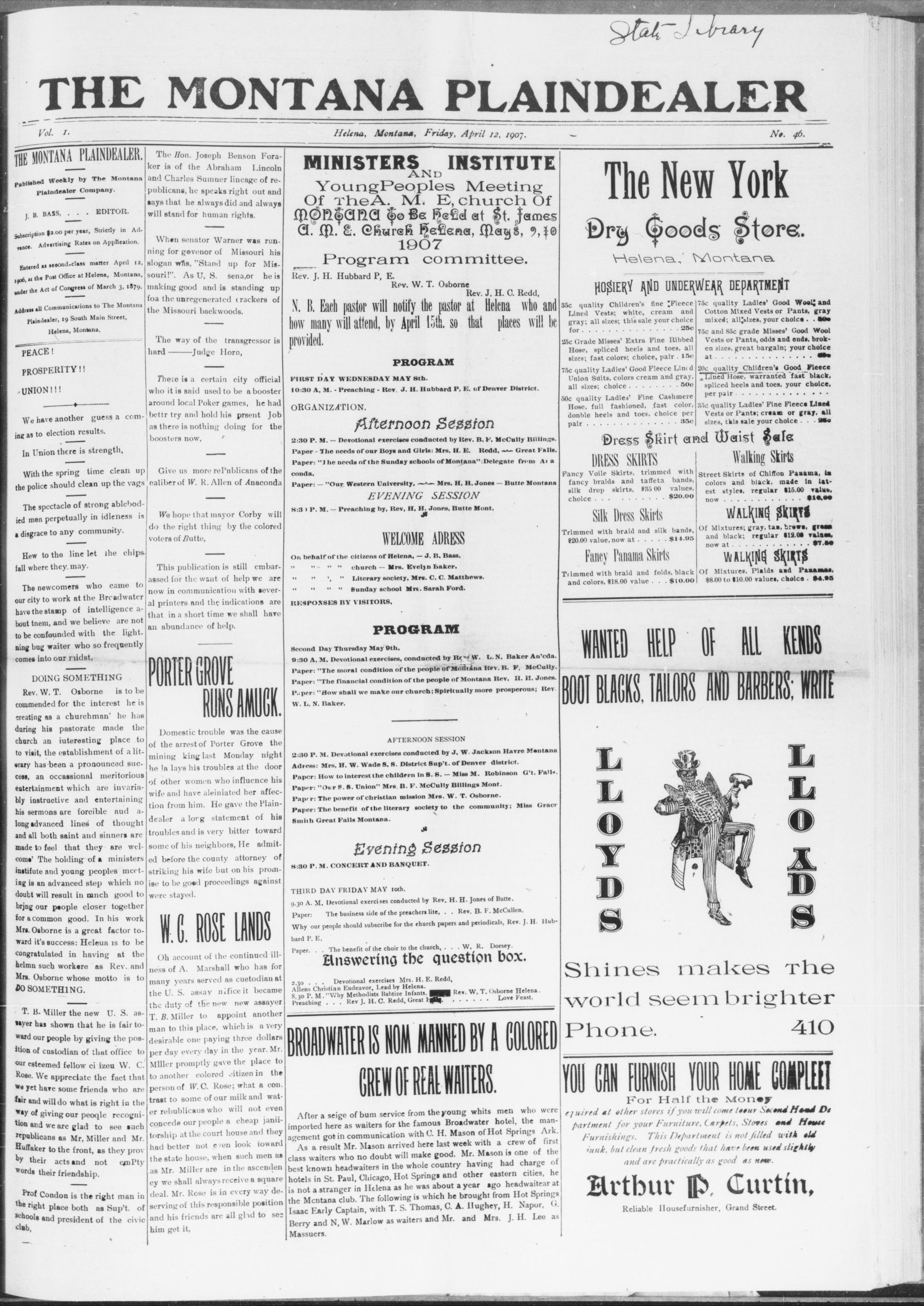
THE MONTANA PLAINDEALER
Vol. 1.
Published Weekly by The Montana Plaindealer Company.
J. B. BASS, . . . EDITOR.
Subscription $2.00 per year, Strietly in Advance. Advertising Rates on Application.
Entered as second-class matter April 12,
1906, at the Post Office at Helena, Montana,
under the Act of Congress of March 3, 1879.
Address all Communications to The Montana Plaindealer, 19 South Main Street,
Helena, Montana.
PEACE!
PEACE!
PROSPERITY!!!
UNION!!!
We have another guess a coming as to election results.
In Union there is strength,
With the spring time clean up the police should clean up the vags
The spectacle of strong ablebodied men perpetually in idleness is a disgrace to any community.
Hew to the line let the chips fall where they may.
The newcomers who came to our city to work at the Breadwater have the stamp of intelligence about them, and we believe are not to be confounded with the lightning bug waiter who so frequently comes into our ruidst,
DOING SOMETHING
Rev. W. T. Osborne is to be commended for the interest he is creating as a churchman' he has during his pastorate made the church an interesting place to to visit, the establishment of a literary has been a pronounced success, an occassional meritorious entertainment which are invariably instructive and entertaining his sermons are forcible aud along advanced lines of thought and all both saint and sinners are made to feel that they are welcome' The holding of a ministers institute and young peoples meeting is an advanced step which no doubt will result in much good to bring our people closer together for a common good. In his work Mrs. Osborne is a great factor toward it's success: Heleua is to be congratulated in having at the helm such workere as Rev. and Mrs. Osborne whose motto is to DO SOMETHING.
T. B. Miller the new U. S. assayer has shown that he is fair toward our people by giving the position of custodian of that office to our esteemed fellow citizen W. C. Rose. We appreciate the fact that we yet have some friends who are fair and will do what is right in the way of giving our people recognition and we are glad to see such republicans as Mr. Miller and Mr. Huffaker to the front, as they prov by their acts and not cmPty words their friendship.
Prof Condon is the right man in the right place both as Sup't. of schools and president of the civic club.
---
The Hon. Joseph Benson Foraker is of the Abraham Lincoln and Charles Sumner lineage of republicans, he speaks right out and says that he always did and always will stand for human rights.
When senator Warner was running for governor of Missouri his slogan was, "Stand up for Missouri!". As U, S. sena,or he is making good and is standing up foa the unregenerated crackers of the Missouri backwoods.
The way of the transgressor is hard Judge Horn.
There is a certain city official who it is said used to be a booster around local Poker games, he had bettr try and hold his present Job as there is nothing doing for the boosters now.
Give us more rePublicans of the caliber of W. R. Allen of Anaconda
We hope that mayor Corby will do the right thing by the colored voters of Butte.
This publication is still embarrassed for the want of help we are now in communication with several printers and the indications are that in a short time we shall have an abundance of help.
PORTER GROVE RUNS AMUCK.
Domestic trouble was the cause of the arrest of Porter Grove the mining king last Monday night he la lays his troubles at the door of other women who influence his wife and have aleiniated her affection from him. He gave the Plaindealer a long statement of his troubles and is very bitter toward some of his neighbors, He admitted before the county attorney of striking his wife but on his promise to be good proceedings against were stayed.
W.G. ROSE LANDS
Oh account of the continued illness of A. Marshall who has for many years served as cuetodian at the U. S. assay nifice it became the duty of the new assayer T. B. Miller to appoint another man to this place, which is a very desirable one paying three dollars per day every day in the year. Mr. Miller promptly gave the place to another colored citizen in the person of W. C. Rose; what a contrast to some of our milk and water republicaus who will not even concede our people a cheap janitorship at the court house and they had better not even look toward the state house, when such men as as Mr. Miller are in the ascendency we shall always receive a square deal. Mr. Rose is in every way deserving of this responsible position and his friends are all glad to see him get it,
---
Helena, Montana, Friday, April 12, 1907.
MINISTERS INSTITUTE AND
YoungPeoples Meeting Of TheA. M. E,church Of MONTHANA To Be Held at St. James A. M. E. Church Helena, May 8, 1907 Program committee. Rev. J. H. Hubbard P. E.
N. B. Each pastor will notify the pastor at Helena who and how many will attend, by April 15th. so that places will be provided.
PROGRAM
DNESDAY MAY 8th.
Teaching - Rev. J. H. Hubbard P, E. of Den
ON.
FIRST DAY WEDNESDAY MAY 8th.
10:30 A, M. - Preaching - Rev. J. H. Hubbard P, E. of Denver District.
ORGANIZATION
Afternoon Session
2:30 P. M. — Devotional exercises cond.
Paper - The needs of our Boys and Girls.
Paper: "Jhe needs of the Sunday school
conda.
Paper: — "Our Western University,
EVENING
8:3) P. M. — Preaching by, Rev, H, H.
otional exercises conducted by Rev. B. F.,
of our Boys and Girls: Mrs. H. E. Rede-
dels of the Sunday schools of Montana": Del-
Western University, Mrs. H. H. Jones,
EVENING SESSION
teaching by, Rev, H, H. Jones, Butte Mont,
2:30 P. M. — Devotional exercises conducted by Rev. B. F. McCully Billings.
Paper - The needs of our Boys and Girls: Mrs. H. E. Redd, Great Falls.
Paper: "The needs of the Sunday schools of Montana": Delegate from A) a conda.
Paper: — "Our Western University, Mrs. H. H. Jones — Butte Montana
EVENING SESSION
8:3) P. M. — Preaching by, Rev, H, H. Jones, Butte Mont.
WELCOME ADRESS
On behalf of the citizens of Helena, — J
" " " " " church — Mrs. Evelyn
" " " ', " Literary society, Mrs.
" " " " " Sunday school Mrs. S
citizens of Helena, — J. B, Bass.
church — Mrs. Evelyn Baker.
Literary society, Mrs. C. C. Matthews.
Sunday school Mrs. Sarah Ford.
VISITORS,
On behalf of the citizens of Helena, - J. B, Bass.
" " " - " " church — Mrs. Evelyn Baker.
" " " , " " Literary society, Mrs. C. C. Matthews.
" " " " Sunday school Mrs. Sarah Ford.
RESPONSES BY VISITORS,
PROGRAM
Second Day Thursday May 9th,
9:30 A.M. Devotional exercises, conduct
Paper: "The moral condition of the peo
Paper: "The financial condition of the p
Paper: "How shall we make our church
W. L. N. Baker.
Sunday May 9th,
National exercises, conducted by Rc W. L.
Special condition of the people of Montana Ire
Financial condition of the people of Montana I
will we make our church; Spiritually more
Second Day Thursday May 9th.
9:30 A. M. Devotional exercises, conducted by Rev W. L.N. Baker An'cda
Paper: "The moral condition of the people of Montana Rev. B. F. McCully
Paper: "The financial condition of the people of Montana Rev. H. H. Jones
Paper: "How shall we make our church; Spiritually more prosperous; Rev
W. L. N. Baker.
AFTERNOON SESSION
2:30 P. M. Devotional exercises conduct
Adress: Mrs. H. W. Wade S. S. District 1
Paper: How to interest the childern in S
Paper: "Our S. S. Union" Mrs. B. F. Mo
Paper: The power of christian mission 1
Paper: The benefit of the literary soci
Smith Great Falls Montana.
National exercises conducted by J. W. Jackson
W. Wade S. S. District Sup't. of Denver de
interest the childern in S. S. — Miss M. Ro-
s. Union" Mrs. B. F. McCully Billings Mon-
ter of christian mission Mrs. W. T. Osborne
fit of the literary society to the communi-
s Montana.
2:30 P. M. Devotional exercises conducted by J. W. Jackson Havre Montana
Adress: Mrs. H. W. Wade S. S. District Sup't. of Denver district.
Paper: How to interest the childern in S. S. — Miss M. Robinson G't. Falle
Paper: "Our S. S. Union" Mrs. B. F. McCully Billings Mont.
Paper: The power of christian mission Mrs. W. T. Osborne.
Paper: The benefit of the literary society to the community; Miss Grace
Smith Great Falls Montana.
Evening Session
8:30 P. M. CONCERT AND BANQUET.
THIRD DAY FRIDAY MAY 10th.
9:30 A. M. Devotional exercises conducted by Paper: The business side of the preachers Why our people should subscribe for the eur
DAY MAY 10th.
final exercises conducted by Rev. H. H. Jones of
business side of the preachers lite, . Rev. B. F. I
should subscribe for the church papers and periodic
THIRD DAY FRIDAY MAY 10th.
9.30 A. M. Devotional exercises conducted by Rev. H. H. Jones of Butte.
Paper: The business side of the preachers lite, . . Rev. B. F. McCullen.
Why our people should subscribe for the church papers and periodicals, Rev. J. H. Hubbard P. E.
Paper: The benefit of the choir to the church, . . W. R. Dorsey.
Answering the question box.
2.30 . . Devotional exercises Mrs. H. E. Redd,
Allens Christian Endeavor, Lead by Helena.
8.30 P. M. "Why Methodists Babize Infants, . . Rev. W. T. Osborne Helena.
Preaching . . Rev J. H. C. Redd, Great Heaven.
Love Feast.
BROADWATER IS NOM MANNED BY A GOLORED GREW OF REAL WAITERS.
After a seige of bum service from the young whits men who were imported here as waiters for the famous Broadwater hotel, the management got in communication with C. H. Mason of Hot Springs Ark. As a result Mr. Mason arrived here last week with a crew of first class waiters who no doubt will make good. Mr. Mason is one of the best known headwaiters in the whole country having had charge of hotels in St. Paul, Chicago, Hot Springs and other eastern cities, he is not a stranger in Helena as he was about a year ago headwaitear at the Mentana club. The following is which he brought from Hot Springs Isaac Early Captain, with T. S. Thomas, C. A. Hughey, H. Napor, G. Berry and N, W. Marlow as waiters and Mr. and Mrs. J. H. Lee as Massuers.
STAT LIBRARY
NDEALE
The New York
Dry Goods Store
DEALER The New York Goods Store
The New York
Helena, Montana
HOSIERY AND UNDERWEAR DEPARTMENT
35c quality Children's fine Fleece Lined Vests; white, cream and gray; all sizes; this sale your choice for .....25c
25c Grade Misses' Extra Fine Ribbed Hose, spliced heels and toes, all sizes; fast colors; choice, pair .15c
75c quality Ladies' Good Fleece Lined Union Suits, colors cream and gray, all sizes; choice .....50c
50c quality Ladies' Fine Cashmere Hose, full fashioned, fast color, double heels and toes, choice per pair .....35c
Press Skirt and Waist Sale
DRESS SKIRTS
Fancy Voile Skirts, trimmed with
fancy braids and taffeta bands,
silk drop skirts, $35 00 values,
choice. $20.00
Trimmed with braid and silk bands,
$20.00 value, now at
$14.95
Trimmed with braid and folds, black and colors. $18.00 value $10.00
WANTED HELP
BOOT BLACKS, TAILORS
LLOYDS
Shines m
world seen
Phone.
YOU CAN FURNISH Y
For Half
equired at other stores if you
partment for your Furniture
Furnishings. This Depart
junk, but clean fresh goods
and are practical
Arthur
CERTED HELP OF ALL
BLACKS, TAILORS AND BARBERS
ines makes
world seem bright
one.
MAN FURNISH YOUR HOME G
For Half the Money
at other stores if you will come to our Sec-
tion for your Furniture, Carpets, Stoves &
Fishings. This Department is not filled
but clean fresh goods that have been used
and are practically as good as new.
Arthur P. Curt
WANTED HELP OF ALL KENDS
BOOT BLACKS, TAILORS AND BARBERS; WRITE
LLOYDS
LLOYDS
Shines makes The world seem brighter Phone. 410
YOU CAN FURNISH YOUR HOME COMPLEET
equired at other stores if you will come to our Second Hand De partment for your Furniture, Carpets, Stoves and House Furnishings. This Department is not filled with old junk, but clean fresh goods that have been used slightly and are practically as good as new.
Arthur P. Curtin,
Reliable Housefurnisher, Grand Street.
---
ALER
No. 46.
New York
ds Store.
75c quality Ladies' Good Wool and Cotton Mixed Vests or Pants, gray mixed; all sizes, your choice ..... 500
75c and 85c grade Misses' Good Wool Vests or Pants, odds and ends, broken sizes, great bargain; your choice at ..... 600
20c quality Children's Good Fleece Lined Hose, warranted fast black, spliced heels and toes, your choice, per pair ..... 35c quality Ladies' Fine Fleece Lined Vests or Pants; cream or gray, all sizes, this sale your choice ..... 260
Walking Skirts
Street Skirts of Chiffon Panama, in colors and black, made in latest styles, regular $15.00 value, now $18.00
WALKING SKIRTS
Of Mixtures; gray, tan, brews, greens and black; regular $19.00 vala, now at $7.50
WALKING SKIRTS
Of Mixtures, Plaids and Panama,
$8.00 to $10.00 values, choice. $4.05
OF ALL KENDS
AND BARBERS; WRITE
LOADS
makes the
ambrighter
410
OUR HOME COMPLEET
the Money
will come to our Second Head De-
c, Carpets, Stoves and House
ment is not filled with old
that have been used slightly
ly as good as new.
S. Curtin,
---
1.7
"Tommy," observed the promising young business man, shortly after he and the divinity student had gone upstairs, "this thing of boarding isn't what it's cracked up to be."
"I'm sure I don't think that we have any reason to complain," said the divinity student. "The food is wholesome and plentiful, and exceedingly well cooked, in my opinion."
I've noticed the same thing in you hope you are not offended?
The promising young business man chuckled. "You are a peach," he said. "No, Tommy, I'm not offended. Not riliously, that is. Yes, they're all people. I ought not to allude to them as 'a mob.' It was unkind of Really, I've no fault to find with of my fellow boarders. I love 'em."
"I'm not kicking on the provender," said the promising young business man. "It's about as good as you'll get in a boarding house, I guess." "It's far better than the average," said the divinity student, warmly. "That chicken to night—"
"What is it makes you fellows so fond of chicken?" said the young business man, in a slightly irritated tone. "There's no scriptural authority for chicken, is there? Yes, the chicken was all right, but—"
"But what?"
"Oh, I don't know. Somehow—"
"Didn't you like the beaten biscuits?" "I told you the grub was all right, didn't I—for boarding house grub? Only—well, there's always that mob." "Everybody seems very pleasant, indeed, to me. Nobody could be kinder or more thoughtful than Mrs. Blimparker. She always speaks of you very nicely." "She's a good old girl. I know that. I'm fond of her, too, as far as that goes. I've boarded ever since I've been in the city, and she's about the best yet. I wasn't trying to reflect on Mrs. Blimparker, you understand." "The others seem to be without exception refined and worthy people. Mr. Gushurst appears a little frivolous in his conversation at times, but if you will pardon me for speaking plainly."
GOOD
Short Stories
A golfing judge, according to the story, had occasion to interrogate in a criminal suit a boy witness from Bala. "Now, my lad," he said, "I want to know if you are acquainted with the nature and significance of an oath?" The boy, raising his brows in surprise, answered: "Of course I am, sir. Don't I caddy for you at the Club?" In a little village in New Jersey the school mistress saw one of the little boys crying. She called him to her and inquired the reason. "Some of the big boys made me kiss a little girl out in the school yard," was the reply. "Why, that is outrageous. Why did you not come right to me?" "I—I—didn't know that you would let me kiss you," he said.
A young bride, after serving to her husband a Thanksgiving dinner that was so-so, said, as the mince pie was brought on: "I intended, dear, to have some sponge cake, too, but it has been a total failure." "How was that?" the husband asked in a disappointed tone, for he was fond of sponge cake. "The druggist," she explained, "sent me the wrong kind of sponges."
Alphonee Mucha, the French artist, whose posters of graceful American women are no less popular in America than in Paris, was recently making a tour of the United States. "What pleases me in America," M. Mucha said, "is the intelligence of the people. The American public is far ahead of the English. On my way over here I stopped a few days in London, and in the British Museum one afternoon I overheard a remark that showed well how benighted the English public is. Two men were looking at some old Egyptian colons. "Them there," said the first man, "must be three hundred or four hundred years old, eh, Bill?" "They're three thousand years old," the second man returned. 'Ah, garn, Bill. What do ye take me for?' said the first man. 'Why, we're only in 1900 now.'"
"It is whispered," said a magazine editor, "that Mark Twain will tell in his autobiography a story about a famous novelist. This novelist loves praise when he is sure of its sincerity. Sincere praise, indeed, is dearer to him than untold gold. And sometimes, in the hope of getting a little of it, he hides his identity and talks to people in book stores and libraries about his own works. One day he went into Brentano's to get some novels for summer reading. The salesman, who didn't know him, after bringing forth Howell's latest, and Conrad's and Tarkington's and George Moore's threw down one of the man's own books. 'Will you try this, sir?' he said. The novelist, eager for praise, threw up his hands before his own book, exclaiming: 'Dear me! I can't stand that man's stuff. 'Can you, sir,' said the salesman. 'Well, to tell the truth, I can't, either.'"
If a woman suffers in silence, the fact that she has to be silent causes additional suffering.
We probably have no idea how much amusement we afford others.
I've noticed the same thing in you. I hope you are not offended?
The promising young business man chuckled. "You are a peach," he said. "No, Tommy, I'm not offended. Not seriously, that is. Yes, they're all nice people. I ought not to allude to them as a 'mob.' It was unkind of me. Really, I've no fault to find with any of my fellow boarders. I love 'em all. But, darn a boarding house, anyway—if you will excuse the profault. You are not offended, I trust?"
"It seems to me a foolish and unnecessary thing to say, Richard, but I am not offended. What is it makes you dissatisfied? Your room here is really luxurious. I should call it luxurious. I think it's the best in the house, and the view from these windows is most interesting. I imagined that you were quite contented."
"I'm not."
"Perhaps as the holiday season approaches you are becoming a little homesick. You want to see the dear old familiar faces and you realize that, however well situated you may be, there's no place like home."
"Do you mean my home?"
"Of course."
"Well, to tell the truth, I left home because I didn't like it. All the same," continued the promising young business man, dreamily, "home life is the only life, isn't it? Now, a comfortable little flat or—"
"Well?"
"Oh, nothing."
"Whose picture is that on your dresser?" inquired the divinity student, suddenly.
"That? Oh, that's—er—that's a young lady. A friend of mine," said the promising young business man—Chicago Daily News.
WINKED AT BY THE BISHOP.
One Small Burst of Profanity Neces
sary to Start the Western Stage.
Ethelbert Talbot, now bishop of central Pennsylvania, and for years the bishop of Wyoming and Idaho, in the early days of that region, gives many an anecdote in his entertaining book of reminiscences, "My People of the Plains."
It both pleased and amused him to notice the stage drivers—a class accustomed to the use of the free profanity—were wont to be respectful and clean spoken in his presence, and that when one day chance let slip an oath he followed it by profane apologies; and he gives an illustrative anecdote from the experiences of Bishop Clarkson on the plains of Nebraska.
One occasion the bishop was due to preach at a certain town on the prairies of Nebraska. It was in the spring and the mud was up to the hubs in places. Already it was growing dark and the lights of the village which the bishop was trying to reach seemed still a long way off. He became a little nervous lest he should be late for his appointment. Just then they encountered a mud hole, and the stage coach stuck fast. The driver laid on the lash, but in valin; the horses would not move. The bishop was on the box with the driver, who was getting desperate. Unable to stand it any longer he turned to the bishop and said:
"Do you see those wheelers looking back at me?"
"Yes, Harry. What does that mean?"
"Bishop, you know I have always tried to treat you right, and I respect your cloth. But do you say you want to preach in that there town tonight?" "Of course I do, Harry. Why don't you whip your horses?" "Whip 'em, em! Ain't I been a-whippin' em, I'll get you there or bust." What do you say, you must preach there tonight?"
"Of course I must."
"Well, bishop. I ask it just once. You see, these horses are used to my style of talkin' to 'em. I know it's a bad habit, and I know it's wrong, but will you please give me a dispensation just this one time? If you will I'll get you there or bust. What do you say, bishop?
"Well, Harry. I suppose I'll have to. Fire away this one time."
Harry ripped out an oath and the horses got down on their haunches, cleared the mud hole and landed the bishop in town just in time to keep his appointment.—Rochester Hersal.
The Beard in Tunis.
In Tunis when a releging prince finds it necessary to go outside his immediate family to choose his successor he follows an odd custom. There the wearing of hair on the face is the exclusive privilege of sovereignty. When the prince selects a successor he sends the court barber to the fortunate individual to notify him that he may wear a beard. This intimation is equivalent to a formal announcement that he has been selected as the heir presumptive.
How He Employed Them
How He Employed Them.
"I used my fists to good advantage last night."
"A fight, h? Tell me about it."
"No, not a fight. I forgot my keys and had to pound on the door at midnight to get some one to let me in."—Cleveland Plain Dealer.
THE FOOL AND HIS MONEY.
Some Schemes of Wildcat Promoters
for Pairing the Two.
The fact that one of the firms of pseudo-bankers infesting lower Broadway has been taking the fool's money for five years is an indication of its success, says Success.
Now half a dozen mushroom "banking" houses, with elaborately furnished quarters in New York, and branch offices in all the larger towns in this country and Canada and even abroad, are using this ingenious scheme to sell spurious mining, oil and manufacturing stocks.
The house most successful at the game has forty branch offices here and abroad, besides agents in many smaller towns. It brings out a new company every little while and sells the stock usually by the mall order and agency system.
Years of experience have given these parasite promoters an invaluable "sucker list"—little investors all over the country whose financial credibility has not been shaken by repeated losses. These "investors"—wage earners, country merchants, clergymen, teachers and other professional men—are reached through circulars and letters. The first stocks sold by this house paid cash dividends for a while, and the "investors" who were doubling and tripling their savings bank incomes spread the glad tidings among their friends. The cash dividends were followed by script dividends—in some cases by no dividends at all. The stockholders who complained too loudly were offered in exchange for their unsatisfactory stocks other stocks in new companies brought out by the house.
A "trust fund" established "for the protection of investors" is made up, supposedly, of sound mining stocks, and when an investor gets tired of one spurious stock he can send it in and exchange it for something else. This, of course, is just as spurious, but it keeps the victim quiet for a while. He is advised to hold the stock until the mine strikes the expected bonanza ore, when the stock will rapidly increase in value. In this manner the house manages to keep its dupes quiet for many months and to sell them more stock besides.
JAPAN TO OWN RAILROAD8
Nation to Pay Double the Cost of the Private Lines.
Now that the Japanese government has undertaken to nationalize seventeen private railways, having a total of 2,837 miles of line, at a cost of 421,500,000 yen ($210,000,000), or about $73,000 a mile, the latest annual report of Ichiji Yamanouchi, director of the imperial bureau of railways of Japan, for the fiscal year ended March 31, 1905, becomes of the highest historical and comparative value.
The total mileage open for traffic in 1905 was 4,693, divided into follows: Government railways, 1,461 miles; private railways, 3,232 miles. This showed an increase of nearly 198 miles over 1904.
Calculating the Japanese yen at 50 cents (commercially 49.8 cents), the cost of construction of the mileage was:
ways ..... $ 76,051,649 $52,054
Private railways .. 120,502,452 37,284
Totals ..... $196,554,101 $41,882
It will be perceived that the Japanese government now pays almost double the original cost of constructing the private railways, and there is no suggestion of graft or excessive valuation in the transaction. The price paid was twenty times the average of the net earnings from operation for 1902, 1903 and 1904, divided by the cost of construction and multiplied by the paid-up capital—Railway Age.
SPOILED HIS PLAN.
Worm Wrecked Michigan Man's
Crop of Railroad Ties.
The best laid plans of mice and men go often wrong. Dr. A. H. Sauerman, who lives a few miles east of Union City, Mich., conceived a plan a few years ago whereby he expected to make a fortune. He planted quite a tract of land of yellow locust trees, setting them close together in rows, the tract containing something like 50,000 thrifty young trees. Their growth was hastened by frequent cultivation, good fertilizing and irrigation and they attained a most thrifty growth until last autumn.
Dr. Sauerman's idea was to care for these trees for a few years until they had reached a sufficient growth to be used for railroad ties, when they were to be marketed and the tract of ground replanted again to trees. An investigation showed that a small worm was creating havoc with the trees, boring into the trunks and in some cases weakening the trees so that they fell over in a strong wind. And thus the genial doctor's visions of a fortune have gone a-glimmering.—Manlestee Times.
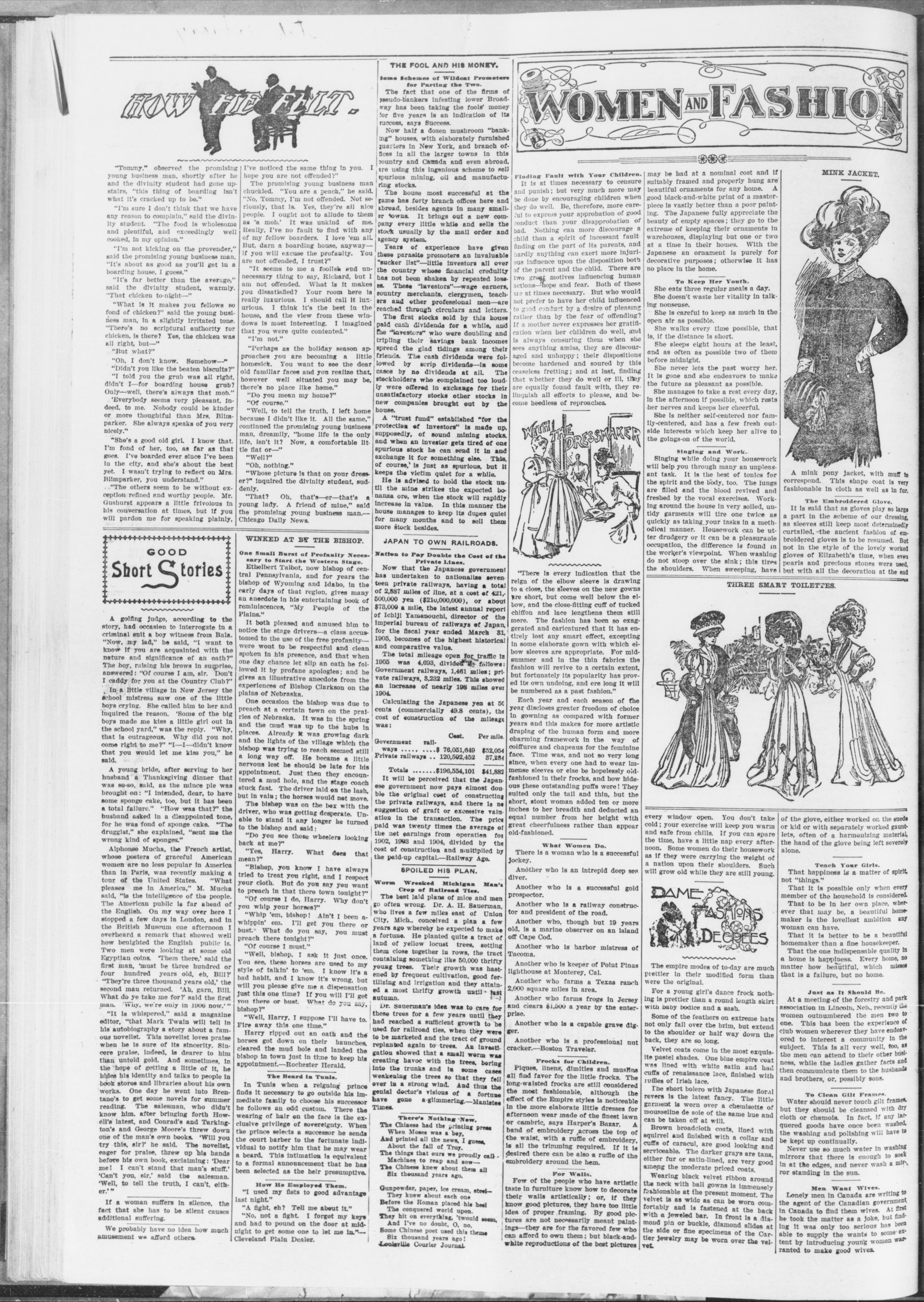
WOMEN AND FASHION
Finding Fault with Your Children. It is at times necessary to censure and punish; but very much more may be done by encouraging children when they do well. Be, therefore, more careful to express your approbation of good conduct than your disapprobation of bad. Nothing can more discourage a child than a spirit of incessant fault-finding on the part of its parents, and hardly anything can exert more injurious influence upon the disposition both of the parent and the child. There are two great motives influencing human actions-hope and fear. Both of these are at times necessary. But who would not prefer to have her child influenced to good conduct by a desire of pleasing rather than by the fear of offending? If a mother never expresses her gratification when her children do well, and is always censuring them when she sees anything amiss, they are discouraged and unhappy; their dispositions become hardened and soured by this ceaseless fretting; and at last, finding that whether they do well or ill, they are equally found fault with, they relinquish all efforts to please, and become heedless of reproaches.
WITH THE DRESSMAKER
"There is every indication that the reign of the elbow sleeve is drawing to a close, the sleeves on the new gowns are short, but come well below the elbow, and the close-fitting cuff of tucked chiffon and lace lengthens them still more. The fashion has been so exaggerated and caricatured that it has entirely lost any smart effect, excepting in some elaborate gown with which elbow sleeves are appropriate. For mild-summer and in the thin fabrics the fashion will revive to a certain extent, but fortunately its popularity has proved its own undoing, and ere long it will be numbered as a past fashion."
Each year and each season of the year discloses greater freedom of choice in gowning as compared with former years and this makes for more artistic draping of the human form and more charming framework in the way of coifures and chapeaus for the feminine face. Time was, and not so very long since, when every one had to wear immense sleeves or else be hopelessly old-fashioned in their frocks, and how hideous these outstanding puffs were! They suited only the tall and thin, but the short, stout woman added ten or more inches to her breadth and deducted an equal number from her height with great cheerfulness rather than appear old-fashioned.
What Women Do.
There is a woman who is a successful jockey.
Another who is an intrepid deep sea diver.
Another who is a successful gold prospector.
Another who is a railway constructor and president of the road.
Another who, though but 19 years old, is a marine observer on an island off Cape Cod.
Another who is harbor mistress of Tacoma.
Another who is keeper of Point Pinas lighthouse at Monterey, Cal.
Another who farms a Texas ranch 2,000 square miles in area.
Another who farms frogs in Jersey and clears $1,500 a year by the enterprise.
Another who is a capable grave digger.
Another who is a professional nut cracker.—Boston Traveler.
Frocks for Children.
Piques, linens, dimities and muslins all find favor for the little frocks. The long-walsted frocks are still considered the most fashionable, although the effect of the Empire styles is noticeable in the more elaborate little dresses for afternoon wear made of the finest lawn or cambridge, says Harper's Bazar. A band of embroidery across the top of the waist, with a ruffle of embroidery, is all the trimming required. If it is desired there can be also a ruffle of the embroidery around the hem.
For Walls.
Few of the people who have artistic taste in furniture know how to decorate their walls artistically; or, if they know good pictures, they have too little idea of proper framing. By good pictures are not necessarily meant paintings—they are for the favored few who can afford to own them; but black-and-white reproductions of the best pictures
THREE SMART TOILETTES.
may be had at a nominal cost and if suitably framed and properly hung are beautiful ornaments for any home. A good black-and-white print of a masterpiece is vastly better than a poor painting. The Japanese fully appreciate the beauty of empty spaces; they go to the extreme of keeping their ornaments in warehouses, displaying but one or two at a time in their homes. With the Japanese an ornament is purely for decorative purposes; otherwise it has no place in the home.
To Keep Her Youth.
She eats three regular meals a day.
She doesn't waste her vitality in talking nonsense.
She is careful to keep as much in the open air as possible.
She walks every time possible, that is, if the distance is short.
She sleeps eight hours at the least, and as often as possible two of them before midnight.
She never lets the past worry her.
It is gone and she endeavors to make the future as pleasant as possible.
She manages to take a rest every day, in the afternoon if possible, which rests her nerves and keeps her cheerful.
She is neither self-centered nor family-centered, and has a few fresh outside interests which keep her alive to the goings-on of the world.
Singing and Work.
Singing while doing your housework will help you through many an unpleasant task. It is the best of tonics for the spirit and the body, too. The lungs are filled and the blood revived and freshed by the vocal exercises. Working around the house in very solled, untidy garments will tire one twice as quickly as taking your tasks in a methodical manner. Housework can be utter drudgery or it can be a pleasuraole occupation, the difference is found in the worker's viewpoint. When washing do not stoop over the sink; this tires the shoulders. When sweeping, have
THREE SMAR
every window open. You don't take cold; your exercise will keep you warm and safe from chills. If you can spare the time, have a little nap every afternoon. Some women do their housework as if they were carrying the weight of a nation upon their shoulders. Such will grow old while they are still young.
DAME FASHIONS DECREES
The empire modes of to-day are much prettier in their modified form than were the original.
For a young girl's dance frock nothing is prettier than a round length skirt with baby bodice and a sash. Some of the feathers on extreme hats not only fall over the brim, but extend to the shoulder or half way down the back, they are so long. Velvet coats come in the most exquisite pastel shades. One blue empire coat was lined with white satin and had cuffs of renaissance lace, finished with ruffles of Irish lace. The short bolero with Japanese floral revers is the latest fancy. The little garment is worn over a chemisette of mousselline de sole of the same hue and can be taken off at will. Brown broadcloth coats, lined with squirrel and finished with a collar and cuffs of caracul, are good looking and serviceable. The darker grays are tans, either fur or satin-lined, are very good among the moderate priced coats.
Wearing black velvet ribbon around the neck with ball gowns is immensely fashionable at the present moment. The velvet is as wide as can be worn comfortably and is fastened at the back with a jeweled bar. In front is a diamond pin or buckle, diamond slides at the side or fine specimens of the Cartier jewelry may be worn over the velvet.
MINK JACKET.
A mink pony jacket, with muff to correspond. This shape coat is very fashionable in cloth as well as in fur.
A mink pony jacket, with muff to correspond. This shape coat is very fashionable in cloth as well as in fur.
The Embroidered Glove.
It is said that as gloves play so large a part in the scheme of our dressing, as sleeves still keep most determinedly curtailed, the ancient fashion of embroidered gloves is to be resumed. But not in the style of the lovely worked gloves of Elizabeth's time, when even pearls and precious stones were used, but with all the decoration at the end.
RT TOILETTES.
of the glove, either worked on the guede or kid or with separately worked gauntlets, often of a harmonizing material, the hand of the glove being left severely alone.
Teach Your Girls.
That happiness is a matter of spirit, not "things."
That it is possible only when every member of the household is considered. That to be in her own place, wherever that may be, a beautiful homemaker is the loveliest ambition any woman can have.
That it is better to be a beautiful homemaker than a fine housekeeper. That the one indispensable quality in a home is happiness. Every home, no matter how beautiful, which misses that is a failure, but no home.
Just as It Should Be:
At a meeting of the forestry and park association in Lincoln, Neb., recently the women outnumbered the men two to one. This has been the experience of club women wherever they have endeavored to interest a community in the subject. This is all very well, too, as the men can attend to their other business, while the ladies gather facts and then communicate them to the husbands and brothers, or possibly sons.
To Clean Gilt Frames
Water should never touch gilt frames, but they should be cleansed with dry cloth or chamois. In fact, if any lacquered goods have once been washed, the washing and polishing will have to be kept up continually.
Never use so much water in washing mirrors that there is enough to soak in at the edges, and never wash a mirror standing in the sun.
Men Want Wives.
Lonely men in Canada are writing to the agent of the Canadian government in Canada to find them wives. At first he took the matter as a joke, but finding it was only too serious has been able to supply the wants to some extent by introducing young women warranted to make good wives.
Old
Favorites
The Vampire.
A fool there was and he made his prayer
(Even as you and I!)
To a rag and a bone and a hank of hair
(We called her the woman who did not
care).
But the fool he called her his lady fair
(Even as you and I!)
Oh, the years we waste and the tears we
waste
And the work of our head and hand
Belong to the woman who did not know
(And now we know that she never could
know)
And did not understand.
A fool there was and his goods he spent
(Even as you and I!)
Honor and faith and a sure intent
(And it wasn't the least what the lady
meant),
But a fool must follow his natural bent,
(Even as you and I!)
Oh, the toll we lost and the apoll we lost,
And the excellent things we planned,
Belong to the woman who didn't know
why,
(And now we know that she never knew
why)
And did not understand.
The fool was stripped to his foolish hide
(Even as you and I!)
(Even as y'all)
Which she might have seen when she
knows she
threw him in
(But it isn't on record the lady tried)
So some of him lived, but the most of him
died—
(Even as you and I!)
And it isn't the shame and it isn't the
blame
That stings like a white-hot brand—
It's coming to know that she never knew
why
(Seeing at last she could never know
why)
And never could understand.
-Rudyard Kipling.
Pack Clouds Away.
Pack clouds away, and welcome day,
With night we banish sorrow;
Sweet air, blow soft; mount, lark, aloft
To give my love good morrow.
Wings from the wind to please her mind
Notes from the lark I'll borrow;
Bird, preen thy wing; nightingale, sing,
To give my love good morrow.
To give my love good morrow.
Notes from them all I'll borrow.
Wake from thy nest, robin redbreast,
Sing, birds, in every furrow;
And from each hill let music shrill
Give my fair love good morrow.
Blackbird and thrush in every bush,
Stare, linnet, and cock-sparrow.
You petty elves, amongst yourselves,
Sing my fair love good morrow.
To give my love good morrow,
Sing, birds, in every furrow.
—Thomas Heywood.
Old-Time School Committee
Fifty years ago the men who made up the school committee in a rural community left something to be desired in the matter of scholarship, but the Maine worthies, sketched by W. S. Knowlton in "The Old Schoolmaster," must have contributed not a little galley to the dull round of teaching. When a certain committeeman came in Mr. Knowlton always reduced to a minimum the noise in the school of which he was the master, so as not to disturb the good man's slumbers. For he would sleep so placidly, with such a childlike expression on his face, that the young schoolmaster had not the heart to disturb him. When the time for speechmaking came a stick of wood was dropped upon the floor to awaken him.
"He always commended the good order," is Mr. Knowlton's shy comment. "I gave another man, who pretended to know Greek, a German reader while the class read Homer," confesses Mr. Knowlton, "and he did not know the difference. He said the class translated admirably!" One man asked the pupils if they would be ready to be examined the thirty-first of September, and they said they thought not. "Well," said he, "that day will convene me best, and I hope you will be ready." The pupils were too polite to smile, and so the committeeman passed out of the schoolhouse feeling sure that he had carried a point, and had corrected Julius Caesar and all the popes.
In one school eight weeks of the session had elapsed, and there were four weeks remaining. The superintendent asked what fractional part of the term had passed.
"Two-thirds," answered the school.
"No," said he, with a knowing look upon them and a disapproving scowl upon the teacher. "You are wrong. I will ask you again before I leave."
When he was about to go he repeated the question, and the school gave the same answer.
"You are wrong again," he said. "The correct answer is eight-twelfths."
Ceylon Sharks.
Sharks infest the water of Ceylon, and the pearl divers of that region are in deadly fear of these wolves of the deep. The divers are mostly Tamils and Moormen and display marvelous endurance and pluck. To protect themselves against the ever present danger to which the presence of the sharks exposes them the divers carry charms given them by recognized "shark binders" who receive a small government fee and a dozen oysters a day from each boat. Owing to the constant noise and spilling, the sharks are generally kept at a distance, and accidents are rare.
SHOOT AT HUMAN TARGETS.
Frenchmen Bring Bloodless Dueling to an Exact Science. Shooting at human targets merely for the sport derived from it and as a test of marksmanship, in other words, bloodless dueling or fencing with pistols, has been made possible through the invention by a Frenchman of a harmless wax projectile. This new diversion is really no more serious than fencing with swords and has that spice of realism in it that tends to make any sport popular.
The new bullet is an ingenious device and required a great deal of experiment before being perfected. The situation was thus: A heavy projectile must necessarily have a wounding force, a light one loses its precision and a soft bullet will be changed in shape and describe an irregular trajectory; therefore a harmless projectile to be effective must differ from all these. The Frenchman's product is a spherical ball of wax-fat, with a small charge, and in tests twenty-four balls were lodged in succession in a rectangle four by five inches at twenty yards At a six-day tournament held in the Tullerles the efficiency of the wax bullet was demonstrated.
The combatants wear thick screens for masks, with heavy glass over the eyes, and wear thick clothing to prevent bruising from the impact of the balls. The distance is 25 paces and the weapons are revolvers. The director of the combat, keeping his gaze fixed upon a metronome which beats eighty to 100 times a minute, makes the inquiry as in an actual duel, "Are you ready?" and when they reply "Yes" the director, timing his words exactly to the beats of the pendulum, cries, "Fire—one—two—three!"
At the command "Fire!" the adversaries raise their weapons and shoot. The two shots must be made before the command "Three!" As the participants in these trials were experts they made a good average, hitting their man six or seven times out of eight shots. Although more than 1,600 balls were fired, there was not the slightest accident. The wax bullets can be used in apartments as well as in the open air without the inconvenience of the lead ball of small caliber, which will probably lead to its introduction into the armies of the various nations for practice shooting.—Popular Magazine.
RESULTS NOT AS PLANNED.
Nature Turns Assouan Dam Into a
Joke on England.
Every year sees new harnessing of nature's forces by man for his uses. But Mother Earth seems to have a sense of humor and gratifies it by turning man's devices into means for his discomfiture. The dam of Assouan is the latest humiliating instance of a tremendous achievement producing results opposite to those planned.
That mighty engineering work was to be the monument to the British occupancy of Egypt. It was to end all famine in the Nile valley. There was to be no further dependence upon the chances of the seasons for the enriched overflows. Held within Assouan's mammoth reservoirs, the fertilizing flood could be released whenever needed. The Nile crops would be perfect and the people happy each year instead of at such intervals as the rupus of the river willed.
All the nations applauded England when the work that was to make Egypt a land of plenty was completed. But nature had not been consulted with sufficient care. And to-day the Egyptians are damning the dam of Assouan with oriental fervor.
Outbursts of fanatics, aggrieved because some of the most sacred relics of the past have been submerged might be disregarded. But there are more practical reasons for the growing discontent. Water, once an occasional boon, now is had in plenty. But the crops are not what they were when the Nile attended to its own overflowing. Grain is scantier, and cotton, the country's most valuable product, is deteriorating, its once unequaled fiber approaching every year nearer similarity with the more brittle, least costly American staple.
The explanation is simple. It was not the Nile flood but the fertilizing matter held in solution that richened the soil. Those properties are precipitated when the water is held stagnant behind the barrier at Assouan England, thinking its work finished, finds that it has only begun a more difficult task. Dame Nature has had her joke.—New York Mall.
Her Strong Faith.
"Oh, Tom," exclaimed the fair young mald, as the auto flew along, "there's a church just ahead there."
"But," replied the eloping lover, "we can't be married there."
"Well, but we might stop there awhile and pray that we may not be over-taken."—Philadelphia Press.
Function of a Helpmeet.
The Bachelor—So you are to marry again. I thought you said when your first wife died that the sorrow was so great you could not bear it?
The Wildower—You misunderstood me; I meant I could not bear it alone—Fillegende Bluetter.
The Sole Objection.
Allice—I hear your husband is going to have an automobile?
Eva—That's something I wouldn't permit under any circumstances.
Mourning colors don't become me.
Flegende Blaetter.
Some people's goodness is probably due to the fact that they are never found out.
Editorials Opinions of Great Papers on Important Subjects.
B
fortunate fact that in the American courts, except perhaps in poisoning cases where a chemist gives the direct results of his analysis and confines himself to that, such a thing as honest expert testimony is almost unknown.
We have, indeed, a disreputable kind of testimony which masks itself under the name of "expert," and which we hear of entirely too often. It is the testimony given by men hired either by the prosecution or by the defense to help its cause. But this is not expert testimony, unless, indeed, the very skillfulness of the prostitution of knowledge that is sometimes exhibited may itself be called expert.
When an expert takes the stand the first question put to him should come from the judge, and it should be in this form: "Have you accepted, or agreed to accept, any fee from the prosecution or from the defense?" as the case may be. If the answer is yes, or if evidence is produced of the payment of such a fee, there should be a law permitting the prosecution of the witness for bribery.
—Chicago Record-Herald.
fortunate fact that in the American courts, except perhaps in poisoning cases where a chemist gives the direct results of his analysis and confines himself to that, such a thing as honest expert testimony is almost unknown.
We have, indeed, a disreputable kind of testimony which masks itself under the name of "expert," and which we hear of entirely too often. It is the testimony given by men hired either by the prosecution or by the defense to help its cause. But this is not expert testimony, unless, indeed, the very skillfulness of the prostitution of knowledge that is sometimes exhibited may itself be called expert.
When an expert takes the stand the first question put to him should come from the judge, and it should be in this form: "Have you accepted, or agreed to accept, any fee from the prosecution or from the defense?" as the case may be. If the answer is yes, or if evidence is produced of the payment of such a fee, there should be a law permitting the prosecution of the witness for bribery.
—Chicago Record-Herald.
it is the result of tinkering with old systems without a comprehensive idea of what should be done to cure the ewls.
New York has lately had the benefit of the suggestions of a special commission appointed to recommend an improvement in its system. In that State all the expenses of the State government are paid by special taxes levied on corporations, on liquor-selling, on stock transfers and on inheritances, so that there is no levy upon the general taxpayers for State purposes. Consequently the tax which has to be paid to the local collector is for local purposes alone. This tax is levied on real estate and personal property.
The commission has recommended that the personal property tax be abolished, and that a real estate tax and a tax on the rental value of the house a man occupies be practically the only taxes the citizen has to pay. This is to be supplemented with a revised inheritance tax, the proceeds of which shall be divided between the State and the community in which the property is situated, as the excuse tax is now divided.
Attention is called to this report, because it is a valuable contribution to the discussion of the taxation que
"ED" WAS BARRED.
army of unmarried turned a deaf ear in love and who When Horsford battalion of the Barden Wood in
It is the result of tinkering with old systems without a comprehensive idea of what should be done to cure the cells.
New York has lately had the benefit of the suggestions of a special commission appointed to recommend an improvement in its system. In that State all the expenses of the State government are paid by special taxes levied on corporations, on liquor-selling, on stock transfers and on inheritances, so that there is no levy upon the general taxpayers for State purposes. Consequently the tax which has to be paid to the local collector is for local purposes alone. This tax is levied on real estate and personal property.
The commission has recommended that the personal property tax be abolished, and that a real estate tax and a tax on the rental value of the house a man occupies be practically the only taxes the citizen has to pay. This is to be supplemented with a revised inheritance tax, the proceeds of which shall be divided between the State and the community in which the property is situated, as the excuse tax is now divided.
Attention is called to this report, because it is a valuable contribution to the discussion of the taxation ques-
Under the close scrutiny of his wife and sister, Mr. Hanson sat unhappily in his chair, drawn up to the cheerful blaze, to be sure, but between the chairs occupied by the feminine members of his household.
"Well, now, what difference does it make whether Letty's husband is well-favored or not?" he demanded, irritably.
"I've told ye there weren't any o' those folks in that little town o' thelrs much to look at. Why ain't that enough for ye? He's a mighty good fellow, Ed Norton is. Everybody'll tell ye he's got the best disposition that ever was, and he's smart, too."
Mrs. Hanson leaned forward and twitched her husband's coat by its sleeve.
"Is it true he's the homestell man in all that part o' the country?" she demanded. "If looks don't make any difference to you, why don't you speak up and tell the truth?"
"Long as you've worried it out o' me," said Mr. Hanson, reluctantly, "I'll tell ye. There's a game they play, young an' old, when they have one o' their gatherings in the little hall they've built. If anybody's made doughnuts that day—I mean whoever's made em' or cockles or what not—instead o' handing 'em round with the rest o' the food, they do 'em up separate, all in papers and boxes and tied with strings in hard knots, and then they'll give 'em to the children to deal out, saying 'Now that's for the man with the biggest mouth.' That's for the man with the largest ears.' That's for the man with the longest nose.' That's for the man with the biggest hands', and so on. You see what I mean? They mention what you'd generally call personal defects. I take it.
Loving to meet you.
WIT OF THE YOUNGSTERS.
Teacher—Johnny, what is the future tense of "He drinks?" Johnny (promptly)—He's drunk.
Teacher—Willie, can you tell me why the multiplication table stops at 12? Willie—I guess it's because 13 at a table is unlucky.
Teacher—Now, Johnny, you may give me the definition of "exercise," Johnny—Exercise is work what a fellow likes to do because it isn't work.
"They say that I have cut a tooth," Said the babe with mournful glee; "But if they'd only tell the truth, They'd say the tooth cut me."
Teacher—Why, Freddie, this excuse doesn't look like your father's writing. Freddie—Well, the next one will look more like it, I guess. He says my penmanship is improving.
Small Tommy after being severely chastised by his mother for disobeying her ran to his father and said between sobs: "Papa, how d-did you c-come to m-marry such a w-woman as m-mamma is?" Mamma—If you had two pennies, Willie, and I was to give you three more, how much would you have? Willie—Make it dollars, mamma. What's the use of being stingy with make-belleve money? A little fellow, age 4, accompanied his father to Lincoln Park one day, where he saw a diminutive monkey with whose playful antics he was greatly pleased. "What did you see, dear?" asked his mother upon his return home. "A funny little boy with a tall," replied the small observer.
T
"What's the matter, pet?" asked a mother of her 3-year-old daughter, who was crying. "S-somfin' dweafful h-happened," sobbed the little one. "Well, what was it, darling?" queried the mother, anxiously. "My d-dolly dot away f-wom me an' b-woked a d-dish in ze p-panty," she sobbed.
JEWELS IN BOOT LEATHER.
Diamond-Set Dancing Pumps Will Soon Be Fashionable Rage.
It is said that a manufacturing jeweler in New York has invented a device for setting gems in boot leather; that diamond-set dancing pumps will soon be the rage; that diamond-toed boots will eventually be so common as not to attract attention in Broadway or in 5th avenue.
Here is merely a return to ancient luxury. The "campagnus," the most ordinary footwear of the Roman emperors, was often enriched with pearls and diamonds. Roman women had shoes with soles of solid gold, shoes that sparkled with precious stones. Heliogabalus, who never wore a pair of boots twice, insisted on exquisite cameos as decorations, but he forbade women to wear gems attached to their shoes. High priests were coquettish also in this manner. Alcblades invented a boot that became the fashion, but we believe it was gemless.
Let us go through the centuries. Charlemagne wore shoes adorned with gems and richly ornamented foot coverings were worn by the nobility of Europe, both by lords and noble dames in the twelfth and thirteenth centuries. In the time of Charles I, of England the extravagance was shoe strings edged with gold. Louis XIV. wore at his wedding boots adorned with fleurs de lis and decorations of gold, but how did they fit him? For the shoemaker, Lestage, disdained to take the royal measure. Toward the close of the eighteenth century in England shoe buckles dazzled with jewels. A millionaire is now a person whose income is a million. A capital of a million is nothing. When General Jung Bahawther took his seat at the ball given in London by the Peninsular and Oriental Company—
Bedad his treat, his belt, his coat,
All bleezed with precious minerals.
Why should not the suddenly rich, the heroes of the American nights, more wonderful than the nights of Arabia, break out all over with diamonds as poorer mortals with measles or the shingles?—Boston Herald.
To Be Refilled.
One of the suburbs of Chicago is the site of a well-known school of theology, from which go out each week-end many members of the senior class to try their volces as "supplies."
A passenger on a Monday morning train was surprised at the number of them who got off at the station.
"What are all those chaps getting off here?" he asked the brakeman.
"Them?" asked the brakeman. "Oh they're returned empties, for the college."
Histrionic.
There was on the stage a realistic scene in which a surgical operation was apparently performed.
"Hold on-" cried a voice from the audience. "Aren't you going to give us some of that chloroform?"
Of course the management was displeased, but there is a point at which realism palls—Philadelphia Ledger.
Hereditary.
"Your son is a great football player."
"Yes; it is hereditary."
"I never heard that his father was a football player."
"He isn't, but he is a chronic kicker."
—Houston Post.
Women can always see the point of a pointless joke.
---
OTH in civil and criminal trials there are frequently circumstances in which the testimony of experts is highly desirable. To determine the equities in a civil suit specialized knowledge is often necessary, and to determine the degree of responsibility in a criminal case the same is true. It is an un-
courts, except per-
ist gives the direct
self to that, such a
most unknown.
kind of testimony
of "expert," and
It is the testimony
obsecution or by the
is not expert testi-
lness of the prosti-
ses exhibited may it
the first question put
and it should be in
agreed to accept, any
the defense?" as the
is, or if evidence is
there should be a
witness for bribery.
POPULAR.
tion is to reduce expense
administration. It is no
people complain so much
the burden—Youth's C
DOWN V
HE broom as the old
from the
which are
The change
unqualified
a breeding
dust of our houses.
Of cleanly instincts she
removes dust instead
lost to the senses, so
location in air, only soo
shelves, pictures, curt
Moreover, the removal
receptacle by means of
absolute destruction by
AXES are paid more reluctantly than any other indebtedness. One of the reasons for the reluctance lies in the belief, which prevails widely, that other men are not paying their fair share of the cost of government. There is foundation for this belief, since no taxation system is perfect. In every case
systems without a be done to cure the It of the suggestions to recommend an imitate all the expenses special taxes levied stock transfers and levy upon the general consequently the tax collector is for local on real estate and that the personal prop estate tax and a taxian occupies be praises to pay. This is to meritance tax, the prow between the State and city is situated, as the because it is a valuation of the taxation ques-
OYSTER INVESTIGATION eaten rai the thinn darry de of the co be good verted to process which makes a To secure this app placed in fresh water This bleaches them, a few fresh water strorms so much water digestive functions a ditions, any bacilli itply, thus infecting This infected food comes a menace to a practice of bleaching should be discourage general.—What to E
army of unmarried men, and invariably turned a deaf ear to privates who were in love and who wished to take wives. When Horsford was in command of a battalion of the rife brigade, says Sir Evelyn Wood in his recent entertaining volume, "From Midshipman to Field Marshal," a soldier came up to him for permission to marry.
"No, certainly not," was the curt reply. "Why does a young man like you want a wife?"
"Oh, please, sir," said the soldier, "I have two rings ("good conduct" badges) and five pounds in the savings bank, so I am eligible, and I want to marry very much."
"Well, go away, and if you come back this day year in the same mind, you shall marry. I'll keep the vacancy."
On the anniversary the soldier repeated his request.
"But do you really, after a year, want to marry?"
"Yes, sir; very much."
In spite of himself, Horsford was visibly impressed.
"Sergant major," he said, "take his name down. Yes, you may marry. I never believed there was so much constancy in man or woman. Right face, Quick march!"
At the door the man turned.
"Thank you, sir," he said, gratefully.
"It isn't the same woman."
NEWSPAPERS FOR ROYALTY
How Rulers of the World Keep Informed of Events.
Most presidents and kings and rulers of countries are far too busy to look over the columns of all the daily papers that are published in their respective lands, says the New York Herald. At the same time, those who are responsible for the welfare of their subjects and their citizens must keep informed on all topics of national and international interest. In order that they may do this with the least possible effort and waste of time it occurred to the Emperor of Austria to arrange or have arranged for him, a morning journal of clippings which would present all the important features of the day so that his time would not be taken up with glancing over extraneous matter.
The journal that his majesty perused while partaking of his coffee and rolls was a neat little leather affair that served as a binding, and into this his secretary slipped the columns of printed matter which was to furnish the emperor's mental food for the day. If the articles were too long then it was the duty of the secretary to condense them and present them to his majesty in neatly typewritten sheets.
As a matter of fact, royalties are usually well read and well informed personages. Many of them devote con-
EXPERT WITNESSES.
TO MAKE TAXES POPULAR.
"Well, it makes consid'dable sport, and nobody's sensitive. I was there to one of those times, and saw how it worked. But just before they began to play it the man that was kind of master of ceremonies, he stood out in the center of the floor, and said he, 'Before we begin I will ask Ed Norton to step outside,' he said. 'I understand there's a new brand o' cakes on hand to-night, and some o' the rest of us men want to get 'em by rights,' he said, 'and not have to depend on Ed Norton's bounty, as we've done at the last two entertainments.' "Now I hope you're satisfied," and Mr. Hanson closed his eyes with the air of one from whom no further information could be dragged.—Youth's Companion.
Constancy of Purpose Only.
Gen. Sir Alfred Horsford, once in authority at Aldershot, believed in an
tion, and is an attempt to make taxes popular by removing some of the inequalities of old systems.
The report is important, too, because it recommends co-operation among the States to secure uniform tax laws and to protect those sources of revenue which belong to the State from the encroachment of the national taxing power.
Of course the only way to reduce the burden of taxation is to reduce expenditures by economies and purity in administration. It is not excessive taxation of which the people complain so much as an inequitable distribution of the burden—Youth's Companion.
DOWN WITH THE BROOM!
HE broom threatens soon to be as obsolete as the old copper warming pan, judging from the number of vacuum dust removers which are being placed upon the market. The change is one which must meet with the unqualified approval of all who know what a breeding ground of disease is the common dust of our houses. Every housewife who is possessed of cleanly instincts should welcome an apparatus which removes dust instead of scattering it in all directions, lost to the senses, so to speak, for a time by its attenuation in air, only sooner or later to settle again on the shelves, pictures, curtains and carpets in a thin film. Moreover, the removal of dust and its collection in a receptacle by means of the vacuum cleaner permits of its absolute destruction by fire.
houses. Every housewife who is possessed instincts should welcome an apparatus which must instead of scattering it in all directions, senses, so to speak, for a time by its attent-er, only sooner or later to settle again on the pictures, curtains and carpets in a thin film. The removal of dust and its collection in a means of the vacuum cleaner permits of its destruction by fire.
Logical science can easily demonstrate the ex-leasease germs in common household dust, and evidence of an eminently practical character that otherwise a source of disease; there could hardly affectual means of spreading the infective and articles than the old-fashioned broom.—London
Bacteriological science can easily demonstrate the existence of disease germs in common household dust, and there is evidence of an eminently practical character that dust is otherwise a source of disease; there could hardly be a more effectual means of spreading the infective and irritating particles than the old-fashioned broom.—London Lancet.
INVESTIGATION has shown that oysters eaten raw frequently cause typhoid. Not the thin, grayish oysters, fresh from the briny deep, but those which, in consequence of the consumer's demand that the bivalves be good to his sight as well as to his perverted taste, are subjected to a bleaching which makes them plump as well.
This appearance the salt water product is fresh water, frequently in fresh water streams. Does them, and owing to the fact that nowadays water streams are pure, that the oyster abuch water that it appears plump, and that its functions are retarded by the unnatural cony bacilli in the water absorbed rapidly mul-infecting the oyster.
Selected food, often shipped long distances, beatenace to health of whole communities. This of bleaching and fattening the oyster certainly discouraged by epicureans and consumers in What to Eat.
To secure this appearance the salt water product is placed in fresh water, frequently in fresh water streams. This bleaches them, and owing to the fact that nowadays few fresh water streams are pure, that the oyster absorbs so much water that it appears plump, and that its digestive functions are retarded by the unnatural conditions, any bacilli in the water absorbed rapidly multiply, thus infecting the oyster. This infected food, often shipped long distances, becomes a menace to health of whole communities. This practice of bleaching and fattening the oyster certainly should be discouraged by epicureans and consumers in general.—What to Eat.
---
T
I
OYSTERS AND TYPHOID.
siderable time to the perusal of foreign papers and magazines, and they can tell you offhand more about the way government affairs are going on on the other side of their world than many of the people in that world can.
Nearly all of the world's great rulers belong to press clipping bureaus, and the majority of them insist upon reading all that is printed about them. If a single unfavorable article is suppressed the fact and the article usually come to the knowledge of their majesties. Once the faithful secretary of one European emperor took it upon himself to save his royal patron the embarrassment and discomfort that were sure to follow the reading of a certain newspaper "roast." But that very morning the emperor had decided to put his newspaper secretary to a test, and he ordered copies of every paper that was sold in his country. What was his surprise to see himself liberally caricatured and featured with anything but flattering comment. The result was that the secretary received a sound scolding, and ever after that he was scrupulous about inserting in the leather journal all articles about the emperor.
Measure Light of Stars.
Various attempts have been made to estimate the light of stars. In the northern hemisphere Angelander has registered 324,000 stars down to the $9\%$ magnitude, with the aid of the best photometric data. Agnes M. Clerk's new "System of the Stars" gives the sum of the light of these northern stars as equivalent to 1-440 of full moonlight and the total light of all stars similarly enumerated in both hemispheres to the number of about 900,000 is roughly placed at 1-180 of the lunar brightness.
The scattered light of still winter celestial bodies is difficult to evaluate. By a photographic method Sir William Abney in 1898 rated the total starlight of both hemispheres at 1:106 of full moonlight and Prof. Newcomb in 1901 from visual observations of diffused sky radiance fixed the light power of all stars at just 728 times that of Capella, or 1-89 of the light of the full moon.
It is not certain, however, that the sky would be totally dark if all stars were blotted out. Certain processes make the upper atmosphere strongly luminous at times and one never can be sure that this light is absent.
Unsympathetic.
"Don't you feel any sympathy for him?"
"Not a bit; he didn't need sympathy till he got found out; an' a man that gets found out doesn't deserve sympathy."—Houston Post.
Women often say, "How the children enjoy Christmas!" True enough; but why should old people butt in?