Montana Plaindealer
Friday, April 26, 1907
Helena, Montana
Page text (machine-generated)
THE MONTANA PLAINDEALER
Vol. I.
lked Weekly by The Montana Plaindealer Company.
description $2.00 per year, Strictly in Ad-
dition. Advertising Rates on Applicaation.
lettered as second-class matter April 12,
at the Post Office at Helena, Montana,
for the Act of Congress of March 3, 1879.
pass all Communications to The Montana
Plaindealer, 19 South Main Street,
Helena, Montana.
PEACE!
PROSPERITY!!
UNION!!!
PEACE!
UNION!!!
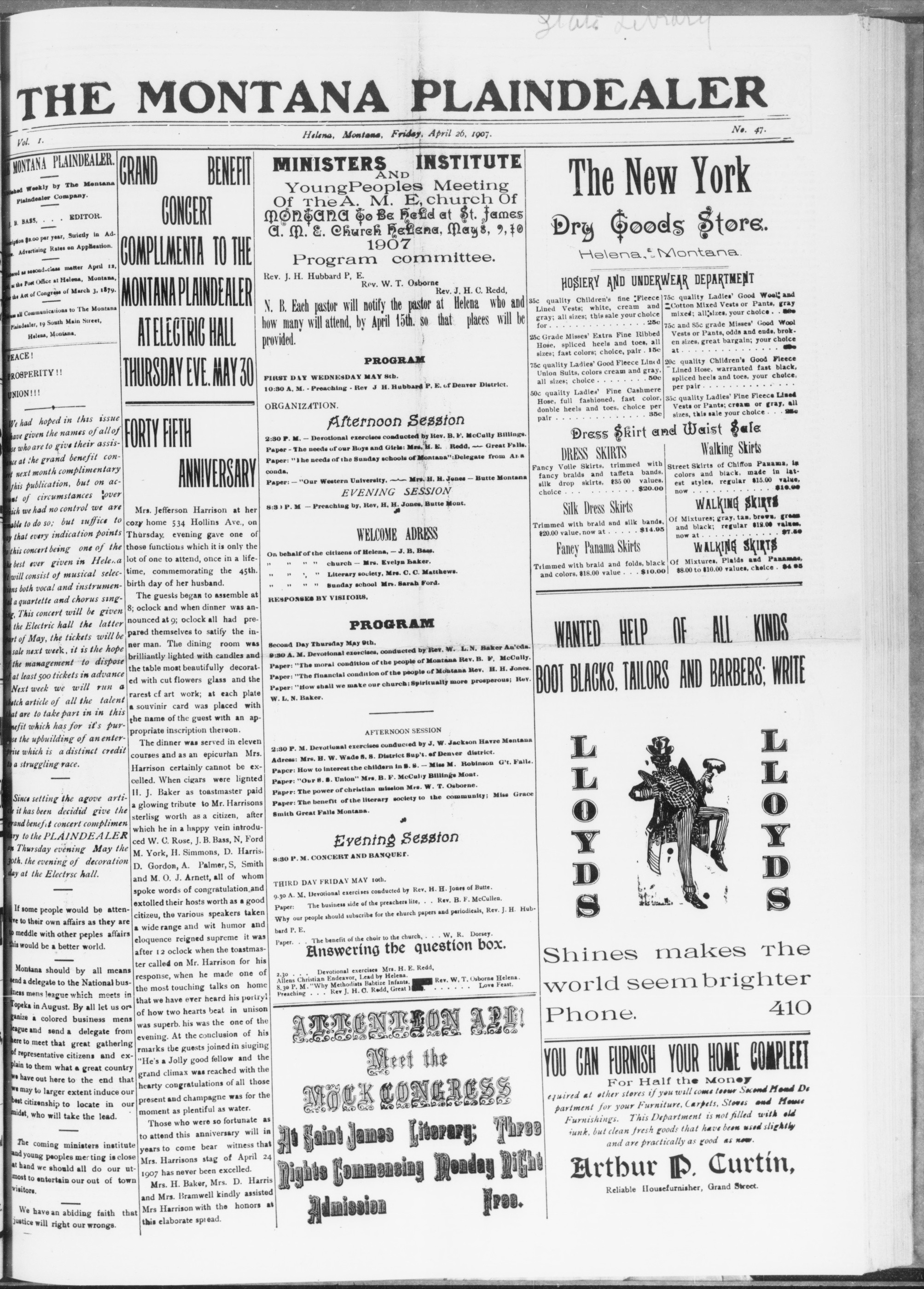
We had hoped in this issue have given the names of all of those who are to give their assistance at the grand benefit concert next month complimentary to this publication, but on account of circumstances over which we had no control we are unable to do so; but tuffice to say that every indication points to this concert being one of the best ever given in Helea. It will consist of musical selections both vocal and instrumental a quartette and chorus singing. This concert will be given at the Electric hall the latter part of May, the tickets will be on sale next week, it is the hope of the management to dispose at least 500 tickets in advance. Next week we will run a batch article of all the talents that are to take part in in this benefit which has for its purpose the upbuilding of an enterprise which is a distinct credit to a struggling race.
Since setting the agove arti it has been decidid give the grand benefit concert complimentary to the PLAINDEALER on Thursday evening May the 20th. the evening of decoration day at the Electrsc hall.
If some people would be attentive to their own affairs as they are to meddle with other peples affairs this would be a better world.
Montana should by all means send a delegate to the National business mens league which meets in Topeka in August. By all let us organize a colored business mens league and send a delegate from here to meet that great gathering of representative citizens and explain to them what a great country we have out here to the end that we may to larger extent induce our best citizenship to locate in our midst, who will take the lead.
The coming ministers institute and young peoples meeting is close at hand we should all do our utmost to entertain our out of town visitors.
We have an abiding faith that justice will right our wrongs.
CONCERT
COMPLLMENTA TO THE
MONTANA PLAINDEALER
ATELEGTRIC HALL
THURSDAY EVE. MAY 30
ANNIVERSARY
Mrs. Jefferson Harrison at her cozy home 534 Hollins Ave., on Thursday, evening gave one of those functions which it is only the lot of one to attend, once in a lifetime, commemorating the 45th. birth day of her husband.
The guests began to assemble at 8; oclock and when dinner was announced at 9; oclock all had prepared themselves to satisfy the inner man. The dining room was brilliantly lighted with candles and the table most beautifully decorated with cut flowers glass and the rarest cf art work; at each plate a souvinir card was placed with the name of the guest with an appropriate inscription thereon.
The dinner was served in eleven courses and as an epicurian Mrs. Harrison certainly cannot be excelled. When cigars were lighted H. J. Baker as toastmaster paid a glowing tribute to Mr. Harrisons sterlisg worth as a citizen, after which he in a happy vein introduced W. C. Rose, J. B. Bass, N, Ford M. York, H. Simmons, D. Harris, D. Gordon, A. Palmer, S, Smith and M. O. J. Arnett, all of whom spoke words of congratulation and extolled their hosts worth as a good citizeu, the various speakers taken a wide range and wit humor and eloquence reigned supreme it was after 12 oclock when the toastmaster called on Mr. Harrison for his response, when he made one of the most touching talks on home that we have ever heard his portryl of how two hearts beat in unison was superb. his was the one of the evening. At the conclusion of his remarks the guests joined in siuging "He's a Jolly good fellow and the grand climax was reached with the hearty congratulations of all those present and champagne was for the moment as plentiful as water.
Those who were so fortunate as to attend this anniversary will in years to come bear witness that Mrs. Harrisons stag of April 24 1907 has never been excelled. Mrs. H. Baker, Mrs. D. Harris and Mrs. Bramwell kindly assisted Mrs Harrison with the honors at this elaborate spread.
Helena, Montana, Friday, April 26, 1907.
MINISTERS
YoungPeople
Of The A. M. I.
MONTHA Do Be H
A. M. E. Church He
1907
Program co
Rev. J. H. Hubbard P, E.
Rev. W. T.
N. B. Each pastor will notify the
how many will attend, by April 15th
provided.
AND
LongPeoples Me
the A. M. E. chur
NA To Be Held at S
Church Helena, Mo
1907
gram committee
Bard P, E.
Rev. W. T. Osborne
Rev. J. I.
pastor will notify the pastor at He
attend, by April 15th. so that
YoungPeoples Meeting Of The A. M. E, church Of MONTHA To Be Held at St. James A. M. E. Church Helena, May 8, 1907
Program committee.
Rev. J. H. Hubbard P, E.
Rev. W. T. Osborne
Rev. J. H. C. Redd,
N. B. Each pastor will notify the pastor at Helena who and how many will attend, by April 15th. so that places will be provided.
PROGRAM
FIRST DAY WEDNESDAY MAY 8th.
10:30 A, M. - Proaching - Rev J H. Hubb
ORGANIZATION.
DNESDAY MAY 8th.
Teaching - Rev J H. Hubbard P. E. of Den
ON.
FIRST DAY WEDNESDAY MAY 8th.
10:30 A, M. - Preaching - Rev J H. Hubbard P. E. of Denver District.
ORGANIZATION.
Afternoon Session
2:30 P. M. — Devotional exercises conducted
Paper - The needs of our Boys and Girls: I
Paper: "I the needs of the Sunday schools
conda,
Paper: — "Our Western University,
EVENING S
8:3) P. M — Preaching by, Rev, H, H. Jo
otional exercises conducted by Rev. B. F. Sons of our Boys and Girls: Mrs. H. E. Redeems of the Sunday schools of Montana": Debr Western University. Mrs. H. H. Jones EVENING SESSION Teaching by, Rev, H. H. Jones, Butte Mont.
2:30 P. M. — Devotional exercises conducted by Rev. B. F. McCully Billings.
Paper - The needs of our Boys and Girls: Mrs. H. E. Redd, Great Falls.
Paper: "I the needs of the Sunday schools of Montana"; Delegate from At a conda.
Paper: — "Our Western University, Mrs. H, H. Jones — Butte Montana
EVENING SESSION
8:3) P. M. — Preaching by, Rev, H, H. Jones, Butte Mont.
WELCOME ADRESS
On behalf of the citizens of Helena, - J. H.
" " " " " church - Mrs. Evelyn N.
" " " ", " Literary society, Mrs. C.
" " " " " Sunday school Mrs. Sam
citizens of Helena, - J. B, Bass. church - Mrs. Evelyn Baker. Literary society, Mrs. C. C. Matthews. Sunday school Mrs. Sarah Ford.
On behalf of the citizens of Helena, - J. B. Bass.
" " " " " church - Mrs. Evelyn Baker.
" " " ", " Literary society, Mrs. C. C. Matthews.
" " " " Sunday school Mrs. Sarah Ford.
RESPONSES BY VISITORS,
PROGRAM
Second Day Thursday May 9th.
9:30 A. M. Devotional exercises, conduct
Paper: "The moral condition of the people
Paper: "The financial condition of the people
Paper: "How shall we make our church?
W. L. N. Baker.
Saturday May 9th. National exercises, conducted by Rev. W. L. Rural condition of the people of Montana Re financial condition of the people of Montana call we make our church; Spiritually more
Second Day Thursday May 9th.
9:30 A. M. Devotional exercises, conducted by Rev. W. L. N. Baker An'cda.
Paper: "The moral condition of the people of Montana Rev. B. F. McCully
Paper: "The financial condition of the people of Montana Rev. H. H. Jones
Paper: "How shall we make our church; Spiritually more prosperous; Rev
W. L. N. Baker.
AFTERNOON SESSION
2:30 P. M. Devotional exercises conducted
Adress: Mrs. H. W. Wade 8, S. District 8
Paper: How to interest the childern in S.
Paper: "Our 8. S. Union" Mrs. B. F. Mc.
Paper: The power of christian mission M.
Paper: The benefit of the literary soci
Smith Great Falls Montana.
optional exercises conducted by J, W. Jack,
W. Wade S, S. District Sup't. of Denver
interest the childern in S. S. — Miss M. F.
S. Union" Mrs. B. F. McCully Billings M.
ver of christian mission Mrs. W. T. Osborn
defit of the literary society to the commu-
nities Montana.
2:30 P. M. Devotional exercises conducted by J, W. Jackson Havre Montana
Adress: Mrs, H. W. Wade S. S. District Sup't. of Denver district.
Paper: How to interest the childern in S. S. — Miss M. Robinson G't, Falls.
Paper: "Our S. S. Union" Mrs, B. F. McCully Billings Mont.
Paper: The power of christian mission Mrs. W. T. Osborne.
Paper: The benefit of the literary society to the community; Miss Grace
Smith Great Falls Montana.
Evening Session
8:30 P. M. CONCERT AND BANQUET.
THIRD DAY FRIDAY MAY 10th.
9.30 A. M. Devotional exercises conducted by
Paper: The business side of the preachers
Why our people should subscribe for the chur
bard P. E.
Paper. . The benefit of the choir to the ch
Answering the
RIDAY MAY 10th.
National exercises conducted by Rev. H. H. Jones.
business side of the preachers lite, . . Rev. B. I.
should subscribe for the ehurch papers and pario
benefit of the choir to the church, . . . W, R.
answering the question
THIRD DAY FRIDAY MAY 10th.
9.30 A. M. Devotional exercises conducted by Rev. H. H. Jones of Butte.
Paper: The business side of the preachers lite, . . Rev. B. F. McCullen.
Why our people should subscribe for the church papers and periodicals, Rev. J. H. Hub.
hard P. E.
Paper. . . The benefit of the choir to the church, . . . W. R. Dorsey.
Answering the question box.
2.30 . . . Devotional exercises Mrs. H. E. Redd,
Allens Christian Endeavor, Lead by Helena.
8.30 P. M. "Why Methodists Babtize Infants. Rev. W, T. Osborne Helena.
Preaching. . . Rev J. H. O. Redd, Great I. . . . Love Feast.
MOCK CONGRESS At Saint James Literary; Three Nights Commencing Monday Night Admission Free.
INSTITUTE
s Meeting
C, church Of
St. James
Helena, May 8, 9, 16
committee.
usborne
Rev. J. H. C. Redd,
master at Helena who and
so that places will be
P. E. of Denver District.
by Rev. B. F. McCully Billing,
Mrs. H. E. Redd, Great Falls
Montana"; Delegate from An-
derson. H. H. Jones — Butte Montana.
SESSION
Mrs. Butte Mont.
PRESS
B. Bass.
Baker.
C. Matthews.
H Ford.
AM
by Rev. W. L. N. Baker An'co-
n of Montana Rev. B. F. McCully
ople of Montana Rev. H. H. Jon-
spiritually more prosperous; Rev.
SESSION
by J. W. Jackson Havre Monta-
tion of Denver district.
S. — Miss M. Robinson G't. Fa-
culty Billings Mont.
S. W. T. Osborne.
to the community; Miss Gr
Rev. H. H. Jones of Butte.
Ree. . Rev. B. F. McCullen.
papers and periodicals, Rev. J. H. B.
ch, . . W. R. Dorsey.
question box.
The New York Dry Goods Store.
Helena, Montana
HOSIERY AND UNDERWEAR DEPARTMENT
35c quality Children's fine Fleece Lined Vests; white, cream and gray; all sizes; this sale your choice for .....25c
25c Grade Misses' Extra Fine Ribbed Hose, spliced heels and toes, all sizes; fast colors; choice, pair . 15c
75c quality Ladies' Good Fleece Lined Union Suits, colors cream and gray, all sizes; choice .....50c
50c quality Ladies' Fine Cashmere Hose, full fashioned, fast color, double heels and toes, choice per pair .....35c
Dress Skirt ad
DRESS SKIRTS
Dress Skirt and Waist Sale
DRESS SKIRTS
Fancy Voile Skirts, trimmed with fancy braids and tafeta bands, silk drop skirts, $35.00 values, choice . . . . . . $20.00
Walking Skirts
Street Skirts of Chiffon colors and black, most styles, regular $1 now . . . . . .
Silk Dress Skirts
Trimmed with braid and silk bands.
$20.00 value, now at . . . $14.05
Fancy Panama Skirts
Trimmed with braid and folds, black
and colors, $18.00 value . . . $10.00
WANTED HELP
BOOT BLACKS, TAILORS
LLOYDS
Shines n
world see
Phone.
YOU CAN FURNISH
For Hait
equired at other stores if you
partment for your Furni
Furnishings. This De
junk, but clean fresh g
and are practi
Arthur
INTED HELP OF ALL KINDS, BLACKS, TAILORS AND BARBERS
LLOYDS
ines makes a world seem bright none.
CAN FURNISH YOUR HOME CITY
For Half the Money
at other stores if you will come to our Secondment for your Furniture, Carpets, Stoves and furnishings. This Department is not filled with ink, but clean fresh goods that have been used and are practically as good as now.
Arthur P. Curt
WANTED HELP OF ALL KINDS
BOOT BLACKS, TAILORS AND BARBERS; WRITE
LLOYDS LLOYDS
Shines makes The world seem brighter Phone. 410
YOU CAN FURNISH YOUR HOME COMPLEET
equired at other stores if you will come to our Second Mound Department for your Furniture, Carpets, Stores and House Furnishings. This Department is not filled with old junk, but clean fresh goods that have been used slightly and are practically as good as now.
Arthur P. Curtin,
Reliable Housefurnisher, Grand Street.
---
---
75c quality Ladies' Good Wool and Cotton Mixed Vests or Pants, gray mixed; all-sizes, your choice.
75c and 85c grade Misses' Good Wool Vests or Pants, odds and ends, broken sizes, great bargain; your choice at.
20c quality Children's Good Fleece Lined Hose, warranted fast black, spliced heels and toes, your choice, per pair.
35c quality Ladies' Fine Fleece Lined Vests or Pants; cream or gray, all sizes, this sale your choice.
and Waist Sale
Walking Skirts
Street Skirts of Chiffon Panama, in colors and black, made in latest styles, regular $15.00 value, now $10.99
Of Mixtures; gray, tan, brews, green
and black; regular $12.00 values.
now at ..... $7.60
WALKING SKIRTS
Of Mixtures, Plaids and Panamases
$8.00 to $10.00 values, choice.
OF ALL KINDS
S AND BARBERS; WRITE
LLOYDS
makes the
embrighter
410
YOUR HOME COMPLETE
If the Money
You will come to our Second Monday
Lature, Carpets, Stoves and House
department is not filled with old
goods that have been used slightly
ically as good as now.
P. Curtin,
---
No. 47.
WOMEN AND FASHION
Middle-Aged Woman in Society.
An entertaining old lady whose friendship I enjoyed used to say, with some impatience: "Because the Lord saw fit to remove Banbury is no reason why I should be invited to noth ing but women's lunches." Not but that she mourned the late Banbury most sincerely, but her active mind chafed at a narrowness of environment which accentuated her loneliness. In fact, it is a hardship to be condemned to a one-sided social life, and it is a mislfortune which happens to many middle-aged women and need scarcely ever happen to a man of any age; for ordinarily a man can have as much feminine society as he chooses, but what will the neighbors say about an elderly woman who announces that in order to preserve a whole and healthy view of life she must seek the society of men?
It will hardly be disputed that the exclusively feminine is worse than the exclusively masculine point of view. True, one sometimes hears of the petty falling of certain classes of men—heroes at sea, for instance, who nevertheless, owing to that isolated life, become fussy and domineering when they regain the shelter of the domestic fireside; and the tales of Bret Harte and his followers have familiarized us with the rude heroes of the mining camp and the plains. But does the naval officer, wedded to law, or the miner, divorced from it, show as great a departure from the normal human type as the woman who is shut up with other women?
Of course, there are as many points of view as there are men and women one should always remember that underneath all there is the human point of view, and that people resemble each other more than they differ yet, when all allowances have been made, some well-recognized dissimilarities do seem to be fundamental. Everybody knows, for instance, that a woman has not usually much sense of proportion; but as to that, does everybody realize how destructive to a sense of proportion of purely domestic life is—that life which, for so long, constituted a woman's all of living? Perhaps Eve may not have been lacking in it before she set up housekeeping and accumulated things. Possibly at that time her sense of humor was not subject to lapses. It is now; and it is most apt to lapse when she turns her attention on herself. For the average woman is inclined to take herself quite seriously—Scribner Magazine.
ABOUT THE BABY
More than three-quarters of a young baby's life is spent in sleep, and upon the restfulness of it depends much of the child's future strength, says the New York Evening Telegram. This being the case, it is certainly important that the sleep should be of the right kind. One of the errors of young mothers is to believe that if a baby sleeps it is surely resting. This is far from being the case, for if the crib is not comfortable, the clothing suitable and the ventilation as it should be slumber does not do for the child what it should.
One of the most important of all things is that a baby should sleep alone. I know this seems like a cold-blooded edict, and to many mothers a senseless one until they understand the reason.
First and foremost, there is always danger of a baby's being smothered when in the bed at night with another person. As a matter of fact, the death rate among infants from suffocation in this way is by no means small. It is a well-known fact that when two persons sleep together the stronger absorbs the vitality of the weaker, and that is what you can not help doing to your baby. It can not be as strong and lusty a child as it will be without this drain upon its constitution.
Schoolgirl of New Japan
School honors are prized nearly by the girl students in Japan, and are sought after very earnestly, but in a spirit of perfect good will to fellow students. A particularly brilliant girl of my acquaintance in Tokyo, writes Marian BonsalH in the Housekeeper, who was finishing her scholastic course, enjoyed beside the supremacy in most of her studies, the presidency of her class, an office she had held for two years before the following incident occurred. The girl's family knew of her diligent study and supposed that she had made an admirable record in her class, though from the girl herself they could learn nothing of her standing. One night at a dinner at her home, when one of the members of the faculty of her school was a guest, it chanced that the speaker smoke incl-
```markdown
```
dentally of the girl's long office as president of her class and the excellence of her record. The family looked at the girl in delighted surprise, but she, blushing furiously and with tears, fled from the room and could not be induced to return throughout the evening.
WITH THE DRESSMAKER
As to the tailor-mades for spring and summer, a season of light colors is imminent. Materials all along the line of worsteds, chevliots, serges and their kind proclaim it. Lovely effects are found in the serges and cheviots of white ground traversed with stripes of many widths from hair lines up. Stripes are very conspicuous in all showings of dress goods, although it cannot be said that checks and blocks seem to have lost any ground. The white grounds are striped or cross-checked with soft browns, steel, black, etc., and in some of the pieces touches of color are introduced.
Black frocks are to be much in evidence this season and a number of beautiful models are decorated principally with laces, usually two or three kinds, but a little good embroidery in skillfully harmonized colors gives a French air to a fine black gown that is most desirable. Black linens and cottons are prettiest in soft fabrics and the embroidered swisses are exquisite. One unusually effective pattern has a black ground, striped with closely set harrilines of white, and is sprinkled with tiny sprays of illias. It is charming for a second mourning costume, or makes up effectively with bits of blue satin.
At last the right material has been generally adopted for the foundation of the elaborate palletted frock. Heretofore a month of late has been expended in decorating tulle with all manner of glimmering particles, which by one evening's festivity is reduced to tags. Riotously extravagant did this perishable quality render the majority of gowns of this description, but now that a strong Brussels net is employed the spangled gown may be counted upon to withstand a reasonable amount of wear and tear. Very lovely is a cream net, embroidered in silver and opalescent spangles, arranged in a wide border at the hem, above which heavy cross lines give the empire character. The upper portion of the skirt is strewn with tiny sprays of leaves. The waist and sleeves have ample garment.
The Linen Supply.
The young housewife with little money to expend may begin with a small supply.
Six or eight pairs of sheets are essential.
One bolster and two pillow slips should be allowed to each pair of sheets.
Several white "honeycomb" spreads and a white marseilles counterpane are needed.
At least two dozen face towels, a dozen fine cup towels, a dozen dish towels and four roller towels are essential.
Four white tablecloths, one of finer quality for "occasions," will do for a beginning.
A dozen hemmed cheesecloth dusters also belong in the outfit.
There is again a craze for fancy stocks of all kinds to freshen up blouses or old bodices.
There is one made of heavy linen having turned over percale corners that reach almost to the bust.
Eyelet embroidery done with coarse linen thread depicts a conventional design on the edge and the fronts are laced through the openings with a fine cord and tassel.
Another cunning little neckpiece is made of antique embroidery and be-filled with narrow lace.
A contrivance of crosswise folds of velvet forming a short V-shaped bib has the openings filled in with silk spiderwebs. Originality distinguishes the girl who embroidered the buttons for her silk blouse with secret insignia, monograms or fraternity emblems.
Middle Class Marrílage
Among that class which in all modern and prosperous countries is the most numerous—the great middle class—marriage undoubtedly its highest development. It is here that the tender and beautiful relation which it expresses reaches its most perfect growth; it is here that the vlicsitudes of life offer it a not too severe test of purity, from which it never falls to
emerge victorious; it is here. If anywhere, that marriage becomes not the mere union of one party to another, the one superior, the other inferior, but a meeting of coals, one with the other, so that their original and separate identity is lost, and there appears instead a new and dual creature, the mantled pair, divested of the faults and composed of the excellencies of the originals of both. This ideal condition of marriage is perhaps not fully attained even among the middle classes, but it certainly approaches it more nearly there than elsewhere. And, as society, throughout the distant ages gradually perfects its form by becoming homogeneous, so will the perfect marriage, now, also, too, rare, become the universal heritage of our race.
Four Great Women
There are four women who ought to be brought to public notice while they are still in active life. One is the mother of the Dr. Osler, who already a celebrated physician, became famous by reason of being credited with the statement that man does not grow in power after 40, and that his usefulness ceases at 60.
Mrs. Osler has just celebrated her one hundredth birthday. She has reared four very distinguished sons and one daughter, has twenty six grandchildren and one great-grandchild, and is still leading a useful and comparatively active life. Another is Mrs. Mary E. Farrell, who has just ended her one hundred and third year.
She has reared eleven children, has fifteen grandchildren and twelve great grandchildren. She has never been ill a day in her life, is still a daily worker about the house, active in body and witty in mind. A third is Mrs. Susan Askey, who on her one hundred and first birthday went to church in an automobile, made an address to the audience, and held a reception in the evening. She also has borne eleven children.
The fourth is Mrs. Franklin Cottle, who at 08 years of age went through thrilling experiences at the late San Francisco disaster, arrived fresh and strong in New York a week or two later, and now, as erect as at 20 and as alert as at 60, she is about to start on a 200-mile automobile ride from New York to Boston—The Delineator.
DAME FASHIONS DECREES
Painted chiffons with deep floral borders running up the skirt are really superb.
White Neapolitan straws and coarse leghorns seem to lead among hats for the south.
Panama straws dyed in various shades will be used for morning hats with plain suits.
If the empire dress is worn the colfure should correspond in style or the charming effect is decidedly lessened.
Lovely novelties are the sheer batiste fichus, with embroidered scalloped edges and long, graceful flower designs in convent work.
One can now get wide belts of pony and caracul fur, mounted with gold buckles. They are for cold weather wear, to eke out the short fur jacket.
A very pretty French bag is of soft gray suede, with a line of silver and greendaisies embroidered along the top edge, instead of a stiff metal mounting.
Strapping, stitching and a bit of hand embroidery are used as trimming for many of the little girls' coats. Braiding is seen occasionally, but not upon the best models.
A new veil is of colored net, edged with frills of little ostrich feathers. These are worn only with hats of the same color and preferably feather-trimmed chapeaux.
A Parisian authority says that appearances point to the vogue for dark green shades in straws for the coiling season. These will be closely followed by gray and violet.
The newest waistcoats are of striped silk. They have sleeves and are kept on when the cloth coat is removed, harmonizing in color with the gown, and forming jaunty little jackets.
A smart tie is a band of Valenciennes insertion, with a narrow edge to match the ends finished with a wide ruffle of the same lace. Valenciennes and the fine laces are the most used for this fashion. Rare old pieces of lace are making their appearance in these dainty trifles.
Open-piece, lingerie frocks, whose blouses and skirts are joined by a net waistbands or girdles of lace, are numerous among the new muslin models and are more easily accomplished by the amateur dressmaker than are the purely princess models cut in one piece from yoke or shoulder to hem.
Editorials Opinions of Great Papers on Important Subjects.
HOU Shait Not Kill" neds no learned commentator to argue that it means just what it says. It neither excuses nor modifies. It does not say that its mandate may be abrogated and set at naught by any "unwritten law"—that modern euphlemism which excuses murder. The particular peo-
ple for whom the law was promulgated understood exactly what it meant and no juggling with words or mongering of sentiment can repeal that ages-old statute that places the seal of sanctity upon human life and invigils against the wanton slaying of a fellowman.
In the Ishmaleitish days of the world, when every man's hand was against every other man, it was right, because it was necessary, that each man should see to his own protection. But when society was organized men gave up their weapons to the delegated authorities and the civilized law of the world places the burden of protection upon the authorities. No individual has any right, moral or legal, to take into his own hands the administration of those laws. Civilization is nullified by such a theory and the world goes back to the age of barbarism when the fairest was the prize of the strongest—the jungle life of tooth and claw, of club and fang.
The last word of the whole matter is the word that was engraved upon the tables of stone. "Thou shalt not kill" means "thou," and "thou" means everybody.—Kansas City Journal.
the tremendous influence of the almighty in absolute security from prosecution or is it not time that the public, seeing the liberately swindled daily, should not rise live action to throttle the monstrous post powerful corporations?—Cinclnati Post. the world, when every older man, it was right.
ple for whom the law was promulgated understood exactly what it meant and no juggling with words or mongering of sentiment can repeal that ages-old statute that places the seal of sanctity upon human life and invigors against the wanton slaying of a fellowman. In the Ishmaelitic days of the world, when every man's hand was against every other man, it was right, because it was necessary, that each man should see to his own protection. But when society was organized men gave up their weapons to the delegated authorities and the civilized law of the world places the burden of protection upon the authorities. No individual has any right, moral or legal, to take into his own hands the administration of those laws. Civilization is nullified by such a theory and the world goes back to the age of barbarism when the fairest was the prize of the strongest—the jungle life of tooth and claw, of club and fang.
parents were considered necessary ele-
breeding. We have cut courtesy out of
We have come to regard it as a time-
waste—an indefinable and rather bevo-
the way of an affectation which we m
our best clothes for weddings, parties
affairs, but not to be carried about with
the prize of the strong-
daw, of club and fang.
letter is the word that
come. "Thou shalt not
ans everybody.—Kan-
AILROADS.
The last word of the whole matter is the word that was engraved upon the tables of stone. "Thou shalt not kill" means "thou," and "thou" means everybody.—Kansas City Journal.
N plunging at breakneck speed down a steep grade, have you ever allowed yourself to think of the terrible consequences should something happen, say, for instance, should the brake prove defective? This is a thought which has doubtless crossed many minds, and a glance through the daily press con-
vices one that fear of unsafe equipment on the average train is only too well justified. The operator fails in his duty, the signal don't work, a rail was broken, a trestle gave way, a defective brake and a thousand and one ready excuses are offered daily by the great railroads in a strenuous effort to shirk responsibility for the awful calamities which are now a daily occurrence. It is so convenient to say that a brake proved defective that this excuse is always relied upon in a pinch, the railroads knowing full well that it is one of the many accepted generally with scarcely a murmur of condemnation.
Why is it that the public stands by while an astute official with a shrug of the shoulders murmurs "defective brake, what are you going to do about it?" That is precisely the question, "What are you going to do about it?" Admitting that the brake proved defective, for instance, is clearly an admission of guilt in maintaining faulty or defective mechanical equipment, and consequently it is unnecessary to convict the railroads of criminal carelessness or negligence, as, by their own admission, they convict themselves, and yet a railroad company will calmly ask, "What are you going to do about it?" A claim agent is employed to settle for loss of loved ones with a few paltry dollars, the company
ment on the average
e operator falls in his
was broken, a trestle
a thousand and one
the great railroads
responsibility for the
daily occurrence. It
Maybe it is ill-mannered to say such thin
no less than the ill-mannered assertion
times. Garish vulgarity taints what is
monly at least, as the best society. He
may we get before degenerating into ut
Indianapolis Sun.
vinces one that fear of unsafe equipment on the average train is only too well justified. The operator falls in his duty, the signal don't work, a rail was broken, a trestle gave way, a defective brake and a thousand and one ready excuses are offered daily by the great railroads in a strenuous effort to shirk responsibility for the awful calamities which are now a daily occurrence. It is so convenient to say that a brake proved defective that this excuse is always relied upon in a pinch, the railroads knowing full well that it is one of the many accepted generally with scarcely a murmur of condemnation.
Why is it that the public stands by while an astute official with a shirug of the shoulders murmurs "defective brake, what are you going to do about it?" That is precisely the question, "What are you going to do about it?" Admitting that the brake proved defective, for instance, is clearly an admission of guilt in maintaining faulty or defective mechanical equipment, and consequently it is unnecessary to convict the railroads of criminal carelessness or negligence, as, by their own admission, they convict themselves, and yet a railroad company will calmly ask, "What are you going to do about it?" A claim agent is employed to settle for loss of loved ones with a few paltry dollars, the company
you going to do about loved defective, for in-guilt in maintaining equipment, and consec-tect the railroads of life, as, by their own and yet a railroad are you going to do they to settle for loss dollars, the company
FIRST WHITE WOMAN TO CROSS EQUATORIAL AIR
FIRST WHITE WOMAN TO CROSS EQUATORIAL AFRICA.
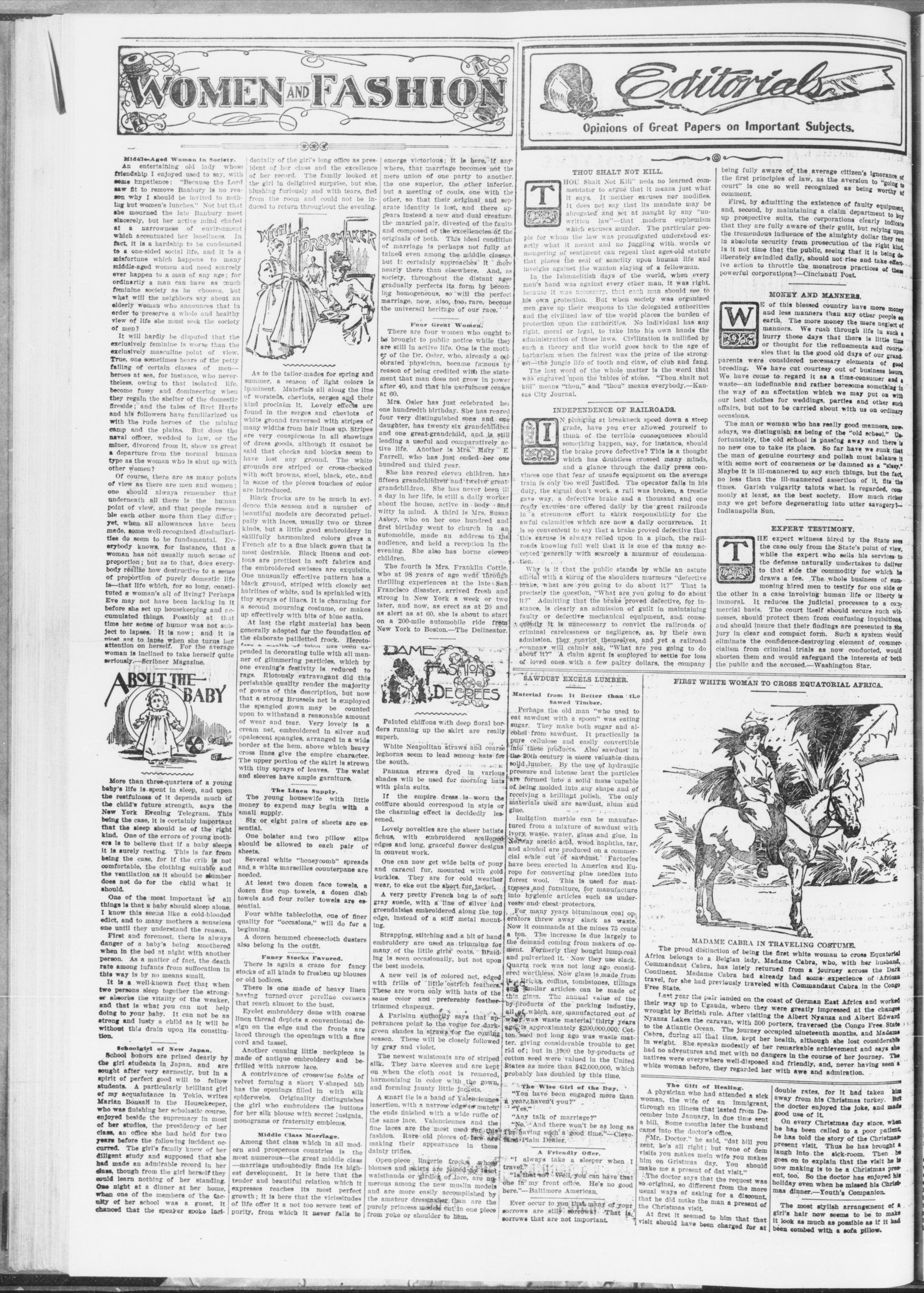
The proud distinction of being the first white woman to cross Africa belongs to a Belgian lady, Madame Cabra, who, with Commandant Cabra, has lately returned from a journey across Continent. Madame Cabra had already had some experience travel, for she had previously traveled with Commandant Cabra Free State.
Last year the pair landed on the coast of German East Africa their way up to Uganda, where they were greatly impressed and wrought by British rule. After visiting the Albert Nyanza and the Nyanza Lakes the caravan, with 300 porters, traversed the Coral to the Atlantic Ocean. The journey occupied nineteenth months Cabra, during all that time, kept her health, although she lost in weight. She speaks modestly of her remarkable achievement had no adventures and met with no dangers in the course of her natives were everywhere well-disposed and friendly, and, never white woman before, they regarded her with awe and admiration.
The proud distinction of being the first white woman to cross Equatorial Africa belongs to a Belgian lady, Madame Cabra, with her husband, Commandant Cabra, has lately returned from a journey across the Dark Continent. Madame Cabra had already had some experience of African travel, for she had previously traveled with Commandant Cabra in the Congo Free State.
Last year the pair landed on the coast of German East Africa and worked their way up to Uganda, where they were greatly impressed at the changes wrought by British rule. After visiting the Albert Nyanza and Albert Edward Nyanza Lakes the caravan, with 300 porters, traversed the Congo Free State to the Atlantic Ocean. The journey occupied nineteenth months, and Madame Cabra, during all that time, kept her health, although she lost considerable in weight. She speaks modestly of her remarkable achievement and says she had no adventures and met with no dangers in the course of her journey. The natives were everywhere well-disposed and friendly, and, never having seen a white woman before, they regarded her with awe and admiration.
The Gift of Healing.
A physician who had attended a sick woman, the wife of an immigrant, through an illness that lasted from December into January, in due time sent a bill. Some months later the husband came into the doctor's office.
"Mr. Doctor," he said, "dat bill you zent, he's all right; but vone of dem visits you makes meln wife you makes him on Gristmas day. You should make me a present of dat visit."
The doctor says that the request was so original, so different from the more usual ways of asking for a discount, that he did make the man a present of the Christmas visit.
At first it seemed to him that that visit should have been charged for at
---
---
THOU SHALT NOT KILL.
T
INDEPENDENCE OF RAILROADS.
I
SAWDUST EXCELS LUMBER.
Material from It Better than the Sawed Timber.
Perhaps the old man "who used to eat sawdust with a spoon" was eating sugar. They make both sugar and alcohol from sawdust. It practically is pure cellulose and easily convertible into these products. Also sawdust in the 20th century is more valuable than solid lumber. By the use of hydraulic pressure and intense heat the particles are formed into a solid mass capable of being molded into any shape and of receiving a brilliant polish. The only materials used are sawdust, alum and glue.
Imitation marble can be manufactured from a mixture of sawdust with ivory, waste, water, glass and glue. In Norway acetic acid, wood naphtha, tar, and alcohol are produced on a commercial scale out of sawdust. Factories have been erected in America and Europe for converting pine needles into forest wool. This is used for mattresses and furniture, for manufacture into hygienic articles such as undervests and chest protectors.
For many years bituminous coal operators threw away slack as waste. Now it commands at the mines 75 cents a ton. The increase is due largely to the demand coming from makers of cement. Formerly they bought lump coal and pulverized it. Now they use slack. Quartz rock was not long ago considered worthless. Now glass is made from it. Bricks, coffins, tombstones, tillings and similar articles can be made of this glass. The annual value of the by-products of the packing industry, all of which are manufactured out of what was waste material" thirty years ago, is approximately $200,000,000. Cotton, seed not long ago was waste matter, giving considerable trouble to get rid of; but in 1600 the by-products of cotton seed were valued in the United States as more than $42,000,000, which probably has doubled by this time.
The Wise Girl of the Day.
"You have been engaged more than a year, haven't you?"
"Yes."
"Any talk of marriage?"
"No. And there won't be as long as I'm having such a good time."—Cleveland Plain Dealer.
A Friendly Offer.
"I always take a sleeper when I travel."
"Is that so? Well, you can have that one in my front office. He's no good here." - Baltimore American.
Ever occur to you that many of your sorrows are still sorrows? That is sorrows that are not important.
being fully aware of the average citizen's ignorance of the first principles of law, as the aversion to "going to court" is one so well recognized as being worthy of comment.
First, by admitting the existence of faulty equipment, and, second, by maintaining a claim department to buy up prospective suits, the corporations clearly indicate that they are fully aware of their guilt, but relying upon the tremendous influence of the almighty dollar they rest in absolute security from prosecution of the right kind.
Is it not time that the public, seeing that it is being deliberately swindled daily, should not rise and take effective action to throttle the monstrous practices of these powerful corporations?—Cincinnati Post.
MONEY AND MANNERS
E of this blessed country have more money and less manners than any other people on earth. The more money the more neglect of manners. We rush through life in such a hurry these days that there is little time or thought for the refinements and courtesies that in the good old days of
are considered necessary elements of good. We have cut courtesy out of business hours, one to regard it as a time-consumer and a definable and rather borsesome something in an affectation which we may put on with othes for weddings, parties and other not to be carried about with us on ordinary or woman who has really good manners, nowlistinguish as being of the "old school." Unlike the old school is passing away and there is to take its place. So far have we sunk that genuine courtesy and polish must balance it sort of coarseness or be damned as a "slasy," ill-mannered to say such things, but the fact, in the ill-mannered assertion of it, fits the fish vulgarity taints what is regarded, contrast, as the best society. How much richer before degenerating into utter savagery?—Sun.
parents were considered necessary elements of good breeding. We have cut courtesy out of business hours. We have come to regard it as a time-consumer and a waste—an indefinable and rather besome something in the way of an affectation which we may put in with our best clothes for weddings, parties and other such affairs, but not to be carried about with us on ordinary occasions.
The man or woman who has really good manners, nowadays, we distinguish as being of the "old school." Unfortunately, the old school is passing away and there is no new one to take its place. So far have we sunk that the man of genuine courtesy and polish must balance it with some sort of coarseness or be damned as a "slay." Maybe it is ill-mannered to say such things, but the fact, no less than the ill-mannered assertion of it, fits the times. Garish vulgarity talts what is regarded, commonly at least, as the best society. How much richer may we get before degenerating into utter savagery? Indianapolis Sun.
EXPERT TESTIMONY:
HE expert witness hired by the State sees the case only from the State's point of view, while the expert who sells his services to the defense naturally undertakes to deliver to that side the commodity for which he draws a fee. The whole business of summoning hired men to testify for one side or
in a case involving human life or liberty is not reduces the judicial processes to a con-
sensus. The court itself should secure such wifi
protect them from confusing inquisitions
ensure that their findings are presented to the
r and compact form. Such a system would
be confidence-destroying element of commer-
cinal trials as now conducted, would
and would safeguard the interests of both
and the accused.—Washington Star.
TO CROSS EQUATORIAL AFRICA.
the other in a case involving human life or liberty is immoral. It reduces the judicial processes to a commercial basis. The court itself should secure such witnesses, should protect them from confusing inquisitions, and should insure that their findings are presented to the jury in clear and compact form. Such a system would eliminate the confidence-destroying element of commercialism from criminal trials as now conducted, would shorten them and would safeguard the interests of both the public and the accused.-Washington Star.
MADAME CABRA IN TRAVELING COSTUME.
and distinction of being the first white woman to cross Equatorial
legs to a Belgian lady, Madame Cabra, who, with her husband,
at Cabra, has lately returned from a journey across the Dark
Madame Cabra had already had some experience of African
she had previously traveled with Commandant Cabra in the Congo
for the pair landed on the coast of German East Africa and worked
up to Uganda, where they were greatly impressed at the changes
British rule. After visiting the Albert Nyanza and Albert Edward
the caravan, with 300 porters, traversed the Congo Free State
economic Ocean. The journey occupied nineteenth months, and Madame
g all that time, kept her health, although she lost considerable
She speaks modestly of her remarkable achievement and says she
tures and met with no dangers in the course of her journey. The
everywhere well-disposed and friendly, and, never having seen a
before, they regarded her with awe and admiration.
Gift of Healing.
who had attended a sick
wife of an immigrant,
ness that lasted from De-
annual in
On every Christmas day since, when he has been called to a poor patient, he has told the story of the Christmas present visit. Thus he has brought a laugh into the sick-room. Then he goes on to explain that the visit he is now making is to be a Christmas present, too. So the doctor has enjoyed his holiday even when he missed his Christmas dinner.—Youth's Companion.
The most stylish arrangement of a girl's hair now seems to be to make it look as much as possible as if it had been combed with a sofa pillow.
W
T
LEAD LONELY LIVES.
MOST DANGEROUS LIGHTSHIP STATION IN THE WORLD.
That Maintained by Uncle Sam Off Nantucket, Mass., Is Noted—Hardy Sailorman Who Constantly Face Perils in Many Forms.
Probably upon no reef guard station in the world have the lives of brave and bold men been so often hazarded up on the Nantucket Shoals lightship, which is located forty miles south from Nantucket, Mass. More than half a century has elapsed since the government first stationed a lightship at this dangerous and lonesome spot. Until recently the lightship was a sail equipped vessel, but now it is steam propelled; yet whether operated by steam or sail the dangers and hardships of the men confined on it are one and the same.
Forty miles out at sea, cooped in the little shell that, day after day and month after month, swings and tugs at its 7,000-pound anchor lying in 18 fathoms of water, the life of the Nantucket lightship sailorman is one of almost complete isolation from the first of November until the opening of the spring months. During the bitterest six months of the year there are no reprieve or shore leave.
Sometimes for two months or more, during the severest periods of the winter, these dozen men are without communication with the shore save the messages sent to them by wireless telegraphy. Often for days their only visible companion is the great red-brown buoy swinging in the sea half a mile from the ship.
Even this object, which is endear-ed to the heart of every man aboard the lightship. In particularly bad weather breaks adrift from its moorings or is frequently shut out from sight for weeks by the dense fogs which drift in over the ocean like a pall from the southward, and then the melancholy of the loneliness which pervades these men is not lifted until a close passing vessel or the infrequent advent of the winter sunlight comes to chase away the monotony of their existence.
But loneliness is only one of the hardships of the men on the Nantucket Shoals lightship, though it is the one dreaded. There are the days when the fog settles down over the isolated vessel in a thick, damp cloak, completely enshrouding the hulk from stem to stern—days when only the far off sound of a passing steamer's ghostly whistle or a sailing vessel's horn, or the systematic roar of the steam fog horn aboard the lightship, is all their world.
Once for twelve consecutive nights
TUCKET SHO
NTUCKET SHOALS
and days the bell which was used aboard the old ship there was kept ringing at two-minute intervals, with the result that when the fog had lifted and the noise ceased, the men were unable to sleep for the first night on account of the poor weather. Uncle Sam to be that the crew is the vessel, even if but it has never men have allowed or crew to go unn
But there is still another danger besides that of being run down. When the winter storms of the Atlantic sweep across the shoals, tossing the lightship like a shuttlecock and burying her thwartships, these men abead, clinging in their bunks between decks or standing watch through the bitter cold hours of the night in the lee of the oak bulwarks, indifferently sheltered from the loet sheet and spray, know not at what moment the great anchor chain may part under the lunges of the rolling vessel and set them adrift in the inky darkness in a battle for life.
Twenty-four times the Nantucket lightship has parted her chains, usually in the heart of the bitterest winter gales, and been swept to sea. Only a year ago vessel and crew thus adrift from moorings were given up for lost. Once during the period of the old sailing lightship's maintenance the vessel was fourteen days in picking her way back to port after having been driven far to sea.
Pots and kettles in the cook's room are always lashed to the stove and the walls to prevent them from flying about under the stress of the rolling ship. Each member of the crew when he sits down to the little mume table below decks has his coffee cup and his tin plate securely held in place by a number of pegs set in the table. Sometimes even then the coffee goes flying into the plumduff or the scource (made
---
WOMAN.
the
eless
only
red-
half
Lady Beatrice Pole-Carew has be
beautiful woman in England. Her
London evening newspaper was over
London voted. Princess Henry of
Sutherland third. Two American be
be well down the list.
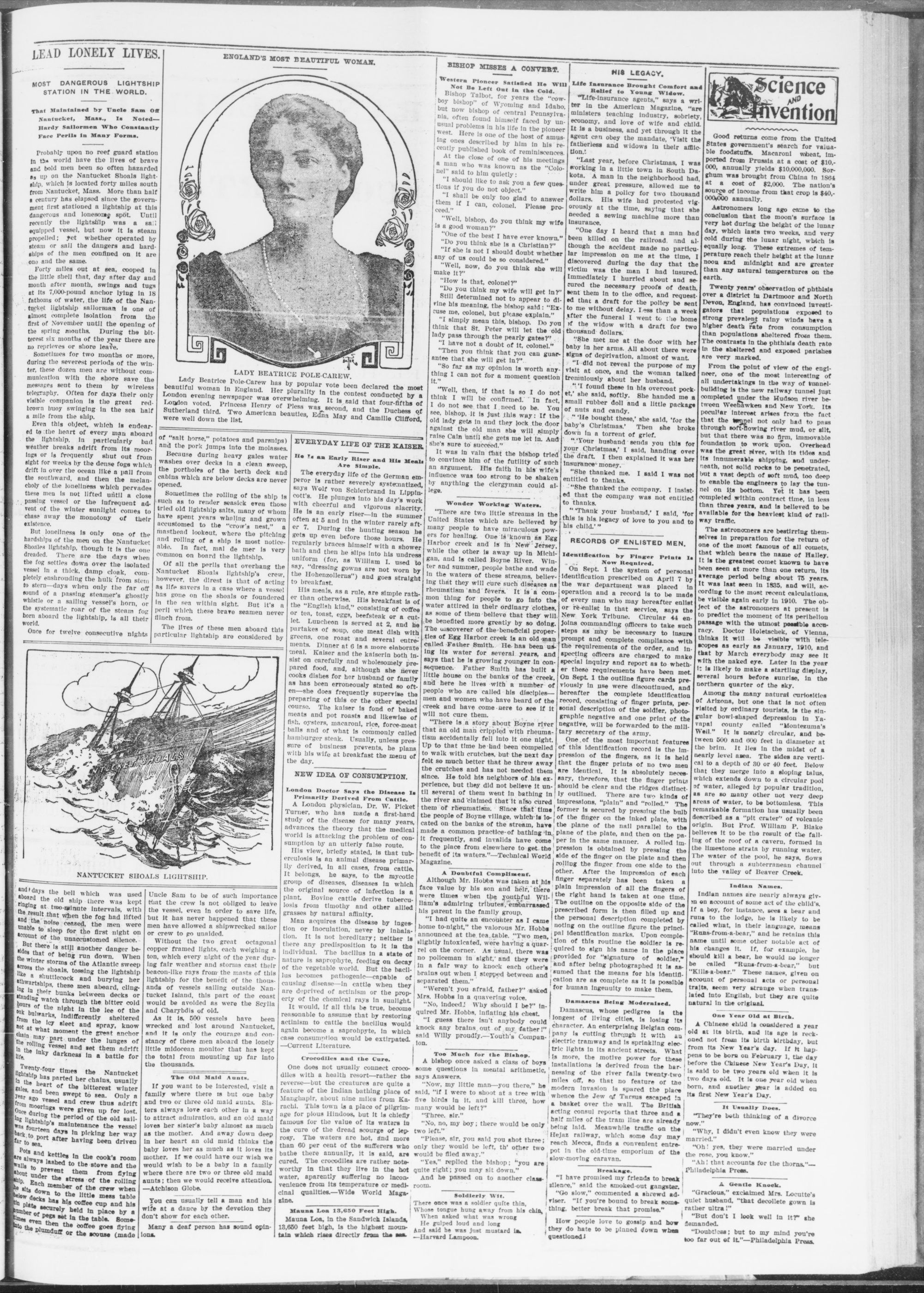
Lady Beatrice Pole-Carew has by popular vote been declared the most beautiful woman in England. Her plurality in the contest conducted by a London evening newspaper was overwhelming. It is said that four-fifths of London voted. Princess Henry of Pless was second, and the Duchess of Sutherland third. Two American beauties, Edna May and Camille Clifford, were well down the list.
of "salt horse," potatoes and parsnips) and the pork jumps into the molasses.
Because during heavy gales water washes over decks in a clean sweep, the portholes of the berth deck and cabins which are below decks are never opened.
Sometimes the rolling of the ship is such as to render seasick even those tried old lightship salts, many of whom have spent years whaling and grown accustomed to the "crow's nest," a masthead lookout, where the pitching and rolling of a ship is most noticeable. In fact, mal de mer is very common on board the lightship.
EVERYDAY LIFE OF THE KAISER
He is an Early Riser and His Meals Are Simple.
The everyday life of the German emperor is rather severely systematized, says Wolf von Schlerbrand in Lippincott's. He plunges into his day's work with cheerful and vigorous alacrity. He is an early riser—in the summer often at 5 and in the winter rarely after 7. During the hunting season he gets up even before those hours. He regularly braces himself with a shower bath and then he slips into his undress uniform (for
Of all the perils that overhang the Nantucket Shoals lightship's crew, however, the direst is that of acting as life savers in a case where a vessel has gone on the shoals or foundered in the sea within sight. But it's a peril which these brave seamen never flinch from. The lives of these men aboard this particular lightship are considered by
SHOALS
Uncle Sam to be of such importance that the crew is not obliged to leave the vessel, even in order to save life, but it has never happened that these men have allowed a shipwrecked sailor or crew to go unaided.
Without the two great octagonal copper framed lights, each weighing a ton, which every night of the year during fair weather and storms cast their beacon-like rays from the masts of this lightship for the benefit of the thousands of vessels sailing outside Nantucket Island, this part of the coast would be avoided as were the Scylla and Charybdis of old.
As it is, 500 vessels have been wrecked and lost around Nantucket, and it is only the courage and constancy of these men aboard the lonely little midocean monitor that has kept the total from mounting up far into the thousands.
The Old Maid Aunts
If you want to be interested, visit a family where there is but one baby and two or three old maid aunts. Sisters always love each other in a way to attract admiration, and an old maid loves her sister's baby almost as much as the mother. And away down deep in her heart an old maid thinks the baby loves her as much as it loves its mother. If we could have our wish we would wish to be a baby in a family where there are two or three old maid aunts; then we would receive attention. —Atchison Globe.
You can usually tell a man and his wife at a dance by the devotion they don't show for each other.
Many a deaf person has sound opinion.
---
LADY BEATRICE POLE-CAREW
EVERYDAY LIFE OF THE KAISER
He Is an Early Riser and His Meals Are Simple.
The everyday life of the German emperor is rather severely systematized, says Wolf von Schlerbrand in Lippincott's. He plunges into his day's work with cheerful and vigorous alacrity. He is an early riser—in the summer often at 5 and in the winter rarely after 7. During the hunting season he gets up even before those hours. He regularly braces himself with a shower bath and then he slips into his undress uniform (for, as William I. used to say, "dressing gowns are not worn by the Hohenzollern") and goes straight to breakfast.
His meals, as a rule, are simple rath er than otherwise. His breakfast is of the "English kind," consisting of coffee or tea, toast, eggs, beefsteak or a cutlet. Luncheon is served at 2, and he partakes of soup, one meat dish with greens, one roast and several entreatments. Dinner at 6 is a more elaborate meal. Kaiser and the kaiserin both insist on carefully and wholesomely prepared food, and, although she never cooks dishes for her husband or family as has been erroneously stated so often—she does frequently supervise the preparing of this or the other special course. The kaiser is fond of baked meats and pot roasts and likewise of fish, oysters, macaroni, rice, force-meat balls and of what is commonly called hamburger steak. Usually, unless pressure of business prevents, he plans with his wife at breakfast the menu of the day.
NEW IDEA OF CONSUMPTION
London Doctor Says the Disease Is
Primarily Derived From Giddy
Primarily Derived From Cattle.
A London physician, Dr. W. Picket Turner, who has made a first-hand study of the disease for many years, advances the theory that the medical world is attacking the problem of consumption by an utterly false route.
His view, briefly stated, is that tuberculosis is an animal disease primarily derived, in all cases, from cattle. It belongs, he says, to the mycotic group of diseases, diseases in which the original source of infection is a plant. Bovine cattle derive tuberculosis from timothy and other allied grasses by natural affinity.
Man acquires the disease by ingestion or inoculation, never by inhalation. It is not hereditary; neither is there any predisposition to it in the individual. The bacillus in a state of nature is saprophyte, feeding on decay of the vegetable world. But the bacillus becomes pathogenic—capable of causing disease—in cattle when they are deprived of actinism or the property of the chemical rays in sunlight. It would, if all this be true, become reasonable to assume that by restoring actinism to cattle the bacillus would again become a saprophyte, in which case consumption would be extirpated.—Current Literature.
Crocodiles and the Cure.
One does not usually connect crocodiles with a health resort—rather the reverse—but the creatures are quite a feature of the Indian bathing place of Manghaplir, about nine miles from Karachi. This town is a place of pilgrimage for plous Hindoos, but it is chiefly famous for the value of its waters in the cure of the dread scourge of leprosy. The waters are hot, and more than 60 per cent of the sufferers who bathe there annually, it is said, are cured. The crocodiles are rather noteworthy in that they live in the hot water, aparently suffering no inconvenience from its temperature or medicinal qualities.—Wide World Magazine.
Mauna Loa 13:650 Fet High
Mauna Loa, in the Sandwich Islands, 13,650 feet high, is the highest mountain which rises directly from the sea.
BISHOP MISSES A CONVERT.
Pioneer Satisfied He Will Not Be Left Out in the Cold.
Bishop Talbot, for years the "cowboy bishop" of Wyoming and Idaho, but now bishop of central Pennsylvania, often found himself faced by unusual problems in his life in the pioneer west. Here is one of the host of amusing ones described by him in his recently published book of reminiscences.
At the close of one of his meetings a man who was known as the "Colonel" said to him quietly:
"I should like to ask you a few questions if you do not object."
"I shall be only too glad to answer them if I can, colonel. Please proceed."
"Well, bishop, do you think my wife is a good woman?"
"One of the best I have ever known."
"Do you think she is a Christian?"
"If she is not I should doubt whether any of us could be so considered."
"Well, now, do you think she will make it?"
"How is that, colonel?"
"Do you think my wife will get in?"
Still determined not to appear to divine his meaning, the bishop said: "Excuse me, colonel, but please explain."
"I have not a doubt of it, colonel."
"Then you think that you can guarantee that she will get in?"
"So far as my opinion is worth anything I can not for a moment question it."
"Well, then, if that is so I do not think I will be confirmed. In fact, I do not see that I need to be. You see, bishop, it is just this way: If the old lady gets in and they lock the door against the old man she will simply raise Calm until she gets me let in. And she's sure to succeed."
It was in vain that the bishop tried to convince him of the futility of such an argument. His faith in his wife's influence was too strong to be shaken by anything the clergyman could allege.
Wonder Working Waters.
"There are two little streams in the United States which are believed by many people to have miraculous powers for healing. One is known as Egg Harbor creek and is in New Jersey, while the other is away up in Michigan, and is called Boyne River. Winter and summer, people bathe and wade in the waters of these streams, believing that they will cure such diseases as rheumatism and fevers. It is a common thing for people to go into the water attired in their ordinary clothes, as some of them believe that they will be benefited more greatly by so doing. The discoverer of the beneficial properties of Egg Harbor creek is an old man called Father Smith. He has been using its water for several years, and says that he is growing younger in consequence. Father Smith has built a little house on the banks of the creek, and here he lives with a number of people who are called his disciples—men and women who have heard of the creek and have come here to see if it will not cure them.
"There is a story about Boyne river that an old man crippled with rheumatism accidentally fell into it one night. Up to that time he had been compelled to walk with crutches, but the next day felt so much better that he threw away the crutches and has not needed them since. He told his neighbors of his experience, but they did not believe it until several of them went in bathing in the river and claimed that it also cured them of rheumatism. Since that time the people of Boyne village, which is located on the banks of the stream, have made a common practice of bathing in it frequently, and invalids have come to the place from elsewhere to get the benefit of its waters."—Technical World Magazine.
A Doubtful Compliment
Although Mr. Hobbs was taken at his face value by his son and heir, there were times when the youthful William's admiring tributes, embarrassed his parent in the family group.
"I had quite an encounter as I came home to night," the valorous Mr. Hobbs announced at the tea table. "Two men, slightly intoxicated, were having a quarrel on the corner. As usual, there was no policeman in sight; and they were in a fair way to knock each other's brains out when I stepped between and separated them."
"Weren't you afraid, father?" asked Mrs. Hobbs in a quavering voice.
"No, indeed. Why should I be?" inquired Mr. Hobbs, inflating his chest.
"I guess there isn't anybody could knock any brains out of my father!" said Willy proudly.—Youth's Companion.
Too Much for the Bishop
A bishop once asked a class of boys some questions in mental arithmetic, says Answers.
"Now, my little man—you there," he said, "if I were to shoot at a tree with five birds in it, and kill three, how many would be left?"
"Three, sir."
"No, no, my boy; there would be only two left."
"Please, sir, you said you shot three; only they would be left, th' other two would be fled away."
"Yes," replied the bishop; "you are quite right; you may sit down."
And he passed on to another classroom.
Soldierly Wit.
He gulped loud and long
And said he was just mustard in.
-Harvard Lampoon.
H18 LEGACY.
Life Insurance Brought Comfort and Relief to Young Widow.
Ketter to Young Widow.
"Life-insurance agents," says a writer in the American Magazine, "are ministers teaching industry, sobriety, economy, and love of wife and child. It is a business, and yet through it the agent can obey the mandate, Visit the fatherless and widows in their affliction."
"Last year, before Christmas, I was working in a little town in South Dakota. A man in the neighborhood had, under great pressure, allowed me to write him a policy for two thousand dollars. His wife had protested vigorously at the time, saying that she needed a sewing machine more than insurance.
"One day I heard that a man had been killed on the railroad. and al though the accident made no particular impression on me at the time, I discovered during the day that the victim was the man I had insured. Immediately I hurried about and secured the necessary proofs of death, sent them in to the office, and requested that a draft for the policy be sent to me without delay. Less than a week after the funeral I went to the home of the widow with a draft for two thousand dollars.
"She met me at the door with her baby in her arms. All about there were signs of deprivation, almost of want.
"I did not reveal the purpose of my visit at once, and the woman talked tremulously about her husband."
"I found these in his overcoat pocket,' she said, softly. She handed me a small rubber doll and a little package of nuts and candy.
"He bought these,' she said,' for the baby's Christmas.' Then she broke down in a torrent of grief.
"Your husband sends you this for your Christmas,' I said, handling over the draft. I then explained it was her insurance money.
"She thanked me. I said I was not entitled to thanks.
"She thanked the company. I insisted that the company was not entitled to thanks.
"Thank your husband,' I said,' for this is his legacy of love to you and to his child."
RECORDS OF ENLISTED MEN
Identification by Finger Prints Is Now Required.
On Sept. 1 the system of personal identification prescribed on April 7 by the war department was placed in operation and a record is to be made of every man who may hereafter enlist or re-enlist in that service, says the New York Tribune. Circular 44 enjoins commanding officers to take such steps as may be necessary to insure prompt and complete compliance with the requirements of the order, and inspecting officers are charged to make special inquiry and report as to whether these requirements have been met On Sept. 1 the outline figure cards previously in use were discontinued, and hereafter the complete identification record, consisting of finger prints, personal description of the soldier, photographic negative and one print of the negative, will be forwarded to the military secretary of the army.
One of the most important features of this identification record is the impression of the fingers, as it is held that the finger prints of no two men are identical. It is absolutely necessary, therefore, that the finger prints should be clear and the ridges distinctly outlined. There are two kinds of impressions, "plain" and "rolled." The former is secured by pressing the bulb of the finger on the linked plate, with the plane of the nail parallel to the plane of the plate, and then on the paper in the same manner. A rolled impression is obtained by pressing the side of the finger on the plate and then rolling the finger from one side to the other. After the impression of each finger separately has been taken a plain impression of all the fingers of the right hand is taken at one time. The outline on the opposite side of the prescribed form is then filled up and the personal description completed by noting on the outline figure the principal identification marks. Upon completion of this routine the soldier is required to sign his name in the place provided for "signature of soldier," and after being photographed it is assumed that the means for his identification are as complete as it is possible for human ingenuity to make them.
Damascus Being Modernized
Damascus, whose pedigree is the longest of living cities, is losing its character. An enterprising Belgian company is cutting through it with an electric tramway and is sprinkling electric lights in its ancient streets. What is more, the motive power for these installations is derived from the harnessing of the river falls twenty-two miles off, so that no feature of the modern invasion is spared the place whence the Jew of Tarsus escaped in a basket over the wall. The British acting consul reports that three and a half miles of the tram line are already being laid. Meanwhile traffic on the Hejaz railway, which some day may reach Mecca, finds a convenient entrepot in the old-time emporium of the slow-moving caravan.
Breakage.
"I have promised my friends to break silence," said the smoked-out gangster. "Go slow," commented a shrewd adviser. "If you're bound to break something, better break that promise."
How people love to gossip and how they do hate to be planned down when questioned
Science AND Invention
Good returns come from the United States government's search for valuable foodstuffs. Macaroni wheat, imported from Prussia at a cost of $10,000, annually yields $10,000,000. Sorghum was brought from China in 1864 at a cost of $2,000. The nation's source of income from that crop is $40,000,000 annually.
Astronomers long ago came to the conclusion that the moon's surface is very hot during the height of the lunar day, which lasts two weeks, and very cold during the lunar night, which is equally long. These extremes of temperature reach their height at the lunar noon and midnight and are greater than any natural temperatures on the earth.
Twenty years' observation of phthisis over a district in Dartmoor and North Devon, England, has convinced investigators that populations exposed to strong prevalent rainy winds have a higher death rate from consumption than populations sheltered from them. The contrasts in the phthisis death rate in the sheltered and exposed parishes are very marked.
From the point of view of the engineer, one of the most interesting of all undertakings in the way of tunnel-building is the new railway tunnel just completed under the Hudson river between Weehawken and New York. Its peculiar interest arises from the fact that the tunnel not only had to pass through soft flowing river mud, or slit, but that there was no firm, immovable foundation to work upon. Overhead was the great river, with its tides and its innumerable shipping, and underneath, not solid rocks to be penetrated, but a vast depth of soft mud, too deep to enable the engineers to lay the tunnel on its bottom. Yet it has been completed within contract time, in less than three years, and is believed to be available for the heaviest kind of railway traffic.
The astronomers are bestirring themselves in preparation for the return of one of the most famous of all comets, that which bears the name of Halley. It is the greatest comet known to have been seen at more than one return, its average period being about 75 years. It was last seen in 1835, and will, according to the most recent calculations, be visible again early in 1910. The object of the astronomers at present is to predict the moment of its perihelion passage with the utmost possible accuracy. Doctor Holetschek, of Vienna, thinks it will be visible with telescopes as early as January, 1910, and that by March everybody may see it with the naked eye. Later in the year it is likely to make a startling display, several hours before sunrise, in the northern quarter of the sky.
Among the many natural curiosities of Arizona, but one that is not often visited by ordinary tourists, is the singular bowl-shaped depression in Yavapai county called "Montezuma's Well." It is nearly circular, and between 500 and 600 feet in diameter at the brim. It lies in the midst of a nearly level area. The sides are vertical to a depth of 30 or 40 feet. Below that they merge into a sloping talus, which extends down to a circular pool of water, alleged by popular tradition, as are so many other not very deep areas of water, to be bottomless. This remarkable formation has usually been described as a "pit crater" of volcanic origin. But Prof. William P. Blake believes it to be the result of the falling of the roof of a cavern, formed in the limestone strata by running water. The water of the pool, he says, flows out through a subterranean channel into the valley of Beaver Creek.
Indian Names.
Indian names are nearly always given on account of some act of the child's. If a boy, for instance, sees a bear and runs to the lodge, he is likely to be called what, in their language, means "Runs-from-a-bear," and he retains this name until some other notable act of his changes it. If, for example, he should kill a bear, he would no longer be called "Runs-from-a-bear," but "Kills-a-bear." These names, given on account of personal acts or personal traits, seem very strange when translated into English, but they are quite natural in the original.
One Year Old at Birth
A Chinese child is considered a year old at its birth, and its age is reckoned not from its birth birthday, but from its New Year's day. If it happens to be born on February 1, the day before the Chinese New Year's Day, it is said to be two years old when it is two days old. It is one year old when born, and another year is added on its first New Year's Day.
It Usually Does.
"They're both thinking of a divorce now."
"Why, I didn't even know they were married."
"Oh! yes, they were married under the rose, you know."
"Ah! that accounts for the thorns."—Philadelphia Press.
Gentle Knock.
"Gracious," exclaimed Mrs. Locutte's quiet husband, "that decollete gown is rather ultra!"
"But don't I look well in it?" she femanded.
"Doubless; but to my mind you're too far out of it."—Philadelphia Press.
Persons living out of town who wish to take advantage of the facil ities of our Savings Department. can deposit with us any amount from $1 up, by mail.
On deposits in our savings department we pay 4 per cent interest, compounded semiannually.
The money may be drawn out at any time, but interest will be paid only when left on deposit at least four full months.
Banking by mail is safe convenient and strictly confidential.
Deposits may be made by money order or bank check, or in currency sent by registered letter.
UNION BANK AND TRUSTCOMPANY Helena Montana.
Trade with the Helena Packing and revision company.
Mr. Alonza Leatherbury is visiting in Helena this week he is taking a much ueeded rest and will be in our midst for a month.
H. W. Robinson is down from Elliston, he is busy shipping ore from his mines at that place.
W. H. Mason chef at the Grandon was a caller at this office this week, he is a practical printer and all around newspaper mau whom we welcome to our city.
Several parties are contemplating a trip to Butte next week to atteud fne grand ball which takes place Wednesday evening.
The Never Sweats ball team under the management of Uncle Dave Gordon will cross bats with the Hub nine at Central park Sunday everybody should turn out and see this game as without doubt it will be a good one.
T. S. Thomas of the Broadwater seems to be the season.
Our only I Hicks has shipped to help construct the Milwaukee railroad,
F. E. Gordon better known as Blondie hot footed it back to his home at White Sulpher Springs where he says he knows he can get by.
J. E. Early also of the Broadwater is tha Chauncy Depew of the whole bunch.
W. H. Veteto of Livingston was in the city this week attending the G. A. R. encampment,
C. H. Mason headwaiter at the Broadwater has been on the sick list this week.
Joe Mace had on too much speed and could not stop long in Bozeman.
Mr. John Anderson of Bozeman was a delegate from the posr of that city to the encampment this week, while here he was the guest of his old comrade James Crump.
Sergt. C. C. Matthews returned Sunday from the Phillipine Islands to his home in this city having earned his retirement.
Watch for the announcement extraordinary of the grand bene-
For Sale----Four room house in good condition, two lots, stable chicken house, stable and all conveiences on 2nd. St. No. 578. Price 950.00, 300.00 down and balance on payments. Inquire of Matthewson and Brackett on 6th. Avenue.
fit concert to be given for this publication next month,
Miss M. Walton after an extended visit to Butte and Auaconda returned home Sunday.
Be sure and attend the mock congress Monday, Tuesday and Wednesday evenings.
A treat of a lifetime will be to attend the mock congress.
A, J. Walton has opened up a rooming house at the corner of State and Water St. The house has been thoroughly renovated and newly painted and it is now open for patronage. Mr. Walton is to be commended for his enterprise and deserving of the support and patronage of the Publ c.
We acknowledge the receipt of an invitation to attend the grand ball in Butte on the evening of the Second and shall try to attend the ball is given under the auspices of the B. S. P. P. U. No. 1 with R. D. Brown J. P. Gordon and Charlie Black as the committee on on arrangements with this trio in charge it is a foregone conclusion that it will be a grand success.
Mrs, Dinah Brooks has reopened her dining room at 19 State St. and when desiring one of those best meals give her a call,
The Broadwater boys were all smiles Thursday it was their first pay day since their arrival. Tickets for the grand benefit concert will be placed on sale next week be sure and get one.
SAINT JAMES LITERARY
The moc't congress begins on Monday evening and adjourns on Wednesday night everybody is requested to come out early.
The democratic nominee for speaker may be the gentleman from Mississippi.
The bill to be introduced on behalf of the discharged soldiers will cause one of the livlest debates of the session.
The gentleman from Maryland will have an election contest and may lose his seat.
GRAND BENEFIT
CONCERT.
GIVEN UNDER THE AUSPICES OF THE MONTANA PLAINDEALER
AT ELECTRIc HALL THURSDAY NIGHT may 30
Church and Society Directory.
St. James African Methodist Episcopal church, located at Co. 5th Ave. and Hoback street, Rev. W. T. Osborne, Pastor. Services Sunday at 11 a. m. and 7 30 p. m. Sunday School, 2 p. m., A. Marshall, Supt., Carrie Dorney, Chisterion, Florence Anderson, Sec'y Prayer Meeting Wednesday Evening. Class meeting, Friday evenings.
R. J. Fletcher Lodge No. 101, A. F. and A. m., meets the first and third Wednesday evenings of each month in the Lucas Block. R. I. Ford, W. M.; C. Johnson S. W.; Spencer Smith, J. W. Geo. Alexander, Sec'y.; W. R. Dorsey, Trens.
Byrd Lodge No. 11, A. F. and A. m., meets the first and third Monday evening of each month at 14 1-2 S. Main St. H. J. Baker W. M.; G. M. Lee, S. W.; J. Harris, J. W.; Chas, Ecton, Sec'y; W. C. Rose, Treas.
Bathshea Lodge, O. E. S., meets the and
and 4th Thursday evenings of each month,
in their hall in the Lucas Block. Mrs. Chas-
Johnson, W. M.; Mrs. N. Ford, A. M.; Alb-
bert Napper, W. P.; Mrs. M. Simmons, Tres.
M. C. C. Matthews, Sect.; Mrs. Jos. Clark,
Con.; Mrs. J. Harrison, A, B.; M. O. J. Arnett,
W.; Chas. Johnson, S.; Mrs. L. Lapper
A.; Mrs. Jas. Crump, R.; Mrs. M. A. Cole,
Eather; Mrs. E. Dorsey, M.; Mrs. George
Alexander, Electa.
Golden City Lodge No. 3455, G. U. of O;
F., meets the first and third Tuesday evenings
of each month. R. Brown, N. G.; J. M.
Reed, V. G.; J. Howard, P. N. G.; N. Ford,
P. S.; W. Parker, E. S.; W. Cottles, Tres:
J. W. Crump, N. F.; Albert Marshall, Chaplain,
W. Mason, Warden; J. Ingram, I. G;
J. Tolbert, P. N. F.
Household of Ruth, No. 542, meets the 2nd and 4th Tuesday evening of each month. Mrs. Sadie Ford, M. N. G.; Mrs. Lucy Nicholson, P. M. N. G.; Mrs. Elanora Johnson, R. N. G.; Mrs. Carrie Johnson, N. G.; Mrs. Georgia Irvin, W. R.
Pride of Montana Lodge, No. 4, K., of P., meets the 2nd and 4th Monday evening of each month at G. A. R. Hell. J. W. Crump C. C.; H. Robinson, V. C.; S. Smith, M. of F.; W. Cottles, M. of E.; J. H. Howard, K. of R. and S.; D. Gordan, M. at A.; Geo. Harrison, O. G.; W. C. Irvin, I. G.; A. Napper, Prelate.
Furnished Rooms or Houses by the Day, Week or Month
Apply 115 East Cutler Street
Helena, Montana
Joseph Richards
The Oldest Exclusive Undertaker in the City
140 West Park St. PHONE 307 BUTTE, MONT.
Miss Mamie walton
Teacher Of Pianeforte
1004 EAST 3rd. STREET.
ANACONDA MONTANA
THE LITTLE COTTAGE
DINING-ROOM
26 East Silver St.
Mrs. Frank M Shannon,
Proprietress
Butte. Montana
SILVER CITY CLUB,
Billiard and Pool Tables in Connection. All Appointments UP-TO-DATE. 38 1/2 E. Park Ave. Butte, Mont. The Family Theatre,
High Class Vaudeville; Change of Program Weekly. Three Shows Daily, 3, 7:45 and 9 p. m. Popular Prices 10, 20 and 30c.
CENTRAL BEER HALL
AND RESTAURANT,
Henry Rossman Proprietor. Telephone 136
118 S. MAIN ST. - Helena, Mont.
Strangers visiting the Capitol City will be given a hearty welcome at all times at the
Manhattan Club,
17 South Main Street
Holena Mont.
G. P. ANDERSON, MGR.,
JERRY McAFFEE, STEWARD.
The Delmonico
Boarding and
Rooming House.
No. 19 State St.
Meals 25 to 50 Cents.
House Thoroughly Renovated.
Everything First Class.
Mrs. Dinah Brooks,
PRESENTS
C. J. Bausch,
TIN, COPPER and SHEET IRON WORK
Stove and Furnace work a Specialty.
315 N. JACKSON ST. - Helena, Mont.
Eugene Bourquin
Dealer in
Sawed and Split Wood and
COAL.
Yard, 437 W. Main St. Residence
370 Water St. 'Phone 632-F.
Helena, Mont.
NO HOT AIR—NO PHONY STUFF BUT PRACTICAL TAILORING AT REASONABLE PRICES
Big 4 Tailoring
H, F. PISSOT, Proprietor
57 West Park Street
BUTTE,
You are Always Welcome
AT THE LUZON
Saloon
All Appointments Up-To-Date
Lordon & Irvin, Props.
So. Main St., HELENA,
The Big 4 Tailoring Co.
Helena
G·AND·PROVISION·CO
wholesAle
B, FISH, POULTRY, FRUIT, BUTT
he Montana Plaindeal
B DEPARTME
PACKING AND PROVISION COMPANY
OYSTERS,FISH,POULTRY,FRUIT,BUTTER&EGGS
The Montana Plaindealer
JOB DEPARTMENT
WE MAKE A SPECIALTY OF
ater Heads, Note No
Walling Gards, Envelop
and Dodgers.
Letter Heads, Note Heads, Galling Gards, Envelopes and Dodgers.
All work Guaranteed Satisfactory or Money Refunded
One Trial is all we Ask. S. Main, Helena, N
19 S. Main, Helena, Mont
BUTTE, MONTANA
Welcome
IN
ate
pps.
LENA, MONT.
- COMPANY
e
BUTTER&EGG
ndealer
MENT
e Heads, velopes s.