Montana Plaindealer
Friday, November 1, 1907
Helena, Montana
Page text (machine-generated)
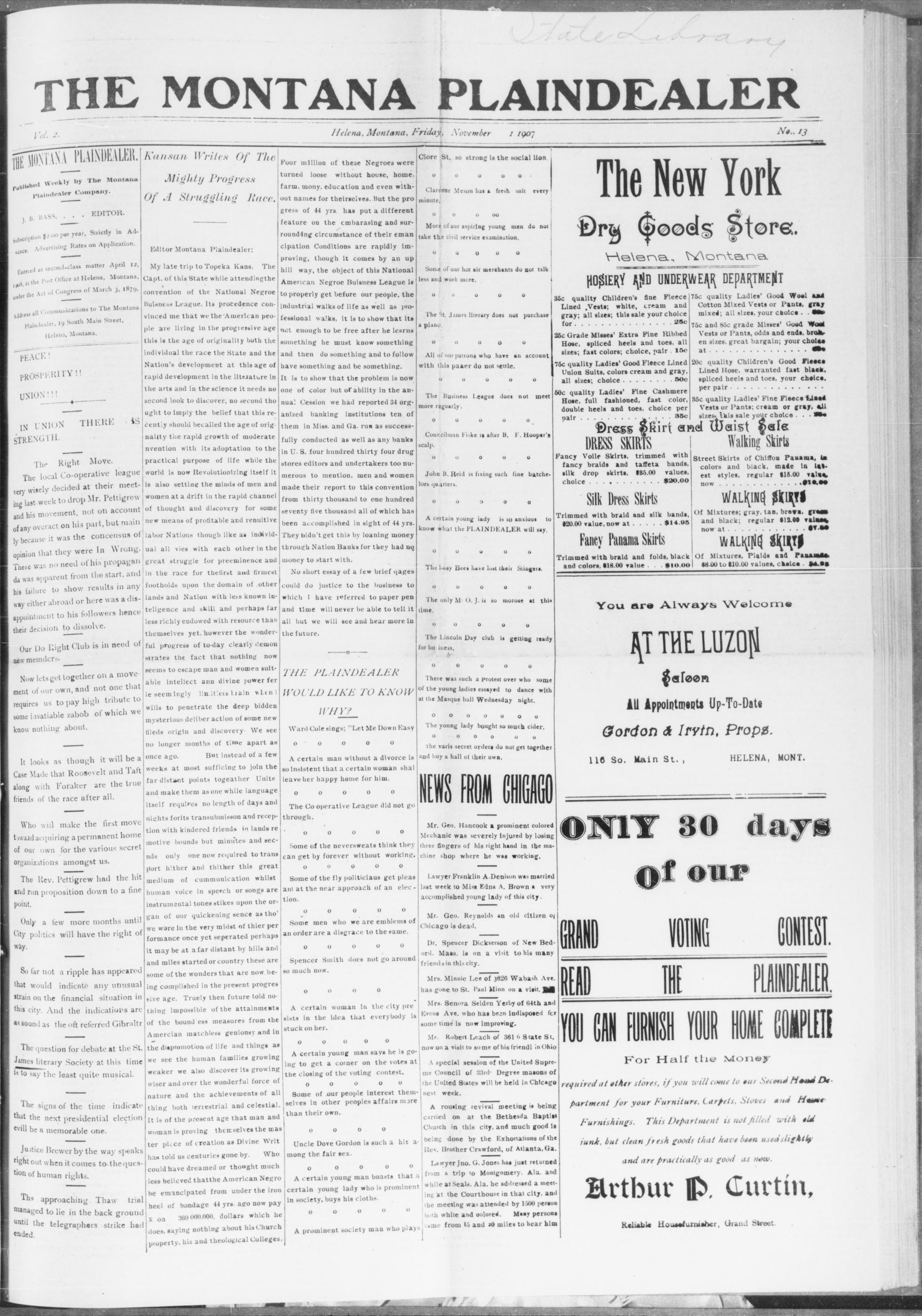
THE MONTANA PLAINDEALER
Vol. 2
Published Weekly by The Montana
Plaindealer Company.
J. B. BASS, . . . EDITOR.
Subscription $2.00 per year, Strictly in Ad-
vance. Advertising Rates on Application.
Entered as second-class matter April 12,
1906, at the Post Office at Helena, Montana,
under the Act of Congress of March 3, 1879.
Address all Communications to The Montana
Plaindealer, 19 South Main Street,
Helena, Montana.
PEACE!
PEACE!
PROSPERITY!!
IN UNION THERE IS STRENGTH.
The Right Move.
The local Co-operative league very wisely decided at their meeting last week to drop Mr. Pettigrew and his movement, not on account of any overact on his part, but mainly because it was the concensus of opinion that they were In Wrong. There was no need of his propaganda was apparent from the start, and his failure to show results in any way either abroad or here was a disappointment to his followers hence their decision to dissolve.
Our Do Right Club is in need of new memders.
Now lets get together on a movement of our own, and not one that requires us to pay high tribute to some insatiable zabob of which we know nothing about.
It looks as though it will be a Case Made that Roosevelt and Taft along with Foraker are the true friends of the race after all.
Who will make the first move toward acquiring a permanent home of our own for the various secret organizations amongst us.
The Rev. Pettigrew had the hit and run proposition down to a fine point.
Only a few more months until City politics will have the right of way.
So far not a ripple has appeared that would indicate any unusual strain on the financial situation in this city. And the indications are as sound as the oft referred Gibraltr
The question for debate at the St. James literary Society at this time is to say the least quite musical.
The signs of the time indicate that the next presidential election will be a memorable one.
Justice Brewer by the way speaks right out when it comes to the question of human rights.
This approaching Thaw trial managed to lie in the back ground until the telegraphers strike had ended.
Editor Montana Plaindealer:
My late trip to Topeka Kans. The Capt. of this State while attending the convention of the National Negro Buisness League. Its procedure convinced me that we the American people are living in the progressive age this is the age of originality both the individual the race the State and the Nation's development at this age of rapid development in the literature in the arts and in the science it needs no second look to discover, no second thought to imply the belief that this recently should be called the age of originality the rapid growth of moderate invention with its adoption to the practical purpose of life while the world is now Revolutionizing itself it is also setting the minds of men and women at a drift in the rapid channel of thought and discovery for some new means of profitable and renuitive labor Nations though like as individual all vies with each other in the great struggle for preeminence and in the race for the first and firmest footholds upon the domain of other lands and Nation with less known intelligence and skill and perhaps far less richly endowed with resource than themselves yet, however the wonderful progress of to-day clearly demonstrates the fact that nothing now seems to escape man and women suitable intellect ann divine power fer le seemingly limitless brain when it wills to penetrate the deep bidden mysterious deliber action of some new files origin and discovery. We see no longer months of time apart as once ago. But instead of a few weeks at most sufficing to join the far distant points togeather United and make them as one while language itself requires no length of days and nights forits transubmission and reception with kindered friends in lands remotive bounds but minutes and seconds only one now required to transport hither and thither this great medium of communication whilst human voice in speech or songs are instrumental tones stikes upon the organ of our quickening sence as though we are in the very midst of thier performance once yet seperated perhaps it may be at a far distant by hills and and miles started or country these are some of the wonders that are now being complished in the present progressive age. Truely then future told nothing impossible of the attainments of the boundless measures from the Amercian matchless geniosy and in the dispromotion of life and things as we see the human families growing weaker we also discover its growing wiser and over the wonderful force of nature and the achievements of all thing both terrestrial and celestial. It is of the present age that man and woman is proving themselves the master piece of creation as Divine Writ has told us centuries gone by. Who could have dreamed or thought much less believed that the American Negro be emancipated from under the ironheel of bondage 44 yrs. ago now pay on 380,000,000. dollars which he does, saying nothing about his Church property, his and theological College
Four million of these Negroes were turned loose without house, home, farm, mony, education and even without names for theirselves. But the progress of 44 yrs. has put a different feature on the embarasing and surround4ng circumstance of their emancipation Conditions are rapidly improving, though it comes by an up hill way, the object of this National American Negroe Buisness League is to properly get before our people, the industrial walks of life as well as professional walks, it is to show that its not enough to be free after he learns something he must know something and then do something and to follow have something and be something.
It is to show that the problem is now one of color but of ability in the annual. Cession we had reported 34 organized banking institutions ten of them in Miss. and Ga. run as successfully conducted as well as any banks in U. S. four hundred thirty four drug stores editors and undertakers too numerous to mention, men and women made their report to this convention from thirty thousand to one hundred seventy five thousand all of which has been accomplished in sight of 44 yrs. They didn't get this by loaning money through Nation Banks for they had no money to start with.
No short essay of a few brief qages could do justice to the business to which I have referred to paper pen and time will never be able to tell it all but we will see and hear more in the future.
THE PLAINDEALER
WOULD LIKE TO KNOW
WHY?
Ward Cole sings; "Let Me Down Easy
0 0 0 0 0
WHY?
A certain man without a divorce is so insistent that a certain woman shall leave her happy home for him.
0 0 0 0 0
The Co operative League did not go through.
0 0 0 0 0
Some of the neversweats think they can get by forever without working.
0 0 0 0 0
Some of the fly politicians get pleas ant at the near approach of an election.
0 0 0 0 0
Some men who we are emblems of an order are a disgrace to the same.
0 0 0 0 0
Spencer Smith does not go around so much now.
0 0 0 0
A certain woman in the city preists in the idea that everybody is stuck on her.
0 0 0 0 0
A certain young man says he is going to get a corner on the votes at the closing of the voting contest.
0 0 0 0 0
Some of our people interest themselves in other peoples affairs more than their own.
0 0 0 0
Uncle Dove Gordon is such a hit among the fair sex.
0 0 0 0 0
A certain young man boasts that a certain young lady who is prominent in society, buys his cloths.
A prominent society man who plays
Clore St. so strong is the social lion.
Clarence Meson has a fresh suit every minute.
More of our aspiring young men do not take the civil service examination.
Some of our hot air merchants do not talk less and work more.
The St. James literary does not purchase a piano.
All of our patrons who have an account with this paaer do not settle.
The Business League does not meet more regularly.
Councilman Fiske is after B. F. Hooper's scalp.
John B. Reid is fixing such fine batchelors quarters.
A certain young lady is so anxious to know what the PLAINDEALER will say.
The busy Bees have lost their Stingers.
The only M: O. J. is so morose at this time.
The Lincoln Day club is getting ready for business.
There was such a Protest over who some of the young ladies essayed to dance with at the Masque ball Wednesday night.
The young lady bought so much cider.
The varis secret orders do not get together
NEWS FROM CHIGAGO
Mr. Geo. Hancook a prominent colored Mechanic was severely injured by losing three fingers of his right hand in the machine shop where he was working.
Lawyer Franklin A. Denison was married last week to Miss Edna A. Brown a very accomplished young lady of this city.
Mr. Geo. Reynolds an old citizen of Chicago is dead.
Dr. Spencer Dickerson of New Bedord. Mass. is on a visit to his many friends in this city.
Mrs. Minnie Lee of 3626 Wabash Ave. has gone to St. Paul Minn on a visit.
Mrs. Senora Selden Yerby of 64th and Evens Ave. who has been Indisposed for some time is now improving.
Mr. Robert Leach of 3616 State St. now on a visit to some of his friend in Ohio
A special session of the United Supreme Council of 33rd Degree masons of the United States will be held in Chicago next week.
A rousing revival meeting is being carried on at the Bethesda Baptist Church in this city, and much good is being done by the Exhortations of the Rev. Brother Crawford, of Atlanta, Ga.
Lawyer Jno. G. Jones has just returned from a trip to Montgomery. Ala. and while at Seals, Ala. he addressed a meeting at the Courthouse in that city, and the meeting was attended by 1500 person both white and colored. Many persons came from 15 and 40 miles to hear him
The New York Dry Goods Store.
BRIERY AND UNDERWEAR DEPARTMENT
Children's fine Fleece
s, white, cream and
es; this sale your choice
.25c
Sies' Extra Fine Ribbed
ed heels and toes, all
colors; choice, pair. 15c
Ladies' Good Fleece Lined
colors cream and gray
choice. 50c
Ladies' Fine Cashmere
fashioned, fast color,
es and toes, choice per
.35c
Dress Skirt and Waist Sleeve
SKIRTS
Skirts, trimmed with
els and taffeta bands,
skirts, $85.00 values,
$20.00
75c quality Ladies' Gold
Cotton Mixed Vests or
mixed; all sizes, your
75c and 85c grade Misses
Vests or Pants, odds s
en sizes, great bargain
at
20c quality Children's
Lined Hose, warranted
spliced heels and toes
per pair
35c quality Ladies' Fine
Vests or Pants; cream
sizes, this sale your c
Walking Shoe
Street Skirts of Chiffon
colors and black,
est styles, regular
now
HOSIERY AND UNDERWEAR DEPARTMENT
DRESS SKIRTS
Fancy Voile Skirts, trimmed with
fancy braids and taffeta bands,
silk drop skirts, $85.00 values,
choice . . . . . . $20.00
Silk Dress Skirts
Trimmed with braid and silk bands.
$20.00 value, now at . $14.05
Faney Panama Skirts
Trimmed with braid and folds, black and colors, $18.00 value . . $10.00
You are Alw
With braid and folds, black
$18.00 value . . . $10.00
Of Mixtures, Plaids
$8.00 to $10.00 values.
You are Always Welcome
AT THE LUZON
Saloon
All Appointments Up-To-Date
Gordon & I
116 So. Main St.,
ONLY 3
Of
GRAND VOT
READ THE
YOU CAN FURNISH
Gordon & Irvin, Props.
3 So. Main St., HELENA,
JUNY 30 da
Of our
VOTING
THE PLAN
AN FURNISH YOUR HOME
Gordon & Irvin, Props.
ON1Y 30 days
YOU CAN FURNISH YOUR HOME COMPLETE
For Half the Money
required at other stores, if you want a department for your Furniture Furnishings. This Department is junk, but clean fresh goods and are practical Arthur
but other stores, if you will come to our Secu-
tion for your Furniture, Carpets, Stoves and
fishings. This Department is not filled with
but clean fresh goods that have been used
and are practically as good as new.
Arthur P. Cur
required at other stores, if you will come to our Second Hand De partment for your Furniture, Carpets, Stoves and House Furnishings. This Department is not filled with old junk, but clean fresh goods that have been used slightly and are practically as good as new.
Arthur P. Curtin,
Reliable Housefurnisher, Grand Street
---
DEPARTMENT
Quality Ladies' Good Wool
on Mixed Vests or Pants.
; all sizes, your choice.
85c grade Misses' Good
or Pants, odds and ends.
es, great bargain; your c.
Quality Children's Good F
Hose, warranted fast b
ed heels and toes, your cl
air.
Quality Ladies' Fine Fleece
or Pants; cream or gra
this sale your choice.
Jaist Sale
Walking Skirts
Skirts of Chiffon Panam
es and black, made in
styles, regular $15.00.
WALKING SKIRTS
WALKING SKIRTS
Fixtures, Plaids and Pa-
tches to $10.00 values, choice.
Welcome
Props.
HELENA, MONT.
day
ur
CONT
PLAINDEA
HOME COMP
Curtin
, Grand Street.
BOYHOOD HOURS.
One night as by the fire I sat
I thought of this and thought of that,
Back many years my mind did fly
And I saw it plain with memory's eye
That little log house old and gray
Where a little boy I used to play.
I seemed to feel myself once more,
Happy and gay, as in days of yore.
I have tasted pleasure's laughing cup,
I've drank the sparkling draught all up;
I've been in love, I've felt the bliss
When love responds with kiss for kiss.
I've often been to the festal den
With wine and women and sportive men,
Where festing talk and ribald song
Rang loud and deep the whole night long.
But all the pleasures rare and fine,
Enjoyed when in our manhood's prime,
Are nothing more than shams in truth
Compared with pleasures of our youth,
When we as care-free, happy boys,
Played in the house-lay with our toys,
Or in the meadow at the brook
We sat for hours with a tiny hook,
And, oh, our hearts would thrill and
bound
When a wriggling fish lay on the ground.
I would give what the world can't hold
To be a boy as in days of old,
To sit once more in the meadow grass,
And fish for the catfish and the bass.
But alas, alas, for me, alack,
The earth on its axis don't turn back,
And the happy hours the sweet, wild thrill
Of our boyhood days we long for still
Have gone from our life to come no more
And gladden hearts as in days of yore.
—Cincinnati Inquirer.
The Lost Lease
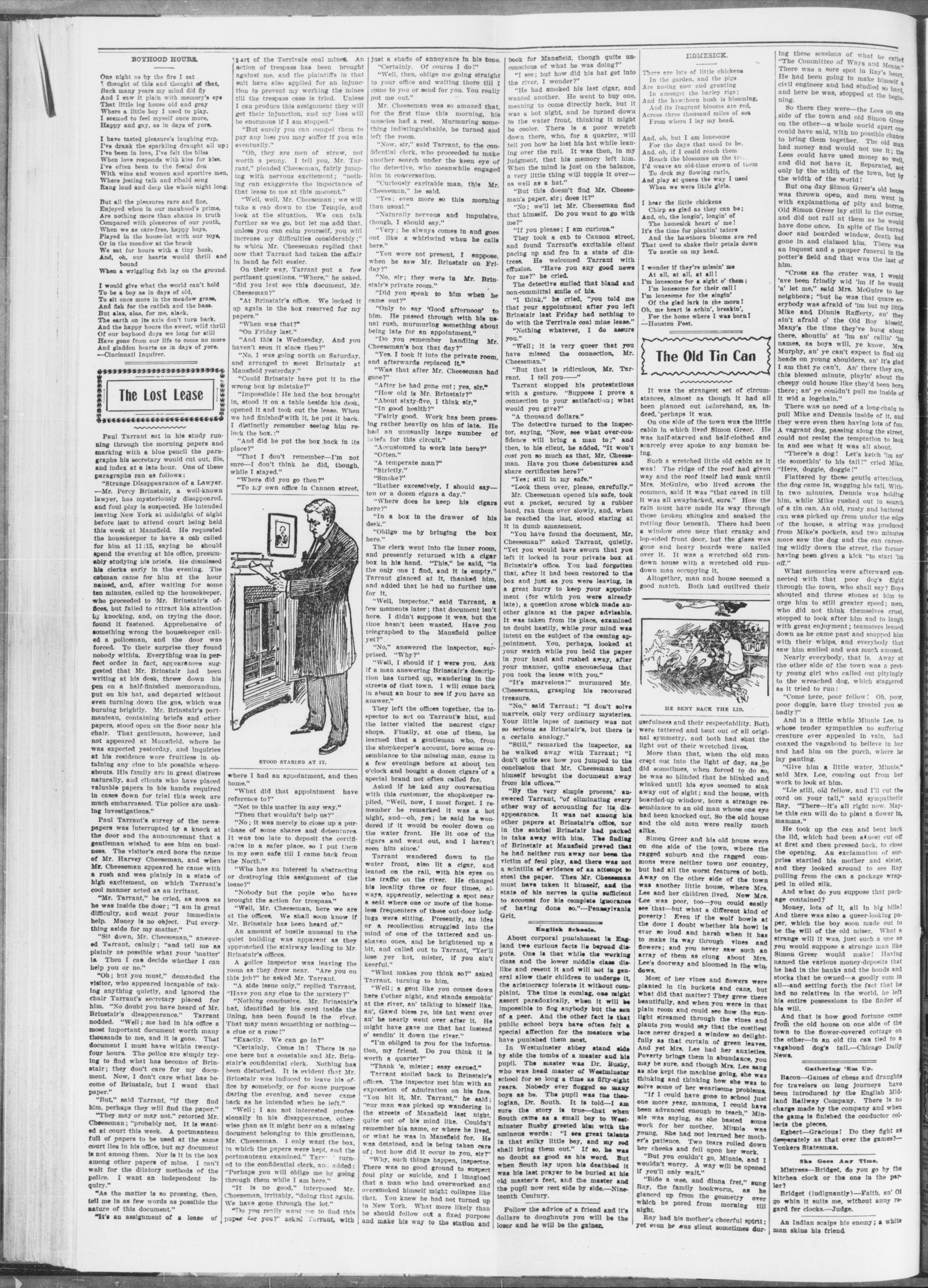
Paul Tarrant sat in his study running through the morning papers and marking with a blue pencil the paragraphs his secretary would cut out, file, and index at a late hour. One of these paragraphs ran as follows:
"Strange Disappearance of a Lawyer —Mr. Percy Brinstair, a well-known lawyer, has mysteriously disappeared, and foul play is suspected. He intended leaving New York at midnight of night before last to attend court being held this week at Mansfield. He requested the housekeeper to have a cab called for him at 11:15, saying he should spend the evening at his office, presumably studying his briefs. He dismissed his clerks early in the evening. The carman came for him at the hour named, and, after waiting for some ten minutes, called up the housekeeper, who proceeded to Mr. Brinstair's offices, but failed to attract his attention to knocking, and, on trying the door, found it fastened. Apprehensive of something wrong the housekeeper called a policeman, and the door was forced. To their surprise they found nobody within. Everything was in perfect order in fact, appearances suggested that Mr. Brinstair had been writing at his desk, threw down his pen on a half-finished memorandum, put on his hat, and departed without even turning down the gas, which was burning brightly. Mr. Brinstair's portmanteau, containing briefs and other papers, stood open on the floor near his chair. That gentleman, however, had not appeared at Mansfield, where he was expected yesterday, and inquiries at his residence were fruitless in obtaining any clue to his possible whereabouts. His family is in great distress naturally, and clients who have placed valuable papers in his hands required in cases down for trial this week are much embarrassed. The police are making investigations."
Paul Tarrant's survey of the newspapers was interrupted by a knock at the door and the announcement that a gentleman wished to see him on business. The visitor's card bore the name of Mr. Harvey Cheeseman, and when Mr. Cheeseman appeared he came with a rush and was plainly in a state of high excitement, on which Tarrant's cool manner acted as an irritant.
"Mr. Tarrant," he cried, as soon as he was inside the door; "I am in great difficulty, and want your immediate help. Money is no object. Put everything aside for my matter."
"Sit down, Mr. Cheeseman," answered Tarrant, calmly; "and tell me as plainly as possible what your 'matter' is. Then I can decide whether I can help you or no."
"Oh; but you must," demanded the visitor, who appeared incapable of taking anything quietly, and ignored the chair Tarrant's secretary placed for him. "No doubt you have heard of Mr. Briustair's disappearance." Tarrant nodded. "Well; me had in his office a most important document worth many thousands to me, and it is gone. That document I must have within twenty-four hours. The police are simply trying to find what has become of Brinstair; they don't care for my document. Now, I don't care what has become of Brinstair, but I want that paper."
"But," said Tarrant, "if they find him, perhaps they will find the paper." "They may or may not." retorted Mr. Cheeseman; "probably not. It is wanted at court this week. A portmanteau full of papers to be used at the same court lies in his office, but my document is not among them. Nor is it in the box among other papers of mine. I can't wait for the dilatory methods of the police. I want an independent inquiry." "As the matter is so pressing, then, tell me in as few words as possible the nature of this document." "It's an assignment of a lease of
part of the Terrivale coal mines. An action of trespass has been brought against me, and the plaintiffs in that suit have also applied for an injunction to prevent my working the mines till the trespass case is tried. Unless I can produce this assignment they will get their injunction, and my loss will be enormous if I am stopped."
"But surely you can compel them to pay any loss you may suffer if you win eventually."
"Oh, they are men of straw, not worth a penny. I tell you, Mr. Tarrant," pleaded Cheeseman, fairly jumping with nervous excitement; "nothing can exaggerate the importance of that lease to me at this moment."
"Well, well, Mr. Cheeseman; we will take a cab down to the Temple, and look at the situation. We can talk further as we go, but let me add that, unless you can calm yourself, you will increase my difficulties considerably;" to which Mr. Cheeseman replied that now that Tarrant had taken the affair in hand he felt easier.
On their way, Tarrant put a few pertinent questions. "Where," he asked. "did you last see this document, Mr. Cheeseman?"
"At Brinstair's office. We locked it up again in the box reserved for my papers."
"When was that?"
"On Friday last."
"And this is Wednesday. And you haven't seen it since then?"
"No. I was going north on Saturday, and arranged to meet Brinstair at Mansfield yesterday."
"Could Brinstair have put it in the wrong box by mistake?"
"I impossible! He had the box brought in, stood it on a table beside his desk, opened it and took out the lease. When we had finished with it, he put it back. I distinctly remember seeing him re-lock the box.?"
"And did he put the box back in its place?"
"That I don't remember—I'm not sure—I don't think he did, though, while I stayed."
"Where did you go then?"
"To my own office in Cannon street."
A
where I had an appointment, and then home."
"What did that appointment have reference to?"
"Not to this matter in any way."
"Then that wouldn't help us?"
"No; it was merely to close up a purchase of some shares and debentures. It was too late to deposit the certificates in a safer place, so I put them in my own safe till I came back from the North."
"Who has an interest in abstracting or destroying this assignment of the lease?"
"Nobody but the people who have brought the action for trespass."
"Well, Mr. Cheeseman, here we are at the offices. We shall soon know if Mr. Brinstair has been heard of."
An amount of bustle unusual in the quiet building was apparent as they approached the stairway leading to Mr. Brinstair's offices.
A police inspector was leaving the room as they drew near. "Are you on this job?" he asked Mr. Tarrant.
"A side issue only," replied Tarrant. "Have you any clue to the mystery?"
"Nothing conclusive. Mr. Brinstair's hat, identified by his card inside the lining, has been found in the river. That may mean something or nothing—a clue or a ruse!"
"Exactly. We can go in?"
"Certainly. Come in! There is no one here but a constable and Mr. Brinstair's confidential clerk. Nothing has been disturbed. It is evident that Mr. Brinstair was induced to leave his office by somebody, or for some purpose during the evening, and never came back as he intended when he left."
"Well; I am not interested professionally in his disappearance, otherwise than as it might bear on a missing document belonging to this gentleman, Mr. Cheeseman. I only want the box, in which the papers were kept, and the portmanteau examined." Tarr returned to the confidential clerk, and added: "Perhaps you will oblige me by going through them while I am here."
"It is no good," interposed Mr. Cheeseman, irritably, "doing that again. We have gone through the lot."
"Do you really want me to find this paper for you?" asked Farrant, with
just a shade of annoyance in his tone. "Certainly. Of course I do!" "Well, then, oblige me going straight to your office and waiting there till I come to you or send for you. You really put me out." Mr. Cheeseman was so amazed that, for the first time this morning, his muscles had a rest. Murmuring something indistinguishable, he turned and left the room. "Now, sir," said Tarrant, to the confidential clerk, who proceeded to make another search under the keen eye of the detective, who meanwhile engaged him in conversation. "Curiously excitable man, this Mr. Cheeseman," he said. "Yes; even more so this morning than usual." "Naturally nervous and impulsive, though, I should say."
"Very; he always comes in and goes out like a whirlwind when he calls here."
"You were not present, I suppose, when he saw Mr. Brinstair on Friday."
"No, sir; they were in Mr. Brinstair's private room."
"Did you speak to him when he came out?"
"Only to say 'Good afternoon' to him. He passed through with his usual rush, murmuring something about being late for an appointment."
"Do you remember handling Mr. Cheeseman's box that day?"
"Yes. I took it into the private room, and afterwards replaced it."
"Was that after Mr. Cheeseman had gone?"
"After he had gone out; yes, sir."
"How old is Mr. Brinstair?"
"In good health?"
"Fairly good. Work has been press-
ing rather heavily on him of late. He
had an unusually large number of
briefs for this circuit."
"Accustomed to work late here?"
"Often."
"A temperate man?"
"Strictly."
"Smoke?"
"Rather excessively, I should say—
ten or a dozen cigars a day."
"Where does he keep his cigars
here?"
"In a box in the drawer of his
desk."
"Oblige me by bringing the box
here."
The clerk went into the inner room, and presently returned with a cigar box in his hand. "This," he said, "is the only one I find, and it is empty." Tarrant glanced at it, thanked him, and added that he had no further use for it.
"Well, inspector," said Tarrant, a few moments later; that document isn't here. I didn't suppose it was, but the time hasn't been wasted. Have you telegraphed to the Mansfield police yet?
"No," answered the inspector, surprised.
"Why?"
"Well, I should if I were you. Ask if a man answering Brinstair's description has turned up, wandering in the streets of that town. I will come back in about an hour to see if you have an answer."
They left the offices together, the inspector to act on Tarrant's hint, and the latter visited the nearest cigar shops. Finally, at one of them, he learned that a gentleman who, from the shopkeeper's account, bore some resemblance to the missing man, came in a few evenings before at about ten o'clock and bought a dozen cigars of a special brand not often called for. Asked if he had any conversation with this customer, the shopkeeper replied, "Well, now, I most forget. I remember he remarked it was a hot night, and—oh, yes; he said he wondered if it would be cooler down on the water front. He lit one of the cigars and went out, and I haven't seen him since."
Tarrant wandered down to the water front, also lit a cigar, and leaned on the rail, with his eyes on the traffic on the river. He changed his locality three or four times, always, apparently, selecting a spot near a seat where one or more of the homeless frequenters of those out-door lodgings were sitting. Presently, an idea or a recollection struggled into the mind of one of the tattered and unshaven ones, and he brightened up a bit, and called out to Tarrant, "Yer'll lose yer hat, mister, if you ain't keerful."
"What makes you think so?" asked Tarrant, turning to him.
"Well; a gent like you comes down here t'other night, and stands asmokin' at the river, an' talking to hisself like, an', Gawd bless ye, his hat went over an' he nearly went over after it. He might have gave me that hat instead o' sendin' it down the river."
"I'm obliged to you for the information, my friend. Do you think it is worth a quarter?"
"Thank e', mister; easy earned."
Tarrant stolled back to Brinstair's offices. The inspector met him with an expression of admiration on his face. "You hit it, Mr. Tarrant," he said; "our man was picked up wandering in the streets of Mansfield last night, quite out of his mind like. Couldn't remember his name, or where he lived, or what he was in Mansfield for. He was detained, and is being taken care of; but how did it occur to you sir?"
"Why, such things happen, inspector. There was no good ground to suspect play or suicide, and I imagined that a man who had overworked and oversmoked himself might collapse like that. You knew he had not turned up in New York. What more likely than he should follow out a fixed purpose and make his way to the station and
book for Mansfield, though quite unconscious of what he was doing?"
"I see; but how did his hat get into the river, I wonder?"
"He had smoked his last cigar, and wanted another. He went to buy one, meaning to come directly back, but it was a hot night, and he turned down to the water front, thinking it might be cooler. There is a poor wretch down there, who, for a quarter, will tell you how he lost his hat while leaning over the rail. It was then, in my judgment, that his memory left him. When the mind is just on the balance, a very little thing will topple it over—as well as a hat."
"But this doesn't find Mr. Cheeseeman's paper, sir; does it?"
"No; we'll let Mr. Cheeseeman find that himself. Do you want to go with me?"
"If you please; I am curious."
They took a cab to Cannon street, and found Tarrant's excitable client pacing up and fro in a state of distress. He welcomed Tarrant with effusion. "Have you any good news for me?" he cried.
The detective smiled that bland and non-committal smile of his.
"I think," he cried, "you told me that your appointment after you left Brinstair last Friday had nothing to do with the Terrivale coal mine lease."
"Nothing whatever, I do assure you."
"Well; it is very queer that you have missed the connection, Mr. Cheeseman."
"But that is ridiculous, Mr. Tarrant. I tell you——"
Tarrant stopped his protestations with a gesture. "Suppose I prove a connection to your satisfaction; what would you give?"
"A thousand dollars." The detective turned to the inspector, saying, "Now, see what over-confidence will bring a man to;" and then, to his client, he added, "It won't cost you so much as that, Mr. Cheeseman. Have you those debentures and share certificates here?" "Yes; still in my safe." "Look them over, please, carefully." Mr. Cheeseman opened his safe, took out a packet, secured by a rubber band, ran them over slowly, and, when he reached the last, stood staring at it in dumb amazement.
"You have found the document, Mr. Cheeseman?" asked Tarrant, quietly. "Yet you would have sworn that you left it locked in your private box at Brinstair's office. You had forgotten that, after it had been restored to the box and just as you were leaving, in a great hurry to keep your appointment (for which you were already late), a question arose which made another glance at the paper advisable. It was taken from its place, examined no doubt hastily, while your mind was intent on the subject of the coming appointment. You, perhaps, looked at your watch while you held the paper in your hand and rushed away, after your manner, quite unconscious that you took the lease with you."
"It's marvelous!" murmured Mr. Cheeseman, grasping his recovered treasure.
"No," said Tarrant; "I don't solve marvels, only very ordinary mysteries. Your little lapse of memory was not so serious as Brinstair's, but there is a certain analogy." "Still," remarked the inspector, as he walked away with Tarrant; "I don't quite see how you jumped to the conclusion that Mr. Cheeseman had himself brought the document away from his offices."
"By the very simple process,' answered Tarrant, "of eliminating every other way of accounting for its disappearance. It was not among his other papers at Brinstair's office, nor in the satchel Brinstair had packed to take away with him. The finding of Brinstair at Mansfield proved that he had neither run away nor been the victim of feul play, and there was not a scintilla of evidence of an attempt to steal the paper. Then Mr. Chessman must have taken it himself, and the state of his nerves is quite sufficient to account for his complete ignorance of having done so."—Pennsylvania Grit.
English Schoola.
About corporal punishment in England two curious facts lie beyond dispute. One is that while the working class and the lower middle class dislike and resent it and will not in general allow their children to undergge it, the aristocracy tolerate it without complaint. The time is coming, one might assert paradoxically, when it will be impossible to flog anybody but the son of a peer. And the other fact is that public school boys have often felt a special affection for the masters who have punished them most.
In Westminster abbey stand side by side the tombs of a master and his pupil. The master was Dr. Busby, who was head master of Westminster school for so long a time as fifty-eight years. Nobedy ever flogged so many boys as he. The pupil was the theologian, Dr. South. It is told—I am sure the story is a true—that when South came as a small boy to Westminster Busby greeted him with the ominous words: "I see great talents in that sulky little boy, and my red shall bring them out." If so, he was no doubt as good as his word. But when South lay upon his deathbed it was his last prayer to be buried at his old master's feet, and the master and the pupil now rest side by side. Nineteenth Century.
Follow the advice of a friend and it's dollars to doughnuts you will be the loser and he will be the gainer.
HOMESICK.
There are lots of little chickens
In the garden, and the pigs
Are nosing now and grunting
In amongst the barley rigs;
And the hawthorn bush is blooming,
And its fragrant blooms are red,
Across three thousand miles of sea
From where I lay my head.
And, oh, but I am lonesome
For the days that used to be.
And, oh, if I could reach them
Reach the blossoms on the tree.
I'd weave an old-time crown of them
To deck my flowing curls.
And play at queen the way I used
When we were little girls.
I hear the little chickens
Chirp as glad as they can be;
And the hawthorn blooms are red
That used to shake their petals down
To nestle on my head.
I wonder if they're missin' me
to tell, at all, at all!
At all, at all, at all!
I'm lonesome for a sight o' them;
I'm lonesome for their call!
I'm lonesome for the singin'
Of the glad lark in the morn!
Oh. me heart is achin', breakin'
For the home where I was born!
—Houston Post.
The Old Tin Can
It was the strangest set of circumstances, almost as though it had all been planned out beforehand, as, indeed, perhaps it was. On one side of the town was the little cabin in which lived Simon Greer. He was half-starved and half-clothed and scarcely ever spoke to any human being.
Such a wretched little old cabin as it was! The ridge of the roof had given way and the roof itself had sunk until Mrs. McGulre, who lived across the common, said it was "that caved in till it was all swaybacked, sure." How the rain must have made its way through those broken shingles and soaked the rotting floor beneath. There had been a window once near that cranky and lop-sided front door, but the glass was gone and heavy boards were nalled over it. It was a wretched old rundown house with a wretched old rundown man occupying it. Altogether, man and house seemed a good match. Both had outlived their
HE BENT BACK THE LID.
usefulness and their respectability. Both were tattered and bent out of all original symmetry, and both had shut the light out of their wretched lives.
More than that, when the old man crept out into the light of day, as he did sometimes, when forced to do so, he was so blinded that he blinked and winked until his eyes seemed to sink away out of sight; and the house, with boarded-up window, bore a strange resemblance to an old man whose one eye had been knocked out. So the old house and the old man were really much allike.
Simon Greer and his old house were on one side of the town, where the ragged suburb and the ragged commons were neither town nor country, but had all the worst features of both. Away on the other side of the town was another little house, where Mrs. Lee and her children lived. Now Mrs. Lee was poor, too—you could easily see that—but what a different kind of poverty! Even if the wolf howls at the door I doubt whether his howl is ever so loud and harsh when it has to make its way through vines and flowers; and you never saw such an array of them as clung about Mrs. Lee's doorway and bloomed in the windows.
Most of her vines and flowers were planted in tin buckets and cans, but what did that matter? They grew there beautifully, and when you were in that plain room and could see how the sunlight streamed through the vines and plants you would say that the costliest lace never draped a window so delightfully as that curtain of green leaves. And yet Mrs. Lee had her anxieties. Poverty brings them in abundance, you may be sure, and though Mrs. Lee sang as she kept the machine going, she was thinking and thinking how she was to solve some of her wearisome problems. "If I could have gone to school just one more year, mamma, I could have been advanced enough to teach." Minnie was saying, as she basted some work for her mother. Mimile was young. She had not learned her mother's patience. Two tears rolled down her cheeks and fell upon her work.
"But you couldn't go, Minnie, and I wouldn't worry. A way will be opened if you'll only wait."
"Bide a wee, and dinna fret," sung Ray, the family bookworm, as he glanced up from the geometry over which he pored from morning till night.
Ray had his mother's cheerful spirit; yet even he has silent sometimes dur
lng these sessions of what he called "The Committee of Ways and Means." There was a sore spot in Ray's heart. He had been going to make himself a civil engineer and had studied so hard, and here he was, stopped at the beginning.
So there they were—the Lees on one side of the town and old Simon Green on the other—a whole world apart one could have said, with no possible chance to bring them together. The old man had money and would not use it; the Lees could have used money so well, and did not have it. Separated, not only by the width of the town, but by the width of the world!
But one day Simon Greer's old house was thrown open, and men went in with explanations of pity and horror. Old Simon Greer lay still in the corner, and did not rail at them as he would have done once. In spite of the barred door and boarded window, death had gone in and claimed him. There was an inquest and a pauper funeral in the potter's field and that was the last of him.
"Cross as the crater was, I would 'ave been friendly wim 'id he if he would 'a let me," said Mrs. McGuire to her neighbors; "but he was that quare everybody was afraid of 'im but my little Mike and Dinnis Rufferty, an' they ain't afraid o' the Old Boy himself. Many's the time they've hung about there, shoutin' at 'im an' callin' 'im names, as boys will, ye know. Mrs. Murphy, an' ye can't expect to find old heads on young shoulders, an' its glad I am that ye can't. An' there they are, this blessed minute, playin' about the cheepy ould house like they'd been born there; an' ye couldn't pull me inside of it wid a logchain."
There was no need of a long-chain to pull Mike and Dennis inside of it, and they were even then having lots of fun. A vagrant dog, passing along the street, could not resist the temptation to look in and see what it was all about.
"There's a dog! Let's ketch 'im an
tie somethin' to his tall!" cried Mike.
"Here, doggle, doggle."
Flattered by these gentle attentions,
the dog came in, wagging his tail. Within
in two minutes, Dennis was holding
him, while Mike rushed out in search
of a tin can. An old, rusty and battered
can was picked up from under the edge
of the house, a string was produced
from Mike's pockets, and two minutes
more saw the dog and the can career-
ing wildly down the street, the former
having been given a kick "to start 'im
off."
What memories were afterward connected with that poor dog's flight through the town, who shall say? Boys shouted and threw stones at him to urge him to still greater speed; men, who did not think themselves cruel, stopped to look after him and to laugh with great enjoyment; teamsters leaned down as he came past and snapped him with their whips, and everybody that saw him smiled and was much amused. Nearly everybody, that is. Away at the other side of the town was a pretty young girl who called out pityingly to the wreached dog, which staggered as it tried to run:
"Come here, poor fellow! Oh, poor, poor doggle, have they treated you so badly?"
And in a little while Minnie Lee, to whose tender sympathies no suffering creature ever appealed in vain, had coaxed the vagabond to believe in her and had him on the porch, where he lay panting.
"Give him a little water, Minnie," said Mrs. Lee, coming out from her work to look at him.
"Lie still, old fellow, and I'll cut the cord on your tail," said sympathetic Ray. "There" it's all right now. May be this can will do to plant a flower in, mamma."
He took up the can and bent back the lid, which had been at most cut off at first and then pressed back, to close the opening. An exclamation of surprise startled his mother and sister, and they looked around to see Ray pulling from the can a package wrapped in oilil silk.
And what do you suppose that package contained?
Money, lots of it, all in big bills! And there was also a queer-looking paper, which the boy soon made out to be the will of the old miser. What a strange will it was, just such a one as you would suppose a strange man like Simon Greer would make! Having named the various money-deposits that he had in the banks and the bonds and stocks that he owned—a goodly sum in all—and setting forth the fact that he had no relatives in the world, he left his entire possessions to the finder of his will.
And that is how good fortune came from the old house on one side of the town to the flower-covered cottage on the other—in an old tin can tied to a vagabond dog's tail—Chicago Daily News.
Gathering 'Em Up.
Bacon—Games of chess and draughts for travelers on long journeys have been introduced by the English Midland Railway Company. There is no charge made by the company and when the game is finished the conductor collects the pieces. Egbert—Graclous! Do they fight as democrately as that over the games?—Yonkers Statesman.
She Goes Any Time.
Mistress—Bridget, do you go by the kitchen clock or the one in the parlor?
Bridget (indignantly)—Faith, an' Ol go whin it suits me, without annoy regard for clocks.—Judge.
An Indian scalps his enemy; a white man skims his friend
WHAT IS PE-RU-NA?
jsita cater elite ora
Tonic, or is it Both?
ople call Peruna a great
i fie voter to Peruza
great catarrh remedy. z=
‘Which of these people are right?
jsitmore proper tocall Peruna a ca-
Erhremedy than to call it a tonic?
‘ur reply is, that Peruna is both a
ais and a catarrh remedy. Indeed,
there can be no effectual catarrh rem-
dy that is not also 9 tonic,
fn order to thoroughly relieve any
ease of cotarrh, a remedy must not
aly have a specific action on the mu-
oy membranes affected by the ca-
tim, but it must have a general tonic
jgetion on the nervous system.
(atarrh, even in persons who are
idherwise strong, is @ weakened con-
jaition of some mucous membrane.
‘there must be something to strength-
the circulation, to give tone to the
ireries,and to raise the vital forces,
‘Perhaps no vegetable remedy in the
yorld has attracted so much attention
om medical writers as HYDRASTIS
(ANADENSIS. The wonderful effi-
of this herb hae becu recognized
years, and is growing in its hold
spon the medical profession, When
‘ined with CUBEBS and COPAIBA a
io of medical agents is formed in Pe-
which constitutes a specific rem-
for catarrh that in the present
ite of medical progress cannot be
iproved upon. This action, rein-
by such renowned tonics as
ILLINSONIA CANADENSIS, COR-
ALIS cane and CEDRON
) ought to this compound
‘ideal remedy for catarrh in all ita
ages and locations in the body,
Froma theoretical standpoint, there-
we, Peruna is beyond criticism. The
of Peruna, confirms this opinion,
jamberless testimonials from every
arter of the earth furnish ample
idence that this judgment is not
erenthusiestic, When practical ex-
confirms a well-grounded the-
the result is a truth that cannot be
look into the past of the man who
kes to go visiting, and somewhere
ay back you will find him a boy
4 photograph album = with long
nis down his back.
‘That was a wise man who set a rat
nin his pocket and caught nis ave
by the finger.
‘he
General Demand
the Well-Informed of the World has
‘ays been for a simple, pleasant
d efficient liquid laxative remedy of
wn value; a laxative which physi-
could sanction for family use
use its component parts are
wn to them to be wholesome and
ly beneficial im effect, acceptable
the system and gentle, yet prompt,
aetion,
a supplying that demand with its
ellent combination of Syrup of
and Elixir of Senna, the Call-
la Fig Syrup Co. proceeds along
ical lines and relies on the merits
the laxative for its remarkable
8.
That fe one of many reasons why
» of Figs and Elixir of Senna is
jn the preference by the Well-
ed. To get its beneficial effects
"ays buy the genuine—manufac-
by the California Fig Syrup Co.,
, and for sale by all leading
iggists. Price fifty cents per bottle.
MADE FOR SERVICE
1 THE ROUGHEST WEATHER
AND GUARANTEED: ABSOLUTELY
dex WATERPROOF
vy AOWERS
ah \\ eam
) by), \)) POMMEL
(Le. SLICKERS
pe 3350
Mi N This trade mark
4 \\\\ seadkrae
Ny ) sui is hh
20 Mute Team
erroan every artic’e in Zour kitehen or
mets a wah polls Ait enter
BAS Const Hora Ga, Seiten Galt:
oe ~e
as Mother's Bread:
LAND CRACKERS
In the...
RED PACKAGES
Not made by the Trust.
—rOSSIFi£D ADS. . .
NiCe—The ‘allowing saneqacemealy ave
loding pesuowies snnogoce and are
ph our careful reading. ‘The fist mp
atthe propontion Sou ‘te Sealey
‘CANT GOVERNMENT LAND. -
7E PRINT MAPS OF STEVENS
P towing a Vacant government tand,
marie tive prints oP S rome gi
na, gas and Chelan count i.
smitip." Frank, Corbaley, 3: Wash
Zitet, Spokane, Wash, et
re
No.43 7
Slave Doc S Bae
SecA. ae
& et y ee
Lot tomes Poe ,
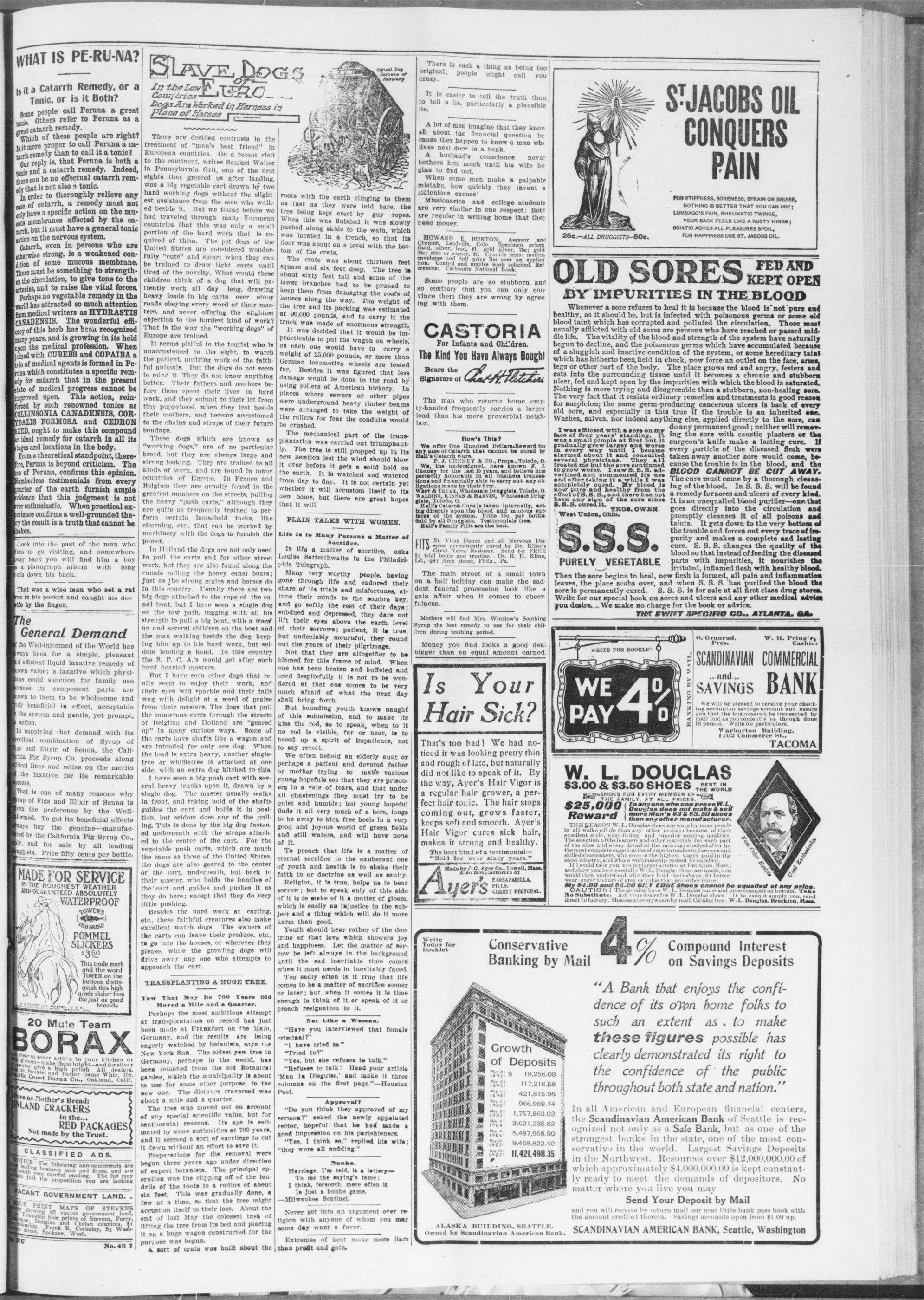
There are decided contrasts in the
treatment of “man's best friend” In
European countries. On a recent visit
to the continent, writes Sanuel Walter
in Pennsylavnia Grit, one of the first
sights that greeted us after landing,
was a big vegetable cart drawn by two
hard working dogs without the slight-
est assistance from the men who walk-
ed beside tt. But we found before we
had traveled through many Earopean
countries that this was ouly a small
Portion of the hard work that ts re-
quired of them. The pet dogs of the
United States are considered wonder-
fully “cute” and «mart when they ean
be tratned to draw light carts until
tired of the novelty. What would these
children think of a dog that will pa-
tlently work all day long, drawing
heavy loads In big carts over stony
‘Toads obeying every word of thelr mas-
ters, and never offering the siighiost
‘objection to the hardest kind of work?
‘That Is the way the “working dogs” of
Europe are trained.
It seems pltiful to the tourlst who ts
unaccustomed to tha sight, to watch
the patient, untiring work of the fatth-
ful animals, But the dogs do not seem
to mind It. They do not know anything
better. Thetr fathers and mothers be-
fore them spent their lives in hard
work, and they submit to thelr lot from
tiny pupprhood, when they trot beside
thelr mothers, and hecome accustomed
to the chains and straps of thelr future
bondage.
These dogs which are known as
“working dogs,” are of no particular
breed, but they are always large and
strong looking. ‘They are tratned to all
kinds of work, and are found In many
countries of Eurepe. In France and
Belgium they are usually found In the
greatest numbers on the streets, pulling
the henvy “push carts,” although they
are quite as frequently tralned to per-
form certain household tasks, ke
churning, ete.. that ean be worked by
machinery with the dogs to furnish the
power,
Tn Holland the dogs are not only used
to pull the carts and for other street
work, but they are also found along the
canala pulling the heavy canal boats;
Just as fhe strong mules and horses do
In this country, Usually there are two
big dogs attached to the rope of the ca-
nal boat, but I have seen a single dog
‘on the tow path, tugging with all hin
strength to pull a blg boat, with a wont
an and several children on the boat and
the man walking beside the dog, keep-
ing him up to his hard work, but sel-
dom tending a hand. In this country
the 8. P. C. A’s would get after such
hard hearted masters,
But { have seen other dogs that re-
ally seem to enjoy thelr work, and
their exes will eparkle and thetr tails
wag with delight at a word of praise
from thelr masters, The dogs that pull
the numerous carts through the streets
of Relglum and Holland are “geared
up” In many curious ways, Some of
the carts have shafts like a wagon and
are intended for only one dog. When
the load Is extra heavy, another aingle-
tree or whimletree ts attached at one
side, with an extra dog hitched to this.
T have seen a blg push cart with sev-
eral heavy trunks upon ft, drawn by #
eingle dog. ‘The master usually walks
in front, and taking hold of the shafts
guldes the cart and holds {t In post-
tlon, but seldom does any of the pull-
Ing. This is done by the big dog fasten-
ed underneath with the straps attach-
ed to the center of the cart. For the
vegetable push carts, which are much
the same as those of the United States,
the dogs are also geared to the center
of the cart, underneath, but back to
thelr master, who holds the handles of
the’cart and guldes and pushes {t as
they do here; except that they do very
ttle pushing.
Besides the hard work at carting,
ete., these falthful creatures also make
excellent watch dogs, The owners of
the carts can leave thelr produce, ete.,
te go into the honses, or wherever they
please, while the growling dogs will
drive awsy any one who attempts to
approach the eart.
TRANSPLANTING A HUGE TREE.
Yew That May Be 700 Years ot
Moved « Mile and @ Quarter.
Perhaps the most ambitious attempt
at transpiantation on record tas Just
been made at Frankfort on the Main,
Germany, and the results are being
eagerly watched by botanists, says tue
New York Sun. The oldest yew tree in
Germany, perhaps in the world, has
been renioved from the old Botanical
garden, which the municipality is about
to use for some other purpose, te the
new one, The distance traversed was
about a mile and a quarter.
‘The tree was moved not on account
‘of any special scientific value. but for
sentimental reasons. Its age Is estl-
aated by some authorities at 700 years,
and It seemed a sort of sacrilege to cut
it down without an effort to save It.
Preparations for the removal were
begun three years ago under direction
of expert botanists. The principal op-
eration was the clipping off of the ten-
drills of the foots to a radius of about
six feet. This was gradually done, a
few at a time, so that the tree might
accustom itself to their loss. About the
end of last May the colossal task of
lifting the tree from Its bed and placing
It on a huge wagon constructed for the
purpose was begun.
‘4 sort of crate was bullt about the
hse heel Te Yy
Ye RAS pees
SES ny Fle aS
= oe Bass fess
* CAS a Be
foots with the earth clinging to them
as fast as they were laid bare, the
tree belng kept erect by guy ropes,
When this was finished it was slowly
Pushed along skids to the wain, which
was located in @ trench, so that its
floor was about on @ level with the bot-
tom of the erate,
The crate was about thirteen feet
Square and six feet deep. ‘The tree Is
about sixty feet tall and some of the
lower branches had to be pruned to
keep them from damaging the roofs of
houses along the way. The weight of
the tree and its packing was estimated
at 90,000 pounds, and to carry it the
truck was made of eaormous strength.
It was decided that it would be im-
Practicable to put the wagon on wheels,
a8 each one would have to carry a
welght ef 25,000 pounds, or more than
German locomotive wheels are tested
for, Besides it was figured that less
damage would be done to the road by’
using rollers of American hickory. In
Places where sewers or other pipes
were underground beavy timber beams
Were arranged to take the welght of
the rollers for fear the conduits would
be crushed.
The mechanical part of the trans-
plantation was carried out triumphant-
ly. The tree Is still propped up in Its
new location lest the wind should blow
It over before It gets a solid hold on
the earth. It is watched and watered
from day to day. It is not certain yet
whether It will accustom itself to Its
vew home, but there are great hopes
that it will
PLAIN TALKS WITH WOMEN.
Ife Is to Many Persons « Matter of
Sacrifice.
Ts Ife a matter of sacrifice, asks
Loulse Satterthwaite iu the Philadel-
phia Telegraph,
Many very worthy people, having
gone through life and endured their
share of its trials and misfortunes, at-
tune their minds to the sombre key,
and go softly the rest of thelr days;
subdued and depressed, they dare not
lift thelr eyes above the earth level
of their sorrows; patient, it ts true,
but undeniably mournful, they round
out the years of their pligrimage.
Not that they are altogether to be
blamed for this frame of mind. When
one has been beaten and buffeted and
used despitefully It Is not to be won-
dered at that one comes to be very
‘much afraid of what the next day
shall bring forth,
But bounding youth knows naught
of this submission, and to make its
kiss the rod, so to speak, when to it
no rod ts visible, far or near, 1s to
breed up @ spirit of impatience, not
to say revolt.
We often behold an elderly aunt or
perhaps a patient and devoted father
or mother trying to make various
young hopefuls see that they are prison-
ers In a vale of tears, and that under
all chastenings they must try to be
quiet and humble; but young hopeful
finds it all yery much of a bore, longs
to be away to kick free heels In a very
good and Joyous world of green fields
‘and still waters, and will have nove
of It.
To preach that life ts a matter of
eternal sacrifice to the exuberant one
of youth and health ts to shake thelr
faith In or doctrine as well as sanity.
Religion, It ts true, helps us to bear
sorrow ; but to speak only of this side
of {t Ie to make of It a matter of gloom,
which {s easily am injustice to the sub-
Ject and a thing which will do It more
harm than good.
Youth should hear rather of the doc-
trine of that love which showers joy
and happiness. Let the matter of sor-
row be left always In the background
until the sad inevitable thne comes
when it must needs he inevitably faced.
Too sadly often Is it true that life
comes to be a matter of sacrifice sooner
or later; but when It comes It is time
enough to think of It or speak of It or
preach resignation to it.
Net Like « Woman.
“Have you Interviewed that female
criminal?”
“1 have tried te.”
“Tried to?”
“Yes, but she refuses te talk.”
“Refuses to talk! Head your article
‘Man Im Dixguise,” and make It three
columns on the first page.”"—Houston
Post.
‘Approval?
“Do you thiuk they approved of my
rermom?” asked the newly appeluted
rector, bopeful that be had made a
good Impression on his parishioners,
“Yes, I think #0,” replied his wife;
“they were all nodding.”
Banke.
Marriage, I'm told, is a lettery—
To me the waying’s tame;
I think, fersooth, mere often it
Is Just a bunko game.
Milwaukee Sentinel,
Never get into an argument over re
Higion with anyone of whom you may
some day want n favor.
Extremes of beat make wore ars
than preft and gain.
There is such a thing as being too
original; people might call you
crazy.
,
Yj T
SSS =
— | ——— .
ky ff} S
AAG NY
oy ey \
NI } \
iy : 4 “FOR STIFFNESS, SORENESS, SPRAIN OR BRUISE,
\"] \ NOTHING IS BETTER THAT YOU CAN USES
v Lowenco’s pan, aneunaTes Twat,
SBRUVAZA ‘YOUR BACK FEELS LIKE A RUSTY HINGES
EFS AA, SOIATIC ACHES ALL PLEASURES SFOIL,
Mbasaie tad eOe FOR HAPPINESS USE ST. JACOBS OIL.
It Is easicr to tell the truth thaa,
to tell a lie, particularly a plausible
lie.
eee
A lot of men imagine that they know
all about the financial questiva be
cause they happen to know a man wh:
lives next door to a hank.
A husband's conscience never
bothers him much until his wife be
gins to find out,
When some men make a palpable
mistake, how quickly they invent a
ridiculous excuse!
Missionaries and college students
are very similar in one respect: Both
are regular in writing home that they
need money.
eed Secon
é
eri Leap MONE Amet
a, sive, lead, "41; gold ver, Te gold
envelopes and "fai Die latent on alice
and umpire’ work solicited. et
Hone oak ontrol, and umpire work solicited. Re
SY IMPURITIES IN THE BLOOD
‘Whenever a sore refuses to heal it is because the blood is"not “pure and
healthy, as it should be, but is infected with polsonous germs or some eld
blood taint which has corrupted and polluted the circulation. Those most
usually afflicted with old sores are persons who have reached or passed mid-
dlelife, ‘The vitality of the blood and strength of the system have naturally
begun to decline, and the poisonous germs which have accumulated because
of a sluggish and inactive condition of the system, or some hereditary taint
which has hitherto been held in check, now force an outlet on the face, orm,
legs or other part of the body. The place grows red and angry, festers
eats into the surrounding tissue until it becomes a chronic and stubbora
ulcer, fed and kept open by the impurities with which the blood is saturated,
Nothing is more trying and disagreeable than a stubborn, non-healing sere,
The very fact that it resists ordinary remedies and treatments is good reasem
for suspicion; the same germ-prodacing cancerous ulcers is back of every
old sore, and especially is this true if the trouble is an inherited eae.
Washes, salves, nor indeed anything else, applied directly to the sore, cam
Giana doany permanent good ; neither will remow
tacv of Tene ea arash esorson My ing the sore with caustic plasters or the
was Small pimple at drat bat it surgeon's knife make a lasting cure. If
fa*every Way until T'’baceiss every particle of the diseased flesh were
alarmed about it and gensulied taken away another sore would come, be
Mosted ma But thesoreseatineca cause the trouble is in the blood, and the
to grow worse. Isaw5.5.5.ed- BLOOD CANKOT BE CUT AWAY.
Mhdahereakioe ioe wbhed wes The cure must come by a thorough cleans-
completely cured. | My blood is ing of theblood. In 8. 8. S. will be found
PavetorS. 8°G. and there hes Set a remedy forsores and ulcers of every kind,
been sny sign ’of the sore since Tt isan unequalled blood purifier—one that
§.8-Bouredit. J os.owEN. goes directly into the circulation and
‘West Union, Ohio, promptly cleanses it of all poisons and
: taints. It gets down to the very bottom of
4 the trouble and forces out every trace of im-
purity and makes a complete and lasting
e e @ cure. S.S.S. changes the quality of the
| Blood so that instead of feeding the diseased
arts with impurities, it now
PURELY _NEGETABLE Fritated, inflamed ieee wie heel eee
‘Then the sore begins to heal, new flesh is formed, all pain and inflammation
feaves, the place scabs over, and when S. 8, 8, has Baril the blood the
sores permanently cured. |S. S. S. is for sale at all first class drug stores,
Write for our special book on sores and ulcers and any other medical edvies
you desire. . We make no charge for the book or advice.
THE SWIFT SPECIFIC CO.. ATLANTA. Gia
Some people are so stubborn and
so contrary that you can only con
vince them they are wrong by agree
ing with them.
CASTORIA
For Infants and Chi'dren.
‘The Kind You Have Always Bought
Bears the
Bignature of
The man who returns home emp-
ty-handed frequently carries a larger
load than his more proverbial neigh-
bor.
How's This?
We offer One Hundred DoilarssReward for
any case of Catarrh thet cannot be cured br
BLN oaiasch eure,
F. J. CHENEY & CO., Srepe, Toledo,
We, the undersigned, have: Enoma te’ &
cnet orf sear to bellee bm
feclly honorable in sil business sransao-
and fuauclaly able to carry out any oo
Migus mace by tearm.
iat, Waoleante Bragg, Toledo, 0
Waupine, Khvian a Sanven, Whokeasie Drag
iis Toledo, 0.
‘Hall's Catarnh Cure is taken internally, act
tog Srey pom the Nea and rue fae
faces of the system. Price Se. per bottle
Gold by ali Druggists.” Testimonials tree,
nid by sll Druggista. | Testimonis
St. Vitus Dance and all Nervous Dis-
FITS Stier termancntty cured: by Dy. iuine's
Great Nerve Restorer. “Send for FREE
petri betue Sn create’ pee", Kine
Ly ot Arch street, Phila, Pa.
‘The main street of a small town
on a half holiday can make the sad
dest funeral procession look Ike a
gala affair when it comes to cheer
fulness.
Mothers will Gnd Mrs. Winslow's Soothing
Syrup the best remedy to use for their chil
poi elie cong ary
W. HM. Pring‘es
fermen F SeMNHAVAN COMMERCIL
"ip ee ve and...
i WE ny : SAVINGS BANK
Me Se
= Dis teer ie ete
Money you find looks a good dea
bigger than an equal amount earned
Hair Sick?
IP? DICKS
That’s too bad! We had no-
ticed it was looking pretty thin
and rough of late, but naturally
did not like to speak of it. By
the way, Ayer’s Hair Vigor is
a regular hair grower, a per-
fect hair toxic. The hair stops
coming out, grows faster,
keeps soft and smooth. Ayer’s
Hair Vigor cures sick hair,
makes it strong and healthy.
‘Tho best kin. of a testimonial —
“Sold for over sixty yours.”
Wado py 2.0. Ayer Oo., Towell, Mase,
Rec feaainctarers of
9 SARSAPARILLA.
Yers PILLS.
LF ClLRRY PECTORAL,
Recitation mcabyBains
W. L. DOUGLAS R
VA
$3.00 & $3.50 SHOES ,*53,"", f.
Be aad MERE eM of ‘
sheer ein the eae porn ka
$25,0 O Beant eeacen recesneasel oN
Reward \ iharinrethermenuiactucor, il Y
THE BEASON W. L. Douglas shoes are worn by more people £ ¥
beg oy rie aS oe as
thibsdshoomster tha reece tie highest wages oolaic te - OAS
sal tet aneceel r EP cee te i Ad
PERG TORT Tec prac het E Dentianann and mieten ce bee ee:
a ee
Write . . a
Foaay for Conservative % Compound Interest
Banking by Mail O on Savings Deposits
Res. “A Bank that enjoys the conft-
Es dence of its own home folks to
Lin Fars, such an extent as. to make
“ANE SRO 2 ’
Ligie’ & crow these figures possible has
WAY y ro} eis D ’
“lay & Crowth “NX clearly demonstrated its right to
vy rE a of Deposits * = a
Ho Ma Hos 19,256.08 | the confidence of the public
1 a A ae throughout both state and nation.”
WMA Mies, \cosccccg | Inall American and European financial centers,
w nUDE B ity duorasee2 4 the Scandinavian American Bank of Seattle is ree-
UUUEEES & isi! 262129582 TF onized not only as a Safe Bank, but as one of the
J HnUE I a. 946862240 f strongest banks in the state, one of the most con-
HERI as az.agaas J “etVative in the world. Largest Savings Deposits
ED Ony 5 ee in the Northwest. Resources over $12,000,000.00 of
PE es aeweees which approximately $4,000,000.00 is kept constant-
Opt a eae ly ready to meet the demands of depositors. No
EV ee eee ater where you live you may
% | - — Send Your Deposit by Mail
Sey — and you will receive by return mail our neat little bank pass book with
a the amount creditet therein, Savings accounts open from $1.00 up.
| owied by Scandinavian Americon tank, SCANDINAVIAN AMERICAN BANK, Seattle, Washington