Montana Plaindealer
Friday, August 26, 1910
Helena, Montana
Page text (machine-generated)
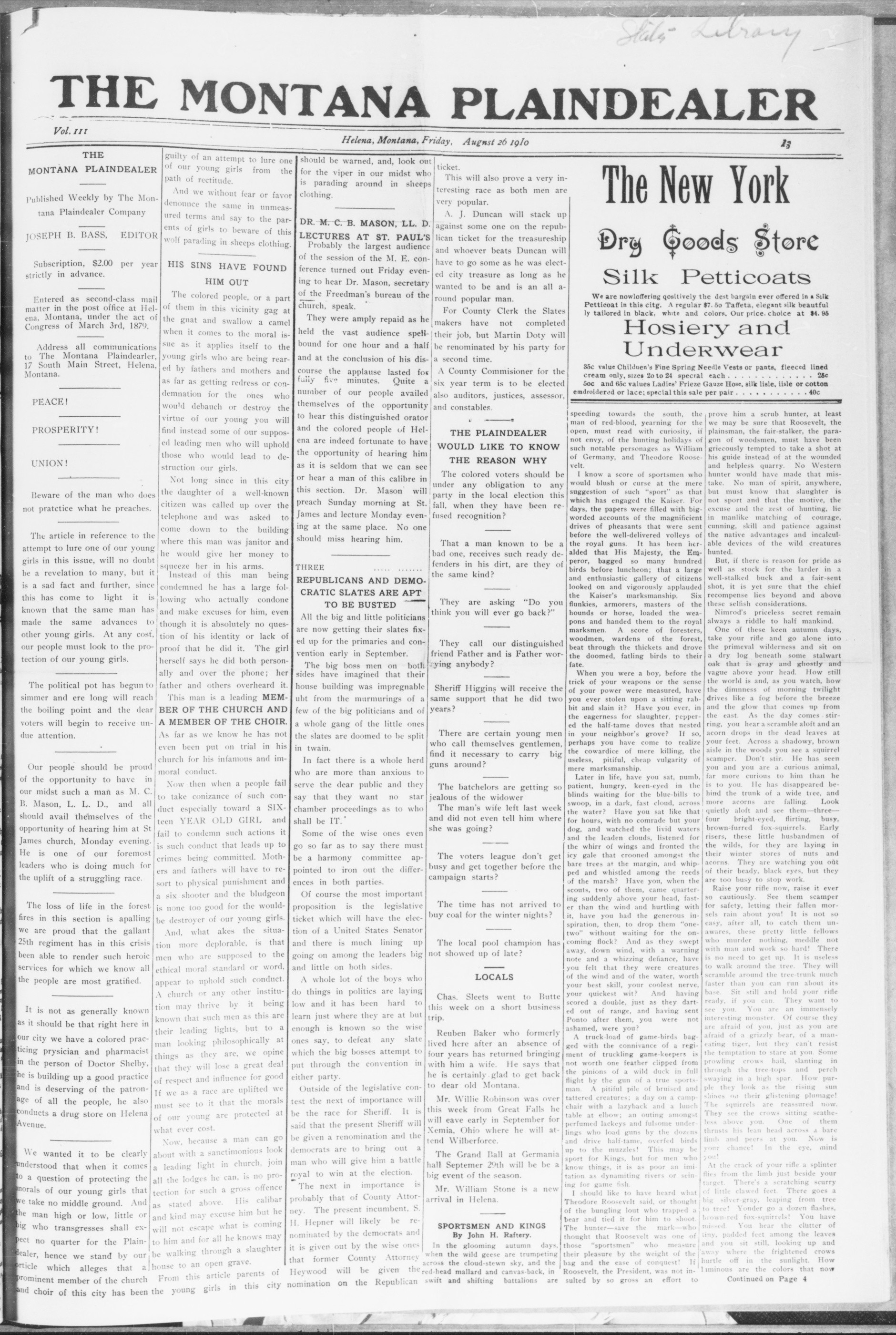
THE MONTANA PLAINDEALER
Vol. 111
Published Weekly by The Montana Plaindealer Company
JOSEPH B. BASS, EDITOR
Subscription, $2.00 per year strictly in advance.
Entered as second-class mail matter in the post office at Helena, Montana, under the act of Congress of March 3rd, 1879.
Address all communications to The Montana Plaindearler, 17 South Main Street, Helena, Montana.
PEACE!
PEACE!
PROSPERITY!
UNION!
UNION!
Beware of the man who does not pratctice what he preaches.
The article in reference to the attempt to lure one of our young girls in this issue, will no doubt be a revelation to many, but it is a sad fact and further, since this has come to light it is known that the same man has made the same advances to other young girls. At any cost, our people must look to the protection of our young girls.
The political pot has begun to simmer and ere long will reach the boiling point and the dear voters will begin to receive undue attention.
Our people should be proud of the opportunity to have in our midst such a man as M. C. B. Mason, L. L. D., and all should avail themselves of the opportunity of hearing him at St James church, Monday evening. He is one of our foremost leaders who is doing much for the uplift of a struggling race.
The loss of life in the forest fires in this section is apalling we are proud that the gallant 25th regiment has in this crisis been able to render such heroic services for which we know all the people are most gratified.
It is not as generally known as it should be that right here in our city we have a colored practicing physician and pharmacist in the person of Doctor Shelby, he is building up a good practice and is deserving of the patronage of all the people, he also conducts a drug store on Helena Avenue.
We wanted it to be clearly understood that when it comes to a question of protecting the morals of our young girls that we take no middle ground. And the man high or low, little or big who transgresses shall expect no quarter for the Plain-dealer, hence we stand by our article which alleges that a prominent member of the church and choir of this city has been
And we without fear or favor denounce the same in unmeasured terms and say to the parents of girls to beware of this wolf parading in sheeps clothing.
HIS SINS HAVE FOUND
HIM OUT
The colored people, or a part of them in this vicinity gag at the gnat and swallow a camel when it comes to the moral issue as it applies itself to the young girls who are being reared by fathers and mothers and as far as getting redress or condemnation for the ones who would debauch or destroy the virtue of our young you will find instead some of our supposed leading men who will uphold those who would lead to destruction our girls.
Not long since in this city the daughter of a well-known citizen was called up over the telephone and was asked to come down to the building where this man was janitor and he would give her money to squeeze her in his arms.
Instead of this man being condemned he has a large following who actually condone and make excuses for him, even though it is absolutely no question of his identity or lack of proof that he did it. The girl herself says he did both personally and over the phone; her father and others overheard it. This man is a leading MEMBER OF THE CHURCH AND A MEMBER OF THE CHOIR. As far as we know he has not even been put on trial in his church for his infamous and immoral conduct.
Now then when a people fail to take conizance of such conduct especially toward a SIXteen YEAR OLD GIRL and fail to condemn such actions it is such conduct that leads up to crimes being committed. Mothers and fathers will have to resort to physical punishment and a six shooter and the bludgeon is none too good for the would-be destroyer of our young girls.
And, what akes the situation more deplorable, is that men who are supposed to the ethical moral standard or word, appear to uphold such conduct. A church or any other institution may thrive by it being known that such men as this are their leading lights, but to a man looking philosophically at things as they are, we opine that they will lose a great deal of respect and influence for good. If we as a race are uplifted we must see to it that the morals of our young are protected at what ever cost.
Now, because a man can go about with a sanctimonious look a leading light in church, join all the lodges he can, is no protection for such a gross offence as stated above. His calibar and kind may excuse him but he will not escape what is coming to him and for all he knows may be walking through a slaughter house to an open grave. From this article parents of the young girls in this city
Helena, Montana, Friday, Augnst 26 1010
LECTURES AT ST. PAUL'S Probably the largest audience of the session of the M. E. conference turned out Friday evening to hear Dr. Mason, secretary of the Freedman's bureau of the church, speak.
They were amply repaid as he held the vast audience spellbound for one hour and a half and at the conclusion of his discourse the applause lasted fos fully five minutes. Quite a number of our people availed themselves of the opportunity to hear this distinguished orator and the colored people of Helena are indeed fortunate to have the opportunity of hearing him as it is seldom that we can see or hear a man of this calibre in this section. Dr. Mason will preach Sunday morning at St. James and lecture Monday evening at the same place. No one should miss hearing him.
The big boss men on both sides have imagined that their house building was impregnable ubt from the murmurings of a few of the big politicians and of a whole gang of the little ones the slates are doomed to be split in twain.
In fact there is a whole herd who are more than anxious to serve the dear public and they say that they want no star chamber proceedings as to who shall be IT.
Some of the wise ones even go so far as to say there must be a harmony committee appointed to iron out the differences in both parties.
Of course the most important proposition is the legislative ticket which will have the election of a United States Senator and there is much lining up going on among the leaders big and little on both sides. A whole lot of the boys who do things in politics are laying low and it has been hard to learn just where they are at but enough is known so the wise ones say, to defeat any slate which the big bosses attempt to put through the convention in either party.
Outside of the legislative contest the next of importance will be the race for Sheriff. It is said that the present Sheriff will be given a renomination and the democrats are to bring out a man who will give him a battle royal to win at the election. The next in importance is probably that of County Attorney. The present incumbent, S. H. Hepner will likely be renominated by the democrats and it is given out by the wise ones that former County Attorney Heywood will be given the nomination on the Republican
This will also prove a very interesting race as both men are very popular.
A. J. Duncan will stack up against some one on the republican ticket for the treasureship and whoever beats Duncan will have to go some as he was elected city treasure as long as he wanted to be and is an all around popular man.
For County Clerk the Slates makers have not completed their job, but Martin Doty will be renominated by his party for a second time.
A County Commissioner for the six year term is to be elected also auditors, justices, assessor, and constables.
THE PLAINDEALER WOULD LIKE TO KNOW THE REASON WHY
The colored voters should be under any obligation to any party in the local election this fall, when they have been refused recognition?
That a man known to be a bad one, receives such ready defenders in his dirt, are they of the same kind?
They are asking "Do you think you will ever go back?"
They call our distinguished friend Father and is Father worrying anybody?
Sheriff Higgins will receive the same support that he did two years?
There are certain young men who call themselves gentlemen, find it necessary to carry big guns around?
The batchelors are getting so jealous of the widower
The man's wife left last week and did not even tell him where she was going?
The voters league don't get busy and get together before the campaign starts?
The time has not arrived to buy coal for the winter nights?
The local pool champion has not showed up of late?
LOCALS
Chas. Sleets went to Butte this week on a short business trip.
Reuben Baker who formerly lived here after an absence of four years has returned bringing with him a wife. He says that he is certainly glad to get back to dear old Montana.
Mr. Willie Robinson was over this week from Great Falls he will eave early in September for Xemia, Ohio where he will attend Wilberforce.
The Grand Ball at Germania hall Septemer 29th will be be a big event of the season.
Mr. William Stone is a new arrival in Helena.
SPORTSMEN AND KINGS
By John H. Raftery.
In the glooming autumn days, thien when the wild geese are trumpeting thie across the cloud-stewn sky, and the bred-head mallard and canvas-back, in R swift and shifting battalions are s
The New York Dry Goods Store Silk Petticoats
We are nowloffering positively the best bargain ever offered in a Silk Petticoat in this city. A regular $7.50 Taffeta, elegant silk beautifully tailored in black, white and colors. Our price, choice at $4.96
35c value Children's Fine Spring Needle Vests or pants, fleeced lined cream only, sizes 2 to 24 special each.....25c
50c and 65c values Ladies' Frieze Gauze Hose, silk lisle, iisle or cotton embroidered or lace; special this sale per pair.....40c
speeding towards the south, the man of red-blood, yearning for the open, must read with curiosity, if not envy, of the hunting holidays of such notable personages as William of Germany, and Theodore Roosevelt.
prove him a scrub hunter, at the we may be sure that Roosevelt, plainsman, the fair-stalker, the person of woodsmen, must have biogicously tempted to take a shot his guide instead of at the woun and helpless quarry. No West
I know a score of sportsmen who would blush or curse at the mere suggestion of such "sport" as that which has engaged the Kaiser. For days, the papers were filled with big-worded accounts of the magnificent drives of pheasants that were sent before the well-delivered volleys of the royal guns. It has been heralded that His Majesty, the Emperor, bagged so many hundred birds before luncheon; that a large and enthusiastic gallery of citizens looked on and vigorously applauded the Kaiser's marksmanship. Six flunkies, armorers, masters of the hounds or horse, loaded the weapons and handed them to the royal marksmen. A score of foresters, woodmen, wardens of the forest, beat through the thickets and drove the doomed, fatling birds to their fate.
When you were a boy, before the trick of your weapons or the sense of your power were measured, have you ever stolen upon a sitting rabbit and slain it? Have you ever, in the eagerness for slaughter, peppered the half-tame doves that nested in your neighbor's grove? If so, perhaps you have come to realize the cowardice of mere killing, the useless, pitiful, cheap vulgarity of mere marksmanship.
Later in life, have you sat, numb patient, hungry, keen-eyed in the blinds waiting for the blue-bills to swoop, in a dark, fast cloud, across the water? Have you sat like that for hours, with no comrade but your dog, and watched the livid waters and the leaden clouds, listened for the whirr of wings and fronted the icy gale that crooned amongst the bare trees at the margin, and whipped and whistled among the reeds of the marsh? Have you, when the scouts, two of them, came quartering suddenly above your head, faster than the wind and hurtling with it, have you had the generous inspiration, then, to drop them "one-two" without waiting for the oncoming flock? And as they swept away, down wind, with a warning note and a whizzing defiance, have you felt that they were creatures of the wind and of the water, worth your best skill, your coolest nerve, your quickest wit? And having scored a double, just as they darted out of range, and having sent Ponto after them, you were not ashamed, were you?
A truck-load of game-birds bagged with the connivance of a regiment of truckling game-keepers is not worth one feather clipped from the pinions of a wild duck in full flight by the gun of a true sportsman. A pitiful pile of bruised and tattered creatures; a day on a camp chair with a lazyback and a lunch table at elbow; an outing amongst perfumed lackeys and fulsome underlings who load guns by the dozens and drive half-tame, overfed birds up to the muzzles! This may be sport for Kings, but for men who know things, it is as poor an imitation as dynamiting rivers or seining for game fish.
I should like to have heard what Theodore Roosevelt said, or thought of the bungling lout who trapped a bear and tied it for him to shoot. The hunter—save the mark—who thought that Roosevelt was one of those "sportsmen" who measure their pleasure by the weight of the bag and the ease of conquest! If Roosevelt, the President, was not insulted by so gross an effort to
13
prove him a serub hunter, at least we may be sure that Roosevelt, the plainsman, the fair-stalker, the paragon of woodsmen, must have been griecously tempted to take a shot at his guide instead of at the wounded and helpless quarry. No Western hunter would have made that mistake. No man of spirit, anywhere, but must know that slaughter is not sport and that the motive, the excuse and the zest of hunting, lie in manlike matching of courage, cunning, skill and patience against the native advantages and incalculable devices of the wild creatures hunted.
But, if there is reason for pride as well as stock for the larder in a well-stalked buck and a fair-sent shot, it is yet sure that the chief recompense lies beyond and above these selfish considerations.
Nimrod's priceless secret remain always a riddle to half mankind.
One of these keen autumn days, take your rifle and go alone into the primeval wilderness and sit on a dry log beneath some stalwart oak that is gray and ghostly and vague above your head. How still the world is and, as you watch, how the dimness of morning twilight drives like a fog before the breeze and the glow that comes up from the east. As the day comes stirring, you hear a scramble aloft and an acorn drops in the dead leaves at your feet. Across a shadowy, brown aisle in the woods you see a squirrel scamper. Don't stir. He has seen you and you are a curious animal, far more curious to him than he is to you. He has disappeared behind the trunk of a wide tree, and more acorns are falling. Look quietly aloft and see them—three—four bright-eyed, flirting, busy, brown-furred fox-squirrels. Early risers, these little husbandmen of the wilds, for they are laying in their winter stores of nuts and acorns. They are watching you out of their beady, black eyes, but they are too busy to stop work.
Raise your rifle now, raise it ever so cautiously. See them scamper for safety, letting their fallen morsels rain about you! It is not so easy, after all, to catch them unawares, these pretty little fellows who murder nothing, meddle not with man and work so hard! There is no need to get up. It is useless to walk around the tree. They will scramble around the tree-trunk much faster than you can run about its base. Sit still and hold your rifle ready, if you can. They want to see you. You are an immensely interesting monster. Of course they are afraid of you, just as you are afraid of a grizzly bear, of a mancating tiger, but they can't resist the temptation to stare at you. Some prowling crows hail, slanting in through the tree-tops and perch swaying in a high spar. How purple they look as the rising sun shines on their glistening plumage! The squirrels are reassured now. They see the crows sitting scateless above you. One of them thrusts his lean head across a bare limb and peers at you. Now is your chance! In the eye, mind you!
At the crack of your rifle a splinter flies from the limb just beside your target. There's a scratching scurry of little clawed feet. There goes a big silver gray, leaping from tree to tree! Yonder go a dozen flashes, brown-red fox-squirrels! You have missed. You hear the clutter of tiny, padded feet among the leaves and you sit still, looking up and away where the frightened crows hurtle off in the sunlight. How laminous are the colors that now Continued on Page 4
When Kant Pardon arrived at the home of her sister in a New England village in a certain town she was met at the request by her sister, Miss Jean Travers, who had heard in her ears. When she reached the house she was kissed by her sister who had heard in her ears. A little later she was welcomed by Mr. Travers, who looked grim and determined. It did not take the little old woman more than half an hour to discover that something in that family was out of grief, and to demand an explanation. She was told to get result in something awful.
Miss Jean had been a away to school in Boston. She knew that, because being rich, and because Miss Jean was her favorite, she was paying the bills. What had the girl done, on her third turn of schooling, and just as she had arrived at that point where she could almost add the gum drops at the store in French, but in love?
She had not only fallen in love with a young man, but she had failed to notify her parents by special delivery after. Further she had broken a rule of the school. On her arrival there she had been told in the pains of being lined up that under no circumstances must she fall in love with a man, either old or young, while to write or receive a note was an offense so benign that it could not possibly be revered. All this was as nothing to what was to come and Fardon must square herself in her chair and keep from running away if she could.
Miss Jean had written notes—little pink notes. She had received notes—little red brown letters and some of those notes had got into the hands of Miss Bonsest, the president of the school, and her hat had been sent to Miss Jean's parents, and now the earth was about to tremble, aunt Parion would tremble with the earth. Miss Jean had been caught when on the verge of slipping with the young most abrasive. She had her window up and was about or descend a more ladder when she was seen and handed back. She was talked to for the rest of the night and sent home next morning. It was the most frequent case Miss Bonsest had encountered in her fifty years of maidenhood, and she must make a shining an ample of the guilty party.
There it was, and what had Kurt Parton to say about it? End she wean in her whole life, heard of such a thing? She replied that she had—just one case, and she knew exactly the comedy for it. Then, in turn, she asked what was the matter with the young man. Neither father nor mother could sensitively tell, and Miss Jean had looked herself in her eyes. The fact of the matter was that Mr. Crawvers had been speculating and made a lot of money, and was going in keep on speculating and making more, and for the honor of the family he wanted the daughter to make a good match. There was no reason why she shouldn't marry a bird instead of an adventurer. Other girls had done it, and why shouldn't Jean
The girls story told amid tears and in the privacy of her sworn, differed somewhat. Yes; she told written and resisted questions, but he was such a lovely young man! There was a rape ladies, but one of the girls had fainted her to despair. Perhaps she might have met the young man and told him to go away, but she certainly had no thought of stoning.
"Do you know what I'm going to do?" asked Kurt Funion of the beams of the family after a day or two. "I'm going to take Jean and go down to Schulthein City for a month. I need the sea air, and she needs to forget this young man. I read that there are always but not to fifteen birds hanging around there, and I'll be my old shoes she captures one of them. There'll be your money and my money behind her, and she'll go off like hot cakes. The biggest relatives we've got is only a member of the legislatures, and I believe they are investigating him for grafting. I kind of like to be aunt or something to a hard to see how it seems."
Miss Jean was ordered to make ready for her trip. She demurred a little and sheed a few tears. She wasn't told in so many words that it was an excuse to further separate her from her young man, but she figured out things properly well for herself. She might have jumped of the curb or down the well and made her parents out of trouble but when the time came she went along as humble as Murray's little ambition.
Aunt Pamela was a bustler. If her son had and the right to vote she would have been governor of the state years before. Four years after reaching athletics, she was promoting the baseballwelt looking for a level. Miss Jean wouldn't. She was still seriously impatient. She had been thirsty, and it was not for her to go grinning around like a mouse.
For three years hard hard looked for her love. She got all the papers and answered the hotel arrivals. She didn't find one, but she was not the one.
and at one point of the walk theailing had been carried away by thewaters snorkled in by a heavy swimmer.The drop down was twisted up, andpredators hugged the fur side inpassing. Miss Person can't rememberber in the far far just how the thing came about. Of a sudden, Miss Jeanwas seized with sorrow andwent screaming towards the gate. Severalpersons surmised. The aunt was peeledoff. An old man warned his cause.She must have taken the drop butfor the young man who rushed forward and caught her and swived her to safety. She didn't want forhands.He thrust the card into Kunt Pacson's hand and modestly disappeared.The torture disappeared at the sametime, and Miss Jean did not requirethe ambulance or got back to theterror.
"If he isn't a lord then I'm an old curmish," said Aunt Purion to herself as she looked at the name on the card. "To save Guy Livingstone, but that of course is his name. Nobody but a lord could jump in the war he did. Why, he seemed to be waiting right there for the chance to do something horrible. Then where words differ from other folks, I didn't see him write the name of his hotel on the card, but here it is, and he must receive a note of great note and an invitation to call."
Such a note was written. It was written by Miss Jean, and she conceived her blunders as she weighed her pen, and that she hummed on herself. It was her first hum for many days.
"The "nong" called. He was a gentleman. he was good-looking. he was entertaining. He didn't say right out that he was a lurid, but he couldn't too sharp off kint Purport. He was asked to call again, and he said he would be charmed. He did call, and one but a month later kint Purport sat down to write a letter to her brother-in-law in New England, and among other things she said: "So you speculated and lost all you made en." Well, We made a duo
```markdown
```
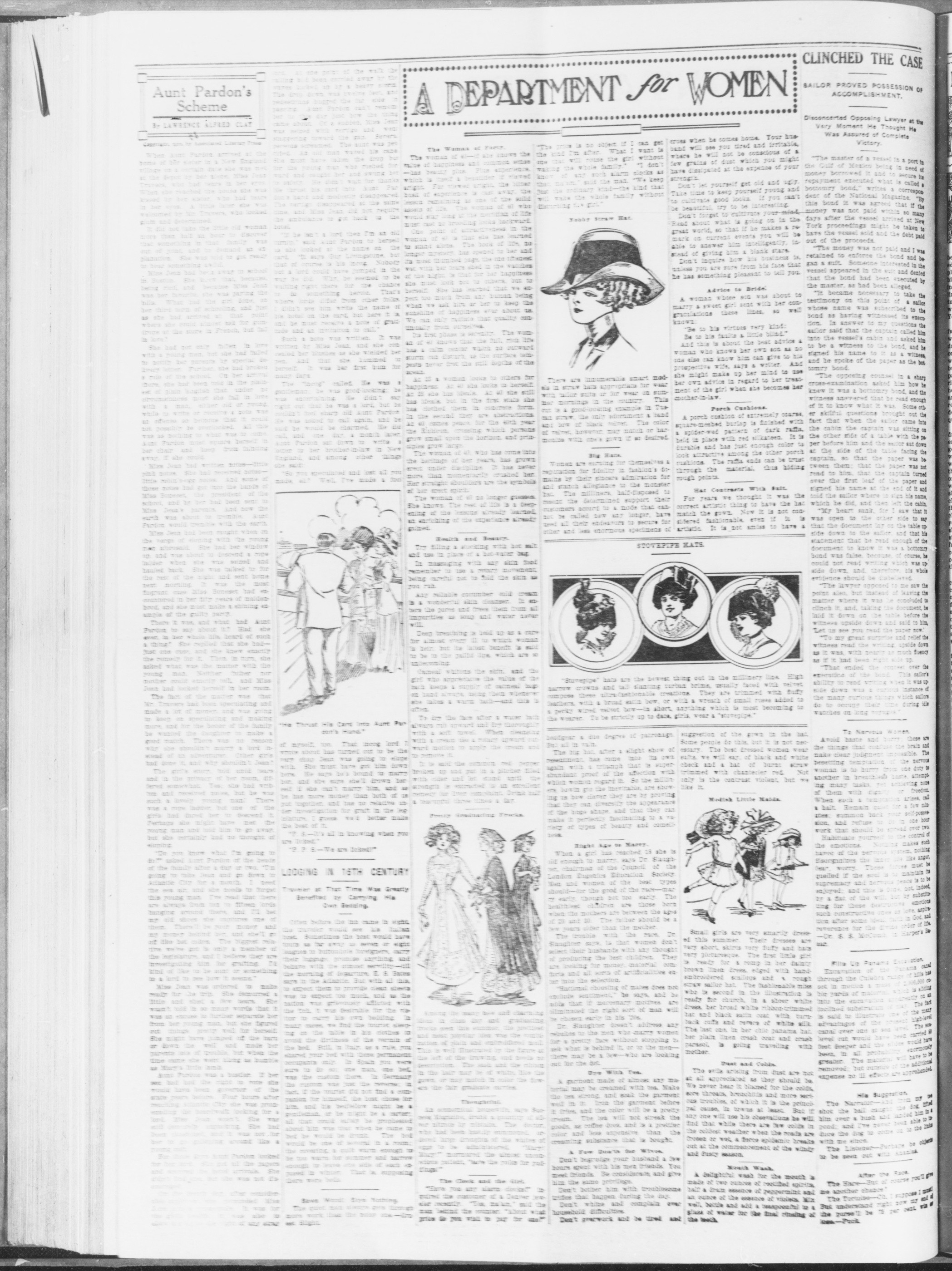
"He Thrust His Card Into Aunt Pan
don'ts Hands."
"He Trust His Card Into Aunt Pam's Hand."
of myself, but That mong lord I wrote about has turned out to be the very chap Jesus was going to elope with. He must have got him frowned. He says he's bound to marry her, and she says she'll drown her self if she can't marry him, and as he has more money than both of us put together, and has to relative under investigation for graft in the legislature, I guess we'll better make the best of it.
"P $ — $'s all in knowing when you are locked."
"P $ — $'s We are locked!"
LODGING IN 16TH CENTURY
Traveler at That Time Was Greatly
Benefited by Carrying His
Own Bagging.
Often before the init came in sight, the traveler would see us Nathan host. Sometimes the host would have tents as far away as seven or eight leguages to automobile foreigners, carry their luggage, promise anything, and behave with the most servility—till the morning of departure. E. S. Bates says in the afairthin. But with all this, to expect them to provide clean sheets was to expect too much, and as the batton was greviously afflicted with the fish, it was desirable for the toilet to carry his own bedding. In many cases, we find the tourist sleeping on the table in his clothes to avoid the dirtiness of the vergin of the bed. Still, in Italy, as a rule, you shared your bed with these permanent occupants only. In Spain you were sure to do so; one man, the bed, was the custom there. In Germany the custom was just the reverse; in fact, if the tourist did not find a companion for himself, the host chose for him, and his bedfellow might be a gentleman, or be might be a carer; all that could surely be grumpleased about him was that when he came to bed he would be drunk. The bed would be one of several in a room; the covering, a quilt warm enough to be the warm for summer and narrow enough to leave one side of each pressed in window. That is, supposing there were beds.
Savann Wardt says Nothing.
The quiet man always goes through
more work than the busy one —she
est flight.
A DEPARTMENT FOR WOMEN
The Woman at Force
The woman of all—she knows the value of happiness and common sense—has beauty plus. Plus experience, which is itself a beacon of visual insight. For viewed right, the bitter truth of experience is just away the lesson remaining as one of the soulful assets of life. The woman of all who would stay long at the mention of the must cast an incoming pool backward. One point of attractiveness in the woman of all is that she has learned to stand alone. The book of life, no longer mysterious has opened to her and the most numbered pages, the one of almost was with her years shed in the vanities of the night is that for her happiness she must look not to others, but to herself. She has learned that we expect you from any human being when we ask him or her to keep the sunshine of happiness ever about us. We can only realize that quality continually from ourselves.
In first phase is seething. The woman of 40 moves that the full, rich life has a calm manner which outward gown can distract, as the surface temples never first the still depths of the ocean.
At 45 a woman looks to others for happiness. At 40 she looks to herself. At 25 she has ideas. At 40 she still has ideas, but in the first state she has dotted them in courteous form. In the second they are abstractions. At 40 comes peace for the 40th year the Eunich, crossing which persons grow small upon the horizon, and principles grow large.
The woman of 40 who has come into the heritage of her years, has grown sweet under discipline. It has never more than momentarily crushed her. Her straight shoulders are the symbols of her sweet smile.
The woman of 40 no longer greets
She knows. The rest of life is a deep-
ening of the lessons already learned,
an unrushing of the experience already
given.
Home | Office | School | Library
Try filling a stocking with hot salt and use in places of a hot-water bag.
In messaging with any skin fool remember to use a wonty movement, being careful not to fold the skin as you run.
Any valuable cucumber mild cream is a wonderful skin cleanser. It enters the purse and frees them from all impurities as soap and water to all will.
Deep breathing is held up as a cure for almost every ill to which woman is heir, but its latest benefit is said to be in the painful lips, which are so unbecoming.
General wittens the skin, and the girl who apprehends the value of the skin keeps a supply of mineral bags on hand always, using them whenever she makes a warm bath—and this is often.
To dry the hair after a water bath
always run toward and fire through-
with a soft towel. When cleaning
with a cream use a rotary upward
ward motion to apply the cream and
to remove it.
It is said the common red pepper
broken up and put in a pitcher filled
with other and let stand until the
strength is extracted is an excellent
remedy for liver concomitant. Drink
it a teaspoon three times a day.
Penalty Geminating Frocks.
Among the many new and charming ideas in china day and graduating frocks seen this summer, the prettiest and most popular idea was the combination of plain and embroidered nail. This is well illustrated by the figure of the left of the drawing, and needs no description. The nail and the cloum in the hair may be of white, like the gown, or may match in color the flowers the fair graduate carries.
Thoughtful.
An economical housewife, says Susan Magnus, brings a quantity of aloe atrush by minima. The fortune who has been basically summoned, or loved large droughts of the valleys of eggs to be administrated, "Mary Magn" marmorized the almost uncontainable patient, "wrote the pain for puffing."
The Check and the Girl.
"Have you any alarm clock?" insulted the customer at a Denver jewelry store recently. "You can tell," said the man behind the counter, "about what price you want to pay for one."
STOVEPIE HATS.
'Sturgepipe' hats are the newest thing out in the millinery line. High narrow crowns and tall skimming turban brims, usually faced with velvet comprise these ultra-fashionable creations. They are trimmed with fluffy beathers, with a broad suit bow, or with a wreath of small roses added to a perky wired velvet bow—in short, anything which is most becoming to the wearer. To be securely up to data, girls wear a 'sturgepipe.'
"The prince is no object if I can get the knif I am after. What I want is one that will cause the girl without washing the whole family." "I don't know of any such alarm stories as that man, knif the man." "We keep just the ordinary knif—the knif that will wake the womb family without disturbing the girl."
Yanky Scraw Hat.
There are innumerable smart models in scrawl hair appropriate for wear with color suits or for wear in summer mornings in the country. This cut is a good-looking example in Turkish scrawl, the only adornment a hand and a bow of hair wear. The color of hair, however, may not or may not be matched with one's gown if so desired.
Big Hats.
Women are earning for themselves a reputation for fidelity in fashion and domains by their students admiration for and grant allegiance to the monastery hat. The millers half-disposed to present the determined support their customers accord to a mode that cannot be called new any longer, have used all their endeavors to secure for other and less enormous specimens of
'Stovepipe' hats are the newest the narrow crowns and tall standing curved compose these ultra-fashionable creature heathers, with a broad such bow, or with a perky wired velvet bow—in short, as the wearsen. To be strung up to dana, g
todigear a due degree of parthenage.
But all in vain.
The big hit, after a slight show of resentment, has come into its own again with a touch that is superb and abundant proof of the affection with which women regarded it. So the millers brown got the inevitable, are showing us how clever they are by growing that they can diversify the appearance of the huge shape, and that they can make it persistently fascinating to a variety of types of beauty and comedy.
RICHARD AVE. DE NARRY.
When a girl has reached 18 she is off enough to marry, says Dr Slaughter, chairman of the Council of the London Engines Education Society. Men and women of the best types should—for the good of the race—marry early, though not too early. The healthiest children are those born when the mothers are between the ages of 20 and 20. The father should be a few years older than the mother. The trouble with the race, Dr Slaughter says, is that women don't select their husbands with any thought of producing the best children. They are looking for money, material comforts and all sorts of artificialities enter into the selection.
"National choosing of makes does not exclude sentiment," he says, and he adds that if necessary mothers are eliminated the right sort of man will be chosen early in his 20s.
Dr. Shanghae doesn't address any subjects in the men who many women for a pretty face without stopping to ask what is behind it, or to the men—there may be a few—who are looking out for the lot.
Bye With You.
A garment made of almost any material may be treated with tea. Make the tea strong, and soak the garment well in it. In the garment before it fries, and the color will be a pretty cream. The tea will not strack the goods, as coffee does, and is a prettier color and less expensive than the treating substance that is bought.
A. How Do You See Wives
Don't begrudge your husband a few hours spent with his men friends. You meet friends. Be considerate and give him the same privileges. Don't bother him with troublesome writes that happen during the day.
the Don't white and complain over that household difficulties. Don't overwork and be tired and
cross when he comes home. Your husband will see you tired and faintable, where he will not be conscious of a few grains of dust which you might have dispatched at the expense of your strength.
Don't let yourself get old and ugly. Take time to keep yourself young and to cultivate good looks. If you can't be beautiful, try to be interesting.
Don't forget to cultivate your mind. Read about what is going on in the great world, so that if he makes a remark on current events you will be able to answer him intelligently, instead of giving him a blank stare.
Don't inquire how his business is, unless you are sure from his face that he has something pleasant to tell you.
Advice to Bride.
A woman whose son was about to marry a sweet girl sent with her congratulations these lines, so well known.
"Be to his virtues very kind:
Be to his family a little blind."
And this is about the best advice a woman who knows her own son as no one else can know him can give to his prospective wife, says a writer. And she might make up her mind to use her own advice in regard to her treatment of the girl when she becomes her mother-in-law.
Porch Cushions.
A porch cushion of extremely sharp, square-measured bump is finished with a spider-wed pattern of dark raffia, held in place with red silkstone. It is durable and has just enough color to look attractive among the other porch cushions. The raffia ends can be truss through the material, thus holding rough points.
Hot Convenience With Fault
For years we thought it was the correct artistic thing to have the last match the guvn. Now it is not considered fashionable, even if it is artistic. It is not amiss to have a
thing out in the millinery line. High urban brims, usually faced with velvet seations. They are trimmed with fluffy with a wreath of small roses added to it, anything which is most becoming to girls, wear a "stavagipe."
suggestion of the grown in the last. Some people for this, but it is not necessary. The best dressed women wear suits, we will say of black and white check and a hat of burnt screw trimmed with chandelier red. Not only is the contrast violent, but we like it.
Mordida Little Manda.
MILTON ABBEY
Small girls are very smartly dressed this summer. Their dresses are very short, salutes very fuzzy and have very punctuoses. The first little girl is ready for a coup in her dainty brown linen dress, eloped with hand-embroidered scallops and a rough scrawl sailor hat. The fashionable miss who is second in the illustration is ready for church, in a sheer white dress, her broad white ribbon-trimmed hat and black sailor coat with turn-back cuffs and reverses of white gills. The last one, in her chic panama hat, her plain linen resh coat and crush parasol, is going traveling with mother.
Dust and Cobble
The winds arising from dust are not at all appreciated as they should be. We never bear it thinned for the colds, save throats, loathbins and more serious troubles, of which it is the principal cause, in towns at least. But if any one will use his observations he will find that while there are few colds in the coldest weather when the winds are Crown or wet, a force agitating breaks out at the commencement of the windy and frosty season.
Mouth Wash
give
some
water
and
A delightful wash for the mouth is
made of two ounces of certified spirit,
half a dram essence of peppermint and
an ounce of the essence of violets. Min
well, bottle and add a congourdful to a
glass of water for the final cleansing of
the mouth.
BAILOR PROVED POSSESSION
ACCOMPLISHMENT.
Disconcerted Opposing Lawyer at the Very Moment He Thought He Was Assured of Complete Victory.
"The master of a vessel in a port in the Gulf of Mexico being in need of money borrowed it and to secure its repayment executed what is called a bonomary bond," writes a correspondent of the National Magazine. "By this bond it was agreed that if the money was not paid within so many days after the vessel arrived at New York proceedings might be taken to have the vessel sold and the debt paid out of the proceeds.
"The money was not paid and I was retained to enforce the bond and be a suit. Someone interested in the vessel appeared in the suit and denied that the bond had been executed by the master, as had been alleged.
"In became necessary to take the testimony on this point of a sailor whose name was subscribed to the bond as having witnessed his execution. In answer to my questions the sailor said that the captain called him into the vessel's cabin and asked him to be a witness to the bond, and be signed his name to it as a witness, and he spoke of the paper as the boot tummy bond.
"The opposing counsel in a sharp cross-examination asked him how he knew it was a bottonomy bond, and the witness answered that he read enough of it to know what it was. Some other skilful questions brought out the fact that when the sailor came into the cabin the captain was sitting on the other side of a table with the paper before him and the sailor sat down at the side of the table facing the captain, so that the paper was be between them; that the paper was not read to him, that the captain turned over the first leaf of the paper and signed his name at the end of it and soff the sailor where he sign his name which he did, and then left the cab
"My heart sank, for I saw that it was open to the other side to say that the document lay on the table up side down to the sailor and that his statement that he read enough of the document to know it was a bounty bond was false because of course, he could not read writing which was up side down, and, therefore, his whole evidence should be disbelieved.
"The lawyer opposed to the saw the point also, but instead of hearing the matter where it was be concluded to clitch it, and, taking the document, he land it down on the table before the witness upside down and said to him, 'Let us see you read the paper now!'
"To my great surprise and relief the witness read the writing upside down as it was, with nearly as much fluency as if it had been right up side up.
"That ended the contest over the execution of the bond." The sailor's ability to send writing when it was upside down was a curious instance of the many curious things which sailors do to occupy their time during the waches on long voyages.
The National Water
Avoid hostage and burrow these are the things that confuse the brain and make clear judgment impossible. The besetting demotion of the nervous woman is her burrow from one duty to another in breathless pause attempting many tasks and achieving ones of them with dignity or freedom. When such a comparison arises, call a hail. Remain quiet for a few minutes, summon back your self-possession, and refuse to do it in one hour work that should be spread over two
Habituate yourself in the control of the emotions. Normally makes such flavor of the nervous system, nothing disorganizes the inner life like anger, fear, worry. These forces must be qualified if the soul is to maintain its supremacy and servicing peace is to be ensured; and this is done not, indeed, by a dart of the will, but by substituting for these destructive emotions such constructive ones as love, appreciation after some idea, truth in God, and coherence for the divine order of life. —Dr. S. S. McCumb in Harper's Beacon.
FILE Urs Panama Expedition.
Excavation of the Panama canal
through the Quebracho range of hills
set in motion a mass of 1,000,000
cubic yards of material, which is shifting
into the excavation apparently on an
inclined substructure of one. The fact
is said to illustrate one of the many
advantages of the present high-level
canal over one of sea level. The sea
level cut out would have been carried 90
feet deeper and the slopes would have
been, in all probability, enormously
greater. The material will have to be
removed, but ruins of the additional
expense no ill effects are apprehended.
Wife Subscriptions
Mia Suggestion
The Narrator—him from my eye
shot the ball caught the dog
him over a bush and sniffed him in a
pound, and I've never been able to
drive the dog or come on to the links
with me since.
After the Race.
The Shar- "Of course you'll give
me another chance!"
The Fortune- "Oh, I suppose I must
But understand right now my end
the purse will be 75 per cent, win or
lose."-Puck.
MODES of The MOMENT
HE young girls are benefiting by the prevailing note of girlishness which characterizes this summer's dresses, and for once at least they have a distracting number of models from which to choose. Some are lovelier than others and all have lines of grace and girl wears a wide brimmed rose colored straw hat trimmed with a hug black satin bow at the left side toward the back.
White and black pin striped marquette or muslin make a becoming an useful dress for almost any afternoon affair, and it can be given much of a air by the trimming used to brighten it. The dull gray tone of the material combines well with rose color or pink.
HE young girls are benefiting by the prevailing note of girlishness which characterizes this summer's dresses, and for once at least they have a distracting number of models from which to choose. Some are lovelier than others and all have lines of grace and beauty. The majority of those intended for afternoon wear are quite simply made. The materials are a combination representing daintiness and nexpensiveness, and trimmings are limited to fancy collars, entredeux, tucks and soft silk belts and ties, writes a fashion expert in the New York Herald.
Muslins, lawns and linens are the favorite foundations for dresses to be worn at tennis and garden parties, for driving at fashionable resorts and upon the other pleasant occasions in which girls who are not yet In the debutante class are permitted to participate. These simple names of materials do not convey all that they might, however, for the reason that muslins and linens in the finer qualities are really glorified fabrics, sheer in weave, delicate in texture and offered in exquisite colors.
Half a dozen of these thin afternoon dresses are not too many for the average young girl to possess, and it goes without saying that two of them will be white. A white lingerie and a white linen are almost essential to the summer outfit. This leaves four, or more if liked, to be chosen in the wearer's most becoming colors. The shades from which young girls may choose are somewhat more limited than for older women, but the list includes pink, blue, gray, cream or pale yellow, brown and rose. The darker shades are suitable for linens and similar materials, while the sheer fabrics cannot be too delicate in their colorings, if the yare to be made without the velled effect, which is one of the fads of this season.
Among the simpler materials are charming marquisettes, showing delicate phink stripes alternating with an openwork pattern, and there are dotted and figured cotton marquisettes and muslins which have all the beauty of silk and are much better suited to the youthful wearer than even foulards or some of the softer weaves of silk.
The cotton volles, new in weave and finish, were never more alluring, and they drape a girlish figure as no other fabric does. With pink and white, rose and white, green with white figures and in dull gray pin stripes a brilliant touch of color is used, perhaps a satin bow or a piping on a round collar, to give the dress an air. Narrow Valenciennes insertions are used fort he most part on lingerie dresses, and even these are now often trimmed with other laces or with embroidery to differentiate them from the ubiquitous ready made garment.
NOTHING is prettier in cut for a simple lingerie dress than the one made with a straight line across the neck reaching from shoulder to shoulder, after the style of Italian dresses worn in mediaeval days. The line is horizontal, and the front and back are filled in with bands of lace run crosswise. A marquisette or dainty muslin dress made in this style would have an inch wide strip of trimming, either a hand embroidered strip or good lace, finishing the top of the waist, front and back. Then from the point where the two strips meet on the shoulder they would unite and continue down the sleeves on the outside of the arm in a single band.
A pink dotted muslin was made in this fashion with an inch wide piece of Cluny insertion outlining the neck and forming the sleeve trimming. The sleeves were a narrow kimono cut, with a band of the lace finishing the bottom at the elbow, where an undersleeve of fine white tucked linen was seen. The blouse was drawn in at the waist under a crushed belt of pikki silk and the skirt fell a bit full at the waist, but rather scant at the bottom and had a ten-inch band of fine embroidery worked across below the knees and falling over a plain skirt of the stirred material.
There is scarcely any dress designed now for a young girl which does not show a low collar or the neck cut away to disclose the throat in a comfortable and pretty way. Older women have adopted the style to a great extent, but it is one universally becoming to youth, while only occasionally so to women who have passed their girlhood. Low round collars of embroidery are almost always seen on the linen dresses, and any severity of cut is thus offset by the graceful neck trimming.
A deep rose colored dress which would sound a striking note at a tennis afternoon has been selected for a girl with dark hair and excellent coloring. The blouse is simple and untrimmed, except for the rolling collar of rose linen embroidered in rose and edged with a narrow frill of Valenciennes lace set onto the collar with a narrow black satin piping. The dress buttons in the front and has a simple linen belt and cuffs to match the collar trimming. With this dress the
girl wears a wide brimmed rose colored straw hat trimmed with a huge black satin bow at the left side toward the back.
White and black pin striped marquisette or muslin make a becoming and useful dress for almost any afternoon affair, and it can be given much of an air by the trimming used to brighten it. The dull gray tone of the material combines well with rose color or pink, while certain shades of blue or yellow often lend a delightful touch. A dress of this design was made with a slightly cut out neck and a collarless effect was achieved by an application of trimming to surround the neck. The trimming was nothing more than a shaped piece of rose colored silk with ends which fell almost to the top of the wide crushed belt of the marquisette. The sleeves were finished with a cuff of the same rose satin and lace frilling, while the skirt, which was short and narrow, had a deep band of the material cut the other way so that the stripes ran around. This band was headed by a tiny fold of rose satin.
WHILE the severer styles of linen dresses have low necks, the line for these is higher than for the softer models. Volles, dainty muslin and lingerie effects may be cut quite low, comparatively speaking, to disclose the curve where the neck and shoulders round into each other. There is this rule to observe, however, in planning such a frock, and that is to have the curve shallow across the front and back. Instead of resembling a "U" it should be like a crescent. A simple fold of silk, an entredeux or a narrow shaped collar makes a becoming finish for the neck, and then the favorite frill of fine linen or lace may be added below this. Sometimes the lingerie ruffle is set on at the top of the neck and there is no other finish.
Undersleeves are a feature of many summer dresses and these show a little below the elbow or more, from half way between shoulder and elbow to half way between wrist and elbow. There seems to be no hard and fast rule about the length of sleeves for such dresses. As a usual thing they come midway to the hand, but sometimes they end just below the elbow. Few of them reach the full length of the arm, a length which detracts from the cool, summery look of almost any gown. Above the undersleeve the sleeve proper is finished with some trimming, a fancy cuff—perhaps adjustable, which can be freshened from time to time—or with a closely fitting band of embroidery or lace. This may go straight around the arm or turn at right angles on the outside of the arm and end in an upward point.
A buff linen dress buttoning down the front has the skirt cut in a graduated panel and a deep plaited flounce reaching all around from the sides of the panel. The blouse also has buttons in front, following a diagonal line, and there is a medium width belt fastening with buttons. A round, flat collar of fine embroidery finishes the neck and the three-quarter length sleeves have cuffs to match. The blouse is given fulness by having a wide plait laid backward at the shoulders and stitched part way down.
Pointed lines in trimming are utilized effectively in a dress made of sheer batiste with a tiny all over embroidered flower. The skirt has a graduated flounce headed by a band of cross tucking which is edged on either side with Valenciennes insertion. This trimming forms a deep V in front and slopes upward at the sides, reaching almost to the belt in the back. The same scheme is carried out in the waist trimming and it is repeated in the sleeves. A soft crushed pink silk belt and some loops of the silk at the neck suggesting a tie complete this charming afternoon costume.
To Put on a Veil.
How many women know how to adjust a veil? Very few; and when carelessly put on, no matter how beautiful the coiffure or how becoming the hat, the entire effect is ruined. Many women never acquire the trick of adjusting a veil neatly, therefore they should dispense with it altogether, or take time when there is nothing more urgent on hand, to learn the art of disposing of the ends and giving it a finished, tasteful appearance. A veil cannot be put on hastily and look well. In this respect it resembles a shirtwair, regarded by many as a simple garment, but how often do you see the wearer of one looking as trim as this little garment demands that she should! Unless carefully and persistently attached to the skirt, it is bound to bag; a little extra strain, and it becomes completely detached, leaving an ugly space between the waist and skirt, while the belt offers no reasonable explanation for its presence.—De lineator.
Medical College Hymn.
"Have you heard the new medical school hymn?"
"No what is it?"
"Fifteen men on a dead man's chest." "-Yale Record"
NO NEED FOR AN ARCHITECT
But for Demiljohn School Board Might Have Found Out Earlier What Was Wanted.
Mayor Edward Schwabenland on Riverside, N. J., and Henry Tesnow, one of the most popular residents of that thriving little borough, were talking the other day on queer sayings and doings, when Eddie told of a motion that had once been made in a school board of which he was a member.
The needs of the town, Eddie said, demanded that a new schoolhouse should be erected, and after the board had discussed the question to a considerable length one of the members arose to his feet.
"I move, Mr. President," said he, impressively, "that we build a new schoolhouse on the site of the old one; that we use the material in the old one for the new one, and that we don't tear down the old one until the new one is built."
"Well, what did they do about it?" smilingly queried Mr. Tesnow.
"They were a little bit slow coming around," replied Eddie, "but just as soon as they got their breath to working again they sent for an architect to figure out how the thing could be done."
"Did he find the answer?" asked Mr. Tesnow.
"No," was the chuckling rejoinder on the mayor. "He worked on it until the demijohn was empty, and then told the school board that what they wanted was a sleight-of-hand professor, not an architect."
LAUGHED IN FACE OF CARE
New York Artists Turned Eviction Tribulation Into a Time of Joyous Merrymaking.
The trials and tribulations of the large number of clever young men and women who are struggling for recognition as writers and artists in New York city are lightened in considerable degree by festivities in the studios.
One young woman whose landlord was hard-hearted turned a seamy situation into light comedy, and saved expense, by giving what she called an "eviction" party. At about two in the morning, after a generous flow of soul and punch, she announced to her masculine guests that it was time to labor. With much joy each of these became a furniture mover. They burdened themselves with chairs and tables and bric-a-brac and trailed with their loads through the silent streets toward the new studio. On the way they rested in the middle of an avenue, placing the chairs round the tables on the asphalt and resuming the social function. A raising of windows began, and the sound of a bell somewhere created an annoying fear that a patrol wagon might be coming round the corner.
Thus it was that the soiré on the asphalt was suddenly broken up. The window gazers, wondering what this strange proceeding in the night might mean, probably did not realize that they were viewing a process in the land of Bohemia of laughing carking care out of countenance.—The Sunday Magazine.
Hopeful Sign.
That the war on tuberculosis pays immediate dividends in human life is proved by a report of Dr. Bosley, health commissioner of Baltimore. In the monthly health bulletin for July it is shown that the number of deaths from tuberculosis occurring in the city was 92, as compared with 123 for the same month last year. Dr. Bosley says that he attributes the decrease in the number of deaths to the educational campaign that those interested in the fight against the "white plague" are making. "The interest of the public has been aroused," he declares, "and there is a general tendency on the part of the people to heed the warnings and to observe the hygienic rule being promulgated." In ten years, it the present progress is kept up, Dr Bosley believes that tuberculosis will be stamped out.
Haaken Follows the Hounds.
King Haakon of Norway is fond of telling his first appearance with his regiment, when he headed it at parade. It was the King's Own Norfolk Yeomanry.
"I was horribly nervous," he says. "I am not what might be called a 'crack rider', and I had seen the yeomanry on parade and in many cases following the hounds. My word, but they ride like the wind and look as if they could easily go up a church steeple if they got the order or the hounds showed them the way. I felt as I rode along at their head that every man was inwardly criticising my style and setting me down as a hopeless duffer. It was a horrible experience and I never want to go through it again."
Sad-Eyed Party—Say, boss, won't you give me a few cents toward gettin' my wife into the Old Ladies home?
Householder (dubiously) — Why doesn't your wife come here herself?
S. E. P—Well, you see, boss, she's a woman an' you kin hardly expect her to go around admittin' she is old enough for that.—Boston Transcript
Must Have.
"Who was 'The Woman with the Serpent's Tongue?'"
"'The Woman with the Serpent Tongue?' That must have been Cleopatra"—Houston Post
Mattings of the Old and the Young
Now Becoming the Fashion.
Now Becoming the Fashion.
What does it matter how old a man is or what the age of a woman is if they wish to marry? What have years to do with love and that felicity that comes from the tying of the nuptial knot? Dr. Johnson's wife was more than twenty years his senior, and Shakespeare's spouse was old enough to be his mother. They were nappy and why should not those who follow their example in these days also find connubial joys?
It is getting to be the fashion nowadays, this mating of December and May, the New York Telegraph says. Recently a wealthy woman of Hartford made plans f rohrroodni tacinford made plans for marrying a schoolboy at New Haven. She was about 70 and he about 20, and her children and grandchildren, when they learned about it, went to the courts and said she was crazy. But the judges knew otherwise, and set her free and let her continue mistress of her own fortune. Then there was the lady of a noted American family who lived in her mansion on the Hudson. For 68 years she had lived alone, and then she married her hostler, aged 24. What of that? Shall a woman who has lived nearly threecore years and ten and still is an old maid continue so until her death?
Mue, Francoise Mantaiselo, 57 years
old, and Arthur Springer, 23 years old,
have taken out a license to marry in
this city. Speaking for the lady and
himself, Master Springer made this
statement: "It is no one's business
except ours if we marry." The boy
is right; he can marry his step-grand
mother if he wishes, and not even the
law can say him nay.
THE FAMILY DOCTOR
Why We Cough, Sneeze and Sigh.
One of the most interesting facts about the human body is its power of self-preservation—Its power of evading or overcoming the thousand and one conditions which, unless corrected would be injurious or destructive.
Among the most common of these acts of self-preservation are the cough, the sneeze and the sigh. Every one it familiar with these acts; yet few people ever ask themselves the cause, and fewer still could explain them.
One of the simplest of the body's devices for self-protection is the cough. The cough is merely a blast of air propelled from the lungs in such a manner as to forcibly dislodge some foreign substance which has been drawn into the throat, the windpipe or the tubes leading to the lungs. The membranes lining these parts of the body are very sensitive, and when a foreign matter comes in contact with them, an alarm message is at once sent to the nervous "headquarters," and the suit is the sudden, spasmoid expulsion of breath which is called a cough. Very often the cough is accompanied by the irritation of the accumulation of mucous on the surface mentioned. In this case, as in the case of a foreign body, the cough is merely a means of expelling the matter.
So, you see, a cough is merely one of nature's methods of self-protection. The ordinary cough cure contains some drug which, by paralyzing the nerves, prevents the cough and allows the mucus to accumulate. Thus the cough medicine does only harm. The cure for cough is to cough—to cough until the excessive deposit is removed. Meantime, of course, measures should be taken to prevent added deposits. A sneeze is exactly like a cough, save that the obstruction occurs in the nostrils, owing to the deposit of some irritant or foreign matter, and that the blast of air is thrown out through the nose instead of through the throat and mouth.
Why do we sigh? When grieved or depressed, the tendency is to hold the breath. This means that the body suffers for oxygen; and the long, deep breath which we call a sigh is merely a means by which the body obtains for itself the necessary amount of oxygen.—Dr. W. R. C. Latson, in Health-Culture.
Her One Anxiety.
Thrown from her luxurious motor car, the fair girl had lain insensible for many hours. Now, however, the operation was over, consciousness had returned and she spoke faintly in the darkened room.
"Yvonne?"
"Yes, mademoiselle." The malo bent over her.
"Yvonne, tell me Did I, or did I not, have on my new silk stockings?"— Judge.
Bliss for Her.
Miss Sweet—Poor Belle's in trouble.
She's had proposals from two men and
she doesn't know which to accept.
Miss Elder—Goodness mercy! You
don't call that trouble—Boston Trans-
script.
Fair Office Exchange.
Stenog—Oh, Frank, will you please
sharpen my pencil?
Clerk—Yes, if you'll please sew on
this button—Boston Herald.
Sometimes fate sets a man up on a
nigh pedestal for the purpose of giving
him a hard fall.
FEED FOR WINTERING STOCK RHEUMATISM
Numerous Catch Crops to Supplement Hay When Latter is Failure
—Soy Beans for Silo.
On many farms where the number of animals raised on the farm and kept through the winter is dependent upon the amount of hay harvested, the farmer is unable to winter all of his stock when the hay crop is a failure unless he grows catch crops to supplement his hay crop.
Oats and peas make a very good catch crop and will produce a large amount of palatable and nourishing hay.
Corn fodder makes an excellent catch crop and affords abundance of rough feed, although corn that is allowed to reach a more mature condition will afford the most nourishment.
Millet is another excellent catch crop and will thrive under a wide variety of conditions, but like most other crops will produce better crops when it is raised on land that contains an abundance of plant food. Barley and peas are very valuable for fall feeding and may be cut late and cured for hay the same as oats and peas. This mixed crop may be used for soiling purposes until late in November. Rape is a member of the turnip family and makes an excellent late forage crop for sheep and hogs any many farmers pasture it with young cattle but it is not adapted for feeding dairy cattle, owing to the danger of its giving the milk a bad odor, similar to that imparted by the turnip when fed in large quantities.
Soy beans are recommended highly as an economical source of protein and may be grown in most sections of the country where live stock is fed. Many fall with this crop because they do not wait for the ground to become warm before they sow the crop. Soy beans may be drilled, planted in hills or in rows. On farms where there is a silo they will do well when sowed in the corn field and run into the silo with the corn crop. It improves the food value of the ensilage and has no bad results.
KEEPING COWS OUT OF PONDS
Dalrymex Make Big Mistake In Allow-
ing Animals to Drink Dirty,
Stagnant Water.
Many men who think they are good
farmers allow their cows to drink all
summer from any old pond that hap-
pens to contain enough water.
No matter how filthy it is, or how
warm or contaminated by vegetable
growth or droppings from the animals
themselves, so long as it is water.
A greater error never was made.
You cannot get good milk or butter
from dirty pond water.
The cow is a wonderful milking ma-
chine and she often transforms some
pretty poor stuff into milk, but if she
is given nothing but dirty, stagnant
pond water all her powers of alchemy
cannot turn it into a fluid fit for child-
ren to drink.
There is one way, however, in which pond water may be used to advantage, but it is not to allow animals to go into it or drink from it direct. A pond on the Oklahoma station farm holds a million gallons and supplies 100 head each of cattle and hogs. It drains a large area which is on a hill to the barrus and feed lots. That is different. As it runs from the faucet it is as clear as the average well water and it tastes good. The cost of building the pond and of piping the water about one-third of a mile was about $400. Barring usual accidents it should cost nothing for repairs and it does not cost a cent to operate it. There are many localities where the ground is more or less hilly where this system of supplying water could very easily be adopted without great cost.
The Science of Farming.
If the world's attention determines the importance of a science, then the science of farming is receiving deserved recognition. For the world is certainly giving much attention to the farm and the people who work upon it. This is not to be wondered at, for upon the farm and its products depend all other industries. Without this science all other things must fall, whereas the farmer could, if necessary, make a fairly good shift at doing without all the rest.
Knowing how is just as valuable on the farm as in any other branch of Industry. The subject of "Dry Farming" is an illustration very much in point. One man experimented until he learned the secret and as a result many people have profited. What he learned does not seem very wonderful, but it was the thing needed to be known, and in the semi-ard west, where crops are being grown by this method, they doem it quite an achievement. It always pays to study one's business.
Palmetto Asparagus
Palmotto asparagus is the most popular variety for commercial plantations. It is rust-resistant to a large degree and makes a strong, vigorous growth. Columbian White Mammoth is a splendid white variety. Asparagus should be grown more largely for many eastern markets. It nearly always sells readily at good prices and brings the grower a cash return early in the season before many other vegetables are ready for sale. If market conditions are favorable, plan for setting a bed next spring. Grow your own plants, if possible. If not buy from special growers who produce strong plants free from disease.
IT WILL CURE
Get a 25-cent vial.
If it fails to cure
I will refund your money.
Munyon.
A Hair Dressing
If you wish a high-class hair dressing, we are sure Ayer's Hair Vigor, new improved formula, will greatly please you. It keeps the hair soft and smooth, makes it look rich and luxuriant, prevents splitting at the ends. And it keeps the scalp free from dandruff.
Does not change the color of the hair.
Formula with each bottle
Show it to your doctor
Ask him about it, then do as he says.
At the same time the new Ayer's Hair Vigor is a strong hair tonic, promoting the growth of the hair, keeping all the tissues of the hair and scalp in a healthy condition. The hair stops falling, dandruff disappears. A splendid dressing.
Made by the J. C. Ayer Co., Lovell, Mass.
Howard E. Burton, Assayer and Chemist,
Leadville, Colorado. Specimen prices: Gold,
Silver, Lead, $1.00; Gold, Silver, 75e; Gold,
50e; Zinc or Copper, $1.00. Mailing envelopes and for mail sent on application. Control and Umpire work collected. Reference: Carbonate National Bank.
Angry Man (at the telephone)—You go hang yourself, Snithers! (After a pause) Do you hear me?
Central—Your party hung up!—Puck.
Red, Weak, Weary, Watery Eyes.
Believed by Murine Eye Remedy. Try
Murine For Your Eye Troubles. You Will
Like Murine. It Soothes. 50e at Your
Drugists. Write for Eye Books. Free.
Murine Eye Remedy Co., Chicago.
Dr. Emde. You may take a drink
with each meal.
Mr. Booze. If I eat as often as that,
Doc, I'd have indigestion.
Mothers will find Mrs. Winslow's Soothing
Syrup the best remedy to use for their children
during the teething period.
The work "pageant" originally signi
figured the fixed or movable scaffold on
which plays were presented.
THE KEYSTONE
TO HEALTH
IS
HOSTETTER'S
STOMACH
BITTERS
When the digestion is bad you need something that will not only relieve but will strengthen the digestive organs and assist them back to their normal condition. This calls for the Bitters first of all. Try it
DYSPEPSIA
"Having taken your wonderful 'Cascarets' for three months and being entirely cured of stomach catarrh and dyspepsia, I think a word of praise is due to 'Cascarets' for their wonderful composition. I have taken numerous other so-called remedies but without avail, and I find that Cascarets relieve more in a day than all the others I have taken would in a year," James McGune, of THIS OUTLET'S STORING Remedy Company, Chicago, Ill., and receive a handmade souvenir Bon Bon FREE.
Try a Package of—
Inland
Crackers
They are crisp and wholesome.
All grocers sell them. Mfg.
by Inland Empire Biscuit
Company, Spokane.
SASH AND DOORS
DIRECT FROM THE FACTORY TO YOU.
SAVE 1-4 TO 1-2 ON BUILDING.
SEND FOR CATALOG 82.
O. B. WILLIAMS CO.
1943 FIRST AVE. SO. SEATTLE
TRY MURINE
EYE REMEDY
When Your Eyes
Need Care
You Will Like It
said Form 25c. 50c
Salve Tubes. 25c. $1.00
Sp. N. U. '10 No. 30
WHEN WRITING TO ADVERTISERS
PLEASE MENTION THIS PAPER
```markdown
```
LOCALS
Trade with the Helena Packing and Provision Co.
Mr. H. Gancey who runs from Butte to Great Falls, visited in Helena for a few days this week
Ed Johnson saws that he has arranged to put on the grand Trail Blazers' at Germania hall during fair week.
Mrs. Corrie Johnson has as her guest this week, her sister's little girl from Great Falls.
Harry Jacobs returned to Helena, Wednesday, after several months absence from Lewistown
Mrs. J. E. Ingram who is visiting in Missouri write that she is having an enjoyable time but the Helena people excel all others.
Mrs. Louise Harrison visited in Missoula this week.
Mr. Chas. Golden of Missoula stopped over in Helena last week en route for na extended trip east.
Mr. and Mrs. Maginnis will leave in the early part of Sept. for an extended visit to their former home in Kansas and Chicago.
Mrs. Emma Fireman is over from Lewistown for a few days on business.
Geo. M. Lee made a flying visit home from Boulder last week.
Mrs. Nannie Mitchell is expected home next week from her visit to Kansas.
Rev. B. R. Guy who has so signally succeeded in this pastorate has been returned by the bishop of the Puget Sound conference to serve St. James A. M. E. church for another year for which the people of Helena are thankful.
Dr. M. C. B. Mason who is attending the M. E. conference in this city wil deliver a lecture at St. James A. M. E. church, Monday evening. Dr. Mason is an orator of national reputation and everybody should turn out to hear him. Admission free.
Mrs. J. Gaines has left Helena for the East.
The party given at the Dam was in every way a big success everyone enjoyed themselves to the fullest.
Jesse Brooks who is well known here will eave Great Falls September 8th for Western University where he will go to school. Mrs. H. E. Saulsburg writes that she is having an excellent visit and is now visiting friends in St. Joe, Missouri. Mr. Wm. Rounds formerly a mail clerk on the Northern Pacific was a visitor in Heelna this week from Boulder Springs.
THE HIGH COST OF LIVING
according to JIM HILL
"COST OF HIGH
Think of the days when
get and start a saving acco
times. We allow 4 per cent
will be ready for you when y
have to sell something to get
UNION BANK AND TR
Union Bank
according to JIM HILL is largely due to the "COST OF HIGH LIVING"
Think of the days when money may be hard to
get and start a saving account during prosperous
times. We allow 4 per cent interest, and the money will be ready for you when you need it. You won't have to sell something to get it.
UNION BANK AND TRUST COMPANY
HELENA, MONTANA
Mrs. H. C. Simmons was given a surprise party for her birthday, Wednesday evening. Quite a number of her friends gathered at her home and spent a very enjoyable evening at cards, dancing, etc., in fact one of the best times which ye scribe has ever had in Helena. Mr. M. H. Nelson premier pianist was present and highly entertained the assembled guests with high class selections both instrumental and vocal. Mrs. Simmons received many handsome presents. Mrs. Walker, Thompson and Clark are to be congratulated on the singula success of the affair.
THE DANCING PARTY
The dance which was gicen by Miss Pearl Palmer and others at the Odd Fellows Hall was in every way a grand success and the occasion was highly appreciated by the dancing folks for the long lay off from tripping the fantastic toe. Madame Erikie furnished the music for the occasion and it was in the small wee hours of the morning before the dances departed. Mr. and Mrs. Ed Glenn spent a week at Canon Creek dam hunting and fishing, returning last Monday.
Harry Clifford who has been sick is now at the hospital and reported as being much improved.
P. H. Keys was over a few days last week from Lewistown on a visit.
Gus Mason who is employed at the Lambs Club is taking his vacation.
Mrs. S. E. Bickford of Virginia visited in Helena for a few days last week.
Mrs. E. G. Coles' dinner of last week was largely attended and she is very thankful to her friends for their patronage.
H. J. Baker has been compelled to lay off from his work at the Grandon on account of the illness of his daughter; she is reported much better now.
L. P. DRIVER'S CAFE
Buffet in Connection
Everything Neat and First Class
When in Anaconda
give us a Trial
L. P. DRIVER, - Proprietor
DRY LAND FARMING.
"Dry Farming Practice in Montana is the title of the pamphlet just issued by Director Linfield of the of Montan Agricultural Station which contains a mass of practical information and points out the methods which, when followed, will insure success in farming without irrigation in Montana. The authors are Alfred Akinson, and F. S. Cooley, superintendent of the armes institutes. Every in Montana could have a copy this pamphlet which will be sent free, on request, by J. H. Hall State Commiss of Agriculture, Helena, Montana.
L is largely due to the
HIGH LIVING"
when money may be hard to
account during prosperous
ment interest, and the money
when you need it. You won't
get it.
TRUST COMPANY
Trust Co.
MONEY TO LOAN AT 5 PER CENT
We will bup you a $1000, 2000, 3000, 4000 or $5000 home and allow yon ten and one half years in which to pay for same at the rate of $7.50 per month plus interest for each 1000 dollars borrowed, and with the privilege of paying all or part of the loan at any time with six months grace on your paymntns in dase of loss of position or sickness.
We loan only on real estate and require first mortgage. For full information aud particulars, clp coupon below, enclose same and return postage and we will mail you literature explaining our plan.
The Standard Home Company "Jur"
The Largest Company of Its Kind in America ASSETS OVER $720,000.00 L. E. Mathfs SPECIAL AGENT 1023 10th.Ave.
Western University
QUINDARO, KANSAS
THE GREAT EDUCATIONAL INSTITUTION FOR KANSAS AND THE WEST
DEPARTMENTS: Theological, College, Normal, Sub-Normal and State Normal
Leading and Best Industrial School of the West
PATENTS
Book on patents. "Hints to inventors." "Inventions needed." "Why some inventors fail." Send rough sketch or model for search of Patent Office records. Our Mr. Greeley was formerly. Acting Commissioner of Patents, and as such had full charge of the U. S. Patent Office. GREELEY & McINTIRE PATENT ATTORNEYS WASHINGTON, D. C.
Sportsmen and Kings by H. Rafferty Continued from page 1 slant through your silent cathedral What a cadence is that of the rising wind among the gaunt, resonant branches! In the dim recesses you can hear the dead leaves rustle as with the tread of unseen footsteps, and the perfume that rises from the sun-warmed mould reminds you of flowers that were tossed into a grave and crushed beneath the piling earth. In a day like this you are a hunter. How many squirrels did you bag?
APPOINTMENTS
The following are the appointments for the ensuing year made by Bishop Grant of the Puget Sound conference recently held at Seattle: Rev. W. T. Osborn Seattle, F. L. Donahue, Spokane, S. S. Freeman, Spokane, F. G. Barr, Portland, S. J. Collins, North Yakami; W. J. Tolliver, Great Falls, S. E. Bailey, Havre; G. T. Kinchion, Missoula, H. C. Redd, Butte; E. D. Abbott, Billings, Wm. Gaillias, Ellensburg, S. E. Clemmons, Everett; Rev. Browman, Anaconda, and B. R. Guy, Heelna.
Missionaries Needed In New Jersey. The recent quarterly conference of the colored Presbyterian pastors of New Jersey, which met in Paterson, was highly interesting. The address of the Rev. Charles H. Trusty of Jersey City revealed some startling information. His subject was "The Spiritual Condition of the Colored People." In the course of his address Dr. Trusty said "there are 70,000 of our people in the state of New Jersey without any religion at all" and that vice and crime among them might be minimized through the assistance of the church
Adress
Mayor Fitzgerald has appointed former Department Commander James H. Wolff to be the orator of the day. The exercises will be held in historic old Faneuil hall. Commander Wolff is one of the most widely known Afro-American veterans of the civil war in the state. His voice has been heard on many patriotic occasions. But this will be the first time that one of our race has been selected by the chief city official to deliver the Independence day oration.
WILLIAM D. CRUM GETS
Taft Nominates the Ex-Collector as Minister Resident and Consul General at Monrovia.
The announcement that President Taft had on Tuesday, June 7, nominated Dr. William D. Crum of Charleston, S. C., to be minister resident and consul general at Monrovia, Liberia, stirred Washington politicians to new anxiety.
It is said that the choice of Dr. Crum for the position coincides with the opinion of southern senators and that there will be no opposition to his confirmation by the senate from that source.
Dr. Crum achieved fame when President Roosevelt appointed him collector of customs at Charleston on Jan. 5, 1903. Senator Tillman led a fierce fight against his confirmation on the sole ground that he was a Negro. No charges were preferred against him, and he was admitted to be a man of integrity and high standing. Action was prevented until Jan. 6, 1905, or one day more than two years. During that period he served under a series of recess appointments.
President Roosevelt on Dec. 8, 1908, named Dr. Crum for another term. Early in January of the following year President Elect Taft made speeches in the south in which he gave assurances that Negroes would not be given federal offices in antagonism to popular protests.
When the special session of the senate following the inauguration of Mr. Taft expired March 14, 1900, Dr. Crum had not been confirmed. It was then squared up to President Taft to stand by his speeches and name somebody else. He did so and designated Edward W. Durant, Jr. a
```markdown
```
The Mallory
Soft and Stiff Ha
and Stiff Hats are the
Soft and Stiff Hats are the best.
WE SELL THEM
MART, SCHA
FINE C
GANS&I
ESTABL
HEL
PHCKING AND PR
whol
OYSTERS, FISH POUITR
T, SCHAFFNER
NE CLOTH
NS & KLEIN
ABL HED
HELENA
AND PROVISION CO
wholesal
FISH POUITRY FRUITBUTT
MART, SCHAFFNER & MAR
FINE CLOTHES GANS & KLEIN CO. ESTABL HED 1866
C. J. Bausch,
TIN, COPPER and SHEET IRON WORK Stove and Furnace work a Specialty.
315 N. JACKSON ST. Helena, Mont.
Strangers visiting the Capital City will be given a hearty welcome at all times at the
17 South Main Street
Helena - - Mont.
Car Specialty Diamond Setting
Expert Watchwork Monogram Engraving
Chas. H. Pratt
Watches, Clocks, Jewelry, Cut Glass
and Novelties
19.N. Main Street
pp. Grand Central Hotel Helena, Mont.
FURNISHED ROOMS
R RENT
Inquire 221 Breckenridge St.
Mrs. M. A. Cole
Eugene Bourquin
Dealer in
Sawed and Split Wood and
COAL.
Yard, 437 W. Main St. Residence
370 Water St. 'Phone 632-F.
Helena, Mont.
CENTRAL BEER HALL
1 ESTUARAT-
Heury Rossman Prop. Phone 186
118 S. Main St. Helena Mont.
The
Tinner.
Hats are the best,
AFFNER & MARX
CLOTHES
BKLEIN CO.
HED 1866
LENA
PROVISION COMPANY
lesaIe
ENTRY FRUITBUTTER & EGGS
LODGE DIRECTORY
Helena, Montana
Golden City Lodge, No. 3455, G. U.
O. of O. F., meets the 1st and Third
Tuesday evenings of each month at
their hall, foot of Broadway.
J. D. Hart N.G.
N. Ford, P. S.
G. M. LEE, E. S.
Unity Lodge, No. 101, A. F. & A.
M., meets the 2nd and fourth Wednesday evening of each month at their Hall in Galen block.
E. L. CLARK, W. M.
H. SAULSBURY, Sec.
Mount Helena Commandry meets 4th Monday evening of each month at Unity Hall foot of Broadway.
E. L. CLARK, E. C.
J. B. BASS, Recorder.
Meridian Chapter meets the 2nd Monday evening of each month at Unity Hall. H. SAULSBURG, H. P. A. Palmer, Sec.
Pride of Montana, No. 4. K. of P. meets the 1st and 3rd Monday evenings at Unity Hall foot of Broadway.
SPENCER SMITH, C. C.
E. L. CLARK, K. R. S.
Besheba Chapter, Eastern Star,
meets 1st and 3rd Thursday evening of each month at Unity Hall, foot of Broadway.
Mrs. R. J. ALEXANDER, R. M
Mrs. C. C. MATTHEWS, See.
Naomi Chapter, Household Ruth,
meets the 2nd and 4th Tuesdays of
each month, at Unity Hall, foot of
Broadway.
Mrs. Cora Johnson M. N. G.
Mrs. C. Howard W. R.
St. James A. M. E. church, cor.
Fifth and Hoback; services Sunday,
11 a. m. and 8 p. m. Friday night
class. Sunday School class, Sun-
day 1 p. m.
Rev. B. R. GUY, Pastor.
Second Baptist church, 417 N. Main
St., services Sunday 11 a. m. and 8. p.
m. Sunday School 2 p. m.