Montana Plaindealer
Friday, August 4, 1911
Helena, Montana
Page text (machine-generated)
THE MONTANA PLAINDEALER
Vol. 111
Subscription, $2.00 per year strictly in advance.
Entered as second-class mail matter in the post office at Helena, Montana, under the act of Congress of March 3rd, 1879.
Address all communications to The Montana Plaindearler, 17 South Main Street, Helena, Montana.
PEACE!
PROSPERITY!
UNION!
County Attorney Heywood made one of the most forcible pleas which we have heard in many days in his closing argument before the jury in the recent Whitworth murder case in the district court. It was a strong and convincing plea for the state and the defendant can thank his stars that one or two of the jurors saved his neck.
We are going to ask all of our subscribers to meet us when we call on you in a few days and pay up your arrears to The Plaindealer. The editor and publisher of this paper has arranged his business so that he can devote all his time to newspaper work and we shall need all that is due us so that we may be enabled to pay off our indebtedness.
We are planning an extended trip and shall publish in these columns our observations in the different localities that we shall visit. The Plaindealer wil be in charge of competent hands during our absence of a few months and on our return we shall open new quarters and settle down and continue to get the news and the business.
The gentlemen of leisure still flock to Helena, as it seems to be dead easy here. And L. Vernon Graye in his palmiest days never put on the stunt that is being put on by the modern and up-to-date secretaries that infest Helena at this time.
Rev. B. R. Guy, whose third year amongst us as pastor of St. James A. M. E. church has about expired, will leave shortly for the annual conference. He leaves with the best wishes of all the people and they are unanimous in the hope that he will be returned for another year as they all feel that he is just the man that Helena needs. He has made good bothin the pulpit and out and it is to be hoped that no exigency will arise that will deprive us of his services for at least the period that he is allowed to remain at one place.
The Washington Bee makes the travelers trip via Democracy's route a strenuous and nauseating journey.
We would suggest that if the colored voters of Montana expect to cut any ice in the campaign of 1912 it is high time that they should begin with their organizations now.
Lieutenant Gov. W. R. Allen made
mech an excellent officer in that
capacity we believe that he would do
better as Governor.
It will take more than that speech
of Senator Meyers at Washington to
outshine our own Joe Dixon:
Governor Norris has appointed a delegation of colored men from this state to attend the National Educational convention which will convene in Denver August 13th. We do not know what the emoluments are or whether even his contingent fund is available to defray their expenses. But we see a ray of hope that if a Democratic governor will appoint one of the race to a position, even though it is an empty honor, maybe some Republican in the city, county or state will wake up. And then if they do not they will find out they will not be able to hold him in line. It is a well known fact that the disaffection of the colored vote cost a senator in the last election. Even over in Butte a Socialist mayor has done the unprecedented thing of appointing a negro on the police force and we say, like the old colored man whose wife chided him by saying "Eph, don't you know we have been married nigh on thirty years and you have only gave me this one calice dress." Uncle Eph looked at her in awe and surprise and said: "Why Liza, you ought to be THANKFUL FOR THAT ONE?" So we say to Governor Norris and Mayor Duncan we are thankful for what you have done.
NEGRO DEMOCRACY.
It is amusing as well as ridiculous to hear colored men declare for the Democratic party. It is a question of serious consideration whether it would not be advisable to have these colored men examined. Just how a colored man can declare for the Democratic party in the face of existing conditions is a question for serious consideration.
Democratic representatives in congress are declaring against the negro every day. In states where the democratic party is in control the colored citizens have no more rights than a convict has in a penitentiary, except the citizen is allowed in the open while the convict's privileges are limited.
A writer to The Bee a few days ago justifies Democratic negroes for accepting spitoon washers' positions at the Capitol. He forgets that under a Republican administration the colored citizen is not only appointed to positions of spitoon washers, but to other high and responsible positions. Vicious utterances of the Governor of South Carolina a few weeks ago are evidences of the feeling of the Democratic party in the South toward the colored citizens. The Democratic party has nothing for the negro Democrat. The Democratic party has no faith in the negro Democrat, and many of them remark the negro is ungrateful if he deserts those who have protected him.
There must be insanity in the negro Democrat. Certainly nothing but insane beings would support those who abuse them. There is no difference between an insane person and a negro Democrat. An insane person will attack his best friend. If the negro Democrat was not insane he would not go to his enemy. If the Democratic party held out any inducements to the colored Americans, The Bee would not complain. If the Democratic party in states that it controls would repeal its obnoxious laws there would be an inducement for negroes to give it aid. Negro Democracy cannot be a factor.—Washington Bee.
The trial of L. Hicks has been carried over on the calendar of the district court until later in the term. It is a shame that two realty holders wil not come forward and go on his bond. A man who has lived in the community as long as Hicks, never a blur against his record, incarcerated now on a charge which no one believes him guilty of, we have found only one qualified bondsm in the person of David Gordon. We have the bond at this office and we want him犯.
another bondsman to get him to give him a chance to prepare his defense.
Helena, Montana, Friday, August 5 1911
BILLINGS NOTES.
beloved sister, Mrs. More, deceased, was born in, N. C., and reared at She was connected with about fourteen years ago of the oldest member of the E. church, and considered of this church. She was six months, but was taken illness about eight days as one son, Henry Keen City, Missouri. She ee July 18, in the full 11th, leaving a devoted son. funeral was held at the Church Thursday the 20th was encased in a half casket. The palestrs. Browning and sons, Chas. Johnson, D. Bland L. Somerville. The I beautiful selection: "Way." Rev. Abbott deli- touching sermon on the Baltimore. sketch of Mrs. Baltimor- led by Mrs. J. B. Reynolds uttered in the local casket was literally covered some floral pieces.
A. L. Somerville was taking the funeral services more. She is reported to be improved.
A. M. E. church gave a service on the 27th inst., at an enjoyable time and a realized
old friend, A C Morris on a working tour of that?
SHORT FLIGHTS.
Griff Higgins continues
without a riffle on the
there are a great mr
like to see him run a
one of our good friends
After the rendition of the above program, which was highly creditable, the Sisters led their guests into the banquet hall where a handsomely decorated table groaned under the load of all the good things thereon, and the feast will be one long remembered by those who attended. The verdict of all was that the Sisters did themselves proud on this occasion, their 18th birthday.
State Library
The New York
Special Bargains In Our Linen And Domestic Department.
The recent editorial in The Plain-dealer in which we took occasion to flay the secretaries that infest the city at this time brought down on us the wrath of that gentry and some of their champions, but we have nothing to take back. We still say that at the present time they are a menace to the community and should be suppressed. And there is something wrong why they are not. We have been told that somebody is getting paid for protection and also that one of the oldtimers stands so well that he can fix things for them. In the meantime they grow more, bold and seem to flourish like the green bay tree. And Nero Fiddles While Rome Burns.
NEGRO SCHOOLS IN THE SOUTH
The work being done by the South for Negro schools is indicated in the fact that of $1,000,-000,000 spent upon common schools in the 16 former slave States and the District of Columbia since 1871 at least $185,-000,000 have been spent upon common schools for Negroes. In that territory the common school enrollment increased from 2,013,684 white and 685,942 Negroes in 1870-71 to 4,692,927 whites and 1,655,781 Negroes in 1907-08.
In 1860 there were in the public schools of the South 781,-199 pupils out of a total of 4,955,894 in the United States, and the income of these public schools in the South was $4,474,370 out of a total of $22,548,519 in the United States. The popularity of the academy and other private schools at that time in the South was one of the influences against the spread of common school idea there in that period.
FIVE NEW RIGHTS
WHITE AND BLACK
Prof. W. E. B. DuBois, the Race's Highest Educated Citizen, Defines the Five New Rights Which All Men, White and Black, Should Enjoy Commented on By Robert Hunter in the Printer and Decorator Magazine.
Some time ago Professor W. E. B. Dubois, of Atlanta University, spoke in New York. He spoke of the five rights which all men, white or black should enjoy.
Spread .....75c
30c 36-inch Fancy Curtain
Madras, per yard .....11c
50c Fancy Poplins in latest
shades for waists and suits,
per yard .....35c
20c Fast Color Black Lawn for
dresses, per yard.....12 1-2.
12 1-2c 25-inch Fancy Cretons
for draperies, yard.....8 1-3c
The first was, he said, "The right to individuality, and I mean by this, the right to his own color, and his own way of thinking, and to his own prejudices, so far as these things do not interfere with other people's rights to the same thing. "Second—The right to public courtesy. This world, from now on, is going to be a world of contact of races. It is going to be utterly impossible to separate and isolate men. In the past, contact meant war, caste and slavery, but today it must not and cannot mean these, for these will cost too much to be indulged in. If, then, this to be a world of contact, each being in it has the right of public courtesy; to visit public places without insul and to travel in public conveyance unmolested and to be entertained in public hostelries.
"Third—A citizen of the world should have the right of opportunity. We used to say the right of education, but this demand should be broadened to the right of opportunity; the right to be educated in his childhood and then to have the doors of economic and political development thrown open to him, according to his ability. Herein lies the answer of that great search for ability which human culture must make. Hitherto, we have said, not that we must have men of ability, but that we must be English, or that they must belong to the first families. Now the Lord, in his great wisdom, did not confine the ability to acquire wisdom to any one class of people, but distributed it to men of many races and all degrees of color, and this ability must be found and honored and put in command, regardless of prejudice.
"Fourth—The citizen of the New World must have the right of peace. The protection from force and violence in the prosecution of work, and this cannot be done until a stop is put to war and lynching and peonage and wage slavery.
"Fifth—He has a right to the truth. If he has a right to be protected against yhysical violence, he has a greater right to protection against moral lies. Race prejudice in this land could not stand for a day if as much effort was made to have the truth in regard to all human beings known as is now made in trying to spread lies about them"
"These, then, are the five rights which all men, white and
The BRASS BOWL PICTURES BY A. WEIL BY LOUIS JOSEPH VANCE COPYRIGHT 1907 THE BOBRO-MERRILL CO.
"Mad" Dan Maitland, on reaching his New York bachelor club, met an attractive young woman at the door. Jan O'Hagan assured him no one had ever within that day. Dan discoverer his woman's fingerprints on his desk. Dan received a letter from his attorney, Maitland dined with Bannerman, his attorney. Dan set out for Greenfields, get his family jewels. During his to the country seat, he met a young woman his mother had seen leave his bachelor's club. Her auto had broken down. He fixed it.
CHAPTER II.—Continued.
"Don't!" she insisted—as much as to say that he was fabricating and she knew it! "We must hurry, you know, because . . . There, I've dropped my handkerchief! By the tree, there. Do you mind—?" "Of course not." He set off swiftly toward the point indicated, but on reaching it cast about vainly for anything in the nature of a handkerchief In the midst of which futile quest a change of tempo in the motor's im patient drumming surprised him.
Startled, he looked up. Too late; the girl was in the seat, the car in motion—already some yards from the point at which he had left it. Dismayed, he strode forward, raising his voice in perturbed exposition.
"But—I say—!" Over the rear of the seat a gray gauntlet was waved at him, as tantalizing as the mocking laugh that came to his ears. He paused, thunderstruck, appalled by this monstrosity of ingratitude. The machine gathered impetus, drawing swiftly away. Yet in the stillness the farewell of the gray girl came to him very clearly. "Good-by!" with a laugh. "Thank you and good-by—Handsome Dan!"
CHAPTER III.
"Handsome Dan."
Standing in the middle of the road, watching the dust cloud that trailed the fast disappearing motor car, Mr. Maitland cut a figure sufficiently forlorn and disconsolate to have distilled pity from the least sympathetic heart. His hands were thrust stiffly at full arm's length into his trousers pockets; a rumpled silk hat was set awry on the back of his head; his shirt bosom was sadly crumpled; above the knees, to a casual glance, he presented the appearance of a man carefully attired in evening dress; below, his legs were sodden and muddied, his shoes of patent leather, twin wrecks. Alas for jauntiness and elegance, alack for ease and aplomb!
"Tricked," observed Maitland, casually, and protruded his lower lip, thus adding to the length of a countenance naturally long. "Outwitted by a sbit of a girl! Dammit!"
But this was crude melodrama. Realizing which, he strove to smile; a sorry failure.
"Handsome Dan,'" quoted he; and cooking his head to one side eyed the road inquiringly. "Where in thunder d'you suppose she got hold of that name?"
Bestowed upon him in callow college days, it had stuck burr-like for many a weary year. Of late, however, its use had lapsed among his acquaintances; he had begun to congratulate himself upon having lived it down. And now it was resurrected, flung at him in sincerest mockery by a woman whom, to his knowledge, he had never before lald eyes upon. Odious appellation, hateful invention of an ingenious enemy!
"Handsome Dan!' She must have known me all the time—all the time I was making an exhibition of myself. . . . 'Wentworth?' I know no one of that name. Who the dickens can she be?"
If it had not been contrary to his code of ethics, he would gladly have raved, gnashed his teeth, footed the dance of rage with his shadow. Indeed, his restraint was admirable, the circumstances considered. He did nothing whatever but stand still for a matter of five minutes, vainly racking his memory for a clue to the identity of "Miss Wentworth."
At length he gave it up in despair and abstractedly felt for his watch fob. Which wasn't there. Neither, investigation developed, was the watch. At which crowning stroke of misfortune—the timepiece must have slipped from his pocket into the water while he was tinkering with that infamous carbureter—Maitland turned eloquently red in the face.
"The price," he meditated aloud, with an effort to resume his pose, "is a high one to pay for a wave of a gray glove and the echo of a pretty laugh."
With which final fling at Fortune he set off again for Maitland Manor, trudging heavily but at a round pace through the dust that soon settled upon the damp cloth of his trousers legs and completed their ruination. But Maitland was beyond being disturbed by such trifles. A wounded vanity engaged his solicitude to the exclusion of all other interests.
At the end of 45 minutes he had covered the remaining distance between Greenfield station and Maitland Manor. For five minutes more he strode wearily over the side path by the box hedge which set aside his ancestral acres from the public highway. At
A. W.
At That Very Moment the Safe Was Being Attacked.
length, with an exclamation, he paused at the first opening in the living barrier; a wide entrance from which a blue-stone carriage drive wound away to the house, invisible in the waning light, situate in the shelter of the grove of trees that studded the lawn.
"Gasoline! Brrr!" said Maitland, shuddering and shivering with the combination of a nauseous odor and the night's coolness—the latter by now making itself as unpleasantly prominent as the former.
Though he hated the smell with all his heart, manfully inconsistent he raised his head, snuffing the air for further evidence; and got his reward in a sickening gust.
"Tank leaked," he commented with brevity. "Quart of the stuff must have trickled out right here. Ugh! If it goes on at this rate, there'll be another breakdown before she gets home." And, "Serve her right, too!" he growled, vindictive.
But for all his indignation he are knowledged a sneaking wish that he might be at hand again, in such event a second time to give gratuitous service to his gray lady.
Analyzing this frame of mind (not without surprise and some disdain of
At That Very Moment the S
him who weakly entertained it) he crossed the drive and struck in over the lawn, shaping his course direct for the front entrance of the house.
By dead reckoning the hour was two, or something later; and a chill was stealing in upon the land, waffled gently southward from Long Island sound. All the world beside himself seemed to slumber, breathless, insensate. Wraith-like, gray shreds of mist drifted between the serried boles of trees, or, rising, veiled the moon's wan and pallid face, that now was low upon the horizon. In silent rivalry long and velvet-black shadows skulked across the ample breadths of dew-drenched grass. Somewhere a bird stirred on its unseen perch, chirping sleepily; and in the rapt silence the inconsiderable interruption broke with startling stress.
In time—not long—the house lifted into view; a squat, rambling block of home-grown architecture with little to recommend it save its keen associations and its comfort. At the edge of the woods the lord and master paused indefinitely, with little purpose, surveying idly the pale, columned facade, and wondering whether or not his entrance at that ungodly hour would rouse the staff of house servants. If it did not—he contemplated with mild amusement the prospect of their surprise when, morning come, they should find the owner in occupation.
"Bannerman was right," he conceded; "any—"
The syllables died upon his lips; his gaze became fixed; his heart thumped wildly for an instant, then rested still; and instinctively he held his breath, tip-toeing to the edge of the veranda the better to command a view of the library window
These opened from ceiling to floor and should by right have presented to his vision a blank expanse of dark glass. But, oddly enough, even while thinking of his lawyer's warning, he had fancied. . . . "Ah!" said Maitland, softly.
A disk of white light, perhaps a foot or 18 inches in diameter, had flitted swiftly across the glass and vanished.
"Ah, ah! The devil, the devil!" murmured the young man, unconsciously.
The light appeared again, dancing athwart the inner wall of the room, and was lost as abruptly as before. On impulse Maitland buttoned his topcoat across his chest, turning up the collar to hide his linen, darted stealthily a yard or two to one side, and with one noiseless bound reached the floor of the veranda. A breath later he stood by the front door, where, at first glance, he discovered the means of entrance used by the midnight mauder; the doors stood ajar, a black interval showing between them.
So that, then, was the way! Cautiously Maitland put a hand upon the knob and pushed.
A sharp, penetrating squeak brought him to an abrupt standstill, heart hammering shamefully again. Gathering himself to spring, if need be, he crept back toward the library windows, and reconnoitering cautiously determined the fact that the bolts had just been withdrawn on the inside of one window frame, which was swinging wide. "It's a wise crook that provides his own quick exit," considered Maitland. The sagacious one was not, apparently, leaving at that moment. On the contrary, having made all things ready for a hurried flight upon the first alarm, the intruder turned back, as was clearly indicated by the motion of the light within. The clink of steel touching steel became audible; and Maitland nodded. Bannerman was in
the Safe Was Being Attacked.
deed justified; at that very moment the safe was being attacked.
Maitland returned noiselessly to the door. His mouth had settled into a hard, unyielding, thin line; and a dangerous light flickered in his eyes. Temporarily the idier had stepped aside, giving place to the real man that was Maitland—the man ready to fight for his own, naked hands against firearms, if it need be. True, he had but to step into the gunroom to find weapons in plenty; but these must be then loaded to be of service, and precious moments wasted in the process—moments in which the burglar might gain access to and make off with his booty.
Maitland had no notion whatever of permitting anything of the sort to occur. He counted upon taking his enemy unawares, difficult as he believed such a feat would be, in the case of a professional cracksman.
Down the hallway he groped his way to the library door, his fingers at length encountering its panels; it was closed, doubtless secured upon the inside; the slightest movement of the handle was calculated to alarm the housebreaker. Maitland paused, deliberating another and better plan, having in mind a short passageway connecting library and smoking room. In the library itself a heavy tapestry curtained its opening, while an equally heavy portiere took the place of a door at the other end. In the natural order of things a burglar would overlook this.
Inch by inch the young man edged into the smoking room, the door to which providentially stood unclosed. Once within, it was but a moment's work to feel his way to the velvet folds and draw them aside, fortunately
without rattling the brass rings from which the curtain depended. And then Maltland was in the passage, acutely on the alert, recognizing from the continued click of metal that his antagonist-to-be was still at his difficult task. Inch by inch—there was the tapestry! Very gently the householder pushed it aside.
An insidious aroma of scorching varnish (the dark lantern) penetrated the passage while he stood on its threshold, feeling for the electric light switch. Unhappily he missed this at the first cast, and—heard from within a quick, deep hiss of breath. Something had put the burglar on guard.
Another instant wasted, and it would be too late. The young man had to chance it. And he did, without further hesitation stepping boldly into the danger zone, at the same time making one final, desperate pass at the spot where the switch should have been—and missing it. On the instant there came a click of a different caller from those that had preceded it. A revolver had been cocked, somewhere there in the blank darkness.
Maitland knew enough not to move. In another respect the warning came too late; his fingers had found the switch at last, and automatically had turned it.
The giure was blinding, momentarily; but the flash and report for which Maltland waited did not come. When his eyes had 'adjusted themselves to the suddenly altered conditions, he saw, directly before him and some six feet distant, a woman's slight figure, dark cloaked, resolute upon its two feet, head framed in veiling, features effectually disguised in a motor mask whose round, staring goggles shone blankly in the warm white light.
On her part, she seemed to recognize him, instantaneously. On his. . .
nize him mistakenly.
It may as well be admitted that Maitland's wits were gone wool-gathering, temporarily at least; a state of mind not unpardonable when it is taken into consideration that he was called upon to grapple with and simultaneously to assimilate three momentous facts. For the first time in his life he found himself nose to nose with a revolver, and that one of able-bodied and respect-compelling proportions. For the first time in his life, again, he was under necessity of dealing with a housebreaker. But most stupefying of all he found the fact that this housebreaker, this armed midnight marauder, was a woman! And so it was not altogether fearlessness that made him to all intents and purposes ignore the weapon; it is nothing to his credit for courage if his eyes struck past the black and deadly mouth of the revolver and looked only into the blank and expressionless eyes of the wind mask; it was not lack of respect for his skin's integrity, but the sheer, tremendous wonder of it all, that rendered him oblivious to the eternity that lay the other side of a slender, trembling finger tip.
And so he stared, agape, until presently the weapon wavered and was lowered and the woman's voice, touched with irony, brought him to his senses.
"Oh," she remarked, coolly, "it's only you."
Thunderstruck, he was able no more than to parrot the pronoun: "You—you!"
"Were you expecting to meet any one else, here, to-night?" she inquired in suave mockery.
He lefted his shoulders helplessly, and tried to school his tongue to coherence. "I confess. . . . Well, certainly I didn't count on finding you here, Miss Wentworth. And the black cloak, you know—"
"Reversible, of course; gray inside, as you see—Handsome Dan!" The girl laughed quietly, drawing aside an edge of the garment to reveal its inner face of silken gray and the fluted ruffles of the gray skirt underneath.
He nodded appreciation of the device, his mind now busy with speculations as to what he should do with the girl, now that he had caught her. At the same time he was vaguely vexed by her persistent repetition of the obsolescent nickname.
"Handsome Dan," he iterated all but mechanically. "Why do you call me that, please? Have we met before? I could swear, never before this night!"
"But you are altogether too modest," she laughed. "Not that it's a bad trait in the character of a professional. . . . But really! it seems a bit incredible that any one so widely advertised as Handsome Dan Anisty should feel surprise at being recognized. Why, your portrait and biography have commanded space in every yellow journal in America recently!" And, dropping the revolver into a pocket in her cloak, "I was afraid you might be a servant—or even Maltland," she diverted the subject, with a nod.
"But—but if you recognized me as Anisty, back there by the ford, didn't you suspect I'd drop in on you—"
"Why, of course! Didn't you all but tell me that you were coming here?" "But—"
"I thought perhaps I might get through before you came, Mr. Anisty; but I knew all the time that, even if you did manage to surprise me—or on the job, you wouldn't call the police." She laughed confidently, and—oddy enough—at the same time nervously. "You are certainly a very bold man, and as surely a very careless one, to run around the way you do without so much as troubling to grow a beard or a mustache, after your picture has been published broad cast."
(TO BE CONTINUED.)
Try This Flavoring.
Do you ever use pineapple juice for flavoring? It is one of the best substitutes for those who do not care to use wine. Added to fruit salads of all kinds it is excellent.
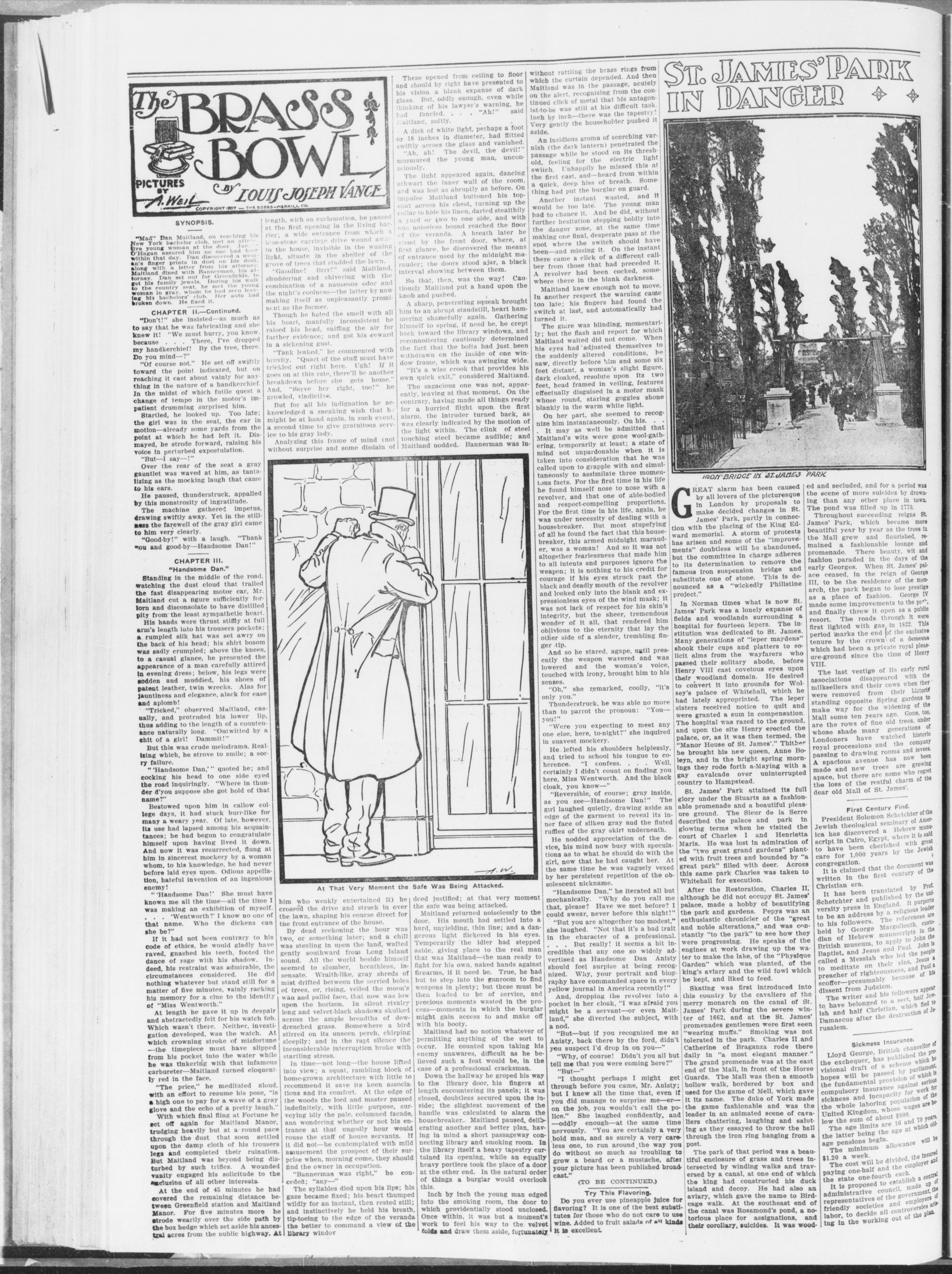
ST. JAMES'PARK IN DANGER
THE GATE
GREAT alarm has been caused by all lovers of the picturesque in London by proposals to make decided changes in St. James' Park, partly in connection with the placing of the King Edward memorial. A storm of protests has arisen and some of the "improvements" doubtless will be abandoned, but the committee in charge adheres to its determination to remove the famous iron suspension bridge and substitute one of stone. This is denounced as a "wickedly Philistine project." ed and the so ing t he P thr James bea ume the M prome fashio e cce of III. t arch,
In Norman times what is now St. James' Park was a lonely expanse of fields and woodlands surrounding a hospital for fourteen lepers. The institution was dedicated to St. James. Many generations of "leper maydens" shook their cups and platters to solicit alms from the wayfarers who passed their solitary abode, before Henry VIII cast covetous eyes upon their woodland domain. He desired to convert it into grounds for Wolsey's palace of Whitehall, which he had lately appropriated. The leper sisters received notice to quit and were granted a sum in compensation. The hospital was razed to the ground, and upon the site Henry erected the palace, or, as it was then termed, the "Manor House of St. James." Thithee he brought his new queen, Anne Boeyn, and in the bright spring mornings they rode forth a-Maying with a gay cavalcade over uninterrupted country to Hampstead.
St. James' Park attained its full glory under the Stuarts as a fashionable promenade and a beautiful pleasure ground. The Sieur de la Serre described the palace and park in glowing terms when he visited the court of Charles I and Henrietta Maria. He was lost in admiration of the "two great grand gardens" planted with fruit trees and bounded by "a great park" filled with deer. Across this same park Charles was taken to Whiteball for execution.
After the Restoration, Charles II, although he did not occupy St. James' palace, made a hobby of beautifying the park and gardens. Pepys was an enthusiastic chronicler of the "great and noble alterations," and was constantly "to the park" to see how they were progressing. He speaks of the engines at work drawing up the water to make the lake, of the "Physique Garden" which was planted, of the king's aviary and the wild fowl which he kept, and liked to feed.
Skating was first introduced into this country by the cavaliers of the merry monarch on the canal of St. James' Park during the severe winter of 1662, and at the St. James' promenade gentlemen were first seen "wearing muffs." Smoking was not tolerated in the park. Charles II. and Catherine of Braganza rode there daily in "a most elegant manner." The grand promenade was at the east end of the Mall, in front of the Horse Guards. The Mall was then a smooth hollow walk, bordered by box and used for the game of Mell, which gave it its name. The duke of York made the game fashionable and was the leader in an animated scene of cavaliers chattering, laughing and saluting as they essayed to throw the ball through the iron ring hanging from a post.
The park of that period was a beautiful enclosure of grass and trees intersected by winding walks and traversed by a canal, at one end of which the king had constructed his duck island and decoy. He had also an aviary, which gave the name to Bird-cage walk. At the southeast end of the canal was Rosmond's pond, a notorious place for assignations, and their corollary, suicides. It was wood.
ed and secluded, and for a period was the scene of more suicides by drowning than any other place in town. The pond was filled up in 1770.
Throughout succeeding reigns St. James' Park, which became more beautiful year by year as the trees in the Mall grew and flourished, remained a fashionable lounge and promenade. There beauty, wit and fashion paraded in the days of the early Georges. When St. James' palace ceased, in the reign of George III, to be the residence of the monarch, the park began to lose prestige as a place of fashion. George IV made some improvements to the park, and finally threw it open as a public resort. The roads through it were first lighted with gas, in 1822. This period marks the end of the exclusive tenure by the crown of a demesne which had been a private royal pleasure-ground since the time of Henry VII.
The last vestige of its early rural associations disappeared with the milkseers and their cows when they were removed from their historic standing opposite Spring gardens to make way for the widening of the Mall some ten years ago. Gone, too, are the rows of fine old trees, under whose shade many generations of Londoners have watched historic royal processions and the company passing to drawing rooms and leaves. A spacious avenue has now been made and new trees are growing apace, but there are some who regret the loss of the restful charm of the dear old Mall of St. James'.
First Century Find.
President Solomon Schetchter of the Jewish theological seminary of America has discovered a Hebrew manuscript in Cairo, Egypt, where it is said to have been cherished with great care for 1,000 years by the Jewish congregation.
congregation.
It is claimed that the document was written in the first century of the Christian era.
Christian ex-
It has been translated by Pro-
Schetcher and published by the un-
versity press in England. It purports
to be an address by a religious leader
to his followers. The references are
held by George Margolouth, custo-
dian of Hebrew manuscripts in the
British museum, to apply to John the
Baptist, and Jesus and Paul. John is
called a Messiah who led the people
to meditate on their sins, Jesus a
preacher of righteousness, and Paul a
coffer—presumably because of his
intention from Judaism.
dissent from Judaism.
The writer and his followers appear to have belonged to a sect, half Jewish and half Christian, which fed to Damascus after the destruction of Jerusalem.
Sickness Insurance.
Lloyd George, British chancellor of the exchequer, has published the provisional draft of a scheme which he hopes will be passed by parliament, the fundamental provision of which is compulsory insurance against serious sickness and incapacity for work for the whole laboring population of the United Kingdom, whose wages are be low the sum of about $800.
low the sum of about $800. The age limits are 16 and 70 years, the latter being the age at which old
the Retiree age pensions begin.
The minimum allowance will be $1.20 a week.
The cost will be divided, the insured paying one-half and the employer and the employer each.
the state one-fourth each. It is proposed to establish a central administrative council, made up of representatives of the government, the friendly societies and employers of labor, to decide all controversies arising in the working out of the plan.
ARE YOU FREE FROM
Headaches, Colds, Indigestion, Pains, Constipation, Sour Stomach, Dizziness? If you are not, the most effective, prompt and pleasant method of getting rid of them is to take, now and then, a desertspoonful of the ever refreshing and truly beneficial laxative remedy—Syrup of Figs and Elixir of Senna. It is well known throughout the world as the best of family laxative remedies, because it acts so gently and strengthens naturally without irritating the system in any way.
To get its beneficial effects it is always necessary to buy the genuine, manufactured by the California Fig Syrup Co., bearing the name of the Company, plainly printed on the front of every package.
"What has caused you to arrive at your present opinion?"
your press
“You press the Billingers?”
“You mean Horace Billinger, who recently got so badly squeezed in the stock market?”
“Yes. You see, we lived next door to the Billingers for a number of years. Since they have lost their money and been compelled to give up their automobiles and most of their servants and in other ways get along on as little as possible, my wife has found that we can live on much less than it formerly cost us.”—Chicago Record-Herald.
DRWM. PFUNDER'S
OREGON BLOOD PURIFIER
A Tonic, Alternative and Resolve
best remedy for Kidneys, Liver and Bowels.
Jerusalem Pimples, Crenulations and Disorders
of the Skin. Purifies the Blood and gives
Tone, Strength and Vigor to the entire system.
Henson—I bet my wife that I could
thread a needle before she could
sharpen a lead penil.
Benson—Which won?
Henson—I won in exactly 13 minutes,
but I believe I'd have lost if she
had not run out of pencils at the end
of five minutes.—Chicago News.
TRY MURINE EYE REMEDY
for Red, Weak, Weary, Watery Eyes
and Granulated Eyelids. Murine Doesn't
Smart—Soothes Eye Pain. Druggists
Sell Murine Eye Remedy, Liquid, 25c,
50c, $1.00. Murine Eye Salve in
Aseptic Tubes, 25c, $1.00. Eye Books
and Eye Advice Free by Mall.
Murine Eye Remedy Co., Chicago.
Grocer—Boy, didn't I see you pocket
an apple from that barrel?
Grocer—Look out! You are acting very suspiciously. I was watching you.
Boy—Yes, I knew you were, and that's the reason I resisted the temptation.
Dr. Pierce's Pleasant Pellets regulate and invigorate stomach, liver and bowels. Sugar-coated, tiny granules. Easy to take as candy.
Mrs. Greene—One does not like to be ignored. I wore a brand new gown at the reception last night, and I don't believe a soul noticed me.
Mrs. Gray—There's where you made a mistake. Now, I wore my old black silk that has been turned twice, and everybody saw me fast enough.
Mothers will find Mrs. Winslow's Soothing Syrup the best remedy to use for their child dren during the teething period.
Men make wealth and women preserve it.
SHE GOT WHAT SHE WANTED
This Woman Had to Insist Strongly, but it Paid
Chicago, Ill.—"I suffered from a female weakness and stomach trouble, and I went to the store to get a bottle of Lydia E. Pinkham's Vegetable Compound, but the clerk did not want to let me have it—he said it was no good and wanted me to try something else, but knowing all about it I insisted and finally I am so
and I went to the store to get a bottle of Lydia E. Pinkham's Vegetable Compound, but the clerk did not want to let me sit it, it was no good and wanted me to try something else, but knowing all about it I insisted and finally got it, and I am so as cured me.
had I did, for it has cured me.
"I know of so many cases where women have been cured by Lydia E. Pinkham's Vegetable Compound that I can say to every suffering woman if that medicine does not help her, there is nothing that will."—Mrs. JANETZKI, 2003 Arch St., Chicago, Ill.
This is the age of substitution, and women who want a cure should insist upon Lydia E. Pinkham's Vegetable Compound just as this woman did, and not accept something else on which the druggist can make a little more profit.
Women who are passing through this critical period or who are suffering from any of those distressing ill peculiar to their sex should not lose sight of the fact that for thirty years Lydia E. Pinkham's Vegetable Compound, which is made from roots and herbs, has been the standard remedy for female ills. In almost every community you will find women who have been restored to health by Lydia E. Pinkham's Vegetable Compound.
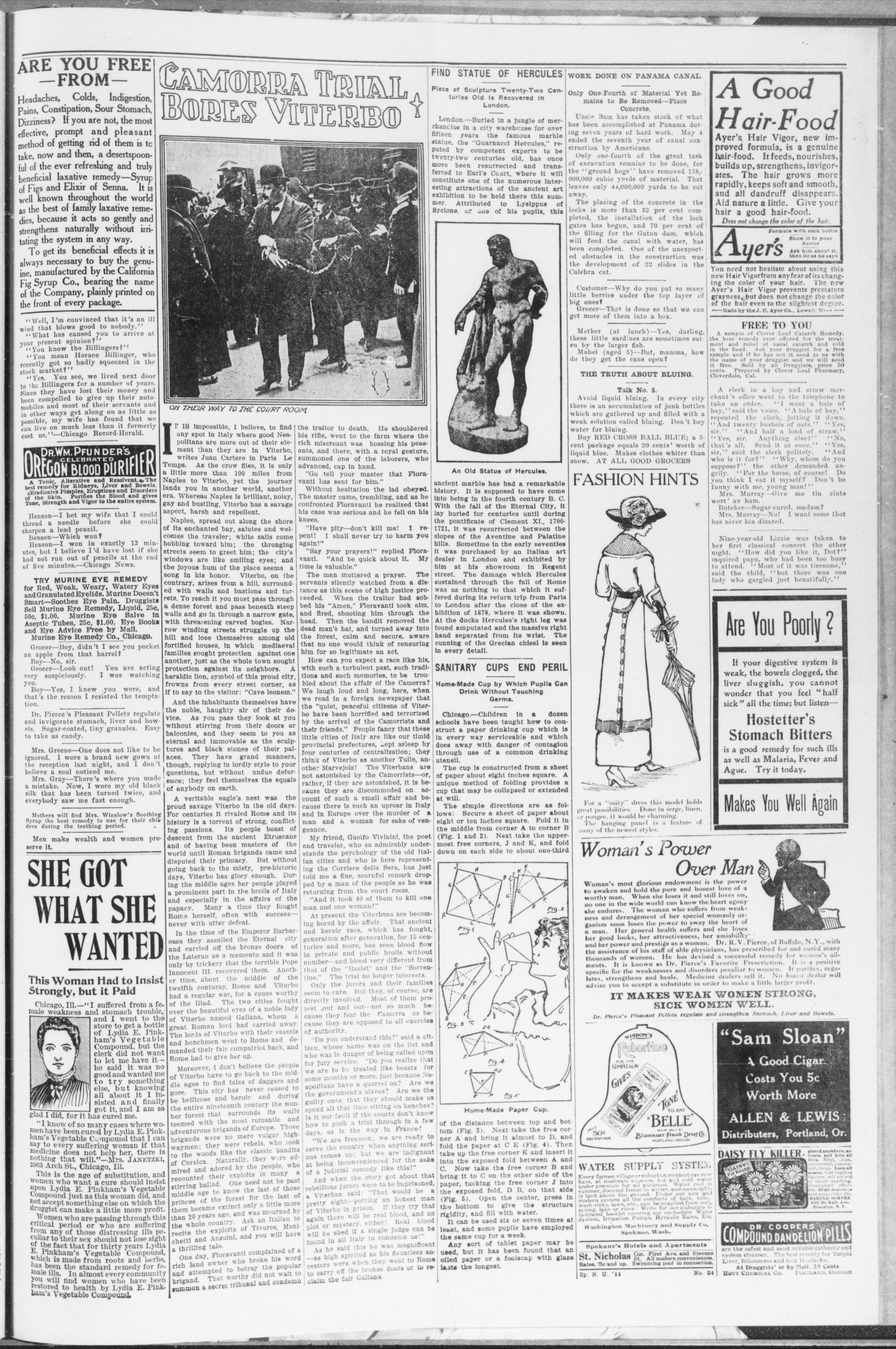
CAMORRA TRIAL
BORES VITERBO
THE
ON THEIR WAY TO THE COURT ROOM
IT IS impossible, I believe, to find any spot in Italy where good Neapolitans are more out of their element than they are in Viterbo, writes Juan Cartere in Paris Le Temps. As the crow files, it is only a little more than 100 miles from Naples to Viterbo, yet the journey lands you in another world, another era. Whereas Naples is brilliant, noisy, gay and bustling, Viterbo has a savage aspect, harsh and repellent.
Naples, spread out along the shore of its enchanted bay, salutes and welcomes the traveler; white sails come bobbing toward him; the thronging streets seem to greet him; the city's windows are like smiling eyes; and the joyous hum of the place seems a song in his honor. Viterbo, on the contrary, arises from a hill, surrounded with walls and bastions and turrets. To reach it you must pass through a dense forest and pass beneath steep walls and go in through a narrow gate, with threatening carved bogles. Narrow winding streets struggle up the hill and lose themselves among old fortified houses, in which mediaeval families sought protection against one another, just as the whole town sought protection against its neighbors. A heraldic lion, symbol of this proud city frowns from every street corner, as if to say to the visitor: "Cave leonem."
And the inhabitants themselves have the noble, haughty air of their device. As you pass they look at you without stirring from their doors or balconies, and they seem to you as eternal and immovable as the sculptures and black stones of their palaces. They have grand manners, though, replying in lordly style to your questions, but without undue deference; they feel themselves the equals of anybody on earth.
A veritable eagle's nest was the proud savage Viterbo in the old days. For centuries it rivaled Rome and its history is a torrent of strong, conflicting passions. Its people boast of descent from the ancient Etruscans and of having been masters of the world until Roman brigands came and disputed their primacy. But without going back to the misty, pre-historic days, Viterbo has glory enough. During the middle ages her people played a prominent part in the broils of Italy and especially in the affairs of the papacy. Many a time they fought Rome herself, often with success—never with utter defeat.
In the time of the Emperor Barbarossa they assailed the Eternal city and carried off the bronze doors of the Lateran as a memento and it was only by trickery that the terrible Pope Innocent III recovered them. Another time, about the middle of the twelfth century, Rome and Viterbo had a regular war, for a cause worthy of the Iliad. The two cities fought over the beautiful eyes of a noble lady of Viterbo named Galliana, whom a great Roman lord had carried away. The lords of Viterbo with their vassals and benchmen went to Rome and demanded their fair compatriot back, and Rome had to give her up.
Moreover, I don't believe the people of Viterbo have to go back to the middle ages to find tales of daggers and gore. This city has never ceased to be bellicose and heroic and during the entire nineteenth century the somber forest that surrounds its walls teemed with the most romantic and adventurous brigands of Europe. Those brigands were no mere vulgar highwaymen; they were rebels, who took to the woods like the classic bandits of Corsica. Naturally, they were admired and adored by the people, who recounted their exploits in many a stirring ballad. One need not be past middle age to know the last of those princes of the forest for the last of them became extinct only a little more than 20 years ago, and was mourned by the whole country. Ask an Italian to recite the exploits of Tivurce, Menli chetti and Ansuini, and you will have a shuffling tale.
a thrilling
One day, Floravanti complained of a
rich land owner who broke his word
and attempted to betray the popular
brigand. That worthy did not wait to
summon a secret tribunal and condemn
the traitor to death. He shouldered his rifle, went to the farm where the rich miscreant was bossing his peasants, and there, with a royal gesture, summoned one of the laborers, who advanced, cap in hand.
"Go tell your master that Floravanti has sent for him."
Without hesitation the lad obeyed. The master came, trembling, and as he confronted Floravanti he realized that his case was serious and he fell on his knees.
"Have pity—don't kill me! I repent! I shall never try to harm you again!"
"Say your prayers!" replied Floravanti. "And be quick about it. My time is valuable."
The man muttered a prayer. The servants silently watched from a distance as this scene of high justice proceeded. When the traitor had sobbed his "Amen," Floravanti took aim, and fired, shooting him through the head. Then the bandit removed the dead man's hat, and turned away into the forest, calm and secure, aware that no one would think of censuring him for so legitimate an act.
How can you expect a race like his, with such a turbulent past, such traditions and such memories, to be troubled about the affair of the Camorra? We laugh loud and long, here, when we read in a foreign newspaper that the "quiet, peaceful citizens of Viterbo have been horrified and terrorized by the arrival of the Camorrists and their friends." People fancy that these little cities of Italy are like our timid provincial prefectures, kept asleep by four centuries of centralization; they think of Viterbo as another Tulle, another Marvejols! The Viterbans are not astonished by the Camorrists—or, rather, if they are astonished, it is because they are discommoded on account of such a small affair and because there is such an uproar in Italy and in Europe over the murder of a man and a woman for sake of vengeance.
My friend, Guelio Viviniini, the poet and traveler, who so admirably understands the psychology of the old Italian cities and who is here representing the Corriere della Sera, has just told me a fine, scornful remark dropped by a man of the people as he was returning from the court room.
"And it took 40 of them to kill one man and one woman!"
At present the Viterbans are becoming bored by the affair. That ancient and heroic race, which has fought, generation after generation, for 15 centuries and more, has seen blood flow in private and public broils without number—and blood very different from that of the "Baslist" and the "Sorrentine." The trial no longer interests.
Only the jurors and their families seem to care. But they, of course, are directly involved. Most of them protest out and out—not so much because they fear the Camorra as because they are opposed to all exercise of authority.
"Do you understand this?" said a citizen, whose name was on the list and who was in danger of being called upon for jury service. "Do you realize that we are to be treated like beasts for some months or more, just because Neapolitans have a quarrel on? Are we the government's slaves? Are we the ones, that they should make us spend all that time sitting on benches? Is it our fault if the courts don't know how to push a trial through in a few days, as is the way in France?"
"We are freemen; we are ready to serve the country when anything serious comes up; but we are indignant at being inconvenienced for the sake of a judicial comedy like this!" And when the story got about that rebellious jurors were to be imprisoned, a Viteren said: "That would be a pretty sight—putting an honest man of Viterbo in prison. If they try that again there will be real blood, and no plot or mystery, either! Real blood will be shed if a single judge can be found in all Italy to condemn us!"
As he said this he was magnificent—as high spirited as his dauntless ancestors were when they went to Rome to carry off the bronze doors or to reclaim the fair Galliana
FIND STATUE OF HERCULES
Piece of Sculpture Twenty-Two Centuries Old is Recovered in London.
London.—Buried in a jungle of merchandise in a city warehouse for over fifteen years the famous marble statue, the "Guarnacci Hercules," reputed by competent experts to be twenty-two centuries old, has once more been resurrected and transferred to Earl's Court, where it will constitute one of the numerous interesting attractions of the ancient art exhibition to be held there this summer. Attributed to Lysippus of Syclone, or one of his pupils, this
An Old Statue of Hercules. ancient marble has had a remarkable history. It is supposed to have come into being in the fourth century B. C. With the fall of the Eternal City, it lay buried for centuries until during the pontificate of Clement XI., 1700-1721, it was resurrected between the slopes of the Aventine and Palatine hills. Sometimes in the early seventies it was purchased by an Italian art dealer in London and exhibited by him at his showroom in Regent street. The damage which Hercules sustained through the fall of Rome was as nothing to that which it suffered during its return trip from Paris to London after the close of the exhibition of 1878, where it was shown. At the docks Hercules's right leg was found amputated and the massive right hand separated from its wrist. The cunning of the Grecian chisel is seen in every detail.
SANITARY CUPS END PERIL
Home-Made Cup by Which Pupils Can Drink Without Touching Germs.
Chicago.—Children in a dozen schools have been taught how to construct a paper drinking cup which is in every way serviceable and which does away with danger of contagion through use of a common drinking utensil.
The cup is constructed from a sheet of paper about eight inches square. A unique method of folding provides a cup that may be collapsed or extended at will.
The simple directions are as follows: Secure a sheet of paper about eight or ten inches square. Fold it in the middle from corner A to corner B (Fig. 1 and 2). Next take the uppermost free corners, J and K, and fold down on each side to about one-third
Fig. 1
Fig. 2
Fig. 3
Fig. 4
Fig. 5
Home-Made Paper Cup. of the distance between top and bottom (Fig. 3). Next take the free corner A and bring it almost to D, and fold the paper at C E (Fig. 4). Then take up the free corner K and insert it into the exposed fold between A and C. Now take the free corner B and bring it to C on the other side of the paper, tucking the free corner J into the exposed fold, D B, on that side (Fig. 5). Open the center, press in the bottom to give the structure rigidity, and fill with water. It can be used six or seven times at least, and some pupils have employed the same cup for a week. Any sort of tablet paper may be used, but it has been found that an oiled paper or a foolscap with glaze lasts the longest.
A Good
Hair-Food
Ayer's Hair Vigor, new improved formula, is a genuine hair-food. It feeds, nourishes, builds up, strengthens, invigorates. The hair grows more rapidly, keeps soft and smooth, and all dandruff disappears. Aid nature a little. Give your hair a good hair-food.
Does not change the color of the hair.
Formula with each bottle
Show it to your doctor
Ask him about it, then do as he says
Ayer's
You need not hesitate about using this new Hair Vigor from any fear of its changing the color of your hair. The new Ayer's Hair Vigor prevents premature grayness, but does not change the color of the hair even to the slightest degree.
—Made by the J. C. Ayer Co., Lowell, Mass.
A sample of Clover Leaf Catarrh Remedy,
the best remedy ever offered for the treatment
and relief of nasal catarrh and cold in
the head. Ask your drugstor for a free
sample if he has not put it on us.
the name of your drugstor and we will send
it free. Sold by all Drugstorists, price 50
cents. Prepared by Clover Leaf Pharmacy,
Cloverdale, Cal.
A clerk in a hay and straw merchant's office went to the telephone to
take an order. "I want a bale of hay," said the voice. "A bale of hay,"
repeated the clerk, jitting it down.
"And twenty bushels of oats." "Yes, sir.",
"And a half load of straw." "Yes, sir. Anything else?" "No,
that's all. Send it at once." "Yes, sir," said the clerk politely. "And
who is it for?" "Why, whom do you
suppose?" the other demanded angrily. "For the horse, of course! Do
you think I eat it myself? Don't be
funny with me, young man!"
Mrs. Murray—Give me tin cints wort' av ham.
Butcher—Sugar-cured, madam?
Mrs. Murray—No! I want some that has niver bin disazed.
Nine-year-old Lizzie was taken to her first classical concert the other night. "How did you like it, Dot?" inquired papa, who had been too busy to attend. "Most of it was tiresome," said the child. "but there was one lady who gargled just beautifully."
Are You Poorly?
Makes You Well Again
Woman's most glorious endowment is the power to awaken and hold the pure and honest love of a worthy man. When she loses it and still loses on, no one in the wide world can know the heart agony she endures. The woman who suffers from weakness and derangement of her special woman or organism soon loses the power to save her or a man. Her general strength and she loses the affectiveness, her amiability
her good looks, her attractiveness, her beauty, and her power and prestige as a woman. Dr. R.V. Pierce, of Buffalo, N.Y., with the assistance of his staff of able physicians, has prescribed for and cured many thousands of women. He has devised a successful remedy for woman's ailments. It is known as Dr. Pierce's Favorite Prescription. It is a positive specific for the weaknesses and disorders peculiar to women. It purifies, regulates, strengthens and heals. Medicine dealers sell it. No honest dealer will advise you to accept a substitute in order to make a little larger profit.
her good looks and prestige as a woman. Dr. R.V.P.
and her power and prestige as a woman. Dr. R.V.P.
the assistance of his stuff of able physicians, has pres-
thousands of women. He has devised a successor-
ments. It is known as Dr. Pierce's Favorite Pr-
specific for the weaknesses and disorders peculiar to
lates, strengthens and heals. Medicine dealers se-
advise you to accept a substitute in order to make a
IT MAKES WEAK WOMEN
SICK WOMEN WE
Dr. Pierce's Pleasant Pellets regulate and strengthen
Dr. R.V. Pierce, of Buffalo, N.Y., with
医ians, has prescribed for and cured many
a successful remedy for woman's all-
Favorite Prescription. It is a positive
orders peculiar to women. It purifies, regu-
ne deers dealers sell it. No honest dealer will
order to make a little larger profit.
K WOMEN STRONG,
MEN WELL.
and strengthen Stomach, Liver and Bowels.
---
---
WORK DONE ON PANAMA CANAL
Uncle Sam has taken stock of what has been accomplished at Panama during seven years of hard work. May 4 ended the seventh year of canal construction by Americans.
Only one-fourth of the great task of excavation remains to be done, for the "ground hogs" have removed 138,000,000 cubic yards of material. That leaves only 44,000,000 yards to be cut away.
The placing of the concrete in the locks is more than 52 per cent completed, the installation of the lock gates has begun, and 70 per cent of the filling for the Gatun dam, which will feed the canal with water, has been completed. One of the unexpected obstacles in the construction was the development of 22 slides in the Culebra cut.
Customer—Why do you put so many little berries under the top layer of big ones?
Grocer-That is done so that we can get more of them into a box.
Mother (at lunch)—Yes, darling, these little sardines are sometimes eaten by the larger fish.
Mabel (aged 5)—But, mamma, how do they get the cans open?
THE TRUTH ABOUT BLUING
Talk No. 5.
Avoid liquid bluing. In every city there is an accumulation of junk bottles which are gathered up and filled with a weak solution called bluing. Don't buy water for bluing.
Buy RED CROSS BALL BLUE; a 5-cent package equals 20 cents' worth of liquid blue. Makes clothes whiter than snow. AT ALL GOOD GROCERS
FASHION HINTS
17
For a "sunty" dress this model holds great possibilities. Done in serge, linen, or ponge, it would be charming. The hanging panel is a feature of many of the newest styles.
Woman's Power
WISDOM'S
Robertine
FOR THE
COMPLEXION
GIVES
"TONE
TO ANY
BELLE"
PROCT
50¢
BOLD DEPTH
MADE ONLY BY
Blumauer Frank Drag Co.
PORTLAND, OREGON
Every farmer, village or suburban area can now have, at moderate expense, hot and cold water under pressure for all purposes, in water, and no unhappily tank above the ground. Under our new and modern system all the components of bath, toilek, wash niks, lace, can, can be supplied from wet farming land. Write for our elaborate illustrated booklet covering our up-to-date Water System, Irrigation Pumps, Hyraulic Rams, Etc.
Washington Machinery and Supply Co,
Spokane, Wash.
Spokane's Hotels and Apartments
St. Nicholas Cor. First Ave. and Stevens St. All modern conveniences. Rates, Tc. and up. Swimming pool in connection.
Sp. N. U. '11 No. 24
FREE TO YOU
If your digestive system is weak, the bowels clogged, the liver sluggish, you cannot wonder that you feel "half sick" all the time; but listen—
is a good remedy for such ills as well as Malaria, Fever and Ague. Try it today.
A
"Sam Sloan"
A Good Cigar
Costs You 5c
Worth More
ALLEN & LEWIS
Distributers, Portland, Or.
DAISY FLY KILLER
placed anywhere, at
traits, and sells a
fire. Next, Clean
enumerical, convert
wash, burn, and
wash. Can't spill
up over, will not so
cause anything
Guaranteed effect
best prepared for 20.
HAROLD SORHERS
LEGAL BANK
Brooklyn, N. Y.
are the safest and most reliable catharic and
system cleanser. The best remedy for Torpia
Liver, Biliousness and Cholesterol is by Mail. 28 Cents
HORT SUMMERAL Co., PORTLAND, ORGAN
You cannot know
How long will you be as pros-
Perous as you are now
y oudo know
How much you can lay aside
each month at the present time.
Think of this as a friendly warn-
ing and not an advertisement
and begin to save today. You
will need it
We allow 4 per cent on Sav-
ings Accounts.
Union Bank& Trust Co.
HELENA, MONTANA
LOCALS
Mrs. Wm. Seals has been on the
sick list.
To those who thought they would
feast on at least a column of scandal
anent recent happenings in this city
in this issue they will be sadly dis-
appointed.
Mr, and Mas. Brown of Afchis
on Kansas arrived fn pur city last
week for a few weeks visit with
their dghter Mrs. N. Mitehell.
Mrs, Dinah Brooks made a -
ness trip to Lewistown this week, re-
turning Thursday.
Bernice Dorsey and Sirlas Grove
(Porter the Second) left last week
to make it for themselves. The last
heard of them they had got as far
as Bozeman.
Attend the ball games this week.
Mrs. Carrie Johnson, 300 State
street, has been on the sick list for
the past week
Mrs. George M. Lee and son Julian
have returned from Boulder where
she visited her husband for the past
two weeks.
Mr. Walter Burnette of St. Paul
was a visitor to the capital of Mon-
tana this week,
Spencer Smith and A. Palmer have
taken charge of the Lambs Club din-
ingroom and are reported as doing a
nice business.
Mrs. Jessie Bass, 202 Fifth avenue
is reported on the sick list this week
Nathaniel Ford, A. Palmer, B. F
Hooper and J. E. W. Clarke have
been appointed as deelgates by Gov.
Norris to represent this state at the
National Educational congress to be
held in Denver, Colorado, August 13th
to 16th.
Wm. Mason, who is erecting a
beautiful residence on the West Side,
is getting along nicely and will soon
have the same completed.
Look out for the editor of The com
Plaindealer who will call on you this | from
week. along
meth
Golden City Lodge of Odd Fellows pany
have elected J. B. Bass as delegate] w,
and Wm. Irvin as alternate to attend any
the Grand Lodge of this jurisdiction. | spea)
The same wil be held at Colorado |own
Springs eariy in September. what
Sn
You cannc
How long will you
Perous as you are |
y oudo k
How much you ca
Miss Alma Bass contemplates giv
ing a piano recital in the near future
Quite a few of the younk folks
are very anxious for a dance to be
given in the near future
—-
| Our enterprising townsman, C. C.
Matthews is making extensive im-
provements on his home on Hollins
avenue, the same now nearly com-
pleted wil be one of the handsomest
homes in the city.
Miss Olga York and Miss Carlotta
Ford are contemplating a visit to Mis-
soula in the near future.
‘The Helena team will play Butte
at home all next week so all the fans
can turn out and boost for the home
team.
Mr. James A. Waller, who visited
here this spring is now sojourning at
Manitou in Colorado,
Charles Cole is running a confec-
tionery and ice cream parlor on the
corner of Warren and Seventh Ave.
Mrs. E. G. Cole, who has been on
the sick list, is much improved.
Jessie L. Brooks is over from Great
Falls visiting his aunt, Mrs. Carrie
Tohneen
Mrs. Mary Parker, who was on the
sick list, has recovered.
Presiding Elder Douglass of the
A.M. E. church, was in the city
‘Thursday and Friday on his last quar-
terly visit for the conference year.
The race for the pennant in the
National league is very interesting,
two of our town boys say that they
will see the world series played. They
are Gus Mason and L. C. Freeman,
Mrs, Emma Anderson left last Sun-
Yorkday for Madison Barracks in
New York, where she will visit her
husband for several weeks.
J. H. Hilliard was granted a di-
vorce from his wife, Mary Hilliard, in
the district court last week.
A NEW ICE COMPANY.
‘The announcement that a new Ics
company is in process of formatior
will be hailed with delight on ever
hand, as the present company in con
trol of the ice situation, is ranker thar
Charles W. Morse's ice trust of New
York City in its palmiest days.
Fish, with his Sanitary company
was decent but he has sold out body
and soul and it seems as though the
Present company realizes that this is
their last season for business and they
‘are determined to get theirs.
It is not one or two isolated com-
plaints as to the rank methods of this
consolidated company, we have heard
complaints from poor widow women,
from the large users of iec, and all
along the line as to the czar-like
methods of this consolidated com-
pany.
We have not written this article in
any revengeful strain, we are only
speaking of what we hear and our
own personal grievance cuts no figure
whatever,
A
rs. L. MEAD CYCLE COMPANY, CHICAGO, ILL,
1 '
Western University
| QUINDARO, KANSAS
THE GREAT EDUCATIONAL INSTITUTION FOR
| KANSAS AND THE WEST |
DEPARTMENTS: Theological, College, Normal, Sub-Normal
and State Norma)
Leading and Best Industrial School
of the West
Courses | Hdvantages
Classical, College, Preparatory, Nor| Splendid Location, Healthfu. Clim-
mal, Sub Normal, Musical (inate ape Good Influences and Thorough
mental and Vocal, including Piano, v = ee
Organ and Harmony), Drawing (Fine| Base aEee
Arte and Mechanical), Carpentry, |
Printing and Book-Binding, Business|
Course, Stenography and Typewrit-| INFORMATION
Bele erin Oussing bacon’ |. Westie Pron sca tadaccaaane
Farming and Gardening. | Offered write to
Shelton French, A. ML,
Acting President ee
UiPbones? West 1423; Residence, Bell We
Prize Offers from Leading Manufacturers
ee a “iets to Send = sketch or model for
See Somes ht SS eS
Gatl'S Pusat Oe
lo GREELEY & MSINTIRE
tS "ATENT ATTORNEYS i}
ro), WASHINGTON, D. Cc. 3
| The Matlors Craven
WH SELL THEM
FART, SCHAFFRER § May,
FINE CLOTEHRs
GANS & KLEIN co
ESTABL HED
HELENA
PACKING AND PROVISION GMPAY
wholesale
JVSTERS, HSH POUITRY FRUITBUTTER Ei
‘Dr. Miles ox
: RI . ‘
Restorative Nervine . :
| Makes Weak Nerves Strong.
It can be relicd upon in all cases ef
Nervous Exhaustion, brought on by
| * ever-work. or srcat mental effort.
| It restores Nervous Energy. 3
It aliays irritation.
It assists the Nerve Cells to generate
nerve force.
Its soothing infinence upon the nerves
brings resifal siccp—nature’s rest pere
fod so essen tin! to the tired, worn-out
mind and bedy.
°
For Headache, Neuralgia,
or any pain or distress, you will finé
almost instant relief by taking .
Dr. Miles’ Anti-Pain Pills. |
They are sold by all druggists, and you
may try either oj (icse remedies on the
positive guarantee that if the first bot
tle or pacl.age does not benefit, your
druggist wili return your money. We
* repay the driecrist the full retail pri
#0 itis te his iuicrest to refund if called
upon to do so. eo
* Miles 1! cs Co., Elkhart, Ind,
Ni ese AG RB eu © AOE IN tAGK TOW
=p CAMVED* | PODER AGENT Sa
fo may Cusine dR oh ie Sade
4 ie ‘muling money 1 weit ace rant af ial efor af og s. aa
| K Ue NO MONEY REQUIGED eile Teceive and spprove cl your BcyelS? We si
| Seis tg anyone, anywhere in the U.S. wuthond cont defovl fe advance, Sreight, a
i\ tilge TaN Da vs? Wikis WiCLAT Sty een eaten geet Zot ao
yy uth fo aay Wilt You wis 1 you 4s then ot pelea ease ee eae
A HUNG Space te sate ores ee crea ce era
| Ae vita FACTORY PRICES ws" : Pepi above actual facory coat ston Soveae
| BAVSANIBESE 12s misiienen's rots Fania tey'e cet ocnty cove You sive
APSR AWM antec Lehiod your beycle, ‘Do herr BUY a Bevel or a pair of tires from agen
PEORIA 38 o,frce Tal yea reefs No BUS Shas 8 bur oes fro aaron
RR PMR orice! ad remarkadls peels! afors Colo apelin
| ai ey Wily YOU WILL BE ASTONISHED indy bar guper® models at thence A
WM Rak are recs aaron is rar. Wee the Ra hewtarade celeron
ae BHCxeLe DEAL Eb, room stl our ‘ibys unde? your vee nuke Tae
coe ee nee i
Up eross ceo agli Sill asad at tests,
compte at pices elias Orb cevisee eau ors, There ge cle ou
promptv at prices nine hea OS rae a ee tees Its Batten ic
tlagle wheels imported roller chatas and ‘pedals, tank’ {itcire and
COASTER-BRAKES, #225 Pedy inch Guten Salona =
5.0 HEDGETHORN- PEXCTURE-PROOF 80
SELF-HEALING TIRES 4 24mete pare f°
To INTRODUCE, oxy
The regular retail price ofthese tre iy :
° 55.50 ger pair, but fo intvones wrest Mi =n
wiirevasimplcfai orbt Dahir fae =
WO MORE TROUBLE FROM PUNCTURES Ramen 7 rR we
NAILS, Taoks or Glass will not let the Es 4 pA \
air out ‘sinty thouesud palva sold last jeer. Ce a
Serine ficial
DESORIPTION: Macca ilsizes Tistively QU i
anteaey feng Mey darcbien et eatery r
2 apecial i Gualiy of Reresseiecrst ene Cee
Perreratd mich cogs up snal pntnres wis: alow: AM wont te asau
theairtoeacape. We havelundreisct tein eee BN Not bber tread
delcasiomersattiig (nt thelr trerneon een pumped GIP ong Spe ranctare stripe “B”
Se oercaremice uybanceesion Trey meighnomorethan MM $04 "Dy_alno rim atelp =~
Be one, ne pastire cuitinguaudeateiog given QM tp Prevent rim oxttings The
Bran ne yefacok ty tees prcgared fabri ine QU) flea wil outiget nay other
tread, Thereqular price ofthese urediagasoperpair.butfor gy EARS" sd
baveunngparpoameare makingaspeciafacoy tees
the rider of only $4.60 per pair Ail orders shipped same day etter ls received. We shlp C.0. D. on
will allow « soak dincSunt at eer a een an, ag the price S208 se seieetrice
"We wili aliow a enak discount of «pera eee en | ie
scod FULL, CASH WITH ONDE nd enclose’ this advertisement wee eE eed 28
mikel pied brass band putnp. Tires te be serted at OUN eepeaee it WE cell se eed sae
po gelafciory oy exaiaaticn Weare perf felleand ates alcatel aay are
Beak if you order a pat of these trea gos wl ang that wey Bi wide eter te de®
Set an craipyeaac ina Sgr tae ur ed re cy
bow that fou will bese well pleased that when ro eens Te re ud jour andes
oe ay ant a Scns bre arte tamer
jon't buy any kind at any price ustll you send fora pate
iF you NEED TIRES Heigericrn Prmneture treat fires on ippreval and trial at
he special Introductory price quoted aber cr arts fase rhe cea KY
describes and quotes el Euked soi Kio st Shere ‘half the usual Bris, ni >
PANT. 2s wits oes postal oday” BONOT THUNK OF BUYING a beets
DO NOT WAIT oi. Sais cl ieee fe ay OO NS you know the new and wonderful
lee we are making. It oy cons & ponal to ara crying.” Weel ROWE” Oe Mae
S 2 man ee mek BOW.
c
C. J. Bausch,
Tinner.
TIN, COPPER and SHEET IRON WORK
Stove and Furnace work « Specialty.
31g N. JACKSON ST. - Helena, Mont,
Strangers visiting the Capital
City will be given a hearty
welcome af all times at the |
Manhattan Club,
17 South Main Street
Homa - ont.
L. P. DRIVER'S CAFE
Buffet in Connection
Everything Neat and First Class
When in Anaconda
give us a Trial
L.P. DRIVER, - Proprietor
FURNISHED ROOK
RRENT. ss
Inquire 221 Breckenridge St.
Mrs. M.A. Coley |
rs
%
Eugene Bourquin
Dealer in
Sawed and Split Wood and
COALS
Yard, 437 W. Main St. Residence
370 Water St. "Phone 632-F,
Helena, Mont.
| Beury Roseman Prop. Phone 186
i. S Main St. Hlena °
Fear neither the difficulties of
foreign languages nor the differ-
ence of manners, nor the powers
of secular government. Consult
not the course of rivers nor the
; LODGE DIRECTORY
| Helena, Montana
Golden City Lodge, No. 455, 6.1,
O. of O. F,, meets the Ist and Third
Tuesday evenings of each month»
their hall, foot of Broadway.
J.D. Hat NG.
N. Ford, P. 8.
G. M. LEE, E §.
Unity Lodge, No. 101, A. F&A
M., meets the 2nd and fourth We
nesday evéning of each morth at ther
Hail in Gaten slock
4. L. CLARK, W. M.
H, SAULSBURY, Sec
Mount Helena Commandry
meets 4th Monday evening of
each month at Unity Hall foot
of Broadway.
E. L. CLARK, E.¢
J. B. BASS, Recorder.
Meridian Chapter meets the
Meridian Chapter meets the
2nd Monday evening of «ath
month at Unity Hall.
H. SAULSBURG, H. P.
A. Palmer, Sec.
| Pride of Montana, No. 4, K. of P
meets the Ist and 3rd Monday eve
ings at Unity Hall foot of Broadmy.
SPENCER SMITH, C.¢
E. L. CLARK, K. RS
Besheba Chapter, Eastern Sts
meets Ist and 3rd Thursday eveniad
of each month at Unity Hall, foot o
Broadway.
Mrs, R. J. ALEXANDER, RH
Mrs. C. C, MATTHEWS, Se
Naomi Chapter, Household Roth,
meets the 2nd and 4th Tuesdaye of
each month, at Unity Hall, foot a
Broadway.
Mrs. Cora Johnson M.N.G
Mrs. C. Howard W. R
St. James A. M. E. church, oF
Fifth and Hoback; services Sandi
11 a. m. and 8 p. m. Friday sil
class. Sunday School class, Sor
day 1 p. m.
Rev. B. R. GUY, Pastor
Second Baptist church, 417 ¥. ‘Mois
St, services Sunday 11 2. ™. and 8 P
m. Sunday School 2 p. ™
Rev. JAMES, Pastor,
Rev. JONES, Pastor: