Muskogee Cimeter
Thursday, July 14, 1904
Muskogee, Oklahoma
Page text (machine-generated)
The Muskogee Gimeter.
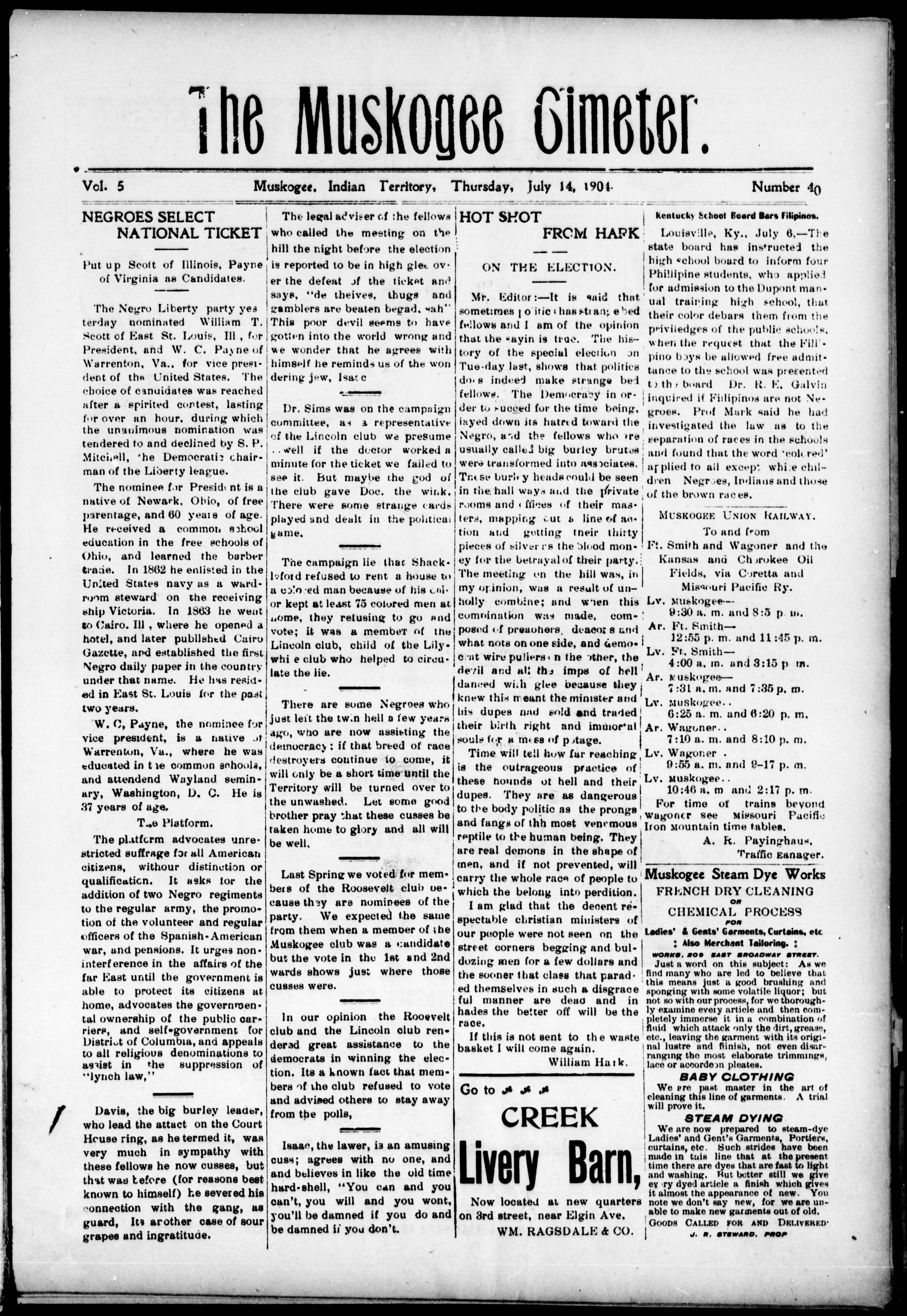
NEGROES SELECT NATIONAL TICKET
Put up Scott of Illinois, Payne of Virginia as Candidates.
The Negro Liberty party yesterday nominated William T. Scott of East St. Louis, Ill, for President, and W. C. Payne of Warrenton, Va., for vice president of the United States. The choice of candidates was reached after a spirited contest, lasting for over an hour, during which the unanimous nomination was tendered to and declined by S. P. Mitchell, the Democratic chairman of the Liberty league.
The nominee for President is a native of Newark, Ohio, of free parentage, and 60 years of age. He received a common school education in the free schools of Ohio, and learned the barber trade. In 1862 he enlisted in the United States navy as a wardroom steward on the receiving ship Victoria. In 1863 he went to Cairo. Ill, where he opened a hotel, and later publlshed Cairo Gazette, and established the first Negro daily paper in the country under that name. He has resided in East St. Louis for the past two years.
W. C, Payne, the nominee for vice president, is a native of Warrenton, Va., where he was educated in the common schools, and attendend Wayland seminary, Washington, D. C. He is 37 years of age.
T.e Platform.
The platform advocates unrestricted suffrage for all American citizens, withour distinction or qualification. It asks for the addition of two Negro regiments to the regular army, the promotion of the volunteer and regular officers of the Spanish-American war, and pensions. It urges noninterference in the affairs of the far East until the government is able to protect its citizens at home, advocates the governmental ownership of the public carriers, and self-government for District of Columbia, and appeals to all religious denominations to assist in the suppression of "lynch law."
Davis, the big burley leader, who lead the attact on the Court House ring, as he termed it, was very much in sympathy with these fellows he now cusses, but that was before (for reasons best known to himself) he severed his connection with the gang, as guard, Its another case of sour grapes and ingratitude.
The legal adviser of the fellows who called the meeting on the hill the night before the election is reported to be in high glee over the defeat of the ticket and says, "de theives, thugs and gamblers are beaten begad, sah" This poor devil seems to have gotten into the world wrong and we wonder that he agrees with himself he reminds us of the wondering jew, Isaac
Dr. Sims was on the campaign committee, as a representative of the Lincoln club we presume ...well if the doctor worked a minute for the ticket we failed to see it. But maybe the god of the club gave Doc. the wink. There were some strange cards played and dealt in the political game.
The campaign lie that Shackleford refused to rent a house to a colored man because of his color kept at least 75 colored men at home, they refusing to go and vote; it was a member of the Lincoln club, child of the Lilywhi e club who helped to circulate the lie.
There are some Negroes who just left the twin hell a few years ago, who are now assisting the democracy: if that breed of race destroyers continue to come, it will only be a short time until the Territory will be turned over to the unwashed. Let some good brother pray that these cusses be taken home to glory and all will be well.
Last Spring we voted for members of the Roosevelt club because they are nominees of the party. We expected the same from them when a member of the Muskogee club was a candidate but the vote in the 1st and 2nd wards shows just where those cusses were.
In our opinion the Rooevelt club and the Lincoln club rendered great assistance to the democrats in winning the election. Its a known fact that members of the club refused to vote and advised others to stay away from the polls,
Isaac, the lawer, is an amusing cuss; agrees with no one, and and believes in like the old time hard-shell, "You can and you can't, you will and you wont, you'll be damned if you do and be damned if you don't.
HOT SHOT
FRCM HAPK
ON THE ELECTION.
Mr. Editor:—It is said that sometimes politics has strange bed fellows and I am of the opinion that the sayin is true. The history of the special election on Tuesday last, shows that politics does indeed make strange bed fellows. The Democracy in order to succeed for the time being, layed down its hatred toward the Negro, and the fellows who are usually called big burley brutes were transformed into associates. These burley heads could be seen in the hall ways and the private rooms and offices of their masters, mapping out a line of action and getting their thirty pieces of silver as the blood money for the betrayal of their party. The meeting on the hill was, in my opinion, was a result of unholly combine; and when this combination was made, composed of preachers, deacons and what nots on one side, and democrat wire pullers on the other, the devil and all the imps of hell danced with glee because they knew this meant the minister and his dupes had sold and traded their birth right and immoral souls for a mess of potage.
Time will tell how far reaching is the outrageous practice of these hounds of hell and their dupes. They are as dangerous to the body politic as the prongs and fangs of the most venomous reptile to the human being. They are real demons in the shape of men, and if not prevented, will carry the whole race of people to which the belong into perdition.
I am glad that the decent respectable christian ministers of our people were not seen on the street corners begging and buldozing men for a few dollars and the sooner that class that paraded themselves in such a disgrace ful manner are dead and in hades the better off will be the race.
If this is not sent to the waste basket I will come again.
William Hark.
Go to CREEK
Livery Barn,
Now located at new quarters
on 3rd street, near Elgin Ave.
WM. RAGSDALE & CO.
---
Number 40
Kentucky School Board Bars Filipinos.
Louisville, Ky., July 6.—The state board has instructed the high school board to inform four Phillipine students, who applied for admission to the Dupont manual training high school, that their color debars them from the privileges of the public schools, when the request that the Filipino boys be allowed free admittance to the school was presented to the board Dr. R. E. Galvin inquired if Filipinos are not Negroes. Prof Mark said he had investigated the law as to the separation of races in the schools and found that the word 'colored' applied to all except white children Negroes, Indians and those of the brown races.
MUSKOGEE UNION RAILWAY.
To and from
Ft. Smith and Wagoner and the Kansas and Chorokee Oil Fields, via Coretta and Missouri Pacific Ry.
Lv. muskogee—
9:30 a. m. and 8:5 p. m.
Ar. Ft. Smith—
12:55 p. m. and 11:45 p. m.
Lv. Ft. Smith—
4:00 a. m. and 3:15 p. m.
Ar. muskogee—
7:31 a. m. and 7:35 p. m.
Lv. muskogee...
6:25 a. m. and 6:20 p. m.
Ar. Wagoner..
7:10 a. m. and 8:10 p. m.
Lv. Wagoner..
9:55 a. m. and 9-17 p. m.
Lv. muskogee..
10:46 a. m and 2:17 p. m.
For time of trains beyond wagoner see Missouri Pacific Iron mountain time tables.
Muskogee Steam Dye Works FRENCH DRY CLEANING
Ladies' & Gents' Garments, Curtains, etc Also Merchant Tailoring. WORKS, 200 EAST BROADWAY STREET. Just a word on this subject: As we find many who are led to believe that this means just a good brushing and sponging with some volatile liquor; but not so with our process, for we thoroughly examine every article and then completely immerse it in a combination of fluid which attack only the dirt, grease, etc., leaving the garment with its original lustre and finish, not even disarranging the most elaborate trimmings, lace or accordeon pleates.
BABY CLOTHING
We are past master in the art of cleaning this line of garments. A trial will prove it.
STEAM DYING
We are now prepared to steam-dye Ladies' and Gent's Garments, Portiers, curtains, etc. Such strides have been made in this line that at the present time there are dyes that are fast to light and washing. But better still we give every dyed article a finish which gives it almost the appearance of new. You note we don't say new, for we are unable to make new garments out of old.
Muskogee Cimeter.
W. H. TWINE, Editor.
MUSKOGEE, IND. TER.
NEW STATE NOTES.
Beggs is to start an oil well at once.
It is said that there are over sixty flouring mills in Oklahoma, and only one sack of flour is on exhibition at the World's fair.
Hinton will celebrate the opening of the new country August 6th. Governor Ferguson has accepted an invitation to address the gathering.
The Frisco has established through service from Ardmore to Durant and points east.
The first load of Kay county wheat tested sixty-two pounds to the bushel and brought seventy cents.
The Ardmore Oil company has let a contract for the sinking of its well to John Davidson, an experienced oil man. The well is to be sunk a distance of 2,000 feet.
D. J. Goodwin, deputy marshal at Alderson, had his left hand blown off by a giant firecracker July 4th, and amputation at the wrist was necessary.
At a joint meeting of the Lawton Club and the Commercial Club at Lawton the separate clube were disbanded and a larger and better organization to be known as the Lawton Commercial Club.
Through the advice of Colonel Randlett, agent for the Comanche Indians, the citizens of Anadarko are taking steps to secure from the government a valuable tract of land near the city, suitable for park purposes.
John Brown and wife and James Dearking were arrested at Alva last week upon the charge of counterfeiting. Molds, a number of spurious coins and materials used in making the "queer" were found in their possession.
O. A. Leach, a printer of Chandler, won a prize for the closest guess of the number entering the postoffice on a certain day. His guess was 4,239, and the register showed 4,254. The prize was a ticket to the World's fair or its equivalent. He took the equivalent.
Frank Simpson was found dead in a pond near his place, six miles northwest of Comanche, last week. The coroner's jury rendered a verdict of accidental drowning.
Arrangements have been made for completing a line of the Postal Telegraph company from Oklahoma City, by way of Shawnee, to South McAlesier, also from Denison, Texas, north to South McAlester.
A committee, consisting of Secretary J. B. Thoburn and H. J. Newberry of the agricultural board and M. Thacker and John Golobie of the good roads association, met in Guthrie last week to prepare a good roads bill to be presented to the next territorial legislature.
Charles Parker, a ten-year-old lad, was killed in McLoud last week. He fell under the feet of a team of horses and was kicked by one of them in the back. He only lived ten minutes after being picked up.
Lone Wolf was visited by a fire last week that destroyed a hotel, numerous residences, a meat market, billiard and realty building. A bank was dynamited to stop the spread of the flames.
WATSON NAMED
THE GEORGIA MAN HEADS POPULIST NATIONAL TICKET
OMAHA PLATFORM OF 1E92 REAFFIRMED
Thomas H. Tibbles of Nebraska Chosen as Candidate for Vice President Senator Allen Would Not Enter Into a Scramble for the Nomination
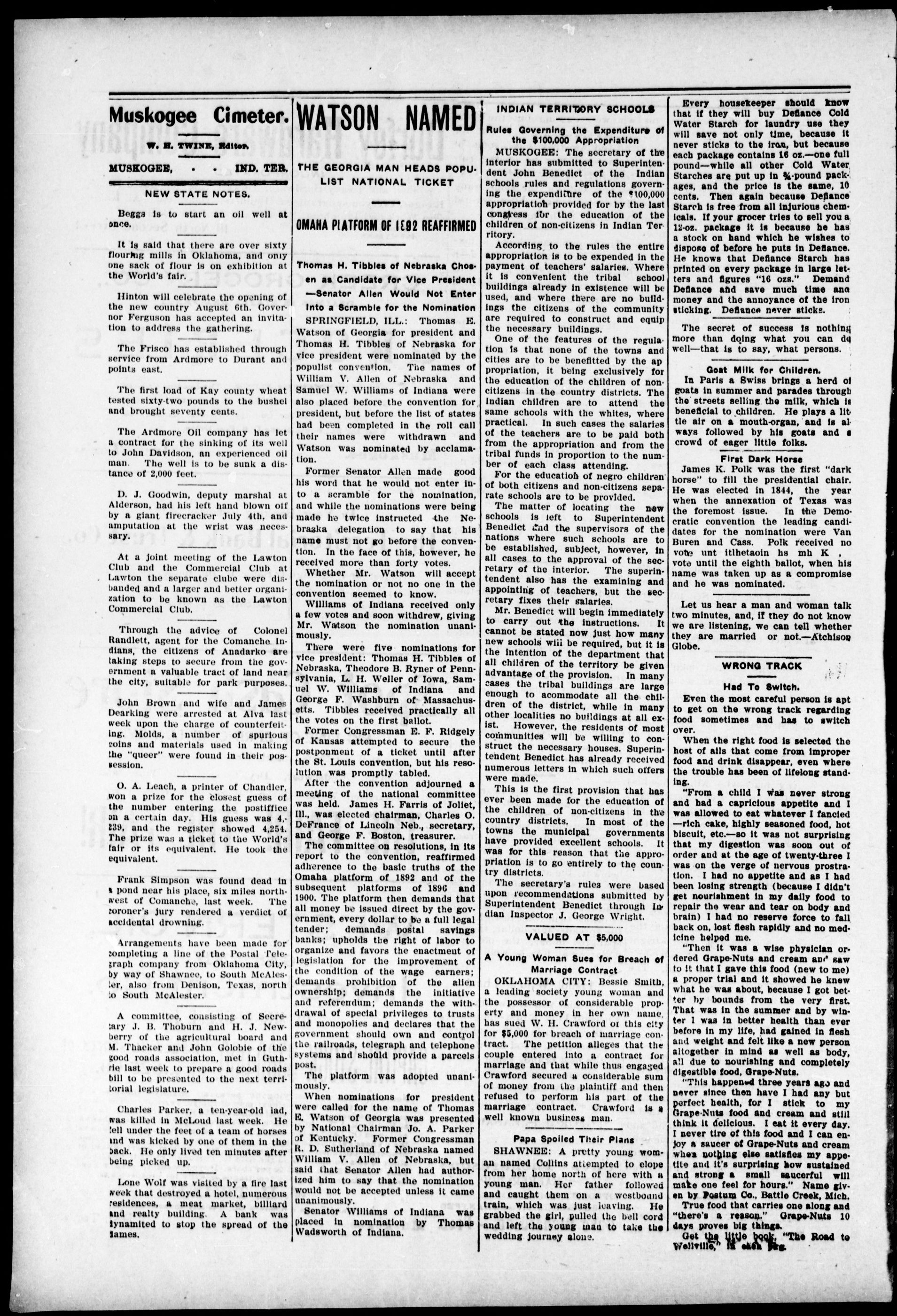
SPRINGFIELD, ILL.: Thomas E. Watson of Georgia for president and Thomas H. Tibbles of Nebraska for vice president were nominated by the populist convention. The names of William V. Allen of Nebraska and Samuel W. Williams of Indiana were also placed before the convention for president, but before the list of states had been completed in the roll call their names were withdrawn and Watson was nominated by acclamation.
Former Senator Allen made good his word that he would not enter into a scramble for the nomination, and while the nominations were being made he twice instructed the Nebraska delegation to say that his name must not go before the convention. In the face of this, however, he received more than forty votes. Whether Mr. Watson will accept the nomination or not no one in the convention seemed to know. Williams of Indiana received only a few votes and soon withdrew, giving Mr. Watson the nomination unanimously.
There were five nominations for vice president: Thomas H. Tibbles of Nebraska, Theodore B. Ryner of Pennsylvania, L. H. Weller of Iowa, Samuel W. Williams of Indiana and George F. Washburn of Massachusetts. Tibbles received practically all the votes on the first ballot.
Former Congressman E. F. Ridgely of Kansas attempted to secure the postponement of a ticket until after the St. Louis convention, but his resolution was promptly tabled.
After the convention adjourned a meeting of the national committee was held. James H. Farris of Joliet, Ill., was elected chairman, Charles O. DeFrance of Lincoln Neb., secretary, and George F. Boston, treasurer.
The committee on resolutions, in its report to the convention, reaffirmed adherence to the basic truths of the Omaha platform of 1892 and of the subsequent platforms of 1896 and 1900. The platform then demands that all money be issued direct by the government, every dollar to be a full legal tender; demands postal savings banks; upholds the right of labor to organize and favors the enactment of legislation for the improvement of the condition of the wage earners; demands prohibition of the alien ownership; demands the initiative and referendum; demands the withdrawal of special privileges to trusts and monopolies and declares that the government should own and control the railroads, telegraph and telephone systems and should provide a parcels post.
The platform was adopted unanimously.
When nominations for president were called for the name of Thomas E. Watson of Georgia was presented by National Chairman Jo. A. Parker of Kentucky. Former Congressman R. D. Sutherland of Nebraska named William V. Allen of Nebraska, but said that Senator Allen had authorized him to say that the nomination would not be accepted unless it came unanimously.
Senator Williams of Indiana was placed in nomination by Thomas Wadsworth of Indiana.
INDIAN TERRITORY SCHOOLS
Rules Governing the Expenditure of the $100,000 Appropriation
MUSKOGEE: The secretary of the interior has submitted to Superintendent John Benedict of the Indian schools rules and regulations governing the expenditure of the 100,000 appropriation provided for by the last congress for the education of the children of non-citizens in Indian Territory. According to the rules the entire appropriation is to be expended in the payment of teachers' salaries. Where it is convenient the tribal school buildings already in existence will be used, and where there are no buildings the citizens of the community are required to construct and equip the necessary buildings.
One of the features of the regulation is that none of the towns and cities are to be benefitted by the ap propriation, it being exclusively for the education of the children of noncitizens in the country districts. The Indian children are to attend the same schools with the whites, where practical. In such cases the salaries of the teachers are to be paid both from the appropriation and from the tribal funds in proportion to the number of each class attending. For the education of negro children of both citizens and non-citizens separate schools are to be provided.
The matter of locating the new schools is left to Superintendent Benedict and the supervisors of the nations where such schools are to be established, subject, however, in all cases to the approval of the secretary of the interior. The superintendent also has the examining and appointing of teachers, but the secretary fixes their salaries.
Mr. Benedict will begin immediately to carry out the instructions. It cannot be stated now just how many new schools will be required, but it is the intention of the department that all children of the territory be given advantage of the provision. In many cases the tribal buildings are large enough to accommodate all the children of the district, while in many other localities no buildings at all exist. However, the residents of most communities will be willing to construct the necessary houses. Superintendent Benedict has already received numerous letters in which such offers were made.
This is the first provision that has ever been made for the education of the children of non-citizens in the country districts. In most of the towns the municipal governments have provided excellent schools. It was for this reason that the appropriation is to go entirely to the country districts. The secretary's rules were based upon recommendations submitted by Superintendent Benedict through Indian Inspector J. George Wright.
VALUED AT $5,000
A Young Woman Sues for Breach of Marriage Contract
OKLAHOMA CITY: Bessie Smith, a leading society young woman and the possessor of considerable property and money in her own name, has sued W. H. Crawford or this city for $5,000 for breach of marriage contract. The petition alleges that the couple entered into a contract for marriage and that while thus engaged Crawford secured a considerable sum of money from the plaintiff and then refused to perform his part of the marriage contract. Crawford is a well known business man.
Papa Spoiled Their Plans
SHAWNEE: A pretty young woman named Collins attempted to elope from her home north of here with a young man. Her father followed and caught them on a westbound train, which was just leaving. He grabbed the girl, pulled the bell cord and left the young man to take the wedding journey alone.
Every housekeeper should know that if they will buy Defiance Cold Water Starch for laundry use they will save not only time, because it never sticks to the iron, but because each package contains 16 oz.—one full pound—while all other Cold Water Starches are put up in %-pound packages, and the price is the same, 10 cents. Then again because Defiance Starch is free from all injurious chemicals. If your grocer tries to sell you a 12-oz. package it is because he has a stock on hand which he wishes to dispose of before he puts in Defiance. He knows that Defiance Starch has printed on every package in large letters and figures "16 ozs." Demand Defiance and save much time and money and the annoyance of the iron sticking. Defiance never sticks.
The secret of success is nothing more than doing what you can do well—that is to say, what persons.
Goat Milk for Children.
In Paris a Swiss brings a herd of goats in summer and parades through the streets selling the milk, which is beneficial to children. He plays a little air on a mouth-organ, and is always followed by his goats and a crowd of eager little folks.
First Dark Horse
James K. Polk was the first "dark horse" to fill the presidential chair. He was elected in 1844, the year when the annexation of Texas was the foremost issue. In the Democratic convention the leading candidates for the nomination were Van Buren and Cass. Polk received no vote unt ithetaoin hs mh K, vote until the eighth ballot, when his name was taken up as a compromise and he was nominated.
Let us hear a man and woman talk two minutes, and, if they do not know we are listening, we can tell whether they are married or not.—Atchison Globe.
101
WRONG TRACK
Had To Switch.
Even the most careful person is apt to get on the wrong track regarding food sometimes and has to switch over. When the right food is selected the host of ails that come from improper food and drink disappear, even where the trouble has been of lifelong standing.
"From a child I was never strong and had a capricious appetite and I was allowed to eat whatever I fancied—rich cake, highly seasoned food, hot biscuit, etc.—so it was not surprising that my digestion was soon out of order and at the age of twenty-three I was on the verge of nervous prostration. I had no appetite and as I had been losing strength (because I didn't get nourishment in my daily food to repair the wear and tear on body and brain) I had no reserve force to fall back on, lost flesh rapidly and no medicine helped me.
"Then it was a wise physician ordered Grape-Nuts and cream and saw to it that I gave this food (new to me) a proper trial and it showed he knew what he was about, because I got better by bounds from the very first. That was in the summer and by winter I was in better health than ever before in my life, had gained in flesh and weight and felt like a new person altogether in mind as well as body, all due to nourishing and completely digestible food, Grape-Nuts.
"This happened three years ago and never since then have I had any but perfect health, for I stick to my Grape-Nuts food and cream and still think it delicious. I eat it every day. I never tire of this food and I can enjoy a saucer of Grape-Nuts and cream when nothing else satisfies my appetite and it's surprising how sustained and strong a small saucerful will make one feel for hours." Name given by Postum Co., Battle Creek, Mich. True food that carries one along and "there's a reason." Grape-Nuts 10 days proves big things. Get the little book, "The Road to Wellville," in each big
A Blow at Bachelorhood
In addressing the Cornell students this year President Schurman broke away from the beaten path of baccalaureate counsel and exhorted the graduates in regard to duties which are generally left to their own discretion. "I feel deeply," he said, "that every young man should look forward to providing for a wife and family, which is beyond doubt the chief blessing vouchsafed to man in this earthly career. I have no patience with the college graduates who deliberately elect bachelorhood, whose social circle is the club and whose religion is a refined and fastidious epicureanism. It would not be worth while maintaining colleges and universities for the production of froth like that."
SAVED CHILD'S LIFE.
Remarkable Cure of Dropsy by Dodd's Kidney Pills.
Sedgwick, Ark., July 11.—The case of W. S. Taylor's little son is looked upon by those interested in medical matters as one of the most wonderful on record. In this connection his father makes the following statement:
"Last September, my little boy had Dropsy; his feet and limbs were swollen to such an extent that he could not walk nor put his shoes on. The treatment that the doctors were giving him seemed to do him no good and two or three people said his days were short, even the doctors, two of the best in the country told me he would not get better. I stopped their medicine and at once sent for Dodd's Kidney Pills. I gave him three Pills a day, one morning, noon and night for eight days; at the end of the eighth day the swelling was all gone, but to give the medicine justice, I gave him eleven more Pills. I used thirty-five Pills in all and he was entirely cured. I consider your medicine saved my child's life. When the thirty-five Pills were given him, he could run, dance and sing, whereas before he was an invalid in his mother's arms from morning until night."
Wealth in Ireland's Bogs.
Sir Richard Sankey estimates that Ireland bogs contain the equivalent of 5,000,000,000 tons of coal, and he advocates creating power for varied industries by converting the fuel into electricity on the spot.
The well earned reputation and increasing popularity of the Lewis' "Single Binder." straight 5c cigar, is due to the maintained high quality and appreciation of the smoker.
The man who fell in love with a 'hello girl's' voice and married her should be cornered for a dime museum.
No Spoony Business.
For Chills, Malaria and Billiousness Cheatham's Laxative Tablets are certainly very fine. No bad effects as with Quinine. Then they are so convenient, can carry them in pocket and no spoon is necessary. They are an ideal remedy. Geo. Westlake, 25c per box. Sycamore, Ark.
Many Rubber Producers.
Most Americans have an idea that rubber is a product like wheat or corn, to be obtained from a given tree. The idea is quite erroneous. It has been estimated that 1,000 different species contain rubber, though commercial quantities have been obtained from only forty or fifty.
Russian Soldier's Rations.
A Russian soldier's daily rations in the field are two and one-half pounds of bread, or one and three-quarters of biscuit; one pound of meat, and, for making soup, four ounces of barley groats; three-quarters ounce of dried vegetables and three ounces of flour. Also salt, pepper, tea and sugar.
Anyone who thinks a woman's voice the sweetest music should go into a "cash, here!" shriek department store on a bargain day rush.
ALLOTMENT OF PASTURES.
Homestead Filings by Osage Tribe of Indiana.
GUTHRIE: One of the first matters of importance to be investigated and passed upon by Capt. Frank Frantz, the Rough Rider candidate recently appointed agent for the Osage tribe of Indians, will be that of the allotment of homestead lands to the members of that tribe. While many of these allotments have been taken and approved by former agents, yet recent events endanger the validity of these allotments and may call for a strict investigation.
For several months prior to the suspension and almost immediate resignation of Indian Agent Mitscher, by sanction of the interior department, the Osages were allowed the privilege of filing on 160 acres of land each, the same to be known as a "homestead filing." Thus in a peaceable and facilitating manner the Indians were themselves accepting the allotments and doing for themselves the work being done for the Indian Territory tribes by the Dawes commission.
In order to encourage the Indians in making these homestead filings and thus further the allotment idea among them, it was the policy to allow the homesteaders to enter into contracts or leases with white men, and in many cases with members of the Osage tribe, to cultivate and improve the lands filed upon.
A large number of homestead filings were made on lands within the regularly surveyed pastures on the reservation; a great many of these filings were leased—informally, of course—for agricultural purposes, and when the original pastures were advertised for lease this year the acreage represented in the actual homestead filings was deducted from the gross area of the several inclosures. Leases were made on the remaining acreage in each pasture and forwarded to he interior department for approval. In approving the contracts the acting secretary of the interior gave to each lessee the option of including in his lease the area embraced in the so-called homesteads not actually occupied as a home personally by an Indian, to be used by the lessee and paid for at the same rental paid for the entire pasture.
Until the announcement of the new leases is made it would be difficult to surmise just what portion of the lessees of pastures will want to take advantage of the option offered to them; in fact, much of the acreage included in the homestead filings has been broken and thus rendered useless for grazing purposes, while under the rules of the department and the terms of the pasture leases the land can not be used for other than grazing purposes. Much of the land is still in grass and can be used for grazing purposes if the lessees want it.
As there are large interests at stake in this proposition, including many Indian citizens of Pawhuska and other members of the tribe—all who have selected homesteads—much anxiety is being felt as to the final outcome of the department's action relative to the homesteaded land. Special Agent Conser, who has been in charge pending the appointment of a successor to Mitscher, has commenced the investigation of the matter for the interior department, acquainting himself with the actual conditions. It is feared among the influential and progressive tribesmen that the department's action will interfere with the final allotting of lands and probably delay it for years, as the full-blood element and many of the mixed-breeds become rebellious and ugly when restrictetd too much by the department; on the other hand, if left alone, the allotting of the lands would be accomplished without any trouble whatever.
The total personal property valuation of Comanche county is $1,018,887.
The World's Famous Catarrh Remedy. Should Be in Every Home.
PERUNA
THE GREATEST
TONE
Pe-ru-na Contains
No Narcotics.
One reason why Peruna has found permanent use in so many homes is that it contains no narcotics of any kind. Peruna is perfectly harmless. It can be used any length of time without acquiring the drug habit.
Silence is golden—the wise man's refuge and the fool's defense.
Examine carefully every bottle of CASTORIA,
a safe and sure remedy for infants and children,
and see that it
Bears the
Signature of
Charles H. Flutcher
In Use For Over 30 Years.
The Kind You Have Always Bought.
A stitch in time saves nine—but
has been known to shorten life.
This Will Interest Mothers.
Mother Gray's Sweet Powders for Children, used by Mother Gray, a nurse in Children's Home, New York, Cure Feverishness. Bad Stomach, Teething Disorders, move and regulate the bowels and destroy Worms. Sold by all Druggists, 25c. Sample FREE. Address A. S. Olmsted, LeRoy, N.Y.
Defiance Starch is put up 16 ounces in a package, 10 cents. One-third more starch for the same money.
Is It Not Worth While
If you travel, on business or pleasure, to get the best service for the lowest rates? Ask the Erie Railroad Company, 555 Railway Exchange, Chicago, for full information. Booklets free describing Summer Tours and the Beautiful Chautauqua Lake Region; also Cambridge Springs.
But Few Are Blessed.
It is more blessed to give than to receive, but the wonderful part of it is that so few people know it.
The Best Results in Starching
can be obtained only by using Defiance Starch, besides getting 4 oz for 10 cents. Once used, always used.
STATE OF OHIO, CITY OF TOLEDO, 88.
LUGAS COUNTY
FRANK J. CHENEY makes oath that he is senior partner of the firm of F. J. CHENEY & Co., doing business in the City of Toledo, County and State aforesaid, and that said firm will pay the sum of ONE HUNDRED DOLLARS for each and every case of CATARRH that cannot be cured by the use of HALL'S CATARRH CURE.
FRANK J. CHENEY.
Sworn to before me and subscribed in my presence, this 6th day of December, A. D. 1886.
A. W. GLEASON,
NOTARY PUBLIC.
Hall's Catarrh Cure is taken internally and acts directly on the blood and mucous surfaces of the system. Send for testimonials, free.
F. J. CHENEY & CO., Toledo, O.
Sold by all Druggists, 75c.
Take Hall's Family Pills for constipation.
A man's soft spot lies in his head or his heart; his tender spot may be his feet, but the real spot to touch is his purse or his stomach.
Old and True.
"For fifteen years I have constantly kept a supply of Hunt's Cure on hand to use in all cases of itching skin trouble. For Eczema, Ringworm and the like it is peerless. "I regard it as an old friend and a true one."
The road to hell is paved with good intentions—and disinterested friends line up each side of it.
love than about anything else, for the reason that there is less naturalness about love than about anything else. they wept.
Do You Want the Lowest Rates either one-way or round-trip excursion, to any point east of Chicago or St. Louis? Ask the Erie Railroad Company, 555 Railway Exchange, Chicago, for complete information. Three fast trains daily from Chicago and St. Louis through to New York, Boston, Buffalo, Pittsburgh and other eastern points. Stop-over without charge at Niagara Falls, Cambridge Springs and Beautiful Chautauqua Lake.
EDUCATIONAL.
OKLAHOMA STATE MILITARY INSTITUTE
A High Grade Preparatory Military School Under Government Supervision
Special Features:
Only Military School in Both Territories.
Thoroughness in Everything.
Slow, Backward Students Receive Special Attention.
High Standard of Study and Morals.
Firm and Wholesome Discipline.
Modern and Comprehensive Methods.
Character Building Combined with Intelectual Training.
Beautiful Environment.
Army Officer, Graduate of West Point, Detailed by Secretary of War.
Moderate Expense.
Second Session Begins September 7th, 1904.
For Application Blank and Illustrated Catalogue, Address
OLONEL JAIES E. DUNN, SUPT
Oklahoma City, Oklahoma.
Capital City
Courses
Bookkeeping
Shorthana
Typewriting
Penmanship
Telegraphy
Business College
Mullinne, Ohio
Fall Term
Begins Sept.
5, 1904.
Write For
Particulars
Afflicted with
sore eyes, use
NEW PENSION LAWS SENT
FREE
Apply to NATHAN BICKFORD, 914 F St.
Washington, D. C.
WHERRETT'S
CHIGGER CURE
CURES CHIGGER
& MOSQUITO
BITES
At Druggists or Hall 25c.
The O. E. WHERRETT CO., Atchison, Kans.
THE DAISY FLY KILLER destroys all the files and affords comfort to every home—in dining-room, sleeping-room and places where files are troublesome. Clean, neat and will not sell or injure anything. Try them once and you will never be without them. If not kept by dealers, send prepaid for 20c.
HAROLD SOBERS,
1490 DeKalb Avenue,
Brooklyn, N. T.
Wiggle Stick
Wiggle-Stick LAUNDRY BLUE
Won't spill, break, freeze nor spot clothes.
Costs 10c. and equals 20c. worth of any other bluing.
W.N.U.—Oklahoma City—No. 29, 1904.
When writing advertisers kindly mention this paper.
PISO'S CURE FOR
CURES WHERE ALL ELSE FAILS.
Best Cough Syrup. Tastes Good. Use in time. Sold by druggists.
CONSUMPTION
MANY HOURS SAVED ON FRISCO
NEW TRAIN SERVICE.
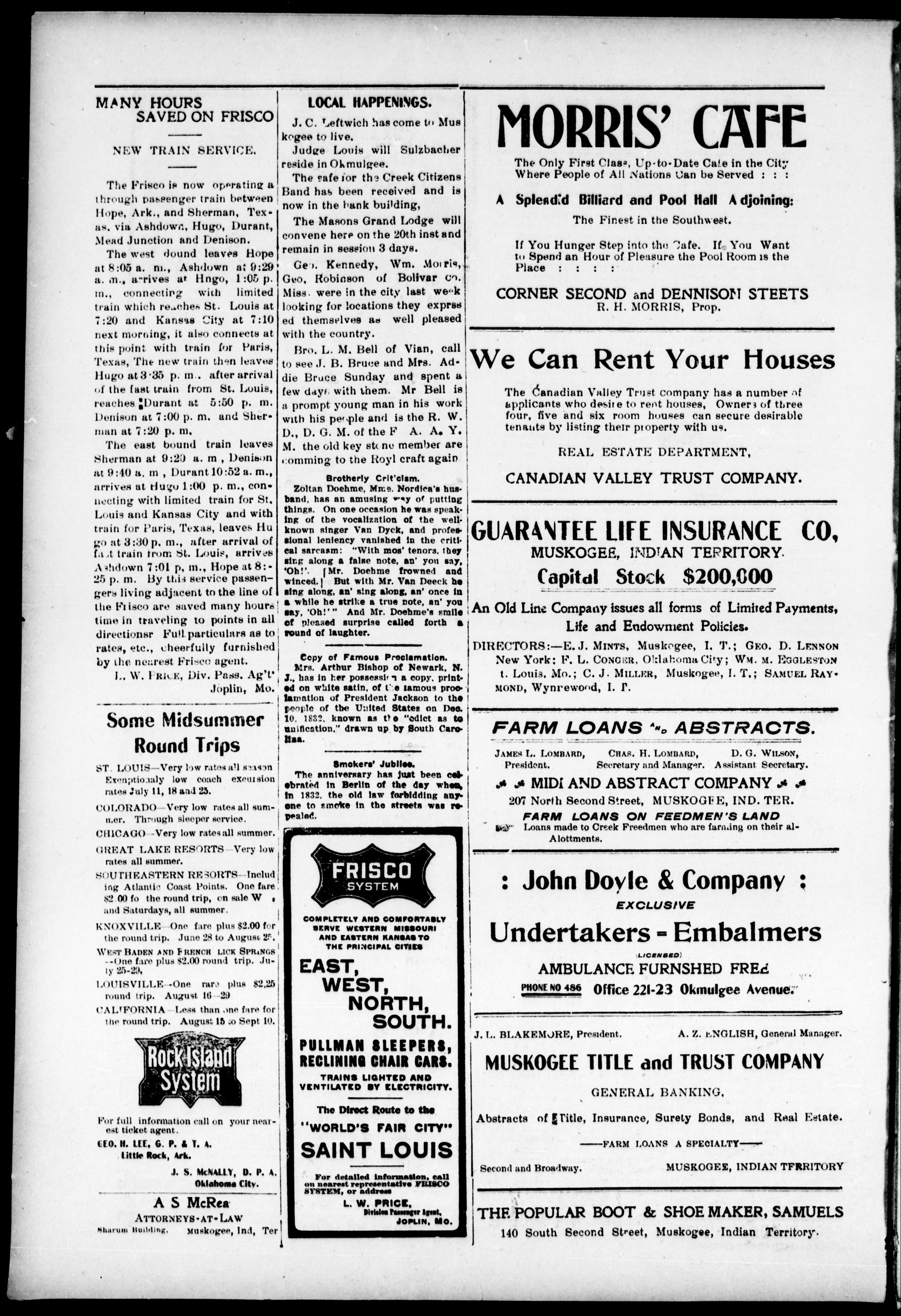
The Frisco is now operating a through passenger train between Hope, Ark., and Sherman, Texas, via Ashdown, Hugo, Durant, Mead Junction and Denison.
The west dound leaves Hope at 8:05 a. m., Ashdown at 9:29 a. m., arrives at Hngo, 1:05 p. m., connecting with limited train which reaches St. Louis at 7:20 and Kansas City at 7:10 next morning, it also connects at this point with train for Paris, Texas, The new train then leaves Hugo at 3:35 p. m., after arrival of the fast train from St. Louis, reaches Durant at 5:50 p. m. Denison at 7:00 p. m. and Sherman at 7:20 p. m.
---
The east bound train leaves Sherman at 9:20 a.m, Denison at 9:40 a.m, Durant 10:52 a.m., arrives at Hugo 1:00 p.m., connecting with limited train for St. Louis and Kansas City and with train for Paris, Texas, leaves Hugo at 3:30 p.m., after arrival of fact train from St. Louis, arrives Ashdown 7:01 p.m., Hope at 8:25 p.m. By this service passengers living adjacent to the line of the Frisco are saved many hours time in traveling to points in all directionsr Full particulars as to rates, etc., cheerfully furnished by the nearest Frisco agent.
L. W. PRICE, Div. Pass. Ag't' Joplin, Mo.
Some Midsummer Round Trips
ST. LOUIS—Very low rates all season Exemptionaly low coach excursion rates July 11, 18 and 25.
COLORADO—Very low rates all summer. Through sleeper service.
CHICAGO—Very low rates all summer.
GREAT LAKE RESORTS—Very low rates all summer.
SOUTHEASTERN RESORTS—Including Atlantic Coast Points. One fare $2.00 fo the round trip, on sale W and Saturdays, all summer.
KNOXVILLE—One fare plus $2.00 for the round trip. June 28 to August 25.
WEST BADEN AND FRENCH LICK SPRINGS
--One fare plus $2.00 round trip. July 25-29.
LOUISVILLE--One rare plus $2.25 round trip. August 16-29.
CALIFORNIA--Less than one fare for the round trip. August 15 to Sept 10.
Rock Island
System
For full information call on your nearest ticket agent.
GEO. H. LEE, G. P. & T. A.
Little Rock, Ark.
J. S. McNALLY, D. P. A.
Oklahoma City.
A S McRea
ATTORNEYS-AT-LAW
Sharum Building. Muskogee, Ind, Ter
LOCAL HAPPENINGS.
J. C. Leftwich has come to Muskogee to live.
Judge Louis will Sulzbacher reside in Okmulgee.
The safe for the Creek Citizens Band has been received and is now in the bank building,
The Masons Grand Lodge will convene here on the 20th inst and remain in session 3 days.
Geo. Kennedy, Wm. Morris, Geo. Robinson of Bolivar co. Miss were in the city last week looking for locations they expressed themselves as well pleased with the country.
Bro. L. M. Bell of Vian, call to see J. B. Bruce and Mrs. Addie Bruce Sunday and spent a few days with them. Mr Bell is a prompt young man in his work with his people and is the R. W. D., D. G. M. of the F. A. A. Y. M. the old key stone member are comming to the Royl craft again
Brotherly Crit'clam.
Zoltan Doehme, Mme. Nordica's husband, has an amusing way of putting things. On one occasion he was speaking of the vocalization of the well-known singer Van Dyck, and professional leniency vanished in the critical sarcasm: "With mos' tenors, they sing along a false note, an' you say, 'Oh!'. [Mr. Doehme frowned and winced.] But with Mr. Van Deeck he sing along, an' sing along, an' once in a while he strike a true note, an' you say, 'Oh!'" And Mr. Doehme's smile of pleased surprise called forth a round of laughter.
Copy of Famous Proclamation.
Mrs. Arthur Bishop of Newark, N. J., has in her possession a copy, printed on white satin, of the famous proclamation of President Jackson to the people of the United States on Dec. 10, 1832, known as the "odict as to unification," drawn up by South Carolina.
Smokers' Jubilee.
The anniversary has just been celebrated in Berlin of the day when, in 1832, the old law forbidding anyone to smoke in the streets was repealed.
FRISCO
SYSTEM
COMPLETELY AND COMFORTABLY
SERVE WESTERN MISSOURI
AND EASTERN KANSAS TO
THE PRINCIPAL CITIES
EAST,
WEST,
NORTH,
SOUTH.
PULLMAN SLEEPERS,
RECLINING CHAIR CARS.
TRAINS LIGHTED AND
VENTILATED BY ELECTRICITY.
The Direct Route to the
"WORLD'S FAIR CITY"
SAINT LOUIS
For detailed information, call
on nearest representative FRISCO
SYSTEM, or address
L. W. PRICE,
Division Passenger Agent,
JOPLIN, MO.
MORRIS' CAFE
The Only First Class, Up-to-Date Cafe in the City Where People of All Nations Can be Served : : :
A Splendid Billiard and Pool Hall Adjoining:
The Finest in the Southwest.
If You Hunger Step into the Cafe. If You Want to Spend an Hour of Pleasure the Pool Room is the Place : : : :
CORNER SECOND and DENNISON STEETS
R. H. MORRIS, Prop.
We Can Rent Your Houses
The Canadian Valley Trust company has a number of applicants who desire to rent houses. Owners of three four, five and six room houses can secure desirable tenants by listing their property with us. REAL ESTATE DEPARTMENT.
GUARANTEE LINE
MUSKOGEE,
Capital S
An Old Line Company issu-
Life and
DIRECTORS:—E. J. MINTS
New York; F. L. CONG
t. Louis. Mo.; C. J. M
MOND, Wynrewood, I.
FARM LOANS
JAMES L. LOMBARD,
President.
CHA
Secret
MIDI AND AE
207 North Second St
FARM LOANS
Loans made to Creek
Alottments.
: John Doyle
Undertake
AMBULANC
PHONE NO 486 Office
INDIAN VALLEY TRUST COMPANY
ITEE LIFE INSURANCE
MUSKOGEE, INDIAN TERRITORY
Capital Stock $200,000
Company issues all forms of Lim-
Life and Endowment Policies.
—E. J. MINTS, Muskogee, I. T.; C.
F. L. CONGER, Oklahoma City; WM.
Mo.; C. J. MILLER, Muskogee, I. T.
Sherwood, I. F.
M LOANS AND ABSTRACT COMPANY
LIMBARD, CHAS. H. LOMBARD, D. G.
Secretary and Manager. Assistant
INDIAN AND ABSTRACT COMPANY
Fifth Second Street, MUSKOGEE, IND.
M LOANS ON FEEDMEN'S L
made to Creek Freedmen who are farming or
alottments.
John Doyle & Company
EXCLUSIVE
Port takers = Embal-
(LICENSED)
EMBULANCE FURNSHED FREE
0486 Office 221-23 Okmulgee A
CANADIAN VALLEY TRUST COMPANY.
An Old Line Company issues all forms of Limited Payments, Life and Endowment Policies. DIRECTORS:—E. J. MINTS, Muskogee, I. T.; GEO. D. LENNON New York; F. L. CONGER, Oklahoma City; WM. M. EGGLESTON t. Louis, Mo.; C. J. MILLER, Muskogee, I. T.; SAMUEL RAYMOND, Wynrewood, I. F.
FARM LOANS $ ^{N_{p}} $ ABSTRACTS.
JAMES L. LOMBARD, CHAS. H. LOMBARD, D. G. WILSON, President. Secretary and Manager. Assistant Secretary. MIDI AND ABSTRACT COMPANY 207 North Second Street, MUSKOGEE, IND. TER. FARM LOANS ON FEEDMEN'S LAND Loans made to Creek Freedmen who are farming on their al-Alottments.
Undertakers = Embalmers
AMBULANCE FURNSHED FREED PHONE NO 486 Office 221-23 0kmulgee Avenue.
J. L. BLAKEMORE, President.
MUSKOGEE TITL
GENE
Abstracts of Title, Insura
——FAR
GEE TITLE and TRUST C
MUSKOGEE TITLE and TRUST COMPANY
GENERAL BANKING. Title, Insurance, Surety Bonds, a FARM LOANS A SPECIALTY-
Abstracts of Title, Insurance, Surety Bonds, and Real Estate. FARM LOANS A SPECIALTY
COLLAR BOOT & SHOE MAKE
n Second Street, Muskogee, India
THE POPULAR BOOK
140 South Second St
THE POPULAR BOOT & SHOE MAKER, SAMUELS 140 South Second Street, Muskogee, Indian Territory.
Second and Broadway.
TRUST COMPANY.
INSURANCE CO,
AN TERRITORY.
$200,000
forms of Limited Payments,
Payment Policies.
Muskogee, I. T.; Geo. D. LENNON
Oklahoma City; Wm. M. EGGLESTON
Muskogee, I. T.; Samuel RAY.
ABSTRACTS.
OMBARD, D. G. WILSON,
Manager. Assistant Secretary.
ACT COMPANY
MUSKOGEE, IND. TER.
FEEDMEN'S LAND
who are farming on their al-
& Company :
SIVE
Embalmers
(SEED)
FURNISHED FREED
3 Okmulgee Avenue.
A. Z. ENGLISH, General Manager. TRUST COMPANY BANKING. surety Bonds, and Real Estate. IS A SPECIALTY MUSKOGEE, INDIAN TFRRITORY
SHOE MAKER, SAMUELS Muskogee, Indian Territory.
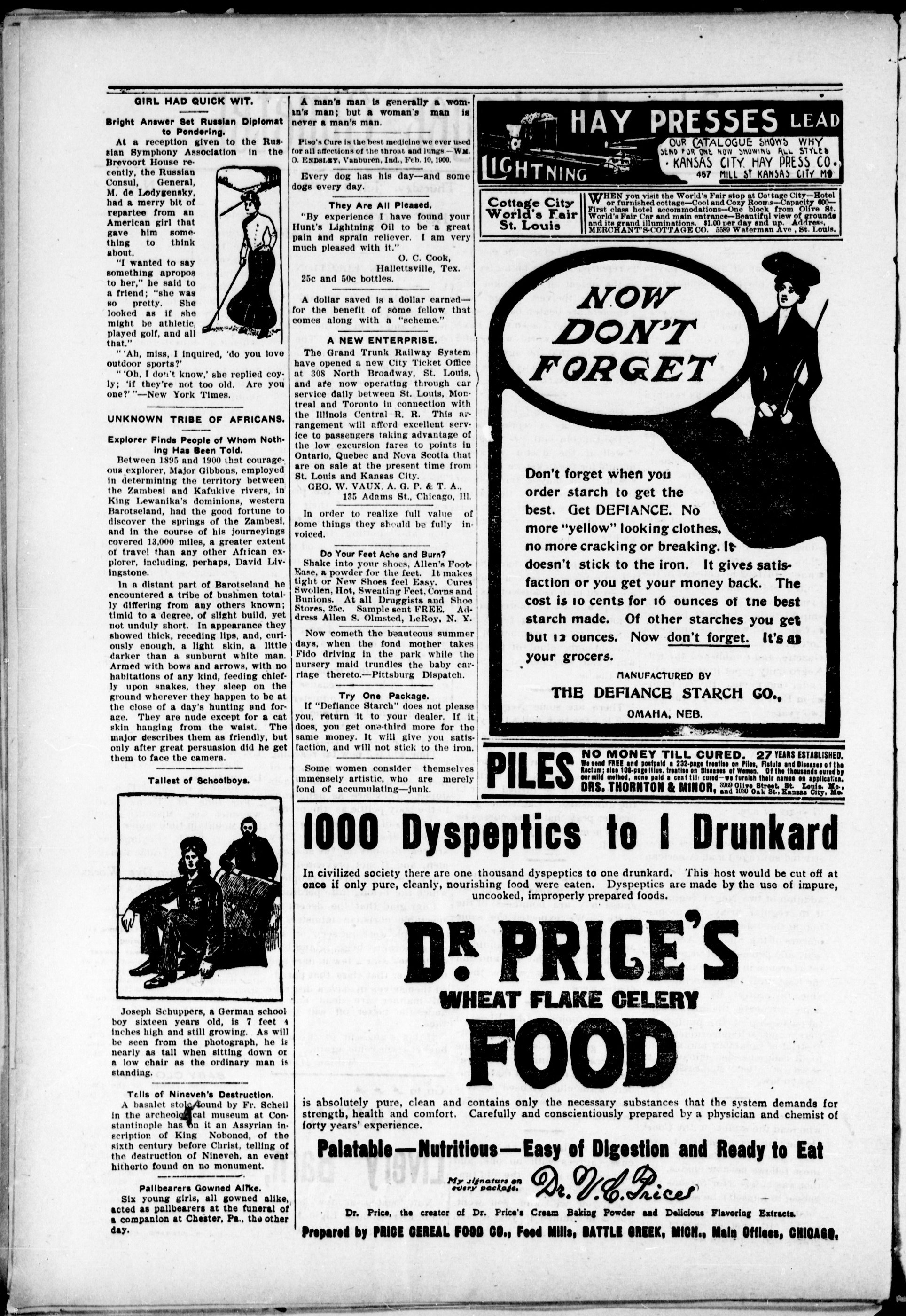
GIRL HAD QUICK WIT.
Bright Answer Set Russian Diplomat to Pondering.
At a reception given to the Russian Symphony Association in the Brevoort House recently, the Russian Consul, General, M. de Lodygensky, had a merry bit of repartee from an American girl that gave him something to think about.
1
"I wanted to say something apropos to her," he said to a friend; "she was so pretty. She looked as if she might be athletic, played golf, and all that."
"Ah, miss, I inquired, 'do you love outdoor sports?"
"Oh, I don't know,' she replied coily; 'if they're not too old. Are you one?' "—New York Times.
UNKNOWN TRIBE OF AFRICANS.
Explorer Finds People of Whom Nothing Has Been Told.
Between 1895 and 1900 that courageous explorer, Major Gibbons, employed in determining the territory between the Zambesi and Kafukive rivers, in King Lewanika's dominions, western Barotseland, had the good fortune to discover the springs of the Zambesi, and in the course of his journeyings covered 13,000 miles, a greater extent of travel than any other African explorer, including, perhaps, David Livingstone.
In a distant part of Barotseland he encountered a tribe of bushmen totally differing from any others known; timid to a degree, of slight build, yet not unduly short. In appearance they showed thick, receding lips, and, curiously enough, a light skin, a little darker than a sunburnt white man. Armed with bows and arrows, with no habitations of any kind, feeding chiefly upon snakes, they sleep on the ground wherever they happen to be at the close of a day's hunting and forage. They are nude except for a cat skin hanging from the waist. The major describes them as friendly, but only after great persuasion did he get them to face the camera.
A
Joseph Schuppers, a German school boy sixteen years old, is 7 feet 4 inches high and still growing. As will be seen from the photograph, he is nearly as tall when sitting down or a low chair as the ordinary man is standing.
Tells of Nineveh's Destruction.
A basalet stole found by Fr. Scheil in the archeological museum at Constantinople has on it an Assyrian inscription of King Nobonod, of the sixth century before Christ, telling of the destruction of Nineveh, an event hitherto found on no monument.
Pallbearers Gowned Allke.
Six young girls, all gowned alike, acted as pallbearers at the funeral of a companion at Chester, Pa., the other day.
HAY PRESSES LEAD
LIGHTNING
OUR CATALOGUE SHOWS WHY
SEND FOR ONE NOW SHOWING ALL STYLES
· KANSAS CITY. HAY PRESS CO.
457 MILL ST KANSAS CITY MO
Cottage City
World's Fair
St. Louis
WHEN you visit the World's Fair stop at Cottage City—Hotel or furnished cottage—Cool and Cozy Rooms—Capacity 600—First class hotel accommodations—One block from Olive St. World's Fair Car and main entrance—Beautiful view of grounds and its grand illuminations. $1.00 per day and up. Address, MERCHANT'S-COTTAGE CO. 5589 Waterman Ave., St. Louis.
NOW
DON'T
FORGET
Don't forget when you order starch to get the best. Get DEFIANCE. No more "yellow" looking clothes, no more cracking or breaking. It doesn't stick to the iron. It gives satisfaction or you get your money back. The cost is 10 cents for 16 ounces of the best starch made. Of other starches you get but 12 ounces. Now don't forget. It's as your grocers.
MANUFACTURED BY
THE DEFIANCE STARCH GO.,
OMAHA, NEB.
PILES
NO MONEY TILL CURED. 27 YEARS ESTABLISHED.
We send FREE and postpaid a 232-page treatise on Piles, Fistula and Diseases of the Rectum; also 108-page illus. treatise on Diseases of Women. Of the thousands cured by our mild method, none paid a cent till cured—we furnish their names on application.
DRS. THORNTON & MINOR.
A man's man is generally a woman's man; but a woman's man is never a man's man.
Piso's Cure is the best medicine we ever used for all affections of the throat and lungs.—Wm. O. ENDSLEY, Vanburen, Ind., Feb. 10, 1900.
Every dog has his day—and some dogs every day.
They Are All Pleaseed.
"By experience I have found your Hunt's Lightning Oil to be a great pain and sprain reliever. I am very much pleased with it."
O. C. Cook,
Hallettsville, Tex.
25c and 50c bottles.
A dollar saved is a dollar earned—for the benefit of some fellow that comes along with a "scheme."
A NEW ENTERPRISE.
The Grand Trunk Railway System have opened a new City Ticket Office at 308 North Broadway, St. Louis, and are now operating through car service daily between St. Louis, Montreal and Toronto in connection with the Illinois Central R. R. This arrangement will afford excellent service to passengers taking advantage of the low excursion fares to points in Ontario, Quebec and Neva Scotia that are on sale at the present time from St. Louis and Kansas City. GEO. W. VAUX. A. G. P. & T. A., 135 Adams St., Chicago, Ill.
In order to realize full value of some things they should be fully invoiced.
Do Your Feet Ache and Burn?
Shake into your shoes, Allen's Foot Ease, a powder for the feet. It makes tight or New Shoes feel Easy. Cures Swollen, Hot, Sweating Feet, Corns and Bunions. At all Druggists and Shoe Stores, 25c. Sample sent FREE. Address Allen S. Olmsted, LeRoy, N. Y.
Now cometh the beauteous summer days, when the fond mother takes Fido driving in the park while the nursery maid trundles the baby carriage thereto.—Pittsburg Dispatch.
Try One Package.
If "Defiance Starch" does not please you, return it to your dealer. If it does, you get one-third more for the same money. It will give you satisfaction, and will not stick to the iron.
Some women consider themselves immensely artistic, who are merely fond of accumulating—junk.
1000 Dysp In civilized society there are one once if only pure, cleanly, nouri
1000 Dyspeptics to 1 Drunkard
In civilized society there are one thousand dyspeptics to one drunkard. This host would be cut off at once if only pure, cleanly, nourishing food were eaten. Dyspeptics are made by the use of impure, uncooked, improperly prepared foods.
DR. PRICE'S WHEAT FLAKE CELERY FOOD
is absolutely pure, clean and contains only the necessary substances that the system demands for strength, health and comfort. Carefully and conscientiously prepared by a physician and chemist of forty years' experience. Palatable—Nutritious—Easy of Digestion and Ready to Eat
Dr. Price, the creator of Dr. Price's Cream Baking Powder and Delicious Flavoring Extracts. Prepared by PRICE CEREAL FOOD CO., Feed Mills, BATTLE GREEK, MICH., Main Offices, CHICAGO.
FLOOD DISTRICTS REVISITED
Damage From Floods May Equal Tha of Last Year
KANSAS CITY: Mayor Gilbert of Kansas City, Kas., has sent the following message to the secretary of war at Washington:
Ten thousand people have been driven from their homes in Kansas City, Kas., by flood. I earnestly request that you direct commander at Fort Leavenworth to issue rations as we may need."
This message was occasioned by the floods which may equal those of last year. The Kaw river has overflow its banks and has now covered the west bottoms, or wholesale districts.
The Armourdale district of Kansas City, Kas., has been deserted, its inhabitants having been driven from their homes by the overflow of the Kaw river for the second time within thirteen months. All Kansas streams are high, and thousands of acres of rich farming land has already been inundated, causing losses to crops which will doubtless run into the hundreds of thousands of dollars. Farmers at a dozen different points have been forced to flee from their homes, driving their cattle before them and taking their horses and what household goods could be gathered hurriedly.
Railroad service soluh and west of Kansas City is demoralized, numerous washouts being reported, and trains on the Rock Island, the Santa Fe, the Union Pacific and Missouri Pacific are stalled.
The Armourdale people began to vacate their homes, many of which were rebuilt since last year's flood, in the middle of the night, and hundreds of wagons carrying the household effects of the citizens to the high ground in Kansas City, Kas., or Kansas City, Mo. Many sad scenes were enacted as the people left their homes and property of which they had almost been bereft twelve months ago. Three thousand people never returned to Armourdale after their experiences of 1903, and it was predicted that many more would forsake the place.
WICHITA: High water here continues to flood 300 blocks of the city, including much of the business section, and there is no prospect of immediate relief. Both the big and little Arkansas rivers, which unite at this point, are over their banks, and reports from above are not encouraging. The Little river has risen six inches and the Big river is about stationary, with reports of a further rise at Hutchinson. By energetic work many merchants have removed their stocks from further damage, but residence property is surrounded, and there is no relief.
TOPEKA: The Kansas river here continues to fall slowly. Advices from Manhattan say that both the Kansas and Blue rivers are rising, and that alarming reports are heard from upstream. The Smoky Hill is getting higher at all points upstream, and another rise in Topeka may therefore be expected. No further damage is anticipated.
The flood is very severe in the southern part of the state. Nearly 200 families are homeless in Iola, and the same number at Winfield. At the latter palce the flood is as high as last year. The Cottonwood and Neosho at Emporia are receding slowly.
Will Camp at El Reno
GUTHRIE: Governor Ferguson is in receipt of correspondence from the war department at Washington which contains the information that the Oklahoma national guard will this year be allowed to hold its annual encampment on the military reservation at El Reno, and thus be enabled to make use of the equipment and conveniences at Fort Reno.
OKLAHOMA COURTS
Place and Time of Holding Court During Balance of Year
GUTHRIE: The terms of court in the various judicial districts of Oklahoma for the balance of the present year have been given out from the office of United States Attorney Speed, and shows the place and time of each term, the presiding judge and the federal attorneys in attendance:
Arapaho, Custer county, Sept. 5, Justice Irwin; Assistant United States Attorney Hall.
Newkirk, Kay county, Sept. 5, Justice Hainer; United States Attorney Speed.
Pond Creek, Grant county, Sept. 5, Justice Beauchamp; no federal business.
Hobart, Kiowa county, Sept. 5, Justice Gillette; Attorneys Speed and Hall.
Stillwater, Payne county, Sept. 5, Chief Justice Burford; Attorney Scotthorn.
Taloga, Dewey county, Sept. 5, Justice Pancoast; Attorney Hall.
Tecumseh, Pottawatomie county, Sept. 12, Justice Burwell; Attorney Scotthorn.
Cheyenne, Roger Mills county, Sept. 15, Justice Irwin; Attorney Scotthorn.
Grand, Day county, Sept. 19, Justice Pancoast; Attorney Hall.
Mangum, Greer county, Sept. 26, Justice Irwin; Attorney Hall.
Watonga, Blaine county, Oct. 3, Justice Beauchamp; Attorney Hall.
Chandler, Lincoln county, Chief Justice Burford; Attorney Hall.
Pawhuska, Osage nation, Oct. 10, Justice Hainer; Attorneys Scothorn and Hall.
Lawton, Comanche county, Oct. 10, Justice Gillette; Attorneys Speed and McKnight.
Beaver, Beaver county, Oct. 11, Justice Pancoast; no attorney assigned.
Norman, Cleveland county, Justice Burwell; Attorney Hall; Oct. 17.
Pawnee, Pawnee county, Oct. 17, Justice Hainer; Attorneys Speed and Scotthorn.
Oklahoma City, Oklahoma county, Oct. 17, Justice Burwell; Attorney Scotthorn.
Woodward, Woodward county, Oct. 24, Justice Pancoast; Attorney Hall.
Cordell, Washita county, Oct. 24, Justice Beauchamp; Attorney McKnight.
Kingfisher, Kingfisher county, Oct. 31, Justice Burford; no attorney assigned.
Guthrie, Logan county, Nov. 8, Chief Justice Burford; Attorney Speed.
Enid, Garfield county, Nov. 14, Justice Beauchamp; Attorney Speed. El Reno, Canadian county, Justice Irwin; Attorney Hall; Nov. 21. Perry, Noble county, Nov. 21, Justice Hainer; Attorneys Speed and Scotthorn. Alva, Woods county, Nov. 21, Justice Pancoast; Attorney Hall. Anadarko, Caddo county, Nov. 21, Justice Gillette, Attorneys Speed and McKnight.
MORTON TO RETIRE MARCH 4
The New Secretary of the Navy Will Only Remain Until Then WASHINGTON: In a dispatch from Chicago it is claimed that Paul Morton's friends say that whatever the result of the coming election he will remain in President Roosevelt's cabinet only until March 4, 1905. It is said Mr. Morton so informed the president when he accepted the portfolio.
Mr. Morton, his friends say, is not giving up his railway connections, but leave of absence has been granted him for nine months, at the end of which time he will again be vice president of the Santa Fe system. His present salary is $30,000 a year. The politicians here cannot understand why Mr. Morton should accept a cabinet position for only a few months, unless it should be for a political reason.
DAIRY
Holstein-Friesan Annual Meeting.
The nineteenth annual meeting of the Holstein-Friesian Association of America was held at Syracuse, N. Y.
There were present about 200 members. The fee for registry on imported cattle was increased to $25. The fees for registry of bulls were reduced as follows: Non-members, $4 and if over one year, $8; members, $2 and if over one year, $4. At a near date all certificates of registry will bear diagrams of the color markings instead of word descriptions as formerly. It was voted to express weights in pounds and decimals of pounds. The regular appropriations for prizes for A. R. O. tests, at fairs, and for the literary committee, were made, amounting in all to about $9,000.
The treasurer reported receipts including balance on hand last year of $42,040.57 and disbursements of $9,745.51, leaving cash on hand $32.295.06. The total membership has reached 1,154. Total registration 5,567 cows and 2,477 bulls, 9,042 transfers were issued, being the largest business in the history of the association.
The election of officers resulted: President, A. A. Cortelyou; vicepresidents, W. A. Matteson, Utica, N. Y.; H. B. Daggett, Milwaukee, Wis.; R. M. Hotaling, San Francisco, Cal.; H. L. Bronson, Cortland, N. Y.; directors, T. A. Mitchell, Weedsport, N. Y.; W. B. Barney, Hampton, Iowa; W. S. Carpenter, Menominee, Mich.; D. H. Burrell, Little Falls, N. Y.; Eldon F. Smith, Columbus, Ohio; W. J. Gillett, Rosendale, Wis.
Treasurer, Wing R. Smith, Syracuse, N. Y.; secretary and editor, Frederick L. Houghton, Brattleboro, Vt.; Supt. of Advanced Registry, S. Hoxie, Yorkville, N. Y.
Influence of the Hand Separator:
The hand separator is exercising a most beneficial influence on the dairy interests in the localities where it is being used. The man that has four or five cows and buys a hand separator soon awakes to the realization that the hand separator will skim the milk for fifteen cows as well as for the number of cows he has. The work of cleaning the separator would be no more than for the lesser number of cows. This leads him to look around for more cows, as a matter of investment. Reports indicate that there is a tendency for the hand separator dairy of a few cows to increase in the number of animals giving milk. The hand separator has another good influence, and that is that the matter of cleanliness is emphasized. The farmer is told by the intelligent cream separator agent that he must wash this separator every time it is used and wash it thoroughly. The habit established in the matter of the separator extends itself to every other article connected with the dairying operations. The men that buy hand separators are the most intelligent men engaged in dairy work and are the quickest to take up with a new idea of value. The greatest good, however, will come from the increasing desire to keep a larger number of good dairy cows than before the separator was purchased.
Straining the Milk.
To many a farmer's wife it would be superfluous to advise her to strain the milk. She would no sooner think of neglecting that part of the work than she would of leaving the cow unmilked. It will be a surprise to such to learn that in the case of people supplying milk to creameries and cheese factories it has become quite a common practice not to strain the milk. After milking the cows at night, the milk is dumped into the cans and left till the next morning. In the morning the cows are again milked and the milk unstrained is hauled off to the creamery or the factory. Re-
celivers of milk at such places have told the writer of a number of such cases. Things have been found in such milk that could never have passed through a strainer. Not long ago we heard of one creamery, the proprietor of which made a rule that his patrons should not strain their milk. He said he could tell better how they were keeping their cows if the milk came to him just as it was drawn. This may be all right for the creamery manager that is a Spartan and is ready to administer the heroic treatment to any patron that does not come up to the standard in the keeping clean of his cows, but for most mortals it will not do. We believe that ordinarily the milk can't be strained too quickly after milking nor too carefully.
Alfalfa for Soiling Purposes.
Alfalfa is one of the best crops for almost any feeding purpose and is especially valuable for feeding cows that are kept up and given feed cut green. In the first place it is about as rich in protein as is bran when the dry matter is compared, but of course in its green state the protein content will be decreased in proportion as the water content of the green plant is increased. Another important thing in favor of alfalfa is that it can be cut repeatedly throughout the summer. This is not the case with some of the other soiling crops. We believe that every dairyman that can should raise alfalfa and feed it green if he can. We say "if he can" for the reason that already some of our city milk buying companies and bottling companies are objecting to the feeding of alfalfa as a soiling crop. We have not learned that any have objected to it as a hay crop, though this may come later. The writer mentioned to an officer of a company engaged in supplying bottled milk to Chicago that alfalfa was likely to prove a most valuable plant for feeding green to cows during the drouth of summer. The officer replied that his company would object to the farmers feeding it, as they even objected to the cows being pastured on red clover for more than a short period at one time. The belief of the writer is that some of these companies are becoming too exacting in their demands. There is a constant tendency among them to object to the feeding of any but the highest priced feeds, such as middlings and corn meal, out of which the farmer cannot make profitable milk. It is doubtful if alfalfa taints the milk at all, and the farmer should not surrender his right to feed it without a most thorough investigation as to its real effect on the flavor of the milk.
Condensing of Milk Increasing.
The condensing factories of the United States and even those of Switzerland have come to be operated largely on the trust plan, and their controllers have been able to regulate the price of condensed milk to a large extent. But it seems that this power is waning, due to the increase in the number of independent companies. It is reported that the manufacturers of condensing factory machinery have been making large sales this year. There is good reason for the establishment of more condensers. Some of the independent concerns in Illinois have made enormous profits during the last few years. One of the stockholders of an independent company told the writer that his company had been making 80 per cent a year for some years. If this is so with the independent concerns, what must be the cases with the concerns that are being operated on a trust basis. There was a time a few years ago when the product of the Swiss condensing factories competed in the American market with the product of the American factories, and the product of the American factories competed in Switzerland with the product of the Swiss factories. But an agreement was entered into by which each withdrew from foreign territory and left the other in possession. We believe it is for the interest of the farming communities to have as many condenseries in operation as possible, and every effort to establish them should be encouraged.
THE CIMETER
Published every week in the interest of the Negro by the Cimeter Publishing Co.
W. H. TWINE - - - - Editor.
R. WOOD, Ass't Editor and Manager.
J. T. TRIMBLE - - - Solicitor.
Entered at the Post Office at Muskogee L.T. as second class mail matter.
SUBSCRIPTION;
(In advance)
One Year..... $1.00
Six Months.....50
Three Months.....25
If the cuss that stole our hog,
our chickens, our wood and coal,
don't steer clear of our backyard
there will be a trial of marksman-
ship with a shot gun as the in-
strument.
$100,000 is available at once for the salaries of teachers in our public schools, neighborhoods desiring to share in this must provide school houses, seats, desks, stoves and fuel.
The Negro who sells his land to come to town and then eats up the town property is a poor financier to say the least; and if we were not religiously inclined would say, he is one of the damphools that the fool killer has failed to get.
We are not in sympathy with the lawless element, white or black, they are menace to society; and the white and black rascals between the rivers should be squelched. The good people, white and black, over there should see that they are squelched at once.
---
In a community of property owners you have peace, quietness and prosperity, and in a community of renters you have unchained hell. If you prefer the former, get a home, if the latter thees loof and let the women make the living honorably if they can, dishonorably if they must.
The Bible tells us to fight; but it does not teach us to arm ourselves with carnal weapons and collect a howling mob to pillage and to burn human beings alive; nor does it us to cut off the ears of men and women and punch out their eyes. It teaches us to "fight the good fight of faith" and lay hold of alife that survive the "ocean's grey hound."—The Chickasaw Rival.
The apostle Paul says, in so many words: "I wish I were in hell for may brethren and kinsmen's sake." Such expression exposes the highest spirit of patriotism which lurked in the
greatest missionary of his day. And now the minister who goes around harping on some Lobby and hasn't love enough for his race to pay one dollar for a paper and edited printed by his own race is not even a striking resemblance to say the least. Chickasaw Rival.
UNION VS. NEGRO.
If there is any one thing that operates against the success of the Negro, it is that of trade union. We have been of the opinion that is better for the Negro to keep out of union. In the majority of instances where he is allowed to join at all, he is simply used as a tool to further the interest of the designing white men. I know of many cases where Negroes have been permitted to join the union and then kept out of work by the union white men. The only excuse given is, that there is no vacant place; and the poor man who is a member, but whose skin is black, must tramp from town to town looking for work, but not daring to take work if non-union men are working on the job. It would be far better in our opinion for the Negro to join hands with the capitalist. He would receive fair treatment, good wages and never be without a job when there is any thing to do.
If capitalist was aware of the fact that he could employ labor that would not want to run his business for him and that could be relied upon at any and all times, the preference would be given to that kind of man. The Negro has all to gain and nothing to loose by steering clear of labor organizations. I know of a number of instances where union men have absolutely refused to work on the building where skill Negro labor was employed. Take the coal mines for example, if the owners and operators could be satisfied that the Negro miners would stay by them as they as they ought, there would never be any trouble about Negro miners getting employment the year round.
We believe that it is a duty of our race leaders—teachers and preachers to lay this matter before our people in a sensible light, by warning those who are not members of this organization to keep out and those who are, to get out.
The predudice that is held by by the union against our people should not be fed and assisted by our aid. In a great many places, this society is composed of foreigners who begin to exhibit their hatred to the Negro as soon as they strike the American soil.
We trust that our people in this Indian Territory, who are the miners, will give one trial to the plan above suggested; and if they do, we are satisfied that they will keep out of unions.
Turner Hardware Co.
Carry a Full Line of
BEST IMPLEMENTS, WAGONS, BUGGIES,
HARNESS, SEED AND EVERYTHING IN
HARDWARE .
GOODS THE BEST -- PRICES THE LOWEST
CALL AND SEE
US . . .
MUSKOGEE, I. T.
Do Your Banking Business With
Shirts, Hats. Underwear, Suit Cases, W. E. McCLURE, KNOX AGENCY, ENGLISH BLOCK. Muskogee. Ind. Ter'v.
Patterson Mercantile Company.
Auskogeo. Indian Territory.
EVERYTHING FOR THE HOUSE
1
North Main St., Muskogee Indian Territory
DRY GOODS, CLOTHING, BOOTE, SHOES, GROCERIES
HAND MADE CLOTHING SHIRTS ALL KINDS OF HATS.
TOOK ONE BALLOT
THAT WAS ALL IT TOOK DEMOCRATS TO SELECT LEADERS
JUDGE PARKER WAS ALL ALONE IN RACE
Democratic Leaders Name Presidential Candidate With One Vote—
Resolutions Unanimously Adopted
—Only One Little Skirmish
Democratic National Ticket.
For President—
Judge Alton Brooks Parker of
New York.
For Vice President—
Ex-Senator Henry T. Davis of
West Virginia.
The democratic national convention met in the exposition building at St. Louis, Wednesday, July 6th. Promptly at twelve o'clock Chairman James K. Jones, of the national committee called the convention to order. His appearance upon the platform brought forth cheering. Chairman Jones directed the sergeant at arms to secure order. It was a considerable time before quiet could be restored.
The chairman appointed Col. J. M. Guffey of Pennsylvania and M. F. Tarpey of California to escort Mr. Williams to the chair. As the platform was enclosed by a railing it was necessary for the committee and Mr. Williams to climb over the railing. The committee lifted Mr. Williams over and the entire convention burst into cheers as he ascended the platform. "I have the honor to introduce to you John S. Williams as temporary chairman," said Chairman Jones, and again the convention cheered.
Mr. Williams delivered his address calmly and without gestures. Several erles of "louder, louder," interrupted Mr. Williams as he began, his clear, but not powerful, voice at first failing to reach parts of the hall.
As Mr. Williams proceeded his voice increased in volume and the delegates listened attentively.
After announcing the time and places for the various committee meetings a motion was made that the convention adjourn until ten o'clock the following morning.
The morning session of the second day lasted a little less than an hour. When the convention was called to order neither the credential committee nor the committee on resolutions were ready to report, although the latter had been in session all night, quitting for a recess at four o'clock in the morning. An adjournment was taken until after noon, when the committee on permanent organization reported the election of Congressman Champ Clark as permanent chairman.
Another development was the refusal of Senator J. W. Bailey of Texas who was selected as permanent chairman of the convention, but refused the honor, saying he desired to be on the floor when the platform is presented for adoption. He is expected to combat any attempt from the Bryan forces to inject into the platform planks which do not meet the approval of the committee. Upon this ground his declination of the chairmanship was respected.
The report of the committee on credentials was the occasion for a fight on the floor. The majority report as read by Chairman Head was adopted. Mr. Bryan presented a minority report. The fight was in the seating the Illinois delegation known as the Hopkins delegates. Mr. Bryan in his speech launched into a review of the Illinois democratic convention and referred to Messrs. Hopkins and Quinn, as high waymen.
After the report had been accepted Permanent Chairman Clark was escorted to the platform and after a speech the convention was declared adjourned until the following day. Anticipating a vigorous contest on the floor when the committee on resolutions should report, the galleries were well filled, and when the permanent chairman called the convention to order the delegates were nearly all in their seats, and upon every countenance was clearly expressed the determination to carry the widely divergent issues to success. Without delay it was announced that the report of the committee would be received.
At the statement the convention seized the opportunity to express its satisfaction at the unanimous report to be made.
Becoming impatient at the delay, Senator Daniel began his announcement in the midst of the uproar.
"I am instructed to make to this convention," he began, "this unanimous report from the committee on resolutions."
It was adopted by a viva voce vote, two or three delegates voting in the negative, and they apparently in a spirit of fun. Chairman Clark then put the motion to adopt the report, and another viva voce vote carried it.
Temporary Chairman Williams then mounted the steps leading up to the platform, swung his hat around his head and the delegates, following his lead, roared their applause again and again, while the band played "Hail Columbia."
"The clerk will now call the roll of states for the nomination of a candidate for president," shouted the chairman.
"Alabama," shrieked the clerk.
"Alabama yields to the empire state of New York," called Delegate Russell of Alabama.
Martin W. Littleton of New York took the stand to place Judge Parker of New York in nomination. His manner of speaking is calm and deliberate, and the vast audience experienced little difficulty in hearing every word which passed his lips. D. M. Delmas was recognized as the spokesman for the California delegation, and when the clerk read the name of that state the Californian mounted the platform and nominated William R. Hearst. The mention of the name of Hearst was the signal for a spontaneous burst of applause.
Other names were placed before the convention, with but little hope of nomination, except that in case of a deadlock, when the vote might go that way, but the Parker boom would not down or be blocked. When the balloting began it took but one to decide who would be the standard bearer for the democrats.
On the completion of the first ballot Parker received 658 votes.
Before the vote was announced Idaho changed her six votes, giving him 664 votes. West Virginia added three more votes, giving him the 667 votes, or two-thirds necessary.
Washington changed from Hearst to Parker. This was followed by a motion by Champ Clark to make the nomination of Parker unanimous. A scene of great enthusiasm followed. A monster American flag was unfurled from the dome of the building. The band struck up "The Star Spangled Banner." Patrick A. Collins of Massachusetts took the stand to second the motion to make the nomination unanimous. After the announcement of the result of the ballot the states that had voted against Parker began to transfer to his column. Soon the changes came so rapidly that it was impossible to keep track of them.
The roll call resulted in the selection of ex-Senator Davis of West Virginia for vice president, after which, and the finishing of some little detail, the convention adjourned sine die. The new democratic national committee includes R. L. Williams for Indian Territory and R. S. Billup for Oklahoma.
CAMPFIRE TALES
Viking's War Song.
When Odin calls him,
Whate'er befalls him,
The hero goes,
With dead and dying
Around him lying.
No fear he knows;
On lightnings winging
His warlike quests
With sea gulls swinging
His bright shield flashing
And sword blade clashing,
His blows fall free.
He dies victorious
For Valhal glorious
Walts such as he,
Undaunted yeomen
And warriors brave,
Who fear no foemen
Nor early grave.
Here life is only
Through rushes lonely,
A passing breeze.
A frail craft sailing.
When winds are failing.
Through unknown seas.
But Norns descending
From Asgard high
Brig life unending
When warriors die.
—Mary Grant O'Sheridan.
About the "Rock of Chickamauga." The vacillating course of George H. Thomas in the exciting days of 1861, says the Richmond (Va.) Time-Despatch, caused much comment at that time, and has been a subject of discussion off and on ever since. Gen. Thomas was a Virginian, a graduate of West Point and an officer in the army. With the exception of a difference in rank, he occupied the same position as Gen. Robert E. Lee, and his relatives and admirers in Virginia believed he would do as Lee did. That he gave them time and again assurances that he would never draw his sword against his state has often been asserted and as often denied by his admirers in the north.
In March, 1861, Gen. Thomas wrote a letter to Gov. Letcher of Virginia, in which he expressed his devotion to the state and said in effect that he would remain in the army so long as his state remained in the Union. However, in a few weeks he changed his mind, and drew his sword against his state.
The letter he wrote to Gov Letcher gave rise to a controversy at Washington as to whether he had recognized his allegiance to Virginia. While the course of Gen. Thomas in remaining in the Union army and repudiating his allegiance to his state was of immense benefit to the federal cause at the time, it is nevertheless true that the belief that he did write the Letcher letter (though his friends denied it), taken with the knowledge of his oft expressed devotion to Virginia, made the authorities at Washington afraid to trust him far, and he was never given the commands which had been tacitly promised him, and which his ability as a soldier so eminently fitted him for.
It was denied at the time that the Letcher letter was in existence or was ever written. It has often been denied since, and only a few weeks ago the existence of the letter was again vehemently denied.
The letter is in existence, and is safely kept in the home of the archives of Virginia. Here is a copy of it:
"New York Hotel, March 12, 1861.
"His Excellency, Governor John Letcher, Richmond, Va.
"Dear Sir—I received yesterday a letter from Major Gilham of the Virginia Military institute, dated the 9th instant, in reference to the position of chief or ordnance of the state, in which he informs me that you had requested him 'to ask me if I would resign from the service, and if so, whether that post would be acceptable to me.' As he requested me to make my reply to you direct, I have the honor to state, after expressing my most sincere thanks for your very kind offer, that it is not my wish to leave the service of the United States as
long as it is honorable for me to remain in it; and, therefore, as long as my native state, Virginia, remains in the Union, it is my purpose to remain in the army, unless required to perform duties alike repulsive to honor and humanity. I am, sir, very respectfully, your obedient servant,
"George H. Thomas,
"Major, U. S. Army."
The authenticity of the letter seems to be beyond question.
Officially Dead Five Years.
William H. Lewis of this village, a veteran of the War of the Rebellion, had a peculiar experience, and for upward of five years was to all intents and purposes a dead man. His grave and the marker which indicates where he was buried can still be seen in the national cemetery at Sharpsburg, Md.
Mr. Lewis enlisted at Albany, May 27, 1861, in Capt. Charles Riley's Company F of the famous Thirty-fourth regiment, commanded by James A. Suiter. Lewis went through the Peninsula campaign without a scratch until the bloody battle of Antietam, when he was shot five times, twice in the legs and once in the face. He was left on the field for dead and for two days and nights lay out in the open, suffering untold agonies; and should Lewis live to be 100 years old he will never forget the hours spent on that battlefield. He was among the dead reported Sept. 17, 1862, and his body was supposed to have been removed from the battlefield and placed in grave. No. 844 in the National Cemetery at Sharpsburg, Md., the headstone bearing that inscription.
Instead, however, Lewis was removed to a shed, where he remained a prisoner for seven days, when he was exchanged and transferred to Washington, being honorably discharged for surgical disability March 22, 1863. The wound in the face was a peculiar one, and never since he was shot has he been able to open his mouth wide.
In 1868, when he made application for a pension, Mr. Lewis was promptly informed by the Pension Department at Washington that he was killed at the battle of Antietam and that there was no such man as William H. Lewis, a member of Company F, Thirty-fourth regiment. He had no trouble in securing affidavits from his captain, Charles Riley, and his colonel, James A. Suiter, establishing his identity, and his pension was soon forthcoming. Lewis enlisted at 23 years of age, and to-morrow he celebrates his sixty-sixth birthday.—Herkimer Citizen.
First Confederate Slain.
There was unveiled at Fairfax Court House, Virginia, on June 1, a monument to Capt. John Quincy Marr, the first Confederate soldier to fall in actual combat in the civil war. The date of Capt. Marr's death was June 1, 1861, and the spot where he fell was only a few yards from the Court House green, upon which the monument has been erected.
It was as captain of the Warrenton Riflemen that he entered the Confederate army. This company of 100 men was ordered to Fairfax Court House—a post of honor and danger—to strengthen its somewhat meager defense, on May 31, 1861. About three o'clock next morning the riflemen were aroused by the news of the approach of the enemy's cavalry. They formed at once and their captain led them to a commanding position near the Court House. Soon after he had called them to halt a body of cavalry rushed upon them and firing was begun. It was pitch dark and no one saw their leader fall, but his "Halt!" was the last word he was ever heard to utter. In the meantime the riflemen were reinforced by Colonel R. S. Ewell, who was commandant of the post. Led by him the riflemen thrice repulsed the enemy and finally drove them off, leaving two prisoners behind them. When daylight dawned Capt. Marr was the only Confederate missing, and he was discovered lying in the long grass with a bullet through his heart.
HOW HIGHBALL WON THE DERBY.
Glorious Race Furnished Inspiration for Poet's Song of the Strenuous Steeds.
The West against the East contending,
Has sent her champion to the fray.
On blithe High Ball our eyes are bending—
The sluggard holds the right of way.
Where's Irish Lad, the New York wonder.
Whose deeds have set the turf on fire?
His hoof beats ring like rumbling thunder—
His Titan heart will never tire!
Which horse will win the Derby laurel?
Will Woodson snatch the Croesus prize?
Will Highball conquer in the quarrel,
Or English Lad the world surprise?
Rapid Water, too, may loom as master--
Big brother to the boisterous breeze.
W. Sod
"How the frenzied crowd is shouting, as English Lad bends to the chase!"
Bilthe Highball's stride seems surely faster
Than surging foam from wind swept seas.
'Tis Derby Day, our glorious season,
When summer swoons upon the land,
To back the bangtails is no treason,
To pick the winner from the stand.
Each jockey grimly eyes his neighbor,
And trails him of his saddle belt.
Over fifty thousand here assemble
To see the maddening, bruising chase;
Shy, pliant maids will pout and tremble,
"Brave Highball will win the race."
Blithe Highball looms so spruce and
slender.
Moharib stout may snatch the prize;
Fort Hunter looms a keen contender—
Rich laughter gleams in Beauty's eyes.
What ringing cheers salute the Master,
Blithe whirlwind of the pampered East;
Staunch Highball neighs and spurs dis-
aster.
And looms a supple, splendid beast.
A crafty jockey guildes his chances—
Fuller—impassive in his seat.
The pompous palfrey proudly prances
And caracoles with dainty feet.
Comes English Lad, the West's Defender,
The stubborn sluggard takes his ease.
Requital's son looms spruce and slender—
Big brother to the bolsterous breeze.
Old Time, they say, is fast and fleeting;
Time Limps a laggard in his train!
What fierce delight when steeds are mating
And grappling on the wind swept plain!
They're at the post—all grouped together;
They're jockeying for the friendly rail;
With hearts as buoyant as a feather,
Like chevalliers of Grecian tale.
"They're off—they're off," the railbirds crying—
Each gallant thoroughbred is straining With foam flecked mouth and tosling
crest. And dauntless Highball's grimly gaining.
FRESH AIR THE BEST TONIC.
Physician Declares Women Need More Exercise.
"It is safe to say," declared a physician, "that one-half of the women are simply starving for fresh air, and if they would throw away their pill bottles and headache powders and exercise freely in the open air for at least two hours daily they would feel like new women at the end of a year. Nature cannot be cheated, nor can
And Woodson nobly stands the test!
How rich the sweep, how grand the measure.
That rises like grey ocean's swell,
They spurn the turf with lordly pleasure,
Exulting like clear chiming bell.
They rise and fall like billows swelling,
And surge and shoulder in the fight,
Full fifty thousand men are yelling
And cheering at the glorious sight!
How the frenzied crowd is shouting,
As English Lad bends to the chase;
Lithe lily lasses flushed and pouting
Show lustious eyes, shy roseleaf face.
Blithe Highball gallops surely faster.
Than whimpering wind or rippling rain,
Rapid Water seems to spurn disaster.
Stout Woodson nobly stands the strain.
His hoof beats ring like silvery rhyme. Relentless as lithe leopard leaping. Highball comes bounding thro' the
throng.
Resistless as fierce cyclone sweeping,
He glides as splendid as a song.
"Come on you hound," the tipsters yelling,
"Wake up and do your song and dance!"
The railbirds with alarm are swelling—"You brute, move up and take a chance.
But English Lad still keeps his distance.
Blithe Highball holds the right of way;
He seems to spurn the turf resistance.
And Woodson trails him in the fray.
They're in the stretch and madly straining.
The panting steeds set sail for home;
And gallant Highball's grimly gaining.
All dappled grey with flecking foam.
The jockeys nurse the steeds that labor,
And trail them at their saddle belt.
And grimly eye their strenuous neighbor
With the fire and fury of the Celt!
The pace was swift, the struggle bruising.
As they thunder down the sloping way, With foam flecked mouth like hounds a cruising
Staunch Highball leads the strenuous fray.
Their hoof beats drown the rumbling
Their hoof beats drown the rumbling thunder.
thunder. Relentless as fierce Cyclops might. There is no time to break or blunder Since Death's in ambush for a fight. Who won the race, who snatched the plunder?
'Twas Highball filched the Croesus price
prize,
His hoof beats ring like rumbling thunder.
1915
"Vain, English Lad, your desperate straining, for dauntless Highball's vanquished Time."
The Eastern champions roused the world's surprise.
Vain, English Lad, your desperate straining—
For dauntless Highball's vanquished Time
And Woodson at his heels was gaining—
Their names will live in rippling rhyme.
—James E. Kinsella.
impaired forces be restored by swallowing medicine every time warning pain and illness overtakes the offender. A busy woman may be compelled to neglect some duty or pleasure for a time in order to obtain the outdoor exercise, but under the circumstances it will be excusable, and in the long run she will make up for it because of increased bodily vigor."
If we share the burdens of others we lighten our own.—Lord Avebury.
JEST AND JOLLIY
Mrs. F (petulantly)—"You never kiss me now."
Mr. F—"The idea of a woman of your age wanting to be kissed! One would think you were a girl of 18."
Mrs. F—"What do you know about girls of 18?"
Mr. F—"Why, my dear, weren't you 18 once yourself?"—Stray Stories.
The Restive Auto.
"See the red automobile standing in front of that house, pop?"
"Yes, I see it, my son."
"What makes it jump so, pop?"
"It is restive, my boy."
"What makes it restive, pop?"
"Oh, I suppose it sees some people crossing the street a block or two ahead."
Matrimonial Joys.
Wife—I met Mr. Meeker this morning. You remember he was your rival for my hand.
Husband—Yes; I hate that man.
Wife—But you shouldn't hate him just because he used to admire me.
Husband—Oh, that isn't the reason.
I hate him because he didn't marry you.
Nothing New to Her.
Mrs. Upjohn (just back from forcign tour)—But I was going to tell you about the scarabaeaus I got in Egypt. It—
Mrs. Gaswell—Oh, I used to be troubled with that when we lived in Pennsylvania. Quinine will knock it out every time.
Another Fish Story.
"So you were out in St. Louis?" said the postmaster. "Did you see the big pike?"
"To be sure," drawled the village fabricator; then after a pause, "but it wasn't one inch bigger than the pike I caught in Hurly's mill pond last summer."
The Flight of Time.
The governess had been reading the story of the discovery of America to her 4 year old charge. Closing the book she said: "Just think, Mabel, all this happened more than 400 years ago."
"Gwacious!" exclaimed the little miss, "aint't it s'pwizin' how time do fly?"
Critical Judgment.
V. P.
"Was the pianist really good?"
"Oh! yes indeed! His hair was nearly a foot long."
Choice Selection.
"I learn that the Van Ruxtons allow their chickens to diet on their neighbors' flowers. Do they keep it a secret?"
"Well, I should think not. If you dine with them the suave Mr. Van Ruxton will ask if you prefer violet-fed fowl or 'chicken de roses.'"
Far Sighted.
"Know young Fillers, the dentist? He's going to elope with Miss Travers."
"The deuce! When?"
"In a few weeks."
"In a few weeks? Why doesn't he take her now?"
"Well, you see, he is doing a little expensive work on her teeth and he wants to collect the bill from her father first."—Kansas City Journal.
Whyness of the Wherefore.
"I suppose," said the scanty haired man, "you have never given marriage a thought."
"Oh, yes I have," replied the bachelor.
"Then why are you still single?" asked the other.
"Because I gave marriage a thought," answered the advocate of single blessedness.
Easy to Believe.
"He has seen better days."
Long Ones.
"Dr. Sawem is to read a paper before the Ohio Medical Association to-day, isn't he?"
"Yes."
"What is the title of it?"
"I don't know exactly, but the words look like Russian war news."—Cleveland Leader.
Retaining the Valuables.
A—"Is it true that your cashier has eloped with your daughter and a large sum of money?" B—It is quite true; but he is an honest fellow, and means to repay me. He has already returned me my daughter."
Yea. Verily!
"Many a man," remarked the philosopher, "who travels on the right road manages to reach the wrong destination."
"How's that?" queried the man.
"They are headed the wrong way," explained the philosophy dispenser.
Annoyed.
"I am strongly inclined to think that your husband has appendicitis," said the physician.
"That's just like him," answered Mrs. Cumrox. "He always waits till anything is pretty near gone out of style before he decides to get it."
The Way He Put It.
He—Is it true that you said young Chumply was a fool?
She—Oh, no! What I said was that it was a good thing he didn't have any money, because if he had he and it would soon be parted.—Browning's Magazine.
A Broad Assertion.
"I wear no man's collar!" he exclaimed with vehemence. Which is a statement that the patron of the average laundry cannot reasonably make until he has examined the mark to see whether there have been any exchanges.—New Orleans Times Democrat.
Brave to Rashness.
"Oh, George," sighed the romantic girl, "I wish you were like the old time knights; I wish you'd something brave to show your love for me."
Gracious!" cried her fliance, haven't I agreed to marry you, and me only getting $20 a week?"--Philadelphia Press.
Bring Flowers.
Bring flowers, young flowers, for the festal board,
To wreathe the cup ere the wine is poured;
Bring flowers! they are springing in wood and vale,
Their breath floats out on the southern gale.
And the touch of the sunbeam hath waked the rose,
To deck the hall where the bright wine flows.
Bring flowers to strew in the conqueror's path—
He hath shaken thrones with his stormy wrath;
He comes with the spoils of nations back.
The vines lie crushed in his chariot's track,
The turf looks red where he won the day—
Bring flowers to die in the conqueror's way!
Bring flowers to the captive's lonely cell.
They have tales of the joyous woods to tell;
Of the free blue streams and the glowing
And the bright world shut from his lan-
They will bear him a thought of the sunny hours
And a dream of his youth—bring him flowers, wild flowers!
Bring flowers, fresh flowers for the bride to wear!
They were born to blush in her shining hair.
She is leaving the home of her childhood's mirth.
She hath bid farewell to her father's hearth.
Her place is now by another's side—
Bring flowers for the locks of the fair young bride!
Bring flowers, pale flowers, o'er the bier to shed.
A crown for the brow of the early dead!
For this through its leaves hath the white rose burst.
For this in the woods was the violet nursed.
Though they smile in vain for what once was ours,
They are love's last gift—bring ye flowers, pale flowers!
Bring flowers to the shrine where we kneel in prayer.
They are nature's offering, their place is there.
They speak of hope to the fainting heart.
With a voice of promise they come and part;
They sleep in dust through the wintry hours.
They break forth in glory—bring flowers, bright flowers!
—Felicia Hemans.
THE LOST TITLE
By GEROME CHAMBERS
Copyright,1901, by Dally Story Publishing Co.
It was an old house, and lonely. The Thief shivered and drew nearer the fire. He was alone, save for an old crone who slept in a far north room up stairs, and in his loneliness he poked the fire to make it burn more brightly, and threw on another log. Even if the woman had been with him he would have been uncomfortable, for she spoke little, in mumbling tones, and he never knew what she said or thought. He said to himself that loneliness was to be pre-
Wison
He was alone. ferred to uneasiness. He showed his inexperience in this. Men who have tried it know better. On the table at his side were the latest books and magazines, unent and unread, and some with the wrappers still on. He did not care for reading now, though it had once been one of his favorite amusements. Letters, social correspondence and invi-
tations lay on the desk in scattered confusion—unanswered. The black cover on the billiard table was covered with dust, and evidently had not been removed for days. The plano that stood in the corner showed the same signs of neglect.
In fact, the only thing that showed any evidence of having had any care or attention given to it, or of having been used lately, was a heavy cane of brown wood, which stood in the umbrella stand. It was nicked and scarred as though it had been used in climbing rocky passes and pushing through bushes and underbrush which it had. He spent most of his time out of doors, especially in the evening, when he would walk many miles over the winding country roads, and come home late at night, or early in the morning, tired and worn, but able to sleep.
He could not have told when or where these changes had come upon him, so gradual had been their approach. He only knew that none of his former enjoyments was even bearable now. And to-night his agony of mind seemed greater than it had been before. If he had ever dreamed that the possession of this house, and its comforts, would have changed him from a careless, comparatively contented man, to a careworn, restless, unhappy wretch, he told himself, he would sooner have cut off his right hand than to have secured it as he did. But then, he thought, it was too late now for vain regrettings. The deed was done, and he must suffer the consequences.
His was not a strong character. He loved his ease, his bodily comforts and mental dissipations. He had always wished to live comfortably, without any exertion of his own body or mind. From earliest childhood he had chosen the easiest paths, saunning the hard ones, and had constantly, since reaching manhood, schemed and planned to continue in this pathway of roses. Work was hateful to him. He loathed early hours and close application as a cat hates water, and for the same reason—they disturbed his comfort. But back in his selfish soul, hidden among the baser traits, was a slowly awakening conscience.
A few drops of rain dashed against the window, and the wind sent the branches of a tree tapping on the glass. It was a night exactly like the night he earned his title. He never called himself Thief, nor did anyone he knew; but there was a small voice that dinned it ever in his ear.
As he sat here in his arm chair, he seemed to be struggling along a country road against a storm; though he heard the crackling of flames, what he seemed to hear was the suck and splash of flying hoofs; though he looked at red brick and a dying fire, he saw, as in a dream, a rider loom out of the darkness; saw him lean and strike the horse and, as he dashed on into the night, a fluttering white something fell from his pocket into the mud. Then the Thief saw himself pick it up. It was a folded document, bearing a seal; he took it to his little room and opened it with trembling fingers. It was his sister's will. There was an inner seal, but this, like the outer one, was not sealed nor stamped. Wax had merely been dropped on each side of the fold, and left to harden. When it was necessary to seal it the wax would be reheated, and the edges drawn together and stamped. She had always fixed her letters that way.
He hastened to read it, casting his eyes at once to the bottom. It had not been witnessed, though her signature was there. But as he looked rapidly over the paper his heart sank again. There, down at the very edge, were two names faintly written, and evidently signed in great haste. He knew the witnesses and felt sure that they had not read the contents. No matter, oral testimony alone could not take the property away from him. Everything was left to her cousins, her only other relatives. Well, it was right, perhaps, for there were five children, and they needed it, and he had always been a black
sheep; he had not deserved it, but he got it, nevertheless, for his heart was black within him, and no one saw the will but himself.
The messenger who had taken it to town to see if it had been properly drown up and attested, told his story, but though the road was searched the will was not found, and the Thief, being next in line, took the house and property.
The dying embers clicked at the heart of the fire. The Thief stirred and sat up with a great sigh. His memories were over. They had not been pleasant. He had not enjoyed his gathered fruit. It does not do for a Thief to have a conscience. A dread of discovery had always haunted him, and popular odium would have completely crushed his spirit.
His glance idly followed his shadow upon the floor. Part of the hearthrug was in deep shadow and part brought out into bold relief by bands of yellow light. As his eyes fastened there and held, he saw the light move. Little by little it crept over the floor, and he watched its slow advance, fascinated. One by one the square patterns in the rug were reached and passed. Steadily the bare polished floor and the metal foot-board came into view, then the climbing pattern on the dark wall paper.
His eyes moved with the ray of light, slowly tracing the pattern. They halted unfamiliarly on the frame of a picture and then passed on. His left hand, which grasped the back of a chair, gripped it hard.
The moon had passed out from behind the clouds. There before him, on the wall, hung the head of Christ. His dull heart beat faster as he gazed at the heavy brown locks, the fair white brow, and the traces of a tender mouth, almost hidden by the curling beard. The eyes were closed. He felt that he had never seen the picture before.
For the first time in his mistaken life he was compelled to think, with a perfect conception of his faults and crimes. He was dragged out of himself, his soul was turned inside out. The stress was more than mortal could bear. Staggering from his chair, he stood with outstretched arms, half in, half out of the moonlight.
"Oh God," he gasped, "what have I done?"
The eyes still burned into his soul—awfully, insistently.
As he stood there, racked in mind and soul, it seemed to him that his deeds, committed in the last year, passed before him in review. But one among them towered up before him, causing the rest to sink into such insignificance that they seemed as naught. This was his theft, by which the last wishes of a woman now dead were thwarted, and five children were despoiled of their lawful rights.
He saw how the Beast of Greed had broken down the barriers of virtue, how it had secured him with chains, link by link, until now he was bound hand and foot; he saw with his soul's eye the image of the Beast gloating over him, yes, even fattening on his heart's blood. Should he break the chain? Then, with diabolical swiftness and a seeming krowing skill of their own, other thoughts filled his mind. He thought of the ease he could enjoy, the open house he could keep, the elegant furnishings, the fine dinners, the sense of ease and elegance he would have, and of a beautiful woman who, perhaps, would some day sit at his side, before this very fire with him.
As these thoughts filled his brain his heart was tortured and wrenched by the sight of those eyes, which now, after a momentary dulling of their keenness, seemed to burn into his soul, until they seemed to grow and come nearer, to scorch him with their scora. Frenzied, he stood for a moment, swaying a little, his hands clasping and unclasping. His mouth curved down, and deep lines furrowed the corners, as, in a half choked, hissing tone that seemed to come from the deepest cell in his lungs, he gasped: "Ah! You would tempt me!
Those hell-born thoughts which seemed to steal my very soul, came from you, Beast."
Then he turned and dragged a table into the moonlight, and with shaking fingers wrote:
"Arthur D. Motley, Attorney.
"Sir: The missing will is found. The Stones have all. Come to me, for Christ's sake. Harland."
He sealed it hastily and directed it. Then stealthily, fearfully, he twisted his head back without moving his body. Slowly, forced on by his own will, his eyes turned until—ah!
He fell back in his chair trembling, a great wave of revulsion sweeping over him. The eyes were closed.
He sat silent, his heart-beats gradually growing calmer; he became aware that his foot was asleep; he saw the fire was cold; his mind regained its clearness.
His hand toyed with the letter ready for mailing. Should he post it?
Hugo
"The missing will is found."
It meant the loss of all he had wished for; it meant hard toll in the future; if he made this just restoration he would have to keep on doing right, and forsake his old ways of deceit and dishonesty, or else his sacrifice would be a hollow sham, and his conversion a mockery. Was he strong enough for this? Was he convinced that it was worth while? Why should he make this somewhat theatrical move? Was he really unselfish in this, and did he wish only to do simple justice, or did he actually desire to feel that he was magnanimous.
As he asked himself these questions he knew that it was only the last feeble stirrings of his once strong selfishness which was now in its dying struggle. He could never again feel the same selfish musings and longings tugging at his heart's cords. His nature was changed, and he could no longer see things in the same old way. His past deeds sickened and disgusted him. After all, what was life to him, without his self-respect? What enjoyment could he get out of nature, the songs of birds, the swell of the prairie, the silent, rolling voyage of the clouds, the beauties of a summer sunset, when his conscience allowed him no rest, and he felt ashamed to look his very dog in the face?
As for Agnes, well—she would think all the more of him when she knew of his conduct, and if he failed to satisfy the demands of his outraged conscience, and she then learned of his failure, she would, in all probability, cast him off forever. And if she didn't? Well, a truce to these wandering, flighty thoughts. Let him decide like a man—now, without any further delay, and fearful thoughts for the future.
Something dropped with a soft thud into the box at his side. It was the letter.
As he bowed his head upon the table, a great wave of joy and content swept over him, such as he never would have believed mortals could enjoy.
Fidelity, not success, regulates the final reward.—J. R. Macduff.
THE WOMAN'S CORNER
CHATS ON TOPICS OF THE BOUDOIR AND KITCHEN.
Some of the Latest Designs in Garments—Gold Bullion Very Popular In Make-Up of Summer Confections Little Hints.
Gold Bullion in Favor.
Gold bullion plays no small part in the make-up of summer confections. Among the girdles of the moment are those of cloth of gold, embroidered in silk floss in small designs, the color of the embroidery matching that of the frock with which the girdle is to be worn. A pale blue pongee silk has a deeply pointed girdle in cloth of gold, embroidered with small fleur-de-lis in pale blue silk. A sage green etamine costume shows a cloth of gold crush girdle, embroidered in disks nearly an inch in diameter.
The Kitchen
Orange or wine jelly is preferable to a heavy dessert on a warm day.
Mint sauce may now be bought in bottles just as catsup or pickles are put up.
Brown paper moistened in vinegar will polish your tins until they shine like silver.
Rub a drop of olive oil on your knives and forks before putting away, and they will retain their brightness and be free from rust.
White cheesecloth and seersucker are recommended for kitchen aprons, as these materials are easily washed and require no ironing.
In these warm days, when gas, oil and gasoline stoves are so much used, a gallon bottle of ammonia should be always on hand as a safeguard against fire. Flames yield readily to a shower of ammonia.
New Fashionable Colors.
The newest tints are geranium pink Neapolitan violet and the popular champagne shade, which look so pretty trimmed with lace, and, in addition, there are some rose pinks, pale turquoise blue, while a fresh shade of mauve will be specially appreciated by blonde beauties, and a silver-gray is suitable for slight mourning. The fashionable brown, now called mordore, is also represented, and there are two good shades of royal blue and a rich poppy red. The white silks are suitable for children's frocks, as they are rather more substantial than Japanese washing silks, though just as easy to tuck and quite as soft, and any of the pale tints will make smart and serviceable slips for all occasions.
Batiote and Lace.
No waist of the season is more desirable than the pretty one of sheer batiste made with a fancy yoke. The
A
Design by May Manton.
model shown is admirable and is adapted both to the odd waist and the gown as well as to many materials and combinations, but is shown in
mercerized batiste with yoke of allover material, consisting of narrow shirred bands and lace insertion, and frills of lace gathered to form headings. The line of the yoke is a peculiarly desirable one and the sleeves form the wide and drooping puffs that are so much in vogue and so graceful. To make the waist for a woman of medium size will be required 4 yards of material, 21, 3 yards 27 or $ 1 \frac{1}{3} $ yards 44 inches wide, with $ \frac{3}{8} $ yards 18 inches wide for yoke, $ 5 \frac{1}{2} $ yards of lace and $ \frac{1}{2} $ yard of soft silk for belt.
Keeping Vegetables Fresh.
Celery, parsley, lettuce or watercress can be kept fresh and green an indefinite length of time by being thoroughly sprinkled with water each day, put into a brown paper bag to keep it from the air and placed on ice. Celery, especially, grows mellower under this treatment.
Pongee and Lace.
No material makes more satisfactory underskirts for summer wear than pongee. It is light in weight, sheds dust and can be laundered with success if proper care be taken. This one is admirable in design and includes a removable flounce, that is buttoned onto a smooth fitting upper portion, and is trimmed with self-colored lace. The flounce provides abundant flare about the feet while the plain portion above does away with all fulness over the hips, a most essential feature of petticoats worn under the fashionable full skirts. When liked several flounces can be
Design by May Manton.
made with one upper skirt, so allowing renewal of the soiled portion with the minimum of labor. The quantity of material required for the medium sizes is, for skirt 2¼ yards 21 or 1½ yards 36 inches wide, for flounce 6½ yards 21 or 3⅛ yards 36 inches wide.
Told in Her Boudoir
Little ties, fichus, collars, belts and all the "finishes" are the most important things about the toilet.
Such a smart jabot may be made by gumming velvet disks to plain mousse line de soie.
Short skirts show a trim patent leather walking shoe with low heel and generous bow.
The mixture of different laces accomplished in one frock is one of the amazing features of this year's fashions.
Some of the most exclusive of tailored gowns are done in one color throughout, self-colored buttons, embroidered in self-color, and braids to match, being used.
For the Dining Room.
A few drops of oil of lavender in a silver bowl or ornamental dish of some kind, half filled with very hot water, and set in the dining room just before dinner is served, gives a delightful and intangible freshness to the atmosphere of the apartment. Hostesses often put a small vessel in the parlor and dressing rooms, when arranging the house for a festivity. The suggestion is especially valuable to the hostess in a small apartment, which sometimes in the bustle of preparation becomes stuffy.
WITH THE WORLD'S BEST WRITERS
ON HOW TO GET RICH.
Since some of our very rich men have taken to public discourse upon all sorts of matters their utterances have somewhat diminished their reputation for infallible wisdom. It has been discovered that a man may possess great wealth and still fail of complete mastery of the science of government or the principles of political economy. Nay, it is evident that such a man may not even prove a reliable guide to the inquirer who seeks for the road to wealth.
One of the most didactic of our vivacious millionaires has recently declared that riches are within the reach of every man who wishes to be rich. He asserts that there are but two requisites for the acquisition of wealth—moderate intelligence and unlimited industry. Given these, he declares that any man can get rich.
Which is, of course, entirely false and misleading, even though it comes from a gentleman who has piled up great wealth and is now engaged in piling up free libraries. Everyone knows that intelligence and industry are not the sole essentials to the acquisition of riches. Everyone knows of men highly intelligent and thoroughly industrious who can scarcely make a living.
It is true that intelligence and industry are qualities favorable to the attainment of wealth, but it is not true that the possession of those qualities, even in the highest degree, constitute any assurance of riches.
The money-making faculty is a thing apart from other natural endowments. An ignorant, illiterate man who possesses it will get rich, and intellectual genius without it will remain poor all his life. Like a gift for music, it can be cultivated, but it cannot be acquired.
The sayings of our loquacious millionaires, like the aphorisms in the copybooks, will not always bear analysis. In the present instance the falsity of the proposition is evident to everybody, since a vast majority of the people, though they are intelligent and hard working, never acquire so much as a modest competence, let alone wealth.—Chicago Record-Herald.
WOMEN IN GERMANY.
The movement in Germany to open the doors of the universities to women has failed in its chief purpose, but it has led to something. Girls are to be admitted to the classical schools preparatory to the university as an experiment, but there is a positive opposition on the part of the government to a classical training for women. Instead, and "to maintain the ideal position of German women in the home," the instruction of girls in the high schools is to be better adapted to domestic requirements. That is to say, the ambitious young women are to be taught the art and science of cooking and of household work generally. The minister of instruction does not seem to be impressed by the arguments in favor of erudite women, but he has a lively sense of the importance to the country of general good cooking.—Philadelphia Record.
LIMIT OF LAWYER'S DUTY.
A lawyer has no right to do anything as a lawyer which he would scorn to do as a man and a citizen. His obligation to the court and to the public is and must be paramount to his obligation to his client. Unless this is recognized the lawyers would be the most dangerous class in the community.—Indianapolis News.
WHOLESALE BANKING.
"No personal accounts, large or small, wanted here; we do business only with large corporations." This was the reply the president of one of the $25,000,000 Wall street banks gave to an inquirer as to the minimum deposit that institution would accept. It was a notification that this was distinctly a "wholesale bank." Such an answer would not have been made five years ago. But this is a new age. The billion-dollar trust and the $25,000,000 bank are to Wall street what wireless telegraphy is to electricity—wonders. The vast demands of modern industry, often requiring the negotiation of a loan of $5,000,000 upon a few hours' notice, with frequent calls for stupendous accommodation from transcontinental railroads or syndicates financing foreign government bond issues, have called into being these new banks—veritable incarnations of power, holding, indeed, the safety and happiness of a people in their hands.—Saturday evening Post.
THE CZAR'S PRIVATE FORTUNE.
Many newspapers have seriously reproduced a telegram which appeared in a Paris journal announcing that the Emperor Nicholas had presented his private fortune, amounting to eighty millions sterling ($400,000,000) to the Russian government for war purposes. It was added that this huge sum stands to the credit of the emperor in a bank of a country not friendly to Russia. Eighty millions would be a pretty sort of a sum to be held at call by any bank; but the whole story is a romance, and so are all the other tales about the emperor's dealings with his civil list. The fact is that the emperor of Russia has no civil list, and he draws at his discretion on the imperial treasury, every rouble of which is supposed to be his property and absolutely at his disposal. London World.
CURBING TREE BUTCHERS.
It is satisfactory to note that public opinion is being aroused on the subject of the wanton destruction of shade trees by the servants of telephone, telegraph and electric light companies, who are sent out to string wires and who carry the implements with which to make short work of a tree which they deem in the way of their operations. Such outrages are usually committed when those able and willing to protect trees are away from home. Protests from women count for very little, and tears for even less. Against subsequent suits for damages the companies are well fortified. If a valuable tree is once spoiled what its owner can recover by a suit at law would not trouble any one.—Chicago Chronicle.
COST OF INSECT PESTS.
The extent of damage done by insects which prey on the agricultural interests of the United States is but little appreciated. Twelve bugs, according to reliable statistics, do an estimated damage to farm products of $363,000,000 per annum. The chinch bug heads the list, with $100,000,000 a year; grasshopper, $90,000,000; Hessian fly (a reminder of the revolution, since the mercenaries hired by King George brought its eggs over in the straw for their horses), $50,000,000; cotton worm and Boll worm (cotton), $25,000,000 apiece; cotton boll weevil, $20,000,000; San Jose scale, grain weevil, apple worm and army worm, $10,000,000 apiece; potato bug, $8,000,000, and cabbage worm, $5,000,000.—Albany, N. Y., Argus.
The Negro who will sell his vote ought to be disfranchised and there are several of that kind in Muskogee.
Our reporter says that one of the candidates for P. M. did not vote at all. This cuss will see ghosts about two months hence.
Look at the vote last spring in the 1st and 2nd wards, then look at the vote of Tuesday and you can see where the "leek iss," the hilies did not vote and when they did—well.
Dr, R, M. Counterman of Eufaula, Dr. J. M. Lemons of Okmulgee, and Dr. M. F. Williams of Muskogee, compose the Board of Medical examiners for the Western district.
A minister who is always dodging around trying to sell his vote and that yt his congregation is a servant of the devil and instead of reaching the pearly gates will wind up in hell,
The Third ward increased its majority over that of last spring and the First and Second ward increased their Democratic majorities, and the lily white club ard their black annex raised hell
Wanted.—Colored men from Arkansas and Texas, et al who wont come here and begin voting the Democratic ticket as soon as they strike dirt, We have some of that article here and would exchange for something better.
Any man who will advise his people to vote a Democratic ticket is a democrat, no matter if he has been elected to a place in the party machinery. Hell is full of that kind of traitors, they are traitors to the race, to the party, and to the country.
The Negro leader who took up the Democrat cry of "dam the court house gang was alright until he, for some reason, lost his job at the U.S. jail, The court house gang were alright then, but since the white master of the Lincoln club say cuss, the little devils cuss.
The last decision from the Secreatry of the Interior settles the matter that a Freedman who is on the Dunn roll can sell his land even if he has one half Indian blood you can now buy land and get a good title to the same even if the seller has Indian blood preprided he is on the Freedman roll.
The d—n fool Negroes who were the dupes of Democrats and
who were cussing out the court house gang, forget that but for the fellows they cuss some of them would now be on the run from here as they ran from Texas, and but for the same gang there would have been several lynchings in this nation.
Durfey Hardware Company
Shelf and Heavy Hardware, Tinware, the Celebrated Monarch Ranges, everyone guaranteed, Builders' Tools, etc. All Kinds of Tin Work and Plumbing, Refrigerators and Ice Coolers. PHONE 205 BOWSEY BLOCK III North Second Street
The Republicans have a majority in this town but a few d-n fools keep them split in factions and hence they can't present a solid front to the enemy. Until the time comes that the factions of the party can get together there can be no success. There are now three distinct factions in the party where there should be but one solid phalanx.
CREEK GROCERY CO.,
GROCERIES
AND HIGH PATENT FLOUR. The Leading Colored Grocery Company in the City. We also buy and pay the highest prices for Country Produce. Located on West 2nd St., South of the U. S. Post Office.
The Democrats at St. Louis did not dare put the anti-Negro plank in their platform, there are too many Negro Democrats in Newyork and the bosses did not want to insult their black allies in the empire state hence Vardaman and Tillman had to sit down. We have a few blerk sheep here we could spare for Vard and Till to practice on.
Do Your Banking Business With The Territorial Bank & Trust Co.
---
Oldest and Strongest Bank in the Indian Territory. interest Paid on Deposits. Abstracts Made Fidelity Bonds Written. MUSKOGEE, INDIAN TERRITORY
The masses of the Negroos voted for a republican but there were a number of buccaneers who sold their votes like cattle, and these were sided and abeted by a few preachers who should be taken down from the pulpit and placed in a cell for accepting and giving bribes. The dirty work was done by the same gang that called the meeting on the hill and their repentance was only a sham to have them do their work under cover.
Spot Cash Store
BIG LINE OF SPRING MILLINARY! Shirt Waist Suits, Shirt Waists, Corsets, Hosiery, Muslin Underwear, Dry Goods, Tin Ware and Enameled Ware. Queens Ware, and Glass Ware.
"How dear to my heart is the old silver dollar, when some kind subscriber presents it to view; the liberty head without necktie or collar, and all the strange that to us seem so new. The wide spreading eagle, the arrows below it, the stars and the words and the strange things they tell. The coin of my fathers, we're glad that we know it, for some or other 'twill come in right well; the spread-eagle dollar, the star-spangled dollar, the old silver dollar we all love so well."
THE FAIR! THE FAIR!
Hello! Who is I hat?
Say. did you know that Gen. Pleasant kept a first-class place on the east side of Second street Everything good to eat, cigar of the best brand. fancy candies ice cream, flour, sugar, coffee and country vegetables.
Non-assessable and carrying no personal liability. Officered and directed by prominent business men of Indian Territory. The Company has a lease on 40 acres of land near the Famous Red Fork Gusher at Red Fork, L. T. In addition to this property, the Company has an option on Oil Land in the Greek Nation that can be bought as soon as the owner gets title to same. As Gushers have been discovered near property controlled by this Company, we feel that every owner of stock in this Company is on the road to Fortune. Stock in this Company is now offered at $25.00 per share. If you want to reap a Fortune from investment, send remittance or write for prospectus to
He sells cheap, give him a call GFORGE PLEASANT.
Dave Richardson's BARBERSHOP. OPPOSITE COURT HOUSE. SATISFACTIONGUARANTFED Dave Richardson. - Prop