Muskogee Cimeter
Thursday, July 21, 1904
Muskogee, Oklahoma
Page text (machine-generated)
The Muskogee Gimeter.
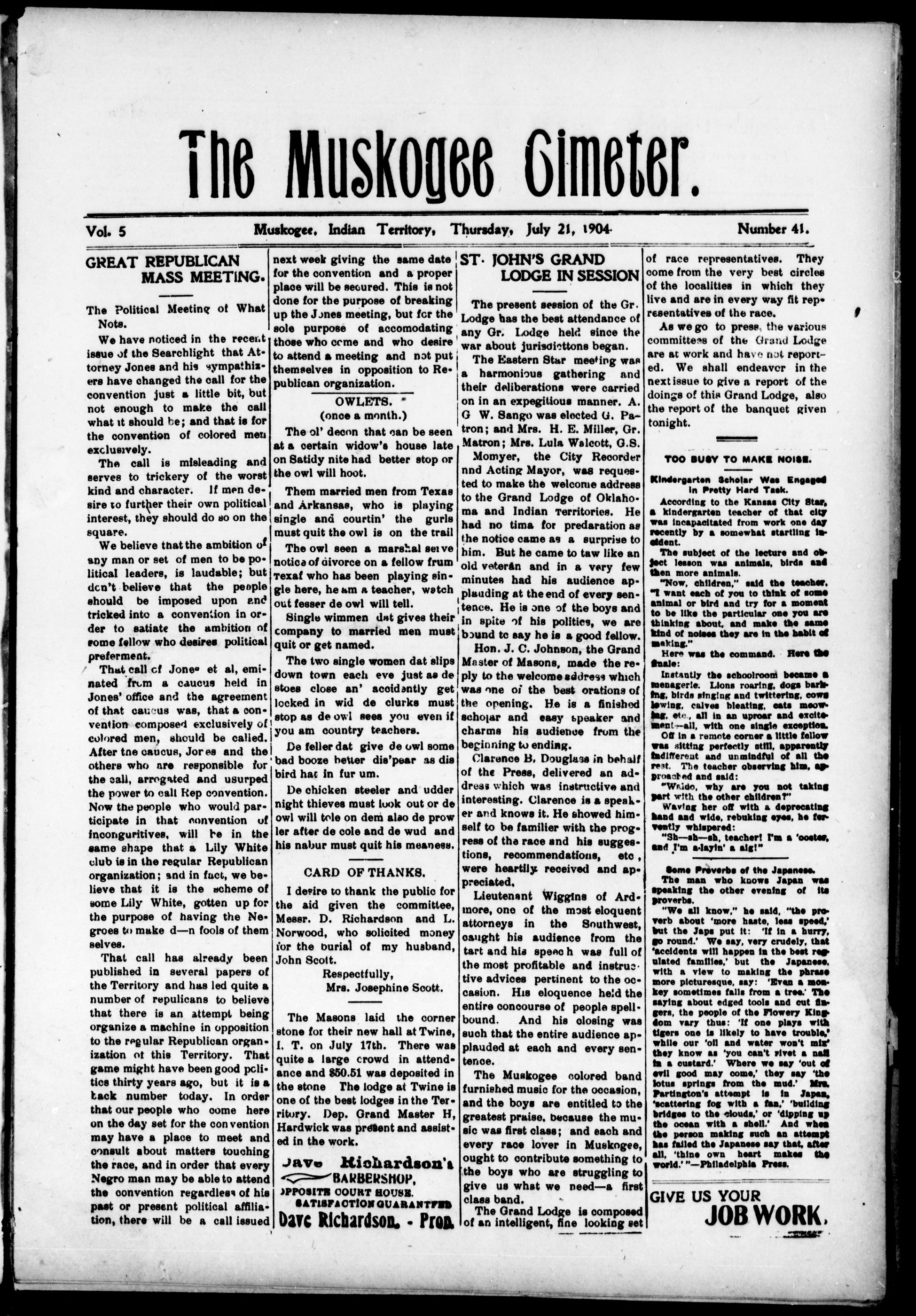
GREAT REPUBLICAN MASS MEETING.
The Political Meeting of What Nots. We have noticed in the recent issue of the Searchlight that Attorney Jones and his sympathizers have changed the call for the convention just a little bit, but not enough to make the call what it should be; and that is for the convention of colored men exclusively.
The call is misleading and serves to trickery of the worst kind and character. If men desire to further their own political interest, they should do so on the square.
We believe that the ambition of any man or set of men to be political leaders, is laudable; but don't believe that the people should be imposed upon and tricked into a convention in order to satiate the ambition of some fellow who desires political preferment.
That call of Jones et al, eminated from a caucus held in Jones' office and the agreement of that caucus was, that a convention composed exclusively of colored men, should be called. After the caucus, Jones and the others who are responsible for the call, arrogated and usurped the power to call Rep convention. Now the people who would participate in that convention of incongruitives, will be in the same shape that a Lily White club is in the regular Republican organization; and in fact, we believe that it is the scheme of some Lily White, gotten up for the purpose of having the Negroes to make d—n fools of them selves.
That call has already been published in several papers of the Territory and has led quite a number of republicans to believe that there is an attempt being organize a machine in opposition to the regular Republican organization of this Territory. That game might have been good pclitics thirty years ago, but it is a tack number today. In order that our people who come here on the day set for the convention may have a place to meet and consult about matters touching the race, and in order that every Negro man may be able to attend the convention regardless of his past or present political affiliation, there will be a call issued
next week giving the same date for the convention and a proper place will be secured. This is not done for the purpose of breaking up the Jones meeting, but for the sole purpose of accomodating those who come and who desire to attend a meeting and not put themselves in opposition to Republican organization.
(once a month.)
The ol' decon that can be seen at a certain widow's house late on Satidy nite had better stop or the owl will hoot.
Them married men from Texas and Arkansas, who is playing single and courtin' the gurls must quit the owl is on the trail
The owl seen a marshal serve notice of divorce on a fellow frum Texaf who has been playing single here, he am a teacher, watch out fesser de owl will tell.
Single wimmen dat gives their company to married men must quit or get named.
The two single women dat slips down town each eve just as de stoes close an' accidently get locked in wid de clurks must stop as de owl sees you even if you am country teachers.
De feller dat give de owl some bad booze better dis'pear as dis bird hat in fur um.
De chicken steeler and udder night thieves must look out or de owl will tole on dem also de prowler after de cole and de wud and his nabur must quit his meaness.
CARD OF THANKS.
I desire to thank the public for the aid given the committee, Messr. D. Richardson and L. Norwood, who solicited money for the burial of my husband, John Scott. Respectfully, Mrs. Josephine Scott.
The Masons laid the corner stone for their new hall at Twine, I. T. on July 17th. There was quite a large crowd in attendance and $50.51 was deposited in the stone The lodge at Twine is one of the best lodges in the Territory. Dep. Grand Master H, Hardwick was present and assisted in the work.
Jave Richardson's
BARBERSHOP,
OPPOSITE COURT HOUSE.
SATISFACTIONGUARANTED Dave Richardson. - Pron
ST· JOHN'S GRAND LODGE IN SESSION
The present session of the Gr. Lodge has the best attendance of any Gr. Lodge held since the war about jurisdictions began. The Eastern Star meeting was a harmonious gathering and their deliberations were carried on in an exegitious manner. A. G W. Sango was elected G. Patron; and Mrs. H. E. Miller, Gr. Matron; Mrs. Lula Walcott, G.S.
Momyer, the City Recorder and Acting Mayor, was requested to make the welcome address to the Grand Lodge of Oklahoma and Indian territories. He had no tima for predaration as the notice came as a surprise to him. But he came to taw like an old veteran and in a very few minutes had his audience applauding at the end of every sentence. He is one of the boys and in spite of his politics, we are bound to say he is a good fellow.
Hon. J. C. Johnson, the Grand Master of Masons, made the reply to the welcome address which was one of the best orations of the opening. He is a finished scholar and easy speaker and charms his audience from the beginning to ending.
Clarence B. Douglass in behalf of the Press, delivered an address which was instructive and interesting. Clarence is a speaker and knows it. He showed himself to be familiar with the progress of the race and his suggestions, recommendations, etc. were heartily received and appreciated.
Lieutenant Wiggins of Ardmore, one of the most eloquent attorneys in the Southwest, caught his audience from the tart and his speech was full of the most profitable and instructive advices pertinent to the occasion. His eloquence held the entire concourse of people spellbound. And his closing was such that the entire audience applauded at each and every sentence.
The Muskogee colored band furnished music for the occasion, and the boys are entitled to the greatest praise, because the music was first class; and each and every race lover in Muskogee, ought to contribute something to the boys who are struggling to give us what we need—a first class band. The Grand Lodge is composed of an intelligent, fine looking set
of race representatives. They come from the very best circles of the localities in which they live and are in every way fit representatives of the race. As we go to press, the various committees of the Grand Lodge are at work and have not reported. We shall endeavor in the next issue to give a report of the doings of this Grand Lodge, also the report of the banquet given tonight.
TOO BUSY TO MAKE NOISE.
Kindergarten Scholar Was Engaged in Pretty Hard Task. According to the Kansas City Star, a kindergarten teacher of that city was incapacitated from work one day recently by a somewhat startling incident. The subject of the lecture and object lesson was animals, birds and then more animals. "Now, children," said the teacher, "I want each of you to think of some animal or bird and try for a moment to be like the particular one you are thinking about, and make the same kind of noises they are in the habit of making."
Here was the command. Here the finale:
Instantly the schoolroom became a menagerie. Lions roaring, dogs barking, birds singing and twittering, cows lowing, calves bleating, cats meowing, etc., all in an uproar and excitement—all, with one single exception.
Off in a remote corner a little fellow was sitting perfectly still, apparently indifferent and unmindful of all the rest. The teacher observing him, approached and said:
"Waldo, why are you not taking part with the other children?"
Waving her off with a deprecating hand and wide, rebuking eyes, he fervently whispered:
"Sh—sh—sh, teacher! I'm a 'ooster, and I'm a-layin' a aig!"
Some Proverbs of the Japanese.
The man who knows Japan was speaking the other evening of its proverbs.
"We all know," he said, "the proverb about 'more haste, less speed,' but the Japs put it: 'If in a hurry, go round.' We say, very crudely, that 'accidents will happen in the best regulated families,' but the Japanese, with a view to making the phrase more picturesque, say: 'Evan a monkey sometimes falls from a tree.' The saying about edged tools and cut fingers, the people of the Flowery Kingdom vary thus: 'If one plays with tigers one is likely to have trouble,' while our 'oil and water won't mix' they know as 'you can't rivet a nail in a custard.' Where we say 'out of evil good may come,' they say 'the lotus springs from the mud.' Mrs. Partington's attempt is in Japan, 'scattering fog with a fan,' 'building bridges to the clouds,' or 'dipping up the ocean with a shell.' And when the person making such an attempt has failed the Japanese say that, after all, 'thine own heart makes the world.'"—Philadelphia Press.
GIVE US YOUR JOB WORK.
FRISCO
SYSTEM
COMPLETELY AND COMFORTABLY
SERVE WESTERN MISSOURI
AND EASTERN KANSAS TO
THE PRINCIPAL CITIES
EAST,
WEST,
NORTH,
SOUTH.
PULLMAN SLEEPERS,
RECLINING CHAIR CARS.
TRAINS LIGHTED AND
VENTILATED BY ELECTRICITY.
The Direct Route to the
"WORLD'S FAIR CITY"
SAINT LOUIS
For detailed information, call
on nearest representative FRISCO
SYSTEM, or address
L. W. PRICE,
Division Passenger Agent,
JOPLIN, MO.
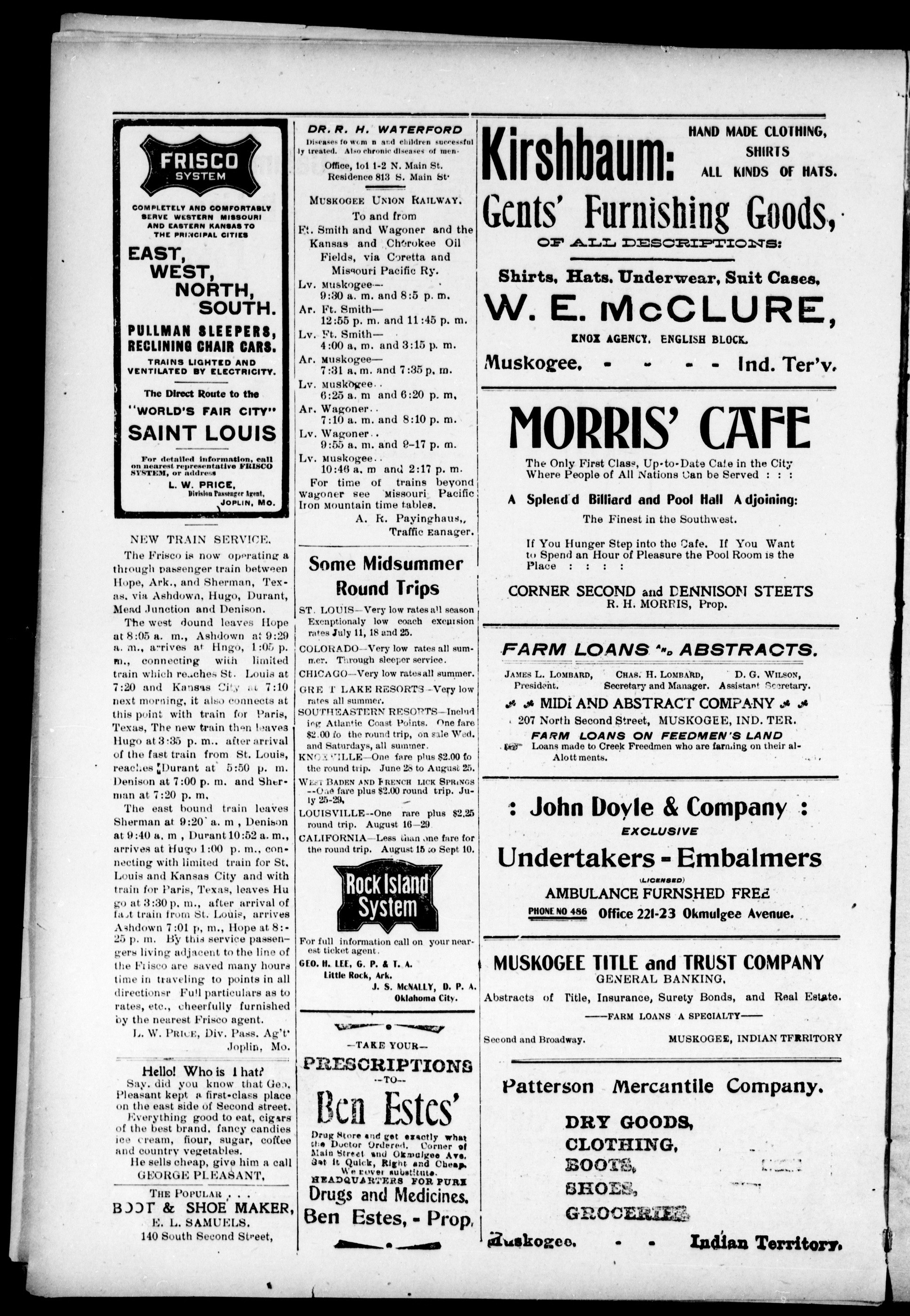
NEW TRAIN SERVICE. The Frisco is now operating a through passenger train between Hope, Ark., and Sherman, Texas. via Ashdown, Hugo, Durant, Mead Junction and Denison.
The west dound leaves Hope at 8:05 a. m., Ashdown at 9:29 a. m., arrives at Hngo, 1:05 p. m., connecting with limited train which reaches St. Louis at 7:20 and Kansas City at 7:10 next morning, it also connects at this point with train for Paris, Texas, The new train then leaves Hugo at 3:35 p. m., after arrival of the fast train from St. Louis, reaches Durant at 5:50 p. m. Denison at 7:00 p. m. and Sherman at 7:20 p. m.
The east bound train leaves Sherman at 9:20 a.m, Denison at 9:40 a.m, Durant 10:52 a.m., arrives at Hugo 1:00 p.m., connecting with limited train for St. Louis and Kansas City and with train for Paris, Texas, leaves Hugo at 3:30 p.m., after arrival of fast train from St. Louis, arrives Ashdown 7:01 p.m., Hope at 8:25 p.m. By this service passengers living adjacent to the line of the Frisco are saved many hours time in traveling to points in all directionsr Full particulars as to rates, etc., cheerfully furnished by the nearest Frisco agent.
L. W. PRICE, Div. Pass. Ag't Joplin, Mo.
Hello! Who is I hat?
Say, did you know that Geo. Pleasant kept a first-class place on the east side of Second street. Everything good to eat, cigars of the best brand, fancy candies ice cream, flour, sugar, coffee and country vegetables. He sells cheap, give him a call GEORGE PLEASANT.
BODT & SHOE MAKER,
E. L. SAMUELS.
140 South Second Street,
Some Midsummer Round Trips
ST. LOUIS—Very low rates all season Excptionaly low coach excursion rates July 11, 18 and 25.
COLORADO—Very low rates all summer. Through sleeper service.
CHICAGO—Very low rates all summer.
GRE T LAKE RESORTS—Very low rates all summer.
SOUTHEASTERN RESORTS—Includ ing Atlantic Coast Points. One fare $2.00 fo the round trip, on sale Wed. and Saturdays, all summer.
KNOXVILLE-One fare plus $2.00 to the round trip. June 28 to August 25.
WEST BADEN AND FRENCH LICK SPRINGS--One fare plus $2.00 round trip. July 25-29.
LOUISVILLE--One rare plus $2.25 round trip. August 16-29.
CALIFORNIA-Less than one fare for the round trip. August 15 to Sept 10.
Rock Island System
For full information call on your nearest ticket agent.
GEO. H. LEE, G. P. & T. A.
Little Rock, Ark.
J. S. McNALLY, D. P. A.
Oklahoma City.
—TAKE YOUR—
PRESCRIPTIONS
Ben Estes'
Drug Store and get exactly what the Doctor Ordered. Corner of Main Street and Okmulgee Ave. Set it Quick, Right and Cheap.
HEADQUARTERS FOR PURE Drugs and Medicines. Ben Estes, - Prop.
OF ALL DESCRIPTIONS:
Muskogee. - - - Ind. Ter'v.
MORRIS' CAFE
The Only First Class, Up-to-Date Cafe in the City Where People of All Nations Can be Served : : :
A Splend'd Billiard and Pool Hall Adjoining:
The Finest in the Southwest.
If You Hunger Step into the Cafe. If You Want to Spend an Hour of Pleasure the Pool Room is the Place : : : :
CORNER SECOND and DENNISON STEETS
R. H. MORRIS, Prop.
FARM LOANS $ ^{N_{D}} $ ABSTRACTS.
JAMES L. LOMBARD, CHAS. H. LOMBARD, D. G. WILSON, President. Secretary and Manager. Assistant Secretary. MIDI AND ABSTRACT COMPANY 207 North Second Street, MUSKOGEE, IND. TER. FARM LOANS ON FEEDMEN'S LAND Loans made to Creek Freedmen who are farming on their al-Alottments.
: John Doyle & Company :
Undertakers = Embalmers
AMBULANCE FURNSHED FREE PHONE NO 486 Office 221-23 Okmulgee Avenue.
MUSKOGEE TITLE and TRUST COMPANY
Abstracts of Title, Insurance, Surety Bonds, and Real Estate. FARM LOANS A SPECIALTY Second and Broadway. MUSKOGEE, INDIAN TFRRITORY
Patterson Mercantile Company.
Muskogee. Indian Territory.
DRY GOODS. CLOTHING. BOOTS. SHOES. GROCERIES.
Muskogee Cimeter.
W. H. TWINE, Editor.
MUSKOGEE, IND. TER.
NEW STATE NOTES.
Yale will celebrate her second anniversary with a picnic August 1st and 2d.
W. J. Sullivan has been appointed traveling freight and passenger agent of the Midland Valley road at Muskogee.
The town of Phillips, a suburb of Coalgate, has petitioned the United States court at Atoka for authority to incorporate.
The city council at Hobart has levied a tax at the rate of seventeen mills. Four mills are for water and for fire supply.
The Missouri, Kansas & Texas Railroad company has suffered more from high water in Kansas and the Indian Territory this year than ever before in the history of that line.
The five-year-old child of Bryant Church, living near Stroud, was instantly killed by falling under the wheels of a steam thresher last week.
Jim Phillips, while resisting arrest at McLoud, was shot by Marshal McCoy. The bullet struck Phillips in the lower jaw, fracturing that part of his anatomy.
According to the Democrat, El Reno will have a proposition for a packing house presented shortly. If the meat workers' strike continues long it may be a good thing.
Twenty-five men were mustered into service at Tulsa last week by Lieutenant F. R. Kenney of the United States army corps.
J. M. Bryan, in custody at Hobart since May 1st for the murder of a neighboring farmer, has been released on a $10,000 bond, pending the convening of the grand jury.
Cleo is to have a cotton gin. H. W. Hutchinson, one of her enrprising citizens, has purchased the mae chinery and will have it in operation for the coming crop.
Those interested in holding a county fair in Roger Mills county will meet at Berlin on the 23d inst to select a place and time and make other arrangements.
While laboring in the harvest field Mrs. James Tish of Woods county suffered a sunstroke, and as a result has lost her mind. She has been taken to the asylum for the insane.
Indian Agent Shoenfelt, who is in Washington, is arranging for the payment of the Choctaw and Chickasaw town site fund to the members of those tribes of Indians. The sum aggregates about $40 per capita to eeyv man, woman and child in the Choctaw and Chickasaw nations.
W. E. Hailey has begun boring for oil on the Goddard place, south of South McAlester. The contract is to sink a well 2,000 feet, unless on in paying quantities is struck sooner. This is the first exploration for oil in the vicinity of South McAlester in fifteen years.
Highwater of the Cottonwood undermined the plant of the Guthrie Gas Manufacturing company, causing the walls of its building to fall. The plant was but recently erected at a cost of $40,000. Workmen have begun repairing the damage, which will be large.
---
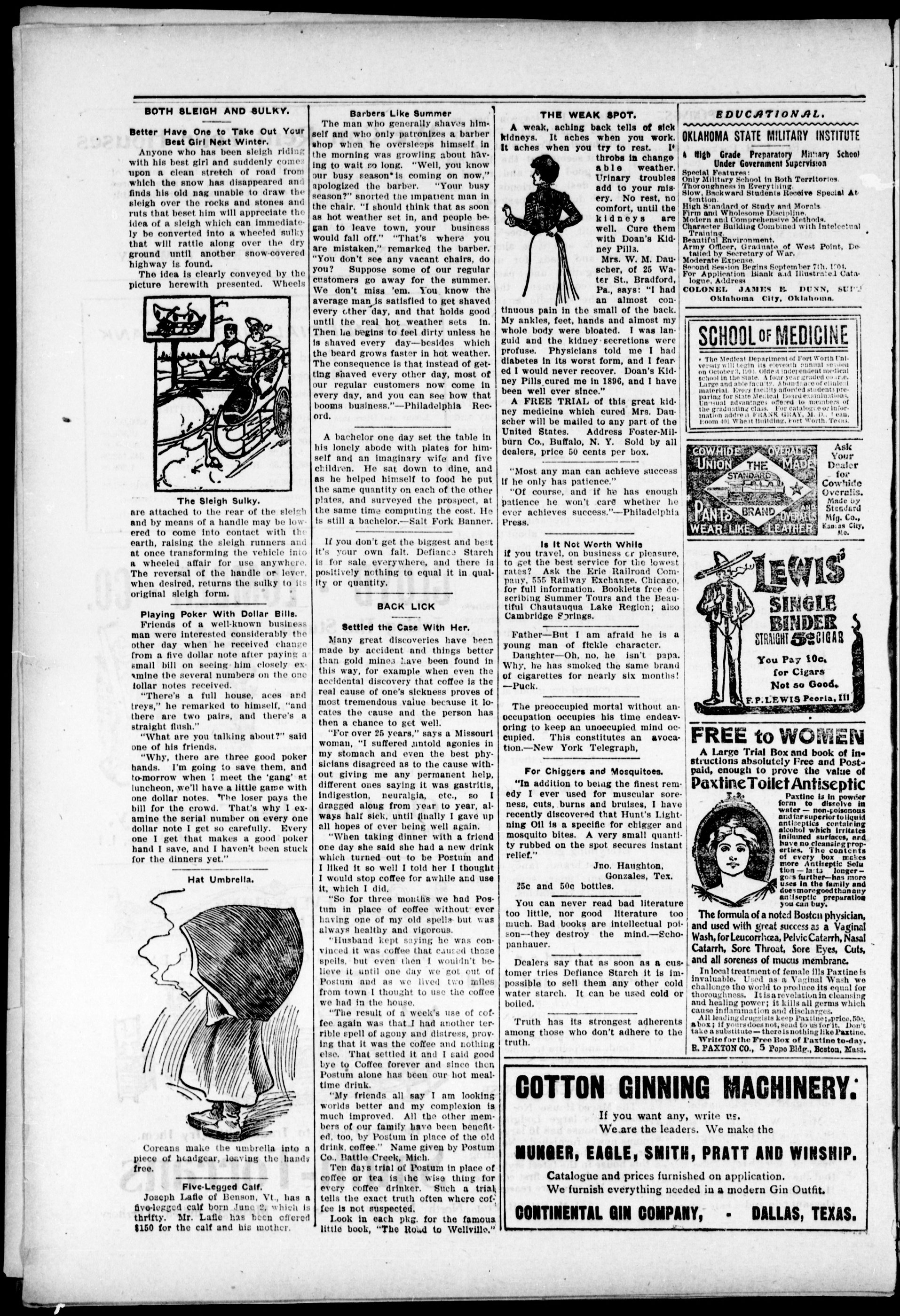
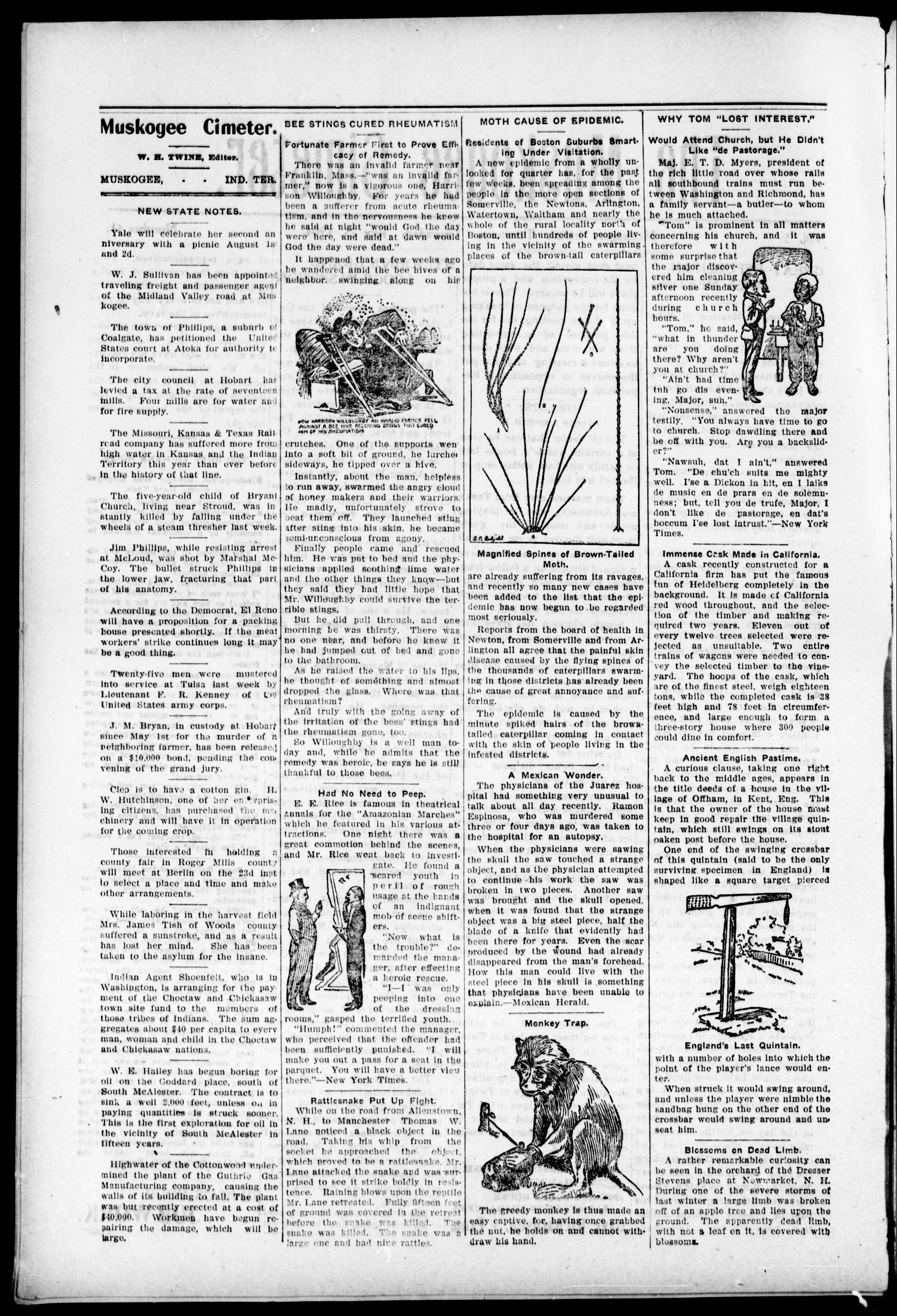
BEE STINGS CURED RHEUMATISM
Fortunate Farmer First to Prove Efficacy of Remedy.
There was an invalid farmer near Franklin, Mass.—"was an invalid farmer," now is a vigorous one, Harrison Willoughby. For years he had been a sufferer from acute rheumatism, and in the nervousness he knew he said at night "would God the day were here, and said at dawn would God the day were dead."
It happened that a few weeks ago he wandered amid the bee hives of a neighbor, swinging along on his
HOW HARRISON WILLOURBY AN INVALID FARMER FELL AGAINST A BEE HIVE RECEIVING STINGS THAT CURED HIM OF THE RHEUMATISM
crutches. One of the supports went into a soft bit of ground, he lurched sideways, he tipped over a hive.
Instantly, about the man, helpless to run away, swarmed the angry cloud of honey makers and their warriors. He madly, unfortunately strove to beat them off. They launched sting after sting into his skin, he became semi-unconscious from agony.
Finally people came and rescued him. He was put to bed and the physicians applied soothing lime water and the other things they know—but they said they had little hope that Mr. Willoughby could survive the terrible stings.
But he did pull through, and one morning he was thirsty. There was no one near, and before he knew it he had jumped out of bed and gone to the bathroom.
As he raised the water to his lips, he thought of something and almost dropped the glass. Where was that rheumatism?
And truly with the going away of the irritation of the bees' stings had the rheumatism gone, too.
So Willoughby is a well man today and, while he admits that the remedy was heroic, he says he is still thankful to those bees.
Had No Need to Peep.
E. E. Rice is famous in theatrical Annals for the "Amazonian Marches" which he featured in his various attractions. One night there was a great commotion behind the scenes, and Mr. Rice went back to investigate. He found a scared youth in peril of rough usage at the hands of an indignant mob of scene shifters.
24
"Now what is the trouble?" demanded the manager, after effecting a heroic rescue.
"I—I was only peeping into one of the dressing rooms," gasped the terrified youth.
"Humph!" commented the manager, who perceived that the offender had been sufficiently punished. "I will make you out a pass for a seat in the parquet. You will have a better view there."—New York Times.
Rattlesnake Put Up Fight:
While on the road from Allenstown, N. H., to Manchester Thomas W. Lane noticed a black object in the road. Taking his whip from the socket he approached the object, which proved to be a rattlesnake. Mr. Lane attacked the snake and was surprised to see it strike boldly in resistance. Raining blows upon the reptile Mr. Lane retreated. Fully fifteen feet of ground was covered in the retreat before the snake was killed. The snake was killed. The snake was a large one and had nine rattles.
MOTH CAUSE OF EPIDEMIC.
Residents of Boston Suburbs Smarting Under Visitation. A new epidemic from a wholly unlocked for quarter has, for the past few weeks, been spreading among the people in the more open sections of Somerville, the Newtons, Arlington, Watertown, Waltham and nearly the whole of the rural locality north of Boston, until hundreds of people living in the vicinity of the swarming places of the brown-tail caterpillars
Q. N. Baldy.
Magnified Spines of Brown-Tailed Moth. are already suffering from its ravages, and recently so many new cases have been added to the list that the epidemic has now begun to be regarded most seriously. Reports from the board of health in Newton, from Somerville and from Arlington all agree that the painful skin disease caused by the flying spines of the thousands of caterpillars swarming in those districts has already been the cause of great annoyance and suffering.
The epidemic is caused by the minute spiked hairs of the browntailed caterpillar coming in contact with the skin of people living in the infested districts.
A Mexican Wonder.
The physicians of the Juarez hospital had something very unusual to talk about all day recently. Ramon Espinosa, who was murdered some three or four days ago, was taken to the hospital for an autopsy.
When the physicians were sawing the skull the saw touched a strange object, and as the physician attempted to continue his work the saw was broken in two pieces. Another saw was brought and the skull opened, when it was found that the strange object was a big steel piece, half the blade of a knife that evidently had been there for years. Even the scar produced by the wound had already disappeared from the man's forehead. How this man could live with the steel piece in his skull is something that physicians have been unable to explain.—Mexican Herald.
Monkey Trap.
The greedy monkey is thus made an easy captive, for, having once grabbed the nut, he holds on and cannot withdraw his hand.
WHY TOM "LOST INTEREST."
Would Attend Church, but He Didn't Like "de Pastorage."
Maj. E. T. D. Myers, president of the rich little road over whose rails all southbound trains must run between Washington and Richmond, has a family servant—a butler—to whom he is much attached.
"Tom" is prominent in all matters concerning his church, and it was
therefore with some surprise that the major discovered him cleaning silver one Sunday afternoon recently during church hours.
A man and a boy talking.
"Tom," he said, "what in thunder are you doing there? Why aren't you at church?" "Ain't had time tuh go dis evening, Major, suh." "Nonsense," answered the major testily. "You always have time to go to church. Stop dawdling there and be off with you. Are you a backslider?"
"Nawsuh, dat I ain't," answered Tom. "De chu'ch suits me mighty well. I'se a Dickon in hit, en I laiks de music en de prars en de solemnness; but, tell you de trufe, Major, I don't like de pastorage, en dat's hoccum I'se lost intrust."—New York Times.
Immense Cask Made in California.
A cask recently constructed for a California firm has put the famous fun of Heidelberg completely in the background. It is made of California red wood throughout, and the selection of the timber and making required two years. Eleven out of every twelve trees selected were rejected as unsuitable. Two entire trains of wagons were needed to convey the selected timber to the vineyard. The hoops of the cask, which are of the finest steel, weigh eighteen tons, while the completed cask is 38 feet high and 78 feet in circumference, and large enough to form a three-story house where 300 people could dine in comfort.
Ancient English Pastime.
A curious clause, taking one right back to the middle ages, appears in the title deeds of a house in the village of Offham, in Kent, Eng. This is that the owner of the house must keep in good repair the village quintain, which still swings on its stout oaken post before the house.
One end of the swinging crossbar of this quintain (said to be the only surviving specimen in England) is shaped like a square target pierced
England's Last Quintain.
with a number of holes into which the point of the player's lance would enter. When struck it would swing around, and unless the player were nimble the sandbag hung on the other end of the crossbar would swing around and unseat him.
Blossoms on Dead Limb.
A rather remarkable curiosity can be seen in the orchard of the Dresser Stevens place at Newmarket, N. H. During one of the severe storms of last winter a large limb was broken off of an apple tree and lies upon the ground. The apparently dead limb, with not a leaf on it, is covered with blossoms.
To cure, or money refunded by your merchant, so why not try it? Price 50c.
Nine Points of Law
In a reprint from its old files, the London Times recently made use of the expression, "eleven points of the law." This has started the inquiry as to how many points of the law there are, the general prejudice being in favor of nine. Brewer's Dictionary of Phrase and Fable gives the following nine requisites for success in a law suit: 1. A good deal of money. 2. A good deal of patience. 3. A good cause. 4. A good lawyer. 5. A good counsel. 6. Good witnesses. 7. A good jury. 8. A good judge. 9. Good luck.—St. Louis Post-Dispatch.
Hundreds of dealers say the extra quantity and superior quality of Defiance Starch is fast taking place of all other brands. Others say they cannot sell any other starch.
A Trip to Colorado, Utah or California is not complete unless it embraces the most beautiful resorts and grandest scenery in Colorado, which are found on the Colorado Midland Railway, the highest standard gauge line in the world. Exceptionally low summer round trip rates to Colorado interior state points, Utah, California and the Northwest are offered by this line. For information address Mr. C. H. Speers, General Passenger Agent, Denver, Colo.
The Teacher's "My Children"
School teachers often call their pupils "my children." A story is being published in the Missouri press about a woman teacher in a rural neighborhood who met the father of one of her pupils and said to the good man: "Excuse me, sir, but aren't you the father of one of my children?" The legend concludes with the statement that the man is still running.
Catarrh Cannot Be Cured
with LOCAL APPLICATIONS, as they cannot reach the seat of the disease. Catarrch is a blood or constitutional disease, and in order to cure it you must take internal remedies. Hall's Catarrch Cure is taken internally, and acts directly on the blood and mucous surfaces. Hall's Catarrch Cure is not a quack medicine. Hall's Catarrch Cure is one of the best physicians in this country for years and is described. It is composed of the best tonics known, combined with the best blood purifiers, acting directly on the mucous surfaces. The perfect combination of the two ingredients is what produces such wonderful results in curing catarrh. Send for testimonials, free. F.J. CHENEY & CO., Props. Toledo O.
"Of course," said the caustic man, "you always do your wife's bidding."
"Gracious, no," replied Mr. Henpeck, "she wouldn't let me. When she goes to an auction sale she never takes me with her.—Philadelphia Press.
Don't you know that Defiance Starch, besides being absolutely superior to any other, is put up 16 ounces in package and sells at same price as 12-ounce packages of other kinds?
If a man is sensitive he should keep his nose out of other people's business.
Do You Want the Lowest Rates either one-way or round-trip excursion, to any point east of Chicago or St. Louis? Ask the Erie Railroad Company, 555 Railway Exchange, Chicago, for complete information. Three fast trains daily from Chicago and St. Louis through to New York, Boston, Buffalo, Pittsburgh and other eastern points. Stop-over without charge at Niagara Falls, Cambridge Springs and Beautiful Chautauqua Lake.
"But," she protested, "I have been told that you are a reformed rake."
Every man is asked to make his life, even in its details, worthy of the contemplation of the most elevated and critical hour.—Thorcau.
Some live on love; some die of heart disease. What's one man's meat is another man's poison.
Piso's Cure can be too highly spoken of as a cough cure.—J. W. O'BRIEN, 322 Third Ave. N., Minneapolis, Minn., Jan. 6, 1900.
The forms or conditions of time and space are nothing in themselves—only our way of looking at things—W. M. Thackeray.
The Hagenbeck Animal Paradise and Trained Animal Circus on the Pike at St. Louis attracts great crowds every day. There are wild beasts, lions, leopards, pumas, hyenas, bears and tigers roaming in their native jungle together with domesticated animals in perfect harmony. The Hagenback trainers present the most thrilling performances of perfect animal training daily in the steel cage of the huge arena. You should not fail to see it. It is the greatest attraction at the World's Fair.
Caller—Is the baby lkie his father?
Mrs. Newpop—Yes; he keeps me up every night.—Chicago Journal.
FITS permanently cured. No fits or nervousness after first day's use of Dr. Kline's Great Nerve Restorer. Send for FIRES $2.00 trial bottle and treatise. Dr. R. H. KLINE, Ltd., 931 Arch Street, Philadelphia, Pa
Man is never so manly as when he feels deeply, acts boldly and expresses himself with frankness and fervor.—Lord Beaconsfield.
A Grateful Customer.
"I suffered for four years with eczema on the ends of eight of my fingers. Had it so long my fingers drew up and could do nothing at all at times, and I tried almost everything that I ever heard of, including several largely advertised ointments, spending many dollars for them. Never a thing did it any good at all. At last I saw in home paper Hunt's Cure was being advertised and tried only a part of one box, which cost me only 50 cents and it cured them. Now I can wash or do anything which before I could not without my fingers bleeding, burning and paining me very much. If this ever comes back I surely will know just what to get. I wish every friend and stranger that had anything of the kind could have seen my fingers before I used this and see them now. It is the best Ointment on earth. That 50 cent box was worth a hundred dollars to me. You deserve all thanks that can be given you for that wonderful salve, Hunt's Cure."
Mrs. J. I. Blalock,
Miles, Tex., July 2, '04.
To A. B. Richards Med. Co.,
Sherman, Tex.
The fool who knows his foolishness
is wise at least so far; but a fool who
thinks himself wise is a fool indeed.—
Buddah.
A NEW ENTERPRISE.
The Grand Trunk Railway System have opened a new City Ticket Office at 308 North Broadway, St. Louis, and are now operating through car service daily between St. Louis, Montreal and Toronto in connection with the Illinois Central R. R. This arrangement will afford excellent service to passengers taking advantage of the low excursion fares to points in Ontario, Quebec and Nova Scotia that are on sale at the present time from St. Louis and Kansas City. GEO. W. VAUX, A. G. P. & T. A.,
Many a woman's ill health is due to her imagination.
Storekeepers report that the extra quantity, together with the superior quality of Defiance Starch makes it next to impossible to sell any other brand.
It is said that plug hats and plug horses are equally scarce in Texas.
900 DROPS
CASTORIA
A Vegetable Preparation for Assimilating the Food and Regulating the Stomachs and Bowels of
INFANTS & CHILDREN
Promotes Digestion, Cheerfulness and Rest. Contains neither Opium, Morphine nor Mineral.
NOT NARCOTIC.
Recipe of Old Dr. SAMUEL PITCHER
Pumpkin Seed
Alk. Storra
Roselle Salad
Anise Seed
Peppermint
Bitterbush Salad
Worm Seed
Cinnated Sugar
Whittygreen Flour
A perfect Remedy for Constipation, Sour Stomach, Diarrhoea Worms, Convulsions, Feverishness and LOSS OF SLEEP.
Fac Simile Signature of
Charles H. Hutchins
NEW YORK.
A Monthly add
35 Doses - 35 Clinis
EXACT COPY OF WRAPPER.
There are but two kinds of starch. Defiance Starch, which is the best starch made and—the rest. Other starches contain chemicals, which work harm to the clothes, rot them and cause them to break. Defiance is absolute-
DEFIANCE
STARCH
ly pure: It is guaranteed perfectly satisfactory or money back. The proof is in the doing and Defiance does. 16 ounces for 10 cents. Your grocer sells it
MANUFACTURED BY
THE DEFIANCE STARCH CO.,
OMAHA, NEB.
THE CIMETER.
Published every week in the interest of the Negro by the Cimeter Publishing . o
W. H. TWINE - - - - Editor.
R. WOOD, Ass't Editor and Manager.
J. T. TRIMBLE - - - Solicitor.
SUBSCRIPTION;
(In advance)
One Year..... $1.00
Six Months.....50
Three Months.....25
The city wants to vote bonds again for water works, it seems that the present condition is worse.
There are over 4000 citizens of the Creek nation that cannot be found, many of them are freedmen.
Our young men should save thrir means and buy a home. Den't throw away your means in riotous living.
The call for the convention has been changed a little but still has the ear works of a political trick that has proven old.
There is no question now about Muskogee being in the center of the greatest oil field in the West. The wells that are being brought in grow better and better.
Perfect titles can now be had in the Indian Territory and there is no excuse for our people to wait. Come now before the rush and buy a farm while the price is reasonable.
We will pay our respects to Carrington, Jones, et al, the Wagoner New Era next week as we got the sheet too late to reply to their scurrilous attact in this last issue.
You can't make an honest living without doing work of some kind. The fellow who is seen wearing good clothes and never works and who has no income is bound to steal or have others steal for him. Go to work young man.
There are a great many robberies being committed in the resident portion of the town. The police should look out for these night prowlers and pull them in. It is real dangerous in some parts of the for a citizen going home at night.
The Phoenix in the report of the rades on Saturday night says one was a Negro joint and the other a white establishment. Now why the difference, both were suppose to be the same kind of places. But prejudice got in its work with the old lady.
There are 9,204,531 Negroes in the U. S. and they will be an important factor in the ensuing election. The center of the Negro population is DeKalb Co., Ala. 77 per cent of them live in the country. Negroes form one-third of the population in the South.
```markdown
```
There is no war at Clarksville nor danger of one, just a fight created by a Democratic Negro who serves as some kind of an officer. A Negro of this kind is always dangerous and a trouble breeder. The newspaper liar for the metropolitan dailies got up the scarehead report of the affair. Nothing to it.
Durfey Hardware Company
Shelf and Heavy Hardware, Tinware, the Celebrated Monarch Ranges, everyone guaranteed, Builders' Tools, etc. All Kinds of Tin Work and Plumbing, Refrigerators and Ice Coolers. PHONE 205 BOWSEY BLOCK III North Second Street.
The Negroes who were influenced by the democrats to curse what they were pleased to call the Court House gang and ring were cursing the only friends they have in official life. If the democrat should win in the election they will find a gang in the Court House that will give the Negroes hell.
Spot Cash Store.
BIG LINE OF SPRING MILLINARY! Shirt Waist Suits, Shirt Waists, Corsets, Hosiery, Muslin Underwear, Dry Goods, Tin Ware and Enameled Ware, Queens Ware, and Glass Ware.
Statehood is coming and the fellows who want to go to Congress, the legislature and constitutional convention are making hay while the sunshines, We want to see a good man from this place in the Constitutional conventional and as we are not a candidate for anything we can take a few shots at the bad candidate.
THE FAIR! THE FAIR! Turner Hardware Co.
Some burglaries have been committed recently and the sap headed reporter for the Pheonix says that the burglar was a Negro because the foot-prints were flat and very large. Now it is just such evidence or lies as that causes Negroes in the South to be lynched. The reporter of courre has small feet or perhaps he could be charged with the erime as it is very easy for a white man to blacken his face and should he have the big pedal extremities (and some have) he could easily pass for the Phoenix's big foot Negro.
Carry a Full Line of BEST IMPLEMENTS, WAGONS, BUGGIES, HARNESS, SEED AND EVERYTHING IN HARDWARE . . .
CALL AND SEE Us . . .
LOCAL HAPPENINGS.
The Baptist College has employed eight teachers, so we are informed for the ensuing year.
GROCERIES
There will be schools established at Rentieville and Gibson Station this year. This will be the first free school ever established at those places.
AND HIGH PATENT FLOUR. The Leading Colored Grocery Company in the City. We also buy and pay the highest prices for Country Produce. Located on West 2nd St., South of the U. S. Post Office.
Rev. I. P. Pittsfield of Ida Beil, I. T., is in the city attending the Grand Chapter meeting. The Rev. is one of the most prominent citizens in the Indian Territory.
Muskogee. - - - Ind. Ter'w
There were 35 white men and 10 colored men arrested Saturday charged with gamin, the fines so far have been $15 each and trimmings.
GUARANTEE LIFE INSURANCE CO. MUSKOGEE, INDIAN TERRITORY. Capital Stock $200,000
Jas. Waters of Little Rock, has moved to Muskogee and taken up his permanent residence here. Mr. Waters lived here some years ago, and went to Arkansas but the longings for the B. I. T. drew him back.
An Old Line Company issues all forms of Limited Payments, Life and Endowment Policies.
DIRECTORS:—E. J. MINTS, uskogee, I. T.; GEO. D. LENNON New York; F. L. CONGER, Oklahoma City; WM. M. EGGLESTON St. Louis. Mo.; C. J. MILLER, Muskogee, I. T.; SAMUEL RAYMOND, Wynrewood, I. T.
Mr. A. L. Norwood has let the contract for a two story residence to contain ten rooms and to cost $2500. This will be one of the most complete residence in the city, and is in keeping with the progressive spirit of great Mushogee. Our people are keeping step to the music. Next.
The Territorial Bank & Trust Co.
Oldest and Strongest Bank in the Indian Territory.
interest Paid on Deposits.
Abstracts Made.
Fidelity Bonds Written. MUSKOGEE, INDIAN TERRITORY
GIVE US YOUR JOB WORK.
45,000 MEN OUT
MEAT PACKING PLANTS ARE DESERTED BY EMPLOYES
STRIKERS ARE EXPECTING A LONG FIGHT
Will Equal the Anthracite Strike of two Years Ago—Work All Cleared Up Before Men Go Out—Difference in Wages of Unskilled Workmen CHICAGO: As a result of a stubborn disagreement, chiefly over wages for unskilled labor, one of the most extensive strikes in the history of the meat packing industry of the United States began in Chicago, Kansas City, Omaha, St. Joseph and other cities where large packing plants are located. If prolonged, the strike is expected to cause widespread inconvenience, possibly equaling the anthracite coal famine of two years ago.
The unanimity of the strike was complete. More than 45,000 employees are directly involved. In Chicago alone 18,000 men are on strike.
The effect of the strike on the food supply of the country and the price of meats is being earnestly discussed, notwithstanding announcement that the packing houses, contrary to somewhat general expectations, will continue operations without any close down, employing whatever help may be obtainable. How much alleviation in the furnishing of supplies to the public this course may afford is a matter of wide variation of opinion. The packers declare that hundreds of men who could not be provided with places have been applying daily for work.
The walkout here was started by the employes of the killing departments at the various packing houses. The killers were followed by the workers in the other departments as fast as the current work left by the slaughterers could be cleaned up. Thus as the workers in each department disposed of their part of the work they threw off their aprons and departed. This consideration was shown for the packers, the labor officials announced, because it was not the desire of the men to cause the employers any financial loss as a result of neglecting meat that was on hand to be dressed.
Watched by cordons of police, the strikers filed briskly out of the packing houses, carrying overalls, rubber boots and knives, cleavers and steels. The strikers were greeted by crowds of women and children, many of whom joined hands with the workmen on the outward march. There was absolutely no sign of disorder.
A picturesque scene was presented when the sausage factories and canneries were left by thir forces. There are 1,000 girls employed in these two departments of the meat industry. Clad in the variegated garb of factory girls, this army of feminine strikers tripped blithely along the main thoroughfares of the stock yards and were roundly cheered as they emerged through the gates and distributed themselves in the crowd of men who had waited their coming.
President Donnelly of the Amalgamated meat cutters and butcher workmen of North America, leader of the strikers, said in a conversation that the strikers would have little difficulty withstanding a seige of a year with the packing houses. In Chicago thirty-five local unions are involved in the strike. Arthur Meeker of Armour & Co., said:
"We consider the demands of the union for an advance in wages of unskilled labor entirely unwarranted by unusual conditions. We could not concede it and, proposed to submit the question to arbitration, which the union declined to do, and called a strike. Every department is kept running, however. We have had applica-
tions from hundreds of unemployed men for positions at less wages than we have been paying, and every day expect to increase our output. We regret extremely the hardships and suffering that will be imposed on these men who are thrown out of work, directly and indirectly through the strike, and the temporary inconveniences caused the public at large, but we consider the fault rests entirely with the union, who not only asked what they were not entitled to, but declined to submit the question to impartial arbitration."
President Donnelly, the strike leader, said:
"I wish to make it clear that we are not fighting for an increase in wages, but against a decrease.
"Our original demand was for a minimum of twenty cents an hour for laborers. This demand was amended after our second conference with the packers in June.
"We agreed to a scale of $18\frac{1}{2}$ cents an hour, except in Omaha and Sioux City, where the scale is 19 cents.
"The packers, on the other hand, refused to pay more than $17\frac{1}{2}$ cents an hour, and declined to sign any agreements at all, except with a very small portion of the workmen.
"The question of wages to skilled men was not discussed. To unskilled workmen the average wage was $ 18 \frac{1}{2} $ cents, but when asked that this be made the minimum wage they cut it to $ 17 \frac{1}{2} $ cents and 15 cents. Men could live on 15 cents if they got steady work, but in some plants n have been able to make only thirteen hours a week at this wage scale. They could not live on it. No one could."
OKLAHOMA CITY: The price of meat has begun to soar as a result of the strike of the meat workers. A general advance of nearly a cent per pound has already been made in Kansas City on fresh meats. No raise has as yet been made upon salt meats, but a continuance of the strike for any length of time will set that going, too.
Chicago, St. Louis, Omaha and other cities are experiencing a like advance in the price of fresh meat. Very little live stock is being shipped into the market centers now. Both sides to the strike controversy are now talking of arbitrating their differences, but neither can agree upon the terms of the other. The strike may continue for some days, or it may not be settled for weeks. Developments in the next few days will tell as to the probable duration. Some packing houses in the larger cities are killing a few head a day, but it is only the stock in the yards or in transit that is being slaughtered.
No Raise in Prices
OKLAHOMA CITY: Mr. Sparrow of the Oklahoma City Packing company, in an interview, stated that the present strike of the meat workers, would have no effect upon the prices of dressed or cured meals in this section. The concern he represents is not in any way connected with the establishments affected by the strike. He stated that supplies will be furnished dealers throughout this section at prices prevailing before the strike, and the company would continue to pay the highest market prices for cattle and hogs. This will be good news to residents of both territories, who depend upon local butchers who secure their supplies from the packing houses.
Can't Use Last Year's Surplus
GUTHRIE: Attorney General Simon has given an opinion in response to an inquiry from Adjutant General Burlingame, in which he holds that monies remaining from last year's appropriation for national guard encampment cannot be used as an additional fund for this year's encampment. Only $2,900 of the $4,000 appropriation was used last year and Burlingame's idea was to secure this additional amount for the September encampment at Fort Reno.
KRUGER IS DEAD
KRUGER IS DEAD
FORMER PRESIDENT OF TRANS VALL REPUBLIC IS NO MORE
BURIAL TO BE BY FORMER PRESIDENT
His People Regret Especially His Death Among Foreigners—Memorial Services Held in all Dutch Churches—Flags at Half Mast CLAREN, SWITZERLAND: Paul Kruger, former president of the Transvaal republic, died here of pneumonia and supervening heart weakness. Mr. Kruger arrived here the first of last May. The body was embalmed and will be taken to the Transvaal for burial.
PARIS: Paul Kruger's death has aroused widespread sympathy here, owing to French sympathy for the Boer cause and personal admiration for the ex-president. When in Mentone recently his health was gradually failing through old age, constitutional disorders and threatened trouble. Visitors described him as being a pathetic figure of calm endurance. His eyesight had dimmed, but he sat much with his Bible open to him, muttering well known passages. He avoided references to the Boer war.
PRETORIA, TRANSVAAL: General Louis Botha, the former commander-in-chief of the Boer forces, received a cable message announcing Mr. Kruger's death. The announcement called forth general expressions of regret, especially because the expresident died among foreigners. The flags on all the government buildings are at half mast. Mr. Kruger will be buried beside the former presidents of the Transvaal, unless his will has provided otherwise.
Memorial services will be held in all Dutch churches. General Botha has ordered that all the Boers shall wear mourning until after the funeral, which, it is expected, will be attended by the representatives of every district of the Transvaal.
GRAND ARMY REUNION
Old Soldiers of Four Commonwealths to Meet in Tulsa in September
to Meet in Tulsa in September TULSA: The Grand Army of the Republic of Indian Territory, Oklahoma, Arkansas and Missouri will hold an encampment here September 27 to 29. Invitations have been extended to all, and accepted by General Black, commander of the G. A. R. of the United States, and others. The commander of the local post has sent the following letter of invitation to the posts of the surrounding country:
My Dear Sir and Comrade: Our post, No. 16, sends greeting to the officers and comrades of your post and asks the pleasure of your company at a grand encampment to be held in this city on September 27, 28 and 29. In soliciting the pleasure of your company on this occasion we assure you that our city, which is known for its hospitality, will spare no means to make the occasion memorable.
"Among our visitors will be some men the most notable of the country, who have responded favorably to our invitation. We earnestly ask that you and your comrades will be with us, and ask that you take steps at your next meeting to this effect. The different lines of railroad will make special rates.
"Let us make this occasion a pleasant one for our aged veterans and their families, and to the latter end we give you the assurances that our W. R. C. will extend to them a royal welcome."
INDICATIONS OF POSSESSION
Fence Posts Denote Ownership of Indian Land
VINITA: The commissioner of Indian affairs has rendered an important decision in which he holds that fence posts being placed eighteen feet apart on a piece of land in the Cherokee nation under contest of ownership were fair indications of possession. The ruling was in the case of Dora M. Horn vs. Joe Queen, and a decision of the Dawes commission was reversed.
In September, 1902, Edward Cawood entered a forty-acre tract of land and put a string of posts on the south side for a distance of 200 yards, and intended to string wire on the posts. These posts constituted the only improvements on the land. As Cawood was indebted to Dora M. Horn, he traded his posts, with all his interest in the land, and gave her his permission to file on the land, and later embodied this permission in a bill of sale, dated March 1, 1903.
After her purchase of the posts Dora Horn never occupied the land, either in person or by tenant, nor did she do anything to reduce the land to possession, but stated that at the time she purchased the posts she was making her home with her mother on a farm adjoining the land in dispute, and had selected this land in good faith for her allotment. Joe Queen, who lives two miles distant, filed on the land in question, contending that the posts for 200 yards on the south was not sufficient improvement to allow Dora Horn to hold it. The Dawes commission, in deciding the case, held as follows:
"The mere placing of these posts on said land was not sufficient to segregate the tract from the public domain, and their presence on said land was not a fair indication that it was occupied or in the possession of anyone."
From this decision J. C. Starr, attorney for Dora Horn, appealed to the commissioner of Indian affairs. The Indian office reversed the Dawes commission decision and held that the placing of posts eighteen feet apart for 200 yards on the south side of the land in controversy was a fair indication of possession and sufficient to put the contestee upon inquiry as to whom said improvements belonged. The contestee, Dora M. Horn, being the owner of said improvements, with the preferential right to select lands so as to include her improvements, should be awarded the lands in controversy as a portion of her allotment selection.
NEW COURT DATES
Judge Raymond Fixes Time for Holding Court in His District
MUSKOGEE: Judge C. W. Raymond has made an order fixing the dates of holding court in the six court towns of his district for the remainder of the year 1904 and 1905. It will be noticed that Judge Raymond takes the Muskogee docket and that Judge Sulzbacker, the newly appointed judge, is given all the other terms. It will be found, however, that the Muskogee docket contains more hard work for the presiding judge than all the other court towns combined. The dates for holding court follow: Muskogee, Judge Raymond presiding, October 3, 1904; January 9, April 10, October 2, 1905; Eufaula, Judge Suzlbacker presiding, November 21, 1905; Okmulgee, November 7, 1904; January 9, February 6. November 6, 1905; Sapulpa, December 5, 1904, March 20, May 12, December 4, 1905; Wagoner, December 12, 1904; March 6, April 24, December 11, 1905, and Wewoka, October 24, 1904, April 10, May 8, October 23, 1905.
Oklahoma City will have a four days' race meeting August 15-18, at which time a string of the best horses in the country will compete for $5,000 in purses. The city is preparing to entertain 15,000 people on that occasion.
DECISION GIVEN
PRECEDENT ESTABLISHED IN RULING OF DEPARTMENT
INDIAN AGENT STOPS THE SALE OF LAND
Petitloner Recited She Was a Freedman, While Rolls Showed She Was Listed as a Half Blood—Matter Determines Who Can Sell Land MUSKOGEE: The most important decision given out by the interior department was the one recently decided establishing the precedent which the land buyers have been longing for ever since the restrictions were removed from the freedmen's land in the territroy.
The trouble has been that the bill read, "And all allottees not of Indian blood, etc., shall have the right to sell their lands without restriction," and the fact that there were a good many citizens who were enrolled as freedmen, but had Indian blood in their veins, kept the land buyers guessing whether to buy land of the freedman who was of Indian blood, and many of them would not buy at all, as the banks would not make loans on the land bought from a freedman who was of Indian blood.
The following is the first time the departmentnt of the interior has ever made any decision on the question, and is a letter written to Rhoda Cook of Haynes, I. T., who admitted in her petition that she was at least one-half Creek Indian:
Department of the Interior, United States Indian Service, Union Agency—Rhoda Cook, Haynes, I. T.: Dear Madam—June 8, 1904, I submitted your petition for the sale of a portion of your allotment in the Creek nation, described as the north half of the northeast quarter of section 23, township 18, north, range 17 east, 80 acres.
It appears that you are a Creek freedman, and your name appears on the approved partial roll of Creek freedmen opposite No. 3772. In your letter accomapnying your said petition you state that you are "as much as one-half Creek Indian by blood."
The petition and all the papers received therewith were transmitted to the department, which, in returning the same, states that under the law the commission to the five tribes and the department have the authority to determine whether applicants for citizenship in the Creek nation are entitled to enrollment as freedmen or as Indians by blood; that it has been determined that you were entitled to enrollment as a freedman, and that it was believed that in the meaning of the law you are a Creek freedman and have a right to dispose of your land without departmental supervision. Under these circumstances you will not be permitted to list your land for sale under the regulations of July 10, 1903. Very respectfully.
J. BLAIR SHOENFELT, United States Indian Agent.
SLOCUM VICTIMS
Total List of Dead Is Given as 958 in the Final Report
NEW YORK: The total dead in the destruction of the excursion steamer General Slocum on June 15 is given as 958 in the final report presented to Police Commissioner McAdocby the inspectors in charge of the investigation by the police department. Only 897 of the dead were identified, 62 were reported missing and 61 unidentified, while 180 were injured, and only 235 out of the nearly 1,400 on the steamer escaped injury. Assuming that the unidentified dead are among the missing, all but one has been thus accounted for.
LAST YEAR OF EXISTENCE
Dawes Commission Preparing to go out of Business
ARDMORE: The Dawes commission is entering upon the last year of its existence and the commissioners are rushing matters as fast as possible. It is thought by the time the commission expires July 1, 1905, the work will have reached that stage where the government can wind up the Indian affairs without the aid of the entire board. It is probable that an experienced man will be appointed to look after the odds and ends incident to the closing up of tribal affairs. It is regarded as improbable that complications will arise after the dissolution of the board, the weil defined policy of the commission being so thoroughly established, and the allotment of lands being complete, would have little room for entanglement. However, it is said in the event that there should be trouble it would be one of a tribal nature and would not be attended by the same consideration given the commission by the government, when a policy for the future guidance of the people was being outlined.
In the Chickasaw nation it is learned that 80 per cent of the allotments have been completed. The work of arbitrarily alloting the lands in this nation is now going on and the field party is working very fast. In the other nations the work is well in hand.
It is thought that the appropriation made by the last congress will be sufficient to carry out the plans of the Dawes commission. New rules have been established, which are radically different from the old ones. One of the principal rules provide that before any employee can draw his salary he must take oath that he is not a member of any corporation or organization which is dealing in Indian lands, and that he is not speculating in lands himself.
CATTLE DYING RAPIDLY
Farmers Near Perry Report That Texas Fever is Killing Live Stock
GUTHRIE: The attention of the Oklahoma live stock commission has been called to the attention of cattle along the quarantine line which separates the Otoe Indian pastures from the main portion of the territory. Farmers and cattlemen north of Perry are up in arms, for their cattle are reported to be dying at a rapid rate as a result of Texas fever.
R. H. Hahn, territorial cattle inspector, has quarantined six different herds in as many different pastures, and his work is being continued unceasingly. There have been between thirty and forty head of cattle which have died from the fever within a week. Active preparations are being made by owners to construct dipping plants immediately. There are 1,800 head of cattle under quarantine at present. There is one bunch of 1,500 Texas cattle under quarantine. The rapid spread of the disease is what is worrying the Oklahoma owners.
Several head of Charles Holcomb's herd have also died as a result of cattle breaking across the line from the reservation.
Only Beaumont Oil Can be Used
GUTHRIE: Secretary Tom Morris of the Oklahoma Live Stock Sanitary Commission states that thus far no oil other than that found in a few wells in the Beaumont, Texas, district has been found that will do for use in killing the fever ticks on cattle. Other oils possess so much petroleum as to make them unfit for such a purpose. On the contrary, the Beaumont oil is no good for petroleum purposes. The specific gravity of Beaumont oil is 22 and 23, while that of Cleveland, Okla., oil is 38. There are only one or two wells in the Beaumont district from which the oil is suitable for dipping purposes; the vats in which the cattle are dipped hold from 400 to 500 gallons of the crude oil.
WITH THE WORLD'S BEST WRITERS
The native-born American woman has been made the subject of discussion almost ad nauseam; indeed, it would be a matter for no surprise if she were to regard herself as being apart. Her energy, her brightness, and resourcefulness have been lauded to such an extent that the women of other countries cannot be considered in the same category with her. This, too, is true as far as it goes, and in many qualities the American woman stands supreme. Unfortunately, however, she fails in the most important one of all—that of maternity, and falls in consequence of her cultivation to excess of those attributes which are generally thought not to be within a woman's province. Her physical powers suffer in proportion as her mental powers increase, and as a propagator of the race she cannot compete with women of stronger bodies but of less highly trained brains.—New York Medical Record.
SPAIN SINCE THE WAR.
Spain is financially better off than when she was loaded down with colonies, which she had for generations administered feebly and corruptly, and which she had become incapable of administering at all. Not only that, but they had forced her to keep a useless navy, and to waste in them capital and energy which were needed at home. If Spain will now establish genuine free government under whatever form, cut off the horde of privileged officeholders who sap her life blood, reduce her army, provide universal free schools, reduce her innumerable holidays to a reasonable basis and turn her attention to the development of her own rich and neglected domain and untouched resources she may enter upon a new and lasting era of greatness.—Cincinnati Enquirer.
STRATEGY.
What has war taught about strategy? Nothing. The principles of strategy are few, simple, and apparently immutable. They are the same now as they were in Caesar's time, and have never been better epitomized than by Gen. Forest, who said that the art of war consisted in "gettin' thar fustest with the mostest men." The Japanese have managed to do this so far. It is supposed the total number of Japanese soldiers in the field about equals the total number of Russian soldiers. But the Japs had considerably more troops in battle at the mouth of the Yalu, Nanshan hill and Vafangow than the Russians. The Japanese generals, up to the present time, have showed themselves to be the superior strategists.—Chicago Tribune.
WORK FOR CONVICTS.
"I may never be governor again," said David R. Francis in an address to the recent good roads convention in St. Louis, "but if I were to be I would surely put the convicts on the highways." It might cost the taxpayers a little more to work the state's prisoners on the roads than it does to keep them locked up, but the ultimate results would probably be more profitable to the state than would be the results from any other use they could be put to. The outdoor work would be good for the convicts' health and would, therefore, according to the best authorities, exert a stronger influence upon them than indoor work does, and the products of their labor would not then come into competition with the products of free labor.—Kansas City Journal.
SCENE IN WHEAT BELT.
One square mile of wheat. Ever see it? Transcontinental trains used to stop in the Smoky Hill valley of Kansas to allow passengers a view of such a wonder. It realized all the travelers' dreams of agricultural splendor. Hundreds such visions now mark the great grain area of the plains, but their beauty is none the less. Six hundred and forty acres of wealth; $6,000 profit—perhaps more! It shimmered beneath the perfect opalescent blue of the sky, the tall straws bending with their weight of grain. Standing on the seat of the reaper one might see in the distance a glimmer of green pastures and catch glimpses of rustling fields of corn, but here was the heart of summer.—Scribner's.
USE OF VAST FORTUNES.
Vast accumulations of money all ways were, and always will be, interesting, but it is obviously difficult for the accumulating individual to make more than a moderate fortune minister to his personal happiness. A very big fortune determines what his occupations shall be, and on what he shall put his mind, but it has not much to do with determining how much satisfaction he shall get out of life. The great office of accumulated wealth is to promote civilization to realize new possibilities of development. When wealth can buy new knowledge for mankind; when it can help a lower race to rise a little, a higher race to rise still more, it is doing about the only thing it can hope to do which is highly important. The more thoughtful of our very rich men seem to realize this. They give money most readily for the spread of knowledge and the discovery of new knowledge. For the relief of suffering they are less solicitous. As is natural, considering their training, they want to do things that will pay; that seem to be scientifically useful. The proportion of their incomes that our richest men spend for their own pleasure is a mere bagatelle. What they don't spend at all immediately becomes productive capital, and a large part of what they give away promotes the spread of knowledge.—Harper's Weekly.
THE MORALS OF AMERICANS
Dr. Charles Cuthbert Hall thinks that the moral standard of the American people is degenerating. Dr. Hall is president of the Union Theological Seminary in New York. In the course of an address May 18 before the Religious Educational Association in Chicago he spoke of the "relatively good state of the common morality of the American people," but a deeper examination of the social side of our American life reveals, he thinks, a situation that causes anything but satisfaction. Our activity has astonished the world, "but morally we are rapidly going astern—so rapidly that one is dumfounded at the contrast after a visit to some of the countries of Europe." Religion, he finds, has very little part in our civilization today; our home life might be better, and our people are generally apathetic about their spiritual interests. To much the same intent but more specific are the conclusions of Dr. Coyle of Denver, as disclosed by him May 19 at the opening of the Presbyterian general assembly at Buffalo. He noted the drift of the people away from lofty ideals and from organized Christianity. It meant something, he thought, when conservative observers called our time "the age of graft."—Harper's Weekly.
Song of Wall Street.
I came to a room on the thirtieth floor
That was dingy and dark, with paint
from the door;
With small, battered desk and rickety
chairs
And a calendar showing the Bulls and
the Bears,
The man at the desk was wolf-eyed and
thin;
With trousers well worn and shoe heels
run in.
But he smiled to himself as a schemer
will smile
And fondled his letters (stereotyped) in
a pile.
The letters that told of the wonderful
gains
In "corners" of copper and cotton and
grains.
"One hundred on barley" and then the
advance—
(And you'd own your own yacht and a
chateau in France)
Cried I: "Who believes that stuff you
have here?"
And he said with a wink and he said
with a leer:
"Lambs! I'm shearing lambs!"
Cotton and corn! Cotton and corn!
Bring in the lambkins that they may
be shorn;
Corner the cotton and unload the leather—
Fools and their money and Wall street
together.
I came to a suite on the very first floor
And a page in brass buttons threw open
the door.
While a suave voice chap with a four
carat pin
Came smiling and bowing and bid me
within.
Past tickers, typewriters, and a long distance 'phone
I followed the chap with the four carat
stone.
Till he opened a door with red letters
bold;
"The president's office" 't was furnished
in gold.
And the man at the desk—could I be
quite sure?
'T was the chap I had seen on the thirtieth floor.
But his rings were ablaze and his broad-
cloth was dear—
Cried I: "Pray tell me how did you get
here.
When your trousers were frayed and your
heels were run in?"
And he smirked and he smiled and he
said with a grin:
"Lambs! I sheared lambs.
Cotton and corn! Cotton and corn!
Bring in the lambkins that they may
be shorn;
Corner the cotton and unload the leather—
Fools and their money and Wall street
together.
The Pocket of Goat Island
By HENRY REED TAYLOR
Copyright, 1901, by The Shortstory Pub. Co.
(All rights reserved.)
Hans Deutrel, specialist in botany, had spent but a few weeks in California when he secured a permit to extend his studies in natural science to Goat Island, that government reservation forming so prominent a landmark in the harbor of San Francisco. The enthusiastic professor had spent the day delightfully, gathering specimens and roaming over the rather lofty ridge of the island, seeking out the character of the growth, in short, to be found on the "Goat's Back." That evening in his hotel in San Francisco but one regret troubled him.
"I haf loosed mein glass," he said dolefully, "and I haf not never find suvch a glass alreaty but in Vienna."
The mischance was rather a serious one to the botanist, and it was to be the cause of wild consternation within a few hours to a large proportion of the inhabitants of all the cities of the bay district. Prof. Deutrel neglected to return to the island promptly the next day to search for his valuable magnifying glass. Had he done so it is possible that this strange story of the island would never have been revealed.
The day—it was in July—opened clear and still. The ladies appeared on the Market Street promenade in light lawn and men of heavy weight prepared to suffer through a really hot spell of weather, though it is never known in that section of California for more than three days at a time. The sun's rays seemed to penetrate every fibre, and the "oldest inhabitant" for once was content to feebly remark, "This is what you call a scorcher."
About noon something was happening on Goat Island. The old professor's glass lay supinely on the parched grass of the hill and grew hotter and hotter, and when the sun reached the zenith its scorching rays shot
through it glaringly like a huge diamond. Soon a small blaze sputtered and flickered on the top of the island. The master of a ferry steamer putting out from the Oakland mole saw the little fire and pointed it out to the mate with an indifferent speculation as to its origin. When the steamer reached the slip on the San Francisco side every passenger was craning his neck to gaze at devouring flames, which were spreading on the eminence.
Goat Island was afire, and the whole town knew it in twenty minutes. The men stationed there were too few in number or too ill-provided with appliances to protect the government property should the roaring sea or flame sweep toward the buildings, but the island was rather sparsely wooded, and the danger was not at first considered imminent.
Observers by thousands were soon lost in astonishment and speculation at the virulence of the fire at one spot high up on the ridge. A blackened area showed where the vegetation had been consumed, but why should the flames shoot skyward like a great funeral pyre in one spot alone? The query "stumped" the officials of the Geodetic Coast Survey, puzzled the city firemen, who received no orders and could but watch the surprising sight, and filled the timorous with vague anxiety.
What could be burning on Goat Island? Prof. Deutrel thought about his lost glass with pensive regret, but never once imagined that by gathering and intensifying the heat rays it had set a spark to that mighty furnace, causing a sight sublime, but well-nigh appalling.
"Hell has broken loose on Goat Island," said the second engineer of the San Francisco Fire Department to Chief Scannell, "and what are you going to do about it?"
"My place is right here," said the chief gruffly, "and I guess the government will have to look after hell. Let them send for Dan Burns!" he added with a grimace.
In this extremity, when the fire department was ridiculing the idea of sending aid to the island, declaring that it was not paid to put out volcanes, the veteran engine company of the city, then comprising eight "exempt" fire fighters, quietly resolved to put the regular department to shame or die in the attempt. They had their steam fire engine, a little antiquated but still effective, and led by Fore-
H.
The task was a mighty one.
man Dennis O'Reilly, a powerful man who had won an enviable reputation for dash and courage, they hastily secured two thousand feet of hose and, chartering a little steamer, set out with their apparatus for Goat Island.
Having to ask permission of no one, the departure of the veterans was scarcely remarked, save for a ripple of astonishment at the wharf during their embarkation.
"Byes," said O'Reilly sententiously, "you'e tough wur-rk ahead, like the old times ag'in, and if yez stand wid me we'll be after makin' mud ples in
that anortin' cratur this day, or me name is not Dinnis."
A cheer was the answer to this enlivening speech, and with few words the grizzled veterans prepared for a struggle on the island's summit, if they could get there. The landing was made and then came the ascent. Ropes and tackle were brought into play, and the whole force of men on Goat's Island turned to to assist in pulling and shoving the fire company's "steamer" to the top of the steep hill. The task was a mighty one, but with encouraging words from the resolute O'Reilly, the heavy engine at length gained a point high up near the summit.
Then with a run the hose was adjusted and slipped down over the precipice into the bay. Fire was up and the steam engine began its glad chug-chug-chug as it got a vigorous suction at work on the salt water far below.
Flocks of sea gulls, excited by the fire and smoke, screamed shrilly on the heights to the music of the puffing, throbbing engine; the firemen ran out the hose with a will and a stream was soon playing fiercely on the fiery hillside. Fortunately there was plenty of hose, and after half an hour's hot work, scrambling and stumbling over the rocks, the fire was beaten back and the government buildings saved from threatened destruction. Foreman O'Reilly and his men had never quit a fire until it was out, and the order was to advance and keep at it.
"Faith, an' if there's water lift in the bay," asserted O'Reilly, "we'll be drivin' the civil himself out av the volcanny for fear av dthrownin'!" Steadily the men kept at work until they had approached almost to the margin of what appeared a veritable miniature volcano, perhaps twenty-five feet in diameter at the top, and furiously vomiting flames high in air. The heat was intense, and a reslnous, tarry odor was perceptible amid the dense smoke.
At first their endeavors seemed to have no effect other than to send up a volume of hissing vapor. But by degrees the perseverance of the exempts showed its effect, and the joy of Dennis O'Reilly manifested itself vociferously. Along in the afternoon the spouting furnace of the island, which had alarmed a wide population, had been subdued to spiteful spurts and gurgling accompaniments which denoted a near finish. Soon, indeed, the brave O'Reilly and his staunch supporters could claim with reason that they had extinguished a crater, or something very like it.
The men were peering curiously down into the black hole, and could see that it extended sixty or seventy feet. Startling rents were visible in the solid rock, torn open doubtless by the great heat, the sides narrowing as they descended.
The government employees had retired from the scene, and having sent below for a stout rope, O'Reilly swore he would go to the inside of the ugly hole and ascertain "what divil of a thing was in it, annyway."
Having been warned to use discretion, his companions carefully lowered him until he alighted in safety upon a flat ledge within a few feet of the bottom of the pit. The odor in the place was powerful and savored of kerosene. He broke off a chunk of dark substance and called up that the "volcano" had been filled with tar. What the adventurer held in his hand was, in point of fact, a half consumed piece of natural asphalt, and highly inflammable. This discovery heralded another so astonishing that for the moment the supposed tar was forgotten.
"By St. Pathrick an' all the thunderin' divils of the volcanny, there's sunthin' been binin' in this here pot—an' the stuff's yaller!" came up in excited, muffled tones from O'Reilly. It was, for a fact, yellow, and the "stuff" formed the kernel of what has since been spoken of by old miners with something like awe. The yellow metal, turned to light in so unexpected a manner was gold, formed into a mass of wealth which would have
made a dais for the Incas—a chunk a foot or more in depth, according to conservative statements, and six feet or over in diameter.
No one knew of the immense find but the veterans of the exempt fire engine company. They had won it by signal bravery and enterprise when all others held aloof, and it goes without saying that they appropriated the regal nugget in chunks like coal without a qualm of conscience. It seemed to be, in miner's parlance, a "pocket," all in one lump, but enough in that
A man in a hat standing on a rope.
Carefully lowered him. one piece to satisfy the wildest ambitions of eight men. There might be some legal question as to rights of discovery on a government reservation, and to avoid needless dispute the precious nugget was quietly removed in sections, carried away secretly in sacks and later minted into good gold coin.
The marvelous discovery was naturally kept for a long time a secret, and their intimates wondered when some of the rough ex-firemen retired to spend their remaining days in palatial homes on Van Ness Avenue Avenue and Nob Hill. The exact value of the find seems to be still in doubt, but all agree that it was fabulous in extent. Certain it is that the exempt company has established a trust fund of two hundred thousand dollars for the widows and orphans of firemen.
Masses of asphaltum, or bitumen, ooze out of the earth in certain parts of California, piling up like lava beds, but savants say that it is impossible that the hidden mass set afire on the island's summit by the fortuitous agency of the glass of old Prof. Deutrel could have come there by itself. It is believed that it was stowed away on the heights by the Indians a century or more ago, for possible use as a signal or great council fire. To the aborigines gold has a superstitious significance only.
Another hypothesis is that the simple aborigines were entirely ignorant of the presence of the precious deposit, and the gold rested fallow for ages in the seams of the rock. By a strange chance it was to become molten, running out into a natural bowl, there to be uncovered at last as that marvel of the land of sunshine and gold, the Great Pocket of Goat Island.
One of the finest creameries in America is near Concord, N. H.
Nahum J. Bachelder, the governor of the state, visited this creamery recently and, as he looked at the great quantities of thick yellow cream that kept arriving from the fine, clean pasture lands of the neighborhood, he said to the superintendent:
"If cream like this was served in the big cities we wouldn't have so many milkman jokes.
"I heard the other day of a joke on a New York milkman. A patron carried out to him two jugs instead of one. The milkman asked the meaning of the two jugs, and the patron said:
" 'This one is for the milk and this one for the water. I will mix them to suit myself.' "
21 PEOPLE KILLED
COLLISION ON EASTERN ILLINOIS KILLS AND INJURES MANY
EXCURSION TRAIN RUNS INTO FREIGHT
Sunray School Picnic Returning Home Meets With Frightful Accident--Injured Are Placed at Sixty-Twenty-One Killed CHICAGO: A collision on the Chicago & Eastern Illinois railway between Chicago Heights and Glenwood, about twenty-five miles out from the city, caused the loss of twenty-one lives and the injury of three score more. The train, on which a Sunday school picnic was riding, crashed into a freight train at a switch.
The picnic train was on the right hand track going north, and the freight was on the left track. A misplaced switch threw the picnic train over on the left track, and before the engineer could apply the brakes it ran at forty miles an hour into the rear of the freight. The engine, baggage car and first coach of the picnic train were demolished, and all of the killed and injured were on the engine and in the two cars.
In explanation of the accident the engineer and crew of the freight train say that their train, which was north bound, parted at Chicago Heights, and the break was not noticed until the train was near Glenwood. The engineer knew that the excursion train was coming, but believed that it was on the north bound track, and was switching his train from the north bound to the south bound track in an effort to keep out of its way. when it came north on the southbound track and crashed into his train.
The picnic was the annual outing of the members of the Doreemus church, formerly a chapel of the South Chicago Congregational church of this city. After spending the day on the picnic grounds at Momence the train started on the return trip, running as the second section of the regular passenger train, which is due in Chicago at 8:25.
Between Chicago Heights and Glenwood there is a sharp curve, and as the picnic train tore around this on the southbound track a freight train was backing from the southbound to the northbound track. It was partly on both tracks. The bend is so sharp that the engineer of the picnic train had no chance to see the freight before he was upon it. It was too late to do anything, and the passenger train smashed into the freight at full speed. The engine and baggage car of the passenger train went through the freight and were piled up in a heap of wreckage on the further side of the switch. The first coach of the picnic train plunged straight into the wreckage and buried itself in a mass of kindling wood under the demolished baggage car. Nearly all of the passengers in the first coach were caught beneath the mass of debris, and it was here that the loss of life occurred.
The people in the rear coaches were hurled from their seats, and many of them were badly shaken up and bruised, but all of the serious casualties occurred in the first car. The uninjured passengers and the trainmen at once hastened to the relief of those who were pinned down under the wreckage.
Fined for Handling Nitro Glycerin BARTLESVILLE: Four men, one well manager, two drillers and a shooter, were arraigned and fined $25 each for attempting to shoot a well in the town limits. They were convicted under a city ordinance prohibiting the handling of nitro-glycerin in the town limits, but have appealed the case and expect to beat it.
HE SWINDLED TEXANS?
A Man Claiming to be a Dawes Commissioner Working an Old Trick SOUTH McALESTER: James B. Cassidy, clerk of the cbitizenship court at Tishomingo, says his office is besieged with letters from persons in north Texas asking for information regarding the identity of a man who collected money from them on the promise to secure citizenship rights in the Choctaw nation.
The operations of the man are said to be as follows: He meets the fraudulently inclined person and declares that he is one of the five commissioners appointed by the government to look after applicants for citizenship. He says his associates have been at South McAlester, but are now working at Tishomingo. For a stipulated sum he agrees to open their cases and see that they are admitted to recognized Indian rolls. The similarity of the name he gives to that of Judge Henry S. Foote of the citizenship court doubtless leads persons to bite the brilliant bate to their sorrow.
Speaking of the fraud, Judge Spencer B. Adams of the citizen's Court recalled a discovery along the same line made by him while taking testimony in a citizenship case at Haileyville, Ala., some time ago. He was waited upon by numerous pepole, who declared they had paid a member of the Dawes commission sums of money to secure a place on the tribal rolls. The name of the alleged commissioner was a new one to Indian Territory, and descriptions given of the man did not fit any one of many who have attempted similar tricks in the past. From investigation it was found that this swindler had secured $2,800 in the vicinity of the little town in Alabama.
BANK PRESIDENT ARRESTED
Enid Bank Failure Causes Arrest of Its President
ENID: William Kennedy, president of the Citizens' bank, which failed last April, has been arrested, on a charge of having made false statements of the bank's condition to Bank Commissioner Cooper. Mr. Kennedy was taken before Probate Judge Garber and was arraigned. He pleaded not guilty, and was bound owed to await a preliminary hearing July 22, under bond of $6,000.
Mr. Kennedy was made president of the Citizens' bank about two years ago, at which time M. A. Low, general attorney for Rock Island Railway company, and a stockholder in the institution, sold his interest. Mr. Kennedy's business connection with the people of the county made the bank stronger, and when the institution closed its doors it had $247,000 in deposits, being one of the strongest banks in the Cherokee Strip.
Mr. Kennedy is secretary and treasurer of the Kennedy Mercantile company, owning large retail stores in Enid and Oklahoma City. At the time of the failure of the bank he was actively engaged in managing the mercantile business.
JUST LIKE WHITE FOLKS
An Indian Couple Married in a Law-
ton Chruch
LAWTON: At the Congregational church last Thursday Judge Foster united in marriage Harry Toeniper, a Comanche Indian, and Sinota, an Apache Indian. There was some question about the age of the parties, the young man saying when he came for the license that he was eighteen and the young lady seventeen. The parents said they were twenty-one and nineteen, respectively, but for fear there might be a mistake Chickawah and Pohwachaka, as parents of the young people, gave their consent to the marriage. This is the first record of Indians getting married after the fashion of white people in this part of the southwest. The church was crowded with white spectators.
NEWS OF THE NEW STATE.
JONES HAS RESIGNED
A Report States That the Indian Commissioner Will Quit
MUSKOGEE: A private telegram from Washington has been received here, stating that William A. Jones, United States commissioner of Indian affairs, has tendered his resignation, effective as soon as his successor can be decided upon. The message states that Mr. Jones' action was forced by the breach which has constantly been widening between the commissioner and Secretary Hitchcock. According to the report Mr. Jones will return to his home in Mineral Point, Wis., and retire from public life.
Commissioner Jones and Secretary Hitchcock have differed widely in a number of things with which both were, in a way, connected, among them the recent dismissal by the latter of Indian Agent Mitscher of the Osage reservation. But what was probably the culmination of the trouble grew out of the removal of General Pratt as superintendent of the Carlisle Indian schools in Pennsylvania. In addition to these, the secretary, contrary to the wishes of the commissioner, dismissed a number of special agents in Wisconsin and other states. This, it is said, tended to humiliate Jones until he finally decided to resign.
Knowing as they do the state of affairs as they have existed for a number of months, the officials here credit the report, although it comes from an unofficial source. However, the departments in Indian Territory have never suffered any by the friction. Such of their work as had to go through the commissioner's office has been submitted to him without hesitancy, and it has always been given prompt attention.
For the past three months, however, Mr. Jones has not been at his desk in Washington, having had some special work in Chicago and St. Louis. It is the opinion of many that he will not return to the capital at all, but will continue with his outside work until his successor is appointed. There seems to be no doubt that his resignation will be promptly accepted, if it has not already been, since it is supposed it was, at least by implication, demanded.
FIVE THOUSAND MISSING
Many Creeks and Freedmen on the Rolls Cannot be Found
MUSKOGEE: The Dawes commission has completed the roll of lost and missing Creek freedmen. There are on the rolls 5,160 names of persons supposed to be in the Creek nation who have never been found, and cannot be located by the commission. These names were furnished the Dawes commission at the time it began business by the tribal authorities, from their roll.
Chairman Bixby thinks most of them are dead, and says those who attempt to perpetrate fraud by representing the missing will surely be detected and prosecuted.
Oklahoma City B. & L. Statement
Oklahoma City B. & L. Statement GUTHRIE: There has been filed with Secretary Grimes a statement covering the past fiscal year of the Oklahoma City Building and Loan association. The law requires that such a statement be filed. The report of the company shows 476 shares of stock issued between July 1, 1903, and January 1, 1904, and 765 shares issued between January 1 and June 30, this year. During the first period named there were loans made of $15,658.45, and during the second period the loans amounted to $19,252. The resources of the company are shown to be $80,052.45.
It is to be Exhibited in Indian Territory Building
MUSKOGEE: Joseph McCoose, a Peoria Indian of Miami, has furnished to the managers of the Indian Territory building at the World's fair an old flag which is said to have been carried by the famous warrior, Tecumseh, in his last fight, the battle of the Thames. The relic was secured through the agency of L. F. Parker, Jr., and the history which its owner gives of the flag is very interesting.
According to McCoose's story, General William Henry Harrison, who commanded the United States army at the battle of the Thames, called for three volunteers who should attempt to capture the great Tecumseh. Immediately three Indians, Superno McCoose of the Peorias, greatgrandfather to the present owner of the flag, a member of the Kaskaskias, and a Plankasha, presented themselves for the task.
In the attempt to capture Tecumseh the great chief was killed, and members of his own tribe spirited the body away in a boat. The three trusty reds, however, made a last attempt to get the body from the boat, but succeeded only in tearing from it the war flag in which it was wrapped; that is, McCoose did, for both his comrades were seriously injured, one of them dying almost immediately.
McCoose is quite positive as to the genuineness of the relic. He says it has been in the family for four generations, and has always been preserved with the greatest care. Of a truth the flag looks to be quite old enough to give credit to its owner's story. It is filled with bullet holes and rents, and apparently torn by arrows.
McCoose has another interesting story in connection with the service rendered by his ancestor and his two companions in their all but successful attempt to capture Tecumseh. He claims that the three arrows engraved upon silver dollars and other silver coins are placed there in honor of the trio.
SEARCHING FOR A NEGRO
Near Grand Mrs. Moran Was Knocked Down by a Black Fiend
GRAND: Posses on horseback and on foot are scouring the country in search of a negro who assaulted Mrs. Thomas Moran. A negro was captured, but Mrs. Moran declared he was not the one who had committed the outrage.
The assault occurred at about the noon hour. The woman was cooking dinner when the negro appeared at the kitchen door and demanded either food or money. Mrs. Moran's movements were not swift enough to satisfy him, and, entering the house, he struck her over the head with a rolling pin, rendering her unconscious. The negro then proceeded to ransack the house, and while so engaged was seen by Mrs. Moran's husband, who was coming from the field. He called to the negro, inquiring what he was doing there, and at that the negro rushed out of the house and was soon lost to sight in a clump of bushes at the rear of the house.
Mrs. Moran was found by her husband, lying where she had been thrown by the negro, and still in an unconscious condition. She could give no coherent account of what had happened for some time, but was at length revived sufficiently to furnish a description of her assailant. Posses were immediately organized and have since been searching for the negro, but without success.
LOCAL HAPPENINGS.
(Taken from The Comet.)
Rev. L. H. Parker of Wagoner was in the city on business this week.
Miss Minnie Jones of Fordyce, Ark., is spending the summer in the city, the guest of her sister, Mrs. M K. Gowan.
Mrs. P. R. Caesar who has been visiting friends in Denison, has returned home on account of her husbands illness.
The K. of P. will lay the corner stone for the C. M. E. church next Sunday at 3 c'clock and all the friends are invited to be present. The Masonic Grand Lodge and Eastern Star is in session this week, and many visitors from various parts of the Territory are here.
Rev. W. R. Toliver, the son of the ex evangelist, is visiting his family here and preached at the First Baptist church last Sunday evening.
Mr, P. Caesar has been on the sick for about 3 weeks but is much improved and drives out occasionally as per advice of his physician.
Mrs. Sadie Wright and Miss Anna D. Lucas of Eufaula, spent a few days in the city as delegates to the Sunday School convention which was held at 2nd Baptist church.
The Comet man will be absent from the city the greater part of this week visiting the P. E. couucit which convenes at Wagoner, 20, 21, inst.
Rev. A, J. McAlester, presiding elder of the M. E. church, informed the Comet man that his district conference will convene at Eufaula. August 3rd. Rev. J. B. Bolden, accompanied by Miss Willie Walker, left the city last Saturday for Pine Bluff, his home, after conducting several days revival at Central Baptist church.
Mrs. S. S. Sanders of Ft. Smith and Mrs. Paralee Steward of Van Buren, are in the city visiting Deputy Marshall Bass Reaves. They are respectfully his daughter and mother.
Revs. J. Bowe and R. R. Booker, evangelist from Conway, Ark, are in the city, conducting a tent meeting at the A. M. E. church, corner 9th and Denison. All the friends are invited to attend without regard to denomination.
Mrs. J. W. Bailey of So. 2nd St., is now in Hot Springs for the Summer on account of the illness of her baby. She writes that the child is much improved. Her many friends hope for her a pleasant trip and a safe return,
Rev. J. L. Grayson has resigned as pastor of the First Baptist church. From what we can learn it seems that the Rev. has done good work and raised a great deal of friends for the church during his pastorate.
A four room parsonage is being built for Beebee's Chapel C. M. E. and it is almost complete and ready for use. The congregation and pastor may justly compliment themselves upon the splendid improvements made.
The tent meeting at the A. M. E, church, Sunday, was a success in every way. Evangelists Bowe and Booker made good impressions by the earnestness expressed in their sermons. The attendance was good all day and it is hoped that much good may result from the meeting.
ANOTHER NEGRO BUSINESS
"Bruner & Anthony" is the style of a dry goods company that is now preparing to open up for business on or about the 25 of this month. Their place of business is located at corner 2nd and Court streets opposite the Court House. These gentlemen are business like in appearance and promise to keep on hand a first class stock of goods and desire to have the patronage of our people.
The Comet has been pleading for a colored dry goods store and now that is a certainty we shall turn our gun in another direction Mr. Bruner is a Creek native, and Mr. Anthony is a South Carolinian. Success to their effort.
Hello! Who is I hat?
Say. did you know that Gen. Pleasant kept a first-class place on the east side of Second street. Everything good to eat, cigars of the best brand. fancy candies ice cream, flour, sugar, coffee and country vegetables. He sells cheap, give him a call GFORGE PLEASANT,
When you need Groceries and Feed
CALL ON
REV. C. JOHNSON
Full stock of goods always on hand, and polite treatment given alike to all . . .
THE MACEO HOUSE
The Maceo House No. 431 N. 3rd St. This large Lodging and Rooming house has 16 large airy ooms newly furnished. No pains or cost has been spared in fitting this house in the latest style. Your comfort my first consider ation. My rates are reasonable.
J. M. SMITH, Prop.
We Can Rent Your Houses
The Canadian Valley Trust company has a number of applicants who desire to rent houses. Owners of three four, five and six room houses can secure desirable tenants by listing their property with us. REAL ESTATE DEPARTMENT.
OFFICIAL STATEMENT OF
COMMERCIAL
United State
Muskogee In
At close of business F
RESOURSES
Loans and Discounts $410,936.13
Overdrafts (Cotton) 23,198.60
Bonds and Premiums 106,080.49
Furniture and Fixtures 5,046.26
Cash and Exchange 68,125.35
$613,886.92
The above statement is correct.
Business intrusted to our
CIVIAN VALLEY TRUST COMPANY
SCIAL STATEMENT OF THE CONDITION OF
MERCIAL NA'TN'L
United States Depository.
Muskogee Indian Territory.
at close of business Friday, January 22, 1900
RESOURSES LIABILITIES
Accounts $410,936.13 Capital
(ton) 23,198.69 Surplus and Profit
niums 106,080.49 Circulation
Fixtures 5,046.26 Deposits
range 68,125.35 Reserved for Taxes
$613,886.92
statement is correct. D. N. FINI
is intrusted to our care receive prom
D - LUMBER
CANADIAN VALLEY TRUST COMPANY.
OFFICIAL STATEMENT OF THE CONDITION OF THE COMMERCIAL NA'TN'L BANK
United States Depository.
Muskogee Indian Territory.
At close of business Friday, January 22, 1904.
RESOURSES | LIABILITIES
Loans and Discounts $410,936.13 Capital $200,000.00
Overdrafts (Cotton) 23,198.69 Surplus and Profit 16,978.26
Bonds and Premiums 106,080.49 Circulation 50,000.00
Furniture and Fixtures 5,046.26 Deposits 345,142.28
Cash and Exchange 68,125.35 Reserved for Taxes 1,266.38
$613,886.92 $613,387.92
The above statement is correct.
D. N. FINK, Cashier.
Business intrusted to our care receive prompt attention.
GLOYD - LUMBER - CO.
GLOYD - LUMBER - CO.
Taking The Stump
To tell about our lumber. It is put forward to win the approval of the lumber users of this section and when its good points are appreciated it will certainly do so. We see no satisfaction or profit in handling low grade stock. Neither will consumers when they learn that the finest lumber by the foot but pieces by the inches.
Gloyd Lumb
North Main St. :
Lumber Comp . : : : Mu
Gloyd Lumber Company,
North Main St. : : : Muskogee, I. T.
EVERYTHING FOR THE HOUSE
1
North Main St., Muskogee Indian Territory
THE CONDITION OF THE
NA'TN'L BANK
Depository.
Can Territory.
May, January 22, 1904.
LIABILITIES
Capital $200,000.00
Surplus and Profit 16,978.26
Circulation 50,000.00
Deposits 345,142.28
Reserved for Taxes 1,266.38
$613,387.92
D. N. FINK, Cashier.
re receive prompt attention.
Lumberman
r Company, Muskogee, I. T.