Muskogee Cimeter
Thursday, August 25, 1904
Muskogee, Oklahoma
Page text (machine-generated)
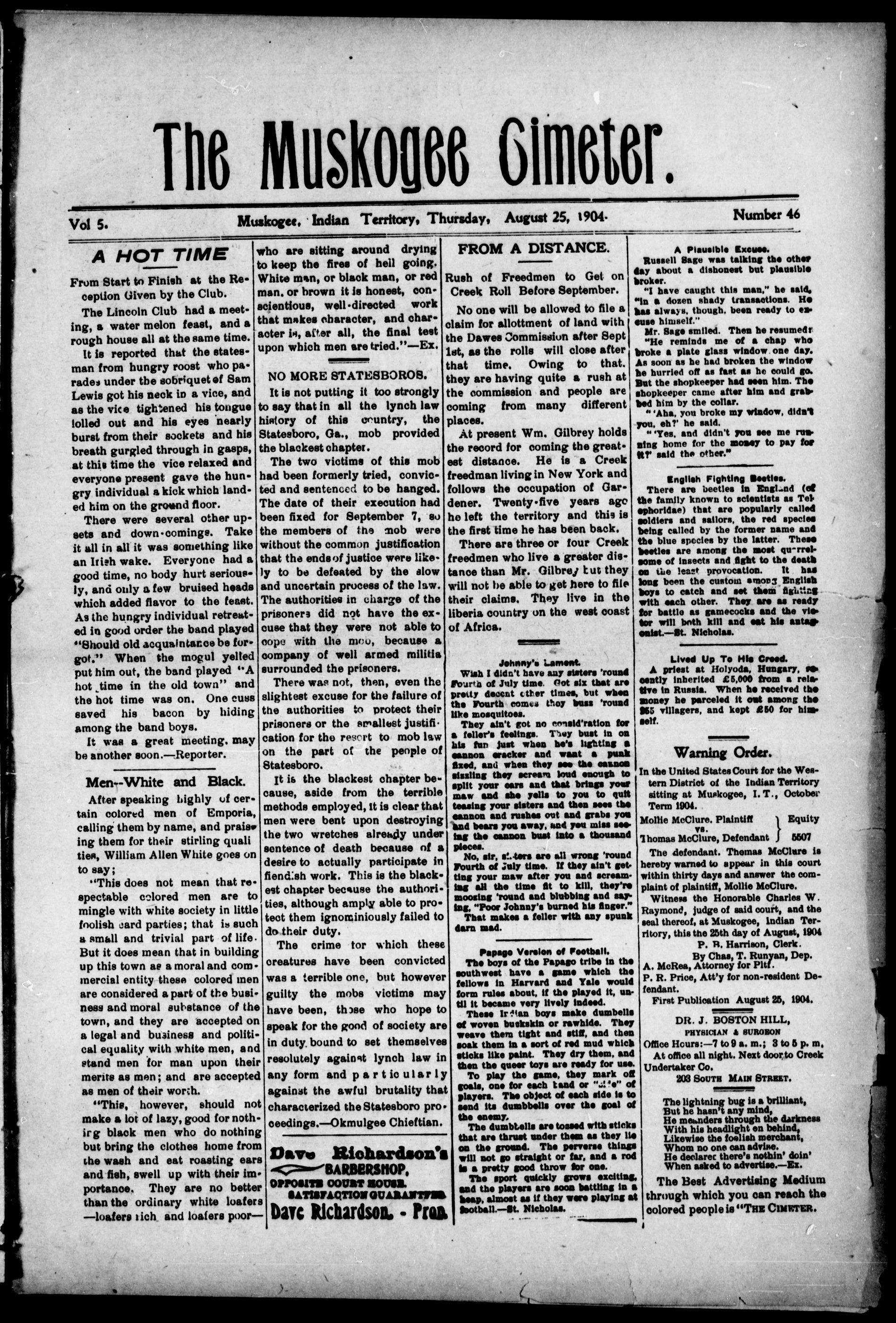
The Muskogee Gimeter.
Vol 5.
A HOT TIME
From Start to Finish at the Reception Given by the Club. The Lincoln Club had a meeting, a water melon feast, and a rough house all at the same time.
It is reported that the statesman from hungry roost who parades under the sobriquet of Sam Lewis got his neck in a vice, and as the vice tightened his tongue lolled out and his eyes nearly burst from their sockets and his breath gurgled through in gasps, at this time the vice relaxed and everyone present gave the hungry individual a kick which landed him on the ground floor.
There were several other upsets and down-comings. Take it all in all it was something like an Irish wake. Everyone had a good time, no body hurt seriously, and only a few bruised heads which added flavor to the feast. As the hungry individual retreated in good order the band played "Should old acquaintance be forgot." When the mogul yelled put him out, the band played "A hot time in the old town" and the hot time was on. One cuss saved his bacon by hiding among the band boys.
It was a great meeting, may be another soon.—Reporter.
Men--White and Black.
After speaking highly of certain colored men of Emporia, calling them by name, and praising them for their stirling qualities, William Allen White goes on to say;
"This does not mean that respectable colored men are to mingle with white society in little foolish card parties; that is such a small and trivial part of life. But it does mean that in building up this town as a moral and commercial entity these colored men are considered a part of the business and moral substance of the town, and they are accepted on a legal and business and political equality with white men, and stand men for man upon their merits as men; and are accepted as men of their worth.
"This, however, should not make a lot of lazy, good for nothing black men who do nothing but bring the clothes home from the wash and eat roasting ears and fish, swell up with their importance. They are no better than the ordinary white loafers loafers rich and loafers poor
Muskogee, Indian Territory, Thursday, August 25, 1904
who are sitting around drying to keep the fires of hell going. White man, or black man, or red man, or brown it is honest, conscientious, well-directed work that makes character, and character is, after all, the final test upon which men are tried."—Ex.
FROM A DISTANCE
Rush of Freedmen to Get Creek Roll Before September
No one will be allowed to fill claim for allotment of land with the Dawes Commission after S 1st as the rolls will close a
NO MORE STATESBOROS.
It is not putting it too strongly to say that in all the lynch law history of this country, the Statesboro, Ga., mob provided the blackest chapter.
The two victims of this mob had been formerly tried, convicted and sentenced to be hanged. The date of their execution had been fixed for September 7, so the members of the mob were without the common justification that the ends of justice were likely to be defeated by the slow and uncertain process of the law. The authorities in charge of the prisoners did not have the excuse that they were not able to cope with the moo, because a company of well armed militia surrounded the prisoners.
There was not, then, even the slightest excuse for the failure of the authorities to protect their prisoners or the smallest justification for the resort to mob law on the part of the people of Statesboro.
It is the blackest chapter because, aside from the terrible methods employed, it is clear that men were bent upon destroying the two wretches already under sentence of death because of a desire to actually participate in fiendish work. This is the blackest chapter because the authorities, although amply able to protect them ignominiously failed to do their duty.
The crime for which these creatures have been convicted was a terrible one, but however guilty the mobs victims may have been, those who hope to speak for the good of society are in duty bound to set themselves resolutely against lynch law in any form and particularly against the awful brutality that characterized the Statesboro proceedings.—Okmulgee Chieftian.
Dave Richardson's BARBERSHOP. OPPOSITE COURT HOUSE.
SATISFACTION GUARANTY Dave Richardson. - Prom
FROM A DISTANCE.
Rush of Freedmen to Get on Creek Roll Before September. No one will be allowed to file a claim for allottment of land with the Dawes Commission after Sept 1st, as the rolls will close after that time. Owing to that. they are having quite a rush at the commission and people are coming from many different places.
At present Wm. Gilbrey holds the record for coming the greatest distance. He is a Creek freedman living in New York and follows the occupation of Gardener. Twenty-five years ago he left the territory and this is the first time he has been back.
There are three or four Creek freedmen who live a greater distance than Mr. Gilbrey but they will not be able to get here to file their claims. They live in the liberia country on the west coast of Africa.
Johnny's Lament.
Wish I didn't have any sisters 'round Fourth of July time. Got six that are pretty decent other times, but when the Fourth comes they buss 'round like mosquitoes. They ain't got no consid'ration for a feller's feelings. They bust in on his fun just when he's lighting a cannon cracker and want a punk fixed, and when they see the cannon sizzling they scream loud enough to split your cars and that brings your maw and she yells to you to quit teasing their sisters and then sees the cannon and rushes out and grabs you and bears you away, and you miss seeing the cannon bust into a thousand pieces.
No, sir, sitters are all wrong 'round Fourth of July time. If they ain't getting your maw after you and screaming all the time fit to kill, they're moozing 'round and blubbing and saying, "Poor Johnny's burned his finger." That makes a feller with any spunk darn mad.
Papago Version of Football.
The boys of the Papago tribe in the southwest have a game which the fellows in Harvard and Yale would form rules about, if the played it, until it became very lively indeed. These Indian boys make dumbells of woven buckskin or rawhide. They weave them tight and stiff, and then soak them in a sort of red mud which sticks like paint. They dry them, and then the queer toys are ready for use. To play the game, they mark off goals, one for each band or "side" of players. The object of each side is to send its dumbbells over the goal of the enemy.
The dumbbells are tossed with sticks that are thrust under them as they lie on the ground. The perverse things will not go straight or far, and a rod is a pretty good throw for one. The sport quickly grows exciting, and the players are soon battling in a heap, almost as if they were playing at football.—St. Nicholas.
Number 46
A Plausible Excuse.
Russell Sage was talking the other day about a dishonest but plausible broker.
"I have caught this man," he said, "in a dozen shady transactions. He has always, though, been ready to excuse himself."
Mr. Sage smiled. Then he resumed:
"He reminds me of a chap who broke a plate glass window. one day. As soon as he had broken the window he hurried off as fast as he could go. But the shopkeeper had seen him. The shopkeeper came after him and grabbed him by the collar.
"Aha, you broke my window, didn't you, eh?" he said.
"Yes, and didn't you see me running home for the money to pay for it?" said the other."
English Fighting Beetles.
There are beetles in England (of the family known to scientists as Telophoridae) that are popularly called soldiers and sailors, the red species being called by the former name and the blue species by the latter. These beetles are among the most quarrelsome of insects and fight to the death on the least provocation. It has long been the custom among English boys to catch and set them fighting with each other. They are as ready for battle as gamecocks and the victor will both kill and eat his antagonist.—St. Nicholas.
Lived Up To His Creed.
A priest at Holyoda, Hungary, recently inherited £5,000 from a relative in Russia. When he received the money he parceled it out among the 255 villagers, and kept £50 for himself.
Warning Order.
In the United States Court for the Western District of the Indian Territory sitting at Muskogee, I. T., October Term 1904.
Mollie McClure. Plaintiff vs. Thomas McClure, Defendant } Equity 5507
The defendant. Thomas McClure is hereby warned to appear in this court within thirty days and answer the complaint of plaintiff, Mollie McClure.
Witness the Honorable Charles W. Raymond, judge of said court, and the seal thereof, at Muskogee, Indian Territory, this the 25th day of August, 1904
A. McRae, Attorney for Plt.
P. R. Price, Att'y for non-resident Defendant.
First Publication August 25, 1904.
Office Hours:—7 to 9 a. m.; 3 to 5 p. m.
At office all night. Next door to Creek Undertaker Co.
203 SOUTH MAIN STREET.
The lightning bug is a brilliant,
But he hasn't any mind,
He meanders through the darkness
With his headlight on behind,
Likewise the foolish merchant,
Whom no one can advise.
He declarer there's nothin' doin'
When asked to advertise.—Ex.
The Best Advertising Medium
through which you can reach the
colored people is "THE CIMETER.
```markdown
```
Muskogee Cimeter.
MUSKOGEE, . . IND. TER.
NEW STATE NEWS.
Cleo now has a broom factory in operation.
Ravia organized a commercial club last week.
The Central Baptist association of Oklahoma met in Yukon last week.
Ground has been broken for the new $40,000 opera house at Muskogee.
Hobart is securing a new hotel, and when completed will be the largest in that city.
The Postal Telegraph company will open an office in Chickasha about the first of September.
The construction of a line of railroad by the Santa Fe is announced from Owasso to Tulsa. Work is to begin at once.
The Caddo National bank has been organized, and will begin business about September 1st. The capital stock will be $50,000.
Herbert H. Black of Oklahoma City, Otis S. Russell of Lookeba, Thomas A. Ball of Renfrow have been appointed railway mail clerks.
A. C. Adams, master mechanic of the Rock Island shops at Chickasha, has been transferred to Trenton, Mo. His successor at Chickasha has not yet been appointed.
Miss Bessie Brown of South McAlester, daughter of Assistant United States Attorney Brown, has been selected to represent her town on Oklahoma day at the World's fair.
Postoffices at Fair, Corum, Diamond, Okla., have been ordered discontinued.
Work on the new $10,000 railroad Y. M. C. A. building at Sapuipa has begun. This is being built by the Frisco system and citizens of that town.
James Beryl, aged 89 years, died at Stroud last week. He had lived the life of a hermit for years, being a persistent pioneer, hunter and trapper.
A meeting of the business men of Altus (formerly Leger) and the farmers residing near that place, was held last week to consider ways and means of securing help to handle the immense cotton crop this fall. Efforts will be made to get all the help possible.
The investigation of the land office at Tishomingo has been completed, and no further dismissals than that of G. R. McDavitt, who, it is alleged, furnished attorneys with information that they were not entitled to.
John Green, arrested last week in the Chickasaw nation upon the charge of horse stealing, has been bound over in the sum of $500. D. Butler, charged with receiving stolen horses, was bound over and his bond was fixed at $200.
A special United States revenue collector at Chickasha last week seized four hundred cases of "People's Food," a soft drink that has been sold extensively. The goods are a brewery production and labeled under a name to conceal what it really was.
---
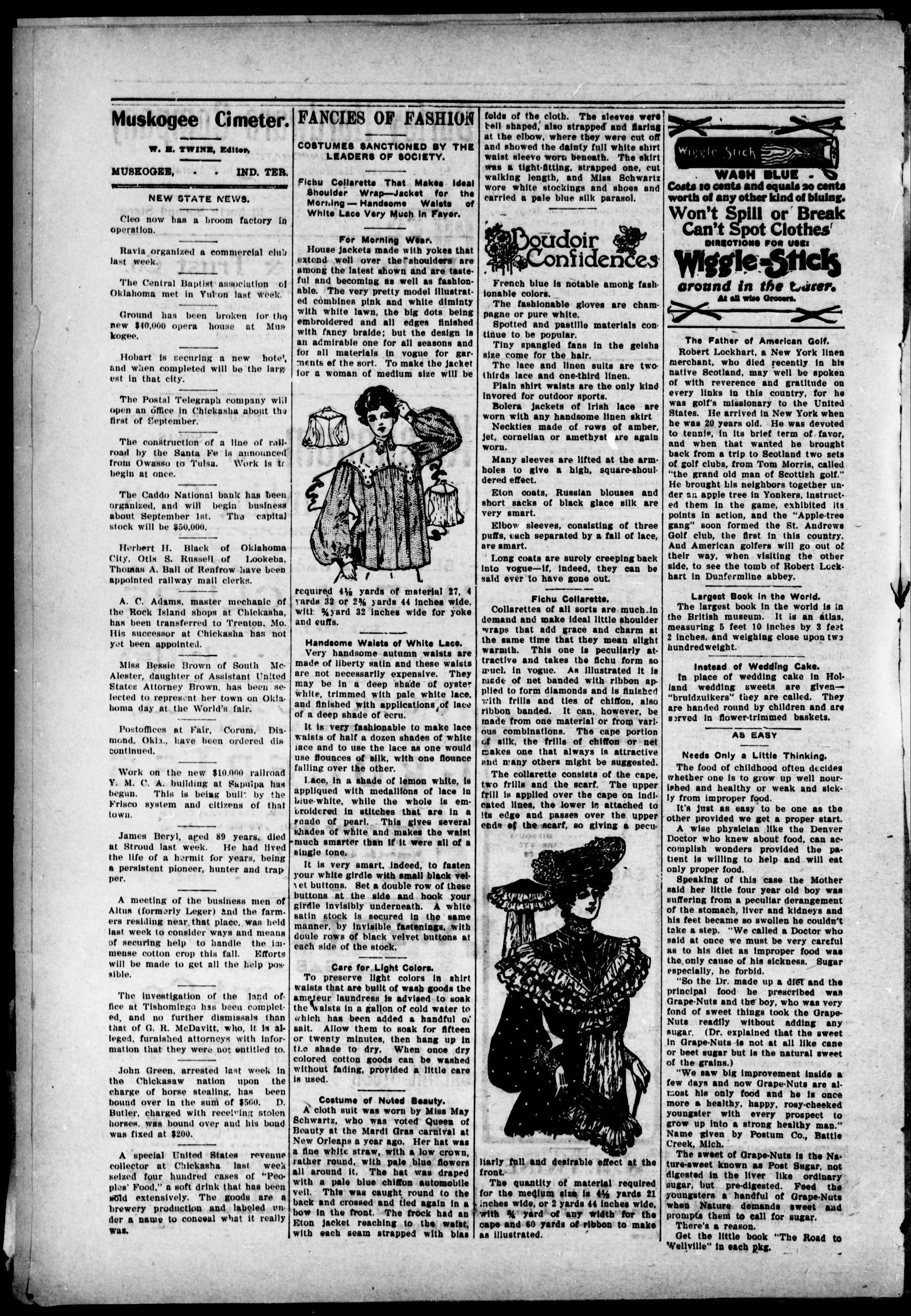
FANCIES OF FASHION
COSTUMES SANCTIONED BY THE LEADERS OF SOCIETY.
Fichu Collarette That Makes Ideal Shoulder Wrap—Jacket for the Morning—Handsome Waists of White Lace Very Much In Favor.
For Morning Wear.
House jackets made with yokes that extend well over the shoulders are among the latest shown and are tasteful and becoming as well as fashionable. The very pretty model illustrated combines pink and white diminty with white lawn, the big dots being embroidered and all edges finished with fancy braide; but the design is an admirable one for all seasons and for all materials in vogue for garments of the sort. To make the jacket for a woman of medium size will be
100
required 4½ yards of material 27, 4 yards 32 or 2½ yards 44 inches wide, with ½yard 32 inches wide for yoke and cuffs.
Handsome Waist of White Lace.
Very handsome autumn waists are made of liberty satin and these waists are not necessarily expensive. They may be in a deep shade of oyster white, trimmed with pale white lace, and finished with applications of lace of a deep shade of ecru.
It is very fashionable to make lace waists of half a dozen shades of white lace and to use the lace as one would use floundes of silk, with one flounce falling over the other.
Lace, in a shade of lemon white, is appliqued with medallions of lace in blue-white, while the whole is embroidered in stitches that are in a shade of pearl. This gives several shades of white and makes the waist much smarter than if it were all of a single tone.
It is very smart, indeed, to fasten your white girdle with small black velvet buttons. Set a double row of these buttons at the side and hook your girdle invisibly underneath. A white satin stock is secured in the same manner, by invisible fastenings, with doule rows of black velvet buttons at each side of the stock.
Care for Light Colors.
To preserve light colors in shirt waists that are built of wash goods the amateur laundress is advised to soak the waists in a gallon of cold water to which has been added a handful or salt. Allow them to soak for fifteen or twenty minutes, then hang up in the shade to dry. When once dry colored cotton goods can be washed without fading, provided a little care is used.
Costume of Noted Beauty.
A cloth suit was worn by Miss May Schwartz, who was voted Queen of Beauty at the Mardi Gras carnival at New Orleans a year ago. Her hat was a fine white straw, with a low crown, rather round, with pale blue flowers all around it. The hat was draped with a pale blue chiffon automobile veil. This was caught round to the back and crossed and tied again in a bow in the front. The frock had an Eton jacket reaching to the waist, with each seam strapped with bias
folds of the cloth. The sleeves were bell shaped, also strapped and flaring at the elbow, where they were cut off and showed the dainty full white shirt waist sleeve worn beneath. The skirt was a tight-fitting, strapped one, cut walking length, and Miss Schwartz wore white stockings and shoes and carried a pale blue silk parasol.
Boudoir Confidences
French blue is notable among fashionable colors.
The fashionable gloves are champagne or pure white.
Spotted and pastille materials continue to be popular.
Tiny spangled fans in the geisha size come for the hair.
The lace and linen suits are two-thirds lace and one-third linen.
Plain shirt waists are the only kind invoked for outdoor sports.
Bolera jackets of Irish lace are worn with any handsome linen skirt.
Neckties made of rows of amber, jet, cornellian or amethyst are again worn.
Many sleeves are lifted at the armholes to give a high, square-shouldered effect.
Eton coats, Russian blouses and short sacks of black glace silk are very smart.
Elbow sleeves, consisting of three puffs, each separated by a fall of lace, are smart.
Long coats are surely creeping back into vogue—if, indeed, they can be said ever to have gone out.
Fichu Collarette.
Collarettes of all sorts are much in demand and make ideal little shoulder wraps that add grace and charm at the same time that they mean slight warmth. This one is peculiarly attractive and takes the fichu form so much in vogue. As illustrated it is made of net banded with ribbon applied to form diamonds and is finished with frills and ties of chiffon, also ribbon banded. It can, however, be made from one material or from various combinations. The cape portion of silk, the frills of chiffon or net makes one that always is attractive and many others might be suggested.
The collarette consists of the cape, two frills and the scarf. The upper frill is applied over the cape on indicated lines, the lower is attached to its edge and passes over the upper ends of the scarf, so giving a pecu
JUORIM
liarly full and desirable effect at the front. The quantity of material required for the medium size is $ 4 \frac{1}{2} $ yards 21 inches wide, or 2 yards 44 inches wide, with $ \frac{3}{4} $ yard of any width for the cape and 60 yards of ribbon to make as illustrated.
Wiggle Stick
WASH BLUE
Costs 10 cents and equals 20 cents worth of any other kind of bluing.
Won't Spill or Break
Can't Spot Clothes
DIRECTIONS FOR USE:
Wiggle-Stick around in the water.
At all wise Grocers.
Robert Lockhart, a New York linen merchant, who died recently in his native Scotland, may well be spoken of with reverence and gratitude on every links in this country, for he was golf's missionary to the United States. He arrived in New York when he was 20 years old. He was devoted to tennis, in its brief term of favor, and when that wanted he brought back from a trip to Scotland two sets of golf clubs, from Tom Morris, called "the grand old man of Scottish golf." He brought his neighbors together under an apple tree in Yonkers, instructed them in the game, exhibited its points in action, and the "Apple-tree gang" soon formed the St. Andrews Golf club, the first in this country. And American golfers will go out of their way, when visiting the other side, to see the tomb of Robert Lockhart in Dunfermline abbey.
Largest Book in the World.
The largest book in the world is in the British museum. It is an atlas, measuring 5 feet 10 inches by 3 feet 2 inches, and weighing close upon two hundredweight.
Instead of Wedding Cake.
In place of wedding cake in Holland wedding sweets are given— "bruldzuikers" they are called. They are handed round by children and are served in flower-trimmed baskets.
AS EASY
Needs Only a Little Thinking.
The food of childhood often decides whether one is to grow up well nourished and healthy or weak and sickly from improper food. It's just as easy to be one as the other provided we get a proper start. A wise physician like the Denver Doctor who knew about food, can accomplish wonders provided the patient is willing to help and will eat only proper food.
Speaking of this case the Mother said her little four year old boy was suffering from a peculiar derangement of the stomach, liver and kidneys and his feet became so swollen he couldn't take a step. "We called a Doctor who said at once we must be very careful as to his diet as improper food was the only cause of his sickness. Sugar especially, he forbid.
"So the Dr. made up a diet and the principal food he prescribed was Grape-Nuts and the boy, who was very fond of sweet things took the Grape-Nuts readily without adding any sugar. (Dr. explained that the sweet in Grape-Nuts is not at all like cane or beet sugar but is the natural sweet of the grains.) "We saw big improvement inside a few days and now Grape-Nuts are almost his only food and he is once more a healthy, happy, rosy-cheeked youngster with every prospect to grow up into a strong healthy man." Name given by Postum Co., Battle Creek, Mich.
The sweet of Grape-Nuts is the Nature-sweet known as Post Sugar, not digested in the liver like ordinary sugar, but pre-digested. Feed the youngsters a handful of Grape-Nuts when Nature demands sweet and prompts them to call for sugar.
There's a reason.
Get the little book "The Road to Wellville" in each pkg.
The real worth of DR. PRICE’S FOOD is in its purity and wholesomeness, Grocers are not encouraged
to fill their shelves by the distribution of worthless prizes,
ZETTET ATT Teena
STILL CALL FOR HORSESHOES.
Trotfey Cars and Automobiles Have
Little Reduced the Output.
“How about horseshoes?” was
seked of a dealer in fron and steel
supplies, including horseshoes. “Has
the Ancreased use of automobiles les-
tened the demand for horséshoes?”
“No, it hasn’t,” was the reply. “We
ore selling as many horseshoes as
ever. It was thought when the trolley
car was introduced that something
was going to happen, but the trolley
cars came in so gradually that their
introduction had no effect on the
horseshoe trade, and it is so as to
the auto. Horses yet remain in gen-
eral use, and the demand for horse-
thoeg still continues.”
Thére are fourteen concerns in the
United States manufacturing horse-
shoes. Their annual output is some-
where about 1,000,000 kegs of 100
pounds each.
STRANGE PETS ON WARSHIPS.
Sailors of Different Nationalities Vary
in Their Likes.
The privilege of keeping pets is
very much appreciated by biuejackets.
who lavish their spare time and cash
on some very strange animals. The
British warship Centurion once had a
monkey that used to eat with a spoon
from a plate and drink from a glass,
with a dinner napkin tucked under
his chin the while. The Caesar hrd
& pet goose some time back. Cus
and dogs, of course, are common on
board ship, The French warship Mar-
ceau had a bantam cock named Bou-
langer as pet, which crowed whenever
the guns were fired. The German
Prinz Wilhelm had a grey stork, and
the United States Chicago had a pig
Doves, pigeons, blackbirds and pea
cocks are popular with Italian~ sea-
men, and the’ unfortunate Almirante
Oquendo of Spain had a pair of casso
waries as pets.
A Valuable Scrapbook.
To devote a scrapbook to one sub-
jcc: makes it much moro interesting
and valuable, and when you begin to
gather material on any one theme you
will be surprised at the amount which
will come to hand. Suppose that you
want to know all about some famous
rerson, either in the public eye at
present, or some one of past times
From Magazines and other sources
can be collected articles, portraits,
perhaps poems 3n relation to the sub-
ject, ete. When matter is clipped, the
scrapbook maker may copy it neatly
with a pen into her book. The educa-
tiona! value of such a book is some-
thing worth while, as well as the sat-
isfaction of having gathered oneself
so much information on & single sub
ject.
Voices of Native Africans.
The timbre of the voices among cen:
tral Africans is usually good—deep
and strong in the men, very melodl-
cus and sweet in the women. One
notable peculiarity about the people
is the forced key in which they ak
ways carry on conversation. The or-
dinary quiet tones of civilized speech
are scarcely ever heard among them.
They Mterally shout and, such being
their habit, it is a matter of Indif-
ference to them whether the person
to whom they are speaking is sicse
by or twenty yards away. “They are
most tireless chatterers,” says a trav-
eler. “I doubt whether any other peo-
ple in the world talk so much or laugh
so much. Their laughter is particu-
larly healthy, natural and unre
strained—a most exhilarating sound.”
Nathaniel, Hawthorne’s Stencil.
The stencil which Hawthorne used
In marking inspected goods, “N. Haw-
thorne,” is. still at the customhouse
and on exhibition.
immensity of Bay of Bengal.
The bay of Bengal is easily the targ:
est in the world. It comprisés 420,
000 square miles of water.
Mre. Winslow's Soothing Syru
Iasi eink: Seats eee
Bacteria in Milk.
In the best milk bacteria number
10,000 to a spoonful. In a really bad
sample of milk the astonishing total
of 600 million is reached.
Do Your Clothes Look Yellow?
Then use Defiance Starch; it will
keep them white—10 oz. for 10 cents.
Education.
If education be a preparation for
life, then should every child, front
tne beginning, have daily experience of
vLat fact.—Herbert Spencer.
‘7 Many Cniidren Are Sickly.
Mother Gray's Sweet Powders for Children,
used by Mother Gray, a nwrse in Childyan‘'s
Home, New York, cure Summer Complaint,
Feverishness,Headache,Stomach Troubles,
Teething Disorders and Destroy Worms. At
all Druggists’, 25c. Sample mailed FREE.
Address Allen S. Olmsted, Le Roy, N. Y.
Weight of Dead Sea Water.
A gallon of distilled water weigh»
ten pounds, of sea water ten and three-
fourths pounds, of Dead sea water
twelve pounds. There are eight and
one-half pounds of salt in every 100
pounds of Dead sea water to two and
four-fifths pounds in ordinary sep
water, 3:
Try One Package.
If “Defiance Starch” does not please
you, return it to your dealer. [f it
does, you get one-third more for the
same money. It will give you satis-
faction, and will not stick to the iron.
Searchlight ana Torpedo.
The practical use of the searchlight
1g only 700 yards, while a torpedo can
be used effectively at from 1,200 to 4,-
C00 yards.
Just in order to make sure cf the
integrity on the part of China, Great
Britain will make its occupaticn of
Weihaiwel perpetual.
Oklahoma State Military Institute.
A High Grade Prepata~ | Only military school in both Torritories; thoroughnass in everything:
Oe cieary School | slow, Uackward stadente receive special attention, high standard at
Under Government Sup- | study and morals: firm and wholesome discipiine: character bullding
ervdties, combined with intellectual training; army officer, graduate of West
. Point, detailed by war department: moderate exponro; begins Sept. 7,'08
For application blank and illustrated catalogue nldress
COLONEL JAMES e DUNN, Superintendent, Oklahoma City, Oklahoma,
NO MONEY TILL CURED. 27 YEARS Estasisne,
Eee acs mea, atari
curled ‘sete, none paid a cont til cured we furnish thelr names on application,
ORS. THORNTON & MINOR, 23 iss Sere Bt Louie Me:
A High Grade Prepata- | Onty military school in
tery Mifttary School | slow, backward studen
Under Government Sup- | study and morals; firm
relate, combined with intelle
Point, detailed by war ¢
For epplication blank and i
COLONEL JAMES ‘ML DUNN, Super
a
sepourntccnathoainhnitineaa teint
RRS
NO,mONEY,
an
Rect 1 wm
cond ‘motors none paid
ORS. THORNTON
SS
Yale Presidents’ Mace.
Space is provided in the gold and
silver mace presented to the president
of the corporation of Yale for the
names of twenty more presidents in
addition to the thirteen now on thiy
rymbol of academic authority.
Important to Mothers.
Examine carefully every bottle of CASTORTA,
safe and sure remedy for infaate and children,
and seo that it i
“Bears the
| Signature of y
In Use For Over 30 Years,
The Kind You Have Always Bought.
Raitroade In Argentina.
Railroads in Argentina are making
favorable progress, it is reported, un-
der the direction of English capital-
isis.
Piso's Cure cannot be too highly spoken of as
‘8 cough cure.—J. W. O'BRimN, 322 Third /.ve.
N., Minneapolis, Minn., Jan. 6, 1900, *
Where Man Is Handicapped.
A cheese-mite a quarter of an inch
long can jump out of a vessel six
inches deep. To equal this feat a man
would have toejump out of a well 144
feet deep.
Defiance Starch is put up 16 ounces
in a package,~ 10 cents. One-third
more starch for the same money.
Many Trace Ancestry to Queen.
Mary, queen of Svots, although she
ief. but one child, has descendants in
every court in Europe,
t
La BeIF
tail BPE i, 2 gi oe i a OP aah areas <7 NIN
EDUCATIONAL
Ne aeeeeeaeaneannenane
EPWORTH UNIVERSITY.
Joint Property of the two Methodiam x.
Intends fo be thorough in scholarship
and helpful and religious in spirit,
‘Ten Head Protesors, the majority of
yhom have taught In such untveraltice as
Northwestern, Vanderbilt, Ann Arbor,
Chicago, Columbia, ‘Leland’ stanford, de:
voto their entire time to the college of
‘Iiberal arts. Full corps of instructors in
“Academy and Music, Rlocution and Art.
Large campus of fifty-two ncres beaut
tully situated. “Modern buildings. Phys
cal, Chemical and Biological Lal foratortes.
‘The first session begins September 7, 1904,
‘Address,
President R. B. McSwain, Ohlehome, Okla.
Nene
Gy) a Ciy §P sinessCalege
—Coyrses—, fi /,0
“ars PSs,
*y orthana if Veet. Pt
ewriting Fo, |gor.
«Renan Werte for
elegra Wieulars —
iB Telegraphy | ;
, YX,
Sati hari.
wisest pein ADEET RQUEERIENT.
$60 in Bookkeeping, Shorthand, Penmanship and
if you are willing \o work to pay board, Positions ser
cured. Free use of text-books, Railroad fare paid,
Write sodey foe full particulars. Address
THOS. M. Mit.aM, Prest., Oklahoma City, O. T.
Speen incber ei rnestsnseerineperiaanicnenie enti
SMOKERS. FIND
LEWIS’ SINGLE BINDER
St Cigar better Quality than most 10¢ Cigars
‘Your jobber or direct from Factory, Peorta, I)
When You Want
A SHAVE.
HAIRCUT.
SHAMPOON.
OR SEA FOAM,
EXCELSIOR TONSORIAL PARLOR
Go to
CREEK
LIVERY BARN,
Now located at new quarters
No. 512 South 3rd Street
Phone 70
Opposite Gill Sanders'
Wholesale House.
THE CONDITION OF THE
NA'TN'L BANK
s Depository.
lian Territory.
Sidav. January 22, 1904.
Loans and Discounts $410,936.13 Capital $200,000.00
Overdrafts (Cotton) 23,198.69 Surplus and Profit 16,978.26
Bonds and Premiums 106,080.49 Circulation 50,000.00
Furniture and Fixtures 5,046.26 Deposits 345,142.28
Cash and Exchange 68,125.35 Reserved for Taxes 1,296.38
The above statement is correct. D. N. FINK, Cashier. Business intrusted to our care receive prompt attention.
Sawala and Ridge Items.
Cotton and corn are looking well. We are soon to have a new railroad, the laying of the steel is only a few miles away from Haskell a new town on the Midland Valley one north of Sowokla and 20 northwest of muskogee.
The 38 Annual Celebration of the Emancipation was held at Billy Banks Spring on the Midland Valley railroad one and onehalf miles north of ridge, Aug. 4th. The Ridge and Sawola people deserve much credit for the magnificent display, the unexcelled program, and sparing no pains to satiate the appetites of all present. There were sports and amusements galore, attractions by the score. Speeches were delivered by some of the most distinguished persons in the Creek nation. Indeed it was an occasion long to be remembered.
MUSKOGEE UNION RAILWAY,
Ft. Smith and Wagoner and the Kansas and Cherokee Oil Fields, via Coretta and Missouri Pacific Ry.
Lv. Muskogee—
9:30 a. m. and 8:05 p. m.
Ar. Ft. Smith—
12:55 p. m. and 11:45 p. m.
Lv. Ft. Smith—
4:00 a. m. and 8:15 p. m.
Ar. Muskogee—
7:81 a. m. and 7:35 p. m.
Lv. Muskogee—
6:25 a. m. and 6:20 p. m.
Ar. Wagoner—
7:10 a. m. and 8:10 p. m.
Lv. Wagoner—
9:55 a. m. and 9:17 p. m.
Lv. Muskogee—
10:46 a. m. and 2:17 p. m.
For time of trains beyond Wagoner see Missouri Pacific Iron Mountain time tables.
A. R. PAYINGHAUS. Traffic Manager.
Hello! Who is That?
Say. did you know that Gen. Pleasant kept a first-class place on the east side of Second street Everything good to eat, cigars of the best brand, fancy candiee ice cream, flour, sugar, coffes and country vegetables. He sells cheap, give him a call GEORGE PLEASANT.
Perfect Harmony.
Mr. Martin was fond of pets, and was somewhat inclined to boast of the friendly feeling existing among his dogs, guinea pigs, owls and fancy pigeons. One day a neighbor, who had reason to suspect that all was not going well on the Martin side of the fence, asked if the latest acquisition, a fine Angora cat, was living in harmony with the other animals.
"How," asked the neighbor, "do your young rabbits and your new cat agree?"
"Beautifully," replied Mr. Martin. "The cat eats the rabbits and the rabbits agree with the cat."—bmart Set
Our Vanis.led Loved Ones.
Still on the lips of all we question,
The finger of God's silence lies;
Will the lost hand in ours be folded?
Will the shut eyelids ever rise?
O friend, no proof beyond this yearning.
This outreach of our hearts, we need;
God will not mock the hope he giveth,
No love He prompts shall vainly plead.
Then let us stretch our hands in dark-
ness,
And call our loved ones o'er and o'er;
Some day their arms will close about us.
And the old voices speak once more.
-Whittier-
Cross Water at Night.
At least 90 per cent of the migrating birds crossed the English channel during the night. This point was noted by the observer at the Eddystone Lighthouse. Where large tracts of water are crossed the birds are night travelers.
Has Killed 2,000 Chamola.
The Austrian emperor recently shot his two-thousandth chamois. It has been stuffed and set up in the Hofburg.
W. H. TWINE.
Will practice in U. S. Cour and Daws Complication Office on Second Street
. Second St., Next to Creek Gro. C Clean towels, sharp razors a specialty J. A. BANKS, Proprietor
Go to
Ben's Quick Relief Mixture
A speedy and sure cure for colic, cholera, diarrhoea, dysentery, bloody flux, cholera morbus, griping in the stomach, cholera infantum and all bowel complaints ASK FOR A MEDICINE GLASS
Do Your Banking Business With
The Territorial
Oldest and Strongest Bank
Interest Paid on Deposits.
Abstracts Made.
Fidelity Bonds Written.
JOHN DOYL
Exclusive Undertak
(LICE
Ambulance
Territorial Bank & Tr
and Strongest Bank in the Indian Ter
in Deposits.
e.
Written.
MUSKOGEE, INDIAN
DOYLE COM
the Undertakers and En
(LICENSED)
ambulance Furnished F
Oldest and Strongest Bank in the Indian Territory. Interest Paid on Deposits. Abstracts Made. Fidelity Bonds Written. MUSKOGEE, INDIAN TERRITORY.
JOHN DOYLE COMPANY Exclusive Undertakers and Embalmers (LICENSED) Ambulance Furnished Free
GUARANTEE LIFE
MUSKOGEE, INC.
Capital Stock
An Old Line Company issues
Life and Ende
DIRECTORS:—E. J. Mints, M.
New York; F. L. Conger, O.
St. Louis, Mo.; C. J. Mill
mond, Wynnewood, I. T.
R. A. GIVEN
Dear
Diamonds, Water
Just opened in front of U. S.
oive my fall line of Jewelry
up-to-date in every respect.
goods and of the latest design
Call and see the latest wheth
NTEE LIFE INSURANCE
MUSKOGEE, INDIAN TERRITORY
Capital Stock $200,000
Company issues all forms of Limite
Life and Endowment Policies.
—E. J. Mints, Muskogee, I. T., Ge-
; F. L. Conger, Oklahoma City; Wma-
Mo.; C. J. Miller, Muskogee, I. T.
nnewood, I. T.
GIVENS, WACTH-M
& JEWF
GUARANTEE LIFE INSURANCE CO.
An Old Line Company issues all forms of Limited Payments, Life and Endowment Policies. DIRECTORS:—E. J. Mints, Muskogee, I. T., Geo. D. Lennon New York; F. L. Conger, Oklahoma City; Wm. M. Eggleston, St. Louis, Mo.; C. J. Miller, Muskogee, I. T.; Samuel Raymond, Wynnewood, I. T.
R. A. GIVENS, WACTH-MAKER @ JEWELER.
ands, Watches, Clocks
d in front of U. S. Court House, and h
all line of Jewelry which is strictly first
in every respect. I carry nothing b
of the latest design. My prices are n
see the latest whether you want to buy
IS. Muskog
D - LUMBER
Diamonds, Watches, Clocks, Etc.
Just opened in front of U. S. Court House, and has just receive my fall line of Jewelry which is striotly first-class and up-to-date in every respect. I carry nothing but the best goods and of the latest design. My prices are reasonable. Call and see the latest whether you want to buy or not.
GLOYD - LU
GLOYD - LUMBER - CO.
Taking The Stump
To tell about our lumber. It is put forward to win the approval of the lumber users of this section and when its good points are appreciated it will certainly do so. We see no satisfaction or profit in handling low grade stock. Neither will consumers when they learn that the finest lumber by the foot but pieces by the inches.
```markdown
```
```markdown
```
Phone No.486
North Second S .
Bank & Trust Co. in the Indian Territory. OGEE, INDIAN TERRITORY. E COMPANY rers and Embalmers (NSED) URNISHED Free
Office 221-23 Okmulgee Ave.
INSURANCE CO.
AN TERRITORY.
K $200,000
All forms of Limited Payments,
Payment Policies.
Muskogee, I. T., Geo. D. Lennon
Oklahoma City; Wm. M. Eggleston,
Muskogee, I. T.; Samuel Ray-
WACTH-MAKER
& JEWELER.
r In
hes, Clocks, Etc.
Court House, and has just re-
which is strictly first-class and
I carry nothing but the best.
My prices are reasonable.
If you want to buy or not.
Muskogee, Ind. Ter. MBER - CO.
A man standing on a tree stump, holding a large axe and a stack of logs.
---
Dealer In
"Universal Peace."
The czar's attempt at the establishment of universal peace is not the first of the kind that has been made by a European monarch. The French King Henry IV. of Navarre proposed something similar in the sixteenth century. His idea was to form the European nations into a confederation of states, and each state to be evenly balanced in military and naval power. The confederation was to be a supreme court of arbitration to decide all disputes that might arise. There was one flaw in this peace proposal—the Turk was to be excluded, and the states were to wage a war of extermination against him. The project was discussed and dropped.
Archery the Sport of Kings.
Archery was a pastime beloved of many kings and queens of old. Mary Queen of Scots was noted for her skill with the bow, and a story has been told against her that shortly after Darnley's murder she was shooting at the Tranent butts with Bothwell for partner. Henry VIII was an "archer bold," and among other Royal experts with bow and arrow were Edward VI and Charles I.
Shouting Their Praise.
Friarpoint, Miss., August 22 (Special).—Cured of Bladder and Kidney Trouble after 26 years of suffering, Rev. H. H. Hatch, of this place, is telling the public the good news and shouting the praises of the remedy that cured him—Dodd's Kidney Pills. Rev. Mr. Hatch says:— "I have been suffering from Bladder and Kidney Trouble for 26 years and I have tried everything that people said would do me good. But nothing did me any good except Dodd's Kidney Pills.
"I haven't felt a pain since I took Dodd's Kidney Pills. They gave me health and I feel like a new man altogether. Dodd's Kidney Pills are the best I ever had."
All Urinary and Bladder Troubles are caused by diseased Kidneys. The natural way to cure them is to cure the kidneys. Dodd's Kidney Pills never fail to cure diseased kidneys in any stage or place. They always cure Backache and they are the only remedy that ever cured Bright's Disease.
England's Great Artist.
George Frederick Watts, the great English artist, who died recently in London, rarely worked from a living subject, but modeled fragmentary studies in wax and clay for particular parts of the figures of his pictures. This patriarch of painters said in reference to his principal works that one of his great aims was to take the terror away from death.
"Makes It Go Way."
We simply can't do without it. We are not going to try. When Bobby stubs or cuts his toe, it's "Ma, where's the Lightning Oil?" When Lizzie burns her hand or arm, it's "Where's the Lightning Oil?" When little Dick's been playing with a bumble bee, it's "Where's the Lightning Oil?" The echo of all our afflictions is "Where's the Lightning Oil?" It's the balm that makes the pain go way. Sincerely yours.
25 and 50c bottles.
Italian Cotton Industry.
The cotton industry of Italy increases in importance and is distributed among 730 factories and employs over 135,000 hands. More than half the factories are worked by steam, the remainder by electricity and hydraulic power. Out of 80,000 looms employed, 60,000 are mechanical. The total production is now calculated at an annual value of over £12,000,000.
The English race is getting near sighted owing to the city life and conditions of civilization, says a well-known oculist
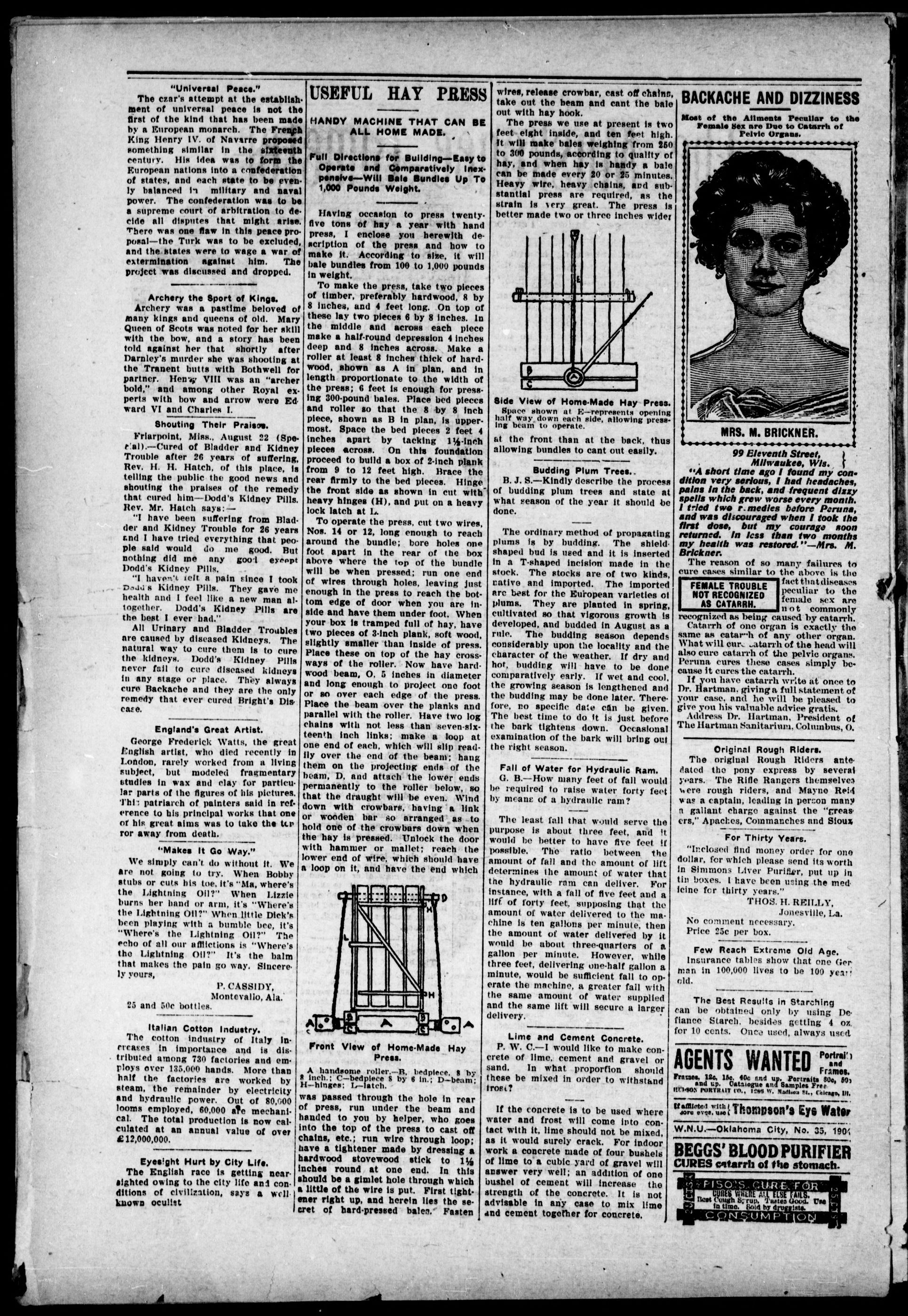
USEFUL HAY PRESS
HANDY MACHINE THAT CAN BE ALL HOME MADE.
Full Directions for Building—Easy to Operate and Comparatively Inexpensive—Will Bale Bundles Up To 1,000 Pounds Weight.
Having occasion to press twenty-five tons of hay a year with hand press, I enclose you herewith description of the press and how to make it. According to size, it will bale bundles from 100 to 1,000 pounds in weight.
To make the press, take two pieces of timber, preferably hardwood, 8 by 8 inches, and 4 feet long. On top of these lay two pieces 6 by 8 inches. In the middle and across each piece make a half-round depression 4 inches deep and 8 inches across. Make a roller at least 8 inches thick of hardwood, shown as A in plan, and in length proportionate to the width of the press; 6 feet is enough for pressing 300-pound bales. Place bed pieces and roller so that the 8 by 8 inch piece, shown as B in plan, is uppermost. Space the bed pieces 2 feet 4 inches apart by tacking $1 \frac{1}{4}$-inch pieces across. On this foundation proceed to build a box of 2-inch plank from 9 to 12 feet high. Brace the rear firmly to the bed pieces. Hinge the front side as shown in cut with heavy hinges (H), and put on a heavy lock latch at L.
To operate the press, cut two wires, Nos. 14 or 12, long enough to reach around the bundle; bore holes one foot apart in the rear of the box above where the top of the bundle will be when pressed; run one end of wires through holes, leaving just enough in the press to reach the bottom edge of door when you are inside and have them under foot. When your box is tramped full of hay, have two pieces of 3-inch plank, soft wood, slightly smaller than inside of press. Place these on top of the hay crossways of the roller. Now have hardwood beam, O. 5 inches in diameter and long enough to project one foot or so over each edge of the press. Place the beam over the planks and parallel with the roller. Have two log chains with not less than seven-sixteenth inch links; make a loop at one end of each, which will slip readily over the end of the beam; hang them on the projecting ends of the beam, D, and attach the lower ends permanently to the roller below, so that the draught will be even. Wind down with crowbars, having a link or wooden bar so arranged as to hold one of the crowbars down when the hay is pressed. Unlock the door with hammer or mallet; reach the lower end of wire, which should have a loop on it, and have the end which
Front View of Home-Made Hay Press.
A handsome roller.-B. bedpiece, 8 by 8 inch.; C-bedpiece 8 by 8 in.; D-beam; H-hinges; L-latch.
was passed through the hole in rear of press, run under the beam and handed to you by helper, who goes into the top of the press to cast off chains, etc.; run wire through loop; have a tightener made by dressing a hardwood stovewood stick to 1½ inches round at one end. In this should be a gimlet hole through which a little of the wire is put. First tightener right up, and herein lies the secret of hard-pressed bales. Fasten
wires, release crowbar, cast off chains, take out the beam and cant the bale out with hay hook. The press we use at present is two feet eight inside, and ten feet high. It will make bales weighing from 250 to 300 pounds, according to quality of hay, and when hay is handy a bale can be made every 20 or 25 minutes. Heavy wire, heavy chains, and substantial press are required, as the strain is very great. The press is better made two or three inches wider
D
C
Side View of Home-Made Hay Press. Space shown at E-represents opening half way down each side, allowing pressing beam to operate. at the front than at the back, thus allowing bundles to cant out easily.
Budding Plum Trees.
B. J. S.—Kindly describe the process of budding plum trees and state at what season of the year it should be done.
The ordinary method of propagating plums is by budding. The shield-shaped bud is used and it is inserted in a T-shaped incision made in the stock. The stocks are of two kinds, native and imported. The imported arc best for the European varieties of plums. They are planted in spring, cultivated so that vigorous growth is developed, and budded in August as a rule. The budding season depends considerably upon the locality and the character of the weather. If dry and hot, budding will have to be done comparatively early. If wet and cool, the growing season is lengthened and the budding may be done later. Therefore, no specific date can be given. The best time to do it is just before the bark tightens down. Occasional examination of the bark will bring out the right season.
G. B.—How many feet of fall would be required to raise water forty feet by means of a hydraulic ram?
The least fall that would serve the purpose is about three feet, and it would be better to have five feet if possible. The ratio between the amount of fall and the amount of lift determines the amount of water that the hydraulic ram can deliver. For instance, with a fall of five feet and a lift of forty feet, supposing that the amount of water delivered to the machine is ten gallons per minute, then the amount of water delivered by it would be about three-quarters of a gallon per minute. However, while three feet, delivering one-half gallon a minute, would be sufficient fall to operate the machine, a greater fall with the same amount of water supplied and the same lift will secure a larger delivery.
Lime and Cement Concrete
P. W. C.—I would like to make concrete of lime, cement and gravel or sand. In what proportion should these be mixed in order to withstand frost?
If the concrete is to be used where water and frost will come into contact with it, lime should not be mixed, as it would surely crack. For indoor work a concrete made of four bushels of lime to a cubic yard of gravel will answer very well; an addition of one bushel of cement will increase the strength of the concrete. It is not advisable in any case to mix lime and cement together for concrete.
BACKACHE AND DIZZINESS
Most of the Alliments Peculiar to the Female Sex are Due to Catarrh of Pelvic Organs.
Most of the Alliments Peculiar to the Female Sex are Due to Catarrh of Pelvic Organs.
THEATRE
MRS. M. BRICKNER.
"A short time ago I found my condition very serious, I had headaches, pains in the back, and frequent dizzy spells which grew worse every month. I tried two r. medles before Peruna, and was discouraged when I took the first dose, but my courage soon returned. In less than two months my health was restored."—Mrs. M. Brickner. The reason of so many failures to cure cases similar to the above is the
recognized as being caused by catarrh. Catarrh of one organ is exactly the same as catarrh of any other organ. What will cure catarrh of the head will also cure catarrh of the pelvic organs. Peruna cures these cases simply because it cures the catarrh. If you have catarrh write at once to Dr. Hartman, giving a full statement of your case, and he will be pleased to give you his valuable advice gratis. Address Dr. Hartman, President of The Hartman Sanitarium, Columbus, O.
Original Rough Riders.
The original Rough Riders ante-dated the pony express by several years. The Rifle Rangers themselves were rough riders, and Mayne Reid was a captain, leading in person many a gallant charge against the "greasers," Apaches, Commanches and Sloux
For Thirty Years.
"Inclosed find money order for one dollar, for which please send its worth in Simmons Liver Purifier, put up in tin boxes. I have been using the medicine for thirty years."
No comment necessary.
Price 25c per box.
Few Reach Extreme Old Age.
Insurance tables show that one German in 100,000 lives to be 100 years old.
The Best Results in Starching can be obtained only by using Deflance Starch, besides getting 4 oz. for 10 cents. Once used, always used.
AGENTS WANTED
Portrait' and Frames.
Frames, 12c, 15c, 40c and up. Portraits 80c, 60c
and up. Catalogue and Samples Free.
HUDSON PORTRAIT CO., 1286 W. Madison St., Chicago, Ill.
Afflicted with
sore eyes, use
Thompson's Eye Water
W.N.U.—Oklahoma City, No. 35, 1904
BEGGS' BLOOD PURIFIER
CURES catarrh of the stomach.
PISO'S CURE FOR
CURES WHERE ALL ELSE FAILS.
Best Cough Syrup. Tastes Good. Use
in time. Sold by druggists.
CONSUMPTION
THE CIMETER
SUBSCRIPTION:
(In advance)
One Year $1.00
Six Months 50
Three Months 25
W. H. TWINE - - - Editor.
R. WOOD, Ass't Editor and Manager.
J. T. TRIMBLE - - Solicitor.
F QUALLS, Manager, Printing Dept
Republican Ticket.
For President,
THEODORE ROOSEVELT,
of New York.
For Vice-President,
CHARLES W. FAIRBANKS,
of Indiana.
We admire a man who can oppose you and stands from under cover and strikes his blow in the open but we hate and detest the d—n snake who like a cowardly cur strikes in the dark. We have some of that kind of reptile in and about this burg.
We think a school teacher should keep out of the political rangles of a community unless he desires to play boss and run a polical machine in that event we say go in old fellow and if you get your fingers scorched don't cry.
The fire-eater of the southern er who is cussing the President because he sat at the dinner table with Booker Washington forgets that their is a great difference in the treatment of the Negro north and south. Up north, they eat with the Negro; down south they sleep with . As a result, there are a great many Negroes as white as the cuss who cusses.
They are sifting the school teachers through a seive in Guthrie, O. T., and charges for gross immorality are placed against some of them. It looks like the immoral teachers must step down and out. In this city it would be well to turn on the electric light and examine the force recently appointed in our school. What say you brethren of the press. The Cimeter's guns are turned that way.
Some days ago down in Tex., two white men were deploring the tendency to social commingling of the races and swearing they would burn every Negro man (not the women) before they would permit such a state of affairs, when a Negro who was standing near remarked: "Gentlemen I am as white as any of you and yet my grand mother was as black as the high sheriff in hell. Now some of you have been practicing social equality." They vanished.
Gov. Vardaman of Mississippi used language unbecoming a gentleman when he editorially referred to the mother of Roosevelt. There is a limit to personal criticism that is reached when abuse is substituted and reason is dethroned. The author of that editorial is not worthy of having a sty named in his honor.—South McAlester Capital.
It might be well for all concerned that the fight for Post Master be held up till November. There will be no appointments made till December, and this will save hundreds of dollars to good men who are now being bled right and left. There are some fellows aggitating the question now for no other purpose than robbing the candidates. We believe the matter should be left alone till after the election, and then let all the republicans decide who shall be endorsed.
Some of the Jones henchmen are using their hammer and are knocking against lawyers who opposed the egotiscal conceived arrogant autocrat who with a turkey gobbler strut proclaims himself as "IT." Some of the cusses are in business themselves, and we can rap back. They say he is the only lawyer in town. Maybe so, and we know he is the only one who failed in the examination and fled to South-town where things are easier, got admitted there and returned here to practice.
THERE WAS, THERE WASN'T
You can't forget that the bond question has been up before and that the Negro for the good of the town has always voted for bonds because he thought it meant improvement and progress and that he would participate in each, that is, have like accommodations &c (no mixing or sacial equality &c.) but to his sorrow he finds as in school bond business there is "nothing to it" but of that we shall speak later for many reasons we think the bonds for extension of the waterworks should be defeated; as it takes a two-third vote to carry the election, we are certain they will go as went the colored contingent of the city administration when the council said, "Let there be no Negro Liftum Dungi and there was none. Let there be a Sanitary Policeman and there was one."
Fisher & White,
CORNER THIRD AND OKMULGEE.
We use the best material and do high grade work at prices within reach of all special prices on gold crowns and ridge work Have your theeth saved before its too late
MUSKOGEE TITLE & TRUST CO.
ABSTRACTS of TITLE, INSURANCE, SURETY BONDS and REAL ESTATE Farm Loans a Specialty Second and Broadway. MUSKOGEE, IND. TER.
WE CAN RENT YOUR HOUSES
The Canadian Valley Trust Company
Has a number of applicants who desire to rent houses. Owners of three, four, five and six room houses can secure desirable tenants by listing their property with us.
REAL ESTATE DEPARTMENT
Canadian Valley Trust Co.
MORRIS' CAFE
The only first-class, up-to-date Cafe in the city Where people of all nations can be served A Splendid Billiard and Pool Hall Adjoining The finest in the southwest. If you are hungry step into the cafe; if you want to spend an hour of pleasure the pool room is the place.
The Barnett Grocery Co.
STAPLE and FANCY GROCERIES We have anything you desire in the Grocery Line at prices that defy competition. Give us a trial and you will repeat. Located on South 5th St., near the South Side Boulevard.
:: FARM LOANS AND ABSTRACTS ::
JAMES L. LOMBARD.
President.
CHAS. H. LOMBARD.
Secretary and Manager.
D. G. WILSON,
Assistant Secretary.
MIDLAND ABSTRACT COMPANY
207 N. Second Street, MUSKOGEE, IND. TER.
FARM :: LOANS :: ON :: FREEDMAN :: LAND
Loans made to Creek Freedmen who are farming
on their allotments
Spott Cash Store
BIG LINE OF SPRING MILLINARY! Shirt Waist Suits, Shirt Waists, Corsets, Hosiery, Muslin Underwear, Dry Goods, Tin Ware and Enameled Ware, Queens Ware, and Glass Ware.
West Broadway. Muskogee THE FAIR.
R. H. MORRIS, Prop.
Corner 2nd and Denison Sts.
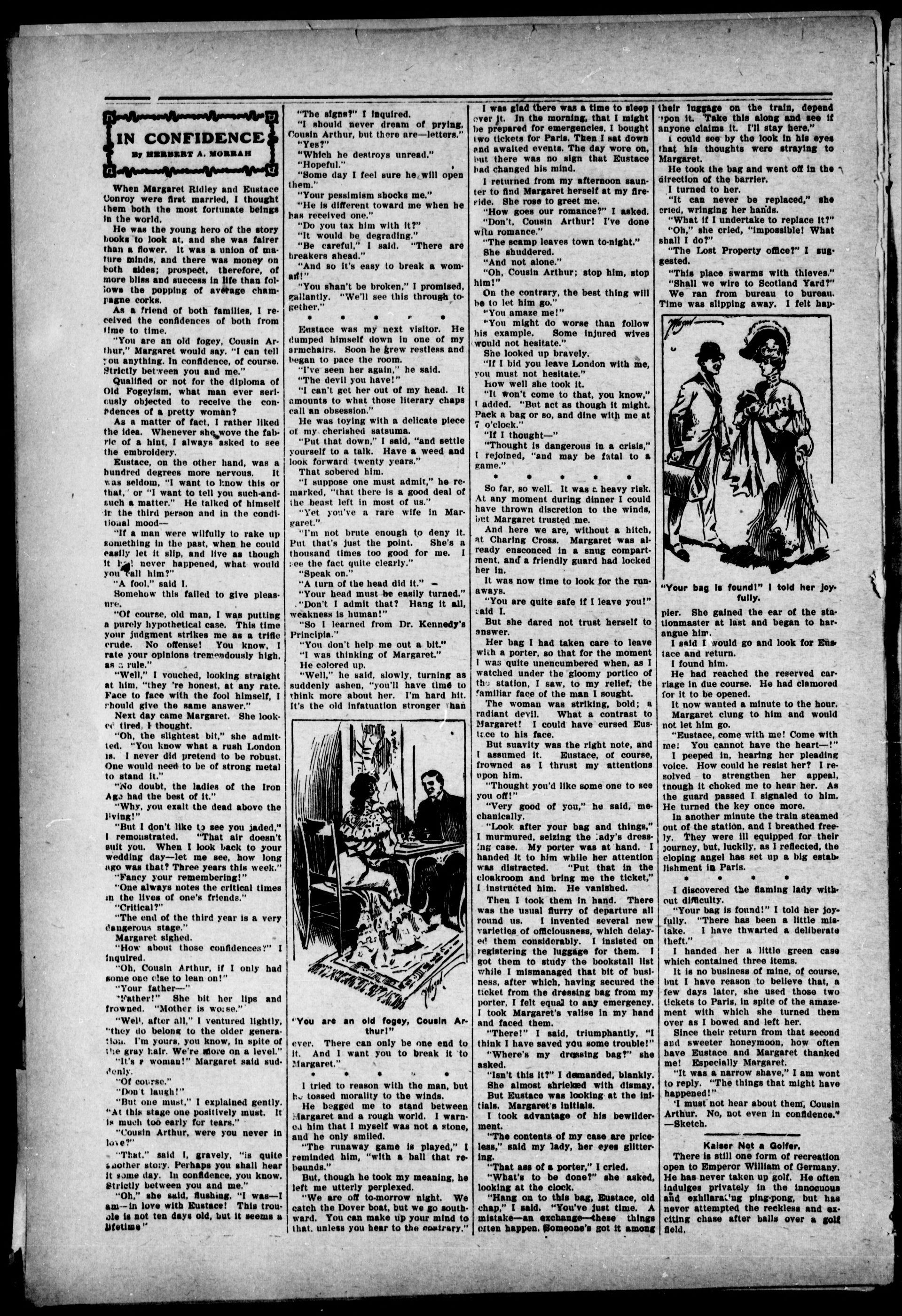
When Margaret Ridley and Eustace Conroy were first married, I thought them both the most fortunate beings in the world.
He was the young hero of the story books to look at, and she was fairer than a flower. It was a union of mature minds, and there was money on both sides; prospect, therefore, of more bliss and success in life than follows the popping of average champagne corks.
As a friend of both families, I received the confidences of both from time to time.
"You are an old fogey, Cousin Arthur," Margaret would say. "I can tell you anything. In confidence, of course. Strictly between you and me."
Qualified or not for the diploma of Old Fogeyism, what man ever seriously objected to receive the confidences of a pretty woman?
As a matter of fact, I rather liked the idea. Whenever she wove the fabric of a hint, I always asked to see the embroidery.
Eustace, on the other hand, was a hundred degrees more nervous. It was seldom, "I want to know this or that,' or "I want to tell you such-and-such a matter." He talked of himself in the third person and in the conditional mood— "If a man were wilfully to rake up something in the past, when he could easily let it slip, and live as though it had never happened, what would you call him?" "A fool," said I. Somehow this failed to give pleasure.
"Of course, old man, I was putting a purely hypothetical case. This time your judgment strikes me as a trifle crude. No offense! You know, I rate your opinions tremendously high, as a rule."
"Well," I vouched, looking straight at him, "they're honest, at any rate. Face to face with the fool himself, I should give the same answer."
Next day came Margaret. She looke- ce tired, I thought.
"Oh, the slightest bit," she admitted. "You know what a rush London is. I never did pretend to be robust. One would need to be of strong metal to stand it."
"No doubt, the ladies of the Iron Age had the best of it."
"Why, you exalt the dead above the living!"
"But I don't like to see you jaded," I remonstrated. "That air doesn't suit you. When I look back to your wedding day—let me see, how long ago was that? Three years this week."
"Fancy your remembering!"
"One always notes the critical times in the lives of one's friends."
"Critical?"
"The end of the third year is a very dangerous stage."
Margaret sighed.
"How about those confidences?" I inquired.
"Oh, Cousin Arthur, if I only had some one else to lean on!"
"Your father—"
"Father!" She bit her lips and frowned. "Mother is wo:se."
"It's r woman!" Margaret said suddenly.
"Of course."
"Don't laugh!"
"But one must," I explained gently.
"At this stage one positively must. It is much too early for tears."
"Cousin Arthur, were you never in love?"
"That." said I, gravely, "is quite another story. Perhaps you shall hear it some day. In confidence, you know. Strictly between you and me."
"Oh," she said, flushing. "I was—I am—in love with Eustace! This trouble is not ten days old, but it seems a lifetime."
"The signs?" I inquired.
"I should never dream of prying, Cousin Arthur, but there are—letters."
"Yes?"
"Which he destroys unread."
"Hopeful."
"Some day I feel sure he will open them."
"Your pessimism shocks me."
"He is different toward me when he has received one."
"Do you tax him with it?"
"It would be degrading."
"Be careful," I said. "There are breakers ahead."
"And so it's easy to break a woman!"
"You shan't be broken," I promised, gallantly. "We'll see this through together."
Eustace was my next visitor. He dumped himself down in one of my armchairs. Soon he grew restless and began to pace the room.
"I've seen her again," he said.
"The devil you have!"
"I can't get her out of my head. It amounts to what those literary chaps call an obsession."
He was toying with a delicate piece of my cherished satsuma.
"Put that down," I said, "and settle yourself to a talk. Have a weed and look forward twenty years."
"I suppose one must admit," he remarked, "that there is a good deal of the beast left in most of us."
"Yet you've a rare wife in Margaret."
"I'm not brute enough to deny it. Put that's just the point. She's a thousand times too good for me. I see the fact quite clearly."
"Speak on."
"A turn of the head did it."
"Your head must be easily turned."
"Don't I admit that? Hang it all, weakness is human!"
"So I learned from Dr. Kennedy's Principia."
"You don't help me out a bit."
"Well," he said, slowly, turning as suddenly ashen, "you'll have time to think more about her. I'm hard hit. It's the old infatuation stronger than
Mizgol
"You are an old fogey, Cousin Arthur!"
ever. There can only be one end to it. And I want you to break it to Margaret."
I tried to reason with the man, but he tossed morality to the winds.
He begged me to stand between Margaret and a rough world. I warned him that I myself was not a stone, and he only smiled.
"The runaway game is played," I reminded him, "with a ball that rebounds."
But, though he took my meaning, he left me utterly perplexed.
"We are off to-morrow night. We catch the Dover boat, but we go southward. You can make up your mind to that, unless you hear to the contrary."
I was glad there was a time to sleep over it. In the morning, that I might be prepared for emergencies, I bought two tickets for Paris. Then I sat down and awaited events. The day wore on, but there was no sign that Eustace had changed his mind.
I returned from my afternoon saunter to find Margaret herself at my fire-side. She rose to greet me.
"How goes our romance?" I asked.
"Don't, Cousin Arthur! I've done with romance."
"The scamp leaves town to-night."
She shuddered.
"And not alone."
"Oh, Cousin Arthur; stop him, stop him!"
On the contrary, the best thing will be to let him go."
"You amaze me!"
"You might do worse than follow his example. Some injured wives would not hesitate."
She looked up bravely.
"If I bid you leave London with me, you must not hesitate."
How well she took it.
"It won't come to that, you know," I added. "But act as though it might. Pack a bag or so, and dine with me at 7 o'clock."
"If I thought—"
"Thought is dangerous in a crisis," I rejoined, "and may be fatal to a game."
So far, so well. It was a heavy risk. At any moment during dinner I could have thrown discretion to the winds, but Margaret trusted me.
And here we are, without a hitch, at Charing Cross. Margaret was already ensconced in a snug compartment, and a friendly guard had locked her in.
It was now time to look for the runaways.
"You are quite safe if I leave you!" said I.
But she dared not trust herself to answer.
Her bag I had taken care to leave with a porter, so that for the moment I was quite unencumbered when, as I watched under the gloomy portico of the station, I saw, to my relief, the familiar face of the man I sought.
The woman was striking, bold; a radiant devil. What a contrast to Margaret! I could have cursed Eustace to his face.
But suavity was the right note, and I assumed it. Eustace, of course, frowned as I thrust my attentions upon him.
"Thought you'd like some one to see you off!"
"Very good of you," he said, mechanically.
"Look after your bag and things," I murmured, seizing the lady's dressing case. My porter was at hand. I handed it to him while her attention was distracted. "Put that in the cloakroom and bring me the ticket," I instructed him. He vanished.
Then I took them in hand. There was the usual flurry of departure all round us. I invented several new varieties of officiousness, which delayed them considerably. I insisted on registering the luggage for them. I got them to study the bookstall list while I mismanaged that bit of business, after which, having secured the ticket from the dressing bag from my porter, I felt equal to any emergency. I took Margaret's valise in my hand and faced them.
"There!" I said, triumphantly, "I think I have saved you some trouble!"
"Isn't this it?" I demanded, blankly. She almost shrieked with dismay. But Eustace was looking at the initials. Margaret's initials. I took advantage of his bewilderment. "The contents of my case are priceless," said my lady, her eyes glittering. "That ass of a porter," I cried.
"What's to be done?" she asked, looking at the clock.
"Hang on to this bag, Eustace, old chap," I said. "You've just time. A mistake—an exchange—these things often happen. Someone's got it among
their luggage on the train, depend upon it. Take this along and see if anyone claims it. I'll stay here."
I could see by the look in his eyes that his thoughts were straying to Margaret.
He took the bag and went off in the direction of the barrier.
I turned to her.
"It can never be replaced," she cried, wringing her hands.
"What if I undertake to replace it?"
"Oh," she cried, "impossible! What shall I do?"
"The Lost Property office?" I suggested.
"This place swarms with thieves."
"Shall we wire to Scotland Yard?"
We ran from bureau to bureau. Time was slipping away. I felt hap-
Miguel
"Your bag is found!" I told her joyfully.
pier. She gained the ear of the stationmaster at last and began to harangue him.
I said I would go and look for Eustace and return.
I found him.
He had reached the reserved carriage in due course. He had clamored for it to be opened.
It now wanted a minute to the hour.
Margaret clung to him and would not let him go.
"Eustace, come with me! Come with me! You cannot have the heart—!"
I peeped in, hearing her pleading voice. How could he resist her? I resolved to strengthen her appeal, enough it choked me to hear her. As the guard passed I signaled to him. He turned the key once more.
In another minute the train steamed out of the station, and I breathed freely. They were ill equipped for their journey, but, luckily, as I reflected, the eloping angel has set up a big establishment in Paris.
I discovered the flaming lady without difficulty.
"Your bag is found!" I told her joyfully. "There has been a little mistake. I have thwarted a deliberate theft."
I handed her a little green case which contained three items.
It is no business of mine, of course, but I have reason to believe that, a few days later, she used those two tickets to Paris, in spite of the amazement with which she turned them over as I bowed and left her.
Since their return from that second and sweeter honeymoon, how often have Eustace and Margaret thanked me! Especially Margaret.
"It was a narrow shave," I am wont to reply. "The things that might have happened!"
"I must not hear about them, Cousin Arthur. No, not even in confidence."
—Sketch.
Kaiser Not a Golfer.
There is still one form of recreation open to Emperor William of Germany. He has never taken up golf. He often indulges privately in the innocuous and exhilarating ping-pong, but has never attempted the reckless and exciting chase after balls over a golf field.
WITH THE WORLD'S —
=~ BEST WRITERS
THE FTE Nee eae OF a ee eee oe
Bighty-nine years have passed since
the great Napoleon—the incarnate god
of war—was defeated and finally over-
thrown on the battlefield of Waterloo.
In this epoch-making battle French
valor shone brilliantly, and although
the eagles of France went down in
disaster no dishonor attached to thetr
defeat. Recently a monument in mem-
ory of Napoleon’s soldiers who fell at
Waterloo was unveiled on the field of
that historic struggle. The’ monu-
ment was placed near the tarmhouse
where the “Old Guard” made its last
stand. The design of the memorial is
a striking one—a wounded eagle sur-
mounting a tall shaft. Since Waterloo
the eagles of France have been
stricken even more grievously than
they were-by Wellington in 1815. In
1870 an army of 173,000 men surrend-
ered at Metz to the German conqueror.
It is impossible to conceive of the
first Napoleon giving up a fight with
an army of 171,000 valorous French-
men to follow his lead. The “Old
Guard” of 1815 was composed of men
who were willing to die, but never to
surrender. France honors herself in
honoring the vanquished heroes of
Waterloo. Sentiment is not extinct in
the Gallic heart. It has survived
Sedan and Metz. The “Wounded
Eagle’ may one day recover his
strength 4nd revive the glories of the
“Old Guard.”—Baltimore Sun.
JAPAN ESE INVENTIVENESS.
It has long been supposed that the
capacity for initiation is the charac-
terlatic of Western nations alone. Ac-
cording to some leading anthropolo-
gists, as one goes from West to East
he finds this capacity disappearing
end the capacity for imitation taking
its place. The Chinese and Japanese
are imitators, not inventors.
But the present war between the
Russians and the Japanese is rapidly
proving the idea to be mere assump:
tion, It-is the Eastern rather than
the Western people which, in this con-
test, are exhibiting the capacity for
initiation and invention. Their strat-
egy is almost faultiess, and it is their
own, Their artillery is astonishingly
destructive, and, in some of its most
deadly features, is the product of
Japanese invention. Their naval tac-
tics have been so unexpected and suc-
cessful as to promise a revolution in
the future methods of naval warfare.
‘When peace comes and the Japanese
carry their genius into the industrial
world, they will demonstrate perhaps
in a more telling way that the capact-
ty for initiation does not diminish as
one travels toward the rising sun.—
Church Standard.
STUDY OF DOMESTIC SCIENCE.
Regarding” domestic science as a
profession, Anna Barrows, writing in
the Chautauquan, says that the young
woman of average ability and educa-
tion, who has taken two years of spe-
cial training in the arts and sciences
underlying the routine of daily life of
a household, large or small, who does
not expect a position made to suit
her, but who is ready to cope with
difficulties, will find the world waiting
for her help in several directions. She
may teach domestic science in public
or private schools or Jecture before
women’s clubs. She may direct the
Mietaries and feed large numbers of
persons iu hospitals and schools, or
send into other homes food prepared
under her own roof, It is doubtful
whether there are any occupations in
the world which are so certain to be
lasting as those that deal with our
daily food.
. RUSSIA'S FUTURE.
Russian character is unknown to
Kurope and America. We know cer-
tain qualities, but we form no con-
ception of the whole, as we do of a
German, Frenchman or Italian. He i
not more than half a Buropean—
probably considerably less than half.
To the Western mind he seems
strangely Oriental. Perhaps to the
Oriental he seems Western. After
Peter the Great broke down some of
the barriers between his country and
the outer world, the Russian uppet
| Classes took in considerable European
culture from the French, but the ef-
fect went no deeper than the surface
influence of culture. Russia, stand-
ing between the Orient and the Occl-
dent, looks to herself for her future—
ir. contrast to Japan, which is ready
to borrow from all the world. Japan
is adaptable. Russia has genius. She
has also an immense naive self-confi-
dence, which shows trivially in her
Woasting and nobly in the calm with
which she goes about her work and
iooks toward the future. Dostoievsky,
emong many, prophesies that the oth-
er powers of Europe will be worn out,
by struggles of their classes, whereas
in Russia the populace is naturally
content and the national mind so
spiritual that a genera! humanitarian
cffort will form a contrast to the con-
stant conflicts of Europe proper. “Uni-
versal democratic tendencies and ab-
solute concord among all Russians,
from the greatest to the least,” was
the unhesitating language of the great
novelist thirty years. ago. Would he
ray as much to-day? Probably yes,
eesentially, with explanations and
modifications. Russia is kept one by
her separate genius. The Russian
peasants for génerations have spoken
of convicts. as “unfortunates.” Their
sense of human brotherhood makes
them sometimes weak, just as it has
shorn Tolstoi of his strength. Tolstoi,
however, remains great, and Russian
history also promises to be great. A
military check to-day is not likely to
make Russia’s future less spiritual or
less useful to the world.—Collier's
Weekly.
HOW FATE TRICKED FINLAND,
“If Napoleon had had his way in the
year 1812 the aspirations of the Finns
to have their land incorporated with
Sweden ‘would have been accomplish-
ed, and there would now have been no
Russification of the country crushing
down the national sentiment, and of
course no murder of the Russian gov-
ernor, Sweden at that time held the
balance of power in Europe, and both
sides were bidding for her support.
Napoleon offered Bernadotte Finland
and the country between the Elbe and
the Weser for 40,000 Swedish soldiers.
‘The Czar Alexander offered him Nor-
way, and dazzled him with prospects
of accession to the throne of France
itself. Bernadotte decided to throw
in his lot with the Allied Powers, and
this decision was the principal factor
in Napoleon's ultimate ruln.—London
Chronicle,
1S OXFORD TRAINING USELESS?
The average citizen, if asked what
was taught at Oxford, would probably
reply: “Useless learning.” And in
many ways it is a true answer, for its
aim is not to turn out doctors, law-
yers and merchants, ready-made, but
men with carefully-trained minds,
fitted not for this or that profession,
but for the whole conduct of life. It
is contended that such a man will in-
sensibly take a wider view of his sub-
ject than the specialist, for he ap-
proaches it from a different stand-
point.—London Outlook,
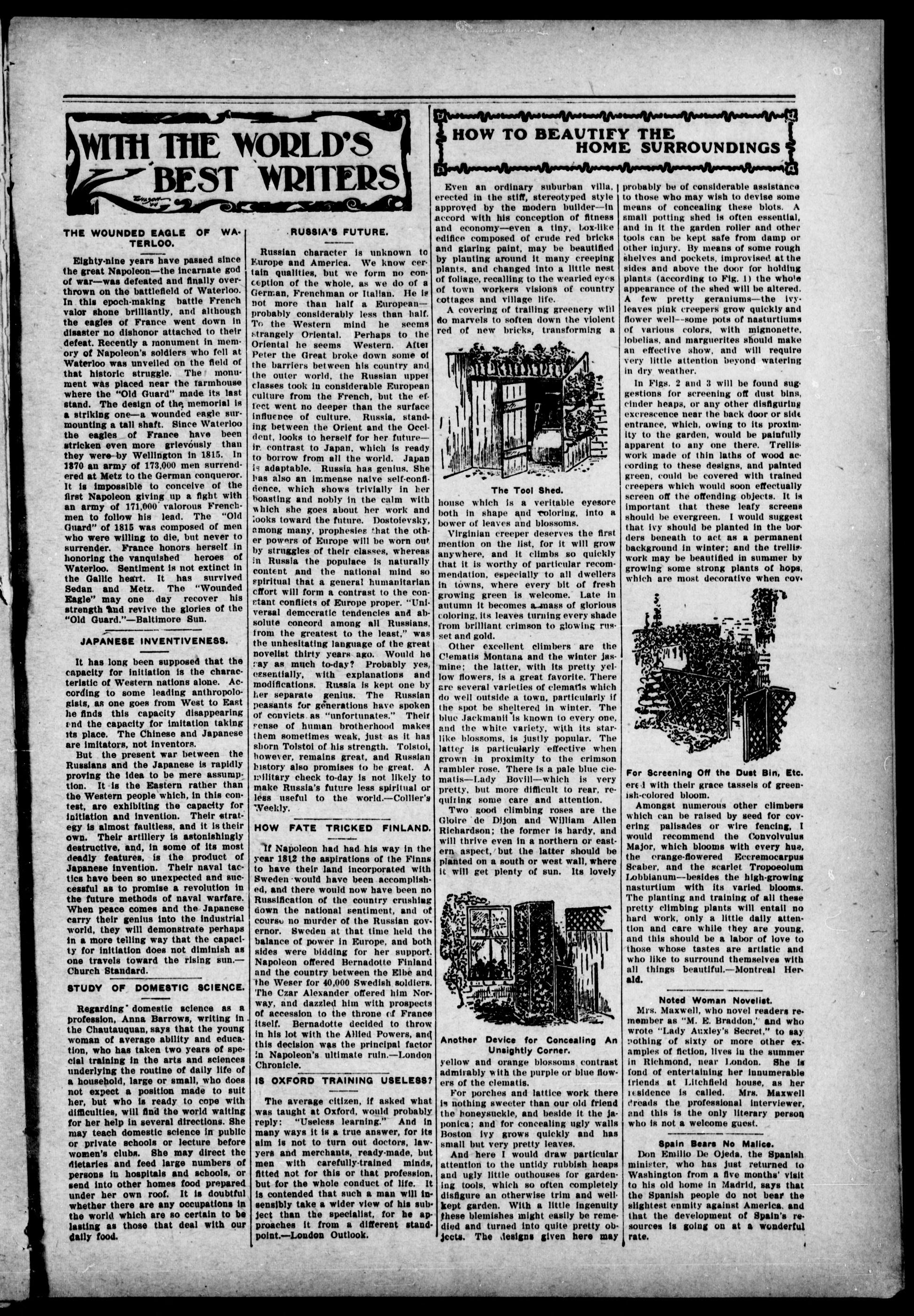
HOW TO BEAUTIFY THE
HOME SURROUNDINGS
Even an ordinary suburban villa, | probably be of considerable assistanc:
erected in the stiff, stereotyped style | to those who may wish to devise som
approved by the modern bullder—in | means of concealing these blots. /
accord with his conception of fitness | small potting shed is often essential
and economy—even a tiny, box-like | and in it the garden roller and othe
edifice composed of crude red bricks | tools can be kept safe from damp o
and glaring paint, may be beautified | other injury. By means of some roug!
by planting around it many creeping | shelves and pockets, improvised at th
plants, and changed into a little nest | sides and above the door for holdin:
of foliage, recalling to the wearied eyes | plants (according to Fig. 1) the who!
of town workers visions of country | appearance of the shed will be altere¢
cottages and village life. A few pretty geraniums—the iv;
A covering of trailing greenery will | leaves pink creepers grow quickly an
do marvels to soften down the violent | flower well--some pots of nasturtium
red of new bricks, transforming a|of various colors, with mignonett
Tartine ae
Nd fle
VL oad
UE dati
ie beak Tool Se
house which is a veritable eyesore
both in shape and toloring, into a
bower of leaves and blossoms.
Virginian creeper deserves the first
mention on the list, for it will grow
anywhere, and it climbs so quickly
that it is worthy of particwar recom-
mendation, especially to all dwellers
in towns, where every bit of fresh
growing green is welcome. Late in
autumn it becomes aanass of glorious
coloring, its leaves turning every shade
from brilliant crimson to glowing rus-
set and gold.
Other excellent climbers are the
Clematis Montana and the winter jas-
mine; the latter, with its pretty yel-
low flowers, is a great favorite. There
are several varieties of clematis which
do well outside a town, particularly if
the spot be sheltered in winter. The
bluc Jackmanii is known to every one,
and the white variety, with its star-
like blossoms, is justly popular. The
lattes is particularly effective when
grown in proximity to the crimson
rambler rose. There is a pale blue cie-
matis—Lady Bovill—which is very
pretty, but more difficult to rear, re-
quiring some care and attention.
Two good climbing roses are the
Gloire de Dijon and Wijliam Allen
Richardson; the former is hardy, and
will thrive even in a northern or east-
ern. aspect, but the latter should be
planted on a south or west wall, where
it will get plenty of sun. Its lovely
ic r-] fee BS
" Me A Bre lh
Sea
“gpa bere il,
wee Siete My ee
Another Device for Concealing An
Unsightly Corner.
yellow and orange blossoms contrast
admirably with the purple or blue flow-
ers of the clematis.
For porches and lattice work there
is nothing sweeter than our old friend
the honeysuckle, and beside it the ja-
ponica; and for concealing ugly walls
Boston ivy grows quickly and has
small but very pretty leaves,
And here I would draw particular
‘attention to the untidy rubbish heaps
and ugly little outhouses for garden-
ing tools, which so often completely
disfigure an otherwise trim and well-
kept garden. With a little Ingenuity
these blemishes might easily be reme-
died and turned into quite pretty ob-
dects. The lesigns given here may
probably be of considerable assistance
to those who may wish to devise some
means of concealing these blots. A
small potting shed is often essential,
and in it the garden roller and other
tools can be kept safe from damp or
other injury. By means of some rough
shelves and pockets, improvised at the
sides and above the door for holding
plants (according to Fig. 1) the whole
appearance of the shed will be altered.
A few pretty geraniums—the ivy-
leaves pink creepers grow quickly and
flower well--some pots of nasturtiums
of various colors, with mignonette,
Jobelias, and marguerites should make
an effective show, and will require
very little attention beyond watering
in dry weather,
In Figs. 2 and 3 will be found sug:
gestions for screening off dust bins,
cinder heaps, or any other disfiguring
excrescence near the back door or side
entrance, which, owing to its proxim:
ity to the garden, would be painfully
apparent to any one there. Trellis-
work made of thin laths of wood ac:
cording to these designs, and painted
green, could be covered with trained
creepers which would soon effectually
screen off the offending objects. It ia
important that these leafy screens
should be evergreen. I would suggest
that ivy should be planted in the bor.
ders beneath to act as a permanent
background in winter; and the trellis:
work may be beautified in summer by
growing some strong plants of hops,
which are most decorative when cove
3 ze
seat x
otis tener =
TO aes
see tree Me berbas iil
ra ae fd)
igs De Be ES
erent eal ea EE
TR aera lt
Rete a tt
boas ae berm eos
Caetano .
Fong UNS BH Fa IS
LARSON SER | *
te eel 5 cy
eS . Boal
~ oe Patsy
For Screening Off the Dust Bin, Etc.
ered with their grace tassels of green-
ish-colored bloom,
Amongst numerous other climbers
which can be raised by seed for cov-
ering palisades or wire fencing, I
would recommend the Convolvulus
Major, which blooms with every hua,
the crange-flowered Eccremocarpus
Scaber, and the scarlet Tropoeolum
Lobbianum—besides the high-growing
nasturtium with its varied blooms.
The planting and training of all these
pretty climbing plants will entail no
hard work, only a little dally atten-
tion and care while they are young.
and this should be a labor of love to
those whose tastes are artistic and
who like to surround themselves with
all things beautiful.—Montreal Her.
ald.
Noted Woman Novelist.
Mrs. Maxwell, who novel readers re-
member as “M. E. Braddon,” and who
wrote “Lady Auxley’s Secret,” to say
vothing of sixty or more other ex-
amples of fiction, lives in the summer
in Richmond, near London. She is
fond of entertaining her innumerable
friends at Litchfield house, as her
1esidence {is called. Mrs. Maxwell
ereads the professional interviewer,
and this is the only lterary person
who is not a welcome guest.
Spain Bears No Malice.
Don Emilio De Ojeda, the Spanish
minister, who has just returned to
Washington from a five months’ visit
to his old home in Madrid, says that
the Spanish people do not bear the
slightest enmity against America, and
that the development of Spain's re-
sources is going on at @ wonderful
rate. ;
LAND MEN MAD
AGENT SHOENFELT 18 SPOILING THEIR SCHEMES
MANY RESTRICTIONS NOT TO BE REMOVED
Mr. Shoenfelt is Standing Between Indians and Land Sharks—Many Applications Will Not Receive His Recommendation
MUSKOGEE: The attitude of the Indian agent, Mr. Shoenfelt, in regard to the removal of restrictions upon the sale of lands by allottees of Indian blood is proving a great disappointment to the land sharks. During the past week the agent has done practically nothing but sign his name to recommendations to the interior department in reference to applications already passed upon, and it is reported upon good authority that less than 3 per cent have met with his approval. One day 152 recommendations were transmitted through the mail, and 147 of these bore the stamp of the agent's disapproval.
The land men are furious. They have gone to considerable expense to herd the Indians into line, and get their applications before the department early. With the freedmen they had experienced an easy conquest, and had anticipated a similar success in case of the Indians of blood. But the Indian agent has forestalled them, and has brought upon himself the brunt of their indignation. Up to date there are 1,100 applications pending, but unless there is a change of policy not more than thirty of these will be approved. Colonel Shoenfelt has given out this statement:
"I do not feel at liberty to state just what has been done. I can only recommend to the department, and therefore my action is not necessarily final. However, I can say that the class of citizens that the land sharks are running in here will never have their restrictions removed with my approval. Why, in the Choctaw nation they have gone into the mountains and bargained with the fullbloods who have always secluded themselves from civilization, and then brought their applications into this office, apparently with the presumption that favorable action would be taken. To turn these Indians loose to be fleeced by these unscrupulous dealers would be the greatest outrage of the century. And in the other nations the situation is little better. Of course, however, there are a few applicants who are really intelligent and other whose interests demand that some of their land be disposed of, but these will be treated in a different light."
Any Indian is permitted to sell his land under the sealed bid system, authorized by act of congress July 10, 1903, and the agency seems to think this the proper method. In this case the vendor is certain to receive a good price for his land, and he is subject to no embarrassment. If the land is valuable there will be bids in plenty, and if none are high enough to suit he can reject all and readvertise.
But Colonel Shoenfelt seems to be of the opinion that it is not at all necessary for all of the Indians to sell now. He thinks that, with the present outlook in the mineral fields, they will profit by holdnig onto their possessions awhile longer. That is, except in a few rare cases, such as the ones mentioned above.
A postoffice has been established at Black Rock, district sixteen, Indian Territory, with Mintre A. Woolverton as postmaster.
CREEK LAND SALES
Nearly Half a Million Dollars Has Been Paid Allottees
MUSKOGEE: On the 10th of May, 1903, the rules and regulations for the sale of Creek allotted land through the Union agency in this city were promulgated by Secretary Hitchcock, and a short time thereafter were put into effect by Mr. Jones, the United States commissioner of Indian affairs. A careful examination of the sales that have been made since that time brings out some interesting facts in regard to the first year's progress under the system now in vogue. Up to July 1, 1904, the total amount of money paid through the agency to allottees for land was $488,150. The total number of tracts on which bids were accepted was 465. The total number of tracts on which petitions to sell were filed and advertised were 1,439. On 137 of these no bids were received. On 207 the petitions were witdrawn because they were filed by freedmen and a provision of the Indian appropriation bill permits them to sell without restriction, and they cannot sell through the agency. The number of deeds approved by the department and delivered to the purchasers was 259, and the number disapproved was nine, the remainder being under consideration at that time. The bids for the latter amounted to $31,637.
The allottees rejected bids on forty three tracts, and the agency rejected all bids on 280 because they were below the appraisement. The total acreage offered for sale was 121,900 acres. Total acreage bought out and paid for was 40,500. Total acreage rejected, being below the appraisement, 23,500. Total acreage rejected by allottees, 4,000. Total acreage on which there were no bids. 11,500.
From the above it will be seen that almost half a million dollars was paid to Creek citizens for lands during the time stated, and that more than 40,000 acres of Creek land changed hands. The present fiscal year will no doubt show a large increase over 1903, and it is confidently expected that by July 1, 1905, more than 10,000 acres will have been sold and paid for. The sales consumed amount to a trifle less than 23 1-3 per cent of the land listed, and the average price per acre is $12.20.
TORNADO AT ST. LOUIS
World's Fair Grounds Visited by a Wind Storm
ST. LOUIS: A terrific thunder storm broke over St. Louis Friday night, and rain fell in torrents, accompanied by heavy wind. Within ten minutes .67 of an inch of rain fell. The velocity of the wind was fifty-two miles an hour. The storm blew in the north windows of the Utah state building at the World's fair grounds and rain did damage to carpets and draperies estimated at from $150 to $200.
A concert was in progress in Festival hall in the exposition during the heavy thunderstorm, when suddenly there was a flash of lightning and immediately all the lights went out. The audience became panic-stricken. An actual panic was only prevented by a woman's voice taking up the strains of "America," in which others joined. The audience left the building singing, but without excitement.
In the Chinece village on the Pike 360 Chinamen, just arrived, were being watched over by immigration officials temporarily when the storm struck. The celestials became panic-stricken, and the officers were forced to draw revolvers to subdue them. Lightning struck near by, and one Chinaman was severely shocked, while another jumped from the roof of the building and broke his arm. The band stand in the Plaza of St. Louis was struck by lightning and the roof was glightly burned.
MOB LAW REIGNS
MOB LAW REIGNS
AN EFFORT TO RID A GEORGIA CETTLEMENT OF NEGROES
COLORED INHABITANTS REGEIVE LASHES
Three Negroes Known to Have Been Shot—Several Floggings Are Reported—Statesboro Militia Alleged to Have Resigned
STATESBORO, GA.: One negro found dead by the roadside five miles east of the town, his body pierced two rifle bullets; two negroes, one of the "old time darkies," and his son, seventeen years old, shot in their cabin during the late hours of night by unknown marauders; half a dozen cases of floggings—such was the history of a day. The scene of excitement has shifted from this town to the rich agricultural region surrounding it. At Alexander Riggs' mill several well to do white planters met to plan to rid their neighborhood of obnoxious negroes. Individual negroes were marked for lashings and part of the programme was carried out.
It is stated that the Statesboro militiamen have prepared their resignations for the governor. The military mismanagement was also manifested when the officer in command, it is reported, took charge of the local telegraph office and for an hour censored all messages, and some messages were withheld from the wires
BURNED AT THE STAKE
The Awful Fate of Georgia Negroes Convicted of Murder
STATESBORO, GA.: With clothing saturated with kerosene, writhing and twisting in their agony, screaming to heaven for the mercy that the mob would not show, Paul Reed and Will Cato, two of the principals in the murder and burning of Henry Hodges and wife and three of their children, six miles from Statesboro, three weeks ago, were burned at the stake. A mob charged on the court house, overpowered the military guard, secured Cato and Reed, who had been found guilty after a legal trial and sentenced to be hanged, took them two miles from Statesboro and there burned them alive.
DAVIS OFFICIALLY INFORMED
The Democratic Nominee for Vice President Receives the Message
WHITE SULPHUR SPRINGS. W. VA.: Henry G. Davis was formally notified of and formally accepted his nomination by the Democratic party for vice president of the United States. The ceremonies took place in the open air in the grounds of Green Briar White Sulphur Springs hotel, and were marked by simplicity. Mr. Davis was escorted to the flag-draped platform by Representative John Sharp Williams of Mississippi who delivered the notification address. Mr. Williams occupied an hour in speaking. It took Mr. Davis ten minutes to read his formal acceptance, but he prefaced this with a heart to heart talk of like duration to the several thousand friends and neighbors who were gathered under the trees.
A Santa Fe Train Into a Ditch
SCRANTON, KAS.: A special train from Cincinnati, bound for Coronatic Beach, Cal., and running as the second section of No. 5 on the Atchison, Topeka & Santa Fe railroad, was ditched one mile east of Scranton. One person was fatally injured, five were hurt seriously and six others sustained light injuries.
MORE CROOKED WORK
Dawes Commission Ordered to Make a Thorough Investigation
WASHINGTON: "Investigate the Tishomingo land office from turret to foundation stone," was the order issued to the Dawes commission by Mr. Ryan, the acting secretary of the interior department. That the secretary does not intend to have any of the guilty escape is evidenced by a statement given out in which it is said the resignation of one of the implicated clerks has already been offered, but had been refused, and that the persons involved in the Tishomingo scandal would be held to answer to the United States court. It is also Judge Ryan's intention to go after certain attorneys who, it is said, were in collusion with the record clerks and thereby assisted greatly in the selecting and locating of allowments of their clients. In other words, the department is preparing a big dragnet, and everybody implicated must either clear himself or take medicine.
Speaking in his usual deliberate manner, Judge Ryan said in regard to the investigation now going on in the territory:
"The department has already received a preliminary report on the Tishomingo land office scandal. A thorough investigation has been ordered, and the guilty persons will be punished. The report received from the department by the Dawes commission shows that the chief clerk of the Tishomingo office brought about the investigation by having his suspicions aroused by irregularities on the part of certain members of his clerical force.
"This state of affairs was al once reported to headquarters at Muskogee and within a few hours a thorough investigation had been ordered. So far, one clerk has been deeply implicated, while others have been placed in a very compromising light."
MAKING A TEST SUIT
The Katy Wants About 3,000,000 Acres in Indian Territory MUSKOGEE: The Missouri, Kansas & Texas Railway company has filed suit in the United States court here against James Bullett, a citizen of the Creek nation, for possession of an allotment. This is the beginning of several suits which will be filed and made test cases.
The claim the Missouri, Kansas & Texas has against the government is that it was to receive every alternate section of land for five miles on either side of its right of way through the Indian Territory. In 1886, it is claimed by the railway company, congress made a grant to the first railroad that would build a line through the territory from the Kansas line to the Texas line. The Katy and the Santa Fe tried for the prize, but the former got its line through and won out. The grant reads:
"As soon as Indian title is extinguished and the land becomes public domain it shall become the property of the railroad." The title has never been passed to the government, and the land has not become public domain. The railroad contends that this is fraud, and that the government alloted the land this way to avoid fulfilling the grant. There are 3,200,000 acres of land involved. The railroad was to get the odd sections, and some of the towns of the territory are located on these odd sections.
The abstractors of Oklahoma or of A. E. Saxey of El Reno as president of A. E. Saxey of Rel Reno as president; George Carron of Norman, secretary, and L. M. Bennett of Kingfisher, treasurer. A legislative committee will be named to secure the passage of a measure requiring the county treasurers to carry on the current tax rolls the delinquent taxes as far back as 1893.
Mr. J. P. Dixon has returned from Kansas City.
H. C. Cavill of Boley, I. T., registered at the Maceu.
Rev. Thos. Shannon of Wacc. Texas, is here on business.
Mr. A. Parker of Boynton was here on business, Monday.
Prof. Gordon went to So. McAlester this morning on business
J. W. Mason of Stoneham, Texas is visiting relatives near Porter.
Mias Addie Heywood spent last week at Wewoka, visiting relatives.
N. McMeans of McKinney, Texas, was visiting Muskogee, Sunday.
L. F. Fue made a business trip to Wagoner the early part of the week.
K. N. Shannon and T. R. Ruler of Checotah were among us this week.
T. J. Tatum of Arcadia, O. T., was prospecting in Muskogee this week.
Messrs I. and M. D. Byrd of Little Rock, Ark., visited Muskogee, Sunday.
Messrs Thomas and Daniel Manual of Twine, I. T., made us a pleasant call Wednesday.
Dr. J. H. Garnett of Lincoln Institute, Jefferson City, Mo., is in the city on business.
Mrs. D. D. Payne of Humbolt, Kansas, is in the city visiting her niece, Mrs. Trimble.
Mrs. Georgia Thomas of Dallas Texas was visiting her sister-in-law, Mrs. Irving King last week.
Mr, K. Shannon and father of Checotah are in the city on business before the Dawes Commission.
The crops in the nation will be very large and cotton pickers will be in demand until very late in the fall.
The city school will not commence until Oct. on account of the delay in getting the building completed.
Rev. N. A. Robinson of Rentieville passed through the city Monday enroute to Cloud Creek conclave.
Postmaster Smith from the city of Grayson is in the city on business; he reports the colored town on a boom.
Mr. E. Hearne is special agent and solicitor for the Cimeter, he will visit the different city in the Territory in our interest.
The U. S. Jail. is about completed and soon their will be a change of quarters that will be for the better of all concerned.
Paul F. Pierce and sister, Miss J. M. Pierce, from Montgomery, Ala, are here and will be employed by the J. W. Anams' Dry Goods & Millinery Co. on Okmulgee Ave.
The cus(tomer) from Adam's Creek ejaculated, "Ise gwine to quit gazing at de stars and pick up dese diamonde at my feet."
Mr. J. W. Adams who will soon open a first-class Dry Goods and Milinery store comes to us very highly recommended. His recommendations are from Mayor, Chief of Police, Postmaster and financiers of Montgomery, and Governor of Alabama; last but not least, Booker T. Washington. Mr. Adams deserves the trade of the people of this locality and should be encouraged, he is a past master in the art of merchandising and his patrons will receive full benefit.
Tourist Rates.
The Frisco System will issue during the Summer months, Tourist round-trip tickets to various resorts and locations-the mountains, Lakes and Seashore, at greatly reduced rates, with ample return limit. Call on nearest agent or address Passenger traffic Dept., St. Louis
A S McRea
ATTORNEY-AT-LAW
PHONE 300 ROOM 11
Sharum Building. Muskogee, Ind, Ter.
DR. R. H. WATERFORD.
Diseases for women and children successful
treated. Also chronic diseases of men.
Office, 101 1-2 N. Main St.
Residence 813 S. Main St
THE POPULAR . . .
BOOT & SHOE MAKER,
E. L. SAMUELS.
140 South Second Street,
FRISCO SYSTEM
COMPLETELY AND COMFORTABLY SERVE WESTERN MISSOURI AND EASTERN KANSAS TO THE PRINCIPAL CITIES
EAST,
WEST,
NORTH,
SOUTH.
PULLMAN SLEEPERS,
RECLINING CHAIR CARS.
TRAINS LIGHTED AND VENTILATED BY ELECTRICITY.
The Direct Route to the
"WORLD'S FAIR CITY"
SAINT LOUIS
For detailed information, call on nearest representative FRISCO SYSTEM, or address
L. W. PRICE,
Division Passenger Agent,
JOPLIN, MO.
W. H. TWINE,
Lawyer.
Will practice in U. S. Court and
Daws Commission. Office on Second
Street.
Durfey Hardware Company
Shelf and Heavy Hardware, Tinware, the Celebrated Monarch Ranges, everyone guaranteed, Builders' Tools, etc. All Kinds of Tin Work and Plumbing, Refrigerators and Ice Coolers. PHONE 205 BOWSEY BLOCK III North Second Street.
Realty Bank & Trust Co.
Money loaned on Real Estate, Chattel and personal security : ; : : : :
Deposits Recaived. Your Business Solicited. A,G. W. SANGO, President. W. A. RENTIE, Cashier.
HAND MADE CLOTHING, SHIRTS ALL KINDS OF HATS.
Muskogee. - - - Ind. Ter'v.
GREEK GROCERY CO., DEALERS IN STAPLE AND FANCY
GROCERIES
AND HIGH PATENT FLOUR. The Loading Colored Grocery Company in the City. We also buy and pay the highest prices for Country Produce. Located on West End St., South of the U. S. Post Office.
WESTERN OIL,
CAPITAL STOCK $300,000, Issued in shares of ...$25.00...
Non-accessible and carrying no personal liability. Offered and directed by prominent business men of Indian Territory. The Company has a lease on 10 acres of land near the Famous Red Fork Gusher at Red Fork, L. T. In addition to this property, the Company has an option on Oil Land in the Creek Nation that can be bought as soon as the owners get title to same. As Gushers have been discovered near property controlled by this Company, we feel that every owner of stock in this Company is on the road to Fortune. Stock in this Company is now offered at $25.00 per share. If you want to reap a Fortune from investment, send remittance or write for prospective to