Muskogee Cimeter
Thursday, September 22, 1904
Muskogee, Oklahoma
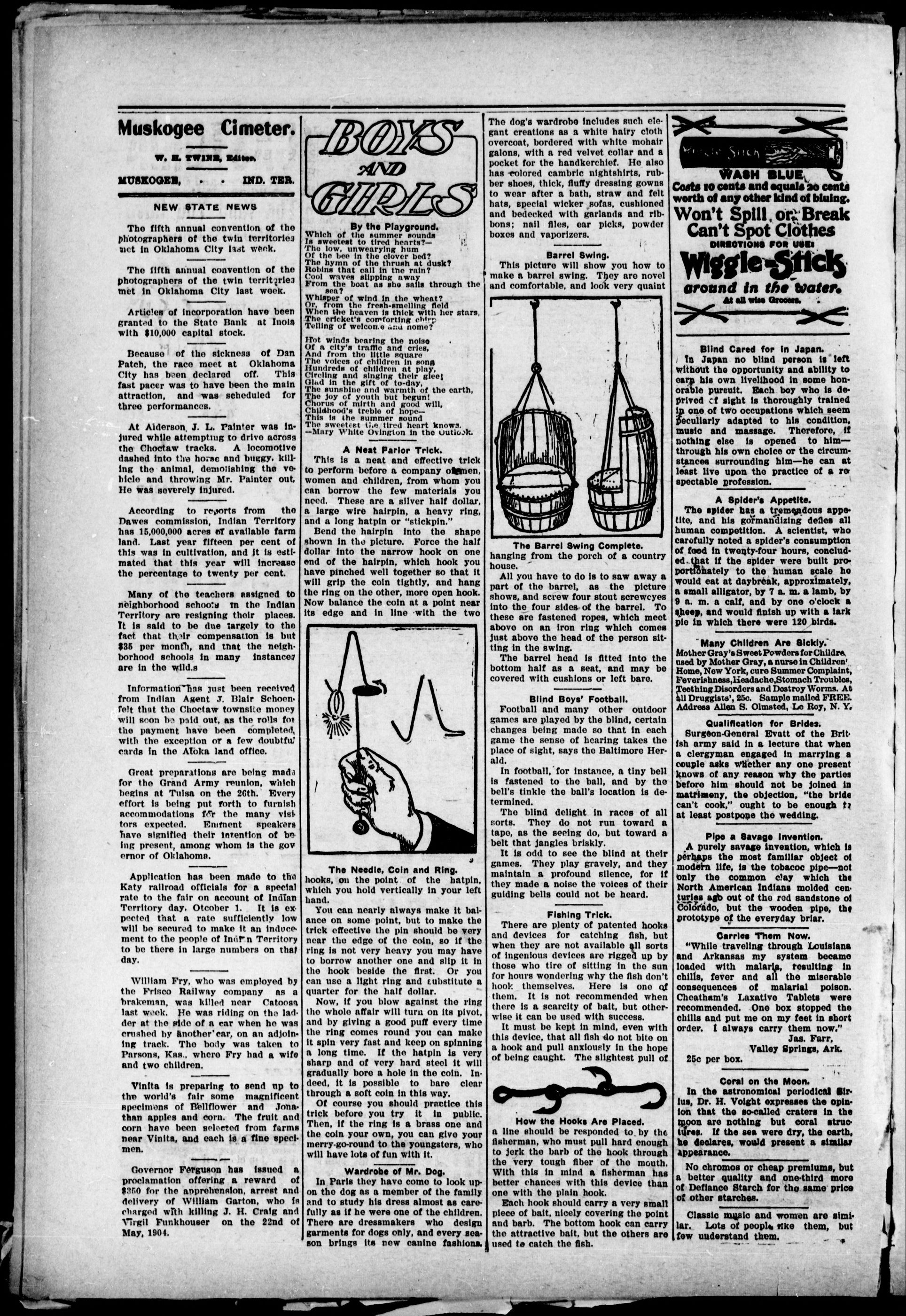
Page text (machine-generated)
Muskogee Cimeter
Single Copy 5 cents.
A LITTLE NONSENSE.
Tom—"And you say she is a great belle?" Jack—"You bet. Why, she actually has four silk pillows stuffed with hair from four different football players."—Philadelphia Record.
Identical.—Mr. Pitt—"It is odd that the lecturer's motto and the highwayman's motto are the same." Mr. Penn—"What is their motto?" Mr. Pitt—"Stand and deliver."—Pittsburg Chronicle-Telegraph.
Nothing Serious.—Tess—"I met Miss Le Fevre in Paris. She said she knew you." Jess—"Oh, yes. I learned French under her; did she tell you?" Tess—"No; she said you used to take lessons from her."—Philadelphia Press.
"There they go," said the fond mamma, exultantly, as her daughter and the count strolled away down the park. "Two souls with but a single thought." "Yes," said papa, who wasn't so impressionable. "I think you've just about hit their mental caliber."—Denver Times.
Mr. Horatio Horakle (who on the previous evening has given a reading of "Eugene Aram" at the churchwardens' entertainment)—"And how did you like the entertainment at the parish hall last night, Mary?" Mary—"Oh, lovely, sir! The dumb-bell ringers' was beautiful!"—Punch.
He Wanted to Know.—George—"Papa, how deep is the ocean?" Papa—"Very deep, dear. They have never been able to fathom some parts of it." George (after a moment's hesitation)—"Papa, I would like to have been there when they were digging it out."—Philadelphia Evening Bulletin.
Dumleigh—"There's nothing cranky about Mr. Synnex; he's a man of sense, he is!" Markham—"Flattering." Dumleigh—"Not a bit. Folks have been saying that smoking cigarettes weakened the intellect. I asked Mr. Synnex, and he told me to keep right on: it couldn't possibly have any effect on me." — Boston Transcript.
PITH AND POINT.
Better not encourage gossip; someone is busy with all of us.—Atchisos Globe.
He who is wise in his own conceits is apt to be foolish in his own concerns.—Ram's Horn.
One physician says that a compound fracture of the neck is a sure cure for the chronic grumbling habit.—Chicago Daily News.
The Point of View.—"Is she a success as a singer?" "That depends on the point of view." "How so?" "She thinks she is and the critics think she isn't."—Chicago Post.
Smith—"Charley is troubled with the big head." Jones—"Oh, I don't think it troubles Charley any. It is the other people who do the suffering."—Boston Transcript.
"You are charged," said the Billville justice, "with stealing two gallons of whisky. Why did you do it?"
"Kaze I couldn't git away with a barrel, yer honor—I never was very strong!"—Atlanta Constitution.
Of More Practical Benefit.—"Do you think that the study of ancient languages is of any value in literature?" "No." said the publisher; "not as books are written to-day. What the student wants now is a familiarity with modern slang." — Washington Star.
Muskogee, I. T., Thursday, September 22, 1904.
Notes From Exchanges.
"This Government is based upon the fundamental idea that ease man, no matter what his occupation, his race or his religious belief, is entitled to be treated on his worth as a man, and neither favored nor discriminated against because of any accident in his position. Even here at home there is a painful difficulty in the effort to realize this ideal and the attempt to secure from other nations acknowledgement of it sometimes encounters obstacles that are well nigh inseperable."
Theodore Roosevelt in his letter of acceptance of the nomination as President of the United States. The above clause in President Roosevelt's letter of acceptance bears out the well known fact that he is a man who never backs down faom the standard he has set up and proves that he is the president of all the people regardless of race or color.
The American public which pretends to be such a great lover of fair play has in this man an ideal representative. Never before in the history of our country have we had a chief executive who would so boldly pronounce his views regardless of public sentiment. Theodore Roosevelt stands in a class to himself, an American of Americans. As such he is the best man for the White House which Alton B. Parker and the party that nominated him will doubless find out. Ex.
After the white race has "Jim Crowed', all of the Negro's privileges, and disfranchised him completely, that class of "ikes" that stand on street corners and in public places discussing the political situation and the everlasting Negro problem, will at last come to the full realization of the importance of paying their poll tax and the value of the ballot. If our colored citizens had possessed more poll tax receipts, a Republican representative would have been sent to our next state legislature and thus ene blow at least would have been struck against school tax segregation and other "Jim Crow" measures.—Ex
A few issues ago, we noticed in our contemporary, The Comet, of Muskogee, an account of the intention of some young people there to devise ways and means for the completion of the Baptist church that was started some time past, but stopped for the lack of funds. We commend these young people, and venture to say that, that is a move in the right direction. The majority of these young people we
understand, belong to other denominations, thus making their actions more commendable. It is high time, that our people should be encouraged along these lines, and forever lay aside the petty differences of denominationalism or no denomination at all. The cause is a good one, and it affects, or will effect our people as a whole, thus we see the advisability of urging all to emulate those young people, by giving a strong pull, and a pull altogether towards the completion of that splendid edifice. The time is opportune, for if the walls and other materials be left open to the weathering effect of a probably rigid winter, irreparable injury might thereby be occasioned, but on the other hand should there be a materialization of the efforts inaugurated to complete that building, an amount of money so far expended will be saved, and a structure that will redown to the credit of the race will have been constructed.—Echo.
OUR ADVERTISERS
A practical woman of this town remarked the other day that she read the advertisements in a newspaper than anything else. "And long ago," she said, "I quit buying of those who do not advertise. It always seem to me that the merchant who advertises incites me to trade with him, while the one who does not advertise impresses be with the idea that he doesn't care enough for my trade to ask for it. Then, too, I know that the merchant who advertises has fresher goods for the reason I suppose he sells more"—Ex
LIT RARY PROGRAM
The Fortnightly Culture Club will hold its meeting Friday evening, September 30th, 30th, 1904, at the A. M. E. church, at which time the following program will be rendered:
Song—Audience.
Invocation—Chaplain.
Roll Call—Quotations from Milton.
Paper—Mr. E. W. Brown.
Solo—Mrs. L. C. Clark.
Budget—Dr. J. I. Teague.
Solo—B. F. Brown, Jr.
Paper—Mrs. E. E. Sims.
Debate:—Resolved, That "Single State-hood will best conserve the interests of the inhabitants of the twin territories. Aff., Prof. C. A. Biggers; Neg., Wm. S. Peters, Esq. Twenty minutes for discussion by members of the club. Everyone is cordially invited to be present. Bargains in City property—See or write Twine, Muskogee, I. T.
Vol. 5. No. 50.
"YOUR MOTHER"
We have just received one of the most beautiful home songs that has of late come to this office. It is called "Your Mother," written by J. T. Rider. This is song that everybody ought to buy and everybody ought to sing.
CHORUS
Why, your mother, your own mother
Such affection could come from no other
In sunshine or rain, in pleasure or pain
The one you loved best was your mother.
Price 50 Cents Per Copy
Readers of our paper, by sending 25 cents in postage stamps to the Theatrical Music Supply Co., 44 W. 28th St. New York, will receive a copy mailed to them post paid.
MUSKOGEE UNION RAILWAY.
Ft. Smith and Wagoner and the Kansas and Cherokee Oil Fielda, via Coretta and Missouri Pacific Ry.
Lv. Muskogee—
9:80 a. m. and 8:05 p. m.
Ar. Ft. Smith—
19:55 p. m. and 11:45 p. m.
Lv. Ft. Smith—
4:00 a. m. and 3:15 p. m.
Ar. Muskogee—
7:81 a. m. and 7:85 p. m.
Lv. Muskogee—
6:25 a. m. and 6:30 p. m.
Ar. Wagoner—
7:10 a. m. and 8:10 p. m.
Lv. Wagoner—
9:55 a. m. and 9:17 p. m.
Lv. Muskogee—
10:46 a. m. and 2:17 p. m.
For time of trains beyond Wagoner
see Missouri Pacific Iron Mountain
time tables
A. R. PAYINGHAUS. Traffic Manager.
FRISCO
SYSTEM
COMPLETELY AND COMFORTABLY
SERVE WESTERN MISSOURI
AND EASTERN KANSAS TO
THE PRINCIPAL CITIES
EAST,
WEST,
NORTH,
SOUTH.
PULLMAN SLEEPERS,
RECLINING CHAIR CARS.
TRAINS LIGHTED AND
VENTILATED BY ELECTRICITY.
The Direct Route to the
"WORLD'S FAIR CITY"
SAINT LOUIS
For detailed information, call
on nearest representative FRISCO
SYSTEM, or address
L. W. PRICE,
Division Passenger Agent,
JOPLIN, MO.
---
Muskogee Cimeter.
W. H. TWINE, Edited.
MUSKOGEB, IND. TER.
NEW STATE NEWS
The fifth annual convention of the photographers of the twin territories met in Oklahoma City last week.
The fifth annual convention of the photographers of the twin territories met in Oklahoma City last week.
Articles of incorporation have been granted to the State Bank at Inola with $10,000 capital stock.
Because of the sickness of Dan Patch, the race meet at Oklahoma City has been declared off. This fast pacer was to have been the main attraction, and was scheduled for three performances.
At Alderson, J. L. Painter was injured while attempting to drive across the Choctaw tracks. A locomotive dashed into the horse and buggy, killing the animal, demolishing the vehicle and throwing Mr. Painter out. He was severely injured.
According to reports from the Dawes commission, Indian Territory has 15,000,000 acres of available farm land. Last year fifteen per cent of this was in cultivation, and it is estimated that this year will increase the percentage to twenty per cent.
Many of the teachers assigned to neighborhood schools in the Indian Territory are resigning their places. It is said to be due largely to the fact that their compensation is but $35 per month, and that the neighborhood schools in many instances are in the wilds.
Information has just been received from Indian Agent J. Blair Schoenfelt that the Choctaw townsite money will soon be paid out, as the rolls for the payment have been completed, with the exception or a few doubtful cards in the Afoka land office.
Great preparations are being made for the Grand Army reunion, which begins at Tulsa on the 26th. Every effort is being put forth to furnish accommodations for the many visitors expected. Engment speakers have signified their intention of being present, among whom is the governor of Oklahoma.
Application has been made to the Katy railroad officials for a special rate to the fair on account of Indian Territory day. Otcober 1. It is expected that a rate sufficiently low will be secured to make it an inducement to the people of Indian Territory to be there in large numbers on that day.
William Fry, who was employed by the Frisco Railway company as a brakeman, was killed near Catoosa last week. He was riding on the ladder at the side of a car when he was crushed by another'car, on an adjoining track. The body was taken to Parsons, Kas., where Fry had a wife and two children.
Vinita is preparing to send up to the world's fair some magnificent specimens of Bellflower and Jonathan apples and corn. The fruit and corn have been selected from farms near Vinita, and each is a fine specimen.
Governor Ferguson has issued a proclamation offering a reward of $350 for the apprehension, arrest and delivery of William Garton, who is charged with killing J. H. Craig and Virgil Funkhouser on the 22nd of May, 1904.
BOYS
AND
GIRLS
By the Playground.
Which of the summer sounds
Is sweetest to tired hearts?—
The low, unwearying hum
Of the bee in the clover bed?
The hymn of the thrush at dusk?
Robins that call in the rain?
Cool waves slipping away
From the boat as she sails through the
sea?
Whisper of wind in the wheat?
Or, from the fresh-smelling field
When the heaven is thick with her stars,
The cricket's comforting chirp
Telling of welcome and nome?
Hot winds bearing the noise
Of a city's traffic and cries,
And from the little square
The volces of children in song
Hundreds of children at play,
Circling and singing their glee;
Glad in the gift of to-day,
The sunshine and warmth of the earth,
The joy of youth but begun!
Chorus of mirth and good will,
Childhood's treble of hope—
This is the summer sound
The sweetest the tired heart knows.
—Mary White Ovington in the Outlook.
A Neat Parlor Trick.
This is a neat and effective trick to perform before a company of women, women and children, from whom you can borrow the few materials you need. These are a silver half dollar, a large wire hairpin, a heavy ring, and a long hatpin or "stickpin." Bend the hairpin into the shape shown in the picture. Force the half dollar into the narrow hook on one end of the hairpin, which hook you have pinched well together so that it will grip the coin tightly, and hang the ring on the other, more open hook. Now balance the coin at a point near its edge and in line with the two
J
hooks, on the point of the hatpin, which you hold vertically in your left hand. You can nearly always make it balance on some point, but to make the trick effective the pin should be very near the edge of the coin, so if the ring is not very heavy you may have to borrow another one and slip it in the hook beside the first. Or you can use a light ring and substitute a quarter for the half dollar.
Now, if you blow against the ring the whole affair will turn on its pivot, and by giving a good puff every time the ring comes round you can make it spin very fast and keep on spinning a long time. If the hatpin is very sharp and of very hard steel it will gradually bore a hole in the coin. Indeed, it is possible to bare clear through a soft coin in this way.
Of course you should practice this trick before you try it in public. Then, if the ring is a brass one and the coin your own, you can give your merry-go-round to the youngsters, who will have lots of fun with it.
Wardrobe of Mr. Dog.
In Paris they have come to look upon the dog as a member of the family and to study his dress almost as carefully as if he were one of the children. There are dressmakers who design garments for dogs only, and every season brings its new canine fashions.
the dog's wardrobe includes such elegant creations as a white hairy cloth overcoat, bordered with white mohair galons, with a red velvet collar and a pocket for the handkerchief. He also has colored cambric nightshirts, rubber shoes, thick, fluffy dressing gowns to wear after a bath, straw and felt hats, special wicker sofas, cushioned and bedecked with garlands and ribbons; nail files, ear picks, powder boxes and vaporizers.
Barrel Swing.
This picture will show you how to make a barrel swing. They are novel and comfortable, and look very quaint
```markdown
```
The Barrel Swing Complete.
The Barrel Swing Complete. hanging from the porch of a country house. All you have to do is to saw away a part of the barrel, as the picture shows, and screw four stout screwcyes into the four sides of the barrel. To these are fastened ropes, which meet above on an iron ring which comes just above the head of the person sitting in the swing. The barrel head is fitted into the bottom half as a seat, and may be covered with cushions or left bare.
Blind Boys' Football.
Football and many other outdoor games are played by the blind, certain changes being made so that in each game the sense of hearing takes the place of sight, says the Baltimore Herald.
In football, for instance, a tiny bell is fastened to the ball, and by the bell's tinkle the ball's location is determined.
The blind delight in races of all sorts. They do not run toward a tape, as the seeing do, but toward a belt that jangles briskly.
It is odd to see the blind at their games. They play gravely, and they maintain a profound silence, for if they made a noise the voices of their guiding bells could not be heard.
Fishing Trick.
There are plenty of patented hooks and devices for catching fish, but when they are not available all sorts of ingenious devices are rigged up by those who tire of sitting in the sun for hours wondering why the fish don't hook themselves. Here is one of them. It is not recommended when there is a scarcity of bait, but otherwise it can be used with success. It must be kept in mind, even with this device, that all fish do not bite on a hook and pull anxiously in the hope of being caught. The slightest pull of
How the Hooks Are Placed.
a line should be responded to by the fisherman, who must pull hard enough to jerk the barb of the hook through the very tough fiber of the mouth. With this in mind a fisherman has better chances with this device than one with the plain hook. Each hook should carry a very small piece of bait, nicely covering the point and barb. The bottom hook can carry the attractive bait, but the others are used to catch the fish.
WASH BLUE
Costs 10 cents and equals 20 cents
worth of any other kind of bluing.
Won't Spill or Break
Can't Spot Clothes
DIRECTIONS FOR USE:
Wiggle-Stick
around in the water.
At all wise Grocers.
Blind Cared for in Japan. In Japan no blind person is left without the opportunity and ability to carp his own livelihood in some honorable pursuit. Each boy who is deprived of sight is thoroughly trained in one of two occupations which seem peculiarly adapted to his condition, music and massage. Therefore, if nothing else is opened to him—through his own choice or the circumstances surrounding him—he can at least live upon the practice of a respectable profession.
A Spider's Appetite.
The spider has a tremendous appetite, and his gormandizing defies all human competition. A scientist, who carefully noted a spider's consumption of food in twenty-four hours, concluded that if the spider were built proportionately to the human scale he would eat at daybreak, approximately, a small alligator, by 7 a. m. a lamb, by 9 a. m. a calf, and by one o'clock a sheep, and would finish up with a lark pie in which there were 120 birds.
Many Children Are Sickly.
Mother Gray's Sweet Powders for Children used by Mother Gray, a nurse in Children' Home, New York, cure Summer Complaint, Feverishness, Headache, Stomach Troubles, Teething Disorders and Destroy Worms. At all Druggists', 25c. Sample mailed FREE Address Allen S. Olmsted, Le Roy, N. Y.
Qualification for Brides.
Surgéon-General Evatt of the British army said in a lecture that when a clergyman engaged in marrying a couple asks whether any one present knows of any reason why the parties before him should not be joined in matrimony, the objection, "the bride can't cook," ought to be enough fr at least postpone the wedding.
Pipe a Savage Invention.
A purely savage invention, which is perhaps the most familiar object of modern life, is the tobacoc pipe—not only the common clay which the North American Indians molded centuries ago out of the red sandstone of Colorado, but the wooden pipe, the prototype of the everyday briar.
Carries Them Now.
"While traveling through Louisiana and Arkansas my system became loaded with malaria, resulting in chills, fever and all the miserable consequences of malarial poison. Cheatham's Laxative Tablets were recommended. One box stopped the chills and put me on my feet in short order. I always carry them now."
Coral on the Moon.
In the astronomical periodical Sirius, Dr. H. Voight expresses the opinion that the so-called craters in the moon are nothing but coral structures. If the sea were dry, the earth, he declares, would present a similar appearance.
No chromos or cheap premiums, but a better quality and one-third more of Defiance Starch for the same price of other starches.
Classic music and women are similar. Lots of people like them, but few understand them.
Adam lived 930 years—Noah died aged 950. For fourteen centuries man lived on vegetables and there was no decrease in the years of life. From the time of the Flood to the time of Moses, about eight centuries, flesh eating existed and there was a decrease of 800 years in the longevity of man. Is not the rapid falling off of man's existence traceable directly to meat eating? The foods for a long life are those that come from Mother Earth—vegetables, fruits, nuts and cereals.
To oure, or money refunded by your merchant, so why not try it? Price 50o.
A QUICK RECOVERY.
A Prominent Officer of the Order of Rebeccas writes to Thank Doan's Kidney Pills for it. Mrs. C. E. Bumgardner, a local officer of the Rebeccas, of Topeka, Kans.,
Room 10, 512 Kansas Ave., writes: "I used Doan's Kidney Pills during the past year, for kidney trouble and kindred ailments. I was suffering from pains in the back and headaches, but found after the use of one box of the remedy that the troubles gradually disappeared so that before I had finished a second package I was well. I, therefore, heartily endorse your remedy." (Signed) Mrs. C. E. Bumgardner.
A
A FREB TRIAL-Address Foster Milburn Co., Ruffalo, N. Y. For sale by all dealers. Price, 50 cts.
The Arkansas Notion.
"Eh-Yah!" drawled Mr. Plunk Jarlick, a prominent but moss-grown citizen of the great commonwealth of Arkansas. "Wife trains the children up in the way they should go, when she ain't got nothin' else to do; but I'm yer to say that it takes about all the time of a tollable smart man to complete the edjercation of a good huntin' dog."—Puck.
Has to Be Cited.
"Possibly there is something on earth that is a surer and quicker cure for cuts, burns, aches, pains, and bruises than Hunt's Lightning Oil. If so, I would like to be cited. For twenty years I have been unable to find anything better myself."
Savages First to Use Mortar.
Mortar was made by the people of Tahiti when our ancestors were shivering in holes in the rocks. They dived into the sea, brought up great lumps of coral, burned them in pits, using wood as fuel, and mixed the lime they got in this fashion with sharp sand and water. With this mixture the ingenious savage plastered the walls and floor of his house, and a better mortar could not be obtained.
Those Who Have Tried It will use no other. Defiance Cold Water Starch has no equal in Quantity or Quality—16 oz. for 10 cents. Other brands contain only 12 oz.
London Suburbs Filling Up.
London Suburbs Filling Up. It was estimated recently that London suburbs were spreading and filling so fast that as many as 900,0000 people settled in them, in new houses, in five years.
Real Wealth.
There is no wealth but life—life, including all its powers of love, of joy, and or admiration. That country is the richest which nourishes the greatest number of noble and happy human beings; that man is richest who, having perfected the functions of his own life to the utmost, has also the widest helpful influence, both personal and by means of his possessions over the lives of others.—John Ruskin.
The First Knife.
The first knife was, of course, a flint flake and the earliest spoon a shell, to which primitive man learned in the course of ages to fasten a handle of wood, says London Answers.
Money makes the world go—wrong, mostly.
The Murine Eye Remedy Co., Chicago, send Home Eye Book free. Write them about your eyes
A temperate life is slow, but it's pretty sure.
"Dr. David Kennedy's Favorite Remedy gave me prompt and complete relief from dyspepsia and liver derangement." B. T. Trowbridge, Harlem K.R. N.Y.
Some men's highest idea of good is of evil itself.
The man always in a nurry seldom gets anywhere.
Piso's Cure is the best medicine we ever used for all affections of the throat and lungs.—Wm. O. ENDSLEY, Vanburen, Ind., Feb. 10, 1900.
It is a man's consciousness of a weakness, not the weakness itself, which makes it conspicuous.
Superior quality and extra quantity must win. This is why Defiance Starch is taking the place of all others.
Tricyclist of Eighty-Two.
Dr. Harris, who is 82 years old, has undertaken to ride a tricycle from London to Edinburgh and back, refraining from meat, tobacco and spiritual liquors during the journey.
Allen's Foot-Ease, Wonderful Remedy.
"Have tried ALLEN'S FOOT-EASE, and find it to be a certain cure, and gives comfort to one suffering with sore, tender and swollen feet. I will recommend ALLEN'S FOOT-EASE to my friends, as it is certainly a wonderful remedy.—Mrs. N. H. Gullford, New Orleans, La."
Undertaker's Thank Offering.
The bishop of London has received a subscription of $25 from an undertaker who described the gift as a thank offering "because trade has been so brisk of late."
Insist on Getting It
Some grocers say they don't keep Defiance Starch because they have a stock on hand of 12 oz. brands, which they know cannot be sold to a customer who has once used the 16 oz. pkg. Defiance Starch for same money.
What Is the C of
900 DROPS
CASTORIA
For Infants and Children.
The Kind You Have Always Bought
Fears the Signature of
Chat H. Flitcher.
In Use For Over Thirty Years CASTORIA
THE GENTAUR COMPANY, NEW YORK CITY.
Rubber Stamps, Notarial Seals, Checks, Stencils and Badges. GOLD, SILVER, NICKEL AND COPPER PLATING WAND & SON, OKLAHOMA CITY.
If afflicted with sore eyes, use Thompson's Eye Water
W.N.U.—Oklahoma City, No. 39, 1904
When writing advertisers, Kindly mention this paper.
E. T. HEARNE - - - City Editor.
Silas Anderson of Oklahoma City ts visiting here.
Doc Killingsworth of Denison, Texas, is in the city.
Willie Hayes of Henrietta was in the city this week.
H. M. Morris of Anneta, Tex., in the city this week.
Mr. J. H. Petree of Boynton was in the city Sunday.
Mrs. Rebecca Walker attended the National convention.
Hon. G. W. Sawner, of Shawrek, O. T., is in the city.
Mrs. Miller of Vineta stopped at the Trigg hotel.
Micco Harjo and wife of Okema were in the city this week.
Dick Martin and wife of Checotah registered at the Trigg hotel.
Mr. Phil Caesar of the northwest part of the city is very sick.
J. Slone and wife of Missssippi were in the city on the 20th inst.
Mrs. L, G. Cobb has returned from Weleeka, where she has been visiting friends.
J. I. Curry, Mrs. Mary Harris, and Miss Eliza Rodgers of Vinita was in the city.
Hon. W. A. Twine visited Oktaha and Wagoner last week on legal bussness.
Mr. E. W. Johnson left Monday for the World's Fair to spend week sight seeing.
B. C. Combess of Perry, O. T.i is prospecting here with intention of locating among us.
Mrs. Annie E. Phillips of Wagoner is in the city and stopping at the McIntosh hotel.
Mrs. Alice Burney of Boynton passed through here on here on her way to Turner, I. T.
Miss Mabal Taylor returned from Ft. Smith where she spent about 10 days very enjoyably.
Mrs. Elixa Bailey and daughter, attended the the National Baptist convention at Austin, Texas, where they reported a fine time. Mr. T. A. Garcia of Lexington, Texas, has rented the Burnsde place on So. 2nd street. In addition to the present stock will serve Mexican chili, Tomales, Enchiladas, Etc.
Mr. S. V. Ward, Wife and child iast Monday night for Green ville. Texas, where they will spend some time visiting. Mr. T. A. Garcia has accepted a call as teacher in the Cherokee nation, Elliott school. His work begins the 19th inst. We wish him every success.
Dr. G. W. Johnson of Wagon er was in the city on the 20th and and left for South. McAlester.
Mr. Purdue and wife of Montgomery, Ala., visited St. Louis, and stopped for a look at Muskogee, etc.
The Programme of the Fortnightly Club will be found in this issue. Come out and enjoy a litterary treat.
Mrs Etta Vaughn of South MeAlester visited friends here and at Wagoner, during her sojourn in this city domiciled at the Erigg hotel,
Mrs. Drake returned last Saturday from St. Louis ond Jefferson City where she visited the World's Fair and placed her son and daughter, Rosa and Sheridan Drake, in Lincoln Institute, Jefferson City.
Mr. F. Qualls went to Wagoner to attend to some business in the line of printing, and was accompanied by the "Cimeter" which issued from the "Echo" office. Mr. Qualls is about to effect a deal to open an up-to-date job printing office in Mmskogee, it will be the future home of this paper.
MUSKOGEE UNION RAILWAY
TO AND FROM
Ft. Smith and Wagoner and the Kansas and Cherokee Oil Fields, via Coretta and Missouri Pacific Ry.
Lv. Muskogee—
9:80 a. m. and 8:05 p. m.
Ar. Ft. Smith—
12:55 p. m. and 11:45 p. m.
Lv. Ft. Smith—
4:00 a. m. and 3:15 p. m.
Ar. Muskogee—
7:81 a. m. and 7:85 p. m.
Lv. Muskogee—
6:25 a. m. and 6:20 p. m.
Ar. Wagoner—
7:10 a. m. and 8:10 p. m.
Lv. Wagoner—
9:55 a. m. and 9:17 p. m.
Lv. Muskogee—
10:46 a. m. and 2:17 p. m.
For time of trains beyond Wagoner see Missouri Pacific Iron Mountain time tables.
A. R. PAYINGHAUS.
Traffic Manager.
Now located at new quarters
No. 512 South 3rd Street
Phone 70 Opposite Gill Sanders'
Wholesale House.
Dave Richardson
BARBERSHOP.
OPPOSITE COURT HOUSE
SATISFACTION GUARANTFEI
Dave Richardson. - Pron
W. H. TWINE,
Lawyer.
Will practice in U. S. Court and
Dave Commission. Office on Second
Street
Realty Bank & Trust
Money Loaned on Real Estate, Chattel and Personal Se- Real Estate Bought and Sold.
DEPOSITS RECEIVED. YOUR BUSINESS SOLICITED.
A. G. W. SANGO, PRESIDENT. W. A. RENTIE, CASHIER.
Durfey Hardware Co,
Shelf and Heavy Hardware, Tinware, the Celebrated Monarch Ranges, everyone guaranteed, Builders' Tools, etc. All Kinds of Tin Work and Plumbing, Refrigerators and Ice Coolers. Phone 209, Rowsey Block. III North Second Street.
O. H. Farley & Co.
Undertakers and Licensed Embalmers. PHONE 436. OFFICE 223 OKMULGEE AVENUE.
Ben's Quick Relief Mixture
A speedy and sure cure for colic, cholera, diarrhoea, dysentery, bloody flux, cholera morbus, griping in the stomach, cholera infantum and all bowel complaints ASK FOR A MEDICINE GLASS Ben Estes' Drug Store.
Smith-Torrans Furniture COMPANY.
EVERYTHING FOR THE HOUSE
THE BEST PEOPLE TO TRADE WITH—TRY THEM.
NORTH MAIN STREET. MUSKOGEE, I. T.
Gents' Furnishing Goods,
Shirts, Hats. Underwear, Suit Cases.
Muskogee. - - - Ind. Ter'v.
Sage Fixes Wedding Date.
No Korean couple would think of marrying without consulting the sage, who fixes the happy day for them. This he does simply by adding the bride's age to the bridegroom's and after determining which star rules the destiny of their united ages, he decrees that the wedding shall take place upon the day sacred to that star.
A Contented Husband.
No, my wife's not educated, and when she tries to talk upon the topics of the day, you're apt to get a shock. She isn't up in music, and she never went to dances, yet when old enough to marry, she had a dozen chances. No, she isn't very handsome, but then she takes the cake when it comes to making biscuit like mother used to make.—Cincinnati Enquirer.
Moon Can Turn Meat.
From time immemorial the moon has been popularly credited with the power of turning raw meat bad, and Mr. F. T. Bullen, in the "Sunday at Home, asserts that there is truth in the belief."
The Devil Grows Clumsy.
A Malden woman whose sprained knee was made well by faith alone, two days after she fell from her bicycle, explains the accident: "Satan had a special spite against my bicycle, because it was dedicated to God before I ever mounted it." Yet the bicycle did not suffer. The devil is growing clumsy.—Boston Advertiser.
Growth of European Population.
Few persons have any idea of the extraordinary manner in which the population of Europe has increased during the last century. According to statisticians this population has more than doubled itself from 1880 to 1900. To this increase the Latin nations of the west and southwest contributed the least and the greatest growth was in the east, where the people have not yet become thoroughly saturated with the ideas of modern civilization.
CHANGE FOOD
Some Very Fine Results Follow.
The wrong kind of food will put the body in such a diseased condition that no medicines will cure it. There is no way but to change food. A man in Mo. says:
"For 2 years I was troubled so with my nerves that sometimes I was prostrated and could hardly ever get in a full month at my work.
"My stomach, back and head would throb so I could get no rest at night except by fits and starts, and always had distressing palms.
"I was quite certain the trouble came from my stomach but two physicians could not help me and all the tonics failed and so finally I turned to food.
"When I had studied up on food and learned what might be expected from leaving off meat and the regular food I had been living on, I felt that a change to Grape-Nuts would be just what was required so I went to eating it.
"From the start I got stronger and better until I was well again and from that time I haven't used a bit of medicine for I haven't needed any.
"I am so much better in every way, sleep soundly nowadays and am free from the bad dreams. Indeed this food has made such a great change in me that my wife and daughter have taken it up and we are never without Grape-Nuts on our table nowadays. It is a wonderful sustainer and we frequently have nothing else at all but a saucer of Grape-Nuts and cream for breakfast or supper." Name given by Postum Co., Battle Creek, Mich.
Good food and good rest. These are the tonics that succeed where all the bottled tonics and drugs fall. Ten days trial of Grape,Nuts will show one the road to health, strength and vigor. "There's a reason." Look in each pkg. for the famous little book, "The Road to Wellville."
Miss Gannon, Sec'y Detroit Ametsus
HORTICULTURE
Top Grafting Old Trees.
I think the subject of top-grafting is one that has been too much overlooked, said Herman Behrens before a meeting of apple growers. Top-grafting when clearly understood and properly applied is one of the most helpful means for improving old orchards. It must be borne in mind that the great majority of orchards in this part of the country planted a score of years ago did not receive the careful attention and foresight of the orchards planted during the past few years. It would be a comparatively easy matter to find instances where the owners of such orchards would be ready to cut down the trees and plow up the orchards. An indifference to proper attention and care the trees should have received has allowed many fungous diseases and other obstructions to the growth of trees to become prevalent; in fact, to seemingly gain the mastering hand. Now if the apple growers knew more about top-grafting they could step in and use this method to the best advantage in such cases. There are different methods in top grafting. Some like to cut off one limb of the tree and then insert the graft. Where there are three strong, well preserved limbs it would require three years to perfect such grafting. My plan would be to graft all limbs on the tree whether there are three or four main limbs at one time and let the case rest for one year. If on close examination one year after graft has been made it is found to be growing; then would saw off each limb where the graft has made its proper effect. In case the graft, which is something like vaccination, had not struck into the life and sap of the limb, I would regraft and wait patiently for the best results.
"DEAR MRS. PINKHAM:—I can conscientiously recommend Lydia E. Pinkham's Vegetable Compound to those of my sisters suffering with female weakness and the troubles which so often befall women. I suffered for months with general weakness, and felt so weary that I had hard work to keep up. I had shooting pains, and was utterly miserable. In my distress I was advised to use Lydia E. Pinkham's Vegetable Compound, and it was a red letter day to me when I took the first dose, for at that time my restoration began. In six weeks I was a changed woman, perfectly well in every respect. I felt so elated and happy that I want all women who suffer to get well as I did."—Miss Guila GANNON, 359 Jones St., Detroit, Mich., Secretary Amateur Art Association.
A Plum Orchard Village.
One day some years ago an enterprising resident of the village of Syracuse, O., brought a Damson plum tree home with him and planted it in his own front yard, says Country Life in America. It grew and thrived and in good time bore fruit. It was good fruit and he planted more along his garden fence from sprouts that came up from the first tree. They also soon bore fine plums. By this time his neighbors had their attention attracted to his modest plum orchard. They bought his surplus plums and begged sprouts from about his trees, thus exemplifying the spirit of the boys who desire to cast their lines in productive pools.
It is clearly shown in this young lady's letter that Lydia E. Pinkham's Vegetable Compound will certainly cure the sufferings of women; and when one considers that Miss Gannon's letter is only one of the countless hundreds which we are continually publishing in the newspapers of this country, the great virtue of Mrs. Pinkham's medicine must be admitted by all; and for the absolute cure of all kinds of female ills no substitute can possibly take its place. Women should bear this important fact in mind when they go into a drug store, and be sure not to accept anything that is claimed to be "just as good" as Lydia E. Pinkham's Vegetable Compound, for no other medicine for female ills has made so many actual cures.
How Another Sufferer Was Cured.
"DEAR MRS. PINKHAM: I cannot praise your wonderful remedies enough, for they have done me more good than all the doctors I have had. For the last eight years and more I suffered with female troubles, was very weak, could not do my housework, also had nervous prostration. Some days I would remain unconscious for a whole day and night. My neighbors thought I could never recover, but, thanks to your medicine, I now feel like a different woman.
It was found that the locality was comparatively free from two annoying plum pests-black knot and insects—and the great bend of the river seemed to protect the fruit from late frosts, so that two full crops every three years might be expected with reasonable certainty. The result was that plum growing spread from lot to lot and from street to alley until the industry amounted almost to a craze. The markets grew and expanded, however, and there never was any difficulty in disposing of the crops at good prices. When other localities had crops Syracuse had to be content with the ruling prices in the general markets, but when other places failed Syracuse made her own prices.
"I feel very grateful to you and will recommend Lydia E. Pinkham's Vegetable Compound to all. It has now been four years since I had the last spell of nervous prostration. I only weighed ninety-eight pounds at that time; now I weigh one hundred and twenty-three.
"I consider your Vegetable Compound the finest remedy made. Thanking you many times for the benefit I received from your medicine, I remain, Yours truly, Mrs. J. H. Farmer, 2809 Elliott Ave., St. Louis, Mo."
Remember Mrs. Pinkham's advice is free and all sick women are foolish if they do not ask for it. She speaks from the widest experience, and has helped multitudes of women.
$5000 FORFEIT if we cannot forthwith produce the original letters and signatures of above testimonials, which will prove their absolute genuineness.
Lydia E. Pinkham Med. Co., Lenn. Mass.
NO MONEY TILL CURED. 27 YEARS ESTABLISHED. We send FREE and perpaid a 282-page treatise on Piles, Pistulia and Diseases of the Rectum; plus 100-page illness, treatise on Diseases of Women. Of the thousands cured by our mild method, none paid a cent till cured—we furnish their names on application.
DRS. THORNTON & MINOR. 3800 Olive Street, St. Louis, Mo. and 1000 Oak St., Kansas City, Mo.
Ten years ago the leading producer of apples was Ohio, while Michigan stood second and Kentucky third. Of late years a good many other states have planted heavily, and it is doubtful what state now ranks first. Among the states that have planted many millions of apple trees during the last few years are Virginia, New York, Pennsylvania, Illinois and Missouri.
A High Grade Preparatory Military School Under Government Supervision.
Only military school in both Territories; thoroughness in everything; slow, backward students receive special attention; high standard of study and morals; firm and wholesome discipline; character building combined with intellectual training; army officer, graduate of West Point, detailed by war department; moderate expense; begins Sept. 7, 06 application blank and illustrated catalogue address
COLONEL JAMES E. DUNN, Superintendent, Oklahoma City, Oklahoma
Virginia has produced over 8,000,000 bushels of peaches in one year.
Men and Women Who Have Laid Down Their Lives in the Cause of Liberty
Among the clandestine literature now being circulated broadcast in Russia are the leaflets and brochures that relate to the history and progress of the revolutionary movement. The Czar's government expressly forbids the publication of news relating to political conspiracies, attempts at assassination and trials of revolutionists.
Since the recent war reverses in the east the Russian censorship has been somewhat relaxed, especially in regard to messages sent abroad; another step forward was signalized when the St. Petersburg newspapers were permitted to publish long accounts of the assassination of Von Plehve. Yet in one respect the embargo of the autocratic system upon news still remains. It continues to be impossible in Russia to publish biographical sketches of revolutionists and their doings; as, therefore, the task of supplying such information
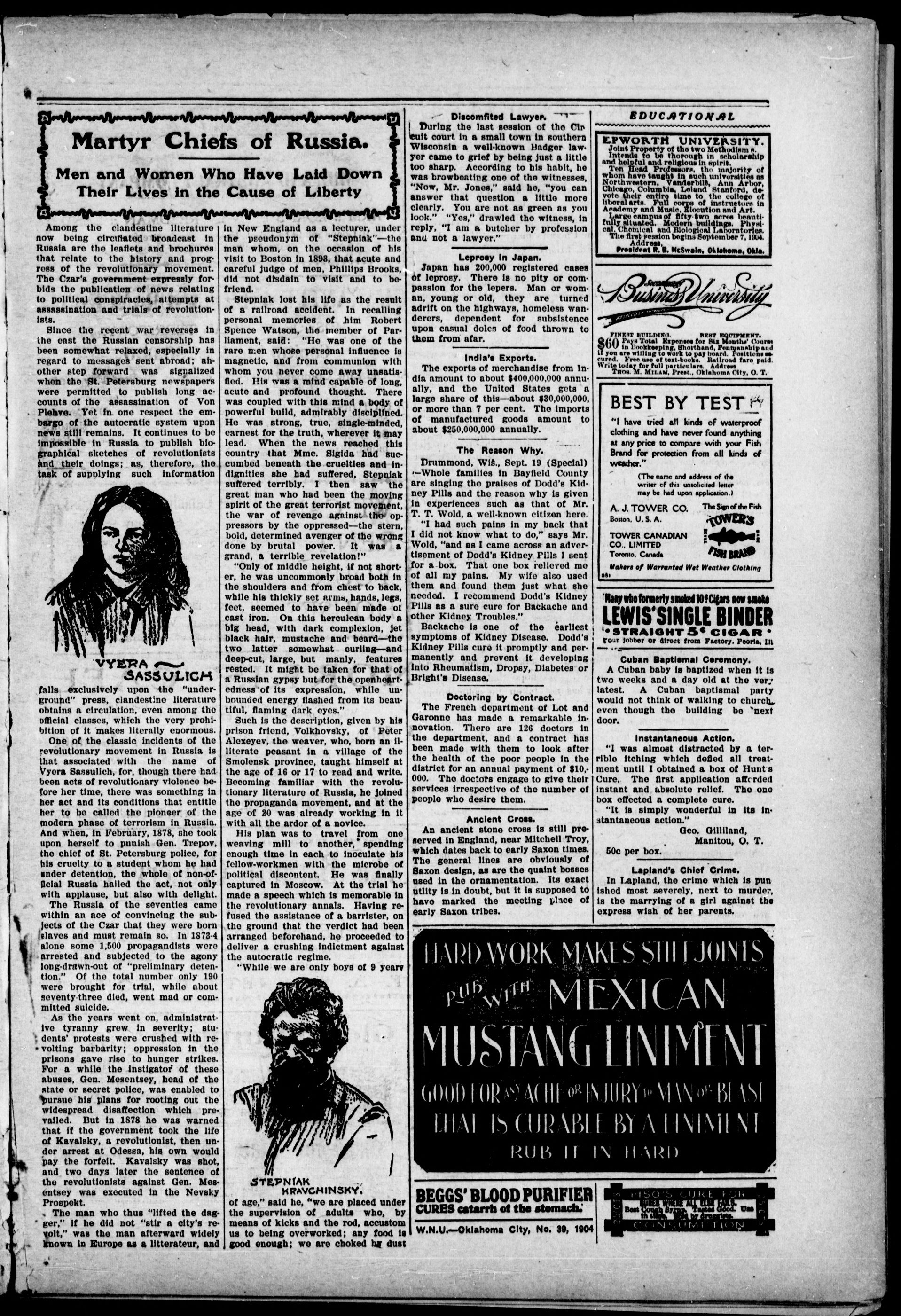
VYERA
SASSULICH
falls exclusively upon the "underground" press, clandestine literature obtains a circulation, even among the official classes, which the very prohibition of it makes literally enormous. One of the classic incidents of the revolutionary movement in Russia is that associated with the name of Vyera Sassulich, for, though there had been acts of revolutionary violence before her time, there was something in her act and its conditions that entitle her to be called the pioneer of the modern phase of terrorism in Russia. And when, in February, 1878, she took upon herself to punish Gen. Trepov, the chief of St. Petersburg police, for his cruelty to a student whom he had under detention, the whole of non-official Russia hailed the act, not only with applause, but also with delight. The Russia of the seventies came within an ace of convincing the subjects of the Czar that they were born slaves and must remain so. In 1873-4 alone some 1,500 propagandists were arrested and subjected to the agony long-drawn-out of "preliminary detention." Of the total number only 190 were brought for trial, while about seventy-three died, went mad or committed suicide.
As the years went on, administrative tyranny grew in severity; students' protests were crushed with revolting barbarity; oppression in the prisons gave rise to hunger strikes. For a while the instigator of these abuses, Gen. Mesentsey, head of the state or secret police, was enabled to pursue his plans for rooting out the widespread disaffection which prevailed. But in 1878 he was warned that if the government took the life of Kavalsky, a revolutionist, then under arrest at Odessa, his own would pay the forfelt. Kavalsky was shot, and two days later the sentence of the revolutionists against Gen. Mesentsey was executed in the Nevsky Prospekt.
The man who thus "lifted the dagger," if he did not "stir a city's revolt," was the man afterward widely known in Europe as a litterateur, and
in New England as a lecturer, under the pseudonym of "Stepniak"—the man whom, on the occasion of his visit to Boston in 1893, that acute and careful judge of men, Phillips Brooks, did not disdain to visit and to befriend.
Stepniak lost his life as the result of a railroad accident. In recalling personal memories of him Robert Spence Watson, the member of Parliament, said: "He was one of the rare men whose personal influence is magnetic, and from communion with whom you never come away unsatisfied. His was a mind capable of long, acute and profound thought. There was coupled with this mind a body of powerful build, admirably disciplined. He was strong, true, single-minded, earnest for the truth, wherever it may lead. When the news reached this country that Mme. Sigida had succumbed beneath the cruelties and indignities she had suffered, Stepniak suffered terribly. I then saw the great man who had been the moving spirit of the great terrorist movement, the war of revenge against the oppressors by the oppressed—the stern, bold, determined avenger of the wrong done by brutal power. It was a grand, a terrible revelation!"
"Only of middle height, if not shorter, he was uncommonly broad both in the shoulders and from chest to back, while his thickly set arms, hands, legs, feet, seemed to have been made of cast iron. On this herculean body a big head, with dark complexion, jet black hair, mustache and beard—the two latter somewhat curling—and deep-cut, large, but manly, features rested. It might be taken for that of a Russian gypsy but for the openheartedness of its expression, while unbounded energy flashed from its beautiful, flaming dark eyes."
Such is the description, given by his prison friend, Volkhovsky, of Peter Alexeyev, the weaver, who, born an illiterate peasant in a village of the Smolensk province, taught himself at the age of 16 or 17 to read and write. Becoming familiar with the revolutionary literature of Russia, he joined the propaganda movement, and at the age of 20 was already working in it with all the ardor of a novice.
His plan was to travel from one weaving mill to another, spending enough time in each to inoculate his fellow-workmen with the microbe of political discontent. He was finally captured in Moscow. At the trial he made a speech which is memorable in the revolutionary annals. Having refused the assistance of a barrister, on the ground that the verdict had been arranged beforehand, he proceeded to deliver a crushing indictment against the autocratic regime. "While we are only boys of 9 years
A.
of age," said he, "we are placed under the supervision of adults who, by means of kicks and the rod, accustom us to being overworked; any food is good enough; we are choked by dust
HARD WORK MAKES SHIFT JOINTS
PUB WITH MEXICAN
MUSTANG LINIMENT
GOOD FOR ANY ACHIEF OR INJURY TO MAN OR BEAST
THAT IS CURABLE BY A LINIMENT
RUB IT IN HARD
BEGGS' BLOOD PURIFIER
CURES catarrh of the stomach.
W.N.U.—Oklahoma City, No. 39, 1904
PISO'S CURE FOR
DIURES WHEN ALL ELSE FAIL.
Best Cough Bypass. Tastes Good. Uses
in them. Not by drugs.
CONSUMPTION
Discomfited Lawyer. During the last session of the Circuit court in a small town in southern Wisconsin a well-known Badger lawyer came to grief by being just a little too sharp. According to his habit, he was browbeating one of the witnesses, "Now, Mr. Jones," said he, "you can answer that question a little more clearly. You are not as green as you look." "Yes," drawled the witness, in reply, "I am a butcher by profession and not a lawyer."
Leprosy in Japan.
Japan has 200,000 registered cases of leprosy. There is no pity or compassion for the lepers. Man or woman, young or old, they are turned adrift on the highways, homeless wanderers, dependent for subsistence upon casual doles of food thrown to them from afar.
India's Exports.
The exports of merchandise from India amount to about $400,000,000 annually, and the United States gets a large share of this—about $30,000,000, or more than 7 per cent. The imports of manufactured goods amount to about $250,000,000 annually.
The Reason Why.
Drummond, Wis., Sept. 19 (Special)
—Whole families in Bayfield County are singing the praises of Dodd's Kidney Pills and the reason why is given in experiences such as that of Mr. T. T. Wold, a well-known citizen here.
"I had such pains in my back that I did not know what to do," says Mr. Wold, "and as I came across an advertisement of Dodd's Kidney Pills I sent for a box. That one box relieved me of all my pains. My wife also used them and found them just what she needed. I recommend Dodd's Kidney Pills as a sure cure for Backache and other Kidney Troubles."
Backache is one of the earliest symptoms of Kidney Disease. Dodd's Kidney Pills cure it promptly and permanently and prevent it developing into Rheumatism, Dropsy, Diabetes or Bright's Disease.
Doctoring by Contract.
The French department of Lot and Garonne has made a remarkable innovation. There are 126 doctors in the department, and a contract has been made with them to look after the health of the poor people in the district for an annual payment of $10,000. The doctors engage to give their services irrespective of the number of people who desire them.
Ancient Cross.
An ancient stone cross is still preserved in England, near Mitchell Troy, which dates back to early Saxon times. The general lines are obviously of Saxon design, as are the quaint bosses used in the ornamentation. Its exact utility is in doubt, but it is supposed to have marked the meeting place of early Saxon tribes.
EDUCATIONAL
EPWORTH UNIVERSITY.
Joint Property of the two Methodism s.
Intends to be thorough in scholarship and helpful and religious in spirit.
Ten Head Professors, the majority of whom have taught in such universities as Northwestern, Vanderbilt, Ann Arbor, Chicago, Columbia, Leeland Stanford, devote their entire time to the college of liberal arts. Full corps of instructors in Academy and Music, Elocution and Art.
Large campus of fifty-two acres beautifully situated. Modern buildings. Physical, Chemical and Biological Laboratories. The first session begins September 7, 1904.
Address.
President R. B. McSwain, Oklahoma, Okla.
Business University
FINEST BUILDING. BEST EQUIPMENT.
$60 Pay Total Expenses for Six Months' Courses
in Bookkeeping, Shorthand, Punjamanship and
if you are willing for work to pay board. Positions secured.
Free use of text-books. Railroad fare paid.
Write today for full particulars. Address
TOS. M. MULAN. Prest. Oklahoma City, O. T.
BEST BY TEST
"I have tried all kinds of waterproof clothing and have never found anything at any price to compare with your Fish Brand for protection from all kinds of weather."
(The name and address of the writer of this unsolicited letter may be had upon application.)
A. J. TOWER CO. The Sign of the Fish
Boston, U.S. A.
TOWER CANADIAN
CO., LIMITED
Toronto, Canada
Makers of Warranted Wet Weather Clothing
Many who formerly smoked 10 Cigars now smoke LEWIS'SINGLE BINDER STRAIGHT 5 CIGAR Your jobber or direct from Factory. Peoria, Ill.
Cuban Baptismal Ceremony.
A Cuban baby is baptized when it is two weeks and a day old at the very latest. A Cuban baptismal party would not think of walking to church, even though the building be next door.
Instantaneous Action.
"I was almost distracted by a terrible itching which defied all treatment until I obtained a box of Hunt's Cure. The first application afforded instant and absolute relief. The one box effected a complete cure.
"It is simply wonderful in its instantaneous action."
Geo. Gilliland,
Manitou, O. T.
50c per box.
Lapland's Chief Crime.
In Lapland, the crime which is punished most severely, next to murder, is the marrying of a girl against the express wish of her parents.
KES SHIFT JOINTS
EXICAN
SUBSCRIPTION:
(In advance)
One Year.....$1.00
Six Months.....$0
Three Months.....$8
W. H. TWINE - - - EDITOR.
Jurors have been elected who
will sit in cases for the Western
District of the Indian Territory at
Muskogee. The term of court begins Oct. 3rd.
Senator Stewart is in the Territory looking up the condition of affairs, and will have many valuable suggestions to offer to his colleagues in Congress, touching the admission of the Indian and Oklahoma Territories as a state.
The Indian Agent will commence the payment of the loyal Creek claim on October 1st. This will turn a loose about $600, 000 in Muskogee and vicinity. There are a great many Negroes who are loyal Creeks and who will participate in this drawing.
The Pheonix man continues to use about two-thirds of his editorial space in roasting the post-master. What the end will be no man knows, but as Clarence seems to get a great deal of satisfaction out of it and the postmaster does not seem to mind, there is no real harm done.
The election has been made in the state of Maine. The returns are in and the Republicans have carried the state by 33,000 majormajority. The old saying is, as goes Maine, goes the Union, and we are satisfied that it is true in the coming election.
Dr. M. L. Flinn, who was sentenced to the penetentiary in the the spring of 1901 for five years, is making application for pardon. We believe the doctor has already suffered sufficiently for the crime for which he was charged, that of selling liquor. We know that it was a most severe sentence imposed at the time, and we don't now recall any man having received such a heavy sentence. We hope to soon see the doctor at home with his wife and little ones.
The Chickasaw Indians are showing the white people that in drawing the color line, "there are others." They positively refuse to attend school with the Whites Such a thing is not to be wondered at as the pale face has about taken all the poor Indian had and is continuing the same process process by crowding him out of the schools Poor Lo will soon find himself up against the segregation issue.—Ex
Our esteemed contemporary, the Pheonix is taking the postmaster or somebody in the post office to task about delivering the mail. Sometime ago it was reported that the Pheonix man wanted the job himself. Later on it was reported that a relative of the Pheonix man wanted the place, and if there was any * * truth in any of these reports, possibly that is the reason why the Pheonix is raising so much hades all at once about the failure of somebody to deliver a card or letter immediately after it arrived.
We never knew that there was so much money till the Pheonix let it out that the place pays twenty six thousand plunks per annum to the fellow who is lucky enough P. M. after his name.
The Postmaster has not enough help to do the work of this office as it should be done and this is well known by every business man in town. Everyone there is over worked.
We think Mr. Estes is doing the very best he can under the circumstances and the wonder is that he does as well as he does with the help that he has. At this time there is a colored man working as sub, who of course is not familiar with the route and he is doing as well as any man could do who is called suddenly to take the place of another. We hope that our neighbor has not taken the colorphobia and is making all this howl because a colored man is delivering the mail on the route that a white man formerly delivered the mail, and who is now taking his vacation. This is very often the case with some people but we trust it is not so in this instance. We have often received mail in our box that got in there through mistake and we are satisfied that others have done the same, but we don't think the postmaster ought to be blamed for all the mishappenings, when it is taken into consideration that he has less help than any other office of its size in the United States. We can say for the postmaster, that we believe that he is honestly and conscienciously doing his duty, and do so without taking any part in the post office fight at this stage of the game as to who shall not be postmaster. We believe that a man is entitled to credit for what he does as an officer and that any citizen can say so with out being mixed with a disgraceful fight as to who shall be the successor
The roll for the loyal Creeks has been made. The Indian Agent has made the additional bond, and the payment will commence on Oct 1st, 1904.
FARM LOANS AND ABSTRACTS
JAMES L. LOMBARD.
President.
CHAS. H. LOMBARD.
Secretary and Manager.
D. G. WILSON,
Assistant Secretary.
FARM :: LOANS :: ON :: FREEDMAN :: LAND Loans made to Creek Freedmen who are farming on their allotments
GUARANTEE LIFE INSURANCE CO
An Old Line Company issues all forms of Limited Payment Life and Endowment Policies.
DIRECTORS:—E. J. Mints, Muskogee, I. T., Geo. D. Lenno New York; F. L. Conger, Oklahoma City; Wm. M. Eggleston St. Louis, Mo.; C. J. Miller, Muskogee, I. T.; Samuel Raymond, Wynnewood, I. T.
WE CAN
RENT
YOUR
HOUSES
The Canadian Valley Trust Company
Has a number of applicants who desire to rent houses. Owners of three, four, five and six room houses can secure desirable tenants by listing their property with us.
REAL ESTATE DEPARTMENT
Canadian Valley Trust Co.
MORRIS' CAFE
The only first-class, up-to-date Cafe in the city Where people of all nations can be served A Splendid Billiard and Pool Hall Adjoining The finest in the southwest. If you are hungry step into the cafe; if you want to spend an hour of pleasure the pool room is the place.
STAPLE and FANCY GROCERIES We have anything you desire in the Grocery Line at prices that defy competition. Give us a trial and you will repeat. Located on South 5th St., near the South Side Boulevard.
A Lumberman Standing on a Tree Stump with a Saw and a Stack of Wooden Boards.
To tell about our lumber. It is put forward to win the approval of the lumber users of this section and when its good points are appreciated it will certainly do so. We see no satisfaction or profit in handling low grade stock. Neither will consumers when they learn that the finest lumber by the foot but pieces by the inches.
THIS LOOKS BAD
DAWES COMMISSION GOOD FOR TEN YEARS LONGER
STATEHOOD LEGISLATION TO BE DELAYED
Officials at Washington Say Work Cannot be Completed Short of a Decade—May Interfere With Statehood Probabilities WASHINGTON: It is now becoming apparent that the promises made by the Dawes commission last winter to the effect that the work of the commission would be concluded by June 30.1905, will not be realized. Indeed, it is improbable that the work of the commission will be completed within many years from that time, and it is certain that a great number of the disputed citizenship cases will not be disposed of for several years.
Reports received at the department of the interior indicate that the work of the commission is progressing more rapidly than ever before, but while this is true, to use the words of a prominent official of the Indian office, "it is apparent the work cannot be concluded within the allotted time." The candid opinion of the official in question is that it will take nearly ten years longer for the commission to clear up the work originally assigned to it.
What effect this condition will have upon the statehood bill now pending before congress is problematical. The chances are, however, that it will defer legislation until a future date beyond that contemplated in the bill which passed the house last winter. As that bill provided for the admission of the new states into the union on March 4, 1906, the probabilities are that the date of the admission will be further postponed, even if legislation should be secured.
It is apparent that the statehood fight will be renewed at the convening of congress with more vigor than ever before. It is the intention of the advocates of single statehood for Oklahoma and Indian Territory to try to force a vote in the senate on the statehood bill at an early date during the coming short session.
Whether they will be successful or not depends entirely upon the advocates of double statehood. The leading exponent of this theory is Senator Bailey of Texas. Senator Bailey, however, is not a prognosticator. He believes in expressing his views, and then permitting the senate to act. If the other advocates of double statehood pursue a similar course, a vote can be reached during the short session. If they adopt the other tactics, of opposing the passage of the single statehood bill, there is little likelihood of legislation this winter.
---
With the great omnibus appropriation bills before congress for action, with only seventy-five days in which to act upon them, and with several measures of national importance before the senate for immediate consideration, little time can be given to the consideration of the statehood bill. Therefore, the probable action of congress on this measure is wholly dependent upon the attitude of the advocates of double statehood.
If Marshal Ben Colbert of the southern judicial district of Indian Territory intends to resign his position as United States marshal and accept a position as member of the noctaw and Chickasaw coal commission under Governor Johnson, as has been recently reported, he has not advised the department of his intention. On the contrary, the impression prevails in Washington official circles that Mr. Colbert intends to give out his full term as marshal, which expires in 1907.
COTTON IMPROVEMENT
Condition of Crop Much Better in the Washita Valley
ARDMORE: Within the past few days there has been a marked improvement in the condition of the cotton crop. Many sections report better prospects for a large yield than was anticipated some two weeks ago. Probably the greatest improvement has been in the Washita valley. According to a statement made by Frank M. Gates of Pauls Valley, who has observed the crop in that section, there will be a third more cotton produced this year than last season. He attributes the favorable improvement and condition to timely rains which have fallen in the valley country during the past fortnight. Mr. Gates, said: "Two weeks ago merchants and farmers were anything but enthused over prospects. The drouth was having a disastrous effect on the fleecy staple, and farmers were growing very much discouraged over the outlook. It was apparent that there would be a big shortage in production, but the recent rains have greatly improved the condition of cotton, and that the valley country will make the largest crop in its history."
In the Red river valley the rains have improved cotton to a great extent, although the drouth, it is said, will cut the crop considerable. Mr. Carter, an experienced cotton raiser who lives near Paoll, says the drouth has cut the crop one-half of what was estimated some time ago. The general condition of the crop is reported as being only fair, but the yield will be larger in Indian territory, because of the increased acreage. The cotton picking season has opened in earnest and the fields present a busy scene.
FOR THE INDIAN'S BENEFIT
Judge Dickerson Says Leases in Future Are to be More Reasonable
ARDMORE: Judge Dickerson, of the United States court for the southern district, has recently made two important decisions. In refusing to confirm a land case wherein a minor figured. Judge Dickerson used vigorous language. "Such a lease," he said, "will never be confirmed in my court. I'll agree to furnish a lessee who will take the land for ten years at $150 a year. These investments must hereafter be made for the benefit of the Indian minor, and this court will confirm no lease which raises a presumption of dishonesty by its ridiculously low rates or an unreasonably long time."
Keretofore hundreds of land leases have been confirmed upon the application of the guardians. Judge Dickerson instructed the clerk of the United States court to furnish film a certified copy of all land leases. Although there are about 1,000 pending, he promised to personally investigate each one. Judge Dickerson has held that the Indian Territory is under the Arkansas statute on the question of usury. In instructing a jury to discharge a defendant for selling mortgaged property he ruled that there can be no crime when a usurious rate of interest was charged.
Will Drive Cattle Out
MUSKOGEE: Capt. John West, chief of the Indian police, accompanied by one of his officers, left for the Arkansas line, where they will drive a herd of about 100 cattle out of Indian Territory into Arkansas. Capt West also had orders to take the owner of the cattle out of the country if he did not agree to keep his cattle up in the future. Several parties, living on the line of Arkansas and Kansas have been allowing their cattle to run at large, and they have been: destroying the crops of farmers living in their neighborhood. Many complaints have been made to Indian Agent Shoenfeit, and that official has issued orders that if must be stopped.
TERRITORIAL DAY
PROGRAM FOR INDIAN TERRITORY DAY ANNOUNCED
SPECIAL FEATURES BY SEVERAL TOWNS
Fruits and Souvenirs to be Distributed by Some of the Towns-Both Territories to be Represented in the Exercises ARDMORE: The official program for Indian Territory day, October 1. at the World's fair, is announced from St. Louis by Frank C. Hubbard, executive commissioner, and will be participated in by both the representatives of Oklahoma and Indian Territory.
A program will be given at 11 o'clock in the morning, to be followed in the afternoon by informal vocal and instrumental musical selections, addresses and readings, which will be given in the Indian Territory building. Several of the towns are arranging for special features for the day. Fruits and souvenirs will also be distributed by some of the territory towns, and in the evening from 9 to 11 o'clock a reception and dance will be held in the territorial pavilion parlors. The program for the day is as follows:
Invocation; address of welcome, David R. Francis; music by Indian band; response on behalf of Indian Territory, General Pleasant Porter. principal chief of the Creek Indians; musical selection; address, Charles B. Stuart, South McAlester; music by Indian band; address, T. B. Ferguson, governor of Oklahoma; musical selection.
Several of the Indian Territory towns are arranging to have special features, and the program for such exercises will be arranged and given out on the morning of territory day.
Arrangements are also being made whereby certain territory towns will give away souvenirs, distribute territory fruits, etc. In the evening of the same day, between the hours of 8 and 11 o'clock, a reception will be held in the parlors of the Indian Territory building.
TEACHERS BARRED, TOO
Must Take Oath Not to Deal in Indian Territory Lands
MUSKOGEE: J. D. Benedict, superintendent of schools in the Indian Territory, has been notified by the interior department that all teachers in schools which have received a share of the $100,000 appropriated by congress will be compelled to take the same oath that is required of the employees of the Union Indian agency and the Dawes commission. Mr. Benedict has received a large number of printed copies of this oath, which he will send out to teachers at once, as they will be required to sign them on their next pay day.
The oath bars the teacher from having any interest directly or indirectly in any Indian lands in the territory, and forbids his owning any stock or having any interest in such lands. A few of the teachers now have interests in Indian Territory realty, but these will be compelled to sell their property or resign their positions. The new oath will work a hardship on many persons who have no property interests in the territory, but who are teaching in districts far remote from a notary public. The teachers will be compelled to take a long trip each month to swear to the oath before they can enter upon another four weeks' work.
The City Bank and Trust company of Tulsa has been incorporated, with a capital stock of $26,000.
ORDERED DISARMED
An Order by the President Affecting the Russian Transport
WASHINGTON: Acting Secretary of State Adee has given out the following statement regarding the Russian ship Lena, now at San Francisco: "The president issued an order through the acting secretary of state directing that the Russian armed transport Lena, now at San Francisco, be taken in custody by the naval authorities of the United States and disarmed.
"The main features of the conditions prescribed are that the Lena be taken to the Mare Island navy yard and there disarmed by removal of small guns, breech locks of large guns, small arms ammunition and ordnance stores and such other dismantlement as may be prescribed by the commandment of the navy yards; that the captain be given a written guarantee that the Lena shall not leave San Francisco until peace shall have been concluded; that the officers and crew shall be paroled and not to leave San Francisco until some other understanding as to their disposal may be reached between the United States government and both belligerents; that after disarmament the vessel may be removed to a private dock for such reasonable repairs as will make her seaworthy and preserve her in good condition during her detention, or may be so repaired at the navy yard if the Russian commander should so elect; that while at private dock the commandant of the navy yard at Mare Island shall have custody of the ship and the repairs shall be overseen by the engineer officer to be detailed by the commandant and that, when so repaired, if peace shall not then have been concluded. The vessel shall be taken back to Mare Island navy yard and be there held in custody until the end of the year."
This action has been taken on the written request of the commander of the Lena, addressed to Rear Admiral Goodrich, setting forth that the vessel is incapable of putting to sea without needful repairs, she must disarm, and asking that needful repairs be permitted after disarmament.
PREPARING FOR OPEN SEASON
Live Stock Officials Begin a Campaign of Cleansing
GUTHRIE: An active campaign has commenced by both the federal and territorial live stock officials to clean up the territory in good shape for the open season, which will again begin on December 1 and continue two months.
Both Dr. Allen, the federal inspector and R. H. Hahn, the territorial inspector, are in Canadian county this week, examining the quarantined pastures and ascertaining if there are any herds that may be released from quarantine. Special orders have been issued for the cattlemen to thoroughly cleanse their herds and pastures, and wherever this order has not been obeyed, the inspectors will compel its obeyance.
Secretary Tom Morris said that the territorial live stock board has recommended that the open season will begin this year, as usual, on December 1. and that in all probability that date will mark the opening. He says, also, that the department's order lifting the special guardatine against Custer county will result in great good to the cattlemen.
There are still some herds under quarantine in this and Noble counties as a result of the outbreak of Texas, or splenetic fever last month; these pastures will in all probability remain under quarantine for several weeks, or until the inspectors are certain that no ticks remain thereon. Every effort is being made to keep the territory clean of infection.
Ardmore schools opened with nearly 1,500 pupils in attendance.
‘The Reg'lar Army Man
He ain't no “mamma's darlin’,”
Ter sparkle in the sun,
He don't parade with gay cockade
And posies in his gun;
He ain't no “pretty soldier boy,”
So lovely, spick and span,
He wears a crust of tan and dusty
The reg‘lar army man;
The marchin', parchin’,
Pipe-clay starchin’,
Reg'lar army man,
He ain't at home in Sunday school,
Nor yet at social tea,
And on the day he gets his pay
He's apt ter spend It free;
He ain't no Sa tne advocate,
He likes to fill the can,
He's kinder rough an’ maybe tough,
The reg'lar army man;
The rarin’, tearin’,
Sometimes swearin’, Pe
Reg'lar army man,
No state'l! call him “noble son,”
He ain't no ladies’ pet,
But, let a row start anyhow,
They'll send for him, you bet:
He don't cut any ice at all }
In fashion's social plan, }
He gita the job to face a mob,
The reg'lar army man; /
The millin’, drillin’,
Made for Killin’,
Reg'lar army man.
They ain't no tears shed over him
When he goes off ter war, ‘i
He gits no speech nor prayerful “preach”
From Fa or governor;
He packs his little knapsack up
And trots off in the van,
Ter start the fight and start it right,
The reg'lar army man;
The rattlin’, battlin’,
Colt or Gatlin’,
Reg’lar army man.
He makes no fuss about the job,
He don't talk big and brave,
He knows he's in ter fight and win,
Or help fill up a grave;
He ain't no “mamma's darlin’,” but
He does the best he can,
And he's the chap that wins the scrap,
The pegs army man;
The dandy, handy,
Cool and ‘sandy,
Reg'lar army man.
—Joe Lincoln,
THEIR DOVBLE GAME;
> By BELLE MANIATES- |
ee ae — 8 Cer A eee
“There is nothing, seemingly, the
matter with me, doctor, only I have
expended all my available energy,”
said Roberts.
The physician prescribed a “general
toning up.”
“How shall I do it?” asked Roberts,
whimsically. “If I were a poor man
you would give me a bottle of bit-
ters——”
“If you were a poor man you'd not
come to me,” interrupted the physi-
cian, “because you would be working
out of doors with plenty of fresh air,
good appetite and deep sleep for
tonics.”
“Then that is what I'll do. My
housekeeper’s brother is foreman of
some day laborers, and I'll get out and
dig for three or four weeks.”
The next morning when bells and
whistles were clamoring for the as-
eee a ty, 43
* NG fe 3
b eadbate Ma Se 3. 3”
i oa
=e hike
he
er CW UAT
\ wa YY rae
Nees
AN ‘ (A;
Mie, 3 ; oe Ate
Te go.”
sembly of breadwinners, Robert pre-
sented himself at the Mortimer coun-
try home on the outskirts of the city.
Back of the house some three-quar-
ters of a mile the grounds rose tn a
high bluff above the lake. These
grounds were ta-be leveled to a gen-
tle slope and low terrace:
By arrangements culminated the
night before, Roberts commenced to
dig at $1.50 per day.
trousers, a blue flannel shirt and a
soft cap, but they felt and ssented
his to the “manner bornness.”
And then his hands! They were
not white. On «he contrary, they
were good, warm brown, like his com-
ploxion, but thefr shapeliness, sup-
pleness and smoothness “ve wot of
the earth earthy.
He worked steadily and vigorously,
if somewhat awkwardly. The unwont-
ed exercise soon brought little shining
beads to his brow, which occasioned
appreciative grins and winks among
his co-workers.
From their conversation he learned
that the Mortimers were rich, but all
right and treated folks “white.”
Every morning at 10 o’clock and every
afternoon at 3 a servant brought two
pails of cool lemonade, accompanied
by a trim little housemaid to serve it.
Roberts had dug for about three
hours and was wearying of his. pre-
scription, when one of the workmen
exclaimed:
“Here comes the lemonade and a
new girl. She's a hummer, though.”
Looking around, Roberts beheld a
fluffy-haired girl with eyes of the sky
and cheeks of the rose—a sight that
was more of a tonic to his shattered
nerves than all his toil and out-of-door
existence,
“Where’s Maggie? Are you a new
girl?” asked one of them.
The girl shrank back, then her eyes
danced and her cheeks dimpled.
“Yes, I am taking Maggie's place,”
she replied, handing him a dipperful
of the refreshing drink.
She went the rounds until she came
to Roberts. Instinctively she paused
and flushed as she handed him the
dipper. On her way back to the house
she met the foreman and stopped him.
“Who is that man?” pointing to
Roberts. “Just a common workman?”
The foreman looked uncomfortable.
“He only gets his $1.50 per, but it’s
his first job.”
“What does he do this kind of work
for?”
“He says he has to, Miss.”
“Oh, poor fellow!”
“Mr. Roberts,” the foreman said
deferentially, “did you bring your din-
ner?”
“I never thought of it,” laughed
Roberts. “I'll telephone the—where
I board—to send something.”
“There is a telephone in the stable
yonder,” suggested the foreman.
“All right. Thanks.” and Roberts
strode quickly through the grounds,
lifting his cap as he passed the girl.
At the stable he rang up his club
and ordered a luncheon sent down. As
he hung up the receiver, he turned
and saw the girl standing in the door-
way. She passed quickly, however,
when he came toward her.
His luncheon did not arrive until 1
o'clock, so he worked through the
noon hour and then sought the shade
of a distant tree,
Removing napkins and dishes from
the basket, he proceeded to enjoy his
luncheon, which consisted of a broiled
lobster, a salad, club sandwiches,
olives and a pint of ale.
“You seem to enjoy more privileges
than the other workmen,” said the
girl, suddenly appearing at his side.
“Your duties as a housemaid don't
appear to be very arduous,” he re-
plied,
She flushed.
“Who told you I was a housemaid?”
“The men,”
“Well, I am attending to my duties
now. James, the man who carried
the lemonade this morning, is busy
and I was sent to see if one of you
could not carry it down.”
“Certainly, I will come this after-
them. Don’t go,” he exclaimed as she
began to walk from him.
- “I must. I have work to do.”
- “And shall I come at 3 o’clock—I
don’t know your name.”
_ “Why should you know it?”
“It would make the afternoon short-
er if I knew it. My name is Rob-
etts. And you won't tell me?” as she
continued walking toward the house.
“Then I shall call you Rose.”
“All right,” she replied, turning her
head. “You may call me Rose. Come
to the dairy at 3.”
Roberts had never met an appoint-
ment so punctually before. Rose came
out of the dairy, A tiny, white mus-
lin cap adorned her head and a ruf-
‘fled white apron covered her dark
gown.
- “You look very nice in those,” he
| said, nodding approvingly, as he took
'a pail of lemonade in each hand and
fi oa
=f VS
ip ‘el
i i a
. WI TE
4 | ————
“No,” she said emphatically.
started down toward the lake shore.
“I wish workmen’s clothes were as
becoming.”
“They look better in their working
clothes than their Sunday clothes. At
least all I have ever seen do. Do
you?” %
“I don’t know,” he replied ruminat-
ingly. “I have no Sunday clothes.”
“How uice!” And she gave a soft,
little laugh.
When they came to a point in the
road where a turn would bring them
in sight of the workmen, she stopped.
“I can go no farther. Mrs. Morti-
mer doesn’t think it necessary for me
to serve the lemonade. She says you
should help yourselves.”
“But, Rose, when am I to see you
again?”
“To-morrow, when you come for the
lemonade,” she said demurely.
“I wish—— See here, Rose, I am
not posted on social grades. I don't
suppose a common laborer is in your
class, is: he?”
“No, indeed, I have looked as high
as a footman.”
“Maybe I can be one yet! Would
you like me better if I were, Rose?”
She shook her head. '
“It makes no difference. A man's a
man wherever he is placed.”
“Do you really believe that?” he
asked in earnest tones,
Another day of toil, two walks and
talks with Rose and he loved her! The
days went by and Roberts still dug on,
Rose acting as a magnet that made
his labor a quick way of whiling away
the hours between their meetings.
fe continued to have his luncheon
sent him at 1 o’clock and he ate it
‘neath the big tree with Rose at his
side.
Six weeks slipped by and there
came the last day of his job. That af-
ternoon during the lemonade walk he
stopped in a secluded spot and shaded
by friendly shrubs and put down the
pails.
“Rose, this is my last day!”
“So I hear!”
“Rose, will you let me take you for
a sail here on the lake to-night?”
“Yes,” she half whispered.
“I will meet you at the boathouse
at 8 this evening.”
A Mttle before the appointed time
she stood at the boathouse, where a
sailboat was at anchor.
“I wonder if I should have come?”
she thought with beating heart. “What
will he, the fastidious Wallingford
Roberts, say to a housemaid?”
“Rose,” said a voice behind her.
She turned quickly. He wore a dark
business suit and a straw hat. She
looked at him critically. .
“I have never seen you dressed up
before.”
“And do 1 look like a workman in
Sunday clothes?”
“No,” she said emphatically.
He helped her into the boat and sat
beside her. After much attention to
sail and tiller, he put his arm about
her.
“Rose,” he whispered softly, “Rose,
I love you.”
The girl quickly drew away from
him.
“Mr. Wallingford Roberts, I know
why you assumed the role of a work-
man. You should not speak of love to
a housemaid!”
“How did you know, Rose?’’ he
asked perplexedly.
“T heard you call up your club and
give your name and order. The same
day Dr. Rutherford paid Mrs. Morti-
mer a visit and I was engaged in the
room when he laughed and told her
he should have to prescribe for her
as he had for a patient of his—a
young millionaire who was dying of
ennui, that he had set him to dig-
ging.”
“It makes no difference,” said Rob-
erts. “It was my whim to woo you
as a laboring man and tell you later,
but Rose,” and again the strong arm
was about her, holding her firmly, “I
love you. Will you be my wife?”
“Oh, Mr. Roberts! You would ask
me, a housemaid?”
“Yes, even if you were one! But,
Miss Frances Mortimer, you happen
not to be a housemaid.”
“How did you know?” and she bur-
ied her face against his shoulder.
“I knew as soon as I saw you that
you were not a servant. I got the
foreman to find out who you were. He
asked the gardener.”—Boston Globe.
HE KNEW THE SONG.
Tramp's Passport Into a Company of
College Men in the Country.
“You know the old Latin college
song ‘Gaudeamus Igitur’?” said the
recent graduate. ‘Well, I suppose
that it comes pretty near being a
grip and pass word with university
men the world over. Something that
happened this month made me un-
derstand how it stands for a college
man wherever you hear it.
“I was on my vacation up in New
Hampshire. Tramping through a little
mountain town I happened to meet
three or four of my own fraternity.
I stopped with them that night, and
in the evening we went to a.road-
house on the outskirts of town for
a little saengerfest.
“Of course, before we finished we
sang ‘Gaudeamus’—-you know it—‘'Let
us rejoice, therefore, while we are
young.’ When we came to the last
stanza, a voice joined in from the
doorway.
“We turned around, There stood
an old, dilapidated tramp. He came
over to us without any hesitation, and
said, in a fine German accent:
“‘Verever you see a university man,
you hear ‘Gaudeamus Igitur.” Heid-
elberg, '73. Shake.”
“He was a Heidelberg man, too, I
suppose, a degenerated gentleman,
for he knew college ways and songs
and he showed that he was a well
educated man. He got all the bear
he wanted out of us that night, and
the price of beer besides, which shows
that a college education sometimes
nai
Horse Census in France. —
Foe military purposes a census is
taken annually of the number of
horses in France. The census of
horses this year showed that there
were only 90,147, against 91,016 twelve
months before, a decrease of 869 in a
single year, which is likely to become
accentuated, i
WORLD'S MARKET
Cotton.
GALVESTON SPOTS.
Ordinary ... 7½ Middling ... 10½
Good Ordinary 8½ Good Middling 10½
Low Middling 10 Middling fair ... 1.5%
NEW ORLEANS SPOTS.
Ordinary ... 7½ Middling ... 10½
Good Ordinary 9½ Good Middling 10½
Low Middling 9½ Middling fair ... 10½
Grain.
KANSAS CITY.
WHEAT.
No. 2 red ... $ 1 07 $1 09
No. 2 hard ... 1 03 1 04
CORN.
No. 2 mixed ... 48 49
No. 2 white ... 48 —
OATS.
No. 2 ... 31 31½
CHICAGO.
WHEAT.
No. 2 red ... 1 14 —
No. 3 red ... — —
No. 2 hard ... — —
CORN.
No. 2 ... 51¼ 52½
No. 2 white ... 53¼ 52½
No. 2 yellow ... 53¼ 54¼
OATS.
No. 2 ... 82½ —
No. 2 white ... 83½ 83½
Live Stock
KANSAS CITY.
CATTLE.
Steers—best ... $ 5 60@ $ 6 10
—fair to good ... 4 —@ 5 25
Western fed steers ... 3 —@ 4 25
Stockers and feeders ... 2 25@ 3 85
Southern steers ... 4 —@ 5 50
Western cows ... 1 40@ 4 35
Native cows ... 1 40@ 4 35
Native heifers ... —@ —
Bulls ... 2 —@ 4 25
Calves ... 3 —@ 6 —
HOGS.
Heavy ... $ 5 65@ $ 5 75
Packers ... 5 60@ $ 5 75
Pigs and lights ... 5 60@ $ 5 80
SHEEP.
Native lambs ... $ 4 25@ $ 5 00
Native sheep ... 3 25@ 4 —
Native ewes ... 3 —@ 3 75
CHICAGO.
CATTLE.
Beeves ... $ 5 60@ $ 6 10
Cows and heifers ... 2 50@ 4 75
Stockers and feeders ... 2 25@ 3 75
Texans ... 4 —@ 5 50
Westerns ... 3 —@ 4 25
HOGS.
Mixed and butchers ... $ 5 50@ $ 6 05
Good to choice heavy ... 5 75@ 6 —
Rough heavy ... 5 75@ 6 10
Light ... 5 50@ 6 10
Bulk of sales ... 5 60@ $ 5 80
SHEEP.
Sheep ... $ 3 65@ $ 4 25
Lambs ... 3 25@ 3 00
FORT WORTH.
CATTLE.
Steers—top ... $ 3 50
—bulk ... 2 65@ —
Cows—top ... 2 30
—bulk ... 1 50@ 2 30
Calves—top ... 3 75
—bulk ... —@ 3 —
HOGS.
Top ... $ 5 72½
Bulk ... 5 50@ $ 65
A Woman Charged With Receiving Stolen Goods at Chickasha
CHICKASHA: Mrs. Fredonia Faulkner has been given a preliminary hearing before Commissioner Payne on the charge of having received stolen goods from Rock Island cars, alleged to have been taken by conductors and brakemen. This is another chapter in the story of systematic theft which Rock Island detectives have been unearthing during the last few months. A number of the employees of the road have been discharged and several are under indictment.
Mrs. Faulkner conducted a rooming house here, in which a number of railroad men made their home. She claimed that the men gave her the goods, and she had no knowledge of their having been stolen. She was arrested in Evansville. Ind. The commissioner bound her over to await the action of the grand jury.
An Enterprise the Object of Which Is to Fix the Price of Cotton
WASHINGTON: Colonel E. S. Peters of Texas, president of the Cotton Growers' Protective association, has succeeded in floating an enterprise which, he says, will mean ten cent cotton always. He is on his way home for New York, where he has been for some time in conference with financial men of national reputation, whom he has succeeded in interesting in his schema.
Colonel Peters is one of the incorporators of the Southern Cotton corporation, just formed with abundant capital, for the purpose of controlling the cotton output of the southern states. The corporation will establish warehouses throughout the cotton states and give the farmers receipts for all the cotton received. These receipts will pass current, and "will be as good as gold," says the colonel. The corporation will hold the cotton for a price fixed, regulated by the supply and demand.
"It is our purpose," said Colonel Peters, "to fix the price of our cotton, instead of allowing it to be fixed in Liverpool and New York by spinners and speculators. It will be impossible for us to get our scheme in operation in time to handle this year's crop, but we will be ready for business before the cotton is picked next year, and in two or three years we are confident of being able to control the output. It will be a blessing to the cotton planters of the south."
Colonel Peters said that among the men who are interested with him in the enterprise is a New York financier, whose check is good for $100,000,000. The matter is to be discussed at the convention of the Farmers' congress, the Cotton Growers' association and the Cotton Growers' Protective association on the 20th inst. Colonel Peters says there is not the least doubt that the enterprise will be in operation before next year, and will prove very beneficial to the growers of cotton.
GOING AFTER THE BUSINESS
Checotah Has a Novel Way of Establishing a Cotton Market
MUSKOGEE: The business men of Checotah have decided upon a novel plan to induce the farmers to market their cotton in that town. Every time a farmer sells a load of cotton in Checotah he gets a ticket bearing a certain number. About Christmas time, after the cotton is all marketed, a public drawing is to be held. Duplicates of all the numbers given out to the cotton raisers will be put in a box and shaken up and three of them will be drawn out by a little girl. who is to be blindfolded. The three men holding the lucky numbers will receive prizes amounting to $300 in gold, contributed by the merchants. The drawing brings thousands of people to town every year, and is a big midwinter event.
Fairmount Postoffice Robbed
Fairmount Postoffice Robbed ENID: Safe blowers broke into the Fairmount postoffice and robbed the safe of $500. The robbers forced an entrance through the rear door of the building and used a heavy explosive to force the safe door. A portion of the money taken belonged to the government and a portion to individuals. J. N. Smith, the postmaster, refused to disclose the amount of money taken, but stated it was nearly the amount given above. Deputy Sheriff Morrison and a posse of men are in pursuit of the robbers, who are supposed to be headed toward Guthrie or Oklahoma City.
"To be happy," advises a magazine writer, "fill yourself with sunshine." You will get the same effects by letting someone else fill you with hot air.
NO MONOPOLY OF PATRIOTISM.
Englishmen, and by Englishmen we mean also Irishmen and Scotchmen, have died as bravely as any Japanese soldier ever died. The same is true of Americans, of Freshmen, and of every nationality. There is no braver soldier or fiercer fighter than the Abyssinian. Englishmen know how bravely the Matabeles can die. In the recent slaughter of Tibetans they died like stoics, fighting as best they could. Physical courage is a fine quality, but it is quite a common quality. Moral courage is a finer quality, but not so common. Every war has its heroes. The war between the state abounded in heroic deeds and unsurpassed exhibitions of fortitude. Patriotism is indigenous, so to speak, to all lands—though more highly developed in some than in others. The mother of the Gracchi has had her counterpart in all ages and climes.—Nashville American.
PERILOUS TRIPS OF LITTLE VALUE.
Just what contribution to science Miss Annie S. Peck has made by climbing one of the loftiest of the Andean peaks to a height of 20,000 feet is not made altogether clear. Perhaps it is important that the exact elevations of these towering points of land should be accurately determined, but beyond the addition of that bit of information to our stock of knowledge mountain climbers of the type of Miss Peck do not seem to accomplish much more than the gratification of their own love of adventure and their desire to be first at the summits of the ice-clad rocks at the "roof of the world." Philadelphia Ledger.
LASSA NO LONGER SACRED.
The romance of the forbidden city has expired. The Caucasian has set his foot in the city of the grand lama. The European is gazing upon the white palace with the golden roofs that crowns the sacred hill from which for centuries the Buddhist pope has reigned. In other centuries a few Europeans managed to reach Lassa. These straggling adventurers were agents of religion; they wanted Lassa for Christianity. They were easily driven away. The present invaders are agents of political ambition—they will stay.—Philadelphia Ledger.
NEW ATMOSPHERE ON THE FARM.
In a broad sense the farm is becoming more attractive every year. The telephone and the rural delivery service, the greatly improved machinery for cultivation and handling of crops, the dawn of the township high and the consolidated district school, the formation of debating clubs and women's societies, the building of better churches, and the advent of the interurban road—all of these influences have created a new atmosphere for the farmer. The day when the average farmer was a lout has passed.—Milwaukee Sentinel.
SPEED THE TIME.
When the American public gets to the point where it can see that a "solid citizen"—namely, a man of wealth and influence—who breaks the law is as much a criminal as the individual who steals that he may eat, the American public will cease to be vexed by financial schemes that are frauds and by automobiles that exceed the legal speed limit.—Washington Times.
THE RIGHT OF PRIVACY.
The public have a right to the pictures of public men under proper conditions and limitations. The employment of the caricature is legitimate under similar restrictions. The caricature is the pictorial editorial and is entitled to equal privileges with that which is written. The spreading broadcast of the picture of the criminal undoubtedly assists in his apprehension. But the private citizen, unless an offender against the laws, should be permitted to say whether or not his likeness should be made public for the scrutiny of thousands. Boston Transcript.
RAILROAD AS PEACEMAKER.
At a recent meeting of the international arbitration conference at Lake Mohonk considerable emphasis was put upon the fact that the railroad is often the most effective of peacemakers, inasmuch as it develops the social and commercial conditions and brings into closer touch neighboring countries that have heretofore been at enmity. It oftentimes materially aids in dissolving those barriers and prejudices which have tended to keep the different peoples apart and to convince them that "all the world's akin." This is especially true among the South and Central American countries and when the railroad becomes more of a factor there than it is at present there will be fewer revolutions and a far greater spirit of fraternity and fellowship.—New York Tribune.
TURKO-ARMENIAN ATROCITIES
For ages the Armenians and the Turks and Kurds have been the bitterest of enemies and have waged upon each other a warfare exceeding in barbarity the conflicts of savage African or American Indian tribes. Each seeks to outdo the other in atrocity. Neither can have the world's unmixed sympathy. Protests by other powers will avail little. There will be constant Turkish aggressions in Armenia and barbarous reprisals by that country's people until sometime and somehow the province is placed under control of a power strong enough to repress Turk and Armenian alike. Just now the world is too busy.—Cleveland Plain Dealer.
"INVESTMENT" FOOLISHNESS
Until mankind have developed the sense of intuition to a point far above and beyond present abilities in that direction, the public will probably continue to be deceived into parting with its hard-earned dollars for the enriching of keen-wittted and unscrupulous individuals. There should be no relaxation of the law with regard to unworthy business schemes. Indeed, the law should be made more stringent, if it is altered at all. But it is evident that the law can never render the public entirely immune to erratic and spasmodic attacks of foolishness with regard to investment schemes.—Worcester Gazette.
THE ENGLISHMAN'S INCOME.
The total annual income of the people of the United Kingdom, as estimated by Sir Robert Giffen and Prof. Bowley, approaches $10,000,000,000. Our population at this moment is as nearly as possible 43,000,000. Dividing $10,000,000,000 by 43,000,000, we get nearly $235 as the annual income per head of the British people. Taking a family as five persons, we see that the average income per family is about $1,175 per annum.
WILL MAKE GOOD
LATEST REPORT IS THAT THE CAPITOL BANK WILL PAY OUT
BILLINGSLEY IS TO REFUND ALL LOSSES
A Party of French Capitalists Purchase a Belt Line Railway for $1,000,000—This Will Help Some—Will Refund Losses GUTHRIE: The information comes from reliable sources that Charles E. Billingsley will refund to his depositors in the Capitol National bank every cent they lost by reason of the failure.
To a number of persons it was known that Mr. Billingsley was very largely interested in a belt line railroad in and around Kansas City prior to the failure of the bank. He was the means of the organization which grew in worth and possibilities. With him were two other capitalists, a Mr. Staggar, a banker in St. Louis, and the other a capitalist of Kansas City, A number of French capitalists, desiring the control of the Kansas City belt line, made a proposition to these three owners of $1,500,000, which was accepted. Attorney Chapel of this city has stated that he saw the cablegram to Billingsley, which contained the information that the contract had been signed, and requesting him to go to France. Billingsley started at once. A number of his friends who heard him discussing the matter, state that his intention is to return and completely refund all the Capitol National bank losses. The French capitalists who are said to have purchased the belt line have stated that their intention is to expend $10,060,000 in belt lines around Kansas City.
PREPARING FOR BUSINESS
Brewers Preparing for Saloons When Indian Territory is Admitted
MUSKOGEE: One of the advanced preparations for statehood is the activity on the part of the brewers, who are securing options on lots and business houses in various towns in Indian Territory, to be used for saloon purposes. It is supposed by the brewers that the granting of statehood will do away with the present stringent liquor laws in the territory, and that no state prohibitory law will replace them. The liquor dealers who can get on the ground early are expecting to reap great profits. It is understood that saloon men have secured options for leases on six of the best business houses in Ardmore. It is also said that business men are purchasing valuable corner lots in Muskogee with a view to using them for saloon purposes.
NO NEWS BAD NEWS
This is the Russian View of the Situation
ST. PETERSBURG: The continued delay in the receipt here of anything like a detailed official account either of the battle of Liao Yang or of the present situation at the front is proving more irritating to the public at St. Petersburg than any previous phase of the war, and has given rise to numerous alarmist stories of the alleged precarious situation of General Kuropatkin's army. None of these stories, however, is traceable to any authentic source. The fact seems to be that military operations in the neighborhood of Mukden are suspended on account of the effect of the rains upon the roads.
The Indian Territory medical board will hold a meeting at Vinita October 2d and 4th.
Attacks Made Upon Non-Union Works
man at Chicago Stock Yards
CHICAGO: Two savage attacks were made upon non-union workers at the stock yards, and in the fights that followed eight people were injured, four of them so severely that it was necessary to take them to hospitals. The first disturbance occurred at the intersection of Halsted and Root street. Two young women, Annie Cook and Mamie Jasper, were on an east bound Root street car, and when it reached Halstead street several men and boys, with the aid of two or three women, boarded the car and dragged the young woman to the streets. But they were badly beaten before the police arrived. They were taken to the hospital. Mamie Jasper was struck with a brick and her face and forehead were badly cut. The mob remained at a short distance from the car track and continued to throw stones. A west bound car which happened to pass during the trouble was struck by several of the missiles and two of the passengers, Fremont Sloan and Annie Crodone, were injured. Anton Ashtura, a driver for a brewery, tried to drive through the crowd and was hit in the back of the head with a brick and knocked from his wagon. His scalp was badly cut, but otherwise his injuries were not severe.
A call for help had been sent in by one of the officers and Lieutenant Prim and six policemen soon arrived and at once charged the crowd, which scattered. Policeman Chris Lyons was knocked down by a stone, but was not badly hurt.
A second riot took place at Root street near Princeton avenue, where seven colored men, employed in the stock yards, were attacked by a large crowd of sympathizers with the stock yards strikers. John Sims, one of the colored men, was knocked down and nearly kicked to death. His knee cap was broken, his jaw was broken and was badly injured about other portions of his head, and severely hurt in the chest. The police finally dispersed the mob, and several arrosts were made.
RUSSIAN SHIP AT FRISCO
United States Is to Inquire Into True Objects of the Visit
SAN FRANCISCO: The Russian cruiser Lena is lying at anchor off the Union Iron Works. The boat's commander stated that her boilers are in need of repairs, and that some time must elapse before she will be in condition to go to sea.
As yet nothing has been done toward placing her in dry dock.
WASHINGTON: Secretary Morton has telegraphed Rear Admiral Goodrich, commander-in-chief of the Pacific squadron at San Francisco and to inquire of the commander of the Russian warship Lena what his intentions are.
Admiral Goodrich's report of the presence of the Lena in San Francisco harbor caused a great stir in official circles here. The entry of the ship was entirely unexpected and was a disagreeable event, for it had been hoped by the officials that America would escape being drawn into the necessity of making close decisions respecting the rights of belligerent vessels in our ports.
The presence of the Russian transport, so-called, in San Francisco harbor involves the application of the United States neutrality laws and it was said at the state department that it was the duty under the president's proclamation of neutrality, for the treasury officials there, collector of customs and surveyor of the port and the United States district attorney in San Francisco to take any action necessary in the matter. In other words, the case is purely internal as it stan is, though it may become external at any moment and thus require action by the state department in event that another nation, Japan for instance, officially calls attention to the bona's presence in San Francisco harbor.
SCHOOLS FILLED
INDIAN TERRITORY CONFRONTED WITH SOME PERPLEXITIES
INSTITUTIONS TOO FEW FOR SCHOLARS
The $100,000 Appropriated by Congress Not Nearly Enough to Supply the Needs—Schools in Some Parts Are Overrun
MUSKOGEE: The superintendent of schools in Indian Territory, J. D. Benedict, and the various school superintendents are confronted with a serious problem upon the opening of the day schools of the tribal governments to white children free of tuition through the distribution of the $100,000 appropriated by congress. In some districts more pupils are attending the schools than the teachers can look after. As a result the instructors are clamoring for assistants, but these cannot be granted, as the appropriation is not large enough to cover the added expense.
One teacher upon arriving at the little frame building which had been converted into a schools house, found that 115 children all hungry for knowledge, were jammed into the little room eagerly waiting for her to arrange her classes and hear the lessons. She felt very much like the old woman who lived in her shoe and sent in an appeal for an assistant or for a reduction of the number of her pupils. There is no way, however, by which any of the children living in the vicinity of a school house can be kept from school, as one has as good a right as the other and hence the only thing for the teacher to do is to govern her large family as best she can and teach as well as possible. A few teachers upon meeting these discouraging conditions have resigned.
Another teacher upon reaching the scene of her labors found that she could not secure board and room nearer than three miles from her school house. She became discouraged and resigned.
Some amusing incidents have arisen in connection with the enforcement of the segregation of the negro pupils from the whites and Indians. The supervisor of schools in the Creek nation yesterday received a complaint from a teacher in a school for white and Indian children that several negro pupils had intruded and insisted on going to school there. She asked the supervisor to compel them to stay away. The same day the supervisor received another complaint from a negro teacher stating that white children had intruded in the negro school. This teacher requested that admission be denied the white children. No complants, however, come from whites or Indians about the association of those two races in the schools.
South McAlester School Bonds
SOUTH McALESTER: At a meeting of the city council it was decided to issue $150,000 in bonds for the erection of school houses in each of the four city wards, and a large central high school. The enrollment of the public schools for the term just opened shows an increase of 9.45 per cent in the attendance of white children over last year. An increase of 20 per cent in the enrollment of negroes is also noted.
TISHOMIGO: Fully two thousand people attended the first day's celebration given by the citizens of Tishomingo in honor of the inauguration of Governor D. H. Johnston. The festivities were held in Kingsberry park, and the program of the day included a barbecue at noon, baseball, Indian games and other amusements for the edification of the crowd.
Year's Crop as Enormous Oklahoma will have 300,000 bales of cotton this year, according to the estimate of Secretary Thoburn of the board of agriculture. The acreage is 33 per cent greater this year than last and the conditions have been better than in 1903. Mr. Thoburn is under the impression, however, that the present cool weather will not be advantageous to the cotton crop, although no serious detriment is expected.
The prospects for the cotton crop are the finest ever known in Oklahoma. The vast increase in acreage over last year, means that, with favorable weather, the territory will have an enormous yield. Three hundred thousand bales are equal to 150,000,000 pounds. Last year Oklahoma raised 204,957 bales, or 93,294,500 pounds, and in 1902 218,390 bales, or 109,195,000 pounds. The acreage last year exceeded that of the preceding year, but the yield was small, compared with 1902, owing to the wet weather and other unfavorable conditions. Greer county alone expects to harvest 100,000 balts this fall.
The smallest yield reported from any one county last year was that of Dewey, where there were only sixty-eight bales. Cotton was planted in nineteen of the twenty-six counties, Woods, Woodward, Grant, Garfield, Kay and Noble counties not reporting. It is probable that there will be reports from all counties this year, since Woods, Woodward and Noble are known to have a considerable acreage this season.
The immense cotton crop of Oklahoma will doubtless require much additional help in its handling. With about 150,000,000 pounds to pick there will be work until next spring. Counting on sixty days of nice weather, during which time farmers can get into the fields to pick, there will have to be enough pickers to gather 2,500,000 pounds daily, and, considering 200 pounds an average day's picking, it will require 12,000 pickers to gather the crop. At the rate of 75 cents per 100 pounds for picking, the farmers will pay out $18,750 per day to pickers, or $1,135,500 for the season.
DOESN'T WANT GUARDIANS
Chickasaw Native Governor Opposes Their Appointment
TISHOMINGO: In his message to the Chickasaw legislature in session here, the newly elected governor of the nation, Douglas H. Johnston, makes a vigorous protest against the interior department in the appointment of guardians for Indian minors. He says that nothing else could harass the Chickasaw and Choctaw nations in the allotment of lands and distribution of tribal properties so much as the appointment of guardians.
Governor Johnston maintains that the parent is the natural guardian of the child and is fully competent to handle the minor's estate. He says the Indians should no longer be treated as wards of the government and thinks that if the interior department should force the appointment of guardians for Indian children it would be the greatest injustice that could be done the Indians.
The governor urges the speedy payment of the tribal funds of the nation per capita, favors the additional enrollment of new born children up to the time of the dissolution of the tribal government, March 4, 1906, recommends that a sufficient portion of the invested and trust funds in the hands of the federal government be set apart for the payment of the outstanding school warrants, and concludes his message by urging the appointment of a delegation to Washington to represent the nation in all matters that may arise before the department and congress, affecting the rights and interests of the Chickasaws
FROM THE SOUTH.
Below we publish a letter from Mr. Holman, received a few days ago from a friend of his living at Starkville, Miss. "Starkville, Miss., Aug. 31, '04.
Mr. J. J. Holman, Topeka, Kas. "Dear friend: I take pleasure in writing you because I believe any news respecting West Point will be of much interest to you. You know that Buchanan has moved from Kosciusko to West Point, and you have doubtless read through the papers that white citizens of West Point selected a committee of thirty and ordered Buchanan on Saturday, Aug. 21, to be out of town by Tuesday. Also according to reports from semi-responsible sources, they also ordered that all Negro merchants leave and told Jim Crowell if he wanted to stay he must get off his hack and strike t by the day as other Negroes.
"I learn today that they have retracted their statement ordering all business Negroes to leave. When the south bound train pulled up to the station on Monday, the train that carried Buchanan's family off, you should have witnessed the scene. As described to me by eye witnesses, cries and lamentations rent the air, and so touching was the affair that the white people saw Zieber and other Negro preachers and requested that they try and pacify the colored people by telling them not to leave. I also heard that at the same meeting they selected the committee to notify Mr. Buchanan that an order was discussed to the effect that every Negro woman in town that had no husband would be compelled to take three family washings. J. W. WILLIAMS.
The time is now at hand that Negroes who have an ounce of moral courage and manhood can take up the battle cry of freedom for those of the race who are trying to achieve a reputation for manhood, honesty and sobriety in the community in which they live. An order has been given to the business men of our race that they leave their respective places of business and hire out by the day. Not only this, but they have ordered that all colored women having no husbands take in at least three washings per week. This is one of the most absurd and rediculous things we have ever heard. These poor, white, infernal devils are getting worse every day, and if a stop is not put to these outrages, it will not be long before the Negro will have to take up arms and use every means to break up this infernal meanness that is treasured up in the hearts of these rebels, these poor, white Negro overseers and drivers, who are now trying to gain what they lost in '61. We would to God the Negroes would muster up enough courage to destroy the property of these people in these counties, cities and towns where they are being so tortured, where colored people are punished in the most severe manner for every offense charged against them whether guilty or not.
Never mind, Mr. Southern Hell-
hound, you will change your tune before another two years; if our plans carry as we contemplate in the next few months, we will show you a clip you need never fear. It is time the white people were being awakened to a sense of their duty as well as the intelligent and far-seeing Negro, in regard to the crimes being perpetrated upon the race. Topeka Plaindealer.
We heartily concur with Bro. Childs in everything in this regard to the depredations perpetrated against us in certain localities in the states also in portions of the Indian Territory. We say likewise that it is time our people were plucking up courage enough to protect their lives, property, and the honor, womanhood and respect due to our wives, daughters, mothers and sisters, even to the last extremity of giving an eye for an eye and a tooth for a tooth, or in other words, practicing the same methods used against us in such localities and sheed blood for blood and destroy property for property. We don't believe in such methods in this christian and enlightened age, and in portions of our Grand America, where we have courts and officers too numerous to mention, but we say, that in some localities throughout the Southland, it seems that the Negro will be driven to the last extreme, unless our better element of law and order loving white people and intelligent law-abiding Negroes co-operate and devise some means of putting a lawful stop to these depredations practiced only against the Negro race.—Echo.
TO FOLLOW TREATY.
"I will recommend to the Creek council," General Pleasant Porter chief of the Creek nation, told the Times to day "that the distribution of the surplus lands of the nation he carried out strictly in accordance with the treaty. In fact I will insist upon it.
The treaty provides that any allottee the appraised value of whose 160 acres is less than $1040, shall have the right to select enough land of the surplus to make ug the difference, This must be done. I will recommend that ninety days be allowed the citizens for this selection. The selections will, of course, be made in the Dawes commission office. The balance of the land, after the time limit shall have expired, should be sold outright."
The Creek council will meet on Tuesday, Oct. 4, at Okmulgee, for the annual thirty days' session. Chief Porter says he will begin working on his message within the next few days. His recommendation as to the 500,000 or 600,000 acres of surplus land will doubtless be the most important.
It is known that the chairman of the Dawes commission will oppose the distribution of the land this way. He thinks to sell it all and divide the money would be more expedient and satisfactory. Muskogee Times.
Just opened in front of U. S. Court House. and has just received my full line of Jewelry which is strictly first-class and up-to-date in every respect. I carry nothing but the best goods and of she latest design. My prices are reasonable. Call and see the latest whether you want to buy or not.
MUSKOGEE TITLE & TRUST CO.
ABSTRACTS of TITLE, INSURANCE, SURETY BONDS and REAL ESTATE Farm Loans a Specialty Second and Broadway. MUSKOGEE, IND. TER.
The Territorial Bank & Trust Co.
Oldest and Strongest Bank in the Indian Territory. Interest Paid on Deposits. Abstracts Made. Fidelity Bonds Written. MUSKOGEE, INDIAN TERRITORY.
Non-assessable and carrying no personal liability. Offered and directed by prominent business men of Indian Territory. The Company has a lease on 40 acres of land near the Famous Fork Guan at Bed Fork, L.T. In addition to this property, the Company has an option on Oil Land in the Greek Nation that can be bought as soon as the owners get title to same. As Cushers have been discovered new property controlled by this Company, we feel that every owner of stock in this Company is on the road to Fortune. Stores in this Company is now offered at $85.00 per share. If you want to reap for land from investment, sand magnitudes or write for prosperity to
Seo'y and Tressy's Western Oil, One and Investment Co.
Muskoge-
Ind. Ter
SPOT CASH STORE.
Shirt Waist Suits, Shirt Waists, Corsets Hosiery, Muslin Underwear, Dry Goods, Tin Ware, and Enameled Ware, Queensware, and Glassware.....
NORTH SECOND STREET,
MUSKOGEE, I. T.
& TRUST CO.
KING
NEW BONDS and REAL ESTATE
specialty
MUSKOGEE, IND. TER.
Business With
& Trust Co.
Indian Territory.
E, INDIAN TERRITORY.
N OIL,
nt Co.
L.I.
issued in shares of
...$25.00...
Ability. Offered and
lan Territory. The Coor-
to Famous New York Guan
erty, the Company has no
can be bought as soon as
have been covered now