Muskogee Cimeter
Thursday, December 29, 1904
Muskogee, Oklahoma
Page text (machine-generated)
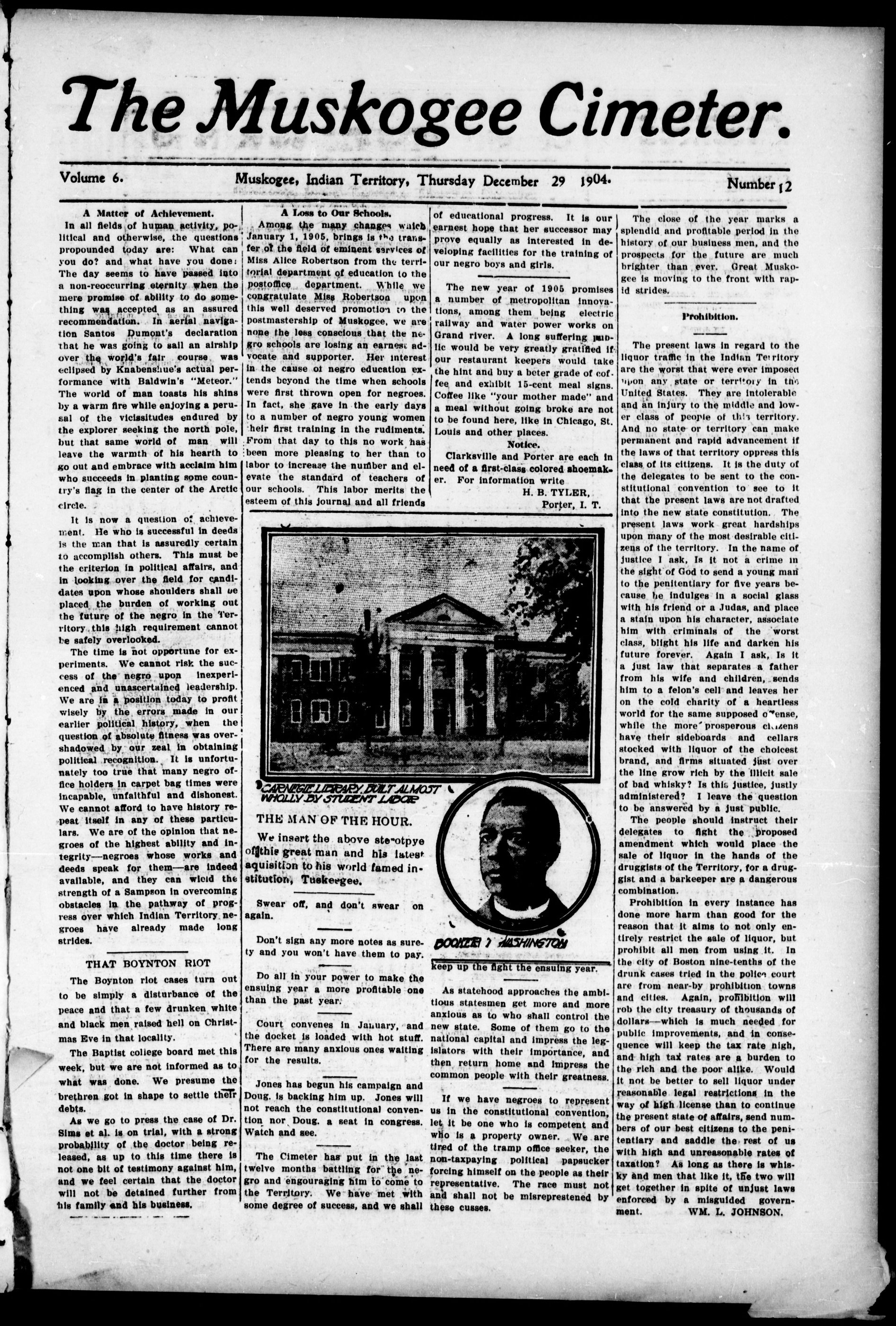
The Muskogee Cimeter.
Volume 6.
A Matter of Achievement.
In all fields of human activity, political and otherwise, the questions propounded today are: What can you do? and what have you done: The day seems to have passed into a non-reoccurring eternity when the mere promise of ability to do something was accepted as an assured recommendation. In aerial navigation Santos Dumont's declaration that he was going to sail an airship over the world's fair course was eclipsed by Knabenshue's actual performance with Baldwin's "Meteor." The world of man toasts his shins by a warm fire while enjoying a perusal of the vicissitudes endured by the explorer seeking the north pole, but that same world of man will leave the warmth of his hearth to go out and embrace with acclaim him who succeeds in planting some country's flag in the center of the Arctic circle.
It is now a question of achievement. He who is successful in deeds is the man that is assuredly certain to accomplish others. This must be the criterion in political affairs, and in looking over the field for candidates upon whose shoulders shall we placed the burden of working out the future of the negro in the Territory, this high requirement cannot be safely overlooked.
The time is not opportune for experiments. We cannot risk the success of the negro upon inexperienced and unascertained leadership. We are in a position today to profit wisely by the errors made in our earlier political history, when the question of absolute fitness was overshadowed by our zeal in obtaining political recognition. It is unfortunately too true that many negro office holders in carpet bag times were incapable, unfaithful and dishonest. We cannot afford to have history repeat itself in any of these particulars. We are of the opinion that negroes of the highest ability and integrity—negroes whose works and deeds speak for them—are indeed available, and they can wield the strength of a Sampson in overcoming obstacles in the pathway of progress over which Indian Territory negroes have already made long strides.
THAT BOYNTON RIOT
The Boynton riot cases turn out to be simply a disturbance of the peace and that a few drunken white and black men raised hell on Christmas Eve in that locality.
The Baptist college board met this week, but we are not informed as to what was done. We presume the brethren got in shape to settle their debts.
As we go to press the case of Dr. Sims et al. is on trial, with a strong probability of the doctor being released, as up to this time there is not one bit of testimony against him, and we feel certain that the doctor will not be detained further from his family and his business.
Muskogee, Indian Territory, Thursday December 29 1904.
THE MUSEUM
A Loss to Our Schools.
Among the many changes which January 1, 1905, brings is the transfer of the field of eminent services of Miss Alice Robertson from the territorial department of education to the postoffice department. While we congratulate Miss Robertson upon this well deserved promotion to the postmastership of Muskogee, we are none the less conscious that the negro schools are losing an earnest advocate and supporter. Her interest in the cause of negro education extends beyond the time when schools were first thrown open for negroes. In fact, she gave in the early days to a number of negro young women their first training in the rudiments. From that day to this no work has been more pleasing to her than to labor to increase the number and elevate the standard of teachers of our schools. This labor merits the esteem of this journal and all friends
CARNEGIE LIBRARY, BUILT ALMO
WHOLLY BY STUDENT LABOR
THE MAN OF THE HOUR.
We insert the above ste-otpye off this great man and his latest acquisition to his world famed institution, Tuskegee.
Swear off, and don't swear on again.
Don't sign any more notes as surety and you won't have them to pay.
Do all in your power to make the ensuing year a more profitable one than the past year.
Court convenes in January, and the docket is loaded with hot stuff. There are many anxious ones waiting for the results.
Jones has begun his campaign and Doug. is backing him up. Jones will not reach the constitutional convention nor Doug. a seat in congress. Watch and see.
The Cimeter has put in the last twelve months battling for the negro and enouraging him to come to the Territory. We have met with some degree of success, and we shall
```markdown
```
of educational progress. It is our earnest hope that her successor may prove equally as interested in developing facilities for the training of our negro boys and girls.
The new year of 1905 promises a number of metropolitan innovations, among them being electric railway and water power works on Grand river. A long suffering public would be very greatly gratified if our restaurant keepers would take the hint and buy a better grade of coffee and exhibit 15-cent meal signs. Coffee like "your mother made" and a meal without going broke are not to be found here, like in Chicago, St. Louis and other places.
Notice.
Clarksville and Porter are each in need of a first-class colored shoemaker. For information write H. B. TYLER, Porter, I. T.
THE
BOOKER 7 WASHINGTON
keep up the fight the ensuing year.
As statehood approaches the ambitious statesmen get more and more anxious as to who shall control the new state. Some of them go to the national capital and impress the legislators with their importance, and then return home and impress the common people with their greatness.
If we have negroes to represent us in the constitutional convention, let it be one who is competent and who is a property owner. We are tired of the tramp office seeker, the non-taxpaying political papsucker forcing himself on the people as their representative. The race must not and shall not be misreprestened by these cusses.
---
Number 12
The close of the year marks a splendid and profitable period in the history of our business men, and the prospects for the future are much brighter than ever. Great Muskogee is moving to the front with rapid strides.
Prohibition.
The present laws in regard to the liquor traffic in the Indian Territory are the worst that were ever imposed upon any state or territory in the United States. They are intolerable and an injury to the middle and lower class of people of this territory. And no state or territory can make permanent and rapid advancement if the laws of that territory oppress this class of its citizens. It is the duty of the delegates to be sent to the constitutional convention to see to it that the present laws are not drafted into the new state constitution. The present laws work great hardships upon many of the most desirable citizens of the territory. In the name of justice I ask, Is it not a crime in the sight of God to send a young man to the penitentiary for five years because he indulges in a social glass with his friend or a Judas, and place a stain upon his character, associate him with criminals of the worst class, blight his life and darken his future forever. Again I ask, Is it a just law that separates a father from his wife and children, sends him to a felon's cell and leaves her on the cold charity of a heartless world for the same supposed o'ense, while the more prosperous citizens have their sideboards and cellars stocked with liquor of the choicest brand, and firms situated just over the line grow rich by the illicit sale of bad whisky? Is this justice, justly administered? I leave the question to be answered by a just public.
The people should instruct their delegates to fight the proposed amendment which would place the sale of liquor in the hands of the druggists of the Territory, for a druggist and a barkeeper are a dangerous combination.
Prohibition in every instance has done more harm than good for the reason that it aims to not only entirely restrict the sale of liquor, but prohibit all men from using it. In the city of Boston nine-tenths of the drunk cases tried in the police court are from near-by prohibition towns and cities. Again, prohibition will rob the city treasury of thousands of dollars—which is much needed for public improvements, and in consequence will keep the tax rate high, and high tax rates are a burden to the rich and the poor alike. Would it not be better to sell liquor under reasonable legal restrictions in the way of high license than to continue the present state of affairs, send numbers of our best citizens to the penitentiary and saddle the rest of us with high and unreasonable rates of taxation? As long as there is whisky and men that like it, the two will get together in spite of unjust laws enforced by a misguided government. WM. L. JOHNSON.
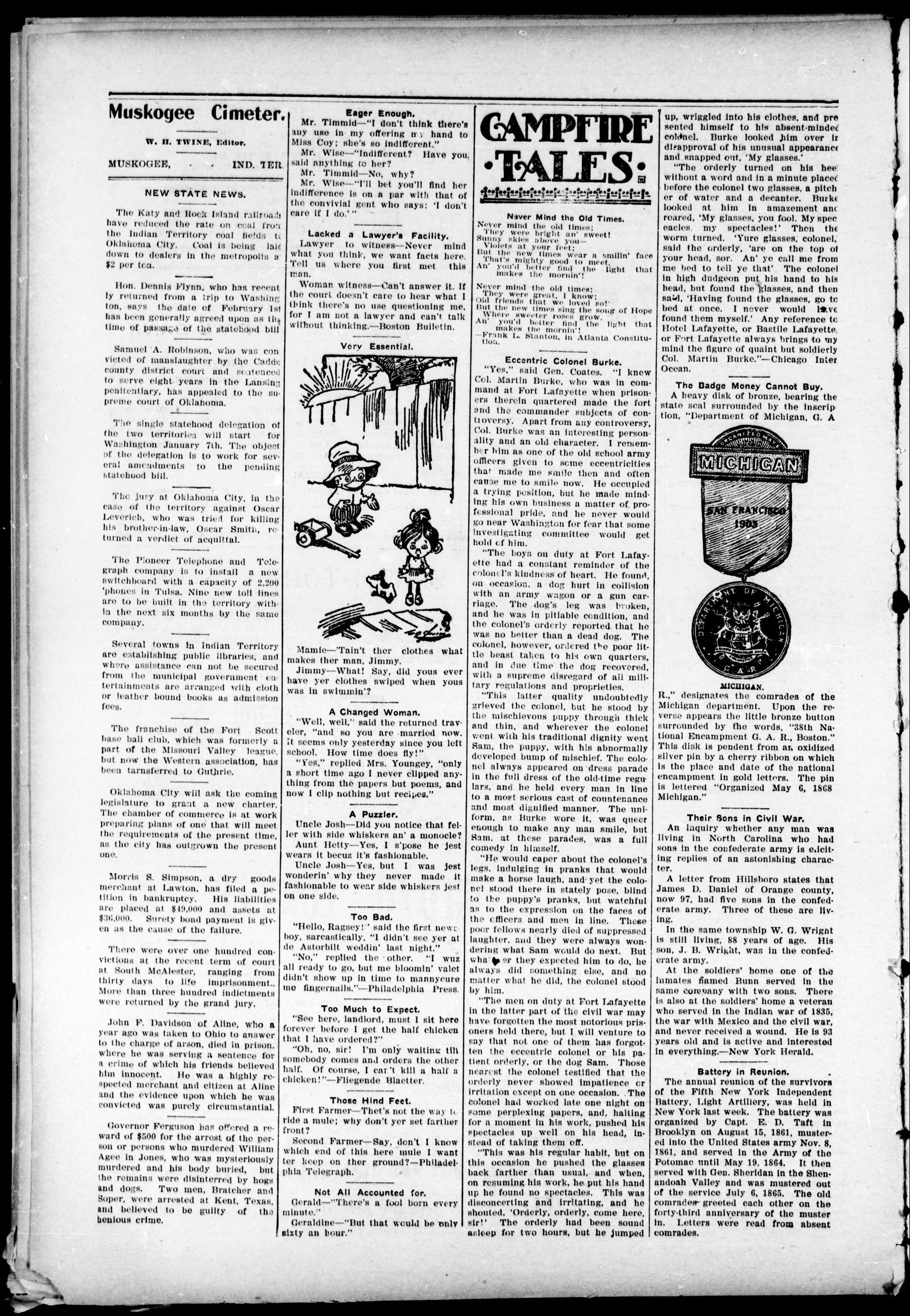
Muskogee Cimeter.
W. H. TWINE, Editor.
MUSKOGEE, IND. TER
NEW STATE NEWS.
The Katy and Rock Island railroads have reduced the rate on coal from the Indian Territory coal fields to Oklahoma City. Coal is being laid down to dealers in the metropolis at $2 per ton.
Hon. Dennis Flynn, who has recently returned from a trip to Washington, says the date of February 1st has been generally agreed upon as the time of passage of the statehood bill
Samuel A. Robinson, who was convicted of manslaughter by the Caddo county district court and sentenced to serve eight years in the Lansing penitentiary, has appealed to the supreme court of Oklahoma.
The single statehood delegation of the two territories will start for Washington January 7th. The object of the delegation is to work for several amendments to the pending statehood bill.
The jury at Oklahoma City, in the case of the territory against Oscar Leverich, who was tried for killing his brother-in-law, Oscar Smith, returned a verdict of acquittal.
The Pioneer Telephone and Telegraph company is to install a new switchboard with a capacity of 2,200 'phones in Tulsa. Nine new toll lines are to be built in the territory within the next six months by the same company.
Several towns in Indian Territory are establishing public libraries, and where assistance can not be secured from the municipal government entertainments are arranged with cloth or leather bound books as admission fees.
The franchise of the Fort Scott base ball club, which was formerly a part of the Missouri Valley league, but now the Western association, has been tarnished to Guthrie.
Oklahoma City will ask the coming legislature to grant a new charter. The chamber of commerce is at work preparing plans of one that will meet the requirements of the present time, as the city has outgrown the present one.
Morris S. Simpson, a dry goods merchant at Lawton, has filed a petition in bankruptcy. His liabilities are placed at $49,000 and assets at $36,000. Surety bond payment is given as the cause of the failure.
There were over one hundred convictions at the recent term of court at South McAlester, ranging from thirty days to life imprisonment.. More than three hundred indictments were returned by the grand jury.
John F. Davidson of Aline, who a year ago was taken to Ohio to answer to the charge of arson, died in prison, where he was serving a sentence for a crime of which his friends believed him innocent. He was a highly respected merchant and citizen at Aline and the evidence upon which he was convicted was purely circumstantial.
Governor Ferguson has offered a reward of $500 for the arrest of the person or persons who murdered William Agee in Jones, who was mysteriously murdered and his body buried, but the remains were disinterred by hogs and dogs. Two men, Bratcher and Soper, were arrested at Kent, Texas, and believed to be guilty of the henious crime.
Eager Enough.
Mr. Timmid—"I don't think there's any use in my offering my hand to Miss Coy; she's so indifferent."
Mr. Wise—"Indifferent? Have you said anything to her?
Mr. Timmid—No, why?
Mr. Wise—"I'll bet you'll find her indifference is on a par with that of the convivial gent who says: 'I don't care if I do.'"
Lacked a Lawyer's Facility.
Lawyer to witness—Never mind what you think, we want facts here. Tell us where you first met this man.
Woman witness—Can't answer it. If the court doesn't care to hear what I think there's no use questioning me, for I am not a lawyer and can't talk without thinking.—Boston Bulletin.
Very Essential.
Mamie—'Tain't ther clothes what makes ther man, Jimmy.
Jimmy—What! Say, did you ever have yer clothes swiped when you was in swimmin'?
A Changed Woman.
"Well, well," said the returned traveler, "and so you are married now. It seems only yesterday since you left school. How time does fly!" "Yes," replied Mrs. Youngey, "only a short time ago I never clipped anything from the papers but poems, and now I clip nothing but recipes."
A Puzzler.
Uncle Josh—Did you notice that feller with side whiskers an' a monocle?
Aunt Hetty—Yes, I s'pose he jest wears it becuz it's fashionable.
Uncle Josh—Yes, but I was jest wonderin' why they never made it fashionable to wear side whiskers jest on one side.
Too Bad.
"Hello, Ragsey!" said the first newsboy, sarcastically, "I didn't see yer at de Astorbilt weddin' last night." "No," replied the other. "I wuz all ready to go, but me bloomin' valet didn't show up in time to mannycure me fingernails."—Philadelphia Press.
Too Much to Expect.
"See here, landlord, must I sit here forever before I get the half chicken that I have ordered?"
"Oh, no, sir! I'm only waiting till somebody comes and orders the other half. Of course, I can't kill a half a chicken!"—Fliegende Blactter.
Those Hind Feet.
First Farmer—Thet's not the way to ride a mule; why don't yer set farther front?
Second Farmer—Say, don't I know which end of this here mule I want ter keep on ther ground?—Philadelphia Telegraph.
Not All Accounted for.
Gerald—"There's a fool born every minute."
Geraldine—"But that would be only sixty an hour."
CAMPFIRE TALES:
Naver Mind the Old Times.
But the new times wear a smilin' face
That's mighty good to meet.
Never mind the old times;
They were great, I know;
Old friends that we loved so!
But the new times sing the song of Hope Where sweeter roses grow. An' youd better find the light that makes the mornin'
—Frank L. Stanton, in Atlanta Constitution.
Eccentric Colonel Burke.
"Yes," said Gen. Coates. "I knew Col. Martin Burke, who was in command at Fort Lafayette when prisoners therein quartered made the fort and the commander subjects of controversy. Apart from any controversy, Col. Burke was an interesting personality and an old character. I remember him as one of the old school army officers given to some eccentricities that made me smile then and often cause me to smile now. He occupied a trying position, but he made minding his own business a matter of professional pride, and he never would go near Washington for fear that some investigating committee would get hold of him.
"The boys on duty at Fort Lafayette had a constant reminder of the colonel's kindness of heart. He found, on occasion, a dog hurt in collision with an army wagon or a gun carriage. The dog's leg was broken, and he was in pitiable condition, and the colonel's orderly reported that he was no better than a dead dog. The colonel, however, ordered the poor little beast taken to his own quarters, and in due time the dog recovered, with a supreme disregard of all military regulations and proprieties.
"This latter quality undoubtedly grieved the colonel, but he stood by the mischievous puppy through thick and thin, and wherever the colonel went with his traditional dignity went Sam, the puppy, with his abnormally developed bump of mischief. The colonel always appeared on dress parade in the full dress of the old-time regulars, and he held every man in line to a most serious cast of countenance and most dignified manner. The uniform, as Burke wore it, was queer enough to make any man smile, but Sam, at these parades, was a full comedy in himself.
"He would caper about the colonel's legs, indulging in pranks that would make a horse laugh, and yet the colonel stood there in stately pose, blind to the puppy's pranks, but watchful as to the expression on the faces of the officers and men in line. These poor fellows nearly died of suppressed laughter, and they were always wondering what Sam would do next. But what or they expected him to do, he always did something else, and no matter what he did, the colonel stood by him.
"The men on duty at Fort Lafayette in the latter part of the civil war may have forgotten the most notorious prisoners held there, but I will venture to say that not one of them has forgotten the eccentric colonel or his patient orderly, or the dog Sam. Those nearest the colonel testified that the orderly never showed impatience or irritation except on one occasion. The colonel had worked late one night on some perplexing papers, and, halting for a moment in his work, pushed his spectacles up well on his head, instead of taking them off.
"This was his regular habit, but on this occasion he pushed the glasses back farther than usual, and when, on resuming his work, he put his hand up he found no spectacles. This was disconcerting and irritating, and he shouted, 'Orderly, orderly, come here, sir!' The orderly had been sound asleep for two hours, but he jumped
up, wriggled into his clothes, and presented himself to his absent-minded colonel. Burke looked him over in disapproval of his unusual appearance and snapped out, 'My glasses.'
"The orderly turned on his heel without a word and in a minute placed before the colonel two glasses, a pitcher of water and a decanter. Burke looked at him in amazement and roared, 'My glasses, you fool. My spectacles, my spectacles!' Then the worm turned. 'Yure glasses, colonel, said the orderly, 'are on the top of your head, sor. An' ye call me from me bed to tell ye that' The colonel in high dudgeon put his hand to his head, but found the glasses, and then said, 'Having found the glasses, go to bed at once. I never would love found them myself.' Any reference to Hotel Lafayette, or Bastile Lafayette, or Fort Lafayette always brings to my mind the figure of quaint but soldierly Col. Martin Burke."—Chicago Inter Ocean.
The Badge Money Cannot Buy.
A heavy disk of bronze, bearing the state seal surrounded by the inscription, "Department of Michigan, G. A
ORGANIZED MAY 1
MICHIGAN
SAN FRANCISCO
1903
DEPARTMENT OF MICHIGAN
A DIPLOMA PRESIDENTA ANCIENTA
CORONAVIRUS
MICHIGAN. R.," designates the comrades of the Michigan department. Upon the reverse appears the little bronze button surrounded by the words, "38th National Encampment G. A. R., Boston." This disk is pendent from an oxidized silver pin by a cherry ribbon on which is the place and date of the national encampment in gold letters. The pin is lettered "Organized May 6, 1868 Michigan."
Their Sons in Civil War.
An inquiry whether any man was living in North Carolina who had sons in the confederate army is exciting replies of an astonishing character.
A letter from Hillsboro states that James D. Daniel of Orange county, now 97, had five sons in the confederate army. Three of these are living.
In the same township W. G. Wright is still living, 88 years of age. His son, J. B. Wright, was in the confederate army.
At the soldiers' home one of the inmates named Bunn served in the same company with two sons. There is also at the soldiers' home a veteran who served in the Indian war of 1835, the war with Mexico and the civil war, and never received a wound. He is 93 years old and is active and interested in everything.—New York Herald.
Battery in Reunion.
The annual reunion of the survivors of the Fifth New York Independent Battery, Light Artillery, was held in New York last week. The battery was organized by Capt. E. D. Taft in Brooklyn on August 15, 1861, mustered into the United States army Nov. 8, 1861, and served in the Army of the Potomac until May 19, 1864. It then served with Gen. Sherldan in the Shenandoah Valley and was mustered out of the service July 6, 1865. The old comrades greeted each other on the forty-third anniversary of the muster in. Letters were read from absent comrades.
AGRICULTURE
Building a Cistern.
If after a cistern has been built in the customary manner with brick and cement a wash is made of clear cement and water, and brushed upon the walls like whitewash, the walls will be found to have been rendered impervious to water. A cistern can be made of cement alone, and if the earth in which it is made is of a solid clayey nature the wall of cement need not be over two inches in thickness. Bricks would have to be used for the arch, but it is better not to make an arch. Cisterns are usually under floors, and if not they can be floored over and the under side lathed and plastered with adamant. It becomes hard as stone, is rot-proof, dirt-proof and moisture-proof. Built in this way a cistern can be made more cheaply, as it does not have to be so deep, and can be larger in diameter. A cistern should always be circular, as it makes the walls stronger and takes less material for a given amount of water stored. Two parts of sand to one of cement are about right.—The Rural New Yorker.
Buckwheat, Rye and Fertility.
The discussion of buckwheat as a feed reminds us to say that it has even a greater value as a fertilizer of the soil, as we demonstrated fully on sandy land that had been reduced to the unprofitable point by too much cropping to wheat; that was several years ago, however. Rye was used in connection with the buckwheat; but the element most needed was secured through the buckwheat, the rye affording some feed during the operation, and helping to put the soil in good mechanical condition. First, winter rye was sown in the fall, pastured then, late, and early in spring. Then allowed to grow until in bloom, when it was plowed under and sown to buckwheat. That, in turn, was plowed under and again sown to winter rye. The following spring red clover was sown in the rye, when an excellent stand resulted and the soil was again in condition to play its part in crop growing.
The Dust Bath.
To keep the fowls free from lice during the winter months nothing is so good as the dust bath. Don't think that lice don't multiply in winter, for they do, especially those great gray fellows. Get a box, a barrel, or anything that will hold the dust away in the dry, and now fill it or have the children fill it with road dust. Now is an excellent time, for later the roads will be too damp with the fall rains and heavy night dews to dry out and make much dust. Then when the fowls must be kept confined and the earth is hard and frozen, put some of the dust in the shallow box, set it in the sunshine or light of the poultry house windows, and notice how they enjoy that dust.bath. Remember, the dust must be dry and if possible warm it, slightly warm. Chickens will not dust in damp earth in winter time.—Farm Star.
Multiplier Onion.
The old-time "multiplier" onion is not of much importance now. It is a persistent grower and succeeds most anywhere. Sometimes it gets to be little better than a weed. But it had some points in its favor. It had a habit of getting up in the spring at the first opportunity and for a short time was passably good. Its place in the garden could not be filled, even by the earliest of vegetables. It would take care of itself when once planted, and would hold its own against grass and weeds if given an equal opportunity with them. It might yet be given a place in many a garden to the benefit of the owner.
Large scandals from small talk often grow.
Defiance Starch is guaranteed biggest and best or money refunded. 16 ounces, 10 cents. Try it now.
A load of liquor merely adds to a man's load of trouble.
For any old cold just use Cheatham's Laxative Tablets. They are guaranteed.
Do not be afraid to adopt some one else's method, if some one else's method is better than yours.
Dr. David Kennedy's Favorite Romedy, the Great Kidney and Liver Cure, World Famous. Write Dr. Kennedy's Secret Kondout, N. Y., for free sample bottle.
Be prompt. Many a farmer has made up his mind after the market has gone by.
A GUAPANTEED CURE FOR PILES. Itching, Blind, Bleeding or Protruding Piles. Your druggist will refund money if PAZO OINTMENT falls to cure you in 6 to 14 days. 50c.
Success belongs to the fellow in any line of business who is persevering and who makes seeming impossibilities give way.
Piso's Cure cannot be too highly spoken of as a cough cure.—J. W. O'BRIEN, 322 Third Ave. N., Minneapolis, Minn., Jan. 6, 1900.
A foolish proverb says, "Take the bull by the horns." No one ever obeyed this but once.
Mrs. Winslow's Soothing Syrup.
For children teething, softens the gums, reduces inflammation, allays pain, cures wind colic. 25c a bottle
The man with methods accomplishes more in a week than the hard working sloven does in a month.
You never hear any one complain about "Defiance Starch." There is none to equal it in quality and quantity, 16 ounces, 10 cents. Try it now and save your money.
The foundation of American prosperity is in the soil. We are still an agricultural nation, and wise men assert that we must remain as such.
Lewis' "Single Binder" straight 5c cigar. No other brand of cigars is so popular with the smoker. He has learned to rely upon its uniform high quality. Lewis' Factory, Peoria, Ill.
The young man or woman starting in life should be willing to go anywhere, provided it is forward.
Old and True.
"For fifteen years I have constantly kept a supply of Hunt's Cure on hand to use in all cases of itching skin trouble. For Eczema, Ringworm and the like it is peerless.
"I regard it as an old friend and a true one."
Mrs. Eula Preslad,
50c per box. Greenfield, Tenn.
Cultivate cheerfulness. It should permeate the home, the stables. It is sure cure for blues. Keep in the sunlight.
A Rare Good Thing.
"Am using ALLEN'S FOOT-EASE, and can truly say I would not have been without it so long, had I known the relief it would give my aching feet. I think it a rare good thing for anyone having sore or tired feet.—Mrs. Matilda Holtwert, Providence, R. L." Sold by all Druggists, 25c. Ask to day.
Signs
Gayboy-I guess my wife expects callers today.
"What makes you think so?"
What makes you think so. "She began the day by making the house unfit for any one to live in."— Life. No soul was ever saved by a scheme of salvation.
ST.
JACOBS
OIL
Miriam H.
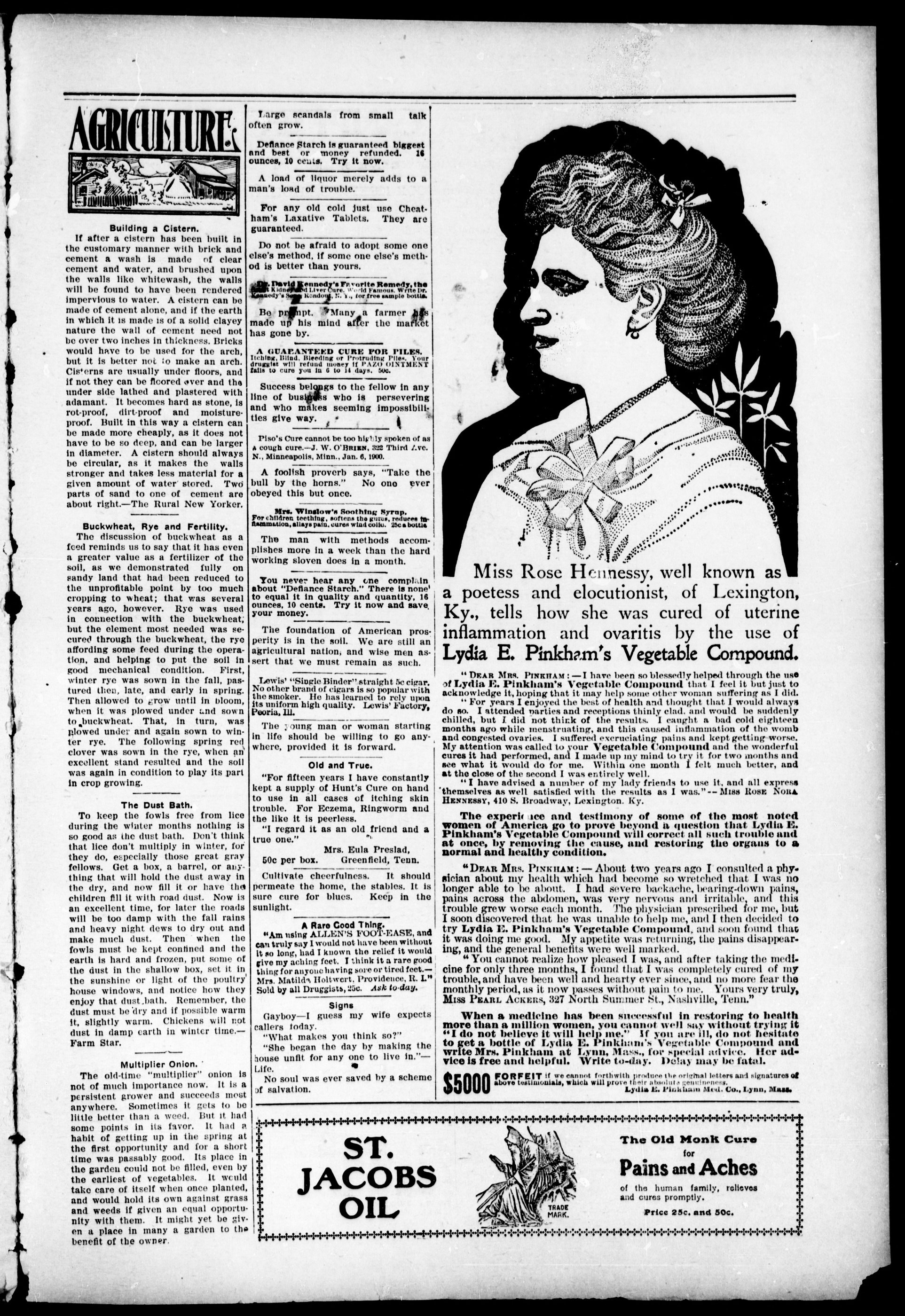
Miss Rose Hennessy, well known as a poetess and elocutionist, of Lexington, Ky., tells how she was cured of uterine inflammation and ovaritis by the use of Lydia E. Pinkham's Vegetable Compound.
"DEAR MRS. PINKHAM:—I have been so blessedly helped through the use of Lydia E. Pinkham's Vegetable Compound that I feel it but just to acknowledge it, hoping that it may help some other woman suffering as I did.
"For years I enjoyed the best of health and thought that I would always do so. I attended parties and receptions thinly clad, and would be suddenly chilled, but I did not think of the results. I caught a bad cold eighteen months ago while menstruating, and this caused inflammation of the womb and congested ovaries. I suffered excruciating pains and kept getting worse. My attention was called to your Vegetable Compound and the wonderful cures it had performed, and I made up my mind to try it for two months and see what it would do for me. Within one month I felt much better, and at the close of the second I was entirely well.
"I have advised a number of my lady friends to use it, and all express themselves as well satisfied with the results as I was."--MISS ROSE NORA HENNESSY, 410 S. Broadway, Lexington, Ky.
The experience and testimony of some of the most noted women of America go to prove beyond a question that Lydia E. Pinkham's Vegetable Compound will correct all such trouble and at once, by removing the cause, and restoring the organs to a normal and healthy condition.
"DEAR MRS. PINKHAM: — About two years ago I consulted a physician about my health which had become so wretched that I was no longer able to be about. I had severe backache, bearing-down pains, pains across the abdomen, was very nervous and irritable, and this trouble grew worse each month. The physician prescribed for me, but I soon discovered that he was unable to help me, and I then decided to try Lydia E. Pinkham's Vegetable Compound, and soon found that it was doing me good. My appetite was returning, the pains disappearing, and the general benefits were well marked.
"You cannot realize how pleased I was, and after taking the medicine for only three months, I found that I was completely cured of my trouble, and have been well and hearty ever since, and no more fear the monthly period, as it now passes without pain to me. Yours very truly, MISS PEARL ACKERS, 327 North Summer St., Nashville, Tenn."
When a medicine has been successful in restoring to health more than a million women, you cannot well say without trying it "I do not believe it will help me." If you are ill, do not hesitate to get a bottle of Lydia E. Pinkham's Vegetable Compound and write Mrs. Pinkham at Lynn, Mass., for special advice. Her advice is free and helpful. Write to-day. Delay may be fatal.
$5000 FORFEIT if we cannot forthwith produce the original letters and signatures of above testimonials, which will prove their absolute genuineness.
Lydia E. Pinkham Med. Co., Lynn, Mass.
of the human family, relieves and cures promptly.
The preliminary hearing of Doctors Daily, Sims and the women who are held in the federal jail, charged with the murder of Edith Grubbs, the Wagoner girl, will be held Thursday morning before United States Commissioner Leekly.
The district attorney has been diligently at work on this case, and thinks there is very strong evidence against several of them.
It is stated that Dr. Daily's father, of Indiana, will arrive, and put up a very strong defense in behalf of his son.
This case, from all reports, is about the worst yet on record in Muskogee, and the action of the court in the matter will be eagerly watched. — Pointer.
There were several colored persons arrested in the case stated, but none of them is even technically guilty or a violation of the law. If there is any wrongdoing, it comes from the high class white folks, and a negro could not in any even be the principal, acting simply as servants and assistants.
Answer to Charges Made Against the Church.
In reply, we say that they are true in part, and it is a shame that I must confess it, but the devils are so numerous that they grow without being planted, and they sweetened their tongues with deceit and chatter with angels, and do deceive the very elect of the church. The question that now confronts us, Who is to be blamed? we will leave to the public to decide. At this writing, we must confess that there are men occupying our pulpifs pretending to be expounders of the gospel, that no decent person should allow their families to hear the gospel so expounded.
We will herewith give a category of the men we condemn: The man who is guilty of rape or even allows himself to be accused should not be a leader in any Christian society, and the people and the church should cry "Away with him!" And he who is guilty of breaking up men's families and he who has a public rumor after him of being immoral, and the man who has to be moved from place to place on account of such accusations should not be supported by the people, for even the vilest sinner is better than he. Ministers who have two living wives should be disregarded as Christian leaders. The public would be justified in the sight of God in withholding their support from such men, and the voice of the righteous is the voice of God. As soon as the better class of citizens and Christians denounce these outrages, so soon will the church take its place as the greatest promoter of Christianity and civilization in our land; but if the church covers up the scoundrels, how much better is the church than the world?
In conclusion, we say stand for the pure Christian church and against the immoral wrecks of the church.
Yours for God and the church and race. REV. T. H. TYSON.
Do You Want a House?
If so, let me build it for you on small monthly payments, low interest and easy terms. On this plan your rents pay for the place, and you are at home all the time. Come to see me. W. P. FIELDS, Office, No 1, English Block.
Near Radian Wells. This is the only first-class place for colored people in the city.
A. S. MCREY. Lawyer, 201-2 Okmulgee Avenue.
SCHIEBERL
First door southof Fire Department, South Second Street.
EXCELSIOR
Tonsorial Parlor
and BATH HOUSE
BANKS & THURMAN, Props.
SHUT 7020 SECOND STREET
Agents for Garden City Ill. custom and Great Western Tailors of Chicago.
FORTNIGHTLY CULTURE CLUB.
Emancipation Proclamation Celebration Program.
Song, "America,"—Congregation.
Invocation—Rev. A. R. Morris.
Roll Call, (Quotation from Negro authors)—Members of Club.
Reading the Proclamation—Miss Maud V. Jones.
Solo, "One Sweetly Solemn Thought"—Mrs. J. E. Toombs.
Reading, "Phillip's Toussaint L'Ouverture"—Mrs. L. E. Perdue.
Solo, selected—Mrs. A. J. Wallace, Junior.
Address, "The Negro as a Soldier"
—Prof. Oscar Spencer.
Duet "The Flower Song"—Misses Clara White and Lula McCulloch.
Reading, Shakespeare's "Othello's Apology"—Mr. Frank W. Reid.
Solo, Instrumental; cornet—Mr. W. A. Allen.
Reading, Selections from Dunbar—Prof. C. A. Biggers.
Solo, "The Rose of Sharon"—Miss Lelia Biggers.
Offertory:
Quartet, Selected--Mrs. Jas. Smith, Miss Biggers, Messrs. Lowe and Biggers.
Benediction—Rev. W. H. Simons.
Sunday Jan. 1st. At the C. M. E Church 2:30 p. m.
Ministers and Deacon Union of the Southeastern District of Kansan will meet at Columbus, Friday before the forth Sunday in January, 1905. Rev. T. E. Pierce, Mod.
Muskogee. - - - Ind. Ter'v.
The 20th Century Corresponding SCHOOL of STENOGRAPHY.
TERRITORIAL TRUST & SURETY COMPANY
ABSTRACTS OF TITLE TITLES GUARANTEED SURETY BONDS WRITTEN
Muskogee, Indian Territory
SELLCIGARS!
Add a few boxes of cigars to your stand or store and increase your sales, we can furnish you OWLS, CAPADURERS, HENRY GEORGE, LITTLE TOM, AGENT, 305, CREMO, PATHFINDFRS, and several other popular brands by the single box and sell them to you at wholesale prices. It is not much to invest, and they are sure to sell. Come and have a talk with us, Ben Estes' Druggist, COR. MAIN and Okmulgee
A School of Modern Methods.
A School that teaches you at home to write shorthand.
The School that is receiving praises
For the progress of its students.
Do not delay but write today
for circulars explaining the Course,
C. A. BIGGERS.....Instructor,
P O, Box 860 Muskogee, I. T.
TERRITORIAL TRUST & SU
ABSTRACTS OF THE
TITLES GUARANTY
SURETY BONDS WE
Muskogee, Indiana
SELL CIC
Add a few boxes of cigars to your s
crease your sales, we can furnish you
ERS, HENRY GEORGE, LITTLE
CREMO, PATHFINDFRS, and s
brands by the single box and sell the
prices. It is not much to invest, and
Come and have a talk with us,
Ben Estes' Drugg
Dave Richardson's
BARBERSHOP.
OPPOSITE COURT HOUSE.
SATISFACTION GUARANTED
Dave Richardson. - Prom
HAND MADE CLOTHES SHIRTS ALL KINDS OF HATS
shing Goods,
SCRIPTIONS:
rwear, Suit Cases,
CLURE,
ENGLISH BLOCK.
- - Ind. Ter'v.
ry Correspond-
STENOGRAPHY.
Our Gem
The Penwere
Dean
& SURETY COMPANY
OF TITLE
GUARANTEED
OS WRITTEN
Italian Territory
IGARS!
your stand or store and in-
nish you OWLS, CAPADUR-
LITLE TOM, AGENT, 305,
and several other popular
sell them to you at wholesale
est, and they are sure to sell.
uggist, COR. MAIN
and Okmulgee
For Sale.
I have a first class buggie with shafts and pole, apparently new, also a set of harness for same. This buggie is what is known as the mountain buggy with breaks, will trade the same for corn, at market price.
B. T. Kell, at U. S. Jail.
Unhealthfulness
Those who point the accusing finger at woman's garb and charge it with being unhealthful are not without just grounds. Woman's garb is indeed unhealthful. Only the very richest women can afford both to dress and to be operated on. Of the middle class, there is now and then a woman brave enough to prefer being a frump to retaining all her viscera, but the great majority will choose to be in style, and for the rest, to suffer, except as they may take advantage of free clinics.
Among the poor the case is even worse. Nothing could be more prejudicial to health than the condition of the woman who, after having paid for her clothes has nothing left for car fare. For if her shoes match her hat and frock, she cannot possibly walk in a graceful manner without straining important muscles. Moreover, worrying for fear people will not attribute her husband's wearing his old hat to eccentricity in the end affects her digestion.
In general, the inability of woman's garb to hang from the shoulders and look like anything has to be considered.—Life.
Found at Last.
Hensley, Ark., Dec. 26th.—(Special!) That a sure cure for Backache would be a priceless boon to the people, and especially the women of America, is admitted by all interested in medical matters, and Mrs. Sue Williams of this place is certain she has found in Dodd's Kidney Pills the long looked for cure.
"I am 38 years old," Mrs. Williams says, "and I have suffered with the Backache very much for three or four years. I have been treated by good physicians and got no relief, but thanks to God, I have found a cure at last and it is Dodd's Kidney Pills. I have taken only one box and it has done me more good than all the doctors in three or four years. I want all sufferers from Backache to know that they can get Dodd's Kidney Pills and get well."
Backache is one of the first symptoms of Kidney Disease. Guard against Bright's Disease or Rheumatism by curing it with Dodd's Kidney Pills.
Mr. Figgjam—Tommy, do you ever use slang?
Tommy Figgjam—No, indeed
"Yhy, isn't 'indeedy' slank?"
"Sure nit. Who put that bug into your coco?"—Baltimore American.
That and This.
"Twelve years ago I bought my first bottle of Hunt's Lightning Oil. For Cuts, Burns, Sprains and Aches it was the best remedy I had found to that time. After the lapse of one dozen years I can truly say, it is the best remedy I have found to this time." John P. Thompson, Red Rock, O. T. 25c and 50c bottles.
His Conclusion
"I'm afriad, Johnny," said the Sunday school teacher rather sadly, "that I shall not meet you in the better land."
"Why? What have you been doin' now?"—Pick-Me-Up.
Many Children Are Sickly.
Mother Gray's Sweet Powders for Children, used by Mother Gray, a nurse in Children's Home, New York, cure Feverishness, Headache, Stomach Troubles, Toething Disorders, Break up Colds and Destroy Worms. At all Druggists' 25c. Sample mailed FREE. Address Allen S. Olmsted, Le Roy, N. Y.
Porrowed trouble always comes to abide.
A little cant can spoil a whole lot of concentration.
Insist on Getting It.
Some grocers say they don't keep Defiance Starch. This is because they have a stock on hand of other brands containing only 12 oz in a package, which they won't be able to sell first, because Defiance contains 16 oz. for the same money.
Do you want 16 oz. instead of 12 oz. for same money? Then buy Defiance Starch. Requires no cooking.
CURIOUS CAVERN IN NEVADA.
Harriman and Senator Clark Having a Wonderland Explored. What is probably the outlet of one of the lost or disappearing rivers in eastern Nevada in a hugh cave near the line of the Clark and Harriman Salt Lake and Los Angeles road, which B. L. Magruder, of Sioux City, Iowa, is exploring for E. H. Harriman and Senator W. A. Clark, of Montana. He is soon to make a report on the subject to them, the latter having become greatly interested in the subterranean chamber for meager reports already given them. The place is about sixty miles west of Calientes, Nev.
It is said the beauty of the cave's stalactites and stalagmites is something wondrous. The latter rise from the floor in the shape of trees. Some of them are thirty feet high. The statistics are represented as forming all sorts of beautiful designs. Magruder has gone into the cave a distance of 2,400 feet and found six or seven magnificent crystallized chambers. Several of them are of great size and height. At the end of the cavern there is an abyss far down in which can be heard the roar and splash of running waters. An attempt will be made by Magruder to find the depth of this abyss and try to trace the source of the hidden river.
Matinee Hats.
In Paris it is customary for the feminine theater going public to attend the play, and even the opera, in hats. This practice is causing a revolution in the form of headgear made fashionable for the purpose.
The bold plunge of discarding the theater hat altogether is not contemplated. The position of affairs is only to create new work for the milliners.
The illustrated specimen of this fas-
A
cinating pursuit in the cause of other people's vision of the stage is made of the newest and most modish lace there is, all of stiffened gold, and a little moonlight white tissue that glistens like silver and forms the apology of a framework the cap possesses. Add to this a paradise plume, the airiest and lightest form of feather there is, made of silver and gold with a dash of pink and rose red in it, and the whole delightful arrangement is complete.
Quackery in Tokio.
A feature of low street life in Tokio is the "kuisha," or "moxa" doctor, who applies small pads made of certain dried herbs to the skin. These he sets afire, the ensuing blisters being supposed to be most effective as a cure for various ailments. Among the doctor's remedies are rhinoceros pills, warranted a sure cure for tightness of the chest, gnashing of the teeth and depression of spirits.
Urged to Watch for News.
Addressing the men's club of Trinity church, Hartford, Conn., E. M. Camp, a New York business man, urged the members to form an expert band of men who know news when they see it, and see that it reaches the newspapers.
Porto Rico Coffee and we will send you post paid a fine pair of scissors absolutely free. We make this and other offers to get you to try our famous Cheek & Neal brand Porto Rico Coffee—the best and richest popular priced package coffee on the market—the finest coffee for the least money. Moderate in price, but excellent in quality.
W. L. DOUGLAS
UNION MADE $3.50 SHOES FOR MEN
THE WORLD CLEARLY ENCLOSED
W. L. Douglas makes and sells more men's $3.50 shoes than any other manufacturer in the world.
The reason W. L. Douglas $3.50 shoes are the greatest sellers in the world is because of their excellent style, easy fitting and superior wearing qualities. If I could show you the difference between the shoes made in my factory and those of other makes and the high-grade leatherers used, you would understand why W. L. Douglas $3.50 shoes cost more to make, why they hold their shape, fit better, wear longer, and are of greater intrinsic value than any other $3.50 shoe on the market to-day, and why the sales for the year ending July 1, 1904, were $6,263,040.00.
NO MONEY TILL CURED. 27 YEARS ESTABLISHED.
We send FREE and postpaid a 232-page treatise on Piles, Fistula and Diseases of the Reclum; also 108-page illus. treatise on Diseases of Women. Of the thousands cured by our mild method, none paid a cent til. cured—we furnish their names on application.
DRS. THORNTON & MINOR. 1880 Olive Street, St. Louis, Mo.
1030 Oak St, Kansas City, Mo.
Promotes Digestion,Cheerfulness and Rest.Contains neither Opium,Morphine nor Mineral. NOT NARCOTIC.
Ration of Old Dr. SANUEL PUTCHER
Pumpkin Seed -
Aix Straw -
Rumella Salic -
Anise Sweet -
Mugwort -
Di Carbuncle Salic -
Vernon Sweet -
Crofted Ruger
1.1 mg/cream Putter
Aperfect Remedy for Constipation, Sour Stomach, Diarrhoea Worms, Convulsions, Feverishness and LOSS OF SLEEP.
Fac Simile Signature of
Charles H. Plattier.
NEW YORK.
At 6 months old
35 Doses - 35 CENTS
EXACT COPY OF WRAPPER.
FREE
A Nice Pair
of Scissors
For Your Name
and Address
And 15 signatures
from packages of
Ser
cut from
Porto Rico Co
paid a fine pair o
make this and other
famous Cheek & Neal
richest popular priced
finest coffee for the
excellent in quality.
65 PREMIUM
to all users of Cheek &
PORTO RICO
ROAST COFFEE
W. L. DOUGL
UNION MADE $3.500 SHOES
W. L. Douglas makes and sells shoes than any other man.
The reason W. L. Douglas $3.50 shoes are the great style, easy fitting and superior wearing quality shoes made in my factory and those of other make stand why W. L. Douglas $3.50 shoes cost more to longer, and are of greater intrinsic value than any sales for the year ending July 1, 1904, were $6.263. W. L. Douglas guarantees their value by stamp take no substitute. Sold by shoe dealers everywhere.
SUPERIOR IN FIT, C.
"I have worn W. L. Douglas $3.50 shoe satisfaction. I lend the superior in fit $5.00 to $7.00."—B. S. McCUE, Dept.
W. L. Douglas uses Corona Coltskin in he be the finest Patent Leather made. Fast.
W. L. DO
PILES
NO MONEY
We send FREE and postpaid hectum; also 108-page illu our mild method, none paired DRS. THORNTON
NEW PENSION LAWS SENT FREE
Apply to NATHAN BICKFORD, 914 F St.
Washington, D. C.
When Answering Advertisements
Kindly Mention this Paper.
BEGGS' CHERRY COUGH
SYRUP cures coughs and colds.
CASTORIA
For Infants and Children.
The Kind You Have
Always Bought
Bears the
Signature
of
Char. H. Flitchus.
In
Use
For Over
Thirty Years
CASTORIA
Tt fs no use praying that all tho
world may have the bread of life when
your own life has about ag much nour
ishment in it as a brickbat.
Don’t It Jar You
To have a cough that you can’t
leave off—even when you go to bed?
Put it away for good by using Sim-
mon’s Cough Syrup. It heals inflam-
mation of the throat and lungs—gives
you rest and peaceful sleep,
Did you” ever hear the expression,
“Did she marry well?” How about
the other person?
TO CURE A COLD IN ONE DAY
Take Luxative Bromo Quiniug ‘Tablets. All drug.
Barer REM nes wath a, eee
Pretty Good
A cheap show which recently vis-
ited Topeka was advertised as “a
danger signal on the path of folly.”
We claim this is pretty good.
We do not credit the story that
Flo Willoughby is in love. We saw
Miss Willoughby yesterday and she
seemed quite happy.—Topeka Capital.
$100 Reward, $100.
The readers of thie paper will be pleased to learn
that there {s at least one dreaded disease that actenco
bas becn able to cure tn all ite stages, and that ts
Catarrh, Hall's Catarrh Cure fs the only positive
gure now known to the medical fraternity. | Catarrh
lug @ constitutional disease, requires @ constitu:
Uonal treatment. Hall's Catarrh Cure fo taken {n-
lerually, acting directly upon the blood and mucous
gurtaces of the system, thereby destroying the
foundation of the diseass, and xlving the patient
strength by butiding up the constitution and asstst-
ing nature tn doing tts work. The proprietors have
so much falth in fts curative powers that they offer
One Hundred Dollars for any case that ft falls to
cuve. Bend for listof testimonials,
‘Address F. J. CHENKY & CO., ‘Toledo, 0.
Bold by all Druggista, 7c,
Take fall's Faully Fills for constipation,
Palpitation
Gladys—Oh, papa, I think I shall
break the engagement. I have dis-
covered that Jack plays—plays the
races!
Father—Gad, how you shocked me.
I thought you were going to say that
he played the piano.—Puck.
More Flexible and Lasting,
won't shake out or blow out; by using
Deflance Starch you obtain better re-
sults than possible with any other
brand and one-third more for same
anoney.
Every person has a spectal adapta-
tion for his own peculiar part in life.
Act well that part and victory is sure.
The cynic gets his opinions before
the mirror.
Doubtless many a woman wishes
she could dispose of her stock in a
taatrimonial combine and get her old
job back in the laundry.
very housekeeper should know
that if they will buy Deflance Cold
Water Starch for laundry use they
will save not only time, because it
never sticks to the iron, but because
each package contains 16 oz.—one full
pound--while all other Cold Water
Starches are put up in %-pound pack-
ages, and the price is the same, 10
cents. Then again because Defiance
Starch ts free from all injurious chem-
fcals. If your grocer tries to sell you a
12-02, package it is because he has
@ stock on hand which he wishes to
dispose of before he puts in Defiance.
He knows that Defiance Starch has
printed on every package in large let-
ters and figures “16 ozs." Demand
Defiance snd save much time and
money and the annoyance of the iron
sticking. Defiance never sticks.
Much the Same Thing
“Well, he, here!” ejaculated honest
old Farmer Bentbacker in the midst
of his reading. “Here is an item
which says that there are many
strange creatures in the 200.” ‘
“What does it mean by the 200?”
{inquired his wife.
“Now, that’s what puzzles me; but
{ guess it’s a new division of the old
400, prob'ly half of them that think
are better than the other half. Still,
It’s sorter rough to rfer to ‘em—But,
whucks! I read wrong; the print is
kinder dim—it says ‘ZOO,’ instead of
200.” Oh, well, lookin’ at it in some
ways, I'd know as I made such an
enormous mistake in the first place,
after all.”"—Puck.
S and c
di? INVENTION,
Widening Radius of Action.
By the Del Proposto system for the
propulsion of ships, it is claimed as
the result of recent trials that the
weight and cost of machinery will be
reduced one-fifth on an engine of 1,000
indicated horse power, and the weight
of the fuel wiil be 14 to 15 per cent
less, or, with an equal weight the ra-
dius of action of the ship may be in-
creased from 25 to 27 per cent. In
this system the power is generated
by internal combustion engine driving
a generator, and an electric motor is
arranged in the same line as_ the
shafting and also the screw propeller.
For ordinary speeds, to avoid the
losses of electro-mechanical transmis-
sion, the screw is driven direct by the
engine, the whole system being inter-
connected by means of electro-mag:
netic clutches. When slow speed or
reversing is required, the clutches are
disconnected and the screw worked by
motor supplied with current from the
generator.
Helps the Fruit Gatherer.
The harvesting of the fruit of the
tree or vine is an exceedingly delicate
performance, for the reason that the
man engaged in this occupation must
have several things on his mind at
the same time during the perform-
ance. First of all, he must have a
care to his own safety, as he moves
ainong the loaded boughs of the tree,
and next he must see that the fruit
is not damaged in the process of pick-
ing by rough handling or by falling.
Fruit which has been damaged in this
manner fails to command anything
like the price which may be secured
for the more perfect specimens, when
it comes to disposing of the product
at market.
The little device which has jiwt
been brought out with the view of as-
sisting the fruit picker is shown here-
with and any one who has had any
experience on the farm will readily
recognize the value of some such de-
vice. With this it is impossible to per-
mit the fruit to slip from one’s hand.
‘GD \Ze 7
No
es ze
2
A a "
N\A AN !
hy AN
Wh
=I \
and at the same time it is possible to
gather a greater amount of fruit than
could be done otherwise.
| The apparatus is exceedingly sim-
ple and consists mainly of a pair of
blades working much like the familar
grass shears, except that they are
smaller and more suited for cutting
a tough stem than the longer shears
would be. The outer edges of the
blades carry a bay which is designed
to hang below the metal, and as the
stem is severed the fruit will drop
into the bag without any possibility of
damage. This enables the picking to
be conducted with one hand while the
other may be used for hanging on to
limbs, and it will be readily seen that
the ficld of labor of the fruit picker
is greatly extended,
Rapid.
“He made fast time with that new
auto, didn’t he?”
“Why, yes. Two weeks after he
bought it he landed in jail.”
SMOKEHOUSE IN A BARREL,
Homemade Contrivance That Will
Give Good Results.
M. W. T.—Please publish a descrip
tion of a small, cheap smokehouyg.
suitable for a farmer to smoke a fee
hams, ete.
Leastcnseneeien tiated
A large cask or barrel may be used
for smoking a small quantity of meat.
To meXe this effective, a small pit
should be dug, and a flat stone or a
brick placed across it, upon which the
edge of the cask will rest. Half the
pit is beneath the barrel and half is
outside, The head and bottom may
be removed, or a hole can be cut In
the bottom a little larger than the
portion of the pit beneath the cask.
The head or cover is removed while
the hams are being hung upon cross
sticks, as shown in the illustration.
The cross sticks rest upon two cross
bars made to pass through holes bored
in the sides of the cask. The head ts
then laid upon the cask and covered
with moist sacks to confine the smoke.
Live coals are put into the pit outside
of the cask, and the fire is fed with
damp corn cobs, hardwood chips, or
GA ea
Pye Fig EN)
a ee
Wy ) y v3 a
“l} = x \\
| Bess
NEE
aces rece) i
(Ci Nan Sid 2
WS rr ee via}
7a Wed
[olan
Barrel Smoke House.
fine brush. The pit is covered with a
flat stone by which the fire may be
regulated, and it is removed when
necessary to add more fuel.—Montreal
Herald,
Quack Grass.
J. N.—Can you tell me how to kill
out quack grass. I was told how to
kill out quack grass. I was told that
buckwheat would do it, but it don’t.
Some say flax will. Please let me
know what you think.
The growing of buckwheat or flax
on land infested with quack grass cer-
tainly will not kill out this persistent
weed unless other steps are taken.
The first thing to do with such land
is to plow it shallow in hot weather,
Harrow or cultivate once or twice
more before the end of the season
to drag up as much as possible of the
weed, so that it may be dried out.
The next year the land may be sown
to buckwheat or any other close grow-
ing crop which will crowd out and pre-
vent the vigorous development of the
weed, but I thing it would be prefer-
able to use a root crop on the land
and trust to the thorough cultivation
which the roots should receive, to des-
troy the quack grass, if any showed
up.—J. F.
A Foundation That Cracked.
F. J. H.—A stone foundation of a
house standing in heavy clay lifted
and cracked last winter, The walls
are built from solid rock up. How
can a repetition of this be prevented.
By the description you give of your
foundation the cause of the lifting and
cracking must be for the want of
drainage, If the wall sits on solid
rock it would net heave by the frost
unless the water is allowed to stand
in the foundation and freeze. If the
wall were properly drained it should
not crack. -By laying a tile drain
around the outside of the wall and at
the bottom, it should remove all the
standing water and prevent the watis
from leing lifted by the frost,
Criticism.
First Hog—It is singular that those
young lambs have so little sense.
Second Hog—-Very. It is shocking
to see them wasting time in idle friv
olity when it might be devoted to ecat-
ing.
The Usual Size
Little Elmer—Papa, what is a hy:
pochondriac.
Prof, Hypochondriac, my ‘son, is a
person who has no disease but many
complaints.—Puck,
HV “ i
FINEST BUILDING. bear eguiraent.
G6) Rex Total Expenses tor Six Months’ Course
in Booktesping, Shorthand, Penmanship and
{f you are willing to work to pay board, Positions s-
fured, Free use of text-books, Railrowd fare paid
Write today for full particulars. | Address
‘Tuos, M. MILAN, Prest.. Oklahoma City, 0. T.
rar N THE FARMERS
is y N on the
FA is eR Free Homestead Lands
of
£5), ny Western Canada
w N. E Carty the bannertor
C R [Ad yields of wheat and
(a other grains for
1904.
100,000 FARMERS
Peceive 955,000,000 as a result of thelr Wheat Crop
Alone.
‘The returns from Oats, Barley and other gratne, ae
Well as cattle and horses, add considerably to this,
Secure a Free Homestead at once, or purchase
from some reliable dealer while lands are selling at
Dresent low prices,
Apply for information to Superintendent of Imm:
gration, Ottawa, Canada, oF to authorized Canndian
joverninent Agent—J. 8. Crawford, No, 125) We
Ninth Street, Kansas City, Missourt.
Please say whore you saw this advertisement.
ured to stay cured. Kminont
Ju ) Ministers, Congressmen
and tho medion press Goclaro
may cures permancnt. 1 cure
cee DAY FOI FithiHe WOOK LEY.
Address, Dr. W ‘Towns, Fond du Lac, Wis,
SHORTHAND. Hook-keeping and Tele-
graphy, thoroughly taught,
Posttions secured or money refunded. S300
oyeated im bulldings. | For Catalog, address
DALLAS COM’L COLLEGE, DALLAS, TEX.
aaa Sricceaeenenrenesnneatenmenecnairitens
WANTED.<For tho U. 8. Army, able-bodied
unmarried men, between ages of 2Land
85; citizens of United States, of good character
and temperate habits, whocan speak, read and
Write English. For information apply, to Ro-
cruiting Officer, Postoffice building, Oklahoma
City, Okin,, oF Tulsa, Ind. Ter, Haid, Shaw:
nee or Guthrie, Okla,
Notarial Seals,
ubber tamps, Checks, Stencil®
°and Badges.
GOLD, SWLVER, NICKEL AND COPPER PLATING
WAND & SON, OKLAHOMA CITY.
NSIO’ JOHN W.MORRIS,
eaennaters ir c
_ euppeset lly hrospgytes Claims.
G3 yre in civil war, 15 adjudicating claims, atty siuce.
be
Every} housewife; gtoats,
‘over finely’ starched
Jinen “and {white “goods.
‘Conceit Is justifiable’
‘after_using Defiance
Starch, It gives a
stiff, glossy, whites
ness ‘to the clothes’
‘and ‘does not“ rot’
‘them. It Is abso:
v futely pure. It Is
the most economical
because it goes 1
farthest, does “more.
@nd costs less than
Others. To be had of all
b grocers at 16 oz.
oO a for 10c. ww"
THB DEFIANCE STARCH CO.,
OMAHA, NEBO
W.N.U.—Oklahoma City—No 63, 1904
The Cimeter force are not candidates for office, but are staying with their friends, and will not stop for anything in the defense of justice and right. We shall not stand idly by and see the race led to defeat and disaster by a political misfit, a legal tramp and a broken down political hack.
The Salvation crowd of religious pirates, who draw the color line, are not worth three whoops in hell. These religious, freebooters beg alms from the public for suffering humanity, and as soon as means are obtained use their devilish, hellish, damnable prejudice in the distribution of the same. Hell is full of this kind of prefended followers of Christ.
The trouble at Boynton grew out of a few drunken whites and a few drunken negroes. Both classes of cusses right to be squelched. The decent negroes at that town were drawn into the fray by the worthless element. We hope the day will soon come when things of this kind won't re a d the race.
School teachers and preachers should keep out of the political fight now brewing, or spree of them will get into hot water and others (preachers) catch hell. The church combine to help out the political aspiration of Jones and his ally will bring sleepless nights to the pastor and the balance of the outfit. Water and see.
The colored people of Widest alias Grayson, have organized a Commercial and Investment company, which means much for that growing town. All of the progressive citizens are interested in the move, and there is no doubt about the ultimate success of this company. The many people who have their eyes turned toward Grayson would do well to invest in this company.
The Climeter still lives, although one friend of the great statesman from Mississippi has ordered the paper stopped. This poor cuss imagines that his subscription stopped will kill the paper, but we inform him that the cuss are not enough fools of the heart and Vardaman outfit to stop the great religious weekly. We shall keep right on fighting the enemies of the race, black and white even if they come from Mississippi, Arkansas and Texas.
The state- and bill will pass without the influence or consent of the Muskogee Twins (Dug. and Jones). Their magnificent influence has not changed or aded a line to the bill, and yet each of them have the consurate gall to claim credit for some portion of it. The school question that worried Doug, so much was changed, of course, to suit his ideas and the public must thank him for it. Now, the truth is, there has been no change to date in the bill touch-
ing the matters that the black and white conspirators are building their political hopes on. There are a few people here who will make these two cusces play cards with faces up.
DOUG. AND JONES.
Douglas, the Phoenix man, and Jones, the ex-contestant for member of congress, have established a mutual admiration society. Douglas prints Jones' booms, and Jones, in turn, will doubtless support Doug. for congress. Doug. went to the capital representing the Indian Territory, and Jones was to go representing the negroes of the B. I. T. For reasons best known to this pair of twins, the black half did not go. The white half went and made a few stage plays, displayed a small amount of egotism, told Teddy what to do and came home to play the "lion act."
The man Jones, who threatened to go to Washington at the last minute, flunked, and the Phoenix prints a letter from Senator Beveridge to Jones, and that settles it. Some d—n. fools encouraged, we presume, by Jones, are circulating the story that Jones must go to the constitutional convention because he is close to and an intimate friend of a United States senator, because the letter to the conceited individual says: "My dear Mr. Jones." This proves that all the fools are not dead yet, and that a few damphools of this class are hereabouts and henchmen of the mismated twins, one-half white and one-half black (Doug. and Jones).
Negro Lawlessness.
The lawless acts of young negroes recent y a Boynton and also at Port rica not be fithered and approved by those who realize fully the extent to which race welfare is jeopardized by such inexcusable deeds. This journal can do little more than strive to build up a sentiment among the colored people, toward crowning and dislike unenancing any of those who participate in the dangerous and disorderly pastimes of "shooting up" a town, and the firing of revolvers at evening enter amnments — some of which are given under the auspices of the church and for its benefit.
As a race we are fertile in giving excuses for any and all of our misdeeds. Some would say that white men become insanely desperate and do similar deeds. This is no excuse and we are far from being in any racial condition to afford to have our young men emulate Jesse James and his ilk. Other's might, say, the boys were drunk, and hence were irresponsible for their disorderly and murderous conduct. This excuse is no excuse at all, and the fact that they wee under the influence of liquor inreas the degree of criminality,
We command the wisdom of the Rev. Robert Mannel, who digressee from cust mary obituary sermons at the funera' of a young man who w killed at a house party near Taft, and proceed d to warn the parents and friends of the d'asstrous influences of the disorder y and riotous prac ces which led up to the killing of Lukq Nevins. The Rev. Mannell went so far as to notify the assemblage that he did not desire to be called on for such occasions, and we believe him eminently justified. The example of the Reverend is worthy of emulation by his religious confreres.
The deaths resulting from these shooting scrapes are entirely too frequent. This is deplorable enough, but there are greater and more far-
Spott Cash Store
BIG LINE OF FALL MILLINARY! Shirt Waist Suits, Shirt Waists, Corsets, Hosiery, Muslin Underwear, Dry Goods, Tin Ware and Enameled Ware, Queens Ware, and Glass Ware. THE FAIR! THE FAIR!
Loans Made to Freedmen on their Allotments Long Time. Easy Payments : : : :
JAMES L. LOMBARD,
FINANCIAL AGENT,
The Union Central Life Insurance Company.
Address: Chas. H. Lombard, Manager,
No. 207 N. Second St , Muskogee, I. T.
MONEY TO LOAN ON FREEDMEN LAND
Just opened in front of U. S. Court House, and has just receive my fall line of Jewelry which is strictly first-class and up-to-date in every respect. I carry nothing but the best goods and of the latest design. My prices are reasonable. Call and see the latest whether you want to buy or not.
Durfey Hardware Company
Durfey Hardware Company
Shelf and Heavy Hardware, Tinware, the Celebrated Monarch Ranges, everyone guaranteed, Builders' Tools, etc. All Kinds Tin Work and Plumbing, Refrigerators and Ice Coolers. 11111 E 05 ROWSEY BLOCK III North Second Street
F. E. FISHER DENTAL PARLORS Rooms 5 7 and 9
CAROLINA BLOCK, OKMULGEE AVENUE.
Specialist in Crown, Bridge and Plate Work of All Kind. From the best Dental College, Louisville, Kentucky. I am permanently located and will make special prices on all Dental Work and
reaching results. The impression is given abroad that civilizing conditions are not to be found in the Territory, and that a low value is put upon human life. Then the land values of the communities where these negro desperadoes hold forth are certain to depreciate and newcomers will give such places as wide a berth as possible. Finally, in nearly every case, the parents are forced to dispose of property to procure funds to clear the culprits from the meshes of the law. Viewed from any point, it is imperative upon all to discountenance these practices and by religious and educational processes make strenuous efforts toward crushing out these lawless occurrences
20th CENTURY BATH COMPANY School of MANUAL THERAPUTICS.
Is in advance of and far more sweeping than schools of Osteopathy, including in its course of study OsteoManipulations coupled with Dr. Corbin's famous Turko-Russian bath, the use of which is thoroughly and practically taught. All instructions given in operating room on patients suffering from some of the many chronic diseases.
For further information address,
C. M. CORBIN, D. O.,
109½ North Main,
Muskogee, I. T.
Or the Editor of this paper.
FISH STORE
ALL MILLINARY!
Waists, Corsets, Hosiery,
Goods, Tin Ware and
Ware, and Glass Ware.
THE FAIR!
LOANS
open on their Allotments
payments : : : :
LOMBARD,
ALL AGENT,
the Insurance Company.
Lombard, Manager,
t, Muskogee, I. T.
FREEDMEN LAND
WATCH-MAKER
JEWELER.
r In
hes, Clocks, Etc.
Court House, and has just re-
which is strictly first-class and
I carry nothing but the best
My prices are reasonable.
r you want to buy or not.
Muskogee. Ind. Ter,
are Company
ATED
Tinware, the Celebrated Monarch
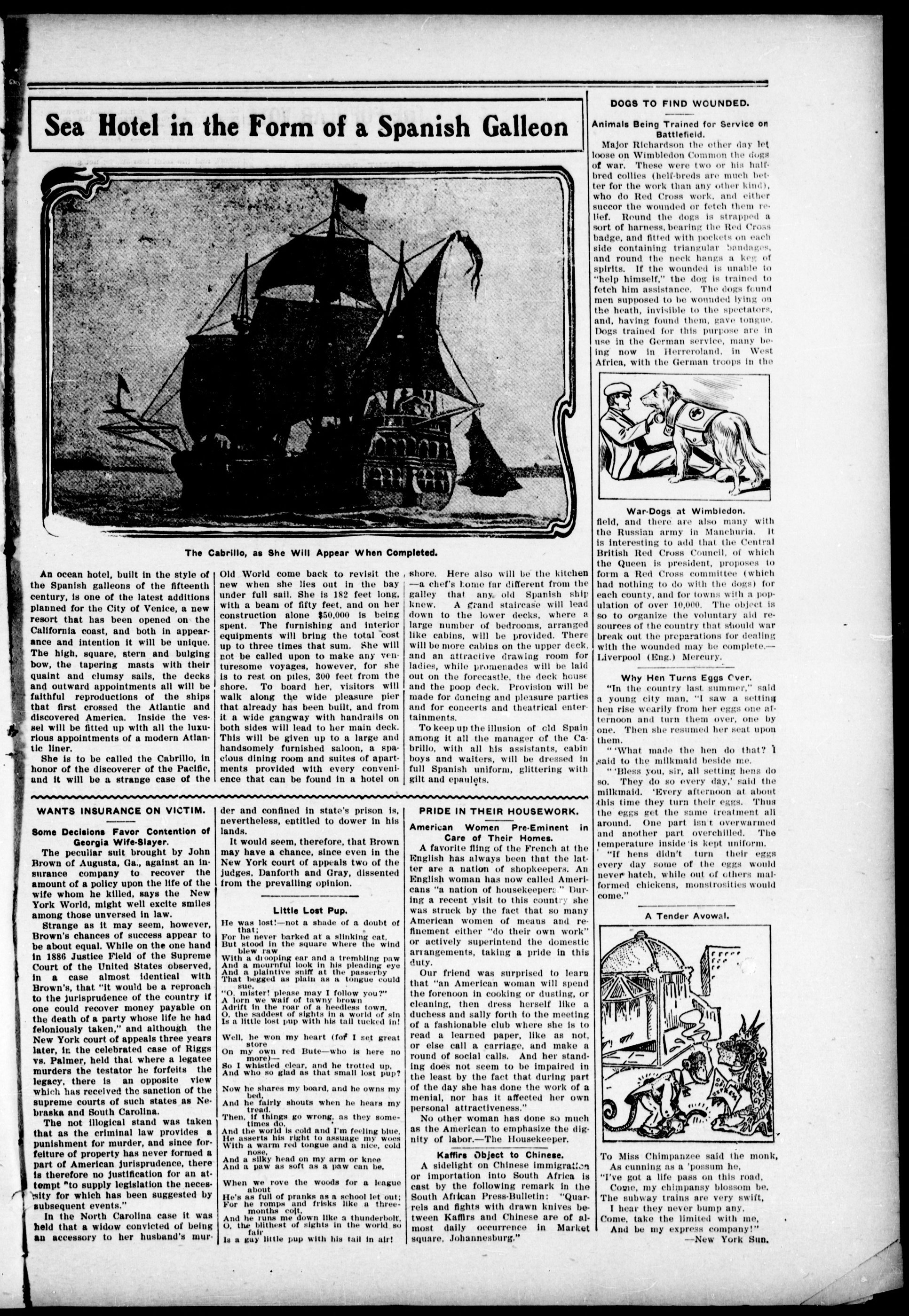
Sea Hotel in the Form of a Spanish Galleon
An ocean hotel, built in the style of the Spanish galleons of the fifteenth century, is one of the latest additions planned for the City of Venice, a new resort that has been opened on the California coast, and both in appearance and intention it will be unique. The high, square, stern and bulging bow, the tapering masts with their quaint and clumsy sails, the decks and outward appointments all will be faithful reproductions of the ships that first crossed the Atlantic and discovered America. Inside the vessel will be fitted up with all the luxurious appointments of a modern Atlantic liner.
She is to be called the Cabrillo, in honor of the discoverer of the Pacific, and it will be a strange case of the
WANTS INSURANCE ON VICTIM.
Some Decisions Favor Contention of Georgia Wife-Slayer.
The peculiar suit brought by John Brown of Augusta, Ga., against an insurance company to recover the amount of a policy upon the life of the wife whom he killed, says the New York World, might well excite smiles among those unversed in law.
Strange as it may seem, however, Brown's chances of success appear to be about equal. While on the one hand in 1886 Justice Field of the Supreme Court of the United States observed, in a case almost identical with Brown's, that "it would be a reproach to the jurisprudence of the country if one could recover money payable on the death of a party whose life he had feloniously taken," and although the New York court of appeals three years later, in the celebrated case of Riggs vs. Palmer, held that where a legatee murders the testator he forfeits the legacy, there is an opposite view which has received the sanction of the supreme courts of such states as Nebraska and South Carolina.
The not illogical stand was taken that as the criminal law provides a punishment for murder, and since forfeiture of property has never formed a part of American jurisprudence, there is therefore no justification for an attempt "to supply legislation the necessity for which has been suggested by subsequent events." In the North Carolina case it was held that a widow convicted of being an accessory to her husband's mur-
The Cabrillo, as She Will Appear When Completed.
Old World come back to revisit the new when she lies out in the bay under full sail. She is 182 feet long, with a beam of fifty feet, and on her construction alone $50,000 is being spent. The furnishing and interior equipments will bring the total cost up to three times that sum. She will not be called upon to make any venturesome voyages, however, for she is to rest on piles, 300 feet from the shore. To board her, visitors will walk along the wide pleasure pier that already has been built, and from it a wide gangway with handrails on both sides will lead to her main deck. This will be given up to a large and handsomely furnished saloon, a spacious dining room and suites of apartments provided with every convenience that can be found in a hotel on
der and confined in state's prison is, nevertheless, entitled to dower in his lands. It would seem, therefore, that Brown may have a chance, since even in the New York court of appeals two of the judges, Danforth and Gray, dissented from the prevailing opinion.
Little Lost Pup.
He was lost!—not a shade of a doubt of that;
For he never barked at a slinking cat.
But stood in the square where the wind blew raw
With a drooping ear and a trembling paw
And a mournful look in his pleading eye
And a plaintive sniff at the passerby
That begged as plain as a tongue could sue.
"O, mister! please may I follow you?"
A lorn we waif of tawny brown
Adrift in the roar of a heedless town.
O, the saddest of sights in a world of sin
Is a little lost pup with his tall tucked in!
So I whistled clear, and he trotted up.
And who so glad as that small lost pup?
Now he shares my board, and he owns my bed.
And he fairly shouts when he hears my tread.
Then, if things go wrong, as they sometimes do.
And the world is cold and I'm feeling blue.
He asserts his right to assuage my woes.
With a warm red tongue and a nice, cold nose.
And a silky head on my arm or knee.
And a paw as soft as a paw can be.
When we rove the woods for a league about
He's as full of pranks as a school let out;
For he romps and frisks like a three-months cojt.
And he runs me down like a thunderbolt;
O, the blithest of sights in the world so fair.
Is a gay little pup with his tail in air!
shore. Here also will be the kitchen—a chef's home far different from the galley that any old Spanish ship knew. A grand staircase will lead down to the lower decks, where a large number of bedrooms, arranged like cabins, will be provided. There will be more cabins on the upper deck, and an attractive drawing room for ladies, while promenades will be laid out on the forecastle, the deck house and the poop deck. Provision will be made for dancing and pleasure parties and for concerts and theatrical entertainments.
To keep up the illusion of old Spain among it all the manager of the Cabrillo, with all his assistants, cabin boys and waiters, will be dressed in full Spanish uniform, glittering with gilt and epaulets.
PRIDE IN THEIR HOUSEWORK.
American Women Pre-Eminent in Care of Their Homes.
A favorite fling of the French at the English has always been that the latter are a nation of shopkeepers. An English woman has now called Americans "a nation of housekeepers." During a recent visit to this country she was struck by the fact that so many American women of means and refinement either "do their own work" or actively superintend the domestic arrangements, taking a pride in this duty.
Our friend was surprised to learn that "an American woman will spend the forenoon in cooking or dusting, or cleaning, then dress herself like a duchess and sally forth to the meeting of a fashionable club where she is to read a learned paper, like as not, or else call a carriage, and make a round of social calls. And her standing does not seem to be impaired in the least by the fact that during part of the day she has done the work of a menial, nor has it affected her own personal attractiveness."
No other woman has done so much as the American to emphasize the dignity of labor.—The Housekeeper.
Kaffirs Object to Chinese.
A sidelight on Chinese immigration or importation into South Africa is cast by the following remark in the South African Press-Bulletin: "Quarrels and fights with drawn knives between Kaffirs and Chinese are of almost daily occurrence in Market square. Johannesburg."
DOGS TO FIND WOUNDED.
Animals Being Trained for Service on Battlefield.
Major Richardson the other day let loose on Wimbledon Common the dogs of war. These were two or his halfbred collies (half-breds are much better for the work than any other kind), who do Red Cross work, and either succor the wounded or fetch them relief. Round the dogs is strapped a sort of harness, bearing the Red Cross badge, and fitted with pockets on each side containing triangular bandages, and round the neck hangs a keg of spirits. If the wounded is unable to "help himself," the dog is trained to fetch him assistance. The dogs found men supposed to be wounded lying on the heath, invisible to the spectators, and, having found them, gave tongue. Dogs trained for this purpose are in use in the German service, many being now in Herreroland, in West Africa, with the German troops in the
SERVICE
War-Dogs at Wimbledon.
field, and there are also many with the Russian army in Manchuria. It is interesting to add that the Central British Red Cross Council, of which the Queen is president, proposes to form a Red Cross committee (which had nothing to do with the dogs) for each county, and for towns with a population of over 10,000. The object is so to organize the voluntary aid resources of the country that should war break out the preparations for dealing with the wounded may be complete. Liverpool (Eng.) Mercury.
Why Hen Turns Eggs Over.
"In the country last summer," said a young city man, "I saw a setting hen rise wearily from her eggs one afternoon and turn them over, one by one. Then she resumed her seat upon them.
"What made the hen do that? I said to the milkmaid beside me.
"Bless you, sir, all setting hens do so. They do so every day," said the milkmaid. 'Every afternoon at about this time they turn their eggs. Thus the eggs get the same treatment all around. One part isn't overwarmed and another part overchilled. The temperature inside is kept uniform.
"If hens didn't turn their eggs every day some of the eggs would never hatch, while out of others malformed chickens, monstrosities would come."
A Tender Avowal.
To Miss Chimpanzee said the monk,
As cunning as a 'possum he,
"I've got a life pass on this road,
Come, my chimpansy blossom be.
The subway trains are very swift,
I hear they never bump any.
Come, take the limited with me,
And be my express company!"
—New York Sun.
CHANGE IN SCHOOL
THE INDIAN TERRITORY EDUCA TOR HAS PLANS
HEWOULD INTRODUCE AGRICULTURE
He Says the Indian Youth Should be Prepared for the Actual Duties of Life—Some Radical Changes Are Recommended
MUSKOGEE: In his annual report for 1904, J. D. Benedict, superintendent of schools in Indian Territory, calls attention to the great need of practical education for the Indians. Such training is especially needed, he says, along industrial and agricultural lines, and he states that an effort will be made during the coming year to introduce agriculture as a special study in the schools of Indian Territory. Superintendent Benedict's report says:
"In years gone by the notion has prevailed altogether too generally among the Indians that the purpose of an education was to make ladies and gentlemen of the students. As in certain other localities, the prevailing notion has been that the educated person should not be expected to work; that any sort of manual labor was beneath the dignity of the educated Indian, and should be passed over to the negro and the white renter. The superficial knowledge of the sciences and the dead languages acquired by those students was not sufficient to enable them to succeed in any profession, and was not sufficiently practical to be of any service to them in the ordinary vocations of life. We have some good ministers, lawyers and physicians, but they were educated in special schools outside the territory.
"Believing that the education of every child should, at least in part, prepare him for the ordinary duties of the kind of life which, in all hu-
COTTON GROWERS ORGANIZE.
They Want to Know Condition of Crop in Advance of Report
DALLAS, TEX.: Ginners from all the cotton growing states west of the Mississippi river met in Dallas and organized the National Cotton Ginners' association of the United States, with J. A. Taylor, of Wynnewood, J. T., as president, and J.-H. Connell, of Dallas, secretary-treasurer.
The purpose of the organization is to gather accurate and reliable information concerning the amount of cotton produced and the condition of the crop and to furnish it by aconfidential code to the members of the association in advance of the government report. While the organization as present includes only those ginners from the states west of the Mississippi, the organization of the other states, it is said, will follow.
Plenty of Complaint
LAWTON: During the two days' state of Secretary Wenner of the territorial school board at this place over one hundred complaints of leeses had been registered. These are to be taken up for final action before the territorial board at Guthrie.
Over a million and a half dollars will be the receipts accrued this year from the rentals of school land. They have averaged about $1,000 per day the last half year. In a short while $1.13 will be distributed to every child of school age in the Territory, besides $80,000 will be designated for public buildings and $60,000 for the Territorial college.
---
man probability, he is destined to lead, we began a few years ago to give the Indian children some practical training which could be utilized by them in their homes. Strange to say, however, numerous Indian parents wrote us that they were sending their children to school to study books and nothing else. Some even went so far as to withdraw their children from school, indignantly declaring that the school's should not teach them to work. At first the children shared the feeling expressed by their parents, but we gradually introduced some lines of manual training, and our only regret now is that we have not had the funds or facilities for carrying on this work upon a much more elaborate scale.
"Neither a treaty nor an act of congress can change the nature of a man nor immediately dispel the influences of racial customs and tendencies. It is no wonder, therefore, that the unlettered fullblood cannot appreciate the value of a given piece of land nor understand why it is necessary for him to settle upon any particular quarter section and abandon his right to change his location as often as he chooses. Nor is it any wonder that he cannot readily adapt himself to the new and changing conditions that are now confronting him, nor successfully compete, in the new and strange commercial world, with his avaricious white brother. His only salvation lies in his education. Forsaking for the moment the prevailing notion that all education is confined to books and schoolrooms, and remembering Spencer's definition, 'The purpose of education is to fit men to live more completely. I am fully convinced that the uneducated fullbloods could be aided materially (educated, if you please), by sending honest, competent men among them to teach them something of the value of land, the importance of keeping and improving it, how to plant, cultivate and care for crops, and how to profitably raise live stock and fruit'. We have already endeavored to introduce some instruction along this line in the Indian schools of the territory, and we are planning, during the coming year, to introduce the subject of agriculture as a special study in many of our schools."
REPUBLICANS GAIN CONTROL
Supreme Court in Colorado Throw Out Encugh Votes to Change Things
DENVER, COLO.: Alva Adams, democratic candidate for governor, has lost 1,182 of his plurality of 5,275 in this county by the action of the supreme court in ordering the election commission to eliminate five precincts from the returns. His plurality in the state still stands at about 10,000. By the supreme court's order the democrats lose three senators, who were apparently elected in this city, and the republicans gain control of both branches of the legislature, with a majority of thirty on joint ballot. They are planning to submit to the legislature evidence of frauds in Denver and ask that body to declare Gov. Peabody elected.
The supreme court is to be reorganized on April 4 next by consolidation with the appellate court, and will consist of seven judges, two of whom are to be appointed by the governor. M. M. Hanna, an expert, has examined the ballots of precinct 3, submitted to him by the supreme court and reports that 240 of the 371 ballots found in the box are apparently fraudulent. Of these, 235 are democratic and five republican.
Wm. J. Kindel, supreme court watcher, has testified that Detective Wm. Greene, one of the four men on trial for contempt of court, in the precinct instructed repaters, many of them women, but did not in any manner interfere with the watchers of voters in general.
Lenna Winnet has been appointed postmistress at Krebs.
THE POPULAR VOTE
PRESIDENT ROOSEVELT HAS A RECORD-BREAKING VOTE
REPUBLICAN PLURALITY OF 2,549,331
Figures of the Recent Election Complete—There Were 13,523,796 Votes Cast—Roosevelt Receives 56.5 Per Cent of Total Vote
CHICAGO: The official canvass of the votes cast November 8 for presidential electors has been completed, and the Associated Press is therefore able to present the first table giving the official vote of all the forty-five states. The total vote is 13,508,496, against 13,968,574 in 1900—a decrease of 460.078.
The ballots were divided as follows:
Roosevelt, republican ..... 7,627,632
Parker, democrat ..... 5,080,054
Debs, socialist ..... 391,587
Swallow, prohibitionist ..... 260,303
Watson, people's ..... 114,637
Corrigan, socialist-labor ..... 33,353
Holcomb, continental labor ..... 830
Roosevelt received over all, 1,746,768, and over Parker, 2,547,578. In 1900 McKinley had 467,046 more than all the other candidates and 859,984 more than Bryan.
The vote for Roosevelt was 409,822 more than for McKinley, while that for Parker was 1,277,772 less than for Bryan. McKinley polled more votes than Roosevelt in Alabama, Georgia, Kentucky, Louisiana, Maine, Maryland, Mississippi, New Hampshire, North Carolina, South Carolina, Tennessee, Texas and Virginia. Roosevelt received more than McKinley in the other thirty-two states.
Parker received more votes than Bryan in Delaware, Georgia, Mississippi, New Jersey, New York, Rhode Island, South
Roosevelt.
Alabama 22,472
Arkansas 46,860
California 205,226
Colorado 124,587
Connecticut 111,080
Delaware 23,714
Florida 8,134
Georgia 24,033
Idaho 47,783
Illinois 632,645
Indiana 369,289
Iowa 307,907
Kansas 210,873
Kentucky 205,277
Louisiana 5,205
Malhe 64,437
*Maryland 109,497
Massachusetts 257,822
Michigan 361,866
Minnesota 216,651
Mississippi 3,147
Missouri 321,447
Montana 34,942
Nebraska 138,558
Nevada 6,87
New Hampshire 54,179
New Jersey 245,164
New York 859,533
North Carolina 82,442
North Dakota 52,595
Ohio 600,096
Oregon 60,415
Pennsylvania 840,949
Rhode Island 41,605
South Carolina 2,771
South Dakota 72,083
Tennessee 105,369
Texas 50,308
Utah 63,444
Vermont 46,682
Virginia 46,450
Washington 101,504
West Virginia 132,698
Wisconsin 280,164
Wyoming 20,489
Totals ..... 7,627,632
*One republican elector.
The following table shows the gains and losses of the two parties named, in the different states, compared with the vote of 1900:
—Repub.—Demo.—
State.
Alabama 33,162 16,506
Arkansas 2,000 36,708
California 40,741 35,097
Colorado 41,610 22,628
Connecticut 8,522 1,088
Delaware 1,185 502
Florida 895 1,214
Georgia 1,032 1,772
Idaho 20,585 10,387
Illinois 34,660 175,455
Indiana 34,226 2529
Iowa 99 57,024
Kansas 24,918 77,801
Kentucky 21,574 1779
Louisiana 9,028 5,964
Maine 998 9,192
Maryland 26,705 12,825
Massachusetts 18,956 8,747
Michigan 45,597 77,521
Minnesota 26,190 57,714
Mississippi 2,606 1,574
Missouri 7,356 46,05
Montana 9,019 15,373
Nebraska 16,723 62,137
Nevada 2,007 2,394
N. Hampshire 624 1,584
New Jersey 23,457 242
New York 37,541 5,595
N. Carolina 50,639 31,61
N. Dakota 16,704 6,206
Ohio 56,178 130,308
Oregon 13,999 15,864
Pennsylvania 128,784 186,234
Rhode Island 7,821 5,037
S. Carolina 1,308 5,430
S. Dakota 17,547 17,542
Tennessee 15,825 13,713
---
Carolina and West Virginia, while Bryan received more than Parker in the remaining thirty-seven states.
The republicans made gains over their vote in 1900 in thirty-two states, and the official figures show losses in thirteen.
The total gains of the republicans were 732,048, and the total loss 312,249; net gain, 419,799.
The democrats polled more votes in eight states than in 1900, but fewer in thirty-seven. Their total gains were 30,-792, and the total losses 1,231,491; net loss, 1,260,699.
Roosevelt carried thirty-two states, against twenty-eight by McKinley, and has 336 electoral votes under the apportionment of 1900. McKinley had 292 under the apportionment of 1880, there having been an addition of twenty-nine votes by the last apportionment.
Parker carried thirteen states, against seventeen by Bryan and has 140 electoral votes. Bryan had 155 under the apportionment in force in 1900.
Watson received his largest vote in Georgia, the total of that state, 22,634, with 20,508 in Nebraska, being nearly one-third of his aggregate, 114,637. Barker polled 50,218 in 1900. The prohibition vote in 1900 was 208,791; this year, 200,303; a gain of 51,512. Four years ago the socialists had an electoral ticket in thirteen states and polled 87,769 votes. This year they had a ticket in fifteen states, and the Debs vote was 391,587. In 1900 over 15,000 votes were polled in only California, Illinois, Massachusetts, Missouri and New York. In November of this year Debs received more than 5,000 votes in California, Illinois, Indiana, Iowa, Kansas, Massachusetts, Michigan, Minnesota, Missouri, Montana, Nebraska, New Jersey, New York, Ohio, Oregon, Pennsylvania, Utah, Washington and Wisconsin, the largest number, 69,225 in Illinois.
The vote of the socialist-labor party in 1900 was 39,944. This year it was 33,453—a loss of 6,491 in these states: Colorado, 335; Connecticut, 575; Illinois, 4,968; Indiana, 1,598; Kentucky, 596; Massachusetts, 2,359; Michigan, 1,012; Minnesota, 974; Missouri, 1,875; New Jersey, 2,680; New York, 9,127; Ohio, 2,633; Pennsylvania, 2,221; Rhode Island, 488; Texas, 421; Virginia, 56; Washington, 5,592; Wisconsin, 223.
The continental labor party had adherents only in Illinois—really Chicago—where 830 votes were polled.
The following table shows the official vote in each state for the five principal candidates:
Parker. Watson. Swallow. Debts.
79,857 5,051 612 853
64,424 2,318 983 1,184
89,294 ..... 7,3'0 29,563
100,105 824 3,418 4,304
72,099 495 1,506 4,543
19,360 51 607 146
27,016 1,165 5 2,337
83,472 22,624 685 197
18,480 435 1,030 4,429
327,606 6,275 37,740 69,226
274,345 2,444 23,496 12,013
149,141 2,207 11,601 14,847
84,830 6,156 7,345 15,424
217,170 2,511 6,609 3,602
47,708 ..... ..... 995
27,639 338 1,510 2,106
109,446 1 3,044 2,247
165,746 1,294 4,279 13,591
134,151 1,159 13,302 8,941
55,187 2,103 6,253 11,692
52,280 1,474 ..... 392
256,847 4,236 7,181 13,008
21,773 1,493 328 5,529
51,876 20,508 6,323 7,412
3,982 344 ..... 925
33,905 83 749 1,190
33,566 3,765 6,486 9,587
683,981 7,429 20,787 36,883
124,191 819 361 124
14,253 163 1,137 2,017
344,674 1,392 19,339 36,260
17,521 753 3,806 7,619
337,998 ..... 33,717 21,634
24,839 ..... 768 966
52,863 1 ..... 22
22,022 1,248 2,965 3,138
171,653 2,491 1,889 1,354
167,229 8,062 4,244 2,287
33,413 ..... ..... 5,767
9,777 ..... 792 869
80,678 759 1,312 298
28,098 669 3,229 9,955
100,850 629 4,604 1,574
124,107 530 9,740 28,270
8,230 ..... 208 1,077
5,080,054 114,637 260,303 391,587
**Highest democratic elector.
Texas ..... 79,333 ..... 100,203
Utah ..... 15,305 ..... 11,593
Vermont ..... 4,114 ..... 3,072
Virginia ..... 69,415 ..... 65,443
Washington ..... 44,048 ..... 16,735
W. Virginia ..... 12,766 ..... 2,145
Wisconsin ..... 14,298 ..... 35,178
Wyoming ..... 5,972 ..... 1,368
Used Gasoline for Coal Oil
GUTHRIE: Wilhelm Schultz is fatally burned, his wife and three children are dead as the result of a gasoline explosion in their home, near Guymon. The family recently homesteaded a claim in Beaver county, coming direct from Germany. They could not speak English, and, going to a store for coal oil, they made signs which the merchant interpreted to mean gasoline. The mother held the lamp burner with the wick lighted while the father filled the lamp with the gasoline. A terrific explosion followed, killing two children instantly, the third child and mother dying soon afterward. The father cannot live.
Trickery in the pulpit does not make truth in the pews.
IMPORTANT HAPPENINGS IN THE NEW STATE
SHOENFELT WANTS $90,000
Think He Can Run the Union Agency For That Amount
MUSKOGEE: J. B. Shoenfelt. Indian agent, has returned from Washington, where he conferred with the secretary of the interior and other high officials relative to needed legislation for the Indian Territory. He asked for an appropriation of $90,000 for the work of the Indian agency for the coming year, and he thinks the request will be granted. This was the amount allowed by congress last year, and the agent thinks he can maintain the agency next year on an equal sum, although the work is constantly increasing.
Mr. Shoenfelt believes that statehood legislation for Indian Territory and Oklahoma this year is assured. He thinks, however, that statehood, if secured, will make little difference with the nature of the work to be performed by the Indian agency, which is independent of state legislation.
PONCA INDIAN ALLOTMENT
A Government Agent on the Ground to Begin Work
GUTHRIE: George A Keeper of Ohio, agent of the interior department to make the final allotting of the Ponca Indian lands in Oklahoma, has arrived here to begin work. Under the congressional act of April 21 last, every Ponca child born since the completion of the tribal allotments and prior to June 13 last, will receive eighty acres of agricultural and 160 acres of grazing land. There are 568 members of the tribe entitled to equal division of the remainder of the tracts of land, something more than 26,000 acres.
One section will be reserved for the common use of the tribe. The allotment will consume a year, and will be followed by final allotments of the Otoes, consuming another year.
MAY MEAN SOMETHING
War Department's Investigating Fort Sill Water Supply
LAWTON: A war department engineer from Washington is at Fort Sill investigating the water supply at Medicine Creek upon the Fort Sill reservation. It is the belief of many that the object of this examination is in order that a report of the situation may be made to the war department, which is considering the subject of enlarging this post to a regimental fort. Col. Kingsbury is quite confident that such action is soon to be taken, and this may terminate in large appropriations being made by the War department for such improvements as are necessary for the post.
TO PROBE BRIDGE BILLS
Further Indictments of "New Country Officials Expected
LAWTON: United States Attorney Horace Speed of Oklahoma has requested that the secretary of the interior make further investigation of charges against several "new country" county officials and John Mounts and J. T. Greenwade of Frederick, alleging the making of false affidavits in the matter of bills drawn on the department on bridge contracts. It is thought other indictments will be brought against J. W. Stokes and Commissioner Poole of Klowa county, who were recently acquitted in the United States court. The trial of the Frederick men was continued from the last term of the court on motion of the United States attorney, in order that he might collect more evidence.
OKLAHOMA BANK LAW
Inspector Wright Recommends it for Indian Territory
MUSKOGEE: J. George Wright, inspector for Indian Territory, in his report to the secretary of the interior, strongly advocates the adoption of the Oklahoma law for the control of private banks. The secretary has approved it, and will recommend legislation along that line. At present only national banks are controlled by the government in Indian Territory. The inspector urges the necessity of road legislation for Indian Territory. He also suggests legislation looking to an equitable settlement of the Wewoka townsite muddle, where officers of the department had held that illegal sales had been made.
Inspector Wright calls attention to the great need of larger appropriations for schools in Indian Territory, and refers especially to Superintendent Benedict's plan to inaugurate a temporary system that will merge gradually into the future system. He says the law which states that persons not of Indian blood may have their restrictions removed is sometimes misconstrued, and should be read to mean that the restrictions should be removed from adult persons not of Indian blood as shown by the official citizenship rolls.
MORE MONEY FOR SCHOOLS
Curtis Working for Additional $27,000 for Indian Territory
WASHINGTON: Chairman Curtis of the committee on Indian affairs of the house will make one recommendation concerning educational matters in the Indian Territory which will probably be adopted. He will propose that, in addition to the regular appropriation of $100,000 for schools, the accumulated surplus fees of clerks and deputy clerks of courts in the territory be made available for paying teachers in existing schools and in providing for additional schools. With an appropriation of $100,000 there are now about 130 schools in the territory. The surplus fees mentioned amount to $28,000, so that it is estimated that 160 schools can be maintained if these funds are made available. The $28,000 represents fees which have accumulated over and above the amount allowed the clerks, which the law requires shall be paid into the school fund.
HOLLANDER ON SCHOOLS
System of Taxation That Will Maintain Indian Territory Institutions
ARDMORE: Prof. Jacob Hollander, who has made a special study of conditions in Indian Territory, has made a lengthly report to congress with reference to a system of taxation that will maintain the schools of the territory and the same time serve as a basis of public revenue.
His plan is favored by leading Indians, especially his recommendation that it is practicable for the federal government to purchase and cede to the new state or territory as a public school endowment the coal and asphalt lands of the Chickasaw and Choctaw nations now set aside for public sale for the benefit of the tribes. If this can not be done, Prof. Hollander recommends that a direct appropriation of $10,000,000 be made as a permanent endowment.
A good roads convention was held in Anadarko last week and measures were taken to secure better roads in the new country.
Anadarko waterworks plant is now at work.
WOULD PLEASE THEM
MUSKOGEE: The twenty-six clerks in the recording districts of Indian Territory would welcome the provision suggested by Senator Stewart that they be made registrars of land and that they be put under the fee system. There are yet those officials in Indian Territory who remember the palmy official days when the fee system was in vogue, and the office of a clerk of one of the federal courts was worth from ten to fifteen thousand dollars each year.
The clerk at the Muskogee office of the western district turns into the government treasury $20,000 annually, after paying all salaries of employees of the office. The clerks in the recording towns outside of the office of the clerk of the court draw salaries of $1,200 a year. If they were put on the fee system they would get perhaps twice or three times as much as they now receive.
The recording business in Indian Territory is tremendously heavy. This is on account of the leases that are required to be recorded and on account of the sale of town lots and lands. It is likely that it will increase for the next few years. To place a fee system in vogue would be to make these offices fat jobs. The same would apply to any other court officer in this country, because the amount of business transacted in every branch is something that would be considered incredible in the older states.
RURAL CARRIERS DISMISSED
Violated Law in Effort to Influence Legislation in Their Behalf
WASHINGTON: Postmaster General Wynne has removed H. E. Nivin of Berthoud, Colorado, and J. W. Whitehead of Medina, Ohio, rural mail carriers, for alleged efforts to influence legislation.
Two postoffice inspectors are investigating these matters, and other developments are expected shortly. It is understood that a meeting of the executive board of the national association of the letter carriers, comprising the carriers in the city service, will be called immediately after the Christmas holidays to take action in connection with the dismissal of President Keller of that organization from the government service. This meeting is made especially necessary by the fact that Keller, having been dismissed as a carrier, will not be received or recognized in any way at the postoffice department and his power as head of the association thereby will be crippled. The question of continuing the present expense account incident to the office of president also is expected to be considered.
Comanche to Get a Brick Plant
COMANCHE: Arrangements have been made for the removal of the Addington brick plant from Addington to this place. The plant cost about $20,000, and is said to be a fine one. It will be located immediately south of the town of Comanche, and the Rock Island Railway company will build a switch track to 1. An inexhaustible supply of fine shale, which is said to be the best in the territory, abounds in this section, and the owners of the plant expect to do a very profitable business. The pay roll will amount from $65 to $90 a day.
Two Innocent Men Shot
SOUTH McALESTER: Leo and Robert Hatcher were shot by Floyd Drummaster at a dance at Dow, near here. Drummaster had an altercation with a miner and started to shoot. The two wounded men were bystanders. Leo Hatcher's wounds are fatal. Drummaster escaped.
More horses are run down by overfeeding than by overwork.
PROHIBS AT WORK
PROHIBS AT WORK
AMENDMENT TO HAMILTON BILL ACCEPTED AS CHALLENGE
THROWS EVERYTHING TO DRUG STORES
Temperance Workers Throughout the Nation Take Up Work Against the "Excepts" in the Prohibition Clause of the Amendment
SOUTH McALESTER: In the bill providing for statehood for the territories, as reported favorably by the senate committee on territories last week there is one provision which has been accepted by the temperance workers as a challenge, and the entire organization throughout the United States has quietly taken up the first lines of action of a well organized campaign and will make life a burden for members of congress during the next month. This provision practically eliminates the open saloon in the Indan Territory for ten years, but legalizes the drug store as a dispenser of liquors.
The prohibition clause, which has been interpreted by all to throw protection about the drug store-saloon is worded as follows:
"That the sale, barter or giving away of intoxicating liquors, except for mechanical, medicinal or scientific purposes be prohibited for a period of ten years from the date of admission of said state, and thereafter until the legislature of said state shall otherwise provide."
It is declared by the prohibitionists that the mechanical and medicinal exceptions will make the dispensing of liquor by druggists on prescription, a most profitable and safe business. The distillers and brewers view this feature as dynamite, and while they are far from being satisfied, they will not make an aggressive fight for amendment, believing that sentiment has caused the senate committee to take stock in the appeals of the prohibitionists and other agencies who are using the Indian and his well developed appetite for whsky to gain favor.
A strong lobby is maintained at Washington this winter by the prohibitionists, and every argument is being advanced to either secure a more favorable amendment or retain the present one in the pending measure.
MR. GARFIELD'S FIRST REPORT
The Federal Governemnt Has Power to Remedy Conditions
WASHINGTON: The first annual report of the commissioner of corporations has been submitted to congress by Commissioner Garfield. He says no satisfactory reform is to be expected under the state system of incorporation; that the federal government has at its command sufficient power to remedy existing conditions in its control of interstate commerce. He therefore suggests that congress consider the advisability of enacting a law for legislative regulation of interstate and foreign commerce under a license or franchise which should provide. among other things, the granting of a federal franchise or license to engage in interstate commerce.
When Taxes Become Due
In Oklahoma one-half of the taxes must be paid by the third Monday in January and the second half by the third Monday in June. If none are paid by the third Monday in January all become due a penalty of one and one-half per cent attaches and warrant must be issued by the sheriff on same by March 25, if still unpaid.
Daily Work.
In the name of God advancing,
Sow thy seed at morning light;
Cheerily the furrows turning,
Labor on with all thy might.
Look not to the far-off future,
Do the work which nearest lies;
Sow thou must before thou reapest,
Rest at last is labor's prize.
Standing still is dangerous ever,
Toll is meant for Christians now;
Let there be, when evening cometh,
Honest sweat upon thy brow;
And the Master shall come smiling,
At the setting of the sun,
Saying, as he pays thy wages,
"Good and faithful one, well done!"
—Translated from the German.
HER LOVE TEST
By Kathryn B. Henderson
(Copyright, 1904, by Dally Story Pub. Co.)
It was a bright, sunny October afternoon that pretty Martha Linton presented herself in the cosy sewing room of her dear friend, Jennie Brooks. Their greeting was cordial and affectionate. Both had gone to the altar the same week, four years previous, and each had confidentially informed the other their husbands were model men not less than a score of times during that period.
"I was just thinking of you, my dear," said Mrs. Brooks. "Lay aside your wrap and take your favorite chair by the window. How pleasant it is to-day! Really, if I didn't have so much on hand I would put on my things and go downtown on a pretense of shopping."
She rushed ahead in her old schoolgirl fashion, meanwhile deftly cutting out and arranging a dainty little apron which promised to be coquettish in design.
"You ought to be happy, Jennie," said young Mrs. Linton. "Henry remarked to me last evening that he
M. M.
"indeed!" sarcastically. believed that John was the best hearted man of his acquaintance." A pleased smile ran over the rosy face of Jennie Brooks. "I think we two are to be envied of our hubbys, don't you?" The only reply was an affectionate nod on the part of Martha. "But have you heard of the curious treatment Mrs. Banks gives her hus band," rattled on Jennie.
"No, I haven't. My dear, what——"
"Why, she says Mr. Banks jilted her sister before he married Mrs. Banks, and that the sister really died of a broken heart. Of course, his wife didn't know the truth until her sister told it all on her death bed, and from that day to this Mrs. Banks has never sed trying to make Mr. Banks' life perfectly miserable. Every one says she pays no more attention to household affairs than if she were boarding. For my part, I don't see how Mr. Banks can put up with such conduct."
"Of! he is perfectly devoted to her. He is just as attentive and solicitous he can be. What a perfect man!"
Half an hour was spent in mutual congratulations of condolence concerning J.R. Bank's urtortunate lot, and in
criticising the various retaliating measures his wife was inflicting.
As Martha Linton wended her way homeward her brain was busy with the tale she had heard. The novelty of such a scheme and the savor of romance it held lent it a peculiar interest. She had an idea. Things were growing a little tame—why not test Henry's love this way?
The mellow, hazy, beautiful October days wore apace and Henry Linton congratulated himself on possessing the most delightful of wives. He was a happy man at home and was proud of her. Business was flattering in its outlook, all the future seemed fair, and what more could he wish.
"Henry, I want a sealskin wrap this winter!" said his wife at breakfast.
A good-humored smile spread over his features as he listened. Then he raised his eyebrows in exaggerated surprise.
"You needn't look so horrified, Henry," she said, a little annoyed at his expressive face.
"I am not horrified—I am simply shocked," he said with assumed gravity.
"Indeed!" sarcastically.
Henry Linton went to business somewhat irritated at the unwonted display of his wife's disagreeableness, but his displeasure wore away before he reached his office.
Before he went home he went to a leading fur establishment and selected a handsome seal garment. He ordered it laid aside and to be delivered at his office before Thanksgiving day.
"My bonny darling shall have her wrap before cold weather sets in," was his thought as he went out of the store. He felt happy that he was able to gratify her wish. A year previous such expense was not to be considered. What a surprise it would be!
He found the evening a little dull. Martha was busy with her fancy work. Without being actually uncivil, she was wholly engrossed with her own affairs. The evening was an illustration of what followed during the week. The days drifted on and Thanksgiving drew near. There was no change in Martha's studious demeanor.
At first Linton resented her lack of affection. He spoke of it frequently. Then pride being aroused, he determined to meet indifference with indifference. He concluded his intended gift would not meet with appreciation if offered while matters were so unpleasant, and he ordered it for Christmas.
Thanksgiving day came and was almost forgotten, and the monotony of Henry Linton's home gallled him. Several times he sought by cheerfulness and playful affection to bring about the old sweet way again, but his efforts were dismal failures.
Humiliated and wounded, he grew angry. With the subsiding of ill nature came a feeling of carelessness. Then neglect crept in. If his wife cared nothing for him he was not bound to lavish his affection on her. If it pleased her to withdraw from his love and extend nothing but a tame friendliness, all well and good.
One morning as he sat in the crowded train his attention was attracted by a veiled face. A pair of bright eyes twinkled roguishly at him. When he reached his office he discovered his necktie ridiculously awry. "Why didn't Martha tell me how I looked at breakfast," he thought, as he reflected how oddly he must have appeared. No wonder the fair stranger was amused. It was only another evidence of the indifference his wife manifested toward him. The incident vexed him.
The next morning he again chanced to sit near the lady who had smiled at him. She looked up, their eyes met. A glance of recognition told she remembered him. He scrutinized her carefully and came to the conclusion that she was attractive. That day he noticed a friend was acquainted with her. Inquiry followed.
"She is Mrs. Jackson. Her husband died during their honeymoon, and she is now employed as secretary of iron. Steel & Co., the contractors. She is
one of the gay widows, Linton, so beware!" was the result of his questioning.
As the days went on Henry Linton learned to watch for the jaunty hat and pretty face as he stood on the platform waiting for the train. Soon a smile, distant yet not unfriendly, was the result. A little courtesy offered in a jostling crowd in helping her from the car steps was the beginning of what proved a pleasant acquaintance.
"You seem a little depressed this morning," she said one day, as they occupied seats together. "I wonder if somebody was cross this morning at breakfast?"
"You have divined the truth," he replied. "Not really cross, but indifferent."
"I'm sorry," she said, archly.
There was no change in Martha Linton's course. She was not always ill tempered, but she managed to make herself utterly apathetic without appearing to make it intentional. Two months had passed in this way.
"Do you know, Clara," said Linton, after greeting his train friend, "that I believe life isn't worth living with the heart starving for love and affection."
They had long since addressed each other by their christian names, and were now on the footing of familiar friendship.
"You echo my sentiments exactly," was her reply. "There is no use in going through life unhappy on that score."
"Are you perfectly happy?"
"Well-I am this morning," she replied, looking into his eyes. He pressed her hand unobserved by others, and the pressure was returned.
All day Henry Linton was preoccupied. His thoughts continually reverted to the morning's incident. Alone in his private office, he paced the floor. He reviewed his married life from the hour he vowed faith and fidelity at the altar to the miserable present. Wherein had he failed as a lover, as a husband. The thought occurred to him that perhaps Martha's heart had gone out to another. Such things had happened, and were happening every day. He would have an understanding with his wife. If she did not love him in the old way she would be at liberty to go. Did he love her? Yes, his heart told him, but this continual apathy was slowly driving all love from his life. Then, there was Clara. She was always pleasant and ready with a smile. She was pretty, too—and every ready with kindest sympathy. What a tender love she could bestow!
That night Martha was invited out to tea, and Linton's intended interview was postponed indefinitely. He spent a quiet evening with his papers, and retired early.
As he stood waiting for the train the next morning he became aware that he was impatient for its coming. Clara Jackson would soon appear, for she lived near and always came just as the train rumbled up to the station. It lacked five minutes before she would smile into his eyes. Did he love her? he asked himself. He assured himself that he did not—but then, he cared for her in a way. Hers was a delightful friendship, and then she was sympathetic. Why could not this friendship ripen into a passionate attachment—the train of thought was interrupted by the sight of the approaching train. A musical voice at his side remarked:
"A penny for your thoughts!"
"Good morning, Mrs. Jackson," replied Linton. "Perhaps they are worth more than you offer.
"Perhaps," she replied, doubtingly.
Seated at last in the coach, while mentally commenting that she looked remarkably attractive in her tailorma le suit, he remarked: "I was thinking of you."
A vivid flush dyed her face.
For a little while neither spoke.
There was something of restraint between them. Curiously enough both felt they had reached a point at which it would be decided whether the future was to be more or less than their past.
He seized her hand within the folds
of her dress, and with hurried words outlined his domestic affairs, and commented on the strained relation existing between him and his wife.
"I am hungry for love and affection," he said, "and I seem instinctively drawn to you. I have been candid and truthful with you and you know my situation. I have tried love, and, trusting in its endurance, have found marriage an illusion."
When they parted she promised to meet him the next day.
"Are you going out this evening?" queried Martha Linton, as Henry took up his hat, shortly after their evening meal.
"Why do you ask."
"I thought if you did not have particular business on hand you might remain with me instead of going out."
"I did not suppose you cared enough for my society to want me to stay," he returned, gravely.
"Oh! yes I do," she replied. "You have been away so much evenings that I have been very lonely."
Henry Linton's heart throbbed quicker than it had for weeks. He stood in the middle of the room, hat in hand, looking at his wife. She sprang from her seat, and, coming close to him, smiled up into his eyes.
"I will stay if you choose it so," he
"I will stay if you choose it so," he said, returning the smile.
"I choose to have you, then," was the laughing response.
In her piquant way she arranged his chair and hers before the glowing grate. In half an hour the old-time terms of endearment fell from their lips as of yore, and for the first time in three months Martha's lips sought those of her husband.
Henry Linton did not go to the little railway station at his usual time the following morning. He took the next train, and as he left home he left a kiss on Martha's lips.
"Can't you come home early this
M. J.
"Oh, yes I do," she replied. evening, dear?" she asked at the door. "I will if nothing prevents," he said gayly, waving his hand to her. An hour later he penned the following note: "Mrs. Jackson: I sincerely prize the confidence you have given me, simply because it was given me freely. I will never violate it. Since our conversation I have learned that the love I thought was a chimera is the truest and best gift in my possession. I am in honor bound to give what I exact, and it is my firm intention to be true to myself and my love. "Forget me. Snould we meet it will be as friends only. Respectfully.
Henry Linton never asked an explanation for Martha's peculiar course. In her heart she resolved never again to cloud her life with foolish experiments in the way of retaliation for a moment's irritation or a passing mood's crossness, but she never knew the danger.
She Must Be Doing Something.
"Eve never went to a woman's club."
"No, but perhaps if she had she would not have found time to sample the fruit."—Illinois State Journal.
City News Department.
The Cimeter Tells of "Great Muskogee."
If you want to find a city that you say is "out of sight"
Just locate in Muskogee, and you will be all right;
For it's a booming city, and the greatest in the West—
That mighty, mighty city, where money has no rest.
The Cimeter can tell you of the laurels that can be won
In this city, where the people are aiming at the sun.
It will tell you of the land and where it can be bought;
It will tell you of our shorthand and how it can be taught.
Then read of the Twentieth Century Corresponding School.
And ne'er should you forget it, but make it a rule
To notice this ad. and the other enterprises, too,
For in Muskogee there's always something new.
There's hustling and bustling—tustling and rustling,
In this great, growing city, nothing lays rusting.
Then read of this city, the greatest in the West,
This mighty, mighty city, where money has no rest.
C. A. Biggers, Instructor of The Twentieth Century Corresponding School of Stenography.
Miss Alma Simms is on a visit to Ft. Smith, Ark.
J. T. Trimble took a few days off this week hunting.
Miss Jefferson is visiting her sister, Mrs. E. E. Simms.
Mr. Emerson Brown is on a visit to parents in Greenville, Miss.
Mr. Chas. Montilla, of Sherman, Tex., is here visiting friends.
Mr. L. F. Fue is on a visit to friends and relatives in Arkansas.
Mrs. Reedis left last week for a visit to relatives in Tennessee.
C. G. Lowe spent Monday in South McAlester, visiting friends.
Mrs. Mittie Twine, wife of our editor, is on a visit to relatives near Mexia, Tex.
Mrs. Cooley, of Hot Springs, Ark., is on a visit to her son, Fred Qualls, our efficient printer.
Rev. T. J. Crawford, of Weir City, Kan., is in the city, and was a pleasant caller at the Cimeter office.
Messrs. "Bud" Brown and Hy. C. Pack, of Tahlequah, were doing Muskogoe Monday.
Mr. J. H. McCulloch, of South Second street, has moved to his new home on North Seventh street.
Mr. E. D. Nickers has been joined by Mrs. Nickers and daughter Edwina, who expect to make this their home.
Mr. Hamilton, of Weir City, Kan., is among the recent arrivals, and is well pleased that he expects to make Muskogee his home.
Mr. P. A. McGloraie, of Alexandra, La., has returned and will engage in the dry goods business on North Fourth street.
---
Mrs. P. B. J. Hudson is on a visit at Navasota, Tex.
Prof. H. A. Clark is spending the week in the city.
Mrs. James Trimble has returned from her Christmas visit.
The board of trustees of Sango Baptist college were in session Tuesday.
Mr. Shaw, from South Louisiana, is among this week's arrivals of prospectors.
Mr. Luckie, one of Gatesville's most prosperous farmers, was a Cimeter caller Tuesday.
P. B. J. Hudson, of Gatesville, was a pleasant caller Tuesday, and left a year's subscription for the Cimeter.
The Carter brothers, of Boynton, are visiting in the city this week.
The Misses Simms spent Christmas with parents here.
Miss Sadie Mapps left for a week's visit to Washington, D. C., last Saturday, and is expected back for Friday evening's banquet.
The Fortnightly Culture club will render an excellent programme at Beebee chapel, C. M. E. church, Sunday, Jan. 13, 1905, 1:30 p. m.
Mrs. J. W. Washington left Tuesday for Coffeyville, Kan. She will be accompanied by her mother-in-law, Mrs. Fannie Washington.
Mrs. Rebecca Haskins, on receipt of a telegram from Memphis, Tenn., left Tuesday, the 20th inst., and on arrival there found that her son, Alonzo Haskins, was dead and buried. The Cimeter extends condolence to the family.
They say that she will not have any excuse for not answering his letters now, as the much-looked-for express package of the following dimensions, 18x24x18 inches, contained a full year's supply of stamps, envelopes and paper.
Messrs. Jas. T. Trimble and Garfield Barneit were hunting this week and reported the following bag: Twenty-seven rabbits and thirty-four quail. They reported plenty of geese and some deer. The above is reported as received, and we do not brand it as a Christmas fake.
T. H. Tyson, Real Estate.
Town lots and farms for sale in and around the town of Grayson; large and small farms for lease for long or short terms. For anything in this line call or write
T. H. TYSON,
Grayson, alias Wildcat.
Material Arrived.
The material for the overhead work upon the street car system has nearly all arrived, and a large gang of men are at work putting it up.
The large dynamos, which will furnish the power for the entire system, are already installed and ready to turn on as soon as the rest of the work is finished.
The street railway company are putting forth every effort possible in order to have the cars running in all parts of the city by February 22.
The new six-story hotel will be opened on this date, and it being the birthday of Washington, Muskogee will indeed pay due respects to that day with the grandest celebration yet in her history.
A company of colored men will operate a first-class livery stable at Porter, I. T.
OFFICIAL STATEMENT OF THE CONDITION OF THE
Loans and Discounts $712,003.95 Capital $200,000.00
Overdrafts (Cotton) 25,989.61 Surplus and Profit 31,572.39
Bonds and Premiums 206,080.49 Circulation 150,000.00
Furniture and Fixtures 7,985.11 Deposits 759,580.25
Cash and Exchange 189,093.48
The above statement is correct. D. N. FINK, Cashier. Business intrusted to our care receive prompt attention.
EVERYTHING FOR THE HOUSE
```markdown
```
GLOYD - LUMBER - CO.
THE RIGHT GOODS RIGHT RIGHT PRICES PLACE
Is the RACKET STORE in the Oklahom Building.
WE CAN RENT YOUR HOUSES
OFFICIAL STATEMENT OF
COMMERCIAL
Muskogee Inc
At close of business Thu
RESOURSES
Loans and Discounts $712,003.95
Overdrafts (Cotton) 25,989.61
Bonds and Premiums 206,080.49
Furniture and Fixtures 7,985.11
Cash and Exchange 189,093.48
81,141,152.64
The above statement is correct.
Business intrusted to our
SMITH-TOR
EVERY
FOR THE
SATISFACTION OR
North Main St. GLOYD - LUN TAKING THE STUMP
To tell about our lumber. It is put forward to win the approval of the lumber users of this section and when its good points are appreciated it will certainly do so. We see no satisfaction or profit in handling low grade stock. Neither will consumers when they learn that the finest lumber does not piece by the foot but by the inches.
THE RIGHT RIGHT
Is the RACKET STORE
Has a number of applicants who desire to rent houses. Owners of three, four, five and six room houses can secure desirable tenants by listing their property with us. REAL ESTATE DEPARTMENT Canadian Valley Trust Co.
T OF THE CONDITION OF THE
L NAT'N'L BANK
Indian Territory.
Thursday, November 10, 1904.
LIABILITIES
.95 Capital $200,000.00
.61 Surplus and Profit 31,572.39
.49 Circulation 150,000.00
.11 Deposits 759,580.25
.48
$1,141,152.64
D. N. FINK, Cashier.
ur care receive prompt attention.
MORRANS CO.
ERYTHING
THE HOUSE
FOR YOUR MONEY BACK
Musko
金森
IT GOODS RIGHT
IT PRICES PLACE
RE in the Oklahoma Building.