Muskogee Cimeter
Thursday, April 26, 1906
Muskogee, Oklahoma
Page text (machine-generated)
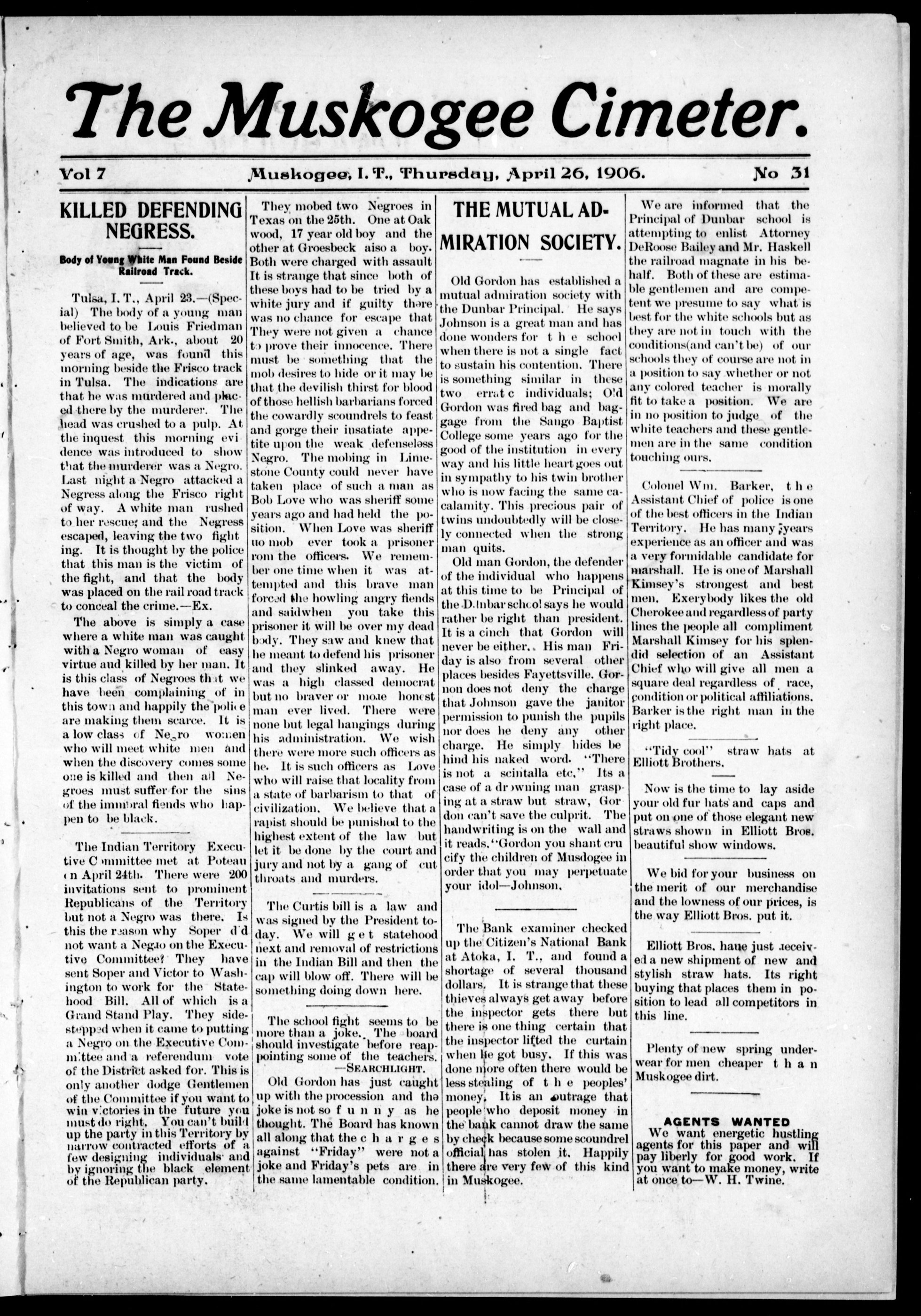
The Muskogee Cimeter.
Vol 7
KILLED DEFENDING NEGRESS.
Body of Young White Man Found Beside Railroad Track.
Tulsa, I. T., April 23.—(Special) The body of a young man believed to be Louis Friedman of Fort Smith, Ark., about 20 years of age, was found this morning beside the Frisco track in Tulsa. The indications are that he was murdered and placed there by the murderer. The head was crushed to a pulp. At the inquest this morning evidence was introduced to show that the murderer was a Negro. Last night a Negro attacked a Negress along the Frisco right of way. A white man rushed to her rescue; and the Negress escaped, leaving the two fighting. It is thought by the police that this man is the victim of the fight, and that the body was placed on the rail road track to conceal the crime.—Ex.
The above is simply a case where a white man was caught with a Negro woman of easy virtue and killed by her man. It is this class of Negroes that we have been complaining of in this town and happily the police are making them scarce. It is a low class of Negro women who will meet white men and when the discovery comes some one is killed and then all Negroes must suffer for the sins of the immoral fiends who happen to be black.
The Indian Territory Executive Committee met at Poteau on April 24th. There were 200 invitations sent to prominent Republicans of the Territory but not a Negro was there. Is this the reason why Soper did not want a Negro on the Executive Committee? They have sent Soper and Victor to Washington to work for the Statehood Bill. All of which is a Grand Stand Play. They side stepped when it came to putting a Negro on the Executive Committee and a referendum vote of the District asked for. This is only another dodge Gentlemen of the Committee if you want to win victories in the future you must do right. You can't build up the party in this Territory by narrow contracted efforts of a few designing individuals and by ignoring the black element of the Republican party.
Muskogee, I. T., Thursday, April 26, 1906.
They mobed two Negroes in Texas on the 25th. One at Oak wood, 17 year old boy and the other at Groesbeck also a boy. Both were charged with assault It is strange that since both of these boys had to be tried by a white jury and if guilty there was no chance for escape that They were not given a chance to prove their innocence. There must be something that the mob desires to hide or it may be that the devilish thirst for blood of those hellish barbarians forced the cowardly scoundrels to feast and gorge their insatiate appetite upon the weak defenseless Negro. The mobing in Limestone County could never have taken place of such a man as Bob Love who was sheriff some years ago and had held the position. When Love was sheriff uo mob ever took a prisoner rom the officers. We remember one time when it was attempted and this brave man forced the howling angry fiends and saidwhen you take this prisoner it will be over my dead body. They saw and knew that he meant to defend his prisoner and they slinked away. He was a high classed democrat but no braver or more honest man ever lived. There were none but legal hangings during his administration. We wish there were more such officers as he. It is such officers as Love who will raise that locality from a state of barbarism to that of civilization. We believe that a rapist should be punished to the highest extent of the law but let it be done by the court and jury and not by a gang of cut throats and murders.
The Curtis bill is a law and was signed by the President today. We will get statehood next and removal of restrictions in the Indian Bill and then the cap will blow off. There will be something doing down here.
The school fight seems to be more than a joke. The board should investigate before reappointing some of the teachers. —SEARCHLIGHT.
Old Gordon has just caught up with the procession and the joke is not so funny as he thought. The Board has known all along that the charges against "Friday" were not a joke and Friday's pets are in the same lamentable condition.
THE MUTUAL ADMIRATION SOCIETY
Old Gordon has established a mutual admiration society with the Dunbar Principal. He says Johnson is a great man and has done wonders for the school when there is not a single fact to sustain his contention. There is something similar in these two erratic individuals; Old Gordon was fired bag and baggage from the Sango Baptist College some years ago for the good of the institution in every way and his little heart goes out in sympathy to his twin brother who is now facing the same calamity. This precious pair of twins undoubtedly will be closely connected when the strong man quits.
Old man Gordon, the defender of the individual who happens at this time to be Principal of the D. inbar school says he would rather be right than president. It is a cinch that Gordon will never be either. His man Friday is also from several other places besides Fayettsville. Goron does not deny the charge that Johnson gave the janitor permission to punish the pupils nor does he deny any other charge. He simply hides behind his naked word. "There is not a scintilla etc." Its a case of a drowning man grasping at a straw but straw, Gordon can't save the culprit. The handwriting is on the wall and it reads, "Gordon you shant crucify the children of Musdogee in order that you may perpetuate your idol—Johnson,
The Bank examiner checked up the Citizen's National Bank at Atoka, I. T., and found a shortage of several thousand dollars. It is strange that these thieves always get away before the inspector gets there but there is one thing certain that the inspector lifted the curtain when he got busy. If this was done more often there would be less stealing of the peoples' money. It is an outrage that people who deposit money in the bank cannot draw the same by check because some scoundrel official has stolen it. Happily there are very few of this kind in Muskogee.
No 31
We are informed that the Principal of Dunbar school is attempting to enlist Attorney DeRoose Bailey and Mr. Haskell the railroad magnate in his behalf. Both of these are estimable gentlemen and are competent we presume to say what is best for the white schools but as they are not in touch with the conditions(and can't be) of our schools they of course are not in a position to say whether or not any colored teacher is morally fit to take a position. We are in no position to judge of the white teachers and these gentlemen are in the same condition touching ours.
Colonel Wm. Barker, the Assistant Chief of police is one of the best officers in the Indian Territory. He has many years experience as an officer and was a very formidable candidate for marshall. He is one of Marshall Kimsey's strongest and best men. Exerybody likes the old Cherokee and regardless of party lines the people all compliment Marshall Kimsey for his splendid selection of an Assistant Chief who will give all men a square deal regardless of race, condition or political affiliations. Barker is the right man in the right place.
"Tidy cool" straw hats at Elliott Brothers.
Now is the time to lay aside your old fur hats and caps and put on one of those elegant new straws shown in Elliott Bros. beautiful show windows.
We bid for your business on the merit of our merchandise and the lowness of our prices, is the way Elliott Bros. put it.
Elliott Bros. haue just received a new shipment of new and stylish straw hats. Its right buying that places them in position to lead all competitors in this line.
Plenty of new spring underwear for men cheaper th a n Muskogee dirt.
AGENTS WANTED
We want energetic hustling agents for this paper and will pay liberly for good work. If you want to make money, write at once—W. H. Twine.
CAN'T STRAIGHTEN UP.
Kidney Trouble Causes Weak Backs and a Multitude of Pains and Aches.
Col. R. S. Harrison, Deputy Marshal, 716 Common St., Lake Charles, La., says: "A kick from a horse first weakened my back and affected my kidneys. I became very bad, and had to go about on crutches. The doctors told me I had a case of chronic rheumatism, but I could not believe them.
from a horse first weakened my back and affected my kidneys. I became very bad, and had to go about on crutches. The doctors told me I had a case of chronic rheumatism, but I could not believe them, and finally began using Doan's Kidney Pills for my kidneys. First the kidney secretions came more freely, then the pain left my back. I went and got another box, and that completed a cure. I have been well for two years."
Sold by all dealers, 50 cents a box. Foster-Milburn Co., Buffalo, N. Y.
Not to Be Deceived.
Boys, business men of your town know you better than your parents. There eyes are on you when you are least aware. You may slip away from your mother, you may dupe and deceive your best friends, you may elude the watchful eye of your teacher, you may trifle with the confidence of your Sunday school superintendent, but you can't fool the business men in your town when they have a position to be filled.—Kansas City Journal.
ATTACKED THE HEART
Awful Neuralgia Case Cured to Stay Cured by Dr. Williams' Pink Pills. Neuralgia in any form is painful but when it attacks the heart it is frequently fatal. Complicated with indigestion of a form that affected the vital organ it threatened serious consequences in an instance just reported. The case is that of Mr. F. L. Graves, of Pleasanthill, La., who tells of his trouble and cure as follows:
"I traveled considerably, was exposed to all kinds of weather and was irregular in my sleeping and eating. I suppose this was the cause of my sickness, at any rate, in May, 1905, I had got so bad that I was compelled to quit work and take to my bed. I had a good doctor and took his medicine faithfully but grew worse. I gave up hope of getting better and my neighbors thought I was surely going to die.
"I had smothering spells that it is awful to recall. My heart fluttered and then seemed to cease beating. I could not lie on my left side at all. My hands and feet swelled and so did my face. After reading about Dr. Williams' Pink Pills in a newspaper I decided to try them and they suited my case exactly. Before long I could see an improvement and after taking a few boxes I was entirely cured. I am glad to make this statement and wish it could cause every sufferer to try Dr. Williams' Pink Pills."
Dr. Williams' Pink Pills do not simply deaden pain; they cure the trouble which causes the pain. They are guaranteed to contain no narcotic, stimulant or opiate. Those who take them run no danger of forming any drug habit. They act directly on the blood and it is only through the blood that any medicine can reach the nerves.
Dr. Williams' Pink Pills are sold by all druggists or will be sent, postpaid, on receipt of price, 50 cents per box, six boxes for $2.50, by the Dr. Williams Medicine Co., Schenectady, N.Y.
Tiny gold roses are seen on some of the smartest of the dark, rich hats.
If It Fails, the Money's Yours.
Thousand of boxes of Hunt's Cure are being sold by the Southern druggists daily, for the simple reason that people are rapidly finding out that it is the best cure for any itching disease ever discovered. The first application relieves, and one box positively guaranteed to cure any one case.
Regular feeding makes even and well marbled mutton.
Mrs. Winslow's Soothing Syrup.
For children teething, softens the gums, reduces inflammation, allays pain, cures wind colic. Do a bottle.
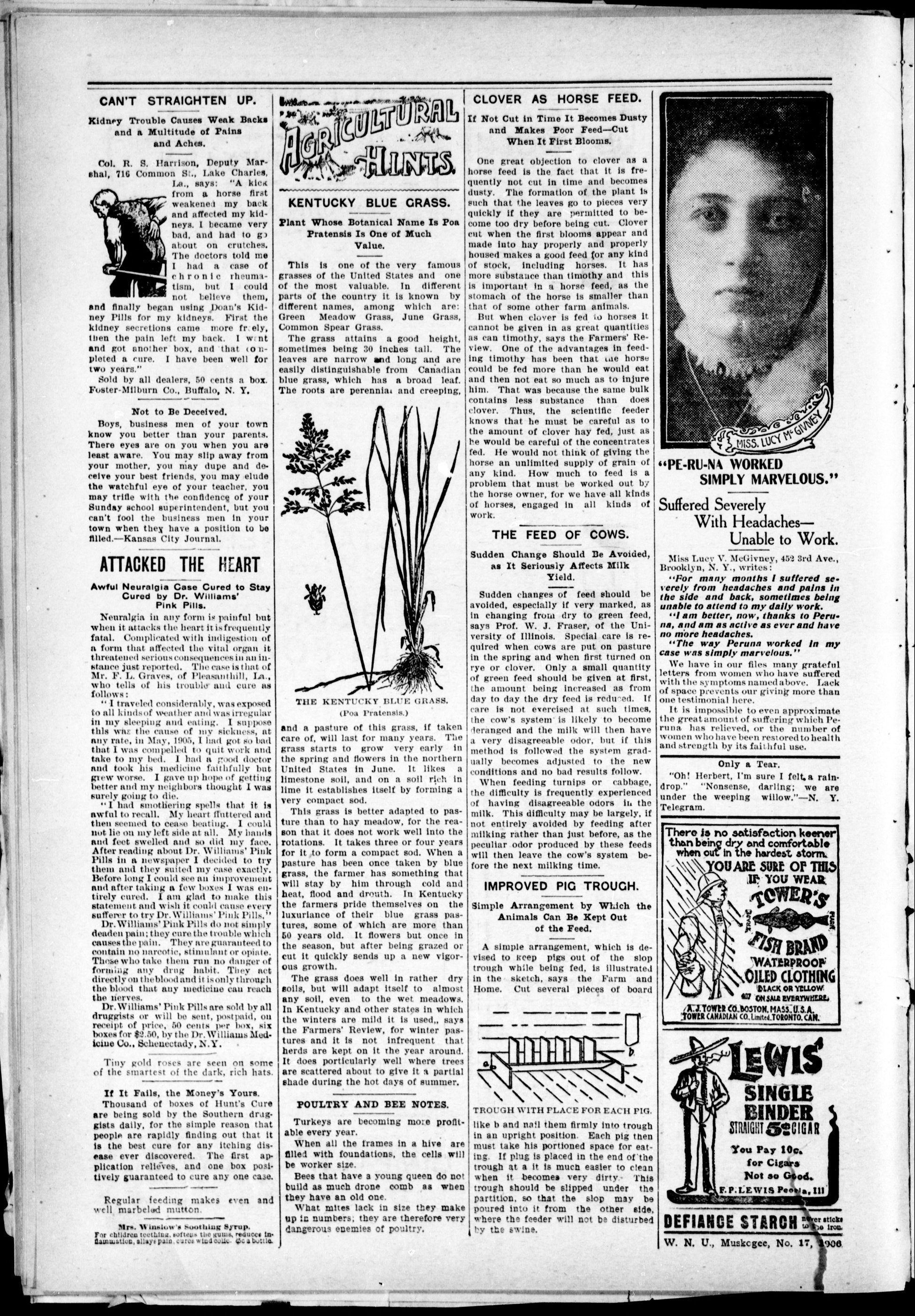
AGRICULTURAL HINTS
KENTUCKY BLUE GRASS.
Plant Whose Botanical Name Is Poa Pratensis Is One of Much Value.
This is one of the very famous grasses of the United States and one of the most valuable. In different parts of the country it is known by different names, among which are: Green Meadow Grass, June Grass, Common Spear Grass.
The grass attains a good height, sometimes being 30 inches tall. The leaves are narrow and long and are easily distinguishable from Canadian blue grass, which has a broad leaf. The roots are perennial and creeping.
G. R. H.
THE KENTUCKY BLUE GRASS. (Poa Pratensis.) and a pasture of this grass, if taken care of, will last for many years. The grass starts to grow very early in the spring and flowers in the northern United States in June. It likes a limestone soil, and on a soil rich in lime it establishes itself by forming a very compact sod.
This grass is better adapted to pasture than to hay meadow, for the reason that it does not work well into the rotations. It takes three or four years for it to form a compact sod. When a pasture has been once taken by blue grass, the farmer has something that will stay by him through cold and heat, flood and drouth. In Kentucky the farmers pride themselves on the luxuriance of their blue grass pastures, some of which are more than 50 years old. It flowers but once in the season, but after being grazed or cut it quickly sends up a new vigorous growth.
The grass does well in rather dry soils, but will adapt itself to almost any soil, even to the wet meadows. In Kentucky and other states in which the winters are mild it is used., says the Farmers' Review, for winter pastures and it is not infrequent that herds are kept on it the year around. It does particularly well where trees are scattered about to give it a partial shade during the hot days of summer.
POULTRY AND BEE NOTES
Turkeys are becoming more profitable every year.
When all the frames in a hive are filled with foundations, the cells will be worker size.
Bees that have a young queen do not build as much drone comb as when they have an old one.
What mites lack in size they make up in numbers; they are therefore very dangerous enemies of poultry.
CLOVER AS HORSE FEED.
If Not Cut in Time It Becomes Dusty and Makes Poor Feed-Cut When It First Blooms.
One great objection to clover as a horse feed is the fact that it is frequently not cut in time and becomes dusty. The formation of the plant is such that the leaves go to pieces very quickly if they are permitted to become too dry before being cut. Clover cut when the first blooms appear and made into hay properly and properly housed makes a good feed for any kind of stock, including horses. It has more substance than timothy and this is important in a horse feed, as the stomach of the horse is smaller than that of some other farm animals.
But when clover is fed to horses it cannot be given in as great quantities as can timothy, says the Farmers' Review. One of the advantages in feeding timothy has been that the horse could be fed more than he would eat and then not eat so much as to injure him. That was because the same bulk contains less substance than does clover. Thus, the scientific feeder knows that he must be careful as to the amount of clover hay fed, just as he would be careful of the concentrates fed. He would not think of giving the horse an unlimited supply of grain of any kind. How much to feed is a problem that must be worked out by the horse owner, for we have all kinds of horses, engaged in all kinds of work.
THE FEED OF COWS.
Sudden Change Should Be Avoided, as It Seriously Affects Milk Yield.
Sudden changes of feed should be avoided, especially if very marked, as in changing from dry to green feed, says Prof. W. J. Fraser, of the University of Illinois. Special care is required when cows are put on pasture in the spring and when first turned on rye or clover. Only a small quantity of green feed should be given at first, the amount being increased as from day to day the dry feed is reduced. If care is not exercised at such times, the cow's system is likely to become deranged and the milk will then have a very disagreeable odor, but if this method is followed the system gradually becomes adjusted to the new conditions and no bad results follow.
When feeding turnips or cabbage, the difficulty is frequently experienced of having disagreeable odors in the milk. This difficulty may be largely, if not entirely avoided by feeding after milking rather than just before, as the peculiar odor produced by these feeds will then leave the cow's system before the next milking time.
IMPROVED PIG TROUGH.
Simple Arrangement by Which the Animals Can Be Kept Out of the Feed.
A simple arrangement, which is devised to keep pigs out of the slop trough while being fed, is illustrated in the sketch, says the Farm and Home. Cut several pieces of board
D
like b and nail them firmly into trough in an upright position. Each pig then must take his portioned space for eating. If plug is placed in the end of the trough at a it is much easier to clean when it becomes very dirty. This trough should be slipped under the partition, so that the slop may be poured into it from the other side, where the feeder will not be disturbed by the swine.
MISS. LUCY M. GIVNEY
Suffered Severely With Headaches— Unable to Work.
Miss Lucy V. McGivney, 452 3rd Ave., Brooklyn, N. Y., writes:
"For many months I suffered severely from headaches and pains in the side and back, sometimes being unable to attend to my daily work.
"I am better, now, thanks to Peruna, and am as active as ever and have no more headaches.
"The way Peruna worked in my case was simply marvelous."
We have in our files many grateful letters from women who have suffered with the symptoms named above. Lack of space prevents our giving more than one testimonial here.
It is impossible to even approximate the great amount of suffering which Peruna has relieved, or the number of women who have been restored to health and strength by its faithful use.
Only a Tear.
"Oh! Herbert, I'm sure I felt a raindrop." "Nonsense, darling; we are under the weeping willow."—N. Y. Telegram.
There is no satisfaction keener than being dry and comfortable when out in the hardest storm.
YOU ARE SURE OF THIS IF YOU WEAR TCWER'S FISH BRAND WATERPROOF OILED CLOTHING BLACK OR YELLOW ON SALE EVERYWHERE.
A. J. TOWER CO. BOSTON, MASS. U.S.A.
TOWER CANADIAN CO., Limited, TORONTO, CAN.
LEWIS' SINGLE BINDER STRAIGHT 5 CIGAR
You Pay 10c. for Cigars Not so Good.
F.P. LEWIS People, Ill.
DEFIANCE STARCH never sticks to the iron.
W. N. U., Muskegee, No. 17, 1906.
SYRUP OF FIGS
To sweeten,
To refresh,
To cleanse the
system,
Effectually
and Gently;
Dispels colds and
headaches when
bilious or con-
stipated;
For men, women
and children;
There is only
one Genuine
Syrup of Figs;
to get its bene-
ficial effects
Acts best on
the kidneys
and liver,
stomach and
bowels;
Always buy the genuine — Manufactured by the
CALIFORNIA FIG SYRUP CO.
Louisville, Ky.
San Francisco, Cal.
New York, N.Y.
The genuine Syrup of Figs is for sale by all first-class
druggists. The full name of the company—California
Fig Syrup Co.—is always printed on the front
of every package. Price Fifty Cents per bottle.
La Creole "Hair Restorer is a Perfect Dressing and Restorer Price $1.00
Cardui Relieves Pain
caused by curable female diseases. It acts directly on woman's delicate organs, and restores their natural activity. By making the organs work normally, pain disappears, strength returns to the system, roses to the cheeks, and the frowns and wrinkles of suffering are seen no more. Mrs. Lucinda Johnson, of Walworth, Wis., writes: "I suffered agonies at every monthly period. Nothing helped me until I took Cardui. Now I can truly say I am cured." Try it.
WINE OF CARDU
c9 Sold by all Druggists
RUNNING SORES ON LIMBS.
Little Girl's Obstinate Case of Eczema
—Mother Says: "Cuticura Remedies a Household Standby."
"Last year, after having my little girl treated by a very prominent physician, for an obstinate case of eczema, I resorted to the Cuticura Remedies, and was so well pleased with the almost instantaneous relief afforded that we discarded the physician's prescription and relied entirely on the Cuticura Soap, Cuticura Ointment, and Cuticura Pills. When we commenced with the Cuticura Remedies her feet and limbs were covered with running sores. In about six weeks we had her completely well, and there has been no recurrence of the trouble. We find that the Cuticura Remedies are a valuable household standby, living as we do, twelve miles from a doctor, and where it costs from twenty to twenty-five dollars to come up on the mountain. Mrs. Lizzie Vincent Thomas, Fairmount, Walden's Ridge, Tenn., Oct. 13, 1905."
Record Shot.
Frank Ward, of New South Wales, is believed to have killed more rabbits at one shot than any other man living. His record is 27. The little animals were drinking at a tank and presented every opportunity for a big kill.
Do You Itch?
If so, you know the sensation is not an agreeable one, and hard to cure unless the proper remedy is used.
Hunt's Cure is the King of all Skin remedies. It cures promptly any itching trouble known. No matter the name or place. One application relieves—one box is absolutely guaranteed to cure.
American Student Life.
Prof. William Ostwald, of the University of Leipsic, who has been lecturing in this country, gives his impression of American student life as follows: "The personal interest of the students, next to their studies, is concentrated alone on sport, which draws their attention altogether from intellectual or aesthetic pursuits."
Babies Wear Charms.
All Neapolitan babies wear tied round their necks a charm against the evil eye called "Cimaruta," which means "a sprig of rice." When complete it consists of nine emblems, all of which have magical power. These emblems are the sprig of rice, serpent, half moon, key, heart, hand and horn, bird, shamrock and silver.
In London Courts.
Some of the London local courts have adopted the method of drawing jurors' names from a box, in the American style. The London Mail says the method has a distinctly novel, not to say sporting character, about it."
Chinese Imperial Canal. The Imperial canal in China is the longest in the world, and connects no fewer than forty-one cities in the course of its 800 miles.
SYR
CALIFORN
Louisville, Ky.
The genui
druggists.
Fig Sy
of every
Traveling Birds.
Sparrows, as a rule, nest anywhere, but the following two cases are perhaps as remarkable as any that can be found. A pair of sparrows actually built a nest in the rack of a train which performed a trip of 200 or 300 miles daily; while another pair attached their home to a busy ferry boat. In both instances a brood was successfully reared.
Will Restole" Hair Restorer is a Perfe
Demand for Flax. There is a great demand for flax all over the world, and a great effort is being made to induce Americans to cultivate it.
UP OF
To sweeten,
To refresh,
To cleanse the
system,
Effectually
and Gently;
There is only
one Genuine
Syrup of Figs;
to get its bene-
cial effects
always buy the genuine—N
ARNIA FIGS
San Francisco, Cal
one Syrup of Figs is for sale by
The full name of the company
Syrup Co.—is always printed
package. Price Fifty Cent
Remember.
It's not how you live, but how's your's liver. If not in perfect order, make it so by using Simmons' Liver Purifier,-tin boxes only. It's the surest, safest and most agreeable aid to that organ ever put up.
If early lambs are to be made a specialty, the ewes must be bred in good season.
ore those G ct Dressing and Restorer P
Removed the Cause.
"Was your dyspepsia cured by surgical operation?"
"Yes. The doctor told me to cut out pie."—Detroit Free Press.
ispels colds and headaches when illious or con-
tipated;
for men, women
and children;
Acts best on
the kidneys
and liver,
stomach and
bowels;
Manufactured by the
YRUP Co.
New York, N.Y.
all first-class
—California
on the front
per bottle.
Norwegians have a primitive way of breaking up old, worn-out wooden ships. They take them to exposed rocky parts of the coast, and, after anchoring them, leave the breakers of the next storm to smash them to pieces. After the storm the floating fragments are picked up and sold for firewood. W. N. U., Muskogee, No. 17, 1900
ay Hairs
ice $1.00
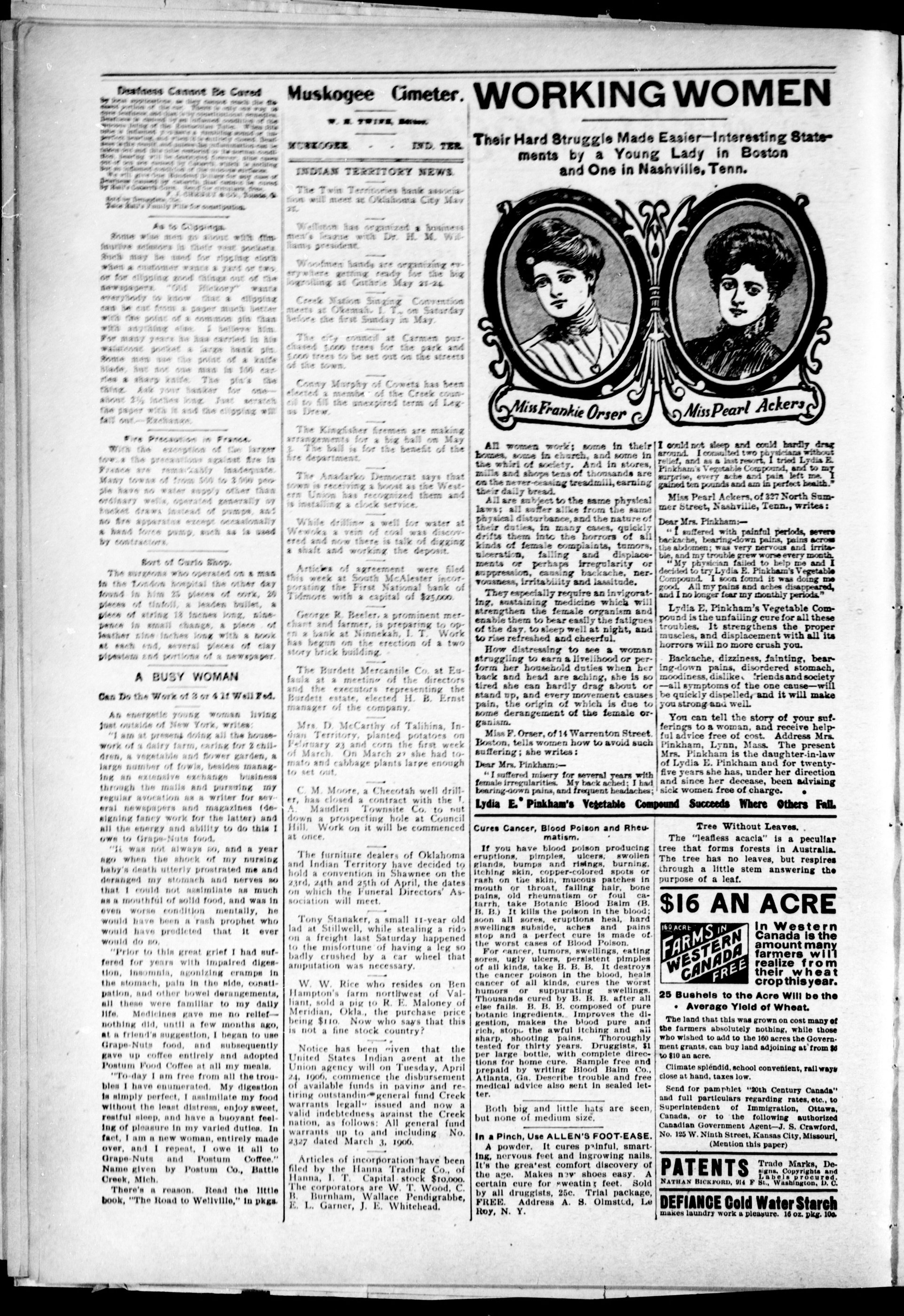
Muskogee Cimeter. WORKING WOMEN
Deafness Cannot Be Cured
By these applications, we deny damage to the
portion of the air. There is only one way to
give sequestration, and that only in confined condition.
Sequestration is caused by an inflamed condition of the
airway lining of the Restoration Table. When this
airway is inflamed, pressure is a stimulating amount of
inflammation, and when it is infiltrated sequestration
death occurs. In infiltrated condition can be
taken out and this other condition can be
taken out. Sequestration will be destroyed forever, after
out of air is caused by Canetti, written in nothing
but an inflamed condition of the airway lining.
We will give One Resident Dollars for any case of
Sequestration caused by Canetti that cannot be caused
by Raleigh Canetti Corp. Reqd for citrulline from
Raleigh Canetti Corp. CHRUCK & CO. Dollars,
bound by Dengstem, the.
Raleigh Raleigh's family title for constrain
Aa to Cigglinga.
Some wise men go about with filmmatic software in their vast pocket. Such may be used for rigging cloth when a customer wants a part or two or for clipping good things out of the newspapers. "Old Hickory" wants everybody to know that a clipping can be cut from a paper much better with the point of a common pin than with anything else. I believe him. For many years he has carried in his waistcoat pocket a large hank pin. Some men use the point of a kaffle blade, but not one man in 100 carries a shary knife. The pin's the thing. Ask your hanker for one—about 2½ inches long. Just scratch the paper with it and the clipping will fall out. Exchange.
Fire Precaution in France.
With the exception of the larger tow, a the precautions against fire in France are remarkably inadequate. Many towns of from 500 to 2,000 people have no water supply other than ordinary wells, operated generally by bucket draws instead of pumps, and no fire apparatus except occasionally a hand force pump, such as is used by contractors.
Bort of Curtis Shore.
The surgeons who operated on a man in the London hospital the other day found in him 25 pieces of cork, 26 pieces of tintail, a leaden bullet, a piece of string 18 inches long, nine-pence in small change, a piece of leather nine inches long with a hook at each end, several pieces of clay pipestone and portions of a newspaper.
A BUSY WOMAN
Can Do the Work of 3 or 4 if Well Fed.
An energetic young woman living just outside of New York, writes:
"I am at present doing all the housework of a dairy farm, caring for 2 children, a vegetable and flower garden, a large number of fowls, besides managing an extensive exchange business through the mails and pursuing my regular avocation as a writer for several newspapers and magazines (designing fancy work for the latter) and all the energy and ability to do this I owe to Grape-Nuts food.
"It was not always so, and a year ago when the shock of my nursing baby's death utterly prostrated me and deranged my stomach and nerves so that I could not assimilate as much as a mouthful of solid food, and was in even worse condition mentally, he would have been a rash prophet who would have predicted that it ever would do so.
"Prior to this great grief I had suffered for years with impaired digestion, insomnia, agonizing cramps in the stomach, pain in the side, constipation, and other bowel derangements, all these were familiar to my daily life. Medicines gave me no relief—nothing did, until a few months ago, at a friend's suggestion, I began to use Grape-Nuts food, and subsequently gave up coffee entirely and adopted Postum Food Coffee at all my meals.
"To-day I am free from all the troubles I have enumerated. My digestion is simply perfect, I assimilate my food without the least distress, enjoy sweet, restful sleep, and have a buoyant feeling of pleasure in my varied duties. In fact, I am a new woman, entirely made over, and I repeat, I owe it all to Grape-Nuts and Postum Coffee." Name given by Postum Co., Battle Creek, Mich.
There's a reason. Read the little book, "The Road to Wellyville," in pkgs.
W. 英. 亨 W 英. 迪 霍
MUNKOGER . IND. TER
INDIAN TERRITORY NEWS
The Twin Territories bank association will meet at Oklahoma City May 21.
Wellston has organized a business men's league with Dr. H. M. Williams president.
Woodmen hands are organizing everywhere getting ready for the big logrolling at Guthrie May 21-24.
Creek Nation Singing Convention meets at Okemah, I. T., on Saturday before the first Sunday in May.
The city council at Carmen purchased 5,000 trees for the park and 5,000 trees to be set out on the streets of the town.
Conny Murphy of Coweta has been elected a membe of the Creek council to fill the unexpired term of Legus Drew.
The Kingfisher firemen are making arrangements for a big hall on May 3. The hall is for the benefit of the fire department.
The Anadarko Democrat says that town is receiving a hoost as the Western Union has recognized them and is installing a clock service.
While drilling a well for water at Wewoka a vein of coal was discovered and now there is talk of digging a shaft and working the deposit.
Articles of agreement were filed this week at South McAlester incorporating the First National bank of Tidmore with a capital of $25,000.
George R. Beeler, a prominent merchant and farmer, is preparing to open a bank at Nimnekah, I. T. Work has begun on the erection of a two story brick building.
The Burdett Mercantile Co. at Eufaula at a meeting of the directors and the executors representing the Burdett estate, elected H. B. Ernst manager of the company.
Mrs. D. McCarthy of Talihina, Indian Territory, planted potatoes on February 23 and corn the first week of March. On March 27 she had tomato and cabbage plants large enough to set out.
C. M. Moore, a Checotah well driller, has closed a contract with the I. A. Maudlen Townsite Co. to out down a prospecting hole at Council Hill. Work on it will be commenced at once.
The furniture dealers of Oklahoma and Indian Territory have decided to hold a convention in Shawnee on the 23rd, 24th and 25th of April, the dates on which the Funeral Directors' Association will meet.
Tony Stanaker, a small 11-year old lad at Stillwell, while stealing a rido on a freight last Saturday happened to the misfortune of having a leg so badly crushed by a car wheel that amputation was necessary.
W. W. Rice who resides on Ben Hampton's farm northwest of Valiant, sold a pig to R. E. Maloney of Meridian, Okla., the purchase price being $110. Now who says that this is not a fine stock country?
Notice has been given that the United States Indian agent at the Union agency will on Tuesday, April 24, 1906, commence the disbursement of available funds in paving and retiring outstanding general fund Creek warrants legally issued and now a valid indebtedness against the Creek nation, as follows: All general fund warrants up to and including No. 2327 dated March 3, 1906.
Articles of incorporation have been filed by the Hanna Trading Co., of Hanna, I. T. Capital stock $10,000. The corporators are W. T. Wood, C. B. Burnham, Wallace Pendigrabbe, E. L. Garner, J. E. Whitehead.
---
Their Hard Struggle Made Easier-Interesting Statements by a Young Lady in Boston and One in Nashville, Tenn.
Miss Frankie Orser Miss Pearl Ackers
Lydia E. Pinkham's Vegetable Compound Succeeds Where Others Fall
All women work; some in their homes, some in church, and some in the whirl of society. And in stores, mills and shops tens of thousands are on the never-ceasing treadmill, earning their daily bread. All are subject to the same physical laws; all suffer alike from the same physical disturbance, and the nature of their duties, in many cases, quickly drifts them into the horrors of all kinds of female complaints, tumors, ulceration, falling and displacements or perhaps irregularity or suppression, causing backache, nervousness, irritability and lassitude.
They especially require an invigorating, sustaining medicine which will strengthen the female organism and enable them to bear easily the fatigues of the day, to sleep well at night, and to rise refreshed and cheerful.
How distressing to see a woman struggling to earn a livelihood or perform her household duties when her back and head are aching, she is so tired she can hardly drag about or stand up, and every movement causes pain, the origin of which is due to some derangement of the female organism.
Miss F. Orser, of 14 Warrenton Street, Boston, tells women how to avoid such suffering; she writes:
Dear Mrs. Pinkham:—
"I suffered misery for several years with female irregularities. My back ached; I had bearing-down pains, and frequent headaches;
Cures Cancer, Blood Poison and Rheumatism.
If you have blood poison producing eruptions, pimples, ulcers, swollen glands, bumps and risings, burning, itching skin, copper-colored spots or rash on the skin, mucous patches in mouth or throat, falling hair, bone pains, old rheumatism or foul catarrh, take Botanic Blood Balm (B. B. B.) It kills the poison in the blood; soon all sores, eruptions heal, hard swellings subside, aches and pains stop and a perfect cure is made of the worst cases of Blood Poison.
For cancer, tumors, swellings, eating sores, ugly ulcers, persistent pimples of all kinds, take B. B. B. It destroys the cancer poison in the blood, heals cancer of all kinds, cures the worst humors or suppurating swellings. Thousands cured by B. B. B. after all else fails. B. B. B. composed of pure botanic ingredients. Improves the digestion, makes the blood pure and rich, stops the awful itching and all sharp, shooting pains. Thoroughly tested for thirty years. Druggists, $1 per large bottle, with complete directions for home cure. Sample free and prepaid by writing Blood Balm Co., Atlanta, Ga. Describe trouble and free medical advice also sent in sealed letter.
Both big and little hats are seen, but none of medium size.
In a Pinch, Use ALLEN'S FOOT-EASE.
A powder. It cures painful, smart-
ing, nervous feet and ingrowing nails.
It's the greatest comfort discovery of
the age. Makes new shoes easy. A
certain cure for sweating feet. Sold
by all druggists, 25c. Trial package,
FREE. Address A. S. Olmsted, Le
Roy, N. Y.
I could not sleep and could hardly drag around. I consulted two physicians without relief, and as a last resort, I tried Lydia E. Pinkham's Vegetable Compound, and to my surprise, every ache and pain left me. I gained ten pounds and am in perfect health." Miss Pearl Ackers, of 327 North Summer Street, Nashville, Tenn., writes:
Dear Mr. Pinkham:—
"I suffered with painful periods, severe backache, bearing-down pains, pains across the abdomen; was very nervous and irritable, and my trouble grew worse every month. "My physician failed to help me and I decided to try Lydia E. Pinkham's Vegetable Compound. I soon found it was doing me good. All my pains and aches disappeared, and I no longer fear my monthly periods."
Lydia E. Pinkham's Vegetable Compound is the unfailing cure for all these troubles. It strengthens the proper muscles, and displacement with all its horrors will no more crush you.
Backache, dizziness, fainting, bearing-down pains, disordered stomach, moodiness, dislike, friends and society—all symptoms of the one cause—will be quickly dispelled, and it will make you strong and well.
You can tell the story of your sufferings to a woman, and receive helpful advice free of cost. Address Mrs. Pinkham, Lynn, Mass. The present Mrs. Pinkham is the daughter-in-law of Lydia E. Pinkham and for twenty-five years she has, under her direction and since her decease, been advising sick women free of charge.
The "leafless acacia" is a peculiar tree that forms forests in Australia. The tree has no leaves, but respires through a little stem answering the purpose of a leaf.
$16 AN ACRE
In Western Canada is the amount many farmers will realize from their wheat crop this year.
160 ACRE
FARMS IN
WESTERN
CANADA
FREE
The land that this was grown on cost many of the farmers absolutely nothing, while those who wished to add to the 160 acres the Government grants, can buy land adjoining at from $0 to $10 an acre.
Climate splendid, school convenient, rail ways close at hand, taxes low.
Send for pamphlet "20th Century Canada" and full particulars regarding rates, etc., to Superintendent of Immigration, Ottawa, Canada, or to the following authorized Canadian Government Agent—J. S. Crawford, No. 125 W. Ninth Street, Kansas City, Missouri. (Mention this paper)
PATENTS Trade Marks, Designs, Copyrights and Labels procured. NATHAN BICKFORD, 914 F. St., Washington, D. C.
DEFIANCE Cold Water Starch makes laundry work a pleasure. 16 oz. pkg. 10g.
THE BODACH OF GLENMORAN (An Irish Folk Tale)
By SEUMAS MACMANUS
(Copyright, 1906, by Joseph B. Bowles)
There was a man once, named Crohoore, that lived next a bog by a high mountain, and he had one son that was as the apple of his eye to him. A brave boy the son was when he grew up, and nothing would do him but he would go away to push his fortune. When he was going off, Crohoore warned him on the peril of his life not to hire with the Bodach of Glenmoran, for though he offered big wages to entice men into his power, he always managed to make the man hired with him rue the day. The lad when he was going off promised to mind this, but on his way through Glenmoran who should he meet but the Bodach himself, and the Bodach asked where he was going and what he was looking for.
"I am going," says the young fellow, says he, "to push my fortune. I am looking for a good master."
"That is lucky," says the Bodach, says he, "for I am looking for a good man. Will you hire with me?"
"No," says the young fellow, "I will not hire with you, because my father warned me against you, and said it would be worse for me if I did, for that you were very bad entirely to your boys."
The Bodach said: "I will engage you for a year and a day, and give you a gold guinea every day of them, provided," says he, "that you do everything you are bid, and that you will never say you rued the day you hired with me; and," says the Bodach, "(for I like to be just) I will engage for my part that if I ever say I rue the day I hired you, your wages will be doubled, and, moreover, should either of us be guilty of ruling the day, the other will have leave to draw him at a carttail, and flog him through the nine towns."
Well, these looked grand wages entirely to Crohoore's poor son, and, thinking of the rich man he would go back home, he couldn't help but agree to them, and away home with the Bodach he went.
The very next day, when the young fellow got his breakfast, the Bodach took him out and sent him with a plow and a pair of horses into a park that was three miles every way. And says the Bodach, says he:
"Your dinner will be ready for you when you are done plowing that field, but don't on the peril of your life come in till the last sod is turned."
The poor fellow when he looked at the size of the field, three miles every way, and thought that he wasn't to get dinner till he had every sod of it turned, his heart went down to his boots, and little wonder. But he fell to anyhow, and he began to plow, and every furrow took him two hours from start to finish, and he hadn't a half-a-dozen furrows plowed in the field when he dropped down from weakness and the fair dint of hunger.
The Bodach he come out to see how he was getting along, and he came up to him where he was lying, and he gives him the toe of his boot, and "Get up out of that," says he.
"Oh, oh, weary's me," says the young fellow, "to ever hire with you anyhow. If I had only observed my poor father's advice—"
"What, what," says the Bodach, says he, "sure it's not ruing your bargain you are."
"Indeed and it is," says the young fellow, says he, "ruing it sorely."
"All right," says the Bodach, says he. "Get up out of this and come along with me in double quick time," and he got him by the scruff of the neck and he hauled him with him. And he tied him to the tail of the cart, and flogged him through the nine towns, till the poor young fellow was a spectacle of cuts and bruises, and the last breath
only was in his body. And then the dirty Bodach loosed him from the cart and left him lying there in the ditch.
As soon as he was able he starts for home, dragging his legs after him, and when he reached home it's the grieved man and the angry one was his father, and he swore that he would never sleep two nights in one bed or eat two meals at the one table till he would reach that Bodach and have his revenge. So, leaving his wee house and wee place in charge of the son, Crohoore spat on his stick and started off afore him, and he never stopped nor stayed till he came to the Bodach's place of Glenmoran. And passing through Glenmoran, who should he meet but the Bodach himself, and the Bodach stopped him, and asked where he was going and what he was looking for.
"I am going," says Crohoore, says he, "to push my fortune, and am looking for a likely master."
"Well, surely," says the Bodach, says he, "that's lucky, for I'm looking for a likely man. Will you hire with me?"
"What's your terms?" says Crohoore, says he.
The Bodach repeated the terms he had told the boy.
Well and good, the bargain was concluded, and the master took Crohoore home with him.
Next day, after Crohoore had his breakfast, the Bodach takes him out and shows him a great big mountain with 500 head of cattle on it, that were tearing and running east and west to get off it, and says he to Crohoore: "Your duty the day is to herd that mountain, and as long as there will be one head of the 500 missing on it you are not to come in to your dinner nor your dinner to come out to you."
"Very well and good," says Crohoore, says he, and he went off to the mountain whistling like a skylark and the cattle was that wild that they were running away, disappearing off the mountain at all quarters, and the Bodach went about his business.
Drawing on night the Bodach come to the mountain to Crohooore, and he couldn't see the sign of a beast on it, let alone 500. And says he to Crohooore in a rage: "Where," says he, "is my 500 beasts?" "I suppose," says Crohooore, says he, "they are wherever pleases them best. How do you expect me to know where your 500 beasts are?" "Sir," says the Bodach, says he, "what did I send you out here the day to do?"
"Ye sent me out," says Crohoore, says he, "to herd this mountain; and I think," says he, "ye'll give in that I have done my duty very well indeed, for there's the mountain safe and sound and on the same spot still. I don't want to boast much of myself," says Crohoore, says he, "but still I will say that if you had hired a slacker man than me you'd have lost your mountain this day, for five times, no less, it started off.
"And knowing," says Crohoore, says he, "that if I left it to go home for my bite of dinner, the devil himself wouldn't overtake it when I would get back, I got your black bull," says he, "in the hollow below, and killed him and roasted a side of him, and I can stay out here herding your mountain for three weeks to come and not want for good sweet meat."
"Och, och, och," says the Bodach, says he, "you are a terrible scoundrel to let my 500 cattle go east and west and get lost over the face of the world, and to kill my black bull," says he, "that I paid 300 guineas for not three weeks ago." And he went tearing up and down like a raving madman.
"What! What!" says Crohoore, says he, "you're surely not vexed with me and don't rue your bargain?"
And with that the Bodach minded himself and says he: "Oh, no, no, that's a way I have when I be jumping with joy. Such a boy as you," says he. "I never had afore, and such a boy, I am sure, I will never have again."
The Bodach he didn't go to bed that night at all. He wandered about and up and down the whole night, planning what he could do at all, at all, to get
rid of Crohoore, and at long and at last he struck upon a grand plan, as he thought. There was a big, wild beggar man that they called Billy the Beggar, who used to come about the Bodach's house every day begging, and he carried a terrible knife with him, and everybody was afraid to refuse him for fear of the same.
And the Bodach said to himself that he would order Crohoore next day to kill the beggar, for that he had him and the whole countryside annoyed. "Then," says the Bodach, says he, "Crohoore's life will be at my mercy in no less than three different ways. If he doesn't do my bidding, then I can do what I like with him; if he does my bidding and the beggar kills him, then my hands will be saved of his blood, but if he gets the better of the beggar and kills the beggar, then I will have him tried and hung for murder." And for once in his life the Bodach was jumping for joy.
The next morning when Crohoore had his breakfast he come to the Bodach and asked what was for him to do the day.
"Why," says the Bodach, "there is only one little thing. It is only," says he, "Billy the Beggar who comes here every day, and who has annoyed me, and I want you to kill him."
"It is only," says he, "Billy the Beggar who comes here every day, and who has annoyed me, and I want you to kill him."
"Very well and good," says Crohoore. And then the Bodach went away about his business, and when he come back in the evening and met Crohoore he asked him how he had enjoyed himself, and did he kill Billy the Beggar.
"I never had as good a day's fun in my life," says Crohoore, says he, "and I began by killing Billy the Beggar."
"Indeed," says the master, "and how did you do it?"
"Very easy," says Crohoore, says he. "When he came to the door begging, I took him in, and I filled his bag with all the goold and silver you had in your chest, and I put it on his back, and I sent him away Billy the Gentleman. Billy the Beggar is as dead as a doorpost, and will never trouble you more." And when the Bodach heard this he set up a whillaloo, and, "Oh, you are an eternaal scoundrel," says he, "all the harm ever you done me afore was nothing at all, at all, to this. You have ruined me out and out," says he, "and it's meself's the beggar for the rest of my days."
"What, what," says Crohoore, says he, "sure you are not vexed with me, and don't rue your bargain."
"Vexed!" says the Bodach, says he, "It's mad I am, and I rue the day ever my eyes first seen ye, ye villain ye, and I wish I was rid of ye never to see ye more."
"Well, well and good," says Crohoore, says he, "come out here till I tie ye to the cart-tail." And out he had to go, and Crohoore tied him to the cart-tail, and whipped and flogged him through the nine towns; and I tell ye every time Crohoore put the whip down on him he brought it down with a vengeance, and he made the Bodach jump and screech as he whaled, and whacked, and flayed, and flogged him through town after town, and give him two cuts for every cut the Bodach had given his son. And afore he stopped he made the Bodacn promise that he would never act the same way again toward any poor strange boy who would come looking to him for service, but that he would treat him as if he was his own son.
What X-Ray Injures.
X-rays as death giving instead of life giving instruments are a discovery in connection with many lower organisms. For example, their preventive effect on the growth of seeds has been observed, and experimentally proved. Similar results have been obtained in experiments with the larvae of bettles, changes of such a character being induced in the body tissues that development does not normally take place. The extraordinary effects of radium emanations in inhibiting growth are also well recognized.
Examine carefully every bottle of CASTORIA, a safe and sure remedy for infants and children, and see that it
Bears the Signature of
Chas. H. Hatcher.
In Use For Over 30 Years.
The Kind You Have Always Bought.
Bears the Signature of
The Plain Plucker.
If a burn or bruise afflicts you, rub it on, rub it on.
Then before you scarcely know it all the trouble will be gone.
For an aching joint or muscle do the same.
It extracts all pains and poisons, plucks the stings and heals the lame.
Hunt's Lightning Oil does it.
Noted Frenchman.
There has just passed away in the person of M. Desprecher one of the pioneers of France in ocean cables. M. Desprecher collaborated with Sir John Pender, Cyrus W. Field, George Elliott and others in laying the first cables between Europe and America. He was one of the promoters of the Corsican cable, which was laid in 1861. In 1894 he bought the island of Anticosti, which now belongs to M. Menier. He has reached the age of 83.
New Kind of Race.
Items in the first great athletic meeting held in China, which took place at Canton, were arithmetic races. Pupils from schools carried slates and pencils, and in the course of the race they encountered a blackboard containing a sum to be solved. The boys were lined up as they reached the goal, and those whose calculations were wrong were then eliminated. The first three left in the line were counted winners.
DODD'S
KIDNEY
PILLS
FOR ALL KIDNEY DISEASES
CURES RHEUMATISM
BRIGHT'S DISEASE E
DIABETES BACKACHE
discontinued the use of our product
package. The public may rely on our
care of limitations. Sold only in boxes.
W. L. DOUGLAS $3.50 & $3.00 SHOES FOR MEN W. L. Douglas $4.00 Gilt Edge Line cannot be equalled at any price.
W.L. DOUGLAS
SHOES
ALL PRICES
BEST
IN
THE
WORLD
THE WORLD'S GREATEST SHOEMAKER
SOLE AGENTS FOR
W.L. DOUGLAS SHOES
ESTABLISHED
JULY 6, 1876.
CAPITAL $2,500,000
W. L. DOUGLAS MAKES & SELLS MORE
MEN'S $8.50 SHOES THAN ANY OTHER
MANUFACTURER IN THE WORLD.
$10,000 REWARD to anyone who can disprove this statement.
If I could take you into my three large factories at Brockton, Mass., and show you the infinite care with which each pair of shoes is made, you would realize why W. L. Douglas $3.50 shoes cost more to make, why they hold their shape, fit better, wear longer, and are of greater intrinsic value than any other $3.50 shoe.
W. L. Douglas Strong Mado Shoes for Men, $2.50, $2.00. Boys' School & Dress Shoes, $2.50, $2.$1.75, $1.50 CAUTION.—Insist upon having W. L. Douglas shoes. Take no substitute. None genuine without his name and price stamped on bottom.
Fast Color Eyelens used; they will not wear brassu. Write for Illustrated Catalog.
W. L. DOUGLAS, Brockton, Mass.
---
The blue mark on your paper means subscription out and paper starts at once.
Roosevelt says we will get statehood and so says Speaker Cannon and Senator Beveridge. Is not that enough?
The Curtis Bill makes provision for Creek Babies to file. This means thousands of acres of land for our people.
The wicked old preacher and his side partner have not yet stoped this paper. There must be a hitch somewhere Parson.
All we ask is that the people who are not interested from a social standpoint keep hands off in the school muddle. Gentlemen its loaded. Its hot and you might get your fingers buent.
Col. Soper is not for a Negre as member of the Ty. Ex. Committee. Grant Victor is and we hope Victors ideas will prevail. Its a shame that the thousands of Negro voters have no representation on the Committee.
The Board of Education will take up the appointment of teachers on May 11th. All applicants should get in their applications and testimonials at the earliest opportunity.
Where is the library that Prof J. E. Johnson bought when Principal of Dunbar School. He left there when he resigned and it was a splendid one. The present individual in incumbent H. N. Johnson can answer if he will and also say how many books have been added to it and how many have disappeared.
Chas Kimsey is the best Chief of Police that Muskogee ever had and is making a record that will be a credit to the Republican Party.
They have descoverd Coal at Grayson I. T., the best grade of coal in the B. I. T. Property has taken a sudden jump upward. A coal mine will be opened at once.
While its no disgrace to be a Negro yet we have never known a white man to declare himself to be a Negro and we have had some experience among people.
The fellows who claim that a certain man who is very light in color is not a Negro, lie and know that the lie comes from a black and rotten heart.
We want all of the teachers who expect to teach in our schools to take the examination and pass, after that if they are morally fit then we think they should be considered.
The Negro is the last person in the world who should draw the color line and yet we are told some of our leading politicians are opposing a candidate for policeman because he is light colored. What fools these mortals be.
We desire to thank Marshall Kimsey and his force for clearing the cyprians and their consorts from their haunts on South Second Street and the two R. R. Let the good work go on gentlemen. Its clean. Now keep it so. And there will never be any riots or midnight murders in this locality.
Harmoney does not exist among the teachers at Dunbar School and we know it. Johnson and his faction have caused the disunion. We must have a change if we expect our schools to mark time with others cities.
Instead of arresting the Coke fiends, they should arrest the person or persons who sell the infernal drug. It's a blame sight worse than whiskey and a sight more injurious to the health. Stop the sale of the cursed stuff to the poor devils who are its slaves.
The future success of our race depends upon the training of our youth, this being a fact we should see to it that the very best teachers are placed in our public schools and insist rigorously upon efficiency in teachers along moral and educational lines.
Just as soon as Congressman Murphy got his bill in motion to punish the theives who stole the record from the Dawes Commission then Senator Clapp got in his resolution to make the records public. Looks like there is some one here the Senator wants to protect.
A Republican who as soon as he gets into office desires to appoint Democratic subs, should have allowed his Democratic opponent to have taken the office and made the appointments. We believe that to the victors belong the spoils.
SECOND SUNDAY IN MAY.
At special rates. Honsehold of Ruth Regalia a specialty including banners badges and Jewels, Time is short. Write at once for special quotations.
PHOTOGRAPHS AT GREEN'S STUDIO
"Not the Cheapest but the Best"
All the Latest Styles in Photographic Art.
"Cloudy Days" as Good as Sunshine.
Lace, Drapery and Flowers. Lady in Attendance.
Studio open Sunday from 9 a.m. to 4 p.m.
Creek Grocery Co.
Is located on South 2nd St. in their own building. They can fill your order for anything you want in the Grocery line at prices that can't be duplicated. Number 304 SOUTH 2nd ST. PHONE 912.
No. 55 & 56 Local Accomodations Daily Except Sunday between Fayetteville and Muskogee and Nos. 58 and 57 Local except Sunday between Okmulgee and Muskogee. No. 51 will connect at Okmulgee for north and south. No. 52 will connect ar Fayetteville for St. Louis and all intermediate points; Eureka Springs line and west from Monett and to Memphis, Birmingham and Bryand to Springfield.
FRISCO
SYSTEM
HON FRANK C. HUBBARD Mayor-Elect of Muskogee.
K Grocery
in South 2nd St. in their own build
for anything you want in the Grocery
publicated.
IRSHBAU
S FURNISHING G
L DESCRIPTIONS
Hats, Underwear, S
E. McCLU
, English Block.
New Time
Effective January
ST
es
7:45 a. m. No. 52 Leav
1:10 p. m. No. 56 “
2:00 p. m. No. 54 Arri
es
7:00 p. m. No. 58 “
Local Accomodations Daily Exc
ville and Muskogee and Nos. 58
between Okmulgee and Muskogee,
connect at Okmulgee for north and
Fayetteville for St. Louis and
Springs line and west from Mon
m and Bryand to Springfield.
Cheery Co.
their own building. They can
in the Grocery line at prices
and ST. PHONE 912.
BAUM ..
BINDING GOODS
ATIONS.
rear, Suit Cases
CLURE,
I.T.
TimeCard
to January 17th
EAST
52 Leaves 11:25 a.m.
56 " 7:45 a.m.
54 Arrives 7:45 a.m.
58 " 10:00 a.m.
Daily Except Sunday be-
and Nos. 58 and 57 Local ex-
cl Muskogee.
for north and south. No. 52
Louis and all intermediate
t from Monett and to Mem-
ringfield.
New TimeCard
H. E. HARKRIDER, Ag't.
---
---
UNCLE BOB'S SOUL
By LAURA FITZHUGH PRESTON
(Copyright, 1908, by Joseph B. Bowles)
Uncle Bob was in a serious dilemma. Confronted for the first time in his life with a psychological problem.
"Uncle Bob," the boy had said, winding up a discussion the two had held regarding the delights of Paradise and a future life, "when you die and go to Heaven, will you have a white soul or a black soul?"
"Is I gwine"—the old man almost gasped—"ter be er white soul, aw er black soul when I dies? Is dat de quecshun you done ax, leetle Moss? (his name for the child). I fo'gibs you, leetle Moss; but you oughtah had bettah sense dan ter ax hit in de fus' place. Why, of co'se I gwine be er white soul! Is you eber heah ob air black pusson in de naix wohl 'sides de debil?"
"But, Uncle Bob"—doubtfully—"if you are going to be white how shall I ever know you up there? 'Cause, Uncle Bob"—cajolingly—"you are such a beau-ti-ful black, and I am so used to you with your lovely white woo—hair, and all, that I don't see how I can ever tell you from other common white people if you are going to change all that."
But Uncle Bob had misunderstood the comparison, and considered that the boy had reference to the social grade he would eventually occupy above; consequently the glamour of the compliment on his beautiful color faded away in a fresh burst of indignation.
"What you meanin' by 'common people,' leetle Moss?" he grunted, irritably. "Does you spec', foher mo-ment, dat I gwine be po' white trash up dar?"
"Then what will you be, Uncle Bob?" queried the little fellow, feeling himself, now, very much bewildered by all these complications. "Are you going to be a white gentieman?" and the bare idea brought him very near the verge of tears, so loath did he feel to part forever from the Uncle Bob of his lifelong association, even if supplanted by the celestial creation of Uncle Bob's ambitious anticipations.
The old man was fairly staggered by this last question.
"I 'clar' ter gracious!" he said, covering his discomfiture with an air on superiority and reticent foreknowledge, "hit ain' no use my tellin' you what I gwine be when I gits up dar, chile; leetl igna'yent boys ain' 'spec' ter hab de knowledge ob ole haids lek mine, and dey des got ter wait twell dey gits shet ob dey baby teef 'fo' dey puzzlin' dey haids on pints what's well on'erstood by de faif'ful froo rev'lation and wraslin' an' pra'r. Desmek yo' min' easy! "Unc' Bob gwine be fix up some way, so dat you sho gwine know him up dar, eben ef he had ter be a cullud white soul twell he git use ter de change. Good-by. Gawd bless you twell de naix time."
That night, in his devotions, Uncle Bob prayed in much fervor and unrest of spirit. The state of his mind will best be revealed by his petitions.
"Marse Jesus," he prayed, in the child-like faith of being very nearly approached and comprehended by the Power he addressed, "I now gwine bring up a subject' ter 'scuss wid you dat bin ax me terday by de chile I lub. He say: 'Unc' Bob (he mos' cry when he ax hit), den is you gwine be er white gem'man up in Heaben?' Dat ar quecshun des pintally bin ha'ntin' me all day!
"De idee of me bein' a white gem'man's soul up in Heaben neber is for one moment entah my min'. I hopes you will beliebe dat, an' 'scuse de on-politeness of de sugges'hun. But den den buhn all my bridges down behin' me, by tellin' de chile dat I ain' gwine be no white trash up dar, an' dat I ausso 'spec' sholy ter hab er white soul! No won'er de po' chile des er spec'latin' ober dat problem, what Unc' Bob gwine tuhn into, in de naix wohl, and done gone home in a quandehy. So dat lebes me face ter face wid er vehy se'yous state ob 'fairs dat I
gettin' tangle' up in. Ter begin wid, de chile say he ain' gwine know me up dar wid er white soul! Lawd, Lawd, dat ar soun' mon'sous ter ole Unc' Bob! De idee ob not bein' known by the chile dat I nuss' fom de time he er leetle twenty weenty infunt an' dat des de pride of my ole age lek Miss Lucy and Marse Tom."
"I des yeahnin', Marse Jesus," weeping unrestrainedly, "ter hab er face es well es er robe wash' white by de blood of de Lam' so dat I could serbe de Lawd in spotless peo'ty of soul; but, oh! bless' Lawd, I ausso yeahnin' foh de time ter come when de gret gen'l meetin' wid ail the fambly ban' gwine tek place, an' dey all gwine say: 'Why ef heah ain' Unc' Bob! des 'zac'ly lek ole times, 'deah ole Unc' Bob!' Lawd, Lawd," in an ecstasy of emotion, "what er meetin' dat gwine be! Oh, bless' Mahster! look down' pon po' Unc' Bob, an' fix up de 'fairs of his soul so dat he res' se-kueh in de faif dat all gwine be well wid him in de happy lan', an' all things possible onto de Creator ob de Heabens an' de yearth! Hab mussy on Unc' Bob, an' bring light out ob dahkness an' gib-him de power to res' saty'fied wid de final 'scision ob de Almighty."
The bell from the Angelus rang out its summons to the faithful, and down among the lily beds the vested throng stood in shining rows, wafting their incense on the scented air.
The dew fell, like tears, from myriads of weeping eyes, on tree, grass and flower, and all the mute, unsheltered things huddling close to the bosom of the earth. Above, the sorrowful heart of the night throbbed with the intensity of its star beats. Below, in the old plantation house whose walls yearned with their passion of protectiveness, the tide of life ebbed low in the pulse of the dying child.
On the edge of the bed sat Uncle Bob, watching with straining look each change on the small white face, lying so still, with closed eyelids, and scarce a breath stirring the parted lips.
Presently the lids fluttered and then slowly unclosed. The blue eyes looked up, for the first time in many days, with a perfect recognition into the seamed, agonized old face bending over them.
"Uncle Bob—"
"What is it, leetle Moss?" answered the broken old voice.
"Uncle Bob, are you crying?" touching with his wan little hand the withered cheek over which the uncontrollable tears were flcwing.
"No, no! 'deed I ain', leetle Moss!" surreptitiously wiping them away with his bandana handkerchief, "'deed I ain', darlin'; what Unc' Bob gwine cry 'bout?" in futile attempt at loving deception, seeing the pained look on the fair little features.
"Poor Uncle Bob," with pitying tenderness, still softly stroking the withered cheek.
"Honey," sobbed Uncle Bob, "don' study 'bout me. Don' grebe 'bout ole Unc' Bob. He gib his life ter mek you des one minute easy an' 'dout pain."
"I am easy, Uncle Bob, and happy."
The unearthly sweetness of the smile broke down Uncle Bob's last little remnant of self-control, and he wept on, unrestrainedly, for a few minutes.
The little boy's eyes wandered round the room, and rested, in their pathetic searching, on the faces of Lucy and Tom—poor Lucy's, worn and haggard from nights of watching and days of unrest, and Tom's, whose breaking heart was plainly visible in the havoc which the past days had indelibly imprinted thereon.
The old grandmother, bedridden and prostrated under the impending calamity, was alone, save for her devoted and faithful attendant, with her sorrow and her God.
Tom bent over and tenderly wiped the damp brow and pushed back the fair clustering curls of the child. He gave a cold little hand to brother and sister, and, in response to the heroism of poor Lucy's brave and loving smile, sighed contentedly, as he turned his little head over on the pillow.
"Jerusalem, the Golden"--evening service was going on in the church, and the words were borne plainly on the absolute stillness of the air:
"I know not, Oh! I know not
What joys await us there,
What radiancy of glory,
What bliss beyond compare."
Uncle Bob's tears had ceased to flow; Lucy and Tom sat motionless, their faces in shadow.
"Tell me—about it—Uncle Bob," gasped the weak little voice, as the last strain died away—"Jerusalem — the Golden."
Uncle Bob leaned eagerly forward, all traces of tears carefully wiped away, that no selfish display of grief disturb the serenity of the departing soul.
"Leetle Moss," he whispered in his broken, quavering voice, "dar whar you gwine, de streets is gol'en, an' de flowers is bloomin', an' de libin' waters 's flowin' froo de green fiel's ob Pah'dise! Oh! leetle Moss, you an' me—po' ole Unc' Bob—hab talk a heap 'bout dat happy lan', but Unc' Bob ain' neber 'spec' dat you gwine go haid ob him ter de sweet an' blessed country!"
"Flowers," murmured the little one, drowsily, "gold flowers. Will there—be any roses—like Lucy's?"
"Lek Miss Lucy's!" in tender assurance. 'Leetle Moss, der flow'rs up in Pah'dise, des es much puttier'n Miss Lucy's es day is dan night! Ain' dey, Miss Lucy?"
"Yes, yes, Uncle Bob. Oh, tell him yes!" wept the girl.
"An' dey des de putties' streets you eber is see, an' you gwine meet all de folks done gone befo', honey. An' tell 'em Unc' Bob gwine be 'long soon! Soon!" in an ecstasy of longing.
A smile of surpassing beauty, and full of the tenderness of a heavenly assurance, lit up the little pallid face.
"Sing, Uncle Bob," he said, in all the simplicity of his babyhood, when the melody of that tremulous old voice was the sound that nightly rocked his soul to sleep.
"Yas, leetle Moss. Unc' Bob gwine sing," clearing his throat and putting forth every effort of his bursting heart. On the quivering air there fell the strains of a voice, old, cracked, worn, strained with the terrible strain of the coming wrench, yet sweet with all the memories of his little life, to the dying boy:
"I want ter be er an-gul
An' wid de an-guls stan',
Er crown ah-pawn my foh-haid,
An' er harp widin my hand'—
"What dat you sayin', leetle Moss," bending down low over the parting lips.
"Is I gwine be er white angul? Oh, Gawd hab mussy!"—wringing his hands in indescribable agony—"What I gwine say? Gib me de right wohds to use, Marse Jesus! Leetle Moss! I gwine be er black angul!—er jet black scul! So dat you des boun reco'nize Unc' Bob de minute you set eyes on him—dat de truf, Lawd!" raising streaming eyes of supreme renunciation to heaven.
"Uncle Bob," and the little voice was weak and far away—"When—I get—home—I'll—ask Jesus—to let me meet you—at the door—and give you—your white robe myself—and we will go—together—and have—your soul—washed white—Uncle Bob—"
"Oh, praise Gawd! Praise Gawd! My leetle Moss, my leetle Moss! My leetle white soul angul!"
"Now I lay me"—"down ter sleep," wailed poor Uncle Bob)—"I pray the Lord"—over the damp and pallid little face flickering lights are passing, and the indescribable majesty of the seal of death is already on the marble brow—"my soul—to keep" ("Oh, leetle Moss, leetle Moss!")—"If I—should—die—before—I—wake—"
And in the silence a little white soul slipped away to the shelter of the heavenly nest.
None to Sell.
De Madden—What about that gold mine proposition you made to me once? Would you like to part with a little of the stock?
McFadden—Not much! We discovered, after all, that that mine had gold in it.—Detroit Free Press.
Not Long.
He—Has she been married long?
She—No; she still thinks that her husband eats cloves because he likes them
Helena, Mont.-The town of Thompson Falls, in Missoula county, has a strange system of cold storage. In the hottest days in summer it is possible to keep living rooms at a temperature of 55 degrees, and butter, eggs and meat are kept cool and fresh without the least trouble. The best part of the cold storage system is that it costs absolutely nothing after the plant has been installed.
Thompson Falls has a large number of wells that furnish cold, fresh air, which rushes upward all summer long. The wells are dug for water, but the supply of cold air is fully as important.
The wells of Thompson Falls are a little more than 60 feet in depth. The water veins are found in a gravel formation and are doubtless fed by the mountain snows at some distant place. The gravel is porous enough to admit of a freely moving current of air, which during the summer time rushes upward in currents strong enough to snuff out a match held over the wells.
The utility of the cold air currents was first observed in 1884, when the Thompson Falls Mercantile company used the cool air to keep butter, eggs and meat in large quantites. The air can be piped in summer to rooms of houses. The wells are covered over tightly at the top, and large pipes tap the current a few feet below the surface of the ground. These pipes conduct the air to different rooms in nearby buildings. For cold storage plants, a house is built above the well and the air rushes upward continuously, keeping the temperature at an unvarying point.
SOLDIERS SENT TO GIRLS.
The German Emperor Provides Partners for Young Women to Dance With.
Crefeld, Germany.—When Emperor William visited Crefeld in 1903 a group of girls complained to his majesty that they had no dancing partners and begged him to send a regiment of cavalry. The emperor promised to do so and a regiment of hussars arrived here from Duesseldorf and with it came the emperor, who had decided to take part in the regiment's reception.
The young women of the city enthusiastically acclaimed the soldiers and handed the staff officers heaps of floral offerings for his majesty. The latter, replying to the mayor's speech of welcome, said: "I have kept my word. To-day I have given the town its garrison and the young ladies their partners."
The emperor's remarks were greeted with cheers.
The city, which is the center of the silk and velvet industry, was gayly decorated for the occasion, a mile of the principal streets being hung with decorations of velvet and silk.
Since the emperor made his promise to the young women at Crefeld in 1903 the reichstag appropriated the sum of money necessary to erect permanent barracks here, which have been constructed for the accommodation of a regiment of cavalry.
Forestry in Kansas.
Approximately 1,000,000 young trees will be distributed to the people living on the prairies of western Kansas free of charge this year. H. S. Beaubien, state forestry commissioner, says he is afraid that even this number will not be sufficient to supply the demand. The forestry stations at Dodge City and Ogallah have the young trees almost ready for shipment and will begin sending them out to those who have made application within a few days.
The wolves of the Russian forests devour about 300 human beings yearly.
Muskogee, I. T., April 26, 1906.
There is a class of investors who do take close and intelligent account of the conditions of a market, and whose fixed plan is to watch for advantageous moments in which to buy or sell. It is impossible, says Alexander D. Noyes, in Atlantic, to lay down rules for a policy in which success depends so largely on possession of a sort of financial instinct. Neither would it be useful or wise to suggest what times should be chosen for such purposes by people engaged in speculating on a "margin" with borrowed money. With such adventurers, the accident of an hour may offset the soundest reasoning adopted with a view to basic conditions. The bonafide investor, however, will do well to keep his eye always on the rate for money in the Wall street market; because, while the rise or fall in rates makes no difference to his own capacity to invest, it may make all the difference in the world to the mass of speculators on borrowed money. If, for instance, stocks are advancing rapidly, and the rate for money simultaneously rising to high figures, it is a disadvantageous market in which to buy. The action of the money rate bears witness to the fact that reserves of loanable capital have been strained to bring stocks to the high prevailing figures—which usually means that before long some of the speculators must let go their hold through inability to command further resources—which brings about readjustment of prices. This conclusion is so obvious that it would hardly need to be repeated, but for the fact that those are the very occasions when conviction that prices are going to a far higher level usually seizes on Wall street. It is much to the interest of professional speculators to create such an impression. If they allow the contrary view to prevail, whom would they find to pay high prices for the stocks which they themselves are forced to sell?
One of Mr. Carnegie's declared reasons for founding and munificently endowing the institution at Washington that bears his name was that "the exceptional man" might be discovered and developed. His purpose more particularly contemplated the exceptional man in science, but he is anxiously awaited and warmly welcomed whenever found in every relation of life. Soemtimes he appears when no special conditions have been prepared for him. Perhaps as often as not he comes to the front through circumstances apparently fortuitous, but which nevertheless call out responsive though unsuspected qualities in him. The exceptional man is not made to order. In fact he is not made at all, but comes to his own through opportunity.
It is now quite the correct thing among the gilded young people of New York city to have gray or almost white hair. So much admired have these "prematurely gray" folks become of late that hairblanching is now nearly as commonly resorted to as manicuring.
Here's another horror: A man dropped 50 feet from the top story of a Cincinnati building this week and was not hurt in the least. They were pickled pigs' feet.
A hymn sung in a Chicago police station reunited a husband and wife. Usually a him separates them.
DARK OUTLOOK FOR STATEHOOD BILL
Senator Beveridge Says Committee Will Not Report It This Session
CONFEREES CANNOT AGREE
Kansas and Missouri Members are in Hot Water--Could Have Saved Oklahoma.
Washington,—The outlook for statehood legislation is beginning to discourage some of the friends of the measure, who until now have been extremely sanguine of the passage of some form of legislation that would admit Oklahoma and Indian Territory, whether the other two territories were admitted or not.
A severe danper has been put upon the situation by the fact that Senator Beveridge, the head of the confeees having the bill in charge, recently declared in private that the conference committee would make no report at this session. The statement was made to members of congress who have been standing by the administration policy up to the present time, and who were severely nonplusses by the senator's statement. The attitude on the part of the Indiana senator is creating a vast deal of surprise among the members, as Beveridge is substantially under pledge to the majority in the senate to do all in his power to make the house recede from its position, and his selection as a member of the conference committee would have been contested by Senator Foraker if there had been any doubt as to his course.
THREE NEW NATIONAL BANKS
Comptroller Approves Application From the Territories
The comptroller of the currency approved the application of C. B. Hyde, H. E. Fulle r, V. V. Harris, W. M. Peggs and C. T. Harris, to organise the Konowa National bank, of Konowa, I. T., with a capital of $25,000. The application of the Citizens' bank of Kirksville, Mo., to convert into the Citizens' National bank of Kirksville, with a capital of $100,000, was approved by the comptroller. The comptroller also approved the conversion of the Farmers and Merchants bank of Snyred, O. T., into the First National Bang of Snyder, O. T., with $25,000 capital.
The First National bank of Keota, I. T., has been authorized to begin business with $25,000 capital. H. D. Price is president; J. F. Price, vice president, C. S. Leonard, cashier.
IS KIT CARSON'S GRANDSON
Wants to Be Gamekeeper in Wichita Mountain Reserve
Guthrie, O. T.—"Gus" Carson, a Logan county farmer, and a grandson of "Kit" Carson, the famous hunter and plainsman, has announced himself as a candidate for the position of superintendent of the game preserve in the Wichita mountains, if the bill looking to the establishment of such a reserve is passed by the present congress. Carson is a well known character in this vicinity, and is well versed in regard to game birds especially. Every year he plants a patch of kaffir corn, which is never harvester but is left for the quail and other wild birds to feed on.
Cattle To Be Taxed Where Kept
Cattle To Be Taxed Where Kept Topeka.—Attorney General Coleman has rendered an opinion holding that cattle owned in one county and let out to the residents of naother county for a share of the increase of the herd shall be taxed in the county in which they are kept. The opinion was rendered in response to a request from the county attorneys of Grant and Stanto counties.
DELAWARES GET PER CAPITA
Eleven Hundred of the Tribe to Receive $102.50 Each
Muskogee, I. T.—After a year of delay and lots of hard work, the Delawares per capita payment will begin at Bartlesville, April 23. Beginning then $102.50 will be disbursed to each of the 1,100 members of the Delaware tribe. It is the final settlement of the government with the Delawares.
The payment will be made at Bartlesville, April 23; Nowatal Apri, 27, and Vinita, May 2. Each adult will be allowed to drow money for himself and for minors; legal guardians appointed by the courts will also draw money. Administrators will draw per capita for Delawares who have died since October 13, 1904.
This claim of the Delawares dates back nearly forty years. It is principally for lands in Kansas, which the government failed to settle for. The claim was for $625,000. Only $150,000 was allowed. Of this attorneys get $37,500, the chief beneficiaries being Walter S. Logan, of New York; Senior Marion Butler, James K. Jones, exsenator from Arkansas, and J. M. Vale. According to their contract with the Indians (had the attorneys secured the full amount of the original claim, they would have had a fee close to $2000,000.
It is the largest per capita payment that has ever been made to Indians since the Sherokee strip payment made in 1894.
VALUATION OF COUNTIES
Over $35,000,000 Worth of Property Taxable for School Purposes
Topeka.—The total valuation of all of the Kansas counties, as returned by the county assessors to the county superintendents of schools, is $152,664,970. This includes all of the property which may be assessed for taxation for school purposes. The total bonded debt of all of the school districts is $2,108,919. The valuation of school property in the state as fixed by the assessors is $10,524,69. The number of schol buildings is 8,788, and the schol houses number 10,544.
WOMAN WILL PRACTICE LAW
First Female Licentiate in Indian Territory
Nowata, I. T.—Mrs. Margaret Gale of Bartlesville, has been admitted to tre practice of law before Judge Gill, of the federal court at Nowata. She is the first woman admitted to the bar in Indian Territory. She is a graduate of the law department of Michigan university and postgraduate of the University of Chicago.
VIOLATED REBATE LAW
Burlington Railway Fined $40,000 and Officials $10,000 Each
Chicago.—The Chicago, Burlington & Quincy railroad, Darius Miller and Claude G. Burnham, officials of the road, were found guilty in the federal court of granting rebates in violation of the law. The railroad corporation was fined $40,000 and the two officials $10,000 each.
Farmers' Insurance Company
Guthrie,O. T.—Charles H. Filson, territorial insurance commissioner, has granted a charter to the Farmers' Union Mutual Insurance company, which has its headouarters at Woodward. J. E. Smith of Fargo, is president: F. M. Robinson of Fargo, vice president and secretary, and Charles Collier, also of Fargo, treasurer. The company fulfilled the requirements of the Oklahoma law, presenting a petition signer by 1,000 farmers.
Top Ruins Boy's Right Eye
Noble, O. T.—Houston Murphy, 12 years old, lost the sight of his right eye while spinning tops on the school grounds. Lige Bradshaw's string failed to unwind when he threw his top, and it swung around the spike, striking young Murphy square in the eye.
Amendment of Senator Clapp to Appropriation Bill
Tribal Rolls to be Printed and Filed With Recording Clerks in All the Districts
Muskogee, I. T.—Much interest is being manifested here in an amendment offered on the floor of the senate to the Indian appropriation bill by Senator Clapp, of Minnesota, providing that the Indian citozenship rolls of the Five Civilized Tribes of Indian Territory be made public property. His amendment provides that a record book containing a copy of each of the five rolls be printed and filed with the recording clerk in each of twenty-six recording districts and that these records be kept open to the public.
This amendment is of special interest here just now as the grand jury is about to indict persons who are alleged to have stolen Indian rolls from the Dawes commission and made them public. If this amendment passes the copying of these rolls will no longer be illegal. It is the oqinion of many good lawyers in Indian Territory that the government has no legal right to keep these rolls from the public as they are public records and some express the opinion that the ernment cannot prosecute those who stole the rolls.
TO RECORD NO TAX DEEDS
Provision Must First Be Made for Redemption
Muskogee.I. T.—R. P. Harrison, clerk of the United States court of the Western district, announced that he will record no tax deeds to town lots in the city of Muskogee that have been sold for taxes, taking the position that he can find nothing in existing laws in Indian eTritory authorizing him to record such instruments.
The city Council of Muskogee on February 12, 1904, passed an ordinance providing for the assessment and collection of taxes, and supposedly making provision for the sale of property for delinquent taxes, its redemption by the original power, and the issuance of a tax title in case the owner failed to redeem it. Clerk Harrison, however, upon examining the ordinance states that in his opinion the ordinance provides no way by which the property can be redeemed or transferred under a tax title, as no officer is stipulated in the ordinance who is authorized to record such transactions.
ENLIST THE NIGHT HAWKS
They Will Aid in the Capture of the Wickliffe Boys
Rogers, I. T.—United States Marshal Darrough has changed his tactics in trying to effect the capture of the Wickliffe boys, the Indian desperadoes, who killed Deputy Marshals Gilstrap and Vier. Last week he went among the Night Hawks and held a powwow with the leaders of this organization, and as a result the Indians have agreed to effect the capture, dead or alive, of the outlaws. Over fifty of these fullbloods have been made deputies and furnished with six-shooters. Darrough predicts that the Wycliffe boys will be either killed or captured within ten days.
Earthquake In Italy
Rome.—Thirteen earthshocks were felt in succession in the province of Siena, Tuscany. Several buildings were damaged, including the city hall at Poggibonsi, nineteen miles south of Florence. The inhabitants of Poggibonsi were panic striken.
The Olympic Games Past and Present
Modern Athlete Compares Favorably with Classic Hero—Marathon Race of Phidippides—Americans Show Up Well.
A writer discussing various phases of the Olympic games, remarks that one result of their revival has been to rob the ancient athlete of his renown. And then makes good by giving comparisons. We are informed that those much lauded youths of ancient endeavor were not nearly such "good men" as cur heroes of to-day. Which all seems very revolutionary and upsetting to the romanticist, but very patent to anyone that has followed sports. The phrase "swam the Hellespont" suggests highest courage, remarkable endurance—until cold facts are stated, until one learns that the Hellespont has a minimum width one-sixteenth that of the English channel.
A
F. B. GLOVER, CHICAGO A. A. the channel crossed in modern times by Capt. Webb. Then let us take the celebrated Marathon race, when Phidippides ran from the battlefield of Marathon to Athens to tell the great news, and arrived there and fell dead from exhaustion. In 1896 the winner of the Marathon race in the revived Olympian games, made the distance between Marathon and Athens in less time than it is estimated the famous race of history was run, and though greatly fatigued at the finish, declared after an hour's rest that he felt strong enough to run again.
An interesting feature in our comparison is the part taken by Americans, an intensely modern people, in the games of classic renown. A writer in the New York Tribune says: "The Greek of to-day at all events has proved himself inferior to the American in the sport which Homer speaks of as the delight of the most ancient Hellenic kings. Greatly disappointed by their failure to capture the foot race prizes, the Greeks at the Athenian games of 1896 were certain of victory in throwing the discus. The Greek contestants, who preceded the foreign participants, made this feeling of triumph in the hearts of the Athenian spectators all the more sure. They struck such graceful attitudes that each recalled the beautiful statue of the Discobolus; which has been called by Byron 'a poem of strength.' After the classic performance of the Greeks the awkward antics of the American were greeted with much good-natured laughter. Yet, despite his lack of grace, Capt. Garrett, of Princeton, who had never had a discus in his hands until three days before the event, won the contest. He threw the "platter"
29.15 meters, or 19.5 centimeters beyond the throw of the Greek champion."
The New York Tribune recently gave a most interesting series of pictures of the "vigorous young specimens of American manhood chosen to uphold this country's athletic fame against all the world at the approaching Olympic games in Greece," and in looking at the various pictures of the vigorous specimens we felt our reproach is being taken away, that we Yankees are not the inferior folk physically John Bull used to say we were. East and west gather the men for the Olympic games, for even the east now recognizes the western athlete. There is Archie Hahn, Milwaukee Athletic association, who will compete in the 100-meter dash, and F. H. Moulton, Kansas City Athletic association, in the 400-meter run. F. B. Glover, Chicago Athletic association, is recognized as one of the best pole vaulters in the west.
In the Olympian games held in 1896 the Americans won all of the short foot races, and Thomas Burke, of Boston, had such an easy time of it in the 400-meter race that he slackened his last few steps to a walk. Asked why the Greeks fell behind, he said they were like high-stepping horses, who make a wonderfully fine appearance but waste no little of their energy in going up in the air instead of ahead. But if the modern Greek showed himself inferior in short distance runs, he won out in endurance. In the long runs the Greek changes his method. "Then he strikes a lengthened gait.
C. M. DANIELS. NEW YORK A. C.
like that of the long-distance runners depicted on old vases instead of the leaping antic of the sprinters. The Marathon race was over a course 25 miles long, and it was won by Spiridon Louis, a humble shepherd of the little village of Amarousi. Louis covered the distance in the remarkable time of 2 hours, 58 minutes."
The approaching Olympic games, to be held in Athens from April 22 to May 2, are under the direct supervision of the duke of Sparta, crown prince of Greece. Under the head of athletic sports there will be given a series of five flat races, sprints of 100, 400, 800 and 1,500 meters, the series closing with the grand Marathon race. There will be hurdle races, jumping, pole vaulting, throwing the discus, putting shot, etc. Also there will be hurling of the javelin and wrestling in the Greco-Roman style; a tug of war between teams of eight; and rope climbing, hand over hand, against time.
There are to be football and lawn tennis matches, Association football alone admitted, Rugby and American excluded. The fencing will attract much attention. In bouts with foils, swords and sabers teams of four will compete, each team composed of men
of the same nationality. The nautical sports will be of great interest. There will be swimming matches of 100, 400 and 1,600 meters; diving from a height of from 4 to 12 meters, and a number of rowing events of unusual sort—a race of pair-oared gigs, two oarsmen and coxswain, over a straight course of 1,000 meters; another race over a straight course of 1,600 meters; gigs, four oars with coxswain, over a straight course of 2,000 meters; man-of-war's gigs, six oars, over a straight course of 2,000 meters; lastly, a race of man-of-war's long boats, maximum 16 oars, over a 3,000-meter course.
The bicycle race will take place on the track at a place just south of Athens. Among the events will be a paced race of 12 miles, no motor cycles used. The close of the bicycle contest will be a grand race without pacers, over the high road from Athens to Marathon and back, a distance of 50 miles. In the shooting section of the programme we find the following numbers: 1. Any recognized army rifle,
ARCHIE HAHN, MILWAUKEE A. A.
300 meters, standing or kneeling. 2. Gras army rifle, 200 meters, standing or kneeling. 3. Any rifle, 300 meters, standing or kneeling. 4. International teams, any rifle, 300 meters; standing, kneeling and prone; teams of five of same nationality. 5. Any recognized army revolver, 20 meters. 6. Army service revolver, model Chamelot-Deloigne 1873-4, 20 meters. 7. Any revolver, 25 meters. 8. Any revolver, 50 meters. 9. Duelling pistols, 20 meters, with deliberate aim. 10. Duelling pistols, 25 meters, at command. 11. Sporting shotgun, clay pigeons, singles. 12. Sporting shotgun, clay pigeons, double. The regulations governing the Olympian games provide that amateurs only may enter. The prizes are cups, medals, diplomas, etc.
CORE OF THE EARTH METAL
Great Density of Formation Suggests the Probability of Such Condition.
Is the middle of the earth made of metal? Experiments on the gravitational attraction between small masses give us the means of determining the average density of the earth, and it has always been considered remarkable that the density thus found, five and a half times that of water, is far higher than the mean density of the rocks which constitute those parts of the earth accessible to us. These latter have not more than two and a half or three times the density of water. It does not seem probable that any pressure in the interior, however great, could explain so great a difference. It must be assumed that the interior is made of a totally different material from the outside. The great density of the earth suggests that in all probability its core is of a metallic nature. It is significant that the meteorite, the only planatry bodies of which we can examine the interior, are composed for the most part of nickel iron. The inference becomes almost irresistible that the iron bearing rocks are samples of the deep interior, which by a rare and exceptional chance have been extruded to the surface by volcanic agency.
Col. William Elliot, of Beaufort, S. C., formerly a representative in congress from that state, has been appointed by Secretary Taft to be a commissioner to mark the graves of the confederate soldiers who died in northern prisons.
A HANDY MARKER.
One Which the Farmer Will Find Convenient Under Certain Circumstances.
Where the check row planter or two-horse drill is not used the marker here shown is very convenient in laying off a field for corn or potatoes, says a writer in the Farm and Home. The runners should be 2x6 in strips at least six feet long, the cross pieces 2x4, as long as you want the rows of
MARKER FOR CORN OR POTATOES. corn in width. An extra board is placed on the two center runners to stand on while driving. The guide is fitted with a double end and hinged at the center of the marker, so that it may be turned over to either side as desired. The tongue of an ordinary bob-sled can be attached without much bother, or a special tongue constructed.
Hard Pest to Fight.
The treatment for root maggots is very difficult, owing to their manner of working upon the plants. The treatment which is recommended is not entirely satisfactory at times. The method of dealing with this pest, which has seemed most satisfactory up to the present time, has been to watch the different stages of the insect and when the first maggots appear to be working in the plants it is the practice to open a furrow away from the plants and sprinkle into this furrow a quantity of tobacco dust, afterwards recovering the furrow. Another method is to apply at this time a carbolic acid emulsion made in the proportion of one pint crude carbolic acid, one pound soap and one gallon water. This should be diluted in 30 parts water and applied near the plants along the row. Either of these treatments will in general be somewhat satisfactory. We are at present planning to take up the onion maggot problem during the coming season and hope we may be able to get more conclusive results.—H. E. Hodgkiss, Assistant Entomologist New York Experiment Station.
Planting Corn in Warm Soil.
In the growing of corn I find that the matter of seed is of very great importance, writes a Kendall county (lil.) correspondent of the Farmers' Review. I sometimes buy seed to get a change and then I sow my own for a few years. I prefer to buy any time after January 1, as after that time seed cannot well be changed. If it is good seed at that time it will stay good, and if bad there is no way of improving it. I test several times and make a thorough test in winter. The sandy loam is ready to plant several days earlier than the clay loam. I prepare my ground thoroughly, and when the soil has become warm I plant about one and one-half inches deep.
Planting Potatoes.
Plant potatoes five to six inches deep in good rich soil, in order that the plant may have room to form roots to accommodate the tubers. If planted deeper than this the crop will be short unless the ground is unusually loose.
Old Flavored Butter.
When cream is kept at a high temperature for a long time the butter is apt to have an old flavor. On the other hand if the cream is kept long at a temperature below 50 butter may be bitter.
Toning Up Hay.
For the last few years I have been using some alsike and a little red-top, and find it adds much to the color of my hay, and the color is everything, or at least half, in selling the goods.
BOYNTON, IND. TER.
Uncle Sam did a mean thing to one of our younf men, about one moon back. It was like this, Rudolh Hudheth was in St. Louis, he was needed here to work on a large building now going up. On his train was a large quantity of booze—40 gallons. At Vinita, Uncle Sam held up our man, keeping him in jail these days. The guilty party was found and "Hud" was set free. Now "Hud" is a nice young man and good.
Insurance agents have been working our town of late. Last Monday night at 2 o'clock the fire friend got in his work and several business firms, all color ed, were burnt out. The fire originated in the Jewelry store of Geo. W. Harris and swept everything. The following firms were burnt out: Nelson Carter Sons, groceries and dry goods, William Alcorn, confectioner and baker, David Bell, harness and sho maker, Albert Burnn, tailor and barber, Bell and Carters. The amount of damage is not known, neither is the insurance.
Felix Ezell, the youthful groom of 18 summers, who was married to the youthful Miss. Rich, 15, on Easter, has returned from Little Rock, where he went on his wedding tour. His bride did not accompany him.
Attorney A. W. Whitfield has fitted up an office.
A. L. Hunter has return from Texas.
THE
WILLIAMSON
HAFFNER CO
OUR CUTS TALK
ENGRAVERS·PRINTERS
DENVER
STUDY LAW AT HOME
THE ORIGINAL SCHOOL. Instruction by mail adapted to everyone. Recognized by courts and educators. Experienced and competent instructors. Takes spare time only. Three courses—Preparatory, Business, College. Prepares for practice. Will better your condition and prospects in business. Students and graduates everywhere. Full particulars and special offer FREE.
THE SPRAGUE CORRESPONDENCE SCHOOL OF LAW, 844 MAJESTIC BLOG. DETROIT, MICH.
Go to
CREEK
LIVERY BARN,
Now located at new quarters
No. 512 South 3rd Street
Phone 70
Opposite Gill Sanders
Wholesale House.
AGENTS WANTED We want energetic hustling agents for this paper at once, will pay liberally for good work. Write at once to==W. H. Twine.
FRISCO
SYSTEM
COMPLETELY AND COMFORTABLY
SERVE WESTERN MISSOURI
AND EASTERN KANSAS TO
THE PRINCIPAL CITIES
EAST,
WEST,
NORTH,
SOUTH.
PULLMAN SLEEPERS,
RECLINING CHAIR CARS.
TRAINS LIGHTED AND
VENTILATED BY ELECTRICITY.
The Direct Route to the
"WORLD'S FAIR CITY"
SAINT LOUIS
For detailed information, call
on nearest representative FRISCO
SYSTEM, or address
L. W. PRICE,
Division Passenger Agent.
JOPLIN, MO.
U.C.V. REUNION
NEW ORLEANS, LA. April 25, 26 and 27,1906 VERY LOW RATES
FULL INFORMATION FROM YOUR NEAREST AGEFT GEO H. LEE, J. S. McNALLY, Gen. Pass. Agt. Div. Pass. Agt. Little Rock, Aak. Oklahoma City, O. T. ROCK ISLAND.
A Leading Fraternal Beneficiary Society. Incorporated under the Laws of the United States, Passed by act of Congress. Insure women as well as men. Pays to Its members from $2.00 to $10.00 Per week in case of sickness. From $2.50 to $12.50 Per week in case of an accident. Pay $100.00 to $1.000.00 to your HEIRS at death.
GOOD Agents are wanted to whom Liberal turms are offered. Write-James W. Brown, Depty Genl' Organizer for Ind, Ter. Office 3041 South 2nd St. Phone 594 Dr, Boston Hill's office and Room 311 Iowa Building.
¶We do business by fair competition and conservative methods :: :: ::
¶Reasonable rates made consistent with first-class printing :: :: ::
¶Try us once and you will always send us your work :: :: :: ::
CIMETER $1. A YEAR.