Muskogee Cimeter
Saturday, August 12, 1916
Muskogee, Oklahoma
Page text (machine-generated)
Vol. 18 NO. 13
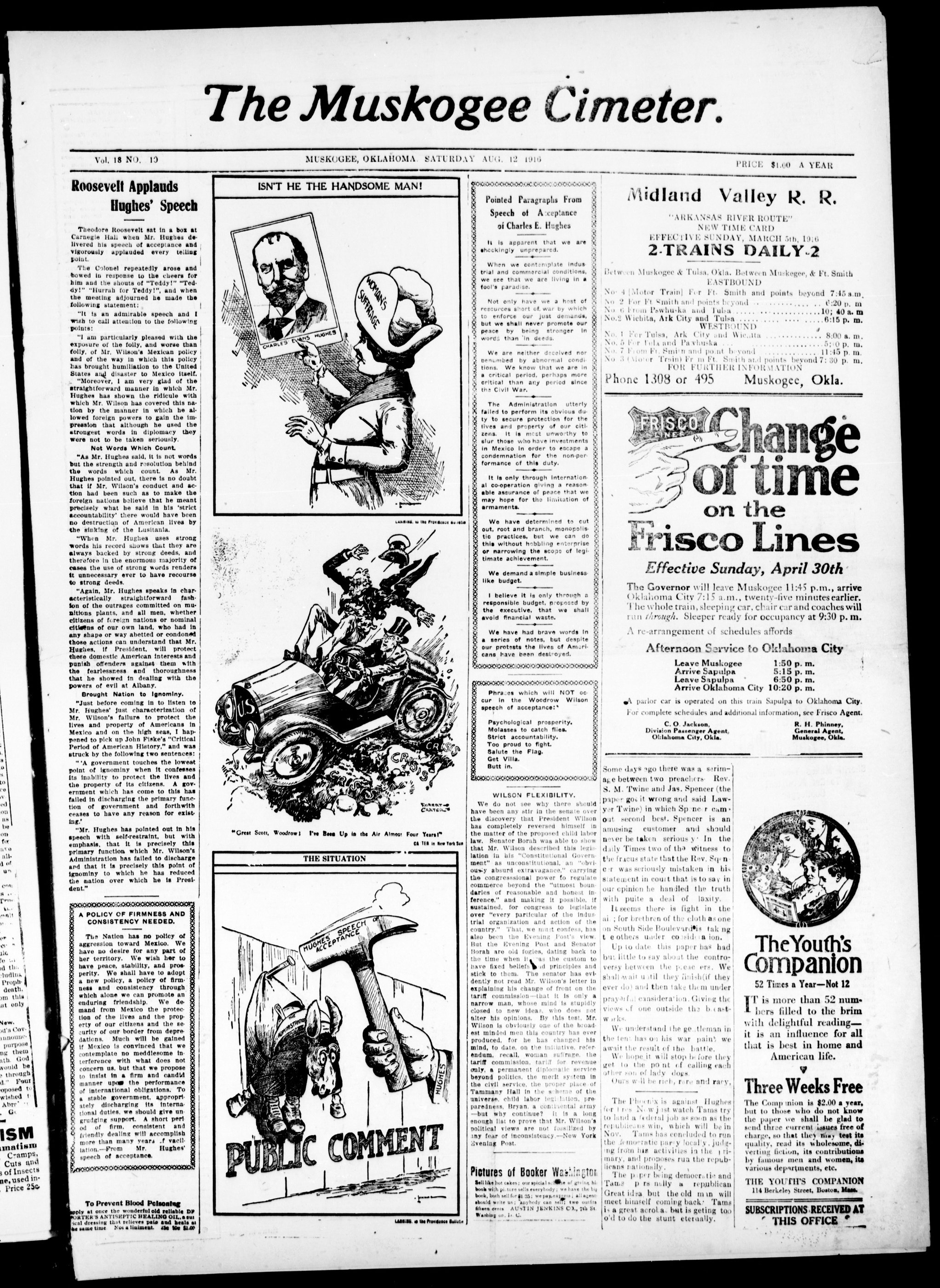
Roosevelt Applauds Hughes' Speech
Theodore Roosevelt sat in a box at Carnegie Hall when Mr. Hughes delivered his speech of acceptance and vigorously applauded every telling point.
The Colonel repeatedly arose and bowed in response to the cheers for him and the shouts of "Teddy!" "Teddy!" "Hurrah for Teddy!", and when the meeting adjourned he made the following statement:
"It is an admirable speech and I wish to call attention to the following points:
"I am particularly pleased with the exposure of the folly, and worse than folly, of Mr. Wilson's Mexican policy and of the way in which this policy has brought humiliation to the United States and disaster to Mexico itself.
"Moreover, I am very glad of the straightforward manner in which Mr. Hughes has shown the ridicule with which Mr. Wilson has covered this nation by the manner in which he allowed foreign powers to gain the impression that although he used the strongest words in diplomacy they were not to be taken seriously."
Not Words Which Count.
"As Mr. Hughes said, it is not words but the strength and resolution behind the words which count. As Mr. Hughes pointed out, there is no doubt that if Mr. Wilson's conduct and action had been such as to make the foreign nations believe that he meant precisely what he said in his 'strict accountability' there would have been no destruction of American lives by the sinking of the Lusitania.
"When Mr. Hughes uses strong words his record shows that they are always backed by strong deeds, and therefore in the enormous majority of cases the use of strong words renders it unnecessary ever to have recourse to strong deeds.
"Again, Mr. Hughes speaks in characteristically straightforward fashion of the outrages committed on munitions plants, and all men, whether citizens of foreign nations or nominal citizens of our own land, who had in any shape or way abetted or condoned those actions can understand that Mr. Hughes, if President, will protect these domestic American interests and punish offenders against them with the fearlessness and thoroughness that he showed in dealing with the powers of evil at Albany.
Brought Nation to Ignominy.
"Just before coming in to listen to Mr. Hughes' just characterization of Mr. Wilson's failure to protect the lives and property of Americans in Mexico and on the high seas, I happened to pick up John Fiske's "Critical Period of American History," and was struck by the following two sentences:
"A government touches the lowest point of ignominy when it confesses its inability to protect the lives and the property of its citizens. A government which has come to this has failed in discharging the primary function of government and forthwith ceases to have any reason for existing."
"Mr. Hughes has pointed out in his speech with self-restraint, but with emphasis, that it is precisely this primary function which Mr. Wilson's Administration has failed to discharge and that it is precisely this point of ignominy to which he has reduced the nation over which he is President."
A POLICY OF FIRMNESS AND CONSISTENCY NEEDED.
The Nation has no policy of aggression toward Mexico. We have no desire for any part of her territory. We wish her to have peace, stability, and prosperity. We shall have to adopt a new policy, a policy of firmness and consistency through which alone we can promote an enduring friendship. We demand from Mexico the protection of the lives and the property of our citizens and the security of our border from depredations. Much will be gained if Mexico is convinced that we contemplate no meddlesome interference with what does not concern us, but that we propose to insist in a firm and candid manner upon the performance of international obligations. To a stable government, appropriately discharging its international duties, we should give ungrudging support. A short period of firm, consistent and friendly dealing will accomplish more than many years of vacitation.—From Mr. Hughes' speech of acceptance.
To Prevent Blood Poisoning
apply at once the wonderful old reliable DP
PORTER'S ANTISPIC HEALING OIL, aisL
for the same time. Not ailment. 450 $11.00
The Muskogee Cimeter.
MUSKOGEE, OKLAHOMA. SATURDAY AUG. 12 1916
ISN'T HE THE HANDSOME MAN!
ISN'T HE THE HANDSOME MAN!
WOMAN'S
SUFFRAGE
CHARLES EVANS HUGHES
CRIS
CRIS
ROBERT
CARTER
"Great Scott, Woodrow I I've Been Up in the Air Almost Four Years!" CA TER in New York Sur
THE SITUATION
MUGHES SPEECH OF ACCEPTANCE
THE ADMINISTRATOR
MUGHES
PUBLIC COMMENT
I.
LAWRIAL, IN THE PROVIDENCE BURST
Pointed Paragraphs From Speech of Acceptance of Charles E. Hughes
It is apparent that we are shockingly unprepared.
When we contemplate industrial and commercial conditions, we see that we are living in a fool's paradise.
Not only have we a host of resources short of, war by which to enforce our just demands, but we shall never promote our peace by being stronger in words than 'in deeds.
We are neither deceived nor numbed by abnormal conditions. We know that we are in a critical period, perhaps more critical than any period since the Civil War.
The Administration utterly failed to perform its obvious duty to secure protection for the lives and property of our citizens. It is most unworthy to slur those who have investments in Mexico in order to escape a condemnation for the non-performance of this duty.
It is only through international co-operation giving a reasonable assurance of peace that we may hope for the limitation of armaments.
We have determined to cut out, root and branch, monopolistic practices, but we can do this without hobbling enterprise or narrowing the scope of legitimate achievement.
We demand a simple business-like budget.
I believe it is only through a responsible budget, proposed by the executive, that we shall avoid financial waste.
We have had brave words in a series of notes, but despite our protests the lives of Americans have been destroyed.
Phrases which will NOT occur in the Woodrow Wilson speech of acceptance:*
Psychological prosperity.
Molasses to catch flies.
Strict accountability.
Too proud to fight.
Salute the Flag.
Get Villa.
Butt in.
WILSON FLEXIBILITY.
We do not see why there should have been any stir in the senate over the discovery that President Wilson has completely reversed himself in the matter of the proposed child labor law. Senator Borah was able to show that Mr. Wilson described this legislation in his "Constitutional Government" as unconstitutional, an "obviously absurd extravagance," carrying the congressional power to regulate commerce beyond the "utmost boundaries of reasonable and honest interference," and making it possible, if sustained, for congress to legislate over "every particular of the industrial organization and action of the country." That, we must confess, has also been the Evening Post's view. But the Evening Post and Senator Borah are old fogies, dating back to the time when it was the custom to have fixed beliefs and principles and stick to them. The senator has evidently not read Mr. Wilson's letter in explaining his change of front on the tariff commission—that it is only a narrow man, whose mind is stupidly closed to new ideas, who does not alter his opinions. By this test, Mr. Wilson is obviously one of the broadest minded men this country has ever produced, for he has changed his mind, to date, on the initiative, referendum, recall, woman suffrage, the tariff commission, tariff for revenue only, a permanent diplomatic service beyond politics, the merit system in the civil service, the proper place of Tammany Hall in the scheme of the universe, child labor legislation, preparedness, Bryan, a continental army—but why continue? It is a long enough list to prove that Mr. Wilson's political views are not fossilized by any fear of inconsistency.—New York Evening Post.
Pictures of Booker Washington
FIGURES OF BOOKER WASHINGTON
Sell like hot cakes; our special service of giving hi
book with picture sells everybody; we have the big
book, both sell for $15; we pay, express; all agent
should write us; anybody can sell, two outi
fifteen cents AUSTIN JENKINS CO., 7th St
Washing on, J. C.
PRICE $1.00 A YEAR
Midland Valley R.
"ARKANSAS RIVER ROUTE"
NEW TIME CARD
EFFECTIVE SUNDAY, MARCH 5th, 1914
2-TRAINS DAILY-2
Between Muskogee & Tulsa, Okla. Between Muskegee, &
EASTBOUND
No. 4 [Motor Train] For Ft. Smith and points beyond
No. 2 For Ft. Smith and points beyond
No. 6 From Pswhuska and Tulsa
No.2 Wichita, Ark City and Tulsa
WESTBOUND
No. 1 For Tulsa, Ark City and Wichita
No.5 For Tula and Pswhuska
No.7 From Ft. Smith and point beyond
No.3 (Motor Train) Fr m Ft. Smith and points beyond
FOR FURTHER INFORMATION
Phone 1308 or 495 Muskogee,
FRISCO LINES
Change of time on the Frisco Line
Effective Sunday, April 3
The Governor will leave Muskogee 11:45 p.m.
Oklahoma City 7:15 a.m., twenty-five minutes
The whole train, sleeping car, chair car and c
run through. Sleeper ready for occupancy at
alley R. R.
RIVER ROUTE"
TIME CARD
DAY, MARCH 5th, 19:6
DAILY-2
Between Muskegee, & Ft. Smith
BOUND
Smith and points beyond 7:45 a.m.
beyond 6:20 p. m.
beyond 10; 40 a. m.
beyond 6:15 p. m.
BOUND
Wicita 8:00 a. m.
Wicita 5:00 p. m.
beyond 11:45 p. m.
Smith and points beyond 7:30 p. m.
INFORMATION
Muskogee, Okla.
Change
of time
in the
No Lines
Sunday, April 30th
Muskogee 11:45 p.m., arrive
twenty-five minutes earlier.
car, chair car and coaches will
only for occupancy at 9:30 p. m.
Midland Valley R. R.
"ARKANSAS RIVER ROUTE"
NEW TIME CARD
EFFECTIVE SUNDAY, MARCH 5th, 19:6
2-TRAINS DAILY-2
Between Muskogee & Tulsa, Okla. Between Muskegee, & Ft. Smith
EASTBOUND
No. 4 [Motor Train] For Ft. Smith and points beyond 7:45 a.m.
No. 2 For Ft. Smith and points beyond 6:20 p. m.
No. 6 From Pswhu-ka and Tulsa 10; 40 a. m.
No.2 Wichita, Ark City and Tulsa 6:15 p. m.
WESTBOUND
No. 1 For Tulsa, Ark City and Wichita 8:00 a. m.
No. 5 For Tulsa and Pawhuska 5:00 p. m.
No. 7 From Ft. Smith and point beyond 11:45 p. m.
No. 3 (Motor Train) Fr m Ft. Smith and points beyond 7:30 p. m.
FOR FURTHER INFORMATION
Phone 1308 or 495 Muskogee, Okla.
FRISCO LINES Change of time on the Frisco Lines
The Governor will leave Muskogee 11:45 p.m., arrive Oklahoma City 7:15 a.m., twenty-five minutes earlier. The whole train, sleeping car, chair car and coaches will run through. Sleeper ready for occupancy at 9:30 p.m.
A re-arrangement of schedules affords
Leave Muskogee 1:50 p. m.
Arrive Sapulpa 5:15 p. m.
Leave Sapulpa 6:50 p. m.
Arrive Oklahoma City 10:20 p. m.
A parlor car is operated on this train Sapulpa to Oklahoma City.
For complete schedules and additional information, see Frisco Agent.
The Youth's Companion
52 Times a Year—Not 12
IT is more than 52 numbers filled to the brim with delightful reading it is an influence for all that is best in home and American life.
Three Weeks Free
The Phoenix is against Hughes for his New just watch Tams try to land a federal job as soon as the republicans win, which will be in Nov. Tams has concluded to run the democratic party locally, judging from his activities in the primary, and proposes run the republicans nationally.
The paper being democratic and Tams personally a republican Great idea but the old man will meet himself coming back: Tams is a great acrobat, but is getting too old to do the stunt eternally.
The Companion is $2.00 a year, but to those who do not know the paper we shall be glad to send three current issues free of charge, so that they may test its quality, read its wholesome, diverting fiction, its contributions by famous men and women, its various departments, etc.
THE YOUTH'S COMPANION
114 Berkeley Street, Boston, Mass.
SUBSCRIPTIONS RECEIVED AT THIS OFFICE
---
C. O. Jackson,
Division Passenger Agent,
Oklahoma City, Okla.
Some days ago there was a seriage between two preachers Rev. S. M. Twine and Jas. Spencer (the paper goes it wrong and said Lawyer Twine) in which Spencer cam out second best. Spencer is an amusing customer and should never be taken seriously. In the daily Times two of the witness to the fracus state that the Rev. Spencer was seriously mistaken in his statement in court that is to say in our opinion he handled the truth with puite a deal of laxity. It seems there is fight in the air; for brethren of the cloth as one on South Side Boulevard is taking the others under consideration. Up to date this paper has had but little to say about the controversy between the preacers. We shall wait until they finish(if they ever do) and then take them under prayerful consideration. Giving the views of one outside the beastworks.
We understand the gentleman in the tent has on his war paint we await the result of the battle.
We hope it will stop before they get to the point of calling each other son of lady dogs.
Ours will be rich, rare and racy.
The Phoenix is against Hughes for tres. New just watch Tams try to land a federal job as soon as the republicans win, which will be in Nov. Tams has concluded to run the democratic party locally, judging from his activities in the primary, and proposes run the republicans nationally.
The paper being democratic and Tams prs nally a republican Great idea, but the old man will meet himself coming back: Tams is a great acrola, but is getting too old to do the stunt eternally.
R. H. Phinney, General Agent, Maukogee, Okla.
The Cimeteer is the only Republican paper in the City of Muskogee. The daily Phoenix is sometimes Republican and sometimes independent but at the present time it claims to be independent, such a changing is not worth three whoops in h — I to any political party and yet Bixby, its editor, got rich at the Republican pie counter. What base ingratitude.
SEGREGATION IN TEXAS CITIES ILLEGAL
The fight on laws which discriminate against the colored people continues in various sections of the country. The latter part of March the Texas state supreme court in the case of Frank A. Spence versus W. H. Fenchler, on appeal from El Paso county, held that the cities of Texas have no authority to establish districts
IMPROVED PASSENGER SERVICE ON M. O. & G.
Effective Sunday, May 21st, the M. O. & G. Ry, established sleeping service between Joplin, Miami, Wagoner, Muskogee, Henryetta and Oklahoma City, on trains 3 and 4. Train No. 3 leaves Joplin at 4:15 P. M., Muskogee at 9:30 P. M., arriving at Oklahoma City at 6:55 A. M., the entire train running through to Oklahoma City, via Dustin and the Ft. S. & W. R. R.
Northbound train leaves Oklahoma City at 11:00 P. M., reaching Muskogee at 7:30 A. M., and Joplin at 1:00 P. M. Parlor cars have been placed in service between Muskogee and Oklahoma City on trains 5 and 8, leaving Muskogee at 9:30 A. M., arriving at Oklahoma City at 5:35 P. M. and leaving Oklahoma City at 9:30 A. M., arriving at Muskogee at 4:50 P. M. Lancheon is served enroute, and the convenient daylight service gives passengers a view of the bustling Henryetta-Dewar-Kusa smelting district—the plants being in full view from the car window.
Handsome brick depots have not been completed and occupied by M. O. & G. Ry, at Dewar and K. Rock ballast is being installed as possible, and the road-bed is being put in good condition.
The Lane Undertaking Company at 321 North Second Street are asking the public for patronage in need of anything in their line. Mr. Delancy, son of P. M. Delaancy, Grand Master of the U. B. F. is a part of the Company. This company is entitled to the patronage of our people. Go and see them. They are worthy of your trade.
A suit was brought in the District Court at Oklahoma City to test the validity of the Registration law passed by our last legislature for the purpose of disfranchising the Negro as we see it.
The suit seems to us like bringing suit against the devil and trying the case in hell.
DRY DISTRICT
TWICE RAIDED
Sheriff Makes Two Journeys To Get Persistent Bootlegger
The Bingham Canyon (Utah) Press-Bulletin, in a recent issue reported raids of officials upon bootleggers operating in "dry" territory. The results of these raids showed the persistence with which these outlaws work and the magnitude of their operations.
The Press Bulletin said:
Under the direction of the county sheriff the upper end of Carr Fork known as the Highland Bay district, was raided last week and large quantities of booze taken.
This week Deputy Sheriff Joe Raigh, made another raid and gathered another lot of liquor that was held in place where no license could be granted for its sale.
The officers state that there will be no lot up on vigilance until all the blind pigs and bootleggers are driven out of the district. The claim is further made that the greater portion of all the trouble which comes from the district comes directly or indirectly from the places where the illicit sale of liquor is made.
In addition to these arrests that have been made the officers have taken into custody. Joe Wells and Mike Padgen on charges of delivering booze in dry territory.
It is claimed that Wells had a car load of the contraband stuff in his possession and that a great portion of it was recovered duping the raid last week, but that he had succeeded in getting a portion of it into wet territory where it was safe from seizure.
Mike Padgen had just made the delivery of the last of three wagon loads of wet goods in dry territory when he was arrested Wednesday and caught with the goods on him.
RUB-MY-TISM
Will cure your Rheumatism
Neuralgia, Herdaches, Cramps,
Colic, Sprains, Bruises, Cuts and
Burns, Old Sores, Stings of Insects
Etc. Antiseptic Anodyne, used in
internally and externally. Price 250
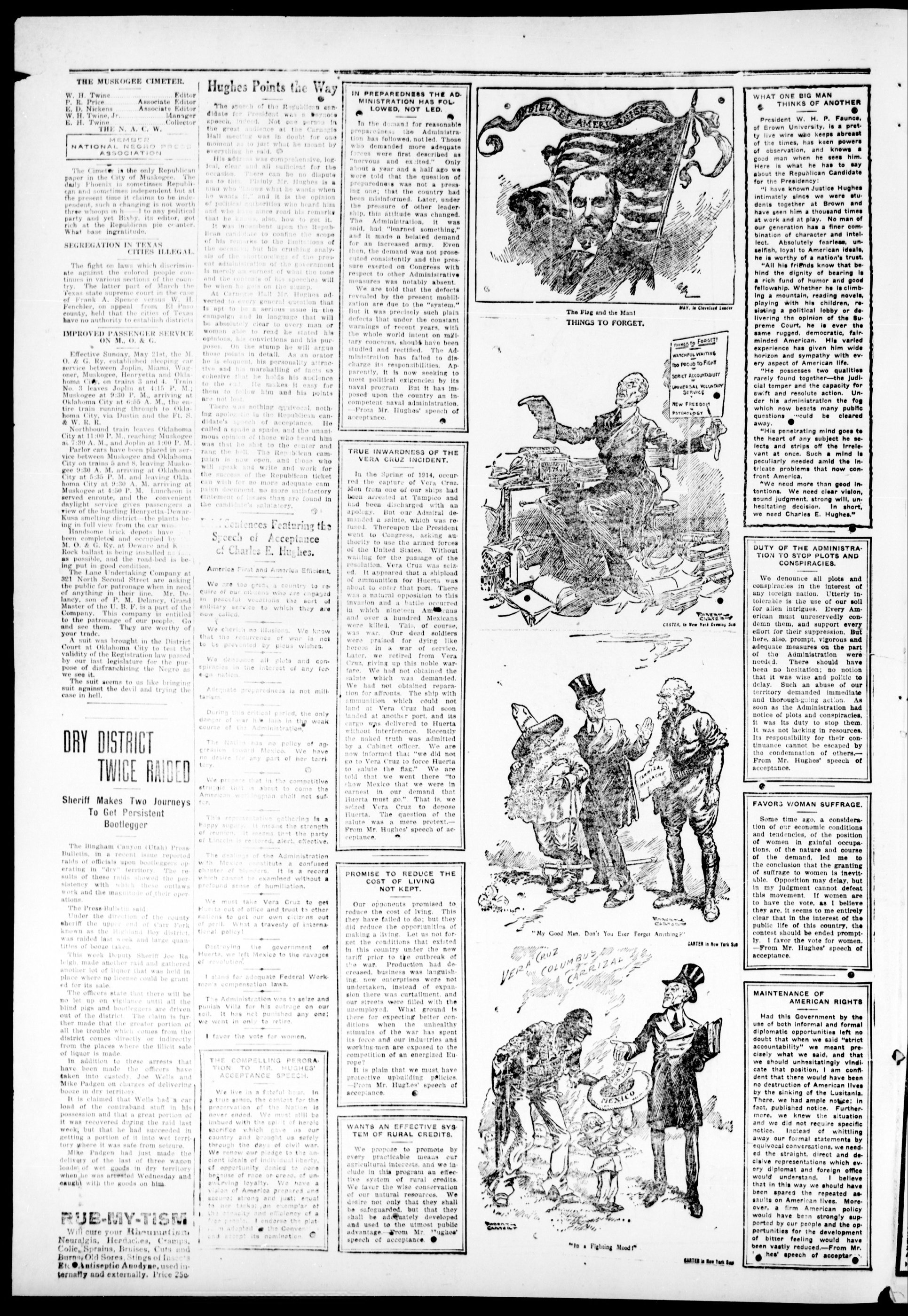
Hughes Points the Way
The speech of the Republican candidate for President was a keynote speech, indeed. Not one person in the great audience at the Carnegie Hall meeting was in doubt for one moment as to just what he meant by everything he said. $\textcircled{1}$
His address was comprehensive, logical, clear and all sufficient for the occasion. There can be no dispute as to this. Pleinly Mr. Hughes is a man who "knows what he wants when he wants it," and it is the opinion of political authorities who heard him and who have since read his remarks that he knows also, how to get it.
It was incumbent upon the Republican candidate to confine the scope of his remarks to the limitations of the occasion, but his crushing analysis of the shortcomings of the present administration of the government is an earnest of what the tone and the contents of his speeches will be when he goes on the scum.
At Carnegie Hall Mr. Hoghes advertised to every general question that is apt to be a serious issue in the campaign and in language that will be absolutely clear to every man or woman able to read he stated his opinions, his convictions and his purposes. On the stump he will argue those points in detail. As an orator he is eloquent, his personality attractive and his marshalling of facts so cohesive that he holds his audience to the end. He makes it easy for them to follow him and his points are not lost.
There was nothing appurvocal, nothing apologetic in the Republican candidate's speech of acceptance. He called a spade a spade and the unanimous opinion of those who heard him was that he shot to the center and rang the bell. The Republican campaign is now open, and those who will speak and write and work for the success of the Republican ticket can wish for no more adequate campaign document no more satisfactory statement of issues than are found in the candidate's salutary.
1 Sentences Featuring the Speech of Acceptance of Charles E. Hughes.
1 Sentences Featuring the Speech of Acceptance of Charles E. Hughes.
America First and America Efficient,
We are too great a country to require of our citizens who are engaged in peaceful vexations the sort of military service to which they are now called.
We cherish no illusions. We know that the recurrence of war is not to be prevented by pleas wishes.
We denounce all plots and conspiracies in the interest of any foreign nation.
Adequate preparedness is not militarism.
During this critical period, the only danger of war hain in the weak course of the Administration.
The Nation has no policy of aggression toward Mexico. We have no desire for any part of her territory.
We prepare that in the competitive struggle that is about to come the American workingman shall not suffer.
This representative gettling is a happy augury. It means the strength of reunion. It means that the party of Lincoln is restored, alert, effective.
The dealings of the Administration with Mexico constitute a confused chanter of blunders. It is a record which cannot be examined without a profound sense of humiliation.
We must take Vera Cruz to get Huerta out of office and trust to other nations to get our own citizens out of pril. What a travesty of international policy!
Destroying the government of Huerta, we left Mexico to the ravages of revolution!
I stand for adequate Federal Workmen's compensation laws.
The Administration was to seize and punish Villa for his outrage on our soil. It has not punished any one; we went in only to retire.
I favor the vote for women.
THE COMPELLING PERORA TION TO MR. HUGHES' ACCEPTANCE SPEECH.
We live in a fateful hour. In a true sense, the context for the preservation of the Nation is never ended. We must still be limbed with the spirit of heroic sacrifice, which gave us our country and brought us安全 through the days of civil war. We renew our plaque to the ancient ideals of individual liberty, of opportunity denied to none because of race or creed, of unavowing loyalty. We have a vision of America prepared and secure; strong and just; equal to her task; an exemplar of the capacity and efficiency of a free people. I endorse the plat form adopted its nomination
IN PREPAREDNESS THE ADMINISTRATION HAS FOLLOWED, NOT LED.
In the demand for reasonable preparedness the Administration has followed, not led. Those who demanded more adequate forces were first described as "nervous and excited." Only about a year and a half ago we were told that the question of preparedness was not a pressing one; that the country had been misinformed. Later, under the pressure of other leadership, this attitude was changed. The Administration, it was said, had "learned something," and it made a belated demand for an increased army. Even then, the demand was not prosecuted consistently and the pressure exerted on Congress with respect to other Administrative measures was notably absent.
We are told that the defects revealed by the present mobilization are due to the "system." But it was precisely such plain defects that under the constant warnings of recent years, with the whole world intent on military concerns, should have been studied and rectified. The Administration has failed to discharge its responsibilities. Apparently, it is now seeking to meet political exigencies by its naval program. But it has imposed upon the country an incompetent naval administration. —From Mr. Hughes' speech of acceptance.
TRUE INWARDNESS OF THE VERA CRUZ INCIDENT.
In the Spring of 1914, occurred the capture of Vera Cruz. Men from one of our ships had been arrested at Tampaico and had been discharged with an apology. But our Admiral demanded a salute, which was refused. Thereupon the President went to Congress, asking authority to use the armed forces of the United States. Without waiting for the passage of the resolution, Vera Cruz was seized. It appeared that a shipboard of ammunition for Huerta was about to enter that port. There was a natural opposition to this invasion and a battle occurred in which nineteen Americans and over a hundred Mexicans were killed. This, of course, was war. Our deed soldiers were praised for dying like heroes in a war of service. Later, we retired from Vera Cruz, giving up this noble warfare. We had not obtained the salute which was demanded. We had not obtained reparation for affronts. The ship with ammunition which could not land at Vera Cruz had soon landed at another port, and its cargo was delivered to Huerta without interference. Recently the naked truth was admitted by a Cabinet officer. We are now informed that "we did not go to Vera Cruz to force Huerta to salute the flag." We are told that we went there "to show Mexico that we were in earnest in our demand that Huerta must go." That is, we seized Vera Cruz to depose Huerta. The question of the salute was a mere protext.—From Mr. Hughes' speech of acceptance.
PROMISE TO REDUCE THE COST OF LIVING NOT KEPT.
Our opponents promised to reduce the cost of living. This they have failed to do; but they did reduce the opportunities of making a living. Let us not forget the conditions that existed in this country under the new tariff prior to the outbreak of the war. Production had decreased, business was languishing, new enterprises were not undertaken, instead of expansion there was curtailment, and our streets were filled with the unemployed. What ground is there for expecting better conditions when the unhealthy stimulus of the war has spent its force and our industries and working men are exposed to the competition of an energized Europe?
It is plain that we must have protective upbuilding policies. —From Mr. HugLee's speech of acceptance.
WANTS AN EFFECTIVE SYS
TEM OF RURAL CREDITS.
We propose to promote by every practicable means our agricultural interests, and we include in this program an effective system of rural credits. We favor the wise conservation of our natural resources. We desire not only that they shall be safeguarded, but that they shall be adequately developed and used to the utmost public advantage—From Mr. Hughes' speech of acceptance.
INFILLED AMERICAN CIVIL
The Flag and the Man!
THINGS TO FORGET.
MAY. In Cleveland Leader
THING
WATCH
TOO PRO
STRIC
UNIVE
NEW
POYCH
CARTER, N.
CAMPAZAL
MASSACRE
RODNEY
CARTER
THINGS TO FORGET!
WATCHFUL WAITING
TOO PROUD TO FIGHT
STRICT ACCOUNTABILITY
UNIVERSAL VOLUNTARY
SERVICE
NEW FREEDOM
PSYCHOLOGY
CARTER, In New York Evening Sun
TARWIZAL
MASSACRE
"My Good Man. Don't You Ever Forget Anything?"
CRUZ
COLUMBUS
CARRIZAL
VERA CRUZ
COLUMBUS
CARRIZAL
MEXICO
ROBERTO CASTILLO
THINKS OF ANOTHER
President W. H. P. Faunce, of Brown University, is a pretty live wire who keeps abreast of the times, has keen powers of observation, and knows a good man when he sees him. Here is what he has to say about the Republican Candidate for the Presidency:
"I have known Justice Hughes intimately since we were students together at Brown and have seen him a thousand times at work and at play. No man of our generation has a finer combination of character and intellect. Absolutely fearless, unselfish, loyal to American ideals, he is worthy of a nation's trust.
"All his friends know that behind the dignity of bearing is a rich fund of humor and good fellowship. Whether he is climbing a mountain, reading novels, playing with his children, resisting a political lobby or delivering the opinion of the Supreme Court, he is ever the same rugged, democratic, fair-minded American. His varied experience has given him wide horizon and sympathy with every aspect of American life.
"He possesses two qualities rarely found together—the judicial temper and the capacity for swift and resolute action. Under his administration the fog which now beats many public questions would be cleared away.
"His penetrating mind goes to the heart of any subject he selects and strips off the irrelevant at once. Such a mind is peculiarly needed amid the intricate problems that now confront America.
"We need more than good intentions. We need clear vision, sound judgment, strong will, unhesitating decision. In short, we need Charles E. Hughes."
DUTY OF THE ADMINISTRATION TO STOP PLOTS AND CONSPIRACIES.
We denounce all plots and conspiracies in the interest of any foreign nation. Utterly intolerable is the use of our soil for alien intrigues. Every American must unreservedly condemn them, and support every effort for their suppression. But here, also, prompt, vigorous and adequate measures on the part of the Administration were needed. There should have been no hesitation; no notion that it was wise and politic to delay. Such an abuse of our territory demanded immediate and thorough-going action. As soon as the Administration had notice of plots and conspiracies, it was its duty to stop them. It was not lacking in resources. Its responsibility for their continuance cannot be escaped by the condemnation of others.—From Mr. Hughes' speech of acceptance.
FAVORG WOMAN SUFFRAGE.
Some time ago, a consideration of our economic conditions and tendencies, of the position of women in gainful occupations, of the nature and course of the demand, led me to the conclusion that the granting of suffrage to women is inevitable. Opposition may delay, but in my judgment cannot defeat this movement. If women are to have the vote, as I believe they are, it seems to me entirely clear that in the interest of the public life of this country, the contest should be ended promptly. I favor the vote for women. —From Mr. Hughes' speech of acceptance.
MAINTENANCE OF
AMERICAN RIGHTS
Had this Government by the use of both informal and formal diplomatic opportunities left no doubt that when we said "strict accountability" we meant precisely what we said, and that we should unhesitatingly vindicate that position. I am confident that there would have been no destruction of American lives by the sinking of the Lusitania. There, we had ample notice; in fact, published notice. Furthermore, we knew the situation and we did not require specific notice. Instead of whittling away our formal statements by equivocal conversations, we needed the straight, direct and decisive representations which every diplomat and foreign office would understand. I believe that in this way we should have been spared the repeated assaults on American lives. Moreover, a firm American policy would have been strongly supported by our people and the opportunities for the development of bitter feeling would have been vastly reduced.—From Mr. hea' speech of accepta
INEBRIETY CONTINUES
PROHIBITION LAW FAILS TO LESSEN NUMBER OF ADDICTS MANY NEW CASES Iowa Hospital Physician Quoted as Saying "Dry" Legislation Has Not Succeeded In Curbing Ills Resulting From Excess, While Incipient Drunkards Increase
The Des Moines (Ia.) Capital recently printed the following item over the signature of Mildred Marquette, showing the failure of Prohibition laws to curb inebriety:
The state inebriate hospital at Knoxville presents the same scene with Iowa dry that it did a year ago or previously. The hospital is full of patients and the immigration there across the alcoholic sea continues without abatement.
Dr. Mackin, who has been at the inebriate hospital for a little over a year, talked about prohibition and its effect on Iowa inebriacy.
"The first few months after the new regime went into effect, I was very hopeful. The newspapers printed stories to the effect that the inebriate hospital would not be needed much longer, and I presume that in a way I was responsible for that impression.
"In January we only received eleven patients. In February we only had seventeen, and in March eighteen. I felt sure a change had come. But after that we jumped back to the old record, and it has stayed the same ever since."
"What is the average number of new patients per month?"
"Between thirty-two and thirty-five," Dr. Mackin replied.
New Cases increase.
"It is an unexpected fact that a far greater per cent of the new cases are first time cases than ever before. I don't know whether that is coincidence or not.
"Even though this is true, it still remains that we do not get nearly as many cases in their incipiency as I wish we would get. In fact, there seems to be an increasing tendency in many communities to let the young men off. It saves the administration money. They are getting so they send only the old inebriates whom there is no chance of curing. They want us to work on them, or their idea is to get the chronics out of their way.
"I wish they had more realization of what a valuable thing it would be to their communities to put the young drinkers through the treatment and discipline we give them. In the end it would save money and morals as well."
"DRY" (?) GEORGIA BARS
MATCHING FOR DRINKS
Finding her first prohibition law a failure, Georgia has enacted a second and more stringent statute. But even it does not prohibit, as the ensuing article from the Atlanta Georgian testifies:
"Matching" for drinks will be made a misdemeanor in Georgia, under a bill introduced in the House Wednesday by Representative Beck, of Murray, directed against all classes of petty gaming. This would apply to all classes of drinks, alcoholic, soft and ice tea.
Shooting "heads or tails," playing "crackaloo" or "matching" when drinks are not at stake would be put under the ban also. The measure was referred to a Judiciary Committee.
"America FIRST AND AMERICA EFFICIENT."
We come to state in a plain and direct manner our faith, our purpose and our pledge. This representative gathering is a happy augury. It means the strength of reunion. It means that the party of Lincoln is restored, alert, effective. It means the unity of a common perception of paramount national needs. It means that we are neither deceived nor benumbed by abnormal conditions. We know that we are in a critical period, perhaps more critical than any period since the Civil War. We need a dominant sense of national unity; the exercise of our best constructive powers; the vigor and resourcefulness of our unkened America. We desire that the Republican Party as a great liberty party shall be the agency of national achievement, the organ of the effective expression of dominant Americanism. What do I mean by that? I mean America conscious of power, awake to obligation, erect in self-respect, prepared for every emergency, devoted to the ideals of peace, instinct with the spirit of human brotherhood, safeguarding both individual opportunity and the public interest, maintaining a well-ordered constitutional system adapted to local self-government without the sacrifice of essential national authority, appreciating the necessity of stability, expert knowledge and thorough organization as the indispensable conditions of security and progress; a country loved by its citizens with a patriotic fervor permitting no division in their allegiance and no rivals in their affection—I mean America first and America efficient. It is in this spirit that I respond to your summons.—From Mr. Hughes' speech of acceptance.
ADEQUATE FEDERAL WORK-MEN'S COMPENSATION LAWS.
I stand for adequate Federal Workman's Compensation laws, dealing not only with the employees of Government, but with those employees who are engaged in interstate commerce, and are subject to the hazard of injury, so that those activities which are within the sphere of the constitutional authority of Congress may be dealt with under a suitable law.—From Mr. Hughes's speech of acceptance.
THE NATION IS SHOCKING
LY UNPREPARED.
It is apparent that we are shockingly unprepared. There is no room for controversy on this point since the object lesson on the Mexican border. All our available regular troops (less, I believe, than 40,000) are there or in Mexico, and as these have been deemed insufficient the entire National Guard has been ordered out; that is, we are summoning practically all our movable military forces in order to prevent bandit incursions. In view of the warnings of the past three years, it is inexcusable that we should find ourselves in this plight. For our faithful guardsmen, who with a fine patriotism responded to this call and are bearing this burden, I have nothing but praise. But I think it little short of absurd that we should be compelled to call men from their shops, their factories, their offices and their professions for such a purpose. This, however, is not all. The units of the National Guard were at peace strength, which was only about one half the required strength. It was necessary to bring in recruits, for the most part raw and untrained. Only a small percentage of the regiments recruited up to war strength will have had even a year's training in the National Guard, which at the maximum means one hundred hours of military drill, and, on the average, means much less. Men fresh from their peaceful employments and physically unprepared have been hurried to the border for actual service. They were without proper equipment; without necessary supplies; suitable conditions of transportation were not provided. Men with dependent families were sent; and conditions which should have been well known were discovered after the event. And yet the exigency, comparatively speaking, was not a very grave one. It involved nothing that could not readily have been seen during the past three years of disturbance, and required only a modest talent for organization. That this Administration while pursuing its course in Mexico should have permitted such conditions to exist is almost incredible.—From Mr. best speech of acceptance.
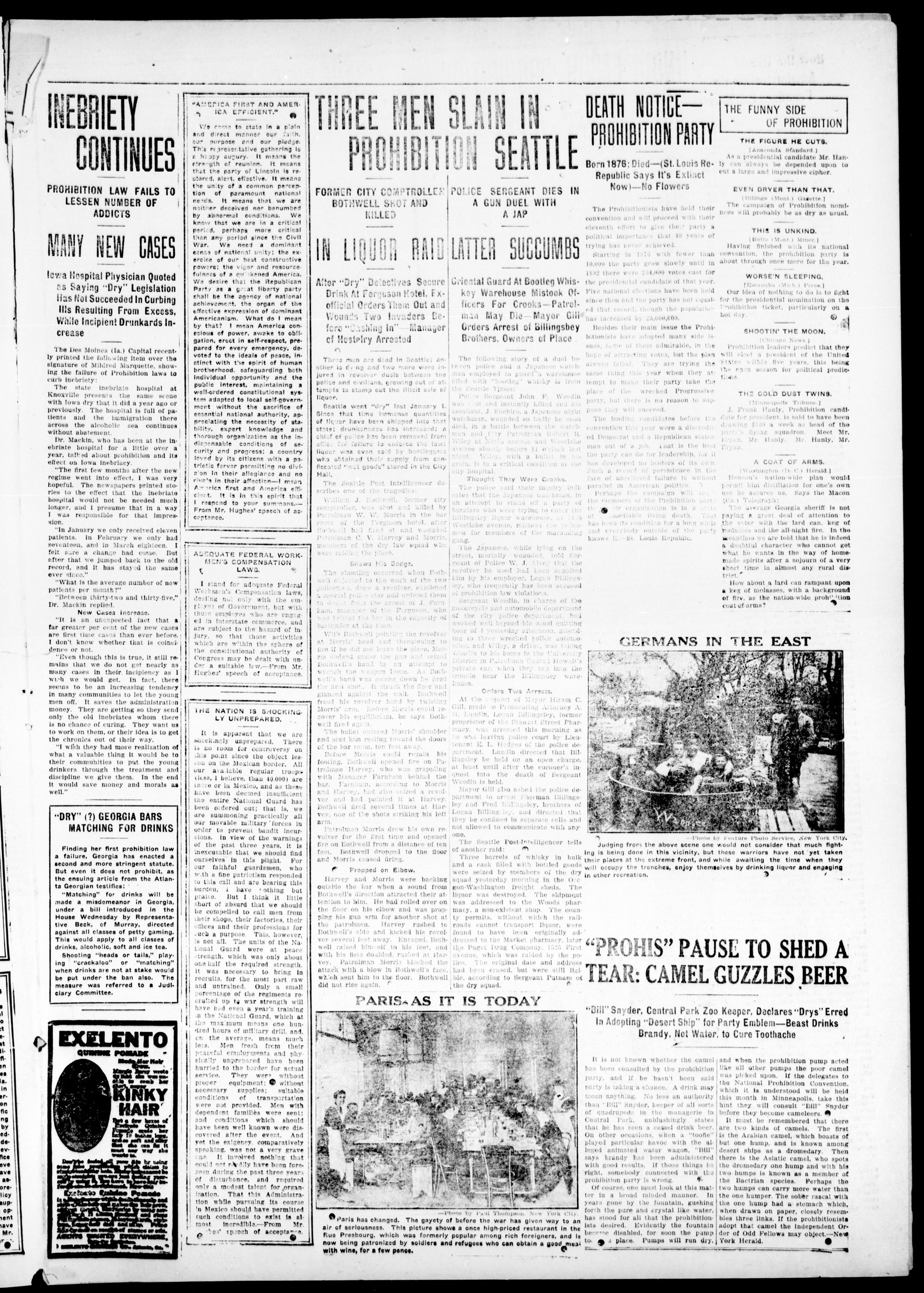
THREE MEN SLAIN IN PROHIBITION SEATTLE
THE CAFE
Paris has changed. The gayety of before the war has given way to an air of seriousness. This picture shows a once high-priced restaurant in the Rue Preebourg, which was formerly popular among rich foreigners, and is now being patronized by soldiers and refugees who can obtain a good meal with wine, for a few pence.
Paris has changed. The gayety of before the war has given way to an air of seriousness. This picture shows a once high-priced restaurant in the Rue Preebourg, which was formerly popular among rich foreigners, and is now being patronized by soldiers and refugees who can obtain a good meal with wine, for a few pence.
FORMER CITY COMPTROLLER
BOTHWELL SHOT AND
KILLED
After "Dry" Detectives Secure Drink At Ferguson Hotel, Ex-official Orders Them Out and Wounds Two Invaders Before "Cashing In"—Manager of Hostelry Arrested Three men are dead in Seattle; another is dying and two more were injured in revolver duels between the police and civilians, growing out of attempts to stamp out the Illinois sale of liquor.
Seattle went "dry" Inst January 1. Since that time immense quantities of liquor have been shipped into that state; drunkenness has increased; a chief of police has been removed from office for failure to enforce the law; liquor was even sold by bootleggers who obtained their supply from confiscated "wet goods" stored in the City Hall.
The Seattle Post Intelligencer describes one of the tragedies: William J. Bothwell, former city comprother, was shot and killed by Patrolman W. W. Morrils in the bar room of the Pergusson hotel, after Bothwell had fired at and wounded Patrolman C. V. Harvey and Morrils, members of the dry law squad who were raising the place.
Shows His Badge.
The shooting occurred when Bothwell objected to the work of the two policemen, drew a revolver, exhibited a special police star and endowed them to desist from the arrest of J. Farnham, manager of the Ferguson, who was behind the bar in the capacity of bartender at the time.
With Bothwell poaching the revolver at Morris' head and threatening to fire if he did not leave the place, Morris dagged under the gun and seized Bothwell's hand in an attempt to wrench the weapon loose. As Bothwell's hand was swung down he fired the first shot. It struck the floor and glanced against the wall. Bothwell freed his revolver hand by twisting Morris' arm. Before Morris could recover his equilibrium, he says Bothwell fired again.
The bullet entered Morris' shoulder and sent him reeling toward the doors of the bar room, ten feet away.
Before Morris could regain his footing, Bothwell opened fire on Patrohlman Harvey, who was grappling with Manager Farnham behind the bar. Farnham, according to Morris and Harvey, had also cooled a revolver and had pointed it at Harvey. Bothwell fired several times at Harvey, one of the shots striking his left arm.
Patrohlman Morris drew his own revolver for the first time and opened fire on Bothwell from a distance of ten feet. Bothwell dropped to the floor and Morris ceased firing.
Propped on Elbow.
Harvey and Morris were backing outside the bar when a sound from Bothwell's direction attracted their attention to him. He had rolled over on the floor on his elbow and was propping his gun arm for another shot at the patrolmen. Harvey rushed to Bothwell's side and kicked his revolver several feet away. Enraged, Bothwell raised him elf to his feet, and with his fists doubled, rushed at Harvey. Patrolman Morris blocked the attack with a blow in Bothwell's face which sent him to the floor. Bothwell did not rise again.
Oriental Guard At Bootleg Whiskey Warehouse Mistook Officers For Crooks—Patrolman May Die—Mayor Gill Orders Arrest of Billingsbey Brothers. Owners of Place
The following story of a duel between police and a Japanese watchman employed to guard a warehouse filled with "bootleg" whiskey is from the Seattle Times:
Police Sergent John F. Weedin was 'hot and instantly killed and his assailant, J. Suebiro, a Japanese night watchman, wounded so badly he soon died, in a battle between the watchman and City Patrolman Robert R. Wiley at Nielsen avenue and Westlake avenue shortly before 11 o'clock last night. Wiley, with a bullet in his groin, is in a critical condition as the city hospital.
Thought They Were Crooks.
The police said their inquiry indicates that the Japanese watchman, in an attempt to stand off a party of burglaries who were trying to enter the Billingaley Hour warehouse, in Nielsen avenue, mistook the police men for members of the marauding gang.
The Japanese, while lying on the street, mortally wounded, told Sergeant of Police W. J. Alvey that the revolver he used had been supplied him by his employer, Logan Billingsley, who frequently has been accused of prohibition law violations.
Sergeant Weedin, in charge of the motorcycle and automobile department of the city police department, bad worked well beyond his usual quieting hour of 4 yesterday afternoon, attending to three wrecked police automobiles, and Ville, a driver, was taking Weedin to his home in the University District in Palisadian Council Howell's private car, when they ran into the trouble near the Billingsley warehouse.
Orders Two Arrests.
At the request of Mayor Hiram C. Gill, made a Prosecuting Attorney A. H. Lundin, Logan Billingley, former proprietor of the Stewart Street Pharmacy, was arrested this morning as he was leaving police court by Lieutenant E. L. Hedges of the police department. Lundin directed that Billingley be held on an open charge, at least until after the coroner's inquest into the death of Sergent Weedian is held.
Mayor Gill also asked the police department to arrest Sherman Billingley and Fred Billingley, brothers of Logan Billingley, and directed that they be confined in separate cells and not allowed to communicate with anyone.
The Seattle Post-Intelligencer tells of another raid:
Three barrels of whisky in bulk and a cask filled with bottled goods were seized by members of the dry squad yesterday morning in the Oregon-Washington freight sheds. The liquor was destroyed. The shipment was addressed to the Woods pharmacy, a non-existent shop. The county permits, without which the railroads cannot transport Iqor, were found to have been originally addressed to the Market pharmacy, later the Puget Drug Company, 1525 First avenue, which was raided by the police. The original date and address had been erased, but were still high, according to Sergeant Putnam of the dry squad.
Hawaii
Judging from the above scene one would not consider that much fighting is being done in this vicinity, but these warriors have not yet taken their places at the extreme front, and while awaiting the time when they will occupy the trenches, enjoy themselves by drinking liquor and engaging in other recreation.
"PROHIS" PAUSE TO SHED A TEAR: CAMEL GUZZLES BEER
"Bill" Snyder, Central Park Zoo Keeper, Declares "Drys" Erred In Adopting "Desert Ship" for Party Emblem—Beast Drinks Brandy, Not Water, to Cure Toothache
DEATH NOTICE PROHIBITION PARTY
Born 1876; Died—(St. Louis Re-Republic Says It's Extinct Now)—No Flowers
The Prohibitionists have held their convention and will proceed with their eleventh effort to give their party a political importance that 40 years of trying has never achieved.
Starting in 1876 with fewer than 10,000 the party grew slowly until in 1892 there were 264,000 votes cast for the presidential candidate of that year. Five national elections have been held since then and the party has not equaled that record, though the population has increased by 25,000,000.
Besides their main issue the Prohibitionists have adopted many side issues, some of them admirable, in the hope of attracting votes, but the plan always failed. They are trying the same thing this year when they attempt to make their party take the place of the wrecked Progressive party, but there is no reason to suppose they will succeed.
The leading candidates before the convention this year were a discredited Democrat and a Republican statesman out of a job. That is the best the party can do for leadership, for it has developed no leaders of its own. Such a record of persistence in the face of unrelieved failure is without parallel in American politics. Perhaps the campaign will treat the members of the Prohibition party the our organization is in a state of immutable living death. That has been its condition for a long while and everybody outside of the party knows it. - St. Louis Republic.
GERMANS IN
Judging from the above scene one thing is being done in this vicinity, but their places at the extreme front, and will occupy the trenches, enjoy them in other recreation.
"PROHIS" PAUL TEAR: CAMEL
"Bill" Snyder, Central Park Zoo In Adopting "Desert Ship" for Brandy, Not Water
It is not known whether the camel has been consulted by the prohibition party, and if he hasn't been said party is taking a chance. A drink may mean anything. No less an authority than "Bill" Snyder, keeper of all sorts of quadrupeds in the managerie in Central Park, unblushingly states that he has seen a camel drink beer. On other occasions, when a "tooie" played particular havoc with the alleged animated water wagon, "Bill" says brandy has been administered with good results. If those things be right, somebody connected with the prohibition party is wrong.
Of course, one must look at this matter in a broad minded manner. In years gone by the fountain, gushing forth the pure and crystal like water, has stood for all that the prohibitionists desired. Evidently the fountain became disabled, for soon the pump to its place. Pumps will run dry.
THE FUNNY SIDE
OF PROHIBITION
As a presidential candidate Mr. Hanly can always be depended upon to cut a large and impressive cipher.
EVEN DRYER THAN THAT.
[Billings (Mont.) Gazette.]
The campaign of Prohibition nominees will probably be as dry as usual.
[Battle (Amb.) Miner]
Having finished with its national convention, the prohibition party is about through once more for the year.
WORSE'N SLEEPING.
[Ezamana (Mich.) Press]
Our idea of nothing to do is to fight
for the presidential nomination on the
Prohibition ticket, particularly on a
hot day.
SHOOTIN' THE MOON.
Prohibition leaders predict that they will elect a president of the United States within five years, this being the open season for political predictions.
THE GOLD DUST TWINS.
[Minneapolis Tribune]
J. Frank Hanly, Prohibition candidate for president, is said to have been drawing $5000 a week as head of the party's flying squadron. Meet Mr. Bryan, Mr. Hanly, Mr. Hanly, Mr. Bryan.
A COAT OF ARMS.
(Washington (O.C.) Herald)
Hobson's nation-wide plan would permit him distillation for one's own use he assures us. Says the Macon (G.) Telegraph:
The average Georgia sheriff is not paying a great deal of attention to the voter with the lard can, keg of molasses and the all-night fire. In the cantino we are told that he is indeed a doubtful character who cannot get what he wants in the way of homemade spirits after a sojourn of a very short time in almost any rural district.
How about a lard can rampant upon a keg of molasses, with a background of fire, as the nation-wide prohibition coat of arms?
IN THE EAST
By Feature Photo Service, New York City. would not consider that much fight—these warriors have not yet taken while awaiting the time when they lives by drinking liquor and engaging
SE TO SHED A GUZZLES BEER
Keeper, Declares "Drys" Erred
Party Emblem—Beast Drinks
to Cure Toothache
and when the prohibition pump acted like all other pumps the poor camel was picked upon. If the delegates to the National Prohibition Convention, which it is understood will be held this month in Minneapolis, take this hint they will consult "Bill" Snyder before they become cameleers.
It must be remembered that there are two kinds of camels. The first is the Arabian camel, which boasts of but one hump, and is known among desert ships as a dromedary. Then there is the Asiatic camel, who spots the dromedary one hump and with his two humps is known as a member of the Bactrian species. Perhaps the two humps can carry more water than the one humper. The sober rascal with the one hump had a stomach which, when drawn on paper, closely resembles three links. If the prohibitionists adopt that camel the Independent Order of Odd Fellows may object.—New York Herald.
How the Wilson Administration Has Penalized Patriotism
"Haring in view the possibility of further aggression upon the territory of the United States from Mexico and the necessity for the proper protection of that frontier." President Wilson, on June 18, called out the mobile arms of the National Guard for federal service.
He did not call them out at their existing peace strength, but at war strength, which is practically double. Lacking a system of reserves, the National Guard organizations immediately had to start a campaign of recruiting, to bring about the desired increase in their numbers.
Patriotic young citizens, under the urge of the cry, "Your country needs you," volunteered for service in gratifying numbers. According to Senator Chambleain, chairman of the Senate Committee on Military Affairs, the result is that about 135,000 citizen soldiers have been mustered into the federal service and are now on the Mexican border or in camp in their home states. There may be more, but the administration refuses to make known the exact figures.
The movement is costing the public treasury many millions of dollars; it is costing the individual citizen soldiers many millions more. They went to the front believing the cry, "Your country needs you." for war service. They sacrificed advancement in their civil occupations, severed home ties, suffered, in thousands of instances, great financial loss. The less patriotic, who did not believe the cry or believing, declined to make sacrifices, fatten at home on these losses.
The real purposes of the call are slowly developing. They are two in number:
First, a patrol of the border to do the work which President Wilson's friend, Carranza, finds it impossible to do. Because the recognized government in Mexico is too ineffective to keep its own citizens in check and prevent them murdering Americans on American soil, the American government undertakes the costly task of doing that work for them. The murder of American citizens on Mexican soil is another matter. Carranza may go as far as he likes in that direction. Second, a purpose of the mobilization on the border and in the camps is to train citizens to perform effective military service. The regular military establishment of the nation is manifestly too small for the actual military needs. To this extent the cry, "Your country needs you," was correct.
But these facts were not made clear when the call was issued. The idea was promulgated that men were needed for actual war service; not for military training. Deceit was practiced.
Opposing in the open legislation for universal military service, the administration by its acts has established what in essence is a system of compulsory military service. It is a system all the more vicious because it operates only against the patriotic, whereas a legalized universal training system equalizes the burden of military service among all men and all classes of men.
When, in 1914, Europe plunged into the greatest war of all history, and conditions in Mexico grew intolerable, intelligent men realized the fact that it was incumbent on this nation to build up its tiny regular army and put its other military resources in condition for use. National safety demanded this. And yet, in December of that year, four months after the European war began, President Wilson went before Congress and declared that all agitation for military preparedness was hysterical; that we were adequately prepared.
After a while the administration changed its mind and professed to believe in the necessity for preparedness. First came an enactment to increase the regular army by 20,000. But the body of the country, and even all parts of the Democratic administration, could not change front so quickly as the head. Recruiting for the regular army lagged. Not yet have the 20,000 been secured.
The need pressed. A new national defense act, providing for still more men in the regular army, was enacted. But still the men were not forthcoming.
Suddenly and without warning the administration issued its call for mobilization of the citizen soldier. It seemed still obsessed with the Bryan motion that an army could be created by presidential ukase.
When the call went out the government did not own enough uniforms, shoes, socks, blankets, hats, wagons, trucks, horses, mules and other things essential to equip the men called; it had made no provision for transporting the troops called to the points where they were required.
Who suffered most by this amazing lack of foresight, this leaping before looking?
Only the 135,000 patriots who believed that their country needed them for national defense; only the men who are making the great sacrifices.
The whole disgraceful story may be summed up in the phrase, the administration has penalized patriotism.
True. It is accumulating. by subterfuge, a reserve of trained soldiers, but events have demonstrated that it cried "wolf" when there was no wolf. Should it be forced to cry "wolf" again, when the wolf is at the door, what will be the result?
"CLARION" REPLIES MENAGES WORKERS
A
Actual fighting consumes a comparatively small part of a soldier's time in the European war. Some of the men with the armies never do any fighting, as in the case of the German tailors and shoemakers in this picture. Like the men at the extreme front, the workers are not denied liquor.
Actual fighting consumes a comparatively small part of a soldier's time in the European war. Some of the men with the armies never do any fighting, as in the case of the German tailors and shoemakers in this picture. Like the men at the extreme front, the workers are not denied liquor.
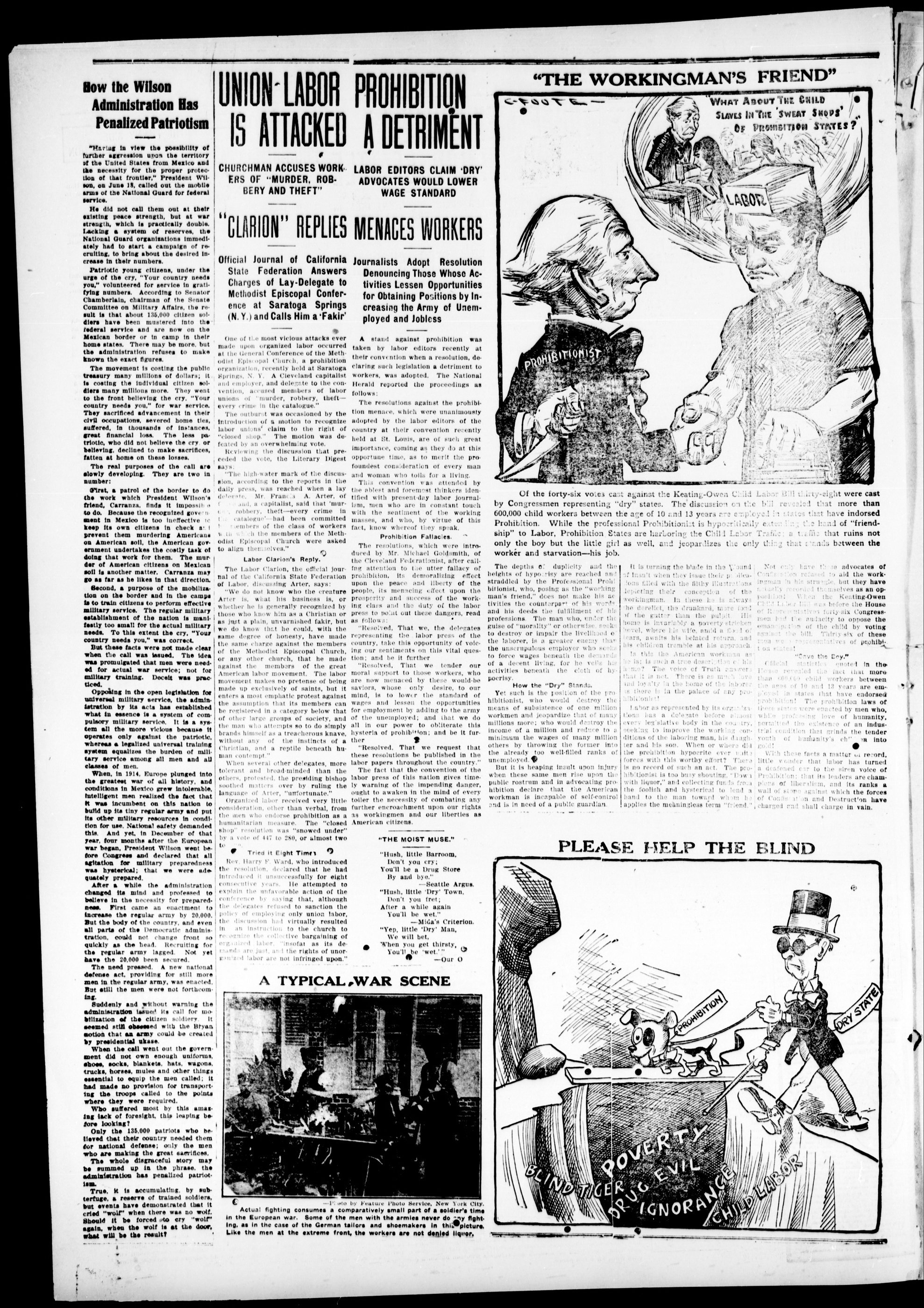
UNION- LABOR IS ATTACKED
CHURCHMAN ACCUSES WORKERS OF "MURDER, ROBBERY AND THEFT"
Official Journal of California State Federation Answers Charges of Lay-Delegate to Methodist Episcopal Conference at Saratoga Springs (N. Y.) and Calls Him a 'Fakir'
One of the most vicious attacks ever made upon organized labor occurred at the General Conference of the Methodist Episcopal Church, a prohibition organization, recently held at Saratoga Springs, N. Y. A Cleveland capitalist and employer, and delegate to the convention, accused members of labor unions of "murder, robbery, theft—every crime in the catalogue."
The outburst was occasioned by the introduction of a motion to recognize labor unions' claim to the right of "closed shop." The motion was defeated by an overwhelming vote. Reviewing the discussion that preceded the vote, the Literary Digest says:
"The high-water mark of the discussion, according to the reports in the daily press, was reached when a lay delegate, Mr. Francis A. Arter, of Cincinnati, a capitalist, said that 'murder, robbery, theft—every crime in the catalogue'—had been committed by members of the class of workers with which the members of the Methodist Episcopal Church were asked to align themselves."
Labor Clarion's Reply.
The Labor Clarion, the official journal of the California State Federation of Labor, discussing Arter, says:
"We do not know who the creature Arter is, what his business is, or whether he is generally recognized by those who know him as a Christian or as just a plain, unvarnished fakir, but we do know that he could, with the same degree of honesty, have made the same charge against the members of the Methodist Episcopal Church or any other church, that he made against the members of the great American labor movement. The labor movement makes no pretense of being made up exclusively of saints, but it enters a most emphatic protest against the assumption that its members can be registered in a category below that of other large groups of society, and the man who attempts so to do simply brands himself as a treacherous knave, without any of the instincts of a Christian, and a reptile beneath human contempt."
When several other delegates, more tolerant and broad-minded than the others, protested, the presiding bishop soothed matters over by ruling the language of Arter, "ufortunate."
Organized labor received very little consideration, other than verbal, from the men who endorse prohibition as a humanitarian measure. The "closed shop" resolution was "snowed under" by a vote of 447 to 280, or almost two to
Tried it Eight Time
Rev Harry F. Ward, who introduced the resolution, declared that he had introduced it unsuccessfully for eight consecutive years. He attempted to explain the unfavorable action of the conference by saying that, although the delegates refused to sanction the policy of employing only union labor, the discussion had virtually resulted in an instruction to the church to recognize the collective bargaining of organized labor, "insofar as its demands are just, and the rights of unorganized labor are not infringed upon."
LABOR EDITORS CLAIM 'DRY ADVOCATES WOULD LOWER WAGE STANDARD
Journalists Adopt Resolution Denouncing Those Whose Activities Lessen Opportunities for Obtaining Positions by Increasing the Army of Unemployed and Jobless
A stand against prohibition was taken by labor editors recently at their convention when a resolution, declaring such legislation a detriment to workers, was adopted. The National Herald reported the proceedings as follows:
The resolutions against the prohibition menace, which were unanimously adopted by the labor editors of the country at their convention recently held at St. Louis, are of such great importance, coming as they do at this opportune time, as to merit the profoundest consideration of every man and woman who toils for a living. This convention was attended by the ablest and foremost thinkers identified with present-day labor journalism, men who are in constant touch with the sentiment of the working masses, and who, by virtue of this fact, know whereof they speak.
Prohibition Fallacies.
The resolutions, which were introduced by Mr. Michael Goldsmith, of the Cleveland Federationist, after calling attention to the utter fallacy of prohibition, its demoralizing effect upon the peace and liberty of the people, its menacing effect upon the prosperity and success of the working class and the duty of the labor press to point out these dangers, read as follows:
"Resolved. That we, the delegates representing the labor press of the country, take this opportunity of voicing our sentiments on this vital question; and he it further
"Resolved, That we tender our moral support to those workers, who are now menaced by these would-be saviors, whose only desire, to our mind, is to lower the standard of wages and lessen the opportunities for employment by adding to the army of the unemployed; and that we do all in our power to obliterate this hysteria of prohibition; and be it further
"Resolved, That we request that these resolutions be published in the labor papers throughout the country."
The fact that the convention of the labor press of this nation gives timely warning of the impending danger, ought to awaken in the mind of every toller the necessity of combating any further encroachment upon our rights as workingmen and our liberties as American citizens.
C. FOOTE
"WHAT ABOUT THE CHILD
SLAVES IN THE 'SWEAT SHOPS'
OF PROHIBITION STATES?"
LABOR
PROHIBITIONIST
Of the forty-six votes cast against the Keating-Owen Child Labor Bill thirty-eight were cast by Congressmen representing "dry" states. The discussion on the bill revealed that more than 600,000 child workers between the age of 10 and 13 years are employed in states that have indorsed Prohibition. While the professional Prohibitionist is hypocritically extending the hand of "friendship" to Labor, Prohibition States are harboring the Child Labor Traffic; a traffic that ruins not only the boy but the little girl as well, and jeopardizes the only thing that stands between the worker and starvation—his job.
PLEASE HELP THE BLIND
PROHIBITION
DRY STATE
POVERTY
BLIND TIGER
DRUG EVIL
IGNORANCE
CHILD LABOR
The depths of duplicity and the heights of hypocrisy are reached and straddled by the Professional Prohibitionist, who, posing as the "working man's friend," does not make his activities the counterpart of his words and his deeds the fulfillment of his professions. The man who, under the guise of "morality" or otherwise seeks to destroy or impair the livelihood of the laborer, is a greater enemy than the unscrupulous employer who seeks to force wages beneath the demands of a decent living, for he veils his activities beneath the cloth of hypocrisy.
How the "Dry" Stands.
Yet such is the position of the prohibitionist, who would destroy the means of subsistence of one million workmen and jeopardize that of many millions more; who would destroy the income of a million and reduce to a minimum the wages of many million others by throwing the former into the already too well-filled ranks of unemployed. But it is heaping insult upon injury when these same men rise upon the public rostrum and in advocating prohibition declare that the American workman is incapable of self-control and is in need of a public guardian.
It is turning the blade in the Vault of Insult when they issue their proclamations filled with the fifty illustrations depicting their conception of the workingman. In these he is always the doerlet, the drunkard, more fond of the gutter than the pulpit. His home is invariably a poverty stricken bowl, where his wife, and a flood of tears, awaits his belated return, and his children tremble at his approach. Is this the American workman as he is; is such a true desert, than his home? The voice of Truth answers that it is not. There is as much love and loyalty in the home of the laborers as there is in the palace of any prohibitionist.
Labor as represented by its organizations has a delicate before almost every legislative body in the country, seeking to improve the working conditions of the laboring man, his daughter and his son. When or where did the prohibition hypocrite ever inflict forces with this worthy effort? There is no record of such an act. The prohibitionist is too busy shouting, "Down with liquor," and collecting funds from the foolish and hysterical to lend a hand to the man toward whom he applies the meaningless term "friend."
Not only have these advocates of Confession refused to aid the workingman in his struggle, but they have actually recorded themselves as an opposition. When the Kensing-Owen Child Labor Bill was before the House of Representatives forty-six Congressmen had the audacity to oppose the emancipation of the child by voting against the bill. Thirty-six of these men were representatives of prohibition states!
"Save the Boy."
Official statistics quoted in the House revealed the fact that more than 600,000 child workers between the ages of 10 and 13 years are employed in states that have endorsed prohibition. The prohibition laws of these states were enacted by men who, while professing love of humanity, permitted the existence of an industrial condition that grinds the tender youth of humanity's ch" into gold.
With these facts a matter of record, little wonder that labor has turned a deafened car to the siren voice of Prohibition; that its leaders are champions of liberalism, and its ranks a wall of stone against which the forces of Concession and Destruct'on have charged and shall charge in vain.