Muskogee Cimeter
Saturday, September 30, 1916
Muskogee, Oklahoma
Page text (machine-generated)
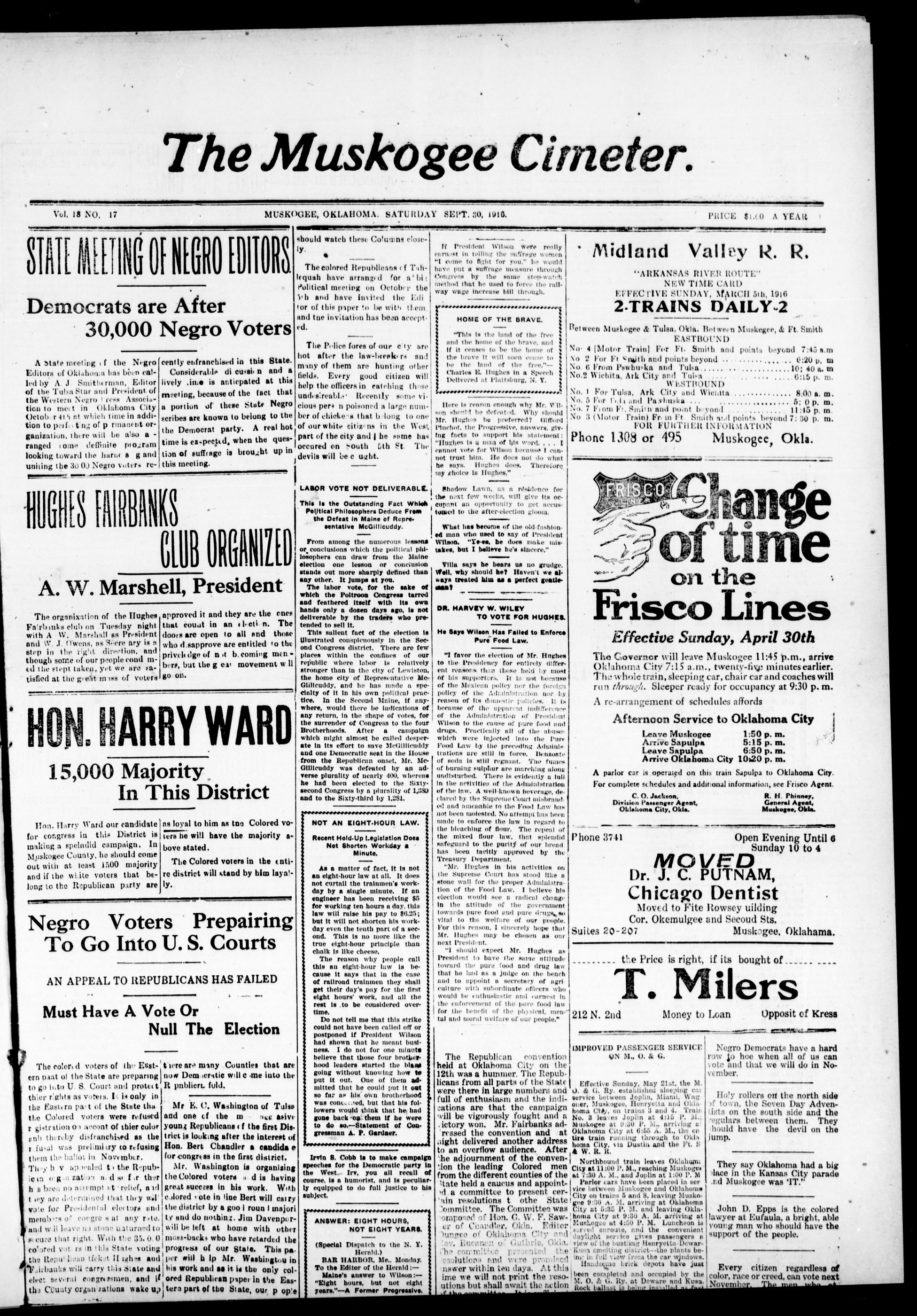
STATE MEETING OF NEGRO EDITORS
Negro Voters Prepairing To Go Into U.S. Courts
AN APPEAL TO REPUBLICANS HAS FAILED
Must Have A Vote Or Null The Election
STATE MEETING O
Democrats are
30,000
A State meeting of the Negro Editors of Oklahoma has been called by A J. Smitherman, Editor of the Tulsa Star and President of the Western Negro Press Association to meet in Oklahoma City October 4th at which time in addition to perfecting of permanent organization, there will be also arranged some definite program looking toward the harms and uniting the 30,000 Negro voters re-
HUGHES FAIRBANK
A. W. Marsh
The organixation of the Hughes Fairbanks club on Tuesday night with A. W. Marshall as President and W. J. Owens, as Secreary is a step in the right direction, and though some of our people cond mcd the stept taken, yet we are satisfied at the great mass of voters
HON. HAR
15,000 Majo
In T
Hon. Harry Ward our candidate for congress in this District is making a spelndid campaign. In Muskogee County, he should come out with at least 1500 majority and if the white voters that belong to the Republican party are
Negro Voter
To Go Into
AN APPEAL TO REPU
Must Have A Voe
The colored voters of the Eastern part of the State are preparing to go into U.S. Court and protect their rights as voters. It is only in the Eastern part of the State that the Colored voters were refused registration on account of their color and thereby disfranchised as the refusal was preliminary to refusing them the ballot in November.
They have appealed to the Republican organization and so far ther has been no attempt at relief, and they are determined that they will vote for Presidential electors and members of congress at any rate, and will leave no stone unturned to secure that right. With the 35.0.0 colored voters in this State voting the Republican ticket Hughes and Fairbanks will carry this State and elect several congressmen, and if the County organizations wake up
The Muskogee Cimeter.
MUSKOGEE, OKLAHOMA. SATURDAY SEPT. 30, 1916.
cently enfranchised in this State. Considerable di cussion and a lively time is anticipated at this meeting, because of the fact that a portion of these State Negro scribes are known to belong to the Democrat party. A real hot time is espected, when the question of suffrage is brought up in this meeting.
KS
CLUB ORGANIZED
well, President
approved it and they are the ones that count in an election. The doors are open to all and those who disapprove are entitled to the privilege of not becoming members, but the great movement will go on.
RY WARD
ority
This District
as loyal to him as the Colored voters he will have the majority above stated.
The Colored voters in the entire district will stand by him layally.
ars Prepairing
U. S. Courts
PUBLICANS HAS FAILED
ote Or
full The Election
there are many Counties that are now Democratic will come into the R publicierr. fold.
Mr E. C. Washington of Tulsa
and one of the m
active young Republicans of the first District is looking after the interest of Hon. Bert Chandler a candida e
for congress in the first district.
Mr. Washington is organizing the Colored voters and is having great success in his work. With colored vote in line Bert will carry the district by a good round majority and do nothing. Jim Davenpor will be left at home with other moss-backs who have retarded the progress of our State. This paper will help Mr. Washington in his work and as it is the only colored Republican paper in the Eastern part of the State, our people
should watch these Columns closely.
The colored Republicans of Tahlequah have arranged for a big Political meeting on October the 5th and have invited the Editor of this paper to be with them, and the invitation has been accepted.
The Police fores of our city are hot after the law-breakers and many of them are hunting other fields. Every good citizen will help the officers in catching those undesirable. Recently some vicious person poisoned a large number of chickens that belong to one of our white citizens in the West part of the city and the same has occured on South 5th St. The devils will be caught.
LABOR VOTE NOT DELIVERABLE
This Is the Outstanding Fact Which Political Philosophers Deduce From the Defeat in Maine of Representative McGillicuddy.
From among the numerous lessons or conclusions which the political philosophers can draw from the Maine election one lesson or conclusion stands out more sharply defined than any other. It jumps at you.
The labor vote, for the sake of which the Poltroon Congress tarred and feathered itself with its own hands only a dozen days ago, is not deliverable by the traders who pretended to sell it.
This salient fact of the election is illustrated conspicuously in the Second Congress district. There are few places within the confines of our republic where labor is relatively stronger than in the city of Lewiston, the home city of Representative McGillicuddy, and he has made a speciality of it in his own political practice. In the Second Maine, if anywhere, would there be indications of any return, in the shape of votes, for the surrender of Congress to the four Brotherhoods. After a campaign which might almost be called desperate in its effort to save McGillicuddy and one Democratic seat in the House from the Republican onset, Mr. McGillicuddy was defeated by an adverse plurality of nearly 400, whereas he had been elected to the Sixty-second Congress by a plurality of 1,330 and to the Sixty-third by 1,231.
Recent Hold-Up Legislation Does Not Shorten Workday a Minute.
As a matter of fact, it is not an eight-hour law at all. It does not curtail the trainmen's workday by a single minute. If an engineer has been receiving $5 for working ten hours a day, this law will raise his pay to $6.25; but it will not shorten his workday even the tenth part of a second. This is no more like the true eight-hour principle than chalk is like cheese.
The reason why people call this an eight-hour law is because it says that in the case of railroad trainmen they shall get their day's pay for the first eight hours' work, and all the rest is to be considered overtime.
Do not tell me that this strike could not have been called off or postponed if President Wilson had shown that he meant business. I do not for one minute believe that those four brotherhood leaders started the blaze going without knowing how to put it out. One of them admitted that he could put it out so far as his own brotherhood was concerned, but that his followers would think that he had gone back on them if he were to do so.—Statement of Congressman A. P. Gardner.
---
Irvin S. Cobb is to make campaign speeches for the Democratic party in the West. Irv, you all recall of course, is a humorist, and is peculiarly equipped to do full justice to his subject.
(Special Dispatch to the N. Y. Herald.)
BAR HARBOR, Me., Monday.
To the Editor of the Herald:—
Maine's answer to Wilson:—
"Eight hours, but not eight years."—A Former Progressive.
If President Wilson were really earnest in telling the suffrage women "I come to fight for you," he would have put a suffrage measure through Congress by the same stop-watch method that he used to force the railway wage increase bill through.
HOME OF THE BRAVE.
"This is the land of the free and the home of the brave, and if it censes to be the home of the brave it will soon cease to be the land of the free"—Charles E. Hughes in a Speech Delivered at Plattsburg, N. Y.
Here is reason enough why Mr. Wilson should be defeated. Why should Mr. Hughes be preferred? Gifford Pinchot, the Progressive, answers, giving facts to support his statement: "Hughes is a man of his word. . . I cannot vote for Wilson because I cannot trust him. He does not do what he says. Hughes does. Therefore my choice is Hughes."
Shadow Lawn, as a residence for the next few weeks, will give its occupant an opportunity to get accustomed to the after-election gloom.
What has become of the old-fashioned man who used to say of President Wilson. "Ye-es, he does make mistakes, but I believe he's sincere."
Villa says he bears us no grudge. Well, why should he? Haven't we always treated him as a perfect gentleman?
DR. MARVEY W. WILEY
TO VOTE FOR HUGHES
He Says Wilson Has Failed to Enforce Pure Food Law.
"I favor the election of Mr. Hughes to the Presidency for entirely different reasons than those held by most of his supporters. It is not because of the Mexican policy nor the foreign policy of the Administration nor by reason of its domestic policies. It is because of the apparent indifference of the Administration of President Wilson to the cause of pure food and drugs. Practically all of the abuses which were injected into the Pure Food Law by the preceding Administrations are still in force. Benzonite of soda is still regnant. The funes of burning sulphur are marching along undisturbed. There is evidently a bull in the activities of the Administration of the law. A well-known beverage, declared by the Supreme Court misbranded and amenable to the Food Law has not been molested. No attempt has been made to enforce the law in regard to the bleaching of flour. The repent of the mixed flour law, that splendid safeguard to the purity of our bread has been tacitly approved by the Treasury Department.
"Mr. Hughes in his activities on the Supreme Court has stood like a stone wall for the proper Administration of the Food Law. I believe his election would see a radical change in the attitude of the government towards pure food and pure drugs, so vital to the welfare of our people. For this reason, I sincerely hope that Mr. Hughes may be chosen as our next President.
"I should expect Mr. Hughes as President to have the same attitude toward the pure food and drug law that he had as a judge on the bench and to appoint a secretary of agriculture with subordinate officers who would be enthusiastic and earnest in the enforcement of the pure food law for the benefit of the physical, mental and moral welfare of our people."
The Republican convention held at Oklahoma City on the 12th was a hummer. The Republicans from all parts of the State were there in large numbers and full of enthusiasm and the indications are that the campaign will be vigorously fought and a victory won. Mr. Fairbanks addressed the convention and at night delivered another address to an overflow audience. After the adjournment of the convention the leading Colored men from the different counties of the state held a caucus and appointed a committee to present certain resolutions to the State Committee. The Committee was composed of Hon. G. W. F. Sawer of Chandler, Okla. Editor Dungee of Oklahoma City and Lav. Bucanan of Guthrie, Okla. The committee presented the resolutions and were promised answer within ten days. At this time we will not print the resolutions but shall await the action
Indland Valley R.
"ARKANSAS RIVER ROUTE"
NEW TIME CARD
EFFECTIVE SUNDAY, MARCH 5th, 1916
2-TRAINS DAILY-2
Wekogee & Tulsa, Okla. Between Muskegee, &
EASTBOUND
For Train] For Ft. Smith and points beyond
Ft. Smith and points beyond
Pswhuska and Tulsa
Ark City and Tulsa
WESTBOUND
Tulsa, Ark City and Wichita
Tulsa and Payhuska
Ft. Smith and point beyond
For Train) From Ft. Smith and points beyond
FOR FURTHER INFORMATION
Midland Valley R. R.
"ARKANSAS RIVER ROUTE"
NEW TIME CARD
EFFECTIVE SUNDAY, MARCH 5th, 1916
2-TRAINS DAILY-2
Between Muskogee & Tulsa, Okla. Between Muskegee, & Ft. Smith
EASTBOUND
No. 4 [Motor Train] For Ft. Smith and points beyond 7:45 a.m.
No. 2 For Ft. Smith and points beyond 6:20 p. m.
No. 6 From Pswhuska and Tulsa 10; 40 a. m.
No. 2 Wichita, Ark City and Tulsa 6:15 p. m.
WESTBOUND
No. 1 For Tulsa, Ark City and Wichita 8:00 a. m.
No. 5 For Tulsa and Pawhuska 5; 0 p. m.
No. 7 From Ft. Smith and point beyond 11:45 p. m.
No. 3 (Motor Train) From Ft. Smith and points beyond 7:30 p. m.
FOR FURTHER INFORMATION
RISCO LINE
Change of time on the Crisco Line
Effective Sunday, April 3
Governor will leave Muskogee 11:45 p.m.
Oklahoma City 7:15 a.m., twenty-five minute
whole train, sleeping car, chair car and c
through. Sleeper ready for occupancy at
arrangement of schedules affords
Afternoon Service to Oklahoma
FRISCO Change of time
Frisco Lines
The Governor will leave Muskogee 11:45 p.m., arrive Oklahoma City 7:15 a.m., twenty-five minutes earlier. The whole train, sleeping car, chair car and coaches will run through. Sleeper ready for occupancy at 9:30 p.m. A re-arrangement of schedules affords
Leave Muskogee 1:50 p. m.
Arrive Sapulpa 5:15 p. m.
Leave Sapulpa 6:50 p. m.
Arrive Oklahoma City 10:20 p. m.
A parlor car is operated on the For complete schedules and add C. O. Jackson, Division Passenger Agent, Oklahoma City, Okla.
or car is operated on this train Sapulpa to Okla-
complete schedules and additional information, see
C. O. Jackson,
Division Passenger Agent,
Oklahoma City, Okla.
R. H. Genera
Muskogee
A parlor car is operated on this train Sapulpa to Oklahoma City For complete schedules and additional information, see Frisco Agent.
MOVED
Dr. J. C. PUTNAM,
Chicago Dentist
Moved to Fite Rowsey uilding
Cor. Okemulgee and Secoud Sts.
Muskogee.
the Price is right, if its bought of T. Milers
T. Milers Money to Loan Oppos
(MPROVED PASSENGER SERVICE
QN M., O. & G.
Effective Sunday, May 21st, the M. O. & G. Ry. established sleeping car service between Joplin, Mianai, Wagover, Muskegee, Henryetta and Oklahoma City; on trains 3 and 4. Train No. 3 leaves Joplin at 4:15 P. M.; Muskegee at 9:30 P. M., arriving at Oklahoma City at 6:55 A. M., the entire train running through to Oklahoma City, via Dustin and the Ft. S. & W. R. R.
Northbound train leaves Oklahoma City at 11:00 P. M., reaching Muskegee at 7:30 A. M., and Joplin at 1:00 P. M. Parlor cars have been placed in service between Muskegee and Oklahoma City on trains 5 and 8, leaving Muskegee 9:30 A. M. arriving at Oklahoma City at 5:35 P. M. and leaving Oklahoma City at 9:30 A. M. arriving at Muskegee at 4:50 P. M. Luncheon is served enroute, and the convenient daylight service gives passengers a view of the bustling Henryetta-Dewar Kuma smelting district—the plants being in full view from the car windows. Handsome brick depots have just
Handsome brick depots have just been completed and occupied by the M. O. & G. Ry. at Deware and Kusa. Rock ballast is being installed as fast
Phone 3741
Suites 20-207
212 N. 2nd
change
time
the
Lines
day, April 30th
Muskogee 11:45 p.m., arrive
twenty-five minutes earlier.
car, chair car and coaches will
for occupancy at 9:30 p.m.
edules affords
e to Oklahoma City
Open Evening Until 6 Sunday 10 to 4
ilers
Negro Democrats have a hard row to hoe when all of us can vote and that we will do in November.
Holy rollers on the north side of town, the Seven Day Adventists on the south side and the regulars between them. They should have the devil on the jump.
They say Oklahoma had a big place in the Kansas City parade and Muskogee was "IT."
John D. Epps is the colored lawyer at Eufaia, a bright, able young man who should have the support of the people.
Every citizen regardless of color, race or creed, can vote next November. The men who at
R. H. Phinney,
General Agent,
Muakogee, Obla
Opposit of Kress
The Cimeter is the only Republican paper in the City of Muskogee. The daily Phoenix is sometimes Republican and sometimes independent but at the present time it claims to be independent, such a changing is not worth three whoops in h—1 to any political party and yet Bixby, its editor, got rich at the Republican pie counter. What base ingratitude.
The Republican party is the ship and all else the sea. The Oklahoma Negro is sure it from bitter experience.
REPUBLIJCAN COUNTY
CANDIDATES.
For Congress Second District
Harry Ward.
For Sheriff—F. J. Bays.
For County Attorney—H. C. Whipperman.
For County Judge—Myron White.
For County Treasurer—A .A. Coupland.
For County Assessor—J. W. Hubbard.
For County Clerk—W. S. Harsha.
For Court Clerk—Dr. J. M. Coon.
For County Superintendent — Miss Alice M. Robertson.
For County Surveyor—M. A. Earl.
For County Weigher—F. T. Swift.
Commissioners.
No. 1.—John L. Cooper, Ft. Gibson.
No. 2—J. C. Rhodes, Webbers Falls.
No. 3—Irvin Blanchard, Haskell.
State Reprpesentatives.
John Lieber.
O. E. Cramer.
Geo. Leopold.
WE WANT THE AMERICAN
FLAG UNSULLIED.
"Now, my friends, we want not only American efficiency in business, in efficiency in the organization of business, in the protection of the factors of human industry and commerce, we want the American flag unsullied and the American name honored throughout the world." —From Mr. Hughes' speech at Chicago.
HUGHES FOR ARBITRATION
He Would Be First to Accord to Labor All Rights Found Just After Consideration.
In his Maine speeches Mr. Hughea made it plain that he was not attacking labor or the equity of the proposed increase of wages for the railroad men. He was simply contending for the all important principle of arbitration as the right means of settlement of such questions. Speaking at different places in Maine, Mr. Hughes dwelt upon this question, saying: "I deeply deplore, in the name of labor, in the name of justice, in the name of American ideals, the surrender of the Executive and of Congress to force, instead of permitting reason to reign.
"The measure to which I have alluded was not, properly speaking, an eight-hour measure. It was a wage measure. It was a plain proposition for a change in the wage scale. I do not speak of the equity of that. That is a matter to be fairly considered. I want what is just and right with respect to wages. I am for the arbitration and the peaceful settlement of these industrial controversies. We can settle everything in this country if we approach those matters with a fair and open mind and an examination of the facts.
"This particular measure shows on its face that it was legislation in advance of the investigation, instead of investigation in advance of legislation. It is said that there was in its favor the judgment of society. The judgment of society in this country has never been passed in favor of legislation without knowledge of the equity and regardless of the facts of the case. There was no judgment of society in favor of the roads which were excepted from its provisions. If there was a judgment of society, why not apply the rule to electric or other kinds of roads or roads less than 100 miles in length? I say, away with such pretense! It was a surrender to force instead of a clear, candid, faithful framed examination of the facts, and then action in accordance with American principles.
"Autocracy represents force; tyranny represents force. Democracy rep
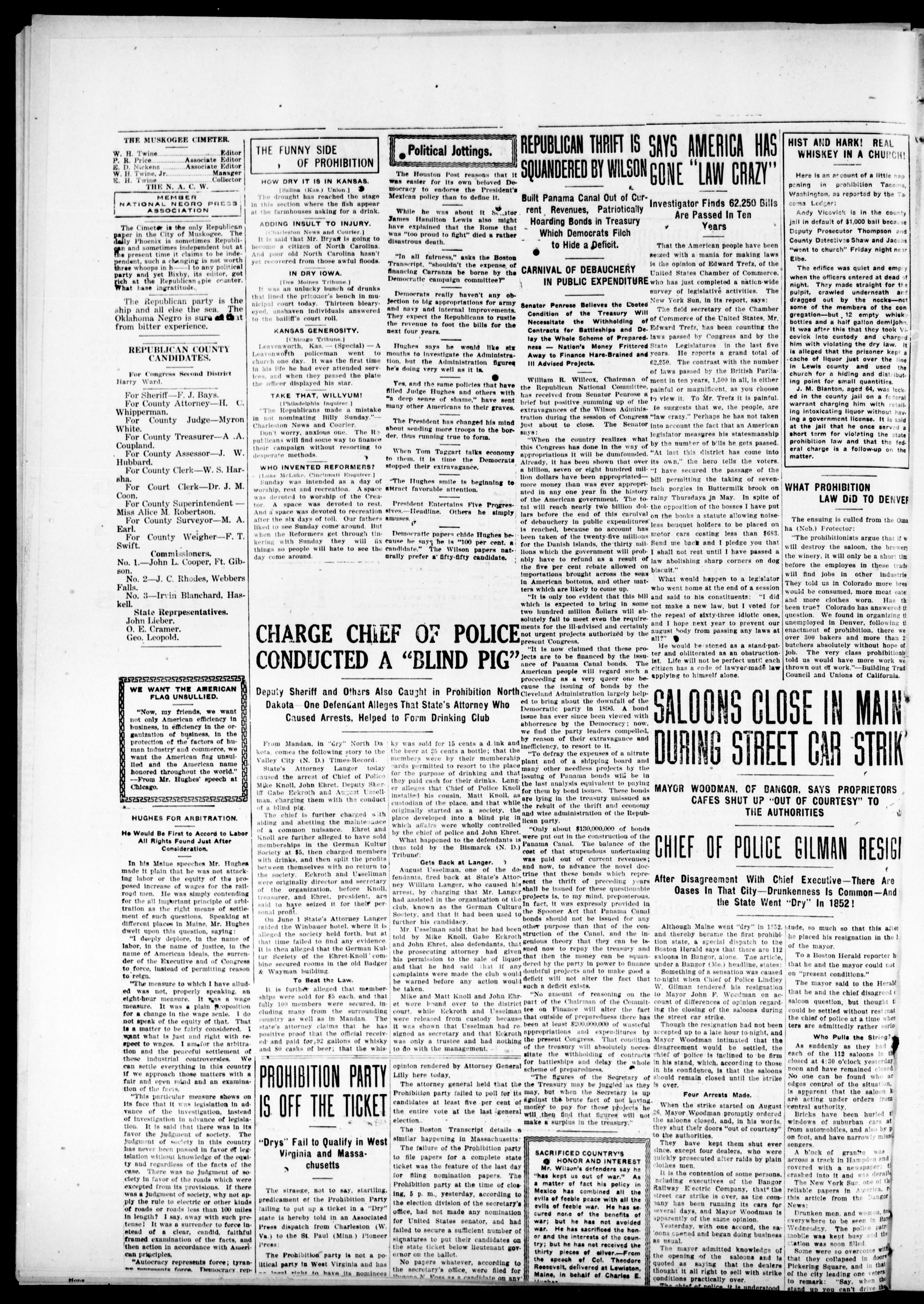
CHARGE CHIEF OF POLICE CONDUCTED A "BLIND PIG"
Deputy Sheriff and Others Also Caught in Prohibition Nort Dakota-One Defendant Alleges That State's Attorney Who Caused Arrests, Helped to Form Drinking Club
THE FUNNY SIDE OF PROHIBITION
HOW DRY IT IS IN KANSAS.
[Salina (Kas.) Union.]
The drought has reached the stage
in this section where the fish appear
at the farmhouses asking for a drink.
ADDING INSULT TO INJURY.
(Charleston News and Courier.)
It is said that Mr. Bryan is going to become a citizen of North Carolina. And poor old North Carolina hasn't yet recovered from those awful floods.
IN DRY IOWA
[Des Mines] Prisone
It was an unlucky bunch of drunks that lined the prisoner's bench in municipal court today. Thirteen bleary-eyed, unshaven individuals answered to the balliff's court roll.
KANSAS GENEROSITY.
[Chicago Tribune]
Leavenworth, Kas. — (Special) — A Leavenworth policeman went to church one day. It was the first time in his life he had ever attended services, and when they passed the plate the officer displayed his star.
TAKE THAT, WILLYUM!
"The Republicans made a mistake in not nominating Billy Sunday."—Charleston News and Courier.
Don't worry, anxious one. The Republicans will find some way to finance their campaign without resorting to desperate methods.
WHO INVENTED REFORMERS?
Jane Meltke, Cincinnati Enquirer 1
(Luke McLuke, Cincinnati Enquirer) Sunday was intended as a day of worship, rest and recreation. A space was devoted to worship of the Creator. A space was devoted to rest. And a space was devoted to recreation after the six days of toil. Our fathers liked to see Sunday come around. But when the Reformers get through tinkering with Sunday they will fix things so people will hate to see the day come around.
CHARGE CHIEF
CONDUCTED A
Deputy Sheriff and Others Also
Dakota—One Defendant Alleg
Caused Arrests, Helped
From Mandan, in "dry" North Dakota, comes the following story to the Valley City (N. D.) Times-Record. State's Attorney Langer today caused the arrest of Chief of Police Mike Knoll, John Ehret, Deputy Sheriff Gabe Eckroth and August Ussellman, charging them with the conduct of a blind pig. The chief is further charged with aiding and abetting the maintenance of a common nuisance. Ehret and Knoll are further alleged to have sold memberships in the German Kultur Society at $5, then charged members with drinks, and then split the profits between themselves with no return to the society. Eckroth and Ussellman were originally director and secretary of the organization, before Knoll, treasurer, and Ehret, president, are said to have seized it for their personal profit.
On June 1 State's Attorney Langer raided the Winbauer hotel, where it is alleged the society held forth, but at that time failed to find any evidence. It is then alleged that the German Kultur Society of the Ehret-Knoll combine secured rooms in the old Badger & Wayman building.
To Beat the Law.
It is further alleged that memberships were sold for $5 each, and that fully 100 members were secured, including many from the surrounding country as well as in Mandan. The state's attorney claims that he has positive proof that the official received and paid for,92 gallons of whiskey and 80 casks of beer; that the whis-
PROHIBITION PARTY IS OFF THE TICKET
"Drys" Fail to Qualify in West Virginia and Massachusetts
The strange, not to say, startling, predicament of the Prohibition Party failing to put up a ticket in a "Dry" state is hereby told in an Associated Press dispatch from Charleston (W. Va.) to the St. Paul (Minn.) Pioneer Press:
The Prohibition party is not a political party in West Virginia and has no legal right to have its nominees
Political Jottings.
The Houston Post reasons that it was easier for its own beloved Democracy to endorse the President's Mexican policy than to define it.
While he was about it Senator James Hamilton Lewis also might have explained that the Rome that was "too proud to fight" died a rather disastrous death.
"In all fairness," asks the Boston Transcript, "shouldn't the expense, of financing Carranza be borne by the Democratic campaign committee?"
Democrats really haven't any objection to big appropriations for army and navy and internal improvements. They expect the Republicans to rustle the revenue to foot the bills for the next four years.
Hughes says he would like six months to investigate the Administration, but the Administration figures he's doing very well as it is.
Yes, and the same policies that have filled Judge Hughes and others with "a deep sense of shame," have sent many other Americans to their graves.
The President has changed his mind about sending more troops to the border, thus running true to form.
When Tom Taggart talks economy to them, it is time the Democrats stopped their extravagance.
The Hughes smile is beginning to attract favorable attention.
President Entertains Five Progressives.—Headline. Others he simply amuses.
Democratic papers chide Hughes because he says he is "100 per cent. a candidate." The Wilson papers naturally prefer a fifty-fifty candidate.
EF OF POLICE
A "BLIND PIG"
also Caught in Prohibition North
ages That State's Attorney Who
d to Form Drinking Club
ky was sold for 15 cents a dink and the beer at 25 cents a bottle; that the members were by their membership cards permitted to resort to the place for the purpose of drinking and that they paid cash for their drinks. Langer alleges that Chief of Police Knoll installed his cousin, Matt Knoll, as custodian of the place, and that while originally started as a society, the place developed into a blind pig in which affairs were wholly controlled by the chief of police and John Ehret. What happened to the defendants is thus told by the Bismarck (N. D.) Tribune:
**Gets Back at Langer.** 3
August Usselman, one of the defendants, fired back at State's Attorney William Langer, who caused his arrest, by charging that Mr. Langer had assisted in the organization of the club, known as the German Culture Society, and that it had been used to further his candidacy.
Mr Usselman said that he had been told by Mike Knoll, Gabe Eckroth and John Ehret, also defendants, that the prosecuting attorney had given his permission to the sale of liquor and that he had said (that if any complaints were made the club would be warned before any action would be taken.
Mike and Matt Knoll and John Ehret were bound over to the district court, while Eckroth and Usselman were released from custody because it was shown that Usselman had resigned as secretary and that Eckroth was only a trustee and had nothing to do with the management.
opinion rendered by Attorney General Lilly here today.
The attorney general held that the Prohibition party failed to poll for its candidates at least five per cent of the entire vote at the last general election.
The Boston Transcript details a similar happening in Massachusetts: The failure of the Prohibition party to file papers for a complete state ticket was the feature of the last day for filing nomination papers. The Prohibition party at the time of closing, 5 p. m., yesterday, according to the election division of the secretary's office, had not made any nomination for United States senator, and had failed to secure a sufficient number of signatures to put their candidates on the state ticket below lieutenant governor on the ballot.
No papers whatever, according to the secretary's office, were filed for Ilugena N. Foss as a candidate on any
REPUBLICAN THRIFT IS SAYS AMERICA HAS SQUANDERED BY WILSON GONE "LAW CRAZY"
Built Panama Canal Out of Cur rent Revenues, Patriotically Hoarding Bonds in Treasury Which Democrats Filch to Hide a Deficit.
CARNIVAL OF DEBAUCHERY
IN PUBLIC EXPENDITURE
Senator Penrose Believes the Losted Condition of the Treasury Will Necessitate the Withholding of Contracts for Battleships and Delay the Whole Scheme of Preparedness — Nation's Money Frittered Away to Finance Hare-Brained and Ill Advised Projects.
William R. Willecox, Chairman of the Republican National Committee, has received from Senator Penrose a brief but positive summing up of the extravagances of the Wilson Administration during the session of Congress Just about to close. The Senator says:
"When the country realizes what this Congress has done in the way of appropriations it will be dumfounded. Already, it has been shown that over a billion, seven or eight hundred million dollars have been appropriated—more money than was ever appropriated in any one year in the history of the American government. The total will reach nearly two billion dollars before the end of this carnival of debauchery in public expenditures is reached, because no account has been taken of the twenty-five millions for the Danish islands, the thirty millions which the government will probably have to refund as a result of the five per cent rebate allowed on importations brought across the seas in American bottoms, and other matters which are likely to come up.
"It is only too evident that this bill which is expected to bring in some two hundred million dollars will absolutely fail to meet even the requirements for the ill-advised and certainly not urgent projects authorized by the present Congress.
"It is now claimed that these projects are to be financed by the issuance of Panama Canal bonds. The American people will regard such a proceeding as a very queer one because the issuing of bonds by the Cleveland Administration largely helped to bring about the downfall of the Democratic party in 1896. A bond issue has ever since been viewed with abhorrence by the Democracy; now we find the party leaders compelled by reason of their extravagance and inefficiency to resort to it.
"To defray the expenses of a nitrate plant and of a shipping board and many other needless projects by the issuing of Panama bonds will be in the last analysis equivalent to paying for them by bond issues. These bonds are lying in the treasury unissued as the result of the thrift and economy and wise administration of the Republican party.
"Only about $130,000,000 of bonds were put out in the construction of the Panama Canal. The balance of the cost of that stupendous undertaking was paid out of current revenues; and now, to advance the novel doctrine that these bonds which represent the thrift of preceding years shall be issued for these questionable projects is, to my mind, preposterous. In fact, it was expressly provided in the Spooner Act that Panama Cand bonds should not be issued for any
other purpose than that of the construction of the Canal, and the ingenious theory that they can be issued now to repay the treasury and that then the money can be squandered by the party in power to finance doubtful projects and to make good a deficit will not alter the fact that such a deficit exists.
"No amount of reasoning on the part of the Chairman of the Committee on Finance will alter the fact that outside of preparedness there has been at least $200,000,000 of wasteful appropriations and expenditures by the present Congress. That condition of the treasury will absolutely necessitate the withholding of contracts for battleships and delay the whole scheme of preparedness.
"The figures of the Secretary of the Treasury may be jugged as they may, but when the Secretary is up against the brute fact of not having money to pay for these projects he will, then find that figures will not make a surplus in the treasury."
---
SACRIFICED COUNTRY'S
HONOR AND INTEREST
Mr. Wilson's defenders say he
"has kept us out of war." As
a matter of fact his policy in
Mexico has combined all the
evils of feeble peace with all the
evils of feeble war. He has
secured none of the benefits of
war; but he has not avoided
war. He has sacrificed the honor
and the interests of the country;
but he has not received the
thirty pieces of silver.—From
the speech of Col. Theodore
Roosevelt, delivered at Lewiston,
Maine, in behalf of Charles E.
SALOONS CLOSE IN MAIN DURING STREET CAR STRIK
MAYOR WOODMAN, OF DANGOR, SAYS PROPRIETORS CAFES SHUT UP "OUT OF COURTESY" TO THE AUTHORITIES
CHIEF OF POLICE GILMAN RESIGI
After Disagreement With Chief Executive—There Are Oases In That City—Drunkenness Is Common—And the State Went "Dry" In 1852!
Investigator Finds 62,250 Bills Are Passed In Ten
That the American people have been seized with a mania for making laws is the opinion of Edward Trefz, of the United States Chamber of Commerce, who has just completed a nation-wide survey of legislative activities. The New York Sun in its report, says:
The field secretary of the Chamber of Commerce of the United States, Mr. Edward Trefz, has been counting the laws passed by Congress and by the State Legislatures in the last five years. He reports a grand total of 62,250. The contrast with the number
of laws passed by the British Parliament in ten years, 1,500 in all, is either painful or magnificent, as you choose to view it. To Mr. Trefz it is painful. Ie suggests that we, the people, are "law crazy." Perhaps he has not taken into account the fact that an American legislator measures his statesmanship by the number of bills he gets passed. "At last this district has come into its own," the hero tells the voters. "I have secured the passage of the bill permitting the taking of seven-inch porgies in Buttermilk brook on rainy Thursdays in May. In spite of the opposition of the bosses I have put on the books a statute allowing noiseless bouquet holders to be placed on motor cars costing less than $683. Send me back and I pledge you that I shall not rest until I have passed a law abolishing sharp corners on dog biscuit."
What would happen to a legislator who went home at the end of a session and said to his constituents: "I did not make a new law, but I voted for the repeal of sixty-three idiotic ones, and I hope next year to prevent our august body from passing any laws at all?" He would be stoned as a stand-patter and obliterated as an obstructionist. Life will not be perfect until each citizen has a code of lawyer-made law applying to himself alone.
SALOONS CLO
DURING STREET
MAYOR WOODMAN. OF BAN
CAFES SHUT UP "OU
THE AUT
CHIEF OF POLICE
After Disagreement With Ch
Oases In That City—Dru
the State Went
Although Maine went "dry" in 1852, and thereby became the first prohibition state, a special dispatch to the Boston Herald says that there are 112 saloons in Bangor, alone. The article, under a Bangor (Me.) headline, states: Something of a sensation was caused to night when Chief of Police Lindley W. Gilman tendered his resignation to Mayor John F. Woodman on account of differences of opinion regarding the closing of the saloons during the street car strike. Though the resignation had not been accepted up to a late hour to night, and Mayor Woodman intimated that the disagreement would be settled, the chief of police is inclined to be firm in his stand, which, according to those in his confidence, is that the saloons should remain closed until the strike is over.
Four Arrests Made.
When the strike started on August 26, Mayor Woodman promptly ordered the saloons closed, and, in his words, they shut their doors "out of courtesy" to the authorities.
They have kept them shut ever since, except four dealers, who were quickly prosecuted after raids by plain clothes men.
It is the contention of some persons, including executives of the Bangor Railway Electric Company, that* the street car strike is over, as the company has been running its cars for several days, and Mayor Woodman is apparently of the same opinion.
Yesterday, with one accord, the saloons opened and began doing business as usual.
The mayor admitted knowledge of the opening of the saloons and is quoted as saying that the dealers thought it all right to sell with strike conditions practically over.
HIST AND HARK! REAL
WHISKEY IN A CHURCH!
Here is an account of a little happen ing in prohibition Tacoma, Washington, as reported by the Tacoma Ledger: Andy Vicovick is in the county jail in default of $1,000 bail because Deputy Prosecutor Thompson and County Detectives Shaw and Jacobs "went to church" Friday night near Elbe.
The edifice was quiet and empty when the officers entered at dead of night. They made straight for the pulpit, crawled underneath and dragged out by the necks—not some of the members of the congregation—but, 12 empty whisky bottles and a half gallon demilghin. It was after this that they took Vi covick into custody and charged him with violating the dry law. It is alleged that the prisoner kept a cache of liquor just over the line in Lewis county and used the church for a hiding and distributing point for small quantities.
J. M. Blanton, aged 64, was locked in the county jail on a federal warrant charging him with retaliating intoxicating liquor without having a government license. It is said at the jail that he once served a short term for violating the state prohibition law and that the federal charge is a follow-up on the matter.
WHAT PROHIBITION
LAW DiD TO DENVER
The ensuing is culled from the Omaha (Neb.) Protector:
"The prohibitionists argue that if we will destroy the saloon, the brewery the winery, it will only be a short time before the employees in these trade will find jobs in other industry. They told us in Colorado more brews would be consumed, more meat eat and more clothes worn. Has they been true? Colorado has answered it question. We found in organizing it unemployed in Denver, following the enactment of prohibition, there we over 300 bakers and more than 2 butchers absolutely without hope of job. The very class prohibitions told us would have more work we thrown out of work."—Building Trad Council and Unions of California.
OSE IN MAIN
ET CAR STRIK
GOR, SAYS PROPRIETORS
OUT OF COURTESY" TO
AUTHORITIES
GILMAN RESIGI
ief Executive—There Are
inkenness Is Common—And
"Dry" In 1852!
tude, so much so that this after he placed his resignation in the l of the mayor.
To a Boston Herald reporter he that he and the mayor could not on "present conditions."
The mayor said to the Herald that he and the chief disagreed o saloon question, but thought t could be settled without resignat the chief of police at a time wher ters are admittedly rather serio
Who Pulls the String
As suddenly as they had each of the 112 saloons in the closed at 4:30 o'clock yesterday, noon and have remained closed. No one can be found who edges control of the situation, is apparent that the saloon k are acting under orders from central authority. Bricks have been hurled the windows of suburban cars at from automobiles, and also by p on foot, and have narrowly miss- sengers. A block of granite was across a track in Hampden and covered with a newspaper; it crashed into it and was derailed. The New York Sun, one of the reliable papers in America, re- this article from the Sanger News:
Drunken men, and women, too everywhere to be seen in Bar Wednesday. The police patrol mobile was kept busy and the station was soon filled. Some were so overcome with that they collapsed in doorr Pickering Square, and in that of the city leading one veteran to remark: "Say, when the stand up you can't drive the
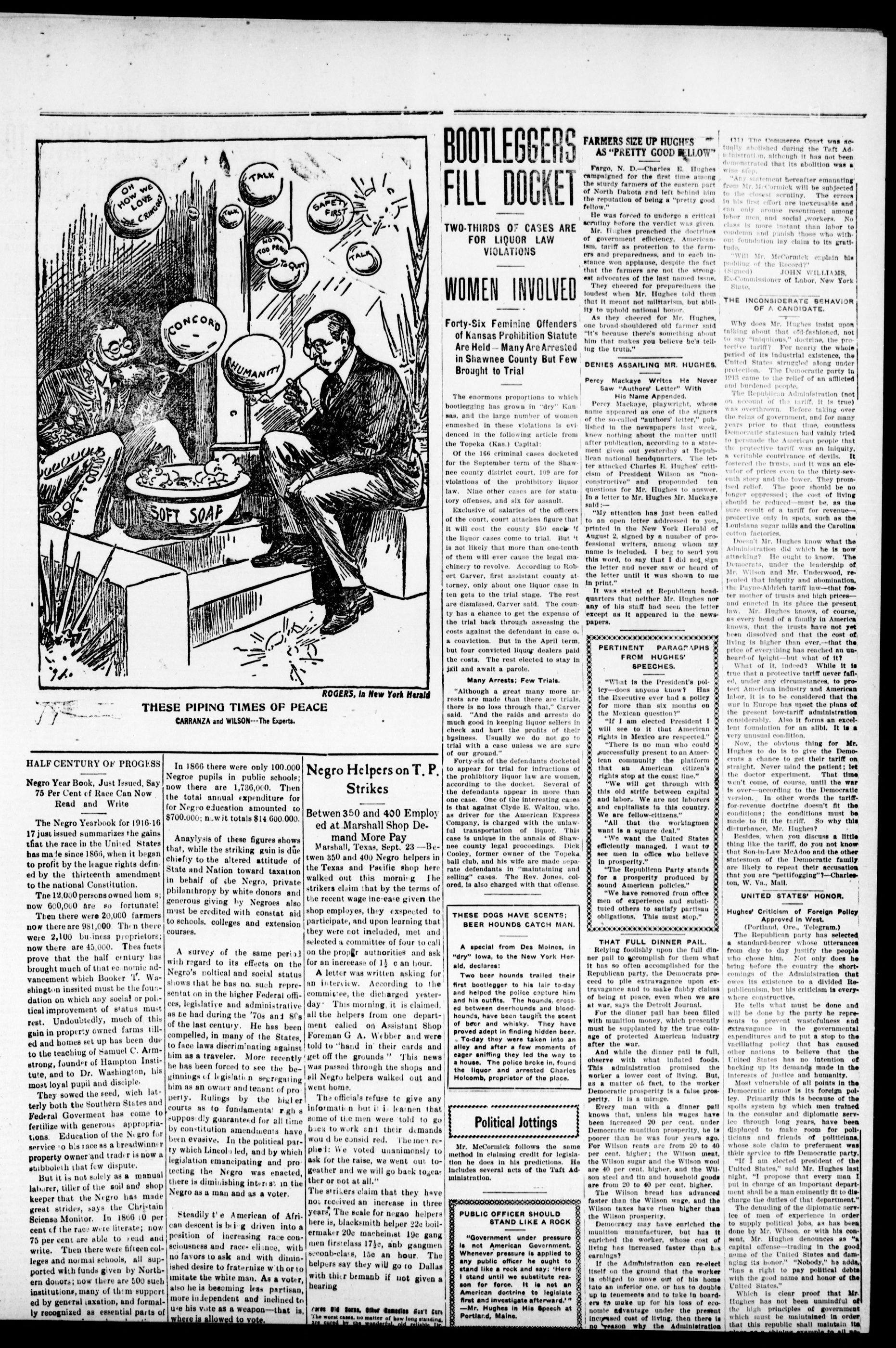
OH HOW WE LOVE THE CRIMINALS!
TALK
SAFETY FIRST
NOT TOO PREVIOUS TO QUIT
TALK
CONCORD
HUMANITY
SOFT SOAP
HALFCENTURY OF PROGESS
Negro Year Book, Just Issued, Say 75 Per Cent of Race Can Now Read and Write
The Negro Yearbook for 1916-16 17 just issued summarizes the gains that the race in the United States has made since 1866, when it began to profit by the league rights defined by the thirteenth amendment to the national Constitution.
The 12,000 persons owned hom s now 600,000 are so fortunate!
Then there were 20,000 farmers now there are 981,000. Then there were 2,100 business proprietors; now there are 45,000. The facts prove that the half century has brought much of that economic advancement which Booker T. Washington insisted must be the foundation on which any social or political improvement of status must rest. Undoubtedly, much of this gain in property owned farms tilled and homes set up has been due to the teaching of Samuel C. Armstrong, founder of Hampton Institute, and to Dr. Washington, his most loyal pupil and disciple.
They sowed the seed, with latterly both the Southern States and Federal Government has come to fertilize with generous appropriations. Education of the Negro for service to his race as a breadwinner property owner and trader is now a stubboleth that few dispute.
But it is not solely as a manual laborer, tiller of the soil and shop keeper that the Negro has made great strides, says the Chri-tain Sciense Monitor. In 1866 10 per cent of the race were literate; now 75 per cent are able to read and write. Then there were fifteen colleges and normal schools, all supported with funds given by Northern donors; now there are 500 such institutions, many of them supported by general taxation, and formally recognized as essential parts of
In 1866 there were only 100,000 Negroe pupils in public schools; now there are 1,736,000. Then the total annual expenditure for for Negro education amounted to $700,000; now it totals $14,600,000.
Analysis of these figures shows that, while the striking gain is due chiefly to the altered attitude of State and Nation toward taxation in behalf of the Negro, private philanthropy by white donors and generous giving by Negroes also must be credited with constat aid to schools, colleges and extension courses.
A survey of the same period with regard to its effects on the Negro's political and social status shows that he has no such representation in the higher Federal offices, legislative and administrative as he had during the 70s and 80s of the last century. He has been compelled, in many of the States, to face laws discriminating against him as a traveler. More recently he has been forced to see the beginnings of legislation segregating him as an owner and tenant of property. Rulings by the higher courts as to fundamental rights supposedly guaranteed for all time by constitution amendments have been evasive. In the political party which Lincollo led, and by which legislation emancipating and protecting the Negro was enacted, there is diminishing interest in the Negro as a man and as a voter.
Steadily the American of African descent is being driven into a position of increasing race consciousness and race-eliance, with no favors to ask and with diminished desire to fraternize with or to imitate the white man. As a voter, also he is becoming less partisan, more independent and inclined to use his vote as a weapon—that is, where is allowed to vote.
ROGERS, In New York Herald
Negro Helpers on T. P. Strikes
Negro Helpers on T. P. Strikes
Betwen 350 and 400 Employ ed at Marshall Shop Demand More Pay
Marshall, Texas, Sept. 23 —Between 350 and 400 Negro helpers in the Texas and Pacific shop here walked out this morning. The strikers claim that by the terms of the recent wage increase given the shop employes, they expected to participate, and upon learning that they were not included, met and selected a committee of four to call on the propgr authorities and ask for an increase of $ \frac{1}{2} $ an hour.
A letter was written asking for an interview. According to the committee, the dicharged yesterday. This morning, it is claimed, all the helpers from one department called on Assistant Shop Foreman G A. Webber and were told to "hand in their cards and get off the grounds." This news was passed through the shops and all Negro helpers walked out and went home.
The officials refuse to give any information but it is learned that some of the men were told to go back to work and their demands would be consid red. The incu replie: We voted unanimously to ask for the raise, we went out to geather and we will go back to geather or not at all."
The strikers claim that they have not received an increase in three years. The scale for negao helpers here is, blacksmith helper 22e boilermaker 20e macheinst 19e gang men firstclass 174e, anb gangmen second-class, 15e an hour. The helpers say they will go to Dallas with thier bemanb if not given a hearing
Areas Old Series, Other Remedies Don't Cure
The worst cases, no matter of how long standing, are cured by the wonderful one.
BOOTLEGGERS FILL DOCKET
TWO-THIRDS OF CASES ARE FOR LIQUOR LAW VIOLATIONS
WOMEN INVOLVED
Forty-Six Feminine Offenders of Kansas Prohibition Statute Are Held Many Are Arrested in Shawnee County But Few Brought to Trial
The enormous proportions to which bootlegging has grown in "dry" Kansas, and the large number of women enmeshed in these violations is evidenced in the following article from the Topeka (Kas.) Capital:
Of the 166 criminal cases docketed for the September term of the Shawnee county district court, 199 are for violations of the prohibitory liquor law. Nine other cases are for statutory offenses, and six for assault.
Exclusive of salaries of the officers of the court, court attaches figure that it will cost the county $50 each if the liquor cases come to trial. But it is not likely that more than one-tenth of them will ever cause the legal machinery to revolve. According to Robert Garver, first assistant county attorney, only about one liquor case in ten gets to the trial stage. The rest are dismissed, Garver said. The county has a chance to get the expense of the trial back through assessing the costs against the defendant in case o. a conviction. But in the April term, but four convicted liquor dealers paid the costs. The rest elected to stay in jail and await a parole.
Many Arrests: Few Trials
"Although a great many more arrests are made than there are trials, there is no loss through that," Carver said. "And the raids and arrests do much good in keeping liquor sellers in check and hurt the profits of their business. Usually we do not go to trial with a case unless we are sure of our ground."
Forty-six of the defendants docketed to appear for trial for infractions of the prohibitory liquor law are women, according to the docket. Several of the defendants appear in more than one case. One of the interesting cases is that against Clyde E. Walton, who, as driver for the American Express Company, is charged with the unlawful transportation of liquor. This case is unique in the annals of Shawnee county legal proceedings. Dick Cooley, former owner of the Topeka ball club, and his wife are made separate defendants in "maintaining and selling" cases. The Rev. Jones, colored, is also charged with that offense.
THESE DOGS HAVE SCENTS;
BEER HOUNDS CATCH MAN.
A special from Des Moines, in "dry" Iowa, to the New York Herald, declares:
Two beer hounds trailed their first bootlegger to his lair to-day and helped the police capture him and his outfits. The hounds, crossed between deerhounds and bloodhounds, have been taught the scent of beer and whisky. They have proved adept in finding hidden beer. To-day they were taken into an alley and after a few moments of eager sniffing they led the way to a house. The police broke in, found the liquor and arrested Charles Holcomb, proprietor of the place.
Political Jottings
Mr. McCormick follows the same method in claiming credit for legislation he does in his predictions. He includes several acts of the Taft Administration.
PUBLIC OFFICER SHOULD
STAND LIKE A ROCK
"Government under pressure is not American Government. Whenever pressure is applied to any public officer he ought to stand like a rock and say: 'Here I stand until we substitute reason for force. It is not an American doctrine to legislate first and investigate afterward.'" —Mr. Hughes in His Speech at Portland, Maine.
FARMERS SIZE UP HUGHES AS "PRETTY GOOD BELLOW"
Fargo, N. D.—Charles E. Hughes campaigned for the first time among the sturdy farmers of the eastern part of North Dakota and left behind him the reputation of being a "pretty good fellow."
He was forced to undergo a critical scrutiny before the verdict was given.
Mr. Hughes preached the doctrines of government efficiency, Americanism, tariff as protection to the farmers and preparedness, and in each instance won applause, despite the fact that the farmers are not the strongest advocates of the last named issue.
They cheered for preparedness the loudest when Mr. Hughes told them that it meant not militarism, but ability to uphold national honor.
As they cheered for Mr. Hughes, one broad shouldered old farmer said "it's because there's something about him that makes you believe he's telling the truth."
DENIES ASSAILING MR. HUGHES.
Percy Mackaye Writes He Never Saw "Authors' Letter" With His Name Appended.
Percy Mackaye, playwright, whose name appeared as one of the signers of the so-called "authors' letter," published in the newspapers last week, knew nothing about the matter until after publication, according to a statement given out yesterday at Republican national headquarters. The letter attacked Charles E. Hughes' criticism of President Wilson as "non-constructive" and propounded ten questions for Mr. Hughes to answer. In a letter to Mr. Hughes Mr. Mackaye said:—
"My attention has just been called to an open letter addressed to you, printed in the New York Herald of August 2, signed by a number of professional writers, among whom my name is included. I beg to sent you this word, to say that I did not sign the letter and never saw or heard of the letter until it was shown to me in print."
It was stated at Republican headquarters that neither Mr. Hughes nor any of his staff had seen the letter except as it appeared in the newspapers.
PERTINENT PARAGRAPHS
FROM HUGHES'
SPEECHES.
"What is the President's policy—does anyone know? Has the Executive ever had a policy for more than six months on the Mexican question?"
"If I am elected President I will see to it that American rights in Mexico are respected."
"There is no man who could successfully present to an American community the platform that an American citizen's rights stop at the coast line."
"We will get through with this old strife between capital and labor. We are not laborers and capitalists in this country. We are fellow-citizens."
"All that the workingmen want is a square deal."
"We want the United States efficiently managed. I want to see men in office who believe in prosperity."
"The Republican Party stands for a prosperity produced by sound American policies." "We have removed from office men of experience and substituted others to satisfy partisan obligations. This must stop."
THAT FULL DINNER PAIL.
Relying foolishly upon the full dinner pail to accomplish for them what it has so often accomplished for the Republican party, the Democrats proceed to pile extravagance upon extravagance and to make flabby claims of being at peace, even when we are at war, says the Detroit Journal. For the dinner pail has been filled with munition money, which presently must be supplanted by the true coinage of protected American industry after the war. And while the dinner pail is full, observe with what inflated foods. This administration promised the worker a lower cost of living. But, as a matter of fact, to the worker Democratic prosperity is a false prosperity. It is a mirage.
Every man with a dinner patl knows that, unless his wages have been increased 20 per cent. under Democratic munition prosperity, he is poorer than he was four years ago. For Wilson rents are from 20 to 40 per cent. higher; the Wilson meat, the Wilson sugar and the Wilson wool are 40 per cent. higher, and the Wilson steel and tin and household goods are from 20 to 40 per cent. higher. The Wilson bread has advanced faster than the Wilson wage, and the Wilson taxes have risen higher than the Wilson prosperity. Democracy may have enriched the munition manufacturer, but has it enriched the worker, whose cost of living has increased faster than his earnings.
If the Administration can re-elect itself on the ground that the worker is obliged to move out of his home into an inferior one, or has to double up in tenements and to take in boarders to make up for his loss of economic advantage under the present increased cost of living, then there is no reason why the Administration
(11) The Commerce Court was actually abolished during the Taft Administration, although it has not been demonstrated that its abolition was a wise step.
"Any statement hereafter emanating from Mr. McCormick will be subjected to the closest scrutiny. The errors in his first effort are inexcusable and can only arouse resentment among labor men and social workers. No class is more instant than labor to condemn and punish those who without foundation lay claim to its gratitude.
"Will Mr. McCormick explain his paddling of the Record?" (Signed)
JOHN WILLIAMS, Ex-Commissioner of Labor, New York State.
THE INCONSIDERATE BEHAVIOR OF A CANDIDATE.
Why does Mr. Hughes insist upon talking about that old-fashioned, not to say "indiquents," doctrine, the protective tariff? For nearly the whole period of its industrial existence, the United States struggled along under protection. The Democratic party in 1913 came to the relief of an afflicted and burdened people.
The Republican Administration (not on account of the tariff, it is true) was overthrown. Before taking over the relis of government, and for many years prior to that time, countless Democratic statesmen had vainly tried to persuade the American people that the protective tariff was an iniquity, a veritable contravance of devils. It fostered the trusts, and it was an elevator of prices even to the thirty-seventh story and the tower. They promised relief. The poor should be no longer oppressed; the cost of living should be reduced—must be, as the sure result of a tariff for revenue—protective only in spots, such as the Louisiana sugar mills and the Carolina cotton factories.
Doesn't Mr. Hughes know what the Administration did which he is now attacking? He ought to know. The Democrats, under the leadership of Mr. Wilson and Mr. Underwood, repealed that iniquity and abomination, the Payne-Aldrich tariff law—that foster mother of trusts and high prices—and enacted in its place the present law. Mr. Hughes knows, of course, as every head of a family in America knows, that the trusts have not yet been dissolved and that the cost of living is higher than ever,—that the price of everything has reached an unheard-of height—but what of it?
What of it, indeed? While it is true that a protective tariff never failed, under any circumstances, to protect American industry and American labor, it is to be considered that the war in Europe has upset the plans of the present low-tariff administration considerably. Also it forms an excellent foundation for an allbi. It is a very unusual condition.
Now, the obvious thing for Mr. Hughes to do is to give the Democrats a chance to get their tariff on straight. Never mind the patient; let the doctor experiment. That time won't come, of course, until the war is over—according to the Democratic version.
In other words the tariff-for-revenue doctrine doesn't fit the conditions; the conditions must be made to fit the tariff. So why this disturbance, Mr. Hughes?
Besides, when you discuss a little thing like the tariff, do you not know that Son-in-Law McAdoo and the other statesmen of the Democratic family are likely to repeat their accusation that you are "petitfogging"?—Charleston, W. Va., Mall.
UNITED STATES' HONOR
Hughes' Criticism of Foreign Polley Approved In West.
The Republican party has selected a standard-bearer whose utterances from day to day justify the people who chose him. Not only does he bring before the country the short-comings of the Administration that owes its existence to a divided Republicanism, but his criticism is everywhere constructive.
He tells what must be done and will be done by the party he represents to prevent wastefulness and extravagance in the governmental expenditures and to put a stop to the vacillating policy that has caused other nations to believe that the United States has no intention of backing up its demands made in the interests of justice and humanity.
Most vulnerable of all points in the Democratic armor is its foreign policy. Primarily this is because of the spoils system by which men trained in the consular and diplomatic service through long years, have been displaced to make room for politicians and friends of politicians, whose sole claim to preferment was their service to the Democratic party. "If I am elected president of the United States," said Mr. Hughes last night, "I propose that every man I put in charge of an important department shall be a man eminently fit to discharge the duties of that department."
The denuding of the diplomatic service of men of experience in order to supply political jobs, as has been done by Mr. Wilson, or with his consent, Mr. Hughes denounces as "a capital offense—trading in the good name of the United States and damaging its honor." "Nobody," he adds, "has a right to pay political debts with the good name and honor of the United States."
Which is clear proof that Mr. Hughes has not been unmindful of the high principles of government which must be maintained in order that this republic shall maintain its
DEBTS OF THE SUCCESS
"If I did not believe that the Republican party was the party of true progress, which was prepared under its leadership to take the country along the way of adaptation to new needs and exigencies of the future, I should have no pride in representing it. But the party of Lincoln is recruited today and we consecrate it to the ideals of Lincoln, and those ideals are permanent. These are the ideals of the success of the plain people. They are the ideals of the achievements under free institutions, of success in all the activities of the co-operative energy of the plain people."—Charles E. Hughes in a Speech Delivered at Plattsburg, N. Y.
BROTHERHOODS WIN FARMERS' WIVES LOSE
Democrats Unctuously but Vainly Flatter Themselves That Tillers of the Soil Believe Their Bunk Uplift Laws Will Improve Agricultural Conditions.
FARING WORSE THAN LOWLIEST RAILROAD HAND
Pilight of Women Laborers in the Fields Described by President Pope of the Association of State Presidents of the Farmers' Union as More Doplorable Than During the Days of Slavery, and Yet Not a Word Was Spoken in the Last Congress, Which is Boasting of its Farm Legislation, About the Woman Who Rakes the Hay and Gathers the Sheaves.
That the increase in pay of members of the four railroad brotherhoods, caused by the enactment of the eighth day law by Congress, will rest ultimately upon the farmer was asserted by Henry N. Pope, newly elected president of the Association of State Presidents of the Farmers' Union, in a statement issued by htm.
Mr. Pope declared that the farmers of the country stand for a fair wage for both labor and capital and favor an eight-hour working day, but that he personally doubted the wisdom of Congress fixing wages for labor employed by private enterprise. "I doubt," said he, "if it is in the interest of either labor, capital or the people to make the wage's schedule of railroad employees a political issue."
The condition of the farmers of the country is worse than that of the most lovely railroad laborer, Mr. Pope stated, with an average farm income of only $1.47 a day, out of which must be paid the expenses of the family. The condition of women laborers in the fields he describes as worse than during the days of slavery.
Not a Word for Farmers.
"Not a word has been spoken by Congress in defense of the woman who rakes the hay and gathers the sheaves," said Mr. Pope. "Little has been done that has increased the income of the farmer or enabled him to pay a higher wage to his laborers.
"But today we find the highest paid laborers in the world, making three times more money than a farmer, demanding twenty-five per cent increase, and Congress hastening to their relief. This increase must, in the end, rest upon the back of the farmer and will reduce his income, increase his hours of labor, and call for another levy of farm mothers from the home to the field.
"The farmers of this nation must fight to hold what they have and to get what is rightfully theirs from the government. We must do it through organization."
Mr. Pope stated that by the enactment of the eighth day inw Congress had thrust upon the people of the country a new responsibility and organized labor now stands committed to the principle of government regulation of wages. The government, he said, should fix wages for all classes of railroad employees and should have the power to decrease as well as to increase wages to remedy comparative inequalities.
"Square Deal" for All.
"In my opinion," he continued, "the next session of Congress should readjust the wages of all railroad employees, from railroad president to secession laborer, giving all a square deal and fixing a schedule of pay based upon business justice and human rights. I submit a schedule of wages taken from official government reports which prosagus conclusive evidence of the inequalities of the present daily wage scale of railroad employees:
"General officers, $16.11; other officers, $6.49; general office clerks, $2.53; station agents, $2.37; other station men, $1.99; enginemen, $5.28; firemen, $3.23; conductors, $4.49; other trainmen, $3.11; all shopmen, $2.37, and trackmen, $1.50."
Mr. Pope declared that the foregoing schedule showed that the 350,000 section hands in the country were condemned to a life of poverty. He said he believed that Congress, having undertaken to regulate the wages of higher paid employees, should review
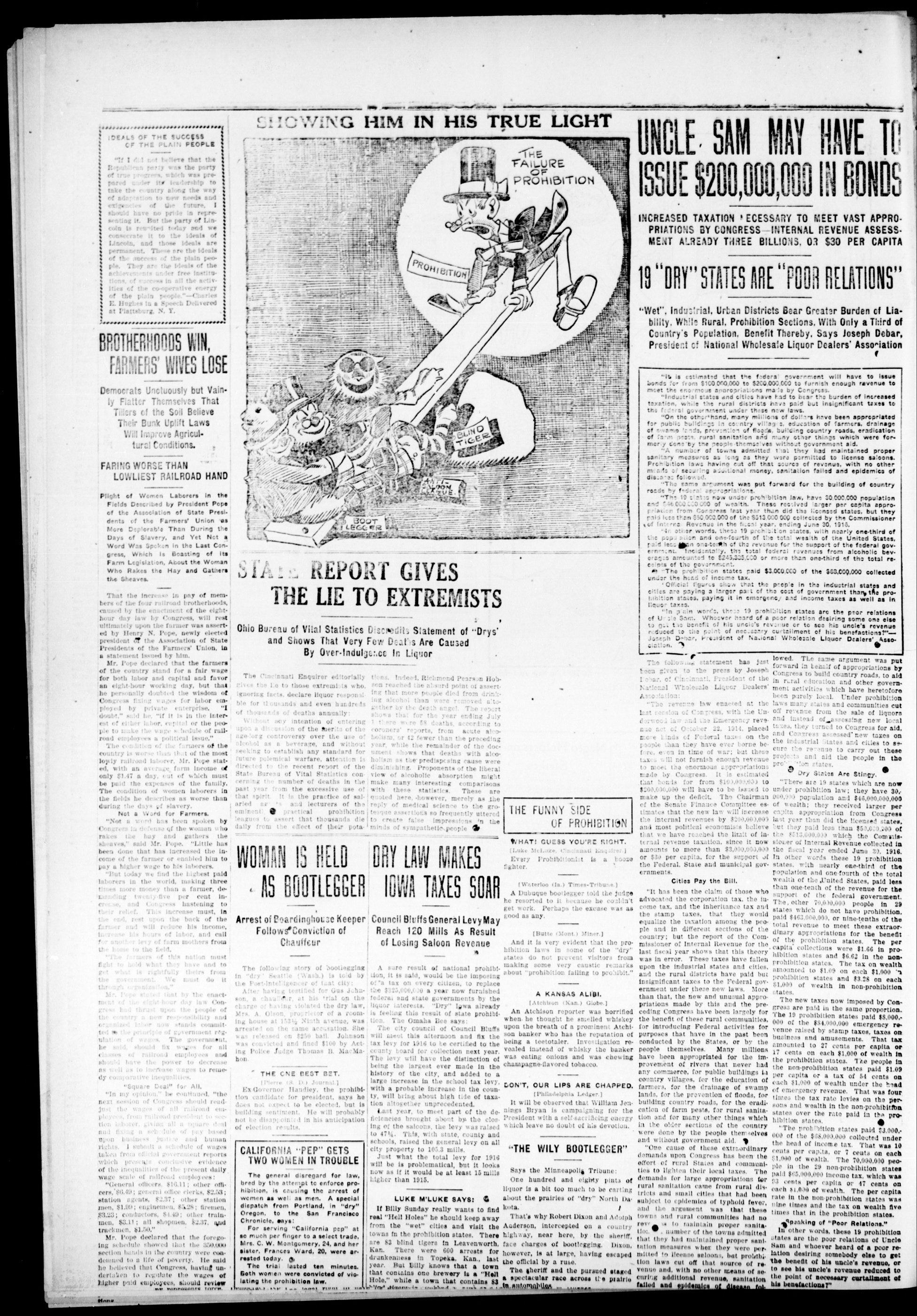
SHOWING HIM IN HIS TRUE LIGHT
THE FAILURE OF PROHIBITION
PROHIBITION
BLIND TIGER
ANTI-FLUID FACTURE
BOOT LEGGER
STATE REPORT GIVES THE LIE TO EXTREMISTS
Ohio Bureau of Vital Statistics Disclosed Statement of "Drys" and Shows That Very Few Deaths Are Caused By Over-Indulgence In Liquor
The Cincinnati Enquirer editorially tions. Indeed, Richmond Pearson Hobgives the lie to those extremists who, ignoring facts, declare liquor responsi- ting that more people died from drinking alcohol than were removed altogether for thousands and even hundreds by the death angel. The report of thousands of deaths annually:
Without any intention of entering upon a discussion of the merits of the age-long controversy over the use of alcohol as a beverage, and without seeking to establish any standard for future polemical warfare, attention is directed to the recent report of the State Bureau of Vital Statistics concerning the number of deaths in the past year from the excessive use of that spirit. It is the practice of salaried agents and lecturers of the eminent: practical prohibition leagues to assert that thousands die daily from the effect of their pota-
WOMAN IS HELD AS BOOTLEGGER
Arrest of Boardinghouse Keeper Follows Conviction of Chauffeur
The following story of bootlegging in "dry" Seattle (Wash.) is told by the Post-Intelligence of that city:
After having testified for Gus Johnson, a chauncher, at his trial on the charge of having violated the dry law, Mrs. A. Olson, proprietor of a rooming house at 1531½ Ninth avenue, was arrested on the same accusation. She was released on $250 bail. Johnson was convicted and fined $100 by Acting Police Judge Thomas B. MacMahon.
THE ONE BEST BET.
Ex Governor Handley, the prohibition candidate for president, says he does not expect to be elected, but is building sentiment. He will probably not be disappointed in his anticipation of election results.
CALIFORNIA "PEP" GETS
TWO WOMEN IN TROUBLE
The general disregard for law, bred by the attempt to enforce prohibition, is causing the arrest of women as well as men. A special dispatch from Portland, in "dry" Oregon, to the San Francisco Chronicle, says:
For serving "California pop" at so much per finger to a select trade, Mrs. C. W. Montgomery, 24, and her sister, Frances Ward, 20, were arrested today.
The trial lasted ten minutes. Both women were convicted of violating the prohibition law.
tions. Indeed, Richmond Pearson Hobson reached the absurd point of asserting that more people died from drinking alcohol than were removed altogether by the death angel. The report shows that for the year ending July 1 there were 58 deaths, according to coroners' reports, from acute alcoholism, or 42 fewer than the preceding year, while the remainder of the document shows that deaths with alcoholism as the predisposing cause were diminishing. Proponents of the liberal view of alcoholic absorption might make many interesting comparisons with these statistics. These are quoted here, however, merely as the reply of medical science to the grotesque assertions so frequently uttered to create false impressions in the minds of sympathetic people.
DRY LAW MAKES IOWA TAXES SOAR
Council Bluffs General Levy May Reach 120 Mills As Result of Losing Saloon Revenue
A sure result of national prohibition, it is said, would be the imposing of a tax on every citizen, to replace the $325,000,000 a year now furnished federal and state governments by the liquor interests. "Dry" Iwa already is feeling this result of state prohibition. The Omaha Bee says: The city council of Council Bluffs will meet this afternoon and fix the tax levy for 1916 to be certified to the county board for collection next year. The levy will have the distinction of being the largest ever made in the history of the city, and added to a large increase in the school tax levy, with a probable increase in the county, will bring about high tide of taxation altogether unprecedented.
Last year, to meet part of the deficiencies brought about by the closing of the saloons, the levy was raised to 47¼%. This, with state, county and schools, raised the general levy on all city property to 105.3 mills.
Just what the total levy for 1916 will be is problematical, but it looks now as if it would be at least 15 mills higher than 1915.
LUKE M'LUKE SAYS:
If Billy Sunday really wants to find real "Hell Holes" he should keep away from the "wet" cities and visit the towns in the prohibition states. There are $3 blind tigers in Leavenworth, Kan. There were 600 arrests for drankness in Topeka, Kan., last year. But Billy knows that a town that contains one brewery is a "Hell Hole," while a town that contains $3
THE FUNNY SIDE OF PROHIBITION
WHAT! GUESS YOU'RE RIGHT.
[Luke McLuke, Cincinnati Enquirer]
Every Prohibitionist is a booze
fighter.
A Dubuque bootlegger told the judge he resorted to it because he couldn't get work. Perhaps the excuse was as good as any.
[Butte (Mont.) Miner.]
And it is very evident that the prohibition laws in some of the "dry" states do not prevent visitors from making some very caustic remarks about "prohibition failing to prohibit."
A KANSAS ALIBI.
An Atchison reporter was horrified when he thought he smelled whiskey upon the breath of a prominent Atchison banker who has the reputation of being a teetotaler. Investigation revealed instead of whiskey the banker was eating onions and was chewing champagne-flavored tobacco.
DON'T, OUR LIPS ARE CHAPPED,
[Philadelphia Ledger]
It will be observed that William Jennings Bryan is campaigning for the President with a self-sacrificing energy which leave no doubt of his devotion.
"THE WILY BOOTLEGGER"
Says the Minneapolis Tribune:
One hundred and eighty pints of liquor is a bit too much to be carting about the prairies of "dry" North Dakota.
That's why Robert Dixon and Adolph Anderson, intercepted on a country highway, near here, by the sheriff, face charges of bootlegging. Dixon, however, is at large, having escaped the official by a ruse.
The sheriff and the pursued staged a spectacular race across the prairie in automobiles.
UNCLE SAM MAY HAVE TO ISSUE $200,000,000 IN BONDS
INCREASED TAXATION * ECESSARY TO MEET VAST APPROPRIATIONS BY CONGRESS—INTERNAL REVENUE ASSESSMENT ALREADY THREE BILLIONS. OR $30 PER CAPITA
"Wet", Industrial, Urban Districts Bear Greater Burden of Liability. While Rural, Prohibition Sections. With Only a Third of Country's Population. Benefit Thereby. Says Joseph Debar, President of National Wholesale Liquor Dealers' Association
"It is estimated that the federal government will have to issue bonds for from $100,000,000 to $200,000,000 to furnish enough revenue to meet the enormous appropriations made by Congress.
"Industrial states and cities have had to bear the burden of increased taxation, while the rural districts have paid but insignificant taxes to the federal government under these now laws.
"On the other hand, many millions of dollars have been appropriated for public buildings in country villages, education of farmers, drainage of swamp lands, prevention of floods, building country roads, eradication of farm posts, rural sanitation and many other things which were formerly done by the people themselves without government aid.
"A number of towns admitted that they had maintained proper sanitary measures as long as they were permitted to license saloons. Prohibition laws having cut off that sources of revenue, with no other means of securing additional money, sanitation failed and epidemics of diseases followed.
"The same argument was put forward for the building of country roads by federal appropriations.
"The 19 stables now under prohibition law, have $30,000,000 population and $46,000,000 of wealth. These received larger per capita appropriation from Congress last year than did the licensed states, but they paid less than $50,000,000 of the $313,000,000 collected by the Commissioner of Internet Revenue in the fiscal year, ending June 20, 1916.
In other words, these 19 prohibition states, with nearly one-third of the population and one-fourth of the total wealth of the United States, paid less than one-third of the revenue for the support of the federal government. Incidentally, the total federal revenues from alcoholic beverages amounted to $245,303,000 or more than one-third of the total receipts of the government.
"The prohibition states paid $3,000,000 of the $63,000,000 collected under the head of income tax.
"Official figures show that the people in the industrial states and cities are paying a larger part of the cost of government than the prohibition states, paying it in emergency and income taxes as well as in liquor taxes.
"In plain words, these 19 prohibition states are the poor relations of Uribe Sam. Whoever heard of a poor relation desiring some one else to get the benefit of his uncle's revenue or to see his uncle's revenue induced to the point of necessary curtailment of his benefactions?" — Joseph Dehor, President of National Wholesale Liquor Dealers' Association.
The following statement has just been given to the press by Joseph Lobar, of Cincinnati, President of the National Wholesale Liquor Dealers' Association.
The same argument was put forward in benefit of appropriations b Congress to build country roads, to all in rural education and other government activities which have heretofore been purely local. Under prohibition
"The revenue law enacted at the last pension of Congress, with the Underwood law and the Emergency revenue not of October 22, 1914, placed more binds of Federal taxes on the people than they have ever borne before, even in time of war; but these taxes will not furnish enough revenue to meet the enormous appropriations made by Congress. It is estimated that bonds for from $100,000,000 to $200,000,000 will have to be issued to make up the deficit. The Chairman of the Senate Finance Committee estimates that the new law will increase the internal revenues by $200,000,000 and most political economists believe that we have reached the limit of internal revenue taxation, since it now amounts to more than $3,000,000,000 or $30 per capita, for the support of the Federal. State and municipal governments.
Cities Pay the Bill.
"It has been the claim of those who advocated the corporation tax, the income tax, and the inheritance tax and the stamp taxes, that they would equalize the taxation among the people and in different sections of the country; but the report of the Commissioner of Internal Revenue for the last fiscal year shows that this theory was in error. These taxes have fallen upon the industrial states and cities, and the rural districts have paid but insignificant taxes to the Federal government under these new laws. More than that, the new and unusual appropriations made by this and the preceding Congress have been largely for the benefit of these rural communities, for introducing Federal activities for purposes that have in the past been conducted by the States, or by the people themselves. Many millions have been appropriated for the improvement of rivers that never had any commerce, for public buildings in country villages, for the education of farmers, for the drainage of swamp lands, for the prevention of floods, for building country roads, for the eradication of farm pests, for rural sanitation and for many other things which in the older sections of the country were done by the people themselves and without government aid.
"One cause of these extraordinary demands upon Congress has been the effort of rural States and communities to lighten their local taxes. The demands for large appropriations for rural sanitation came from rural districts and small cities that had been subject to epidemics of typhoid fever, and the argument was that these towns and rural communities had no reason to maintain proper sanitation. A number of the towns admitted that they had maintained proper sanitation measures when they were permitted to license seeloons, but prohibition laws cut off that source of revenue and, with no other means of securing additional revenue, sanitation failed and epidemics of disease fok
lowed. The same argument was put forward in benefit of appropriations by Congress to build country roads, to aid in rural education and other government activities which have heretofore been purely local. Under prohibition laws many states and communities cut off revenue from the sale of liquors and instead of assessing new local taxes, they turned to Congress for aid, and Congress assessed' new taxes on the industrial states and cities to secure the revenue to carry out these projects and aid the people in the prohibition states.
Dry States Are Stingy.
"There are 19 states which are now under prohibition law; they have 30,000,000 population and $44,000,000,000 of wealth; they received larger per capita appropriation from Congress last year than did the licensed states, but they paid less than $50,000,200 of the $513,000,000 which the Commissioner of Internal Revenue collected in the fiscal year ended June 30, 1916. In other words these 19 prohibition states, with nearly one-third of the population and one-fourth of the total wealth of the United States, paid less than one-tenth of the revenue for the support of the federal government. The other 70,000,000 people in 29 states which do not have prohibition, paid $463,000,000, or nine-tenths of the total revenue to meet these extraordinary appropriations for the benefit of the prohibition states. The per capita collections were $1.66 in prohibition states and $6.62 in the non-prohibition states. The tax on wealth amounted to $1.09 on each $1,000 in prohibition states and $3.28 on each $1,000 of wealth in non-prohibition states.
The new taxes now imposed by Congress are paid in the same proportion. The 19 prohibition states paid $8,000,000 of the $4,000,000 emergency revenue raised by stamp taxes, taxes on business and amusements. That tax amounted to 27 cents per capita or 17 cents on each $1,000 of wealth in the prohibition states. The people in the non-prohibition states paid $1.09 per capita or a tax of 54 cents on each $1,000 of wealth under the head of emergency revenue. That was four times the tax rate levies on the persons and wealth in the non-prohibition states over the rate paid in the prohibition states.
"The prohibition states paid $3,000,000 of the $68,000,000 collected under the head of income tax. That was 10 cents per capita, or 7 cents on each $1,000 of wealth. The 70,000,000 people in the 29 non-prohibition states paid $5,000,000 income tax, which was 93 cents per capita or 47 cents on each $1,000 of wealth. The per capita rate in the non-prohibition states was nine times and the tax on wealth five times that in the prohibition states.
Speaking of "Poor Relations."
In other words, these 19 prohibition states are the poor relations of Uncle Sam and whoever heard of a poor relation desiring somebody else to get the benefit of his uncle's revenue, or to see his uncle's revenue reduced to the point of necessary curtailment of his benefactions."