Muskogee Cimeter
Saturday, November 25, 1916
Muskogee, Oklahoma
Page text (machine-generated)
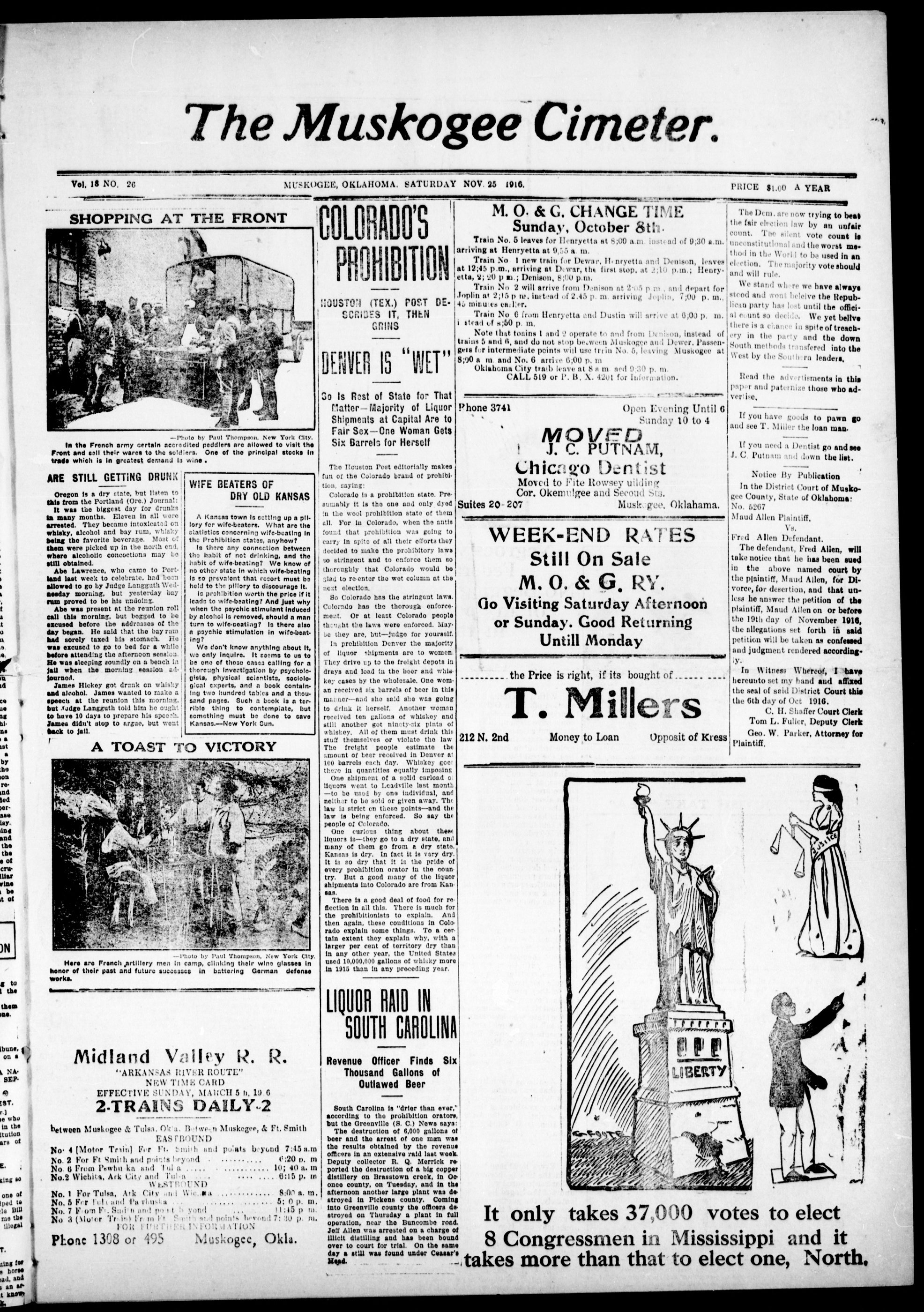
SHOPPING AT THE FRONT
—Photo by Paul Thompson, New York City.
In the French army certain accredited peddlers are allowed to visit the Front and sell their wares to the soldiers. One of the principal stocks in trade which is in greatest demand is wine.
A TOAST TO VICTORY
Here are French artillery men in camp, clinking their wine glasses in honor of their past and future successes in battering German defense works.
between Muskogee & Tulsa, Okla. Between Muskegee, & Ft. Smith
EASTBOUND
No. 4 [Motor Train] For Ft. Smith and points beyond 7:45 a.m.
No. 2 For Ft Smith and points beyond 6:20 p. m.
No. 6 From Pewbuka and Tulsa 10; 40 a. m.
No.2 Wichita, Ark City and Tulsa 6:15 p. m
WESTBOUND
Vol. 18 NO. 26
SHOPPING AT
In the French army certain acer
Front and sell their wares to the sof
trade which is in greatest demand
ARE STILL GETTING DRUNK
Oregon is a dry state, but listen to this from the Portland (Ore.) Journal: It was the biggest day for drunks in many months. Eleven in all were arrested. They became intoxicated on whisky, alcohol and bay rum, whisky being the favorite beverage. Most of them were picked up in the north end, where alcoholic concoctions may be still obtained.
Abe Lawrence, who came to Portland last week to celebrate, had been allowed to go by Judge Langguth Wednesday morning, but yesterday bay rum proved to be his undoing.
Abe was present at the reunion roll call this morning, but begged to be excused before the addresses of the day began. He said that the bay rum had sorely taxed his stomach. He was excused to go to bed for a while before attending the afternoon session. He was sleeping soundly on a bench in jail when the morning session adjourned.
James Hickey got drunk on whisky and alcohol. James wanted to make a speech at the reunion this morning, but Judge Langguth told him he ought to have 10 days to prepare his speech. James didn't stop to argue, but went back to jail.
A TOAST T
The Muskogee Cimeter.
MUSKOGEE, OKLAHOMA. SATURDAY NOV.25 1916.
WIFE BEATERS OF
DRY OLD KANSAS
A Kansas town is setting up a pillory for wife-beaters. What are the statistics concerning wife-beating in the Prohibition states, anyhow? Is there any connection between the habit of not drinking, and the habit of wife-beating? We know of no other state in which wife-beating is so prevalent that resort must be held to the pillory to discourage it. Is prohibition worth the price if it leads to wife-beating? And just why when the psychic stimulant induced by alcohol is removed, should a man turn to wife-beating? Is there also a psychic stimulation in wife-beating?
We don't know anything about it, we only inquire. It seems to us to be one of those cases calling for a thorough investigation by psychologists, physical scientists, sociological experts, and a book containing two hundred tables and a thousand pages. Such a book is a terrible thing to contemplate, but something must be done to save Kansas.—New York Sun.
Train No. 5 leaves for Henryetta at 8;00 a.m. instead of 9;30 a.m. arriving at Henryetta at 9,55 a.m.
Train No. 1 new train for Dewar, Henryetta and Denison, leaves at 12;45 p.m., arriving at Dewar, the first stop, at 2;10 p.m.; Henryetta, 2;20 p.m.; Denison, 8;00 p.m.
Train No. 2 will arrive from Denison at 2:05 p.m., and depart for Joplin at 2;15 p.m., instead of 2.45 p.m. arriving Joplin, 7:00 p.m., 45 minutes earlier.
Train No. 6 from Henryetta and Dustin will arrive at 6;00 p.m. istead of s;50 p.m.
Note that toins 1 and 2 operate to and from Denison, instead of trains 5 and 6, and do not stop between Muskogee and Dewer. Passengers for intermediate points will use ttrin No. 5, leaving Muskogee at 8;90 a.m. and No. 6 arrive 6;00 p.m.
the Price is right, if its bought of .....
It only takes 37,000 votes to elect 8 Congressmen in Mississippi and it takes more than that to elect one, North.
So Is Rest of State for That Matter—Majority of Liquor Shipments at Capital Are to Fair Sex—One Woman Gets Six Barrels for Herself
The Houston Post editorially makes fun of the Colorado brand of prohibition, saying:
Colorado is a prohibition state. Presumably it is the one and only dyed in the wool prohibition state of them all. For in Colorado, when the antis found that prohibition was going to carry in spite of all their efforts they decided to make the prohibitory laws so stringent and to enforce them so thoroughly that Colorado would be glad to re-enter the wet column at the next election.
So Colorado has the stringent laws. Colorado has the thorough enforcement. Or at least Colorado people thought the laws were enforced. Maybe they are, but—judge for yourself. In prohibition Denver the majority of liquor shipments are to women. They drive up to the freight depots in drays and load in the beer and whiskey cases by the wholesale. One woman received six barrels of beer in this manner—and she said she was going to drink it herself. Another woman received ten gallons of whiskey and still another got ninety-six pints of whiskey. All of them must drink this stuff themselves or violate the law. The freight people estimate the amount of beer received in Denver at 100 barrels each day. Whiskey goes there in quantities equally imposing
212 N. 2nd
One shipment of a solid carload of liquors went to Leadville last month—to be used by one individual, and neither to be sold or given away. The law is strict on these points—and the law is being enforced. So say the people of Colorado.
One curious thing about these liquors is—they go to a dry state, and many of them go from a dry state. Kansas is dry. In fact it is very dry. It is so dry that it is the pride of every prohibition orator in the country. But a good many of the liquor shipments into Colorado are from Kansas.
There is a good deal of food for reflection in all this. There is much for the prohibitionists to explain. And then again, these conditions in Colorado explain some things. To a certain extent they explain why, with a larger per cent of territory dry than in any other year, the United States used 10,000,000 gallons of whisky more in 1915 than in any preceding year.
LIQUOR RAID IN SOUTH CAROLINA
South Carolina is "drier than ever," according to the prohibition orators, but the Greenville (S. C.) News says: The destruction of 6,000 gallons of beer and the arrest of one man was the results obtained by the revenue officers in an extensive raid last week. Deputy collector R. Q. Merrick reported the destruction of a big copper distillery on Brasstown creek, in Ooonee county, on Tuesday, and in the afternoon another large plant was destroyed in Pickens county. Coming into Greenville county the officers destroyed on Thursday a plant in full operation, near the Buncombe road. Jeff Allen was arrested on a charge of illicit distilling and has been bound over to court for trial. On the same day a still was found under Ceasar's Head.
M. O. & G. CHANGE TIME Sunday, October 8th.
Oklahoma City trab leave at 8 a.m. and 9:30 p. m.
CALL 519 or P. B. X. 4201 for Information.
LIBERTY
Money to Loan
Open Evening Until 6 Sunday 10 to 4
PRICE $1.00 A YEAR
The Dem. are now trying to beat the fair election law by an unfair count. The silent vote count is unconstitutional and the worst method in the World to be used in an election. The majority vote should and will rule.
We stand where we have always stood and wont believe the Republican party has lost until the official count so decide. We yet belive there is a chance in spite of treachery in the party and the down South methods transferred into the West by the Southern leaders.
Read the advertisements in this paper and paternize those who advertise.
If you have goods to pawn go and see T. Miller the loan man.
If you need a Dentist go and see J. C. Putnam and down the list.
Notice By Publication
In the District Court of Muskogee County, State of Oklahoma:
No. 5267
Maud Allen Plaintiff.
Vs.
Fred Allen Defendant.
The defendant, Fred Allen, will take notice that he has been sued in the above named court by the plaintiff, Maud Allen, for Divorce, for desertion, and that unless he answer the petition of the plaintiff, Maud Allen on or before the 19th day of November 1916, the allegations set forth in said petition will be taken as confessed and judgment rendered accordingly.
In Witness Whereof, I have hereunto set my hand and affixed the seal of said District Court this the 6th day of Oct. 1916.
C. H. Shaffer Court Clerk
Tom L. Fuller, Deputy Clerk
Geo. W. Parker, Attorney for Plaintiff.
HOW PROHIBITION FAILS TO PROHIBIT IN IDAHO
Special Correspondent of Los Angeles Times Says Pocatello, In That State. With 16,000 People, Has More Drunkards Than "Wet" Salt Lake City, Population 125,000
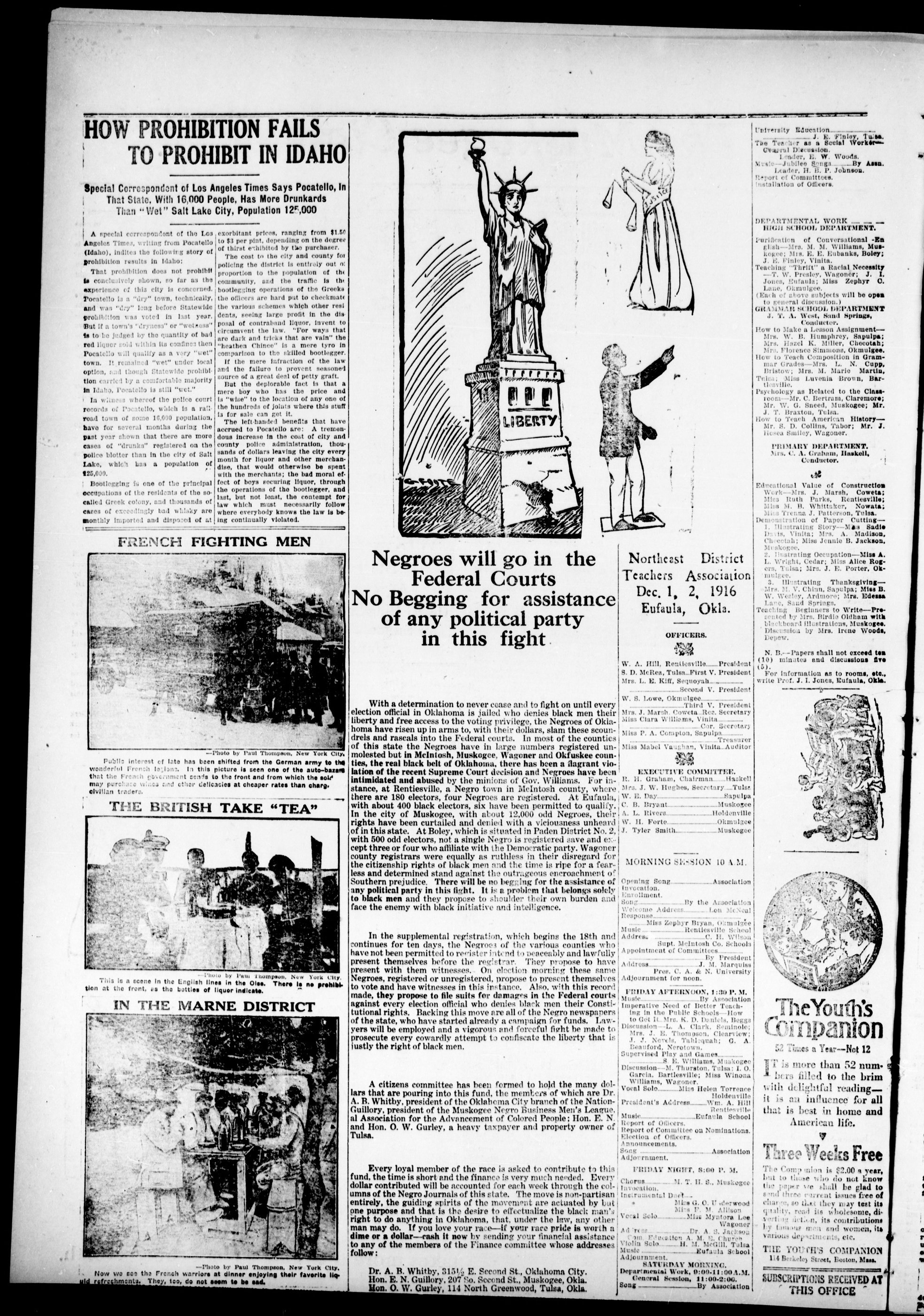
FRENCH FIGHTING MEN
北岳小站
Public interest of late has been shifted from the German army to the wonderful French legions. In this picture is seen one of the auto-bazars that the French government sends to the front and from which the soldier may purchase whites and other delicacies at cheaper rates than charg- civilian traders.
Photo by Paul Thompson, New York City.
This is a scene in the English lines in the Olse. There is no prohibition at the front, as the bottles of liquor indicate.
This is a scene in the English lines in the Olea. There is no prohibition at the front, as the bottles of liquor indicate.
IN THE MARNE DISTRICT
A
Photo by Paul Thompson, New York City. Now we see the French warriors at dinner enjoying their favorite liquid refreshments. They, too, do not seem to be sad.
A special correspondent of the Los Angeles Times, writing from Pocatello (Idaho), indicates the following story of prohibition results in Idaho:
That prohibition does not prohibit is conclusively shown, so far as the experience of this city is concerned. Pocatello is a "dry" town, technically, and was "dry" long before Statewide prohibition was voted in last year. But if a town's "dryness" or "wetness" is to be judged by the quantity of bad red liquor sold within its confines then Pocatello will qualify as a very "wet" town. It remained "wet" under local option, and though Statewide prohibition carried by a comfortable majority in Idaho, Pocatello is still "wet."
In witness whereof the police court records of Pocatello, which is a railroad town of some 16,000 population, have for several months during the past year shown that there are more cases of "drunks" registered on the police blotter than in the city of Salt Lake, which has a population of 125,000. Bootlegging is one of the principal occupations of the residents of the so-called Greek colony, and thousands of cases of exceedingly bad whisky are monthly imported and disposed of at
exorbitant prices, ranging from $1.50 to $3 per pint, depending on the degree of thirst exhibited by the purchaser. The cost to the city and county for policing the district is entirely out of proportion to the population of the community, and the traffic is the bootlegging operations of the Greeks the officers are hard put to checkmate the various schemes which other residents, seeing large profit in the disposal of contraband liquor, invent to circumvent the law. "For ways that are dark and tricks that are vain" the "heathen Chinece" is a mere tyro in comparison to the skilled bootleger. If the mere infraction of the law and the failure to prevent seasoned source of a great deal of petty graft.
But the deplorable fact is that a mere boy who has the price and is "wise" to the location of any one of the hundreds of joints where this stuff is for sale can get it.
The left-handed benefits that have accrued to Pocatello are: A tremendous increase in the cost of city and county police administration, thousands of dollars leaving the city every month for liquor and other merchandise, that would otherwise be spent with the merchants; the bad moral effect of boys securing liquor, through the operations of the bootlegger, and last, but not least, the contempt for law which must necessarily follow where everybody knows the law is being continually violated.
Negroes will go in the Federal Courts No Begging for assistance of any political party in this fight
With a determination to never cease and to fight on until every election official in Oklahoma is jailed who denies black men their liberty and free access to the voting privilege, the Negroes of Oklahoma have risen up in arms to, with their dollars, slam these scoundrels and rascals into the Federal courts. In most of the counties of this state the Negroes have in large numbers registered unmolested but in McIntosh, Muskogee, Wagoner and Okfuskee counties, the real black belt of Oklahoma, there has been a flagrant violation of the recent Supreme Court decision and Negroes have been intimidated and abused by the minions of Gov. Williams. For instance, at Rentiesville, a Negro town in McIntosh county, where there are 180 electors, four Negroes are registered. At Eufaula, with about 400 black electors, six have been permitted to qualify. In the city of Muskogee, with about 12,000 odd Negroes, their rights have been curtailed and denied with a viciousness unheard of in this state. At Boley, which is situated in Paden District No. 2, with 500 odd electors, not a single Negro is registered save and except three or four who affiliate with the Democratic party. Wagoner county registrars were equally as ruthless in their disregard for the citizenship rights of black men and the time is ripe for a fearless and determined stand against the outrageous encroachment of Southern prejudice. There will be no begging for the assistance of any political party in this fight. It is a problem that belongs solely to black men and they propose to shoulder their own burden and face the enemy with black initiative and intelligence.
In the supplemental registration, which begins the 18th and continues for ten days, the Negroes of the various counties who have not been permitted to register intend to peaceably and lawfully present themselves before the registrar. They propose to have present with them witnesses. On election morning these same Negroes, registered or unregistered, propose to present themselves to vote and have witnesses in this instance. Also, with this record made, they propose to file suits for damages in the Federal courts against every election official who denies black men their Constitutional rights. Backing this move are all of the Negro newspapers of the state, who have started already a campaign for funds. Lawyers will be employed and a vigorous and forceful fight be made to prosecute every cowardly attempt to confiscate the liberty that is justly the right of black men.
A citizens committee has been formed to hold the many dollars that are pouring into this fund, the members of which are Dr. A.B. Whitby, president of the Oklahoma City branch of the Nation-Guillory, president of the Muskogee Negro Business Men's League, al Association for the Advancement of Colored People; Hon. E. N. and Hon. O. W. Gurley, a heavy taxpayer and property owner of Tulsa.
Every loyal member of the race is asked to contribute to this fund, the time is short and the finance is very much needed. Every dollar contributed will be accounted for each week through the columns of the Negro Journals of this state. The move is non-partisan entirely, the guiding spirits of the movement are actuated by but one purpose and that is the desire to effectualize the black man's right to do anything in Oklahoma, that, under the law, any other man may do. If you love your race—if your race pride is worth a dime or a dollar—cash it now by sending your financial assistance to any of the members of the Finance committee whose addresses follow:
Dr. A. B. Whitby, 3151½ E. Second St., Oklahoma City.
Hon. E. N. Guillory, 207 So. Second St., Muskogee, Okla.
Hon. O. W. Gurley, 114 North Greenwood, Tulsa, Okla.
LIBERTY
Northeast District Teachers Association Dec.1, 2, 1916 Eufaula, Okla.
OFFICERS.
W. A. Hill, Rendiesville President
S. D. McRea, Tulsa First V. President
Mrs. L. E. Kiff, Sequoyah
..... Second V. President
W. S. Wole, Okmulgee
..... Third V. President
Mrs. J. Marsh, Coweta Rec. Secretary
Miss Clara Williams, Vinita
..... Cor. Secretary
Miss P. A. Compton, Sapulpa
..... Treasurer
Miss Mabel Vaughan, Vinita Auditor
EXECUTIVE COMMITTEE.
R. H. Graham, Chairman Haskell
Mrs. J. W. Hughes, Secretary Tulsz
W. E. Day ..... Sapulpa
C. B. Bryant ..... Muskogee
A. L. Rivers ..... Holdenville
W. H. Forte ..... Okmulgee
J. Tyler Smith ..... Muskogee
MORNING SESSION 10 A.M.
Opening Song.....Association
Invocation.
Enrollment.
Song.....By the Association
Welcome Address.....Lou McNeil
Response
.....Miss Zephyr Bryan, Ormulgale
Music.....Rentiesville School
Address.....C. H. Wilson
Supt. Mcintosh Co. Schools
Appointment of Committees
.....By President
Address.....J. M. Marquell
Pres. C. A. & N. University
Adjournment for noon.
FRIDAY AFTERNOON, 1:30 P. M.
Music.....By Association
Imperative Need of Better Teaching in the Public Schools—How to Get H. Mrs. K. D. Daniels, Boggs
Discussion—L. A. Clark, Seminole;
Mrs. J. E. Thompson, Clearview;
J. J. Newls, Tablequah; G. A.
Beauford, Nerotown.
S. E. Williams, Muskogee
Discussion... M. Thurston, Tulsa; I. O.
Garcia, Bartlesville; Miss Winona
Williams, Wagoner.
Vocal Solo..... Miss Helen Torrence
Holdenville
President's Address..... Wm. A. Hill
Rentiesville
Music..... Eufaula School
Report of Officers.
Report of Committee on Nominations.
Election of Officers.
Announcements.
Song..... Association
Adjournment.
PRIDAY NIGHT, 8:00 P. M.
Chorus..... M. T. H. S., Muskogee
Invocation.
Instrumental Desk
Instrumental Duet
* Miss G. O. Underwood
* Miss P. M. Allison
Vocal Solo ..... Miss Myntora Lee
Wagoner
Address ..... Dr. A. S. Jackson
Com. Education A. M. B. Church
Violin Solo ..... H. M. McGill, Tulsa
Music ..... Eufaula School
Adjournment.
SATURDAY MORNING.
Departmental Work, 9:00-11:00 A.M.
General Session, 11:00-2:00
Song ..... By Association
University Education
J. E. Finley, Tuva
The Teacher as a Social Worker
General Discussion
Woods, W. Woods
Music-Jubilee Songs By Assn.
Leader, H. B. P. Johnson
Report of Committees
Installation of Officers.
DEPARTMENTAL WORK
HIGH SCHOOL DEPARTMENT.
Purification of Conversational-En-
glish—Mrs. M. M. Williams, Musk-
koce; Mrs. E. E. Eubanks, Boley;
J. E. Finley, Vinita.
Teaching "Thrift" a Racial Necessity
—T. W. Presley, Wagoner; J. I.
Jones, Eufaula; Miss Zephyr O.
Lane, Ulmugle.
(Each of above subjects will be open to general discussion.)
GRAMMAR SCHOOL DEPARTMENT
J. T. A. West, Sand Springs,
Conductor.
How to Make a Lesson Assignment—
Mrs. W. B. Humphrey, Sapulpa;
Mrs. Hazel K. Miller, Cecotah;
Mrs. Florence Simmons, Okmulgue.
How to Teach Composition in Gram-
mar Grades—Mrs. L. N. Cupp,
Bristow; Mrs. M. Marie Martin,
Tulsa; Miss Luvenia Brown, Bard-
tville.
Psychology as Related to the Class-
room—Mr. C. Bertram, Claremore;
Mr. W. G. Sneed, Muskogee; Mr.
J. T. Braxton, Tulsa.
How to Teach American History—
Mr. S. D. Collins, Tabor; Mr. J.
Rosea Smiley, Wagoner.
PRIMARY DEPARTMENT.
Mrs. C. A. Graham, Haskell,
Conductor.
#
Educational Value of Construction
Work—Mrs. J. Marsh, Coweta;
Miss Rita Parks, Rentiesville;
Miss M. B. Whittaker, Nowata;
Miss Trenna J. Patterson, Tulsa.
Demonstration of Paper Cutting—
1. Illustrating Story—Mrs. Saddle
Davis, Vinita; Mrs. A. Madison,
Chocetah; Miss Jennie B. Jackson,
Muskogee.
2. Illustrating Occupation—Miss A. L. Wright, Cedar; Miss Alice Rogers, Tulsa; Mrs. J. E. Porter, Oknulgee.
3. Illustrating Thanksgiving—Mrs. M. V. Chiu, Sapulpa; Miss B. W. Wesley, Ardmore; Mrs. Edessa Lane, Sand Springs.
Teaching Beginners to Write—Presented by Mrs. Birdie Oldham with blackboard illustrations, Muskogee.
Discussion by Mrs. Irene Woods, Depew.
N. B.—Papers shall not exceed ten
(10) minutes and discussions five
(5).
For information as to rooms, etc., write Prof. J. I. Jones, Eufaula, Okla.
THE WORLD'S LARGEST MUSEUM
TheYouth's Companion
52 Times a Year-Not 12 IT is more than 52 numbers filled to the brim with delightful reading it is an influence for all that is best in home and American life.
Three Weeks Free
The Companion is $2.00 a year, but to those who do not know the paper we shall be glad to send three current issues free of charge, so that they may test its quality, read its wholesome, diverting action, its contributions by famous men and women, its various departments, etc.
THE YOUNG'S COMPANION
114 Berkeley Street, Boston, Mass.
SUBSCRIPTIONS RECEIVED AT
THIS OFFICE
AUTO SALOONS IN COLORADO
CAFES ON WHEELS DO BIG BUSINESS THROUGHOUT "DRY" STATE
Owners Do Not Pay Licenses,
According to Deputy District
Attorney—Sell "Rotten Whiskey" at Fancy Prices—Authorities Are Powerless To
Prevent Law Violations
The Denver Post tells, in the following fashion, of the difficulty Colorado is having in enforcing her prohibition law:
From one end of Colorado to the other there are more than a thousand saloons, each doing a lively business, not only every week, but on Sunday also. They pay no license, either government, state or city, and every cent they charge over the cost of the rotten whisky they sell is clear profit, according to Robert H. Kane, deputy district attorney, who is designated by District Attorney Rush to try liquor cases in the county court.
1,000 Saloons on Wheels.
According to Kane, these saloons are automobiles, but saloons, nevertheless. "They are operating in all parts of the state," said Kane. "In most counties the authorities are doing all they can to suppress the business, but are not able to do so. These automobiles bring booze from Wyoming, Nebraska, New Mexico and Utah, whichever state happens to be the nearest. Some of them operate as common carriers and make a pretense of obeying the prohibition law, but none of them that I have heard of do obey the law.
"It is only a pretense. They take orders from their customers, then cross the border, buy the liquor and return with it and deliver it to their patrons, charging a large profit on each package. The charge is ostensibly a charge for hauling.
"The customer will order, say two quarts of whisky. The saloon on wheels will take that order and many others and go to Cheyenne, for instance, buy the two quarts of whisky for $3, bring it to Denver, where the customer lives, and charge him $4 for it, making a profit of $1 on the deal.
If officers attempt to arrest the owner of the saloon on wheels he will say that he charged the $1 for hauling the liquor to Denver.
Violate the Law.
"The law which requires that an affidavit shall be sworn to by each purchaser of liquor which is imported into this state that the stuff is for his own personal use is constantly violated by these automobile saloons. Also the tax of 25 cents on each package of whisky imported into the state is seldom paid.
"The profits from this business are enormous. One wholesale bootlegger whom I tried and convicted in the county court paid a fine of $250 and costs. In addition he paid his lawyer $150, making a total of $300. He boasted afterward that he had made $10,500 by supplying small bootleggers with whisky. He has quit the business, as far as I know. A second conviction would mean a penitentiary sentence for him, but he made more money bootlegging in a few months than he could in a year with a legitimate saloon in a wet state."
THE FUNNY SIDE OF PROHIBITION
JUST SO, JUST SO.
[Luke McLuke, Cincinnati Enquirer.]
The maddest man we ever met was
a Reformer who once found himself
the target of Reform.
WOULD GET A NICE OBITUARY.
[Mason Telegraph.]
If Mr. Bryan can't break into the
first page any other way he might
think over the proposition of hunting
for a leak in the gas pipe with a match.
[Minneapolis Labor Review.]
The Mayor of Lowistown, Maine,
ordered the saloons closed during a
recent street car strike. We were
under the impression they were all
closed sixty years ago when the state
went "dry."
HE CAN PROVE AN ALIBI.
[St. Louis Globe Democrat.]
Whether Woodrow is re-elected or
defeated they can't blame much on
Bryan.
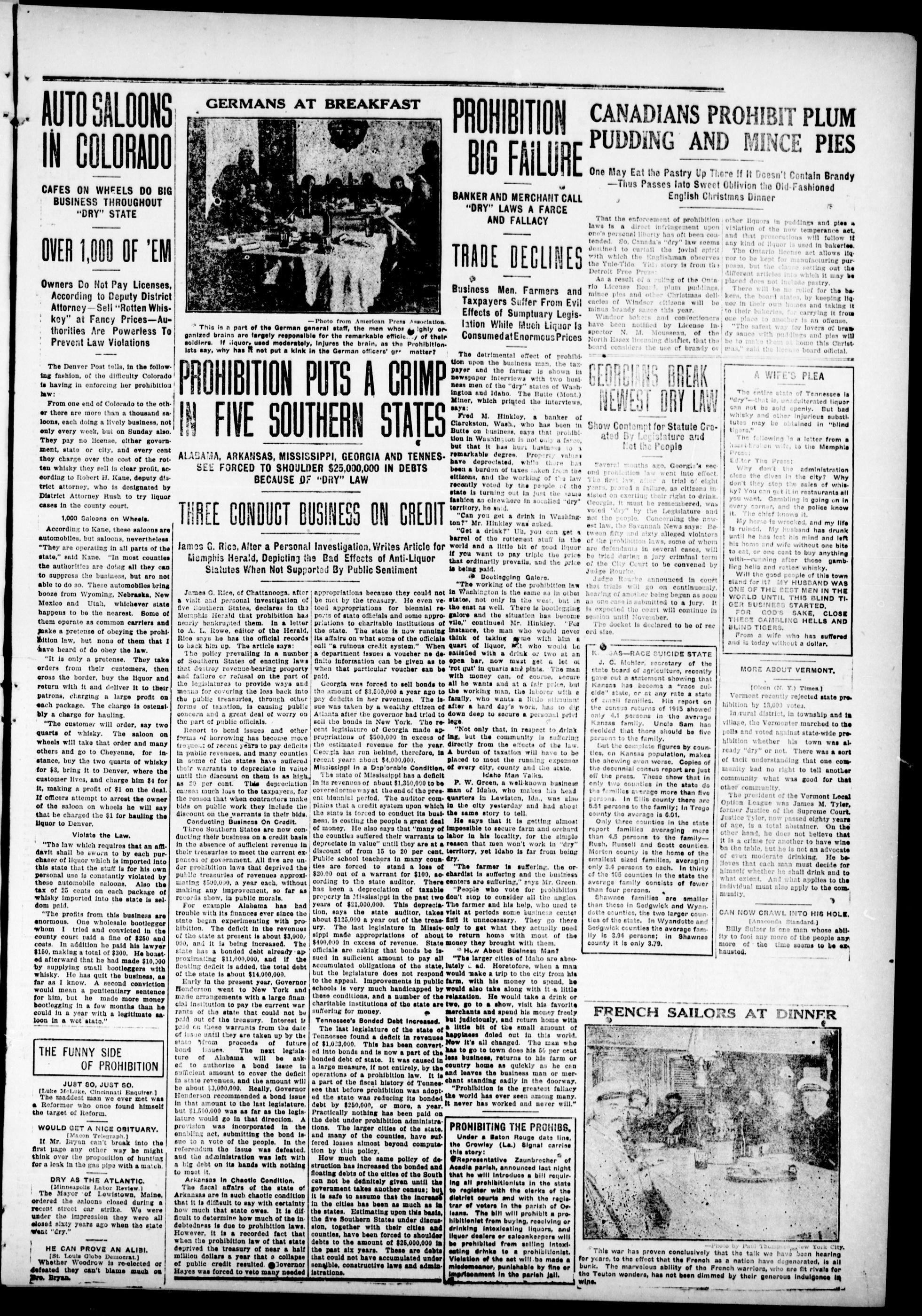
THE SEWING MACHINE
This is a part of the German general staff, the men who highly organized brains are largely responsible for the remarkable efficiency of their soldiers. If liquor, used moderately, injures the brain, as the Prohibitionists say, why has it not put a kink in the German officers' grim matter?
PROHIBITION PUTS A CRIMP IN FIVE SOUTHERN STATES
ALADAMA, ARKANSAS, MISSISSIPPI, GEORGIA AND TENNESSEE FORCED TO SHOULDER $25,000,000 IN DEBTS BECAUSE OF "DRY" LAW
THREE CONDUCT BUSINESS ON CREDIT
James G. Rice, After a Personal Investigation, Writes Article for Memphis Herald, Depicting the Bad Effects of Anti-Liquor Statutes When Not Supported By Public Sentiment
James G. Rice, of Chattanooga, after a visit and personal investigation of five Southern States, declares in the Memphis Herald that prohibition has nearly bankrupted them. In a letter to A. L. Rowe, editor of the Herald, Rice says he has the official records to back him up. The article says:
The policy prevailing in a number of Southern States of enacting laws that destroy revenue-bearing property and failure or refusal on the part of the legislatures to provide ways and means for covering the loss back into the public treasuries, through other forms of taxation, is causing public concern and a great deal of worry on the part of public officials.
appropriations because they could not be met by the treasury. He even vetoed appropriations for biennial reports of state officials and some appropriations to charitable institutions of the state. The state is now running its affairs on what some of the officials call "a ruinous credit system." When a department issues a voucher as definite information can be given to when that particular voucher can be paid.
Georgia was forced to sell bonds to the amount of $3,500,000 a year ago to pay deficits in her revenues. The issue was taken by a wealthy citizen of Atlanta after the governor had tried to sell the bonds in New York. The re-
Resort to bond issues and other forms of borrowing has become more frequent of recent years to pay deficits in public revenues, and many counties in some of the states have suffered their warrants to depreciate in value until the discount on them is as high as 20 per cent. This depreciation causes much loss to the taxpayers, for the reason that when contractors make bids on public work they include the discount on the warrants in their bids. Conducting Business On Credit. Three Southern States are now conducting their business on a credit basis in the absence of sufficient revenue in their treasuries to meet the current expenses of government. All five are under prohibition laws that deprived the public treasuries of revenues approximating $500,000, a year each, without making any improvement, so far as records show, in public morals.
For example Alabama has had trouble with its finances ever since the state began experimenting with prohibition. The deficit in the revenues of the state at present is about $3,000,000, and it is being increased. The state has a bonded debt already approximating $11,000,000, and if the floating deficit is added, the total debt of the state is about $14,000,000.
Early in the present year, Governor Henderson went to New York and made arrangements with a large financial institution to pay the current warrants of the state that could not be paid out of the treasury. Interest is paid on these warrants from the date of issue until they are taken up by the state from proceeds of future bond issues. The next legislature of Alabama will be asked to authorize a bond issue in sufficient amount to cover the deficit in state revenues, and the amount will be about $3,000,000. Really, Governor Henderson recommended a bond issue in that amount to the last legislature, but $1,500,000 was as far as the legislature would go in that direction. A provision was incorporated in the enabling act, submitting the bond issue to a vote of the people. In the referendum the issue was defeated, and the administration was left with a big debt on its hands with nothing to meet it.
Arkansas in Chaotic Condition.
The facial affairs of the state of Arkansas are in such chaotic condition that it is difficult to say with certainty how much that state owes. It is difficult to determine how much of the indebtedness is due to prohibition laws. However, it is a recorded fact that when the prohibition law of that state deprived the treasury of near a half million dollars a year that a collapse of public credit resulted. Governor Hayes was forced to veto many needed
appropriations because they could not be met by the treasury. He even vetoed appropriations for biennial reports of state officials and some appropriations to charitable institutions of the state. The state is now running its affairs on what some of the officials call "a ruinous credit system." When a department issues a voucher ne definite information can be given as to when that particular voucher can be paid.
Georgia was forced to sell bonds to the amount of $3,500,000 a year ago to pay deficits in her revenues. The issue was taken by a wealthy citizen of Atlanta after the governor had tried to sell the bonds in New York. The recent legislature of Georgia made appropriations of $500,000 in excess of the estimated revenue for the year. Georgia has run behind, therefore, in recent years about $4,000,000.
Mississippi in a Disposable Condition. The state of Mississippi has a deficit in its revenues of about $1,350,000 to be covered someway at the end of the present biennial period. The auditor complains that a credit system upon which the state is forced to conduct its business, is costing the people a great deal of money. He also says that "many of the counties suffered their warrants to depreciate in value" until they are at a discount of from 15 to 20 per cent. Public school teachers in many counties are forced to stand a loss of $20,00 out of a warrant for $100, according to the state auditor. There has been a depreciation of taxable property in Mississippi in the past two years of $21,000,000. This depreciation, says the state auditor, takes about $125,000 a year out of the treasury. The last legislature in Mississippi made appropriations of about $400,000 in excess of revenue. State officials are asking that bonds be issued in sufficient amount to pay all accumulated obligations of the state, but the legislature does not respond to the appeal. Improvements in public schools is very much handicapped by these conditions, and a number of the charitable institutions of the state are suffering for money.
Tennessee's Bonded Debt increased. The last legislature of the state of Tennessee found a deficit in revenues of $1,023,000. This has been converted into bonds and is now a part of the bonded debt of state. It was caused in a large measure, if not entirely, by the operations of a prohibition law. It is a part of the fiscal history of Tennessee that before prohibition was adopted the state was reducing its bonded debt by $250,000, or more, a year. Practically nothing has been paid on the debt under prohibition administrations. The larger cities of the state, and many of the counties, have suffered losses almost beyond computation by this policy.
How much the same policy of destruction has increased the bonded and floating debts of the cities of the South can not be definitely given until the government takes another census; but it is safe to assume that the increase in the cities has been as much as in the states. Estimating upon this basis, the five Southern States under discussion, together with their cities and counties, have been forced to shoulder debts to the amount of $25,000,000 in the past six years. These are debts that could not have accumulated under sensible, constructive laws and administrations.
PROHIBITION BIG FAILURE
BANKER AND MERCHANT CALL "DRY" LAWS A FARCE AND FALLACY
TRADE DECLINES
Business Men. Farmers and Taxpayers Suffer From Evil Effects of Sumptuary Legislation While Much Liquor Is Consumed at Enormous Prices
The detrimental effect of prohibition upon the business man, the taxpayer and the farmer is shown in newspaper interviews with two business men of the "dry" states of Washington and Idaho. The Butte (Mont.) Miner, which printed the interviews, says:
Fred M. Hinkley, a banker of Clarckston, Wash., who has been in Butte on business, says that prohibition in Washington is not only a foe, but that it has hurt business to a remarkable degrees. Property values have depreciated, while there has been a burden of taxes taken from the citizens, and the working of the law recently voted by the people of the state is turning out in just the same fashion as elsewhere in socialled "dry" territory, he said.
"Can you get a drink in Washington?" Mr. Hinkley was asked.
"Get a drink?" Un, you can get a barrel of the rottenest stuff in the world and a little bit of good liquor if you want to pay triple the price that ordinarily prevails, and the price is being paid.
Bootlegging Galore.
"The working of the prohibition law in Washington is the same as in other states, not only in the west, but in the east as well. There is bootlegging galore and the situation has become vile," continued Mr. Hinkley. "For instance, the man who would never think of taking some with him a quart of liquor, not who would be satisfied with a drink or two at an open bar, now must get a let on 'rot gut' in quarts and plats. The man with money can, of course, secure all he wants and at a fair price, but the working man, the laborer with a family, who wants a little stimulant after a hard day's work, has to dip down deep to secure a personal privilege.
"Not only that, in respect to Drink ing, but the community is suffering directly from the effects of the law. A burden of taxation will have to be placed to meet the running expenses of every city, county and the state. Idaho Man Talks. P. W. Green, a well-known business man of Idaho, who makes his head quarters in Lowiston, Ida., was also in the city yesterday and had about the same story to tell. He says that it is getting almost impossible to secure farm and orchard labor in his locality, for the simple reason that men won't work in "dry" territory, yet Idaho is far from being dry.
"The farmer is suffering, the orchardist is suffering and the business centers are suffering," says Mr. Green. "People who vote for prohibition don't stop to consider all the angels. The farmer and his help, who used to visit at periods some business center and find it unnecessary. They go there only to get what they actually need to return home with most of the money they brought with them.
"The larger cities of Idaho are absolutely ad. Horetofore, when a man would make a trip to the city from his farm, with his money to spend, he would also take along with it a little relaxation. He would take a drink or two, go to a show, visit his favorite merchants and spend his money freely but judiciously, and return home with a little bit of the small amount of happiness doled out in this world. Now it's all changed. The man who has to go to town does his 50 per cent less business, returns to his farm or country home as quickly as he can and leaves the business man or merchant standing sadly in the doorway.
"Prohibition is the greatest fallacy the world has ever seen among many. It never has worked and never will."
PROHIBITING THE PROHIBIT
Under a Baton Rouge date line,
the Crowley (La.) Signal carriose
this story:
Representative Zaunbrocher of Acadia parish, announced last night that he will introduce a bill requiring all prohibitionists in the state to register with the clerks of the district courts and with the registrar of voters in the parish of Orleans. The bill will prohibit a prohibitionist from buying, receiving or drinking intoxicating liquors, and liquor dealers or saloonkeepers will be prohibited from selling intoxicating drinks to a prohibitionist. Violation of the act will be made a misdemeanor, punishable by fine or imprisonment in the parish jail.
CANADIANS PROHIBIT PLUM PUDDING AND MINCE PIES
One May Eat the Pastry Up There If It Doesn't Contain Brandy
Thus Passes Into Sweet Oblivion the Old-Fashioned
English Christmas Dinner
FRENCH SAILORS AT DINNER
This war has proven conclusively that the talk we have been hearing for years, to the effect that the Frenoh as a nation have degenerated, is all bunk. The marvelous ability of the French warriors, who are fit rivals for the Teuton wonders, has not been dimmed by their generous indulgence in wine.
That the enforcement of prohibition laws is a direct infringement upon one's personal liberty has oft been contended. So, Canada's "dry" law seems destined to curtail the jovial spirit with which the Englishman observes the Yule-Tide. This story is from the Detroit Free Press:
As a result of a pulling of the Ontario License Board, plum puddings, mince plos and other Christmas delicacies of Windsor citizens will be minus brandy sauce this year.
Windsor bakers and confectioners have notified by License Inspector N. M. Mousseau, of the North Essex licensing district, that the board considers the use of brandy or
Show Contempt for Statute Created By Legislature and Not the People
Several months ago, Georgia's second prohibition law went into effect. The first law, after a trial of eight years, proved a failure, as citizens insisted on exerting their right to drink. Georgia, it must be remembered, was voted "dry" by the Legislature and not the people. Concerning the newest law, the Savannah News says: Between fifty and sixty alleged violators of the prohibition laws, some of whom are defendants in several cases, will be tried during a jury criminal term of the City Court to be convened by Judge Rourke.
Judge Rousseau announced in court that trials will go on continuously, hearing of another being begun as soon as one case is submitted to a jury. It is expected the court will continue in session until November. The docket is declared to be of record size.
K. GAS—RACE SUICIDE STATE
J. C. Mohler, secretary of the state board of agriculture, recently gave out a statement showing that Kansas has become a "race suicide" state, or at any rate a state of small families. His report on the census returns of 1915 showed only 4.1 persons in the average Kansas family. Uncle Sam has decided that there should be five persons to the family.
But the complete figures by counties, on Kansas population, makes the showing even worse. Copies of the decennial census report are just off the press. These show that in only two counties in the state do the families average more than five persons. In Ellis county there are 5.51 persons to the family; In Trego county the average is 6.01. Only three counties in the state report families averaging more than 4.5 persons to the family—Rush, Russell and Scott counties. Morton county is the home of the smallest sized families, averaging only 3.4 persons to each. In thirty of the 105 counties in the state the average family consists of fewer than four persons.
Shawnee families are smaller than those in Sedgwick and Wyandotte counties, the two larger counties of the state. In Wyandotte and Sedgwick counties the average family is 3.94 persons; in Shawnee county it is only 3.79.
other liquors in puddings and pies a violation of the new temperance act, and that prosecutions will follow if any kind of liquor is used in bakeries. The Ontario license act allows liquor to be kept for manufacturing purposes, but the clause setting out the different articles into which it may be placed does not include pastry. There will be no relief for the bakers, the board states, by keeping liquor in their own homes and taking it to their bakeries, for carrying it from one place to another is an offense. "The safest way for lovers of brandy sauce with puddings and pies will be to make them at home this Christmas," said the license board official.
A WIFE'S PLEA
The entire state of Tennessee is "dry"-that is, unadulterated liquor can not be sold openly. But bad whisky and other injurious substitutes may be obtained in "blind tigars."
The following is a letter from a housebroken wife, to the Memphis Press:
Editor The Press:
Why don't the administration close the dives in the city? Why don't they stop the sales of whisky? You can get it in restaurants all you want. Gambling is going on in every corner, and the police know it. The chief knows it.
My home is wrecked, and my life is ruined. My husband has drunk until he has lost his mind and left his home and wife without one bite to eat, or one cent to buy anything with—running after those gambling hells and rotten whisky.
Will the good people of this town stand for it? MY HUSBAND WAS ONE OF THE BEST MEN IN THE WORLD UNTIL THIS BLIND TIGER BUSINESS STARTED.
FOR GOD'S SAKE, CLOSE THESE CAMBLING HELLS AND BLIND TIGERS.
From a wife who has suffered and is today without a dollar.
MORE ABOUT VERMONT
[Olson (N. Y.) Times.]
Vermont recently rejected state prohibition by 13,000 votes.
In rural district, in township and in village, the Vermonter marched to the polls and voted against state-wide prohibition whether his town was already "dry" or not. There was a sort of tacit understanding that one community had no right to tell another community what was good for that other community.
The president of the Vermont Local Option League was James M. Tyler, former Justice of the Supreme Court, Justice Tyler, now passed eighty years of age, is a total abstainer. On the other hand, he does not believe that it is a crime for another to have wine on the table, but he is not an advocate of even moderate drinking. He believes that each man must decide for himself whether he shall drink and to what extent. And what applies to the individual must also apply to the community.
CAN NOW CRAWL INTO HIS HOLE.
[Anaconda Standard.]
[Amaconda Standard.]
Billy Sulzer is one man whose ability to fool any more of the people any more of the time seems to be exhausted.
The Cimeter is the only Republican paper in the City of Muskegee. The daily Phoenix is sometimes Republican and sometimes independent but at the present time it claims to be independent, such a changing is not worth three wheeps in h—1 to any political party and yet Bixby, its editor, got rich at the Republican pie counter. What base ingratitude.
POLICE FACE NEW PROBLEM
"STRAIGHT" ALCOHOL BE-COMES FAVORITE BEVERAGE IN "DRY" STATE
SNUFF IS USED
By Mixing It With Cider. Many Find the Desired "Kick"—Police Testify That Ether Also Makes a Very "Successful" Ingredient
The following story from the Dellingham (Wash.) American Reville indicates that residents of that city, which is "dry" under state-wide prohibition, have contracted the dangerous habit of drinking "straight" alcohol in lieu of liquor:
Hard elder, which a few months ago was given as the cause for nine of every ten cases of drunkenness that came into police court, is no longer named by those who imbibe too freely as the "beverage" that they carry to the police station. Police Judge Beach says that the blame now has shifted to straight alcohol and Canadian whisky. The alcohol question is a hard one to deal with, the police assert, because of the loophole in the prohibition law which permits its purchase and sale provided the buyer simply says he needs it for mechanical purposes. Many of the men brought to police headquarters, when searched, are found to have a bottle of alcohol on their person, say the police.
The officers claim that some of the old offenders simply mix warm water with the alcohol, while others make a "better" drink by mixing it with sugar, water and lemon juice. Other cities in the state are confronted also with the alcohol problems, and it is said that Seattle is considering an ordinance which will make it necessary for all those who wish to purchase alcohol to first secure a permit from the chief of police, who will investigate the case before issuing the permit. There is a strong possibility, the police assert, that such an ordinance will be drafted here.
New Drinks Concocted.
Some very uncommon cases have come to the attention of the police since the statewide prohibition law be-come effective. The habitual drunkards were found hard to deal with. Many of them, the police say, resorted to unheard of methods in order to reach a state of intoxication. One man was found putting ether into hard cider. Several others mixed snuff with cider, hoping that this mixture would give the desired effect. The police say that from their observations, they found that this proved to be a successful experiment. However, the hard cider question is causing but little trouble at present in comparison with the number who depart from the "straight and narrow" by the alcoholic route.
KANSAS PAPER CONFESSES
If Kansas is "dry," why does the Anti-Saloon League expend so much effort in fighting the "wet" element in that state? Read this confession of the Atchison (Kan.) Globe: It is difficult to understand prohibitionists. When they organize a campaign they tackle Kansas, first jump out of the box. The Flying Squadron devoted as much time to Atchison as to Kansas City, which has so many saloons and liquor-employed Atchison has people. When the itinerary of the national Prohibition party's special train was made up this week, par-
Booker T. Washington's
COMPLETE LIFE IN BOOK FORM NOW READY
It is well illustrated, showing him leaving home, a ragged boy, tor Hampton Institute. A history from the cradle to the grave. This is the best book on Dr Washington. The publishers, Austin Jenkins Co., 9th Street, Washington, D. C., pay express and give the best life-size photograph to each subscriber. Anyone wishing an agency can get prospectus and photo attachments, too, too we are.
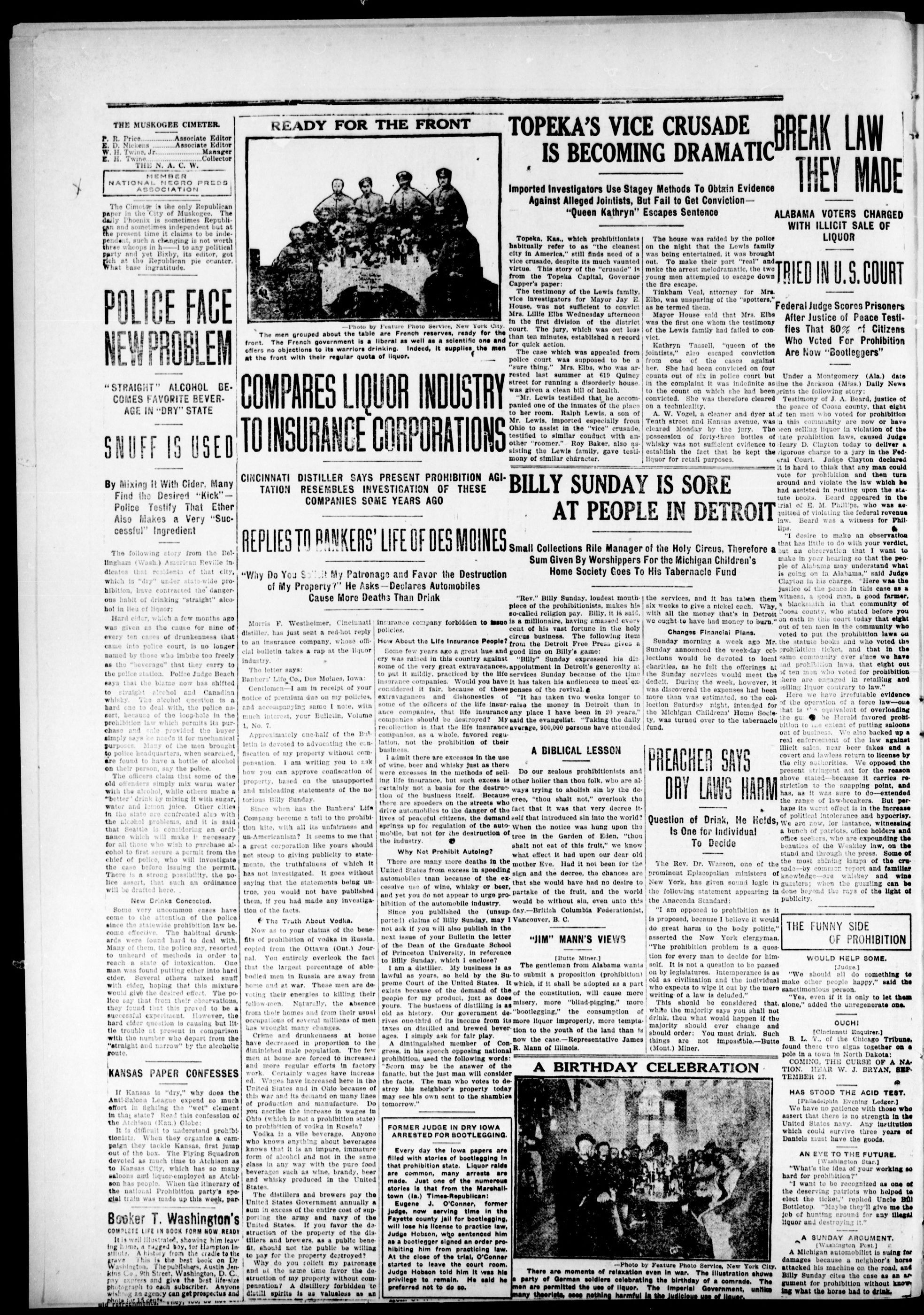
READY FOR THE FRONT
THE FIRST BATTLE OF THE WAR OF 1861
The men grouped about the table are French reserves, ready for the front. The French government is a liberal as well as a scientific one and offers no objections to its warriors drinking. Indeed, it supplies the men at the front with their regular quota of liquor.
COMPARES LIQUOR INDUSTRY TO INSURANCE CORPORATIONS
CINCINNATI DISTILLER SAYS PRESENT PROHIBITION AGI TATION RESEMBLES INVESTIGATION OF THESE COMPANIES SOME YEARS AGO
REPLIES TO BANKERS' LIFE OF DES MOINES
"Why Do You Soil It My Patronage and Favor the Destruction of My Property?" He Asks—Declares Automobiles Cause More Deaths Than Drink
Morris F. Westheimer, Cincinnati distiller, has just sent a redhot reply to an insurance company, whose official bulletin takes a rap at the liquor industry.
The letter says:
Bankers' Life Co., Des Moines, Iowa:
Gentlemen—I am in receipt of your notice of premium due on my policies, and accompanying same I note, with much interest, your Bulletin, Volume 1, No. 7.
Approximately one-half of the Bulletin is devoted to advocating the confiscation of my property without compensation. I am writing you to ask how you can approve confiscation of property, based on the unsupported and misleading statements of the notorious Billy Sunday.
Since when has the Bankers' Life Company become a tail to the prohibition kite, with all its unfairness and un-Americanism? It seems to me that a great corporation like yours should not stoop to giving publicity to statements, the truthfulness of which it has not investigated. It goes without saying that the statements being untrue, you would not have published them, if you had made any investigation of the facts.
The Truth About Vodka.
Now as to your claims of the benefits of prohibition of vodka in Russia, copied from the Ottawa (Ont.) Journal. You entirely overlook the fact that the largest percentage of abebodied men in Russia are away from home and at war. These men are devoting their energies to killing their fellow-men. Naturally, the absence from their homes and from their usual occupations of several millions of men has wrought many changes.
Crime and drunkenness at home have decreased in proportion to the diminished male population. The few men at home are forced to increase and more regular efforts in factory work. Certainly wages have increased. Wages have increased here in the United States and in Ohio because of this war and its demand on many lines of production and manufacture. Do you ascribe the increase in wages in Ohio (which is not a prohibition state) to prohibition of volksa in Russia? Vodka is a vile beverage. Anyone who knows anything about beverages knows that it is an impure, immature form of alcohol and not in the same class in any way with the pure food beverages such as wine, brandy, beer and whisky produced in the United States.
The distillers and brewers pay the United States Government annually a sum in excess of the entire cost of supporting the army and navy of the United States. If you favor the destruction of the property of the distillers and brewers, as a public benefit, should not the public be willing to pay for the property destroyed? Why do you collect my patronage and at the same time favor the destruction of my property without compensation? A distillery forbidden to distill spirits is as valueless as an
extravagances and dishonesties of "It has taken two weeks longer to the of the officers of the life insur-raise the money in Detroit than inance companies, that life insurance any place I have been in 20 years," companies should be destroyed? My said the evangelist. "Taking the daily recollection is that the life insurance average, 900,000 persons have attended companies, as a whole, favored reu-
insurance company forbidden to issue policies.
How About the Life Insurance People?
Some few years ago a great hue and cry was raised in this country against some of the very great extravagances, to put it mildly, practiced by the life insurance companies. Would you have considered it fair, because of these extravagances and dishonesties of some of the officers of the life insurance companies, that life insurance companies should be destroyed? My recollection is that the life insurance companies, as a whole, favored regulation, not the prohibition of their business.
I admit there are excesses in the use of wine, beer and whisky just as there were excesses in the methods of selling life insurance, but such excess is certainly not a basis for the destruction of the business itself. Because there are speeders on the streets who drive automobiles to the danger of the lives of peaceful citizens, the demand springs up for regulation of the automobile, but not for the destruction of the industry.
Why Not Prohibit Autoling?
There are many more deaths in the United States from excess in speeding automobiles than because of the excessive use of wine, whisky or beer, and yet you do not appear to urge prohibition of the automobile industry.
Since you published the (unsupportel) claims of Billy Sunday, may I not ask if you will also publish in the next issue of your Bulletin the letter of the Dean of the Graduate School of Princeton University, in reference to Billy Sunday, which I enclose?
I am a distiller. My business is as lawful as yours, so held by the Supreme Court of the United States. It exists because of the demand of the people for my product, just as does yours. The business of distilling is as old as history. Our government derives one-third of its income from its taxes on distilled and brewed beverages. I simply ask for fair play.
A dintingulshed member of Congress, in his speech opposing national prohibition, used the following words: "Scorn may be the answer of the fanatic, but the just man will consider the facts. The man who votes to destroy his neighbor's property today may see his own sent to the shambies tomorrow."
FORMER JUDGE IN DRY IOWA
ARRESTED FOR BOOTLEGGING.
Every day the Iowa papers are filled with stories of bootlegging in that prohibition state. Liquor raids are common, many arrests are made. Just one of the numerous stories is that from the Marshall-town (la.) Times-Republican: Eugene J. O'Conner, former judge, now serving time in the Fayette county jail for bootlegging, will lose his license to practice law, Judge Hobson, who sentenced him as a bootleger signed an order prohibiting him from practicing law. At the close of the trial, O'Conner started to leave the court room. Judge Hobson told him it was his privilege to remain. He said he preferred not to do so.
TOPEKA'S VICE CRUSADE IS BECOMING DRAMATIC
Imported Investigators Use Stagey Methods To Obtain Evidence Against Alleged Jointists, But Fail to Get Conviction— "Queen Kathryn" Escapes Sentence
BILLY SUNDAY IS SORE AT PEOPLE IN DETROIT
THE CHESSING
There are moments of relaxation even in war. The illustration shows a party of German soldiers celebrating the birthday of a comrade. The men are permitted the use of liquor. The Imperial Government, unlike many theorists, sees nothing harmful in the judicious use of liquor.
Topeka, Kaa., which prohibitionists habitually refer to as "the cleanest city in America," still finds need of a vice crusade, despite its much vaunted virtue. This story of the "crusade" is from the Topeka Capital, Governor Capper's paper:
The testimony of the Lewis family, vice investigators for Mayor Jay E. House, was not sufficient to convict Mrs. Lillie Elbs Wednesday afternoon in the first division of the district court. The jury, which was out less than ten minutes, established a record for quick action.
The case which was appealed from police court was supposed to be a "sure thing." Mrs. Elbs, who was arrested last summer at 619 Quincy street for running a disorderly house, was given a clean bill of health.
"Mr. Lewis testified that he accompanied one of the inmates of the place to her room. Ralph Lewis, a son of Mr. Lewis, imported especially from Ohio to assist in the "vice" crusade, testified to similar conduct with another "roomer." Roy Baker, also assisting the Lewis family, gave testimony of similar character.
BILLY SUNDAY AT PEOPL
Small Collections Rile Manager
Sum Given By Worshippers
Home Society Goes To
"Rev." Billy Sunday, loudest mouthpiece of the prohibitionists, makes his so-called religion pay. Billy, it is said, is a millionaire, having amassed every cent of his vast fortune in the holy circus business. The following item from the Detroit Free Press gives a good line on Billy's game: "Billy" Sunday expressed his disappointment in Detroit's generosity at services Sunday because of the time it has taken his audiences to meet expenses of the revival. "It has taken two weeks longer to raise the money in Detroit than in any place I have been in 20 years." said the evangelist. "Taking the daily average, 900,000 persons have attended
A BIBLICAL LESSON
Do our zealous prohibitionists and other holier than thou folk, who are always trying to abolish sin by the decree, "thou shalt not," overlook the fact that it was that very decree itself that introduced sin into the world? When the notice was hung upon the tree in the Garden of Eden, "thou shalt not eat of this fruit," we know what effect it had upon our dear old mother Eve. Had it not been for the sign and the decree, the chances are that she would have had no desire to partake of the fruit, and the world would be without sin, even unto this day.—British Columbia Federationist, Vancouver, B. C.
"JIM" MANN'S VIEWS
[Butte Miner.]
The gentleman from Alabama wants to submit a proposition (prohibition) which, if it shall be adopted as a part of the constitution, will cause more misery, more "blind-pigging," more "bootlegging," the consumption of more liquor improperly, more temptation to the youth of the land than is now the case—Representative James R. Mann of Illinois.
A BIRTHDAY
The house was raided by the police on the night that the Lewis family was being entertained, it was brought out. To make their part "real" and make the arrest melodramatic, the two young men attempted to escape down the fire escape.
Tinkham Veal, attorney for Mrs. Elbs, was unsparing of the "spotters," as he termed them.
Mayor House said that Mrs. Elbs was the first one whom the testimony of the Lewis family had failed to convict.
Kathryn Tassell, "queen of the jointists," also escaped conviction from one of the cases against her. She had been convicted on four counts out of six in police court but in the complaint it was indefinite as to the count on which she had been convicted. She was therefore cleared on a technicality.
A. W. Vogel, a cleaner and dyer at Tenth street and Kansas avenue, was cleared Monday by the jury. The possession of forty-three bottles of whisky was not sufficient evidence to establish the fact that he kept the liquor for retali purposes.
Y IS SORE
LE IN DETROIT
of the Holy Circus. Therefore a
For the Michigan Children's
His Tabernacle Fund
the services, and it has taken them six weeks to give a nickel each. Why, with all the money that's in Detroit we ought to have had money to burn."
Changes Financial Plans.
Sunday morning a week ago Mr. Sunday announced the week-day collections would be devoted to local charities, as he felt the offerings at the Sunday services would meet the deficit. During the week, however, it was discovered the expenses had been more than was estimated, so the collection Saturday night, intended for the Michigan Children's Home Society, was turned over to the tabernacle fund.
PREACHER SAYS DRY LAWS HARM
Question of Drink, He Holds, Is One for Individual To Decide
The Rev. Dr. Wasson, one of the prominent Episcopalian ministers of New York, has given sound logic in the following statement appearing in the Anaconda Standard:
"I am opposed to prohibition as it is proposed, because I believe it would do great harm to the body politic," asserted the New York clergyman. "The prohibition problem is a question for every man to decide for himself. It is not a question to be passed on by legislatures. Intemperance is as old as civilization and the individual who expects to wipe it out by the mere writing of a law is deluded." This should be considered that, while the majority says you shall not drink, then what would happen if the majority should ever change and should order: You must drink. Such things are not impossible—Butte (Mont.) Miner.
CELEBRATION
ALABAMA VOTERS CHARGED WITH ILLICIT SALE OF LIQUOR
TRIED IN U.S. COURT Federal Judge Scores Prisoners After Justice of Peace Testifies That 80% of Citizens Who Voted For Prohibition Are Now "Bootleggers"
Under a Montgomery (Ala.) date line the Jackson (Miss.) Dally News prints the following story:
Testimony of J. A. Beard, justice of the peace of Coosa county, that eight of ten men who voted for prohibition in this community are now or have been selling liquor in violation of the state prohibition laws, caused Judge Henry D. Clayton today to deliver a vigorous charge to a jury in the Federal Court. Judge Clayton declared it is hard to think that any man could vote for prohibition and then turn around and violate the law which he had assisted in putting upon the statute books. Beard appeared in the trial of E. M. Phillips, who was acquitted of violating the federal revenue law. Beard was a witness for Phillips.
"I desire to make an observation that has little to do with your verdict, but an observation that I want to make in your hearing so that the people of Alabama may understand what is going on in Alabama," said Judge Clayton in his charge. "Here was the justice of the peace in this case as a witness, a good man, a good farmer, a blacksmith in that community of Coosa county, who stated before you on oath in this court today that eight out of ten men in the community who voted to put the prohibition laws on the statute books and who voted the prohibition ticket, and that in the same community ever since we have and prohibition laws, that eight out of ten men who voted for prohibition there are engaged in retailing and selling liquor contrary to law."
Here we have irrefutable evidence of the operation of a force law—one that is the equivalent of overloading the gui. He Herald favored prohibition to the extent of putting saloons out of business. We also backed up a real enforcement of the law against illicit sales, near beer fakes and a covert and lawless return to license by the city authorities. We opposed the present stringent act for the reason above stated—because it carries restriction to the snapping point, and has, as it was sure to do—extended the range of law-breakers. But perhaps its worst effect is in the increase of political intolerance and hypocrisy. We are now, for instance, witnessing a bunch of patrols, office holders and office seekers, who are expounding the beauties of the Weakley law, on the stand and through the press. Some of the most shining lamps of the crusade—by common report and familiar knowledge—are whiskey and wine guzzlers; when the guzzling can be done beyond the rays of the light of publicity.
THE FUNNY SIDE
OF PROHIBITION
WOULD HELP SOME.
[Judge.]
"We should all do something to
make other people happy," said the
sanctimonious person.
"Yes, even if it is only to let them
alone," added the unregenerate one.
OUCHI
B. L. T., of the Chicago Tribune,
found these two signs together on a
pole in a town in North Dakota:
COMING, THE CURSE OF A NATION.
HEAR W. J. BRYAN, SEPTEMBER 27.
HAS STOOD THE ACID TEST.
[Philadelphia Evening Ledger.]
We have no patience with those who
assert that there is no strength in the
United States navy. Any institution
which could survive three years of
Daniels must have the goods.
AN EYE TO THE FUTURE.
"What's the idea of your working so hard for prohibition?"
"I want to be recognized as one of the deserving patrols who helped to elect the ticket," rephed Uncle Bill Bottleton. "Maybe they'll give me the job of hunting around for any illegal liquor and destroying it."
A Michigan automobilist is suing for damages because a neighbor's horse attacked his machine on the road, and Billy Sunday cites the case as an argument for prohibition without knowing what the horse had to drink.