Muskogee Cimeter
Saturday, December 2, 1916
Muskogee, Oklahoma
Page text (machine-generated)
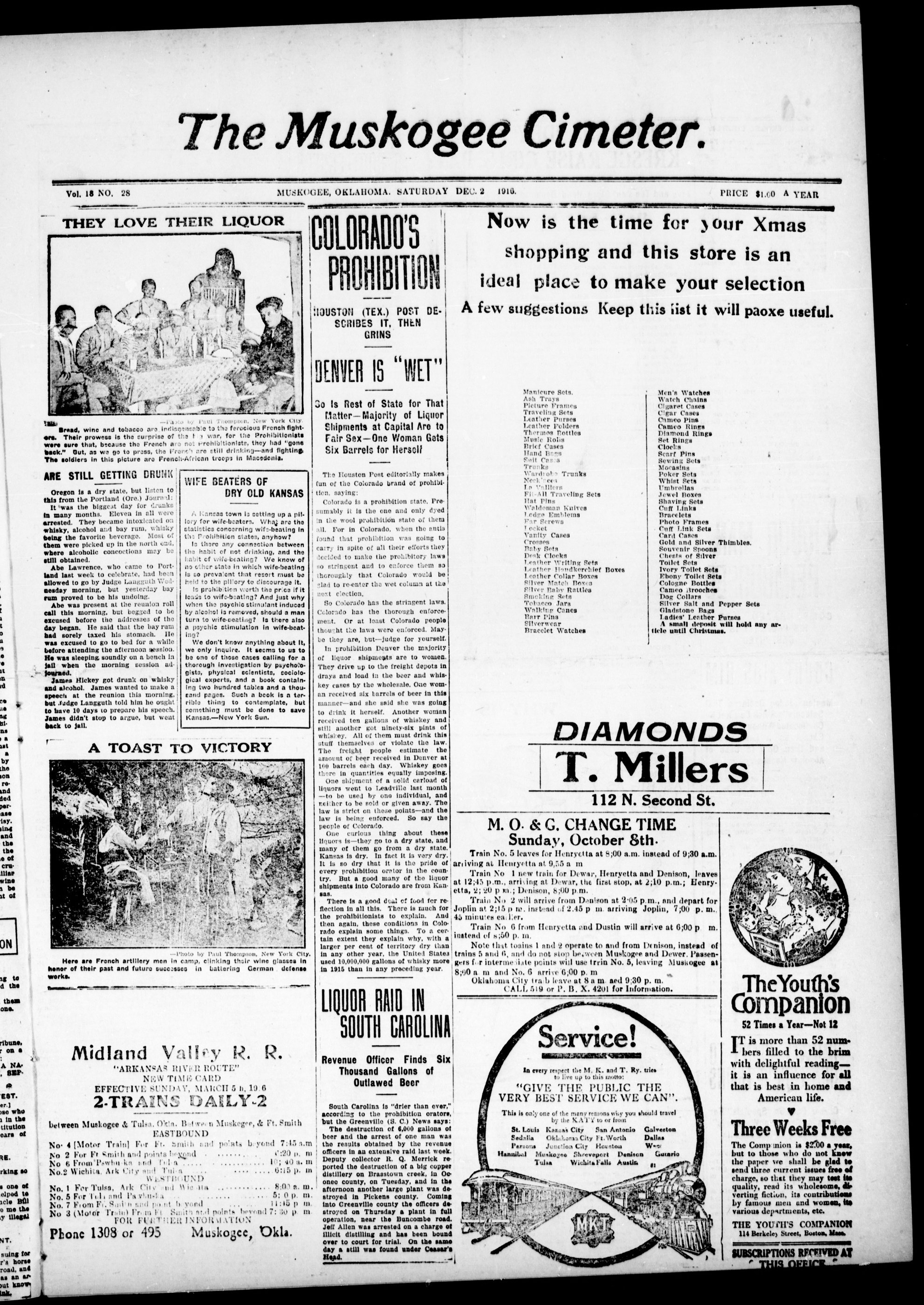
THEY LOVE THEIR LIQUOR
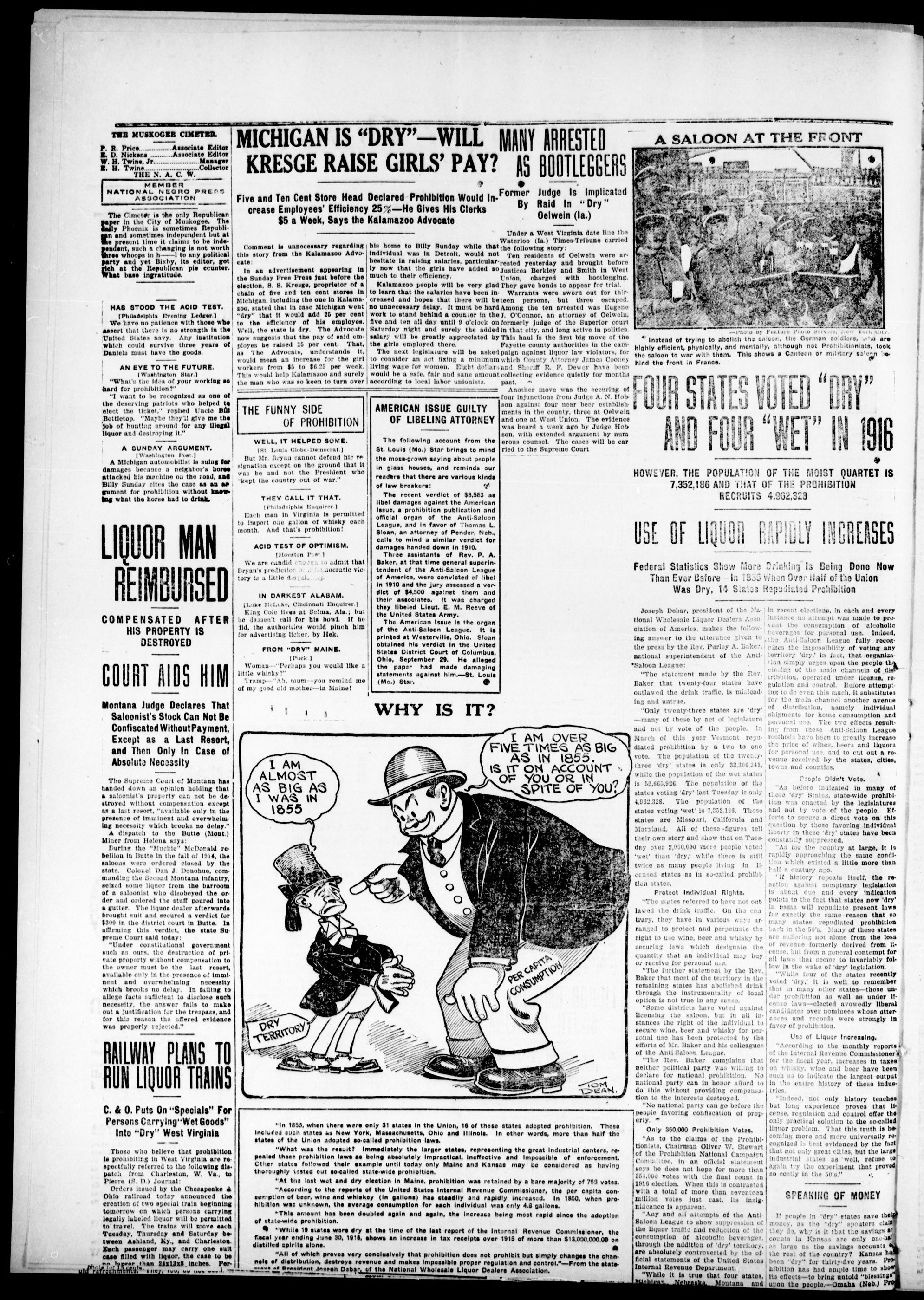
Bread, wine and tobacco are indispensable to the ferocious French fighters. Their prowess is the surprise of the war, for the Prohibitionists were sure that, because the French are not prohibitionists, they had "gone back." But, as we go to press, the French are still drinking—and fighting. The soldiers in this picture are French-African troops in Macedonia.
A TOAST TO VICTORY
Here are French artillery men in camp, clinking their wine glasses in honor of their past and future successes in battling German defense works.
between Muskogee & Tulsa, Okla. Between Muskogee, & Ft. Smith
EASTBOUND
No. 4 [Motor Train] For Ft. Smith and points beyond 7:15 a.m
No. 2 For Ft. Smith and points beyond 4:20 p. m
No. 6 From Pswhuska and Tulsa 10; 40 a. m
No.2 Wichita, Ark City and Tulsa 6:15 p. m
WESTBOUND
Phone 1308 or 495 Muskogee, Okla.
Vol.18 NO.28
THEY LOVE T
Bread, wine and tobacco are indi-
ors. Their prowess is the surprise of
were sure that, because the French a
back." But, as we go to press, the F
The soldiers in this picture are Fren
ARE STILL GETTING DRUNK
Oregon is a dry state, but listen to this from the Portland (Ore.) Journal: It was the biggest day for drunks in many months. Eleven in all were arrested. They became intoxicated on whisky, alcohol and bay rum, whisky being the favorite beverage. Most of them were picked up in the north end, where alcoholic concoctions may be still obtained.
Abe Lawrence, who came to Portland last week to celebrate, had been allowed to go by Judge Langguth Wednesday morning, but yesterday bay rum proved to be his undoing.
Abe was present at the reunion roll call this morning, but bogged to be excused before the addresses of the day began. He said that the bay rum had sorely taxed his stomach. He was excused to go to bed for a while before attending the afternoon session. He was sleeping soundly on a bench in jail when the morning session adjourned.
James Hickey got drunk on whisky and alcohol. James wanted to make a speech at the reunion this morning, but Judge Langguth told him he ought to have 10 days to prepare his speech. James didn't stop to argue, but went back to fail.
A TOAST
The Muskogee Cimeter.
MUSKOGEE, OKLAHOMA. SATURDAY DEC. 2 1916.
WIFE BEATERS OF
DRY OLD KANSAS
A Kansas town is setting up a pillory for wife-beaters. What are the statistics concerning wife-beating in the Prohibition states, anyhow? Is there any connection between the habit of not drinking, and the habit of wife-beating? We know of no other state in which wife-beating is so prevalent that resort must be held to the pillory to discourage it. Is prohibition worth the price if it leads to wife-beating? And just why when the psychic stimulant induced by alcohol is removed, should a man turn to wife-beating? Is there also a psychic stimulation in wife-beating?
We don't know anything about it, we only inquire. It seems to us to be one of those cases calling for a thorough investigation by psychologists, physical scientists, sociological experts, and a book containing two hundred tables and a thousand pages. Such a book is a terrible thing to contemplate, but something must be done to save Kansas.—New York Sun.
HOUSTON (TEX.) POST DESCRIBES IT, THEN GRINS
DENVER IS "WET"
So Is Rest of State for That Matter—Majority of Liquor Shipments at Capital Are to Fair Sex—One Woman Gets Six Barrels for Herself
The Houston Post editorially makes fun of the Colorado brand of prohibition, saying:
Colorado is a prohibition state. Presumably it is the one and only dyed in the wool prohibition state of them all. For in Colorado, when the autis found that prohibition was going to carry in spite of all their efforts they decided to make the prohibitory laws so stringent and to enforce them so thoroughly that Colorado would be glad to re-enter the wet column at the next election.
So Colorado has the stringent laws. Colorado has the thorough enforcement. Or at least Colorado people thought the laws were enforced. Maybe they are, but—judge for yourself.
In prohibition Denver the majority of liquor shipments are to women. They drive up to the freight depots in drays and load in the beer and whiskey cases by the wholesale. One woman received six barrels of beer in this manner—and she said she was going to drink it herself. Another woman received ten gallons of whiskey and still another got ninety-six pints of whiskey. All of them must drink this stuff themselves or violate the law. The freight people estimate the amount of beer received in Denver at 100 barrels each day. Whiskey goes there in quantities equally imposing. One shipment of a solid carload of liquors went to Leadville last month—to be used by one individual, and neither to be sold or given away. The law is strict on these points—and the law is being enforced. So say the people of Colorado.
One curious thing about these liquors is—they go to a dry state, and many of them go from a dry state. Kansas is dry. In fact it is very dry. It is so dry that it is the pride of every prohibition orator in the country. But a good many of the liquor shipments into Colorado are from Kansas.
There is a good deal of food for reflection in all this. There is much for the prohibitionists to explain. And then again, these conditions in Colorado explain some things. To a certain extent they explain why, with a larger per cent of territory dry than in any other year, the United States used 10,000,000 gallons of whisky more in 1915 than in any preceding year.
LIQUOR RAID IN SOUTH CAROLINA
Revenue Officer Finds Six Thousand Gallons of Outlawed Beer
South Carolina is "drier than ever," according to the prohibition orators, but the Greenville (S. C.) News says:
The destruction of 6,000 gallons of beer and the arrest of one man was the results obtained by the revenue officers in an extensive raid last week. Deputy collector R. Q. Merrick reported the destruction of a big copper distillery on Brasstown creek, in Oconee county, on Tuesday, and in the afternoon another large plant was destroyed in Pickens county. Coming into Greenville county the officers destroyed on Thursday a plant in full operation, near the Buncombe road. Jeff Allen was arrested on a charge of illicit distilling and has been bound over to court for trial. On the same day a still was found under Ceasar's Head.
Now is the time for your Xmas shopping and this store is an ideal place to make your selection A few suggestions Keep this list it will paoxe useful.
DIAMONDS T. Millers
Train No. 5 leaves for Henryetta at 8;00 a.m. instead of 9;30 a.m. arriving at Henryetta at 9;55 a.m.
Train No. 1 new train for Dewar, Henryetta and Denison, leaves at 12;45 p.m., arriving at Dewar, the first stop, at 2;10 p.m.; Henryetta, 2;20 p.m.; Denison, 8;00 p.m.
Train No. 2 will arrive from Denison at 2:05 p.m., and depart for Joplin at 2;15 p.m. instead of 2.45 p.m. arriving Joplin, 7;00 p.m. 45 minutes earlier.
Train No. 6 from Henryetta and Dustin will arrive at 6;00 p.m. instead of 8;50 p.m.
Note that toains 1 and 2 operate to and from Denison, instead of trains 5 and 6, and do not stop between Muskogee and Dewer. Passengers for intermediate points will use trin No. 5, leaving Muskogee at 8;90 a.m and No. 6 arrive 6;00 p.m.
Service!
In every respect the M. K. and T. Ry. tries to live up to this motto:
"GIVE THE PUBLIC THE VERY BEST SERVICE WE CAN".
This is only one of the many reasons why you should travel by the KATY to or from
St. Louis Kansas City San Antonio Galveston
Sedalia Oklahoma City Ft.Worth Dallas
Persons Junction City Houston Waco
Hannibal Muskogee Shreveport Denison Gutario
Tulsa Wichita Falls Austin 81
Mainture Sets.
Ash Trays
Picture Frames
Traveling Sets
Leather Purses
Leather Folders
Thermos Bottles
Music Rolls
Brief Cases
Hand Bags
Soft Cases
Trunks
Wardrobe Trunks
Necklaces
Le Vallers
Fit-All Traveling Sets
Hat Pins
Waldeman Knives
Lodge Emblems
Far Screws
Locket
Vanity Cases
Crosses
Baby Sets
Deck Clocks
Leather Writing Sets
Leather Handkerechief Boxes
Leather Collar Boxes
Silver Match Boxes
Silver Baby Rattles
Smoking Sets
Tobacco Jars
Walking Canes
Barr Pins
Silverwear
Bracelet Watches
M. O. & G. CHANGE TIME Sunday, October 8th.
Oklahoma City traj leave at 8 a.m. aed 9:30 p. m.
CALL 519 or P. B. X. 4201 for Information.
for your Xmas
this store is an
like your selection
this list it will paoxe useful
our Xmas
re is an
selection
will paoxe useful.
Men's Watches
Watch Chains
Cigaret Cases
Cigar Cases
Cameo Pins
Cameo Rings
Diamond Rings
Set Rings
Clocks
Scarf Pins
Sewing Sets
Mocasins
Poker Sets
Whist Sets
Umbrellas
Jewel Boxes
Shaving Sets
Cuff Links
Bracelets
Photo Frames
Cuff Link Sets
Card Cases
Gold and Silver Thimbles.
Souvenir Spoons
Chests of Silver
Toilet Sets
Ivory Toilet Sets
Ebony Toilet Sets
Cologne Bottles
Cameo Brooches
Dog Collars
Silver Salt and Pepper Sets
Gladstone Bags
Ladies' Leather Purses
A small deposit will hold any article until Christmas.
ONDS
illers
second St.
os
rs
THE WORLD'S FIRST
COMPUTER
The Y
Comp
52 Times a
The Youth's Companion
52 Times a Year—Not 12
IT is more than 52 num-
bers filled to the brim
with delightful reading
it is an influence for all
that is best in home and
American life.
Three Weeks Free
Three Weeks Free
The Companion is $2.00 a year, but to those who do not know the paper we shall be glad to send three current issues free of charge, so that they may test its quality, read its wholesome, diverting fiction, its contributions by famous men and women, its various departments, etc.
THE YOUTH'S COMPANION
114 Berkeley Street, Boston, Mass.
SUBSCRIPTIONS RECEIVED AT THIS OFFICE
"DAY" CHIEFS ARE ACCUSED
INVALID WOMAN CHARGES
SHE WAS SWINDLED
OUT OF $200
Claims Names of Colorado Ministers Were Used to Induce Her to Buy Shares In Investment Company Launched By Anti-Saloon League Men
An invalid woman of Denver has filed suit against two officials of the Anti-Saloon League whom she charges sold her worthless mining stock. The Denver (Col.) Post reports the case as follows:
In a complaint filed in the district court today by E. M. Sabin, attorney for Mrs. Emma Showers, an invalid who has for many years been confined to her home, Arthur J. Finch, superintendent of the Colorado branch of the Anti-Saloon League, and G. Arthur Holloway, secretary of the same organization, are charged with using the name of the league, that of its organizer and of Denver ministers of the gospel to induce her to buy stock in a mining company they had organized and which has proved worthless.
Mrs. Showers in her complaint charges Finch and Holloway with wilful and malicious fraud and asks for body judgment against both of them and that they be confined in the county fall until judgment against them is paid. The suit is for the recovery of $200 which Mrs. Showers paid for 5,000 shares of stock in the A. S. L. Mines Investment Company.
The complaint states that Finch and Holloway are what is known as promoters and that after they had organized two mining companies that had failed they started the A. S. L. Mines Investment Company with a capital of $5,000,000, in which company both of them were officers and directors.
"Had a Short Life."
"The A. S. L. Mines Investment Company—meaning the Anti-Saloon League Mines Investment Company—had a short lease of life," the complaint states. "The incorporators and promoters, according to their statement, sold several thousands dollars worth of stock but had not and never acquired any property and allowed the charter to be cancelled. The company, itself, today has no legal existence."
They represented also that the company was holding under lease and bond the War Dance mine; that it had control of the Clay County mine in Gilpin county and that there were several hundred thousand tons of ore in the War Dance and Clay County mines already blocked out for shipment and that this ore was worth from $25 to several thousand dollars a ton.
RELATES EVIL OF MAINE'S DRY LAW
Former Citizen of That State Says It Has a Real Liquor Question
The Chicago Tribune contains an article of Mr. William Tinton, which we quote in full as being brief and to the point:
"J. M. Burley writes The Tribune that Lewiston, Me., has very little drunkenness. I wish Mr. Burley could make a personal investigation of conditions in Lewiston and as a result thereof he would find very little about conditions in Lewiston to indorse.
"I moved my family from Lewiston four years ago. For twenty years I resided in central Maine, and if there is a whisky question anywhere on earth it will be found in that state.
"Governor Cobb of Maine, who during his term of office endeavored to give the people of Maine what they voted for (prohibition), significantly said after his experience, with prohibition: 'If I, for the moral, social, and economic welfare of the young people of my state, had to choose between prohibition—such prohibition as I found it possible to enforce, and free rum, I would s' and firmly for handling whiskey over the counters of my stores so as to I do愈快!"
THE FEDERAL NATIONAL GAMBOLA CIVIL FORUM
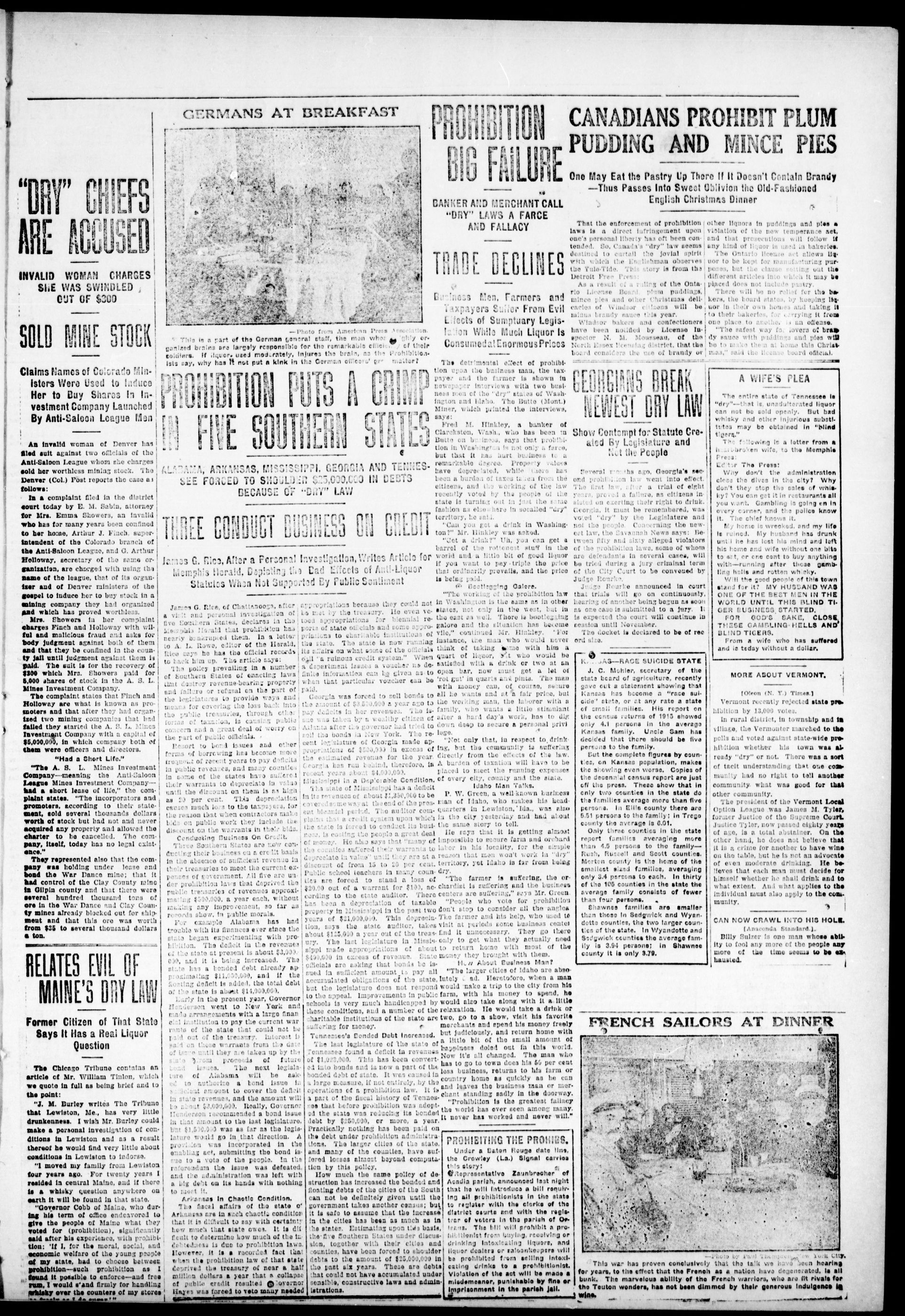
This is a part of the German general staff, the man who highly organized brains are largely responsible for the remarkable efficiency of their soldiers. If liquor used moderately, injures the brain, so the Prohibitionists say, why has it not put a kink in the German officers' gr matter?
PROHIBITION PUTS A GRIMP IN FIVE SOUTHERN STATES
ALABAMA, ARKANSAS, MISSISSIPPI, GEORGIA AND TENNESSEE FORCED TO SHOULDER $25,000,000 IN DEBTS DECAUSE OF "DRY" LAW
James G. Rice, After a Personal Investigation, Writes Article for Memphis Herald, Depicting the Bad Effects of Anti-Liquor Statutes When Not Supported by Public Sentiment
James G. Rice, of Chattanooga, after a visit and personal investigation of five Southern States, declares in the Memphis Herald that prohibition has nearly bankrupted them. In a letter to A. L. Rowe, editor of the Herald, Rice says he has the official records to back him up. The article says:
The policy prevailing in a number of Southern States of enacting laws that destroy revenue-bearing property and failure or refusal on the part of the legislatures to provide ways and means for covering the loss back into the public treasuries, through other forms of taxation, is causing public concern and a great deal of worry on the part of public officials.
appropriations because they could not be met by the treasury. He even took appropriations for biennial reports of state officials and some appropriations to charitable institutions on the state. The state is now running its affairs on what some of the officials call "a ruinous credit system." When a department issues a voucher as definite information can be given to when that particular voucher can be paid.
Georgia was forced to sell bonds to the amount of $8,500,000 a year ago to pay deficits in her revenues. The issue was taken by a wealthy citizen of Atlanta after the governor had tried to roll the bonds in New York. The re
Resort to bond issues and other forms of borrowing has become more frequent of recent years to pay deficits in public revenues, and many counties in some of the states have suffered their warrants to depreciate in values until the discount on them is as high as 20 per cent. This depreciation causes much loss to the taxpayers, for the reason that when contractors make bids on public work they include the discount on the warrants in their bids. Conducting Business On Credit. Three Southern States are now conducting their business on a credit basis in the absence of sufficient revenue in their treasuries to meet the current expenses of government. All five are under prohibition laws that deprived the public treasuries of revenues approximating $500,000, a year each, without making any improvement, so far as records show, in public morals.
For example Alabama has had trouble with its finances ever since the state began experimenting with prohibition. The deficit in the revenues of the state at present is about $3,000,000, and it is being increased. The state has a bended debt already approximating $11,000,000, and if the floating deficit is added, the total debt of the state is about $14,000,000.
Early in the present year, Governor Henderson went to New York and made arrangements with a large financial institution to pay the current warrants of the state that could not be paid out of the treasury. Interest is said on these warrants from the date of issue until they are taken up by the state $ from proceeds of future bond issues. The next legislature of Alabama will be asked to authorize a bond issue in sufficient amount to cover the deficit in state revenues, and the amount will be about $3,000,000. Really, Governor Henderson recommended a bond issue in that amount to the last legislature, but $1,500,000 was as far as the legislature would go in that direction. A provision was incorporated in the enabling act, submitting the bond issue to a vote of the people. In the referendum the issue was defeated and the administration was left with a big debt on its hands with nothing to reset it.
Arkansas In Chaotic Condition.
The fiscal affairs of the state of Arkansas are in such chaotic condition that it is difficult to say with certainty how much that state owes. It is difficult to determine how much of the indebtedness is due to prohibition laws. However, it is a recorded fact that when the prohibition law of that state deprived the treasury of near a half million dollars a year that a collapse of public credit resulted Governor Hayes was forced to veto many needed
appropriations because they could not be met by the treasury. He even vetoed appropriations for biennial reports of state officials and some appropriations to charitable institutions of the state. The state is now running its affair on what some of the officials call "a rumorous credit system." When a department issues a voucher its definite information can be given as to when that particular voucher can be paid.
Georgia was forced to sell bonds to the amount of $3,500,000 a year ago to pay deficits in her revenues. The issue was taken by a wealthy citizen of Atlanta after the governor had tried to sell the bonds in New York. The recent legislature of Georgia made appropriations of $500,000 in excess of the estimated revenue for the year. Georgia has run behind, therefore, in recent years about $4,000,000.
Mississippi in a Depreciation Cause.
The state of Mississippi has a deficit in its revenues of about $1,350,000 to be covered some way at the end of the present biennial period. The auditor complains that a credit system upon which the state is forced to conduct its business, is costing the people a great deal of money. He also says that "many of the counties suffered their warrants to depreciate in value" until they are at a discount of from 15 to 20 per cent. Public school teachers in many counties are forced to stand a loss of $20,000 out of a warrant for $100, according to the state auditor. There has been a depreciation of taxable property in Mississippi in the past two years of $21,000,000. This depreciation, says the state auditor, takes about $15,500 a year out of the treasury. The last legislature in Mississippi made appropriations of about $400,000 in excess of revenue. State officials are asking that bonds be issued in sufficient amount to pay all accumulated obligations of the state but the legislature does not respond to the appeal. Improvements in public schools is very much handicapped by these conditions, and a number of the charitable institutions of the state are suffering for money.
Tennessee's Bonded Debt increased. The last legislature of the state of Tennessee found a deficit in revenues of $1,923,000. This has been converted into bonds and is now a part of the bonded debt of state. It was caused in a large measure, if not entirely, by the operations of a prohibition law. It is a part of the fiscal history of Tennessee that before prohibition was adopted the state was reducing its bonded debt by $250,000, or more, a year. Practically nothing has been paid on the debt under prohibition administrations. The larger cities of the state and many of the counties, have suffered losses almost beyond computation by this policy.
How much the same policy of destruction has increased the bonded and floating debts of the cities of the South can not be definitely given until the government takes another census; but it is safe to assume that the increase in the cities has been as much as in the states. Estimating upon this basis, the five Southern States under discussion, together with their cities and counties, have been forced to shoulder debts to the amount of $25,000,000 in the past six years. These are debts that could not have accumulated under sensible, constructive laws and administrations.
PROHIBITION BIG FAILURE
BANKER AND MERCHANT CALL "DRY" LAWS A FARCE AND FALLACY
Business Men, Farmers and Taxpayers Suffer From Evil Effects of Sumptuary Legislation While Much Liquor Is Consumed at Enormous Prices
The detrimental effect of prohibition upon the business man, the taxpayer and the farmer is shown in newspaper interviews with two business man of the "dry" states of Washington and Idaho. The Butte (Mont.) Miner, which printed the interviews, says:
Fred M. Hinkley, a banker of Clarkston, Wash., who has been in Butte on business, says that prohibition in Washington is not only a fance, but that it has hurt business to a remarkable degree. Property values have depreciated, while there has been a burden of taxes taken from the citizens, and the working of the law recently voted by the people of the state is turning out in just the same fashion as elsewhere in socalled "dry" territory, he said.
"Can you get a drink in Washington?" Mr. Hinkley was asked.
"Get a drink? Uh, you can get a barrel of the rottenest stuff in the world and a little bit of good liquor if you want to pay-triple the price that ordinarily provails, and the price is being paid.
© Beetlinging Galore.
"The working of the prohibition law in Washington is the same as in other states, not only in the west, but in the east as well. There is bootlegging galore and the situation has become vile," continued Mr. Hinkle. "For instance, the man who would never think of taking some with him a quart of liquor, let who would be satisfied with a drink or two at an open bar, now must get a lot of 'rot gut' in quarts and pints. The man with money can, of course, secure all he wants and at a fair price, but the working man, the laborer with a family, who wants a little stimulant after a hard day's work, has to dig down deep to secure a personal privilege.
"Not only that, in respect to drinking, but the community is suffering directly from the effects of the law. A burden of taxation will have to be placed to meet the running expenses of every city, county and the state. Idaho Man Talks. P. W. Green, a well known business man of Idaho, who makes his headquarters in Lewiston, Idaa., was also in the city yesterday and had about the same story to tell. He says that it is getting almost impossible to secure farm and orchard labor in his locality, for the simple reason that man won't work in "dry" territory, yet Idaho is far from being dry.
"The farmer is suffering, the orchardist is suffering and the business centers are suffering," says Mr. Green. "People who vote for prohibition don't stop to consider all the angles. The farmer and his help, who used to visit at periods some business center find it unnecessary. They go there only to get what they actually need to return home with most of the money they brought with them.
HOW About Business Manly
"The larger cities of Idaho are absolutely bad. Heretofore, when a man would make a trip to the city from his farm, with his money to spend, he would also take along with it a little relaxation. He would take a drink or two, go to a show, visit his favorite merchants and spend his money freely but judiciously, and return home with a little bit of the small amount of happiness doled out in this world. Now it's all changed. The man who has to go to town does his 56 per cent less business, returns to his farm or country home as quickly as he can and leaves the business man or merchant standing sadly in the doorway.
"Prohibition is the greatest fallacy the world has ever seen among many. It never has worked and never will."
PROHIBITING THE PROHIBITS.
Under a Baton Rouge date line,
the Crowley (La.) Signal carrier
this story:
Representative Zaumbrecher of Acadia parish, announced last night that he will introduce a bill requiring all prohibitionists in the state to register with the clerkes of the district courts and with the registrar of voters in the parish of Orléans. The bill will prohibit a prohibitionist from buying, receiving or drinking intoxicating liquors, and liquor dealers or saloonkeepers will be prohibited from selling intoxicating drinks to a prohibitionist. Violation of the act will be made a misdemeanor, punishable by fine or imprisonment in the parish jail.
CANADIANS PROHIBIT PLUM PUDDING AND MINCE PIES
One May Eat the Pastry Up There If It Doesn't Contain Brandy
Thus Passes Into Sweet Oblivion the Old-Fashioned
English Christmas Dinner
FRENCH BARBERS IN DINNER
This war has proven conclusively that the talk we have been hearing for years, to the effect that the French as a nation have degenerated, is all bunk. The marvelous ability of the French warriors, who are fit rivals for the Teuton wonders, has not been dimmed by their generous indulgence in wine.
This war has proven conclusively that the talk we have been hearing for years, to the effect that the French as a nation have degenerated, is all bunk. The marvelous ability of the French warriors, who are fit rivals for the Teuton wonders, has not been dimmed by their generous indulgence in wine.
That the enforcement of prohibition laws is a direct infringement upon one's personal liberty has oft been contended. So, Canada's "dry" law seems destined to curtail the jovial spirit with which the Englishman observes the Yule-Tide. This story is from the Detroit Free Press: As a result of a ruling of the Ontario License Board, plum puddings, mince pies and other Christmas delicacies of Windsor citizens will be minna brandy sauce this year. Windsor bakers and confectioners have been notified by License Inspector N. M. Mousseau, of the North Essex licensing district, that the board considers the use of brandy or
GEORGIANS BREAK NEWEST DRY LAW
Show Contempt for Statute Created By Legislature and Not the People
Several months ago, Georgia's second prohibition law went into effect. The first law, after a trial of eight years, proved a failure, as citizens insisted on exerting their right to drink. Georgia, it must be remembered, was voted "dry" by the Legislature and not the people. Concerning the newest law, the Savannah News says: Between fifty and sixty alleged violators of the prohibition laws, some of whom are defendants in several cases, will be tried during a jury criminal term of the City Court to be convened by Judge Burke.
Judge Bourke announced in court that trials will go on continuously, hearing of another being begun as soon as one case is submitted to a jury. It is expected the court will continue in session until November. The docket is declared to be of record size.
K...JAS—RACE SUICIDE STATE
J. C. Mohler, secretary of the state board of agriculture, recently gave out a statement showing that Kansas has become a "race suicide" state, or at any rate a state of small families. His report on the census returns of 1915 showed only 4.1 persons in the average Kansas family. Uncle Sam has decided that there should be five persons to the family.
But the complete figures by counties, on Kansas population, makes the showing even worse. Copies of the decennial census report are just off the press. These show that in only two counties in the state do the families average more than five persons. In Ellis county there are 5.51 persons to the family; in Trego county the average is 6.01. Only three counties in the state report families averaging more than 4.5 persons to the family—Rush, Russell and Scott counties. Morton county is the home of the smallest sized families, averaging only 3.4 persons to each. In thirty of the 105 counties in the state the average family consists of fewer than four persons.
Shawnee families are smaller than those in Sedgwick and Wyandotte counties, the two larger counties of the state. In Wyandotte and Sedgwick counties the average family is 3.94 persons; in Shawnee county it is only 3.79.
other liquor in puddings and plies a violation of the new temperance act, and that prosecutions will follow if any kind of liquor is used in bakeries. The Ontario License act allows liquor to be kept for manufacturing purposes, but the clause setting out the different articles into which it may be placed does not include pastry. There will be no relief for the bakers, the board states, by keeping liquor in their own homes and taking it to their bakeries, for carrying it from one place to another, is an offense. "The safest way fo. lovers of brandy sauce with puddings and plies will be to make them at home this Christmas," said the license board official.
A WIFE'S PLEA
The entire state of Tennessee is "dry"—that is, unadulterated liquor can not be sold openly. But bad whisky and other injurious substitutes may be obtained in "blind tigers." The following is a letter from a hardbroken wife, to the Memphis Press:
Editor The Press:
Why don't the administration close the dives in the city? Why don't they stop the sales of whisky? You can get it in restaurants all you want. Gambling is going on in every corner, and the police know it. The chief knows it.
My home is wrecked, and my life is ruined. My husband has drunk until he has lost his mind and left his home and wife without one bite to eat, or one cont to buy anything with—running after those gambling hells and rotten whisky.
Will the good people of this town stand for it? MY HUSBAND WAS ONE OF THE BEST MEN IN THE WORLD UNTIL THIS BLIND TIGER BUSINESS STARTED.
FOR GOD'S SAKE, CLOSE THESE GAMBLING-HELLS AND BLIND TIGERS.
From a wife who has suffered and is tied without a dollar.
MORE ABOUT VERMONT.
[Oleon (N. Y.) Times.]
Vermont recently rejected state prohibition by 13,000 votes.
In rural district, in township and in village, the Vermont marched to the polls and voted against state-wide prohibition whether his town was already "dry" or not. There was a sort of tacit understanding that one community had no right to tell another community what was good for that other community.
The president of the Vermont Local Option League was James M. Tyler, former Justice of the Supreme Court. Justice Tyler, now passed eighty years of age, is a total abstainer. On the other hand, he does not believe that it is a crime for another to have wine on the table, but he is not an advocate of even moderate drinking. He believes that each man must decide for himself whether he shall drink and to what extent. And what applies to the individual must also apply to the community.
CAN NOW CRAWL INTO HIS HOLE.
[Anaconda Standard.]
Billy Sulzer is one man whose ability to fool any more of the people any more of the time seems to be exhausted.
Land values have decreased in the last five years; 5,000 people have moved away, having gone to some other place.
A number of one, two and three-story brick buildings in the little city are unoccupied; sidewalks in front of most of them are in bad repair; windows are broken, and the people who own them face the condition of not being able to rent or sell, but must pay heavy taxes all the time.
All over the city there are empty residences.
Bootleggers Vote Dry.
The bootleggers all vote the dry ticket. They pay about 27 or 28 cents a pint for whiskey—express charges and all—and sell it for $1 a pint. They get beer in barrel lots, express paid, for 16 cents a quart, and they retail it at 50 cents per quart. So, you see, they are doing a big business in a dry state. The bootleggers of every city in Oklahoma are organized. Some one of them is raided nearly every day, and as soon as the raid is made the others are notified by telephone to get the stuff in the clear. As soon as the raiding is over, they start up in business again.
I know of an instance where a place was raided and a barrel of beer and a case of whisky taken. Inside of thirty minutes after the raid the place was open again and doing business as if nothing had happened. Some of the members of the organization had supplied the liquor to make up for the loss in the raid.
I have known quite a number of men who died from drinking whisky which they had purchased from unlicensed bootleggers. They sell the most poisonous of drugs for whisky. Knowing these things, I would rather have a wide-open saloon than the infernal bootleggers.
At one time the state of Oklahoma was prosperous, but it is practically bankrupt today. Missouri, Arkansas and Texas get all of Oklahoma's surplus money for liquor. That puts the money out of circulation at home, where it should stay. This condition makes hard times.
RELATES EVIL OF MAINE'S DRY LAW
The Chicago Tribune contains an article of Mr. William Tinton, which we quote in full as being brief and to the point:
"J. M. Burley writes The Tribune that Lewiston, Me., has very little drunkenness. I wish Mr. Burley could make a personal investigation of conditions in Lewiston and as a result thereof he would find very little about conditions in Lewiston to indorse.
"I moved my family from Lewiston four years ago. For twenty years I resided in central Maine, and if there is a whisky question anywhere on earth it will be found in that state.
"Governor Cobb of Malne, who during his term of office endeavored to give the people of Malne what they voted for (prohibition), significantly said after his experience, with prohibition: 'If I, for the moral, social, and economic welfare of the young people of my state, had to choose between prohibition—such prohibition as I found it possible to enforce—and free rum, I would stand firmly for handling whisky over the counters of my stores as freely as I do sugar.'"
```markdown
```
We have lost the National election on account of the treacheay of some Col. politicians and the stupedity of the Rep. in not cutting down the Representation in the Southern States when they had the power to do so. The Negro in the South should come into the West and Northeast and the next four years will be bearable at least.
Attoney G. W. Parker and Mrs. Mattie Ceasar, found something to be thankful for in spite of the Democratic leadership and were united in holy wedlock on Wed evening at 8:30 p. m. at the beautiful home of the bride. Rev.E. Arlington Wilson officiating. Mr. Parker is one of Muskogee's successful Lawyers and the bride one of the most lovable and progressive women of the race. we wish them a pleasant sail over the matrimonial sea.
Pictures cf Booker Washington
Sell like hot cakes; our special scheme of giving his book with picture sells every body; we have the big book, both sell for $1.25; we pay express; all agents should write us; anybody can sell; two outfits, fifteen cents. AUSTIN JENKINS CO., 7th St., Washington, D. C.
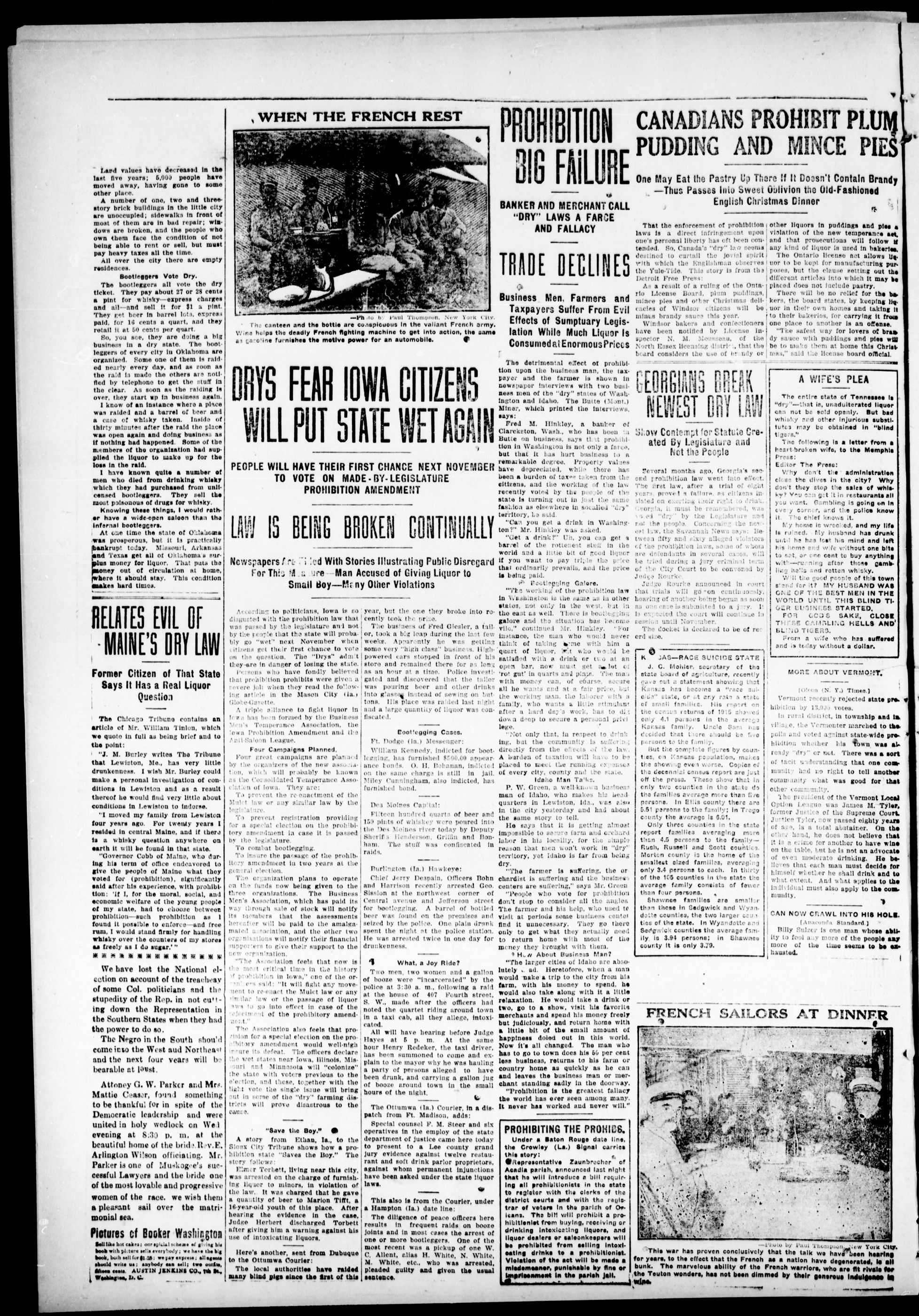
WHEN THE FRENCH REST
THE BARBERS
The canteen and the bottle are conspicuous in the valliant French army. Wine helps the deadly French fighting machine to get into action, the same as caroline furnishes the motive power for an automobile.
The canteen and the bottle are conspicuous in the valliant French army. Wine helps the deadly French fighting machine to get into action, the same as caroline furnishes the motive power for an automobile.
DRYS FEAR IOWA CITIZENS WILL PUT STATE WET AGAIN
PEOPLE WILL HAVE THEIR FIRST CHANCE NEXT NOVEMBER TO VOTE ON MADE-BY-LEGISLATURE PROHIBITION AMENDMENT
LAW IS BEING BROKEN CONTINUALLY
Newspapers Are Titled With Stories Illustrating Public Disregard For This Measure-Man Accused of Giving Liquor to Small Boy-Many Other Violations
According to politicians, Iowa is so disgusted with the prohibition law that was passed by the legislature and not by the people that the state will probably go "wet" next November when citizens get their first chance to vote on the question. The "Drys" admit they are in danger of losing the state. Persons who have fondly believed that prohibition prohibits were given a severe jolt when they read the following article in the Mason City (la.) Globe-Gavette. A triple alliance to fight liquor in Iowa has been formed by the Business Men's Temperance Association, the Iowa Prohibition Amendment and the Anti-Saloon League.
Four Campaigns Planned
Four great campaigns are planned by the organizers of the new association, which will probably be known as the Consolidated Temperance Association of Iowa. They are:
To prevent the reenactment of the Mullet law or any similar law by the legislature.
To prevent registration providing for a special election on the prohibitory amendment in case it is passed by the legislature.
To combat bootlegging.
To insure the passage of the prohibitory amendment in two years at the general election.
The organization plans to operate on the funds now being given to the three organizations. The Business Men's Association, which has paid its way through sale of stock will notify its members that the assessments hereafter will be paid to the amalgamated association, and the other two organizations will notify their financial supporters to give their support to the new organization.
"The Association feels that now is the most critical time in the history of prohibition in Iowa," one of the organizations said: "It will fight any movement to re enact the Mullet law or any similar law or the passage of liquor laws to go into effect in case of the re enactment of the prohibitory amendment."
The Association also feels that provision for a special election on the prohibitory amendment would well-night insure its defeat. The officers declare the wet states near Iowa, Illinois, Missouri and Minnesota will "colonize" the state with voters previous to the election, and these, together with the light vote the single issue will bring out in some of the "dry" farming districts will prove disastrous to the cause.
"Save the Boy."
A story from Ethan, Isa., to the Sloux City Tribune shows how a prohibition state "Saves the Boy." The story follows:
Elmer Torbett, living near this city, was arrested on the charge of furnishing liquor to minors, in violation of the law. It was charged that he gave a quantity of beer to Marion Tifft, a 16-year-old youth of this place. After hearing the evidence in the case, Judge Herbert discharged Torbett after giving him a warning against his use of intoxicating liquors.
Here's another, sent from Dubuque to the Ottumwa Courier:
The local authorities have raided many blind pigs since the first of this
year, but the one they broke into recently took the prize.
The business of Fred Glesler, a tailor, took a big loaf during the last few weeks. Apparently he was getting some very "high class" business. High-powered cars stopped in front of his store and remained there for as long as an hour at a time. Police investigated and discovered that the tailor was pouring beer and other drinks into glasses instead of sewing on buttons. His place was raided last night and a large quantity of liquor was confiscated.
Bootlegging Cases.
William Kennedy, indicted for boot
legging, has furnished $500.00 appear
ance bonds. O. H. Bohanan, indicted
on the same charge is still in jail
Miley Cunningham, also indicted, has
furnished bond.
Dea Molnes Capital:
Fifteen hundred quarts of beer and 150 pints of whiskey were poured into the Des Moines river today by Deputy Sheriff's Henderson, Griffin and Bonham. The stuff was confiscated in raids.
Burlington (Ia.) Hawkeye:
Chief Jerry Despain, Officers Bohn and Harrison recently arrested Geo. Sisson at the northwest corner of Central avenue and Jefferson street for bootlegging. A barrel of bottled beer was found on the premises and seized by the police. One plain drunk spent the night at the police station. He was arrested twice in one day for drunkenness.
What, a Joy Ride?
Two men, two women and a gallon of booze were "incarcerated" by the police at 3:30 a.m., following a raid at the house of 407 Fourth street, S. W., made after the officers had noted the quartet riding around town in a taxi cab, all they allege, intoxicated.
All will have hearing before Judge Hayes at 5 p. m. At the same hour Henry Redeker, the taxi driver, has been summoned to come and explain to the mayor why he was hauling a party of persons alleged to have been drunk, and carrying a gallon jug of booze around town in the small hours of the night.
The Ottumwa (la.) Courier, in a dispatch from Ft. Madison, adds:
Special counsel F. M. Steer and six operatives in the employ of the state department of justice came here today to present to a Lee county grand jury evidence against twelve restaurant and soft drink parlor proprietors, against whom permanent injunctions have been asked under the state liquor laws.
This also is from the Courier, under a Hampton (la.) date line:
The diligence of peace officers here results in frequent raids on booze joints and in most cases the arrest of one or more bootleggers. One of the most recent was a pickup of one W. C. Allent, alias H. White, N. White, M. White, etc., who was arrested, pleaded guilty and given the usual sentence.
PROHIBITION BIG FAiLURE
BANKER AND MERCHANT CALL "DRY" LAWS A FARCE AND FALLACY
TRADE DECLINES
Business, Men, Farmers and Taxpayers Suffer From Evil Effects of Sumptuary Legislation While Much Liquor Is Consumed at Enormous Prices
The detrimental effect of prohibition upon the business man, the taxpayer and the farmer is shown in newspaper interviews with two business men of the "dry" states of Washington and Idaho. The Butte (Mont.) Miner, which printed the interviews, says:
Fred M. Hinkley, a banker of Clarcketon, Wash., who has been in Butte on business, says that prohibition in Washington is not only a farce, but that it has hurt business to a remarkable degree. Property values have depreciated, while there has been a burden of taxes taken from the citizens, and the working of the law recently voted by the people of the state is turning out in just the same fashion as elsewhere in socialied "dry" territory, he said.
"Can you get a drink in Washington?" Mr. Hinkley was asked.
"Get a drink?" Un, you can get a barrel of the rotten stuff in the world and a little bit of good liquor if you want to pay triple the price that ordinarily prevails, and the price is being paid.
Bootlegging Galore.
BOOTHING GALORE.
"The working of the prohibition law in Washington is the same as in other states, not only in the west, but in the east as well. There is bootlegging galore and the situation has become vile," continued Mr. Hinkley. "For instance, the man who would never think of taking some with him a quart of liquor, but who would be satisfied with a drink or two at an open bar, now must get a lot of 'rot gut' in quarts and pints. The man with money can, of course, secure all he wants and at a fair price, but the working man, the laborer with a family, who wants a little stimulation after a hard day's work, has to dig down deep to secure a personal privilege.
"Not only that, in respect to drinking, but the community is suffering directly from the effects of the law. A burden of taxation will have to be placed to meet the running expenses of every city, county and the state. Idaho Man Talks. P. W. Green, a well-known business man of Idaho, who makes his headquarters in Lewiston, Ida., was also in the city yesterday and had about the same story to tell. He says that it is getting almost impossible to secure farm and orchard labor in his locality, for the simple reason that men won't work in "dry" territory, yet Idaho is far from being dry.
"The farmer is suffering, the orchardist is suffering and the business centers are suffering," says Mr. Green. "People who vote for prohibition don't stop to consider all the angles. The farmer and his help, who used to visit at periods some business center find it unnecessary. They go there only to get what they actually need to return home with most of the money they brought with them." H. About Business Man?
"The larger cities of Idaho are absolutely ad. Heretofore, when a man would make a trip to the city from his farm, with his money to spend, he would also take along with it a little relaxation. He would take a drink or two, go to a show, visit his favorite merchants and spend his money freely but judiciously, and return home with a little bit of the small amount of happiness doled out in this world. Now it's all changed. The man who has to go to town does his 56 per cent less business, returns to his farm or country home as quickly as he can and leaves the business man or merchant standing sadly in the doorway. "Prohibition is the greatest fallacy the world has ever seen among many. It never has worked and never will."
PROHIBITING THE PROHIDS.
Under a Baton Rouge date line, the Crowley (La.) Signal carrrics this story:
Representative Zaunbrother of Acadia parish, announced last night that he will introduce a bill requiring all prohibitionists in the state to register with the clerks of the district courts and with the registrar of voters in the parish of Orieans. The bill will prohibit a prohibitionist from buying, receiving or drinking intoxicating liquore, and liquor dealers or saleonkeepers will be prohibited from selling intoxicating drinks to a prohibitionist. Violation of the act will be made a midemeaner, punishable by fine or imprisonment in the parish jail.
CANADIANS PROHIBIT PLUM PUDDING AND MINCE PIES
One May Eat the Pastry Up There If It Doesn't Contain Brandy
Thus Passes Into Sweet Oblivion the Old-Fashioned
English Christmas Dinner
THE BAR
This war has proven conclusively that the talk we have been hearing for years, to the effect that the French as a nation have degenerated, is all bunk. The marvelous ability of the French warriors, who are fit rivals for the Teuton wonders, has not been dimmed by their generous indulgence in wine.
That the enforcement of prohibition laws is a direct infringement upon one's personal liberty has oft been contended. So, Canada's "dry" law seems destined to curtail the jovial spirit with which the Englishman observes the Yule-Tide. This story is from the Detroit Free Press: As a result of a ruling of the Ontario License Board, plum puddings, mince pies and other Christmas delicacies of Windsor citizens will be minus brandy sauce this year. Windsor bakers and confectioners have been notified by License Inspector N. M. Moussouen, of the North Essex licensing district, that the board considers the use of brandy or
GEORGIANS BREAK NEWEST DRY LAW
Show Contempt for Statute Created By Legislature and Not the People
Several months ago, Georgia's second prohibition law went into effect. The first law, after a trial of eight years, proved a failure, as citizens insisted on exerting their right to drink. Georgia, it must be remembered, was vowed "dry" by the Legislature and not the people. Concerning the newest law, the Savannah News says: Between fifty and sixty alleged violators of the prohibition laws, some of whom are defendants in several cases, will be tried during a jury criminal team of the City Court to be convened by Judge Rourke.
Judge Rourke announced in court that trials will go on continuously, hearing of another being begun as soon as one case is submitted to a jury. It is expected the court will continue in session until November.
The docket is declared to be of record size.
K JAS—RACE SUICIDE STATE
J. C. Mohlen, secretary of the state board of agriculture, recently gave out a statement showing that Kansas has become a "race suicide" state, or at any rate a state of small families. His report on the census returns of 1915 showed only 4.1 persons in the average Kansas family. Uncle Sam has decided that there should be five persons to the family.
But the complete figures by counties, on Kansas population, makes the showing even worse. Copies of the decennial census report are just off the press. These show that in only two counties in the state do the families average more than five persons. In Ellis county there are 5.51 persons to the family; in Trogo county the average is 6.01.
Only three counties in the state report families averaging more than 4.5 persons to the family—Rush, Russell and Scott counties. Morton county is the home of the smallest sized families, averaging only 3.4 persons to each. In thirty of the 105 counties in the state the average family consists of fewer than four persons. Shawnee families are smaller than those in Sedgwick and Wyandotte counties, the two larger counties of the state. In Wyandotte and Sedgwick counties the average family is 3.94 person; in Shawnee county it is only 3.79.
other liquors in puddings and pies a violation of the new temperance act, and that prosecutions will follow if any kind of liquor is used in bakeries. The Ontario license act allows liquor to be kept for manufacturing purposes, but the clause setting out the different articles into which it may be placed does not include pastry. There will be no relief for the bakers, the board states, by keeping liquor in their own homes and taking it to their bakeries, for carrying it from one place to another is an offense. "The safest way for lovers of brandy sauce with puddings and pies will be to make them at home this Christmas," said the license board official.
A WIFE'S PLEA
The entire state of Tennessee is "dry"-that is, in unadulterated liquor can not be sold openly. But bad whisky and other injurious substitutes may be obtained in "blind tigers." The following is a letter from a heart-broken wife, to the Memphis Press:
Editor The Press:
Why don't the administration close the dives in the city? Why don't they stop the sales of whisky? You can get it in restaurants all you want. Gambling is going on every corner, and the police know it. The chief knows it.
My home is wrooked, and my life is ruined. My husband has drunk until he has lost his mind and left his home and wife without one bite to eat, or one cent to buy anything with—running after those gambling halls and rotten whisky.
Will the good people of this town stand for it? MY HUSBAND WAS ONE OF THE BEST MEN IN THE WORLD UNTIL THIS BLIND TIGER BUSINESS STARTED.
FOR GODS SAKE, CLOSE THESE CAMBELLS HELLS AND BLIND TIGERS.
From a wife who has suffered
and is today without a dollar.
MORE ABOUT VERMONT
[Oleon (N. Y.) Times.]
Vermont recently rejected state prohibition by 13,000 votes.
In rural district, in township and in village, the Vermonter marched to the polls and voted against state-wide prohibition whether his town was already "dry" or not. There was a sort of tacit understanding that one community had no right to tell another community what was good for that other community.
The president of the Vermont Local Option League was James M. Tyler, former Justice of the Supreme Court. Justice Tyler, now passed eighty years of age, is a total abstainer. On the other hand, he does not believe that it is a crime for another to have wine on the table, but he is not an advocate of even moderate drinking. He believes that each man must decide for himself whether he shall drink and to what extent. And what applies to the individual must also apply to the community.
CAN NOW CRAWL INTO HOLE.
[Anaconda Standard.]
Billy Sulzer is one man whose ability to feel any more of the people any more of the time seems to be exhausted.