Muskogee Cimeter
Saturday, January 13, 1917
Muskogee, Oklahoma
Page text (machine-generated)
Vol.18 No.2
In the Superior in and of Muskogee County, State of Oak. Malindy French, Plantiff.
v8 Henry French. Defendant No. 6524
Said defendant, Henry France will take notice that he has been sued in the above named Court by the above named plaintiff for an absolute divorce from him the said defendant, upon the grounds of extreme cruelty, gross neglect of duty and abandonment, an' for the custody of the one minor child of said plaintiff and defendant, and that he must answer the petition of said plantiff filed therein, on or before the 1st day of Feb. 1917, or said petition will be taken as true and a judgement for said plantiff will be rendered accordingly, together with the costs of said plaintiff in said suit laid out and expended.
Altest
C. H. Shaffer Clerk of said Court
By E. A. Hill Deputy
W. H. Twine, P. R. Price,
Attys, for Plantiff.
NOTICE BY PUBLICATION
In the Superior Court of Muskogee County, Oklahoma,
No. 0540
Lula Washingtontoi Plaintiff.
Vs
Philip Washington Defendant.
The defendant Phillip Washington, will take notice that he has been seized in the above named Court by the Plaintiff, Lula Washington, for Divorce and Custody of children, and that unless he answer the petition filed by the Plaintiff alleging gross neglect of duty and abandonment on or before the 9th day of February 1917 the allegations contained in said petition will be taken as true and confessed and judgment rendered accordingly
In Witness Whereof, I have hereunto set my hand as Clerk of said Court and affixed the (seal) thereof this the 23rd day of December 1916..
C.H. Shaffer, Court Clerk,
By E. A. Hill,
B. M. Hatton,
Attorney for Plaintiff
NOTICE BY PUB LICATION
In the District Court of Muskogee County, Sate of Oklahoma:
No. 5390
Eulah Trammel Plaintiff,
Vs.
Leo Trammel Defendant.
The defendant, Leo Trammel, will take NOICE that he has been sued in the above named Court by the pliantiff Eulah Trammel, for Divorce for Decertion and Cruelty, and unless he answer the petition of the pliantiff, Eulah Trammel, on or before the 20th day of January, 1917, the allegations set forth in said petition will be taken as confessed and judgement rendered accordingly.
In Witness Wherof, I have hereunto set my hand and affixed the seal of said District Court this the 8th day of December, 1916.
C. H. Shaffer, Court Clerk,
Tom L. Fuller, Deputy Clerk,
Gee. W Parker, Attorney for Plaintiff.
Coal For Sale
The Henryotta Nut Coal
$6.00 per ton
Sippes Coal Comprny
Phone 96
421 So. 5th St.
The Muskogee Cimeter.
MUSKOGEE, OKLAHOMA. SATURDAY JAN. 13 1917.
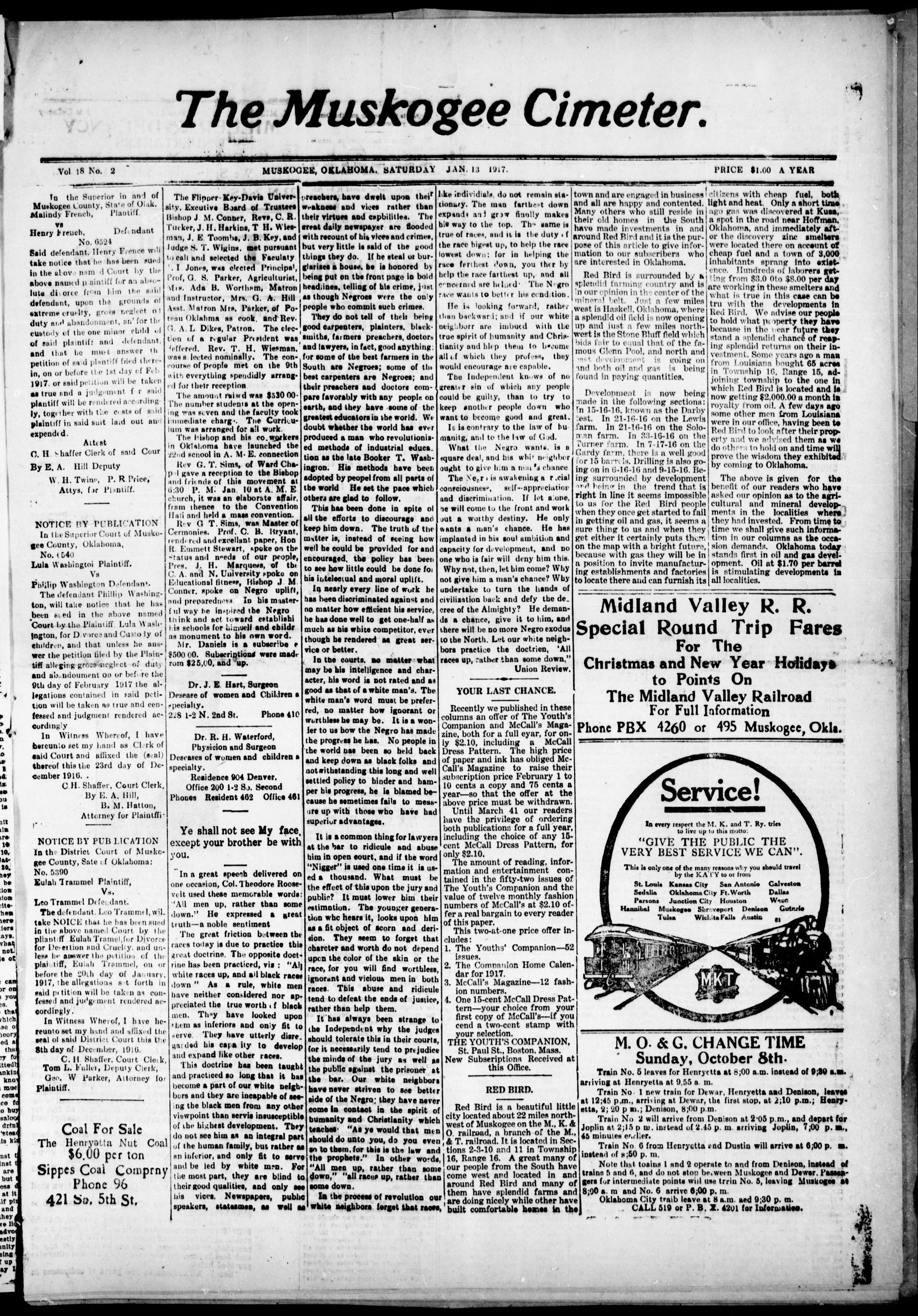
The Flipper-Key-Davis University, Executive Board of Trustees Bishop J. M. Conner, Revs, C. R. Tucker, J. H. Harkins, T H. Wiesman, J. E Toombs, J. B. Key, and Judge S. T. Wigins, met pursuant to call and selected the Faculaty. I. Jones, was elected Principal, Prof, G. S. Parker, Agriculturist, Mrs. Ada B. Wortham, Matron and Instructor, Mrs. G. A. Hill Asst. Matron Mrs. Parker, of Poteau Oklahma as cook, and Rev. G. A. L. Dikes, Patron. The election of a regular President was deferred. Rev. T. H. Wiesman, was lected nominally. The course of people met on the 9th with everything spendidly arranged for their reception. The amount raised was $530 00. The number students at the opening was seven and the faculty took immediate charge. The Curriculum was arranged for all work.
In the Bishop and his co,workers in Oklahoma have launched the 22nd school in A. M. E. connection
Rev G. T. Sims, of Ward Chapel gave a reception to the Bishop and friends of this movement at 6:30 P. M. Jan. 10 at A. M. E. church, it was an elaborate affair, from thence to the Convention Hall and held a mass convention.
Rev G. T. Sims, was Master of Cermonies. Prof. C. B. Bryant, rendered and excellent paper, Hon R. Emmett Stewart, spoke on the status and needs of our people, Pres. J. H. Marques, of the C.A. and N. University spoke on Educational fitness, Bishop J. M. Conner, spoke on Negro uplift, and preparedness. In his masterful way he inspired the Negro think and act toward establis his schools for himself and childr as monument to his own word.
Mr. Daniels is a subscribe e $500.00. Subscriptions were made from $25.00, and up.
Dr. J. E. Hart, Surgeon
Desease of women and Children a
specialty.
228 1-2 N. 2nd St. Phone 410
Physicion and Surgeon Descases of women and children a specialty. Residence 904 Denver.
Ye shall not see My face, except your brother be with you.
In a great speech delivered on one occasion, Col. Theodore Roosevelt used these memorable words: "All men up, rather than some down." He expressed a great truth—a noble sentiment.
The great friction between the races today is due to practice this great doctrine. The opposite doctrine has been practiced, vis: "Alp white races up, and all black races down." As a rule, white men have neither considered nor appreciated the true worth of black men. They have looked upon them as inferior and only fit to serve. They have utterly disregarded his capa ity to develop and expand like other races.
This doctrine has been taught and practiced so long that it has become a part of our white neighbors and they are incapable of seeing the black men from any other viewpoint than servis insusceptible of the highest development. They do not see him as an integral part of the human family, but rather as an inferior, and only fit to serve and be led by white men. For the most part, they are blind to their good qualities, and only see his vices. Newspapers, public speakers, statesmen, as well as
preachers, have dwelt upon their weakness and vices rather than their virtues and capabilities. The great daily newspaper are flooded with recount of his vices and crimes, but very little is said of the good things they do. If he steal or burglars a house, he is honored by being put on the front page in bold headlines, telling of his crime, just as though Negroes were the only people who commit such crimes.
They do not tell of their being good carpenters, plainters, blacksmiths, farmers preachers, doctors and lawyers, in fact, good anything; for some of the best farmers in the South are Negroes; some of the best carpenters are Negroes; and their preachers and doctors compare favorably with any people on earth, and they have some of the greatest educators in the world. We doubt whether the world has ever produced a man who revolutionized methods of industrial education as the late Booker T. Washington. His methods have been adopted by peopel from all parts of the world. He set the pace which others are glad to follow.
This has been done in spite of all the efforts to discourage and keep him down. The truth of the matter is, instead of seeing how well he could be provided for and encouraged, the policy has been to see how little could be done for his intellectual and moral uplift.
In nearly every line of work he has been discriminated against and no matter how efficient his service, he has done well to get one-half as much as his white competitor, ever though he rendered as great service or better.
In the courts, no matter what may be his intelligence and character, his word is not rated and as good as that of a white man's. The white man's word must be preferred, no matter how ignorant or worthless he may be. It is a wonder to us how the Negro has made the progress he has. No people in the world has been so held back and keep down as black folks and not withstanding this long and well settled policy to hinder and hamper his progress, he is blamed because he sometimes fails to measure up with those who have had superior advantages.
It is a common thing for lawyers at the bar to ridicule and abuse him in open court, and if the word "Nigger" is used one time it is used a thousand. What must be the effect of this upon the jury and public? It must lower him their estimation. The younger generation who hears it, looks upon him as a fit object of scorn and derision. They seem to forget that character and worth do not depend upon the color of the skin or the race, for you will find worthless, ignorant and vicious men in both races. This abuse and ridicule tend to defeat the ends of justice, rather than help them.
It has always been strange to the Independent why the judges should tolerate this in their courts, for it necessarily tend to prejudice the minds of the jury as well as the public against the prisoner at the bar. Our white neighbors have never striven to see better side of the Negro; they have never come in contact in the spirit of humanity and Christianity which teaches: "As ye would that men should do unto you, do you even so to them, for this is the law and the prophets." In other words, "All men up, rather than some down," "all races up, rather than some down.
In the process of revolution our white neighbors forget that races.
like individuals, do not remain stationary. The man farthest down expands and grows finally makes his way to the top. The same is true of races, and it is the duty of the race biggest up, to help the race lowest down; for in helping the race farthest down, you ther by help the race farthest up, and all concerned are helped. The Negro race wants to better his condition.
He is looking forward, rather than backward; and if our white neighbor are imbued with the true spirit of humanity and Christianity and help them to become all of which they profess, they would encourage are capable.
The Independent knows of no greater sin of which any people could be guilty, than to try to keep another people down who want to become good and great.
It is contrary to the law of humanity, and to the law of God.
What the Negro wants, is a square deal, and his white neighbor ought to give him a man's chance. The Negro is awakening a racial consciousness, self-appreciation and discrimination. If let alone, he will come to the front and work out a worthy destiny. He only wants a man's chance. He has implanted in his soul ambition and capacity for development, and no one who is fair will deny him this. Why not, then, let him come? Why not give him a man's chance? Why undertake to turn the hands of civilization back and defy the degree of the Almighty? He demands a chance, give it to him, and there will be no more Negro exodus to the North. Let our white neighbors practice the doctrien, "All races up, rather than some down." Union Review.
YOUR LAST CHANCE.
Recently we published in these columns an offer of The Youth's Companion and McCall's Magazine, both for a full eyar, for only $2.10, including a McCall Dress Pattern. The high price of paper and ink has obliged McCall's Magazine to raise their subscription price February 1 to 10 cents a copy and 75 cents a year—so that the offer at the above price must be withdrawn. Until March 41 our readers have the privilege of ordering both publications for a full year, including the choice of any 15-cent McCall Dress Pattern, for only $2.10. The amount of reading, information and entertainment contained in the fifty-two issues of The Youth's Companion and the value of twelve monthly fashion numbers of McCall's at $2.10 offer a real bargain to every reader of this paper. This two-at-one price offer includes: 1. The Youths' Companion—52 issues. 2. The Companion Home Calendar for 1917.
3. McCall's Magazine—12 fashion numbers.
4. One 15-cent McCall Dress Pattern—your choice from your first copy of McCall's—if you cend a two-cent stamp with your selection.
THE YOUTH'S COMPANION
St. Paul St. Boston Mass.
St. Paul St. Boston, Mass. New Subseriptions Received at this Office.
RED BIRD.
Red Bird is a beautiful little city located about 22 miles northwest of Muskogee on the M., K. & O. railroad, a branch of the M., & T. railroad. It is located in Sections 2-3-10 and 11 in Township 16, Range 16. A great many of our people from the South have come west and located in and around Red Bird and many of them have splendid farms and are doing nicely while other have built comfortable homes in the
Midland Valley R. R.
Special Round Trip Fares
For The
Christmas and New Year Holidays
to Points On
The Midland Valley Railroad
For Full Information
Phone PBX 4260 or 495 Muskogee, Okla.
Service!
In every respect the M. K. and T. Ry. tries
to live up to this motto:
"GIVE THE PUBLIC THE
VERY BEST SERVICE WE CAN".
This is only one of the many reasons why you should travel
by the KATY to or from
St. Louis Kansas City San Antonio Galveston
Sedalia Oklahoma City Ft.Worth Dallas
Parsons Junction City Houston Waco
Hannibal Muskogee Shroveport Denison Gutnrle
Tulsa Wichita Falls Austin
MKT
M. O. & G. CHANGE TIME Sunday. October 8th.
Train No. 5 leaves for Henryetta at 8;00 a.m. instead of 9;30 a.m. arriving at Henryetta at 9;55 a.m.
Train No. 1 new train for Dewar, Henryetta and Denison, leaves at 12;45 p.m., arriving at Dewar, the first stop, at 2;10 p.m.; Henryetta, 2;20 p.m.; Denison, 8;00 p.m.
Train No. 2 will arrive from Denison at 2:05 p.m., and depart for Joplin at 2;15 p.m. instead of 2.45 p.m. arriving Joplin, 7;00 p.m., 45 minutes earlier.
Train No. 6 from Henryetta and Dustin will arrive at 6;00 p. m. instead of s;50 p.m.
Note that toains 1 and 2 operate to and from Denison, instead of traine 5 and 6, and do not stop between Muskogee and Dewer. Passengers for intermediate points will use ttrin No. 5, leaving Muskogee at 8;00 a.m. and No. 6 arrive 6;00 p.m.
Oklahoma City trail leave at 8 a.m. aed 9;30 p.m.
CALL 519 or P. B. X. 4201 for Information.
town and are engaged in business and all are happy and contented. Many others who still reside in their old homes in the South have made investments in and around Red Bird and it is the purpose of this article to give information to our subscribers who are interested in Oklahoma.
Red Bird is surrounded by a splendid farming country and is in our opinion in the center of the mineral belt. Just a few miles west is Haskell, Oklahoma, where a splendid oil field is now opening up and just a few miles northwest is the Stone Bluff field which bids fair to equal that of the famous Glenn Pool, and north and east development is going on and both oil and gas is being found in paying quantities.
Development is now being made in the following sections: In 15-16-16, known as the Darby test. In 21-16-16 on the Lewis farm. In 21-16-16 on the Solomon farm. In 33-16-16 on the Turner farm. In 7-17-16 on the Gardy farm, there is a well good for 15 barrels. Drilling is also going on in 6-16-16 and 9-15-16. Being surrounded by development and being in the trend that is right in line it seems impossible to us for the Red Bird people when they once get started to fail in getting oil and gas, it seems a sure thing to us and when they get either it certainly puts them on the map with a bright future, because with gas they will be in a position to invite manufacturing establishments and factories to locate there and can furnish its
PRICE $1.00 A YEAR
citizens with cheap fuel, both light and heat. Only a short time ago gas was discovered at Kusa, a spot in the road near Hoffman, Oklahoma, and immediately after the discovery zinc smelters were located there on account of cheap fuel and a town of 3,000 inhabitants sprang into existence. Hundreds of laborers getting from $3.0 to $8.00 per day are working in these smelters and what is true in this case can be tru with the developments in Red Bird. We advise our people to hold what property they have because in the near future they stand a splendid chance of reaping splendid returns on their investment. Some years ago a man from Louisiana bought 65 acres in Township 16, Range 15, adjoining township to the one in which Red Bird is located and is now getting $2,000.00 a month in royalty from oil. A few days ago some other men from Louisiana were in our office, having been to Red Bird to look after their property and we advised them as we do others to hold on and time will prove the wisdom they exhibited by coming to Oklahoma.
The above is given for the benefit of our readers who have asked our opinion as to the agricultural and mineral developments in the localities where they had invested. From time to time we shall give such information in our columns as the occasion demands. Oklahoma today stands first in oil and gas development. Oil at $1.70 per barrel is stimulating developments in all localities.
NATIONAL NEORO PRESS ASSOCIATION
The Cimeter is the only Republican paper in the City of Muskogee. The daily Phoenix is sometimes Republican and sometimes independent but at the present time it claims to be independent, such a changing is not worth three whoops in h—1 to any political party and yet Bixby, its editor, got rich at the Republican pie counter. What base ingritude.
LET PEOPLE HAVE VOTE
WASHINGTON (D.C.) CITIZENS SHOULD SETTLE LIQUOR QUESTION
SAYS JOSEPH DEBAR
President of National Wholesale Liquor Dealers' Association Attacks Anti-Saloon League For Trying to Foist Prohibition on Capital City Without a Reforendum
In the Cincinnati Enquirer appeared the following reply to Wayne B. Wheeler, of the Anti-Saloon League.
President Joseph Debar, of the National Wholesale Liquor Dealers' Association, yesterday replied to the special dispatch in the Enquirer under a Washington date line as follows:
"Wayne B. Wheeler, of the Anti-Saloon League, tries to defend the inconsistencies of that organization, now engaged in an effort to prevent the Congress from giving home rule to the people of the District of Columbia on the liquor question. If the people have the right to better their condition, as Mr. Wheeler claims, in any unit of government, then the people should have the right to decide by vote, first of what that betterment consists, and, secondly, if a majority of the people want it.
"There are a great many good people in the District of Columbia—quite as good as the Anti-Saloon League lobby now besieging the capital—who do not believe that prohibition would better conditions in the District. These voters have a right to be heard on this question. And if some people think that prohibition would better conditions, then the voters have a right to know if a majority desire this alleged betterment.
"Afraid of Defeat"
"Mr. Wheeler knows that the Senators who voted for the Underwood amendment are quite as good lawyers as he is. He is not troubled about the legal validity of the amendment, but he is afraid of being defeated at the polls on this question by the people. With his usual unfairness Mr. Wheeler, if quoted correctly, would have the readers of the Enquirer believe that the proposed prohibition bill is directed only against the saloons in the District, whether at wholesale or at retail. It would close all retail liquor stores, even where no saloons exist and where liquor is sold only in original packages not to be imbibed on the premises.
"The Supreme Court of the United States in deciding the Warehouse Receipt Cases, February 24, 1914, rendered a unanimous decision concerning the liquor business in the following language:
" 'We know of no reason for thus condaining honest transactions which grow out of the recognized necessities of a lawful business.'
"Thus the highest tribunal in our land has unanimously declared the liquor business to be a lawful business, that the business has necessities and that the court recognized these necessities. A lawful business has the right to exist, especially when encouraged for generations by the granting of licenses in the capital of the nation. To destroy this lawful business without compensation, even by a majority of the people, is a crime. To destroy it without the sanction of a majority of the voters is a greater crime and is defensible tyranny. All of the civilized nations of the world grant compensation when withholding licenses or eliminating any phase of the liquor business. Even Russia, in suppressing vodka as a war measure, confiscated no man's property. Russia ceased to use a state monopoly and immediately imposed other taxes to take the place of profits derived from the sale of
THE MUSICIAN
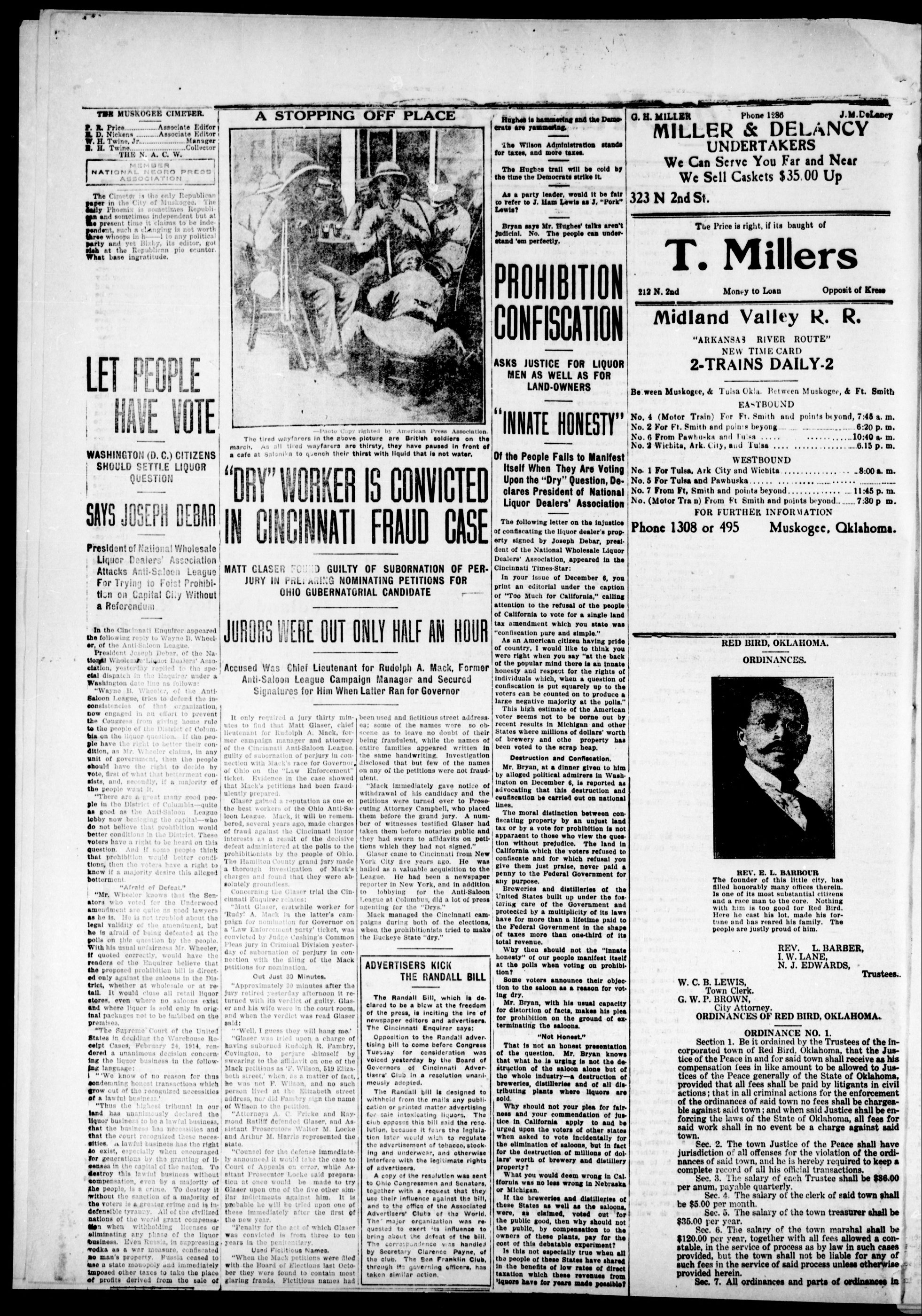
—Photo Copy righted by American Press Association.
The tired wayfarers in the above picture are British soldiers on the march. As all tired wayfarers are thirsty, they have paused in front of a cafe at Satonika to quench their thirst with liquid that is not water.
"DRY" WORKER IS CONVICTED IN CINCINNATI FRAUD CASE
MATT CLASER FOUND GUILTY OF SUBORNATION OF PER- JURY IN PREPARING NOMINATING PETITIONS FOR OHIO GUBERNATORIAL CANDIDATE
Accused Was Chief Lieutenant for Rudolph A. Mack, Former Anti-Saloon League Campaign Manager and Secured Signatures for Him When Latter Ran for Governor
It only required a jury thirty minutes to find that Matt Glaser, chief lieutenant for Rudolph A. Mack, former campaign manager and attorney of the Cincinnati Anti-Saloon League, guilty of submuration of perjury in connection with Mack's race for Governor of Ohio on the "Law Enforcement" ticket. Evidence in the case showed that Mack's petitions had been fraudulently prepared. Glaser gained a reputation as one on the best workers of the Ohio Anti-Saloon League. Mack, it will be remembered, several years ago, made charges of fraud against the Cincinnati liquor interests as a result of the decisive defeat administered at the polls to the prohibitionists by the people of Ohio. The Hamilton County grand jury made a thorough investigation of Mack's charges and found that they were absolutely groundless.
Concerning the Glaser trial the Cincinnati Enquirer relates: 'Matt Glaser, eratewhile worker for Rudy' A. Mack in the latter's campaign for nomination for Governor on a 'Law Enforcement party' ticket, was convicted by Judge Cushing's Common Pleas jury in Criminal Division yesterday of subnation of perjury in connection with the filing of the Mack petitions for nomination.
Out Just 30 Minutes.
"Approximately 30 minutes after the jury retired yesterday afternoon it returned with its verdict of guilty. Glaser and his wife were in the court room, and when the verdict was read Glaser said:
"Well, I guess they will hang me."
"Glaser was tried upon a charge of having suborned Rudolph R. Fambry, Covington, to perjure himself by swearing to the affidavit on one of the Mack potitions as 'F. Wilson, 519 Elizabeth street,' when, as a matter of fact, he was not F. Wilson, and no such person lived at the Elizabeth street address, nor did Fambry sign the name of Wilson to the petition.
"Attorneys A. C. Fricke and Raymond Ratliff defended Glaser, and Assistant Prosecutors Walter M. Locke and Arthur M. Harris represented the state."
"Counsel for the defense immediately announced it would take the case to Court of Appeals on error, while Assistant Prosecutor Locke said preparation at once would be made to try Glaser upon one of the five other similar indictments against him. It is probable he will be tried upon one of these immediately after the first of the new year. "Penalty for the act of which Glaser was convicted is from three to ten years in the penitentiary. Used Fictitious Names.
"When the Mack petitions were dled with the Board of Elections last October they were found to contain most glaring frauds. Fictitious names had
been used and fictitious street addresses; some of the names were so obscene as to leave no doubt of their being fraudulent, while the names of entire families appeared written in the same handwriting. Investigation disclosed that but few of the names on any of the petitions were not fraudulent.
"Mack immediately gave notice of withdrawal of his candidacy and the petitions were turned over to Prosecuting Attorney Campbell, who placed them before the grand jury. A number of witnesses testified Glaser had taken them before notaries public and they had sworn to affidavits on petitions which they had not signed."
Glaser came to Cincinnati from New York City five years ago. He was hailed as a valuable acquisition to the League. He had been a newspaper reporter in New York, and in addition to lobbying for the Anti-Saloon League at Columbus, did a lot of press agenting for the "Drys." Mack managed the Cincinnati campaigns during both of the elections, when the prohibitionists tried to make the Buckeye State "dry."
ADVERTISERS KICK
THE RANDALL BILL
The Randall Bill, which is declared to be a blow at the freedom of the press, is inciting the fire of newspaper editors and advertisers. The Cincinnati Enquirer says: Opposition to the Randall advertising bill to come before Congress Tuesday for consideration was voiced yesterday by the Board of Governors of Cincinnati Advertisers' Club in a resolution unanimously adopted. The Randall bill is designed to withhold from the mails any publication or printed matter advertising for sale intoxicating liquors. The club opposes this bill said the resolution, because it fears the legislation later would wish to regulate the advertisement of tobacco, stocking and underwear, and otherwise interfere with the legitimate rights of advertisers.
A copy of the resolution was sent to Ohio Congressmen and Senators, together with a request that they use their influence against the bill, and to the office of the Associated Advertisers' Clubs of the World. The major organization was requested to exert its influence to bring about the defeat of the bill. The correspondence was handled by Secretary Clarence Payne, of the club. The Ben Franklin Club, through its governing officers, has taken similar action.
Hughes is hammering and the Democrats are yammering.
The Wilson Administration stands for taxes, and more taxes.
The Hughes trail will be cold by the time the Democrats strike it.
As a party leader, would it be fair to refer to J. Ham Lewis as J, "Pork" Lewis?
Bryan says Mr. Hughes' talks aren't judicial. No. The people can understand 'em perfectly.
PROHIBITION
CONFISCATION
ASKS JUSTICE FOR LIQUOR
MEN AS WELL AS FOR
LAND-OWNERS
"INNATE HONESTY"
Of the People Falls to Manifest Itself When They Are Voting Upon the "Dry" Question, Declares President of National Liquor Dealers' Association
The following letter on the injustice of confiscating the liquor dealer's property signed by Joseph Debar, president of the National Wholesale Liquor Dealers' Association, appeared in the Cincinnati Times-Star:
In your issue of December 6, you print an editorial under the caption of "Too Much for California," calling attention to the refusal of the people of California to vote for a single land tax amendment which you state was "confiscation pure and simple."
As an American citizen having pride of country, I would like to think you were right when you say "at the back of the popular mind there is an innate honesty and respect for the rights of individuals which, when a question of confiscation is put squarely up to the voters can be counted on to produce a large negative majority at the polls."
This high estimate of the American voter seems not to be borne out by recent results in Michigan and other States where millions of dollars' worth of brewery and other property has been voted to the scrap heap.
Destruction and Confiscation.
Mr. Bryan, at a dinner given to him by alloged political admirers in Washington on December 6, is reported as advocating that this destruction and confiscation be carried out on national lines.
The moral distinction between confiscating property by an unjust land tax or by a vote for prohibition is not apparaunt to those who view the question without prejudice. The land in California which the voters refused to confiscate and for which refusal you give them just praise, never paid a penny to the Federal Government for any purpose.
Breweries and distilleries of the United States built up under the fostering care of the Government and protected by a multiplicity of its laws have for more than a lifetime paid to the Federal Government in the shape of taxes more than one-third of its total revenue.
Why then should not the "innate honesty" of our people manifest itself at the polls when voting on prohibition?
Some voters announce their objection to the saloon as a reason for voting dry.
Mr. Bryan, with his usual capacity for distortion of facts, makes his plea for prohibition on the ground of exterminating the saloons.
"Not Honest."
That is not an honest presentation of the question. Mr. Bryan knows that what he is urging is not the destruction of the saloon alone but of the whole industry—a destruction of breweries, distilleries and of all distributing plants where liquors are sold.
Why should not your plea for fairness and your commendation of justice in California apply to and be urged upon the voters of other states when asked to vote incidentally for the elimination of saloons, but in fact for the destruction of millions of dollars' worth of brewery and distillery property?
What you would deem wrong in California was no less wrong in Nebraska or Michigan.
If the breweries and distilleries of these States as well as the saloons, were, as claimed, voted out for the public good, then why should not the public, by compensation to the owners of these plants, pay for the cost of this debatable experiment? Is this not especially true when all the people of these States have shared in the benefits of low rates of direct taxation which these revenues from 'liquors have for years made possible?
MILLER & DELANCY UNDERTAKERS We Can Serve You Far and Near We Sell Caskets $35.00 Up
T. Millers Money to Loan Oppor land Valley R.
T. Millers
212 N. 2nd Money to Loan Opposit of Kress
"ARKANSA3 RIVER ROUTE"
NEW TIME CARD
2-TRAINS DAILY-2
ogee, & Tulsa Okla. Between Muskogee,
EASTBOUND
(Train) For Ft. Smith and points beyond
Smith and points beyond
Pawhuska and Tulsa
Ark. City, and Tulsa
WESTBOUND
La, Ark City and Wichita
La and Pawhuska
Smith and points beyond
(a n) From Ft. Smith and points beyond.
FOR FURTHER INFORMATION
198 or 495 Muskogee, C
Between Muskogee, & Tulsa Okla. Between Muskogee, & Ft. Smith
EASTBOUND
No. 4 (Motor Train) For Ft. Smith and points beyond, 7:45 a. m.
No. 2 For Ft. Smith and points beyond ..... 6:20 p. m.
No. 6 From Pawhuska and Tulsa ..... 10:40 a. m.
No. 2 Wichita, Ark. City, and Tulsa ..... 6:15 p. m.
WESTBOUND
No. 1 For Tulsa, Ark City and Wichita ..... 8:00 a. m.
No. 5 For Tulsa and Pawhuska ..... ..........
No. 7 From Ft. Smith and points beyond ..... 11:45 p. m.
No. (Motor Train) From Ft. Smith and points beyond ..... 7:30 p. m.
FOR FURTHER INFORMATION
Phone 1308 or 495 Muskogee, Oklahoma.
C. B. LEWIS,
Town Clerk.
W. P. BROWN,
City Attorney.
ORDINANCES OF RED BIRD, OKL
ORDINANCE NO. 1.
Section 1. Be it ordained by the Trust
corporated town of Red Bird, Oklahoma,
of the Peace in and for said town shall
compensation fees in like amount to be a
sales of the Peace generally of the State
provided that all fees shall be paid by lit-
tions; that in all criminal actions for the
ordinances of said town no fees shall
against said town; and when said Justi-
cing the laws of the State of Oklahoma
work shall in no event be a charge
own.
Sec. 2. The town Justice of the Pea-
risdiction of all offenses for the violatio
Section 1. Be it ordained by the Trustees of the incorporated town of Red Bird, Oklahoma, that the Justice of the Peace in and for said town shall receive as his compensation fees in like amount to be allowed to Justices of the Peace generally of the State of Oklahoma, provided that all fees shall be paid by litigants in civil actions; that in all criminal actions for the enforcement of the ordinances of said town no fees shall be chargeable against said town; and when said Justice shall be enforcing the laws of the State of Oklahoma, all fees for said work shall in no event be a charge against said town.
Sec. 2. The town Justice of the Peace shall have jurisdiction of all offenses for the violation of the ordinances of said town, and he is hereby required to keep a complete record of all his official transactions.
Sec. 3. The salary of each Trustee shall be $86.00 per annum, payable quarterly.
Sec. 4. The salary of the clerk of said town shall be $5.00 per month.
Sec. 5. The salary of the town treasurer shall be $35.00 per year.
Sec. 6. The salary of the town marshal shall be $120.00 per year, together with all fees allowed a constable, in the service of process as by law in such cases provided, but the town shall not be liable for any of such fees in the service of said process unless otherwise provided herein.
Sec. 7. All ordinances and parts of ordinances in
323 N 2nd St.
The Price is right, if its bought of
Opposit of Kress
ey R. R.
between Muskogee, & Ft. Smith
UND
and points beyond, 7:45 a. m.
6:20 p. m.
10:40 a. m.
6:15 p. m.
UND
a ..... 8:00 a. m.
und ..... 11:45 p. m.
and points beyond ..... 7:30 p. m.
FORMATION
Muskogee, Oklahoma.
RED BIRD, OKLAHOMA.
ORDINANCES.
J. B. H.
REV. E. L. BARBOUR
The founder of this little city, has filled honorably many offices therein. Is one of its most substantial citizens and a race man to the core. Nothing with him is too good for Red Bird. Here he cast his lot, made his fortune and has reared his family. The people are justly proud of him.
REV. L. BARBER,
I. W. LANE,
N. J. EDWARDS,
Trustees.
LEWIS,
Down Clerk.
BROWN,
City Attorney.
DINANCES OF RED BIRD, OKLAHOMA.
ORDINANCE NO.1.
tained by the Trustees of the in- Bird, Oklahoma, that the Jus- or said town shall receive as his amount to be allowed to Jus- ally of the State of Oklahoma, all be paid by litigants in civil actions for the enforcement town no fees shall be charge- ed when said Justice shall be en- State of Oklahoma, all fees for event be a charge against said justice of the Peace shall have as for the violation of the ordi-
conflict herewith are hereby repealed.
This ordinance shall be in full force and take effect
from and after its passage and approval.
1915.
(Seal) Trustees.
Attest:
ORDINANCE NO. 2.
Be It Ordained by the Trustees of the Incorporated Town of Red Bird, Oklahoma;
Section 1. That it shall be unlawful for any person, or agent of any property within the incorporated limits of the town of Red Bird, to maintain, or to permit to become in an unsanitary condition, any privy, toilet, or other building.
Sec. 2. That it shall be unlawful for any person to permit to accumulate any garbage, refuse, dead animal, or other obnoxious substances, dangerous to the public health and that would tend to create disease of any character, within the incorporated limits of the town of Red Bird.
Sec. 3. That all bodies of dead animals and other refuse matters shall be removed by those responsible therefor, either by burning the same outside the limits of said town, or by carting the same away within twenty-four hours thereafter, and a failure so to do shall constitute a public nuisance.
Sec. 4. That the contents of all privies shall be removed by the scavenger in odorless airtight tanks, and said tanks shall frequently be inspected by some one authorized by the Trustees to insure the public health.
Sec. 5. That all privies within the incorporated town of Red Bird shall be cleaned at least once each month, and offender if occasion should at any time require, provided, however, that all privies used in connection with hotels and restaurants, and other public buildings, shall be cleaned every two weeks.
Sec. 6. That a charge of 20 cents shall be paid by the owners of each privy for cleaning same, and all privies shall be provided with a slide being placed underneath each seat in the privy, and said slide shall be placed so as to be readily accessible.
Sec. 7. It shall be unlawful for any person to maintain any cesspool in, upon or about his premises, except as otherwise provided herein, or to throw, or cause to be thrown upon any vacant lot, upon his own premises, or in the public streets of said town, any slop, waste paper, garbage, or refuse of any kind.
Sec. 8. It shall be unlawful for any person to set fire to any dead grass, or stubble, within the incorporated limits of said town, unless same be personally under the supervision of some competent adult person, and in no event shall such fire be permitted after dark, or be put out while a high wind is blowing so as to endanger buildings within said town.
Sec. 9. Unless otherwise provided by the Trustees of said town it shall be the duty of the town marshal to see that this ordinance is strictly enforced.
Any persons, or persons, violating any of the provisions of this ordinance shall be deemed guilty of a misdemeanor, and upon conviction shall be fined in a sum not less than $500, or sentenced to not less than ten days in jail, or both, in the discretion of the court.
All ordinances and parts of ordinances in conflict herewith are hereby repealed.
This ordinance shall take effect after its passage and approval. Passed and approved this day of September, 1915.
Be It Ordained by the Trustees of the Incorporated Town of Red Bird, Oklahoma:
Section 1. That the Board of Trustees of said town shall meet in regular session at least once each month, beginning with the first Monday night following the passage and approval of this ordinance, and at such time thereafter as shall be provided for at each session thereof; provided, that it may meet in extra-ordinary session whenever circumstances may require, each member thereof being notified by the President, or chairman of said Board of Trustees.
Sec. 2. The town clerk shall meet with the Board of Trustees and shall be the secretary thereof, and it shall be his duty to record the proceedings of each meeting as they occur.
All ordinances and parts of ordinances in conflict herewith are hereby repealed.
This ordinance shall take effect and be in force after its passage and approval.
1915.
Passed and approved this 20th day of September, (Seal) Trustees.
Attest:
W. C. B. LEWIS.
Be It Ordained by the Trustees of the Incorporated Town of Red Bird, Oklahoma:
Sec. 2. All business matters shall be referred to the proper committee with direction to report to the Board of Trustees not later than its next meeting.
Sec. 3. All ordinances shall be recorded in a book kept by the town clerk, which shall constitute a permanent record of said town.
Sec. 4. No bills shall be allowed against said town until the same have been submitted in writing, verified by the affidavit of the claimant, filed with the town clerk and regularly allowed at a regular session of the Board of Trustees.
Sec. 5. Any member of the Board of Trustees failing, without reasonable excuse, to attend three successive meetings of the Board shall thereby forfeit his office, unless otherwise provided by the laws of the State of Oklahoma, in such case provided.
Sec. 6. The town marshal shall be street commissioner, unless other wise provided by the Board of Trustees at a regular meeting, and shall be allowed $1.00 per day for work.
Sec. 7. All committees shall submit their reports to the Board in writing.
All ordinances and parts of ordinances in conflict herewith are hereby revealed.
This ordinance shall take effect and be in force
Be It Ordained by the Trustees of the Incorporated Town of Red Bird, Oklahoma;
That it shall be unlawful for any person, firm, or corporation, to do or perform any of the acts hereinafter enumerated within the incorporated limits of the town of Red Bird, viz:
Section 1. To obstruct the streets, alleys or sidewalks with any boxes, barrels or anything, except when receiving or forwarding goods, wares and merchandise, and then only for a reasonable time.
Sec. 2. For any person to fire or discharge any cannon, fowling piece, pistol, or any other firearms of any description, or fire or explode any squibs, crackers, or other thing containing powder or other combustible or explosive substance, without permission from the Trustees, which permission is subject to revocation at any time: Provided, it shall not be a violation of this ordinance to sound an alarm of fire by the discharge of firearms.
Sec. 3. For any person to leave any horse, or horses, mules, or any other animal attached to any vehicle, in the streets, alleys, or other public places, without securely fastening said animals, or by leaving some competent person in charge of same.
Sec. 4. To leave any open trap door, ditch, pit or vault in any street, highway, sidewalk, or other place of public travel, or to suffer same to be done, without placing threat a red light before the close of day to warn passengers of every degree of the apparent danger, which said danger signal shall not be removed therefrom sooner than the rising of the sun of the day following.
Sec. 5. To ride or drive on any sidewalk, or to ride or drive through the streets and alleys in a reckless or wanton manner such as to endanger human life and property.
Sec. 6. To leave standing any wall or flue, chimney, or building which shall be dangerous by fire, to passersby, or which shall become a public nuisance after twelve hours' notice to remove the same.
Sec. 7. To permit any dangerous or mischievous animal to run at large.
Sec. 8. To be found prowling around or about the property of another without his consent, or reasonable excuse therefor.
Sec. 9. To enter the house, building, or premises of another for any unlawful purpose.
Sec. 10. To be guilty of the crime of petit larceny as defined by the statutes of the State of Oklahoma.
Sec. 11. To jump off or on, cling to or hang on any railway car or engine while the same is in motion, except this provision shall not apply to passengers, officials or other employees of the railroad company.
Sec. 12. For any engineer, fireman, conductor, or other trainman in charge of the operation of any railway train, to allow said train to block the streets for a period exceeding fifteen minutes.
Sec. 13. The mahshal shall have power to abate any nuisance, or to remove the cause which immediately threatens fire to any building.
Any person, firm or corporation violating any of the provisions of this ordinance shall be guilty of a misdemeanor, and upon conviction shall be fined not less than $5.00 nor more than $25.00, or imprisoned in the city jail for a period not to exceed thirty days, or by both such fine and imprisonment in the discretion of the court.
All ordinances and parts of ordinances in conflict herewith are hereby repealed. This ordinance shall take effect and be in force after its passage and approval. (Seal) Trustees
ORDINANCE NO. 6.
Be It Ordained by the Trustees of the Incorporated Town of Red Bird, Oklahoma;
That it shall be unlawful for any person to do, or perform any of the following acts within the incorporated limits of said town, viz:
Section 1. To set up, keep, maintain, exhibit, or play at game known as faro, monte, lottery, dice, shuffle board, or any other game prohibited by the laws of the State of Oklahoma.
Sec. 2. To maintain any business, or practice of whatever degree by which money is wagered in the nature of gambling as defined by the laws of the State of Oklahoma.
Sec. 3. For each day any gambling game shall be carried on shall be and constitute a separate offense.
Sec. 4. To have or keep any tables or other paraphernalia for gambling purposes.
Any person found guilty of a violation of the provisions of this ordinance shall be deemed guilty of a misdemeanor, and upon conviction shall be fined in a sum not more than $25.00, or sentenced to imprisonment in the city jail for not less than ten days, or by both such fine and imprisonment in the discretion of the court.
All ordinances and parts of ordinances in conflict herewith are hereby repealed.
This ordinance shall take effect and be in force after its passage and approval.
(Seal() Trustees.
Attest:
W. C. B. LEWIS,
Town Clerk.
ORDINANCE NO. 7.
Be It Ordained by the Trustees of the Incorporated Town of Red Bird, Oklahoma:
Section 1. That it shall be unlawful for any person within the incorporated town of Red Bird, to maintain, keep, or patronize any bawdy house, assignation house, house of ill fame, brothel shop, or other place where immoral practices may be carried on.
Sec. 2. It shall be unlawful for any female to engage in any lewd conduct with the opposite sex within the incorporated limits of said town, or to in anywise induce, or encourage any male to frequent any place, public, or private, for immoral purposes.
Sec. 3. It shall be unlawful for any man, or boy over the age of fourteen years, and not a relative, to be found in the company of any woman, or other female of bad repute, upon the streets, or in any house, public, or private, within the incorporated limits of said town, provided, however, that this section shall not apply to officials, lawyers and doctors who may be called upon to
discharge some legal obligation towards such persons.
discharge some legal obligation towards such persons.
Sec. 4. It shall be unlawful for any person within the incorporated limits of the town of Red Bird to appear in public in a state of nudity, or in an indecent or lewd dress, or make any indecent exposure of his or her person, or be guilty of any lewd or indecent act or behavior, or exhibit or sell any indecent or lewd book, picture or other thing, or exhibit or perform any indecent or immoral or lewd play or other representation, or put upon any street, alley, or other public place, or leave in any yard, or upon any premises, any indecent notice or advertisement.
Sec. 5. In addition to other places commonly known as public places, all vacant lots and blocks within the incorporated town of Red Bird are hereby declared public places within the meaning of this ordinance.
Sec. 8. It shall be unlawful for any person within the incorporated limits of the town of Red Bird, to wear or carry any pistol, dirk, butcher knife, bowie knife, sword, spear in a cane, brass or metal knucks, razor, slung shot, sand bag, or pocket knife with a blade to exceed three inches in length, or with a spring handle.
Sec. 7. It shall be unlawful for any person within the limits of the town of Red Bird to maintain any place where intoxicating liquors of any kind may be sold, or given away, contrary to the laws of Oklahoma, or to be and appear in an intoxicated condition upon any street, or in any public place whatsoever.
Sec. 8. It shall be unlawful for any person within the limits of the town of Red Bird to maintain any house or place where divers persons may resort and there make loud and boisterous noises such as are calculated to disturb the quietness of the people of said town, or any part of them, or to employ any device, noise or other performance tending to the collection of persons on the streets, or other public places to the obstruction of same, or to exhibit any tricks of legerdemain, or other devices of like kind, or perform with bells, organs or other instruments upon any of the streets of said town; provided, this section shall not affect exhibitions, performances, or the sale of any articles permitted upon payment of the license fee required by other ordinances of this town.
Sec. 9. It shall be unlawful for any person within the incorporated limits of the town of Red Bird willfully give or make a false alarm of fire, or to resist an officer in the lawful discharge of his duty, or to in any wise interfere with such officer while acting in the discharge of his duty, or to escape from arrest or to aid another to escape therefrom.
Sec. 10. Any person owning or keeping any female dog over the age of one year, or any male dog over the age of one year, within the corporate limits of the town of Red Bird shall pay thereon the sum of $1.00 for every female dog and 50 cents for every male dog each year as a license fee thereon. Provided, however, that any owner of a female dog who allows same to run at large
Sec. 11. All fines collected for the violation of any ordinances of the town of Red Bird shall go into the general fund of said town.
Sec. 12. All business houses shall pay an occupation tax to be fixed by the Trustees of the town of Red Bird at any regular meeting of said Trustees and notice thereof shall be given ten days to each person, or firm, or corporation liable to pay said tax.
Sec. 13. Any person violating any provision of this ordinance shall be guilty of a misdemeanor and fined not to exceed $25.00, or sentenced to not more than thirty days in jail, or both, at the discretion of the court.
Sec. 14. All ordinances and parts of ordinances in conflict herewith are hereby repealed.
This ordinance shall be in full force and take effect from and after its passage and approval.
Be It Ordained by the Trustees of the Incorporated Town of Red Bird, Oklahoma;
Section 1. That the town Justice of the Peace shall require a cost bond in all criminal cases for the violation of town ordinances, except where said prosecution is had at the instance of the town.
Sec. 2. The Justice of the Peace shall be liable for accepting worthless bonds for the appearance of persons charged with crime, or to secure the costs or fine.
All ordinances and parts of ordinances in conflict herewith are hereby repealed.
This ordinance shall be in full force and take effect from and after its passage and approval.
Passed and approved this 20th day of September, 1915. REV. E. L. BARBER,
Be It Ordained by the Trustees of the Incorporated Town of Red Bird, Oklahoma;
Section 1. That it shall be unlawful for any peddler of any kind whatsoever to exhibit, or offer for sale within the incorporated limits of said town any goods, wares or merchandise of whatever nature without first obtaining permission from the town Trustees and paying to the Town Treasurer a license fee in the sum of $1.00 to $3.00. A receipt for said license duly signed by said Town Treasurer shall operate and be construed as the written consent of said Trustees.
Sec. 2. No shows, merry-go-rounds, and like entertainments given by persons other than residents of the Town of Red Bird, shall be allowed in the incorporated limits of said town for the purpose of giving an entertainment or exhibition unless a license shall first be procured from the town clerk at a cost of from $1.00 to $5.00
Any person violating the provisions of this ordinance shall be deemed guilty of a misdemeanor and on conviction shall be fined in a sum not to exceed $25.00, or sentenced not to exceed thirty days in jail, or both, in the discretion of the court.
All ordinances and parts of ordinances in conflict herewith are hereby repealed. This ordinance shall be in force and take effect from and after its passage and approval. 1915. REV. E. L. BARBER
TRYING TO "SAVE" OHIO
ANTI-SALOON LEAGUE FLOODS GREAT STATE WITH PAID REFORMERS
FROM SOUTH, TOO!
Buckeye Editor Roasts Small, Hobson and Patterson, Telling Them To Help Lift Up Georgia, Alabama and Tennessee Which Really Need the Light
After two previous unsuccessful attempts the Anti-Saloon League, with a paid gang of reformers, is trying to make Ohio "dry." Here is what the Ohio Valley Times, of Steubenville, Ohio, thinks of the scheme:
The national organization of the Anti-Saloon League is sending into the state of Ohio the Rev. Small of Georgia, the Hon. Richard P. Hobson, of Alabama, and Ex-Governor Patterson, of Tennessee, to tell the people here to manage the affairs of this great state, Georgia, Alabama, Tennessee!
Look at the map! Study the tables of illiteracy and human deprivation. Make comparisons of these states with the state of Ohio on any question involving any matter of American civilization or American welfare and determine for yourself whether theseationen, Rev. Sam Small of Georgia, Hon. Richmond P. Hobson of Alabama, and Ex-Governor Patterson of Tennessee might not employ their talents, such as they have, to the amelioration of conditions in the states from which they come.
Ohio is an enlightened community. Ohio places the man above every other consideration.
Ohio Represents America.
Georgia, Alabama, Tennessee do not represent the spirit of America. They all live in an age that is dead. They are debadent communities. The things that Rev. Small, Mr. Hobao and Mr. Patterson are contending for may be very well for Georgia, Alabama, Tennessee and Russia, but Ohio is America at its best. Autocratic government for Russia, Georgia, Alabama and Tennessee is the only form applicable to communities where the population has been kept in the darkness of Cathay, but this is Ohio—Ohio selfless, Ohio intelligent, Ohio awake to the light and the life of the twentieth century.
Ohio does not vote the Democratic ticket nor the Republican ticket at the best of the bosses. Ohio has more independent voters than any state in the union. Ohio thinks for herself.
Ohio is able to take care of herself.
We say unto you, Richmond P. Hobson, go back to Alabama, and take those poor half-starved children out of the factories, where the grind is destroying the future citizens of America. You sank the Merrimac in the streets of Santiago, but we warn you to sink the Alabama.
To Sam Small of Georgia we say unto you, put Georgia on the map as civilized community and then come Ohio and tell us how you did it.
Anti-Saloon League Politics.
To Ex-Governor Patterson of Tennessee, we want to know how you came by that "EN" in front of your name. Did the fact that you helped to destroy civil liberty and local self-government in Tennessee have anything to do with it? You have a court-appointed mayor in Memphis, put her by a subservient court, and in defence of the expressed will of the people. You have in Tennessee what you are pleased to call prohibition, but you have not local self-government; neither have you a judiciary that dares to lift its head. The Anti-Sabon mob has intimidated your courts and the state has taken property without due process. Human slavery has been abolished within your borders, but not by you nor your fathers, but in spite of you and the race from which you spring.
You cannot foist upon Ohio either human slavery nor any of these subordinates which you bring under another gudge. Ohio demands clean hands and a pure heart. Show your hands and reveal to us the true inwardness of your hearts. We do not believe in your sincerity, neither do we trust to your judgments. "Fool, first cast the beam out of thine own eye; then can't thou see clearly the note that is in thy brother's eye."
WHAT ARE YOU
GOING TO DO?"
Michigan has gone dry—voted to go
after April 1, 1918. The hotels
barrooms have been swamped
with the query, What are you going to
To silence further interrogation
following sign has been posted in
Detroit hotels and cafes:
"Don't ask what we are going to do.
What are you going to do?"—Philadelphia Public Ledger.
THE SUNDAY BREAKFAST
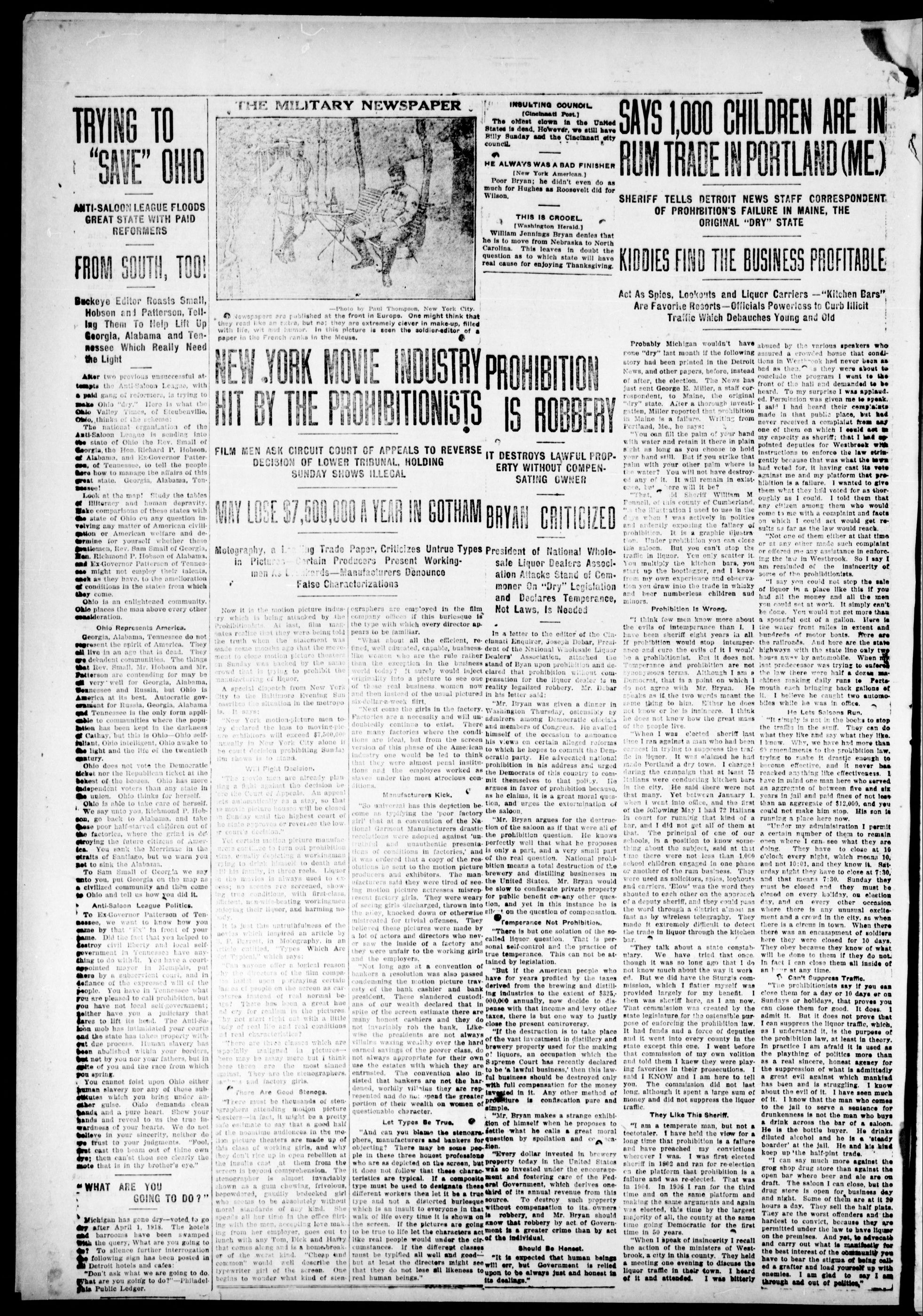
Newspapers are published at the front in Europe. One might think that they read like an extra, but not; they are extremely clever in make-up, filled with life, wit and humor. In this picture is seen the soldier-editor of a paper in the French ranks in the Meuse.
NEW YORK MOVIE INDUSTRY PROHIBITION HIT BY THE PROHIBITIONISTS IS ROBBERY
FILM MEN ASK CIRCUIT COURT OF APPEALS TO REVERSE
DECISION OF LOWER TRIBUNAL, HOLDING
SUNDAY SHOWS ILLEGAL
Motography, a Leading Trade Paper, Criticizes Untrue Types in Pictures—Certain Producers Present Workingmen As Lackords—Manufacturers Denounce False Characterizations
Now it is the motion picture industry which is being attacked by the Prohibitionists. At last, film magnates realize that they were being told the truth when the statement was made some months ago that the movement to close motion picture theaters on Sunday was backed by the same crowd that is trying to prohibit the manufacturing of liquor.
A special dispatch from New York City to the Baltimore Evening Sun describes the situation in the metropolis. It says:
"New York motion-picture men today declared the loss to moving-picture exhibitors will exceed $7,500,000 annually in New York City alone if the court decides prohibiting Sunday film shows to attend.
WILL FIGHT DECISION.
"The movie men are already planning a fight against the decision before the Court of Appeals. An appeal gets automatically in a stay, so that the movie picture houses will be closed on Sunday until the highest court of the state approves or reverses the lower court's decision."
Yet certain motion picture manufacturers continue to turn out prohibition films, equally depicting a workman trying to drink himself to death and kill his family, in three reels. Liquor in the movies is always used to express; no scenes are screened, showing true conditions, with first-class, efficient, non-wife-beating working men enjoying their liquor, and harming no body.
It is just this untruthfulness of the movies which inspired an article by M. P. Barrett, in Photography, in an article entitled, "Types Which Are Not Tempted," which says:
"Can anyone offer a logical reason why the director of the film compares instict upon portraying certain lasces of people on the screen as caricatures instead of real normal beings? There has been a great haul od city for realism in the pictures. Why not start right out with a little study of real life and real conditions not real characteristics?"
"Where are three classes which are especially maligned in pictures—here may be many more but I think here three are the most shinned against. They are the stenographers, architects and factory girls."
There Are Good Stenons.
"There must be thousands of stenographers attending motion picture theaters—in fact, it might be a pretty safe estimate to say that a good half of the noontime audiences in the motion picture theaters are made up of this class of working girls, and why they don't rise up in open rebellion at the insula cast, at them from the screen is beyond comprehension. The stenographer is almost invariably shown as a gum chewing, frivolous, hopowdored, gaudily bedecked girl who seems to be absolutely without moral standards of any kind. She spends all her time in the office firing with the men, accepting love making from her employer, goes out to lunch with any Tom, Dick and Harry that comes along and is a homebreaker of the worst kind. "Cheap and common" would well describe the typewriter girl of the screen. One begins to wonder what kind of sten-
ographers are employed in the film company offices if this burlesque is the type with which every director appears to be familiar.
"What about all the efficient, refined, well educated, capable, business-like women who are the rule rather than the exception in the business world today? It surely would inject originally into a picture to see one of those real business women now and then instead of the usual pictured six-dollars-a-week flirt.
"Next come the girls in the factory. Factories are a necessity and will undoubtedly continue to exist. There are many factories where the conditions are ideal, but from the screen version of this phase of the American industry one would be led to think that they were almost penal institutions and the employees worked as slaves under the most atrocious conditions.
Manufacturers Kick.
"So universal has this depiction become as typifying the 'poor factory girl' that at a convention of the National Garment Manufacturers drastic resolutions were adopted against 'untruthful and unauthentic presentations of conditions in factories,' and it was ordered that a copy of the resolutions he sent to the motion picture producers and exhibitors. The manufacturers said they were tired of seeing motion picture actresses misrepresent factory girls. They were weary of seeing girls discharged, thrown into the ailey, knocked down or otherwise mistreated for trivial offenses. They believed these pictures were made by a lot of actors and directors who never saw the inside of a factory and they were unfair to the working girls and the employers.
"Not long ago at a convention of bankers a resolution was also passed condemning the motion picture trayvesty of the bank cashier and bank president. These slandered custodians of our wealth declared that in spite of the screen estimate there are many honest cashiers and they do not invariably rob the bank. Like wise the presidents are not always villains waxing wealthy over the hard earned savings of the poorer class, do not always appropriate for their own use the estates with which they are entrusted. The convention also insisted that bankers are not the hard dened, worldly villains they are represented and do not spend the greater portion of their wealth on women of questionable character.
Let Types Be True.
"And can you blame the stenographers, manufacturers and bankers for objecting? There may be some people in these three honest professions who are as depicted on the screen, but it does not follow that these characteristics are typical. If a composite type must be used to designate these different workers then let it be a true type and not a distorted burlesque which is an insult to everyone in that walk of life every time it is shown on the screen. If the pictures are going to be true to life let the characters act like real people would under the cir-
The oldest clown in the United States is dead. However, we still have Billy Sunday and the Cincinnati city council.
HE ALWAYS WAS A BAD FINISHER
[New York American.]
Poor Bryan; he didn't even do as much for Hughes as Roosevelt did for Wilson.
William Jennings Bryan denies that he is to move from Nebraska to North Carolina. This leaves in doubt the question as to which state will have real cause for enjoying Thanksgiving.
PROHIBITION IS ROBBERY
IT DESTROYS LAWFUL PROPERTY WITHOUT COMPENSATING OWNER
BRYAN CRITICIZED
President of National Wholesale Liquor Dealers Association Attacks Stand of Commoner On "Dry" Legislation and Declares Temperance, Not Laws. Is Needed
In a letter to the editor of the Chinchunati Enquirer, Joseph Debar, President of the National Wholesale Liquor Dealers' Association, attacked the stand of Bryan upon prohibition and declared that prohibition without compensation for the liquor dealer is in reality legalized robbery. Mr. Debar in his letter said:
"Mr. Bryan was given a dinner in Washington Thursday, ostensibly by admirers among Democratic officials and members of Congress. He availed himself of the occasion to announce his views on certain alleged reforms to which he hopes to commit the Democratic party. He advocated national prohibition in his address and urged the Democrats of this country to commit themselves to that policy. He argues in favor of prohibition because, as he claims, it is a great moral question, and urges the extermination of the saloon.
"Mr. Bryan argues for the destruction of the saloon as if that were all of the prohibition question. He knows perfectly well that what he proposes is only a part, and a very small part of the real question. National prohibition means a total destruction of the brewery and distilling businesses in the United States. Mr. Bryan would be slow to confiscate private property for public benefit on any other question, and yet in this instance he is silent on the question of compensation.
Temperature Not Prohibition.
"There is but one solution of the so-called liquor question. That is personal self-control and the practice of true temperance. This can not be attained by legislation.
"But if the American people who have for years profited by the taxes derived from the brewing and distilling industries to the extent of $325,000,000 annually, now decide to dispense with that income and levy other taxes, there is but one way to justly close the present controversy.
"If the destruction is to take place of the vast investment in distillery and brewery property used for the making of liquors, an occupation which the Supreme Court has recently declared to be a 'lawful business,' then this lawful business should be destroyed only with full compensation for the money invested in it. Any other method of procedure is confiscation pure and simple.
"Mr. Bryan makes a strange exhibition of himself when he proposes to settle what he calls a great moral question by spoiation and coacation.
"Every dollar invested in brewery property today in the United States was so invested under the encouragement and fostering care of the Federal Government, which derives one-third of its annual revenue from this source. To destroy such property without compensation to its owners is robbery, and Mr. Bryan should know that robbery by act of Government is a greater crime than by act of the individual.
Should Be Honest.
"It is expected that human beings will err, but Government is relied upon to be always just and honest in its dealings."
SAYS 1,000 CHILDREN ARE IN RUM TRADE IN PORTLAND (ME.)
SHERIFF TELLS DETROIT NEWS STAFF CORRESPONDENT OF PROHIBITION'S FAILURE IN MAINE, THE ORIGINAL "DRY" STATE
KIDDIES FIND THE BUSINESS PROFITABLE
Act As Spies, Lookouts and Liquor Carriers - "Kitchen Bars" Are Favorite Resorts Officials Powerless to Curb Illicit Traffic Which Debauches Young and Old
Probably Michigan wouldn't have gone "dry" last month if the following story had been printed in the Detroit News, and other papers, before, instead of after, the election. The News has just sent George E. Miller, a staff correspondent, to Maine, the original "dry" state. After a thorough investigation, Miller reported that prohibition in Maine is a failure. Writing from Portland, Me., he says: "You can fill the palm of your hand with water and retain it there in plain sight as long as you choose to hold your hand still. But if you strike that palm with your other palm where is the water? You will not have destroyed any of it. It will remain in existence, but here will it be?
"That, and Sheriff William M. Pennell, of this county of Cumberland, "is the illustration I used to use in the dogs when I was actively in politics and ardently exposing the fallacy of prohibition. It is a graphic illustration. Under prohibition you can close the saloon. But you can't stop the traffic in liquor. You only scatter it. You multiply the kitchen bars, you start up the bootlegger, and I know from my own experience and observation you draw into the trade in whisky and bear numberless children and minors.
Prohibition Is Wrong.
"I think few men know more about the evils of intemperance than I. I have been sheriff eight years in all. If prohibition would stop intemperance and cure the evils of it I would be a prohibitionist. But it does not. Temperance and prohibition are not synonymous terms. Although I am a Democrat, that is a point on which I do not agree with Mr. Bryan. He speaks as if the two words meant the same thing to him. Either he does not know or he is insincere. I think he does not know how the great mass of the people live.
"When I was elected sheriff last time I ran against a man who had been earnest in trying to suppress the traffic in liquor. It was claimed he had made Portland a dry town. I charged during the campaign that at least 75 Italians were conducting kitchen bars in the city. He said there were not that many. Yet between January 1, when I went into office, and the first of the following May I had 72 Italians in court for running that kind of a bar, and I did not get all of them at that. The principal of one of our schools, in a position to know something about the subject, said at that time there were not less than 1,000 school children engaged in one phase or another of the rum business. They were used as solicitors, spies, lockhouses and carriers. 'Blow' was the word they shouted to each other on the approach of a deputy sheriff, and they could pass the word through a district almost as fast as by wireless telegraphy. They made it extremely difficult to detect the trade in liquor through the kitchen bar.
"They talk about a state constabulary. We have tried that once, though it was so long ago that I do not know much about the way it worked. But we did have the Sturgis commission, which I flatter myself was provided largely for my benefit. I then was shcriff here, as I am now. That commission was created by the state legislature for the ostensible purpose of enforcing the prohibition law. It had funds and a force of deputies and it went into every county in the state except this one. I went before that commission of my own volition and told them I knew they were playing favorites in their prosecutions. I said I KNOW and I am here to tell you. The commission did not last long, although it spent a large sum of money and did not suppress the liquor traffic
They Like This Sheriff
"I am a temperate man, but not a teototaler. I have held the view for a long time that prohibition is a failure and have preached my convictions wherever I was. I was first elected sheriff in 1962 and ran for re-election on the platform that prohibition is a failure and was re-elected. That was in 1964. In 1966 I ran for the third time and on the same platform and making the same arguments and again was elected, this time by the largest majority of all, the county at the same time going Democratic for the first time in 50 years.
"When I speak of insincerity I recall the action of the ministers of Westbrook, a city in this county. They held a meeting one evening to discuss the liquor traffic in their town. I heard of it and attended. I was bitterly
abused by the various speakers who assured a crowded house that conditions in Westbrook had never been as bad as then. as they were about to conclude the program I wont to the front of the hall and demanded to be heard. To my surprise I was applauded. Permission was given me to speak. I said I had heard their complaints made in that public place, but had never received a complaint from any one of them on which I could act in my capacity as sheriff, that I had appointed deputies for Westbrook with instructions to enforce the law stringently because that was what the town had voted for, it having cast its vote against me and my platform that prohibition is a failure. I wanted to give them what they had voted for as thoroughly as I could. I told them that any citizen among them who would come to me with a complaint and facts on which I could act would get results as far as the law would reach.
"Not one of them either at that time or at any other made such complaint or offered me any assistance in enforcing the law in Westbrook. So I say I am reminded of the insincerity of some of the prohibitionists.
"I say you could not stop the sale of liquor in a place like this if you had all the money and all the men you could set at work. It simply can't be done. You would not get more than a spoonful out of a gallon. Here is the water front mills in extent and hundreds of motor boats. Here are the railroads. And here are the state highways with the state line only two hours away by automobile. When my last predecessor was trying to enforce the law there were half a dozen machines making daily runs to Portsmouth each bringing back gallons of it. I believe he caught two automobiles while he was in office.
"It simply is not in the books to stop the traffic in the stuff. They can do what they like and say what they like. I know. Why, we have had more than 60 amendments to the prohibition law, trying to make it drastic enough to become effective, and it never has reached anything like effectiveness. I have in mind one man here who served an aggregate of between five and six years in jail and paid fines of not less than an aggregate of $12,000, and you could not make him stop. His son is running a place here now.
"Under my administration I permit a certain number of them to remain open where I can see what they are doing. They have to close at 10 o'clock every night, which means 10, and not 10:01, and they know it. Saturday night they have to close at 7:30, and that means 7:30. Sunday they must be closed and they must be closed on every holiday, on election day, and on every other occasion where there is any unusual excitement and a crowd in the city, as when there is a circus in town. When there there was an encampment of soldiers here they were closed for 10 days. They obey because they know of what will be done to them if they do not. In fact I can close them all inside of an hour at any time.
Can't Suppress Traffic.
"The prohibitionists say if you can close them for a day or 10 days or on Sundays or holidays, that proves you can close them for good. It does. I admit it. But it does not prove that I can suppress the liquor traffic, which, as I understand it, is the purpose of the prohibition law, at least in theory. In practice I am afraid it is used as the plaything of politics more than as a real sincere, honest agency for the suppression of what is admittedly a great evil against which mankind has been and is struggling. I know about the evil of it. I have seen much of it. I know that the man who comes to the jail to serve a sentence for drunkenness is not the man who buys a drink across the bar of a saloon. He is the bottle buyer. He drinks diluted alcohol and he is a 'steady boarder' at the jail. He and his kind keep up 'the half-pint trade.
"I can say much more against the grog shop drug store than against the open bar where beer and ale are on draft. The saloon I can close, but the drug store is open for business day and night. Some of them are at it 20 hours a day. They sell the half plates. They are the worst offenders and the hardest to convict, because they are permitted under the law to have liquor on the premises. And yet, to advocate and carry out what is manifestly for the best interest of the community you have to bear the stigma of being called a grafter and load yourself up with enemies. I am gled to say I am through and out of petitions."