Muskogee Cimeter
Saturday, February 3, 1917
Muskogee, Oklahoma
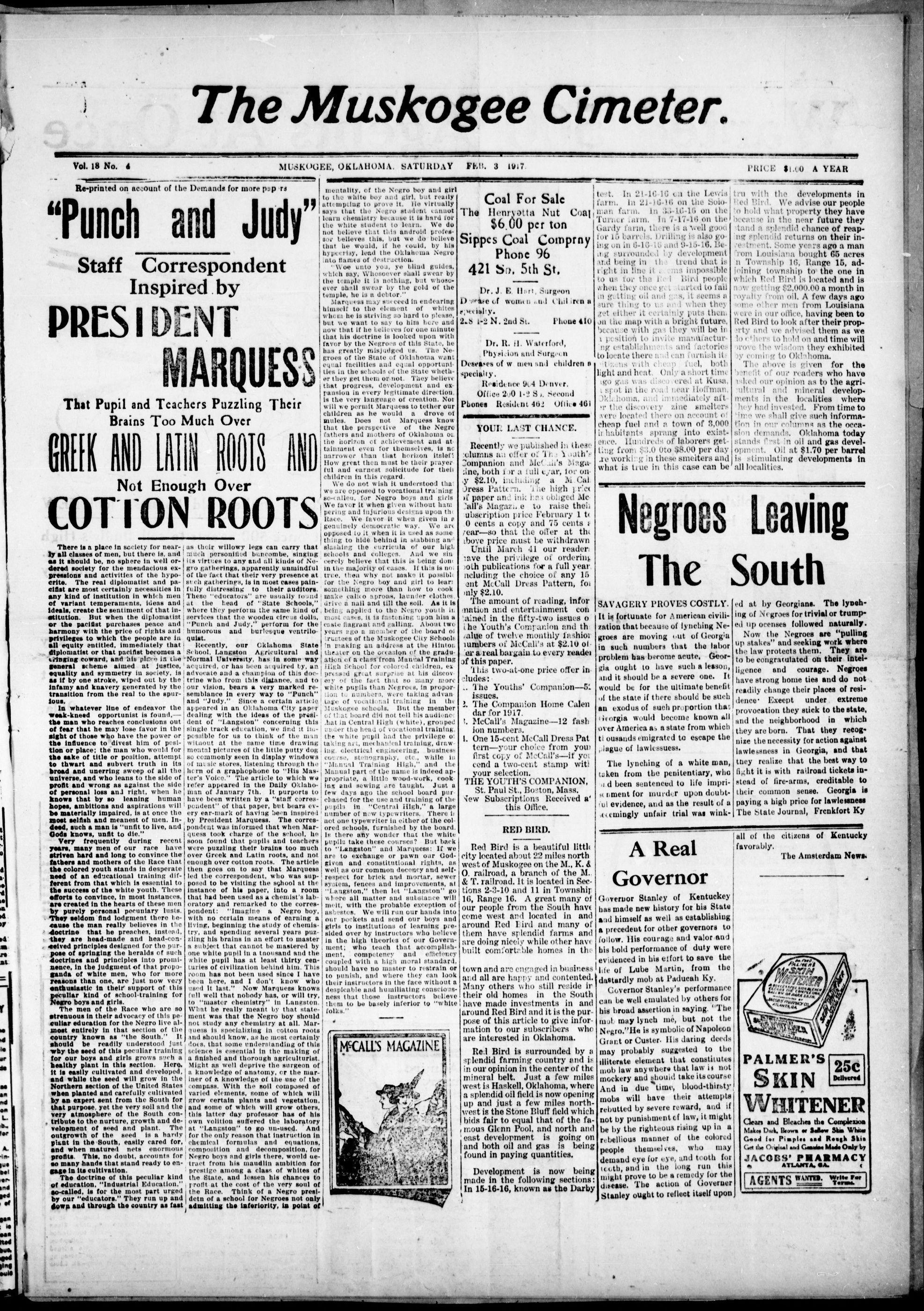
Page text (machine-generated)
Re-printed on account of the Demands for more papers
Staff Correspondent Inspired by PRESIDENT MARQUESS
Vol.18 No.4
Re-printed on account of the
"Punch a
Staff Corr
Inspir
PRESIDE
That Pupil and Teac
Brains Too
GREEK AND LAT
Not Enou
COTTON
There is a place in society for nearly all classes of men, but there is, and as it should be, no sphere in well ordered society for the mendacious expressions and activities of the hypocrite. The real diplomatist and pacifist are most certainly necessities in any kind of institution in which men of variant temperaments, ideas and ideals, create the sentiment of that institution. But when the diplomatist or the pacifist purchases peace and harmony with the price of rights and privileges to which the people are in all equity entitled, immediately that diplomatist or that pacifist becomes a crining coward, and his place in the general scheme aimed at justice, equality and symmetry in society, is as if by one stroke, wiped out by the infamy and knavery generated by the transition from the real to the spurious.
In whatever line of endeavor the weak-kneed opportunist is found,—the man who reaches conclusions out of fear that he may lose favor in the sight of those who have the power or the influence to divest him of position or place; the man who would for the sake of title or position, attempt to thwart and subvert truth in its broad and unerring sweep of all the universe, and who leans to the side of profit and wrong as against the side of personal loss and right, when he knows that by so leaning human hopes, ambitions and aspirations will be materially impaired, is at once the most selfish and meanest of men. Indeed, such a man is “unfit to live, and God knows, unfit to die.”
Very frequently during recent years, many men of our race have striven hard and long to convince the fathers and mothers of the Race that the colored youth stands in desperate need of an educational training different from that which is essential to the success of the white youth. These efforts to convince, in most instances, are created in the hearts of these men by purely personal pecuniary lusts. They seldom find lodgment there because the man really believes in the doctrine that he preaches, instead, they are head-made and head-conceived principles designed for the purpose of springing the heralds of such doctrines and principles into prominence, in the judgment of that propoganda of white men, who for more reasons than one, are just now very enthusiastic in their support of this peculiar kind of school-training for Negro boys and girls.
The men of the Race who are so strenuous in their advocacy of this peculiar education for the Negro live almost entirely in that section of the country known as "the South." It should be readily understood just why the seed of this peculiar training for our boys and girls grows such a healthy plant in this section. Here, it is easily cultivated and developed, and while the seed will grow in the Northern section of the United States when planted and carefully cultivated by an expert sent from the South for that purpose, yet the very soil and the very atmosphere of the South contribute to the nurture, growth and development of seed and plant. The outgrowth of the seed is a hardy plant in the South, easily cared for, and when matured nets enormous profits. This, no doubt, accounts for so many hands that stand ready to engage in its cultivation.
The doctrine of this peculiar kind of education, "Industrial Education," so-called, is for the most part urged by our "educators." They run up and down and through the country as fast
```markdown
```
The Muskogee Cimeter.
MUSKOGEE, OKLAHOMA. SATURDAY FEB. 3 1917.
as their willowy legs can carry that much personified buncombe, singing its virtues to any and all kinds of Negro gatherings, apparently unmindful of the fact that their very presence at such gatherings, is in most cases painfully distressing to their auditors. These "educators" are usually found at the head of "State Schools," where they perform the same kind of services that the wooden circus dolls, "Punch and Judy," perform for the humorous and burlesque ventriloquist.
Recently, our Oklahoma State School, Langston Agricultural and Normal University, has in some way acquired, or has been acquired by, an advocate and a champion of this doctrine who from this distance, and to our vision, bears a very marked resemblance in every way to "Punch" and "Judy." Since a certain article appeared in an Oklahoma City paper dealing with the ideas of the president of "Langston" concerning this single track education, we find it impossible for us to think of the man without at the same time drawing mental pictures of the little putty dog so commonly seen in display windows of music stores, listening through the horn of a graphophone to "His Master's Voice." The article to which we refer appeared in the Daily Oklahoma of January 7th. It purports to have been written by a "staff correspondent" of that paper, but bears every ear-mark of having been inspired by President Marquess. The correspondent was informed that when Marquess took charge of the school, he soon found that pupils and teachers were puzzling their brains too much over Greek and Latin roots, and not enough over cotton roots. The article then goes on to say that Marquess led the correspondent, who was supposed to be visiting the school at the instance of his paper, into a room that had been used as a chemist's laboratory and imagined to the correspondent: "Imagine a Negro boy, with no certain means of earning a living, beginning the study of chemistry, and spending several years puzzling his brains in an effort to master a subject that cannot be mastered by one white pupil in a thousand and the white pupil has at least thirty centuries of civilization behind him. This room has not been used since I have been here, and I don't know who used it last." Now Marquess knows full well that nobody has, or will try, to "master chemistry" in Langston. What he really meant by that statement was that the Negro boy should not study any chemistry at all. Marquess is specializing in cotton roots and should know, as he most certainly does, that some understanding of this science is essential in the making of a finished and thorough agriculturist. Might as well deprive the surgeon of a knowledge of anatomy, or the mariner of a knowledge of the use of the compass. With the soil composed of varied elements, some of which will grow certain plants and vegetation, and some of which will grow others, this latter day professor has of his own volition suffered the laboratory at "Langston" to go un-used. And for the only reason that instruction in chemical formulas and equations, composition and decomposition, for Negro boys and girls there, would extract from his maudlin ambition for prestige among a class of whites of the State, and lessen his chances to profit at the cost of the very soul of the Race. Think of a Negro presidet of a school for Negroes not only admitting the inferiority, in point of
mentality, of the Negro boy and girl to the white boy and girl, but really attempting to prove it. He virtually says that the Negro student cannot learn chemistry because it is hard for the white student to learn. We do not believe that this android professor believes this, but we do believe that he would, if he could, by his hypercyris, lead the Oklahoma Negro into flames of destruction. "Woe unto you, ye blind guides, which say, Whoseover shall swear by the temple it is nothing, but whosoever shall swear by the gold of the temple, he is a debtor."
Marques may succeed in endearing himself to the element of whites when he is striving so hard to please, but we want to say to him here and now that if he believes for one minute that his doctrine is looked upon with favor by the Negroes of this State, he has greatly misjudged us. The Negroes of the State of Oklahoma want equal facilities and equal opportunities in the schools of the State whether they get them or not. They believe that progress, development and expansion in every legitimate direction, is the very language of creation. Nor will we permit Marques to tether our children as he would a drove of mules. Does not Marques know that the perspective of the Negro fathers and mothers of Oklahoma on the horizon of achievement and attainment even for themselves, is no narrower than that horizon itself? How great then must be their prayerful and earnest solicitude for their children in this regard.
We do not wish it understood that we are opposed to vocational training so-called, for Negro boys and girls. We favor it when given without hampering and injurious designs upon the Race. We favor it when given in a genuinely democratic way. We are opposed to it when it is used as something to hide behind in stabbing and slashing the curricula of our high schools and colleges. And we sincerely believe that this is being done in the majority of cases. If this is not true, then why not make it possible for the Negro boy and girl to learn something more than how to cook make calico aprons, launder clothes, drive a nail and till the soil. As it is being applied to the Negro youth in most cases, it is fastening upon him a caste fragrant and galling. About two years ago a member of the board of trustees of the Muskogee City Schools in making an address at the Hinton theater on the occasion of the graduation of a class from Manual Training High School for colored children, expressed great surprise at his discovery of the fact that so many more of the pupils that Negroes, in proportion to numbers, were taking advantage of vocational training in the Muskogee schools. But the member of that board did not tell his audience that in Central High (white), grouped under the head of vocational training, the white pupil had the privilege of taking art, mechanical training, drawing, electrical engineering, business course, stemography, etc., while in "Manual Training High," and the Manual part of the name is indeed appropriate, a little wood-work, cooking and sewing are taught. Just a few days ago the school board purchased for the use and training of the pupils in "Central High," a large number of new typewriters. There is not one typewriter in either of the colored schools, furnished by the board. Is there any wonder that the white pupils take these courses? But back to "Langston" and Marquess: If we are to exchange or pawn our Godwin and constitutional rights, as well as our common decoy and self-respect for brick and mortar, sewer system, fences and improvements, at
"Langston," then let "Langston" go where all matter and substance will melt, with the probable exception of asbestos. We will run our hands into our pockets and send our boys and girls to institutions of learning presided over by instructors who believe in the high theories of our Government; who teach that accomplishment, competency and efficiency coupled with a high moral standard, should have no master to restrain or to punish, and where they can look their instructors in the face without a despicable and humiliating consciousness that those instructors believe them to be basely inferior to "white folks."
MCCALL'S MAGAZINE
Coal For Sale
The Henryetta Nut Coap
$6.00 per ton
Sippes Coal Comprny
Phone 96
421 So. 5th St.
Dr. J. E. Hort, Surgeon
Disease of women and Children a
specialty.
2.8 I-2 N. 2nd St. Phone 410
Dr. R. H. Waterford,
Physician and Surgeon
Desenses of women and children a
specialty.
Residence 904 Denver.
Office 200 1-2 S. Second
Phones Resident 462 Office 461
YOUR LAST CHANCE.
Recently we published in these columns an offer of The Youth's Companion and McCall's Magazine, both for a full year, for only $2.10, including a McCall Dress Pattern. The high price of paper and ink has obliged McCall's Magazine to raise their subscription price February 1 to 10 cents a copy and 75 cents a year—so that the offer at the above price must be withdrawn.
Until March 41 our readers have the privilege of ordering both publications for a full year, including the choice of any 15 cent McCall Dress Pattern, for only $2.10.
The amount of reading, information and entertainment contained in the fifty-two issues of the Youth's Companion and the value of twelve monthly fashion numbers of McCall's at $2.10 offer a real bargain to every reader of this paper.
This two-at-one price offer includes:
. The Youths' Companion—52 issues.
2. The Companion Home Calendar for 1917.
3. McCall's Magazine—12 fashion numbers.
4. One 15-cent McCall Dress Pattern—your choice from your first copy of McCall's—if you cend a two-cent stamp with your selection.
THE YOUTH'S COMPANION
St. Paul St., Boston, Mass.
St. Paul St. Boston, Mass.
New Subscriptions Received at
this Office.
RED BIRD.
Red Bird is a beautiful little city located about 22 miles north west of Muskogee on the M., K. & O. railroad, a branch of the M. & T. railroad. It is located in Sections 2-3-10 and 11 in Township 16, Range 16. A great many of our people from the South have come west and located in and around Red Bird and many of them have splendid farms and are doing nicely while other have built comfortable homes in the town and are engaged in business and all are happy and contented. Many others who still reside in their old homes in the South have made investments in and around Red Bird and it is the purpose of this article to give information to our subscribers who are interested in Oklahoma.
Red Bird is surrounded by a splendid farming country and is in our opinion in the center of the mineral belt. Just a few miles west is Haskell, Oklahoma, where a splendid oil field is now opening up and just a few miles northwest is the Stone Bluff field which bids fair to equal that of the famous Glenn Pool, and north and east development is going on and both oil and gas is being found in paying quantities.
Development is now being made in the following sections: In 15-16-16, known as the Darby
Negroes Leaving The South
test. In 21-16-16 on the Lewis farm. In 21-16-16 on the Soloman farm. In 33-16-16 on the Turner farm. In 7-17-16 on the Gardy farm, there is a well good for 15 barrels. Drilling is also going on in 6-16-16 and 9-15-16. Being surrounded by development and being in the trend that is right in line it seems impossible to us for the Red Bird people when they once get started to fail in getting oil and gas, it seems a sure thing to us and when they get either it certainly puts them on the map with a bright future, because with gas they will be in a position to invite manufacturing establishments and factories to locate there and can furnish it
citizens with cheap fuel, both light and heat. Only a short time ago gas was discovered at Kusa, a spot in the road near Hoffman, Oklahoma, and immediately after the discovery zinc smelters were located there on account of cheap fuel and a town of 3,000 inhabitants sprang into existence. Hundreds of laborers getting from $3.0 to $8.00 per day are working in these smelters and what is true in this case can be
Negroes
The
SAVAGERY PROVES COSTLY. It is fortunate for American civilization that because of lynching Negroes are moving out of Georgia in such numbers that the labor problem has become acute. Georgia ought to have such a lesson, and it should be a severe one. It would be for the ultimate benefit of the state if there should be such an exodus of such proportion that Georgia would become known all over America as a state from which thousands emigrated to escape the plague of lawlessness.
The lynching of a white man, taken from the penitentiary, who had been sentenced to life imprisonment for murder upon doubtful evidence, and as the result of a seemingly unfair trial was wink-
A Real Governor
Governor Stanley of Kentuckey has made new history for his State and himself as well as establishing a precedent for other governors to follow. His courage and valor and his bold performance of duty were evidenced in his effort to save the life of Lube Martin, from the dastardly mob at Paducah Ky.
Governor Stanley's performance can be well emulated by others for his broad assertion in saying. "The mob may lynch me, but not the Negro."He is symbolic of Napoleon Grant or Custer. His daring deeds may probably suggested to the illiterate element that constitutes mob law anywhere that law is not mockery and should take its course And in due time, blood-thirsty mobs will have their attempts rebutted by severe reward, and if not by punishment of law, it might be by the righteous rising up in a rebellious manner of the colored people themselves, who may demand eye for eye, and tooth for tooth, and in the long run this might prove to be a remedy for the disease. The action of Governer Stanley ought to reflect itself upon
```markdown
```
PRICE $1.00 A YEAR
tru with the developments in Red Bird. We advise our people to hold what property they have because in the near future they stand a splendid chance of reaping splendid returns on their investment. Some years ago a man from Louisiana bought 65 acres in Township 16, Range 15, adjoining township to the one in which Red Bird is located and is now getting $2,000.00 a month in royalty from oil. A few days ago some other men from Louisiana were in our office, having been to Red Bird to look after their property and we advised them as we do others to hold on and time will prove the wisdom they exhibited by coming to Oklahoma.
The above is given for the benefit of our readers who have asked our opinion as to the agricultural and mineral developments in the localities where they had invested. From time to time we shall give such information in our columns as the occasion demands. Oklahoma today stands first in oil and gas development. Oil at $1.70 per barrel is stimulating developments in all localities.
Leaving South
ed at by Georgians. The lynching of Negroes for trivial or trumped up ocenses followed naturally. Now the Negroes are "pulling up stakes" and seeking work where the law protects them. They are to be congratulated on their intelligence and courage. Negroes have strong home ties and do not readily change their places of residence. Except under extreme provocation they stick to the state, and the neighborhood in which they are born. That they recognize the necessity for action against lawlessness in Georgia, and that they realize that the best way to fight it is with railroad tickets instead of fire-arms, creditable to their common sense. Georgia is paying a high price for lawlessness The State Journal, Frenkfort Ky all of the citizens of Kentucky favorably.
PALMER'S
SKIN
WHITENER
A BREVETED SOAP BEAVER
CLEARS THE SWEETNESS
SALMONS THE DARK SKIN.
JACOBS PHARMACY CO.
ATLANTA, GA.
PALMER'S
SKIN
WHITENER
25c
Delivered
Clears and Bleaches the Complexion
Makes Dark, Brown or Sallow Skin Whiter
Good for Pimples and Rough Skin
Get the Original and Genuine Made Only by
JACOBS' PHARMACY
ATLANTA, GA.
AGENTS WANTED. Write For Terms.
```markdown
```
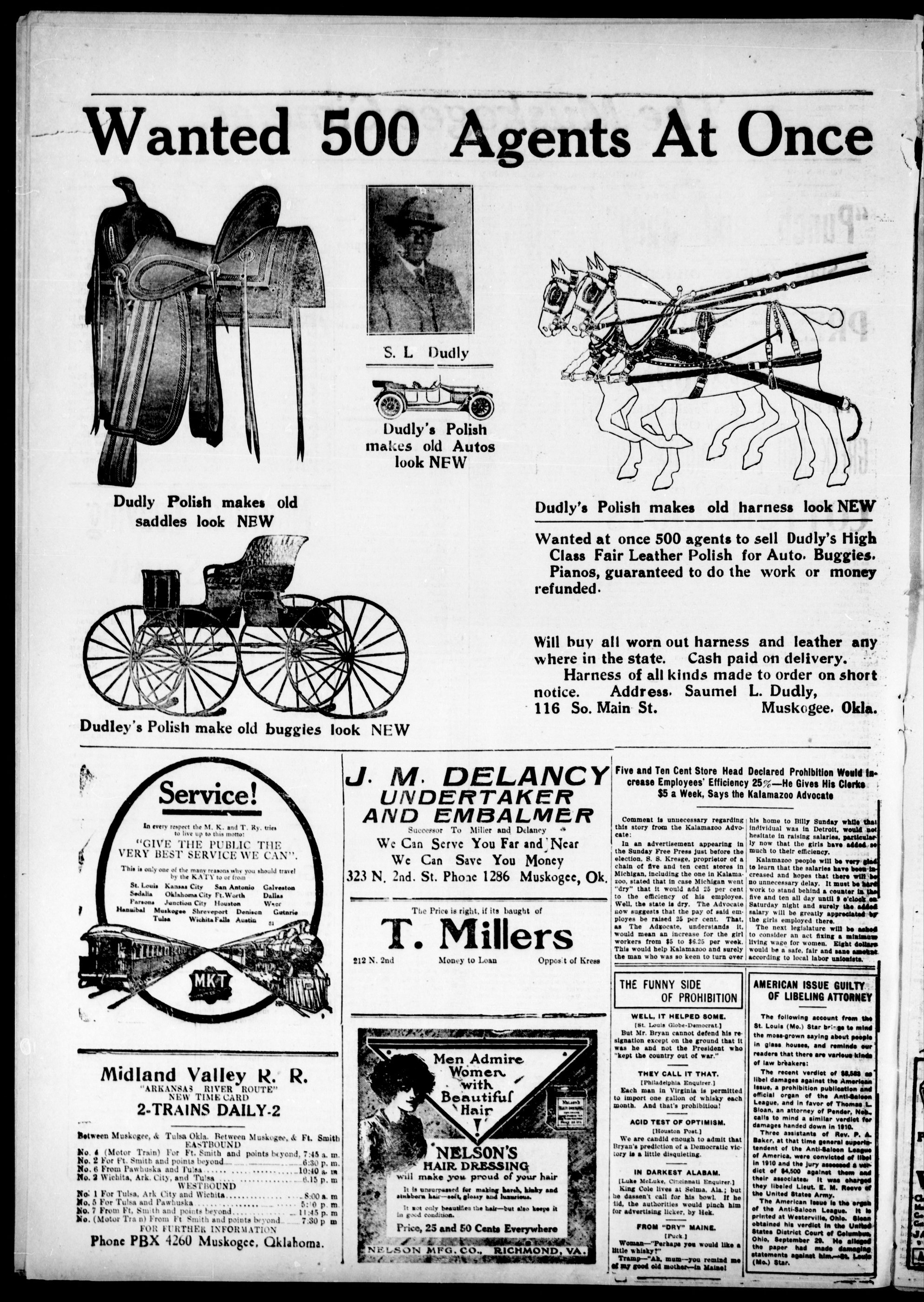
Wanted 500 Agents At Once
```markdown
```
Dudly's Polish makes old harness look NEW
Wanted at once 500 agents to sell Dudly's High Class Fair Leather Polish for Auto. Buggies. Pianos, guaranteed to do the work or money refunded.
Will buy all worn out harness and leather any where in the state. Cash paid on delivery. Harness of all kinds made to order on short notice. Address. Saumel L. Dudly, 116 So. Main St. Muskogee. Okla.
Men Admire Women with Beautiful Hair!
NELSON'S HAIR DRESSING
will make you proud of your hair
It is unsurpassed for making harsh, hinky and stubborn hair—soft, glossy and luxurious.
It not only beautifies the hair—but also keeps it in good condition.
Price, 25 and 50 Cents Everywhere
NELSON MFG. CO., RICHMOND, VA.
SADDLE
S. L Dudly
Dudly's Polish makes old Autos look NEW
Dudly's Polish makes old Autos look NEW
NEW
W. M. DEN
UNDERT
AND EMB
Successor To Miller
We Can Serve You
We Can Save Y
B N. 2nd. St. Phone 128
The Price is right, if its
T. Mil
Dudly Polish makes old saddles look NEW
```markdown
```
Dudley's Polish make old buggies look NEW
Service!
In every respect the M. K. and T. Ry. tries
to live up to this motto:
"GIVE THE PUBLIC THE
VERY BEST SERVICE WE CAN".
This is only one of the many reasons why you should travel
by the KATY to or from
St. Louis Kansas City San Antonio Galveston
Sedalia Oklahoma City Ft.Worth Dallas
Parsons Junction City Houston Weer
Hannibal Muskogee Shreveport Denison Gutnrie
Tulsa Wichita Falls Austin 81
MKT
2 N. 2nd Money to Loan Men Adm Women
Midland Valley R. R.
"ARKANSAS RIVER ROUTE"
NEW TIME CARD
2-TRAINS DAILY-2
Between Muskogee, & Tulsa Okla. Between Muskogee, & Ft. Smith
EASTBOUND
No. 4 (Motor Train) For Ft. Smith and points beyond, 7:45 a. m.
No. 2 For Ft. Smith and points beyond..... 6:30 p. m.
No. 6 From Pawhuska and Tulsa..... 10:40 a. m.
No. 2 Wichita, Ark. City, and Tulsa..... 6:15 p. m.
WESTBOUND
No. 1 For Tulsa, Ark City and Wichita..... 8:00 a. m.
No. 5 For Tulsa and Pawhuska..... 5:10 p. m.
No. 7 From Ft. Smith and points beyond..... 11:45 p. m.
No. (Motor Tra n) From Ft. Smith and points beyond..... 7:30 p m
FOR FURTHER INFORMATION
Phone PBX 4260 Muskogee, Oklahoma.
Opposit of Kress
Five and Ten Cent Store Head Declared Prohibition Would increase Employees' Efficiency 25%—He Gives His Clerke $5 a Week, Says the Kalamazoo Advocate
Comment is unnecessary regarding this story from the Kalamazoo Advocate:
In an advertisement appearing in the Sunday Free Press just before the election, S. S. Kresge, proprietor of a chain of five and ten cent stores in Michigan, including the one in Kalamazoo, stated that in case Michigan went "dry" that it would add 25 per cent to the efficiency of his employees. Well, the state is dry. The Advocate now suggests that the pay of said employees be raised 25 per cent. That, as The Adgocate, understands it, would mean an increase for the girl workers from $5 to $6.25 per week. This would help Kalamazoo and surely the man who was so keen to turn over
THE FUNNY SIDE OF PROHIBITION
WELL, IT HELPED SOME.
[St. Louis Globe-Democrat.]
But Mr. Bryan cannot defend his resignation except on the ground that it was he and not the President who "kept the country out of war."
Each man in Virginia is permitted to import one gallon of whisky each month. And that's prohibition!
We are candid enough to admit that Bryan's prediction of a Democratic victory is a little disquieting.
[Luke McLuke, Cincinnati Enquirer.] King Cole lives at Selma, Ala.; but he dassen't call for his bowl. If he hid, the authorities would pinch him for advertising licker, by Hek.
Woman—"Perhaps you would like a little whisky?"
Tramp—"Ah, mum—you remind me of my good old mother—in Mainet"
his home to Billy Sunday while that individual was in Detroit, would not heaitate in raising salaries, particularly now that the girls have added so much to their efficiency.
Kalamazoo people will be very glad to learn that the salaries have been increased and hopes that there will be no unnecessary delay. It must be hard work to stand behind a counter in the five and ten all day until 9 e'clock on Saturday night and surely the added salary will be greatly appreciated by the girls employed there.
The next legislature will be asked to consider an act fixing a minimum living wage for women. Eight dollars would be a safe, fair and sane amount according to local labor unionists.
AMERICAN ISSUE GUILTY OF LIBELING ATTORNEY
The following account from the St. Louis (Mo.) Star brings to mind the moss-grown saying about people in glass houses, and reminds our readers that there are various kinds of law breakers:
The recent verdict of $8,583 as libel damages against the American issue, a prohibition publication and official organ of the Anti-Bailoon League, and in favor of Thomas L. Sloan, an attorney of Pender, Neb., calls to mind a similar verdict for damages handed down in 1910.
Three assistants of Rev. P. A. Baker, at that time general superintendent of the Anti-Bailoon League of America, were convicted of libel in 1910 and the jury assessed a verdict of $4,500 against them and their associates. It was charged they libeled Lieut. E. M. Reeve of the United States Army.
The American issue is the orga
the of the Anti-Saloon League. It is
printed at Westerville, Ohio. Sloan
obtained his verdict in the United
States District Court of Columbus,
Ohio, September 29. He allowed
the paper had made damaging
statements against him—St. Louis
(Mo.) Star.
MEMBER
NATIONAL NEGRO PRESS
ASSOCIATION
The Cimeter is the only Republican
paper in the City of Muskogee. The
only Phoenix is sometimes Republica-
can and sometimes independent but at
the present time it claims to be inde-
pendent, such a changing is not worth
three whoops in h—I to any political
party and yet Bixby, its editor, got
sick at the Republican pie counter.
What base ingritude.
NOTICE BY PUBLICATION
In the District Court of Muskogee
County, State of Oklahoma:
Vioia Brown. Plaintiff.
Harry Brown, Defendant
The defentant Harry Brown,
will take notice that he has been
sued in the above named Court by
the plaintiff, Viola Brown, for
Divorce for Desertion and that
unless he answer the partition of the
plaintiff, Viola Brown, on or before the 12th day of March, 1917
the allegations set forth in said
petition will be taken as confessed
and judgment rendered accordingly
In Witness Whereof, I have
hereunto set my hand and affixed
the seal of said District Court this
the 23rd day of January, 1917.
By Tom L. Fuller, Deputy, Clerk.
Geo. W. Parker, Attorney for
Plaintiff.
NOTICE BY PUBLICATION.
In the District Court of Muskogee County, State of Oklahoma:
No. 5498
Neter Foutch Defendant.
The defendant Netter Foutch, will take NOTICE that she has been sued in the above named Court by the plaintiff, H Foutch, for Divorce, by reason of Desertion and that unless she answer the petition of the plaintiff, H Foutch on or before the 5 day of March, 1917, the allegations set forth in said petition will be taken as confessed and judgment rendered accordingly.
In Witness Whereof, I have hereunto set my hand and affixed the seal of said District Court this the 19 day of January, 1917
C. H. Shaffer, Court Clerk,
By Tom L. Fuller Deputy Clerk
Geo. W. Parker, Attorney-for
Plaintiff.
IT'S EASY
SAILING!
PALMER'S
SKIN
WHITENER
25c
Delivered
Clear and Bleaches the Complexion
Make Dark, Brown or Sallow Skin White
Good for Pimples and Rough Skin
Get the Original and Conduit Made Only by
JACOBS' PHARMACY
ATLANTA, GA.
AGENTS WANTED. Write For Tormak.
THE MUSICIAN
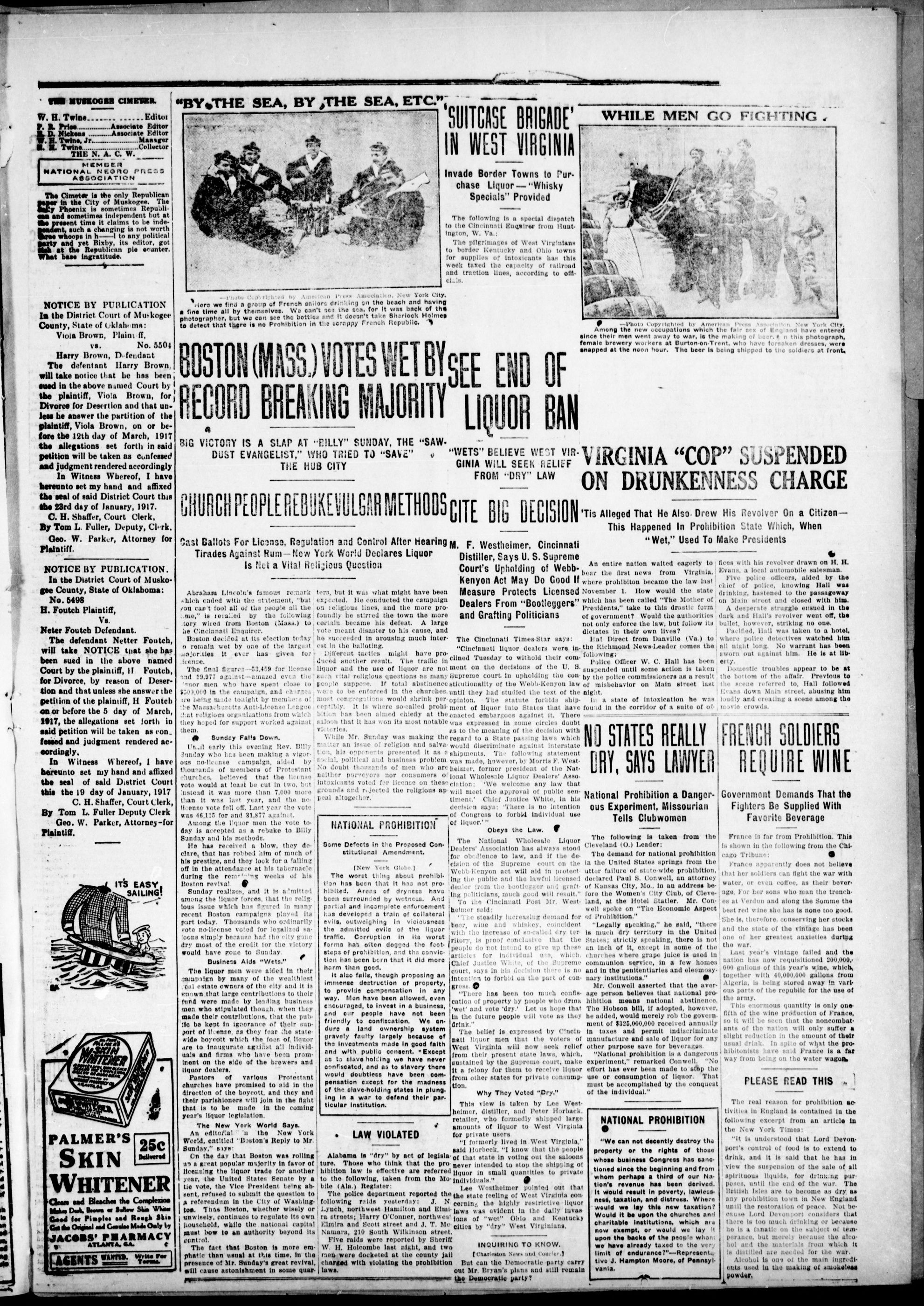
Photo Copyrighted by American Press Association, New York City. Here we find a group of French sailors drinking on the beach and having a fine time all by themselves. We can't see the sea, for it was back of the photographer, but we can see the bottles and it doesn't take Sherlock Holmes to detect that there is no Prohibition in the serpentine French Republic.
BOSTON(MASS.)VOTES WET BY SEE END OF RECORD BREAKING MAJORITY LIQUOR BAN
BIG VICTORY IS A SLAP AT "BILLY" SUNDAY, THE "SAW DUST EVANGELIST," WHO TRIED TO "SAVE" THE HUB CITY
Cast Ballots For License, Regulation and Control After Hearing Tirades Against Rum—New York World Declares Liquor Is Not a Vital Religious Question
Abraham Lincoln's famous remark which ended with the statement, "but you can't fool all of the people all the time," is recalled by the following story wired from Boston (Mass.) to the Cincinnati Enquirer.
Boston decided at its election today to remain wet by one of the largest majorities it ever has given for license.
The final figures—53,459 for license and 29,977 against—amazed even the junior men who have spent close to $500,000 in the campaign, and charges are being made tonight by members of the Massachusetts Anti-License League that religious organizations from which they hoped for support worked against them.
Sunday Falls Down.
Unal early this evening Rev. Billy Sunday who has been making a vigorous no-license campaign, aided by thousands of members of Protestant churches, believed that the license vote would at least be cut in two, but instead it was more than 7,000 more than it was last year, and the no-license vote fell off. Last year the vote was 46,115 for and 31,877 against. Among the liquor men the vote today is accepted as a rebuke to Billy Sunday and his methods.
He has received a blow, they declare, that has robbed him of much of his prestige, and they look for a falling off in the attendance at his tabernacle during the remembrings weeks of his Boston revival.
Sunday realizes, and it is admitted among the liquor forces, that the religious issue which has figured in many recent Boston campaigns played its part today. Thousands who ordinarily vote no license voted for legalized saloons simply because had the city gone dry most of the credit for the victory would have gone to Sunday.
Business Aids "Wets."
The liquor men were aided in their campaign by many of the wealthiest real estate owners of the city and it is known that large contributions to their fund were made by leading business men who stipulated though, when they made their contributions, that the public be kept in ignorance of their support of license, as they fear the statewide boycott which the foes of liquor are to inaugurate against all individuals and firms who have been prominent on the side of the brewers and liquor dealers.
Pastors of various Protestant churches have promised to sid in the direction of the boycott, and they and their parishioners will join in the fight that is to be made in the coming year's liquor legislation.
The New York World Says.
An editorial in the New York World, entitled "Boston's Reply to Mr. Sunday," says:
On the day that Boston was rolling on a great popular majority in favor of licensing the liquor trade for another year, the United States Senate by a tie vote, the Vice President being absent, refused to submit the question to a referendum in the City of Washington. Thus Boston, whether wisely or unwisely, continues to regulate its own household, while the national capital must bow to an authority beyond its control.
The fact that Boston is more emphatic than usual at this time, in the presence of Mr. Sunday's great revival, will cause astonishment in some quar-
ters, but it was what might have been expected. He conducted the campaign on religious lines, and the more profoundly he stirred the town the more certain became his defeat. A large vote meant disaster to his cause, and he succeeded in arousing much interest in the balloting.
Different tactics might have produced another result. The traffic in liquor and the use of liquor are not such vital religious questions as many people suppose. If total abstinence were to be enforced in the churches, most congregations would shrink perceptibly. It is where so-called prohibition has been aimed chiefly at the saloon that it has won its most notable victories.
While Mr. Sunday was making the matter an issue of religion and salvation, his opponents presented it as a social, political and business problem. No doubt thousands of men who are neither purveyors nor consumers of intoxicants voted for license on these grounds and rejected the religious appeal altogether.
NATIONAL PROHIBITION
Some Defects in the Proposed Constitutional Amendment.
The worst thing about prohibition has been that it has not prohibited. Areas of dryness have been surrounded by wetness. And partial and incomplete enforcement has developed a train of collateral evils, outweighing in viciousness the admitted evils of the liquor traffic. Corruption in its worst forms has often dogged the footsteps of prohibition, and the conviction has been born that it did more harm than good.
It also falls, though proposing an immense destruction of property, to provide compensation in any way. Men have been allowed, even encouraged, to invest in a business, and our people have not been friendly to confiscation. We endure a land ownership system gravely faulty largely because of the investments made in good faith and with public consent. *Except as to slave holding we have never confiscated, and as to slavery there would doubtless have been compensation except for the madness of the slave-holding states in plunging in a war to defend their particular institution.
- LAW VIOLATED
Alabama is "dry" by act of legislature. Those who think that the prohibition law is effective are referred to the following, taken from the Mobile (Ala.) Register:
The police department reported the following raids yesterday: J. N Lynch, northwest Hamilton and Elmira streets; Harry O'Connor, northwest Elmira and Scott street and J. T. McNamara, 210 South Wilkinson street.
Five raids were reported by Sheriff W. H. Holcombe last night, and two men were docketed at the county jail charged with violating the prohibition laws.
Invade Border Towns to Purchase Liquor—"Whisky Specials" Provided
The following is a special dispatch to the Cincinnati Enquirer from Huntington, W. Va.:
The pilgrimages of West Virginiaans to border Kentucky and Ohio towns for supplies of intoxicants has this week taxed the capacity of railroad and traction lines, according to officials.
SEE END OF LIQUOR BAN
"WETS" BELIEVE WEST VIRGINIA WILL SEEK RELIEF FROM "DRY" LAW
CITE BIG DECISION
M. F. Westheimer, Cincinnati Distiller, Says U. S. Supreme Court's Upholding of Webb-Kenyon Act May Do Good If Measure Protects Licensed Dealers From "Bootleggers" and Grafting Politicians
The Cincinnati Times-Star says:
"Cincinnati Honor dealers were
"Cinchnati liquor dealers were inclined Tuesday to withhold their comment on the decisions of the U. S. Supreme court in upholding the constitutionality of the Webb-Kenyon law until they had studied the text of the opinion. The statute forbids shipment of liquor into States that have enacted embargoes against it. There was expressed in some circles doubt as to the execution of the decision with
as to the meaning of the decision with regard to a State passing laws which would discriminate against interstate shipments. The following statement was made, however, by Morris F. Westheimer, former president of the National Wholesale Liquor Dealers' Association: 'We welcome any law that will meet the approval of public sentiment.' Chief Justice White, in his decision says: 'There is no intention of Congress to forbid individual use of honor.'
Obeys the Law.
The National Wholesale Liquor Dealers' Association has always stood for obfidence to law, and if the decision of the Supreme court on the Webb-Kenyon act will aid in protecting the public and the lawful licensed dealer from the bootleger and grafting politicians, much good will result." To the Cincinnati Post Mr. West-helmer said: "The steadily increasing demand for beer, wine and whiskey, coincident with the increase of so-called dry territory, is proof conclusive that the people do not intend to give up these articles for individual use, which Chief Justice White, of the Supreme court, says in his decision there is no intention to forbid on the part of congress.
"There has been too much confiscation of property by people who drink 'wet' and vote 'dry.' Let us hope that in the future people will vote as they drink."
The belief is expressed by Cincinnati liquor men that the voters of West Virginia will now seek relief from their present state laws, which sustained by the Supreme court, make it a felony for them to receive liquor from other states for private consumption.
Why They Voted "Dry."
This view is taken by Lee Westheimer, distiller, and Peter Horback, retailer, who formedly shipped large amounts of liquor to West Virginia for private users.
"I formerly lived in West Virginia," said Horback. "I know that the people of that state in voting out the saloons never intended to stop the shipping of liquor in small quantities to private individuals."
Lee Westheimer pointed out that the state feeling of West Virginia concerning the highly restrictive liquor laws was evident in the daily invasions of "wet" Ohio and Kentucky cities by "dry" West Virginia.
INQUIRING TO KNOW.
But can the Democratic party carry out Mr. Bryan's plans and still remain the Democratic party?
THE WINE CO.
Photo Copyright by American Press Association. New York City. Among the new occupations which the fair sex of England have entered since their mere introduction is the female brewery workers at Burton-on-Trent, who have foraken dresses were snapped at the noon hour. The beer is being shipped to the soldiers at front.
VIRGINIA "COP" SUSPENDED ON DRUNKENNESS CHARGE
"Tis Alleged That He Also-Drew His Revolver On a Citizen—This Happened In Prohibition State Which, When "Wet," Used To Make Presidents
An entire nation waited eagerly to bear the first news from Virginia, where prohibition became the law last November 1. How would the state which has been called "The Mother of Presidents," take to this drastic form of government? Would the authorities not enforce the law, but follow its dictates in their own lives?
Ha! Direct from Danville (Va.) to the Richmond News-Leader comes the following:
faces with his revolver drawn on H. H. Evans, a local automobile salesman. Five police officers, aided by the chief of police, knowing Hall was drinking, hastened to the passageway on Main street and closed with him. A desperate struggle ensued in the dark and Hall's revolver went off, the bullet, however, striking no one. Pacified, Hall was taken to a hotel where police detectives watched him all night long. No warrant has been sworn out against him. He is at lil
Police Officer W. C. Hall has been suspended until some action is taken by the police commissioners as a result of misbehavior on Main street last night. In a state of intoxication he was found in the corridor of a suite of NO STATES REALLY DRY, SAYS LAWYER
National Prohibition a Dangerous Experiment, Missourian Tells Clubwomen
The following is taken from the Cleveland (O.) Leader:
The demand for national prohibition in the United States springs from the utter failure of state-wide prohibition, declared Paul S. Conwell, an attorney of Kansas City, Mo., in an address before the Women's City Club, of Cleveland, at the Hotel Statler. Mr. Conwell spoke on "The Economic Aspect of Prohibition."
"Legally speaking," he said, "there is much dry territory in the United States; strictly speaking, there is not an inch of it, except in some of the churches where grape juice is used in communion service, in a few homes and in the penitentiaries and elemosy-nary institutions."
Mr. Conwell asserted that the average person believes that national prohibition means national abstinence. The Hobson bill, if adopted, however, he added, would merely rob the government of $325,000,000 received annually in taxes and permit indiscriminate manufacture and sale of liquor for any other purpose save for beverages. "National prohibition is a dangerous experiment," remarked Conwell. "No effort has ever been made to stop the use or consumption of liquor. That must be accomplished by the conquest of the individual."
NATIONAL PROHIBITION
"We can not decretely destroy the property or the rights of those whose business Congress has sanctioned since the beginning and from whom perhaps a third of our Nation's revenue has been derived. It would result in poverty, lawlessness, taxation, and distress. Where would we lay this new taxation? Would it be upon the churches and charitable institutions, which are now exempt, or would we lay it upon the backs of the people whom we have already taxed to the very limit of endurance?"—Representative J. Hampton Moore, of Pennsylvania.
faces with his revolver drawn on H. H. Evans, a local automobile salesman. Five police officers, aided by the chief of police, knowing Hall was drinking, hastened to the passageway on Main street and closed with him. A desperate struggle ensued in the dark and Hall's revolver went off, the bullet, however, striking no one. Pacified, Hall was taken to a hotel, where police detectives watched him all night long. No warrant has been sworn out against him. He is at liberty. Domestic troubles appear to be at the bottom of the affair. Previous to the scene referred to, Hall followed Evans down Main street, abusing him loudly and creating a scene among the movie crowds.
FRENCH SOLDIERS REQUIRE WINE
Government Demands That the Fighters Be Supplied With Favorite Beverage
France is far from Prohibition. This is shown in the following from the Chicago Tribune:
France apparently does not believe that her soldiers can fight the war with water, or even coffee, as their beverage. For her sons who man the trenches at Verdun and along the Somme the best red wine she has is none too good. She is, therefore, conserving her stocks and the state of the vintage has been one of her greatest anxieties during the war.
Last year's vintage failed and the nation has now requisitioned 200,000,000 gallons of this year's wine, which, together with 40,000,000 gallons from Algeria, is being stored away in various parts of the republic for the use of the army.
This enormous quantity is only one-fifth of the wine production of France, so it will be seen that the noncombatants of the nation will only suffer a slight reduction in the amount of their usual drink. In spite of what the prohibitionists have said France is a far way from being on the water wagon
PLEASE READ THIS
The real reason for prohibition activities in England is contained in the following excerpt from an article in the New York Times:
"It is understood that Lord Devonport's control of food is to extend to drink, and it is said that he has in view the suspension of the sale of all spirituous liquids, for drinking purposes, until the end of the war. The British Isles are to become as dry as any prohibition town in New England until the restoration of peace. Not because Lord Devonport considers that there is too much drinking or because he is a fanatic on the subject of temperance, but merely because the alcohol and the materials from which it is distilled are needed for the war.
Alcohol is one of the main ingredients used in the making of smokeless powder."
MUST RAISE STATE TAXES TO PAY FOR PROHIBITION
"Dry" Tennessee Misses Liquor Revenue and Faces Floating Indebtedness of More Than $1,000,000, So the People Must Pay the Difference
"I AM GOING TO KNOW WHY!"
SEIZURE
OF ILLICT STILLS
YEAR STILLS
1885-245
1915-3832
Prohibition strikes into the purse of the taxpayer. This is the experience of Tennessee, where the legislature is planning to raise taxes to meet the deficit occasioned by anti-liquor laws. The Chattanooga Times, in reporting the proposed increase, says:
Gev. Rye and his advisers are figuring on asking the legislature to increase the state tax rate.
For a quarter of a century or more a state tax of 50 cents has been assessed on each $100 worth of taxable property. Fifteen out of 50 cents collected for the state is by law appropriated for education. The balance, 85 cents, is for maintenance of the general state government.
The governor and state administrative officials closely associated with him have a plan for raising the state tax levy by the adoption of one mill. The leaders in Nashville, however, hope by adding a mill to the 35-cent net rate to be able to spend enough
"I FEAR SAINTS IN POLITICS"
Bishop Russell, of Catholic Church, Scores "Holier Than Thou" Folk
The ensuing item appears in the Louisville Courier Journal, under a Washington (D. C.) date line: "Monsignor William T. Russell, pastor of St. Patrick's Catholic Church here and newly appointed bishop of Charleston, S. C., spoke at a mass meeting of citizens here, urging referendum of the bill pending in Congress for prohibition in the District of Columbia to residents of the capital. "There is no principle of American government more elemental, more essential, than that there should be no legislation pertaining to the individual without a hearing or representation," he said. Referring to prohibition leaders forces who oppose referendum, Monsignor Russell added: "I am always afraid of that class of people who are better than thou. I fear the man who convinces himself that his views are necessarily the pleas of Almighty God. I fear saints in politics. sometimes feel that I would like very much to be able to revise the 'Litany of Saints.' After 'All ye Saints of Heaven, intercede for us,' I would like to insert, 'From the saints on earth, O Lord, deliver us.'"
on public highways to entitle Tennessee to greater financial assistance from the United States.
The last several legislatures have been enacting moral laws, and word comes directly from Capitol Hill, Nashville, that financial legislation will be urged as the most important general problem for the next general assembly to solve. The state was deprived of financial resources of consequence by enactment of prohibition laws, and officials estimate that 1917's deficit will run toward the half million mark unless one mill is added to the tax rate.
Tennessee now has a floating indebtedness of more than $3,000,000. To satisfy, or even approach satisfaction of public demands, every department of the state government must be enlarged, the governor and his associates declare. They insist that time has come for changing a tax rate of a quarter-century's application, and by adding one mill they propose a plan for procuring the desired funds equitably.
THE FUNNY SIDE OF PROHIBITION
SURE AND THEY'RE NOT!
[St. Louis Post Dispatch.]
The announcement that liquor packages for dry territory had more to do with the congestion of Christmas mail and express in St. Louis than anything else makes one wonder if the prohibitionists themselves are altogether sincere at this particular season.
It is the "New York William A. Sunday Evangelistic Association, Inc." And it will prove a mighty close corporation when it comes to handing out dividends.
"I take off my hat to Boston," said Billy Sunday, and passed it around. Bat Boston voted for booze and so rejected the salvation proposed by Billy for a consideration.
THERE ARE OTHERS.
After one of Billy Sunday's revivals a well known scape-goat of the town applied to a church for membership. The committee, knowing his reputation, advised that he wait a month and prayerfully consider the matter of his fitness. At the end of the month he returned and was asked to give his experiences before the entire church. He arose, solemnly turned to minister, deacons and audience and said: "Follow sinners, daily for a month God has admonished me not to feel badly if I did not get into this church, for He had tried for twenty years and was not in yet."
DING TO KNO
[Philadelphia Public Ledger.]
WATER WAGON
GROSS OF COLD
FREE SILVER
LEVERS
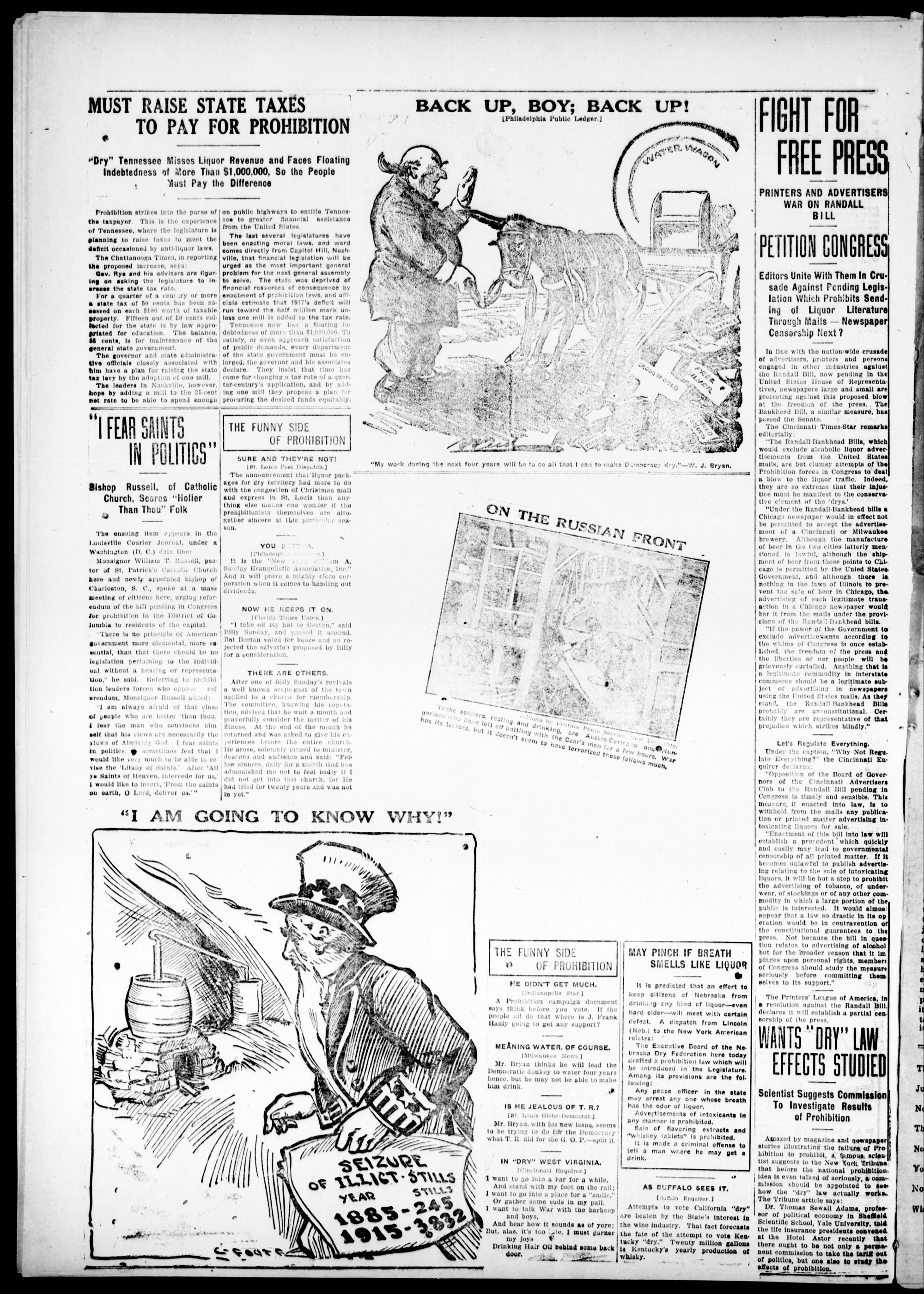
"My work during the next four years will be to do all that I can to make Democracy dry."—W. J. Bryan.
ON THE RUSSIAN FRONT
These soldiers, resting and drinking, are Austro-Cerrans and Hun-
garians who have left off battling with the Czar's men for a few hours. War
has its terrors, but it doesn't seem to have terrorized these fellows much.
THE FUNNY SIDE
OF PROHIBITION
A Prohibition campaign document says think before you vote. If the people all do that where is J. Frank Hanly going to get any support?
MEANING WATER, OF COURSE.
[Milwaukee News.]
Mr. Bryan thinks he will lead the Democratic donkey to water four years hence, but he may not be able to make him drink.
[L. Louis Globe - Democrat]
Mr. Bryan, with his new issue, seems to be trying to do for the Democracy what T. R. did for the G. O. P. - split it.
MAY PINCH IF BREATH SMELLS LIKE LIQUOR
It is predicted that an effort to keep citizens of Nebraska from drinking any kind of liquor—even hard cider—will meet with certain defeat. A dispatch from Lincoln (Neb.) to the New York American relates:
The Executive Board of the Nebraska Dry Federation here today drafted a prohibition law which will be introduced in the Legislature. Among its provisions are the following:
Any peace officer in the state may arrest any one whose breath has the odor of liquor.
Advertisements of intoxicants in any manner is prohibited.
Sale of flavoring extracts and
Sale of flavoring extracts and "whiskey tablets" is prohibited.
It is made a criminal offense to tell a man where he may get a drink.
AS BUFFALO SEES IT.
[Buffalo Enquirer.]
Attempts to vote California "dry" are beaten by the State's interest in the wine industry. That fact forecasts the fate of the attempt to vote Kentucky "dry." Twenty million gallons is Kentucky's yearly production of whisky.
FIGHT FOR FREE PRESS
PRINTERS AND ADVERTISERS
WAR ON RANDALL
BILL
PETITION CONGRESS
Editors Unite With Them In Crusade Against Pending Legislation Which Prohibits Sending of Liquor Literature Through Mails — Newspaper Censorship Next ?
In line with the nation-wide crusade of advertisers, printers and persons engaged in other industries against the Randall Bill, now pending in the United States House of Representatives, newspapers large and small are protesting against this proposed blow at the freedom of the press. The Bankhead Bill, a similar measure, has passed the Senate.
The Cincinnati Times-Star remarks editorially:
"The Randall Bankhead Bills, which would exclude alcoholic liquor advertisements from the United States mails, are but clumsy attempts of the Prohibition forces in Congress to deal a blow to the liquor traffic. Indeed, they are so extreme that their injunction must be manifest to the conservative element of the 'drys.' "
"Under the Randall Bankhead bills a Chicago newspaper would in effect not be permitted to accept the advertisement of a Cincinnati or Milwaukee brewery. Although the manufacture of beer in the two cities latterly mentioned is lawful, although the shipment of beer from those points to Chicago is permitted by the United States Government, and although there is nothing in the laws of Illinois to prevent the sale of beer in Chicago, the advertising of such legitimate transaction in a Chicago newspaper would bar it from the mails under the provisions of the Randall Bankhead bills.
"If the power of the Government to exclude advertisements according to the whims of Congress is once established, the freedom of the press and the liberties of our people will be grievously cartalled. Anything that is a legitimate commodity in interstate commerce should be a legitimate subject of advertising in newspapers using the United States mails. As they stand, the Randall-Bankhead Bills probably are unconstitutional. Certainly they are representative of that prejudice which strikes blindly."
Under the caption, "Why Not Regulate Everything?" the Cincinnati Enquirer declares:
"Opposition of the Board of Governors of the Cincinnati Advertisers Club to the Randall Bill pending in Congress is timely and sensible. This measure, if enacted into law, is to withhold from the mails any publication or printed matter advertising intoxicating liquors for sale.
"Enactment of this bill into law will establish a precedent which quickly and easily may lead to governmental censorship of all printed matter. If it becomes unlawful to publish advertising relating to the sale of intoxicating liquors, it will be but a step to prohibit the advertising of tobacco, of underwear, of stockings or of any other commodity in which a large portion of the public is interested. It would almost appear that a law so drastic in its operation would be in contravention of the constitutional guarantees to the press. Not because the bill in question relates to advertising of alcohol but for the broader reason that it impinges upon personal rights, members of Congress should study the measure seriously before committing them selves to its support."
The Printers' League of America, in a resolution against the Randall Bill, declares it will establish a partial censorship of the press.
WANTS "DRY" LAW EFFECTS STUDIED
Scientist Suggests Commission To Investigate Results of Prohibition
Amazed by magazine and newspaper stories illustrating the failure of Prohibition to prohibit, a famous scientist suggests to the New York Tribune that before the national prohibition idea is even talked of seriously, a commission should be appointed to see how the "dry" law actually works. The Tribune article says:
Dr. Thomas Sewall Adams, professor of political economy in Sheffield Scientific School, Yale University, told the life insurance presidents convened at the Hotel Astor recently that there ought to be not only a permanent commission to take the tariff out of politics, but one also to study the effects of prohibition.