Muskogee Cimeter
Saturday, September 8, 1917
Muskogee, Oklahoma
Page text (machine-generated)
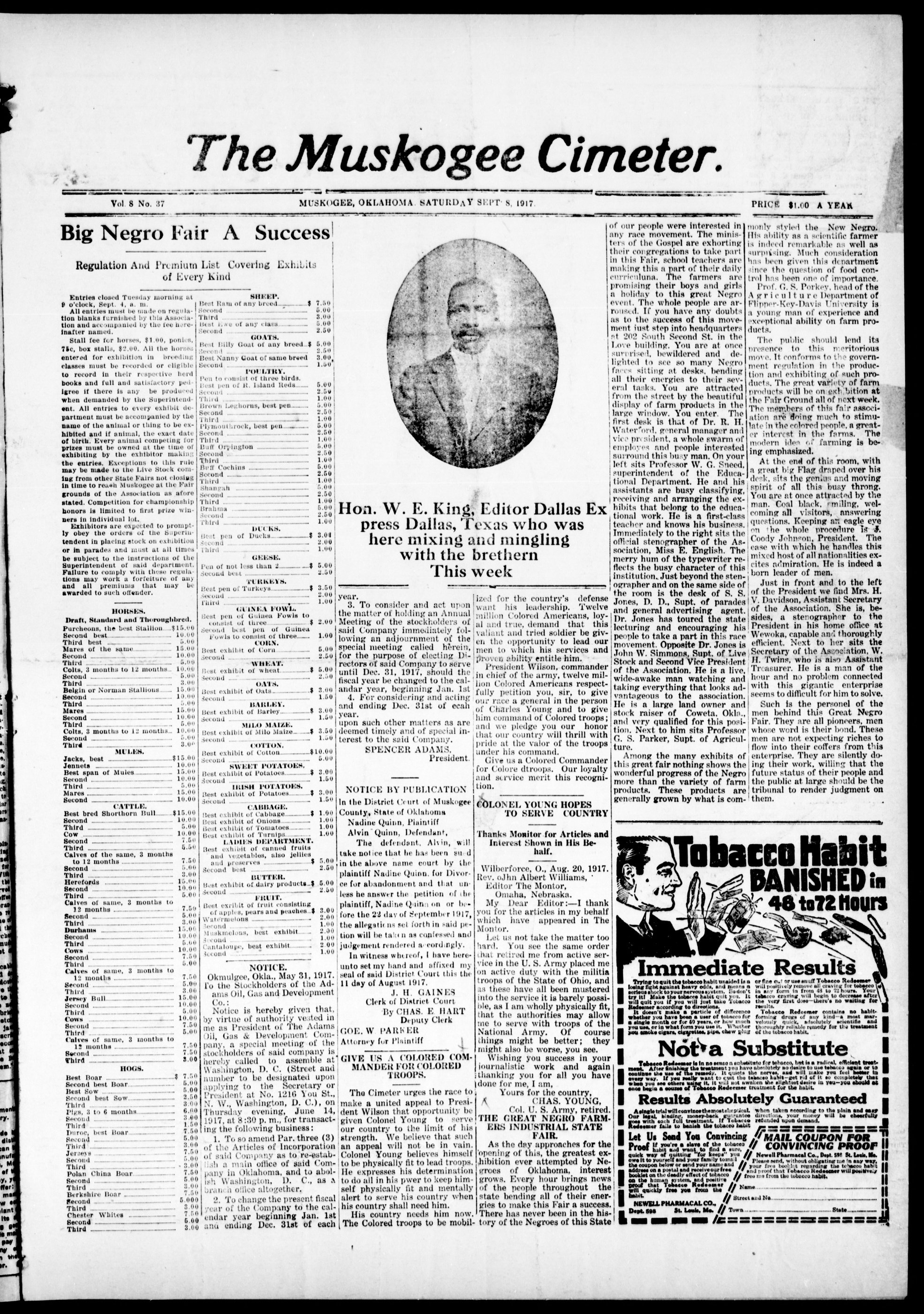
Big Negro Fair A Success
Big Negro Fair A Success
Regulation And Premium List Covering Exhibits of Every Kind
Vol. 8 No. 37
Entries closed Tuesday morning at 9 o'clock, Sept. 4, a. m.
All entries must be made on regulation blanks furnished by this Association and accompanied by the fee hereinafter named.
Stall fee for horses, $1.00, ponies, 75c, box stalls, $2.00. All the horses entered for exhibition in breeding classes must be recorded or eligible to record in their respective herd books and full and satisfactory pedigree if there is any be produced when demanded by the Superintendent. All entries to every exhibit department must be accompanied by the name of the animal or thing to be exhibited and if animal, the exact date of birth. Every animal competing for prizes must be owned at the time of exhibiting by the exhibitor making the entries. Exceptions to this rule may be made to the Live Stock coming from other State Fairs not closing in time to reach Muskogee at the Fair grounds of the Association as afore stated. Competition for championship honors is limited to first prize winners in individual lot.
Exhibitors are expected to promptly obey the orders of the Superintendent in placing stock on exhibition or in parades and must at all times be subject to the instructions of the Superintendent of said departments. Failure to comply with these regulations may work a forfeiture of any and all premiums that may be awarded to such offender.
HORSES.
The Muskogee Cimeter.
MUSKOGEE, OKLAHOMA. SATURDAY SEPT. 8, 1917
SHEEP.
Best Ram of any breed. $7.50
Second $5.00
Third $3.00
Best Eve of any class $5.00
Second $2.50
GOATS.
Best Billy Goat of any breed. $5.00
Second $2.50
Best Nanny Goat of same breed $3.00
Second $1.50
POULTRY.
Pen to consist of three birds.
Best pen of R. Island Reds $5.00
Second $2.50
Third $1.00
Brown Leghorns, best pen $5.00
Second $2.50
Third $1.00
Plymouthrock, best pen $5.00
Second $2.50
Third $1.00
Buff Orpington $5.00
Second $2.50
Third $1.00
Ducks.
Pen of not less than 2 $5.00
Second best $2.50
Turkeys.
Best pen of Turkeys $3.50
Second $2.00
Third $1.00
GUINEA FOWL.
Best pen of Guinea Fowls to consist of three $2.00
Second best pen of Guinea Fowls to consist of three $1.00
CORN.
Best exhibit of Corn $5.00
Second $2.50
WHEAT.
Best exhibit of wheat $5.00
Second $2.50
OATS.
Best exhibit of Oats $3.00
Second $1.50
BARLEY.
Best exhibit of Barley $3.00
Second $1.50
MILO MAIZE.
Best exhibit of Milo Maize $3.50
Second $1.50
COTTON.
Best exhibit of Cotton $10.00
Second $5.00
SWEET POTATOES.
Best exhibit of Potatoes $3.00
Second $1.50
IRISH POTATOES.
Best exhibit of Potatoes $3.00
Second $1.50
CABBAGE.
Best exhibit of Cabbage $1.50
Best exhibit of Onions $1.00
Best exhibit of Tomatoes $1.00
Best exhibit of Turnips $1.00
LADIES DEPARTMENT.
Best exhibit of canned fruits and vegetables, also jellies $5.00
Second best $2.50
BUTTER.
Best exhibit of dairy products $5.00
Second $2.50
FRUIT.
Best exhibit of fruit consisting of apples, pears and peaches $3.00
Watermelons $2.00
Second $1.00
Mushcmelons, best exhibit $2.00
Second $1.00
Cantaloupe, best exhibit $2.00
Second $1.00
NOTICE.
Okmulgee, Okla., May 31, 1917. Po the Stockholders of the Adams Oil, Gas and Development Co.: Notice is hereby given that, by virtue of authority vested in me as President of The Adams Oil, Gas & Development Company, a special meeting of the stockholders of said company is hereby called to assemble at Washington, D. C. (Street and number to be designated upon applying to the Secretary or President at No. 1216 You St., N. W., Washington, D. C.), on Thursday evening, June 14, 1917, at 8:30 p. m., for transacting the following business: 1. To so amend Par. three (3) of the Articles of Incorporation of said Company as to re-establish a main office of said Company in Oklahoma, and to abolish Washington, D. C., as a branch office altogether. 2. To change the present fiscal year of the Company to the calendar year beginning Jan. 1st and ending Dec. 31st of each
[Name]
Hon. W. E. King, Editor Dallas Express Dallas, Texas who was here mixing and mingling with the brethern This week
year.
3. To consider and act upon the matter of holding an Annual Meeting of the stockholders of said Company immediately following an adjournment of the special meeting called herein, for the purpose of electing Directors of said Company to serve until Dec. 31, 1917, should the fiscal year be changed to the calendar year, beginning Jan. 1st.
4. For considering and acting and ending Dec. 31st of each year, upon such other matters as are deemed timely and of special interest to the said Company.
SPENCER ADAMS.
President.
NOTICE BY PUBLICATION
In the District Court of Muskogee
County, State of Oklahoma
Nadine Quinn, Plaintiff
Alvin Quinn, Defendant,
The defendant, Alvin, will
take notice that he has been sued
in the above name court by the
plaintiff Nadine Quinn, for Divorce
for abandonment and that unless
he answer the petition of the
plaintiff, Nadine Quinn on or before
the 22 day of September 1917,
the allegations set forth in said petition will be taken as confessed and judgement rendered accordingly.
In witness whereof, I have hereunto set my hand and affixed my seal of said District Court this the
11 day of August 1917.
GOE. W PARKER
Attorney for Plaintiff
GIVE US A COLORED COM MANDER FOR COLORED TROOPS.
The Cimeter urges the race to make a united appeal to President Wilson that opportunity be given Colonel Young to serve our country to the limit of his strength. We believe that such an appeal will not be in vain. Colonel Young believes himself to be physically fit to lead troops. He expresses his determination to do all in his power to keep himself physically fit and mentally alert to serve his country when his country shall need him. His country needs him now. The Colored troops to be mobil-
ized for the country's defense want his leadership. Twelve million Colored Americans, loyal and true, demand that this valiant and tried soldier be given the opportunity to lead our men to which his services and proven ability entitle him. President Wilson, commander in chief of the army, twelve million Colored Americans respectfully petition you, sir, to give our race a general in the person of Charles Young and to give him command of Colored troops; and we pledge you our honor that our country will thrill with pride at the valor of the troops under his command. Give us a Colored Commander for Colore dtroops. Our loyalty and service merit this recognition.
COLONEL YOUNG HOPES TO SERVE COUNTRY
Thanks Monitor for Articles and Interest Shown in His Behalf.
Wilberforce, O., Aug. 20, 1917. Rev. oJhn Albert Williams,
Editor The Montor.
Omaha, Nebraska.
My Dear Editor:—I thank you for the articles in my behalf which have appeared in The Montor.
Let us not take the matter too hard. You see the same order that retired me from active service in the U. S. Army placed me on active duty with the militia troops of the State of Ohio, and as these have all been mustered into the service it is barely possible, as I am wholly physically fit, that the authorities may allow me to serve with troops of the National Army. Of course things might be better; they might also be worse, you see.
Wishing you success in your journalistic work and again thanking you for all you have done for me, I am,
Yours for the country,
CHAS. YOUNG.
Col. U. S. Army, retired. THE GREAT NEGRO FARMERS INDUSTRIAL STATE FAIR. As the day approaches for the opening of this, the greatest exhibition ever attempted by Negroes of Oklahoma, interest grows. Every hour brings news of the people throughout the state bending all of their energies to make this Fair a success. There has never been in the history of the Negroes of this State
Tobacco Habit BANISHED in 48 to 72 Hours
Immediate Results
Trying to quit the tobacco habit unraided in a or fine cut or use smuff Tobacco Redeemer loins fight against heavy odds, and mesma serious shock to your nervous system. So don't try it! Make the tobacco habit quit you. It tobacco craving will begin to decrease after will quit you if you will just take Tobacco Redeemer according to directions.
It doesn't make a particle of difference Tobacco Redeemer contains no habit whether you have been a user of tobacco for forming drugs of any kind—a most marvelous way or for 90 years, or how much velouly quick, absolutely scientific and you use or in what form you use it. When you see others using it, it will not awaken the slightest desire in you—you should at once begin a course of Tobacco Redeemer treatment for the habit.
Not a Substitute
Tobacco Redeemer is in no sense a substitute for tobacco, but is a radical, efficient treatment. After finishing the treatment you have absolutely no desire to use tobacco again or to abstain the use of the remedy. It quits the tobacco and will make you feel better in every way. If you really want to quit the tobacco habit—get rid of it so completely that when you see others using it, it will not awaken the slightest desire in you—you should at once begin a course of Tobacco Redeemer treatment for the habit.
Results Absolutely Guaranteed
As single trial will convince the most telescopical, when taken according to the plain and easy Our legal, binding, money-back guarantee directions, your money will be cheerfully goes with each full treatment. If Tobacco Redeemer fails to banish the tobacco habit
Let Us Send You Convincing Proof If you're a slave of the tobacco habit and want to find a sure, quick way of quitting "for keeps" you owe it to yourself and send your name and address on a postal and receive our free booklet on the deadly effect of tobacco on the human system, and positive proof that Tobacco Redeemer will positively free me from the tobacco habit.
MAIL COUPON FOR CONVINCING PROOF
Newell Pharmacal Co., Dept. 598 St. Louis, Mo.
Please send, without obligating me in any way, your monthly regarding the tobacco habit and proof that Tobacco Redeemer will positively free me from the tobacco habit.
Name
Street and No.
Town
State
of our people were interested in any race movement. The ministers of the Gospel are exherting their congregations to take part in this Fair, school teachers are making this a part of their daily curriculuna. The farmers are promising their boys and girls a holiday to this great Negro event. The whole people are arroused. If you have any doubts as to the success of this movement just step into headquarters at 202 South Second St. in the Love building. You are at once surroused, bewildered and delighted to see so many Negro faces sitting at desks, bending all their energies to their several tasks. You are attracted from the street by the beautiful display of farm products in the large window. You enter. The first desk is that of Dr. R. H. Waterford, general manager and vice president, a whole swarm of employees and people interested surround this busy man. On your left sits Professor W. G. Sneed, superintendent of the Educational Department. He and his assistants are busy classifying, receiving and arranging the exhibits that belong to the educational work. He is a first-class teacher and knows his business. Immediately to the right sits the official stenographer of the Association, Miss E. English. The merry hum of the typewriter reflects the busy character of this institution. Just beyond the stenographer and on the same side of the room is the desk of S. S. Jones, D. D., Supt. of parades and general advertising agent. Dr. Jones has toured the state lecturing and encouraging his people to take a part in this race movement. Opposite Dr. Jones is John W. Simmons, Supt. of Live Stock and Second Vice President of the Association. He is a live, wide-awake man watching and taking everything that looks advantageous to the association. He is a large land owner and stock raiser of Coweta, Okla., and very qualified for this position. Next to him sits Professor G. S. Parker, Supt. of Agriculture.
Among the many exhibits of this great fair nothing shows the wonderful progress of the Negro more than the variety of farm products. These products are generally grown by what is com-
monly styled the New Negro. His ability as a scientific farmer is indeed remarkable as well as surprising. Much consideration has been given this department since the question of food control has been one of importance. Prof. G. S. Porkey, head of the Agriculture Department of Flipper-Key-Davis University is a young man of experience and exceptional ability on farm products.
The public should lend its presence to this meritorious move. It conforms to the government regulation in the production and exhibiting of such products. The great variety of farm products will be on exhibition at the Fair Ground all of next week. The members of this fair association are doing much to stimulate in the colored people, a greater interest in the farms. The modern idea of farming is being emphasized.
At the end of this room, with a great big Flag draped over his desk, sits the genius and moving spirit of all this busy throng. You are at once attracted by the man. Coal black, smiling, welcoming all visitors, answering questions. Keeping an eagle eye on the whole procedure is J. Coody Johnson, President. The ease with which he handles this mixed host of all nationalities excites admiration. He is indeed a born leader of men.
Just in front and to the left of the President we find Mrs. H. V. Davidson, Assistant Secretary of the Association. She is, besides, a stenographer to the President in his home office at Wewoka, capable and thoroughly efficient. Next to her sits the Secretary of the Association, W. H. Twins, who is also Assistant Treasurer. He is a man of the hour and no problem connected with this gigantic enterprise seems to difficult for him to solve.
Such is the personel of the men behind this Great Negro Fair. They are all pioneers, men whose word is their bond. These men are not expecting riches to flow into their coffers from this enterprise. They are silently doing their work, willing that the future status of their people and the public at large should be the tribunal to render judgment on them.
THE TEXAS DELEGATES NUMBER MORE THAN THREE HUNDRED.
More Than 216 Arrived Yesterday at 4 P. M.
This Number Was Headed by Rev. A. L. Boone, D. D., President of the Band M. E. Convention of Texas, of Fort Worth, Texas.
Rev. A. Barbor, Galveston.
Rev. B. M. Miller, Sulphur Springs.
Rev. E. M. Clemmons, Ft. Worth.
Mrs. S. Hughebanks, Pine.
Rev. R. B. Francis, Tyler.
Rev. M. Sharkie, Houston.
Rev. H. W. Weekley, Giddings.
Rev. M. T. Tapp, Clarksville.
Rev. M. K. Curry, Wichita Falls.
Rev. U. S. Kelling, Waco.
Rev. A. G. Menagan, Mineral Wells.
Mrs. J. H. Gregg, Denison.
Mrs. C. J. Oldem, Gainesville.
Mrs. E. Ducenfield, Wichita Falls.
Mrs. Z. E. Trimbles, Wichita Falls.
Rev. H. W. Bendy, Beaumont.
Mrs. M. Franks, Beaumont.
Mrs. C. J. Oldem, Gainesville.
Mrs. E. Ducenfield, Wichita Falls.
Mrs. Z. E. Trimbles, Wichita Falls.
Rev. H. W. Bendy, Beaumont.
Mrs. M. Franks, Beaumont.
Mrs. C. J. Oldem, Gainesville.
Mrs. E. Ducenfield, Wichita Falls.
Mrs. Z. E. Trimbles, Wichita Falls.
Rev. L. M. Leonard, Houston.
Rev. P. H. Westbrooks, Waco.
Mrs. E. Childs, Gainesville.
Mrs. Georgia Johnson, Gainesville.
Mrs. R. C. Creig, Gainesville.
Mrs. J. W. Smith, Denison.
Rev. H. R. Wilson, Waco.
Mr. L. D. Petty, East Caind.
Mr. H. H. Crocham, Ft. Worth.
Mrs. Rosa Brown, Ft. Worth.
Mrs. Annie Johnson, Abilene.
Mrs. S. J. Alsbrooks, Sulphur Springs.
Mrs. A. Patillo, Grandbury.
Mrs. Ida Abney, Ft. Worth.
Mrs. C. A. Smith, Ft. Worth.
Mrs. M E. Harris, Greenville.
Mr. R. M. B. Butler, Hearne.
Rev. Z. E. Stewart, Plano.
Mrs. Maggie Moore. Ft. Worth.
Mr. W. M. Reese, Nasasota.
Mr. E. E. Brown, Navasota.
Rev. John Jones, Houston.
Mrs. Jones Jones, Houston.
Rev. J. C. Chambers, Mt. Pleasant.
Mrs. T. M. Chambers, Mt. Pleasant.
Mr. J. A. Cleveland, Grandbury.
Mrs. C. D. Hunt, Wolfe City.
Mrs. S. T. Jones, Wolfe City.
Rev. F. R. Ruffin, Giddings.
Rev. G. W. Wright, Royse City.
Mr. Willis Thornton, Plano.
Rev. J. S. Simmons, Waxahatchie.
Rev. L. A. Weaver, Ennis.
Rev. D. H. Shivers, Bryan.
Mrs. T. C. Crowder, Commerce.
Rev. J. E. Dennis, Calvert.
Mr. G. W. Hodges, Mt. Vernon.
Miss Willie Spencer, Commerce.
Mrs. M. Organ, Denison.
Mrs. S. J. Hill, Denison.
Mrs. M. Echols, Mexia.
Mrs. P. A. Green, Mexia.
Mrs. M. C. Harris, Winchester.
Rev. L. G. Farley, Ft. Worth.
Prof. T. S. Boone, Ft. Worth.
Rev. G. T. Burley, Cameron.
Mr. Z. E. Petty, Austin.
Mr. B. C. Kendric, Como.
Mrs. B. E. Scott, Bryan.
Rev. C. M. Butler, Overton.
Rev. F. L. Lights, Houston.
Mrs. L. Brown, Austin.
Rev. R. H. Littleton, Bryan.
Rev. J. R. Burdett, Houston.
Mr. J. D. Daniels, Bryan.
Rev. W. M. Lincoln, Dallas.
Rev. J. R. Swancey, Honey Grove.
Rev. T. E. George, Pittsburg
Rev. G. Bolden, Mt. Pleasant
Mrs. H. Slaughter, Honey Grove.
Mrs. F. Taylor, Honey Grove
Mrs. A. E. Hughes, Clarksville.
Mrs. M. C. Hughes, Clarksville.
Mrs. R. Smith, Honey Grove.
Mrs. A. Duncan, Rice.
Rev. W. A. Cook, Lone Oak.
Miss H. A. Carroll, Sulphur Springs.
Mr. F. G. Green, Mt. Pleasant.
Rev. L. B. Fennell, Tyler.
Mrs. Ida L. Amos, Greenville.
Mrs. Ella Logan, White-
wright.
Mrs. Lula Mitchell, White-
wright.
Mrs. K. Crumplin, Rockwall.
Mrs. G. W. Hill, Sherman.
Mrs. M. M. Forman, Wolf
City.
Mrs. L. Jones, Wolf City.
Mrs. C. McGee, Wolf City.
Mrs. M. E. Bell, Wolf City.
Rev. J. D. Lott, Bonham.
Mrs. J. D. Lott, Bonham.
Rev. C. Smith, Kaufman.
Mrs. E. Johnson, Rockwall.
Mrs. D. Jonett, Bonham.
Mrs. L. Bacon, Sherman.
Mrs. E. C. Doss Bennett, Bon-
ham.
Rev. E. W. Johnson, Pittsburg.
Rev. W. H. Lynch, Bonham.
Rev. W. T. Bolden, Mt. Pleasant.
Miss Edna M. Walker, Austin.
Mr. C. N. Andrews, Bells.
Rev. J. J. Deloney, Texarkana.
Rev. J. E. Knox, Dallas.
Rev. Fred Randle, Wolfe City.
W. G. Upshaw, Ft. Worth.
Rev. J. B. Pius, Austin.
Rev. J. S. Adair, Corsicana.
Mrs. A. L. Boone, Ft. Worth.
Mrs. J. L. McNorton, Ft. Worth.
Rev. W. J. Cobbs, Wolfe City.
Rev. E. M. Griggs, Palestine.
Mrs. M. E. Holland, Windom.
Hon. S. J. Williamson, Palestine.
Rev. S. R. Davis, Tyler.
Miss Lottie Crawford, Clarksville.
Mrs. F. Shadeoc, Whitewright.
Miss D. Stephens, Whitewright.
Mr. H. E. Hollie, Whitewright.
Mr. A. B. Legg, Sherman.
Mrs. M. Bolden, Whitewright.
Rev. P. W. Wesley, Texarkane
kauf.
Mrs. C. E. Makey, She
Miss C. Legg, She
Rev. J. A. Brown,
Mrs. L. B. Lane, Ft. Worth.
Mrs. L. V. Kennedy, Dallas.
Mrs. A. Cooksy, Longview.
Mrs. M. J. Bradford, Kauf-
man.
Mrs. L. Gibson, Celeste.
Mrs. J. B. Moss, Whitewright.
Mrs. L. E. Spurland, White-
wright.
wright.
Mrs. W. Kimble, Sherman.
Rev. C. H. Pryor, Dallas.
Mrs. E. Brembey, Sulphur.
Rev. A. P. Cooksy, Longview.
Rev. W. R. Neil, Big Sandy.
Rev. J. J. Goodwin, Carthage.
Rev. H. C. Alexander, Kilgore.
FOUR CONVENTION
FOUR CONVENTION
Mrs. K. C. Ingram, Gilmer.
Mrs. Mattie Dewitt, Troop.
Rev. C. A. Wallace, Waco.
Mrs. L. B. Furch, Tyler.
Mrs. C. Cash, Pittsburg.
Miss M. Ratliff, Overton.
Miss C. Williams, Troop.
Rev. C. C. Harper, Dallas.
Mrs. M. Robinson, Dallas.
Mrs. M. E. Neil, Pittsburg.
Mrs. Ada Williams, Pittsburg.
Mrs. M. Abner, Dallas.
Mrs. E. C. Coleman, Dallas.
Mrs. A. Hall, Hawkins.
Rev. J. G. Jackson, Morgan.
Rev. Joseph Wilson, Jr., Tem-
Mrs. J. D. Holman, Longview.
P. H. Jackson, Waco.
Mr. C. H. Hannah, Ft. Worth.
Mr. R. B. Walker, Ft. Worth.
Mrs. H. O. Nelson, Ft. Worth.
Mr. V. Nelson, Ft. Worth.
Mr. H. Caroll, Sulphur
Springs.
Mr. H. C. Fore, Ft. Worth.
Rev. A. D. Dupree, Sherman.
Rev. B. J. Brown, D. D., Ft.
Worth.
Worth.
Mr. M. Wilson, Ft. Worth.
Mr. J. E. Sims, Como.
Mr. W. M. Grant, Houston.
Rev. J. G. Sims, Pittsburg.
Mrs. E. Watson, Ft. Worth.
Mrs. K. B. Mackey, Ft. Worth.
Mrs. W. Ross, Ft. Worth.
Mrs. Ida Vann, Ft. Worth.
Rev. L. Burton, Ft. Worth.
Mrs. J. A. Kilgore, Longview.
Rev. P. H. Westbrooks, Waco.
Rev. A. T. Stewart, Palestine.
Miss A. A. Houston, Dallas.
Miss C. Houston, Dallas.
Prof. J. V. McClellan, Tyler.
Mrs. E. M. Griggs, Palestine.
Rev. E. L. Taylor, Houston.
Mrs. J. A. Green, Shuleng-
burg.
Mr. S. J. Colvin, Terrell.
Miss F. T. Boone, Ft. Worth.
Mrs. S. J. Colvin, Terrell.
Rev. D. A. Butler, Tyler.
Mrs. M. Carlisle, Kaufman.
Mrs. Edna Strickland, Pitts-
burg.
Mrs. E. E. Weaver, Waco.
Mrs. Amanda Carlisle, Kaufman.
W. E. King, Dallas.
Rev. S. E. J. Watson, Dallas.
GIVE US A COLORED COM MANDER FOR COLORED TROOPS.
The Cimeter urges the race to make a united appeal to President Wilson that opportunity be given Colonel Young to serve our country to the limit of his strength. We believe that such an appeal will not be in vain. Colonel Young believes himself to be physically fit to lead troops. He expresses his determination to do all in his power to keep himself physically fit and mentally alert to serve his country when his country shall need him.
His country needs him now. The Colored troops to be mobilized for the country's defense want his leadership. Twelve million Colored Americans, loyal and true, demand that this valiant and tried soldier be given the opportunity to lead our men to which his services and proven ability entitle him. President Wilson, commander in chief of the army, twelve million Colored Americans respectfully petition you, sir, to give our race a general in the person of Charles Young and to give him command of Colored troops; and we pledge you our honor that our country will thrill with pride at the valor of the troops under his command.
Give us a Colored Commander for Colore dtroops. Our loyalty and service merit this recognition.
COLONEL YOUNG HOPES TO SERVE COUNTRY
Thanks Monitor for Articles and Interest Shown in His Behalf.
Wilberforce, O., Aug. 20, 1917.
Rev. oJhn Albert Williams,
Editor The Montor,
Omaha, Nebraska.
My Dear Editor:—I thank you for the articles in my behalf which have appeared in The Monitor.
Let us not take the matter too hard. You see the same order that retired me from active service in the U. S. Army placed me on active duty with the militia troops of the State of Ohio, and as these have all been mustered into the service it is barely possible, as I am wholly physically fit, that the authorities may allow me to serve with troops of the National Army. Of course things might be better; they might also be worse, you see.
Wishing you success in your journalistic work and again thanking you for all you have done for me, I am.
Yours for the country,
CHAS. YOUNG,
Col. U. S. Army, retired.
SOLVING THE PROBLEM OF
HOW TO ORGANIZE, TRAIN
AND USE NEGROES
DRAFTED FOR THE ARMY.
Intellectuals of the race, including 10 Harvard graduates and other college men, being taught the science of military tactics at Fort Des Moines officers' training camp for negroes—They will lead the National army units of their race in the battle for democracy and are justifying the Government's confidence in them by hardest kind of work to qualify for this important service
Twelve hundred Negroes, including the picked men of their race from every state of the Union, are attempting to demonstrate their ability to lead their fellow Afro-Americans in peace and war at Fort Des Moines, at Des Moines, Ia., this summer. They are members of the Negro reserve officers' training camp at Fort Des Moines, and from the men in training there are expected to be commissioned for service with the Negro troops of the National Army.
They may be divided roughly into two classes—one including professional men, college students and civilians of proven ability in business life; and another made up of men assigned to the training camp from the Negro regiments of the regular army.
Of the first class, 10 are graduates of Harvard, 48 are products of Booker T. Washington's Tusekgee Institute, and more than 200 are either students or faculty members of Howard University of Washington, D. C., the largest educational institution in the country devoted
alone to the instruction of Negroes. Lincoln, Fisk, Hampton and other Negro schools also have many representatives.
The training camp was a development of a long struggle by Negroes and white educational leaders interested in Negro welfare to obtain recognition by the War Department.
Prof. J. E. Spingarn of Columbia University, a leading sociologist, started the fight, but was compelled to drop it when he himself went into army training.
Dr. George W. Cabaniss, a Negro of Washington; Prof. T. M. Gregory, Harvard, 190, of Howard University, and many other leading Negroes, including factual members from Lincoln, Fisk, Tuskegee and Hampton universities, then took the matter up and finally prevailed upon the War Department to establish the camp.
Whether the venture will prove a success or a failure is yet to be proven, but if it is a failure it will not be due to the are unwilling to work.
fact that the men themselves are unwilling to work.
They regard this as the opportunity of their race, in peace as well as war.
"It is the test of the new generation of the Negro race in America," says Prof. Gregory. "Eooker T. Washington is dead. Others of his generation are growing old. It is from among the men who are at this camp, or of similar caliber, that the future leaders of the Negro race must come.
"We believe that the Negro can be fitted to lead his own race. We also believe that this leadership alone can work out what is known as the race problem in the United States. And we are here trying to prove both to ourselves and Uncle Sam that we can succeed if given an opportunity."
In the past there have been many Negroes in the regular army, but very few Negro officers. Lieutenant-Colonel Chas, Young of the Tenth Cavalry is the highest ranking Negro in the army, and is a West Point graduate. A few other officers are Negroes, but the pathway of the Negro officer has been a difficult one to travel.
Col. C. C. Ballou of the regular army, who has been in command of Negro troops for many years, is commandant at the camp. He has been recommended for promotion to the rank of Brigadier-General, and will command one of the Negro brigades in France.
"It is a wonderful experiment," Col. Ballou says. "I believe we have the material for some good officers here. It would be too much to predict what the success of the camp will be, but I have never worked with a more willing group of men."
The camp routine is hard work for all, but it is considerably harder upon the civilians than upon the 200-odd regular army veterans, most of them non-commissioned officers of years' experience.
The civilians may have a slight advantage in gray matter, but they are short on military experiences. As a result the regular army lads have been doing most of the bossing, and are enjoying it immensely.
As an example, one husky Sergeantis assigned to instruct a company in the genial art of military calisthenics, better known as "selfing up." He, of course, has had a dose of it every day for years and goes through the manual without a lost motion.
The chaps who are ordered to follow his example are in a different boat. After five minutes it gets monotonous and the grin of the instructor broadens as the flow of perspiration increases.
Serg. H. D. Quene, Troop K, Tenth Cavalry, is one of the regulars who is likely to obtain a commission.
Queen fought the Mexicans at Carrizal. He was one of the three men who escaped death or capture, and wandered three days in the desert before being picked up by Porshing's men.
"The regular army boys feel that they should have a chance to get a commission, and we expect to make good when we get over on the other side," said Queen. "We've done a lot of fighting. Roosevelt was mighty glad to see us at San Juan, so
tney say, and we did our bit in the Philippines. I had four years on the border, including the scrap at Carrizal.
"There is one thing that I am sure about, and that is that machine guns are the only thing. If we had had a couple at Carrizal to break up the attack when things began to pop a lot of brave boys would be alive today."
The camp routine is exactly the same that prevailed in the other officers' reserve camps of the country. The camp will close about Sept. 8, and it is probable that another contingent will follow.
Competition has been stiff and discipline rigid. The slightest lapse has been sufficient to send a ran rhome, but there have been practically no dismissals as a matter of discipline.
One feature of the camp which is lacking in the white reserve regiments is an almost universal love of music, which has resulted in vocal chorus work on a remarkable scale.
The Negroes seem to be born singers. The entire regiment appeared in review at a great open-air concert in Des Moines, and, led by a picked chorus of 300 meni sang a program of the peculiar Negro melodies.
The voices of the chorus blended into a tone similar to that of an organ, but lacked the depth and keenness of the chords of a white man's chorus.
"Swing Low, Sweet Chariot," "Couldn't Hear Nobody Pray," "Shouting All Over God's Heaven," "Steal Away," and "The Old King Never Touched the Ground" are some of their favorites.
The biggest favorite of all cannot be classed as a typical negro melody, however. It is "Tipperary," but it is a far different Tipperary than the usual rollingick marching song. The same air of melancholy evident in most negro singing gets into the verses somehow, and "Tipperary" becomes almost a hymn.
Just the same, hymn or no hymn, a citizen of Hibernian extraction was recently arrested for assault and battery upon the person of a hotel porter of color who innocently sang "Tipperary" in the presence of the gentleman from Erin.
Life is a serious business at the camp, but matters are different when the camp members come up town.
The regular army boys especially, some of them decked out with a string of service medals across their breasts, are the heroes of the local negro population, male and female, adult and pickaninny.
There has been absolutely no disorder, and no cases of trouble between local whites and members of the training camp. The men have behaved like gentlemen and have earned the respect of the community. Approximately 20 regiments of the new National Army to be called into service Sept. 4, will be negroes, officered from the training camp at Fort Des Moines. The field officers, Col-Majors of these regiments will onels, Lieutenant-Colonels and be white, drawn in large part from the regular army, leaving the other 46 to be picked from the training camp.
While the regular army has had four negro regiments ever since the Civil War, and several volunteer regiments were in service in the Civil War, no negro regiment, officered by negroes, ever has seen war service under the American flag. For this reason army-officers are greatly interested in the new plan, and they say that a creditable record in the trenches will mean a great deal to the race in the United tSates.
There is no question among regular army officers about the negro's ability as a soldier. There are none better. But heretofore the negro soldier in battle always has been led by white officers. This makes for the ideal military condition in the gulf separating officers and men. In the new regiments, directly under officers of his own race, the question is whether the negro soldier will show the respect and unquestioning obedience to officers of his own race which has made him such a good soldier under white officers. Equally important is whether the negro officer will show fitness to command. The test in this case will be thorough, for fully one-
third of the negroes who will officer the new regiments are men who have seen five to ten years in the negro regiments of the regular army.—The Monitor.
Large Trial Bottle of Sanol for 35c.
Sanol is a family remedy. Sanol is sold on an absolute guarantee. Remember if it says Sanol it is all right. 30c and $1.00 at the drug store.
Every loyal Negro in Oklahoma has a special interest in making the Negro Fair a success and they will do all in their power to be present in person or by proxy. It is a mile stone in the history of the State. Many whites will come just to see our President, the Hon. J. Coody Johnson, better known in his tribe of Indians as the Famous Black Panther. He is one good Colored Man who has made good in the oil game. In years to come our children will be proud of the history made by the pioneers of the race in Oklahoma and in the Beautiful Indian Territory. This is no one man Fair. It is the Fair of all the Negroes and a few jealous Negroes cannot stop the wheels of progress.
Read the advertisements in this paper and patronize those who advertise with us; they deserve your trade. Our subscription is $1.00 per year. Agents wanted. Good commission paid. Write us.
It is the general custom to make a Negro the example when politicians want to make a grand band play. The Houston Texas fray is an example. Those Negroes are U. S. Soldiers and should be treated as such. They did not get a square deal from the police force in Houston since the trouble that followed. We are opposed to our boys being sent south. Last year the Eighth Illinois had trouble in Texas and they were not the aggressors, some white people are so small that when they see a Negro in Uncle Sam's Uniform they have Negro phobia and become real dangerous. Our boys never have any trouble when stationed elsewhere because they are the best Soldiers in the world and know how to obey orders.
When you have Backache the liver or kidneys are sure to be out of gear. Try Sanol, it does wonders for the liver, kidneys and bladder. A trial 35c bottle will convince you. Get it at the drug store.
It is guaranteed to any woman who will use Sanol Eczema Prescription will find a perfect complexion. It will cure any eruption on the skin. It is a skin Tonic. Sanol Eczema Cure is a household remedy. A trial will convince you. Get it at the drug store.
Do you get up at night? Sanol is surely the best for all kidney or bladder troubles. Sanol gives relief in 24 hours from all backache and bladder troubles. Sanol is a guaranteed remedy. 35c and $1.00 a bottle at the drug gstore.
BALLOT FOR NEGRO SOLDIERS PROBLEM IN MISSISSIPPI.
Blacks, Now Called Upon to Carry Arms, Have No Franchise in the Primaries.
Aside from the financial measure, however, the greatest interest throughout the state is in the bills to allow the soldiers of Mississippi to vote wherever they may be. The situation in Mississippi is peculiar and is complicated by the number of Negroes who will be called on to bear arms. According to present plans of the War Department, contemplating a second call for half a million men, just as soon as the draft machinery is well under way, Mississippi will have about 26,000 men under arms.
These men will have left the State, in all probability, before the primary elections of August, 1918. Now, following a custom which the more just of the white electors have been unable to eradicate, the Negroes do not vote in the primaries in Mississippi, largely because, if they did, the Republican candidate would win almost every election.
Thus, the enlisted Negroes, though they will serve their country just as faithfully as their white brothers in arms, have no interest whatever in a law to halow them to vote when away from home.
It is difficult to estimate just what part of this number of men to be furnished by Mississippi will be white until the numbers show how many Negroes have been drawn. It is expected, considering the large Negro population of the State, that there will be ta least 16,000 Negro soldiers unable to vote because of the color of their skins, against 10,000 white soldiers whom the proposed law will affect.
It is expected that a fight of some proportions will develop over this bill when it arises in the Legislature, not so much because there is any opposition to its as a measure, but because several Mississippi legislators do not care to advertise to the world that the Negroes are not allowed to vote in Mississippi.—Post-Dispatch.
Wanted 500-A gentsAtOnce
```markdown
```
Dudly's Polish makes old harness look NEW Wanted at once 500 agents to sell Dudly's High Class Fair Leather Polish for Auto. Buggies. Pianos, guaranteed to do the work or money e funded. Will buy all worn out harness and leather any where in the state. Cash paid on delivery. Harness of all kinds made to order on short notice. Address. Saumel L. Dudly, 116 So. Main St. Muskogee. Okla.
Dudley's Polish make old buggies look NEW
.
Dudly's Polish makes old Autos look NEW
75c Bottle for 85c
THE MUSKOGEE
FURNITURE COMPANY
Muskogee, Okla., 2-15-17.
Or Where No Furniture Ever Gone.
To Whom It May Concern:
This is to certify that we have used a gallon of the famous Dudley Furniture Polish and are very anxious to say that we have used all kinds of polish and this is the best splish we have ever had the pleasure of using. It leaves the finest gloss on furniture and you can use come on all grades of furniture.
Thi sis to certify that this Polish is the Bost we have ever used and if you try it you will be convinced. J. F. ADDINGTON. 397 Knight St., Providence, R. I.
I have recently taken the agency for the sale of Dudley's Fair Polish and I can say that wherever it has been used it has given perfect satisfaction and the preparation does all it promises.
LOUIS C. AVENDORPH.
CRADTREE & RAYMOND.
Muskogee, Okla., 2-15-17
To Whom It May Concern:
This is to certify that we have used Dudley Furniture Polish in our furniture store and like it very much,
and heartily recommend it to all housewives.
CRABTREE & RAYMOND.
434 26th St., Denver, Col
I have the agency in this state for your Dudley Fair Leather Polish and I take pleasure in saying that it does everything it agrees to do, sells readily and an experiment with it makes a demand for it, always. L. H. DONIPHAN.
I am using Dudley's Auto Body Polish on my line of Moon Bro. Buggies, and every customer is well pleased with its working qualities D. J. DANIHY. Harness, Saddies and Buggies, South
Muskogee, Okla., June 12, 1917.
To Whom It May Concern:
This is to certify that I have tried
Dudley's Auto Body Polish and
may say it is the best I have used
I recommend it to all housekeepers
COL. E. D. JEFFERSON.
Muskogee, Okla., June 12, 1917.
I am using Dudley's Auto Body
Polish in my home, and my wife is
well pleased with same.
REV. A. R. NORIS.
Muskogee, Okla., June 12, 1917.
I am using Dudley's Auto and Body Polish on my car and find it to work fine in every way. Every one should use this high-grade Polish.
DR. A. T. WARING.
Muskogee, Oklahoma,
June 12th, 1917.
---
We have a large amount of Dudley's Auto Body Polish in our store, and find that every customer is well pleased with the high-class gloss it leaves on all grades of furniture. It should be in ever yhome.
WARON TRADING CO.
Muskogee, Okla., June 14, 1917.
I have tried the famous Dudley's
7. Auto Polish, and must say it does
high-class work. I recommend it to
od every home.
HON, W. H. TWINE,
Lawyer.
Service!
In every respect the M. K. and T. Ry. tries
to live up to this motto:
"GIVE, THE PUBLIC THE
VERY BEST SERVICE WE CAN".
This is only one of the many reasons why you should travel
by the KATY to or from
St. Louis Kansas City San Antonio Galveston
Sedalia Oklahoma City Ft.Worth Dallas
Parsons Junction City Houston West
Hannibal Muskogee Shreveport Denison Gutnrie
Tulsa Wichita Falls Austin 81
The Price is right, if its bought of T. Millers
Midland Valley R. R.
NEW TIME CARD
Train No. 1 For Tulsa, and Wichita, depart
Train No. *7 (Motor) for Tulsa, depart
Train No. 5 For Tulsa and Pawhuska, depart
Train No. 3 From Ft. Smith arrive
Train No. 2 From Tulsa and Wichita, arrive
Train No. 4 For Ft. Smith depart
Train No. 2 For Ft. Smith depart
Train No. 7 From Ft. Smith arrive
Train No. *8 From Tulsa (Motor) arrive
Train No. 6 From Pawhuska and Tulsa, arrive
*Daily except Sunday.
For further information.
Phone PBX 4260 Muskoge
Train No. 1 For Tulsa, and Wichita, depart ..... 8:00 a.m.
Train No. 7 (Motor) for Tulsa, depart, ..... 12:01 p.m.
Train No. 5 For Tulsa and Pawbuska, depart, ..... 5:10 p.m.
Train No. 3 From Ft. Smith arrive, ..... 7:30 p.m.
Train No. 2 From Tulsa and Wichita, arrive, ..... 6:15 p.m.
Train No. 4 For Ft. Smith depart, ..... 7:45 a.m.
Train No. 2 For Ft. Smith depart, ..... 6:30 p.m.
Train No. 7 From Ft. Smith arrive, ..... 11:45 a.m.
Train No. *8 From Tulsa (Motor) arrive, ..... 9:45 p.m.
Train No. 6 From Pawhuska and Tulsa, arrive, ..... 10:40 a.m.
*Daily excerpt Sunday
1.09 Morning Glory T., Holdenville.
Lillie Wilkerson, W. S.
Prue Light L. 82, McAlester.
Meets 1st and 3rd Tuesdays of each month.
C. H. Hayes, W. M.
George A. Bruce, W. S.
315½ Choctaw.
St. Matthew L. 3, Porter, Okla.
Meets 1st and 3rd Tuesday nights of each month.
W. S. Motley, W. M.
J. E. Pitts, W. S.
Sunshine T., 61, Oktaha.
Meets 1st and 3rd Saturdays of each month.
Mrs. C. S. Alexander, W. P.
Birda Johnson, W. S.
6. Thomas Lodge No. 67, Oktaha.
Meets 2nd and 4th Saturdays of each month.
Alex Robinson, W. M.
Lennie Robinson, W. S.
Light of Boley L., Ss. Boley.
Meets 1st and 3rd Thursday nights
of each month.
W. H. Tatum, W. M.
Ed Roblassen, W. S.
St. Lawrence Lodge, Stringtown
Meets 1st Monday nights of each
month.
E. Neal, W. M.
Dr. A. J. Whitby, W. S.
True Light Temple, Chickasha
Meets 1st and 3rd Thursdays of each month.
Mrs. R. A. Bass, W. P.
Mrs. Minnie Dixon, W. S.
815 S. 2nd St.
Clayton Lodge, Buley
Meets 2nd and 4th Friday nights of each month.
Route 4, Box 2
Golden Eagle Lodge, Claremore
Meets 1st and 3rd Tuesday nights of each month.
Eli Eastman, W. M.
A. W. Robinson, W. S.
Queen Esther Temple, Coweta
Meets 2nd and 4th Tuesdays of each month.
Mrs. C. M. Nichols, W. P.
Elnora Hadnett, W. S.
Box 517
Silver Leaf T., 3D, Eufaula.
Meets 2nd and 4th Thursdays of each month.
Mrs. S. P. Abrams, W. S.
Mrs. Annie Smith, W. P.
Excelsior T. No. 107 Wilburton.
Meets 1st and 3rd Saturdays of each
month.
Crystal White L. No. 33, Alsuma.
Meets 1st and 3rd Thursdays of each month.
diabell L. No. 49, Mabell. Meets 2nd and 4th Tuesday nights of each month.
herokee L. No. 48, Roland.
meets 1st and 3rd Thursday nights of
each month.
St. Lawrence T. No. 68, Atoka.
Meets 1st and 3rd Wednesdays of each month.
11 Bright Prospects, Spiro.
Meets at Masonic Hall 1st and 3rd
Thursdays of each month.
Mrs. Frances Jennings, W.P.
Jennie Holenshead, W. S.
90 Fall City, N. Muskogee.
Meets 2nd and 4th Tuesday nights of
each month.
14 Pearly ate Gate L, Porter.
For stationery only.
J. D. Whaley, W. S.
80 Virdegris, Wybark.
Meets 1st and 3rd Thursdays of each month.
17 Union Grove T., Wybark.
Meets 1st and 3rd Thursdays of each month.
Estell T., No. 105, Holdenville.
Meets 1st and 4th Thursdays of each
month.
---
Mrs. Della Parker, W. P.
Mrs. Faunie Churry, W. S.
I. W. Carwile, W. M.
N. H. Washington, W. G.
N. H. Hayes, W. M.
A. Piggee, W. S.
Mrs. Geneva Crunk, W. B.
Mrs. C. B. Chambers, W. B.
J. A. Fonvili, W. M.
J. W. Williams, W. S.
Calvin Jones, W. M.
S. A. Watson, W. S.
W. C. Perryman, W. P.
Alberta Smith, W. S.
Mrs. Tamar Olden, W. B
Mrs. Annie Taylor, W. G
OMAHA DRY;
TAXES SOAR
ASSESSMENTS OF FIRMS JUMP 50 AND 100 PER CENT 3,000 ARE RAISED Biscuit Company's Valuation Boosted From $225,000 To $4,000,000 Under Construction of Revenue Law Officials Reluctant to Discuss Matter
That prohibition raises taxes has been once more demonstrated. On the first of May of this year, Nebraska went "dry." Now comes the news from Omaha that assessment of many firms are already being raised from 50 to 100 per cent. The Omaha (Neb.) Bee, printing an advance story of the boost, says:
A wholesale boost in assessments has been undertaken by County Assessor Fitzgerald. Confirmation of this was had from Mr. Fitzgerald himself.
Despite the secrecy maintained and the careful guarding of the 3,000 notices of assessment raises reposing securely in the court house vaults awaiting delivery within the next day or two. The Bee has succeeded in obtaining a few samples indicating the extent and character of the changes proposed in the assessment roll, subject, of course, to revision by the equalizing board. Here are just a dozen of them:
Some Big Ones.
Paxton & Gallagher, wholesale grocers, raised from $149,000 to $550,000.
Byrne-Hammer Wholesale Dry Goods establishment, raised from $316,000 to $600,000.
M. E. Smith Wholesale Dry Goods house from $550,000 to $800,000.
Smelting works raised from $1,200,000 to $2,000,000.
Union Stock Yards raised from $709,
000 to $1,000,000.
Cudahy packing plant raised from
$600,000 to $1,000,000.
Morris packing plant raised from
$300,000 to $500,000.
H. J. Hughes, wholesale grocery, raised from $75,000 to $150,000. Drexel Shoe Company raised from $25,000 to $75,000.
Browning-King & Co., raised from $68,000 to $90,000.
Simon Bros., wholesale grocery, raised from $10,500 to $75,000.
Fry Shoe Company raised from $25,000 to $45,000.
The star boost is said to be the raise of the Iten Biscuit Company from $225,000 to $4,000,000, explained on the theory that the revenue law requires full value assessment of the corporate stock in the Nebraska corporation doing business outside as well as inside the state.
Makes Even Boost.
The figures for the banks and franchise corporations are not available. The fact that there are approximately 3,000 notices is taken to mean that Assessor Fitzgerald has not been playing favorites, but has made proportionate increases all along the line.
Members of the county board, when questioned as to their opinion, professed ignorance of coming assessment changes, except as foreshadowed in The Bee.
Tom O'Connor, chairman of the board, deftly side-stepped.
"County Assessor Fitzgerald has the right to make such raises as he wants to," he said.
"He is probably adjusting and trying to equalize things. Anybody who is raised can have a hearing when the board meets Tuesday and if he has any objection he can make it then."
A DRY STATE-MENT
FROM OLD GEORGIA
Now the prohibitionists are going to repudiate the Senate's action providing for the state to vote on the prohibition amendment on the assumption that the whisky men held a celebration at the Willard on its passage, and therefore there must be a joker in it. Representative Randall sees a joker in the six-year clause. Well, maybe so. You never can tell. But it does seem that if the country can not be gotten to vote for national prohibition through its Legislatures in six years then it is a pretty good sign the country doesn't want national prohibition for a good while yet, and the proponents of such a measure might as well fold their tents and let the situation rest until they garner more confidence in their own campaign.
Like a pretty large element in this country The Telegraph is beginning to believe that the main move for national prohibition is not from the prohibition sentiment of the nation, but from the skilled agitators who make fat fees and draw down first-class salaries lobbying for it. Just about one more break like the Randall announcement day before yesterday and everybody will believe it.—Macon (Ga.) Telegraph.
W. H. Twine ..... Editor
P. R. Price ..... Associate Editor
W. H. Twina, Jr. ..... Manager
B. H. Twine ..... Collector
THE N. A. C. W.
MEMBER
NATIONAL NEGRO PRESS
ASSOCIATION
The question of compensation for distillers, in the event that the United States Government should decide to take over their plants, is intelligently discussed by "The Bache Review," published by J. S. Bache & Co., of New York City, members of the New York Stock Exchange. Food Conservation and prohibition are also discussed, under the heading of "Facts Are Now Our Masters," as follows: President Wilson, in his appeal for selflessness in war, advocates that a just price be paid for everything the Government buys, and defines a just price as one which will sustain the industries in a high state of efficiency, provide a living for those who conduct them, enable them to pay good wages and make possible the expansion of their enterprises.
Pay Liberal Price.
The President truly says that such expansion is necessary, as the stupendous undertaking of the great war develops, and that we could not wisely or reasonably do less than pay such prices, as they are necessary for the maintenance and development of industry, which in turn is necessary for the great task of vigorously prosecuting the war.
The problem of fixing just prices is now in hand and the conferences should bear in mind, as the President says that "Facts are now our masters."
It is a difficult task. A fair price in war times must provide for much more than normal contingencies. It must even provide for more than normal profits, for there are many contingencies facing business in these perilous months.
One of them is the possibility of peace. When this does come the business man must face falling prices in his stocks on hand, and so, in figuring what a fair profit is, account must be taken of depreciation in inventories which is certain to follow the cessation of war. This is one reason why war profits should be larger than normal; namely, to provide for sure future losses in value of stocks of goods and material on hand.
The practice of adding to special legislation requiring immediate action, other purposes not closely related to the object sought, should be discouraged in Congress, especially in times like these, when emergency measures, from their very nature, should receive undivided attention and action. Prohibition has been unwisely attached to food conservation measures, with the result that the principal and most important object of food legislation is being annoyingly held up. The main provisions of the Food Administration bill have been agreed upon, and if separated from the side issue of prohibition, would probably long ago have become law.
At the very beginning of this at tempt, we called attention to the important question of lost revenue, and this has now made itself prominent The probabilities that the anti-liquor section, as amended, would, by defeat of collection of revenue and addition of expense in purchasing distilled spirits in bond, add to the Government's deficit, around $1,000,000,000, has called a halt in the passage of the bill in the Senate. The fact is that prohibition, as a war measure, should have been considered as an absolutely separate subject, and the pros and cons as related to the expedition of the war, would then have received careful and just consideration. Prohibition was introduced as a subject for food legislation on the plea that food conservation would be greatly assisted through the abolition of honor-making and using.
The Question of Compensation.
We said last week in the Review, that if stopping absolutely the manu facture of distilled spirits was necessary in order to conserve the grain supply, then the interests which have put vast sums of money in this business should be compensated by the Government if the business is destroy ed. No just discussion of the subject can gainssay the fairness of compen sating any industry where vast
Give the young colored man a chance of being trained for officers. It is a duty our Government owes to its loyal colored citizens. If there is any colored prejudice lurking in the cuticle of the administration it should be eliminated instanter. The war if won at all must be won by the loyal sons of the Republic, regardless of race, color or creed.
On account of her fair treatment to all of her citizens France stands in the front rank of the Nations of the world and her loyal black patriots are her saviors and they come from the most remote parts of the dominion to fight and die for France. The United States should profit from this example. "If that be treason make the most of it."
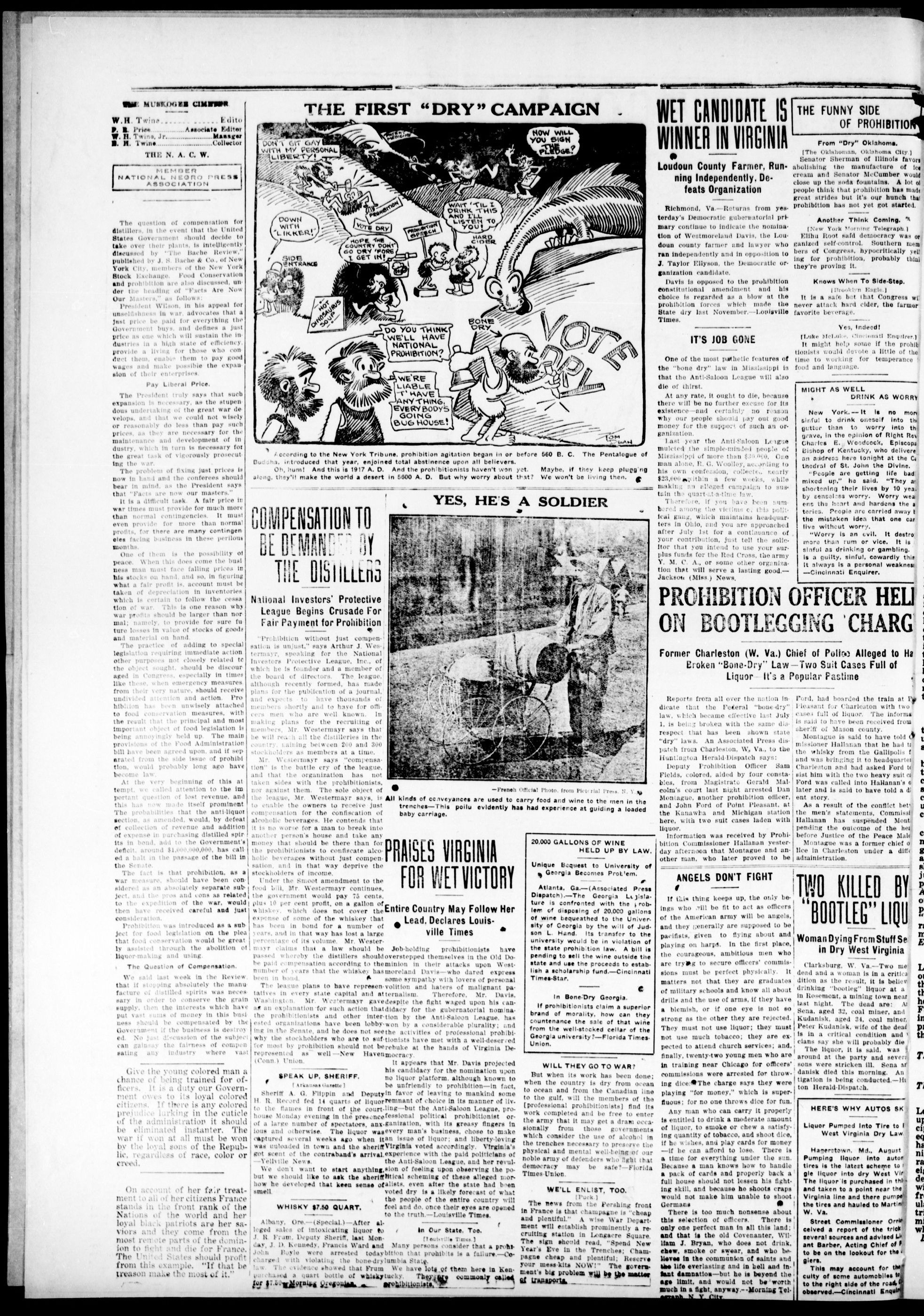
THE FIRST "DRY" CAMPAIGN
DON'T GIT GAY WITH MY PERSONAL LIBERTY!
PROHIBITION
VOTE DRY
HOPE THE COUNTRY DON'T GO DRY! PORE I GET IN!
SIDE ENTRANCE
HOT DINOSAURS SOUP!
NOW WILL YOU SIGN THE PRIORGE?
WAIT 'TIL I DRINK THIS AND I'LL LISTEN TO YOU!
HARD CIDER
DO YOU THINK WE'LL HAVE NATIONAL PROHIBITION?
BONE DRY
WE'RE LIABLE T'HAVE ANY THING, EVERYBODY'S GOING BUG HOUSE!
LOM DAN
According to the New York Tribune, prohibition agitation began in or before 560 B. C. The Pentalogue of Buddha, introduced that year, enjoined total abstinence upon all believers.
Oh, hum! And this is 1917 A. D. And the prohibitionists haven't won yet. Maybe, if they keep plugging along, they'll make the world a desert in 5600 A. D. But why worry about that? We won't be living then.
mayr claims that a law should be Job-holding prohibitionists have passed whereby the distillers should overstepped themselves in the Old Doe paid compensation according to the minion in their attacks upon West-number of years that the whiskey has moreland Davis—who dared express been in bond. some sympathy with lovers of personal The league plans to have represen-volition and haters of malignant patatives in every state capital and aternalism. Therefore, Mr. Davis, Washington. Mr. Westernmayr gavedespite the fight waged upon his canan explanation for such action that didacly for the gubernatorial nomina-the prohibitionists and other intertion by the Anti-Saloon League, has ested organizations have been lobby-won by a considerable plurality; and ing in the Senate, and he does not see the activities of professional prohib-why the stockholders who are to suffionists have met with a well-deserved for most by prohibition should not berehue at the hands of Virginia De-represented as well—New Havenmocracy.
Sheriff A. G. Flippin and Deputy in favor of leaving to mankind some H. R. Record fed 14 quarts of liquor remnant of choice in its manner of livethe flames in front of the court-ling—but the Anti-Saloon League,prohouse Monday evening in the presence professional political prohibitionist orofa large number of spectators, anx-ganization, with its greasy fingers inions and otherwise. The liquor was every man's business, chose to makecaptured several weeks ago when it an issue of liquor; and liberty-lovingwas unloaded in town and the sheriffVirginia voted accordingly. Virginia'sgot scent of the contraband's arrival experience with the paid politicians of—Yellville News. the Anti-Saloon League, and her revul-We don't want to start anything on feeling upon observing the pobut we should like to ask the sheriffliteral scheming of these alleged morhow he developed that keen sense of allists, even after the state had beensmelld voted dry is a likely forecast of what
day, J. D. Kennedy, Francis Ward and Many persons consider that a probit John Boyle were arrested todaybitton that prohibits is a failure.—Co-charged with violating the bone-drylumbia State.
law. The evidence showed that Frum We have lots of them here in Ken- purchased a quart bottle of whiskytucky. They are commonly called for $7.50 Morning Oregonian prohibitionists.
COMPENSATION TO BE DEMANDED BY THE DISTILLERS
National Investors' Protective League Begins Crusade For Fair Payment for Prohibition
"Prohibition without just compensation is unjust," says Arthur J. Westermayr, speaking for the National Investors Protective League, Inc., of which he is founder and a member of the board of directors. The league, although recently formed, has made plans for the publication of a journal, and expects to have thousands of members shortly and to have for officers men who are well known. In making plans for the recruiting of members, Mr. Westermayr says that he will reach all the distilleries in the country, training between 200 and 300 stockholders as members at a time.
Mr. Westermayr says "compensation" is the battle cry of the league, and that the organization has not taken sides with the prohibitionists, nor against them. The sole object of the league, Mr. Westermayr says, is to enable the owners to receive just compensation for the confiscation of alcoholic beverages. He contends that it is no worse for a man to break into another person's house and take any money that should be there than for the prohibitionists to confiscate alcohol beverages without just compensation, and in that way deprive the stockholders of income.
Under the Smoot amendment to the food bill, Mr. Westermayr continues, the government would pay 75 cents, plus 10 per cent profit, on a gallon of whiskey, which does not cover the expense of some of the whiskey that has been in bond for a number of years, and in that way has lost a large percentage of its volume. Mr. Wester-
mayor claims that a law should be passed whereby the distillers should be paid compensation according to the number of years that the whiskey has been in bond. The league plans to have representatives in every state capital and at Washington. Mr. Westermayr gave an explanation for such action that the prohibitionists and other interested organizations have been lobbying in the Senate, and he does not see why the stockholders who are to suffer most by prohibition should not be represented as well—New Haven (Conn.) Union.
SPEAK UP, SHERIFF,
[Aransas carrot]
Sheriff A. G. Flippin and Deputy H. R. Record fed 14 quarts of liquor to the flames in front of the courthouse Monday evening in the presence of a large number of spectators, anxious and otherwise. The liquor was captured several weeks ago when it was unloaded in town and the sheriff got scent of the contraband's arrival. -Yellville News.
We don't want to start anything, but we should like to ask the sheriff how he developed that keen sense of smell.
WHISKY $7.50 QUART.
Albany, Ore.—(Special.)—After alleged sales of intoxicating liquor to J. R Frum, Deputy Sheriff, last Monday, J. D. Kennedy, Francis Ward and John Boyle were arrested today charged with violating the bone-dry law. The evidence showed that Frum purchased a quart bottle of whisky for $7.50 Morning Oregonian.
YES, HE'S A SOLDIER
A man in a hat and coat stands beside a baby in a stroller. The background is a street scene with buildings and trees.
All kinds of conveyances are used to carry food and wine to the men in the trenches—This poilu evidently has had experience at guiding a loaded baby carriage.
PRAISES VIRGINIA FOR WET VICTORY
Entire Country May Follow Her Lead. Declares Louisville Times
The Job-holding prohibitionists have overstepped themselves in the Old Dominion in their attacks upon Westmoreland Davis—who dared express some sympathy with lovers of personal involition and haters of malignant patternalism. Therefore, Mr. Davis, despite the fight waged upon his candidacy for the gubernatorial nomination by the Anti-Saloon League, has won by a considerable plurality; and the activities of professional prohibitionists have met with a well-deserved rebuke at the hands of Virginia Democracy.
It appears that Mr. Davis projected his candidacy for the nomination upon no liquor platform, although known to be unfriendly to prohibition—in fact
in favor of leaving to mankind some remnant of choice in its manner of living—but the Anti-Saloon League, professional political prohibitionist organization, with its greasy fingers in every man's business, chose to make an issue of liquor; and liberty-loving Virginia voted accordingly. Virginia's experience with the paid politicians of the Anti-Saloon League, and her revulsion of feeling upon observing the political scheming of these alleged moralists, even after the state had been voted dry is a likely forecast of what the people of the entire country will feel and do, once their eyes are opened to the truth.—Louisville Times.
In Our State, Too.
[Louisville Times]
Many persons consider that a prohibition that prohibits is a failure.—Columbia State.
We have lots of them here in Ken-
20.000 GALLONS OF WINE
HELD UP BY LAW.
Unique Bequest to University of Georgia Becomes Problem.
Atlanta, Ga.—(Associated Press Dispatch)—The Georgia Lajislature is confronted with the problem of disposing of 20,000 gallons of wine bequeathed to the University of Georgia by the will of Judson L. Hand. Its transfer to the university would be in violation of the state prohibition law. A bill is pending to sell the wine outside the state and use the proceeds to establish a scholarship fund.—Cincinnati Times-Star.
In Bone:Dry Georgia.
If prohibitionists claim a superior brand of morality, how can they countenance the sale of that wine from the well-stocked cellar of the Georgia university?—Florida Times-Union.
WILL THEY GO TO WAR?
But when its work has been done; when the country is dry from ocean to ocean and from the Canadian line to the gulf, will the members of the [professional prohibition]s] find its work completed and be free to enter the army that it may get a dram occasionally from those governments which consider the use of alcohol in the trenches necessary to preserve the physical and mental well-being of our noble army of defenders who fight that democracy may be safe?—Florida Times-Union.
WE'LL ENLIST, TOO. [Puck]
The news from the Pershing front in France is that champagne is "cheap and plentiful." A wise War Department will establish prominently a recruiting station in Longacre Square. The sign should read, "Spend New Year's Eve in the Trenches; Champagne cheap and plentiful; Reserve your mess-kits NOW!" The government's big problem will be the matter of transports.
PROHIBITION OFFICER HELION BOOTLEGGING CHARG
Former Charleston (W. Va.) Chief of Police Alleged to Ha Broken "Bone-Dry" Law—Two Suit Cases Full of Liquor-It's a Popular Pastime
Loudoun County Farmer, Running Independently. Defeats Organization
Richmond, Va.—Returns from yesterday's Democratic gubernatorial primary continue to indicate the nomination of Westmoreland Davis, the Loudoun county farmer and lawyer who ran independently and in opposition to J. Taylor Ellyson, the Democratic organization candidate.
Davis is opposed to the prohibition constitutional amendment and his choice is regarded as a blow at the prohibition forces which made the State dry last November.—Louisville Times.
IT'S JOB GONE
One of the most pathetic features of the "bone dry" law in Mississippi is that the Anti-Saloon League will also die of thirst. At any rate, it ought to die, because there will be no further excuse for its existence—and certainly no reason why our people should pay out good money for the support of such an organization. Last year the Anti-Saloon League muted the simple-minded people of Mississippi of more than $30,000. One man alone, R. G. Woolley, according to his own confession, collected, nearly $23,000 within a few weeks, while making an alleged campaign to sustain the quartz-time law.
Therefore, if you have been numbered among the victims c., this political gang, which maintains headquarters in Ohio, and you are approached after July 1st for a continuance of your contribution, just tell the solicitor that you intend to use your surplus funds for the Red Cross, the army Y. M. C. A., or some other organization that will serve a lasting good.—Jackson (Miss.) News.
Reports from all over the nation indicate that the Federal "bone-dry" law, which became effective last July 1, is being broken with the same disrespect that has been shown state "dry" laws. An Associated Press dispatch from Charleston, W. Va., to the Huntington Herald-Dispatch says: Deputy Prohibition Officer Sam Fields, colored, aided by four constables, from Magistrate Gerald Malcolm's court last night arrested Dan Montague, another prohibition officer, and John Ford of Point Pleasant, at the Kanawha and Michigan station here, with two suit cases laden with liquor. Information was received by Prohibition Commissioner Hallanane yesterday afternoon that Montague and another man, who later proved to be
ANGELS DON'T FIGHT
If this thing keeps up, the only beings who will be fit to act as officers of the American army will be angels, and they generally are supposed to be pacifists, given to flying about and playing on harps. In the first place, the courageous, ambitious men who are trying to secure officers' commissions must be perfect physically. It matters not that they are graduates of military schools and know all about drills and the use of arms, if they have a blemish, or if one eye is not so strong as the other they are rejected. They must not use liquor; they must not use much tobacco; they are expected to attend church services; and, finally, twenty-two young men who are in training near Chicago for officers' commissions were arrested for throwing dice: The charge says they were playing "for money," which is superfluous; for no one throws dice for fun.
Any man who can carry it properly is entitled to drink a moderate amount of liquor, to smoke or chew a satisfying quantity of tobacco, and shoot dice, if he wishes, and play cards for money — if he can afford to lose. There is a time for everything under the sun. Because a man knows how to handle a pack of cards and properly back a full house should not lessen his fighting skill, and because he shoots craps would not make him unable to shoot Germans
There is too much nonsense about this selection of officers. There is only one perfect man in all this land; and that is the old Covenanter, William J. Bryan, who does not drink, chew, smoke or swear, and who believes in the communion of saints and the life everlasting and in hell and infant damnation—but he is beyond the age limit, and would not be worth much in a fight, anyway. Morning Telegraph, N.Y. City.
From "Dry" Oklahoma.
[The Oklahomaan, Oklahoma City]
Senator Sherman of Illinois favors abolishing the manufacture of ice cream and Senator McCumber would close up the soda fountains. A lot of people think that prohibition has made great strides but it's our hunch that prohibition has not yet got started.
Another Think Coming.
[New York Morning Telegraph]
Elihu Root said democracy was organized self-control. Southern members of Congress, hypocritically yelling for prohibition, probably think they're proving it.
Knews When To Side-Step.
[Brooklyn Eagle.]
It is a safe bet that Congress will never attack hard elder, the farmer favorite beverage.
Yes. Indeed!
[Luke McLaney, Cincinnati Enquirer]
It might help some if the prob-
tionists would devote a little of the
time to working for temperance
food and language.
MIGHT AS WELL
DRINK AS WORRY
New York.—It is no more
sinciful to drink oneself into the
gutter, than to worry into the
grave, in the opinion of Right Rev
Charles E. Woodcock, Episcopus
Bishop of Kentucky, who delivere
an address here tonight at the C
cathedral of St. John the Divine.
"People are getting life bad mixed up," he said. "They are shortening their lives by 10 years by senseless worry. Worry wears the heart and hardens the arteries. People are carried away by the mistaken idea that one can live without worry.
"Worry is an evil. It destroys more than rum or vice. It is sinful as drinking or gambling. is a guilty, sinful, cowardly thin. It always is a personal weakness—Cincinnati Enquirer.
OFFICER HELI
GING 'CHARGE
Chief of Police Alleged to Ha
—Two Suit Cases Full of
Popular Pastime
Ford, had boarded the train at P
Pleasant for Charleaton with two
cases full of liquor. The informa
is said to have been received from
sheriff of Mason county.
Montague is said to have told Commission Hallanan that he had to the whisky from the Gallipollis ferry and was bringing it to headquarter Charleston and had asked Ford to sist him with the two heavy suit of Ford was called into Hallanan's later and is said to have told a dlient story.
As a result of the conflict between the men's statements, Commission Hallanan has suspended Montpending the outcome of the hep before Justice of the Peace Malone Montague was a former chief officer in Charleston under a different administration.
TWO KILLED BY "BOOTLEG" LIQU
Woman Dying From Stuff Seen in Dry West Virginia
Clarksburg, W. Va.—Two men dead and a woman is in a critical dition as the result, it is believ drinking "bootleg" liquor at a in Rosemont, a mining town near last night. The dead are: At Sena, aged 32, coal miner, and Kudanisk, aged 34, coal miner, Peter Kudanisk, wife of the dead is in a critical condition and clans say she will probably die. The liquor, it is said, was around at the party and severs sons were stricken ill. Sena are danisk died this morning. An tigation is being conducted. -Hon Herald-Dispatch.
HERE'S WHY AUTOS SK
Liquor Pumped Into Tire to I West Virginia Dry Law
Hagerstown, Md., August Pumping liquor into auto tires is the latest scheme to give liquor into dry West Virgina The liquor is purchased in this and taken to a point near the Virginia line and there pump the tires and hauled to Martin W. Va.
Street Commissioner Ornceceived a report of the trick several sources and advised Liek Barber, Acting Chief of P to be on the lookout for the giers.
This may account for the culty of some automobiles to the right side of the road, observed—Cincinnati Enquir