Nashville Globe
Friday, February 1, 1907
Nashville, Tennessee
Page text (machine-generated)
THE NASHVILLE GLOBE.
"All things come to them that wait, providing they hustle while they wait."—Charles W. Anderson. "Get out of our sunshine."—R. H. Boyd.
VOL. II.
REVIEW OF THE "CLANSMAN."
EFFECTS OF PLAY ON MINDS OF GENERAL PUBLIC.
Daily Press Compelled to Pronounce the Play Unwholesome.
NO GOOD CAN BE PRODUCED BY ITS PRESENTATION.—NEGROES WOULD BE IN DANGER OF BODILY HARM IF PRESENT—STRONG SENTIMENT IN FAVOR OF BRINGING "UNCLE TOM'S CABIN" HERE—ADVISED AGAINST SUCH STEP—PEACE PRAYED FOR.
A Globe reporter was sent out by the Globe Publishing Company to learn something of Tom Dixon's Clansman, or better known as Rev. Thomas Dixon, mob instigator, Negro murderer, inflammatory race persecutor, or any other name that the English language contains to describe a man that has brought the most inflammatory agitation that has ever visited our peaceful community since the days that the murderer Ku Klux Klan drenched the fair Southland with innocent Negroes' blood. This reporter, although a taxpayer and a citizen, who was born and reared in the South, and has lived in Nashville more than a decade, paid his taxes, obeyed the laws and has tried to live a peaceable, Christian citizen, was denied admission to this murderous inflammatory exhibition for reasons unknown to him. Hence he can only judge the effects of this play by the reports and editorials of the daily papers whose editors were admitted possibly on complimentary tickets. Your reporter encloses herewith two clippings, marked No.1 and No.2 respectively. No.1 is from the Nashville American, which seems to thrive upon the spirit of race hatred of the oppressed Negro. No.2 is from the Nashville Banner. These will give some idea of the effects of this agitation on the minds of those who have seen the play.
(From The Nashville American.)
Seldom has a Nashville audience been so deeply moved by a dramatic production as that which witnessed "The Clansman" at the Vendome Theater on Wednesday night. The house was crowded almost to its capacity, and during the performance a state of suppressed excitement generally prevailed, but it is not meant to imply that the audience was undemonstrative, but merely that what was expressed was almost infinitesimal in comparison with what was felt. Wisely, it is believed, did the management exclude negroes from the playhouse, for so powerfully was the spirit of the reconstruction period revived that it is probable they would have been in imminent danger of being forcibly expelled, if, indeed, more drastic measures had not been resorted to.
The now famous creation of Thomas Dixon, Jr., was magnificently staged, and the behavior of the audience was eloquent testimony to the effective work of the cast. Not from the gallery alone emanated hisses and excited exclamations; but in such a manner also did occupants of boxes and orchestra seats give vent to the emotions of disgust and anger aroused by the presumption and villainy of the negro characters of the portrayal. Although the performance was not without its defects, one was blinded to them by the appealing force of the ensemble, and indeed it would be extremely difficult, if not impossible for any man or woman imbued with Southern sentiments to criticise dispassionately. So powerful are the passions which it inspires that one tends to forget that it is but a stage affair and this is the greatest compliment that can be paid it.
It is not necessary here to synopsis the story of "The Clansman" as it may be taken for granted that the public is familiar with it. It is an irrefutable argument against the possibility of social and political equality between the negro and the Caucasian
NASHVILLE. TENN., FRIDAY, FEBRUARY 1, 1907.
races, and the play abounds with incidents which thrill a Southern audience with peculiar force. Powerfully dramatic is the portrayal of Austin Stoneman, the uncompromising, radical leader, bent on humbling the white people of the South to acquiesce in a condition of social equality, by John B. Cooke, who proved himself equal to the demands of his difficult part. Albert Andrus gave a masterful interpretation of the character of Silas Lynch, Lieutenant Governor of South Carolina, the artful and ambitious mulatto, who aspired to the hand of Stoneman's daughter. Elsie, and the audience testified to the effectiveness of his work by its repeated hisses, and in one of the climaxes of the play the exclamation, "Shoot him" was heard. The part of Dr. Richard Cameron, the conservative, reluctant to countenance the organization of the Ku-Klux Klan until his daughter had jumped to her death to escape the clutches of a brutal negro, was well taken by Guv B. Hoffman. Nelse, Cameron's former slave, and devoted to his master, was realistically portrayed by Theodore Kehrwald. Coleman F. Carroll, as Gus of the Black Guard, in the scene in the cave, the meeting place of the Ku-Klux Klan, interrupted his part with rare dramatic effect. Charles Avery, as the scalawag governor, the tool of Lynch, was admirable. The part of Elsie Stoneman was taken by Claire McDowell, who charmingly portrayed the noble character. Mable Shaw gave a very satisfactory interpretation of the character of Flora. Dr. Cameron's daughter. F. Cecil Butler, as the Grand Wizard of the Klan, Gen. N. B. Forrest: Maude Durand, as Eve, Nelse's wife: John E. Sweeny, as a carpetag noddler and auctioneer, and all of the other members of the numerous cast were very satisfactory in their respective parts. Some of them displayed dramatic ability in various situations of a high order.
The scenic effects were excellent, that of the cave being particularly impressive. "The Clausman" will be presented at the Vendome the balance of the week.
"THE CLANSMAN."
(Nashville Banner.)
Thomas Dixon's flamboyant melodrama, "The Clansman," has come and gone, and its effect on life in Nashville appears to have been no more than that of any one of a thousand other such plays might have exerted, and but for the protests against the performance it would probably be as soon forgotten as any of them. The protests against the play and the discussion elicited by them were valuable aids to the press agent, and their effects was shown in the crowded houses at each presentation of the drama.
If such a play as the "Clansman" were allowed to appear without opposition, the probability is that it would soon run its course and pass into the limbo of forgotten sensations. It has no literary or dramatic merit to sustain a continued popularity.
There are features of the play that naturally appeal to many people in the South. It depicts the gross injustice to which the Southern white people were subjected by reconstruction measures and the fanaticism of some of the leading Northern politicians of the reconstruction era. It shows, too, the justification for measures of self-defense which the stricken South adopted. These things presented in melodramatic form arouse a sentiment largely prevalent in the South, and elicit interest and applause, but for this very reason the play is unwholesome. The South should not linger in bitter and unprofitable memories. It should not, at least, have its feelings harrowed by a recall of those evil days with their worst features accentuated and intensified with all the calcium effects of a stage presentation. History should be studied calmly and dispassionately and only perverted ideas can be had from a purposely highly colored melodrama.
"The Clansman," too, is calculated to encourage and sustain race rancor, and that is something the South needs especially to avoid. The relation of the races in the South now is not only amicable but politically and otherwise it is such as the white people desire. It doesn't behoove them to aid in seized exploitations of race antagonisms. "The Clansman" from this point of view is hurtful. It has no motive of good or helpfulness in it. It is a travesty on the conditions of the reconstruction times, and it contributes nothing to history and is designed for no present good. The ne-
A NORTHERN SYN- DICATE PURCHASES
A LARGE TRACT OF LAND IN NORTH NASHVILLE.
This property we understand is on McLaughlin avenue, not far from the Jefferson street car line, and near Fisk University.
The land is to be cut up into building lots, and sold on long time, the same as has been done by several firms here to sell to white people.
It is a fact that with many thousand lots sold on long time in this city, a colored person was unable to purchase a lot unless he paid cash, or nearly all cash for it. The result has been that any one working and desiring to invest 50 cents or a dollar a week in real estate had no opportunity for doing so.
This firm will place a large force of men at work on this property at once to beautify it. We are told they will have about 500 lots, and have already let the contract for grading and making streets, and otherwise making high grade property of this. In order that every one doing business may be guaranteed against any possibility of loss, one of the local banks guarantees all their transactions by signing all deeds and contracts given by this firm.
PEARL HIGH SCHOOL NOTES.
This school is now in a settled condition. Classes are running smoothly, pupils have become accustomed to their new grades, and it would be difficult for a visitor to tell that any change had taken place. Reorganization was effected with very little loss of time. More pupils failed in higher mathematics than in any other branch, thus verifying the popular and accepted notion that mathematical knowledge is the hardest to acquire. Science appeared to furnish the next greatest obstacle in the way of promotion. It would be interesting to know how the pupils in the white High School ao quitted themselves in these branches, that a comparison might be made as to the relative difficulty of acquisition of these subjects by white and colored pupils, especially as both schools took the same questions. This school was honored with a visit from Mr. J. Herman Moore (Prince Herman), of Pittsburg, Pa., this week. Rev. G. L. Jackson visited the High School on Monday. Miss S. M. Wells, of Fisk University, called at the school and spent much time visiting the First and Second Floors.
gro protests against "The Clansman" were first made in the North. It was inhibited by white Democratic authorities in several Southern cities at a time of race excitement. These objections, when they have been made in vain in the South, have only advertised the play. "The Clansman" is objectionable in the same way that "Uncle Tom's Cabin" was. It presents the worst features of an evil condition in the garish and exaggerated light of melodrama and irritates and inflames a serious situation that should be left to safe judgment. "Uncle Tom's Cabin" was one of the most potent factors in producing a bloody war that calm counsel might have avoided. It is hardly possible that "The Clansman" could have such dire effects, but it is toying with dynamic conditions that were best avoided. The best way to nullify such an influence, however, is to leave it unnoticed as far as possible. It will thrive on sensational opposition.
In the name of all that is wise just and good when will these agitations cease? Why resurrect the old Ku Klux Klan? Why heat the blood and agitate the minds of young white men, who can possibly be easily excited to join a mob for the destruction of suspected Negroes on almost any frivolous pretext? But this is not the worst that this agitation brings among us. The reporter has found among almost every group of Negroes who have been discussing this affair, a strong determination to bring Uncle Tom's Cabin to follow the Clausman. The book itself is in demand. The Negroes are buying it for their children. A great number of Negroes are pledged to take season tickets for a week at fair prices to bring this play on the stage of Nashville. If opera houses will not have it they are talking of renting halls. I am sure that the Globe would advise against this. Uncle Tom's Cabin, as
written by Mrs. Harriet Beecher Stowe, did more, possibly, to emancipate the Negroes than any other agency. It is dear to the Negroes and is held in sacred memory. But in the words of our great statesman, "Let us have peace." The Globe will contend for peace. Yet we are assured that while some cities and even some states have denied the right of Uncle Tom's Cabin to be played upon the stages, yet the Mayor of Nashville has assured us that he cannot stop a play, as he has no power. So there is nothing to prevent Uncle Tom's Cabin coming to Nashville. While the Negroes love this play, and would pay more to see it than any other drama that is put upon the stage, yet, because they found that it was offensive to their white neighbors they have abandoned the agitation of having it, and they do not encourage the circulation of the book. Book agents among Negroes have not encouraged its sale. Well-thinking Negroes have not encouraged the reading of this book by Negroes. They have thought it best to let the dead past lie buried.
INITIAL RALLY FOR ROGER WILLIAMS UNIVERSITY.
Sylvan Street Baptist Church Raises First Money Donated to Rebuild this Institution of Learning.
Much has been said about rebuilding Roger Williams University in Nashville, and speculation beyond measure has been indulged in, but the most advanced step in that direction was the effort put forth by the members of the Syllan Street Baptist Church on the east side last Sunday, when under the leadership of their able and energetic pastor, Rev. Wm. Haynes, they raised the sum of $54.00 as a fund to aid in rebuilding the institution here. This was supplemented with $28.00 raised at an Executive Board meeting held recently at this church, making a total of $82.00 raised by this congregation and pastor. No great fuss was made about the matter, simply the members and friends decided that if Roger Williams is to be built the Negroes will have to put their hands in their pockets and build it. They built the old Roger Williams and turned it over to a society dominated by white men, and when the fire came and the "winds blew," the Negroes woke up to realize that they had built on a sandy foundation. An institution that belonged to them was swept away by the flames, the little sum of over $50,000 insurance was turned into the treasury of the society dominated by white men from the East, and the ground was cut up into building lots and is being sold; so that the proceeds can go in the same direction. The university could not be rebuilt on the same ground because some white people objected, despite the fact that one Mr. Thompson, one of the wealthiest and most highly respected citizens in this city testified that the students were always manly, and when the fire forced the young men and women out of doors, he threw open his doors to them and aided them in every way he could. But the institution could not be built there. Then it was rumored that a site had been purchased in another part of the city, even more desirable than the old site, and that Nashville would retain the institution, but time rolled on and the longer the forty thousand Negroes of Nashville waited for matters to materialize into something tangible the further from solution seemed the problem of rebuilding this educational institution that has done so much to uplift the thousands who have for forty odd years looked on her with pride and gathered inspiration, and it seems that they have about decided that the best way to get a thing is to roll up your sleeves and go after it.
A committee has been appointed with Rev Wm. Haynes, pastor of the Sylvan Street Baptist Church, as chairman, and they propose to go at the matter in a systematic way and raise funds to give to Nashville again one of her institutions of learning bigger and better than the old one. They have planned to hold educational rallies in as many churches as possible, and give every lover of education an opportunity to aid in this worthy cause. The people of Nashville and the whole country will receive these tidings with glad hearts, and those who have been instruced with the duty of pushing the plan as laid out expect a hearty co-operation from the public generally. The citizens of Nashville have always taken a great deal of pride in the educational institutions located here, and are not willing to sacrifice a single one of them, but instead hope in the near future to be able to point to a progressive Fisk University, an enlarged Walden University, and a new and bigger Roger Williams University, owned and controlled by the Negro Baptists and the Negro friends of education.
THE GOVERNMENT TAKEN TO TASK.
RECENT ORDER CREATES MUCH DISCUSSION.
Back Stamping of Mail Causes Local Publishers Great Worry.
IMPOSSIBLE TO PLACE RESPONSIBILITY OF ERRORS IF THE RECENT ORDER ABOLISHING BACKSTAMPING STANDS—THAT THE NEW METHOD WILL NOT PROTECT THE PUBLIC AGAINST FRAUDS IS SHOWN—PRESSURE WILL BE BROUGHT TO BEAR IN FAVOR OF OLD SYSTEM.
Much is being said in business circles among the big publishing houses of Nashville concerning back stamping. It seems that an article which appeared in the Globe a few weeks ago has started an investigation as to whether backstamping was really a bindrance or help to incoming mall of first-class nature. It is an undisputed fact that there is but one way of ascertaining the delay in letters that are received in the post office from an R. P. O. and not delivered within the limit of time. The post office in dispatching its large amount of outgoing mall makes up special ties of letters when the quantity is sufficient to justify it. In case a letter for Memphis is put in the package tied out for Knoxville, from the Nashville post office, it would possibly lose from 24 to 48 hours if the trains were running on schedule time. This could only be detected by the distributing clerk at the Knoxville post office. The error should be reported on the facing slip, which should accompany this tie of letters, and would serve as a check on the mailing clerk in the Nashville post office. If the distributing clerks in the Knoxville post office were using the backstamping machine, and would destroy or misplace this facing slip, the only recourse for reporting the error, if reported at all, would be to report it under the pouch label, which of course would not hold good against the railroad postal clerk, who could ask for credit as the error was not reported on the facing slip. The letter would then be marked "Missent" by Knoxville and dispatched by the first mail out to Nashville. These appear to be the two points at issue. The trend of the argument put forth by the First Assistant Postmaster General in his report for the fiscal year ending June 30, 1906, in which he takes up at length and discusses backstamping, seems to be in favor of facing slips to backstamping. It is argued that the only feasible way to discuss the matter on its merits is to draw an illustration showing the absolute need of backstamping as a help to all, and a protection to the sender as well as the addresssee.
B is in Memphis, Tennessee; A is in Nashville, Tennessee. B has promised to have a check here to take up a note at the One-Cent Savings Bank which is due on Saturday, February 2. The note is subject to protest. B mails a letter in Memphis at 10 a.m. February 1,1907. It is so postmarked and is dispatched by the first Nashville mail. The mailing clerk in the Memphis office accidently puts this letter in the Knoxville box. It is tied out for Knoxville, and is so dispatched. The distributing clerk in the Knoxville office gets this letter and reports the error on the facing slip from the Memphis post office. The letter is then dispatched to Nashville but does not reach here until the night of the 2nd of February. In the meantime A has protested the note at the Bank. Notwithstanding B is under the impression that his letter is received on time, he argues that it was malled on time and should have been delivered. A says it was not received. With the backstamping, the local office could show the letter was not received until the night of February 2, while if the backstamping is dispensed with and only the facing slip is used, the local office and carriers force would be held responsible for the delay. Letters that are missent by post offices and R. P. O's are not always marked "Missent" by the clerk detecting the error. They simply, as a rule, check
DR. JOSIE E. WELLS,
Diseases of Women and Children.
Electrical Massage Given at the
Office.
OFFICE. RESIDENCE.
411 Fourth Avenue, N.,
'Phone 1477. 77 Maple Street.
'Phone 1318.
OFFICE HOURS: 10 to 12 a.m., evening
by appointment. 10-27-06 tf.
H. GLENN.
640 WETMORE ST.,
Practical Cleaner and Dyer
OF
Ladies' and Gents' Clothing.
12-7-06 tf
JNO. W. KELSO,
DEALER IN
Wood, Coal, Ice and KINDLING. ORDERS PROMPTLY DELIVERED, GIVE MEA CALL. Yards Cor. Sixth Ave., and Jefferson st. 12-7-06 tf
Economical Steam Laundry,
OWNED, OPERATED AND CONTROLLED BY NEGROES.
We solicit your patronage. First-class work at reasonable prices. Packages called for and delivered to all parts of the city. Give us a trial.
ARTHUR G. PRICE, Manager.
Telephone 4095. 412 Cedar Street.
GO TO
Contractor and Builder,
When you want Repair and Job Work
done, Screens a specialty. All work
guaranteed done satisfactorily. Shop:
210 Seventh Avenue, South.
5-15-06 at
Capitol Shoe Store
423 CEDAR STREET,
FOR SPECIAL BARGAINS ON
Shoes, Umbrellas and Glo es.
PROPRIETORS.
C. S. Randals, - S. J. Mesbit.
12.14.06 4t
FOR RENT
A beautiful suite of rooms on the third floor of the Napier Court 411 Fourth Ave., North. There are five rooms with a glass-stained partition. Will be rented in whole or in part. Can be used as a flat or lodge room. Apply to J. C. NAPIER. One Cent Savings Bank. 1-182-7f
BOOKS FOR VALENTINES.
Nothing is more beautiful for a valentine than a beautiful book of phases, mazes and grazes of love. Get a copy of Paul Laurence Dunbar's works.
When Malinda Sings.....$1.63
Poems of Cabin and Field.....1.50
Lyrics of Lowly Life.....1.25
Talks from Dixey (a story).....1.25
The Strength of Gideon.....1.25
Love of Landry.....2.5
In Old Plantation Days.....1.50
Sunshine and Shadow.....1.00
Hearthside.....1.25
Fanatics.....6.2
Candletimes.....1.50
The Sport of the Gods.....1.50
Happy Hollow.....1.50
LIT' Gal.....1.50
Howdy, Honey, Howdy.....1.50
Jorln' Erlong.....1.50
Make your order now from the National Baptist Publishing Board. 533 Second avenue, North, Nashville, Tenn.
THE NASHVILLE GLOBE, FRIDAY, FEBRUARY 1, 1907.
the error on the facing slip "letter for Nashville, Tenn," and sign it H. A. Jones, P. C., Nashville and Memphis R. P. O., and send it in to the Superintendent of mails. All envelopes look alike when a reference slip is attached, and are "Respectfully referred" to some postal clerk for an explanation. The argument has been well put forth that when an envelope or letter is delayed and passes through the office, and the delay is not detected until the hour of delivery, it is impossible to find out at which end the delay was caused. Backstamping is a necessity, and indeed is a protection not only to the local post office and its officials, but to the sender and addressee. It takes a great responsibility off of the local post office, for it enables them to advise the patron that the letter was received at a certain hour and that it was delivered in the first mail after receipt of the letter. The backstamping clerk takes oath, like all government employees, and swears to perform his or her duty within the prescribed laws, so that if one is caught moving up or moving back the hour of receiving, he or she would be accused of destroying government records in a sense, and would be subject to removal. The facing slip only serves as a check to the R. P. O. and the P. C. who is in charge of the railroad post office. Hence the railway mail service would have to bear all of the burdens when it is a certain fact that letters are received in the various post offices and are not delayed in transmission or vice versa. For instance if Number 1 who carries the East Nashville mail, should be given a letter for Number 25, who carries the Murphy Addition after Number 25 has left the office at 8 o'clock a.m., this letter would be delayed until the afternoon. If this occurred on Saturday afternoon, it would be held over until Monday morning, even if Number 1 did stamp it "W" and attach his number to it, there would be no way of ascertaining the delay unless the backstamping appeared. The carrier could put forth an argument that the letter was delayed in transmission, notwithstanding the postmark of Memphis might show that it left that post office Friday noon., and it should have been received Saturday morning. The carrier might say and be justified in his claim, that the letter was not received by him until Monday morning. So it can readily be seen that without backstamping showing at what hour it arrived, there would be no way of tracing these delays.
The postal department in its effort to economize, seems to have attacked a tender place, hence it remains to be seen whether the business men of the large mail order houses will allow this temporary suspension of the backstamping to continue in force without a strong protest. Nashville appears to have been one of the desirable cities in which to inaugurate this experiment which has been started in some of the large northern and eastern cities. A decided opposition to the argument put up by the Assistant Postmaster General, is being made by the business men, who argue that both the facing slip system, which is a record for the railway mail service, and the backstamping system, which is a record for the local post office and a protection to both, should be continued. One is as essential as the other. For in the United States mail we have two great divisions, the railway mail service and the local post office. Each must have protection, and the patrons must have theirs.
The following is taken from the report of the Postmaster General in his argument for the facing slip system against backstamping:
"In the post office of one of our large cities the record of errors traced to their source during the month of September last, while backstamping was in opperation, showed a total of 172, whereas the same office was able in the month of October with backstamping suspended, to fix the responsibility of 2.478 errors, utilizing the facing slip in a manner just described. Similar experiences have been reported from other post-offices as a result of the suspension of backstamping."
The above is a good showing for the facing slip argument but it does not detract from the merits of backstamping. It does not show how many letters have been delayed in the local post-offices in this period, which could have been traced to direct negligence of some of the distributing clerks or letter carriers. Thus the burden of these delays rests with the railway mail service.
Another argument put forth by the Assistant Postmaster General against backstamping is as follows:—
While the backstamp is supposed to show approximately the time of a letter's receipt at the post office, it is never conclusive, for there may be delay in the office before the backstamping occurs."
Those who have spent years in the service know that there is never a delay of more than thirty minutes or an hour at the most in backstamping the mail after it has been received into the post office. Carriers have been "swung" until the mail could be backstamped and distributed. Hence it is held that the receiving stamp on the back of the letter, so far as the
government records are concerned, is conclusive evidence of receipt of the letter. The post master general goes further in this argument and says:— "As a rule the time record of the backstamp is changed not oftener than every half hour, and therefore backstamping, even if promptly done, can show a variance of nearly thirty minutes from the true time."
This argument is easily offset by the fact that when mail arrives in the post office in rapid succession not less than thirty minutes apart, it is not absolutely necessary to retard the work, and delay the distribution by changing the backstamp, except when the period occupies over thirty minutes. But invariably letters of importance, like special delivery letters, are stamped as near the hour they are received as the dye in the backstamping machine will indicate. Hence the special delivery service would at least be protected in the continuance of the backstamping. This cannot be done if this custom of not backstamping is allowed to continue.
The Assistant Postmaster General continues:
"The usual custom in adjusting the time record of the backstamp is to set it thirty minutes ahead of the actual hour."
To this a reply can be easily given, as it is learned that the backstamping machine is usually set between the time of the arrival of the train at the depot and the arrival of the mail at the post office, either of which would be good records.
He goes further in his argument and says:
"Recent investigation has developed the fact that in some offices the backstamp is habitually set, not at the time when the mail arrives, but at the hour when it is the practice to begin delivery. In such cases the record conveyed by the backstamp is far from accurate and serves to deceive rather than to enlighten the public."
It is hardly necessary for business men who conduct some of the largest business establishments in the United States to expect to give reasonable excuses to their patrons for delays in letters if there is no official record on the face or back of the letters to show the exact hour of their dispatch and arrival. It would appear that if the Assistant Postmaster General is going to economize in the service, it would be better for him to begin at another end that is of less importance to the large patrons of the mail service. In his last report, the Hon. Assistant Postmaster General does not show how important to a business firm the mail records are, especially of the receipt of letters at post offices. If so, he would certainly not put forth an argument in favor of the Facing Slip, which only protects the railway service, as against backstamping, which not only protects the railway mail service, but protects the officials, employees and addressee. It remains to be seen whether this experiment in vogue in some of the large cities will prove a success or failure.
THE PASSING OF A USEFUL CITI
ZEN—BROWN HIGHTOWER.
In the death of Mr. Brown Hightower, Nashville, loses one of its oldest, most useful and best known citizens. He was one of the first colored men to begin a mercantile business in the city. For years he successfully conducted a junk store at 215 Fourth avenue. South. Mr. Hightower's health began falling last summer, but after having been confined to his bed for several weeks, he recovered sufficient strength to return to his place of business. His friends were hopeful that the worst had passed, and that his life would be spared for several years longer; but on Wednesday morning, January 23rd, he fell in the yard at his home on Lewis street. His wife rushed to him and found him suffering as from a stroke of paralysis. She and other friends assisted him into the house and put him to bed, notified his brother, Thomas Hightower, and called a physician. Everything possible was done to make the sufferer comfortable and to relieve his pains, but at noon his soul took its departure and winged its sainted flight up to the hills of light, there to rest forever in the bosom of its God.
Seldom in the history of Nashville have so many sorrowing friends gathered to do honor to the memory of the departed as assembled in the Second Baptist Church. Friday evening, Jan. 25th, to do honor to Mr. Hightower. His pastor, Rev. B. G. Taylor, got up out of his sick bed that he might be present at the funeral. The floral offerings were profuse and very expressive of sorrow for the dead and sympathy for the bereaved. The rostrum was crowded with city pastors and other distinguished individuals. The officers of the church were the hall bearer. Miss Georgia Sanders read resolutions of condolence. The Sons' and Daughters' of Israel, the society of which Mr. Brown Hightower was a member, turned out in a body. The church choir was at its best: Rev. Preston Taylor had charge of the funeral, and he not only directed it with a masterly hand, but was of valuable service to the pastor in handling the large audience. The pastor, Rev. G. B. Taylor, took for his text Job 5:26: "Thou shalt come to thy grave in a
OR HAVE YOU ANY
TROUBLE WITH YOUR
EYES, EARS, NOSE or THROAT?
IF SC, CONSULT
Dr. G. V. Roman,
SPECIALIST,
ROOMS 2 and 3 NASHVILLE,
NAPIER COURT. TENN.
full age," and proceeded to deliver the funeral eulogy. He paid a glowing tribute to Mr. Hightower as a business man, as a Christian, as an officer of the church and as a friend. Rev. W. S. Ellington, pastor of the First Baptist Church, of which Mr. Thomas Hightower, a brother of the deceased, is a member, was asked to say a word. He said that he felt as if he were at the funeral of a near relative, that he had lived just across the street from Mr. Hightower for three years and that he had learned to love him as a neighbor and a Christian. He assured the sorrowing wife and brother of the comfort of the Holy Spirit, the love of Christ, the goodness of God and the sympathy and prayers of hundreds of friends. Rev. Luke Mason, pastor of the Primitive Baptist Church, on Lewis street, was the last speaker. He said that he had known Mr. Hightower for thirty years or more, and that he had found him ever ready to help a friend and to sympathize with a struggling neighbor. Rev. Mason was especially eloquent in his portrayal of the resurrection of the just and the eternal happiness of those who die in the Lord.
At the conclusion of these services, the body of the lamented dead was followed by the family and a large number of friends to its final resting place in Mount Ararat.
A Paper by Miss Georgia A. Sanders.
Mr. Brown Hightower was a member and officer of Hopewell Lodge, No. 2, Sons and Daughters of Israel. He was one of the chartered members who helped to organize this number five years ago. He was a good and faithful officer and would at all times respond very liberally to the financial needs of the lodge. He carried with him sunshine and laughter where'er he went, usually possessing a bright cheerful countenance. As soon as he would enter our Lodge room every one would begin to smile, and very soon the hall would be filled with laughter. He served the lodge very faithfully as Worthy Sentinel until his death. Oh, but how we shall miss him. No more shall we hear the fall of his footsteps; no more shall we hear those cheering words of consolation, for his voice is hushed in death, and his spirit has gone to the God who gave it; his soul is anchored in the haven of rest, where there is no sorrow, sickness, nor death. In his death the Sons and Daughters of Israel have lost a Christian brother and a faithful officer. But we can only bow our heads in humble submission to God and say "The Lord giveth, and the Lord taketh blessed be the name of the Lord."
ANTI-CONSUMPTION LEAGUE.
The Anti-consumption League met at the First Baptist Church with large attendance. After the object of the meeting was stated by the president, Dr. R. F. Boyd, many physicians expressed themselves as to their intentions to do all in their power to push this work to success. Dr. Merrill, president of Fisk University, was present. He complimented this move and brought out many interesting points, and asked the physicians had they ever thought why it was that this dreaded disease seemed to be more prevalent among the boys than girls, as it seemed to be the rule in his school?
As the physicians are anxious to create an interest, by common consent of the league, the President was authorized to appoint physicians to speak at the various churches providing it met the approval of the Ministers' League of the city. The following appointments were made for Sunday, February 3:
St. Paul, Dr. J. H. Hale; Mt. Olive, Dr. F. A. Steward; Clark Memorial, Dr. R. F. Boyd; Spruce Street Baptist, Dr. A. M. Townsend; Little Bethel, Dr. H. T. Geeder; First Baptist, Dr. S. S. Caruthers; First Baptist, East Nashville, Dr. G. H. Bandy. The meeting adjourned to meet at St. John's A. M. B. Church, Thursday night, Feb. 7.
F. C.
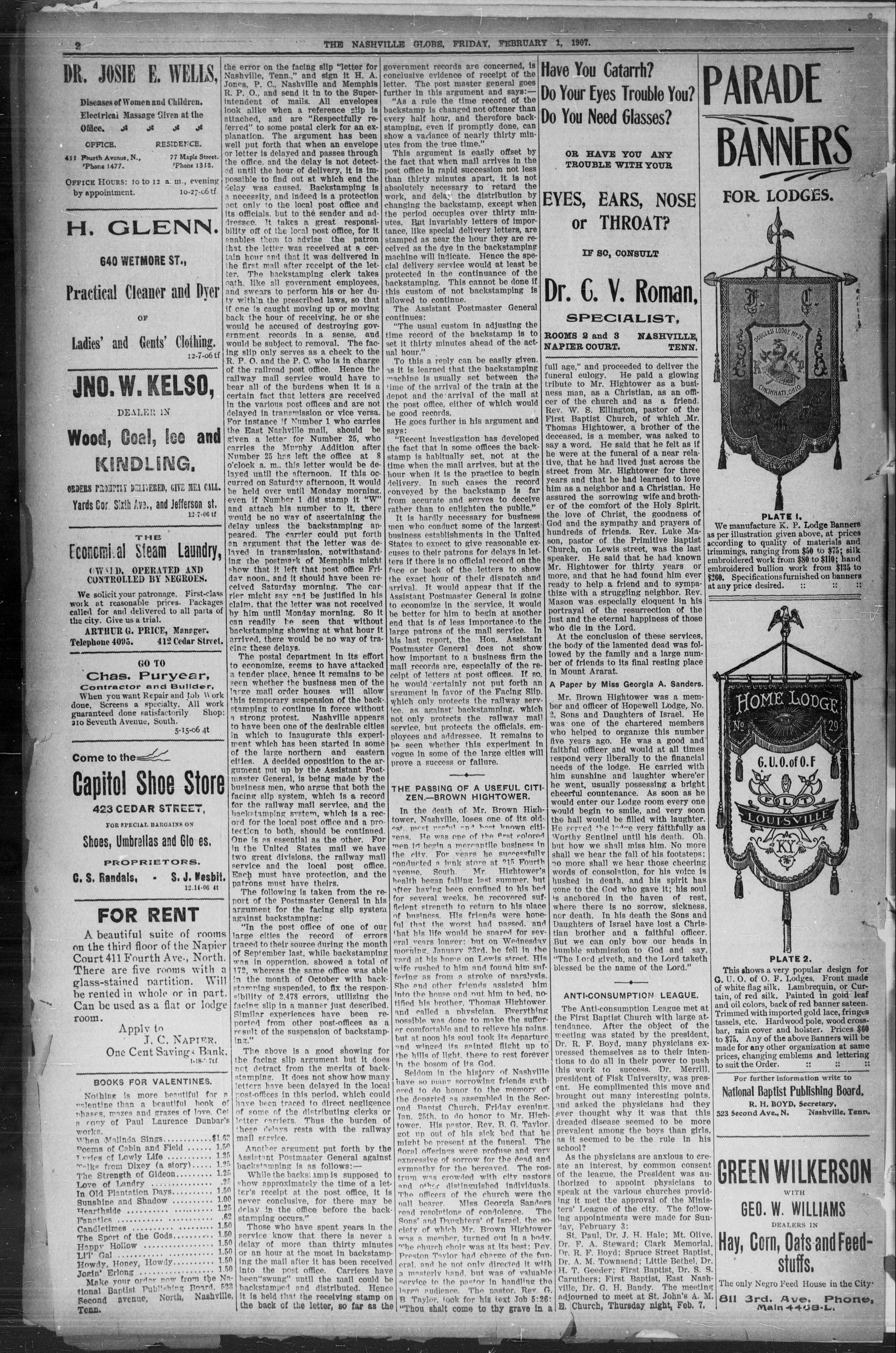
DOUGLASS LODGE MF21
CINCINNATI, OHIO.
We manufacture K. P. Lodge Banners as per illustration given above, at prices according to quality of materials and trimmings, ranging from $50 to $75; silk embroidered work from $80 to $110; hand embroidered bullion work from $135 to $260. Specifications furnished on banners at any price desired. :: :: ::
HOME LODGE
No 29
G.U.O.of O.F
FLT
LOUISVILLE
KY
This shows a very popular design for
G. U. O. of O. F. Lodges. Front made
of white flag silk. Lambrequin, or Curtain,
of red silk. Painted in gold leaf
and oil colors, back of red banner sateen.
Trimmed with imported gold lace, fringes
tassels, etc. Hardwood pole, wood crossbar,
rain cover and holster. $60 to $75. Any of the above Banners will be
made for any other organization at same
prices, changing emblems and lettering
to suit the Order. :: :: ::
For further information write to
National Baptist Publishing Board.
R. H. BOYD, Secretary,
523 Second Ave., N. Nashville, Tenn.
GREEN WILKERSON
WITH
GEO. W. WILLIAMS
DEALERS IN
Hay, Corn, Oats and Feed-
stuffs.
The only Negro Feed House in the City
811 3rd. Ave. Phone,
Main 4408-L.
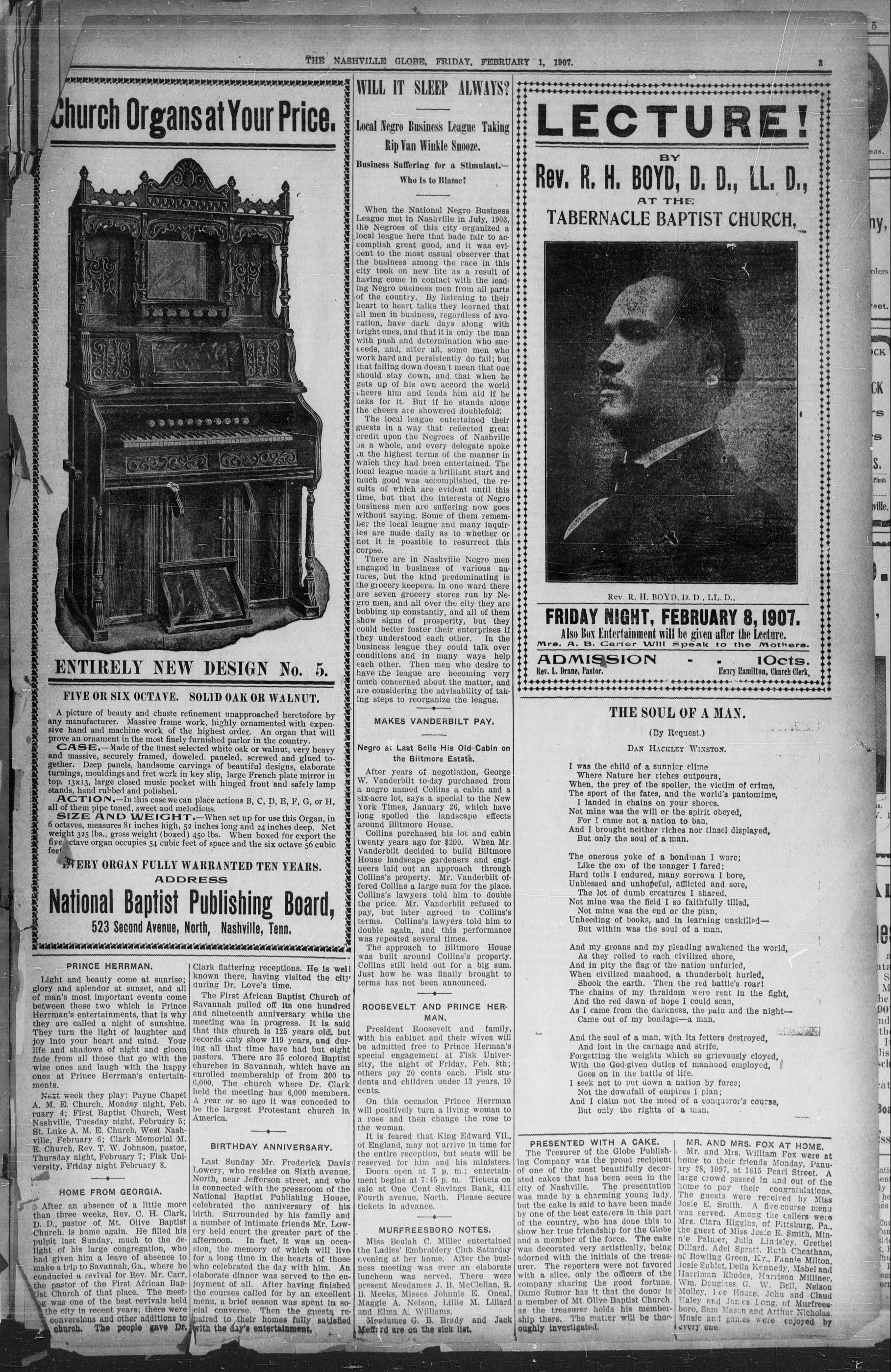
Church Organsat Your Price.
P. L. L.
ENTIRELY NEW DESIGN No. 5.
FIVE OR SIX OCTAVE. SOLID OAK OR WALNUT.
A picture of beauty and chaste refinement unapproached heretofore by any manufacturer. Massive frame work, highly ornamented with expensive hand and machine work of the highest order. An organ that will prove an ornament in the most finely furnished parlor in the country.
CASE.—Made of the finest selected white oak or walnut, very heavy and massive, securely framed, dowelled, panelled, screwed and glued together. Deep panels, handsome carvings of beautiful designs, elaborate turnings, mouldings and fret work in key slip, large French plate mirror in top. 13x13, large closed music pocket with hinged front and safely lamp stands, hand rubbed and polished.
ACTION.—In this case we can place actions B, C, D, E, F, G, or H, all of them pipe toned, sweet and melodious.
SIZE AND WEIGHT.—When set up for use this Organ, in 6 octaves, measures 81 inches high, 52 inches long and 24 inches deep. Net weight 325 lbs., gross weight (boxed) 450 lbs. When boxed for export the five octave organ occupies 54 cubic feet of space and the six octave 56 cubic feet
PRINCE HERRMAN.
Light and beauty come at sunrise; glory and splendor at sunset, and all of man's most important events come between these two which is Prince Herrman's entertainments, that is why he are called a night of sunshine. They turn the light of laughter and joy into your heart and mind. Your life and shadows of night and gloom fade from all those that go with the wise ones and laugh with the happy ones at Prince Herrman's entertainments.
Next week they play: Payne Chapel A. M. E. Church, Monday night, Feb.uary 4; First Baptist Church, West Nashville, Tuesday night, February 5; St. Luke A. M. E. Church, West Nashville, February 6; Clark Memorial M. E. Church, Rev. T. W. Johnson, pastor, Thursday night, February 7; Fisk University, Friday night February 8.
HOME FROM GEORGIA.
After an absence of a little more than three weeks, Rev. C. H. Clark, D. D., pastor of Mt. Olive Baptist Church, is home again. He filled his pulpit last Sunday, much to the delight of his large congregation, who had given him a leave of absence to make a trip to Savannah, Ga., where he conducted a revival for Rev. Mr. Carr, the pastor of the First African Baptist Church of that place. The meeting was one of the best revivals held the city in recent years; there were conversions and other additions to church. The people gave Dr.
THE NASHVILLE GLOBE, FRIDAY, FEBRUARY 1. 1907.
Clark flattering receptions. He is well known there, having visited the city during Dr. Love's time.
The First African Baptist Church of Savannah pulled off its one hundred and nineteenth anniversary while the meeting was in progress. It is said that this church is 125 years old, but records only show 119 years, and during all that time have had but eight pastors. There are 35 colored Baptist churches in Savannah, which have an enrolled membership of from 300 to 6,000. The church where Dr. Clark held the meeting has 6,000 members. A year or so ago it was conceded to be the largest Protestant church in America.
BIRTHDAY ANNIVERSARY.
Last Sunday Mr. Frederick Davis Lowery, who resides on Sixth avenue, North, near Jefferson street, and who is connected with the pressroom of the National Baptist Publishing House, celebrated the anniversary of his birth. Surrounded by his family and a number of intimate friends Mr. Lowery held court the greater part of the afternoon. In fact, it was an occasion, the memory of which will live for a long time in the hearts of those who celebrated the day with him. An elaborate dinner was served to the enjoyment of all. After having finished the courses called for by an excellent menu, a brief season was spent in social converse. Then the guests repaired to their homes fully satisfied with the day's entertainment.
WILL IT SLEEP ALWAYS?
Local Negro Business League Taking Rip Van Winkle Snooze.
Business Suffering for a Stimulant. Who is to Blame?
When the National Negro Business League met in Nashville in July, 1903, the Negroes of this city organized a local league here that bade fair to accomplish great good, and it was evident to the most casual observer that the business among the race in this city took on new lite as a result of having come in contact with the leading Negro business men from all parts of the country. By listening to their heart to heart talks they learned that all men in business, regardless of avocation, have dark days along with bright ones, and that it is only the man with push and determination who succeeds, and, after all, some men who work hard and persistently do fail; but that falling down doesn't mean that one should stay down, and that when he gets up of his own accord the world cheers him and lends him aid if he asks for it. But if he stands alone the cheers are showered doublefold.
The local league entertained their guests in a way that reflected great credit upon the Negroes of Nashville as a whole, and every delegate spoke in the highest terms of the manner in which they had been entertained. The local league made a brilliant start and much good was accomplished, the results of which are evident until this time, but that the interests of Negro business men are suffering now goes without saying. Some of them remember the local league and many inquiries are made daily as to whether or not it is possible to resurrect this corpse.
There are in Nashville Negro men engaged in business of various natures, but the kind predominating is the grocery keepers. In one ward there are seven grocery stores run by Negro men, and all over the city they are bobbing up constantly, and all of them show signs of prosperity, but they could better foster their enterprises if they understood each other. In the business league they could talk over conditions and in many ways help each other. Then men who desire to have the league are becoming very much concerned about the matter, and are considering the advisability of taking steps to reorganize the league.
MAKES VANDERBILT PAY.
Negro at Last Sells His Old Cabin on the Biltmore Estate.
After years of negotiation, George W. Vanderbilt to-day purchased from a negro named Collins a cabin and a six-acre lot, says a special to the New York Times, January 26, which have long spoiled the landscape effects around Biltmore House. Collins purchased his lot and cabin twenty years ago for $200. When Mr. Vanderbilt decided to build Biltmore House landscape gardeners and engineers laid out an approach through Collins's property. Mr. Vanderbilt offered Collins a large sum for the place. Collins's lawyers told him to double the price. Mr. Vanderbilt refused to pay, but later agreed to Collins's terms. Collins's lawyers told him to double again, and this performance was repeated several times.
The approach to Biltmore House was built around Collins's property. Collins still held out for a big sum. Just how he was finally brought to terms has not been announced.
ROOSEVELT AND PRINCE HERMAN.
President Roosevelt and family, with his cabinet and their wives will be admitted free to Prince Herman's special engagement at Fisk University, the night of Friday, Feb. 8th; others pay 20 cents each. Fisk students and children under 13 years, 10 cents.
On this occasion Prince Herrman will positively turn a living woman to a rose and then change the rose to the woman.
It is feared that King Edward VII., of England, may not arrive in time for the entire reception, but seats will be reserved for him and his ministers.
Doors open at 7 p. m.; entertainment begins at 7:45 p. m. Tickets on sale at One Cent Savings Bank, 411 Fourth avenue, North. Please secure tickets in advance.
MURFREESBORO NOTES.
Miss Beulah C. Miller entertained the Ladies' Embroidery Club Saturday evening at her home. After the business meeting was over an elaborate luncheon was served. There were present Mesdames J. B. McClellan, R. B. Meeks, Misses Johnnie E. Oneal, Maggie A. Nelson, Lillie M. Lillard and Elma A. Williams.
Mesdames G. B. Brady and Jack Meftard are on the slick list.
THE MASTER OF THE MUSIC
Rev R. H. BOYD, D. D., LL. D.
FRIDAY NIGHT, FEBRUARY
Also Box Entertainment will be given after
Mrs. A. B. Carter Will Speak to
ADMISSION
Rev. L. Drane, Pastor.
NIGHT, FEBRUARY 8
entertainment will be given after the
Carter Will Speak to the
SION
Kenry Ha
THE SOUL OF A MAN.
I was the child of a sunny
Where Nature her richer
When, the prey of the spider
The sport of the fates, and
I landed in chains on you
Not mine was the will or the
For I came not a nation
And I brought neither rich
But only the soul of a man
The onerous yoke of a boy
Like the ox of the man
Hard toils I endured, man
Unblessed and unhopeful,
The lot of dumb creature
Not mine was the field I
Not mine was the end of
Unheeding of books, and
But within was the soul
And my groans and my pity
As they rolled to each
And in pity the flag of the
When civilized manhood,
Shook the earth. Then
The chains of my thrald
And the red dawn of hope
As I came from the darkn
Came out of my bondage
And the soul of a man, with
And lost in the carnage
Forgetting the weights we
With the God-given duties
Goes on in the battle of
I seek not to put down a
Not the downfall of empire
And I claim not the meet
But only the rights of
DAN HACKLEY WINSTON.
the child of a sunnier clime
Nature her riches outpours,
the prey of the spoiler, the victim of
out of the fates, and the world's pans
ed in chains on your shoes.
He was the will or the spirit obeyed,
came not a nation to ban,
bought neither riches nor tinsel disp-
ly the soul of a man.
A serious yoke of a bondman I wore;
the ox of the manger I fared;
he is endured, many sorrows I bore,
and unhopeful, afflicted and sore
out of dumb creatures I shared.
He was the field I so faithfully tilled
line was the end or the plan,
flag of books, and in learning unski-
thin was the soul of a man.
My groans and my pleading awakened,
my rollled to each civilized shore,
quiet the flag of the nation unfurled,
vilized manhood, a thunderbolt hurl-
ed on the earth. Then the red battle's
sins of my thraldom were rent in
the red dawn of hope I could scan,
from the darkness, the pain and
out of my bondage—a man.
My soul of a man, with its fetters dest-
inct in the carnage and strife,
hang the weights which so grievously
the God-given duties of manhood emp-
in in the battle of life.
Not to put down a nation by force;
the downfall of empires I plan;
claim not the meed of a conqueror's
only the rights of a man.
I was the child of a sunnier clime
Where Nature her riches outpours,
When, the prey of the spoiler, the victim of crime,
The sport of the fates, and the world's pantomime,
I landed in chains on your shores.
Not mine was the will or the spirit obeyed,
For I came not a nation to ban.
And I brought neither riches nor tinsel displayed,
But only the soul of a man.
The onerous yoke of a bondman I wore;
Like the ox of the manger I fared;
Hard toils I endured, many sorrows I bore,
Unblessed and unhopeful, afflicted and sore,
The lot of dumb creatures I shared.
Not mine was the field I so faithfully tilled,
Not mine was the end or the plan,
Unheeding of books, and in learning unskilled—
But within was the soul of a man.
And my groans and my pleading awakened the world,
As they rolled to each civilized shore,
And in pity the flag of the nation unfurled,
When civilized manhood, a thunderbolt hurled,
Shook the earth. Then the red battle's roar!
The chains of my thraldom were rent in the fight,
And the red dawn of hope I could scan,
As I came from the darkness, the pain and the night—
Came out of my bondage—a man.
And the soul of a man, with its fetters destroyed,
And lost in the carnage and strife.
Forgetting the weights which so grievously cloyed,
With the God-given duties of manhood employed,
Goes on in the battle of life.
I seek not to put down a nation by force;
Not the downfall of empires I plan;
And I claim not the meed of a conqueror's course,
But only the rights of a man.
PRESENTED WITH A CAKE.
The Tresurer of the Globe Publishing Company was the proud recipient of one of the most beautifully decorated cakes that has been seen in the city of Nashville. The presentation was made by a charming young lady, but the cake is said to have been made by one of the best caterers in this part of the country, who has done this to show her true friendship for the Globe and a member of the force. The cake was decorated very artistically, being adorned with the initials of the treasurer. The reporters were not favored with a slice, only the officers of the company sharing the good fortune. Dame Rumor has it that the donor is a member of Mt. Olive Baptist Church, as the treasurer holds his membership there. The matter will be thoroughly investigated.
EBRUARY 8, 1907.
be given after the Lecture.
Speak to the Mothers.
10cts.
Kenry Hamilton, Church Clerk.
or clime
has outpours,
killer, the victim of crime,
and the world's pantomime,
our shores.
the spirit obeyed,
to ban.
does nor tinsel displayed,
man.
pondman I wore;
enger I fared;
by sorrows I bore,
afflicted and sore,
rores I shared.
so faithfully tilled,
or the plan,
in learning unskilled—
of a man.
reading awakened the world,
civilized shore,
the nation unfurled,
a thunderbolt hurled,
the red battle's roar!
tom were rent in the fight,
he I could scan,
less, the pain and the night—
be—a man.
with its fetters destroyed,
and strife,
which so grievously cloyed,
of manhood employed,
life.
nation by force;
dires I plan;
of a conqueror's course,
a man.
MR. AND MRS. FOX AT HOME.
Mr. and Mrs. William Fox were at home to their friends Monday, January 28, 1097, at 1615 Pearl Street. A large crowd passed in and out of the home to pay their congratulations. The guests were received by Miss Josie E. Smith. A five course menu was served. Among the callers were Mrs. Clara Higgins, of Pittsburg, Pa., the guest of Miss Josie E. Smith, Minnie Palmer, Julla Lindsley, Grethel Dillard, Adel Spratt, Ruth Cheatham, of Bowling Green, Ky., Fannie Milton, Josie Sublet, Della Kennedy, Mabel and Harriman Rhodes, Harrison Milliner, Wm. Douglass, G. W. Bell, Nelson Molley, Lee House, John and Claud Haley and James Long, of Murfreesboro, Sam Mason and Arthur Nicholas. Music and games were enjoyed by every one.
(By Request.)
The Nashville Globe.
Published Every Friday in the Year, Room
2, Odd Fellows Hall, No. 447 Fourth Avenue,
North, Nashville, Tenn.
BY
THE GLOBE PUBLISHING CO.
Telephone 4323-L.
J. O. BATTLE .....EDITOR
Entered as second-class matter January 19,
1906, at the post office at Nashville, Tennessee,
under the act of Congress of March 3,
1879.
No Notice taken of anonymous contributions.
SUBSCRIPTIONS IN ADVANCE.
One Year .....$1 50
One Month .....15
Single Copy .....05
Notify the office when you fail to get your paper.
ADVERTISING RATES FURNISHED
UPON APPLICATION.
READING MATTER RATES.
5 cents per line for each insertion.
8 cents per line for each insertion (black
face).
Contracts for 1,000 lines to be taken in a
year, made at 3 cents per line.
Advertising copy should be in the office
not later than Tuesday 9 a. m. of each week.
TO THE PUBLIC.
Any erroneous reflection upon the character, standing or reputation of any person, firm or corporation, which may appear in the columns of THE NASHVILLE GLOBE will be gladly corrected upon being brought to the attention of the management.
Send correspondence for publication so as to reach this office Monday. No matter intended for current issue which arrives as late as Thursday can appear in that number, as Thursday is press day.
All news matter sent us for publication must be written only on one side of the paper, and should be accompanied by the name of the contributor; not necessarily for publication, but as an evidence of good faith.
WATCH THE COURSE OF THE STRAWS.
The marchants of Nashville as a whole are wide-awake and progressive; this is a fact that is self-evident, and it seems from the many improvements they are making in the way of securing larger and better quarters both by lease and purchase, and the erecting of new buildings and remodeling structures already massive in architecture, that a wave of prosperity is floating in their paths. Every citizen of Nashville is proud of the city's progress and, we believe, rejoice at the erecting of every new building and at every improvement tending to beautify their home abode, and this is especially true of the Negroes. They like to spend their money with the concerns that show the greatest signs of prosperity, and since this is true, we are led to wonder if he acts wisely in so doing. Does the merchant with the big store want his patronage? We know some do not, but we believe there are others who do. We take the liberty to mention the firms of Hirshberg Bros. and the Timothy Dry Goods Company on Third avenue, North, and heartily commend them to our readers, but as for the rest we are in serious doubt. For it seems to us that if they desire our patronage they would find time to give audience to our advertising agent sometimes, and would not always greet him with the gruff reply, "Too busy to talk to you to-day." We judge by this treatment that they have all the business they want or are only desirous of the patronage of white people. Negroes would act wisely to consider this point, and particular attention to the treatment they receive on entering stores. If the merchant wants your trade he will treat you with politeness, and will train his clerks to do the same. We take special pride in vouching for those whose advertisements appear in these columns, and as for those that do not we merely ask you to watch the course of the straws.
THE OKLAHOMA CONSTITUTION
Oklahoma, which will be admitted to the sisterhood of states this year, providing a constitution is adopted that meets the approval of President Roosevelt, is holding a constitutional convention. The democrats, who are in control of the convention, are finding it rather hard to draw up an instrument that will please the southern and the radical factions of that party, and yet be acceptable to the President. If Mr. Roosevelt vetoes the constitution, as we have stated above, the admission of the territory will be postponed.
THE NASHVILLE GLOBE. FRIDAY. FEBRUARY 1. 1907.
The President with characteristic directness sent word last week through the territorial representative in Congress, that if the constitution was adopted with a provision to prevent railroads from protecting their property during labor troubles, he would veto the whole instrument. This, it is said, is the second time that Mr. Roosevelt has issued an ultimatum to the convention. The first objection was to a proposition to disfranchise Negroes and establish "jim crow" cars.
From the reports sent out recently it appears that the opposition to the Negro has taken fresh courage since the Brownsville affair has been given so much prominence and now several other propositions, aimed at persons "of African descent" have been introduced and the "jim crow car" plank revived. The conservative democrats, influenced by advice from the party leaders in Washington, are trying to steer clear of the subject, but whether they will succeed is not apparent. The outcome of the convention's deliberations will be watched with interest, for if the constitution is made so as to limit the rights of the citizens of color it will be up to Mr. Roosevelt to discharge the instrument at once and without honor.
OVERSTEPPING AUTHORITY.
OVERSTEPPING AUTHORITY.
If we are to take utterances and acts as an index of what constitutes the disposition or inclination of a person or a nation, then the decision often given the Negro, if given at the hand of a white man, can readily come either before the fact or after the fact, without investigation. This is a consideration that has long been endured in the Southland, and which finally wended its way to the executive chair of the nation, and is now taken up with impunity by the host of officials acting in their various capacities. While there may have been other points that have not been given out that were beneath the surface in the Swettenham-Davis Jamaica affair that warranted the kicking out of Admiral Davis, the disposition shown by him to take absolute control of the island while yet on his way, and the statement made by him that he was hurrying to the scene for fear the Negroes would take advantage of the opportunity and loot the island, was sufficient alone to warrant Swettenham's action. Thinking that Negroes everywhere are treated alike, Reem Admiral Davis thought he would be free to sail over and kick and cuff a few while the Negro-hating element at home would cheer him and nominate him candidate for the presidency.
Admiral Davis forgot or didn't know that the population of the island is overwhelmingly a Negro one and that there are over 488,000 of them to 15,000 Caucasians and if the Negroes were so disposed they could loot the island whenever they desired to do so. Instead of Swettenham being compelled to resign, Admiral Davis ought to have been reprimanded for the officiousness which provoked the treatment which he received.
BREAKING THE JIM CROW LAW.
We have noticed that there is a disposition on the part of some of the white people to disregard the separate street car law which was enacted by the state legislature and known as the "Jim Crow Street Car Law." The object of this law, as we understand it, is to separate the colored and white passengers on all street cars operated in the state. The law went into effect on July 5, 1905, and with but few exceptions there has been a general acceptance of the law by Negroes. We have noticed that white people are not law-abiding in this direction. The text of the law reads about as follows: "White passengers boarding the car are to seat from the front to the rear. Colored passengers boarding the car will seat from the rear to the front." This appears, and would be interpreted, that a white passenger boarding a street car should take the seat farthest front, the next passenger the next seat, and so on, each seat, being filled toward the rear; the colored passengers vice versa. The colored passengers always obey this
law, but white passengers boarding street cars sit anywhere except where they belong. We have noticed cars coming in with not more than a dozen white passengers, one on each seat, while fifteen or twenty colored passengers would be crowded in the back of the car, some of them occupying the two lengthwise seats, with plenty of empty seats in the front of the car. Some of the conductors have attempted to carry out the law. They have on several occasions ordered white passengers to the front, but as a general rule no attention is paid to the transgressors of the law if they perchance belong to the white race. The attention of the officials of the state, as well as of the street car company, is hereby called to these conditions. We hope they will be remedied ere the summer returns. Some of our people are forced to ride on the cars: their work demands it, and in order to give their time to their employers they must report on time, which can not be done when they live great distances, unless they use the cars.
There are hundreds of Negroes in Nashville who have never "bowed their knees to Baal" (the Jim Crow Law), but these cannot be classed as law-breakers. They would, we believe, carry out the law to the letter if they were forced to ride on the cars. The enforcing of legislative acts, so far as concerns our people, appears very rigid; but on the other hand the only violations noted are when something extremely sensational occurs, as was the case when a white man in a buggy with seeming deliberation ran down an aged colored woman on Third avenue, North, some time ago
OUGHT TO SEE THE NASHVILLE BRAND.
Some one has said that Springfield has more pretty girls than any other city in the Union. The other fellow declares that this some one is blind. What sayeth thou?—Springfield (Ill.) Forum.
Now, if the Globe wants to show up the "Nashville Brand" and the Springfield Forum would like to show up Springfield's prettiest, why, just run their cuts in your paper, and after we have looked them over, we will show you something from "Old Virginny" that is fit to keep company with angels.
Now, don't back down; come right up and let the world see what you call pretty.—St. Luke's Herald.
We are surprised that our brilliant, usually well informed contemporary should want us to enter the "Nashville Brand" of pretty girls in a beauty contest against Springfield and "Old Virginny." Fit company for angels! Why, the Nashville Brand is the nearest approach to angels that inhabit this mundane sphere—in our opinion! The Globe is not backing down. We are willing to enter a beauty contest, but Old Virginny and Springfield must first prove that they are in our class. As the prize-fighters say, "Go get a rep., then come for a fight."
The Temperance people of this state seem to have old John Barleycorn on the run. The Senate by an overwhelming majority passed the Pendleton bill this week, which makes the Adams Law apply to the whole state. The measure now goes to the House of Representatives, and if it is passed by that body it will be up to Governor Patterson to sign or veto. The bill will doubtless meet with a determined fight in the House from both the whiskey interests and the temperate anti-whiskey men. It is the concensus of opinion, though, that even if the bill passes it will not apply to Nashville.
A report of a speech made by President Roosevelt last Saturday night before The Gridiron Club, an organization of Washington newspaper correspondents, in which it was alleged that he said, "All coons look alike to me," has brought forth some more explanations. Roosevelt probably thought he was speaking before the Pickwick Club.
The government has been hoisted on its own petard. The railroads of
the West refused to make a special rate for the soldiers who are to be transferred to the Philippine Islands.
The criminal Negro stands a very poor chance to get a long write up while the Thaw and Feist murder trials are in progress.
EDITORIAL OPINIONS FROM THE COLORED PRESS.
The Democracy of St. Paul, with a Negro population in the city of 2,500 and 10,000 in the State, gives to the race six Negroes in the Fire Department, one deputy sheriff, three Negro policemen, confidential messenger to the Governor, one State messenger ger and six Negroes filling clerical places under the Democratic Governor. The Republicans filling office in the county are one deputy clerk in County Auditor's office and two bailiffs.
Kansas City, Mo., recognizes her colored citizens. A clerk of the Police Court, filled by Mr. Nelson C. Crews, $2,800 per year; assistant clerk, Mr. Elmer Jackson; a colored Fire Department, four colored police, 75 colored school teachers, the janitor of City Hall and five assistants, 14 mail carriers, five clerks in post office, four colored street foremen, with 12 to 14 men in each gang. The majority of the street car track layers are colored men, messengers in the banks, janitors in all large buildings, about 50 Negro chauffeurs, at least 500 colored coachmen. Every leading hotel, both dining, kitchen and bell stand, employ colored men. The stewards of all leading clubs, Kansas City, The Elk, the Eagles and others employ colored men.
Minneapolis, Minn., employs three colored men in the post office, two mail clerks, a former member in the Assembly, four colored police, two colored detectives, colored Fire Department. Colored women and men can be seen clerking in department stores, etc. Two colored teachers. The colored population of Minneapolis is about 500.—The Buffalo (N. Y.) Gasteer and Guide.
The Jamaica Catastrophe—Gov. Swettenham's Act.
The earthquake at Jamaica was sad indeed. It was shocking in the extreme. We presume the great majority of those killed were colored Jamaicans. Their brethren in this country certainly have our sympathy. The Colored West Indians are already raising money to send for relief. A West India cricket team held an entertainment last night at Cambridge part of the proceeds of which are to go for that purpose. Rev. M. A. N. Shaw, pastor of the new Twelfth Baptist Church, took a collection at his church last Sunday night for the same end. Rev. Shaw is a native of Jamaica. The West Indian Benevolent Association has an appeal in these columns which we publish to help the cause. We trust the suffering ones may be speedily relieved.
Queerly enough, a sensational international incident has attracted the attention of the world in connection with the rendering of aid by this country. We mean the orders of Governor Swettenham to Admiral Davis to quit the island with his troops. In spite of the great outcry against this action in this country and supposedly in England and in Jamaica, we cannot help admiring the Jamaican governor for courage and sagacity and we feel it is a wholesome lesson to our own country. Under the "Big Stick" policy of President Theodore Roosevelt our country is presuming too far with the landing of soldiers in foreign territory.—The Boston Guardian.
Negro Mail Order House.
Chicago has the only incorporated Negro mail order mercantile company in the country, the J. H. Zedrichs & Co. business. -The Wisconsin Defender.
Tillman Gets Right.
After all of his constitutional meanness, his unreasonable prejudice and his vicious antagonism, Senator Tillman of South Carolina, who is the most powerful enemy the Negro has, is the only one of the Southern statesmen that reached the real inwardness of the Brownsville affair. There has been a steady stream of senatorial verbosity coming out of this controversy, the Southern senators reviewing at length the various phases of the geographical bugbear, "Negro domination," but Tillman, who admits with ghoulish delight his hatred to the Negro, destroyed the perplexity of the immediate problem by this simple declaration:
"I have no love for the Negro. This is a fact that every one knows. I believe that the advancement of the Negro is a growing menace to white supremacy; but my dislike for him is not of such a nature as to direct me to withhold from him an act of simple justice. I could never have
done to any American soldier, black or white, what the President done to these three companies is a serious matter for the United States through its executive, to that at least one hundred men, officers of our army, must be deprived of their character and honorable standing. Nothing so debases a man in the eyes of his countrymen as a dishonorable discharge from the military service of his country."
Tillman evidently has a deep-seated feeling of repugnance against the Negro which is cordially returned by every Negro who ever heard the name of the blatant Senator from South Carolina, but the simple truth should be recognized whenever it appears, and it does seem that it came from Tillman upon this occasion. The contention of the Negroes in the Brownsville episode is not for the silly rot of social equality or racial denomination, but a prayer for justice to certain members of their race, valiant and patriotic members of their race, many of whom have fought the nation's battles for many years. nation's battles for many years.— Hopkinsville Morning News.
"The Negro's Handicap."
The editorial which appears under this caption in Collier's last week must be pleasant news to those of our contemporaries who accepted as a fact the reports, coming via Atlanta, that the Metropolitan Life Insurance Company and Collier's had instructed their agents to have no further business relations with Negroes. Collier's says:
"Discriminating against the Negro seems to be a game at which others besides Tillman and Vardaman and the 'Jim Crow' railroads can play. The Metropolitan Life Insurance company, a worthy rival to Senator Dryden's philanthropic organization in Newark for providing a poor widow with the means to bury her husband, issued an order to its agents to accept no Negro risks after the first of the year. Too many die to make the business profitable. At the same time, Mr. Jim Jeffries, champion, announces that he will never meet Mr. Jack Johnson, a husky colored gentleman who yearns to wear the title, in the prize ring. Mr. Jeffries says tersely that he will defend his honors against any white man for a purse of $50,000. He doesn't fear Mr. Johnson—not at all—only 'no gentleman would fight a nigger.' Students of history however, are recalling that only eight years ago, a year before he became champion by beating Mr. Bob Fitzsimmons, the Odysseus of the squared circle, Mr. Jeffries fought Mr. Bob Armstrong a colored pugilist. The champion is finicky. Our sympathy goes out to Mr. Jack Johnson. If we recall correctly the testimony brought out when President Hegeman's company was under the Insurance Committee's probe, the prospective colored policy-holder in the Metropolitan lost less by his exclusion than Mr. Johnson is deprived of. Even Collier's has been accused of hypocritical discrimination, by no less an authority than the newspaper which is known to fame as the inciter of the Atlanta riots. The News in this instance has the excuse that one of our branch managers issued instructions to his agents in language that was capable of misinterpretation. Our salesmen are told to treat Negroes as they treat every kind of being—on business principles solely. Anybody can get the inestimable benefit of reading this paper by paying cash. Credit is a question solely of experience and of fact—whether the subscribers are likely to deserve credit. This over-expressive agent of ours has been told that credit is to be given to colored ministers, teachers, professional men and others whom experience shows to be safe risks, so to speak. For the less responsible there is always the resource of cash and the race in its struggles (pace the Atlanta News) is not to be deprived of the vast help of reading this illuminating sheet."
Another New York weekly, equally as reliable and as widely circulated as the paper from which this rather lengthy clipping is made, said editorially last week that the Metropolitan, too, had been maligned; that no instructions to agents to discontinue insuring Negroes, as was reported by the Associated Press, had been issued. That it was simply another case of "misinterpretation," this time of comments upon mortality statistics appearing in the company's annual report.
With this rift in the cloud which, at first sight, seems to grow larger and darker, we gird up our loins and tackle again with renewed strength the ever-present problem, praying, hoping and working for its final solution.—The (Charleston, W. Va.) Advocate.
Colored Soldiers Given Certificates of Merit.
General Oliver, assistant secretary of war, has awarded certificates of merit to the following named enlisted men of the United States Army: Sergeant Jno. W. Ash and Corporal Preston Askew, both of Company E, $24^{1}$
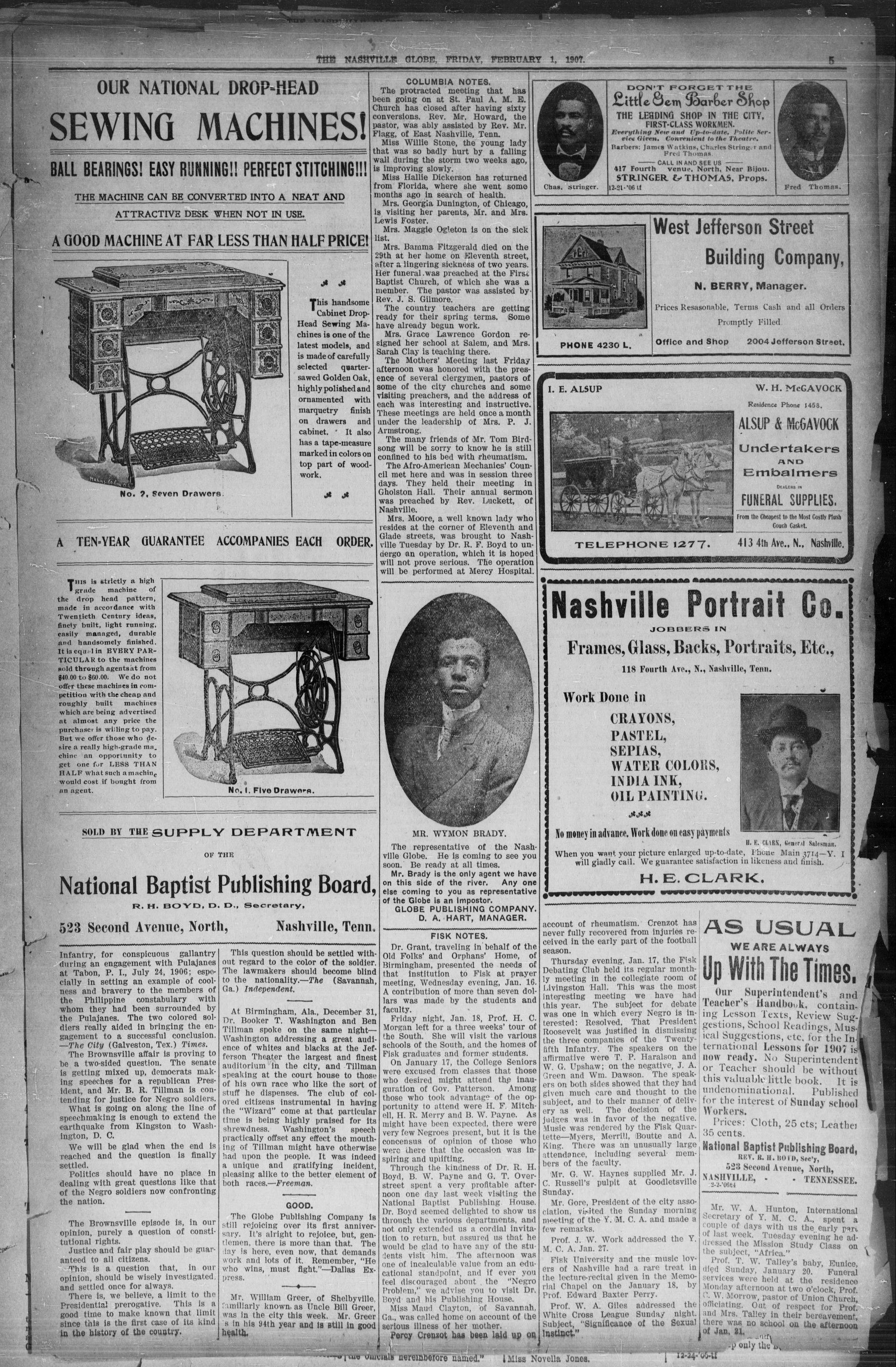
SEWING MACHINES!
BALL BEARINGS! EASY RUNNING!!! PERFECT STITCHING!!!
THE MACHINE CAN BE CONVERTED INTO A NEAT AND ATTRACTIVE DESK WHEN NOT IN USE.
A GOOD MACHINE AT FAR LESS THAN HALF PRICE!
Mabus Sewing
A TEN-YEAR GUARANTEE ACCOMPANIES EACH ORDER.
No. I. Five Drawers.
SOLD BY THE SUPPLY DEPARTMENT
National Baptist Publishing Board,
A TEN-YEAR GUARANTEE ACC
This is strictly a high grade machine of the drop head pattern, made in accordance with Twentieth Century ideas, finely built, light running, easily managed, durable and handsomely finished. It is equal in EVERY PARTICULAR to the machines sold through agents at from $40.00 to $60.00. We do not offer these machines in competition with the cheap and roughly built machines which are being advertised at almost any price the purchaser is willing to pay. But we offer those who desire a really high-grade machine an opportunity to get one for LBSH THAN HALF what such a machine would cost if bought from an agent.
SOLD BY THE SUPPLY OF THE
National Baptist P
R. H. BOYD, D. D.
OF THE
523 Second Avenue, North,
Infantry, for conspicuous gallantry during an engagement with Pulajanes at Tabon, P. I., July 24, 1906; especially in setting an example of coolness and bravery to the members of the Philippine constabulary with whom they had been surrounded by the Pulajanes. The two colored soldiers really aided in bringing the engagement to a successful conclusion. —The City (Galveston, Tex.) Times. The Brownsville affair is proving to be a two-sided question. The senate is getting mixed up, democrats making speeches for a republican President, and Mr. B. R. Tillman is contending for justice for Negro soldiers. What is going on along the line of speechmaking is enough to extend the earthquake from Kingston to Washington, D. C.
We will be glad when the end is reached and the question is finally settled.
Politics should have no place in dealing with great questions like that of the Negro soldiers now confronting the nation.
The Brownsville episode is, in our opinion, purely a question of constitutional rights.
Justice and fair play should be guaranteed to all citizens.
This is a question that, in our opinion, should be wisely investigated, and settled once for always.
There is, we believe, a limit to the Presidential prerogative. This is a good time to make known that limit since this is the first case of its kind in the history of the country.
THIS NASHVILLE GLOBE, FRIDAY, FEBRUARY 1, 1907.
the officials hereinbefore named." Miss Novella Jones.
```markdown
```
This handsome Cabinet DropHead Sewing Machines is one of the latest models, and is made of carefully selected quartersawed Golden Oak, highly polished and ornamented with marquetry finish on drawers and cabinet. It also has a tape-measure marked in colors on top part of woodwork.
ACCOMPANIES EACH ORDER.
No. I. Five Drawers.
Y DEPARTMENT
THE
Publishing Board,
D., Secretary,
```markdown
```
Nashville, Tenn.
This question should be settled without regard to the color of the soldier. The lawmakers should become blind to the nationality.—The (Savannah, Ga.) Independent.
At Birmingham, Ala., December 31, Dr. Booker T. Washington and Ben Tillman spoke on the same night—Washington addressing a great audience of whites and blacks at the Jefferson Theater the largest and finest auditorium in the city, and Tillman speaking at the court house to those of his own race who like the sort of stuff he dispenses. The club of colored citizens instrumental in having the "Wizard" come at that particular time is being highly praised for its shrewdness. Washington's speech practically offset any effect the mouthing of Tillman might have otherwise had upon the people. It was indeed a unique and gratifying incident, pleasing alike to the better element of both races.—Freeman.
GOOD.
The Globe Publishing Company is still rejoicing over its first anniversary. It's alright to rejoice, but, gentlemen, there is more than that. The day is here, even now, that demands work and lots of it. Remember, "He who wins, must fight."—Dallas Express.
Mr. William Greer, of Shelbyville, familiarly known as Uncle Bill Greer, was in the city this week. Mr. Greer is in his 94th year and is still in good health.
COLUMBIA NOTES.
The protracted meeting that has been going on at St. Paul A. M. E. Church has closed after having sixty conversions. Rev. Mr. Howard, the pastor, was ably assisted by Rev. Mr. Flagg, of East Nashville, Tenn.
Miss Willie Stone, the young lady that was so badly hurt by a falling wall during the storm two weeks ago, is improving slowly.
Miss Hallie Dickerson has returned from Florida, where she went some months ago in search of health.
Mrs. Georgia Dunington, of Chicago, is visiting her parents, Mr. and Mrs. Lewis Foster.
Mrs. Maggie Ogleton is on the sick list.
Mrs. Bamma Fitzgerald died on the 29th at her home on Eleventh street, after a lingering sickness of two years. Her funeral was preached at the First Baptist Church, of which she was a member. The pastor was assisted by Rev. J. S. Gilmore. The country teachers are getting ready for their spring terms. Some have already begun work. Mrs. Grace Lawrence Gordon resigned her school at Salem, and Mrs. Sarah Clay is teaching there. The Mothers' Meeting last Friday afternoon was honored with the presence of several clergymen, pastors of some of the city churches and some visiting preachers, and the address of each was interesting and instructive. These meetings are held once a month under the leadership of Mrs. P. J. Armstrong.
The many friends of Mr. Tom Bird-song will be sorry to know he is still confined to his bed with rheumatism. The Afro-American Mechanics' Council met here and was in session three days. They held their meeting in Gholston Hall. Their annual sermon was preached by Rev. Luckett, of Nashville. Mrs. Moore, a well known lady who resides at the corner of Eleventh and Glade streets, was brought to Nashville Tuesday by Dr. R. F. Boyd to undergo an operation, which it is hoped will not prove serious. The operation will be performed at Mercy Hospital.
[Name not visible]
MR. WYMON BRADY.
The representative of the Nashville Globe. He is coming to see you soon. Be ready at all times.
Mr. Brady is the only agent we have on this side of the river. Any one else coming to you as representative of the Globe is an Impostor.
GLOBE PUBLISHING COMPANY.
D. A. HART. MANAGER.
FISK NOTES.
Dr. Grant, traveling in behalf of the Old Folks' and Orphans' Home, of Birmingham, presented the needs of that institution to Fisk at prayer meeting, Wednesday evening, Jan. 16. A contribution of more than seven dollars was made by the students and faculty. Friday night, Jan. 18, Prof. H. C. Morgan left for a three weeks' tour of the South. She will visit the various schools of the South, and the homes of Fisk graduates and former students.
On January 17, the College Seniors were excused from classes that those who desired might attend the inauguration of Gov. Patterson. Among those who took advantage of the opportunity to attend were H. F. Mitchell, H. R. Merry and B. W. Payne. As might have been expected, there were very few Negroes present, but it is the consensus of opinion of those who were there that the occasion was inspiring and uplifting.
Through the kindness of Dr. R. H. Boyd, B. W. Payne and G. T. Overstreet spent a very profitable afternoon one day last week visiting the National Baptist Publishing House. Dr. Boyd seemed delighted to show us through the various departments, and not only extended us a cordial invitation to return, but assured us that he would be glad to have any of the students visit him. The afternoon was one of incalculable value from an educational standpoint, and if ever you feel discouraged about the "Negro Problem," we advise you to visit Dr. Boyd and his Publishing House. Miss Maud Clayton, of Savannah, Ga., was called home on account of the serious illness of her mother. Percy Crenzot has been laid up on
CALL IN AND SEE US
417 Fourth venue, North, Near Bijou.
STRINGER & THOMAS, Props.
12-21-*06 tf
N. BERRY, Manager.
Prices Resasonable, Terms Cash and all Orders
Promptly Filled.
Office and Shop 2004 Jefferson Street.
I. E. ALSUP W. H. McGAVOCK
Residence Phone 1458.
TELEPHONE 1277.
Nashville Portra
Nashville Portrait Co.
JOBBERS IN Frames, Glass, Backs, Portra 118 Fourth Ave., N., Nashville, Tenn Work Done in
Frames, Glass, Backs, Portraits, Etc., 118 Fourth Ave., N., Nashville, Tenn.
CRAYONS,
PASTEL,
SEPIAS,
WATER COLORS,
INDIA INK,
OIL PAINTING.
No money in advance. Work done on easy payments
H. E. CLARK, General Salesman.
When you want your picture enlarged up-to-date, Phone Main 3714-Y. I will gladly call. We guarantee satisfaction in likeness and finish.
H. E. CLARK.
AS USUAL WE ARE ALWAYS Up With The Times.
account of rheumatism. Crenzot has never fully recovered from injuries received in the early part of the football season.
Thursday evening, Jan. 17, the Fisk Debating Club held its regular monthly meeting in the collegiate room of Livingston Hall. This was the most interesting meeting we have had this year. The subject for debate was one in which every Negro is interested: Resolved, That President Roosevelt was justified in dismissing the three companies of the Twenty-fifth Infantry. The speakers on the affirmative were T. P. Haralson and W. G. Upshaw; on the negative, J. A. Green and Wm. Dawson. The speakers on both sides showed that they had given much care and thought to the subject, and to their manner of delivery as well. The decision of the judges was in favor of the negative. Music was rendered by the Fisk Quartette—Myers, Merrill, Boutte and A. King. There was an unusually large attendance, including several members of the faculty.
Our Superintendent's and Teacher's Handbook, containing Lesson Texts, Review Suggestions, School Readings, Musical Suggestions, etc. for the International Lessons for 1907 is now ready. No Superintendent or Teacher should be without this valuable little book. It is undenominational. Published for the interest of Sunday school Workers. Prices: Cloth, 25 cts; Leather 35 cents.
523 Second Avenue, North,
NASHVILLE, - - TENNESSEE.
2-2-0084
Mr. G. W. Haynes supplied Mr. J. C. Russell's pulpit at Goodletsville Sunday. Mr. Gore, President of the city association, visited the Sunday morning meeting of the Y. M. C. A. and made a few remarks.
Mr. W. A. Hunton, International Secretary of Y. M. C. A., spent a couple of days with us the early part of last week. Tuesday evening he addressed the Mission Study Class on the subject, "Africa."
Prof. J. W. Work addressed the Y. M. C. A. Jan. 27. Fisk University and the music lovers of Nashville had a rare treat in the lecture-recital given in the Memorial Chapel on the January 18, by Prof. Edward Baxter Perry.
Prof. T. W. Talley's baby, Eunice, died Sunday, January 20. Funeral services were held at the residence Monday afternoon at two o'clock, Prof. C. W. Morrow, pastor of Union Church, officiating. Out of respect for Prof. and Mrs. Talley in their bereavement, there was no school on the afternoon of Jan. 21.
Prof. W. A. Giles addressed the White Cross League Sunday night. Subject, "Significance of the Sexual Instinct."
Chas Stringer.
19
I. E. ALSUP
```markdown
```
Fred Chance
W. H. McGAVOCK
Residence Phone 1458.
ALSUP & McGAVOCK
Undertakers
AND
Embalmers
DEALERS IN
FUNERAL SUPPLIES.
From the Cheapest to the Most Costly Plush
Couch Gasket.
413 4th Ave.. N.. Nashville
A. B.
12-24-'06-tf
Miss Annie Primm of 818 King street is indisposed this week.
Mrs. Augusta Williams, of Chattanooga, spent Sunday and Monday in the city, the guest of Mrs. Marshall Wheeler, of 313 Eleventh avenue, North.
Mr. and Mrs. Isaac Carter, of Wessynton, spent a few days in the city visiting relatives.
Miss John D. Thompson is home after an absence of several weeks in Birmingham, Ala., where she visited relatives.
Prof. W. S. Thompson spent Saturday and Sunday in the surrounding cities taking a view of the country.
Mr. and Mrs. James Harlan left for St. Louis Thursday night, where they will make their home.
Mr. Thomas Caruthers, after spending three weeks in the city will leave this week for Chicago.
Mrs. J. R. Reece, of Lebanon, Tenn., who has been visiting her daughter, Mrs. Annie McGill, of Jefferson street, will leave for her home in a few days.
Miss Henrie Ellen Church, of Franklin, Tenn., was in the city last week visiting Miss Brucie Mal Ewing, of 509 Twelfth avenue, North. Miss Church was entertained at dinner Sunday afternoon by Miss Velma Mal Mosley, of 611 Fifth avenue, North. She returned home Sunday evening.
Miss Velma Mal Mosley and Miss Carrie Walker will leave this afternoon for Gallatin, Tenn., where they will be the guest of Mrs. Annie Malone, who will entertain in their honor. The young ladies will return home Sunday evening.
Mrs. Cassie Greer, of Waverly School, entertained at dinner January 28. A menu consisting of four courses was served. Those present were Mrs. Octavia Elkins, Mrs. Sophia Dodson, Mr. and Mrs. Chas. Greer and Mr. Chas. Greer, Jr.
Miss Sallie A. Smith, of 716 Smiley street, has entered the Normal Course at Fisk University.
Mr. and Mrs. N. J. Buchanan, of 81 Fairfield avenue, gave a dinner in honor of Mr. and Mrs. Straghn, of the S. D. A. Church, last Sunday.
Mr. L. L. Thomason left for Grenada, Miss. on January 20, to spend a few weeks with his relatives.
Mrs. Josephine Hall and daughter Sophionia have returned home after a week's visit to her cousin, Miss Johnie D. Wilson, of North Hill street.
Mrs. Thomas Baird, Sr., of Columbia, is attending the bedside of her sister, Mrs. E. W. Birdsong, 419 First avenue, South.
Miss M. L. Guinn, of McMinnville, Tenn., is expected to visit Nashville in a few days.
Mr. W. J. Blanton was on the sick list last week, but is able to be at his business.
Mr. W. J. Blanton, the popular jewelry salesman, is filling orders at 1307 Hynes street.
Miss Carrie Bailey, who has been visiting her mother has returned to Chicago, Ill.
Mr. C. P. Lay, Secretary and Treasurer of the Rembrandt Studio, will later Walden University, Monday, finish his Normal course.
Miss Ruth Bryant, who arrived in the city January 14, is yet with her mother, Mrs. Samuel Bryant. Miss Selena Henderson, who has been the guest of Mrs. Hester Porter, of 1911 1-2 Morrison street, left Sunday morning for her home in Chattanooga.
COME!
AND LET YOUR HEARTS BE LIGHT
AND YOUR
UNDERSTANDING IMPROVED
AT
Taylor's Amusement
PARLORS
417 Cedar St. Boyd Building
50 cents worth of pleasure
for 5 cents.
Bring your family and your
Friends.
A Strictly High Class Entertainment
now going on
DAY AND LIGHT.
THE NASHVILLE GLOBE, FRIDAY, FEBRUARY 1, 1907.
Mr. C. P. Lay, who has had a very severe cold, is able to be out.
Miss Alberta Allen, of North Hill street, is slightly indisposed.
Miss Jennie Crowell, who has been the guests of Mrs. Hillman, of 307 Eleventh avenue, left the city this week for Chicago.
Mr. Sherman Granberry is in Mt. Pleasant visiting relatives.
Mrs. Sarah Utley left this week for Louisville, Ky., after spending two months visiting relatives on Ewing avenue.
Mrs. Elnora Brooks, of Cincinnati, O., the sister of Mrs. J. C. Thompson, of No. 209 Eighteenth avenue, North, who has been spending some weeks here is expected to leave in a few days. Mrs. Brooks at one time resided here and is well known in this city.
Miss Mary Walker, of 410 Ninth avenue, North, continues very ill. It was hoped that she would show signs of recovery this week, but up to the present nothing has been noticed that argues for her improvement. Her friends continue to call and show their affections.
Mr. and Mrs. E. L. Price, of East Nashville, who left during the holidays to visit friends and relatives in South Carolina, have returned. They visited Columbia, Spartanburg, Salibury, Charleston and Camden. Most of the time was spent in the latter place, which is the home of Mr. Price. They received much attention from old friends and acquaintances while away. Miss Ida B. Holmes is again quite ill at her home, 915 Shankland street.
Little Mary Patterson, of 715 Gay street, is still seriously sick.
Mrs. Nellie Rivers, sister of Mrs. Patterson, of Gay street, is ill.
Little Lucile Johnson, of Gay street, has recovered from a recent illness.
There was a violin recital given at Jackson Temple C. M. E. Church Wednesday night. Miss Hester O. Brown being the star, she was ably assisted by local talent. An appreciative audience was present.
The Willing Workers' Club of Tabernacle Baptist Church, will give a "Parlor Concert" Monday evening, February 4, 1907, at the residence of Miss Mary J. Phillips. An excellent program will be rendered.
There will be a box party given at Tabernacle Baptist Church Friday, February 8, 1907.
Miss Hester O. Brown visited the Verdi Kindergarten School Thursday, where she made a short address and rendered a violin solo.
A SOUTHERN TRIP.
Rev. Preston Taylor, the progressive Fourth avenue undertaker, has kindly consented to give the readers of the Globe the benefit of his experiences during a trip through the South in a series of four letters, which will appear in these columns consecutively.
A day spent in Birmingham would convince any skeptic of the wonderful progress our people have made. The mines and furnaces which have made the city noted, are worked by colored men. The firemen on all railroads, after leaving Nashville, are colored, and these men make from sixty to one hundred dollars per month. Birmingham is a magnetic city, and our people are well established along all the walks of life; they own good homes and many of them are beautiful places of great value. The Penny Savings Bank owns its own building, a three-story brown stone front, with offices above. They have ten employees, such as president, cashier, teller, stenographer, clerks, etc. They did a business last year of two hundred and fifty thousand dollars. This bank has stood the test of years against terrific panies and to-day has business of great volume.
Bond & Co. are the men furnishers; they have a store full from pit to dome of everything that a man wears. Every article is of the very latest fashion and best quality; they have a good trade, and demand the patronage of all in their reach. The People's Investment and Banking Company is erecting a new office building, two stories in height, and will have one of the best locations in the city. They furnish money to our people to buy and build houses. The company employs a dozen clerks and handles thousands of dollars in the interest of our people. The President, Mr. W. L. Lauderdale, is a gentleman of great activity, and his company has made wonderful progress, and still there is a bright prospect before them, for Birmingham is like a gold mine—always on the increase.
Messrs. Davenport and Harris are the funeral directors, and they own one of the finest funeral cars and a number of carriages as can be found in any establishment in the country. They do the business of the city. Mrs. Davenport is the Secretary of the company and owns a large block of the stock. Dr. A. M. Brown is one of the most affable gentlemen of the city. His suite of rooms is fitted up in the most elegant style, with all the modern appliances, and his rubber tired buggy, with his horse, Fox, moves among his numerous patients at lightning speed. He is holding all he has and getting more and now already counts his possessions by the scores. The Mason Building is occupied on the first floor by one of the largest and best arranged drug stores of the
city. The furniture and stock shows up to a great advantage, and from what we saw they have a large patronage. The second floor is occupied as offices, among them are the "People's Mutual Aid Association," which is doing a good share of the insurance business among our people. Their record shows they have been able to conduct a satisfactory business both to the people and themselves. Birmingham has her share of professional men, such as lawyers, doctors, etc., and will rank with any city in the country. Our race is well cared for in the post office and the city government.
PRESTON TAYLOR.
(To be continued next week.)
GOODLETTSVILLE NOTES.
GOODLETTSVILLE NOTES.
Prof. Wilmether gave two scene plays here this week.
Mrs. Ada Napier has decided to take the Globe for one year.
Mrs. Mattie Cantrell, of East Nashville, visited Mrs. Willie Finch last week.
Mr. Horace Cantrell has recently returned from Columbia, Ohio.
Miss Mary Fite visited her brother, Orange Cantrell, at Edgefield Junction last Sunday.
Little Frankie Gordon, of Nashville, accompanied by her aunt, Miss Anna L. Hendricks, visited Goodlettsville last Sunday.
Owing to unfavorable weather, church services were largely interrupted last Sunday.
BEYOND THE CENTURY MARK.
Mrs. Jane Bincent, who is one hundred years and one month old, is living with her grandson, Mr. Polk Holt, of No. 23 Tennessee street. Mrs. Bincent was born in Wilson County, where she lived fifteen years, Maury County, thirty-five years, Marshall County thirty years, Davidson County twenty years. She is the mother of ten children,—seven girls and three boys. During the dark days of slavery she had four masters and worked in the field every day. She has had good health all her life, and the only dose of medicine she ever took was in her early childhood.
FUNERAL OF REV. GEO. W. SMITH.
FUNERAL OF REV. GEO. W. SMITH.
Rev. Geo. W. Smith, of Murfreesboro, Tenn., died Tuesday night, Jan.
15. His funeral took place Thursday afternoon at 2 o'clock at Mt. Zion Baptist Church, Murfreesboro. He leaves a wife, sister and six children, W. Smith, Jr., and Sallie A. Smith two of whom reside in Nashville—Geo. Revs. Moore, Joe Swift and Pearson had charge of the cermonies.
Mr. and Mrs. A. J. Normal entertained at their residence, 1049 Edgehill avenue, at dinner Sunday. A number of guests enjoyed the gathering and passed off the time in discussing "The Interest of Mechanism and the Future Prosperity of the Negro Race as a Mechanic." An appetizing dinner was served, after which cigars and jokes were enjoyed by all present. Those present were A. L. Anderson, chorister of Kayne Avenue Baptist Church Choir; Thos. W. Maddox, Instructor in Industrial Department of A. & M. College, Normal, Ala.; Mr. and Mrs. Will Thompson, Mr. and Mrs. T. J. Rhodes, Mrs. Fannie McGhee, of Decatur, Ala.; Mr. and Mrs. Wm. Normal, Q. Hamilton, Mr. and Mrs. Nelson Napier, F. S. Rhodes and Mr. and Mrs. Richard Pointer.
DELIGHTFUL ENTERTAINMENT.
A delightful entertainment was given recently at the residence of Mrs. Whittaker, 808 Eighth avenue, North, in honor of her son, Mr. L. L. Thomison, of Houston, Texas, and Miss Novella E. Jones, of Avondale. Dancing and games were the features of the evening. Cakes and icees were served at a late hour. Those present were Misses Evalena Barnes, Brucie M. Ewing, Vannoy C. Webster, Annie L. Milla, D. Mayberry, Selene Peterson, Fannie Hayes, Eloise and Clara Frierson, Nannie Bond, Mamie Allison, Mattie B. Tucker, Sadie L. Paschall, Novella E. Jones, Lula Grant, Virginia and Mary Whittaker, Annie M. Killcrease, Mrs. Lizzie Edwards and little daughter, Samella; Messrs. Alonzo and T. C. Brock, W. A. House, Andrew Stith, R. M. Edmonson, E. J. Frierson, C. H. Morton, Allen Whittaker, Edward and V. R. Whittaker, H. O Mayes, J. H. Perkins, O. H. Sublett Lee Wilson, J. R. Robinson, J. C. Webster, J. R. Anthony, H. M. Mitchell.
FRANKLIN NOTES.
Mrs. J. D. MitchaJl is sick with catarrh.
Miss Sallie B. Williams has returned home from Nashville.
Mrs. Albinda W. Redmond was in Nashville Sunday to see her cousin, Mrs. Wm. Britt, who is sick.
Mr. Henry Scott is very sick.
Miss Annette Freeman, of Nashville, is here with her aunt, Mrs. Henry Scott.
Dr. R. L. Washington and Mr. Jno. Ewing, Jr., found their cows where a little boy had given them over to the city marshal. The little fellow received 25 cents, bought marbles and went off rejoicing. He said he knew the law.
TAYLOR & CO.
BUY YOUR
Clothing, Hats, Etc.,
OF
BOB ROBERTSON,
PHONE Main 1614
RESIDENCE: 618 WEBSTER STREET.
ANY TIME YOU Need Servants Call Main 2160 Hunt's Employment Office.
the“Ger-
at until 11:
at three of
couples on
one figure
hear any-
DR. S. S. CARUTHERS,
Homeopathic Physician and Surgeon.
Room 1, First Floor, Odd Fellows Hall.
447 Fourth Ave., North
Office Hours: 9 to 11 a. m., 3 to 4 p. m., 7 to
NASHVILLE, TENN.
Preston Taylor.
CARRIAGES FOR HIRE.
449 Forth Avenue, North,
Mr. T. A. Williams lost his horse Tuesday from indigestion. He had refused $160 for her.
Rev. E. M. Seymore and wife will soon leave this city for Shelbyville.
Mr. Solomon Sweeney was buried this week.
Mr. J. K. Hughes is sick with pneumonia on House avenue.
Messrs. M. C. Nevils and T. A. Williams were in Nashville Wednesday.
Mrs. A. N. C. Williams received a painful wound last week from a rooster.
BRENTWOOD NOTES.
Miss Julian Armstrong is on the sick list.
Miss Beulah Perkins spent last Sunday in Brentwood.
Alex Cole, the little son, of Mr. and Mrs. Houston Cole, was accidently hurt by exploding a torpedo. He is recovering nicely.
Mrs. Thomas Walker gave a taffy pulling last Thursday evening in honor of the little Misses Nannie and Eliza Vernon. Quite a number of little misses were in attendance, as also were some of their parents, and a very enjoyable time was had.
Mr. Hubbard Newsome, the coal merchant at Chapel station, was at Columbia, Tenn., the other day to be examined for an increase of pension. He reports the meeting of many friends and old soldiers of his company.
Mrs. Laura Spratt, of the Granny White pike, is still dangerously ill. Her relatives and friends are very anxious about her.
Mr. Alex. Raines is preparing his hot-beds and grounds for an early market of peas, beans, tomatoes, etc. He hopes to be one of the first on the market.
The pastor and congregation of Brook's Chapel M. E. Church are looking forward with pleasure to a visit from Rev. E. W. S. Hammond, Dean of Walden University, Sunday, February 17, 1907. Dr. Hammond is an excellent speaker and his sermons on that day will doubtless be interesting and instructive to those who will be fortunate enough to hear him.
Mr. John Hyde who has been sick so long, is now slowly improving.
Miss Pearl Buchanon is visiting relatives in Williamson county.
SERIOUS ACCIDENT NARROWLY AVERTED.
On Thursday morning about 11:30 another accident was added to the long list that has made the vicinity o the old Linck Depot famous. Mr. Eugene White, who is employed by the Charion Printing Company, corner of Locust street and Second avenue, North, was thrown by a frightened horse, receiving painful injuries about the head and chest. The fortunate man mounted the horse on Locust street. Before he was securely seated in the saddle the animal whirled suddenly and started at breakneck speed toward Third avenue. Pedestrians passing were attracted by the speed of the horse and made efforts to lend assistance, but before such could be rendered the horse had reached Third avenue, making a sudden whirl he threw Mr. White on the granite paved street, cutting a painful wound on his head and rendering him unconscious. Friends were soon at his side and carried him to the nearest drug store where he received medical attention.
EUREKA DANCING CLASS.
The Eureka Dancing Class, under the management of Mr. Dock Liner, is achieving fame among the lovers of dancing, both old and young, that makes it a credit to the city. There were more than one hundred persons present Monday night and any one outside of the hall could not tell that it was occupied. Then, too, the dancing is high class, and lends to aid in training toward self-control.
Monday night they danced the "German," taking from 10 o'clock until 11:30 o'clock to go through all three of the figures. There were 36 couples on the floor at one time. Not one figure was called, nor could you hear anything except the rhythmical sound of the feet to the accompaniment of music. The whole German was danced without an error, which shows the perfection which the members of the class have reached. A visit to the class will convince you that it is essential to your own as well as others' social welfare. The first annual dance of the season will be given Monday night, February 4, 1907.
Geo. O. Boyd, Jr
BOYD & BATTLE,
Fist-Class Horses and Buggies To Let
Our Baggage Wagon will call for
and deliver your parcels.
Short Wood and Coal Orders promptly delivered.
Horses Beight and Sold.
PHONE MAIN 4460-Y.
900 Joe Johnston Ave., Nashville, Tenn
7-20-06 tf
BUY YOUR SHOES
PHONE Main 1614
RESIDENCE: 618 WEBSTER STREET.
WITH
410 Union Street. Phone 1235.
The Best Variety and the Most Reliable
Shoes Made.
Varley & Bauman.
325 Union St. Phone 560.
The Best Variety and the Most Reliable Place
in the City.
Dry Goods, Notions, Cloaks, Etc.,
OF
Bob Robertson.
PHONE Main 1614
RESIDENCE: 618 WEBSTER STREET.
WITH
The Castner-Knott Dry Goods Co.
200 Fifth Ave., N. Phone 620.
The Largest and Best Stock to Select from
in the City.
To the Madam of the House:
FOR SALE
TWO DRESSES.
1 Black Dress, cost $50, slightly
worn, size, 36, $9.00.
1 Blue Dress, never worn, a beauty,
cost $35, size 3, $10.00
MRS. N. N. STEWART,
200 South High Street.
Office Phone 4323-L. Residence 1834 Jefferson St
Residence 3131-Y.
Instructions and Lessons given in Piano, Organ, Violin, Mandolin, Guitar, Voice and Harmony.
NO. 449—EIGHTH AVENUE, N., (North Spruce St.)
MISS JOSEPHINE PRICE,
(INSTRUCTOR.)
TERMS OF 1906—1907. $2.00 Per Month.
We Respectfully Ask Your Patronage. 114 Fourth Ave., S.
J. B. KEN LIVERY, BOARD A Fine Rigs of Eve
Fine Rigs of Every Description. PHONE, Main 4156
440 THIRD AVENUE, NORTH,
TIMOTHY'S
Dry Goods and Carpet Co.
Third Avenue, between Union Street
and Public Square.
Carry the best Stock of Carpets,
The best Assortment of Silks and
Dress Goods,
The handsomest Line of Cloaks
and Suits.
1-4-'07 tf
R. L. MILES, Jr. THE QUEEN CITY TAILOR.
Cleaning, Dyeing and Repairing.
Pants to Order.....$4.00
Suits to Order.....$15.00
423 Deaderick St., NASHVILLE, TENN.
J. S. Martin,
PROPRIETOR
THE CUSTOM HOUSE LIVERY
STABLE.
First-Class Livery on Short Notice.
712 and 714 Broadway.
Nashville, Tenn.
The readers of the Globe wil do well to pay special attention to the husiness firms that advertise in this paper asthey are all reliable busines men. Give them a trial.
J. H. Copeland, Prop.
Telephone 1173.
CITY COUNCIL HOLDS LONG SESSION.
The city lawmakers have at last got down to work. At the meetings held this week, there were night and day sessions at which some very important business came up for consideration. Many bills were submitted for the first reading and a memorial to the State Legislature will be presented. Some changes were suggested in the charter. The night session consumed about three hours, which is a long one for the city fathers to have to work. The important work of the council is shown in the number of bills presented.
Following the convening of the Council and the reading of the Mayor's message and the report of Recorder Bauman, the following measures came up on final reading, there being no second reading bills:
Closing a portion of the Benedict street and portions of alleys in East Nashville, and extending Fourth street to Hitch street. Passed.
Abandoning five feet of ground on Forrest avenue between Fourteenth and Fifteenth streets. Passed.
Amending section 889, Price & McConnico's Digest. This extends the stock ordinance so as to include the Thirteenth Ward. Passed.
The following bills came up on first reading:
Appropriating $6,000 for purchasing land and erecting school building for colored children in the Fourteenth Ward.
Appropriating $800 to have enumerated the scholastic population of the city.
Appropriating $4,000 to purchase coal for schools.
Appropriating $4,750 to purchase school furniture.
Appropriating $660 to have school scavenger work done.
Appropriating $1,500 for building an addition to the Carter School.
Appropriating $2,500 for heating and ventilating apparatus for Elliott School.
Appropriating $10,000 for purchasing land and erecting a school building for colored children in the Eighth Ward.
Appropriating $16,100 out of the Light Department to purchase coal for the light plant.
Appropriating $36,000 out of the Water-works Department to purchase coal for the pumping station.
Making it unlawful to sell or give away morphine except upon a certificate from some licensed physician.
Furnishing free water for the Carnegie Library.
Providing for the stopping of street cars on the near side of intersecting streets.
Providing for the equipment of street cars with fenders.
Providing for the display of red lights on rear end of street cars.
Regulating sidewalks.
Specifying the distance at which one street car may follow another.
Providing for stopping of street cars at signal of passengers.
Bills on Introduction.
The following new bills were introduced:
By C. W. Bailey—Providing that the provisions of an ordinance restricting
THE NASHVILLE GLOBE, FRIDAY, APRIL 5, 1907.
THE NASHVILLE GLOBE, FRIDAY, FEBRUARY 1, 1907.
NASHVILLE, TENNESSEE.
2 in tf
the retailing of intoxicating liquors within certain territory of the City of Nashville shall not apply to manufacturers of beer or other liquors, and that such manufacturers may manufacture and sell their products at their several manufactories and breweries wherever located. Provided, however, that no such manufacturers or brewers shall tipple their products at their said places of business. By E. M. Wrenne—Amending sections 878, 879, 882 and 883 of Price & McConnico's Digest so as to include certain properties of oil companies. By F. J. Ehrhart—Regulating sale and manufacture of sausage.
By F. J. Ehrhart—Regulating sale of foods and condiments.
By Gus A. Blodau—Closing portion of alley No. 505.
By C. W. Bailey (resolution)—"That it is the sense of this Council that the enactment by the General Assembly of a bill known as Senate Bill No. 90, entitled 'An Act to prohibit the manufacture of spirituous, vinous or malt liquors in all territory within the State of Tennessee where the sale of such liquors is prohibited by law, and provide the penalties for the violation of this act,' is unwise and inopportune and will work great hardship and loss unnecessarily, and the General Assembly is requested to defeat said act. Adopted."
Legislative Committee.
Mr. Baskette called attention to the fact that a Legislative Committee had been appointed by the Council; that the committee had met and made certain recommendations to the Davidson County delegation. He asked that the committee be allowed to report, and this report was taken up and adopted by the Council and its provisions, with minor amendments, will be presented to the Davidson County delegation embodied in the memorial. The provisions of the report follow:
Changing charter so that the City Judge be eligible to re-election. Adopted unanimously.
Recommending that salaries of the Police Judge be increased to $2,000; the Chief of Police, $2,500, and the Chief of the Fire Department, $2,500. This section was amended by Councilman Wrenne to make the Chief of the Fire Department's salary $3,000 and voted on separately. The amendment was adopted by a vote of 14 to 11. The salaries of the Police Judge and Chief of Police were then taken up separately also and the section was adopted after two motions changing the Chief of Police's salary to $2,000, then to $3,000, had been tabled. Increasing powers of City Council to enable it to investigate any of the municipal departments. Adopted by a vote of 22 to 3.
Extending Mayor's term of office four years. Mr. Ehrhart moved that this section of the report be rejected, but the motion failed by a vote of 16 to 9. The section was then adopted by a vote of 16 to 9.
On motion of Mr. Schardt the section was amended to make the Mayor's salary $7,600 per annum.
Protesting against any change in present powers of the Board of Public Works. Adopted.
Recommending that the assessment of taxation against the Cumberland Telephone & Telegraphic Company and the Nashville Railway & Light Company be put back in the hands of the City Tax Assessor. Adopted.
Civil Service Resolution.
Mr. Bailey introduced a resolution to which many absurd amendments were offered, providing for the extension of the Civil Service Commission's jurisdiction, as follows:
"Whereas the General Assembly of Tennessee, recognizing the merits of such a system (the Civil Service System) saw fit by section 10, chapter 26, Acts of 1901, to extend the power of such commission, so as to give it jurisdiction over all employees, except common laborers, of the waterworks and lighting departments of said cities as to punishment and discharge for cause; and,
"Whereas, there are other employees in municipal departments who, in the judgment of this body, should be placed under the jurisdiction of the Civil Service Commission as to punishment and discharge for cause; towit: The Secretary of the Board of Public Works, the Superintendent of the Scavenger Department, the Superintendent of the Street Department, the Superintendent of the City Hospital, the Superintendent of the Sprinkling Department and Work-house Keeper.
"Be it therefore resolved by the Mayor and City Council, That it is the sense of this body that the employees above named be placed under the jurisdiction of the Civil Service Commission as to punishment and discharge for cause, and that such a change will greatly promote the efficiency with which the duties of their respective offices are conducted, and will thereby promote the welfare of the city.
"Be it further resolved. That a memorial embracing this resolution be drawn and presented to the General Assembly of Tennessee petitioning that the charter of the City of Nashville be so amended as to extend the provisions of the civil service law to the officials hereinbefore named."
LODGE DIRECTORY.
GRAND LODGE K OF P.
G. C.-J. P. CRAWFORD,
706 Bass Street, Nashville, Tenn.
G. V. C.-I. M. STEGALL,
Humboldt, Tenn.
P. G. C.-J. H. LAPRADE,
Chattanooga, Tenn.
P. P.-REV. T. J. TOWNSEND,
Box 148, Brownville, Tenn.
G. M. OF E.-B. F. JOHNSON,
850 E. 8th Street, Chattanooga, Tenn.
G. L.-J. M. EASTERLING,
903 Georgia Ave., Chattanooga, Tenn.
G. K. R. S.-DR. R. W. ALLEN,
124-126 E. 9th St., Chattanooga, Tenn.
G. M. A.-JOHN SINGLETON,
Knoxville, Tenn.
G. I. G.-A. T. HILL,
Pulaski, Tenn.
G. M.-R. E. GEE,
Nashville, Tenn.
G. O. G.-A. W. GLEAVES,
Nashville, Tenn.
G. Att'y.-J. THOMAS TURNER,
Nashville, Tenn.
G. M. R.—DR. A. M. TOWNSEND,
614 Webster St., Nashville, Tenn.
2-23-06-utf
ENDOWMENT BOARD:—W. F. Reynolds,
Pres., W. L. Cansler, Sec'y',
B. F. Johnson, Treas., B. J. Fernandis
VOLUNTEER COMPANY NO. 5,
U. R. K. OF. P.
Meets each Monday night in Odd
Fellows Amusement Hail over the
Union Transportation Co's Garage.
H. H. BOWMAN, Capt.,
J. A. O. BROUGHTON, Recorder.
2-23-06-utf
DAMON LODGE, NO. 2, K. OF P.
Meets at the Pythian Temple, corner of Fifth and Capitol avenues, the second and fourth Wednesdays of each month.
J. W. BLAINE, C. C.
W. L. CANSLER, K. of R. & S.
STRINGER LODGE NO. 6.
Meets at Burrus Hall, corner of Cedar and McLemore s'reets, second and fourth Mondays of each month.
DR. P. R. BURRUS, C. C.
W. A. JAMES, K. of R. & S.
3-16-06 utf
IVANHOE LODGE, NO. 8.
Meets at the Pythian Temple, corner of Fifth and Capitol avenues, the second and fourth Thursdays of each month.
J. F. IRONS, C. C.
J. E. MILLER, K. of P. and S.
3-16-06 utf
TYREE LODGE, NO. 11.
Meets at the Pythian Temple, corner of Fifth and Capitol avenues, the first and third Wednesdays of each month.
W. H. ALLISON, C. C.
J. B. SMITH, K of R. & S.
2:23:06 utf.
Meets at the Pythian Temple, corner
of Fifth and Capitol avenues, the first
and third Mondays of each month.
JOHN P. PORTER, C. C.
A. L. HADDOX, K of R. and S
2-23-06-utf
PURITY LODGE. NO. 42. K. OF P
Meets at the Pythian Temple, corner
of Fifth and Capitol avenues, second
and fourth Tuesdays of each month
BAILEY TURNER, C. C.
W. M. ALLEN, K of R. and S.
3-2-06-utf
FRIENDSHIP LODGE. NO. 72. K
OF P.
Meets at the Pythian Temple, corner
of Fifth and Capitol avenues, second
and fourth Mondays of each month.
DR. J. A. McMILLAN, C. C.
THOMAS C. MOORE, K. of R
and S.
2-23-06-ttf
The resolution was adopted after the
City Engineer had been included in
the list of officers.
Mr Wrenne also introduced a resolution
asking the Board of Public
Works to request the City Engineer to
see that the streets of the territory re-
cently acquired were numbered as
avenues.
The Council adjourned until to-night
at 7:30 o'clock.
TWO O'CLOCK DINNER.
Mrs. Wm Wimes delightfully entertained at dinner Wednesday. Jan. 23, at her home on Heiman street. A four-course menu was served. Those seated at the table were Dr. T. W. Haigler, Dr. Welch, Rev. and Mrs. Allen and Rev. Wimes. After dinner the guests retired to the parlor, where many selections were rendered on the plano by Miss Novella Jones.
SOCIETY BADGES
All Styles and Prices.
MEMBER
LOCAL Nº 1
I.U.J.H.
NEW YORK, N.Y.
We are prepared to make all kinds of badges for societies and associations at prices that are as reasonable as can be had anywhere.
They are made of the best satin ribbon, stamped with pure gold leaf and trimmed with imported gold bullion fringe.
Write us for prices and specifications stating the number of badges you want.
Address
National Baptist Publishing Board,
R. H. BOYD, Sec'y,
3 Second Ave., N. NASHVILLE, TENN.
GO TO
MILLS
GO TO
THE CASH GROCER
1806 JEFFERSON STREET,
For First-Class Staple and Fancy
Groceries, Cigars and Tobacco
FRESH VEGETABLES DAILY
Fine Table Butter, Fresh Eggs
Our Policy Cash Sales and Small Profits
We Keep only the Best.
12-24-06-tt
FEB. 15 THE DAY
WE MOVE to our UNTENABLE new quarters, CORNER FIFTH AVENUE AND CHURCH STREET. The unfinished condition of the storehouses will not permit of our moving our present stock.
WE MUST SELL OUR GOODS—WE CANNOT MOVE THEM. COME AT ONCE. HELP US OUT—HELP YOURSELF.
PRICES CUT THAT DIG DEEP INTO COST
HIRSHBERG BROS. 321 Third AVENUE, NORTH.
PIANOS
XX
SAVE $50 OR $100 ON A PURCHASE. TERMS REASONABLE
These Pianos are Double Veneered, case made in fancy figured mahogany, fine Circassian or burl walnut, or quarter-sawed oak of the finest quality.
We offer as our testimonials the people who have purchased and are now using our Pianos. Call on or write them for their opinion:—Dr. W. R. Baker, 1504 Fourteenth ave., N.. Nashville, Tenn., Bishop Evans Tyree, 15 N. Hill street, Nashville, Tenn.; Mrs. Lovell Landers, 1603 Harding street, Nashville, Tenn.; Mrs. R. H. Boyd, 523 Second ave., N., Nashville, Tenn.; Mt. Olive Baptist Church Sunday School, Nashville, Tenn.
W. C. T. U. CONVENTION. Mrs. C. H. Phillips, Honorary President of Tennessee Woman's Christian Temperance Union, addressed the Davidson County W. C. T. U. Convention, Wednesday the 16th at the First Presbyterian Church. She was introduced by the President of the Convention, who styled her as the pioneer worker of W. C. T. U. work in this State, having founded the work here twenty-three years ago, and represented the state in the National W. C. T.
U. Convention here in 1887. She was appointed by the convention to work up interest in this city for the coming of the National Woman's Christian Temperance Union to be held here November 8th, 1907.
FISK LITERARY CLUB.
The Fisk Literary Club will hold its monthly meeting Saturday, February 9th, 1907, at 3:00 o'clock, at the residence of Mrs. S. W. Crosthwait, Phillips Street. All normal, college and
THE NASHVILLE GLOBE. FRIDAY. FEBRUARY 1. 1907.
Nashville, Tenn.
U. Convention here in 1887. She was appointed by the convention to work up interest in this city for the coming of the National Woman's Christian Temperance Union to be held here November 8th, 1907.
FISK LITERARY CLUB
The Fisk Literary Club will hold its monthly meeting Saturday, Feb.uary 9th, 1907, at 3:00 o'clock, at the residence of Mrs. S. W. Crossthwait, Phillips Street. All normal college and
AND MORE.
Child's Suits
and Overcoats, now $3.35
Child's Suits
and Overcoats, now $2.35
Child's Suits
and Overcoats, now $1.65
Ladies' Cloaks, while
they last, now $7.85
Ladies' Cloaks
while they last now $4.95
Ladies' Cloaks
while they last, now $3.15
Misses' Cloaks
while they last, now $1.85
Ladies' Furs,
while they last, now $4.85
Ladies' Furs,
extra large pieces, now $2.45
Ladies' Fur
Neck Pieces only, now $1.45
Men's Soft
and Stiff Hats, now $1.23
Young Men's
Soft Hats, now 89c
Boys'
Fancy Caps, now 22c
321 Third
AVENUE, NORTH.
Violin Recital!
BY Miss Hester O. Brown,
OF CLEVELAND, OHIO.
THE FOLK SONGS OF THE WEST
Mt. Olive Missionary Baptist Church,
MONDAY NIGHT, Feb. 4,
Admission - 15cts.
Couple - - - 25cts.
musical graduates and under graduates are invited and urged to be present as very important business will be transacted. The Literary Department,
of which Miss Mollie Berry is chairman, will present an interesting program.
PALMYRA NOTES.
Mrs. R. L. Outlaw entertained the T. U. Club at her residence on the 22nd. Games were played until 11 p. m., after which they were served in two courses. Those present were Misses B. H. Moody, V. L. Moody, Alice Eldridge and M. L. Allen, Messrs. T. B. Green, Jas. Oliphant, Joseph Allen, T. J. Moody, H. L. Moody and W. C. Wilkins.
We are very sorry indeed to learn that the Doctor states that Mr. Ed. Marable cannot get well. Yet we hope he will stay with us quite awhile.
MRS. STIGGER IMPROVING.
Mrs. Webble Stigger will be able to leave Mercy Hospital about the end of the incoming week. It will be remembered that Mrs. Stigger underwent a very difficult operation, which was performed by Drs. J. T. Wilson and A. M. Townsend. The work was of the major class, being not only extremely difficult but of the emergency nature. It was the first operation ever performed in Mercy Hospital at night and both physicians demonstrated excellent skill in the case. The operation was witnessed by the senior medical class of Meharry. Mr. Stigger is well pleased with the speedy recovery of his wife.
DELIGHTFULLY ENTERTAINED.
The beautiful residence of Mrs. Horace M. Burns on Tenth avenue was recently well filled with friends who had accepted an invitation to luncheon in honor of Mrs. Cannon C. Winstead. The parlors were beautifully decorated with ferns and evergreens, while growing plants and cut flowers made the dining room a thing of beauty. The hostess was assisted in receiving by Mrs. Winstead and Mrs. Hattie Pullen. Mrs. F. A. Turner presided over the frappe bowl. The following five-course menu was served:
Cream Soup.
Crackers.
Shrimp Salad on Lettuce.
Baked Fish.
Green Peas. Pickles.
Beaten Biscuit.
Pink and White Devil Food.
Ice Cream.
Cake. Java Coffee.
AN OLD LANDMARK REMOVED.
Residents of North Nashville in the vicinity of Jefferson street will miss an old familiar landmark in the destruction of the little Bethlehem Baptist Church, which has stood for nearly a quarter of a century at the corner of Warren and Haslam streets. This church was torn down last week to make way for a new church.
PHIL H. BROWN ILL.
Mr. Phil H. Brown, editor and publisher of the Hopkinsville Morning News, the only daily newspaper in the United States issued by colored people, was seriously ill the first of the week. Mr. J. W. DeWees, one of our well-known citizens, was at the bedside of Mr. Brown last week and pronounces the case as serious. He thinks that with care Mr. Brown will be able to resume his duties in a week or more.
GOOCH-HALL NUPTIALS.
A quiet, but pretty wedding was that of Miss Effie Hall and Mr. Leslie Gooch on January 30, 1907. The ceremony was impressively performed by the Rev. Mr. Ferrill. The bride was becomingly gowned in a cream net over silk. In her hair she wore bride's roses. Ices, cake and fruit were served. The guests were Mr. and Mrs. James Gray, Mr. and Mrs. James Phillips, Mr. and Mrs. S. T. Shelby, Mrs. A. Cunningham, Mrs. L. Walker and Messrs. Taylor and Dobson.
EIGHT O'CLOCK TEA.
An enjoyable eight o'clock tea was given last Friday evening by the Misses Berry at the home of their mother, Mrs. L. P. Corrington, on Jefferson street. The house was beautifully lighted, and from the handsomely decorated table a most dainty menu was served. Those present were Misses Mollie, Elnora and Esther Berry, Messrs. D. W. Crutcher, Roy Tibbs, Wm. Boger, Geo. White, Wm. Davis and A. T. Landers.
DEATHS.
James Floyd, Eve's Infirmary, 23 years.
Ella Williams, 524 Crawford street, 36 years.
John Scott, 1724 Salem street, 40 years.
Lena Coleman, City Hospital, 17 years.
Hattie Hall, 300 Fourth avenue, South, 33 years.
Henry Brady, Jackson and Blank streets, 90 years.
Richard Puryear, 1525 Fourteenth avenue, North, 5 years.
Chas. A. Larkin, Vinson street, Mt. Nebo, 55 years.
Thomas Miller, Bucks alley, 47 yrs.
Benjamin Jones Williams, 415 Ewing avenue, 88 years.
Robert Barthell Bradley, Third and R. R. crossing, near Nashville, 8 months.
Fannie Steel, 424 Broad street, rear, 16 years.
Mollie Lattimore, 1020 Fourth avenue, North, 30 years.
Lewis Jones, 205 Fourth avenue, S., 55 years.
Brown Hightower, 44 Lewis street, 59 years.
Sarah Harris, County Asylum, 50 years.
every Monday and
8:30 to 9:30. Mr. Dock
instructions free of charge
to learn the new dances tha
Good order will-be observed
with children admitted free.
DOCK LINER, Instructor.
ADMISSION 15 Cents.
9-7-06 tf
Need anything - - Call on
Richard Hill,
Pension vouchers and other important papers fixed with promptness and dispatch.
ALL - BUSINESS - CONFIDENTIAL
Is your life insured? Is your house and Furniture Insured? Aren't You tired paying Rent?
TELEPHONE 1889.
CEDAR ST., Boyd Bldg. NASHVILLE, TENN.
E. FOSTER. C. W. RODES.
FOSTER & RODES
Stove Repair Works
We repair all kinds of Stoves, Ranges and Base Burners between meals. We buy and sell Stoves and Furniture new and second-hand.
All Work Guaranteed to be Satisfactory.
TELEPHONE 3243 L.
COR OVERTON AND DIVISION STS.,
NASHVILLE, - - TENN.
8-24-06 utf
WANTED—All Churches and Sunday schools to use our money Gleaners, Albums, etc., to raise means to pay off all indebtedness. For sale, by National Baptist, Publishing Board, 523 Second avenue, North, Nashville, Tenn.
Incorporated Under the Laws of Tennessee.
One-Cent Savings Bank.
CAPITAL STOCK, $25,000.00.
Does a regular banking business. Interest paid on all time deposits. Only institution of its kind in Tennessee.
R. H. Boyd, President,
J. W. Bostick, Vice President,
J. C. NAPIER, Cashier,
C. N. LANGSTON, Teller.
411 FOURTH AVENUE, NORTH,
NASHVILLE. TENNESSEE.
HILL BROS. BIG GROCERS
SOUTH NASHVILLE.
We do a 5POT CASH Business. All goods
strictly FIRST CLASS. We carry a full
line of Everything in the
grocery line.
801 Ewing Ave., Corner of Fogg St.
Tel. Main, 3638 Y.
PRICE LIST.
2 2 lb. cans of corn.....15c
2 2 lb. cans of early peas.....15c
2 3 lb. cans of bartlet peas.....20c
2 2 lb. cans of ra-pberries.....15c
McCaskey Nut Meg with Grater.....10c
"Can't Be Beat on the Market."
1-4·07 ff.
Residence, 101 Lafayette St. Tel. 789
Dr G. H. Bandy,
Office, 403 S. Cherry St.
OFFICE HOURS:
9 to 11 a. m. 3 to 4 p. m.
and
6 to 8 p. m.
Telephone 1181. Nashville, Tenn.
If you want to buy,
If you want to sell,
If you want to rent,
See T. CLAY MOORE,
The Real Estate Agent,
419 Cedar street. Boyd Building
Phone 967. (Up Stairs.
8-31-06 tt.