Nashville Globe
Friday, September 4, 1908
Nashville, Tennessee
Page text (machine-generated)
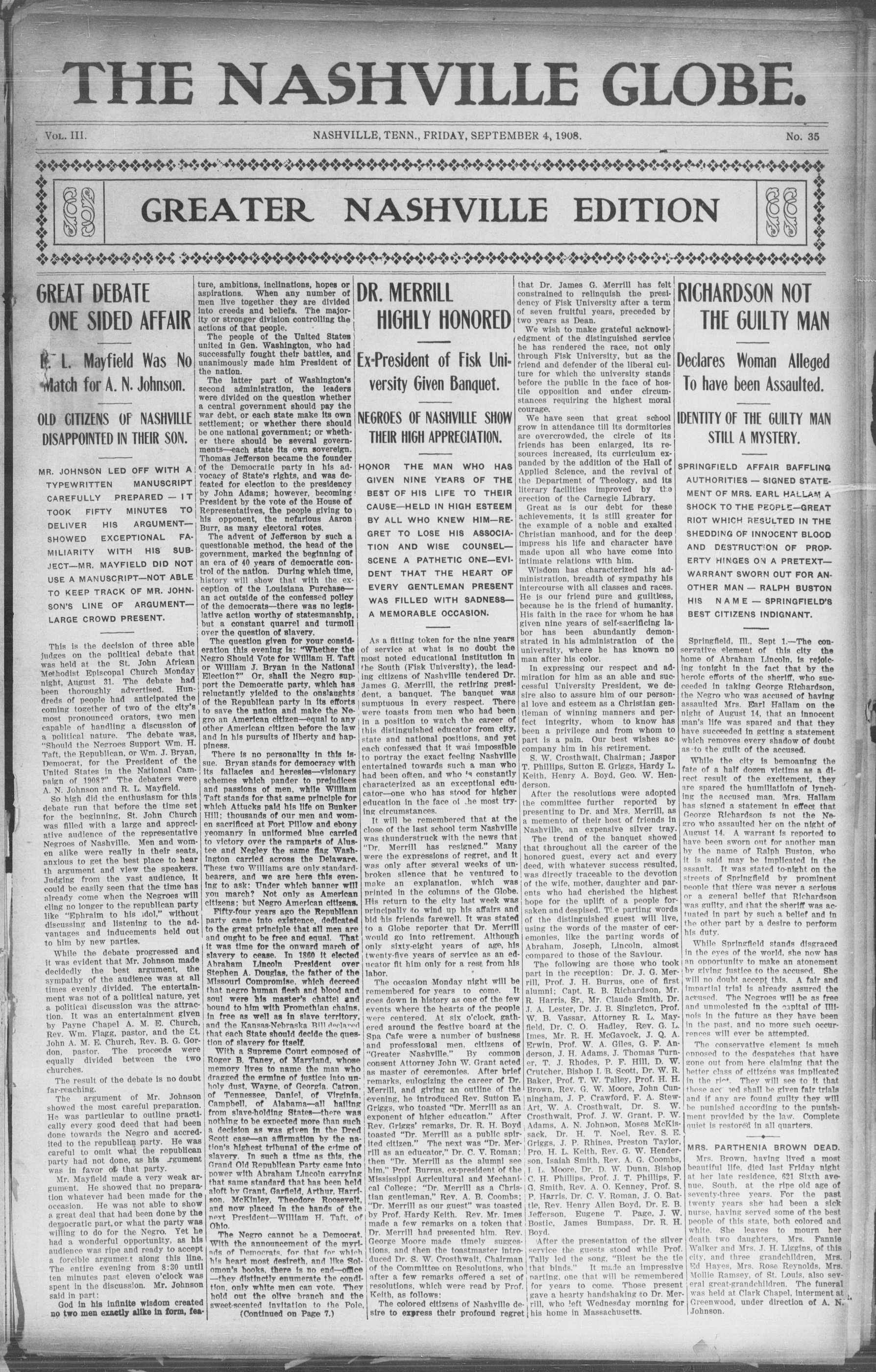
THE NASHVILLE GLOBE.
GREATER NASHVILLE EDITION
```markdown
```
Vol. III.
H
GREAT DEBATE ONE SIDED AFFAIR
E. L. Mayfield Was No Match for A. N. Johnson.
OLD CITIZENS OF NASHVILLE DISAPPOINTED IN THEIR SON.
MR. JOHNSON LED OFF WITH A TYPEWRITTEN MANUSCRIPT CAREFULLY PREPARED IT TOOK FIFTY MINUTES TO DELIVER HIS ARGUMENT SHOWED EXCEPTIONAL FAMILIARITY WITH HIS SUBJECT—MR. MAYFIELD DID NOT USE A MANUSCRIPT—NOT ABLE TO KEEP TRACK OF MR. JOHNSON'S LINE OF ARGUMENT LARGE CROWD PRESENT.
This is the decision of three able judges on the political debate that was held at the St. John African Methodist Episcopal Church Monday night, August 31. The debate had been thoroughly advertised. Hundreds of people had anticipated the coming together of two of the city's most pronounced orators, two men capable of handling a discussion of a political nature. The debate was, "Should the Negroes Support Wm. H. Taft, the Republican, or Wm. J. Bryan, Democrat, for the President of the United States in the National Campaign of 1908?" The debaters were A. N. Johnson and R. L. Mayfield.
So high did the enthusiasm for this debate run that before the time set for the beginning, St. John Church was filled with a large and appreciative audience of the representative Negroes of Nashville. Men and women alike were really in their seats, anxious to get the best place to hear th argument and view the speakers. Judging from the vast audience, it could be easily seen that the time has already come when the Negroes will cling no longer to the republican party like "Ephraim to his idol," without discussing and listening to the advantages and inducements held out to him by new parties.
While the debate progressed and it was evident that Mr. Johnson made decidedly the best argument, the sympathy of the audience was at all times evenly divided. The entertainment was not of a political nature, yet a political discussion was the attraction. It was an entertainment given by Payne Chapel A. M. E. Church, Rev. Wm. Flagg, pastor, and the St. John A. M. E. Church, Rev. B. G. Gordon, pastor. The proceeds were equally divided between the two churches.
The result of the debate is no doubt far-reaching.
The argument of Mr. Johnson showed the most careful preparation. He was particular to outline practically every good deed that had been done towards the Negro and accredited to the republican party. He was careful to omit what the republican party had not done, as his argument was in favor of that party.
Mr. Mayfield made a very weak argument. He showed that no preparation whatever had been made for the occasion. He was not able to show a great deal that had been done by the democratic part, or what the party was willing to do for the Negro. Yet he had a wonderful opportunity, as his audience was ripe and ready to accept a forcible argument along this line. The entire evening from 8:30 until ten minutes past eleven o'clock was spent in the discussion. Mr. Johnson said in part:
God in his infinite wisdom created no two men exactly alike in form, fea
NASHVILLE, TENN., FRIDAY, SEPTEMBER 4, 1908.
ture, ambitions, inclinations, hopes or aspirations. When any number of men live together they are divided into creeds and beliefs. The majority or stronger division controlling the actions of that people.
The people of the United States united in Gen. Washington, who had successfully fought their battles, and unanimously made him President of the nation.
The latter part of Washington's second administration, the leaders were divided on the question whether a central government should pay the war debt, or each state make its own settlement; or whether there should be one national government; or whether there should be several governments—each state its own sovereign. Thomas Jefferson became the founder of the Democratic party in his advocacy of State's rights, and was defeated for election to the presidency by John Adams; however, becoming President by the vote of the House of Representatives, the people giving to his opponent, the nefarious Aaron Burr, as many electoral votes.
The advent of Jefferson by such a questionable method, the head of the government, marked the beginning of an era of 40 years of democratic control of the nation. During which time, history will show that with the exception of the Louisiana Purchase—an act outside of the confessed policy of the democrats—there was no legislative action worthy of statesmanship, but a constant quarrel and turmoil over the question of slavery.
The question given for your consideration this evening is: "Whether the Negro Should Vote for William H. Taft or William J. Bryan in the National Election?" Or, shall the Negro support the Democratic party, which has reluctantly yielded to the onslaughts of the Republican party in its efforts to save the nation and make the Negro an American citizen—equal to any other American citizen before the law and in his pursuits of liberty and happiness.
There is no personality in this issue. Bryan stands for democracy with its fallacies and heresies—visionary schemes which pander to prejudices and passions of men, while William Taft stands for that same principle for which Attucks paid his life on Bunker Hill; thousands of our men and women sacrificed at Fort Pillow and ebony yeomanry in uniformed blue carried to victory over the ramparts of Alustee and Negley the same flag Washington carried across the Delaware. These two Williams are only standard-bearers, and we are here this evening to ask: Under which banner will you march? Not only as American citizens; but Negro American citizens.
Fifty-four years ago the Republican party came into existence, dedicated to the great principle that all men are and ought to be free and equal. That it was time for the onward march of slavery to cease. In 1860 it elected Abraham Lincoln President over Stephen A. Douglas, the father of the Missouri Compromise, which decreed that negro human flesh and blood and soul were his master's chattel and bound to him with Promethian chains, in free as well as in slave territory, and the Kansas-Nebraska Bill declared that each State should decide the question of slavery for itself.
With a Supreme Court composed of Roger B. Taney, of Maryland, whose memory lives to name the man who dragged the ermine of justice into unholy dust, Wayne, of Georgia, Catron, of Tennessee, Daniel, of Virginia, Campbell, of Alabama—all halling from slave-holding States—there was nothing to be expected more than such a decision as was given in the Dred Scott case—an affirmation by the nation's highest tribunal of the crime of slavery. In such a time as this, the Grand Old Republican Party came into power with Abraham Lincoln carrying that same standard that has been held aloft by Grant, Garfield, Arthur, Harrison, McKinley, Theodore Roosevelt, and now placed in the hands of the next President—William H. Taft, of Ohio.
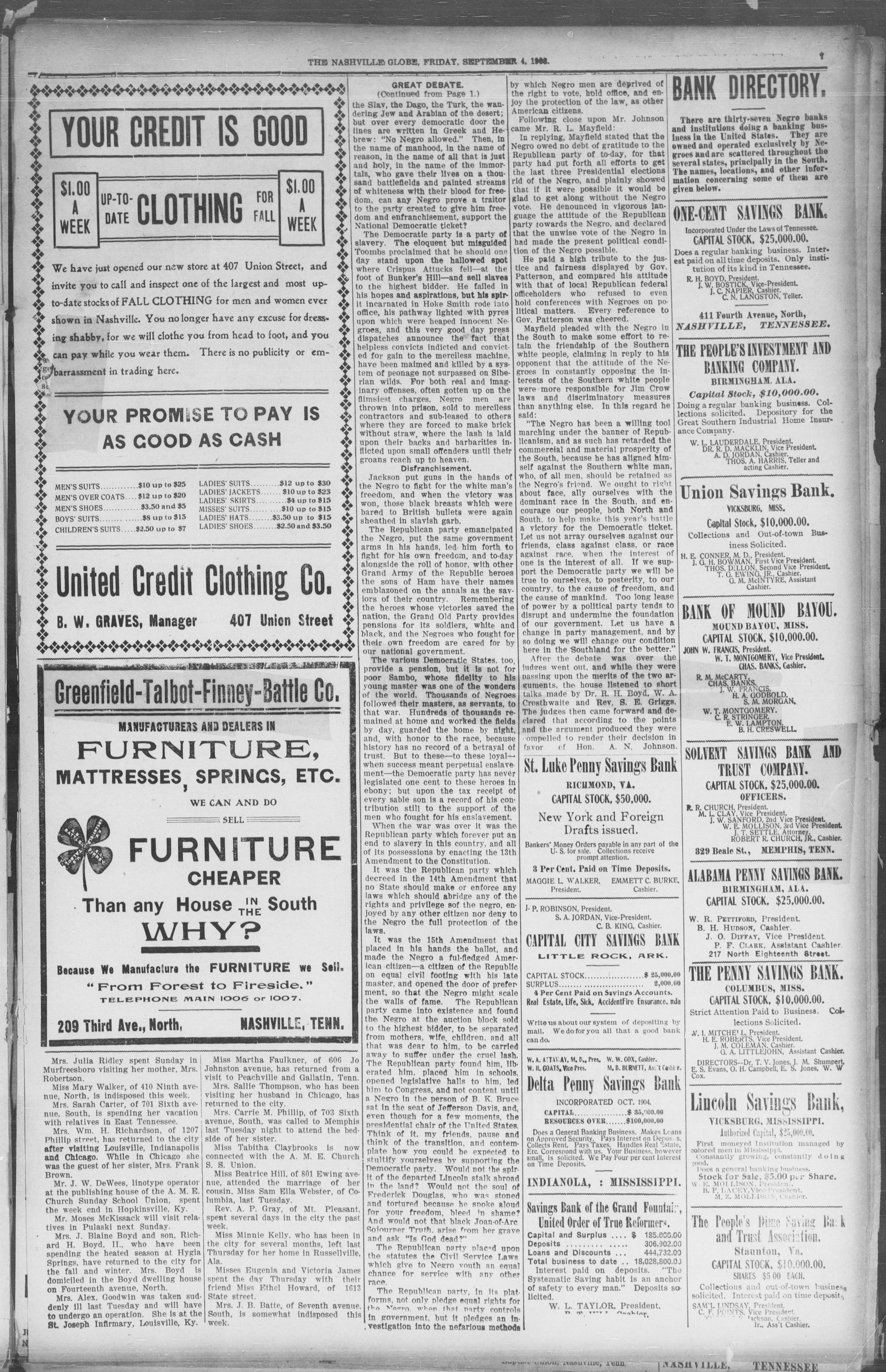
The Negro cannot be a Democrat. With the announcement of the mylads of Democrats, for that for which his heart most desireth, and like Solomon's books, there is no end—office—they distinctly enumerate the condition, only white men can vote. They hold out the olive branch and the sweet-scented invitation to the Pole (Continued on Page 7.)
DR. MERRILL HIGHLY HONORED
Ex-President of Fisk University Given Banquet.
NEGROES OF NASHVILLE SHOW THEIR HIGH APPRECIATION.
HONOR THE MAN WHO HAS GIVEN NINE YEARS OF THE BEST OF HIS LIFE TO THEIR CAUSE—HELD IN HIGH ESTEEM BY ALL WHO KNEW HIM—REGRET TO LOSE HIS ASSOCIATION AND WISE COUNSEL—SCENE A PATHETIC ONE—EVIDENT THAT THE HEART OF EVERY GENTLEMAN PRESENT WAS FILLED WITH SADNESS—A MEMORABLE OCCASION.
As a fitting token for the nine years of service at what is no doubt the most noted educational institution in the South (Fisk University), the leading citizens of Nashville tendered Dr. James G. Merrill, the retiring president, a banquet. The banquet was sumptuous in every respect. There were toasts from men who had been in a position to watch the career of this distinguished educator from city, state and national positions, and yet each confessed that it was impossible to portray the exact feeling Nashville entertained towards such a man who had been often, and who is constantly characterized as an exceptional educator—one who has stood for higher education in the face of the most trying circumstances.
It will be remembered that at the close of the last school term Nashville was thunderstruck with the news that "Dr. Merrill has resigned." Many were the expressions of regret, and it was only after several weeks of unbroken silence that he ventured to make an explanation, which was printed in the columns of the Globe. His return to the city last week was principally to wind up his affairs and bid his friends farewell. It was stated to a Globe reporter that Dr. Merrill would go into retirement. Although only sixty-eight years of age, his twenty-five years of service as an educator fit him only for a rest from his labor.
The occasion Monday night will be remembered for years to come. It goes down in history as one of the few events where the hearts of the people were centered. At six o'clock, gathered around the festive board at the Spa Cafe were a number of business and professional men, citizens of "Greater Nashville." By common consent Attorney John W. Grant acted as master of ceremonies. After brief remarks, eulogizing the career of Dr. Merrill, and giving an outline of the evening, he introduced Rev. Sutton E. Griggs, who toasted "Dr. Merrill as an exponent of higher education." After Rev. Griggs' remarks, Dr. R. H. Boyd toasted "Dr. Merrill as a public spirited citizen." The next was "Dr. Merrill as an educator," Dr. C. V. Roman; then "Dr. Merrill as the alumni see him." Prof. Burrus, ex-president of the Mississippi Agricultural and Mechanical College; "Dr. Merrill as a Christian gentleman," Rev. A. B. Coombs; "Dr. Merrill as our guest" was toasted by Prof. Hardy Keith. Rev. Mr. Imes made a few remarks on a token that Dr. Merrill had presented him. Rev George Moore made timely suggestions, and then the toastmaster introduced Dr. S. W. Crosthwait, Chairman of the Committee on Resolutions, who after a few remarks offered a set of resolutions, which were read by Prof Keith, as follows:
The colored citizens of Nashville desire to express their profound regret
that Dr. James G. Merrill has felt constrained to relinquish the presidency of Fisk University after a term of seven fruitful years, preceded by two years as Dean. We wish to make grateful acknowledgment of the distinguished service he has rendered the race, not only through Fisk University, but as the friend and defender of the liberal culture for which the university stands before the public in the face of hostile opposition and under circumstances requiring the highest moral courage. We have seen that great school grow in attendance till its dormitories are overcrowded, the circle of its friends has been enlarged, its resources increased, its curriculum expanded by the addition of the Hall of Applied Science, and the revival of the Department of Theology, and its literary facilities improved by the erection of the Carnegie Library. Great as is our debt for these achievements, it is still greater for the example of a noble and exalted Christian manhood, and for the deep impress his life and character have made upon all who have come into intimate relations with him.
Wisdom has characterized his administration, breadth of sympathy his intercourse with all classes and races. He is our friend pure and guiltless, because he is the friend of humanity. His faith in the race for whom he has given nine years of self-sacrificing labor has been abundantly demonstrated in his administration of the university, where he has known no man after his color.
In expressing our respect and admiration for him as an able and successful University President, we desire also to assure him of our personal love and esteem as a Christian gentleman of winning manners and perfect integrity, whom to know has been a privilege and from whom to part is a pain. Our best wishes accompany him in his retirement.
S. W. Crossthwait, Chairman; Jasper T. Phillips, Sutton E. Griggs, Hardy L. Keith, Henry A. Boyd, Geo. W. Henderson.
After the resolutions were adopted the committee further reported by presenting to Dr. and Mrs. Merrill, as a memento of their host of friends in Nashville, an expensive silver tray.
The trend of the banquet showed that throughout all the career of the honored guest, every act and every deed, with whatever success resulted, was directly traceable to the devotion of the wife, mother, daughter and parents who had cherished the highest hope for the uplift of a people forsaken and despised. The parting words of the distinguished guest will live, using the words of the master of ceremonies, like the parting words of Abraham, Joseph, Lincoln, almost compared to those of the Saviour.
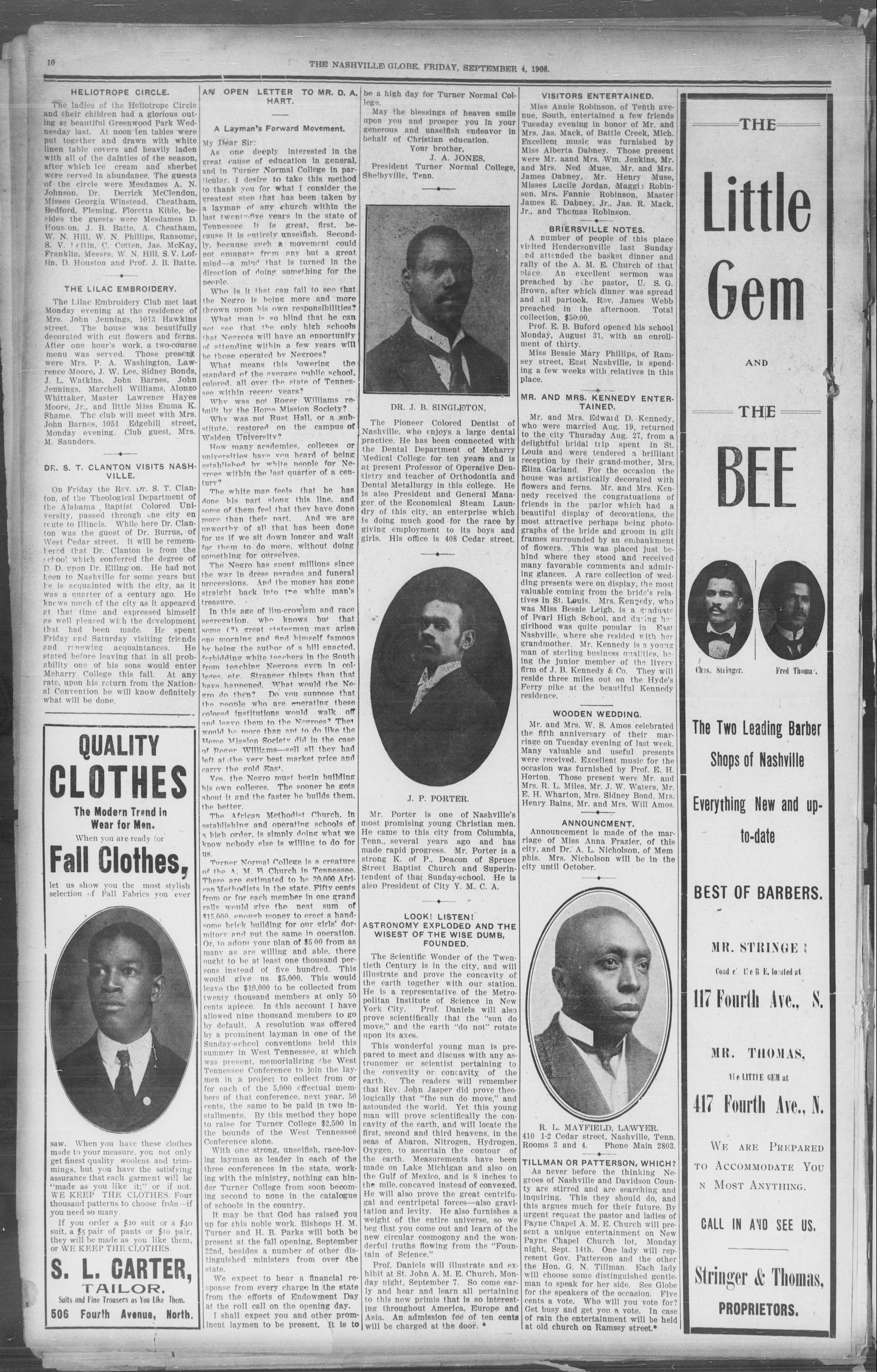
The following are those who took part in the reception: Dr. J. G. Merrill, Prof. J. H. Burrus, one of first alumni; Capt. R. B. Richardson, Mr. R. Harris, Sr., Mr. Claude Smith, Dr. J. A. Lester, Dr. J. B. Singleton, Prof. W. B. Vassar, Attorney R. L. Mayfield, Dr. C. O. Hadley, Rev. G. L. Imes, Mr. R. H. McGavock, J. Q. A. Erwin, Prof. W. A. Giles, G. F. Anderson, J. H. Adams, J. Thomas Turner, T. J. Rhodes, P. F. Hill, D. W. Crutcher, Bishop I. B. Scott, Dr. W. R. Baker, Prof. T. W. Talley, Prof. H. H. Brown, Rev. G. W. Moore, John Cunningham, J. P. Crawford, F. A. Stewart, W. A. Crostwait, Dr. S. W. Crostwait, Prof. J. W. Grant, P. W. Adams, A. N. Johnson, Moses McKissack, Dr. H. T. Noel, Rev. S. E. Griggs, J. P. Rhines, Preston Taylor, Pro. H. L. Keith, Rev. G. W. Henderson, Isalah Smith, Rev. A. G. Coombs, I. L. Moore, Dr. D. W. Dunn, Bishop C. H. Phillips, Prof. J. T. Phillips, F. G. Smith, Rev. A. O. Kenney, Prof. S. P. Harris, Dr. C. V. Roman, J. O. Batle, Rev. Henry Allen Boyd, Dr. E. B. Jefferson, Eugene T. Page, J. W Bostic, James Bumpass, Dr. R. H Boyd.
After the presentation of the silver service the guests stood while Prof. Tally led the song, "Blest be the tie that binds." It made an impressive parting, one that will be remembered for years to come. Those present gave a hearty handshaking to Dr. Merrill, who left Wednesday morning for his home in Massachusetts.
No.35
EE
RICHARDSON NOT THE GUILTY MAN
Declares Woman Alleged To have been Assaulted.
IDENTITY OF THE GUILTY MAN STILL A MYSTERY.
SPRINGFIELD AFFAIR BAFFLING AUTHORITIES — SIGNED STATEMENT OF MRS. EARL HALLAM A SHOCK TO THE PEOPLE—GREAT RIOT WHICH RESULTED IN THE SHEDDING OF INNOCENT BLOOD AND DESTRUCTION OF PROPERTY HINGES ON A PRETEXT—WARRANT SWORN OUT FOR ANOTHER MAN — RALPH BUSTON HIS NAME — SPRINGFIELD'S BEST CITIZENS INDIGNANT.
Springfield, Ill., Sept 1.—The conservative element of this city the home of Abraham Lincoln, is rejoicing tonight in the fact that by the heroic efforts of the sheriff, who succeeded in taking George Richardson, the Negro who was accused of having assaulted Mrs. Earl Hallam on the night of August 14, that an innocent man's life was spared and that they have succeeded in getting a statement which removes every shadow of doubt as to the guilt of the accused.
While the city is bemoaning the fate of a half dozen victims as a direct result of the excitement, they are spared the humilliation of lynching the accused man. Mrs. Hallam has signed a statement in effect that George Richardson is not the Negro who assaulted her on the night of August 14. A warrant is reported to have been sworn out for another man by the name of Ralph Buston, who it is said may be implicated in the assault. It was stated to night on the streets of Springfield by prominent people that there was never a serious or a general belief that Richardson was guilty, and that the sheriff was actuated in part by such a belief and in the other part by a desire to perform his duty.
While Springfield stands disgraced in the eyes of the world, she now has an opportunity to make an atonement by giving justice to the accused. She will no doubt accept this. A fair and impartial trial is already assured the accused. The Negroes will be as free and unmolested in the capital of Illinois in the future as they have been in the past, and no more such occurrences will ever be attempted.
The conservative element is much opposed to the despatches that have gone out from here claiming that the better class of citizens was implicated in the riot. They will see to it that those accused shall be given fair trials and if any are found guilty they will be punished according to the punishment provided by the law. Complete quiet is restored in all quarters.
MRS. PARTHENIA BROWN DEAD.
MRS. PARTHENIA BROWN DEAD.
Mrs. Brown, having lived a most beautiful life, died last Friday night at her late residence, 621 Sixth avenue, South, at the ripe old age of seventy-three years. For the past twenty years she had been a sick nurse, having served some of the best people of this state, both colored and white. She leaves to mourn her death two daughters, Mrs. Fannie Walker and Mrs. J. H. Liegins, of this city, and three grandchildren, Mrs. Ed Hayes, Mrs. Rose Reynolds, Mrs. Mollie Ramsey, of St. Louis, also several great-grandchildren. The funeral was held at Clark Chapel, interment at Greenwood, under direction of A. N. Johnson.
O.
RICHARD HILL
Hill, the wide awake, of the greatest deals in sales. He purchased for his property on Cedar Street from the Duncan Hotel, what Mr. Hill secured on such a piece of ground upon which there and more front on Cedar Act to the title dates by the growth of the city. On contemplates extents large and increasing to erect very desired roof garden for his desirable location could have negotiated such a smaller ones. Should Lord would suggest that
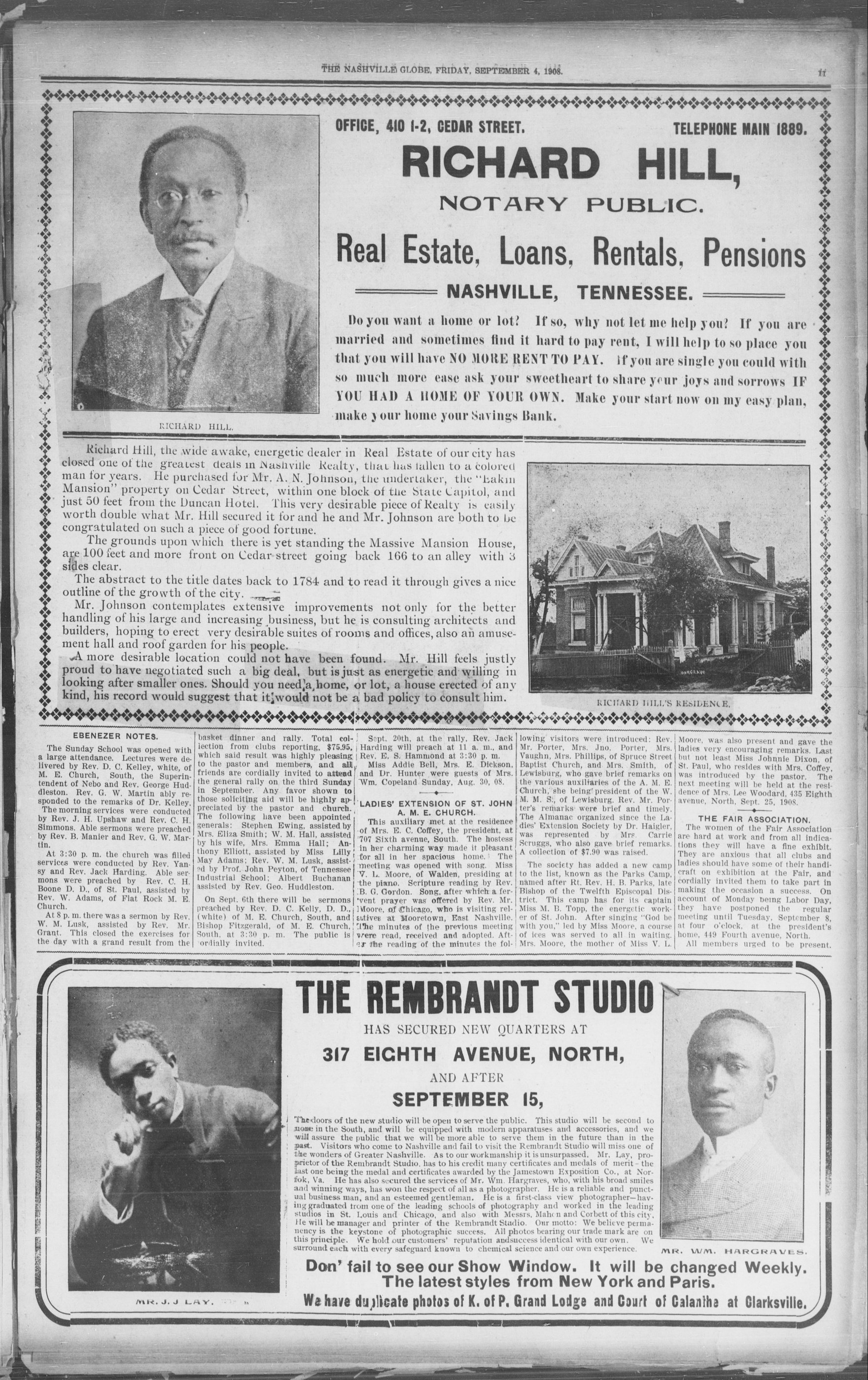
Richard Hill, the wide awake, energetic dealer in Real Estate of our city has closed one of the greatest deals in Nashville Realty, that has fallen to a colored man for years. He purchased for Mr. A. N. Johnson, the undertaker, the "Eakin Mansion" property on Cedar Street, within one block of the State Capitol, and just 50 feet from the Duncan Hotel. This very desirable piece of Realty is easily worth double what Mr. Hill secured it for and he and Mr. Johnson are both to be congratulated on such a piece of good fortune.
The grounds upon which there is yet standing the Massive Mansion House, are 100 feet and more front on Cedar street going back 166 to an alley with 3 sides clear.
The abstract to the title dates back to 1784 and to read it through gives a nice outline of the growth of the city.
Mr. Johnson contemplates extensive improvements not only for the better handling of his large and increasing business, but he is consulting architects and builders, hoping to erect very desirable suites of rooms and offices, also an amusement hall and roof garden for his people. A more desirable location could not have been found. Mr. Hill feels justly proud to have negotiated such a big deal, but is just as energetic and willing in looking after smaller ones. Should you need a home, or lot, a house erected of any kind, his record would suggest that it would not be a bad policy to consult him.
EBENEZER NOTES.
The Sunday School was opened with a large attendance. Lectures were delivered by Rev. D. C. Kelley, white, of M. E. Church, South, the Superintendent of Nebo and Rev. George Huddleston. Rev. G. W. Martin ably responded to the remarks of Dr. Kelley. The morning services were conducted by Rev. J. H. Upshaw and Rev. C. H. Simmons. Able sermons were preached by Rev. B. Manier and Rev. G. W. Martin.
At 3:30 p. m. the church was filled services were conducted by Rev. Yansy and Rev. Jack Harding. Able sermons were preached by Rev. C. H. Boone D. D., of St. Paul, assisted by Rev. W. Adams, of Flat Rock M. E. Church.
At 8 p. m. there was a sermon by Rev. W. M. Lusk, assisted by Rev. Mr. Grant. This closed the exercises for the day with a grand result from the
心
THE NEW YORK TIMES
17
MR. J. J LAY.
---
---
basket dinner and rally. Total collection from clubs reporting, $75.95, which said result was highly pleasing to the pastor and members, and all friends are cordially invited to attend the general rally on the third Sunday in September. Any favor shown to those soliciting aid will be highly appreciated by the pastor and church. The following have been appointed generals: Stephen Ewing, assisted by Mrs. Eliza Smith; W. M. Hall, assisted by his wife, Mrs. Emma Hall; Anthony Elliott, assisted by Miss Lilly May Adams; Rev. W. M. Lusk, assisted by Prof. John Peyton, of Tennessee Industrial School; Albert Buchanan assisted by Rev. Geo. Huddleston.
On Sept. 6th there will be sermons preached by Rev. D. C. Kelly, D. D., (white) of M. E. Church, South, and Bishop Fitzgerald, of M. E. Church, South, at 3:30 p. m. The public is ordially invited.
THE
317
The doors of the
none in the South
will assure the
past. Visitors,
the wonders of
prietor of the R
last one being g
fok, Va. He h
and winning w
ual business m
ing graduated f
studios in St.
He will be man
nency is the k
this principle.
surround each
Don' f
---
THE NASHVILLE GLOBE, FRIDAY, SEPTEMBER 4, 1908
THE REMBRANDT STUDIO
The doors of the new studio will be open to serve the public. This studio will be second to none in the South, and will be equipped with modern apparatuses and accessories, and we will assure the public that we will be more able to serve them in the future than in the past. Visitors who come to Nashville and fail to visit the Rembrandt Studio will miss one of the wonders of Greater Nashville. As to our workmanship it is unsurpassed. Mr. Lay, proprietor of the Rembrandt Studio, has to his credit many certificates and medals of merit—the last one being the medal and certificates awarded by the Jamestown Exposition Co., at Norfolk, Va. He has also secured the services of Mr. Wm. Hargraves, who, with his broad smiles and winning ways, has won the respect of all as a photographer. He is a reliable and punctual business man, and an esteemed gentleman. He is a first-class view photographer—having graduated from one of the leading schools of photography and worked in the leading studios in St. Louis and Chicago, and also with Messrs. Mahon and Corbett of this city. He will be manager and printer of the Rembrandt Studio. Our motto: We believe permanency is the keystone of photographic success. All photos bearing our trade mark are on this principle. We hold our customers' reputation and success identical with our own. We surround each with every safeguard known to chemical science and our own experience.
Don' fail to see our Show Window. It will be changed Weekly. The latest styles from New York and Paris.
We have duplicate photos of K. of P. Grand Lodge and Court of Calanthe at Clarksville.
RICHARD HILL, NOTARY PUBLIC.
Do you want a home or lot? If so, why not let me help you? If you are married and sometimes find it hard to pay rent, I will help to so place you that you will have NO MORE RENT TO PAY. If you are single you could with so much more ease ask your sweetheart to share your joys and sorrows IF YOU HAD A HOME OF YOUR OWN. Make your start now on my easy plan, make your home your Savings Bank.
OFFICE, 410 1-2, CEDAR STREET.
RICHARD
NOTATION
Real Estate, Lo-
NASHVILLE
Do you want a home or lot?
married and sometimes find it
that you will have NO MORE RE-
so much more ease ask your
YOU HAD A HOME OF YOUR
make your home your Savings
In Real Estate of our city has
realty, that has fallen to a colored
person, the undertaker, the "Lakin
block of the State Capitol, and
desirable piece of Realty is easily
and Mr. Johnson are both to be
going the Massive Mansion House,
going back 166 to an alley with 3
and to read it through gives a nice
movements not only for the better
but he is consulting architects and
rooms and offices, also an amuse-
en found. Mr. Hill feels justly
is just as energetic and willing in
time, or lot, a house erected of any
be a bad policy to consult him.
Sept. 20th, at the rally, Rev. Jack Harding will preach at 11 a. m., and Rev. E. S. Hammond at 3:30 p. m.
Miss Addie Bell, Mrs. E. Dickson, and Dr. Hunter were guests of Mrs. Wm. Copeland Sunday, Aug. 30, 08.
LADIES' EXTENSION OF ST. JOHN
A. M. F. ECHURCH.
This auxiliary met at the residence of Mrs. E. C. Coffey, the president, at 707 Sixth avenue, South. The hostess in her charming way made it pleasant for all in her spacious home. The meeting was opened with song. Miss V. L. Moore, of Walden, presiding at the piano. Scripture reading by Rev. B. G. Gordon. Song, after which a fervent prayer was offered by Rev. Mr. Moore, of Chicago, who is visiting relatives at Mooretown, East Nashville. The minutes of the previous meeting were read, received and adopted. After the reading of the minutes the fol-
E REMBRANDT
HAS SECURED NEW QUA
17 EIGHTH AVENUE
HILL
PUBLIC.
Rentals, Pe
ENNESSEE.
y not let me help you?
my rent, I will help to s
Y. if you are single you
to share your joys and
ke your start now on m
DARGRAVE
RICHARD HILL'S RESIDENCE
lowing visitors were introduced: Rev Mr. Porter, Mrs. Jno, Porter, Mrs Vaughn, Mrs. Phillips, of Spruce Street Baptist Church, and Mrs. Smith, of Lewisburg, who gave brief remarks on the various auxiliaries of the A. M. E Church, she being president of the W. M. M. S., of Lewisburg, Rev. Mr. Porter's remarks were brief and timely. The Almanac organized since the Ladies' Extension Society by Dr. Haigler was represented by Mrs Carrie Scruggs, who also gave brief remarks. A collection of $7.90 was raised.
The society has added a new camp to the list, known as the Parks Camp, named after Rt. Rev. H. B. Parks, late Bishop of the Twelfth Episcopal District. This camp has for its captain Miss M. B. Topp, the energetic worker of St. John. After singing "God be with you," led by Miss Moore, a course of ices was served to all in waiting. Mrs. Moore, the mother of Miss V. L.
it will be changed York and Paris. and Court of Calanthe a
TELEPHONE MAIN 1889.
ILL,
LIC.
Is, Pensions
SEE.
e help you? If you are
will help to so place you
are single you could with
our joys and sorrows IF
rt now on my easy plan,
Moore, was also present and gave the ladies very encouraging remarks. Last but not least Miss Johnnie Dixon, of St. Paul, who resides with Mrs. Coffey, was introduced by the pastor. The next meeting will be held at the residence of Mrs. Lee Woodard, 435 Eighth avenue, North, Sept. 25, 1908.
THE FAIR ASSOCIATION
The women of the Fair Association are hard at work and from all indications they will have a fine exhibit. They are anxious that all clubs and ladies should have some of their handicraft on exhibition at the Fair, and cordially invited them to take part in making the occasion a success. On account of Monday being Labor Day, they have postponed the regular meeting until Tuesday, September 8, at four o'clock, at the president's home, 449 Fourth avenue, North. All members urged to be present.
[Name]
changed Weekly. Paris. of Calanthe at Clarksville.
11
NATIONAL BAPTIST
[Image of a man in a suit with a bow tie, looking upwards.]
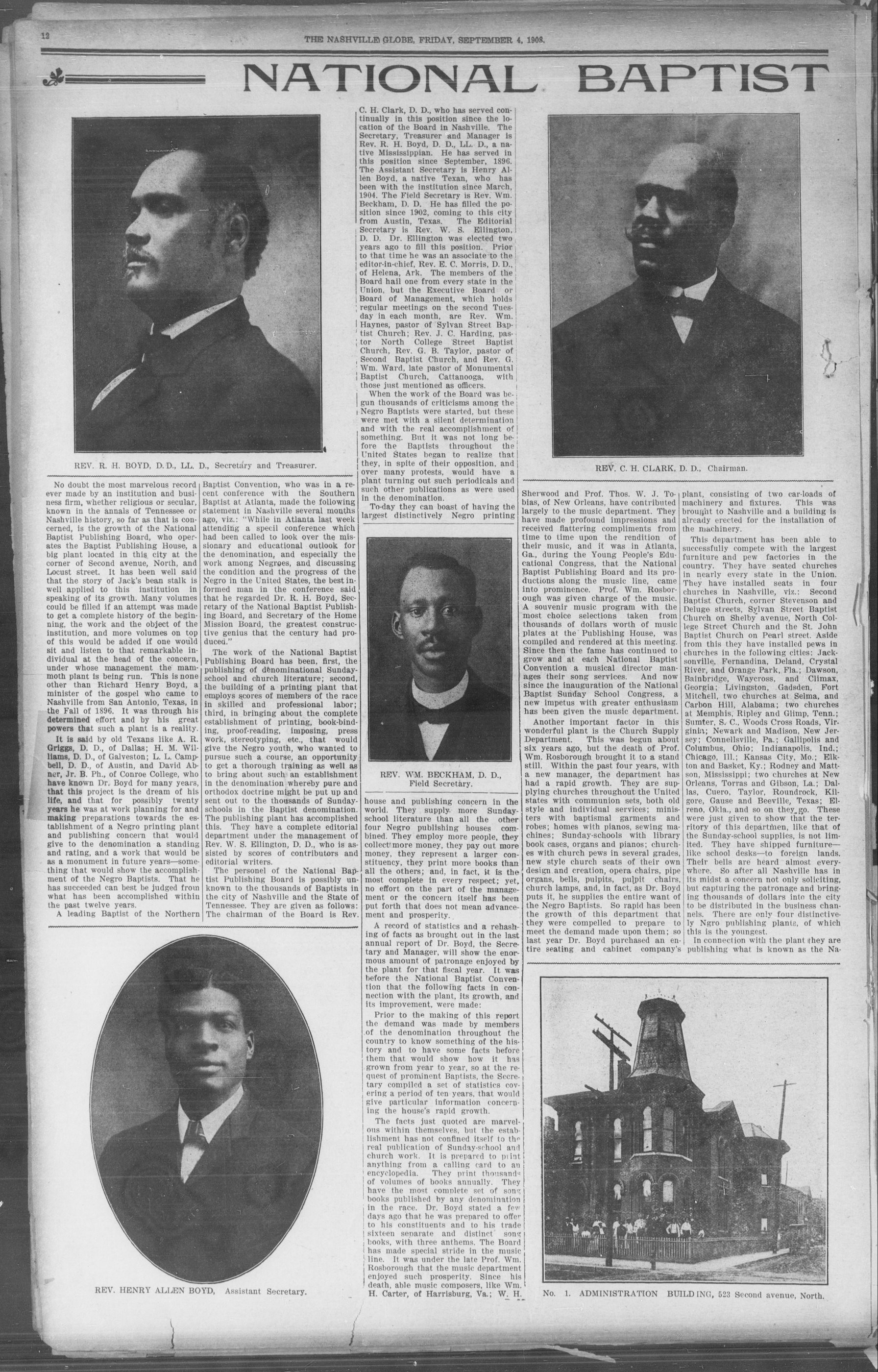
REV. R. H. BOYD, D.D., LL.D., Secretary and Treasurer.
[Name not visible in the image]
REV. HENRY ALLEN BOYD, Assistant Secretary.
12
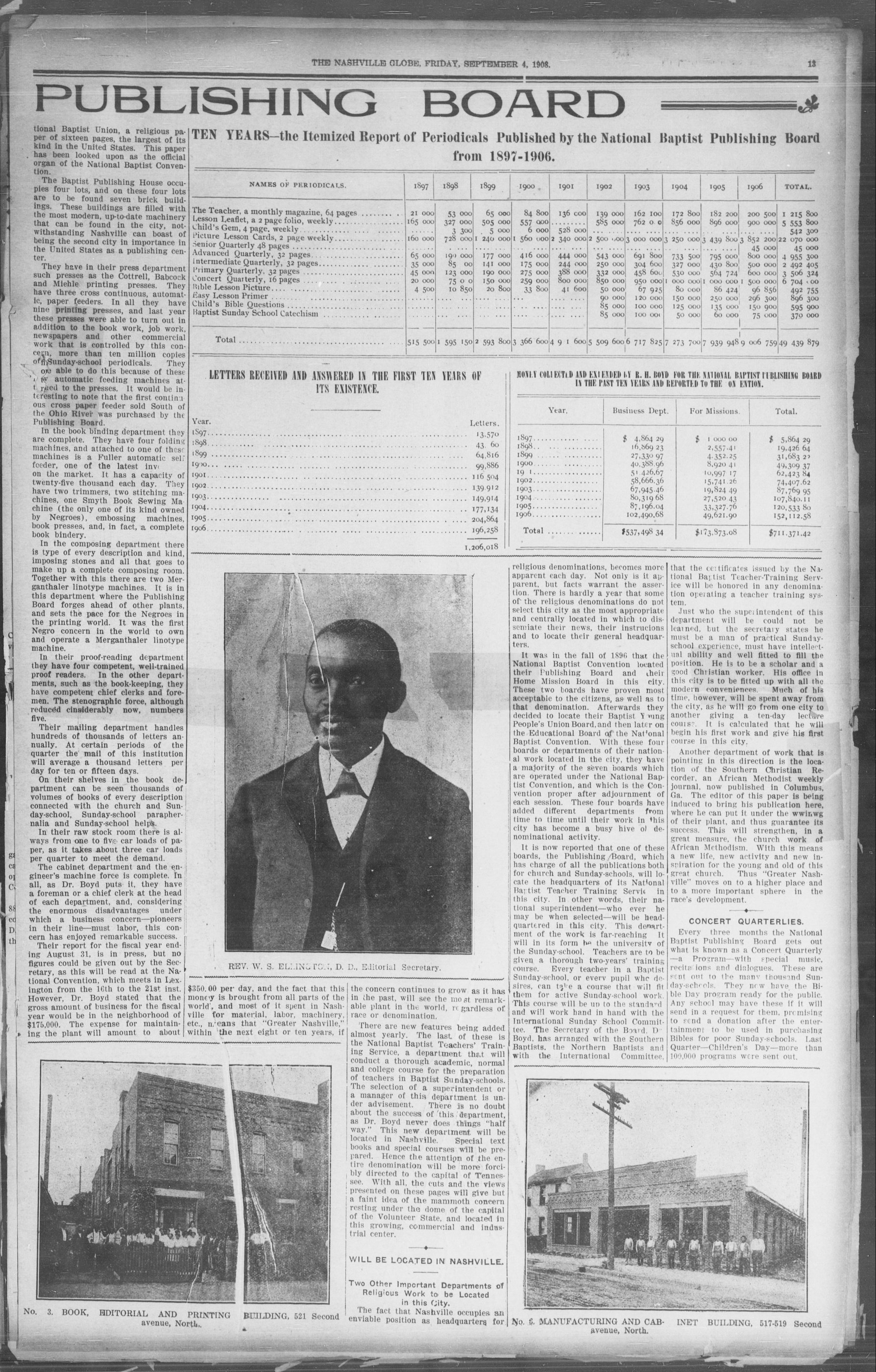
No doubt the most marvelous record ever made by an institution and business firm, whether religious or secular, known in the annals of Tennessee or Nashville history, so far as that is concerned, is the growth of the National Baptist Publishing Board, who operates the Baptist Publishing House, a big plant located in this city at the corner of Second avenue, North, and Locust street. It has been well said that the story of Jack's bean stalk is well applied to this institution in speaking of its growth. Many volumes could be filled if an attempt was made to get a complete history of the beginning, the work and the object of the institution, and more volumes on top of this would be added if one would sit and listen to that remarkable individual at the head of the concern, under whose management the mamoth plant is being run. This is none other than Richard Henry Boyd, a minister of the gospel who came to Nashville from San Antonio, Texas, in the Fall of 1896. It was through his determined effort and by his great powers that such a plant is a reality.
It is said by old Texans like A. R. Griggs, D. D., of Dallas; H. M. Williams, D. D., of Galveston; L. L. Campbell, D. D., of Austin, and David Abner, Jr. B. Ph., of Conroe College, who have known Dr. Boyd for many years, that this project is the dream of his life, and that for possibly twenty years he was at work planning for and making preparations towards the establishment of a Negro printing plant and publishing concern that would give to the denomination a standing and rating, and a work that would be as a monument in future years—something that would show the accomplishment of the Negro Baptists. That he has succeeded can best be judged from what has been accomplished within the past twelve years. A leading Baptist of the Northern
THE NASHVILLE GLOBE, FRIDAY, SEPTEMBER 4, 1908.
Baptist Convention, who was in a recent conference with the Southern Baptist at Atlanta, made the following statement in Nashville several months ago, viz.: "While in Atlanta last week attending a specil conference which had been called to look over the missionary and educational outlook for the denomination, and especially the work among Negroes, and discussing the condition and the progress of the Negro in the United States, the best informed man in the conference said that he regarded Dr. R. H. Boyd, Secretary of the National Baptist Publishing Board, and Secretary of the Home Mission Board, the greatest constructive genius that the century had produced."
The work of the National Baptist Publishing Board has been, first, the publishing of denominational Sunday-school and church literature; second, the building of a printing plant that employs scores of members of the race in skilled and professional labor; third, in bringing about the complete establishment of printing, book-binding, proof-reading, imposing, press work, stereotyping, etc., that would give the Negro youth, who wanted to pursue such a course, an opportunity to get a thorough training as well as to bring about such an establishment in the denomination whereby pure and orthodox doctrine might be put up and sent out to the thousands of Sunday schools in the Baptist denomination. The publishing plant has accomplished this. They have a complete editorial department under the management of Rev. W. S. Ellington, D. D., who is assisted by scores of contributors and editorial writers.
The personel of the National Baptist Publishing Board is possibly unknown to the thousands of Baptists in the city of Nashville and the State of Tennessee. They are given as follows: The chairman of the Board is Rev.
C. H. Clark, D. D., who has served continually in this position since the location of the Board in Nashville. The Secretary, Treasurer and Manager is Rev. R. H. Boyd, D. D., LL. D., a native Mississippiian. He has served in this position since September, 1896. The Assistant Secretary is Henry Allen Boyd, a native Texan, who has been with the institution since March, 1904. The Field Secretary is Rev. Wm. Beckham, D. D. He has filled the position since 1902, coming to this city from Austin, Texas. The Editorial Secretary is Rev. W. S. Ellington, D. D. Dr. Ellington was elected two years ago to fill this position. Prior to that time he was an associate to the editor-in-chief, Rev. E. C. Morris, D. D., of Helena, Ark. The members of the Board hail one from every state in the Union, but the Executive Board or Board of Management, which holds regular meetings on the second Tuesday in each month, are Rev. Wm. Haynes, pastor of Sylvan Street Baptist Church; Rev. J. C. Harding, pastor North College Street Baptist Church, Rev. G. B. Taylor, pastor of Second Baptist Church, and Rev. G. Wm. Ward, late pastor of Monumental Baptist Church, Cattanooga, with those just mentioned as officers.
When the work of the Board was begun thousands of criticisms among the Negro Baptists were started, but these were met with a silent determination and with the real accomplishment of something. But it was not long before the Baptists throughout the United States began to realize that they, in spite of their opposition, and over many protests, would have a plant turning out such periodicals and such other publications as were used in the denomination.
To-day they can boast of having the largest distinctively Negro printing
P. E.
REV. WM. BECKHAM, D. D., Field Secretary.
house and publishing concern in the world. They supply more Sundayschool literature than all the other four Negro publishing houses combined. They employ more people, they collect more money, they pay out more money, they represent a larger constituency, they print more books than all the others; and, in fact, it is the most complete in every respect; yet, no effort on the part of the management or the concern itself has been put forth that does not mean advancement and prosperity.
A record of statistics and a rehashing of facts as brought out in the last annual report of Dr. Boyd, the Secretary and Manager, will show the enormous amount of patronage enjoyed by the plant for that fiscal year. It was before the National Baptist Convention that the following facts in connection with the plant, its growth, and its improvement, were made:
Prior to the making of this report the demand was made by members of the denomination throughout the country to know something of the history and to have some facts before them that would show how it has grown from year to year, so at the request of prominent Baptists, the Secretary compiled a set of statistics covering a period of ten years, that would give particular information concerning the house's rapid growth.
The facts just quoted are marvelous within themselves, but the establishment has not confined itself to the real publication of Sunday-school and church work. It is prepared to print anything from a calling card to an encyclopedia. They print thousands of volumes of books annually. They have the most complete set of song books published by any denomination in the race. Dr. Boyd stated a few days ago that he was prepared to offer to his constituents and to his trade sixteen separate and distinct song books, with three anthems. The Board has made special stride in the music line. It was under the late Prof. Wm. Rosborough that the music department enjoyed such prosperity. Since his death, able music composers, like Wm. H. Carter, of Harrisburg, Va.; W. H.
[Name not visible in the image]
REV. C. H. CLARK, D. D., Chairman.
Sherwood and Prof. Thos. W. J. Tobias, of New Orleans, have contributed largely to the music department. They have made profound impressions and received flattering compliments from time to time upon the rendition of their music, and it was in Atlanta, Ga., during the Young People's Educational Congress, that the National Baptist Publishing Board and its productions along the music line, came into prominence. Prof. Wm. Rosborough was given charge of the music. A souvenir music program with the most choice selections taken from thousands of dollars worth of music plates at the Publishing House, was compiled and rendered at this meeting. Since then the fame has continued to grow and at each National Baptist Convention a musical director manages their song services. And now since the inauguration of the National Baptist Sunday School Congress, a new impetus with greater enthusiasm has been given the music department
Another important factor in this wonderful plant is the Church Supply Department. This was begun about six years ago, but the death of Prof. Wm. Rosborough brought it to a stand still. Within the past four years, with a new manager, the department has had a rapid growth. They are supplying churches throughout the United states with communion sets, both old style and individual services; ministers with baptismal garments and robes; homes with pianos, sewing machines; Sunday-schools with library book cases, organs and pianos; churches with church pews in several grades, new style church seats of their own design and creation, opera chairs, pipe organs, bells, pulpits, pulpit chairs, church lamps, and, in fact, as Dr. Boyd puts it, he supplies the entire want of the Negro Baptists. So rapid has been the growth of this department that they were compelled to prepare to meet the demand made upon them; so last year Dr. Boyd purchased an entire seating and cabinet company's
THE HALL
No. 1. ADMINISTRATION BUILDING, 523 Second avenue. North.
plant, consisting of two car-loads of machinery and fixtures. This was brought to Nashville and a building is already erected for the installation of the machinery.
This department has been able to successfully compete with the largest furniture and pew factories in the country. They have seated churches in nearly every state in the Union. They have installed seats in four churches in Nashville, viz.: Second Baptist Church, corner Stevenson and Deluge streets, Sylvan Street Baptist Church on Shelby avenue, North College Street Church and the St. John Baptist Church on Pearl street. Aside from this they have installed pews in churches in the following cities: Jacksonville, Fernandina, Deland, Crystal River, and Orange Park, Fla.; Dawson, Bainbridge, Waycross, and Climax, Georgia; Livingston, Gadsden, Fort Mitchell, two churches at Selma, and Carbon Hill, Alabama; two churches at Memphis, Ripley and Glimp, Tenn.; Sumter, S. C., Woods Cross Roads, Virginia; Newark and Madison, New Jersey; Connellsville, Pa.; Gallipolis and Columbus, Ohio; Indianapolis, Ind.; Chicago, Ill.; Kansas City, Mo.; Elkton and Basket, Ky.; Rodney and Mattson, Mississippi; two churches at New Orleans, Torras and Gibson, La.; Dallas, Cuero, Taylor, Roundrock, Killgore, Gause and Beeville, Texas; Elreno, Okla., and so on they go. These were just given to show that the territory of this department, like that of the Sunday-school supplies, is not limited. They have shipped furniture—like school desks—to foreign lands. Their bells are heard almost everywhere. So after all Nashville has in its midst a concern not only soliciting but capturing the patronage and bringing thousands of dollars into the city to be distributed in the business channels. There are only four distinctively Ngro publishing plants, of which this is the youngest.
In connection with the plant they are publishing what is known as the Na-
PUBLISHING BOARD
THE MUSEUM OF THE AMERICAN REPUBLIC
No. 3. BOOK, EDITORIAL AND PRINTING avenue, North...
national Baptist Union, a religious paper of sixteen pages, the largest of its kind in the United States. This paper has been looked upon as the official organ of the National Baptist Convention. The Baptist Publishing House occupies four lots, and on these four lots are to be found seven brick buildings. These buildings are filled with the most modern, up-to-date machinery that can be found in the city, notwithstanding Nashville can boast of being the second city in importance in the United States as a publishing center.
They have in their press department such presses as the Cottrell, Babcock and Miehle printing presses. They have three cross continuous, automatic, paper feeders. In all they have nine printing presses, and last year these presses were able to turn out in addition to the book work, job work, newspapers and other commercial work that is controlled by this concern, more than ten million copies of Sunday-school periodicals. They are able to do this because of these automatic feeding machines attached to the presses. It would be interesting to note that the first continuous cross paper feeder sold South of the Ohio River was purchased by the Publishing Board.
In the book binding department they are complete. They have four folding machines, and attached to one of these machines is a Fuller automatic self feeder, one of the latest invo on the market. It has a capacity of twenty-five thousand each day. They have two trimmers, two stitching machines, one Smyth Book Sewing Machine (the only one of its kind owned by Negroes), embossing machines, book presses, and, in fact, a complete book bindery.
In the composing department there is type of every description and kind, imposing stones and all that goes to make up a complete composing room. Together with this there are two Merganthaler linotype machines. It is in this department where the Publishing Board forges ahead of other plants, and sets the pace for the Negroes in the printing world. It was the first Negro concern in the world to own and operate a Merganthaler linotype machine.
In their proof-reading department they have four competent, well-trained proof readers. In the other departments, such as the book-keeping, they have competent chief clerks and foremen. The stenographic force, although reduced considerably now, numbers five.
Their mailing department handles hundreds of thousands of letters annually. At certain periods of the quarter the mail of this institution will average a thousand letters per day for ten or fifteen days. On their shelves in the book department can be seen thousands of volumes of books of every description connected with the church and Sunday-school, Sunday-school paraphernalia and Sunday-school helps. In their raw stock room there is always from one to five car loads of paper, as it takes about three car loads per quarter to meet the demand.
ga
ca
op
CS
88
cc
D
th
The cabinet department and the engineer's machine force is complete. In all, as Dr. Boyd puts it, they have a foreman or a chief clerk at the head of each department, and, considering the enormous disadvantages under which a business concern—pioneers in their line—must labor, this concern has enjoyed remarkable success. Their report for the fiscal year ending August 31, is in press, but no figures could be given out by the Secretary, as this will be read at the National Convention, which meets in Lexington from the 16th to the 21st inst. However, Dr. Boyd stated that the gross amount of business for the fiscal year would be in the neighborhood of $175,000. The expense for maintaining the plant will amount to about
THE NASHVILLE GLOBE, FRIDAY, SEPTEMBER 4, 1908
LETTERS RECEIVED AND ANSWERED IN THE FIRST TEN YEARS OF ITS EXISTENCE.
Year. Letters.
1897. 13,570
1898. 43. 60
1899. 64,816
1900. 99,886
1901. 116,504
1902. 139,912
1903. 149,914
1904. 177,134
1905. 204,864
1906. 196,258
1,206,018
M.
REV. W. S. ELLINGTON, D. D., Editorial Secretary. $350.00 per day, and the fact that this money is brought from all parts of the world, and most of it spent in Nashville for material, labor, machinery, etc., means that "Greater Nashville," within the next eight or ten years, if the concern continues to in the past, will see the able plant in the world race or denomination. There are new feature almost yearly. The k
THE STREET CENTER
PRINTING BUILDING, 521 Second North.
the concern continues to grow as it has in the past, will see the most remarkable plant in the world, regardless of race or denomination.
There are new features being added almost yearly. The last of these is the National Baptist Teachers' Training Service, a department that will conduct a thorough academic, normal and college course for the preparation of teachers in Baptist Sunday-schools. The selection of a superintendent or a manager of this department is under advisement. There is no doubt about the success of this department, as Dr. Boyd never does things "half way." This new department will be located in Nashville. Special text books and special courses will be prepared. Hence the attention of the entire denomination will be more forcibly directed to the capital of Tennessee. With all, the cuts and the views presented on these pages will give but a faint idea of the mammoth concern resting under the dome of the capital of the Volunteer State, and located in this growing, commercial and industrial center.
WILL BE LOCATED IN NASHVILLE.
Two Other Important Departments of Religious Work to be Located in this City.
The fact that Nashville occupies an enviable position as headquarters for
MONLY COLLECTED AND EXTENDED BY R. H. BOYD FOR THE NATIONAL BAPTIST PUBLISHING BOARD
IN THE PAST TEN YEARS AND REPORTED TO THE ON ENTION.
Year. Business Dept. For Missions. Total.
1897. $ 4,864 29 $ 1 000 00 $ 5,864 29
1898. 16,869 23 2,557.41 19,426 64
1899. 27,330 97 4,352.25 31,683 22
1900. 40,388 96 8,920 41 49,309 37
191. 51,426,67 10,997 17 62,423 84
1902. 58,666,36 15,741.26 74,407,62
1903. 67,945,46 19,824 49 87,769 95
1904. 80,319,68 27,520 43 107,840.11
1905. 87,196.04 33,327.76 120,533.80
1906. 102,490,68 49,621.90 152,112.58
Total $537,498 34 $173,873.08 $711,371.42
BROOKLYN MILK CO.
No. 5. MANUFACTURING AND CAB INET BUILDING, 517-519 Second avenue, North.
religious denominations, becomes more apparent each day. Not only is it apparent, but facts warrant the assertion. There is hardly a year that some of the religious denominations do not select this city as the most appropriate and centrally located in which to disseminate their news, their instructions and to locate their general headquarters.
It was in the fall of 1896 that the National Baptist Convention located their Publishing Board and their Home Mission Board in this city. These two boards have proven most acceptable to the citizens, as well as to that denomination. Afterwards they decided to locate their Baptist Young People's Union Board, and then later on the Educational Board of the National Baptist Convention. With these four boards or departments of their national work located in the city, they have a majority of the seven boards which are operated under the National Baptist Convention, and which is the Convention proper after adjournment of each session. These four boards have added different departments from time to time until their work in this city has become a busy hive of denominational activity.
It is now reported that one of these boards, the Publishing/Board, which has charge of all the publications both for church and Sunday-schools, will locate the headquarters of its National Baptist Teacher Training Service in this city. In other words, their national superintendent—who ever he may be when selected—will be headquartered in this city. This department of the work is far-reaching. It will in its form be the university of the Sunday-school. Teachers are to be given a thorough two-years' training course. Every teacher in a Baptist Sunday-school, or every pupil who desires, can take a course that will fit them for active Sunday-school work. This course will be up to the standard and will work hand in hand with the International Sunday School Committee. The Secretary of the Board, D.Boyd, has arranged with the Southern Baptists, the Northern Baptists and with the International Committee.
13
that the certificates issued by the National Baptist Teacher-Training Service will be honored in any denomination operating a teacher training system.
Just who the superintendent of this department will be could not be learned, but the secretary states he must be a man of practical Sunday-school experience, must have intellectual ability and well fitted to fill the position. He is to be a scholar and a good Christian worker. His office in this city is to be fitted up with all the modern conveniences. Much of his time, however, will be spent away from the city, as he will go from one city to another giving a ten-day lecture course. It is calculated that he will begin his first work and give his first course in this city.
Another department of work that is pointing in this direction is the location of the Southern Christian Recorder, an African Methodist weekly journal, now published in Columbus, Ga. The editor of this paper is being induced to bring his publication here, where he can put it under the wwinwg of their plant, and thus guarantee its success. This will strengthen, in a great measure, the church work of African Methodism. With this means a new life, new activity and new inspiration for the young and old of this great church. Thus "Greater Nashville" moves on to a higher place and to a more important sphere in the race's development.
---
CONCERT QUARTERLIES
Every three months the National Baptist Publishing Board gets out what is known as a Concert Quarterly—a Program—with special music, recitations and dialogues. These are sent out to the many thousand Sunday-schools. They now have the Bible Day program ready for the public. Any school may have these if it will send in a request for them, promising to send a donation after the entertainment to be used in purchasing Bibles for poor Sunday-schools. Last Quarter—Children's Day—more than 100,000 programs were sent out.
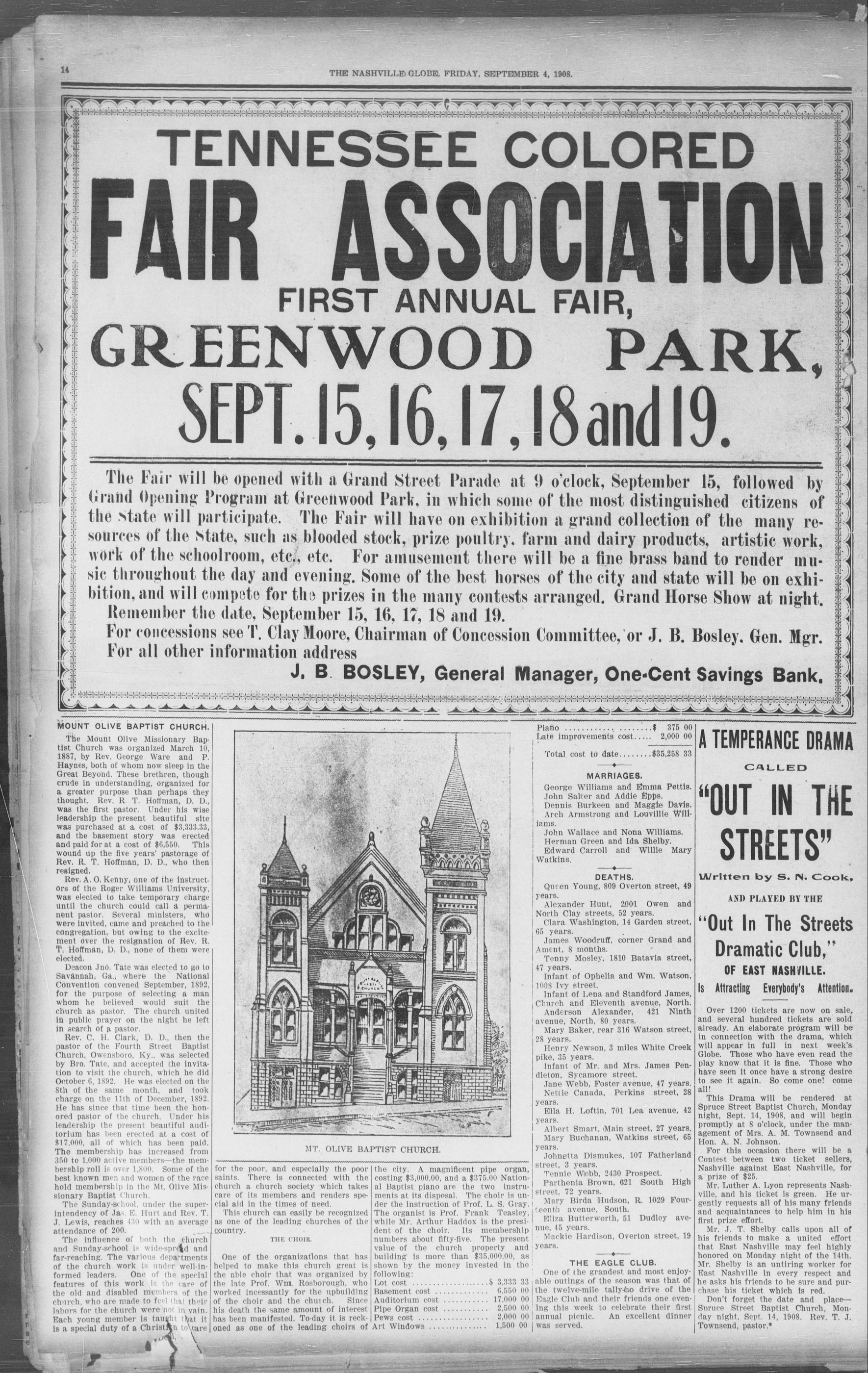
TENNESSEE COLORED FAIR ASSOCIATION FIRST ANNUAL FAIR, GREENWOOD PARK, SEPT.15,16,17,18 and 19.
The Fair will be opened with a Grand Street Parade at 9 o'clock, September 15, followed by Grand Opening Program at Greenwood Park, in which some of the most distinguished citizens of the State will participate. The Fair will have on exhibition a grand collection of the many resources of the State, such as blooded stock, prize poultry, farm and dairy products, artistic work, work of the schoolroom, etc., etc. For amusement there will be a fine brass band to render music throughout the day and evening. Some of the best horses of the city and state will be on exhibition, and will compete for the prizes in the many contests arranged. Grand Horse Show at night. Remember the date, September 15, 16, 17, 18 and 19. For concessions see T. Clay Moore, Chairman of Concession Committee, or J. B. Bosley, Gen. Mgr. For all other information address
J. B. BOSLEY, General Manager, One-Cent Savings Bank.
---
14
MOUNT OLIVE BAPTIST CHURCH.
The Mount Olive Missionary Baptist Church was organized March 10, 1887, by Rev. George Ware and P. Haynes, both of whom now sleep in the Great Beyond. These brethren, though crude in understanding, organized for a greater purpose than perhaps they thought. Rev. R. T. Hoffman, D. D., was the first pastor. Under his wise leadership the present beautiful site was purchased at a cost of $3,333.33, and the basement story was erected and paid for at a cost of $6,550. This wound up the five years' pastorage of Rev. R. T. Hoffman, D. D., who then resigned.
Rev. A. O. Kenny, one of the instructors of the Roger Williams University, was elected to take temporary charge until the church could call a permanent pastor. Several ministers, who were invited, came and preached to the congregation, but owing to the excitement over the resignation of Rev. R. T. Hoffman, D. D., none of them were elected.
Deacon Jno. Tate was elected to go to Savannah, Ga., where the National Convention convened September, 1892, for the purpose of selecting a man whom he believed would suit the church as pastor. The church united in public prayer on the night he left in search of a pastor.
Rev. C. H. Clark, D. D., then the pastor of the Fourth Street Baptist Church, Owensboro, Ky., was selected by Bro. Tate, and accepted the invitation to visit the church, which he did October 6, 1892. He was elected on the 8th of the same month, and took charge on the 11th of December, 1892. He has since that time been the honored pastor of the church. Under his leadership the present beautiful auditorium has been erected at a cost of $17,000, all of which has been paid. The membership has increased from 350 to 1,000 active members—the membership roll is over 1,800. Some of the best known men and women of the race hold membership in the Mt. Olive Missionary Baptist Church.
The Sunday-school, under the superintendency of Jas. E. Hurt and Rev. T. J. Lewis, reaches 430 with an average attendance of 200.
The influence of both the church and Sunday-school is wide-spread and far-reaching. The various departments of the church work is under well-informed leaders. One of the special features of this work is the care of the old and disabled members of the church, who are made to feel that their labors for the church were not in vain. Each young member is taught that it is a special duty of a Christian to care
THE NASHVILLE GLOBE, FRIDAY, SEPTEMBER 4, 1908
PORTS BREWERY
LAST CHURCH
MT. OLIVE BAPTIST CHURCH.
for the poor, and especially the poor saints. There is connected with the church a church society which takes care of its members and renders special aid in the times of need. This church can easily be recognized as one of the leading churches of the country.
One of the organizations that has helped to make this church great is the able choir that was organized by the late Prof. Wm. Rosborough, who worked incessantly for the upbuilding of the choir and the church. Since his death the same amount of interest has been manifested. To-day it is reckoned as one of the leading choirs of
THE CHOIR.
the city. A magnificent pipe organ, costing $3,000.00, and a $375.00 National Baptist piano are the two instruments at its disposal. The choir is under the instruction of Prof. L. S. Gray. The organist is Prof. Frank Teasley, while Mr. Arthur Haddox is the president of the choir. Its membership numbers about fifty-five. The present value of the church property and building is more than $35,000.00, as shown by the money invested in the following:
Lot cost ..... $ 3,333.33
Basement cost ..... 6,550.00
Auditorium cost ..... 17,000.00
Pipe Organ cost ..... 2,500.00
Pews cost ..... 2,000.00
Art Windows ..... 1,500.00
Piano ..... $ 375 00
Late improvements cost..... 2,000 00
MARRIAGES.
George Williams and Emma Pettis.
John Salter and Addie Epps.
Dennis Burkeen and Maggie Davis.
Arch Armstrong and Louvillie Williams.
John Wallace and Nona Williams.
Herman Green and Ida Shelby.
Edward Carroll and Willie Mary Watkins.
DEATHS.
Queen Young, 809 Overton street, 49 years.
Alexander Hunt, 2001 Owen and North Clay streets, 52 years.
Clara Washington, 14 Garden street, 65 years.
James Woodruff, corner Grand and Ament, 8 months.
Tenny Mosley, 1810 Batavia street, 47 years.
Infant of Ophelia and Wm. Watson, 1008 Ivy street.
Infant of Lena and Standford James, Church and Eleventh avenue, North.
Anderson Alexander, 421 Ninth avenue, North, 80 years.
Mary Baker, rear 316 Watson street, 28 years.
Henry Newson, 3 miles White Creek pike, 35 years.
Infant of Mr. and Mrs. James Pendleton, Sycamore street.
Jane Webb, Foster avenue, 47 years.
Nettie Canada, Perkins street, 28 years.
Ella H. Loftin, 701 Lea avenue, 42 years.
Albert Smart, Main street, 27 years.
Mary Buchanan, Watkins street, 65 years.
Johnetta Dismukes, 107 Fatherland street, 3 years.
Tennie Webb, 2430 Prospect.
Parthenia Brown, 621 South High street, 72 years.
Mary Birda Hudson, R. 1029 Fourteenth avenue, South.
Eliza Butterworth, 51 Dudley avenue, 45 years.
Mackie Hardison, Overton street, 19 years.
THE EAGLE CLUB.
One of the grandest and most enjoyable outings of the season was that of the twelve-mile tally-ho drive of the Eagle Club and their friends one evening this week to celebrate their first annual picnic. An excellent dinner was served.
A TEMPERANCE DRAMA
CALLED
"OUT IN THE
STREETS"
Written by S. N. Cook,
AND PLAYED BY THE
"Out In The Streets Dramatic Club," OF EAST NASHVILLE. Is Attracting Everybody's Attention. Over 1200 tickets are new on sale, and several hundred tickets are sold already. An elaborate program will be in connection with the drama, which will appear in full in next week's Globe. Those who have even read the play know that it is fine. Those who have seen it once have a strong desire to see it again. So come one! come all!
This Drama will be rendered at Spruce Street Baptist Church, Monday night, Sept. 14, 1908, and will begin promptly at 8 o'clock, under the management of Mrs. A. M. Townsend and Hon. A. N. Johnson.
For this occasion there will be a Contest between two ticket sellers, Nashville against East Nashville, for a prize of $25.
Mr. Luther A. Lyon represents Nashville, and his ticket is green. He urgently requests all of his many friends and acquaintances to help him in his first prize effort.
Mr. J. T. Shelby calls upon all of his friends to make a united effort that East Nashville may feel highly honored on Monday night of the 14th. Mr. Shelby is an untiring worker for East Nashville in every respect and he asks his friends to be sure and purchase his ticket which is red. Don't forget the date and place—Spruce Street Baptist Church, Monday night, Sept. 14, 1908. Rev. T. J. Townsend, pastor.*
```markdown
```
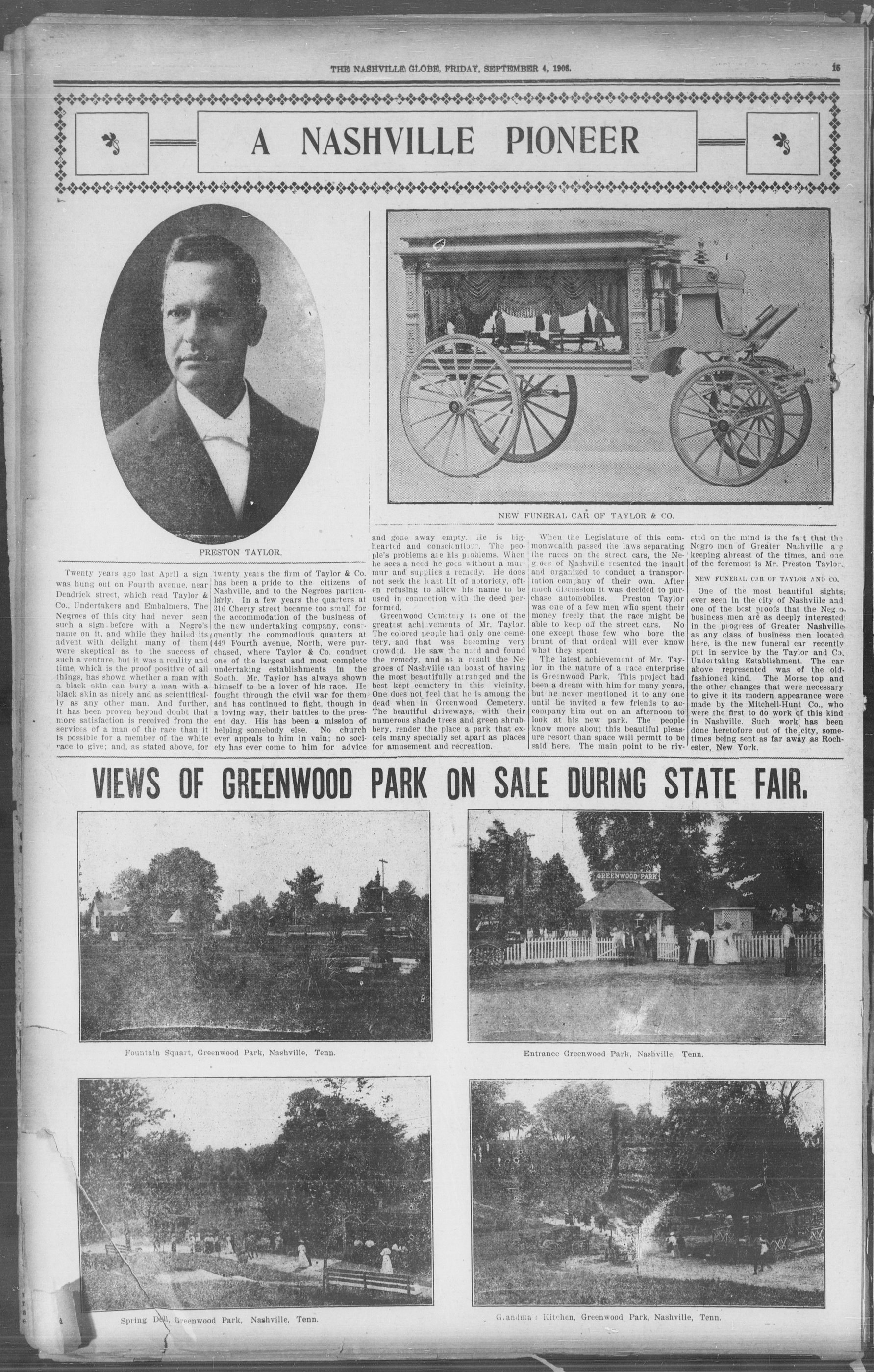
VIEWS OF GREENWOOD PARK ON SALE DURING STATE FAIR.
[Name not visible in the image]
Twenty years ago last April a sign was hung out on Fourth avenue, near Deadrick street, which read Taylor & Co., Undertakers and Embalmers. The Negroes of this city had never seen such a sign before with a Negro's name on it, and while they hailed its advent with delight many of them were skeptical as to the success of such a venture, but it was a reality and time, which is the proof positive of all things, has shown whether a man with a black skin can bury a man with a black skin as nicely and as scientifically as any other man. And further, it has been proven beyond doubt that more satisfaction is received from the services of a man of the race than it is possible for a member of the white race to give; and, as stated above, for
VIEWS OF
VIEWS OF GREENWOOD
THE FOUNTAIN
Fountain Squart, Greenwood Park, Nashville, Tenn.
The image provided is too blurry to accurately recognize any text or details. It appears to be a grayscale photograph of a natural scene, possibly a park or a wooded area, with trees and a building in the background.
THE PARK
THE PARK
Spring Dell, Greenwood Park, Nashville, Tenn.
A NASHVILLE PIONEER
PRESTON TAYLOR.
twenty years the firm of Taylor & Co. has been a pride to the citizens of Nashville, and to the Negroes particularly. In a few years the quarters at 316 Cherry street became too small for the accommodation of the business of the new undertaking company, consequently the commodious quarters at 449 Fourth avenue, North, were purchased, where Taylor & Co. conduct one of the largest and most complete undertaking establishments in the South. Mr. Taylor has always shown himself to be a lover of his race. He fought through the civil war for them and has continued to fight, though in a loving way, their battles to the present day. His has been a mission of helping somebody else. No church ever appeals to him in vain; no society has ever come to him for advice
THE NASHVILLE GLOBE, FRIDAY, SEPTEMBER 4, 1908.
ASHVILLE PION
PIONEER
THE WESTERN WESTERN WESTERN
NEW FUNERAL CAR OF TAYLOR & CO.
OD PARK ON SALE
SALE DURING STAT
GREENWOOD PARK
GREENWOOD PARK
Entrance Greenwood Park, Nashville, Tenn
THE CITY OF BANGKOK
THE CITY OF BANGALORE
G. andma's Kitchen, Greenwood Park, Nashville, Tenn.
---
---
and gone away empty. He is big-hearted and conscientious. The people's problems are his problems. When he sees a need he goes without a murmur and supplies a remedy. He does not seek the least bit of notoriety, often refusing to allow his name to be used in connection with the deed performed.
Greenwood Cemetery is one of the greatest achievements of Mr. Taylor. The colored people had only one cemetery, and that was becoming very crowded. He saw the need and found the remedy, and as a result the Negroes of Nashville can boast of having the most beautifully arranged and the best kept cemetery in this vicinity. One does not feel that he is among the dead when in Greenwood Cemetery. The beautiful driveways, with their numerous shade trees and green shrubbery, render the place a park that excels many specially set apart as places for amusement and recreation.
When the Legislature of this commonwealth passed the laws separating the races on the street cars, the Negroes of Nashville resented the insult and organized to conduct a transportation company of their own. After much discussion it was decided to purchase automobiles. Preston Taylor was one of a few men who spent their money freely that the race might be able to keep off the street cars. No one except those few who bore the brunt of that ordeal will ever know what they spent.
The latest achievement of Mr. Taylor in the nature of a race enterprise is Greenwood Park. This project had been a dream with him for many years, but he never mentioned it to any one until he invited a few friends to accompany him out on an afternoon to look at his new park. The people know more about this beautiful pleasure resort than space will permit to be said here. The main point to be riv-
eted on the mind is the fact that the Negro men of Greater Nashville are keeping abreast of the times, and one of the foremost is Mr. Preston Taylor.
One of the most beautiful sights ever seen in the city of Nashville and one of the best proofs that the Neg o business men are as deeply interested in the progress of Greater Nashville as any class of business men located here, is the new funeral car recently put in service by the Taylor and Co. Undertaking Establishment. The car above represented was of the old-fashioned kind. The Morse top and the other changes that were necessary to give it its modern appearance were made by the Mitchell-Hunt Co., who were the first to do work of this kind in Nashville. Such work has been done heretofore out of the city, sometimes being sent as far away as Rochester, New York.
ONE-CENT SAVINGS BANK
```markdown
```
```markdown
```
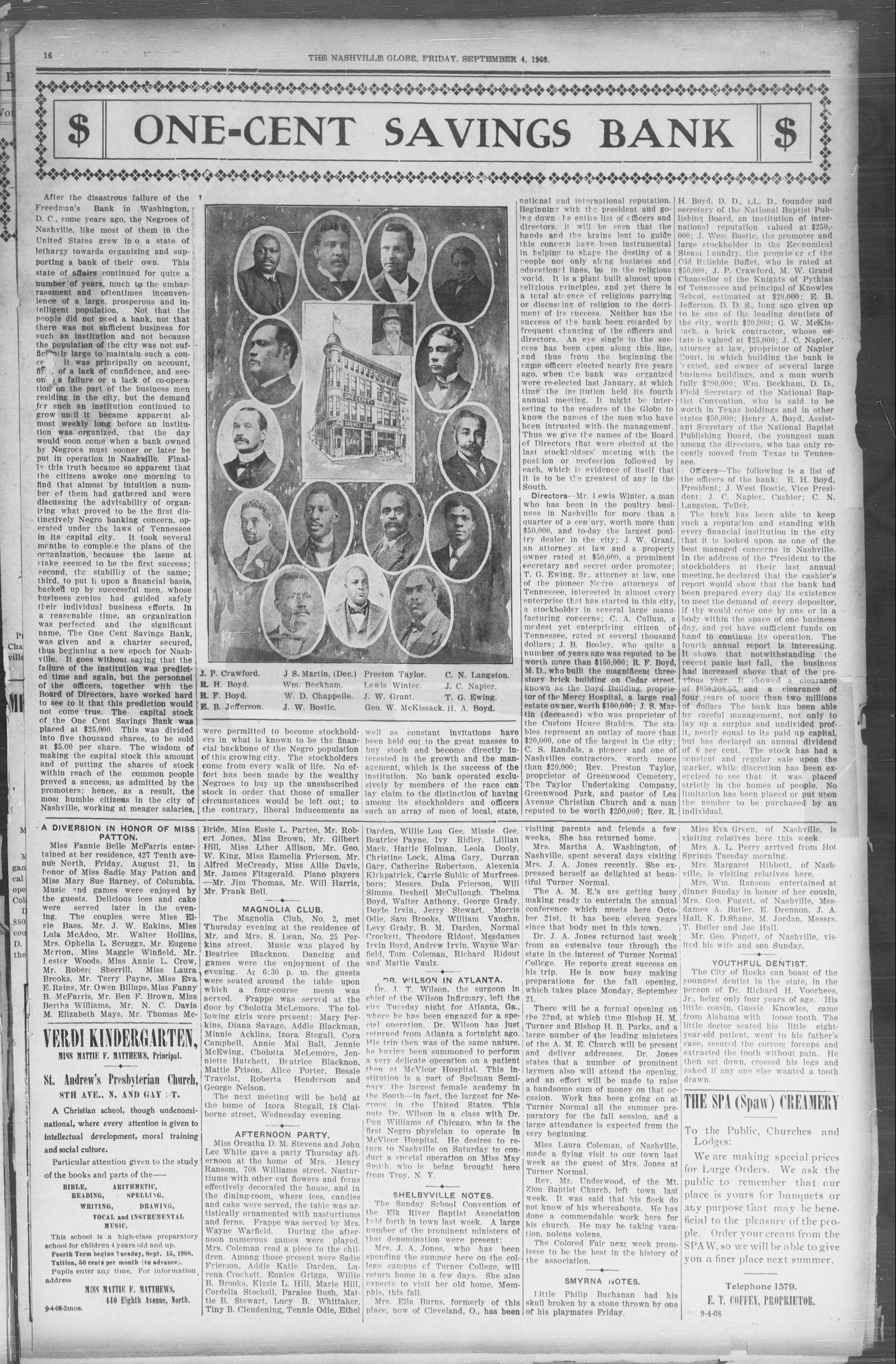
After the disastrous failure of the Freedman's Bank in Washington, D. C., some years ago, the Negroes of Nashville, like most of them in the United States grew into a state of lethargy towards organizing and supporting a bank of their own. This state of affairs continued for quite a number of years, much to the embarrassment and oftentimes inconvenience of a large, prosperous and intelligent population. Not that the people did not need a bank, not that there was not sufficient business for such an institution and not because the population of the city was not sufficiently large to maintain such a conce. It was principally on account, first, of a lack of confidence, and second, a failure or a lack of co-operation on the part of the business men residing in the city, but the demand for such an institution continued to grow until it became apparent almost weekly long before an institution was organized, that the day would soon come when a bank owned by Negroes must sooner or later be put in operation in Nashville. Finally this truth became so apparent that the citizens awoke one morning to find that almost by intuition a number of them had gathered and were discussing the advisability of organizing what proved to be the first distinctively Negro banking concern, operated under the laws of Tennessee in its capital city. It took several months to complete the plans of the organization, because the issue at stake seemed to be the first success; second, the stability of the same; third, to put it upon a financial basis, backed up by successful men, whose business genius had guided safely their individual business efforts. In a reasonable time, an organization was perfected and the significant name, The One Cent Savings Bank, was given and a charter secured, thus beginning a new epoch for Nashville. It goes without saying that the failure of the institution was predicted time and again, but the personnel of the officers, together with the Board of Directors, have worked hard to see to it that this prediction would not come true. The capital stock of the One Cent Savings Bank was placed at $25,000. This was divided into five thousand shares, to be sold at $5.00 per share. The wisdom of making the capital stock this amount and of putting the shares of stock within reach of the common people proved a success, as admitted by the promoters; hence, as a result, the most humble citizens in the city of Nashville, working at meager salaries,
· A DIVERSION IN HONOR OF MISS PATTON.
Miss Fannie Belle McFarris entertained at her residence, 427 Tenth avenue North, Friday, August 21, in honor of Miss Sadie May Patton and Miss Mary Sue Barney, of Columbia. Music and games were enjoyed by the guests. Delicious ices and cake were served later in the evening. The couples were Miss Elsie Bass, Mr. J. W. Eakins, Miss Lula McAdoo, Mr. Walter Hollins, Mrs. Ophelia L. Scruggs, Mr. Eugene Mrton, Miss Maggie Winfield, Mr. Iester Woods, Miss Annie L. Crow, Mr. Robert Sherrill, Miss Laura Brooks, Mr. Terry Payne, Miss Eva E.Rains, Mr. Owen Billups, Miss Fanny B. McFarris, Mr. Ben F. Brown, Miss Bertha Williams, Mr. N. C. Davis M. Elizabeth Mays, Mr. Thomas Mc-
VERDI KINDERGARTEN,
MISS MATTIE F. MATTHEWS, Principal.
St. Andrew's Presbyterian Church, 8TH AVE., N. AND GAY ST.
A Christian school, though undenominational, where every attention is given to intellectual development, moral training and social culture.
Particular attention given to the study of the books and parts of the——
BIBLE, ARITHMETIC,
READING, SPELLING,
WRITING, DRAWING,
VOCAL and INSTRUMENTAL
MUSIC.
This school is a high-class preparatory school for children 4 years old and up.
Fourth Term begins Tuesday, Sept. 15, 1908.
Tution, 50 cents per month (in advance).
Pupils enter any time. For information, address
THE NASHVILLE GLOBE, FRIDAY, SEPTEMBER 4, 1908.
ONE CENT
SAVINGS BANK
BANK
were permitted to become stockholders in what is known to be the financial backbone of the Negro population of this growing city. The stockholders come from every walk of life. No effort has been made by the wealthy Negroes to buy up the unsubcribed stock in order that those of smaller circumstances would be left out; to the contrary, liberal inducements as Bride, Miss Essie L. Partee, Mr. Robert Jones, Miss Brown, Mr. Gilbert Hill, Miss Lther Allison, Mr. Geo. W. King, Miss Eamelia Frierson, Mr. Alfred McCready, Miss Allie Davis, Mr. James Fitzgerald. Piano players —Mr. Jim Thomas, Mr. Will Harris, Mr. Frank Bell.
MAGNOLIA CLUB
The Magnolia Club, No. 2, met Thursday evening at the residence of Mr. and Mrs. S. Dean, No. 25 Perkins street. Music was played by Beatrice Blacknon. Dancing and games were the enjoyment of the evening. At 6:30 p.m. the guests were seated around the table upon which a four-course menu was served. Frappe was served at the door by Cholotta McLemore. The following girls were present: Mary Perkins, Diana Savage, Addie Blackman, Minnie Acklins, Izora Stegall, Cora Campbell, Annie Mai Ball, Jennie McEwing, Cholotta McLemore, Jennie Hatchett, Beatrice Blacknon, Mattie Frison, Alice Porter, Bessie Travelst, Roberta Henderson and George Nelson.
The next meeting will be held at the home of Izora Stegall, 18 Clalborne street, Wednesday evening.
AFTERNOON PARTY
Miss Oreatha D. M. Stevens and John Lee White gave a party Thursday afternoon at the home of Mrs. Henry Ransom, 708 Williams street. Nasturtiums with other cut flowers and ferns effectively decorated the house, and in the dining-room, where ices, candies and cake were served, the table was artistically ornamented with nasturtiums and ferns. Frape was served by Mrs. Wayne Warfield. During the afternoon numerous games were played. Mrs. Coleman read a piece to the children. Among those present were Sadie Frierson, Addie Katie Darden, Lurena Crockett, Eunice Griggs, Willie B. Brooks, Kizzie L. Hill, Marie Hill, Cordelia Stockell, Paralee Bush, Mattie B. Stewart, Lucy B. Whittaker, Tiny B. Clendening, Tennie Odie, Ethel
well as constant invitations have been held out to the great masses to buy stock and become directly interested in the growth and the management, which is the success of the institution. No bank operated exclusively by members of the race can lay claim to the distinction of having among its stockholders and officers such an array of men of local, state.
Darden, Willie Lou Gee, Missie Gee, Beatrice Payne, Ivy Ridley, Lillian Mack, Hattie Holman, Leola Doole, Christine Lock, Alma Gary, Durran Gary, Catherine Robertson, Alexenia Kirkpatrick, Carrie Public of Murfreessboro; Messrs. Dula Frierson, Will Simms, Deshell McCullough, Thelma Boyd, Walter Anthony, George Grady, Doyle Irvin, Jerry Stewart, Morris Odie, Sam Brooks, William Vaughn, Levy Grady, B. M. Darden, Normal Crockett, Theodore Ridout, Mesdames Irvin Boyd, Andrew Irvin, Wayne Warfield, Tom Coleman, Richard Ridout and Mattie Vaulx.
DR. WILSON IN ATLANTA
Dr. J. T. Wilson, the surgeon in chief of the Wilson Infirmary, left the city Tuesday night for Atlanta, Ga., where he has been engaged for a special operation. Dr. Wilson has just returned from Atlanta a fortnight ago. His trip then was of the same nature, he having been summoned to perform a very delicate operation on a patient then at McVicar Hospital. This institution is a part of Spelman Seminary, the largest female academy in the South—in fact, the largest for Negroes in the United States. This puts Dr. Wilson in a class with Dr. Dan Williams of Chicago, who is the first Negro physician to operate in McVicar Hospital. He desires to return to Nashville on Saturday to conduct a special operation on Miss May Smith, who is being brought here from Troy, N. Y.
SHELBYVILLE NOTES
The Sunday School Convention of the Elk River Baptist Association held forth in town last week. A large number of the prominent ministers of that denomination were present: Mrs. J. A. Jones, who has been spending the summer here on the college campus of Turner College, will return home in a few days. She also expects to visit her old home, Memphis, this fall. Mrs. Ella Burns, formerly of this place, now of Cleveland, O., has been
national and international reputation. Beginning with the president and going down the entire list of officers and directors, it will be seen that the hands and the brains lent to guide this concern have been instrumental in helping to shape the destiny of a people not only along business and educational lines, but in the religious world. It is a plant built almost upon religious principles, and yet there is a total absence of religious parrying or discussing of religion to the detriment of its success. Neither has the success of the bank been retarded by frequent changing of the officers and directors. An eye single to the success has been open along this line, and thus from the beginning the same officers elected nearly five years ago, when the bank was organized were re-elected last January, at which time the institution held its fourth annual meeting. It might be interesting to the readers of the Globe to know the names of the men who have been intrusted with the management. Thus we give the names of the Board of Directors that were elected at the last stockholders' meeting with the position or profession followed by each, which is evidence of itself that it is to be the greatest of any in the South.
Directors—Mr. Lewis Winter, a man who has been in the poultry business in Nashville for more than a quarter of a century, worth more than $50,000, and to-day the largest poultry dealer in the city; J. W. Grant, an attorney at law and a property owner rated at $50,000, a prominent secretary and secret order promoter; T. G. Ewing, Sr., attorney at law, one of the pioneer Negro attorneys of Tennessee, interested in almost every enterprise that has started in this city, a stockholder in several large manufacturing concerns; C. A. Cullum, a modest yet enterprising citizen of Tennessee, rated at several thousand dollars; J. B. Bosley, who quite a number of years ago was reputed to be worth more than $150,000; R. F. Boyd, M.D., who built the magnificent three-story brick building on Cedar street, known as the Boyd Building, proprietor of the Mercy Hospital, a large real estate owner, worth $100,000; J. S. Martin (deceased) who was proprietor of the Custom House Stables. The stables represent an outlay of more than $20,000, one of the largest in the city; C. S. Randals, a pioneer and one of Nashville contractors, worth more than $20,000; Rev. Preston Taylor, proprietor of Greenwood Cemetery, The Taylor Undertaking Company, Greenwood Park, and pastor of Lea Avenue Christian Church and a man reputed to be worth $200,000; Rev. R.
visiting parents and friends a few weeks. She has returned home. Mrs. Martha A. Washington, of Nashville, spent several days visiting Mrs. J. A. Jones recently. She expressed herself as delighted at beautiful Turner Normal. The A. M. E.'s are getting busy making ready to entertain the annual conference which meets here October 21st. It has been eleven years since that body met in this town. Dr. J. A. Jones returned last week from an extensive tour through the state in the interest of Turner Normal College. He reports great success on his trip. He is now busy making preparations for the fall opening, which takes place Monday, September 21.
There will be a formal opening on the 22nd, at which time Bishop H. M. Turner and Bishop H. B. Parks, and a large number of the leading ministers of the A. M. E. Church will be present and deliver addresses. Dr. Jones states that a number of prominent laymen also will attend the opening, and an effort will be made to raise a handsome sum of money on that occasion. Work has been going on at Turner Normal all the summer preparatory for the fall session, and a large attendance is expected from the very beginning.
Miss Laura Coleman, of Nashville, made a flying visit to our town last week as the guest of Mrs. Jones at Turner Normal.
Rev. Mr. Underwood, of the Mt. Zion Baptist Church, left town last week. It was said that his flock do not know of his whereabouts. He has done a commendable work here for his church. He may be taking vacation, nolens volens. The Colored Fair next week promisese to be the best in the history of the association.
SMYRNA NOTES
Little Philip Buchanan had his skull broken by a stone thrown by one of his playmates Friday.
$
H. Boyd, D. D., LL. D., founder and secretary of the National Baptist Publishing Board, an institution of international reputation valued at $250,000; J. West Bostic, the promoter and large stockholder in the Economical Steam Laundry, the proprietor of the Old Reliable Buffet, who is rated at $50,000; J. P. Crawford, M. W. Grand Chancellor of the Knights of Pythias of Tennessee and principal of Knowles School, estimated at $20,000; E. B. Jefferson, D. D. S., long ago given up to be one of the leading dentists of the city, worth $20,000; G. W. McKissack, a brick contractor, whose estate is valued at $25,000; J. C. Napier, attorney at law, proprietor of Napier Court, in which building the bank is located, and owner of several large business buildings, and a man worth fully $200,000; Wm. Beckham, D. D., Field Secretary of the National Baptist Convention, who is said to be worth in Texas holdings and in other states $50,000; Henry A. Boyd, Assistant Secretary of the National Baptist Publishing Board, the youngest man among the directors, who has only recently moved from Texas to Tennessee.
Officers—The following is a list of the officers of the bank: R. H. Boyd, President; J. West Bostic, Vice President; J. C. Napier, Cashier; C. N. Langston, Teller.
The bank has been able to keep such a reputation and standing with every financial institution in the city that it is looked upon as one of the best managed concerns in Nashville. In the address of the President to the stockholders at their last annual meeting, he declared that the cashier's report would show that the bank had been prepared every day its existence to meet the demand of every depositor, if they would come one by one or in a body within the space of one business day, and yet have sufficient funds on hand to continue its operation. The fourth annual report is interesting. It shows that notwithstanding the recent panic last fall, the business had increased above that of the previous year. It showed a clearance of $650,208.53, and a clearance of four years of more than two millions of dollars. The bank has been able by careful management, not only to lay up a surplus and undivided profit, nearly equal to its paid up capital, but has declared an annual dividend of 6 per cent. The stock has had a constant and regular sale upon the market, while discretion has been exercised to see that it was placed strictly in the homes of people. No limitation has been placed or put upon the number to be purchased by an individual.
Miss Eva Green, of Nashville, is visiting relatives here this week.
Mrs. A. L. Perry arrived from Hot Springs Tuesday morning.
Mrs. Margaret Hibbett, of Nashville, is visiting relatives here.
Mrs. Wm. Ransom entertained at dinner Sunday in honor of her cousin, Mrs. Geo. Fugett, of Nashville, Mesdames A. Butler, E. Drennon, J. A. Hall, K. D.Shane, M. Jordan, Messrs, T. Butler and Joe Hall.
Mr. Geo. Fugett, of Nashville, visited his wife and son Sunday.
YOUTHEFUL DENTIST
The City of Rocks can boast of the youngest dentist in the state, in the person of Dr. Richard H. Voorhees, Jr., being only four years of age. His little cousin, Gussie Knowles, came from Alabama with loose tooth. The little doctor seated his little eight-year-old patient, went to his father's case, secured the correct forceps and extracted the tooth without pain. He then sat down, crossed his legs and asked if any one else wanted a tooth drawn.
THE SPA (Spaw) CREAMERY
To the Public, Churches and Lodges: We are making special prices for Large Orders. We ask the public to remember that our place is yours for banquets or any purpose that may be beneficial to the pleasure of the people. Order your cream from the SPAW, so we will be able to give you a finer place next summer.
Telephone 1579.
E. T. COFFEY, PROPRIETOR.
9-4-08
```markdown
```
MERCY HOSPITAL
---
VOL. III.
5
R. F. BOYD, A. M., M. D., D. D S.,
Professor of Gnaecology and Abdomin
Chairman of the Executive Board Natio
ville's leading citizens.
MEHARRY, MEDICAL, DE
TICAL COLLEGES,
SITY, NASHVILLE
MEDICAL, DENTAL AND HOSPITAL COLLEGES, WALDEN U.S.Y, NASHVILLE, TENNESSEE
Professor of Gnaecology and Abdominal Surgery in Meharry Medical College, Chairman of the Executive Board National Medical Association. One of Nashville's leading citizens.
MEHARRY, MEDICAL, DENTAL AND PHARMACEUTICAL COLLEGES, WALDEN UNIVERSITY, NASHVILLE, TENNESSEE.
MEHARRY, MEDICAL, DENTAL AND PHARMACEUTICAL COLLEGES, WALDEN UNIVERSITY, NASHVILLE, TENNESSEE.
MEHARRY MEDICAL COLLEGE.
Meharry Medical College was organized in 1876 and was the first Medical School in the Southern States to open its doors for the education of Colored Physicians. During the 32 years of its existence 880 students have completed a medical course and received the degree of M. D. They constitute about one-half of the regular graduated Colored Physi
MISSUCHI
38
LEAVENWOOD
MISSOURI
KANSAS
18
MIDWAY
MIDWAY
MIDWAY
QUARTY
LOCATION OF THE GRADUATES
OF MEHARRY MEDICAL COLLEGE.
WALDEN UNIVERSITY
THE PROKES SHOW THE NUMBER
RESIDING IN EACH STATE.
Class of 1908 not included
PART THREE
THE NASHVILLE GLOBE
MENTAL AND PHARMACEU.
WALDEN UNIVER-
LE, TENNESSEE.
cians of the Southern and Southwestern States.
They have been well received by the white physicians of the South and their success both financial and professional has been most gratifying to their Alma Mater and creditable to their race. Most of them have comfortable and some even elegant homes, good libraries and well furnished offices.
During the past session 285 Medical students were enrolled.
NASHVILLE, TENN., SEPTEMBER 4, 1908.
THE MUSEUM
Mercy Hospital, which is located at 811 Fourth avenue, South, is a two-story structure of twelve rooms, and contains twenty-three beds, most of which are of the latest hospital pattern. During the past school session over 217 patients have been treated, with a mortality from all causes of about two per cent. The surgical work has been of a very high degree of excellence, and many difficult major operations have been performed by local surgeons and Dr. Daniel H. Williams, of Chicago, who spends a week or ten days operating in this hospital every year. These operations have been of every class and kind, including the removal of fibroid tumors, diseased ovaries and tubes, ovarian cysts, amputations and appendectomies. Thirteen house nurses, under Mrs. M. A. Bailey as head nurse, have been in attendance during the school year, and the whole nurse-training classes are in constant attendance when needed. This hospital has been under the management of the faculty of Meharry, and the senior students have served as internes and externes. In connection with this hospital in the nurse-training school of Meharry, where a limited number of applicants for the nurse-training course may be admitted. The alumni and other physicians throughout the country may send or bring their patients to this hospital for treatment and surgical
MERCY HOSPITAL
MERCY HOSPITAL.
operations at all times. For further information address the Superintendent in charge, or R. F. Boyd, Surgeonin-Chief.
Weekly clinics have been held at the College under the direction of Drs. J. T. Wilson, G. H. Bandy, S. S. Caruthers and J. A. McMillan. Each Saturday clinics are held by Dr. R. F. Boyd at Mercy Hospital.
MEHARRY MEDICAL COLLEGE.
REQUIREMENTS FOR ADMISSION.
This College is a member of the Association of American Medical Colleges and according to the rules of this Association the requirements for admission demand four years of a High School, Normal School or Academic course or the equivalent.
The course of study requires four sessions of seven months each. Beginning with the coming sessions about 4,100 hours' work are required. This includes Lectures, Clinics, Laboratory work and Recitations. Special attention is given to Laboratory work in Chemistry, Embryology, Histology, Pathology, Physiology and Electro-Theapeutics
Tuition is .$50 per session. The next session opens on the 9th of September, 1908.
MEHARRY DENTAL COLLEGE.
Meharry Dental College was opened in 1886. One hundred and sixteen Dental students were enrolled during the past session and there have been one hundred and twenty-three graduates.
The course of study consists of four
CLINICS
COURSE OF STUDY.
TUITION.
No. 35
MERCY HOSPITAL
HOSPITAL.
Dr. Daniel H. Williams, one of the leading colored surgeons of Chicago, and a member of the medical staff of Cook County Hospital, held surgical clinics and successfully performed a number of rare and difficult operations.
The members of the senior class have attended obstetrical cases under the direction of Dr. W. R. Baker.
Weekly clinics on diseases of the Ear, Eye, Nose and Throat have been held by Dr. C. V. Roman.
The image provided is too blurry to accurately recognize any text. It appears to be a grayscale photograph of a natural scene, possibly a forest or a park, with trees and foliage in the foreground. The background is mostly obscured by mist or fog.
sessions of six months each, and the requirements for admission are three years of a High School course or its equivalent in addition to an English course of eight years.
There are 16 members in the Dental Faculty.
The tuition is $50 per session.
This College is a member of the National Association of Dental Faculties.
The next session opens on the 23rd of September and all students must be present not later than 10 days after this date in order to be credited with a full session's attendance.
MEHARRY PHARMACEUTICAL COL
LEGE.
Meharry Pharmaceutical College was organized in 1889, and has had 106 graduates; 66 students were enrolled during the past session.
The requirements for admission are a good English education and one year of Latin and Physics.
The course of study consists of 3 sessions of 6 months each.
The tuition is $40 per session.
The demand for well qualified Colored Pharmacists far exceeds the supply. The next session opens on the 23rd of September.
For further information or catalogue address Dr. G. W. Hubbard, Dean, Moharry Medical College, Nashville, Tennessee.
PART THREE
No. 35
E E
THE WILSON INFIRMARY
This Infirmary is open for the reception and treatment of all patients who may apply. Special attention and unexcelled skill and service given all surgical cases. Careful well-trained nurses always on hand. Rooms large, clean, and well ventilated. Private rooms furnished at a moderate price to patients who may desire to be entirely secluded.
Since the incorporation of this Infirmary, cases of all kinds, surgical and otherwise, have been successfully treated, with a death rate of only one percent. All physicians are permitted to bring patients and treat or operate themselves, or have the operating done by any one they desire. Rates reasonable. Donations solicited and gratefully received for the treatment and care of charitable patients. Write for information.
OFFICERS----BOARD OF DIRECTORS.
C. O. HADLEY, M. D., President, 1103 Cedar Street.
W. A. REED, M. D., Vice President.
G. H. BANDY, M. D., Treasurer
A. M. TOWNSEND, M. D., Secretary, 537 Main Street.
J. T. WILSON, M. D., Surgeon-in-Chief.
J. W. HALE, M. D., Business Manager, 408 Cedar Street.
J. A. McMILLAN, M. D., Assistant Business Manager.
REV. PRESTON TAYLOR.
BISHOP EVANS TYREE.
PROPERTY OWNERS OF NASHVILLE
PROPERTY OWNERS OF NASHVILLE
BY T. CLAY MOORE. REAL ESTATE AGENT.
18
One of the surest signs of success and progress among any people is the amount of property owned and taxes paid thereon. The amount of influence one has in a community depends largely upon whether or not he is a taxpayer. Along the line of property owners throughout the entire country the Negroes of Nashville easily rank among the first
There is more property in Nashville owned by Negroes than in most any other city of equal size and many of larger size. This is not speaking disparagingly of the other cities, for in almost any city you may go, you will find Negroes owning nice homes and rental property. The schools of which we can so proudly boast, the pulpit which is second to none either in intelligence or morals, and many other influences have taught the Negroes of Nashville independence and self respect until now, no one feels himself wholly a citizen until he becomes a taxpayers and property owner.
It is now almost a craze among the people to own a home no matter how small; the laborer making his six or nine dollars per week will pay five or ten dollars per month on property: true it may take him a long time to pay for it, but if he lives he will some day own his little home, which will be an inspiration to his children to own a better one. The cook, the nurse, the business and professional man, all are striving and acquiring property at every available opportunity. The Negro in Nashville owns from his one room hut to the finest of mansions. Some of the finest farms in the state are owned by Negroes.
Even in the most exclusive neighborhoods, where every effort has been made to exclude the Negro, you will find him; around Vanderbilt, Belmont and the Murphy addition, the most aristocratic settlements, you will find the property of Negroes, and many of them living there.
They very often have their auction sales exclusively for whites, but when the deeds, etc., are recorded you will find some of the property belonging to Negroes. There are whole settlements belonging largely to Negroes.
Around Fisk University there are some of the nicest homes in the city—all owned by Negroes; near Walden University are other colored settlements, with the home of Bishop Evans. Types which in itself is a thing of
THE NASHVILLE GLOBE, FRIDAY, SEPTEMBER 4, 1908.
reception and treatment of all patient cases. Careful well-trained men at a moderate price to patients in confirmary, cases of all kinds, so that all physicians are permitted to desire. Rates reasonable. Patients. Write for information.
THE HOTEL
beauty to be admired by all and a credit to the race. There are numerous mansions that could be mentioned, but space will not permit of it.
We have property owners here who own blocks of rental property, and others who pay taxes on more than 100 pieces of property. Among the property owners the Burrus brothers can easily rank with any in the city, white or black. Dr. R. F. Boyd, Hon. J. C. Napier, Dr. H. T. Noel, Dr. F. A. Stewart, Rev. Preston Taylor and many oth-
[Name]
T. CLAY MOORE.
ers pay hundreds of dollars in taxes every year. No wonder that such men have influence in the community in which they live. There is also much business property owned by Negroes; bank buildings, office buildings, lodge halls, stores, etc., valued at many thousand dollars.
Hon. A. N. Johnson, who has recently come into our city and embarked in the undertaking business, has just recently purchased a very valuable piece of business property just about one and one-half blocks from the capitol and two blocks from the public square.
The Napier Court, in which is lo-
---
( INCORPORATED )
treatment of all patients who are
fuel well-trained nurses always
price to patients who may desire
uses of all kinds, surgical and other
ans are permitted to bring patient
ates reasonable. Donations soli
or information.
cated the One Cent Savings Bank is a monument to the race as well as the beautiful Pythian Temple and Odd Fellows Hall. The Negro has realized that to make oneself permanent and felt in the community in which he lives that it is absolutely necessary to be a property owner; the individual who is a property owner gets more consideration from the general public than one who is not, he commands the respect of others more and is more readily recognized in the business world. If you want a bill of goods from some merchant, the minute he finds out that you are a property holder, he is more ready to accommodate you, he knows that there is some solidity to you, that you cannot afford to pick up and run off leaving your debts
behind you, and that you have something at stake and are a great deal more to be trusted than one who owns nothing.
The watchword of the Negro should be to own something and be something; with education which he is fast acquiring, money and property, he will of necessity be given his place in the life and councils of the community in which he lives. It is logical that if you pay taxes upon your property you should most certainly have a say as to how it is to be spent, for upon this very principle is our government founded.
Just at this stage in the life of the
---
During the week, beginning October 19, 1908, this Infirmary will hold a Surgical Clinic. Dr. J. T. Wilson, Surgeon-in-Chief, in charge. All kinds of operations will be performed. Physicians who may desire a take advantage of this opportunity can easily make arrangements by writing to Dr. Wilson, or to the Secretary, Dr. A. M. Townsend, 537 Main Street.
This Infirmary offers also a Nurse Training Course of three years.
Negro, when there are so many perplexing questions before him and when it is absolutely necessary for him to be felt in the community no one is in position to be of more service than the Real Estate Agent. A conscientious agent, who is not trying to deceive or defraud the people, is as much of a necessity as a preacher. He has a mission to perform which, if well done, will yield an untold amount of good to generations yet unborn. Any race that has something is self-respecting, and when we respect ourselves, we demand the respect of others. One of the surest signs that the Negro's condition is getting better or is going to get better, is that he is acquiring property; hardly a day passes but that some Negro's name is recorded in the Real Estate transfers of this city.
In spite of the many difficulties which he has to face, the many lucrative positions closed to him, and the decided disadvantage with which he has to compete with the other man, he is forging to the front and so rapidly that a howl has gone up, which is one of the best evidences in the world that he is doing something; because the man who accomplishes something is the man who makes enemies and knockers and what is true of the individual is true of the race.
Nashville is setting the pace in acquiring property and is a long way on the road. Let others follow her example. Let those within her borders take up the watchword, and those who do not own a home should own one before another year rolls around.
DR. HADLEY RETURNS.
DR. HADLEY RETURNS.
Dr. C. O. Hadley returns after an absence of more than three weeks from the city. While away he visited his sister, Mrs. F. L. Faulkner, of Denver, Colo. It was in Denver that he met the Nashville Colony, who were very hospitable, entertaining him royally, Dr. T. Ernest McClain heading the list. Dr. Hadley stated to a Globe reporter that the Meharry students in the West are doing exceptionally well. Each of them seems to enjoy excellent practice. On his return he stopped over at Kansas City, Mo., and at this place as at Denver the Meharry graduates took charge of him and gave him a royal reception. He declared that his vacation was helpful and he feels like going into work as never before.
REV. HARDING CONTINUES TO IMPROVE
News has reached the city that the Rev. Lester Harding, who has been in Denver for several months on account of his health, is rapidly improv-
ing. It is stated that he has gained perhaps thirty pounds in the dry air of Denver. This will be welcome news to many of the Baptists of the city, as Rev. Harding, who is the pastor of the Third Avenue Baptist Church, is one of the rising young men of the denomination. Rev. Harding, who is greatly beloved by the members of his church, was granted a lave of absence to go West in the effort to regain his health, which was fast failing. During his absence services at the Third Avenue Church have been under the direction of his father, the Rev. Jack Harding. It is not known definitely when Rev. Harding will return.
LEAVES FOR TUSKEGEE.
Miss Miranda Winter, the youngest daughter of L. Winter, left the city Monday morning for Tuskegee Institute, Ala. Miss Winter goes to the famous Tuskegee Institute to accept a position in the musical department where she will doubtless be a valuable assistant to Mrs. Jennie Cheatham Lee, of this city, who has charge of the vocal music of the school. Miss Winter, besides being a graduate of the Musical Department of Fisk University, where she was a student of the piano, possesses a voice of remarkable sweetness and has been a favorite with many of the parlor musical clubs of the city.
VISITING OLD FRIENDS
Miss Florence Jackson, of Pensacola, Fla., is spending a few weeks in the city the guest of Mr. and Mrs. Jno. L. Harlin, of Lewis street. Miss Jackson is a recent graduate of the college department of Fisk University. During her school life she boarded in the city and likewise spent her summers here, hence possesses a host of Nashville acquaintances. Miss Jackson is teaching at one of the A. M. A. schools in North Carolina and stopped over in this city in order to see a few of her many friends before taking up her work.
ENJOYABLE DINNER
Mrs. Jerry Collins, of 2411 Pinson street, entertained Mrs. Jesse Johnson and two children, of Chicago, and also Mrs. Pinkard, of Ohio, at dinner Friday, August 28. The table was beautifully decorated with cut glass, china, and fine linens and a centerpiece of the same material. Two courses were served—baked fish cream potatoes, stuffed pepper, beat en biscuits and ginger punch, fruits, ices and cakes.
THE NASHVILLE GLÔBE, FRIDAY, SEPTEMBER 4, 1908.
OWNED, CONTROLLED BAP
NED, CONTROLLED and OPERATED
BY THE
LORED BAPTISTS of TENNESSEE
MORE
THAN 400
ALUMNI
DISCIPLINE
FIRM
THE MUSEUM
ROGER UNI
ROGER WILLIAMS
UNIVERSITY
NASHVILLE, - - TENNESSEE
Ideal College Site--Healthfulness
and Beauty Unsurpassed
DEPARTMENTS:
ROGER WILLIAMS UNIVERSITY
NASHVILLE in Ideal College and Bea DE
An Ideal College Site--Healthfulness and Beauty Unsurpassed
COLLEGE, ACADEMIC, NORMAL ENGLISH, THEOLOGICAL.
(Modern four-story brick dormitory for girls under process of erection.)
m Begins September 29, 1908 FOR PARTICULARS ADDRESS
J. W. JOH
W. JOHNSON, President
J. W. JOHNSON, President
FOUNDED
1866
INSTRUCT-
ION
THOROUGH
MORE THAN 400 ALUMNI DISCIPLINE FIRM
GEO. W. McKISSACK,
Contractor, Builder and Practical Bricklayer
He has always been able to please the homefolks. He has contracted for and erected some of the most substantial buildings in the city. FOR ALL OTHER INFORMATION APPLY AT
ROOMS 1 and 2
TELEPHONE M
PLACE YOUR NEXT
J. D. MA
HAY, CORN, OAT
TELEPHONE 1097.
1 and 2 Napier
TELEPHONE MAIN, 147
PLACE YOUR NEXT ORDER WITH
D. MARTIN
CORN, OATS, BRAN
TELEPHONE 1097. 205 FIFTH AV
ille, Ter
and 2 Napier Court.
HONE MAIN, 1477.
YOUR NEXT ORDER WITH
MARTIN,
N, OATS, BRAN, ETC.,
E 1097. 205 FIFTH AVE., S.
Rooms 1 and 2 Napier Court.
TELEPHONE MAIN, 1477.
J. D. MARTIN, HAY, CORN, OATS, BRAN, ETC., TELEPHONE 1097. 205 FIFTH AVE., S.
PHONES
OFFICE, Main 2093
Res. Main 4092-Y
T. CLAY MOORE,
Notary Public.
CLAY MOORE & CO.,
LICENSED
Renting, Buying
Selling Property a Specialty
PLACE YOU WANT SEE US.
(Pythian Temple) Nashville, Tenn.
I. L. MOORE. PHONE
OFFICE, Main
Res. Main 400
T. CLAY MOORE
LICENSE
Real Estate and Loan Agre-
and Selling Property
FOR ANY PLACE YOU
428 Fifth Ave., N., (Pythian
PHONES
OFFICE, Main 2093
Res. Main 4092-Y
CLAY MOORE & O
LICENSED
Renting
and Selling Property a Specialty
FOR ANY PLACE YOU WANT SEE
Ave., N., (Pythian Temple) Nas
Real Estate and Loan Agents. Renting, Buying and Selling Property a Specialty
428 Fifth Ave., N., (Pythian Temple) Nashville, Tenn.
WHITE'S SPECIFIC FOR THE COMPLEXION
THE GREAT BEAU
A harmless preparation for the s
Pimples and Ringworms and remove
Sunburn and Blackheads.
READ THE FOLLOWING LETTER:
Chattanooga
DEAR SIR:—I have been using your
find it extremely satisfactory. I would
consider it the best cream made for bl
etc.
MISS NETTIE THOM
If your druggist does not keep it in stor
box promptly upon receipt of the price.
WHITE SPECIFI
Union and Summer Sts.,
CE YOUR NEXT ORDER
NASHVILLE WOOD AND
SUCCESSORS TO
F. L. DUFFY & CO
best burning Coal in the city. A
Our terms are easy, and made
any grade of coal you wish
COAL WILL ADVANCE NOW EACH MON
THE WISE IS SUFFICIENT."
G. SLAUGHTER, Man
THE GREAT BEAUTIFIER.
A harmless preparation for the skin that will cure Simples and Ringworms and remove Freckles, Tan, Sunburn and Blackheads.
READ THE FOLLOWING LETTER:
Chattanooga, Tenn., July 5, 1905.
DEAR SIR:—I have been using your "White's Specific" and and it extremely satisfactory. I would not do without it, and consider it the best cream made for bleaching, tan, freckles, ite.
MISS NETTIE THOMPSON, 820 11th St.
If your druggist does not keep it in stock, we will mail you a box promptly upon receipt of the price, 25 cents.
WHITE SPECIFIC CO., Union and Summer Sts., Nashville, Tenn.
OUR NEXT ORDER WITH
ENVILLE WOOD AND COAL CO.
SUCCESSORS TO
DUFFY & CO.
Running Coal in the city. A ton will conforms are easy, and made to suit. Will grade of coal you wish and deliver it.
ALL ADVANCE NOW EACH MONTH. "A HINT TO THE WISE IS SUFFICIENT."
LAUGHTER, Manager.
A harmless preparation for the skin that will cure Pimples and Ringworms and remove Freckles, Tan, Sunburn and Blackheads.
READ THE FOLLOWING LETTER:
Chattanooga, Tenn., July 5, 1905.
DEAR SIR:—I have been using your "White's Specific" and find it extremely satisfactory. I would not do without it, and consider it the best cream made for bleaching, tan, freckles, etc.
MISS NETTIE THOMPSON, 820 11th St.
If your druggist does not keep it in stock, we will mail you a box promptly upon receipt of the price, 25 cents.
WHITE SPECIFIC CO.,
Union and Summer Sts., Nashville, Tenn.
PLACE YOUR NEXT
SOUTH NASHVILLE W
SUCCESS
F. L. DUFF
For the best burning Coal in
vince you. Our terms are easy,
furnish you any grade of coal
promptly.
REMEMBER COAL WILL ADVANCE N
THE WISE IS SU
W. G. SLAUGHT
PLACE YOUR NEXT ORDER WITH
SOUTH NASHVILLE WOOD AND COAL CO.
For the best burning Coal in the city. A ton will convince you. Our terms are easy, and made to suit. Will furnish you any grade of coal you wish and deliver it promptly.
REMEMBER COAL WILL ADVANCE NOW EACH MONTH. "A HINT TO THE WISE IS SUFFICIENT."
W. G. SLAUGHTER, Manager.
OFFICE YARDS:— FACTORY STREET and I. C. CROSSING. : : :
Telephone, Main 1748.
NATHAN
Formerly of Market Street, is now
500 Broadway, Corner
Under the Style of
TENNESSEE
WHERE
LOANS /
at LOWEST RATES on all Articles
actions strictly confidential. A fu-
and Gentlemen's Watches in Gold
ways on hand.
Everything Sold With
TENNESSEE
Corner Broadway a
(Next door to Drake's
RATHAN HYNE
formerly of Market Street, is now permanently located
10 Broadway, Corner 5th A
Under the Style of Firm of
MINNESSEE LOANS
WHERE HE
LOANS MONEY
TEST RATES on all Articles of Value All bu
strictly confidential. A full line of Unrede
battlemen's Watches in Gold and Silver and Pla
hand.
Nothing Sold With a Strict Gua
MINNESSEE LOANS
Corner Broadway and Fifth Avenue
(Next door to Drake's Ice Cream Parlor.
HAN HYMAN
Market Street, is now permanently located at
Broadway, Corner 5th Avenue,
Under the Style of Firm of
ESSEE LOAN CO.,
WHERE HE
LOANS MONEY
on all Articles of Value All business trans-
confidential. A full line of Unredeemed Ladies'
Watches in Gold and Silver and Plated Cases al-
Sold With a Strict Guarantee.
ESSEE LOAN CO.,
Broadway and Fifth Avenue.
at door to Drake's Ice Cream Parlor.
NATHAN HYMAN
Formerly of Market Street, is now permanently located at
500 Broadway, Corner 5th Avenue,
Under the Style of Firm of
TENNESSEE LOAN CO.,
WHERE HE
LOANS MONEY
at Lowest Rates on all Articles of Value All business transactions strictly confidential. A full line of Unredeemed Ladies' and Gentlemen's Watches in Gold and Silver and Plated Cases always on hand.
Everything Sold With a Strict Guarantee.
TENNESSEE LOAN CO.,
Corner Broadway and Fifth Avenue.
(Next door to Drake's Ice Cream Parlor.)
A meeting will be held Sunday, September 6, at 4:30 p. m. in St. Andrew's Presbyterian Church, Eighth avenue, North, and Gay street. Address by Rev. J. W. Johnson. Mr. Thos. Davis addressed the Y. M. C. A. last Sunday.
Nashville.
I. L. MOORE
M.
I will make contracts with any one and deliver your coal anywhere in the city.
James McGoode, Agt.,
Cayce Transfer and Coal Co., 409
Eighth avenue, North.
THE NASHVILLE GLOBE, FRIDAY, SEPTEMBER 4, 1908.
Tennessee.
T. CLAY MOORE,
Notary Public.
Telephone, Main 1748.
THE UNIVERSAL CO-OPERATIVE INSTITUTIONAL LEAGUE.
This League was incorporated, according to the laws of the State of Tennessee, July 18, 1908.
The mission of this message is to lay before you in a brief and concise way, the history of this League; its objects and purposes, and our way of securing the means to accomplish its aims. OBJECT.
There are many fraternal as well as charitable organizations in existence, each of which no doubt serves its mission well; but for all that there is still a territory that no other institution covers save that of the Universal Cooperative Institutional League, with its four distinct departments, all working under one head to one common aim—that of elevating and uplifting discouraged and unfortunate humanity, furnishing and securing employment to the unemployed. Christianizing the unchristian; teaching the practical rule of life to be observed in domestic circles, instructing neglected, illiterate ones from the cradle rocker to maturity, and rendering immediate relief to those in actual need, etc.
Thus our work involves many interests. It is so devised to meet or come in direct touch with the common necessities and requirements of all ages and classes. In our effort to accomplish these aims we will co-operate with any Christian, fraternal, charitable, educational, industrial or commercial institution, seeking the uplift of humanity in general, who desires such co-operation.
The League having been incorporated in this city, Nashville naturally suggests itself as the logical place for its headquarters, where a handsome
THE BANK OF NEW YORK
four-story building has been planned to be erected, in which each of the four departments of the work will ultimately occupy a floor respectively, from which each department will make strenuous efforts to push its cause to a practical conclusion. The departments are as follows, viz.:
1. Commercial Department.
2. Industrial Department.
3. Educational Department.
4. Associated Charities and Missionary Department.
Each department has been thoroughly outlined within itself and is ready for organization and operation as soon as we can obtain temporary quarters until we can secure the means to establish our main building. Every organization has its frail beginning, and likewise we, too, must face the breakers, sink or swim, live or die.
Any encouragement at the hands of those who may be interested in the work as we have briefly laid it before you will be highly appreciated by the promoters of the League. We are quite sure that just a glance at the object of this great co-operative League will cause the heart to leap for joy as it reaches out in acknowledgement of its filling a long felt necessity, and that you will be moved as by an unseen hand to contribute, as the Lord has blessed you, toward the erection of this building and the establishment of this work.
This message is sent forth as a voice from the wilderness crying unto my people to unite with us and help swell the ranks of those engaged in philanthropic work among the unfortunate and neglected idle class.
ASSOCIATED CHARITY AND MISSIONARY DEPARTMENT.
Realizing the special need of an immediate effort to establish our associated charity and missionary department, our most ardent hope is that we may be able to have this department in operation in a few days.
The nature of this department, aside from the missionary feature, is to do an associated charity work in every sense of the word,—such as aiding in any form of actual personal need by giving clothing, food, fuel, medical aid to sick and money itself whenever it is deemed a real necessity. To foster this feature of our work, dear friends, we must depend upon your generous and philanthropic spirit to aid us in establishing a fund whereby we may successfully conduct this work.
As we said before, you may assist us in many ways—by giving clothing, shoes, fuel, coal, food and money. Either of these may be sent to the President and General Manager,—MRS. D. BOCY,511 Quarry Street, Nashville, Tenn.
They Bake Better Than Any Other—
Burn Coal or Wood and Do the Work
With Ease.
CAS, GASOLINE AND COAL OIL
COOK STOVES
At
Jones & Hopkins Mfg. Co.
207 THIRD AVE, NORTH
PHONE, MAIN L
OWSE BROS.
URE, STOVES AND CARPETS
At
Jones & Hopkins Mfg. Co.
207 THIRD AVE, NORTH
PHONE, MAIN 1096
WSE BROS.
STOVES AND CARPETS
HOWSE FURNITURE, STO
FURNITURE, STOVES AND CARPETS TERMS TO SUIT EVERYBODY.
Rurnish Your Home Complete from Parlor to
Old Goods as First Payment; Balance Weekly.
DWAY. NA.
THE MANAGEMENT OF
GREENWOOD R
HAS SECURED
Attractions and Goods
FOR SUMMER SEASON OF
Management of W. W. Mishaw, of C.
Mishaw is a show man of wide experience. The
Comedy and Minisrel Shows of Go
W PLAYS EVERY W
show every Thursday, Friday and Sunday
and Fellows Hall every Tuesday and Wednesday
plays weekly. The public is cordially
They are no Plantation shows.
ION - - -
TYLOR & C
We Can Furnish Your Home Complete from Parlor to Kitchen. We Take Old Goods as First Payment; Balance Weekly or Monthly.
MANAGEMENT OF
HIWOOD PARK
HAS SECURED
actions and Good Shows
SUMMER SEASON OF 1908
of W. W. Mishaw, of Cincinnati, Ohio.
show man of wide experience. There will be
y and Minsrel Shows of Good Character.
LAYS EVERY WEEK.
Every Thursday, Friday and Sunday nights at the Park
is Hall every Tuesday and Wednesday nights with a
weekly. The public is cordially invited these high-
are no Plantation shows.
THE MANA
GREENWO
HAS S
New Attractions
FOR SUMMER
Under the Management of W. W.
Mr. Mishaw is a show man of
Vaudeville, Comedy and Mime
NEW PLAYS
There will be a show every Thursday
and shows at Odd Fellows Hall every
change and new plays weekly. The
class attractions. They are no Plant
ADMISSION -
New Attractions and Good Shows
NEW PLAYS EVERY WEEK.
There will be a show every Thursday, Friday and Sunday nights at the Park and shows at Odd Fellows Hall every Tuesday and Wednesday nights with a change and new plays weekly. The public is cordially invited these high-class attractions. They are no Plantation shows.
Telephone 895.
LOR & CO.
TAYLO
Funeral Directors and
Embalmers.
CARRIAGES FOR HIRE.
449 Fourth Avenue, North,
Nashville, - - Tenn.
6:29-'06utf
16ARCADE
LEW ROBERTS
RAZORS
ARE GUARANTEED
At all Grocery Stores, Cafes and Stands. 6c. a Bottle
t the Quality Store
EQUAL TO TAILOR-MADE
Credit at the EQUAL Most people fi time the price
at the Quality EQUAL TO TAILO Most people find it hard to get
Credit at the Quality Store
EQUAL TO TAILOR-MADE
Most people find it hard to get together at one
time the price of fist-class clothing. Under our
CREDIT PLAN you buy the best
Men's, Boys', Children's
SUITS AND
OVERCOATS,
LADIES' SUITS,
CLOAKS AND
SKIRTS
YOU ONLY PAY
$1.00 PER WEEK OR $5.00 PER MONTH
Our guarantee to keep your suit in repair for 12 months is sufficient proof that only the best materials go into our garments. Cash or credit is all the same to us as industrious people pay their debts.
MONARCH CLOTHING CO.,
408 CHURCH ST. Opposite Maxwell House.
CINEMA
MILARY E. HOWSE.
304-306 BROADWAY.
Preston Taylor.
THE HORSE WALKING CARRIAGE
THE MOST REFRESHING DRINK IN THE WORLD!
Coca-Cola
TRADE MARK
PHONE, MAIN 1096
NASHVILLE, TENN.
10 CENTS
Telephone 895.
FISK UNIVERSITY
Entrance examination will take place on the preceding Monday and Tuesday. The Boarding Department will be open for the reception of students who have previously been accepted on Saturday, Sept. 26.
THE HOSPITAL
NEGRO BANKS AND BANKING CONGERNS
Nashville's Position as a Center for Negro Banking Business=-Geographical Position the Envy of the South.
Nashville, the capital of Tennessee, is in the center, and is easily reached from more states and a larger territory than any other city in the South. Hence it becomes the clearing house of the South so far as Negro banks are concerned. As a banking center it has many advantages. It might be well and appropriately said that as a banking center she is destined to enjoy superior advantages. While it can boast of but one Negro bank chartered and doing business under the laws of the state of Tennessee, it can lay claim to a direct interest in more large corporations, whose influence is directly seen and felt in larger cities than any other of its sister towns.
If you take it as a religious center or an educational center, with the thousands of dollars pouring into the city annually, it could be understood why such a claim was made. If you consider it as a publishing center, you multiply these incomes or receipts by a larger number. Money is being received in Nashville from all parts of the world in bank checks, drafts, money orders and other collateral that must pass through some banking concern. Hence its position as a banking center is no mean one. It can be seen by looking over the business of two of the largest Negro printing plants in the world, whose business in themselves will go over $250,000 per annum; the three large Negro institutions, whose enrollment of students will average more than 1,500 each year, with the many other enormous concerns that bring thousands of dollars annually, that Nashville is in a position to handle millions in money.
It would be interesting to take a review of the important geographical position Nashville is filling with respect to Negro banks. Out of the thirty-six Negro banks in the United States.
THE NASHVILLE GLOBE, FRIDAY, SEPTEMBER 4, 1908.
twenty-eight of them are in states bordering Tennessee, and either of these states can be reached with one night's ride on the railroads out of "Greater Nashville, which only leaves nine banks located in states not bordering on Tennessee and that cannot be reached in twenty-four hours.
The states that can boast of Negro banks are Virginia, nine; Alabama, two; Mississippi, ten; Arkansas, two; Georgia, two; Tennessee, two; Texas, two; Florida, four, making a total of thirty-six. Of these not to be reached from Tennessee are three in Oklahoma, two in Texas, four in Florida. Had the Philadelphia bank not suspended, or should it still be in operation, it would augment this total to ten not reached from Nashville or Tennessee, and bring the total up to thirty-eight.
The real amount of capital stock by the Tennessee banks is $60,000. The clearings from the Tennessee banks for 1907 was $00,000. The capital stock of the combined banks in states bordering Tennessee reached from Nashville in one night's ride is enormous. Their clearance for 1907 was encouraging. The amount of paid up capital in these combined banks would surprise the business world. Their stock is now worth on the market from 25 to 50 above par. The combined capital stock of all Negro banks in the United States up to the present is not known, and the clearance of all the banks last year as shown by their statement up to June 1, 1908, astonished the business world. Capital Stock. Lincoln Savings Bank, Wicks.
ville, Tenn. .....Solvent Savings Bank. Mem-
THE CHURCH
ner, to either of whom correspondence may be directed.
Fisk University has a faculty of forty-four officers and instructors, who seek moral as well as intellectual development. The attendance last year was five hundred and seventy-one students. They came from twenty-seven different states and foreign countries. One hundred and twenty-four are in college. I leven substantial buildings on a campus beautifully situated and covering nearly four city blocks, are occupied by the University. Fisk University offers a liberal and Christian education to those who seek a thorough preparation for life's work. The courses of study are various: Theological, Classical, Scientific, Normal, Music, etc. Diplomas and degrees are granted. The dormitory buildings are provided with fire escapes and abundant stairways wisely located. Recreation under the direction of experienced teachers is encouraged. A gymnasium furnishes facilities for indoor exercises in the winter season. Special training in piano, organ, and voice. The Mozart Society and Fisk Glee Club give several concerts each year. A fine library of eight thousand volumes carefully selected is opened to all the students. A new library building, the gift of Andrew Carnegie, is in process of erection. Splendidly equipped laboratories for practical science work furnish the best facilities. In a kitchen laboratory practical cooking is taught. Sewing classes are formed. Tuition in all departments low.
President Merrill having recently resigned, the trustees have placed the management of the University temporarily in the hands of an Administrative Committee consisting of Dean H.H. Wright (chairman), Prof. W. G. Waterman and Prof. Dora A. Scrib-
ner, to either of whom corre-
Fisk University has a faculty of forty-fe-
The attendance last year was five hundred
and foreign countries. One hundred and
fully situated and covering nearly four city
and Christian education to those who s
Theological, Classical, Scientific, Normal
provided with fire escapes and abundant
ers is encouraged. A gymnasium furnish
organ, and voice. The Mozart Society a
thousand volumes carefully selected is o
gie, is in process of erection. Splendidly
a kitchen laboratory practical cooking is
phis Tenn. 25,000
People's Investment and Bank-
ing Co., Birmingham, Ala. 10,000
The Alabama Penny Saving
and Loan Association Bank,
Birmingham, Ala. 25,000
Capital City Savings Bank, Little
Rock, Ark. 25,000
Delta Penny Saving Bank, Indi-
nola, Miss. 35,000
Saving Bank of the Grand
Fountain, United Order of
True Reformers, Richmond,
Va. 100,000
The Sons and Daughters of
Peace Penny, Nickel and
Dime Savings Bank, Newport
News, Va. 25,000
The People's Penny Savings
Bank, Yazoo City, Miss. 30,000
Wage Earners' Bank, Savannah,
Ga. 50,000
Southern Bank, Jackson, Miss. 30,000
The People's Bank and Trust
Co., Muskogee, Okla. 25,000
Bank of Mound Bayou, Mound
Bayou, Miss. 50,000
The People's Dime Saving
Bank and Trust Ass'n,
Staunton, Va. 10,000
St. Luke's Penny Savings Bank,
Richmond, Va. 50,000
Penny Savings Bank, Columbus,
Miss. 10,000
Union Savings Bank, Vicksburg, Miss.
Burg, Miss. 10,000
Savings Bank of Knights of Honor,
Greenville, Miss.
Mechanics' Bank, Richmond, Va.
American Trust and Savings Bank,
Jackson, Miss.
Nichols, Miss.
Jackson, Miss.
Nickel Savings Bank, Richmond, Va.
Grand United Order of Galileans.
Fisherman Consolidated Bank, Hampton, Va.
Isaac H. Smith's Bank, Newberne, N.C. Star of Zion Banking and Loan Association, Salem, Va. Capital Trust and Investment Co., Jacksonville, Fla.
The People's Saving Bank, Philadelphia, Pa. National Mercantile Realty and Investment Co., Jacksonville, Fla.
Savings Dept. of Tuskegee Inst., Tuskegee, Ala.
Unity Bank and Trust Co., Pine Bluff, Ark.
The People's Bank and Trust Co., Muskogee, Okla.
The Boley Bank and Trust Co., Boley, Okla.
Loans and Discounts ..... $27,572.92
Overdrafts, secured and un-
secured ..... 354.80
Stocks, bonds, warrants, etc. ..... 1,056.19
Furniture and fixtures ..... 3,255.00
Other real estate owned ..... 24,897.80
Due from banks ..... 9,198.89
Checks and other cash items ..... 389.70
(Continued on Page 24.)
M. B.
WM. HIGHTOWER.
ress, and to-day is regarded as the leading junk dealer in the city of Nashville. He has made many large purchases. It was he that bought the entire lot of old iron that was taken out of the McKendree Church. This is only one instance in which he has successfully manipulated a big deal. Not a week passes that he does not ship one or two car loads of material to some large northern or eastern factory or foundry. He is known everywhere for his business tact and ability. His success is almost phenomenal. He is one of the leading members of the First Baptist Church of this city, and fills admirably the office of deacon and trustee. He owns a magnificent three-story brick building in the business district, where his store is located, aside from other valuable holdings. He has been interested in everything that tends to build up the race in this city.
---
FISK MEMORIAL CHAPEL.
The Farmers' and Merchants' Bank, Boley Okla.
A Negro Bank at Houston, Texas.
A Negro Bank at Tampa, Fla.
A Negro Bank at Meridian, Miss.
BANK STATEMENT.
Report of the condition of the People's Bank & Trust Co., at Muskogee, in the State of Oklahoma, at the close of business July 15, 1908.
Beginning in Nashville about a quarter of a century ago in a distinct line of business, and under most trying circumstances, the Hightower Brothers started what was known as a junk store. The beginning was small and the encouragement from friends as well as local dealers was still smaller, but there was a determination, coupled with ambition, thrift and energy that meant success; then there was an inviting field for usefulness. They found that Nashville afforded unexcelled opportunities for any individual or firm that would stick to such an effort. Day by day, week by week, year in and year out, they continued in their business pursuit. The firm grew to such an extent that they found it necessary to dissolve and go into separate quarters. The senior member of the firm, Mr. Wm. Hightower, the subject of this sketch, has made wonderful prog-
NASHVILLE AS A BUSINESS CENTER
In the spring of 1779, James Robertson, with seven others, came to the French Salt Lick, now Nashville, and planted a field of corn near the mouth of Lick Branch. Leaving three men to keep the deer and buffalo from destroying the unfenced corn, he, with the other four men, went to Illinois to obtain "cabin rights," or land titles, from General George Roger Clark, and then to Watauga to bring out his family. A large number of persons there joined him. They sent their women and children, under the care of John Donelson, down the Tennessee River in boats, and themselves started to the Bluff by way of Cumberland Gap.
They arrived at the east bank of Cumberland River on December 24th. The weather was the coldest that had ever been known in this country. The river was frozen, and the next day they and their horses and cattlealked over on the ice. So it has been said that Nashville was founded on Christmas day, 1779. Log cabins were begun, and when the party who went by water arrived, on April 24, 1780, they were ready to shelter the women and children.
Being nearly three hundred miles from civilization, with forests and mountains between, the first care was to provide a form of government for the protection of life and property. On May 13th a "Compact of Government" was entered into, by which a court of judges or general arbitrators was created, by whom all disputed questions were to be determined, and the signers promised that no action or complaint should ever be lodged in any court on account of anything done by these "General Arbitrators." Every man in the settlement signed the compact, and before the end of the summer there were two hundred and fifty-six names attached.
Attacks by Indians soon began. Many men, women and children were killed and scalped, and in November, 1780, only one hundred and thirty of those who had signed the Compact answered to the roll-call.
A fort or station was built on Spring, or what is now Church Street, near Market, and various other stations were established, the nearest to the Bluff being Freeland's at the Cotton Factory, Denton's, between Freeland's and the river, and Eaton's, on the east side, near the present Lock No. 1. The station at the Bluff was called Nashboro, after General Francis Nash, who was killed at Gérmantown, in 1777.
The settlers were disturbed by uncertainty of title to the land. General Clark could not convey it; Henderson & Company claimed it by purchase from the Indians. In 1782 the settlers' doubts were increased by the passage of an Act by the General Assembly of North Carolina, which declared that the land to the extent of one square mile around each Salt Lick should be exempt from entry and grant. Thomas Mulloy was sent out to make this survey, and he laid off the land bounded, roughly, by Jefferson Street on the north, the present line of the railway on the west, Peabody street on the south, and the river on the east, as the territory which was not to be sold. But Nashvoro was a long way from the government of North Carolina, and there is no record of any excitement by reason of this Act.
In 1783 the Cumberland Settlements were organized into Davidson County, all of Middle Tennessee north of Duck River being included in it. Eight men were commissioned to form a court to be called the "Court of Pleas and Quarter Sessions," by which all government was to be conducted, and thenceforth the Cumberland Compact ceased to exist. This court tried and punished offenders, collected taxes, regulated the currency, raised and equipped armies, and was all powerful. James Robertson was the leading man in it, as he had been and continued to be, in all matters relating to the settlement. It
HAVE YOUR OLD HATS MADE NEW
The Hat Manufacturer also Renovater of All Kinds of Hats.
WILLIAM BROUGHTON, Proprietor,
324 DEADERICK STREET.
THE NASHVILLE GLOBE. FRIDAY. SEPTEMBER 4, 1908.
was through the people's confidence in him that none of its Acts were ever contested or disputed. In November, 1784, the General Assembly of North Carolina appointed five directors or trustees who should "cause two hundred acres of land, situated on the south side of Cumberland River, at a place called the Bluff, adjacent to the French Lick, in which said Lick shall not be included, to be laid off in lots of one acre each, with convenient streets, lanes and alleys, reserving four acres for the purpose of erecting public buildings, on which land, so laid off according to the directions of this Act, is hereby constituted and erected, and established a town, and shall be known and called Nashville, in memory of the patriotic and brave General Nash."
The two hundred acres were laid off the same year into one hundred and sixty-five lots, Lot No. 1 where being the Gas Works are, and Lot No. 165 on Broad Street, from Eighth Avenue (Spruce Street) to Ninth Avenue (McLemore Street.)
In 1796 this Act was amended by appointing four additional trustees, and the trustees were empowered to "lay off a Water Street, to begin at the upper boundary line of the town, and extend down the river, a direct course, till it intersects the cross street leading through the lower part of the public square, and from the lower line of said town to the upper end of Lot No. 8." This lot No. 8 is the lot on the northeast corner of the Square, running from Second Avenue (Market street) to Walter street.
In 1785 the State of North Carolina gave to Davidson Academy two hundred and forty acres of the Salt Lick Reservation, and it was to be free from taxation for ninety-nine years. This was the land afterwards called "Free Territory," and it was not taxed for any purpose till 1885.
This gift left two hundred acres of the French Salt Lick land undisposed of, and in 1788, the General Assembly ordered this to be sold. In 1790 it was offered at public outey and bought by Judge John McNairy, for two hundred pounds. When the deed was made it did not include the land lying between the town and the river, and Judge McNairy brought suit for it. The suit was pending until 1815, and was then compromised by a division of the property.
A Methodist church was built of stone on the Public Square before 1783. This house was used for public meetings and for a court house until 1803, when the first court house was built by the county. The first jail, a log house about twenty-five feet deep and wide, was also built on the Square.
The State of Tennessee was created in 1796. On November 11, 1801, the General Assembly passed an Act for the election of seven commissioners, the election to be held on the first Saturday in April, 1802. The commissioners were to elect a suitable person to preside at their meetings, who should be known as the Intendant. These commissioners superseded the Court of Pleas and Quarter Sessions, which had formed the government since 1783. At the election of commissioners none but owners of land voted, and each free person, white or black, male or female, who was a free holder, had a vote.
The commissioners were empowered to call upon the men of the town between 18 and 45 years of age to work on the streets and keep them in repair; to prevent swine from running at large; to prevent Negroes from biring their time and keeping tippling houses; to appoint a surveyor to survey the lots and make a large map of the town; and to build a market house on the Public Square. In order to accomplish all this they were authorized to levy an annual tax of fifty cents on the hundred dollars worth of property; one dollar on each Negro poll; and five dollars on each billiard table. They were directed by another Act, passed August 3, 1804, to have a well dug on the Square. No sign remains of anything they did. They built no market house, and the well they dug on the Square. No sign remains of anything they did. They built no market house, and the well they dug is concealed under the southwest corner of the City Hall.
By an Act of the Legislature passed September 11, 1896, "the town of Nashville, in the County of Davidson, and the inhabitants thereof," were constituted a body polity and corporate. by the name of the Mayor and Alderman of the town of Nashville. In the following October Joseph Coleman was elected Mayor, and six of the best citizens, freeholders, selected as Alderman. Thus began the corporate life of the city of Nashville. Under numerous Acts of the Legislature, called charters, the corporation has continued to prosper and increase until now it is
a great city, solid as to its business, its people and its buildings, with a smaller per cent of mortgages upon its residences than any city of its size in the United States.
TRADE OF NASHVILLE.
Each year sees an increase in the trade of Nashville; and each year sees also an extension of the territory from which the trade—both wholesale and retail—is drawn. It is a fact that no year in the history of the trade of Nashville has shown a decrease in volume as compared with the preceding year. The growth has been steadily upward. There has been a healthy, continuous growth, like that which characterizes the oak.
The wholesale territory of Nashville? As well ask a schoolboy to name the States and Territories. The answer would be the same. Her territory proper, is probably covered within twenty States—from Virginia to Texas; from Indiana, Illinois and Missouri and the States between. It also extends in certain lines to Cuba and Porto Rico.
Various factors have contributed to the preeminence of Nashville as a wholesale center. A glance at the map will show it to be the Gateway to the South. Pick out any city or section of importance in the South and note how Nashville is the natural supply point for that city or section. The low freight rates which Nashville enjoys have largely assisted. Her location upon the navigable Cumberland has enabled the railroads to grant her competitive freight rates, and the right of Nashville to enjoy these rates has been upheld by the Supreme Court of the United States.
The dry goods jobber sends his traveling salesman to Kentucky, Oklahoma, Missouri, and every State south of them to the Gulf. The shoe jobber and manufacturer has his men covering the same territory. The hat and cloak, the millinery and the notions jobbers, the hardware and stove dealers, the harness, furniture, and fertilizer manufacturer, drugs, paints and oils, grocer specials, all have their live, up-to-date men out covering every town, village and hamlet In the South, while the wholesale grocer keeps his men scouring his territory as with a fine-tooth comb. The frequency with which these Nashville salesmen call upon the retailers, largely aids in the development of Nashville's trade, for it is human nature to trade with an acknowledged leader in any line, for Nashville is the Mecca for live ones, whose slogan is:
"Pull Together"
Nashville's trade is greatly stimulated by the commercial tours taken by the heads of the jobbing and manufacturing plants, made annually over some part of Nashville's territory, who preach the glad gospel of Nashville and her trade, and to use Nashville made goods, thus keeping home money at home.
Another important factor in Nashville's success has been the fact that so many of the lines jobbed out of Nashville are manufactured here. Overalls, shirts, shoes, gloves, caps, stoves, fertilizers (Nashville ranks second in the United States as a fertilizer manufacturer), furniture, telephone and electrical goods, flour—in fact, almost anything that is needed in trade—is manufactured here; and there is but one freight rate, one profit, one commission to be figured in the selling price instead of two or three as is the case with goods sold out of other cities. That means lower prices and when it is considered that it means lower prices for better goods it means that Nashville gets the trade
The retail trade of Nashville is growing rapidly. The stores are metropolitan in every sense of the word. Many department stores are found here occupying four and five floors, modern in appointments, up-to-date in the goods offered, courteous treatment on the part of the proprietor, and so conveniently arranged that there is no unnecessary hunting for wares, nor delay in waiting upon the customer. Shoppers who have shopped all over the world, in New York and Chicago, who have visited the large stores of London and Paris, of Berlin and Vienna, all agree that there is no better variety in those trade centers than in Nashville, no better values offered, nor any higher grades obtainable.
The retail merchant of Nashville, during certain seasons, offer the visiting shoppers inducements by refunding railroad transportation to those who come to the city to shop. This has been done, not so much to attract trade, for the reputation of the stores of Nashville is its own attraction, but to concentrate the out-of-town shopping to two or three days a week, on which days the bargains offered will appeal more particularly to the needs
of the visitors, embracing not only the staple goods, but those higher class goods which could not be obtained in the smaller towns.
The wholesale merchants also offer transportation to the visiting merchant.
Both these free transportation features are under the jurisdiction of the Board of Trade.
The approximate aggregate of the business done by the several lines places the total for 1907 at $166,200,000.00, an increase over the preceding years of $13,000,000.00.
Jobbing Trade.
Agricultural implements
Agricultural implements and buggies ..... $ 3,750,000 00
Baking powder ..... 250,000 00
Beer ..... 1,250,000 00
Boots and shoes ..... 9,500,000 00
Coal ..... 1,850,000 00
Caskets and burial goods ..... 800,000 00
Cotton ..... 2,500,000 00
Crockery, queensware ..... 600,000 00
Clothing ..... 2,750,000 00
Drugs ..... 2,100,000 00
Dry goods ..... 11,000,000 00
Fertilizers ..... 5,500,000 00
Produce ..... 3,500,000 00
Stoves ..... 2,300,000 00
Furniture ..... 4,000,000 00
Ginseng ..... 200,000 00
Grain ..... 26,600,000 00
Groceries ..... 12,100,000 00
Hats ..... 1,500,000 00
Hardware ..... 6,500,000 00
Hides ..... 900,000 00
Liquors ..... 3,500,000 00
Live stock ..... 6,700,000 00
Tobacco—manufactured ..... 4,000,000 00
Lumber ..... 9,700,000 00
Millinery ..... 1,700,000 00
Paving ..... 2,000,000 00
Printing and publishing ..... 5,500,000 00
Sadlery and harness ..... 3,500,000 00
Trunks and valises ..... 700,000 00
Wool ..... 400,000 00
Varied industries ..... 29,300,000 00
Total ..... $166,450,000 00
To the above might be added the retail business of Nashville, which amounts approximately to $25,000,
000.00.
SOUTH'S GREAT MILLING CENTER.
Nashville mills have a capacity sufficient to feed one million five hundred thousand strong men every day in the year. If every source of bread supply were cut off, the product of Nashville mills would feed and comfortably maintain the entire population of Tennessee. To feed Alabama, or Arkansas, or California, or Mississippi, North or South Carolina, Virginia or West Virginia, or any other State having a like number of inhabitants, would be an easy task for the magnificent plants that make Nashville the foremost soft winter wheat milling point of the whole world. These assertions are based upon the food requirements of a United States soldier, the War Department having determined with scientific accuracy that it takes a barrel of flour to feed one male adult one year.
One of Nashville's mills requires 18,000 bushels of wheat for one full day's run. One hundred and eight thousand bushels pass between the rolls in a week, and 7,400,000 bushels in a year, counting a year as 300 days. The amount of wheat ground in the entire city is fully one-third more than the figures given for Nashville's largest plant. Every day a train load of wheat is converted into flour in Nashville. This train load of wheat produces in one day 5,000 barrels of flour which is equivalent to 30,000 barrels a week and 1,500,000 barrels a year. The by-products of this mountain of grain are marketed with great profit and in themselves form an industry that exceeds many that have made other cities famous.
Nashville owes its place at the front in this important industry to big men as well as to favorable location, geographically. Anyone can make flour in almost any place, but it takes a real business man to market it successfully and to locate his mill so as to reach the largest number of consuming markets with the least impost from carrying charges. Both of these requirements are exemplified in Nashville mills, and Nashville mill men, not only successfully but admirably.
The arduous requirements on the man in charge of the sale of a large mill will be better understood when it is said that Denver, Colorado, often competes with Nashville for Southern business. Missouri and Kansas are after Southern business all the time, while Philadelphia and Baltimore on the East, and Toledo on the North are eager to sell flour south of Nashville. In the face of all this competition Nashville mill men are generally able to find a million and half people every day who want Nashville-made flour.
The export business in Nashville flour will vary between 18,000 and 65,000 barrels of flour a year, according to the size of the wheat crop in foreign countries.
To successfully market the product of Nashville mills, Nashville millers ship to over 12,000 dealers throughout the territory described. Not all of these dealers carry Nashville flour the year around, but year in and year out Nashville flour brands are to be found in that number of establishments throughout the South and foreign countries. Seven hundred and fifty bread winners in Nashville receive their salary checks from Nashville mills. Of these, about 400 are operatives and the remainder clerks and salesmen. In addition to these, over 100 people are employed in lines of a collateral nature, such as barrel and bag manufacture, transfer lines and similar allied trades.
In Birmingham, Macon and Jacksonville, regular depots are maintained for the distribution of Nashville flour on a large scale.
This trade conquest has its reason. Nashville has outstripped the world in the manufacture of soft winter wheat flour, as it is termed in milling parlance, to distinguish it from the spring wheat and hard wheat of Kansas and the Northwest. Other cities in the United States have a wheat grinding capacity greater than Nashville's, but no city devotes so large a part of its total capacity to soft winter wheat exclusively, as Nashville does. Reams have been written on this subject in trade arguments but they all come back to the point they set out from—that Nashville is the greatest soft winter wheat manufacturing point in the United States, and therefore, in the whole world.
NASHVILLE HAS
The largest exclusive soft winter wheat mill in the world.
The only concrete elevator at any inland point in the South, with 275,000 bushels capacity.
The largest steel storage tank elevator in the South, capacity 350,000 bushels.
The largest elevator of any description in the South, capacity, 500,000 bushels.
The only grain-drying plant in the South, except the export plant at New Orleans, making the city a favorite point with millers.
Average stocks of grain amounting to 400,000 bushels of wheat; 200,000 bushels of corn, and 400,000 bushels of oats.
Twenty grain warehouses, in which 2,250,000 bushels of grain can be carried.
Over thirty established grain dealers, who operate through Nashville Grain Exchange. Fourteen grain elevators with an aggregate carrying capacity of nearly 1,750,000 bushels.
LEADS IN HARDWOOD LUMBER.
In the United States there are left two great areas of timber. One is on the Pacific Coast. The other is the
JORDAN'S
SCHOOL
OF
MADAM JORDAN.
MILLINERY 1004 SECOND AVE., S.
In the business world of Nashville women play no small part. Our leading milliner Madam Lula Jordan is doing excellent work instructor of Millinery, Flower-Making, Plume Work and
A
She is a graduate of one of the leading schools of the art taken several post courses, active and genial success in Great-
Madam Jordan is wide awake, and we predict for her continued er Nashville.
```markdown
```
NEGRO DOLLS
For Further Information Call on the NATIONAL BAPTIST PUBLISHING BOARD.
```markdown
```
THE DOLL AND THE DOLL
523 SECOND AVENUE, NORTH,
A. JULIUS WILLIAMS.
Dramatic Reader, Playwright, Actor.
Mr. Williams is one of the greatest readers of the race. He has dramatized and presented "Overshadowed," the popular novel by Rev. Sutton E. Griggs. Mr. Williams is a member of
yellow pine and cypress field of the Gulf and South Atlantic coasts, and what is known as the great Central-Southern hardwood field, embracing roughly the territory from the eastern slopes of the Appalachians westward to Central Arkansas, and from the Ohio River to midway of the Gulf States. Within these narrow limits is not confined the source from which comes all of the yellow pine, all the cypress, and probably not less than seventy-five
the Senior Class of Meharry Medical College. He will be glad to assist the poor and afflicted to take advantage of the benefits to be derived from the splendid clinic of the college with its efficient and worthy professors.
per cent of all the hardwood lumber used in this country and exported abroad. There is no hardwood on the Pacific Coast, and none in British America, and no yellow pine or cypress anywhere on the North American continent except in the district described.
The meaning of this is obvious—that to the South, east of the Mississippi river, must come in time all the woodworking industries requiring hardwood timber, if they are to be in economic
THE NASHVILLE GLOBE, FRIDAY, SEPTEMBER 4, 1908.
An Opportunity is Given to Every Negro Family to Secure a Beautiful Negro Doll for Their Girls.
An exhibit of these dolls is now at the Nashville Globe Office. The public is invited to call at the Globe office and see these dolls, and get the prices on the same. There are four sizes. The most beautiful collection that has ever been seen in Nashville.
The fact that the Colored Dolls have reached this city, and that hundreds of families will get them in their homes within the next three months is true beyond a doubt. Take your child to the Globe office in the Odd Fellows' Hall Building, 447 Fourth Avenue, North, (North Cherry) and see these beautiful toys. There will be a clerk in the Globe office who will give full information concerning these dolls. Those who can not get to the Globe Office will be given an opportunity to see the same assortment of dolls by calling at the National Baptist Publishing Board, 523 Second Avenue, North, (North Market). They will be given the same exhibition with full information.
Orders for these dolls should be placed at once, as they must be shipped from the factory. Do you want one for your child? If so, call at either of the two above named places. If you can not call, write for prices and pictures to the
NEGRO DOLL COMPANY
NEGRO DOLL COMPANY
These toys are not made of that disgraceful and humiliating type that we have been accustomed to seeing black dolls made of. They represent the intelligent and refined Negro of to-day, rather than that type of toy that is usually given to the children, and as a rule used as a scarecrow. These toys are placed in the city and at the disposal of the people that they may teach their children how to look upon their people.
523 Second Avenue, North, or 447 Fourth Avenue, North,
proximity to the raw material upon which they are based. Nashville is the center of the hardwood area here described, and within easy reach of the cypress and pine, the latter being the great house building lumber.
No city in America could have a better location with reference to timber supply, or offer better opportunities for the successful conduct of wood-working enterprises. With railroads reaching out in every direction for the cypress and yellow pine, Nashville has the hardwoods in the greatest abundance and variety at her very doors. An exceptional advantage possessed by the city is that more than a dozen turnpike roads radiate from the city in as many different directions, extending from forty to one hundred and twenty miles, and in several cases touching the borders of the State. Despite the fact that Nashville has been the leading hardwood lumber producing point in the United States for more than a quarter of a century, hardwood logs in ample abundance are still being hauled into the city over these turnpike roads. Nashville has a nearby source of timber supply that is possessed by no other city of like size in the country.
Nashville has thirteen saw mill plants, several of them being double band mills, and all of them equipped as complete plants, with planing mills, dry kilns and commodious sheds. All the lumber plants of Nashville are large plants, and all have been notably successful. Their total output of lumber exceeds eighty million feet per annum and more than half this amount of lumber is regularly carried in stocks.
In addition to the saw mills, Nashville has also one veneer factory, one big hardwood flooring plant, three furniture factories, several wagon and carriage factories, one runk slat factory, two big trunk factories, two spoke and handle plants, and numerous other successful wood-working establishments, and car shops to build both railroad and trolley line, freight and passenger cars.
Exceptional opportunities are offered here for another veneer plant, a dimension woodstock factory, more furniture factories, wagon factories, and enterprise to make smaller articles from wood, including toys. Any of these industries would find at Nashville an abundance both of material and labor, and freight rates and railroad transportation, both for inbound and outbound shipments, that are second to no city in the South, irrespective of size. The city is entirely surrounded by a belt line, on which numerous sites for factories are to be obtained at moder-
A
umiliating type that we have They represent the intelli-
t type of toy that is usually
ecrow. These toys are placed
they may teach their chil-
PUBLISHING
NASHVILLE,
HING BOARD,
HVILLE, TENNESSEE.
NASHVILLE, TENNESSEE.
HON. J. W. GRANT. A. M., LL. B.
The Hon. J. W. Grant, A. M., LL. B., was born at Cleveland, Bradley County, Tenn. He studied four years at Fisk University, and graduated from both college and law at Central Tennessee College, now Walden University. Immediately after graduation he was elected to the faculty of the law school of Walden and served for eight years as Dean. Mr. Grant is one of the leading Counsellors at law of the Nashville Bar, is a director and Chairman of the Executive Committee of the One Cent Savings Bank of Nashville, a director The African Real Estate and Gold Mining Co. of New York, a stockholder in the Copper Mining Co. of
---
---
Nashville, Tenn.
Washington and a stockholder in The Nashville & Huntsville Railroad. The Hon. Grant is also a large owner of real estate, and is one of our leading men, both in business and politics. His name is a synonym for honesty and reliability. Lawyer Grant was just recently presented by a numerous class of Republicans for appointment to the position of Assistant U. S. District Attorney for the Middle District of Tennessee, but was turned down by "Lilly Whiteism." The Lawyer is a great race man, and is ever ready to help on any worthy cause. He is also the author of a book on race interests, which he expects to publish soon.
WALDEN UNIVERSITY
YOUNG MEN! YOUNG WOMEN!
Fit yourselves for life and success. Get an Education. Go to College. Come to Walden University. This school has Thirteen Departments. 70 Teachers, 925 Students last year. Over 1,400 Alumni. The largest professional colleeg in the world for colored people. While one of the very best, Walden University is one of the least expensive schools. The faculty is strong, experienced and thorough. Morals pure, health good, discipline and administration wise and helpful. Walden University is located in the best college city in the South. Catalogue and information free. Send for Catalogues. Address Rev. John A. Kumler, President of Walden University, Nashville, Tennessee.
Collegiate Normal English Commercial Braden Bible Training
Fit yourselves for life and ers, 925 Students last year. Our sity is one of the least expensi and helpful. Walden Univer A. Kumler, President of Wal
for life and success. Get an Education. Go last year. Over 1,400 Alumni. The largest prest expensive schools. The faculty is strong. Walden University is located in the best college center of Walden University, Nashville, Tennessee. OOL OPEN
ate cost. In short, there is no advantage as a point for manufacture of wooden articles that is not possessed by Nashville.
With its thirty-six printing and publishing houses, Nashville is supplying almost every country on the globe with religious literature, furnishing the English-speaking world with much of its supply of choice reading matter and supplying, in large proportions, the commercial stationery and blank books used in the Southern and Western States.
Since the first commercial printing establishment was organized in Nashville the name of this city has been the first to suggest itself to the minds of business men in the South when the question of printing is brought up. There is not a post-office in all the Southern States, and few in the entire country, that does not receive each week some kind of printed matter mailed from Nashville. There are few missionary posts in the far corners of the earth that do not receive regularly printed matter sent out from Nashville in many languages.
WALDEN
UNIVERSITY
MUSIC DEPARTMENT
BRANCHES OF STUDY.
PIA 10: EIGHT GRADES.
Certificate Course of
Three Grades.
Graduate Course of Six
Grades.
Teachers' Course of Six
Grades and Practical
Teachn g.
Artists' Course of Eight
Grades.
VOICE: THREE YEARS'
COURSE.
---
---
IMMENSE PUBLISHING INTERESTS:
Harmony,
Music History,
Violin,
Singing Classes for Grades, Normal and College Departments.
Choral Society for Advanced Chorus Study.
Orchestra for ensemble playing.
Fall Term Opens Sept. 30, 1908
FOUR TEACHERS--FULL COURSE
For Further Information Address
MISS MARY E. BRADEN,
DEAN.
THE NASHVILLE GLOBE, FRIDAY, SEPTEMBER 4, 1908.
NASHVILLE, TENNESSEE.
Of the homes in the Southern States there are few which do not receive a message from Nashville each week or month in the form of some one of the great literary, class or trade publications printed here, for the publications of Nashville have wide circulation. With the single exception of railroad pay rolls, and that only in the most prosperous times, the pay rolls of the publishing and printing establishments of Nashville are the largest in the city. Thousands of men are employed and many thousands of dollars are paid out each week for salaries to the army of men and women employed in these thirty-six establishments. To whatever branch of the interesting trade one may belong, from the stock handler to the experts of the color and engraving arts, he will find a demand for his services.
Three are among the largest newspaper plants in the South. Ten are the largest general commercial printing and binding concerns in the South. Nine are the headquarters for all the supplies sent out by nine of the leading Southern churches. Twelve are equipped with engraving plants equal to any demand. Seven execute their portion of the multi-colored lithographing demanded in the South.
These houses draw patronage from nearly every State in the United States, Mexico, Cuba, West Indies and Africa. So important is the volume of patronage from this wide territory that local conditions have little effect upon the output of Nashville printing concerns. When business is dull in one section another sends in its orders to keep the presses running, and the Nashville houses see little difference in "good times" and "hard times," as we express it when applied to other lines of business.
The church publishing boards in Nashville include the following:
National Baptist Publishing Board.
African Methodist Episcopal Church Sunday School Union.
Publishing House of the Southern Methodist Church.
Sunday School Board of the Southern Baptist Church.
Board of Publication of the Cumberland Presbyterian Church.
Gospel Advocate of the Christian Church.
Southern Publishing Association
Pentecostal Mission Publishing House.
Seventh Day Adventists Publishing House.
Summing up the Nashville printing and publishing business briefly:
Capital invested $5,800,000.
Capital invested, $5,000,000.
Value of annual output, $8,000,000.
Foremost publishing center of the South.
Fifth largest publishing center in America.
Third city of the country in point of variety of work.
1,000 homes occupied by the craft.
Volume of business increased 50 per cent in three years.
No employees discharged during recent financial disturbances.
LEADS AS AN EDUCATIONAL CENTER.
Nashville is rich in handsome homes; its factories are multiplying with wonderful rapidity and solid value; its business houses, wholesale and retail, are annually expanding their enormous sales and their territory.
All this is true, and every citizen is proud of it. But there is a more silent power within the borders of Nashville that is actually a stronger asset to the city than any of the commercial features—her schools.
Hundreds of substantial families that have moved to the city were attracted by the remarkable variety of institution in which they might educate their children. Fathers and mothers, when considering the question of
MEDICAL DENTAL and PHARMACEUTICAL LITERARY
Music
Domestic Science
Industrial
Law
EN! YOUNG
Go to College. Come to Walden U.
st professional colleeg in the world
long, experienced and thorough. M
ge city in the South. Catalogue an
nessee.
NS: MEDICAL
DENTAL and
LITERARY
changing their homes, ask, "What about schools for our children?" And knowing what they could find in Nashville, they have come by hundreds, year after year. The schools, public and private, provide instruction from infancy to manhood; first in kindergarten, then in elementary branches, then in secondary studies and preparation for college, along with art and music, and finally in universities for the various professions.
NATURAL RESOURCES OF NASHVILLE
The natural resources of the country tributary to Nashville are varied. Of coals there are two chief sources of supply, namely, the Cumberland field and the Western coal field of Kentucky, both within easy distance, and with a good freight rate. Both contain excellent coal, and the Cumberland field is especially good for all purposes. The supplies from both fields are practically inexhaustible.
Of iron ores there is quite a large amount in the country west of the city, in the so-called limonite ore district. A development within the past twelve months has been the uncovering of a bed of calcaerous iron ore north of the city, in the neighborhood of Goodlettsville. This contains 20 to 25 per cent of metallic iron, with about 50 per cent of limestone and low content of silica, and forms an important addition to the furnace burden, although it cannot be used alone. For this purpose already a good deal of it has been shipped. Phosphates are treated at some length elsewhere, so are only mentioned here to say that this is another mineral of which we need anticipate no exhaustion.
Within easy reach are clays suitable for almost any purpose, especially adapted to the manufacture of stoneware and, therefore, of such materials as terra cotta, terra cotta lumber, fireproofing, etc. Most of these clays will make fine sewer pipe but are of too high grade to be used for this purpose alone. Any factory working on them in a large way should do well at this point, where the raw materials can be assembled so economically and the labor supply can be so easily handled.
For cements of all sorts, and lime, there is a wealth of raw material, and the cost of manufacture is very low indeed on account of cheap fuel and cheap labor. The city is a good distributing point, therefore especially adapted to the manufacture of such materials as these, which are handled in enormous amount. Our limes as already manufactured are the equal of any, and more should be burned, much of the country south of us being deficient in limestone.
Our resources in hardwood lumber are great despite the possible exhaustion of most of the hardwood forests of the United States. The country tributary to this city is of such a character that there is never likely to be any great deficiency in the supply of hardwoods available to manufacturers here.
AGRICULTURAL RESOURCES
It has often been said that the first requisite to a successful town is a tributary country capable of supporting it, and this Nashville has in full measure and running over.
The fertility of its soil, and the beauty of its landscape, render Middle Tennessee, of which Nashville is the commercial center, the fairest region on the face of the earth. Who can contemplate without enthusiasm its varieties of scenery including mountains, hills and level spaces, with their lavish gifts of mineral, timber, water and land? There is not a swamp, worthy of the name, in this entire division. It is slightly tilted toward the Northwest, and its drainage is nearly per-
---
Medical
Dental
Pharmaceutical
Nurse Training
EN!
as Thirteen Departments. 70 Teach-
e one of the very best, Walden Univer-
discipline and administration wise
for Catalogues. Address Rev. John
---
MEHARRY:
Phar
Nurs
G WOMEN
university. This school has Thirty
for colored people. While one of
corals pure, health good, discip
d information free. Send for Ca
PHARMACEUTICAL
fect. It is watered and drained by the Cumberland, the Tennessee, the Elk and the Duck rivers and their innumerable affluents, including more than 300 mill streams.
Middle Tennessee extends from the western boundary of East Tennessee, on the Cumberland Tableland, to the Tennessee River. Its area is 18,120 square miles, and includes forty counties, viz.: Bedford, Cannon, Cheatham, Clay, Coffee, Cumberland, Davidson, DeKalb, Dickson, Fentress, Franklin, Giles, Grundy, Hickman, Houston, Humphreys, Jackson, Lawrence, Lewis, Lincoln, Mason, Marshall, Maury, Montgomery, Robertson, Overton, Perry Pickett, Putnam, Rutherford, Smith, Stewart, Sumner, Trousdale, Warren, Wayne, White, Williamson and Wilson.
Its topographical features include 3,406 square miles of mountains and valleys, 9,300 square miles of hills and valleys in the Highland Rim and 5,450 square miles of beauty and utility in the Central Basin.
WHAT HAS THE NEGRO DONE AND WHAT
ARE THEY DOING?
The Negroes of Nashville compare favorably, from a business standpoint, with the members of the race in any portion of the country, and is saying it is not meant to imply that they have done all they could have done, nor that there is not room for more and better efforts; but to whom credit is due it should be given. Nashville has in her citizenry a man who was born a slave. At the close of the war, or shortly thereafter, he decided to enter business here. He chose as his line the poultry business, and for over thirty years Lewis Winter has conducted a large poultry and produce house here, an enviable record. At one time he put a corner on the egg business in the South. Close by him is the large junk dealer, one of the largest in the city, conducted by W. H. Hightower, another ex-slave. Some of the largest stone foundations in this city were conducted by Negro contractors, and the carpenters hold a like position in the public eye. Two of the largest publishing houses in the South are operated here by Negroes. Three undertaking establishments that would do credit to any city are operated here. One bank, three laundries; four drug stores; three job printing offices; five weekly newspapers; at one time there were seven grocery stores in one ward; three of the largest livery stables are owned by Negroes, and they do a thriving business. They are engaged in every line of business that is carried on in this city, and bid fair to build substantial concerns.
DR. BOOKER T. WASHINGTON TO
VISIT MISSISSIPPI IN
OCTOBER
Please announce through your paper that Dr. Booker T. Washington will make the following places and dates in Mississippi:
Holly Springs, October 5.
Jackson, October 6.
Natchez, October 7.
Vicksburg, October 8.
Greenville, October 9.
Mound Bayou, October 10.
This is authentic and can be relied upon. Yours truly,
HAY RIDE.
The most enjoyable hay ride of the season was that of a merry party of young girls and boys last Monday evening. They started from the home of Miss Sadie Dee Watkins, 1213 Pearl street. Those who participated in the affair were Misses Annie Henderson, Nannie Mai Brooks, Ollie Mai Dale, Elsie Irene Dale, Mary Davis, Jeanette Clark, Sadie Dee Watkins, Messrs, Theophilus Boyd, Wil-
September September September
lie Rose, James Herd, James Watkins, Jr., Eugene Dillard, Robert Morris, Hnry C. Perier, Frank K. Jones. Misses Brucie Mai Ewing, Jennie L. Brothers, Mrs. G. C. Watkins, chaperons.
VISITING RELATIVES
Mrs. Mollie Knowles, of Montgomery, Ala., and two daughters, Roberta and Gussie , are visiting her sister, Mrs. Maggie Voorbees, at their new home, ninth avenue and Jackson street. Mrs. Knowles has been the honoree of several socials since her stay in the city. She is in excellent health and reports Montgomery as a thriving city.
S. EVANS SHIRLEY. ESQ.
Mr. Shirley received the most of his literary training at the Birmingham Institute and Selma University. He began his trade under the supervision of Prof. Thos. W. Wallace, formerly instructor in the Department of Printing at Tuskegee, and by persistent study and constant application to it has reached the place where he may justly be termed a professional printer. Among the positions he has filled are the following: Foreman respectively of the Southern Sentinel and the Wide-Awake, Birmingham, Ala; instructor in printing at Selma University, Selma, Ala.; foreman Southern Advocate, Coffeeville; Miss.; Mississippi Baptist Canton, Miss.; job printer in the office
A. B.
S. EVANS SHIRLEY, Esq. Book and Job Printer National Baptist Publishing House, Nashville, Tenn.
of the Preacher-Safeguard, Kosciusko, Miss.; the Mobile Press, Mobile, Ala.; formerly Manager Southern Printing Co., Nashville, Tenn., and Editor Southern Review Magazine; instructor in printing at the Grenada-Zion College, Winona, Miss.; instructor in printing at Rust University, Holly Springs, Miss.; Howe Institute, Memphis; foreman Clarion Printing Co., Nashville; foreman Morning News, Hopkinsville, Ky.; job printer A. M. E. Publishing House, Nashville; foreman printing department National Baptist Foreign Mission Board, Louisville; compositor at the office of the American Baptist, Louisville, Ky. He has also been honored as instructor in printing at Walden University, of which institution he is an undergraduate of the law department and a graduate of the business department. He also has been honored as instructor in printing at the Curry Normal and Industrial Institute, Urbana, O., and foreman of the Kentucky Reporter, Owensboro. He is a brilliant orator and has traveled extensively delivering lectures on his hobby—"Fighting Through the Ordeals."
THE CHURCHES OF GREATER NASHVILLE
Were it not for the principles that separate denomination from denomination, creed from creed, it would be impossible to distinguish one church from another in Greater Nashville. Notwithstanding the city can boast of more organized churches, more church houses, more property owned by these churches and having as large a membership as any city of its size, if the Negro population is taken into consideration.
There are in this city some of the oldest and wealthiest churches in the Southland. Long before the emancipation proclamation was put into force in the Volunteer State; long be the soothing zephyrs, wafted from the free land to the north of us, blew over the sunny South, and people cherished the thought of being free, the Negro had a place to "worship God according to the dictates of his own conscience." He was permitted to enjoy religious service under his own vine and fig tree, if such a term can be applied. Many of the houses of worship were poorly constructed, scantily furnished and not at all in keeping with the cause for which they were built. Yet that mark of religious respect characteristic of the race was noticeable. The records and exact data concerning the establishment and organization of certain churches are buried beneath the ages of early history. In fact, it is only when some octogenarian or centenarian can be induced to converse on these affairs that anything definite can be learned. Yet in an effort to get at the proper history, it can be safely stated that there has been in the city of Nashville since about 1830, churches owned exclusively by Negroes. Although in slavery days it was unlawful to charter or legally
THE NASHVILLE GLOBE, FRIDAY, SEPTEMBER 4, 1908.
organize a church, some deference was paid to the religious belief of certain free Negroes. A number of them belonged to white churches, where they enjoyed the privileges of members. It is commonly asserted that the venerable lamented Rev. Nelson G. Merry organized the first Negro church in the city of Nashville. It was known as the Spruce Street Baptist Church, and for many years was the leading church of Nashville. Later on, about the latter part of 1865, and the early part of 1866 Rev. Alex Buchanan organized the Second Baptist Church. Simultaneously, or about the same time, Rev. Jordan Bradford and others organized Mount Zion Baptist Church. After freedom came other denominations, each looking upon the city as a sort of place of vantage, viewed through the religious lens. On and on the religious development of Nashville has gone, each year improving upon its predecessor, until to-day the domes of magnificent houses of worship point skyward to the tune of more than half a hundred.
In the city can be found 1 Presbyterian church, 2 Christian churches, 1 Catholic church, 1 African Methodist Zion Episcopal church, 4 Methodist Episcopal churches, 2 Colored Methodist Episcopal churches, 12 African Methodist Episcopal churches, 2 Holiness churches, 2 Congregational churches, and 32 Baptist churches, making a grand total of 57 churches, with a Negro population of thirty-five thousand. Not more than 10 percent are without their own houses of worship and property. Some of the structures are handsomely finished, having the most up-to-date pews, pulpit furniture, large modern pipe organs, and finished basements, and in
THE CHURCH
If You are Looking for the Best There is in TAILORING For the Lowest Possible Price Consistent with High Class Work.
D. W. CRUTCHER 46 COLE BUILDING
```markdown
```
fact, they are valued from $25,000 down to the cheapest frame building that can be constructed. The membership of these churches represents hundreds of intelligent, cultured and refined citizens. Men and women holding membership in the Nashville churches can be found in all parts of
The church is a beautiful example of Gothic architecture, with its pointed roof, ribbed vaults, and tall chimneys. It is surrounded by a beautiful garden, with a large flower bed and a stone wall. The church is also surrounded by a beautiful garden, with a large flower bed and a stone wall.
the United States. Some of these churches have a membership as large as 1,700. Nashville is the home of three bishops and could easily lay claim to a fourth, as the Right Rev. Bishop C. S. Smith was elected to the bishop-
ic from Tennessee, while he was reiding in this city.
The Congregationalists and Baptists, together with other denominations, have looked in this direction to supply their needs from the membership of the Nashville churches. In
FTE
one quarter of the city it is an easy task to visit a half-dozen churches not more than two blocks apart of different denominations, which will give some idea of the numerous churches to be found in Greater Nashville.
HOWARD CONGREGATIONAL
CHURCH.
Twelfth Avenue, Between Church
and Hynes.
G. L. Imes, Pastor. Organized 1879
Preaching Sunday, 11 a.m.
Sabbath-School, Sunday, 10 a.m.
C. E. Sunday, 5 p.m.
ST. PAUL A. M. E. CHURCH.
Organized A. D. 1866. Members
755. Located on the corner of Fri-
n street and Fourth avenue, So-
Rev. C. H. Mantelle Boone, A.
B. D., pastor.
ST. JOHN A. M. E. CHURCH.
Rev. B. G. Gordon, Pastor.
Located corner Eighth avenue
Cedar street.
Services—Sunday-school: 9:30 p.
preaching, 11 a. m. and 8 p.
Christian Endeavor; 7:30 p. m.;
meeting Tuesday nights. P
meeting Thursday nights.
NEGRO BANKS AND BANKI
CONCERNS.
(Continued from Page 20.)
Cash and sight exchange... 5,832.0
Total ..... 72,557.
Liabilities.
Capital stock paid in ..... $25,000.
Undivided profits, less exp
enses and taxes paid... 1,218.
Individual deposits subject
to check ..... 35,364.
Time certificates of deposit ..... 7,322.
Cashier's checks outstanding ..... 39
Bill payable ..... 3,517
Liabilities other than those
above stated ..... 96
Total ..... $72,557
State of Oklahoma, County of Mus
I. James E. Johnson, Cashier of the above-named bank, do solemnly swear that the above statement is true and that said bank has no other liability and is not endorser on any note of obligation other than that shown in the above statement, to the best of my knowledge and belief, so help me God.
JAMES E. JOHNSON.
Cashier.
Subscribed and sworn before me this 27th day of July, 1908.
(Seal) JOHN ESCOE.
Notary Public.
My com. ex. Oct 5, 1911.
Correct—Attest:
W. H. SMITH,
ROBT. LOVE,
L. F. FUE,
Director
[Name]
A. M. TOWNSEND, M. D.
THE MEDICAL PROFESSION OF GREATER NASHVILLE.
THE MEDICAL PROFESSION OF GREATER NASHVILLE.
A. M. Townsend, M. D.
Well might Nashville boast and justly be proud of the character and dignity of the men who constitute her medical profession, as well as the progress that has been made along all lines of medicine and surgery. The medical profession of Nashville has contributed no small part to the advancement of the colored people along all lines of progress, for in every effort of every kind the men of the profession take active part and give freely of their influence and means. Thus from the confidence established in the community through this activity the profession is becoming to be looked upon as an indispensable factor of the social, civic and material life of this community.
The beginning of the history of the practice of medicine by a Negro doctor in Nashville was coincident with the beginning of our great, much beloved and much adored Meharry. In fact, its first graduate was our first Negro doctor. Nashville was not, and seems even now not to be a field for adventurers in the medical profession, for all of the men of the profession here are of our own product with one or two exceptions. And it is becoming that we should pause here for a moment and give fitting expression to those consecrated characters, who, in spite of derision, in spite of ostracism, as it were, in the face of malicious opposers, gave liberally of their meager earnings to found Meharry.
We think no marble white enough on which to carve the names of the Meharry brothers. Though the pages of profane history may never be resplendent with their deeds and love for man, yet they were God's representatives in a new era and the advocates of a truth that is now being realized, viz.: that the Negro doctor will be an influential member of the social body, a worker for the people's weal, teachers of public morals and wielders of public thought.
No one save he who has experienced it can realize the struggles of him who does the pioneer work along any line. Jamison Bass and Halfacre, who of the race may be termed the pioneers of the profession in Nashville, with Boyd, Noel and Stewart following close behind, had more to do than become familiar with the structure
Staley's Shoes
Are the standard by which all other shoes are judged. The fall season will be on us shortly. The State Fair is near. Labor Day is at hand. You will need shoes and we have arranged a sort of
Just - Before - the - Battle Sale
for the next few days. We want to close out the remainder of our summer goods.
Special Prices----Best Quality
STALEY'S
416 Union St. 416 Union St
and mechanism of the human anatomy, chase blood through arteries and veins, trace cause of diseases, study therapeutical remedies and the methods of their judicial administration, or receive their diploma. Greater obstacles were to be overcome. But they had faith that "By and by when the morning comes, And the pioneers of medicine are all gathering home. They would tell the story how they've overcome.
For they'd understand it better by and by."
Their beginning was in times when the minds of our people were blighted by false beliefs; when their souls were in darkness; when superstitions and auguries and signs were the mainsprings of their actions; when conditions had made it almost a part of the Negro's nature to have no confidence in the ability of one another and to believe it impossible for a Negro dentist to fill properly a decaying tooth; a Negro doctor to know enough to count accurately his pulse, take his temperature, tell him exactly what is the matter with him and prescribe for him; a Negro pharmacist to concentrate his thoughts sufficiently to mix up with precision the ingredients prescribed for him to take, and for a Negro surgeon to remove with dexterity a fibro'd tumor was entirely out of the question.
All honor then to those pioneers who, reeking with a desire to uplift mankind and comfort the sick among our own people, burning with an enthusiasm that would make shame some of this day, tolling with little gain, being derided for their apparent foolishness and chided by kinsman and people, toiled on and on in spite of derision, in spite of lack of opportunity for investigation and proficiency, unyoked their ambition from the burdens upon it and laid the foundation upon which the confidence of the Negro people of Nashville in the ability of the Negro physician, surgeon, dentist and pharmacist rests to day.
In the medical profession in Nashville three conditions obtain, which combination is seldom found: (1) They are able to do anything in medicine and surgery so far as research has been able to find; (2) they have
THE NASHVILLE GLOBE, FRIDAY, SEPTEMBER 4, 1908. won by their ability and personal bearing the confidence of the Negro people: and (3) unity exists.
It must be confessed that medical art has too often been discredited by professional incompetence. In America especially, from defective laws, the widest latitude is given to incapacity and imposture. Notwithstanding, generally speaking, this is true, yet we offer the assertion that each intelligent person has been brought face to face with facts, particularly in Nashville, that the capacity of the Negro to master the medical art is equal to that of any other; that he has become practically conversant with physiological conditions and the manifold phenomena of morbid anatomy, and so familiarized himself with the varying indications of disease that, in the presence of whatever malady, his diagnosis and treatment command respect, not only from the laity, but also from those of the profession whose advantages are by far superior.
Nashville's physicians realize that there can be no loftier, more practical manifestation of their love to men than is exemplified in their benign grant effort to assuage the lills to which mortality is heir; nor can any devotion be more privileged and inspiring than that which softens the shock of disease, illumines the darkness of mental and physical distress, and from the debris of misfortune, vice and heredity, create anew the image of divine perfection. With these objects in view they strive to give the r patrons the very best service possible.
Nashville's people realize that Negro doctors can best understand the conditions and individualities of Negro people and best administer to their suffering ills, and sympathize with them in their labors and distresses. With these objects in view, for the most part, they now prefer the services of their own doctor. In communities where our people carry out the principles of employing Negro doctors, the statistics as filed in the office of the health department of the city show that the mortality in such communities is far less than where other conditions obtain. This goes to prove that our people in such communities get the very best of service from experienced and well prepared Negro physicians, and that they are not merely objects for practice and experiment for those who are not interested in their welfare further than for clinical purposes.
Nashville can boast of thirty-four Negro physicians; six Negro dentists; four Negro pharmacists; three well-regulated, well-equipped, up-to-date drug stores; Meharry Medical, Dental and Pharmaceutical Colleges; Mercy Hospital, with R. F. Boyd, M. D. Surgeon-in-chief, and a nurse training department; "The Wilson Infirmary," with J. T. Wilson, M. D., Surgeon-in-chief, and a nurse training department; a well organized, unified and aggressive medical organization; the only Negro specialist on diseases of eye, ear, nose and throat in the whole South, and of surgeons who have no equals in the South and who stand side by side with our own, Williams, Hall, Curtis and Warfield. These unexcelled and unparalleled advantages, together with the proficiency, the unity and harmony of the profession, make Nashville's people feel that their health is in safe hands.
One of the principal factors in the solution of the so-called race problem is the acquisition of wealth. In Nashville the Negro medical men are contributing their part in the effort at the solution, for nearly every physician owns and controls valuable property on prominent streets of the city. Finally, it is worthy of mention that the kindiest feelings have at all times existed between the white men of the profession and the Negro men of the profession, even the leading white physicians entering freely into consultations and willingly giving us the advantage of their years of experience and observation. If time deals gently with us, and the cycle of months keeps us together, we will still utilize head, heart, hand, time and money to the end that Nashville may continue to be the greatest among the great.
CEMETERY NOTES.
Mrs. Robert Rucker entertained a few of her friends from 6 to 7 last Tuesday evening, the house being decorated with cut flowers. Cakes and ice cream were served. At the table were Miss L. Black, of Jefferson, Miss K. C. Hows, Mesdames Hugle, Hows and Jordan, of Murfreesboro. In the center of the table was a beautiful centerpiece and cut flowers.
Mr. Ellis Anderson met with a misfortune last evening by having two cows killed by the train.
Rev, N. C. Crutcher has begun his revival at Mt. Olive Baptist Church.
Mr. John Hugle has gone to Mt. Pleasant, where he will spend the summer.
The Cemetery Ball Team leads throughout the South.
Mr. Willie King was the guest of his brother, Watt King.
Mrs. Roberta Malone has recovered from a spell of fever and is able to be in school again.
Miss Lettie Black visited here Saturday and Sunday.
There was a large attendance at the baptizing Sunday.
FOR RENT.
FIVE ROOMS FOR RENT CHEAP
-Upstairs in 812 Cedar street. Apply at 812 Cedar street.
FOR RENT—1 Typewriter, in first-class condition. Terms reasonable to any responsible person. See Miss Belma Mahan, 1615 Hamilton street.
50 ft. vacant lot, Scovel St ..... $ 300
4 rooms, Garden St ..... 600
4 rooms, Thomas St ..... 700
4 rooms, Wharf Ave ..... 1200
Belma Mahan,
DRINK
DRINK
SPARKLING
PEPSOL
TRADE MARK
REG. U.S. PAT. OFFICE
He lthful, Refreshing
AT ALL SODA FOUNTS AND IN BOTTLES
FIVE CENTS.
DEALER IN ICE. All orders taken over the phone will be promptly delivered.
PHONE MAIN 178.
Establashed 1886 Telephone Main 1254
Bargains in Diamonds and Watches
SHYER'S LOAN OFFICE
We Advance Liberally on Watches,
Diamonds and all other Articles of
Value. Our Motto: A Square Deal
238 Fourth Ave..N., Nashville, Tenn.
H. SUDEKUM & SON
ICE CREAM AND SHERBET
FANCY CAKES AND CANDY
817 Broadway. Near Terminal Station
PHONES, Main 1080 and 198
TIMOTHY'S
Dry Goods and Carpet Co.
Third Avenue, between Union Street
and Public Square.
Carry the Best Stock of Carpets,
The Best Assortment of Silks and
Dress Goods,
The Handsomest Line of Cloaks
and Suits.
Have Your
HOUSE
PLANNED AND BUILT
By MOSES McKISSACK
ARCHITECT and BUILDER
DUNCA
Bicycles
REPAIR
"We are closing
cost.
533.
Office 'Phone 127
Dr. J. E
DUNCAN R. DORRIS,
Bicycles and Supplies.
REPAIRING A SPECIALTY
"We are closing out our Sporting Goods
cost. Give us a call.
533. North
Office 'Phone 1271. Residence 'Phone 3443—R.
Dr. J. B. Singleton,
DENTIST.
OFFICE: RESIDENCE:
408 Cedar St. 1116 Jefferson St.
8-29-07 ff.
---
---
More Bargains For Sale! QUIT PAYING RENT
Now is the Time to Pick Up Good Things. See These.
Several choice high-class cottages on Fairview and Sunset Avenues, Southwest. Drop in and Let Us Talk It Over.
RICHARD HILL,
Real Estate Agent—Notary Public.
410½ Cedar St. Telephone, Main 1889.
7-31-08
Office: 1418 Cedar St. Office Hours: 10 a. m. to 12
'Phone Main 4150-Y 2:30 to 4:30 p. m.
6:30 to 7:30 p. m.
DR. T. H. ELLIOTT,
Residence: 109 1st Ave., S. 'Phone 3843-L.
NASHVILLE, TENN.
ALL CALLS ANSWERED PROMPTLY DAY OR NIGHT.
FINE CHICKENS FOR SALE.
We have settings of eggs from the genuine barred
PLYMOUTH ROCK HENS.
We can also furnish pairs of these chickens at reasonable prices. The brood is direct from Belvidere, N. J. For further information call on or write to MRS. P. G. POINDEXTER, Box 309, Madisonville, Ky.
GO TO THE
KELLER SHOE HOSPITAL
UNDER THE AUSPICIES OF
N. I. and F. W. Association
"Shoes relieved of all complaint on short notice." We solicit your patronage.
E. T. KELLER, General Manager.
424 Jo Johnston Avenue.
NOTICE!
I will make contracts with any one and deliver your coal anywhere in the city.
Lump Coal $3.25 Per Ton.
Nut Coal $3.00 Per Ton.
This price holds good for this month only.
JAMES McGOODE, Agt.,
CANCE TRANSFER AND COAL CO.,
409 Eighth Avenue, North.
8-7-8
CALL 3008-R
L. M. KLEIN MANUFACTURER OF BREAD, CAKES, ICE CREAM
All orders filled and delivered promptly. Special prices on CONFECTIONERY and ICE CREAM for Festivals and Picnics.
CARROLL STREET AND SECOND AVENUE.
(MARKET STREET.)
NASHVILLE, TENN.
ECONOMICAL STEAM LAUNDRY
Have your washing done at the Economical Steam Laundry. Let us do your
412 Cedar Street.
Dr. J. B. Singleton, Mgr.
Personal attention given Plans, Specifications and Superintending. ROOMS 1 & 2 NAPIER COURT.
ICE
JOHN W. KELSO.
Manufacturers and Shippers of
4
The Nashville Globe.
Published Every Friday in the Year, Room
I, Odd Fellows Hall, No. 447 Fourth Avenue,
North, Nashville, Tenn.,
BY
THE GLOBE PUBLISHING CO.
J. O. BATTLE, PRESIDENT
C. H. BURRILL, SECRETARY
H. A. BOYD, TREASURER
D. A. HART, BUSINESS MANAGER
Telephone Main 4323-L.
Entered as second-class matter January 19,
1800, at the post-office at Nashville, Tennessee,
under the act of Congress of March 3,
1879.
No Notice taken of anonymous Jes-contributions.
SUBSCRIPTION IN ADVANCE.
One Year..... $1 50
Six Months..... 80
Three Months..... 40
Single Copy..... 05
Notify the office when you fail to get your
paper.
6 cents per line for each insertion (black
cap)
Advertising copy should be in the office not later than 9 a.m. Tuesday of each week.
TO THE PUBLIC.
Any erroneous reflection upon the character, standing or reputation of any person, firm or corporation, which may appear in the columns of THE NASHVILLE GLOBE will be gladly corrected upon being brought to the attention of the management.
Send correspondence for publication so as to reach the office Monday. No matter intended for current issue which arrives as late Thursday, you can appear in that number, as is the case.
All news matter sent us for publication must be written only on one side of the paper, and should be accompanied by a name for publication for name for publication, but as an evidence of good faith
OUR GREATER NASHVILLE EDITION.
Of the making of books there is no end, and, likewise, the printing of special editions of newspapers seems to be endless. But as there is always room for something different, we are issuing to-day the Greater Nashville Edition of The Nashville Globe. In sending forth this edition we believe we are breaking all records for weekly, secular, Negro newspapers as to size, general typographical appearance and the character of the matter contained within. In publishing this edition and breaking all records we are but living up to what we planned before our initial issue, that is: "To give the public the best."
This edition is gotten out for the express purpose of advertising to the world the resources of Greater Nashville. Especially is it published to call attention to the progressive Negroes of this city and to show how we as a race are doing our part in business and other affairs of the city.
In this edition we are presenting some of the Boosters of "Greater Nashville" and Negro business enterprises. In this issue are presented the men who believe in their race and are showing up in their various avocations by their individual successes, the inherent ability of the Negro to accomplish things by his own efforts.
The Nashville Globe, first of all things is a "Booster." We want to make of every Negro in Davidson County a "Booster" of Greater Nashville and its Negro enterprises. Such should be the case. We believe this city to be one of the best in the country for any live, energetic man that wants to establish any line of business; we know its school facilities are unexcelled; it is healthy; and the chances offered to the wage earner to possess his own home are so inviting as to make this the ideal city for laborers. With all the advantages of almost any city in the country and with so few of the disadvantages, why should not we all be "Boosters?"
A few short years ago it was a misdemeanor to teach a Negro to read. To-day this great issue of The Nashville Globe in its entirety is the work of Negro brain and mechanical skill. With such wonderful progress made here in Nashville, why should we all not be "Boosters" of Greater Nashville and her Negro business enterprises?
The lynching mania is still rampant. For the second time in five months there has been a lynching in
---
THE NASHVILLE GLOBE. FRIDAY. SEPTEMBER 4. 1908
this state. A mob at Murfreesboro, last Friday night, put to death a 19 year old boy for the "usual crime." A threat was made, it is alleged, that the jail where the prisoner was confined was to be dynamited and the officers attempted to escape with their prisoner. Strange to say, after going about one hundred yards they were confronted by a select mob, composed of the "best citizens," we suppose, and after a "desperate resistance" were overpowered and relieved of their prisoner! It is a pity that the white man can not respect his own laws. It is a shame that men sworn to uphold the law should so perform their duties as to cause the suspicion that they were in collusion with the members of a lawless gang.
The news matter of this great edition was written by Negroes, the type matter was set by Negro linotype operators, the "proofs" were read by Negro proof-readers, the "ads" set and the "forms" "imposed" by Negro compositors, the presswork by Negro pressmen on presses owned, controlled and operated by a Negro institution, the folding and gathering by Negroes, the mailing by The Globe force which, as every one knows, is composed exclusively of Negroes; in fact, it is a Negro production from beginning to end and will stand as a record breaker for race productions.
Every Negro business enterprise and every professional man making his living exclusively from Negroes, should have been represented in this issue of The Globe. The man who expects to succeed must get himself or his business before the people whose patronage he wants. There is no better way to reach the people than advertising. There is no better medium for advertising so as to reach the Negroes of Nashville that The Nashville Globe. Progressive men recognize these facts. The other kind, well they are usually complaining of a "dull season."
The public love feast participated in by Senator Joseph Benson Foraker and Judge William Howard Taft, at Toledo, Wednesday, will do more to bring votes to the republican ticket in that state than hundreds of campaign speeches. Much of opposition to the head of the republican ticket in the "Buckeye State," as well as other states, has been founded upon the belief that Mr. Taft was in league with the movement to retire Senator Foraker from the Senate.
After all the horrors of the Spring field riots, it develops that the prisoner charged with assaulting the woman was not, according to her own statement, the guilty person. That is the great fault of "quick justice" mob rule. More often than otherwise innocen men are put to death.
An Oklahoma judge has declared the separate school law, recently passed by the legislature of that state, unconstitutional. With so many mixtures of different bloods as they have in that state it is hard to tell who is who and what is what in the matter of races.
It is to be hoped that the Georgian Legislature now in session will finally pass the bill introduced in the Senate to abolish the lease system in 1900. The iniquitous system now in vogue is a disgrace to the state.
If the Negro democrats can do no better in defending their cause than their representative in the debate Monday night, their case is a hopeless one.
THE C. H. P. CLUB DIVERSION.
The C. H. P. of B. O. 106 met at the residence of Mr. and Mrs. John Turner, 138 Lafayette street, last Friday night. The house was decorated with ferns and cut flowers. Among those present were Mrs. Annie Gooch, Harriet Thompson, Bessie Etter, Westella Vaughn, Alberta Ross, Lulia Turner, Laura Brown and Bessie Franklin, Messrs. E. Goock, Richard Allen, J. H. Evans, J. H. Turner, PleasantWaldon and George Garrett. At ten o'clock cakes, cakes and lemonade were served. The club will meet at the residence of Mrs. Gooch next Friday evening.
LEXINGTON (TENN.) NOTES.
Miss Bessie E. Garrett and Velma M. Mosley were the guests of Mr. and Mrs. Fate Watson, of Copeland street, Southeast Lexington, last Saturday and Sunday. On Sunday Mrs. Watson entertained their guests at dinner. A delightful time was enjoyed by all who were present. Those who partook of Mr. and Mrs. Watson's hospitality were Misses Mosley and Garrett, Misses Katie and Ollie B. Watson, Prof. Edwards, principal of Lexington High School, Mrs. Ed-Edwards, Mr. and Mrs. Hart of Miami, Messrs. Ernest Williams and Henry Kiser. A four-course menu was served. Several selections were rendered on the piano, after which the merry party were conveyed to the depot and to various points of interest over the city in vehicles.
WEDNESDAY EVENING PIT CLUB.
After a "vacation" of several weeks, Mr. and Mrs. Charles H. Thorne entertained the Wednesday Evening Pit Club last week with an old-fashioned watermeion feast. The evening was most delightfully spent in coatting, interspersed with brilliant repartee. After several hours of much glee the guests departed to meet Wednesday, September 9, with Mr. and Mrs. Wm. Austin, of Twelth avenue, North.
BROKE EVEN IN DOUBLE HEADER.
The National Baptist Juniors and the White Sox of East Nashville broke even in a double header Saturday, August 29. The first game resulted in victory for the National Baptist boys. The score was 18 to 12. The second game went to the White Sox. Score, 11 to 7.
The boys played good ball. No wrangling, but hard playing all the time. Features wore Bright's double unassisted, Boyd's playing at short. Both sides used the hickory freely, batting honors being about even. A Globe representative was keeping score. A little urchin crawled up behind him in the dust and asked for a pencil. He made him a diagram and in a minute or so had copied the score. Upon the query as to his name it was learned that he was a fourth grade student. His name is Jesse Williams. He looked to be about nine years.
A SUCCESSFUL PHYSICIAN.
Dr. D. W. Dunn came to our city about three years ago, and has easily verified by his splendid services here the high esteem in which he was held by his many friends in his former fields of practice—Dallas, Tex., and Memphis, Tenn., where he was taxed to his utmost to accommodate an ever-increasing patronage. Dr. Dunn strove to devote himself especially to diseases of women and children—medical and surgical—but he is regarded as a general practitioner since that suffering humanity finds him a conscientious and resourceful friend in whatever lay in the path of duty.
It is no need to say that his labors are appreciated in a material way, for his home on Seventeenth avenue, North, is one of the prides of the Negro's capabilities for the beautiful in art and the nobler sentiments of life. He is a graduate of Fisk University and Meharry Medical College and since has taken special post-graduate work in Chicago.
---
FOR SCHOOL GIRLS.
Room and board. Good accommodations. Location not over two blocks from Fisk University and Hoffman Hall. Can accommodate five or six ladies; music furnished. Can give good reference. Apply at 1923 Alemeda street.
LADIES' UNION CLUB NO.1.
The Ladies' Union Club No. 1 met and reorganized Monday night, August 19, with 53 members, giving to each member $5.30. The week ending Friday night, August 21, 1908, the total amount taken in was $280.90 During the four years the club has been organized the total amount taken in and paid out, $1,850.90. MRS. ANNIE PATTERSON.
MRS. MARIA SHAW, Secretary.
MRS. CHANIE DICKERSON,
SACRED CONCERT.
On Sunday evening, September 6, at 8 o'clock, there will be a sacred concert at Holy Trinity Church under the direction of the organist, Mrs. Robt. S. White, assisted by some of the best local talent. Almost every church of the city is contributing its share of talent to make it a success. The vicar of the church solicits worshippers to attend the concert, not only for the pleasure that will be given them with the music and sing-
ALL WE ASK IS TO GIVE US A TRIAL!
If you need anything in our line, such as buying Merchandise or borrowing money. We assure you fair treatment and if you are dissatisfied with anything that you may purchase from us, return it and we will cheerfully refund the money.
Have your house wired, switch boards put in, combination fixtures hung fixtures cleaned and changed to combination. For anything electrical globe, see the GLOBE ELE, TRICAL CO. 420 Cedar Street.
ing, but are willing to help however little the efforts of the church to spread the Master's kingdom.
---
PLEASANTLY ENTERTAINED.
On last Thursday evening at St. Mary's Cottage, the vicarage of Holy Trinity Church, Rev, Father and Mrs. Coombs very pleasantly entertained Mrs. Holland, daughters and niece, Mrs. J. C. Lee and Mr. Arthur Smith, of Newport, R. I. Mrs. Holland, who is engaged with the Deaf and Dumb Institution of Texas, most beautifully demonstrated by the sign language, "The Lord's Prayer," and "Nearer, my God, to thee."
NOTICE.
National Baptist Convention, Lexington, Ky., Sept. 16-21, 1908. Reduced rates have been secured from all the passenger associations in the United States for the coming session of the National Baptist Convention, Lexington, Ky., Sept 16-21. All persons planning to attend should inquire of their agents for rates before getting ready to leave home. 8-28-3t R. B. HUDSON. Sec.
SUNSHINE HOME NOTES.
The parents' meeting at Bethel Baptist Church was largely attended by parents, young people and children. Great interest was manifested in the subjects discussed, and many expressed themselves well benefited. The pastor, Rev. Mr. Merritt, was present and took an active part. Rev. S. E. Griggs gave an impressive talk on home training. His presence was quite an inspiration. The next meeting will be held at Sixth Street Baptist Church on the fourth Wednesday night in September.
Miss Sylvia E. Moore returned Tuesday from a two weeks' vacation at Tullahoma.
---
The First Baptist Church of Franklin, Tenn., has called as its pastor Rev. I. J. Jordan. The call was issued some time ago and was finally accepted by Rev. Jordan, who leaves for Franklin Saturday to pay an official visit and to formally take charge of the pastorage of the church. Rev. Jordan lives at 514 Fourteenth avenue, North, this city.
Rev. Upshaw filled the pulpit at St. Paul A. M. E. Church last Sunday night.
Mrs. Mary James Parkerson has returned to the city after several weeks stay in Asheville, N. C.
Mr. Lamor Pruitt, of Bloomington, Ill., was the guest of Miss Eulalua James Sunday evening.
Mr. David E. Parkerson and wife will leave in a few days for Chicago to visit Mr. John a Richilu and Mrs. Annie James Sublette.
Mr. Joe Scott, of 1018 Hawkins street, entertained at 6 o'clock dinner last Wednesday, Mrs. Charles Scott and mother, Mrs. Noah Brewington, of Spata, Tenn.
Prof. F. E. Dawson, who has just returned from Lewisburg, is ill at his home, 110 Lewis street.
Mr. S. H. Killbrew left the city Tuesday for Clarksville to spend a few weeks with his mother, Mrs. Killbrew.
Misses Maggle Greene, of Columbia, and Maud Barton, of Lebanon, spent Sunday with Miss Etta Mai Cheatham.
Miss Maud Barton left Nashville
Miss Maud Barton left Nashville
J. E. EDWARDS, Mgr.
KUHN'S
COMPOUND
EXTRACT OF
Sarsaparilla
SKIN
AND
BLOOD
Purifier
Best Known Remedy For
Pimples, Pustules, Boils, Blotches, Ring-
worm, Salt Rheum, Ulcerations, Sores,
Scrotula, Constipation, Rheumatism,
Syphilitic Affecions, Etc.
TELEPHONES: Main 1718 and Main 4035
For Anything That Comes from
a Drug Store.
Prescriptions Sent for and Delivered FREE!
BICYCLE SERVICE
DAVID J. KUHN, Druggist Cor, Cedar and 12th Ave., Nashville, Tenn.
First Floor. Phone Main 967.
PYTHIAN TEMPLE.
J. Thomas Turner,
Lawyer and Notary Public
Grand Attorney for the Knights of
Pythias and Order of Calanthe, of
Tennessee. Editor of the
Pythian News.
Practices before all the State and Federal
Courts of Tennessee.
428 Fifth Ave., N. Nashville, Tenn.
LEW ROBERTS
16 ARCADE
KNIVES
ARE GUARANTEED
Sunday evening to visit Miss Maggie Greene, at Columbia.
Miss Maggie Green passed through Nashville Sunday from Lebanon, where she was the guest of Mrs. Hortense Draper.
Miss Mary L. Page has returned to the city after spending a three weeks' vacation in Chattanooga and Murfreesboro. She reports a pleasant trip, especially on the Lookout Mountain. Miss Page's scholars all are glad to see her. She will start her class at once.
Little Mary K. Battle will take part in the concert which will be given at Hubbard Chapel by Mildred Pyles. This little girl is only three years old but will sing a solo.
Misses Lena Johnson, Danetta Gaines, Parthenia Page, in company, with Mr. Johnson, spent a pleasant evening last Sunday automobile riding. Miss Johnson and brother are making it quite pleasant for those who haven't an auto.
THE GLOBE PUBLISHING COMPANY
```markdown
```
[Image of a man in a suit with a tie and a mustache, looking slightly to the right. The background is plain and oval-shaped.]
J. O. BATTLE,
President Globe Publishing Company, Editor Nashville Globe.
[Name not visible in the image]
H. A. BOYD, Treasurer Globe Publishing Company.
It is extremely doubtful if during the past three years there has been any other one force in Nashville that has done so much to awaken the Negro to a self-consciousness of his ability to do things as has The Nashville Globe. Unlauded, it has entered the homes of the race in this city, State and many other States and foreign climes, and brought its message of
H. A. BOYD, Treasurer
GETTING READY FOR STATE FAIR.
GETTING READY FOR STATE FAIR.
Preparations for the holding of the first annual Fair of the Tennessee Colored Fair Association are going steadily forward. The Fair, which is to be held at Greenwood Park, beginning September 15 and continuing through the 19th, will be ushered in with a grand street parade on the opening day.
Following the parade the opening ceremonies will be held at the park. At these exercises it is expected that speeches on behalf of the state, county and city will be delivered by Gov. M. R. Patterson, Judge W. M. Pollard and Mayor James S. Brown.
General Manager Bosley, in conversation with a Globe representative, expressed himself as being highly pleased with the prospects for the successful outcome of the fair. Mr.
---
THE NASHVILLE GLOBE, FRIDAY, SEPTEMBER 4, 1908.
hope to those who despair of the future of the race; encouragement to those who are attempting constructive work, and of praise to those who have accomplished laudable aims.
The Nashville Globe has been so busy exploiting the news of this city and vicinity, so diligent in its search for items of news that would tend to uplift rather than to degrade or hold
Globe Publishing Company.
Bosley, in co-operation with the Executive Committee, of which Dr. P. R. Burrus, is chairman, and the various sub-committees are rapidly getting into shape all of the preliminary work. Concessionaire has begun applying for space, and Mr. T. Clay Moore, chairman of the Committee on Concessions, with the General Manager, Mr. Bosley, is rapidly allotting space to those who have applied. The Fair, with good weather, gives every evidence that it will be a great success.
THE BEAUTIFYING CLUB
The Beautifying Club of the Fifteenth Avenue Baptist Church met at the residence of the President, Mrs. Andrews Carter, 924 Fourteenth avenue, North. After all business was transacted two courses were served—
to radicule the members of our race; so constant in defending the every right of the race where it has judged the same to be in jeopardy; so assiduous in its efforts to present to the people of Nashville a newspaper different from and superior to anything of its class in America; that the question of the company, or rather of the workers that make possible the Globe, has been, in so far as this newspaper itself was concerned, a topic of minor consideration.
The Globe during the two years and a half it has been in existence, has frequently found occasion to praise business firms that have merited praise, but scarcely one paragraph of a lawatory quality has appeared commending the Globe Publishing Company, the owners of the Nashville Globe.
It has been the policy of the owners of this newspaper to permit others to sing our praise. This policy will still be pursued. But on an occasion when we present to the people of Nashville the greatest issue of any secular Negro newspaper ever printed in the State or the South, and possibly the United States, we feel that the people would like to know something of the company and persons who have made such an edition possible, and we feel justified in gratifying their interest and desires.
The Globe Publishing Company is a direct result of the night of the Negroes of Nashville against the "Jim Crow" street car law that compels the races to seat from opposite ends of the street cars. The game fight made by the Negroes of this city against overwhelming odds of unlimited capital of the concerns doing a transportation business and against nature itself, is still fresh in the minds of all, and needs not be related here.
In the struggle to successfully maintain the opposition to the "Jim Crow" laws, the leaders of the movement and others connected with it found that they were greatly handicapped in that they possessed no public-spirited, secular news medium through which they could reach the masses of our people. Though the city was the greatest printing center of the race and sent out more different newspapers, magazines, and periodicals than any other city in the country, it yet lacked a local newspaper that circulated in the homes of members of all denominations. The city lacked a newspaper of sufficient local circulation to be of any practical service.
Realizing the needs of a thoroughly secular newspaper in the city, and with an earnest desire to aid with its every ability the fight against the "Jim Crow" car law, the Globe Publishing Company was organized in December, 1905, with the following named gentlemen as members: Chas. H. Burrill, D. A. Hart, Henry A. Boyd, J. O. Battle. At a later date the organization was completed by the election of the following officers: J. O. Battle, President and Editor of the Globe; Chas. H. Burrill, Secretary; D. A. Hart, Business Manager; Henry A. Boyd, Treasurer. These officers have held their respective offices without change until the present.
The Globe, from its initial issue, which appeared January 14, 1906, has met with a most favorable reception by the people of Nashville, because its every issue has contained some item that could not possibly be obtained from any other news source. Such desirable results have been brought about only through the incessant labor of the four men mentioned above as the members of the Globe Publishing Company and those who from time to time have been connected with the company as employees.
The names of the members of the Globe Publishing Company, with one exception, Charles H. Burrill, have appeared so frequently in the columns of the Globe as active young men in connection with public enterprises.
cream, cake and salmon sandwiches. There were two visitors, Mrs. Charles Conn of St. Louis, and Mrs. L. K. Thomas of the city. They both addressed the club, urging it to go on to perfection. Mrs. Edward Cheatham entertained the club with her jolly jokes. The next meeting will be at the residence of Mrs. Edward Cheatham, 483 Seventeenth avenue, North.
---
MR. R. C. FISHER IN THE CITY.
MR. R. C. FISHER IN THE CITY
Mr. R. C. Fisher, who is instructor in job printing at Tuskegee Institute, is in the city to spend his vacation.
Mr. Fisher, though a native of Louisiana, made so many warm friends in Nashville, that he decided to spend a few days here. He was prior to going to Tuskegee, connected with the composing rooms of the National Bap-
d
D. A. HART, Manager Globe Publishing Company
[Name not visible in the image]
CHAS. H. BURRILL. Secretary Globe Publishing Company
religious and social affairs, that biographical sketches are not necessary in this article. The Globe Publishing Company is proud of the success that has attended its labors thus far but it is far from having reached that place where it is satisfied. The company does not believe that The Globe has reached
CHAS. H. BURRILL, Secretar
tist Publishing House, where he was a most valued employee.
VACATION OVER:
Rev. Geo. W. Moore, D. D., Field Missionary of the American Missionary Association, spent a few days in Clarksville, Tenn., last week visiting old friends. While there he preached at St. Peters A. M. E. Church. Rev. Moore returned to the city early in the week to prepare for a long tour through the South. His vacation closed with his stay in Clarksville, He leaves Saturday for Memphis, Tenn., to attend some church affairs.
MEMORABLE DAY.
Sunday, August 30, was a memorable day in the history of the First Baptist Church, East Nashville. It was Woman's Day. The ladies of the
the point of perfection. There are numerous improvements for the betterment of the paper that the company desires to install, and with an increased patronage which it believes the paper merits, will endeavor to make The Nashville Globe the greatest weekly newspaper in the world published by Negroes.
y Globe Publishing Company.
church took charge and successfully conducted the services during the day. Many interesting and thoughtful papers were read. Each woman as far as time would permit had something to say for Christ. The spirit of the Lord was with them and so great was the power that the brethren could not withhold their peace. The general collection or the day was $42.85.
RAINBOW ENTERTAINMENT
At Salem Chapel A. M. E. Church on Monday night a rainbow entertainment was given under the auspices of the seven class leaders. Dr. T. J. Townsend, pastor of Spruce Street Baptist Church, was present and delivered an excellent address. A large crowd of people was present and had an enjoyable time.
```markdown
```
15
GEORGE O. BOYD,
Formerly of San Antonio, Texas.
The livery firm of Boyd & Battle is the latest to open its doors to the riding public; and notwithstanding the fact that they have been in business now three years past, their service from a general, all-round livery standpoint is conceded to be the best furnished in the city. Along this line they have established a precedent which has endeared them to the general public and won for them the exclusive confidence of their patrons. Like most concerns, this firm also had its peculiar beginning, which may be
Mrs. T. C. Moore, of Birmingham, Ala., who has been the guest of Mrs. Chas. C. Boger, of 1615 Jo Johnston avenue, for several weeks, left Tuesday for Pulaski, Tenn., where she will stop for a short visit. She will also visit relatives and friends at her native town, Athens, Ala., before returning home.
Mr. J. Edwin Graham, who has been employed in the composing room of the National Baptist Publishing House, will enter Meharry Medical College next week.
Master Hooper Stratton, son of Mr. and Mrs. Robert Stratton, of North Nashville, continues ill.
Mrs. Humphrey Maddux is expecting to visit relatives at Cotton Dale, Ala. She will keep books for Cotton Dale Miller Memorial College.
Dr. J. W. Bright, of East Nashville, has just returned from attending the Grand Lodge session. He was highly honored by being elected National Delegate to the Supreme Grand Lodge, which meets in St. Paul, Minn., next July.
Mesdames Martha Turner and Ada Anderson, of North Nashville, have gone to Lewisburg, Tenn., and vicinity for an indefinite stay.
Miss Blanche Davis, of Fourth avenue, North, has entered the blind school to resume her work as teacher.
Mrs. Thos. E. Hall, of Palestine, Texas, will visit her mother and father, Dr. and Mrs. R. H. Boyd, during this month. She will come from the National Baptist Convention to Nashville, en route to her Texas home. Mrs. Hall is the oldest child and has not been here since the Benefield-Boyd wedding.
Mr. and Mrs. Edward Pryor, of Dickerson pike, tendered to their son, Master Edward Thomas, a birthday party last Sunday evening.
Mrs. Winnie Hart, mother of Bishop Tyree, will be with Mr. and Mrs. Richard Turner and family, of North Nashville, this week.
Mrs. George O. Boyd, and her little son, George O., Jr., visited the Publishing House late Monday evening. Litle George was considerably impressed with the linotype machine as manipulated by his father.
Mr. A. C. D. McClellon will reach the city next week in time to take up his studies at Meharry. He will finish medicine with the class of '09. Mrs. Lizzie E. Buchanan Osborn, of Gallatin, formerly of this city, is expected here during the month of September.
easily traced to the National Baptist Publishing House, where both of the proprietors were engaged at the time of its conception. Both being young and having limited means, plans were entered into towards the accomplishment of these ends. They both decided to settle down to business and "put away" every dollar that could possibly be spared over and above their expenses. Later on Mr. Battle connected himself with a wholesale wood and coal company, but owing to their difficulty in getting carload lots from the
Mrs. Sallie E. Goodall and children, of Seventh avenue, North, after a delightful stay in Hartsville, Tenn., have returned home.
Mr. Emanuel Clemmons, of Moore Town, East Nashville, is very much ill.
Miss E. B. Trousdale is now teaching at Gate, Tenn. She is a constant reader of the Globe, and wishes to be remembered by friends. Mr. and Mrs. Anderson, of Michigan,
DR. J. I.
A most successful practitioner and
La.
who are here on a visit, spent Sunday visiting the various churches, and are surprised to find such magnificent structures in the city. They declared that nowhere in the State of Michigan can be found buildings so well and comfortably furnished.
Mr. and Mrs. Humphrey D. Beams, of Oakland, Cal., announce that they will give in marriage their daughter, Mildred Estelle, to Mr. Harry Owen Johnson, Tuesday afternoon, September 22, 1908. The contracting parties are both very prominent in the West. The bride-to-be especially has a host of friends in Ohio, Tennessee and Texas.
Miss Mary J. Woodall, of 315 Eleventh avenue, North, left the city Wednesday for St. Louis, where she will spend several weeks with friends.
Mrs. Polk Fowler and little daughter, Magnolia, of Eighteenth avenue North, returned Sunday morning from Pulaski and Lewisburg, where they visited relatives.
Mrs. J. W. Work, Sr., and little Florence Sango, of Cedar street, who have been visiting Mrs. A. W. Sango in Muskogee, I. T., returned to the city last week.
Miss Mattie B. Scales returned to the city Friday from a pleasant sojourn at Hygeia Springs. She was
---
THE NASHVILLE GLOBE. FRIDAY. SEPTEMBER 4. 1908.
BOYD & BATTLE LIVERY, SALE AND BOARDING STABLES.
[Picture of a man in a suit with a tie and a necklace. The man has a mustache and is smiling. The background is a plain, light-colored oval frame.]]
mines, sold his interests and accepted a position in St. Louis which not only paid him well, but allowed him to see a deal of the country. While away he visited points as far north as Canada, as far east as New England, as far west as California, as far South as Florida and Mexico. After about a year of this circuitous traveling, Mr. Battle decided, in the interest of his health and his pet scheme, that he would return to his home again.
In the meantime Mr. Boyd, after failing in a photograph gallery, breaking even in a restaurant, and just having returned from California, where he went to the bedside of his father, who died not long after his return to this city, continued his connection with the Publishing House as linotype machinist-operator.
Again they meet and after comparing the cash in their pocketbooks, decided as their next venture to unite and open a retail wood and coal yard. After securing the license and putting in a meager stock, they decided that they needed a horse and wagon. After a brief investigation Mr. Boyd found a place where by paying down $5.00 cash and the balance monthly they secured a wagon, and Mr. Battle found a horse that could be bought for $10.00. The deal was closed and Mr. Battle took charge of affairs. Suffice it to say that through the shrewd and skillful dealings of Mr. Battle, before the winter season closed the firm had a neat little bank account, part of which, in the early spring, was invested in an "up-to-date" runabout or road wagon, which in the livery list is now known as No. 1. During the summer the firm devoted most of its time to buying, selling and trading horses, at which Mr. Battle proved to be quite an adept. Later they abandoned the coal business, secured their present quarters and to-day present to the public one of the most substantial, unincumbered business assets in Greater Nashville. They have and handle the best stock in Tennessee, and their vehicles are of the latest and most fash
Mr. Alex. Hunt, of 1717 Clay street, died Sunday evening at 5 p. m. He leaves a wife and a child. He was an active member of Mount Olive Baptist Church. The funeral was held on Tuesday afternoon at 2 o'clock. Miss Belma Mahan, of the stenographic department of the Baptist Publishing House, left the city Saturday night for Memphis and Little Rock, where she will spend her vacation.
H. HALE,
member of the Economical Steam Laundry Co.
Miss Mary J. Woodall, of 315 Eleventh avenue, North, left the city Wednesday for St. Louis, where she will spend several weeks with friends.
Mrs. Polk Fowler and little daughter, Magnolia, of Eighteenth avenue, North, returned Sunday morning from Pulaski and Lewisburg, where they visited relatives.
Mrs. J. W. Work, Sr., and little Florence Sango, of Cedar street, who have been visiting Mrs. A. W. Sango in Muskogee, I. T., returned to the city last week.
Miss Mattie B. Scales returned to the city Friday from a pleasant sojourn at Hyegeia Springs. She was ac
---
```markdown
```
J. FRANK BATTLE,
Formerly of Chattanooga, Tenn.
ionable make. All are paid for, too. Their credit will be attested by any firm with which they do business, as well as by thousands of individuals. They lay a great deal of stress on the service which they render their patrons and take special pride in turning out, stylish, up-to-now rigs and turnouts. In their boarding department the best of attention is given horses and buggies and their stable is kept in a sanitary condition the year round. Mr. Battle gives his personal attention to every animal in the barn daily, and ministers to their
companied by little Miss Lillian Dixon and Mrs. Orndorff, of Greenbrier.
Mrs. Tennie Mosley, who died last Friday, was buried Sunday. The funeral service took place at Mount Olive Baptist Church at 2:30 o'clock.
Miss Edna M. Clanton, of Decatur, Ill., reached the city last week and on Tuesday morning accepted a position on the stenographic force of the National Baptist Publishing Board. Miss Clanton is the daughter of Dr. S. T. Clanton, of the Theological Department of Selma University. Miss Clanton graduated from Brown's Business College of Decatur, ill., and has been following her profession for some time.
Miss Jennie Dunsen, of 442 Ninth avenue, North, was slightly hurt this week. A truck passed over her right foot.
Mr. and Mrs. John Barnes, Miss Evelyn Barnes and Miss Vannoy Webster, after spending a pleasant week in Camden, Tenn., and Hickman, Ky., passed through the city Sunday en route to their home at Wartrace.
Miss Eudora L. McClelland, of Hawkins street, who has been in Topeka, Kans., since the first part of last month, will return to the city on or about September 15.
Mr. and Mrs. Walter Hadley, of 1007 Fourteenth avenue, North, are rejoicing over the arrival of a fine boy.
Mr. Thomas Webster and mother, Mrs. John Webster, of Wartrace, Tenn., will leave Saturday night for Chicago to spend a few days with relatives.
Mr. S. P. Toney, of 1700 Patterson street, has returned home from St. Louis, where he spent two weeks with his daughter, Mrs. H. L. Wade.
The O. F. G. T. Club met at the home of Miss Mary L. McGhee last Monday.
Misses Mayme Hunt, Sadle and Annie Cole, of Brentwood, were the guests of Miss M. Lee Thompson and Mary L. McGhee last week.
Mrs. M. K. McGhee is recovering.
Mr. Robert Turner is improving rapidly.
Mrs. Henry Fanroy, of 1708 Patterson street, left Sunday morning for Columbia, Tenn., to visit her relative, Mrs. Washington Fleming.
Mr. Fred D. Williams, of Franklin, Tenn., stopped over in Nashville on his way to Chicago and Detroit. He will visit Brooklyn and Niagara Falls before he returns.
Mrs. E. B. Ramsey, of Houston, Tex., is visiting relatives and friends in Nashville.
Mrs. S. S. Hughes, of 1306 Hynes street, and Mrs. Jacob Shelborne, of Franklin, spent several days last week in Springfield, visiting Mrs. Robt. Bredlove.
Miss Izora Stegall, of this city, will
every need, even in case of sickness, he having almost finished a course in veterinary surgery. They also make a specialty of buying, selling and dealing live stock. They will either sell you a horse or sell your horse for you; they will buy your horse or buy one for you. They are both genial and affable young men, and are reliable to the word. When you need anything in their line of business call at their stable, corner Tenth avenue, North, and Cedar street, or ring up Main 4496—Y, and they will do the rest.
take up her school again in Clarksville, Tenn., September 8th. We wish her much success.
Mrs. John L. Cockrill and daughters, of 123 First avenue, South, spent Saturday and Sunday in Lebanon, where they have been visiting for the past four weeks.
Miss Florence K. Davis, of 546 E. Castle street, Murfreesboro, spent last Saturday in the city with her cousin, 719 West Church street.
Mrs. H. L. W. Washington, of 634 Fogg street, entertained at dinner last Thursday Mrs. Charles Scott and mother, Mrs. Noah Brewitington, of Sparta, Tenn.
Mr. O. L. Stegall, who has been ill for the past eight or nine months, returned from Estill Springs Monday evening.
Mr. J. S. Davis has returned from Dixon, where he was called to attend the funeral of his cousin.
Mrs. S. T. Shelby, of 522 Fourth avenue, South, and little Waltella, have returned after a ten days' stay in Franklin, Tenn.
Mrs. Virginia Mays is spending a week in Savannah, Tenn.
Mr. Fred Webb is able to be up and out again.
Mrs. Millie Bohanon, of Phillip street, accompanied her husband to Atlanta, Ga., and spent a few days.
Mrs. H. P. Blake, of 911 1-2 Morrison street, is visiting her father in La Vergne, Tenn.
Positively given away to the successful person selling the largest amount over $50.00 worth of tickets or the Sacred Drama—
"OUT IN THE STREETS"
AT—
Spruce Street Baptist Church,
MONDAY NIGHT, SEPT., 14, 1908
At 8 p. m. Nashville vs East Nashville. Contests: Mr. Luther Lyon and Mr. J. T. Shelby. Mon. A. N. Johnson will play the leading male role. Everybody knows his power to sway an audience. So don't fail to witness his grand performance. Mrs. N. H. Shelby's popular humorous reciter and Mrs. A. M. Townsend in her pathetic role as Mrs. Bradford, will certainly touch your sympathetic cord and win you. So come and see for yourself.
Col. Wayne.....Hon. A. N. Johnson
Mrs. Wayne.....Mrs. N. H. Shelby
Mrs. Bradford.....Mrs. A. M. Townsend
Pete.....Mr. Geo. Dardon
Minne.....Little Miss Laura Carter
Sol Davis.....Mr. Will Davis
Sol Davis' son.....Mr. Thos. Allison
Nina.....Miss Floy Darrell
Dr.....Dr. J. W. Bright
Officer.....Mr. William Stockell
Very fine music will be furnished for the occasion.
Miss Geneva Bender, Planist. Mrs. Josie E. Henderson, Miss M. E. V. Reed, Specialists. Don't forget the date. Monday Night, Sept. 14, 1908.
ADMISSION 10 Cts. Come one, Come all!
REV. T. J. TOWNSEND, Pastor.
YOUR CREDIT IS GOOD
We have just opened our new store at 407 Union Street, and invite you to call and inspect one of the largest and most upto-date stocks of FALL CLOTHING for men and women ever shown in Nashville. You no longer have any excuse for dressing shabby, for we will clothe you from head to foot, and you can pay while you wear them. There is no publicity or embarrassment in trading here.
YOUR PROMISE TO PAY IS AS GOOD AS CASH
United Credit Clothing Co.
Because We Manufacture the FURNITURE we Sell.
"From Forest to Fireside."
TELEPHONE MAIN 1006 or 1007.
8508
B. W. GRAVES, Manager
Greenfield-Talbot
MANUFACTURERS
FURNIT
MATTRESSES,
BANKSY BANKSY BANKSY
Than any Ho WH
Because We Manufacture the
"From Forest
TELEPHONE MA
209 Third Ave., North,
Mrs. Julia Ridley spent Sunday in Murfreesboro visiting her mother, Mrs. Robertson.
Miss Mary Walker, of 410 Ninth avenue, North, is indisposed this week.
Mrs. Sarah Carter, of 701 Sixth avenue, South, is spending her vacation with relatives in East Tennessee.
Mrs. Wm. H. Richardson, of 1207 Phillip street, has returned to the city after visiting Louisville, Indianapolis and Chicago. While in Chicago she was the guest of her sister, Mrs. Frank Brown.
Mr. J. W. DeWees, linotype operator at the publishing house of the A. M. E. Church Sunday School Union, spent the week end in Hopkinsville, Ky.
Mr. Moses McKissack will visit relatives in Pulaski next Sunday.
Mrs. J. Blaine Boyd and son, Richard H. Boyd, II., who have been spending the heated season at Hygia Springs, have returned to the city for the fall and winter. Mrs. Boyd is domiciled in the Boyd dwelling house on Fourteenth avenue, North. Mrs. Alex. Goodwin was taken suddenly ill last Tuesday and will have to undergo an operation. She is at the St. Joseph Infirmary, Louisville, Ky.
LADIES' SUITS.....
LADIES' JACKETS.....
LADIES' SKIRTS.....
MISSES' SUITS.....
LADIES' HATS.....
LADIES' SHOES....
It Clothing
er 407 Uni
It-Finney-Ba
RS AND DEALERS IN
ITUR
SPRINGS
Clothing Co.
407 Union Street
Finney-Battle Co.
AND DEALERS IN
TURE,
SPRINGS, ETC.
WE CAN AND DO
SELL
FURNITURE
CHEAPER
House IN THE S
HY?
The FURNITURE
rest to Firesi
MAIN 1006 or 10
SELL
FURNITURE
HEAPER
house IN the South
MY?
FURNITURE we Sell.
to Fireside."
IN 1006 or 1007.
NASHVILLE, TENN.
Miss Martha Faulkner, of 606 Jo Johnston avenue, has returned from a visit to Peachville and Gallatin, Tenn. Mrs. Sallie Thompson, who has been visiting her husband in Chicago, has returned to the city. Mrs. Carrie M. Phillip, of 703 Sixth avenue, South, was called to Memphis last Tuesday night to attend the bedside of her sister. Miss Tabitha Claybrooks is now connected with the A. M. E. Church S. S. Union. Miss Beatrice Hill, of 801 Ewing avenue, attended the marriage of her cousin, Miss Sam Ella Webster, of Columbia, last Tuesday. Rev. A. P. Gray, of Mt. Pleasant, spent several days in the city the past week.
Miss Minnie Kelly, who has been in the city for several months, left last Thursday for her home in Russellville, Ala.
Misses Eugenia and Victoria James spent the day Thursday with their friend Miss Ethel Howard, of 1613 State street.
Mrs. J. B. Batte, of Seventh avenue, South, is somewhat indisposed this week.
THE NASHVILLE GLOBE. FRIDAY. SEPTEMBER 4. 1908.
...$12 up to $30
...$10 up to $23
...$4 up to $15
...$10 up to $15
...$3.50 up to $15
...$2.50 and $3.50
the Slav, the Dago, the Turk, the wandering Jew and Arabian of the desert; but over every democratic door the lines are written in Greek and Hebrew: "No Negro allowed." Then, in the name of manhood, in the name of reason, in the name of all that is just and holy, in the name of the immortals, who gave their lives on a thousand battlefields and painted streams of whiteness with their blood for freedom, can any Negro prove a traitor to the party created to give him freedom and enfranchisement, support the National Democratic ticket?
The Democratic party is a party of slavery. The eloquent but misguided Toombs proclaimed that he should one day stand upon the hallowed spot where Crispus Attucks fell—at the foot of Bunker's Hill—and sell slaves to the highest bilder. He failed in his hopes and aspirations, but his spirit incarnated in Hoke Smith rode into office, his pathway lighted with pyres upon which were heaped innocent Negroes, and this very good day press dispatches announce the fact that helpless convicts indicted and convicted for gain to the merciless machine, have been maimed and killed by a system of peonage not surpassed on Siberian wilds. For both real and imaginary offenses, often gotten up on the filmsiest charges, Negro men are thrown into prison, sold to merciless contractors and sub-leased to others where they are forced to make brick without straw, where the lash is laid upon their backs and barbarities in flicted upon small offenders until their groans reach up to heaven.
Jackson put guns in the hands of the Negro to fight for the white man's freedom, and when the victory was won, those black breasts which were bared to British bullets were again sheathed in slavish garb.
The Republican party emancipated the Negro, put the same government arms in his hands, led him forth to fight for his own freedom, and to-day alongside the roll of honor, with other Grand Army of the Republic heroes the sons of Ham have their names emblazoned on the annals as the saviors of their country. Remembering the heroes whose victories saved the nation, the Grand Old Party provides pensions for its soldiers, white and black, and the Negroes who fought for their own freedom are cared for by our national government.
The various Democratic States, too, provide a pension, but it is not for poor Sambo, whose fidelity to his young master was one of the wonders of the world. Thousands of Negroes followed their masters, as servants, to that war. Hundreds of thousands remained at home and worked the fields by day, guarded the home by night, and, with honor to the race, because history has no record of a betrayal of trust. But to these—to these loyal—when success meant perpetual enslavement—the Democratic party has never legislated one cent to these heroes in ebony; but upon the tax receipt of every sable son is a record of his contribution still to the support of the men who fought for his enslavement.
When the war was over it was the Republican party which forever put an end to slavery in this country, and all of its possessions by enacting the 13th Amendment to the Constitution.
It was the Republican party which decreed in the 14th Amendment that no State should make or enforce any laws which should abridge any of the rights and privilege sof the negro, enjoyed by any other citizen nor deny to the Negro the full protection of the laws.
It was the 15th Amendment that placed in his hands the ballot, and made the Negro a full-fledged American citizen—a citizen of the Republic on equal civil footing with his late master, and opened the door of preferment, so that the Negro might scale the walls of fame. The Republican party came into existence and found the Negro at the auction block sold to the highest bidder, to be separated from mothers, wife, children, and all that was dear to him, to be carried away to suffer under the cruel lash. The Republican party found him, liberated him, placed him in schools, opened legislative halls to him, led him to Congress, and not content until a Negro in the person of B. K. Bruce sat in the seat of Jefferson Davis, and, even though for a few moments, the presidential chair of the United States. Think of it, my friends, pause and think of the transition, and contemplate how you could be expected to stultify yourselves by supporting the Democratic party. Would not the spirit of the departed Lincoln stalk abroad in the land? Would not the soul of Frederick Douglas, who was stoned and tortured because he smoke aloud for your freedom, bleed in shame? And would not that black Joan-of-Arc Soloumer Truth, arise from her grave and ask "Is God dead?"
The Republican party placed upon the statutes the Civil Service Laws which give to Negro youth an equal chance for service with any other race. The Republican party, in its platforms, not only pledge equal rights for the Negro, when that party controls in government, but it pledges an investigation into the nefarious methods
by which Negro men are deprived of the right to vote, hold office, and enjoy the protection of the law, as other American citizens. Following close upon Mr. Johnson came Mr. R. L. Mayfield: In replying, Mayfield stated that the Negro owed no debt of gratitude to the Republican party of to-day, for that party had put forth all efforts to get the last three Presidential elections rid of the Negro, and plainly showed that if it were possible it would be glad to get along without the Negro vote. He denounced in vigorous language the attitude of the Republican party towards the Negro, and declared that the unwise vote of the Negro in had made the present political condition of the Negro possible.
He paid a high tribute to the justice and fairness displayed by Gov. Patterson, and compared his attitude with that of local Republican federal officeholders who refused to even hold conferences with Negroes on political matters. Every reference to Gov. Patterson was cheered.
Mayfield pleaded with the Negro in the South to make some effort to retain the friendship of the Southern white people, claiming in reply to his opponent that the attitude of the Negroes in constantly opposing the interests of the Southern white people were more responsible for Jim Crow laws and discriminatory measures than anything else. In this regard he said:
"The Negro has been a willing tool marching under the banner of Republicanism, and as such has retarded the commercial and material prosperity of the South, because he has alligned himself against the Southern white man, who, of all men, should be retained as the Negro's friend. We ought to right about face, ally ourselves with the dominant race in the South, and encourage our people, both North and South, to help make this year's battle a victory for the Democratic ticket. Let us not array ourselves against our friends, class against class, or race against race, when the interest of one is the interest of all. If we support the Democratic party we will be true to ourselves, to posterity, to our country, to the cause of freedom, and the cause of mankind. Too long lease of power by a political party tends to disrupt and undermine the foundation of our government. Let us have a change in party management, and by so doing we will change our condition here in the Southland for the better."
After the debate was over the judges went out, and while they were passing upon the merits of the two arguments, the house listened to short talks made by Dr. R. H. Boyd, W. A. Crostwalte and Rev. S. E. Griggs. The judges then came forward and declared that according to the points and the argument produced they were compelled to render their decision in favor of Hon. A. N. Johnson.
St. Luke Penny Savings Bank
New York and Foreign
Drafts issued.
Bankers' Money Orders payable in any part of the
U. S. for sale. Collections receive
prompt attention.
3 Per Cent. Paid on Time Deposits.
MAGGIE L. WALKER, EMMETT C. BURKE,
President. Cashier.
J. P. ROBINSON, President.
S. A. JORDAN, Vice-President.
C. B. KING, Cashier.
CAPITAL CITY SAVINGS BANK
LITTLE ROCK, ARK.
CAPITAL STOCK..... $ 25,000.00
SURPLUS..... 2,000.00
4 Per Cent Paid on Savings Accounts.
Real Estate, Life, Sick, AccidentFire Insurance, nda
Write us about our system of depositing by mail. We do for you all that a good bank can do.
W. A. ATTAYAY, M. D., Pres. W. W. COX, Cashier.
W. H. COATS, Vice Pres. M. B. BURNETT, Asst. Cashier.
INCORPORATED OCT. 1904.
CAPITAL.....$ 35,000.00
RESOURCES OVER.....$100,000.00
Does a General Banking Business. Makes Loans on Approved Security. Pays Interest on Deposits. Collects Rent. Pays Taxes. Handles Real "State. Etc. Correspond with us. Your Business, however small, is solicited. We Pay Four per cent Interest on Time Deposits.
INDIANOLA, : MISSISSIPPI.
Savings Bank of the Grand Fountain United Order of True Reformers.
Capital and Surplus ... $ 185,600.00
Deposits ... 306,902.00
Loans and Discounts ... 444,732.00
Total business to date ... 18,028,800.00
Interest paid on deposits. "The
Systematic Saving habit is an anchor
of safety to every man." Deposits solicited.
W. L. TAYLOR, President.
P. T. YELL, Grabber.
BANK DIRECTORY.
There are thirty-seven Negro banks and institutions doing a banking business in the United States. They are owned and operated exclusively by Negroes and are scattered throughout the several states, principally in the South. The names, locations, and other information concerning some of them are given below.
ONE-CENT SAVINGS BANK.
Incorporated Under the Laws of Tennessee.
CAPITAL STOCK, $25,000.00.
Does a regular banking business. Interest paid on all time deposits. Only institution of its kind in Tennessee.
R. H. BOYD, President.
J. W. BOSTICK, Vice-President.
J. C. NAPIER, Cashier.
C. N. LANGSTON, Teller.
411 Fourth Avenue, North,
NASHVILLE, TENNESSEE.
THE PEOPLE'S INVESTMENT AND BANKING COMPANY. BIRMINGHAM, ALA.
Capital Stock, $10,000.00.
Doing a regular banking business. Collections solicited. Depository for the Great Southern Industrial Home Insurance Company.
W. L. LAUDERDALE, President.
DR. R. D. MACKLIN, Vice President.
A. D. JORDAN, Cashier.
THOS. A. HARRIS, Teller and acting Cashier.
Union Savings Bank. VICKSBURG. MISS.
Capital Stock, $10,000.00.
Collections and Out-of-town Business Solicited.
H. E. CONNER, M. D. President.
J. G. H. BOWMAN, Finance Vice President.
THOS. D. LLON, Second Vice President.
T. G. EWING, JR., Cashier.
G. M. McINTYRE, Assistant Cashier.
BANK OF MOUND BAYOU.
MOUND BAYOU, MISS.
CAPITAL STOCK, $10,000.00.
JOHN W. FRANCIS, President.
W. T. MONTGOMERY, Vice President.
CHAS. BANKS, Cashier.
R. M. McCARTY.
CHAS. BANKS.
J. W. FRANCIS.
H. A. GODBOLD.
S. M. MORGAN.
W. T. MONTGOMERY.
C. R. STRINGER.
E. W. LAMPTON.
B. H. CRESWELL.
SOLVENT SAVINGS BANK AND
TRUST COMPANY.
CAPITAL STOCK, $25,000.00.
OFFICERS.
R. R. CHURCH, President.
M. L. CLAY, Vice President.
J. W. SANFORD, 2nd Vice President.
W. E. MOLLISON, 3rd Vice President.
J. T. SETTLE, Attorney.
ROBERT R. CHURCH, JR., Cashier.
329 Beale St., MEMPHIS, TENN.
ALABAMA PENNY SAVINGS BANK.
BIRMINGHAM, ALA.
CAPITAL STOCK. $25,000.00.
W. R. PETTIFORD, President.
B. H. HUDSON, Cashier.
J. O. DIFFAY, Vice President.
P. F. CLARK, Assistant Cashier.
217 North Eighteenth Street.
THE PENNY SAVINGS BANK.
CAPITAL STOCK, $10,000.00.
Strict Attention Paid to Business.
Collections Solicited.
G. A. LITTLEJEOH, Assistant Cashier.
DIRECTORS-- Dr. T. V. Jones, J. M. Shumpert,
E. S. Evans, O. H. Campbell, E. S. Jones, W. W.
Cox.
Lincoln Savings Bank,
VICKSBURG, MISSISSIPPI.
Authorized Capital, $25,000.00.
First moneyed Institution managed by
colored men in Mississippi.
Constantly growing, constantly doing
good.
Does a general banking business.
Stock for Sale, $5.00 per Share.
W. E. MOLLISON, President.
B. F. LACEY, Vice President.
M. Z. MOLLISON, Cashier.
The People's Dime Saving Bank and Trust Association.
Collections and out-of-town business solicited. Interest paid on time deposits. SAM'L LUNDSAY, President. C. F. POUNTS, Vice President. Vipers, Cashier. Jre. Asst. Cashier.
10,000 Knights and 6,000 Calanthes Wanted by the Grand Lodge Meeting in 1909
ARE YOU A. K. OF P.?
IF NOT. WHY NOT?
Knights of Pythias Great Secret Order.
Founded on Love of Country and Self-Sacrifice—Founded as Late as 1864—Is Now 275,000 Strong and Has Enthusiastic Membership Wherever Old Glory Floats—Story of Damon and Pythias.
There is an axiom among politicians that capitals are always hotbeds of sedition. It is frequently said that Washington citizens are more ready to criticise the national administration than are the people of any other American city. In view of this it might be considered singular that the only fraternal order whose constitution demands of its members loyalty to the existing government was born in the national capital. Yet when the date of the first meeting of the Knights of Pythias is considered the apparent anomaly is explained. It was in 1864, when the nation was torn with internal strife, that Justice H. Rathbone and a few of his friends founded the Pythian order, choosing for its basic principle brotherly love between members. After the civil war was over and the fraternity began to reach out for members in those States where sectional feeling had run high, it proved a potent factor in bringing about cordial and intimate relations between men of different political affiliations.
No secret order has a higher ideal than that which the Knights of Pythias expect each member to realize. It is that of love for one's fellow-man so great that it will transcend all lesser things and leave self-love forgotten. The sentiment is a very old and a very sweet one. It goes back into the fourth century before Christ, and touches the lives of two students who were followers of Pythagoras, and who were members of a secret society that believed and taught his doctrines. Damon and Pythias were their names, and in the stress of political strife that swung about Syracuse, their home city, they found need of a close friendship. They were men of high ideals and unblemished honor and the corrupt political atmosphere incident to the rule of Dionysius was not pleasing to them. Pythias publicly denounced the tyrant and was imprisoned for his temerity and condemned to death. He asked permission to go home and arrange his
THE PYTHIAN NEWS.
Editor and Manager. Adopted the official organ of the Grand Lodge of Tennessee at their last session.
GREATER NAS A MUS
GREATER NASHVILLE AS A MUSICAL GENTER.
BY PROF. F. J. WORK.
Nashville has been styled the "Athens of the South" because of the great number and variety of its schools. Athens was the leader of all the cities of Greece not only in the opportunities it afforded for the study of the academic branches, but also as the fountain from which flowed a steady stream of musical culture. Before her ascendency, music had been cultivated to some extent in Egypt and Assyria, but no effort had been made to systematize it as a study. It remained for Pythagoras to make of it a science by the invention of the scale. Then it was that Athens became music mad, and gave harmony its beginning. The musicians scattered throughout Greece and by their
---
private affairs, and knowing the love of Damon to be strong, offered him as hostage against his return. Damon willingly came and stayed in prison and when Pythias after overcoming many difficulties that beset his return journey, arrived just in the nick of time to save Damon from execution, Dionysius was so touched by such devotion that he pardoned the offender. He even asked to be admitted as a third into so loyal and devoted a brotherhood, but the friends refused him.
Do you know that the Order of Knights of Pythias is the strongest and most progressive of the age?
The four departments of the Order are as follows:
Subordinate Lodge.
In this the members are united to care for and protect each other in health as well as in sickness and distress.
Uniform Bank.
In this department our young men are receiving a military education which they get in no other way, thus making them better and more useful citizens.
Ladies' Court.
In this the wives, mothers, widows, daughters and sisters of Knights are united for the common purpose of life.
In this department we are paying out thousands of dollars annually to the widows and heirs of deceased Knights.
For information concerning the setting up of a lodge, address either of the following: Dr. J. P. Crawford, Grand Chancellor, 706 Bass street, Nashville, Tenn.; A. W. Fite, G. D. C., 520 Fourteenth avenue, North, Nashville, Tenn.; Dr. W. A. Thompson, Chattanooga, Tenn.; Arthur Hazen, 318 State street, Knoxville, Tenn.; Dr. O. S. Sawyer, Homboldt, Tenn.; Dr. W. T. Horton, Eads, Tenn.; J. H. Brown, 319 Beale avenue, Memphis, Tenn.; Roy Brown, Somerville, Tenn.; Prof. T. J. Clinison, Centerville, Tenn.; N. N. Reynolds, Pulaski, Tenn.; W. H. Hightower, Rinley, Tenn.; Sir J. H. Slaten, Columbia; Sir T. F. Wilson, McKenzie; Dr. C. A. Kelly, Clarksville; Sir. G. W. Brown, Cleveland; Sir Ray Brown, Somerville; Sir W. L. Miller, South Pittsburg; Prof. J. H. Brice, Bristol.
For information concerning setting up of Courts and Juveniles, address R. F. Boyd, Grand Worthy Counsellor, No. 428 Fifth avenue, North, Nashville, Tenn., or either of his Deputies as follows: Mrs. Georgia McEwen, Nashville, Tenn.; Mrs. Fannie Adams, Memphis, Tenn.; Miss Soward, Millington, Tenn.; Dr. J. L. Light, Jackson, Tenn.; Mrs. Parks, Covington, Tenn.; Dr. J. W. Whitefield, Mt. Pleasant, Tenn.; T. P. Turner, Pulaski, Tenn.; Mrs. Hamilton, Knoxville, Tenn.; Dr. G. W. Hunter, Chattanooga, Tenn.; Miss S. S. Price, Winchester, Tenn.; Rev. J. A. Jones, Shelbyville, Tenn.; Prof. T. J. Clinison, Centerville, Tenn.; Dr. G. W. Akkins, Somerville, Tenn.; Mrs. Nannie Shelby, East Nashville, Tenn.; Rev. A. N Stevens, Humboldt, Tenn.; Dr. W. T Horton, Eads, Tenn.; Mrs. S. A. Jones Brownsville, Tenn.; N. S. Wims Memphis, Tenn.
TWO BATTALIONS OF THE U. R.
K. OF P. ORGANIZED.
Two Battalions of U. R. K. of P. were organized at Clarksville, Tenn. SHVILLE AS SICAL CENTER.
devotion to the art, created a strong love for melody and caused Athens to be a Mecca for those who wished to perfect themselves in this the loveliest and most divine branch of art. What Athens was to Greece, Nashville is to the South. When Fisk University sent from her midst the "Jubilee Singers," who were to tour the world, and Central Tennessee College started the "Tennessee" on a successful tour of our own country, they were laying the foundation of a musical culture which was to cause their native city to be regarded as the greatest musical center of the South. These two schools, by consistent work, have created such a broad musical cul
---
THE NASHVILLE GLOBE, FRIDAY, SEPTEMBER 4. 1908
Endowment.
July 15, 1908, during the Grand Lodge meeting by Brig. Gen'l J. D. Fagala commanding, and Ass't Attorney General B. F. Johnson, with Co's No. 1, 2 and 3 of E. Tennessee. First Battalion—Major J. T. Thompson, commanding; and companies Nos. 5, 7 and 8 of Middle and West Tennessee. Second Battalion—Major Henry H. Bowman, commanding; J. A. O. Broughton, Secretary; Col. B. F. Johnson presiding.
Grand Lodge Officers 1908-9.
G. C.—Dr. J. P. Crawford, 706 Bass street, Nashville.
G. V. C.—J. W. Lane, Jackson.
P. G. C.—W. H. Wells, 550 Alston avenue, Memphis.
G. P.—Rev. G. W. Porter, Memphis.
G. M. of Ex.—Dr. G. W. Atkins, Memphis.
G. L.—Dr. J. P. Frierson, Chattanooga.
G. M. R.—Dr. A. M. Townsend, 537 Main street, Nashville.
G. K. R. & S.—Dr. R. W. Allen, 124-126 E. Ninth street, Chattanooga.
G. Att'y.—J. Thomas Turner, 428 Fifth avenue, North, Nashville.
G. M. at A.—Leroy Brown, Memphis.
G. M.—W. M. Allen, Nashville.
G. I. G.—K. L. Wiseman, Box 245 Covington.
G. O. G.—J. P. Porter, Nashville.
ENDOWMENT BOARD
B. J. Farnandis, President, Memphis.
A Thos. Hill, Secretary, Box 7, Pulaski.
T. G. Robinson, Treasurer, Dyersburg.
J. W. Whitfield, Mt. Pleasant.
A. W. Williams, Chairman, Memphis.
T. P. Turner, Pulaski.
John Cunningham, Nashville.
SUPREME REPRESENTATIVES.
Dr. J. P. Crawford, Nashville.
A. W. Fite, Nashville.
Rev. A. N. Stephens, Humboldt.
W. S. Thompson, Nashville.
GRAND COURT OFFICERS
Dr. R. F. Boyd, G. W. C., 428 Fifth avenue, North, Nashville, Tenn.
Mrs. Abbie Sanders, G. W. Inx., 951 Louis street, Memphis.
Mrs. Mary E. Miller, G. W. I. South Pittsburg, Tenn.
Mrs. Cora E. Burke, G. W. R. D., 701 Nelson street, Knoxville, Tenn.
Mrs. Clemmie White, G. R. Dep., 9 Garden street, Nashville, Tenn.
Mrs. Eliza Porter, G. W. E., 36 South Hill street, Nashville, Tenn.
Mrs. Maggie Bowling, G. W. S. D., 1635 Patterson street, Nashville, Tenn.
Mrs. Lena Bartley, G. W. J. D., 312 Vertrans street, Knoxville, Tenn.
Mrs. Mary Stevens, G. W. Cond., Dyersburg, Tenn.
Mrs. N. B. Nace, G. W. Asst., Cond., Chattanooga, Tenn.
Mrs. Mattle Smith, G. W. H., Mt. Pleasant, Tenn.
Miss Ethel Hayes, G. W. P. Eads, Tenn.
Mrs. M. A. Turner, Sec. Endowment Bureau, Box 17, Pulaski, Tenn.
N. N. Reynolds, G. W. Lecturer, Box 217 Pulaski, Tenn.
Dr. C. O. Hunter, G. W. Medical Register, 3 1-2 Main street, Columbia, Tenn.
ture that the normal Nashvillian who does not attempt to make music is an exception. MUSIC IN OUR SCHOOLS.
We have within our city four colleges and seminaries, and each one makes a specialty of music. They employ about twenty teachers of this branch each one of which uses the latest and most improved methods. About five hundred students coming from nearly all of our states and territories, and some from foreign countries, are pursuing this branch of art. There are two choral societies, which are pre-eminent; one orchestra, to which city musicians are eligible; one glee club of male voices, which has no superior, and several fine quartettes. The ensemble work of these school organizations is unequaled by any similar organization in the South. They render only the masterpieces of the masters, and nothing bordering on charlatanism is ever heard. The soloists who serve these societies are selected from their own ranks, and are all ways equal to the occasion.
IN THE CHURCHES. In our churches the brand of music
Analytical Summary of the Endowment Bureau for the Twenty-first Quarter, Ending March 31, 1908.
RECAPITULATION.
In hands of Treasurer at beginning of quarter...
Received from Secretary—
Endowment receipts
Policy receipts
Am't of error in order No. 565
Total in hand during quarter
Total in hand during quarter brought forward...
Paid Out —
Endowment claims
Expenses
Balance
Cr. by error in balance 20th quarter.
Net balance in hands of Treasurer April 1...
In hands of Secretary——Nothing.
Condition of the Bureau.
Resources—
Cash and notes (in bank).
Cash (in hands of Treasurer).
Bills receivable.
National Baptist Publishing Board
Liabilities—
Outstanding claims (not yet due).
Net worth
Gains—
Endowment tax
Policy fees
Error in order No. 565
Losses—
Claims filed this quarter.
Expenses
Net gain
In hands of Treasurer at beginning of quarter... $ 5,231 74
Received from Secretary—
Endowment receipts $4,949 95
Policy receipts 270 65
Am't of error in order No. 565 06 5,220 66
Total in hand during quarter $10,452 40
Total in hand during quarter brought forward $10,452 40
Paid Out —
Endowment claims $3,208 33
Expenses 592 06 3,800 39
Balance $6,652 01
Cr. by error in balance 20th quarter. 50 00
Net balance in hands of Treasurer April 1. $6,602 01
In hands of Secretary—Nothing.
Net worth at beginning of quarter ..... Cr. by error in Treasurer's balance ..... Balance ..... Net gain this quarter ..... Net worth April 1 .....
COMPARATIVE NOTES.
arter, 3.
ts, $314.90.
1. Number of new Lodges this quarter, 3.
2. Number of policies issued, 543.
3. Increase of membership, 472.
4. Increase in Endowment receipts, $314.90.
parts of our city. When I say that we have in Greater Nashville, a city of about one hundred and twenty-five thousand inhabitants, five stores doing an exclusive instrument business, you can better understand what a healthy atmosphere we have. A short while ago the writer was in a certain Southern city, claiming a larger population than Nashville, and had the pleasure of hearing one of the Negro's most famous singers in a recital. He sang the best things known for a singer, but he was unable to produce any kind of applause until, by a substitution, he sang "Teasing." The audience went wild with delight. If the same singer had done the same thing in Nashville, his popularity would have been seriously impaired as a singer. The "Athens of the South" requires the best always.
FACILITIES FOR HEARING GOOD MUSIC.
On account of its location Greater Nashville is in easy access of the Northern centers, and there is a steady influx of artists of all nationalities. Each year, from the galaxy of modern stars, we gather enough of them to keep our souls somewhat satiated.
---
VERIFICATION.
one hears on Sunday is of the very best. Instead of the bizarre so-called anthems of Excell they use compositions that contain real merit and assist in worship; instead of using as they did some time ago to a great extent, the Moody songs, which are weak to insipidity, they sing the old standard hymns, famous for their power to encourage religious thought. One of the best signs of our growing music culture is the constant series of sacred concerts which one hears on Sunday nights. Each church seems to vie with the other as to the quality of these concerts, and music is heard such as is seldom heard in any other Southern city.
TEACHERS.
A city is judged musically not by the number and quality of its conservatories and colleges, but by the quality and number of its private teachers. Nashville now has a brand of private teachers that is superior to anything found in the other Southern cities. They come to us from different schools and teachers and the work that they are doing is creating an atmosphere that is fast spreading to all the remote
THE NASHVILLE GLOBE
DR. C. V. ROMAN. Specialist
```markdown
```
Vol. III.
```markdown
```
A man who thinks is a busy man. When he is young his mind naturally goes out after the galeties of the world. He likes sports and sometimes he so conducts himself in a way that makes even his friends call him "sporty." If he is any part of a man he likes society. He delights to see the fair sex happy, and will without urging contribute his share to the happiness of the ladies. And it is during this period in a man's life that he acts; he believes he is thinking and he makes a selection. He wooes and wins—he gets married and then he really thinks of "settling down." He begins to story the surroundings. Where shall I live? What are the inducements for living in this or that city? Are the people agreeable and are the conveniences conducive to the happiness that every man seeks for his family?
In this age the thoughtful man seeks to know if the specialists are located there, for this is the age of the specialist. And in this particular respect Nashville leads all cities in the South, and especially so as it concerns the Negro, for they have what the Negroes in no other city in this country have, namely, a Negro physician who is a genuine medical specialist. Dr. C. V. Roman, who has been in this city for several years, with offices in Napier Court, is the only Negro in the United States doing a limited practice. Dr. Roman ranks among the leading specialists. He was born in Pennsylvania, but moved to Canada in early boyhood, where he was reared and educated. He graduated with high honors from Hamilton Collegiate Institute in Canada, but met the same barrier that confronts so many young men as they emerge from college—race prejudice. None of the lucrative positions that await the young men who are prepared for high service awaited him. A problem—What can I do to employ my mind and render the service which I have prepared myself to render? The doors of opportunity all being closed to him in Canada, he turned his face southward.
Dr. Roman found abundant opportunity here and lost no time in coming to Tennessee. He taught school several years, part of the time in the city of Nashville. While there he studied medicine in Meharry Medical College He graduated from that institution with honors, after which he practiced medicine in Tennessee and Texas.
While doing a general practice, Dr. Roman had his mind set on a limited practice, realizing that the demands for specialists were becoming more and more urgent. He, therefore, went to Chicago, where he took a post course in the Post Graduate Medical School. This is one of the leading institutions in the world for instruction in diseases of the eye, ear, nose and throat. Dr. Roman believes in striving to the highest attainments, and in 1904 he went to London, England, and there studied in three of the leading hospitals in the old world, namely: "The Royal London Ophthalmic Hospitals," which holds its clinics in the morning. This is the oldest eye hospital in the world. They average over four hundred patients a day the year round. Many of the greatest eye men of the world have been connected with this institution. Second, "The Central London Throat and Ear Hospital," which holds its clinics in the afternoon. This is also an immense institution. Third, "The London Hospital for Diseases of Nose and Throat." where they hold night clinics. Be-
Have You Catarrh?
Do Your Eyes Trouble You?
Do You Need Glasses?
OR HAVE YOU ANY
TROUBLE WITH YOUR
EVES, EARS, NOSE or THROAT?
IF SO, CONSULT
SPECIALIST,
ROOMS 2 and 3 NASHVILLE,
NAPIER COURT. TENN.
M. B.
Occulist and Aurist—Post Graduate of the London Ophthalmic Hospital and the Central London Nose, Throat and Ear Hospital, London, England. Lecturer in the Meharry Medical College and Oculist and Aurist, Fisk University.
Dr. Roman, who is a regularly educated physician of wide experience, limits his practice to diseases of the Eye, Ear, Nose and Throat. If you have Catarrh or any trouble with your Eyes, Ears, Nose or Throat, it will pay you to consult him. Spectacles and Eye-Glasses Scientifically adjusted.
sides the work in these hospitals he took special lectures from the most eminent men in the special practices.
Dr. Roman has a record of 95 per cent of success in fitting glasses, while 80 per cent is covered to
Dr. Roman is a very affable man and made many friends among the leading specialists, who took delight in showing him every courtesy possible. He completed his studies and received a special high mark in efficiency. He returned to the States and to his home in Texas, but was finally persuaded to locate in Nashville in order that the hundreds of graduates going out from Meharry Medical College might have advantage of his superior lectures.
So, as stated above, the Negroes of Nashville have a special advantage over the Negroes of any other city in this country in that they have in their midst the only Negro physician doing a medical and surgical practice limited to the Eye, Ear, Nose and Throat, and one, too, who ranks with the best in the country. Dr. Roman has all of the most modern appliances, and is prepared to give and does give as good service as any specialist in the city. No Negro is compelled to go into a white doctor's office from the alley and wait until all of the white patients have been served and then take second-class treatment, but they can go in the front door at Dr. Roman's office in Napier Court and receive first-class service.
A gentleman who called in to see this eminent specialist not long since said to him:
"Why, doctor, you have more different kinds of instruments than any man I ever saw. You will never have need for all of them."
"Some of them," said he, "I will not use once in five years; but when I do need them, I need them badly."
It is possible that most people do not consider how necessary it is that special attention be given the special senses if the health would be preserved. Some facts not generally known probably would not be out of place here.
Dullness and stupidity in school children is often caused by some defect of hearing or seeing. Some apparently trifling disease of the nose or throat may be the beginning of some fatal malady: asthma may come from some disease of the nose; consumption from neglected throat trouble; deafness from either a diseased nose or throat, or both; meningitis and death from disease of the ear; headache and brain disease from the eyes, etc. These are all very delicate organs, and only the skillful and specially trained are able to properly treat them.
NASHVILLE, TENN., SEPTEMBER, 4, 1908.
OFFICE OF DR. C. V. ROMAN, State of the London Ophthalmic Hospital, London, England. Lecturer in the Medical and Oculist and Aurist, Fisk University only educated physician of wide experience, you have Catarrh or any trouble with your eyes and Eye-Glasses Scientifically adjusted Dr. Roman has a record of 95 per cent of success in fitting glasses, while 80 per cent is conceded to be a highwater mark. Out of the first five hundred cases he fitted here four hundred and seventy-five were satisfactory and the others were satisfied eventually.
***
A HOPEFUL SIGN.
The death rate is much higher among Colored people than among white people in the same locality. This is not caused by the superior vitality of the white race, but because they pay more attention to acute diseases, especially diseases of the Eye, Ear, Nose and Throat. Diseases of these organs are often the starting point of fatal maladies. A hopeful sign of the times is the fact that the race has produced at least one real Medical Specialist.
Dr. C. V. Roman, of Nashville, Tenn., is such a one. After fifteen years' successful experience in the practice of medicine and surgery, and special courses in the Royal London Ophthalmic Hospital and the Central London Nose, Throat and Ear Hospital of London, England, he accepted the professorship of Diseases of the Eye, Ear, Nose and Throat in Meharry Medical College of the above named city.
Dr. Roman is a doctor of philosophy as well as a doctor of medicine. He has a well equipped office and is giving his entire attention to diseases of Eye, Ear, Nose and Throat. The successful way in which he fits glasses, cures catarrh and deafness, and manages the various complicated treatments and operations on these delicate organs is truly a HOPEFUL SIGN FOR THE RACE.
***
Dr. C. V. Roman of Nashville, Tenn., to whose visit we last week referred conducted a three days' clinic, at the Institute Hospital, during which time he treated cases of special diseases of the eye, ear, nose and throat. He also fitted several pairs of glasses, and with the assistance of Dr. J. A. Kenney, our Resident Physician, performed two very delicate operations on the throat. While here he spoke very acceptably in the Chapel during its regular Sunday evening service and also addressed the nurses of the Institute's Hospital.—The Tuskegee Student.
A GREAT MAN MISTAKEN.
The poet Byron says:
"The tree of Knowledge is not that of life."
Dr. C. V. Roman, the eminent and successful Negro Specialist on Diseases of Eye, Ear, Nose and Throat, of Nashville, Tenn., says that Byron is wrong when he implies that knowledge will not prolong life. The doctor thinks that Shakespeare came nearer the truth when he said:
"By Medicine life may be prolonged, But death will get the doctor, too."
Dr. Roman says neglect of the organs of special sense is one fruitful source of the high death rate among colored people. He has prevented many a case of consumption by the TIMELY AND PROPER TREATMENT OF THE NOSE and throat.
* * *
NEGLECTED OPPORTUNITY.
The great German philosopher and poet, Goethe, thus discourses upon the disinclination of mankind generally to make use of their opportunities: "If we reflect upon the number of men we have seen and known and consider how little we have been to them and they to us, what must our feelings be? We meet the man of genius without conversing with him, with the scholar without learning from him, with the traveller without gaining information from him, with the amiable man without making ourselves agreeable to him. And this, alas, happens not merely with passing acquaintances; societies and families conduct themselves similarly towards their dearest members, cities toward their worthiest citizens, peoples towards their most excellent princes, and nations towards their most eminent men."
Your correspondent visited the well equipped offices of Dr. C. V. Roman, Oculist and Aurist, in Nashville, Tenn., and was astonished at what he saw. After this visit and talking with the doctor, whose patients are well-nigh unanimous in their praise of him, your correspondent was at a loss to understand why so many colored people accept the back doors, impolite and unskillful treatment of white specialists when they have a man of first-class ability and equipment in their own race.
Did Goethe have our people in mind when he wrote the above?—National Baptist Union, Nashville, Tenn.
PART TWO
No. 34
st
No.34
A PROPHECY LITERALLY FUL-
FILLED.
Modern science testifies to Scriptural Truth. "The eyes of the blind shall be opened," said the prophet Isaiah. A reporter of this paper was astonished the other day to see how completely the skilled oculist can demonstrate the wisdom of this holy sage. By medical treatment and the adjustment of glasses Dr. Roman, the colored Oculist and Aurist of Nashville, Tenn., transferred a little girl from a blind school to the public school. By a surgical operation wonderful in its delicacy and minuteness he restored vision to a woman who had been led about for five years. These and many other things which the reporter learned about Dr. Roman and his work filled the newspaper man with admiration at the literal fulfillment of prophecy: "Then the eyes of the blind shall be opened."
***
EXTRACTS FROM HEALTH PAPERS BY DR. C. V. ROMAN.
The brain is the organ of thought. The brain acts from external stimulation and from no other known cause. Cerebration within the cranium depends upon stimulation from without. Deprive the brain of communication with the external world and it ceases to functionate. The individual thus afflicted can no longer think. The organs of sense are the means by which the brain learns of (feels, if we are strictly etymological) its environment. It is evident, then, that a person deficient in any of the sense organs is handicapped in intellectual development. — Southwestern Christian Advocate, July 26, 1906
* * *
The eye is the organ of sight. The function of the eyes, therefore, constitutes one of the special senses. Vision is claimed by many to be the most important of the special senses. Be that as it may, I will not argue about the relative rank of the different senses, but will assume that all intelligent people value their eyes. Presuming that my feelings in this matter represent humanity generally, I give the following facts for the guidance of those interested but without opportunity for original investigation.—Southwestern Christian Advocate, August 2, 1906.
***
The ear is the organ of hearing and is the most complicated and difficult to study of all the organs of special sense.
Considered from a structural or anatomical standpoint, the ear is divided into three parts: An external ear, a middle ear, and an internal ear.
The external ear consists of what we can see and usually call "the "ears," and a canal leading up to the external drum-head (called by the laity the "drum of the ear").
The middle ear is an irregular cavity lying between the external and internal ears. It is the tympanum or drum of the ear proper. It is so called from its resemblance to a drum.
The internal ear lies deeply imbedded in the hardest piece of bone in the human body, called petrous (like a rock), because of its rocklike appearance. This petrous portion of the temporal bone forms part of the base of the skull and lies immediately beneath the brain.—Southwestern Christian Advocate, September 6, 1908.
For everything new, novel and satisfactory in
EYE=GLASSES or
SPECTACLES ::
at the very lowest prices, consistent with first-class workmanship, see C.V.Roman,Ph.D.,M.D., OCULIST AND AURIST.
Rooms 2 and 3 Napier Court,
NASHVILLE. TENNESSEE