Nashville Globe
Friday, December 11, 1908
Nashville, Tennessee
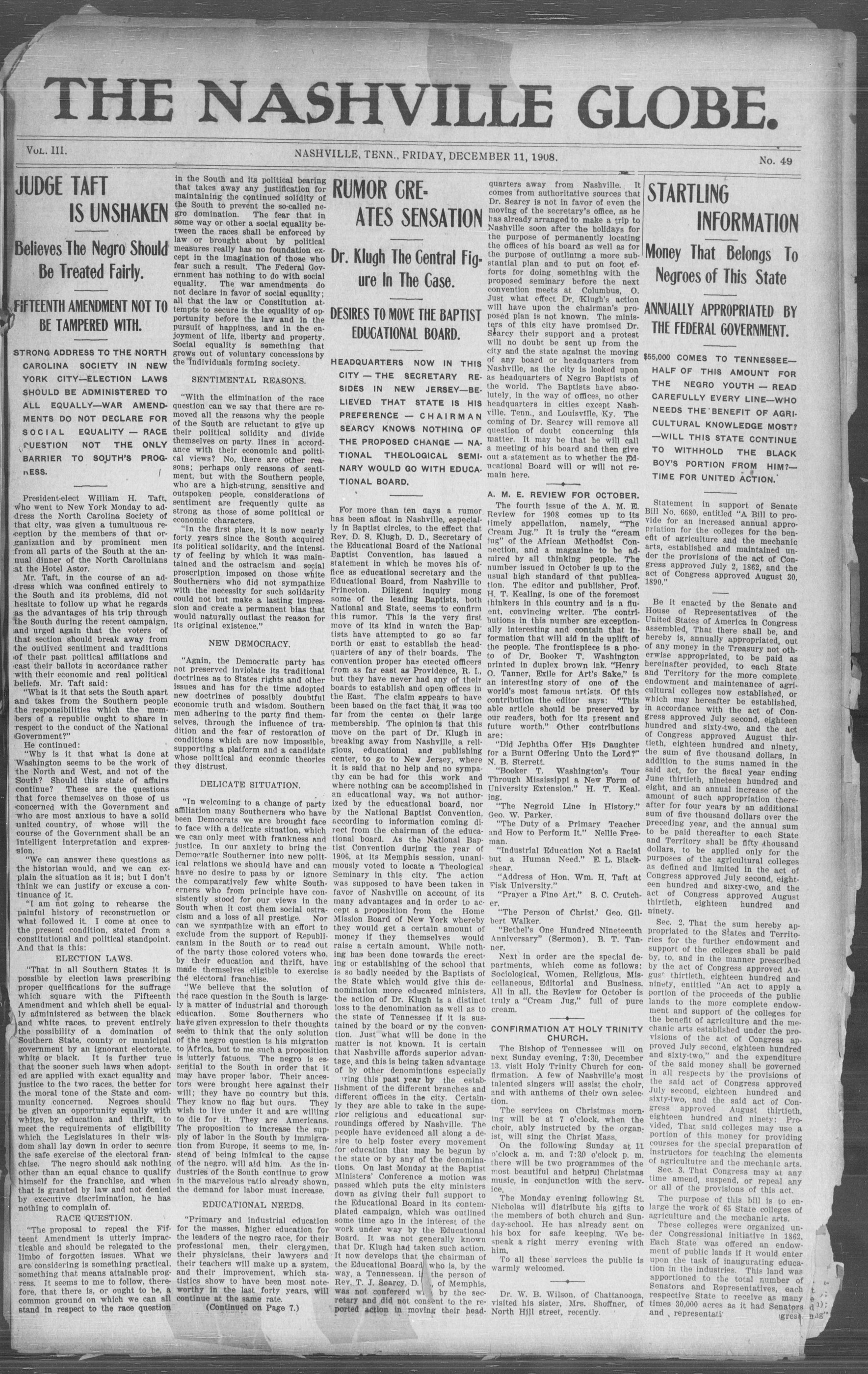
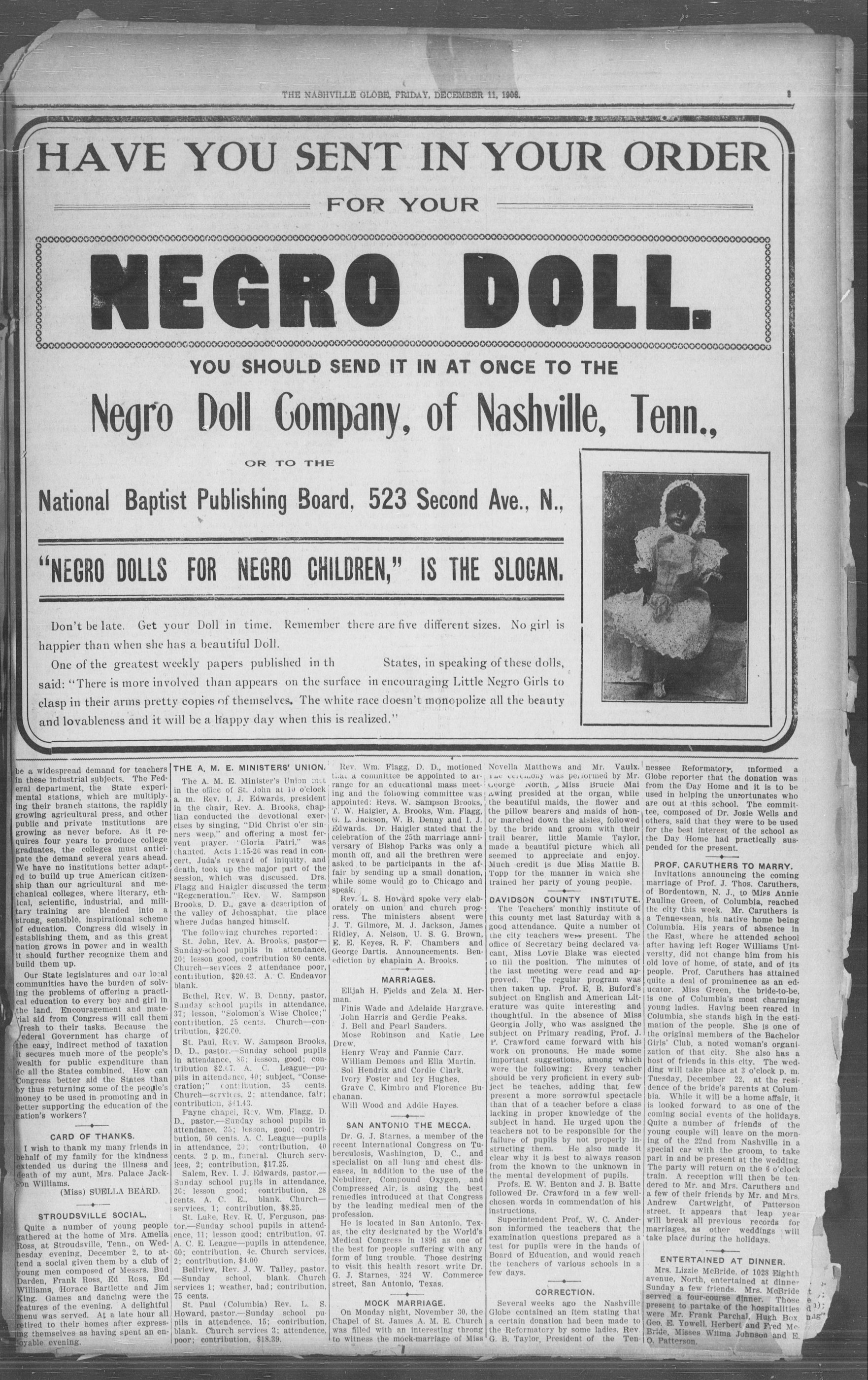
Page text (machine-generated)
THE NASHVILLE GLOBE.
Vol. III.
Believes The Negro Should Be Treated Fairly.
FIFTEENTH AMENDMENT NOT TO BE TAMPERED WITH.
STRONG ADDRESS TO THE NORTH CAROLINA SOCIETY IN NEW YORK CITY-ELECTION LAWS SHOULD BE ADMINISTERED TO ALL EQUALLY-WAR AMENDMENTS DO NOT DECLARE FOR SOCIAL EQUALITY - RACE QUESTION NOT THE ONLY BARRIER TO SOUTH'S PROGRESS.
President-elect William H. Taft, who went to New York Monday to address the North Carolina Society of that city, was given a tumultuous reception by the members of that organization and by prominent men from all parts of the South at the annual dinner of the North Carolinians at the Hotel Astor. Mr. Taft, in the course of an address which was confined entirely to the South and its problems, did not hesitate to follow up what he regards as the advantages of his trip through the South during the recent campaign, and urged again that the voters of that section should break away from the outlived sentiment and traditions of their past political affiliations and cast their ballots in accordance rather with their economic and real political beliefs. Mr. Taft said:
"What is it that sets the South apart and takes from the Southern people the responsibilities which the members of a republic ought to share in respect to the conduct of the National Government?"
He continued:
"Why is it that what is done at Washington seems to be the work of the North and West, and not of the South? Should this state of affairs continue? These are the questions that force themselves on those of us concerned with the Government and who are most anxious to have a solid united country, of whose will the course of the Government shall be an intelligent interpretation and expression.
"We can answer these questions as the historian would, and we can explain the situation as it is; but I don't think we can justify or excuse a continuance of it.
"I am not going to rehearse the painful history of reconstruction or what followed it. I come at once to the present condition, stated from a constitutional and political standpoint. And that is this:
ELECTION LAWS.
"That in all Southern States it is possible by election laws prescribing proper quellifications for the suffrage which square with the Fifteenth Amendment and which shell be equally administered as between the black and white races, to prevent entirely the possibility of a domination of Southern State, county or municipal government by an ignorant electorate, white or black. It is further true that the sooner such laws when adopted are applied with exact equality and justice to the two races, the better for the moral tone of the State and community concerned. Negroes should be given an opportunity equally with whites, by education and thrift, to meet the requirements of eligibility which the Legislatures in their wisdom shall lay down in order to secure the safe exercise of the electoral franchise. The negro should ask nothing other than an equal chance to qualify himself for the franchise, and when that is granted by law and not denied by executive discrimination, he has nothing to complain of.
"The proposal to repeal the Fifteent Amendment is utterly impracticable and should be relegated to the limbo of forgotten issues. What we are considering is something practical, something that means attainable progress. It seems to me to follow, therefore, that there is, or ought to be, a common ground on which we can all stand in respect to the race question
NASHVILLE, TENN., FRIDAY, DECEMBER 11, 1908.
in the South and its political bearing that takes away any justification for maintaining the continued solidity of the South to prevent the so-called negro domination. The fear that in some way or other a social equality between the races shall be enforced by law or brought about by political measures really has no foundation except in the imagination of those who fear such a result. The Federal Government has nothing to do with social equality. The war amendments do not declare in favor of social equality; all that the law or Constitution attempts to secure is the equality of opportunity before the law and in the pursuit of happiness, and in the enjoyment of life, liberty and property. Social equality is something that grows out of voluntary concessions by the individuals forming society.
SENTIMENTAL REASONS
"With the elimination of the race question can we say that there are removed all the reasons why the people of the South are reluctant to give up their political solidity and divide themselves on party lines in accordance with their economic and political views? No, there are other reasons; perhaps only reasons of sentiment, but with the Southern people, who are a high-strung, sensitive and outspoken people, considerations of sentiment are frequently quite as strong as those of some political or economic characters.
"In the first place, it is now nearly forty years since the South acquired its political solidarity, and the intensity of feeling by which it was maintained and the ostracism and social proscription imposed on those white Southerners who did not sympathize with the necessity for such solidarity could not but make a lasting impression and create a permanent bias that would naturally outlast the reason for its original existence."
NEW DEMOCRACY
"Again, the Democratic party has not preserved inviolate its traditional doctrines as to States rights and other issues and has for the time adopted new doctrines of possibly doubtful economic truth and wisdom. Southern men adhering to the party find themselves, through the influence of tradition and the fear of restoration of conditions which are now impossible, supporting a platform and a candidate whose political and economic theories they distrust.
DELICATE SITUATION.
"In welcoming to a change of party affiliation many Southerners who have been Democrats we are brought face to face with a delicate situation, which we can only meet with frankness and justice. In our anxiety to bring the Democratic Southerner into new political relations we should have and can have no desire to pass by or ignore the comparatively few white Southerners who from principle have consistently stood for our views in the South when it cost them social ostracism and a loss of all prestige. Nor can we sympathize with an effort to exclude from the support of Republicanism in the South or to read out of the party those colored voters who, by their education and thrift, have made themselves eligible to exercise the electoral franchise.
"We believe that the solution of the race question in the South is largely a matter of industrial and thorough education. Some Southerners who have given expression to their thoughts seem to think that the only solution of the negro question is his migration to Africa, but to me such a proposition is utterly fatuous. The negro is essential to the South in order that it may have proper labor. Their ancestors were brought here against their will; they have no country but this. They know no flag but ours. They wish to live under it and are willing to die for it. They are Americans. The proposition to increase the supply of labor in the South by immigration from Europe, it seems to me, instead of being inimical to the cause of the negro, will aid him. As the industries of the South continue to grow in the marvelous ratio already shown, the demand for labor must increase.
EDUCATIONAL NEEDS:
"Primary and industrial education for the masses, higher education for the leaders of the negro race, for their professional men, their clergymen, their physicians, their lawyers and their teachers will make up a system, and their improvement, which statistics show to have been most noteworthy in the last forty years, will continue at the same rate.
(Continued on Page 7.)
HEADQUARTERS NOW IN THIS CITY — THE SECRETARY RESIDES IN NEW JERSEY—BELIEVED THAT STATE IS HIS PREFERENCE — CHAIRMAN SEARCY KNOWS NOTHING OF THE PROPOSED CHANGE — NATIONAL THEOLOGICAL SEMINARY WOULD GO WITH EDUCATIONAL BOARD.
For more than ten days a rumor has been afloat in Nashville, especially in Baptist circles, to the effect that Rev. D. S. Klugh, D. D., Secretary of the Educational Board of the National Baptist Convention, has issued a statement in which he moves his office as educational secretary and the Educational Board, from Nashville to Princeton. Diligent inquiry mong some of the leading Baptists, both National and State, seems to confirm this rumor. This is the very first move of its kind in which the Baptists have attempted to go so far north or east to establish the headquarters of any of their boards. The convention proper has erected officers from as far east as Providence, R. L., but they have never had any of their boards to establish and open offices in the East. The claim appears to have been based on the fact that it was too far from the center on their large membership. The opinion is that this move on the part of Dr. Klugh in breaking away from Nashville, a religious, educational and publishing center, to go to New Jersey, where it is said that no help and no sympathy can be had for this work and where nothing can be accomplished in an educational way, was not authorized by the educational board, nor by the National Baptist Convention, according to information coming direct from the chairman of the educational Board. As the National Baptist Convention during the year of 1906, at its Memphis session, unanimously voted to locate a Theological Seminary in this city. The action was supposed to have been taken in favor of Nashville on account of its many advantages and in order to accept a proposition from the Home Mission Board of New York whereby they would get a certain amount of money if they themselves would raise a certain amount. While nothing has been done towards the erecting or establishing of the school that is so badly needed by the Baptists of the State which would give this denomination more educated ministers the action of Dr. Klugh is a distinct loss to the denomination as well as to the state of Tennessee if it is sustained by the board or by the convention. Just what will be done in the matter is not known. It is certain that Nashville affords superior advantage, and this is being taken advantage of by other denominations especially
During this past year by the establishment of the different branches and different offices in the city. Certainly they are able to take in the superior religious and educational surroundings offered by Nashville. The people have evidenced all along a desire to help foster every movement for education that may be begun by the state or by any of the denominations. On last Monday at the Baptist Ministers' Conference a motion was passed which puts the city ministers down as giving their full support to the Educational Board in its contemplated campaign, which was outlined some time ago in the interest of the work under way by the Educational Board. It was not generally known that Dr. Klugh had taken such action. It now develops that the chairman of the Educational Board who is, by the way, a Tennessean, is the person of Rev. T. J. Searcy, D. J., of Memphis, was not confered with by the secretary and did not consent to the reported action in moving their head.
quarters away from Nashville. It comes from authoritative sources that Dr. Searcy is not in favor of even the moving of the secretary's office, as he has already arranged to make a trip to Nashville soon after the holidays for the purpose of permanently locating the offices of his board as well as for the purpose of outlining a more substantial plan and to put on foot efforts for doing something with the proposed seminary before the next convention meets at Columbus, O. Just what effect Dr. Klugh's action will have upon the chairman's proposed plan is not known. The ministers of this city have promised Dr. Searcy their support and a protest will no doubt be sent up from the city and the state against the moving of any board or headquarters from Nashville, as the city is looked upon as headquarters of Negro Baptists of the world. The Baptists have absolutely, in the way of offices, no other headquarters in cities except Nashville, Tenn., and Louisville, Ky. The coming of Dr. Searcy will remove all question of doubt concerning this matter. It may be that he will call a meeting of his board and then give out a statement as to whether the Educational Board will or will not remain here.
A. M. E. REVIEW FOR OCTOBER.
A. M. E. REVIEW FOR OCTOBER.
The fourth issue of the A. M. E. Review for 1908 comes up to its timely appellation, namely, "The Cream Jug." It is truly the "cream jug" of the African Methodist Connection, and a magazine to be admired by all thinking people. The number issued in October is up to the usual high standard of that publication. The editor and publisher, Prof. H. T. Kealing, is one of the foremost thinkers in this country and is a fluent, convincing writer. The contributions in this number are exceptionally interesting and contain that information that will aid in the uplift of the people. The frontispiece is a photo of Dr. Booker T. Washington printed in duplex brown ink. "Henry O. Tanner, Exile for Art's Sake," is an interesting story of one of the world's most famous artists. Of this contribution the editor says: "This able article should be preserved by our readers, both for its present and future worth." Other contributions are:
"Did Jephtha Offer His Daughter for a Burnt Offering Unto the Lord?"
N. B. Sterrett.
"Booker T. Washington's Tour Through Mississippi a New Form of University Extension." H. T. Kealing.
"The Negroid Line in History." Geo. W. Parker.
"The Duty of a Primary Teacher and How to Perform It." Nellie Freeman.
"Industrial Education Not a Racial but a Human Need." E. L. Blackshear.
Next in order are the special departments, which come as follows: Sociological, Women, Religious, Miscellaneous, Editorial and Business. All in all, the Review for October is truly a "Cream Jug," full of pure cream.
CONFIRMATION AT HOLY TRINITY CHURCH.
The Bishop of Tennessee will on next Sunday evening, 7:30, December 13, visit Holy Trinity Church for confirmation. A few of Nashville's most talented singers will assist the choir, and with anthems of their own selection.
The services on Christmas morning will be at 7 o'clock, when the choir, ably instructed by the organist, will sing the Christ Mass.
On the following Sunday at 11 o'clock a. m. and 7:30 o'clock p. m. there will be two programmes of the most beautiful and helpful Christmas music, in conjunction with the service.
The Monday evening following St. Nicholas will distribute his gifts to the members of both church and Sunday-school. He has already sent on his box for safe keeping. We bespeak a right merry evening with him.
To all these services the public is warmly welcomed.
Dr. W. B. Wilson, of Chattanooga, visited his sister, Mrs. Shoffner, of North Hill street, recently.
No.49
STARTLING INFORMATION Money That Belongs To Negroes of This State
ANNUALLY APPROPRIATED BY THE FEDERAL GOVERNMENT.
$55,000 COMES TO TENNESSEE— HALF OF THIS AMOUNT FOR THE NEGRO YOUTH — READ CAREFULLY EVERY LINE—WHO NEEDS THE BENEFIT OF AGRICULTURAL KNOWLEDGE MOST? WILL THIS STATE CONTINUE TO WITHHOLD THE BLACK BOY'S PORTION FROM HIM? TIME FOR UNITED ACTION.
Statement in support of Senate Bill No. 6680, entitled "A Bill to provide for an increased annual appropriation for the colleges for the benefit of agriculture and the mechanic arts, established and maintained under the provisions of the act of Congress approved July 2, 1862, and the act of Congress approved August 30, 1890."
Be it enacted by the Senate and House of Representatives of the United States of America in Congress assembled, That there shall be, and hereby is, annually appropriated, out of any money in the Treasury not otherwise appropriated, to be paid as hereinafter provided, to each State and Territory for the more complete endowment and maintenance of agricultural colleges now established, or which may hereafter be established, in accordance with the act of Congress approved July second, eighteen hundred and sixty-two, and the act of Congress approved August thirtieth, eighteen hundred and ninety, the sum of five thousand dollars, in addition to the sums named in the said act, for the fiscal year ending June thirtieth, nineteen hundred and eight, and an annual increase of the amount of such appropriation thereafter for four years by an additional sum of five thousand dollars over the preceding year, and the annual sum to be paid thereafter to each State and Territory shall be fifty thousand dollars, to be applied only for the purposes of the agricultural colleges as defined and limited in the act of Congress approved July second, eighteen hundred and sixty-two, and the act of Congress approved August thirtieth, eighteen hundred and ninety.
Sec. 2. That the sum hereby appropriated to the States and Territories for the further endowment and support of the colleges shall be paid by, to, and in the manner prescribed by the act of Congress approved August thirtieth, eighteen hundred and ninety, entitled "An act to apply a portion of the proceeds of the public lands to the more complete endowment and support of the colleges for the benefit of agriculture and the mechanic arts established under the provisions of the act of Congress approved July second, eighteen hundred and sixty-two," and the expenditure of the said money shall be governed in all respects by the provisions of the said act of Congress approved July second, eighteen hundred and sixty-two, and the said act of Congress approved August thirtieth, eighteen hundred and ninety: Provided, That said colleges may use a portion of this money for providing courses for the special preparation of instructors for teaching the elements of agriculture and the mechanic arts.
Sec. 3. That Congress may at any time amend, suspend, or repeal any or all of the provisions of this act.
The purpose of this bill is to enlarge the work of 65 State colleges of agriculture and the mechanic arts. These colleges were organized under Congressional initiative in 1862. Each State was offered an endowment of public lands if it would enter upon the task of inaugurating education in the industries. This land was apportioned to the total number of Senators and Representatives, each respective State to receive as many times 30,000 acres as it had Senators and representati
8
Thus 10,233,169 acres of land were given to the States for this purpose. This land has now nearly all been sold, and the invested endowment is $12,049, 626, yielding an average annual income, which alone can be expended, of $721,492, an average of $15,031 for the land-grant colleges in each of the 48 States and Territories. In 1890 Congress, in the second Morrill Act, supplemented this endowment by the appropriation of $25,000 for each State and Territory, thus providing each with the present average of $40,031 per annum from the Federal Treasury, an annual total of $1,921, 492.
Under the provision of the acts named, each State was required to purchase lands and erect buildings from State funds, Lands, buildings, and equipments valued at $45,836,731, or an average of $954,932, have thus been provided by the respective States and Territories. The State colleges have become very useful and the States have added materially to their support. The total current expense funds thus supplied by the States aggregated for the year 1905 the sum of $3,048,422, an average of about. $65,000 for each State.
The sum supplied by the Federal Government and the sum supplied by the States for current expense or maintenance funds aggregated $4,969,914, an average of $103,540 for each State. Thus the Federal Government supplies 38.6 per cent and the States 61.4 per cent of the support of these institutions.
But in 1905 the colleges also received for buildings and other purposes from the States and other local sources (including fees) a total of $6,700,280, so that in reality the States contributed $9,748,702, which is nearly 83 per cent of the total income for educational purposes of the land-grant colleges.
In 1887 Congress followed up its initiative of inducing the States to establish colleges for instruction in agriculture and the mechanic arts by taking the initiative in establishing a system of state agricultural experiment stations. That act appropriates annually to each State the sum of $15,000 for investigations in agriculture. Under the Adams Act of 1906 each State experiment station will soon receive from the Federal Government an additional sum of $15,000, making a total of $30,000 annually. The States supplement this sum with 540,467 of State funds, or $11,260 per State.
Another movement has grown out of the establishment of agricultural colleges. Beginning in Minnesota in 1888 the States took the initiative in beginning the establishment of agricultural high schools or secondary schools devoted to education in farming and in home making for the young people of the farm. The first of these agricultural high schools were established on the grounds of the State colleges, taking the place of preparatory courses therefore found necessary in agricultural and other colleges for the farm youth who came from the irregular work of the rural schools. In more recent years the pronounced practical success of these secondary agricultural high schools has led to the establishment of a number of branch agricultural high schools. The States have established these schools, respecuively, as follows: Districts of several counties: Minnesota, 2; Nebraska, 1; North Dakota, 1; South Dakota, 1; Oklahoma, 1; Maine, 1; Alabama, 9; Georgia, 11; New York, 1; Rhode Island, 1; Washington, 1; a total of 30.
District of one county: Wisconsin, 2; Kansas 1; Tennessee, 1; Maryland, 1, a total of 5.
It seems probable that all States will follow Alabama and Georgia and establish systems of agricultural high schools, as each city has established public high schools, thus providing secondary schools for farmers as well as for city pupils.
About the beginning of the new century a movement was begun in Ohio, Indiana, and other States to consolidate the one-room rural schools into larger and more efficient units. These schools are provided with vans in which to haul the pupils to and from a large graded school in a district now containing several of the little districts or covering an area of about 25 square miles. There are now about 200 of these consolidated rural schools. These are gradually being made into real rural schools by the introduction into their courses of study of instruction in agriculture and home economics.
Since experiments have demonstrated that but little of instruction in agriculture and home economics can be successfully introduced into the isolated country school and that the elements of these subjects can be well taught in consolidated rural schools, there is no doubt that the rural school system will be generally aorganized.
Since there are about 3,000 agricultural counties in this country, the rates, in order to supply one agricultural high school to each district a ties, must establish, equip, the in 300 agricultural high area phi
THE NASHVILLE GLOBE, FRIDAY, DECEMBER 11, 1908.
schools. According to the census of 1900, there were 838,000,000 acres in farms or 1,250,000 square miles. If the entire country were supplied there would be required 50,000 consolidated rural schools each to supply a district of 25 square miles. Smaller areas than 5 to 15 counties for agricultural high schools, and smaller districts than 20 to 30 square miles for consolidated rural schools, would considerably increase the total cost. Besides being cheaper the larger districts, it is believed by many who know most concerning the experiments with these two classes of schools, provide a far more efficient system of education for farm youth than do the smaller districts.
During the first three decades of the history of the State colleges of agriculture and the mechanics' arts their most rapid and popular development was along the lines of engineering and the mechanical industries. The teachers of these subjects found subject matter easily reducible to pedagogical form, and students found that the definite instruction and practice work along these lines gave good training and led to salaried positions in our rapidly developing manufacturing and transportation industries. Agriculture, on the other hand, at first afforded no sufficiently organized body of knowledge which teachers could present in a strong way to students, and there were few salaried positions open in agriculture. During the past decade, however, owing to the wisdom of Congress in passing the Hatch Act establishing State experiment stations and in appropriating money for research in the Federal Department of Agriculture, which are rapidly adding to the body of knowledge, agricultural instruction has risen to a splendid status. Not only have the subject matter and the laboratory and practice work in agricultural courses been brought up to a position comparable with instruction in engineering, but there is a largely increased demand at good salaries for technical workers, as in departments of agriculture, experiment stations, agricultural schools, and agricultural newspapers.
It may be said that at present we have a splendid start at a system of industrial education. To the State colleges of agriculture and mechanic arts we may largely attribute the development of instruction in manual training and mechanic arts in our city schools. The capital city of Minnesotata, one of the first to thoroughly equip a mechanic arts high school is now but one of many examples of cities in which young men are prepared to aid in working up the industries of a city. Manual training, nature study, and school gardening in the city primary schools also are outgrowths of the work Congress inaugurated when it passed the first Morrill Act, establishing State colleges of agriculture and the mechanic arts.
These same colleges have also done the country a pronounced service in inaugurating instruction in home economies. This relatively inexpensive line of teaching is now rapidly extending from the State colleges into all other colleges, secondary schools, and primary schools wherever girls are taught separately or in coeducational institutions. This one line of instruction alone is or vastly greater value than the total cost to the nation and States of all these colleges.
It is not too much to say that through the Morrill Act of 1862 and subsequent acts Congress has wrought a revolution in American education as well as in American agriculture. The old educational ideals, growing out of the purely church schools, which even yet may be not far wrong in training ministers of the gospel, have slowly given way to the far broader ideals for a system of public education suited to the needs alike of workers, business men, home makers, technicians and professionals. The new education, while retaining the high moral and ethical ideals of the old, combines with these substantial training in doing the things of every day life. It develops at once the high ideals and the ability to succeed in carrying them out. It trains to think by thinking and it trains to do by doing. By broadening out the course of study early in the child's school life, allowing it to taste both of things literally and things practical, each pupil has a basis for judgment as to what line of activity he is best fitted to enjoy and in which he can best hope to compete with his fellows. This broadening out of the school curriculum provides students better selected to go forward into the various technical college courses, because intelligent finding of themselves is far better than being pushed into a given life's work by parental initiative. The land-grant act of 1862 did not merely establish a system of schools; it inaugurated a permanent system of education America in its ideals and in its results. Congress can not do too much to further recognize this fact and to help the States in completing the broadest kind of a system of public education, with the nonpublic schools so woven into the scheme as best to supplement it for ethical and religious training.
These land-grant colleges have influenced the nonagricultural industries to nearly as great a degree as the have improved agriculture. The engineering courses in these colleges have supplied a large share of men who have made it possible to develop our vast systems of transportation and manufacturing and to erect our great cities. They have provided a large body of teachers of the science and technique of the industries and of home economics for the other schools. They are the forerunners of the city mechanic arts high school, and of the introduction of the industrial and manual training subjects into the city graded schools. Our cities are coming rapidly to see that these schools are most useful in developing a strong class of technicians and artisans prepared to establish and man within their borders manufacturing industries and transportation enterprises. The engineering departments of our land-grant colleges at the top, city mechanic arts high school in the middle, and the manual training classes of primary graded schools at the base are being evolved into a system of ladders up which the mechanically inclined youth of our cities are learning to climb and from which they are bringing greater efficiency to our labor, artisan, and engineering classes. The degree to which we, as a nation, shall distance other nations in manufacturing, if not indeed in the developing of transportation and in the erection of cities, will in no small part depend upon the rounding out of the technical education or those who are at work in our mechanical industries. The use of federal funds to enable the engineering department of our land-grant colleges to lead onward and upward in this educational movement has in every way proved justifiable.
The agricultural department of our State colleges are recently having a most substantial development, and from them is springing a brood of agricultural high schools and a still larger brood of consolidated rural school. In the thirty-five agricultural high schools and nearly 200 township or consolidated schools in rural communities courses of study have been devised and used in which the general school subjects and the agricultural and home economics subjects are interwoven and graded from the primary class throughout the entire eight years of the rural school, the four years of the agricultural high school, and the four years of the agricultural college. These courses have become so universally successful that even conservative educators of the old school acknowledge that the new education initiated by Congress in 1862 is destined to revolutionize country life and the rural industries.
That the people are generally awakening to the value of educating the boy and girl who are to remain on the farms has recently been most emphatically proved in the State of Georgia. A law was passed last July appropriating about $66,000 annually for the support of an agricultural high school in each of the eleven Congressional districts of that progressive S state, now greatly rising from its industrial inundation of nearly half a century ago. This appropriation was given on condition that each locality securing one of these schools should provide a good school and experiment farm and suitable buildings with which to start a school. Governor Terrell has just completed a canvass of the State and towns and counties securing these schools have given the State a average of nearly 300 acres of land and several hundred thousand dollars for buildings and equipment, altogether costing the individual contributors over $800,000. Secretary of Agriculture Wilson is quoted as asserting that "this marks a new era in Georgia," and that "Georgia will now lead the South into a new agriculture."
My own State, Minnesota, while I was a member of the regency of the university and agricultural college, organized the first original and still the leading American agricultural high school. We congratulate Georgia on being the first to take advantage of this new plan to provide and fully equip institutions of this kind all over the State. Minnesota has recently started a second agricultural high school, and numerous other States have established one or two schools of this kind. Alabama has established a school of this class in each Congressional district, but they have not as yet received the necessary large equipment nor the current expense fund arranged for in Georgia. Ere long the governments of the world will have expended hundreds of millions of dollars in building up a body of knowledge of agriculture and home making. Selections from this body of practical facts woven in with the literary and general subject-matter of our rural school course will give life to these primary rural schools, which are not now apace with modern progress. Nothing short of the highly developed, co-called consolidated rural schools with specially trained teachers can take this rich and interesting technical education to all the boys and girls who live farm. This education so in
CHRISTMAS GIFTS AT THE ROYAL $2.50 SHOE
We have just got in a shipment of ladies' fancy SHOES in GRAY, BROWN and BLACK CRAVENETTS TOPS. The latest desired style.
Everybody should see and buy a pair for yourself, your wife and your daughter.
HOWSE
FURNITURE, STOVES
TERMS TO SUIT
We Can Furnish Your Home Co
We Take Old Goods as First Paym
WSE BROS. STOVES AND CARPETS TO SUIT EVERYBODY. Your Home Complete from Parlor to Kitchen. as First Payment; Balance Weekly or Monthly.
We Can Furnish Your Home Complete from Parlor to Kitchen.
We Take Old Goods as First Payment; Balance Weekly or Monthly.
304-306 BROADWAY. NASHVILLE
THE SPA
(The Sp
We have just added to our place a fin
and theatre. Open till 12:30 every night
solicit the patronage of Churches, Lodge
delivery. Telephone, Main 1679,
C. T. COFFEY,
11-13-08-3mrs.
TRY A M
They B
Burn Co
With E
CAS, GA
C
Jones
THE STOVE PEOPLE
The Spaw.)
Our place a first-class lunch for the public after church
to every night. Ice Cream and Soda all winter. We
arches, Lodges, Weddings and Private Orders, Prompt
Main 1679.
Cor. Ninth Ave. and Cedar St
We have just added to our place a first-class lunch for the public after church and theatre. Open till 12:30 every night. Ice Cream and Soda all winter. We solicit the patronage of Churches, Lodges, Weddings and Private Orders. Prompt delivery. Telephone, Main 1679.
TRY A MONOGRAM STEEL RANGE
They Bake Better Than Any Other—
Burn Coal or Wood and Do the Work
With Ease.
GAS, GASOLINE AND COAL OIL
COOK STOVES
At
Jones & Hopkins Mfg. Co.
207 THIRD AVE. NORTH
the productive capacity of farm youth that from this standpoint alone it will pay its own cost several times over—with better home, better rural civilization, and still more highly developed supply of surplus people to send to our cities as additional sources of profit. The welfare of the future fathers and mothers in our farm homes, as well as the welfare of our country as a whole, demands that our farm youth be better schooled both in technique and in general subjects.
Nothing short of a system of State agricultural colleges to supply teachers for agricultural high schools, also technicians in other agricultural lines, and of an agricultural school for each group of 10 counties, can supply the needed 50,000 teachers of agriculture and 50,000 teachers of home economics for a system of consolidated rural schools. And nothing short of 65 agricultural colleges, 300 agricultural high schools, and 50,000 consolidated farm schools will supply our rural communities with a people educated to manage farms and farm homes. Congress started this line of education, and it can do no better work than to recognize that its initiative has made possible the organization of a complete system of education in agriculture and the city industries. The cost of discarding the little rural schools and erecting new, modern, large, central school buildings, of establishing agricultural high schools, and the increased annual expense to the State and community of maintaining the necessary and important secondary and primary schools, will be large. Only the present great prosperity of the American people makes these changes possible.
By aiding in supporting the college of agriculture and mechanics arts, the Federal Government will encourage every State to establish high schools for the boys who are to be farmers mechanics and for the girls who manage homes and for those
---
HILARY E. HOWSE.
Nashville, Tenn.
who are to teach practical studies in the primary schools of the city and country. This encouragement will not stop with high schools but will greatly encourage the broadening of the curriculum of our city primary graded schools and the development and consolidation of our rural schools, that the city and the rural industries and the home making may be encouraged, emphasized, and built up.
The demands are constantly increasing for technical workers in the rapidly developing State and national departments of agriculture, in agricultural schools, in experiment stations, in the agricultural press, and in other public and private enterprises needing trained specialists in the various branches of agriculture and home economics. The action of Congress in trebling the expenditures in the Federal Department of Agriculture in a decade is but one illustration of what the demands will become during the next decade. These colleges of agriculture are recruiting institutions where are trained the army of industrial specialists who are to prepare our people to hold their industrial supremacy in the world and they are getting behind the task we are setting for them. Many of these colleges no longer have the money with which to hold their best men, who are sought by other lines of the work which have better financial support.
It is now eighteen years since Congress increased the allotment for these colleges. As compared with the research and police sides of our splendid agricultural policy, these colleges have been neglected. These institutions have now created a demand that a system of technical high schools and consolidated rural schools be established to carry technical training to all the people. The action of Minnesota, Ohio, Indiana, and other States indicates that soon there will
PHONE, MAIN 1086
NASHVILLE, TENN.
HAVE YOU SENT IN YOUR ORDER
NEGRO DOLL.
Negro Doll Company, of Nashville, Tenn.,
National Baptist Publishing Board, 523 Second Ave., N.,
"NEGRO DOLLS FOR NEGRO CHILDREN," IS THE SLOGAN.
Don't be late. Get your Doll in time. Remember there are five different sizes. No girl is happier than when she has a beautiful Doll.
One of the greatest weekly papers published in th States, in speaking of these dolls, said: "There is more involved than appears on the surface in encouraging Little Negro Girls to clasp in their arms pretty copies of themselves. The white race doesn't monopolize all the beauty and lovableness and it will be a happy day when this is realized."
be a widespread demand for teachers in these industrial subjects. The Federal department, the State experimental stations, which are multiplying their branch stations, the rapidly growing agricultural press, and other public and private institutions are growing as never before. As it requires four years to produce college graduates, the colleges must anticipate the demand several years ahead. We have no institutions better adapted to build up true American citizenship than our agricultural and mechanical colleges, where literary, ethical, scientific, industrial, and military training are blended into a strong, sensible, inspirational scheme of education. Congress did wisely in establishing them, and as this great nation grows in power and in wealth it should further recognize them and build them up.
Our State legislatures and our local communities have the burden of solving the problems of offering a practical education to every boy and girl in the land. Encouragement and material aid from Congress will call them fresh to their tasks. Because the Federal Government has charge of the easy, indirect method of taxation it secures much more of the people's wealth for public expenditure than do all the States combined. How can Congress better aid the States than by thus returning some of the people's money to be used in promoting and in better supporting the education of the nation's workers?
CARD OF THANKS.
I wish to thank my many friends in behalf of my family for the kindness extended us during the illness and death of my aunt, Mrs. Palace Jackson Williams. (Miss) SUELLA BEARD.
STROUDSVILLE SOCIAL.
Quite a number of young people gathered at the home of Mrs. Amelia Ross, at Stroudsville, Tenn., on Wednesday evening, December 2, to attend a social given them by a club of young men composed of Messrs. Bud Darden, Frank Ross, Ed Ross, Ed Williams, Horace Bartlette and Jim King. Games and dancing were the features of the evening. A delightful menu was served. At a late hour all retired to their homes after expressing themselves as having spent an enjoyable evening.
THE NASHVILLE GLOBE, FRIDAY, DECEMBER 11, 1908.
OR TO THE
FOR NEGRO CHI
our Doll in time. Remember
has a beautiful Doll.
weekly papers published in th
olved than appears on the su
y copies of themselves. The w
will be a happy day when this
THE A. M. E. MINISTERS' UNION.
The A. M. E. Minister's Union met in the office of St. John at 10 o'clock a. m. Rev. I. J. Edwards, president in the chair, Rev. A. Brooks, chaplian conducted the devotional exercises by singing, "Did Christ o'er sinners weep," and offering a most fervent prayer. "Gloria Patri," was chanted. Acts 1:15-26 was read in concert, Juda's reward of iniquity, and death, took up the major part of the session, which was discussed. Drs. Flagg and Haigler discussed the term "Regeneration." Rev. W. Sampson Brooks, D. D., gave a description of the valley of Jehosaphat, the place where Judas hanged himself.
The following churches reported.
St. John, Rev. A. Brooks, pastor—Sunday-school pupils in attendance, 20; lesson good, contribution 80 cents.
Church—services 2 attendance poor, contribution, $20.43. A. C. Endeavor blank.
Bethel, Rev. W. B. Denny, pastor, Sunday school pupils in attendance, 37; lesson, "Solomon's Wise Choice;" contribution, 25 cents. Church—contribution, $26.00.
St. Paul, Rev. W. Sampson Brooks, D. D., pastor—Sunday school pupils in attendance, 86; lesson, good; contribution $22.67. A. C. League—pupils in attendance, 40; subject, "Consecration;" contribution, 35 cents.
Church—services, 2; attendance, fair; contribution $41.43.
St. Paul (Columbia) Rev. L. S.
Howard, pastor.—Sunday school pupils in attendance, 15; contribution, blank. Church services 3; attendance, poor; contribution, $18.39.
FOR YOUR
SEND IT IN AT C
mpany, of N
ard, 523 Second
HILDREN," IS THE
ber there are five different si
th States, in speaking
surface in encouraging Little
white race doesn't monopolize
is is realized."
Rev. Wm. Flagg, D. D., motioned that a committee be appointed to arrange for an educational mass meeting and the following committee was appointed: Revs. W. Sampson Brooks, T. W. Haigler, A. Brooks, Wm. Flagg, G. L. Jackson, W. B. Denny and I. J. Edwards. Dr. Haigler stated that the celebration of the 25th marriage anniversary of Bishop Parks was only a month off, and all the brethren were asked to be participants in the affair by sending up a small donation, while some would go to Chicago and speak.
Rev, L. S. Howard spoke very elaborately on union and church progress. The ministers absent were J. T. Gilmore, M. J. Jackson, James Ridley, A. Nelson, U. S. G. Brown, E. E. Keyes, R. F. Chambers and George Dartis. Announcements. Benediction by chapain A. Brooks.
MARRiAGES.
Elijah H. Fields and Zela M. Herman.
Finis Wade and Adelaide Hargrave.
John Harris and Gerdie Peaks.
J. Bell and Pearl Sanders.
Mose Robinson and Katie Lee Drew.
Henry Wray and Fannie Carr.
William Demoss and Ella Martin.
Sol Hendrix and Cordie Clark.
Ivory Foster and Icy Hughes.
Grave C. Kimbro and Florence Buchanan.
Will Wood and Addie Hayes.
SAN ANTONIO THE MECCA.
Dr. G. J. Starnes, a member of the recent International Congress on Tuberculosis, Washington, D. C., and specialist on all lung and chest diseases, in addition to the use of the Nebulizer, Compound Oxygen, and Compressed Air, is using the best remedies introduced at that Congress by the leading medical men of the profession.
He is located in San Antonio, Texas, the city designated by the World's Medical Congress in 1896 as one of the best for people suffering with any form of lung trouble. Those desiring to visit this health resort write Dr. G. J. Starnes, 324 W. Commerce street, San Antonio, Texas.
---
MOCK MARRIAGE.
On Monday night, November 30, the Chapel of St. James A. M. E. Church was filled with an interesting throng to witness the mock-marriage of Miss
THE BALLET
Novella Matthews and Mr. Vaux. The ceremony was performed by Mr. George North. Miss Brucie Maiwing presided at the organ, while the beautiful maids, the flower and the pillow bearers and maids of honor marched down the aisles, followed by the bride and groom with their trail bearer, little Mamie Taylor, made a beautiful picture which all seemed to appreciate and enjoy. Much credit is due Miss Mattie B. Topp for the manner in which she trained her party of young people.
DAVIDSON COUNTY INSTITUTE.
The Teachers' monthly institute of this county met last Saturday with a good attendance. Quite a number of the city teachers were present. The office of Secretary being declared vacant, Miss Lovie Blake was elected to fill the position. The minutes of the last meeting were read and approved. The regular program was then taken up. Prof. E. B. Buford's subject on English and American Literature was quite interesting and thoughtful. In the absence of Miss Georgia Jolly, who was assigned the subject on Primary reading, Prof. J. P. Crawford came forward with his work on pronouns. He made some important suggestions, among which were the following: Every teacher should be very proficient in every subject he teaches, adding that few present a more sorrowful spectacle than that of a teacher before a class lacking in proper knowledge of the subject in hand. He urged upon the teachers not to be responsible for the failure of pupils by not properly instructing them. He also made it clear why it is best to always reason from the known to the unknown in the mental development of pupils.
Profs. E. W. Benton and J. B. Batte followed Dr. Crawford in a few well-chosen words in commendation of his instructions.
Superintendent Prof. W. C. Anderson informed the teachers that the examination questions prepared as a test for pupils were in the hands of Board of Education, and would reach the teachers of various schools in a few days.
Several weeks ago the Nashville Globe contained an item stating that a certain donation had been made to the Reformatory by some ladies. Rev. G. B. Taylor, President of the Ten-
CORRECTION.
nessee Reformatory, informed a Globe reporter that the donation was from the Day Home and it is to be used in helping the unfortunate who are out at this school. The committee, composed of Dr. Josie Wells and others, said that they were to be used for the best interest of the school as the Day Home had practically suspended for the present.
PROF. CARUTHERS TO MARRY. Invitations announcing the coming marriage of Prof. J. Thos. Caruthers, of Bordentown, N. J., to Miss Annie Pauline Green, of Columbia, reached the city this week. Mr. Caruthers is a Tennessean, his native home being Columbia. His years of absence in the East, where he attended school after having left Roger Williams University, did not change him from his old love of home, of state, and of its people. Prof. Caruthers has attained quite a deal of prominence as an educator. Miss Green, the bride-to-be, is one of Columbia's most charming young ladies. Having been reared in Columbia, she stands high in the estimation of the people. She is one of the original members of the Bachelor Girls' Club, a noted woman's organization of that city. She also has a host of friends in this city. The wedding will take place at 3 o'clock p. m. Tuesday, December 22, at the residence of the bride's parents at Columbia. While it will be a home affair, it is looked forward to as one of the coming social events of the holidays. Quite a number of friends of the young couple will leave on the morning of the 22nd from Nashville in a special car with the groom, to take part in and be present at the wedding. The party will return on the 6 o'clock train. A reception will then be tendered to Mr. and Mrs. Caruthers and a few of their friends by Mr. and Mrs. Andrew Cartwright, of Patterson street. It appears that leap year will break all previous records for marriages, as other weddings will take place during the holidays.
ENTERTAINED AT DINNER
Mrs. Lizzie McBride, of 1028 Eighth avenue, North, entertained at dinner Sunday a few friends. Mrs. McBride served a four-course dinner. Those present to partake of the hospitalities were Mr. Frank Parchal, Hugh Box, Geo. E. Yowell. Herbert and Fred McBride, Misses Witma Johnson and E. O. Patterson.
The Nashville Globe.
Published Every Ne the Year, Room
1, Odd Fellows Hail, No, 447 Fourth Ave-
ue, North, Nashville, Tenn.,
BY
THE GLOBE PUBLISHING CO.
D. A. HART... .........-Preeident
C. H, BURRILL...... .....Secretary
J.0. BATTLE °........... Treasurer
H, A. BOYD ......Business Manager
Telephone Main 4323-L.
J.O. BATTLE,,.,........60200+00s0++-EDITOR,
cetera
Entered as second-class matter January,
1906, at the post-office at Nashville, Tennes-
see, under the act of Congress of March 8,
1879.
No Notice takea of anonymous contribu-
tions.
SUBSCRIPTION IN ADVANCE.
IMR AEERE Gi (ec scdawecesshs pence #E-8C
REE MORUB is. see\scsseesgivesscs. 80
Three Months......6.....cc00005. 40
PHBE CORY, coicicctvesantesreans OS
Notify the office when you fall to get your
‘paper.
ADVERTISING RATES FURNISHED
UPON APPLICATION,
READING MATTER RATES,
Scents per line for each Insertion.
Scents per line for each Insertion (black
2).
‘Advertising copy should be In the office
not later than 9a, m. Tuesday of each week,
ect etree
TO THE PUBLIC.
Any erroneous reflection upon the charae-
ter, standing or reputation of any person,
fir’n oF corporation, which may appear in
the columns of THE NASHVILLE GLOBE
Will be gladly corrocted upon being brought
tothe attention of the management.
Send correspondence for publication #9 as
to reach the offlee Monday, “No matter in-
tended for current issue which arrives as late
ag Thursday can appear in that number, as
‘Thursday is press day.
All news matter sent us for publication
must be written only on one side of the pa-
per, and should be accompanied by thename
ofthe contributor, not necessarily for publi-
ation, but as an evidence of good faiths
SOUTHERN SITUATION.
President-elect Taft's address to the
North Carolina Society at their an-
nual banquet in New York City the
first of this week was a sensible and
logical deliverance. He made the best
possible use of a favorable time to
say some sane things to the entire
South with reference to some of its
ancient time-serving vagaries and pre-
tended fears of Negro denomination.
Ignoring any discussion of the recon-
struction period, which has always.
been magnified out of all due propor-
tion to, the actual status of things, he
took up the present-day situation and
showed that the white South had no
need to resort to unlawful means to
retain its governing power. He as
good as said that the long chasing of
the irrepressible ghost of Negro su-
premacy had worked untold injury to
her and would continue to do so if
she kept up her folly.
After showing that the South has
almost eliminated herself as a factor
in the national government by ex-
pending her strength and ability pur-
suing a groundless fear of the Negro,
Mr. Taft addressed his attention to
the election laws. He said in part as
follows:
“That in all Southern States it is
possible by election laws prescribing
proper qualifications for the suffrage
which square with the Fifteenth
Amendment and which shall be equal-
ly administered as between the black
and white races, to prevent entirely
the possibility of a domination of
Southern State, county or municipal
government by an ignorant electorate,
white or black. It is further true
that the sooner such laws when adopt:
ed are applied with exact’ equality
and justice to the two races, the better
for the moral tone of the State and
community concerned. Negroes should
be given an opportunity equally with
whites, by education and thrift, te
meet the requirements of eligibility
which the Legislatures in their wis
dom shall lay down in order to se
eure the safe exercise of the electoral
franchise. The Negro should ash
nothing other than an equal chance t¢
qualify himself for the franchise, anc
when that is granted by law and no‘
| denied by executive discrimination, h
; has nothing to complain of.
1) The Negro asks no special favors
;oo1e would be less than simple to do so
| Bkll he wants is a square deal and 1
Bair chance and he will not complain
3iN¢ith these, he will fittingly work ou
seats destiny. An impartial review o
#nres past achievements will not onl;
convincing that he has wrough
Ul, but that he will continue to d
1
THE NASHVILLE GLOBE, PRIDAY, DECEMBER 11, 1908.
Some of the things said by the Pres-
ident-elect in his address before the
North Carolina Society are, in sub-
stance, but an iterance of what he
said in his address at the dedicatory
exercises of the Carnegie Library at
Fisk University earlier in the year.
‘The South which has almost reached
the vanishing point so far as an effec-
tive participation in national affairs
is concerned, would do well to heed
the words of wisdom given utterance
‘by Mr. Taft.
Concluding, let it be said that the
South has no friend more loyal than
the Negro; he has ever been true to
her best interests, and elects to remain
so, He seeks no domination, no. su-
premacy; he only wants the fighting
chance of a man; that’s all.
HOLIDAY SEASON.
Christmas week, the holiday season,
which is universaily observed through-
out Christendom, is’ nearly at hand,
and everybody is astir anticipative of
a full share of enjoyment. Ever
against this occasion men are wont to
prepare for the distribution of gifts
in commemoration of the world’s
greatest event, the Savior's birth,
Heaven's best gift to man. Let it be
fittingly and appropriately celebrated.
Let our consideration of the deserving
aged and poor and needy bespeak our
generosity to those less favored than
ourselves and whose lives have been
saddened or darkened by experiences
or circumstances over which they had
no control. Let us remember that
they are the happiest who make oth-
ers happy. If by our little kindnesses
and words of cheer we relight the
lamp of hope in the breast of some
fellow-being; if by any generous act
of ours we strengthen some weak-
ened, disheartened fellow-brother, old
or young, toiling along life’s way, re-
member our reward will be heaven's
benediction, a sweet and abiding
peace.
Christmas is the joyous season that
boys and girls of tender years look for-
ward to with greatest anticipation.
Forget not the children, the merry,
romping, joyous children. For a few
brief years more and they, like you in
the years gone by, will be looking
retrospectively at the vanishing past
in whose embrace will be locked the
joys of the springtime of life that will
never come back again. So make
them happy while you may.
TAXES, TAXES, TAXES!
The city budget for 1909 is crying
for more funds and the City Council
is racking its brains to get through a
measure to satisfy it. Its efforts re-
minds one of the Inquisition, a sort
of court or tribunal which once ex-
isted in Spain, Italy and Portugal,
which was established for the purpose
of trying some poor culpurit for
heresy, who, when found guilty, as was
invariably the case, was then hand-
ed over to the secular arm of the law.
The poor wretch was then taken to a
dungeon and securely fastened upon a
wheel, a devilish machine called the
rack, and a confession extorted from
him by the most cruel torture. It
seems that the people of this city have
become heretical on the question of
more taxes and they have been so
adjudged by the “city fathers” who
will, it is said, memoralize the Legis-
lature, asking that body to grant them
(the city fathers) the power to levy
a “special tax,” that is, allow them tc
put the people upon “the rack” and
make them disgorge more funds in
the name of taxes for the purpose of
raising the amount of money needec
for the 1909 budget.
Will the time ever come when the
suffering and overburdened people
will find a surcease from increasec
taxation? If the members of the City
Council favoring the measure succeec
in their efforts an increase rate o
taxes will be imposed,
Physicians, physiologists and scien-
tists advise the diinking of plenty of
pure water as a necessary aid to
health, and, in their learned way,
dwell with much emphasis upon the
efficacious results to be derived from
a rigid adherence to such a course
dietetically; but all of their sane and
wholesome counsel will come to
naught if the people hear much more
concerning the analyzation of the wa-
ter supply of the city. So many
analyses have been made that suspi-
cion has already been aroused that
there is something wrong with the wa-
ter. Tell them now that the more wa-
ter they drink the better for their
physical well-being, and they will, ua-
der the circumstances, flout the declar-
ation, believing that the safe thing to
do is to drink as little as possible.
The following news item tells of the
passing of Dr. John B. Taylor, one o:
America’s greatest runners:
Philadelphia, Pa, December 2.—
Dr, John B, Taylor, the former cham-
pion quarter-mile runner of the Uni-
ney of einer en FT at aE
home to-d: of typhoid yn
oe ee
‘picked to carry the American flag on
his breast in Olympic championships,
‘he running in the 400-metre race and
in the relay event.
Dr. Taylor, at one time, was chosen
as the fittest man to represent Ameri-
can sprinters in the Olympian-games.
He was a great athlete; in fact, one
of the greatest runners produced by
any country. He leaves a splendid
record of achievements, not only to
his race, but to the athletic world. So
to speak, he was a Greek among
Greeks,
Collecting data as a working basis
for the House of Representatives to
use in its revision of the tariff is in
full swing and has been for some time.
This tariff bogey is always a bugbear
to our national representatives. An-
drew Carnegie has thrown a bomb
into the camp of the advocates of high
protection. Those who want either
the old schedule to remain or another
barbed-wire strung around the tariff
wall are saying some ugly things about
the lord of “Skibo Castle.” They con-
sider him a modern Coriolanus in the
camp of the Volci.
In saying, “What fools we mortals
be,” the great dramatist meant to
prod friendly the sides of the common
masses of mankind and awake them
from their dreamy and indifferent
lethargy as’ to what was going on
around them. The masses of to-day
have kindred tendencies to those that
existed then, It will ever be true that
eternal vigilance is the price of lib-
erty, and if the people do not guard
their liberties by keeping an eye on
the acts of their representatives, self-
styled servants, those liberties will be
curtailed, one by one, till none remain,
The lawyers who are looking out for
the interests of the Reelfoot Lake
nightrider suspects won out before the
courts here, but their victory was
short-lived. The legal tussle that has
been going on for some weeks betwen
the defense and state authorities has
been sharp and vigorous. It has been
watched with intense interest by the
people.‘ It is a struggle in which the
prowess of the iaw is pitted against
the prowess of lawlessness, and it yet
remains to be seen which side is to be
vanquished.
What is in a name? We will not
attempt to answer, but it is reported
that at Trenton, Tenn., recently one
colored gentleman shot another for
applying to him the epithet “night-
rider.” Some epithets will stir up the
“fightibility” in some natures, and
now the poor old word “nightrider”
has been mustered into the bad com-
pany of epithetical insults, No brave
man wants to be called “nightrider;"
the word signifies too much that is
the opposite of manliness and cour:
age,
It will be noticed from reports all
over the country that business is tak-
ing on a decidedly encouraging look
and that the wheels of industry are
humming away. This is what the
people wish to see and the sort of
music they want to hear. Plenty of
healthy, substantial business activity
and plenty of busy industries in mo-
tion are the best assurances of the
people's peace, happiness and con-
tentment.
As the holiday shopping season is
ite: full blast, let our people deport
liietiaelve in such a manner as to
cause no suspicion to attach to their
presence in the up-town shopping dis-
trict. It will be sensible for them to
transact their business with reasona-
ble dispatch.
President Roosevelt has ordered that
as fast as places can be found for
white bandmasters of colored _ regi-
ments their vacancies shall be filled
by colored bandmasters. Though long
deferred, it is better late than never.
pages
COMMUNICATION.
Trip to Mempnis.
Editor of the Globe:
Please give us space to say a
word about our trip to Memphis,
where I went on the 28th of Novem-
ber by invitation of the faculty and
board of trustees of Howe Bible and
Normal Institute to preach a sermon
which they styled “A Corner-stone
Sermon of the Girls’ Dormitory.”
Through the rain which continued
day Saturday and Saturday night, I
went to Memphis, arriving at 3:30
p. m. Saturday. I was met at the
depot by Drs. T, O, Fuller and W, H.
Hurd, who put us in one of Memphis’
best carriages and took us to the
beautiful home of Rev. T. J. Searcy,
D. D. We were received by Sister
Searcy, the amiable wife of the Doc-
tor, who knows how to make one feel
at home. Dr. Searcy was detained
at the Woman’s Board meeting which
was in session at the First Baptist
Church, of which the matchless Dr.
‘lt. O. Fuller, President of Howe, is
pastor, But we had not been there
very long before Dr. Searcy came in
and, in his usual happy mood, made
us welcome, But by that time we
were in full possession of his lovely
home and his baby boy, who is a
bright little fellow, and had things
well in hand, It was our good for-
tune to have the privilege to study
Dr, Searcy. I found him to be one of
our best pastors, a safe leader and a
sound Baptist. The National Baptist
Convention did not make a mistake
when it. elected Dr. Searcy chair-
man of the Educational Board. Sun-
day morning came on, the clouds
were lifted and the Lord gave us a
lovely day for services. We preached
at 11:30 a. m, for Dr. Searcy’s people.
At 3:30 p, m, We were greeted by a
most enthusiastic and intelligent
congregation at the First Baptist
Church, Dy. Fuller, like a magnetic
needle, drew the pastors and their
congregations both from thé country
and the city. We have seldom, if
ever, seen more educational enthusi-
asm than was exhibited by the pas
tors and their congregations at that
meeting. The churches all gave lib
erally and pledged future support to
Howe, At night I preached for Dr.
W. H. Hurd’s people. He is our sweet.
est preacher, says Dr. Morris. Dr.
Hurd has one of the largest congrega
tions in Memphis. They gave us $5.2:
in an after collection. We spoke tc
a large body of students of Howe
Monday morning. Most of them
were from outside the city. Dr, Full
er gave us $15.00 for our expenses
for which we thank them.
C. H, CLARK,
TO THE COLORED TEACHERS
THROUGHOUT THE COUNTRY.
Tuskegee Institute, Ala, Dec, 3,
1908.—The National Association for
the Study and Prevention of Tuber-
culosis is holding for the week begin-
ning December 13th and December
19th, an exclusive Negro conference
at Tuskegee Institute, Ala. bearing
upon this dreaded disease. They are
calling upon all colored organizations
to make an effort to have the above
week designated as Health Week.
Also to have on Sunday, December
18th, sermons, addresses, ete., and
in all churches and public places
make some reference to the health o|
the Negro people of the country. We
8s officers of the National Association
of Teachers in Colored Schools, both
private and public, ask all to join in
this effort for the health of both chil
dren and parents, If, during this
week in connection with our schools
a conference could be had, bringing
in the parents in the local communi
ty and talks made upon methods o
preventing consumption, much goo
will result. In the regular teaching
of hygiene in our schools, if some em
phasis during this week could be
placed upon the methods of prevent
ing consumption, we are sure mucl
fruit would be borne. In connectior
with this particular effort the colore¢
teachers of the country would have at
opportunity to show themselves no
only helpers in the intellectiial devel
opment of our people, put as strong
forces in the social life. With th
hope that a large number of ou
teachers may take nold and giv
strength to this movement, we are
Yours very truly,
R. R. WRIGHT,
President National Association o
Teachers in Colored Schools.
J. R. BE. LEE,
Corresponding Secretary.
TRIP TO MOUND BAYOU.
Mrs, W. A. Lewis, of Nashville,
Tenn., who has beer in the field all
the fall visiting conferences in the in-
terest of the Connectional Preachers”
Aid Association, of which her ‘hus-
band is Secretary, spent a few days
in Mound Bayou at the beautiful
home of Hon. Charles Banks and wife
who spared ‘no pains in making it
Pleasant for her and having her see
as much of their historic little town
as possible. After being shown
through most of the business places,
standing behind the cage in the bank,
visiting the schools, of which there
are three, standing upon the founda-
tion of an oil mill plant in course of
erection, which when completed and
equipped will cost one hundred thou-
sand dollars, and after visiting many
of the best homes of the town, Mrs,
Lewis declared that from all she had
read and heard of Mound Bayou the
half had not been told. Mrs. Banks
entertained in her honor, Those
Present were Mesdames W, A. Lewis,
L. E. Gardner, C. W. Stringer, B. F.
Owsley, Lela M. Lee, A. A, Cosey,
Misses Gertrude Fowler, Alva Booze,
Mayme Booze, Nannie V, Powell, and
Mrs. T. O. Banks. A most en-
joyable evening was spent and Mrs,
Lewis left for Clarksdale, Friar’s
Point and other points, carrying with
her a high admiration for the town and
settlement owned and controlled by
Negroes.
REV. JAS. MYERS TO BE OR.
DAINED.
The ordination of Rey. Jas. Myers,
the well-known young minister will
take place at the First Baptist Church
on Spruce street. This will, no
doubt, be the most largely attended"
service at any of the churches Sun-
day, as Mr. Myers is well known
throughout the city. Then, too, the
fact that he has entered the pastorate
bespeaks more interest in the ordina-
tion, The examining council will be in
session to-night. All of the Baptist
city pastors will be present Sunday to
assist and lay their hands upon the
head of the young divine who in en-
tering the ministry and the pastorate,
enters under the most favorable cir-
cumstances. It is expected that some
members of the First Baptist Church
of Murfreesboro, Tenn., where he has
already accepted a charge, will be
present. Rey. Mr, Meyers’ fame as a.
speaker, a singer and an entertainer
has by no means been confined to the
State of Tennessee. He has tray-
eled extensively, and by his sweet
voice, both as a reader and singer,
has pleased thousands of people,
moving them to laughter or tears as
he saw fit. And now that his talent
will be directed towards the saving of
Souls, it is evident that his firends
from all parts of the city will come
out to see the ordination. The sery-
ices will begin prompuy at 3 o'clock,
Rev, Dr. Ellington, the pastor, has
already made extra preparations for
the occasion.
AN ABLE EDITORIAL.
Nothing is more convincing that the
Nashville Globe is not only one of
the leading newspapers in the United
States, but that it molds sentiment in
every section of the country, taking
the people particularly at all times.
In a letter just received by the Globe
force, Mr. O, J. Carter, of San An-
tonio, Secretary of the Guadalupe
Baptist Association, President of the
Texas Auto Transit Company and a
Prominent church worker, writes the
following: “I read a very masterly
editorial in the Globe last week re-
garding the lynching and the foul
murder of the three Steinback broth-
ers. I read several good articles in
the same number, but I must especial-
ly commend you and the editor on
this one, for it is not only a bold
stand that is taken, but also a brainy
and fearless way of getting at these
inereasing diabolical outrages. Your
Paper is, in my judgment, one of,
it not the very best Negro journals.
extant. Most of them deal with
minor and local affairs, but yours
most always takes up matters that
are of general interest to the entire
nation, notwithstanding the race in
general, I shall not worry you longer
regarding this matter, for I am only
discussing some things of which you
are already aware, but I was im-
pelled by some hidden power to ex-
Press my approval of the good you
are accomplishing through the Globe.”
SUNSHINE HOME NOTES,
‘The’ Christian Workers’ Conference
will meet Monday, December 14, from
10 to 12 m. Mrs. Jones and Brother
Barry will address the meeting.
Those interested in the work of the
Conference are earnestly requested
to be present, as st is the last meet+
ing in the old year, end we desire to
effect plans for the new year.
In response to a special appeal by
the Correspanding Secretary for a
Thanksgiving offering for Foreign
Missions, quite a number of members
and friends of the “Christian Work-
ers’ Missionary Society” contributed
Uberally. The amount given wag very
encouraging.
```markdown
```
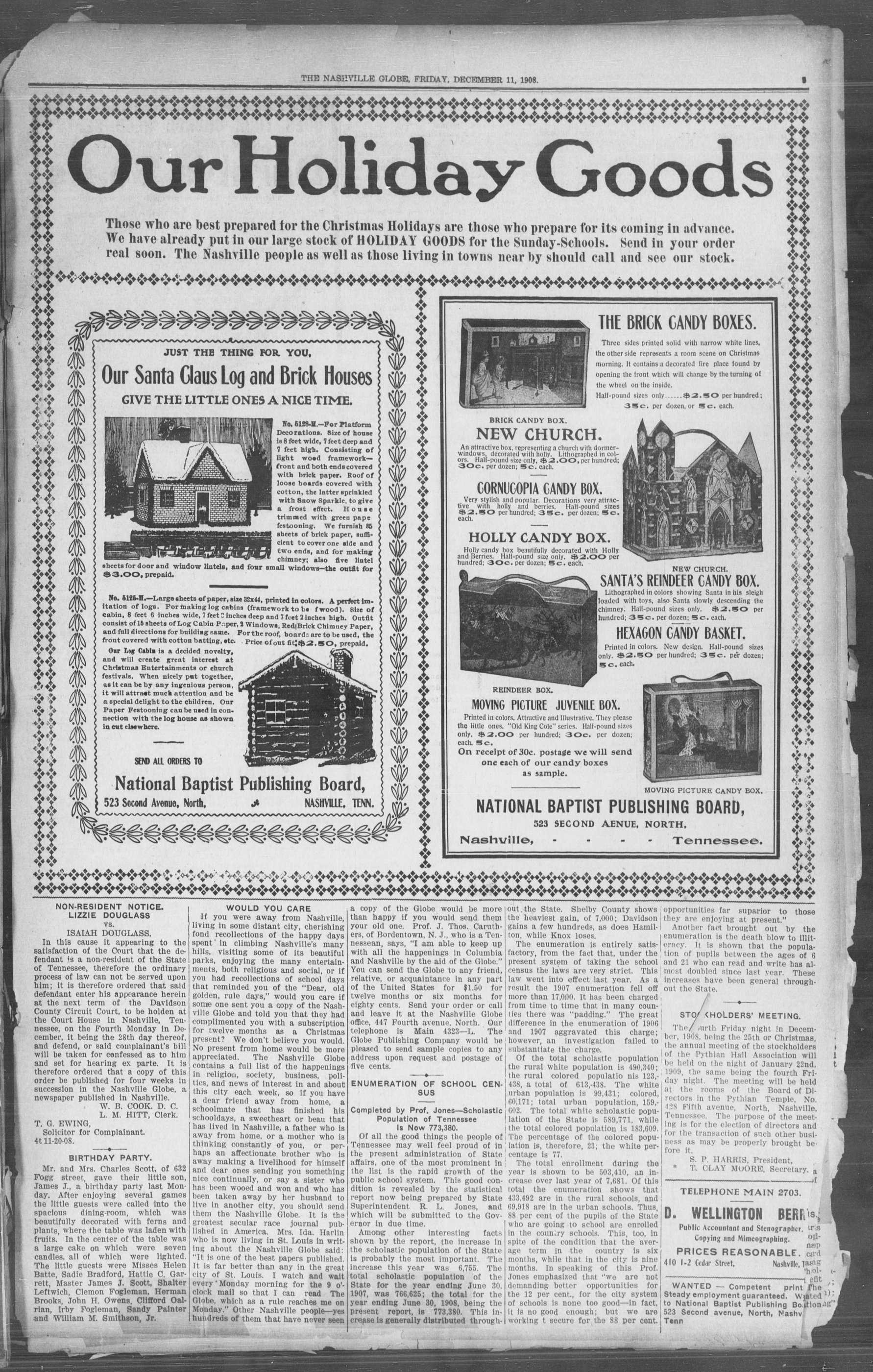
Our Holiday Goods
Those who are best prepared for the Christmas Holidays are those who prepare for its coming in advance. We have already put in our large stock of HOLIDAY GOODS for the Sunday-Schools. Send in your order real soon. The Nashville people as well as those living in towns near by should call and see our stock.
```markdown
```
Our Santa Claus Log and Brick Houses GIVE THE LITTLE ONES A NICE TIME.
No. 5128-H.—For Platform Decorations. Size of house is 8 feet wide, 7 feet deep and 7 feet high. Consisting of light wood framework—front and both ends covered with brick paper. Roof of loose boards covered with cotton, the latter sprinkled with Snow Sparkle, to give a frost effect. House trimmed with green paper festooning. We furnish 85 sheets of brick paper, sufficient to cover one side and two ends, and for making chimney; also five lintel sheets for door and window lintels, and four small windows—the outfit for $3.00, prepaid.
No. 5125-H. Large sheets of paper, size 32x44, printed in colors. A perfect imitation of logs. For making log cabins (framework to be fwood). Size of cabin, 8 feet 6 inches wide, 7 feet 3 inches deep and 7 feet 2 inches high. Outfit consist of 15 sheets of Log Cabin Paper, 2 Windows, Red Brick Chimney Paper, and full directions for building same. For the roof, boards are to be used, the front covered with cotton batting, etc.
Our Log Cabin is a decided novelty, and will create great interest at Christmas Entertainments or church festivals. When nicely put together, as it can be by any ingenious person, it will attract much attention and be a special delight to the children. Our Paper Festooning can be used in connection with the log house as shown in cut elsewhere.
National Baptist Publishing Board, 523 Second Avenue, North. NASHVILLE, TENN.
If you were away from Nashville, living in some distant city, cherishing fond recollections of the happy days spent in climbing Nashville's many hills, visiting some of its beautiful parks, enjoying the many entertainments, both religious and social, or if you had recollections of school days that reminded you of the "Dear, old golden, rule days," would you care if some one sent you a copy of the Nashville Globe and told you that they had complimented you with a subscription for twelve months as a Christmas present? We don't believe you would. No present from home would be more appreciated. The Nashville Globe contains a full list of the happenings in religion, society, business, politics, and news of interest in and about this city each week, so if you have a dear friend away from home, a schoolmate that has finished his schooldays, a sweetheart or beau that has lived in Nashville, a father who is away from home, or a mother who is thinking constantly of you, or perhaps an affectionate brother who is away making a livelihood for himself and dear ones sending you something nice continually, or say a sister who has been wooed and won and who has been taken away by her husband to live in another city, you should send them the Nashville Globe. It is the greatest secular race journal published in America. Mrs. Ida. Harlin who is now living in St. Louis in writing about the Nashville Globe said: "It is one of the best papers published. It is far better than any in the great city of St. Louis. I watch and wait every Monday morning for the 9 o'clock mail so that I can read The Globe, which as a rule reaches me on Monday." Other Nashville people -yes hundreds of them that have never seen
```markdown
```
SEND ALL ORDERS TO
NON-RESIDENT NOTICE.
LIZZIE DOUGLASS
ISAIAH DOUGLASS.
In this cause it appearing to the satisfaction of the Court that the defendant is a non-resident of the State of Tennessee, therefore the ordinary process of law can not be served upon him; it is therefore ordered that said defendant enter his appearance herein at the next term of the Davidson County Circuit Court, to be holden at the Court House in Nashville, Tennessee, on the Fourth Monday in December, it being the 28th day thereof, and defend, or said complainant's bill will be taken for confessed as to him and set for hearing ex parte. It is therefore ordered that a copy of this order be published for four weeks in succession in the Nashville Globe, a newspaper published in Nashville.
W. B. COOK. D. C.
L. M. HITT. Clerk.
T. G. EWING
Solicitor for Complainant.
41 11-20-08.
BIRTHDAY PARTY.
Mr. and Mrs. Charles Scott, of 632 Fogg street, gave their little son, James J., a birthday party last Monday. After enjoying several games the little guests were called into the spacious dining-room, which was beautifully decorated with ferns and plants, where the table was laden with fruits. In the center of the table was a large cake on which were seven candles, all of which were lighted. The little guests were Misses Helen Batte, Sadie Bradford, Hattie C. Garrett, Master James J. Scott, Shalter Leftwich, Clemon Fogleman, Herman Brooks, John H. Owens, Clifford Oalrian, Irby Fogleman, Sandy Painter and William M. Smithson, Jr.
THE NASHVILLE GLOBE, FRIDAY, DECEMBER 11, 1908
No. 5128-H.—For Platform Decorations. Size of house is 8 feet wide, 7 feet deep and 7 feet high. Consisting of light wood framework—front and both ends covered with brick paper. Roof of loose boards covered with cotton, the latter sprinkled with Snow Sparkle, to give a frost effect. House trimmed with green paper festooning. We furnish 85 sheets of brick paper, sufficient to cover one side and two ends, and for making chimney; also five lintel
```markdown
```
WOULD YOU CARE
An attractive box, representing a church with dormer windows, decorated with holly. Lithographed in colors. Hall-pound size only, $2,000, per hundred; 30c, per dozen; $c, each.
Very stylish and popular. Decorations very attractive with holly and berries. Hall-pound sizes $2.50 per hundred; 35c. per dozen; 5c. each.
HOLLY CANDY BOX.
Holly candy box beautifully decorated with Holly and Berries. Half-pound size only. $2.00 per hundred: 30c. per dozen: 5c. each.
fit for
fect im-
Size of
Outfit
Paper,
used, the
repaid.
RE
MOVING
```markdown
```
MOVING PICTURE JUVENILE BOX.
Printed in colors. Attractive and Illustrative. They please the little ones. "Old King Cole" series. Half-pound sizes only. $2.00 per hundred; 30c. per dozen; each. 5c.
On receipt of 30c. postage we will send
rd,
TENN.
On receipt
one e
NAT
Nashw
Nashville,
a copy of the Globe would be more than happy if you would send them your old one. Prof. J. Thos. Caruthers, of Bordentown, N. J., who is a Tennessee, says, "I am able to keep up with all the happenings in Columbia and Nashville by the ald of the Globe." You can send the Globe to any friend, relative, or acquaintance in any part of the United States for $1.50 for twelve months or six months for eighty cents. Send your order or call and leave it at the Nashville Globe office, 447 Fourth avenue, North. Our telephone is Main 4323—L. The Globe Publishing Company would be pleased to send sample copies to any address upon request and postage of five cents.
ENUMERATION OF SCHOOL CENSUS
Completed by Prof. Jones—Scholastic Population of Tennessee Is Now 773,380. Of all the good things the people of Tennessee may well feel proud of in the present administration of State affairs, one of the most prominent in the list is the rapid growth of the public school system. This good condition is revealed by the statistical report now being prepared by State Superintendent R. L. Jones, and which will be submitted to the Governor in due time.
Among other interesting facts shown by the report, the increase in the scholastic population of the State is probably the most important. The increase this year was 6,755. The total scholastic population of the State for the year ending June 30, 1907, was 766,625; the total for the year ending June 30, 1908, being the present report, is 773,380. This increase is generally distributed through-
THE BRICK GANDY BOXES.
Three sides printed solid with narrow white lines, the other side represents a room scene on Christmas morning. It contains a decorated fire place found by opening the front which will change by the turning of the wheel on the inside.
und sizes only.....$2.50 per hundred;
35c. per dozen, or 5c. each.
SANTA'S REINDEER CANDY BOX.
Lithographed in colors showing Santa in his sleigh
loaded with toys, also Santa slowly descending the chimney.
Hall-pound sizes only. $2.50 per
hundred; 35c, per dozen; 5c, each.
HEXAGON GANDY BASKET.
Printed in colors. New design. Half-pound sizes only. $2.50 per hundred; 35c. per dozen; 5c. each.
NATIONAL BAPTIST PUBLISHING BOARD,
523 SECOND AENUE. NORTH.
```markdown
```
out the State. Shelby County shows the heaviest gain, of 7,000; Davidson gains a few hundreds, as does Hamilton, while Knox loses. The enumeration is entirely satisfactory, from the fact that, under the present system of taking the school census the laws are very strict. This law went into effect last year. As a result the 1907 enumeration fell off more than 17,000. It has been charged from time to time that in many counties there was "padding." The great difference in the enumeration of 1906 and 1907 aggravated this charge; however, an investigation failed to substantiate the charge.
Of the total scholastic population the rural white population is 490,340; the rural colored population nis 123,438, a total of 613,438. The white urban population is 99,431; colored, 60,171; total urban population, 159,602. The total white scholastic population of the State is 589,771, while the total colored population is 183,609. The percentage of the colored population is, therefore, 23; the white percentage is 77.
The total enrollment during the year is shown to be 503,410, an increase over last year of 7,681. Of this total the enumeration shows that 433,492 are in the rural schools, and 69,918 are in the urban schools. Thus, 88 per cent of the pupils of the State who are going to school are enrolled in the country schools. This, too, in spite of the condition that the average term in the country is six months, while that in the city is nine months. In speaking of this Prof. Jones emphasized that "we are not demanding better opportunities for the 12 per cent., for the city system of schools is none too good—in fact, it is no good enough; but we are working t secure for the 88 per cent.
BRICK CANDY BOX.
GORNUGOPIA GANDY BOX
as sample.
```markdown
```
THE LITTLE BOOK
Tennessee.
opportunities far superior to those they are enjoying at present."
Another fact brought out by the enumeration is the death blow to illiteracy. It is shown that the population of pupils between the ages of 6 and 21 who can read and write has almost doubled since last year. These increases have been general throughout the State.
STO/<HOLDERS' MEETING.
The fourth Friday night in December, 1908, being the 25th or Christmas, the annual meeting of the stockholders of the Pythian Hall Association will be held on the night of January 22nd, 1909, the same being the fourth Friday night. The meeting will be held at the rooms of the Board of Directors in the Pythian Temple, No. 428 Fifth avenue, North, Nashville, Tennessee. The purpose of the meeting is for the election of directors and for the transaction of such other business as may be properly brought be fore it.
S. P. HARRIS, President,
* T. CLAY MOORE, Secretary.
TELEPHONE MAIN 2703.
D. WELLINGTON BERR
Public Accountant and Stenographer, tris
Copying and Mimeographing.
nap
PRICES REASONABLE.
card
410 1-2 Cedar Street, Nashville, lasag
holi
eft
WANTED — Competent print The
Steady employment guaranteed. Wanted 1)
to National Baptist Publishing Bottionag
523 Second avenue, North, Nashv
Tenn
6
OUT OF TOWN NOTES.
MURFREESBORO NOTES.
Mr. W. M. Overall spent Thanksgiving in Nashville.
Rev. J. M. Moore and family left Sunday for Nashville where they will reside in the future. The following were the guests of Mr. and Mrs. William Overall last Friday night: Rev. and Mrs. James North, Rev. D. P. Pearson and Miss Mattie Scott.
COLUMBIA NOTES.
Mr. and Mrs. Jas. B. Green announce the approaching marriage of their daughter, Annie Pauline, to Prof. J. Thomas Carouthers, of Bordentown, N. J. The wedding will take place December 22 at the home of the bride on Wilks street. Miss Bessie Grisham, of St. Louis, is here to spend the winter.
is here to spend the day.
Mr. Armstead Cheatham, of Nashville, visited his uncle, Mr. G. W. Bradshaw, last week.
Mrs. Rachel Hardy was burned to death at her home near Mt. Pleasant, December 4. She was alone, and before assistance came was dead. She was the mother of Mr. S. H. Hardy, one of the county teachers.
Mrs. Lula Campbell and Mr. James Gantt were quietly married last Sunday afternoon at the home of Rev. Spratlin. Mrs. Campbell is one of Maury County's teachers, and Mr. Gantt is one of Columbia's most industrious citizens.
dustrious cemetery
Mrs. Samantha Brown, of Tenth
street, is very sick. Her sister, Mrs.
Ophelia Zillner, of Chicago, has been
called to her bed-side.
called Mrs. Annie Franklin and Mr. London Mack were married Sunday, December 6, at 7:30 p. m., at Mt. Lebanon Baptist Church, Rev. Spratlin officiating.
Mrs. Ella Shearad is quite sick at her home on Water street. Miss Ida Halfacre has returned from Nashville. Mr. Thomas Graham, of Chicago, is here. BORN—To Dr. J. Q. Johnson and wife last Sunday morning a baby girl.
SMYRNA NOTES.
The very sad funeral of Mrs. Anna Ross, a member of the M. E. Church, was preached by the pastor, Rev. Mr. Florer, Tuesday, it will be remembered that her husband was found dead near his house a few months ago. Five small children survive her.
The entertainment given at the Baptist church last Saturday night by the Woman's Auxiliary here for the benefit of Roger Williams University was by no means a failure. At the rate they are going they will soon be prepared to furnish a room in the new dormitory which they intend to do.
Mr. A. B. Drennon carried a number of people to the city Tuesday in his pleasure wagon.
BRIERSVILLE NOTES.
The funeral of Mr. Geo. Love, which was held last Thursday, was largely attended. The First Baptist Church choir of East Nashville, furnished music for the occasion. A solo was sung by Mrs. Willa Reed, of Bowling Green, Ky. A short address was made by Mr. W. H. McGavock, undertaker, who told of the life of Mr. Love since becoming acquainted with him. The following friends served as pallbearers Messrs. Frank Pettis, Wallace Goodrich, Ike Ross, Guss Walton, Edd Yateman, Walter Tallie. The Benevolent Order No. 79 took charge of the remains. Mr. Love was president of the Order.
dent of the
Mr. Moses White, who was here to
the funeral of his uncle, Mr. Geo,
Love, left last Saturday for Chicago,
where he will resume his position in
the Pullman service.
The loyal Sons and Daughters of Temple No. 1 are preparing to have their annual election Friday night
OWENSBOORO NOTES.
The Owensboro Medical, Dental and Pharmaceutical Association met and organized with the following officers: President, Dr. R. B. Bell; Secretary Dr. R. E. Walker; Treasurer, Dr. R. F. White. Committee on censors, Dr R. Moreland, Dr. W. B. Reed, Jr., and Dr. J. H. Jones.
The Western High School gave a public rhetorical last Friday night.
Dr. R. B. Bell, formerly of Russell illle, and Dr. W. B. Reed, Jr., of Bowling Green, have opened their offices together at 608 West Third street.
whrs. W. B. Reed, wife of Dr. W. B. derl, Jr., is expected to arrive in the has one day next weeek.
all sall James Chapel A. M. E. Church orga inaking rapid and intelligent head- Sincith under the pastorate of Dr. Jas. ral more. Every department of the states has been well organized into turs p. clubs and leagues and work co charm. II. Gilmore is one of the ablest ers in the Tennessee Confer- spiritual and the financial depts of the church are better at ason of the year than ever be-
THE NASHVILLE GLOBE. FRIDAY. DECEMBER 11. 1908.
Despite the hard times the parsonage is being nicely fitted up with extra fine furniture. The church has also bought a splendid new organ and a young progressive choir of fifteen voices has been organized.
MEHARRY NOTES.
Dr. O. E. Brown, of the Vanderbilt Theological department, addressed the Y. M. C. A. Sunday, December 6th, He discussed 1 Cor. 12:13. "But covet earnestly the best gifts; and yet shew I unto you a more excellent way." His address was very instructive and showed depth of thought. Dr. C. H. Clark, pastor of M. Olive Baptist Church will address the Y. M. C. A. Sunday, December 13th at 3:30 o'clock at the Meharry Auditorium. The public is especially welcome.
The Y. M. C. A. gives a musical Friday evening, December 18th, at Meharry Auditorium, for which a special program has been prepared. This needs no elaboration for the high character of all the Y. M. C. A. proceedings has given it a name which is to be coveted. Mr. W. A. Holmes, its president, and Mr. S. S. Lawton, musical director, have been untiring in their efforts to bring to the organization a goodly membership as well as functions of high character. The present membership is two hundred having lateyl added 62 new members which speaks well for the body. The coming entertainment is looked forward to as one of the season's treats.
The nurses of Mercy Hospital gave an entertainment at the Meharry Auditorium, Friday evening, December 4th. Dr. R. F. Boyd, master of ceremonies, introduced Hon. J. C. Napier who spoke for ten minutes very interestingly and was followed by Dr. F. A. Stewart, who gave the history of the founding of Mercy Hospital and how it grew from a one room institution to its present proportions. Dr. C. V. Roman, the speaker of the evening discoursed instructively upon the necessity and benefits of such an institution. Rev. W. S. Ellington, pastor of First Baptist Church, gave actual testimony of the thoroughness and effectiveness of the work. Dr. Josie Wells spoke of the life of the trained nurse, their trials and tribulations during her period in Mercy Hospital. A paper read by Miss Booker, one of the nurses, was very liberally received. Dr. G. W. Hubbard in responding to the addresses made, strengthened his statements by subscribing $5.00 to the fund for the benefit of the nurses home. Dr. John H. Kumler spoke of the good of such an institution and subscribed to the fnud. A collection was taken to assist in preparing a suitable home for nurses. Miss Minnie White, the head nurse, recently of Lincoln Hospital, New York City, and who has spent some time studying in England and Germany, seems especially fitted for this particular work.
Dr. R. H. Boyd, D. D., will preach the next regular monthly sermon at the Meharry Auditorium, Sunday, December 13th at 11 o'clock a. m. for the University. The public is most cordially invited.
A combined Geneva retinoscope and ophthalmoscope has been purchased for use in Dr. Roman's clinic in diseases of the eye. Dr. Roman's clinic in diseases of the eye, ear, nose and throat is very largely attended where each and every patient receives the very best of treatment free. This clinic is held regularly every Friday afternoon from 1:30 till 3 in the amphitheatre in the dental and pharmaceutical building.
The athletic association held their annual election Monday evening, December 7th at which the following officers were elected; C. B. Covington, president; D. B. Granberry, vice president; J. T. Risher, secretary; Dr. W. Sevier, treasurer; L. M. Hill, manager; G. W. P. Johnson, assistant manager; W. H. Jackson, custodian. S. M. McDew, T. L. O. Sullivan, executive board. M. U. Saunders, of the sophomore medical class, was elected captain of the foot-ball team for next year. Miss Bessie Patton, a member of the senior class in the nurse training department who has been ill for the past week, is rapidly convalescing.
FRANKLIN NOTES
The remains of Mrs. Kittie Baugh, greatgrandmother of Mrs. Will Pointer were brought here last Thursday for burial. The funeral services were held at the Primitive Baptist Church, Friday, conducted by Elders Wm. Moore and Willie Wilson. Mrs. Baugh was 113 years old.
Mr. Henry North has opened a Wood yard.
Miss Alice Otey, who has been filling a very important position, has returned home for the winter.
Mrs. William Hughes met with quite a serious accident a few days ago by a window blind closing on her hands. Little Grace Wolridge has been quite sick but has recovered.
Miss Hattie Crutcher and Mrs. Harry Morris spent a few days in Nashville last week.
Mrs. Rosa Reams and daughter, Miss Hattie Mai, have had built and are living in a beautiful three-room cottage.
Mrs. Andrew Hightower has been quite sick but is out again.
Mrs. Martha Wolridge is still improving under the careful nursing of her faithful granddaughter, Miss Martha Wolridge.
Quite a number of people of our village lost their meat by killing their hogs the latter part of the first cold spell.
Mrs. Ellen Hughes is now living in her new cottage.
Mrs. Robert Buford has been very low for four months but is getting well again.
Mr. and Mrs. Pinkerton, formerly of Nashville, have a bouncing baby girl.
Mr. Matt Presley, brother of Mr. Oscar Presley, of Nashville, has built a neat cottage.
Mrs. Malinda Otey has made extensive improvements on her home.
Mrs. William Cartwright, of Nashville, was out with us last week.
Mr. Oscar Presley spent a few days with us last week.
Rev. D. W. Binford, of the A. M. E. Church, is stormed by members of his congregation with fresh meat every day or two.
Mrs. Estella Hodge, who spent a few days here, has returned to Mercy Hospital where she is taking a course in nurse training.
Miss Margie Crutcher, a teacher in the public school here was brought home from school last week sick. At this writing she is reported much better.
Miss Jennie L. Ewing has returned home from Nashville where she visited friends.
We are glad to report that the K. of P. lodge is growing.
Mr. Jordan Hughes, of Hughes Bros., Nashville, is out this week on business.
The men had a meeting at the M. E. Church Sunday conducted by Rev. Nelson, the pastor.
Miss Mattie Halfacre was in town Saturday.
Mr. Thomas Robinson, who has been suffering with rheumatism, is able to be out.
Mr. Milton Jackson is a little indisposed this week.
Miss Maggie Houghes is visiting in Nashville.
Elder Harris, of Nashville, preached at the Christian Church Sunday.
Mrs. Addie W. Alston was in Brentwood, Tenn., Tuesday.
Miss Georgia Akin passed through en route for her home at Columbia, Monday.
Mr. Hugh Merrill, of Columbia, passed through here Tuesday.
Miss Tagn Foster spent Tuesday at home.
Prof. J. K. Hughes, of Bingham, Tenn., was in town Saturday.
Mr. James Hughes, the shoemaker, is on the sick list.
The V. P. C.'s met Tuesday night.
Dr. L. E. Martin, of Nashville, was the guest of Dr. J. S. Williams Saturday and Sunday.
Mr. and Mrs. Will Cartwright, of Nashville, were out Friday to the burial of Mrs. Kittle Bough.
Prof. W. F. Reynolds has moved to his home in town.
Mr. James N. Church is on the sick list.
Mr. Charles Parks has returned from Nashville where he visited friends.
Mr. Andrew Ewing has contracted and built some of the best and handsomest houses of Franklin. He has just completed a very large house for Mr. Manning, the baker.
Mr. and Mrs. Henry Winsted's baby died this week.
We are glad to report that Ewing and Patton are getting their share of the undertaking business. We must give it to them.
Miss Alice Otey is out from Nashville this week.
Mr. Mercy, of Nashville, was here this week.
Mr. J. W. Reddick is not able to be out yet.
SHELBYVILLE NOTES.
Thursday evening, December 3, the faculty and students of Turner Normal College tended a banquet to the football team for their overwhelming victory Thanksgiving Day against Bradley Academy, of Murfreesboro, Tenn. The first part of the evening the audience was entertained by a program of the literary society, which was rendered very creditably. After the program was finished the President, Dr. J. A. Jones, made a short address, and at the conclusion of the same, he announced that we were ready to enjoy the banquet and make the boys feel that we appreciate their courage and bravery. The dining-room was beautifully decorated with ferns, chrysanthemums, and bunches of red, white, and blue hung artistically around the room, giving national air to the occasion. The table was placed in the center of the dining-hall, tastefully arranged with sparkling glasses, and pure white chinaware. In the center of the table was placed the victorious foot-ball encircled with purple and orange. At each plate were placed sprigs of ever green, and the table was overhung with a beautiful floral design of green foliage and chrysanthemums con
DOES YOUR CHURCH NEED SEATS? DO YOU KNOW THAT COMFORTABLE, CLEAN Durable Seats
Are a Guaranty to Large Appreciative Congregations? Then, why not let us seat your church for you? The new style, new design church seat is
Hence, it is the best for churches in moderate circumstances, especially those who want to have something in the way of a seat that is clean and reasonable in price. Why not send us the
New style seat No.1. Front View. See the beauty of this piece of furniture.
NATIONAL BAPTIST
DR. R. H. BOY
523 Second Avenue, North,
GLOBE ELE
GLOBE ELECTRIC CO.,
420 Cedar Street.
Have your house wired witch oards s fixtures cleaned a globe, see the GLO.
Hyman PAWNB
A. W. SUTHER
403 Public Square, 2nd d
MONEY
ON ALL ARTIC
Unnredeemed Pledg
Have your house wired witch oards put in, combination fixtures hung, old gas fixtures cleaned a combination For anything electrical on the globe, see the GLO... AL CO., 420 Cedar Street
Hyman&Harry PAWNBROKERS
A. W. SUTHERLAN, Manager, 403 Public Square, 2nd door north of Cedar Street
nected at each end with two electric lights of green and red. The football team formed a line in the chapel, and was escorted to the table by the young ladies and seated with the President, Dr. J. A. Jones, and Prof. R. F. Purdy. They were served with a delicious menu of four courses. While seated at the table toasts were given led by the captain, Mr. F. W. Gardner, of Clarksville, Tenn. On leaving the banqueting hall they made the wekin ring with the college yells, and departed for their homes to have pleasant dreams of T. N. C.
BISHOP PARKS SILVER WEDDING.
The twenty-fifth marriage or silver wedding anniversary of Bishop Parks will be celebrated at Chicago, Ill., January 16th, 1909, and the ministers and members in Alabama and Tennessee are getting quite enthusiastic about it. Tuesday, December 15th, 1909, at 12 o'clock m. there will be a meeting of the presiding elders of the State of Tennessee at St. John, Nashville, and at Birmingham, Ala., to consider the program respectively. It is said Nashville will be well represented on the program—and in the list of donations, the same will be presented by the State and district. Persons desiring to attend, see Dr. Halgler for information. All will leave Nashville, Tenn., January 15, 1909, 3:30 p. m.
OPERA CHAIRS FOR CLASS 16.
OPERA CHAIRS FOR CLASS 16. Arrangements for the installation of the opera chairs for class 16 at Mount Olive Sunday-School will terminate in less than a fortnight. This class has been nomined by the Church Supply Department or the National Baptist Publishing Board that their chairs will be ready to install at about the time designated. The class has asked for a special program on the Sunday that the chairs are first presented to the school. Superintendent James E. Hurt has the matter under advisement and will, no doubt, allow this class the privilege to entertain the school at an early date. The members of the class are scattered over the state teaching in
```markdown
```
New style seat No. 1. Showing back of seat, Note the braces for the back, (seat and legs.)
length and width of your church, measuring from the inside? We will make up a complete estimate on the cost and the number of seats that it would require to fill your church. We have installed on new machinery. Hence we are able to all your orders with promptness and dispatch. We have made more than five hundred estimates on seating churches throughout the United States. We have seated a large number of churches and we have given satisfaction on all occasion. Let us seat yours. For further information write the
LECTRIC CO.,
J. E. EDWARDS, Mgr.
n & Harry
NBROKERS
IERLAN, Manager,
2nd door north of Cedar Street
Y LOANED
ARTICLES OF VALUE.
edges Always on Hand.
You can buy a home for same money. For Sale or Rent, two new four-room cottages, cabinet mantels, city water-$10.00 Monthly Payments. I have others. Drop in and let us talk it over.
RICHARD HILL, Real Estate Agent-Notary Public.
410 1-2 Cedar St. Telephone, Main 1889.
Pension claims given prompt attention.
THE KELLER SHOE HOSPITAL
Shoes relieved of all complaints on short notice. We solicit your patronage. 424 Jo Johnson Avenue.
Eureka Dancing Class
Open every Monday and Friday Evening Instruction from 8:30 to 9:30. Regular dancing till 11:30.
Admission 15 Cents. DOCK LINI R. Instructor. portions of Tennessee and Alabama, and are sending in their contributions. These chairs are creating great interest in every part of the Sundayschool. Already classes No. 1, No. 5 and No. 14 are making extra preparations. Class No. 9 has announced an entertainment on Monday night for its benefit.
SOCIAL DIVERSION.
Miss Fannie B. McFarrish, of 427 Tenth avenue, North, gave a social on last Friday in honor of Miss Annie Smith and Miss Hattie Turner, of Springfield, Tenn. Music and games were enjoyed by the guests. As the guests arrived they were served frappe. A delicious four-course menu was served. Those present were Misses Maud and Cornelia Wilkerson, Birdie M. Cannon, Tinnie Jones, Martha Allen, Bertha Williams, Alice Holmes, Mary Snow, Emma Louis, Della Davis, Ellen Hill, Jennie Wilkerson, Messrs. James Fitzgerald, Alfred McCready, Ben Warren, Will Horn, Joe Dorris, Henry Hager, Charley Crockett, Jim Hitt, Sam Henderson, E. Cole, J. Allen, G. Harris, S. Bryant.
Nashville, Tenn
C. H. P. CLUB.
An important meeting of the C. H. P. Club was held at the home of Mr. and Mrs. Gooch, on Green street. The President, Mr. Gooch, presided over the meeting. There was a full attendance of members present. Atten o'clock a menu of two courses was served. The club will meet at the home of Mr. and Mrs. Mitchell, of Clalborne street, December 11.
H. T. G. M. CLUB.
The H. T. G. M. Club met with Miss Lillian Badger. of Fourteenth avenue, North, on Friday morning, November 27. This charming hostess, taking advantage of holiday season, entertained the club with a 10 o'clock breakfast.
The house was beautifully decorated with holly bows, which had come from Indianola. Miss., as a gentle reminder of the interest still alive in the heart of an absent member, Miss Nannie I. Sumner. Among the amusements, "Analyzing a Maiden's Heart" and "Autograph Writing" were the most popular. Miss Fannie M. Banks succeeded in receiving the most autographs and was the recipient of the prize—Shakespeare's "Antony and Cleopatra." Mrs. Allen Poyd received the consolation, a darner. The visito's present were Mesdames E. B. Jefferson and V. C. Langston. Misses Callie Beasley, Edwina Smith and Maud Roberts.
THE N. B. G. T. CLUB.
On last Thursday the N. B. G. T.
Club had a social at the home of Miss
Louise Douglass. The dinging-room
was decorated with ferns. A two-
Office Hours: 8 to 1) A.M. Phone. Main
1 to 3 P.M; 6 to 7 P.M. 4870
DR. W. S. PACE
Physician & Surgeon
All Calls Promptly 805 Division Street
Answered Nashville, Tenn.
11-17-08.
805 Division Street Nashville, Tenn.
Louisville & Nashville R. R.
New Union Station. City Ticket Office, 284
Fourth ave., North. Telephone Main 758
Leaves. Arrives.
Louisville & Cincinnati...*3:47am *2:15am
Louisville & Cincinnati...*7:55am *8:27am
Louisville & Cincinnati...8:00pm *8:59pm
Louisville Accom'oda...a*12:29pm *8:26pm
Evansville & Chicago...7:40pm *8:16pm
Evansville & St. Louis...3:57am *2:06am
Evansville & St. Louis...a7:30am *a1:10pm
Evansville & St. Louis...*7:40pm *8:10am
Birmingham, Montgom-
ery, Mobile and New Orleans.....*2:25am *3:37am
Birmingham, Montgomery, Mobile and New Orleans.....*8:45am *7:25am
Nashville & Scottsville Accommodation.....3:10pm *10:15am
Nashville & Hartsville Accommodation.....5:10pm *7:50am
Hopkinsville Aecomoda.a5:45pm *10:00am
Nashville & Clarksville Accommodation.....4:15pm *18:17am
Nashville & Decatur Accommodation.....8:50pm *10:10am
Columbia & Pleas.nt.....8:50pm *7:28am
Columbia & Florence Sheffield, & Tuscumbia.....7:40am *5:00pm
*Daily, 1 daily except Sunday.
a Steps at North College-street station.
Train arriving at 4:55 p.m. runs from Mt.
Pleasant only.
Train arriving at 7:45 p.m brings connections from Tuscumbia and Florence.
R. C. WALLIS, W. HAL MUSTAINE,
District Pass. Agent. City Ticket Agent.
N.,C. & St.L.Ry.
TICKET OFFICES
UNION STATION, BROADWAY
CITY OFFICE
In Maxwell House, Corner Church
Street and 4th Ave., North.
ONE MAIN 377
Leaves—West and Northwest—Arrives
*7:00am—Memphis, Hickman, Pa. *3:35pm
ducah, St. Louis, con-
nects for Centreville ()
*2:14—Phoenix, Hickman, J
Jackson *1:32pm
15:30pm—Waverly Accommodation, 9:00am
*8:00pm—Dixie Flyer" solid train, 9:00am
to St. Louis.
*11:30pm—Memphis and Hickman
SOUTH AND EAST.
2:24am—Chicago and Florida *3:13am
Limited.
*9:30am St. Louis-Jacksonville *6:55pm
"Dixie Flyer." Con-
nections () for all branch
line points.
*12:17pm—Chicago, Jacksonville. *3:20pm
"Dixie Flyer." Solid
train. Dining cars.
*3:30 pm—Chattanooga and the *10:50am
East. Connections () for
Shelbyville, Sparta, Fayet-
ville, Huntsville, Tracy
City, South Pittsburg.
16:00 pm—Tulahoma Accommodation, 18:15am
Connects for Shelby-
ville.
*9:30 pm—Chattanooga, Atlanta *6:35am
Augusta and points be-
yond.
17:00am—Lebanon Mixed..... 12:10pm
19:20am—Lebanon Express..... 16:40pm
19:00pm—Lebanon Accommodation..... 18:30am
Daily. Daily except Sunday.
W. M. HUNT, C. T. A., Maxwell House.
POWELL PHILLIPS, P. A., Maxwell
House.
W. L. DANLEY, G. P. A., Union Station.
THE NASHVILLE GLOBE FRIDAY. DECEMBER 11. 1908.
course menu of turkey, jelly, beaten biscuit, salmon salad, chicken salad, ranges, bananas, apples, ices andakes was served. Mr. Turner prelided at the piano. Those present were Misses Harriet Hill, Mamie Ashford, Willie M. Johnson, Maggie Ried, Lelia Dillahunty, Louise Douglass, Samuella Napier, Lottie Jackson, Henrietta Floy, Janie Fleming, Malenia Christmas, Alberta Buford, Mr. Tolbert Hill, Allen Dixon, Robert Donelson, Willie Napier, Edward Dillahunty, Palmer Richardson, Clarence Muirhead, George Hargrave, Albert Allen, Wm. House, Arthur Fleming, Charles Lightfoot and Henry Gley, Alberta I. Buford, President; Janice M. Fleming, Secretary; Louise E. Douglass, Treasurer.
Y. M. L. C.
The Y. M. L. C. spent quite a pleasant evening with Mr. H. J. Stockard Monday evening, December 7. The night was programme night and an excellent one was rendered and was highly enjoyed by the members present. The program, although short, was full of interest and life. Mr. Berry rendered a declaration that was full of inspiration. The other numbers consisted of a reading and an essay by Mr. Galloway and Mr. H. J. Stockard. Following the programme a talk of two minutes was allowed each member. After the two-minute talks the club adjourned to meet with Mr. Mansfield Douglass, 1805 1-2 State street, Monday evening, December 14.
LILAC EMBROIDERY CLUB.
The Lilac Embroidery Club met at the home of Mr. and Mrs. L. L. Moore Monday afternoon. December 7. The reception room was ornamented with green plants. Mrs. C. C. C. Winstead delivered an interesting address in behalf of the progress of the Club. After an hour's work the ladies were served an elegant two-course menu with fruits and ices. Mrs. Moore was assisted in receiving her guests by Mesdames J. L. Watkins and John Barnes. Those present were Mesdames P. A. Washington, Matt. Johnson, George Haley, John Jennings, John Barnes, Marshal Williams, Sidney Bonds, W. H. Mosely, Heck Cary, Emmett Sims. W. S. Amos, H. Crockett, Wm. Sherfield and Miss Phelistia Womack. The club will meet with Mrs. J. L. Watkins, 1123 Kosset street, Monday afternoon, December 14, at 3 o'clock.
CLUB NUMBER TWO.
Club Number Two, of Benevolent Order, met at the residence of Mrs. Sarah Phillips, of Ash street, Tuesday evening. An address was delivered by Rev. Venerable. A delightful menu was served. The Club will meet at the residence of Mrs. Holman, 100 Highland street, next Tuesday, December 15.
DEATHS.
Infant of Thos. Elliott and Pearl Jones.
Hattie Jordan, 104 Lewis street, 26 years.
Minnie Vicla Simmons, 1011 Eighteenth avenue, North, 4 years.
Martha Turner, St. Louis, Mo., 66 years.
Addie Latimore, 604 Webster street, 36 years.
Nannie Couch, 138 Fourth avenue, North, 61 years.
Nancy Bates, 104 Jo Johnston avenue, 61 years.
Kitty Bough, 626 Sixth avenue, South, 113 years.
Charles Redmond, 424 Jo Johnston avenue, 2 years.
Nick Williams, 617 North High street, 36 years.
Infant of George and Fannie Lee, 1512 1-2 Fourteenth avenue, North.
Horace Frierson, 1000 Third avenue, North, 53 years.
Birdie Murphy, 909 Division street, 46 years.
James Eddie Johnson, 1205 Harding street, 9 years.
Brady Payne, 922 Pearl street, 51 years.
Leslie Rickman, 707 Winter street, 20 years.
Theo, Ellis Compton, 829 Overton street, 18 years. Viola Anderson, 5 Crutcher street, 59 years.
Fannie May Weakly, Buck's alley, 30 years.
Ida Foster, St. Louis, Mo.
Jas. H. Johnson, 1401 Salem street, 18 years.
Janie Gleaves, 1605 Philip street, 34 years.
Ellen Mathews, Rock City, 45 years. Marguerite Rutledge, 77 years, 1111 Church street. Belle Craven, Corner Summer and Monroe street, 34 years. Henry Beach, City Hospital, 51 years.
Mr. Joe Bell and Miss Pearl Saunders, daughter of Mrs. Lizzie Cross, of 938 Gay street, married last Saturday. Mrs. William H. Richardson, of 1207 Phillip street, who underwent an operation a few weeks ago, is very ill.
operation a few weeks ago, is very ill.
Mr. and Mrs. Jas. A. Johnson take
this method of thanking their many
friends and the employees of the A.
M. E. Sunday School Union for kindnesses and sympathy shown during
the long illness of their late son James Henry.
Miss Mary Puryear, who is teaching in Murfreesboro, Tenn., will spend the Christmas with her parents in this city.
Miss Addie G. Henley, who is teaching at China, Ala., writes that she is getting the Globe every week and that she enjoys every issue.
Call and see our line of Christmas and New Year Cards and Post Cards before you purchase elsewhere. We can save you 50 per cent.—National Baptist Publishing Board, 523 Second avenue, North.
The Artesian Drug Co., of 242 Broad street, Albany, Ga., one of the leading Drug stores of the State of Georgia, placed its second large order for Negro dolls last week with the Negro Doll Company of this city. Shipment was made last Thursday, December 3, 1908.
Mrs. Mattie Coleman, the wife of Dr. W. F. Coleman, of Bessemer, Ala., is to spend the Holidays with her parents, Rev. and Mrs. Kirkpatrick. The best that is in the city, the cheapest that is in the city is our line of Christmas and New Year Cards and Post Cards.—National Baptist Publishing Board, 523 Second avenue, N.
Miss Ella White, of Memphis, and Mrs. Buchanon, of St. Louis, were the guests of their niece, Mrs. R. L. King, of Patterson street, last week.
There is in Knoxville, Tenn., a Negro theatre, says a news item from East Tennessee. The stage manager of the theatre, who is making quite a reputation in that particular line of work, is Mr. Wm. Goff Kennedy. Mr. Kennedy was recently married down in Albany, Ga., and is a brother of Miss Lovinia McLemore. The theater is doing an excellent business, being well patronized by the Knoxville people.
The dividend checks for the Nashville Stockholders of the Bank of Mound Bayou, located at Mound Bayou, Miss., arrived and were being circulated on Tuesday, making the fourth annual dividened of the concern.
Why not send a friend of yours a subscription to the Nashville Globe as a Christmas present? You can send the Globe to him or her, which ever it may be, six months for 80 cents or one year for $1.50. Call the Nashville Globe and give your order.
Mrs. Genie B. Williams, of 1014 McLemore street, and her sister and piece, Mrs. Susie Durant, of Montreal, Canada, and Mrs. Lazinka Dickson, of Jersey City, N. J., went to visit Mrs. J. A. Booker, of Trenton, Tenn., last week. Mrs. Booker is a sister of the former two and an aunt of the latter. They have returned to the city after having spent a very enjoyable visit of several days.
Mr. S. Evans Shirley, formerly a compositor at the National Baptist Publishing House, has severed his connection with that enterprise and gone to Tuskegee Industrial Institute, Tuskegee, Ala., where he will pursue his calling as professional printer.
Mr. and Mrs. Geo Dotson, of Cheatham street, spent a part of last week in Louisville.
Miss Bessie Epps, of Franklin, who underwent a serious operation at one of the local infirmaries, is able to return to her home.
Miss Johnnie Crutcherfield, who underwent an operation at Vanderbilt Hospital several weeks ago, is improving nicely.
Miss E. J. Cockrill was indisposed the first of the week.
Cards are out announcing the marriage of Mr. Arthur Franklin to Miss Lydia Robertson, of Galveston, Texas. Miss Ella White, of Memphis, and Mrs. Buchanon, of St. Louis, were called to the city to attend the funeral of their sister, Mrs. Ida Foster, of St. Louis. Mrs. Maria Singleton, of Bunbarton, S. C., mother of Dr. J. B. Singleton, is in the city to pay an extended visit to her son and his family. Mrs. Millie Wright and niece, Miss Salley Smith, who spent the summer and fall in Chicago with their relative, are now at home, 716 Smiley street. Miss Bessie Frierson, who has been sick for several weeks, is slowly improving.
Master Geo. O. Boyd, Jr., the eight months' old son of Mr. and Mrs. Geo. O. Boyd, of Eighth avenue, North, is suffering from a very severe cold contracted the first of the week.
Mr. George Wyman and Mr. Henry Simmons arrived in the city Sunday from the funeral of their sister, Miss Viola Simmons, on Saturday morning.
BANK DIRECTORY.
There are thirty-seven Negro banks business in the United States. They by Negroes and are scattered through in the South. The names, locations, some of them are given below.
ONE-CENT SAVINGS BANK
Incorporated Under the Laws of Tennessee.
CAPITAL STOCK, $25,000.00.
Does a regular banking business. Interest paid on all time deposits. Only institution of its kind in Tennessee.
R. H. BOYD, President.
J. W. BOSTICK, Vice-President.
J. C. NAPIER, Cashier.
C. N. LANGSTON, Teller.
411 Fourth Avenue, North,
NASHVILLE, TENNESSEE.
THE PEOPLE'S INVESTMENT AND BANKING COMPANY. BIRMINGHAM, ALA.
Capital Stock, $10,000.00.
Doing a regular banking business. Collections solicited. Depository for the Great Southern Industrial Home Insurance Company.
W. L. LAUDERDALE, President.
DR. R. D. MACKLIN, Vice President.
A. D. JORDAN, Cashier.
THOS. A. HARRIS, Teller and acting Cashier.
Union Savings Bank. VICKSBURG MISS
Capital Stock, $10,000.00.
Collections and Out-of-town Business Solicited.
H. E. CONNER, M. D., President.
J. G. H. BOWMAN, First Vice President.
THOS. H. BOWMAN, Second Vice President.
T. G. EWING, J. CASH.
G. M. McINTYRE, Assistant Cashier.
BANK OF MOUND BAYOU.
MOUND BAYOU, MISS.
CAPITAL STOCK, $10,000.00.
JOHN W. FRANCIS, President.
W. T. MONTGOMERY, Vice President.
CHAS. BANKS, Cashier.
R. M. McCARTY.
CHAS. BANKS.
J. W. FRANCIS.
H. A. GODBOLD.
S. M. MORGAN.
W. T. MONTGOMERY.
C. R. STRINGER.
E. W. LAMPTON.
B. H. CRESWELL.
SOLVENT SAVINGS BANK AND TRUST COMPANY. CAPITAL STOCK. $25,000.00. OFFICERS.
R. R. CHURCH, President.
M. L. CLAY, Vice President.
J. W. SANFORD, 2nd Vice President.
W. E. MOLLISON, 3rd Vice President.
J. T. SETTLE, Attorney
ROBERT R. CHURCH, JR., Cashier.
829 Beale St., MEMPHIS, TENN.
ALABAMA PENNY SAVINGS BANK
BIRMINGHAM, ALA.
CAPITAL STOCK. $25,000.00.
V. R. PETTIFORD, President.
B. H. HUDSON, Cashier.
J. O. DIFFAY, Vice President.
P. F. CLARK, Assistant Cashier
217 North Eighteenth Street.
Miss Ella White, of Memphis, and Mrs. Buchanan, of St. Louis, were called to the city to attend the funeral of their sister, Mrs. Ida Foster, of St. Louis.
Mrs. Wm. B. Reed, of Owensboro, Ky., is in the city visiting her sister, Mrs. J. L. Overton. She came down Thanksgiving to witness the football game between Fisk and Meharry and will possibly remain in the city until after the holidays.
JUDGE TAFT IS UNSHAKEN.
(Continued from Page 1.)
"On the whole then the best public opinion of the North and the best public opinion of the South seem to be coming together in respect to all the economic and political questions growing out of present race conditions.
"The recent election has made it probable that I shall become more or less responsible for the policy of the next Presidential administration and I improve this opportunity to say that nothing would give me greater pride, because nothing would give me more claim to the gratitude of my fellow-citizens, if I could so direct that policy in respect to the Southern States, as to convince its intelligent citizens of the desire of the administration to aid them in working out satisfactorily the serious problems before them, and of bringing them
---
1
and institutions doing a banking are owned and operated exclusively hout the several states, principally and other information concerning
St. Luke Penny Savings Bank
RICHMOND, VA.
CAPITAL STOCK. $50,000.
New York and Foreign
Drafts issued.
Bankers' Money Orders payable in any part of the
U. S. for sale. Collections receive
prompt attention.
3 Per Cent. Paid on Time Deposits.
MAGGIE L. WALKER,
President.
EMMETT C. BURKE,
Cashier.
CAPITAL CITY SAVINGS BANK
LITTLE ROCK, ARK.
CAPITAL STOCK.....$ 25,000.00
SURPLUS.....2,000.00
4 Per Cent Paid on Savings Accounts.
Real Estate, Life, Sick, AccidentFire Insurance: nda
Write us about our system of depositing by
mail. We do for you all that a good bank
can do.
W. A. ATTAWAY, M. D., Pres. W. W. CCX, Cashier.
W. H. GOATS, Vico Pres. M. B. BURNETT, Asst. Cashier.
Delta Penny Savings Bank
INCORPORATED OCT. 1904.
CAPITAL.....$ 25,000.00
RESOURCES OVER.....$100,000.00
Does a General Banking Business. Makes Lans on Approved Security. Pays Interest on Deposits. Collects Rent. Pays Taxes. Handles Real State. Etc. Correspond with us. Your Business, however small, is solicited. We Pay Four per cent Interest on Time Deposits.
INDIANOLA. : MIS ISSIPPL.
Savings Bank of the Grand Fountain.
Capital and Surplus ..... $ 185,000.00
Deposits ..... 306,902.00
Loans and Discounts ..... 444,732.00
Total business to date ..... 18,028,800.00
Interest paid on deposits. "The
Systematic Saving habit is an anchor
of safety to every man." Deposits so
licited.
W. L. TAYLOR, President.
R. T. HILL, Cashler.
THE PENNY SAVINGS BANK.
COLUMBUS, MISS.
CAPITAL STOCK, $10,000.00.
Strict Attention Paid to Business. Col
lections Solicited.
G. A. LITTLEJOHN, Assistant Cashier.
DIRECTORS--Dr. T. V. Jones, J. M. Shumpert,
E. S. Evans, O. H. Campbell, E. S. Jones, W. W.
Cox.
Lincoln Savings Bank,
VICKSBURG, MISSISSIPPI.
Authorized Capital, $25,000.00.
First moneyed institution managed by
colored men in Mississippi.
Constantly growing, constantly doing
good.
Does a general banking business.
Stock for Sale, $5.00 per Share.
W. E. MOLLISON, President.
B. F. LACEY, Vice-President.
M. Z. MOLLISON, Cashier.
The People's Dime Saving Bank
and Trust Association.
Staunton, Va.
CAPITAL STOCK, $10,000.00.
SHARES $5.00 EACH.
Collections and out-of-town business solicited. Interest paid on time deposit. SAM'L LINDSAY, President. C. E. POINTS, Vice President. Jackson, Cashier.
and their Northern fellow-citizens closer and closer in sympathy and point of view. I pray that it may be given to me to strengthen this movement to obliterate all sectional lines and leave nothing of differences between the North and the South save a friendly emulation for the benefit of our common country."
PEERLESS COLORED AMERICANS
There has just been issued a charis on which appear such men as Bishop- Turner; Tanner, the artist; Williamsp the surgeon; Washington, the educard tor, and Boyd, the publisher. The lasg named is a Nashville man. Thol-chart is offered by Geo. W. Rewell art Co. of Cleveland, Ohio. There the much to be admired in the produc tion.
HIRSHBERG BROS On the Corner 5th Ave. & Church St.
CHILDREN'S SUITS AND OVERCOATS—best $2 TO $10 assortment in the city.....
CHILD'S RED COATS $6 values $3.35 only.
Furs Everything in Mink and Lynx Sets-also complete assortment in Mink and Lynx. Come and see these special values.
ST. ELL BAPTIST CHURCH.
ST. ELI BAPTIST CHURCH.
Dr. J. T. Martin, of Winston-Salem, N. C., one of the most noted and eloquent speakers of the Primitive Baptists, met the Sunday-school Sunday morning and filled the pulpit at 11 o'clock a. m. and at 7:30 p. m. He chose for his text Sunday evening the sixth chapter, third verse, of Isaiah. He preached a wonderful sermon. He met the Bible Band at 5 o'clock p. m. and made an address which gave much encouragement to the president, teacher and class. Dr. Martin is touring the several states in the interest of the Winston-Salem Primitive Baptist Theological College. The Bible Band had for their lesson 1 Peter 2, which was beautifully illustrated by Deacon J. L. Douglas. The pastor made each verse very interesting for the members.
ENTERTAINS AT DINNER.
MISS L. K. Jones, who has recently remodeled and fitted with all modern conveniences her beautiful home at 1024 South street, entertained at dinner Mrs. W. B. Reed, of Owensboro, Ky., Mrs. J. L. Overton and Sergt. Maj. Brown, Ninth Cavalry, Company K, of the Philippine Islands. The hostess was assisted in entertaining by her mother. A six-course dinner, including an ice-course, was served. After dinner Mrs. Reid and Miss Jones sang several beautiful selections.
MRS. FOSTER DIES IN ST. LOUIS.
Mrs. Ida Foster, who at one time was a resident of this city, died in St. Louis last Saturday. Mrs. Foster was in the city paying a visit to relatives, and while in feeble health, it was not thought that the disease was fatal. She returned to her home the latter part of October and became worse. Her relatives were notified and two sisters, Mrs. Alice Warren and Miss White who resides at Memphis, left Saturday for her bedside. The remains reached the cit Tuesday morning, accompanied by the husband, two sisters and a sister-in-law. The funeral services were held Tuesday afternoon at Lumbston Hill. Mrs. Foster was an aunt of Mrs. R. L King, of 1622 Patterson street.
FEDERATION OF CITY CLUBS.
The Federation of the Clubs of the
public City of Nashville has been formed. Dr. I The meeting for considering the Fed-
ville, aneration was called at St. Paul A. M.
ing Green Church, November 13. The clubs
gather responded heartily, more than sixteen
rs. Wifferent organizations being repre-
lented.
one After discussing the need and utility of such an organization which JAME could show the strength of the com-
ned effort of the many club in our Jamesy, which no one doubted. The la-
king is set to work and laid the plans under the formation and continuance of more active Federation of the Social has his of the City of Nashville.
clubs
charm.
Gilmore
ers in
spiritual
ents of the
Jason of the
Federation is open to any
which desires to unite with them
is great movement. Your appil-
will receive prompt attention and
st hearty welcome.
following officers were elected:
G. L. Jackson, President—
Wheatley Club.
THE NASHVILLE GLOBE, FRIDAY, DECEMBER 11. 1908.
Mrs. A. J. Bright, Vice President—Nonpareil.
Mrs. H. T. Hightower, Treasurer—Ladies' Union No. 1.
Mrs. M. A. Saunders, Secretary—Housekeepers.
Mrs. A. M. Townsend, Corresponding Secretary—Fleur-de-Lis.
Miss E. J. Pinkard, Reporter—H. T. G. M.
IN HONOR OF MR. WOOD.
Mr. and Mrs. Stubblefield, of Fourteenth avenue, North, entertained on last Friday evening in honor of their brother, Mr. Wood. An excellent menu was served. The room was decorated with white carnations and evergreens. Those present were Mrs. Crawford, Mr. and Mrs. Flemings, Mr. and Mrs. Ward, Mr. Gibson, Miss Gilliam, Miss Smith, Miss Jannie Moore, Blanche Perkins and Miss E. M. Hitte.
C.
COACH GILES
The above is a likeness of Prof. W. Arthur Giles, coach at Fisk University. He is a young man of sterling worth and has demonstrated his ability as a coach. He has left no stone unturned in fitting himself for the work. He has gained many friends in Nashville by his clever work and the Athletic Association at Fisk has been fortunate in securing his services. He graduated from Springfield School of Physical Training in 1906; played football at guard and end on 'varsity squad from 1903 to 1905; member of track and field squads; took post-graduate work in philosophy of physical training and physiology of exercise at Lake George Summer School in 1907; special work in medical gymnastics; Swedish gymnastics and history of physical training at Harvard Summer School of Physical Training, 1908.
MISTAKE CORRECTED.
Mr. Editor:
I rather consider it beneath me to enter into a controversy relating solely to the world of sports. But being officially concerned, I beg the indulgence of the public to say that I am absolutely dumbfounded to read in the columns of your paper of last issue, from the pen of the gentleman who umpired the game between Turner Normal College and Bradley Academy teams here on Thanksgiving Day, that the game was a tie of 5 to 5.
There were probably 500 people who witnessed the game, and saw Turner defeat Bradley by a score of 10 to 5. The game ended pleasantly, the result at no time controverted by the opposing side; the visitors banqueted and all went "merry as a marriage bell." There was some "squabbling," as is usually the case with the average colored football or baseball team, at a certain stage of the game, but it was satisfactorily adjusted. The "squabbling" was not brought about by Turner's team, either.
I think I have stated the facts in the case. There is nothing in me misstating facts in a matter of this kind Our boys were entirely outclassed by Pearl, and were consequently badly defeated. We took it for our share. I think that is the only way that "clean football" can be conducted between schools. J. A. JONES, Pres. T. N. C.
Boxing.
Eastern sports are thinking awful things about that Burns-Johson tete-a-tete, which is due to be pulled off in Australia the latter part of this month.
Some of them even go so far as to say that the affair is prearranged. Of course it's a bit tough on the angelic Thomas to think of such things, let alone connect his name with them.
Johnson's name has been connected with a crooked fight, the same as Fitzsimmons', the same as Gans', and the same as Jack O'Brien's but Tommy Burns—ah! How can they be so cruel?
It is true, however, that Tommy's former manager, a Mr. Billy Ge, of Chicago, has letters from the angelic one asking the manager to frame up a few fights for him. He wanted the other fellow to put up $5,000 in the hands of an outsider as a guarantee that the affair would be won by Burns.
It is true that he faked with Jack O'Brien at Los Angeles, and then, at the last moment, double-crossed Jawn, but these things are likely to happen to any one.
Probably Tommy was fooling or didn't know the difference, as Fitzsimmons said about the fake with Jim Hall. We don't know the innermost thoughts of the pure Burns. We can surmise a few things though.
Jack Palmer, in 'England, declared that Burns put up his (Palmer's) forfeit for the great go they had, and also said other things about promises to Tommy.
Eastern sports, of course, remember these, and then, when they hear of Burns actually agreeing to fight Johnson, after running away from him all over the world, they can't think of anything else but frame-up.
Burns said to the writer the day he left for England that if a $25,000 purse was hung up he would fight Johnson. Jim Coffroth offered that money, but Burns refused to fight. When he was cornered in England and roasted by the British press, he declared that he would never fight Johnson unless his end, win, lose or draw, was $30,000. Still, he claimed that he was the greatest fighter on top of the earth. Johnson went to England, and Tommy beat it to Australia. When he got that far away from the rest of the world, somehow or other he thought it was a good time to fix up a go with Johnson.
Burns has made some money on his tours, while Johnson has just made a wee bit more than he needed. Now Burns is the dictator. Will he do as an ex-champion lightweight thinks—make the Johnson people bet their end on Burns to win, so that if Burns is double-crossed the Johnson people will be broke?
Will he bet a wad on Johnson himself and take to the mat rather than stand up and take the licking? Will he pay Johnson $30,000 to take the count, so that he can go around the world without being disputed as the greatest champion we ever saw?
NEGRO GIANTS DEFEAT REDS.
Havana, Cuba, November 21.—The Brooklyn Royal Negro Giants easily defeated the Cincinnati Reds here yesterday by the score of 9 to 1. Dubuc, for the Reds, was hit all over the lot by the local men, and at no time of the game was the contest in doubt. The following gives the score by innings:
BUY YOUR GIFTS
NOW
PAY US AFTER XMAS.
Men's Suits, Overcoats, Hats
and Shoes.
Ladies' Goats, Suits, Waists,
Skirts and Furs,
ON CREDIT.
ASKIN & MARINE CO.,
THE WORLD'S GREATEST CREDIT CLOTHIERS.
411 UNION.
Cincinnati .....0 0 1 0 0 0 0 0 0—1
Br'klyn Giants .1 0 0 0 3 4 1 0 0—9
Hits—Cincinnati, 6: Brooklyn Giants, 8. Errors—Cincinnati, 6; Brooklyn Giants, 0. Batteries—Cincinnati, Dubuc and Pearce; Brooklyn Giants, Buckner and Bradley.
J. C. NAPIER AND JUDGE TAFT.
J. C. NAPIER AND JUDGE TAFT.
Washington, D. C., Dec. 10. The board meeting of the Anna T. Jeanes fund was held here yesterday. A full attendance of all the members was noticeable. The board's deliberations were very interesting. This was a call meeting for the purpose of going over some matters with respect to the distribution of school funds. The rural district schools will, no doubt, be greatly helped by this meeting. Prominent among those present at the meeting were J. C. Napier, the member from Tennessee, and President-elect, Judge William H. Taft, who is also a member of the board.
The fund consists of $1,000,090 donated by the late Miss Anna T. Jeanes, of Philadelphia, for industrial training in the South in co-operation with the public educational authorities. The Board approved the distribution of $1,680 among eighteen schools toward buildings and equipment and appropriated $17,500 more to be expended on the recommendation of the President and the approval of the Executive Committee.
PARDONS GRANTED.
Gov. Patterson exercised executive clemency Saturday in the case of C. L. Sparkman, of White County. Sparkman was convicted in May, 1906, of carrying a pistol. A fine of $50 was imposed upon him, and the costs of the case were assessed against him. He was recommended as a fit subject for executive clemency by numerous citizens of White County. It was shown that Sparkman was the rail road agent at Bon Air, and the pistol he was carrying was purely for protection. There were no aggravating circumstances in the case.
Andy Gee, colored, of Jackson County, was relieved of a fine and a workhouse sentence. Gee was convicted by the Criminal Court of Jackson County in November, 1908, of violating the four-mile law. He was sentenced to six months in the workhouse and a fine of $50 was assessed against him. His application for relief was recommended by the trial Judge and numerous citizens of Jackson County. It was stated that Gee is an old-fashioned Negro, polite and humble, and was persuaded to commit the offense by white men. He is aflicted and has served a part of his sentence.
NIGHT RIDERS IN SOUTH NASH VILLE.
The home of Rev. and Mrs. W. Samson Brooks, 12 Robertson street, was visited on last Monday night by night riders. They met in the basement of St. Paul A. M. E. Church and there formed their daring and surprising plans, while the pastor and officers were in the office above holding a meeting unaware of what was going on in the basement. The pastor went home alone. The riders went from the church to Mrs. M. C. Blake's where they were joined by other members and from there to the pastor's house. They went in singing, "Walk in the light." led by Mrs. M. A. Saunders. A wagon laden with everything in the line of edibles was carried. Rev. and Mrs. Brooks were very much surprised and extended to all a most hearty
and refreshments were indulged in. Near the hour of midnight the party departed for their homes. The occasion will long be remembered by all the participants.
SUPREME ATTORNEY WATKINS PASSES THROUGH NASH-VILLE
Mr. W. A. T. Watkins, of Chicago, Ill., the Supreme Attorney for the Negro Knights of Nythias, was in the city a few hours Monday en route to his home from Atlanta, Ga., where he had been on official business.
It could not be learned just what was the specific nature of his mission, but it is the consensus of opinion that he had been in consultation with the leading Pythians of that State relative to the lawsuit that is pending there. The public is familiar with the bitter fight that the white Pythians are making against the black, and are watching the outcome with keen interest. The whites in other Southern States are also awaiting, it is believed, the final decision in the Georgia case. Already South Carolina white Pythians are making an effort to raise a fund to fight the blacks in the Palmetto State, and if the case in Georgia goes against the Order it is believed that the same steps will be taken in every Southern State. The Negroes are preparing for a long and bitter fight. While here Mr. Watkins was the greater portion of the time in conference with Grand Attorney J. T. Turner. He left on the evening train for his home in Chicago.
MRS. PRUITTE IN KENTUCKY.
MRS. PRUITTE IN KENTUCKY. Mrs. Viola Baker Pruitte, who several weeks ago went to Kentucky to join her husband and to spend the winter with his parents, states that she is enjoying country life very much. Mr. and Mrs. Pruitte contemplate returning to the city in the spring, where they will reside. It will be remembered that Mrs. Pruitte is a great composer of music and she has been considered by the best music publishers of Chicago as being one of the greatest colored female song writers of the day. She has composed a melody to a song in fifteen minutes, and to prove this, if any one desires her to put a melody to their words, she will be pleased to do so when she returns. She is now writing a book entitled "Her Name, Yet Not Her Name." She contemplates having it published, and not only published, but played, and by some of the best talent of the city.
"OULD DEFSTRICK SKULE."
"OULD DEESTRICK SKULE."
The "Ould Deestrick Skule" will be repeated on Friday night, December 18, at Jackson Temple. The skule will consist of the me jolly crowd of pupils with the efficient Dr. J, P. Crawford as schoolmaster. The many classes, essays, speeches and solos will all be drawing cards. Mrs. Honey-suckle and her twins will also be on hand. Betsey Bang will still do the grinning, while Liza Ann Snodgrass will cry enough for all. If you want to live fifty years longer and grow fifty pounds heavier see the "Ould Deestrick Skule."
SOCIAL EVENT.
A social event of the week was one at the home of Mr. and Mrs. J. F. Burton, of Lea avenue, in honor of Dr. Ray, who stopped in the city en route to Howard University, in Washington, Games and music were indulged in throughout the evening. Refreshments were served.