Nashville Globe
Friday, January 14, 1910
Nashville, Tennessee
Page text (machine-generated)
THE NASHVILLE GLOBE.
VOL. V.
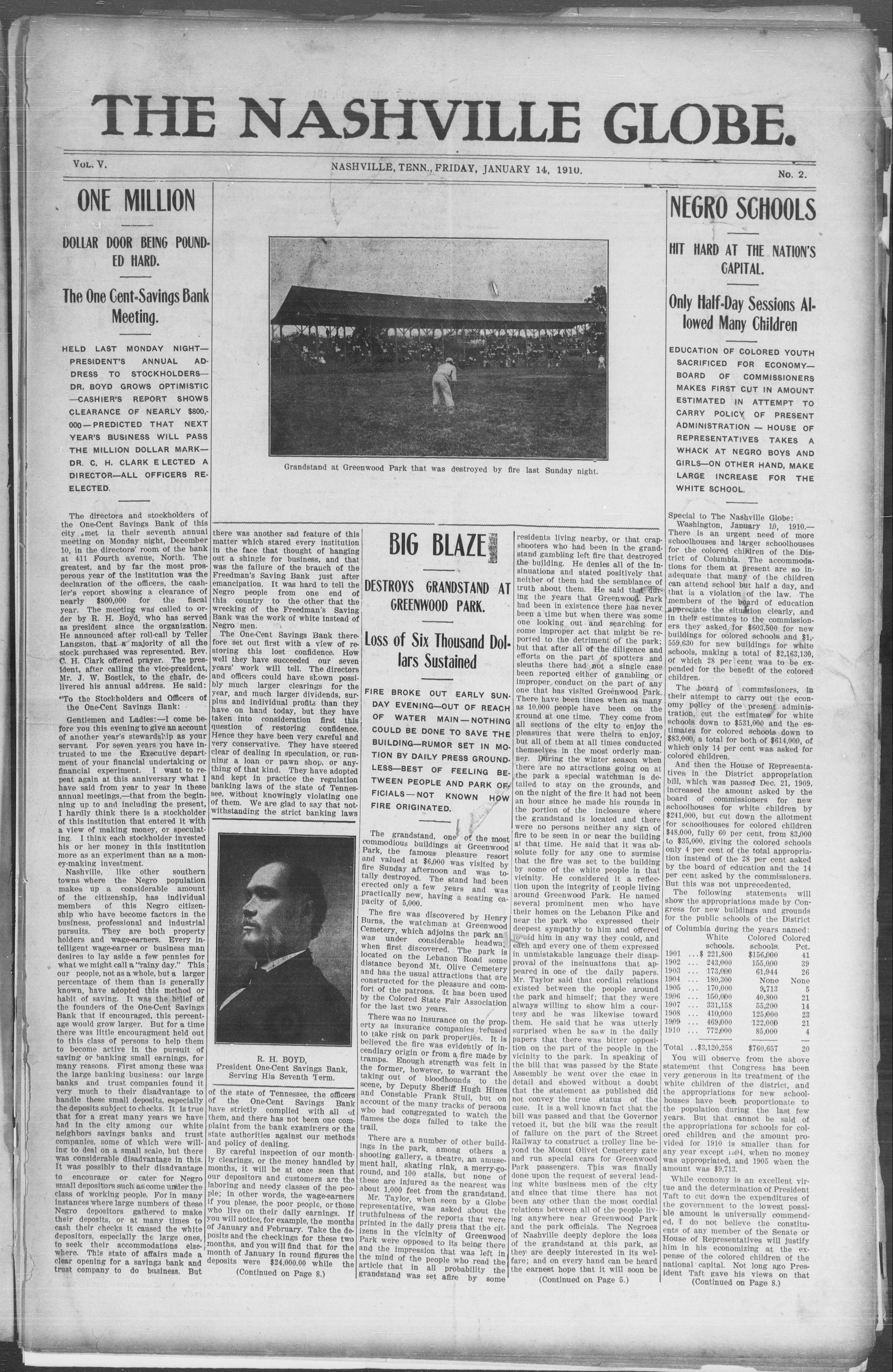
ONE MILLION
DOLLAR DOOR BEING POUND- ED HARD.
The One Cent-Savings Bank Meeting.
HELD LAST MONDAY NIGHT—
PRESIDENT'S ANNUAL ADDRESS TO STOCKHOLDERS—
DR. BOYD GROWS OPTIMISTIC
—CASHIER'S REPORT SHOWS
CLEARANCE OF NEARLY $800,
000—PREDICTED THAT NEXT
YEAR'S BUSINESS WILL PASS
THE MILLION DOLLAR MARK—
DR. C, H. CLARK ELECTED A
DIRECTOR—ALL OFFICERS RE-
LECTED.
The directors and stockholders of the One-Cent Savings Bank of this city met in their seventh annual meeting on Monday night, December 10, in the directors' room of the bank at 411 Fourth avenue, North. The greatest, and by far the most prosperous year of the institution was the declaration of the officers, the cashier's report showing a clearance of nearly $800,000 for the fiscal year. The meeting was called to order by R. H. Boyd, who has served as president since the organization. He announced after roll-call by Teller Langston, that a majority of all the stock purchased was represented. Rev. C. H. Clark offered prayer. The president, after calling the vice-president, Mr. J. W. Bostick, to the chair, delivered his annual address. He said:
"To the Stockholders and Officers of the OneCent Savings Bank;
Gentlemen and Ladies:—I come before you this evening to give an account of another year's stewardship as your servant. For seven years you have intrusted to me the Executive department of your financial undertaking or financial experiment. I want to repeat again at this anniversary what I have said from year to year in these annual meetings,—that from the beginning up to and including the present, I hardly think there is a stockholder of this institution that entered it with a view of making money, or speculating. I think each stockholder invested his or her money in this institution more as an experiment than as a money-making investment.
Nashville, like other southern towns where the Negro population makes up a considerable amount of the citizenship, has individual members of this Negro citizenship who have become factors in the business, professional and industrial pursuits. They are both property holders and wage-earners. Every intelligent wage-earner or business man desires to lay aside a few pennies for what we might call a "rainy day." This our people, not as a whole, but a larger percentage of them than is generally known, have adopted this method or habit of saving. It was the belief of the founders of the One-Cent Savings Bank that if encouraged, this percentage would grow larger. But for a time there was little encouragement held out to this class of persons to help them to become active in the pursuit of saving or banking small earnings, for many reasons. First among these was the large banking business: our large banks and trust companies found it very much to their disadvantage to handle these small deposits, especially the deposits subject to checks. It is true that for a great many years we have had in the city among our white neighbors savings banks and trust companies, some of which were willing to deal on a small scale, but there was considerable disadvantage in this. It was possibly to their disadvantage to encourage or cater for Negro small depositors such as come under the class of working people. For in many instances where large numbers of these Negro depositors gathered to make their deposits, or at many times to cash their checks it caused the white depositors, especially the large ones, to seek their accommodations elsewhere. This state of affairs made a clear opening for a savings bank and trust company to do business. But
NASHVILLE, TENN., FRIDAY, JANUARY 14, 1910.
Grandstand at Greenwood Park that was destroyed by fire last Sunday night.
there was another sad feature of this matter which stared every institution in the face that thought of hanging out a shingle for business, and that was the failure of the branch of the Freedman's Saving Bank just after emancipation. It was hard to tell the Negro people from one end of this country to the other that the wrecking of the Freedman's Saving Bank was the work of white instead of Negro men.
The One-Cent Savings Bank therefore set out first with a view of restoring this lost confidence. How well they have succeeded our seven years' work will tell. The directors and officers could have shown possibly much larger clearings for the year, and much larger dividends, surplus and individual profits than they have on hand today, but they have taken into consideration first this question of restoring confidence. Hence they have been very careful and very conservative. They have steered clear of dealing in speculation, or running a loan or pawn shop, or anything of that kind. They have adopted and kept in practice the regulation banking laws of the state of Tennessee, without knowingly violating one of them. We are glad to say that notwithstanding the strict banking laws
R. H. BOYD,
President One-Cent Savings Bank,
Serving His Seventh Term.
of the state of Tennessee, the officers of the One-Cent Savings Bank have strictly complied with all of them, and there has not been one complaint from the bank examiners or the state authorities against our methods and policy of dealing.
By careful inspection of our monthly clearings, or the money handled by months, it will be at once seen that our depositors and customers are the laboring and needy classes of the people; in other words, the wage-earners if you please, the poor people, or those who live on their daily earnings. If you will notice, for example, the months of January and February. Take the deposits and the checkings for these two months, and you will find that for the month of January in round figures the deposits were $24,000.00 while the (Continued on Page 8.)
BIG BLAZE
DESTROYS GRANDSTAND AT GREENWOOD PARK.
Loss of Six Thousand Dollars Sustained
FIRE BROKE OUT EARLY SUNDAY EVENING—OUT OF REACH OF WATER MAIN—NOTHING COULD BE DONE TO SAVE THE BUILDING—RUMOR SET IN MOTION BY DAILY PRESS GROUNDLESS—BEST OF FEELING BETWEEN PEOPLE AND PARK OFFICIALS—NOT KNOWN HOW FIRE ORIGINATED
The grandstand, one of the most commodious buildings at Greenwood Park, the famous pleasure resort and valued at $6,000 was visited by fire Sunday afternoon and was totally destroyed. The stand had been erected only a few years and was practically new, having a seating capacity of 5,000.
The fire was discovered by Henry Burns, the watchman at Greenwood Cemetery, which adjoins the park an was under considerable headway when first discovered. The park is located on the Lebanon Road some distance beyond Mt. Olive Cemetery and has the usual attractions that are constructed for the pleasure and comfort of the patrons. It has been used by the Colored State Fair Association for the last two years.
There was no insurance on the property as insurance companies refused to take risk on park properties. It is believed the fire was evidently of incendiary origin or from a fire made by tramps. Enough strength was felt in the former, however, to warrant the taking out of bloodhounds to the scene, by Deputy Sheriff Hugh Hines and Constable Frank Stull, but on account of the many tracks of persons who had congregated to watch the flames the dogs failed to take the trail.
There are a number of other buildings in the park, among others a shooting gallery, a theatre, an amusement hall, skating rink, a merry-go-round, and 100 stalls, but none of these are injured as the nearest was about 1,000 feet from the grandstand.
Mr. Taylor, when seen by a Globe representative, was asked about the truthfulness of the reports that were printed in the daily press that the citizens in the vicinity of Greenwood Park were opposed to its being there and the impression that was left in the mind of the people who read the article that in all probability the grandstand was set afire by some
residents living nearby, or that crap shooters who had been in the grand stand gambling left fire that destroyed the building. He denies all of the insinuations and stated positively that neither of them had the semblance of truth about them. He said that during the years that Greenwood Park had been in existence there has never been a time but when there was some one looking out and searching for some improper act that might be reported to the detriment of the park, but that after all of the diligence and efforts on the part of spotters and sleuths there had not a single case been reported either of gambling or improper, conduct on the part of any one that has visited Greenwood Park. There have been times when as many as 10,000 people have been on the ground at one time. They come from all sections of the city to enjoy the pleasures that were theirs to enjoy but all of them at all times conducted themselves in the most orderly manner. During the winter season when there are no attractions going on at the park a special watchman is detailed to stay on the grounds, and on the night of the fire it had not been an hour since he made his rounds in the portion of the enclosure where the grandstand is located and there were no persons neither any sign of fire to be seen in or near the building at that time. He said that it was absolute folly for any one to surmise that the fire was set to the building by some of the white people in that vicinity. He considered it a reflection upon the integrity of people living around Greenwood Park. He named several prominent men who have their homes on the Lebanon Pike and near the park who expressed their deepest sympathy to him and offered to aid him in any way they could, and each and every one of them expressed in unmistakable language their disapproval of the insinuations that appeared in one of the daily papers. Mr. Taylor said that cordial relations existed between the people around the park and himself; that they were always willing to show him a courtesy and he was likewise toward them. He said that he was utterly surprised when he saw in the daily papers that there was bitter opposition on the part of the people in the vicinity to the park. In speaking of the bill that was passed by the State Assembly he went over the case in detail and showed without a doubt that the statement as published did not convey the true status of the case. It is a well known fact that the bill was passed and that the Governor vetoed it, but the bill was the result of failure on the part of the Street Railway to construct a trolley line beyond the Mount Olivet Cemetery gate and run special cars for Greenwood Park passengers. This was finally done upon the request of several leading white business men of the city and since that time there has not been any other than the most cordial relations between all of the people living anywhere near Greenwood Park and the park officials. The Negroes of Nashville deeply deplore the loss of the grandstand at this park, as they are deeply interested in its welfare; and on every hand can be heard the earnest hope that it will soon be
(Continued on Page 5.)
No. 2.
NEGRO SCHOOLS
HARD AT THE NATION'S CAPITAL.
Only Half-Day Sessions Allowed Many Children
EDUCATION OF COLORED YOUTH
SACRIFICED FOR ECONOMY—
BOARD OF COMMISSIONERS
MAKES FIRST CUT IN AMOUNT
ESTIMATED IN ATTEMPT TO
CARRY POLICY OF PRESENT
ADMINISTRATION — HOUSE OF
REPRESENTATIVES TAKES A
WHACK AT NEGRO BOYS AND
GIRLS—ON OTHER HAND, MAKE
LARGE INCREASE FOR THE
WHITE SCHOOL.
Washington, January 10, 1910. There is an urgent need of more schoolhouses and larger schoolhouses for the colored children of the District of Columbia. The accommodations for them at present are so inadequate that many of the children can attend school but half a day, and that is a violation of the law. The members of the board of education appreciate the situation clearly, and in their estimates to the commissioners they asked for $603,500 for new buildings for colored schools and $1,559,630 for new buildings for white schools, making a total of $2,163,130, of which 28 per cent was to be expended for the benefit of the colored children.
The board of commissioners, in their attempt to carry out the economy policy of the present administration, cut the estimates for white schools down to $531,000 and the estimates for colored schools down to $83,000, a total for both of $614,000, of which only 14 per cent was asked for colored children.
And then the House of Representatives in the District appropriation bill, which was passed Dec. 21, 1909, increased the amount asked by the board of commissioners for new schoolhouses for white children by $241,000, but cut down the allotment for schoolhouses for colored children $48,000, fully 60 per cent, from 83,000 to $35,000, giving the colored schools only 4 per cent of the total appropriation instead of the 28 per cent asked by the board of education and the 14 per cent asked by the commissioners. But this was not unprecedented.
The following statements will show the appropriations made by Congress for new buildings and grounds for the public schools of the District
of Columbia during the years named:
White schools. Colored schools. Colored Pct.
1901 ... $ 221,800 $156,000 41
1902 ... 243,000 155,000 19
1903 ... 173,000 61,944 26
1904 ... 180,300 None None
1905 ... 170,000 9,713 5
1906 ... 150,000 40,800 21
1907 ... 331,158 55,200 14
1908 ... 410,000 125,000 23
1909 ... 469,000 122,000 21
1910 ... 772,000 85,000 4
Total ... $3,120,258 $760,657 20
You will observe from the above statement that Congress has been very generous in its treatment of the white children of the district, and the appropriations for new schoolhouses have been proportionate to the population during the last few years. But that cannot be said of the appropriations for schools for colored children and the amount provided for 1910 is smaller than for any year except 1904, when no money was appropriated, and 1905 when the amount was $9,713.
While economy is an excellent virtue and the determination of President Taft to cut down the expenditures of the government to the lowest possible amount is universally commended, I do not believe the constituents of any member of the Senate or House of Representatives will justify him in his economizing at the expense of the colored children of the national capital. Not long ago President Taft gave his views on that
FIRE IN THE HOME OF GEORGE WILLIS BURRILL, OF BROOKLYN, N. Y.
Special to the Nashville Globe:
Brooklyn, N. Y., Jan. 6, 1910.—Fire which threatened to destroy a row of four-story double brick flats on Reid avenue, between Macon and McDonough streets, broke out at 6 o'clock last night, and it was only after three alarms had been sent in that the Fire Department got the blaze under control. The fire started in the pain shop occupied by Morris Coewitz, at 280 Reid avenue, and extended into the next building, causing a total loss of nearly $8,000.
As early as 4 o'clock in the afternoon, Mr. George Willis Burrill, who is employed by the Brooklyn Rapid Transit and lives on the first floor over the paint shop, though he smelled smoke, and went to the apartment of Mr. Titus, who lives on the same floor. Together they made an examination of the building, but fire could not be found in the house, so the searchers went into No. 284, next door. In the cellar under the store occupied by Peter Tribeker, they came upon a man, who said he was a plumber and was thawing out the water pipes. According to Mr. Burrill, the man did not look like a plumber, and after the fire was discovered, three hours later, he notified the fire marshal of what he had seen.
Mr. Burrill was just about to leave the house, and was saying goodbye to his wife when somebody yelled "Fire." He went down to see what he could do, and his wife, Mrs. Margaret Burrill, who has just recovered from a long illness, got out of bed, slipped on a few clothes and, taking her two children, Evelyn, a year and a half old, and Margaret, less than one month, carried them down the stairs, which was by this time crowded with tenants. As she reached the street she slipped on the icy pavement and fell the two children sprawling on the street. They were all picked up and taken to the home of a friend on Hancock street, where they spent the night. Their apartments were entirely burned out, with a loss of $1,500.
The second floor, which is occupied by H. E. Pennington, was also burned out. Mrs. Pennington was at home with her four children and her sister, Miss Kate Milard, who was preparing to leave town. When the fire broke out Mrs. Pennington took two of the children, while Miss Milard took the others, and led them down stairs, which was, by this time, a mass of flames. The top floor was occupied by Harold Simpson, his wife and one child. They also made their way to safety by the stairs. Their apartment was also burned out.
After the fire fighters arrived and had been at work for almost a quarter of an hour, a second alarm was turned in. This was followed by a third two minutes later.
Eating its way through the walls, the fire spread to 284 Reid avenue. This is also a double-flat house, but at the time of the fire there was only one family living in the north side of the building. John Kisslig, his wife and one child, who occupied the third floor. Their home was gutted. The cause of the fire is unknown, and according to the police there is nothing suspicious about it. The people who were burned out, however, are of a different opinion, and believe that the fire was started for the purpose of getting insurance.
Mr. Geo. Willis Burrill is the son of Mr. Chas. H. Burrill, "Dean" and Secretary of the Globe Publishing Company, and who was proof-reader at the National Baptist Publishing House until a few months ago, when he re turned to his home at 203 Halsey street as the result of illness.
NASHVILLE MAN HIGHLY
_PRAISED.
This city has been said to enjoy the distinction of producing, or has living in it some of the most noted business and professional men that the race has produced. Hardly a day passes but that this fact is brought out not only in Nashville, but in other cities by speeches, publications, or otherwise. Among the recent utterances coming from a source that would be considered by all authoritative and reliable in the Freeman, an illustrated weekly journal, published at Indianapoils, Ind., a clipping appears editorially on one of Nashville's industrious business and professional men. It was a reference to R. H. Boyd, the Secretary of the National Baptist Publishing Board, a religious institution looking after the business side of their denominational publicational work. There is a kindly feeling toward the Freeman in this city, said a good Baptist brother, more so now than at any other time, and that journal has for the past three or four years voluntarily, without the knowledge or consent of those interested in the denomination's uplift, pointed with pride to the rapid success obtained by the institution which Dr. Boyd represents. The clipping that caused some attention is given.
"Rev, Dr. R. H. Boyd, the indomitable, irrepressible, progressive founder and manager, secretary and treasurer of the National Publishing
THE NASHVILLE GLOBE. FRIDAY. JANUARY 14, 1910.
House of Nashville has our sympathetic good wishes in all his laudable undertakings for the good of the race and the growth of the great Baptist denomination with which he is identified, and in manner and style of work he is premier. We thank the good doctor for the Christmas gift of the Negro doll, a sample of which should be in every Negro home is the land, also congratulate him for the issuing of such a magnificent journal as the 'Review,' a weekly that will make its own way with the readable people of all denominations."
The Freeman is a paper that for a number of years has been constantly kept before the people both as a news journal and a high class periodical.
MR. WM. KENNEDY HONORED.
Mr. and Mrs. Jas, Burnette, of 1409 Jackson street, entertained a limited number of friends las Friday evening. The house was bautifully decorated. Music and games were the main features of the evening. At a late hour a three-course menu was served, the table being daintily decorated. Those who enjoyed the evening were Mr. Wm. Kennedy, Chicago, Ill.; Mrs. Sam Townsend, Jr., Mr. and Mrs. Pete Wood, Mr. and Mrs. Turley Gleaves, Mr. and Mrs. Andrew B. Martin Misses Norman, Lelia Grear, Daisy Lillian Lawrence, Lyle and Mesdames Hughes and Shane, Messrs. Quinton Gleaves, Lott, Martin and R. A. Coleman.
RETURNED TO BIRMINGHAM.
Mrs. Ella Coffey asd son, Lawrence, who have been in the city for several months visiting their aunt, Mrs. Lizie Hadley, of Eleventh avenue North, left the city last Saturday morning for their home in Birmingham, Ala. Little Irene Green, daughter of Mrs. F. M. B. Green, accompanied them to Birmingham where she will stay indefinitely with her uncle and aunt, Prof. and Mrs. M. Z. Hanna.
IMPORTANT POINTS ON THE U. S. CENSUS.
This information is prepared for the use of persons who have opportunities of teaching others. It is urged that ministers, teachers and lecturers on all subjects will make frequent use of these facts in impressing people with the great importance of the coming census, and in preparing them to give correct answers.
This leaflet is out in this small compass, so that the speakers may carry these facts with them as reminders of their opportunity to instruct the people.
1. Thirteenth General Census of the United States will be taken beginning April 15, 1910, to be completed within the next thirty days.
2. Great importance of learning the truth about the people of the nation, their health, their wealth, their education, their homes and their general progress. Descriptions based upon the imagination and hearsay frequently do great harm.
3. United States is still primarily an agricultural country, hence the importance of the farm schedule.
4. Crops and animal products desired are those for 1909, while property and live stock, including poultry and bees, are those on hand April 15, 1910.
Possibility of error is greatest in the case of the farmer who moves on to his land in 1910. This man must learn of the crops of 1909 from the farmer who preceded. He in turn ought to tell his successor about his crops on the farm which he cultivated in 1909. 5. Note definition of a farm—as the land, 3 acres and over, under the personal direction of the farmer. The advocacy of keeping farm records for census purposes is one which will give us an entering wedge on the whole matter of keeping accounts. Through this campaign a beginning will be made toward inducing people to keep records of profits and losses—a matter of great economic importance to themselves.
IMPORTANT QUESTIONS ASKED OF ALL PERSONS.
1. What was your exact age at last birthday?
2. Each mother will report how many children have been born to her and how many of her children are living.
3. Each family will report whether home is owned or rented, and if owned whether entirely paid for or mortgaged.
4. In giving occupation be sure to state whether you are an employer, or an employee, or working on your own account without employing labor.
Answers to the first two questions give valuable information regarding the health of the nation.
Answers to the last two questions are an indication of the prosperity of the nation.
IMPORTANT QUESTIONS ASKED OF FARMERS.
Information reported will not be given to any tax accessor and will be treated as strictly confidential.
A farm, according to the Census.
includes all the land cultivated under the personal direction of the farmer.
A portion of the land less than three acres is not to be considered a farm, unless it requires all the time of one person or produced $250 worth of produce in 1903.
Land operated by any of the following classes constitutes a separate farm and is not to be counted with the owner's farm:
1. By share, hands or croppers.
2. By cash renters or renters who pay a stated amount of labor or of farm products.
3. By managers who receive wages or salary for their services as managers or overseers.
Such farms are to be reported by the tenant or manager himself if possible.
1. How many acres in the farm?
Total value.
2. How many acres of improved land in your farm? Improved land is land regularly tilled or mowed, land now in pasture but plowed in recent years, land lying fallow, land in gardens, orchards, vineyards, and nurseries and land occupied by buildings.
3. How many acres of timbered land?
4. What is the value of all buildings on the farm?
5. What is the value of all the implements and machinery on the farm?
6. What is the value of each kind of live stock, including poultry and bees, on hand April 15, 1910?
The following facts relate to the crops and animal products of 1909, and should be recorded immediately, and kept for the enumerator, who will call for them on or after April 15, 1910.
Replies to all questions must be concerning the farm on which the farmer is living April 15, 1910.
7. Give number of acres in, and quantity and value of, each kind of crops harvested in 1909.
8. Give number and value of each kind of animals purchased, sold alive, or slaughtered in 1909.
9. Give the number of calves, colts, mule colts, lambs, and pigs born on the farm in 1909.
10. Give quantity produced and quantity sold in 1909 of milk, butter, cheese, and the quantity sold of cream and butter fats.
11. Give the value of all poultry raised in 1909.
12. Give the amount received from poultry sold in 1909.
13. Give number of dozen and value of eggs produced in 1909.
14. Give number of dozen and value of eggs sold in 1909.
DEATHS.
Minnie Ramsey, Mercy Hospital, 20 years.
Lula Nichol, Vanderbilt Hospital, 57 years.
Rachel McEwen, City Hospital, 45 years.
Andrew Jackson, 423 Eighth avenue, North, 69 years.
Thomas Stringer, Mill and Gizer streets, 34 years.
Martha Beech, 508 Fourth avenue, North, 93 years.
Matilda Trammell, 103 Lewis street, 70 years.
Wayman Henderson, 42 Lewis street, 16 years.
May Pearl Jacobs, 118 Fairfield avenue, 18 years.
Ella Gant, 514 Jo Johnston avenue, 27 years.
Sadie M. Gennice, Greenbrier, Tenn., 38 years.
Missie Perkins, 52 years, 906 Twenty-first avenue, North.
John Edward Graham, 907 North Seventh street.
Infant of Mary Thompson, 1021 Hawkins street.
Rosa Searcy, 21 years, 200 Fillmore street.
George Sanders, 40 years, City Hospital.
Edgar Bush, 19 years, 724 South Seventh street.
Ransom Ward, 60 years, 47 Lewis street.
Willis Ware, 1 year, 1018 Cedar street.
Moses Battle, 75 years, Flat Rock.
Jim Bonner, West Pearl and Zollicoffer, 80 years.
John H. T. Muse, 829 Fairmount street.
Elnora Page, 1000 South street, 4 years.
Lee Slatter, 127 1-2 Eleventh avenue, North, 40 years.
Hattie Belle Mosely, 1618 Prison avenue, 4 years.
Hab Ware, 1002 Warren street, 35 years.
Lucinda Williams, Chicago, Ill.
Dow Johnson, 811 Criddle street, 60 years.
FIVE O'CLOCK DINNER.
Mr. and Mrs. Henry Reynold, of 831 Division street, entertained a few friends at dinner Sunday evening. Those present were Rev. and Mrs. W. Johnson, Miss Ella Easmon, of Chicago, Mrs. Solomon Blade, Mr. Wm Copeland, Mr. and Mrs. Major Johnson, Miss Mary Ligget, Mrs. Mary Polk, Mr. and Mrs. Henry Reynolds and Master Herman Blackwell.
NWSE BROS.
HOME, STOVES AND CARPETS
EMS TO SUIT EVERYBODY.
Your Home Complete from Parlor to Kitchen.
Bids as First Payment; Balance Weekly or Monthly.
Y. NASHVILLE, TENN.
Day Furniture Co.,
SWINDELL, MANAGER.
TURE, STOVES
S OF HOUSEHOLD FURNISHINGS.
Fish your home on easy payments.
HOWSE
FURNITURE, STOVER
TERMS TO SUIT ME
We Can Furnish Your Home Comp
We Take Old Goods as First Payment
Broadway Fur
J. H. SWINDER
FURNITURE
And ALL KINDS OF HOUSE
We can furnish your home
Broadway Furniture Co.,
And ALL KINDS OF HOUSEHOLD FURNISHINGS. We can furnish your home on easy payments. TELEPHONE MAIN 701
MARRIAGES.
Alonzo Burnett and Maggie May
Caruthers.
Richard Smith and Frankie Stamps.
Oscar M. Brown and Mamie H. Davis.
George Washington and Carrie
Tubbs.
Dan Helim and Anna Lou Crow.
Sonny Mason and Myrtle Richardson.
Curtis Blackburn and Lizzie Harris.
Leonard Stratton and Jennie V.
Hodge.
THE "BUSY MUGGLETONIANS."
Last Tuesday at the residence of Mr. and Mrs. White, 9 Garden street, the "Busy Muggletonian's" Club gave its annual social. The house was beautifully decorated with ferns and cut flowers. Music and dancing were the features of the evening after which a three-course menu was served. Those present were Misses Minnie O. Peaks, Beatrice Johnson, Lucille Gleaves, Elma Brown, Sadie L. Watson, Nani M. Hughes, Leola Bright, A. V. White, Georgia Bright, Estizer R. Watson, Clara M. Hightower, Millie F. Stone, Messrs. James Johnson, Joe Crow, Jesse Foster, R. G. Buckner, G. L. Jackson, Thomas Hightower, Elliott Brown, L. M. Pollar, P. F. Buchannan, Stanley White, Mark Booth, R. L. Peters, A. M. Jones, — Walker, Alfronsa Dockett, Fred Bayes.
EVENING ENTERTAINMENT.
Mrs. Martha Peyton, of 24 Tennessee street entertained on last Tuesday evening a number of friends. Those who enjoyed the hospitality of Mrs. Peyton were Misses Arzella Ellis, Gertrude Lewis, Sophia Garner, Lula Gains, Mamie Brown, Mable Smith, Molivia Dye, Guenea Drucy, Messrs. Arthur Frazier, Prof. Hugh J. Johnson, Dr. Craigg, D. Fowlkes, Mr. T. W. Burney, Mr. R. B. McArthur, Mr. Clifford Anderson. A palpable menu was served in elaborate style.
The NonPAREIL CLUB met at the home of the president, Mrs. A. J. Bright, Tuesday. Promptly at three o'clock the ladies began their work, and at the close of the meeting many pretty and artistic bows, collars and ribbon roses were ready for use. Several of the members brought many fancy articles to exhibit, which they had made since the last meeting in December. Mrs. Falkner, the new member, was present at this meeting and welcomed into the club. A two-course menu was served and the club adjourned to meet January 18, with Mrs. Thos. Hightower.
Miss Maggie E. Hargrave, of 1106 Twelfth avenue, South, entertained at her residence on last Friday afternoon Mr. Sidney Kirkpatrick, of Richard and Pringle's Minstrel Show. Quite a pleasant afternoon was spent indeed. Mr. Kirkpatrick sang several of his most choice selections two of which were "Roses," and "When you Were Mine." He expressed himself as having been delightfully entertained and was only sorry that he was unable to remain in our city longer.
LADIES AID SOCIETY ENTER
TAINED.
The Ladies Aid Society of Howard Congregational Church was entertained by the President, Mrs. P. R. Burrus, Thursday evening, January 6. During the evening an informal musicale was given, after which tempting refreshments were served. An enjoyable evening was spent by all who were present.
Mrs. Martha Johnson announces the coming marriage of her daughter, Mrs. Genie B. Williams to Mr. Peter Patterson on Wednesday, January 19. The marriage will be solemnized at her home, 1004 Ninth avenue, North.
---
---
HILARY E. HOWSE.
304-306 BROADWAY.
No. 318 Broadway.
NONPAREIL CLUB.
ENTERTAINS
ANNOUNCEMENT.
PHONE: MAIN 1000
NASHVILLE, TENN.
ENTERPRISE RESTAURANT
OPEN DAY AND NIGHT.
Orders Promptly Filled. — Neatly Furnished Rooms.
Telephone, Main 2830.
ROBT. L. MILLER, Prop.,
714 Jo Johnston Ave., Nashville, Tenn.
PERRY & LESTER
Wholesale and Retail Dealers In
HIGH-GRADE STEAM
AND DOMESTIC
COAL
PHONE MAIN 29
606 Second Ave., N., Nashville, Tenn.
CREOLE HAIR A SPECIALITY
C. R. BADOUX,
MANUFACTURER OF
HAIR GOODS.
220 Fifth Ave., N.
NASHVILLE. - TENNESSEE.
Ten per cent discount to all who present
this advertisement.
THE A. B. HOOPER FURNITURE COMPANY.
1201 CHURCH STREET,
DEALERS IN
FURNITURE, STOVES, CARPETS and QUEENSWARE.
We exchange New for Old. Easy pay
ments.
Phone 4359-Y.
REMEMBER THAT THE
Textile Coloring and Dry Cleaning
Company
Cleans all kinds of Laces, Silks, Velvets,
Gloves, Fur, Feathers, Garments, Ete.
Phone Main 1965
U. S. MORTON, Mgr.
421 Cedar Street, Boyd Building.
WHY NOT RAISE POULTRY
THAT WILL PAY?
THE ROOSTER
Hens that will give you on an average of 200 eggs each a year and guaranteed to lay at a time when eggs are at a premium (during the winter). Broilers that you can send to the market in six weeks, is the breed you want. This is what my Rhode Island Reds and White Plymouth
Rocks are doing for me, and will do with the proper care and treatment the same for your own rocks. You can your selection be only a matter of color and not the bird. Eggs shipped to all parts of the country, they hatch just the same, distance not much different, all times. Let me book your order for an early shipment, as
Rocks are doing for me, and will do with the proper care and treatment the same for your Bear. Will fill the bill, so your selection be only a matter of color and not the bird. Eggs shipped to all parts of the country, they hatch just the same, distance not considered. Eggs for sale at all times. Let me book your order for an early shipment, as earlier the hatch better the results. Write for prices and catalogue, also information as to stock for sale if wanted.
MRS. DRAPER ENTERTAINS.
Mrs. George Draper entertained at luncheon at her beautiful home, McFerrin avenue. Those presest were: Mrs. Estiza Ratcliff Watson, of Clarksville, Mrs. Ella Martin Ewing, Mesdames John Campbell, Sim Peyton and George Williamson. The house was beautifully decorated for the occasion. A three-course menu was served.
ROGER WILLIAMS UNIVERSITY. At the close of the year 1909 Roger Williams had enrolled more than 115 students, sixty of whom were above the English Department and the old chapel was so limited that it was unable to comfortably seat the anxious ones desirous to enroll with us here. Many applications for membership have been turned down for the same reason. But as we approached the threshold of the new year and viewed it with new responsibilities, ideas, obligations and duties, we found our young women comfortably domiciled in our steam-heated, five-story, new brick girls' dormitory, and the young men taking possession of the quarters left by the young women, and now when the elements with the attendant subjects from the region of "Septriiones" swoop down upon us to wrap us in their blanket of white and to hold us firmly within their grasp, we can lay aside our togas and pleasantly smile upon their fruitless efforts and attacks.
Now that we are housed in our new brick girls' dormitory, we extend a cordial invitation to those anxious ones who have so long been held in suspense. The development and growth of the school have been uniform since the very beginning of the term. That is, no one phase of the college life has been especially emphasized at the expense of the other, but all have been developed abreast at a uniform rate. While the attention of the student body has been constantly called to the importance of thorough scholarship both in and out of classroom, the spiritual side, nevertheless, has not passed unnoticed. Within the last four weeks, eight among us here have professed to know Christ, the Redeemer of the world, and at present there is but one resident student who knows not Christ, so that we are a Christian band, a family of believers in Christ. Following are names of those who professed Christ: Messrs. John Harris, Frank Baker, Jesse Davis, Scipio Landrum, John Mason, Misses Nannie Turner, Mary Baugh and Eva London.
There is here in the school college spirit, class spirit—a product of the old school. College songs and yells can be heard when the smallest bunch of students meet for a cheerful "chat" in the halls, on the stone steps or out on the campus. Class rivalry is in evidence day by day. The Second Academic Class, twenty-eight in number, held an enthusiastic class meeting and drew up the following resolutions for the new year:
As we look over the events of the year 1909 and recount the many good duties we performed and the many good opportunities we let pass, be it
Resolved, That we make use of every good opportunity, that we read a verse of the Bible each day, that we attend church each Sunday, that we apply ourselves to our work completely day by day, that we give teachers no reason for complaint, and that we improve in every good way in course of the year.
FRANK BAKER, President.
MISS MAGGIE T. HICKMAN.
Secretary.
It will be remembered that Mr. Holle Linder was the author of this movement of resolutions.
Remarks ..... Master of Ceremonies
Invocation ......
Music—America ..... Congregation
Proclamation .. Mr. Wm. Haynes, Jr.
Music—Star Spangled Banner ......
University Chorus
Reading—Lincoln's Gettysburg
Address ..... Mr. Frank L. Baker
Vocal Solo—Rock of Ages ......
Mr. Samuel E. Herrod
Reading—Julius Caesar ......
Mr. Silas B. Thornton
Essay—Incentives to Future Ac
tivities ..... Miss F. Ardella Owen
Music—Marching Through Georgia
..... University Chorus
Address—The Place of the Emancipation in Our Race Life
..... Prof. A. O. Jeffries, A. B.
Chorus—Freedom's Sons
SAID ABOUT THE COMMETARY.
Remarks calculated to influence no little attention on the National Baptist Sunday-School Lesson Commentary are being made from time to time by scholars, prominent speakers and newspapers of note. The 1910 edition is being mailed out rapidly. The following comment on the book, comes from Atlanta, Ga.;
"I have enjoyed looking through and reading the Sunday-School Lesson Commentary for 1910. I am forced to admit that it requires much research and thoughtfulness to produce such a clear, concise and explicit note on the lessons, as were given, and these, together with a splendid map and dictionary and class record blanks, also the helpful information in the first of the book on the Modern Sunday-school Methods, make up a book that will be valuable to any Sunday-school worker and indispensible to the teacher. I trust that you will be able to get the commentary into the hands of thousands who have not had it before. When they have
THE NASHVILLE GLOBE, FRIDAY, JANUARY 14, 1910.
once used it I am sure that they will not want to be without it.
MISS HELLEN A. McALPHINE
Spelman Seminary, Atlanta, Ga."
Others are sending in the most flattering compliments from all over the country about this book.
H. T. G. M. CLUB.
The Misses Banks were hostesses to the H. T. G. M. Club at its January meeting, Thursday evening, January 6, 1910. In spite of the bitter cold evening, the young ladies were all present with two exceptions and busily engaged in their newly assigned tasks at 6 o'clock. When the young men guests of the club arrived work was laid aside and tables arranged for progressive whist. The first prize was captured by Dr. M. Glover, a burnt wood box containing linen paper. The consolation fell to Miss Clara Hodgkins, a Japanese pin tray. A two-course menu was served. The guests of the evening were Misses Elizabeth Moore, Clara and Hattie Hodgkins, Mrs. Jas, A. Simpson, Drs. W. M. Glover, H. C. Clardy, M. A. Melton, J. I. Taylor, G. H. Francis, J. B. Hanckle, H. E. Nash and R. F. Boyd. Each young lady was the recipient of a beautiful souvenir card from Miss R. H. Mason, of Knoxville, Tenn., who was a guest of the club during the past summer. The next meeting of the club will be with Mrs. H. A. Boyd, 1603 Harding street, February 14, 1910.
THANKS FROM PHYLLIS WHEAT-
LY CLUB
To all who donated for the happiness and comfort of the poor through the Phyllis Wheatley Club we tender our sincere thanks. The club ladies have been very busy looking up the needy and distributing Christmas baskets. All parts of the city have been visited and in more than seventy-five houses the happy hearts of parents and children and the beautiful Christmas cards bearing greetings from the club tell the story that the club ladies have been there. In many homes "God bless you and your work" were the only words the recipients could find to utter. Such a happy work of love it has been and all the club ladies feel happier from having made so many others happy. This is not a new feature of the club. It has done this work for fifteen years. Each year it strives to reach more and more and to broaden its influence for good. The club is not a church club
The next meeting of the club will be with Mrs. Lizzie Caruthers, 1044 Edgehill avenue, the last Thursday in the month January 27, 1910, at 3 o'clock. It is hoped that the first meeting of the new year shall be largely attended, indicative of a renewed determination for an enlarged work during the present year. MRS. G. L. JACKSON, Pres.
THREE BANK CALENDARS.
"There is quite a number of Negro banks in the state of Mississippi which have demonstrated on more than one occasion that they know the value of printer's ink, that is, they advertise; they let the people in their city, in their state and other states know that they are in the banking business. They do this twelve months in the year. Evidences of this fact have reached Nashville constantly," said a gentleman in this city to a Globe reporter concerning a big bank news item that is to come out in The Globe at an early date. He also remarked about the beautiful calendars, expensive in their make-up, that some of the banks send out and regarded them as a paying investment, as it was using "the printer's ink" as advertising. "The most beautiful calendar yet seen from the state of Mississippi was one sent out by the Delta Penny Savings Bank, of Indianola, Miss," said the gentleman. "Second choice," he continued "falls to the Union Savings Bank, of Vicksburg, while the third is the bank at Mound Bayou, Mound Bayou, Miss; that is, if you were voting in a contest as to the most beautiful calendar sent out by the three banks mentioned. But if you were taking it from another point of view it is evident," continued the gentleman, "that it would be a toss-up as to who had sent out the most attractive of the three. For instance, the bank at Mound Bayou has on its calendar two bales of cotton, the king of the South, representing prosperity in the state of Mississippi. Close to these two bales can be seen an excellent likeness of the venerable Mr. I. T. Montgomery, founder of the town, pointing a small boy to the two cotton bales. The inscription under these two bales is: "As long as there are mouths to be fed, backs to be clothed and land to be tilled, the place of the American farmer in the hearts of the American people will be supreme." When studied closely, this calendar is calculated to make one think, certainly it can be argued that it represents the business side of the thriving Negro town where this bank is located. The
CHURCH DIRECTORY.
PENTECOSTAL CHURCHES.
Holiness, 605 Twelfth Avenue, N.—Rev.
James B. Crosby, pastor. Sunday services
PLEASANT VALLEY, Edgehill St.—Sunday-
school 9:30 a. m.; preaching 11:30 a. m. and
8 p. m. Sundays. Rev. Henry Ewing, pastor.
WEST NASHVILLE. Sunday-school 9:30
SECOND, Stevens St. Cor. Deluge—Sunday-
school 9:30 a. m.; preaching 11:30 a. m. and
8:30 p. m. Sundays; prayer meetings Tuesday
nights; preaching Thursday nights; commu-
SEVENTH DAY ADVENTISTS
CHURCH.
SEVENTH DAY ADVENTIST No 2, 711 Winter Street.—Services Saturday 10 a. m. to 12 m.
CATHOLIC CHURCH
HOLY FAMILY, 458 3d Ave., N.-Rev Thomas J. Plunket, rector. Sunday services 10:30 a. m.
THE CHURCH OF GOD.
THE CHURCH of God, 534 4th Ave., S.
Sunday-school; preaching at 8 n. p. m.; W.
Worker at Tuesday night;
preaching at river every 8:30 p.
m. Rev. A. W. Thompson, pastor.
A. M. E. ZION CHURCHES.
ZION CHURCH SUNDAY-SCHOOL. Howerton Ave., near Fifth.—Rev. B. R. Scott, pastor Sunday services 11 a. m. and 7:30 p. m.
CONGREGATIONAL CHURCHES
HOWARD CHAPEL, 12th Ave., N.—Sunday-school to a. m.; preaching services 11 a. m. Sunday; Y. P. S. C. E. 6:00 p. m.; Rev. G. L. Imes, pastor.
UNION, Fisk University Campus.—Preaching services at 11 a. m., followed by Sunday-school; Y. M. C. A. and C. E. meetings at 9 a. m.; mission Sunday-school 2 p. m.; prayer-meeting Wednesday at 6:40 p. m.
EPISCOPAL.
HOLY TRINITY, S. 6th and Ewing Aves.—Sunday-school 9:30; preaching services 11 a.m. and 7:30 p. m. Sunday. Rev. Father Coombs, rector.
HOFFMAN HALL, Hoffman Hall Building.—Sunday-school 9:30 a. m.; preaching 11:30 a. m. Sunday; praise services 7 p. m. Rev. E. J. Batty, pastor.
HANNINGTON CHAPEL, Hoffman Hall.—Sunday services 7:30 a. m. and 11 a. m. and 4 p. m.
COLORED METHODIST EPISCOPAL CHURCHES.
LANE TABERNACLE.—Sunday-school 9:30 a. m.; preaching 11:30 a. m. and 8 p. m.; Epworth League meeting at 6:30 p. m.; prayer meeting every Wednesday at 8 o'clock. Rev. I. H. Jones, pastor, No. 27 Spring street, East Nantucket B. E. Pray Superintendent CAPERS Chapel, Church St. Viaduct.—Sunday-school 9:30 a. m.; preaching services 11 a. m. and 8 p. m.; prayer-meeting Tuesday and Friday nights; C. E. 7 p. m. Sunday, Rev. Amos, pastor.
PRESBYTERIAN CHURCH.
St. ANDREW, 8th Ave., N.—Rev. Spencer Jackson, pastor. Sunday services 11 a. m. and 7:30 p. m.
CUMBERLAND PRESBYTERIAN.
First CHURCH, 1507 Hamilton St.-J. M. Dishon, pastor. Sunday services 11 a. m. and 7:30 p. m.
CHRISTIAN CHURCHES.
LEA AVENUE, 713 Lea Avenue—Sunday-school 9:30 a.m.; preaching services 11 a.m. and 8 p. m. Sundays, C. E. 7 p. m. Sunday evening; prayer-meter Wednesday night. Rev. Preston Taylor, pastor, 449 Fourth avenue, north.
GAY STREET—Preaching 11 a. m. and 8 p. m.; Sunday-school, 9:30; Christian Encavor 7 p. m. Eld. S. D. Cottrell, pastor.
WILLOW STREET, S. Hill, S. W. Cor. First avenue.—Rev. A. J. Lawrence, pastor. Sunday service 7:30 p. m.
METHODIST EPISCOPAL
PRIMITIVE BAPTIST CHURCHES
Union Savings Bank calendar contains beautiful half-tone cuts of the interior and exterior of the bank with photographs of the president, first and second vice presidents, cashier and assistant cashier and naturally finds a warm place in Nashville because of one of its sons appearing in that group. The kindred relationship of the states of Mississippi and Tennessee would probably influence a choice among many people in their selection of this one—while when you are looking at the rise and progress you could easily dismiss the personal side and admire the rapid progress made in that financial institution.
HONORS GUEST.
Mr. and Mrs. J. F. Henry, of 221
Eleventh avenue, North, entertained
PLEASANT VALLEY, Edgehill St.—Sunday-
school 9:30 a.m. m; preaching 11:30 a.m. m and
8 p.m. Sundays. Rev. Henry Ewing, pastor.
WEST NASHVILLE. —Sunday-school 9:30
a.m.; preaching 11:30 m and 7:30 p.m
prayer-meeting Thursday day. Rev. T. F.
Thatcher, pastor.
UNITED PRIMITIVE BAPSTH, S. E. Cor.
Walker St., N. W. —Sunday-school 9:30
a.m.; preaching 11:30 a.m. m and 8 p.m.
Sundays, Rev. Robert Estleman, pastor.
AFRICAN METHODIST EPISCOPAL
CHURCHFES
St. JOHN, cor. 8th Ave., N., and Cedar St.-Sunday services 11:30 a. m. and 8:00 p. m.; Sunday-school 9:30 a. m.; Christian Endeavor 7:00 p. m.; prayer and class meeting Tuesday night. Rev. A. Brooks, pastor, residence 923 Jackson street.
St. PAUL, Cor. 4th Ave., S., and Franklin St.-Sunday services 11:00 a. m. and 8:00 p. m.; Sunday-school 9:30 a. m.; Christian Endeavor meetings 6:30 p. m.; class meeting Thursday night; prayer-meeting Tuesday night. Rev. W. Sampson Brooks, pastor, residence 12 Roberson street.
BETHEL, 10th Ave., S.-Sunday services 11:00 a. m. and 8:00 p. m.; Sunday-school 9:30 a. m.; Christian Endeavor meeting 7 p. m.; class and prayer-meeting Thursday night. Rev. W. B. Denny, pastor. Residence 1350 Fourth Avenue, South DENNIS, 4th Ave., N. Chestnut St.-Sunday services 11:00 a. m. and 8:00 p. m.; Sunday-school 9:30 a. m.; Christian Endeavor 7:00 p. m.; class meeting Tuesday night; prayer-meeting Friday night. Rev. A. H. Nelson, pastor.
NORTS. COLLEGE St.—Sunday services 11:00 a. m. and 8:00 p. m.; Sunday-school 9:30 a. m.; Christian Endeavor 7:00 p. m. Rev. T. A. Dunlap, pastor. Residence, 26 Lincoln avenue.
FLAT Rock.—Sunday services 12:00 a. m. and 8:00 p. m.; Sunday-school 9:30 a. m.; class meeting Friday night. Rev. W. J. Adams, pastor.
ANTIOCH, 308 Benedict St.—Sunday services—Sunday-school 3 p. m.; Christian Endeavor 7 p. m.; preaching 8 p. m.; prayer meeting Wednesday night. Rev. Jas. L. Marlin, pastor, 312 Hill street.
MISSIONARY BAPTIST CHURCHES.
Mr. Olive, Cedar St.—Sunday-school 9:30 a. m.; preaching 11:20 and 8 p. m.; Sundays; teachers' meeting Tuesday evenings 7:30; prayer-meeting Tuesday nights; preaching on Thursday nights; communion every first Sunday in each month 3 p. m. Rev. C. H. Clark, 610 Jo Johnston avenue, pastor; Philip Douglass, Jackson street, Church Clerk; J. Eldridge Hurt, 1205 Clinton street, Sunday-school Superintendent.
SPRUCE STREET, 8th Ave., N.-Sunday-
school at 9:30 a.m.; services 11:30 a.m. and
8 p.m.; B. Y. P. U. 7 p.m. Sunday; prayer
meeting on Friday nights; communion services
every first Sunday in each month. Rev.
T. J. Tornsend, D. D., pastor.
SYLVAN St., Shelby Ave.-Sunday-school
9:30 a.m.; services 11:30 a.m. and 8 p.m.
Sundays; prayer-meeting Tuesday night;
teachers' meeting Tuesday night; preaching
services Friday night; B. Y. P. U. Sunday
7 p.m. Rev. Wm. Haynes, D. d., pastor,
residence. White's Creek Pike.
FIRST BAPTIST, 8th Ave., N.-Sunday-school
9:30 a.m.; services 11:30 a.m. and 8 p.m.
Sundays; B. Y. P. U. 7 p.m. Sunday; prayer-meeting Tuesday nights; services
Thursday nights; communion services every
first Sunday. Rev. W. S. Ellington, A. M.
D. D., Pastor; A. B. Carter, 710 Gay street,
Clerk; Mr. J. D. Crenshaw, Superintendent
of Sunday-school.
Monday night, January 3, in honor of Mrs. Joseph Gardner, of Chattanooga, Tenn. Among the features of the evening were card-playing and dancing. At a late hour a delightful two-course menu was served. Those present were Mr. and Mrs. Andrew Irving, Mr. and Mrs. Frierson, Mr. and Mrs. Armstrong, Miss Tunston, Mr. Hill and Mr. Edward Gray.
ENTERTAINED BOARDERS.
Mrs. Martha Peyton, of 24 Tennessee street, entertained in honor of the young ladies boarding at her residence on Tuesday night. The following were present: Misses M. L. Brown, Maud L. Moses, Mabel Smith, Sophia Garner, Melvia Dye, Lula Gaines, Gurnea B. Drewry, Azelia El-
9
SECOND, Stevens St., Cor. Deluge—Sunday-
school 9:30 a.m.; services 11:30 a.m. and
8:30 p. m. Sundays; prayer meetings Tuesday
nights; preaching Thursday nights; communi-
nion services every first Sunday. Rev. G. B.
Taylor, pastor.
5TH. AVE.—Sunday-school 9:30 a.m.; services
11:30 a.m. and 8 p. m., Sunday; prayer-
meeting Tuesday night; services Thursday
night; communion services every first
Sunday. Rev. G. K. Wilson, pastor.
FIRST BAPTIST, E. Nashville—Sunday-
school 9:30 a.m.; services 11:30 a.m. and
8 p. m.; Sunday, B. Y. P. U. 3 p. m., Sunday;
prayer-meeting Tuesday nights; services
Tuesday and Friday nights. Communi-
nion services first Sunday. Rev. S. E.
Gripps, pastor.
PLERASANT GREEN, Jefferson St—Sunday-
school 9:30 a.m.; preaching 11:30 a.m. and
7:30 p. m. Sundays; prayer-meeting on Tues-
day of each week. J. C. Fields, A. M.
pastor, 2030 Jefferson street; T. E. Dicker,
church clerk, 1817 Almeda street; S. H. Johnson,
superintendent, 1000 Tweed street.
SIXTH St., East Nashville—Sunday-school
9:30 a.m.; services 11:30 a.m. and 8 p.m.
Sundays; communication services every first
Sunday. Rev. James Tunstill, pastor, 827
North Sixth street.
Rock City.—Sunday-school 9:30 a.m.
services 11:30 a.m. and 8 p.m. Sundays;
prayer-meeting Tuesday nights; preaching
Thursday nights. Rev. A. W. Wilson, pastor,
R. F. D. No. 10.
Mt. BRETHEL. E. Nashville.—Sunday-school
9:30 a.m.; services 11:30 and 8 p.m. Sundays;
services Tuesday and Thursday nights.
Rev. E. M. Merritt, pastor, No. 20 Cowan
street.
HAWKINS St.—Sunday-school 9:30 a.m.
services 11:30 a.m. and 8 p.m. Sundays;
weekly meetings Wednesday and Friday; com-
munication services every first Sunday. Rev. J. C.
Harding, pastor, 1017 Fourteenth avenue,
South.
NORTH 3D AVE.—Sunday-school 9:30 a.m.
praecing at 11:30 a.m. and 3 p.m. 8 p.m.
Sundays; prayer-meeting Tuesday nights;
praecing Thursday nights; communication
services every first Sunday. Rev. J. M. Moore,
pastor.
NORTH SPRUCE, Cor. 8th Ave. and Jackson St.-Sunday-school 9:30; preaching 11 a. m. and 8 p. m., Sundays. Rev. Jeff Turner, pastor.
LAKE PROVIDENCE, end of Nolensville Pike.-Sunday-school 9:30 a. m.; preaching services 11:30 a. m. and 8 p. m., Sundays. Rev. Cumby, pastor.
BASS Sr., BASS Sr.-Sunday-school 9:30 a. m.; preaching services 11:30 a. m. and 8 p. m., Sundays. W. J. Bogus, pastor.
VINE GLEN, 2nd Ave., N., and Nolan Pike.-Sunday-school 9:30 a. m.; preaching 11 a. m. and 8 p. m., Rev. James Small, pastor.
lis and Gertrude Lewis, of Walden University. The young ladies were accompanied by their young gentleman friends as their guests of honor. Refreshments were served. Music and other enjoyments of the season were the objects of the evening.
COUSIN HONORED
Miss Lillie May January, of 2423 Batavia street, entertained at her residence Wednesday evening from 8 until 11 o'clock p. m. in honor of her cousin, Miss Idella Hatton, of Murfreesboro, Tenn. The parlor was beautifully decorated with bells and ferns. Those who were invited were Misses Eliza Martin, Jennie Oakley, Lizzie Hamilton, Edna Page.
The Nashville Globe.
Published Every Friday in the Year, Room
1, Odd Fellows Hall, No. 447 Fourth Ave-
ne, North, Nashville, Tenn.,
BY
THE GLOBE PUBLISHING CO.
D. A. HART.....President
C. H. BURRILL.....Secretary
H. A. BOYD.....Business Manager
Telephone Main 4732.
D. A. HART.....Editor
Entered as second-class matter January 19,
1906, at the post-office at Nashville, Tenn-
sie, under the act of Congress of March 3,
1873.
No Notice taken of anonymous contribu-
tions.
SUBSCRIPTION IN ADVANCE.
One Year. $1 50
Six Months. 80
Three Months. 40
Single Copy. 05
Notify the office when you fail to get your paper.
ADVERTISING RATES PURNISHED
UPON APPLICATION.
READING Matter RATES.
5 cents paid for each insertion.
TO THE PUBLIC.
Any erroneous reflection upon the character, standing or reputation of any person, firm or corporation, which may appear in the columns of THE NASHVILLE GLOBE will be gladly corrooted upon being brought to the attention of the person. Send correspondence for publication so as to reach the office Monday. No matter intended for current issue which arrives as late as thursday can appear in that number, as thursday is press day. It will be written us for publication m. be written only on one side of the paper, and should be accompanied by the name of the contributor, not necessarily for publication, but as an evidence of good faith.
FRIDAY, JANUARY 14, 1910.
GREENWOOD FIRE.
The fire that destroyed the grandstand at Greenwood Park last Sunday night affected more people than any fire that has occurred in this vicinity for many years. The Negroes of Nashville have learned to look upon this pleasure resort as their own. While they know that it does not belong to them in a legal sense of the word, on the other hand, they realize that all the pleasures they enjoy there during the hot summer months were put there at the expense of some one else. So there has grown a mutual friendship between the people and the officials. This friendly feeling is almost unanimous. Of course there are a few in this city who have spoken in opposition to the park, but it was more superficial than real. We firmly believe that every Negro in Nashville has deep sympathy for Mr. Preston Taylor in this great loss.
As is always the case, and as might have been expected, a reporter for one of the daily papers attempted to convey the impression that in all probability the fire was a result of a bad feeling on the part of people living nearby, but upon investigation it was proven beyond doubt that the very best relations existed between the residents and the park officials. So the people need not entertain the least fear as to the perpetuity of Greenwood Park. So long as the proper appreciation is shown the owner of this famous resort he may be depended upon to keep the park running. It is hoped that the grandstand will be rebuilt in the near future.
IS IT REALLY SO?
We read several weeks ago these words in the columns of our contemporary, The Central Afro-American, "The Only First-Class Negro Newspaper in the World." At first we concluded that the printer was imposing on the editor of the Central Afro-American, but we notice the line reads the same in the last issue of the paper, so we are forced to ask Mr. King, the editor, if it is really so? Is a paper half and half better than one of the same size with eight pages of live matter every week? We call our friend's attention to some of our papers and ask him if he discounts them. We mention The Dallas Express; The Atlanta Independent; The Advocate and Mountain Leader, of Charleston, W. Va.; The Freeman; The New York Age; The Boston Guardian, and we
---
THE NASHVILLE GLOBE, FRIDAY, JANUARY 14, 1910
might name many others, but we think if our friend will ask the editors of these papers they will exchange with him rather than have him appear so ridiculous before the world; and we are satisfied that when Mr. King compares any of these papers with his own he will change the reading of that sentence.
EXPOSITION COMMISSION.
It is beginning to look like a certainty that the Negroes in this country will hold an exposition in 1913 in commemoration of the fiftieth anniversary of the Emancipation Proclamation. Step by step the project is taking form, and every indication is favorable to success.
The next move to be made, and one that is of great import, is the appointment of the commission to look into the feasibility of holding the exposition. We believe that the success of the undertaking hinges on the ability of the men selected for this commission to properly grasp the situation. If there has ever been a time in the history of the Negroes' freedom in this country when the strongest men of the race should be put to the front it is now. The occasion demands men who are broad and who have a knowledge of the needs of the Negrces in this country. We do not know what steps have been taken, neither do we know what methods will be adopted in the selection of the commission, but we believe we know one man fully competent to serve as a member. We refer to Dr. R. H. Boyd, the Secretary of the National Baptist Publishing Board, in Nashville, Tenn. We believe he is competent from every point of view and we also believe we voice the sentiments of the people when we nominate him as a member of the commission to be appointed to consider the Exposition.
NEGRO ENUMERATORS.
January the 15th was the day set for the closing of the examination for census enumerators, but owing to the small number who have applied up to this date the time has been extended to January 31st. The Negro press of the country has made a gallant fight for Negroes to be appointed as enumerators, and a victory has been won. The gauntlet has been thrown down, and the government has ordered that Negroes be appointed to take the census of Negroes, and when the report was sent out that the time would have to be extended fifteen days because so few had applied it came as a great surprise.
Every thinking man and woman of the race should interest themselves in this matter. The men and women who are competent to do this work should be urged to take the examination and see to it that there is a sufficiency of Negro applicants for enumerators.
PATTERSON FOR PRESIDENT.
Presidential possibilities are beginning to loom up from every section of the country, and less than ten days ago Mr. Dickinson, Secretary of War, is reported to have incidentally referred to Mr. Taft as his own successor. How about the South? Cannot a man be found among us competent to set as the chief executive of this nation? We believe that the South is entitled to recognition, and since the tendency of this nation is toward the selection of the best men, irrespective of party affiliations, we believe that our present governor, Hon. Malcom R. Patterson, is a man thoroughly competent for the high honor. He has made an enviable record as a statesman and diplomat during his tenure as governor of Tennessee and we know he is able to fill any position in the gift of the nation with credit
News has reached us of the burning of the house occupied by Mr. George Willis Burrill, of Brooklyn, N. Y. Geo. Willis is the son of Mr. Chas. H. Burrill, Secretary and Dean of The Globe Publishing Company. We deeply sympathize with young Mr. Burrill, as we are certain the many friends of his father in this city do; we are glad, however, that no harm befell him or any of his little flock.
Sermons on harmony are in order now. If it takes prayer-meetings to start the movement let us have prayer-meetings in abundance. To have that harmony that creates a fellow-feeling among men require that concessions be made by every one concerned.
Voting is a privilege that every man should be proud of. It is regrettable that the young Negroes are so dilatory about the matter. A constant war should be waged on them until they are made to see the importance attached to that privilege.
The bread ghost gets bigger and bigger before the eyes of the working man. If it does not disappear in the near future, there will very likely be some running indulged in.
EDITORIAL CLIPPINGS.
The battle for bread goes on merrily with the little man. The battle for ideas is cast higher up. 'The whole human family is in the struggle. Well, 'twas ever thus from childhood's gentle hour. 'Twill ever be.-Dallas Express.
What's in a Name?
During the past year a cloud has loomed upon the horizon of Negro fraternal societies which bodes anything but good for their future welfare.
Georgia has enacted a law forbidding the use by the second party of a name, regalia or emblem adopted previously by another. Michigan has done likewise, and the New York Superior Court has decreed that Negro Elks are without the pale of the law. What's to do when such forces are arrayed against one? Go to smash, or attain the same ends clothed in a different regalia, wearing another emblem and called by an unappropriated name?
Fraternal societies are accomplishing too much good among Negroes in the way of solidifying the race, acquiring property and promulgating lofty principles to be abandoned now without a struggle. We have too much at stake to surrender all without an effort. But whatever effort is made must be along conservative and intelligent lines. A change of name, regalia and emblem will be far less expensive, than certain defeats in state supreme courts and appeals to the United States Supreme Court of well-known tendencies.—The (Charleston, W. Va.,) Advocate.
A. Mischief-Maker Rebuked.
The Nashville Globe administers a timely rebuke to the meddlesome editor of the Allen Student, who tries to make gullible folks believe there is a terrible war going on between Dr. Booker T. Washington and Dr. W. T. Vernon and that the former is making a desperate effort to get Vernon out of the office of Register of the Treasury to make a place for Mr. J. C. Napier. The Globe very properly administers a hard kick to the bumptious Student for intimating that the people of Tennessee were mulcted by Mr. Napier to pay for the recent tour of Dr. Washington through the State of Tennessee, so that he might ride into the treasury on the "Wizard's" shoulders.
As a matter of fact, the people of Tennessee were delighted to have Dr. Washington in the State and are satisfied that his words of wisdom had a very beneficial effect upon both races at every point that the party touched. Everybody feels especially indebted to Mr. Napier for making the trip a possibility, and for contributing so liberally of his time and means to make it a triumphant success. In the matter of aspiring to public office, Mr. Napier will win on his merits as an upright citizen, as a faithful and result-producing party worker and as a man of exceptional capacity for the administration of large affairs. If Dr. Washington endorses him it is no more than the United Negroes of Tennessee are doing and it is the "Wizard's" natural prerogative to indicate his desire to see Mr. Napier recognized if he wishes to do so. The Globe shows that the Student has no interest in Dr. Vernon, and less in Dr. Washington and Mr. Napier. Its only objetjet is to stir up bad blood and make trouble among useful men, with the race as the ultimate sufferer. The Globe does well to puncture the evil intentions of the mischief-making editor of the Allen Student in season.—The Freeman.
The New Administraion.
In the new municipal administration the Negroes of New York, with all other good citizens, have a confident hope and enthusiasm. Representative and able and honest as are all the incoming officials, the metropolis may congratulate itself on its incoming government. The administration of Mayor McClellan has on the whole been successful and popular. It has been one
of municipal achievements. That that administration has been clogged and thwarted by a grasping and greedy machine, none will deny. That there has been much consequent waste and corruption was inevitable and deplorable. The new officials are not of the machine politician type, neither are they theorists of the "goo-goo" type. But independent and yet practical, they should give New York one of the best governments it ever had.
Mayor William J. Gaynor, liberal and popular with those Negroes who have known him, should follow up his life-long efforts for an equitable deal for the masses. District Attorney Chas. S. Whitman has already demonstrated, through his appointment of a Negro deputy assistant, his interest and confidence in the black man. Manhattan Borough President George F. McAneny, who has labored long and faithfully for the uplift of the Negro, may be depended on to follow up those efforts in his official position. Controller Prendergast and President of the Board of Aldermen Mitchell complete the clean and auspicious slate of leading city officials, the like of which the city has not had for many a day. The Negroes of New York, wishing to co-operate in their efforts for good government, congratulate the new administration—New York Age.
***
Solidarity.
A fable I read when a boy holds a valuable lesson to-day.
An old man on his death-bed wished to impress upon his sons the value of united action. Calling them around him he handed them each in turn a bundle of very small sticks which were, however, carefully wrapped together by a cord wound around and around them. He asked them to break the sticks as they were. None of them could do it, not-withstanding their youth and strength.
The old man then cut the cord and as feeble as he was, he easily broke the sticks one by one. Whereupon he preached them a sermon thy never forgot, showing them that if they were bound together by the cords of brotherly love, common interest and mutual respect, they were impregnable to any assault from without, even by the strongest; but scattered, dismembered, and mayhap struggling against each other, they might fall a prey to the attacks of even the weakest of their enemies. Medicine has been regarded as a brotherhood from the earliest times. The disintegrating influences of modern commercialism and individual ambition are rapidly tending to obscure this ancient landmark. Indeed, some members of the profession have never seen it.
If our men can ever be brought to see the value and meaning of solidarity when recognized and intelligently utilized, the colored professional man's enraptured vision will behold a new heaven and a new earth; for he will have discovered wisdom—that wonderful medicine that will cure every ill that flesh is heir to—mental, physical, moral, social, racial—all.
Solidarity was born in the French Commune—that social earthquake of the 18th century—and means a fellowship in gain and loss, honor and dishonor.
Race prejudice in this country has fixed the solidarity of the Afro-American—the only question is, will we have sense enough to utilize it to our advantage?—Dr. C. V. Roman, in Journal National Medical Association.
EVENING RECEPTION.
One of them ost elaborate and delightful social functions of the season was the party given by Mr. and Mrs. San. Watson Monday evening January 10, 1910, in honor of their little son, Master Herbert Watson, who arrived from Danville, Ill., where he spent the holidays. The house was open wide to the young people and it was beautifully decorated in banks of ferns and cut flowers. Master Herbert was assistd in receiving his guests by his sister, Mrs. Easter Hibbette. After a few hours' enjoyment, wine, marble cream and cake were served. Dancing and games were the amusements of the evening. The guests were Misses Maggie D. Watson, Margaret Powel, Sallie Davidson, Lena Watson, Susie L. Blair, Ida Watkins, Tommie Winston, Louise Davidson, Irma Powell, Mayne Turner, Addie Garner, Easter Hibbitte, Mary E. White, Messrs. Thomas Fox, Robert Green, Osborne Jackson, Richard Owens, Herbert Watson, Fred Watson. One especially enjoyable feature of the evening was the excellent music by Messrs. Charlie Watkins and Ed H. Wray.
CORRECTION
The Nashville Globe is not $1.00 a year as was stated in our Christmas issue of December 17th. This was a typographical error. The manager of the Nashville Globe wishes to announce that he will send the Globe to any address for one year upon receipt of $1.50, or six months for 80 cents, three months for 40 cents.
THE ONLY ORIGINAL FOLK SONGS TAKE FIRST RANK.
Commenting upon the singing of the songs in our Folk Songs No.1. DR. HENRY E. KREBBIEL, "Dean of American Critics" says:
"A concert-goer might live a lifetime and never hear such beautiful homogeneity of tone as that which they produce, nor such euphony, perfection of unance and precision. Save for its vital human quality, which lifts it above all musical products; this harmony sounds like that of a well-tuned organ."
This recognition puts the Folk Songs side by side with the world's greatest musical achievements.
WRITE FOR INFORMATION TO
Work Bros. & Hart Co.,
BOX 61.
NASHVILLE. - TENN.
Those who are behind with their subscriptions will please send them in to the Nashville Globe. Address your letter to 447 Fourth avenue, North, or call Main 4732 and ask that a collector be sent to your address. All subscribers not paid up will please be as liberal toward the Globe as the Globe is toward them. You have received the paper. You have enjoyed reading it, for it has kept you posted on the happenings each week. Many of you have sent it to your friends out of the city, and in all justice to yourself, your friends, and the Globe, send your remittance.
REV. A. N. McEWEN DEAD.
REV. A. N. McEWEN DEAD.
A telegram was received in Nashville Thursday afternoon announcing the death of Rev A. N. McEwen, of Mobile, Ala., Secretary of the National Baptist Educational Board. Rev McEwen had been confined to his bed for several months, and it was thought that he would recover, but he had a relapse a few days ago and continued to grow weaker until death relieved him of his sufferings. Rev McEwen lived in Nashville several years ago and was one of the organizers of the Mt. Zion Church, and held his membership there until a short time ago. He was a prominent character in church work in the state of Alabama and was also publisher and owner of the leading newspaper in that state for several years.
He was elected Secretary of the Educational Board of the National Baptist Convention in June of last year, but was never able to do much active work in that capacity.
BISHOP TYREE ADDRESSES CO-
Columbia, Tenn., Jan. 12.—This afternoon the pupils of the High School were entertained with a lecture by Bishop Evans Tyree, of Nashville, Tenn. All of the ministers of the city, and a goodly number of the parents of the children together with other visitors swelled the crowd until the room was well filled. Bishop Tyree lectured on "Self-Reliance." He pointed out to the young people the benefit to be derived from any one having confidence to believe that they can do for themselves. He proved clearly that the boy and girl who relied on themselves have made the greatest benefactors the world has ever known. The speaker urged the young, especially, to cultivate self-reliance, that bulwark that will protect any girl amidst the deceptions of designing men and that will make of boys stalwart, courageous men.
Prof. J. H. Kelly, principal of the school, presided. A splendid programme had been arranged and was carried out in a smooth manner. The singing is especially deserving of mention, as none better has ever. It has been a custom of Bishop Tyree's to visit the high school here once during each school year and the pupils and Prof. Kelly and citizens as well have learned to look forward to his coming. On Wednesday it was unanimously agreed to name the occasion "Tyree Day" and to make the Bishop's coming a special annual event. No date was set for the event, that being left to the discretion of the speaker and Prof. Kelly.
---
MYRTLE LEAF ART CLUB
The Myrtle Leaf Art Club was charmingly entertained Wednesday, January 12, at the residence of Mrs. Daniel Keeble, 912 Shankland street. After spending the limited time at their art work they were served with a most unique two-course menu. The guest of the club was Miss G. A. Lofton, who addressed them, giving some very appreciable words of encouragement. The next meeting will be at the residence of Mrs. E. W. Knight, 408 Eleventh avenue, North.
Mr. John Hayden, an excursion agent, of Louisville, Ky., is quite ill. Miss Susie Hatcher, formerly of this city, was married in Chicago December 27, 1909, to Mr. Worthy Goodman. Mr. J. H. Overton, of East Nashville, after having toured the North coming through Louisville, being manager of the Lincoln Theater, has returned home, the theatre season being over. He will go back in the Spring and taken up his work again. Miss Carrie Overton, of North Sixth street, and Miss Alice Garrett, of North Seventh street, spent their Christmas holidays in Gallitin, Tenn. Miss Hattie Smith, of Louisville, spent the holidays in the city the guest of Mr. and Mrs. Edward Smith, of Tenth avenue, South.
Mrs. Hill, mother of Miss Georgianna Hill, of Tsorne street, who has been quite sick, is much improved. Miss Callie Goff, of Decatur, Ala., and Miss Mary Bowman, of Courtland, Ala., spent the holidays in the city the guests of Miss Bessie Franklin, 78 Clalborne street. Mr. Washington Anderson, of Woodlawn, Tenn., spent the Christmas with his brother and sister, Mr. and Mrs. Chas. Radford, of 622 Webster street. He had a delightful time, being highly entertained by their many friends. Mrs. Georgie Gordon Taylor, of 449 Fourth avenue, North, is ill.
Little Amelia Bransford, who was seriously burned last week, is doing nicely.
Miss Annie B. Adams, of Atlanta, is in the city for an indefinite stay.
Mr. S. L. Brown, of Chicago, Ill., after an absence of twenty-two years, is visiting his brother, Mr. John Brown, of 624 Webster street, East Nashville.
Arrangements are being made for a concert to be given some time soon by the Students Quartette of Fisk University. No date for this entertainment has yet been announced, but it will be given soon at Spruce Street Baptist Church.
Prof. Hynes' first exhibit for the new year at Mt. Olive Baptist Church Monday evening was largely attended. Owing to the bad weather there were only about two or three hundred persons present.
Mrs. J. A. McClendon spent Sunday in Murfreesboro with her mother.
Mr. Johnnie Owens, of Franklin, spent Thursday with the Misses Wilkins, 94 Lewis street.
After a stay of two weeks as the guest of the Misses Wilkins, Misses Nannie T. Wilkins and Lovenia Vorhees have returned to their homes.
Miss Martha Lawrence, of Anchorage, spent a very pleasant week in the city with her sister Katie at Mercy Hospital, and Fannie at Walden University. Miss Lawrence returned to her home Tuesday.
Mr. Andrew Wiggins departed this life January 8, 1910, at Princeton.
life January 8, 1910, at Princeton. Mr. Thomas Stringer, who received a shot from a toy pistol in his left four-finger, died January 7, 1910 at his home on Mill street. He was buried at Greenwood Cemetery.
---
$25 REWARD
A twenty-five-dollar reward will be paid to any one who will find Mr. W. F. Robertson, the leading barber of town, occupying his same old stand after January 17th, 1910. His business has so largely increased that he deemed it necessary to remove from his old shop and occupy a new one, on the same street, though several blocks nearer the square. No. 418 Cedar street. Much improvement will be made at his new place for the comfort and convenience of his many old customers and friends, whose attendance has afforded his no little pleasure. Therefore he heartily extends an invitation to every man who has enough self-pride to call*on him and get the best service and attention at uniform rates.
W. F. ROBERTSON.
STOCKHOLDERS' ANNUAL MEET ING.
The annual meeting of the stock-
holders of the People's Savings Bank
and Trust Company will be held at
the Banking House, 410 Cedar street,
at 7:30 p. m., January 17, 1910, for
the purpose of receiving the first annual
report and electing directors.
By order of
R. F. BOYD, President.
T. G. EWING, Cashier.
Maybe that Headache
is caused by defective
eyesight or badly
adjusted
C.V. ROMAN, Ph. D., M., Oculist and Aurist Nashville Tennessee.
THE NASHVILLE GLOBE. FRIDAY. JANUARY 14. 1910.
DR. BOOKER T. WASHINGTON AT MEHARRY.
It was a beautiful audience composed of members of all departments of Meharry College who greeted Dr. Booker T. Washington on last Thursday afternoon at 4 o'clock. Dr. R. F. Boyd was introduced as the speaker to introduce Dr. Washington. Dr. Boyd said many helpful and interesting things in his usual eloquent way. When Dr. Washington arose it seemed as though the audience could not applaud long enough. So strong was the welcome. Dr. Washington, in his usual graceful and modest manner, acknowledged this greeting. The following are his remarks in part:
"I am especially glad to be allowed the privilege of standing before what might be termed the largest body of medical students of the colored race in the world. I always deem it a pleasure whenever such opportunities arise. My impression of the Meharry graduates wherever I have traveled has been good. I find them succeeding on their merit in all these sections. During my tour of South Carolina and even in my recent tour of your own state, Tennessee, I find them playing the part of leaders in their several communities, not only professionally, but otherwise. The race owes credit to such philanthropic men as Drs. Hubbard and Boyd for their great sacrifices in bringing to the front this great institution for medical learning.
Some of you are leaving your fathers and mothers for the first time to take up the grave responsibilities of your lives. Your temptations will be numerous, but it will depend strongly upon your ability to abstain from such things as strong drinks and improper habits. Healing is a thing of the past and the doctors of to-day should not direct their attention to the healing of diseases, but to preventative means. I employ my physician to keep me from lapsing into illness and not to wait until I am in bed to run to my assistance.
If I have done nothing else in my talk to you to-day, I want to be able to impress you with the idea that the successful man is he who is able to control himself and abstain from liquors and intemperance of any kind. Live clean, honest and upright lives. Another point of great importance I should like to bring before you and that is with regard to your preparation. It would be my delight if you would, before coming to Meharry, secure the very best preparation possible, as the greater the intelligence the more capable are you of solving those intricate problems which come up before you in the study of your most learned profession. Strict attention to personal cleanliness is another point I desire to bring before you, as this has to do materially with your work in the practice of medicine. No one desires to employ the physician whose appearance is not neat and tidy. Your appearance after graduation depends strongly upon your start in school.
Finally, let me say, it is your sacred duty to lead this school higher and higher into the greater avenues of medical research. And when you have done this, you will have been able to boast of pre-eminence over the medical schools of this country."
On last Sunday the students listened to an instructive and helpful sermon delivered by the Rev. Dr. Gross Alexander, Editor of the Quarterly Review of the A. M. E. Church, South. His text was taken from Matt. 5:3.
The following is the program of the Class Day exercises which was so beautifully rendered on last Friday evening:
Selection.....University Orchestra Invocation.....J. B. Winrow, Chaplain Bass Solo....."Davy Jones' Locker"
Class Historian" .....
Miss Mary Irene Brown, Medical Department.
"Row Up Stream" .....
M. A. Grant, Pharmaceutical Department.
Violin Solo .."Kujawiak" .....
Henri Wieniawski (Seconde Mazurka)
E. O. Welters, Dental Department.
"A plea for close relationship among
Professional Men".....
J. J. Creagh, Dental Department.
Quintette. "Doctor Peter Price's Permanent Panacea".....
Messrs. Peters, Gordon, West, Jones
"The Conservative Physician".....E. W. Bates, Medical Department
PALMETTO NOTES:
Since the cold spell there have been lots of hogs slaughtered. Mr. Mayhew Duncan killed hogs Monday. Mr. and Mrs. James Lawes were the guests of Mr. and Mrs. Allen Smith, of Farmington, Sunday. Mr. William Gay put in a nice concrete hearth last week. Messrs. S. T. Divins, Joe Hightower and Raleigh Ellison and family moved to our vicinity a few weeks ago.
Mrs. Newt. Puckett and Mrs. Hiram Hopwood are on the sick list.
Miss Susie Dysart and sister were the guests of Miss Ella Duncan and sister Friday.
Messrs. Simon Thompson and Edward Crutcherfer, of Lewisburg, spent a few hours with Mr. Mayhew Duncan Monday afternoon.
Miss Maggie Puckett spent a few hours with Miss Mattie Diviens Monday.
NOTICE
The stockholders of the Pythian Hall Association are hereby notified that the annual meeting of the Association will be held Friday night, January 28, 1910, at the office in the Pythian Temple. The purpose of the meeting will be to elect directors for the ensuing year and for the transaction of such other business as may be brought before it. S. P. HARRIS, President.
THE Y. L. P. A. CLUB.
The Y. L. P. A. Club of East Nashville, highly entertained last Thursday evening at their evidence of Miss Jennings, 710 Winter street the following guests: Misses Inell Hatcher, Nettie Andrews, Lizzie Morgan, Willie Giles, Marina Douglass, Cassie Phillips, Lucile Overton, Mattie L. Luster, Lottie Balle, Allie Davis, Jennie Brice, Sarah Stockell, Delphia Howse, Izora Flemmings, Julia Auston, Mammie Walton, Georgia Miller, Hattie Turner, Tannie Jennings, Ethel Nichols, Lurena Harris, Martha Farrar, Elizabeth Weakley, Annie Price, Bessie Morgan, Mattie Tunstall, Florence Johnston, Annie Miller, Lille McCulough, Josie Woods, Geneva Phillips, Maud Wilkerson, Lettie Bush, Estella Howse, Messrs. Arthur Ware, Floyd Wade, Steve McCall, Anderson Ford, Fred Brandsford, Johnny Mayberry Howard Saulters, Levy Allison, Russell Owen, S. Martin, Edward Stockell, Wm. Akins, Fommie Cohen, Roy Ray, Charles Walton, Richard——John Jennings, John Turpin, Wm Kennedy, Sherman Leftwich, Raleigh Morgan, Thomas Pennington, D. O Darden.
The dining-room was draped in the club colors, gold and black, forming a cross over the center of the table, with Christmas bells. A four-course menu was served. Dancing and games were the features of the evening. Mr. Tennyson Dooley, assisted by Master Wm. Sims, performed at the piano.
THE MISSES WILKINS ENTER
TAIN.
Misses Mary E. and Mattie L. Wilkins, of 94 Lewis street, entertained a number of friends and relatives with a Christmas social. Those present were Mr. and Mrs. Jno, Wilkins, Jr., Mr. Henry J. Ewing, Misses Annie Puryear, Louvenia Voorhies, Nannie T. Wilkins, Willie M. Thompson, Pearlie Buford, Mr. Arch Pointer, of Franklin, Tenn.; Mr. and Mrs. Dan Miles, Mr. George S. Dean, Miss Sallie Mosley, Mr. Tom Mosley, Miss Maggie McGavock, Miss Mollie Johnson and Louisa Andrews, Mr. and Mrs. Thos. Wilkins, Mr. and Mrs. Richard Johnson, Messrs. Wm. Sanders, Edward Carthorn, Thos. Hall, Jas, H. Denton and Albert Cartwright. Games and dancing were the amusements of the evening. music being furnished by Mr. Johnny C. Cameron. A seven-course menu was served during the night, after which cocoa and coffee were served a 4:30 a.m.
HELIOTROPE CIRCLE
The Heliotrope Circle met at the home of Mrs. U. M. Hill, 632 Fogg street, Tuesday, December 28, 1909. Most of the time was devoted to flower making under the direction of Mrs. J. H. Hale, who is quite a faithful worker in the club. There were three guests present, viz.: Mrs. Jackson, Mrs. Smith and Mrs. Colter. Mrs. Jackson made a few remarks, which were quite interesting and impressive. The hostess afterwards served a delicious three-course menu. She was assisted by her two accomplished daughters, Misses Frankie and Beatrice Hill. The next meeting was held with Mrs. W. P. Phillips, 703 Sixth avenue, South, January 11, 1910.
BIG BLAZE.
(Continued from Page 1.)
rebuilt. It is the only park the Negroes have in or near Nashville, and was established and is maintained by one individual. The people have shown their appreciation by visiting the resort in the proper seasons by the thousands. They do this in spite of the fact that the railway company has so far refused to complete the line to the park, and there cannot be fused a single man near the part who will raise a voice of protest against its existence. It is considered by all one of the grandest enterprises in the state and the promoter is receiving continuous praise by all the people regardless of race for his interest in the Negro's welfare in this city.
UP TO THE FARMER TO SAVE THE DAY.
Boston, Jan. 12.—"We must increase production per acre by more intelligent methods or we must face the relentless, certain day when we shall not produce food enough to supply our own necessities," said President William C. Brown, of the New York Central Railroad, in an address to-night before the New England Railroad Club.
The speech, coming, as it does at the height of a new floodtide of national prosperity, was intended as a warning of the most serious import. It gains added force by its reiteration of the recent admonition of James J. Hill, as well as those of visiting students of our internal affairs; and it is especially timely in view of the fact that the employees of the railroads east of the Mississippi are formulating demands for an increase in wages, based on the increased cost of living. In this connection Mr. Brown says: "Wages must go up in about the same proportion that the purchasing power of the money the laborers earn goes down."
Mr. Brown said in part:
"The most portentious cloud discernable upon the political or economic horizon at this time is the steady, relentless increase in price of everything that goes to make up the cost of living.
GREAT INCREASE.
"With a succession of bountiful harvests, the price of grain has steadily advanced until the prices of 1908-09 show increases over those of 1898 as follows: Corn, an increase of 111.2 per cent; oats, an increase of 85.1 per cent; wheat, an increase of 79.5 per cent; potatoes, an increase of 70.5 per cent; hay, an increase of 49.7 per cent. With a normal increase and no decrease to deplete our herds, meat values have increased marvellously. Notwithstanding the advent of the automobile, horses and mules show an increase in value of more than 160 per cent.
"The products of the forest make an equally marvelous showing. Anthracite and bituminous coal have advanced 29 and 42 per cent respectively; lard, 113 per cent; pork, 82 per cent, and tallow 55 per cent. During this time farm land in all parts of the West and Middle West has fully doubled in value.
GOLD ONE CAUSE.
"This unusual phenomenon of steadily rising values in the face of a long succession of bountiful crops is of the most important as well as intereting problems that confront the political economist to-day. Economists agree that there is a direct relation between the quantity of gold that is the basis of value and the general industrial condition. The gold production of the world for 1906 was approximately $202,251,600. For 1909 it was approximately $445,000,000, an increase of 120 per cent.
"The significance of these facts in their effect upon present and future values may be better comprehended when we recall the fact that gold is indestructible. In some form the gold that Columbus carried in the caravels is in existence somewhere to-day. The crop grown in 1908 has been almost consumed. The coal mined last year has been burned, but the gold produced year after year piles up, and as it accumulates it takes more gold to buy a bushel of wheat, a suit of clothes, a pound of steak, a sack of flour or any other necessity of life.
"For this reason, the pay of labor has steadily advanced and must continue to advance in some fair ratio with the increase in the cost of things that labor must buy. To put it in another way, wages must go up in about the same proportion that the purchasing power of the money the laborer earns goes down.
CONSUMPTION BEATS PRODUCTION
"Another force is working for higher cost of living, more insistently, more powerfully, and with a sinister significance compared with which all others become negligible factors; and this is the alarming rapidity with which consumption of the products of the Nation's farms overtaking production. "Statistics show that the failure to increase the product of our farms in something like the ratio of increase in consumption, is exerting more than three times the effect upon the cost of living that the increase of gold is having.
"If the converging lines of production and consumption in the United States continued to approach each other as they have for the last ten years, before the middle of the decade upon which we have just entered has been reached the last vessel loaded with the agricultural products of this country will have left our shores, the exporting grain elevators in our seaboard cities will stand empty and this great Nation, like those of the Old World, will be looking for a place to buy the necessaries of life.
"There is no alternative—we must increase production per acre by more intelligent methods, or we must face the relentless, certain day when we shall not produce food enough to supply our own necessities."
NATIONAL BAPTIST REVIEW
A Religious Weekly Journal Of Special Interest to Pastors and Superintendents, Fills a Long-felt Want.
THIS PAPER IS
A Pastor's Help.
A Sunday-school Superintendent's Guide.
The Educator's and Superintendents' Information Bureau.
A Reference for the University, College and Academy.
Contains a Complete Directory of the Many State Conventions.
SPECIAL FEATURES THAT WILL BE CARRIED IN THE REVIEW.
First, General Reviews—Composed of editorials, editorial comments and denominational questions.
Second, Pastoral Reviews—Contributions of interesting nature from successful pastors.
Third, Homiletic Reviews—Interesting homiletical writings and sermonizing.
Fourth, Sunday-School Reviews—Which is devoted to superintendents and teachers and the work of the Teacher-Training Service.
Fifth, Educational Reviews—What the universities, colleges, academies and high schools are doing in the religious world.
Sixth, Missionary Reviews—A list of the State and Territorial Conventions, the time and place of their next annual meeting; the names and addresses of the presidents and secretaries and the reports from the missionaries on the field.
Seventh, Publication Reviews—Comments on books, magazines and newspapers. Special attention to the religious publications, with what they contain of interest to denominational workers.
These seven departments will be kept up for the benefit of the readers of all good literature.
The National Baptist Review, the mouthpiece and official organ of the Home Mission and Publishing Boards, will also espouse the cause of the National Baptist Convention.
PRICE.
Per Year.....$1.00
Six Months.....50c
Three Months.....25c
IN ADVANCE.
It will be sent free to any superin-
tendent or pastor for one year, who
will send in two subscribers at $1.00
each for twelve months.
Send All Subscriptions and Inquiries to the
Nat'l Bap. Pub. Board,
R. H. BOYD, Secretary.
523 SECOND AVE., N., NASHVILLE, TENN.
---
Special attention given to boxing and moving pianas, Parking, Carrying, Ware, etc. for shipment and ware, etc. for shipment
Dendrick St. Between Fourth and Fifth Aves.
leasure Wagons for Hirr.
TELEPHONE, MAIN 218
Louisville & Nashville R. R.
New Union Station. City Ticket Office, 224 Fourth ave., North. Telephone- Main 758
Leaves. Arrives.
Louisville & Cincinnati .* 4:37am .* 2:15am
Louisville & Cincinnati .* 7:55am .* 8:27am
Louisville & Cincinnati .* 8:00pm .* 8:35pm
Louisville & Cincinnati .* a:29pm a:09pm
Evansville & Chicago .* 8:57am .* 4:06am
Evansville & Chicago .* 7:40pm .* 8:10am
Evansville & St. Louis .* 8:57am .* 2:06am
Evansville & St. Louis .* a:7:30am a:8:10pm
Evansville & St. Louis .* 7:40pm .* 8:10am
Birmingham, Montg-
ery, Mobile and New
Orleans .* 2:25am .* 5:37am
Birmingham, Montg-
ery, Mobile and New
Orleans .* 8:45am .* 7:25pm
Nashville & Scottville
Accommodation .* 3:10pm .* 10:15am
Nashville & Hartville
Accommodation .* 5:10pm .* 17:50am
Hopkinsville Acomoda* a:45pm .* 10:00am
Nashville & Darkville
Accommodation .* 4:15pm .* 18:17am
Nashville & Decatur Ac-
commodation .* 8:50pm .* 10:10am
Columbia & Mt. Pleas. nt .* 8:50pm .* 7:25pm
Columbia, Florence,
Sheffield, & Tuscumbia .* 7:40am .* 5:00pm
*Daily. {Daily except Sunday.
A Stops North College-street Station.
The driving at 4:36 p.m. runs from Mt.
Sanders only.
Train arriving at 7:45 p.m brings connections from Tuscumbia and Florence.
R. C. WALLIS, W. HAL. MUSTAINE,
District Pass, Agent. City Ticket Agent
N.,C. & St.L.Ry.
TICKET OFFICES
UNION STATION, BROADWAY
CITY OFFICE
In Maxwell House, Corner Church
Street and 4th Ave., North.
PHONE MAIN 377
Leaves—West and Northwest—Arrives
*7:00am—Memphis, Hickman, Pa. *6:35pm
ducah, St. Louis, con-
nect for Centreville (!)
*2:15—Puduchac, Hickman, *1:32pm
Jackson
*8:30pm—Waverly Accommodation, 8:00am
*8:00pm—"Dixie Flyer" solid train *9:00am
to St. Louis.
*11:30pm—Memphis and Hickman *6:50am
SOUTH AND EAST.
*2:24am—Chicago and Florida *3:18am
Lincoln.
*9:30am—St. Louis Jacksonville *6:55pm
"Dixie Flyer." Con-
nect for Centreville.
*12:17pm—Chicago, Jacksonville. *3:20pm
"Dixie Flyer." Strat-
din, Dining cars.
*8:30 pm—Hattiezooga and
East, Coattonville (1) for
Shelbyville, Sparta, Fayet-
ville, Huntsville, Tracy
City, South Pittsburg.
*8:00 pm—Tullahoma Accommoda-
tions, Connects for Shelby-
ville.
*9:30 pm—Chattanooga, Atlanta *6:35am
Augusta and points be-
lieve.
LEBANON TRAINS.
7:00am-Lebanon Mixed ..... 12:10pm
9:22am-Lebanon Express ..... 12:10pm
4:00pm-Lebanon Accommodation 16:40pm
6:00pm-Lebanon Accommodation, 18:30am
Daily, Daily except Sunday.
W. M. HUNT, C. T. A., Maxwell House.
POWELL PHILLIPS. P. A., Maxwell
House.
W. L. DANLEY, G. P. A., Union Station
TENN. CENTRAL R. R.
City Ticket Office, No. 1 Arcade,
227 FOURTH AVE., N. PHONE, MAIN 209
Station, foot of Broad street. Effective
March 14, 1908.
Depart. Arrive.
*Nashville to Hopkinsville 8:05 a. m. 7:05 p. m.
*Nashville to Hopkinsville 5:00 p. m. 9:30 a. m.
*Ilebanon Accommodation 10:45 a. m. 2:10 p. m.
*Knoxville Day Express 8:30 a. m. 6:45 p. m.
*Knoxville Night Express 9:30 p. m. 6:15 a. m.
*Nayey Shoppeing 9:30 p. m. 10:00 a. m.
*Ilebanon Accommodation 6:10 p. m. 7:50 a. m.
*Daily (almost except Sunday
Train leaving Nashville at 8:30 a.m. m. carries day coach through to Knoxville (via Southern Railway from Harriiman), connecting at Knoxville with through sleeping cars to points East and Southeast. Train leaving Nashville at 8:30 a.m. m. carries sleeping car to Knoxville (via Southern Railway from Harriiman), connecting at Knoxville with through sleeping cars to points East and Southeast. H. W. TYSON, C. T. A. ERIC TATOM, P. A. TMEQ, A. ROUSSEAU, G. A. P'
WILLIAM TISDALE
Colored Agent for
DAVID J. KUHN.
DRUGGIST.
Will call to your home with a complete line of
Toilet Articles, etc., etc. Call him. PHONES M
1718 or 4035 when you wish to see him. He will
take pleasure in showing you his line of goods.
W. D. RUCKER,
DEALER IN
STAPLE AND FANCY
GROCERIES
ORDERS PROMPTLY FILLED.
'Phene, Main 4682-L. 451 Eighth Ave., D
20-1100.
THE NASHVILLE GLOBE, FRIDAY, JANUARY 14, 1910.
FAYETTEVILLE NOTES.
Miss Annie Moore, who has been visiting relatives and friends in West Tennessee, has returned home.
The city high school gave a Christmas cantata, which was a very interesting one.
There was a drama played at the St. Paul A. M. E. Church on the 4th, "Forty years of freedom." It was the best of its kind ever played at Fayetteville.
Mrs. Minnie Reynolds has been somewhat ill for several days.
Mrs. Emma Hunt, of Camden, Ala., is visiting relatives here.
Mr. Louis Wright has about completed his cottage near the city high school.
Mr. Burt Buchanan's daughter and son-in-law have moved from Nashville here, where they will reside in the future.
Mr. Sam Franklin made a flying trip to Chattanooga a few days ago. Mr. Charles Bonner has purchased some real estate and moved into our town to live. Mr. Gilbreth has also purchased a home and moved into it. Mr. Burt Buchanan is building another room to his home.
Mrs. Leona Street has a progressive school, at Merry Chapel.
Rev. J. M. W. DeShon has been ill, but is up again.
Miss Georgia Martin is getting on nicely in her new school.
Mr. W. H. Taylor reports a financial success in his business. Miss Katie Hall spent the holidays in Huntsville and Pulaski returning Friday. Mr. Marion Clark, a senior of Meharry Medical College, spent the holidays with homefolks. Mrs. J. H. Smith has been indisposed, but is convalescent.
Mr. and Mrs. Chas. Yowell have come home to stay. Miss Estella Washington spent the holidays at Huntsville. Mr. and Mrs. Cleveland McLin, of Nashville, were here last week the guests of Mr. and Mrs. Gatha. Mrs. Mary Haiston, of Texas, spent a few days here last week. Mr. William Kimes and Miss Ola Dismukes were united in matrimony last Wednesday evening at the residence of Mr. Willie Commons, Rev. N. P. Greggs officiating. The groom was 56 and the bride 17.
Wednesday afternoon Miss Mattie Fowler entertained at luncheon from 4 until 8. Games were the feature of the evening. A four-course menu was served. She had as plate favors love-knots. Those present were Mesdames N. P. Greggs, Bertie Todd, Anna E. Edmondson, Misses Sarah Rhodes, Bessie R. Clark, Messrs. Edmondson, N. P. Greggs and Dr. I. H. Hampton. Miss Bessie R. Clark entertained at informal luncheon Saturday evening, January 1. from 7:30 to 12 o'clock. Progressive whist was the feature of the evening. Miss Mattie Fowler won the prize, a silver belt pin. Later a five-course menu was served. The guests were Mesdames N. P. Greggs, Anna E. Edmondson, Mary Lou Buchanan, Joyce, Kelso, Misses Katie Hall, Mattie Fowler, Messrs. Bryson, Edmondson, Dr. I. H. Hampton, Rev. Greggs.
ALLISON NOTES
Miss Maggie Rucker was the guest of her brother and sister, Mr. and Mrs. Dee Rucker, last Monday.
Miss Beulah Patton called on Miss Maggie Rucker while in the city.
Mr. Burt Rucker is much improved.
Mr. J. H. and C. T. Rucker left Tuesday for Nashville.
Mr. Huston Andrews is visiting his brother.
Miss Annie R. Wilson has returned home after spending a week with her sister, Mrs. D. Burns.
Mr. M. L. and C. T. Patton leave in a few days for Indianapolis.
Little Joe Willie Rucker enters school in Nashville February 1st to remain there until he is 21 years old.
COLUMBIA NOTES.
Mr. W. Lee Miller, of Nashville, was here January 2nd on legal business. Prof. J. W. Johnson, President of Roger Williams University, spent the first three days of the new year here with homefolks and looking after his real estate interests. He is the owner of some valuable real estate here. Mr. Phillip Webster has returned
Mr. Phillip Webster has returned from Chicago.
Mr. David Daniel is on the sick list.
Mr. Horace Bartlett and little Woodard Washington, of Cedar Hill, spent the holidays with Mr. and Mrs. Rankin Doyle on High street.
Mrs. Charles Suggs and Mrs. Williams, of Springfield, Tenn., spent the holidays here.
Mrs. Emma Carter is home for the winter.
Mrs. Julia Irwin, who has been visiting her mother, Mrs. Dew, on Eleventh street, has returned to her home in Clarksville.
Rev. Clifford Miller, of Haverhill, Mass., is in the city for a few days. While here he is the guest of his grandmother, Mrs. Elizabeth Miller.
Mrs. Maria Birdsong is on the sick list.
Mrs. Robert Green entertained the
Embroidery Club January 2nd from 4 to 6 o'clock.
Mr. Richard Martin died at the home of his sister, Mrs. Mary Young, of East Tenth street, January 8th.
There will be a grand contest given at Mt. Lebanon Baptist Church January 13th composed of four male quartettes. The names of those who win will be given in the Globe next week.
FRANKLIN NOTES
Mr. Tom Robinson was down to the stockholders' meeting of the One-Cent Savings Bank, Nashville, Monday.
Mr. and Mrs. William Howse entertained at dinner Sunday in honor of their daughter, Miss Cynthia M. Howse, who is to leave for St. Louis, Mo., in a few weeks. Those that were present were Mrs. Mattie Mills, Messrs. W. Box, H. Williams, Drs. McClain and Moore, of Nashville; Dr. and Mrs. J. S. Williams and little daughter, Ethel, Mr. and Mrs. Tom Howse, Miss Willie Howse, Messrs. Wm. Farmer and O. Williams.
Bishop and Mrs. I. B. Scott and Mrs. Bell Lucket, of Nashville, who were the guests of their mother, Mrs. Laura Evans, have returned home.
Grandberry were in Nashville Sunday. Mrs. J. P. Campbell and Miss M. Johnson, of Nashville, were out at a dinner of Mr. and Mrs. Erskin North. Fred D. Williams was down to the Richard and Pringles Minstrels Friday night.
Mr. T. A. Williams entertained with a stag celebrating his forty-fourth anniversary. An eight-course menu was served. M. H. Ewing was toastmaster. D. Whitfield, of Mt. Pleasant, drank to the health of Mr. Williams; Mr. J. W. Bostick, of Nashville, responded with a classy toast. All responded to toasts. Thirty-seven were present.
Mrs. Daisy Turner, of Nashville, was the guest of Mr. and Mrs. Wm. Pointer this week.
Mr. J. P. Merrill was in Nashville a few days ago.
Mr. P. Williams, of Meharry Medical College, was the guest of Miss Hazel Doyle Sunday.
Mrs. C. B. Hodge, of Mercy Hospital, attended the exercises Friday night at the auditorium.
Mr. Harry Marsh, Jr., of St. Paul, is the guest of his father, M. H. Marsh, this week.
Miss Margaret Crutcher is on the sick list this week.
Mr. Docket, of Meharry College, was the guest of Miss Sadie Foster Sunday.
Mr. Walter Johnson was in Nashville this week.
Rev. Judson, of Nashville, was out Sunday.
Rev. Maurry, of the A. M. E. Church, was in Columbia, Tenn., last week on business.
Mrs. Susan Murdick is on the sick list this week.
Fred D. Williams is showing a swell line of spring samples for men's and ladies' suits.
CULLEOKA NOTES
The hard shell Baptists held their regular monthly meeting Sunday. A very good crowd was out according to the inclementy of the weather.
Mr. Wardell Jennings and Johnnie Abernathy and Mrs. Ella Cruss were the week-end guests of Mrs. Hattie Rivers. Mr. Thomas Ford was also her guest during the week.
Mrs. Mary Hughes and Mrs. Ella Cruss were the guests of Mrs. Fletcher Wells and Miss Mardie Wells Monday night and Tuesday.
Miss Johnnie Hughes and little Miss Cleopatrick Wilford spent the night with Miss Willie Mai Baxter Sunday night.
Misses Johnnie Hughes and Willie Mai Baxter dined with Mrs. Cisro Hughes Monday. A lovely dinner was prepared.
Mrs. Quincy Fogg, of Buford Station, Tenn., was here visiting. While here she was the guest of Mrs. Alice Wells, Mrs. Anna Baxter and Miss Hattie Harris. She returned home Saturday.
Mrs. Lily Mitchell and Miss Ella M. Hunt visited Mrs. Haywood Wilkes Sunday afternoon.
Miss Ella M. Hunt visited Mr. and Mrs. Presly Wilkes Sunday.
Mr. Anderson Hughes is slowly improving.
Little W. R. Reed, who was seriously burned, is improving.
Mrs. Terra Hughes is very ill at this writing.
The sad news reached here of the death of Mrs. Martha Tayior, of Columbia. Her remains were brought here for burial. We are in sympathy with the bereaved family.
MURFREESBORO NOTES
Rev. Wm. Haynes, of Nashville, preached at the First Baptist Church Sunday morning. The sermon was a very interesting one, being found in the 2nd Cor. 3:17. His subject was "Liberty." On account of the inclement weather the audience was small, but those present received a gospel treat from the lips of the able divine. Mr. Haynes is one of our tireless Baptist workers and we are always proud to welcome him.
Misses Mary Puryear and Florence Kirk will begin their schools in the
BANK DIRECTORY.
There are thirty-seven Negro banks and institutions doing a banking business in the United States. They are owned and operated exclusively by Negroes and are scattered throughout the several states, principally in the South. The names, locations, and other information concerning some of them are given below.
ONE-CENT SAVINGS BANK.
Incorporated Under the Laws of Tennessee.
CAPITAL STOCK. $25,000.00.
Does a regular banking business. Interest paid on all time deposits. Only institution of its kind in Tennessee.
R. H. BOYD. President.
J. W. BOSTON. Vice-President.
J. C. NAPIER. Cashier.
C. N. LANGSTON. Teller.
411 Fourth Avenue, North,
NASHVILLE, TENNESSEE.
THE PEOPLE'S INVESTMENT AND BANKING COMPANY. BIRMINGHAM, ALA.
Capital Stock, $10,000.00.
Doing a regular banking business. Collections solicited. Depository for the Great Southern Industrial Home Insurance Company.
W. L. LAUDERDALE, President.
DR. R. D. MACKLIN, Vice President.
A. D. JORDAN, Cashier.
THOS. A. HARRIS, Teller and acting Cashier.
Union Savings Bank. VICKSBURG. MISS.
Capital Stock, $10,000.00.
Collections and Out-of-town Business Solicited.
B. E. CONNER, M. D., President.
J. G. H. HOWE, First Vice President.
THOS. D.ILLOON, Second Vice President.
T. G. EWING, JR., Cashier.
G. M. McINTYRE, Assistant Cashier.
BANK OF MOUND BAYOIL.
MOUND BAYOU, MISS.
CAPITAL STOCK, $10,000.00.
JOHN W. FRANCIS, President.
W. T. MONTGOMERY, Vice President.
CHAS. BANKS, Cashier.
R. M. McCARTY,
CHAS. BANKS.
J. W. FRANCIS,
H. A. GODIBOLD,
S. M. MORGAN.
W. T. MONTGOMERY.
C. R. STRINGER.
E. W. LAMPTON.
B. H. CRESWELL.
ALABAMA PENNY SAVINGS BANK.
BIRMINGHAM, ALA.
CAPITAL STOCK, $25,000.00.
W. R. PETTIFORD, President.
B. H. HURSON, Cashier
J O DIRTY, Vice President.
P F CLARK, Assistant Cashier
217 North Eighteenth Street.
People's Bank and Trust Co.
4 Per Cent Interest
On Time Deposits
Deposits Guaranteed.
T Escor, President. J. E. Johnson, Cashier.
seventh district Monday, January 10. Mrs. Florence Burton Thomas, who was reported ill in Sanford, Fla., is much improved at this writing. The Emancipation exercises were fittingly held at the First Baptist Church January 1st and were more largely attended than heretofore. The Proclamation was read by Miss Matilda Green. A very timely paper was read by Mrs. B. V. Anderson. Other speeches were made by Drs. Harden, Hickman and White, Rev. T. D. Ledbetter and Mr. Willie Hester, of Kansas City. Music was furnished by a chorus of Bradley Academy students. The Murfreesboro Magnolia Band, of this city, recently purchased their band uniforms, which are green cloth with gold trimmings.
Miss Florence Kirk spent a few days in Nashville last week.
Mrs. Cora Scales is convalescent.
PURITY LODGE NO. 42 K. OF P.
ELECTS OFFICERS.
At the annual election of Purity
Lodge No. 42 the following made
short talks:
were chosen: Deputy Grand Chancellor, G. W. Fite; Grand Worthy Counsellor, Dr. R. F. Boyd; Rev. G. B. Taylor, Lawyers Grant and Bumpus, Bailey Turner, W. M. Allen, J. H. Kelly, Jr., and others. At this time Deputy Grand Chancellor Fite, who was presiding, called the house to order on the election of officers, which resulted as follows: Bailey Turner, Chancellor Commander; W. M. Allen.
---
7
St. Luke Penny Savings Bank
New York and Foreign
Drafts issued.
Bankers' Money Orders payable in any part of
U. S. for sale. Collections receive
prompt attention.
3 Per Cent. Paid on Time Deposits.
MAGGIE L. WALKER. EMMETT C. BURKE
President. Cashier.
The People's Dime Saving Bank
and Trust Association.
Staunton, Va.
CAPITAL STOCK. $10,000.00.
SHARES $5.00 EACH.
Collections and out-of-town business
solicited. Interest paid on time deposit.
SAM'L LINDSAY, President.
C. F. POINTS, Vice President.
Jackson, Cashier.
Ir. Ass't Cashier.
Savings Bank of the Grand Fountain.
United Order of True Reformers.
Capital and Surplus ..... $ 185,000.00
Deposits ..... 306,902.00
Loans and Discounts ..... 444,732.00
Total business to date ..... 18,028,800.00
Interest paid on Deposits. "The
automatic Saving halt is an anchor
of safety to every man." Deposits so
licited.
W. L. TAYLOR, President.
THE PENNY SAVINGS BANK
COLUMBUS, MISS.
CAPITAL STOCK. $10,000.00.
Strict Attention Paid to Business. Call
lections Solicited.
W. I. MITCHELL, President.
H. E. ROBERTS, Vice President.
J. M. COLEMAN, Cashier.
G. A. LITTLEJOHN, Assistant Cashier.
DIRECTORS—Dr. T. V. Jones, J. M. Shumpert,
E. S. Evans, O. H. Campbell, E. S. Jones, W. W.
Cox.
W. A. ATZAVAY, M. D., Press. W. W. COX, Cashier.
W. H. GOATS, Vice Fier. M. B. BURNETT, Assistant Cashier.
Delta Penny Savings Bank
INCORPORATED OCT. 1904.
CAPITAL..... $ 35.00 / 4
RESOURCES OVER..... $100.00
Does a General Banking Business. Makes it on Approved Security. Pays Interest on Deposits. Collects Rent. Pays Taxes. Handles Real $eature. Erc. Correspond with us. Your Business, however small, is solicited. We Pay Four per cent Interest on Tire. Deposits.
INDIANOLA. : MISSISSIPPI
Lincoln Savings Bank
Lincoln Savings Bank
VICKSBURG, MISSISSIPPI.
Authorized Capital, $25,000.00.
First moneyed institution managed
colored men in Mississippi.
Constantly growing, constantly
good.
Does a general banking business.
Stock for Sale, $5.00 per Shar-
w. E. MOLLISON, President.
B. F. LACEY, Vice-President.
M. Z. MOLLISON, Cashier.
Vice Chancellor; John Timms, Master-of-Work; W. M. Allen, Trustee;
Ben Shelby, Prelate; J. H. Kelly, Jr.
Keeper of Records and Seal; Phineas
Baker, Master of Finance; Knight
Sloan, Master of Exchequer, John
Randolph, Master-at-Arms. J. H. Kel-
ly, Jr., and W. M. Allen were elected
to represent the Lodge in the next
Grand Lodge session, which is to be
held at Jackson, Tenn.
MR. AND MRS. WINGFIELD ENTERTAIN.
On last Thursday evening Mr. and Mrs. R. W. Wingfield, of 1802 Patterson street, received and entertained a few of their friends at their home. Those to share their hospitality were Misses Ada Dickson and Frances Moore, Messrs. F. T. Jones, E. M. 2 GLOBE WIN Jan 12
Wilkerson, of Asheville, N. C.; Wm. Fox, A. F. Williams and Mr. and Mrs. Walter Whitaker. After an evening of social chat a repast of three courses was served.
VISITING FLORIDA
Mrs. T. Clay Moore and T. Clay Moore, Jr., have been in Key West, Fla., for the past two months, visiting her parents. They will go to Cuba before returning to Nashville. Mrs. Moore's father is Collector of Internal Revenue of Key West and was at one time Presidential Elector from Florida, and for eight years sheriff of his county.
ONF MILLION
(Continued from Page 1.)
checkings were $31,000.00, a difference of $7,000. This is the hardest and coldest month of the year, and the living expenses of the family are much greater. In February the deposits were $24,000, while the checkings were $25,000, a difference of $1,000. Then let us take March when the living had become easier, and we will then find in round numbers the deposits were $29,000, while the checkings were only $27,000, or in June when the deposits were $43,000 and the checkings $35,000. Here is a difference of $8,000 in favor of the deposits.
If time would allow us to go over and discuss these questions more minutely, we would be glad to show clearly and more effectually the work that is being done by the One-Cent Savings Bank in restoring confidence among the laboring class of people and the capability and honesty of their own people to handle their money. The confidence of the people is shown still greater in another event. After the One-Cent Savings Bank had kept its doors open for five or six years, and the panic of 1907 rushed upon the people, when the directors of the One-Cent Savings Bank gave it out in unmistaken terms that they were prepared to hand each depositor dollar for dollar without closing its doors, the matter was discussed around the firesides, and in the homes of both the laborer and professional men, until it was seen that there was an opening and opportunity with capital and confidence for another bank. Hence our neighbor and sister, The People's Savings Bank and Trust Company was organized, and her shingle hung to the breeze, with a capital stock double that of ours, while our authorized capital is only $25,000, their authorized capital is $50,000. Thus we can see that while the One-Cent Savings Bank cannot and does not control one-fifth, and possibly not one-tenth of the Negro business of the city of Nashville, yet it awakened such confidence that it made room for a friendly competitor with twice the capital of itself. These two Negro banks are on the very best of terms. Many of the stockholders and even the directors of one are the stockholders and directors of the other. This is as it should be. Permit me to say, God speed the day when a third institution of the kind shall throw open its doors in some part of the city, and continue to help build up this confidence until the three shall unite in one, and unfurl to the breeze the first Negro National Bank of America, with its savings and trusts departments, its real estate and chattel mortgage department, with a sufficient working force skilled in all these professions to take care of the needs of all classes of our people.
We desire to call your attention to the monthly clearings or the money handled by months; when I say clearings, I mean the deposits and checkings, the amount of money passed over our counter each month. It will be seen that this amounts to $774,076. 55 for the year ending December 31, 1969. It will be seen by going backwards over our annual reports that these clearings have increased annually at the rate of $100,000. We do not believe that this steady increase will keep up, but on contrary, if the officers and directors would bestir themselves the slightest, this would jump to the million mark for the next fiscal year.
It must be understood that the One-Cent Savings Bank can boast of but two things. First—It is the only bank, white or colored, known to me that does not advertise. We have never had a calendar, nor placard, nor printed folder. It is a fact that we have never printed as yet our By-laws. We have never shown to the public any interest in trying to induce them to come to our counter to do business. We have twice each year, June and December, handed our statement to the daily and weekly papers and we have done this only because nessie demand it. I do not, however, the banking laws of the State of Tensay this is right, but this is what we have done. Second—All monies deposited in the One-Cent Savings Bank are safe and guarded with sacredness, and there has never been a day when the depositors could not receive dollar for dollar on their deposits without closing doors. I believe if the One-Cent Savings Bank had put forth one-half the energy that a number of banks, white and black, are putting forth every year for advertising their business, our clearings, instead of showing the $700,000 that it does, it would have long since passed the million mark
I desire to call your attention once more to the small working capital that the bank has been furnished, and the large surplus and undivided profits on hand. I again sound a warning to the stockholders that this is a mistake, and would advise that some disposition be made of this. I notice that a number of the oldest colored banking institutions, for instance, The Alabama Penny Savings Bank, whose resources are $275,996.53 against our resources of $43,797.85. Their paid up capital is $42,018.50, while our paid up capital is only $4,290. Yet their undivided profit
THE NASHVILLE GLOBE. FRIDAY. JANUARY 14. 1910.
its are $3,773.83, while our undivided profits are $3,593.70. If a certain claim of ours were collected, which is sure to be collected as it is in every way guilt edge, our undivided profits would be $4,593.70. I do not believe that any unencumbered stock should be sold promiscuously, and allow the newcomers to come in and share the undivided profits equally with those who have labored so earnestly to build up the institution. Yet the stockholders cannot justly complain, for they have had their 6 per cent dividend paid in cash each year.
There are many things that I would be glad to call the attention of the
[Portrait of a man in formal attire, facing left, with a mustache and a bow tie. The background is a plain, light color.]]
J. C. NAPIER,
Cashier One-Cent Savings Bank, Re-elected for the Seventh Term.
stockholders to but this is not an evening of talking, but a day of action. You are here to hear the reports of the cashier, who is the proper custodian of the cash and to elect a Board of Directors for the ensuing year.
Again thanking you, I herewith hand you an annual statement, which is compiled by months, showing the deposits and checkings during each month, and the total of each, together with the grand total for the year.
The president's address was unanimously adopted. The Cashier, Mr. J. C. Napier, who has also served in that capacity since the organization of Nashville's oldest Negro financial institution, in making his report, corroborated the statements set forth in the President's address. He essayed to make several corrections. He said that the President had underrated the amount of capital stock paid in by several hundred dollars which had come to the institution since the annual statement was prepared on December 31st and that the surplus was nearly $1,000 more than was reported. His statement of deposits by months was then given.
| | Deposits | Checks | Totals |
| :--- | :--- | :--- | :--- |
| January | $ 24,156 92 | $ 31,811 70 | $ 55,967 62 |
| February | 24,298 41 | 54,292 92 | 49,283 71 |
| March | 39,482 33 | 27,351 53 | 66,834 06 |
| April | 39,103 15 | 37,979 57 | 78,882 72 |
| May | 29,061 58 | 33,567 81 | 62,629 39 |
| June | 43,423 45 | 35,236 87 | 78,660 32 |
| July | 39,203 24 | 36,163 87 | 78,660 32 |
| August | 22,982 30 | 27,764 53 | 50,746 83 |
| September | 35,738 06 | 28,524 19 | 64,262 25 |
| October | 29,544 10 | 37,249 19 | 66,793 29 |
| November | 27,417 15 | 27,836 56 | 55,253 71 |
| December | 38,737 66 | 34,404 55 | 73,142 21 |
| | $386,522 54 | $387,544 01 | $774,076 55 |
Made a comparison of the business transacted by months, quarters and for each year from 1906 to 1909. He showed
[Name not visible]
C. H. CLARK,
New Director of the One-Cent Savings Bank.
conclusively that the steady growth of the bank was due to the increased confidence of the people, that the working people, the breadwinners from every walk of life, are drawn by the One-Cent Savings Bank on account of its safe, sane and businesslike transactions, "Confidence," said
Mr. Napier, "Is what the people must have. When they know that their money is safe and they can get it upon demand, they will not fall to patronize the bank." With a surplus of several hundred dollars more than the capital stock, the shares bounded upward and now they are held at a premium. Both the Cashier's report and the President's address were received and adopted amid jubilant expressions by the stockholders representing a majority of all the stock now purchased. The following is a list of the directors for 1910: Louis Winter, J. W. Grant, T. G. Ewing, J. P. Crawford, J. B. Bosley, E. B. Jefferson, C. N. Langston, R. F. Boyd, G. W. McKlissack, H. A. Boyd, C. H. Clark, Wm. Beckham, C. S. Randalls, R. H. Boyd, J. C. Napier, Preston Taylor and J. W. Bostick.
A resolution was adopted by the stockholders out of respect to the recent disaster that overtook beautiful Greenwood Park. It was prepared by J. C. Napier, the Cashier. The resolution was in the nature of sympathy extended to the philanthropic efforts of Mr. Taylor in preparing this resort for the pleasure and convenience of the thousands of Negroes in Nashville. It was unanimously adopted, being the expression of these enterprising citizens. After some plans were discussed concerning the remaining unsubcribed stock the stockholders adjourned.
Immediately after the adjournment of the stockholders' meeting the directors were called for their annual meeting. At the directors' meeting R. H. Boyd, the President, presided. The first order of business occupied but little time, as it was evident that the earnings of the bank had increased over previous years. Yet following custom and safe business methods the directors authorized a six per cent dividend, placing the remainder of the earnings to the surplus and undivided profits. The election of officers for the ensuing year was as follows. R. H. Boyd, President; J. W. Bostick, Vice President; J. C. Napier, Cashier; C. N. Langston, Teller The Executive Committee elected was: J. B. Bosley, E. B. Jefferson, J. C. Napier, R. H. Boyd and J. W. Grant. The directors' meeting, like that of the stockholders', showed much enthusiasm and a determination on the part of the management to push on to greater success the endeavors of the One-Cent Savings Bank. Stockholders ranging in age from 2 years to 70 were present at the meeting. The youngest stockholder present was R. H. Boyd, III, who has been a stockholder of the bank for 2 years and 1 month, notwithstanding he is only 2 years and 1 month old. Last year the youngest member present was the son of Dr. White, who was ten years old. The directors will meet at their appointed time at their rooms in the bank building.
BENEVOLENT TREASURE INSTALLATION
The Benevolent Treasure No. 5 had their installation Monday night, January 10, 1910, D. W. Stokes, president Benevolent Treasure No. 1, and Senior Deacon of Kayne Avenue Baptist Church, made the installation very interesting. After the officers were installed prayer was offered by Mr. J. K. Campbell, Deacon of Kayne Avenue Baptist Church, after which a five-course menu was served. Everybody left feeling happy. The officers installed were: Julia Thompson, President; Amanda Randolph, Vice President; Alice Cook, Financial Secretary; Emma Elkins, Recording Secretary; Nannie Douglass, Treasurer; Robert Douglas, Marshal; Many Wade, Assistant, Marshal; Thomas Douglas, Chairman Sick Committee; James Murray, Chaplain.
EXPRESSION OF THANKS
We wish to thank our many friends and the employees of the National Baptist Publishing Board for their kindnesses and benevolent considerations shown us at the death of our Sister Maggie. MARY AND JENNIE DUNSON
6
MRS. ZACHERY SERVES DINNER
Mr. and Mrs.. Robert Zachery entertained several of their friends at dinner Sunday at their residence, 1104 Hynes street. Those composing the party were Miss M. B. T. Mopp, Miss Lizie E. Dickerson, Chas. H. Osborne and Master Theodore Williams.
CLIFTON NOTES.
The faculty and students of Clifton Training School were highly honored Monday by having in their midst Lawyer J. T. Tinin, of Linden, Tenn., Perry County. He made a timely talk and to the point. It is always an honor to have such distinguished gentlemen stop in and leave words of consolation. We trust and pray that his words may be as the good seed sown on good soil, that they may spring up and do much good. Rev. W. J. Young, a staunch friend and supporter of the school, in response, made, as usual a great and noble talk. The faculty and students are always pleased to have Rev Young present.
(Continued from Page L.)
subject in positive and eloquent terms. In a speech at the laying of the cornerstone of the new library at Howard University, he said:
"The institution here is the partial repayment of a debt—only partial—to a race to which the government and the people of the United States are eternally indebted. They brought that race into this country against its will. They planted it here irretrievably. They first put it in bondage, and then they kept it in the ignorance that that bondage seemed to make necessary under the system then in vogue. Then they freed it and put upon it the responsibilities of citizenship. Now some sort of obligation follows that chain of facts with reference to the people who are responsible for what that government did. The obligation would be clearer, or rather the method of its discharge would be easier, were it not for our constitutional system, which throws generally upon the states the burden of education and leaves to the general government only certain limited jurisdictions with respect to the people. However, in so far as the District of Columbia is concerned, the responsibility rests entirely with Congress." In the management of the public schools the board of education has recognized the colored population as one-third of the total of the district, and the colored children actually comprise a trifle more than one third of those enrolled. The Supreme Court of the District of Columbia on this basis has appointed three representatives of that race to the board of education, which has a total of nine members. But when appropriations are being made by Congress the colored schools never received 30 percent, their proper proportion, except on two occasions, when special reasons prevailed. As will be seen by the above table, the allotment for buildings for colored children has been invariably below their share.
The total enrollment of pupils in the public schools in the District of Columbia for the year ending June 30, 1909, was 58,384, of which 38,785 were white and 19,599 were colored, the proportion of the colored being 34 per cent.
The proportion of pupils attending the night schools was exactly 50 per cent. It is a striking coincidence that 1,896 white pupils and 1,396 colored pupils were enrolled in the several night schools last year. In the normal schools the colored population was represented beyond its proportion, 40 per cent, of the young men and women being colored. In the manual training schools the proportion was even greater, for 43 per cent of the pupils were colored. In the grammar and primary schools the colored children maintained their proper proportion of 33 per cent, but they furnished only 19 per cent of the pupils in the high schools.
DELIGHTFUL AFTERNOON.
A delightful afternoon was spent at the home of Miss Cora K. Moore, 1124 Clifton avenue, West Nashville, Sunday, January 2. A five-course menu was served. Those enjoying the hospitality were Misses Belle M. Porter, Ema Owens and Beulah Rountree.
CARD OF THANKS.
Mrs. Martha Williams and daughter, Miss Mayre J. Williams, of 1302 Sixteenth avenue, North, wish to extend their thanks to the many friends who were so kind to them during the lingering illness of her son, Madison Monroe Williams, who passed away December 30, 1909, and whose remains were interred at the cemetery at Spring Hill, Tenn., his former home and birthplace, on January 2, 1909.
DELIGHTFUL RECEPTION.
There was a delightful reception given at the residence of Mr. and Mrs. M. A. White, 1023 Eleventh avenue, North, from 5 to 10 o'clock p. m. The house was beautifully decorated with cut flowers. The guests indulged in music and games, after which they repaired to the dining-room to partake of the hospitalities which consisted of six courses. Mrs. M. A. White, the hostess, served. The following were present: Mr. and Mrs. A. V. Richardson, retired U. S. V.; Mr. and Mrs. Tinsley Smiley, Mrs. G. W. Johnson, Mrs. A. E. Demoss, Mrs. A. B. Carter, Mrs. A. J. Bell and Miss Minnie C. E. Moore.
Walker-Day.
Miss Beulah L. Walker, of the pharmaceutical class of 1909, Meharry College was quietly married at her home, 1429 Lucas avenue, St. Louis, Mo. January 1, to Mr. John Day, of Kansas City, Mo. They have the best wishes of a host of Nashville friends.
Church and School Work a Specialty.
E. E. GREEN & CO.
THE TINNER.
Tin, Iron and Asphalt Roofing, Guttering and Valleys and Stoves Repaired
Special attention given to all work.
007 Twelfth Avenue, North. Nashville, Tenn.
PARADE
BANNERS
FOR LODGES.
PONGLASS LODGE NO.21
CUMINNAIT. OHIO
We manufacture K. P. Lodge Banners
as per illustration given above, at prices
according to quality of materials and
rimmings, ranging from $50 to $75; silk
embroidered work from $80 to $110; hand
embroidered bullion work from $135 to
$260. Specifications furnished on banners
at any price desired. :: :: ::
HOME LODGE
No. 29
G.U.O.of O.F
FLT
LOUISVILLE
KY
PLATE 2.
This shows a very popular design for
S. U. O. of O. F. Lodges. Front made
of white flag silk. Lambrequin, or Cur-
rain, of red silk. Painted in gold leaf
and oil colors, back of red banner sateen.
Trimmed with imported gold lace, fring-
tassels, etc. Hardwood pole, wood cross
bar, win cover and holster. Prices
of the above Banners will be
made for any other orga-
tion at same
prices, changing emblems and lettering
to suit the Order.
For further information write to
National Baptist Publishing Board,
R. H. BOYN, Secretary,
22 Second Ays. M. Highville, Tenn.