Nashville Globe
Friday, May 3, 1912
Nashville, Tennessee
Page text (machine-generated)
NASHVILLE GLOBE.
NASHVILLE OFFERS
OPPORTUNITY
Vol. VII.
PUBLISHERS
SUFFER LOSSES
Vol. VII.
DR. BOYD AND MR. BRYANT SO STATE.
High Waters the Cause.
Expecting Greater Losses to Come— Demands for Help Extremely Heavy—Church and Sunday- Schools Not Able to Buy Literature—What They Had Destroyed by Water.
The continual high waters throughout the country are invoking a telling effect on the publishing business of this city. In this city the rising floods have driven thousands of people from their homes and the continual rains keep the smaller streams swollen throughout the season, adding to the suffering of the people and the loss of property and also prevents the farmers from planting their crops. As a result all garden truck is late, and that which has been planted and should be ready for the market now has been greatly damaged by the rain. Negroes live principally on the farm, and those who reside in the cities are mostly in the low sections. Thousands of these have been driven from their homes by the back-waters, and many of their churches have been under water, thereby preventing them from holding their services and in many cases destroyed books and literature on hand. Thousands of Sunday-schools have not held a meeting for months. Added to this is the inability of the farmers to work, thereby depriving them of means with which to buy literature and hold Sunday-school services in the cases where they are unable to rent temporary quarters.
Dr. R. H. Boyd, Secretary of the National Baptist Publishing Board, and Mr. Ira T. Bryant, Secretary of the A. M. E. S. S. Union, both located in this city, have said to a Globe representative that their business has been greatly curtailed by the rainy season and high waters. Added to in receipts comes an additional hardship on the publishers in that just as fast as the people can return to their settlement and open up their Sunday-schools and churches the yare compelled to ask for aid that they may be enabled to get their people together again and begin holding their services. This causes the publishers to be forced to make larger donations in the face of the fact that their receipts have already been greatly cut off. The end of the situation is not in sight as yet, and the heads of these publishing concerns anticipate an even greater loss than is yet apparent, and they also realize that they will be compelled to make large donations of books and magazines, thereby rendering their losses heavier from a financial point of view.
GENERAL CONFERENCE DELEGATES.
On Saturday morning between 6 and 7 o'clock two special trains will pull into the Union Station loaded with delegates en route to the A. M. E. General Conference in Kansas City Mo. One of these trains will come over the L. & N., bringing the Alabama and Florida delegates. One will come over the N., C. & St. L. railroad bringing the Georgia, South Carolina and East Tennessee delegates. Upon their arrival in this city the visitors will be taken in charge by the General Officers located nere, Mr. Ira T. Bryant, Dr. W. A. Lewis and Dr. J. C. Caldwell, who will be aided by a committee of ministers and leading citizens. The delegates will be taken first to the St. John A. M. E. Church, at the corner of Eighth avenue and Cedar street, where they will be served to breakfast. The spacious dining, room of the church will be proudly decorated and accommodations ranged for all the delegates. They will be permitted to refresh themselves with a good breakfast, then they will be taken to the publishing houses in the city. First they will be carried to the A. M. E. S.-S. Union on the Square, and thence to the National Baptist Publishing House at the corner of Second avenue and Lorust street. They will make a close inspection of these two plants, as this general Conference will be expected to do some specific legislation in regard to its publishing interests.
After visiting the publishing houses, other places of interest will be taken before the trains putil out for Kansas City. They will leave here prompt at noon, one via the L. & N. and one other via the N., C. & St. L. Nashville will be well represented on both trains. Rev. S. L. Howard, one of the leading delegates from the state, has received a letter from Bishop H. B. Parks, informing him that he is to preach an evangelistic service on Sunday night, May 5th, at the seat of the General Conference in Kansas City. Dr. Howard is a noted evangelist and it is the general opinion that the General Conference will enlarge his plan of an Evangelistic Bu
SUBSCRIPTION, $1.50 A YEAR. SINGLE COPY FIVE CENTS.
OBJECTIONABLE CHARACTERS
NOT WANTED IN NORTH WEST NASHVILLE.
Negroes Are Buying Homes Rapidly.
Scrutinizing all New Comers—Rumored that Lewd Woman Has Home Bought for Her—Committee Investigating the Matter—Would not Talk for Publication.
In Northwest Nashville in what is known as the vicinity of Fisk University, Negroes are buying homes at a rapid rate. Beginning at the railroad on the south, and Eleventh avenue on the east, running north to Buchanan street, west to Eighteenth avenue, and taking a circuitous course to the grounds of the State Normal, back to West Nashville, is a vast territory of the city that is acknowledged as belonging to Negroes; either as owners or renters. More than 60 percent of the homes in that vast territory are owned by Negroes, and more are buying homes in that portion of the city every day.
The Bransford Realty Company has purchased a vast amount of property in that section of the city and is spending thousands of dollars erecting homes to be sold to colored people on their easy terms.
The people of that vicinity are very jealous of the neighborhood and are endeavoring to see to it that none but respectable citizens locate therein. It is known that a meeting was recently held at which a rumor of an undesirable neighbor coming was discused. It was made plain to all present that the people in that vicinity are bitterly opposed to any one buying a home there whose reputation is not the best. It had been hinted around that an undesirable character was having a house erected on one of the principal streets. It could not be learned from what source the information was gained, as the speakers at the meeting were very cautious in their sayings and no one would make a direct statement. It was clear, however, that a decided stand will be taken against undesirable characters. It leaked out that it had been intimated that a certain white man had planned to build a house in that vicinity for a Negro woman. It was also hinted that this man had in mind to visit this house and that the woman in question was understood to be of that character who lets rooms to other Negro women in which to meet white men. The matter is being investigated and it is believed that if any truth is found that a strong protest will be made, first to the real estate agent who has the property, and then to the city authorities to protect the community against undesirable characters. The people in the neighborhood are very much wrought up over the rumor and are watching closely every move made, and if it develops that there is any truth in the report, actions will be taken to stamp out the 'evil'.
A GRAVE INJUSTICE.
Wednesday of this week the following article appeared in the Nashville Democrat:
Negro Boys' Offenders.
Dr. R. F. Boyd, a colored physician of this city, came to the police station yesterday morning and complained that a gang of white boys at the corner of Mulberry street and Third avenue are in the habit of throwing rocks at every Negro that passes that corner and also vehicles. At one time they threw at a doctor's buggy, hitting the driver over the eye and making a severe wound. At another time they attacked a nurse who was passing with a baby buggy. The officers in that ward have been instructed to keep a lookout for the offenders.
It will be observed that Negro boys had nothing to do with the disturbance, but the heading of the article above makes it appear that Negro boys wore the offenders.
M. E. CONFERENCE DELEGATES.
The following are delegates to M. E. General Conference at Minneapolis: H. W. Key, J. A. McMillan, W. D. Hawkins, T. W. Johnson.
reau. There will be other noted men in the delegation. Dr. Chappelle, of South Carolina; Dr. T. M. Smith, W. D. Johnson, of Georgia; Dr. G. W. Allen, of Alabama; Dr. J. A. Jones, of Tennessee, and many others who are prominently mentioned for honors will be seen in Nashville, and at the gathering at St. John Church it is expected that several of these gentlemen will make remarks. Nashville will see more African Methodist preachers Saturday than have been together in this city before at one time. The occasion promises to be an auspicious one, and their entertainment while here will be commensurate with the reputation of this city.
NASHVILLE, TENN., FRIDAY MAY 3, 1912
GROUND BREAKING AT TURNER
SCHOOL SHELBYVILLE MAKES A START.
Commencement Concluded Wednesday.
Student Body Sent Home Rejoicing
—In High Hopes of New Building
—Graduating Class very Large
—Dr. Jones Departs for General Conference of the A.
Ground was broken for the new girls' cornellity of Turner Normal College, at this place Tuesday, April 30, in the presence of a large assembly of people, who met with the faculty, members of the trustee board, and students on the beautiful campus of that institution. The exercises were both impressive and inspiring. When the workmen, headed by Mr. George Davidson, walking in on the grounds early in the morning for the purpose of laying off the grounds, the students, number of whom were out on the campus, raised a yell which rent the air. This was a signal for others to take it up, and in a short time the campus was filled with yelling students, some carrying the school flag, some ringing the big bell, others beating old cans and ringing small bells, and in all pandemonium seemed to reign. The president saw it was useless to restrain the commotion. The students had taken the field.
At 2 o'clock the ground-breaking ceremonies took place. The exercise consisted of songs and shouts by a number of distinguished visitors and members of the general board of trustees. Among those who spoke were Drs. G. R. Norman, J. A. Crump, Revs. C. C. Campbell, S. W. West and N. P. Greggs. After the first song was sung, Dr. J. A. Jones, the president, delivered a short address, outlining in brief the work of the institution, its progress and development during the seven years of his administration. He then dug up the first shovel of dirt, which was thrown out by the youngest member of the student body, a small child about seven years old from the primary grade.
The scene was photographed, during an interval of the proceedings. The picture of the members of the trustee board who were present, together with the members of the faculty of Turner Normal, was also taken in a group. The occasion was a most inspiring one to all who were present.
Commencement Exercises.
Commencement period opened last Thursday night, with the exhibition of the primary department, conducted under the auspices of Misses Mabel B. McKay, the principal of that department, and Miss Madge C. Boddle, the musician 'or the occasion. The chapel was filled to overflowing, and standing room was at a premium. The exercises were highly entertaining, and reflected much credit upon those in charge.
"The Brownie Band" was presented fillmgrfulopum nuSHRFWYP on Thursday night before another full house. Miss Lela B. Porter was in charge, assisted by Miss H. Mae Fields. The little "brownies" in full uniform, were a most pleasing and amusing feature of the entertainment. Many high compliments were paid the ladies who conducted this beautiful entertainment.
The baccalaureate sermon was delivered Sunday by Rev. N. P. Greggs, of Fayetteville. It was said by many who expressed themselves, that this was the best baccalaureate discourse that has ever been delivered at the institution. Rev. Mr. Greggs was indeed equal to the occasion in every sense of the word.
The student body marched to the A. M. E. Church Sunday night, where they listened to the annual sermon, preached by Rev. W. V. Hawkins, of Winchester. His sermon was also a mastery effort, and was well received. Rev. Hawkins is an old alumnus of Turner Normal College.
Class Day exercises were held on Monday night in the presence of a large audience. With this exercise was combined the anniversary of the Turner Literary Society. The following persons represented the literary society with great credit: Mr. William Champion, of Decherr, Tenn.; Mr. B. A J. Jones, of Mt. Pleasant, and Misses Sallie Commons and Jimmie Whittaker, of Fayetteville, Mr. A. T. Walls, of Stevenson, Ala, proved himself quite a rising orator by his recitation of the "Dangers of Military Supremacy."
ROUGH ON RATS BRINGS DEATH IN THE FAMILY.
Special to the Globe.
Haley, Tenn., Apr. 29.—Mr. Jas. Jipro, who lives near Rossville, purchased a piece of meat from the man with whom he lives. The meat was hung up in the smoke house over where he had put the poison.
ALABAMA PUB-
LIC SCHOOLS
DISCUSSED BY PRES. STATE CONVENTION.
Negro Teaching Force Too Small—Practically No High School—Too Little Attention to College Education—Recommends Improved Methods of Teaching Young People.
(By Prof. G. W. Trenholm.)
It is indeed a great pleasure to come face to face and to be able to touch hands and exchange ideas with my faithful co-workers in Alabama for a wider, better, more general education and a nobler civilization.
Thoughtful and progressive Negro teachers everywhere fully realize that we, as well as teachers of the white race, need to get together, consult each other, plan and labor for the best interest and progress of our people in education.
It is self-evident that, each and every one standing alone, no class of workers can do their best and achieve the highest degree of success. In all the walks of life this fact is being more keenly realized. If persons who manufacture, construct and operate along material lines find it important and necessary to organize and work as one, how much more important and necessary must it be for
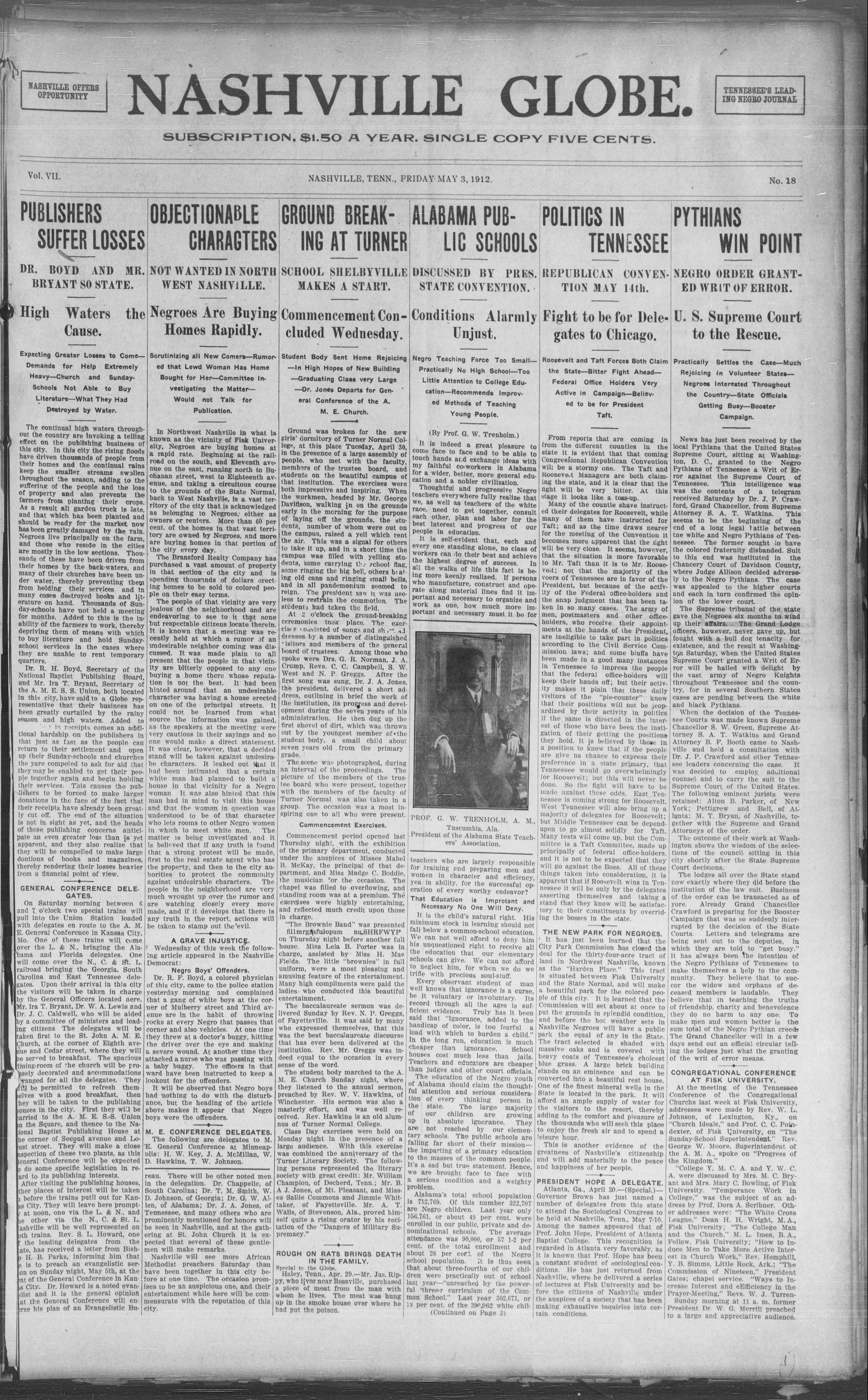
PROF. G. W. TRENHOLM, A. M. Tuscumbia, Ala. President of the Alabama State Teachers' Association. teachers who are largely responsible for training and preparing men and women in character and efficiency, yea in ability, for the successful operation of every worthy endeavor?
That Education is Improntal and
Necessary No One Will Deny.
It is the child's natural right. His minimum stock in learning should not fall below a common-school education. We can not well afford to deny him his unquestioned right to receive all the education that our elementary schools can give. We can not afford to neglect him, for when we do we trifle with precious soul-stuff. Every observant student of man well knows that ignorance is a curse, be it voluntary or involuntary. Its record through all the ages is sufficient evidence. Truly has it been said that "ignorance, added to the handicap of color, is too fearful a load with which to burden a child." In the long run, education is much cheaper than ignorance. School houses cost much less than jails. Teachers and educators are cheaper than judges and other court officials. The education of the Negro youth of Alabama should claim the thoughtful attention and serious consideration of every thinking person in the state. The large majority of our children are growing up in absolute ignorance. They are not reached by our elementary schools. The public schools are falling far short of their mission—the imparting of a primary education to the masses of the common people. It's a sad but true statement. Hence, we are brought face to face with a serious condition and a weighty problem.
Alabama's total school population is 712,769. Of this number 322,707 are Negro children. Last year only 156,761, or about 49 per cent. were enrolled in our public, private and denominational schools. The average attendance was 90,000, or 57 1-2 per cent. of the total enrollment and about 28 per cent. of the Negro school population. It is thus seen that about three-fourths of our children were practically out of school last year—"unreached by the powerful 'three' curriculum of the Common School." Last year 302,871, or 28 per cent. of the 390,062 white chil-
POLITICS IN TENNESSEE
REPUBLICAN CONVENTION MAY 14th.
Fight to be for Delegates to Chicago.
Roosevelt and Taft Forces Both Claim the State—Bitter Fight Ahead—Federal Office Holders Very Active in Campaign—Believed to be for President
From reports that are coming in from the different counties in the state it is evident that that coming Congressional Republican Convention will be a stormy one. The Taft and Roosevelt Managers are both claiming the state, and it is clear that the night will be very bitter. At this stage it looks like a tosun-
Many of the countie shave instructed their delegates for Roosevelt, while many of them have instructed for Taft; and as the time draws nearer for the meeting of the Convention it becomes more apparent that the right will be very close. It seems, however, that the situation is more favorable to Mr. Taft than it is to Mr. Roosevelt; not that the majority of the voers of Tennessee are in favor of the President, but because of the activity of the Federal office-holders and the snap judgment that has been taken in so many cases. The army of men, postmasters and other office-holders, who receive their appointments at the hands of the President, are ineligible to take part in politics according to the Civil Service Commission laws; and some bluffs have been made in a good many instances in Tennessee to impress the people that the federal office-holders will keep their hands off; but their activity makes it plain that these daily visitors of the "pie-counter" know that their positions will not be paraphrased by their activity in politics if the same is directed in the interest of those who have been the institution of their getting the positions they hold. It is believed by those in a position to know that if the people are give na chance to express their preference in a state primary, that Tennessee would go overwhelming for Roosevelt; but this will never be done. So the fight will have to be made against these odds. East Tennessee is coming strong for Roosevelt. West Tennessee will also bring up a majority of delegates for Roosevelt; but Middle Tennessee can be depend upon to go almost solidly for Taft. Many tests will come up, but the Committee is a Taft Committee, made up principally of federal office-holders, and it is not to be expected that they will go against the Boss. All of these things taken into consideration, it is apparent that if Roosevelt wins in Tennessee it will be only by the delegates asserting themselves and taking a stand that they know will be satisfactory to their constituents by overriding the bosses in the state.
THE NEW PARK FOR NEGROES. It has just been learned that the City Park Commission has closed the deal for the thirty-four-acre tract of land in Northwest Nashville, known as the "Harden Place." This tract is situated between Fisk University and the State Normal, and will make a beautiful park for the colored people of this city. It is learned that the Commission will set about at once to put the grounds in splendid condition, and before the hot weather sets in Nashville Negroes will have a public park the equal of any in the State. The tract selected is shaded with massive oaks and is covered with heavy coats of Tennessee's choice blue grass. A large brick building stands on an eminence and can be converted into a beautiful rest house. One of the finest mineral wells in the State is located in the park. It will afford an ample supply of water for the visitors to the resort, thereby adding to the comfort and pleasure of the thousands who will seek this place to enjoy the fresh air and to spend a leisure hour.
This is another evidence of the greatness of Nashville's citizenship and will add materially to the peace and happiness of her people.
PRESIDENT HOPE A DELEGATE.
Atlanta, Ga., April 30.—(Special.)
Governor Brown has just named a number of delegates from this state to attend the Sociological Congress to be held at Nashville, Tenn., May 7-10. Among the names appeared that of Prof. John Hope, President of Atlanta Baptist College. This recognition is regarded in Atlanta very favorably, as it is known that Prof. Hope has been a constant student of sociological conditions. He has just returned from Nashville, where he delivered a series of lectures at Fisk University and before the citizens of Nashville under the auspices of a society that has been making exhaustive inquiries into certain conditions.
TENNESSEE'S LEAD-
ING NEGRO JOURNAL
No.18
PYTHIANS
WIN POINT
No.18
NEGRO ORDER GRANTED WRIT OF ERROR.
U. S. Supreme Court to the Rescue.
Practically Settles the Case—Much Rejoicing in Volunteer States—Negroes Interested Throughout the Country—State Officials Getting Busy—Booster Campaign.
News has just been received by the local Pythians that the United States Supreme Court, sitting at Washington, D. C., granted to the Negro Pythians of Tennessee a Writ of Error against the Supreme Court of Tennessee. This intelligence was the contents of a telegram received Saturday by Dr. J. P. Crawford, Grand Chancellor, from Supreme Attorney S. A. T. Watkins. This seems to be the beginning of the end of a long legal battle between the white and Negro Pythians of Tennessee. The former sought to have the colored fraternity disbanded. Suit to this end was instituted in the Chancery Court of Davidson County, where Judge Allison decided adversely to the Negro Pythians. The case was appealed to the higher courts and each in turn confirmed the opinion of the lower court.
The Supreme tribunal of the state gave the Negroes six months to wind up their affairs. The Grand Lodge officers, however, never gave up, but fought with a bull dog tenacity for existence, and the result at Washington Saturday, when the United States Supreme Court granted a Writ of Error will be hailed with delight by the vast army of Negro Knights throughout Tennessee and the country, for in several Southern States cases are pending between the white and black Pythians.
When the decision of the Tennessee Courts was made known Supreme Chancellor S. W. Green, Supreme Attorney S. A. T. Watkins and Grand Attorney B. F. Booth came to Nashville and held a consultation with Dr. J. P. Crawford and other Tennessee leaders concerning the case. It was decided to employ, additional counsel and to carry the suit to the Supreme Court of the United States. The following eminent jurists were retained: Alton B. Parker, of New York; Pettigrew and Bell, of Atlanta; M. T. Bryan, of Nashville, together with the Supreme and Grand Attorneys of the order.
The outcome of their work at Washington shows the wisdom of the selections of the council sitting in this city shortly after the State Supreme Court decisions.
The lodges all over the State stand now exactly where they did before the institution of the law suit. Business of the order can be transacted as of yore. Already Grand Chancellor Crawford is preparing for the Booster Campaign that was so suddenly interrupted by the decision of the State Courts. Letters and telegrams are being sent out to the deputies, in which they are told to "get busy." It has always been the intention of the Negro Pythians of Tennessee to make themselves a help to the community. They believe that to succor the widow and orphans of deceased members is laudable. They believe that in teaching the truths of friendship, charity and benevolence they do no harm to any one. To make men and women better is the sum total of the Negro Pythian creed. The Grand Chancellor will in a few days send out an official circular telling the lodges just what the granting of the writ of error means.
CONGREGATIONAL CONFERENCE
AT FISK UNIVERSITY.
At the meeting of the Tennessee Conference of the Congregational Churchs last week at Fisk University, addresses were made by Rev. W. L. Johnson, of Lexington, Ky., on "Church Ideals," and Prof. C. P. Coundexter, of Fisk University, on "The Sunday-School Superintendent." Rev. George W. Moore, Superintendent of the A. M. A., spoke on "Progress of the Kingdom."
"College Y. M. C. A. and Y. W. C. A. were discussed by Mrs. M. C. Bryant and Mrs. Mary C. Bowling, of Fisk University." "Temperance Work in College," was the subject of an address by Prof. Dora A. Scribner. Other addresses were: "The White Cross League," Dean H. H. Wright, M.A. Fisk University; "The College Man and the Church," M. L. Imes, B.A. Fellow. Fisk University; "How to Induce Men to Take Active Interest in Church Work," Rev. Hemphill, Y. B. Simmons, Little Rock, Ark.; "The Commission of Nineteen," President Gates; chapel service. "Ways to Increase Interest and eEfficiency in the Prayer-Meeting." Revs. W. J. Turren-Sunday morning at 11 a.m. former President Dr. W. G. Merrill preached to a large and appreciative audience.
A
CLEAR FLINT
GLASS
With a
Patent Metal Screw Top, Perfect
Padlock and Key.
The money cannot be extracted. The coins
pass through a slit in a round disk of rubber
underneath the cover. Will receive any coin
from a penny to a dollar.
PRICE.
No. 1. by mail..... 35c.
(No. 1, holds 200 Nickels.)
No. 2. by mail..... 50c.
(No. 2, holds 350 Nickels.)
Nothing better for Charities, Churches and Sunday-School to collect money for Home or Foreign Mission Work. a Church Debt, Organ, Piano, or a New Carnet. Children will take out the Bank readily and work with great enthusiasm.
For Organ Fund.
SEND ORDERS TO
NATL. BAP. PUB.
LISHING BOARD.
523-2nd Ave. N., NASHVILLE, TENN.
Everywhere
Drink
the satisfactory beverage
Coca-Cola
Carbonated in bottles.
Delicious, Wholesome,
Thirst-Quenching
Relieves fatigue
RENWAR
KILLS
F HEU MATIS M
Cohn and Goldberg
LUMBER
Yards Cor. Fifth Ave. and Demonbreun St.
and 109 to 128 Fifth Ave. South
Phone M. 188 Nashville, Tenn.
CREOLE HAIR A SPECIALTY
C. R. BADOUX,
MANUFACTURER OF
220 FIFTH AVE. NORTH,
NASHVILLE, TENNESSEE.
Ten per cent discount to all who present
this advertisement.
One-Cent Savings Bank
Incorporated Under the Laws of Tennessee
Capital Stock $25,000.00
Does a regular banking business. Interest paid on all time deposits. Only in attition of its kind in Tennessee.
R. H. B. BIV President.
J. W. GRANT, 1st Vice President
J. W. Bostrick, 2nd Vice President
J. C. NAPIER, Cashier
C. N. LANGTON, Assistant Cashier.
411 Fourth Avenue, North
PHONE MAIN 1951
Nashville, Tennessee
When in Nashville
STOP AT
Hotel Daniel
713 Cedar Street
Rooms Nicely Furnished. First Class
Service to All. Hot or Cold Baths.
J. W. Daniels, Prop.
JONES & HOPKINS
MFG. CO.
TELEPHONE EXCHANGE
MAIN 2270 & 2271
WHOLESALE AND RETAIL DEALERS
Stoves, Ranges and Household
Goods
Hard Wood Mantels and Furna-
ces, Guttering and Roofing
Sales Department, Factory and Shops
207 THIRD AVENUE, N
The National Life and Accident Insurance Co.
Nashville, Tean.
Cash Capital $200,000.00
Life, Health and Accident Insurance in one Policy
Weekly and Monthly Premium Plan
Na
Pb
-2
NASHVILLE GLOBE, FRIDAY, MAY 3, 1912.
PRICES ARE DOWN
Buying at these prices wil ing on next Winter's fuel bill
And think of the worry a that you can eliminate by now.
Why not call us up to-day your order?
Since
1870
ST. BERNA
Jas.
ST. BERNARD MINING CO.
Jas. R. Love, Mgr.
Arcade
wn Notes.
Main Office, 34-36 Arcade
Out of Town
took dinner with Miss Flownie Dysart Sunday. Mr. and Mrs. Oscar McLean and little daughter, Floye. And Mr. and Mrs. Newton Puckett and little son, Thomas, and Miss Golie Alison took dinner with Mrs. Lara McLean Sunday. Miss Edna Jones spent Sunday night at her grandfather and mother's, and Mrs. John Orr. Mr. and Mrs. Jim Laws took dinner with Mr. and Mrs. W. A. Smith. Mr. and Mrs. Zack Boren and Mrs. S'il a Orr took dinner with Mr. and Mrs. William Holt Sunday. Callie Mai Allison spent Sunday with little Miss Bessie Dowell. Mr. John Winston went to Mi'town Sunday. Rev. O. F. Bishop spent Sunday night with Mr. Alen Smith. Rev. T. H. Bonner spent Sunday night with Mr. and Mrs. Tom Woodruff. Rev. S. Brooks went to Mr. George Dysart's to spend Sunday night. Miss Lela Jones took dinner with Miss Maudie Robinson Sunday. Miss Lela Jones have begun her little school again. Come one and all, there will be a grand play, entitled "Wide-awake and Pull of Fun," a comical play, something you have never seen, May 11, 1912.
---
---
St.
From mines direct to Consumer Since 1870
Mrs. Ora Vandyke and children were the guests of Mrs. Williams Sunday. Dr. Parr, of Henry, was in Paris Saturday. Miss Nettle Fitch, after spending several weeks in different cities in the North, has returned. She reports an enjoyable trip. Quite a number of citizens visited Henry Sunday in interest of one of the lodges. Mrs. Callie Johnson is on the sick list. Mr. Frank Smith died at his home in South Paris Thursday evening, and was buried Saturday. Mr. and Mrs. James Porter are the proud parents of a little daughter. Mrs. Fayella Waddy spent Sunday at McKenzie. Mr. Joseph Mosby will conduct an excursion from Clarksville via Paris to overlook the highwaters at Memphis May 5th. The most brilliant social of the season was the elaborate luncheon served the Ladies' Social Club by Mrs. Ernest Travis and Mrs. Henry Loving, at the residence of Mrs. Loving, Thursday evening, West Blythe street. The rooms were beautifully decorated in white dogwood blossoms and ever green. Among the members were tue honored guests, Mrs. Wm. McGhee, of Paducah, Ky. and Mrs. Robt Haynes, of Henry. After a four-course menu was served a souvenir card was presented to each by Miss Marion Epps. A number of 25 were present. Mrs. Robert Hynes, of Paducah, was the guest of Mrs. Leslie Miller and Miss Lillian Fitch Sunday.
WHITEVILLE NOTES
WHITEVILLE NOTES.
Mr. Wilson Green, who was stricken with paralysis about two weeks ago, is still on the sick list. Mr. Green in his younger days lived here, but for the last twenty-five or thirty years he has lived out west and at the north. Last fall he returned here to live with his son, Thomas. Mr. Burrell Johnson, of Covington, came last week to the bedside of his father, Mr. Finley Johnson, who lives near Augusta, and has been very sick, but is better now. Mrs. Peters, who lives near Eureakton, is in town dressing hair this week. Mrs. Mattie Belle McKenney, who spent last week in Memphis with her sister-in-law, Mrs. Crowder, came home Sunday evening. The young ladies of Whiteville went out Tuesday evening on a fishing tour. Mrs. Minnie Edmonia Smith, of Guthrie, Ok'a, is here at the bedside of her father, Mr. Wilson Green. Miss Susie E. Moore, of Bartlett, spent last Sunday in town with friends. The stork visited the home of Prof. and Mrs. H. D. A. Dawkins and left a bouncing little baby girl eight or ten days ago. Mrs. Minerva Crisp, of Spold, spent last Saturday and Sunday at Fayette Corner with her mother. Mrs. Pauline Murphy spent last week with Mrs. G. A. Sheton. Mr. Lewis Patton was brought here from Brownsville three weeks ago by his brother, Brist Patton, Mr. Lewis Patton died, and was buried in the Union Hill Cemetery Monday. Mrs Ferby Lewis' mother and sister, Eliza of Memphis, were both here.
FARMINGTON NOTES.
Mr. George Dysart, who has been on the sick list, is better. We had a grand supper at the Cumberland Church Saturday night. Rev. D. C. Dobbins failed to get here Sunday to preach, but the pulpit was well supplied with preachers. Rev. Samuel Brooks preached an interesting sermon and Rev. O. F. Bishop preached an excellent sermon Sunday night. Rev. T. H. Bonner assisted them. Mrs. Willie Mayfield gave her father a birthday dinner, also for the preachers and others. Miss Ella Duncan
For May and June we quote the lowest prices of the year
for the best grade of ST. BERNARD Lump or Nut or
Buying at these prices will mean a big saying on next Winter's fuel bill.
And think of the worry and inconvenience that you can eliminate by filling your bins now.
Why not call us up to-day and let us book your order?
Per Ton
GUTHRIE (KY) NOTES:
Sunday-school at the Guildfield Baptist Church was very largely attended. The regular monthly meeting was also held at 11:30 o'clock. An unusually large crowd was in attendance and listened with much eagerness and to a soul-stirring sermon by the pastor, Rev. P. D. Dennis, Mr. and Mrs. Robert Marshall, of Henderson, Ky., are visiting his brother, Mr. Moses Marshall. Mr. Charlie Willis, of Allensville, Ky., was in town Sunday. Mrs. Mollie Patton, of Dickson, Tenn., is the guest of Mrs. Luke Fort. Mrs. Boyd Douglas, who has been on the sick list, is very much improved. Mrs. Arthur Mims will leave soon for treatment at the Home Infirmary in Clarkville, Tenn Misses Dazalee and Corolla Meriweather were in Clarkville this week. Miss Maldey Taylor visited Pembroke, Ky., recently. Mrs. Jas, Hatcher, of Pembroke, was in town visiting relatives. Rev. and Mrs. P. D. Dennis were delightfully entertained by Mr. and Mrs. Richard Morrison. The ladies of the Household of Ruth gave an entertainment Saturday evening under the management of Mrs. Hattin Clarke, the Recorder. Go to Mr. C. Cross and E day for first-class groceries. Mr. P Moody and Miss G. Tyler were united in the holy bonds of matrimony and left Saturday morning for Trenton Ky. Mr. Samuel Warfield, after an illness of several months, is able to return to his work again. Mrs. Sau Snadon left Saturday morning for Paducah, Ky., to spend a few weeks with her daughter, Mrs. Roy Raye We are very glad to see Mrs. Jessie Whitlock out, after a severe illness Mrs. Frank Baker, after two months stay in St. Louis, Mo., has returned home.
KEELING NOTES.
Rev. V. H. Murray, formerly of Mytleville Ala., now feeding the flock in Pottersville Presbyterian Church, will expound the Word of God in Greenleaf Presbyterian Church Sunday, May 5th, at 11 a. m. Rev. Murray is a graduate of Lincoln University, Philadelphia, and a member of the Birmingham Presbytery. We are informed that Mr. Johnnie Taylor and et. al left Saturday for Jackson, Tenn. for a few days' stay. The pea crop is very much behind this season: more so than usual. The season is on for printing bills, advertisements, etc. Call on Sir F. T. Jones for the same. We have a need.
SIX PHONES
to thank God each day of our lives when we scan the pages of the newspapers we can read of some calamity that has happened to some one and some place. Yet so far we are unhurt. God has shown his mercy to wards us, more so than we deserved.
ALLEN'S CREEK NOTES.
President L. L. Jackson came Saturday, April 27th, to hold his second quarterly conference. Owing to the rain Friday night the waters were so high that he could not come further than Riverside on train; he was transferred with the United States malt on handcar, so he got here safely just the same. He held the conference Saturday night and gave many good instructions to the Boards. Each Board made its report, but the Willing Workers' Board is still in the lead with finance. It was $10.60 in the lead. Elder Jackson preached a splendid sermon Sunday night. Text If Thou had been here my brother would have died. Mr. H. C. Mitchell, of Indianapolis, Ind., has been suffering from a very bad sore throat, but is better at this writing. Mr. Lee Bradley is in bed with a severe case of measles. Mrs. Lula Hill was the pleasant guest of Mrs. L. B. Smith last week. All were delighted to have her in our town. She is a milliner. She leaves for Gardensburg, where she will spend a week or more. We hope to have her come again. Mr. and Mrs. M. Smith entertained the following at dinner last Sunday: President L. L. Jackson, of Nashville; Rev. J. W. Thompson, Columbia, Mr. S. Lewis. Mrs. Famille Lee, Mr. H. C. Mitchell, of Indianapolis, Ind.
DAYTON NOTES
Mr. Harry Jones, who is here from New York on a visit and other business, made a business trip to Chattanooga last Tuesday. Mr. Mat Jones, Jr., formerly of Dayton, but now of Chattanooga, was visiting relatives in our city last Sunday. Miss Sister Robinson, of Chattanooga, was in attendance at the baptizing of the A. M. E. Z. Church. Rev. James Thornton and Rev. James Franklin filled their appointments at Carpe, Tenn., last Sunday. Mr. L. M. Brown, of Dark Alley, was visiting in Rockwood last Sunday. Mrs. Matilda Cravin, of Jinggo, Tenn., who has been in our city the past week visiting her sister on Market street, Mrs. Salema Thompson, was in attendance at the baptizing of the Richland Bridge last Sunday. Rev. H. W. Stripling, the pastor of Mt. Zion Baptist Church, filled at stall 11 o'clock Sunday and at 3 o'clock the stand of the M. E. Church in Rev. G. W. Cane's stead in the interest of the M. E. rally. The closing of the city hight school last day brought great credit to Dayton, known as the Gem City of the Gate, located just 37 miles north of the Gate to the town on the north River, and C. N. O. & T. P. R. where it turned out its first primary graduates in the persons of Mr. Ulus Powell, Miss Lucile Powell, Miss Estella Franklin. Mr. Albert Huse, of Soddy, Tenn., was visiting in our city this week. Mr. Harte Toliver, of Spring City, was in our circle Sunday. Miss Mary Cane, one of Dayton's most up-to-date teachers who has been in service as a teacher at Marshtown, arrived last Friday to take her vacation with her mother and father. Mrs. Ada Braxton, of Kingston. Tenn., who is in our city visiting her parents, is soon to take her leave for Cincinnati. Ohio, to join her husband. Mr. Ell Brown, of Morgantown, left for Graysville, Tenn. Sunday afternoon. Miss M. White who has been in our city for the past two weeks on a visit, was seen at the baptizing last Sunday. Miss Bianchla Mayse, who has been in our city attending the high school, is visiting friends in the south this week. Miss Geneva Foster of Quarry street, has gone to Chattanooga. Mrs. Henderson, of Madisonville, who has been in our city at tending the closing exercises of the
city high school, left last Sunday for her home at Madisonville, Tennessee. Mrs. Amanda Mosley, of Columbus, Ohio, is still at the bedside of her sick sister, Mrs. Mary Jones, who is improving. We are glad to see Mr. Arthur Johnson out again after being indisposed for the past three weeks. Miss Sinia Broyles, of Morgantown, has accepted a position as second cook at the Aqua Hotel. Rev. J. D. Miller left this morning for Riton, Tenn., to fill his appointments.
CARTER'S CREEK NOTES
CARTER'S CREEK NOTES.
The third quarterly session of the Duck River District Auxiliary was held with the First Baptist Church, Columbia, April 19, 20, 21, 1912. A motion prevailed that a copy of the following resolutions be sent the Nashville Globe, the Nashville Clarion and Union-Review for publication. Life is eternal and when the soul is freed from its mortal dreams and borne on celestial pinions through the beautiful gates ajar into the realm invisible, incorruptible, which God has prepared for His own, it will expand into the glorious image and likeness of its Creator and shint in fadeless beauty through eternity. She still lives in the Omnipotent Spirit, the all-pervading presence. And when this mortal shall put on immortality, then shall come to pass the saying, "Death is swallowed up in victory."
Whereas, The beautiful earth life of Mrs. Sarah Braizer ended March 7, 1912, and her spirit went into the silent land, yet not alone for the Omnipotent spirit who said: "L, I am with you alway," sustained her with His rod and staff of the shadow. Whereas, The Ruck River District Auxiliary realizes it has lost an active and esteemed member, who, in all the varied duties of life, discharged them with a degree of fidelity known only to the consecrated Christian. Resolved. That a copy of this tribute be sent to the bereaved family, also spread upon the minutes of our books; be it further Resolved. That the Duck River District Auxiliary extend our tender love and detm sympathy to the sorrowing ones with the assurance that "Death is only a dream." L. B. MCCONNICO, Secretary.
SPARTA NOTES
Bishop Frielson is carrying on a revival with very good results. Prof. and Mrs. Burns left for Christianna Saturday, April 9th where they will spend their vacation. Mrs. Bessle Moore is able to be out again. Mr. Willis Dibrell will leave for Richard City Wednesday. Mrs. Didrell will also leave for a week's stay with her mother, Mrs. Smartt, at Smartt's Station. Mr. Folix Fanchier is very ill. Rev. Hishman of the Baptist Church is in our town. The revival closed at the M. E. Church with good results. There were two conversions. Rev. S. M. Carmichael is conducting a revival for Rev. Frielson. The young men are preparing to console the lonely with a band of music. Mr. Herman Turner and Mr. Joe Hudd'eson are the leaders of the movement.
CEMETERY NOTES
CEMETERY NOTES.
Rev. N. C. Crutcher preached at
Mt. Olive Sunday and Sunday afternoon.
Mrs. Mary L. Avent has returned from Nashville, where she was visiting her son, Mr. G. F. Avent.
Miss Laura L. Washington and her little nephew, Anderson, who has been the company keeper for the Misses Avents, returned home Sunday evening. One of the most charming weddings was that of Miss Jessie Tillage to Mr. Green Miles, which was solemnized Thursday night at 9:30 o'clock. The bride was a charming picture of lovelliness as she stood at the altar. The maids of honor were Misses Evalena Anderson and Edith Orr. Messrs Albert Smith and Bracile Tillage were best men. Rev. B. F. Anderson performed the ceremony. Mr. Eugene Kage and father, Sam Kage, are still on the sick list. Mrs. Isabella Mason and daughter, Miss Ella Mason, spent a pleasant evening with the Misses Washington. Mrs. Addie Edmason, of Salem, Tenn., are visiting relatives here. Mrs. Irene Haynes and Master G. W. Haynes spent the day with Miss Alice Washington recently. Mrs. Nicle Rucker spent a pleasant day with Mrs. Irene Haynes Wednesday. Miss Lizzie Washington, who spent the week-end at Florence, returned home Sunday.
TULLAHOMA NOTES
Rev. J. S. Swift, the popular pastor of the Mt. Zion Baptist Church, has just closed one of the greatest revivals for Rev. J. H. Mastin in Chattanooga that has been held in that city for a number of years. Rev. Swift is one among the greatest revivalists in the state. Rev. N. B. Morton was in Shelbyville last Monday looking after his property, and the interest of the Turner Normal College. Rev. G. Utley is pushing the pen in the interest of his insurance company at Decherd and Estil Springs this week. Rev. N. P. Grigg and wife, of Fayetteville, Tennessee. Mrs. E. McElroy, of Pennsburg, and and Mrs. Luna Brown of Estil Springs, are the guests of Wm. Jenkins and wife this week. Mrs. Bettle Hunt is quite sick at this writing. Mr. Jerry School has accepted a lucrative position with the N. C, and St. L. Railway Company. Miss Emma Clendenen, who has been quite sick, is much improved at this writing. Rev. N. B. Morton had made Mr. Ed. Holoway's house look like a new one, with that fine coat of paint. Rev. Morton knows how to use a brush. Miss Mattle C. Mastin will be a store visitor in Chattanooga next week. Mrs. R. O. Laws and Mrs. T. B. Spencer are attending the commencement at Turner Normal in Shelbyville this week. Read the Globe and keep posted like Miss Nannie Hunt. Mr. Belcher, of Nashville, spent last Sunday in our town. Mr. Bud McKeeg is kept very busy installing and overhauling soda fountains. Mr. Frank Ramsey has accepted a lucrative position with the insurance company. Mrs. Emline Brown, who has been quite sick, is much improved at this writing.
WHEN OUT OF EMPLOYMENT
GO AND SEE
Prof. W. G. HYNES
and he will give you positions of all kinds. He will also give to you from THE NEW MAJESTIC LAUNDRY clear, snow white clothes. Economical prices
420 Cedar Street Phone M. 2190
NASHVILLE, TENN.
Gray's Ointment
For BOILS and SORES
of all kinds
Ask Grandma.
HAVE YOU A
Columbia Graphophone
IN YOUR HOME?
CALL at our store or drop us a
post card, and a man will call
at your home and make terms so
that you can afford to have the
greatest variety of the world's
famous singers, musicians, bands,
etc., in your own home at all times.
We Sell Records for
All Makes of Machines.
PHILLIPS & BUTTORFF
MFG. CO.
ANNOUNCEMENT
WE ARE AUTHORIZED TO ANNOUNCE
MR. P. F. HILL
as a Candidate for Magistrate of the first
(Nashville District*) at the ensuing Aug-
ust election.
Ask For
Yellow
Creek
Whiskey
Straight
100 Proof
YELLOW CREEK
STRAIGHT
KENTUCKY
SOUR MAPLE
JOURNAL WHISKEY
SERVED WITH LEMON
BOTTLED IN KENTUCKY
All good dealers sell it. Not a headache in a barrel of it. A rich, fragrant, mellow, soft, pure straight Kentucky sour mash of best possible quality.
YOU'LL LIKE IT
EDELMAN DIST. CO.
EVANSVILLE, IND.
Perry & Lester Coal Co.
Wholesale and Retail Dealers in
COAL
TANNER HENDRICK, Manager.
Yards: 605 Second Ave., N. Phone Main 29.
FIFTY-SIX SUNDAY-SCHOOL
TEACHERS GRADUATE.
six students representing the five Atlanta Ga., April 28, 1912—Fifty-colleges and universities of this city, made up a graduating class that is the first to finish in the Teacher Training Course recently prescribed and endorsed by the Clifton Conference, which was tried first in this city. The instructor of this class was Prof. H. C. Lyman, whose interest was centered in the graduation, as practically all denominations were represented in the class. At the exercises Morris Brown College was represented by President Fountain, Clark University by President Ideman, Spelman Seminary by President Tapley, Atlanta University by President Ware, Atlanta Baptist College by President Hope. Those students who professed a Methodist faith were supplied with diplomas made by the Methodist Publishing House at Cincinnati, the Baptist students were given diplomas from the National Baptist Publishing Board at. Nashville, Tenn. The exercises were held in the First Congregational Church of which Rev. Proctor is the pastor.
I
A pure line of drugs and toilet articles Physicians prescriptions carefully and accurately compounded by registered pharmacists. {These stores carry everything found in first-class drug establishments.
Amber Gas Light
NO MATCHES NECESSARY
JUST PULL THE CHAIN Price $1.60
SOLD ON 4 MONTHLY PAYMENTS OF 40 CTS.
125 CANDLE POWER FOR 3/5 CTS. PER HOUR
Nashville Gas Company
Phone 160 Main
Have you tried our new drink?
BEERETTE
(NONINTOXICATING)
A Wonderful product of the Brewing Art.
On Sale by the Glass and Bottle at Soft
Drink Stands. Bottled also for Family Use.
Delicious, Healthful and Nourishing
MADE ONLY BY
The Wm. Gerst Brewing
Company.
PHONE MAIN 39
All Kinds of
Seasonable
Hermitage H
309 Third A
NASHVILLE,
REV. MARK C. HAYFORD OF AFRICA.
For three days this week Nashville entertained Rev. Mark C. Hayford, D. D., F. R. G. S., a distinguished Baptist minister from the city of Cape Coast, government of Gold Coast, West Africa. Dr. Hayford stopped over in Nashville en route from the Conferences of the Races, that was he'd at Tuskegee recently. He delivered an able address to the employees of te National Baptist Publishing Board. Dr. Hayford is a native African, but is one of the most scholarly men now in the pulpit, having acquired a splendid education from some of the best schools. He speaks English fluently. He is at the head of the Baptist work in the government of the Gold Coast, which is but a few hundred miles from Liberia, and is but one of the few remaining governments where the blacks are still in control on the coast of Africa. Dr. Hayford recited the fact that he and Bishop Scott in coming over to this country narrowly averted the great catastrophe of the Titanic. They were to have sailed on that ship, but on account of the delayed departure, they took ship on an earlier boat. He left the city Thursday for Louisville, Ky., to visit the Foreign Mission Board. It might be interesting to know that Gold Coast is a government and a country in Africa. Dr. Hayford in an address at the Chapel said that there was a population of three million in Gold Coast with a scholastic population of more than three hundred thousand. He spent many years in London, England, where he received his literary training. He is the author of one of the best books on "The West Coast of Africa and its Opportunities," that has fallen from the press.
ALABAMA PUBLIC SCHOOLS.
(Continued from Page 1)
dren in the state were enrolled in all the schools for their race.
During the past year $2,865,254 was expended in the maintenance of the common public schools. Of this amount the schools for the white children received $2,507,669 while those for the Negro children received only $357,585. While the white school population is only 1.2 times that of the Negro, the common public schools for white children received seven times as much public money for their support as the same class of schoo's for the Negro. The ave-
Fisk Pharmacy
1714 Jefferson St.
Phone M. 2942
and toilet articles
accurately compounded by registered
everything found in first-class drug es-
our Patronage
Gas Light
Price $1.60
PAYMENTS OF 40 CTS.
OR 3/5 CTS. PER HOUR
Gas Company
650 Main
Your new drink?
LETTE
(EXCITATING)
of the Brewing Art.
and Bottle at Soft
and also for Family Use.
Soul and Nourishing
ONLY BY
First Brewing
Company.
PHONE MAIN 650
Hardware
Garden Tools
Rubber Hose
Base Ball Goods, Tennis Goods
Fishing Tackle
Refrigerators, Water Coolers
Ice Cream Freezers
Ice Picks, Saws, Tongs & etc
Lawn Mowers, Lawn Swings
Lawn Fence, Hammocks
Screen Doors and Windows
Screen Wire Cloth
Hardware Co.
venue, North,
TENN.
rage amount expended last year per Negro child was about $1.10, while the average amount expended per white child was about $6.43. State Surviveintendent Willingham, in discussing the amount expended in the maintenance of the common schools, says: "It is fair to state that the money expended on the Negro schools was largely the money appropriated to them as public funds either by the State or by local taxation, the individual supplement paid by them being a much smaller proportion of the whole than that which obtained with respect to the schools for white children."
While the supplement paid for each Negro child is much smaller than that paid for each white child, it would be surprising to know just how much of the $557,585 expended for Negro education was really paid as a supplement by the Negro. He has certainly paid much more of it than his best white friends realize. For instance, the supplement paid by the Negro last year at Tuscumbia was $942.00; at Decatur $287.50; at Tuscaloosa $322.80; and at Demopolis $242.40. The supplement at Tuscumbia was considerably more than $442, but I have given the amount which was included in the $357,585 reported by State Superintendent Willingham as having been expended on the Negro common schools. What the four small cities just mentioned did last year in the way of a supplement for Negro education is a fair example of what many other towns and cities did throughout Alabama.
For the year ending September, 30,
1910, $329,094.83 was expended on
common schools for the Negro and
$2,417,378.57 on the common schools
for white children. The Negroes paid
as a supplement that year $31,235.30,
while the white people paid $224,907.
02. In other words, the supplement
paid by the Negroes was about 9.5
per cent. of the whole amount
expended on their schools, while
the supplement paid by the white people
was about 9.3 per cent. of the whole
amount expended on the schools for
them.
The Teaching Force in this State Entirely Too Small.
We need at least three times as many as we have. Alabama employed last year 6,836 white teachers and 2,384 colored. There was one white teacher employed to every 57 of the white school population and one Negro teacher to every 135 of the Negro school population.
If one competent white teacher can not successfully teach 57 children, how can one Third Grade Negro teacher teach 135? The record shows that more than two-thirds of the Negro teachers employed are on the Third Grade register. The great majority of these have had practically no training in the Science of Education and the Art of Teaching.
Of the 2,384 Negro teachers employed in Alabama, 126, or 5.2 per cent., hold Life Certificates; 48, or 2 per cent., hold First Grade; 608, or 25.5 per cent., hold Second Grade; and 1,602, or 67.2 per cent., hold Third Grade Certificates.
Grade Certificates were issued to Negro teachers in Alabama last year, while 515 were issued to white educators. During the same period 97 Life Certificates were issued to white teachers and not one was issued to the Negro. Can not, and will not, our normal schools and colleges change this condition?
There is Entirely Too Little Attention Given to College Education in Alabama for the Negro.
In making this statement I am not unmindful of the fact that it is a little unpopular to speak out for
Fifteen years ago when the Negro school population of Alabama was about 13,000 less than it is today, our teaching force in the public, private and denominational schools was about 2,400, about 200 of them being in the private and denominational schools. While the number of public school teachers has remained practically the same there has been an increase of 125 per cent. in the teaching force of the private and denominational schools. There are in these schools today about 450 teachers. These schools now enroll about 10,000 students against 4,000 fifteen years ago. The increase in the number of students was 125 per cent. The increase in the total number of teachers and students was the same. Adding to the 2,384 teachers in the public schools the 450 in the other schools of the state, the grand total number of teachers for the Negro is about 2,834.
The average salary during the past year for while teachers was $413 for the males and $350 for the females, while that for the Negro teachers was only $169 for the men and $150 for the women. We can not hope to get the best grade of teachers for this small salary. As a general rule, poor saary means poor teacher. "As is the teacher so is the school." The State Superintendent of Education well says that, "The Negro teachers with an income of $169 and $150 respectively by the men and the women receive really less than is being paid to inferior men and women of that race who are employed as teamsters, washerwomen and cooks. Negroes thus employed usually get their board in addition to a larger annual cash income than is paid to the Negro men and women who board themselves while teaching the Negro youth."
There are Practically No Negro Public High Schools in Alabama.
The remarkable and praise-worthy movement during the past few years to establish county high schools has not even touched the Negro. Including the District Agricultural Schools there are about 200 public high schools in the state for the education of white children. There are, according to the recent report of the United States Commissioner of Education, four for the Negro. Added to this very small number there are a few grammar schools that give their pupils a year's training in high-school studies after the completion of the prescribed elementary course. In the white public high schools last year there were enrolled 11,500 students, or about 3 per cent, of the white school population and about 4 per cent, of the total enrollment. In the Negro public schools there were enrolled in high-school classes 468 pupils, or about 14 per cent, of the Negro school population and about 3 per cent, of the total enrollment. About 450 white teachers devoted practically all their time to the instruction of pupils in public high schools, while not more than 40 per cent of the 23 teachers, instructing Negro high-school students, devoted all their time to that grade of work. Practically none of the Negro public high schools require the same amount of work, or number of credits, and in the same studies, for graduation, as is required by the white public high schools for a diploma.
The high-school situation for Negro education is more serious than that of the common school. The State feels that it ought to do something toward imparting a primary education to the Negro youth. There seems to be little or no public sentiment favoring high-school education for any per cent. of Negroes at public expense. The outlook is by no means encouraging.
President Williams, of the National Association of Teachers in Colored Schools, says: "If Negroes are to have any leaders of considerable intelligence for the masses of their people who are being pushed farther and farther out of contact with the white people every day, they too must have a considerable number of high schools maintained at public expense. Social and economical conditions among the colored people themselves demand them. And the very presence of the elementary schools makes high schools a necessity, not only for the sake of preparing efficient teachers for the elementary schools, but also to give a fitting outlet for the buder schools."
What reasons can be given why we should not have a larger number of public high schools in this state? Why should not these high schools do for the Negro students what the white public high schools are doing for their pupils? In addition to the industrial courses (and too much praise can not be given to that line of education) why should not our State Normal Schools do for the prospective Negro teachers what the white State Normal Schools are doing for their prospective teachers? Why should not our State A. and M. College do for the Negro what is being done at Auburn for the white people? And why should not the private and denominational secondary schools and colleges for the Negro do for him just what the same class of schools for the whites are doing for that race? Why should our high grade institutions content themselves in giving us only Second and Third Grade teachers? Only three First
Grade Certificates were issued to Negro teachers in Alabama last year, while 513 were issued to white educators. During the same period 57 Life Certificates were issued to white teachers and not one was issued to the Negro. Can not, and will not, our normal schools and colleges change this condition?
There Is Entirely Too Little Attention Given to College Education in Alabama for the Negro.
In making this statement I am not unmindful of the fact that it is a little unpopular to speak out for the higher education of the Negro. Neither am I unconscious of the fact that we must educate the masses of the Negro in the fundamental principles of a common-school course; devise their instinct of truth and justice, implanted in their hearts by the Almighty, and give them such industrial efficiency that will make them such a factor in our industrial problems, that they cannot be cancelled without serious detriment to the labor situation of our common country. If we do this for the masses we must have a considerable number of high grade leaders, such as our high grade institutions are capable of producing.
During the past year there were 2.641 students in all the college departments of all the white colleges—public, private and denominational—in A abama, while in all the college departments of all the Negro colleges in the state there were only 66 students, and three-fourths of these were in one college—Talladega. In other words, there was one pupil in college to every 147 of the white school population, and only one student in college to every 4.889 of the Negro school population.
We can no more get along without the college than can the white race. We must have leaders and teachers of high ideal and liberal education; for without such our secondary and normal schools can not do the best work.
If we hope to succeed in America a considerable number of our boys and girls must be trained in the arts, sciences and professions. A one-sided education is a dangerous thing or any people. The Negro needs a full rounded education. "Schools of every branch and every character are needed to make him a full rounded man." The race that neglects the college destroys the high school, and with the passing of the high school, there can be no very great number of real first class elementary school's to impart a primary education to the "comor masses of the common people."
The great majority of our schools are taught in churches and society halls. Worse than poor are the most of our rural school houses. In many of our towns and cities the same wretched conditions obtain. Dr. Dillard, of the Jeanes Fund, after raking extensive visits in parts of the South, including our own state, writes: "With rare exceptions I found wretched conditions in the way of school houses and school equipments." In most of our cities the Negro school houses are badly over crowded. Nothing more needs to be said regarding the general condition of Negro school houses in Alabama; for in my fellow teachers face the situation daily and you know too well the wretched conditions which obtain.
The facts and figures given in this discourse speak for themselves. What now can we do towards enlarging our educational forces? Can we not inaugurate some movement for the rescue of our children from the terrible state of ignorance toward which they are steadily and rapidly marching?
It is evident that much needs to be done if the education of our children is to be given anything of the impetus already given to the education of the children of the white race in Alabama. A noted educator has well said: "We must strive to win our boys and girls from ignorance as we are striving to win them from hell. We must build school houses for them as well as churches. We must support the teachers as well as the ministers—co-workers together in the same field. It is our divinely imposed duty to do both."
How shall we change the status of Negro education in Alabama?
1. By Improving Our Methods.
"The surest way," says Superintendent J. H. Philips, "for teachers principals and superintendents to improve their methods is to improve themselves." This proposition needs no argument—it is self-evident.
2. By Urging Legislation for the Im provement of Our Schools.
"Ask, and it shall be given you" says the Master. We ask for entirely too little. We need a strong committee to put our case before the members of the Legislature. County High Schools having been given the whites, surely we can get a few District High Schools, if we ask for them in the right way.
3. By Helpful Publication—Turning on the Light.
This Association should collect and publish from time to time data covering the material contributions that the Negroes are making towards their own education. "It seems to me," says Mr. W. T. B. Williams, "to be clearly our duty, and the duty, too, of local educational associations, to learn the actual specific, homely and even unwelcome truth about cooled school conditions and to make public this information. We should do this not for the sake of complaining nor in the spirit of bitterness, but for the sake of the truth which ought to arouse the colored people to overcome their own indifference and to secure to them the helpful interest of all those who are ever ready to help those who help themselves."
We Can Furnish Your Home Complete fro Parlor to Kitchen
We Take Old Goods as First Payment: Balance weekly or Monthly
304-306-308 BROADWAY NASHVILLE, TENN.
R. J. Lyles, Pres. W. L. Pierce, Sec. & Treas. H. G. Nichols, Gen'l Mar.
Volunteer Manufacturing Co.
UNION MADE
200 PUBLIC SQUARE
MANUFACTURER OF
VOLUNTEER JUMPERS, OVERALLS, PANTS
HILARY E. HOWSE
HOWSE
FURNITURE, STOVES
TERMS TO SUIT
We Can Furnish Your Home Co.
We Take Old Goods as First Paym
304-306-308 BROADWAY
R. J. Lyles, Pres. W. L. Pierce, Sec.
Volunteer Man
UNION
200 PUBLI
MANUFACT
VOLUNTEER JUMPERS
4. By Building More and Better School Houses.
By building more and better school houses, thoroughly equipping the same, so that both teacher and pupils may do their work under the most favorable conditions. Let us make use of the state fund set aside for that purpose. On October 1, 1911, the state had on hand for building and repairing school houses $83,029.63. On April 1, $67,000 was added to that amount, making a total of $150,929.63. On April 1, every year this amount will be increased by $67,000. We ought to use as much of this amount as possible. The people will rally to us, if we will rally to them. If we point the way, they will follow. We can build school houses. In too many cases we are not disposed to build. "We as teachers are too willing to enter upon the fruits of another man's abors, and to teach in a hall or a church."
5. By Supplementing More Substant...tially the Public School Fund...and Lengthening the School Term.
"Any competent, wide-awake teacher can arouse sufficient interest in himself and his work to secure the active co-operation of the people not only in building, but also in supplementing." Several teachers have done so quite successfully, and what they have done and are now doing, others can do. Let the people be thoroughly and persistently aroused and they will take care of their schools in a substantial way.
6. By Co-operating with Local Public School Boards.
We must reach the public school authority in our respective communities in the interest of better schools and more ample facilities for our schools. We must be aroused to a keener appreciation of the value of public education. We should give far greater attention toward making the work of the public school stronger and broader. We can not afford to show indifference, for we have too much at stake.
7. By Improving Our Private and Demonstrational Schools.
We do not need to establish any more of these; but we ought to give better support to those already in existence. We must rely more and more on the public schools to impart a primary education to the masses, as do the whites. Whie many of our private schools have done a great work and are still doing commendable work, we must not lose sight of the fact that they can never take the place nor do the work of the public school.
8. By Establishing High School Departments in Many of Our Well Organized Grammar Schools in the Larger Towns and Cities.
This can easily be done by organization and co-operation. This offers a splendid field for self-help. Let us meet the public school board, do as much as they, and get more public high schools going.
9. By urging a considerable number of our brightest high-school graduates to enter college, and thus fit themselves for 'arger usefulness.
10. By laying a little more stress on real college work in our institutions that are prepared to do that grade of work. I do not ask that we start any more colleges in Alabama; but I do urge that more college work be done, more attention be given to that grade of education—in our colleges now in existence. We can not afford to neglect so important a branch of education.
11. By Enriching Our Courses of Study.
This may be done by the addition of some industries. This can be done in most, if not in all, of our schools.
12. By remaining in the Community Long Enough to do Some Real Good as a Teacher.
Very litle' first class work can be done in any place if it is to have a new teacher every session. Many of us have entirely too much of this spirit' of moving every year into a new community.
Many other ways might be suggested for the improvement of our educational status, but I must conclude. And now, fellow teachers, I have spoken to you along this line in the hope that these remarks may induce a train of thought that will find expression in a concert of action looking toward a speedy and genera' improvement of our educational' condition. We can not afford to stand passively by and see this great army of Negro children unreached by the wholesome influence of education. If we rest contented while quite 200,000 of our youth go marching steadily into ignorance and consequent crime, we shall receive the greater condemnation. May we have the courage and the wisdom to do our whole duty before it is too late. For truly has it been well said: "If man is to reach the highest state of personal happi-
---
3
DR. C. V. ROMAN,
SPECIALIST IN
Eye, Ear, Nose and Throat Diseases is now
permanently located in his new building
1303 Church St.
PARADE
BANNERS
FOR LODGES.
GRACILLA'S LODGE M921
CHIOHRAIT, CAIO
We manufacture K. P. Lodge Banners
per illustration given above, at prices
according to quality of materials and
rimmings, ranging from $50 to $75; silk
embroidered work from $50 to $100; hand
embroidered boulder work from $95 to
$260. Specifications furnished on banners
at any price desired. :: :: ::
HOME LODGE
No. 29
G.U.O.of O.F.
FLT
LOUISVILLE
KY
PLATE 2.
This snares a very popular design for
S. U. O. of O. F. Lodges. Front made
of white flag silk. Lambrequin, or Cur-
min, of red silk. Painted in gold leaf
and oil colors, back of red banner steen.
Trimmed with imported gold lace, fring
tassels, etc. Hardwood pole, wood cross-
bar, win cover and holster. Prices
of the above Banners will
made for any other order. Re-
tention at same prices, changing emblems and lettering
to suit the Order.
For further information write to
National Baptist Publishing Board,
R. H. BOYD, Secretary.
ness and usefulness, as well as to contribute his greatest possible service to mankind; if the community is to be moral and religious; if there is to be a high sense of intellectual and social responsibility; if pure living, noble ideals, honest enterprise, and the advancement of civilization, are to be encouraged and fostered there must be a sound and correct educational sentiment. We must raise the standard of intelligence and morality through universal education."
G. W. TRENHOLM.
Tuscumbia, Ala.
NASHVILLE GLOBE.
Published every Friday in the year at 447 Fourth Avenue, North, Nashville, Tennessee, by the NASHVILLE GLOBE PUBLISHING COMPANY.
Telephone, Main 1890.
Recorded as second class matter January 19, 1908, at the post office at Nashville, Tennessee, under the act of Congress of March 3, 1873.
No notice taken of anonymous contributions.
SUBSCRIPTIONS IN ADVANCE.
One Year. . . $ 1 50
Monthly. . . $ 80
Three Months. . . 80
Single Copy. . . 65
Notify the office when you fail to get your paper.
ADVERTISING RATES FURNISHED UPON APPLICATION.
READING MATTER RATES.
9 cents per line for each insertion.
18 cents per line for each insertion in (black text).
Advertising copy should be in the office not later than 9 a.m. Tuesday of each week.
TO THE PUBLIC.
Any erroneous publicity upon the character, standing or reputation of any person, firm or corporation, which may appear in the columns of the NASHVILLE GLOBE will be gladly corrected upon being brought to the attention of the manage-
Send correspondence for publication so as to reach the office Monday. No matter intended for current issue which arrives as late as Thursday, send it in that number, as Thursday is preday. All news sent to for publication must be written only on one side of the paper, and should be accompanied by the name of the contributor, not merely for publication, but as evidence of good faith.
FRIDAY, MAY 3, 1912.
Negro Pythians.
The news from Washington that the Supreme Court of the United States had granted the Negro Pythians of Tennessee a writ of error came as good news to the members of the order in this city and State and to every loyal Negro. A cloud has hovered over this order for some time, and when the State Supreme Court affirmed the decision of the lower courts, the situation appeared gloomier, and some of the members were wont to despair; but the men who were leading this grand order did not despair. They felt that their cause was just, and saw no reason why they should surrender without making the final effort.
This writ of error, while it does not settle the case entirely, gives the order a hope that in the end the case will be settled strictly on its merits.
The Dallas Bank failure is to be regretted, but it is not believed it will have any effect on the other Negro banks in this country. Black men are fast learning that all of their business efforts cannot succeed; for if they did they would have more exceptional ability than any fairminded man expects for them to attain in so short a time.
Visible Means of Support.
The question that taxes the minds of those people who toil and who are endeavoring to live clean lives is, "How can some people live without working; how can they maintain homes in which every comfort is provided and the luxuries of life come as free as water?" In the day these people can be seen around their homes spending the hours reading magazines, lounging on fine couches, in lawn swings and sitting in modern porch furniture. At night, or as the shades of evening draw on they attire themselves in fine linens and board the car for the city. They can be oftimes are found in the high seen in the questionable districts, and places of society; commingling with the good people; taking part in this or that movement; making themselves conspicuous at times, while at other times they vanish like a shadow, to emerge at a late hour when they can be seen making their way to their mansions. The question agitating the minds of the people is; "How are they living?" They never work. It cannot be learned that they own any stocks or bonds, or that they have any visible means of support; and yet they live on and on. This is a serious problem and one that it will require courage to solve. It cannot be solved by street corner conversations. It will never be broken up only by a courageous and decided stand.
One was heard to remark in this city on a certain occasion that if a newspaper ever published anything about them they would take their gun and blow the brains of the publishers of the paper out. Such an act, while it might satisfy the individual performing it, would not settle the case. Right can never be destroyed. When the people will to they can stamp out an evil and destroying the life of one person will not change the course of the people. The one thing that is required is the determination on the part of the people to put a stop to these evil practices, to take it upon themselves to investigate all questionable characters; to make it known that they will ask why a certain individual can live in a community without a visible means of support. It is the right of the people to know these things. Those who are endeavoring to rear families owe it to their posterity to keep around them a healthy atmosphere. It is not a question of whether some one will be killed or not. Every man and every woman should make up his or her mind that he or she will die for the protection of their homes. For that man who lays down his life
for the honor and integrity of his household erects a monument that will endure throughout the ages. The question can be answered and must be answered if the people of any community would keep that community on a high plane.
Our New Park.
The purchase of the Harding Place for a park for Negroes is a commendable move on the part of the Park Commission. Mayor Howse must be given a large portion of the credit for the establishment of this park. He has expressed himself upon many occasions as favoring such, and has worked incessantly to bring it to pass. The Mayor has proven himself a friend of all the people. He believes in the "square deal" for all citizens, and is priving from time to time that he is a man with a big heart.
This park will add greatly to the comforts of the Negro citizens of Nashville. They have never visited the city parks that are located in white communities, despite the fact that they have known all along that there is no law prohibiting any citizen from visiting the public parks. But that peace might prevail they have refrained from making these visitations. The Mayor and all good citizens know this to be a fact and they are to be commended for the desire to do the fair thing.
The high water has returned and with it comes untold suffering to the poor people. People who have recently returned to their homes are forced to move again, which doubles their suffering. It means that all must suffer together, for these people who are forced to move from their homes must be taken care of somehow, and no one should feel that they are not concerned in this matter.
The M. E. Conference that convenes in Minneapolis Monday will have to deal with that ever-present question, the election of Bishops. The colored constituency is demanding a Negro Bishop. It is thought by some that the opportunity which looked so promising for the election of a Bishop at Baltimore will not be obtained at this meeting. There are others who believe that a Negro Bishop for work in the States will be elected this year. Time will tell about this question. If it comes it will be aust just recognition of the efforts of the Negro ministers in the Methodist church to equip themselves for the highest office in the gift of the Church.
SPECIAL SUNDAY-SCHOOL CON-
GRESS NOTICE.
Those who are planning to attend the Seventh Annual Session of the Sunday-School Congress, at Tuskegee Institute, Alabama, are respectfully requested to send their names and addresses in to Dr. Booker T. Washington, Tuskegee Institute, Alabama, at once, so that they may be assigned to their stopping places. The committee at Tuskegee is well organized to take care of over two thousand visitors, but they must know in advance who is going to attend so that they will know who to prepare for. Board in Tuskegee and the institute will be $1.00 per day. When the committee receives your letter they will simply make the assignment. They will not send you ar assignment card, but upon your arrival at Tuskegee you will be directed to your stopping place after you have handed in your name and address, telling what state you are from.
For further information concerning rates, enrollment or departmental meetings, write.
HENRY A. BOYD, Secretary
Sunday-School Congress.
523 2nd Ave., N., Nashville, Tenn.
5-21.
BROWNSVILLE NOTES.
BROWNSVILLE NOTES.
Miss Tommy Ragan, of Humboldt, one of Gibson county's leading teachers, was in the city a few days last week mingling with her many friends. Dr. Hale, the dentist from Dyersburg, is working in our little city every Friday and Saturday. He is working in the office with Dr. Barnett. All of his patrons are highly pleased with his work. Mr. Tom Meadows, of Dyersburg, was in the city Tuesday selling fish. Come again, Tom. Mr. J. W. Leigh has accepted a position with the Life and Casualty Insurance Company of Nashville, Tenn., as special writer on the Humboldt District. Mrs. Annie Duke, the wife of Mr. Alex Duke, Jr., after a brief illness, died April 22nd. The funeral was preached at the First Baptist Church, Rev. A. Parr officiating. Mr. Charlie Porter spent Wednesday and a part of Thursday in Humboldt. His purpose for going home, the writer learned, was to see that Miss Tommy Ragans got home safely. N. N. Reynolds, the grand lecturer of the Calanthe Court, made his annual visit and delivered his lecture to Court No. 28 on Monday evening, April 29th. His talk was inspiring and full of thought. He left the Court encouraged. The Court served an excellent three-course menu at Irvin's Store Monday night in honor of the grand lecturer.
Spinsters' Convention at Odd Fellows Auditorium, Thursday evening, May 20, 1912, under auspices of Galeda Class No. 16, Mt. Olive Baptist Sunday-School. Come and bring your
NASHVILLE GLOBE, FRIDAY, MAY 3, 1912.
DOWN! DOWN! WHAT'S DOWN? PRICES ON COAL For MAY and JUNE DELIVERY
By filling your coal Bins now with our St. Bernard, Jellico or Fentress, "The Ideal Coals," you save money and avoid the worry and trouble of winter delivery. Superior methods obtained at our yards in handling, screening, weighing and delivering—insuring full value for every dollar invested.
FENTRESS LUMP or 4 IN., Per Ton.
PARTICULAR ATTENTION TO ALL PHONE ORDERS
Main Office----4 Arcade
friends. It is the evening of Decoration Day.* Dr. George W. Miller, of Chicago, IL., passed through the city last week, en route to Atlanta, Ga., where he is to remain several weeks on a summer vacation. Mrs. G. B. Brady spent the week end in Murfreesboro with her brother, Mr. Andrew Suttles, who has been seriously ill for some time. He is much improved now. Spinsters' Convention at Odd 'Felows' Auditorium, Thursday evening, May 30, 1912, under auspices of Galdea Class No. 16, Mt. Olive Baptist Sunday-School. Come and bring your friends.: It is the evening of Decoration Day.* Mrs. W. P. Phillips, of Second avenue, South, has as her house guests for a few weeks, Mrs. Edward Russell and Mrs. Samuel] Hayes, of Shelbyville, Tenn.
The Christian Workers' Foreign Missionary Society will meet at 513 Mulberry street, May 5 on Monday at eight o'clock. Mrs. Mary H. Flowers has returned from an enjoyable vacation in Knoxville, Tenn.
Miss Babbs and Mrs. Suggs, of Springfield, Tenn., are in the city taking a course in hair dressing, hair work, etc. They are the guests of Mrs. Geo. Hobert.
Mr. Charles Crook left last Sunday night for Chicago. Ill. His many friends will miss him from this city.
Miss Annie L. Hart, of Shelbyville, Ladies' silk hose with deep garter top, double heel and toe in black, white or tan, 25 cents a pair at J. H. Foreman's, Eleventh avenue and Jefferson street (Matison's old stand). is here the guest of Mrs. Ernest Hart, 330 Ninth avenue, North.
Mr. E. H. Hart has recovered from a serious illness.
Spinsters' Convention at Odd Fellows Auditorium, Thursday evening, May 30, 1912, under auspices of Galeda Class No. 16, Mt. Olive Baptist Sunday-School. Come and bring your friends. It is the evening of Decoration Day.*
Mr. and Mrs. Walker, of 73 Claiborne street, are happy parents of a fine baby girl.
Miss Laura White, of Dalton. Ga., is the guest of her aunt, Mrs. Frank Sapp, of 1501 Phillips street.
Spinsters' Convention at Odd Fellows Auditorium, Thursday evening, May 30, 1912, under auspices of Galeda Class No. 16, Mt. Olive Baptist Sunday-School. Come and bring your friends. It is the evening of Decoration Day.*
We wish to thank our friends for the kindness shown us during our recent bereavement and for the floral tributes so willingly given and assure them we shall never forget them.
MR. and MRS. ALBERT EVERETT.
Church work at Payne Chapel is very prosperous. The two weeks' rally resulted in the sum of $127.92. This amount was stewards' and trustees'. Dr. H. L. P. Jones preached for Mr. Ben Shelby's club at Sylvan Street Baptist Church Sunday afternoon at 3 o'clock. Quite a large congregation was present. Full line of spring and summer underwear for the whole family. Best quality and lowest price at J. H. Foreman's, 11th avenue and Jefferson (opposite Mt. Zion Baptist Church).
Dr. Wm. Haynes, pastor of Sylvan Street Baptist Church, preached for Payne Chapel Stewardesses' Board a few nights ago. All the members and officers of Payne Chapel met Tuesday night, the 300th, to complete decision on new Payne Chapel at the corner of Winter and Seventh streets. Mrs. Abe Overton, of 212 North Sixth street, will visit her nieces at Columbia, Tenn., the coming month. Mrs. Florence Mason, of Chattanooga, is visiting her sister, Mrs. Minnie Hooper, 1611 North Eighth street. Mr. Dock McGavock left last Sunday night for Chicago, Ill. Mrs. J. W. Sayers and daughter, Emma Lue, of Clarksville, are visiting
SOUTHERN ICE CO., SUCCESSOR
he rson and daughter, Mr. and Mrs.
Frank Savers, of 927 Jackson street.
Frank Sayers, of 927 Jackson street. The young ladies of Galeda Class No. 16 cordially invite you to witness their first performance of the Spinsters' Convention, to be given at Odd Fellows Auditorium Thursday evening, May 30. Donation fee at door, 10 cents. Just one dime.*
Miss Louise Brook, of 1709 Seventeenth avenue, North, entertained at dinner Sunday Misses Adrin Beasley, Mosel's Flagg and Mr. Lewis House.
Miss Lucile Farmer, of Franklin, was in the city last week visiting friends and relatives She was very highly entertained by Miss Rebecca Covington.
Mrs. Kizzie McGhee died last Saturday afternoon, after a lingering illness of several weeks. Funeral services were held at Bethel A. M. E. Church Monday at 2 p. m.
WANTED—You to be one of the many satisfied customers of The Palms. Telephone your order.
Pineapple Sherbet made from choice fresh pineapple served at The Palms and delivered to any part of the city.* Heart-shaped Brick Ice Cream in 3 flavors delivered to any part of the city. $1.25 per gallon, 75c per half-gallon, 50c per quart. Telephone M. 1973, The Palms. * Get a copy of the Nashville Globe and Indianapolis Freeman at The Pa'ms. * Mr. Hugh Turner was summoned home from Chicago on account of the death of his mother, Mrs. Kizzie McGhee. Mrs. G. B. Brady, of Tremont avenue, is spending several days at Murfreesboro this week. Forty-five-inch wide white India lawn, 10 cents per yard at J. H. Foreman's, 11th avenue and Jefferson (Mattson's old stand).
HOME BEAUTIFUL MOVEMENT STARTED—NASHVILLE LEAGUE ON CONDITIONS AMONG NEGROES OFFERS PRIZES IN GOLD FOR BEST KEPT PREMISES.
A home beautiful movement has been inaugurated by the Nashville League on Conditions among Negroes for the Negro householders in the third and fourteenth wards. Every householder in these wards, whether he rents or owns his home, may enter the contest. There will be three prizes in gold for each ward as follows: $7.50, $5, $2.50. Five impartial judges for each ward, whose names and addresses will be announced later in the Globe, will be chosen. Persons in blocks adjoining these wards may enter the contest by seeing the judges and entering their names.
The plan of the contest is as follows: Beginning May 15 and ending October 1, the judges will regularly inspect, at times of their own choice, the premises of any person who gives in his name on or before June 1. The judges will keep a record of each inspection of each of the premises and will decide by vote on or after October 1 to whom the prizes shall be awarded.
The points about the premises to be covered are the condition of the front yard, including lawn and flowers, the cleanliness of the whole yard, including the back yard and beneath the house, and the disposal of slops, garbage, etc.
The owner or renter of a modest or plain looking house will have just as much chance in this contest as an owner or renter of a fine looking house, since the points of the contest cover the tidiness and cleanliness of all the premises, and the attractiveness of the front yards.
... SOUTH PITTSBURG NOTES...
The city public school closes to night (Friday night) and a very interesting program is to be carried out. Teachers' Annual Institute opens Monday morning, the 6tn, at the county school house on the hill. Rev. Mr. Bonner, pastor of the A. M. E. Church here, preached the Calanthe Court sermon at the M. E. Church
Wadsome Home New
UNIVERSITY FOR SALE
Wadsome home on the corner of 17th avenue,
it, with all conveniences, is for sale on e-
pt fronts 106 5-10 feet on Heiman street and
For further particulars call at our office.
Transford Realty Co.
(Incorporated)
North Avenue, N., Nashville,
TELEPHONES 2323--2324.
Daily Sporting Goods House in the
St Line of Base Ball and Fishing Tackle
in the South—Let us prove it
Dixie Sporting Goods Co.
405 CHURCH STREET
L. W. CRUTCHE
THE HOME OF THE MAYFIELD MARRIAGE CLUB
This handsome home on the corner of 17th avenue and Heiman street, with all conveniences, is for sale on easy payments. Lot fronts 106 5-10 feet on Heiman street and is 238 feet deep. For further particulars call at our office.
162 Fourth Avenue, N., Nashville, Tenn.
TELEPHONES 2323--2324.
The Only Sporting Goods House in the City Largest Line of Base Ball and Fishing Tackle Goods in the South—Let us prove it Dixie Sporting Goods Co. 405 CHURCH STREET
MEN'S FURNISHINGS AND TAILORING 424 Cedar St., Nashville.
last Sunday afternoon to a large and appreciative congregation. Miss J. A. Lightfoot, with her glee club, was the organist. Collection was $14.68. Miss Lela Martin and brother, Dillard, of near McMinnville, stopped over a night on their way from Morristown College to home. They were the guests of their uncle and aunt, Mr. and Mrs. J. D. Martin. Miss Annie Staples, who has been attending school at Nelson Merry College, Jefferson City, Tenn., has returned home to the delight of her parents and many friends. Prof. F. C. Greer passed through here one day this week en route to Nashville on business.
Miss Janie A. Lightfoot, Dayton, Tenn., in the secret order work. M will probably visit o Chattanooga Valley, t and Roane counties. M kins visited Mrs. C. H. week. Messrs. Bufo Martin, both students College, returned home company with their Lela and Dillard Mart the big circus and s on Friday and left Sah home in Middle Te Sallie Lane attended exercises of Nelson
Phone Main 43
Home Near
Y FOR SALE
in the corner of 17th avenue and Hei-
veniences, is for sale on easy pay-
10 feet on Heiman street and is 238
particulars call at our office.
Brd Realty Co.
corporated
, N., Nashville, Tenn.
ONES 2323--2324.
Goods House in the City
Ball and Fishing Tackle Goods
South—Let us prove it
porting Goods Co.
CHURCH STREET
CRUTCHER
Nashville, Tenn.
Clothing, Hats and Furnishings
AGENCY— FAMOUS SIGNAL OVERALLS
Successor to W. D. Hamilton. 311-13 2nd Ave., N.
GIVE US A LOOK BEFORE BUYING.
Algonquin.
Mr. D. Wesley Crutcher, 1610 Phillips St.
President.
Mr. S. Lam L. Carter, 713 Gay St. Secretrary.
Meets 2nd and 4th Tuesdays, 8-11 p.m.
Day Home Club.
Mr. L. B. Scott, 125 Fourteenth avenue, North, President.
Mrs. W. W. Boger, 1615 Jo. Johnston Secretary.
Mr. T. B. Cohen, 720 Smiley St., President.
Miss Lottie Johnson, 218 North Eighth St.
Secretary.
Meetings subject to call of President, 7-9 p. m.
East Nashville Dramatic.
Mrs. A. M. Townsend, 614 Webster St., President.
Mrs. Floyd J. Darrell, 614 Webster St., Secretary.
Meetings subject to call of President.
Employee Mutual Benefit.
Mrs. Lafayette Moore, 1109 Clinton St., President.
Mrs. Rob. L. Miller, 927 Jackson St., Secretary.
Meets every Monday, 8-10 p. m.
Hubbard Hospital.
Dr. Josie E. Wells, 1203 Second avenue, South, President.
Mrs. J. H. Hale, 639 Wetmore St., Secretary.
Meets 1st and 3rd Mondays, 4-6 p. m.
Friday Review Club.
Mrs. John Cunningham, 905 Jackson St.
President.
Miss Maggie Mayberry, Eighth avenue,
near Cedar, Secretary.
Meets 1st and 3rd Fridays, 3:80-6 p. m.
Loraline Social Club.
Mr. Jesse J. Smith, 428 Quarry St.,
President.
The National Co-operative Club held its regular meeting on last Wednesday night, and a new spirit was manifested, in that new officers were elected and every member pledged himself to labor ardently for the success of the club. A new day is dawning for this excellent organization, and we are preparing to meet it. The new officers elected were: B. H. January, President; J. A. Black, 1st Vice-President; and M. D. Wilson, 2nd Vice-President, Thomas W. Anderson, Secretary; W. S. Garnes, Treasurer; J. T. Williams, Reporter.
The Minnehaha Club.
The Minnehaha Club was delightfully entertained Thursday night, April 25th, at the residence of Miss Margaret Mayberry, Ramsey street. The meeting was opened by the president, Miss V. L. Flagg, with prayer then taken up. The members were wide awake and jubilant over the coming entertainment. After several committees had been appointed by the president, the club adjourned to meet next with Miss Anna Matthews. The hostess then served the members a very tempting ice course. Guests of the evening were Mr. Livingston and Mr. White and Miss Mary Lizzie Bowling.
Miss Estella Hollins Entertains.
Miss Estella Hollins highly entertained the Minnehaaha Club Tuesday night, April 16, at her residence. The meeting was opened in its regular form with devotional exercises. At the roll call each member responded with a quotation and dues. Plans were then discussed, after which the program was arranged.
The club was then served a most delicious two-course menu, consisting of veal salad on lettuce, pimentos, red pepper sandwiches, beaten biscuit and hot tea. Souvenirs, violets and pansies. The club then adjourned to meet with Miss Margaret Mayberry, next Thursday night.
The Mohicans.
The Mohicans met Thursday even ing in regular meeting. Much impor-
Miss Addie L. Allison, 2015 Jefferson St. Secretary.
Meets 2nd and 4th Tuesdays, 8-11 p. m.
Nashville League on Condition Among Negroes.
Prof. Geo. E. Haynes, Flask University, President.
Mrs. C. V. Roman, 130 Fourteenth avenue, North. President.
Mrs. Gilbert white, 9 Garden St., Secretary.
Meets 2nd and 4th Tuesdays, 3-5 p. m.
Original Greenwood Social.
Miss Mabel Smith, 1115 Cedar St., President.
Miss Frankis Trammell, 1215 Cedar St., Secretary.
Meets 2nd and 4th Thursdays, 8:30-11 p. m.
Phyllis Wheatley.
Mrs. G. L. Jackson, 707 Lea avenue, President.
Mrs. J. H. Hale, 639 Wetmore St., Secretary.
Meets last Thursday, 3-5 p. m.
W. E. P. C.
Mr. Leslie Rowen, 214 Elighith St., President.
Miss Eudora McClelland, 1805 Heffernan St., Secretary.
Meets 2nd and 4th Tuesdays, 8-11 p. m.
Y. M. L. C.
Mr. J. L. Leach, Mehairy Medical College, President, pro tem.
This is the Directory of the Standard Clubs of Nashville, to which visitors to the city are cordially invited upon proper notification of either President or Secretary.
tant business was transacted and plans for the summer work were outlined. These plans, when perfected, will mean an era of literary awakening for the young men of Nashville. A most interesting program was carried out at this meeting. Their meetings are always open to visitors and the Receiving Committee will gladly welcome all who may avail themselves of an opportunity to attend any of their meetings. The officers are all videawake, hustling young men and will be delighted to receive you any Thursday evening at 719 Jefferson street.
W. E. P. Club.
The W. E. P, Club meet at the home of Miss Nannie Guild, 606 Sylvan street. The meeting was presided over by the president. The roll was called and all responded, after which the debate was entered into. The judges were Mr. Williams, Mr. Baker and Miss Morgan. The affirmatives were Miss Geneva Bender and Mr. Robbert Sumner, negatives, Mr. J. B. Brown and Mr. Tipton. The affirmatives were successful. The subject under discussion was, "Resolved, That woman's love is greater than man's." Short, timely talks were made by the visiting guests. Music was furnished by Miss Bender. A sumptuous ice course with cake was served. The next meeting will be with Mr. Jack Johnson at the home of Miss Richie Rideout on North Seventh street, East Nashville May 7. It is hoped that all members will be present at the next meeting to engage in the discussions. The visiting guests were Miss Morgan, Alaston, Scooby, Clendenen, Mr. and Mrs. Baker, Messrs. Williams, Clendenon and Rankins.
A Birthday Party.
Tuesday evening, April 23, 1912, little Esther E. Arms celebrated her fifth birthday at the home of her parents, 1311 Eleventh avenue, South. The little hostess with her little friends enjoyed a very pleasant evening and at six o'clock they ate their refreshments, consisting of cake, candies, fruits and cream. Many pretty and useful presents were received. Among the guests were the following children: Cordelia A. Floyd,
NASHVILLE GLOBE, FRIDAY, MAY 3, 1912.
Eliza Perkins, Kittie Holmes, Elizabeth Gaitor, Ellen Gentry, Georgia Bradley, Errian Mae Williamson, Maurice Bradley, Fred E. Reed and little W. T. Ensley.
The Original Greenwood Club
Miss Jessie B. Beech entertained the Original Greenwood Social Club beautifully on the evening of April 25, at her residence, 921 Sixteenth avenue. North. The club continues to brow in membership. The name of Miss Nellie Beech was enrolled at the last meeting. The visitors present were Messrs. Ed Hyde, Robd. Edmonson, Abraham Griggs. After the regular routine of business Miss Jessie Beech served a delicious two-course menu, which was greatly enjoyed. Visitors are welcome.
Rose of Sharon Embroidery Club
No. 1
No. 1.
The Rose of Sharon Embroidery Club was recently organized at the residence of Sylvia Ferguson, 411 Fourteenth avenue, North, with the following officers: Mrs. Anna Clark, President; Mrs. Cora Alexander, Vice President; Mrs. John Tate, Secretary; Mrs. Beatrice Woods, Assistant Secretary; Mrs. G. W. Gray, Treasurer; Mrs. Sylvia Ferguson, Embroidery Instructery; Miss Mary Carter, Assistant Embroidery Instructor; Mrs. Susie Carter, Chaplain. After the organization of the club a menu of several courses was served. The table was beautifully decorated with a centerpiece of lace and hand embroidery. The club adjourned to meet with Mrs. Henry Lewis, 1417 Jackson street, on May 1st.
Imperial Club.
The doors of the spacious home of Mrs. John Work, of Fourteenth avenue. North, were thrown open for entertainment of the Imperial Club Wednesday afternoon, April 24. Promptly as each member arrived her needle work was begun. At this meeting the members were all enthusiastic over the making of beautiful Marechal Niel rose jabots. Some very lovely ones were made. At the close of the sewing hour the hostess invited her guests into the dining-room, where a two course menu was served, which each one highly enjoyed. The dining-table was very attractive with a beautiful drawn centerpiece on which stood a lovely stand of carnations. Each one left the table with a carnation, the favor of the hostess. In the dining-room the business portion of the meeting was transacted, after which the guests repaired to the parlor and enjoyed a musical program. The club adjourned to meet with Mrs. Jake Anderson, Wednesday, May 8th.
Relief Club
Mrs. Anna Clark. of Cedar street, entertained the Relief Club Friday, April 19. The meeting was called at 2:30 o'clock by the president, Mrs. Susie Johnson. Program follows: Song and prayer. Mrs. Mary North; roll call; secretary; responses by quotations; collection of dues. Several important topics were discussed and the club adjourned to meet with Mrs. Mary North. The following members were present: Mesdames Susie Johnson, Mary North. Jennie Davis, Fannie Armstrong, Susie L. Carter, Cassie Crawford, Emma Eldridge, Emma Davis, Hattie Bramlett, Silvia Ferguson, John Tate, Joe Alexandria and Miss Mary E. Carter. Mrs. Clark spared no pains in serving a three-course menu, which was enjoyed by all.
Brilliant Church Wedding.
Attended by all the brilliancy of a large church wedding, with the great throng of interested friends, the marriage of Miss Lutie B. McDaniel and Mr. William Posey took place Monday evening, April 22, at 8 o'clock at the Second Baptist Church, Rev. G. B. Taylor, the pastor, performed the impressive ceremony. Early in the evening solos were rendered by Mrs. Sadie Williams and Mmm. M. Magdalene Tartt, the well-known soprano.
To the strains of Mendelssohn's wedding march, played by Prof. H. A. Clemons, Prof. and Mrs. W. G. Hynes entered, followed by the bridal party, composed of Miss Ola M. Boyd, with Mr. Frank Weatherford, Miss Madeline Short with Mr. Durley C. Cook. Then came the little flower girl and ring bearer, little Elizabeth Alexander, with Master Gilbert Taylor. Both were prettily dressed in white. The bride entered with her maid of honor, Miss Bessie Vanx, who was gowned in real linen, trimmed in heavy brocaded insertion.' The groom was attended by Mr. Geo. Lee.
The bride was very beautiful in her bridal gown of soft white silk, fashioned with a semi-train, high walsteline, with loose panels; it was very becoming. A pin with very brilliant sets held her tulle veil. She carried a bouquet of bride's roses. The bridesmaids, who were also prettily gowned, carried bouquets of white carnations.
Immediately after the ceremony a reception was held at the home of Mr. and Mrs. Albert W. McDaniel, 816 Overton street. An ice-course was served.
In appreciation of the friendship and esteem, Mr. Posey and Miss McDaniel were the recipients of very many beautiful presents. The ushers for the occasion were Messrs. Rhodes Tinnon and Oscar Brown. Those who assisted in receiving the guests were Misses Lucille Jordan and Mattle Foster.
Mr. and Mrs. Posey have the best wishes of their friends for a long, happy and prosperous journey through life. If difficulties should come, may they ever remember the command, "What God hath joined together let no man put asunder."
Juvenile Societies Meet.
The committees appointed by the Lodges, Households of Ruth, Juvenile Societies, Council and Patriarchy of the G. U. O. of O. F. of Nashville met on Monday evening, April 29, to effect the organization of a B. M. C. Club. A large representation was present, and the organization became effect-
MILITARY INSTITUTE
ORGANIZATION
COMING The Tuskegee Band COMING 47 MUSICIANS AT THE MAJESTIC THEATRE THURSDAY and FRIDAY, May 9 and 10 Matinee Friday Admission 25 cents Reserved Seats 50 and 75 cents
Reserved Seats on sale Saturday, May 4th CAPT. N. CLARK SMITH, Band Master
ual. The Temporary Chairman, Mr. W. M. Patterson, presided, Mrs. Mattie R. Perry acting Secretary. The Chairman explained the object of the club, and the Secretary read the recommendation, which met with the approval of all present and the same were adopted in sections. The permanent officers were elected.
Atlanta B. M. C. Committee.
The members of the various lodges and Inmates of the Household of Ruth met at Odd Fellows hall Monday night to organize and make arrangements for the delegates and friends who desire to attend the sixteenth B. M. C. at Atlaha, Ga., in September. The B. M. C. Clubs were divided into four divisions: Central B. M. C. Club No. 1; East Nashville B. M. C. Club No. 2; South Nashville B. M. C. Club No. 3; West Nashville B. M. C. Club No. 4. The following officers were elected: P. W. G. M. William Patterson, Grand Director; Chairman, G. M. G. B. Fossie, Vice Chairman; Mrs. Matte Perry, Secretary; Mr. J. P. Porter, Special Deputy Assistant Secretary; Mrs. Mollie Thomas, Corresponding Secretary; M. V. P. Elias Hendley, Treasurer. The entire committee is requested to meet Friday night, May 17, at Odd Fellows Hall.
City Federation.
The City Federation will meet at St Paul A. M. E. Church Friday 3:30 o'clock p. m., May 10th. It is earnestly hoped that all clubs comprising City Federation will have representatives on hand. Work will be planned for summer. State and national meetings will be discussed.
Y. M. L. C. Quartette.
The Y. M. L. C. Quartette returned to the city Monday morning at 9 a.m. on the Memphis train from their trip through several towns of West Tennessee. They met with unusual success as well as hospitality and succeeded in establishing a record as a quartette that will stand for time to come and the reputation that was left at the towns in which they appeared will never be forgotten. At Centerville the quartette appeared in two concerts at the Mt. Lebanon Baptist Church, having a packed house each concert, with white as well as colored So successful were selections composed of humorous and Jubilee and readings from Dunbar by Prof. Kinzer, that the white citizens tried to negotiate a deal with the manager to appear at the opera house on the following Monday night, but owing to the limit of time, no agreement was reached, but a compromise of a promise to return at a future date was concluded.
Those composing the party were H. Jordan Stockard, manager and second bass; E. P. Bond, first bass; M. F. Douglass, Jr. second tenor; A. Russell Stockard, first tenor. The regular club meeting for next Monday night has been deferred until Tuesday, May 7, at the usual time, and a very special program is to be indulged and visitors are especially invited.
Club No. 1 of Mt. Zion Baptist Church. Mt. Zion Baptist Church Working Club No. 1 meet Tuesday night, April 30th, at 7:30 o'clock at the residence of Mr. J. W. Mayberry, 152 Fourteenth Ave., N. The captain, Deacon Andrew Phillips, was highly encouraged to see so many out. After the transaction of business ice and fruits were served. The meeting adjourned to meet with Bro. Sam Gregory next Wednesday night at the corner of Jackson and Morrison streets.
Card of Thanks.
Mr. and Mrs. Graves sincerely thank their many friends for the kindness shown them during the sickness and death of their daughter, Minnie Ellison.
Fairfield Baptist Church
We have had quite a success in cur revival at Fairfield Baptist Church, which began April 21. We have been blessed with thirty conversions and 32 additions. The meeting is being conducted by Rev. Robert Stubblefield, of East Nashville and will continue through this week, preaching
Automobiles For Hire
Classy Machines just the thing for
SIGHT SEEING AND PLEASURE
Taylor & Company
449 Fourth Avenue, North,
Phone M. 895.
12TH Avenue Theatre
ADMISSION 5 and 10 CENTS
12th Ave., and Cedar St.
Change of Program Twice a Week
day and night. Baptizing takes place at the Wharf, Sunday, May 5, leaving the church at one o'clock. After baptizing we will return, and at night will administer the Lord's Supper. Our Sunday-school is moving on nicely. The attendance for Sunday, April 28: Scholars present fifty-one; collection, $1.25. Rev. B. J. Majors, the pastor of Fairfield Baptist Church, in discussing the lesson, brought out some beautiful points concerning the meek inheriting the earth. Our services Sunday night were short on account of the bad, rainy weather. Collection Sunday night, $7.00.
WANTED
To LOAN $200.00—$300.00
500.00—$1,000.00 on improve Nashville Real Estate. No lay—bring your abstract.
DARBY UNION REALTY CO.
610 1st National Bank Bldg. Telephone M.
ST. PAUL A M E.H. URCH CHOS
TO RENDER A
MUSICAL
In their effort to supplement t
To the Memory of Geo. Washington
Armstrong.
A stone will be erected over the grave of Geo Washington Armstrong, who was buried September 1, 1911, at Greenwood Cemetery on Wednesday, May 8, by his mother.
The Ladies' Auxiliary of Mt. Olive Baptist Church.
The Ladies' Auxiliary of Mt. Olive Baptist Church held an enthusiastic meeting Monday evening, April 29, at 3:30 o'clock. President Pride presided. Scripture lesson, 1st Division of Psalms. Prayer by Sister Walker. Receipts for the evening, $2.00.
---
Mrs. Rebecca H. Lester, 153 Lafayette street, begins another class this week in Chiropody, Hair Dressing, Hair Work, Manicuring, Facial and Scalp Massage. All persons wishing treatment may secure service at the above address at half price of regular cost from 10 a. m. to 3 p. m. daily. The motor system will be used exclusively.
STEVENSON (ALA.) NOTES.
The services held at the Center Star Missionary Baptist Church last Sunday were quite impressive. Rev. W. H. Helton, of Hollywood, the pastor, preached. Revs. Elias Hudson
5
WANTED
To LOAN $200.00—$300.00—
500.00—$1,000.00 on improved
Nashville Real Estate. No delay—bring your abstract.
DARBY UNION REALTY CO..
610 Ist National Bank Bldd. Telephone M. 1482.
ST. PAUL A M E.H URCH CHOIR
TO RENDER A
MUSICAL
Reading—MISS ALBERTA TYREEB Bridal Chorus—From "Rose Maiden" (Cowen)
Italia—From "Lucrezia" (Donizetti)
Swing Low ... (Jubilee)
Admission, 15 cents.
REV. J. W. SEXTON, D. D., Pastor.
and L. A. Smith, of this city, are attending the A. M. E. District Conference in Scottsboro. The book club held their meeting last Wednesday as the president and other members of the A. M. E. Church had to
Panama and Costa Rica
6
tion to Judge Brown, Associate Justice of the Supreme Court, and urged that we should call on him first. At once we made off for Judge Brown's office. We found he had gone to his home for breakfast. Of course, it was a peculiar time of day with us to have breakfast, but we started out for his home. When we sent in our card and letter of introduction, Judge Brown took us into the sitting-room and was ready for a full and friendly conference. After arranging some other preliminaries concerning matters, we then dived into conditions.
We informed Judge Brown we had some knowledge of his father who was for years pastor of the Baptist church in Providence R. I. This caused an appreciable change in the Judge. We told him we did not know whether he was a Baptist, like his father or not, but we wanted to talk confidentially with him. He assured us that he had full faith in his father's religion, but conditions on the Zone had made it such that he was not in active co-operation with Baptist work. Here we met with that curious phrase that seemed to be peculiar to the Zone, and that was, "I do not care to be quoted." I sighed, and said, "Very well, Judge." But as he was high up in authority I ventured to ask, "Why not quote you?" He then gave me to understand some reasons why, and we readily agreed. However, he said that we might quote this fact, that in his judgment the work of the white ministers on the Zone, or especially the representatives of the Southern Baptists, among Negroes was an afterthought, that it was not the original intention to give time to this, but assured me that there was one little white Baptist church on the Zone not numbering over thirty-five members, and to make up this number they had to go from Colon and Panama City to find them. We then called his attention to certain things that were going on and certain things that were being said.
Judge Brown was very positive in his belief that our Board should continue this work. He said that he did not believe that the government should pay any of the preachers of denominations, but since it was doing it, all should be treated alike. Each denomination should have a fair show. He felt that Negroes could best attend the Negro's spiritual and religious needs. He said he had visited all the churches and was constantly engaged in religious services and religious work. He then told us how that the Baptist church for colored in Colon had, in his judgment, begun to fall away and was fast losing its grip upon the Negroes. He told us of the good work of Prof. Curr and recommended him very highly, because of knowing him personally.
After a considerable interview with Judge Brown, we returned to Rev. Mr. Elliot's office and found him still waiting for us. Here we went over the work very thoroughly, and when we put some things to him, here came our old, familiar phrase again, "I do not care to be quoted." Laughing, we said, "Rev. Elliot, we have never heard one phrase more repeatedly used than the one we have heard on the Zone, 'I do not care to be quoted.'" He laughed heartily at this, and said, "There are but few of us here as Americans and we all want to be on good terms with the others." He then said he was a Presbyterian to the manner born, but that the Presbyterian church as Presbyterians could not succeed among the whites on the Zone and the only way they could have religious services would be to have a union service, and he was sure the white Baptists were in the same condition. He said that the white Baptists, like the Presbyterians, had lost out and would not be able to succeed among the whites, and that it was a mistake to try. He said that the Negroes were so numerous, and naturally inclined to be Baptists, that he thought if the National Baptist Convention could put two, three of four men, like Rev. Thourbourne, on the Zone, they would do a wonderful work. He said he had preached in Rev. Thourbourne's churches a great number of times and was always glad to have an invitation. As a proof of this, he volunteered to preach Rev. Thourbourne's annual missionary sermon Sunday, March 17th. Thus arrangement was made for him to spend the day in Panama City with Rev. Thourbourne and family.
We learned many things from Mr. Elliot which we do not care here to put on paper concerning the work. Mr. Elliot, however, was very loud in his praise of the work of Prof. Curr and his school. He said that it was indeed a pity that there were no permanent organizations to take charge of this school. He asked if we had not met Prof. Curr, to meet him and his wife, that his wife was an excellent lady and that he would have no hesitancy in recommending him anywhere.
After spending considerable time with the Reverend, we set out to see more of the twin cities, Cristobia and Colon. However, something began to tell us that it was time to go back to the home of Lawyer Carrington, that somebody was waiting for us. Sure enough, when we reached home, we found the table laden with a big dinner. Mrs. Thourbourne and Mrs. Carrington were wondering why we had stayed away so long. Having eaten a hearty dinner, we were ready for the baseball, which we took in readily. Baseball over, we again took in other parts of the city. We had an opportun-
NASHVILLE GLOBE, FRIDAY, MAY 3, 1912
nity then to visit and spend sometime in the office of Dr. A. J. Pettiford and the office of Lawyer W. C. Todd and to visit the home of Mr. W. W. Wilson and many others whose names we do not now remember. Each of these gentlemen was either a colored American citizen or had been educated in America, so we felt perfectly at home with them.
rington and Rev. Thourbournate farewell, they boarded we went back to get our little go down to the ship Mexican Line, which would sail at 12 Costa Rica.
Mrs. Carrington and Mrs. Dr. Pettiford, Mr. Todd, Mr. number of others, occupi-
We learned many things concerning conditions. We learned that Mr. W. W. Wilson, of St. Louis, who is a strong member of the Baptist church, had helped Prof. E. A. Curr in organizing and perpetuating the school, but that he had severed his connection with the Colon Baptist Church for the reason he could not get along with the white Baptist preacher and did not like his way. However, he said that if the Board ever saw its way clear to furnish a colored minister, one that was intelligent and aggressive, the right man in the right place, he stood ready to renew his membership and go to work for the advancement of the cause. He then told us of his wife and daughter and how he regretted he had no church relations for them.
The day was spent profitably, and we began to get ready to spend our last night on the Zone. At night we heard the roaring of the sea and the dashing of the waves against the breakwaters to such an extent that we could not resist the temptation to go into the lonely night and sit on the banks and spend some hours in solemn meditation, while the waters roared. Retiring for the night, we were up at five o'clock the next morning to have our last view of the beautiful, tropical Panama Canal Zone.
Arising at 5 a. m. and leaving all the family in the home busy about breakfast, we took a little spin around the city, viewing the open lands that are being filled with the dirt taken from the Canal leveled over with gravel, and where it is being laid out for the new city or addition to the city of Colon. We liked to have overstayed our time looking at this wonderful new addition and musing over the future. In our imagination we could see the houses already erected, with paved streets and beautiful grass lawns, and cocoanut, bananna and palm trees waving their leaves. We could hear the church bells ringing in our imagination; yes, we saw in our imagination great schools rising up and heard the merry school children shouting their joyous notes, and all at once we looked at our watch to find that it was after nine o'clock. Hastening through the bright morning sun, we rushed back to our home, or to the home of Mrs. Carrington, and found that Dr. Pettiford and Lawyer Todd and other prominent gentlemen had already called to meet us. We also found that a member of the firm of Evans & Ralu, a large colored firm doing business in Colon, had called to bid us good-bye. The daughter of Mr. W. W. Wilson, of St. Louis, and a number of friends had called to say good-bye.
When we had had breakfast, we walked down to the depot to see Lawyer Carrington and Rev. Thourbourne take the train. While we were waiting for the train a gentleman was introduced to us as Rev. S. Witt, who was pastor of the Negro Baptist church at Colon. Of course we were glad to shake hands with him, so we had not been accustomed to shaking hands with a white Baptist preacher who was pastor of a Negro church. At first Rev. Mr. Witt did not seem disposed to be very communicative with us, but ventured to ask our business in Colon. We told him that we had only been up the Zone looking after the work of the Home Mission Board of the National Baptist Convention. He then began to tell us something of the work. We asked him how the church at Colon was prospering. He then gave us to understand that the beautiful concrete building was burned down, and that they had a temporary building that would seat possibly one hundred and twenty-five people. He told us that for some reason a number of the members had left the church. We then asked about the school. He said that they had never owned the school, that Prof. E. A. Curr and wife had been engaged in teaching and they had allowed them the use of the building. Prof. Curr was one of the leading officers, but he found him impudent, insulting and dishonest, and he fired out both him and his school. We then asked how many members he had. He said he did not know what his attendance was, but presumed that he had enrolled between seventy-five and one hundred members. We asked him why the school did not continue. He said the government was running a school and he did not care to be bothered with another. We then asked him the proposition concerning first, the turning over of the Negro work to the white Baptists; he thought that was a capital idea provided white men were in control of it. We then changed the question and asked him about the white Baptists turning over the work to the Negroes, at which he laughed very heartily and said, "That will never be done." He gave us the history of the Jamaican and Barbadian Negroes, and told us some things that we do not care to put in print.
By this time, the train was ready to leave for Panama City. We bead Lawyer Car-
rington and Rev. Thourbourne an affectionate farewell, they boarded the train and we went back to get our little luggage and go down to the ship Mexican on the Leland Line, which would sail at 12 o'cock m. for Costa Rica.
Mrs. Carrington and Mrs. Thourbourne, Dr. Pettiford, Mr. Todd, Mr. Desuge and a number of others accompanied us to the ship. We were introduced to the chief steward and the captain, who were glad that we would make the voyage with them. We learned from Captain Lawrence that the ship would drop anchor at Port Limon, Costa Rica, by eight o'clock Sunday morning. Here we indulged in the hope that we would get to worship the Lord one day in the Republic of Costa Rica. How well our hopes were founded will be told in our next chapter.
SOME DESCRIPTIONS OF WORK, PEOPLE AND CONDITIONS, FINANCIAL, POLITICAL, ECONOMICAL, RELIGIOUS AND EDUCATIONAL AS WE SAW THEM ON THE CANAL ZONE, PANAMA.
In the preceding chapter we told of being in Colon and Cristobia. We now turn aside before leaving for Port Limon, Costa Rica, to give a description of these places.
L—THE WORK OF THE CANAL
There are many of our readers who, like ourself, have possibly formed curious ideas of this "great ditch" that is being dug by the United States Government and wonder how and why it will possibly take $900,000,000 to accomplish the task, when the canal will only extend 47 miles, from the Caribbean Sea or Colon Bay to the Pacific Ocean or Panama Bay. They have wondered and asked themselves how deep and how wide must this Canal be dug across this Isthmus of only 47 miles? To all of these questions we have no accurate answer; but if you will go back with us from Colon to Panama or Balboa, we will try to give you a few descriptions.
Starting out from Colon or Cristobia, there are practically low, level, marshy or swampy flats for about six or seven miles; and riding on the train it looks like a very short distance when we strike the mountains. The reader must understand that the Isthmus is very mountainous. The little mountains begin and rise successively higher and higher like great mole-hills, and they run entirely across the Isthmus. They extend upward from one hundred to five hundred feet. We find that there is a river running lengthwise the Isthmus with its course northward. Its source is somewhere in Columbia. It runs down through the State or Isthmus of Panama in a northerly direction, turns eastward and enters the Bay of Colon. This river, in Spanish, is called Chagres.
We now start out of the Bay of Colon, and go up the canal on sea-level water till we reach Gatun. Here we strike the mountains. In these mountains we find Gatun Lake. The water of this lake is 85 feet above the level of the sea or the water in Colon Bay, and here comes the great task of the stupendous work. It is here that the Government has to dam the Chagres River, change its course and turn the waters of this river into one great lake, known as the Gatun Lake. The area of this great lake when completed will be about 164 square miles and the depth of the water somewhere between 70 and 80 feet.
The work of this lock and dam is the most wonderful engineering feat that has ever been undertaken by a civilized people. It is here that the great ships of commerce and great men of war, great vessels drawing from 20 to 40 feet of water, measuring in length from one to eight hundred feet, weighing many thousands of tons, must be taken up by the force of water and lifted from the salt waters of the Atlantic or Caribbean Sea and carried to the fresh waters of Gatun Lake, which is made up from the rain water flowing down the great Chagres river. Here is the plateau level of the Canal, winding through the mountains; here train loads of earth are being excavated to make the channel, this dirt being dumped upon the lowlands; here may be seen the cutting down of the highlands and blasting out the rock to make a channel anywhere from 100 to 500 feet in width. The bed or channel of the canal must be on a dead level, so that the back waters from Gatun Lake will flow back into the mountains from 40 to 50 feet in depth, that is, clear back to the Pedro Miguel and Miraflores locks, fully 27 or 30 miles between.
As to how much dirt must be excavated, how much rock must be blasted, we cannot undertake to tell in this article. But it is sufficient to say that the rock, dirt, sand and clay taken out of this great excavation would possibly build a walk-way, three feet high, six-feet wide on a level from Washington City to Los Angeles, California. This we do not give as exact measurement, but to give the reader some idea of the millions of cubic yards of rock, clay and sand that will be excavated to complete the canal. It appeared to us from passing over the rail-
```markdown
```
road along the side of the canal, where they are excavating, that they must haul five or six hundred train loads of dirt each day, and each train carrying from five to ten cars. We can get some idea of the immensity of this great work when we know that from 25,000 to 40,000 men are engaged in this work all the way along from Gatun Lake to Mariflores Lock, or from Colon Bay to Panama Gulf.
There was nothing so wonderful in the excavation till we came to what is known as Culebra Cut. Here is what might be called the Divide. It is upon this ridgway that the rain water on one side runs into the Atlantic and on the other side into the Pacific. Here this great canal must be on a level between the locks, and to reach that level an excavation must be made something like 100 to 150 feet in depth for several miles in length. This brings us over to Pedro Miguel. Here we start down the mountains and reach the waters of the Pacific Ocean or Panama Bay. The waters of the Pacific are possibly 18 or 20 feet higher than the waters of the Atlantic.
The great body of fresh water, Gatun Lake, must be kept on a level, as ships must be let down 65 feet to reach the water-level of Panama Bay. This, like the Gatun Dam, is done by great locks. Here the ships go into a great cement wall or basin built up one-half or three-fourth of a mile in length. The wall must be from 50 to 100 feet in width inside measurement. The water must be let down through great gates into the Mariflores Lock, and through the Mariflores it must be let down 25 feet into the level waters of Panama Bay, then for ten miles we travel on a sea level out into the open Bay and on into the Pacific.
The reader will see at a glance that this great canal is not a canal of salt or ocean water, but that it is a canal of fresh water gathered during the six or eight months of the rainy season and confined in a great lake, then forced backwards from the lake 27 or 30 miles through the mountains to the locks of Pedro Miguel. As our reader has some knowledge of locks and dams, it is not necessary to try and describe the raising and lowering of the ships.
II.—WHAT MAY BE ASKED
The question may be asked, What becomes of the rock and dirt that is taken from this great excavation? In answer to this, we will say that the rock, millions and millions of tons, is ground up to make concrete for the construction of the great stone walls of the locks and dams. One other question may be asked: How is the Chagres water held to form the great Gatun Lake? This is another engineering feat of mechanical skill that racks one's brain to think it out. Commencing in the low valleys, rock, clay and sand are piled up, almost a mile in width and possibly 150 feet high. It is carried up in great train loads, the rock being piled on either side and the sand and clay in the center as a core in such a way that it is not more than 150 feet wide at the top. But to guard against overflow or the breaking of the dam, great spill-ways are made with gates leading out from the bottom of this dam, so that the water of the great lake, when reaching too great a height, could be turned loose to make its way into the Caribbean Sea. We shall not attempt to give a description of this work, but it is enough to say that the lowlands along the canal are all filled up in some places for miles back, so that traveling on the railroads we imagine that we are traveling on highlands and that we are looking down into a great valley or stream built by nature. The Gatun dam and all the other dams along the lowlands look like great mountain ranges that have been built by nature.
III. THE POPULATION
We were informed by what we consider good authority that perhaps 75 or 80 per cent of all this work has been performed by Negroes. These Negroes are not known, however, except by their bosses, who employ them. There are three classes of people living along the Zone.
The principal cities and towns are Colon, Cristobia, Gatun, Empire, Pedro Miguel, Panama, Ancon and Balboa. Colon proper is made up of both Colon and Cristobia. Colon is owned and controlled by the Panamian Government, and Cristobia is controlled by the United States Government. There is only a narrow street dividing them, but there are two post-offices. The Colon post-office is conducted in Spanish, and the Cristobia post-office in English. Gatun is a city, or camp, with a post-office, and Empire is the same. Empire is notable on the Zone because here are found the principal offices. The machine shops and all the repair work is done here, and, we think, the Government has more than 5,000 employees in this one city. The next city is Culebra. This is one of the early camps and has grown to be a town of considerable size. The next is Pedro Miguel. This town has grown very much, and we are told that the asylum, the Zone prison and other institutions will be located here. Panama City is made up of Panama, Ancon and Balboa. The great hill between Balboa and Panama extends up possibly 500 or 1,000 feet. We
in fe
This kodak, or snap-shot view was taken from the Locks at Pedro Miguel. The cut shows the great cement walls it are being built. These walls extend upwards between fifty and one hundred feet in height. The locks extend about one mile. Millions of tons of rock, sand and cement are mixed by steam mixing machines, and the cement is holested by great derricks and poured into place. These are laid crosswise, interwoven with great mats of steelbar to hold the concrete in place. When completed the inside of these concrete or stone walls will be filled with water and by this the ships will be hoisted from the sea-level water as it comes out of Panama Bay up into the fresh waters of the Canal.
This cut shows a group of children, who attend the government schools with their teachers. As the schools of the Republic are mixed it will be seen that this group of children is mixed, but looks precisely like a group of our own children. There are all shades and colors from the very blackest to some, who are as light as Caucasians. Thousands of these children can be seen throughout the country attending government schools.
This cut shows a group of children, who attend the government schools with their teachers. As the schools of the Republic are mixed it will be seen that this group of children is mixed, but looks precisely like a group of our own children. There are all shades and colors from the very blackest to some, who are as light as Caucasians. Thousands of these children can be seen throughout the country attending government schools.
```markdown
```
imagine, and yet we do not know, that it was from the summit of one of these great nills that Baiboa first saw the placid waters of the Pacific.
What classes of people live along this Canal, 10 miles in width and 47 miles in length? There are three classes, namely, Negroes, colored people and white people. The white people are English, German and French speaking, gathered from the United States, England, Germany and France. The colored people are the Panaminians, Costa Ricans, Nicaraguans, Colombians and other Central American people. They speak the Spanish language. There are also Japanese, Chinese and Turks. These range in color from bright mulatto to black Africans. Their hair however is straight and one not acquainted would think that they were in contact with our American Negroes. They have beautiful forms, black eyes and coal black hair. The third class is known as Negroes. They range from dark mulatto to
LOCKS OF
This kodak, or snap-shot view was taken from cement walls that are being built. These walls extend height. The locks extend about one mile. Million steam mixing machines, and the cement is holested laid crosswise, interwoven with great mats of steel the inside of these concrete or stone walls will be hoisted from the sea-level water as it comes out of
Bird's Eye view of Guide wall, Pedro Miguel locka, Panama Canal
LOCKS OF PEDRO MIGUEL
black African. They are known principally by the kinks in their hair. The prevailing languages are Spanish and English, although one can hear on the streets of the cities all the languages that were spoken by the laborers on the Tower of Babel, the day that God wrought the confusion of tongues to stop its erection. We have wondered after hearing the languages on the streets why it is that he has not confused the work on the Isthmus of Panama, but the work continues.
V.—OCCUPATION OF THE PEOPLE.
The Negroes or black people do all the work; the Panaminians or colored people do the looking on, and the white people do the bossing. The East Indians, who are as black as the Negroes, do the peddling. The Chinese own the stores or shops and do the selling. The native Panaminians furnish the fruit and keep the markets.
One would be surprised to find such healthy moral condition on the Zone, when one takes under consideration that these men are like soldiers, or railroad constructors; men who have been gathered up from every part of the world and brought there to labor away from their mothers, wives, sisters and
This cut shows a group of children, who attend schools of the Republic are mixed it will be seen closely like a group of our own children. There are who are as light as Caucasians. Thousands of these tending government schools.
Group of Children attending Government School.
sweethearts. They are there with the hope of accumulating some means and returning to their homes. One would suppose from this that the moral condition on the Zone would be far from healthy, but the laws governing the people of the Zone are very strictly enforced. Gambling is prohibited, co-habitating is not allowed, and women going to the Zone must give strict account of
IV.—CONDITIONS OF THE PEOPLE.
VI. THE MORAL CONDITION.
themselves before they are allowed to land unless they have relatives or close friends to look after them. Persons, such as hoobes and common tramps, are not allowed. Men must have some kind of occupatian or they are made to leave. The scarcity of houseroom, however, is not very conducive to moral sentiment. Families occupy only one or two rooms, and the houses are built in such a way that often from 50 to 100 families are under the same roof, both in Colon and Panama. In Empire, Gatun, Cristobia and Pedro Miguel it is a little different as a great many cottages, or small camps as they are called, are built to accommodate the workmen and their families
VII.—EDUCATIONAL CONDITION OF THE PEOPLE.
The English-speaking people, both Negroes and whites, are better educated than the Spanish and French-speaking people. The Republic of Panama has public schools for the children in both Panama City and
locka, Panama Canal
the Locks at Pedro Miguel. The cut shows the great tend upwards between fifty and one hundred feet in of tons of rock, sand and cement are mixed by by great derricks and poured into place. These are bar to hold the concrete in place. When completed filled with water and by this the ships will be Panama Bay up into the fresh waters of the Canal.
Colon. The United States government on the Isthmus has provided schools for the children of the families from Cristobia on the Atlantic side to Ancon on the Pacific side. The schools for Negroes are taught, however, by white people or the black people called Jamacians and Barbadoans. Nineteenth of all the Negroes on the Zone come from English provinces. These Negroes are very well educated up to a certain grade. There are quite a number of professional Negroes, such as doctors and lawyers. There are many carpenters and other mechanics, and they get all that they can do, and they get paid very well in cash.
VIII.—THE RELIGIOUS CONDITION OF THE PEOPLE.
Here we made the most piteous and startling discovery. We wish to say here that we made as careful and earnest an investigation as time would allow and we feel safe in saying that not one-half of one per cent, of the people, that is, one out of every 200 men, women and children, go to church at all. The church-going people are Negroes. The Spanish-speaking people go to church on holy days, such as Palm Sunday, Good Friday. Easter Sunday and Christmas, etc. The English-speaking or white people from
attending Government School.
the government schools with their teachers. As the
this group of children is mixed, but looks pre-
all shades and colors from the very blackest to some,
children can be seen throughout the country at-
the States do not let their religion worry them. Now and then white men go to the Roman Catholic Church, a few to the Episcopal Church, and fewer still go to the other Protestant churches. In other words, the white men, that is, the Americans, have not gone to the Zone to go to church, they are there to make money and they are making it.
NASHVILLE GLOBE, FRIDAY, MAY 3. 1912.
IX.—WAGES PAID.
We do not know just what to say about wages. We suppose wages are made to govern the cost of living so far as the Negroes are concerned. That is to say, if a Negro who is a common laborer will go to the Zone, work hard and regularly, and live economical, he can make enough to live on and feed his family, provided the family is not very large. The average wage for a common laborer is 16 cents per hour, or $1.60 for 10 hours' work. This is paid in s'iver or Panama money, which means 80 cents per day or 8 cents per hour in American money. The white man doing the same grade of work is paid the same money, but he is paid in gold, as the United States money is called. Where the Negro gets 80 cents per day in American money, the white man gets $1.60 per day, which means, when summed up, that the white man gets two dollars to the Negro's one for the same kind of work in the same length of time.
X.—RACIAL CONDITIONS ON THE ZONE.
The same discrimination that Is made in wages between white and black men is seen in everything else. The white man's quarters are different, his trading place is different, the service at the post-office is different and his schools are different. The sign of discrimination does not say, "for the white man" and "for the Negro," but the discrimination is shown between silver employees and gold employees. Of course, all Negroes are silver employees and the white men are gold employees. The preaching is done by white men for the reason that the majority of white preachers are known as visiting chaplains and are paid a salary by the government just as the chaplain is piad in the army, and are given free transportation over the Panama Railroad. No Negro preach as yet has received such an appointment. Just why they receive this salary we are not prepared to say. However, the Episcopal Church has put in two Negro preachers, one of these being educated in the United States. The National Baptist Convention has three equipped churches with homes for the preacher; one in Panama City, one at Pedro Miguel and one at Empire. They have two missionaries from the United States and one helper from Jamaica. However, they receive no assistance from the government as they have not white preachers.
XI.—CONDITION OR FERTILITY OF THE SOIL
The Zone and, in fact, all of Central America, as we have seen, has very fertile, virgin soil. Cocoanuts, bananas, yams, sugar cane, Indian corn, and the like, grow
A COCOANUT FARM.
This is a snap-shot or kodak view of a cocoanut farm taken from the deck of the ship, as this cocoanut farm is situated near the edge of the water of the bay. These cocoanut trees are from four to twelve inches in diameter and grow straight up without forks or prongs, and extend from fifteen to forty feet in height. When they begin bearing fruit they have from five to fifty cocoanuts on continuously the year round. As the young ones mature and the older ones ripen and fall to the ground the cocoanut farmer can pick these up without climbing trees. But, as the natives like them best when green, they are skilled in climbing these straight trees to get the cocoanuts to serve at meals.
without cultivation. Hence a stalk of cane planted, and the bushes and undergrowth kept cleared away, will grow continually. There is no need of replanting. It will grow till it falls to the ground, then take root and sprout till the whole looks like a canebrake. Our Indian corn, if planted and kept from smothering by the brushes, will grow with out cultivation. There are two or three crops of this grain grown, each year. It would seem from this that the people of this country would grow immensely rich from their farm products, but we must now tell you that one of the greatest hindrances is reaching the market or ports for exportation.
This country is just as America was when discovered by the Europeans. There are no roads outside of the city, and vehicles are of no service. All transportation, both of freight and passengers, must be made on pack mules or pack horses. There is nothing but what we would call our old Indian trails, that is, only one person or one animal can walk at a time, one behind the other. The streams are also very difficult to cross, because there are no bridges, as timber sufficient for building purposes is very scarce. The native people build from very small poles or canes and cover with thatch, palm, palmetto or cocoanut leaves. There is never any need of fire for heating purposes, and the people only need clothing to keep the sun from scorching them. Wood and charcoal are brought into the cities on pack mules. All vegetables and fruit are transported in the same way. It is indeed amus-
7
```markdown
```
ing to see five or ten stems of bananas weighing between 250 and 400 pounds on the back of one of these little mules, or one-fourth of a cord of wood tied upon the back of others in the same way, and one leading two or five of these, one behind the other. When you make inquiry you find that the leader of these animals is possibly a rich farmer or the employee, or servant, or mozo of a rich farmer.
The banana tree will bear In twelve months after it springs from the root, but it will only bear one stem, which must then be cut down. But before this stem is ripe others are growing out of the same root. This will enable a person to get at least one stem every month after they are planted. The cocoanut trees, however, grow slower. From the time the cocoanut tree springs up
A BANANA FARM.
This snap-shot is taken from a Banana Farm. As there are no roads and nothing but trails, these expert banana cutters cut the bananas, pile them up and load them on pack mules. When the mules are loaded, they are led, trailing one behind the other. One man or boy can lead with ease from two to five of these mules.
it takes it six years to bear, after that it bears continuously. If you care for green cocoanut, such as the natives eat, you must climb the trees; but if you will wait the fruit when fully ripe will drop off. A farmer is kept busy each day gathering up the cocoanuts as they fall from the trees. The large burr is chopped off from the fruit with a sharp instrument, such as a hatchet or sharp knife. Both the cocoanut and burr are exported, the cocoanut for food and the burr for making cocoa matting, such as we use on our office floors and halls, etc. Yampes grow continually from the vine, that is to say, the vine comes up something like our sweet potato, only it runs into trees and bushes. The yampe is the root and grows very large, sometimes as large as four, five or six inches in diameter, and tastes when boiled something like our Irish potato, only it has not so much starch or sugar.
We might name many other fruits, but we cannot now remember their Spanish names. Oranges and lemons grow plenitfully out in the open woods and are favorable for exportation. The guavas, mangoes, and the like, are easily bruised like our peaches, and, therefore, are not used much for exportation. Coffee is grown in great quantities and so is cocoa. Both of these products are exported in large quantities.
We have given this brief description that the reader may have some idea of the Isthmian regions we visited.
Saturday, February 24th, at twelve o'clock promptly, the coarse whistle of the steamship Mexican sounded a long blast which sent cold chills through our body. We said to Bessie, Mrs. Carrington, Lawyer Todd, Dr. Pettiford and a number of newly made friends, too numerous to here name, "It's all off." We began to shake hands with them as we sipped our last glass of English lemonade which we had enjoyed in the beautiful dining-room of the steamship. They began to climb down the ship's ladder to the wharf. We shook hands with each one personally as they stepped down, Bessie being the last. She threw her arms around us and said, "Tell the people at home not to forget us." We here confess our weakness, for it was weakness, the tears began to fall. The loud, coarse voice of the captain's mate began to issue orders to cut loose from the wharf and the steamship began slowly to back off. It moved so slowly that we had to go to the side of the ship and
A snapshot view of the beautiful Vargas Park, Port Limon, Costa Rica. This park is just across the street as we leave the yard where the ship lands.
see the distance to the wharf before we knew we were out into the bay. We could hear the singing from the shore, "God be with you till we meet again." Handkerchiefs began waving and the steamship Mexican pointed its way around the new break waters and out into the Carribbean Sea. When we had gotten around the breakwaters, on examining our pocket compass, we saw that the ship was pointing considerably toward the northwest. This was a lit-
(Continued in next issue.)
WARNER PROPERTY
We have just purchased the entire home tract of Mr. Alexander Warner, on the corner of 17th Avenue and Heiman St.
We have subdivided the entire tract in to about 50 lots. Cement walks are being laid throughout the subdivision and 17th Ave. and Thompson Street have both been widened, making this one of the most attractive subdivisions near Fisk University, and we now have about 7 new houses under construction.
The prices in this vicinity are advancing rapidly, and as this subdivision affords practically all of the available building lots in this section, it would be wise for those who are interested to make immediate arrangements to take a lot off the market.
Those purchasing the first lots in the subdivision
Will be given $50 worth of Lumber out of the stables and slaughter houses, that are now situated on the property.
Bransford Realty Company
162 Fourth Avenue, North,
Phone Main 2323 and 2324
OFFICE PHONE M 1889 RESIDENCE PHONE HEMLOCK 1940
Miss One, Call the Other
Richard Hill
Real Estate--Notary Public
REAL ESTATE BARGAINS AND
PENSION CASES A SPECIALTY
110 1-2 Cedar Street
Nashville, Tenn.
Kobt. H. Fite N. D. Overall Harry L. Albright
FITE, OVERALL & CO.
GENERAL INSURANCE
Nashville, Tenn.,
Phone, Main 602 203 UNION STREET
Fresh Meats and Groceries
Call at Mr. U. S. Morton's store, in the A. N. Johnson, Majestic Theatre Building and examine the beautiful line of Fine Sanitary Hair Goods. Made to order for Mrs. W. H. Young, well known for her excellent and durable and artistic work in Hair Goods and Millinery. Combings made to order and braids re-dyed and crimped. Leave orders at the store, or address Mrs. W. H. Young, 1026 Ivy St., Nasaskville, Teen.
National furniture Company
Dealers in
Take Up an Agency
NOW IS YOUR TIME. DO NOT
PUT IT OFF DO IT TODAY.
Do you want to make
money? If so, accept the
agency to sell
---
14
FINE SANITARY HAIR GOODS
NEW AND SECOND-HAND FURNITURE, STOVES, ETC.
Highest Price Paid for Second-Hand Furniture
Telephone Main 4893
Sell on Easy Payment 1048 Jefferson St.
Negro Dolls
You can make from three
to fifteen dollars per day
canvassing for these dolls
in your town.
For further information, write, en-
closing a two cent stamp. Address a
letter to the
National Negro Doll Co.
H. A. BOYD, Manager.
523 Second Avenue, North
Nashville, Tennessee
Miss Ester Lee Fields has closed her school at Brighton, Tenn., and she is now in the city to spend her vacation with mother and father. Rev. and Mrs. C. L. Fields. Rev. H. P. Gordon made a business trip to the Bluff City last week. Squire J.
G. J. FRANCES
COURTEOUS TREATMENT ACCORDED TO ALL
TRADE WITH FRANCES
A. W. KENNEDY
1203 Jefferson
ALL KINDS OF SOFT DRINKS Cigars and Tobacco
We Want Your Patronage
W. Boyd spent several days in Memphis last week attending to Rev. Geo. Plummer's daughter's divorce case. Mr. Hardy Ruffin was in Keeling, Tenn., last week, working insurance. He has a membership of over 100 in the city of Mason. Mr. Peter Boyd, of Louisville, Ky., was in our city several days last week visiting his mother, Mrs. Emily Boyd, and brother and wife, Mr. and Mrs. Jas. Boyd. He left last Saturday night for Memphis to visit his sister, Mrs. Alice Kirk, and left there Sunday at 1 p. m. for home (Louisville) passing back through Mason over the L. & N. R. R. The third rally at Alexander Chapel M. E. Church for the purpose of building a new concrete church was a success on last Sunday, raising
NASHVILLE GLOBE, FRIDAY, MAY 3, 1912.
Nashville, Tenn.
$113.47 without including the public collection. The reports from captains were as follows: Captain No. 1, Mrs. A. H. Stewart, $4.15; Captain No. 2, Mrs. F. H. Alexander, $4.03; Captain No. 3, Mrs. Lucy Sydnor, $8.15; Captain No. 4, Miss Elizabeth Taylor, $7.50; Captain No. 5, Mrs. Fanny Hughlett, $3.25; Captain No. 6, Mrs. M. C. Boyd, $7.75; Captain No. 8, Mrs. Eliza McBride, $2.35; Captain No. 9, Mrs. Ada Boyd, $11; Captain No. 10, Mrs. B. P. Fields, $28.69. Total, $113.47. The class exercise of Mason City School which was rendered last Friday night, the 26th instit., was highly commended. The papers by the young men and ladies were nicely rendered. Dr. R. S. Fields and Father Wilson were present and made short talks. Miss Augusta B. Stewart, of Covington High School, was over to witness the class exercises of Mason City School last Friday night. She returned Monday morning to her place of duty.
YUM YUM NOTES
This community is having plenty of rain at this writing, and the farmers are late planting. The grim monster, Death, took from our midst. Miss Mary L. Johnson on the 15th. She was a member of Pleasant Grove Baptist Church. He also visited us again on the 20th and took the little daughter of Mr. and Mrs. Charlie Jones, Pattie L. She is their loss, but we know that, it is heaven's gain. Mr. Ben Atkins has his fast horses and is ready for the picnic season. Messrs. Thomas and George Williamson made a flying trip to Macon on the 14th. If you want to read the news of your race, read the Nashville Globe.
PULASKI NOTES
POLASKY NOTES.
Prof. W. J. Hale, president of the State Normal, will address the Giles County Teachers' Association at the Court House Saturday, the 4th, inst., and will have with him Prof. Keith, who is Supervisor of Manual Training in the city schools of Nashville, who will also make an address. It is expected that all teachers, doctors, leaders and all friends of education will turn out and hear these race leaders discuss the need of the masses. Prof. Turner will be in Memphis the last of this week on business for a few days. Mrs. M. A. Turner has returned home after spending a week in the Rock City. Series of meetings are being conducted by Dr. A. Brooks, pastor of the A. M. E. Church, and Dr. A. J. James, pastor of the First Baptist Church. Mrs. Stone, who is a sister of Mr. Wallace and John Maxwell, came up from Athens to visit her brother, Mr. J. A. Maxwell, who is very sick. The news of Mr. Moses McKissack's marriage to Miss Miranda Winters has reached our town and his many friends here wish both he and his better half much success. Mr. McKissack was formerly a Giles County boy and he has many friends here. His relatives here are highly respected and honored citizens of this town. Mr. Will
Goff, who has been sick quite a while, is some better. Mr. Miner Carter, the hackman, is sick Prof. E. S. Rose, Grand Lecturer of King Solomon, was here Friday night visiting Camps. Master Albert Clay left for Nashville Sunday. The consolidated lodges of the G. U. O. O. F. will have their Thanksgiving sermon on the second Sunday in May. Mrs. C. C. Joyce went to Nashville Saturday on business. Miss Robie Lee Wilson has been elected teacher of the Bible class of the First Baptist Church. Campbell's Chapel A. M. E. Church had a mock conference April 22nd. Rev. A. Brooks, D. D., was the presiding bishop. The conference was a decided success. Rev. Brooks organized the conference just one month before the first session was held. The conferences were two in number, the Nightingale Conference and the Rough Riders' Conference. Each conference had four districts and each district four charges. There were 32 pastors and eight presiding elders. The conference reports, including the connectional school amounted to 253.66.
CLARKSVILLE NOTES.
AN exceedingly heavy rain last Sunday night closed all of the churches. The pulpit of Mt. Olive was occupied Sunday morning by Rev. A. W. Ralme. The Sunday-school had quite a spiritual overflow, and the new superintendent, Mrs. Bell Darden, is proving quite efficient. The Morning Glory Circle mer last Friday at the residence of Mrs. Callie Mars, and held a very pleasant session. A delightful menu was served. Mt. Olive's May fair will open on the 21st and a great time is expected. Mr. Eugene Smith, of Springfield, Tenn., and Miss Lillian Thomas were united in the bonds of matrimony last Sunday afternoon by the Rev. E. M. Seymour, in the presence of a number of friends. The happy young couple received a handsome lot of presents. Miss Maggie Cornell entertained many of the friends from Springfield who came down to the wedding. At St. John's Church Rev. S. W. Toles preached in the morning on "The Great Builder." The basement of St. John's has been beautifully lighted by the King's Sons in preparation for the May fair which opens next Monday night. All of the churches have promised to co-operate in this fair and make it a grand success. At St. Peter A. M. E. Church Rev. D. A. Graham began a sermon last Sunday morning on the subject of the Second Coming of Jesus. His belief in the very early date of that event and his argument to justify that belief aroused very deep interest in the large audience. He will continue the sermon next Sunday morning, and all are invited. Mrs. Armstrong, of Cumberland Furnace, sister to Mrs. Maggie Killibrew, was in the city last week at the bedside of her father, who has been sick for several months. Mr. J. P. Hill, son-in-law of N. Mace Dixon, left last week for Peoria, Ill., where he will spend seven months. Rev. J. F. Dean of Dickson, Tenn., spent a few days of the past week in the city visiting his daughter and friends. The six leading pastors of the city have formed the Clarksville Colored Chautauqua Association, and purpose holding a Chautauqua assembly this summer. The officers are as follows: Rev. S. W. Toles, B. D., president; Rev. C. C. Marks, vice president; Rev. D. A. Graham, D. D., secretary; Rev. G. L. Harris, assistant secretary; Rev. E. M. Seymour, treasurer. They are planning to bring some great attractions here.
CUMBERLAND FURNACE NOTES.
Sunday is being a daily, Rev. W. T. C. Travis preached an able sermon at 11 o'clock at Stone's Chapel M. E. Church. The Sunday-school is getting along nicely under the auspices of Rev. Wm. Carter. Rev. Thomas Pettus is carrying on revival at Mt. Olive Baptist Church, with much success. Mr. and Mrs. C. C. Dotson entertained several girls, among whom were Misses Etta Bradley, Maud Yateman, Ophelia Yateman and Myrtle Bradley. Mrs. M. B. Davis was the guest of Mrs. Jenia Carter Sunday. Mrs. R. E. Armstrong has just returned from Clarksville. Mrs. Lucinda Hawkins and daughter, Vennia, left Friday evening en route to Winchester, where they will spend several weeks with friends and relatives. The Misses Alberta Dotson and Mary Gerron were the guests of Miss Isabelle Dixon Sunday evening. Master Finus Crockett is very sick. Little Gertrude Oliver is sick. Sunday, the 14th inst. Cumberland Chapter No. 65. O. E. S. filed into Stone's Chapel M. E. Church led by the Marshal Bro. Charles England. All the members were conspicuously dressed in black. After the constitutional ceremonies, Rev. W. H. C. Stokes was in produced by W. P. R. E. Armstrong who preached an able sermon on the mysteries of masonry and to O. E. S
FAYETTSVILLE NOTES.
Rev. and Mrs. N. P. Greggs made a flying trip to Shelbyville, where he will preach the Baccalaurate sermon at Turner Normal Sunday. Mrs. Maud Woods returned from Lewisburg Saturday. She reports her sister, Miss Annie Pearl Davis, better. Prof. Beasley, of Nashville, will be the principal of the city high school for the next term. We predict for him success. Rev. T. J. Fletcher, pastor of C. P. Church, left Tuesday evening for Dyersburg, Tenn., where he will attend the Hewassee Presbytery. Mt. Zlon congregation had a successful rally Sunday. They raised $13.00 Mr. Dennie Scott returned from Chattanooga, where he had been visiting his brother, Mr. L. Scott.
MURFREESBORO NOTES.
Rev. Bowser is conducting a revival meeting at the Christian Church this week. While in the city Rev. Bowser and family will be the guests of Mr. and Mrs. Wm. Robertson. Mrs. Octavia Williams, after an illness of a few weeks, died at her home on East Seveire street. Mrs. Lula (Hester) Miller is very ill at this writing. Her sister Alice, of St. Louis, has been summoned to her bedside. Mrs. G. B. Brady was in our city last week, the guest of her
brother, Mr. Andrew Settles, Mrs. Ora Morrow, of Chicago, Mrs. Mattie S. Long, of Chattanooga, Lieut. E. Green, of Wilberforce, Ohio, Mr. and Mrs. Hillard Green, of Nashville, have returned to their homes after the burial of their beloved sister, Mrs. J. B. McClellan, last week. Rev. B. F. Anderson will have a high day at Smyrna on the first Sunday in May. Grand rally given by members and friends of Elders Chapel M. E. Church. Baskets will be on the grounds, and plenty to eat for all. There will be three sermons during the day. Rev. T. Sumler, of Dilton, at 11 o'clock; Rev. Comby, pastor of Mt. Zion Baptist Church at 3 p. m., and Rev. B. F. Anderson, pastor, at night. Quite a number of persons from this place are preparing to go. Misses Idella Hatton and Idella Williams are the guests of Mrs. Hattie Rucker last Friday night at supper. After supper they went to class meeting. Mr. McClellan Anderson, Mr. Kern Simmons and Miss Gussele Myles of Birmingham, Ala., were the guests of Miss Gertrude Rucker last Sunday. A card of thanks: We wish to thank our many friends for their kindness shown us during the illness of our loved one, Mary L. McClellan, also the church, the school and ladies of the city, for the many beautiful floral designs, and Mrs. R. T. Weatherby, of Nashville, for her care as a trained nurse. Signed: Dr. J. B. McClellan, Mr. and Mrs. Hillard Green and family.
BOWLING GREEN, KY.
The banquet given at Gordon's Hall Thursday, April 18th, was a decided success in every detail. The music was fine. Those who attended were: Misses Mary A. Gordon, Mattie Clay, Eva and Florence Smith, Katie Bowman, Bessie Lewis, Myrtle Williams, Nellie Taylor, Maggie Ewing, Florence Galloway, and Mrs. Ben Wilson; Messrs. Jas. Hobson, K. J. Luvall, Attrice Starks, Will Lillard, Walter Galloway, Denton Hall, Floyd L. Curd, Ben Goodall, Harry Haynes and Mr. and Mrs. J. L. Gordon. Isaiah Smith, Jr., celebrated his 9th birthday anniversary Thursday afternoon, April 18th, at the residence of his parents, Mr. and Mrs. E. I. Smith, 425 Kentucky street. He received many nice presents and the little folks spent a most pleasant evening. Sherbert, ice cream, cake and punch were served during the evening. Twenty-five guests were present. For some time the news has been whispered around that one of our local physicians had grown tired of bachelorhood and has enlisted in the great army of Benedicts, but the rumor could not be confirmed as the lady who shared in the act had mysteriously resigned her position as instructor in the Bowling Green Academy, and assumed a like position in Maysville, Ky., and could not be seen by our news gatherers and quizmasters. However, the good doctor came out last Sunday with the facts in the case and acknowledged through the churches and otherwise that it is true that he, Dr. Z. K. Jones, and Miss Mary B. Robinson, of Dyer, Tenn., were united in wedlock on January 11, 1912, by the Rev. J. W. Botts. The reception was held at the doctor's residence, 428 Chestnut street, Wednesday, May 1st, from 4 to 11 p. m. We join with the rest of their good friends and acquaintances in wishing them much joy and a long happy life.
CUNNINGHAM NOTES
During the educational meeting which convened at St. Paul Baptist Church April 21st, the following program was rendered: Sunday-school opened by the Superintendent, Dock Rippy, and conducted by Rev. J. L. Collins; Addresses were made by the following persons, Rev. J. S. Fuller, Messrs. Samuel Philip, Westly Slayden, Mrs. Eliza Wiley and the superintendent; a collection of $1.27 was taken up. At 11 o'clock Rev. J. S. Fuller preached a doctrinal sermon, which was quite enthusiastic. At 7 o'clock the Woman's Auxiliary met and discussed the following topic: "When, where and by whom should the child be trained?" At 8 o'clock the usual order of service was begun. Total collection raised during the meeting, $6.40. The W. H. and F. M. of the A. M. E. Church is planning to give an entertainment soon. The Sunday-school of Sulphur Spring last Sunday was in its bloom. We are glad to know that the parents in this community are so interested in sending their children to Sunday-school. Those on the sick list are: Mr. and Mrs. Joiner Allen, Mr. Hugh E. Wiley last week for Evansville, Ind., after spending quite a while with his parents. Mrs. Lydia Williams, of Yellow Creek, is here visiting relatives. Mrs. Lela Edd of Strainge Town, was here last week in the interest of her lodge. We are glad that the people of this vicinity are proving to be just as intelligent as the people are in any city or town. They are showing it by subscribing for the Globe. Mr Lewis Hopkins subscribed three months for the Globe.
TENNESSEANS IN ALABAMA.
Birmingham, Ala—Notable among the visiting clergymen now in Birmingham assisting in conducting special revival services is Rev. J. Davenport Bushell, D. D., pastor of the First Baptist Church of East Nashville, who came Sunday to help Dr. T. W. Walker in the revival services at his church. Dr. Bushell's arrival created no little interest because of his favorable and cordial reception in the city several weeks ago. He is accompanied by Mrs. Bushell, who is known to be an earnest worker in services and a very sweet singer. Y. M. C. A. GENERAL SECRETARY.
Y. M. C. A. GENERAL SECRETARY.
One of the General Secretaries of the Y. M. C. A. work spent the latter part of last week and Sunday of this week in Nashville. He was Mr. J. B. Watson, of Atlanta, Ga. Mr. Watson is one of the four Negro General Secretaries looking after the uplift of the Y. M. C. A.'s throughout the country. His particular mission here, it is stated, was to assist the new Local
Louisville & Nashville R. B.
New Union Station. City Ticket Office, 821
Fourth avenue. Telephone Main 758.
(Corrected to Dec. 4, 1910.)
L & N
NORTH—NORTHEAST
NORTH-NORTHEAST
LEAVES
8:00 am - New York Special (through
service).
8:35 pm - New York, Limited
(Lough service).
a12:15 pm - Lakewood Accommodation.
a3:20 am - Evansville & Chicago.
a7:25 am - Evansville & St. Louis.
a7:50 am - The Chicago Limited.
a4:10 am - Evansville & Chicago
(Dixle Flyer).
a5:50 pm - The St. Louis Flyer.
SOUTH.
a2:35 am - Birmingham, Montgomery
Mobile, New Orleans.
a8:25 am - Birmingham, Montgomery,
Mobile, New Orleans.
a9:05 am - Birmingham, Montgomery.
ACCOMMODATION TRAINS.
a1:10 pm - Nashville & Scottville Accommodation.
a6:10 pm - Nashville & Hartville
Accommodation.
a8:45 pm - Hopkinson Accommodation.
a3:20 pm - Nashville & Decatur Accommodation.
a2:50 pm - Columbia & Mt. Pleasant.
a7:40 am - Columbia, Florence, Shaf-
field and Tuscumb.
a4:15 pm - Nashville & Clarkville
accommodation.
a7:40 am - Fremont, Columbia.
a2:55 pm - Interurban.
a8:50 pm - Interurban.
a7:00 pm - Interurban.
Train arriving at 7:40 p. m. and 7:18 p.
brings connections from Tuscumb
Florence.
A. G. WALLIS, District Passenger A.
R. W. MUSTAINE, City Passenger
N. C. & ST. L. Ry.
NCASTL
UINION STATION
Union Station, Broadway;
City Office, Mid-
well house, consign
Church St. and Foothill
Ave. N., Phone 516-
(Correct Nov. 25, 1910.)
WEST AND NORTHWEST.
Leaves.
7:00 am—Memphis, Hickman,
Paducah, St. Louis,
connects for Centr-
ville (!).
2:15 pm—Memphis, Memphis,
Hickman, Paducah.
5:30 pm—Waverly, Accomo-
dation, connects for
Centrville.
8:00 pm—St. Louis, Flyer, solid
train to St. Louis.
11:30 pm—Memphis and Hick-
man.
6:00 am
SOUTH AND EAST.
2:25 am—Chattanooga and At-
lanta.
9:30 am—St. Louis-Jackson-
ville, "Dixie Flyer," con-
nections (!) for all
branch line point.
11:55 am—Alabama Flyer, solid
vestibule train to
Chattanooga, Atlanta
and Jacksonville. Din-
tations.
8:20 pm—Chattanooga and con-
necting (!) for Shei-
bville, Sparta, Faye-
tville, Huntsville,
Troy City, St. Louis
Pittsburgh.
10:50 am
6:00 pm—Tullahoma Accomo-
dation (connects for
Shei- bville, Sparta, Faye-
tville, Huntsville,
Troy City, St. Louis
Pittsburgh.
6:15 am
9:25 am—Chattanooga, Atlanta,
Sleeper to New York.
LEBANON TRAINS.
7:00 am—Lebanon Mixed.
9:25 am—Lebanon Express.... 12:10 pm
4:00 am—Lebanon Accom.... 6:40 pm
4:00 am—Lebanon Accom.... 8:30 am
Daily except Sunday.
W. M. HUNT, City Ticket Agent, Maxwel
House.
POWELL PHILLIPS, P. A., Maxwell
House, W. L. DANLEY, G. P. A., Uss
House
NASHVILLE INTERURBANRAIL
WAY.
Train Schedule.
Effective Wednesday, June 1, 1910.
Northbound.
Leave Franklin.
6:00 am.
7:00 am.
8:00 am.
9:00 am.
10:00 am.
12:00 noon
1:00 pm.
5:00 pm.
4:00 pm.
6:00 pm.
7:00 pm.
10:30 pm
Arrive Nashville.
7:00 am.
8:00 am.
9:00 am.
10:00 am
11:00 am
1:00 pm.
4:00 pm.
6:00 pm.
7:00 pm
8:50 pm
11:20 pm
Southbound.
Leave Nashville.
8:00 am.
9:00 am.
10:00 am
11:00 am
12:00 noon
1:00 pm.
5:00 pm.
4:00 pm.
6:00 pm.
7:00 pm
8:50 pm
10:30 pm
Arrive Franklin.
8:00 am.
9:00 am.
10:00 am
11:00 am
1:00 pm.
4:00 pm.
6:00 pm.
7:00 pm
8:50 pm
10:30 am
11:20 pm
MIDDLE TENNESSEE RAILROAD.
Schedule Effective Wednesday, June 1, 1924
Leave Leatherwood.....6:15 am 2:00 pm
Arrive Franklin.....7:45 am 8:30 pm
Leave Franklin.....10:50 am 4:30 pm
Arrive Leatherwood.....11:30 am 8:00 pm
Subject to change without notice.
Phone
THE WORLD MOVES
SO DOES
FELIX S. WHITE
408 Deaderick
Commercial Pressing Club
V. Williams, Prop.
Dry Cleaning, Pressing, Dyeing & Repairing
Fine Tailoring a Specialty
Telephone Main 4739
105 Fifth Ave., N. Nashville, Tenn.
Secretary, Mr. Sanders, and the Local
Y. M. C. A. in pulling off their mam-
moth mass-meeting Sunday. Mr. Watson left the city early this week for other parts.