Nashville Globe
Friday, November 22, 1912
Nashville, Tennessee
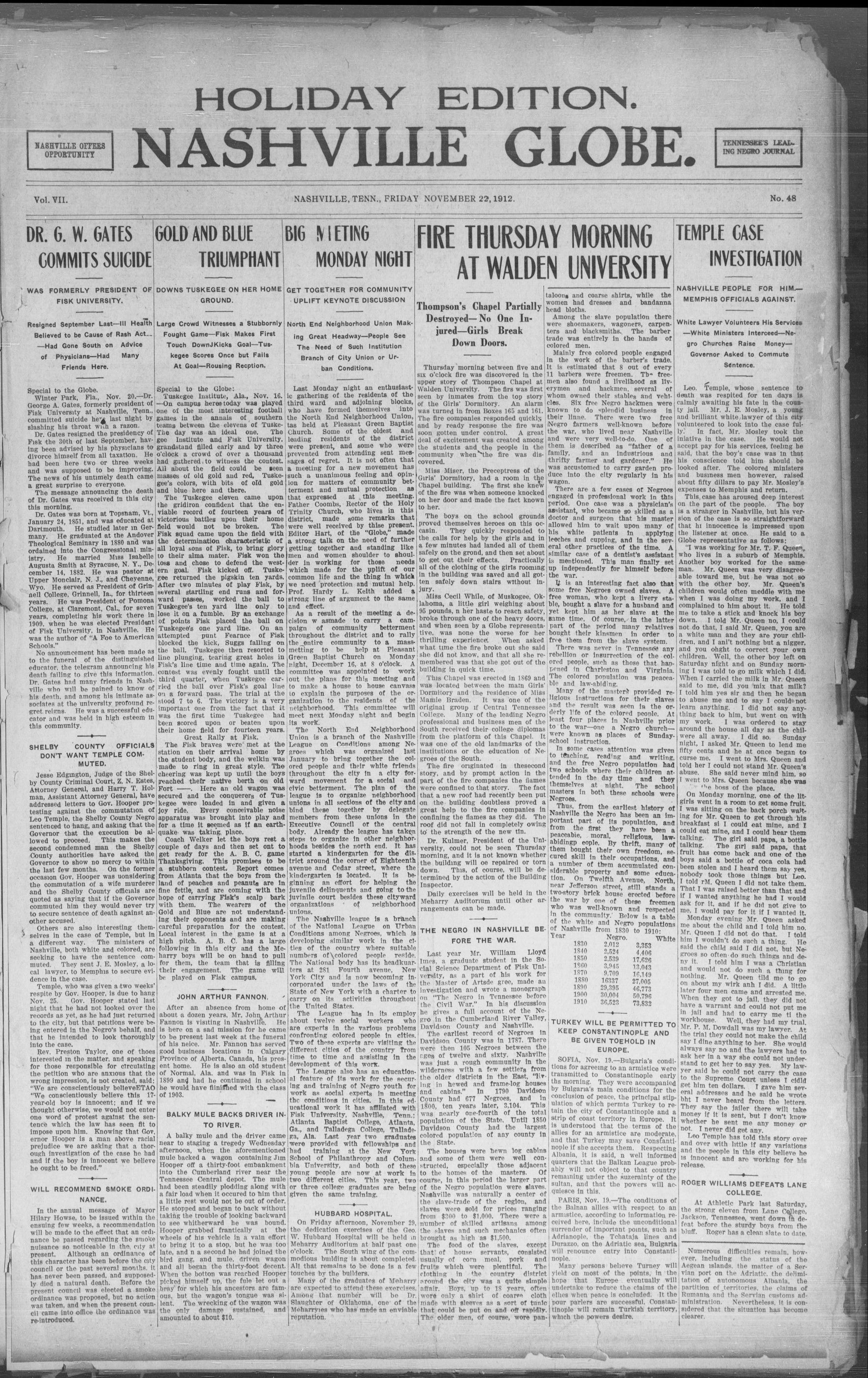
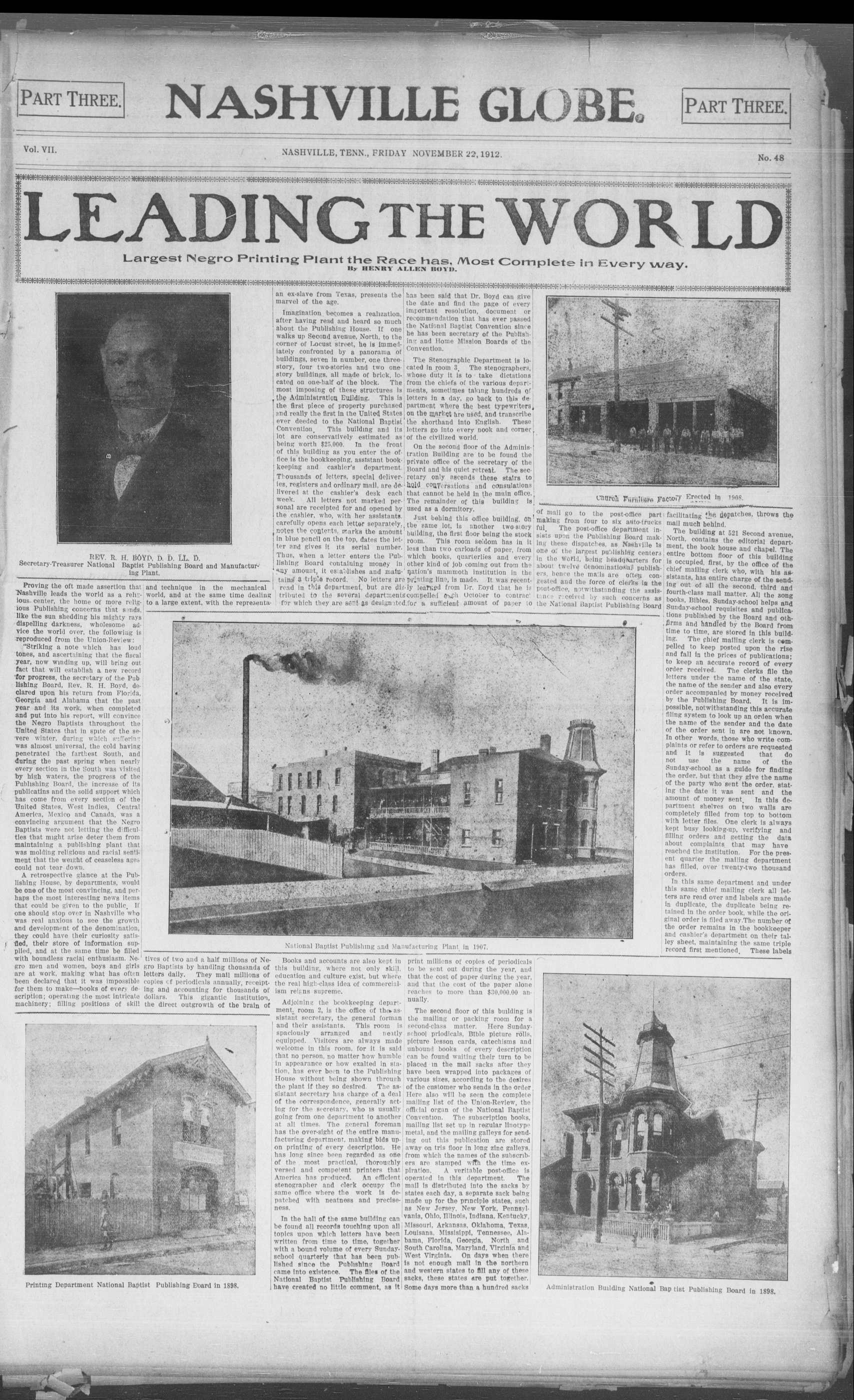
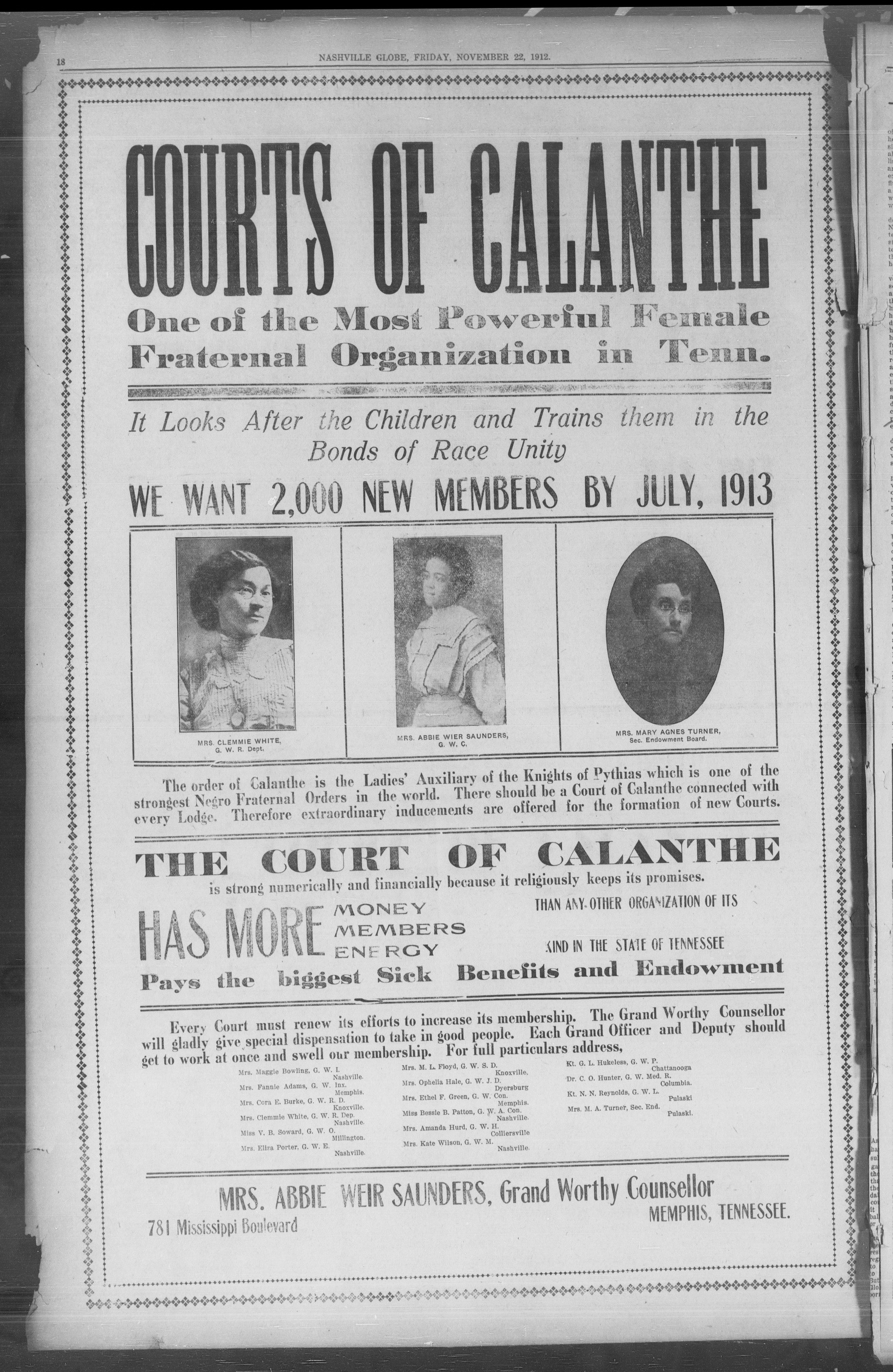
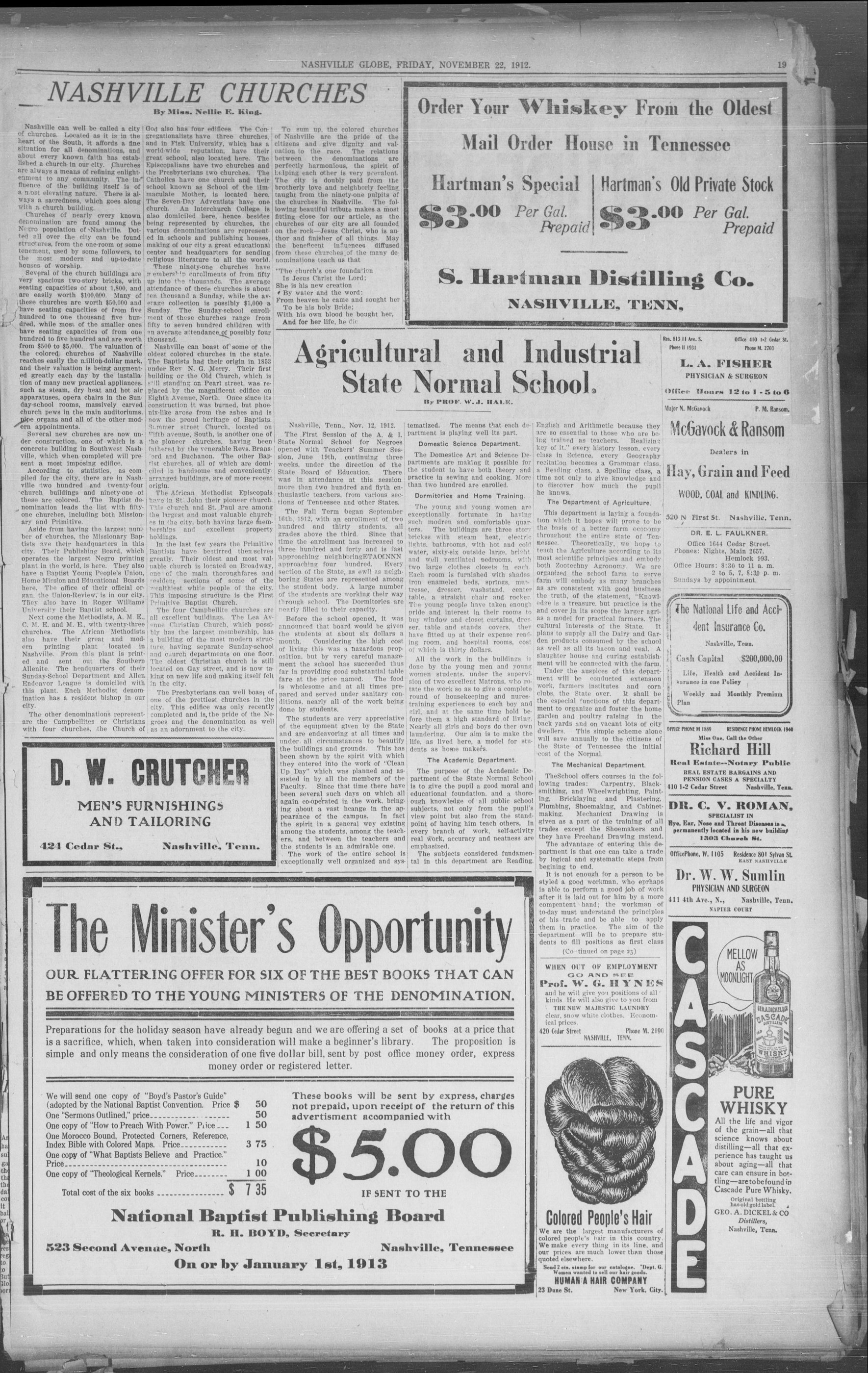
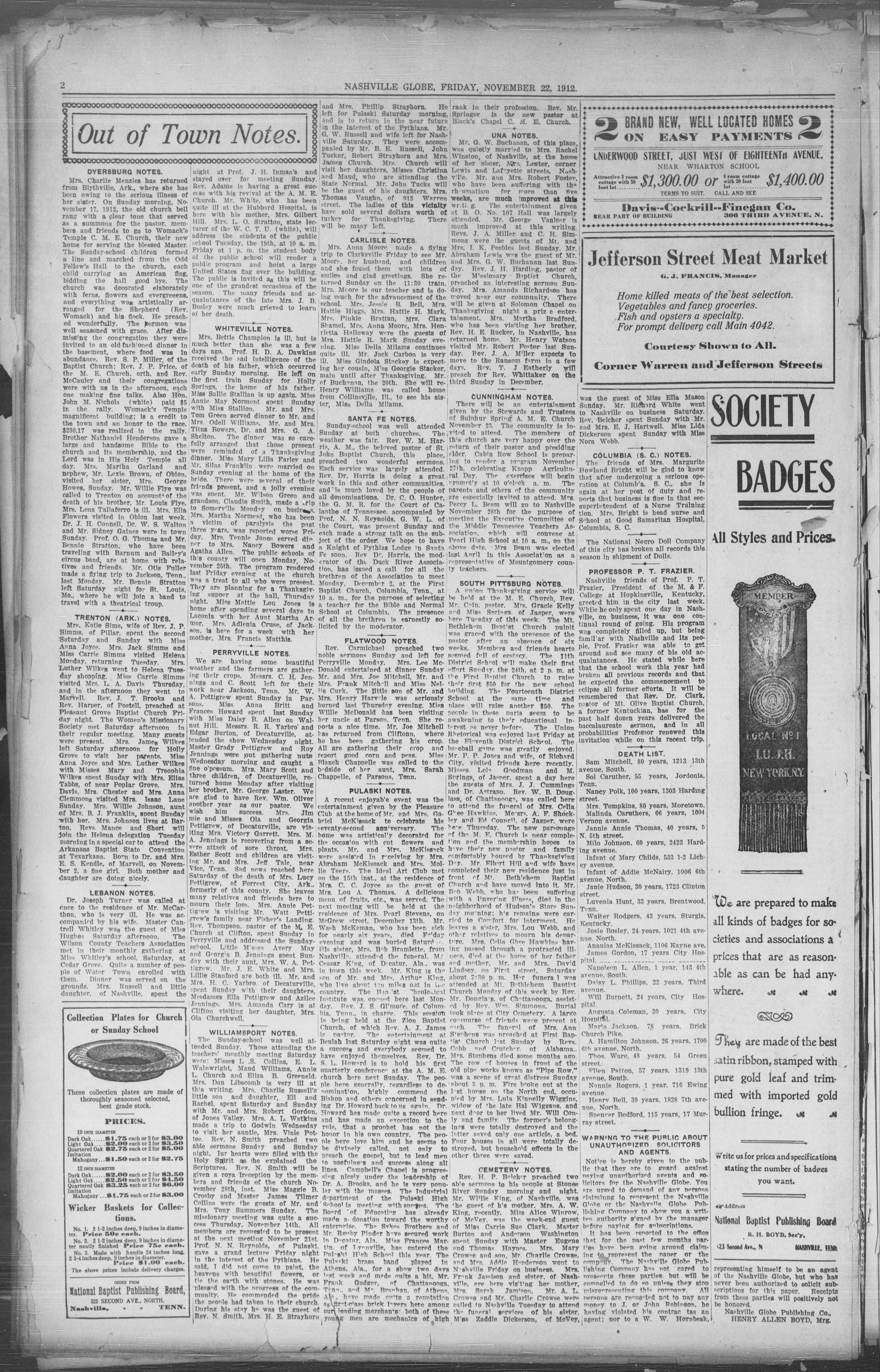
Page text (machine-generated)
NASHVILLE OFFERS
OPPORTUNITY
Vol. VII.
DR. G. W. GATES COMMITS SUICIDE
WAS FORMERLY PRESIDENT OF
FISK UNIVERSITY.
Resigned September Last—Ill Health
Believed to be Cause of Rash Act...
—Had Gone South on Advice
of Physicians—Had Many
Friends Here.
Special to the Globe.
Special to
Winter Park, Fla., Nov. 20.—Dr. George A. Gates, formerly president of Fisk University at Nashville, Tenn., committed suicide last night by shaking his throat with a razon.
Dr. Gates resigned the presidency of Fisk the 30th of last September, having been advised by his physicians to divorce himself from all taxation. He had been here two or three weeks and was supposed to be improving. The news of his untimely death came a great surprise to everyone.
The message announcing the death of Dr. Gates was received in this city this morning.
Dr. Gates was born at Topsam, Vt., January 24, 1851, and was educated at Dartmouth. He studied later in Germany. He graduated at the Andover Theological Seminary in 1880 and was ordained into the Congressional ministry. He married Miss Isabelle Augusta Smith at Syracuse, N. Y., December 14, 1882. He was pastor at Upper Monclair, N. J., and Chevenne Wyo. He served as President of Grinnell College, Grinnell, Ia., for thirteen years. He was President of Pomona College, at Claremont, Cal., for seven years, completing his work there in 1909. when he was elected President of Fisk University, in Nashville. He was the author of "A Foe to American Schools."
No announcement has been made as to the funeral of the distinguished educator, the telegram announcing his death failing to give this information. Dr. Gates had many friends in Nashville who will be pained to know of his death, and among his intimate associates at the university profound regret reigns. He was a successful educator and was held in high esteem in this community.
SHELBY COUNTY OFFICIALS
DON'T WANT TEMPLE COM-
MUTED.
Jesse Edginton, Judge of the Shelby County Criminal Court, Z. N. Estes, Attorney General, and Harry T. Holman, Assistant Attorney General, have addressed letters to Gov. Hooper protesting against the commutation of Leo Temple, the Shelby County Negro sentenced to hang, and asking that the Governor that the execution be allowed to proceed. This makes the second condemned man the Shelby County authorities have asked the Governor to show no mercy to within the last few months. On the former occasion Gov. Hooper was onusiding the commutation of a wife murderer and the Shelby County officials are quoted as saying that if the Governor commuted him they would never try to secure sentence of death against another accused.
Others are also interesting themselves in the case of Temple, but in a different way. The ministers of Nashville, both white and colored, are seeking to have the sentence commuted. They sent J. E. Mosley, a local lawyer, to Memphis to secure evidence in the case.
Temple, who was given a two weeks' respite by Gov. Hooper, is due to hang Nov. 25. Gov. Hooper stated last night that he had not looked over the records as yet, as he had just returned to the city, but that petitions were being entered in the Negro's behalf, and that he intended to look thoroughly into the case.
Rev. Preston Taylor, one of those interested in the matter, and speaking for those responsible for circulating the petition who are anxious that the wrong impression, is not created, said: "We are conscientiously believe ETAO "We consciently believe this 17-year-old boy is innocent; and if we thought otherwise, we would not enter one word of protest against the sentence which the law has seen fit to impose upon him. Knowing that Gov. eror Hooper is a man above racial prejudice we are asking that a thorough investigation of the case he had and if the boy is innocent we believe he ought to be freed."
WILL RECOMMEND SMOKE ORDI
NANCE.
In the annual message of Mayor Hilary Howse, to be issued within the ensuing few weeks, a recommendation will be made to the effect that an ordinance be passed regarding the smoke nuisance so noticeable in the city at present. Although an ordinance of this character has been before the city council or the past several months, it has never been passed, and supposedly died a natural death. Before the present council was elected a smoke ordinance was proposed, but no action was taken, and when the present council came into office the ordinance was re-introduced.
HOLIDAY EDITION. NASHVILLE GLOBE.
GOLD AND BLUE
TRIUMPHANT
DOWNS TUSKEGEE ON HER HOME
GROUND.
Large Crowd Witnesses a Stubbornly
Fought Game—Fisk Makes First
Touch DownJKicks Goal—Tuskegee Scores Once but Fails
At Goal—Rousing Reception.
Special to the Globe:
Tuskegee Institute, Ala., Nov. 16.
—On campus here today was played one of the most interesting football games in the annals of southern teams between the eleven of Tuskegee The day was an ideal one. The gee Institute and Fisk University, grandstand filled early and by three o'clock a crowd of over a thousand had gathered to witness the contest.
All about the field could be seen masses of old gold and red, Tuskegee's colors, with bits of old gold and blue, here and there.
The Tuskegee eleven came upon the gridiron confident that the enviable record of fourteen years of victorious battles upon their home field would not be broken. The Fisk squad came upon the field with the determination characteristic of all loyal sons of Fisk, to bring glory to their alma mater. Fisk won the toss and chose to defend the western goal. Fisk kicked off. Tuskegee returned the pligskin ten yards. After two minutes of play Fisk, by several startling end runs and forward passes, worked the ball to Tuskegee's ten yard line only to lose it on a fumble. By an exchange of points Fisk placed the ball on Tuskegee's one yard line. On an attempted punt Fearce of Fisk blocked the kick, Suggs falling on the ball. Tuskegee then resorted to plunging, tearing great holes in Fisk's line time and time again. The contest was evenly fought until the third quarter, when Tuskegee carried the ball over Fisk's goal line on a forward pass. The trial at the stood 7 to 6. The victory is a very important one from the fact that it was the first time Tuskegee had been scored upon or beaten upon their home field for fourteen years.
Great Rally at Fisk.
The Fisk braves were met at the station on their arrival home by the student body, and the welkin was made to ring in great style. The cheering was kept up until the boys reached their native berth on old Fort — Here an old wagon was secured and the conquerers of Tuskegee were loaded in and given a joy ride. Every conceivable noise apparatus was brought into play and for a time it seemed as if an earthquake was taking place.
Coach Welker let the boys rest a couple of days and then set on to get ready for the A. B. C. game. Thanksgiving. This promises to be a stubborn contest. Report comes from Atlanta that the boys from the land of peaches and peanuts are in fine fettle, and are coming with the hope of carrying Fisk's scalp bark with them. The wearers of the Gold and Blue are not understanding their opponents and are making careful preparation for the contest. Local interest in the game is at a high pitch. A. B. C. has a large following in this city and the Meharry boys will be on hand to pull for them, the team that is filling their engagement. The game will be played on Fisk campus.
JOHN ARTHUR FANNON
After an absence from home of about a dozen years, Mr. John Arthur Fannon is visiting in Nashville. He is here on a sad mission for he came to be present last week at the funeral of his niece. Mr. Fannon has served good business locations in Calgary Province of Alberta, Canada, his pres ent home. He is also an old student of Normal, Ala, and was in Fisk in 1899 and had he continued in school he would have finished with the class of 1903.
BALKY MULE BACKS DRIVER IN TO RIVER.
A balky mule and the driver came near to staging a treedy Wednesday afternoon, when the aforementioned mule backed a wagon containing Jim Hooper off a thirty-foot embankment into the Cumberland river near the Tennessee Central depot. The mule had been steadily plodding along with a fair load when it occurred to him that a little rest would not be out of order. He stopped and began to back without taking the trouble of looking backward to see whitherward he was bound. Hooper grabbed frantically at the wheels of his vehicle in a vain effort to bring it to a stop, but he was too late, and n a second he had joined the bird gang, and mule, driven wagon and all began the thirty-foot decent. When the bottom was reached Hooper picked himself up, the fule let out a bray for which his ancestors are famous, but the wagon's tongue was silent. The wrecking of the wagon was the only damage sustained, and amounted to about $10.
NASHVILLE, TENN., FRIDAY NOVEMBER 22, 1912.
MEETING
MONDAY NIGHT
GET TOGETHER FOR COMMUNITY UPLIFT KEYNOTE DISCUSSION North End Neighborhood Union Making Great Headway—People See The Need of Such Institution Branch of City Union or Urban Conditions.
Last Monday night an enthusiastic gathering of the residents of the third ward and adjoining blocks, who have formed themselves into the North End Neighborhood Union, tas held at Pleasant Green Baptist Church. Some of the oldest and leading residents of the district were present, and some who were prevented from attending sent messages of regret. It is not often that a meeting for a new movement has such a unanimous feeling and opinion for matters of community betterment and mutual protection as that expressed at this meeting. Father Coombs, Rector of the Holy Trinity Church, who lives in this district, made some remarks that were well received by these present. Editor Hart, of the "Globe," made a strong talk on the need of further getting together and standing like men and women shoulder to shoulder in working for those needs which made for the uplift of our common life and the thing in which we need protection and mutual help. Prof. Hardy L. Keith added a strong line of argument to the same and effect.
As a result of the meeting a decision w asmade to carry a campaign of community bettermet throughout the district and to rally the entire community to a massmetting to be help at Pleasant Green Baptist Church on Monday night, December 16, at 8 o'clock. A committee was appointed to work out the plans for this meeting and to make a house to house canvass to explain the purposes of the organization to the residents of the neighborhood. This committee will meet next Monday night and begin its work.
The North End Neighborhood Union is a branch of the Nashville League on Conditions among Negroes which was organized last January to bring together the colored people and their white friends throughout the city in a city forward movement for a social and civic betterment. The plan of the league is to organize neighborhood unions in all sections of the city and bind these together by delegate members from these unions in the Executive Council or the central body. Already the league has taken steps to organize in other neighborhoods besides the north end. It has started a kindergarten for the district around the corner of Eighteenth avenue and Cedar street, where the kindergarten is located. It is beginning an effort for helping the juvenile delinquents and going to the juvenile court besides these cityward organizations of neighborhood unions.
The Nashville league is a branch of the National League on Urban Conditions among Negroes, which is developing similar work in the cities of the country where suitable numbers of colored people reside. The National body has its headquarters at 281. Fourth avenue, New York City and is now becoming incorporated under the laws of the State of New York with a charter to carry on its activities throughout the United States.
The League has in its employ about twelve social workers who are experts in the various problems confronting colored people in cities. Two of these experts are visiting the different cities of the country from time to time and assisting in the development of this work. The League also has an educational feature of its work for the securing and training of Negro youth for work as social experts in meeting the conditions in cities. In this educational work it has affiliated with Fisk University, Nashville, Tenn.; Atlanta Baptist College, Atlanta, Ga., and Talladega College, Talladega, Ala. Last year two graduates were provided with fellowships and had training at the New York School of Philanthropy and Columbia University, and both of these young people are now at work in two different cities. This year, two or three college graduates are being given the same training.
HUBBARD HOSPITAL
On Friday afternoon, November 29, the dedication exercises of the Geo W. Hubbard Hospital will be held in Meharry Auditorium at half past one o'clock. The South wing of the commodious building is about completed. All that remains to be done is a few touches by the builders. Many of the graduates of Meharry are expected to attend these exercises. Among that number will be Dr. Slaughter of Oklahoma, one of the Mehharries who has made an enviable reputation.
FIRE THURSDAY MORNING AT WALDEN UNIVERSITY
Thompson's Chapel Partially Destroyed—No One Injured—Girls Break Down Doors.
Thursday morning between five and six o'clock fire was discovered in the upper story of Thompson Chapel at Walden University. The firs was first seen by inmates from the top story of the Girls' Dormitory. An alarm was turned in from Boxes 165 and 161. The fire companies responded quickly and by ready response the fire was soon gotten under control. A great deal of excitement was created among the students and the people in the community when the fire was discovered.
Miss Miser, the Preceptress of the Girls' Dormitory, had a room in the Chapel building. The first she knew of the fire was when someone knocked on her door and made the fact known to her.
The boys on the school grounds proved themselves heroes on this occasion. They quickly responded to the calls for help by the girls and in a few minutes had landed all of them safely on the ground, and then set about to get out their effects. Practically all of the clothing of the girls rooming in the building was saved and all got ten safely down stairs without injury.
Miss Cecil While, of Muskogee, Oklahoma, a little girl weighing about 95 pounds, n her haste to reach safety, broke through one of the heavy doors, and when seen by a Globe representative, was none the worse for her thrilling experience. When asked what time the fire broke out she said she did not know, and that all she remembered was that she got out of the building in quick time.
This Chapel was erected in 1869 and was located between the main Girls' Dormitory and the residence of Miss Mamie Braden. It was one of the original group if Central Tennessee College. Many of the leading Negro professional and business men of the South received their college diplomas from the platform of this Chapel. It was one of the old landmarks of the institutions or the education of Negroes of the South.
The fire originated in the second story, and by prompt action in the part of the fire companies the flames were confined to that story. The fact that a new roof had recently been put on the building doubtless proved a great help to the fire companies in confining the flames as they did. The roof did not fall in completely owing to the strength of the new tin.
Dr. Kulmer, President of the University, could not be seen Thursday morning, and it is not known whether the building will be repaired or torn down. This, of course, will be determined by the action of the Building Inspector.
Daily exercises will be held in the Meharry Auditorium until other arangements can be made.
THE NEGRO IN NASHVILLE BE
FORE THE WAR.
Last year Mr. William Lloyd Imes, a graduate student in the Social Science Department of Fisk University, as a part of his work for the Master of Artade gree, made an investigation and wrote a monograph on "The Negro in Tennessee before the Civil War." In his discussion he gives a full account of the Negro in the Cumberland River Valley, Davidson County and Nashville.
The earliest record of Negroes in Davidson County was in 1787. There were then 105 Negroes between the ages of twelve and sixty. Nashville was just a rough community in the wilderness with a few settlers from the older districts in the East, "living in hewed and frame-log houses and cabins." In 1790 Davidson County had 677 Negroes, and in 1800, ten years later, 3,104. This was nearly one-fourth of the total population of the State. Until 1850 Davidson County had the largest colored population of any county in the State.
The houses were hewn log cabins and some of them were well constructed, especially those adjacent to the homes of the masters. Of course, in this period the larger part of the Negro population were slaves. Nashville was naturally a center of the slave-trade of the region, and slaves were sold for prices ranging from $200 to $1,000. There were a number of skilled artisans among the slaves and such mechanics often brought as high as $1,500.
The food of the slaves, except that of house servants, consisted usually of corn meal, pork and fruits which were plentiful. The clothing in the country district around the city was a quite simple affair. Boys, up to 18 years, often wore only a shirt of coarse cloth made with sleeves as a sort of tunic that could be put on and off rapidly. The older men, of course, wore pan-
taloung and coarse shirts, while the women had dresses and bandanna head blots. Among the slave population there were shoemakers, wagoners, carpenters and blacksmiths. The barber trade was entirely in the hands of colored men. Mainly free colored people engaged in the work of the barber's trade. It is estimated that 8 out of every 11 barbers were freemen. The freemen also found a livelihood as liverymen and hackmen, several of whom owned their stables and vehicles. Six free Negro hackmen were known to do splendid business in their lime. There were two free Negro farmers well-known before the war, who lived near Nashville and were very well-to-do. One of them is described as "father of a family, and an industrious and thrifty farmer and gardener." He was accustomed to carry garden produce into the city regularly in his wagon. There are a few cases of Negroes engaged in professional work in this period. One case was a physician's assistant, who became so skilled as a doctor and surgeon that his master allowed him to wait upon many of his white patients in applying leeches and cupping, and in the several other practices of the time. A similar case of a dentist's assistant is mentioned. This man finally set up independently for himself before the war.
It is an interesting fact also that some free Negroes owned slaves. A free woman, who kept a livery stable, bought a slave for a husband and yet kept him as her slave at the same time. Of course, in the latter part of the period many relatives bought their kinsmen in order to free them from the slave system.
There was never in Tennessee any rebellion or insurrection of the colored people, such as those that happened in Charleston and Virginia. The colored population was peaceable and law-abiding.
Many of the masters provided religious instructions for their slaves and the result was seen in the orderly life of the colored people. At least four places in Nashville prior to the war—one a Negro church—were known as places of Sunday-school instruction.
In some cases attention was given to teaching, reading and writing, and the free Negro population had two schools where their children attended in the day time and they themselves at night. The school masters in both these schools were Negroes.
Thus, from the earliest history of Nashville the Negro has been an important part of its population, and from the first they have been a peacable, moral, religious, law-abiding people. By thrift, many of them bought their own freedom, secured skill in their occupations, and a number of them accumulated considerable property and some education. On Twelfth Avenue, North, near Jefferson street, still stands a two-story brick house erected before the war by one of these freemen who was well-known and respected in the community. Below is a table of the white and Negro populations of Nashville from 1830 to 1910: Year Negro White
# White
1830 2,012 3,353
1840 2,524 4,406
1850 2,539 17,626
1860 3,945 13,043
1870 9,709 16,149
1880 16337 27,005
1890 29,395 46,773
1900 30,004 50,796
1910 36,523 73,832
TURKEY WILL BE PERMITTED TO
KEEP CONSTANTINOPLE AND
BE GIVEN TOEHOLD IN
SOFIA, Nov. 19.—Bulgaria's conditions for agreeing to an armistice were transmitted to Constantinople early this morning. They were accompanied by Bulgaria's main conditions for the conclusion of peace, the principal stipulation of which permits Turkey to retain the city of Constantinople and a strip of coast territory in Europe. It is understood that the terms of the allies for an armistice are moderate, and that Turkey may save Constantinople if she accepts them. Respecting Albania, it is said, n well informed quarters that the Balkan League probably will not object to that country remaining under the suzerainty of the sultan, and that the powers will acquiesce in this.
PARIS, Nov. 19.—The conditions of the Balan allies with respect to an armistice, according to information received here, include the unconditional surrender of important points, such as Adrianeople, the Tchatajta lines and Durazzo, on the Adriatic sea, Bulgaria will renounce entry into Constantinople.
Many persons believe Turney will yield on most of the points, in the hope that Europe eventually will undertake to reduce the claims of the elites when peace is concluded. It the pour parlers are successful. Constantinople will remain Turkish territory, which the powers desire.
TENNESSEE'S LEADING NEGRO JOURNAL
No.48
TEMPLE CASE INVESTIGATION
NASHVILLE PEOPLE FOR HIM.—
MEMPHIS OFFICIALS AGAINST.
White Lawyer Volunteers His Services
—White Ministers Interceed—Negro Churches Raise Money—
Governor Asked to Commute
Sentence
Leo. Temple, whose sentence to death was respited for ten days is calmly awaiting his fate in the county jail. Mr. J. E. Mosley, a young and brilliant white lawyer of this city volunteered to look into the case fully. In fact, Mr. Mosley took the inative in the case. He would not accept pay for his services, feeling he said, that the boy's case was in that his conscience told him should be looked after. The colored ministers and business men however, raised about fifty dollars to pay Mr. Mosley's expenses to Memphis and return. This case has aroused deep interest on the part of the people. The boy is a stranger in Nashville, but his version of the case is so straightforward that his innocence is impressed upon the listener at once. He said to a Globe representative as follows:
"I was working for Mr. T. F. Queen, who lives in a suburb of Memphis. Another man, Mr. Queen was very disagreeable toward me, but he was not so with the other boy. Mr. Queen's children would often meddle with me when I was doing my work, and I complained to him about it. He told me to take a stick and knock his boy down. I told Mr. Queen no, I could not do that, I said Mr. Queen, you are a white man and they are your children, and I anl't nothing but a nigger, and you ohght to correct your own children. Well, the other boy left on Saturday night and on Sunday morning I was told to go milk which I did. When I carried the milk in Mr. Queen said to me, did you mix that milk? I told him yes sir and then he began to abuse me and to say I could not learn anything. I did not say anything back to him, but went on with my work. I was ordered to stay around the house all day as the chillere all away. I did so. Sunday night, I asked Mr. Queen to lend me fifty cents and at he once began to curse me. I went to Mrs. Queen and told her I could not stand Mr. Queen's abuse. She said never mind him, so I went to Mrs. Queen because she was the boss of the place.
On Monday morning, one of the lit-girls went in a room to get some fruit. I was sitting on the back porch waiting for Mr. Queen to get through his breakfast si I could eat mine, and I could eat mine, and I could hear them talking. The girl said papa, a bottle talking. The girl said papa, that fruit has come back and one of the boys said a bottle of coca cola had been stolen and I heard them say yes, nobody took those things but Leo. I told m.R. Queen I did not take them. That I was raised better than that and if I wanted anything he had I would ask for it, and if he did not give to me, I would pay for it if I wanted it.
Monday evening Mr. Queen asked me about the child and I told him no. Mr. Queen I did not do that. I told him I wouldn't do such a thing. He said the child said I did not, but Negroes so often do such things and deny it. I told him I was a Christian and would not do such a thing for nothing. Mr. Queen tild me to go on about my wirk anh I did. A little later four men came and arrested me. When they got to jail, they did not have a warrant and could not put me in jail and had to carry me ti the workhouse. Well, they had my trial, Mr. P. M. Dowdall was my lawyer. At the trial they could not make the child say I dine anything to her. She would always say no and the lawyers had to ask her in a way she could not understand to get her to say yes. My lawyer said he could not carry the case to the Supreme Court unless I cild get him ten dollars. I gave him several addresses and he said he wrote bt I never heard from the letters. They say the jaller there will take money if it is sent, but I don't know whether he sent me any money or not. I never did get any.
Leo Temple has told this story over and over with little if any variations and the people in this city believe he is innocent and are working for his release.
ROGER WILLIAMS DEFEATS LANE
COLLEGE.
At Athletic Park last Saturday, the strong eleven from Lane College, Jackson, Tennessee, went down in defeat before the sturdy boys from the bluff. Roger has a clean slate to date.
Numerous difficulties remain, however, including the status of the Aegean islands, the matter of a Servian port on the Adriatic, the delimitation of autonomous Albania, the partition of territories, the claims of Rumania and the Servian customs administration. Nevertheless, it is considered that the situation has become clearer.
NASHVILLE GLOBE, FRIDAY, NOVEMBER 22, 1912.
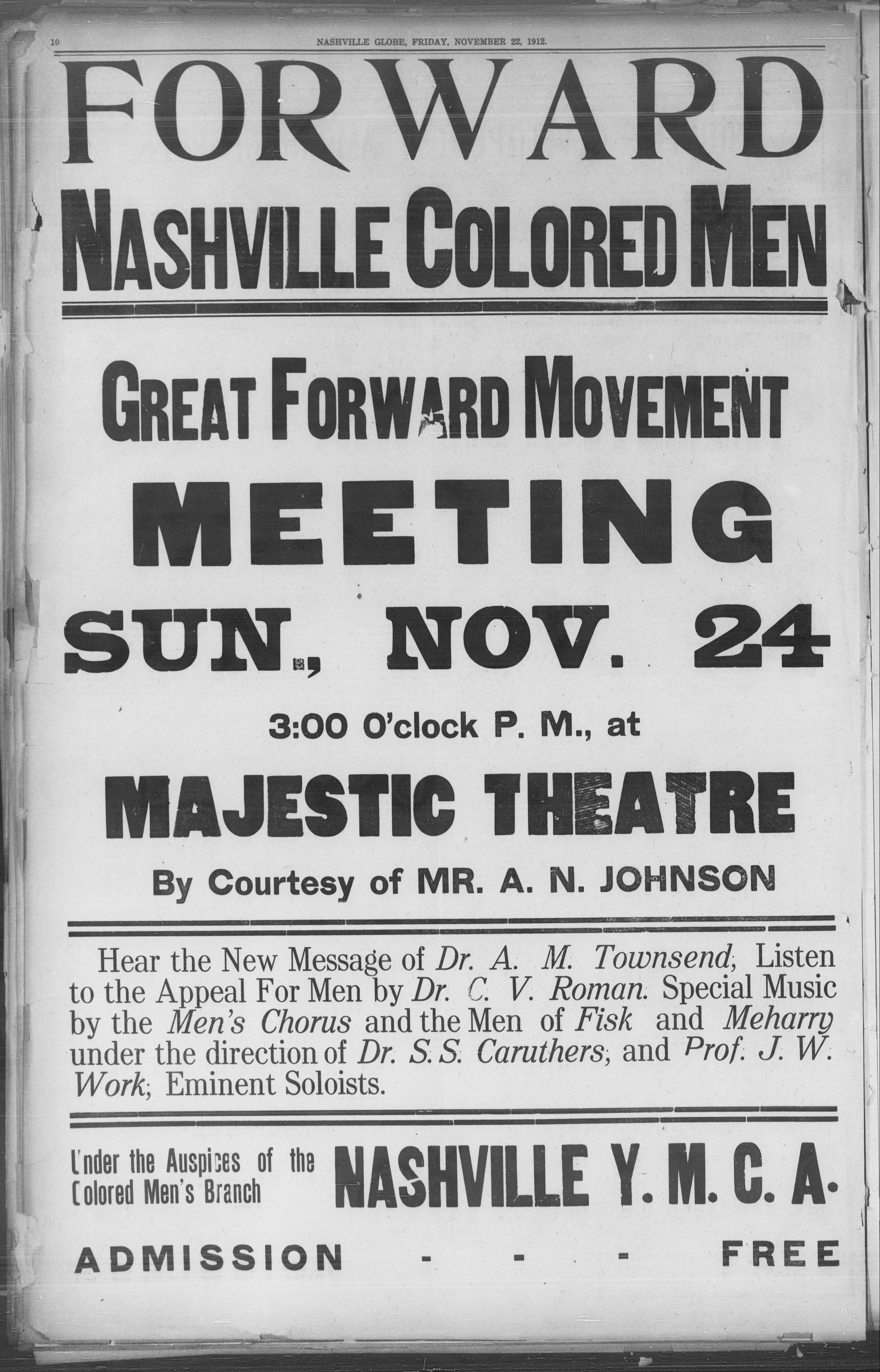
FORWARD NASHVILLE COLORED MEN
GREAT FORWARD MOVEMENT MEETING SUN. NOV. 24
3:00 O'clock P.M., at
By Courtesy of MR. A. N. JOHNSON
Hear the New Message of Dr. A. M. Townsend, Listen to the Appeal For Men by Dr. C. V. Roman. Special Music by the Men's Chorus and the Men of Fisk and Meharry under the direction of Dr. S.S. Caruthers, and Prof. J. W. Work; Eminent Soloists.
Under the Auspices of the Colored Men's Branch
POULTRY DEVELOPEMENT AMONG NEGROES.
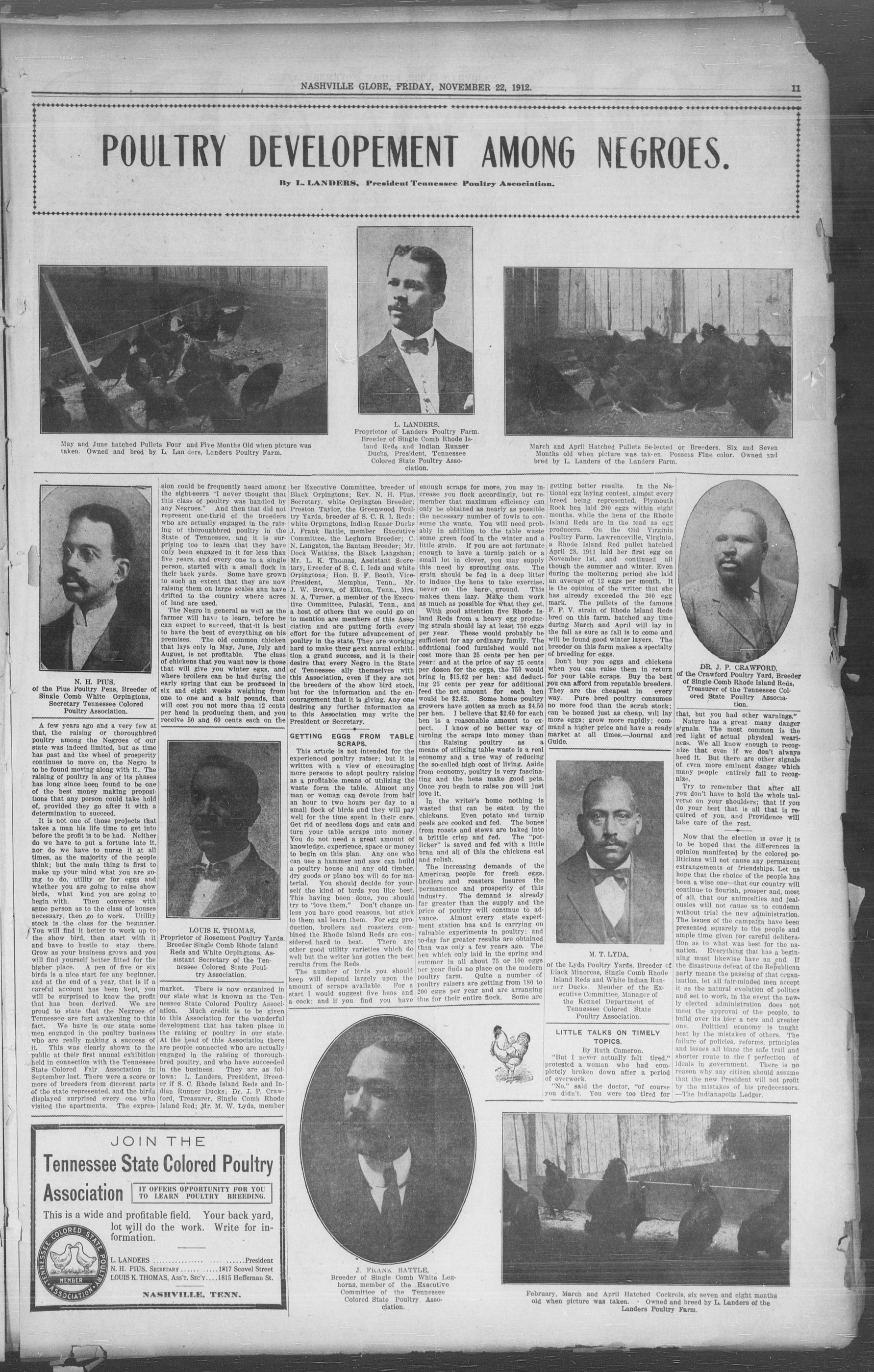
May and June hatched Pullets Four and Five Months Old when picture was taken. Owned and bred by L. Landers, Landers Poultry Farm.
JOIN THE
Tennessee State Colored Poultry
Association
IT OFFERS OPPORTUNITY FOR YOU
TO LEARN POULTRY BREEDING.
This is a wide and profitable field. Your back yard,
lot will do the work. Write for in-
formation.
L. LANDERS ...President
N. H. PIUS, SECRETARY ...1817 Scovel Street
LOUIS K. THOMAS, Ass't. SEC'Y ...1815 Heffernan St.
NASHVILLE, TENN.
[Name]
N. H. PIUS,
of the Pius Poultry Pens, Breeder of
Single Comb White Orpingtons,
Secretary Tennessee Colored
Poultry Association.
A few years ago and a very few at
that, the raising or thoroughbred
poultry among the Negroes of our
state was indeed limited, but as time
has past and the wheel of prosperity
continues to move on, the Negro is
to be found moving along with it.. The
raising of poultry in any of its phases
has long since been found to be one
of the best money making propositions
that any person could take hold of,
provided they go after it with a
determination to succeed.
It is not one of those projects that takes a man his life time to get into before the profit is to be had. Neither do we have to put a fortune into it, nor do we have to nurse it at all times, as the majority of the people think; but the main thing is first to make up your mind what you are going to do. utility or for eggs and whether you are going to raise show birds, what kind you are going to begin with. Then converse with some person as to the class of houses necessary, then go to work. Utility stock is the class for the beginner. You will find it better to work up to the show bird, then start with it and have to hustle to stay there. Grow as your business grows and you will find yourself better fitted for the higher place. A pen of five or six birds is a nice start for any beginner, and at the end of a year, that is if a careful account has been kept, you will be surprised to know the profit that has been derived. We are proud to state that the Negroes of Tennessee are fast awakening to this fact. We have in our state some men engaged in the poultry business who are really making a success of it. This was clearly shown to the public at their first annual exhibition held in connection with the Tennessee State Colored Fair Association in September last. There were a score or more of breeders from decent parts of the state represented, and the birds displayed surprised every one who visited the apartments. The expres-
sion could be frequently heard among the sight-seers "I never thought that this class of poultry was handled by any Negroes." And then that did not represent one-third of the breeders who are actually engaged in the raising of thoroughbred poultry in the State of Tennessee, and it is surprising too to learn that they have only been engaged in it for less than five years, and every one to a single person, started with a small flock in their back yards. Some have grown to such an extent that they are now raising them on large scales ann have drifted to the country where acres of land are used.
The Negro in general as well as the farmer will have to learn, before he can expect to succeed, that it is best to have the best of everything on his premises. The old common chicken that lays only in May, June, July and August, is not profitable. The class of chickens that you want now is those that will give you winter eggs, and where broilers can be had during the early spring that can be produced in six and eight weeks weighing from one to one and a half pounds, that will cost you not more than 12 cents per head in producing them, and you receive 50 and 60 cents each on the
M. B.
LOUIS K. THOMAS,
Proprietor of Rosemary Poultry Yards.
Breeder Single Comb Rhode Island
Reds and White Orpingtons. Ass-
istant Secretary of the Tennessee Colored State Poultry Association.
market. There is now organized in our state what is known as the Tennessee State Colored Poultry Association. Much credit is to be given to this Association for the wonderful development that has taken place in the raising of poultry in our state. At the head of this Association there are people connected who are actually engaged in the raising of thoroughbred poultry, and who have succeeded in the business. They are as follows: L. Landers, President, Breeder if S. C. Rhode Island Reds and Indian Runner Ducks; Dr. J. P. Crawford, Treasurer, Single Comb Rhode Island Red; Mr. M. W. Lovely, member
NASHVILLE GLOBE, FRIDAY, NOVEMBER 22, 1912.
By L. LANDERS, President Tennessee Poultry Association.
J. B.
L. LANDERS,
Proprietor of Landers Poultry Farm.
Breeder of Single Comb Rhode Island Reds and Indian Runner
Ducks, President, Tennessee
Colored State Poultry Association
ber Executive Committee, breeder of Black Orpingtons; Rev. N. H. Plus Secretary, white Orpington Breeder; Preston Taylor, the Greenwood Poultry Yards, breeder of S. C. R. I. Reds; white Orpingtons, Indian Runer Ducks J. Frank Battle, member Executive Committee, the Leghorn Breeder; C. N. Langston, the Bantam Breeder; Mr. Dock Watkins, the Black Langshan; Mr. L. K. Thomas, Assistant Secretary, Freeder of S. C. I. leds and white Orpingtons; Hon. B. F. Booth, Vice President, Memphis, Tenn., Mr. J. W. Brown, of Elkton, Tenn., Mrs. M. A. Turner, a member of the Executive Committee, Pulaski, Tenn., and a host of others that we could go on to mention are members of this Association and are putting forth every effort for the future advancement of poultry in the state. They are working hard to make their next annual exhibition a grand success, and it is their desire that every Negro in the State of Tennessee ally themselves with this Association, even if they are not the breeders of the show bird stock, but for the information and the encouragement that it is giving. Any one desiring any further information as to this Association may write the President or Secretary.
GETTING EGGS FROM TABLE
SCBAPS
This article is not intended for the experienced poultry rater; but it is written with a view of encouraging more persons to adopt poultry raising as a profitable means of utilizing the waste form the table. Almost any man or woman can devote from half an hour to two hours per day to a small flock of birds and they will pay well for the time spent in their care. Get rid of needless dogs and cats and turn your table scraps into money. You do not need a great amount of knowledge, experience, space or money to begin on this plan. Any one who can use a hammer and saw can build a poultry house and any old timber, dry goods or piano box will do for material. You should decide for yourself the kind of birds you like best. This having been done, you should try to "love them." Don't change unless you have good reasons, but stick to them anl learn them. For egg production, broilers and roasters combined the Rhode Island Reds are considered hard to beat. There are other good utility varieties which do well but the writer has gotten the best results from the Reds.
The number of birds you should keep will depend largely upon the amount of scraps available. For a start I would suggest five hens and a cock; and if you find you have
[Image of a man in a suit with a tie and a mustache].
[Picture of a man in a suit and tie].
J. FRANK BATTLE.
Breeder of Single Comb White Leg
horns, member of the Executive
Committee of the Tennessee
Colored State Poultry Association.
enough scraps for more, you may increase you flock accordingly, but remember that maximum efficiency can only be obtained as nearly as possible the necessary number of fowls to consume the waste. You will need probably in addition to the table waste some green food in the winter and a little grain. If you are not fortunate enough to have a turnip patch or a small lot in clover, you may supply this need by sprouting oats. The grain should be fed in a deep litter to induce the hens to take exercise, never on the bare ground. This makes them lazy. Make them work as much as possible for what they get.
With good attention five Rhode Island Reds from a heavy egg producing strain should lay at least 750 eggs per year. These would probably be sufficient for any ordinary family. The additional food furnished would not cost more than 25 cents per hen per year: and at the price of say 25 cents per dozen for the eggs, the 750 would bring in $15.62 per hen: and deducting 25 cents per year for additional feed the net amount for each hen would be $2.62. Some home poultry growers have gotten as much as $4.50 per hen. I believe that $2.60 for each hen is a reasonable amount to expect. I know of no better way of turning the scraps into money than this Raising poultry as a means of utilizing table waste is a real economy and a true way of reducing the so-called high cost of living. Aside from economy, poultry is very fascinating and the hens make good pets. Once you begin to raise you will just love it.
In the writer's home nothing is wasted that can be eaten by the chickens. Even potato and turnip peels are cooked and fed. The bones from roasts and stews are baked into a brittle crisp and fed. The "pot-poller" is saved and fed with a little bran and all of this the chickens eat and relish.
The increasing demands of the American people for fresh eggs, broilers and roasters insures the permanence and prosperity of this industry. The demand is already far greater than the supply and the price of poultry will continue to advance. Almost every state experiment station has and is carrying on valuable experiments in poultry: and to-day far greater results are obtained than was only a few years ago. The hen which only laid in the spring and summer in all about 75 or 100 eggs per year finds no place on the modern poultry farm. Quite a number of poultry raises are getting from 180 to 200 eggs per year and are arranging this for their entire flock. Some are
```markdown
```
---
```markdown
```
```markdown
```
CHICKEN
March and April Hatched Pullets Se-lected or Breeders. Six and Seven Months old when picture was tak-en. Possess Fine color. Owned and bred by L. Landers of the Landers Farm.
February, March and April Hatched Cockrels, six seven and eight months old when picture was taken. Owned and breed by L. Landers of the Landers Poultry Farm.
getting better results. In the National egg laying contest, almost every breed being represented, Plymouth Rock hen laid 200 eggs within eight months, while the hens of the Rhode Island Reds are in the read as egg producers. On the Old Virginia Poultry Farm, Lawrenceville, Virginia, a Rhode Island Red pallet hatched April 28, 1911 laid her first egg on November 1st, and continued all though the summer and winter. Even during the molting period she laid an average of 12 eggs per month. It is the opinion of the writer that she has already exceeded the 200 egg mark. The pullets of the famous F. F. V. strain of Rhode Island Reds bred on this farm, hatched any time during March and April will lay in the fall as sure as fall is to come and will be found good winter layers. The breeder on this farm makes a spectalty of breeding for eggs.
Don't buy you eggs and chickens when you can raise them in return for your table scraps. Buy the best you can afford from reputable breeders. They are the cheapest in every way. Pure bred poultry consumes no more food than the scrub stock; can be housed just as cheap, will lay more eggs; grow more rapidly; command a higher price and have a ready market at all times.—Journal and Guide.
[Name]
of the Lyda Poultry Yards, Breeder of Elack Minorcas, Single Comb Rhode Island Reds and White Indian Runner Ducks. Member of the Executive Committee, Manager of the Kennel Department of Tennessee Colored State Poultry Association.
LITTLE TALKS ON TIMELY TOPICS.
"But I never actually felt tired," protested a woman who had completely broken down after a period of overwork. "No," said the doctor, "of course you didn't. You were too tired for
11
[Name]
DR. J. P. CRAWFORD, of the Crawford Poultry Yard, Breeder of Single Comb Rhode Island Reds, Treasurer of the Tennessee Colored State Poultry Association.
that, but you had other warnings." Nature has a great many danger signals. The most common is the red light of actual physical weariness. We all know enough to recognize that even if we don't heed it. But there are other signals of even more eminent danger which many people entirely fall to recognize.
Try to remember that after all you don't have to hold the whole universe on your shoulders; that if you do your best that is all that is required of you, and Providence will take care of the rest.
Now that the election is over it is to be hoped that the differences in opinion manifested by the colored politicians will not cause any permanent estrangements of friendships. Let us hope that the choice of the people has been a wise one—that our country will continue to flourish, prosper and, most of all, that our animosities and jealousies will not cause us to condemn without trial the new administration. The issues of the campaign have been presented squarely to the people and ample time given for careful deliberation as to what was best for the nation. Everything that has a beginning must likewise have an end. If the disastrous defeat of the Republican party means the passing of that organization, let all fair-minded men accept it as the natural evolution of politics and set to work, in the event the newly elected administration does not meet the approval of the people, to build over its bier a new and greater one. Political economy is taught best by the mistakes of others. The failure of policies, reforms, principles and issues all blaze the safe trail and shorter route to the f perfection of ideals in government. There is no reason why any citizen should assume that the new President will not profit by the mistakes of his predecessors.—The Indianapolis Ledger.
By Councilman S. P. Harris.
The latest approved and accepted definition of the term citizenship, is that which describes it as follows: "The status of a citizen with its rights and privileges." The same author defines a citizen to be "A member of a nation or a sovereign state, especially a republic; one who owes allegiance to a government and is entitled to protection from it." Referring again to the definition of citizenship as given above, viz., the status of citizen with all of the rights and privileges that go with that status, it is easy to see that to be a citizen of one's country is no tution which them as per right to duty and to And thus the Negroes ed, was five this Dred-Scine line with a public sentin tined to be it will it was and render tain events War. The man of the 14th
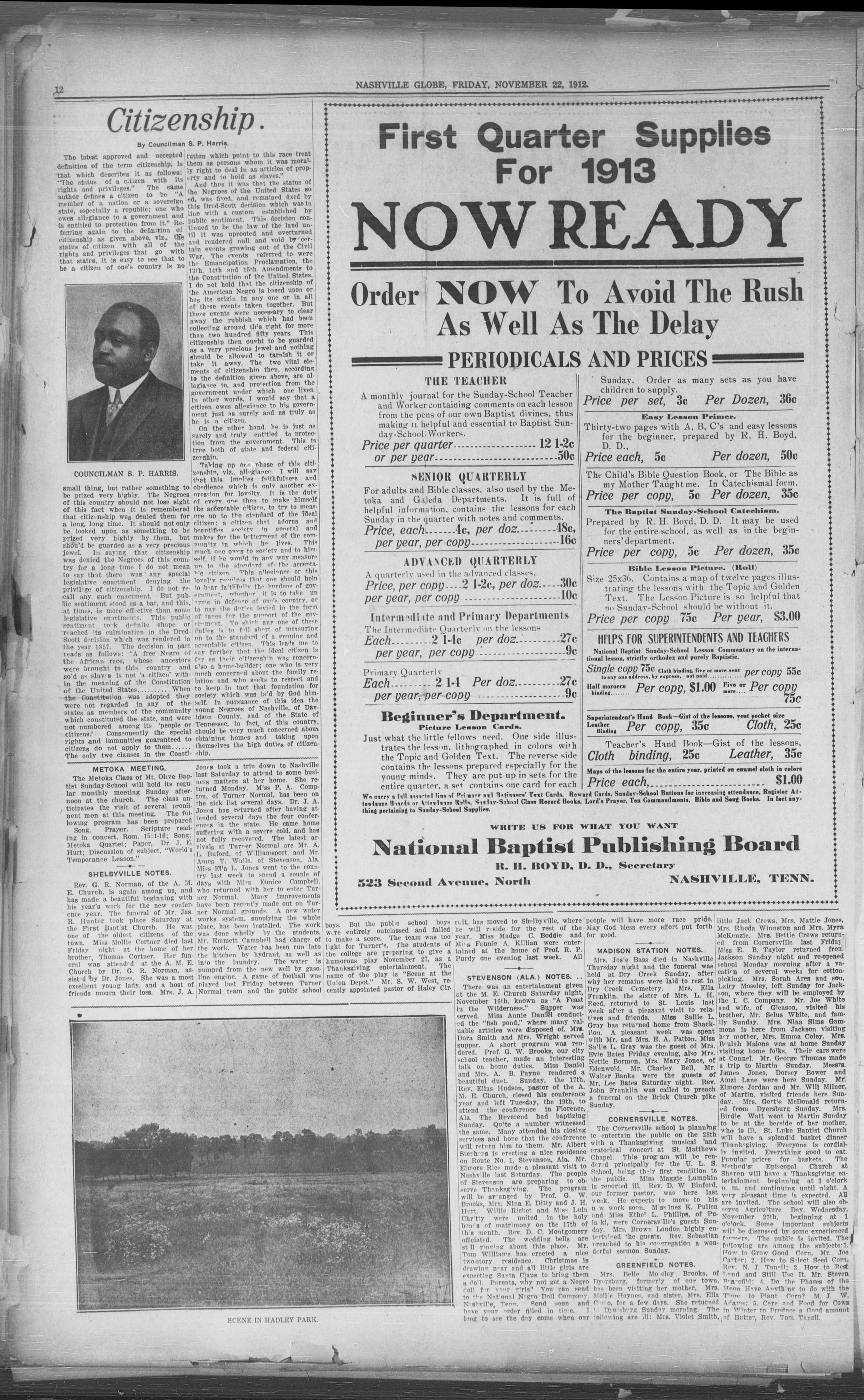
COUNCILMAN S. P. HARRIS.
small thing, but rather something to be prized very highly. The Negroes of this country should not lose sight of this fact when it is remembered that citizenship was denied them for a long, long time. It should not only be looked upon as something to be prized very highly by them, but should be guarded as a very precious jewel. In saying that citizenship was denied the Negroes of this country for a long time I do not mean to say that there was any special legislative enactment denying the privilege of citizenship. I do not recall any such enactment. But public sentiment stood as a bar, and this at times, is more effective than some legislative enactments. This public sentiment took definite shape or reached 'its culmination in the Dred Scott decision which was rendered in the year 1857. The decision in part reads as follows: "A free Negro of the African race, whose ancestors were brought to this country and so'd as slaves is not 'a citizen' with in the meaning of the Constitution of the United States.... When the Constitution was adopted they were not regarded in any of the states as members of the community which constituted the state, and were not numbered among its 'people or citizens.' Consequently the special rights and immunities guaranteed to citizens do not apply to them.... The only two clauses in the Consti
METOKA MEETING
The Metoka Class of Mt. Olive Baptist Sunday-School will hold its regular monthly meeting Sunday afternoon at the church. The class and ticipates the visit of several prominent men at this meeting. The following program has been prepared Song. Prayer. Scripture reading in concert. Rom. 15:1-16; Song. Metoka Quartet; Paper. Dr. J. E Hurt; Discussion of subject, "World's Temperance Lesson."
SHELBYVILLE NOTES.
Rev. G. R. Norman, of the A. M. E. Church, is again among us, and has made a beautiful beginning with his year's work for the new conference year. The funeral of Mr. Jas. R. Hunter took place Saturday at the First Baptist Church. He was one of the oldest citizens of the town. Miss Mollie Cortner died last Friday night at the home of her brother, Thomas Cortner. Her funeral was attend'd at the A. M. E. Church by Dr. G. R. Norman, as sist'd by Dr. Jones. She was a most excellent young lady, and a host of friends mourn their loss. Mrs. J. A.
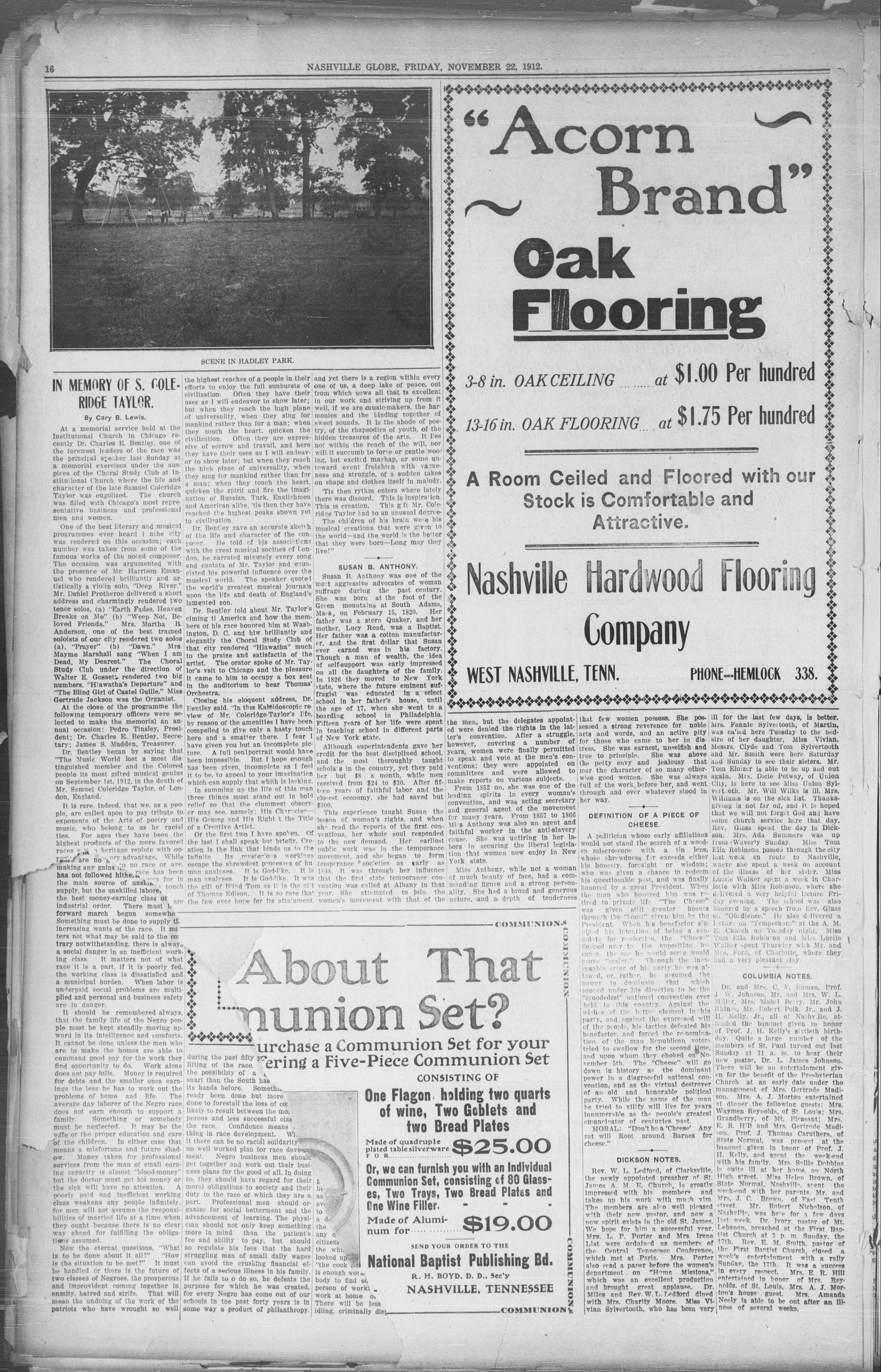
The image shows a vast, open field with a dense line of trees in the background. The field appears to be covered in grass or low vegetation, and there are no visible buildings or other structures. The sky is overcast, suggesting a cloudy day.
12
tution which point on this race treat them as persons whom it was morally right to deal in as articles of property, and to hold, as slaves."
And thus it was that the status of the Negroes of the United States soed, was fixed, and remained fixed by this Dreds-Scot decision which was in line with a custom established by public sentiment. This decision continued to be the law of the land until it was uprooted and overturned and rendered null and void by certain events growing out of the Civil War. The events referred to were the Emancipation Proclamation, the 13th, 14th and 15th Amendments to the Constitution of the United States. I do not hold that the citizenship of the American Negro is based upon or has its origin in any one or in all of these events taken together. But these events were necessary to clear away the rubbish which had been collecting around this right for more than two hundred fifty years. This citizenship then ought to be guarded as a very precious jewel and nothing should be allowed to tarnish it or take it away. The two vital elements of citizenship then, according to the definition given above, are allegiance to, and protection from the government under which one lives. In other words, I would say that a citizen owes allegiance to his government just as surely and as truly as he is, a citizen.
On the other hand, he is just as surely and truly entitled to protection from the government. This is true both of state and federal citizenship.
Taking up one phase of this citizenship, viz. alliance. I will save that this implies faithfulness and obedience which is only another expression for lovility. It is the duty of every one then to make himself the acceptable citizen, to try to measure up to the standard of the Ideal citizen; a citizen that adorns and beautifies society. In general and makes for the betterment of the community in which he lives. This much one owes to society and to himself, if he would in any way measure up to the standard of the acceptable citizen. This allegiance or this loyalty requires that one should help to bear faithfully the burdens of government, whether it is to take up arms in defense of one's country, or to pay the duties levied in the form of taxes for the support of the government. To shift any one of these duties is to fall short of measuring up to the standard of a genuine and acceptable citizen. This leads me to say further that the ideal citizen is for as their citizenship was concern also a home-builder; one who is very much concerned about the family relation and who seeks to respect and to keep in tact that foundation for society which was laid by God himself. In pursuance of this idea the young Negroes of Nashville, of Davidson County, and of the State of Tennessee, in fact, of this country, should be very much concerned about obtaining homes and taking upon themselves the high duties of citizenship.
Jones took a trin down to Nashville last Saturday to attend to some business matters at her home. She returned Monday. Miss P. A. Compton, of Turner Normal, has been on the slick list several days. Dr. J. A. Jones has returned after having attended several days the four conferences in the state. He came home suffering with a severe cold, and has not fully recovered. The latest arrivals at Turner Normal are Mr. A. L. Buford, of Williamsport, and Mr. Amos T. Walls, of Stevenson, Ala. Miss Ella L. Jones went to the country last week to spend a couple of days with Miss Eunice Campbell, who returned with her to enter Turner Normal. Many improvements have been recently made out on Turner Normal grounds. A new water works system, supplying the whole place, has been installed. The work was done wholly by the students. Mr. Emmett Campbell had charge of the work. Water has been run into the kitchen by hydrant, as well as in the laundry. The water is pumped from the new well by gasoline line. A game of football was played last Friday between Turner Normal team and the public school
NASHVILLE GLOBE, FRIDAY, NOVEMBER 22, 1912.
First Quarter Supplies For 1913 NOWREADY
Order NOW To Avoid The Rush As Well As The Delay
THE TEACHER
journal for the Sunday-School
Worker containing comments on each
the pens of our own Baptist divi
ing it helpful and essential to Bapti
School Workers.
per quarter
per year
A monthly journal for the Sunday-School Teacher and Worker containing comments on each lesson from the pens of our own Baptist divines, thus making it helpful and essential to Baptist Sunday-School Workers.
Price per quarter.....12 1-2c
or per year.....50c
SENIOR QUARTERLY
For adults and Bible toka and Galeda helpful information, Sunday in the quarter Price, each per year, per c
s and Bible classes, also used by
Galeda Departments. It is
information, contains the lessons
in the quarter with notes and com
each.....4c, per doz.
ear, per copy
For adults and Bible classes, also used by the Metoka and Galeda Departments. It is full of helpful information, contains the lessons for each Sunday in the quarter with notes and comments.
Price, each.....4c, per doz.....48c,
per year, per copy.....16c
ADVANCED QUARTERLY
A quarterly used in the
Price, per copy
per year, per copy
Intermediate and
The Intermediate Qu
Each.....2 1-
per year, per c
Primary Quarterly
Each.....2 1-
per year, per c
Beginner
Picture
Just what the little f
trates the lesson,
the Topic and Go
contains the lesse
young minds. The
entire quarter, a
We carry a full assorted line o
toutance Boards or Attendance
thing pertaining to Sunday-Sch
Nation
523 Second Ave
early used in the advanced classes.
per copy.....2 1-2c, per doz.
ear, per copy
Immediate and Primary Depart
Intermediate Quarterly on the lesson.
2 1-4c per doz.
ear, per copy
Quarterly
2 1-4 Per doz.
ear, per copy
Beginner's Department
Picture Lesson Cards.
At the little fellows need. One s
the lesson, lithographed in co-
opic and Golden Text. The re-
tains the lessons prepared especial
minds. They are put up in se-
e quarter, a set contains one care
full assorted line of Primary and Beginner's T
ords or Attendance Rolls, Sunday-School Gl
assing to Sunday-School Supplies.
WRITE U
National Bapt
R. H. H.
Second Avenue, North
A quarterly used in the advanced classes.
Price, per copy.....2 1-2c, per doz.....30c
per year, per copy.....10c
Primary Quarterly
Each..... 2 1-4 Per doz..... 27c
per year, per copy..... 9c
Beginner's Department. Picture Lesson Cards.
Just what the little fellows need. One side illustrates the lesson, lithographed in colors with the Topic and Golden Text. The reverse side contains the lessons prepared especially for the young minds. They are put up in sets for the entire quarter. a set contains one card for each
We carry a full assortment of Primary and Beginners' Text Cards, Reward Cards, Sunday-School Buttons for increasing attendance, Register Attendance Boards or Attendance Rolls, Sunday-School Class Record Books, Lord's Prayer, Ten Commandments, Bible and Song Books. In fact anything pertaining to Sunday-School Supplies.
523 Second Avenue, North
boys. But the public school boys w're entirely outclassed and failed to make a score. The team was too light for Turner's. The students of the college are preparing to give a humorous play November 27, as a Thanksgiving entertainment. The name of the play is "Scene at the Union Depot." Mr. S. W. West, recently appointed pastor of Haley Cir-
---
for the Sunday-School Teacher
ning comments on each lesson
our own Baptist divines, thus
and essential to Baptist Sun-
ers.
12 1-2c
50c
QUARTERLY
classes, also used by the Me-
Departments. It is full of
contains the lessons for each
with notes and comments.
4c, per doz.....48c,
copy.....16c
the advanced classes.
2 1-2c, per doz. 30c
copy 10c
Primary Departments
quarterly on the lessons
per doz. 27c
copy 9c
Per doz. 27c
copy 9c
's Department.
Lesson Cards.
Mullows need. One side illus-
lithographed in colors with
olden Text. The reverse side
ons prepared especially for the
they are put up in sets for the
set contains one card for each
Primary School Class Record Books, L
School Supplies.
WRITE US FOR W
R. H. BOYD, D
venue, North
cult, has moved to Shelbyville, where he will reside for the rest of the year. Miss Madge C. Boddle and Miss Fannie A. Killian were entertained at the home of Prof. R. P. Purdy one evening last week. All
STEVENSON (ALA.) NOTES.
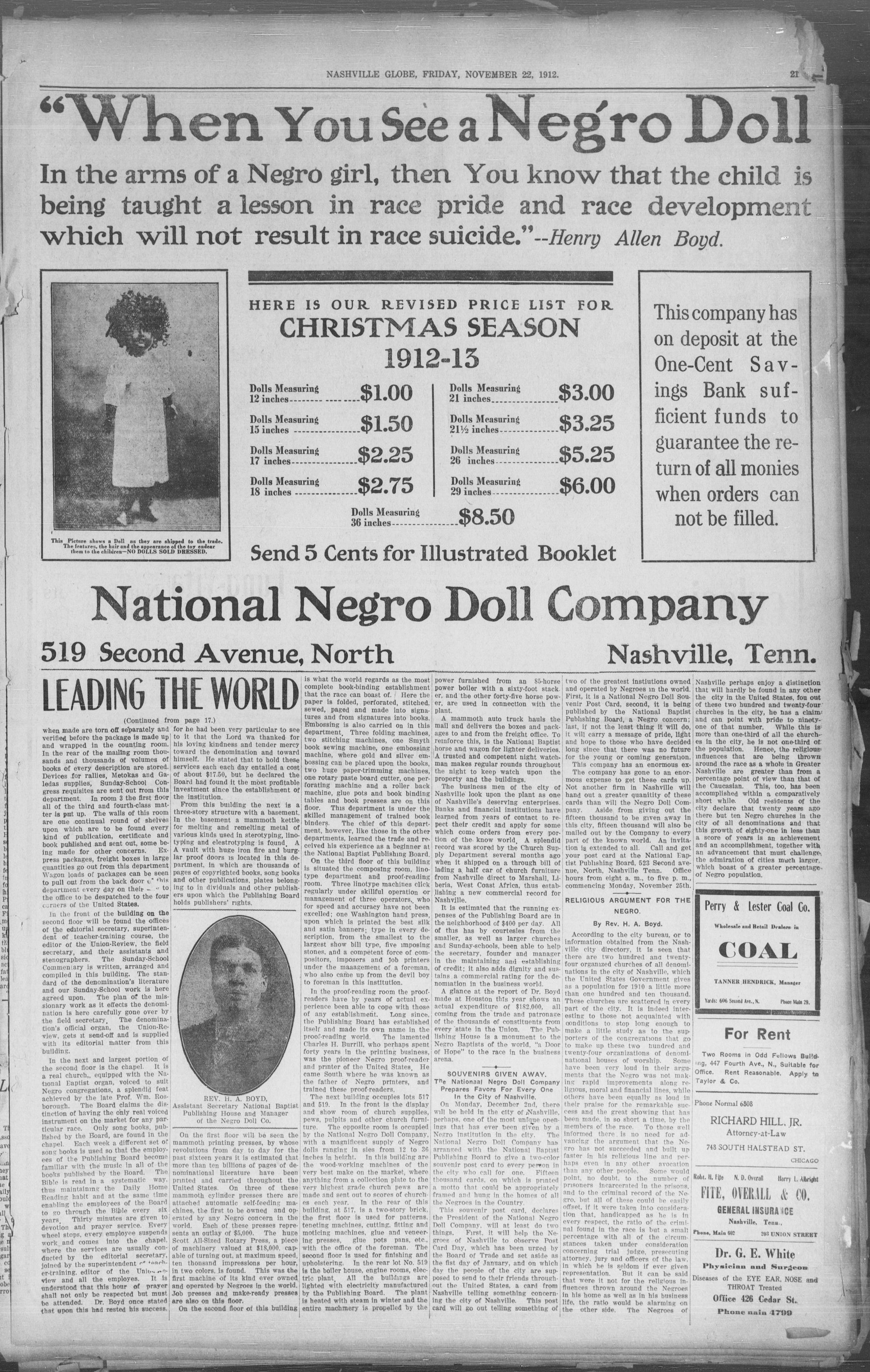
THERE was an entertainment given at the M. E. Church Saturday night, November 16th, known as "A Feast in the Wilderness." Supper was served. Miss Annie Daniel conducted the "fish pond," where many valuable articles were disposed of. Mrs. Dora Smith and Mrs. Wright served supper. A short program was rendered. Prof. G. W. Brooks, our city school teacher, made an interesting talk on home duties. Miss Daniel and Mrs. A. B. Payne rendered a beautiful duet. Sunday, the 17th, Rev. Elias Hudson, pastor of the A. M. E. Church, closed his conference year and left Tuesday, the 19th, to attend the conference in Florence, Ala. The Reverend had baptized Sunday. Quite a number witnessed the same. Many attended his closing services and hope that the conference will return him to them. Mr. Albert Sterhans is erecting a nice residence on Route No. 1. Stevenson, Ala. Mr. Elmore Rice made a pleasant visit to Nashville last Saturday. The people of Stevenson are preparing to observe Thanksgiving. The program will be arranged by Prof. G. W. Brooks, Mrs. Nina E. Ditty and J. H. Hurt. Willie Ricket and Miss Lula Chrity were united in the holy bones of matrimony on the 17th of this month. Rev. D. C. Montgomery officiated. The wedding bells are still ringing about this place. Mr. Tom Williams has erected a nice two-tory residence. Christmas is drawing near and all little girls are expecting Santa Claus to bring them a doll. Parents, why not get a Negro doll for your girls? You can send to the National Negro Doll Company Nashville. Send soon and have your order filled in time. Long to see the day come when on
---
Sunday. Order as many sets as you have children to supply.
Price per set, 3c Per Dozen, 36c
for the beginner, prepared by R. H. Boyd,
D. D.,
Price each, 5c Per dozen, 50c
The Child's Bible Question Book, or The Bible as
my Mother Taught me. In Catechismal form.
Price per copy, 5c Per dozen, 35c
The Baptist Sunday-School Catechism.
Prepared by R. H. Boyd, D. D. It may be used
for the entire school, as well as in the beginn-
ners' department.
Price per copy, 5c Per dozen, 35c
Price per copy 75c Per year, $3.00
HELPS FOR SUPERINTENDENTS AND TEACHERS
National Baptist Sunday-School Lesson Commentary on the international lesson, strictly orthodox and purely Baptistic.
Single copy 75c
Single copy 75c Cloth binding, five or more sent
to any one address, by express, not paid per copy 55c
Half morocco
binding Per copy, $1.00 Five or
more Per copy
75c
Superintendent's Hand Book—Gist of the lessons, vest pocket size
Leather
Binding Per copy, 35c Cloth, 25c
Teacher's Hand Book—Gist of the lessons,
Cloth binding, 25c Leather, 35c
NASHVILLE. TENN.
people will have more race pride. May God bless every effort put forth for good.
MADISON STATION NOTES.
MADISON STATION NOTES.
Mrs. Joseis Bass died in Nashville
Thursday night and the funeral was
held at Dry Creek Sunday, after
why her remains were laid to rest in
Dry Creek Cemetery. Mrs. Ela
Franklin, the sister of Mrs. L. H.
Reed, returned to St. Louis last
week after a pleasant visit to rela-
tives and friends. Miss Sallie L.
Gray has returned home from Shack-
lon. A pleasant week was spent
with Mr. and Mrs. E. A. Patton. Miss
Sallie L. Gray was the guest of Mrs.
Evie Bates Friday evening, also Mrs.
Nettie Bormon, Mrs. Mary Jones,
of Edenwold. Mr. Charley Bell, Mr.
Walter Banks were the guests of
Mr. Lee Bates Saturday night. Rev
John Franklin was called to preach
a funeral on the Brick Church pike
Sunday.
CORNERSVILLE NOTES.
The Cornersville school is planning to entertain the public on the 28th with a Thanksgiving musical and oratorical concert at St. Matthews Chapel. This program will be rendered principally for the U. L. S. School, being their first rendition to the public. Miss Maggie Lumpkin is reported ill. Rev. D. W. Blinford, our former pastor, was here last week. He expects to move to his n w work soon. Miss Inez K. Pullen and Miss Ethel L. Phillips, of Pula kl, were Cornersville's guests Sunday. Mrs. Brown London highly entertained the guests. Rev. Sebastian preached to his congregation a wonderful sermon Sunday.
GREENFIELD NOTES.
Mrs. Belle Moley Brooks, of Dyersburg, formerly of our town has been visiting her mother, Mrs. Mollie Haynes, and sister, Mrs. Elsa Cuno, for a few days. She returned to Dyersburg Sunday morning. The following are ill: Mrs. Violet Smith
GREENFIELD NOTES.
little Jack Crews, Mrs. Mattle Jones, Mrs. Rhoda Winnstein and Mrs. Myra McKenzie. Mrs. Bettle Crews returned from Cornersville last Friday Miss E. B. Taylor returned from Jackson Sunday night and re-opened school Monday morning after a vacation of several weeks for cotton-picking. Mrs. Sarah Ares and son, Lairy Moseley, left Sunday for Jackson, where they will be employed by the I. C. Company. Mr. Joe White and wife of Gleason, visited his brother, Mr. Selus White, and family Sunday. Mrs. Nina Sima Gammons is here from Jackson visiting her mother, Mrs. Emma Coley. Mrs. Bulish Malone was at home Sunday are at Connel. Mr. George Thomas made a trip to Martin Sunday. Messrs. James Jones, Dorsey Bower and Amzi Lane were here Sunday. Mr. Elmore Jordan and friend Mr. Will Milner, Mrs. Gertle McDonald returned from Dyersburg Sunday. Mrs. Birdie Watt went to Martin Sunday to be at the beside of her mother, who is ill. St. Luke Basket Church will have a splendid basket dinner Thanksgiving. Everyone is cordially invited. Everything good to eat. Popular prices for baskets. The Method's Episcopal Church at Sharon will have a Thanksgiving entertainment beginning at 3 o'clock p.m. and continuing until night. A very pleasant time is expected. All are invited. The school will also observe Agriculture Day, Wednesday November 27th, beginning at 1 o'clock. Some important subjects will be discussed by some experienced farmers. The public is invited. The following are among the subjects: 1. How to Grow Good Corn, Mr. Joe Carter; 2. How to Select Seed Corn Rev. N. J. Tansil; 3. How to Rescind Land and Still Use It. Mr. Steven Raefield; 4. Do the Phases of the Moon Have Anything to do with the time to Plant Corn? M. J. Wadams; 5. Care and Food for Cows in Winter to Produce a Good amount of Butter, Rev. Tom Tansil.
Nursery and Greenhouses
JOE BROWN, Proprietor Telephone Walnut 292 Lischy and Mile-End Avenues NASHVILLE, TENN.
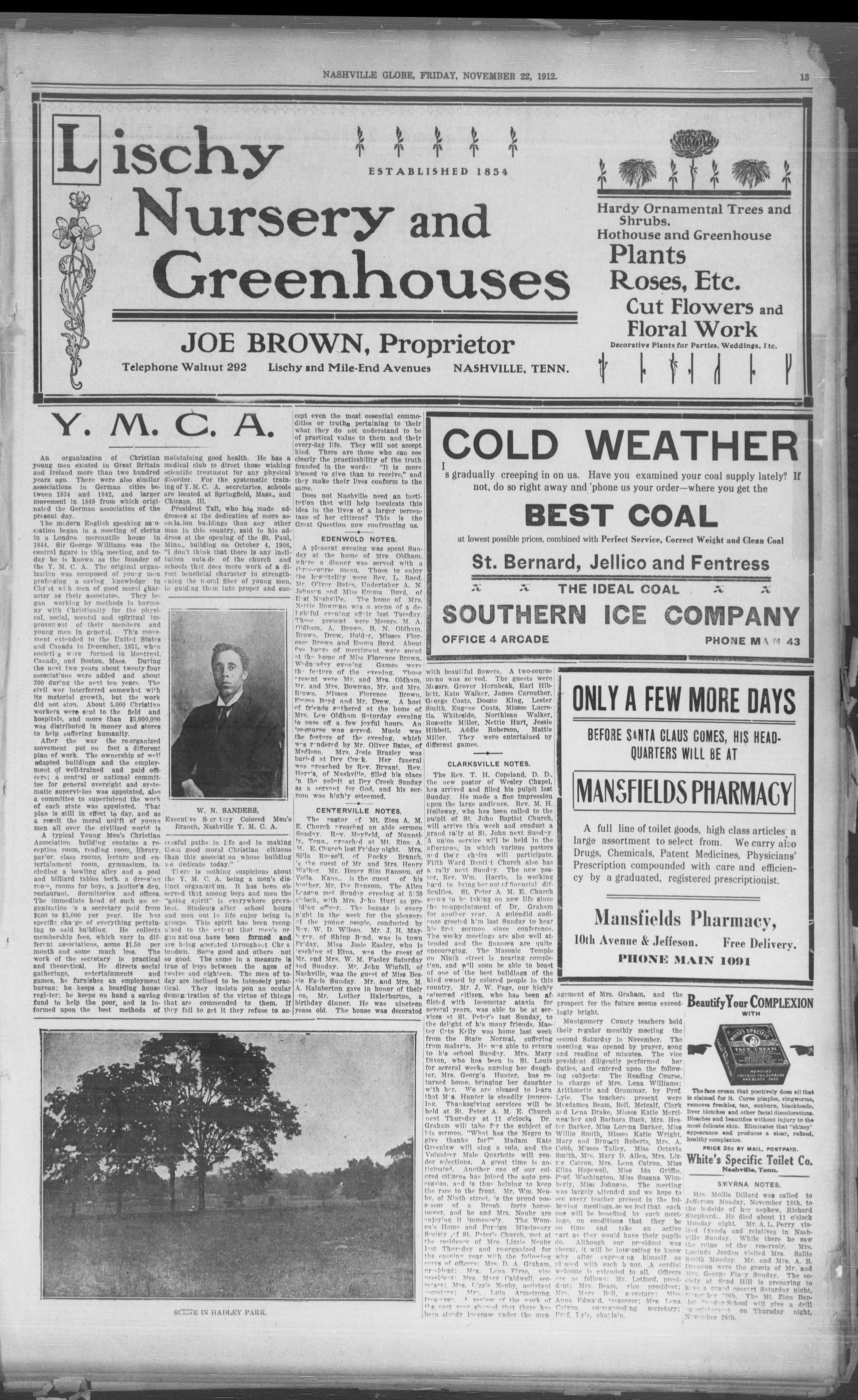
Y. M. C. A.
The image shows a large, leafy tree in the foreground with a sprawling canopy. The background is a vast, open field with a few scattered buildings and trees. The sky is overcast, and the overall atmosphere is calm and serene.
An organization of Christian young men existed in Great Britain and Ireland more than two hundred years ago. There were also similar associations in German cities between 1834 and 1842, and larger movement in 1849 from which originated the German association of the present day.
The modern English speaking as ociation began in a meeting of clerks in a London mercantile house in 1844. Sir George Williams was the central figure in this meeting, and today he is known as the founder of the Y. M. C. A. The original organization was composed of young men professing a saving knowledge in Christ with men of good moral character as their associates. They began working by methods in harmony with Christianity for the physical, social, mental and spiritual improvement of their members and young men in general. This movement extended to the United States and Canada in December, 1851, when societys were formed in Montreal, Canada, and Boston, Mass. During the next two years about twenty four associations were added and about 200 during the next ten years. The civil war interfered somewhat with its material growth, but the work did not stop. About 5,000 Christian workers were sent to the field and hospitals, and more than $5,000,000 was distributed in money and stores to help suffering humanity.
After the war the reorganized movement put on foot a different plan of work. The ownership of well adapted buildings and the employment of well-trained and paid officers; a central or national committee for general oversight and systematic supervision was appointed, also a committee to superintend the work of each state was appointed. That plan is still in effect to day, and as a result the moral unlift of young men all over the civilized world is
A typical Young Men's Christian Association building contains a reception room, reading room, library, parlor, class rooms, lecture and entertainment room, gymnasium, in including a bowling alley and a pool and billiard tables both, a dressing room, rooms for boys, a janitor's den, restaurant, dormitories, and offices. The immediate head of such an organization is a secretary paid from $600 to $5,000 per year. He has specific charge of everything pertaining to said building. He collects membership fees, which vary in different associations, some $1.50 per month and some much less. The work of the secretary is practical and theoretical. He directs social gatherings, entertainments and games, he furnishes an employment bureau; he keeps a boarding house register; he keeps on hand a saving fund to help the poor, and is informed upon the best methods of
maintaining good health. He has a medical club to direct those wishing scientific treatment for any physical disorder. For the systematic training of Y. M. C. A. secretaries, schools are located at Springfield, Mass., and Chicago, Ill.
President Taft, who has made addresses at the dedication of more association buildings than any other man in this country, said in his address at the opening of the St. Paul, Minn., building on October 4, 1908, "I don't think that there is any institution outside of the church and schools that does more work of a direct beneficial character in strengthening the moral fiber of young men, in guiding them into proper and suc
A. B.
W. N. SANDERS,
Executive Secretary Colored Men's
Branch, Nashville Y. M. C. A.
coeful paths in Life and in making
the good moral Christian citizens
than this associat on whose building
we dedicate today."
There is nothing suspicious about the Y. M. C. A. being a men's distinct organization on. It has been observed that among boys and men the "going spirit" is everywhere prevalent. Students after school hours and men out in life enjoy being in groups. This spirit has been recognized to the extent that men's organizations have been formed and are being operated throughout Christendom. Some good and others not so good. The same in a measure is true of boys between the ages of twelve and eighteen. The men of society are inclined to be intensely practical. They instilstupon an ocular demontration of the virtue of things that are commended to them. If they fail to get it they refuse to ac
NASHVILLE GLOBE, FRIDAY, NOVEMBER 22, 1912.
ESTABLISHED 1854
ery a
enho
OWN, Pro
y and Mile-End Avenue
cept even the most essential commodities or truths pertaining to their what they do not understand to be of practical value to them and their every-day life. They will not accept kind. There are those who can see clearly the practicability of the truth founded in the words: "It is more blessed to give than to receive," and they make their lives conform to the same.
Does not Nashville need an institution that will help inculcate this idea in the lives of a larger percentage of her citizens? This is the Great Question now confronting us.
EDENWOLD NOTES.
A pleasant evening was spent Sunday at the home of Mrs Oldham, where a dinner was served with a three-course menu. Those to enjoy the hospitality were Rev L. Reed, Mr. Oliver Bates, Undertaker A. N. Johnson and Miss Emma Bovd. of East Nashville. The home of Mrs. Nettie Bowman was a scene of a delightful evening affair last Tuesday. Those present were Messrs M. A. Oldham, A. Brown, B. N. Oldham, Brown, Drew, Holder, Misses Florence Brown and Emma Boyd. About two hours of merriment were spent at the home of Miss Florence Brown, Wedn-sday evening. Games were the feature of the evening. Those present were Mr. and Mrs. Oldham, Mr. and Mrs. Bowman, Mr. and Mrs. Brown, Misses Florence Brown, Froma Boyd and Mr. Drrew. A host of friends gathered at the home of Mrs. Lee Oldham Saturday evening to pass off a few joyful hours. An lee-course was served. Muscle was the feature of the evening, which was rendered by Mr. Oliver Bates, of Madison. Mrs. Josie Brazley was buried at Dry Creek. Her funeral was preached by Rev. Rev. Harris, of Nashville, filled his place in the pulpit at Dry Creek Sunday as a servant for God, and his sermon was highly esteemed.
CENTERVILLE NOTES
The pastor of Mt. Zion A. M. E. Church unchained an able sermon Sunday. Rev. Mayfield, of Nunnelly, Tenn. reached at Mt. Zion A. M. E. Church last Friday night. Mrs. Silla Russell, of Pocky Branch is the guest of Mr. and Mrs. Henry Walker. Mr. Henry Sim Ransom, of Vola. Kans. is the guest of his brother. Mr. Ike Ransom. The Allen League met Sunday evening at 5:30 clock, with Mrs. John Hurt as pre-idding officer. The bazaar is every night in the week for the pleasure of the young people, conducted by Rev. W. D. Wilson. Mr. J. H. May berry of Shipp Bond, was in town Friday. Miss Josie Easley, who is teaching at Etna, was the guest of Mr. and Mrs. W. M. Fasley Saturday and Sunday. Mr. John Wigfall, of Nashville, was the guest of Miss Bessie Esle Sunday. Mr. and Mrs. M. A. Haluberton gave in honor of their on, Mr. Luther Haluberton, a birthday dinner. He was nineteen yeas old. The house was decorated
---
and
houses
oprietor
es NASHVILLE, TEN
COLD
I's gradually creeping in
not, do so right aw
at lowest possible prices, co
St. Berna
SOUTHE
COLD WEATHER
s gradually creeping in on us. Have you examined your coal supply lately? If not, do so right away and 'phone us your order—where you get the
OFFICE 4 ARCADE
with beautiful flowers. A two-course menu was se ved. The guests were Megrs. Grover Hornbeak, Earl Hibbett, Kato Walker, James Carouther, George Coats, Dossie King, Lester Smith, Eugene Coats, Misses Lucretia Whiteside, Northlean Walker, Rosette Miller, Nettie Hurt, Jessie Hibbett, Addle Roberson, Mattle Miller. They were entertained by different games.
CLARKSVILLE NOTES.
The Rev. T. H. Copeland, D. D., the new pastor of Wesley Chapel, has arrived and filled his pulpit last Sunday. He made a fine impression upon the large audience. Rev M. H. Holloway, who has been called to the pulpit of St. John Baptist Church, will arrive this week and conduct a grand rally at St. John next Sunday. A union service will be held in the afternoon, in which various pastors and their chairs will participate. Fifth Ward Baptist Church also has a rally next Sunday. The new pastor, Rev Wm. Harris, is working hard to bring her out of financial difficulties. St. Peter A. M. E. Church seems to be taking on new life since the re-appointment of Dr. Graham for another year. A splendid audience greeted h'm last Sunday to heat his first sermon since conference. The weeky meetings are also well attended and the finances are quite encouraging. The Masonic Temple on Ninth street is nearing completion, and will soon be able to boast of one of the best buildings of the kind owned by colored people in this country. Mr. J. W. Page, our highly esteemed citizen, who has been at filled with locomotar ataxia for several years, was able to be at services at St. Peter's last Sunday, to the delight of h'm state friends. Master of Kelly was home last week from the school Sunday. Mrs. Mary Dixon, who has been in St. Louis for several weeks nursing her daughter, Mrs. Georgia Hunter, has returned home, bringing her daughter with her. We are pleased to learn that Mrs. Hunter is steadily improving. Thanksgiving services will be held at St. Peter A. M. E. Church next Thursday at 11 o'clock. Dr. Graham will take for the subject of his sermon, "What has the Negro to give thanks for?" Madam Kate Greenlaw will sing a solo, and the Volunteer Male Quartette will render selections. A great time is anticipated. Another one of our colored citizens has joined the auto process, and is thus helping to keep the race to the front. Mr. Wm. Neuby, of Ninth street, is the proud possessor of a Brush, forty horsepower, and he and Mrs. Neuby are enjoying it immensely. The Women's Home and Foreign Mission Society of St. Peter's Church, met at the residence of Mrs. Lizzie Neuby lost Thursday and re-organized for the ensuing year with the following corps of officers: Mrs. D. A. Graham, president; Mrs. Lena Fora, vice president; Mrs. Mary Caldwell, secretary; Mrs. Lizzie Neuby, assistant secretary; Mrs. Lulu Armstrong, treasurer. The work of the past year showed that there has been steady increase under the man-
---
Hardy Ornamental Trees and Shrubs. Hothouse and Greenhouse
ONLY A FEW MORE DAYS
BEFORE SANTA CLAUS COMES, HIS HEAD- QUARTERS WILL BE AT
MANSFIELDS PHARMACY
A full line of toilet goods, high class articles, a large assortment to select from. We carry also Drugs, Chemicals, Patent Medicines, Physicians' Prescription compounded with care and efficiency by a graduated, registered prescriptionist.
Mansfields Pharmacy, 10th Avenue & Jeffeson. Free Delivery. PHONE MAIN 1091
agement of Mrs. Graham, and the prospect for the future seems exceedingly bright.
Montgomery County teachers held their regular monthly meeting the second Saturday in November. The meeting was opened by prayer, song and reading of minutes. The vice president diligently performed her duties, and entered upon the following subjects: The Reading Course, in charge of Mrs. Lena Williams; Arithmetic and Grammar, by Prof. Lyle. The teachers present were Misdames Beam, Bell, Metcalf, Clark and Lena Drake, Misses Katie Merriweather and Barbara Buck, Mrs. Hester Barker, Miss Lorena Barker, Miss Willie Smith, Misses Katie Wright, Mary and Bruntt Roberts, Mrs. A. Cobb, Misses Talley, Miss Octavia Smith, Mrs. Mary D. Allen, Mrs. Lizze Catron, Mrs. Lena Catron, Miss Eliza Hopewell, Miss Ida Griffin, Prof. Washington, Miss Susana Wimberly, Miss Johnson. The meeting was largely attended and we hope to see every teacher present in the following meetings, as we feel that each one will be benefited by such meetings, on conditions that they be on time and take an active part as they would have their pupils do. Although our president was absent, it will be interesting to know why after expressing himself as pleased with such hnor. A cordial welcome is extended to all. Officers are as follows: Mr. Letford, president; Mrs. Beam, vice president; Mrs. Mary Belle, secretary; Miss Anna Edward, treasurer; Mrs. Lena Catron, corresponding secretary; Prof. Lyle, charlain.
PHONE M 43
MORE DAYS
S COMES, HIS HEAD-
WILL BE AT
S PHARMACY
goods, high class articles, a
fect from. We carry also
nt Medicines, Physicians'
with care and efficien-
istered prescriptionist.
Pharmacy,
on. Free Delivery.
MAIN 1091
Beautify Your COMPLEXION
WITH
WHITE'S SPECIFIC
FACE CREAM
REMOVES
FRIENDS AND SUNBURN
AND BLACK IRONS
The face cream that positively does all that
is claimed for it. Cures pimples, ringworms,
removes freckles, tan, sunburn, blackheads,
liver blotches and other facial discolorations.
Bleaches and beautifies without injury to the
most delicate skin. Eliminates that "shiney"
appearance and produces a clear, refined,
healthy complexion.
PRICE 25c BY MAIL, POSTPAID.
White's Specific Toilet Co.
Nashville, Tenn.
SMYRNA NOTES:
Mrs. Mollie Dillard was called to Jefferson Monday, November 18th, to the bedside of her nephew, Richard Shephard. He died about 11 o'clock Monday night. Mr. A.L. Perry visited friends and relatives in Nashville Sunday. While there he saw the ruins of the reservoir. Mrs. Lucinda Jordan visited Mrs. Sallie Smith Monday. Mr. and Mrs. A.B. Dremon were the guests of Mr. and Mrs. George Finny Sunday. The society at Sand Hill is preparing to have a grand concert Saturday night, November 20th. The Mt. Zion Baptist Sunday School will give a drill on instrument on Thursday night, November 28th.
---
```markdown
```
By H. L. KEITH.
Negroes everywhere face an industrial and educational problem and must work out a program on which to rest all the hopes and aspirations of the future. Every consideration of the fact requires and rapidly changing conditions demand it. These truths are evident in Tennessee as elsewhere.
The general education and prosperity of the masses occupy the public mind more than anything else now. The "self-conscious class" has had its day and the reign of "the aristocracy of learning" is ended. School systems everywhere are seriously at work developing a new education suited for all rather than a few. All races need it and all races shall have it. In the years to come the new departure in education will prove a peculiar and special blessing to Negroes of the next generation.
The public, professional and business people of the race are the advance guard of a newer Negro and a more prosperous race. They are a necessary addition to the life of any race. They are the standard bearers that must lead the race to higher heights and place it on a surer road of progress and keep it there.
The advance guard of the race to day represents the dream in reality of the founders of Fisk, Atlanta, Howard, Roger Williams, Wilberforce, Taladge and the other great schools that have done and are doing so much in the development of the Negro. The future of the race depends very large upon the realization of the ideals of these people and in the light of the past and present the best is expected
The path of duty lies plainly before the educated Negroes of the South. They do not have to proceed to find and do their duty in a zig-zag way, but can go straight ahead, aiming at a particular goal marked at the end of the way. Between these people and victory are the masses who have come to realize that some of the comforts and good things of life are intended for their enjoyment and that life is really worth living. But they must be shown the way. It must be done by those of the race who have had the favors heretofore or those who have been prepared for leadership must pay the price that all must forfeit who shirk duty. Industrial and business property certainly lie at the base of all other progress whether of city, state or nation. There can be none of it without a sound, substantial and efficient working class that can be relied upon as the very backbone of a strong body of citizens.
If the business life of the Negro is to prosper, it must have efficient and well-paid labor as a background. If the professional life is to be properly maintained and supported, it must rest upon a substantial industrial foundation.
From any viewpoint, the hope of the past, present and future of the Negro race must always begin and end with those who do the work of the world and bear its burdens and do the struggling.
The hopes of the Negro physician, dentist, and druggist are centered as they ought to be in the Negro patients who must be looked to as a field for the practice of medicine. These men as a class cannot hope to find any joy or profit in practicing their professions among the members of any race.
The old guard is rapidly passing awaf. The ranks are not being filled us as they ought to be. The Negro is losing ground as a skilled laborer in the fields he once controlled and there are no great evidences of his making any gains in callings which he has not followed hitherto. He is still the main source of unskilled labor supply, but the unskilled laborer is not the best money-earning class of any industrial order. There must be a forward march begun somewhere. Something must be done to supply the increasing wants of the race. It matters not what may be said to the contrary notwithstanding, there is always a social danger in an inefficient working class. It matters not of what race it is a part, if it is poorly fed, the working class is dissatisfied and a municipal burden. When labor is underpaid social problems are multiplied and personal and business safety are in danger.
It should be remembered always, that the family life of the Negro people must be kept steadily moving upward in its intelligence and comforts. It cannot be done unless the men who are to make the homes are able to command good pay for the work they find opportunity to do. Work alone does not pay bills. Money is required for debts and the smaller ones earnings the less he has to work out the problems of home and life. The average day laborer of the Negro race does not earn enough to support a family. Something or somebody must be neglected. It may be the wife or the proper education and care of the children. In either case that means a misfortune and future shadow. Money taken for professional services from the man of small earning capacity is almost "blood-money" but the doctor must get his money or the sick will have no attention. A poorly paid and inefficient working class weakens any people infinitely, for men will not assume the responsibilities of married life at a time when they ought because there is no clear way ahead for fulfilling the obligations assumed.
Now the eternal questions, "What is to be done about it all?" "How is the situation to be met?" It must be handled or there is the future of two classes of Negroes, the prosperous and improvident coming together in enmity, hatred and strife. That will mean the undoing of the work of the patriots who have wrought so well
The NASHVILLE GLOBE helps the boy help himself.Call to see us at
during the past fifty years for the uplifting of the race. There is also the possibility of a greater social snarl than the South has ever had on its hands before. Something has already been done but more can be to forestall the loss of confidence likely to result between the more prosperous and less successful classes of the race. Confidence means everything in race development. Without it there can be no racial solidarity and no well worked plan for race development. Negro business men should get together and work out their business plans for the good of all. In doing so, they should have regard for their moral obligations to society and their duty to the race of which they are a part. Professional men should organize for social betterment and the advancement of learning. The physician should not only keep something more in mind than the patient's fee and ability to pay, but should so regulate his fees that the hard struggling man of small daily wages can avoid the crushing financial effects of a serious illness in his family. If he fails to o do so, he defeats the purpose for which he was created, for every Negro has come out of our schools in the past forty years is in some way a product of philanthropy.
NASHVILLE GLOBE, FRIDAY, NOVEMBER 22, 1912.
A PENNILESS BOY
Is a nuisance to his father and a daily burden to his mother. At the age of three. "Papa, give me a penny." That is sweet music on the old man's ears; just a penny. One nickel will last almost a week.
Four years old. "Papa, give me a dime; I want a ball and a bat." First time, "all right son." Delighted. Papa rolls the ball to son and wrenches his back trying to bat the ball.
Next day. "Papa give me a quarter to buy a glove; I got to have a glove." Quarter comes forth, but not a word is uttered.
Next day a bigger boy comes along, breaks the bat and throws the ball on top of the house, and it is lost. Dad comes home, has sup. per, lights his cigar and gets his paper to read. "Papa, I want a dime. That old boy broke my bat and threw my ball on top of the house and lost it." Dime comes forth, but following close onto it comes a little sermon from Dad that has often been heard. It goes like this: "Look here, boy! you are costing me more than you are worth."
But such sermons don't help the situation. The boy must have his play-things. What are you going to do about it? Let us tell you.
Send your boy to the Globe office and encourage him to sell newspapers and make enough money to buy his play toys and also give his mamma some money to put in the bank. Other boys are doing it why not yours?
Few can deny it and make an intelligent proof to sustain the denial.
Other things can be done also. Encourage a man at his work. It matters not what it is. It his means of livelihood and famill support and he should be made to feel a peculiar pride in it. The industrial problems of the Negro are being multiplied by the steady stream of low immigrants being poured into this country yearly. Where these people do not find opportunity to earn a living in competition with the Negro, they become a part of the community in some way and the very people whom the immigrant population has come to uproot, must help bear the burden of their support, as idlers or criminals. The idlers of every community can be put seriously to work or kept moving on. Without a doubt somebody feeds or supports the vagrant element of Negroes of any community and the good Negro citizens bear a part of the burden with the white people who are so often looked upon as the burden bears by "the cook and kitchen route." There is enough work in Tennessee for everybody to find something to do. Each person of working age should be at work at home or somewhere else. There will be less crime when the idling, criminally disposed element is
447 Fourth Avenue. North.
kept on the go, either as self-supporting citizens or under the eyes of the officers of the law.
There is always the hope of doing something with grown-up people. It is not always the case that have reached a point of moral turpitude where they are hopeless cases. Some are wrecks of time, but there are many who still have a chance to pass the rigid inspection and hard conditions imposed by the law of the survival of the fittest. The best that may be done can be done with these wavering, faltering products of our changed industrial life. The best work, however, can be done with the young people who fill the public schools of to-day. If they are properly prepared, the uncertainties of the future will pass away and the next generation of Tennessee citizens will be a greater honor to the state and race than the one preceding it. Nine-tenths of these never go beyond the grammar school but take their place early in the growing life of the state and follow whatever they find to do because of natural fitness for the opportunity offers. They become very largely the main body of the Negro citizens and out of their families must come all that is to make the future of the race grand and
glorious. / If these young people can have their characters well developed, their hands, heads and hearts well trained for the duties of citizenship, the future will be secure. Every Negro boy and girl in the public schools of Tennessee should be taught something of the common things of life and made intelligent about their surroundings. Their education in the grammar schools should not close without the completion of some vocation that would make them self-supporting factors in the community where they reside from the very beginning. Each community should have its vocational course attached to the grammar schools and the courses should be arranged and adjusted to the opportunities likely to be offered the pupils where they reside. Add to this training a well organized apprentice system among the men and women well qualified as skilled laborers and a gradual but not violent pressure into fields of labors hitherto unoccupied by the people of the Negro race, then the next generation of Tennessee Negroes will find that they can live ever better than their ancestors under the provisions of the Constitution of the United States. There will be less vagrants, fewer professional beggars, a decrease in
```markdown
```
crime among Negroes, more work, better wages, more contentment, less strife, more Negro employers of Negro labor and increasing co-operation, happiness and good-will among all classes of Negroes and the opposite race.
The country must now turn to the Democratic party, which has merely stood in a fortune position to receive the result of Republican discontent. Let us hope that the present prosperity of the country and its matchless advancement under Republican rule, may inspire the patriotism of the Democratic party to do nothing against the maintenance of the present order of things.
Woodrow Wilson unquestionably an able man, whose mind is well balanced. While he acks experience and breadth of vision perhaps, yet the country is full of men whose advice and counsel can be retolled upon to help him in the struggle to ses to it that the hands on the face of the clock of progress are not set back. America is now a great world power. Among the nations of the earth its place is made; let us hope that the Great Finger of the Infinite who made us all inspire us to follow while He points the way—The Dallas Express.
NASHVILLE GLOBE, FRIDAY, NOVEMBER 22, 1912.
```markdown
```
```markdown
```
The Knights of Pythias N. A., S. A., E., A., A. and A.
Has inaugurated one of the most gigantic movements ever attempted by any Fraternal organization in Tennessee for an increased membership. "It is a good thing" and all sober and industrious husbands and fathers should identify themrelves with our order that "Gets There."
If so study your rate card and then turn to the rates of the Knights of Pythias and see if you don't get a run for your money
WE WANT 10,000 New Members By JULY 1913
Will You Help us to Get Them? Now don't say "no" but get busy and do all you can. Let us have YOUR APPLICATION.
The Grand Chancellor will grant a special dispensation for the sole purpose of getting all worthy males between the ages of 18 and 45 years into the Pythians. Are you worthy? If not, why not?
department and under
other mailing clerk all let-
read over and labels are made
plicate, the duplicate being re-
relied in the order book, while the ori-
lal order is filed away. The number of
the order remains in the bookkeeper
and cashier's department on their tal-
y sheet, maintaining the same triple
record first mentioned. These labels
J. G. PARKER, R. F. D. No. 5 .....Ripley
DR. C. O. HUNTER .....Columbia
G. W. WILLIAMS .....222 Turley St., Memphis
W. H. MALONE .....Jackson
J. W. HYNES .....Chattanooga
ARTHUR HAZEN .....Knoxville
R. E. GEE .....Nashville
J. S. BUTLER .....Aspen Hill
J. W. OWEN .....Union City
DR. C. A. KELLY .....Clarksville
DR. W. T. HORTON .....Eades
N. N. REYNOLDS .....Pulaski
FRANK K. REID .....Brownsville
J. R. SMITH .....R. F. D. 5. Ripley
ROBERT STARNES .....Box No. 7, Coal Creek
GEO. BROWN .....Cleveland
MARCUS SCRUGGS .....Bellbuckle
T. M. STEGALL .....Humboldt
DR. O. S. SAWYERS .....Humboldt
A. S. PYLES .....Milton
LUTHER C'MMINGS .....South Pittsburg
J. P. HALE .....Dyersburg
ED. MASS .....Covington
FOR FULL PARTICULARS ADDRESS
J. P. CRAWFORD, Grand Chancellor or A. W. FITE, Deputy
1501 FOURTEENTH AVENUE, NORTH 1714 HEIM
NASHVILLE.
Everybody Get Busy
The playground is a large, open grassy area surrounded by tall trees. There are several swings set up in the center, and a few children are playing on them. The area is well-maintained, with no signs of litter or damage.
16
IN MEMORY OF S. COLE-RIDGE TAYLOR.
By Cary B. Lewis.
At a memorial service held at the Institutional Church in Chicago recently Dr. Charles E. Bentley, one of the foremost leaders of the race was the principal speaker last Sunday at a memorial exercises under the auspices of the Choral Study Club at institutional Church where the life and character of the late Samuel Coleridge Taylor was eugolized. The church was filled with Chicago's most representative business and professional men and women.
One of the best literary and musical programmes ever heard i n the city was rendered on this occasion; each number was taken from some of the famous works of the noted composer. The occasion was argumented with the presence of Mr. Harrison Emanuel who rendered brilliantly and artistically a violin solo, "Deep River." Mr. Daniel Protheroe delivered a short address and charmingly rendered two tenor solos, (a) "Earth Fades, Heaven Breaks on Me" (b) "Weep Not, Beloved Friends." Mrs. Martha B. Anderson, one of the best trained soloists of our city rendered two solos (a), "Prayer" (b) "Dawn." Mrs. Mayme Marshall sang "When I am Dead, My Dearest." The Choral Study Club under the direction of Walter E. Gossett rendered two big numbers, "Hiawatha's Departure" and "The Blind Girl of Castel Gulle." Miss Gertrude Jackson was the Organist.
At the close of the programme the following temporary officers were selected to make the memorial an annual occasion: Pedro Tinsley, President; Dr. Charles E. Bentley, Secretary; James S. Madden, Treasurer. Dr. Bentley began by saying that "The Music World lost a most distinguished member and the Colored people its most gifted musical genius on September 1st, 1912, in the death of Mr. Samuel Coleridge Taylor, of London, England.
It is rare, indeed, that we, as a people, are called upon to pay tribute to exponents of the Arts of poetry and music, who belong to us by racial ties. For ages they have been the highest products of the more favored races with a heritage replete with oppressions are no more advantage. While making any gains in no race or race, has not followed hither, race has been the main source of unskilled for in supply, but the unskilled labor, touch the best money available.
industrial order. There must be forward march begin somewhere. Something must be done to supply increasing wants of the race. It matters not what may be said to the contrary notwithstanding, there is always a social danger in an inefficient working class. It matters not of what race it is a part, if it is poorly fed the working class is dissatisfied and a municipal burden. When labor is underpaid social problems are multiplied and personal and business safety are in danger.
It should be remembered always that the family life of the Negro people must be kept steadily moving upward in its intelligence and comforts. It cannot be done unless the men who are to make the homes are able to command good pay for the work they find opportunity to do. Work alone does not pay bills. Money is required for debts and the smaller ones earnings the less he has to work out the problems of home and life. The average day laborer of the Negro race does not earn enough to support a family. Something or somebody must be neglected. It may be the wife or the proper education and care of the children. In either case that means a misfortune and future shadow. Money taken for professional services from the man of small earning capacity is almost "blood-money" but the doctor must get his money or the sick will have no attention. A poorly paid and inefficient working class weakens any people infinitely, for men will not assume the responsibilities of married life at a time when they ought because there is no clear way ahead for fulfilling the obligations assumed.
Now the eternal questions, "What is to be done about it all?" "How is the situation to be met?" It must be handled or there is the future of two classes of Negroes, the prosperous and improvident coming together in enmity, hatred and strife. That will mean the undoing of the work of the patriots who have wrought so well
About That Union Set?
SCENE IN HADLEY PARK.
the highest reaches of a people in their efforts to enjoy the full sunbursts of civilization. Often they have their uses as I will endeavor to show later; but when they reach the high plane of universality, when they sing for mankind rather than for a man; when they touch the heart, quicken the civilization. Often they are expressive of sorrow and travail, and here they have their uses as I will endeavor to show later; but when they reach the high plane of universality, when they sing for mankind rather than for a man; when they touch the heart, quicken the spirit and fire the imagination of Russian, Turk, Englishmen and American alike, 'tis then they have reached the highest peaks shown yet to civilization.
Dr. Bentley save an accurate sketch of the life and character of the composer. He told of his associations with the great musical societies of London, he narrated minutely every song and cantata of Mr. Taylor and enunciated his powerful influence over the musical world. The speaker quoted the world's greatest musical journals upon the life and death of England's lamented son. Dr. Bentley told about Mr. Taylor's ciming ti America and how the members of his race honored him at Washington, D. C. and his brilliantly and elegantly the Choral Study Club of that city rendered "Hlawatha" much to the praise and satisfactin of the artist. The orator spoke of Mr. Taylor's visit to Chicago and the pleasure it came to him to occupy a box seat in the auditorium to hear Thomas Orchestra.
Closing his eloquent address, Dr. Bentley said. "In this Kaleidoscopic review of Mr. Coleridge-Taylor's life, by reason of the amenities I have been compelled to give only a hasty touch here and a smatter there. I fear I have given you but an incomplete picture. A full penportrait would have been impossible. But I hope enough has been given, incomplete as I feel it to be, to appeal to your imagination which can supply that whihh is lacking. In summing up the Life of this man three things must stand out in bold relief so that the clummsest observer may see, namely: His Character—His Genius and His Right t the Title of a Creative Artist.
Of the first two I have spoken. Of the last I shall speak but briefly. Creation is the link that binds us to the Infinite. Its mysterious workings escape the shrewdest processes of human analyses. It is God-like. It is man analyses. It is God-like. It was the gift of Blow of Mind as it is the gift of Thomas Edison. It is so rare that the few ever hope for its attainment.
during the past fifty y
lifting of the race.
the possibility of a
snarl than the South has
its hands before. Sometimes ready been done but more done to forestall the loss of co likely to result between the mo perous and less successful clas the race. Confidence means thing in race development. When it there can be no racial solidarity no well worked plan for race devel- ment. Negro business men should get together and work out their business plans for the good of all. In doing so, they should have regard for their moral obligations to society and their duty to the race of which they are a part. Professional men should organize for social betterment and the advancement of learning. The physician should not only keep something more in mind than the patient's fee and ability to pay, but should so regulate his fees that the hard struggling man of small daily wages can avoid the crushing financial effects of a serious illness in his family. If he falls to o do so, he defeats the purpose for which he was created, for every Negro has come out of our schools in the past forty years is in some way a product of philanthropy.
---
NASHVILLE GLOBE. FRIDAY. NOVEMBER 22. 1912.
and yet there is a region within every one of us, a deep lake of peace, out from which nows all that is excellent in our work and striving up from it well, if we are music-makers, the harmonies and the binding together of sweet sounds. It is the abode of poetry, of the rhapsodies of youth, of the hidden treasures of the arts. It lies not within the reach of the will, nor will it succumb to force or gentle wooing, but excited mayhap, or some untoward event freighten with vauueness and struggle, of a sudden takes on shape and clothes itself in malody. 'Tis then rythm enters where lately there was discord. This is inspiration. This is creation. This g t Mr. Coleridge Taylor had to an unusual decree. The children of his brain were his musical creations that were given to the world—and the world is the better that they were born—Long may they live!'
SUSAN B. ANTHONY
Susan B. Anthony was one of the most aggressive advocates of woman suffrage during the past century. She was born at the foot of the Green mountains at South Adams, Mass., on February 15, 1820. Her father was a stern Quaker, and her mother, Lucy Read, was a Baptist. Her father was a cotton manufacturer, and the first dollar that Susan ever earned was in his factory. Though a man of wealth, the idea of self-support was early impressed on all the daughters of the family. In 1826 they moved to New York state, where the future eminent suffragist was educated in a select school in her father's house, until the age of 17, when she went to a boarding school in Philadelphia. Fifteen years of her life were spent in teaching school in different parts of New York state.
Although superintendents gave her credit for the best disciplined school, and the most thoroughly taught schola's in the country, yet they paid her but $8 a month, while men received from $24 to $30. After fifteen years of faithful labor and the closest economy, she had saved but $200.
This experience taught Susan the lesson of woman's rights, and when she read the reports of the first conventions, her whole soul responded to the new demand. Her earliest public work was in the temperance movement, and she began to form temperance *societies as early as 1848. It was through her influence that the first state temperance convention was called at Albany in that year. She attempted to join the women's movement with that of the
"Acorn Brand" Oak Flooring
3-8 in. OAK CEILING at $1.00 Per hundred
13-16 in. OAK FLOORING at $1.75 Per hundred
A Room Ceiled and Floored with our Stock is Comfortable and Attractive.
Nashville Hardwood Flooring Company
the men, but the delegates appointed were denied the rights in the latter's convention. After a struggle, however, covering a number of years, women were finally permitted to speak and vote at the men's conventions; they were appointed on committees and were allowed to make reports on various subjects. From 1852 on, she was one of the leading spirits in every woman's convention, and was acting secretary that few women possess. She possessed a strong reverence for noble acts and words, and an active pity for those who came to her in distress. She was earnest, unselfish and true to principle. She was above the petty envy and jealousy that mar the character of so many other wise good women. She was always full of the work, before her, and went through and over whatever stood in her way.
ill for the last few days, is better. Mrs. Fannie Sylvestooth, of Martin was called on Tuesday to the bed sire of her daughter, Miss Vivian Messrs. Clyde and Tom Sylvestooth and Mr. Smith were here Saturday and Sunday to see their sisters. Mr Tom Eloizer is able to be up and out again. Mrs. Dicie Petway, of Union City, is here to see Miss Union Sylvestooth. Mr. Will Wilks is ill. Mrs Williams is on the sick list. Thanks
A politician whose early affiliations would not stand the search of a wooden microscope with a tin lens, whose shrewdness for exceeds either his honesty, foresight or wisdom; who was given a chance to redeem his questionable past, and was finally honored by a great President. When the man who honored him was retired to private life "The Cheese" was given still greater honors through the "boost" given him by the President. When his benefactor signified his intention of being a candidate for re-election, the "Cheese" flowed over to the opposition because the one he would serve would prove "cessler." Through the inexcusable error of his party he was allowed, or, rather, he assumed the power to dominate that which proved under his direction to be the "crookedest" national convention ever held in this country. Against the wishes of the better element in his party, and against the expressed will of the people, his tactics defeated his benefactor, and forced the re-nomination of the man Republican voters tried to swallow for the second time, and upon whom they choked on November 5th. The "Cheese" will go down in history as the dominant power in a disgraceful national convention, and as the virtual destroyer of an old and honorable political party. While the name of the man he tried to vilify will live for years innumerable as the people's greatest emancipator of centuries past.
pifed his idate for floped ove cause the prove "less
MORAL: "Don't be a 'Cheese' Any
more! Root around Barnes for
cheese."
Rev. W. L. Ledford, of Clarksville, the newly appointed preacher of St. James A. M. E. Church, is greatly impressed with his members and takes up his work with much vim. The members are also well pleased with their new pastor, and now a new spirit exists in the old St. James. We hope for him a successful year. Mrs. L. P. Porter and Mrs. Irene List were ordained as members of the Central Tennessee Conference, which met at Paris. Mrs. Porter also read a paper before the women's department on "Home Missions", which was an excellent production and brought great applause. Dr. Miles and Rev. W. L. Ledford dined with Mrs. Charity Moore. Miss Vlian Sylvertooth, who has been very
the men, but the delegates appointed were denied the rights in the latter's convention. After a struggle, however, covering a number of years, women were finally permitted to speak and vote at the men's conventions; they were appointed on committees and were allowed to make reports on various subjects. From 1852 on, she was one of the leading spirits in every woman's convention, and was acting secretary and general agent of the movement for many years. From 1857 to 1866 Miss Anthony was also an agent and faithful worker in the anti-slavery cause. She was untiring in her labors in securing the liberal legislation that women now enjoy in New York state.
Miss Anthony, while not a woman of much beauty of face, had a commanding figure and a strong personality. She had a broad and generous nature, and a depth of tenderness
COMMUNION
DEFINITION OF A PIECE OF
CHEESE
DICKSON NOTES.
PHONE---HEMLOCK 338.
COLUMBIA NOTES.
Dr. and Mrs. C. V. Roman, Prof. J. W. Johnson, Mr. and Mrs. W. L. Miller, Mrs. Mabel Berry, Mr. John Rhines, Mr. Robert Polk, Jr. and J. H. Kelly, Jr., all of Nashville, attended the banquet given in honor of Prof. J. H. Kelly's sixtieth birthday. Quite a large number of the members of St. Paul turned out last Sunday at 11 a. m. to hear their new pastor, Dr. L. James Johnson. There will be an entertainment given for the benefit of the Presbyterian Church at an early date under the management of Mrs. Gertrude Madison. Mrs. A. J. Morton entertained at dinner the following guests: Mrs. Waymen Reynolds, of St. Louis; Mrs. Grandberry, of Mt. Pleasant; Mrs. E. R. Hill and Mrs. Gertrude Madison. Prof. J. Thomas Caruthers, of State Normal, was present at the banquet given in honor of Prof. J. H. Kelly, and spent the week-end with his family. Mrs. Salle Dobkins is quite ill at her home, on North High street. Miss Helen Brown, of State Normal, Nashville, spent the week-end with her parents. Mr. and Mrs. J. C. Brown, of East Tenth street. Mr. Robert Nicholson, of Nashville, was here for a few days last week. Dr. Ivory pastor of Mt. Lebanon, preached at the First Baptist Church at 3 p. m. Sunday, the 17th. Rev. E. M. Smith, pastor of the First Bartist Church, closed a week's entertainment with a rally Sunday, the 17th. R. was a success in every respect. Mrs. E. R. Hill entertained in honor of Mrs. Reynolds, of St. Louis, Mrs. A. J. Morton's house guest. Mrs. Amanda Neely is able to be out after an illness of several weeks.
LEADING THE WORLD
Largest Negro Printing Plant the Race has. Most Complete in Every way. BY HENRY ALLEN HODD.
M. B.
REV. R. H. B'OYD. D. D. LL. D.
Secretary-Treasurer National Baptist Publishing Board and Manufacturing Plant.
MUNICIPAL FIRE DEPT.
Printing Department National Baptist Publishing Board in 1898.
Vol. VII.
Proving the oft made assertion that Nashville leads the world as a religious center, the home of more religious Publishing concerns that sends like the sun shedding his mighty rays dispelling darkness, wholesome advice the world over, the following is reproduced from the Union Review:
"Striking a note which has loud tones, and ascertaining that the fiscal year, now winding up, will bring out fact that will establish a new record for progress, the secretary of the Publishing Board, Rev. R. H. Boyd, declared upon his return from Florida, Georgia and Alabama that the past year and its work, when completed and put into his report, will convince the Negro Baptists throughout the United States that in spite of the severe winter, during which suffering was almost universal, the cold having penetrated the farthest South, and during the past spring when nearly every section in the South was visited by high waters, the progress of the Publishing Board, the increase of its publicatins and the solid support which has come from every section of the United States, West Indies, Central America, Mexico and Canada, was a convincing argument that the Negro Baptists were not letting the difficulties that might arise deter them from maintaining a publishing plant that was molding religious and racial sentiment that the weight of ceaseless ages could not tear down.
A retrospective glance at the Publishing House, by departments, would be one of the most convincing, and perhaps the most interesting news items that could be given to the public. If one should stop over in Nashville who was real anxious to see the growth and development of the denomination, they could have their curiosity satisfied, their store of information supplied, and at the same time be filled with boundless racial enthusiasm. Negro men and women, boys and girls are at work, making what has often been declared that it was impossible for them to make—books of every description; operating the most intricate machinery; filling positions of skill
NASHVILLE GLOBE.
THE BREWERY
and technique in the mechanical world, and at the same time dealing to a large extent, with the representa
C
tives of two and a half millions of Negro Baptists by handling thousands of letters daily. They mail millions of copies of periodicals annually, receipting and accounting for thousands of dollars. This gigantic institution, the direct outgrowth of the brain of
National Baptist Publishing and Manufacturing Plant in 1907.
an ex-slab from Texas, presents the marvel of the age.
Imagination becomes a realization, after having read and heard so much about the Publishing House. If one walks up Second avenue, North, to the corner of Locust street, he is immediately confronted by a panorama of buildings, seven in number, one trestory, four two-stories and two one-story buildings, all made of brick, located on one-half of the block. The most imposing of these structures is the Administration Building. This is the first piece of property purchased and really the first in the United States ever deeded to the National Baptist Convention. This building and its lot are conservatively estimated as being worth $25,000. In the front of this building as you enter the office is the bookkeeping, assistant bookkeeping and cashier's department. Thousands of letters, special deliveries, registers and ordinary mail, are delivered at the cashier's desk each week. All letters not marked personal are received for and opened by the cashier, who, with her assistants, carefully opens each letter separately, notes the contents, marks the amount in blue peniln on the top, dates the letter and gives it its serial number. Thus, when a letter enters the Publishing Board containing money in any amount, it establishes and maintains a triple record. No letters are read in this department, but are distributed to the several department for which they are sent as designate
National Baptist Publishing and M
Books and accounts are also kept in this building, where not only skill, education and culture exist, but where the real high-class idea of commercialism reigns supreme.
Adjoining the bookkeeping department, room 2, is the office of the assistant secretary, the general forman and their assistants. This room is spaciously arranged and neatly equipped. Visitors are always made welcome in this room, for it is said that no person, no matter how humble in appearance or how exalted in station, has ever been to the Publishing House without being shown through the plant if they so desired. The assistant secretary has charge of a deal of the correspondence, generally acting for the secretary, who is usually going from one department to another at all times. The general foreman has the over-sight of the entire manufacturing department, making bids upon printing of every description. He has long since been regarded as one of the most practical, thoroughly versed and competent printers that America has produced. An efficient stenographer and clerk occupy the same office where the work is depatched with neatness and precision.
In the hall of the same building can be found all records touching upon all topics upon which letters have been written from time to time, together with a bound volume of every Sunday-school quarterly that has been published since the Publishing Board came into existence. The files of the National Baptist Publishing Board have created no little comment, as it
has been said that Dr. Boyd can give the date and find the page of every important resolution, document or recommendation that has ever passed the National Baptist Convention since he has been secretary of the Publishing and Home Mission Boards of the Convention.
The Stenographic Department is located in room 3. The stenographers, whose duty it is to take dictations from the chiefs of the various departments, sometimes taking hundreds of letters in a day, go back to this department where the best typewriters on the market are used, and transcribe the shorthand into English. These letters go into every nook and corner of the civilized world.
On the second floor of the Administration Building are to be found the private office of the secretary of the Board and his quiet retreat. The secretary only ascends these stairs to hold conversations and consultations that cannot be held in the main office. The remainder of this building is used as a dormitory.
Just behind this office building, on the same lot, is another two story building, the first floor being the stock room. This room seismos has in it less than two carloads of paper, from which books, quarterlies and every other kind of job coming out from the nation's mammoth institution in the printing line, is made. It was recently learned from Dr. Eoyd that he is compelled each October to contract for a sufficient amount of paper to
manufacturing Plant in 1907.
print millions of copies of periodicals to be sent out during the year, and that the cost of paper during the year, and that the cost of the paper alone reaches to more than $30,000.00 annually.
The second floor of this building is the mailing or packing room for a second-class matter. Here Sunday school pridicals. Bible picture rolls, picture lesson cards, catechisms and unbound books of every description can be found waiting their turn to be placed in the mail sacks after they have been wrapped into packages of various sizes, according to the desires of the customer who sends in the order Here also will be seen the complete mailing list of the Union-Review, the official organ of the National Baptist Convention. The subscription books, mailing list set up in regular liontype metal, and the mailing galleries for sending out this publication are stored away on tris floor in long zinc galleys, from which the names of the subscribers are stamped with the time expiration. A veritable post-office is operated in this department. The mail is distributed into the sacks by states each day, a separate sack being made up for the principal states, such as New Jersey, New York, Pennsylvania, Ohio, Illinois, Indiana, Kentucky, Missouri, Arkansas, Oklahoma, Texas, Louisiana, Mississippi, Tennessee, Alabama, Florida, Georgia, North and South Carolina, Maryland, Virginia and West Virginia. On days when there is not enough mail in the northern and western states to fill any of these sacks, these states are put together. Some days more than a hundred sacks
```markdown
```
SCHOOL
of mail go to the post-office part facilitating the dispatch making from four to six auto-trucks mail much behind. The post-office department insists upon the Publishing Board making these dispatches, as Nashville is one of the largest publishing centers in the world, being headquarters for about twelve denominational publishers, hence the mails are often congested and the force of clerks in the post-office, notwithstanding the assistance received by such concerns as books, Bibles, Sunday-sunday, the National Baptist Publishing Board
THE MUSEUM
Administration Building National Baptist Publishing Board in 1898
facilitating the depatches, throws the mail much behind
The building at 521 Second avenue, North, contains the editorial department, the book house and chapel. The entire bottom floor of this building is occupied, first, by the office of the chief mailing clerk who, with his assistants, has entire charge of the sending out of all the second, third and fourth-class mail matter. All the song books, Bibles, Sunday-school helps and Sunday-school requisites and publications published by the Board and other firms and handled by the Board from time to time, are stored in this building. The chief mailing clerk is compelled to keep posted upon the rise and fall in the prices of publications; to keep an accurate record of every order received. The clerkls file the letters under the name of the state, the name of the sender and also every order accompanied by money received by the Publishing Board. It is impossible, notwithstanding this accurate filing system to look up an order when the name of the sender and the date of the order sent in are not known. In other words, those who write complaints or refer to orders are requested and it is suggested that do not use the name of the Sunday-school as a guide for finding the order, but that they give the name of the party who sent the order, stating the date it was sent and the amount of money sent. In this department shelves on two walls are completely filled from top to bottom with letter files. One clerk is always kept busy looking-up, verifying and filling orders and getting the data about complaints that may have reached the institution. For the present quarter the mailing department has filled, over twenty-two thousand orders.
In this same department and under this same chief mail clerk all letters are read over and labels are made in duplicate, the duplicate being retained in the order book, while the original order is filed away. The number of the order remains in the bookkeeper and cashier's department on their taille sheet, maintaining the same triple record first mentioned. These labels
No.48
ee
18
One of the Most Powerful Female
Fraternal Organization im ‘Tenm.
It Looks After the Children and Trains them in the
Bonds of Race Unity
WE WANT 2.000 NEW MEMBERS BY JULY, 1913
Be
Mg
ae.
MRS. MARY AGNES TURNER,
Sec. Endowment Board.
ie eo
Rear a
ee Mae
aaa’ Remmi
Gee Asai oe Ae
i BR een
Cate mesh
a tf 1S
ie ht tl
ef . 4 i
Pesce oiled
Babel
ee a
. aS
Pay el
oC
ree es
cs Teg? ;
MRS, ABBIE WIER SAUNDERS,
GW. Cc.
The order of Galanthe is the Ladies’ Auxiliary of the Knights of Pythias which is one of the
strongest Negro Fraternal Orders in the world. There should be a Gourt of Galanthe connected with
every Lodge. Therefore extraordinary inducements are offered for the formation of new Courts.
=—[$=$=$=$=$—=<=<_*_—[—<— ——————— nc oor Ne ———— ————————
v
THE COURT OF CALAN rHeE
is strong numerically and financially because it religiously keeps its promises.
BAC ETS MONEY THAN ANY-OTHER ORGANIZATION OF 1S
: 3 AQ " MEMBERS
tu iVith ENERGY {IND IN THE STATE OF TENNESSEE
Pays the biggest Sick Benefits and Endowment
eee TS,
a To iad ee Se
Every Court must renew its efforts to increase its membership. The Grand Worthy Counsellor
will gladly give special dispensation to take in good people. Each Grand Officer and Deputy should
get to work at once and swell our membership. For full particulars address,
Mrs. Maggie Bowling, G. W. 1 ‘Mrs, M, L. Floyd, G. W. 8. D. Kt. G. L, Hukeless, G. Ww. P.
Nashville. Knoxville, Chattanooga
Mrs. Fannie Adams, G. W. Inx. ‘Mrs. Ophelia Hale, G. W. J.D. Dr. C. 0. Hunter, G. W. Med. R.
Memphis. Dyersburg Columbia.
Mrs. Cora E. Burke, G. W. R. D. Mrs, Ethel F, Green, G. W. Con, Kt, N,N, Reynolds, G. wl.
Knoxville. Memphis. Pulaski
Mrs. Clemmie White, G. W. R, Dep. ‘Miss Bessle B, Patton, G. W. A. Con. Mrs, M. A. Turner, Sec. End.
Nashville. Nashville. Pulaski.
Miss V. B, Soward, G. W. 0. Mrs, Amanda Hurd, G. W. H.
Millington. Colliersville
Mrs. Eliza Porter, G. W. B. Mrs. Kate Wilson, G. W. M.
Nashville. Nashville.
fo
eS
- WEIR SAUNDERS, Grand Worthy Counsel
MRS. ABBIE 'S, Grand Worthy Gounse OF
Ee ays
781 Mississippi Boulevard MEMPHIS, TENNESSEE.
NASHVILLE CHURCHES
D. W. CRUTCHER
MEN'S FURNISHINGS
AND TAILORING
424 Cedar St., Nashville, Tenn.
The Minister's Opportunity
OUR FLATTERING OFFER FOR SIX OF THE BEST BOOKS THAT CAN BE OFFERED TO THE YOUNG MINISTERS OF THE DENOMINATION.
Preparations for the holiday season have already begun and we are offering a set of books at a price that is a sacrifice, which, when taken into consideration will make a beginner's library. The proposition is simple and only means the consideration of one five dollar bill, sent by post office money order, express money order or registered letter.
We will send one copy of "Boyd's Pastor's Guide"
(adopted by the National Baptist Convention. Price $ 50
One "Sermons Outlined," price..... 50
One copy of "How to Preach With Power." Price..... 1 50
One Morocco Bound, Protected Corners, Reference,
Index Bible with Colored Maps. Price..... 3 75
One copy of "What Baptists Believe and Practice."
Price..... 10
One copy of "Theological Kernels." Price..... 1 00
Total cost of the six books ..... $ 7 35
Nashville can well be called a city of churches. Located as it is in the heart of the South, it affords a fine situation for all denominations, and about every known faith has established a church in our city. Churches are always a means of refining enlightenment to any community. The influence of the building itself is of a most elevating nature. There is always a sacredness, which goes along with a church building.
Churches of nearly every known denomination are found among the Negro population of Nashville. Dotted all over the city can be found structures, from the one-room of some tenement, used by some followers, to the most modern and up-to-date houses of worship.
Several of the church buildings are very spacious two-story bricks, with seating capacities or about 1,800, and are easily worth $100,000. Many of these churches are worth $50,000 and have seating capacities of from five hundred to one thousand five hundred, while most of the smaller ones have seating capacities of from one hundred to five hundred and are worth from $500 to $5,000. The valuation of the colored churches of Nashville reaches easily the nillion-dollar mark and their valuation is being augmented greatly each day by the installation of many new practical appliances such as steam, dry heat and hot air apparatuses, opera chairs in the Sun day-school rooms, massively carved church pews in the main auditoriums pipe organs and all of the other modern appointments.
Several new churches are now under construction, one of which is a concrete building in Southwest Nashville, which when completed will present a most imposing edifice.
According to statistics, as compiled for the city, there are in Nashville two hundred and twenty-four church buildings and ninety-one of these are colored. The Baptist denomination leads the list with fifty-one churches, including both Missionary and Primitive.
Aside from having the largest number of churches, the Missionary Baptists are their headquarters in this city. Their Publishing Board, which operates the largest Negro printing plant in the world, is here. They also have a Baptist Young People's Union, Home Mission and Educational Boards here. The office of their official organ, the Union-Review, is in our city. They also have in Roger Williams University their Baptist school.
Next come the Methodists, A. M E. C. M. E. and M. E., with twenty-three churches. The African Methodists also have their great and modern printing plant located in Nashville. From this plant is printed and sent out the Southern Allenite. The headquarters of their Sunday-School Department and Allen Endeavor League is domiciled with this plant. Each Methodist denomination has a resident bishop in our city.
The other denominations represent are the Campbellites or Christians with four churches, the Church of
By Miss. Nellie E. King.
God also has four edifices. The Congregationalists have three churches, and in Fisk University, which has a world-wide reputation, have their great school, also located here. The Episcopalians have two churches and the Presbyterian two churches. The Catholics have one church and their school known as School of the Immaculate Mother, is located here. The Seven-Day Adventists have one church. An Interchurch College is also domiciled here, hence besides being represented by churches, the various denominations are represented in schools and publishing houses, making of our city a great educational center and headquarters for sending religious literature to all the world.
These ninety-one churches have membership enrollments of from fifty up into the thousands. The average attendance of these churches is about ten thousand a Sunday, while the average collection is possibly $1,000 a Sunday. The Sunday-school enrollment of these churches range from fifty to seven hundred children with an average attendance of possibly four thousand.
Nashville can boast of some of the oldest colored churches in the state. The Baptists had their origin in 1853 under Rev N. G. Merry. Their first building or the Old Church, which is still standing on Pearl street, was replaced by the magnificent edifice on Eighth Avenue, North. Once since its construction it was burned, but phoenix-like arose from the ashes and is now the proud heritage of Baptists. Summer street Church, located on Fifth avenue, South, is another one of the pioneer churches, having been fathered by the venerable Revs. Bransford and Buchanon. The other Baptist churches, all of which are domiciled in handsome and conveniently arranged buildings, are of more recent origin. The African Methodist Episcopals have in St. John their pioneer church. This church and St. Paul are among the largest and most valuable churches in the city, both having large memberships and excellent property holdings.
In the last few years the Primitive Baptists have bestrilled then selfs greatly. Their oldest and most valuable church is located on Broadway, one of the main thoroughfares and resident sections of some of the wealthiest white people of the city. This imposing structure is the First Primitive Baptist Church. The four Campbellite churches are all excellent buildings. The Lea Avenue Christian Church, which possibly has the largest membership, has a building of the most modern structure, having separate Sunday-school and church departments on one floor. The oldest Christian church is still located on Gay street, and is now taking on new life and making itself felt in the city. The Presbyterians can well boast of one of the prettiest churches in the city. This edifice was only recently completed and is, the pride of the Negroes and the denomination as well as an adornment to the city.
NASHVILLE GLOBE, FRIDAY, NOVEMBER 22, 1912.
To sum up, the colored churches of Nashville are the pride of the citizens and give dignity and valuation to the race. The relations between the denominations are perfectly harmonious, the spirit of helping each other is very prevalent. The city is doubly paid from the brotherly love and neighborly feeling taught from the ninety-one pulpits of the churches in Nashville. The following beautiful tribute makes a most fitting close for our article, as the churches of our city are all founded on the rock—Jesus Christ, who is author and finisher of all things. May the beneficent influences diffused from these churches of the many denominations teach us that
"The church's one foundation
Is Jesus Christ the Lord;
She is his new creation
By water and the word:
From heaven he came and sought her
To be his holy Bride."
Agricultu State
Agricultural and Industrial State Normal School.
Nashville, Tenn., Nov. 12, 1912.
The First Session of the A. & I. State Normal School for Negroes opened with Teachers' Summer Session, June 19th, continuing three weeks, under the direction of the State Board of Education. There was in attendance at this session more than two hundred and fyth enthusiastic teachers, from various sections of Tennessee and other States.
The Fall Term began September 18th, 1912, with an enrolment of two hundred and thirty students, all grades above the third. Since that time the enrollment has increased to three hundred and forty and is fast approaching neighboringETAOINN approaching four hundred. Every section of the State, as ewil as neighboring States are represented among the student body. A large number of the students are working their way through school. The Dormitories are nearly filled to their capacity.
Before the school opened, it was announced that board would be given the students at about six dollars a month. Considering the high cost of living this was a hazardous proposition, but by very careful management the school has succeeded thus far in providing good substantial table fare at the price named. The food is wholesome and at all times prepared and served under sanitary conditions, nearly all of the work being done by students.
The students are very appreciative of the equipment given by the State and are endeavoring at all times and under all circumstances to beautify the buildings and grounds. This has been shown by the spirit with which they entered into the work of "Clean Up Day" which was planned and assisted in by all the members of the Faculty. Since that time there have been several such days on which all again co-operated in the work, bringing about a vast heave in the appearance of the campus. In fact the spirit in a general way existing among the students, among the teachers, and between the teachers and the students is an admirable one.
The work of the entire school is exceptionally well organized and sys-
ortunity
BOOKS THAT CAN
E DENOMINATION.
a set of books at a price that
library. The proposition is
office money order, express
be sent by express, charges
receipt of the return of this
companied with
5.00
's Oppo
X OF THE BEST BOO
NISTERS OF THE DE
begun and we are offering a set
n will make a beginner's librari
e dollar bill, sent by post office
r registered letter.
These books will be se
not prepaid, upon recei
advertisement accompa
$5.
These books will be sent by express, charges not prepaid, upon receipt of the return of this advertisement accompanied with $5.00 IF SENT TO THE
PUBLISHING BOOK
YD, Secretary
Nash
uary 1st, 1913
Board
Nashville, Tennessee
3
Order Your Whiskey From the Oldest
Mail Order House in Tennessee
Hartman's Special Hartman's Old Private Stock
$3.00 Per Gal. Prepaid $3.00 Per Gal. Prepaid
S. Hartman Distilling Co.
NASHVILLE, TENN,
By PROF. W.J. HALE.
tematized. The means that each departement is playing well its part.
Domestic Science Department.
The Domestice Art and Science Departments are making it possible for the student to have both theory and practice in sewing and cooking. More than two hundred are enrolled.
Dormitories and Home Training
The young and young women are exceptionally fortunate in having such modren and comfortable quarters. The buildings are three store brickss with steam heat, electric lights, bathrooms, with hot and cold water, sixty-six outside large, bright and well ventilated bedrooms, with two large clothes closets in each. Each room is furnished with shades iron enameled beds, springs, mattress, dresser, washstand, center table, a straight chair and rocker. The young people have taken enough pride and interest in their rooms to buy window and closet curtains, dresser, table and stands covers, they have fitted up at their expense reading room, and hospital rooms, cost of which is thirty dollars.
All the work in the buildings is done by the young men and young women students, under the supervision of two excellent Matrons, who rotate the work so as to give a complete round of housekeeping and nurseries training experiences to each boy and girl, and at the same time hold before them a high standard of living Nearly all girls and boys do their own laundering. Our aim is to make the life, as lived here, a model for students as home makers.
The Academic Department
The purpose of the Academic Department of the State Normal School is to give the pupil a good moral and educational foundation, and a thorough knowledge of all public school subjects, not only from the pupil's view point but also from the standpoint of having him teach others, in every branch of work, self-activity real work, accuracy and neatness are emphasized. The subjects considered fundamental in this department are Reading.
English and Arithmetic because they are so essential to those who are being trained as teachers. Realizing key of it," every history lesson, every class in Science, every Geography recitation becomes a Grammar class, a Reading class, a Spelling class, a time not only to give knowledge and to discover how much the pupil he knows.
The Department of Agriculture
This department is laying a foundation which it hopes will prove to be the basis of a better farm economy throughout the entire state of Tennessee. Theoretically, we hope to teach the Agriculture according to its most scientific principles and embody both Zootechny Agronomy. We are organized the school farm to serve farm will embody as many branches as are consistent with good business the truth, of the statement, "Knowledge is a treasure, but practice is the and cover in its scope the larger agril as a model for practical farmers. The cultural interests of the State. It plans to supply all the Dairy and Garden products consumed by the school as well as all its bacon and veal. A slaughter house and curing establishment will be connected with the farm
Under the auspices of this department will be conducted extension work, farmers institutes and corn clubs, the State over. It shall be the especial functions of this department to organize and foster the home garden and poultry raising in the back yards and on vacant lots of city dwellers. This simple scheme alone will save annually to the citizens of the State of Tennessee the initial cost of the Normal.
The Mechanical Department
TheSchool offers courses in the following trades: Carpentry, Blacksmithing, and Wheelwrighting, Painting, Bricklaying and Plastering, Plumbing, Shoemaking, and Cabinet-making. Mechanical Drawing is given as a part of the training of all trades except the Shoemakers and they have Freehand Drawing instead. The advantage of entering this department is that one can take a trade by logical and systematic steps from beginning to end. It is not enough for a person to be styled a good workman, who ephraps is able to perform a good job of work after it is laid out for him by a more competent hand; the workman of to-day must understand the principles of his trade and be able to apply them in practice. The aim of the department will be to prepare students to fill positions as first class
WHEN OUT OF EMPLOYMENT
GO AND SEE
Prof. W. G. HYNES
and he will give you positions of all
kinds. He will also give to you from
THE NEW MAJESTIC LAUNDRY
clear, snow white clothes. Economical prices.
420 Cedar Street
NASHVILLE, TENN.
Phone M. 2190
```markdown
```
19
Res. 813 11 Ave. S. Office 410 1-2 Cedar St.
Phone II 1931 Phone M. 2703
L. A. FISHER
PHYSICIAN & SURGEON
Office Hours 12 to 1 - 5 to 6
Major N. McGavock P. M. Ransom.
McGavock & Ransom
Dealers in
Hay, Grain and Feed
WOOD, COAL and KINDLING.
520 N First St. Nashville, Tenn.
DR. E. L. FAULKNER.
Office 1644 Cedar Street.
Phones: Night, Main 2657.
Hemlock 993.
Night Hours: 8:30 to 11 a. m.
2 to 5, 7, 8:30 p. m.
Sundays by appointment.
The National Life and Accident Insurance Co.
Nashville, Tenn.
Cash Capital $200,000.00
Life, Health and Accident Insurance in one Policy
Weekly nad Monthly Premium Plan
OFFICE PHONE M 1889 RESIDENCE PHONE HEMLOCK 1940
Miss One, Call the Other
Richard Hill
Real Estate--Notary Public
REAL ESTATE BARGAINS AND
PENSION CASES A SPECIALTY
410 1-2 Cedar Street Nashville, Tenn.
DR. C. V. ROMAN,
SPECIALIST IN
Bye, Ear, Nose and Throat Diseases is
permanently located in his new building
1303 Church St.
OfficePhone, W. 1105 Residence 801 Sylvan St.
EAST NASHVILLE
Dr. W. W. Sumlin
PHYSICIAN AND SURGEON
411 4th Ave., N., Nashville, Tenn.
NAPIER COURT
CAS
MELLOW
AS
MOONLIGHT
BERADICKELAER
CASCAD'S
DISTILLERY
WHISKY
PURE
WHISKY
All the life and vigor of the grain—all that science knows about distilling—all that experience has taught us about aging—all that care can ensure in bottling—are to be found in Cascade Pure Whisky.
Original bottling has old gold label.
GEO. A. DICKEL & CO
Distillers,
Nashville, Tenn.
E
Out of Town Notes.
2
DYERSBURG NOTES.
Mrs. Charlie Menzies has returned from Blythville, Ark., where she has been owing to the serious illness of her sister. On Sunday morning, November 17, 1912, the old church bell rang with a clear tone that served as a summons for the pastor, members and friends to go to Womack's Temple C. M. E. Church, their new home for serving the blessed Master. The Sunday-school children formed a line and marched from the Odd Fellow's Hall to the church, each child carrying an American flag bidding the hall good bye. The church was decorated elaborately with ferns, flowers and evergreens, and everything was artistically arranged for the Shepherd (Rev Womack) and his flock. He preached wonderfully. The sermon was well seasoned with grace. After dismissing the congregation they were invited to an old-fashioned dinner in the basement, where food was in abundance. Rev S. P. Miller, of the Baptist Church; Rev J. P. Price, of the M. E. Church; and Rev, R. McCaulley and their congregations were with us in the afternoon, each one making fine talks. Also John M. Nichols (white). Also P. $5 in the rally. Womack's Temple magnificent building; is a credit to the town and an honor to the race. $230.17 was realized in the rally. Brother Nathaniel Henderson gave a large and handsome Bible to the church and its membership, and the Lord was in His Holy Temple all day. Mrs. Martha Garland and nephew, Mr. Lexie Brown, of Oblon, visited her sister, Mrs. George Howes, Sunday. Mr. Willie Flye was called to Trenton on account* of the death of his brother, Mr. Louis Flye, Mrs. Lena Taliafero is ill. Mrs. Ella Flowers visited in Oblon last week. Dr. J. H. Connell, Dr. W. S. Walton and Mr. Sidney Galanes were in town Sunday. Prof. O. G. Thomas and Mr. Bennie Stratton, who have been traveling with Barnum and Bailey's circus band, are at home with relatives and friends. Mr. Otis Fuller made a flying trip to Jackson, Tenn., last Monday. Mr. Bennie Stratton left Saturday night for St. Louis, Mo., where he will join a band to travel with a theatrical troup.
TRENTON (ARK.) NOTES
THRENTON (ARK.) NOTES.
Mrs. Katie Sims, wife of Rev. J. P. Sims, of Pillar, spent the second Saturday and Sunday with Miss Anna Joyce. Mrs. Jack Sims and Miss Carrie Sims visited Helena Monday, returning Tuesday. Mrs. Luther Wilkes went to Helena Tuesday shopping. Miss Carrie Sims visited Mrs. L. A. Davis Thursday, and in the afternoon they went to Marvel. Rev. J. T. Brooks and Rev. Harper, of Postell, preached at Pleasant Grove Baptist Church Friday night. The Women's Missionary Society met Saturday afternoon in their regular meeting. Many guests were present. Mrs. James Wilkes left Saturday afternoon for Holly Grove to visit her parents. Miss Anna Joyce and Mrs. Luther Wilkes with Misses Mary and Treopla Wilkes spent Sunday with Mrs. Ellas Tabbs, of near Poplar Grove. Mrs. Davis, Mrs. Chester and Mrs. Anna Clemmons visited Mrs. Isaac Lane Sunday. Mrs. Willie Johnson, aunt of Mrs. B. J. Franklin, spent Sunday with her. Mrs. Johnson lives at Barton. Revs. Mance and Short will join the Helena delegation Tuesday morning in a special car to attend the Arkansas Baptist State Convention at Texarkana. Born to Dr. and Mrs. E. S. Kendle, of Marvel, on November 2, a fine girl. Both mother and daughter are doing nicely.
LEBANON NOTES
Dr. Joseph Turner was called at once to the residence of Mr. McCarthon, who is very ill. He was accompanied by his wife. Master Cantrell Whitley was the guest of Miss Hughes Saturday afternoon. The Wilson County Teachers Association met in their monthly gathering at Miss Whitley's school, Saturday, at Cedar Grove. Quite a number of people of Water Town enrolled with them. Dinner was served on the grounds. Mrs. Russell and little daughter, of Nashville, spent the
```markdown
```
night at Prof. J. H. Inman's and stayed over for meeting Sunday. Rev. Adams is having a great success with his revival at the A. M. E. Church. Mr. White, who has been quite ill at the Hubbard Hospital, is here with his mother, Mrs. Gilbert Hill. Mrs. L. O. Stratton, state lecturer of the W. C. T. U. (white), will address the students of the public school Tuesday, the 19th, at 10 a.m. Friday at 1 p. m. the student body of the public school will render a public program and hoist a large United States flag over the building. The public is invited as this will be one of the grandest occasions of the season. The many friends and acquaintances of the late Mrs. J. B. Bosley were much grieved to learn of her death.
WHITEVILLE NOTES:
Mrs. Bettle Champion is ill, but is much better than she was a few days ago. Prof. H. D. A. Dawkins received the sad intelligence of the death of his father, which occurred early Sunday morning. He left on the first train Sunday for Holly Springs, the home of his father, Miss Sallie Stallian is up again. Miss Annie May Norment spent Sunday with Miss Stallion. Mr. and Mrs. Tom Green served dinner to Mr. and Mrs. Odell Williams, Mr. and Mrs. Titus Bowers, Dr. and Mrs. G. A. Shelton. The dinner was so carefully arranged that those present were reminded of a Thanksgiving dinner. Miss Mary Lilla Farley and Mrs. Silas Franklin were married on Sunday evening at the home of the bride. There were several of their friends present, and a jolly evening was spent. Mr. Wilson Green and grandson, Claudie Smith, made a trip to Somerville Monday on business. Mrs. Martha Norman, who has been a victim of paralysis the past three years, was reported worse Friday. Mrs. Tennie Jones served dinner to Mrs. Nancy Bowers and Agatha Allen. The public schools of this county will open Monday, November 25th. The program rendered last Friday the event at the church was a treat to all who were present. They are planning for a Thanksgiving supper at the hall, Thursday night. Miss Mattie Lou Jones is home after spending several days in Laconia with her Aunt Martha Armor. Mrs. Adlena Cruse, of Jackson, is here for a week with her mother, Mrs. Francis Matthis.
PERRYVILLE NOTES
WILLIAMSPORT NOTES
WILLIAMSPORT NOTES.
The Sunday-school was well attended Sunday. Those attending the teachers' monthly meeting Saturday were: Misses L. S. Collins, E. L. Wahnrey, Maud Williams, Annie L. Church and Eliza B. Greeneld. Mrs. Dan Libscomb is very ill at this writing. Mrs. Charlie Russell's little son and daughter, Ell and Rachel, spent Saturday and Sunday with Mr. and Mrs. Robert Gordon, of Jones Valley. Mrs. A. L. Watkins made a trip to Godwin Wednesday to visit her auntie, Mrs. Vinie Potte. Rev. N. Smith preached two sermons Sunday and Sunday night. Iur hearts were filled with the Holy Spirit as the explained the Scriptures. Rev. N. Smith will be given a roya reception by the members and friends of the church November 28th, inst. Miss Maggie B. Crowsy and Master James Tiller Collins were the guests of Mr. and Mrs. Tony Summers Sunday. The missionary meeting was quite a success Thursday, November 14th. All members are requested to be present at the next meeting November 21st. Prof. N. N. Reynolds, of Pulaski, gave a grand lecture Friday night in the interest of the Pythians. He said, I did not come to paint, the heavens with beautiful flowers, or tie the earth with stones. He was pleased with the progress of the community. He commended the pride the people had taken in their church During his stay he was the guest of Rev. N. Smith, Mrs. H. E. Strayhorn
and Mrs. Phillip Strayhorn. He left for Pulaski Saturday morning, and is to return in the near future in the interest of the Pythians, Mr. G. W. Russell and wife left for Nashville Saturday. They were accompanied by Mr. B. E. Russell, John Tucker, Robert Strayhorn and Mrs. James Church. Mrs. Church will visit her daughters, Misses Christina and Maud, who are attending the State Normal. Mr. John Tucks will be the guest of his daughters, Mrs. Thomas Vaughn, of 913 Warren street. The ladies of this vicinity have sold several dollars worth of turkey for Thanksgiving. There will be many left.
rank in their profession. Rev. Mr. Springer is the new pastor at Black's Chapel C. M. E. Church.
UNA NOTES.
Mr. G. W. Buchanan, of this place was quietly married to Mrs. Rachel Winston, of Nashville, at the home of her sister, Mrs. Lester, corner Lewis and Lafayette streets, Nashville. Mr. and Mrs. Robert Foster, who have been suffering with the rhusmatism for more than five weeks, are much improved at this writig. The entertainment given at B. O. No. 107 Hall was largely attended. Mr. George Vanleer is much improved at this writig.
CARLISLE NOTES
CARLISLE NOTES.
Mrs. Anna Moore made a flying trip to Clarksville Friday to see Mr. Moore, her husband, and children and she found them with lots of smiles and glad greetings. She returned Sunday on the 11:30 train. Mrs. Moore is our teacher and is doing much for the advancement of the school. Mrs. Jessie B. Bell, Mrs. Hattle Higgs, Mrs. Hattle H. Mark, Mrs. Pinkie Brattan, Mrs. Clara Shamel, Mrs. Anna Moore, Mrs. Henriella Halloway were the guests of Mrs. Hattle R. Mark Sunday evening. Miss Della Milams continues quite ill. Mr. Jack Carbon is very ill. Miss Gindola Stackey is expecting her cousin, Miss George Stacker, main until after Thanksgiving. Mr. of Buchman, the 20th. She will re-Henry Williams was called home from Collinsville, ill., to see his sister, Miss Della Milams.
SANTA FE NOTES.
Sunday-school was well attended Sunday at both churches. The weather was fair. Rev. W. M. Harris, A. M. the beloved pastor of St. John Baptist Church, this place, preached two wonderful sermons. Each service was largely attended. Rev. Dr. Harris is doing a great work in this and other communities, and is much loved by the people of all denominations. Dr. C. O. Hunter, the G. M. R. for the Court of Calanthe of Tennessee, accompanied by Prof. N. N. Reynolds, G. W. L. of the Court, was present Sunday and each made a strong talk on the subject of the order. We hope to have a Knight of Pythias Lodge in Santa Fe soon. Rev Dr. Harris, the moderator of the Duck River Association, has issued a call for all the brethren of the Association to meet Monday, December 2, at the First Baptist Church, Columbia, Tenn., at 10 a. m., for the purpose of selecting a teacher for the Bible and Normal School at Columbia. The presence of all the brethren is earnestly solicited by the moderator.
FLATWOOD NOTES
Rev. Carmichael preached two noble sermons Sunday and left for Perryville Monday. Mrs. Lee McDonald entertained at dinner Sunday Mr. and Mrs. Joe Mitchell, Mr. and Mrs. Frank Mitchell and Miss Nellie Curk. The little son of Mr. and Mrs. Henry Harvle was seriously burned last Thursday evening. Miss Willie McDonald has been visiting her uncle at Parson, Tenn. She reports a nice time. Mr. Joe Mitchell has returned from Clifton, where he has been gathering his crop. All are gathering their crop and report good corn and peas. Miss Blanch Chappelle was called to the bedside of her aunt, Mrs. Sarah Chappelle, of Parsons, Tenn.
PULASKI NOTES.
A recent enjoyable event was the entertainment given by the Pleasure Club at the home of Mr. and Mrs. Gabriel McKissack to celebrate his seventy-second anniversary. The home was artistically decorated for the occasion with cut flowers and plants. Mr. and Mrs. McKissack were assisted in receiving by Mrs. Abraham McKissack and Mrs. Mollie Teers. The Ideal Art Club met on the 15th inst., at the residence of Mrs. C. C. Joyce as the guest of Mrs. Lou A. Thomas. A delicious menu of fruits, etc., was served. The next meeting will be held at the residence of Mrs. Pearl Stevens, on McWash street, December 13th. Mr. Wash McKenan, who has been sled for nearly six years, died Friday evening and was buried Saturday. His sister, Mrs. Bob Bramlette, from Nashville, attended the funeral. Mr. Caesar King, of Dacur, Ala., was in town this week. Mr. King is the son of Mr. and Mrs. Arthur King, who live about ten miles out in the country. The Baptist Theological Institute was opened last Monday. Rev. J. S. Glimore of Columbia, Tenn., in charge. This session is being held at the Zion Baptist Church, of which Rev. A. J. James is pastor. The entertainment at Beulah last Saturday night was quite a success and everybody seemed to have enjoyed themselves. Rev. Dr. S. Howard is to hold his first quarterly conference at the A. M. E. church here next Sunday. The people here generally, regardless to demination, highly command the Bishop and others concerned in sending Dr. Howard back to us again. Dr. Howard has made quite a record here and has made an exception to the rule, that a prophet has not the honor in his own country. The people here love him and he seems to be divinely called, not only to preach the gospel, but to lead men to usefulness and success along all lines. Campbell's Channel is progressing under the leadership of Dr. A. Brooks, and he is very popular with the masses. The Industrial department of the Pulaski High School is meeting with success. The Board of Education has already made a donation toward the worth enterprise. The Skies Brothers and Mr. Rebby Plander have secured work in Decatur, Ala., Miss Frances Martin, of Lyvvonne, has entered the Pulaski High School this year. The Pulaski brass band played in Athens, Ala., for a show two days last week and made quite a hit. Mr. Frank Gudger, of Chattanooga Tenn., and Mr. Branham, of Athens, Ala., have made quite a reputation as first-class brick levers here among our leading merchants: both of these young men are mechanics of high
rank in their profession. Rev. Mr. Springer is the new pastor at Black's Chapel C. M. E. Church.
UNA NOTES
UNA NOTES.
Mr. G. W. Buchanan, of this place, was quietly married to Mrs. Rachel Winston, of Nashville, at the home of her sister, Mrs. Lester, corner Lewis and Laf-yette streets, Nashville. Mr. ana Mrs. Robert Foster, who have been suffering with the rhinatum for more than five weeks, are much improved at this writig. The entertainment given at B. O. No. 107 Hall was largely attended. Mr. George Vanleer is much improved at this writing. Revs. J. A. Miller and C. H. Simmons were the guests of Mr. and Mrs. I. K. Peebles last Sunday. Mr. Abraham Lewis was the guest of Mr. and Mrs. G. W. Buchanan last Sunday. Rev. J. H. Harding, pastor of the Missionary Baptist Church, preached an interesting sermon Sunday. Mrs. Amanda Richardson has moved near our community. There will be given at Solomon Chapel on Thanksgiving night a prize e entertainment. Mrs. Martha Bradford, who has been visiting her brother, Rev. H. E. Rucker, in Nashville, has returned home. Mr. Henry Watson visited Mr. Robert Foster last Sunday. Rev. J. A. Miller expects to move to the Ransom farm in a few days. Rev. T. J. Etherly will preach for Rev. Whittaker on the third Sunday in December.
CUNNINGHAM NOTES
CUNNINGHAM NOTES.
There will be an entertainment given by the Stewards and Trustees of Sulnhur Spring A. M. E. Church November 23. The community is invited to attend. The members of this church are very happy over the return of their pastor and presiding elder. Cabin Row School is preparing to render a program November 27th, celebrating Knapp Agricultural Day. The exercises will begin promptly at 10 o'clock a. m. The parents and others of the community are especially invited to attend. Mrs Percy L. Beam will go to Nashville November 28th for the purpose of meeting the Executive Committee of the Middle Tennessee Teachers Association, which will convene at Pearl High School at 10 a. m., on the above date. Mrs Beam was elected last April in this Association as a representative of Mountgomery county teachers.
SOUTH PITTSBURG NOTES.
A union Thanksgiving service will be held at the M. E. Church, Rev. Mr. Coin, pastor. Mrs. Grace Kelly and Miss Springs, of Jasper, were here Tuesday of this week. The Mt. Bethlehem Baptist Church pulitn was graced with the presence of the pastor after an absence of six weeks. Members and friends hearts seemed full of ecstasy. The 11th District School will make their first effort Sunday, the 24th, at 2 p. m. at the First Baptist Church to raise their first $50 for the new school building. The Fourteenth District School at the same time and place will raise another $50. The people in these parts seem to be awakening to their educational interest as never before. The Union Rhetorical was enjoyed last Friday at the Eleventh District School. The baseball game was greatly enjoyed. Mr. P. Jones and wife, of Richard City, visited friends here recently. Misses Lela Goodman and M. Strings, of Jasper, spent a day here the guests of Mrs. J. C. Cummings and Dr. Astrapp. Rev. B. Doughlass, of Chattanooga, was called to attend the funeral of Mrs. Cella Gheawkins, Meers, A. F. Shockley and Ed Council, of Jasper, were here Thursday. The new parsonage of the M. E. Church is near completion and the membership hopes to have their pastor and family comfortably housed by Thanksgiving Day. Mr. Flibort Hill and wife have completed their new residence just in front of Mt. Bethlehem Baptist Church and have moved into it. Mr. Bob Webb, who has been suffering with a lingering illness, died in the neighborhood of Hudson's Store Sunday morning; his remains were carried to Comfort for interment. He leaves a sister, Mrs. Lou Webb, and other relatives to mourn his departure. Mrs. Cella Gheawkins having passed through a protracted illness, died at the home of her father and mother, Mr. and Mrs. David Lindsey, on First street, Saturday about 7:30 p. m. Her funeral I was attended at Mt. Bethlehem Baptist Church Monday of this week by Rev Mr. Douglas, of Chattanooga, assisted by Rev. Wm. Simmons. Burial took place at City Cemetery. A large concourse of friends were present at each. The funeral of Mrs. Ann Stephens was preached at First Baptist Church last Sunday by Revs. Douglas, and Crutcher, of Alabama. Mrs. Stephens died some months ago. The row of houses in front of the old plowe works known as "Pipe Row" was a scene of great distress Sunday about 5 p. m. Fire broke out at the last house on the North end, occupied by Mrs. Lula Kinnelley Wiggs, widow of the late Hali Wiggs, and next door to her lived Mr. Will Conly and family. The former's belongings were totally destroyed and the latter saved only one article, a bed Four houses in all were totally destroyed, but household effects in the other three were saved.
CEMETERY NOTES
CEMETERY NOTES.
Rev. H. P. Belcher preached two able sermons to his people at Stones River Sunday morning and night. Mr. Willie King, of Nashville, was the guest of his mother. Mrs. A. W. King, recently, Miss Alice Winrow, of McVey, was the week-end guest of Miss Carrie Sue Clark. Master Burton and Anderson Washington spent Sunday with Master Eugene and Thomas Haynes. Mrs. Mary Crowse and son, Mr. Charlie Crowse, and Mrs. Addie Henderson went to Nashville Friday on business. Mrs. Frank Jamison and sister, of Nashville, are here visiting her mother. Mrs. Sarah Jamison. Mr. A. L. Crowse and Mr. Charlie Crowse were called to Nashville Tuesday to attend the funeral services of his sister Miss Zaddle Dickerson, of McVey
2 BRAND NEW, WELL LOCATED HOMES 2
ON EASY PAYMENTS
UNDERWOOD STREET, JUST WEST OF EIGHTEENTh AVENUE,
NEAR WHARTON SCHOOL
Attractive 3 room
cottage with 50
foot lot.....
$1,300.00 or 4 room cottage
with 50 foot
lot.....
$1,400.00
TERMS TO SUIT. CALL AND SEE
Davis--Cockrill--Finegan Co.
REAR PART OF BUILDING
306 THIRD AVENUE, N.
Jefferson Street Meat Market
Home killed meats of the best selection. Vegetables and fancy groceries. Fish and oysters a specialty. For prompt delivery call Main 4042.
Corner Warren and Jefferson Streets
was the guest of Miss Ella Mason Sunday. Mr. Richard White went to Nashville on business Saturday. Rev. Belcher spent Sunday with Mr. and Mrs. E. J. Hartwell. Miss Lida Dickerson spent Sunday with Miss Nora Webb.
COLUMBIA (S. C.) NOTES.
The friends of Mrs. Marigurite Howland Bright will be glad to know that after undergoing a serious operation at Columb'a. S. C., she is again at her post of duty and reports that business is fine in that superintendent of a Nurse Training. Mrs. Bright is head nurse and School at Good Samaritan Hospital, Columbia, S. C.
The National Negro Doll Company of this city has broken all records this season in shipment of Dolls.
PROFESSOR P. T. ERAZIER.
PROFESSOR P. T. FRAZIER.
Nashville friends of the Prof. P. T. Frazier, President of the M. & F. College at Hopkinsville, Kentucky, greeted him in the city last week. While he only spent one day in Nashville, on business, it was one continual round of going. His program was completely filled up, but being familiar with Nashville and its people, Prof. Frazier was able to get around and see many of his old acquaintances. He stated while here that the school work this year had broken all previous records and that he expected the commencement to cellipse all former efforts. It will be remembered that Rev. Dr. Clark, pastor of Mt. Olive Baptist Church, a former Kentuckian, has for the past half dozen years delivered the baccalaureum sermon, and in all probabilities Professor renewed this invitation while on this recent trip.
DEATH LIST.
Sam Mitchell, 80 years, 1213 13th avenue. South.
Sol Caruther, 55 years, Jordonia, Penn.
Nancy Polk, 100 years, 1303 Harding street.
Mrs. Tompkins, 80 years, Moretown.
Malinda Caruthers, 66 years, 1004 Vernon avenue.
Jannie Annie Thomas, 40 years, 5 N. 5th street.
Milo Johnson, 60 years, 2423 Harding avenue.
Infant of Mary Childs, 533 1-2 Lichey avenue.
Infant of Addie McNairy, 1006 6th avenue, North.
Janie Hudson, 30 years, 1723 Clinton street.
Luvenia Hunt, 33 years, Brentwood, Penn.
Walter Rodgers, 43 years, Sturgis, Kentucky.
Josie Bosley, 24 years, 1021 4th avenue, North.
Ananias McKissack, 1106 Kayne ave, James Gordon, 17 years City Hospital.
Napoleon L. Allen, 1 year, 143 4th avenue, South.
Daisy L. Phillips, 22 years, Third avenue.
Will Burnett, 24 years, City Hospital.
Augusta Coleman, 30 years, City Hospital.
Maria Jackson, 78 years, Brick Church Pike.
A Hamilton Johnson, 26 years, 1700 6th avenue, North.
Thos. Ware, 48 years, 54 Green street.
Flen Patton, 57 years, 1319 13th avenue, South.
Nannie Rogers, 1 year, 716 Ewing avenue.
Henry Bell, 39 years, 1828 7th avenue, North.
Spencer Bedford, 115 years, 17 Murray street.
WARNING TO THE PUBLIC ABOUT UNAUTHORIZED SOLICITORS AND AGENTS
Notice is hereby given to the public that they are to guard against naving unauthorized agents and solicitors for the Nashville Globe. You are urged to demand of any persons claiming to represent the Nashville Globe or the Nashville Globe Publishing Company to show you a written authority signed by the manager before paying for subscriptions. It has been reported to the office that for the past few months parties have been going around claiming to represent the namer or the company. The Nashville Globe Publishing Company has not cared to prosecute these parties, but will be compelled to do so unless they stop misrepresenting this company. All persons are requested not to pay any money to J. or John Robinson, he having violated his contract taz an agent; nor to a W. W. Hornbeak,
All Styles and Prices
MEMBER
LOCAL NO. 1
I.U.J.K.
NEW YORK, N.Y.
We are prepared to make all kinds of badges for societies and associations a prices that are as reasonable as can be had anywhere.
They are made of the best satin ribbon, stamped with pure gold leaf and trimmed with imported gold bullion fringe.
write us for prices and specifications stating the number of badges you want.
National Baptist Publishing Board
R. H. BOYD, Sec'y.
123 Second Ave. N. NASHVILLE TERM
representing himself to be an agent of the Nashville Globe, but who has never been authorized to solicit subscriptions for this paper. Receipts from these parties will positively not be honored. Nashville Globe Publishhing Co. HENRY ALLEN BOYD, Mrg.
ARE YOU A VICTIM of th DREADED PLAGUE
Lung Lung
Don’t Despair-There is a Cure intie First Stage
| LUNG-VITA Has Restored Many Sufferers to Health---lf Will Do the Same for You
| LUNG-VITA is a tried and true remedy for Tuberculosis and Asthma. Investigate
its wonderful record of cures. It offers you release from your terrible bond-
age It points the way to health and happiness.
| Read These Voluntary Testimoniails---Every Word is ‘True
20
oe
| Seegoatenteateateateateatreteegeet
Sreepetretodedtoatesfeaieatedts
———————— ES
The most
deadly foe
of the human
race has been
| conquered by
Wonderful cures
have been accom-
plished right here
in Nashville. Read
| the testimonials
of those whom it
has
SAVED
ii Dn oe arenes
Hf You Are a Sufferer, or If You Have a Friend or Loved One Who Is Afilicted With Tuberculosis or Asthma,
Investigate the Wonderful Merits of LUNG-VITA~It Opens the Door of Hope
@ @
P| y % ¥: Pl
DISCOVERER
Room 4 Steger Bldg. 161 Fourth Ave., N., Nashville, Tenn.
, fey? j,
i)
ee é
Ot ieee ae ete ee ae
Kast Lake, Ala, Sept. 4, 1912,
To Whom It May Concern:
1 have been afflicted with lung
trouble for seven years and the
jiast three years have not been
lable to do any work.
1 spent ten months in San An-
onio, ‘eas, and two years in
Denver, Col, tying to get well,
fou revurned ome in a much
worse condition than when I left.
Then 1 spent two months in a
sanatorium, but still grew worse.
I then came home and gave up
lo die.
1 had heard of Mr, J. C, John:
son's jung medicine, but had no
iaith in it, as 1 had tried every-
thing that anyone could mention,
Then 1 began his treagment,
land in about twor weeks I began
to feel like a new man and con-
jinued to improve,
I know he has saved my life,
land when | die 1 am quite sure
that it will not be of lung trou-
ble,
I was once down to 95 pounds
in wieght, but have gained back
Ito 144 pounds, only 5 or 6 pounds
within my average weight, 1 can
highly recommend Mr. J. C. John-
jsou’s Lung Cure to anyone who
Ihas any kind of Jung trouble,
Yours truly,
u, M, HARMON.
Ware M. GRIFFIN, Notary Public
Nashville, Tenn., Sept. 20, 1912
I have been using Lung-Vita for
three weeks, am feelinng much
stronger and have gained four
pounds in weight.
T. S. WHITFIELD,
Lenox street, R, F, D. 4,
ae bd
7
* " ph
eh
oN ‘ee
ms
NASHVILLE GLOBE, FRIDAY, NOVEMBER 22, 1912.
No, 48 Carnegie Way, Atlanta, Ga, Sept, 3, 1912.
Mr. J. © Johnson, Nashville, Tenn,
Dear Sir—I have been taking your “Lung-Vita” for about three
months end haye been getting some stronger, but still expectorate as
much as usual. Use two sputum cups a day, and for the past week
have been having high fever early in the morning and the afternoons,
witich, of course, is very weakening,
‘The last bottle I got was from Birmingham and ts a great deal thicker
(han the other one and nauseates me go much I can't take it all during
the day, so I take it at bedtime,
My lungs seem to be in the same condition as to soreness, ete.
» Please advise by return mail if there is something I can take for the
fever,
Do not drink milk in any form and have not since the first few doses
of medicine, Have very good apatite.
The back of my lungs are in so much worse condition and have been
wearing “Ordway's Plasters," which have helped me a great deal, I think.
Have been keeping very late hours. Please advise the correct hours
for me to sleep, ete.
Hoping to hear from you at your earliest convenience, I am,
eee
GRACE WREN.
Mr. J. C. JOHNSON, Nashville, Tenn.:
Dear Sir—Your letter of last month received, and have tried to carry
ut your instructions as best I can, Am a great deal better and had a
doctor listen to my lungs thig-afternoon, and he tells me if my lungs
are affected he can't tell it, and I am sure your medicine has helped me
wonderfully, and would be glad for you to send me another bottle 80 I
will get it about the 3rd of November. Thanking you in advance, I am,
Very truly,
MISS GRACE WREN, 48 Carnegie Way, Atlanta, Ga.
P, S—I have several acquaintances whom I am trying to induce to
take your medicine and hope you will hear from them shortly.
Reece dacs sc ae ab lace SP atlas A cae
THE DISCOVERER’S AFFIDAVIT
In July and August, 1911, I was having slight semorrhages two or three
times a week, and upon examination by a registered physician at Bir
mingham, Ala, was refused a policy in a life insurance company.
After using my medicine twelve months, I gained thirty-two pounds In
weight, and I never enjoyed better health in my life.
J J. C, JOHNSON, Nashville, Tenn.
| Sworn to and subseribed to before me this, the 4th day of September,
11912.
| (Seal) ROBT, 0. ALLEN, Notary Public,
| My commission expires July 13, 1913.
ict ih errs rendocd cai cis aD Nas aed ee ANSI
| ‘Atlanta, Ga, June 11, 1912.
by the Public:
T have been a victim of tuberculosis for fully three years, and during
a this time I was afflicted with a severe cough and was unable to obtain
‘any rest during night or day; and before taking Johnson's Tuberculosis
‘Cure I was unable for fifteen months to do any kind of labor, was forced
to give up my fob as conductor on the Southern Railway; I spent eight
months in a Sanitarium under the treatment of the best specialist in a
|vain effort to obtain reliet or a cure of my affiction, but I was no better
[when I left the sanitarium, and was so weal physically that 1 could not
ispeak above a low whisper.
Five weeks ago I secured a bottle of Johnson's Tuberculosis Cure, and
I immediately began to get relief, and am now able to rest comfortably
at night, I am gaining strength and vitality very rapidly, and can
truthfully cay that T feel stronger today physically than TI have before
for fifteen months, although I have only taken one bottle of the medicine,
I am able to walk anywhere and take a reasonable amount of exercise;
1 have a good appetite, and after having tried almost every remedy and
after having consulted the greatest and leading specialists in the United
Siates, and having been treated and spent a fortune without any good
roault, T can truthfully say, without fear of contradiction, that Johnson's
Tuberculosis Cure has done me more good, has quicker put me on my
feet and has given me more vim, vigor and vitality than all the other
reatments that T have been receiving, and I have not the slightest doubt
hat before the year 1912 rolls around I will be a sound man, Too much
‘an not be said in praise of and in behalf of the merits of Johnson's
Tuberculosis Cure.
I live at No. 181 Plum Street, Atlanta, Ga., and will be glad to answer
vny inquiries from any one who fs so unfortunate as to be afflicted with
he fearful malady, tuberculosis.
Very truly,
W. W. NASH.
pone DESPAIR
Lung-Vita
Has Cure Many
Mrs. R. L. Neese, residing at
2204 Oakland Avenue, Birming.
wham, Ala, has the following . to
say of our treatment:
| “I was in a desperate condition,
jand had a hemorrhage on Jan. §
which lasted three hours, I had
fanother on Jan. 9 which lasted
four hours. I began the use o!
Johnson’s Lung-Vita which
‘stopped the hemorrhages at once
It had such a severe cold that 1
could not sleep at night, but after
three weeks’ treatment my cough
lceased. I gained elght pounds af
iter six weeks’ treatment, anc
igrew strong enough to sit up.
“I now have no cough at all
nor any gymptom of lung trouble
1 have a three different physi.
iclans to examine me, and al
three say that I have now no sign
jof lung trouble. I had been giv:
len up to die by other physicians
who said that I could not possibly
\live more than two months.”
‘This statement was made by
Mrs. Neese on June 20, _ five
months after she began my treat
iment.
DON’T DESPAIR
Lung-Vita
| Will Cure You
et
os
s q
oy
i é (ae
Fea coe
| Aug., 1912—Weight 172 Lbs.
SotetetectowesteRestetedtests
Brdeeeorintesapeep agrees
TORO eereer ree doegord vs
Numbers _ its
victims by the
thousands and
has been con-
sidered incur-
able.
is a sure remedy
for Asthma. Read
the testimonials
of those whom it
has
CURED
SSS
Lung
Vita
"When You See a Negro Doll
In the arms of a Negro girl, then You know that the child is being taught a lesson in race pride and race development which will not result in race suicide."--Henry Allen Boyd.
National Negro Doll Company
THE CHILDREN OF THE WORLD
This Picture shows a Doll as they are shipped to the trade. The leather, the stitching, the color and the thickness of the Doll are NO DUPLICATE SOLD DRESSED.
(Continued from page 17.)
when made are torn off separately and verified before the package is made up and wrapped in the counting room. In the rear of the mailing room thousands and thousands of volumes of books of every description are stored. Devices for rallies, Metokas and Galedas supplies, Sunday-School Congress requisites are sent out from this department. In room 3 the first floor all of the third and fourth-class matter is put up. The walls of this room are one continual round of shelves upon which are to be found every kind of publication, certificate and book published and sent out, some being made for other concerns. Express packages, freight boxes in large quantities go out from this department Wagon loads of packages can be seen to pull out from the back door of this department every day on their way to the office to be despatched to the four corners of the United States.
In the front of the building on the second floor will be found the offices of the editorial secretary, superintendent of teacher-training course, the editor of the Union-Review, the field secretary, and their assistants and stenographers. The Sunday-School Commentary is written, arranged and compiled in this building. The standard of the denomination's literature and our Sunday-School work is here agreed upon. The plan of the missionary work as it effects the denomination is here carefully gone over by the field secretary. The denomination's official organ, the Union-Review, gets it send-off and is supplied with its editorial matter from this building.
In the next and largest portion of the second floor is the chapel. It is a real church, equipped with the National Baptist organ, voiced to suit Negro congregations, a splendid feat achieved by the late Prof. Wm. Rosborough. The Board claims the distinction of having the only real voiced instrument on the market for any particular race. Only song books, published by the Board, are found in the chapel. Each week a different set of song books is used so that the employees of the Publishing Board become familiar with the music in all of the books published by the Board. The Bible is read in a systematic way, thus maintaining the Daily Home Reading habit and at the same time enabling the employees of the Board to go through the Bible every six years. Thirty minutes are given to devotion and prayer service. Every wheel stops, every employee suspends work and comes into the chapel, where the services are usually conducted by the editorial secretary, joined by the superintendent of teacher-training, editor of the University and all the employees. It is understood that this hour of prayer shall not only be respected but must be attended. Dr. Boyd once stated that upon this had rested his success.
for he had been very particular to see it that the Lord was thanked for his loving kindness and tender mercy toward the denomination and toward himself. He stated that to hold these services each day entailed a cost of about $17.50, but he declared the Board had found it the most profitable investment since the establishment of the institution.
From this building the next is a three-story structure with a basement. In the basement a mammoth kettle for melting and remelting metal of various kinds used in sterotyping, linotyping and elestropotyping is found. A vault with huge iron fire and burglar proof doors is located in this department, in which are thousands of pages of copyrighted books, song books and other publications, plates belonging to individuals and other publishers upon which the Publishing Board holds publishers' rights.
BENJAMIN DOWD
Assistant Secretary National Baptist Publishing House and Manager of the Negro Doll Co.
On the first floor will be seen the mammoth printing presses, by whose revolutions from day to day for the past sixteen years it is estimated that more than ten billions of pages of denominational literature have been printed and carried throughout the United States. On three of these mammoth cylinder presses there are attached automatic self-feeding machines, the first to be owned and operated by any Negro concern in the world. Each of these presses represents an outlay of $5,000. The huge Scott All-Sized Rotary Press, a piece of machinery valued at $18,000, capable of turning out, at maximum speed, ten thousand impressions per hour, in two colors, is found. This was the first machine of its kind ever owned and operated by Negroes in the world. Job presses and make-ready presses are also on this floor.
On the second floor of this building
HERE IS OUR REVISED PRICE LIST FOR CHRISTMAS SEASON 1912-13
Send 5 Cents for Illustrated Booklet
NASHVILLE GLOBE, FRIDAY, NOVEMBER 22, 1912.
is what the world regards as the most complete book-binding establishment that the race can boast of. Here the paper is folded, perforated, stitched, sewed, paged and made into signatures and from signatures into books. Embossing is also carried on in this department. Three folding machines, two stitching machines, one Smyth book sewing machine, one embossing machine, where gold and silver embossing can be placed upon the books, two huge paper-trimming machines, one rotary paste board cutter, one perforating machine and a roller back machine, glue pots and book binding tables and book presses are on this floor. This department is under the skilled management of trained book binders. The chief of this department, however, like those in the other departments, learned the trade and received his experience as a beginner at the National Baptist Publishing Board.
On the third floor of this building is situated the composing room, linotype department and proof-reading room. Three linotype machines click regularly under skillful operation or management of three operators, who for speed and accuracy have not been excelled; one Washington hand press, upon which is printed the best silk and satin banners; type in every description, from the smallest to the largest show bill type, five imposing stones, and a competent force of compositors, imposers and job printers under the management of a foreman, who also came up from the devil boy to foreman in this institution.
In the proof-reading room the proof-readers have by years of actual experience been able to cope with those of any establishment. Long since, the Publishing Board has established itself and made its own name in the proof-reading world. The lamented Charles H. Burrill, who perhaps spent forty years in the printing business, was the pioneer Negro proof-reader and printer of the United States. He came South where he was known as the father of Negro printers, and trained these proof-readers.
The next building occupies lots 517 and 519. In the front is the display and show room of church supplies, pews, pubs and other church furniture. The opposite room is occupied by the National Negro Doll Company, with a magnificent supply of Negro dolls ranging in sies from 12 to 36 inches in height. In this building are the wood-working machines of the very best make on the market, where anything from a collection plate to the very highest grade church pews are made and sent out to scores of churches each year. In the rear of this building, at 517, is a two-story brick, the first floor is used for patterns, teneting machines, cutting, fitting and moticing machines, glue and veneering presses, glue pot pans, etc. with the office of the foreman. The second floor is used for finishing and upholstering. In the rear lot No. 519 is the boiler house, engine rooms, electric plant. All the buildings are lighted with electricity manufactured by the Publishing Board. The plant is heated with steam in winter and the entire machinery is propelled by the
power furnished from an 85-horse power boiler with a sixty-foot stacker, and the other forty-five horse power, are used in connection with the plant. A mammoth auto truck hauls the mail and delivers the boxes and packages to and from the freight office. To reinforce this, is the National Baptist horse and wagon for lighter deliveries. A trusted and competent night watchman makes regular rounds throughout the night to keep watch upon the property and the buildings.
The business men of the city of Nashville look upon the plant as one of Nashville's deserving enterprises. Banks and financial institutions have learned from years of contact to respect their credit and apply for some which come orders from every portion of the know world. A splendid record was scored by the Church Supply Department several months ago when it shipped on a through bill of lading a half car of church furniture from Nashville direct to Marshall, Liberia, West Coast Africa, thus establishing a new commercial record for Nashville.
It is estimated that the running expenses of the Publishing Board are in the neighborhood of $400 per day. All of this has by courtesies from the smaller, as well as larger churches and Sunday-schools, been able to help the secretary, founder and manager in the maintaining and establishing of credit; it also adds dignity and sustains a commercial rating for the denomination in the business world.
A glance at the report of Dr. Boyd made at Houston this year shows an actual expenditure of $182,000, all coming from the trade and patronage of the thousands of constituents from every state in the Union. The Publishing House is a monument to the Negro Baptists of the world, "a Door of Hope" to the race in the business arena.
SOUVENIRS GIVEN AWAY.
The National Negro Doll Company
Prepares Favors For Every One
In the City of Nashville
In the City or Nashville.
On Monday, December 2nd, there will be held in the city of Nashville, perhaps, one of the most unique openings that has ever been given by a Negro institution in the city. The National Negro Doll Company has arranged with the National Baptist Publishing Board to give a two-color souvenir post card to every person in the city who call for one. Fifteen thousand cards, on which is printed a motto that could be appropriately framed and hung in the homes of all the Negroes in the Country.
This souvenir post card, declares the President of the National Negro Doll Company, will at least do two things. First, it will help the Negroes of Nashville to observe Post Card Day, which has been urged by the Board of Trade and set aside as the fist day of January, and on which day the people of the city are supposed to send to their friends throughout the United States, a card from Nashville telling something concerning the city of Nashville. This post card will go out telling something of
This company has on deposit at the One-Cent Savings Bank sufficient funds to guarantee the return of all monies when orders can not be filled.
oklet
Compa
Nashv
pany hville, Tenn.
two of the greatest institutions owned and operated by Negroes in the world. First, it is a National Negro Doll Souvenir Post Card, second, it is being published by the National Baptist Publishing Board, a Negro concern; last, if not the least thing it will do, it will carry a message of pride, light and hope to those who have decided long since that there was no future for the young or coming generation.
Nashville perhaps enjoy a distinction that will hardly be found in any other the city in the United States, four of these two hundred and twenty churches in the city, he has a claim and can point with pride to ninety-one of that number. While this is more than one-third of all the churches in the city, he is not one-third of the population. Hence, the religious influences that are being thrown around the
This company has an enormous ex-
pense. The company has gone to an en-
ormous expense to get these cards up,
Not another firm in Nashville will
hand out a greater quantity of these
cards than will the Negro Doll Com-
pany. Aside from giving out the
fifteen thousand to be given away in
this city, fifteen thousand will also be
mailed out by the Company to every
part of the known world. An invita-
tion is extended to all. Call and get
your post card at the National Ea-
ptist Publishing Board, 523 Second ave-
nue, North, Nashville Tenn. Office
hours from eight a. m., to five p. m.,
commencing Monday, November 25th
According to the city bureau, or to information obtained from the Nashville city directory, it is seen that there are two hundred and twenty-four organized churches of all denominations in the city of Nashville, which the United States Government gives as a population for 1910 a little more than one hundred and ten thousand. These churches are scattered in every part of the city. It is indeed interesting to those not acquainted with conditions to stop long enough to make a little study as to the supporters of the congregations that go to make up these two hundred and twenty-four organizations of denominal houses of worship. Some have been very loud in their arguments that the Negro was not making rapid improvements along religious, moral and financial lines, while others have been equally as loud in their praise for the remarkable success and the great showing that has been made, in so short a time, by the members of the race. To those well informed there is no need for advancing the argument that the Negro has not succeeded and built up faster in his religious line and perhaps even in any other avocation than any other people. Some would point, no doubt, to the number of prisoners incarcerated in the prisons, and to the criminal record of the Negro, but all of these could be easily offset, if it were taken into consideration that, handicapped as he is in every respect, the ratio of the criminal found in the race is but a small percentage with all of the circumstances taken under consideration concerning trial judge, prosecuting attorney, jury and officers of the law, in which he is seldom if ever given representation. But it can be said that were it not for the religious influences thrown around the Negroes in his home as well as in his business life, the ratio would be alarming on the other side. The Negroes of
---
---
By Rev. H. A. Boyd.
Nashville perhaps enjoy a distinction that will hardly be found in any other the city in the United States, four out of these two hundred and twenty-four churches in the city, he has a claim and can point with pride to ninety-one of that number. While this is more than one-third of all the churches in the city, he is not one-third of the population. Hence, the religious influences that are being thrown around the race as a whole in Greater Nashville are greater than from a percentage point of view than that of the Caucasian. This, too, has been accomplished within a comparatively short while. Old residents of the city declare that twenty years ago there but ten Negro churches in the city of all denominations and that this growth of eighty-one in less than a score of years is an achievement and an accomplishment, together with an advancement that must challenge the admiration of cities much larger, which boast of a greater percentage of Negro population.
Perry & Lester Coal Co.
Wholesale and Retail Dealers in
COAL
TANNER HENDRICK, Manager
Yards: 606 Second Ave., N. Phone Main 29.
Two Rooms in Odd Fellows Building, 447 Fourth Ave., N., Suitable for Office. Rent Reasonable. Apply to Taylor & Co.
RICHARD HILL, JR.
Attorney-at-Law
743 SOUTH HALSTEAD ST.
CHICAGO
Robt. H. Fite N. D. Overall Harry L. Albright
FITE, OVERALL & CO.
GENERAL INSURANCE
Nashville, Tenn..
Phone, Main 602 203 UNION STREET
Dr. G. E. White
Physician and Surgeon
Diseases of the EYE EAR, NOSE and
THROAT Treated
Office 426 Cedar St.
Phone nain 4799
National Negro Press
Association. __
STo newspapers, denominational and
secular, will be the advanced steps
now being nade by the National Ne-
gro Press Association. The logical
Headquarters of this Association
which held its last meeting in Chica
£0. Ill, in the month of August, is
Nashville, Tenn, ‘The election of Henry
Allen Boyd as Corresponding Secre-
tary, whose duty it is to keep alive
the interests of the association, as
‘well as keep in touch with the hun-
dreds of newspapers now being pub-
Uished, will put Nashville before a
Jarger number of publishers, as the
Secretary is already “on the job,”
sending out scores of letters not only
to the Executive Committee but to
ithe members and affiliated newspa-
pers. All are showing a deep inter-
est in the great plans that are being
piished for the enlargement of the As-
fociation, which has for its motto,
“or the Highest Development of Ne-
gro. Journalism.”
‘While the President of the Assocl-
ation in che person of R. W. Thompson,
ig located a the nation’s capital, the
‘Treasurer, John L. Thompson, at Des
Moines, Ia.; Recording Secretary
Chas. Sumner Smith, at Minneapolis,
Minn.; Vice President, Jos. L. Jones.
at Cincinnati, 0.; the Second Vice
President, Gurley Brewer, at Indian
apolis, Ind,, and the Chairman of the
Executive Committee, N. B. Dodson,
‘at Brooklyn, N. Y., they are already
Jooking forward to the accomplish:
“ment of great things. ‘The Corre:
‘sponding Secretary has plans under
way, which are not altogether in em-
‘ryo and if pushed will mean a Press
Association in reality. ‘The purpose
‘of the Association is to unify and so-
lidify the larger interests of the news
Papers in so far as the Press is con
cerned, which have not been attempt
ed heretofore.
One of the first plans to be pushed
to a successful culmination,” says the
Corresponding Secretary after, a
Jengthy correspondence with the Pres:
ident and the Chairman of the Exec
utive Committee, “will be the com-
piling and {suing of a National Nezro
Newspaper Directory, a publication
that will give the name of every Ne-
gto newspaper and magazine pub:
lished in the United States, the party
‘by whom and the city in which the
publication is issued, with the name
‘and address, as far as can be obtained,
of the Editor, Associate Editor and
Business Manager. Tt will also attempr
to show the amount of capital stock |
authorized and paid, if published by
@ publishing company, or the amount
of capital stock invested in machinery,
type and printing paraphernalia
‘owned by the paper.”
‘The Press Association at Chicago
went on record as favoring such a
movement, thus in carrying ou, the
wishes of the organization, the Cor-
responding Secretary and the Presi
dent have individually endeavored to
get the plan on foot as rapidly as
possible.
‘Other plans, according to Presl-
dent Thompson, will be the form:
Ing of a plate and reciprocal
news service and standardization
of advertising matter for the Ne
gro Press and papers throughout the
Ynited States. Underlying all of
this, declares Secretary Boyd, before
many years elapse, will come the
daily newspaper for the black man
with a complete news service that
that will handle news for the Ne:
gro daily press as is being han-
died now for the white daily
newspapers. It is stated that the
Western Union and Postal Telegraph
Companies are now willing to listen
to propositions whereby news for the
Negro press can be handled on “the
Delayed Telegraph Plan,” that is to|
say that news of importance from
every section of the United States is
to be picked up and sent to the va
rious newspapers, such as they wish
py Thursday morning of each week,
fn a way that will prove interesting
reading matter to the patrons of the
Negro press, and thereby increase the
circulation af the various newspapers
throughout the country, In other
worils there will be a general getting
together of the officers of the Press
Association, the men who do not only
publish and operate newspapers, but
those who have and are still spend.
ing their tine “furnishing the dope”
for the press throughout the country,
ithe active newspaper correspondent.
‘The appearance of the official sta:
tionery of the Association that has
fust been issued, discloses the fol-
lowing officers: |
R. W. Thompson, Prestdent, 908 S.
street, Washington, D. C
Jos. L, Jones, Vice President, Cin
cinnati, Ohio.
Gurley Brewer, Second Vice Pres:
fdent, Indianapolis, Ind,
Henry Allen Boyd, Corresponding |
Secretary, 447 Fourth avenue, North,
Nashville, Tenn.
Charles Sumner Smith, Recording
Secretary, Minneapolis, Minn. |
John L. Thompson, Treasurer, Des
Moines, ta.
‘The Executive Committee is as fol-
lows:
N. B. Dodson, Chairman, 309 Berrl-
man street, New York.
Alabama—Emmett J, Scott, Tuske-
gee Institute,
‘Arkansas—James R. Booker, Little
Rock.
California—Fred R. Roberts, Los
‘Angeles. z
Phone M. 4518
ey
si | lhe Crystal Palace
i rn f BERRY CANNON, Proprietor
we e
; ~ ‘ i **_*={==_—_—_—_—_—_—_E
se § | The FINEST brands of soft drinks. My
i’) ~. | ‘| _ cigars and tobacco are of the best. Come
H ees | around and get acquainted. I would be
1 il J iH : | — glad to get your trade and would certain-
oe few | ly appreciate it.
: #4 AS ay
ew 135 4th Avenue, South Nashville, Tenn.
ters, Jr., Washington.
Florida—M, M_ Lewey, Pensacola.
Georgia—B, J. Davis, Atlanta,
Tilinois—Carey B. Lewis, Chicago.
Indiana—George L. Knox, Indianap-
olis. s
Iowa—H. EF Jacobs, Des Moines.
Kansas—Nick Chiles, Topeka.
Kentucky—W. H. Steward, Louis-
ville,
Louisiana—Rev. R. EB, Jones, New
Orleans.
Maryland—Harry T. Pratt, Baltt-
nore.
‘"Massachusetts—J, ‘Thomas Harri
son, Cambridge .
“Michigan—James A. Ross, Detroit.
| Minnesota—George B, Kelly, Min
‘neapolis,
- Mississippi—Rev. B. B. Topp, Jack
son.
/-Missouri—c. K. Robinson, St, Louis
Nebraska — T. P. Mahammitt,
Omaha.
New Jersey—J. H. Lightfoot, Atlan:
te City.
New York—J. H, Anderson, New
York.
North Carolina—W. 8, Young, Dur
Be
Ohio—Thomas Kennedy, Zanesville.
Oklahoma—A. J. Smitherman, Mus:
ogee.
_ Oregon—C. H. Parker, Portland.
— Penngylvania—R. R.’ Wright, Jr,
Philadelphia,
| Rhode Island—G. W. Smith, Prov.
idence,
| South Carolina—W. T. Andrews,
Sumter,
Tennessee—W. L, Porter, Knoxville.
Texas—W., E. Pete, Tyler.
Utah—Laurence Marsh, Salt Lake
city,
Virginia—B. A. Graves, Richmond.
being operated in some way, directly
West Virginia—J. C. Gilmer,
Charleston.
Wisconsin—R, B. Montgomery, Mil-
waukee
Wyonming—Rev. G. W. Prioleau, Ft.
D. A. Russell.
Foreign.
Canada—C. C. Mitchell, Edmonton-
Alberta,
Cuba—John S Durham, Havana.
Haiti—Dr. H. W. Furniss, Port-au-
Prince.
Hawali—Charles A. Cottrill, Hono-
Int,
Liberia—Bishop I. B. Scott, Mon-
rovia,
Madagascar—James G. Carter, Tam:
aiave,
Nicaraugua—James W. Johnson,
Corinto.
Philippine Islands—Dr. J. H. Fitz
butler, Manila,
It will be seen that no; only is the
United States represented fm this
list. but Canada, Cuba, Haiti, Hawaii,
Liberia, Madagascar, Nicaraugua and
the Philippine Islands have received
recognition on the Executive Commit:
tee.
Through the courtesy of the Corre-
sponding Secretary a letter has been
written to several leading newspaper
men operating newspapers, who did
not thoroughly understand the mode
of operation of this Association, is re-
produced, with an apology for mak-
ing the letter public, and by agreeing
that the names of the parties to whom.
the letter was written be omitted.
Nashville, Tenn,, Oot. 24, 1912.
Dear Sir:
Tt was very kind of you to take so
much of your ..me in replying to my.
personal letter of some few days ago,
in which I invited you to become an
active member of the National Ne-
gro Press Association, Your reply,
really at first glance, appears to be
in the nature of declining the invita-
tion, to co-operate in the work of the
Negro Press Association, and yet it
assumes a different aspect when you
read it over carefully and study its
contents. IT say this because I am
well acquainted with the splendid et-
forts you have put forth as a leader
and believe that you are heart and
soul in the movement, which has in
its every feature, and air the highest
development of Negro Journalism.
“T want to admit that for the past
four years, the National Negro Press
Association has met, elected officers
and adjourned, but this was the old
order of things, and notwithstanding
this order of things did obtain, I sin:
NASHVILLE GLOBE, FRIDAY, NOVEMBER 22, 1912,
Sete eee ee eee sees ss eseeeeeeeee ts a4 Pees rete Sheth $ee $e
——— $$
NI |
egro Press)
ie
e 6
clation.
ROYD, Corresponding Seerstary. ”
— $d
ttt Peet FECOSOPOOESEFPOEeSOFOesHEEEES PEE eseseseseseeees
Fr ee a aN oe Os aM cae 5: aE at Sta
j cars aa ns Se oe ec re ee eee
participate in. You must admit tha
there is a ering need and growing de
mand for plate natter that will nor b:
homilinting to the see, degeneratins
to us as a people, and demoralizing in
fits influence as much of the presen
‘matter is. ‘That this is the conditior
of some of this matter cannot be de
nied, for if we will but take up some
of onr papers from week to week ithe
proof will be there, What I am try
ing to do is to get the papers actually
or indirectly, to co-operate with the
present officials and the executive
committee, that good results may b
brought about early.
The pittance of $1.00 as an enroll
ment fee, would not be considered by
you, if you are convinced that the
motive which actuated our correspond
ence is sincere. ‘That is why I am
Inhoring to send you this letter, and if
nose!ble explain myself and simplify
my views.
“Another plan which will be pushed
vigorously this year will be a Nation
ol Negro Newspaper and Press Dirce
tory, that will give the name of every
publication whether roligious or sec
ular, newspaper or magezine, pub
Mshed weekly, semi-weekly, tri-month
ly monthly or quarterly, by the race.
“I could go on and make this an
endless letteor, but it is hardly neces
sary, for I think I have been very ex
piteit, and after all it simply brings
us back to our motto, the aim of the
Ascoviation is “For the Highest De
velopment of Negro Journalism.”
“Some one has said that ‘wise men
chonge often, and I any sure that it
at fret you had any intention of de
clini the proffered invitation tc
membership in the Association, you
will at least be willing to suspend
judgment till you have considered the
contents of this letter, however there
rea large nun.ber of newspapers and
thelr representatives: who hay. put
‘heir shoulders to the wheel and will
bring things to pass during the en
suing year.
"One of our intentions is to have
he Association to succeed and at the
fame time have the cooperation of
the Negro newspaper men in the
United States, but If it all cannot. be
done with the men, all of them united
in one effort, it will be done in spite
of them, ‘This statement is not de-
fiant. nor is it a declaration of war.
but it is the resolve of every mens
ber who has enrolled. Again, I ex
tend to you and your staff the cour
tesies of the National Negro. Press
Association,
““Him who cometh unto me, 1 will
in no wise cast out,; saith the Savior,
and yet men are still arguing the sim-
ple plan of salvation he left here on
earth; hence I do not marvel that
there are some who find fault with
the National Negro Press Association
Lhone you will take time 10 answer
this letter that I may know your ful
intention by your early reply..
~ “Yours truly,
“HENRY ALLEN BOYD,
“Corresponding Ceeretary National
Negro Press Association.”
Another agreement reached at the
Chicago meeting was that the West:
ert Press Association was ‘9 become
an auxiliary of the National Negro
Press Association were present at the
and leading members of the Western
Press Association were presen tat the
Chicago meeting and were so well
pleased with the outlook that they
Joined the movement, and will be
heard from before the next annual
meeting in Philapelphia,
The Corresponding Secretary states
further that four of the largest pub
liching concerns, viz., the National
Baptist, Nashville; the A. M. E, Sun
day-School Union, Nashville; the Col:
ored Methodist, ‘Jackson, ‘and the
Zion Methodist, Charlotte, N, C., are
said to be in hearty sympathy and co
operation with the National Pres:
Association along these lines, ‘The
very fact they Mr Ira t. Uryant o}
the A, M, B. Sunday-School Union
and Dr, R. H. Boyd of the Baptis
Publishing House, not only went t
the Association's meeting in Chica
0, but returned in the same sleeper
occupying a drawing room, wher
they conferred on many subjects, on
of which was the support of thi
movement, shows how the leaders ar
taking to the Assoeiation, its new of
ficers and object. A meeting of th
| Cerely and earnestly believe that th
|" as the desire of the originators
and promoters in the outset to
build up a movement, in which Ne:
| "ro newspapers end the various de
p rtments connected with them, that
| to make up ¢ newspaper may be
helpful one to the other, contributing
really to the great development of the
race of which these papers and thelr
various representatives make up a
part, Like the fathers of thelr coun:
try, Chey builded well out of the ma-
ter‘al which they had and so have the
members and officials of tie old Press
Association done. They did the very
best they could with the material on
hand.
“Have you stopped to think, my
dear sir, how utterly futile it is for
/one to try to foster plans and carry
ou arrangements through writing or
correspondence with any men-ber of
the race, be; they professional, clergy
or laymen. ‘They do not know what
it is, on the whole, to answer a let-
ter promptly. Never, as a rule, do
‘they consider what an obligation
in correspondence means, and yet
these are our people and through
them, as well as with them, must be
| bude whatever structure the pres-
lent journalist proposes to erect and
|leave to his posterity, ’
|_ “Permit me to state first that the
Negro Press Association is an organi-
| zation made up of the representatives
/of the Press, throughout the country.
One gentlewan stated that in the
| list of officers and members, there was
not a single newspaper man or pub
/lisher present, This statement is not
| justified by the enrollment, and while
T am ot taking this occasion to an-
swer hin, I want to say ito you that
some of the most, influential
newspaper men and: publishers of
our race in this country were
vat this meeting. for instance,
‘Hon, William Stewart, editor. of the
American Baptist at Louisville, the
oldest editor in point of service, was
present and took an active part. Rev
©. ©. Morris, editor Vanguard, pub:
lished in Little Rock, was present and
spoke in behalf of the Association,
taking part in the sessions cach day
Mr. Ira’. Bryant, Secretary A. M. E.
Sunday-School Union printing house,
and manager of the Southern Chris:
‘tian Recorder, was also present. ‘The
editor and manager of two of the lead:
ing Chicago papers were enrolled.
Mr. Knox, of the Freeman, Mr. John
L. Thompson, editor of the Iowa State
Bystander, who was elected as the
new treasurer, and Rey. R. H. Boyd,
manager of the National Baptist
Union-Review and secretary-treasurer
of the National Baptist Publishing
Board; Rev. L, G, Jordan, editor
Foreign Mission Herald; R. KR.
Wright, editor Christian Recorder; P.
4, Kennedy, editor Missionary Visit
or; W. EB. King, editor Dallas Express;
D. A. Hart, editor Nashville Globe;
H. A. Boyd, manager Nashville Globe,
and Emn.ett J Scott, editor The Stu
dent, are enrolled, also about twenty
others whose names I do not recall
were there and formed enthusiastic
supporters of the movement, hence
the statement is refuted by the ree:
ords. It can be be readily seen that
the aim of the Association can be
summed up in one motto—"For the
Highest Development of Negro Jour-
nalism.” Whatever this means and
whatever this covers will be our aim
and purpose.
“One of the first things, however,
‘to claim the attention of the Executive
Comittee will be the perfecting of a
news service to be operaied on the
leas expensive plan that will serve
the best interests of the hundreds ot
newspapers that ere published week:
ly, sen.i-weekly, monthly and quarterly
throughout the United States. If we
can have your co-operation, advice and
Influence in this particular line, welt
and good for us all. Already a mid-
winter meeting has been proposed for
the executive committee to take up
this matter for adjustment. It is not
the intention of the present Negro
Press Association to be annihilated by
any otber movement. They will be
heard from in no uncertain way, ere
the meeting in Philadelphia next,year,
No greater step, to my way of think-
‘ing, could be taken” than the one we
are now contemplating of perfecting,
by way of simplifying and yet purify:
ing a service that our papers through:
Executive Committee will take place,
probably Monday, November 26th, at
Mound Bayou, Miss., or possibly later
at Texarkana, Texas, Cincinnati, Ohio,
or Washing*on, D. C. The four places
sow being suggested will enable the
Corresponding Secretary to make an-
cuncement eter of the launching of
the plans now under way.
Two of the leading’ newspapers
identified with the Association not
not represented on the Executive
Committee are the Dallas Express, W.
E. King, Dallas, Texas, and the Na
tional Baptist Union Review, J. D
Crenshaw, editor, Nashville, Tenn,
Nashville has been playing a con:
spicuous part in the Press Associa
tion for the past three years
and the Corresponding —_Secre-
taryship tozether with the logical
headquarters of the Association are
its reward. It is not doubted that
‘there will go out fron: tne city each
week to the four corners of the globe,
matter enanating from the National
Negro Press Association headquar-
ters. Some of the papers are plan-
ning (o dedicate @ Page to this pur-
pose. ‘This is the latest development,
a National Negro Press Association
pese. Contributing to this will be
rome of the most mfluential corre
spondents throughout the country, as
he veteran writer, J. 0, Midnight
Charles Stewart of Chicago), R. W.
‘Thompson, Washington, D.C; Carey
P. Lewis, Chicago, Ti; Horace D.
Slater, Hopkinsville, Ky; A. F.
Owens, Tuskegee Inst., Ala. and D.
Wellington Berry, of Nashville,
—~——
BUILD ON YOUR OWN ESTATE.
Why not Invest In stock that pays
a legal rate of tnterest? Any legiti-
mate Investment that pays an annual
Gividend of six per cent, 1s destra-
ble and acceptable on stock markets,
Purchase a share of the One-Cent
Savings Bank stock. You will not
regret it. Make your deposit with
us.
ONE-CENT SAVINGS BANK
411 4th Ave, North, Main 1951.
=== IN AN ————————
Old Line Legal Reserve
Insurance Company
FOR COLORED PEOPLE ONLY
75 million whites, 300 companies for same; 15 million
colored, no company for same.
H. V. JOHNSON, Agent,
| Office 410 Coder Strest Hashvilie, Tenn,
HILARY uowse PHONE, MAIN 1008
HOWSE BROS.
FURNITURE, STOVfs AND CARPETS
TERMS TO SUIT EVERYBODY
Veter om ca herp ner Mateus samc
304-306-308, BROADWAY NASHVILLE, TENN,
gS PADOTARTERS ROR coool epprie. |
HEADQUARTERS FOR SCHOOL SUPPLIES
THE SOUTH SIDE PHARMACY
| Wishes to announce that they Bare just received a full fine of
up-to-date SCHOOL SUPPLIES. Your inspection of
these supplies is most cordially invited
__ your PATRONAGE SOLICITED — zs ree
South Side Pharmacy. M. Y. Boutte, Ph. @.. Prop,
Corner Lafayette and Maple Streets
j United Staten Se. Staion No.7 Phone your odes Main 2574 |
Sherwin-Williams Paint and Varnishes
Hardware, Sporting Goods
Fishing Tackle, Lawn Tennis Goods
+ Fencing, Guns, Ammunition
Call Main 2475 - 2476 - 2477
Keith Simmons & Co.
316 and 318 Union Street
Po sk oo Mii eS BR Ae i BB Ral la elt hd Bias ae:
> Have you tried our new drink?
> Ie aeRO eae
; BEERETTE .
: A Wonderful product of the Brewing Art. }
, On Sale by the Glass and Bottle at Soft
° Drink Stands. Bottled also for Family Use. 4
” ie er
; Delicious, Healthful and Nourishing :
: The Wm. Gerst Brewing :
! Company.
rer lrdp tore Gredrdrdibectedtectedetretedectecteatec,
Hermitage Hardware Co.
309 Third Avenue, North,
NASHVILLE, ee TENN.
THE NASHVILLE NEGRO BOARD OF TRADE
```markdown
```
"How to Preach With Power
A WELL KNOWN BOOK
NOW BEING OFFERED TO THE PUBLIC AND ESPECIALLY TO THEOLOGICAL STUDENTS AND MINISTERS OF THE GOSPEL.
We are offering at a sacrifice to those who desire to take advantage of it a book that has made a splendid record for the past years, known as "How to Preach with Power." The book is good for young, theological students, licensed and ordained ministers and not bad for older ones. Its author is one of the forceful ministers of today. This book has had a splendid run being in its third edition. We have bought in the entire edition at a great expense in order that our patrons may have the benefit of the revised book.
Send in a post-office money order for $1.50 to
This offer, in substance, is that we will send, postpaid, or by express, to any minister or theological student, as long as they last, a copy of "How to Preach With Power" for
SECRETARY NATIONAL BAPTIST PUBLISHING BOARD 523 Second Avenue, North. Nashville, Tennessee SEND THE ORDER IN TODAY SO THAT IT MAY BE FORWARDED YOU AT ONCE
It is the opinion of the writer that the Nashville Negro Board of Trade bids fair to become a most constructive and important organization among our people. The concern can be, as but few other organizations found among the colored citizenship, instrumental in the ambleable adjustment of any and all differences which may arise from time to time between white man and black man, and which, in itself, would be worth while, to say nothing of the opportunity offered for friendly co-operation with the "powers that be," thus securing for cur people many advantages that would never, perhaps, come to us, or to say the least, would be slow of arrival.
The Negro Board of Trade has within its membership nearly every business, professional and industrial colored man in the community. Every good colored citizen residing in Nashville may become a member. It is non-sectarian and non-political in its nature and it stands for the interests of Nashville in general and for the Negro race in Nashville in particular. Its aim is to help advance the sanitary and all other helpful conditions of the city, likewise, its educational facilities. In all of its efforts effecting the welfare of the people of Nashville it has been assured of the hearty co-operation and help of the white Board of Trade and other organizations among the white citizens.
Community Spirit.
The Negro people, like their white neighbors, have found out that they are no longer ruralites, but urbanites, and they are really sitting up and taking notice of their surroundings. Community life is beginning at least to be understood better in some communities than in others, and, in comparing notes, we find that where community life is best understood, community living is most worth while. The Negro Board of Trade aims to make the community life co-operative life, by making it better understood among her people. It has been charged that the Negro people give but little thought to the community as a whole. It is a case of "every fellow take care of
AGRICULTURAL AND INDUSTRIAL STATE NORMAL SCHOOL.
(Continued from page 10)
workmen, foremen and teachers of craft.
The drawing is arranged with a view to giving the student a general knowledge of working drawings, preparing him to read these intelligently cultivating his ability to make workings drafts, plans, elevations, and sections of tools, buildings, machinations, wagons, and other work in the line of his trade, and other work in the line of his trade, and to build according to the same.
Special Needs.
(a). Apparatus and equipment for the Academic, Agricultural, and Mechanical Departments.
(B). The official endorsements of the Superintendents, School Boards; All School Officials.
The success the school has made since the few weeks of its life is wonderful. Seldom, if ever, has a Negro State School made such rapid progress. The credit is largely due to you, Superintendent, and the State Board of Education.
In the location of the School, the contracting for the buildings and the selection of equipment and high type teachers, you have shown unusual good judgment and liberal disposition
Bv D. WELLINGTON BERRY
himself and the devil take the hindmost." The good colored citizen even simply pays his taxes, supports his church and home, but forgets his debt of citizenship. He is so engrossed in his own affairs until he never stops to think about his service to his community—whether he has adequate light, police or fire patrol, paved streets, street car accommodation, or does he stop to investigate whether the rates are exhorbitant, and if the service is not adequate, he does not bother to help correct it. The Negro Board of Trade hopes to bring about a civic awakening among our people that a new patriotism and a love of the city will be inspired. It believes that a city, as regards its colored citizens, will be what the colored citizens make it or permit it to be. The Negro Board of trade is struggling to have the community live up to its opportunity and not to remain independent and give no heed to its fellow individuals or to the common welfare of all. It believes that when its colored citizens are united, organized and appreciative of the fact that the community is as desirable as the colored people are making it, and that upon the shoulders of all rests equally the burden of responsibility for existing community conditions, then the community is progressive and is a creature of design and of concerted, in intelligent effort. If the community spirit prevails and the Negro Board of Trade is working hard and ardously to make it so, all of the colored citizens of Nashville will work together for the community welfare and uplift.
Development Organization
"Introduce me to your Board of Trade and I will tell you what kind of town you have."
This rather startling statement is said to have been made by a prominent student of community life. Vital truth is contained in the statement and it has come to be recognized by men whose lives have been devoted to contrasting community conditions in various towns and cities of the country. Whether it is a Board of Trade or an Improvement toward the "Brother in Black." The full school and success thus far. is the answer the Negroes of the State are making. The Board has given the petty politician and calamity an(eas) ETAOI ETOAI ETAOUNA howler (the usual destroyers of Negro State schools scant consideration.
Our watchword is "Think, work serve."
Call and get your souvenir post card at the National Baptist Board, corner Market and Locust streets. Send out a two-color souvenir post card telling something about Nashville's industry to some of your friends out of town. They will be given away at the National Baptist Publishing Board, 523 Second avenue, North. You will miss a rare treat if you fail to go to the National Baptist Publishing Board, at 523 Second avenue, North, any time after Monday, November 25th and get your souvenir with the other Nashville people in sending to your friends a post card post card, so that you can keep up from this city.*
Giving away souvenir post cards is something new in Nashville, but the National Baptist Publishing Board, 523 Second avenue, North, where post cards will be given away on Monday, November 25th, has generally been in
NASHVILLE GLOBE. FRIDAY. NOVEMBER 22. 1912
Association—no matter what the name—a development organization tells the story of the presence or absence of the community spirit in proportion to the interest and support it is receiving from the citizens of the community. The Negroes of Nashville are beginning to realize as never before that as their white neighbors have found out, they, too, need development organizations, such as the Negro Board of Trade; that such an organization should and must have the hearty support and active personal, co-operation of its membership and such membership must include the men in the community whose interests are bound up in the community and who have influence among their fellowmen. They are beginning to realize more and more that community organization is business and that it will pay in Nashville among the colored citizens and will pay pay best when every Negro will get into the development organization and do his pros, for as the community prospers, the individual community morals are at a low ebb, so the morals of the community is destined to be. If for the community is sanitary, its people are healthy, Community organization is not a matter of sentiment, but is the biggest business, the writre-thinks, that the Negro men of Nashville can engage in. It pays the largest dividends for the amount of time and energy invested. It has paid every community that has gone about it in a business-like way. It will pay the citizenship of Nashville. Can you imagine anything undertaken for the good of Nashville and for her colored citizens that wouldn't go through, if every Negro man in the city believed in himself and in his city, and belonged to the Negro Board of Trade, an organization which stands for the city and for Nashville Negroes; belonged to the Negro Board with his whole heart and not in a perfunctory, critiquing way? If all of the colored men of Nashville who have a business interest or a professional interest in it, as well as all others who have a common interest in its well
the lead and seem to keep the lead on new ideas. Don't fail to get yours."
the lead and seem to keep the lead on new ideas. Don't fall to get yours.*
Nothing is more pleasing to a friend than to get a message from those with whom he is acquainted in the various states. Send them a souvenir post card from Nashville. Call at the National Baptist Publishing Board. 523 Second avenue, they will you a beautiful card to send away.*
Won't you call at the National Baptist Publishing Board for your post card which they propose to present to you Monday morning, November 25th? You will have an opportunity of seeing the greatest plant operated by Negroes in the world. Courtesy and attention will be given to each visitor.*
Tell your friends and neighbors that the National Baptist Publishing Board will present them with a souvenir post card any time after eight o'clock Monday, November 25th. Their office is 523 Second avenue North.*
MRS. C. H. PHILLIPS, JR. HERE,
Declaring that she came down to
visit the mother of her husband and
that she would remain here until
after the Thanksgiving game, Mrs.
Eda French-Phillips, the wife of
Dr. C. H. Phillips, M. D., of St.
Louis, dropped in upon Nashville
folks this week. She is at "Sunshine," the Phillips home on Twelfth
avenue, North.
---
fare, were to unite for some specific purpose, unanimously agree upon some definite line of action and go out and work unitedly and determinely for its accomplishment, the writer predicts that no one would need a slate and pencil to determinate the answer. Think what it would mean to the Negroes of Nashville had we such a development organization!
Some Plain Talk
There is a kind of spirit that never got a town anywhere nor its people. It's for lack of the necessary moral and financial support from enough of the citizens of the community. In Nashville, as in all other communities, there are community debtors. They always want the other fellow to do the work while they selfishly buckle down to their private affairs and try to get everything they can out of the community without putting anything in or else they announce with much gusto that they are not going to join until they see what the organization does. It is not a question of seeing what the other fellow does with such an organization as the Nashville Negro Board of Trade. It's what am I doing? What are you doing? What can we all do working together to advance the interests of all of the Negroes of Nashville and the interests of our community in general?
Nashville Negroes have a development organization. It is known as the Nashville Negro Board of Trade. It can be made the one bunch of live wires to do something for this race and town of ours. The question is, Do you belong to it? If not, what excuse have you for letting the other fellow do all the work while you get the benefit? The Negro Board of Trade is asking, if you are a member, are you a worker? The man who is really of use to a community is the fellow who gives himself—some of his time, some of his brains, some of his initiative and energy—to an organization like the Negro Board of Trade composed of Negro men who have interests IN COMMON.
SUNDAY-SCHOOL UNION
"What is the duty of a Sunday-School teacher at the home," was the subject under discussion at the regular meeting of the Sunday-School Union last Sunday afternoon. The Fairfield Baptist Church and Sunday-School were entertaining the meeting. The pastor of the church, the Rev. Majors, was assigned to the exposition. One of the largest crowds in the history of the Union were present. It was agreed that the next meeting would be held with the W. Sixth Street Baptist Church. E. Nashville, and that the committee to arrange the program would meet at the Mt. Olive Baptist Church on November 24th. The matter of looking after the Sunday-school work at the State Penitentiary was taken up and the Union went on record as favoring the carrying of the gospel in prison walls. Chairman Lewis, announced that the Secretary of the Publishing Board, Rev. Dr. Boyd, would furnish the literature for the conducting of the school, if the nion would send competent teachers that the state would honor to instruct the prisoners. Chairman Lewis stated that he had plans on foot, that will put the official organ of the denomination, the Union-Review, into the hand of every Sunday-school Superintendent and teacher in the Baptist churches of the city.
Power BOOK CIRALLY TO THEO- THE GOSPEL. age of it a book that to Preach with Power."
This offer, in substance, is that we will send, postpaid, or by express, to any minister or theological student, as long as they last, a copy of "How to Preach With Power" for $1.50
HING BOARD
shville. Tennessee
U AT ONCE
Church Directory
PENTECOSTAL CHURCHES.
Hortoness, 651 Toulouse avenue, N—Sun-
day services 11:30 p. m. and 7 p. m.
ANTIOCH, 308 Benedict St.—Sunday services
—Sunday-school 3 p. m.; Christian
Endevour 7:30 p. m. preaching 8:00 p. m.
Dominique 7:30 p. m.
SEVENTH DAY JOURNIST NO. 2, 711 W11
Sr. sr. services Saturday 10 a. m. to 12 m.
CATHOLIC CHURCH
BOLY FAMILY, 438 Third Ave., N.-Sun day services 10:30 n. m.
THE CHURCH OF GOD
The Curtis Hall *F* God, 334 Fourth Ave.
3—Sunday's lunch) preaching at eight 3
m. in church. Worcers *Club Tuesday*
preaching at the river every Sunday
at 3:30 p. m.
A. M. Z. ZION CHURCHES.
Zion School *Sunday School*. Howerton
n. near Plich.—Sunday services 11 a. m.
7:30 p. m.
CONGREGATIONAL CHURCHES
Dowling Chapel
morning; P. Y. S. p. preaching services 11 a.m.
morning; Y. P. S. E. 6:00 p. m.
morning; Flak University campus 6:00 p. m.
morning; Y. M. C. A. and C. E. meetings at 9 a. m.; mission Sunday-school at 6:40
p.; prayer-meeting Wednesday at 6:40
EPISCOPAL
HOLY TRINITY, S, 6th and Ewing Aves. —
Sunday school — preaching services 11
— Sunday, 7:30 p.m., 29 p.m.
GIFMAN HALL, Hoffman Hall Building,
—Sunday-school 9:30 a. m.; preaching
11:30 a. m.; Sunday; praise services 7
p. m.
WINNINGTON CHAPEL, Hoffman Hall,
—Sunday services 7:30 and 11 a. m. and
4 p. B.
COLORED METHODIST EPISCOPAL
CHURCHES
LANE TABENNACLE, Spring St.—Sunday-
school 9:30 a.m.; m. preaching 11:30 a.m.
and 8 p.m.; Epworth League meeting at
8 p.m.; Epworth meeting every Wednesday
at 8 o'clock.
CAPERS CHURCH, Church St.—Preaching
at 11 a.m. and 8 p.m.; Sunday-school
9:30 a.m.; C.E. League, 7 p.m.; Tues-
day's meeting; Wednesday, 8 p.m.
Ellis Bible class.
PRESBYTERIAN CHURCH.
St. ANNEBW, 8th Ave. N.—Sunday services
11 a. m. and 7:30 p. m.
FIRST CHURCH, Helman street.—Sunday
day services 11 a. m. and 7:30 p. m.
day services 11 a. m. and 7:30 p. m.
CHRISTIAN CHURCHES.
LEA AVENUE, 713 Lea Avenue —Sunday-
school 9:30 a.m. ; m: preaching services 11
a.m. and 8 p.m. Sundays; C. E. 7 p.m.
evening; prayer-meter Wednesday
gay STREET —Preachsg 11 a.m. and 8
p.m.; Sunday-school 9:30; Christian
endowment; Willow STREET, S. Hill, W. C. Corner
first avenue —Sunday service 7:30 p.m.
METHODIST EPISCOPAL
PRIMITIVE BAPTIST CHURCHES
McNAIRY HILL, Broad St.-Sunday-
school 9:30; preaching 11 a.m. and 8
p.m.; preaching services 12 a.m.
EUL, Ell 8th Ave.-Sunday-school 9:30
a.m.; preaching 11 a.m. and 8 p.m.
Sundays.
MARK, Green St.-Sunday-school 9:30
a.m.; preaching services 11 a.m. and 8
p.m. Sundays.
BETHEL PUMITIVE- Sunday-school 9:30
a.m.; preaching services 11 a.m. and 8
p.m.
MT, MUHAN, S. E, Cor 16th Ave. N.
Sunday-school 9:30 a.m.; preaching
services 11 a.m. and 8 p.m. Sundays.
PLEASANT VALLEY, Edgchill St.-Sunday-
school 9:30 a.m.; preaching 11 a.m. and
8 p.m. Sundays.
WEST NASHVILLE—Sunday-School 9:30 a. m.; preaching 11:30 a. m. and 7:30 p. m.; prayer-meeting Thursday night.
UNITED PRIMITIVE BAPTIST, S. E. Cor. Wash. School 9:30 a. m.; preaching 11:30 a. m. and 8 p. m. Sundays.
AFRICAN METHODIST EPISCOPAL CHURCHES.
St. JENN, Cor. 8th Ave. N, and Cedar St.-Sunday services 11:30 a. m. and 8:00 p. m.; Sunday-school 9:30 a. m.; Christian meeting Tuesday night.
St. PATI, Cor. 4th Ave. S, and Franklin St.-Sunday services 11:30 a. m. and 8:00 p. m.; Sunday-school 9:30 a. m.; Christian meeting Thursday night; prayer-meeting Tuesday night.
St. 10th Ave. S.-Sunday services 11:30 a. m. and 8:00 p. m.; Sunday-school 9:30 a. m.; Christian Endeavor meeting 7 p. m.; class and prayer-meeting Thursday night.
Sunday services 11 a. m. and 8 p. m.; Sunday-school 9:30 a. m.; Christian Endeavor meeting 7 p. m.; class meeting Tuesday night; prayer-meeting Friday night.
ANTOCH, 308 Brendel St.—Sunday services—Sunday school 3 p. m.; Christinum Endeavor 7:00 p. m.; preaching 8:00 p. m.; prayer-meeting Wednesday night.
MISSIO-ARY BAPTIST CHIURCHES.
Mt. OLIVE, Cedar St.—Sunday school 9:30 p. m.; preaching 11:20 mo a p. m. Sundays; teachers' meeting Tuesday evenings 7:30; prayer-meeting Tuesday nights; communion on Thursday nights; communion
PLEASANT GREEN, Jefferson St.—Sunday-
school 9:30 a.m. m; preaching 11:30 a.m. m
and 7:30 a.m. p. Sundays; prayer-meet-
ing 11:30 a.m. p. Sundays; KAYNE Ave.—Sunday-school 9:30 a.m. m;
services 11:30 a.m. m and 8 p. Sundays;
B. Y. P. u. S. U. suray evenings; prayer-meet-
ing Tuesday and preaching Thursday; com-
munion services every first Sunday.
A. N.—Sunday-school 9:30 a.m. m;
Sunday-school 9:30 a.m. m; preaching
11:30 a.m. m and 8 p. Sundays.
CUMBERLAND VALLEY BAPTIST CHURCH
preaching services 17 a. m. and 8 p. m.
preaching services 17 a. m. and 8 p. m.
216 "P. H. S." N. G. W.
"IMPERIAL"
MANUFACTURED BY
NOAH G. WHITEHEAD
of Jacksonville, Fla.
Can be secured by calling on or writing to
South Side Pharmacy, M. V. BOUTTE
State Agent, whose address is
Corner Maple and Lafayette Street
Phone Main 2574
NASHVILLE, TENN.
COAL
Lewis-Ezell Coal Co
Cor. 11th Ave & Hamilton St.
Jellico
THAT GOOD COAL IN
NUT AND LUMP
Wood and Kindling
CHAS. COHN
A. L. GOLDBERG
Cohn and Goldberg
LUMBER
Yards Cor., Fifth Ave. and Demonhreun
and 109 to 128 Fifth Ave., South!
Phone M. 188 Nashville, Tenn
---
THE SHARES OF OUR STOCK ARE AS GOOD AS GOLD
Why not give a share of our stock to your dear ones for a Christmas present? Within twelve months it will be worth almost double the amount in value and will have accrued interest of 6 per cent. It enables the holders to participate in the undivided surplus; it introduces them to the business world; it makes them potent factors in the financial affairs of the city; it teaches them the saving habit; it brings them in closer relation with the money market. Call at our bank and talk the matter over or see any of the stockholders, directors or officials. No safer institution for depositing money is to be found in the United States. The stockholders and directors are among Nashville's thrifty, enterprising people. Interest paid on saving accounts. This the oldest Negro Bank in the state of Tennessee. It has handled over a million dollars of the people's money during the past twelve months. The United States government recognizes the officials of this institution. Open an account with us by making a deposit, learn our methods.
One-Cent Savings Bank
---
TRUSTEES
NASHVILLE,
```markdown
```
NASHVILLE GLOBE, FRIDAY, NOVEMBER 22, 1912.
R. H. Boyd
J. W. Grant
E. B. Jefferson
G. W. McKissick
Wm. Beckham
C. S. Randals
Preston Taylor
J. C. Napier
Evans Tyree
Henry A. Boyd
Alonza Napier
W. H. Odum
H. C. Noel
C. H. Clark
Wm. Haynes
Joe Brown
C. N. Langston
J. West Bostic
ONE CENT
SAVING BANK
ONE-CENT SAVINGS BANK,
Located at 410 Fourth Avenue, N.
R. H. Boyd, President
J. W. Grant, 1st. Vice
J. West Bostic, 2nd Vice
J. C. Napier, Cashier
C. N. Langston Asst Cashier
Executive Committee
TENNESSEE.
OFFICERS
Preston Taylor, Chairman
E. B. Jefferson
C. N. Langston
J. W. Grant
R. H. Boyd
W. S. Thompson, Chairman
L. Landers
C. V. Roman
```markdown
```
902 12th Ave., N.
Jefferson and 12th Ave., N.
25th Ave. and Cedar
4th Ave. and Jo Jonhston
Fifth Ave. and Buchanan
Fifth Ave. S. and Demombreum
19th Ave. N.
Kayne Ave. and Grand
12th Ave., N. and Jo Johnston
A BRIEF STORY OF THE LIEF AND DEATH OF THE WORLD'S MOST WONDERFUL FREAK OF NATURE.
In a recent issue we gave a brief notice of the death of Milline Christine, the world-famous colored twin sisters, who were united from the walst down, but with separate legs. They were undeniably the greatest human wonder ever known, and have travelled and exhibited all over this country and the Old World, and been seen by the crowned heads of Europe. Having two virgins, but only one rectin, they were one person formed in two parts, their minds and sensibilities being nearly alligned. They would start conversing on different subjects, but soon their minds would blend together, and they would drift into the same topic, showing that their mental faculties, as well as bodies, were closely alligned. If one had a dream the other knew it. One sister would walk on two legs and easily carry the other, or they could use three legs in walking, but they could not get around by using one leg from each. But they could walk around as readily as any one, going up and down stairs. They were well educated, speaking five languages. They were pure Negroes, one being a little darker than the other. Their mother was a large fleshy woman, with arm as large as a man's thigh, but the father rather small and slender. Both are dead. They leave a sister and two brothers, one Preston McKoy, being born on the ocean when the mother was bringing the twins back from England. There is nothing unusual about the formation of other members of the family. One sister was named Millie and the other Christine, but they signed with both, connected by a hyphen. They took the name of their former owner McKoy, as did most slaves after Emancipation.
These noted twins were 61 years of age on the 11th day of last July. They were born in Welches Creek township of Columbus county, N. C., six miles from Whiteville. Their parents were slaves of Jabez McKoy, father of Mr. Lloyd McKoy. It is said that their owner was not pleased with' the acquisition of such property, as he could never make hoe hands or cotton pickers of them. They were healthy and vigorous youngsters, and grew rapidly.
Sheriff A. S. Richardson, in searching among the archives in our court house, discovered a very interesting document connected with these twins. It was a combined bill of sale and contract, dated May 18, 1852. In this paper Jabez McKoy, of Columbus county, N. C., transfers to John C. Purvis, of Chesterfield district, S. C., twin Negro girls, ten months old, and whose bodies are united from the waist down. Said Purvis is to pay said McKoy $1,000, and exhibit the twins, paying McKoy 25 per cent of the net proceeds received from their exhibit. McKoy agrees to let the mother of these twins go with them, without any hire being paid. Conditioned: that if said Purvis sold the twins, or disposed of them otherwise, then he was to pay to Jabez McKoy one-fourth of whatever he received. Furthermore, that the mother of said twins must be returned to McKoy without any expense on his part.
But it seems that the exhibit did not pan out much profit to McKoy, as there is on record another paper dated September 30, 1853, in which Jabez McKoy waives any and all interest he may have in their exhibit, and for $200 deeds them to John C. Purvis, his heirs, etc., etc. It is not stated what was the disposition of the mother; but she was used after wards to recover her children when they were carrier to England.
As is known, ever since emancipation, the Millie-Christine sisters have been exhibited and controlled by J. Pearson Smith, of Smook, S. C. We understand that Mr. Smith's mother married John C. Purvis, their original purchaser. He had the entire confidence of the twins, and exhibited them all over the world, and they attracted great crowds and attention everywhere. But of late years they have not been regularly on the road, and only occasionally exhibiting at fairs. In intervals they lived on a little farm, with about 20 acres cleared around the house, near where they were born. Their sister and her husband lived with and looked after them. They kept a
horse and surry, but rarely went out except among the neighbors. They had a ten-room house, but it was burned one night near three years ago, with their furniture, including a cow horn chair, said to have cost $500. But they could comfortably sit in any ordinary chair. The building was replaced with a four-room cottage.
Those who know say the twins left but little property—a poor, marshy farm and a small sum in the bank. For the past two years Millie has been suffering with consumption, they have not made much by exhibi- log, and their expenses have been heavy. It is said their contract with Mr. Smith was that they were to receive 25 per cent of the receipts. For many years they seemed fushed with money, but they were generous in not only assisting their relatives, but it is said the Negroes in all that section lived off of them. But their manager, Mr. Smith, carefully looked after them and their every need was supplied. The past summer they were sent to a tuberculosis hospital in the north, that Millie might be treated.
After the Charleston earthquake, that created such terror among our colored population, the twins joined the Methodist church; but some months ago they changed to the Baptists and were, baptized while sitting in a chair. An immense throng witnessed their immersion.
P
LATE MILHE CHRISTINE TWINS.
The twins were very courteous and always glad to receive and talk with visitors at their home; but they asked to be notified in time. They would receive no white visitors on Sunday, as that day was set aside or colored people. No charge was made for seeing them at their home. The sisters would come into the parlor and talk with you as long as you stayed. They were especially pleased to talk of their experiences and travels in foreign lands. But nothing angered them more than to be approached and gazed at when on their travels, and charged the curious spectators with being no gentlemen.
We cannot get the exact facts of the trouble that Purvis, their owner, had with the twins in England. One story is that they were taken from him by Abolitionists while exhibiting in Michigan, carried via underground railroad to Canada, and from thence carried to England and put in school. Another story is that the twins were taken from Purvis while exhibiting them in England, that country not recognizing the institution of slavery, and Queen Victoria, then on the throne, being bitterly opposed to slavery. Anyway, the twins were taken from Purvis, and the courts decided against him. It was then that the mother was carried across the ocean and claimed and demanded the twins as her children. There was no denying a mother's right to her own children, so Victoria ordered that they be given to her. She then turned them over to their owner. After Purvis' death, J. Pearson Smith took charge of the sisters exhibiting them.
and is said to have made quite a for-
NASHVILLE GLOBE, FRIDAY, NOVEMBER 22, 1912. NASHVILLE GLOBE, FRIDAY, NOVEMBER 22, 1912.
The sisters enjoyed splendid health until about two years ago, when Mille developed a case of consumption. Dr. Crowell, of Whiteville, was their physician. Mille rapidly grew worse, and died at 6 p.m. on Tuesday of last week. Just before her death Christine, who was in excellent health, was taken with a severe spell of vomiting. Dr. Crowell was at the bedside, and said that Christine announced her sister's demise even before he himself detected that breath had left her body. It has alady been explained that the minds of these twins ran in the same groove. Christine said that Millie passed away just as if she was in a dream. This is undeniably the most accurate knowledge of death ever given or known. And to show the intimate connection between the two bodies, the warmth remained in the body of the corpse until the other twin had likewise died. Crowell says the life of Millie was doubtless prolonged by her drawing vitality from Christine's body.
As proof of this fact, Millie apparently passed away at 4 o'clock and to every appearance was dead; but at 6, two hours afterward, she revived, and was conscious and rational for some minutes, when final dissolution took place. Life was sustained in the corpse by its connection with a living body, when the spark of life revived, flickered and then was finally extinguished.
Millie died on Tuesday at 6 p.m. Christine died on Wednesday at 1:30 p.m. A human being existed for 19 hours united with the part of a corpse. The living sister bore up wonderfully well, but after a few hours suffered excruciating nervous agony. Christine knew her own demise was only a matter of a few hours, for the living could not be cut apart from the dead. The two sisters had always prayed that they might pass away at the same time. When her nervous pains set in, Christine begged Dr. Crowell to give her something to relieve the agony and render her unconscious. Her constant prayer was that death come to her relief quickly. The doctor ad administered a reasonable dose of morphine stating that it was his mission to save and not take life. After the operate was given, Christine kept asking the physician how long be fore it would act?
When the news circulated over the settlement that one of the twin sisters was dead and the other still living the excitement was intense. A great throng of neighbors, both white and black, flocked to the house. Among the visitors was Hon. J. M. Shipman, who had known the sisters all their life. This was the morning after Mille's death. Mr. Shipman found Christine entirely rational, and under the horrible condition was remarkably composed, although her suffering was acute. She said she knew that her death was inevitable, that she was ready to go, but prayed her end might come speedily.
The remains of the two sisters were interred Thursday in the colored graveyard near their home. An immense crowd attended the funeral. The sisters had a borror of their bodies being dissected, and it is said asked to be cremated, lest some shoul steal their bodies. It is said their relatives could have sold the bodies for $10,000 for exhibition purposes. Fear is had that some body snatcher may yet invade that little country burial ground. A special coffin had to be made by carpenters.
MEHARRY NOTES
The annual religious service of Hubbard Hospital will be held at Meharry Auditorium on Sunday morning, 24th inst. at 11 o'clock. when the sermon will be preached by Bishop L. B. Scott. Special music will be rendered by the Walden University choir, and a solo will be sung by Mrs. J. D. Bushell, of East Nashville. The collection on this occasion will go to the funds of the hospital club.
The public is cordially invited to attend.
***
The Y. M. C. A. of Meharry Medical College will be addressed at 8:30 o'clock, on Sunday afternoon 24th inst. by Dr. J. E. McCulloch. General Secretary of the American Interchurch College. A large audience is expected.
**
Appropriate exercises for the dedication of the Geo. H. Hubbard Hospital will be conducted at Mehary Audiotium, on Friday, November 29th, beginning at 1:30 o'clock in the afternoon.
The program will be an elaborate one, and it is expected that the following named churches dicaries will speak on the occasion: Bishop Wm F. Anderson, of Cincinnati, Ohio; Bishop Theodore S. Henderson, of Chattanooga, enn.; Bishop I. B. Scott; Bishop to Afrida; Bishop C. H. Philips, of the C. M. E. Church; Bishop Evans Tyree, of the A. M. E. Church Rev. P. J. Maveby, Corresponding Secretary of the Freedmen's Aid Society.
The numerous friends of Dr. G. Hamilton Francis, of the medical class of 1911, will be pleased to learn that he is very successfully engaged in the practice of his profession at Norfolk, Va., where he has built up a very extensive practice. The doctor reports progress along all lines.
THE DEATH OF MISS ROBBIE LEE
JONES.
It is sad to note the death of Miss Robbie Lee Jones, of 220 N. 8th street. She was the oldest daughter of Dr. and Mrs. H. L. P. Jones. She took ill August 18th at Payne Chapel evening service being the church and Sunday School pianist and continued to weaken until death relieved her on Sunday morning. November 10th about 12:45 o'clock. Medicine and attention proved unsuccessful. She was the sa lutatorian of her class that graduated in May (1912) at Turner Normal College. Shelbyville, Tenn. Robbie Lee was a brilliant and useful young girl, closing life at the age of 16 years, 10 mos. 25 days. Many friends of the family from various parts of the state at
STUDY APPLIED TO AGRICULTURE.
Prof. J. Thomas Caruthers.
Perhaps no field of human endorses giving employment to such large numbers in the races of mankind and bearing sway over such large part of the economy of nations has received so small a proportion of man's mental energies as agriculture.
Youths of brains and promise have systematically left the farm to enter upon vocations other than that of farming because men of brains and training have made other vocations famous, while the uncultured and those limited in mental capacity have remained or been kept on the farm and grown up with visions no broader than the fields within their line fences. This truth explains the remarkably slow evolution of agricultural interests and a kind of semi-contempt in which the vocation is held by many. They observe the slow progress and meagre rewards of those who are engaged in agricultural pursuits, but think little that the trained mind capable of making life in the city a success is also capable of making life on the farm a success. If farmers studied their professions as carefully as lawyers, doctors and othr professional men study theirs, there is every reason to believe that the rewards for such studies would mean a compensation equivalent to that for study in other professions.
By the constantly changing economic conditions of the country the rural population is becoming relatively less.
PROF. J. THOS. CARUTHERS,
Member of the Faculty of the A. and
I Normal, product of Amberst A.
and M., native of Columbia, Tenn.
This means that those remaining on the farm to engage in agricultural pursuits must become relatively more productive: less hand labor and more machinery must be used and the soil must produce more to the acre; hence the farmer must become more proficient and intelligent. He must gain a deeper insight into the nature and composition of the elements with which he deals and study the characteristics of life in the soil as well as upon it. Successful agriculture is dependent upon the ability of the agriculturist to contend successfully with the changeable elements and insect pests; to understand both animal and vegetable pathology; to learn the chemical and physical properties of the soil and vary his methods according to conditions; rather than follow blindly the customs of his fathers. This is only possible when one has a thorough knowledge of the properties of the elements which enter into agricultural vocations. But why this great ado, about agricultural training has grown old without it?
A part of the answer has already been given in the statement that the number of farmers is growing relatively less and the efficiency of those who remain must be relatively increased. Another part of the answer is that methods often followed have tended to impoverish even the most fertile fields, while farm operations in the future must not only retain soil fertility but reclaim farms at present run down and abandoned.
tended the funeral which took place at Payne Chapel A. M. E. Church, Wednesday, November 13th, 1:30 p.
wednesday, November 13th, 1:30 p.m.
Dr. G. L. Jackson, Presiding Elder of the Columbia District rendered the funeral oration. Dr. J. Q. Johnson, Presiding Elder of the N. Nashville District was the master of ceremonies. Ministers present were as follows: Drs. A. P. Gray, P. E., Shelbyville District, W. H. Porter, pastor of Bethel Station, W. H. Anderson, pastor of St. James Station, F. W. Gardner, P. E., South Nashville District, T. W. Stephens, pastor, Scovel Street Station, J. H. Kerr, pastor Hartsville Circuit, J. Davenport Bushell, pastor of First Baptist Church, J. W. Richmond, pastor of Braden Memorial Station, I. H. Jones, of Chattanooga, Payne Chapel and the good people of Nashville and other places expressed their love for Robbie Lee and true sympathy for the bereaved family as was evidenced by the floral designs and funeral attendance. Mr. J. A. Fannon, of Calgary, (Alberta) Canada are rived in time to witness the funeral of Robbie Lee. Mr. Fannon is the only son of Mrs. Laura Fannon and the only brother of Mrs. H. L. P. Jones Resolutions from the Minnehaha and Rose Bud Clubs were read by Misses Viola Flagg and Kizzie Lillian Hill. The remains of Robbie Lee were placed in vault at Mt. Ararat Cemetery.
---
Agriculture.
Farm homes must be elevated ta a status as comfortable as cultured ts the homes of those engaged in other pursuits.
Farm communities must have their social interests and organizations for social uplift. More systematic study must therefore be devoted to both farm life and farm economy if society is to maintain its equilibrium under rapidly changing conditions.
Three thousand years ago, Jacob fully illustrated the value of study in connection with anifal breeding when, as is related in Genesis XXX chapter, 25 to 43, he caused the flocks of Laban to conceive among pilled rods in order to increase the number of ring-staked and spotted which fell to him hor his hire.
Every individual now engaged in any phase of agriculture will find a technical knowledge of his business helpful both in sustaining the high character of the enterprise and in making valuable improvements.
Some years ago the San Jose' Scale devastated great sections of fruit growing regions and caused a loss of millions of dollars all because orchardists were ignorant of the presence of this pest or the method of etermination. A trained eye would have discovered this insect earlier and an application of lime and sulphur would have saved the orchards. Orchards als suffer from lack of pruning and improper pruning while a thorough knowledge and judicious practice of this art will
[Name]
result in greatly increased returns from the trees.
A few heens and a rooster form part of almost every household but very few poultry owners ever think of applying the laws of hygiene to the care of their fowls or of feeding an egg producing ration: but wonder all the while why the hens don't lay.
Many a farmer fails to realize the most from his farm because he does not follow a proper system of rotation.
He often fails to introduce into the system both deep and shallow rooted plants to feed respectively upon the deep and surface layers of soil, thus he fails to make use of all the plant food present or perhaps is not judicious in his selection of a legume suited to enter into the system without which any system of rotation of crops is seriously defective.
The question of fertilizers should engage the careful attention of all who engage in the growing of crops; for the quality of the fertilizer affects the quality of the crop and while certain crops must have the more available fertilizers certain others can make use of the—— and cheaper fertilizing elements.
Finally those who wish to engage in agricultural pursuits must study agriculture and those who study best and work best will succeed best and be the owners of the best farms, for it is just as impossible for the good farmer to live on a poor farm as it is for a poor farmer to live on a good farm.
A ROUND TABLE PRAYER MEET ING AT LEE AVE CHRISTIAN CHURCH.
Something new and novel in the way of prayer-meeting was introduced by Elder Preston Taylor, pastor of Lee Ave Christian Church. There were tables put in the chapel and covers for fifty were laid, while seated at these tables there was Scripture readings, songs and prayers and quotations. Some thought that a meeting of this kind would detract from the Spiritual part, but the voice of all was: It is the best prayer-meeting that we have had in Lee Ave Christian Church. It served a two-fold purpose. It made the regular pray-meeting double itself. It brought the members closer together and warmed their souls with spiritual blessings. It was decided to hold this kind of meeting the first Wednesday evening of each month. The C. W. B. M. the married ladies club will prepare the menu for the next Round-Table prayer-meeting.
MIDDLE TENNESSEE ASSOCIATION
OF TEACHERS
A few weeks ago the local members of the Executive Committee of the Middle Tennessee Colored Teachers Association met with the President Prof J. B. Batte and Secretary, W. F. Reynolds, and decided to call a meeting of the committee.
8
RAILROAD TIME TABLES
Louisville & Nashville R. R.
New Union Station, City Ticket Office, 221
Fourth avenue. Telephone Main 753.
(Corrected to June 25, '12)
L & N
North/Northwest
Leaves
3:10 am - Louisville & Cincinnati
8:30 pm - New York Special
(through service)
8:55 am - Louisville Limited
(through service)
10:15 pm - Louisville Accom.
2:30 am - Evansville & Chicago
2:55 am - Evansville & St. Louis.
7:55 pm - The Chicago Limited.
4:20 am - Evansville & Chicago
7:55 pm - The St. Louis Flyer.
7:55 am
2:25 am - Birmingham, Mont-
gomery, Mobile, New
Oklahoma.
8:25 am - Birmingham, Mont-
gomery, Mobile, New
Oklahoma.
9:05 pm - Birmingham & Mont-
gomery
Accommodation Train
a3:10 pm - Nashville and Scotts-
ville Accommodation
a5:10 pm - Nashville and Hartts-
ville Accommodation
a8:00 pm - Hartkillville Accom-
modation
9:05 am - Nashville and Decatur
Accommodation
3:40 pm - Columbia and Mt.
Pleasant.
7:30 am - Columbia, Florence,
Shelteld and Tus-
cumber.
a1:40 pm - Nashville and Clarkts-
ville Accommodation.
7:30 am - Interurban Columbia.
2:30 pm - Interurban
3:40 pm - Columbia and Mt.
Pleasant.
6:55 pm - Birmingham
1:Daily except Sunday.
a 1ops at North College Station.
Training arrive at 7:00 p.m. and 7:15 p.m.
or connections from Tuscumber and
R.C. WALLIS, District Passenger Agt.
N. C. & ST. L. RY.
Ticket Offices: Union
Station, Broadway,
City Office, Maxwell
House, corner, and
Fourth Avenue
and Phone Main
377.
N.C.&STL
(Corrected Dec. 3, 1911)
W. M. HUNT, City Ticket Agent Maxwell House
POWELL PHILIPS, P. A., Maxwell House.
J. O. FRAGNEY, JR., Maxwell House.
W. L. DANLEY, G. P. A., Union Station.
West and Northwest
Leaves.
7:00 am—Memphis, Hickman, Paducah,
St. Louis, connects from Centerville (1) ..... 6:35 pm
2:15 am—Jackson, Memphis, Hickman,
8:30 pm—Waverly, Accommodation,
connects for Centerville ..... 8:00 am
8:00 pm—"Dixie Flyer", solid train to
8:15 pm—Memphis and Hickman ..... 8:35 am
11:30 pm—Memphis and Hickman ..... 6:50 am
South and East
2:25 am—Chattanooga and Atlanta ..... 2:55 am
9:30 am—St. Louis, Jacksonville, Atlanta,
"Dixie Flyer", connects for all branch line points ..... 6:35 pm
11:25 am—"Dixie Flyer", solid vestibulated train to Chattanooga,
Atlanta, Jacksonville. Dinic cars ..... 4:12 pm
8:30 am—Chattanooga and connect-
ing (1) for Shelbyville, Sparta,
Fayetteville, Troy City ..... 10:50 am
6:00 pm—Tullahoma Accommodation
(connects for Shelbyville) ..... 8:15 am
9:30 am—Chattanooga, Atlanta Sleep-
er Center ..... 6:55 am
Lebanon Trains
7:00 am—Lebanon Mixed ..... 12:10 pm
9:25 am—Lebanon Express ..... 16:40 pm
9:00 am—Lebanon Accommodation ..... 17:55 pm
10:00 am—Date except Sunday.
NASHVILLE INTEBURBANRAILWAY.
Train Schedule.
Effective Wednesday, June 1, 1820.
Northbound.
Leave Franklin.
6:00 am
7:00 am
8:00 am
9:00 am
10:00 am
11:00 am
12:00 noon
1:00 pm
3:00 pm
6:00 pm
6:00 pm
7:00 pm
10:00 pm
Arrive Nashville.
7:00 am
8:00 am
9:00 am
10:00 am
11:00 am
1:00 pm
3:00 pm
6:00 pm
7:00 pm
10:00 pm
Southbound.
Leave Nashville.
7:00 am
8:00 am
9:00 am
10:00 am
11:00 am
12:00 noon
1:00 pm
2:00 pm
3:00 pm
4:00 pm
5:00 pm
6:00 pm
7:00 pm
8:00 pm
9:00 pm
10:00 pm
11:30 pm
Arrive Franklin.
8:00 am
9:00 am
10:00 am
11:00 am
1:00 pm
2:00 pm
3:00 pm
4:00 pm
5:00 pm
6:00 pm
7:00 pm
8:00 pm
9:00 pm
10:00 pm
11:30 pm
MIDDLE TENNESSEE RAILROAD.
Schedule Effective Wednesday, June 1, 1884
Leave Leatherwood ..... 6:15 am ..... 3:00 pm
Arrive Franklin ..... 7:45 am ..... 3:30 pm
Leave Franklin ..... 10:00 am ..... 4:30 pm
Arrive Leatherwood ..... 11:30 am ..... 4:30 pm
Subject to change without notice.
TENNESSEE CENTRAL R. R.
City Ticket Office No. 1 Arcade. Phone Main 80. Station foot of Broadway. Effective March 10, 1912.
For sleeping car reservation between 6 p. m. and 9 p. m., Phone Main 1172.
Import. Alyve.
Hopkinsville Mall..... 8:55 am 9:15 am
Hopkinsville Accom..... 5:00 pm 9:45 pm
Lebanon Accom..... 11:25 am 2:10 pm
Kn.ville Day Express..... 8:50 am 6:20 pm
Knoxville Night Express..... 9:30 pm 6:15 am
Mahwaii School Train..... 4:00 am 10:00 am
Lebanon Accom..... 6:10 pm 7:50 am
Through electric lighted Pullman sleepers on night trains; individual lights in each Pullman service between Nashville and Ashville, N. C. Through coal cars on lay trains between Nashville and Knoxville.
Shortest Line. Quickest Time.
Idaly except Sunday.
IN. BROOK, C.T. A.
R. A. CHADWICK, G.P. A.
Notices have been sent out to all members of the Committee asking that they meet at Pearl High School building at ten o'clock, Thursday morning, November 28, Thanksgiving Day.
It is the object of the meeting to outline the program and name a place of meeting for the next annuap session to be held in the early spring. From replies received secretary W. F. Reynolds states that he expects a majority of the committee to be present. It is hoped that the next meeting will far surpass the meeting held last spring when more than two hundred teachers were present. The secretary speaks enthusiastically of having three or four hundred teachers at the nert meeting. The local members of the committee trust that the whole committee will be present at the meeting or that they send statements concerning their wishes to the secretary.
---
Published every Friday in the year at 447 Fourth Avenue, North, Nashville, Teen., by the NASHVILLE GLOBE PUBLISHING COMPANY.
Telephone, Main 1989.
Entered as second-class matter January 19, 1976,
at the post-office at Nashville, Tennessee, under
the Act of Congress of March 3, 1879.
No notice taken of anonymous contributions.
SUBSCRIPTIONS IN ADVANCE.
One Year. $ 1 50
Six Months. 80
Three Months. 40
Single Copy. 50
Notify the office when you fail to get your paper.
ADVERTISING RATES FURNISHED UPON APPLICATION.
APPLICATION.
READING MASTER RATES.
8 cents per line for each insertion.
10 cents per line for each insertion (in black face).
Advertising copy should be in the office not late
than 9 a.m., Tuesday of each week.
TO THE PUBLIC.
Any erroneous reflections upon the character, standing or reputation of any person, firm or corporation, which may appear in the columns of the newspaper, may be brought to the attention of the management being brought to the attention of the management. Send correspondence for publication so as to reach the office Monday. No matter intended for current issue which arrives as late as Thursday can appear in that number, as Thursday is press
All news sent us for publication must be written only on one side of the paper, and should be accompanied by the name of the contributor, not needed for publication, as but evidence of good faith.
Will the Negro Suffer?
As the time approaches for the change of the National administration, on every hand the question is being discussed as to how many Negroes will lose their positions as the result of this change. There are differences of opinion on this score, or rather different expressions. Those men who have hobbled with the republican crowd for all these years are expected to say that the Negroes who work for the Federal Government will lose their positions shortly after the fourth of March. But those who speak as they believe are compelled to admit that the Negro cannot suffer much in the way of federal patronage.
President Taft in his inaugural address promised not to appoint Negroes to any positions that were objectionable to white people of that community. He kept his word, and as a consequence any job that a white man wanted he naturally objected to a Negro having it; and why shouldn't he? A Negro would have done the same thing if he could have secured the job in that way.
President-elect Wilson and the Democratic administration can not be any harder on the Negro in the way of federal jobs than President Taft has been. Too many of us lose sight of the change of sentiment in this nation. Eight years ago Negroes expected nothing but dammation from democrats, and democrats had the same opinion of Negroes. He knew the Negro could do nothing but vote against them and "cuss" him at the big gate; but when the leaders of any party are certain that a particular element is against them it creates a feeling of resentment. During the last four years more Negroes have deserted the republican party and joined the democratic party than did in all of the years previous to that time since the civil war. This happened in many instances where the support of the Negro vote was not really needed. But the fact that the Negro decided to cast his lot with the democratic party has caused the democrats to see him in a different light.
In view of this shift we do not believe that the Negro will suffer from the change of administration. On the other hand, we believe that he will be given more recognition by the Wilson administration, and in a way that is more manly than he received from the Taft administration. We are assured by Governor Wilson that he will not countenance any attempt to change the Constitution, and being a Virginian of that starling character so prevalent in the Old Dominion, we have no fear but that Mr. Wilson will keep his word. Furthermore, he has promised to carry into the White House with him his religion and to conduct the aairs of the nation from the standpoint of a Christian. No stronger promise could be made than this, and Mr. Wilson is of that type of men whom we call Southern Gentlemen, and who are acknowledged to be the most courageous men in the nation.
Those Negroes who are holding federal jobs will of course resign. They cannot be democrats, and since to the victor belong the spoils, an effort will have to be put forth to find enough Negro democrats to go around to all the jobs to be passed out.
Thanksgiving.
Thursday of next week the American people will celebrate their Thanksgiving day. This occasion means much to this people. It is celebrated in memory of a great event. At a time when it meant much for men to stand and advo
cate the principles that were contrary to the English Government. Counting the progress this nation has made from the time the Pilgrim Fathers first celebrated this day down to this present time every American should feel that he has much to give thanks for. Many obstacles have been overcome! great achievements have been wrought and above all, the blight of Slavery has been removed, and we now live in a free country.
Since the Emancipation of the slaves greater strides have been made in our national development than was accomplished in double the time before, and as we stand in the dawn of the twentieth century, it is apparent that our development will be far greater than it has been in a like period of the past. We stand to-day in the light of greater achievements than any nation in the world. Our people enjoy more liberty and those ills that obstruct our paths strong minds are grappling with them to the extent that the people believe that in the near future all will be peace and contentment. For these and the many things inenumerable we should all give thanks to Him who has blessed us and who will continue to bless the nation if justice and right are allowed to control.
The Temple Case.
All who are in favor of the weak and oppressed receiving justice are compelled to sympathize with Leo Temple, the young man sentenced to be hung next Monday. If his story is true, he has not had a semblance of a trial, and if his attorney believed he could get him out of the trouble for ten dollars, the case of the defense must have been very weak.
The report sent out from Memphis to the effect that the court officials there had petitioned the Governor to let the law take its course should not have any weight in the case. If Temple was railroaded through the court at Memphis as he has repeatedly said he was, the judges and officials of that court would naturally be averse to the light being turned on their shady actions.
Leo Temple is a poor, friendless boy, and has very little education. He says he stopped school in the second grade. He does not look like a criminal, and those who have come in contact with him constantly since he has been in jail here do not believe he is guilty of the crime as charged. Life is sweet to him, and if the state permits him to be put to death without giving him a chance to prove his innocence, it will be a blight on them. Leo Temple says he is a Christian and is ready to die, but insists that he is innocent.
Foreman of Composing Room—"Last form, boys! Let's go from here." The gas took him at his word, and the typesetting machine operators had to wait until it returned. This is our apology for the big edition being late. We wave the illness of one machine operator.
The untimely death of Dr. George A. Gates is regretted by all. He was a learned man with exceptional qualities.
The Globe votes that Bishop A. Walters give way to Robert N. Wood. Making political appointments and ministerial appointments are so widely different, the distinguished prelate might get confused.
If Fisk succeeds in scalping A. B. C. Turkey day, the whole bunch will be eligible to enlistment in the allied forces.
---
CHAMPION JOHNSON'S FINISH.
We are no more interested in Mr. John Arthur Johnson in his character of prizefighter and spectacular law-breaker than the police are, and that interest is that he stay in his class as prizefighter and obey the laws is his conduct or be made to do so. The day has passed when such men can be held up as representing the Negro people, and when the Negro people can be held responsible for such men or their questionable conduct in public or private places. There are a hundred thousand Negroes in Cook County who are not in Mr. Johnson's bruiser class—hardworking people who are either members of the Christian church or were educated in it, and who do not live in the haunts of revelry and crime or the police station—New York Age.
If the white Republicans are dying as hard as are the colored Republicans they are dying very hard indeed. Gentlemen, is it worth the candle?
Less politics and more business. Politics are all very well for a while, but business must go on forever.—The Afro-American.
IT SEEMS JACK JOHNSON IS BE ING PERSECUTED.
What seemed at first to be a prosecution of Jack Johnson for violating Federal laws, is turning out to be a persecution of the man simply because he is champion mugilist of the world and a Negro. When Johnson
NASHVILLE GLOBE, FRIDAY, NOVEMBER 22, 1912.
was arrested some days ago for alleged illegal living with a white woman, this paper as well as other self-respecting Negroes in many parts of the country, condemned his actions as we would condemn any man found guilty of crimes which react against society. But later developments in this case tend to show that there are other motives beside that of bringing a criminal to justice. The judge who assessed an extortionate bond agafst Johnson, besides objecting to his bondsmen, is said to have overstepped his authority; a thing that he would not likely have done had Johnson not been the fl champion fighter of the world and a Negro. We do not condone crime of any description; neither do we connive in a scheme of persecution because the culprit happens to be a black man. But what we really do want, is that which every fair-minded, unprejudiced American wants—a square deal for every man, be he white or black. The Columbian.
COMMUNICATION.
"PRESIDENTS OF NEGRO COL
LEGES
It was not to be expected that all would agree with me in my position concerning Negro presidents of colleges for Negroes. And yet in discussing the subject, I would insist upon the opposition sticking to the text.
The editor of the Globe said in the last week's issue of the paper, that I did not "advance a single reason" why I affirmed that Fisk University would never be presided over by a Negro as long as it belonged to white people. How strange that sounds! Why, Mr. Editor, I expressed the reason, when I said, "as long as it belonged to and was controlled by white people." I do not contend that it is "reasonable;" but I do insist that it is the reason. It is not "reasonable" that Negroes should be denied accommodations in a public restaurant, run by white men, on account of their color; but that is the "reason" that they are denied.
The editor of the Globe knows quite well, that when it comes to dealing with the color question in this country, white men do not act from the standpoint of "reason." They are governed by their pet prejudices. And what is more, they do not make any apology for it either.
The Globe says that "Negroes have been elected to the presidency of schools owned and controlled by white people, and of which the majority of the trustees are white." Why did not the Globe name one? There was certainly space enough in the columns of the paper to name one, at least.
Now, Mr. Editor, when you name the school or schools, be sure you name one that is in the class with Fisk University. Don't name some State Normal school, which was established with the distinct understanding that a Negro was to be put in charge. For after all, a state school is not owned by white people. It belongs to the citizens of the state. And colored people are a part of the state.
Don't name some preparatory school, which was established by white people, with the understanding, to start with, that a colored man should be its principal. But in discussing this subject, stick to your text. Mention a single instance where a great university owned by any class of white people or any denomination, to whose presidency white men may aspire, where they ever turned down a white man for a Negro.
And then you make the remarkable declaration, "To say that the trustees of Fisk University will never elect a Negro president would infer that they have prejudice against black men." Certainly, I mean that. What else could I mean? Is it possible that the editor of the Globe has not yet learned that there is such a thing in this country as race prejudice? Who doubts it? You say, "if it is true (that there is race prejudice) the Negroes of the country should know it." I did not think there were any sensible Negroes in this country who did not know it. If the Negroes of this country have not yet been convinced that race prejudice exists in this country, from the Atlantic to the Pacific, and from the Lakes to the Gulf, then they are the blindest race on the face of the earth.
Put a black man at the head of Fisk University, and it will at once be the signal for the elimination of every white teacher from the faculty. If they did not voluntary resign, it would not be long before some "state-man" on Capitol hill would ruse up in all his might of "statesmanship" and put through an act, prohibiting white and colored from giving instruction in the same institution. That is only one side of the question, however.
Your paragraph on the failures of white men as presidents of Negro colleges is altogether another phase of this discussion. I am not prepared to say whether or not they are a failure or a success. But I agree with you, for the most part, in what you say along that line. That grand set of men, such as were the pioneers in the work of Fisk, Roger Williams and Wolden, have about all passed away. We will hardly see their like again, but I will say, parenthetically, that we must remember that conditions make men. The times demand men of certain stamp. The present times do not demand men of that strine.
Now, you say, "the students who enter a college under a white president and a white faculty, enter with the feeling of restlessness and discontent," etc. If that is true, why is it true? Is it not on account of the sensitivity of the Negro student, who comes with a knowledge of the prejudice that already exists against blun on the part of the white faculty and president? Yet I do not altogether agree with you in this statement. For my observation has been rather to the contrary. The average
The Nashville Furniture Co.
Mention Many ITEMS of Interest to the THRIFTY SHOPPER
The whole store is alive with bargains that appeal to those who recognize quality plus economy--each department on all floors offers inducements which should appeal to the careful buyer.
An Easy Meal With a Darling
The only perfect worker under all conditions. If you need one, come and see for yourself. You will find in our stock just what you want and at prices that will be a pleasant surprise to you.
This is easily the best range on the market. Your thanksgiving turkey will brown to a turn, if Darling is used.
You Old Stove or Range Taken In Part Payment
See our parlor suits, Davenports, China Closets, Sideboards, Dining Tables, Brass Beds, Wardrobes, Chifforniers, etc. We carry everything necessary to good housekeeping.
Cash or Easy Terms
NASHVILLE FURNITURE CO.
WALTER BRACY, Manager
216 THIRD AVENUE
Z. B. HUGHES
JOHN HUNTER
C. MASON
WEB GOODWIN
Of Ravenscroft, the clean, clinkerless coal will convince you of its real merit as a heating factor in your home. It burns up to a clear, white ash, makes intense heat and costs only $4.00 a ton for Block or Four-inch.
Negro student seems to rather enjoy what he considers the contact with the members of the superior race. He considers it a special privilege. He leaves school feeling that he has gotten more out of school life by having attended a school taught by white people. Nothing I have said is to be construed as my being opposed to a Negro president for Fisk University. But I only mean to express an opinion that inasmuch as Fisk University is not a Negro institution, and inasmuch as Negroes do not own a foot of the ground, nor a single brick in the walls, they will never control it, nor, as a race, ever preside over it.
In short, I wish to repeat what I tried to make clear in my former article, that if Negroes want to preside over colleges and universities, they must establish them and own them themselves. I wish to again make clear, that Fisk University is not a Negro college. It is a college for Negroes. If you want to find a Negro college, I invite you to Wilberforce O.; Atlanta, Ga.; Little Rock, Ark.; Jackson, Miss.; Columbia, S. C.; Kittrell, N. C.; Waco, Texas; Jacksonville, Fla., and lastly, to Shelbyville, Tenn., and there you will find some "Negro colleges." None of them may be so pretentious as Fisk, but they are essentially Negro institutions. And there will never come a time when any contention will arise about whether a white man or a Negro will preside over either one. Black men will hold the key to the situation as long as the African Methodist Church holds a place among the sisterhood of denominations.
The Whiskey
FOR HOME USE
A RICH, PURE, SOFT, STRAIGHT KENTUCKY SOUR
MASH, UNUSUALLY MELLOW AND FRAGRANT
Yellow Creek
100 PROOF
WHISKEY
Best Possible Quality
Your Guests Will Relish It
SOLD BY ALL GOOD DEALERS
Edelman Distilling Co.
EVANSVILLE, IND.
Now, Mr. Editor, I have not said that white people will "cease to contribute to Negro education when Negroes are put in charge." On the contrary, he it said to the credit of the white man, he will help those whom he sees are trying to help themselves. But I have learned one thing by contact with this great Anglo-Saxon race, he knows how to hold fast to what he gets. And Fisk is his.
Yes, the good white people of Shelbyville have shown an interest in Turner Normal College that is extraordinary. There is nothing in the bounds of reason that these good people will not do for me as president of this school. They have helped to carry us through straits which seemed at the time impassable; and they will do it again. They know full well that they are helping and encouraging a Negro institution, in which they know they have no financial interest. They know that I am not contending for a single thing over which they have control. They are willing for us to manage and control what we create, and they will encourage us, as a race to make all the progress we are capable of making.
But, Mr. Editor, be it remembered that this proud Anglo-Saxon race, whether in the sunny South or the frozen North, will ever insist upon dominating his own affairs, and will
tolerate but little suggestion, and no dictation, from any other race on the face of the Globe.
Take your public schools even in the city of Nashville: a protest from all the Negroes in the city could avail nothing toward the removal of a principal or teacher from the colored school if the white Board of Education chose to decide otherwise. They would simply say, "what are you goin' to do 'bout it?" They would simply give you to understand that they are controlling affairs, and do not propose to take the Negroes' dictation.
Now, I conclude by saying that, as much as I believe in Negr institutions, for as an African Methodist, I could not feel otherwise. I have my doubts about the time being ripe for a black man to be called to the presidency of Fisk University. I have other reasons than those I heretofore expressed, or that space at this time will not permit mentioning.
J. A. JONES.
Fine Art Concern
Floyd W. Willis' classes in china painting are doing excellent nt work.
He advises those wishing to make Xmas gifts of china paintings to make them in time. All kind of presents in china painting for motifs and landscapes. Suitable for ladies and gentlemen. All work up in beautiful boxes ready to be given. Reasonable prices to all. St. Louis St.
Goats of Astrachan Plush and Garacul
tsinai Fore weiss] Wonderful Values in COATS and SUITS at [ sou ar |
Praca TIMOTHY'S THIRD AVE. STORE - "bane i
: :
Man-Tailored Skirts $1.00
Itonly takes 21-4 to2 3-4 yards 54-inch goods to make a!
jms Ta, Perc ciler Wy one resonance Bit pata
teed—$1.00 for the making,
_—_———
Children’s Goats at $3, $5, $7.50, $10, $12.50
In Velvets, Plushes and Caraculs, Practical, sensible and
serviceable, Appropriate for the children. Attractive and|
say euch
Chiffon Waists Embroidered $1.50
Those Waist Patterns are exquisite, dainty and attractively’
boxed, come in all the French evening shades of Mauve,
Coral, new Buss, Sell Blacks, Pinkse Browns, Navy Blues
Kee ng aeonineateh a peuaa aaa are (|
Suitably boxed for Christmas presents.
Chiffon Veils, $1.00 to $5.00 each
Chiffon Veils in Kelly Green and Blue edge.
Beautiful Dress Ginghams
Black Frogs, 100 to $2.00 each.
Black Bands of Baby Irish.
Crystal Frings, Bands and Ornaments,
Shadow Lace Allovers, $1.00. a
Black Allovers, Baby Irish Black Bands, 2 to 4 inches, in
military silk braids,
Coats for Young Ladies
‘The materials are Chinchilla, Astrachan, Boucle, Pony Skin.
‘and Scotch Plaids. The prices are moderate---87.95, 89.45,
$12.45, $14.95, $19 95. Wonderful Coat vaines--consist of
full-length Coats of Zibelines, Boucle, Chinchilla, Thibet and
other cloths. Allare attractive models. Coats b- autifull
tailured and finished-- in fact, Coats of a class 9 5
and character you expect at $18 to $20,are.. .. . Ky
A Sale of Lace Curtains ©
We will close out the odd pairs where the qnantity is less
than 6 pairs 1s follows: 81.50 will be 75c. $2.00 Curtains wil
be $1.00 a pair |
All our $3.00 aud $3.50 Curtains will be... ....$1.50 and $1.75,
All oue $1.00 aud $5.00 Curtains will be... - $2.00 and 0
$5.00 to $7.00 Lace Curtains will be... .$2.50 to $3.50 a pair
OLD PUPILS HONOR TEACHER CELEBRATION OF SIXTIETH ANNIVERSARY,
rh
a
ar
\ deal
A
PROF, J. H. KELLY, .
Who has retired after thirty-nine years’ service in the public schools
of Moury County.
Columbia, Tenn.—(Special to the
Globe.) —Under the direction of Mrs,
‘Tennle McKay Watkins and assis
tants a most brilliant entertainment
and banquet were served in honor
of Prof, J. H. Kelly, who for thirty
years was principal of public
schools of this city, Exercises were
held at the Lebanon Baptist Church.
One of the charming and amusing
featur's of the eveninng was “The
Old School” which was present num-
bering twenty {n all. ‘The boys and
girls answered the roll call, Those
answering to their names were as
follows: Boys: Wm: L, Miller, of
Nashville; Prof. J, W. Johnson, of
Roger Williams; Prof. A, J, Arm-
$22.00 (Coats Marked at $14.95
§ Practically every mew material and Coat styles sanc- §
tioned by Dame Fashion this season is represented in
this truly great display, Tweeds, Broadcloths, Cara- ;
culs, Fancy Mixtures and various models in the pop- 4
e wlar Black and White Diagonals; Coats that are e
worth $22 50; very special,
25.00 DRESSES AT Guaranteed 17.50 DRESSES AT
$14.95 PLUSH GOATS $9.95
‘This offer embraces Velvets, Char-] A Sealette Plush Coat is suitable for] Velvet, Charmeuse and Silk Dresses,
meuse, Silks and French SergeJany occasion, combining warmth}modeled after high priced imported
Dresses, fashioned in a score of they with rich appearance, In this saleystyles, These are prettily trimmed
season's most desirable styles, in-]tomorrow we show twelve styles,] with same and contrasting materials;
cluding accordion-pleated styles;}trimmed with braid and fastened] soft lace frills are used in macy in-
high or low-neck models; some with] with large silk frogs, finished with] stances at the neck and sleeves;
Robespicrre collars; others trimmed] guaranteed lining, in either plain] Black and the season's most favorite
with lace, embroidery, braids and}satin or fancy brocaded. Coats}colors. Dresses worth $17 50 and
contrasting materials; worth $37.50. Very $20.00. offered in this
sco and gag Drees... 14,99 | speci serroy Yor, 20.00 |sesemcronst a... G00
$10.00 Women’s Goats $7.95 $18.00 Natty Coats for $9.95
|| Choice of six different styles at this price, in all-wool | Fully 200 Coats here at this price, embraciug dozens|
mixture, rich fur fabrics and elegant Black Broad- | of styles in Caraculs, Broadcloths, Diagonals and nov-
‘cloth; all carefully made, along the season's newest | elty mixtures, with plaid back. All new and authen-|
lines. Not a Coat im the lot worth less than $10,00, | tic models; some have large shaw! collars; large fancy.
and equally as many worth $15.00 buttons are much in evidence; not a Coat
evista doth fare 000 | tats batan pecan | OO)
| . *| i.
24-inch Silk Poplins A9¢ The Meteor, in All Shades~Charmeuse, in
: p
All Shades—New Corduroys~New Velvets|
.jEvery Color that's new—every shade that's de- <
eee ee es S| Corduroys—27 inch—all colors...........-690
manded—in those beautiful Silks at........49c| Grepe Meteors 42 inch .....$175 and $2.00
| Mirror and Mirage Silks ._....--........69¢ | Charmeuse—all colors—42 inches wide—extra
Sie la lela | neem ae a
Black Taffetas—yard wide..........-----8¢ | —$—_———
fone Lariat Mv OPsseszcececo sO Extra heavy Charmeuse—Black, White and
‘Moneyback Taffetas—yard wide........$1.50 | Navy.....--.--.-------------------.$2.50
strong, Mr. John Webster, Prof. 8.
G. Johnson, principal of efty school;
John P. Rhines, attorney-atlaw, at
Nashville; Rey. Marion Riley, Mr.
Ellis Harris, Mr, Joe Wilkes, Mr,
Chas. Bradshaw and Mr. Aaron Pat
ton. Girls:_ Mrs. Mary Ellen Brown,
teacher; Mrs, Mollie ~—_ (Choate)
Pyans, Mrs, Jennie Wigfall, Mary
(Dew) Johnson .M'ss Mary Brad-
shaw, teacher; Mrs Angle (Kiste)
Grehe, Drusilla (Joggers) Harris,
Mrs. Susie (Gordon) Brown, Mrs.
‘Tennwe (McKay) Watkins, Mary
Jane (Campbell) Porter, “As the
roll wrs called each was admonished
to take his seat and give attention,
The following program was ren:
dered: Our Schools, Lucius H. Gil-
NASHVILLE GLOBE, FRIDAY, NOVEMBER 22, 1912,
more, M. D.; Citizenship, John P.
Rhines, attorney.at-law; The Church
Piof. A. J, Armstrong; Our Frater-
nal Organizatons, C. 0. Hunter, M.
D,; selection, “The Murderer,” Mrs.
Mabel Berry, Nashville, Tenn.; Pu-
ils of Ye Olden Times, W. L. Mil
Jer, Nashville, Tenn.; remarks, R. G.
Johnson, principal “of City” Public
‘Schools; response, Prof. J. H. Kelly.
‘Toastmaster, Prof. J. W. Johnson,
President Roger Willlams Universi:
ty. Other speakers on _ program
were Dr. C. V, Roman, of Nashville,
and Mr. E, Yoest, member of City
Board of Education. Each of the
syeakers was at his best. Quite a
large gathering was present, and
each entered the spirit of the ocea-
ston, Following the program all re
‘paired to the basement, where an
jelaborate _ two-course menu was
‘served. Covers were laid for 200
|but this was increased to 250, All
‘guests departed reporting themselves
‘appreciative of the good feeling and
good will which characterized _ the
ata ‘The honoree of the occasion
will forever live in the hearts and
|minds of his people. Visiting guests
were: R. W, Polk, Jr, Mr. and Mrs
W. Lee Miller, J.’P. Rhines, LL. D.
Dr, and Mrs, C, V. Roman, Prof. J
W. Johnson and Mrs, Mabel Berry
and J, H, Jelly, Jr, all of Nashville
Prof. J. H, Kelly, the subject o
this sketch, was born in Boston
Mass, November 14, 1852. He fin
ished’ school there at an early age
He then began the study of law with
the view of making that his life
work, While pursuing this course
he decided to visit relatives In th
Sonth. It was Just after the war an¢
ho found that lls servicas were muct
needed among his people in th
south as a teacher, So he at once be
Jean that work in Tennessee, anc
|Inbored earnestly at it for thirty
|nine years, when his health ‘Beear
|to fail on account of which he wa
foreed to resign his school work.
| Brief Sketch of Hostess,
| airs. Tennle MeKay Watkins wil
be hotter remembered to her ol
friends as Miss Tennle McKay, whe
|was born and reared in Columbia
and reneived her first ednestion a
the hands of Prof, J. H. Kelly anc
was for years a member of the “OX
School." ‘Thirtesn years ago sh
left here’ for Chicago, where, with
her husband, who was one of th
employees in the Chicazo Postomee
have been Teliing ever _sinee
She returned home on the %th day
of May and has been. actively en
enged in working wn the attalr fo
the rast few months She wn
hiehly complimented; also her assis
tints received. many wards of prats
for thelr rntir'ne efforts nit. fort
to make this affair a erand sneces
She will Ione be remembered in th
“minds of her many friends in Cc
-lumbia,
THE PYTHIAN CAMPAIGN.
The Grand Chancellor, Dr. J. P.
Crawford, continues to get encourag.
ing reports from all over the juris-
diction, espectally from Memphis,
where Knights Green Williams, C.
H. Cooper are boosting with vim
and energy. Hundreds are being
added to the order through their
efforts,
Dr, C. 0. Hunter ts doing some
very pretty work at Columbia, Fay.
ettville and Mt. Pleasant at the lat.
ter place a new lodge being set up.
‘Sumner Lodge, at Gallatin, has 66
members and is making new ones
each meeting night. Knights Brown,
Lowery and Bailey are pushing
things.
Kirkland Lodge, at Kirkland, Wil
liamson County,” now has 40 new
ones,
Stonewall Lodge, of Nashville, un
der the able guidance of Knight
Anthony Porter, is still doing
things, Prince Bowman, the King
ef all boosters, is st'll briging ap
Mlications. The membership now is
100, with 25 new ones to make al
their next meeting,
Sir Luther Cummings, of the
Sequachee Valley District, 1s not
making much noise, but his report
show that he fs on the firing line
He ts certainly doing some tal
hustling for his lodees.
Dr. W. T. Horton, of Eades, fs
riding night and day, setting uy
courts and lodges, Dr. Horton ha:
‘the distinction of setting up mor
courts and lodges than any deputy
in_nthe state,
The Grand Court of Calanthe
through Mrs. Abbie W. Saunders, ha:
also a campaign on hand which
meeting with much success, It {
desired that every Pvthian’s wife ani
daughter connect themselves wit!
some court, if they have not alread
done 80.
PUBLIC TAKE NOTICE.
All perons are hereby notified that
J R. Robinson {s no longer connect-
ed with the Nashville lobe or the
‘Nashville Globe Publishing Comna-
ny and under no circumstances. wil
the Nashville Globe or the Nashvifle
Globe Publishing Comranvh — onar
receinis given by the sald J. R, Rob
Inson for subserintions, advertise
ments, or any other business of this
paner or company.
Parties are urgently rennested to
telenhone the Globe office, Main 1989,
if the satd J. PR. Pebinson attempts
to collect. subeerintfons,
‘The same statement annites to one
W. W. Hornbeck, who fe renorted to
be solictt'ne end. catect'ne ebserin
tions for the Naehville Globe fn
South Noshvitle ond othr parts of the
tiev. Mr, Hornbeek ft not an agent
ror a renrecentative of the Nashvitle
Globe nor the Nashville Globe Pub
Ushine Comnany,
Nashville Glohe Publishing Co.,
HFNR A. BOYD. Manager.
| Nashville, Tenn, Nov. 1, 1912
’ . .
Women’s Union Suits
Wemen's Union Suits, Vests and Pants, of fine wool and silk,
perfect fitting garment made $1.00 to $3.00.
Boys’ and Girls’ Ribbed Union Suits, Shirts and Drawers, of cot-
ton and wool mixed, in White and Gray; well-known makes;
500 to $1.25.
Ladies’ fine Ribbed Cream Fleeced Vest and Pants, well fleeced;
extra full sizes, nicely taped and trimmed; per garment, S0e,
Children’s White and Gray Union Suits, well mace, full sizes, 2
to 7 years, extra good garment, per garment, 2%.
Children’s Black Bloomers, 2 to 7 years, 50e.
Ladies’ Weel, Gray and White, $1.25 values, per garment, 79e,
Indian Blankets—“Navajo” Blankets ........ ......$2.00 cach
Navajo Blankets, for dens and lounges...... .... $2.00 each
Gray, Tan and White Cotton Blankets, per pair. -.., Oe
Gray, White and Tan Cotton Blankets, worth $1.50....... $1 00
Large heavy veal Nap Blankets, Gray, Tan and White $2.00
Tan and White, fue and White, Gray and White, and Pink
and White plaid Wool Nap Blankets.......... .. $250
Fall size All-Woel Blankets, in Plaids and in White, Gray and
Red, worth $5.00. eataae. seen tena? ee
All-Wool, Extra large Blankets, in solid colors and plaids,
worth $6.00; our price. as oily a) . eee SAO
Bxtra quality large All-Woel Blankets, in White, Gray. Tan
and Plaids...... so eeee+ $8 00, $6.00, $7.50 and $10.00
QI.ID . ‘
New Prices on Garpets, Rugs and Art
braciug dozens|
Seals and nov: Squares.
‘wand authen-
xrs; large fancy | 9x12 Brussels Rugs, $6.75---250 of these Rugs on sale Monday.
FG ,Q5 rer tuceternns tect by 12 feet” Remember tee place” Times
. thy's, Third Avenue, ” i R
Extra Brassels Rags, 9feet by 12 feet..................$10.50
\ se, . -
ae Other Prices in Rugs
ew Velvets|
Imperial Brassels Rugs, 9 feet by 12 feet............ $1450
--------69e]$15.00 Velvet Rugs, 9x12, OMY. ... eee eee eee eee eee es $100
eee | $22,000 Velvet Rugs, 9x12, Only... 66.6. .6 6 cece ee eee ee SI6.50
1B aud $200 fo 8 oo we eee
| wide—extra| Z . roe
>| Bargains in Axministers
{WHS ry asmaias Regeigciss 2 eee
- ~~~ --$2.501835.00 Art Squares ..... s laceacenatd oageeeieret Ream
Rees Se CaS
Imperial Brussels Rugs, 9 feet by 12 feet............. $1450
$15.00 Velvet Rugs, 9x12, Only.......ceecceeseeeeees $1050
$22.00 Velvet Ruge, 9x12, On1Y.......ec.ce veceeeeeeee $1650
A TWELVE AND ONE-HALF
POUND BABY.
Mr, Jas. Caruthers, of 1009 Six-
teenth avenue, No'th, 1s all smiles.
The stork visited his home Thursday
at 10 o'clock and left a baby weigh-
ing twelve and one-half pounds, Mrs.
Caruthers and Master Caruthers are
doing well.
=
Y. M. C, A. MEETING SUNDAY AT
2D OM.
At the Majestle Theatre Sunday
‘afternoon at 2 o'clock the Young
Men's Christian Association hopes to
have one of the largest. gatherings of
men known in its history, Plans
have been lald for decorating the
stage of the Majestic Theatre with
palms through the courtesy of Mr.
Joe Brown, the florist, Dr. ©. V.
Roman and Dr, A. M. Townsend
will speak to the men. Music by
male voices under the direction of
Dr. S. S. Caruthers will be one of
the most enjoyable features of the
program,
‘Thie meeting wes planned by the
committee of management of the as-
ocintion, and the extensive adver:
tisement thet fs being given it Is due
mainiy to the nnsh and enthusiastic
efforts of Prof, H. 1. Kelth, prest
dent of the Rranch Assoriation. Prof.
Keith evidently has gotten a clear
vieton of what the Yonne Men's
Christian Associntion can do for men
it they wil do something for ft
Tn the addresses thst shall he given
Syydoy will be fond some of the
furdamertal nrincinels nertsining to
thig work among and for mon and
hevs, The workines of this orzant.
gation cannot be pictured very satis
fretorily In words. nor even |n Aces
where a nlant or modern building
Js not at the disnosal of the mon, anit
a well-informed set of spe titste 'n
chareo ‘of the varfons. de wriments
af the came, When this ts dane ft
wll became loss easy for voune men
to drift throneh Mfe, They will be
Sine ming nealtrenrestine arti ail
hove a hleher reeard for the churet
ana ite {natitntions, We samnlate
ery: often abent ten, and hove. hay
Ine no interest fn thinee en'ritnal
aya the mere ann hase tn the athe
hand cometnin thet the chureh and
{ta copsUtienre hove. loeb titarest 1
emt his westine Rnndae: wi
a eaNa ene UATTIR SITET ibe FOR
fMetinge tenths, Come ont and take
tees
TULLAHOMA NOTES,
Past Sunday the dav was hrleht
dclacr snl. cen hoanted No. 1
Headed for Foti Surinos to the hte
hartletne, We ware aranmnanted he
x A Mrs We Tint, Mr and
ARR Want o Mecand Mees oA
Morohhonke, Mr WT. Smfth, Rev
Vonne, Taritne and David
son, Tha feat hein om time. we
t atnertie-a:th tha vehnreh Ghoune
whare we fond Pore TW wMIman
2D. A. Townsend eneared tn
ohoreh earl Pov ilman. has
heen condnating a revival nt Retfl
for & or 19 dave and hee had game
ciehteen or twenty converstons, ‘This
%
was one of the greatest revivals that
has ever been held at Estill
Springs. There were about ten
added to the church and baptized.
We were then invited to the beaut!
ful home of Mrs, Luna Brown for
dinner. The table was laden with
the best the market afforded. ‘This
was a great day with us in Estill
and at the home of Mrs. Brown,
Mr. Will Hunt, the popular porter
at the Hurrican Hall, ie quite {ll
at this writing. Mrs. “Rosle Cannon
is quite ill, mot expecting to live,
Mrs, Minnie Anderson has returned
from Nashville, Read the Globe and
Keep posted. Mr. Tom Carter was a
live wire at the baptizing last Sun-
day, ‘The daughter of Mrs, Steve
Hunt, from Arkansas, is vislting
here ths week. ‘The invitations are
out announcing the approaching mar-
riage of Rey, Youngand Miss Lizzie
Davidson, December 15th. Mr, Al-
bert Trigg and Miss Myrtle Johnson
were united 1n the holy bond of wed-
lock last ‘Thursday night. Rev.
Young officiated. Remember ‘Thanks-
giving dinner at the Immaculate
Hall “on Thursday, the 28th. Rey.
Swift and Wm, Jenkins can tell you
A CARD OF THANKS, ....__
Dr, and Mrs, H, L. P. Jones thank
their many friends for the kindness
and sympathy shown them during the
illness and death of their daughter,
Robbie Lee.
Mrs. Jesse L. Cheatham, of 630 Syl
van street, who has been ill for the
past month is improving.
Satin Ribbons in all colors, blue
black, gold and red Thanksgiving
game, 5 cents a yard and up.
J. H. Foreman, 11th ave and Jeffer-
son,
THE STAR REALTY and INVEST-
MENT COMPANY WILL GIVE
$5.00 IN GOLD
to any person between ten and fifteen
Years of age, securing the greatest number
Of Individual adult voters, using this en-
Ty Voom ong a ticket Celght weeks. cme
paign), beginning the issue of Nov. 15.
‘THE STAR REALTY and INVESTMENT CO:
hues and elle real estate, Improves and re-
deems. pronerty, bulls. ahd sepals houses,
Secures’ tenants and collects rent, Also, and
operates on sonnd business principles
REGULATIONS,
No adult will be allowed more than one
diving the contest. Contestants. wilt
secure and collect all of thelr votes on oF
Tins 10, 1918, amd seal And deliver
hanna:
Do not let your birds ont so early
hese “cu(ly -morntigesand by -all
means keep them out of these fall
and winter rains, as they do more
harm than eood
A gool healthy stock, a well venti-
lated house, a good supply of fresh:
water, plenty of nice clean litter on
| the floor, with as much green food as
| is availble, with nice scratch or lay:
. ing food in the litter, then comes the
eggs. Just try.
5B
InspectOurBoohk Shel
-— “Much Reading Maketh a Full Man.” —
Knowing this to be true, we cordially invite you to inspect the book-
shelves of the National Baptist Publishing House in order that you
may make a selection for the home, church and Sunday-School
from the abundant lot of publications, re-
No Trouble ligious and secular, poetry and fiction. We ae a. position
. su] er € ts
to Show Tia tok it wae en
Our Goods. es keeping with good policy to
The Prices ms}, ie Select Your
are Right. a | oe Xmas
| tk tt ae Presents
Dp gg) Seth acheter dat ares | Now. |
V2) FP) NATIONAL BAPTIST PUBLISHING BOARD
i or: ' ee R. H. BOYD, Secretary
= @ fi |e" | 523 Second:Avenue, North, NASHVILLE, TENN.
GN) tame er! Pe a Res eS Ah TWO PHONES. Main 1236--1149 .
Miladi’s Neate Book:
6
Clab Directory.
Algonquin.
‘Mr. D. Wesley Crutcher, 1610 Phillips
St, President; Mr. Sam L. Carter,
T18 Gay St. Secretary. Meets 2nd
‘and 4th Tuesdays, 811 p. m.
Day Home Club.
er tsa ropa A
Sey teil les Se
Set g
4th Tuesdays, 811 p. m.
Eagle Club C. of C.
‘Mr. T. B. Cohen, 720 Smiley Bt.
President: Misr Lottie Johnson, 218
‘N. BHighth St., Secretary. Meetings
subject to cali of President, 7-9 p. m
East Nashville Dramatic.
sae Regent of etna
St., President; Miss Fley J. Darrell,
Big oe ely, el
tee Basar
Employee Mutual Benefit.
Fane hein clan 8
ean Sie Bk. i ae” SH
cea” Maas
tnag, tie ps
Greenwood Independent Club.
‘Someone Pedant tu
Hospital Board of Boyd’s Infirmary.
win, at Wt 8 Cuma
Hat lane Poa
Secet Mtagy, i
Sb Sens Basse
Hubbard Hospital.
ee, 1, ea Ane
Be ne st
Somes sag, Mae
Eien: S's
Friday Review Club,
wea anes
‘St, President; Mise — ‘Mayberry,
Bighth Ave, near , Secretary
BES Asal ha ide ae
os
Ladies’ Aid Society.
‘Mrs. Genie B. Patterson, 1004” oti Avenue N
‘Secretary. Meets every Monday alternoor
Se
Loraine Social Club.
Me fea Chai 28 our
et Sn ti a
Tote aaceny ts“
AES tautn ATs
Nashville League on Condition Among
Negroes.
noo Bara Fie tty
Pret: eh 2 hasta
Een ig ety ue
Svan, £8 5S"
Non Pariel Art Club.
Me ints, a ei
Sat Saher a"o.
Original Greenwood Social.
Phyllis Wheatley.
‘Twentieth Century Embroidery Clut
W. E. P. ©.
1 SRT ian Oa?
Y MLC.
Monday
Youu c
Mise Ella Cockrill, 1211 First Avenue,
South, President; Miss Flora V. Carra:
way, fid-lith Avenue, North, Secretary
Meets 2nd ‘and 4th Saturdays from 6 un-
Ul Toelock.
2 eee
CARROLL—BASS.
Special to the Globe,
Miss Elsie V. Bass, who formerly
resided with Mrs. Emma Liggins, 1001
ith avenue, North, Nashville, Tenn.
was quietly married to Mr. H. F. Can
roll of Chicago, Ill,, Saturday, Novem-
ber 9th at 7 o'clock p. m. Mr. H, F.
Carroll is a pioneer of the young set
of Chicago and is very active in real
estate; it 18 also to be remembered
that Miss Eass was one of Nashville's
foremost Hair Dressers. Mr, and Mrs.
‘H, F, Carroll will reside at 5241 So
Wabash avenue, Chicago, Ill,
tee
Mrs. Edna Scott Entertains in Honor
of Little Louise Cummings,
A merry juvenile party was dehght-
fully entertained by Mrs, Edna Scott
for Little Louise Cummings’ fourth
birthday. Fourteen children enjoyed
childhood’s frotics, after which th y
were ushered Into the dining rocm
where an ice course of pink and white
and frappe was served. The table
had in the center, a large stand ot
crysanthemums, and near this stoow
a large cake decorated with pink ona
white and four candles burning. Those
assisting Mrs, Scott were Mesdames
Fisher, Latimore, Sanders, Davis, Ray,
‘and Wharley, Misses Spurlock and
Anstin.
The little ones present were Louise
|Cummings, Nancy, Lottie and Ella
‘Wharley, Mabel Latimore, Minnie May
Price, Helen and Jeanetta Britt, Mat:
|tte Webster, Christine Ray, and Mat:
tle Durley,’ Masters Edgar Ray,
|Lawrence Moore and James Davis.
Many presents were recetved by the
| ttle honoree,
| see
|Mr. and Mrs, Joe Alexander's Visit To
| Bel!view, Tenn.
Mr. and Mrs, Joe Alexander, of 409|
14th avenue, North, spent Sunday in
Bellview, Tenn., visiting Mr. and Mrs. |
William Riley and enfoyed a good old
fashioned country diner, After din-
ner, they were invited into the cosey|
little sitting room where they were
entertained with music by Miss Col-
ledan Riley, Miss Wille Temple and
Mr. Robert Riley.
‘Those present were Mr, and Mra
Joe Alexander, of Nashville, Mrs, Mol-
le Newsom, of Perram, Tenn., Mr.
and Mrs, William Riley, Miss Lncile
Riley, Colledar Riley, Willie Temple
‘and Robert Riley.
ates
The Phyllis Wheatley Club,
|The Phyllis Wheatley Club will hold
its regular meeting Thursday, Novem-
| ber. 28th with Mrs, A. L, Caruthers,
1044 Edgehill. ‘This 1 the last meet-
ing before the bazaar and all members
‘are urged to be present,
NASHVILLE GLOBE, FRIDAY, NOVEMBER 22, 1912.
The Non Pariel Club.
‘The Non Pariel Art Club met with
Mrs, W. A. Reed, 1315 12th avenue,
South, Tuesday, November 12th, ‘The
ladies spent the first hour of the meet-
‘ing in making fancy neckwear.
| ‘After the transaction of business the
hostess served a delightful two-course
‘menu, ‘The club adjourned to meet
with Mrs, C, V. Roman, 130 4th avenue,
North, Tuesday, November 26th,
tee
‘The Western Terpsicore Club.
‘At 8:30 on the evening of November
the twelfth, the Western Terpsicore
Club met with Miss Fannte Austin at
her home, 502 14th avenue, North. The
meeting was opened by the President,
Mr, Clarence Irans, who spoke on
“How to make the club a success.”
The following officers were elected:
R. J. Sherrell, Vice President; Lela
Greer, Secretary; Fannie Austin,
Treasurer. A large number of mem-
‘bers were present and a general good
time was enjoyed by all.
‘The next meeting of the club will ve
{xovenber 20th, at the home of Miss
Austin and we hope to have every
|member present.
eee
lpr. James K. Childress Complimented.
| Quite an excellent and enjoyable
time was witnessed by the members
and friends of Salem A. M. E. Church
|lnst Monday evening. A reception
| was given complimentary to the pas:
tor, Dr. James K. Childress, who was
assigned to this church for another
year,
Dr. Childress’ honorary guests wer
Dr. Wiley Anderson and wife, Dr. P
; KE, Gray and wife, Miss Black, of Chi
cago, Ill. A tempting menu wa:
served by the faithful workers of the
! church in the persons of Mesdame:
Martha Turner, Ada Anderson, Jenni¢
Robinson, Louisa Raines, Fllen Strat
|ton, Henrietta Kelley, Sallie Goodall
}|Fanme Gibbs, Lucy ‘Shelby, Ormal
|master of ceremonjes. Dr. Childres:
Stratton, Annie Jones, and Marth:
'|Stratton, Mr, Charley Frazior wa
‘is highly esteemed in Nashville an
| its neighboring town.
- eee
"| Six O'clock Dinner, _
’| Mr. and Mrs, Eenjainin Shelby ex
,/tertained at a six o'clock dinner Sur
\day in honor of Miss Magate Black,
|Chicago, Ill. ‘The house was artl
Ucally decorated with ferns and cu
>\flowers. A tempting three-cours
|menu was served from the beautifu
9/dining-room. Those seated at th
n | table were the hostess, Miss Willa Di
val; Mr, and Mrs. Alex Scot
/Miss Sallie Duvall, Mr, and Mr
| James Shelby, Mr, Bugene Evans, E
y win Johnson. Masters James Arthu
e and Howard Shelby and Lanail Roger
: City Items. }
Gocooaooonoaossonaan{tNy
Lemuel Gordon, of 1011 17th ave.
North left Thursday for Carbondale,
Tl, where he has accepted a position
as Dry Cleaner, it will be remembered
that Mr, Gordon was once in with the
National Dry Cleaning Co., which was
Gordon Bros. Mr. Jack ‘W. Gorton,
the other brother is now cleaning in
Contralla, Tl,
- Special offerings in dress skirts
suspenders, hose, underwear, etc., at
J. H, Foreman, lth ave. and Jeffer
son,
Eishop I. B, Scott, who has been in
New York attending a meeting of the
Board of Foreign Missions, 1s now it
the city. He will be here until the
Jast of the month when he will again
leave for New York, and will sail from
there for his work in Africa, December
4th,
Special prices this week In Millinery
Flowers and ribbons. Come and get
your Thanksgiving outfit from us all
prices reduced at J, H. Foreman, 11th
ayenue and Jefferson,
Mr, Geo. P. Williamson, of 34 Maury
street, left Tuesday for St. Louts in re
sponse to a wire from ‘his sister, Mise
Emma Williamson stating that his
mother was very ill.
‘There will be a rally all day Sunday
‘at Sylvan Street Baptist Church,
Miss Maggie L. Howard, who hat
been with theSenod Drug Company o
‘Meridian, Miss., 1s home again, She
is at her mother's out on the Bricl
Church Pike. She cafe last Saturday
| Mr. Roseo C. Simms, of Chicago
passed through the city last Frida}
‘en route south, Mr, Simmons {s amon,
the foremost writers and speakers 0
‘this country.
__ New line of handbags just recelves
|at J. H. Foreman, 11th ave,, and Jeffer
son.
Mr, Rowland Spicer, of New Yor
City passed through Nashville las
Saturday night en route south witl
|the B. F, Yoakum Party,
SACRED CONCERT AT HOLY TRIN-
: ITY CHURCH.
On Sunday evening, November 24th
at 6 o'clock, a sacred concert will be
given at Holy Trinity Church, The
talent from other churches have prom:
|1sed their services and the effort prom-
\ises to be d musical treat. On Thanks.
giving Day, the services of the church
will be in the morning at 10:30. Dur
ing Avent which beeun Sunday, No-
‘vember 7. ‘The services will be each
|Sunday an Lady celebration at 8
lo'clock. “Morning prayer and ser
mon at 11 é'clock. Vespers and ser-
mon, 7:80, ~ Children's service at 1
o'clock.
——
| ANOTHER BURRILL.
Mr, Geo, Willis Burrill is again the
|proud father of a daughter. The lit
tle miss arrived at the home of Mr.
|ana Mrs, Burrill in Brooklyn,
‘N. Y., November 12 and was named
|Aeline Therese. Mr, Geo, Willis Bur.
| rill, it will be remembered, is the only
oe of the late Chas. H. Burrill, who
'|was a charter member of the Globe
'| Publishing Company. Mrs. G. W.
| Burrill at last reports is resting nice.
: jy and the new arrival bids fair to
}) make herself heard in the world, for
| they say there is plenty of lung power,
Ri:
We take this method of thanking
the many friends for their words of
condolence and floral offerings which
were sent in our latest bereavement,
Miss Frankie Hickman,
+=
FACILITIES FOR RACE COMMIS:
. SION.
(New York Evening Post.)
‘There are now many agencies in the
South trying to find a way to help the
Negro get a larger share of the fruits
‘Of his toll, and to enable Aim to ive
|his life more abundantly and im better
accord with the Southern white man
Not one of them is so revolutionary
considering the history of the South's
|attitude toward this question—the so
jealled: “Negro problem”—and perhaps
|none holds more promise, than the con
certed efforts of hundreds of earnes
| students in Southern colleges and uni
versities who, on their own initiative
haye set about studying the matter i:
such a manner as, a few years ago
would have been thought the idea c
‘a dreamer,
‘A striking point is that, where:
nearly every substantial effort hereto
|tore in this field has been directed
and, largely true even now, supporte:
by public-spirited people of the North
at this time the scholarship oft
South, is directed with almost solem’
|intensity, first, to an awakening of (
Southern white people to teir «
tunity and duty, and, second, to
practical examination of the condittor
‘which are believed to be responsit
for the failure of the Negro to :
| what he hopes for and what is des :
for him,
; The most encouraging considerst
is the fact that the South itseyf is in
Vestigating the trouble and trying
find the remedy as it has never a
“before. ‘This would seem to justify
_ Statement of @ prominent Souther
: educator recently. He said that What
, ever was done to help the Negro woul
have to be with the sympathy and c¢
‘operation nothing that was done woul
|e of permanent value, With the bes
*/minds and character in Southern inst
tutions of learning enlisted in’the wor
lhe said, there was good reason to b
® lieve that conditions would speedit
¢ change for the better.
5 Plans of December Meeting.
| At this time, when Southern st
h dents are taking up the work wher
*|they left off at the close of th
| last academic year, it seems appropr
hate to call attention to two of the moi
S| striking features of the work whic
| was begun only last session,
| ‘The first, and perhaps, the moi
promising is the Commission on Sout!
ern Race Questions. The membe
|ship is confined to the faculties
9) eleven Southern State universities,
o| was organized at the suggestion of D
James H. Dillard, president and dire
T|tor of the Anna T. Jeanes Foundatio
a Me membership {s follows:
{| Prof. James B. Doster, dean of t
y | School of Education, University of Al
| bama; C. H. Brough, professor of eco
1 omics and sociology, University of A
| kansas; James M. Farr, vice-preside
g.| and professor of English, University
‘Florida; R. J, H. De Loach, profess
yr of cotton industry, Untversity of Gec
7, |sia; W. 0. Scroggs, professor of ec
[nomics and sociology, University
Louisiana; W, D. Hedieston, profess
got ethics and sociology, University
of | Mississippi; Charles W, Bain, prof
‘n sor of Greek, University of North Cai
lina; Josiah Morse, professor of ph
osophy, University of South Carolin
\James D. Hosking, dean and profess
g- of history and economics, Univers!
lof Tennessee; W. S. Sutton, dean a
|professor of education, University
ne Texas, and William M. Hunley, ¢
no Junct ‘professor of political scien
ts| University of Virginia. Profess
‘Brough is chairman, and professor
Hunley, secretary,
| At the first meeting at Nashville last
May, Dr, Dillard outlined his purpose
in calling such a body of teachers to-
gether. After an informal discussion
it was decided to hold the next meeting
at Athens, Ga, December 19, when
each member will present a plan,
Arrangeménts for this meeting are
now being made. Just how the com-
missin will do its work will be de-
termined then,
‘The leadership of State umversities
In the South is coming to be more and
more vital to the interests of the peo-
ple. They have been critized often
for apparent indifference to the Negro
question. ‘The orgaization of this
commission has aroused widespread
interest. Not only stimuladon, but
actual leadership, is expected of it.
A number of students, notably at the
University of Virginia and the Univer-
sity of Georgia, began last fall a sys-
tematic study of the Negro in his re-
lation to all phases of Southern life.
‘They started under the auspices of the
Young Men's Christian Association.
‘Tremendous impetus was given their
|work by. the establehment of the
Phelps-Stokes fellowships at Virginia
and Georgia, At each of these insti-
tutions the holder of this fellowship is
at work’upon a particular phase of the
\question, under the direction of the
| professors of economics and soctology.
‘Their theses will be printed at the
close of the present academic year.
Summary of Results,
| An idea of the extent of the work
|undertaken by these students may be
‘|had from the report of last year’s
|study at the University of Virginia,
"This group of students, numbering
nearly 110, issued a summary of the re-
sults of their study, in part as follows:
“(1) A reallzation of the pervasive-
-|ness of the problem; that'in reahty it
| is not an isolated situation out of touch
>| with the affairs of the South at large,
-|but an intimate, ever-present, problem
| touching the life of the South at every
\|turn, and involving the hygienic, eco-
nomic, and moral well-being of every
t| citizen of the South.
-| (2) Not only has the problem been
-|recognized, but much reading has
t/been done and much thought devoted
t| to the subject. More than one hun-
.|dred volumes were taken from the
-| library by students of this question,
.| “(8)_ Through lectures, books and
current magazines the men of the
®|group have come in contact with the
-|leading thinkers and workers in this
+ field of soctological endeavor.
| (4) A library of more than 400 vol-
t/umes has been accumulated and :om-
f pletely catalogued for use, and addi.
r|tions are continually being made.
| “(5) Actual investigation has been
»- made and a foundation laid for future
f work of greater scope and value,
r| (6) Virginia has assumed:a lender
ft ship in this, the largest problem of
| Southern life, that has attracted wide
-|attention and, excited emulation.”
-| There are those who seen in the fact
; that Southern students railize this, to
r\be “the largest problem of Southern
y| life,” and in direction of the minds
dof Southern teachers and students to
t| ward a study of the Negro question,
l- the most promising factor that has
®,|been enlisted in the study of the Ne
| gro since he became a problem,
THANKSGIVING ;
2
HILL’S BIG DISPLAY
oe .
of Thanksgiving Groceries
en
Nothing excells our pure food. Prices that are below
all others. Your money back if not satisfied.
‘Special at our new store—
* the largest
The Big Gream Cheese sipet’soun” Ih 27¢
This cheese will be sold direct from our windows Saturday.
Steaks fii'iae 12 1-2c to 20c Ib | Pure Butter ssrrshy™ Ib 380
At all our stores every item displayed is aspecial.
Grystaline Salt 8 Boxes, 10c | Prunes big meaty fruit, 2 Ibs 150
Evaporated Peaches, 3 Ibs 25e | Can'd Corn rich-creamy 3.ca's 25¢
H. G. HILL Grocery & Baking Go.
NEW STORE PHONE M. 703
A
“He thanked God and took courage.”
Acts 28:15.
“No man is in true health who can-
not stand in the free alr of Heaven,
with his feet on God's free turf, and
thank his Creator for the stmple lux-
‘ury of physical existence;" and one
should be especially thankful who
lives in these times of great world
movements.
Tam thankful for much of our past.
But someone says, “Before I could
‘be thankful for it I would have to for-
get slavery.” But a condition of
slavery is not peculiar to us; many
other nations have been in the sme
‘or similar condition. I once heard
Frederick Douglass say, “People of-
ten say to me, ‘Mr. Douclass, aren't
you ashamed to cay tha’ you were @
slave, and that you were beaten in
slavery?” And I tell them no, if the
great apostle Paul boasted that he was
five times beaten of the Jews with
forty stripes save one, why should T
be ashamed that I was beaten?” Per.
sonally I doubt if freedom will ever
give to us a more glorious page in
many respects. That period marks
the transition of my people from bar
barism to civilization; from a smol*
cargo in 1620 to a great part of the
numerica’ stren-th of the country—
four millions in 1863; t marked th:
beginnings of some great moveruen’
among us. It marked some real
struggles for manhood rights, en
some real protests against their de-
nial —insurrections, — Undergroun’
Railroad, the fugitives’ flight to the
free North, following the light of t*
Polar Star; it gave us William S*
and Harriet Tubman; it marked the
loyalty of slaves to their masters and
mistresses—whose confidence _ they
did not abuse, whose sacred trusts
they did not violate, and then to the
government in '76, in “12, in '61-'65—
the blacks of the South fighting side
by side with the whites of the North;
they, without a country alongside the
freemen who purposed to: save the
‘Union—it was a spectacle for gods
and men. Whatever the glory the
conflict brought to others, it could
bring to them no more than it brought
to us, and Tam thankful for that mer-
ited glory.
After all, tt may be that the whole
wronght out plan was providential:
a course armed resistance bewteen
the races wonld have heen neither
wise nor successfvl; the Indians tried
this plan to their detriment—thev
thave been pushed almost into the sea
Norman and Sexon met tn saneninare
sonflict until they fnsed their blood
‘ag well ns thelr snesch. A polley of
pacificatfon—vet with compromise of
princinle—of natural toleration and
helpfulness—nromises. more to both
thn any other nolicy can.
Tam thankful for the decline of race
I cannot understand the logic which
claims that A or B is a barber—the
best one in town because he’s colored
and X Y and Z are so-called doctors,
lawyers and teachers“but the poor:
est in town because they are colored.
‘You say it 1s not color, it 1s experience
—but didn’t every professional man
‘start in his business as novice—where
did he get his experience? How
could he get it unless some body’ em:
ployed him? Men don't get experi.
‘ence by heredity. And T can do as
much in 30, 40 or §0 years as any
other man, You insist that he does
n't have access—and that's it, Read:
ing on hygiene. anatomy and physt
olory do not make a doctor. You
make him. If you do not give him
‘access—you're to blame,
Your minister, your priest, is like
everythinz—everybody else | around
you—pretty much what you make him
or it. You like “Rev, Dr.” this or
that because he makes you “feel good,”
and he learns what you Ike and falls
{nto the habit of giving yon what yor
Wke—what makes you “feel good” In-
stend of what you need—a serious
mistake. You must know that facts
‘are more important than feeling, that
Christian life 1s more than a periott
eal church shont, You must. now
that successful ministry 's not abso-
lute, but relative not poipit, but. pul:
pit plus, or pulnit related to pew.
¢ It the pew reflects on the pulpit let
\\e new take the responsibility of its
a fon,
Yes, but you say he holds no di-
plomasfrom Princeton, Chicago, North-
western, neither did Peter nor Jesus,
Moody nor Amanda Smith. Paul sat
at the feet of Gamaliel when a Phari-
see, but when a disciple he sat at
the feet of Jesus,
You thing because “Dr, A.” or “Dr.
B" came from Gammon or Richmond
REV. HENRY P. JONES.
or somewhere else, he must be some.
body, but I tell you he's just what Je.
sus makes him, plus you.
This idea that our ministry must g0
scientifically through the gamut of
doubt and doxma ‘of higher criticism
and thinly disguise infidehty, must de-
undermind the faith in the Word o!
God before it builds a shrine to ration-
ism and reason didn't originate with
our people, and I hope it may find no
entertainment in our thought.
It's no sign of progress that the
pew demands and the mmnistry sup-
plies such a product. ‘There is on
Gospel, one Saviour of men, the In-
carnate, Immaculate God, made flesh
and dwelt among us. ‘There's. one
true mintstry God called to teach whit
ever He commanded, other messages
are superuous, spurious, unavailing,
This true mmistry need not thrive one
at the expense of the other, need not
be exalted one to the derogation of
the other, need not be qualified by
adjectives of comparison, God is the
final determining factor. Paul plants,
Apollos waters—but God giveth the
increase,
And this Gospel proclamation needs
a voice, You have a conception and
you voice that. I nave a conception
and I voice that. It needs a repro
sentation in color, a picture, a like
ness. You have your mental picture
and I mine. Your means somethin:
to you, mine something tome. Yours
is interesting to me because it shows
me your conception. Mine to you
for the same reason, But who could
ever do justice to a likeness of Christ’
‘An artist might concetve the body in
this pose or that, but could anybod¥
artist or not, know that soul? He
might conceive an expression at th:
Supper, on Mt, of Tempration, bear
ing a cross, before Pilate, on Calvor
but he couldn't get these all in on
pleture, Yet they would be expres
sions which were outward ones 0°
great soul. I used this word “co-
all pletures of Christ are “concep
tions.” ‘They have no historical vat
ue, only artistic value, The Jews had
no likness, no Images, because of the
second commandment, tence non¢
came down to us, Ail prettres hav.
deen made since, and having no orist
nal to copy, they are Just. “concep
tions,” nothing more! Tt’ may be
Hoffman's, it may be Munkassy’s,
may be Tanner's, but whatever it’ b
named t is a concention” Now thes
conceptions are Irst in the artist, ther
‘on the canvas, First, it lives, breathe
on the canvas, First ft" lives
breathes, pulsates, is a reality, ther
translated. 1t becomes dead, still, life
lest, pulteless, My concention
God, of Jesus, of ancels, is differen
from that of others, because T am
different man. Teseo Jesus as no
body else sees him or can see him
‘My personal exneriences, my persona
needs, my personality, makes Him al
‘over, “recreates.” reconcelves Him
brines Him within my erasn, my com
prehension. T know Him, who helps
‘who svmpathizes, who strenethens, 4
spiritnal concention. a spiritual com
Pauoin and ination,
When I make Him oblective, visual
oxternal, work ont my Jesus on can
vas, or paper with brsh or pencil
way T not color Him without as Td
within?) Whe should T meke Hin
white instead of brown? Why shanl
my angels not be lke unto mvselt
‘Truth to tell the angels of my futur
fare the angels of miv nast and of m
‘procent: wife and children, mother
father, sister, brother, preacher, tench
fen friends thelr thos are fomttar
their sincerity and holnfulness nroved
their Interast wnfatline: they are al
‘ready erowned with a halo of glor¥
T wonldn't Know them If thev were
chaneel, they would be stranee, un
lite themestves, nfamilinn, No n9
Tam maine me heavan as T e9, neo
nite it with thoes T love and. thos
who Tove me Mack men and womer
‘and. ehilaran sph. why, Hote
Tan’t {t tre now as-alwavs that the
holy mothers are eivine us saviors 0
the race? Yes, the snrronndines. 1
humble as those of the nativity, thet
cireumstanees a8 poor ns those o
Mare ond Josenh, What of that’
Swrronndines aro immaterial, efroum
stances of no moment. the sivinity i
in manta ncihine else sve 9b li
Ionarts tt. Not all the “Madonnae'
the Holv Mothers are Jows, Fa
from {t! 'T hey have teelrs, and.
Gon't hoernden them. Put we hav
ovrs and Tam thantfnl for it! 1? th
freatest tribute we can pay them i
to paint » beantifol Tveness, let's
that—whethor we do or not the racy
must wait uvon them. Our leader
NASHVILLE GLOBE, FRIDAY, NOVEMBER 22, 1912.
must come from them, our destiny is
Pood up: with them.” A black baad
will rock the cradle which holds the
Swaddled form of our future great and
greatness, We will bear them, nur.
ture them, train them, send them
forth who will win renown and bring
again their trophies to tay at the feet
of our Madonnas.
‘The most beautiful picture in the
world is Raphael's Madonna and the
original of that picture was Margherta
‘whom he knew and loved.
And, who shall one love more than
he loves his own, and what shall typi-
fy his best unless it is his own, ana
whom shall be enshrined in his art
and m his heart unless it 1s his own?
Whether he will or no he can't get
away from himself, German art Is
essentially German or nothing; Ital-
lian art, French art likewise it ideal-
izes its own. Iam doing nothing more
‘than others do, nothing less when f
turn my own into saints beatuified, put
‘a carona over their heads or place a
chaplet upon them confidently chal-
lenge the world to produce its peer.
What have we in ourselves? What
estimate do we put upon what we
have?
We cannot retain our self-respect,
cannot secure the respect of others,
cannot bestir ourselves’ to our best
endeavors so long as whatever 1s white
As best and whatever {s black is worst,
whatever is white 1s of heaven and
God and whatever is black is of hell
and the devil, that whatever is white
superior and whatever is black is In.
ferior, This eFror due to the igno
rance, numerical predomtnence and
biased literature of the whites, needs
vigorous refutation that our people
have their minds disabused of such
‘erroneous impression, ws
Does God repent Himself of His
‘work? Was the created man white?
What color 1s Caesar when he 1s
turned to dust? What color has
“spirit?” T can see about ac much
reason for making “Adam” wh'eh
means “red,” “white” as I see for
‘making “white” when used flenra
tively Into “white” literally. Bishon
‘Turner was right when he said, "God
‘never made made a ‘white man,” the
‘Mteral ‘Adam’ is ‘dust-colored,” no!
‘whiter
And {udging from the complexior
lof the world at large it would be in
/finitely easier for God to change
|“whites” into some other color than
to change others into-“whites.” T«
me it seems repurnant to reason and
‘common sense; to let a man become
all that he fs capable of becoming 1s
not to change his identity, his con
sclous Identity, but to awaken all bir
dormant energies, to develop his un
developed powers. He must remem.
ber his exreriences, must he eunscious
of his present and past relations, and
‘I want to know to-morrow my ex
peri=nces of today, my exporiances as
[a black man in the world, my strug
‘gles asa black man, my triumphs ae
|@ black man, my victories and my de
feats as a black man, my friends goo¢
enoueh to live with, ood enough tc
le with, good enoveh to remember
forever. 1 can't sacrifice them with
out compromising my manhood; 1
can’t deny my parentsre withont’ vio
lating the commandment and desnis
Ing myself, T can’t hate my color
without hating my God who mode {
and stultifying myself by permitting
the hatred, and T won'an’t if T contd
ett myself for temnarary advantage
when I do it voluntarily, fs a slavery
worse than the involuntary servitude
of antebellum days,
And I thank God that the race is
finding its voice. for the development
of race conscionsness
For the Idealism and scholarship o!
DuBois, for the realism and practical
lity of Booker Washginton, for “The
| Crisis.” and “The Age.” and “The
Freeman,” and “The Planet,” “The
| Palladium,” and “The Guardian,” “The
| Chronicle,” and “The Idea,” and our
|“Appeal,” for the editors, and teach:
ers, and lawyers, and doctors, and di-
vines, for its associations, religions.
|chariteble, reformatory and _ preven:
tive; for its business campanies and
corporations, federations and alliances.
T am thankful for an increasing out:
put of Negro literature, for “The Mar.
row of Tradition” and “The House Fe.
hind the Cedars;" for “The Soul of
Black Folks” and “The Quest of the
Silyer Fleece;” and “The quest of the
and “The Story of My Life;” for the
songs of Dunbar and Braithwaite ana
Katherine Tillman; 6f James Edwin
Campbell, William H. A. Moore; for
|the essays of Kelley Miller. I am
thankful for the growth of the art of
|ilustration for the Hampton Art Club
and its illustrations of Dunbar’s poems
for the Douglas Calendar Co., and its
beautiful calendars; for the illustra.
tions and cartoons in our journals and
magazines; for the manufacturers of
\Negro dolls; the continued existence
[of these things means that they are
filling a want, that they come in an-
swer to a demand; they are prophetic
of a coming day when a growing sense
lof self-respect will make caricatures
rare; when other needs will be sup.
plied, a just appreciation and support
of what Is being done, will induce
those who are now doing to do more
‘and those who are not doing to try.
PN a A a a
SERMON.
to the, rulers and the ruled; that it is
better fo. all concerned that real
worth should accompany great respon-
bility; that exceptional ability
should go hand in hand with the use
of great power; that a constituency
must be strong enough to sustain and
support its representatives, strong
enough in every essential’ feature.
‘Thus the conditions estabhshed in the
reconstruction period could not con-
tinue, when Negro judges, legislators,
State officials, etc, were prevailent.
There was nothing to sustatn it m the
race itself, the condition was anomal-
ous, it was a chain of sand, it was a
foundation. It represented’ a revers-
al of every sound principle of
superstructure without a government.
In my judgment the only possible so.
“luton to the problem then existing
was the one found, there was much
that was good came out of the policy
of reconstruction, anly Negroes re-
mained loyal to the government, and
a new government could not be made
out of disloyal element, but a perma-
nent condition of government maile of
freemen and Yankees was impossible,
it could be only temporary; there was
not cohesiveness, nor consistency in
|the race itself, not general intelligence,
|not strength of influence nor affluence.
|We have learned the causes of former
‘failure, we are profiting by our earlier
mistakes and when we come again to
be a governing class we shall have
made the preparations necessary to
| success,
| Tam thankful for all the material
prosperity of my people.
For every home they own and every
lacre’ they et tor every bank they
/have established and every dollar they
‘have deposited and all the capital they
have paid in; T am thankful for every
sheep, horse, cow, mule, ox, that we
possess, for every business enterprise,
rug store, shoe store, yrocery store,
,We own and operate, for every mill
jand every factory, 1 am thankful
for every town we have established,
for fevery Mayor and Councilman,
every policeman and Sheriff, every
| market master And clerk. 1 am thank-
|ful for every real estate man, every
milliner, every dressmaker, black.
|smith, wheelwright, electrician, every
engineer and fireman and conductor,
for every colonel and major and eap-
tain and Heutenant. every quartermas-
ter, and inspector of rifle practice, for
the bakers and candlestick makers,
for moulders and polishers and_pat-
ter makers; may their tribe like that
of Ben Adhem, continually increase,
| And T am thankful for the increased
power and influence whten this pros:
perity brings us,
| A colored man was employed as a
|HHeket agent by the rallroaa company
whose road enters Mound Bayou. For
|some offense imaginary or reat, the
agent was discharged and a white
agent substituted, The patronage of
the road at Mound Bavou was colored
and they demanded that a colored
agent be emnloyed. and their demand
was met bv the assigment of a colored
agent to duty.
Tam thankful for the Negro's part
In every moral and evangelical move-
| ment,
| For his part in the temperance
|movement which has swept the South
and {s destined to sween the North.
For his efforts and contributions in
raising $275,000 in Washington. Tos
|Angeles, Chicago, Atinnta and Phila.
Aelnhia, to be increased by $125,000
more from a white philnthronist for
the Y. M.A. movement. That In-
Ainnanolie ts now raising the last $75.
|990 for the same pnrnose. That Co-
|Iumbus. Ga. and Columbus, 0., Tonle
ville, Kv., have raised less sums for
| the same purpose.
For his part in the misstonary move-
|mient at home and strosf eusosetin
jorr own missionaries in America,
North end Sonth, In the Sea Tstonds
jin Africa. and for his ald of others
| who are doin: so,
| For his tand everywhere _asainst
extremists of every kind and in. be.
| half of ood morels, the Christion re
\Heton and all thetr various agenctes.
|. For his erowine Inflrence and nower
in movements of world-wide move.
|ment, —-Fenmenical Conferences.
|Worlt’s Christin Fnteavor, World's
Sunday School Convention. World's
[Pesce Congress, World's Missionary
|Convention, World’s Race Congress.
Jete. ete,
| Tam thankfnl for onr bnovancy of
isnirit, onr reefleney of dtanosttion, our
powers of aniritnal reenneration.
| _ We are cork—not lead. Our troubles
do not strike in so deeply: we turn
|them as the Anck’s back ths. wator,
{Slavery wonld have crushed him had
jhe heen atharwise
Tf there's a hrieht side to anything.
well! find it: tf there’s a foke im anv-
thing, we'll sae it. We can whistle
better than anvbody, and louder. We
can Janeh more heartily than anybody,
and more merrite. We can sing more
sweetly than others,
Ry the law of comnensation. nature
[nave in one nlace for her defolency
in another When yon've denrived a
Tore mithlessty, vou ret the eweeter
nerfime, When von've given one
bird af freedom he sines a sweeter
cannelty for deen sorrow, von've. si.
pied the capecity for erent fov. Tln-
eoln was 9 sorat wit, but he was one
of the saddest men,
STANDARD WHITE ORPINGTON YARDS
1817 SCOVEL STREET
Our Orpingtons are ofthe First Quality, Fancy
and Utility Stock
“They Weigh, Lay and Pay”
Call .at our yards and see these beautiful chickens.
Stock for sale. Eggs and Baby Chicks in season.
N. H. PIUS & A. M. PIUS, Proprietors.
it.
Tam thankul for the Negro’s great
soul, deeply religious—it's breathed
in his song of a past which tried men’
as by fire. His “Swing Low, Sweet.
Chariot,” “Couldn't. Hear Nobody:
Pray,” “I'm Troubled in Mind.”
Any anylsis of them will show a
childlike faith, superior to cireum-
stances—a love that is deep and wide,
a hope which cannot be realized,
a resignation which, if 1t were not re-
ligious, would be pitiable,
Simple and powerful, direct and
searching, gentle as morning dew,
thundering with impending judgment,
wailing and wierd—the agony of a
tortured soul, the soothing touch of an
angel’s wing, the compelling melody
of soul serene and calm and confident
God is all and in all.
‘And I'm thankful for these produe-
ers and interpreters of later times,
for 8, Coleridge Taylor and his Atone-
ment and Hiawatha, for Harry Bur-
leigh and Azalia Hackley,
T'm thankful for our remembrance
of Him whose bountiful hand supplies
our needs, of Him without whom we
can do nothing,
pels
THE TURKEY BUZZARD AS A CAR.
RIER AND TRANSMITTER OF
ANIMAL DISEASES.
By Geo. R, White, M. D. V. 8, State
Live Stock Inspector.
Since the Turkey Buzzard {is such
a menace to the live stock Industry
of Tennessee—on account of being
a disease carrier—it is well that our
live stock raisers have their attention
directed to this bird, particularly it
habits and dangers,
‘The Buzzard is one of our largest
and most common birds. It is filthy
and repulsive on account of being a
scavenger. It {8 much more common
in the Southern States than those to
thé north ‘of us; however, it is occa-
sionally observed as far north as Cana-
da. It exists to a more or less de-
gree in every State in the Union, The
Buzzard is sluggish and lazy in its
habits and has a decided preference
for warm latitudes,
It is in Southern Alabama, Georgia,
Florida and the West Indies, that the
Fuzzard finds life pleasantest. How-
ever the Buzard breeds and thrives
well in Tennessee, Here we find them
present at all seasons of the year in
great numbers,
It is molested by no other bird,
since it attacks none, It makes no
enemies, since it feeds almost entirely
on carrion, which no other bird srud-
ges. The youngest chickens in the
yard show no alarm when a buzzard
alights in thelr midst. ‘They know
from instinct that no more harmless
bird to them exicts,
‘The Buzzard depends for protection
entirely upon disgorgement of the foul
carrion contents of its stomach upon
the intruder. When distrubed in the
act of devouring a foetd—especially
when extremely hungry—they express
great displeasure and blow thro, the
nose, making a low, hissing sound or
grunt, and lift their wings in a threat.
enng attitude. ‘This hissing and
grunting sound is the only noise a
buzzard ever utters,
Since the buzzard feeds upon the
carcasses of animals indiscriminately
and are themselves endowed with nat.
ural immunity against most conta
geous infectious diseases, they are
now considered carriers of all animal
diseases which are of germ origin,
‘They carry the infection of Black
Leg, Anthrax, Tuberculosis, Hog Chot
era, Glanders and many diseases from
place to place, ‘This infection {s car
ried upon the whole surface of their
body, especially on the mouth and
feet, as well as in thelr stomachs. AN
of the natural discharges from a bur.
zard’s body are disease laden at all
times, hence ft behooves every owner
of live stock to see that these diserse
carrying creatures are not allowed to
light upon their premises,
Aside from public stock yards. 7
consider the turkey buzvard directly
responsible for most of the outbreaks
of Hoe Cholera in Tennessee,
Many of the Sonthern states afford
the buzzard legal protection. This
accounts in part for their great nvm
bers. At one time the Duzzard wns
protected by Iaw in Tennessee. At
that time anyone killing a buzzard
was Hable to arrest and fine, Of
course when that law was passed m7
one had any idea that the buzzard
was such a spreader of atsease,
Some peovle are under the erron:
eous impression that the buzzard at
this time has leeal protection in Ten:
nessee. For the'r benefit I will say
that the Inw protesting the buzzant
was renesled in 1993, Since tha’
date the buzzard has had no lex] pro.
tection in this State. Any nerson
can kill a buzzar? without violating
any State law. Stnce that {8 a fact,
every rood citizen should do his vart
towards exterminating the buzzani,
as it Is a menace to the live stock
raising industry in Tennessee, on a%
count of heing a spreader of Hor Chol
era and many other contageous. in:
fectious d'seases,
If all persons would wake it a rule
to bury all animals which dle on the
farm, then there would be no Indies
ment offered the buzzard to visit thelr
premises, Resites heiny an attrac.
tion to buzzards, the stench trom foe
Hd caroaeres of Taree animals onnstt
tute a public nuisance, in anv com.
munity where they are allowed to de-
PARADE
=
BANNERS
—S
FOR LODGES.
PLATE I,
‘We manufacture K.P. Lodge Banners
# per illustration given above, at prices
sccording to quality of materials and
imnmings, ranging from $50 to $75; silk
embroidered work from $90 to $110; hand
umbroidered bullion work from $135 to
3200, Specifications furnished on banners
atany price desired. :: 2 =) th
7)
MOuuaneo cn
G.UL0.0f0.F
CK 8)
ER LY
O Vine™ 3)
Lon,
tg x SD
( gs R
. f ines 6
qe
This shows a very popular design fot
3.U.0, of 0. F. Tee Front aude
af white flag silk. Lambrequin, or Cur
ain, of red silk, Painted ta gold leaf
tnd oil colors, back of red banner sateen,
rimmed with imported gold lace, fring
tassels, ete. Hardwood pole, wood cros¢.
bar, aim cover and hoister. Prices $)
Lh of the abewe Bauners will lg
made for any other org.’ ‘ion at same
ices, changing emblems ana lettering
GenittheOrder te
For further Information wate to @
National Baptist Publishing Board,
R. H. BOYD, Searetary, €
RR deren Aves, BS Rwohetile Tenn
Scat ance
compose on the surface of the ground,
Some effort should be made to induce
the incoming Genera: Assembly to
pass a law compelling owners to
either burn or bury all carcasses ot
their animals which die upon their
premises. Such a law at this time
is necessary from a human as well as
an animal health viewpoint.
ADMINISTRATOR'S NOTICE
All creditors o° Mrs. Sus'e H. Bos-
ley, deceased, of Nashville, Tennessee,
are hereby appraised of her death, and
warned to bring ther accounts’ and
demands to me within the time pre-
scribed by law, or they will be barred;
also all persons indebted to the sald
Mrs. Susie H. Bosley are asked to call
and settle their indebtedness,
November 18, 1912,
C..N. LANGSTON, Administrator,
411 Fourth Ave,, N.,
Nashville, Tenn,
eee
Mrs, John Page was in the olty last
week visiting her daurhter, Mra,
Buvene Lews, of 2516 Jackson strect
and her cousin, Mrs, Sam Smith, 564
Cowen street. €
THE HOUSE OF ASTONISHING VALUES
DID THE FEW PAST MORNINGS, WITH ITS BEAUTIFUL CRISPY WEATHER, MAKE YOU THINK OF AN UP-TO-THE-MINUTE OVERCOAT OF SUIT? IF SO, WE KNOW HIRSHBERG MUST SURELY HAVE BEEN IN YOUR MIND. WE HAVE BEEN SERIOUSLY THINKING OF YOU AND HAVE ARRANGED EVERY WANT FOR THIS BEAUTIFUL COOL WEATHER.
ON THE CORNER OF FIFTH AVENUE AND CHURCH STREET
PAST MORNINGS, WITH IT
IF SO, WE KNOW HIRS
ING OF YOU AND HAVE
Coats--Exc
Smart
For Street, dress and auto wear—in three-qu
length styles—of Zibelines, Chinchillas, Sea
and all other popular fabrics.....
Not one detail is lacking to make them abs
$25.00—special at $15.00.
See the Extra Special Coat
DRESSES MADE OF
CORDUROY
Beautiful frocks for morning, afternoon and ev
$15.00—special at ...
Girls' $12.50 Coats
For Street, dress and auto wear—in three-quarter and full length styles—of Zibelines, Chinchillas, Sealette Plushes and all other popular fabrics ..... $15:00
Not one detail is lacking to make them absolutely correct and perfect—values up to $25.00—special at $15.00.
DRESSES MADE OF HANDSOME MESSALINE—SERGES—
CORDUROYS AND VELVETEENS.
Beautiful frocks for morning, afternoon and evening wear—worth $12.00 and
$15.00—special at ..... 5.85
Sizes 6 to 14 years—All-Wool Fancy Mixtures
—lelted or plain back—all the des-
sirable colorings—special at ... 7.45
Children's $3.50 Chinchilla Coats
Sizes 2 to 6—
special ... 1.95
Children's Silk Plush Coats
Long roll collar—
guaranteed linings ... 3.45
"Our Special" Ladies
Suits at $14.45
Exclusive in style and fabrics, possessing individuality that
fastidious women like and can't be duplicated elsewhere
under $20.00.
Magnificent Showing of Sample Trimmed Hats at One-half Price
Here Is Where We Will Please the Ladies and Win Many New Friends
Ladies' Tan Boots Shoes for the Baby 12, 14 and 16 buttons 2.48 All styles- high-16 styles at 65c
$120.00
For Every Boy
This is no pipe dream
but an actual fact
HOW CAN YOU GET IT?
COME BY THE
Nashville Globe Office
447 FOURTH AVENUE, N.
and the secret will be revealed
to you
```markdown
```
Coats--Exceptionally Smart Styles
Coats--Exceptionally Smart Styles
See the Extra Special Coats at $5.85, $7.85, $9.85
"Our Special" Ladies Suits at $14.45
NASHVILLE GLOBE, FRIDAY, NOVEMBER 22, 1912.
15:00
perfect—values up to
85, $9.85
SALINE—SERGES—
CENS.
12.00 and 5.85
shade with the new kink
length—body fitted and
Coats or the more consec
your inspection and kno
will suit and please you
assortment. Come and
$12 To $4
Girl's $5.00 Coats
Size 6 to 14 years—stylish and durable Coats for school and dress wear of fancy Wool fabrics—various styles to select from 2.25—special at.....
Children's Silk Plush Coats Long roll collar— 3.45 guaranteed linings—
"Fair" Ladies $14.45
possessing individuality that can't be duplicated elsewhere
d Hats at One-half Price
In Manp New Friends
DESIRABLE MERCHANDISE SHBERG BR AT THE LOWEST PRICE
Overcoats
shade with the new kinks of extreme length and length—body fitted and full box—belted and Coats or the more conservative styles—we have the your inspection and know if at all interested we will suit and please you from our large and varied assortment. Come and see them!
shade with the new kinks of extreme length and short length—body fitted and full box—belted and pleated Coats or the more conservative styles—we have them for your inspection and know if at all interested we will suit and please you from our large and varied assortment. Come and see them!
SUITS Single or double breasted
box or body fitted, per-
fectly styled and correctly fitted
$10 to $35
Boys' Overcoats and Suits
Our Children's Department is complete with every con-
ceivable styles for the young men'.
Overcoats from $5 to $15. Special Boys' Double Breasted
Top Coats—Reefer style convertible collar—age 2 to 10
years—all wool, only.....$5.00
Suits $4 to $15. Ages 7 to 18 years. Call and see
the wonderful values in this department.
Shirts Just received a full line of exclusive styles in shirts in stiff and pleated bosom—many with separate fancy colored collar to match—in Arrow, Eclipse and Yorke-make. $1.00 to $2.00
Hats and Caps In a few days the Dorby Hat will prelidonate on the streets and places—why not get one now before your soft hat get seedy? We have all the newest blocks at. $2.00 to $4.00
Caps for Roy or Man—All the shades and colors 50c to $1.50 from.
JOHN B. STUTSON'S HATS The world's standard make-in vel- $3.50 to $5.00
RG BROS.
WEST PRICE
extreme length and short
box—belted and pleated
the styles—we have them for
at all interested we
our large and varied
em!
NOTICE TO COOKS AND HOUSE LA-
BORERS.
We, the Cooks, Union No. 1, invite
all laboring people, house girls, house
men, cooks and washerwomen to meet
with us at St John A. M. E. Church
next Wednesday night, November 27,
1912, at 8 o'clock.
Don't fall to come. We will be
glad to meet you. Done by order of
Ladies of Cook's Union No. 1.
No. 23452 in Chancery at Nashville,
State of Tennessee, Office Clerk
and Master Chancery Court,
Nashville:
November 21, 1912.
ELLA HICKS, Complaint
STEPHEN HICKS, Denendant.
It appearing from affidavit filed in this cause that the Denendant, Stephen Hicks, is a non-resident or the State of Tennessee, and cannot be served with the ordinary process of law; it is therefore ordered, that said Denendant enter his appearance herein on the fourth Monday in December next (1912), it being December 23, 1912, and a rule day of said Court, and plead, answer or demur to Complaintant's bill, or the same will be taken for confessed as to him and set for hearing ex parte, and that a copy of this order be published for four consecutive weeks in the Nashville Globe.
Deputy Clerk and Master.
R. L. Mayefild, Solicitor for Com-
plainant.
BAZAAR.
The Phyllis Wheatley Club will
give a bazaar at the People's Savings
Bank and Trust Company the week
YOUR
IS GOOD
At
Ameri
inceiv-
every
short
reated
m for
Have you changed to your winter Underwear? We have everything you may desire in union or separate garments—in all wool, mercerized silk, cotton and wool fleeced and spring needle ribbed—at per garment, from .50c to $3.00
YOUR CREDIT
IS GOOD
AT THE
American
Supply House
I. SCHWARTZMAN 26 ARCADE
Ladies' Tailor-Made Suits.....$1.00 Per Week
Ladies' Cloaks.....1.00 Per Week
Ladies' Rain-coats......50 Per Week
Ladies' Skirts and Waists......50 Per Week
Ladies' Hats, made to order......50 Per Week
Ladies' Silk Petticoats......50 Per Week
Every conceivable style, every color, every
THE HOUSE THAT SUPPLIES
ENTIRE FAMILY
TO-THE-MINUTE OVER-
EN SERIOUSLY THINK-
SWEATERS
Sweaters for man or boy—made in coat style—the extreme large athletic collar or the regulation coat style in all wool or mixtures—all colors—all sizes—
$1.00 to $6.00
beginning December 9th. The public is cordially 'invited tot urn out and help these worthy ladies in their laudable endeavor to buy a home for the aged. Dinner will be served and encouragement. each day. Lend them your presence
Office Clerk and Master Chancery Court, Nashville:
October the 23, 1912 Victoria Hannon, Complainant, vs. Andrew Hannon Defendent. It appearing from attiled in this cause, that the Defendent, Andrew Hannois non-resident of the State of Tennessee, and cannot be served with the ordinary process of law; it is therefore ordered, that said Defendant enter his appearance herin on the fourth Monday in November next (1912), it being November 25, 1912, and a rule of said Court, and plead, answer or demur to Complaintant's amended bill, the or will be taken for confessed as to him and set for hearing ex parte, and that a copy of this order be published for four consecutive weeks in the Nashville Globe. Robt. Vaughn.
Clerk and Master.
W. A. Crosthwait.
W. H. Hodekings.
Solicitor for Complainant.
By J. R. West
Deputy Clerk and Master.
MR. MITCHELL RAINS DEAD.
Mr. Mitchell Rains, an old citizen of Nashville residing at 438 11th avenue, North, departed this life November 20th. He was a member of Mt. Olive Baptist Church and was about seventy years of age.
AT THE
rican