The National Forum
Saturday, June 4, 1910
Washington, D.C.
Page text (machine-generated)
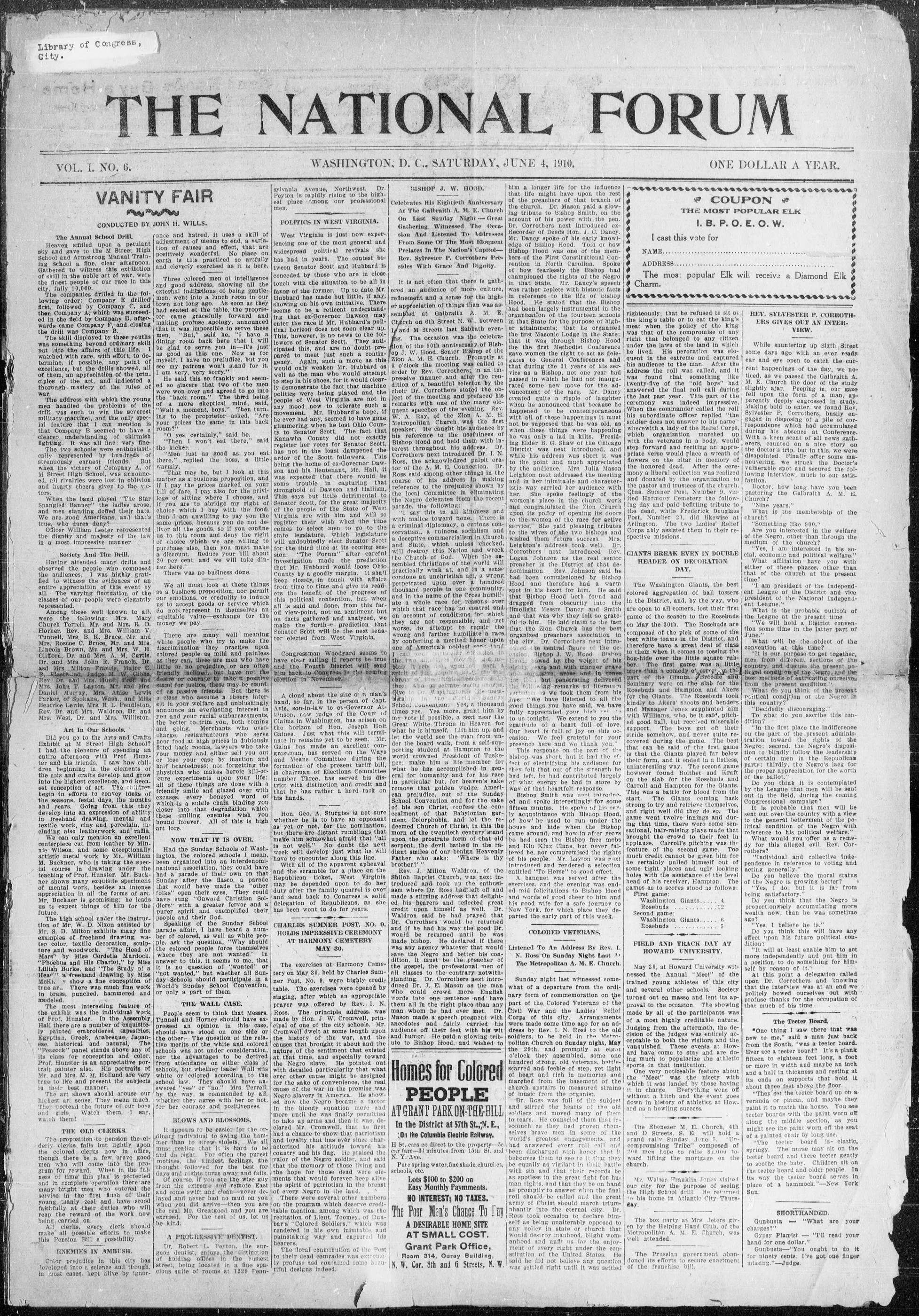
THE NATIONAL FORUM
Library of Congress City.
VOL. I. NO. 6.
VANITY FAIR
CONDUCTED BY JOHN H. WILLS.
The Annual School Drill.
Heaven smiled upon a petulant sky and gave to the M Street High School and Armstrong Manual Training School a fine, clear afternoon. Gathered to witness this exhibition of skill in the noble art of war, were the finest people of our race in this city. fully 10,000 the following order: Company E drilled first, followed by Company C, and then Company A, which was succeeded in the field by Company D, afterwards came Company F, and closing the drill was Company B.
The skill displayed by these youths was something beyond ordinary skill put into the affairs of this life. I watched with care, with effort, to determine, if possible, any point of excellence in the school skill, and an appreciation of the principles of the art, and indicated a thorough mastery of the rules of war.
The address with which the young men handled the problems of the drill was such to win the severest military martinet, and the only special feature that I can mention is that Company B seemed to have a clearer understanding of skimming the water fish. The two schools were enthusiastically represented by hundreds of strenuously earnest friends. But when the victory of Company A. of M Street High School, was announced, all rivalries were lost in oblivion and hearty cheers given to the victors. When the band played "The Star Sanglged Banner" the ladies arose, and men stunned her dotted their hairs. We are good Americans, and that's true, who dares deny? Officer William Lester represented the dignity and majesty of the law in a most impressive manner.
Society And The Drill
Having attended many drills and observed the people who composed the audiences, I was highly gratified to witness the evidences of an entire appreciation of this event by all. The varying fluctuation of the classes of our people were elegantly represented. Among those well known to all were the following: Mrs. Mary Church Terrell, Mr. and Mrs. R. D. Horner, Rev. and Mrs. William V. Tunnell, Mrs. B. K. Bruce, Mr. and Mrs. Roscoe C. Bruce, Mr. and Mrs. Lincoln Brown, Mr. and Mrs. W. H. Clifford, Dr. and Mrs. A. M. Curtis, Dr. and Mrs. John R. Francis, Dr. and Mrs. Milton Francis, Major C. B. Fleetbush, Judge M. W. Gibbz, Dr. and Mrs. John R. Francis, Mrs. T. L. Leston, Mr. and Mrs. Daniel M. Murray, Mrs. Anise Lewis Parker, of Spokane, Wash., and Miss Beatrice Lewis, Mrs. R. L. Pendleton, Rev. Dr. and Mrs. Waldron, Dr. and Mrs. West, Dr. and Mrs. Williston.
Art In Our Schools.
Did you go to the Arts and Crafts Exhibit at M Street High School? I had the pleasure of spending an entire afternoon with Prof. Hunster and his friends. I saw how children beginning in the elements of the arts and crafts develop and grow into the highest excellence, and keenest conception of art. The children begin in efforts to convey ideas of the seasons, festal days, the months and years. Going from this they develop into an expression of ability in freehand drawing, mental and textile work, clay and porcelain, including also leatherwork and raffia. We can only mention an excellent centerpiece cut from leather by Minnie Wilson, and some exceptionally artistic metal work by Mr. William M. Buckner, who is taking the special course of art designed by teaching of Prof. Hunster. Mr. Buckner, who many exquisite specimens of mental work, besides an intense appreciation in all the forms of art, Mr. Buckner is promising; he leads us to expect things of him for the future.
The high school under the instruction of Mr. W. D. Nixon assisted by Mr. S. D. Milton exhibits many fine examples of freehand drawing, water color, textile decoration, sculpture and woodwork. "The Head of Mars" by Miss Cordella Murdock. "Phoebe and His Charlot," by Miss Lillian Burke, and "The Study of a Heath a freehand and a Meko." by Miss Meko, a fine conception of true ar. There was much fine work in brass, punched, hammered and modeled.
The most interesting feature of the exhibit was the individual work of Prof. Hunster. In the Assembly Hall there are a number of exquisitely painted embroidered tapestries, Egyptian, Greek, Arabesque, Japanese, historical and natural. The "Pesacock" panel stands above any of its class for conception and color. The embroiderer is an excellent craft, trellis, prints. His portraits of Mr. and Mrs. M. M. Holland are very true to life and present the subjects in their best manner.
The art shown should arouse our highest art sense. They mean much. They portend the future of our boys. Watch them. I say, watch them!
THE OLD CLERKS
The proposition to pension the elderly clerks falls, but lightly upon the colored clerks now in office, though there be a few brave good men who will come into the program for reward. When in the fulness of time this plan is perfected and in complete operation there are many bright men who entered the service in the early years and have stood faithfully at their duties who will reap the reward of the work now being carried on.
All clerks, every clerk should make all possible efforts to make this Pension Bill a possibility.
ENEMIES IN AMBUSH.
Color prejudice in this city has
developed, led to crime,
least likely by ignorance.
ance and hatred, it uses a skill of adjustment of means to end, a variation of causes and effect, that are positively wonderful. No place on earth is this practiced so artfully and cleverly exercised as it is here.
Three colored men of intelligence and good address, showing all the external indications of being gentlemen, went into a lunch room in our town not long ago. As soon as they had seated at the table, the prophet came gracefully forward and making profuse apology, announced that it was impossible to serve these men. "But," said he, "I have a dining table but I cannot. I will serve you in it—it's just as good as this one. Now as for myself, I have no prejudice, but you see my patrons won't stand for it. I am very very sorry."
He said this so frankly and seemed so sincere that two of the men were won over and agreed to go into the "back room." The third being of a more skeptical mind, said, "Wait a moment, boys." Then turning to the proprietor asked, "Are your prices the same in this back room?" "O yes, certainly," said he. "What can I won't eat there," said the kicker. "Men just as good as you eat there," replied the boss, a little warmly.
"That may be, but I look at this matter as a business proposition, and if I pay the prices marked on your bill of fare, I pay also for the privilege of sitting where I choose, and if you are to abridge my right of choice which I buy with the food, then I am unwilling to pay you the same prices, because you do not deliver all the goods, so if you confine us to this room and deny the right of choice which we are willing to purchase also, then you must make a discount. Reduce your bill about 20 per cent, and we will take dinner here."
There was no business done.
We all must look at these things as a business proposition, nor permit our emotions, or credulity to induce us to accept goods or service which do not represent in themselves and equitable value—exchange for the money we pay.
There are many well meaning white people who try to make the discrimination they practice upon colored people as mild and painless as they can, these are men who have little or no prejudice, or are often friendly inclined, but have not the desire or courage to take a positive stand for justice, these may be counted as passive friends. But there is a class who assume a cheery interest in your welfare and unblippingly interest in you and your racial embarrassments, the better to trim you, both coming and going. Merchants who overcharge, restauranteurs who serve poor food at high prices in dubiously fitted back rooms, lawyers who take your money and either sell you out or lose your case by inaction and half heartedness; not forgetting the physician who makes herole kill-or-cure experiments upon you with these things done with a friendly smile and glazed over with excuses every honeyed word of which is a subtle chain binding you closer into that degradation which these smiling enemies wish you bound forever. All of this is high art lore.
NOW THAT IT IS OVER.
Had the Sunday Schools of Washington, the colored schools I mean, been organized into an interdenominational association, they could have had a parade of their own on that Sunday after the flasco, a parade that would have made the "other folks" open their eyes. The could have sung One Christian Christian, a greater fervor and a purer spirit and exemplified their people and their God.
Speaking of the Sunday School parade affair, I have heard a number of colored, as well as white people, ask the question, "Why should the colored people force themselves where they are not wanted." In answer to this, it seems to me, that is it wanted, or "not wanted," but whether all Sunday Schools should participate in a World's Sunday School Convention, or only a part of them.
THE WALL CASE.
People seem to think that Messrs. Tunnel and Horner should have expressed an opinion in this case, should have stood on one side or the other. The question of the relative merits of the white and colored schools was not under consideration, nor the advantages to be derived from attendance on either class of schools, but whether Isabel Wall was white or colored according to the school law. They should have answered "yes" or "no." Mrs. Terrell, by the way, is commended by all, whether they agree with her or not, for her courage and positiveness.
BLOWS AND BLOSSOMS
It appears to be easier for the ordinary individual to swing the hammer than to strew violets. We all must realize that it is hard to be and do right. For often the purest motives, the kindest feelings, the thought followed for the best for days and nights turns away and falls. Of course, if you are the wise guy from the extreme and remote East and come swift and clean—never delayed and never had no mud on you when you did arrive—then you are the real Mr. Greatgood and you are excused. For the rest of us, let us be kind.
A PROGRESSIVE PENTIST.
Robert L. Feyton, the surgeon dentist, enjoys the distinction of holding offices in the busines
clubs of the city and in clubs of clubs suite of rooms at 1224 Penn
WASHINGTON, D. C., SATURDAY, JUNE 4, 1910.
sylvanla Avenue, Northwest. Dr. Peyton is rapidly rising to the highest place among our professional men.
POLITICS IN WEST VIRGINIA.
West Virginia is just now experiencing one of the most general and widespread political revivals she has had in years. The contest between Senator Scott and Hubbard is conceded by those who are in close touch with the situation to be all in favor of the former. Up to date Mr. Hubbard has made but little, if any, showing on his own initiative. There seems to be a reticent understanding that ex-Governor Dawson may enter the race if Mr. Hubbard's political horizon does not soon up. This, however, is no news to the followers of Senator Scott. They anticipated this, and no doubt prepared to just such a contingency. Again, such a move as this only weaken Mr. Hubbard as well as the man who would attempt to step in his shoes, for it would clearly demonstrate the fact that machine politics were being played and the people of West Virginia are not in any mood now to telerate such a movement. Mr. Hubbard's hope, if he ever had any, seemed to have gone glimmering when he lost Ohio County to Senate County. The fact that county register her votes for Senator Scott, has not in the least dampened the ardor of the Scott followers. This being the home of ex-Governor Dawson and his lieutenant, Mr. Hall, it was expected that there would be some trouble in capturing that stronghold of Dawson and Hallism. This says but little detrimental to Senate Scott, for the great majority of the people of the State of West Virginia are with him and will so register their wish when the time comes to select men to go to the state legislature, which legislature will undoubtedly elect Senator Scott for the third time at his careful session. "The Lord's after service investigation made the prediction that Mr. Hubbard would loose Ohio County by a goodly margin. It shall keep closely, in touch with affairs from time to time and give its readers the benefit of the progress of this political content, but when all is said and done, from this far-off view-point, not on sentiment but on facts gathered and analyzed, we make the further-prediction that Senator Scott will be the next senator elected from West Virginia.
Congressman Woodyard seems to have clear sailing if reports be true and the Fourth District will send him back to Congress, in the coming election in November.
A cloud about the size of a man's hand, so far, in the person of Capt. Avis, son-in-law to ex-Governor Atkinson, now judge of the Court of Claims in Washington, has arisen on the horizon of Hon. Joseph Holt Gaines. Just what this will terminate in remains yet to be seen. Mr. Gains has made an excellent congressman, has served on the Ways and Means Committee during the formation of the present tariff bill, is chairman of Elections Committee number Three, has served his district with distinction and credit and that he has rather a hard task on his hands.
Hon. Geo. A. Sturgis is not sure whether he is to have an opponent as yet or not, for the nomination, but there are distant rumblings that make him somewhat afraid that "all is not well." No doubt the next week will develop just what he will have to encounter along this line. With all of the apparent upheaval and the scramble for a place on the Republican ticket, West Virginia may be depended upon to do her duty after the family quarrel is over and send back to Congress a solid delegation of Republicans, as she has been wont to do for years.
CHARLES SUMNER POST. NO. 9
HOLD'S IMPRESSIVE CEREMONY
AT HARMONY CEMETERY
MAY 30.
The exercises at Harmony Cemetery on May 30, held by Charles Summer Post, No. 9, were highly creditable. The exercises were opened by singing, after which an appropriate prayer was offered by Rev. I. N. Ross. The principle address was made by Hon. J. W. Cromwell, principal of one of the city schools, Mr. Cromwell dwelt at some length upon the history of the war, and the causes that brought it about and the nature of the sentiment that asked at that time, and especially toward the Negro shattered particularly that what ever our cause might be assigned for the sake of convenience, the real cause of the war in the premise was Negro slavery in America. He showed how the Negro became a factor in the bloody equation more and more until he was finally permitted to take up arms and then it was declared Mr. Cromwell, that he first had a chance to show that patriotism and loyalty that has ever since characterized his attitude toward his country and his flag. He praised the valor of the Negro soldier, and said that the memory of those living and the hope for those dead were elements that would forever keep alive the spirit of patriotism in the breast of every Negro in the land.
There were several other numbers on the program which deserve creditable mention, among which was the recitation of Lieut. Toomey, of Dunbar's "Colored Soldiers," which was rendered in his own intimate and painstaking way and captured his hearers.
The floral contribution of the Post to their dead comrades was extremely profuse and contained some beautiful designs indeed.
Celebrates His Eightieth Anniversary At The Galbraith A. M. K. Church On Last Sunday Night — Great Gathering Witnessed The Occasion And Listened To Addresses From Some Of The Most Elquent Prelates In The Nation's Capitol— Rev. Sylvester P. Corrothers Presides With Grace And Dignity.
It is not often that there is gathered an audience of more culture, refinement and a sense for the higher appreciation of things than was assembled at Galbraith A. M. E. Church on 6th Street N. W. between I. and M Streets last Sabbath evening. The occasion was the celebration of the 80th anniversary of Bishop J. W. Wood, Senior Bishop of the Zion A. M. E. Church. Promptly at 8 o'clock the meeting was called to order by Rev. Corrothers; in an impressive manner and after the rendition of a beautiful selection by the choir Dr. Corrothers stated the object of the meeting and prefaced his remarks with one of the many eloquent speeches of the evening. Rev. W. A. Ray, of the Zion A. M. E. Metropolitan Church was the first speaker. He caught his audience by his reference to the usefulness of Bishop Hood and held them with interest throughout his address. Dr. Corrothers next introduced Dr. I. N. Ross, the acknowledged pupil orator of the A. M. E. Connection. Dr. Ross said among other things in the course of his address in making reference to the prejudice shown by the local Committee in eliminating the Negro delegates from the recent parade, the following:
Rev. J. Milton Waldron, of the Shiloh Baptist Church, was next introduced and took up the enthusiasm where Dr. Ross had left off and made a stirring address that delighted his hearers and reflected great credit upon himself as well. Dr. Waldron said he had prayed that Dr. Corrothers would be returned and if he had his way the good Dr. would be returned until he was made bishop. He declared if there was any agency whatever that would save the Negro and better his condition, it must be the preacher of the gospel, the professional men of all classes to the contrary notwithstanding. Dr. Corrothers next introduced Dr. J. E. Mason as the man who could crowd more English words into one sentence and have them all in the right place than any man whom he had ever met. Dr. Mason made a speech pregnant with anecdotes and fairly carried his audience off their feet with his wit and humor. He paid a glowing tribute to Bishop Hood, and wished to
Homes for Colored PEOPLE
AT GRANT PARK ON THE HILL
In the District at 57th St., N. E.,
On the Columbia Electric Railway.
H St. cars go direct to the property—30 car fare—30 minutes from 15th St. and N. Y. Ave.
Pure spring water, fine shade, churches, schools, etc.
Lots $100 to $200 on
Easy Monthly Paymments.
NO INTEREST; NO TAXES.
The Poor Men's Chance To Buy
A DESIRABLE HOME SITE
AT SMALL COST.
Grant Park Office,
Room 314, Ouray Building,
N. W. Cor. 8th and G Streets, N. W.
him a longer life for the influence that life might have upon the rest of the preachers of that branch of the church. Dr. Mason paid a glowing tribute to Bishop Smith, on the account of his power with the pen. Dr. Corrothers next introduced ex-Recorder of Deeds Hon. J. C. Dancy. Mr. Dancy spoke of his early knowledge of Bishop Hood. Told or how Bishop Hood was one of the members of the First Constitutional Convention in North Carolina. Spoke of how fearlessly the Bishop had championed the rights of the Negro in that State. Mr. Dancy's speech was rather replete with historic facts in reference to the life of Bishop Hood. He stated that the Bishop had been largely instrumental in the organization of the fourteen sons of the Negro in the higher institutions; that he organized the first Masonic Lodge in the State; that it was through Bishop Hood the first Methodist Conference gave women the right to act as delegates to General Conferences and that during the 31 years of his service as a Bishop, not one year had passed in which he had not inaugurated some new move for the advancement of the race. Mr. Dancy created quite a ripple of laughter when he announced that because he happened to be contemporaneous with all of these happenings it must not be supposed that he was old, as when these things were happening he was only a lad in kilts. Presiding Elder B. G. Shaw of the Chicago District was next introduced, and while his address was short it was to the point and much appreciated by the audience. Mrs. Julia Mason Leighton in address addressed the meeting and in her intuitable and characteristic way carried her audience with her. She spoke feelingly of the nature of the preachers and congratulated the Zion Church upon its policy of opening its doors to the women of the race for active service. She paid pleasing tributes to the wives of the two bishops and wished them future success. Mrs. Leighton's address took well. Dr. Corrothers next introduced Rev. Logan Johnson as the real senior preacher in the District of that denomination. Rev. Johnson said he had been commissioned by Bishop Hood and therefore had a warm spot in his heart for him. He said that Bishop Hood both found and dragged from obscurity into the timelight Messrs Dancy and Smith and that was why they felt no grateful to him. He laid claim to the fact that the Zion Church has the best organized preachers association in the city. Dr. Corrothers next introduced the central figure of the occupation. Bishop J. W. Hood. Bishop Hood bowed by the weight of his years and with manner grave in his voice, worse and in tone but penetrating delivered remarks ad illumination. We have listened to all the good things you have said, we have fully appreciated your high reliance to us tonight. We extend to you the gratitude of a heart full of love. Our heart is full of joy on this occasion. We feel grateful for your presence here and we thank you." This response on the part of the bishop was short, but it had the effect of electrifying his audience for they felt that out of the strength he had left, he had contributed largely of what energy he had in store by way of that heartfelt response.
Bishop Smith was now introduced and spoke interestingly for some fifteen minutes. He spoke of his early acquaintance with Bishop Hood, of how he used to run under the house and hide when the Bishop came around, and how in after years he had seen the Bishop face mobs and Klu Klux Clans, but never faltered he, nor compromised the rights of his people. Mr. Layton was now introduced and rendered a selection entitled "To Horse" to good effect. A banquet was served after the exercises, and the evening was ended mid felicitations to Bishop Hood and words of good cheer to him and his good wife for a safe journey to New York, for which place they departed the early part of this week.
COLORED VETERANS.
Listened To An Address By Rev. L.
N. Ross On Sunday Night Last
The Metropolitan A. M. E. Church
Sunday night last witnessed somewhat of a departure from the ordinary form of commemoration on the part of the Colored Veterans of the Civil War and the Ladies' Relief Corps of this city. Arrangements were made some time ago for an address by Rev. I. N. Ross to the old soldiers, to be held in the Metropolitan Church on Sunday night. May the 29th and promptly at eight o'clock be assembled some one hundred strong, some bettle scarred and feeble of step, yet light of heart and rich in memories and marched from the basement of the church upstairs to measured strains of music from the organist.
Dr. Ross was full of the subject and stirred the hearts of the old soldiers and moved many of them to tears. He counselled them that in somuch as they had proven themselves brave men in some of the world's greatest engagements, and had answered every roll call and been discharged with honor that they be equally as vigilant in their battle with sin and that their records be as spotless in the great fight for human rights, and that they be on hand as promptly to answer when the final roll should be called and the great philanthropy should be triumphantly into the modern city. Ross took occasion to declare himself as being unalterably opposed to any policy in state or church that would destroy manhood, blight womanhood and unit us for the enjoyment of every right under the constitution of the United States. He said he did not believe any question was settled right until it was settled
COUPON
THE MOST POPULAR ELK
I. B. P. O. E. O. W.
I cast this vote for
NAME.....
ADDRESS.....
The mos: popular Elk will receive a Diamond Elk
Charm.
righteously; that he refused to sit at the king's table or to eat the king's meat when the policy of the king was that of the compromise of any right that belonged to any citizen under the laws of the land in which he lived. His persecution was eloquent in the extreme and captured his audience to the man. After the address the roll was called, and it was found that something like twenty-five of the "old boys" had answered the final roll call during the last past year. This part of the ceremony was indeed impressive. When the commander called the roll his subordinate officer replied "the soldier does not answer to his name" wherewith a lady of the Relief Corps, which organization marched up with the veterans in a body, would step forward and reciting an appropriate verse would place a wreath of flowers on the altar in memory of the honored dead. After the ceremony a liberal collection was realized and donated by the organization to the pastor and trustees of the church. Chas. Summer Cemetery, Number 9, visited Harmony Cemetery the following day and paid befitting tribute to the dead, while Frederick Douglass Post, Number 21, did likewise at Arlington. The two Ladies' Relief Corps ably assisted them in their respective missions.
GIANTS BREAK EVEN IN DOUBLE
HEADER ON DECORATION
DAY.
The Washington Giants, the best colored aggregation of ball tossers in the District, and, by the way, who are open to all comers, lost their first game of the season to the Rosebuds on May the 30th. The Rosebuds are composed of the pick of some of the best white teams in the District, and therefore have a great deal of class to them when it comes to tossing the hog-hide over the little square rubber. The first game was a hit for the Giants, and the part of the Giants, Brockum and Seminary were on the slab for the Rosebuds and Hampton and Akers for the Giants. The Rosebuds took kindly to Akers' shoots and benders and Manager Jones supplanted him with Williams, who be it it said, pitched good ball, but received miserable support. The boys got off their stride somehow, and never quite recovered during the game. The best that can be said of the first game is that the Giants played far below their form, and it ended in a listless, uninteresting way. The second game however found Bolthet and Kraft on the slab for the Rosebuds and Carroll and Hampton for the Giants. This was a battle for blood from the start. The Giants coming back strong to try and retrieve themselves, and right well did they do so. The game went twelve innings and during that time, there were some sensational, hair-raising plays made that brought the team up to the level of Carroll's pitching was the feature of the second game. Too much credit cannot be given him for he certainly pulled himself out of some tight places and ugly looking holes with the assistance of the level head of his receiver, Hampton. The games as to scores stood as follows: First game:
Washington Giants..... 4
Rosebuds..... 12
Second game:
Washington Giants..... 6
Rosebuds..... 5
FIELD AND TRACK DAY AT
HOWARD UNIVERSITY.
May 30, at Howard University witnessed the Annual "Meet" of the trained young athletes of this city and several other schools. Society turned out en masse and lent its approval to the occasion. The showing made by all of the participants was of a most highly creditable nature. Judging from the aftermath, the decision of the judges was entirely acceptable to both the visitors and the vanquished. These events at Howard have come to stay and are doing much to popularize the athletic sports in that institution. One very noticeable feature about the "Meet" was the nice with which it was landed by those having attended the event without a bitch and the event goes down in history of athletics at Howard as a howling success.
The Ebenezer M. E. Church, 4th and D Streets, S. E. will hold a grand rally Sunday, June 5. "Uncompromising Tribe" composed of 200 men hope to raise $1,000 toward lifting the mortgage on the church.
Mr. Walter Franklin Jones visited our city for the purpose of seeing the High School drill. He returned to his home in Atlantic City Thursday.
The box party at Mrs. Jets given by the Helping Hand Club, of the Metropolitan A. M. E. Church, was well attended.
The Prussian government abandoned its efforts to secure enactment of the franchise bill.
REV. SYLVESTER P. CORROTHERS GIVES OUT AN INTERVIEW.
While sauntering up Sixth Street some days ago with an ever ready ear and eye open to catch the current happenings of the day, we noticed, as we passed the Galbraith A. M. E. Church the door of the study slightly ajar. Peeping in, our gaze upon the form of a man, apparently deeply engrossed in study. Making bold to stare, the Sylvester P. Corrothers, busily engaged in disposing of a pile of correspondence which had accumulated during his absence at Conference. With a keen scent of all news gatherers, counted on a nice story on the doctor's trip, but in this, we were disappointed. Finally after some maneuvering, we struck the Doctor's visible spot and secured the following interview, much to our satisfaction.
Doctor, how long have you been pastoring the Galbraith A. M. E. Church?
"Nine years."
What is the membership of the church?
"Something like 900."
Are you interested in the welfare of the Negro, other than through the medium of the church?
"Yes, I am interested in his social, economic and political welfare."
What affiliation have you with either of these phases, other than that of the church at the present time?
"I am president of the Independent League of the District and vice president of the National Independent League."
What is the probable outlook of the League at the present time?
"We will hold a District convention some time in the latter part of June."
What will be the object of the convention at this time?
"It is our purpose to get together, meet our different sections of the country, and demonstrate the present political condition of the Negro, and the best methods of extricating ourselves from the present condition."
What do you think of the present political condition of the Negro in this country?
"Decidedly discouraging."
To what do you ascribe this condition?
"It is the first place the indifference on the part of the present administration toward the rights of the Negro; second, the Negro's disposition to blindly follow the leadership of certain men in the Republican party; thirdly, the Negro's lack for the proper appreciation for the worth of the ballot."
Do you think it is contemplated by the League that men will be sent out over the country with a view to the general betterment of the political condition of the Negro with reference to his political welfare.
What would you offer as a remedy for this alleged evil Rev. Corrothers?
"Individual and collective independence in reference to voting and acting generally."
Do you believe the moral status of the Negro is growing better?
Do you think that the Negro is proportionately accumulating more wealth now, than he was sometime ago? "Yes, I believe he is."
Do you think this will have any effect upon his future political condition?
"It will at least enable him to act more independently and put him in a position to do something for himself by reason of it."
At this point a delegation called Dr. Corollson and knowing that the interview was at an end we politely bowed ourselves out with profuse thanks for the occupation of that much of his time.
The Teeter Board
"One thing I saw there that was new to me," said a man just back from the South, "was a teeter board. Ever see a teeter board? It is a plank fifteen to eighteen feet long, a foot or more in width and maybe an inch and a half in thickness and resting at its ends on supports that hold it about three feet above the floor.
"They set the teeter board up on a veranda or pizza, and maybe they paint it to match the house. You see teeter boards with the paint worn off along the middle section, as you might see the paint worn off the seat of a painted chair by long use.
"The teeter board is* elastic, springy. The nurse may sit on the teeter board and there teeter gently to soothe the baby. Children sit on the teeter board and older people. In its way the teeter board serves in place of a hammock."—New York Sun.
SHORTHANDED
Gunbusta — "What are your charges?"
Gypsy Plamist — "I'll read your hand for one dollar."
Gunbusta—"You ought to do it for ninety cents; I've got one finger missing."—Judge.
The National Forum
Subscription Rates
One Year.....$1.00
Six Months.....50
609 F Street, N. W., Room 203.
RALPH W. WHITE
Editor and Proprietor.
JOHN H. WILLS
Business Manager.
Address all communications, checks
and money orders to
TO THE ELKS OF THE DISTRICT
OF COLUMBIA.
The "Forum" is alive to the fact that the Elk Lodge is one of the most progressive Negro secret organizations on earth. The "Forum" is also cognizant of the fact that the Grand Lodge meets in the city of Washington on July 26, 27, 28 and 29. In order that we may lend what contribution we can to the success of of that meeting, and at the same time keep alive the public interest, to which we know the Order to be entitled, the "Forum" is this week inaugurating a voting contest for a beautiful gold Elk charm set with a magnificent diamond to be presented to the most popular Elk in the District of Columbia, which will be presented at the meeting of the Grand Lodge.
The charm will be on exhibition at a popular jewelry store on the Avenue, which place will be designated in the next issue of the "Forum." Cut out the coupon, insert the name of the man for whom you desire to vote and mail to the "Forum." All coupons must positively be in on and before July 27, 1910, inclusive. The "Forum" realizes that there are two lodges in the District. With that fact the "Forum" is not concerned. There may be members in one lodge whose popular choice is in the other. The "Forum" makes the straight proposition that the Elk receiving the largest number of votes, including both lodges, and hopes in the face of the unjust opposition that is confronting the Elks and for the good of the race and all Negro secret orders at large, that the consolidation so long hoped for may be realized at this session of the Grand Lodge.
Walking down Pennsylvania Avenue, one in looking at different advertisements flashed out against the sky through the medium of electricity, is struck by one unique, in its character, and beautifully pious in its design. Over behind the National Bank of Washington, in letters bold and clearly outlined at regular intervals flashes out against the eye of the ever steady stream of pedestrians, that ever saving clause of Holy Writ "Jesus the Light of the World."
Who can measure the saving power of this sacred light flashing out the eternal truth to men and women night after night. Who knows how many weary, heart-sore forlorn way-faring men and women are in an instant caused to stop and reflect, which reflection may be the turning point that leads them to higher and better things?
The "Zanesville Daily Courier" in an editorial under date of May 24th instant. in referring to the Sunday School incident of a few days since in our city says among other things. "When Negro delegates from the District of Columbia were barred from the mammoth parade given by the delegates and visitors to the Sixth World's Sunday School Convention in Washington, D. C., the deplorable insincerity of a certain class of church workers was shown and a great organization was placed in a position which was cruelly unfair."
There should be no color line in true Christianity and to the credit of the great bulk of church workers it must be said that there is no distinction as to race or social condition."
The Courier is a white daily from Ohio where "colorphobia" as Dr. Ross has aptly termed it has not such a hold on the people to have crept far up the sides of the churches at least. We can ratulate the Courier on its manly and generously Christian-like stand and wish only that there were more newspapers similar to it.
Dr. I. N. Ross preached one of his magnificent sermons at his church, the Metropolitan A. M. E., on last Sunday morning. Dr. Ross has recently returned from a lecture tour through the South, and reports the condition of our people, in all parts of the Southland as materially improving.
Mrs. Rachel Perry, of Wythville, Va., is in the city for a few days. She can attend the graduation of her daughter from Howard University, who finished this year, and who enjoys the unique distinction of having been chosen to fill the chair of English in the Wheeling High School before her graduation from Howard.
Mrs. Lacey Redeem contemplates a trip to her summer home in Manassas, Va., to recuperate. After having spent some time there she will
while away the months of June and July in Atlantic City, listening to what the wild waves have to say.
Dr. Alfred W. Harris, of Petersburg, Va., made a visit to the city last week and renewed old acquaintances. Dr. Harris has a lucrative practice in his home city and looks prosperous and happy.
Miss Biance Thomas, who is a graduate of Howard University, and who has been teaching in Florida this past year stopped over en route to New York and Brooklyn to attend the Howard commencement. Miss Thomas will summer in Brooklyn.
Mr. A. Hayson is reported as being very ill. Mr. Hayson is one of the old land marks in the district and has been one of the active Odd Fellows of this city for more than 40 years and his many friends are sorry to hear of his illness and wish him a speedy recovery.
Mr. Cobb and J. W. Cromwell, Jr.
returned from Baltimore flushed
with victory for having been successful
in another whist contest in that
city, during the latter part of last
week.
Hon. William L. Houston, grand master of the Odd Fellows Lodge,
returned from Chicago on last Saturday
en route to Richmond to attend
the funeral of Hon. W. M. T.
Forrester. Mr. Forrester was the first grand master of the Odd Fellows and bell that high office longer than any wan before or since. He was also at one time grand master of the Odd Fellow of the State of Virginia. Mr. Forrester became largely interested in the manufacture of regalias for all secret orders before his death.
Rev. Moses H. Johnson, of Chicago, was the guest of Dr. and Mrs. Curtis during last week. Rev. Johnson was a delegate to the Sunday School Convention and took an active part in the denunciation of the action of the local committee of this place in refusing the right to the colored delegates to participate in the parade. Rev. Johnson is an old Washington boy and has many friends here who were delighted to see him.
Dr. St. Clair was in our city last week and as usual was heart and soul in the general advancement of Howard University. Dr. St. Clair is about one of the liveliest ex-Howardites we know anywhere.
Rev. J. E. Mason Pastor in the
A. M. E. Zion connection and
connected with the schools at Living-
ton College. S. C., was in the city
during the whole of last week, and
participated in the anniversary celebration of Bishop Hood's 90th
birthday held in Glibrath A. M. E.
Zion Church last Sunday night.
Mrs. Jones, of Atlanta, Ga., was
among the visitors in our city, last
week. She came to see her son
graduate.
The Ministers' Wives Association
met at the Metropolitan Church
Wednesday, June 1. Their session
was indeed an interesting one.
Mrs. C. B. Lee Binghampton, N.
W., is visiting Mr. and Mrs. J. E.
Dent 628 Cochran Street. He will
remain in attendance for several days.
Mr. Lee is the probiotic of the Win-
chester Hotel at Binghampton.
Hon. Wm. H. Lewis, assistant United States District Attorney of Boston, Mass., spent some time in the city last week among his many friends and admirers. Mr. Lewis was on his return trip from Tuskegee, where he went to deliver the principal address at the commencement exercises.
Mr. Lewis is an alumnus of Harvard where he was picked one year by Walter Camp as one of the world's two best half backs. He finally enjoyed the distinction of becoming coach to the Harvard team. Mr. Lewis served several terms in the Massachusetts Legislature prior to his accepting the present position, to which he was appointed by ex-President Roosevelt.
On Sunday evening at 5 o'clock p.M. Hon. C. L. Moore and wife will give an oratorical and poetical entertainment at the Israel C. M. E. Church at First and B Streets, S. W. Prof. Moore comes well recommended and will be glad to have his entertainment well patronized.
---
Mrs. Lewis V. Green celebrated the 36th anniversary of her birthday at 317 John Marshall Place, N. W. Tuesday evening, May 31, 1910. Among her guests were Mr. and Mrs. Thaddeus Lewis, Mr. and Mrs. Thomas Parker, Miss Susie Matinee, Miss Anna Brown and others. Numerous presents were received by the celebrants. Refreshments were served.
The Y. M. C. A. was addressed on last Sunday, May 29, by Rev. Dr. Abraham Simon, of the 8th Street Appleton and the Parkers Hall, 1418 North Yon Streets, N. W. Rabbi Simon spoke to about 1,000 men on the subject of "Self Respect and creation of Respect in Others." He was optimistic as to the future of the race and impressed upon his hearers the extreme need as well as the great value of education.
Miss Anise Lewis Parker, of Spokane, Washington, is visiting her father, Monte Lewis, of this city.
Mr. James T. Newman has resigned his position as assistant in the Library of the United States Senate. His resignation took effect May 31 just passed.
The colored citizens of Gibson Grove, Md., are considering the advisability of organizing a training school for young men and women where all of the branches from elementary manual training and such higher branches as bookkeeping, typewriting and stenography will be taught.
Prof. E. C. Morris, of Helena, Arkansas, lectured at the Second Baptist Church on Tuesday, May 31. His subject was "The American Negro and the Fulfillment of a Prophecy."
J. B. McGwin, at 1505 9th Street, N. W. has invented a carpet lining, which is clean, safe and durable. It is entirely different from the old paper lining. The composition of the lining makes it possible to save the carpet and its durability adds to its value.
WOMAN'S REALM
Meat—Breast of Lamb.—Cover two breasts of lamb with cold water, bring to the boil and skim. Add a teaspoon of salt, half a dozen peppercorns, a large onion stuck with three cloves, two small carrots, one small white turnip, a sprig of parsley, a stalk of celery and a bay leaf. Simmer for two hours, take out the meat, remove the bones and trim. Rub with butter, sprinkle with seasoned crumbs and brown in the oven. Use the broth for soup.
Women do not remove their hats at formal afternoon receptions. Hats should not be worn in the evening. There should be maids in attendance to take care of wraps. The bride does not furnish carriages except for her immediate party. Guests provide their own. The matron of honor and bridesmaid help receive guests, standing next to the parents of the bridegroom. If you take a friend with you, only the most formal introduction is required, and you do not remain to talk with the receiving line.
Nothing more than congratulations to the newly married couple are required, except a friendly greeting to their respective parents. If the reception includes a dance and supper, the guests go to the dancing floor immediately they have greeted the receiving line.—New York Telegram.
Woman to Woman.
The woman who for any reason cannot get on with women is preparing for herself a lonely old age. She may be beautiful, witty, a favorite with the men, yet there are times when she realizes that in one sense she is a failure. She asks herself whether one of the most tangible forms of success is not to get on with people. And the greater success—as she also begins to observe—is to get on with women. To get on with men is much less distinguished, for the odds are all in her favor. Men are not critical in their attitude toward her, and respond quickly to attention or kindness, seldom questioning the motives underlying either, as members of her own sex are prone to do, says Woman's Life. It seems impossible for a certain class of women to be fair to women; ergo, it is equally impossible for them to get on with other women.
A widow of fifty-four years in London has been ordered to pay a young man of twenty-five years $500 for breach of promise to be married to him. The young man is Jack Denny Bower, a draper's assistant, who says
Our Out-Out Recipe
*Pasta in Your Scratch-Book*
Meat—Breast of Ian cold water, bring to the salt, half a dozen pepper cloves, two small carrots parsley, a stalk of celer hours, take out the meat with butter, sprinkle wi oven. Use the broth for
that Mrs. Jesus Agnes Ebsworth, a grandmother, made love to him and even promised to settle a set amount of money on him after their marriage. The two met about three years ago and became friends. Bower alleged that Mrs. Ebsworth wrote him endearing letters and that they visited a hotel in Clifton, where they occupied separate rooms and he was described as Mrs. Ebsworth's nephew. There was testimony that Mrs. Ebsworth paid the bills. Mrs. Ebsworth denied she ever agreed to marry the young man and said that the letters Bower put in evidence were written by her as a joke to the young man. She says that after he proposed marriage to her she ordered him never to speak to her. The jury, however, thought the young man's feelings had been wounded.—New York Press.
Pleasant Manners.
Life would be more livable if more of us felt it a duty to be pleasant however things might go.
An old woman once told a girl with a Puritan conscience: "Stop worrying so much about the right and wrong of things and keep smiling, and you will make this world a better place."
The girl who learns to keep smiling when she would much rather weep or storm has gained a victory over herself beyond pence and fasting.
Be pleasant, first, from a sense of duty, and it will soon become habit. If sulkiness, deceit, ill temper, nagging can get a grip on character, why not pleasant ways?
If you cultivate a pleasant manner from no other reason, do so through self-interest. The girl who is agreeable never moans over the world's treatment. Solemn knew when he advised the "soft answer" rule for living.
Make a pleasant manner your rule. The peace of mind that follows freedom from brawls, snappy answers and irritability adds years to your life and to your success in life. Indianapolis News.
Some Oldtime Savings.
Everybody knows some old sayings which few of us perhaps believe in our hearts. Yet, although we do not believe them, still we are interested in them, and as often as not follow the directions notwithstanding that we may scoff at the results. As, for instance, most people pick up a pin when they see it, but they do not cherish any hope of the action affecting their luck. When our ears burn we say some one is speaking of us; perchance we think we speak truly, probably we do not.
Here, however, are some other old-time sayings given for what they are worth. If you—
Drop a slice of bread or butter a hungry visitor will come.
Eat geese on Michaelmas Day, you will have plenty of money throughout the coming year.
Pick an apple with a worm in it, you will be rich; with a fly in it, however, poverty must be yours.
Meet a man with a wooden leg, you may expect a surprise soon.
Have an irritation of the right foot.
you will walk on strange ground with good results; your left foot having the opposite effect.
Break, says Woman's Life, your needle when sewing a garment, you will live to wear it out.
See a frog sitting on dry ground in the springtime, you will shed as many tears during the year as will make a pond large enough for it to swim in.
Bleached Hair.
This is pre-eminently the time for women who have been dyeing or bleaching their hair to discontinue the practice, for so much false hair can be worn now that the head can be completely covered with it during the period that the tresses are regaining their natural shade.
Times without number I am asked by my correspondents how they can restore color, having changed it by dyes, and my only answer it by massage, brushing and a copious use of oils. The last, perhaps the most important, is manifestly impossible when one's own hair must show, but when false pieces are used the head may be deluged and the oil will not show.
The chief injury done the hair through dyeing or bleaching is the drying of natural oils until the locks stave or become so crisp they break constantly.
Oil is the best method of nourishing, as massage is best to drive it into the pores. Incidentally, massage stimulates circulation. Ordinary tonics—that is, those for ordinary conditions of the scalp—will be inefficacious. A combination of sweet almond oil, putting half an ounce of tincture of cantharides to eight ounces of the oil, is helpful. Almond oil is also nourishing.
Either is to be put on every night—that is, literally poured over the scalp. It is impossible that too much oil shall go on. When the head has been wet in this way the whole scalp should be pressed with the finger tips, bending the knuckles to move the scalp over the skull. Each section is to be pressed for three or four min-
utes in this way, then another rubbing must be given to drive the oil into the pores. After this there must be a thorough brushing, using long bristles that will go through the hair and reach the scalp.
The whole treatment will take at least ten and probably fifteen or twenty minutes at night, and it is not to be thought that all the oil will be absorbed by the scalp in this time. To the contrary, much will remain and the head will not look neat. Nevertheless, if necessary, it may be tied in a thin bandage for the night. Oil in quantities it must have, and in the morning if more oil can be absorbed it should be applied. The locks are then twisted closely but not tightly around the back of the head and the various switches affected by fashion are pinned on to completely cover the natural tresses.
Unpleasant as this treatment may seem, it is the only one that will expedite the return to natural color. To dry hair after it has been bleached is to make the trouble worse.—Margaret Mixter, in the Washington Star.
PRETTY LITTLE THINGS TO WEAR
Shoes have fancy buckles and are worn with gayly colored stockings. The newest pocket handkerchiefs are tiny, with the colored border very deep.
Crystal fringe and embroidery in crystal beads are used on evening gowns.
In the fashionable shops the draped princess is the leading model for the dressy frock.
One of the pretty ornaments for the hair is a butterfly made of white and gold sequins.
"King's blue," a new shade of the season, is merely a cold. Japanese shade of blue.
Cypress green, pewter gray and a delicate fawn shade are soft tints that are popular.
White serge suits have black or green collars and cuffs. Green is also used on dark blue.
The chantecler pump has a high heel and a decorative narrow toe. It is unusually arched.
Earrings are very picturesque, particularly when worn with the quaint coiffures now in vogue.
Embroidery lacecings and all-overs are to be very much used this season for pretty frocks.
The new veils are novel and conspicuous, but not becoming. Colored lace veils are still popular.
Foulards, plain and figured, are allied with great success. The deep hem reaching to the knees is a happy solution of the problem of contrasting silks.
Would you have a delectable wrap in a very short time? Well, take the model seen at one of the private views. It was simply a huge square of pale rose satin, ornamented on each corner with a heavy dull silver tassel and cord.
THE EPICURE'S CORNER
Remove the meat from two lobsters, and cut all edible parts in small pieces. Have slices of bread cut thin of the size and shape desired, and well buttered. Make a mayonnaise dressing as follows: Two teaspoons mustard, one teaspoonful salt, one tablespoon sugar two tablespoons melted butter, eight tablespoons milk, five tablespoons vinegar, one well beaten egg. Boll until it thickens. Spread the bread with mayonnaise, and work the rest in with the lobster. Cover a slice with the prepared filling, place another slice on it, and wrap in paraffine paper until needed. —Boston Post.
Chocolate Fudge.
Put two cups sugar, a half cup milk, a quarter cup butter and four squares of chocolate into a saucepan and simmer ten minutes.
Take from the fire, add one teaspoonful vanilla and stir for five minutes until soft and creamy. Pour in buttered pans.
To make the plain Vassar fudge, add to two cups white granulated or soft brown sugar, one cupful thick cream. Put this over the fire, and when it gets hot add a quarter cake chocolate, grated or broken in one pieces. Stir constantly and vigorously. When it reaches the boiling point add a tablespoonful butter, and keep stirring until a little poured on a saucer creams with beating. Take from the fire, beat until cool and pour in buttered tins.—New York Telegram.
Cream of Tomato Soup.
Scrape two young carrots, peel one young turnip and cut into slices, together with a stalk or two of celery, a leek and a small onion. Add a few sprigs of parsely, half a bunch of chives cut in small bits and a clove of garlic, if desired. Cook for an hour in three cups water, then add a quart can of tomatoes. Simmer gently for two hours longer, then strain through a colander. Melt a large tablespoonful butter in a saucepan, stir until rather brown, then add two tablespoonful flour. When blended stir in a cupful of the hot soup stock, then turn the thickened mixture back into the soup pot. Cook ten or fifteen minutes, season with a tablespoonful salt, a scant teaspoonful pepper and a teaspoonful sugar. Serve hot with fried or toasted croutons Washington Star.
Southern Beaten Biscuit.
Sift together one quart flour, a salt spoonful salt and a half teaspoonful baking powder. Rub into the flour with the tips of the fingers a heaping tablespoonful lard, then add a cup of milk or enough to make a stiff dough, stiffer than for bread. Now, if you follow the old-time method of beating, take a biscuit beater or rolling pin and beat the dough on a block of hard wood until it blisters and pops. If takes a strong arm and a skillful one to beat well. Cut into rounds about the size of a watch (medium size), prick with a fork and bake about thirty minutes in a moderate oven. If you like short cuts in your culinary methods instead of beating try running the dough through a food chopper about six times. This blisters the dough as well as the traditional method, beating and can be done in a tenth of the time.—Washington Star.
Hints for Housewives.
Use sour milk and salt to brighten brass candle sticks.
If your grocer furnishes kerosene which gives a dim light, put a little salt in the bottom of the lamp, then fill with oil and you will be surprised at the result.
Tie up a piece of yellow beeswax in a rag and when the iron is almost, but not quite hot enough to use, rub it quickly with the wax and then with a coarse cloth.
By rubbing a fresh lemon thoroughly into a sponge and rinsing in lukewarm water several times it will become as sweet and clean as when new.
In baking biscuits, have the oven hot at first, but lower the temperature just a little before the biscuits are ready to take out. This will add materially in making the biscuits light.
Take old pieces of lace curtains, dip in thin thin rich, lay on place to be mended, iron with quite a hot iron. The starch sticks the piece on and will stay till the curtains are washed again.
Don't select a large pattern for a small room, for it will be out of proportion and decrease its size. In a place of this kind choose something small and dainty and the charm will be enhanced.
Don't use a striped paper in a place with a high ceiling. A room of that description should have a figured side wall with a pattern of generous proportions, if the space admits of that treatment. The same advice applies to materials.
How many know that by adding common table salt to gasolene you can remove spots from clothing or the most delicate fabrics without leaving a ring around the edge cleaned? Many a dry cleaner's bill can be saved by useful knowledge. Don't put heavy toned colors in dark or medium light rooms, no matter how much you like them. Often the salesman, not knowing where the light comes from or how the room is situated, in order to make a sale urges what he sees the customer fancies.
Good Roads
Good Roads
Importance of Good Roads.
We have received a copy of the report by the Senate Committee on Agriculture recommending the enactment of Senate Bill No. 6931, providing for an appropriation of $500,000 for the extension of the work of the U. S. Office of Public Roads in aiding in the improvement of the public highways. Senator J. H. Bankhead, of Alabama, in his speech on the bill said:
The national Governments of all the principal nations of the world except the United States actively aid and encourage the building and maintenance of public roads. France has the most superb system of roads in the world, completed at a total cost of $612,775,000. The effect of these roads upon the material prosperity of the French people is indicated in the following extract from a report by Francis R. Loomis, commercial agent at St. Elenine, France, dated April 23, 1891:
"The road system of France has been of far greater value to the country as a means of raising the value of lands and of putting the small peasant proprietors in easy communication with their markets than have the railways. It is the opinion of well-informed, Frenchmen who have made a practical study of economic problems that the superb road of France have been one of the most steady and potent contributions to the material development and marvelous financial elasticity of the country. The far-reaching and splendidly maintained road system has distinctly favored the success of the small landed proprietors, and in their prosperity and in the ensuing distribution of wealth lies the key to the secret of the wonderful vitality and solid prosperity of the French nation."
As a result of the improved condition of the roads in these countries, their farmers haul produce to market at an average cost of only ten cents per ton per mile, and in some cases it is as low as seven cents; while, as a result of the bad conditions of American roads, our farmers are forced to pay an average expense of twenty-three cents per ton per mile on every ton of produce hauled to market or shipping point. —Indiana Farmer.
Improving the Roads.
Of New York State's 80,000 miles of public highways, running through her 30,476,800 acres, 3000 are State roads, maintained by the State. The remainder are under the care of county or town. On January 1, 1909, when the new State Highway Commission was created, there were practically 2000 miles of highway macadamized; now 2400 miles are improved. This year the commission hopes to increase the miles improved by perhaps 500, and to increase each year until the total per year will amount to 800 or 1000 miles.
Thus far this year 120 contracts for improved roads have been let by the commission, and more contracts will be awarded. This will be the last until fall or winter, enabling the successful bidders to get ready for work early next spring.
Under the law some work must be done in all counties whose roads are to be improved at the same time. The 120 contracts awarded this year call for the building of 430 miles of highway, at a total cost of $5,600,000. Of this total the State will pay about $4,500,000 and the counties and towns the remainder.
Of the work contracted for 158 miles are State trunk lines and about 272 miles county roads. The State pays the entire cost of the trunk lines, while the State, county and towns share the cost of the county roads. The contracts to be awarded will amount to about $500,000, bringing the total outfit for the season to more than $6,000,000.
The trunk lines will traverse the State from east to west and from south to north. One trunk line will run from New York City to Plattsburg, on Lake Champain. From Plattsburg the trunk line will proceed westerly through Ogdensburg, Watertown and Oswego to Syracuse, where it will join the main artery, extending through the centre of the State from Albany to Buffalo. This central artery will pass through Amsterdam, Utica, Syracuse and Rochester.
A third east and west trunk line will run through the southern tier of counties, and will pass through the cities of Binghamton, Elmira, Corning, Olean and Jamestown. There will be several trunksextending north and south, which will connect the trunks along the southern tier with that from Albany to Buffalo.—New York Times.
The class was being questioned on the cardinal points of the compass. "If I turn to the east and look at the rising sun, what is behind me?" Boy—"Yer shadder."—Manchester Guardian.
from woolens that regularly sell at $20 and $23.50. Choice of 75 patterns.
Every Few Years You Pay Enough
FOR
Rent To Buy a Home of Your Own
Very few chances now left to buy cheap homes in the District of Columbia.
Go out and look at
East Deanwood, Burville
Reverly, D. C.
This subdivision lies on both sides of the COLUMBIA ELECTRIC R. R., between Bennings, D. C., and Chesapeake Junction.
One fare and 20 minutes' time to the city. Get off at Brooks' Station, East Deanwood, D. C.
Buy now when you can get lots cheap.
Prices will soon advance. Greater Washington is spreading out in every direction and will soon cover the entire District of Columbia.
Lots sold on easy monthly payments.
No interest and no taxes till lots are paid for.
Title perfect.
This is now the only section of the District in which laboring people and people of moderate means can buy now. Buy now. The price will soon be double what it is today.
The understated agent will show the front hall and see him and ar-ange to go out to look the subdivision over.
SALISBURY BROOKS
1505 Pa. Ave., N. W.
Materials selected or furnished. All building details superintended with skill and promptness.
Office: 51st and G St., N. E.
Address R. 3, Box No. 44
EAST DEANWOOD D. C.
A CONVICT'S ADVENTURE.
News was received in London recently of the death of Joseph Creswick, who, while fleeing from justice, accomplished one of the most remarkable walking feats on record.
Creswick was undergoing a sentence for forgery in Rhodesia, and while being conveyed from one prison to another by train (as reported some months ago) conceived the idea of escaping from his guards. As his legs were heavily ironed, the task was by no means an easy one, but one night, when the train in which he was being conveyed was between Builwayo and Salisbury and his guards were asleep, Creswick quietly opened the carriage door and jumped out. When he reached the ground he fell, but was not badly hurt. Dusing the remainder of the night he shuffled along in the dark, and at daybreak could see the railroad in the distance. He decided to walk in a straight line from it, which he did for several days, still with his feet shackled.
Day after day and night after night he rubbed his irons with the sharpest pieces of rock he could find, until at last he was able to throw his manacles aside. After this Creswick went on with great strides through the unknown country in which he found himself, his sole object being to get to some white settlement.
Some weeks after his escape the wanderer had a wonderful piece of luck. In a hut apparently belonging to a settler he found a gun and some ammunition, which, in the circumstances, he did not hesitate to take possession of. With the gun he managed to shoot several zebras and other animals, which provided him with many a welcome meal; but unfortunately his gun got out of order before his ammunition became exhausted and he had to rely upon fruit for his sustenance.
Just when Creswick was coming to the conclusion that he had been walking 'round and 'round, without making much progress, he fell in with some natives, who gave him certain directions as to how to find "a very long water," which Creswick concluded must mean the River Congo, and for several weeks he continued his cramp.
Eight months after his escape from the train between Salisbury and Bulwayo, Creswick was found by a party of Belgians lying in a weak and feverish condition about 200 miles from Leopoldville, on the Congo. They nursed him back to health and strength. At Bomba, arrayed in all the glory of a pair of cricket flannels and a football jersey, provided by his new friends, the fugitive found a ship, on which he worked his passage to Antwerp. From there he got a ship to London. That, however, led to his undoing, for while walking in Whitechapel he was recognized by Detective Inspector Belcher, of Scotland Yard, who arrested him on the charge of escaping from lawful custody.
He was taken subsequently to Rhodea as a fugitive offender, and for his escapade he was sentenced to a further term of six months imprisonment, during which he died.
A French inventor, M. Paul Jegon, has devised an electrolytic detector which operates without the use of a battery to affect telephone receivers. The detector consists of a glass cup containing at the bottom a small amount of mercury with some pure tin in solution. This serves as one electrode, while the other electrode is of the usual type, namely a fine Wollaston wire. Diluted sulphuric acid is used for the electrolyte. The detector is found to act like a small battery, and yet possesses all of the sensitiveness of the electrolytic detector. One of these detectors used at Paris was found to receive signals sent from the Ouessant post on the coast.—Scientific American.
TO GET ITS BENEFICIAL EFFECTS
ALWAYS BUY THE ORIGINAL AND GENUINE
SYRUP OF FIGS
AND
ELIXIR OF SENNA
MANUFACTURED BY THE
CALIFORNIA FIG SYRUP CO.
The
original and genuine
Syrup of Figs and Elixir of
Senna, known throughout the
world as the best of family laxatives,
for men, women and children, always
has the full name of the California Fig
Syrup Co. printed on the front of
every package. It is for sale by all,
leading druggists everywhere, one
size only, regular price 50 cents
per bottle. The limitations some-
times offered are of inferior quality
and do not give satisfaction;
therefore, should be
declined.
While, spenalted the winter in Georgia, here his inauguration as President, Mr. Taft went to the city of Athens to deliver an address to the students of the University of Georgia. He met a member of the faculty—a staunch Democrat—who said, "Judge, I voted the Democratic ticket, but wanted to see you win." "Judge Taft replied, 'You remind me of the story of Brer Jasper and Brer Johnson, who were both deacons in the Shilo Baptist Church, although avowed enemies, Brer Johnson did the deacons told Brer Johnson that he must say something good about the deceased on Sunday night. At first he declined, but finally consented. Sunday night, when the time for the eulogy arrived, he arose slowly and said: 'Brederen and Sisteren, I promised ter say sump'n good 'bout Deacon Jasper tonight, an' I will say we all hopes he's gone what we knows he ain't.'"—London Tit-Bits. Buy "BATTLE AKE" SHOES.
The city of Frankfort has not only established a municipal fish market, but supplies housewives with a fish cookery book free of charge. Libby's Food Products
Contains double the nutriment and none of the impurities so often found in so-called fresh or raw milk. The use of Libby's insures pure, rich, wholesome, healthful milk that is superior in flavor and economical in cost.
Libby's Evaporated Milk is the purest, freshest high grade milk, obtained from selected, carefully fed cows. It is pasteurized and then evaporated (the water taken out), filled into bright, new tins, sterilized and sealed air tight until you need it. Use Libby's and tell your friends how good it is.
Libby, McNeill
& Libby
Chicago
BUY "BATTLE AXE" SHOES
DROPSY NEW DISCOVERY:
gives great relief and care
to cool men, look of testimonial and 40 Barges required.
Groen, Jr. H. H. GREENS 5000, Nox B, Allanta, Ga.
NYONE—an easily make it to M. dollars per week.
A home appliance. Full information. JACK
MAYCHOFT. 1337 Arch St., Philadelphia
WE BUY
WOOL
HIDES AND FURS
Being Dearer,
we can do
better for you than agents or sound stuccoists.
Keseger; nay bank in Louisville. We furnish
Wool Bags Free to our shippers. Write for price list.
M. SABEL & SORS
established in 1896.
Louisville, Ky.
Lavender and rose perfumes are said to be fatal to microbes.
Paber's Scalp All Crusted Over.
"Our little daughter, when three months old, began to break out on the head, and we had the best doctors to treat her, but they did not do her any good. They said she had eczema. Her scalp was a solid scale all over. The burning and itching was so severe that she could not rest, day or night. We had about given up all hopes when we read of the Cuticura Remedies. We at once got a cake of Cuticura Soap, a box of Cuticura Ointment and one bottle of Cuticura Resolvent, and followed directions carefully. After the first dose of the Cuticura Resolvent, we used the Cuticura Soap freely and applied the Cuticura Ointment. Then she began to improve rapidly and in two weeks the scale came off her head and new hair began to grow. In a very short time she was well. She is now sixteen years of age and a picture of health. We used the Cuticura Remedies about five weeks, regularly, and then we could not tell she had been affected by the disease. We used no other treatments after we found out what the Cuticura Remedies would do for her. J. Fish and Ella M. Fish, Mt Vernon, Ky. Oct. 12, 1909."
An acre of growing wheat needs 60 tons of water a month.
For COLD$ and GRIP.
For COLDS and GRIP.
Hold AFIDING the best speed, relieves the best speed, relieves the best speed, curing the cold and restores normal conditions. It’s liquid-effects immediately. 10c. 25c. and sec. airdrug stores.
Great men are never sufficiently shown but in struggles…Burke.
For Red, Ishingy Acids, Cysts, Styes, Failing Murine and All Eyes That Need Care Try Murine Eye Selve. Aseptic Tubes, Trial Size, 25c. Ask Your Druggist or Write Murine Eye Remedy Co., Chicago.
Educating Royalty.
Divinity may or may not hedge a king. If we think it does, it does; if we think it dosen't, it dosen't. The German people hold one opinion: Colonel Roosevelt, a strenuous and aggressive minority, holds another. Between these divergent opinions the German Emperor is having the time of his life.
Europe lives in a hothouse atmosphere of convention. It is Colonel Roosevelt's face to smash a few panes and lift the fresh air. He has embarked a number at Berlin, as he other places, and the stifling grandes so far from resenting it, rather relish it.
To ignore vain ceremonial, to brush aside empty forms, to come down to the bedrock of essential fact and to appraise the value of the reality behind the trappings and the show—all this is a service that only an American could perform for an old society. The German Emporium is as little likely to suffer from this direct appeal and clean-cut method as any other man in Europe—a fact which helps explain the friendship which has been strue, up within the past few days.—Chicago Record-Herald.
Traits Of The Trade
"Tell me all about it," said the woman who was ill and couldn't attend the wedding.
"Twasn't much," said her husband. "There was no best man and the birdgroom forgot the ring and had to go back home for it."
"Lucky girl!" she exclaimed, with woman's institution. "She is marry-in a plumber."
Particular People
Find positive pleasure in
Post Toasties
a crisp, appetizing, dainty food for breakfast, lunch or supper. Always ready to serve right from the package with cream or milk and ad-ways enjoyed.
"The Memory Lingers"
[Pkg. 10c. and 15c.]
Sold by Grocers.
Postum Cereal Co., Ltd.
Battle Creek, Mich.
EXERCISE FREELY LF
FORTY OR OVER.
Men of This Age, Says Dr. Coughlin, Should Go in Few Sports and Be Active.
Men beyond their fortieth year are earnestly advised by Dr. Robert E. Coughlin, of Brooklyn, writing in the current number of the Medical Record, to take abundant exercise in order to keep their systems in repair.
"Such men," writes the physician in a complimentary strain, "are a community's greatest asset. They are at the head of all great enterprises; they are the individuals with big ideas and who put through big schemes; they are our engineers, inventors, bankers, incorporators, professors and successful professional men. We as physicians should try to study this subject so that we may prolong these valuable lives instead of allowing ordinary laymen to direct men regardning their health.
"Who has not heard of our great statesmen putting themselves in the hands of crude trainers and former trainers of prize fighters without medical knowledge and training. The general results cannot be good, except for the fact that these men need exercise, and need it badly.
"One noted athlete has lately made the following statement regarding life in cities: 'The New Yorker wants bottled stuff to cure him; he has not time for exercise. Let a physician tell a man to exercise to cure his rheumatism or his gout or his neurasthenia, or any of his sills that the golden drug brings on, and he will call the doctor a fool and demand pills or bottled drugs that will cure him while he sleeps. It would take too much time away from his desk or store to exercise.'"
Dr. Coughlin especially warms men who have been athletes in their younger years against getting out of condition.
"From the twenty-first year to the fortieth, he continues, "little may be said, as most young men have by this time passed out of athletic life and gone into their chosen vocations. The eagerness to make a living and the desire to succeed in life compel them to be up and doing. As a rule degenerative changes are not so apparent and no notice is taken of such changes until middle life is reached. This is the time, however, when habits of life are formed. The enlarged heart may call upon the former athlete for some stimulation, and instead of exercising he takes to drink. One athletically inclined always athletically bent would be a good rule."
Speaking of men well on in years who have dropped their exercise, Dr. Coughlin declares that there was something sadly significant in the death of William Blakie, a Harvard athlete in his youth, who took no exercise in the last year of his life, and thus paved the way for the fatal stroke of appoplexy which took his life.
"After forty," writes the physician in conclusion, "desegregative changes are the most active sequence to an early active life, especially if, as occurs often, the individual becomes sedentary in his habits. As a rule men more than forty do not exercise sufficiently to keep up metabolism. One should be on the lookout for high blood pressure at this time." Dr. Coughlin advises the following of nearly any kind of good sport, but considers walking in good style as the best exercise.
Meium Cordial.
When Mrs. Washington Claymore Adams had persuaded her son to go courting Miss Clorinda Jefferson, she awaited his home-coming with high hopes. When he entered the house on his return, she waited eager for him to speak.
"Well, boy," she said, impatiently, "is she done receive you cordial, or how is she done?"
"She done receive me kind of mejam," said young Lafayette Wesley, as he unwound his muffler with great deliberation.
"What did you mean by dat, boy?" demanded his mother.
"I mean jen' what I say," replied the son, calmly. "She done invite me in cordial, but 'less I'd been thin as a sheet o' paper I couldn't 'a got in de crack she held de do' open. So den I reserved de tool o' boot in de crack, an 'kin o' worked it roun' an' worked it roun' till de crack was some bigger, an 'den say, 'I'm fraid you couch cold, Miss Clorinda. Hadn't you better close cold, do 'a little mo'?"
"And she kind o' laugh an' say,
'Dere seems to be some kind ob' struc-
tion to its closing'; so den I say, 'Let
me see', 'she open she do' wide and
let me in, an' den it close wid no' mo'
trouble, 'she say, 'Seems like it
works all right now you're inside, Mr.
Lafayette'.
"So I calls her mejum cordial, on
de while." - Youth's Companion.
Musical Sense of Insects
Interesting facts with regard to the musical perceptions of the water flea were mentioned at the Royal Society's meeting yesterday afternoon by F. J. Cole.
The insect is particularly sensitive to certain notes on the tenor trombone. When imprisoned in a microscope live box it preserves a stolid indifference to most musical sounds. It is only when the B flat below the middle C of the trombone is in full blast that it expresses its displeasure by "fixing its first pair of antennae under its body."
One isolated specimen, however, was evidently irritated by every note of the instrument, while many appear to have been entirely tone deaf.—London Daily Mail.
Japanese Police.
Japan's police force was originally the most aristocratic body of the kind in the world. Its establishment was almost coincident with the Emperor's decree forbidding the wearing of swords. By a stroke of the imperial pen the samurai were deprived of cherished weapons by which the gentlemen of Japan had been accustomed from immemorial times to advertise their rank. So they went into the police, where it is still possible to carry a sword. And a very formidable weapon it was, being of the handed variety—Chicago N.
A Package Mailed Free on Request of
MUNYON'S
PAW-PAWPILLS
The best Stomach and Liver Pills known and a positive and speedy cure for Constipation, Indigestion, Jaundice, Billiousness, Sour Stomach, Headache, and nillie disorder, disordered stomach or shigush liver. They contain in concen-
The best Stomach and Liver Pills known and in positive and greedy environment, Indigestion, Jaundice, Biliousness, Sour Stomach, Headache, and all ailments arising from a disordered stomach or sluggish liver. They contain in concentrated form all the virtues and values of Munyon's Paw Paw tonic and are made from the juice of the Paw-Paw fruit. I unhesitatingly recommend these pills as being the best axtative and ectaric vitamin and mineral letter, requesting a free package of Munyon's Celebrated Paw-Paw Laxative Pills, and we will mall same free of charge. MUNYON'S HOMOEOPATHIC HOME REMEDY CO., 533 and Jefferson Sts., Philadelphia, Pa.
PROVED.
"How can you prove that the ultimate consumer is a myth?" asked one statesman.
"Easily," replied the other. "The gods on high Olympus indulged in banquets, showing that a myth is an ultimate consumer; therefore the ultimate consumer must be a myth; Q. E. D."—Washington Evening Star.
In the course of a year over 1,377,600,000 passengers are carried by the local railways, tramways and principal omnibus companies of London.
IT WEARS YOU OUT.
Kidney Troubles Lower the Vitality of the Whole Body.
Don't wait for serious illness; begin using Don't's Kidney Pills when you first feel backache or notice urinary disorders. W.
W. Godden, 711 1/2 E.
Marshall St., Richmond, Va. says:
Every picture
Tale
Story
"My doctor said I had inflammation of the bladder. My limbs swelled to twice their real size and it seemed as if there were thousands of needles sticking into them. I had
been bedfast for three months when I began using Donan's Kidney Pills. Soon I was in better health than I years."
Remember the name—Donan's. For sale by all dealers. 50 cents a box Foster-Milburn Co., Buffalo, N. Y.
From coal-tar Professor Remsen derived saccharin. Already other chemists had made coal-tar the basis for the manufacture of innumerable dyes and perfumes and flavors and drugs. It was reserved for Dr. Remsen to find that coal-tar contained within it the possibility of a sweetening material of six hundred times the power of ordinary cane-sugar. An almost infinitesimal amount of saccharin will sweeten a cup of coffee.
The surface of the earth is said to be 195,971,984 square miles.
Dr. Pierre's Pellets, small, sugar-coated,
keasy to take as candy, re-plate and invigorate
stomach, liver and bowls and cure
constipation.
HOME OF THE SHETLAND PONY.
HOME OF THE SHETLAND PONY.
Just off the coast of Scotland there is a group of islands called the Shetland islands. On one of this group of Shetlands the men are so large they are almost giants, for they are tall, strong and broad shouldered.
Their wives and children, too, are fine looking and intelligent. Only twenty-five miles away from this island of Fetlar is one called Muckle Roe. There the men are small, ill-shapen, homely, and, in fact, look almost like queer little dwarfs. These people are so very loyal to each other that they do not like to welcome any of their neighboring islands to live in Muckle Roe. For this reason these queer people make very little progress. When the people of Shetland Islands reach the age of twenty they feel rather sure of a long life, for over half of the population live to be seventy years old and many of the people lead vigorous out-of-door lives until they are past eighty years of age.
"Got anything good?" inquired the city editor.
"Brutal murder neatly done."
Bruce Burke murdered a man in "Well, play up strong on the in-human interest."—Louisville Courter-Journal.
HARD ON CHILDREN
When Teacher Has Coffee Habit.
"trest is best, and best will ever be." When a person feels this way about Postum they are glad to give intimacy for the benefit of others.
"One cup of coffee taken at breakfast would cause me to become so nervous that I could scarcely go through with the day's duties, and this nervousness was often accompanied by deep depression of spirits and heart palpitation.
"I am a teacher by profession, and when under the influence of coffee had to struggle against crossness when in the school room.
"When talking this over with my physician, he suggested that I try Postum, so I purchased a package and made it carefully according to directions; found it excellent of flavour, and nourishing.
"In a short time I noticed very gratifying effects. My nervousness disappeared, I was not irritated by my pupils, life seemed full of sunshine, and my heart troubled me no longer.
"I attribute my change in health and spirits to Postum alone."
Read the little book, "The Road to Wellville," in pkga. "There's a Reason."
Ever read the above letter? A new one appears from time to time. They are genuine, true, and full of human interest.
With the funny fellows
Living in a Glass House.
Alice and Nick and a few poodle dogs
Were seated at home last night;
The fires burst forth from the crackling
dogs
An their clare was warm and bright.
"Dadda is after those naughty French,"
"Cried Alice in delight;
"It's good for them, too; they have no
defense."
And her pride was a pretty sight.
"Race suicide is a terrible thing.
An mad dog,"
"Her eye was clear, her voice had a ring--
Then Nicholas raised his head.
He laid down his paper, then took it up,
His words had a meaning sting;
For he said, as he kicked the nearest pup:
Yes, it's a terrible thing."
"Toremore C. Dittrich, in New York American."
Feminine Amenities
Violet—"I wouldn't want to stand in your shoes."
Miss Smallfoot (coyly)—"You couldn't."—Brooklyn Life.
Power of Suggestion
Angry Man (at the telephone)—"You go hang yourself, Smithest! (After a pause) Do you hear me?" Central—"Your party hung up!"—Puck.
Mrs. Heck—"Your carpets are so fresh and bright looking. What do you use to clean ther" Mrs. Pech—"My husband."—Boston Transcript.
Unsatisfactory.
"Have you seen the Washington Monument?"
"Yes," replied the New Yorker.
"It's a pretty tall building, but what's the good of it without any offices for rent?"—Washington Star.
For the Asking
"Pardon me, Governor," began the Intviewer, "I—"
"Certainly, certainly," replied the Tennessee Executive, reaching for a blank. "What are you guilty of?" — Philadelphia Public Ledger.
Unreasonable.
Mother—"Tommy, what's the matter with your little brother?" Tommy—"He's crying because I'm eating my cake and won't give him any." Mother—"Is his own cake finished?" Tommy—"Yes'm, and he cried while I was eating that, too."—Brooklyn Eagle.
4 Grewsome Proposition.
"You don't go after that dentist very often?" "No," answered the bill collector. "I'm afraid to. Every time I see him he offers to take the account out in trade."—Washington Star.
The Wife's Tears.
"My wife has cried only twice since we've been married."
"On what occasions?"
"When I told her I couldn't afford to get her a set of furs for Christmas and when I got 'em for her."—Cleveland Leader.
Something Visible.
"Show me some tiaras, please. I want one for my wife."
"Yes, sir. About what price?"
"Well, at such a price that I can say: 'Do you see that woman with the tiara? She is my wife.'"—Fliegende Blaetter.
One Kind.
"Yes, my son."
"Were there two of every kind went into the ark?"
"Yes, my boy; two of every kind."
"And was there two suffragettes?"
"Yonkers Statesman."
More Appropriate.
Society Woman—"I see by today's paper I am referred to as "one of fashion's butterflies." Her Husband—"Considering the way you go through your clothes, I should think 'moth' would apply better."—Stray Stories.
Technically Speaking.
"So there is to be a divorce," raid the woman who discusses everybody. "It seems but a little while since he asked for her hand." "Yes," replied the rude man. "He got the hand all right. But it turned out to be a misdeal!"—Washington Star.
Tenses.
"So you think your new publication should appeal to admirers of both the old and the new." "Yes," replied the theatre manager; "the leading actress is a woman with a future and the heroine of the story is a woman with a past."—Washington Star.
Desperate.
Maud—"Jack proposed to me last night."
Mal'el—"Poor fellow; so he did keep his word after all."
Maud—"Why, what do you mean?"
Mabel—"When I refused him last week he said it would cause him to do something desperate."—M. A. P.
Do you feel weak, tired, despondent, have frequent heat aches, coated tongue, bitter or had taste in mornin' "heart-burn," believing of heart, acid rains in throat at eating, stomach gavw or burn, foul breath, dizzy speak poor or variable appetite, nausea at times and kinds symptoms?
Do you feel weak, tired, despondent, have frequent headaches, coated tongue, bitter or bad taste in morning, "heart-burn," belieching of gas, acid raisings in throat after eating, stomach gaw or burn; foul breath, dizzy spells, poor or variable appetite, nausea at times and kindred symptoms?
If you have any considerable number of the above symptoms you are suffering from biliosness, torpid liver with indigestion or dyspepsia. Dr. Pierce's Golden Medical Discovery is made up of the most valuable medicinal principles known to medical science for the permanent cure of such abnormal conditions. It is a most efficient liver invigorator, stomach tonic, bowel regulator and nerve strengthener.
The "Golden Medical Discovery" is not a patent medicine a full list of its ingredients being printed on its bottle-under oath. A glance at these will show that it contains ful habit-forming drugs. It is a fluid extract made with glycerine, of proper strength, from the roots of native forest plants. World's Dispensary Medical Association,
not a patent medicine or secret nostrum
on its bottle-wrapper and attested
now that it contains no alcohol, or harm-
extract made with pure, triple-refined
the roots of native American medical
Medical Association, Props., Buffalo, N. Y.
The "Golden Medical Discovery" is not a patent medicine or secret nistrum, a full list of its ingredients being printed on its bottle-wrapper and attested under oath. A glance at these will show that it contains no alcohol, or harmful habit-forming drugs. It is a fluid extract made with pure, triple-refined glycerine, of proper strength, from the roots of native American medical forest plants. World's Dispensary Medical Association, Props., Buffalo, N. Y.
No Heat Except Where Needed
Dishes hot—food well cooked—kitchen cool. No underdone food—no overheated kitchen in summer. Everything hot when wanted. Heat under perfect control and concentrated. The blue flame is all heat—no smoke—no odor—no dirt. These are
some of the advantages in using the
New Perfect
WICK BLUE BLAZE
Oil Cook-st
It has a Cabinet Top with shelf for keep
hot. Drop shelves for the coffee pot or sauce
bowl racks.
It has long turquoise-blue enamel chin
finish, with the bright blue of the chimneys, n
attractive and invites cleanliness. Made with
the 2 and 3-burner stoves can be had with or
CAUTIONARY NOTE: Be careful not to store -see that the name-pla
Every dealer everywhere; if not at yours, write for De
to the nearest agency of the
Standard Oil Compa
(Incorporated)
in using the
perfection
BLUE FLAME
ook-stove
shelf for keeping plates and food
pot or saucepans, and nickeled
enamel chimneys. The nickel
chimneys, makes the stove very
made with 1, 2 and 3 burners
had with or without Cabinet.
see that the name-plate reads "NEW PERFECTION."
yours, write for Descriptive Circular
agency of the
Oil Company
corporated)
New Perfection
WICKED BLUE FLAME
Oil Cook-stove
It has a Cabinet Top with shelf for keeping plates and food hot. Drop shelves for the coffee pot or saucepans, and nickeled low rack shelves.
It has long turquoise-blue enamel chimneys. The nickel finish, with the bright blue of the chimneys, makes the stove very attractive and invites cleanliness. Made with 1, 2 and 3 burners—the 2 and 3-burner stoves can be had with or without Cabinet.
CAUTIONARY NOTE: Be aware you can set this stove—see that name-plate reads "NEW PERFECTION."
A FLAVOR that is used the same as lemon or vanilla. By dissolving sugar in water and baking Marinade, attains syrupy texture. A vanilla is sold by grocers. Send 20 stamps for cups and roti book. Crescent Miz. Co., Seattle.
The trouble about noticing the decline in prices is that it is figured at one-sixteenth of 1 per cent. A decline like that cannot be seen with the naked eye—Chattanooga News.
Dairy Paintbiller for bottles, juices, burns and strains. Also for diarrhea and diarrheal. Avoid substitutes. Lc., Sc., Sc.
There are about 26,800 worms to an area of cultivated land.
Mrs Winslow's Soothing Aroma for Children, toothing, softens the gum, reduces tooth inflammation. Allays pain, cures worm colds 25c a bottle.
In 54 cases out of every 100 the left leg is stronger than the right.
Buy "BATTLE AXE" SHOES.
The convicts of Norway are made to till the soil. B. N. U. 22.
must give the bowels help. Your choice must lie between harsh physic and candy Cascarets. Harshness makes the bowels callous, so you need increasing doses. Cascarets do just as much, but in a gentle way.
Vest-pocket box, 10 cents--at drug-stores. 833
Each tablet of the goutine is marked C C C.
FREE Send postal fee
Free Package of Paxtine.
Better and more economical
than liquid antiseptics
FOR ALL TOILET USES.
PAXTINE
TOILET ANTISEPTIC
Gives one a sweet breath; clean, white
germ-free teeth—antiseptically clean
mouth and throat; hurries the breath
after aspiration; dispels all disagreeable
aspiration and body odors—much
appreciated by dainty women. A quick
remedy for sore eyes and catarrh.
PATENTS, Trade-Marks, Pensions, Bounty
, Pay, Claims Against the Gov-
ernment, Soliciting.
Address W. H. WILLS,
Ality-at-Law,
Washington, D. C.
312 Ind. Ave.
25 YEARS' PRACTICE.
BUY "BATTLE AXE" SHOES
BLAIR'S PILLS
CUSTOMER'S ENGLISH REMEDY
GOTT AND BEAUTIFICATION. SAVE AND
RELIABLE. AT YOUR DEUGGIST.
PATENTS Watson K. Coleman, Washington N. Books set refreements. Post remarks.
DAISY FLY KILLER placed anywhere on West, Cres, emu st. edu. colleges cap. Made of math, cis. or edu. colleges and or edu. colleges. Gaganted st. or edu. colleges. EARLD $6000.
---
---
What Ails You?
What Ails You?
```markdown
```
MAPLEIN
We know what we are, but know not what we may be.—Shakespeare.
People Talk About Good Things.
Sixteen year ago few people know of such a preparation as ower of a bake. Today for certain portions of Aileen Foot-Ease have been told year after year by grateful person, it is in impasible to millions. It is cleanly, wholesome, healing and antiseptic and gives rest and comfort to tired aching feet. It cures while you wear testimonials. Imitations pay the dealer a larger profit otherwise you would never be able to tide aching feet. Ask for Aileen Foot-Ease, and see that you get it.
A friend may well be reckoned the masterpiece of nature—Emerson.
FOR HEADACHE—Heels CAPEINE
Whether from Cold, Heat, Stomach or Nervous Troubles, Capdine will relieve you. Its liquid—pleasant to take—acts immediately. Try it, 10c., 25c. and 60c at drug.
Best "sandpaper" is made from powdered wine bottles.
Buy "BATTLE AXE" SHOES.
In calling attention to Trinidad as a popular coaling station, Consult Franklin D. Hale says that the bunkering business, especially with steamers trading between North and South America, is increasing at a rate which shows the excellent facilities available at Port of Spain.
AFTER SUFFERING ONE YEAR
Cured by Lydia E. Pinkham's Vegetable Compound
Milwaukee, Wis. — "Lydia E. Pinkham's Vegetable Compound has made
a woman
completely a well woman, and I would like to tell the whole world of it. I suffered from female trouble and fearful pain in my back. I had the best doctors and they all decided that I had a tumor in addition to my female trouble, and advised an operation. Lydia E.
and I would like to tell the whole world of it. I suffered from female trouble and fearful pains my back. I had the doctors and the best doctor and I had that I had a tumor in addition to my female trouble, and advised an operation. Lydia E. Minkham's Vegetable Compound made me a well woman and I have no more backache. I hope I can help others by telling them about my Vegetable Compound has done for me."—MRS. EMMA LENSE, 83 First St., Milwaukee, Wis.
The above is only one of the thousands of grateful letters which are constantly being received by the Pinkham Medicine Company of Lynn, Mass, which prove beyond a doubt that Lyda E. Pinkham's Vegetable Compound, made from roots and herbs, actually does cure these obstinate diseases of women after all other means have failed, and that every such suffering woman owes it to herself at least give Lyda E. Pinkham's Vegetable Compound a trial before submitting to an operation, or giving up the recovery of her. Mrs. Pinkham, of Lynn, Mass, invites all sick women to write her for advice. She has guided thousands to health and her advice is free.
BUY "BATTLE AXE" SHOES
图
You Indoor People
A little Paxine powder dissolved in a glass of hot water makes a delightful antiseptic solution, possessing extraordinary cleaning, germicidal and healing power, and absolutely harmless. Try a Sample. 50c. a large box at druggists or by mail.
PAXTIME
Seattle Cafe
Meals at all hours. Good cooking
and good service.
1239 SEJENTH STREET
CHINGS
WORTH KNOWING
Uncle Sam's fishing fleet numbers
6954 vessels.
The University of Calcutta is pro-
nably the largest educational institu-
tion in the world. It has about 10,
600 students.
The horse has a smaller stomach
in proportion to its size than any
other quadruped.
There are fifty-eight distinct
disases of the eye. No other organ of
the human body has so many.
Any child over seven can be prosecuted as a criminal in England, but in Germany twelve is the limit of responsibility.
There are 6300 electric lights on the Mauretans.
The hardest wood in the world is not ebony but cocus, which is used for making flutes and similar musical instruments.
As nearly as can be estimated there are thirty inhabitants to the square mile on the globe.
Switzerland has a total population of 3,500,000 and there are 1384 periodicals in the country, or one publication to every 2715 persons.
The highest inhabited place in the world is that Buddhist monastery of Ilaine, Thibet, which is about seventeen thousand feet above sea level.
OI 12,000,000,000 letters written in a year by the world at large. 8,000,000,000 are in English. 1,200,000,000 in German and only 1,000,000,000 in French.
The average weight of a man five feet six inches in height at the age of thirty-five to forty years is 147 pounds. The feminine average is five pounds less.
The conservation of Austria-Hungary is a proverb, but Yankee invention and enterprise have been able to break through the old lines to a surprising degree.
The police "third degree," so frequently used by New York's detective force in cases where prisoners do not know their rights, has fallen under the ban of the highest court of the State of Washington.
By means of improvements of the nature of curve eliminations and short-cuts of one kind or another the length of the Trans-Siberian Railroad will be so shortened that 1200 miles will be cut off the trip from Paris to Pekin. Instead of being more than 7500 miles in length, it will be 6300, and the fourteen days now consumed by the trip will be reduced to nine and a half. The improvements are being made on the most substantial lines and will not be open to the unfavorable criticism the original work was subjected to.
WILD CATS IN CAPTIVITY.
Four Kittens Remain Around House and Follow Master Like Dogs.
I was fortunate enough to secure a female wild cat which had been caught in a trap by a keeper in the extreme north of Scotland. It was not long in my possession before I arrived at the conclusion that there are few animals wilder than a wild cat. The beast was so savage that I found it impossible to do any thing to the injured fore-limb, but nature came to the aid of my captive, and the leg, although remaining slightly deformed, became quite servicable.
In about a month's time the cat, which afterwards escaped and was shot while raiding peasant rearing grounds, presented me with four kittens, and knowing the cannibalistic tendencies of wild animals in captivity, I made arrangements to remove the kittens as soon as they were born. One had, however, been made a meal of before the others were rescued.
The remaining three were transferred to a foster mother in the shape of a gentle stable cat, and the family survived all their infantile ailments and are still alive. Notwithstanding their environment and the excellent example shown them by the stable cat the kittens were practically untamed terrors with every one but myself until they reached the age of four or five months.
After that period they seemed to have a greater faith in human nature, or perhaps familiarity had bred contempt, though even yet there are times when the wild ancestral blood courses madly through their veins, and for days they are almost unapproachable. But in their quieter moments they follow me about like dogs and respond to call or whistle. I give them their liberty only during the day now, and even then they are under observation, as once when I let them out of their quarters in the evening they boiled.
After much difficulty I recaptured two, but the third did not return for a work, and I was surprised that it came back at all. On warm moonlights they will cauterwaul to the domestic tabbies, and the voice of the ordinary cat is a mere whisper compared to the calls of those products of the pine woods gloom, and I had to remove my three wild cats to a place where there were no neighbors whose dreams could be disturbed. — From the Scotchman.
In 1903 the foreign-born population of 13.6 per cent furnished 15.6 per cent of the criminals, 20.8 per cent, of the paupers, and 29.5 per cent of the insane. Between 1904 and 1908 the aliens in these institutions increased thirty-four per cent.
Her head is held among the stars,
Her feet are on the sea.
An airship with its whirling blades
Is poised upon her knee;
An auto tire is round her neck,
A trolley at her side.
An instrument of wireless wire
About her waist are tied.
The lightnings of the wireless flash
Around her giant jorm.
Her brow is valued in clouds of dust,
Her voice is like the storm:
She puts a harbors on the world,
It moves at her command.
And all the secrets of the air
Are poisoned in her hand.
--Mina Irving, in Leslie's Weekly.
LOST AND FOUND.
By MARIE STURTEVANI:
X-X-X-X-X-X-X-X-X-X
I have faithfully kept my promise never to divulge to my sister Louise the adventure that befall me at our first memorable dinner at Lily Carter's, nor the identity of the prim walkress who served us on that occasion. And no one but Mrs. Carter and the person directly involved ever knew of the loss and subsequent history of my near scarfin.
Brief mention must be made of my eldest sister's inordinate and sinful regard for the details of household management, for thereby hangs this tale. Her own home is perfectly ordered, and thus intrenched, outside the application of the adage concerning dwellers in glass houses, she justifies herself in cavelling at the domestic pecadilloes of her friends. Not one that is not afraid to entertain Louise. I knew that Mrs. Carter was quaking over the prospect of our dining at her house. She was a boarding-school friend of Louise's and had married a poor bank clerk, and this was Luise's first visit East since Lily had set up house-keeping. We were to go out early in order to be driven about the suburbs before dark. My sister had preceded me, and as I was on my way from the station, alone, I detected a short cut to the house by way of some vacant lota. Grip in hand, I sprang up the banking which sloped abruptly from the sidewalk, and upon reaching the top noticed a girl, hesitating on the brink, as if dubious about trusting herself upon the slippery surface; for it was the winter season. After passing her, I paused, with an instinctive centre to be of assistance. She was the prettiest creature I ever saw. Her blond hair fluffed out from beneath a boyish seal cap which matched her rich coat. Upon the soft curve of one cheek, where the coquettes of old used to wear their patches, a small brown mole enhanced the fairness of her skin. She threw me a confiding look from her gray eyes which were shaded by wonderful black lashes, and tentatively stepped upon the ice slope. Then her feet began to slide.
"Pristil!" she cried, and extended to 628 a long direction. With more zeal than caution I was at her side, the impetus of my own precipitating us at a break-neck pace down the bank, across the slippery sidewalk and into the street. With a hurried, "Thank you so much," in a sweet voice, she disengaged herself from my support and was gone.
I adjusted my hat and coat collar with a pleased though regretful smile, and, with a habit I have, felt for the pin in my scarf. It was gone! And then I remembered with vivid distinctness the violent pressure of two small hands against my chest as we made our mad descent. It was a valuable pin, and I was sorry to lose it. But my deepest regret was on another account.
"What a charming maid;" this in a stage whisper by Louise to Mrs. Carter. "Has she been with you long?"
"Not long." Mrs. Carter had time to respond before the girl re-entered the dining-room. I glanced up without interest. Her hair was blond, parted primly in the middle and drawn smoothly-away from her forehead. Upon the curve of one very pink cheek, where our colonial belles were wont to wear their beauty patches, was a small, brown mole. So my lady was a professional thief gaining entrance to this house disguised as a servant!
The dinner was a success and the servant perfect. Louise, beamed approval and Mrs. Carter basked therein. After coffee in the library, I found some pretext for leaving the room. Listening stealthily at the pantry door, and hearing the faint clink of china, I entered. She was seated independently on the top of a pair of portable steps, finishing an ice. Her face blanched when she met my condemning gaze, and she sprang to the floor. Her beauty smote me to the heart.
"I know everything," I declared in a dramatic whisper. "If you will leave at once I will not expose your position!"
"How did you know?" she breathed, wide-eyed.
"It is quite apparent," said I, dryly, "especially after the theft of my pin."
"Oh!" she gasped. "It's you, is it!"
"Yes, it is I," grimly. "However, it is upon my friend's account that I come to you, not my own."
"Why don't you tell your friends?" she defied.
I felt myself growing red.
It is a man's pride to have a reason for his acts. I then realized that her beauty's appeal to my sympathy was my reason now.
"You are young." I repiled, severely. "I trust this is your first of offense and that you will reform."
She covered her face with her little hands and for a moment her shoulders shook gently. But the eyes that she raised to mine were tearless.
"Since you are so kind I will tell you the truth. I did not steal your pin. It caught—it caught in my pimpadour! You will find it advertised in the evening paper."
Was this clever ruse to throw me off? I looked at her keenly.
"You don't believe me!" The gray eyes flashed.
"I do believe you, and I ask your pardon. But—I can't understand your position here—as a servant—"
"Is it necessary that you should, Mr. Barrows? It was the ice voice of my hostess. Being now without defence I looked the picture of guilt.
"When I need any detective work, Mr. Barrows, I will call upon you—perhaps. Until then, kindly refrain from annoying my servants!"
It was evident she thought me smitten by the charms of her table girl. So I was—yet—was a well-meaning young man ever in a more awkward position?
"Nonsense, Lily! Mr. Barrows does not deserve such abominable treatment! And I'm not your servant!"
"Oh, Daphne, think what you are saying!" Implored Mrs. Carter of her mutinous maid.
"I don't care. You'll have to tell him, Lily. I'm sure he can be trusted with our secret."
How blessed for that!
Then they told me how Mrs. Carter's lack of a waitress had been supplied by her cousin Daphne. Knowing Louise as I did, I could appreciate the situation, and after mutual assurances of forgiveness and confidence our strange session in the pantry broke up.
When my sister returned to Chicago a few days later, I did not accompany her, and in due season the Pearl scarf pin was fashioned into an engagement ring for the loveliest girl in the world.—Boston Post.
The Tight Little Isle.
An Englishman's pride in his own country is both admirable and humorous at times. In a very good Western story in Gunter's, entitled "The Remittance Man," Preston Ward, the writer, has his hero apostrophize England in these words:
"I see a place where the grass is green—so green; you don't know green. Tom, till you see English grass all rolled and pampered and trimmed for hundreds of years by my father and my father's father, and their fathers back—so far. And there's hedges—trim hedges, Tom, not a great rugged, cruel mountain ridge that notches the horizon. English hedges you can see over best when a good old Irish hunter lifts his front legs to take them. It takes your breath, that lift, it does. Maybe a little trout stream plays for a while through the green—so green—grass; it's an English trout stream—never blustering nor making a fuss about itself like the mountain fellows here. And the whole country's filled with trees—English trees. Great oaks that have lived in our places since we, and that guard the old homes and the old families and make them what they are. They're not afraid to stretch out; they don't get ashamed and stunted at a timber line; there no scumbark nor abruhs nor carcasses in my England. And all the places are laid out in straight lines, and all the families are straight like the lines, and the hedges mean that this is mine and that is yours, but we won't quarrel about it, for we're all Englishman. Oh, it's a tight little place, Tom; and it sometimes cramps fellows like me and chafes us mortal sore, and sometimes we—well, we aren't as straight as the oaks, and they make us ashamed to listen to the English breeze whispering through their English branches. But it's tight little England—my England, Tom! And that's what I see down there in the mountains. It's calling me home; calling me, calling me home like the echo we catch up here."
The Parson's Trap.
A certain local preacher who lived in Western New York in my boyhood days cultivated a small farm in addition to his clerical duties and was accustomed to trap mink, muskrat and similar "small deer." He was brought before a board of deacons of his church on a charge of attending his traps on Sunday. He explained by saying that on one occasion he was taking a walk. It chanced to be Sunday morning, and also he had casually passed near one of his traps. In the jaws of the steel trap he discovered a live mink. As the poor creature was badly mangled and suffering, he of humanity, took the animal out and knocked it in the head.
This seemed to be satisfactory and the charge was about to be dismissed when Deacon Cobb sprang his trap: "Parson, did you set the trap again?" With a deprecatory wave of the hand easy to imagine but difficult to describe, the parson replied: "Deacon, I just barely set it."
Confessed Too Much.
Late one afternoon Michael Flannigan and Dennis O'Rourke met upon the avenue. Mike was considerably under the weather.
"Molke," asked O'Rourke, "why don't yez brace up, and lave the dhrink alone?"
"Ol've thried, Dinnie, but the job's too big for me."
"Thry this once more, Molke. Here's a church fornist us. Go in there, old man, and confess and take a frish start. I'll wait outside."
He waited until he was tired, then, peering into the darkened building, said in a hoarse whisper:
"Molke?"
"Phwat?"
"Have yes confissed?"
"Oi have that!"
"Where's the prast?"
"E gorrah, Dinnie, and Oi think he's gone out to call a dop."—Success Magazine.
Trade of the United States with its non-contiguous territories aggregate $172,000,000 in the year just ended, against about $64,000,000 a decade ago.
The manufacture of ration furniture is beginning to attract attention in the Philippines.
The Most Intelligent and Interesting of Recent Sketches of His Personality.
Curts Brown, in London Correspondence
Sir. Angfield Republic, Written Before the Death of Edward VII.
It used to be the fashion to look on the man who will reign over the British Empire as George V. as a good natured but rather stupid man, . . . but recent developments have given reason to believe that this is not so. No doubt George's court will be a very different one from Edward's, but there are many Englishmen who think this will not be a bad thing.
To begin with, George V. will be the first English monarch since the Stuart days of whom it will be possible to say that he is wholly and indisputably English. Even his grandmother, Queen Victoria, spoke English with a German accent, although she was intensely English in sentiment. The pro-German inclinations of the first four Georges were notorious, and most of them could hardly understand the language of the country over which they had been called to rule. George speaks no language but English. He had the usual drilling at school in the European tongues, of course, but so soon as his formal education was finished he promptly forgot all about them, declaring emphatically that English was quite good enough for all his wants. He doesn't like foreigners, and in fact one of his father's chief trials lies in persuading him to be ordinarily civil to diplomats and distinguished visitors whom it is his duty as his apparent to the throne to meet. "Why should I see the brutes?" he is reported to have asked recently when a number of distinguished European statesmen were visiting London and he was called on to receive them. The King explained that it was necessary for him to be civil, and he dequeued and was formally polite, but he hurried through the ceremony as quickly as possible.
This does not mean, however, that the Prince is shy or stupid or that he is not keenly conscious of the duties connected with his high position. When he is called on to take part in any English or colonial function he responds gladly, and there is no man in the country who is better informed on home and imperial problems. His choice of friends is significant in itself. They are all selected either from the old English nobility or from men who have made their mark in the development of the empire. Lord Strathcona, who began life as Donald Smith, a trapper for the Hudson's Bay company in Canada, is one of his most trusted friends and advisers, and another is Lord Mount Stephen, whose career has been identified with the development of the great Canadian Pacific railway system. He has for the new mobility of wealth which has grown up in recent years in England and the international financiers many of them of Eastern origin, who swarm about his father, will find the court a very cold place indeed when he succeeds to the throne.
The Prince detests cards and hardly can be persuaded to take a hand when he is staying at a country house. He cares nothing for racing, for which his father had a passion, and he cares even less for entertaining, while his father's love for surrounding himself with clever people has made his court the most brilliant in Europe. There is no better evidence of this than the difference between the life at Marborough House now and when the King was Prince of Wales. In the old days a succession of brilliant balls, garden parties and other entertainments followed each other throughout the London season. Now the Prince gives one bail and one garden party every year and grumbles at having to do this. At these functions he contents himself with a formal appearance and then settles down in a quiet corner with some colonial or some man who is doing things at home and forgets all about his more frivolous guests in a discussion of some problem of empire.
The King likes foreign politics and high diplomacy, and the Prince destests them and only is too glad that his father does not ask him to take any of this work on his shoulders. The King is bored with home and colonial affairs, which he considers dull and unexciting, and is delighted that his son is willing to take all this work off his hands.
There was a typical case of this agreement to disagree when the South African Generals visited London after the war. The King, it was known, could not forget that these men had been in rebellion against him, and while his exquisite tact enabled him to be polite to the he he had no desire to lionize them. The Prince stepped into the breach and surprised the men from the veldt by his intimate knowledge of all that had happened in South Africa since the white man first settled there and of all the problems that had to be settled. I am told that there can be no doubt that the Prince's genuine affability to the former enemies of his country had a lot to do with the speedy reconciliation of the Boers to their defeat and their loyal acceptance of British rule. The thoroughness with which the Prince had made himself master of South African problems is typical of all his work. Every now and again he makes a speech at some public function that surprises every one by its grasp on the subject treated. Such a one was his famous "Wake Up, England" speech, delivered at a Guildhall banquet a few years ago, when he tried to arouse the country to a sense of how it was being distanced" in the race for the world's commerce by the younger nations, including the United States.
It is the fashion when a prince
makes a speech like that to say that it was written for him by some one else, but in the case of George of Wales this is not so. He prepares every speech that he makes himself as carefully as any public man among his subjects. Of course this does not mean that he does not trust to a secretary to look up his figures and references, but even busy politician does that. The fact remains that the speech is his own ideas, phrasing and construction. Perhaps this thoroughness is the result of his early training.
To this day George has remained the bluff sailor and his virtues and shortcomings are those of the man who follows the sea.
An excellent story of his modesty refers to the time when he was a young officer on a warship which put in at Nova Scotia to coal. A prominent American politician was at Hallafax when the vessel entered the port, and in hope of seeing the young Prince he obtained permission to inspect the ship. Coaling was in progress when he came on board, and the captain, who was busy, turned him over to a young officer, who showed him all over the ship. The officer's face was begrimed with coal dust and his uniform showed that he had been crilled from superintending the trimming of the bunkers to act as host to the visitor. The American questioned him about the Prince. "Don't be to be seen to day," he
"Isn't he to be seen to-day?" he asked.
"I'm afraid his features won't be visible," was the reply.
"Oh, I suppose you keep him wrapped up in cotton wool when a job like this is on," said the American, but the young officer only laughed good naturedly.
Finally, when he had been shown everything there was to see, the American went to say good-by to the captain, who asked him if he had seen all he wanted.
"Well, the fact is, I haven't seen the man I wanted most to see, the Prince."
"The Prince!" said the captain.
"Why, man, you have been with him for the last two hours."
"Was that the Prince?" the American shouted. "Well, Captain, you just give him my compliments and tell him that I have gone ashore to kick myself."
On the domestic side the heir to the British throne is all that could be desired by the most home loving Englishman. . . . "In fact," said my informant at court, "all that we can complain of is that the Prince is too domestic for a man in his position. He never is seen at the clubs and seldom at the theatre or the opera. His idea of a pleasant evening is to sit at home by the fire, with a book, while his wife sits at his side with her knitting. He cares for nothing in the way of amusement or sport, as it generally is understood, except for shooting, and he has a perfect passion for that. But even shooting won't induce him to accept an invitation from any of the new nobility or the others of whom the King is so good. It is a safe prediction that his court will be a much quieter one than his father, but the names of those about it will be much more familiar to those who have studied English history.
"He is not likely to have the personal popularity of his father for the reason that he has not the King's wonderful memory for names and faces and incidents. King Edward never forgets a name or a face, and years after he has met a man he can recall the circumstances perfectly. He also is very thoughtful in remembering anniversaries and the like and in sending kindly messages. The Prince is just as kind, but he simply doesn't understand how a message from him can give pleasure to any one, and on occasions when it absolutely is necessary that he should send one he has to be urged to do so. He is terribly conscientious, and once he realizes that it is his duty to extend these formal courtesies he will be most punctilious, but his actions of this kind never will have the genuine spontaneity of his father's."
What the Prince lacks in this respect though will be supplied by his wife. There is no more methodical person in the kingdom than the Princess of Wales, and while her manner sometimes seems cold, there is no woman who sympathizes more genuinely with misfortune of all kinds. She has the great advantage of having known something approaching poverty, for although born a princess, the daughter of a royal duke, there never was too much money in the Teck household, and Princess May knew what it was to scrutinize housekeeping bills and even to make her own dresses. She has a wonderful gift for detail and an excellent memory. She never is so happy as when caring for her children, of whom she has sk—five sons and a daughter.
In conclusion it is my duty to refute a slander about the Prince which has gained currency in England and America. It is that he drinks to excess. Nothing could be further from the truth. Perhaps when he was a young sailor he may have joined some of his messmates in a spree and have taken too much grog, but for years he has been the most temperate of men. He is no connoisseur of wines like his father and he seldom takes anything more to drink than a couple of glasses of claret at dinner. Any one who could see him as I did the othe: day, looking in the very pink of condition, would realize at once that he was looking at a man to whom temperance and a fitness "are almost a religion."
Early Habits.
"That last speaker," said the first guest at the banquet, "was quite entertaining."
"Yes," replied the other, "and he's a self-made man; too."
"I can't say, though, that I liked his delivery. It was rather slow."
"Qh! naturally. He began life as a messenger boy."—Catholic Standard Times.
THOMAS BECKETT
Attorney and Counsellor-at-Law
494 Louisiana Avenue
Room 15, Lewis Bldg., Washington, D. C.
Sylvester L. McLaurin
Attorney and Counsellor-at-Law
609 F ST., N. W.
First Floor
LANCASTER'S GERMAN PAPER.
Dead After an Existence of More Than a Hundred Years.
After an existence of nearly 102 years Dev Volksfreund and Beobachter. Lancaster's last surviving German newspaper, with the issue of March 2 became defunct. For more than 100 years Lancaster has had her German newspaper actively competing with the English. For a number of years the community aly supported a daily. It is a significant fact that there are not now sufficient readers of German to support even a weekly.
Pennsylvania Dutch is still spoken in the northern parts of Lancaster County, but comparatively few of the population can read German; and while they may converse in the German dialect, having been educated in the public schools, they read English newspapers. Journalism in English has now completely crowded out the German here.
William Hamilton, the editor of the Lancaster Journal (begun in 1794), in July, 1808, advertised for a German editor. He secured Joseph Ehrenfried, and in August, 1808, started Der Volksfrund, a Federalist weekly paper, the subscription price to be $1.50 a year. In February, 1809, Mr. Hamilton announced that he had formed "a connection with Mr. Peter Albright, late one of the publishers of the Amerikanishe Staatsbote," and that "the Volksfrund will henceforward be published under the firm of Hamilton, Albright & Ehrenfried."
Subsequently Mr. Hamilton became involved in pecuniary difficulties and the establishment passed into Mr. Enherriedn's possession by Sheriff's sale. He did not make a success of the paper, and it was again sold by the Sheriff, in 1817, and purchased by John Baer and Samuel Kling. The latter retired the same year, and Mr. Baer became sole proprietor. In 1834 he purchased the Lancaster Beobachter from Samuel Wagner and combined the two papers under the title of Der. Vollfisfreund und Beobachter (The People's Friend and Observer). John Baer died in 1858. His sons, Reuben A. and Christian R., under the name of John Baer's Sons, continued the publication of the paper. Reuben A. Baer died a few years ago. Christian R. Baer is still living here, retired and in feeble health, and his son, John F. Baer, was the last publisher of the paper.
Mr. John F. Baer, the publisher, says: "It no longer paid, and so we gave it up." The editorial valedictory was written by Mr. Charles Nickel, who had been editor for a number of years. Thus, full of years and honors, expired Der Volksfrund und Beobachtern, perhaps the last German newspaper ever to be published in Lancaster.—D. H. S., Lancaster, Pa., in the New York Sun.
THE ORIGIN OF BASEBALL.
Do you know that our great American game of baseball undoubtedly originated in England? Arthur B. Reeve, In Outing, delves into the history of the game. He says: "Baseball probably grew out of the old English schoolboy game of 'rounders.' Some have adduced evidence that it came from the old New England game of 'one old cat' or 'two old cat,' which may be true. The old game of ticpat may also be related. It was played by four, six, or eight players, each standing by a hole or base. One of the opposite party threw the cat to the baseman and every time it was hit they had to run about the bases. Probably rounders and ticpat had the same ancestor. At any rate, baseball belongs to the family.
"An Englishman seeing a baseball game for the first time might very properly say, 'This is rounders made scientific.' We took the old game, made rules, and amended it until now it stands forth as the national game of America."
Animal Partnerships
A doctor in Canada gives a most interesting instance of a partnership between two animals—a coyote, or prairie wolf, and a common badger. It is quite common, he says, for these two creatures to go out hunting together, and he has often seen them in his district hunting for the small ground squirrels that live in burrows below the soil.
Their sung little homes have always two entrances, and while the coyote watches one of these, the badger digs down from the other, so that, whichever way the poor squirrel tries to escape, he is certain to make a meal for one of his foes, says Home Notes. This is a "quite true" story, though it sounds strange, and there is no doubt that animals are often far more clever than we give them credit for being.
HIS CHOICE
Judge — "You are privileged to challenge any member of the jury now being impanelled." Well, then, yer Honor, Ol'fleigh the small mon wid wan yoe, in the corner, there fernist yez." —Metropolitan Magazine.
PALACE
Shoe Shining Parlor
For Ladies and Gentlemen
Newspapers, Periodicals and Magazines
Imported and Domestic Cigars.
810 Ficrida Avenue, N. W.
The Forum
And all Leading Colored Papers For Sale
For about the Best Yet in a Slightly
Used Tailored Suit
$3 to $10
One Price Only
SEE JUSTH'S OLD STAND
619 D Street, N. W.
Men's Suits Cleaned, Repaired,
and Properly pressed
Peter Latterner
Dyeing and Cleansing Works
For Ladies' and Gentiemen's Cothing
111 Four-and-a-half Street N. W.,
East Side
Clothing called For and Delivered
Clothing Stored Free
Phone Main 2376
TENNYSON & ELLIS CO.
FINE PAPERHANGERS
and DECORATOR's
Painting, Plastering, Kaisemining
Window Shades To Order
Prompt Attention
All Work Guaranteed
1400 Pierce Place, North west
Phone North 4015
The Topsy Turvy Pressing Club.
DYING AND CLEANING
1104 You Street, N. W.
Silias Johnson
New Pool and Billiard Parlor
1721 1-2 Seventh Street, N. W.
This is a true story about a man who is alive to-day. He has invented a talking machine, has given us the electric lights and has invented hundreds of useful things which give comfort to people all over the world. He has even made an instrument to measure the heat of the far-off stars. Sixty-three years ago, when this great man was born, no one dreamed that some day the name of Thomas Edison would be so famous. As a little boy grew into childhood he asked many questions which were difficult to answer, for he wanted to know the why and how of many things. When young Edison was twelve years old he began to earn money, for he started in business as a newsboy, selling fruits, peanuts and papers on the train. His brightness and pleasantness gained many customers.
With the money earned he bought powders and liquids to use for experiments. All of these jars and bottles of things were kept in an old baggage car and labeled "polson," so that no one would interfere with them. Soon Edison wanted to print a paper of his own, so bought some old type from a printing office. His shop was in the baggage car where he kept his chemicals. After being a newsboy for four years an accident happened which caused young Edison to change his work. The baggage car in which the boy kept his chemicals and printing press caught fire by the falling of a bottle of phosphorus on the floor. So angry was the conductor that after putting out the fire he boxed Thomas Edison's ears and threw his materials out of the car. Later Edison set up his printing press at his home.
As the boy grew older he studied telegraphy from a Mr. McKensie, who took great pains in teaching Edison, for Edison had risked his life to save that of Mr. McKensie's child, who was playing on the track of a moving engine. The great inventor as a young man was not very successful in keeping positions, for his employers complained that he had too many plans of his own.
As the man grew older these plans and many more were worked out until Thomas Edison has given pleasure and comfort to millions of people by the work of his hands and brain. This untiring worker still spends much of his time in trying to discover better ways of doing things.—Washington Star.
Royal Motor Cars.
King Edward's motor cars did not bear number plates. Those of the German royal family are recognized by their warning signals. They alone may use the three noted horns.
"The cars used by the German Emperor and Empress have their approach heralded by three noted horns and those of the royal princes by two noted horns. No infringement of this prerogative by ordinary motorists is tolerated.
"The fact that the royal cars, both in England and in Germany, may so easily be distinguished is an indication of the confidence which exists between the monarchs and their respective peoples," says the Gentlewoman.
"In less happier times it would have been courting danger to have carried such marks of distinction, and even now in less fortunate lands the rulers dare not travel so openly."
Fawnshops in Chile are under special regulation of the general Government, enforced by local authorities.