The National Forum
Saturday, July 9, 1910
Washington, D.C.
Page text (machine-generated)
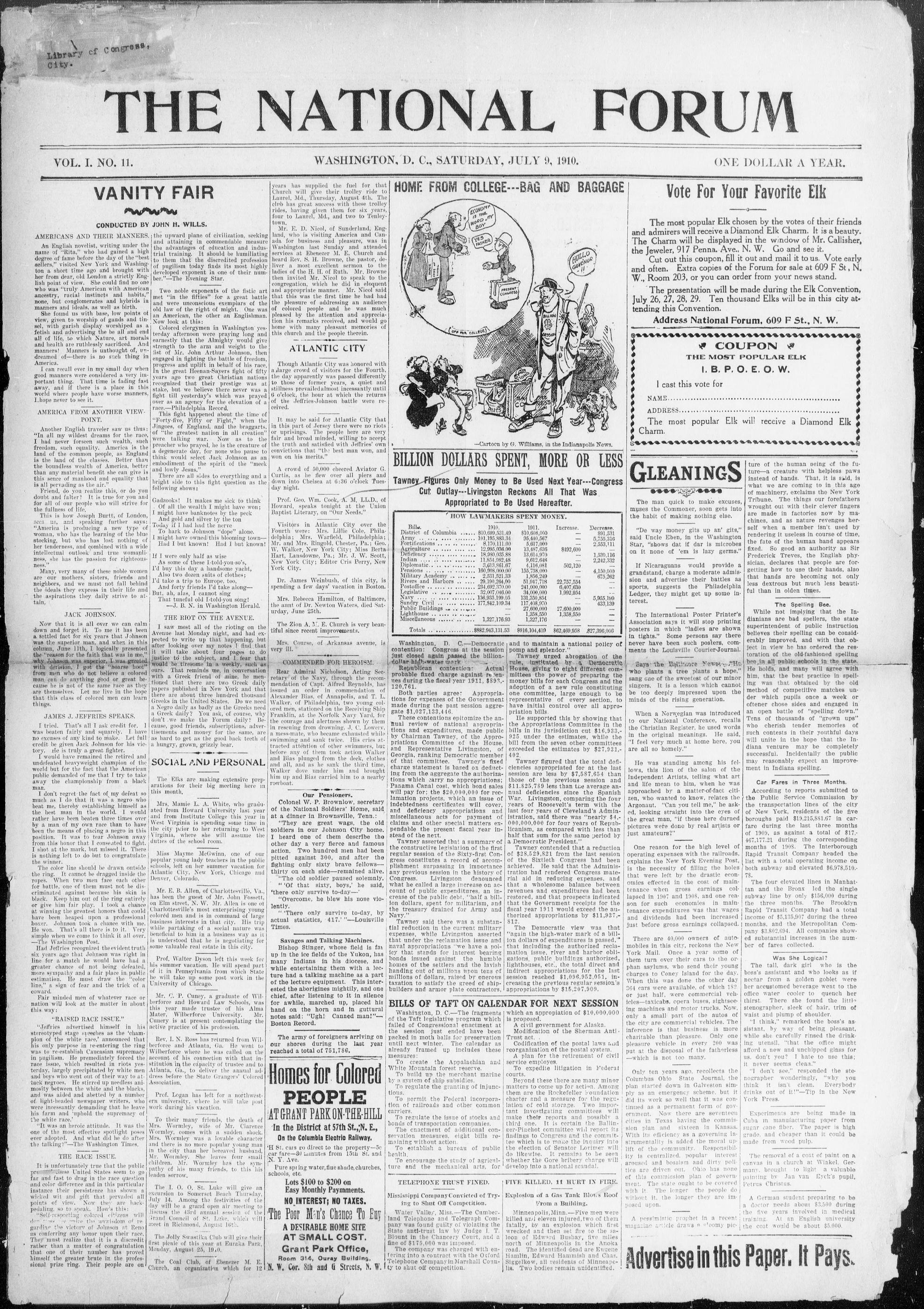
THE NATIONAL FORUM
Library of Congress. City.
VOL. I. NO. 11.
VANITY FAIR
CONDUCTED BY JOHN H. WILLS.
AMERICANS AND THEIR MANNERS
An English novelist, writing under the name of "Rita," who had gained a high degree of fame before the day of "Rita" sells," visited New York and Washingtons to teach and brought with her from dear, old London a strictly English point of view. She could find no one who was "truly American with American ancestry, racial instincts and habits," none, but conglomerates and hybrids in manners and ideals, as well as birth.
She found us with base, low points of view, given to worship of gauds and tinsel, with garish display worshiped as a fetish and advertising the all and all end all of life, to which Nature, art morals and health are ruthlessly sacrificed. And manners! Manners is unthought of, undreamed of—there is no such thing in America.
I can recall ever in my small day when good manners were considered a very important thing. That time is fading fast away, and if there is a place in this world where people have worse manners, Lhone never to see it.
AMERICA FROM ANOTHER VIEW
POINT
Another English traveler saw us thus: "In all my wildest dreams for the race I had never forseen such wealth, such freedom, such equality. America is the land of the common people, as England is the land of the classes. Better than the boundless wealth of America, better than any material benefit she can give is this sense of manhood and equality that is all pervading as the air."
Friend, do you realize this, or do you doubt and falter? It is true for you and for all of our people who will strive for the fullness of life.
This is how Joseph Burtt, of London, accs us, and speaking further says: "America is producing a new type of woman, who has the learning of the blue stocking, but who has lost nothing of her tenderness, and combined with a wide intellectual outlook and true womanliness, she has the passion for righteousness."
Now, very many of these noble women are our mothers, sisters, friends and neighbors, and we must not fall behind the ideals they express in their life and the aspirations they daily strive to attain.
Now that it is all over we can calm down and forget it. To me it has been a settled fact for six years that Johnson was the superior man, and when in this column, June 11th, I logically presented the "reason for the faith that was in me," why Johnson was superior, I was greeted with decision, I got the "hoarse hoof" from men who do not believe a colored man can do anything good or great because he is not of the same race as they are themselves. Let me live in the hope that this class of colored men can learn things.
JAMES, J. JEFFERIES SPEAKS.
I tried. That's all I ask credit for. I was beaten fairly and squarely. I have no excuses of any kind to make. Let full credit be given Jack Johnson for his victory. rie is truly a great fighter. I would have remained the retired and undefeated heavyweight champion of the world but for the fact that the American public demanded of me that I try to take away the championship from a black man. I don't regret the fact of my defeat so much as I do that it was a negro who beat me, thereby establishing himself as the best man in the world. I would rather have been beaten three times over by a man of my own race than to have been the means of placing a negro in this contest. It was their chosen away from this honor that I consented to fight. I shot at the mark, but missed it. There is nothing left to do but to congratulate the winner.
The color line should be drawn outside the ring. It cannot be dragged inside the ropes. When two men face each other for battle, one of them must not be discriminated against because his skin is black. Keep him out of the ring entirely or give him fair play. I took a chance at winning the greatest honors that could be given to him, and made a professor boxer. Johnson took a chance with me. He won. That's all there is to it. Very simple when we come to think it all over. —The Washington Post.
Had Jeffries recognized the evidence truth six years ago that Johnson was right in line for a match he would have had a greater chance of not being defeated, more sympathy and a fair place in public estimation. He must draw the "color line, a sign of fear and the trick of a coarse hair." Fair-minded men of whatever race or nation will look at the matter in about this way:
"RAISED RACE ISSUE"
"Joffries advertised himself in his stereotyped stage speeches as the 'champion of the white race', announced that his only purpose in re-entering the ring was to re-establish Caucasian supremacy in pugilism. He immediately forced the race issue, which resulted in riots yesterday, largely precipitated by white men and boys who went out of their way to attack negroes. He stirred up needless animosity between the white and the blacks and was aided and abetted by a number of light-headed newspaper writers, who were incessantly demanding that he leave his farm and 'uphold the supremacy of the white race.'
"It was an heroic attitude. It was the one of the most effective spotlight poses ever adopted. And what did he do after the talking?"—The Washington Times.
It is unfortunately true that the public prefers these United States seem to go far and fast to drag in the race question and color difference and in this particular instance their persistence has shown a wicked wrist and gift that pervaded all points of view. Now they are back pedaling so to speak. How's this: "Self-respecting colored citizens will respect the awakism and/or gardine the view of Roe as conferring any honor upon their race. They must realize that it is a discredit rather than a matter of congratulation that one of their number has proved himself the greater brute in the professional prize ring. Their people are on
JACK JOHNSON
THE RACE ISSUE
the upward plane of civilization, seeking and attaining in commendable measure the advantages of education and industrial training. It should be humiliating to them that the discredited profession of pugilism today finds its most highly developed exponent in one of their number."—The Evening Star.
Two noble exponents of the fistic art met "in the fifties" for a great battle and were unconscious exemplars of the old law of the right of might. One was an American, the other an Englishman. Now look at this:
Colored clergymen in Washington yesterday afternoon were praying long and earnestly that the Almighty would give strength to the arm and weight to the fist of Mr. John Arthur Johnson, then engaged in fighting the battle of freedom, progress and uplift in behalf of his race. In the great Heinem-Savers fight of fifty years ago we gave Christian man recognition that their prestige was as stake, but we believe there never was a fight till yesterday's which was prayed over as an agency for the elevation of a race—Philadelphia Record.
This fight happened about the time of "Forty-five, Fifty or Fight," when the Jingoes, of England, and the braggarts, of "the greatest nation in all creation" were talking war. Now as to the preacher who prayed, he is the creature of a degenerate day, for none who pause to think would select Jack Johnson as an embodiment of the spirit of the "meek and lowly." There are all sides to everything and a bright side to this fight question as the following shows:
Gadzooks! It makes me sick to think
Of all the wealth I might have won;
I might have banknotes by the peck
And gold and silver by the ton
Today if I had had the nerve
To hark to Johnson "dope" alone.
I might have owned this blooming town—Had I but known? Had I but known!
If I were only half as wise.
As some of these I-told-you-so's,
I'd buy this day a handsome yacht,
Also two dozen suits of clothes;
I'd take a trip to Europe, too.
And forty friends I'd take along—
But, al, alas, I cannot sing
That tuneful old I-told-you song!
—J. B. N. in Washington Herald.
THE RIOT ON THE AVENUE.
I saw most all of the rioting on the Avenue last Monday night, and had expected to write up that happening, but after looking over my notes I find that it will take about four pages to do justice to the subject, and I fear that would become in a weekly, such as with a Greek friend of mine, he mentioned that there are two Greek daily papers published in New York and that there are about three hundred thousand Greeks in the United States. Do we need a Negro daily as badly as the Greeks need a Greek daily? You ask, of course, why don't we make the Forum daily? Because, good friends, subscriptions, advertisements and more, we are as hard to get as good back teeth of a hungry, grown, grizzly bear.
SOCIAL AND PERSONAL
The Elks are making extensive preparations for their big meeting here in this month.
Mrs. Manie L. A. White, who graduated from Howard University last year and from Institute College this year in West Virginia, is spending some time in the city prior to her returning to West Virginia, where she will assume the duties of the school room.
Miss Mayne McGwinn, one of our popular young lady teachers in the public schools, left on her summer vacation for Atlantic City, New York, Chicago and Denver, Colorado.
Mr. E. B. Allen, of Charlottesville, Va., has been the guest of Mr. John Fossett, on Elm street, N. W. Mr. Allen is one of Charlottesville's most enterprising young men as in command of large business interests in that city. His trip while partaking of a social nature was beneficial to him in a business way as it is understood that he is negotiating for some valuable real estate in this city.
Prof. Walter Dyson left this week for his summer vacation. He will spend part of it in Pennsylvania from which State he will take up some post work in the University of Chicago.
Mr. C. P. Cuney, a graduate of Wilberforce and Howard Law Schools, was this year made trustee of his Alma Mater, Wilberforce University. Mr. Cuney is at present contemplating the active practice of his profession.
Rev. I. N. Ross has returned from Wilberforce and Atlanta. Ga. He went to Wilberforce where he was called on the account of his connection with that institution in the capacity of trustee and to Atlanta, Ga., to deliver the annual address before the State Grangers' Colored Association.
Prof. Logan has left for a northwestern university, where he will take post work during his vacation.
To their many friends, the death of Mrs. Wormley, wife of Mr. Clarence Wormley, comes with a sudden shock. Mrs. Wormley was a lovable character and there is no more popular young man in the city than her bereaved husband, Mr. Wormley. She leaves four small children. Mr. Wormley has the sympathy of his many friends, to this his leaden sorrow.
The I. O. O. St. Luke will give an excursion to Somerset Beach Thursday, July 14. Among the festivities of the day be a grand open air meeting to discuss the 43rd annual session of the Grand Council of St. Luke, which will meet in Richmond, August 16th.
The Jolly Swastika Club will give their first picnic of this year at Eurzka Park, Monday, August 25, 19.0.
The Coal Club, of Ebenezer M. E. Church, an organization which for 12
WASHINGTON, D. C., SATURDAY, JULY 9, 1910.
years has supplied the fuel for that Church will give their trolley ride to Laurel, Md., Thursday, August 4th. The club has great success with these trolley rides, having given them for six years, four to Laurel, Md., and two to Tenley-town.
Mr. E. D. Nicol, of Sunderland, England, who is visiting America and Canada for business and pleasure, was in Washington last Sunday and attended services at Ebenenez M. E. Church and heard Rev. S. H. Browne, the pastor, deliver a most excellent sermon to the congregation. He then invited Mr. Nicol to speak to the congregation, which he did in eloquent and appropriate manner. Mr. Nicol said that this was the first time he had the pleasure of addressing an audience of colored people and he was much pleased by the attention and appreciation his remarks received, and would go home with many pleasant memories of this church and the people therein.
ATLANTIC CITY
Though Atlantic City was honored with a large crowd of visitors for the Fourth, the day apparently was passed differently to those of former years, a quiet and stillness prevailed almost incessantly until 6 o'clock, the hour at which the returns of the Jeffries-Johnson battle were received.
It may be said for Atlantic City that in this part of Jersey there were no riots or uprisings. The people here are very fair and broad-minded, willing to accept the truth and satisfied with Jeffries' own convictions that "the best man won, and won on his merits."
A crowd of 50,000 cheered Aviator G. Curtis, as he flew over all piers and down into Chelsea at 6:36 o'clock Tuesday night.
Prof. Geo. Wm. Cook, A. M. LLD., of Howard, speaks tonight at the Union Baptist Literary, on "Our Needs."
Visitors in Atlantic City over the Fourth were: Mrs. Lillie Cole, Philadelphia; Mrs. Warfield, Philadelphia; Mr. and Mrs. Ringold, Chester, Pa.; Geo. W. Walker, New York City; Miss Berta Hart, Lansdowne, Pa.; Mr. J. W. Scott, New York City; Editor Cris Perry, New York City.
Dr. James Weinbush, of this city, is spending a few days' vacation in Boston.
Mrs. Rebecca Hamilton, of Baltimore, the aunt of Dr. Newton Waters, died Saturday, June 25th.
The Zion A. M. E. Church is very beautiful since recent improvements.
Mrs. Course, of Arkansas avenue, is very ill.
Bear Admiral Nicholson, Ace Seeing retreaty of the Navy, through the recommendation of Capt. Alfred Reynolds, has issued an order in commendation of Alexander Bias, of Annapolis, and T. L. Walker, of Philadelphia, two young colored men, stationed on the Receiving Ship Franklin, at the Norfolk Navy Yard, for the courage and alertness shown by them in rescuing from drowning, J. C. Lowery, a mate-mess, who became exhausted while swimming and sank twice. His cries attracted attention of other swimmers, but because of the condition Walker and Bias plunged from the deck, and all, and as he sank the third time, Walker dove under him and brought him up and Bias carried him to a nearby boatbait.
Our Pensioners.
Colonel W. P. Brownlow, secretary of the National Soldiers' Home, said at a dinner in Brownsville, Tenn.: "They are great wags, the old soldiers in our Johnson City home, I heard one of them describe the other day a very fierce and famous action. Two hundred men had been pitted against 300, and after the fighting only sixty brave fellows—thirty on each side—remained alive. "The old soldier paused solemnly. "Of that sixty, boys,' he said, 'there only survive to-day—" "Overcome, he blew his nose violently. " "There only survive to-day, by actual statistics, 417." —Louisville Times.
Sensors and Talking Machine
Savages and Lakers.
Bishop Stinger, whose field is far up in the ice fields of the Yukon, has many Indians in his diocese, and while entertaining them with a lecture had a talking machine as a part of the lecture equipment. This interested the aborigines mightily, and one chief, after listening to it in silence for awhile, marched up, placed his hand on the horn and in guttural notes said: "Ugh! Canned man!"—Boston Record.
The army of foreigners arriving on our shores during the last year reached a total of 751,786.
Homes for Colored PEOPLE AT GRANT PARK ON-THE-HILL In the District at 57th St.,N. E. On the Columbia Electric Railway.
H St. cars go direct to the property-50
car fare-30 minutes from 15th St. and
N. Y. Ave.
Pure spring water, fine shade, churches,
schools, etc.
HOME FROM COLLEGE----BAG AND BAGGAGE
ECONOMY IS THE WORD MY BOY
YES TAYNER
PRESENT CONGRESS
OFF FOR COLLEGE
HUILLO SONENOR
BILLION
SHEETS
IN
PROSUM
APPROVAL
BILL
SHEETS
-Cartoon by G. Williams, in the Indianapolis News.
ARS SPENT, MORE OR LESS
Money to Be Used Next Year---Congress
Vivingston Reckons All That Was
Rated to Be Used Hereafter.
LAWMAKERS SPENT MONEY.
1910. 1911. Increase. Decrease.
$10,699,531.49 $10,608,000 — $80,531
191,165,883.34 95,440,567 — 5,755,316
9,747,814,140 95,440,567 — 2,553,111
12,985,036.00 15,487,636 $492,000 — 1,520,116
18,389,035.88 13,614,970 — 1,520,116
18,389,035.88 13,614,970 — 2,242,332
3,613,861.67 4,116,081 562,120 —
180,998,000.00 155,758,000 — 4,150,000
2,631,521.33 886,249 — 675,262
2,631,521.33 886,249 22,757,554 —
234,692,370.00 241,000,000 6,407,630 —
32,007,046.00 34,000,000 1,992,954 —
136,953,199.05 131,359,854 — 5,955,190
177,842,109.34 117,408,070 — 433,139
177,842,109.34 117,408,070 — 433,139
1,327,176.93 1,327,176 —
$882,943,131.53 $916,104,419 $62,469,958 $27,396,000
BILLION DOLLARS SPENT. MORE OR LESS
HOW LAWMAKERS SPENT MONEY.
Bills
District of Columbia 810,699,531.49 810,698,000 891,531
Army 101,195,883.34 954,456.57 5,755,316
Fortifications 8,170,111.00 5,617,000 2,553,111
Agriculture 12,995,036.00 13,487,636 $492,600
Differences 18,980,035.88 13,614,970 1,530,116
Indian 17,814,092.88 9,619,488 2,242,332
Diplomatic 3,613,810.67 4,118,981 502,129
Pensions 160,998,000.00 155,758,000 4,150,000
Military Academy 2,531,211.33 1,856,249 675,262
Rivers and Harbors 26,190,294.00 51,941,718 22,757,554
Boroughs 24,927,670.00 64,047,900
Legislative 32,007,049.00 34,000,000 1,992,954
Navy 136,935,199.05 131,350,854 5,955,190
Sundry Civil 177,842,109.34 117,408,970 433,139
Public Buildings 27,600,000 27,600,000
Lighthouse 1,327,176.93 1,327,170
Miscellaneous 1,327,176.93 1,327,170
Totals $882,942,131.53 $816,104,419 $629,498,000 $27,396,000
Washington, D. C.—Democratic contention: Congress at the session just closed again passed the billion-dollar high-water mark
Actual probable fixed charge for revenues during the fiscal year 1911, $393,120,761
and to maintain a national policy of pump and splendor."
Tawney urged abrogation of the rule, instituted by a Democrat House, giving to eight different committees power of preparing the money bills for each Congress and the adoption of a new law.
BILLS OF TAFT ON CALENDAR FOR NEXT SESSION
NED. FIVE KILLED, 11 HURT IN FIRE.
of Try-
tion. Explosion of a Gas Tank Blows Roof
from a Building.
Both parties agree: Appropriations for expenses of the Government made during the past session aggregate $1,027,133,446. These contentions epitomize the annual review of national appropriations and expenditures, made public in Tawny, of the Appropriations Committee, the Board and Representative Livingston of Georgia, ranking Democratic member of that committee. Tawny's fixed charge statement is based on deducting from the aggregate the authorizations which carry no appropriations; Panama Canal cost, which bond sales will pay for; the $20,000,000 for reclamation projects, which an issue of indebtedness certificates will cover, and deficiency appropriations and the claims and other special matters expendable the present fiscal year instead of the next.
Tawney asserted that a summary of the constructive legislation of the first regular session of the Sixty-first Congress constitutes a record of accomplishment surpassing in importance any previous session in the history of Congress. Livingston denounced what he called a large increase on account of public expenditures, an increase of the public debt, "half a billion dollars, spent for militarism, and the treasury drained for Army and Navy." Tawney said there was a substantial reduction in the current military expense, while Livingston asserted that under the reclamation naval appropriations "we have a policy that stands for interest, bearing bonds issued against the humble homes of the settlers and the lavish handing out of millions upon tens of millions of dollars, raised by onerous taxation to satisfy the greed of shipbuilders and armor plate contractors.
Washington, D. C.—The fragments of the Taft legislative program which failed of Congressional enactment at the session just ended have been packed in moth balls for preservation until next winter. The calendar as already framed up includes these measures: To create the Appalachian and White Mountain forest reserve.
To build up the merchant marine by a system of ship subsidies.
To regulate the granting of injunctions.
To permit the Federal incorporation of railroads and other common carriers.
To regulate the issue of stocks and bonds of transportation companies.
The enactment of additional conservation measures, eight bills remaining without action.
To establish a bureau of public health.
To encourage the study of agriculture and the mechanical arts, for
TELEPHONE TRUST FINED.
Mississippi Company Convicted of Trying to Shut Off Competition.
Water Valley, Miss.—The Cumberland Telephone and Telegraph Company was found guilty of violating the State ant-trust law by Judge I. T. Blount in the Chancery Court, and a fine of $175,000 was imposed. The company was charged with entering into a contract with the Oxford Telephone Company in Marshall County to shut off competition.
and to maintain a national policy of pomp and splendor." Tawney urged abrogation of the rule, instituted by a Democratic House, giving to eight different committees the power of preparing the money bills for each Congress and the adoption of a new rule constituting one committee, large enough to be representative of every section, to have initial control over all appropriation bills. He supported this by showing that the appropriations Committee in the bills with the jurisdiction, $1,931,925 under the estimates, while the bill from the seven other committees exceeded the estimates by $27,931,402
Tawney figured that the total deficiencies appropriated for at the last session are less by $7,587,654 than those of the previous session and $11,825,789 less than the average annual deficiencies since the Spanish War. Livingston, comparing the four years of Roosevelt's term with the last four years of Cleveland's Administration, said there was "nearly $4,000,000,000 for four years of Republicanism, as compared with less than half that sum for the same period by a Democratic President." Tawney contended that a reduction of $28,529,821 from the last session of the Sixth Congress had been achieved. He said that the Administration had an congress material aid in reducing expenses, and that a wholesome balance between revenues and expenditures had been restored, and that prospects indicated that the Government receipts for the fiscal year 1911 would exceed the authorized appropriations by $11,937,-812.
The Democratic view was that "again the high-water mark of a billion dollars of expenditures is passed." that including the authorized reclamation issue, river and harbor obligations, public buildings authorized, houses, estates, and institutes permitted for the last session reached $1,096,952,051, increasing the previous regular session's appropriations by $15,207,909.
which an appropriation of $10,000,000 is proposed.
A civil government for Alaska.
Modification of the Sherman Anti-Trust act.
Codification of the postal laws and reorganization of the postal system.
A plan for the retirement of civil service employees.
An expedite litigation in Federal courts.
Beyond these there are many minor matters to come up for action. Among them are the Rockefeller foundation charter and a measure for the regulation of cold storage. Two important investigating committees will make their reports and possibly a third one. It is certain the Ballinger-Pinchot committee will report its findings to Congress and the committee to vote the inquiry into election of Senator Lorraine will do likewise. It remains to be seen whether the Gore bribery charge will develop into a national scandal.
Minneapolis, Minn. — Five men were killed and eleven injured, two of them fatally, by an explosion which first wrecked and then set fire to the saloon of Edward Bushay, five miles north of Minneapolis in the Anoka road. The identified dead are Eugene Hamlin, Edward Hammish and Chas, Siggelkow, all residents of Minneapolis. Two bodies remain unidentified.
ONE DOLLAR A YEAR.
For Your Favorite Elk
Mr Elk chosen by the votes of their friends, give a Diamond Elk Charm. It is a beauty displayed in the window of Mr. Callisher Ave., N. W. Go and see it. Bon, fill it out and mail it to us. Vote early ties of the Forum for sale at 609 F St., N. W. can order from your news stand. It will be made during the Elk Convention. Ten thousand Elks will be in this city at on.
National Forum, 609 F St., N. W.
COUPON
MOST POPULAR ELK
B. P. O. E. O. W.
for
Mr Elk will receive a Diamond Elk
Vote For Your Favorite Elk
The most popular Elk chosen by the votes of their friends and admirers will receive a Diamond Elk Charm. It is a beauty. The Charm will be displayed in the window of Mr. Callisher, the Jeweler, 917 Penna. Ave., N. W. Go and see it.
Cut out this coupon, fill it out and mail it to us. Vote early and often. Extra copies of the Forum for sale at 609 F St, N. W., Room 203, or you can order from your news stand.
The presentation will be made during the Elk Convention, July 26, 27, 28, 29. Ten thousand Elks will be in this city attending this Convention.
Address National Forum, 609 F St., N. W.
COUPON
THE MOST POPULAR ELK
I. B. P. O. E. O. W.
I cast this vote for
NAME.....
ADDRESS.....
The most popular Elk will receive a Diamond Elk
Charm.
GLEANINGS
The man quick to make excuses, muses the Commoner, soon gets into the habit of making nothing else.
this Paper. It Pays.
Advertise in this Paper. It Pays.
"De way money gits up an' gits," said Uncle Eben, in the Washington Star, "shows dat if dar is microbes on it none of 'em is lazy germs."
If Nicaraguans would provide a grandstand, charge a moderate admission and advertise their battles as sports, suggests the Philadelphia Ledger, they might get up some interest.
---
The International Poster Printer's Association says it will stop printing posters in which "ladies are shown in tights." Some persons say there never have been such posters, comments the Louisville Courter-Journal.
Says the Baltimore Newspaper, "He who plants a tree plants a hope," sang one of the sweetest of our minor singers. It is a lesson which cannot be too deeply impressed upon the minds of the rising generation.
When a Norwegian was introduced to our National Conference, recalls the Christian Register, he used words in the original meanings. He said, "I feel very much at home here, you are all so homely."
He was standing among his fellows, this lion of the salon of the Independent Artists, telling what art and life mean to him, when he was approached by a matter-of-fact citizen, who wanted to know, relates the Argonaut. "Can you tell me," he asked, looking straight into the eyes of the great man, "if these here durned pictures were done by real artists or just amateurs?"
---
One reason for the high level of operating expenses with the railroads, explains the New York Evening Post, is the necessity of filling the holes that were left by the drastic economies effected in the cost of maintenance when gross earnings collapsed in 1907 and 1908, and one reason for such economies in maintenance expenditures was that wages and dividends had been increased just before gross earnings collapsed.
There are 40,000 owners of automobiles in this city, reckons the New York Mail. Once a year some of them turn over their cars to the orphan asylums, who send their young charges to Coney Island for the day. When this was done the other day 364 cars were available, of which 182 or just half, were commercial vehicles—taxicabs, opera buses, sightseeing machines and motor trucks. Now, only a small part of the autos of the city are commercial vehicles. The inference is that business is more charitable than pleasure. Only one pleasure vehicle in every 200 was put at the disposal of the fatherless—which is not too many.
Only ten years ago, recollects the Columbus Ohio State Journal, the plan started down in Galveston simply as an emergency scheme, but it did its work so well that it was continued as a permanent form of government. Now there are seventeen cities in Texas having the commission plan and sixteen in Kansas. With its efficiency as a governing instrumentality is added the moral uplift of the community. Responsibility is centralized, popular interest aroused and bossism and dirty politics are driven out. Ohio has none of this commission plan of government. The state ought to be covered with it. The longer the people do without it, the longer they are imposed upon.
A possitistic prophet in a recent magazine article draws a sooty pic
0
ture of the human being of the future—a creature with helpless paws instead of hands. That, it is said, is what we are coming to in this age of machinery, exclaims the New York Tribune. The things our forefathers wrought out with their clever fingers are made in factories now by machines, and as nature revenges herself when a member isn't used by rendering it useless in course of time, the fate of the human hand appears fixed. So good an authority as Sir Frederick Treves, the English physician, declares that people are forgetting how to use their hands, also that hands are becoming not only less dextrous but much less beautiful than in olden times.
The Spelling Bee.
While not implying that the Indianians are bad spellers, the state superintendent of public instruction believes their spelling can be considerably improved, and with that object in view he has ordered the restoration of the old-fashioned spelling bee in all public schools in the state. He holds, and many will agree with him, that the best practice in spelling was that obtained by the old method of competitive matches under which pupils once a week or oftener chose sides and engaged in an open battle of "spelling down." Tens of thousands of "grown ups" who cherish tender memories of such contests in their youthful days will unite in the hope that the Indiana venture may be completely successful. Incidentally the public may reasonably expect an improvement in Indiana spelling.
Car Eares in Three Months.
According to reports submitted to the Public Service Commission by the transportation lines of the city of New York, residents of the five boroughs paid $13,215,881.67 in carfare during the last three months of 1999, as against a total of $17,467,177.21 during the corresponding months of 1998. The Interborough Rapid Transit Company headed the list with a total operating income on both subway and elevated $6,978,510.78.
The four elevated lines in Manhattan and the Bronx led the single subway line by only $156,000 during the three months. The Brooklyn Rapid Transit Company had a total income of $5,135,907 during the three months, and the Metropolitan Company $3,802,694. All companies showed substantial increases in the number of fares collected.
Was She Logical?
The tall, dark girl who is the boss's assistant and who looks as if nectar from a golden gobble were her accustomed beverage went to the office water cooler to quench her thirst. There she found the little stenographer, sleek of hair, trim of waist and plump of shoulder.
"I think," remarked the boss's assistant, by way of being pleasant, while she carefully rinsed the drinking utensil, "that the office might afford a new and unchipped glass for us, don't you? I hate to use this; it never seems clean."
"I don't see," responded the stenographer wonderingly, "why you think it isn't clean. Everybody drinks out of it!"—Tip in the New York Press.
Experiments are being made in Cuba in manufacturing paper from sugar cane fiber. The paper is high grade, and cheaper than it could be made from wood pulp.
The removal of a coat of paint on a canvas in a church at Winkel, Germany brought to light a valuable painting by Jan van Eyck's pupil, Petrus Christus.
A German student preparing to be a doctor needs about $3,500 during the five years involved in medical training. At an English university the cost would be about $3,000.
Subscription Rates
One Year.....$1.00
Six Months.....50
Published Weekly
Address all communications, checks and money orders to The National Forum, 609 F Street, N. W., Washington, D. C.
"THE NEXT HOUSE."
When it comes to matters of speedy adjustment, the House of Representatives has no equal. Six weeks ago, it looked as if we would be well on into the dog days, before the Speaker would sound his gavel for final adjournment of the Sixty-first Congress. By some method, known only to those on the inside, oil was poured on the troubled waters, and the beginning of the end hove in sight. More was accomplished in the last four weeks of the Session than had actually been done, in point of real legislation during the whole of the Session, up until that time. All of this goes to show that heat and broken down political fences at home, will do more to bring about speedy legislation than all of the parliamentary usages and the Committee on Rules thrown in.
---
Just now, conjecture is being freely made, as to the organization of the next House and how it will be accomplished. It is fair to suppose that the Insurgents will make their wants known and yet go a step further and insist that their demands be heeded. It has been broadly hinted, that the regulars will be conceded the Clerk of the House, while the insurgents will claim the right to the Doorkeeper. Then the regulars will be conceded the Sergeant-at-Arms and the insurgents insist on taking the Postmaster of the House. This, of course, will only leave the Chaplain and there will be no trouble in getting together on his election. This would seem an equitable adjustment of the matter when not viewed from the inside or when looked at by the laity. But upon a closer analysis, when it is remembered that all of the patronage that amounts to anything will be in the hands of the Doorkeeper it can be readily seen the advantage the insurgents would derive from such division.
Just what effect the enlargement of Committee on Rules is going to have cannot yet be determined. There is one thing that it is likely to disturb and that is the appointment of Committees and committee chairmen. Many aver that it will in no wise effect the power of the next elected Speaker to determine who shall and who shall not be chairman of the different committees in so much as this would be parliamentary courtesy to him and in the light of the consideration that, if he were not permitted this leeway he would be seriously hampered in his program of expelling business. Others aver as strongly that just the opposite result would obtain. The whole matter is seen "but through a glass darkly," now, but after the people have registered their expressions at the polls in the coming November, then "shall we see face to face."
"THE JOHNSON-JEFFRIES AFTER MATH."
The Fourth of July has come and gone. The biggest sporting event of its kind in the world is now history, and it has taught its lesson. The enactment of certain outrages on our main thoroughfare after the announcement of the final round of the big event raises serious and perplexing questions in the mind of the real thinking man. Among the many things alleged to have incited these ugly and uncalled for outbreaks over the country was the one word PRIDE. The real man, after all, is the man who can endure with admirable calm the pangs of an honest defeat. He who cannot do this is manifestly WEAK. After all, Mr. Jeffries and Johnson set the real example for both sides to have followed. They battled honestly. At no time it is said, did they use harsh words toward each other in the ring. Mr. Jeffries took his defeat like the game man that he was and said, "he is the best man I ever met." Mr. Johnson accepted his laurels with becoming grace and returned the compliment by saying, "That's the gamer man I ever saw." They parted better friends than when they met, both with praise for the prevailing spirit and each with a good word for the other. Where is the reason for all the aftermath? To the more sober minded have these interrogations presented themselves to you? Would these things have happened had Mr. Jeffries won? Would ovations have been suppressed? Would elated gatherings have been called riotous assemblies? Think ye that the presentation of the fight pictures over the country would have been disallowed. Is there not some food for thought here? Think on these things.
The people who think of themselves generally have very little to think about, chirps the New York Times.
No wonder the railroad presidents feel that they have been badly treated. What's a little thing like the law between friends? asks the Indianapolis News.
Close by, inscribed to one the world had known;
But ally, that lonely grave with moss o'grown!
Thrilled me far more than his who armies led.
"She made home happy!" Through the long, sad years
The mother toiled, and never stopped to rest
Until they crossed her hands upon her breast,
And closed her eyes, no longer dim with tears.
The simple record that she left behind
Was grander than the soldiers, to my mind.
—American Home Monthly.
THE SHOT THAT MISSED.
I came to make, in company with my friend, Dr. Noirot, the tour of the extensive gardens which surrounded his private asylum for the insane; we were returning to his residence, and he was on the point of relating to me the peculiar circumstances connected with the case of one of his patients, whom we had met, and who had greeted us with an air of great condescension. At that moment the sharp report of a pistol rang out in the still morning air. I grasped the arm of my host and exclaimed: "What is that? Surely some one of your patients is doing mischief!" Dr. Noirot smiled. "No," said he, "be composed; it is merely another singular case, which I will show you."
Diverging to the left, he drew me toward a small pavilion hidden behind a cluster of trees. He opened a door, and after proceeding along a narrow vestibule, we reached a sort of long court, surrounded by high brick walls. A man was there, tall of stature, and clothed in the costume of a hunter, resembling, in certain details, the habit of the Mexican cattle herder. He was reclining against one of the walls of the pavilion, and at the moment of our arrival raised slowly the right hand, in which was firmly grasped a pistol. Our arrival disturbed him not. I followed the direction of the weapon, and I saw at about fifteen paces a white head with a black hole in the centre of the forehead. It was, as far as I was able to judge at that distance, a mask of plaster of paris, skillfully executed, and in which I seemed to be able to distinguish a resemblance to Diana the huntress.
The shot was discharged. The head remained intact.
"See," said the doctor. "It is most remarkable; he never misses a shot."
"Is it possible?" said I, half ineredulously.
"Yes, all the balls are lodged in the same place—in that dark spot not larger than an inch and a half in diameter. See!"
The man had drawn another pistol from his belt. He fired. The head moved out. The weapon was a hand-some revolver, charged with several shots. The marksmans discharged successively five other shots, none of which damaged the figure.
The doctor placed his hand upon the shoulder of the marksmans, who, turning toward him, revealed a face adorned by a heavy black beard, and upon which reposed an air of determination and melancholy.
"Stop a moment," said the doctor. The man bowed assentingly, and the doctor then conducted me to the end of the court and behind the mask, and showed me a kind of blackened from plate which protected the wall from being damaged by the bullets. In the centre of the plate I observed a round spot which glistened brightly from the effects of the lead which had been battered in striking.
"You see," said the doctor, in showing me the exact correspondence of the brilliant spot and the hole which passed through the plaster head, "all balls have entered here. You will find this to be true in every instance."
"It is indeed marvelous," replied I. "But what of his strange history?" "Let us go. I will relate it to you without."
We traversed again the court and the vestibule, and this is the strange recital of Dr. Norlot, interrupted at regular intervals by the detonations of the mad marksmans' revolver: That poor fortunate is called Guido Ventura. Whether Italian, Spanish or American, is not certainly known. American I should say, for it is from the United States these masters of the rifle and revolver come. It was from there he came to France. You could have seen him last season at the Alacazar D'autonne, where he had given four or five exhibitions of dexterity, and would have performed elsewhere had not imperative reasons terminated abruptly his representations.
Guido Ventura, when he arrived at Paris, was accompanied by a young lady, known professionally as Mademokelle Arabelle. She was a magnificent creature, with the form of a statue and the head of a goddess. She lacked not adorers, and in less than a week it became quite the fashion to seethe superb Arabelle assist Ventura in his wonderful performances.
She performed splendidly, the arms crossed, the face immovable, while at fifteen places Ventura leveled his pistol, the bullets from which invariably pierced a card held between the fingers, or broke the stem of a common clay pipe, between her snowy teeth, and within a few inches of her lips. The crowning feat was the breaking of a small glass ball placed upon her head.
A single tremor of the hand of Ventura, and—but the hand of Ventura never trembled.
Evidently Ventura loved this splendid woman with a love approaching idolatry. It suffered to prove this to see once the fierce fires which flashed in his eyes when in the green room, waiting their turns, some gallant became too friendly or attentive to the lovely Arabelle. Jealous? Of course, and the poor fellow suffered atrociously, for his companion, as coquettish as she was beautiful, seemed to
Through the long, sad years
ever stopped to rest
ends upon her breast,
gave dim with tears.
he left behind
Idie's, to my mind.
—American Home Monthly.
HAT MISSED.
take a malicious pleasure in exasperating his passion.
The director of the Alcazar d'Autonne had observed this, and had said:
“Take care, mademoiselle. That man holds each night in his hands your life.”
Arabelle laughingly replied, as she raised those beautiful shoulders:
Each night she stood before the pistol's muzzle with the same calm tranquility, her soft glances calming the revolt of her lover as the eye of the master subdues the rage of the animal.
One evening, scarcely eight days after the arrival of Ventura at Paris, a gentleman of elegant appearance entered the green room and went toward Arabelle, who, with a slight cry of mingled surprise and pleasure, seized the extended hand and kissed it passionately. Guido Ventura, who had been conversing with the director, turned about upon the entrance of the stranger and witnessed this tender reception. His face assumed a deathlike pallor, and his eyes flashed with fearful rage.
The new arrival was a rich Amer-
As a simple busi Which
As a simple business proposition---
Which Wins?
UNGLE SAM spends a billion dollars a year. He clings to single entry bookkeeping. He does not know how much property he has, what it has cost him, or its actual present value. He can not follow a business transaction through and check it up. He can not even strike a true balance.
ican, whose attentions to Arabelle had caused some slightandal during the time which they had remained in New York. It was to avoid this man that Ventura had canceled his engagement there and had come to Paris. And now behold him here! Who but Arabelle could have informed him of their destination? That night, upon their return to the hotel, a violent quarrel took place between Ventura and his companion.
But the most terrible scene of all occurred eight days later. During that week the American was lavish of his gifts and attentions to Arabelle. Ventura endeavored to induce the director to refuse the American entrance behind the scenes. But to no purpose.
On the evening in question, as Arabelle was preparing her stage costume, Guido saw a note fall from the corsage of her dress. He picked it up unobserved, and perused it eagerly. It was from the American, filled with expressions of endearment, and proposing flight on the morrow.
Five minutes later the call boy announced their turn. On their way to the stage, Ventura beheld the American leaning negligently against a scene. Ventura glared at him and hesitated, but at that moment Arabelle, who had made the entrance in advance of him, stood prepared, the arms crossed, the glass ball in position on her head. With a bitter oath, but half-suppressed, Ventura turned and strode upon the stage.
Ventura was in position, the muzzle of his pistol covered the mark, a stillness as of death reigned in that dense mass of human beings in front. Arabelle smiled. On whom was she smiling? On whom save the man who rivaled him in her love? She could smile on a man who dared to make such a proposal! Heaven! she would perhaps assemble to it!
The silence was terrible, but it was soon broken; a quick, sharp report rang out. Arablea tottered and fell heavily to the stage; the bullet had pierced the centre of her forehead.
When the arms of Ventura were loosened from the corpse which he held with an iron firmness to his breast, he was raving mad!
Crime? Accident? One knew not how to decide. At Paris sensations pass quickly, and after the first excitement had subsided the characters of this tragedy were soon forgotten.
Since that time he has passed most of his days of confluence here, before his plaster mask. Once and once only his aim failed, and the head was shattered. For eight days thereafter he was violent, but otherwise he has been harmless and inoffensive as you see.
We returned to the pavilion, and found Ventura cleaning his weapon. "You have not missed, to-day, Ventura," said the doctor, pleasantly. The man raised his head, and
pointing to the mask, said, in a low tone:
"No; always in the centre of the forehead, always in the centre."—New York Weekly.
Coal-Mine Safety Devices
By GEORGE E. WALSH.
In the effort to eliminate so far as possible the dangers of coal-mining, the fuel division of the Geological Survey has been for some time conducting experiments with a number of devices intended to save the lives of miners. Gas and coal-dust explosions in mines exact a heavy toll of lives nearly every year. England and Belgium have had few casualties from this source, owing to extreme precautions, although Belgian mines are notorious for the presence of fire-damp. As a result of experiments in England, there are a number of "permissible explosives" used, and no others, and there is also a "hitch charge," which must not be exceeded by the miners or mine-owners under pain of severe penalty.
One of the devices used in European mines which will probably be used here in the future is an apparatus worn by the members of a rescue party immediately after an accident. This enables them to enter the mine charged with gas and coal-dust vapors. Statistics of mine disasters in this country show that many terrible deaths from suffocation follow an explosion in a mine. If immediately after such an accident rescuers could enter the mine to help the miners, fully fifty per cent, of the fatalities could be averted. The apparatus which is used in European coal-mines is capable of sustaining life where there is fire-damp or the poison vapors that follow explosions. The device consists of a canvas jacket equipped with cylinders of compressed oxygen, connected with the operator's mouth by a flexible rubber-lined metallic tube. The use of the oxygen is regulated by a pressure gauge. The exhalation of the operator is passed through small lumps of potassium hydroxide. The carbon dioxide is thus absorbed and the re-
ness proposition---
Wins?
THE FINANCIAL GROUP who underwrite his bonds, control his natural monopolies, manage his public utilities, dictate his tariff laws, construct his warships, erect his public buildings, and sell hundreds of millions of dollars' worth of supplies to him, know down to the smallest details the condition of their business. From Success Magazine.
maining product, with added oxygen, is available.
With this apparatus a man could enter a mine immediately after the explosion and begin rescue work. The fire-damp and poisonous vapors do not immediately suffocate, and if the miners could be brought to the surface at once they would be saved. Besides having these devices ready at the mouths of the miners for the use of miners, the Belgian authorities require that mine-owners carry a sufficient supply of them in deep underground work. A rescuing party could thus penetrate deep tunnels, and affix an apparatus to the head of a suffocating miner so that he would not die while being carried to fresh air.
Mine explosions have been reduced in mine and seriousness in Belgium by the compulsory use of standard miners' lamps which are tested by government experts. Many of the so-called safety lamps used by miners have been found inadequate. Under severe tests in the government experiment stations they have leaked sufficiently to ignite fire-damp and coal dust. Another point which the experimental tests have developed is that more explosions are due to coal dust than to fire-damp. The careless use of explosives by the miners themselves is a common cause of explosions and cave-in accidents. The men in their hurry or carelessness use too heavy charges and cause underpropping of the supports or produce an explosion through the concussion.
The ventilation of the mines is another great advance made in recent years, which will soon be improved much further. With the invention of electric fans and suction air-pumps so enclosed that they are air-tight, the deepest tunnel can be kept fresh and practically free from dangerous fire-damp and poisonous gases. These air-pumps and ventilators can be operated night and day, and it is possible to keep a mine as fresh as the upper air.-Harner's Weekly.
Wild Animal Diet.
"I am perfectly used," remarked a visitor to the Central Park zoo, "to see monkeys and elephants eat peanuts. And I do not think it strange that the toucans relish them, for they are very much like a parrot. But when it comes down to polar bears, buffaloes, wild dogs and the rhinoceros liking peanuts, it disturbs my ideas of wild animals." Peanuts, however, seem to furnish the finest of dainties to even the "wildest" animals in the zoo. The deer, antelope, brown bears, ducks, golden pheasants and all the animals there, except perhaps the lions, tigers and eagles, eat peanuts. The peanut seems to have charms to soothe the savage breast.—New York Tribune
Oil and coal are successfully burned to gather under boilers in England.
THIEVES WHO HIDE LOOT.
Recovered Later, and the Ex-Criminal Lives in Wealth.
It is well known to the police that there are a number of ex-convicts who are literally rolling in riches and driving about London and the provinces to-day in their own motor cars and carriages, said a detective to the writer the other day. The majority of these men are old embezzlers and there seems to be little doubt that they are able to live well and keep going lavishly furnished residences because the money they stole was hidden by them before being arrested and sent to prison.
It may surprise you to know that thousands of pounds' worth of valuable property looted by thieves from various sources lies buried in odd corners of Britain and will probably only be recovered by the men themselves on their release. Cases are constantly occurring where an embezzler after running off with a large sum in gold refuses to divulge the hiding place of his ill gotten gains. He is sent to prison and the loot remains unrecovered. In nine cases out of ten the embezzler finding arrest imminent buries his stolen property and digs it up again when he comes out of prison.
A man who was for many years an inmate of one of our prisons is now living in affluence in a town up north. He was imprisoned for embezzling £70,000 from his employers and he declared at the trial that he had spent every penny of it. For some time after his release from jail he lived in a cheap lodging house at Hoxton and then one day he declared that he had come into a fortune, a brother in Australia having died and left him some thousands. As a matter of fact, although the police had no proof, he had recovered the money which he had embezzled years before.
A man of considerable means now living in the States served a term of imprisonment for forgery, having obtained £15,000 by means of false checks. Not a penny of the money was recovered by the police. During the forced confinement of the thief his wife, in pursuance of a previously agreed plan, went out to service in a gentleman's family. As soon as the husband was liberated, however, the wife resigned her position and the pair sailed immediately for the colonies. It ultimately came to light that the money which had been stolen by means of the forged checks had been buried under the flooring of a Soho house.
Some fifteen years ago a Hindo merchant who had come to London to make purchases of gems was robbed of many thousands of pounds. The thieves carried their ill gotten wealth to a cheap tenement in Whitechapel, but finding the police hot on their track they carried the loot one dark night to a remote spot on the Essex marshes and secretly buried it. They then disappeared and have not been seen since. It is believed that the money remains to this day where it was buried.
Not so very long ago a burglary was committed by a couple of well known thieves, who got away with about 2500 in coin and banknotes. They were arrested, but refused to state what they had done with the money, although one darkly hinted that it had been buried in a garden in a suburb of London.—From Tit-Bits.
The Art of Disguise.
The disguise that really serves its purpose instead of only betraying its wearer is a difficult art. It is an art that enters more effectually into real life—its romance and tragedy—than most people would be disposed to believe.
In the case of men, the beard is undoubtedly the greatest aid to disguise. But great care has to be taken, for if too striking an appearance were given to the subject the whole purpose of the scheme would be defeated. In our art the whole secret of success lies in not attempting too much. There is no particular kind of beard. As a rule, it has to be thin, and is usually of a lighter hue than the hair.
Besides altering the complexion, the use of slightly smoked glasses often helps greatly toward a good disguise. Alterations can also be made in the arch and color of the eyebrows; and, talking of eyebrows, you would be surprised if you only knew how often we have to paint out black eyes.
Of course, with certain persons it is useless for us to attempt a disguise solely by working on the face. Attention has to be paid to the contour of the back and shoulders; while sometimes the use of a towel or two over the latter inside of the coat works a great change. The use of a high heel and low one is often successful in altering the gait, but in this matter a good deal depends upon the person himself.—Strand.
Free Operation.
"Dr. Doyen fought a duel with a Belgian while I was on the Riviera," said a Chicago surgeon. "You've heard of Doyen? His latest is a serum that, increasing tenfold the energy of our white blood corpuscles, wards off old age.
"Well, we gave him, we saw bones, a supper at the Cergie de la Mediterrance in Nice after his duel. He won the duel, you know. And in his after-dinner speech he told us how he had said to the Belgian, as he ran him through:
"You lucky dog! I'd charge any other man 50,000 francs for an abdominal incision like this. And yet, by joy, you don't look over pleased!" —Detroit Free Press.
A New Kind of Farm.
The Artcraft Institute of Chicago, which since 1900 has taught more than 600 unskilled women home and art occupations that have enabled them to become self-supporting, is preparing to enlarge its scope by establishing an educational farm. The Artcraft Institute is an educational combination of school, club and workshop, reaching from the home to the business world.—American Educational Review.
HOME MADE.
I do not yearn for terrapin or salman
steak or trout
Or venison or quail or ennawack
Or lamb or Newburgh or a dish of devil-
lure crab
Or mushrooms or truffles rich and black.
But my hearts go harking backward or
the beaten path of years
To places where I once was wont to roam.
And again I see before me on a china
platter piled
The shortcakes that they used to bake at home.
They went into the oven, just a dozen to the pan.
Like little balls of light and fluffy snow, and they issued forth like cobblestones or
Or any substance far removed from dough. But
you can make it with flour, and I sing
and I write, for them, as they sing.
When I go to fish for tarpon in the foam, For I'd like to take one with me for a sinker on my line, The shorttake that they used to make at home—Minna Irving, in the New York Sun.
"Quite a large sign there, 'Post No Dills.'" "So it is. I wish my tailor could see it"—Birmingham Age-Herald.
"He's got no license to talk the way he does." "Oh, he's got a Hitense, all right. What he lacks is a muzzle!"—Cleveland Leader.
"Why do you think the milkman is selling us condensed milk, dear?" "Because two quarts of it just fits a quart jar."—Houston Post.
"Papa, Mr. Blitherington says he will kill himself unless you let him have me." "Does he say that as a threat or a promise?"—Chicago Record-Herald.
Uncle Bill—"How much money have you got in your bank, Tommy?" Tommy—"Not much. The depositors have fallen off awfully since Violet got engaged."—Judge.
The breeze that sweeps the waves screne Removes the dust,
And keeps. I to The ocean clean.
Him—"I was confused for a bit, I confess, but it took me only a moment to collect my wits—" Her—"Yes, it couldn't take any longer than that. Go on."—Cleveland Leader.
The Count—"Ah! Do not refuse me, sweet angel of my dreams, for I cannot live without you." The Heress (reflectively)—"That's just what I was afraid of."—Life.
Husband (to wife, packing trunk)—"But how am I going to get my things in?" "Wife—"I don't see that you need to take much, my dear. You look very well as you are."—Life.
Jones (to friend who is showing his collection of "old masters")—"How do you know they are originals?" Friend—"Oh, I was too smart to play into the hands of a dealer. I bought 'em myself right on the spot."—Judge.
The Maiden Aunt—"No, sir! No traveling second-class on the continent for me. How do I know with what strange man I might be locked into a compartment?" "That's so. But the man wouldn't know what was coming to him, either."—Life.
The joker bids us laugh our fill And be exceeding gay; But when one turns up in a bill We sell them feel that way.
She—"Did you see where some man declares that women are not honest?" He—"Well, he's right in saying so." She (fiercely)—"When did you ever know me to do a dishonest thing?" He (tenderly)—"When you robbed me of my peace of mind and stole my heart, you dear little thief!"—Baltimore American.
Artemis (gazing into the crystal)—"I see rolling downs—crowds—police—horses. They are racing. The horses round the bend—the jockeys lash them. They near the post—two lead neck and neck—a dead heat—no one of them dashes ahead and wins." Client—"Yes, yes, but which? What are the winner's colors?" Artemis—"Alas, I cannot tell you! I am color-blind!"—Punch.
The President and the Magazines.
The President and the Magazines. Talking with more than one visitor, the President expressed himself very freely on the subject of the attitude of the magazines and newspapers. Mr. Taft does not accept this criticism as sincerely made. He attributes the antagonism of the magazine writers chiefly to the demand for muck-rake copy. He feels it the more keenly because the magazines are the recipients of what he calls a subsidy from the Postoffice Department. It appears to him gross ingratiature for the periodical press to attack the Government, which annually contributes millions of dollars to its support. Conscious of the rectitude of his purposes, he finds it impossible to understand how persons so well informed as are the political writers for the magazines and the correspondents of the daily papers can impugn his motives or give to political news the representations which he reads in the press.—William Bayard Hale, in World's Work for June.
In Norway the average length of life is greater than in any other country.
ATTENTION!
For a few days we will make to your order a
Two-Piece
SUIT
FOR ONLY
$16.50
from woolens that regularly sell at $20 and $22.50. Choice of 75 patterns. Goldheim & Sons 403-405 Seventh St.
Every Few Years You Pay Enough FOR
Rent To Buy a Home of Your Own
Very few chances now left to buy cheap homes in the District of Columbia.
Go out and look at
East Deanwood, Burville,
Beverly, D. C.
This subdivision lies on both sides of the COLUMBIA ELECTRIC R. R., between Bennings, D. C., and Chesapeake Junction.
One fare and 20 minutes' time to the city. Lots off at Brooks' Station, East Deanwood, D. C.
Buy now when you can get lots cheap. Prices will soon advance. Greater Washington is spreading out in every direction and will soon cover the entire District of Columbia.
Lots sold on easy monthly payments.
No interest and no taxes till lots are paid for. Title perfect.
This is now the only section of the District in which laboring people and people of moderate means can buy homes. Buy now. The price will soon be double what it is today.
The undersigned agent will show the ground. Call and see him and arra-
dise to do out to look the subdivision over.
SALISBURY BROOKS
1133 15th St., N. W.
Frenk T. Rawlings Co.
1505 Pa. Ave., N. W.
Architectural Plans Prepared.
Materials selected or furnished. All
building details superintended with skill
and promptness.
Office: 51st and G St., N. E.
Address R. 3, Box No. 44
EAST DEANWOOD D. C.
NEWSPAPER ENGLISH.
Veteran Reporter Takes Occasion to
Roast Some Ordinary Specimens.
Albert L. Blair, a veteran newspaper man of Brooklyn, recently entertained the Business Men's Association of Bridgeport, Conn., with a description of the inside workings of the newspaper. During his talk he discussed different phases of the profession, which he declared is one of high calling and second only to the ministry and pedagogy. The reporter, he said, is a necessary nuance, and is the man who really makes the paper. Many specimens of newspaper English came in for a grilling. Among them was the word "gutted," which he said happened to every house which had caught fire. He said this word had no place in a clean and up-to-date newspaper. He also asked why it was that there were so few "fires" in newspapers, why they were always "conflagrations." He wished that some reporter would say that a criminal "brawl sideways" or any other than "down" when he confessed. He always breaks "down," said the speaker. Again, a man never "says" a thing nowadays, he declared. He "makes a statement," he "states." The bride always "comes in on the arm" of her father or somebody else. I consider that a great feat, he declared, "to be able to carry a woman on one's arm. It is second only to the feat of Byron, who said he stood on the Bridge of Sighs in Venice with a palace "on one hand and a prison 'on the other. Byron was a poet and an athlete, so I believe he did what he said." Another one is the "inclemency" of the weather. At a banquet there is always a "bounteous repast to which full justice was done." Whenever I read anything like that I hear a lot of people in a hall gobbling up food. All after-dinner speeches are of course "post-prandial."—From the Editor and Publisher.
Dante as a Sorcerer.
A correspondent of the Times sends a curiously interesting paper on "Dante as a Sorcerer," based on the recently published documentary records of the processes instituted at Avigon by Pope John XXII, against Matteo Viscioni and his son Galeazzo of Milan. The Viscioni were charged with having resorted to witchcraft in order to injure the Pope, and Bartolomeo Canholati, the chief witness against them, declared that in an interview with Galeazzo the latter stated that he had conferred with Dante. The evidence, which is in Latin, makes no definite charge against Dante. All that Canholati alleges is that Galeazzo had caused Dante to come to him on this business; and the general impression of his evidence is that Dante had an uncanny reputation for some people, and that Galeazzo may have hoped that he would consent to exert his maleficient powers against a man whom he (Galeazzo) hated." The particular method resorted to in this case was the "sub-fumigation" of an image, so that as the image was consumed with heat so would the person be consumed "against" whom the image was made; and we have Dante's own testimony in the "Purgatorio" (XXV. 23) that he believed in the efficacy of that form of witchcraft.—London Spectator.
The Luggage Question.
Defiance Nicoll, lawyer, is always a well dressed man, and abominates a slovenly appearance. At the Union Club he said of a Westerner one day: "He has come to New York for a week and I don't believe he has brought a sitch of luggage with him."
Hero Mr. Nicoli smiled.
"Unless, indeed," he added, "he's stowed something in the large bags he carries in the knees of his trousers." Now York Tribune.
Children are often worried because their mothers are often attentive and continually reprove their small ones without reason. A child should be left alone and be allowed to play or amuse itself in its own way without constant direction of a nervous mother. A boy, for example, enjoys more a few simple toys, and something which his own ingenuity has worked out, than the most elaborate plaything which has been bought. In the same way the little girl will lavish her affections on a misshapen doll, probably made at home, while the most artistic production of the toy shop will lie in state, to be taken up on rare occasions. Keep children well, clothe them sensibly, let them understand they are to amuse themselves, and don't "fuss" them—New York Press.
Above everything let your household linen be of the best quality and commence housekeeping with a good supply. Pinch in other departments—if you must pinch—but not in this. No part of the furnishings of a house marks the refinement of a woman's character as does the quality of her house linen. It is economical, too, for, although the initial cost is somewhat greater, the wear is more than double. You may darn good napery, but common damask or linen will not bear darning; therefore, from whatever standpoint the question is viewed, the result is the same. One of the most useful of wedding presents is a quantity of house linen, says Woman's Life. It will be a substan-
tial help and will last long after the showy gimcracks which generally form the bulk of wedding presents have departed the way of all trifles.
Judge Has Feminine Staff.
John J. Jenkins, of Chippewa Falls, Wis, recently appointed judge of the Federal Court in Porto Rico, will have a staff of feminine assistants. He has appointed four young women to fill important places connected with the judiciary of the island. The appointees and their duties and yearly salaries are as follows:
Miss Lou Cosgriff, court reporter, salary $2000; Miss Nell Colburn, deputy clerk of court at San Juan. salary $1500; Miss Lulu Gross, deputy clerk of court at Ponce, salary $1200; Miss Mary Mimmons, deputy clerk of court at Mayaguez, salary $1200.
Judge Jenkins has received over three hundred and fifty applications from all parts of the United States for these and other posts of which he has charge.
The Misses Cosgriff and Colburn have been in Judge Jenkins' employ for some time. Miss Colburn formerly was his stenographer and has held a similar post with United States Senator Stevenson.
The "dirigible gown," so named because it is capable of many evolutions, and at the same time is perfectly safe and exceptionally modest, is ready to make its debut in Fifth avenue to supplant the startling pantaloon creation of last season, and to become the subject of hours of discussion over the tea tables.
Stylish as a walking gown in city or town, the dirigible, simply by unbuttoning here and fastening there, may be changed to a garment of comfort and ease, especially adapted for the golf links, horseback riding or canoeing.
The new creation comes from a costume establishment in Fifth avenue, the American birthplace of the censored directoire and of the pantaloon. It is made of broadcloth, the upper portion of the garment cut in modest fashion, with three-quarter collar and the skirt on lines which allow, when used as a walking gown, for a neatly fitting front and back. The bottom of the skirt hangs halfway between the ankle and the instep.
A "Corner" In Comfort
It is not very different from any walking gown, except that the front of the skirt is divided, one portion overlapping the other and each held in position by stoutly sewed buttons.
ICED POSTUM
For the golf links, the polo field, the balloon or the aeroplane the dirigible skirt is quickly transformed, almost before the invitation is ended. The skirt is unbuttoned down the front, and the divided sides are taken in on an angle, much like reefing a sail, thus relieving the weight from the bottom of the skirt and allowing freedom for running of jumping.—New York Special to Baltimore Sun.
"There's a Reason" for POSTUM
the latest
So why
MUNYON'S
PAW-PAWPILLS
The best Stomach and Liver Pills known and a positive and speedy care for Constipation; Indigestion; Jaundice; Billiousness, Sour Stomach, Headache, and all alliments arising from a disordered stomach or sluggish liver. They contain in concentrated form all the
The Storman and Litter Pills know a positive precede care for Constipation, Indigestion, Jaundice, Bilirousness, Sour Stomach, Headache, and all ailments arising from a disordered stomach or sluggish liver. They contain in concentrated form all the virtues and values of Munyon's Paw-tonic and are made from the juice of the Paw-tonic. I un-identify recently that pills being the best laxative and cathartic ever compounded. Send us postal or letter, requesting a free package of Munyon's Celebrated Paw-Paw Laxative Pills, and we will mail same free of charge. MUNYON HOMEO-PATHIC HOME REMEDY CO., 534 and Jefferson Sts., Philadelphia, Pa.
She Understood.
Mrs. Newhouse was patiently instructing her Irish maid of all work as to the proper names of certain articles.
"And, Bridget," she said at one time, "these are ewers—ewers—don't call them jugs any more."
"Sure, an' I won't, ma'am," said Brigdet joyously. "An' is all them little basins mine, too, ma'am?"—Youth's Companion.
Dramatic Note.
Nick—What good is an asbestos curtain, anyhow?
Nax—Keeps the show from being roasted.—Yale Record.
Trial Bottle Free By Mail
If you suffer from Epilepsy, Fits, Falling Sickness, Spasm, or have children that do so, my New England hospital, please contact you and you are asked to do so is to send for a Free Trial $5 Bottle of Dr. May's Epileptiolide Cure
It has cured thousands where everything else failed. Guaranteed by May Medical Laboratory. The New England Hospital is a New England Guaranty No. 16971. Please write for Special Free $5 Bottle and give AGE and complete address
DR. W. H. MAY. 548 Pearl Street, New York.
Writer's Cramp.
"Pa, what is writer's cramp?"
"It's being cramped for money,
my son. All writers suffer from it."
—Red Hen.
For HEADACHE—Hicks? CAPUDINE
Whether from Colds, Heat, Stomach or
Nervous Trubles, Capudine will relieve you.
It's liquid—pleasant to take—immed-
ly. Try it, 100., 250., and 500 at drug store.
ODDS AND ENDS.
Australia had a wheat crop in 1908-9 of 82,400,000 bushels. Abraham Lincoln's fortune was $75,000. Madriz pays his generals 20 cents a day in 15-to-1 paper money, or 1.6 cents in gold. New York has discovered that it pays $100,000 a year for the wooden skewers in the meat. Cuban goods were invoiced for the United States through the Havana consulate during the last quarter in 1909 to the value of $8,283,476. Massachusetts mills turn out about 90 per cent. of the writing paper used in the United States each year. Two Illinois men have patented a lathe with a removable shield to prevent chips flying into its user's eyes. So powerful are the jaws of a wasp that the insect has been known to puncture a sea shell. The cost of a transatlantic cable averages very nearly $1,200 per mile.
A 50,000-ton steamer, the largest craft ever built, is planned for one of the leading transatlantic companies.
More than 34 carloads of sunflower seed were raised in a single Illinois county last year and sold for medical purposes or bird or stock food.
A French aeronaut has patented a balloon which, when deflated, can be packed in its basket and the entire equipment carried on a man's back. The company uses a large, efficient manager, cool, sensible man, to see that the parties are properly mated. The parties to the marriage will attend to the love, but neglect the business end of the match, which is more important.—Achison Globe.
For those who know the pleasure and satisfaction there is in a glass of
Make it as usual, dark and rich—boil it thoroughly to bring out the distinctive flavour and food value.
Cool with cracked ice; and add sugar and lemon; also a little cream if desired.
Postum is really a food-drink with the nutritive elements of the field grains. Ice it, and you have a pleasant, safe, cooling drink for summer days—an agreeable surprise for those who have never tried it.
Postum Coreal Co., Limited,
Battle Creek, Mich.
Woman's Realm
Cream of Potato Soup.—Pare three large potatoes, cut them in quarters and boil for five minutes. Throw off this water and pour on a pint and a half of boiling water. Add one onion whole, and the tops of some celery. Cover and boil until the potatoes are soft. When thoroughly boiled take out the onion and celery and pass the potatoes and water through a sieve. Scald a pint of milk. Blend to a smooth paste one tablespoonful of butter and one of flour and stir it into the milk until creamed; then put in the potatoes. Let the soup boil for five minutes when it is ready to be served.
Concerning Children.
A Talk to Engaged Girls.
Our Cut-out Recipe.
Paste in Your Scrap-Book.
Judge Has Feminine Staff.
"Dirigible" Gown Now.
The Adaptable Girl
Ask yourself, "Am I adaptable?"
This is the secret of much popularity. It is not clothes nor money nor looks that count so much as the power to adjust oneself to surroundings; in other words, to fit in.
Women are adaptable enough when it comes to clothes. They will let themselves out or pinch themselves in, be boned as for a stratjacket or take to girdles, be concave or convex, hipless or hipped, be frilled or slinky, shuffle their flesh and their organs from one point of anatomy to another, plaster the hair or wear innumerable and disfiguring false locks to meet the latest flicker of fashion.
So why not turn this adaptability
to account temperamentally? It will make life easier to live not only for yourself, but for those who must live with you.
The girl who thinks nothing too much trouble to keep in fashion will not take time to adjust herself to family rules, dispositions or views.
Half the family troubles are due to lack of adaptability. There are varied tastes and natures among brothers and sisters, parents and children. Does the average girl recognize these differences and adjust herself to them?
Not she. She takes the Grant motto of fighting it out on these lines if it takes the rest of her life. Flacating, adapting, sinking one's own personality for sake of harmony never occurs to her.
Perhaps a girl has had more advantages than her parents. She has been to school or college, has outgrown home life. What results? Instead of adapting herself to ways of the household, biding her time for changes, she frets, grows superior in her manner, drifts away from her family, even is guilty of being ashamed of them.
Why are there so many unwelcome visitors? Lack of adaptability. However odd the customs of your friend's home may seem, accept them as your own, not grudging, carping, or with an air of sufferance, but as if born to them. If you don't like them, say nothing, but don't go back.
Have you gone to live in a new town? The surest way to remain an outsider is not to be quick readjusting. It is not easy when one has reached mature years to make new friends, to shake down into strange
surroundings. It will never be done if you spend your time lamenting old ways instead of adapting yourself to new ones.
The girl who is adaptable will never criticise the customs of the place that is to be her home. She will not announce, "We did so and so in Blanktown." "How queer we never had such a bridge rule at home!" She may disapprove and feel she can improve as much as she likes, provided she keeps it to herself.
The adaptable girl does not force her opinions, obtrude her wishes, or become a regulator. She does not groan over past luxuries when fortune takes wing, nor be ever anxious for something that is not at hand.
She may not like circumstances, but she makes the best of them. So doing, she finds them not half so bad as pictured.
It is well not to be too adaptable. Where this trait is merged into yielding a point of conscience, because others see no harm, to become a nonentity with a mind that wabbles toward the last person, it is not to be desired. Better be a "stand-cuter" than a "standpatter" under such conditions.—New York Times.
FRILLS
OF
FASHION
Afternoon gowns are more or less elaborate.
Tucking is used a great deal on the light gowns.
Swiss fabrics are often worn with a colored slip.
This season one finds entire coats and wraps of cretonne.
The elastic belts, in different widths, are more popular than ever.
Many coats have long revers that cross and button below the waist line.
Coarse Russian braid is used a great deal for trimming coats and capes.
The chanteceler is found embroidered on the instep of the latest silk hosiery.
The tiniest of roses are used for trimming caps of muslin or lace for the baby.
The shoulder seam on the new shirt waist is much longer than that of last season.
Lingerie embroidered with the all-pervading chanteceler is one of the fads of the hour.
A box-pleated quilling of net is the finish at the wrist of a pretty sleeve seen recently.
Ribs of brass as well as of gilt and white enamel are seen in some of the summer sunshades.
Separate blouses of black net with lace insertion are worn over an underblouse of white.
Exquisite separate blouses are made of the soft crepe printed in the rich Paisley patterns.
One of the old fashions that has been revived in the use of oblong gold buckles to trim gowns.
Bathing suits fashioned after either a princess model or the Russian blouse are favorites this year.
The Retort Direct.
"See here," cried the artist, who had come to complain about the materials he had bought, "I can't imagine anything worse than your paints."
"That's strange," replied the dealer; "don't you ever use your imagination on your painting?" — The Catholic Standard and Times.
The HOUSE and HOME
Dye With Tee.
A garment made of almost any material may be creamed with tea. Make the tea strong and soak the garment well in it.
Iron the garment before it dries and the color will be a pretty cream. The tea does not streak the goods, as coffee does, and is a prettier color and less expensive than the creaming substance that is bought.—Indianapolis News.
Skirt Making
In making the new five-gore skirt with very little fullness below (this is the Parisian skirt of the moment), it is necessary so to fit it over the hips that all extra fullness is taken from each gore, and thus the position of each seam will not be changed.
In other words, do not push all of the extra fullness into the central back box pleat and thus rowd the added weight to this one spot.—Eoston Post.
Scerted Sheets.
It is said that lavender scented sheets induce slumber. Whether that is true or not, it is certain that to lie down in bed after a lovely refreshing bath in sheets that have a delicate scent of lavender about them is most refreshing and luxurious. It does not cost much to have this luxury and it is within the possibility of almost every housekeeper to have in her linen closet several finely cut packages of dried lavender leaves. These can be bought upon the street almost any time. Put the little packages between the sheets, pillowcases, towels and wash clothes. You will find that the odor will last for a long time and will be enjoyed by all who use your linen, the odor is so deliciously clean. —Newark Call.
An English Idea
What is known as e "Dorothy bag" in England is often made of a worn-out tail silk hat. Begin by cutting the hat close to the brim all round, and then slip off the silk covering; it will be found to be already in shape of a convenient bag, and merely in need of a lining of colored silk, which can be made by cutting a disk the same size as the circle at the top of the hat, allowing for narrow turnings. The sides are the same size and depth as the outer covering, and the silk lining, being made separate, is put inside the outer covering; the edges of the latter are turned down an inch and the former turned in to meet the raw edge and just cover it. Small brass or bone rings are sewn inside, eighteen being needed, at intervals; a piece of silk cord is passed through the rings, allowing enough to draw up to form two handles, and it is then sewn together at the ends, the bag being thus completed. Old tall hats can frequently be found in the attic, and satisfaction lies in using them.—New York Press.
A Camphorated Bath.
Nothing is so invigorating when tired and warm as a scented bath of hot water. In warm weather it proves particularly refreshing when taken before dressing for the evening.
The simplest of these baths is made by adding cologne, toilet water, or violet ammonia into a quarter of a tubful of water.
A good aromatic mixture to keep on hand is made from two ounces of tincture of camphor, four ounces of cologne and an ounce of tincture of benzoin. Add enough of this to the bath water to make it milky.
If you are presented with colognes or toilet waters that are not especially fragrant, use them in the bath. The scent is so faint as not to be disagreeable, and the refreshing qualities are as great as from more expensive colognes.
Another refreshing bath is Made by squeezing the filtered juice of four lemons into a quarter of a tubful of water.
Where the aromatic bath seems extravagant, or there is no time for it, put a solution of the mixture given above into a spray and spray it over face, neck and arms.—New York Times.
FOR THE EPIGURE
Rice Balls.—Boil cupful of rice in water and add salt. While warm mix in quarter pound of butter, two eggs well beaten, and tablespoonful of cinnamon. Make this into small balls and fry in deep fat. Drain and roll in currant jelly, then powdered sugar.
To Caramelize Sugar.—Put sugar in a smooth granite saucepan or omelet pan, place over the hot part of the range and stain constantly until melted and the color of maple sugar. Care must be taken to prevent sugar from adhering to the sides of the pan or spoon.
To Freshen Lettuce.—Wash the leaves a few hours before using, wrap in waxed tissue paper and put it on the ice. All the ingredients of moist salads can be prepared in good season and time saved by covering them with the tissue before using to prevent drying.
Mock Fried Oyster.—Scrape and slice thin one cup salisey or vegetable oyster, cook in a little water until tender, cool and add one egg, a little salt and pepper and two crackers broken fine; shape into oyster shape and fry and serve on steamed bread with melted butter.
Cream of Potato Soup—Pare and cut small four medium-sized potatoes, one onion and a little celery. Cook until tender in salted water. Mash, stir in a little butter, pepper and flour. Add this picee to one quart of hot mk'k. Stir well, reheat and serve with crisp crackers.
"Biernstieger Bjornson, in his hotel fronting the Tulleries gardens, received a few friends up to the last in Paris," said the continental agent of a typewriter firm.
"I had the honor to be among those friends, and I never weared of the great Norseman's wit and wisdom."
"The last thing he said to me, in cautioning me not to give an important proverbal agency to any easy going man of the world, was this: "Beware of the easy going man. An easy going man can be a path of life very rough and difficult for somebody else."—Detroit Free Press.
Supporting The Courts.
Redd—Do you believe in heartily supporting our courts?
Greene—I certainly do. Why, I contribute to their support as a motorist, or my wife helps them as a subrogator as a sufraget? Yonkers Statesman.
SCREAMED WITH PAIN.
Rochester, N. Y., Woman's Terrible
Suffering from Kidney Trouble.
Mrs. F. M. Carrillo, 130 Allen St.
Rochester, N. Y., says: "My kidneys
and bladder were in terrible condi-
termine condensation. My ankles and writes swelled and tears appeared beneath eyes. The pain when passing the kidney secretions was often so great as to make me scream. I was treated by, by, a physician.
tion. My ankles and wrists swelled and puffy sacks appeared beneath my eyes. The pain when passing the kidney secretions was often so great as to make me scream. I was treated by a physician but he did not help me. For months I was laid up and did not walk a step. At last I began using Daan's Kidney Pills and all my troubles disappeared. In a few weeks I was so changed my friends could hardly believe it." Remember the name—Doan's. For sale by all dealers. 50 cents a box. Foster-Milburn Co., Buffalo, N. Y.
In The Automobile Ward.
F. H. Elliott, secretary of the American Automobile Association, was discussing at a dinner in New York the automoblist's well-known enthusiasm. A friend of mine, he said, "visited recently the automobile ward of a lunatic asylum. They have, you know, automobile wards now.
"The inmates? was the replay 'Oh, they's all here. They're under the beds tinkering with the springs.'"—Washington Star.
If You Are a Trifo Sensitive
If You Are a Trifoil Sensitive
About the size of your shoes, many people
have a Trifoil Feet-Ease, the antiseptic powder, to shake into the shoes. It cures Tired, Swollen, Sweating Fect. Just the thing for Breaking in. It also helps to keep your feet Free. Address A.S. Olmsted, LeRoy N.X.
India and Ceylon produce seven-eighths of the world's tea.
Try Murine Eye Remedy
For Rear Eyes, Wear Eyes Eyes and
Granulated Eyed Glasses to Stoches Eye Pain.
Murine Eye Remedy Liquid, 9% and 50%.
Murine Eye Solver, 8% and 50%.
Two 100-year-old ships are in use in
the Danish merchant navy.
For COLDS and GRIP
Hick's CAPFUDINE is the best remedy-
relieves the aching and feverishness-cures
the cold and restores normal conditions. It’s
liquid affects immediately. Ic, 25c. and
60c, at drug stores.
in density of population Paris and
Berlin lead all other European cities.
Mrs. Winslow's Soothing Syrup for Children
teaching, softens the gums, reduces inflammation,
allays pain, cures wind colic. 25c a bottle.
A barber is running for the governorship of Georgia.
Dr. Pierce's Pleasant Pellets regulate and
invigorate stomach, liver and bowels.
Sugar-coated, tiny granules. Easy to take
as candy.
Euphemism.
The young curate was reading the first chapter of Jonah, and making the best of the seventeenth verse—"And the Lord prepared a great fish to swallow up Jonah, and Jonah was in the ge-e a—and Jonah was in the ge-e b—and Jonah was prepared a great fish to swallow Jonah, and Jonah was in the society of the fish three days and three nights."—Ideas.
Well Looked After;
The farmer's son had just returned after a few weeks' sojourn in the wicked city. "Wuz yew guarded in yore conduct while yew wuz in toown, son?" asked the old man. "Shore theng, dad," replied the boy. "I wuz guarded by two perilmen most uv th' time."—Chicago News.
Slashed By Maddened Mute
Wheeling, W. Va.—William Atkinson was fatally cut with a razor in the hands of Charles Faulkner, a mute. The men live in the same house, and after a first fight Faulkner secured a razor and cut Atkinson. The mute was lodged in the county fall.
New At Farming.
Mrs. Blobbs—Does your hired man rake many mistakes?
Blobbs—Does he? Why, he was just asking where to find the milkweed to feed the cows with.—Chicago News.
A Palmy Day Regret.
"Baseball isn't what it used to be out in my old town," said the boy who was selling soft drinks, cigars, chewing gum and candy.
"What makes you think so?"
"People didn't wait till they got thirsty to buy lemon soda and sarsapirila. What they were after were bottles to throw at the umpires."—Washington Star.
Friendly Advice.
"But for my ears being in the way, I could wear one of these very high collars."
"Too bad; but stick to your ears, girl. You may need 'em in your old age to hook your spectacles over."—Washington Herald.
Possible Uses.
Aspiring Vocalist—Professor, do you think I will ever be able to do anything with my voice?
Perspiring Teacher — Well, it might come in handy in case of fire or shining week—Cornell Widow.
Women who suffer with disorders peculiar to their sex should write to Dr. Pierce and receive free the advice of a physician of over 40 years' experience—a skilled and successful specialist in the diseases of women. Every letter of this sort has the most careful conformation and is required as seriously confidential. Many sensitively modest women write fully to Dr. Pierce what they would shrink from telling to their local physician. The local physician is pretty sure to say that he cannot do anything without "an examination." Dr. Pierce holds that these distasteful examinations are generally needless, and that no woman, except in rare cases.
Dr. Pierce's treatment will cure you right your own home. His "Favorite Presen hundreds of thousands, some of them t
It is the only medicine of its kind that is the product physician. The only one good enough that its male ingredient on its outside wrapper. There's no secret. No alcohol and no habit-forming drugs are ifulous medicine dealers may offer you a substitute. with your health. Write to World's Dispensary M. V. Pierce, President, Buffalo, N. Y.,—take the advice
A Hurricane. A Bri
Dr. Pierce's treatment will cure you right in the privacy of your own home. His "Favorite Prescription" has cured hundreds of thousands, some of them the worst of cases.
It is the only medicine of its kind that is the product of a regularly graduated physician. The only one good enough that its makers dare to print its every ingredient on its outside wrapper. There's no secrecy. It will bear examination. No alcohol and no habit-forming drugs are found in it. Some unsurprulous medicine dealers may offer you a substitute. Don't take it. Don't trifle with your health. Write to World's Dispensary Medical Association, Dr. R. V. Pierce, President, Buffalo, N. Y., take the advice received and be well.
Calvin J. Wright, the Western baseball veteran, was telling at a baseball banquet in Cleveland, baseball stories.
"You know how, in the old days," he said "teams were sometimes turned into theatrical troupes, and toured the country all winter with 'Pure as Snow,' 'The Evil That Men Do,' and such like melodramas.
"Well, old Josh Brady had hard luck with his theatrical baseball team in '72. He was obliged, by George, to travel with it on a stock train.
"One bitter January night the stock train pulled up at a little station, and an inspector turned his lantern on it and yelled:
"What ye got aboard?"
"Hogs and actors' the conductor answered.
"Old Josh Brady stuck out his head at that and roared from among the hogs:
"Say, you, why couldn't you say actors first?" —Cleveland Leader.
TUMOR OF YEARS GROWTH
Removed by Lydia E. Pinkham's Vegetable Compound
Holly Springs, Miss.—"Words are inadequate for me to express what yourwonderful medicines have done for me. The doctors said I had a tumor, and I had an operation, but was soon as bad againasever.Iwrote toyouforadvice,and taken to E. Pinkham's Vegetable Compound as you told me to do.I am glad to say that we look and feel so well that my friends keen to ask me what I can make and I cladly recommend your Vegetable Compound."—Miss WILLIE Edwards, Holly Springs, Miss.
One of the greatest triumphs of Lydia E. Pinkham's Vegetable Compound is the conquering of woman's dread enemy—tumor. If you have mysterious pains, inflammation, ulceration or displacement, don't wait for time to confirm your fears and go to hospital or hospital operation but try Lydia E. Pinkham's Vegetable compound at once.
For thirty years Lydia E. Pinkham's Vegetable Compound, made from roots and herbs, has been the standard remedy for female ills, and such unquestionable testimony as the above proves the value of this famous remedy, and should give everyone confidence.
If you would like special advice and your case, contact Mrs. Pinkham, at Lynn, Mass. Her advice is free, and always helpful.
No Matter
PATENTS
Trade-Mark, Claims, Bounty
$ Pay, Claims Against the
Government, Soliciting.
Address W. H. WILLS,
ATTY-AT-LAW.
312 Ind. Ave., Winston
Wilton, D. G.
8 YEAR'S PRACTICE
WRITE TO ME FOR ANYTHING YOU WANT,
and send it to the shopping centre, money saved, and satisfaction given. Personal attention. Mrs. A. R. NORTH-
RIP, Room 40, No. 200, Fifth Ave., N. Y. City.
BLAIR'S PILLS.
CELIBRATED ENGLISH, REMEDY FOR
RELIABILITY. AT YOUR DRUGGING
"The Memory Lingers"
Sold by Grocers,
Pkgs. 10c and 15c.
```markdown
```
---
WELCOME WORDS TO WOMEN
A. Hurricane.
"The terrors of the deep," remarked the captain of a transatlantic liner, "were perhaps never more thrillingly set forth than in the description by a young lady who last year made her first trip abroad. She was a captain of Mark Twain, when for seven days he recorded the fact that he 'got up washed and went to breakfast.' "There was, however, one important exception. When she crossed the Channel the experience was so trying that she felt impelled to describe it. 'I am firmly resolved to stay on deck,' she wrote, 'although the temples of the hurricane that it is only with the greatest difficulty that I can hold up my masquerade.'"—Brooklyn Life.
The Majority And Ibsen
The members of a debating society fiercely discussed Ibsen's declaration that "the majority is always wrong." They even exchanged personalities over the matter, and in the end a motion affirming Ibsen's view to be correct was carried by an overwhelming majority.—London Daily News.
Boy Tortured by Eczema.
"When my boy was six years old, he suffered terribly with eczema. He could neither sit still nor lie quietly in bed, for the litching was dreadful. He would irritate spots by scratching with his nails and that only mad, them worse. A doctor treated hirsit and we tried almost everything, but the eczema seemed to spread. It started in a small place on the lower extremities and spread for two years until it very nearly covered the back part of his leg to the knee.
"Finally I got Cuticura Scap, Cuticura Ointment and Cuticura Pills and gave them according to directions. I used them in the morning and that evening, before I put my boy to bed, I used them again and the improvement even in those few hours. was surprising, the inflammation seemed to be so much less. I used two boxes of Cuticura Ointment, the same of the Pills and the Soap and my boy was cured. My son is now in his seventeenth year and he has never had a return of the eczema.
"I took care of a friend's child that had eczema on its face and limbs and I used the Cuticura Soap and Ointment. They acted on the child just as they did on my son and it has never returned. I would recommend the Cuticura Remedies to anyone. Mrs. A. J. Cochran, 1823 Columbia Ave, Philadelphia, Pa. Oct. 20, 1909."
Noral Influence Of Woman.
Is it true, as the Rev. Dr. Butler said to the graduating class of Milwaukee Downer College that "the American community today looks more to its intelligent women than to its men for its standard of morals and of living?" The probability is that it is not quite true—that Dr. Butler exaggerated for the sake of emphasis. It is确然重要. Its ability should be developed in every individual to the highest degree and kept alert against the temptations that can constantly beset. The present age, it is safe to say, looks to woman not less than to man for its moral standards, and looks with the confident expectation that they will be high. Boys as well as girls receive their first moral instructions at their mother's knee. A who often infers a husband at the cells of his wife. But men also possess great influence in setting moral standards.
Undoubtedly the moral influence of woman, as well as her social influence in general, is enhanced by her education. Undoubtedly the woman qualified to be the intellectual companion of educated men is a more powerful influence for good than her mentally less able peers, and increasing facilities for the education of women as well as of men, the world ought to be better from a moral standpoint than ever before.-Milwaukee Wisconsin.
What He Wanted
"Riches do not bring happiness," remarked the party with the quotation habit. "I'm not looking for happiness," rejoined the contrary person. "All I want is comfort."—Chicago News.
A Pleasing Combination Post Toasties
with Cream and Sugar.
Adding strawberries or any kind of fresh or stewed fruit makes a delicious summer dish:
The crisp, golden-brown bits have a most delightful flavour—a fascination that appeals to the appetite.
POSTUM CEREAL CO., LTD.,
Battle Creek, Mich.
#
A Breach Of Precedence.
B. N. U. 27.
icines have done for me. The doctors said I had a tumor, and I had an operation, but was soon as bad againinace. I wrote toyouforadvice, and began to take Lyda E. Pinkham's Vegetable Compound you hold to do so to serve you look
what Liver or Bowel medicine you are using, stop it now. Get a 10 box—week's treatment—of CASCARETS today from your druggist and learn how easily, naturally and delightfully your liver can be made to work, and your bowels move every day. There's new life in every box. CASCARETS are nature's helper. You will see the difference!
Cascarets—100 box—week's treatment. All druggists. Biggest seller in the world.
better for you than agents or comm'r' merchants,
Referencer any bank in Lonnieville. We furnish
Wool Bags Free to our ships. Write love价 for
Wool. MABEL & SONS
IN SONS. Lonnieville, KY.
placed anywhere, as is the next clean, ornamental, convenient, cheap, Lasta all season. Made of metal, canopy spill or tip over, will not sell or injure anything. Guaranteed effective. Of all dealers or sent prepaid for 20 cents. KAROLD SOMER 150 DeKalb Ave. Brooklyn, N.
Seattle Cafe
Meals at all hours. Good cooking
and careful service.
1239 SEVENTH STREET
A Clean Place To Eat
Open Day and Night
The Waldorf Cafe
FRANKT. WADDELL, Prop.
15 and 25c Meals
At All Hours
First Class Dairy Lunch Service
643 Florida Ave. N. W.
Washington, - - D. C.
Open All Night
JOSHUA N. ANDERSON, Prop'r
SEE UNCLE JOSH AT THE
TUSKEGEE
Quick Lunch Room
626 North Capitol Street, N.W.
West Side Un on Station, Half Block away
Washington, D.C.
Best Meals at Low Prices
EXCELLENT SERVICE
The Bay State Hotel
334 N. TENNESSEE AVE.,
Atlantic City, N. J.
European Plan.
Concert Garden
Special Rates to Parties Taking
Apartments.
POPULAR
SCIENCE
Probably most people who buy gold filled watches fancy that they are mysteriously impregnated with gold. As a matter of fact the term is misleading. Gold filling consists in taking two sheets of gold between which is placed a section of solder-coated base metal. This metallic sandwich is heated and pressed, so that the three parts are welded together, with the gold outside.—Scientific American.
---
In his presidential address before the American Electro-Chemical Society, at Pittsburgh, Pa., Dr. Leo H. Baeckel stated that "the last hundred years, under the influence of the modern engineer and scientist, have done more for the betterment of the race than all the art, all the civilizing efforts, all the so-called literature of past ages, for which some respectable people want us to have such an exaggerated reverence."
A French investigator has lately interested the French Academy of Sciences in his researches concerning the glass mirrors which were used in ancient times in Egypt and in Thrace. They were backed with a highly polished metal, the nature of which has been in question. It has now been ascertained that the metal was almost pure lead, and it is believed that the method of manufacture was to pour the molten lead on the concave surface of disks cut from balloons of blown glass. In consequence of their shape the mirrors minimized the images of objects looked at in them.
In Rochester, N. Y., a good system of electric light and telephone wiring is in use, whereby unsightly pole lines on the streets are done away with. The system is applicable chiefly to the residential districts. The lines are placed in underground conduits in the streets, but instead of making connections with the houses directly from the underground conduits, a pole line is erected in the back yards of each block and this pole line is connected to the conduits by an underground branch at each side street. This obviates the necessity of having a manhole in front of each house.—Scientific American.
Modern Housing in the South.
There is no better way to gain an idea of how the South has prospered in the last dozen years than to look out of the window from a moving train at the houses and grounds of working men, and think what they were a generation back. Then they were cabins, flat on the ground, often with earth floors, scattered higgleypiggy, surrounded with pools, heaps of flith, wreckage to which the roofs, the doors and the fences constantly added, gates off the hinges and worn out pots and kettles in the front yards. Now trim rows of neat, well painted cottages, on foundations or stilts, tight shingles overhead, clean paths to the sidewalks, gardens at the side, flowers in front. The better housing of the working people in the manufacturing towns, along the railroads, must have absorbed hundreds of the millions of the money made by the new South. Good housing rears up a more healthy and successful race — New York Press.
Exasperating.
Beginner (wrathfully) — "Look here, I'm tired of your laughing at my game. If I hear any more impudence from you I'll crack you over the head."
Caddie—"All right; but I bet yer don't know what's the right club to do it with."—"Pick-Me-Up.
Tests made by army officers indicate that projectiles fired from the heaviest guns when they penetrate concrete do so cleanly, not splintering or scattering it.
AN ENGLISH HIGHWAY
EVERYTHING MUST WORK.
Nothing of Moment in the World Has Been Accomplished Without Toll.
It is an old road, probably one of those tracks which were the framework of the country before Julius Caesar came; but his legions left their mark upon it, and to-day it stands as they made it. It is a road of steep rises and sharp descents, and as straight as a rod, but with the advent of vehicular traffic people prefer to go around the hills instead of over them, so now it is little used, and the broad greensward on either side is continually encroaching on the whiteness, and it is overgrown with regular lines of green, save where the rumbling wheels of an occasional wagon keep the limestone bare.
It is built high above the cultivated land on either side and rises gradually upward till the fields give place to thickets of dwarf oaks and holly and thorn, with an undergrowth on the stony soil of bracken and bramble. Behind rolls a swelling stretch of weald, and out at one side, just below, lie the faint outlines, as shown by the height of the bushes, of a one time stupendous earthwork. Now it is a series of mere ridges, with dykes on the outer edges, reaching across the countryside; simply a long length of green mounds upon which penetrating roots and earth worms have persevered for centuries in their slow leveling process, to mark where once stood a famous Roman camp. But the white, straight road is as good as ever; it has outlived the camp, it will outlive many things of to-day—an eternal monument to the great road makers of history.
Down below on the lower modern road snorts a motor car; I can see it enveloped in a white cloud of dust; but up here I am alone with the shades of forgotten legions. There is no sense of solitude such as men experience in the unknown wilderness, but you find more a feeling of restfulness and satisfaction that you are following in the footsteps of men who, by building roads, shaped the destiny of nations.
Climbing steadily upward the edge of the ridge turns the square side of the camp and I wondered vaguely under what conditions those dykes were dug. Did our forebears hang onto the flanks of their conquerors, harassing them from every thicket of oak and thorn, or were they willing serving men? But they are dust again and the spring wind whispers of a new life as it rustles the dead fronds of the ruddy bracken, and there is the sharp blow of the axe on the green wood that tells of other life.
A little further on, in the midst of a clump of ash plants, I found it in the shape of an old hedger plying his bill hook with the vigorous skill that comes with experience and is not lost with years. I passed the time o' day and he looked at me with the mild curiosity of the countryside. His eyes were of that intense blue that is supposed to denote a Saxon ancestry; they were set in a well herborn face seamed with the wrinkles of age and sunlight. He bobbed his white head gravelly.
"Ay, a nice marn'n, 'tis that," he said with deliberation. I glanced at his neatly tied bundles of ash plants; he followed my look.
"Ash plants," he said, "for walkin' sticks for town folk."
"I noticed a lot coming up here," I said.
"Yes, but not many folk come this way," he explained; "that's why they've kept."
"But it is a good road for walking."
"Mebbe," said the old man, "but 'tis the hills, they're cruel bad."
"Yes, they are a bit steep, I own," I said. "They were not so particular in those days; they were a marching people."
The old man was looking down across the countryside.
"So I've heard tell on't," he said simply.
"They were a wonderful race of men." I went on.
"Fighters, eh?" he interrupted.
"Yes, and conquered well nigh the whole world."
"An' they carried swords an' things as d'clank like when they marched?" "Well, I suppose so," I answered uncertainly, a little puzzled.
The old hedger nodded his head; he thought for a moment or two.
Even if work comes not as a blessing per se, we have to be considered as part of the primal curse in which man was bidden to earn his bread in the sweat of his brow, and which the minority of mankind seem to think did not include themselves, what right has any created thing to wish to evade it?
Is there such a thing known as absolute rest among all the powers and agencies of the cosmic universe, the very names of power and agency implying action?
Are not the four elements constant at their never-ceasing, never-resting, always interchanging labor? Does one drop of water pause in the roll of the ocean, one tongue of flame hang suspended in the fire, one cloud stay motionless in the wide heavens, one atom of the brown earth cease to disintegrate, to molder, to crumble and change for its new state?
Is not the seed ever germinating, the flower ever blooming, the fruit ever ripening, sunshine falling, rivers running? Do the planets rest in their courses, the earth in its revolution, the tides in their great swinging? All the atoms and impulses of nature are constantly rendering their tide of service; and why, then, should any of us, as much an atom of nature as stick or stone is, and moved by nature's quickening as much as tide or sap—why should we halt at our work and bemoan our fate that we have our share of work to do? Even while we bemoan ourselves the work of the universe goes on un-
"Then I've heerd 'em," he said with a slow decision. "I've heerd 'em—time an' again."
I looked at him in amazement.
"Yes, 'tis so, master; often I've heerd 'em when, I wor younger, that wor. All down along these copsies as you'd walk by of a night you'd' heem 'em. The rattail' o' swords an' armor an' the tramp o' marchin' men."
"But did you ever see anything?" I asked.
He shook his head.
"I didn't wait; I'd run," he said artlessly.
"Can you hear them now?" I inquired.
"No; I've heerd folks say as they never 'ud heer 'em any more. Us have it that Carter Maunders broke the spell. He wor plowin' back in a bit o' meadow land as lies on the edge o' the camp an' was goin' easy when his share hit up against sumt' hard. The horses pulled in the collar a bit an' the plow went fair through it. When he looked down to see what it wor he'd plowed through a big brown pot cram full o' money, an' the coins lay all over the plow an' scattered 'round the furrows. He looked at it for a moment, an' he got that frit that he ran home. Ha, ha! Left his team standin' an' ran home, he did, 'an' put all the folks in a fuster by sayin' as how he'd plowed up pots o' money more'n he could lift. Us all went back wi' him, an' there they wor, thousands o' coins, little green bronze bits, all over the place. The pars'n took an' mended the pot an' sorted out the coins, an' now the squire has 'em. People as know say that they were the money o' the same folk as builted this gret' road, an' how mebbe the camp paymaster buried the money an' wor killed. Still it broke the wor, an' we'll never hear the clank o' arm and the marchin' any more. Young folks laugh at it, but there, they never believe owt but their own eyes an' ears."
He finished with an air of finality, a little contemptuous in his tone of the degeneracy of the rising generation.
Taking up his bill hook again, he moistened his palms in the primitive fashion of the laborer, and with the skill of an expert broke away the smooth barked staves crowned with the clustering buds. He cut carefully at their roots, saving the twists at the bottom for the handle crooks and leaving bare a hideous jagged stump.
"An ugly end for anything," I remarked.
"Walkin' sticks for townfolks," he snorted angrily, "to make 'em look gentry, people as lives in cooped up streets o' brick. Bah!" And he slashed away with redoubled vigor.
Then lopping off their tops he tied them with withes.
"You won't be passing this way again to cut those clumps," I ventured.
He shook his head. "They won't be grown till after my time, master." He trimmed a jagged stump and then went on:
"But, 'its the way o' all things, though, an' us can't help ourself." His blue eyes twinkled as he gazed round at me. "I've had a pow'rful lot o' sunlight in my time, an' I ain't to grissle. Many folks 'a seen less; I'm just bldin' me time."
I stepped out of the shade into the glare of the road again. A couple of rabbits scurried across lower down, black spots of shadow in the sun. The heat shot up from off the track in suffocating plumes.
"Anyway," I shouted down, "your children won't deny the existence of this road; it'll last them out' and their children."
"It'll last forever," he said decidedly.
Up to the crest of the hill the road rose, and as I looked back and saw the midday heat shimmering over its majestic breadth a broad band of white in a setting of cooling green, I repeated to myself, "Ay, it will last for ever."
And as if in confirmation came the ringing blow of the bill hook from among the ash clumps below.—Lon-Daily News.
ceasingly in our own bodies, and the changes that bring on old age daily within us and about us. There is something marvelously strange in view of the industry of all natural forces that the human race, or any portion of it, should be the only thing to rebel at the necessity of labor, in some degree at least.
But apart from all fancies of the kind, it is a fact that there has never been anything of moment in the world accomplished without work. What an immensity of it must have been done to complete those conquests over the raw materials of the earth in the ancient desert ruins, temples, and aqueducts, in the modern tunneling of the mountains and stretching of railroads across continents!
"The money that you pay for our labor we send home," said the Chinese to some agitator against them, "but the work remains for you." And so the act of work remains in its effect upon the character of the worker. —Philadelphia Bulletin.
Where Cradles Are Yet in Us
We are proud of our people. They have all been brought up right. They are home grown and hand spanked.—Green County (Ohio) Journal.
Chicago has a smokeless locomotive, for which perfect combustion is claimed. Not only is it free from smoke, gas, and forest-destroying sparks, but it effects a saving of over thirty-five per cent.
Refined Vaudeville and Motion Pictures VAUDEVILLE CHANGED EVERY WEEK Pictures Changed Every Day To Disperse Dull Care, Come Here
Thursday Evening, July 10.
Arrange Things so You Can Get There in Time
Independent Order of St. Luke
FIRST ANNUAL EXCURSION
To Somerset Beach
Thursday, July 14th,'10
Steamer, Jane Moseley Leaves 7th St. Wharf at 9.30 A. M.
LAST TRIP FOR THE SUMMER
Music Furnished by Amherst Orchestra, Prof. Geo. Clements, Leader
TICKETS: Adults 50 Cents; Children 25 Cents
Bessie B. Anderson, Worthy Deputy; A. C. Garner, Assistant Deputy;
Julia Hayes, Recording Secretary; M. M. Peace, Treasurer
Quaint and Curious
The pawnbrokers of Great Britain issue over 190,000,000 pledges a year.
The pawnbrokers of Great Britain issue over 190,000,000 pledges a year.
Queens is the largest in size of the five boroughs of New York City. It has an area of 124 square miles.
Broadway, beginning at Bowling Green and terminating at the Yonkers line, is about fourteen miles long.
A wind with a velocity of 100 miles an hour travels at a rate of 148.6 feet per second; 8800 feet per minute. It has a force in pounds of 49,200 per square foot.
All animals are terrified by airships. Partridges, qualls and other game birds crouch and hide, while domestic fowl utter loud, warning notes the instant they perceive the monstrous bird of prey.
The first charter New York enjoyed was granted by King James II., of England, in 1686. It is known as the Dongan Charter. In 1730 King George II, granted another, in which no direct changes were made for one hundred years.
The highest velocity of wind recorded blew at St. Paul, Minn., at the startling rate of 102 miles an hour. The nearest to that was ninety-six miles an hour at North Platte, Neb. The wind once blew in New York City at a rate of eighty miles an hour.
Acting on the idea that a business man, or, in fact, anyone, will open and read a telegram where a circular would be thrown into a waste basket, many persons who have heretofore used the mails for reaching prospective customers are now using the new letter-telegram system of the telegraph companies.
'All the world's a stage, and most of us are looking for an angel.
Cheap notoriety is dear at any price.
Only the blind swallow flattery.
It's a case of open your mouth and shut your eyes.
The mermaid is a myth. In fact, she hasn't any standing at all.
Most of us have too much regard for the good opinions we have of ourselves.
Don't overestimate your capacity, especially when you are looking for trouble.
We send a great deal of American gold to Europe, especially when an heiress marries.
A hair on the head is worth two in the soup.
It doesn't require a magician to make an automobile turn turtle.
It is almost as easy to make a fool of one's self as to advise others not to.
Money burns a hole in a man's pocket, and in a woman's—er—hosery.
Homely girls are frequently clever, but most girls prefer not to be clever at the price.
Don't look down on a man just because he's in a hole.
It doesn't require any pull to go on the down grade.
The best ideas have a habit of striking us when we are off our guard.
To be born lucky is merely to be born with a moderate amount of common sense.
He who dances must pay the fiddler, and usually about ten times as much as the dance was worth.—From "The Dysphectic Philosopher," in the New York Times.
New York Times.
At Lipscomb's Auditorium
TUESDAY EVENING, JULY 26TH, 1910
Prizes Awarded to the Two Best and Most
Graceful Waltzing couples of the Evening.
General Admission - - 25 Cents
TO TEST WOODS
FOR LEAD PENCILS.
Supply of Red Cedar Will Be Exhausted in Five Years--Substitute Must Be Found.
With a view to replenishing the supply of woodsadaptable to the manufacture of lead pencils the forest service has perfected plans for testing a number of the national forest woods in co-operation with several leading representatives of the pencil industry.
The Department of Agriculture recently held conferences with lead pencil manufacturers, and it was brought out, as stated at the Forest Bureau yesterday, that the supply of red cedar, which furnished practically all the wood for the annual output for some 325,000,000 pencils, will be exhausted within five years.
In view of this situation a substitute must be found which has all the qualities of pencil wood, and which grows in sufficient quantities to meet the manufacturers' demands. Among the woods in the national forest to be experimented with are rocky mountain red cedar, alligator Juniper, western Juniper, redwood, incense cedar, western cedar, Port Oxford cedar and Alaska cypress. The specimens collected will be sent to four leading manufacturers, who have agreed to test them.
Cheering Up 'Thuse.
James Whitcomb Riley was going up the steps of the State House in Indianapolis one day when he met his friend Warren G. Sayre. The two had been close friends for years.
"Good morning, Mr. Riley," said Mr. Sayre in greeting.
"Why, hello, Warren!" Mr. Riley replied. "How are you?"
replied. How are you?
"Never felt better in my life. You're looking well."
"I don't know," said the poet; "I sometimes feel the weight of years, for you know I am getting old?"
"Nonsense! nonsense!" Mr. Sayre remarked with emphasis. "You don't look old. In fact, you don't look a bit older now than when I first saw you."
"Perhaps that is true; but I feel age coming on. I was just thinking, as I came up these steps, about old Methuselah. I imagined I could see him driving along the road in his big wagon. He met an old friend who was sitting on a rail fence at the side of the road. 'Why, hello, Thuse!' says the friend. 'How are you?' "Oh, pretty fair for an old man," said the patriarch. 'But I'm getting along in years.' "Oh, bosh, 'Thuse! You don't look old. How old are you, Thuse, anyway?' "I'm 469, he answered.
"Well, well, I never would er thought it!" said the friend. "Why, Thuse, you don't look a day over 968!" "Harper's."
Roar of the Vatican Lions.
Mgr. Schaefer, Bishop of Tarbes, was yesterday celebrating mass in the Lourdes Grotto of the Vatican Gardens for the benefit of the French pilgrims, when the sound of roaring lions broke in on the singing of the choir.
The disturbance had been caused by the two lions presented to the Pope by the Emperor Menelik, which are enclosed in a cage at the back of the grotto. In order to pacify the beasts their feeding hour had to be anticipated, and they forthwith ceased to disturb the service.—London Express
Anxious For Particulars.
"Papa, Mr. Billington says he will kill himself unless, you let him have me."
"Does he say that as a threat or as a promise?"—Chicago Record-Herald.
POOR RICHARD'S MAXIMIS.
Franklin's Proverbs of Thrift Especially Applicable at This Time.
If a postal savings bank is established on the proposed lines, it might be well to recognize on the deposit card and on the bonds that are to be issued the wholesome maxims of Franklin, the first American philosopher. Poor Richard's sayings would in this way have a deservedly wide circulation and would be read by the plain people greatly to their advantage as they were read in the early days of the Republic. Here are some of these maxims, taken from the Pennsylvania almanac for 1758, of which Benjamin Franklin, under the pseudonym of Richard Sanders, was editor and publisher.
Many words will not fill a bushel. God helps them who help themselves.
The used key is always bright. Do not squander time; time is the stuff that life is made of.
The sleeping fox catches no poultry.
"Time enough," always proves little enough.
He that riseth late must trot all day and shall scarce overtake his business at night.
Laziness travels so slowly that poverty soon overtakes him.
Drive thy business; let not thy business drive thee.
Early to bed and early to rise make a man health, wealthy and wise.
Industry pays debts.
Diligence is the mother of good luck.
One to-day is worth two to-morrows.
Have you something to do to-morrow, do it to-day.
The cat in gloves catches no mice.
Little strokes fell great oaks.
Employ thy time well if thou meanest to gain leisure.
Since thou are not sure of a minute do not throw away an hour.
Trouble springs from idleness and grievous toll from needless ease.
Fly pleasures and they will follow thee.
Three removes are as bad as a fire.
Want of care does more damage than want of knowledge.
Not to oversee workmen is to leave them thy purse open.
If thou wouldst have a faithful servant and one that thou likest, serve thyself.
For want of a nail the shoe was lost;
For want of a shoe the horse was lost;
For want of a horse the rider was lost.
Being overtaken and slain by the enemy;
All for want of care about a horse-
shoe nail.
What maintains one vice would
bring up two children.
Many a little make a mickle.
Fools make feasts and wise men eat
them.
Wise men learn by others' harms.
When the well is dry they know the
need of water.
Wouldst thou know the value of
money try to borrow some.
He that goes a-borrowing goes
a-sorrowing.
Pride is as loud a beggar as Want and a great deal more saucy. Pride that dines on Vanity, sups on Contempt. Pride breakfasted with Plenty, dined with Poverty and supped with Infamy. The second vice is lying; the first is running into debt. Lying rides upon Debt's back.
It is hard for an empty bag to stand upright.
Creditors have better memories than debtors.
They have a short Lent who owe money to be paid at Easter.
Experience keeps a dear school, but fools will learn in no other, and scarcely in that.
Plow hard while sluggards sleep, and you shall have corn to sell and to keep.
He that by the plow would thrive, himself must either hold or drive.
Our Need of Water.
Physiologists tell us that the animal body consists of almost eighty per cent. of water. Admitting this to be true, it would seem plausible that this quantity is necessary in order to carry on the normal physiological processes of the animal economy in proper condition. For similar reasons it would also appear plausible that should this quantity in any way be greatly reduced or diminished, either through normal processes of the body or through abnormal processes, this lost quantity must immediately be re-supplied. Should such a withdrawal of water be permitted to be unduly prolonged the disorders will assume such grave dimensions that life itself may ultimately be terminated. Elasticity and pliability of muscles, nerves, cartilage, tendons and even bones depend mainly on the amount of water they contain. Water also serves as a distributor of bodily heat and regulates the body temperature by the physical process of absorption and elimination. Under normal conditions and in a proper degree of health this supply is ordinarily furnished partly by the food and partly by the drink we are daily consuming. An over-indulgence in the use of water—provided it is not carried to excess—will seldom, if ever, be productive of any deleterious consequences.—Medical Record.
*newspapers, Periodicals and Magazines*
*Imported and Dome: tic tacs.*
The Forum
And all Leading Colored Papers For Sale
For about the Best Yet in a Slightly
Used Tailored Suit
$3 to $10
One Price Only
SEE JUSTH'S OLD STAND
619 D Street, N. W.
FINE PAPERHANGERS
and DECORATOR
Painting, Flastering, Kasmining
Window Shadca To Order
Prompt Attention
All Work Guaranteed
1400 Pierce Place, North west
Phone North 4045
The Topsy Turvy Pressing Club.
DYING AND CLEANING
1104 You Street, N. W.
Silias Johnson
New Pool and Billiard Parlor
1721 1-2 Seventh Street, N. W.
JOURNALISM AND ITS GOLDEN AGE.
President Taft's little disquisition on journalism, with its incidental references to newspapers and newspaper men, was rather better than such things commonly are, but, as usual, remarks the New York Times, it revealed in several particulars the inability of the outsider to understand the combination of business trade, and profession which to those inside of it seems to have no mysteries at all. The President repeated, for instance, the long-familiar statement that the newspaper of to-day differs from those of twenty or thirty or fifty years ago in that while now the news receives most attention, then it was the editorial utterances that made value and reputation.
That is right enough, as a matter of uninterrupted observation, but as basis for the conclusion drawn by the President and so often reached by other people—that the editors of to-day are different from, inferior to, and less influential than their predecessors in the Golden Age of Journalism—is without any foundation in fact. Newspapers always printed all the news their resources and their facilities enabled them to get. The better and more prosperous ones get more of it nowadays, because they can, and that is all there is to the much-lamented change.
The supposed superiority of the old-time editorial articles is a pure illusion, with no foundation in fact, or none except the one fact that when the news supply was scanty the comment on it attained a comparative importance which it now lacks. The best way to gain freedom from this illusion is to look through the old files of representative papers printed in the era when editorial giants are supposed to have abounded. Whoever does so will find some good editorial writing and some that is strong, but he will also find that its average of merit is below rather than above the editorial writing of the present, and that not a little of it would now excite only derative laughter.
The modern editor addresses a public larger, better educated, and vastly less prejudicial, especially in matters political, than did his professional forbears. He cannot as safely speak to his readers "from high to low," as the French say, and he must keep in mind their habit of reading more than one newspaper and their consequent possession of the means for convicting him of misrepresentation if he be inclined to indulge in it.
An application was recently made for a permit to lay conduits along the new Baltimore and Wilmington road. These are to form part of an underground trunk system connecting Boston, New York, Philadelphia, Baltimore and Washington, in which the American Telephone and Telegraph Company will run its lines. The conduits will be laid just below frost line, and will contain a hundred wires, which can be tapped at any point. It is stated that the system will serve as an auxiliary for the overhead wires, which occasionally are put out of order by severe storms. It is expected that after the line connecting Boston and Washington is completed, the system will be extended West and South.
Children's Parks.
The Civic League of Lynchburg is working for a children's park, and it could hardly turn its energies in a better direction. Parks are the lungs of a city, and very few cities have enough of them. Petersburg needs one at the head of Grove avenue and High street, but we greatly fear that it will be lost through neglect of a most inviting opportunity, which we have more than once pointed out. Petersburg Index-Apeal.
What is believed to be the biggest shark on record was caught in San Pedro, Cal., not long ago. It measured thirty-five feet in length.