The National Forum
Saturday, July 16, 1910
Washington, D.C.
Page text (machine-generated)
THE NATIONAL FORUM
VOL. I. NO. 12.
CONDUCTED BY JOHN H. WILLS.
THE NEW NORMAL SCHOOL SITE.
Just why Howard Hill should be chosen as a proper location for Normal School No. 2, I cannot understand, nor does any one seem able to enlighten me.
The sole argument advanced in favor of the Ballock site on or near Brightwood avenue and close to Howard University, is the cheapness of the land. Whatever the price may be and what relative difference there may be in the cost, and the cost of one more centrally located, it may be fairly said that it is dear at any price, and the cash saved by the Government will be spent in a hundred fold by parents in a fair fare and parents created by a long daily journey to such an out-of-the-way school. It will cost the great majority of teachers and pupils two car fares a day to reach this school.
“The Noo Yawk ally, that a hund kill both Johnson war.” In the dar intellect the writer to be a lot of felft Springfield rifles, ing at each other apart. For the may think the se so that there is one of the lost, in prize dights is a The fighting inst. though dormant, lust for battle whi mals feel. When stood face to face with his hands, for those days there w
THE HOWARD UNIVERSITY IN
FLUENCE.
To locate a training school for teachers near Howard University would not be a good thing for that school while it might benefit the University. In the natural order of things the University would dominate the school by the very fact of proximity, even though the faculty and body of the University kept clear of the school, a thing they would not be likely to do. The numbers in numbering about two hundred, have issued the following statement of their attitude in an appeal to the colored parents of the District:
To the Colored Parents of the District of Columbia
The Bill appropriating the money for the purchase of a site for the building of the Colored, or "Normal School No. 2," requires that it be located somewhere East of 7th street, West of North Capitol street, and North of O street N. W. The Board of Education has recommended to the Commissioners of the District of Columbia that the "Balloch Property," between Sixth and Seventh street, appropriate Downtown of Howard University, be purchased as the site for said Normal School No. 2.
This site is unfit as a location for Normal School No. 2; first, because of its close proximity to the Men's Dormitory and the New Medical School of Howard University—where will be gathered from three to four hundred young men for eight months in the year; secondly, it is out of the way and not easily accessible to the students of our school, and finally, the thoracitrure through which most of the girls attending Normal School No. 2 would have to pass is unlightly, degrading, and unsafe for young women unattended by chapens. The "Balloon Property" will be selected as the site of our Normal School unless our parents enter an immediate and vigorous protest. Fill out, sign and mail the Proposal to the District of Columbia at once. Be sure to cut off your protest at dotted line.
To the Honorable Commissioners of the
District of Columbia,
Gentlemen:
I respectfully ask, as a parent, citizen,
and taxpayer, of the District of Columbia,
that the building for Normal School
No. 2 be located on the "Balloon"
"park" but on or near O street N. W.
Name
Address
Date
EAST OF SEVENTH STREET, WEST OF NORTH STREET, NORTH OF STREET, NW
I do not perceive the "raison d'etre" as my French friends say of prescribing the location of Normal School No. 2 to these bounds, nor can I learn why Congress should place that stipulation and restriction in the appropriation bill, nor why the Commissioners should make such a recommendation, nor can the School be decidedly and plainly adopt the proposition to place a school in a decidedly and plainly evident undesirable location. I may be fair in presuming that the location in question was considered before the bill was presented to Congress and that is why the bounds of selection were so fixed. If this is true, a wealth of suggestion as to other things connected with the location of the school will endeavor to verify some of these suggestions, and will be glad to have anybody who knows anything to tell me something.
MEN AND THE CHURCH
The progressive churchmen of America have long been considering the means of bringing more men into the church, and many methods have been tried. Now the church realizes the fact that the real men are less inclined to attend church services and take active part in church affairs, yield to purely church influences than any time before. There are many reasons for this, some say because the church is too theoretically religious and not sufficiently practical in its teaching. Men are more actually interested in this, and while they all desire to go to heaven when they die they are quite anxious to make the best of life in this world.
There are a great many men who would gladly go, listen with close attention, and strive to follow the teachings of Jesus. But they would also could tell them how they might better their daily life, be more useful to their neighbors and get some good thought and advice on Sunday that they could carry on Monday out into the workday world.
THE KINGDOM OF HEAVEN IS AT HAND.
Without going into a theological dissertation, I may say that there are men who regard Christ as a great philosopher, a political reformer of advanced principles, who sought to better the social and political condition of His people. This is an interesting view and to fair minded men does not disparage the conception of those who believe Him to be the Son of the Living God. However, if all men believed that if all men endeavoured to live in human form each made effort toward such life the kingdom of heaven would come to be in our daily life, as well as in a faraway hereafter, this would indeed be a nicer world to live in.
"The Noo Yawk Chonal" says, editorially, that a hundred pound clerk could kill both Johnson and Jeffries in "actual war." In the darkness of his editorial intellect the writer considered actual war to be a lot of fellows with Mauser and Springfield rifles, standing in line shooting at each other about a mile or so apart. For the benefit of others who may think the same thing, I will say that that is not actual war at all. War is one of the lost arts and our interest in prize fights is a survival of its spirit. The fighting instinct lives in us yet though dormant, and we still have the instinct which all rededicated him feels. When war really was, a man stood face to face with his foe and fought with his hands, feet and whole body. In those days there was no "hundred pound clerks."
THAT YELLOW STREAK.
So the机械 Yellow Streak did not appear in Jack Johnson, but showed up in Jeff, whom I always thought was a dub and never hesitated to say so—a sort of a Joe Grim champion. This yellow stuff has been handed out about every colored prize fighter, George Dixon had it bad. Joe Walcott was sadly affected with it, and Joe Gans had chills when he saw a boxing glove—that's what they all said until each of these timid boys knocked the block off everything in their class. The last man accused was Jack Johnson, but he failed to display the yellow streak, Jeffries, Corbett and John L. Sullivan had the yellow streak and had it bad. They ducked behind the color line to keep from having it seen.
ANOTHER VIEWPOINT.
Now that the Jeffries-Johnson prize fight is over, the State of Nevada should become civilized. It is the only State in the Union in which a fight to the finish is lawful. Nevada owes it both to itself and to the rest of the country to repeal this relic of barbarism. In spite of the hundreds of reams of good white paper which were wasted by more or less literary gentlemen in supplying the details of the fights of the fighters, including not only the routine of their training camps but the trivial incidents of their whole past lives (greatly idealized) all intelligent men and women, when frank with themselves, know that prize fighting is brutal to the last degree.
To pretend that it is necessary to cultivate a love of manly strength and courage is balderdash. The manliest and strongest men we have are not those who take part in prize fights. The association of ringing rings, anything that elevating morally, socially, or in any other direction.
The big corporations of this country are every day sending up a call for strong, aggressive, courageous young men, but it is not recommended to them to say of a young man that he is a bully (obstinacy) (whether that is one of the technical phrases the sport). —Huntington Herald Dispatch.
THE MOST POPULAR ELK
The contest for the honor of being the "most popular Elk" is well on, and there is a manifestation of interest that bids fair to make the affair spirited and exciting. Some have said that we should limit the choice of popularity to local Elks, but I do not think that would be courteous to the visitors, and we feel that if a visitor should gain the honor, hospitality alone would inspire us to gladly accord him that honor. The charm is displayed in the window of Callisha the deer, and we would like her. Do and see it; get an expert opinion on its merit and beauty. The charm is worth any man's desire.
Personal and Society
Personal and Society
The Elks of this city are making extensive preparations to entertain the Grand Lodge, which meets here the latter part of this month. It is expected that there will be ten thousand Elks in the city at least. This means much to the citizenry of Washington, and every man, whether Elk or not, should constitute himself a committee of one to see to it that the visiting Elks and the strangers that come within our gates shall go away from the national capital prepared to carry a good report back to their several and various homes.
The excursion given by the Wesley Club of the Metropolitan A. M. E. Church on last Friday was a desired success. This is rather a new feature in the way of an outing in church circles and it proved not only popular but profitable as well. There is no good reason why the churches should not enter into the field of harmless amusements and thereby rescue many persons, who otherwise would not be reached if they could and could not be if they would.
Mrs. Hamilton, President of the Wesley Club which gave the excursion on Friday night last, reports that this trip to Summerset Beach was the most enjoyable as well as the most profitable by far of any of the previous ones.
Hon. W. A. B. Cosby, of 372 Houston street, Atlanta, Ga., was in the city for a few days this week and was the guest of Rev. Dr. L. I. Ross and family, of 1444 Q street N. W. Mr. Cosby has been making a tour of the larger cities of the North, including New York, Philadelphia, Boston, Buffalo and Baltimore with a view to securing some ideas in connection with a certain proposition in which he is interested in the city of Atlanta. He is one of the popular young men of that city, and was the leading spirit in Dr. Ross' Sunday School when the Doctor was pastor of that church.
Mrs. A. M. Curtis, the charming wife of Dr. A. M. Curtis, is spending the summer at the popular resort, Ardwell-on-the-Bay, Md. She reports a pleasant time, and advises that Washington society has contributed liberally toward making the resort popular by its patrons who are there from this city.
At no caterer's in town will you find a nicer repost and better service than at Mrs. I. E. Williamson's at 1939 9th street, N. W. Williamson is mis-
WASHINGTON, D. C., SATURDAY, JULY 16, 1910.
tress of the culinary department, having spent a lifetime in this capacity. When you desire a real refreshing, yet homelike meal, go to Mrs. I. E. Williamson's at the above named number.
Rev. Mr. Holland, one of the two local preachers of the Metropolitan Church, filled the pulpit on last Sunday night and rendered a very creditable discourse indeed. His subject was well handled and logically discussed.
Rev. Dr. I. N. Ross preached at the A. M. E. Church in Dearwood on Sunday. The occasion was the raising of some funds to meet the needs of the trustees. There was a goodly number present and many members of the Metropolitan Church turned out to help their sister church.
Mr. Harry Neal, messenger to Speaker Cannon, contemplates a trip to Danville, IL, soon. Mr. Neal has been employed in this capacity for a number of years and is one of the most popular men about the Capitol. It is said of him, that he knows every man personally, who is a member of the House, and has a wonderful memory for faces, men and events.
Miss Catherine C. Bush died Monday, July 11, at 12:10 o'clock. Her remains were buried at St. Thomas' Church at Chapel Point, near Port Tobacco, Md. Services were held at her late residence, 1622 Vermont avenue, on Tuesday, July 12. Miss Bush was formerly a clerk in the Recorder of Deeds' Office, and enjoyed the acquaintance and friendship of quite a number of persons, both in and out of the city.
PRESIDENT TAFTS SOUTHERN POLICY OPPOSED BY THE INDE-
The Independent League of the District of Columbia has called a mass meeting to be held at the True Reformers Hall, corner of 12th and You streets, on July 19, 1910, for the purpose of taking steps, looking toward a formal protest, of what is claimed by the League to be the economic evils that have resulted in the policy of the President in the South. In an interview with one of the leaders of the League it was recited that their purpose was to ask not only for the retention of what colored office holders now occupy positions, but to ask for restoration, by way of appointment to offices, of those negroes who had been deposed by the government of the deposed office holders) occurency of office was obovious to the white people of the several and different communities.
It was learned that the League has organizations in thirty-six States, the purpose of which is to secure to the negro the same civil and political rights as enjoyed by other American citizens. The call announces, "that any patriotic organization or individual who is in sympathy with the League is invited to join us and allowed to participate in the conference in the afternoon of the above date and also the convention to be held at night of the same date." The officers are as follows: Rev. S. L. Corrothers, D. D., President District League; Rev. J. Milton Waldron, D. D., National Organizer. Other moving spirits are Bishop Alexander Walters, D. D.; Attorneys J. L. Neil and N. B. Marshall; Dr. L. C. Moore and J. C. Newsom.
ATLANTIC CITY
Miss Manie Chisloum, Mrs. Clara Miller, Mr. William Still, Mr. Spute and Mr. Wendell Comish were the guests of Mrs. Gacher, of New Gretna avenue, last Sunday.
Miss Mayne Sorrell, of Baltimore, spent Sunday with her mother, Mrs. Sorrel, of 113 Maryland avenue.
Mr. J. A. Henderson, of Keystone, W. Va., is visiting friends here.
Miss Louise Wright and her brother, Engene Wright, left yesterday for Georgia, where they are attending the funeral of their mother.
Miss Gretta Scott, who has been visiting her sister, Miss Raven Scott, one of our public school teachers, left yesterday for Boston.
Mrs. Miller, of Richmond, Va., is stopping at the Ridley Hotel.
Miss Mayne Flemming, one of our public school teachers here, is spending her vacation in Charlottesville, Va.
In visiting Atlantic City don't forget to try the new drink—"The Jackson Punch"—served at the Bay State Hotel only.
C. L. ROWLETTE.
WHERE HE MISLAID THEM.
Surgeon—"Where the deuce can I have left my glasses?"
Wife—"You haven't been performing an operation to-day, I suppose."
—Pele Mele.
Homes for Colored PEOPLE AT GRANT PARK ON THE-HILL In the District at 57th St., N. E.,
1H St. cars to direct to the property-50 car fare-30 minutes from 15th St. and N. Y. Ave.
Pure spring water, fine shade, churches, schools, etc.
Lots $100 to $200 on Easy Monthly Payments.
NO INTEREST; NO TAXES.
The Poor Man's Chance To Buy
A DESIRABLE HOME SITE
AT SMALL COST.
Grant Park Office,
Room 314, Ouray Building,
N. W. Cor. 8th and G Streets, N. W.
The Congressional Library City.
AL F
AY, JULY 16, 1910.
R KNOCKOUT.
CANNON GRACKER
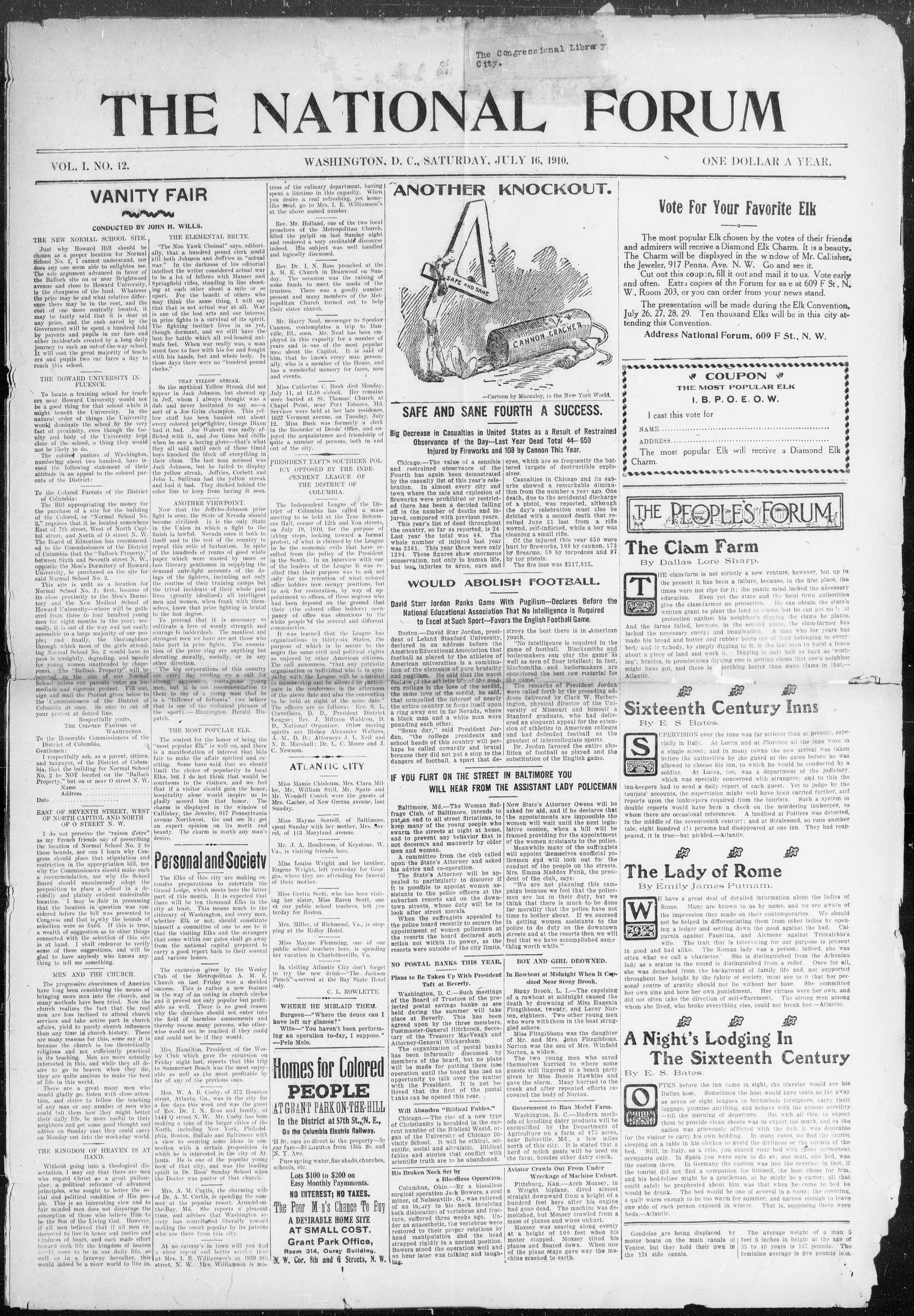
—Cartoon by Macauley, in the New York World.
NE FOURTH A SUCCESS.
in United States as a Result of Restrained
Day--Last Year Dead Total 44--650
works and 108 by Cannon This Year.
ANOTHER KNOCKOUT.
SAFE AND SANE
CANNON CRACKER
Big Decrease in Casualties in United States as a Result of Restrained Observance of the Day--Last Year Dead Total 44--650 Injured by Fireworks and 108 by Cannon This Year.
BOLISH FOOTBALL. Game With Pugilism-Declares Before the Association That No Intelligence is Required Sport---Favors the English Football Game.
WOULD ABOLISH FOOTBALL.
David Starr Jordon Ranks Game With Pugilism--Declares Before the National Educational Association That No Intelligence is Required to Excel at Such Sport--Favors the English Football Game.
STREET IN BALTIMORE YOU
FROM THE ASSISTANT LADY POLICEMAN
IF YOU FLIRT ON THE STREET IN BALTIMORE YOU WILL HEAR FROM THE ASSISTANT LADY POLICEMAN
---
Chicago.—The value of a sensible and restrained observance of the Fourth has again been demostrated by the casualty list of this year's celebration. In almost every city and town where the sale and explosion of fireworks were prohibited or restricted there has been a decided falling off in the number of deaths and injured, compared with previous years. This year's list of dead throughput the country so far as reported, is 24 Last year the total was 44. The whole number of injured last year was 2361. This year there were only 1294. These figures show enormous conservation, not only in human life, but less injuries to arms, ears and
WOULD ABOLI
David Starr Jordon Ranks Game National Educational Association to Excel at Such Sport---Fave
Boston.—David Star Jordan, president of Leland Stanford University, declared in an address before the American Educational Association that football as played by the athletes of American universities is a combination of the elements of pep brutality and pugilism. The athletic life of the modern college is the love of the sordid, the same love of the sordid, he said, that compelled the interest of nearly the entire country to focus itself upon a ring away out in far Nevada, where a black man and a white man were pounding each other. "Some day," said President Jordan, "the college presidents and school heads of the country will perhaps be called forwardly and brutal because they did not put a stop to the dangers of football, a sport that de-
IF YOU FLIRT ON THE STREET
WILL HEAR FROM TH
Baltimore, Md.-The Woman Suffrage Club, of Baltimore, intends to put an end to all street flirtations, to keep many of the young people who swarm the streets at night at home, and to prevent any behavior that is not decorate and mannerly by older men and women. A committee from the club called upon the State's Attorney and asked his advice and co-operation. The State's Attorney will be appealed to particularly to discover if it is possible to appoint women assistants to the police officers at the suburban resorts and on the downtown streets, whose duty will be to look after street morals. When the suffragists appealed to the police to secure the appointment of women policemen at the resorts the board declared such action not within its power, as the resorts were outside of the city limits.
Plans to Be Taken Up With President
Tatt, at Beverly.
Washington, D. C.—Such meetings of the Board of Trustees of the projected postal savings banks as are held during the summer will take place at Beverly. This has been agreed upon by the three members, Postmaster-General Hitchcock, Secretary of the Treasury MacVeigh and Attorney-General Wickersham. The organization of postal banks has been informally discussed by members of the board, but no plans will be made for putting them into operation until the board has had an opportunity to talk over the matter with the President. It is not believed that the first of the postal banks can be opened this year.
Will Abandon "Biblical Fables."
Chicago.—The rise of a new type of Christianity is heralded in the current number of the Biblical World, organ of the University of Chicago Divinity School. It will be ethical, scientific, social and altruistic. Biblical fables and stories that conflict with scientific truth are to be abandoned.
Columbus, Ohio.—By a bloodless surgical operation Jack Bowers, a coal miner, of Nelsonville, O. was relieved of an injury to his neck involving both dislocation of vertebrae and fracture, suffered three weeks ago. Under an anaesthetic, the vertebrae were restored to their proper relations by hand manipulation and the head strapped rigidly in a normal position. Bowers stood the operation well and an hour later was talking and laughing.
eyes, which are so frequently the battered targets of destructible explosives. Casualties in Chicago and its suburbs showed a remarkable diminution from the number a year ago. One death, due to the accidental discharge of a pistol, was reported, although the day's celebration must also be debted with a second death that that June 21 last from a re- wound, self-inflicted, while a boy was cleaning a small rifle. Of the injured this year 650 were hurt by fireworks, 108 by cannon, 173 by firearms, 59 by torpedoes and 97 by toy pistols.
The fire loss was $317,815.
stroys the best there is in American youth.
"No intelligence is required in the game of football. Blacksmiths and bottlers makers can play the game as well as men of finer intellect; in fact, blacksmiths and bottlers makers are considered the best raw material for the game."
The remarks of President Jordan were called forth by the preceding address delivered by Clark W. Hetherington, physical director of the University of Missouri and himself a Stanford graduate, who had delivered an eloquent appeal for the extension of athletics in American colleges and universities. The greatest of intercollegiate sports.
Dr. Jordan favored the entire abolition of football as played and the substitution of the English game.
---
Now State's Attorney Owens will be asked for aid, and if he declares that the appointments are impossible the women will wait until the next legislative session, when a bill will be framed providing for the appointment of the women assistants to the police.
Meanwhile many of the suffragists will appoint themselves unofficial policemen and will look out for the conduct of the people on the streets.
Mrs. Emma Maddox Funk, the president of the club says.
"We are not planning this campaign because we feel that the policemen are lax in their duty, but we think that there is much to be done for morality that the police have not time to bother about. If we succeed in getting women assistants to the police to do duty on the downtown streets and at the resorts then we will feel that we have accomplished something worth while."
BOY AND GIRL DROWNED.
In Rowbow at Midnight When It Capsized Near Stony Brook.
Stony Brook, L, I.—The capsizing of a rowboat at midnight caused the death by drowning of Miss Eugenia Fitzgibbons, twenty, and Leroy Norton, eighteen. Two other young men who were with them in the boat struggle. Miss Fitzgibbons was the daughter of Mr. and Mrs. John Fitzgibbons. Norton was the son of Mrs. Winfield Norton, a widow.
The two young men who saved themselves hurried to where some guests still lingered at a beach party given by Miss Bessie Hawkins and gave her hurried to the creek and after repeated efforts recovered the body of Norton.
Government to Run Model Farm.
Washington, D. C.—Modern methods of handling dairy products will be exemplified by the Department of Agriculture on a farm of 475 acres, near Boltsville, Md., a few miles north of this city. It is stated that a herd of milch goats will be bred on the farm, besides other dairy stock.
Aviator Crawls Out From Under
Wreckage of Machine Unhurt.
Pittsburg, Kan.—Arch Moxsey, in a Wright biplane, dived almost straight downward from a height of a hundred feet here after his engine had gone dead. The machine was demolished, but Moxsey crawled from a mass of planes and wires unhurt.
Moxsey was soaring along evenly at a height of 500 feet when his motor stopped. Moxsey tilted his planes and floated down. When one of the plane stays gave way the machine crashed to earth.
ONE DOLLAR A YEAR.
Vote For Your Favorite Elk
The most popular Elk chosen by the votes of their friends and admirers will receive a Diamond Elk Charm. It is a beauty. The Charm will be displayed in the window of Mr. Callisher, the Jeweler, 917 Penna. Ave. N. W. Go and see it.
Cut out this coupon, fill it out and mail it to us. Vote early and often. Extra copies of the Forum for sale at 609 F St., N. W., Room 203, or you can order from your news stand.
The presentation will be made during the Elk Convention, July 26, 27, 28, 29. Ten thousand Elks will be in this city attending this Convention.
Address National Forum, 609 F St., N. W.
COUPON
THE MOST POPULAR ELK
I. B. P. O. E. O. W.
I cast this vote for
NAME
ADDRESS
The most popular Elk will receive a Diamond Elk Charm.
Vote For Your Favorite Elk
The most popular Elk chosen by the votes of their friends and admirers will receive a Diamond Elk Charm. It is a beauty. The Charm will be displayed in the window of Mr. Callisher, the Jeweler, 917 Penna. Ave. N. W. Go and see it.
Cut out this coupon, fill it out and mail it to us. Vote early and often. Extra copies of the Forum for sae at 609 F St., N. W., Room 203, or you can order from your news stand.
The presentation will be made during the Elk Convention July 26, 27, 28, 29. Ten thousand Elks will be in this city attending this Convention.
Address National Forum, 609 F St. N. W.
COUPON
THE MOST POPULAR ELK
I. B. P. O. E. O. W.
I cast this vote for
NAME.....
ADDRESS.....
The most popular Elk will receive a Diamond Elk
Charm.
The Clam Farm
By Dallas Lore Sharp.
HE clam-farm is not strictly a new venture, however, but up to the present it has been a failure, because, in the first place, the times were not ripe for it; the public mind lacked the necessary education. Even yet the state and the local town authorities give the clam-farmer no protection. He can obtain the state's written grant to plant the land to clams, but he can get no legal protection against his neighbor's digging the clams he plants.
And the farms failed, because, in the second place, the clam-farmer has lacked the necessary energy and imagination. A man who for years has made his bread and butter and rubber boots out of land belonging to everybody and to nobody, by simply digging in it, is the last man to build a fence about a piece of land and work it. Digging is only half as hard as 'working'; besides, in promiscuous digging one is getting clams that one's neighbor might have got, and there is nothing better than mere clams in that—Atlantic.
Sixteenth Century Inns
HE clam-farm is not strictly a new venture, however, but up to the present it has been a failure, because, in the first place, the times were not ripe for it; the public mind lacked the necessary education. Even yet the state and the local town authorities give the clam-farmer no protection. He can obtain the state's written grant to plant the land to clams, but he can get no 'al protection against his neighbor's digging the clams he plants
THE clam-farm is not strictly in the present it has been a failure, because, in the first place, the times were not ripe for it; the public mind lacked the necessary education. Even yet the state and the local town authorities give the clam-farmer no protection. He can obtain the state's written grant to plant the land to clams, but he can get no legal protection against his neighbor's digging the clams he plants. And the farms failed, because, in the second place, the clam-farmer has lacked the necessary energy and imagination. A man who for years made his bread and butter and rubber boots out of land belonging to everybody and to nobody, by simply digging in it, is the last man to build a fence about a piece of land and work it. Digging is only half as hard as "working"; besides, in promiscuous digging one is getting clams that one's neighbor might have got, and there is nothing better than mere clams in that.—Atlantic
UPERVISION over the inns was far stricter than at present, especially in Italy. At Lucca and at Florence all the inns were in a single street; and in many towns the new arrival was taken before the authorities by the guard at the gates before he was allowed to choose his inn, to which he would be conducted by a soldier. At Lucca, too, was a department of the judiciary, which was specially concerned with strangers; and to this the inn-keepers had to send a daily report of each guest. Yet to judge by the tourists' accounts, the supervision might well have been carried further, and reports upon the innkeepers required from the tourists. Such a system or double reports would have been a check on the murdering innkeeper, to whom there are occasional references. A landlord at Poltiers was detected, in the middle of the seventeenth century; and at Stralesund, so runs another tale, eight hundred (1) persons had disappeared at one inn. They had reappeared, it is true—but pickled—Atlantic.
The Lady of Rome
UPERVISION over the inns was far stricter than at present, especially in Italy. At Lucca and at Florence all the inns were in a single street; and in many towns the new arrival was taken before the authorities by the guard at the gates before he was allowed to choose his inn, to which he would be conducted by a soldier. At Lucca, too, was a department of the judiciary, which was specially concerned with strangers; and to this the
UPERVISION over the inns was far stricter than at present, especially in Italy. At Lucea and at Florence all the inns were in a single street; and in many towns the new arrival was taken before the authorities by the guard at the gates before he was allowed to choose his inn, to which he would be conducted by a soldier. At Lucea, too, was a department of the judiciary, which was specially concerned with strangers; and to this the inn-keepers had to send a daily report of each guest. Yet to judge by the tourists' accounts, the supervision might well have been carried further, and reports upon the innkeepers required from the tourists. Such a system of double reports would have been a check on the murdering innkeeper, to whom there are occasional references. A landlord at Poitiers was detected, in the middle of the seventeenth century; and at Stralesau, so runs another tale, eight hundred (!) persons had disappeared at one inn. They had reappeared, it is true—but pickled—Atlantic.
The Lady of Rome
By Emily James Putnam.
We have a great deal of detailed information about the ladies of Rome. Many are known to us by name, and we are aware of the impression they made on their contemporaries. We should not be helped in differentiating them from other ladies by opening a ledger and setting down the good against the bad, Calpurnia against Faustina, and Alcemene against Trimalchio's wife. The trait that is interesting for our purpose is present in good and bad alike. The Roman lady was a person; indeed, she was often what we call a 'character'. She is distinguished from the Athenian lady as a statue in the round is distinguished from a relief. Once for all, she was detached from the background of family life and, not supported throughout her height by the fabric of society, must see to it that her personal centre of gravity should not lie without her base. She committed her own sins and bore her own punishment. Her virtues were her own, and did not often take the direction of self-effacement. The strong men among whom she lived, who broke everything else, could not break her—Atlantic.
A Night's Lodging In The Sixteenth Century
E have a great deal of detailed information about the ladies of Rome. Many are known to us by name, and we are aware of the impression they made on their contemporaries. We should not be helped in differentiating them from other ladies by opening a ledger and setting down the good against the bad, Calpurnia against Faustina, and Alcmeine against Trimachio's wife. The trait that is interesting for our purpose is present
We have a great deal of detailed information about the ladies of Rome. Many are known to us by name, and we are aware of the impression they made on their contemporaries. We should not be helped in differentiating them from other ladies by opening a ledger and setting down the good against the bad, Calpurnia against Faustina, and Alcene against Trimachio's wife. The trait that is interesting for our purpose is present in good and bad alike. The Roman lady was a person; indeed, she was often what we call a 'character'. She is distinguished from the Athenian lady as a statue in the round is distinguished from a relief. Once for all, she was detached from the background of family life and, not supported throughout her height by the fabric of society, must see to it that her personal centre of gravity should not lie without her base. She committed her own sins and bore her own punishment. Her virtues were her own, and did not often take the direction of self-effacement. The strong men among whom she lived, who broke everything else, could not break her—Atlantic.
A Night's Lodging In The Sixteenth Century
FTEN before the inn came in sight, the traveler would see his Italian host. Sometimes the host would have tots as far away as seven or eight leagues to buttonhole foreigners, carry their luggage, promise anything, and behave with the utmost servility—till the morning of departure. But with all this, to expect them to provide clean sheets was to expect too much, and as the nation was grievously afflicted with the itch, it was desirable for the visitor to carry his own bedding. In many cases, we find the tourist sleeping on a table in his clothes to avoid the dirtiness or the vermin of the bed. Still, in Italy, as a rule, you shared your bed with these permanent occupants only. In Spain you were sure to do so; one man, one bed, was the custom there. In Germany the custom was just the reverse; in fact, if the tourist did not find a companion for himself, the host chose for him, and his bed-fellow might be a gentleman, or he might be a carter; all that he would be prophesied about him that when he came to bed he would be drunk. The bed would be one of several in a room; the covering, a quilt warm enough to be too warm for summer, and narrow enough to leave one side of each person exposed in winter. That is, supposing there were beds.—Atlantic.
FTEN before the inn came in sight, the traveler would see his Italian host. Sometimes the host would have toouts as far away as seven or eight leagues to buttonhole foreigners, carry their luggage, promise anything, and behave with the utmost servility—till the morning of departure. But with all this, to expect them to provide clean sheets was to expect too much, and as the nation was grievously afflicted with the itch, it was desirable
FTEN before the inn came in sight, the traveler would see his Italian host. Sometimes the host would have toouts as far away as seven or eight leagues to buttonhole foreigners, carry their luggage, promise anything, and behave with the utmost servility—till the morning of departure. But with all this, to expect them to provide clean sheets was to expect too much, and as the nation was grievously afflicted with the itch, it was desirable for the visitor to carry his own bedding. In many cases, we find the tourist sleeping on a table in his clothes to avoid the dirtiness or the vernin of the bed. Still, in Italy, as a rule, you shared your bed with these permanent occupants only. In Spain you were sure to do so; one man, one bed, was the custom there. In Germany the custom was just the reverse; in fact, if the tourist did not find a companion for himself, the host chose for him, and his bed-fellow might be a gentleman, or he might be a carter; all that could safely be prophesied about him was that when he came to bed he would be drunk. The bed would be one of several in a room; the covering, a quilt warm enough to be too warm for summer, and narrow enough to leave one side of each person exposed in winter. That is, supposing there were beds.—Atlantic.
Gondolas are being displaced by motor boats on the main canals of Venice, but they hold their own in the 124 side canals.
The average weight of a man 5 feet 6 inches in height at the age of 35 to 40 years is 147 pounds. The feminine average is five pounds less.
Gondolas are being displaced by motor boats on the main canals of Venice, but they hold their own in the 124 side canals. The average weight of a man 5 feet 6 inches in height at the age of 35 to 40 years is 147 pounds. The feminine average is five pounds less.
Subscription Rates
One Year.....$1.00
Six Months.....50
Published Weekly
JOHN H. WILLS Business Manager.
Address all communications, checks and money orders to
IS THE COLONEL A REGULAR OR INSURGENT?
The fact that Colonel Roosevelt, in a measure, has allied himself with the so-called Insurgents, has had something of the effect upon the old liners that the going of Delany into Johnson's corner had upon Jeffries: It has rather discerted them. Just when the sky seemed brightest, and the white winged dove of peace seemed hovering over all the Colonel breaks out in brand new political livery, and joins another parade. Well you can never tell just what he is going to do and perhaps the very uncertainty of this fact is the one thing that gives him a hold upon the hearts of the American people. This much may be said, he usually gets results, even though he chooses divers and various methods to obtain them.
Over in Ohio, Hon. James R. Garfield has let it be known, without modification, that he is an insurgent of the deepest dye and has no apology to offer therefore. Ohio was not in any too promising a condition politically before this insurgent wave swept over her borders and certainly this last move on the part of the "progressive" Republicans has not served to clarify the condition in the least. Ohio is not so rockribbled that she never changes her mind. Every once in a while she does the political "flop" and unless matters can be smoothed over and that right soon, the political rainbow of promise will not be seen to arch itself in very clear relief across her sky Ohio has her hands full fighting a common enemy, but when she faces the situation of having a split in her own party ranks, the task is doubled, the danger of defeat increased and the chances for victory do not appear so bright.
LYNCH LAW.
The Newark lynching is replete with a lesson to the American people. As long as these depredations did not strike home, that were winked at and adroitly need, but the shoe is on the foot now and has begun to pinch. The spirit of summary justice, which found expression in the far West at a time when the strong arm of the law reached not that far, worked its way into the southland where it numbered its victims among the Negroes by the hundreds, with no redress save "daunts" and "dares." That same spirit because it was not checked by operation of law in its incipiency, has spread like wildfire until now it finds expression anywhere within the limits of the United States. It is indeed a sad state of affairs when the enforcement of law is so disregarded that human life and property are below par. There was never a greater trumph than that uttered by the Great Divine when he said: "Whatsoever a man sows, that also shall he reap." The application is clear here.
DEMOCRATS' HOPE OF VICTORY.
Democracy is giggling in its boots these days because of the dissention in the ranks of the Republican party. In the South they figure that they have a chance to carry several of the Western States on the account of the attitude taken by the insurgents in these States. Of course that the South will remain Democratic to the core goes without saying. The East is somewhat of a puzzle up to date. Maryland is a problem and if we are able to carry that State, we may just feel proud that we have accomplished something worth while. New Jersey bids fair to give but little trouble and Delaware, it is thought, will be on the right side of the ledger when the roll is called in November. New York is in the throes of an almost political regeneration, and it will take some good work to get things in shape where they will present a promising appearance. Now as to the West, there is where we may expect Colonel Roosevelt to cut some ice. If there is any section of the country which believes in him, it is the great Golden West, and anybody will have a hard time upsetting me calculations out there. It is to be hoped that some measure may be adopted whereby both the insurgents and the regulators may meet on a common ground, settle amicably their differences and present an unbroken front to the common enemy.
AN ECHO FROM THE BIG FIGHT
Muldoca, Brady, Corbett and numerous others have written up reams of paper since the big fight, attempting to explain, and, at the same time, justify, the defeat of Mr. Jeffries at the hands of Johnson at Reno, Nev., on July 4, last. Mr. Little, Johnson's former manager has jumped into the limelight with so many accusations, that the general public is not to beothe to believe any of them for they seem off color. The fact is, i. Mr. Little had knowledge of these things then and did not reveal them he was a party to the crime and is a late a very late—cate to spring on the
public. After all, the daddy of them all, the man who every sporting man votes to be one of the squarrest on earth, gives the real reason for the defeat and you will find that reason to be not so much a lack of condition 'on the part of Mr. Jeffries as the superb condition of Mr. Johnson. The following is from the Evening Star, of Washington, D. C., under date of July 13, 1910, and in it, through Mr. O'Rourke, Mr. Delaney gives out clearly the reason for the defeat of Mr. Jeffries, and he knows more about Jeffries and more about conditioning men for these encounters than all the rest combined:
WHAT DELANEY SAID.
"Daleney told me," said O'Rourke yesterday, that Jeffries wanted to quit in the fifth round of his first fight with Titzismons and again in the eighteenth round of his battle with Sharkey at Coney Island. Daleney also told me that if Jeffries ever met a man his own size and weight who could fight better than the average he would be defeated. I remember when Jeffries boxed in this city for the first time more than ten years ago. He couldn't stop Armstrong in ten rounds, and then didn't have nerve enough to meet poor old Steve O'Donnell the same night. I told him that little George Dixon had knocked Jeffries out, but that he thumped Jeffries, with his thumb was hurt, refused to fight, and in so doing he made me believe he didn't have the right sort of nerve.
"From that time I always insisted that Jeffries was greatly overrated. He licked Fitzsimmons because the latter was fifty pounds lighter and was overconfident. Corbett wasn't strong enough for him and Sharkey was forty pounds lighter. Johnson therefore was the first man of Jeff's size the latter ever met, and as soon as Jeff found that he was up against it he lost confidence in himself. As a matter of fact Jeffries never saw the day he could beat this black man.
Says the Baltimore Sun: It is not the well to do who pay the highest profits, Mr. Wilson states, but the poor who buy the lower grades of beef. * * * It is the history of nearly every industry that when a trust or combination secures control or commands enough power to dictate, prices are increased without reference to supply and demand. A trust generally charges "all the traffic will bear."
A striking case in which the benefits derived from the farm gardens are shown is that of a Germantown widow, cites the Philadelphia Inquirer, who has supported herself and six children since the death of her husband last year and has supplied her table almost entirely from the truck she herself has raised. There are many other similar cases, and it is said that the Vacant Lots Cultivation Society which is responsible for the distribution of these little "farms" is very much gratified with the results obtained. More lots are needed, however, and this is a charity we must appeal to every one. It is seemed hoped that, he scope of the work may be broadened to the extent the society wishes.
Whenever a cable message is sent to an inland city, it is necessary to transcribe the message from the cable receiver and re-transmit it by hand over the land lines to its point of destination. Heretofore it has been impossible to send a message directly to the inland city by means of relay connection with the overland wires, for the reason that the cable signals are of too fluctuating a character and too sensitive to operate an ordinary telegraph relay. Recently, notes the Scientific American, a system has been devised which promises to make direct connection between the cable and telegraph systems commercially practicable. A very sensitive relay is used, and the character of the signal is changed so as to obviate the usual fluctuations. By means of this new system a cable message was recently sent from Canso, Nova Scotia, to New York, a distance of 800 miles, and here relayed to Chicago.
Every schoolboy is taught to respect the hardships that the fathers of the Republic endured, boasts the New York World. The campaign orator eloquently describes the rise of a Jackson, a Lincoln or a Garfield from obscure poverty to immortal fame. But it would be folly to blink the fact that their poverty was quite a different poverty from the kind that produces the public necessity for hundreds of thousands of free Christmas dinners. Lincoln was poor, but it was a self-respecting, self-reliant poverty that neither needed nor would have accepted charity. It was a poverty that could feed itself and clothe itself. It was not the poverty of a great city, where earning a living has to be regarded not as a right, but as a privilege; where the employer looks upon himself as a benefactor in allowing the employee to sell labor to him, and the man who can no longer keep the pace is cast aside as ruthlessly as any piece of anti-quoted machinery. It was Garfield who said that the Republic is opportunity. When it has ceased to be opportunity it will no longer be the Republic, whatever the form of government. It is still opportunity and still the Republic, but how far and has fast has Privilege encroached upon the opportunity that is vital to free institutions? Cannot the extent of this encroachment fairly be measured in the multiplication of free Christmas dinners to the hungry and homeless?
OUT IN THE SUNSHINE.
Let's sorter git out in the sunshine an 'breathe the free air as it blows;
There's comfort enough in the sunshine for all of our troubles an 'wocs;
Out in the joy o 'the weather -free as the light o 'the day—
Let's sorter git out in the sunshine an 'walk in the sunshine way.
Let's sorter git out in the sunshine an 'think that we're blest in the light;
Kiss hands to our troubles an 'tell am 'a world full o 'troubles ain't right;
The river is alsa a-singin' a mighty sweet song as it goes;
There's armous o 'happiness in 'places where nobody knows!
The world's full o 'beauty an 'blessing; though Sorrow seems havin' her way
The tears that we shed at her biddin' are kissed by the angels away;
The harvests are ripe for the reapin' an 'green is the pathway an 'bright
To the souls that are out in the sunshine an 'goin' the way o 'the light!
THE PRICE SHE PAID.
By EMMA PLATT GUYTON.
Xenil Edmonston stepped on to the railway platform just as Burke Rodney, accompanied by his wife and little son, drove up. Unobserved, but curiously, Edmonston watched Mrs. Rodney as, after kissing the boy tenderly, unassisted by her husband, she climbed out of the carriage.
"We'll come for you to-night, mamma!" called the child.
The husband, however, gave only a early grunt to her cheerful response, first to the lad, then to him.
"Good-by, sweetheart! Good-by, Burke!"
"The brute!" muttered Edmonston, and drew farther back upon the platform, that she might not feel humilated by the immediate knowledge that he had witnessed the singular parting.
It was not till she had purchased her ticket and stepped out on to the platform to await the coming train that Edmonston ventured to approach her. The flush which her husband's boorish reply and manner had caused still suffused her face, but she advanced with a smile and an outstretched hand to greet him. Xenil Edmonston was known for his brotherly kindness and devotion to all women, but it was with more than his accustomed chivalry that he took into both his own the hand that Helen Rodney offered. Her face paled slightly, and he felt the hand he so warmly grasped tremble as he said: "It is a long time since we last met, Helen. How have you been?"
There was a world of tenderness in the voice that questioned. Sympathy is the open sesame to the gates of long pent up emotion. Poor, patient, suffering Helen Redney could not withstand it. The tears flooded her eyes till they blinded her sight. The thunder of the approaching train rang in her ears, above it all the whispered words: "Forgive me," from Xenil Edmonston, sounded like the music of earlier, happier years. Carefully shielding her from observation, he handed her into a private compartment of a parlor car, and with a word of excuse, left her to find the porter. Dominated as she was by a series of emotions of which self commissionation was not the least, the tact and gentleness of the man appealed most forebly to her gratitude and sense of admiration. When, later, he returned and took a seat beside her, the turned her eyes bravely to his as she said:
"I am very glad of this meeting. Xenil, though you have discovered the skeleton in my closet."
"I suspected its existence long ago; for public gossip, though not remarkable for its veracity, is not without some foundation in truth. So, Helen. I have longed to see you and learn the facts from your own lips. I resolved, however, not to plan nor force a meeting, but calmly to await fate's own good time. I was sure it would come. Do you remember our last rendezvous, before your engagement to Rodney was publicly announced? As I told you then I tell you now—sooner or later our lives must run together. You laughed at the idea, though you half recognized your deeper love for me. I saw that you must learn your lesson by experience, which meant marriage with Rodney, with whom you were dazzled, infatuated, and thought yourself irrevocably in love. I knew you better than you knew yourself. Helen, dearest, though a cruel one, is not the lesson learned? Are you not ready to cast off the degrading shackles that bind you and come to me?"
A startled, frightened look came into her eyes, but the indignation she should have felt was absent, although she drew herself slightly away from him.
“There, Helen, don't misunderstand me! I am neither a libertine nor a scoundrel, as you know, and being a lawyer, shall abide by legal measures. To put the matter plainly and perhaps bluntly, I want your permission to obtain a divorce for you from Burke Rodney on the ground of cruelty. I then desire to make you my wife according to civil law, as you are now in the sight of a higher but generally unrecognized one — that of God."
His voice thrilled her with an indescribable tenderness as he pronounced the last words. She knew all he said was true. Seven years before they had been sweethearts. There had been no definite engagement, but a tacit understanding existed between them that some day they would be husband and wife.
Koell was a struggling young lawyer then, just out from college. Burke Rodney came between them with the glamour of his wealth, and the voluptuous, impetuous nature that made what he desired immediately his own. In less than six months from their meeting Helen became his wife, and repented at leisure. A year after marriage a child was born, the little Philip, and in him she had her only comfort and happiness.
The impetuosity she had once taken for an evidence of love seemed now a wild recklessness that terminated in the most passionate outbursts of temper if she crossed her husband's will, however unintentionally.
If she expressed a desire that did not accord with his mood, he burst upon her with violent and abusive language. The presence of the boy was no restraint, and Helen reached a point where she felt a tragedy was imminent. Such scenes between them would at least ruin the character and
an' breathe the free air as it blows;
as the light all of our troubles an' woes;
as the light of our day...
an' walk in the sunshine an' bright
an' think that were blest in the light;
am a world full o' troubles an' right;
sweet song as it goes;
places where nobody knows!
tough Sorrow seems havin' her way
are blessed by the angels away;
an' green is the pathway an' bright
mine an' goin' the way o' the light!
SHE PAID.
disposition of the boy. The utter inharmony of their natures was becoming more apparent daily. Often her very presence seemed not only to irritate but infuriate him. He was an open admirer of other women. In her opinion such a marriage was only a mockery, and had it not been for the boy, she would have terminated it long before. Her own disposition was becoming erratic, and at times a rebelliousness against her lot took absolute possession of her.
Now, at a time when her domestic troubles seemed to have reached a climax, Love came and whispered to her the old, sweet strain. The feeling she thought dead leaped again to life. Could she, dared she, face the scandal that such a separation would create? And Philip—what of him? This thought caused her to gasp for breath as she asked—
"What would it all mean for—for Philip?"
"You should have the boy, if possible; if not, you would probably be permitted to have him with you occasionally. That would be much better for him than the scenes he must constantly be forced to witness between his father and mother."
"Ah, yes, yes! It is killing me and ruining him. I will consider the matter and then let you know. You return to-night, do you not?"
"Yes; I have important business which will require my attention the entire day. I presume you are up for
Speaker Cannon's Rue
"HONOR thy father,
"Take no though
worry.
"Work, work, work with
"Learn to sing, no matt
"Sing and laugh and k
"Work, work, work with hands, feet, legs, and brain.
"Learn to sing, no matter how miserably.
"Sing and laugh and keep on a-keepin' on."
shopping. I will meet you, however, at the train to-night."
It was a peculiar day for Helen Rodney. Amid the rush and tumult of the city, thoughts of Philip, Burke, and home dissensions, mingled curiously with dry goods, millinery, love, and Xenil Edmonston.
At last the day was over, and once again she and Xenil were together. Even now his presence seemed to her a comfort and protection.
"Well, what is the decision?" he gravely queried.
"I cannot decide immediately. Give me time, Xenil."
"As much as you like, Helen; but I see the end. Therefore, will you not allow me to call occasionally, simply as a friend?" many misgivings he proceeded on his way to her. Would she not endure anything rather than a separation from Philip? Would not the mother-love in this extremity rise supreme over that of the woman for her lover? It had seemed that her affection was deeper than that of most mothers, for in her almost intolerable matrimonial life, Philip had been the only object for the expenditure of her love.
Great; then, was Edmonston's surprise at the calmness with which she listened and her evident preparation for the result of the interview.
"I knew he would strike me through Philip," she said. "I know his cruel nature. I am prepared to accept the condition. Philip, if he
She gave him her hand in consent. He pressed it deferentially to his lips, then carefully arranged some pillows for her to rest upon, and taking a newspaper from his pocket commenced to read; and so, in silence they made the short journey home.
The weeks that followed seemed interminably long to Helen, and her moods and methods of reasoning were various. For hours at a time she would consider the proposed measures from a strictly orthodox and conventional point of view, until a species of insanity seemed to possess her. This would be followed by a rebellious mood—which for a woman is particularly dangerous; for if temptation comes to her at such a moment, she may in desperation yield to it. Fortunately, Xenil Edmonston was not the man to take advantage of such moments. He intended she should make the decision for herself with what deliberation she should desire, and in a natural frame of mind. Then, whatever occurred, she could not censure either herself or him.
At these periods of mental insurrection, Helen felt like immediate and open rebellion against those regulations and customs of society which some inherent but pristine sense, dominated as unnatural and false. Yet she knew that she was still thralk to a heritage of social claims and obligations. She despised herself that this was so, and wondered if she would ever become sufficiently strong to break what she felt to be a degrading bondage.
Perhaps the narrowness of those with whom she came in daily contact irritated her to constant self-analysis, so that she seemed an inhabitant of a world apart.
It was only the occasional visits of Xenil Edmston that partially restored her to the humanity about her. He was in no wise a part of it, but it was doubtless the kinship that existed between them that made her, in his presence, feel less isolated.
Perhaps her husband suspected what was going on in her mind. At all events, he had never been so frankly brutal. There were times when she feared personal violence. Once she said to him, in desolation: "Rodney, I believe you hate me. Let us go our separate ways. Set me free!" For years she remembered the terrible scene that ensued—the man's coarse accusations and insults. In horror she fled from him. And this ruffian was the father of her child! If the day should come when Philip trod in the steps of his sire, she felt her heart would break. A long, miserable year dragged by. Then Helen became desperate, and gave Edmonsten the answer he de-
stret. It was sent in a character little note which read simply: "I have decided to place my case in your hands and trust my future to your care." HELEN," Without delay Edmounston repaired to Mr. Rodney, whom he found alone and at leisure. A cool greeting was exchanged between the two men, and then the lawyer launched into the object of his visit. He stated his case clearly and concisely. The love he had borne Helen for years previous to her marriage, the sympathy he had felt at the unhappiness of her wedded life, which was public talk, his desire to make her his wife, if Rodney would permit a quiet divorce without contest, was told in a straightforward, manly way.
To say that Rodney was dazed, be wildered, at the proposition is but a mild way of stating his mental condition. He was speechless for a moment, during which time every vestige of color disappeared *from his face*. Then he asked:
"Helen knows of this?"
"Yes"
"And it is her wish to leave me?"
"Yes."
Rodney's eyes burned with anger as he deliberately replied:
"I am not a man to hold any woman against her will. If, as you think, you can make this one happy, take her and welcome; but not the boy. She will never be allowed intercourse with Philip, and he shall not be allowed to recognize her as his mother. She shall be an outcast to him. Do you understand?"
"But this is doing her a grave injustice, Mr. Rodney. The whole world knows she is an unloved wife—"
"As I am an unloved husband. Does your world know that, too? Helen has always held herself above me. Let her go her high and holy way—I wish you joy of her!"
He turned shortly to his desk.
"That is all. Good-day."
Edmonson was forced to leave without further attempt at argument. Indeed, he felt it useless to try to revoke Rodney's decision; and in his heart he could not blame the man for clinging to his son. It would be a terrible blow to Helen to learn she must lose her boy, and it was with
many misgivings he proceeded on his way to her. Would she not endure anything rather than a separation from Philip? Would not the mother-love in this extremity rise supreme over that of the woman for her lover? It had seemed that her affection was deeper than that of most mothers, for in her almost intolerable matrimonial life, Philip had been the only object for the expenditure of her love. Great, then, was Edmonston's surprise at the calmness with which she listened and her evident preparation for the result of the interview.
"I knew he would strike me through Philip," she said. "I know his cruel nature. I am prepared to accept the condition. Philip, if he lives to become a man, will leave me some day for another woman. It is nature's law. Have I not seen scores of sorrowing mothers hunger for a crumb of a son's love, thrown without reserve at the feet of a stranger? The day will come when I shall be alone in my suffering. Rodney hates me, Philip will forget. I have decided. Take me, Xenil!" By a subtle chain of reasoning she had thought the matter out to the end, and the decision at which she arrived was as unalterable as the law of the Medes and Persians.
Before her husband returned that night Helen was on her way to the adjoining city, where she lived quietly until her divorce was obtained, when she was married to Xenil Edmonston. But in spite of his now wide influence and wealth, she was completely ignored by the society in which she had formerly reigned as queen. Women, mothers particularly, do not readily forgive child desertion; in spite of Rodney's well known cruelty to her, public sympathy was entirely with him and the boy. Before the expiration of a year after she became Mrs. Edmonston, Xenil was forced to sell, at a sacrifice, his large and lucrative practice, and move away.
Only once was the name of his mother mentioned between Philip and his father. Several years later, when the lad had reached an understanding age, Rodney related to him the story of Helen's desertion, coloring the facts to suit himself. He listened in silence, with flushing face, kissed his father tenderly and walked quietly out of the room. Truly he had inherited all of his mother's reserve and decision.
The story reached Helen's ears, and when, a few years later, she met Philip—now almost a man—upon the streets of the city in which she lived, he passed her coldly and without recognition. However, she was aware he knew she was his mother.
Xenil Edmonston was always kindness and devotion itself to his beautiful wife. And she? Did his love compensate her for the social ostracism, and, more than all, for the loss of her boy, with his respect and love? Helen ever remained silent on the subject; so who can tell?—Waverley Magazine.
A Smooth One.
"You say he was brought up in a refining atmosphere?"
"Yes; as a boy he lived in the oil districts of Pennsylvania."
It is estimated that more than four thousand cars will be required to market this year's $2,000,000 peach crop of Georgia.
With the Funny Fellows
Down in the Jungle.
There was once a fuzzy old Hindoo.
Who said, "I make mighty thin clothes do;
Fact is, in July.
When the January's high,
I often make just my old skin do!"
—Louis Schneider, in Lippincott's.
A Definition
"What is a parasol?"
"A parasol is just an umbrella that you never think of borrowing."—Boston Transcript.
More Substantial
Poet—"Oh, for the wings of a dove!"
Lady—"Looks as if the wings of a fowl would suit you better."—Pele Mele.
Poultry Art.
"Why did they quarrel?"
Why did they quarrel? "He made fun of her chantecler nat. Said it ought to be trimmed with boiled potatoes and dumplings." —Washington Star.
And Yet We Wonder at Crime.
Fuddy—The name Smith dates away back, I understand. Can you tell me when it was first used?
Fuddy—No; probably its origin is Smithical." —Boston Transcript.
An Old Friend.
Maybelle—"See the beautiful engagement ring' Jack gave me last night." Estelle—"Gee! - Has that just got around to you?" - Cleveland Leader.
Applying Scripture.
Ethel (who, calling at the vicarage with her mother, has sighed for some time at a bowl of apples without result)—I say, Mr. Browne, let's pretend I'm Eve and you're Satan."—Punch.
The First Compulsory
Riggs—"Feeling out of sorts and been to a doctor, eh? No doubt he told you you must give up something."
Briggs—"Yes, $2 and smoking."—Boston Transcript.
Unlucky Title.
Maud—"I got this novel to send to Mr. Baerdoh for his birthday."
Ethel—"What's the title of it?"
Maud—"《The Lost Heir.》"
Ethel—"Don't do it. He's bald."
—Boston Transcript.
Making It Final.
Master—"John, it's just possible a gentleman may call and inquire for me; if he does, say Ive gone away." Servant—"Hadn't I better say run away, sir? Else perhaps he'll come back." -Fliegende Blaetter.
The Other Way About.
Wife—"The landlord was here today, and I gave him the rent and showed him the baby."
Husband—"Next time he comes around just show him the rent and give him the baby."—Puck.
A Mistake.
"How did that man become so distressingly involved in a breach of promise suit?" asked one woman. "Petty economy," replied the other. "Insisted on writing his own valentines instead of buying them at the stationer's."—Washington Star.
Reformation.
"You say you are a reformer?"
"Yep," replied the local boss; "of the deepest dye."
"But you were not always so."
"No. The reformers reformed our town last year, and I want to reform it back again."—Washington Star.
So Careless of Them.
Blunderby (with newspaper)—“This is sad. A man has fallen over a precipice and broken his neck.” Mrs. Blunderby—“Dear, dear! Ain't it awful how folks will leave things lying around for other folks to trip over?”—Boston Transcript.
Prevention.
"Do you believe that music prevents crime?"
"To a certain extent," replied Mr. Sinnick. "When a man keeps both hands and his breath busy with a cornet, you know he can't be picking pockets, attempting homicide or slamming his neighbors."—Washington Star.
A Hard Moment.
"Well, Jim," said Bingleton, as he proudly showed off his first-born "what do you think of that for a kid?" "He's some kid, all right, all right,' returned Jim, unemotionally. "Think he looks like me, old man?' persisted Bingleton. "H'm! Well -er -ah -hum -well Bill -well, old pal, to tell the truth I'm afraid he does!" replied the embarrassed Jim. "Harper's."
ATTENTION!
For a few days we will
make to your order a
Two-Piece
SUIT
FOR ONLY
$16.50
from woolens that regularly sell at $20 and $22.50. Choice of 75 patterns.
S. Goldheim & Sons
403-405 Seventh St.
Every Few Years You Pay Enough FOR Rent To Buy a Home of Your Own
Very few chances now left to buy cheap homes in the District of Columbia. Go out and look at
East Deanwood, Burville, Beverly, D. C.
This subdivision lies on both sides of the COLUMBIA ELECTRIC R. R., between Bennings, D. C., and Chesapeake Junction. One fare and 20 minutes' time to the city. Get off at Brooks' Station, East Deanwood, D. C.
Buy now when you can get lots cheap. Price will soon cover the entire District of Columbia.
Lots sold on easy monthly payments. No interest and no taxes till lots are paid for. Title perfect.
This is now the only section of the District of Columbia living people and people of moderate men can buy houses. Buy now. The price will soon be double what it is today.
The undersigned agent will show the ground. Call and see him and arrange to go out to look the subdivision over.
SALISBURY BROOKS.
Agent
1133 15th St., N. W.
Frank T. Rawlings Co.
1505 Pa. Ave., N. W.
Architectural Plans Prepared.
Materials selected or furnished. All building details superintended with skill and promptness.
Office: 51st and G St., N. E.
Address R. 3, Box No. 44
EAST DEANWOOD D. C.
THINGS
WORTH KNOWING
Sugar alone will sustain life for a considerable time.
The most valuable pipe in the world is the state pipe of the Shah of Persia. It is set with precious stones and is worth $400,000.
In Germany marriages by any foreign consular officer are strictly prohibited—except where they are special treaty stipulations.
Copenhagen is plagued with rata and it has been made a criminal offense to breed rodents for the purpose of securing the bounty offer for rat tails.
The first Catholic church built in New York was erected in 1786 at Barclay and Church streets, where St. Peter's now stands. The first Roman Catholic priest settled in New York in 1683; it was not until 1784 that full religious liberty was established.
Rubber production in the Malay peninsula has increased remarkably in the last two years; from 100,000 acres planted with Para rubber in 1907 to 240,000 acres in 1909. The world's supply of rubber in 1909 was 17,000 tons, an increase of 5000 tons over 1908.
One of the great English railways is installing a compact railway ticket printing machine. When a ticket for a certain station is required the clerk touches an indicator, which carries the name of the station, slips a blank into a slot, turns a handle and the completed ticket drops out. At the same time a record of the sale is printed on a continuous strip of paper, together with the fare and all information required for bookkeeping.
Personal Worth.
By PRESIDENT W. H. P. FAUNCE,
of Brown University.
Our country has been obsessed by
the idea of success. We have as a
nation made the soulless maxims of
Poor Richard an appendix to our
Bible, and have worshiped at the
shrine of thrift rather than the altar
of service. We have too frequently
admired results regardless of methods,
and have believed that a man is
justified in choosing any road he will,
provided he "gets there." It is time
for us to reclaim the finer and higher
ideals of personal worth which were
once dominant in the life of the Republic,
supplementing these earlier
ideals with the later truth that personal worth is acquired in and
through social service.
College men and women can make no finer contribution to the life of their generation than by insistence that the laws already accepted as the basis of the single human life shall prevail as the basis of national life also. Let them resist the frenzied appeals for battleships made by the agents of those who want to build them. Let them show to the world that America, in its union of sovereign States, great and small, rich and poor, in one indissoluble republic, presents a model for a vaster federation of civilized nations, all leagued together to prevent any one from violating the peace and progress of all. Let no college graduate sleep cosily in one little corner of world's effort and to fall in achieving the greatest task now before humanity. Let every man who calls himself in any measure educated help to banish the craze for greater armament and to establish henceforth the obligatory arbitration of all international disputes.
ROOSEVELT RETURNS AND IS GIVEN AN OVATION SELDOM EQUALED
The Mighty Traveler Goes Buoyantly Through a Long and Trying Reception-Parade, Showing Lively Interest in Everything American.
The White Company Receives Unique Compliment For the Sturdy Reliability of Its Steam Car From Mr. Roosevelt and Family.
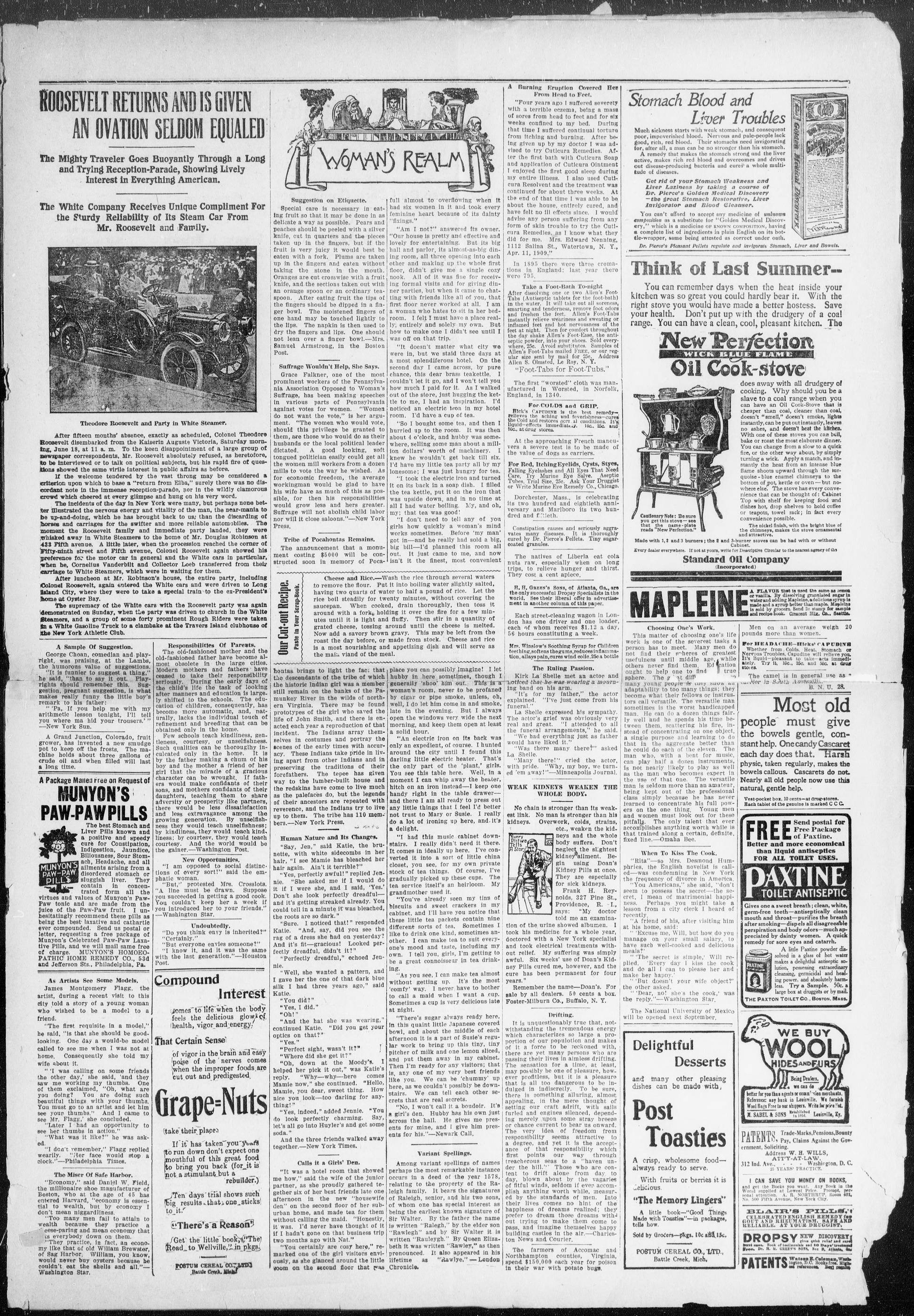
Theodore Roosevelt and Party in White Steamer.
After fifteen months' absence, exactly as scheduled, Colonel Theodore Roosevelt disembarked from the Kaiserin Auguste Victoria, Saturday morning, June 18, at 11 a. m. To the keen disappointment of a large group of newspaper correspondents, Mr. Roosevelt absolutely refused, as heretofore, to be interviewed or to talk on political subjects, but his rapid fire of questions showed the same virile interest in public affairs as before.
If the welcome tendered by the vast throng may be considered a criterion upon which to base a "return from Elba," surely there was no discord note in the immense reception-parade, nor in the wildly clamorous crowd which cheered at every glimpse and hung on his very word.
The incidents of the day in New York were many, but perhaps none better illustrated the nervous energy and vitality of the man, the near-manila to be up-and-doing, which he has brought back to us; than the discarding of horses and carriages for the swiffer and more reliable automobiles. The moment the Roosevelt family and immediate party landed, they were whisked away in White Steamers to the home of Mr. Douglas Robinson at 433 Fifth avenue. A little later, when the procession reached the corner of Fifty-ninth street and Fifty avenue, Colonel Roosevelt again showed his preference for the motor car in general and the White cars in particular, when he, Cornelius Vanderbilt and Collector Loeb transferred from their carriage to White Steamers, which were in waiting for them.
After luncheon at Mr. Robinson's house, the entire party, including Colonel Roosevelt, again entered the White cars and were driven to Long Island City, where they were to take a special train to the ex-President's home of Oyster Bay.
The supremacy of the White cars with the Roosevelt party was again demonstrated on Sunday, when the party was driven to church in the White Steamers, and a group of some forty prominent Rough Riders were taken in a White Gasoline Truck to a clambake at the Travers Island clubhouse of the New York Athletic Club.
A Sample Of Suggestion.
George Chan, comedian and playright, was praising, at the Lambs, the humorous value of suggestions.
Responsibilities Of Parents.
The old-fashioned mother and the old-fashioned father have become almost obsolete in the large cities.
"It is funnier to suggest a thing," he said, "than to say it out. Play-rights should remember this. Suggestion, pregnant suggestion, is what makes really funny the little boy's remark to his father:
"Pa, If you help me with my arithmetic lesson tonight, I'll tell you where ma hid your trousers."
—New York Sun.
A Grand Junction, Colorado, fruit grower, has invented a new smudge pot to keep off the frosts. The machine holds about three gallons of crude oil and when filled will last a long time.
A Package Managed Free on Request of
MUNYON'S
PAW-PAWPILLS
The best Stomach and Liver Pills known and a positive and speedy cure for Constipation, Bilirubin, Billousness, Sour Stomach, Headache, and all ailments arising from a disordered stomach or sluggish liver. They contain in concen-
The best Stomach and Liver Pills known and positive and speedy cure, consolation, Indigestion, Juvenile Biliousness, Sour Stomach, Headache, and all ailments arising from a disordered stomach or sluggish liver. They contain in concentrated form all the virtues and values of Munyon's Paw-Paw tonic and are made from the juice of the Paw-Paw fruit. I unhesitatingly recommend these pills as being the best axative and cathartic pill for the treatment of the letter, requesting a free package of Munyon's Celebrated Paw-Paw Laxative Pills, and we will mall same free of charge. MUNYON'S HOMEOPATHIC HOME REMEDY CO., 53d and Jefferson Sts., Philadelphia, Pa.
James Montgomery Flagg, the artist, during a recent visit to this city told a story of a young woman who wished to be a model to a friend.
"The first requisite in a model," he said, "is that she should be good-looking. One day a would-be model called to see me when I was not at home. Consequently she told my wife about it.
"I was calling on some friends the other day," she said, "and they saw me working my thumbs. One of them exclaimed, "Oh, what are you doing? You are doing such beautiful things with your thumbs. You must go to an artist and let him see your thumbs." And I came to see Mr. Flagg, she concluded.
Later I had an opportunity to see her thumbs in action.
"What was it like?" he was asked.
"I don't remember," Flagg plumped wearily, "Her face would stop a clock."—Philadelphia Times.
The Miser Of Safe Harbor.
"Economy," said Daniel W. Field, the millionaire shoe manufacturer of Boston, who at the age of 45 has entered Harward, "economy is essential to wealth, but by economy I have been too much." Too many men fail to attain to wealth because they practice a case-paring and mean economy that is everybody down on them. "They practice, in fact, an economy like that of old William Brewster, who was a William, you know, would never buy oysters because he couldn't eat the shells and all." Washington Star.
Responsibilities Of Parents.
The old-fashioned mother and the old-fashioned father have become almost obsolete in the large cities. Modern mothers and children have ceased to take their responsibility. During the early days of the child's life the task of looking after manners and education is largely shifted to the schools. The education of children, consequently, has become more automatic, and, naturally, lacks the individual touch of refinement and breeding that can be obtained only in the home.
Few schools teach kindliness, gentleness, courtesy, or unselfishness. Such qualities can be thoroughly inculcated only in the home. It is by the father making a chun of his boy and the mother a sense of pride in their character. A gracious character can be wrought. If fathers would make confidants of their sons, and mothers confidants of their daughters, teaching them to share adversity or prosperity like partners, there would be less dissatisfaction and less extravagance among the growing generation. By unselfishness, courtesy, and kindness by kindness, they would teach kindliness; by courtesy, they would teach courtesy. And the world would be the gainer.—Washington Post.
New Opportunities.
"I am opposed to social distinctions of every sort!" said the emphatic woman.
"But," protested Mrs. Crosslots.
"A line must be drawn. Suppose you succeeded in getting a good cook. You will be a week if you introduced her to your friends."
—Washlutton Star
Undoubtedly.
"Do you think envy is inherited?" "Certainly." "But everyone envies someone?" "I know it, and it was the same with the last generation."—Houston Post.
Compound
Interest
gomes to life when the body feels the delicious glow of health, vigor and energy;
That Certain Sense
of vigor in the brain and easy
poise of the 'nerves comes
when the improper foods are
cut out and predigested.
Grape=Nuts
(take their place)
If it has taken you years to run down don't expect one mouthful of this great food to bring you back (for it is not a stimulant but a rebuilder.)
Ten days trial shows such big results that one sticks to it.
"There's a Reason"
Get the little book,"The Road to Wellville," in pkgs.
POSTUM CEREAL CO.,LTD.
Battle Creek, Michigan
WOMAN'S REALM
Cheese and Rice—Wash the rice through several waters to remove the flour. Put it into boiling water slightly salted, having two quarts of water to half a pound of rice. Let the rice boil steadily for twenty minutes, without covering the saucepan. When cooked, drain thoroughly, then toss it around with a fork, holding it over the fire for a few minutes until it is light and fluffy. Then stir in a quantity of grated cheese, tossing around until the cheese is melted. Now add a savory brown gravy. This may be left from the roast the day before, or made from stock. Cheese and rice is a most nourishing and appetizing dish and will serve as the main vindge of the meal.
Special care is necessary in eating fruit so that it may be done in as delicate a way as possible. Pears and peaches should be peeled with a silver knife, cut in quarters and the pieces taken up in the fingers, but if the fruit is very juicy it would best be eaten with a fork. Plums are taken up in the fingers and eaten without taking the stone in the mouth. Oranges are cut crosswise with a fruit knife, and the sections taken out with an orange spoon or an ordinary teaspoon. After eating fruit the tips of the fingers should be dipped in a finger bowl. The moistened fingers of one hand may be touched lightly to the lips. The napkin is then used to dry the fingers and lips. One should not lean over a finger bowl.—Mrs. Samuel Armstrong, in the Boston Post.
Suffrage Wouldn't Help. She Says.
SURGEAGE WOMAN'S Help, Says
Grace Falkner, one of the most prominent workers of the Pennsylvania Association Opposed to Woman's Suffrage, has been making speeches in various parts of Pennsylvania against votes for women. "Women do not want the vote," is her argument. "The women who would vote, should this privilege be granted to them, are those who would do as their husbands or the local political leader dictated. A good looking, soft tongued politician easily could get all the women mill workers from a dozen mills to vote the way he wished. As for economic freedom, the average workingman would be glad to have his wife have as much of this as possible, for then his responsibilities would grow less and hers greater. Suffrage will not abolish child labor nor will it close saloons."—New York Press.
Tribe of Pocahontas Remains.
The announcement that a monument costing $6000 will be constructed soon in memory of Poca.
Our Cut-out Recipe.
Paste in Your Scrap-Book.
Cheese and Rice.—W to remove the flour. Put having two quarts of w rice boll steadily for tw saucepan. When cook around with a fork, hot utensil until it is light and grated cheese, tossing. Now add a savory brow roast the day before, or is a most nourishing ar the mat. viand of the m
Our Cut-out Recipe.
Paste in Your Scrap-Book.
hontas brings to light the fac; that the descendants of the tribe of which the historic Indian girl was a member still remain on the banks of the Pamunkey River in the wilds of northern Virginia. There may be found prototypes of the girl who saved the life of John Smith, and there is enacted each year a reproduction of that incident. The Indians array themselves in costumes and portray the scenes of the early times with accuracy. These Indians take pride in living apart from other Indians and in preserving the traditions of their forefathers. The tepee has given way to the lumber-built house and the redskins have come to live much as the palefaces do, but the legends of their ancestors are repeated with reverence, and the Indians try to live up to them. The tribe has 110 members.—New York Press.
Human Nature and Its Changes.
"Say, Jen," said Katie, the brunette, with white sideburns in her hair. "I see Mamie has bleached her hair again. Ain't it terrible?"
"Yes, perfectly awful!" replied Jennie. "She asked me if I would do it if I were she, and I said, 'Yes.' Don't she look perfectly dreadful—and it's getting streaked already. You could tell in a minute it was bleached, the roots are so dark."
"Sure. I noticed that!" responded Katie. "And, say, did you see the rag of a dress she had on yesterday? And it's fit—gracious! Looked perfectly dreadful, didn't it?"
"Perfectly dreadful," echoed Jennie.
"Well, she wanted a pattern, and I gave her the one of that dark blue silk I had three years ago," said Katie.
"You did?"
"And the hat she was wearing,
continued Katie. "Did you get your
optics on that?"
"Yes."
"Perfect sight, wasn't it?" "Where did she get it?" "Oh, down at the Moody's. I helped her pick it out," was Katie's reply. "Why—why—here comes Mamie now," she continued. "Hello, Mamie, you dear, sweet thing. How nice you look—too darling for anything!" "Yes, indeed," added Jennie. "You do look perfectly charming. Say, let's all go into Huyler's and get some soda." And the three friends walked away together—New York Times.
Calls it a Girls' Den.
"It was a hotel room that showed me how," said the wife of the junior partner, as she proudly gathered together six of her best friends late one afternoon in the new "housewife den" on the second floor of her suburban home, and made tea for them without calling the maid. "Honestly, it was. I'd never have thought of it if I hadn't gone on that business trip two months ago with Nat." "You certainly are cozy here," remarked one of the girl visitors eniously, as she glanced around the little room on the second floor that was
full almost to overflowing when it had six women in it and took every feminine heart because of its dainty "fixings."
"Am I not?" answered its owner. "Our house is pretty and effective and lovely for entertaining. But its big hall and parlor, its almost-a-big dining room, all three opening into each other and making up the whole first floor, didn't give me a single cozy nook. All of it was fine for receiving formal visits and for giving dinner parties, but when it came to chatting with friends like all of you, that first floor never worked at all. I am a woman who hates to sit in her bedroom. I felt I must have a place really, entirely and solely my own. But how to make one I didn't see until I was off on that trip.
"It doesn't matter what city we were in, but we staid three days at a most splendiferous hotel. On the second day I came across, by pure chance, this dear brass teakettle. I couldn't let it go, and I won't tell you how much I paid for it. As I walked out of the store, just hugging the kettle to me, I had an inspiration. I'd noticed an electric iron in my hotel room. I'd have a cup of tea.
"So I bought some tea, and then I hurried up to the room. It was then about 4 o'clock, and hubby was somewhere, selling some man about a million dollars' worth of machinery. I knew he wouldn't get back till six. I'd have my little tea party all by my lonesome; I was just hungry for tea.
"I took the electric iron and turned it on its back in a soap dish. I filled the tea kettle, put it on the iron that was upside down, and in no time at all I had water boiling. My, and oh, my; that tea was good!"
"I don't need to tell any of you girls how quickly a woman's mind works sometimes. Before 'my man' got in—and he really had sold a big, big bill—I'd planned this room all out. It just came to me, and now isn't it the finest, most convenient
place you can possibly imagine! I let hubby in here sometimes, though I generally 'shoo' him. This is a woman's room, never to be profaned by cigar or pipe smoke, unless, oh, well, I do let him come in and smoke, late in the evening. But I always open the windows very wide the next morning, and keep them open at least a solid hour.
"An electric iron on its back was only an expedient, of course. I hunted around the city until I found this darling little electric heater. That's the only part of the 'plant,' girls. You see this table here. Well, in a moment I can whip away the heater, hitch on an iron instead—I keep one handy right in the table drawer—and there I am all ready to press out any little things that I feel I'd better not trust to Mary or Susie. I really do a lot of ironing up here, and it's a delight.
"I had this music cabinet downstairs. I really didn't need it there. It comes in ideally up here. I've converted it into a sort of little china closet, you see, for my own private stock of tea things. Of course, I've gradually picked up these cups. The tea service itself's an heirloom. My grandmother used it.
"You've already seen my tins of biscuits and sweet crackers in my cabinet, and I'll have you notice that these little tea packets contain nine different sorts of tea. Sometimes I like to drink one kind, sometimes another. I can make tea to suit everyone's mood and taste, including my own. I tell you, girls, I'm getting to be a great connoisseur in tea drinking.
"As you see, I can make tea almost without getting up. It's the most 'comfy' way. I never have to bother to call a maid when I want a cup. Sometimes a cup is very delicious late at night.
"There's sugar always ready here, in this quaint little Japanese covered bowl, and about the middle of each afternoon it is a part of Susie's regular work to bring up this tiny, tiny pitcher of milk and one lemon sliced, and put them away in my cabinet. Then I'm ready for any visitors; that is, any one of my very best friends like you. We can be 'chummy' up here, as we could possibly be downstairs. We can tell each other secrets that are real secrets.
"No, I won't call it a boudour. It's a girl's den. Hubby has his own just across the hall. He gives me presents for mine, and I give him presents for his."—Newark Call.
Variant Spellings.
Among variant spellings of names perhaps the most remarkable instance occurs in a deed of the year 1578, relating to the property of the Raleigh family. It bears the signatures of Raleigh, senior, and his two sons, of whom one has special interest as being the earliest known signature of Sir Walter. By the father the name is written "Raleigh," by the elder son "Rawleigh" and by Sir Walter it is written "Rauleygh." By Queen Elizabeth it was written "Rawley," as then pronounced. It also appeared in his lifetime as "Rawlye." — London Chronicle.
A Burning Eruption Covered Her
From Head to Feet.
"Four years ago I suffered severely with a terrible eczema, being a mass of sores from head to feet and for six weeks confined to my bed. During that time I suffered continual torture from itching and burning. After being given up by my doctor I was advised to try Cuticura Remedies. After the first bath with Cuticura Soap and application of Cuticura Ointment I enjoyed the first good sleep during my entire illness. I also used Cuticura Resolvent and the treatment was continued for about three weeks. At the end of that time I was able to be about the house, entirely cured, and have felt no ill effects since. I would advise any person suffering from any form of skin trouble to try the Cuticura Remedies, as I know what they did for me. Mrs. Edward Nenning, 1112 Salina St., Watertown, N. Y., Apr. 11, 1909."
In 1895 there were three cremations in England: last year there were 795.
Take a Foot-Bath To-night
After dissolving one or two Allen's Foot-Tabs (Antiseptic tablets for the foot-bath) in the water. It will take out all soreness, smarting and tenderness, remove foot odor and relieve itching. Allen's Foot-Tabs instantly relieve weariness and sweating or inflamed feet and hot nervousness of the feet at night. Then for comfort throughout the day shake Allen's Foot-Ease, the antiseptic powder, into your shoes. Sold overly hot, avoid submerging samples of Allen's Foot-Tabs mailed FREE, or our regular size sent by mail for 25c. Address Allen S. Olmsted, Le Roy, N. Y.
"Foot-Tabs for Tub-Tubs."
The first "worsted" cloth was manufactured in Worsted, in Norfolk, England. In 1340.
For COLDS and GRIP
Hick's CAPIDURP is the best remedy relieves the aching and feverishness-cures cold and restores sort all conditions. It's liquid and preserves humidity. 10c. 25c. and 50c. aturing stores.
At the approaching French mancuvers a severe test is to be made of the value of dogs as carriers.
For Red, Itching Eyelids, Cysts, Styes. Falling Eyelashes and All Eyes That Need Care, Try Murine Eye Salve. Asepic Tubes, Trial Size, 25c. Ask Your Druggist or Write Murine Eye Remedy Co. Chicago.
Dorchester, Mass., is celebrating its two hundred and eighteenth anniversary and Mariboro its two hundred and eighteh.
Constipation causes and seriously aggravates many diseases. It is thoroughly cured by Dr. Pierce's Pellets. Tiny sugar-coated granules.
The natives of Liberia eat col nuts raw, especially when on long trips, to relieve hunger and thirst. They cost a cent apiece.
H, H. GREEN's Sons, of Atlanta, Ga., are the only successful Dropsy Specialists in the world. See their liberal offer in advertisement in another column of this paper.
Each street-cleaning wagon in London has one driver and one loader, each of whom receives $1.12 a day, 56 hours constituting a week.
Mrs. Winslow's Soothing Syrup for Children teething, softens thighs, induces inflammation, allays pain, cures wind colds, 25c a bottle
The Ruling Passion.
Kirk La Shelle met an actor and noticed that he was wearing a mourning band on his arm.
"It's for my father," the actor explained. "I've just come from his funeral."
La Shelle expressed his sympathy. The actor's grief was obviously very real and great. "I attended to all the funeral arrangements," he said. "He had everything just as father would be like it."
"Was there many there?" asked La Shelle.
"Many there!" cried the actor, with pride. "Why, my boy, we turned 'em away!"—Minneapolis Journal.
WEAK KIDNEYS WEAKEN THE
WHOLE BODY.
No chain is stronger than its weakest link. No man is stronger than his kidneys. Overwork, colds, strains, etc., weaken the kidneys and the whole body suffers. Don't neglect the slightest kidney aliment. Begin using Doan's Kidney Pills at once. They are especially for sick kidneys.
Every Digiture
A Story
Frank H. Reynolds, 327 Pine St., Providence, R. - I., says: "My doctor told me an examination of the urine showed albumen. I took his medicine for a whole year, doctored with a New York specialist and took electrical treatments without relief. My suffering was simply awful. Six weeks' use of Doan's Kidney Pills cured me, however, and the cure has been permanent for four years."
Remember the name—Doan's. For sale by all dealers. 50 cents a box. Foster-Milburn Co., Buffalo, N. Y.
Drifting.
It is unquestionably true that, notwithstanding the tremendous energy which characterizes so large a proportion of our population and makes of it a force to be reckoned with, there are yet many persons who are passing their lives in almess drifting. The sensation for a time, at least, notwithstanding the ever profitless, but it is a pleasure that is all too dangerous to be indulged in indiscretely. To be sure, there is something alluring, almost appealing, in the mere thought of setting our craft adrift, with sails furled and engines silenced, depending merely upon some stray breeze or chance current to bear us onward. The very idea of freedom from notwithstanding seas a degree, and yet it is the acceptance of that responsibility which first points our way through treacherous seas to a "haven under the hill." Those who are content to drift alone from day to day, blown about by the vagaries of fittil winds, seldom if even accomplish anything worth while, measured by the standards of men. Into the depths of the happiness of dreams realized; they prefer to dream those dreams without trying to make them come to pass, and imagine themselves happy building castles in the air.—Charleston News and Courier.
The farmers of Acomac and Northhampton counties, Virginia, spend $150,000 each year for poison in their war with potato bugs.
Stomach Blood and Liver Troubles
Much sickness starts with weak stomach, and consequent poor, impoverished blood. Nervous and pale people lack good, red blood. Their stomachs need invigorating for, after all, a man can be no stronger than his stomach. A remedy that makes the stomach strong and the liver active, makes rich red blood and overcomes and drives out disease-producing bacteria and cures a whole multitude of diseases.
Get rid of your Stomach Weakness and Liver Laziness by taking course of Dr. David Galloway's power - the great Stomach Restorative, Liver Invigorator and Blood Cleanser.
You can't afford to accept any medicine of our composition as a substitute for "Golden Medical Dery," which is a medicine of KNOWN COMPOSITION, a complete list of ingredients in plain English on its tile-wrapper, same being attested as correct under Dr. Pierce's Pleasant Pellets regulate and invigorate.
Think of Last Summer
You can remember days when the kitchen was so great you could hardly right stove you would have made a be your health. Don't put up with the range. You can have a clean, cool, ple
New Perfect WICK BLUE FILM Oil Cook-s
You can't afford to accept any medicine of unknown composition as a substitute for "Golden Medical Discovery," which is a medicine of known composition, having a complete list of ingredients in plain English on its bottle-wrapper, same being attested as correct under oath.
st Summer
when the heat inside your
old hardly bear it. With the
made a better hostess. Save
with the drudgery of a coal
cool, pleasant kitchen. The
perfection
QUE FLAME
k-stove
Dr. Pierce's Pleasant Pellets regulate and invigorate Stomach, Liver and Bowels.
Think of Last Summer--
You can remember days when the heat inside your kitchen was so great you could hardly bear it. With the right stove you would have made a better hostess. Save your health. Don't put up with the drudgery of a coal range. You can have a clean, cool, pleasant kitchen. The New Perfection WICK BLUE FLAME Oil Cook-stove
does away with all drudgery of cooking. Why should you be a slave to a coal range when you can have an Oil Cook-Steve that is cheaper than coal, cleaner than coal, doesn't "smell" that doesn't smoke, lights instantly, can be put out instantly, leaves no ashes, and doesn't heat the kitchen. With one of these stoves you can bull, bake or roast the most elaborate dinner. You can change from a slow to a quick fire, or the other way about, by simply turning a wick. Apply a match, and instantly the heat from an intense blue flame shoots upward through the turret, and the heat from the chimney to the bottom of pot, kettle or oven — but nowhere else. The stove has every convenience that can be thought of: Cabinet Top with shelf for keeping food and dishes hot, drop shelves to hold coffee or teapots, t rack; in fact every convenience possible.
The nickel finish, with the bright blue of the chimneys, makes the stove ornamental and
and attractive
Made with 1,2 and 3 burners; the 2 and 3 burner stoves
Cabinet
Every dealer everywhere. If not at your, write for Descriptive C
Standard Oil Comp
(Incorporated)
MAPLEINE
A FLASH
or vanilla
water and
made and
in mold by
and recipe
currier stoves can be had with or without
dishnet.
Descriptive Circular to the nearest agency of the
All Company
(orated)
A FLAVOR that is used the same as lemon
or vanilla. By dissolving granulated sugar in
water and adding Marbleite, a delicious syrup is
made and a syrup better than maple. Marbleite
is made by grouting. Send 20 stamp for sample
and recipe book. Crescent Mfg. Co., Seattle.
Made with 1,2 and 3 burners; the 2 and 3-burner stoves can be had with or without
A FLAVOR that is used the same as lemon water and adding Maple, delicious syrup water and adding Maple, delicious syrup is made and a syrup better than maple. Maple syrup is used by gardeners. Soak a stamp for a few minutes and cookipe. Crackenst Mfg. Co., Seattle.
FOR HEADACHE-Hickey CAPUINN
Whether from Colds, Heat, Stomach or
Nervous Troubles, Capuine will relieve you
12 Hours. Liquid please to take care imme-
dately. Try it, 10, 25c, 50c and 100c at dru-
tories.
The camel is in general use as
cameron in South Australia.
B. N. U. 28.
Most old
people must give
the bowels gentle, con-
stant help. One candy Cascaret
each day does that. Harsh
physic, taken regularly, makes the
bowels callous. Cascaret do not.
Nearly all old people now use this
natural, gentle help.
WE BUY
WOOL
HIDES AND FURS
Being Dealers,
we can do
better for you than a gents or comm.'sion merchants.
Reference: any bank in Louisville. We furnish
Wool Bags Free to our shippers. Write far prive list.
M. SABEL & SONS
Established in 1856
Louisville, Ky.
PATENTS. Trade-Marks, Pensions, Bounty
Pay, Claims Against the Gov-
ernment, Soliciting.
Address W. H. WILLS,
ATTY-AT-LAW,
312 Ind. Avon, Washington, D. C.
25 YEARS' PRACTICE.
PATTERN
---
Cautionary Note: Be sure you get this stove—see thus the name-plate reads "New Perfection."
Choosing One's Work.
This matter of choosing one's life work is one of the severest tasks a person has to meet. Many men do not find their "hereses of greatest usefulness until middle age, while others never find them. Education ought to find them. Find true life." The z in diff.
many young people is they snow an adaptability to too many things; they become what their fellows or instructors call versatile. The versatile man sometimes is the worst handicapped man. He can do a dozen things fairly well, but his thin limb twitches them, scattering his fire, instead of concentrating on one object, a single purpose and learning to do that in the aggregate better than he could do each of the eleven. The man who, with a bent for music, can play a dozen instruments, can do a dozen plays as the man who becomes expert in the use of that one. The versatile man is seldom more than an amateur, being kept out of the professional class simply because he has never learned to concentrate his full powers on the one thing. Young men sometimes do pitfalls, the only talent that ever accomplishes anything worth while is that trained along a certain, definite, fixed line.—Omaha Bee.
When To Kiss The Cook
"Rita"—so Mrs. Desmond Humphries, the English novelist is called—was condemning in New York the frequency of divorce in America. "You Americans," she said, "don't seem to possess the secret—the secreal I mean of marriottish happiness. Perhaps might take a lesson from a city clerk I heard of recently. "A friend of his, after visiting him at his home, said: "Excuse me, Will, but how do you manage on your small salary, to have such well-cooked and delicious meals? The secret is simple. Will replied, 'Every day I kiss the cook and do all I can to please her and make her happy.'
"But doesn't your wife object? the other asked.
"Dear, no! she's the cook," was the reply."—Washington Star.
The National University of Mexico will be opened next September.
Delightful Desserts
and many other pleasing dishes can be made with,
Post Toasties
A crisp, wholesome food—always ready to serve.
With fruits or berries it is delicious.
A little book—"Good Things
Made with Toasties"—in packages,
tells how.
Sold by Grocers—pkgs. 10c and 15c.
POSTUM CEREAL CO., LTD.
Battle Creek, Mich.
Golden Medical Discovery
Men on an average weigh 20 pounds more than women.
Vest-pocket box, 10 cents-at drug-stores.
Each tablet of the genuine is marked C C C.
FREE Send postal for Free Package of Paxtine.
Better and more economical than liquid antiseptics FOR ALL TOILET USES.
PAXTINE
TOILET ANTISEPTIC
Gives one a sweet breath; clean, white, germ-free teeth—antiseptically clean mouth and skin—purifies the breath of plague—dries at all diarrheal preparations and body odors—much appreciated by dainty women. A quick remedy for sore eyes and catarrh.
A little Pastein powder dissolved in a glass of hot water makes a delightful antiseptic solution, possessing extraordinary cleaning, germicidal and healing power, and absolutely harmless. Try a Sample. 50c. a large box at a drugstore or by mail.
PANTINE
Address W. H. WILLS.
I CAN SAVE YOU MONEY ON BOOKS,
and get the Books you want. Any Book in the
World supplied at A. L. NORTHWEST, Room
No. 500 Fifth Avenue, New York City.
BLAIR'S PILLS,
WESTERN MASTER OF
GOURD AND REMEMBRANUM, SAFE AND
RELIABLE. AT YOUR DRUGGIST.
DROPSY NEW DISCOVERY
gives guts training and great
bore训. Book of techniques and 60 Day's training.
Dr. H. M. GREEN'S BOWS, B. A. Allanus,
PATENTS
Watson R. C. Coleman, Wash-
ington, BookFree, High
Seattle Cafe
Meals at all hours. Good cooking
and careful service.
1239 SEVENTH STREET
A Clean Place To Eat
Open Day and Night
The Waldorf Cafe
FRANK T. WADDELL, Prop.
15 and 25c Meals
At All Hours
First Class Dairy Lunch Service
643 Florida Ave. N. W.
Washington, - - D. C.
Open All Night
JOSHUA N. ANDERSON, Prop'r
SEE UNCLE JOSH AT THE
TUSKEGEE
626 North Capitol Street, N.W.,
West Side Union Station, Half Block away
Washington, D.C.
Best Meals At Low Prices
EXCELLENT SERVICE
Good Things To Eat.
ELLIS CAFE
Welcome to the Elks
OUR 100 IS O THE BEST
Police and Prompt service our moto
Prices Reasonable
No. 729 4th St., N.W.
WHERE TO DINE
ATLANTIC CITY
The Bay State Hotel
HARDY & OTTERY, Propa.
334 N. TENNESSEE AVE.,
Atlantic City, N. J.
European Plan.
Concert Garden
Special Rates to Parties Taking
Apartments.
POPULAR
SCIENCE
For mixing concrete a spade has been invented with long, oval holes in the blade, the perforations allowing the finer cement to flow through and give the face a finer finish.
Eggs with two yolks occur not uncommonly, but eggs with three yolks remain small care. Such an egg was recently laid by a barred Plymouth Rock pullet at the Maine Experiment Station, and is described in some detail in a bulletin recently issued. The egg was somewhat above the average size, but no other abnormal feature was noticed.
One of the longest wharves in the world, almost a mile in length, or to be exact, 4700 feet, is at Port Los Angeles, Cal. It extends into the Pacific in a long serpentine curve. The reason for this construction, says the Scientific American, is that it offers better resistance to the strong currents and the buffetings of the waves than if it were perfectly straight. Until the nearby harbor of San Pedro was developed by the Federal Government the big wharf at Port Los Angeles was a very busy place, but of late it is comparatively seldom used except by the Japanese fishermen, who have formed a colony along the adjacent beach.
It is computed that the temperature of the sun would be expressed by 18,000 degrees of Fahrenheit's thermometer or about ninety times the temperature of boiling water. This is about five times the temperature that man is able to produce by artificial means. The light given off from the surface of the sun is reckoned as being 5300 times more intense than that of the molten metal in a Bessemer converter, though that is of an almost blinding brilliancy. Or, if we compare it with the oxy-hydrogen flame, the sun sheds a light equal in brilliance to a light 146 times the intensity of the limelight. —New York American.
The British Situation.
A few friends were discussing the political situation, and one of them, a Tory, was emphatic on the point that while his party were quite ready to resume the fight it would be reprehearsible on the part of the Radicals to raise the veto issue while King George's reign was at its infancy. "Your attitude," said an Irishman in the little party, "reminds me of two fellow countrywomen who were quarreling. One of the two, declaring herself quite anxious to fight, snatched up her child and said defiantly: 'Strike me now with the child in me arms!'"—London Daily News.
Obeying Orders.
A woman coming down the garden walk was horrified at seeing her son standing on his head against the garden wall.
"Johnnie, you wretch," she cried, "what are you doing now?" "Standing on my napper," replied Johnnie, "Didn't yer tell me to play at sumatran that wouldn't wear my boots out?"—Tit-Bits.
Andy's Punishment.
If the American people ever start in to square accounts with the big men who have been having fun with the public the way with Andy Carnegie will be easy—give him back all his libraries. — Tip, in the New York
LEST WE FORGET
BY CARL HOLLIDAY, M. A.,
Author of "A History of Southern Literature," "A Cotton-Picker" and Other Poems, Etc.
Would you have present-day heroes? Then remind your children of the heroes of the past. Would you have poets to thrill your nation into fruitful activity? Then do honor to the poets of your past. The ancient Grecian race track was lined with the statues of the winners of the races of other days, and as the runner hurled himself along the course, he felt the inspiration of those marble figures beside him and knew that if he, too, won, his statue would stand among those others in the immortal rows. Small is the joy of art if it see no present results and can hope for no remembrance in the distant future.
Confederacy remains to this day unmarked.
The most famous graduate of Mercer University and the most famous professor in the University of Georgia was undoubtedly Richard McColm Johnston. He was born near Powelton, Ga., and the Dukesborough of his famous stories is Powelton; but you will look in vain at Mercer, Athens or Powelton for recognition of these facts.
Strangers Recognize His Merit.
Maryland is another Southern State that has too often allowed the memory of her poets to suffer. Francis
New England long ago recognized these facts, and she has not failed to reap the fruits in the high quality of her citizenship. To-day you may trace by means of lasting memorials the wild ride of Paul Revere over hill and valley. You may even find near Boston on a tablet marking the spot where "Schoolmaster" Emerson once kept his school. You may find a bit of granite or marble or bronze telling where Hawthorne did this, Longfellow that, and Whittier the other. Those descendants of the Pilgrim Fathers, with a high sense for the ideal, have left in almost eternal forms their admonition to future generations to be worthy sons of noble fathers. We of the South seemingly have forgotten the significance, the vast importance of this our duty to those who have striven for our welfare. We have erected, it is true, monuments to our famous soldiers; but what have we done for the memory of those noble intellects who by song and story and stern expostulations roused those warriors to go forth and battle for the right? Shall he that incites to duty be considered less worthy than he that performs the duty?
No Shaft to Cotton-Gin Inventor.
Why, for instance, has the South reared no shaft in honor of Daniel Emmett, the author of "Dible?" Why has no tablet been placed on the site of the old New Orleans theatre where that song first burst upon the South? Kentucky has lately bestowed its tribute upon Stephen Foster, the author of "My Old Kentucky Home;" but why has Florida shown no gratitude to him for the fame of "Suwance River?" Why has New Orleans erected no memorial to the South's greatest musician, Louis Gotschalk? Why has Augusta, Ga., not marked for the world the place where Ell Whitney's epoch-making invention, the cotton-gin, was first tried? Why has Georgia erected no tribute to Francis R. Goulding, who invented and had in use a sewing machine nearly two years before Howe secured a patent? It is said that one of the legares had a steamboat paddling Savannah River before Fulton, in the Hudson; but what happened later, was trouble to
prove the statement and mark the shore where the craft began its voyage?
Indeed, Georgia has numerous sins of omission to account for. Henry Rootes Jackson, the author of the "Red Old Hills of Georgia," was born at Athens and died at Savannah; but neither town seems particularly proud of the fact. Surely the maker of so stirring a State-song is as worthy of a memorial as any one of that State's innumerable Governors. Augusta, Ga., long ago carved a shaft in honor of her poet, Richard Henry Wilde; but Augustus Baldwin Longstreet, author of the famous "Georgia Scenes," to whom Richard Malecolm Johnston, Joel Chandler Harris and Thomas Nelson Page owe so much, and whose story, "The Militia Drill," was directly imitated by Thomas Hardy in his "Trumpet Major," has received no recognition from his native city. He was president of Emory College and of the University of Mississippi; yet their walls tell nothing of him. At Madison, Ga., William Tappan Thompson wrote for the town paper, The Miscellany, the laughable "Major Jones" Letters. Why has not Madison marked with some inexpensive bronze or granite the spot where this pioneer in American humor did these things?
In 1901, Charleston, S. C., honored itself by honoring Timrod with a pillar of stone. But see what Georgia has done for his schoolmate and fellow-poet, Paul Hamilton Hayne. His famous home, "Copse HMl," near Augusta, has been turned over to a negro family! The house where the herocle "Lyric of Action" was written, the house which almost daily received letters from Longfellow, Bayard Taylor, Tennyson and Swinburne, the house that should have become a literary shrine of the South, has become, instead, the habitation of a motley collection of blacks! If "Copse Hill" had been near Boston—but comparisons are odious.
Author of Battle-Song Unhonored.
There lived and died near Columbus, Ga., a quiet country physician named Francis Ticknor, the author of a ballad the equal of any in the English language:
"Out of the focal and foremost fire
"Out of the hospital's walls as dire-
Smitten of grape-shot and gangrene-
Eighteen battle and he sixteen,
"Out of the hospital's walls as dire-
Little Ginnie of Tennessee.
Poe, it is said, wronged him by using his poetic ideas and actual words without giving credit; but has not Columbus wronged him far more by its utter neglect. And why is Augusta, Ga., so slow in its support of a movement to honor the author of the greatest battle-song of the South—"Maryland; My Maryland"? If a New Englander had written as stirring a lyric as that, a pillar to his memory ere this would have touched the clouds! Randall pointed out in the ruins of Poydras College, Pointe Coupe, La., the very spot where on that stormy night he wrote that cry to arms; the spot awaits in vain a fitting memorial. The room in Baltimore where two young women put that lyric to music and gave it to the
Confederacy remains to this day unmarked.
The most famous graduate of Mercer University and the most famous professor in the University of Georgia was undoubtedly Richard Malcolm Johnston. He was born near Powelton, Ga., and the Dukesborough of his famous stories is Powelton; but you will look in vain at Mercer, Athens or Powelton for recognition of these facts.
Strangers Recognize His Merit.
Strikers Recognize This State
Maryland is another Southern State that has too often allowed the memory of her poets to suffer. Francis Scott Key was born in Frederick County in that State, wrote the "Star-Spangled Banner" near Fort McHenry, and died at Baltimore; and yet the only worthy symbol of public appreciation is not in Maryland, but in far-away San Francisco, where in Golden Gate Park a monument executed by William Story stands to his memory. At Baltimore there lived and died Edward Coate Pinkney, author of many a graceful line of poetry.
"I fill this cup to one made up
His tess of each time Heaven.
He yet awaits a token of memory.
And John Pendleton Kennedy, of Baltimore—how much he did for writers of the South! If that man had not recognized the ability of Poe, had not encouraged him, had not found for him a congenial work, America probably would not have heard of its truest literary genius. Yet what bronze words declare the fact? And for that matter, what appreciation has Baltimore ever shown for the honor of possessing Poe's dust? He lies in a neglected grave in old Westminster graveyard, and doubtless not one person in a thousand of those who daily pass the cemetery knows that the most artistic of all American poets sleeps nearby.
The bitterest shame of all, however, is the fact that Georgia has done practically nothing for the memory of the greatest genius she ever produced — Sidney Lanier. To-day the Georgia city best known to the intellectual circles of Great Britain is not the capital, but Macon, the birthplace of the most musical of American poets. There stands in a hall of Johns Hopkins an impressive bust of Lanier; but where has Macon a shrine to his memory? A few years ago a Georgia Governor and a famous Georgia preacher stood on the capitol grounds at Atlanta. Said the Governor: "I want to see over in that corner a statue of Congressman So and So, and a statue here to Governor This, and a statue there to Governor That. Then we shall have our honored dead." "And where will you put Sidney Lanier's?" quietly asked the preacher. "Ah," said the Governor, somewhat abashed, "I had forgotten him." Perhaps that is the only trouble with all Georgians; not neglectful, simply forgetful. There stands on an Atlanta street a strong, brave statue of Henry Grady; would it not be eminently fitting to place within sight of the great orator's eyes the figure of Sidney Lanier, and farther on another of Joel Chandler Harris?
Look where you will throughout the Southland, we find sad neglect of our dead singers. William Glimore Simms, author of more than one hundred volumes, and genial inspirer of Timrod, Hayne and other literary lights, made his home, "Woodlands," near Charleston, a true literary centre in ante-bellum days; and Charleston has forgotten to honor either him or that famous home. Davy Crockett and Sam Houston, the most famous pioneers in Southwestern life—the one born at Limestone, Greene County, Tenn, and the other in Rockbridge County, Va.—have received no token of respect from their mother-States. Alexander Beaufort Meek wrote a poem, "Balaklava," which Queen Victoria deemed so worthy that she had it published at her kingdom's expense and spread far and wide over her country, and this man, turning aside from his poetry, created by untrying efforts the school system of his native State, Alabama. And what has Alabama done to give him honor before posterity? Nothing.
Father Abram Ryan lived at Norfolk, Knoville, Clarksville and Mobile, and died near Louisville; but you will search long for signs of appreciation. Clarksville has lately discovered that he wrote the "Conquered Banner" there—the old lady in whose home he resided at the time still lives—and a small club is honoring itself and the city by erecting a bronze tablet proclaiming this fact to the world.
Margaret Preston, of Lexington, Ky., was undoubtedly the best woman poet of America. Lexington evidently is not aware of this. John Reuben Thompson, born at Richmond and educated at the University of Virginia, the author of our most famous brief verse narrative of war, "Music in Camp," is just as much neglected. Mississippi's poet, Irwin Russell, in his "Christmas Night in the Quarters," as truly wrote the epic of Southern life as Whittier, in his "Snow-Bound," wrote the epic of New England life. Both poems grow more famous as the years pass; but what a difference in the honors to their authors! Port Gibson was Russell's birthplace and the hut of a poor Irish washwoman in New Orleans his deathplace; the stone marking either is not yet carved.
An old Scotch woman was led up to see a great shaft to Burns' memory. Long she looked at it and then exclaimed: "Aye, aye, he asked ye for bread and ye gave him a stone!" Scant was the bread we gave these workers while living; can we not afford them a stone in death?—Uncle Remem's Home Magazine.
AMUSEMENTS
Ford Dabney's Theatre
Refined Vaudeville and Motion Pictures VAUDEVILLE CHANGED EVERY WEEK Pictures Changed Every Day
WHEN ADVERTISING BEGAN.
```markdown
```
M. T.—In these times when advertising one's business or wares has been reduced to a fine science, it would be interesting for one who is engaged in it to know who was the first to introduce it to the world and when. I have several times sought information on the subject, but never with any degree of success. Can The Times enlighten me? Advertising in some form or other is really as old as the institution of buying and selling. In the days of ancient Rome and Athens merchants were wont to employ "barkers," or criers, who went about the streets shouting out the wares and alluring prices of their employers. They howled about "bargains" in those days and caused rushes of trade, we may suppose, just as the advertisements of to-day draw the throngs of shoppers.
Presently came written notices that were displayed on blank walls for the edification of the purchasing public. In the early days of London the shopkeepers had clerks who were stationed in front of the stores to shout their wares much after the fashion that used to obtain in Baxter street, when the "barker" came into his own. These clerks were wont to preface their vocal advertisement of wares by shouting: "What do ye lack? What do ye lack?" The first genuine newspaper advertisement of which there appears to be any authentic record was printed in The Mercurius Politicus in London in January, 1652. It was a publisher's announcement and read thus:
"Irenella Gratulatoria, an Herokel Poem," being a congratulatory panegyrick for my Lord General's late return, summing up his successes in an exquisite manner. To be sold by John Holden, in the New Exchange, London. Printed by Tho. Newcourt, 1652.
The new method of letting the public know where it could get what it wanted was quickly snapped up, but in its early stages it furnishes some most remarkable examples of advertising. One of these quaint notices, appearing in a London publication soon after the introduction of newspaper advertising, reads thus:
THE PUBLICK WILL PLEASE TAKE NOTICE—There ran away from my place on Thursday of last week an apprentice boy, called Dick Noodler, with a smutty complexion, and black teeth, and he is as ugly as sin. Ten shillings deward will be paid to any person bringing him back to me.
Soon afterward this remarkable notice appeared one of the first newspaper advertisements in Ireland:
RAN AWAY FROM PATRICK McDALLAGH.—Whereas my wife, Mrs. Bridget McDallagh, has gone away with herself and left me with her four small children and her poor blind mother, and nobody else to look after the home and house, and I hear has taken up with Tim Gugan, the lame fiddler, she same that was put in the stocks last Easter for stealing Bardy Doody's gamecock, this is to give notice that I will not pay for bite or sip on her account to man or mortal and that she had better never show the mark of her ten toes near my home again.
PATRICK McDALLAGH.
N. B.—Tim had better keep out of my sight.
—From the New York Times
On repapering a room in cradlebourne Hall, Derbyshire, in 1882, I found, partly covered by an old oak cupboard, considerable remains of quite early eighteenth century wall paper, of pale green tint, with a flowing pattern in darker color on it. This paper was made in squares of about twenty inches, and I was able to rescue two or more complete pieces. It had been printed on rather thick paper from wood cut blocks, and each square was nailed up with coarse iron tacks about one and a half inches apart, each tack being run through squares or washers of brown leather, so that both tack heads and washers showed all around each square of paper. It is possible that this wall paper was of late seventeenth century date.
Bradbourne Hall, in the lower Peak, is a pictureque house, almost unaltered, of the time of James I., having been then fashioned from the canonical house of the Augustins of Dunstable. It was just the place—"far from the madding crowd"—where curious details of domestic decorations would survive.—Notes and Quaries.
The blue geese, which have been considered as mythical birds by many, have been found in large flocks in some remote regions of the South.
An Early Wall Paper.
Hurrah! Hurrah! For the Big Dance
The Loralne Night
At Lipscomb's Auditorium
TUESDAY EVENING, JULY 26TH, 1910
Prizes Awarded to the Two Best and Most Graceful Waltzing Couples of the Evening.
Given by G. W. Newton, Frank Holmes
and C. L. Rowlette
THE EPICURE'S CORNER
Finnish Eggs.
For Finnish eggs, cream together a tablespoonful of butter and a tablespoonful of flour and stir into a cupful of canned tomatoes and add a tablespoonful of minced green pepper. Cook the mixture over hot water for a quarter of an hour. Meanwhile poach three eggs and toast three slices of bread. Put an egg on each slice and turn the sauce over them. Sprinkle with a tablespoon of minced chives and serve very hot.—New York Sun
Two cups or one pint of sifted flour, three level teaspoonfuls baking powder, one-half teaspoonful salt, two level tablespoonfuls sugar, four level tablespoonfuls cocoa, two level tablespoonfuls butter or lard, two-thirds cup milk or enough to make a firm but not stiff dough. Sift all the dry ingredients together, rub in the butter with the tips of the fingers, stir in the required amount of milk, turn out on slightly floured board, roll or pat out the desired thickness, place close together in pan and bake in very hot oven ten or fifteen minutes. —Boston Post.
One egg, one cup sugar, one-half cup shortening, one cup milk (if sour use one teaspoon soda; if sweet is used, use two tablespoons baking powder) and flour to mix stiff, but not as stiff as for doughnuts; one-half cup raisins, one-half cup curants, one-half cup nut meats, one-half cup chopped citron; drop by the tablespoon, not too near together, into a well buttered dripping pan and bake a tender brown—use half the mixture this way, then to the remainder add one teaspoon cinnamon and one teaspoon of nutmeg and one-half teaspoon cloves. Saves lots of work by not rolling out and cuts so nice. If they run together cut into squares before taking from pan—Frances Jelinah, in the Boston Post.
HOUSEHOLD HINTS
Curtains of undressed scrim, with a hem and a narrow lace edge, are popular for cottage use.
No flower should be kept in a house after it has lost its freshness. A stale bouquet hints too strongly of decay and death.
It is said that if common table salt is added to gasoline, spots can be cleaned on silks and other delicate fabrics without leaving a ring.
A much more wholesome sweet for children than anything which can be bought is home made toffee—made only of butter, sugar and lemon juice.
Beware of matches in the nursery.
Little children often suck them, and may easily poison themselves in this way, even if they do not set their clothes alight.
All stains from strawberries, blackberries, etc., may be quickly removed by wetting the hands in cold water, and after lighting a match let the fumes pass through the fingers.
Very badly tarnished brass or copper that will not brighten with ordinary polish may be easily cleaned as follows: Dip a piece of cloth into ammonia, then rub it over a piece of soap; wipe the article with it; rinse off immediately and then use a fine sand soap, powder or other brass polish.
Flatlions if not properly cared for when put away will become rusty, especially if kept where dampness exists. If this should occur you will find that there is no better way to clean them than to wash them first in strong washing soda water and then rub them hard on a board on which some sort of polishing sand has been generously sprinkled. Emery dust is splendid for this. When finished the irons will look and feel like new.
Cocoa Biscuits
Dropped Cookies.
THOMAS BECKETT
Attorney and Counsellor-at-Law
494 Louisiana Avenue
Room 15, Lewis Bldg., Washington, D. C.
Sylvester L. McLaurin
Attorney and Counsellor-at-Law
609 F ST., N. W.
First Floor
The custodians of the pork barrel in Congress, or, as they prefer to be known, framers of the annual rivers and harbors bill, have brought in a measure proposing to expend the coming fiscal year the sum of $52,000,000 upon waterways throughout the country.
Senator Burton, chairman of the National Waterways Commission and an undisputed authority, is vigorously fighting the proposition. He is against piecemeal work, in the first place, and, what is of more importance, he is entirely opposed to many of these iridescent and impractical projects.
No level-headed man objects, per se, to the symmetrical improvement of waterways in this country. Navigable rivers and harbors are indispensable factors in the equation of transportation. We must have them if the development of the nation is to proceed unimpeded.
But legitimate waterways are one thing, and pork barrel projects another, and vastly different, thing. It is a safe bet that forty per cent. of this $52,000,000 is political pork, pure and simple, expressed in projects to widen impossible creeks or dredge hopeless harbors, neither of which ever can or ever will figure in either local or interstate commerce.
If half of this year's proposed appropriation should be diverted from theoretic streams and hypothetical harbors and spent instead on national good roads projects, we should experience a national impulse toward prosperity near incaulable.
Even conceding for the sake of argument, that every penny of this fabulous $52,000,000—about the same amount, by the way, thrown away in obsolete warships now going to the scrap-heap—is founded on reason, it would still be incumbent on Congress to provide at least proportionately for good roads.
In their most highly developed aspects, waterways can only benefit a fraction of America's population. Decent highways throughout the nation benefit every class of population, stimulating rural and urban development, lessening the exorbitant cost of living, increasing the national wealth, so that in the near future the immeasurable drain of such luxuries as battleships and academic waterways will bear less heavily.
It is the people's money that Congress is frittering away to reinforce personal political reputations. Today the people are demanding that a portion of the sums taken from them in taxes be spent upon good roads—a project interesting every man, woman and child living and yet to be born in this country.—Editorial in the Atlanta Constitution.
Good Roads Vs. a Naval Scrap-Heap
Warships of Uncle Sam to the value
of $50,735,789 are soon to go to the
crap-heap, according to Leslie's Weekly,
because in twenty years' time they
have grown worthless and obsolete.
Eleven protected cruisers, three unprotected cruisers, ten monitors and
a group of smaller and cheaper vessels
authorized since 1883, now go to
the naval cemetery, which means that
more than $50,000,000 is virtually interred. Styles and patterns in war
vessels change perennially. Should
these once sea terrors now go against
an ordinary enemy, they would be
knocked into minemeet. Other and
more expensive types must take their
place.
Suppose half of that $50,000,000
had been spent upon good roads
throughout America!
We should have had the foundation of a national auxiliary transportation system which would annually mean hundreds of millions of dollars to the farmers of this country, and to every class of population in this country.
Unlike warships, good roads do not deteriorate, at least not into worthlessness. Men-of-war are built upon the basis of hypothetical usefulness. Good roads are built upon a reality. The Appian Way, centuries old, still stretches out from ancient Rome. The Simplon Pass is practically as smooth and firm as the day it was laid. Men-of-war crumble, the stupendous fortune they represent vanishes, while the mythical foe delays his coming. Good roads appreciate in value with each month, pay their own up-keep and return dividends amenable only to the computation of the decades. The more than fifty millions spent upon these efete vessels is the premium the nation pays upon a peace policy. In moderation that is essential.
But a tithe of that enormous premium spent upon a constructive policy of highway development would in its return pay several times over the cost of these decaying vessels in adding untold actual and potential wealth to the wealth to the nation.—Atlanta Constitution.
For about the Best Yet in a Slightly
Used Tailored Suit
$3 to $10
One Price Only
SEE JUSTH'S OLD STAND
619 D Street, N. W.
TENNYSON & ELLIS CO.
FINE PAPERHANGERS
and DECORATORS
Painting, Plastering, Kaisemining
Window Shades To Order
Prompt Attention
All Work Guaranteed
1400 Pierce Place, Northwest
Phone North 4045
The Topsy Turvy Pressing Club.
DYING AND CLEANING
1104 You Street, N. W.
Silias Johnson
New Pool and Billiard Parlor
1721 1-2 Seventh Street, N. W.
TAFT RAPS NEWSPAPERS.
President Seems to Consider Then "Necessary Evils."
Before the Chicago Newspaper Club, in an impromptu address, President Taft warmed to his subject, "The Press," and touched on phases of journalism which, from the emphasis he placed on them, apparently he feels deeply.
"Mr. President and gentlemen of the Newspaper Club," began the President, I look around on this handsome crowd, this charitable, beneficent, patriotic crowd, and I value the opportunity given me to speak to the men who do the work on the Chicago papers, but who are not responsible for their editorials.
"I have seen so many apocalyptic statements, so many unsound arguments, and unjust conclusions, that they must come from some other source than this distinguished and intelligent audience.
"The newspapers, of course, are essential. We say we do not read them. Well, we have to read them.
"The difficulty I find is that I have to read them; and after a time of sensitivity—what shall I call it?—of a sense of injustice, one's skin grows thicker, one is able to forget phrases of contempt and criticism, and what a newspaper man ultimately learns, that after all, if we can only survive two or three days of attack and assault and unfounded statements, most people will forget it.
"The only men who don't forget it about themselves, the most sensitive men with reference to the criticism of the press, in my experience, are the newspaper men, those who are served up by the newspapers of the opposition. They are most sensitive, and it is gratifying to me that they are."
"Now, I don't know whether you number among your newspaper members, not only newspaper men, but men who combine the profession of the press with statesmanship, whether you have among you the men who are reformers down to the ground and at the same time are engaged in handing out their views, and news suited to their views as statesmen correspondents. If you haven't you lack a distinguished type of newspaper man, a distinguished type which, I am bound to say, has not contributed to the accuracy of the news furnished the public, for the reason that a newspaper man who does his task rightly is a man who furnishes the facts as they are without respect to whom they may hurt or help; but the man who is preaching an evangel or who is helping a cause, and especially the one who takes himself seriously, is about the worst witness of events with respect to those which his views reach. I speak with some knowledge, because I have had to examine that character of statesmen close at hand, but I think he centres about Washington."
The Orient Limited.
The orient express between Paris and Constantinople, 1933 miles—perhaps the oldest "limited" train in Europe—is to have its time shortened up. Something was done last year, when the time from Paris to Vienna, 861 miles, was reduced to twenty-five hours. The changes announced for this year, reduce the time in the other direction to twenty and three-quarter hours. From Constantinople after April the train will leave at 7.15 p.m., Budapest (889 miles) at 6.50 a.m. (the second day), Vienna at noon, Munich at 7.44 p.m., Strasburg at 2.30 a.m. and reach Paris at 8.45 a.m. This requires but one night between Budapest and Paris (1044 miles) instead of two, as formally. It is interesting to note that this much-talked-of long distance train is so well patronized that it is regularly made up with two sleeping cars and a diving car. Of late, a limited express between Ostend and Vienna, 822 miles, has connected with it, going by way of Cologne, Frankfurt and Nuremberg. The average speed from Constantinople to Budapest will be twenty-five miles an hour, thence to Paris forty miles—Railway Age Gazette.