The National Forum
Saturday, July 30, 1910
Washington, D.C.
Page text (machine-generated)
THE NATIONAL FORUM
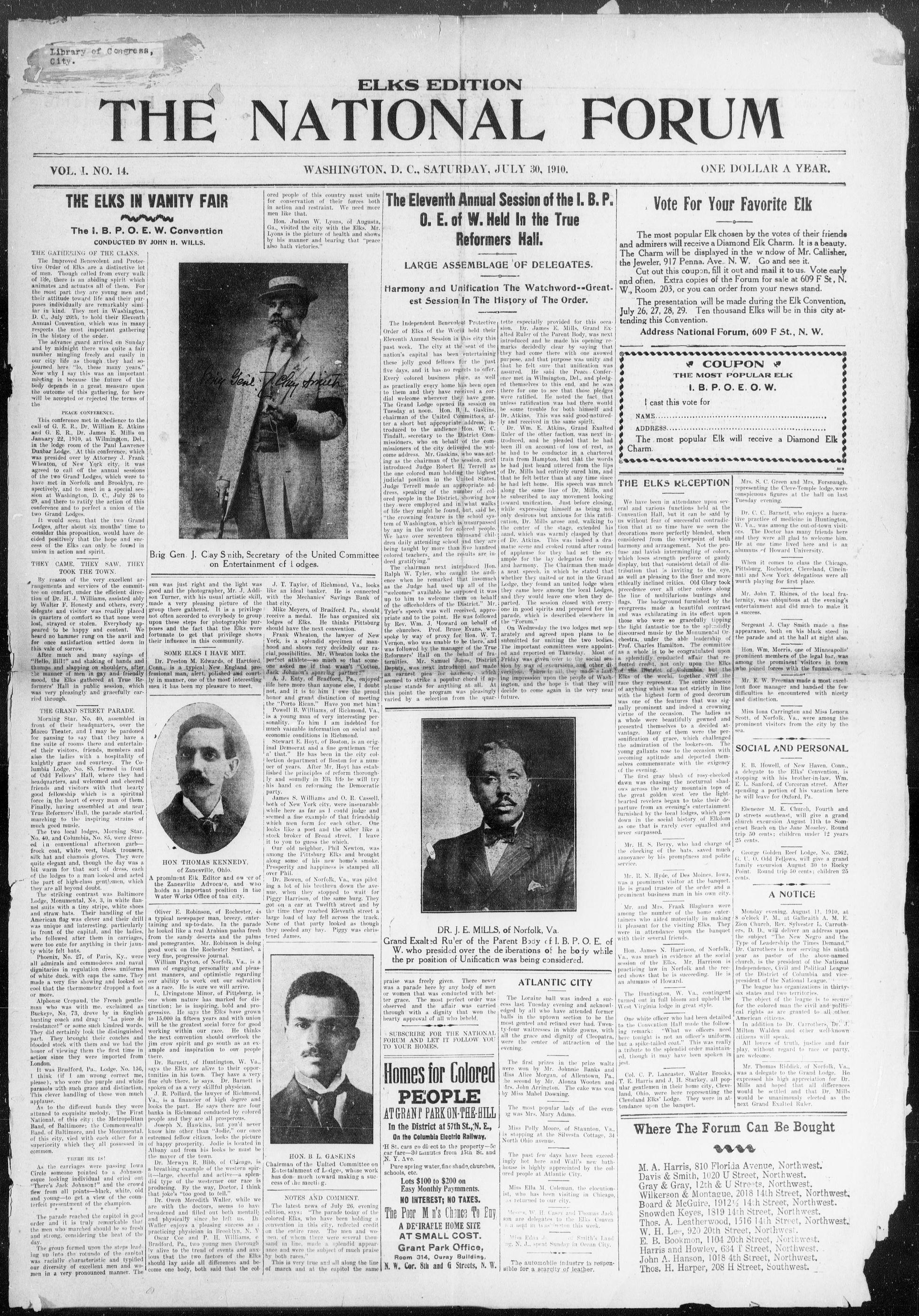
THE ELKS IN VANITY FAIR
The I. B. P. O. E. W. Convention CONDUCTED BY JOHN H. WILLS.
Library of Congress
City.
VOL. I. NO. 14.
THE ELKS IN W
The I. B. P. O. E.
CONDUCTED BY J
THE GATHERING OF THE CLANS.
THE GATHERING OF THE CLANS.
The Improved Benevolent and Protective Order of Elks are a distinctive lot of men. Though called from every walk of life, there is an abiding spirit which animates and actuates all of them. For the most part they are young men and their attitude toward life and their purposes individually are remarkably similar in kind. They met in Washington, D. C. July 20th, to hold their Eleventh Annual Convention, which was in many respects the most important gathering in the history of the order.
The advance guard arrived on Sunday and there was quite a fair number singing and danced easily in our city life as though they had sojourned here "lo, these many years." Now why I say this was an important meeting is because the future of the body depends in a great measure upon the outcome of this gathering, for here will be accepted or rejected the terms of the
PEACE CONFERENCE.
This conference met in obedience to the call of G. E. R., Dr. William E. Atkins and G. E. R., Dr. James E. Mills on January 22, 1910, at Wilmington, Del., in the lodge room of the Paul Lawrence Dunbar Lodge. At this conference, which was presided over by Attorney J. Frank Wheaton, of New York city, it was agreed to call off the annual sessions of the two Grand Lodges, which were to have met in Norfolk and Brooklyn, respectively, and to meet in a special session at Washington, D. C., July 26 to 29, and to ratify the action of this conference and to perfect a union of the two Grand Lodges.
It would seem that the two Grand Lodges, after about six months' time to consider this proposition, would have decided positively that the hope and success of the Elks can only be found in union in action and spirit.
THEY CAME, THEY SAW, THEY
TOOK THE TOWN.
By reason of the very excellent arrangements and services of the committee on comfort, under the efficient direction of Dr. H. J. Williams, assisted by Walter F. Honesty and others, every delegate and visitor was readily placed in quarters of comfort so that none were lost, strayed or stolen. Everybody appeared to be happy and content. We heard no hammer rung on the anvil and for once satisfaction settled down in this vale of sorrow.
After much and many sayings of "Hello, Bill!" and shaking of hands and thumps and slapping on shoulders, after the manner of men in gay and friendly mood, the Elks gathered at True Reformers' Hall in public session, which was very pleasingly and gracefully carried through.
THE GRAND STREET PARADE
Morning Star, No. 40, assembled in front of their headquarters, over the Maceo Theater, and I may be pardoned for pursuing to say that they have a fine suite of rooms there and entertained their visitors, friends, members and also the ladies with a hospitality of knightly grace and courtesy. The Columbia Lodge, No. 85, formed in front of Old Fellows' Hall, where they had headquarters, and welcomed and cheered friends and visitors with that hearty good fellowship which is a spiritual force in the heart of every man of them. Finally, having assembled at and near True Reformers' Hall, the parade started, marching to Inspiring strains of music. The two local lodges, Morning Star, No. 40, and Columbia, No. 85, were dressed in conventional afternoon garb—coff coat, white vest, black trousers, silk hat and chamois gloves. They were quite elegant and, though the day was a bit warm for that sort of dress, each of the lodges to a man looked and acted the part of high-class gentlemen, which they are all hedon doubt.
The striking contrast was Baltimore Lodge, Monumental, No. 3, in white flannel suits with a tiny stripe, white shoes and straw hats. Their handling of the American flag was clever and their drill was unique and interesting, particularly in front of the capital, and the ladies, who followed after them in carriages, were too cute for anything in their jaunty white felt hats. No. 27, of Paris, Ky., were all admirals and commodores and naval dignitaries in regulation dress uniforms of white duck, with caps the same. They made a very fine showing and looked so cool that the thermometer dropped a foot or more.
Alphonse Crepand, the French gentleman who was with me, exclaimed as Buckeye, No. 73, drove by in English hunting coach and drag: "La piece de resistance!" or some such kindred words. They did certainly look the distinguished part. They brought their conches and blood stocked with them, and they were viewing the first time in action since they were imported from London.
It was Bradford, Pa. Lodge, No. 156 I think (if I am wrong correct me please), who wore the purple and white parasols with such grace and distinction. This clever handling of these won much applause. As to the different bands they were attuned to exquisite melody. The First National, of this city; the Metropolitan Band, of Baltimore; the Commonwealth Band, of Baltimore, and the Monumental of this city, vied with each other for superiority which they all possessed in common.
THERE HE 181
As the carriages were passing Iowa Circle someone pointed to a Johnson-esque looking individual and cried out "There's Jack Johnson!" and the crowd flew from all points—black, white, old and young—to get a view of the counterfeit presentation of the champion.
The parade reached the capitol in good order and it is truly remarkable that the men who marched should be so fresh and strong, considering the heat of the day.
The group formed upon the steps leading up into the rotunda of the capitol was racially characteristic and typified our diversity of excellent men and women in a very pronounced manner. The
Very Good Z. Elly Smith
Brig Gen. J. Clay Smith, Secretary of the United Committee on Entertainment of lodges.
sun was just right and the light was good and the photographer, Mr. J. Addison Turner, with his usual artistic skill, made a very pleasing picture of the group there gathered. It is a privilege not often accorded to everybody to group upon these steps for photographic purposes and the fact that the Elks were fortunate to get that privilege shows their influence in this community.
SOME ELKS I HAVE MET.
Dr. Preston M. Edwards, of Hartford, Comm., is a typical New England professional man, alert, polished and courteously in manner, one of the most interesting men it has been my pleasure to meet.
J. T. Taylor, of Richmond, Va., looks like an ideal banker. He is connected with the Mechanics' Savings Bank of that city.
Mike Meyers, of Bradford, Pa., should receive a medal. He has organized six lodges of Elks. He thinks Pittsburg should have the next convention.
Frank Wheaton, the lawyer of New York, is a splendid specimen of manhood and shows very decidedly our racial possibilities. Mr. Wheaton looks the perfect athlete—so much so that some one asked me if that wasn't "Cotton Jack Johnson" sparing partner."
A. J. Enty, of Bradford, Pa., enjoyed life here more than anyone else. I doubt
HON. THOMAS KENNEDY,
of Zancsville, Ohio.
A prominent Elk Editor and ower of the Zanesville Advocate, and who holds an important position in the Water Works Office of tha city.
Oliver E. Robinson of Rochester, as a typical newspaper man, breezy, entertaining and up-to-date. In the parade he looked like a real Arabian pashth from the sandy deserts and the palms and pomegranates. Mr. Robinson is doing good work on the Rochester Sentinel, a very fine, progressive journal.
William Payton, of Norfolk, Va., is a man of engaging personality and pleasant manners, and optimistic regarding our ability to work out our salvation as a race. He is sure we will arrive.
L. Livingstone Minor, of Pittsburg, is one whom nature has marked for distinction; he is inspiring, bold and progressive. He says the Elks have grown to 15,000 in fifteen years and with union will be the greatest social force for good working within our race. He thinks the next convention should overlook the jim crow spirit and go south as an example and inspiration to our people there.
Dr. Barnett, of Huntington, W. Va., says the Elks are able to their opportunities in his town. They have a very fine club there, he says. Dr. Barnett is spoken of as a very skillful physicist. J. R. Pollard, the lawyer of Richmond, Va., is a financier of high degree and looks the part. He says there are four esteemed people in the city, orded people and they are all prosperous. Joseph N. Hawkins, but you'd never know him other than "Jodie," our once esteemed fellow citizen, looks the picture of happy prosperity. Jodie is located in Albany and from his looks he must be the mayor of the town. Dr. Merwyn R. Bibb, of Chicopee, is a breathing example of the western spirit—large, cheerful and active—a splenium type of the wayward Doctor, I think that jodie "is too good to tell."
Dr. Owen Meredith Waller, while we are with the doctors, seems to have broadened and filled out both mentality and physically since he left us. Dr Waller enjoys a pleasing success as a practicing physician in Brooklyn, N. V. Oscar Coe and P. H. Williams, e. Bradford, P., two young men thoroughly alive to the trend of events and anxious that the two factors of the Elks should lay aside all differences and become one body, both said that the col
ELKS EDITION
WASHINGTON, D. C., SATURDAY, JULY 30, 1910.
ored people of this country must unite for conservation of their forces both in action and restraint. We need more men like that. Hon. Judson W. Lyons, of Augusta, visited the city with the ERKs. Mr. Lovell, of the city of health and shows by his manner and bearing that "peace also hath victories."
etary of the United Committee
ment of lodges.
J. T. Taylor, of Richmond, Va., looks like an ideal banker. He is connected with the Mechanics' Savings Bank of that city.
Mike Meyers, of Bradford, Pa., should receive a medal. He has organized six lodges of Elks. He thinks Pittsburgh should have the next convention.
Frank Wheaton, the lawyer of New York, is a splendid specimen of manhood and shows very decidedly our racial possibilities. Mr. Wheaton looks the perfect athlete—so much so that someone asked me if that wasn't "Cotton, Jack Johnson" sparing partner?" J. Enty, of Bradford, Pa., enjoyed life like anyone else. I doubt not, and it is to him I own. I proud and grand distinction of meeting the "Porto Rican." Have you met him? Powell B. Williams, of Richmond, Va., is a young man of very interesting personality. To him I am indebted for much valuable information on social and economic conditions in Richmond.
Stewart E. Hoyt, of Boston, is an original Democrat and a fine gentleman "for a' that." He has been in the city collection department of Boston for a number of years. After Mr. Hoyt has established the principles of reform thoroughly and soundly in Elk life he will try his hand on reforming the Democratic party. James S. Williams and O. R. Cassell, both of New York city, were inseparable while here as far as I could judge and seemed a fine example of that friendship which men form for each other. One looks like a poet and the other like a stock broker of Broad street. I leave it to you to guess the which.
Our old neighbor, Phil Newton, was among the Pittsburg Elks and brought home of his new smoke. Prosperity and happiness is stamped all over Phil.
Dr. Bowen, of Norfolk, Va., was piloting a lot of his brothren down the avenue, when they stopped to wait for Piggy Harrison, of the same burg. They got on a car at Twelfth street and by the time they reached Eleventh street a large load of hay fell across the track. None of that party looked as though they needed any hay. Piggy was christened James.
M. A. S.
Chairman of the United Committee on Entertainment of Lodge, whose work has done much toward making a success of the meeting.
NOTES AND COMMENT
The latest news of July 26, evening edition, says: "The parade today of the colored Elks, who have been holding a convention in this city, reflected credit on the entire race. The men and women, of whom there were several thousand in line, made a splendid appearance in the subject of much praise by both races." This is very true and at all along the line of march and at the capitol the same
The Eleventh Annual Session of the I. B. P. O. E. of W. Held In the True Reformers Hall.
The Eleventh Annual Session of the I. B. P. O. E. of W. Held In the True Reformers Hall.
LARGE ASSEMBLAGE OF DELEGATES. Harmony and Unification The Watchword--Greatest Session In The History of The Order.
A. B.
The Independent Benevolent Protective Order of Elks of the World held their Eleventh Annual Session in this city this past week. The city at the seat of the nation's capital has been entertaining these jolly good fellows for the past five days, and it has no regrets to offer. Every colored business place, as well as practically every home has been open to them and they have received a cordial welcome wherever they have gone. The Grand Lodge opened its session on Tuesday at noon. Hon. R. L. Gaskins, chairman of the United Committees, after a short but appropriate address, introduced to the audience Hon. W. C. Tindall, secretary to the District Commissioners, who on behalf of the commissioners of the city delivered the welcome address. Mr. Gaskins, who was acting as the chairman of the session, next introduced Judge Robert H. Terrell as the one colored man holding the highest judicial position in the United States. Judge Terrell made an appraisal of dress, speaking of the number of colored people in the District, showing how they might be employed and in what walks if they might be found, but, said he "the crowning feature is the school system of Washington, which is unsurpassed by any in the world for colored people. We have over seventeen thousand children daily attending school and they are being taught by more than five hundred colored teachers, and the results are in deed gratifying."
The chairman next introduced Hon. Ralph W. Tyler, who caught the audience when he remarked that inasmuch as the Judge had used all of the "welcomes" available he supposed it was up to him to welcome them on behalf of the officeholders of the District." Mr. Tyler's speech was pointed at. He pointed by Rev. Wm. J. "Howard on behalf of the churches. Prof. Bruce Evans, who spoke by way of proxy for Hon. W. T. Vernon, who was unable to be there, and was followed by the manager of the True Reformers' Hall on the behalf of fraternities. Mr. Samuel Jones, District Deputy, was next introduced and made an earnest plea for harmlessness, seemed to be sincere, it appealed for anything at all. At this point the program was pleasingly varied by a selection from the quar-
DR. J. E. MILLS
Grand Exalted Ru'er of the F
W. who presided over the o
the pr position of Unification
praise was freely given. There never was a parade here by any body of men or women that was conducted with better grace. The most perfect order was observed and the affair was carried through with a dignity that won the hearty approval of all who beheld.
SUBSCRIBE FOR THE NATIONAL FORUM AND LET IT FOLLOW YOU TO YOUR HOMES.
Homes for Colored PEOPLE AT GRANT PARK ON THE-HILL In the District at 57th St., N. E.
On the Columbia Electric railway.
H St. cars go direct to the property-5c car fare-30 minutes from 15th St. and N. Y. Ave.
Pure spring water, fine shade, churches, schools, etc.
Lots $100 to $200 on Easy Monthly Payments.
NO INTEREST; NO TAXES.
The Poor M'n's Chance To Eny
A DEFIRAFLE HOME SITE
AT SMALL COST.
Grant Park Office,
Room 314, Ouray Building,
N. W. Cor. 8th and G Streets, N. W.
tette especially provided for this occasion. Dr. James E. Mills, Grand Exalted Ruler of the Parent Body, was next introduced and he made his opening remarks decidedly clear by saying that they had come there with one avowed purpose, and that purpose was unity and that he felt sure that unification was assured. He said the Peace. Conference met in Wilmington, Del., and pledged themselves to this end, and he was there for one to see that those pledges were fulfilled. He said unless ratification was had there would be some trouble for both himself and Dr. Atkins. This was said good-natured and received in the same spirit.
Dr. Wm. E. Atkins, Grand Exalted Ruler of the other faction, was next introduced, and he pleaded that he had been ill on account of loss of rest, as he had to be conductor in a chartered train from Hampton, but that the words he had just heard uttered from the lips of Dr. Mills had entirely curried him, and that he felt better than at any time since he had left home. His speech was much along the same line of Dr. Mills, and he subscribed to any movement looking forward to the future. Just before closing while expressing himself as being not only desired but anxious for this ratification, Dr. Mills arose and, walking to the center of the stage, extended his hand, which was warmly clasped by that of Dr. Atkins. This was indeed a dramatic scene and evoked round after round of applause for they had set the example for the lay delegates for unity and harmony. The Chairman then made a neat speech, in which he stated that whether they united or not in the Grand Lodge, they found an united lodge when they came here among the local Lodges. They would have been used, particularly in their mission, used with every one in good spirits and prepared for the parade, which is described elsewhere in the "Forum."
On Wednesday the two lodges met separately and agreed upon plans to be submitted for uniting the two bodies. The important committees were appointed and reported on Thursday. Most of Friday was given over to the social session by way of excursions and other diversions. Taken in all, they made a lasting impression upon the people of Washington, and the hope is that they will decide to come again in the very near future.
of Norfolk, Va.
Parent Body of I. B. P. O. E. of the iterations of he body while he was being considered.
ATLANTIC CITY
The Loraine ball was indeed a success last Tuesday evening and acknowledged by all who have attended former balls in the uptown section to be the most genteel and retired ever had. Twenty-four waitresses in white gowns, with all the grace and dignity of Cleopatra, were the center of attraction of the evening.
The first prizes in the prize waltz were won by Mr. Johnnie Banks and Miss Alice Morgan, of Allentown, Pa., the second by Mr. Alonza Wooten and Mrs. John Arrington. The cake was won by Miss Mabel Downing.
The most popular lady of the evening was Mrs. Mary Adams.
Miss Polly Moore, of Staunton, Va., is stopping at the Silvestra Cottage, 34 North Ohio avenue.
The past few days have been exceedingly hot here and Wall's new bathhouse is highly appreciated by the colored people at Atlantic City.
Miss Ella M. Coleman, the electionist, who has been visiting in Chicago, has returned to our city.
Missers, W. H. Casey and Thomas Jack son are delegates to the Elks Convenient neqt in vassiberton this week.
Miss Edna J. of Smith's Landing, N. J., spent Sunday in Ocean City.
The automobile industry is responsible for a scarcity of leather.
ONE DOLLAR A YEAR.
For Your Favorite Elk
Mr Elk chosen by the votes of their friends give a Diamond Elk Charm. It is a beauty. Displayed in the window of Mr. Callisher, a. Ave. N. W. Go and see it. Don, fill it out and mail it to us. Vote early ties of the Forum for sale at 609 F St., N. a can order from your news stand.
It will be made during the Elk Convention, Ten thousand Elks will be in this city at-ion.
National Forum, 609 F St., N. W.
COUPON
MOST POPULAR ELK
B. P. O. E. O. W.
for
Mr Elk will receive a Diamond Elk
Vote For Your Favorite Elk
The most popular Elk chosen by the votes of their friends and admirers will receive a Diamond Elk Charm. It is a beauty. The Charm will be displayed in the window of Mr. Callisher, the Jeweler, 917 Penna. Ave., N. W. Go and see it.
Cut out this coupon, fill it out and mail it to us. Vote early and often. Extra copies of the Forum for sale at 609 F St., N. W., Room 203, or you can order from your news stand.
The presentation will be made during the Elk Convention, July 26, 27, 28, 29. Ten thousand Elks will be in this city attending this Convention.
Address National Forum, 609 F St., N. W.
Mr. H. S. Berry, who had charge of the cheeking of the hats, saved much annoyance by his promptness and polite service.
Mr. R. N. Hyde, of Des Moines, Iowa, was a prominent visitor at the banquet. He is grand trustee of the order and a prominent business man in his own city.
Mr. and Mrs. Frank Blagburn were among the number of the home entertainers who aided materially in making it pleasant for the visiting Elks. They were in attendance upon the banquet with their several friends.
The Huntington, W. Va., contingent turned out in full bloom and uphold the West Virginia lodge in great style.
One white officer who had been detailed to the Convention Hall made the following remark: "What we officers need here tonight is not an officer's uniform, but a spike-tailed coat." This was really a tribute to the splendid order maintained, though it may have been spoken in jest.
Col. C. P. Lancaster, Walter Brooks, T. E. Harris and J. H. Starkey, all popular gentlemen in their home city, Cleveland, Ohio, were here representing the Cleveland Elks' Lodge. They were in attendance upon the banquet.
Where The Forum Can Be Bought
THE ELKS RECEPTION
We have been in attendance upon several and various functions held at the Convention Hall, but it can be said by us without fear of successful contradiction that at no time have we seen the decorations more perfectly blended, when considered from the viewpoint of both harmony and arrangement. Not the profuse and lavish intermingling of colors, which loses strength perforce of gaudy display, but that consistent detail of distribution that is inviting to the eye as well as pleasing to the finer and more ethically inclined critics. Old Glory took precedence over all other colors along the line of multifarious bantings and flags. The background furnished by the evergreens, made up of matching paintings in its effect upon those who were so gracefully tipping the light fantastic toe to the splendidly discoursed music by the Monumental Orchestra, under the able leadership of Prof. Charles Hamilton. The committee as a whole is to be congratulated upon a splendidly conducted affair that reflected credit, not only upon the Elks of the District of Columbia, but the Elks of the world, together with the race they represent. The entire absence of anything which was not strictly in line with the highest form of good decorum was one of the features that was signally prominent and indeed a crowning virtue of the occasion. The ladies as a whole were beautifully gowned and presented themselves to a decided advantage. Many of them were signification of the challenges of the lookers-on. The young gallants rose to the occasion with becoming aptitude and deported themselves commensurate with the exigency of the evening.
The first gray blush of rosy-checked dawn was chasing the nocturnal shadows across the misty mountain tops of the great golden west 'ere the light-hearted revelers began to take their departure from an evening's entertainment furnished by the local lodges, which goes down in the social history of Elkdom as one that is rarely ever equalled and never surpassed.
Hon. James N. Harrison, of Norfolk, $V_{k_i}$ was much in evidence at the social session of the Elks, Mr. Harrison is practicing law in Norfolk and the record shows that he is succeeding. He is an alumnus of Howard.
---
Mrs. S. C. Green and Mrs. Forsnaugh, representing the Creeve-Temple lodge, were conspicuous figures at the hall on last Tuesday evening.
Dr. C. C. Barnett, who enjoys a lucrative practice of medicine in Huntington, W. V. was among the out-of-town visitors. The Doctor has many friends here and they were all glad to welcome him. He at one time lived here and is an alumnus of Howard University.
When it comes to class the Chicago, Pittsburgh, Rochester, Cleveland, Cincinnati and New York delegations were all worth playing for first place.
Mr. John T. Rhines, of the local fraternity, was ubiquitous at the evening's entertainment and did much to make it a success.
Sergeant J. Clay Smith made a fine appearance, both on his black steed in the parade and at the hall at night also.
Hon, Wm, Morris, one of Minneapolis' prominent members of the legal bar, was among the prominent visitors in town who joined forces with the funnakers.
Mr. E. W. Freeman made a most excellent floor manager and handled the few difficulties he encountered with nicety and distinction.
Miss Iona Carrington and Miss Lenora Scott, of Norfolk, Va., were among the prominent visitors from the city by the sea.
SOCIAL AND PERSONAL
E. B. Howell, of New Haven, Conn., a delegate to the Elks' Convention, is stopping with his brother-in-law, Wm. E. L. Sanford, of Corcoran street. After spending a portion of his vacation here he will leave for Oxford, Pa.
Ebenezer M. E. Church, Fourth and D streets southeast, will give a grand church excursion August 11th to Somerset Beach on the Jane Moseley. Round trip 50 cents; children under 12 years 25 cents.
George Golden Reef Lodge, No. 2362, G. U. O. Old Felows, will give a grand church excursion August 30 to Rocky Point. Round trip 50 cents; children 25 cents.
A NOTICE
Monday evening, August 11, 1910, at 8 o'clock P. M., at Galbraith A. M. E. Zion Church, Rev. Sylvester L. Carrothers, D. D., will deliver an address upon the subject "The New Negro and the Type of Leadership the Times Demand." Dr. Carrothers is now serving his ninth year as pastor of the above-named church, is the president of the National Independence, Civil and Political League of the District of Columbia and vice-president of the National League.
The league has organizations in thirty-six states, and two territories.
the object of the league is to secure for the colored man the civil and political rights as are granted to all other American citizens. In addition to Dr. Carruthers, Dr. J. T. Mills, Walden and other well-known citizens will speak. All lovers of truth, justice and fair play, without regard to race or party, are welcome.
Mr. Thomas Riddick of Norfolk, Va., was a delegate to the Grand Lodge. He expressed his high appreciation for Dr. Mills and hoped that all differences would be settled and that Dr. Mills would be unanimously elected as the next Grand Exalted Ruler.
---
Subscription Rates
One Year..... $1.00
Six Months..... 50
Entered as second class matter. May
27, 1910, at the Postoffice at Washington,
D. C., under Act of March 3, 1879.
Address all communications, checks
and money orders to
The National Forum,
609 F Street, N. W.,
Washington, D. C.
THE MAIN FEATURE ABOUT THE RECENT MEETING OF THE ELKS IN OUR CITY WAS THE SPLENDID DECORUM THAT WAS EVERYWHERE AND AT ALL TIMES OBSERVED, NOT THAT THEY ARE AT ALL INCLINED TO BE OTHER THAN DECORUS, BUT CERTAIN RUMORS FROM CERTAIN CLASSES HAD GONE FORTH THAT DISTURBANCES MIGHT BE EXPECTED ON ACCOUNT OF THE EXPECTED PRESENCE OF JACK JOHNSON. IT WAS ONLY ANOTHER CASE OF SHORTSIGHT EDNESS ON THE PART OF THOSE OVER WHOM PREJUDICE AND PETTY, FOOLISH PRIDE HAS FULL SWAY.
---
The article offered by Rev. Dr. J. Milton Waldron dealing in the main with the evils attendant upon the method of living employed by the Negroes in some measure, and that is really forced upon them in another was the keynote to the solving of a great problem, and should be closely studied for the benefit that might accrue therefrom. There is no denying that we sadly neglect the essentials along this line even in cases where we ourselves could remedy the evil. It is not to be overlooked that there is quite a deal of religion in good, wholesome soap, a liberal application of water and the looking after the sanitary condition of our domiciles. Cleanliness is next to Godliness. Alas! how true, but how little observed.
The one question that has been on every lip this week has been, "When is Jack Johnson coming?" Jack did not come, but he did the two next best things. He sent his popular attorney, Hon. Frank Wheaton, and for fear that Wheaton could not cover all the ground he sent his photos. Since he cannot be seen in action here through the medium of the fight films, and it would be attempted to be made unpleasant for him if he came by certain classes, we suppose there is no law that can keep his picture out of the District at least.
The booth of "The National Forum" at the True Reformers' Hall was visited by thousands of persons during the last week, and each and every one received a welcome. The "Forum" was glad to be able to co-operate with the loyal lodges in entertaining the visiting Elks. We have kept a faithful list of names in our register and shall be pleased to mail you a copy of the proceedings upon a request from you either before or after you leave for your homes. Let the Forum (follow you).
The story runs, relates the Brooklyn Eagle, that once upon a time a reporter hurried into a Manhattan newspaper office, rushed up to the city editor's desk, and said: "I want to give you a column about a man jumping from the Brooklyn Bridge to the water." The city editor responded coldly: "Make it two sticks. I'll give you two, columns if you'll bring me in a story of a man's jumping from the water up to the Brooklyn Bridge. Anybody can jump down."
In the past the skyscraper men were a bolsterous, swashbuckling lot. They "floated" from New Orleans to Vancouver, lived in freight cars, built bridges and dropped off them with a grin and a choking "good-by." A hero among them was a man who had the longest fall to his credit, or who could toss a white-hot rivet the greatest distance, cites Harper's Weekly. They lived hard and died easily. Today they know that a man stands highest on the pay roll who takes his work and its danger most seriously, who also watches the man next to him—for in this calling one man's error often means another man's life.
Very few people are aware that the first practical telescope—the one which Galileo used in discovering the satellites of Jupiter in January, 1610, is still in existence and preserved in the Museum of Physics and Natural History in Florence, notes the Strand Magazine. It is about three hundred years since this instrument was first turned toward the heavens. Unlike the present astronomical type, it had a concave instead of a convex eyepiece, just like the opera glasses now in use. When Galileo first exhibited his new telescope to the doge and an enthusiastic assembly he was overwhelmed with honors, because it was thought that the instrument would give the soldiers and sailors of the republic a great advantage over their enemies.
'WARE OF EVIL EYE.
A Superstition That is Centuries Old--Witch, "Kahuna" and "Ghost Shooter" Still Vivid Perils to Many.
One of the oldest and most widespread of human beliefs, one which has been adhered to by some of the earth's most learned and pious, as well as her lowest, is that of the influence of the "evil eye" upon human beings, animals, and even plants. A person with an evil eye was, and is still in some quarters, supposed to be gifted with the power of exerting an evil influence or fascination on any one by a glance from the eyes. By the ancient Romans it was called fascinum, and by the Greeks baskania, and to both it was an integral part of the popular belief.
Is called "tamatetiga," or "ghost shooter." A bit of bamboo is stuffed with leaves, a dead man's bone and other magical ingredients, while the proper mana song is chanted over it. Fasting in most cases adds power to this charm. The man who has made or bought one of these holds it in his hand, with the open end of the bamboo covered with his thumb, till he sees his enemy, when he lets out the magic influence and shoots his man.
When the Malay wishes to destroy his enemy without the discomfort of actually killing him he takes wax from a deserted comb, moulds it into
Even in these modern days the 'evil eye' fallacy is to be found in every country on the face of the globe. Here it is especially prevalent among the immigrants who flock to our shores in such countless numbers. Many of them have certain persons among their friends whom they suspect of having an evil eye. If the child of an Italian or Polish mother begins to cry suddenly she will at once attribute it to the evil eye of some one who has looked at the youngster.
It is not children alone that the evil eye threatens. It affects grown up people, animals, and even the crops in the field.
But it is to lovers or newly married couples that the evil eye is most dangerous. An evil eye will make the sweetheart faithless. It will transform the best husband. It brings discord into the homes where love and harmony reigned. That is what the superstitious ones believe.
Many and varied are the means adopted to counteract the effects of the evil eye. Amulets of various forms—the most common those shaped like horns, like a frog or like a hand—are worn, and such devices adopted by way of safeguard as ex-pectorating on the ground or on the breast, showing something ridiculous to the fascinator, dissimulating good fortune or doing something unpleasant by way of counter penance. The Italians, who are inveterate believers in this foolish superstition, are partial to a charm in the shape of a tiny hand, the index and little fingers being pointed out and the third and fourth fingers being held down by the thumb. This little charm is made of various materials, coral, tortoise shell, silver and gold being the ones in highest favor.
The following are a few of the many charms against the evil eye: The kernel of the fruit of the palm tree, a sprig of rue, sweeping a child's face with the branch of a pine tree, hanging around a child's neck fennel seed or bread and cheese. In The Gentleman's Magazine, of England (January, 1731), appears the following account of a curious trial of certain persons charged with bewitching cattle belonging to neighbors, which throws an interesting light upon the superstitions prevailing among our own ancestors in the early days of the existence of the American colonies:
"From Burlington, in Pennsylvania (New Jersey was doubtless meant), 'tis advised that the owners of several cattle, believing them to be bewitched, caused some suspected men and women to be taken up and trials to be made for detecting 'em. About three hundred people assembled near the Governor's house, and, a pair of scales being erected, the suspected persons were each weighed against a large Bible; but all of them vastly outweighed it. The accused were then to be tied head and feet together, and put into a river (the Delaware), on supposition that if they swam not they must be guilty. This they offered to undergo in case their accusers should be served in like manner, which being done, they all swam very buoyantly and cleared the accused."
A most extraordinary belief, and yet one which has had a world-wide currency, is that of the ability of certain persons to accomplish the death of others by various magical processes. In Europe and America the persons so gifted were commonly known as witches, and in the early days, when they were caught at their nefarious practices, death was their portion. The march of civilization has uprooted this superstition from the minds of most civilized peoples, but it is still in vogue among the ignorant, while in the islands of the Pacific and in Asia it flourishes in many queer forms.
Even to this day the older Hawaiian's blood will run cold and he will take to his bed in very horror as soon as the thought strikes him that some one is attempting to "pray" him to death. This is an ancient superstition in the islands, and it is only within recent years that implicit faith in the ability of the "kahuna," or priest, to accomplish his nefarious purpose in this manner, has been broken.
Formerly a person who felt that he had been injured by another would go to a certain "kakuna," and by giving him presents procure his aid in "praying" his enemy to death. The inhabitants of the South Pacific islands, who are offshoots of the Malay race, are very superstitious, and many authentic instances are reported by the missionaries of Hawaiians taking their beds as soon as they heard that they were being "anaanaa," as it was termed, and dying in a very few days.
In the stirring times of the revolution "kahunas," who wore, of course, friendly to ex-Queen Liliukolani, were employed to pray President Dole to death, and pigs were sacrificed to bring this about, but the head of the new republic was too practical a man to be scared, although he was fully aware of what was going on. As pigs are valuable in the islands, the game was soon found to be rather expensive, and as it also proved bootless it was soon abandoned for more violent and less costly means.
A remarkable engine of mischief among the superstitious natives of the Banks Islands, in the South Seas.
is called "tamatetiqua", or "ghost shooter." A bit of bamboo is stuffed with leaves, a dead man's bone and other magical ingredients, while the proper mana song is chanted over it. Fasting in most cases adds power to this charm. The man who has made or bought one of these holds it in his hand, with the open end of the bamboo covered with his thumb, till he sees his enemy, when he lets out the magic influence and shoots his man. When the Malay wishes to destroy his enemy without the discomfort of actually killing him he takes wax from a deserted comb, moulds it into an image of his foe, decorates it with the eyebrows or the hair of the foe, and then slowly scorches the wax figure over a lamp for seven nights, reciting: "It is not the wax I am scorching. It is the liver, the heart and the spleen of _____ that I scorch," naming his enemy. Of course, after this there is nothing for the victim to do but to die.
A superstition whose origin is lost in the myths of antiquity and yet still flourishes in every clique is that thirteen is an unlucky number. While the belief is usually associated with thirteen at table, it has been extended to the number when used to mark rooms in hotels, staterooms on ships, windows in banks and offices, etc. The Turks so dislike the number that the word is almost expunged from their vocabulary. The Italians never use it in making up the number of their lotteries. In Paris no house bears the number. In the Austrian hospitals one finds no ward thirteen or staircase thirteen, while very few patients will consent to be operated on on the thirteenth. And yet thirteen has not always been accounted unlucky. It was the sacred number of the Mexicans and the people of Yucatan.
From very early times the belief in luck and unlucky days has prevailed, and the times of weddings and other important events were looked into with great care, so as to prevent their occurring on days which were deemed unlucky. Grafton, in his "Abridgement of his Chronicle" (1565), enumerates the unlucky days as follows.
January 1, 2, 4, 5, 10, 15, 17, 29, very unlucky. February 26, 27, 28, unlucky; 8, 10, 17, very unlucky. March 16, 17, 20, very unlucky. April 7, 8, 10, 20, unlucky; 16, 21, very unlucky. May 3, 6, unlucky; 7, 15, 20, very unlucky. June 10, 22, unlucky; 4, 8, very unlucky. July 15, 21, very unlucky. August 1, 29, 30, unlucky; 19, 20, very unlucky. September 3, 4, 21, 23, unlucky; 6, 7, very unlucky. October 4, 16, 24, unlucky; 6, very unlucky. November 5, 6, 29, 30, unlucky; 15, 20, very unlucky. December 15, 22, unlucky; 6, 7, 9, very unlucky.
By many Friday is considered an unlucky day upon which to begin anything, such as starting a sea or land journey, beginning a new employment or taking up any task, the belief being that they will come to a sudden and bad ending. However, all nations do not consider it an unlucky day. It is regarded by the Scandinavians as the luckiest day of the week, while in Scotland Friday is a choice day for weddings.
The lover, when he places the visible pledge of his affection upon the hand of his sweetheart, would not think for a moment of placing it upon other than the ring finger, as it is called, or the finger on the left hand between the long and the little fingers. If asked why this finger was selected, not one in a thousand could give an intelligent explanation.
Aulus Gillius, a Latin writer of the second century A. D., gives the reason for it. He says in dissecting corpse it had been found that a certain slender sinew or nerve ran directly from this finger to the heart, so that it seemed quite fitting that this finger should be the one to bear the ring, pre-eminently a token of affection. It was not until long after that it was discovered that there was no such intimacy between the finger and the heart as had been thought to exist. A very old and a very odd supposition is that it is dangerous to save a person from drowning. The belief is prevalent in Scotland and China. The Chinese believe even to this day that the spirit of one who has died violently will return to earth if a substitute can be found. The last man dead is supposed to keep guard over the land of the dead; to save a drowning man would be to deprive him of his substitute and incur the displeasure of a mysterious enemy.
It was at one time believed generally that at the approach of a murderer the blood of the murdered body gushed out. The notion still survives in some places. A very old fallacy was to the effect that if a man deeply perjured himself, especially if by his perjury he had sacrificed the life of a friend, he not merely lost the enjoyment of the sunshine, but he actually lost all consciousness of its light or warmth. The belief that fairies will steal un baptized children and replace them with their own stupid or ugly children is an old one, and is not confined to the ignorant or to the poor and humble in station. The writer knew some years ago a young man, born in a family of wealth and position, who was wretched because his mother, a brilliant woman of society, insisted when he was a baby that he was not her own son, and not only did she henceforth refuse to see him, but she hated him with a malignant hatred.
A superstitious belief which had a great vogue at one time, and is still believed in by some, is that a child is fortunate when it is born with a paul.
England's only radium deposit, in the Trenwith mine, St. Ives, Cornwall, has yielded its first infinitesimal crop, of approximately one-twentieth of an ounce. At the present market, rates this is worth $150,000. The Austrian radium bureau which has a sort of corner in radium, has arranged for its acquisition.
FOR THE EPIGURE
Strawberry Jam.
To each pound of berries allow three-quarters of a pound of sugar. Put them in a preserving pan and stir gently not to break the fruit. Let them simmer for half an hour, and then put into air-tight pots and cover either with a round of paper or with melted paraffine before using.—New York Press.
Strawberry Tapioca
Soak over night a large tacepult of tapioca in water. In the morning put half of it in a buttered yellow ware baking dish. Sprinkle sugar over the tapioca. In this put a quart of strawberries, sugar and the rest of the tapioca. Fill the dish with enough water to cover the tapioca and bake in a moderately hot oven until it jooks clear. Eat cold with cream. If, when baking, the tapioca, seems too dry and more water.—New York Press.
Chicken Bissoles
Take the remains of a cold chicken and chop rather fine with a little lean, cold ham. Make a sauce of two tablespoonfuls of sifted flour mixed with one-half cup warm butter, one-half pint milk, salt and pepper to taste. Boil the milk, pepper and salt, stir in the flour and butter and boil until it becomes thick. Mix with the meat. Roll out a light paste one-quarter inch thick, cut into squares and put a little meat on one square laying another over it and pressing the edges together. Fry in hot lard until brown.—Mrs. P. C. Milliken, in the Boston Post.
Clear Vegetable Soup.
Make a stock of three pounds veal knuckle cut in small pieces, two quarts cold water, one tablespoonful salt, one onion, one-half teaspoonful pepper, two celery stalks. Heat slowly and simmer four hours, skimming frequently. Prepare two carrots, two turnips and two potatoes by cutting into even strips or dicing, then simmering twenty minutes. Drain the water from these and after straining, seasoning and clearing the stock, add the vegetables.
To clear soup stock, remove the meat and fat; add to each quart of liquor the white and shell of one egg. The white should be lightly beaten and the shell broken into small pieces. Boil the stock two minutes, stirring constantly, then allow it to simmer twenty minutes and, after removing the scum, season and strain through two thicknesses of cheese cloth. Everyday Housekeeping.
Broiled Forequarter of Lamb.
Broiled Forequarter of Lamb.
Take off the shoulder, lay it upon the gridiron with the breast; cut in two parts to facilitate its cooking; put a tin sheet on top of the meat and a weight upon that, turn the meat around frequently to prevent its burning; turn over as soon as cooked on one side; renew the coals occasionally that all parts may cook alike; when done, season with butter, pepper and salt, exactly like beefsteak. It takes some time to broil it well, but when done it will be to be equal to broiled chicken, the flavor being more delicate than when cooked otherwise; serve with cream sauce made as follows: Heat a tablespoonful of butter in a saucepan, add a teaspoonful of flour and stir until perfectly smooth, then add slowly, stirring in a cupful of milk (cold), let it boil up once, season to taste with salt and pepper and a teaspoonful of finely chopped fresh parsley. Serve in gravy dish, all hot.—Boston Post.
Hints for Housewives.
Sugar is a valuable foodstuff for children, but it should be eaten with moderation.
The infection of whooping-cough can be conveyed before the child has begun to "whoop."
The infection of measles does not eling to furniture and clothing with the same tenacity as in scarlet fever.
When a tailored collar is just ironed curve in the hands, pressing the turned edge, and place in a cup or howl to dry.
Fat is a valuable article of diet for the prevention of constipation. Bacon fat is more easily digested than the fat of butcher's meat.
For the proper development of children's bones and teeth lime and fat are both absolutely necessary. You will find both of these in milk.
A child who has had mumps should not return to school for four weeks from the beginning of the illness, and then only if all swelling has subsided.
Endiva is a little known vegetable that is an excellent hot-weather substitute for lettuce. It should be planted every two weeks for a succession.
When you are ironing any dark material do not put a linen cloth underneath, as the lint will come off on to the stuff, and you will have great fluffiness in brushing it off again.
The following is a good fly poison: Buy five cents' worth of quassia chips from the druggist and place a layer of them on a plate. Pour hot water over them and sprinkle with brown sugar.
It is a mistake to accustom children to be sung or rocked to sleep. All this soothing and singing, and the occasional sudden starts, which are almost unavoidable, have a bad effect on the child's nerves. It is like opium-eating, the more you have the more you want. The nerves use to do their own work if you do it for them.—Home Notes.
Maunt of the Ptarmigan.
BV SETON GORDON
Of all our mountain birds the ptarmigan alone remains on the mountain tops in winter as well as in summer, and when all other bird life has been compelled by the severity of the weather to descend to more sheltered quarters the hardy ptarmigan seems almost to revel in the Arctic conditions and scorns to leave his storm-swept strongholds.
For this reason he is of special interest to the ornithologist and a day at his haunts is always worth the labors of an arduous climb, for the ptarmigan rarely descends even during the heaviest snowstorms below the level of 2500 feet. As the writer, accompanied by a mountaining friend, set out at daybreak for a favorite haunt of the ptarmigan, a hard frost held the whole countryside firmly in its grip, and the snow partly thawed by a mild westerly wind on the preceding day was frozen as hard as iron.
On the lower grounds the covering was not continuous, but on the sheltered sides of the hill were deep wreaths and to our west the snow lay deep and unbroken. Passing a small lochan nestling in a birch wood we found it thickly covered with a beautiful sheet of smoothest ice, suggesting to our minds the national game of curling, for many ideal rinks could have been marked out on the lochan's surface. Soon we passed a mountain quarry, where ample evidence pointed to the fact that a kestrel used the spot as a roosting site and the hillside also yielded a good many grouse, some already paired, but the majority in coves and packs.
Lech Davan far-beneath us was partially ice bound, but large waves were rolling across the exposed surface of the water, showing that a strong wind was blowing on the low grounds. We put up many mountain hares, which seemed to rival the snow in their snowwhite fur, but shortly after leaving the 2000-foot level the grouse flushed were now few and far between, and at length we entered the domain of the snow white ptarmigan.
We first became aware of the close proximity of these birds by a deep guttural croaking proceeding from some rocky ground on our left, and careful stalking enabled us to get within a few yards of the bird and to obtain a snapshot of him. He was crouching low on the ground and harmonized with his surroundings in a truly remarkable manner.
When he took wing the great beauty of his plumage was very obvious, a few black feathers in the tail setting off the spotless white of his wings and breast. We obtained a pretty photograph of a parmigan's footmarks leading through the wet snow to a small pool of water, and ample traces we found that the "fresh" of the previous day had been felt even at this altitude of close on 3000 feet, for there was practically no snow on the summit plateau, and numerous frozen pools of water showed how the snow had melted. —The Field.
Great Cathedral Dedicated
The exercises in connection with the dedication of the new Catholic Cathedral of Westminster continued several days. About thirty Archbishops and Bishops, many abbots and 300 priests participated in the ceremonies, which were of the most solemn character. Archbishop Bourne presided. The new cathedral was begun in 1895 by Cardinal Vaughan. It is the first Catholic cathedral built in England since the Reformation and the only example of Christian byzantine architecture in London. It has been designated by architects as the greatest architectural triumph of the last seven centuries.
Though the structure was finished in the early part of 1903, many years will elapse before the interior decorations are complete. The nave is the widest of any church in England, and owing to the fact that the sanctuary is seven and one-half feet above the level of the nave, every part commands an uninterrupted view of the high altar, with its imposing marble and mosaic baldacchino, on which light is cleverly concentrated. The gilt crucifix that hangs from the channel arch is thirty feet in length. The dominating external feature is the great canpanile, which to the top of its crowning cross is 284 feet. Apart from the cost of the site, over $1,250,000 was spent on the cathedral.
Candid Caddies.
Caddies, as every one knows, often become expert golf players, and trotting the links at more than one local club are youngsters who could put it over the men whose clubs they carry in a straight game. It often happens, therefore, that the amateur golfer happening to draw one of these diminutive cracks as his attendant, finds himself playing in a mysteriously depressing atmosphere. The contempt that the caddy feels for the plays of some of the amateurs is sometimes beyond his power to suppress.
At the Philadelphia Country Club they are telling a story of a swell young beginner who appeared to think the only qualification necessary for golf was a lot of staggering clothes. He started over the links with a young lady who had similar delusions. They played awhile with one of the best caddy golfers as an attendant.
"Do you think," asked the young man, turning to the zaddy with a kindly air, "do you think we'll be able to get around the course before dusk?" "If you run, sir," said the caddie, grimly."Philadelphia Times.
The Killiov.
"Why don't you like old Pionees? I think he's a genial chap."
"Genial—yes. But he's this kind of a fellow: He'll sit down to dinner with a bunch of people and pass the tomato ketchup to everybody. When everybody has some, they'll pass it to him and he'll refuse. Then they ask him why, an' he says, 'Not for me. I've been through the factory where they make it!'—Cleveland Leader.
ELK
JOTTINGS
Mr. W. H. Casey and Thomas Jackson, of Atlantic City, N. J., were delegates to the convention held here this week.
Dr. P. M. Edwards, M. D., of Hartford, Conn., is in the city meeting his many friends. Dr. Edwards was a member of the Committee on Reform, which, after that of Unification, was the most important committee of the session.
Hon. B. L. Gaskins, chairman of the United Committee on Entertainment, seemed to have been the most sought after man in the convention. There was a reason.
Dr. P. A. Scott, a prominent physician from Newport News, Va., was among the visitors from the Old Dominion.
Mr. C. A. Wilson, Mr. D. W. Parker and Mr. James S. Williams, of New York, constituted a jolly trio that helped to enliven the occasion.
Dr. Segura, whose former home was New Iberia, La., but who has been practicing in the city for something like fourteen years, was diligent in seeking out all of the visiting Elks who were doctors and making them especially welcome.
Misses R. C. Henry, Mrs. Carrie G. Clark and Mrs. Emma Fitchett were delegates from the Elk Temple in Norfolk Virginia.
Messrs. Otis Wootson and Prof. Harvey, of Huntington, W. Va., were popular delegates from the Little Mountain State.
Hon. Frank Wheaton, attorney at law from New York, and who, by the way, is the counselor for Jack Johnson, was prominent in the effort to adjust the matter of unification of the two factions of the lodge.
The Elk Home, equipped nicely with every convenience on the corner of 11th and Yuy streets N. W., was a source of great relief to those who were inclined to seek case rather than the sights of fire by the capital of the nation.
The decorations of the True Reformers' Hall were nicely designed and served well the purpose for which they were intended.
Mr. J. H. Jones, of 115 Summit Lodge, Uniontown, Pa., was a delegate to the Grand Session held this week in our city.
Quaint and Curious
The fashion for red barns is dying out in the country districts.
The fashion for red barns is dying out in the country districts.
The camel is in general use as a carrier in South Australia.
At the approaching French maneuvers a severe test is to be made of the value of dogs as carriers.
A bill granting the taxpaying women of Princess Anne County the right to vote at town elections has passed the Maryland Senate.
Liverpool's chief constable says that owing to the religious feuds the cost of policing the city last year was increased by more than $50,000.
Though blessed with the most fertile soil and most favorable climate in the world, the United States produces less wheat an acre planted than England, Germany or Holland.
In England one clockmaker in a hundred has the haziest notion of what an electric clock is, whereas in Switzerland it has been an active part of their profession for a generation or two.
London is now considering a scheme for the better drainage of its streets that was first propounded by Benjamin Franklin 150 years ago—the idea of a single gutter in the middle of the throughtore.
Leeches are enumerated by the Bureau of Statistics under its general head of animals imported, the total value of the imports of this species in 1908 having been $5341; in 1907, $6992; in 1906, $4494; in 1905, $3802; in 1904, $3589; in 1903, $3240, and in 1902, $2412.
"Rembrandt etchings fetched high prices at the sale of the Theobald collection at Gutekunst's art room in Stuttgart. One, "Rembrandt in the Act of Drawing," was bought by a Berlin dealer for $8250. This is a proof from the unfinished plate, and the only other one known to exist is in the British Museum.
ATTENTION!
For a few days we will make to your order a
Two-Piece SUIT
FOR ONLY
$16.50
from woolens that regularly sell at $20 and $22.50. Choice of 75 pattes.
S. Goldheim & Sons
403-405 Seventh St.
Buy a Home Stop Paying Rent
Every Few Years You Pay Enough FOR
Rent To Buy a Home of Your Own
Very few chances now left to buy cheap homes in the District of Columbia. Go out and look at
East Deanwood, Burville, Beverly, D. C.
This subdivision lies on both sides of the COLUMBIA ELECTRIC R. R., between Bennings, D. C., and Greenpeak Junction. One fare and 20 minutes' time to the city. Get off at Brooks' Station, East Deanwood, D. C.
Buy now when you can get lots cheap. Prices will soon advance. Greater Washington is spreading out in every direction and will soon cover the entire District of Columbia. Less sold on any monthly payments. No interest and no taxes till lots are paid for. Title perfect.
This is now the only section of the District in which laboring people and people of moderate means can buy homes. Buy now. The price will soon be double what it is today.
The undersigned agent will show the ground. Call and see him and arrange to do out to look the subdivision over.
1133 15th St., N. W.
Frank T. Rawlings Co.
Architectural Plans Prepared
Materials selected or furnished. All building details superintended with skill and promptness.
Office: 51st and G St., N. E.
Address R. 3, Box No. 44
EAST DEANWOOD D. C.
The recent discovery of practical methods of converting crude cocoa- nut oil into a palatable and satisfactory vegetable butter has given great extension to this business in Germany. Seven companies are now crushing the copra and refining the oil for edible use. The importations of raw copra have more than doubled within three years.
The King of the Belgians, the King of Portugal and the Czar of Bulgaria are distantly related to the English royal family, and the Queen of Holland is the niece of the Duchess of Albany, and, therefore, first cousin of Princess Alexander of Teck. Only the Emperor of Austria, the King of Italy, the King of Servia and the Prince of Montenegro are without family connections with King George.
An exciting music hall "turn." which will be known as the "human cup and ball." was rehearsed in a shed at the outskirts of Paris. A woman is shut inside a huge wicker ball, which is then rolled down a steep inclined plane, terminating in an upward bend. The ball shoots with lightning speed down the slide and is hurled up into space and caught by an elevated bowl shaped receptacle twenty-five feet away.
EARLIEST "DRY FARMERS."
How Navajo Indians Cultivated Scant Patches in the Desert.
Physically, morally and intellectually the Navajo is superior to other nomadic tribes, such as the Utes, Apaches, Comanches, Sioux and Cheyennes. He has always been self-supporting, receiving no rations or other assistance from the Government. When there is work to be had within their capacity the men labor willingly and efficiently, grading on the railroads, constructing irrigation reservoirs and ditches and weeding or harvesting sugar beets in the beet fields of Colorado.
They cultivate their scanty patches of corn and beans on thousands of places in the desert, having been real "dry farmers" centuries before the Campbell system was born of the brain of the Nebraska experimenter or the Dry Farming Congress that meets in October in Billings, Mont., conceived of. They build their humble hogans of stone or of timber banked up with clay, wherever there happens to be water for their flocks and herds.
They are neither nomads, like the wandering tribes of the plains, nor settled agriculturists, like the Pueblos, but rather Bedouins of the American desert, moving when necessary to secure better pasturage or a more abundant supply of water for their live stock. Their blankets, woven exclusively by their squaws, have made their tribal name a household word wherever barbaric beauty or next to everlasting durability is prized.—Los Angeles Times.
Few Mosquitoes at Panama
Dr. Claude Pierce, of the United States quarantine service at Colon, arrived in New York City on the steamship Santa Marta. "Colon, Cristobal and Panama," he said, "are more healthy places of residence than New York City, because of the great precaution in the Canal Zone. All open pools and cisterns have been done away with entirely in the fight to exterminate the mosquitoes that carry yellow fever and malaria germs. The elimination of mosquitoes i the greatest thing done in the Panama Canal Zone outside of building the canal itself."
The naval, mercantile, marine and general engineering and machinery exhibition to be held at Olympia, London, next September, will, if is stated, be the largest of its kind ever held in that city.
A Package Mailed Free on Request or
MUNYON'S
PAW-PAWFILLS
The best Stomach and
Liver Pile known and
a positive and speedy
cure for Constipation,
Bellowsiness, Sour Stomach,
Headache, and all
ailments arising from a
disordered stomach or
surgical liver. They
form, all the forms,
The best stomach and Paw Fills known and a positive and speedy introduction, Jaundice, Biliousness, Sour Stomach, Headache, and all ailments arising from a disordered stomach or sluggish liver. They contain in concentrated form all the virtues and values of Munyon's Paw-tonic and are made from the juice of the Paw-Fruit. I unhesitatingly recommend these products to patrons ever compounded. Send us postal or letter, requesting a free package of Munyon's Celebrated Paw-Faw Laxative Pills, and we will mail same free of charge. MUNYON'S HOMOEOPATHIC HOME REMEDY CO., 53d and Jefferson Sts., Philadelphia, PA.
These candy tablets do just as much as salts or calomel. But Cascarets never callous the bowels. They never create a continuous need, as harsh cathartics do. Take one just as soon as the trouble appears, and in an hour its over.
Vest-pocket box. 10 cents—at drug-stores. Each tablet of the genuine is marked C C C.
PATENTS Watson E. Coleman, Wash.ington, D.C. Books free. Highest reference.
As early as the fifteenth century Liberia was the first country to send cotton clothes to Northern and Western Europe. That industry is reviving for home consumption is a recent report.
Cocoanat mats have been provided for engineers and firemen of the Baden State Railways to prevent their hearing being impaired by the vibration of their engines.
Electric locomotives capable of a speed of about 43 miles an hour are used to haul trains through the Simpson Tunnel, in Switzerland.
A POLICEMAN'S EXPERIENCE.
Suffered For Years From Chronic
Kidney Trouble.
Walter J. Stanton, 1139 Pear St.,
buton, 1139 Pear St.
Camden, N.J., says:
"Kidney trouble
nothered me for
fifteen years. If
I stooped, sharp
twings shot through
'y back and it was
hard for me to arise.
I was treated by several
doctors, one a
specialist, but did
not receive relief.
Finally I began using
Doam's Kidney
Pills and soon
noticed an improvement.
I continued
until the trouble
disappeared."
T
Remember the
name—Doua's. For
sale by all dealers.
50 cents a box. Fos-
Buffalo. N. Y.
Origin Of Our Time
The hour is divided into 60 minutes simply because in old Babylon there existed, by the side of the decimal system of notation, another system of notation, another system, the sexagesimal, which counted by sixties. There is no number which has so many divisors as 60. The Babylonians divided the sun's daily journey into 24 parasangs, each parasang, or hour, being divided into 60 minutes. The parasang is about equal to a German mile, and the Babylonians compared the progress made by the sun during one hour to the progress made by a good walker during the same time.—New York American.
Waiting Their Turn.
"Did your folks down in Bingville see Halley's comet this spring?" asks the visitor. "Nope," replies the native. "We never any of those big shows until after they've played a year in New York."—Judge.
He Had Feared It Would
The prospects for a safe and sana summer are not as good as they were. The Saturday Evening Post is printing another serial story by Robert W. Chambers.—St. Paul Dispatch.
The Hardest Kind.
"Ever do anything in the way of settlement work?"
"Yes; I've tried bill-collecting."—Pittsburgh Post.
The total sale of English goods in Argentina averages $100,000,000 annually.
There's vitality, snap and "go" in a breakfast of.
and cream.
Why?
Because nature stores up
In wheat and barley
The Potassium Phosphate
In such form as to
Nourish brain and nerves
The food expert who originated
Grape=Nuts
Retained this valuable
Element in the food.
"There's a Reason"
Read the famous little book.
"The Road to Wellville."
Found in packages.
(POSCUM CEREAL COMPANY, Linked)
Battle Creek, Michigan
10 AN OLD FRIEND.
BY MART E.
Now when the sweet
Quickens all that once
I remember how we
You and I, I and yo
Wandered about thar
Reading the books tha
Saying the things that
The world was young,
In those bright forgoit
I remember how we
You and I, I and yo
Read and read for the
Walked in the old fan
Talked and talked for
The world is young, by
Many a book we shall
I remember how we
You and I, I and yo
Vowed that love shout
That we would love
And the years should
THE GUIDE.
A Story of Adventure, in Wh
Become Clos
W. K. ROSE, IN CLEVE
The boy came out of the bushes and waited for the man to approach. He was a boy of ten, a tired boy whose face was gray through lack of rest and whose eyes were heavy through lack of sleep. His clothes were dusty and torn and his fine shoes were coated with dried mire.
The man coming down the quiet highway was a tramp, a tattered, whiskered, slouching vagabond. He was singing in a mandolin voice and the song was a sentimental ballad of the variety stage. His battered soft hat was pushed back on his tangled hair and his dirty face was upturned to the paling sky. And he did not see the waiting boy.
"My Mamie is a fair one, My Mamie is a rare one; There's never a girl like Mamie in this good old world of ours; You never saw a sweeter.
all. I—I didn't notice that you was not eating. If you haven't had your supper, please take this." And he offered the vagabond the last bit of bread.
The tramp slowly smiled and gently pushed the morsel away.
"You're a gentleman, son," he said. "That's easy to see. But don't you worry. I've had my feed. Make it a clean-up, kiddie."
The boy finished the bread and drained the cup.
"I'm feeling much better, thank you, sir."
The tramp nodded.
"That's good. And now, maybe you'll feel like telling me a little something about you who are and where you want to go and why you're lost?"
"Of course I'll tell you," said this boy promptly. "I'll tell you 'cause
My Manie is th' fairest flower of all th' bloomin' bowers."
His voice trailed off in a long-drawn note as he caught sight of the boy.
"Hullo," said the later a little timidly.
"Howdy, boy," said the tramp as he looked over the lain in an odd appraising way. He fell to whistling as he stared at him. "Lost, strayed or merely gallivanting?"
The boy's lip quivered. He was very tired.
"I—I think I strayed," he answered. "Anyway, I'm sure I'm lost."
The tramp came a little nearer. He was very dirty and there was a stale smell about him. His white teeth glistened in the midst of his whiskered face. But the boy was not afraid.
"Lost, eh?"
He put out a grimy hand and laid it on the boy's shoulder.
"Yes, sir," said the lad, and his voice broke a little. "I couldn't find my way and I was very tired and nobody came by and then I heard you singing down the road—singing that beautiful song—and so I came out."
The tramp had been softly whistling while the boy explained.
"Get up on my back," he said. "I'll tore you a piece."
The boy obeyed, holding the vagabond tightly about the neck, while the man clasped his legs.
"Ain't heavy?" he presently asked as the tramp strode along.
"Not a bit heavy, son," replied the vagabond cheerily. "Ride as easy as you can. We've got something of a way to go. There isn't a farmhouse within two miles of here."
"All right," murmured the boy. His head drooped against the tramp's shoulder. "Couldn't you sing a little as you walk? I like that song and maybe it would rest you some."
The vagabond chuckled.
"Maybe it would," he agreed. "Maybe, too, it would put some folks to sleep." He chuckled again, and when he sang his voice had taken on an unacustomed softness.
"My Mamie is a fair one,
There's never a girl like Mamie in this good old world of ours!
He stopped the song. The boy's breathing told him he was asleep. He clutched the lad's legs a little tighter and stalked on.
The evening shadows fell. The glowing hues faded from the sky, a gray mist filled the air.
The tramp presently passed up a lane and finding a low place in the fence managed to get into a field without awakening the tired child. He carried him to a haystack and sinking on his knees contrived to lay the boy on the loose hay at the foot of the stack. The lad did not unclose his heavy eyes.
The man stood up, an ugly figure outlined against the gray sky, and stared down at the small white face.
"Somebody's kid," he muttered, and his voice had a queer sound. He slowly pulled off his ragged coat and laid it across the sleeping child. "Now to do a little foraging." He hesitated a moment. "If the laddle wakes up," he said, "he'll find my coat over him, and then he'll know I'm coming back." He turned and stalked across the field and presently disappeared behind the bushes by the roadside.
He was gone twenty minutes, perhaps, and when he returned he had a bottle of milk and an old tin cup and half a leaf of bread.
He stooped and touched the boy on the shoulder. The tired eyes opened. "Here, son," he said. "It's better to eat a little something. You'll sleep the easier. Sit up and make yourself comfortable. Here's some milk. Dip the bread in the cup. That's right." The boy ate almost ravenously. He was nearly starved. But presently he stopped with a little start.
"I beg your pardon, sir!" he hastily said, "but you are letting me eat it
"Legs limp, eh?" "Yes, sir." "Hungry?" "Xes, sir."
COLERIDGE.
sunny weather
was dead
two,
u.
streets together.
had to be read.
cannot be said.
and we were younger
en days,
two,
u.
spirit's hunger.
nailar ways,
each other's praise.
at we are older.
read no more—
two,
u.
id not grow colder,
we loved before,
make-us love the more.
—From "Gathered Leaves."
which a Lost Boy and a Tramp lose Friends.
ELAND PLAIN DEALER.
all. I—I didn't notice that you was not eating. If you haven't had your supper, please take this." And he offered the vagabond the last bit of bread.
The tramp slowly smiled and gently pushed the morsel away.
"You're a gentleman, son," he said.
"That's easy to see. But don't you worry. I've had my feed. Make it a clean-up, kiddle."
The boy finished the bread and drained the cup.
"I'm feeling much better, thank you, sir."
The tramp nodded.
"That's good. And now, maybe, you'll feel like telling me a little something about who you are and where you want to go and why you're lost?"
"Of course I'll tell you," said the boy promptly. "I'll tell you 'cause I'm sure you'll help me. You're really a tramp, ain't you?
"And tramps know so much, don't they? They know how to live without money and they ain't never sick, and they can tell when storms are coming, and they know all the places on the map and lots of things, don't they?"
"I've run away from a boys' school," said the lad. "They locked me in a room and beat me with a cane, and I pushed open a window in the night and climbed down a tin waterpipe and ran away." He paused a moment. "My name is Spencer Pond," he said. "and we live at Roxbury, and my mother was taken so sick that the doctor said she must go to Chelsea Springs and my father thought it best for me to go to the boys' school, because it wouldn't be convenient for me at the Springs, so I went to the school and I never had been away from home before, and after my father went away I guess maybe I cried. You see my mother was sick and I didn't know anybody there, and there was lumps in my throat and I'm pretty sure I cried. And some of the boys saw me and they said I was a cry baby and they pushed me around and then one of them said I'd better run right home to my mamma. And I was thinking of my mamma and how sick she was and what he said hurt me, and I struck him hard in the face and made him scream, and then some more of them came at me and I fighted them all. And they got me down on the ground, and I got up again and shook them off and the man who owns the little school came running and called me a little brute and wouldn't give me any dinner and struck me with a cane, and locked me in a room all by myself. But I had my knife in my pocket and I pried open the window and got out and ran through the night—cause I wanted to get to Chelsea Springs as soon as I could. I was afraid to ask the way, 'cause when I did a man took my money—it wasn't much—and said he'd cut my head off if I told anybody. But I didn't afraid to tell you. I know you could lick him easy."
"I'd like to test it," said the tramp with fervor. He wrinkled his forehead. "You've come quite a piece out of your way, kiddie. Chelsea Springs must be all of forty miles, cross country, from here. Want me to take you there?"
"Sure I do," cried the child. "My father will be so much obliged to you." He suddenly yawned. "Excuse me, but it's funny how sleepy I am. Do you know any prayer you want to say?"
"No," replied the vagabond.
"Cause if you do you might like to say yours first."
"Go ahead." said the tramp.
Go ahead, and the tramp.
A single yellow star gleamed fitfully through the light mist above them. The boy looked up at it.
"Thou who dost all things command, bless our home, our friends, our land. We are children in Thy hand."
The child looked around at the vagabond.
"And bless the tramp, too," he gravely added.
SAW once how like slee
A man who to my wakie
and ragged sat upon
bankment. He was sleeping,
then at least he did not count
But presently a policeman
into waking life. Then all th
to be let loose upon this w
blinked his eyes and breath
just as when a fish is caught,
suddenly cast into a basket,
gasp like this poor man sudde
depths of sleep. Or if you th
an amusing and not a painful
be if some giant of table cou
air into the space between the
Would we not willingly si
air? S. it is when the loud
sleep, --London Outlook.
SAW one how like sleep was to life in the deep waters. A man who to my waking eyes looked cold and starved and rugged sat upon one of the benches on the Embankment. He was sleeping, and I knew from his face that then at least he did not count himself miserable.
But presently a policeman came and shook the sleeper into waking life. Then all the violence of the world seemed to be loose upon this wreck of a man. He shook and blinked his eyes and breathed with heavy spasms. It was just as when a fish is caught out of the depth of the sea and suddenly cast into a basket. I have seen mackerel shake and gasp like this poor man suddenly caught up out of the native depths of sleep. Or if you think that a fish thus dying is only an amusing and not a painful sight, then think what it might be: the giant plant of the could catch us up out of our native air just the space between the stars.
Would we not willingly sink back again into the depth of air? S. it is when the loud world lets us glide down into sleep. —London Outlook.
Happiness in Sleep.
"That sounds good to me," murmured the vagabond.
The star paled, the night wind fluttered the loose key. The boy was asleep.
The sun had climbed high when he awoke He rubbed his eyes and looked around. The tramp was smiling down at him.
"Breakfast is ready," said the vagabond. "Bread and milk again, and a piece of fresh johnnycake, and a chunk of cold beef."
"If you please," said the boy, "I think I'd like to wash before I eat." His cheeks grew red as he looked at the tramp's grimy face. "I always do, you know," he added with an apologetic air.
"Of course," laughed the vagabond. "There's a washroom right across the field. Come."
He led the way over the field to a shady ravine, with a brisk little stream gurgling through it. And the boy drew from his inner coat pocket a flat leather case, and opening it, showed a piece of soap, a narrow hair brush, a tooth brush, a tiny mirror and a comb and a wash cloth.
"My mother gave me this," he said. "See, there's my initials on it."
He knelt down on a flat stone at the edge of the stream and made his toilet—and came up rosy and smiling. "You're next," he cried.
The vagabond gave a queer little laugh.
"All right," he said, and took the proffered soap. When he finally looked around, his face cleaned, his hair smoothed down, his eyes clear and shining and his white teeth glittering, the boy gave a quick laugh.
"That's great," he cried. "I wonder how you'd look without whiskers?"
"I wonder," said the tramp.
"Look at yourself in my glass," said the boy, and gave him the little mirror.
The vagabond smilingly took it and looked at- his reflection—and the smile faded.
"It looks," he softly muttered, "as if there might be some remnants of a man there yet."
He gave back the glass and they made their frugal meal.
"Now for the road," said the vagabond, "and Chelsea Springs."
They might have been a pair of careless strollers as they tramped down the highway that sunny morning. The vagabond developed a wonderful fund of merry conversation, and the boy was as happy as a bird.
They stopped to rest occasionally, and once they were given a ride by a farmer's boy on a hay wagon, and when it was near noon, they came in sight of a low frame house some distance from the road.
"Now to forage," said the trampa. "You wait for me here."
He went up the lane and was hidden by the bushes. Presently he returned.
"Nothing doing," he cheerfully announced. "The old man said I was too clean for a tramp and too dirty to be respectable."
But at the next farmhouse the vagabond found an elderly woman who said he could earn his dinner with the ax. He whistled for the boy, who was waiting in the highway, and the lad piled the wood and filled the woman's woodbox.
She looked at him a little suspiciously.
"Your boy?" she said to the tramp. "Bo' of a friend of mine. Been away and I'm taking him home."
"Does he treat you well?" she asked the lad.
"Yes, ma'am," the boy promptly replied. "He treats me very well."
And he laid his hand trustingly on the vagabond's arm.
They had an excellent dinner in the clean old kitchen and then the kind woman put a bag of cookies in the boy's hands.
"Madam," said the tramp, with a little flourish, "could you, would you, loan me a razor?"
The good woman laughed.
"I'm afraid," she said, "that you'll have a harder job of cutting than you had at the woodpile. But I'll let you take a razor—it is an old one my son left behind when he went to the Philippines. If you do a good job, I'll give it to you."
He did so good a job that the boy stared at him in wonder and the woman promptly told him to keep both the razor and strop.
"And take good care of the boy," she said.
"Lady," said the boy as he gravely shook hands with her, "he's taking fine care of me and I like him very much."
The woman looked at the tramp and her eyes were very keen.
"Friend," she cried, "I believe there's the making of a man in you yet." And she shook hands with him and wished them both Godspeed.
The vagabond was rather quiet as they strolled down the highway, but the boy chattered like a merry magpie. And then they came upon a rough fellow sitting on a stump by the roadway, a burly vagabond with a fiery face and a hoarse voice.
"Why, it's Stevie!" he cried "swearin' Stevie—an' who's th' kid?" He glowered hard at the boy, who moved a little nearer his friend.
"Howdy, Butcher," said the vagabond, and started to pass the fellow, but the burly man lurched into the roadway.
"No, you don't, Stevie," he snarled. "That's no way to shake an old pal. I don't know what's your game, but I mean to find out. Here, have a drink?" And he drew a black bottle from his rags.
The boy noticed that the vagabond seemed to tremble a little. But he drew back.
"No, Butcher," he said, "I've cut it out."
The stranger laughed discordantly. "You've cut it out," he hoarsely shouted. "Little Stevie's cut out the booze! Well, well! An! maybe, you've cut out th' swearin', too!" "Yes," said the vagabond, and he suddenly took a grip on the boy's sleeve.
"I dunno what your game is," snarled the vagabond, "but it's easy to see there's money in th' boy, Mebby he's kidnapped; mebby not, Mebby he's the boy I saw advertised over at Johnsbury; mebby not. But, anyway, I'm standin' in with you, an' it's going to be a share-and-share-alike deal. Come here, kid." "Let the boy alone," said the vagabond, sharply.
The stranger luced forward with a fierce oath.
"Come here, you cub!" The vagabond quickly threw the boy aside.
"Run!" he cried. "Run, kiddle!" The baffled brute screamed an oath and struck the vagabond a heavy blow. And the vagabond, forced from his balance for a moment, rallied and rushed forward like a wildcat, and the fight was on. It was a desperate battle. The big man had the weight and skill, but the vagabond was quick and full of courage.
"Run, kiddie!" he screamed again, as he dashed at the ruffian.
Then he slipped and fell and the big man was down on him like a flash, and the sky turned red before the boy's eyes and he gave a queer, choking cry and snatched up a piece of rotting wood, and ran forward and screamed again and brought the club down with all his force on the bare head of the burly brute.
And the stranger crumpled under the blow and rolled into the roadway.
The vagabond slowly arose. He was white and trembling.
"I—I didn't run away," stammered the boy.
"I good thing," said the vagabond thickly. His wandering gaze fell upon the stranger, who was trying to regain his feet.
"Move along, Jim Butcher," he thickly growled. "You've had enough."
And the burly man staggered down the roadway, swearing and grooming. The boy was watching the vagabond anxiously.
"Come into the shade, sir," he said, and caught his hand and drew him from the roadway. And suddenly the vagabond reciled and fell at full length on the grass, white and still.
The boy gave one glance at the prostrate form and turned and ran swiftly up the roadway.
Three days later the vagabond was resting in a hammock on the broad porch of a kind old woman's farmhouse. When the panting boy had rushed up the lane with a cry for help, the woman had taken him into her wagon, which luckily was standing in the lane, and had driven after the injured vagabond, and together they had brought him home. And the good woman had bandaged and plastered his hurts and tenderly nursed him.
"It might have been my own son," she murmured.
And then, a little later, she found time to write a letter, and to pass it into the care of the rural carrier.
And so it happened that a touring car came up the lane on the third day after the great battle in the highway, and a man leaped out and ran and caught the boy in his arms.
"Here, daddy," cried the lad, "come and meet my friend. He's been awful good to me. When a very bad man tried to steal me away from him he fought him like a tiger and that's how he was hurt."
"I know all about that, son," said the newcomer, "and your friend is my friend and your mother's friend, from henceforth."
And he took the vagabond's hand and pressed it warmly.
"He guided me, daddy, just like that guide you had in the woods, and he was bringing me to you when he got hurt."
The vagabond looked up with a quick smile.
"He trusted me, sir," he said with a queer little catch in his voice. "Nobody ever trusted me before. And as for guiding—why, sir, it's the boy who's been guiding me."
The publisher is not a modern product. In Greek and Roman times there were firms or individuals who stood between the author and the public, using the cheap resource of slave labor for the transcription of manuscripts, of which there were frequently large editions. It may be said that the supply of books was abundant, and their prices very reasonable; in fact, amazingly cheap, all things considered. For instance, the first book of Martial's Epigrams, in handsome binding, was sold for what would be in our money about seventy-five cents. A cheaper edition was to be for had some thirty-five cents.
Curiosities of Smell.
No substance that refuses to dissolve in water has an odor. It is the actual substance itself, floating in particles in the air, that appeals to the nose, and not simply a vibration of the air, as in the case of light and sound. The damper a thing is the more powerful the odor it gives off. A pleasant proof of the fact can be had by walking in a garden after rain. There is no end to the curiosities of smell. It is, for instance, the vapor of a liquid that smells, and not the liquid in the mass itself. If eau de cologne be poured into the nostril the nose refuses to recognize any odor there at all.—London Globe.
The largest railway company in England, the Great Western, has a locomotive for nearly every mile of the system; there are 3000 miles and nearly 2600 engines.
Do you feel all tired out? Do you sometimes think you just can't work away at your profession or trade any longer? Do you have a poor appetite, and lay awake at nights unable to sleep? Are you tired of being in the world? Do you bition to forge head in the world left you? If so, your might as well put a stop to your misery. You can do it if you will. Dr. Pierce's Golden Medical Discovery will make you a different individual. It will set your lazy liver to work. It will set things right in your stomach, and your appetite will come back. It will purify your blood. It will make you feel better. It will keep that dread destroyer awake. Even after consumption has almost gained a foothold in the form of a
fingering cough, bronchitis, or bleeding at the lungs, it will bring about a care in 98 per cent, of all cases. It is a remedy prepared by Dr. R. V. Pierce, of Buffalo, N. Y., whose advice is given free to all who wish to write him. His great success has come from his wide experience and varied practice. Don't be wheeled by a penny-grabbing dealer into taking inferior substitutes. Dr. Pierce's medicines are of a known composition. Their every infrequent printed on their wrappers. Made from roots without alcohol. Contain no habitative drugs. World's Dispensary Medical Association, Buffalo, N. Y.
sion
tite,
your n
bition to
might us
you will.
make you
to work.
your appo
If there is
it will ke
sumption.
lingering cough, bronchitis, or bleeding cure in 98 per cent, of all cases. It is a of Buffalo, N. Y., whose advice is given j great success has come from his wide exe Don't be wheeled by a penny-grabb tutes for Dr. Pierce's medicines, recon Pierce's medicines are or known como on their wrappers. Made from roots forming drugs. World's Dispensary Med
MAPLEEN
The Chinese are building reinforced concrete houses with native labor.
In a Pinch, Use Allen's Foot-Ease. The Antiseptic Powder, to shine on your shoes, make the feet, Curses Corn, Runns, Swollen, Sore, Hot, Cough, Aching, Sweating Feet and Ingrowing Nails. Allen's Foot-Ease makes new or tight shoes easy. Always use it to break in new shoes. Sample size. A. S. Olmsted, Lo Roy, N. Y.
Soda will brighten burned or darkened chinwash.
For Red, Itching Eyelids, Cysts, Styes,
Falling Eyelashes and All Eyes That Need
Care, Try Murine Eye Solve. Aspleite
Tubes, Trial Size. 25c. Ask Your Druggist
or Write Murine Eye Remedy Co., Chicago.
Chile exports about 1,800,000 tons
of nitrate or soda annually.
For HEADACHE-Hickey CAPUDINE
Whether from Colds, Heat, Stomach or
Noble conditions Capsule helps regu-
lize its lipid content like in impure-
tion. Try it. 25c, 50c, and 60c, at dru-
trol no. es.
A new meter registers how long
a telephone is used.
Mrs. Winslow's Soothing Syrup for Children
teaches soothes the grum, reduces inflammation,
allows pain relief soothes. 25c a bottle.
Corn is Argentina's premier crop.
Dr. Pierre's Pleasant Pellets cure consti-
tion. Constipation is the cause of many
diseases. Cure the cause and you cure the
disease. Easy to take.
An auto driven by producer gas is
1 Scotch experiment.
Epidemic of Itch in Welsh Village.
"In Dowlais, South Wales, about fifteen years ago, families were stricken wholesale by a disease known as the itch. Believe me, it is the most terrible disease of its kind that I know of, as it itches all through your body and makes your life an inferno. Sleep is out of the question and you feel as if a million mosquitoes were attacking you at the same time. I knew a dozen families that were so affected.
"The doctors did their best, but their remedies were of no avail whatever. Then the families tried a druggist who was noted far and wide for his remarkable cures. People came to him from all parts of the country for treatment, but his medicine made matters still worse; as a last resort they were advised by a friend to use the Cuticure Remedies. I am glad to tell you that after a few days' treatment with Cuticura Soap, Ointment and Resolvent, the effect was wonderful and the result was a perfect cure in all cases.
"I may add that my three brothers, three sisters, myself and all our families have been users of the Cuticura Remedies for fifteen years. Thomas Hugh, 1650 West Huron St., Chicago, fl., June 29, 1909."
Incredulity Of Man.
Mr. Henry C. Weeks, the New York architect, who years ago moved the mirth of his Long Island neighbors by pouring oil into swamps to keep down mosquitoes, lived long enough to have the laugh on his side, Friday at the age of 66. He is not the only instance, by sands, that the planner being called by those whom he was seeking to benefit by an operation that justifies itself. Fulton was "crazy" in the opinion of those who jeered him as he went on his way to the yard where the Clermont was building. Their incredulity was different in expression only from that of Laplace, who assured Napoleon that there was nothing in Fulton's plumbing that would enough power to propel a child plaything—Boston Transcript.
Big Hats Defended.
"Those big hats are all right, all right," said the man. "I want my wife to wear one on week days and Sundays, night and morning. Why? They keep her from getting her head knocked off, that is why. All her life she has had the habit of poking her head through cab windows, car windows, the windows of any old thing she happened to pass vehicles grazed, nose to nose, but possible beheaded had no terror for her. But since she has taken to wearing big hats she has to keep her head inside because the hats won't go through the window. When voting for or against big hats just put me down among the yeas," —New York Sun.
For Breakfast—
Post
Toasties
with cream or milk.
The smile that follows will
last all day—
"The Memory Lingers"
Sold by Grocers.
Pkgs. 10c and 15c.
POSTUM CEREAL COMPANY, Ltd.,
Battle Creek, Mich.
Do You Feel This Way?
A FLAVOR that is used the same as lemon or vanilla. By dissolving granulated sugar in water and adding Maplemeal, addicious syrup is made and a syrup is added to the liquid. Send 20 stamp for sample and recipe book. Crescent Mif. Co.. Seattle.
The automobile industry is responsible for a scarcity of leather.
For COLDS and GRIP
Hick's CAPDUNE is the best remedy- relieves the aching and feverishness-cures blood when normal conditions, its liquid-effects immediately. 10c, 25c and 60c, adhors drug stores.
Curiosities Of Smell.
No substance that refuses to dissolve in water has an odor. It is the actual substance itself, floating in particles in the air, that appeals to the nose, and not simply a vibration of the air, as in the case of light and sound. The damper a thing is the more powerful the odor it gives off. A pleasant proof of the fact can be had by walking in a garden after rain. There is no end to the curiosities of smell. It is, for instance, the vapor of the liquid that smells, and not the liquid in the air. It can be cologne be poured into the nostril the nose refuses to recognize any odor there at all.—London Globe.
Mountain air is imitated for the use of invalids. B. N. V. 30.
AFTER FOURYEARS OF MISERY
Baltimore, Md.—"For four years my life was a misery to me. I suffered
from irregularities, terrible dragging sensations, extreme nervousness, and that all gone feeling in my stomach. I had given up hope of I was when I began to take Lydia E. Pinkham's Vegetable Compound. Then I felt as though new life had been
from irregularities, terrible dragons, scandalous extreme nervousness, and that all gone feeling in my stomach. I had given up hope of ever being well when I began to take Lydin E. Pinkham's Vegetable Coconut. Then I felt as though new life had been given me, and I am recommending it to all my friends."—Mrs. W. S. Forn, 2207 W. Franklin St., Baltimore, Md.
The most successful remedy in this country for the cure of all forms of female complaints is Lydia E. Pinkham's Vegetable Compound. It has stood the test of years and today is more widely and successfully used in any other form of illness. It has cured troubles of women who have been troubled with displacements, inflammation, ulceration, fibroid tumors, irregularities, periodic pain, backache, that bearing-down feeling, fatulency, indigestion, and nervous prostration, after all other means had failed.
If you are suffering from any of these ailments, don't give up hope until you have given Lydia E. Pinkham's Vegetable Compound a chance. You can like special advice write to Mrs. Pinkham, Lynn Mass, for it. She has guided thousands to health, free of
FREE Send postal for Free Package of Paxtine. Better and more economical than liquid antiseptics FOR ALL TOILET USES.
PAXTINE TOILET ANTISEPTIC
Gives one a sweet breath; clean, white, germ-free teeth—antiseptically clean mouth and that hurries the breath after smoking—diapses all disagreeable perspiration and body odors—much appreciated by dainty women. A quick remedy for sore eyes and catarrh.
A little Paxtine powder dissolved in a glass of hot water makes a delightful antiseptic solution, possessing extraordinary cleaning, germicidal and healing power, and absolutely harmless. Try a Sample. 50c. a large box at druggists or by mail.
line is in a glass of hot water solved in a glazed hot water makes a delightful antiseptic solution, possessing extraordinary cleaning, germicidal and healing power, and absolutely harmless. Try a Sample. 50c. in a large box at druggists or by mail. THE PAXTON TOILET CO., BOSTON MASS.
WE BUY WOOL HIDES AND FURS
Being Dealers, we can do better for you than agents or comm'ion merchants. Referrals: any bank in Louisville. We furnish Wool Bags Free to our shippers. Write for price 'tit.
M. SABEL & SONS Established Louisville, Ky.
ATENTS, Trade Marks, Pension, Bounty Pay,
Claims Against the Government, Scheduling,
Address of R. H. CLS.
ATENTS, MA. Washington, D. O.
312 Ind. Ave. Washington, D. O.
21 YEARS' PRACTICE.
BLAIR'S PILLS.
CELLEGATED ENGLISH REMEDY for
COUT AND RHEUMATISM, SAVE AND
DROPSY NEW DISCOVERY;
gives quick travel and care
bank of funds to the poor.
BANK OF HAMPSONS, SAVE AND
DROPSY, BANK OF HAMPSONS, SAVE AND
DROPSY.
Seattle Cafe
Meals at all hours. Good cooking
and careful service.
1239 SEVENTH STREET
A Clean Place To Eat
Open Day and Night
The Waldorf Cafe
FRANKT, WADDELL, Prop.
15 and 25c Meals
At All Hours
First Class Dairy Lunch Service
643 Florida Ave. N. W.
Washington, - - D. C.
Open All Night
JOSHUA N. ANDERSON, Prop'r
SEE UNCLE JOSH AT THE
TUSKEGEE
626 North Capitol Street, N.W.
West Side Un on Station, Half Block away
Washington, D.C.
Best Meals At Low Prices
EXCELLENT SERVICE
Good Things To Eat.
ELLIIS CAFE
Welcome to the Elks
OUR FOO IS O THE BEST.
Police and Prempt service our motto
Prices Reasonable
No. 729 4th St., N.W.
WELCOME L.P. P.O.E.W. WELCOME
JAMES W. GRAY
The Best of Love yihi g,
Food, Dink and Uggs
Ladies' and Gentlemen's Cafe Upstairs
1313 E St. N.W.
Phone Main 3696 N.xt to National Theatre
LOU COSTLEY'S
CAFE and DINING ROOM
Grandest Pool and Billard Parlors
SOUTH OF NEW YORK
Ladies' Dining Room Upscairs
1310 Penna. Ave. N. W.
WHERE TO DINE
ATLANTIC CITY
The Bay State Hotel
HARDY & OTTERY, Props.
334 N. TENNESSEE AVE.,
Atlantic City, N. J.
European Plan.
Concert Garden
Special Rates to Parties Taxing Apartments.
BOOK MURDERER BANE OF SECOND-HAND STORES
He Cuts Pictures and Chapters From Rare Volumes, Destroying Their Value.
"Do you see that man with the glasses and the anxious, nervous movement of his hands as he searches among the books?" asked the proprietor of a New York street book store as he glanced at the curious crowd of book lovers tumbling the second-hand books on the counter outside.
"Every craft has its criminals. He is the criminal of the second-hand book trade. No, he is not a thief. He is a murderer. That term is a definite, exact one.
"I can tell a murderer as soon as he stops in front of my stand. He makes a hurried glance along the tables, picks out a certain kind of a book, generally an encyclopaedia or a book of famous men, or a compilation, and buys it. Sometimes he will pay exorbitant prices. You can tell what to charge by the glance of his eye as in triumph it lights on the book he covets.
"A murderer is a man or woman who is interested in a certain sort of picture or clippings from books about certain people. The most common murderer of the old days was the Napoleon Bonaparte murderer. The collector of pictures of Napoleon would search the second-hand book stores till he found a book with a picture of Napoleon and buy it, carefully cut out the picture, thus 'murdering' the book as a perfect specimen of a special edition, and then sell the book to some other store. In time that book might prove to be the valuable only copy of a first edition. It might be quoted at $500. The book-seller offers it for sale. The expert looks it over and says, 'But the picture of Napoleon, made by the famous etcher Spookums, is missing. It is practically worthless.' Then it is that the book dealer curses the murderer.
"Nowadays in America the murderer is apt to be a man interested in the Battle of Gettysburg or of the Wilderness, or in the exodus of the Mormons or some other special object. I have seen men pick up books on the fifteen cent stand, look through them, find some picture missing, and urge me to find them a copy with the picture intact. They have offered me hundreds of dollars sometimes for a book I have marked at fifteen cents if I can replace a picture or chapter that has been cut out by a murderer."
Another Matter.
"I tell you, my dear boy, I stand on my rights. I believe a man should be the master in his own house."
"Of course, that's all right. But what I want to know is if you are allowed to smoke in the parlor?"—Baltimore American.
LIFE OF THE MOLE.
One of the Most Common But Ob scourest of Animals.
One would think that the life history of such a common creature as the mole would be accurately known to naturalists. The commonest of an animal, however, often protects it from expert study. It is more exulting and wins more fame to investigate the habits of a denizen of central Africa or Borneo than to watch the doings of a familiar creature from one's own doorstep. So it comes about, as we are assured by Lionel E. Adams, in Nature, that the life stories of some common animals remain to be written; and that of the mole is yet rather obscure. He says:
The difficulties of observing the habits of a subterranean dweller of a most retiring disposition are patent but not altogether insuperable, and the winner is that field naturalists have been content to read and take for granted the information handed down for the last century without any att- mpt to confirm it.
"During the winter months one cannot help noticing in the open fields here and there a mole-leaf conspicuously larger than the rest. This is a male mole's winter habitation; but at present we do not know whether he lives alone or with his wife, or if the female ever constructs these fortresses, as they are called. Probably he lives alone, and probably females make 'fortresses' slightly more simple in construction and smaller in size than those of the males. If we take a spade and carefully slice away the top of a fortress we shall find several hollow tunnels or runs, which may be opened up and followed to the base of the fortress, whence they lead away in the field. Slicing further under these into the fortress, and just below the ground level, we come upon a large, circular cavity filled with a bundle of grass or dead leaves; this is the mole's nest, in which he sleeps.
"If he has lately quitted it, the interior will be quite warm to the hand; the mole himself, however, will never be caught in the nest. When the nest is removed and the cavity examined it will be found about a foot in diameter and worn smooth by the mole wriggling about as he wraps his nest round him, for that is his method of arranging himself within it. Two or more tunnels will be found leading away from the nest cavity into the field. One of these is particularly noteworthy, as it is found in nearly every fortress; this exit leads from the bottom of the nest perpendicularly downward for about a foot, then, turning upward, it joins another run. Its origin and use are uncertain, but it is usually regarded as a sort of sallypot, and is known as the 'bolt-run.'
"It is extremely unlikely that the mole deliberately selects the site of his fortress, as he is practically blind; probably he sets to work whenever the impulse seizes him and proceeds in' the narrowing manner: He commences to enlarge a nest-cavity, ejecting the earth which he has loosened with his powerful claws out of a hole in the roof; this he does with the top of his head in little jerks. The quiet observer may see a sausage-shaped mass of earth issue from below with four or two sudden jerks; then, after one or two minutes' interval, when the mole is collecting more loose earth, another sausage will appear as before, and so on until the work is complete. After the nest-cavity comes the excavation of the bolt-run, and finally, to make all safe and waterproof, the mole piles up a mass of earth, often amounting to a large barrow load, by means of tunnels around the base of the existing heap. These tunnels sometimes break into one another, and sometimes into the nest-cavity, and so cause a labyrinth which has given rise to much erroneous speculation in the past.
"A fortress is often completed in a single night. The young are not born in the winter fortress, but in a separate habitation made by the female alone. It is built on the same plan as the fortress, but usually simpler in construction and without the bolt-run. The female produces only one litter a year, and the young, which are born from the end of April to the end of May, vary in number from two to six. Naked, blind and pink, they turn lead-color in ten days; after a fortnight a gray velvet pellet is visible, which becomes black at the end of three weeks, when the eyes open. The ears are opened on the seventeenth day. Attempts to rear the young by hand have hitherto proved futile, for, though they will suck freely from flannel or cotton wool soaked in warm milk, they pine and die on the third or fourth day.
"There has always been much discussion as to the mole's power of sight. Dissection has shown that the size of the eye is greater in the embryo than in the adults, indicating that the sight of the race has deteriorated. From numerous experiments the writer is convinced that the adult mole is practically blind. Moles encountered in the daytime have taken no notice of a human being waving a hand close in front, nor at night do they show signs of consciousness of a light waved before their noses; but, if the slightest sound is made the greatest excitement is instantly shown."
The writer tells us further that he has often thrown down worms before a captive mole. The animal shows at once that he knows the worm is there; but the hap-hazard way in which he pokes about indicates that he is guided by scent or by hearing, not by sight. Excitement causes the fur to radiate around the minute eye, and it has been suggested that the animal thus clears his eye to see; most probably, however, this is only an inherited relic of a lost function. To quote again:
"When, after a hurried and blundering search, the worm has been located, the mole holds it down with his forepaws and eats it from end to end with quick, jerky blites. When the animal's immense appetite is at length satisfied and worms are still being supplied the mole will often
give the worm several bites to disable it, and will then cram it into the earth, presumably to bury if 'or future use'—after the manner of the dog with bones and the squirrel with acorns.
"The sense of smell and hearing must be very acute to enable the note to locate a pheasant's or partridge's nest above his run. That this is the case is testified to by two gamekeepers in different parts of the country, both of whom state that the nests are often entered from below and the eggs eaten."—Literary Digest.
WAR CN THE MISTLETOE
That Emblem of Christmas a Danger to Tree Life.
The Department of Agriculture has declared war upon the mistletoe bough, declaring it a serious danger to tree growth. A special investigation into the depreduations of the mistletoe in this country has been conducted by William L. Bray, forest pathologist, and the conclusions are said "o warrant a general effort upon the part of those interested in national arboriculture to exterminate the pest. "The American mistletoe," said Mr. Bray, "is a leaf, green, parasitic shrub commonly found growing upon various species of broad leaf trees throughout the Southern States and extending in more or less modified forms across Texas, Southern New Mexico and Arizona to Southern California and thence northward in the coast region to Oregon and Washington. Eastward its northern limit is in New Jersey, Southern Pennsylvania, Southern Ohio, Indiana, Illinois, Missouri and Eastern Oklahoma.
"Among people who see it rarely and especially among those living in Northern cities who purchase small sprigs or bunches of It for Christmas decoration the idea of mistletoe being a harmful parasite upon trees is quite lost sight of. Nevertheless there are localities in which mistletoe becomes so abundant upon trees and so harmful to them as to make the control of it or its extermination a serious practical question."
Mr. Bray has found that the mistletoe is a parasite which is invariably destructive to its host. The habit of the plant is of course to draw sustenance from the branch and in increasing quantity as the parasite increases in size. The immediate result is to starve that portion of the branch lying beyond the point of infection, and while this part may persist for a few years alive without noticeable growth, in the end it dies and the mistletoe thus comes to occupy the end of the branch. Some very peculiar effects have been noted by Mr. Bray in regard to the action of the mistletoe upon its host. For example, at the point of attachment the branch of the host is stimulated to excessive growth, which gives rise to grotesque deformities, these varying in shape on different host species. In the case of the water oak, which is peculiarly susceptible to the attacks of the mistletoe, both branch and mistletoe are enlarged as so to resemble a clumy piece of welding. Frequently, as in the Osage orange, the branch is stimulated to an excessive formation of shoots, forming a sort of witches' broom, so called; Large branches and not infrequently the main trunks of trees may be greatly deformed by the mistletoe.
Vacation Schools.
Vacation schools offer not a task, but a privilege to those pupils who attend, and that it is so regarded applications and waiting lists show. More would-be pupils apply than can possibly be accommodated. Book learning is not the mode at the vacation school, where the more social method of oral instruction with demonstration takes its place, since entertainment as well as instruction is the aim, and pupils are introduced to a form of knowledge which will give them new resources for their leisure hours. Instead of memorizing or poring over figures the eager classes are given manual training, cooking classes, sewing, gymnastics, and, best of all, are taken to the parks or the country once a week for nature study, or to vacant lots to learn something about flower and vegetable gardening.—Milwaukee Free Press.
Don Juan.
About Byron's purpose in writing "Don Juan," nothing better can be done than to give the words of the late R. C. Stoddard. Says Stoddard: "We should read it as we read 'Gil Blas,' not as we read 'The Scarlet Letter.' It is the story of the life of a young man of a passionate race, whose blood was tumultuous, whose senses were alive and whose manners were in keeping with those of the South of Europe, and with men not altogether unknown in the England of the Prince Regent. It is not the story of Sir Galahad, but the story of Tannhauser. But what a story, what a poem, what an Odyssey it is! Twinkling with humor, sparkling with wit, it will be remembered as long as 'Romeo and Juliet.'"—New York American.
Census Taking in China:
Two magistrates of Soochow, China, saw trouble two weeks ago in the towns to the south of Soochow. The disturbances were caused by the census takers.
The country people say that their names are being taken for the building of the new railways; that each crosstie requires that a name be placed beneath it and the person whose name is thus used dies at once. In one town five persons are said to have died immediately after their names were taken. The mob forced one unfortunate magistrate to issue a guarantee, stamped with his official seal, that no one in this village would die within ten years.—North China Herald.
Pink For Girls; Blue For Boys.
Mrs. Up-To-Date (in infants' wear department)—"You may send me this cap, please."
Clerk—"Yes, madam. Do you wish the ribbons pink or blue?"
Mrs. Up-To-Date—'Oh, pale yellow, of course. The dear little thing is a suffragette.' —Judge.
Ford Dabney's Theatre
Refined Vaudeville and Motion Pictures
VAUDEVILLE CHANGED EVERY WEEK
Pictures Changed Every Day
To Disperse Dull Care, Come Here
Blue Mouse Theatre
26th and M Sts. N. W.
Largest, Handsomest and Coolest
Theatre in Town. : : : : : :
Good Vaudeville and Motion Pictures.
A Cordial Welcome Extended To Visitors.
H. C. Smith, Manager.
Advertise in this Paper. It Pays.
Among the weapons which the wit of primitive man devised to aid him in the struggle for existence with animals far more formidably endowed by nature than himself, the way in which some were suggested to him by the objects which he saw around him is obvious enough, but of others we are amazed by his ingenuity in their design and his skill in their use. The most striking instance of both this skill in use and cleverness in design is perhaps the boomerang. The perfection of balance, curve, and weight in all its parts is so exact that modern dynamics have been quite unable to find a formula according to which a workable boomerang can be turned out by a carpenter, and the skill needed for the use of even the most perfect weapon is such that the untutored efforts of the most stalwart throuver of a cricket-ball are ridiculously futile when he begins to make trial of it. It is scarcely too much to say that, in spite of years of practice, no white man has ever succeeded in becoming effective with it. We are told that there is in Australia a tree whose seed pod is so formed that when detached by the process of natural growth from the branch it whirls through the air with a curve analogous to that of the boomerang
—we see a faint suggestion of a similar movement in the gyrations of the seed-pods of our own ash—and it has been conjectured that the observant "black fellow" may have received from this the first hint of the weapon which he eventually fashioned into the wonderful boomerang. It is a conjecture which will ever remain conjectural. Others of man's early weapons—the club, the spear, the hatchet (originally, we may suppose, a stone cleft by accident to a cutting edge)—are easy to understand. Nature gave them almost ready-made into his hand. The almost universal use of the bow, a weapon of much more elaboration, does not suggest a puzzle nearly so baffling as the boomerang. The force of elasticity in the sapling would be apt almost literally to "jump to the eyes" of the savage as he made his way through the bush, and his friend in front released a bough from its tension to fly back and whip him across the face. To cut such a sapling, to fasten to either end of it a sinew or a stretch of a touch creeping plant, to fit an arrow on the string, and discharge it by the relaxed tension of the released string, are no doubt, a series of operations demanding much ingenuity, and probably much time, for their development; but we can imagine the steps. We are not left wondering. Even the throwing-stick—that very effective application of the principle of the lever by which the wild man added so very greatly to the force and distance of his throw of his missile spear—may be supposed to have been discovered by accidental means which we can reconstruct. The boomerang still remains the biggest puzzle.
There is another adaptation of a very simple instrument which we do not know to have such antiquity as some of these, yet must always seem very marvelous when we first witness the variety of uses and the perfection to which it has been brought—the use of a bit of rope which we call lazooling. The value of the noose we can easily imagine to have been brought very early to the notice of man in his more or less natural state. Its efficacy in arresting his progress through a forest thickly hung with lianas must soon have struck him as one of the inconveniences of his existence, but we do not seem to find record at a very early stage of any practical use to which he might have put the hint so given him. The greatest wonder in the history of the noose (second only to the marvelous skill exhibited by the experts in its use) is that certain nations should have acquired the skill that they did acquire in it with few generations of practice. We may probably take it for granted that the American Red Indian did not begin to use it until after the Spaniards had made their way to America. The origin of the word is Latin, "laqueus;" there is Portuguese "laco;" we "lasso" or "lace" our boots every morning—presuming that we do not spend the day in slipers. But, apart from that, it is not easy to see that the lasso could have had value without the horse. It is the instrument of riders on horseback. There were no horses in America, according to all who claim to speak with authority, until the Spaniards arrived there. The apparition of their cavalry was so
strange as to strike terror into the hearts of the natives, who deemed horse and man some fearful composite animal. The most skilful artist in the world with the lasso is that compound—who shall say what is the exact mixture of the ingredients?—of Spaniard and Indian that is known as Mexican, especially the Mexican of the Southwestern States of the Union; but we read of various tribes of the Red Indians, probably quite free from any infusion of European blood, to whom the lasso had become so familiar a weapon, so trusted in cases of emergency, that they not only used it on the galloping bison and overthrew him on the prairie, but actually lassoed the funnels of the steam engines when the trains began to invade their land. It is possible that the result may have been to give a little shake to their confidence, but their skill in the use of the noose has abundant witness.
The Mexican's dexterity has to be seen to be believed. At full gallop he will send the loop to encircle at his will the neck, the horn, the leg of the steer blundering along beside him. His little horse knows the game as perfectly as he does, throwing himself back on his haunches into the best possible position to stand the shock and the strain which he knows will arrive when the rope is drawn tight, of which one end is about the steer and the other is fastened to the horn of the big Spanish saddle. The horse stands arm and the steer tumbles. Sometimes the Mexicans will ride down and lasso the coyote or the wild turkey, for the turkey likes his legs better than his wings as means of locomotion, and will seldom fly again after he has once been flushed and marked down. The actual evolution of the lasso may be imagined easily—at first a big loop of rope thrown about the head of an animal beside which the rider galloped, then the free-running noose at the end of a single rope. But the accuracy of aim with the loop is the wonder. After all, it cannot be nearly so subtle an affair as the boomerang throw, for though perhaps the Mexican excels, the white cowboy is nearly, if not quite, his match. But the things that a Mexican can do with a rope or bit of rawhide are marvelous. He will fit a fresh rawhide "riata" around the nut of a screw that has stuck, and unscrew it, when the hide has hardened, though the white mechanic, with his specially-made wrench, has failed. You may be told that tale—and it is a credible one—by many who have worked on the railways in the Mexican Republic.
The best noose story is a British one. Like many of the best stories, it is a 'bus-driver's story, and, like all the best stories, it is an old story. 'Bus A and 'bus B were together in a block. The driver of 'bus A had the end of his whip hitched up into a little noose and kept playing with it, putting his finger through it and dragging it tight, then loosening it again. He also "kept saying nothing" and looking nowhere in particular; nevertheless, the driver of 'bus B began glaring at him, and his face grew more and more crimson, until finally the winged bends broke forth Homerically, and he cursed the player with the noose as only one 'bus-driver can curse another. Still the driver of 'bus A kept saying nothing, and as innocently as ever kept playing with his noose. Then the 'fare" who sat beside the driver of 'bus A leaned forward and asked him. "What's the matter with that man?" indicating the driver of 'bus B; "what's he so angry with you about? You're not doing him any harm?"
"Matter with 'im?' said the noose-
player scornfully. "Why 'e' ain't got
no sense o' humor; that's what's the
matter with 'im'. Is father was
ung."—Westminster Gazette.
He's Always Right
Lord Northcliffe, who began life as a poor reporter, now owns the London Times, the Daily Mail, the Daily Mirror, the Evening News, and a score or two of British weeklies and magazines.
Lord Northcliffe, on his last visit to New York, was reproached because two of his newspapers advocated diametrically opposite views.
But the young millionaire journalist was quite ready with his defense.
“Are there not,” he said, “two sides, a right and a wrong, to every question? Well, how, without two papers, can I be always right?”—Washington Star.
Joseph H. Stewart
Attorney and
Counsellor-at-Law
699 F St. N. W. Room 203
Sylvester L. McLaurin
Attorney and Counsellor-at-Law
609 F ST., N. W.
First Floor
Fellows
No Knot Holes.
Stone walls do not a prison make.
Such is the poet's claim,
And I, for one, shall never take
Exception to the same.
They may not make a prison, but
This much I bid you mark:
Stone walls are awful things to put
Around a baseball pit.
—Washington Herald.
Husband—"Did you hunt up the new cook's references?"
Wife—"No, John, I didn't. I was afraid they might prove prejudicial."
—Harper's Bazar.
Sceptical.
Little Girl—"Look, Auntie, there's a poor man with a wooden leg. Can't I give him a penny?"
Aunt—"Certainly not, dear. I have no doubt he's an imposter."—Punch.
First Fair Autoist—"Did you have to pay any damages to that man you ran over?"
Second Fair Autoist—"No. Fortunately, he was my husband."—Jewish Ledger.
Nothing Lost.
"You can't beat system."
"How now?"
"I understand the traction interests throughout the country get a profit from melting down the lead money taken in."—Washington Herald.
Simkins—"Oh, sir! Was that a banana peel you slipped on?" Crabb—"Did ye think it was a piece of sandpaper?"—New York Telegram.
A Lick and a Flick.
Mr. Hubb—"The intelligence office manager told me that our new girl was once an actress."
Mrs. Hubb—"I believe it. She dusts the furniture exactly as the soubrette does on the stage."—Boston Transcript.
On the Wrong Tack.
"I'll tell the public that everybody ought to see this play," said the press agent.
"Don't do that," replied the manager. "The plays people flock to see are those they oughtn't to."—Washington Evening Star.
On Her Dignity
"I should like a drink of water," said the young man politely.
"You'll have to wait until mother comes downstairs," said the young lady haughtily. "I want you to understand that I never go into the kitchen."—Detroit Free Press.
Hard to Please.
"Did Bliggins enjoy himself at the banquet?" "I'm afraid not. He was scared all evening at the possibility of being called on for a speech, and when it was over resented the fact that he was overlooked." -Washington Star.
A Hustler
Charitable Person—"I thought you were blind."
Beggar—"Well, cap, times is so hard just now and competition is so keen even a blind man has to keep his eyes open nowadays if he wants to do anything at all."—Brooklyn Life.
To Stay With the Old Man.
"Come in doors immediately!" called a nurse to a small boy whose father was going out. "You won't go to heaven if you're so naughty."
"I don't want to go to heaven," was the aggrieved reply; "I want to go with father!" — Philadelphia Inquirer.
For Ladies and Gentlemen
Newspapers, Periodicals and Magazines
Imported and Domestic Ligars.
810 Florida Avenne, N. W.
The Forum
And all Leading Colored Papers For Sale
Could You Do Better
Than wear a nice tailored, slightly used
suit at $8.00 to $15.00, and think
of the money you save. Savey?
One Price.
Justh's Old Stand, 619 D. St. N. W.
TENNYSON & ELLIS CO.
FINE PAPERHANGERS
and DECORATORS
Painting, Floatering, Kalsomining
Window Shades To Order
Prompt Attention
All Work Guaranteed
1400 Pierce Place, Northwest
Phone North 4045
Silias Johnson
New Pool and Billiard Parlor
1721 1-2 Seventh Street, N. W.
POPULAR SCIENCE
In an experiment to ascertain the resisting power of a mass of solid concrete the shot from a twelve-inch gun penetrated the cement block to the extent of twenty-one feet. This is equivalent to penetrating a nineteen-inch armor belt.
The Senate has appropriated $50,000 for the purpose of establishing a biological station to study the contagious diseases of fish. Cancer is one of these diseases. A careful study of these diseases in fish may result in assisting the medical profession in alleviating one of the most dreadful of human afflictions. — Scientific American.
Six new elements have been discovered by Dr. Auer von Welsbach. Last year Dr. von Welsbach simultaneously with the French scientist Urbain discovered that ytterbium, for thirty years believed to be an element, was divisible. Since 1878 the Viennese savant has added ten elements to those known.—Scientific American.
Cold tinned meats for troops in warfare will soon disappear from the list of the hardships of active service. The use of the motor vehicle and the invention of a means of cooking tinned or fresh meat while moving rapidly have received the approval of the authorities. An Irish quartermaster has invented a traveling kitchen, fixed in an ordinary wagon, which can cook for 800 men as it moves with them, and at the first halt in a forced march a hot meal can be served at once.
Among the most useful of the many ways in which science is teaching us to transform the world is the choice of vegetable forms which are capable of resisting diseases that practically sweep some varieties out of existence. At present hope is entertained in France of replacing the native chestnut, which has been destroyed in many parts of the country by a disease of the roots, with a Japanese variety. Experiments were first made with American chestnuts, but they soon fell victims to the disease. The Japanese trees, on the other hand, give promise of proving immune.
In one of Chicago's giant hotels a device has recently been installed which will liberate steam into the radiators during the winter, and cold brine or liquid air during the summer, thus heating the rooms through the cold months and cooling them during the hot. This thermostat is so constructed that for each variation in the degree of temperature, a corresponding change is made in the quantity of cold or hot material introduced into the radiators, thus maintaining an even temperature throughout the year. Many advantages, it is believed, will be had from this arrangement, probably greatest of which will be the diminution of the number of colds suffered by the lodgers, throat troubles of this nature being believed due mainly to sudden changes in room temperature.
A Large Volume
The biggest book in Washington is not in the Congressional Library. It is in the reference room of the Geological Survey on F street, where its huge bulk reposes on a stand made especially for it. It is a dictionary and consists of half a dozen volumes bound under one generous cover that must have taken several calfskins to provide the leather binding. It contains 7085 pages and weighs as much as a high school girl. By contrast, the fat Webster's Unbridged that lies alongside this great Jumbo of a book looks like a pocket edition of the Rubalay.—Washington Star.
A Senator's Idiosyncrasy.
Senator Bacon, of Georgia, never votes on any question until all the others are through. He permits his name to be called and passed and then arises, addresses the chair, has his name called again and pompously records his sentiment while the rest go on about their business.—Baltimore Sun.