The New Age (Butte)
Friday, May 30, 1902
Butte, Montana
Page text (machine-generated)
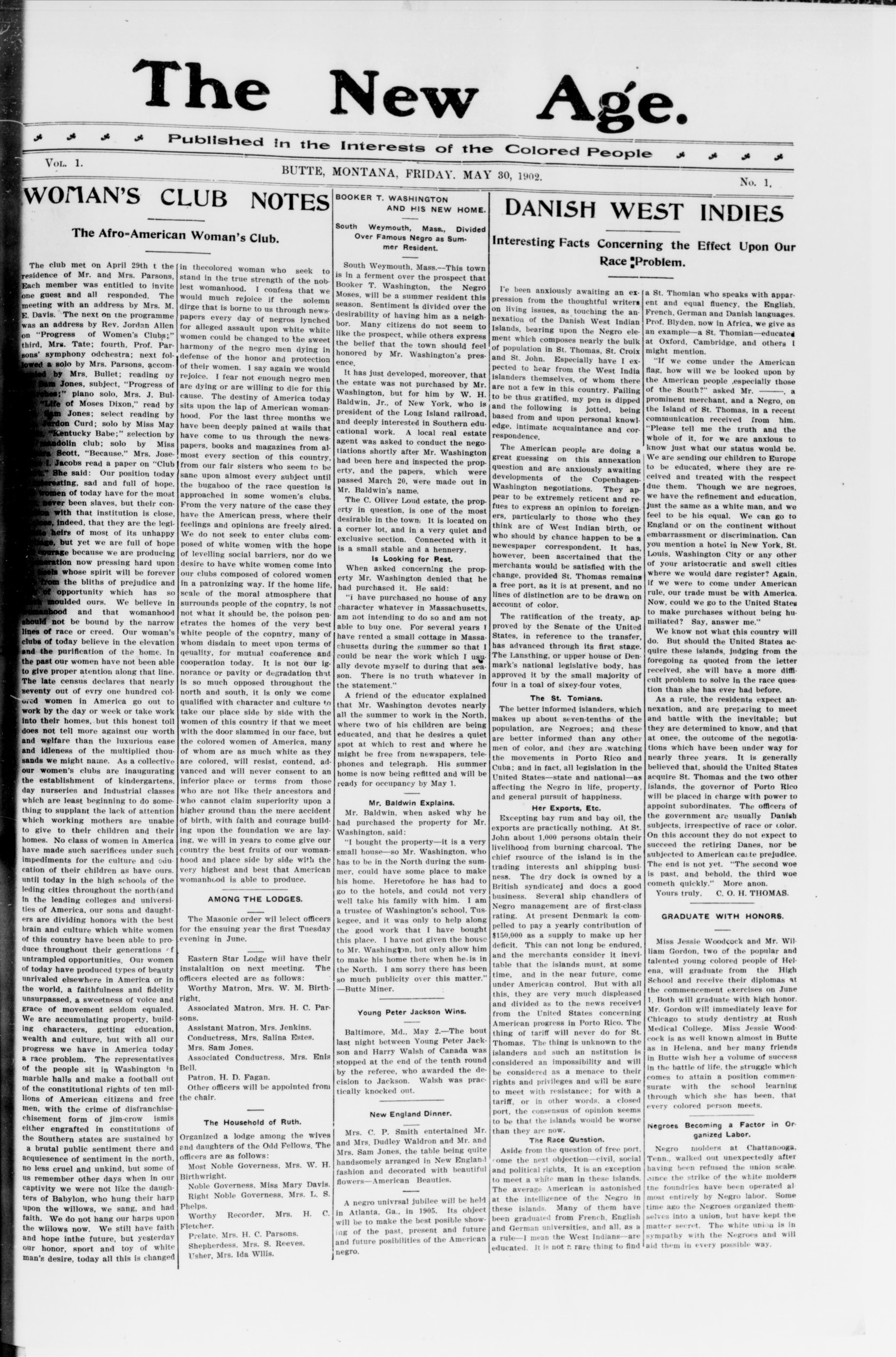
The New Age.
The Afro-American Woman's Club.
Vol. 1.
The club met on April 29th t the residence of Mr. and Mrs. Parsons. Each member was entitled to invite one guest and all responded. The meeting with an address by Mrs. M. E. Davis. The next on the programme was an address by Rev. Jordan Allen on "Progress of Women's Clubs;" third, Mrs. Tate; fourth, Prof. Parsons' symphony odchestra; next followed a solo by Mrs. Parsons, accompanied by Mrs. Bullet; reading by Sam Jones, subject, "Progress of Women;" piano solo, Mrs. J. Bulld "Life of Moses Dixon," read by Sam Jones; select reading by Gordon Curd; solo by Miss May "Kentucky Babe;" selection by Randolin club; solo by Miss Scott, "Because." Mrs. Joseph I. Jacobs read a paper on "Club She said: Our position today interesting, sad and full of hope. women of today have for the most never been slaves, but their concern with that institution is close, indeed, that they are the legible heirs of most of its unhappy home, but yet we are full of hope courage because we are producing preparation now pressing hard upon peoples whose spirit will be forever from the bliths of prejudice and of opportunity which has so much moulded ours. We believe in womanhood and that womanhood should not be bound by the narrow lines of race or creed. Our woman's clubs of today believe in the elevation and the purification of the home. In the past our women have not been able to give proper attention along that line. The late census declares that nearly seventy out of every one hundred colored women in America go out to work by the day or week or take work into their homes, but this honest toll does not tell more against our worth and welfare than the luxurious ease and idleness of the multiplied thousands we might name. As a collective our women's clubs are inaugurating the establishment of kindergartens, day nurseries and industrial classes which are least beginning to do something to supplant the lack of attention which working mothers are unable to give to their children and their homes. No class of women in America have made such sacrifices under such impediments for the culture and education of their children as have ours. until today in the high schools of the leading colleges and universities of America, our sons and daughters are dividing honors with the best brain and culture which white women of this country have been able to produce throughout their generations of untrampled opportunities. Our women of today have produced types of beauty unrivaled elsewhere in America or in the world, a faithfulness and fidelity unsurpassed, a sweetness of voice and grace of movement seldom equaled. We are accumulating property, building characters, getting education, wealth and culture, but with all our progress we have in America today a race problem. The representatives of the people sit in Washington in marble halls and make a football out of the constitutional rights of ten millions of American citizens and free men, with the crime of disfranchisement form of jim-crow ismis either engrafted in constitutions of the Southern states are sustained by a brutal public sentiment there and acquiescence of sentiment in the north, no less cruel and unkind, but some of us remember other days when in our captivity we were not like the daughters of Babylon, who hung their harp upon the willows, we sang, and had faith. We do not hang our harps upon the willows now. We still have faith and hope inthe future, but yesterday our honor, sport and toy of white man's desire, today all this is changed
BUTTE, MONTANA, FRIDAY. MAY 30, 1902.
in thecolored woman who seek to stand in the true strength of the noblest womanhood. I confess that we would much rejoice if the solemn dirge that is borne to us through newspapers every day of negros lynched for alleged assault upon white white women could be changed to the sweet harmony of the negro men dying in defense of the honor and protection of their women. I say again we would rejoice. I fear not enough negro men are dying or are willing to die for this cause. The destiny of America today sits upon the lap of American womanhood. For the last three months we have been deeply pained at wails that have come to us through the newspapers, books and magazines from almost every section of this country, from our fair sisters who seem to be sane upon almost every subject until the bugaboo of the race question is approached in some women's clubs. From the very nature of the case they have the American press, where their feelings and opinions are freely aired. We do not seek to enter clubs composed of white women with the hope of levelling social barriers, nor do we desire to have white women come into our clubs composed of colored women in a patronizing way. If the home life scale of the moral atmosphere that surrounds people of the coptry, is not what it should be, the poison penetrates the homes of the very best white people of the coptry, many of whom disdain to meet upon terms of equality, for mutual conference and cooperation today. It is not our ignorance or pavity or degradation that is so much opposed throughout the north and south, it is only we come qualified with character and culture to take our place side by side with the women of this country if that we meet with the door slammed in our face, but the colored women of America, many of whom are as much white as they are colored, will resist, contend, advanced and will never consent to an inferior place or terms from those who are not like their ancestors and who cannot claim superiority upon a higher ground than the mere accident of birth, with faith and courage building upon the foundation we are laying, we will in years to come give our country the best fruits of our womanhood and place side by side with the very highest and best that American womanhood is able to produce.
AMONG THE LODGES.
The Masonic order wil select officers for the ensuing year the first Tuesday evening in June.
Eastern Star Lodge will have their instalition on next meeting. The officers elected are as follows:
Worthy Matron, Mrs. W. M. Birthright.
Associated Matron, Mrs. H. C. Parsons.
Assistant Matron, Mrs. Jenkins.
Conductress, Mrs. Salina Estes.
Mrs. Sam Jones.
Associated Conductress, Mrs. Enis Bell.
Patron, H. D. Fagan.
Other officers will be appointed from the chair.
The Household of Ruth.
Organized a lodge among the wives and daughters of the Odd Fellows. The officers are as follows:
Most Noble Governess, Mrs. W. H. Birthwright.
Noble Governess, Miss Mary Davis.
Right Noble Governess, Mrs. L. S. Phelps.
Worthy Recorder, Mrs. H. C. Fletcher.
Prelate, Mrs. H. C. Parsons.
Shepherdess, Mrs. S. Reeves.
Usher, Mrs. Ida Wllis.
BOOKER T. WASHINGTON AND HIS NEW HOME.
South Weymouth, Mass., Divided Over Famous Negro as Summer Resident.
South Weymouth, Mass.--This town is in a ferment over the prospect that Booker T. Washington, the Negro Moses, will be a summer resident this season. Sentiment is divided over the desirability of having him as a neighbor. Many citizens do not seem to like the prospect, while others express the belief that the town should feel honored by Mr. Washington's presence.
It has just developed, moreover, that the estate was not purchased by Mr. Washington, but for him by W. H. Baldwin, Jr., of New York, who is president of the Long Island railroad, and deeply interested in Southern educational work. A local real estate agent was asked to conduct the negotiations shortly after Mr. Washington had been here and inspected the property, and the papers, which were passed March 20, were made out in Mr. Baldwin's name.
The C. Oliver Loud estate, the property in question, is one of the most desirable in the town. It is located on a corner lot, and in a very quiet and exclusive section. Connected with it is a small stable and a hewnery.
Is Looking for Rest.
When asked concerning the property Mr. Washington denied that he had purchased it. He said:
"I have purchased no house of any character whatever in Massachusetts, am not intending to do so and am not able to buy one. For several years I have rented a small cottage in Massachusetts during the summer so that I could be near the work which I usually devote myself to during that season. There is no truth whatever in the statement."
A friend of the educator explained that Mr. Washington devotes nearly all the summer to work in the North, where two of his children are being educated, and that he desires a quiet spot at which to rest and where he might be free from newspapers, telephones and telegraph. His summer home is now being refitted and will be ready for occupancy by May 1.
Mr. Baldwin Explains.
Mr. Baldwin, when asked why he had purchased the property for Mr. Washington, said:
"I bought the property—it is a very small house—so Mr. Washington, who has to be in the North during the summer, could have some place to make his home. Heretofore he has had to go to the hotels, and could not very well take his family with him. I am a trustee of Washington's school, Tuskegee, and it was only to help along the good work that I have bought this place. I have not given the house to Mr. Washington, but only allow him to make his home there when he is in the North. I am sorry there has been so much publicity over this matter."—Butte Miner.
Young Peter Jackson Wins.
Baltimore, Md., May 2.—The bout last night between Young Peter Jackson and Harry Walsh of Canada was stopped at the end of the tenth round by the referee, who awarded the decision to Jackson. Walsh was practically knocked out.
New England Dinner.
Mrs. C. P. Smith entertained Mr. and Mrs. Dudley Waldron and Mr. and Mrs. Sam Jones, the table being quite handsomely arranged in New England fashion and decorated with beautiful flowers—American Beauties.
A negro univrsal jubilee will be held in Atlanta, Ga., in 1905. Its object will be to make the best possible showing of the past, present and future and future posibilities of the American negro.
DANISH WEST INDIES
Interesting Facts Concerning the Effect Upon Our Race Problem.
I've been anxiously awaiting an expression from the thoughtful writers on living issues, as touching the annexation of the Danish West Indian Islands, bearing upon the Negro element which composes nearly the bulk of population in St. Thomas, St. Croix and St. John. Especially have I expected to hear from the West India islanders themselves, of whom there are not a few in this country. Failing to be thus gratified, my pen is dipped and the following is jotted, being based from and upon personal knowledge, intimate acquaintance and correspondence.
The American people are doing a great guessing on this annexation question and are anxiously awaiting developments of the Copenhagen-Washington negotiations. They appear to be extremely reticent and refuses to express an opinion to foreigners, particularly to those who they think are of West Indian birth, or who should by chance happen to be a newspaper correspondent. It has, however, been ascertained that the merchants would be satisfied with the change, provided St. Thomas remains a free port, as it is at present, and no lines of distinction are to be drawn on account of color.
The ratification of the treaty, approved by the Senate of the United States, in reference to the transfer, has advanced through its first stage. The Lansthing, or upper house of Denmark's national legislative body, has approved it by the small majority of four in a toal of sixey-four votes.
The St. Tomians.
The better informed islanders, which makes up about seven-tenths of the population, are Negroes; and these are better informed than any other men of color, and they are watching the movements in Porto Rico and Cuba; and in fact, all legislation in the United States—state and national—as affecting the Negro in life, property, and general pursuit of happiness.
Her Exports, Etc.
Excepting bay rum and bay oil, the exports are practically nothing. At St. John about 1,000 persons obtain their livelihood from burning charcoal. The chief resource of the island is in the trading interests and shipping business. The dry dock is owned by a British syndicatej and docs a good business. Several ship chandlers of Negro management are of first-class rating. At present Denmark is compelled to pay a yearly contribution of $150,000 as a supply to make up her deficit. This can not long be endured, and the merchants consider it inevitable that the islands must, at some time, and in the near future, come under American control. But with all this, they are very much displeased and divided as to the news received from the United States concerning American progress in Porto Rico. The thing of tariff will never do for St. Thomas. The thing is unknown to the islanders and such an institution is considered an impossibility and will be considered as a menace to their rights and privileges and will be sure to meet with resistance; for with a tariff, or in other words, a closed port, the consensus of opinion seems to be that the islands would be worse than they are now.
The Race Question.
Aside from the question of free port, come the next objection—civil, social and political rights. It is an exception to meet a white man in these islands. The average American is astonished at the intelligence of the Negro in these islands. Many of them have been graduated from French, English and German universities, and all, as a rule—I mean the West Indians—are educated. It is not a rare thing to find
No. 1.
a St. Thomian who speaks with apparent and equal fluency, the English, French, German and Danish languages. Prof. Blyden, now in Africa, we give as an example—a St. Thomian—educated at Oxford, Cambridge, and others I might mention.
"If we come under the American flag, how will we be looked upon by the American people, especially those of the South?" asked Mr. ____, a prominent merchant, and a Negro, on the Island of St. Thomas, in a recent communication received from him. "Please tell me the truth and the whole of it, for we are anxious to know just what our status would be. We are sending our children to Europe to be educated, where they are received and treated with the respect due them. Though we are negroes, we have the refinement and education, just the same as a white man, and we feel to be his equal. We can go to England or on the continent without embarrassment or discrimination. Can you mention a hotel in New York, St. Louis, Washington City or any other of your aristocratic and swell cities where we would dare register? Again, if we were to come under American rule, our trade must be with America. Now, could we go to the United States to make purchases without being humiliated? Say, answer me."
We know not what this country will do. But should the United States acquire these islands, judging from the foregoing as quoted from the letter received, she will have a more difficult problem to solve in the race question than she has ever had before.
As a rule, the residents expect annexation, and are preparing to meet and battle with the inevitable; but they are determined to know, and that at once, the outcome of the negotiations which have been under way for nearly three years. It is generally believed that, should the United States acquire St. Thomas and the two other islands, the governor of Porto Rico will be placed in charge with power to appoint subordinates. The officers of the government are usually Danish subjects, irrespective of race or color. On this account they do not expect to succeed the retiring Danes, nor be subjected to American caste prejudice. The end is not yet. "The second woe is past, and behold, the third woe cometh quickly." More anon.
Yours truly. C. O. H. THOMAS.
GRADUATE WITH HONORS.
Miss Jessie Woodcock and Mr. William Gordon, two of the popular and talented young colored people of Helena, will graduate from the High School and receive their diplomas at the commencement exercises on June 1. Both will graduate with high honor. Mr. Gordon will immediately leave for Chicago to study dentistry at Rush Medical College. Miss Jessie Woodcock is as well known almost in Butte as in Helena, and her many friends in Butte wish her a volume of success in the battle of life, the struggle which comes to attain a position commensurate with the school learning through which she has been, that every colored person meets.
Negroes Becoming a Factor in Organized Labor.
Negro molders at Chattanooga, Tenn., walked out unexpectedly after having been refused the union scale, since the strike of the white molders the foundries have been operated almost entirely by Negro labor. Some time ago the Negroes organized themselves into a union, but have kept the matter secret. The white union is in sympathy with the Negroes and will aid them in every possible way.
2
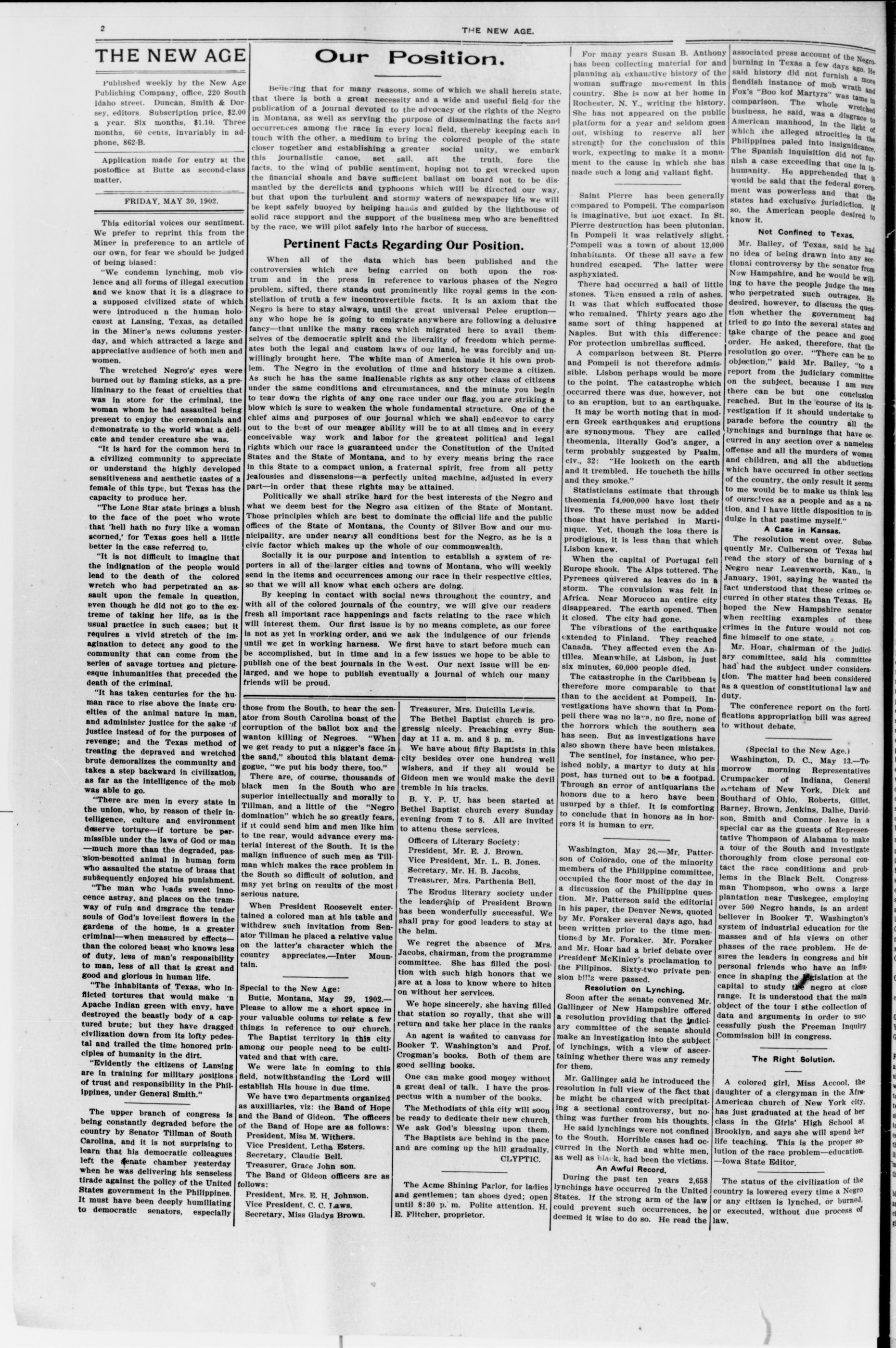
THE NEW AGE
Published weekly by the New Age Publishing Company, office, 220 South Idaho street. Duncan, Smith & Dorsey, editors. Subscription price, $2.00 a year. Six months, $1.10. Three months, 60 cents, invariably in adphone, 862-B.
FRIDAY, MAY 30, 1902.
This editorial voices our sentiment. We prefer to reprint this from the Miner in preference to an article of our own, for fear we should be judged of being biased:
"We condemn lynching, mob violence and all forms of illegal execution and we know that it is a disgrace to a supposed civilized state of which were introduced n the human holocaust at Lansing, Texas, as detailed in the Miner's news columns yesterday, and which attracted a large and appreciative audience of both men and women.
The wretched Negro's eyes were burned out by flaming sticks, as a preliminary to the feast of cruelties that was in store for the criminal, the woman whom he had assaulted being present to enjoy the ceremonials and demonstrate to the world what a delicate and tender creature she was.
"It is hard for the common herd in a civilized community to appreciate or understand the highly developed sensitiveness and aesthetic tastes of a female of this type, but Texas has the capacity to produce her.
"The Lone Star state brings a blush to the face of the poet who wrote that 'hell hath no fury like a woman scorned,' for Texas goes hell a little better in the case referred to.
"It is not difficult to imagine that the indignation of the people would lead to the death of the colored wretch who had perpetrated an assault upon the female in question, even though he did not go to the extreme of taking her life, as is the usual practice in such cases; but it requires a vivid stretch of the imagination to detect any good to the community that can come from the series of savage tortues and picture-esque inhumanities that preceded the death of the criminal.
"It has taken centuries for the human race to rise above the inate cruelties of the animal nature in man, and administer justice for the sake of justice instead of for the purposes of revenge; and the Texas method of treating the depraved and wretched brute demoralizes the community and takes a step backward in civilization, as far as the intelligence of the mob was able to go.
"There are men in every state in the union, who, by reason of their intelligence, culture and environment deserve torture—if torture be permissible under the laws of God or man—much more than the degraded, passion-besotted animal in human form who assaulted the statue of brass that subsequently enjoyed his punishment
"The man who leads sweet innocence astray, and places on the tramway of ruin and disgrace the tender souls of God's loveliest flowers in the gardens of the home, is a greater criminal—when measured by effects—than the colored beast who knows less of duty, less of man's responsibility to man, less of all that is great and good and glorious in human life.
"The inhabitants of Texas, who inflicted tortures that would make in Apache Indian green with envy, have destroyed the beastly body of a captured brute; but they have dragged civilization down from its lofty pedestal and trailed the time honored principles of humanity in the dirt.
"Evidently the citizens of Lansing are in training for military positions of trust and responsibility in the Philippines, under General Smith."
The upper branch of congress is being constantly degraded before the country by Senator Tillman of South Carolina, and it is not surprising to learn that his democratic colleagues left the senate chamber yesterday when he was delivering his senseless tirade against the policy of the United States government in the Philippines. It must have been deeply humiliating to democratic senators, especially
Our Position.
Believing that for many reasons that there is both a great necessity, publication of a journal devoted to the Montana, as well as serving those occurrences among the race in every touch with the other, a medium to a closer together and establishing a this journalistic canoe, set facts, to the wind of public sentiments, the financial shoals and have suffused mantled by the derelicts and typhoons, but that upon the turbulent and swift be kept safely buoyed by helping the solid race support and the support by the race, we will pilot safely into the pertinent Facts Reel.
When all of the data we controversies which are being trum and in the press in referee problem, sifted, there stands out our stellation of truth a few incontroversies. Negro is here to stay always, until any who hope he is going to emigrate fancy—that unlike the many races of ourselves of the democratic spirit and states both the legal and custom law willingly brought here. The white lem. The Negro in the evolution of As such he has the same inalienable under the same conditions and circumspect to tear down the rights of any one who blow which is sure to weaken the whichechief aims and purposes of our journey to the best of our meager abilities conceivable way work and labor rights which our race is guaranteed States and the State of Montana, and in this State to a compact union, a jealousies and dissensions—a perfect part—in order that these rights must.
Politically we shall strike hard what we deem best for the Negro. Those principles which are best to our offices of the State of Montana, the municipality, are under nearly all condi civic factor which makes up the whole.
Socially it is our purpose and in porters in all of the larger cities and send in the items and occurrences and so that we will all know what each one.
By keeping in contact with society with all of the colored journals of the fresh all important race happenings and will interest them. Our first issue it is not as yet in working order, and we until we get in working harness. We be accomplished, but in time and in publish one of the best journals in the larged, and we hope to publish even friends will be proud.
that for many reasons, some of which we shall both a great necessity and a wide and useful journal devoted to the advocacy of the right, well as serving the purpose of disseminating among the race in every local field, thereby keeping other, a medium to bring the colored people, and establishing a greater social unity, aatic canoe, set sail, att the truth, wind of public sentiment, hoping not to get the schools and have sufficient ballast on board nor the derelicts and typhoons which will be directed at the turbulent and stormy waters of newspapers buoyed by helping hands and guided by the support and the support of the business men who will pilot safely into the harbor of success.
Nent Facts Regarding Our Positive
of the data which has been published, which are being carried on both upon the press in reference to various phases of there stands out prominently like royal gems with a few incontrovertible facts. It is an axiom to stay always, until the great universal Pellet, who is going to emigrate anywhere are following like the many races which migrated here to a democratic spirit and the liberality of freedom we legal and custom laws of our land, he was forget here. The white man of America made it here in the evolution of time and history became the same inalienable rights as any other class of conditions and circumstances, and the minute rights of any one race under our flag, you are sure to weaken the whole fundamental structure. The purposes of our journal which we shall endeavor of our meager ability will be to at all times in any work and labor for the greatest political race is guaranteed under the Constitution of State of Montana, and to by every means bring a compact union, a fraternal spirit, free from dissensions—a perfectly united machine, adjust that these rights may be attained.
We shall strike hard for the best interests of the best for the Negro asa citizen of the State which are best to dominate the official life and state of Montana, the County of Silver Bow and under nearly all conditions best for the Negro, which makes up the whole of our commonwealth. We our purpose and intention to establish a system of the larger cities and towns of Montana, who has and occurrences among our race in their respect will know what each others are doing.
In contact with social news throughout the colored journals of the country, we will give our race happenings and facts relating to the term. Our first issue is by no means complete, a working order, and we ask the indulgence of our working harness. We first have to start before but in time and in a few issues we hope to best journals in the West. Our next issue is hope to publish eventually a journal of which proud.
Believing that for many reasons, some of which we shall herein state that there is both a great necessity and a wide and useful field for the publication of a journal devoted to the advocacy of the rights of the Negro in Montana, as well as serving the purpose of disseminating the facts and occurrences among the race in every local field, thereby keeping each in touch with the other, a medium to bring the colored people of the state closer together and establishing a greater social unity, we embark this journalistic canoe, set sail, att the truth, fore the facts, to the wind of public sentiment, hoping not to get wrecked upon the financial shoals and have sufficient ballast on board not to be dismantled by the derelicts and typhoons which will be directed our way, but that upon the turbulent and stormy waters of newspaper life we will be kept safely buoyed by helping hands and guided by the lighthouse of solid race support and the support of the business men who are benefitted by the race, we will pilot safely into the harbor of success.
Pertinent Facts Regarding Our Position.
When all of the data which has been published and the controversies which are being carried on both upon the rostrum and in the press in reference to various phases of the Negro problem, sifted, there stands out prominently like royal gems in the constellation of truth a few incontrovertible facts. It is an axiom that the Negro is here to stay always, until the great universal Pelee eruption—any who hope he is going to emigrate anywhere are following a delusive fancy—that unlike the many races which migrated here to avail themselves of the democratic spirit and the liberality of freedom which permeates both the legal and custom laws of our land, he was forcibly and unwillingly brought here. The white man of America made it his own problem. The Negro in the evolution of time and history became a citizen. As such he has the same inalienable rights as any other class of citizens under the same conditions and circumstances, and the minute you begin to tear down the rights of any one race under our flag, you are striking a blow which is sure to weaken the whole fundamental structure. One of the chief aims and purposes of our journal which we shall endeavor to carry out to the best of our meager ability will be to at all times and in every conceivable way work and labor for the greatest political and legal rights which our race is guaranteed under the Constitution of the United States and the State of Montana, and to by every means bring the race in this State to a compact union, a fraternal spirit, free from all petty jealousies and dissensions—a perfectly united machine, adjusted in every part—in order that these rights may be attained.
Politically we shall strike hard for the best interests of the Negro and what we deem best for the Negro as citizen of the State of Montant. Those principles which are best to dominate the official life and the public offices of the State of Montana, the County of Silver Bow and our municipality, are under nearly all conditions best for the Negro, as he is a civic factor which makes up the whole of our commonwealth. Socially it is our purpose and intention to establish a system of reporters in all of the larger cities and towns of Montana, who will weekly send in the items and occurrences among our race in their respective cities, so that we will all know what each others are doing.
By keeping in contact with social news throughout the country, and with all of the colored journals of the country, we will give our readers fresh all important race happenings and facts relating to the race which will interest them. Our first issue is by no means complete, as our force is not as yet in working order, and we ask the indulgence of our friends until we get in working harness. We first have to start before much can be accomplished, but in time and in a few issues we hope to be able to publish one of the best journals in the West. Our next issue will be enlarged, and we hope to publish eventually a journal of which our many friends will be proud.
those from the South, to hear the senator from South Carolina boast of the corruption of the ballot box and the wanton killing of Negroes. "When we get ready to put a nigger's face in the sand," shouted this blatant demagogue, "we put his body there, too."
There are, of course, thousands of black men in the South who are superior intellectually and morally to Tillman, and a little of the "Negro domination" which he so greatly fears, if it could send him and men like him to the rear, would advance every material interest of the South. It is the malign influence of such men as Tillman which makes the race problem in the South so difficult of solution, and may yet bring on results of the most serious nature.
When President Roosevelt entertained a colored man at his table and withdrew such invitation from Senator Tillman he placed a relative value on the latter's character which the country appreciates.—Inter Mountain.
Butte, Montana, May 29, 1902. Please to allow me a short space in your valuable columns to relate a few things in reference to our church. The Baptist territory in this city among our people need to be cultivated and that with care.
We were late in coming to this field, notwithstanding the Lord will establish His house in due time.
We have two departments organized as auxilliaries, viz: the Band of Hope and the Band of Gideon. The officers of the Band of Hope are as follows:
President, Miss M. Withers.
Vice President, Letha Esters.
Secretary, Claudie Bell.
Treasurer, Grace John son.
The Band of Gideon officers are as follows:
President, Mrs. E. H. Johnson.
Vice President, C. C. Laws.
at the Band of Hope
Sideon. The officers
hope are as follows:
M. Withers.
Letha Esters.
Die Bell.
John son.
Sideon officers are as
The Methodists of this church be ready to dedicate their work
We ask God's blessing to us
The Baptists are behind us and are coming up the hill
(
```markdown
```
Special to the New Age:
THE NEW AGE
seasons, some of which we shall herein state necessity and a wide and useful field for the to the advocacy of the rights of the Negro the purpose of disseminating the facts and every local field, thereby keeping each in to bring the colored people of the state a greater social unity, we embark a sail, att the truth, fore the treatment, hoping not to get wrecked upon sufficient ballast on board not to be dishoops which will be directed our way to stormy waters of newspaper life we will hands and guided by the lighthouse out of the business men who are benefitted to the harbor of success.
Regarding Our Position.
which has been published and the carried on both upon the ross reference to various phases of the Negro prominently like royal gems in the comfortable facts. It is an axiom that the great universal Pelee eruption—migrate anywhere are following a delusive which migrated here to avail them of the liberality of freedom which permit laws of our land, he was forcibly and unlawful of America made it his own problem of time and history became a citizenable rights as any other class of citizens circumstances, and the minute you begin the race under our flag, you are striking a whole fundamental structure. One of the journal which we shall endeavor to carry utility will be to at all times and in every for the greatest political and legal under the Constitution of the United States and to by every means bring the race a fraternal spirit, free from all petty sects united machine, adjusted in every may be attained.
for the best interests of the Negro and asa citizen of the State of Montant. dominate the official life and the public the County of Silver Bow and our muditions best for the Negro, as he is a whole of our commonwealth.
intention to establish a system of reand towns of Montana, who will weekly among our race in their respective cities, others are doing.
special news throughout the country, and the country, we will give our readers and facts relating to the race which is by no means complete, as our force we ask the indulgence of our friends. We first have to start before much can in a few issues we hope to be able to the West. Our next issue will be entually a journal of which our many
Treasurer, Mrs. Duicilla Lewis.
The Bethel Baptist church is progressig nicely. Preaching every Sunday at 11 a. m. and 8 p. m.
We have about fifty Baptists in this city besides over one hundred well wishers, and if they all would be Gideon men we would make the devil tremble in his tracks.
B. Y. P. U. has been started at Bethel Baptist church every Sunday evening from 7 to 8. All are invited to attenu these services.
Officers of Literary Society:
President, Mr. E. J. Brown.
Vice President, Mr. L. B. Jones.
Secretary, Mr. H. B. Jacobs.
Treasurer, Mrs. Parthenia Bell.
The Erodus literary society under the leadership of President Brown has been wonderfully successful. We shall pray for good leaders to stay at the helm. We regret the absence of Mrs. Jacobs, chairman, from the programme committee. She has filled the position with such high honors that we are at a loss to know where to hitch on without her services.
An agent is wanted to canvass for Booker T. Washington's and Prof. Crogman's books. Both of them are good selling books.
One can make good money without a great deal of talk. I have the prospectus with a number of the books.
The Methodists of this city will soon be ready to dedicate their new church. We ask God's blessing upon them.
The Baptists are behind in the pace and are coming up the hill gradually.
CLYPTIC.
The Acme Shining Parlor, for ladies and gentlemen; tan shoes dyed; open until 8:30 p. m. Polite attention. H. E. Flitcher, proprietor.
---
For many years Susan B. Anthony has been collecting material for and planning an exhaustive history of the woman suffrage movement in this country. She is now at her home in Rochester, N. Y., writing the history. She has not appeared on the public platform for a year and seldom goes out, wishing to reserve all her strength for the conclusion of this work, expecting to make it a monument to the cause in which she has made such a long and valiant fight.
Saint Pierre has been generally compared to Pompeii. The comparison is imaginative, but not exact. In St. Pierre destruction has been plutonian. In Pompeii it was relatively slight. Pompeii was a town of about 12,000 inhabitants. Of these all save a few hundred escaped. The latter were asphyxiated.
There had occurred a hall of little stones. Then ensued a rain of ashes. It was that which suffocated those who remained. Thirty years ago the same sort of thing happened at Naples. But with this difference: For protection umbrellas sufficed.
A comparison between St. Pierre and Pompeii is not therefore admissible. Lisbon perhaps would be more to the point. The catastrophe which occurred there was due, however, not to an eruption, but to an earthquake. It may be worth noting that in modern Greek earthquakes and eruptions are synonymous. They are called theomenia, literally God's anger, a term probably suggested by Psalm, civ., 32: "He looketh on the earth and it trembled. He toucheth the hills and they smoke."
Statisticians estimate that through theomenia f4,000,000 have lost their lives. To these must now be added those that have perished in Martinique. Yet, though the loss there is prodigious, it is less than that which Lisbon knew.
When the capital of Portugal fell Europe shook. The Alps tottered. The Pyrenees quivered as leaves do in a storm. The convulsion was felt in Africa. Near Morocco an entire city disappeared. The earth opened. Then it closed. The city had gone.
The vibrations of the earthquake extended to Finland. They reached Canada. They affected even the Antilles. Meanwhile, at Lisbon, in just six minutes, 60,000 people died.
The catastrophe in the Caribbean is therefore more comparable to that than to the accident at Pompeii. Investigations have shown that in Pompeii there was no lava, no fire, none of the horrors which the southern sea has seen. But as investigations have also shown there have been mistakes. The sentinel, for instance, who perished nobly, a martyr to duty at his post, has turned out to be a footpad. Through an error of antiquarians the honors due to a hero have been usurped by a thief. It is comforting to conclude that in honors as in horrors it is human to err.
Washington, May 26.—Mr. Patterson of Colorado, one of the minority members of the Philippine committee, occupied the floor most of the day in a discussion of the Philippine question. Mr. Patterson said the editorial in his paper, the Denver News, quoted by Mr. Foraker several days ago, had been written prior to the time mentioned by Mr. Foraker. Mr. Foraker and Mr. Hoar had a brief debate over President McKinley's proclamation to the Filipinos. Sixty-two private pension bills were passed.
Resolution on Lynching.
Soon after the senate convened Mr. Gallinger of New Hampshire offered a resolution providing that the indicary committee of the senate should make an investigation into the subject of lynchings, with a view of ascertaining whether there was any remedy for them.
Mr. Gallinger said he introduced the resolution in full view of the fact that he might be charged with precipitating a sectional controversy, but nothing was further from his thoughts.
He said lynchings were not confined to the South. Horrible cases had occurred in the North and white men, as well as black, had been the victims.
During the past ten years 2,658 lynchings have occurred in the United States. If the strong arm of the law could prevent such occurrences, he deemed it wise to do so. He read the
associated press account of the Negro-burning in Texas a few days ago. He said history did not furnish a more fiendish instance of mob wrath and Fox's "Boo kof Martyrs" was tame in comparison. The whole wretched business, he said, was a disgrace to American manhood, in the light of which the alleged atrocities in the Philippines paled into insignificance. The Spanish inquisition did not furnish a case exceeding that one in humanity. He apprehended that it would be said that the federal government was powerless and that the states had exclusive jurisdiction. If so, the American people desired to know it.
Not Confined to Texas
Mr. Bailey, of Texas, said he had no idea of being drawn into any sectional controversy by the senator from New Hampshire, and he would be willing to have the people judge the men who perpetrated such outrages. He desired, however, to discuss the question whether the government had tried to go into the several states and take charge of the peace and good order. He asked, therefore, that the resolution go over. "There can be no objection," said Mr. Bailey, "to a report from the judiciary committee on the subject, because I am sure there can be but one conclusion reached. But in the course of its investigation if it should undertake to parade before the country all the lynchings and burnings that have occurred in any section over a nameless offense and all the murders of women and children, and all the abductions which have occurred in other sections of the country, the only result it seems to me would be to make us think less of ourselves as a people and as a nation, and I have little disposition to indulge in that pastime myself."
A Case in Kansas.
The resolution went over. Subsequently Mr. Culberson of Texas had read the story of the burning of a Negro near Leavenworth, Kan., in January, 1901, saying he wanted the fact understood that these crimes occurred in other states than Texas. He hoped the New Hampshire senator when reciting examples of these crimes in the future would not confine himself to one state. Mr. Hoar, chairman of the judiciary committee, said his committee had had the subject under consideration. The matter had been considered as a question of constitutional law and duty.
The conference report on the fortifications appropriation bill was agreed to without debate.
(Special to the New Age)
Washington, D. C., May 13.—Tomorrow morning Representatives Crumpacker of Indiana, General Netcham of New York, Dick and Southard of Ohio, Roberts, Gillet Barney, Brown, Jenkins, Dalhe, Davidson, Smith and Connor leave in a special car as the guests of Representative Thompson of Alabama to make a tour of the South and investigate thoroughly from close personal contact the race conditions and problems in the Black Belt. Congressman Thompson, who owns a large plantation near Tuskegee, employing over 500 Negro hands, is an ardent believer in Booker T. Washington's system of industrial education for the masses and of his views on other phases of the race problem. He desires the leaders in congress and his personal friends who have an influence in shaping the Legislation at the capital to study the negro at close range. It is understood that the main object of the tour i the collection of data and arguments in order to successfully push the Freeman Inquiry Commission bill in congress.
The Right Solution.
A colored girl, Miss Accool, the daughter of a clergyman in the Afro American church of New York city has just graduated at the head of her class in the Girls' High School at Brooklyn, and says she will spend her life teaching. This is the proper solution of the race problem—education. Iowa State Editor.
The status of the civilization of the country is lowered every time a Negro or any citizen is lynched, or burned, or executed, without due process of law.
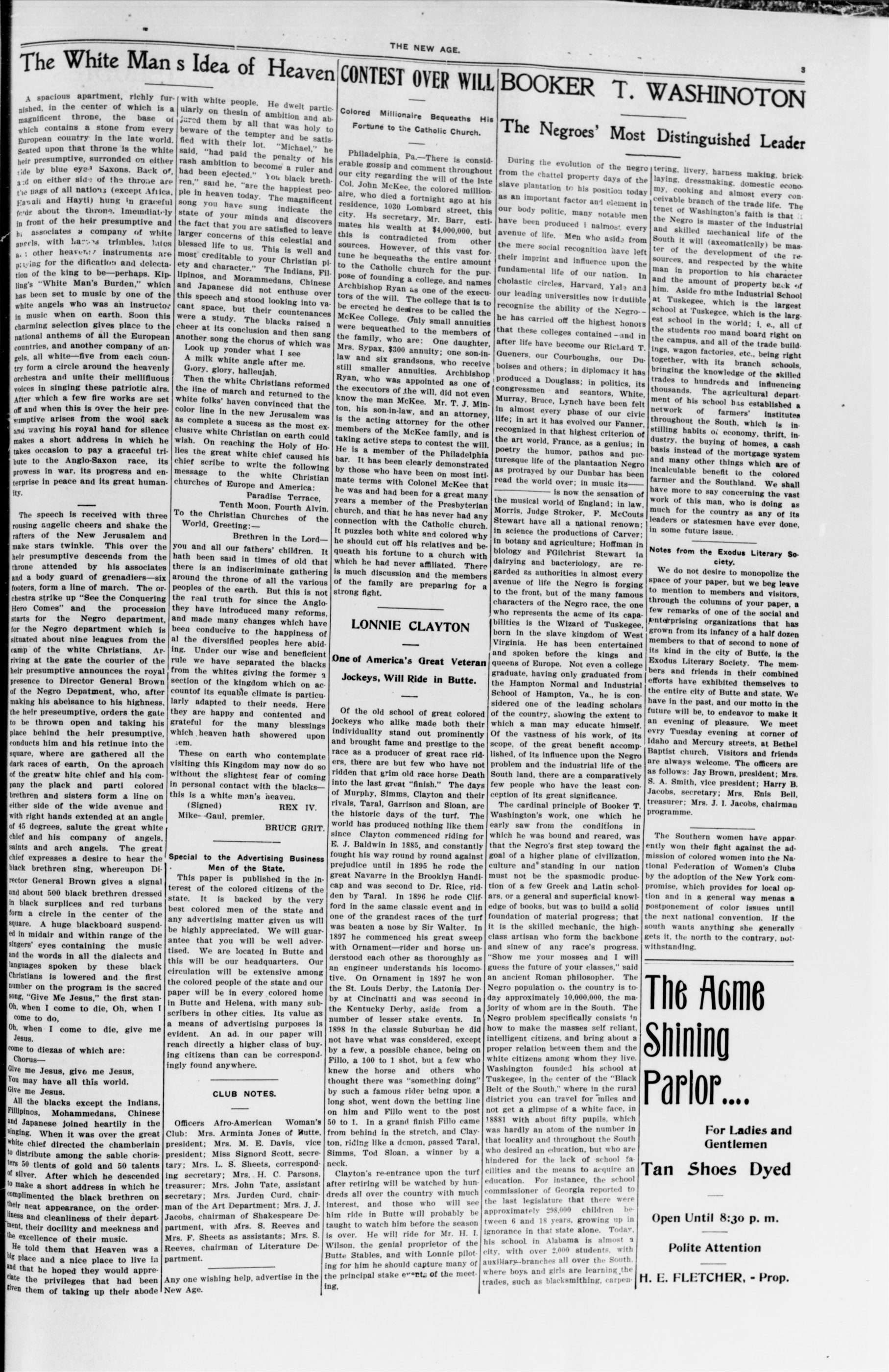
A spacious apartment, richly furnished, in the center of which is a magnificent throne, the base on which contains a stone from every European country in the late world. Seated upon that throne is the white heir presumptive, surrendered on either side by blue eye Saxons. Back of, and on either side of the throne are the nags of all nations (except Africa, Hawaii and Hayti) hung in graceful fields about the throne. Immediately in front of the heir presumptive and his associates a company of white angels, with harps trimbles, lutes and other heavenly instruments are playing for the difification and delectation of the king to be—perhaps. Kipling's "White Man's Burden," which has been set to music by one of the white angels who was an instructor in music when on earth. Soon this charming selection gives place to the national anthems of all the European countries, and another company of angels, all white—five from each country form a circle around the heavenly orchestra and unite their mellifluous voices in singing these patriotic airs. After which a few fire works are set off and when this is over the heir presumptive arises from the wool sack and waving his royal hand for silence makes a short address in which he takes occasion to pay a graceful tribute to the Anglo-Saxon race, its prowess in war, its progress and enterprise in peace and its great humanity.
The speech is received with three rousing angelic cheers and shake therafters of the New Jerusalem and make stars twinkle. This over theheir presumptive descends from the throne attended by his associates and a body guard of grenadiers—six footers, form a line of march. The orchestra strike up "See the Conquering Hero Comes" and the procession starts for the Negro department, for the Negro department which is situated about nine leagues from the camp of the white Christians. Arriving at the gate the courier of the heir presumptive announces the royal presence to Director General Brown of the Negro Department, who, after making his abeisance to his highness, the heir presumptive, orders the gate to be thrown open and taking his place behind the heir presumptive, conducts him and his retinue into the square, where are gathered all the dark races of earth. On the approach of the greatw hite chief and his company the plack and parti colored brethren and sisters form a line on either side of the wide avenue and with right hands extended at an angle of 45 degrees, salute the great white chief and his company of angels, saints and arch angels. The great chief expresses a desire to hear the black brethren sing, whereupon Director General Brown gives a signal and about 500 black brethren dressed in black surplices and red turbans form a circle in the center of the square. A huge blackboard suspended in midair and within range of the singers' eyes containing the music and the words in all the dialects and languages spoken by these black Christians is lowered and the first number on the program is the sacred song, "Give Me Jesus," the first stanOh, when I come to die, Oh, when I come to do,
Oh, when I come to die, give me Jesus.
come to diezas of which are:
Chorus—
Give me Jesus, give me Jesus,
You may have all this world.
Give me Jesus.
All the blacks except the Indians, Fillipinos, Mohammedans, Chinese and Japanese joined heartily in the singing. When it was over the great white chief directed the chamberlain to distribute among the sable choristers 50 tents of gold and 50 talents of silver. After which he descended to make a short address in which he complimented the black brethren on their neat appearance, on the orderliness and cleanliness of their department, their docility and meekness and the excellence of their music.
He told them that Heaven was a big place and a nice place to live in and that he hoped they would appreciate the privileges that had been given them of taking up their abode
with white people. He dwelt particularly on thesin of ambition and abjured them by all that was holy to beware of the tempter and be satisfied with their lot. "Michael," he said, "had paid the penalty of his rash ambition to become a ruler and had been ejected." You black brethren," said he, "are the happiest people in heaven today. The magnificent song you have sung indicate the state of your minds and discovers the fact that you are satisfied to leave larger concerns of this celestial and blessed life to us. This is well and most creditable to your Christian piety and character." The Indians, Filipinos, and Morammedans, Chinese and Japanese did not enthuse over this speech and stood looking into vacant space, but their countenances were a study. The blacks raised a cheer at its conclusion and then sang another song the chorus of which was Look up yonder what Lovely
Then the white Christians reformed the line of march and returned to the white folks' haven convinced that the color line in the new Jerusalem was as complete a success as the most exclusive white Christian on earth could wish. On reaching the Holy of Holies the great white chief caused his chief scribe to write the following message to the white Christian churches of Europe and America:
Paradise Terrace,
Tenth Moon, Fourth Alvin.
To the Christian Churches of the World, Greeting:—
Brethren in the Lord—you and all our fathers' children. It hath been said in times of old that there is an indiscriminate gathering around the throne of all the various peoples of the earth. But this is not the real truth for since the Anglo-they have introduced many reforms, and made many changes which have been conducive to the happiness of al the diversified peoples here abiding. Under our wise and beneficient rule we have separated the blacks from the whites giving the former a section of the kingdom which on accountof its equable climate is particularly adapted to their needs. Here they are happy and contented and grateful for the many blessings which heaven hath showered upon them.
These on earth who contemplate visiting this Kingdom may now do so without the slightest fear of coming in personal contact with the blacks—this is a white man's heaven.
(Signed) REX IV.
Mike--Gaul, premier.
Special to the Advertising Business Men of the State
This paper is published in the interest of the colored citizens of the state. It is backed by the very best colored men of the state and any advertising matter given us will be highly appreciated. We will guard ante that you will be well advertised. We are located in Butte and this will be our headquarters. Our circulation will be extensive among the colored people of the state and our paper will be in every colored home in Butte and Helena, with many subscribers in other cities. Its value as a means of advertising purposes is evident. An ad. in our paper will reach directly a higher class of buying citizens than can be correspondingly found anywhere.
CLUB NOTES.
Officers Afro-American Woman's Club: Mrs. Arminta Jones of Butte, president; Mrs. M. E. Davis, vice president; Miss Signord Scott, secretary; Mrs. L. S. Sheets, corresponding secretary; Mrs. H. C. Parsons, treasurer; Mrs. John Tate, assistant secretary; Mrs. Jurden Curd, chairman of the Art Department; Mrs. J. J. Jacobs, chairman of Shakespeare Department, with Mrs. S. Reeves and Mrs. F. Sheets as assistants; Mrs. S. Reeves, chairman of Literature Department.
Any one wishing help, advertise in the New Age.
THE NEW AGE
Colored Millionaire Bequeaths His Fortune to the Catholic Church.
Philadelphia, Pa.—There is considerable gossip and comment throughout our city regarding the will of the late Col. John McKee, the colored millionaire, who died a fortnight ago at his residence, 1030 Lombard street, this city. Hs secretary, Mr. Barr, estimates his wealth at $4,000,000, but this is contradicted from other sources. However, of this vast fortune he bequeaths the entire amount to the Catholic church for the purpose of founding a college, and names Archbishop Ryan as one of the executors of the will. The college that is to be erected he desires to be called the McKee College. Only small annuities were bequeathed to the members of the family, who are: One daughter, Mrs. Sypax, $300 annuity; one son-in-law and six grandsons, who receive still smaller annuities. Archbishop Ryan, who was appointed as one of the executors of the will, did not even know the man McKee. Mr. T. J. Minton, his son-in-law, and an attorney, is the acting attorney for the other members of the McKee family, and is taking active steps to contest the will. He is a member of the Philadelphia bar. It has been clearly demonstrated by those who have been on most intimate terms with Colonel McKee that he was and had been for a great many years a member of the Presbyterian church, and that he has never had any connection with the Catholic church. It puzzles both white and colored why he should cut off his relatives and bequeath his fortune to a church with which he had never affiliated. There is much discussion and the members of the family are preparing for a strong fight.
LONNIE CLAYTON
One of America's Great Veteran Jockeys, Will Ride in Butte.
Of the old school of great colored jockeys who alike made both their individuality stand out prominently and brought fame and prestige to the race as a producer of great race riders, there are but few who have not ridden that grim old race horse Death into the last great "finish." The days of Murphy, Simms, Clayton and their rivals, Taral, Garrison and Sloan, are the historic days of the turf. The world has produced nothing like them since Clayton commenced riding for E. J. Baldwin in 1885, and constantly fought his way round by round against prejudice until in 1895 he rode the great Navarre in the Brooklyn Handicap and was second to Dr. Rice, ridden by Taral. In 1896 he rode Clifford in the same classic event and in one of the grandest races of the turf was beaten a nose by Sir Walter. In 1897 he commenced his great sweep with Ornament—rider and horse understood each other as thoroughly as an engineer understands his locomotive. On Ornament in 1897 he won the St. Louis Derby, the Latonia Derby at Cincinnati and was second in the Kentucky Derby, aside from a number of lesser stake events. In 1898 in the classic Suburban he did not have what was considered, except by a few, a possible chance, being on Fillo, a 100 to 1 shot, but a few who knew the horse and others who thought there was "something doing" by such a famous rider being upon a long shot, went down the betting line on him and Fillo went to the post 50 to 1. In a grand finish Fillo came from behind in the stretch, and Clayton, riding like a demon, passed Taral, Simms, Tod Sloan, a winner by a neck.
Clayton's re-entrance upon the turf after retiring will be watched by hundreds all over the country with much interest, and those who will see him ride in Butte will probably be taught to watch him before the season is over. He will ride for Mr. H. I. Wilson, the genial proprietor of the Butte Stables, and with Lonnie piloting for him he should capture many of the principal stake events of the meeting.
BOOKER T. WASHINOTON
The Negroes' Most Distinguished Leader
During the evolution of the negro from the chattel property days of the slave plantation to his position today as an important factor and element in our body politic, many notable men have been produced in nalmost every avenue of life. Men who aside from the mere social recognition have left their imprint and influence upon the fundamental life of our nation. In cholastic circles, Harvard, Yale and our leading universities now irdutible recognize the ability of the Negro—he has carried off the highest honors that these colleges contained—and in after life have become our Richard T. Gueners, our Courboughs, our Duboises and others; in diplomacy it has produced a Douglass; in politics, its congressmen and seantors, White, Murray, Bruce, Lynch have been felt in almost every phase of our civic life; in art it has evolved our Fanner, recognized in that highest criterion of the art world, France, as a genius; in poetry the humor, pathos and picturesque life of the plantaation Negro as protrayed by our Dunbar has been read the world over; in music its
is now the sensation of the musical world of England; in law Morris, Judge Stroker, F. McCouts Stewart have all a national renown; in science the productions of Carver; in botany and agriculture; Hoffman in biology and FGilchrist Stewart in dairying and bacteriology, are regarded as authorities in almost every avenue of life the Negro is forging to the front, but of the many famous characters of the Negro race, the one who represents the acme of its capabilities is the Wizard of Tuskegee, born in the slave kingdom of West Virginia. He has been entertained and spoken before the kings and queens of Europe. Not even a college graduate, having only graduated from the Hampton Normal and Industrial School of Hampton, Va., he is considered one of the leading scholars of the country, showing the extent to which a man may educate himself. Of the vastness of his work, of its scope, of the great benefit accomplished, of its influence upon the Negro problem and the industrial life of the South land, there are a comparatively few people who have the least conception of its great significance.
The cardinal principle of Booker T. Washington's work, one which he early saw from the conditions in which he was bound and reared, was that the Negro's first step toward the goal of a higher plane of civilization, culture and standing in our nation must not be the spasmodic production of a few Greek and Latin scholars, or a general and superficial knowledge of books, but was to build a solid foundation of material progress; that it is the skilled mechanic, the high-class artisan who form the backbone and sinew of any race's progress. "Show me your mosses and I will guess the future of your classes," said an ancient Roman philosopher. The Negro population o. the country is today approximately 10,000,000, the majority of whom are in the South. The Negro problem specifically consists in how to make the masses self reliant, intelligent citizens, and bring about a proper relation between them and the white citizens among whom they live. Washington founded his school at Tuskegee, in the center of the "Black Belt of the South," where in the rural district you can travel for miles and not get a glimpse of a white face, in 18881 with about fifty pupils, which was hardly an atom of the number in that locality and throughout the South who desired an education, but who are hindered for the lack of school facilities and the means to acquire an education. For instance, the school commissioner of Georgia reported to the last legislature that there were approximately 298,000 children between 6 and 18 years, growing up in ignorance in that state alone. Today, his school in Alabama is almost a city, with over 2,000 students, with auxiliary-branches all over the South, where boys and girls are learning the trades, such as blacksmithing, carpen-
tering, livery, harness making, brick laying, dressmaking, domestic economy, cooking and almost every conceivable branch of the trade life. The tenet of Washington's faith is that the Negro is master of the industrial and skilled mechanical life of the South it will (axeometically) be master of the development of the resources, and respected by the white man in proportion to his character and the amount of property back of him. Aside fro mthe Industrial School at Tuskegee, which is the largest school at Tuskegee, which is the largest school in the world; i. e., all of the students roo mand board right on the campus, and all of the trade buildings, wagon factories, etc., being right together, with its branch schools, bringing the knowledge of the skilled trades to hundreds and influencing thousands. The agricultural department of his school has established a network of farmers' institutes throughout the South, which is instilling habits of economy, thrift, industry, the buying of homes, a cash basis instead of the mortgage system and many other things which are of incalculable benefit to the colored farmer and the Southland. We shall have more to say concerning the vast work of this man, who is doing as much for the country as any of its leaders or statesmen have ever done, in some future issue.
Notes from the Exodus Literary Society.
We do not desire to monopolize the space of your paper, but we beg leave to mention to members and visitors, through the columns of your paper, a few remarks of one of the social and enterprising organizations that has grown from its infancy of a half dozen members to that of second to none of its kind in the city of Butte, is the Exodus Literary Society. The members and friends in their combined efforts have exhibited themselves to the entire city of Butte and state. We have in the past, and our motto in the future will be, to endeavor to make it an evening of pleasure. We meet every Tuesday evening at corner of Idaho and Mercury streets, at Bethel Baptist church. Visitors and friends are always welcome. The officers are as follows: Jay Brown, president; Mrs. S. A. Smith, vice president; Mary B. Jacobs, secretary; Mrs. Enis Bell, treasurer; Mrs. J. I. Jacobs, chairman programme.
The Southern women have apparently won their fight against the admission of colored women into the National Federation of Women's Clubs by the adoption of the New York compromise, which provides for local option and in a general way menas a postponement of color issues until the next national convention. If the south wants anything she generally gets it, the north to the contrary, notwithstanding.
The Acme Shining Parlor....
For Ladies and Gentlemen Tan Shoes Dyed
Open Until 8:30 p. m.
Polite Attention
H. E. FLETCHER, - Prop.
THE NEW AGE.
4
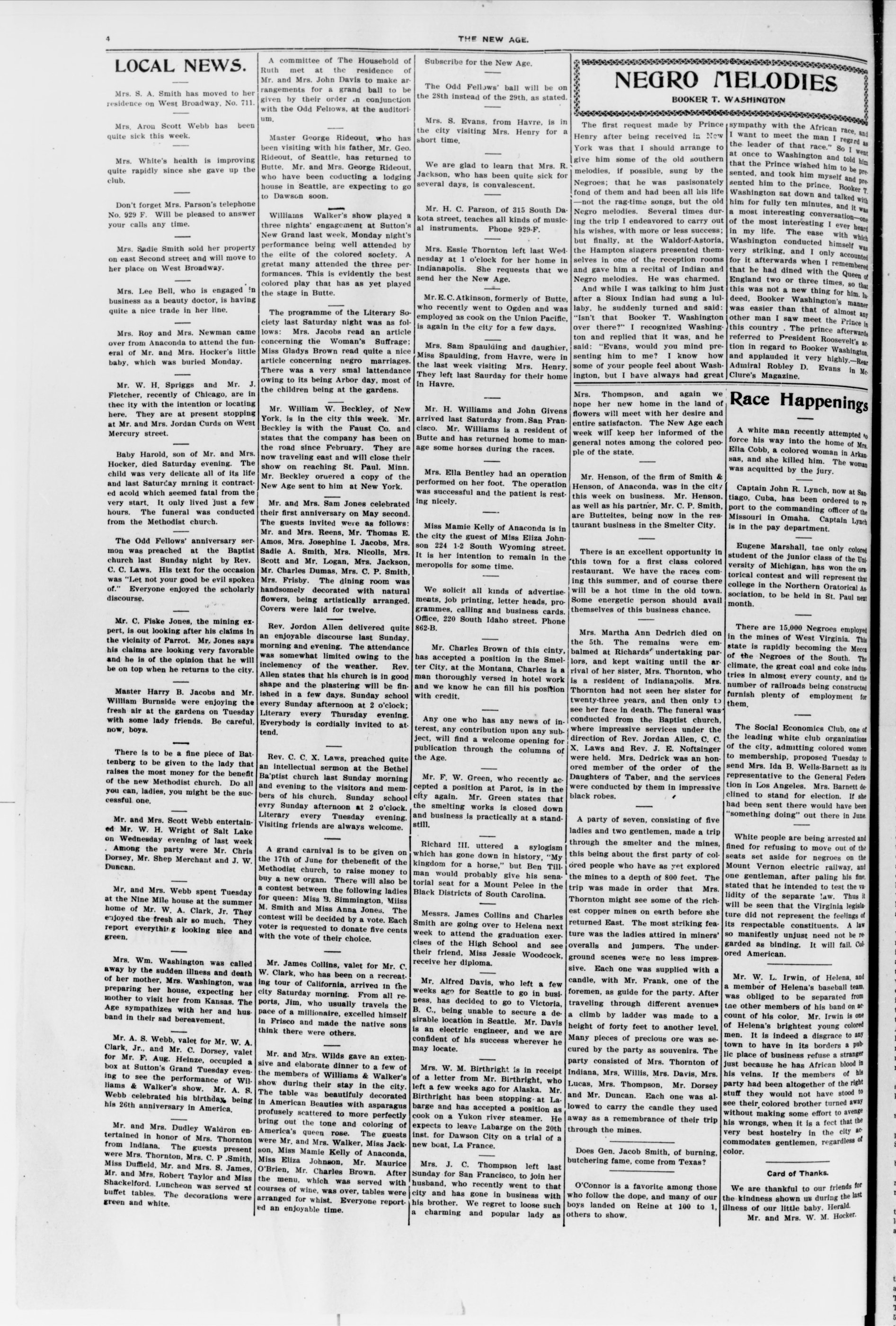
sympathy with the African race, and I want to meet the man I regard as the leader of that race." So I went at once to Washington and told him that the Prince wished him to be presented, and took him myself and presented him to the prince. Booker T. Washington sat down and talked with him for fully ten minutes, and it was a most interesting conversation—one of the most interesting I ever heard in my life. The ease with which Washington conducted himself was very striking, and I only accounted for it afterwards when I remembered that he had dined with the Queen of England two or three times, so that this was not a new thing for him. Indeed, Booker Washington's manner was easier than that of almost any other man I saw meet the Prince in this country. The prince afterwards referred to President Roosevelt's action in regard to Booker Washington, and applauded it very highly.—Rear Admiral Robley D. Evans in McClure's Magazine.
Race Happenings
Card of Thanks.
We are thankful to our friends for the kindness shown us during the last illness of our little baby, Herald. Mr. and Mrs. W. M. Hocker.