The New Age (Butte)
Friday, July 4, 1902
Butte, Montana
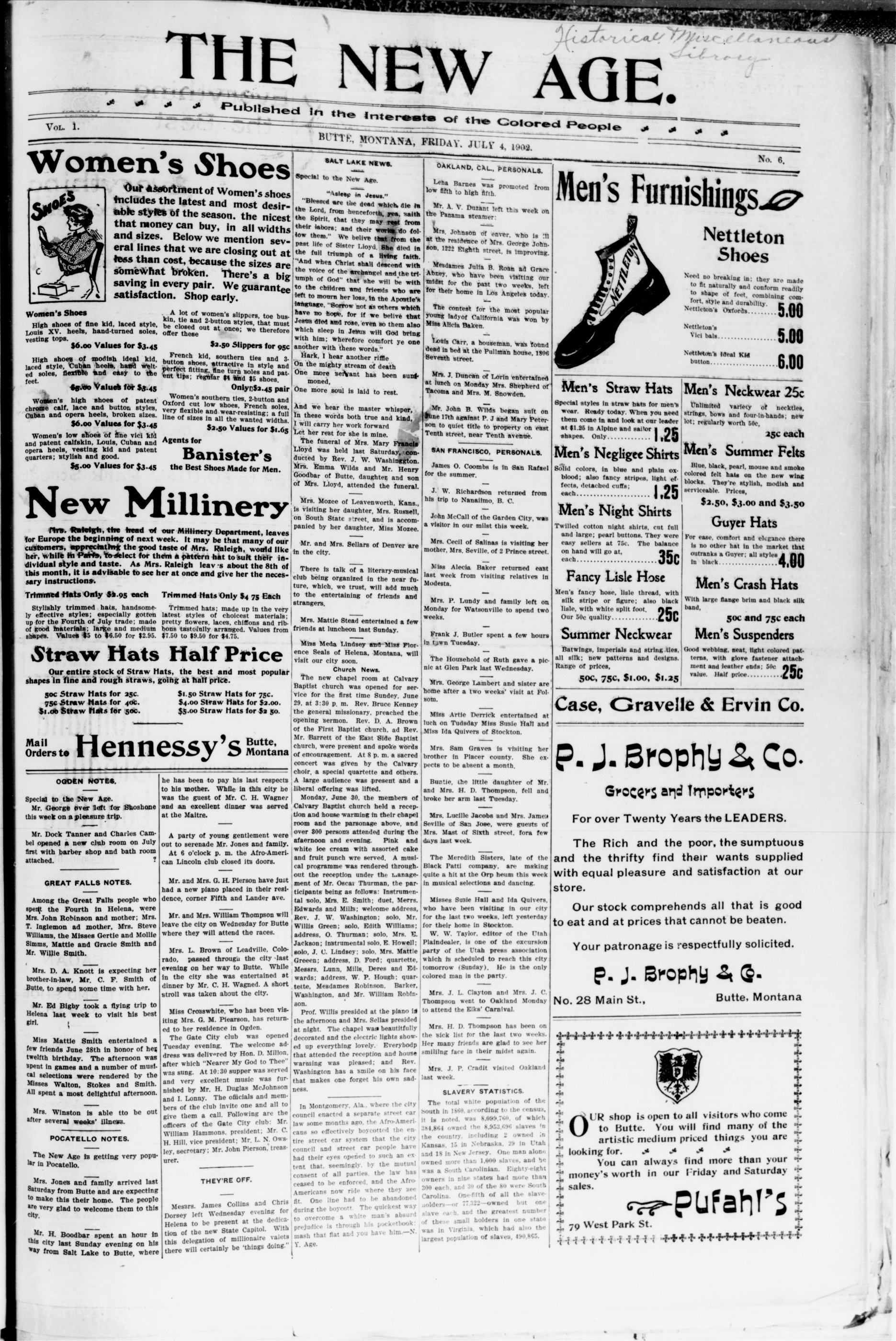
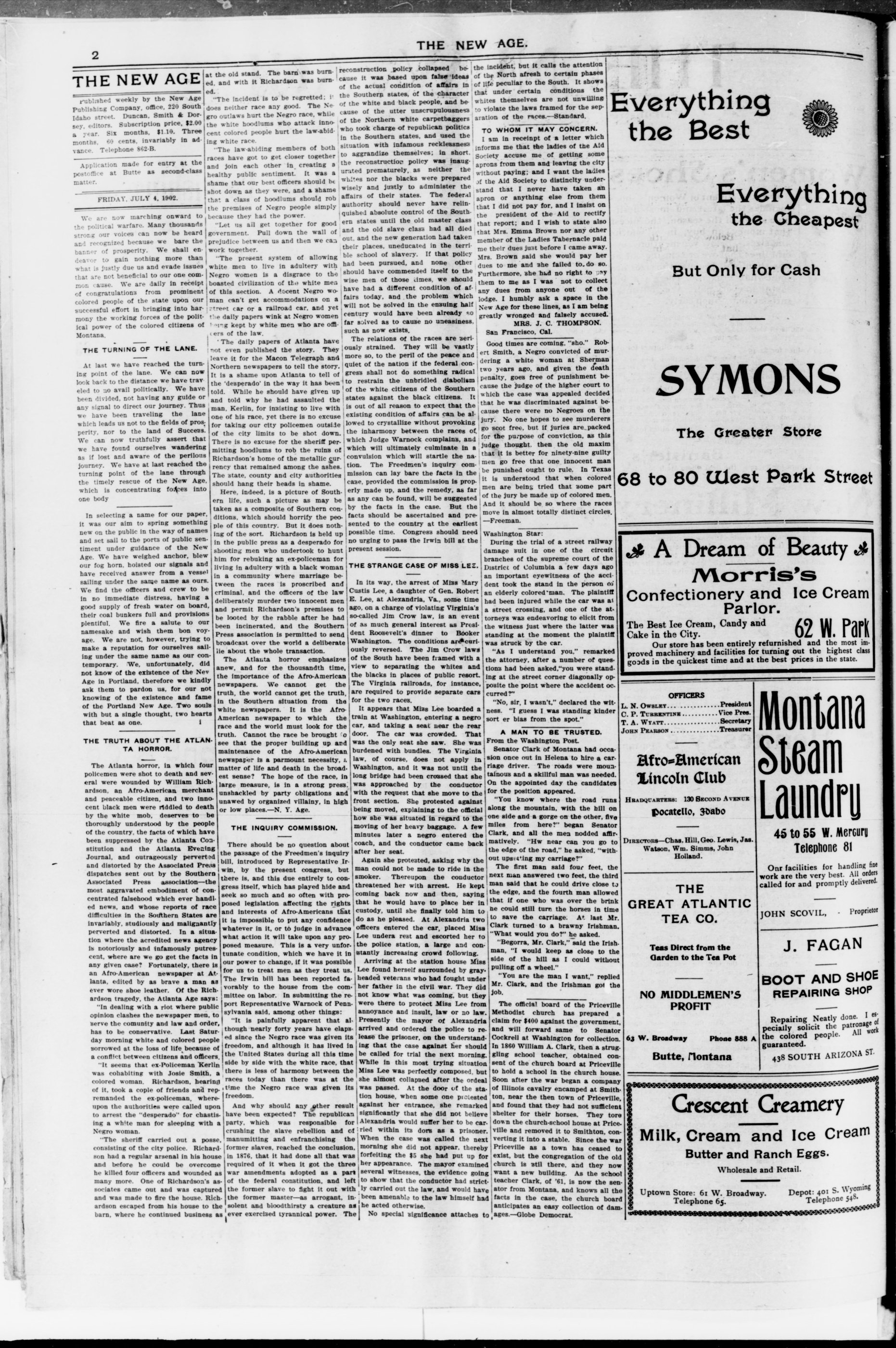
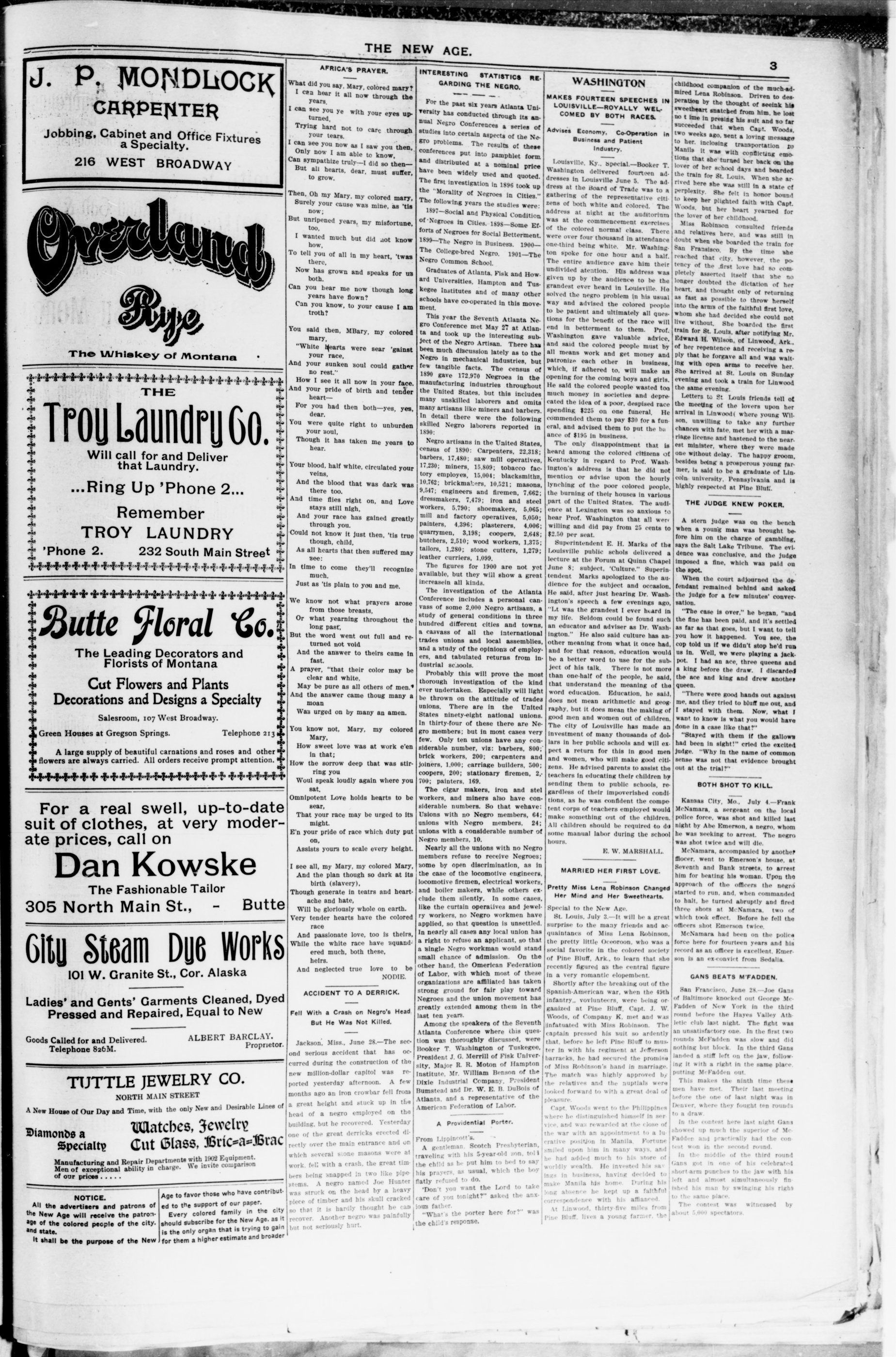
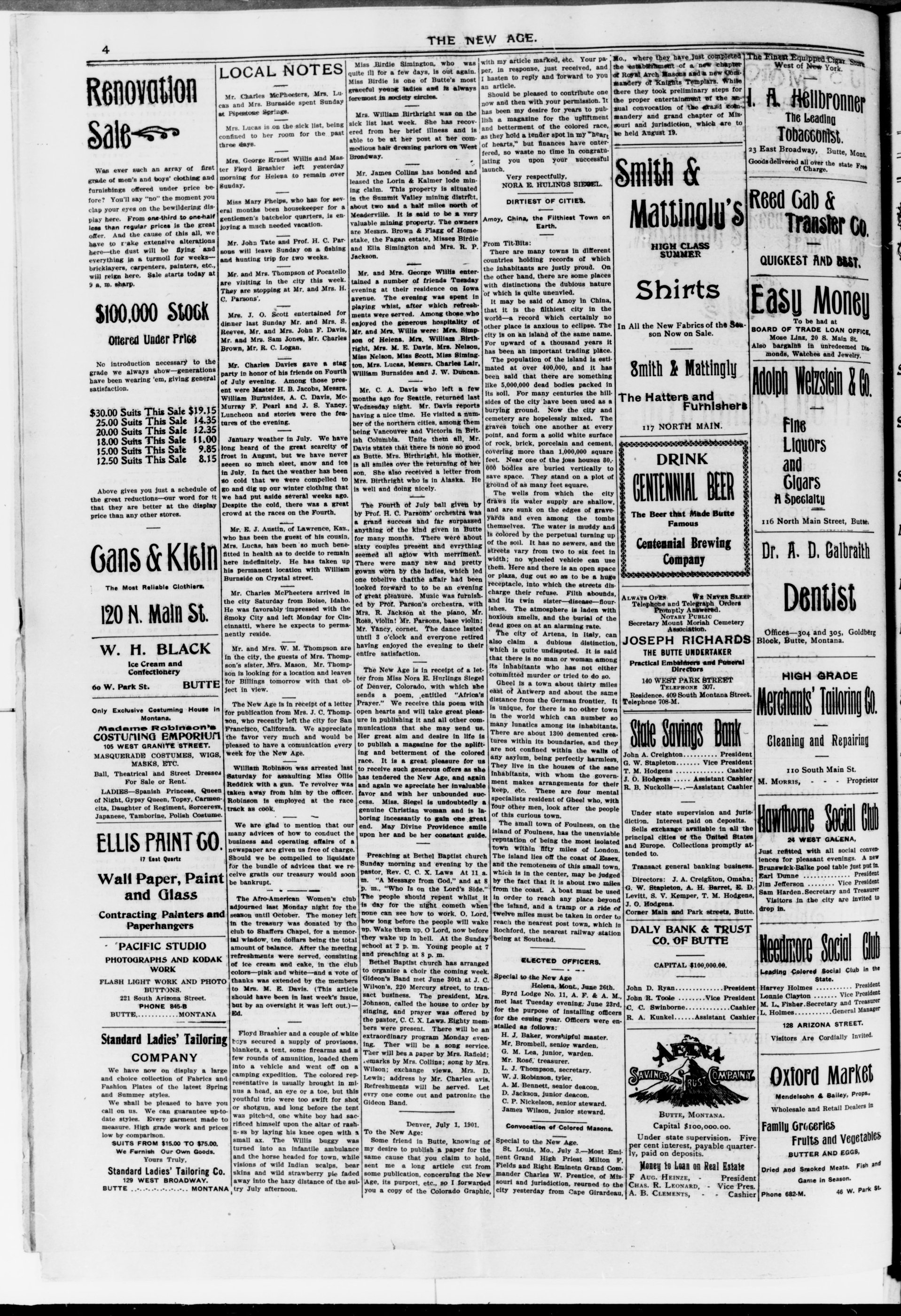
Page text (machine-generated)
THE NEW AGE.
Women's Shoes
Our assortment of Women's shoes includes the latest and most desirable styles of the season, the nicest that money can buy, in all widths and sizes. Below we mention several lines that we are closing out at less than cost, because the sizes are somewhat broken. There's a big saving in every pair. We guarantee satisfaction. Shop early.
New Millinery
Mrs. Raleigh, the head of our Millinery Department, leaves for Europe the beginning of next week. It may be that many of our customers, appreciating the good taste of Mrs. Raleigh, would like her, while in Paris, to select for them a pattern hat to suit their individual style and taste. As Mrs. Raleigh leaves about the 8th of this month, it is advisable to see her at once and give her the necessary instructions.
Straw Hats Half Price
Our entire stock of Straw Hats, the best and most popular shapes in fine and rough straws, going at half price.
Mail Orders to Hennessy's Butte, Montana
Vol. 1.
SHOE'S
Women's Shoes
High shoes of fine kid, laced style,
Louis XV, heels, hand-turned soles,
vesting tops.
$6.00 Values for $3.45
High shoes of modish ideal kid,
laced style, Cuban heels, hand wetted
soles, flexible and easy to the
feet.
$5.00 Values for $5.45
Women's high shoes of patent
chrome calf, lace and button, styles,
Cuban and opera heels, broken sizes.
$6.00 Values for $3.45
Women's low shoes of fine vici kid
and patent calfskin, Louis, Cuban and
opera heels, vesting kid and patent
quarters; stylish and good.
$5.00 Values for $3.45
New M
Mrs. Raleigh, the head of for Europe the beginning of next w customers, appreciating the good her, while in Paris, to select for the dividual style and taste. As Mrs this month, it is advisable to see hary instructions.
Trimmed Hats Only $2.95 each
Stylishly trimmed hats, handsome-
ly effective styles; especially gotten
up for the Fourth of July trade; made
of good materials; large and medium
shapes. Values $5 to $6.50 for $2.95.
Straw Hats
Our entire stock of Straw H
shapes in fine and rough straws, p
50c Straw Hats for 25c.
75c Straw Hats for 40c.
$1.00 Straw Hats for 50c.
Mail
Orders to Henne
OGDEN NOTES.
Special to the New Age.
Special to the New Age.
Mr. George over left for Shoshone this week on a pleasure trip.
Mr. Dock Tanner and Charles Cambel opened a new club room on July first with barber shop and bath room attached.
GREAT FALLS NOTES.
Among the Great Falls people who spent the Fourth in Helena, were Mrs. John Robinson and mother; Mrs. T. Inglemon ad mother, Mrs. Steve Williams, the Misses Gertie and Mollie Simms, Mattie and Gracie Smith and Mr. Willie Smith.
Mrs. D. A. Knott is expecting her brother-in-law, Mr. C. F. Smith of Butte, to spend some time with her.
Mr. Ed Bigby took a flying trip to Helena last week to visit his best girl.
Miss Mattie Smith entertained a few friends June 28th in honor of her twelfth birthday. The afternoon was spent in games and a number of musical selections were rendered by the Misses Walton, Stokes and Smith. All spent a most delightful afternoon.
Mrs. Winston is able to be out after several weeks' illness.
POCATELLO NOTES
The New Age is getting very popular in Pocatello.
Mrs. Jones and family arrived last Saturday from Butte and are expecting to make this their home. The people are very glad to welcome them to this city.
Mr. H. Boodbar spent an hour in this city last Sunday evening on his way from Salt Lake to Butte, where
A lot of women's slippers, toe buskin, tie and 2-button styles, that must be closed out at once; we therefore offer these
$2.50 Slippers for 950
French kid, southern ties and 3-button shoes, attractive in style and perfect fitting, fine turn soles and patient tips; regular $4 and $5 shoes.
Only $2.45 pair
Women's southern ties, 2-button and Oxford cut low shoes, French soles, very flexible and wear-resistant; a full line of sizes in all the wanted widths.
Banister's the Best Shoes Made for Men.
[illinery
in our Millinery Department, leaves week. It may be that many of our taste of Mrs. Raleigh, world like them a pattern hat to suit their in. Raleigh leaves about the 8th of her at once and give her the neces-
Trimmed Hats Only $4.75 Each
Trimmed hats; made up in the very latest styles of choicest materials; pretty flowers, laces, chiffons and ribbons tastefully arranged. Values from $7.50 to $9.50 for $4.75.
Half Price hats, the best and most popular going at half price.
$1.50 Straw Hats for 75c.
$4.00 Straw Hats for $2.00.
$5.00 Straw Hats for $2 50.
essy's Butte, Montana
he has been to pay his last respects to his mother. While in this city he was the guest of Mr. C. H. Wagner and an excellent dinner was served at the Maitre.
A party of young gentlement were out to serenade Mr. Jones and family.
At 6 o'clock p. m. the Afro-American Lincoln club closed its doors.
Mr. and Mrs. G. H. Pierson have just had a new piano placed in their residence, corner Fifth and Lander ave.
Mr. and Mrs. William Thompson will leave the city on Wednesday for Butte where they will attend the races.
Mrs. L. Brown of Leadville, Colorado, passed through the city last evening on her way to Butte. While in the city she was entertained at dinner by Mr. C. H. Wagned. A short stroll was taken about the city.
Miss Crosswhite, who has been visiting Mrs. G. M. Piearson, has returned to her residence in Ogden.
The Gate City club was opened Tuesday evening. The welcome address was delivered by Hon. D. Millon, after which "Nearer My God to Thee" was sung. At 10:30 supper was served and very excellent music was furnished by Mr. H. Duglas McJohnson and I. Lonny. The officials and members of the club invite one and all to give them a call. Following are the officers of the Gate City club: Mr. William Hammons, president; Mr. C. H. Hill, vice president; Mr. L. N. Owsley, secretary; Mr. John Pierson, treasurer.
THEY'RE OFF.
Messrs. James Collins and Chris Dorsey left Wednesday evening for Helena to be present at the dedication of the new State Capitol. With this delegation of millionaire valets there will certainly be 'things doing."
BUTTE, MONTANA, FRIDAY, JULY 4, 1902.
SALT LAKE NEWS. Special to the New Age.
"Asleep in Jesus."
"Blessed are the dead which die in the Lord, from henceforth, yes, saith the Spirit, that they may rest from their labors; and their works do follow them." We belive that from the past life of Sister Lloyd. She died in the full triumph of a living faith. "And when Christ shall descend with the voice of the archangel and the triumph of God" that she will be with to the children and friends who are left to mourn her loss, in the Apostle's language. "Sorrow not as others which have no hope, for if we belive that Jesus died and rose, even so them also which sleep in Jesus will God bring with him; wherefore comfort ye one another with these words."
One more servant has been summoned,
One more soul is laid to rest.
And we hear the master whisper,
In these words both true and kind,
I will carry her work forward
Let her rest for she is mine.
The funeral of Mrs. Mary Francis
Lloyd was held last Saturday, conducted by Rev. J. W. Washington.
Mrs. Emma Wilds and Mr. Henry Goodbar of Butte, daughter and son of Mrs. Lloyd, attended the funeral.
Mrs. Mozee of Leavenworth, Kans., is visiting her daughter, Mrs. Russell, on South State street, and is accompanied by her daughter, Miss Mozee.
Mr. and Mrs. Sellars of Denver are in the city.
There is talk of a literary-musical club being organized in the near future, which, we trust, will add much to the entertaining of friends and strangers.
Mrs. Mattie Stead entertained a few friends at luncheon last Sunday.
Miss Meda Lindsey and Miss Florence Seals of Helena, Montana, will visit our city soon.
Church News.
The new chapel room at Calvary Baptist church was opened for service for the first time Sunday, June 29, at 3:30 p. m. Rev. Bruce Kenney the general missionary, preached the opening sermon. Rev. D. A. Brown of the First Baptist church, ad Rev. Mr. Barrett of the East Side Baptist church, were present and spoke words of encouragement. At 8 p. m. a sacred concert was given by the Calvary choir, a special quartette and others. A large audience was present and a liberal offering was lifted.
Monday, June 30, the members of Calvary Baptist church held a reception and house warming in their chapel room and the parsonage above, and over 300 persons attended during the afarmoon and evening. Pink and white ice cream with assorted cake and fruit punch were served. A musical programme was rendered throughout the reception under the Management of Mr. Oscar Thurman, the participants being as follows: Instrumental solo, Mrs. E. Smith; duet, Merrs, Edwards and Mills; welcome address, Rev. J. W. Washington; solo, Mr. Willis Green; solo, Edith Williams; address, O. Thurman; solo, Mrs. E. Jackson; instrumental solo, E. Howell; solo, J. C. Lindsey; solo, Mattle Greecen; address, D. Ford; quartette, Messrs. Lunn, Mills, Deres and Edwards; address, W. P. Hough; quartette, Mesdames Robinson, Barker, Washington, and Mr. William Robinson.
Prof. Willis presided at the piano in the afternoon and Mrs. Sellas presided at night. The chapel was beautifully decorated and the electric lights showed up everything lovely. Everybody that attended the reception and house warming was pleased; and Rev. Washington has a smile on his face that makes one forget his own sadness.
In Montgomery, Ala., where the city council enacted a separate street car law some months ago, the Afro-Americans so effectively boycotted the entire street car system that the city council and street car people have had their eyes opened to such an extent that, seemingly, by the mutual consent of all parties, the law has ceased to be enforced, and the Afro-Americans now ride where they see fit. One line had to be abandoned during the boycott. The quickest way to overcome a white man's absurd prejudice is through his pocketbook; mash that flat and you have him—N. Y. Age.
OAKLAND, CAL., PERSONALS.
Leha Barnes was promoted from low fifth to high fifth.
Mr. A. V. Duzant left this week on the Panama steamer:
Mrs. Johnson of enver, who is ill at the residence of Mrs. George Johnson, 1222 Eighth street, is improving.
Mesdames Julia B. Roan ad Grace Abney, who have been visiting our midst for the past two weeks, left for their home in Los Angeles today.
The contest for the most popular young lady of California was won by Miss Alicia Baken.
Louis Carr, a houseman, was found dead in bed at the Pullman house, 1806 Seventh street.
Mrs. J. Duncan of Lorin entertained at lunch on Monday Mrs. Shepherd of Tacoma and Mrs. M. Snowden.
Mr. John B. Wilds began suit on June 17th against P. J and Mary Peterson to quiet title to property on east Tenth street, near Tenth avenue.
James O. Coombs is in San Rafael for the summer.
J. W. Richardson returned from his trip to Nanaimo, B. C.
John McCall of the Garden City, was a visitor in our milst this week.
Mrs. Cecil of Salinas is visiting her mother, Mrs. Seville, of 2 Prince street.
Miss Alecia Baker returned east last week from visiting relatives in Modesta.
Mrs. P. Lundy and family left on Monday for Watsonville to spend two weeks.
Frank J. Butler spent a few hours in town Tuesday.
The Household of Ruth gave a picnic at Glen Park last Wednesday.
Mrs. George Lambert and sister are home after a two weeks' visit at Folsom.
Miss Artie Derrick entertained at luch on Tudsday Miss Susie Hall and Miss Ida Quivers of Stockton.
Mrs. Sam Graves is visiting her brother in Placer county. She expects to be absent a month.
Buntie, the little daughter of Mr. and Mrs. H. D. Thompson, fell and broke her arm last Tuesday.
Mrs. Lucille Jacobs and Mrs. James Seville of San Jose, were guests of Mrs. Mast of Sixth street, fora few days last week.
The Meredith Sisters, late of the Black Patti company, are making quite a hit at the Orp heum this week in musical selections and dancing.
Misses Susie Hall and Ida Quivers, who have been visiting in our city for the last two weeks, left yesterday for their home in Stockton.
W. W. Taylor, editor of the Utah Plaindealer, is one of the excursion party of the Utah press association which is scheduled to reach this city tomorrow (Sunday). He is the only colored man in the party.
Mrs. J. L. Clayton and Mrs. J. C. Thompson went to Oakland Monday to attend the Els' Carnival.
Mrs. H. D. Thompson has been on the sick list for the last two weeks. Her many friends are glad to see her smilling face in their midst again.
Mrs. J. P. Cradit visited Oakland last week.
SLAVERY STATISTICS.
The total white population of the South in 1860, according to the census, it is noted, was 8,099,760, of which 384,864 owned the 8,953,696 slaves in the country, including 2 owned in Kansas, 15 in Nebraska, 29 in Utah and 18 in New Jersey. One man alone owned more than 1,000 slaves, and he was a South Carolinian. Eighty-eight owners in nine states had more than 300 each, and 30 of the 80 were South Carolina. One-fifth of all the slave-makers—or 77,322—owned but one slave each, and the greatest number of these small holders in one state was in Virginia, which had also the largest population of slaves, 490,855.
---
Men's Furnishings
Men's Furnishings
NEETLETON
Men's Straw Hats
Special styles in straw hats for men's
wear. Ready today. When you need
them come in and look at our leader
at $1.25 in Alpine and sailor
shapes. Only. 1.25
Men's Negligee Shirts
Solid colors, in blue and plain oxblood; also fancy stripes, light effects, detached cuffs; each.....1.25
Men's Night Shirts
Twilled cotton night shirts, cut full and large; pearl buttons. They were easy sellers at 75c. The balance on hand will go at, each ..... 35c
Fancy Lisle Hose
Men's fancy hose, lisle thread, with
sliked stripe or figure; also black
lisle, with white split foot.
Our 50c quality ..... 25c
Summer Neckwear
Batwings, imperials and string ties, all silk; new patterns and designs. Range of prices,
50c, 75c, $1.00, $1.25
Case, Gravel
P. J. Brop
Gravelle & Ervin Co. J. Brophy & Co.
Case, Gravelle & Ervin Co.
P. J. Brophy & Co.
Grocers and Importers
For over Twenty Years
The Rich and the
and the thrifty find
with equal pleasure at
store.
Our stock compreh
to eat and at prices tha
Your patronage is
P. J. Brow
over Twenty Years the LEADERS.
Rich and the poor, the sumptuous thrifty find their wants supplied of pleasure and satisfaction at our stock comprehends all that is good at prices that cannot be beaten.
patronage is respectfully solicited.
P. J. Brophy & Co.
For over Twenty Years the LEADERS.
The Rich and the poor, the sumptuous and the thrifty find their wants supplied with equal pleasure and satisfaction at our store.
Our stock comprehends all that is good to eat and at prices that cannot be beaten.
Your patronage is respectfully solicited.
P. J. Brophy & Co.
No. 28 Main St.,
R shop is open to all visitors who come to Butte. You will find many of the artistic medium priced things you are for. You can always find more than your worth in our Friday and Saturday
OUR shop is open to
to Butte. You w
artistic medium
looking for.
You can always
money's worth in our
sales
OUR shop is open to all visitors who come to Butte. You will find many of the artistic medium priced things you are looking for. You can always find more than your money's worth in our Friday and Saturday sales.
Pufahl's
79 West Park St.
St Park St.
```markdown
```
No. 6.
Nettleton Shoes
Need no breaking in; they are made to fit naturally and conform readily to shape of feet, combining comfort, style and durability.
Nettleton's Oxfords.....5.00
Nettleton's Vici bals.....5.00
Nettleton's Ideal Kid button.....6.00
Men's Neckwear 25c
Unlimited variety of neckties,
strings, bows and four-in-hands; new
lot; regularly worth 50c.
25c each
Blue, black, pearl, mouse and smoke colored felt hats on the new wing blocks. They're stylish, modish and serviceable. Prices.
$2.50, $3.00 and $3.50
Guyer Hats
For ease, comfort and elegance there is no other hat in the market that outranks a Guyer; all styles in black. 4.00
With large flange brim and black silk band.
Men's Suspenders
Good webbing, neat, light colored patterns, with glove fastener attachment and leather ends; 50c value. Half price. 25c
Butte, Montana
2
THE NEW AGE
Published weekly by the New Age Publishing Company, office, 220 South Idaho street. Duncan, Smith & Dorsey, editors. Subscription price, $2.00 a year. Six months, $1.10. Three months, 60 cents, invariably in advance. Telephone 862-B.
Application made for entry at the postoffice at Butte as second-class matter.
FRIDAY, JULY 4, 1902.
We are now marching onward to the political warfare. Many thousands strong our voices can now be heard and recognized because we bare the banner of prosperity. We shall endeavor to gain nothing more than what is justly due us and evade issues that are not beneficial to our one common cause. We are daily in receipt of congratulations from prominent colored people of the state upon our successful effort in bringing into harmony the working forces of the political power of the colored citizens of Montana.
THE TURNING OF THE LANE.
At last we have reached the turning point of the lane. We can now look back to the distance we have traveled to no avail politically. We have been divided, not having any guide or any signal to direct our journey. Thus we have been traveling the lane which leads us not to the fields of prosperity, nor to the land of Success. We can now truthfully assert that we have found ourselves wandering as if lost and aware of the perilous journey. We have at last reached the turning point of the lane through the timely rescue of the New Age which is concentrating forces into one body
In selecting a name for our paper, it was our aim to spring something new on the public in the way of names and set sail to the ports of public sentiment under guidance of the New Age. We have weighed anchor, blew our fog horn, hoisted our signals and have received answer from a vessel sailing under the same name as ours. We find the officers and crew to be in no immediate distress, having a good supply of fresh water on board, their coal bunkers full and provisions plentiful. We fire a salute to our namesake and wish them bon voyage. We are not, however, trying to make a reputation for ourselves sailing under the same name as our contemporary. We, unfortunately, did not know of the existence of the New Age in Portland, therefore we kindly ask them to pardon us, for our not knowing of the existence and fame of the Portland New Age. Two souls with but a single thought, two hearts that beat as one.
THE TRUTH ABOUT THE ATLANT
TA HORROR.
The Atlanta horror, in which four policemen were shot to death and several were wounded by William Richardson, an Afro-American merchant and peaceable citizen, and two innocent black men were riddled to death by the white mob, deserves to be thoroughly understood by the people of the country, the facts of which have been suppressed by the Atlanta Constitution and the Atlanta Eventing Journal, and outrageously perverted and distorted by the Associated Press dispatches sent out by the Southern Associated Press association—the most aggravated embodiment of concentrated falsehood which ever handled news, and whose reports of race difficulties in the Southern States are invariably, studiously and malignantly perverted and distorted. In a situation where the accredited news agency is notoriously and infamously putrescent, where are we go get the facts in any given case? Fortunately, there is an Afro-American newspaper at Atlanta, edited by as brave a man as ever wore shoe leather. Of the Rich ardson tragedy, the Atlanta Age says
"In dealing with a riot where public opinion clashes the newspaper men, to serve the community and law and order, has to be conservative. Last Saturday morning white and colored people sorrowed at the loss of life because of a conflict between citizens and officers, "It seems that ex-Policeman Kerlin was cohabiting with Josie Smith, a colored woman. Richardson, hearing of it, took a cople of friends and repremanded the ex-policeman, whereupon the authorities were called upon to arrest the "desperado" for chastising a white man for sleeping with a Negro woman.
"The sheriff carried out a posse, consisting of the city police. Richardson had a regular arsenal in his house and before he could be overcome he killed four officers and wounded as many more. One of Richardson's associates came out and was captured and was made to fire the house. Richardson escaped from his house to the barn, where he continued business as
at the old stand. The barn was burned, and with it Richardson was burned.
"The incident is to be regretted; it does neither race any good. The Negro outlaws hurt the Negro race, while the white hoodlums who attack innocent colored people hurt the law-abiding white race.
"The law-abiding members of both races have got to get closer together and join each other in creating a healthy public sentiment. It was a shame that our best officers should be shot down as they were, and a shame that a class of hoodlums should rob the premises of Negro people simply because they had the power.
"Let us all get together for good government. Pull down the wall of prejudice between us and then we can work together."
"The present system of allowing white men to live in adultery with Negro women is a disgrace to the boasted civilization of the white men of this section. A decent Negro woman can't get accommodations on a street car or a railroad car, and yet the daily papers wink at Negro women long kept by white men who are officers of the law.
The daily papers of Atlanta have not even published the story. They leave it for the Macon Telegraph and Northern newspapers to tell the story. It is a shame upon Atlanta to tell of the 'desperado' in the way it has been told. While he should have given up and told why he had assaulted the man, Kerlin, for insisting to live with one of his race, yet there is no excuse for taking our city policemen outside of the city limits to be shot down. There is no excuse for the sheriff permitting hoodlums to rob the ruins of Richardson's home of the metallic currency that remained among the ashes. The state, county and city authorities should hang their heads in shame.
Here, indeed, is a picture of Southern life, such a picture as may be taken as a composite of Southern conditions, which should horrify the people of this country. But it does nothing of the sort. Richardson is held up in the public press as a desperado for shooting men who undertook to hunt him for rebuking an ex-policeman for living in adultery with a black woman in a community where marriage between the races is proscribed and criminal, and the officers of the law deliberately murder two innocent men and permit Richardson's premises to be looted by the rabble after he had been incinerated, and the Southern Press association is permitted to send broadcast over the world a deliberate lie about the whole transaction.
The Atlanta horror emphasizes anew, and for the thousandth time, the importance of the Afro-American newspapers. We cannot get the truth, the world cannot get the truth, in the Southern situation from the white newspapers. It is the Afro-American newspaper to which the race and the world must look for the truth. Cannot the race be brought to see that the proper building up and maintenance of the Afro-American newspaper is a paramount necessity, a matter of life and death in the broadest sense? The hope of the race, in large measure, is in a strong press unshackled by party obligations and unawed by organized villainy, in high or low places.—N. Y. Age.
THE INQUIRY COMMISSION.
There should be no question about the passage of the Freedmen's inquiry bill, introduced by Representative Irwin, by the present congress, but there is, and this due entirely to congress itself, which has played hide and seek so much and so often with proposed legislation affecting the rights and interests of Afro-Americans that it is impossible to put any confidence whatever in it, or to judge in advance what action it will take upon any proposed measure. This is a very unfortunate condition, which we have it in our power to change, if it was possible for us to treat men as they treat us The Irwin bill has been reported favorably to the house from the committee on labor. In submitting the report Representative Warnock of Pennsylvania said, among other things:
"It is painfully apparent that although nearly forty years have elapsed since the Negro race was given its freedom, and although it has lived in the United States during all this time side by side with the white race, that there is less of harmony between the races today than there was at the time the Negro race was given its freedom.
And why should any other result have been expected? The republican party, which was responsible for crushing the slave rebellion and of manumitting and enfranchising the former slaves, reached the conclusion, in 1876, that it had done all that was required of it when it when it got the three war amendments adopted as a part of the federal constitution, and left the former slave to fight it out with the former master—as arrogant, insolent and bloodthirsty a creature as ever exercised tyrannical power. The
THE NEW AGE.
reconstruction policy collapsed because it was based upon false ideas of the actual condition of affairs in the Southern states, of the character of the white and black people, and because of the utter unscrupulousness of the Northern white carpetbaggers who took charge of republican politics in the Southern states, and used the situation with infamous recklessness to aggrandize themselves; in short, the reconstruction policy was inaugurated prematurely, as neither the whites nor the blacks were prepared wisely and justly to administer the affairs of their states. The federal authority should never have relinquished absolute control of the Southern states until the old master class and the old slave class had all died out, and the new generation had taken their places, uneducated in the terrible school of slavery. If that policy had been pursued, and none other should have commended itself to the wise men of those dimes, we should have had a different condition of affairs today, and the problem which will not be solved in the ensuing half century would have been already so far solved as to cause no uneasiness such as now exists.
The relations of the races are seriously strained. They will be vastly more so, to the peril of the peace and quiet of the nation if the federal congress shall not do something radical to restrain the unbridled diabolism of the white citizens of the Southern states against the black citizens. It is out of all reason to expect that the existing condition of affairs can be allowed to crystallize without provoking the inharmony between the races of which Judge Warnock complains, and which will ultimately culminate in a convulsion which will startle the nation. The Freedmen's inquiry commission can lay bare the facts in the case, provided the commission is properly made up, and the remedy, as far as any can be found, will be suggested by the facts in the case. But the facts should be ascertained and presented to the country at the earliest possible time. Congress should need no urging to pass the Irwin bill at the present session.
THE STRANGE CASE OF MISS LEZ
In its way, the arrest of Miss Mary Custis Lee, a daughter of Gen. Robert E. Lee, at Alexandria, Va., some time ago, on a charge of violating Virginia's so-called Jim Crow law, is an event of as much general interest as President Roosevelt's dinner to Booker Washington. The conditions are curiously reversed. The Jim Crow laws of the South have been framed with a view to separating the whites and the blacks in places of public resort. The Virginia railroads, for instance are required to provide separate cars for the two races.
It appears that Miss Lee boarded a train at Washington, entering a negro car, and taking a seat near the rear door. The car was crowded. That was the only seat she saw. She was burdened with bundles. The Virginia law, of course, does not apply in Washington, and it was not until the long bridge had been crossed that she was approached by the conductor with the request that she move to the front section. She protested against being moved, explaining to the official how she was situated in regard to the moving of her heavy baggage. A few minutes later a negro entered the coach, and the conductor came back after her seat.
Again she protested, asking why the man could not be made to ride in the smoker. Thereupon the conductor threatened her with arrest. He kept coming back now and then, saying that he would have to place her in custody, until she finally told him to do as he pleased. At Alexandria two officers entered the car, placed Miss Lee undera rest and escorted her to the police station, a large and constantly increasing crowd following.
Arriving at the station house Miss Lee found herself surrounded by gray-headed veterans who had fought under her father in the civil war. They did not know what was coming, but they were there to protect Miss Lee from annoyance and insult, law or no law. Presently the mayor of Alexandria arrived and ordered the police to release the prisoner, on the understanding that the case against her should be called for trial the next morning. While in this most trying situation Miss Lee was perfectly composed, but she almost collapsed after the ordeal was passed. At the door of the station house, when some one protested against her entrance, she remarked significantly that she did not believe Alexandria would suffer her to be carried within its dors as a prisoner. When the case was called the next morning she did not appear, thereby forfeiting the $5 she had put up for her appearance. The mayor examined several witnesses, the evidence going to show that the conductor had strictly carried out the law, and would have been amenable to the law himself had he acted otherwise.
the incident, but it calls the attention of the North afresh to certain phases of life peculiar to the South. It shows that under certain conditions the whites themselves are not unwilling to violate the laws framed for the separation of the races.--Standard.
TO WHOM IT MAY CONCERN.
I am in receipt of a letter which informs me that the ladies of the Aid Society accuse me of getting some aprons from them and leaving the city without paying; and I want the ladies of the Aid Society to distinctly understand that I never have taken an apron or anything else from them that I did not pay for, and I insist on the president of the Aid to rectify that report; and I wish to state also that Mrs. Emma Brown nor any other member of the Ladies Tabernacle paid me their dues just before I came away. Mrs. Brown said she would pay her dues to me and she failed to do so. Furthermore, she had no right to pay them to me as I was not to collect any dues from anyone out of the lodge. I humbly ask a space in the New Age for these lines, as I am being greatly wronged and falsely accused.
MRS. J. C. THOMPSON.
San Francisco, Cal.
Good times are coming. "sho." Robert Smith, a Negro convicted of murdering a white woman at Sherman two years ago, and given the death penalty, goes free of punishment because the judge of the higher court to which the case was appealed decided that he was discriminated against because there were no Negroes on the jury. No one hopes to see murderers go scot free, but if juries are packed for the purpose of conviction, as this judge thought, then the old maxim that it is better for ninety-nine guilty men go free that one innocent man be punished ought to rule. In Texas it is understood that when colored men are being tried that some part of the jury be made up of colored men. And it should be so where the races move in almost totally distinct circles—Freeman.
Washington Star:
During the trial of a street railway damage suit in one of the circuit branches of the supreme court of the District of Columbia a few days ago an important eyewitness of the accident took the stand in the person of an elderly colored man. The plaintiff had been injured while the car was at a street crossing, and one of the attorneys was endeavoring to elicit from the witness just where the latter was standing at the moment the plaintiff was struck by the car.
"As I understand you," remarked the attorney, after a number of questions had been asked, "you were standing at the street corner diagonally opposite the point where the accident occurred?"
"No, sir, I wasn't," declared the witness. "I guess I was standing kinder sort er bias from the spot."
A MAN TO BE TRUSTED.
From the Washington Post.
Senator Clark of Montana had occasion once out in Helena to hire a carriage driver. The roads were mountainous and a skillful man was needed. On the appointed day the candidates for the position appeared.
"You know where the road runs along the mountain, with the hill on one side and a gorge on the other, five miles from here?" began Senator Clark, and all the men nodded affirmatively. "Hw near can you go to the edge of the road," he asked, "without upsetting my carriage?"
The first man said four feet, the next man answered two feet, the third man said that he could drive close to the edge, and the fourth man allowed that if one who was over the brink he could still turn the horses in time to save the carriage. At last Mr. Clark turned to a brawny Irishman, "What would you do?" he asked.
"Begorra, Mr. Clark," said the Irishman, "I would keep as close to the side of the hill as I could without pulling off a wheel."
"You are the man I want," replied Mr. Clark, and the Irishman got the job.
The official board of the Priceville Methodist church has prepared a claim for $400 against the government, and will forward same to Senator Cockrell at Washington for collection. In 1860 William A. Clark, then a struggling school teacher, obtained consent of the church board at Priceville to hold a school in the church house. Soon after the war began a company of Illinois cavalry encamped at Smithton, near the then town of Priceville, and found that they had not sufficient shelter for their horses. They torre down the church-school house at Priceville and removed it to Smithton, converting it into a stable. Since the war Priceville as a town has ceased to exist, but the congregation of the old church is still there, and they now want a new building. As the school teacher Clark, of '61, is now the senator from Montana, and knows all the facts in the case, the church board anticipates an easy collection of damages. -Globe Democrat
---
Everything the Best
codificat
d e ' 1 0 0 1
Everything the Cheapest
But Only for Cash
SYMONS
SYMONS
MONS
SYMONS
The Greater Store
A Dream of
Morris
Confectionery and
Parlor
The Best Ice Cream, Candy and
Cake in the City.
Our store has been entirely refu-
proved machinery and facilities for tur-
goods in the quickest time and at the
OFFICERS
L. N. OWSLEY.....President
C. P. TURRENTINE.....Vice Pres.
T. A. WYATT.....Secretary
JOHN PEARSON.....Treasurer
Afro=American
Lincoln Club
80 West Park
A Dream of Bea
Morris's
Sectionery and Ice
Parlor.
Ice Cream, Candy and
the City.
62
store has been entirely refurnished and
machinery and facilities for turning out the
quickest time and at the best prices in
OFFICERS
President
Vice Pres.
Secretary
Treasurer
American
Coln Club
Mont
Stea
West Park Street
ream of Beauty
Morris's
Honey and Ice Cream
Parlor.
Candy and
62 W. Park
seen entirely refurnished and the most im-
facilities for turning out the highest class
time and at the best prices in the state.
President
Vice Pres.
Secretary
Treasurer
Montana
Steam
Laundry
ICAN
ub
ND AVENUE
ubo
68 to 80 West Park Street
A Dream of Beauty
Morris's
Confectionery and Ice Cream
Parlor.
The Best Ice Cream, Candy and
Cake in the City.
62 W. Park
Our store has been entirely refurnished and the most im-
proved machinery and facilities for turning out the highest class
goods in the quickest time and at the best prices in the state.
HRADQUARTERS: 130 SECOND AVENUE
Pocatello, 3dabo
DIRECTORS—Chas. Hill, Geo. Lewis, Jas. Watson, Wm. Simms, John Holland.
THE GREAT ATLANTIC TEA CO.
Teas Direct from the Garden to the Tea Pot
NO MIDDLEMEN'S PROFIT
63 W. Broadway Phone 888 A
Butte, Montana
Recent Creamery
Cream and Ice Cream
Water and Ranch Eggs.
Wholesale and Retail.
W. Broadway.
65.
Depot: 401 S. Wyoming
Telephone 548.
Crescent C
Milk, Cream and
Butter and Rait
Wholesale and
Uptown Store: 61 W. Broadway.
Telephone 65.
Crescent Creamery
K, Cream and Ice
Butter and Ranch Eggs
Wholesale and Retail.
Store: 61 W. Broadway.
Telephone 65.
Depot: 4
Tele
Crescent Creamery
Milk, Cream and Ice Cream
Butter and Ranch Eggs.
Wholesale and Retail.
Uptown Store: 61 W. Broadway.
Telephone 65.
Depot: 401 S. Wyoming
Telephone 548.
45 to 55 W. Mercury Telephone 81 Our facilities for handling fine work are the very best. All orders called for and promptly delivered.
JOHN SCOVIL, - Proprietor
J. FAGAN
BOOT AND SHOE
REPAIRING SHOP
Repairing Neatly done. I especially solicit the patronage of the colored people. All work guaranteed.
438 SOUTH ARIZONA ST.
```markdown
```
Jobbing, Cabinet and Office Fixtures a Specialty. 216 WEST BROADWAY
Overland
Rye
The Whiskey of Montana
THE
Will call for and Deliver that Laundry.
...Ring Up
Reme
TROY L
'Phone 2. 239
Butte Fl
The Leading
Florists o
Cut Flower
Decorations and L
Salesroom, 107
Green Houses at Gregson Spring
A large supply of beautiful
flowers are always carried. All
For a real sw
suit of clothes,
rate prices, call o
Dan K
The Fashion
305 North Main
City Steam
101 W. Granite
Ladies' and Gents' Ga
Pressed and Repa
Ring Up 'Phone 2
Remember
ATTROY LAUNDRY
No. 2. 232 South Main
Cette Floral
the Leading Decorators at
Florists of Montana
Cut Flowers and Plants
Operations and Designs a Special
Salesroom, 107 West Broadway.
sites at Gregson Springs. Te
supply of beautiful carnations and rose
always carried. All orders receive promo
a real swell, up-to-
clothes, at very re-
ces, call on
Jan Kowsk
The Fashionable Tailor
North Main St., -
Steam Dye W
W. Granite St., Cor. Alas
d Gents' Garments Clea-
sed and Repaired, Equal to
...Ring Up 'Phone 2...
The Leading Decorators and Florists of Montana Cut Flowers and Plants Decorations and Designs a Specialty
For a real swell, up-to-date suit of clothes, at very moderate prices, call on
The Fashionable Tailor 305 North Main St., Butte
IOI W. Granite St., Cor. Alaska Ladies' and Gents' Garments Cleaned, Dyed Pressed and Repaired, Equal to New
Goods Called for and Delivered.
Telephone 826M.
TUTTLE JEWELRY CO.
NORTH MAIN STREET
A New House of Our Day and Time, wi
Diamonds a
Specialty
Wa
Cute
Manufacturing and Repair Dep
Men of exceptional ability in
of our prices . . . .
Our Day and Time, with the only New and D
Watches, Jewel
Specialty Cut Glass, Brick
turing and Repair Departments with 1902 Equ
exceptional ability in charge. We invite con
价 . . . .
A New House of Our Day and Time, with the only New and Desirable Lines of
NOTICE.
All the advertisers and patrons of the New Age will receive the patronage of the colored people of the city. and state.
It shall be the purpose of the New
Age to favor those who have ceded to the support of our paper. Every colored family in should subscribe for the New is the only organ that is trying for them a higher estimate and
purpose of the work for which you are working.
'Phone 2...
ember
LAUNDRY
2 South Main Street
Decorators and
of Montana
S and Plants
Designs a Specialty
West Broadway.
Bags. Telephone 213
carcations and roses and other
orders receive prompt attention.
well, up-to-date
at very moder-
owske
enable Tailor
St., - Butte
Dye Works
St., Cor. Alaska
Arments Cleaned, Dyed
Fired, Equal to New
ALBERT BARCLAY.
Proprietor.
JEWELRY CO.
MIN STREET
In the only New and Desirable Lines of
Patches, Jewelry
Glass, Bric=a=Brac
Departments with 1902 Equipment.
Charge. We invite comparison
Age to favor those who have contributed to the support of our paper.
Every colored family in the city should subscribe for the New Age, as it is the only organ that is trying to gain for them a higher estimate and broader
Co.
THE NEW AGE
What did you say, Mary, colored mary?
I can hear it all now through the years.
I can see you ye with your eyes up turned.
Trying hard not to care through your tears.
I can see you now as I saw you them.
Only now I am able to know.
Can sympathize truly—I did so then—But all hearts, dear, must suffer to grow.
Then, Oh my Mary, my colored mary,
Surely your cause was mine, as 'tin now;
But unripened years, my misfortune too,
I wanted much but did not know how.
To tell you of all in my heart, 'twar there,
Now has grown and speaks for us both.
Can you hear me now though long years have flown?
Can you know, to your cause I am troth?
You said then, MBary, my colored mary,
"White hearts were sear 'gains' your race,
And your sunken soul could gather no rest."
How I see it all now in your face
And your pride of birth and tender heart—
For you had then both—yes, yes dear.
You were quite right to unburden your soul,
Though it has taken me years to hear.
Your blood, half white, circulated your veins,
And the blood that was dark was there too.
And time flies right on, and Love stays still nigh,
And your race has gained greatly through you.
Could not know it just then, 'tis true though, child,
As all hearts that then suffered may see:
In time to come they'll recognize much,
Just as 'tis plain to you and me.
We know not what prayers arose from those breasts,
Or what yearning throughout the long past.
But the word went out full and returned not void
And the answer to theirs came in fast.
A prayer, "that their color may be clear and white,
May be pure as all others of men.
And the answer came thoug many a moan
Was urged on by many an amen.
You know not, Mary, my colored Mary,
How sweet love was at work e'en in that;
How the sorrow deep that was stirring you
Woul speak loudly again where you sat.
Omnipotent Love holds hearts to be sear,
That your race may be urged to it might.
E'n your pride of race which duty pu on,
Assists yours to scale every height.
I see all, my Mary, my colored Mary,
And the plan though so dark at its birth (slavery),
Though generate in teatrs and hearts ache and hate,
Will be gloriously whole on earth.
Very tender hearts have the colored race
And passionate love, too is theirs.
While the white race have squared much, both these, heirs.
And neglected true love to be NODIE.
ACCIDENT TO A DERRICK.
Fell With a Crash on Negro's Head
But He Was Not Killed.
Jackson, Miss., June 28.—The second serious accident that has occurred during the construction of the new million-dollar capitol was reported yesterday afternoon. A few months ago an iron crowbar fell from a great height and stuck up in the head of a negro employed on the building, but he recovered. Yesterday one of the great derricks erected directly over the main entrance and on which several stone masons were at work, fell with a crash, the great timbers being snapped in two like pipe stems. A negro named Joe Hunter was struck on the head by a heavy piece of timber and his skull cracked so that it is hardly thought he can recover. Another negro was painfully but not seriously hurt.
```markdown
```
For the past six years Atlanta University has conducted through its annual Negro Conferences a series of studies into certain aspects of the Negro problems. The results of these conferences put into pamphlet form and distributed at a nominal price have been widely used and quoted. The first investigation in 1896 took up the "Morality of Negroes in Cities." The following years the studies were: 1897—Social and Physical Condition of Negroes in Cities. 1898—Some Efforts of Negroes for Social Betterment. 1899—The Negro in Business. 1900—The College-bred Negro. 1901—The Negro Common School.
Graduates of Atlanta, Fisk and Howard Universities, Hampton and Tuskegee Institutes and of many other schools have co-operated in this movement.
This year the Seventh Atlanta Negro Conference met May 27 at Atlanta and took up the interesting subject of the Negro Artisan. There have been much discussion lately as to the Negro in mechanical industries, but few tangible facts. The census of 1890 gave 172,970 Negroes in the manufacturing industries throughout the United States, but this includes many unskilled laborers and omits many artisans like miners and barbers. In detail there were the following skilled Negro laborers reported in 1890:
Negro artisans in the United States, census of 1890: Carpenters, 22,318; barbers, 17,480; saw mill operatives, 17,230; miners, 15,809; tobacco factory employees, 15,004; blacksmiths, 10,762; brickmakers, 10,521; masons, 9,547; engineers and firemen, 7,662; dressmakers, 7,479; iron and steel workers, 5,790; shoemakers, 5,065; mill and factory operatives, 5,050; painters, 4,396; plasterers, 4,006; quarrymen, 3,198; coopers, 2,648; butchers, 2,510; wood workers, 1,375; tailors, 1,280; stone cutters, 1,279; leather curriers, 1,099.
The figures for 1900 are not yet available, but they will show a great increase in all kinds.
The investigation of the Atlanta Conference includes a personal canvass of some 2,000 Negro artisans, a study of general conditions in three hundred different cities and towns, a casvass of all the international trades unions and local assemblies, and a study of the opinions of employers, and tabulated returns from industrial schools.
Probably this will prove the most thorough investigation of the kind ever undertaken. Especially will light be thrown on the attitude of trade unions. There are in the United States ninety-eight national unions. In thirty-four of these there are Negro members; but in most cases very few. Only ten unions have any considerable number, viz: barbers, 800; brick workers, 200; carpenters and joiners, 1,000; carriage builders, 500; coopers, 200; stationary firemen, 2,700; painters, 169.
The cigar makers, iron and stel workers, and miners also have considerable numbers. So that wehave: Usions with no Negro members, 64; unions with Negro members, 24; unions with a considerable number of Negro members, 10.
Nearly all the unions with no Negro members refuse to receive Negroes; some by open discrimination, as in the case of the locomotive engineers, locomotive firemen, electrical workers, and boiler makers, while others exclude them silently. In some cases, like the curtain operatives and jewelry workers, no Negro workmen have applied, so that question is unsettled. In nearly all cases any local union has a right to refuse an applicant, so that a single Negro workman would stand small chance of admission. On the other hand, the Omerican Federation of Labor, with which most of these organizations are affiliated has taken strong ground for fair play toward Negroes and the union movement has greatly extended among them in the last ten years.
Among the speakers of the Seventh Atlanta Conference where this question was thoroughly discussed, were Booker T. Washington of Tuskegee, President J. G. Merrill of Fisk University, Major R. R. Moton of Hampton Institute, Mr. William Benson of the Dixie Industrial Company, President Bumstead and Dr. W. E. B. DuBois of Atlanta, and a representative of the American Federation of Labor.
A Providential Porter.
MAKES FOURTEEN SPEECHES IN
LOUISVILLE—ROYALLY WEL-
COMED BY BOTH RACES.
Louisville, Ky., Special.—Booker T. Washington delivered fourteen addresses in Louisville June 5. The address at the Board of Trade was to a gathering of the representative citizens of both white and colored. The address at night at the auditorium was at the commencement exercises of the colored normal class. There were over four thousand in attendance one-third being white. Mr. Washington spoke for one hour and a half. The entire audience gave him their undivided attention. His address was given up by the audience to be the grandest ever heard in Louisville. He solved the negro problem in his usual way and advised the colored people to be patient and ultimately all questions for the benefit of the race will end in betterment to them. Prof. Washington gave valuable advice, and said the colored people must by all means work and get money and patronize each other in business, which, if adhered to, will make an opening for the coming boys and girls. He said the colored people wasted too much money in societies and deprecated the idea of a poor, despised race spending $225 on one funeral. He commended them to pay $30 for a funeral, and advised them to put the balance of $195 in business.
The only disappointment that is heard among the colored citizens of Kentucky in regard to Prof. Washington's address is that he did not mention or advise upon the hourly lynching of the poor colored people, the burning of their houses in various part of the United States. The audience at Lexington was so anxious to hear Prof. Washington that all were willing and did pay from 25 cents to $2.50 per seat.
Superintendent E. H. Marks of the Louisville public schools delivered a lecture at the Forum at Quinn Chapel June 8; subject, "Culture." Superintendent Marks apologized to the audience for the subject and occasion. He said, after just hearing Dr. Washington's speech a few evenings ago, "Lt was the grandest I ever heard in my life. Seldom could be found such an educator and adviser as Dr. Washington." He also said culture has another meaning from what it once had, and for that reason, education would be a better word to use for the subject of his talk. There is not more than one-half of the people, he said, that understand the meaning of the word education. Education, he said, does not mean arithmetic and geography, but it does mean the making of good men and women out of children. The city of Louisville has made an investment of many thousands of dollars in her public schools and will expect a return for this in good men and women, who will make good citizens. He advised parents to assist the teachers in educating their children by sending them to public schools, regardless of their impoverished conditions, as he was confident the competent corps of teachers employed would make something out of the children. All children should be required to do some manual labor during the school hours.
E. W. MARSHALL
MARRIED HER FIRST LOVE
Pretty Miss Lena Robinson Changed Her Mind and Her Sweethearts.
Special to the New Age.
St. Louis, July 3.—It will be a great surprise to the many friends and acquaintances of Miss Lena Robinson, the pretty little Oceoroon, who was a social favorite in the colored society of Pine Bluff, Ark., to learn that she recently figured as the central figure in a very romantic elopement.
Shortly after the breaking out of the Spanish-American war, when the 49th infantry., vovlunteers, were being organized at Pine Bluff, Capt. J. W. Woods, of Company K. met and was infatuated with Miss Robinson. The captain pressed his suit so ardently that, before he left Pine Bluff to muster in with his regiment at Jefferson barracks, he had secured the promise of Miss Robinson's hand in marriage. The match was highly approved by the relatives and the nuptials were looked forward to with a great deal of pleasure.
Capt. Woods went to the Philippines where he distinguished himself in service, and was rewarded at the close of the war with an appointment to a lucrative position in Manila. Fortune smiled upon him in many ways, and he had added much to his store of worldly wealth. He invested his savings in business, having decided to make Manila his home. During his long absence he kept up a faithful correspondence with his afflianced. At Linwood, thirty-five miles from Pine Bluff, lives a young farmer, the
childhood companion of the much-admired Lena Robinson. Driven to desperation by the thought of seekin his sweetheart snatched from him, he lost no time in pressing his suit and so far succeeded that when Capt. Woods, two weeks ago, sent a loving message to her, inclosing transportation to Manilis it was with conflicting emotions that she turned her back on the lover of her school days and boarded the train for St. Louis. When she arrived here she was still in a state of perplexity. She felt in honor bound to keep her plighted faith with Capt. Woods, but her heart yearned for the lover of her childhood.
Miss Robinson consulted friends and relatives here, and was still in doubt when she boarded the train for San Francisco. By the time she reached that city, however, the potency of the first love had so completely asserted itself that she no longer doubted the dictation of her heart, and thought only of returning as fast as possible to throw herself into the arms of the faithful first love, whom she had decided she could not live without. She boarded the first train for St. Louis, after notifying Mr. Edward H. Wilson, of Linwood, Ark. of her repentence and receiving a reply that he forgave all and was waiting with open arms to receive her. She arrived at St. Louis on Sunday evening and took a train for Linwood the same evening.
Letters to St. Louis friends tell of the meeting of the lovers upon her arrival in Linwood( where young Wilson, unwilling to take any further chances with fate, met her with a marriage license and hastened to the nearest minister, where they made one without delay. The happy groom, besides being a prosperous young farmer, is said to be a graduate of Lincoln university, Pennsylvania and is highly respected at Pine Bluff.
THE JUDGE KNEW POKER.
A stern judge was on the bench when a young man was brought before him on the charge of gambling, says the Salt Lake Tribune. The evidence was conclusive, and the judge imposed a fine, which was paid on the spot.
When the court adjourned the defendant remained behind and asked the judge for a few minutes' conversation.
"The case is over," he began, "and the fine has been paid, and it's settled as far as that goes, but I want to tell you how it happened. You see, the cop told us if we didn't stop he'd run us in. Well, we were playing a jackpot. I had an ace, three queens and a king before the draw. I discarded the ace and king and drew another queen.
"There were good hands out against me, and they tried to bluff me out, and I stayed with them. Now, what I want to know is what you would have done in a case like that?" "Stayed with them if the gallows had been in sight!" cried the excited judge. "Why in the name of common sense was not that evidence brought out at the trial?"
BOTH SHOT TO KILL
Kansas City, Mo., July 4.—Frank McNamara, a sergeant on the local police force, was shot and killed last night by Abe Emerson, a negro, whom he was seeking to arrest. The negro was shot twice and will die.
McNamara, accompanied by another flocer, went to Emerson's house, at Seventh and Bank streets, to arrest him for beating his woman. Upon the approach of the officers the negro started to run, and, when commanded to halt, he turned abruptly and fired three shots at McNamara, two of which took effect. Before he fell the officers shot Emerson twice.
McNamara had been on the police force here for fourteen years and his record as an officer is excellent. Emerson is an ex-convict from Sedalia.
GANS BEATS M'FADDEN
San Francisco, June 28.—Joe Gans of Baltimore knocked out George McFadden of New York in the third round before the Hayes Valley Athletic club last night. The fight was an unsatisfactory one. In the first two rounds McFadden was slow and did nothing but block. In the third Gans landed a stiff left on the jaw, following it with a right in the same place, putting McFadden out.
This makes the ninth time these men have met. Their last meeting before the one of last night was in Denver, where they fought ten rounds to a draw.
In the contest here last night Gans showed up much the superior of McFadden and practically had the contest won in the second round.
In the middle of the third round Gans got in one of his celebrated shortarm punches to the jaw with his left and almost simultaneously finished his man by swinging his right to the same place.
The contest was witnessed by about 5,000 spectators.
4
Renovation Sale
Was ever such an array of first grade of men's and boys' clothing and furnishings offered under price before? You'll say "no" the moment you clap your eyes on the bewildering display here. From one-third to one-half less than regular prices is the great offer. And the cause of this all, we have to rake extensive alterations here—the dust will be flying and everything in a turmoil for weeks—bricklayers, carpenters, painters, etc., will reign here. Sale starts today at 9 a. m. sharp.
$100,000 Stock
Above gives you just a schedule of the great reductions—our word for it that they are better at the display price than any other stores.
Gans & Klein
The Most Reliable Clothiers.
120 N. Main St.
W. H. BLACK
Ice Cream and
Confectionery
BUTTE
60 W. Park St. BUTTE
Only Exclusive Costuming House in
Montana.
Madame Robinson's
COSTUMING EMPORIUM
Ball, Theatrical and Street Dresses
For Sale or Rent.
LADIES—Spanish Princess, Queen
of Night, Gypsy Queen, Topsy, Carmen-
cita, Daughter of Regiment, Sorceress,
Japanese, Tamborine, Polish Costume.
ELLIS PAINT GO.
17 East Quartz
Wall Paper, Paint
and Glass
Contracting Painters and
Paperhangers
PHOTOGRAPHS AND KODAK WORK
FLASH LIGHT WORK AND PHOTO BUTTONS.
221 South Arizona Street.
PHONE 845-B
BUTTE.....MONTANA
Standard Ladies' Tailoring
COMPANY
We have now on display a large and choice collection of Fabrics and Fashion Plates of the latest Spring and Summer styles.
We shall be pleased to have you call on us. We can guarantee up-to-date styles. Every garment made to measure. High grade work and prices low by comparison.
SUITS FROM $15.00 TO $75.00.
We Furnish Our Own Goods.
Yours Truly,
Standard Ladies' Tailoring Co.
129 WEST BROADWAY.
BUTTE MONTANA
```markdown
```
LOCAL NOTES
Mr. Charles McPheeters, Mrs. Lucas and Mrs. Burnside spent Sunday at Pipestone Springs.
Mrs. Lucas is on the sick list, being confined to her room for the past three days.
Mrs. George Ernest Willis and Master Floyd Brashier left yesterday morning for Helena to remain over Sunday.
Miss Mary Phelps, who has for several months been housekeeper for a gentlemen's batchelor quarters, is enjoying a much needed vacation.
Mr. John Tate and Prof. H. C. Parsons will leave Sunday on a fishing and hunting trip for two weeks.
Mr. and Mrs. Thompson of Pocatello are visiting in the city this week. They are stopping at Mr. and Mrs. H. C. Parsons'.
Mrs. J. O. Scott entertained for dinner last Sunday Mr. and Mrs. S. Reeves, Mr. and Mrs. John F. Davis, Mr. and Mrs. Sam Jones, Mr. Charles Brown, Mr. R. C. Logan.
Mr. Charles Davies gave a stag party in honor of his friends on Fourth of July evening. Among those present were Master H. B. Jacobs, Messrs. William Burnsides, A. C. Davis, Mc Murray F. Pearl and J. S. Yancy, Luncheon and stories were the features of the evening.
January weather in July. We have long heard of the great scarcity of frost in August, but we have never seeen so much sleet, snow and ice in July. In fact the weather has been so cold that we were compelled to go and dig up our winter clothing that we had put aside several weeks ago. Despite the cold, there was a great crowd at the races on the Fourth.
Mr. E. J. Austin, of Lawrence, Kas., who has been the guest of his cousin, Mrs. Lucas, has been so much benefitted in health as to decide to remain indefinitely. He has taken up his permanent location with William Burnside on Crystal street.
Mr. Charles McPheeters arrived in the city Saturday from Boise, Idaho. He was favorably impressed with the Smoky City and left Monday for Cincinnati, where he expects to permanently reside.
Mr. and Mrs. W. M. Thompson are in the city, the guests of Mrs. Thompson's sister, Mrs. Mason, Mr. Thompson is looking for a location and leaves for Billings tomorrow with that object in view.
The New Age is in receipt of a letter for publication from Mrs. J. C. Thompson, who recently left the city for San Francisco, California. We appreciate the favor very much and would be pleased to have a communication every week for the New Age.
William Robinson was arrested last Saturday for assaulting Miss Ollie Reddick with a gun. Te revolver was taken away from him by the officer. Robinson is employed at the race track as cook.
We are glad to mention that our many advices of how to conduct the business and operating affairs of a newspaper are given us free of charge. Should we be compelled to liquidate for the bundle of advices that we receive gratis our treasury would soon be bankrupt.
The Afro-American Women's club adjourned last Monday night for the season until October. The money left in the treasury was donated by the club to Shaffers Chapel, for a memorial window, ten dollars being the total amount of balance. After the meeting refreshments were served, consisting of ice cream and cake, in the club colors—pink and white—and a vote of thanks was extended by the members to Mrs. M. E. Davis. (This article should have been in last week's issue but by an oversight it was left out.)—Ed.
Floyd Brashier and a couple of white boys secured a supply of provisions, blankets, a tent, some firearms and a few rounds of ammunition, loaded them into a vehicle and went off on a camping expedition. The colored representative is usually brought in minus a head, an eye or a toe, but this youthful trio were too swift for shot or shotgun, and long before the tent was pitched, one white boy had sacrificed himself upon the altar of rash-ss by laying his knee open with a small ax. The Willis buggy was turned into an infantile ambulance and the horse headed for town, while visions of wild Indian scalps, bear skins and wild strawberry pie faded away into the hazy distance of the sultry July afternoon.
THE NEW AGE.
Miss Birdie Simington, who was quite ill for a few days, is out again. Miss Birdie is one of Butte's most graceful young ladies and is always foremost in society circles.
Mrs. William Birthright was on the sick list last week. She has recovered from her brief illness and is able to be at her post at her commodious hair dressing parlors on West Broadway.
Mr. James Collins has bonded and leased the Lorin & Kalmer lode mining claim. This property is situated in the Summit Valley mining district, about two and a half miles north of Meaderville. It is said to be a very valuable mining property. The owners are Messrs. Brown & Flagg of Home stake, the Fagan estate, Misses Birdie and Ella Simington and Mrs. R. P. Jackson.
Mr. and Mrs. George Willis entertained a number of friends Tuesday evening at their residence on Iowa avenue. The evening was spent in playing whist, after which refreshments were served. Among those who enjoyed the generous hospitality of Mr. and Mrs. Willis were: Mrs. Simpson of Helena, Mrs. William Birthright, Mrs. M. E. Davis, Mrs. Nelson, Miss Nelson, Miss Scott, Miss Simington, Mrs. Lucas, Meerss, Charles Lair, William Burnsides and J. W. Duncan.
Mr. C. A. Davis who left a few months ago for Seattle, returned last Wednesday night. Mr. Davis reports having a nice time. He visited a number of the northern cities, among them being Vancouver and Victoria in British Columbia. Unite them all, Mr. Davis states that there is none so good as Butte. Mrs. Birthright, his mother, is all smiles over the returning of her son. She also received a letter from Mrs. Birthright who is in Alaska. He is well and doing nicely.
The Fourth of July ball given by Prof. H. C. Parsons' orchestra was a grand success and far surpassed anything of the kind given in Butte for many months. There were about sixty couples present and everything seemed all aglow with merriment. There were many new and pretty gowns worn by the ladies, which led one tobelive thatthe affair had been looked forward to to be an evening of great pleasure. Music was furnished by Prof. Parson's orchestra, with Mrs. R. Jackson at the piano, Mr. Ross, violin! Mr. Parsons, base violin; Mr. Yancy, cornet. The dance lasted until 3 o'clock and everyone retired having enjoyed the evening to their entire satisfaction.
The New Age is in receipt of a letter from Miss Nora E. Hurlings Siegel of Denver, Colorado, with which she sends a poem, entitled "Africa's Prayer." We receive this poem with open hearts and will take great pleasure in publishing it and all other communications that she may send us. Her great aim and desire in life is to publish a magazine for the uplifting and betterment of the colored race. It is a great pleasure for us to receive such generous offers as she has tendered the New Age, and again and again we apreciate her invaluable favor and wish her unbounded success. Miss. Siegel is undoubtedly a genuine Christian woman and is laboring incessantly to gain one great end. May Divine Providence smile upon her and be her constant guide
Preaching at Bethel Baptist church Sunday morning and evening by the pastor, Rev. C. C. X. Laws At 11 a.m. "A Message from God," and at 8 p.m. "Who Is on the Lord's Side." The people should repent whilst it is day for the night cometh when none can see how to work. O. Lord, how long before the people will wake up. Wake them up. O Lord, now before they wake up in hell. At the Sunday school at 2 p.m. Young people at 7 and preaching at 8 p.m.
Bethel Baptist church has arranged to organize a choir the coming week. Gideon's Band met June 30th at J. C. Wilson's, 220 Mercury street, to transact business. The president, Mrs. Johnson, called the house to order by singing, and prayer was offered by the pastor, C. C. X. Laws. Eighty members were present. There will be an extraordinary program Monday evening. Ther will be a song service. Ther will bes a paper by Mrs. Rafield; remarks by Mrs. Collins; song by Mrs. Wilson; exchange views, Mrs. D. Lewis; address by Mr. Charles avis. Refreshments will be served. Let every one come out and patronize the Gideon Band.
Some friend in Butte, knowing of my desire to publish a paper for the same cause that you claim to hold, sent me a long article cut from some publication, concerning the New Age, its purport, etc., so I forwarded you a copy of the Colorado Graphic,
with my article marked, etc. Your paper, in response, just received, and I hasten to reply and forward to you an article. Should be pleased to contribute one now and then with your permission. It has been my desire for years to publish a magazine for the upliftment and betterment of the colored race, as they hold a tender spot in my "heart of hearts," but finances have interfered, so waste no time in congratulating you upon your successful launch. Very respectfully, NORA E. HULINGS SIEGEL.
DIRTIEST OF CITIES.
Amoy, China, the Flithiest Town on Earth.
From Tit-Bits:
There are many towns in different countries holding records of which the inhabitants are justly proud. On the other hand, there are some places with distinctions the dubious nature of which is quite unenvied.
It may be said of Amoy in China, that it is the filthiest city in the world—a record which certainly no other place is anxious to eclipse. The city is on an island of the same name. For upward of a thousand years it has been an important trading place. The population of the island is estimated at over 400,000, and it has been said that there are something like 5,000,000 dead bodies packed in its soil. For many centuries the hillsides of the city have been used as a burying ground. Now the city and cemetery are hopelessly mixed. The graves touch one another at every point, and form a solid white surface of rock, brick, porcelain and cement, covering more than 1,000,000 square feet. Near one of the joss houses 80,000 bodies are buried vertically to save space. They stand on a plot of ground of as many feet square.
The wells from which the city draws its water supply are shallow, and are sunk on the edges of graveyards and even among the tombs themselves. The water is muddy and is colored by the perpetual turning up of the soil. It has no sewers, and the streets vary from two to six feet in width; no wheeled vehicle can use them. Here and there is an open space or plaza, dug out so as to be a huge receptacle, into which the streets discharge their refuse. Filth abounds, and its twin sister—disease—flourishes. The atmosphere is laden with noxious smells, and the burial of the dead goes on at an alarming rate.
The city of Artena, in Italy, can also claim a dubious distinction, which is quite undisputed. It is said that there is no man or woman among its inhabitants who has not either committed murder or tried to do so.
Gheel is a town about thirty miles east of Antwerp and about the same distance from the German frontier. It is unique, for there is no other town in the world which can number so many lunatics among its inhabitants. There are about 1300 demented creatures within its boundaries, and they are not confined within the walls of any asylum, being perfectly harmless. They live in the houses of the sane inhabitants, with whom the government makes arrangements for their keep, etc. There are four mental specialists resident of Gheel who, with four other men, look after the people of this curious town.
The small town of Foulness, on the island of Foulness, has the unenviable reputation of being the most isolated town within fifty miles of London. The island lies off the coast of Essex, and the remoteness of this small town, which is in the center, may be judged by the fact that it is about two miles from the coast. A boat must be used in order to reach any place beyond the island, and a tramp or a ride of twelve miles must be taken in order to reach the nearest post town, which is Rochford, the nearest railway station being at Southead.
ELECTED OFFICERS.
Special to the New Age
Helena, Mont., June 26th.
Byrd Lodge No. 11, A. F. & A. M.,
met last Tuesday evening; June 23rd,
for the purpose of installing officers
for the esuing year. Officers were en-
stalled as follows:
H. J. Baker, worshipful master.
Mr. Brombell, senior warden.
G. M. Lea, junior, warden.
Mr. Rosé, treasurer.
L. J. Thompson, secretary.
W. J. Robinson, tyler.
A. M. Bennett, senior deacon.
D. Jackson, junior deacon.
C. P. Nickelson, senior steward.
James Wilson, junior steward.
Convocation of Colored Masons.
Special to the New Age.
St. Louis, Mo., July 3.—Most Eminent Grand High Priest Milton F. Fields and Right Eminetin Grand Commander Charles W. Prentice, of Missouri and jurisdiction, reurned to the city yesterday from Cape Girardeau.
Mo., where they have just completed the establishment of a new chapter of Royal Arch Masons and a new Commandery of Knights Templars. While there they took preliminary steps for the proper entertainment of the annual convocation of the grand commandery and grand chapter of Missouri and jurisdiction, which are to be held August 19.
Smith & Mattingly's
HIGH CLASS
SUMMER
Shirts
In All the New Fabrics of the Season Now On Sale.
Smith & Mattingly
The Hatters and
Furnishers
117 NORTH MAIN.
DRINK
GENTENNIAL BEER
The Beer that Made Butte
Famous
Centennial Brewing Company
ALWAYS OPEN WE NEVER SLEEP
Telephone and Telegraph Orders
Promptly Answered.
NOTARY PUBLIC
Secretary Mount Moriah Cemetery
Association.
JOSEPH RICHARDS
THE BUTTE UNDERTAKER
Practical Embalmers and Funeral
Directors
140 WEST PARK STREET
TELEPHONE 307.
Residence. 409 South Montana Street.
Telephone 708-M.
State Savings Bank
John A. Creighton ..... President
G. W. Stapleton ..... Vice President
T. M. Hodgens ..... Cashier
J. O. Hodgens ..... Assistant Cashier
R. B. Nuckolls—.—Assistant Cashier
Under state supervision and jurisdiction. Interest paid on deposits.
Sells exchange available in all the principal cities of the United States and Europe. Collections promptly attended to.
Transact general banking business.
Directors: J. A. Creighton, Omaha;
G. W. Stapleton, A. H. Barret, E. D. Levitt, S. V. Kemper, T. M. Hodgens,
J. O. Hodgens.
Corner Main and Park streets, Butte.
DALY BANK & TRUST CO. OF BUTTE
CAPITAL $100,000.00.
John D. Ryan.....President
John R. Toole.....Vice President
C. C. Swinborne.....Cashier
R. A. Kunkel.....Assistant Cashier
AETN
SAVINGS AND TRUST COMPANY
Under state supervision. Five per cent interest, payable quarterly, paid on deposits.
Mis-
the
eau,
F AUG. HEINZE, - President
CHAS. R. LEONARD, - Vice Pres.
A. B. CLEMENTS, - Cashier
23 East Broadway, Butte, Mont. Goods delivered all over the state Free of Charge.
Reed Gab & Transfer Co.
QUICKEST AND BEST.
Easy Money
To be had at
BOARD OF TRADE LOAN OFFICE,
Mose Linz, 20 S. Main St.
Also bargains in unredeemed Diamonds, Watches and Jewelry.
Adolph Wetzstein & Co.
Fine
Liquors
and
Gigars
A Specialty
116 North Main Street, Butte.
Dr. A. D. Galbraith
Dentist
Offices—304 and 305, Goldberg Block, Butte, Montana.
HIGH GRADE
Merchants' Tailoring Co.
Cleaning and Repairing
110 South Main St.
M. MORRIS, - - - Proprietor
Hawthorne Social Club
24 WEST GALENA,
Just refitted with all social conven-
ences for pleasant evenings. A new
Brunswick-Balke pool table just put in.
Earl Dunne ..... President
Jim Jefferson ..... Vice President
Sam Harden.Secretary and Treasurer
Visitors in the city are invited to
drop in.
Needmore Social Club
Leading Colored Social Club in the
State.
Harvey Holmes ..... President
Lonnie Clayton ..... Vice President
M. L. Fisher. Secretary and Treasurer
L. Holmes.....General Manager
Visitors Are Cordially Invited.
Oxford Market
Mendelsohn & Bailey, Props,
Wholesale and Retail Dealers in
Family Groceries
Fruits and Vegetables
BUTTER AND EGGS,
Dried and Smoked Meats. Fish and
Game in Season.
Phone 682-M. 46 W. Park St.
```markdown
```