The New Age (Butte)
Saturday, July 12, 1902
Butte, Montana
Page text (machine-generated)
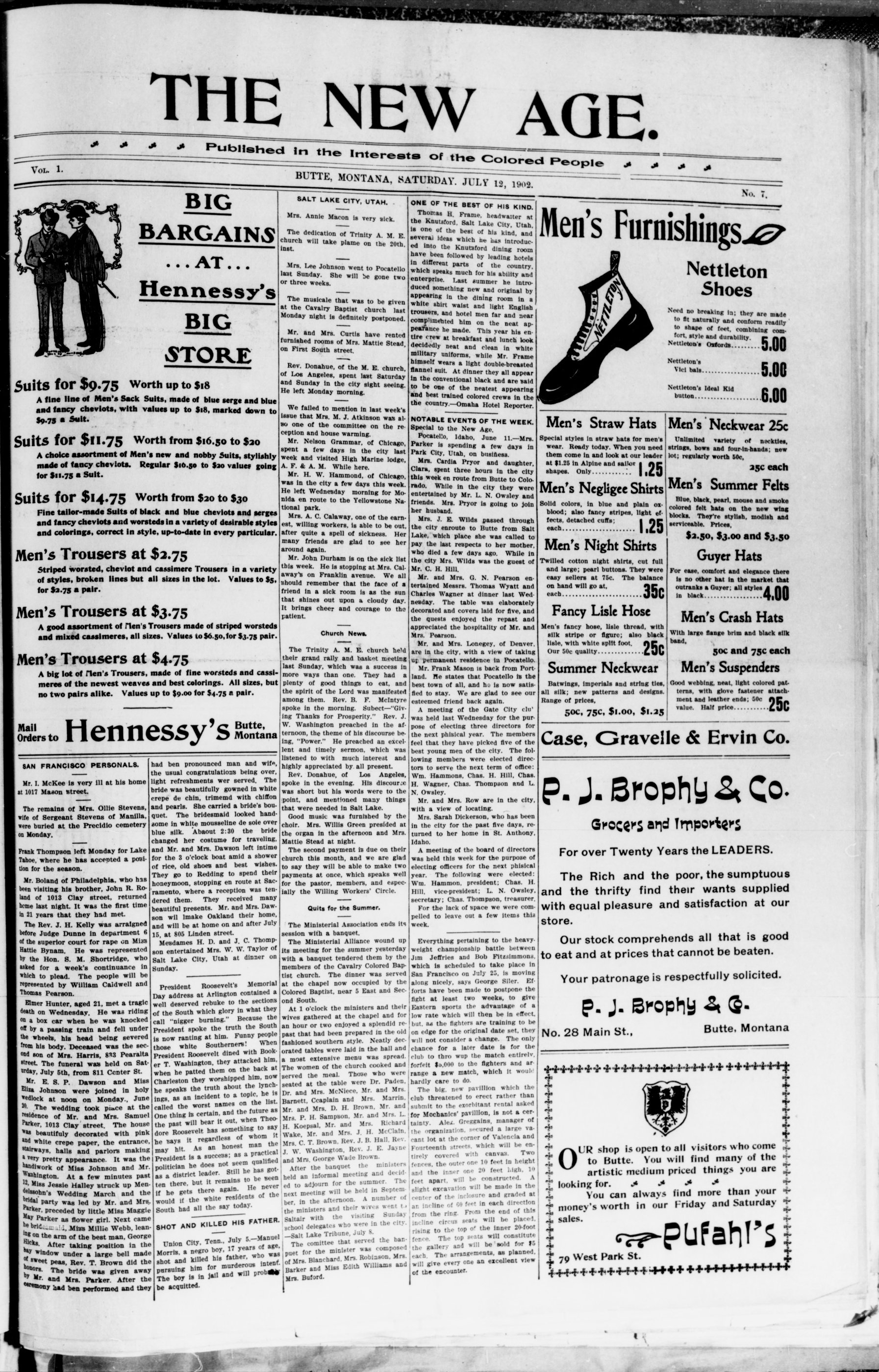
Suits for $9.75 Worth up to $18
A fine line of Men's Sack Suits, made of blue serge and blue and fancy cheviots, with values up to $18, marked down to $9.75 a Suit.
Suits for $11.75 Worth from $16.50 to $20
Suits for $14.75 Worth from $20 to $30
Fine tailor-made Suits of black and blue cheviots and arges and fancy cheviots and worsteds in a variety of desirable styles and colorings, correct in style, up-to-date in every particular.
Men's Trousers at $2.75
Striped worsted, chevlot and cassimere Trousers in a variety of styles, broken lines but all sizes in the lot. Values to $5, for $2.75 a pair.
Men's Trousers at $3.75
A good assortment of Men's Trousses made of striped worsteds and mixed cassimeres, all sizes. Values to $6.50, for $3.75 pair
Men's Trousers at $4.75
A big lot of Men's Trousers, made of fine worsteds and cassimeres of the newest weaves and best colorings. All sizes, but no two pairs alike. Values up to $9.00 for $4.75 a pair.
Mail Orders to Hennessy's Butte, Montana
VOL. 1.
THE MEN IN THE COAT
Suits for $9.75 Wor
A fine line of Men's Sack Su
and fancy cheviots, with va
$9.75 a Suit.
Suits for $11.75 Wor
A choice assortment of Men's
made of fancy cheviots. Req
for $11.75 a Suit.
Suits for $14.75 Wor
Fine tailor-made Suits of bla
and fancy cheviots and worst
and colorings, correct in sty
Men's Trousers at
Striped worsted, cheviot and
of styles, broken lines but a
for $2.75 a pair.
Men's Trousers at
A good assortment of Men's T
and mixed cassimeres, all size
Men's Trousers at
A big lot of Men's Trousers,
meres of the newest weaves
no two pairs alike. Values
Mail
Orders to Henne
SAN FRANCISCO PERSONALS.
Mr. I. McKee is very ill at his home at 1017 Mason street.
The remains of Mrs. Ollie Stevens, wife of Sergeant Stevens of Manilla, were buried at the Precidio cemetery on Monday.
Frank Thompson left Monday for Lake Tahoe, where he has accepted a position for the season.
Mr. Boland of Philadelphia, who has been visiting his brother, John R. Roland of 1013 Clay street, returned home last night. It was the first time in 21 years that they had met.
The Rev. J. H. Kelly was arraigned before Judge Dunne in department 6 of the superior court for rape on Miss Hattie Bynam. He was represented by the Hon. S. M. Shortridge, who asked for a week's continuance in which to plead. The people will be represented by William Caldwell and Thomas Pearson.
Elmer Hunter, aged 21, met a tragic death on Wednesday. He was riding on a box car when he was knocked off by a passing train and fell under the wheels, his head being severed from his body. Deceased was the second son of Mrs. Harris, 833 Pearalta street. The funeral was held on Saturday, July 5th, from 811 Center St.
Mr. E. S. P. Dawson and Miss Eliza Johnson were joined in holy wedlock at noon on Monday., June 20. The wedding took place at the residence of Mr. and Mrs. Samuel Parker, 1013 Clay street. The house was beautifully decorated with pink and white crepe paper, the entrance, stairways, halls and parlors making a very pretty appearance. It was the handwork of Miss Johnson and Mr. Washington. At a few minutes past 12. Miss Jessie Halley struck up Mendelsohn's Wedding March and the bridal party was led by Mr. and Mrs. Parker, preceded by little Miss Maggie May Parker as flower girl. Next came he bridemaid, Miss Millie Webb, leaning on the arm of the best man, George Hicks. After taking position in the bay window under a large bell made of sweet peas, Rev. T. Brown did the honors. The bride was given away by Mr. and Mrs. Parker. After the ceremony had been performed and they
---
THE NEW AGE.
had ben pronounced man and wife, the usual congratulations being over, light refreshments werved. The bride was beautifully gowned in white crepe de chin, trimmed with chiffon and pearls. She carried a bride's bouquet. The bridesmaid looked hand some in white mousselline de soie over blue silk. Ababout 2:30 the bride changed her costume for traveling, and Mr. and Mrs. Dawson left intime for the 3 o'clock boat amid a shower of rice, old shoes and best wishes. They go to Redding to spend their honeymoon, stopping en route at Sacramento, where a reception was tendered them. They received many beautiful presents. Mr. and Mrs. Dawson will imake Oakland their home, and will be at home on and after July 15 at 805 Linden street.
Mesdames H. D. and J. C. Thompson entertained Mrs. W. W. Taylor of Salt Lake City, Utah at dinner on Sunday.
President Roosevelt's Memorial Day address at Arlington contained a well deserved rebuke to the sections of the South which glory in what they call "nigger burning." Because the President spoke the truth the South is now ranting at him. Funny people those white Southerners! When President Roosevelt dined with Booker T. Washington, they attacked him, when he patted them on the back at Charleston they worshipped him, now he speaks the truth about the lynchings, as an incident to a topic, he is called the worst names on the list. One thing is certain, and the future as the past will bear it out, when Theodore Roosevelt has something to say he says it regardless of whom it may hit. As an honest man the President is a success; as a practical politician he does not seem qualified as a district leader. Still he has gotten there, but it remains to be seen if he gets there again. He never would if the white residents of the South had all the say today.
SHOT AND KILLED HIS FATHER
Union City, Tenn., July 5.—Manuel Morris, a negro boy, 17 years of age, shot and killed his father, who was pursuing him for murderous intent. The boy is in jail and will probably be acquitted.
SALT LAKE CITY, UTAH.
Mrs. Annie Macon is very sick.
The dedication of Trinity A. M. E. church will take plame on the 20th. inst.
Mrs. Lee Johnson went to Pocatello last Sunday. She will be gone two or three weeks.
The musicale that was to be given at the Cavalry Baptist church last Monday night is definitely postponed.
Mr. and Mrs. Curtis have rented furnished rooms of Mrs. Mattie Stead, on First South street.
Rev. Donahue, of the M. E. church, of Los Angeles, spent last Saturday and Sunday in the city sight seeing. He left Monday morning.
We failed to mention in last week's issue that Mrs. M. J. Atkinson was also one of the committee on the reception and house warming.
Mr. Nelson Grammar, of Chicago, spent a few days in the city last week and visited High Marine lodge, A. F. & A. M. While here.
Mr. H. W. Hammond, of Chicago, was in the city a few days this week. He left Wednesday morning for Monida en route to the Yellowstone National park.
Mrs. A. C. Calaway, one of the earnest, willing workers, is able to be out, after quite a spell of sickness. Her many friends are glad to see her around again.
Mr. John Durham is on the sick list this week. He is stopping at Mrs. Calaway's on Franklin avenue. We all should remember that the face of a friend in a sick room is as the sun that shines out upon a cloudy day. It brings cheer and courage to the patient.
Church News.
The Trinity A. M. E. church held their grand rally and basket meeting last Sunday, which was a success in more ways than one. They had a plenty of good things to eat, and the spirit of the Lord was manifested among them. Rev. B. B. F. McIntyre spoke in the morning. Subject—"Giving Thanks for Prosperity." Rev. J. W. Washington preached in the afternoon, the theme of his discourse being, "Power." He preached an excellent and timely sermon, which was listened to with much interest and highly appreciated by all present. Rev. Donahue, of Los Angeles, spoke in the evening. His discourse was short but his words were to the point, and mentioned many things that were needed in Salt Lake.
Good music was furnished by the choir. Mrs. Willis Green presided at the organ in the afternoon and Mrs. Mattie Stead at night. The second payment is due on their church this month, and we are glad to say they will be able to make two payments at once, which speaks well for the pastor, members, and especially the Willing Workers' Circle.
Quits for the Summer.
The Ministerial Association ends its session with a banquet. The Ministerial Alliance wound up its meeting for the summer yesterday with a banquet tendered them by the members of the Cavalry Colored Baptist church. The dinner was served at the chapel now occupied by the Colored Baptist, near 5 East and Second South.
At 1 o'clock the ministers and their wives gathered at the chapel and for an hour or two enjoyed a splendid repast that had been prepared in the old fashioned southern style. Nearly decorated tables were laid in the hall and a most extensive menu was spread. The women of the church cooked and served the meal. Those who were seated at the table were Dr. Paden, Dr. and Mrs. McNiece, Mr. and Mrs. Barnett, Ccaplain and Mrs. Marrin, Mr. and Mrs. D. H. Brown, Mr. and Mrs. P. H. Sampson, Mr. and Mrs. L. H. Koepsal, Mr. and Mrs. Richard Wake, Mr. and Mrs. J. H. McClain, Mrs. C. T. Brown, Rev. J. B. Hall, Rev. J. W. Washington, Rev. J. E. Jayne and Mrs. George Wade Brown.
After the banquet the ministers held an informal meeting and decided to adjourn for the summer. The next meeting will be held in September, in the afternoon. A number of the ministers and their wives went to Saltair with the visiting Sunday school delegates who were in the city: —Salt Lake Tribune, July 8.
The committee that served the banquet for the minister was composed of Mrs. Blanchard, Mrs. Robinson, Mrs. Barker and Miss Edith Williams and Mrs. Buford.
ONE OF THE BEST OF HIS KIND.
Thomas H. Frame, headwatter at the Knutsford, Salt Lake City, Utah, is one of the best of his kind, and several ideas which he has introduced into the Knutsford dining room have been followed by leading hotels in different parts of the country, which speaks much for his ability and enterprise. Last summer he introduced something new and original by appearing in the dining room in a white shirt waist and light English trousers, and hotel men far and near complimented him on the neat appearance he made. This year his entire crew at breakfast and lunch look decidedly neat and clean in white military uniforms, while Mr. Frame himself uses a light double-breasted flannel suit. At dinner they all appear in the conventional black and are said to be one of the neatest appearing and best trained colored crews in the country. -Omaha Hotel Reporter
NOTABLE EVENTS OF THE WEEK.
Special to the New Age.
Pocatello, Idaho, June 11.—Mrs. Parker is spending a few days in Park City, Utah, on business.
Mrs. Cardia Pryor and daughter, Clara, spent three hours in the city this week en route from Butte to Colorado. While in the city they were entertained by Mr. L. N. Owsley and friends. Mrs. Pryor is going to join her husband.
Mrs. J. E. Wilds passed through the city enroute to Butte from Salt Lake, which place she was called to pay the last respects to her mother, who died a few days ago. While in the city Mrs. Wilds was the guest of Mr. C. H. Hill.
Mr. and Mrs. G. N. Pearson entertained Messrs. Thomas Wyatt and Charles Wagner at dinner last Wednesday. The table was elaborately decorated and covers laid for five, and the quests enjoyed the repast and appreciated the hospitality of Mr. and Mrs. Pearson.
Mr. and Mrs. Lonegey, of Denver, are in the city, with a view of taking up permanent residence in Pocatello. Mr. Frank Mason is back from Port land. He states that Pocatello in the best town of all, and he is now satisfied to stay. We are glad to see our esteemed friend back again.
A meeting of the Gate City chu was held last Wednesday for the purpose of electing three directors for the next physical year. The members feel that they have picked five of the best young men of the city. The following members were elected directors to serve the next term of office: Wm. Hammons, Chas. H. Hill, Chas. H. Wagner, Chas. Thompson and L. N. Owsley. Mr. and Mrs. Row are in the city, with a view of locating. Mrs. Sarah Dickerson, who has been in the city for the past five days, returned to her home in St. Anthony, Idaho.
A meeting of the board of directors was held this week for the purpose of electing officers for the next physical year. The following were elected: Wm. Hammon, president; Chas. H. Hill, vice-president; L. N. Owley, secretary; Chas. Thompson, treasurer. For the lack of space we were compelled to leave out a few items this week.
Everything pertaining to the heavy-weight championship battle between Jim Jeffries and Bob Fitzsimmons, which is scheduled to take place in San Francisco on July 25, is moving along nicely, says George Siler. Efforts have been made to postpone the fight at least two weeks, to give Eastern sports the advantage of a low rate which will then be in effect, but, as the fighters are training to be on edge for the original date set, they will not consider a change. The only chance for a later date is for the club to throw wup the match entirely, forfeit $0,000 to the fighters and arrange a new match, which it would hardly care to do.
The big, new pavillion which the club threatened to erect rather than submit to the exorbitant rental asked for Mechanics' pavilion, is not a certainty. Alex. Greggains, manager of the organization, secured a large vacant lot at the corner of Valencia and Fourteenth streets, which will be entirely covered with canvas. Two fences, the outer one 10 feet in height and the inner one 20 feet high, 10 feet apart, will be constructed. A slight excavation will be made in the center of the enclosure and graded at an incline of 60 feet in each direction from the ring. From the end of this incline circus seats will be placed, rising to the top of the inner 20-foot fence. The top seats will constitute the gallery and will be 'sold for $5 each. The arrangements, as planned, will give every one an excellent view of the encounter.
Men's Furnishings
Men's Furnishings
NEETLETON
Men's Straw Hats
Special styles in straw hats for men's
wear. Ready today. When you need
them come in and look at our leader
at $1.25 in Alpine and sailor
shapes. Only... 1.25
Men's Negligee Shirts
Solid colors, in blue and plain ox-blood; also fancy stripes, light effects, detached cuffs; each ..... 1.25
Men's Night Shirts
Twilled cotton night shirts, cut full and large; pearl buttons. They were easy sellers at 75c. The balance on hand will go at, each.....35c
Fancy Lisle Hose
Men's fancy hose, lile thread, with
silk stripe or figure; also black
lile, with white split foot.
Our 50c quality ..... 25c
Batwings, imperials and string ties,
all silk; new patterns and designs.
Range of prices,
50c, 75c, $1.00, $1.25
Case, Gravel
P. J. Brow
Case, Gravelle & Ervin Co.
P. J. Brophy & Co.
Grocers and Importers
For over Twenty Y
The Rich and the and the thrifty find with equal pleasure a store.
Our stock compreh to eat and at prices th
Your patronage is
P. J. Bro
For over Twenty Years the LEADERS.
The Rich and the poor, the sumptuous and the thrifty find their wants supplied with equal pleasure and satisfaction at our store.
Our stock comprehends all that is good to eat and at prices that cannot be beaten.
Your patronage is respectfully solicited.
P. J. Brophy & Co.
No. 28 Main St.
OUR shop is open to all visitors who come to Butte. You will find many of the artistic medium priced things you are looking for.
You can always find more than your money's worth in our Friday and Saturday sales.
Pufahl's
79 West Park St.
Nettleton Shoes
Need no breaking in; they are made to fit naturally and conform readily to shape of feet, combining comfort, style and durability.
Nettleton's Oxfords.....5.00
Nettleton's
Vici bals.....5.00
Nettleton's Ideal Kid
button.....6.00
Men's Neckwear 25c
Unlimited variety of neckties, strings, bows and four-in-hands; new lot; regularly worth 50c.
Men's Summer Felts
Blue, black, pearl, mouse and smoke colored felt hats on the new wing blocks. They're stylish, modish and serviceable. Prices,
$2.50, $3.00 and $3.50
Guyer Hats
For ease, comfort and elegance there is no other hat in the market that outranks a Guyer; all styles in black.....4.00
Men's Crash Hats
With large flange brim and black silk band,
50c and 75c each
Men's Suspenders
Good webbing, neat, light colored patterns, with glove fastener attachment and leather ends; 50c value. Half price.....25c
le & Ervin Co.
phy & Co.
ears the LEADERS.
be poor, the sumptuous
their wants supplied
and satisfaction at our
ends all that is good
at cannot be beaten.
respectfully solicited.
phy & Co.
Butte, Montana
No. 7.
2
THE NEW AGE
rublished weekly by the New Age Publishing Company, office, 220 South Idaho street.
Subscription price, $2.00 a year. Six months, $1.10. Three months, 60 cents, invariably in advance. Telephone 862-B.
SATURDAY, JULY 12, 1902.
The campaign will soon be on. This is the year to put aside personalities, feuds and differences, and by a united effort to establish a high race prestige in politics.
We are living in an age of commercialism, an era of materialism, and a man is respected and esteemed according to his integrity and the amount of business which he can command.
The cordial and enthusiastic support which our position upon the consolidation and concentration of the colored vote of the state, both in the individual districts and the state collectively is receiving from the testimonials and letters which we are receiving at our office is indeed gratifying. That the negro's progress as a factor in the industrial, mechanical, commercial and business life of our nation has been and is wonderfully increasing is an axiom, but as a political factor the means within his power are sadly neglected. Let every negro citizen of Montana take a renewed pride in the heritage of his citizenship and the value of his ballot, and by placing himself in touch with the concentrated movement in the state can make the use of his ballot a powerful instrument to himself and his race.
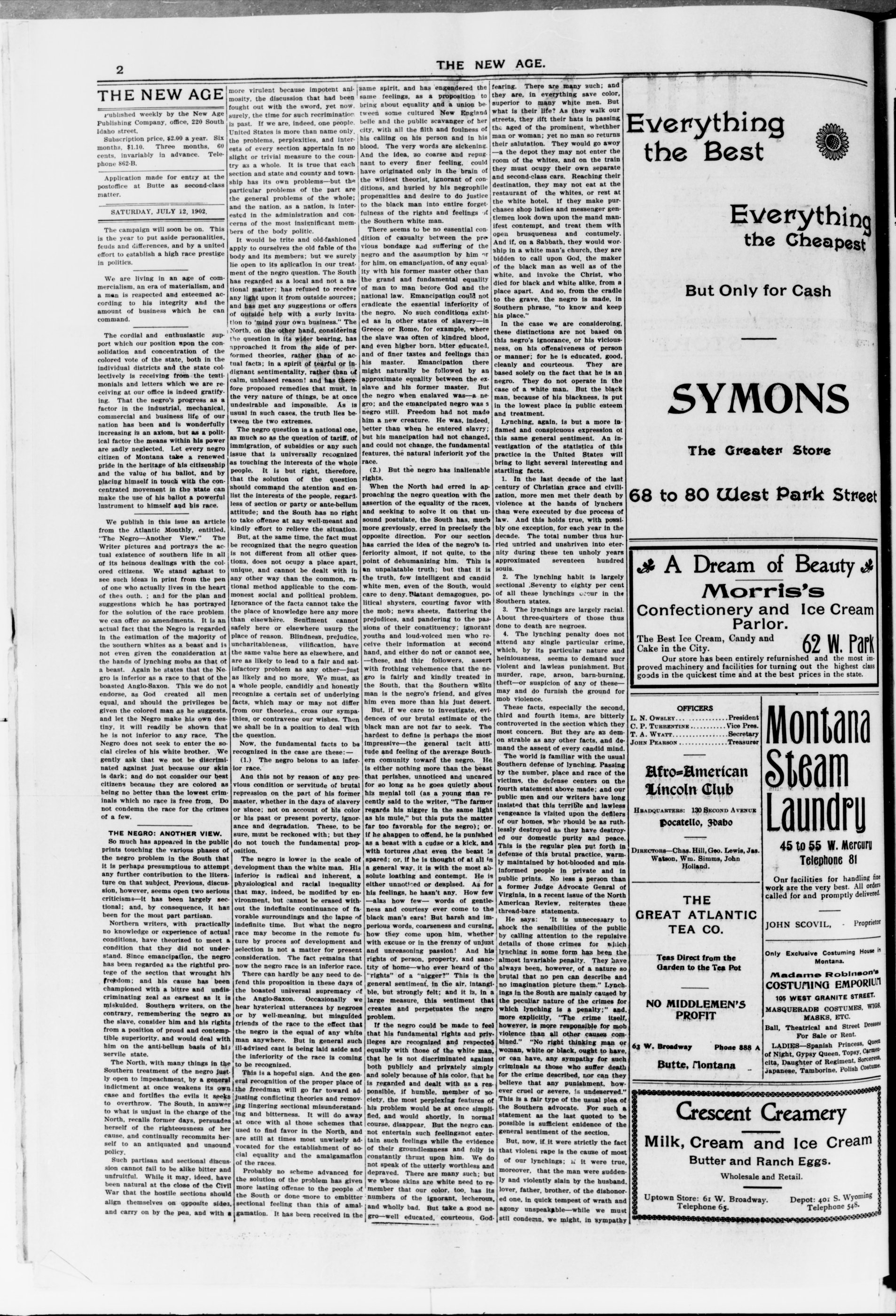
We publish in this issue an article from the Atlantic Monthly, entitled, "The Negro-Another View." The Writer pictures and portrays the actual existence of southern life in all of its heinous dealings with the colored citizens. We stand aghast to see such ideas in print from the pen of one who actually lives in the heart of thesouth. ; and for the plan and suggestions which he has portrayed for the solution of the race problem, we can offer no amendments. It is an actual fact that the Negro is regarded in the estimation of the majority of the southern whites as a beast and is not even given the consideration at the hands of lynching mobs as that of a beast. Again he states that the Negro is inferior as a race to that of the boasted Anglo-Saxon. This we do not endorse, as God created all men equal, and should the privileges be given the colored man as he suggests, and let the Negro make his own destiny, it will readily be shown that he is not inferior to any race. The Negro does not seek to enter the social circles of his white brother. We gently ask that we not be discriminated against just because our skin is dark; and do not consider our best citizens because they are colored as being no better than the lowest criminals which no race is free from. Do not condemn the race for the crimer of a few.
So much has appeared in the public prints touching the various phases of the negro problem in the South that it is perhaps presumptuous to attempt any further contribution to the literature on that subject. Previous, discussion, however, seems open two serious criticisms—it has been largely sectional; and, by consequence, it has been for the most part partisan.
Northern writers, with practically no knowledge or experience of actual conditions, have theorized to meet a condition that they did not understand. Since emancipation, the negro has been regarded as the rightful protege of the section that wrought his freedom; and his cause has been championed with a bittre and undiscriminating zeal as earnest as it is miskuided. Southern writers, on the contrary, remembering the negro as the slave, consider him and his rights from a position of proud and contemptible superiority, and would deal with him on the anti-bellum basis of his servile state.
The North, with many things in the Southern treatment of the negro justly open to impeachment, by a general indictment at once weakens its own case and fortifies the evils it seeks to overthrow. The South, in answer to what is unjust in the charge of the North, recalls former days, persuades herself of the righteousness of her cause, and continually recommits herself to an antiquated and unsound policy.
Such partisan and sectional discussion cannot fail to be alike bitter and unfruitful. While it may, ideed, have been natural at the close of the Civil War that the hostile sections should align themselves on opposite sides, and carry on by the pen, and with a
more virulent because impotent animosity, the discussion that had been fought out with the sword, yet now, surely, the time for such recrimination is past. If we are, indeed, one people, United States is more than name only, the problems, perplexities, and interests of every section appertain in no slight or trivial measure to the country as a whole. It is true that each section and state and county and township has its own problems—but the particular problems of the part are the general problems of the whole; and the nation, as a nation, is interested in the administration and concerns of the most insignificant members of the body politic.
It would be trite and old-fashioned apply to ourselves the old fable of the body and its members; but we surely lie open to its application in our treatment of the negro question. The South has regarded as a local and not a national matter; has refused to receive any light upon it from outside sources; and has met any suggestions or offers of outside help with a surly invitation to 'mind your own business.' The North, on the other hand, considering the question in its wider bearing, has approached it from the side of performed theories, rather than of actual facts; in a spirit of tearful or indignant sentimentality, rather than of calm, unbased reason! and has therefore proposed remedies that must, in the very nature of things, be at once undesirable and impossible. As is usual in such cases, the truth lies between the two extremes.
The negro question is a national one, as much so as the question of tariff, of immigration, of subsidies or any such issue that is universally recognized as touching the interests of the whole people. It is but right, therefore, that the solution of the question should command the attention and enlist the interests of the people, regardless of section or party or ante-bellum attitude; and the South has no right to take offense at any well-meant and kindly effort to relieve the situation.
But, at the same time, the fact must be recognized that the negro question is not different from all other questions, does not occupy a place apart, unique, and cannot be dealt with in any other way than the common, rational method applicable to the commonest social and political problem. Ignorance of the facts cannot take the place of knowledge here any more than elsewhere. Sentiment cannot safely here or elsewhere usurp the place of reason. Blindness, prejudice, uncharitableness, vilification, have the same value here as elsewhere, and are as likely to lead to a fair and sat isfactory problem as any other—just as likely and no more. We must, as a whole people, candidly and honestly recognize a certain set of underlying facts, which may or may not differ from our theories, cross our sympa thies, or contravene our wishes. Then we shall be in a position to deal with the question.
Now, the fundamental facts to be recognized in the case are these:—(1.) The negro belongs to an inferior race.
And this not by reason of any previous condition or servitude of brutal repression on the part of his former master, whether in the days of slavery or since; not on account of his color or his past or present poverty, ignorance and degradation. These, to be sure, must be reckoned with; but they do not touch the fundamental proposition.
The negro is lower in the scale of development than the white man. His inferior is radical and inherent, a physiological and racial inequality that may, indeed, be modified by environment, but cannot be erased without the indefinite continuance of favorable surroundings and the lapse of indefinite time. But what the negro race may become in the remote future by proces sof development and selection is not a matter for present consideration. The fact remains that now the negro race is an inferior race. There can hardly be any need to defend this proposition in these days of the boasted universal supremacy of the Anglo-Saxon. Occasionally we hear hysterical utterances by negroes or by well-meaning, but misguided friends of the race to the effect that the negro is the equal of any white man anywhere. But in general such ill-advised cant is being laid aside and the inferiority of the race is coming to be recognized.
This is a hopeful sign. And the general recognition of the proper place of the freedman will go far toward adjusting conflicting theories and removing lingering sectional misunderstanding and bitterness. It will do away at once with all those schemes that used to find favor in the North, and are still at times most unwisely advocated for the establishment of social equality and the amalgamation of the races.
Probably no scheme advanced for the solution of the problem has given more lasting offense to the people of the South or done more to embitter sectional feeling than this of amalgamation. It has been received in the
THE NEW AGE.
same spirit, and has engendered the same feelings, as a proposition to bring about equality and a union between some cultured New England belle and the public scavanger of her city, with all the filth and foulness of his calling on his person and in his blood. The very words are sickening. And the idea, so coarse and repugnant to every finer feeling, could have originated only in the brain of the wildest theorist, ignorant of conditions, and huried by his negrophile propensities and desire to do justice to the black man into entire forgetfulness of the rights and feelings of the Southern white man.
There seems to be no essential condition of casualty between the previous bondage and suffering of the negro and the assumption by him or for him, on emancipation, of any equality with his former master other than the grand and fundamental equality of man to man before God and the national law. Emancipation could not eradicate the essential inferiority of the negro. No such conditions existed as in other states of slavery—in Greece or Rome, for example, where the slave was often of kindred blood, and even higher born, bitter educated, and of finer tastes and feelings than his master. Emancipation there might naturally be followed by an approximate equality between the ex slave and his former master. But the negro when enslaved was—a negro; and the emancipated negro was a negro still. Freedom had not made him a new creature. He was, indeed better than when he entered slavery; but his mancipation had not changed and could not change, the fundamental features, the natural inferiority yof the race.
(2.) But the negro has inalienable rights.
When the North had erred in approaching the negro question with the assertion of the equality of the races, and seeking to solve it on that unsound postulate, the South has, much more graviously, erred in precisely the opposite direction. For our section has carried the idea of the negro's inferiority almost, if not quite, to the point of dehumanizing him. This is an unpalatable truth; but that it is the truth, few intelligent and candid white men, even of the South, would care to deny. Blatant demagogues, political shysters, courting favor with the mob; news sheets, flattering the prejudices, and pandering to the passions of their constituency; ignorant youths and loud-voiced men who receive their information at second hand, and either do not or cannot see—these, and their followers, assert with frothing vehemence that the negro is fairly and kindly treated in the South, that the Southern white man is the negro's friend, and gives him even more than his just desert.
But, if we care to investigate, evidences of our brutal estimate of the black man are not far to seek. The hardest to define is perhaps the most impressive—the general tacit attitude and feeling of the average Southern community toward the negro. He is either nothing more than the beast that perishes, unnoticed and uncared for so long as he goes quietly about his menial toll (as a young man recently said to the writer, "The farmer regards his nigger in the same light as his mule," but this puts the matter far too favorable for the negro); or, if he ahappen to offend, he is punished as a beast with a cudse or a kick, and with tortures that even the beast is spared; or, if he is thought of at all in a general way, it is with the most absolute loathing and contempt. He is either unnoticed or desplaced. As for his feelings, he hasn't any. How few—alas how few—words of gentleness and courtesy ever come to the black man's ears! But harsh and imperious words, coarseness and cursing, how they come upon him, whether with excuse or in the frenzy of unjust and unreasoning passion! And his rights of person, property, and sancity of home—who ever heard of the "rights" of a "nigger?" This is the general sentiment, in the air, intangible, but strongly felt; and it is, in a large measure, this sentiment that creates and perpetuates the negro problem.
If the negro could be made to feel that his fundamental rights and privileges are recognized and respected equally with those of the white man, that he is not discriminated against both publicly and privately simply and solely because of his color, that he is regarded and dealt with as a responsible, if humble, member of society, the most perplexing features of his problem would be at once simplified, and would shortly, in normal course, disappear. But the negro cannot entertain such feelings while the evidence of their groundlessness and folly is constantly thrust upon him. We do not speak of the utterly worthless and deprived. There are many such; but we whose skins are white need to remember that our color, too, has its numbers of the ignorant, lecherous, and wholly bad. But take a good negro—well educated, courteous, God-
fearing. There are many such; and they are, in everything save color, superior to many white men. But what is their life? As they walk our streets, they lift their hats in passing the aged of the prominent, whether man or woman; yet no man so returns their salutation. They would go away—a the depot they may not enter the room of the whites, and on the train they must occupy their own separate and second-class cars. Reaching their destination, they may not eat at the restaurant of the whites, or rest at the white hotel. If they make purchases shop ladies and messenger gentlemen look down upon the mand manifest contempt, and treat them with open brusqueness and contumely. And if, on a Sabbath, they would worship in a white man's church, they are bidden to call upon God, the maker of the black man as well as of the white, and invoke the Christ, who died for black and white alike, from a place apart. And so, from the cradle to the grave, the negro is made, in Southern phrase, "to know and keep his place."
In the case we are consideroing, these distinctions are not based on this negro's ignorance, or his vlaucness, on his offensiveness of person or manner; for he is educated, good, cleanly and courteous. They are based solely on the fact that he is an negro. They do not operate in the case of a white man. But the black man, because of his blackness, is put in the lowest place in public esteem and treatment.
Lynching, again, is but a more inflamed and conspicuous expression of this same general sentiment. An investigation of the statistics of this practice in the United States will bring to light several interesting and startling facts.
1. In the last decade of the last century of Christian grace and civilization, more men met their death by violence at the hands of lynchers than were executed by due process of law. And this holds true, with possibly one exception, for each year in the decade. The total number thus hurried untried and unshriven into eternity during these ten unholy years approximated seventeen hundred souls.
2. The lynching habit is largely sectional. Seventy to eighty per cent of all these lynchings occur in the Southern states.
3. The lynchings are largely racial. About three-quarters of those thus done to death are negroes.
4. The lynching penalty does not attend any single particular crime, which, by its particular nature and heinousness, seems to demand sucr violent and lawless punishment. But murder, rape, arson, barn-burning, theft—or suspicion of any of these—may and do furnish the ground for mob violence.
These facts, especially the second, third and fourth items, are bitterly controverted in the section which they most concern. But they are as demon strable as any other facts, and demand the assent of every candid mind.
The world is familiar with the usual Southern defense of lynching. Passing by the number, place and race of the victims, the defense centers on the fourth statement above made; and our public men and our writers have long insisted that this terrible and lawless vengeance is visited upon the defilers of our homes, who should be as ruthlessly destroyed as they have destroyed our domestic purity and peace. This is the regular plea put forth in defense of this brutal practice, warmly maintained by hot-blooded and misinformed people in private and in public prints. No less a person than a former Judge Advocate Genral of Virginia, in a recent issue of the North American Review, reiterates these thread-bare statements.
He says: "It is unnecessary to shock the sensibilities of the public by calling attention to the repulsive details of those crimes for which lynching in some form has been the almost invariable penalty. They have always been, however, of a nature so brutal that no pen can describe and no imagination picture them." Lynchings in the South are mainly caused by the peculiar nature of the crimes for which lynching is a penalty," and more explicitly, "The crime itself, however, is more responsible for mob violence than all other causes combined." "No right thinking man or woman, white or black, ought to have, or can have, any sympathy for such criminals as those who suffer death for the crime described, nor can they believe that any punishment, however cruel or severe, is undeserved." This is a fair type of the usual plea of the Southern advocate. For such a statement as the last quoted to be possible is sufficient evidence of the general sentiment of the section.
But, now, if it were strictly the fact that violent rape is the cause of most of our lynchings; if it were true, moreover, that the man were suddenly and violently slain by the husband, lover, father, brother, of the dishonored one, in quick tempest of wrath and agony unspeakable—while we must still condemn, we might, in sympathy
Everything the Best
---
---
Everything the Cheapest
But Only for Cash
SYMONS
SYMONS
MONS
SYMONS
The Greater Store
A Dream of
Morris
Confectionery and
Parlor
The Best Ice Cream, Candy and
Cake in the City.
Our store has been entirely refurb
proved machinery and facilities for turn
goods in the quickest time and at the be
80 West Park
Dream of Beauty
Morris's
actionery and Ice C
Parlor.
ice Cream, Candy and
the City.
62 W
store has been entirely refurnished and
minery and facilities for turning out the
quickest time and at the best prices in
West Park Street
am of Beauty
Morris's
ery and Ice Cream
Parlor.
Candy and
62 W. Park
in entirely refurnished and the most im-
cilities for turning out the highest class
me and at the best prices in the state.
68 to 80 West Park Street
Confectionery and Ice Cream Parlor.
OFFICERS
L. N. OWSLEY.....President
C. P. TURRENTINE.....Vice Pres.
T. A. WYATT.....Secretary
JOHN PEARSON.....Treasurer
Afro=American
Lincoln Club
HRADQUARTERS: 130 SECOND AVENUE
Pocatello, 3dabo
DIRECTORS—Chas. Hill, Geo. Lewis, Jas.
Watson, Wm. Simms, John
Holland.
THE GREAT ATLANTIC TEA CO.
Teas Direct from the Garden to the Tea Pot
NO MIDDLEMEN'S PROFIT
63 W. Broadway Phone 888 A
Butte, Montana
Crescent Cream
Milk, Cream and
Butter and Ranch
Wholesale and R
Uptown Store: 61 W. Broadway.
Telephone 65.
Crescent Creamery
Cream and Ice C
Butter and Ranch Eggs.
Wholesale and Retail.
Store: 61 W. Broadway.
Telephone 65.
Depot: 401
Telephone
ent Creamery
Fm and Ice Cream
and Ranch Eggs.
Wholesale and Retail.
Broadway. Depot: 401 S. Wyoming
Telephone 548.
Crescent Creamery
Milk, Cream and Ice Cream
Butter and Ranch Eggs.
Wholesale and Retail.
Uptown Store: 61 W. Broadway.
Telephone 65.
Depot: 401 S. Wyoming
Telephone 548.
Montana Steam Laundry
45 to 55 W. Mercury Telephone 81 Our facilities for handling fine work are the very best. All orders called for and promptly delivered.
JOHN SCOVIL, - Proprietor
Only Exclusive Costuming House in Montana.
Madame Robinson's COSTUMING EMPORIUM
105 WEST GRANITE STREET.
MASQUERADE COSTUMES, WIGS,
MASKS, ETC.
Ball, Theatrical and Street Dresses
For Sale or Rent.
LADIES—Spanish Princess, Queen
of Night, Gypsy Queen, Topsy, Carmen-
cita, Daughter of Regiment, Sorceress,
Japanese, Tamborine, Polish Costume.
```markdown
```
Jobbing, Cabinet and Office Fixtures a Specialty. 216 WEST BROADWAY
Overlo
Ruy
The Whiskey of
THE
Troy Laun
Overland
Rye
The Whiskey of Montana
THE
roy Laundry
Overlaud
Rye
The Whiskey of Montana
THE
Will call for and Deliver that Laundry.
...Ring Up 'P
Remem
TROY LAU
'Phone 2. 232 S
Butte Fl
The Leading Des
Florists of M
Cut Flowers a
Decorations and Des
...Ring Up 'Phone 2
Remember
TROY LAUNDRY
Phone 2. 232 South Main
utte Floral
The Leading Decorators a
Florists of Montana
Cut Flowers and Plants
Decorations and Designs a Spe
...Ring Up 'Phone 2...
Remember
TROY LAUNDRY
'Phone 2. 232 South Main Street
The Leading Decorators and Florists of Montana
Cut Flowers and Plants
Decorations and Designs a Specialty
Salesroom, 107 West Broadway.
Green Houses at Gregson Springs. Telephone
A large supply of beautiful car
flowers are always carried. All order
For a real sweet
suit of clothes, at
rate prices, call on
Dan Ko
The Fashiona
305 North Main S
City Steam
101 W. Granite St
Ladies' and Gents' Garm
Pressed and Repaire
large supply of beautiful carnations and roses are always carried. All orders receive promo
for a real swell, up-t
of clothes, at very
prices, call on
Dan Kowsk
The Fashionable Tailor
North Main St., -
Steam Dye W
101 W. Granite St., Cor. Ala
'and Gents' Garments Clea
essed and Repaired. Equal
For a real swell, up-to-date suit of clothes, at very moderate prices, call on
101 W. Granite St., Cor. Alaska
Ladies' and Gents' Garments Cleaned, Dyed
Pressed and Repaired. Equal to New
Goods Called for and Delivered.
Telephone 826M.
ALBERT BARCLAY.
Proprietor
TUTTLE JEW
NORTH MAINE
A New House of Our Day and Time, with
Diamonds a
Specialty
Water
Cut C
Manufacturing and Repair Depart
Men of exceptional ability in ch
of our prices . . . .
TUTTLE JEWELRY CO.
NORTH MAIN STREET
house of Our Day and Time, with the only New and
Watches, Jewel
finds a
Specialty
Cut Glass, Br
manufacturing and Repair Departments with 1902 B
en of exceptional ability in charge. We invite
our prices . . . .
Manufacturing and Repair Departments with 1902 Equipment. Men of exceptional ability in charge. We invite comparison of our prices . . . .
All the advertisers and patrons of the New Age will receive the patronage of the colored people of the city. and state.
It shall be the purpose of the New
---
curd
ye
of Montana
ndry Co.
Phone 2...
member
UNDRY
South Main Street
oral Co.
decorators and
Montana
and Plants
designs a Specialty
cell, up-to-date
at very modern-
owske
table Tailor
St., - Butte
Dye Works
St., Cor. Alaska
ments Cleaned, Dyed
red. Equal to New
ALBERT BARCLAY.
Proprietor.
JEWELRY CO.
ON STREET
in the only New and Desirable Lines of
atches, Jewelry
Glass, Bric-a=Brac
partments with 1902 Equipment.
Charge. We invite comparison
Age to favor those who have contributed to the support of our paper.
Every colored family in the city should subscribe for the New Age, as it is the only organ that is trying to gain for them a higher estimate and broaden
THE NEW AGE.
and sorrow, condone the deed of hurried vengeance. But neither of these things is true.
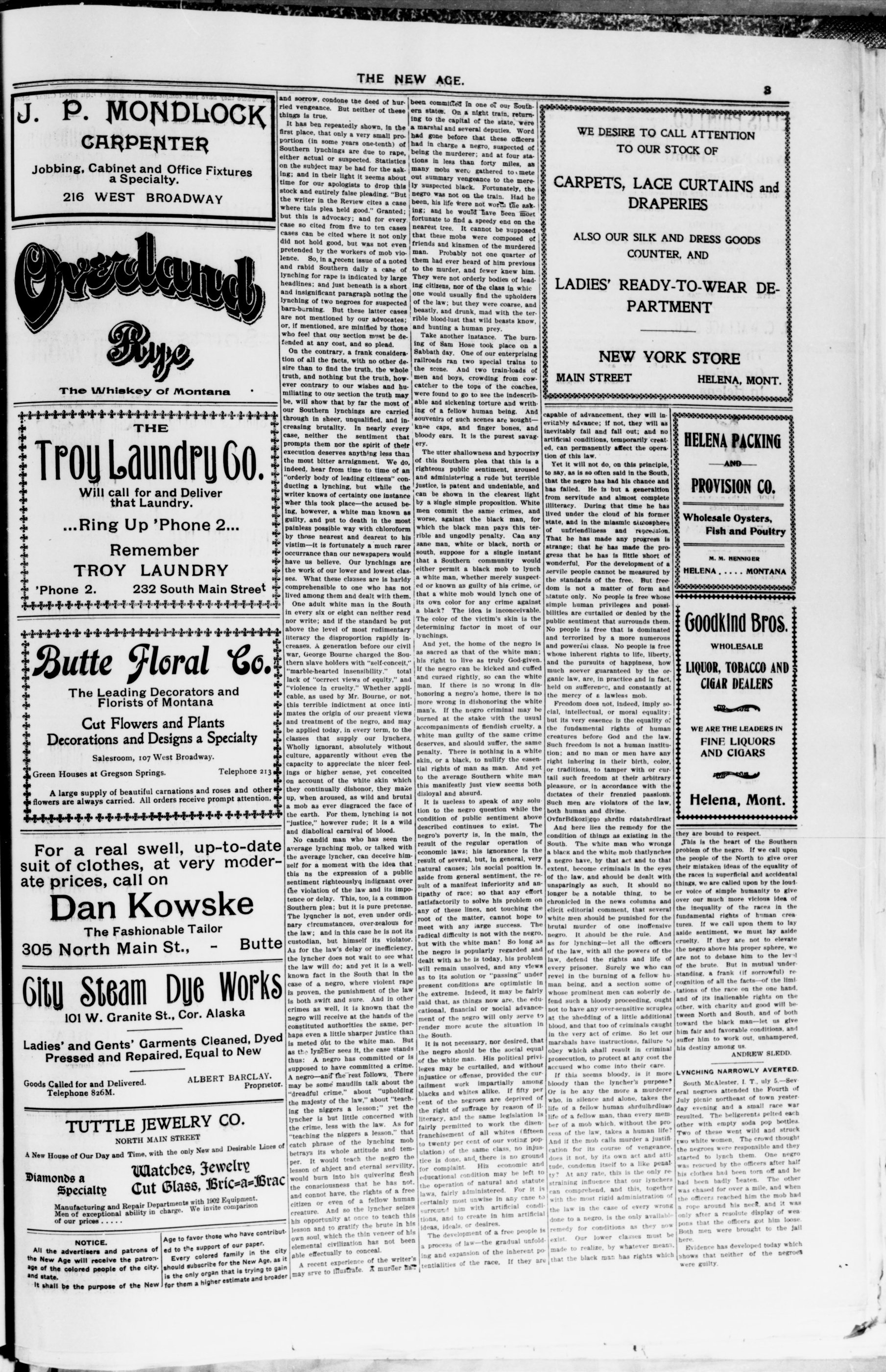
It has been repeatedly shown, in the first place, that only a very small proportion (in some years one-tenth) of Southern lynchings are due to rape, either actual or suspected. Statistics on the subject may be had for the asking; and in their light it seems about time for our apologists to drop this stock and entirely false pleading. "But the writer in the Review cites a case where this plea held good." Granted; but this is advocacy; and for every case so cited from five to ten cases can be cited where it not only did not hold good, but was not even pretended by the workers of mob violence. So, in a recent issue of a noted and rabid Southern daily a case of lynching for rape is indicated by large headlines; and just beneath is a short and insignificant paragraph noting the lynching of two negroes for suspected barn-burning. But these latter cases are not mentioned by our advocates; or, if mentioned, are minified by those who feel that our section must be defended at any cost, and so plead.
On the contrary, a frank consideration of all the facts, with no other desire than to find the truth, the whole truth, and nothing but the truth, however contrary to our wishes and humiliating to our section the truth may be, will show that by far the most of our Southern lynchings are carried through in sheer, unqualified, and increasing brutality. In nearly every case, neither the sentiment that prompts them nor the spirit of their execution deserves anything less than the most bitter arraignment. We do, indeed, hear from time to time of an "orderly body of leading citizens" conducting a lynching, but while the writer knows of certainty one instance where this took place—the accused being, however, a white man known as guilty, and put to death in the most painless possible way with chloroform by those nearest and dearest to his vistim—it is fortunately a much rarer occurrence than our newspapers would have us believe. Our lynchings are the work of our lower and lowest classes. What these classes are is harly comprehensible to one who has not lived among them and dealt with them.
One adult white man in the South in every six or eight can neither read nor write; and if the standard be put above the level of most rudimentary literacy the disproportion rapidly increases. A generation before our civil war, George Bourne charged the Southern slave holders with "self-conceit," "marble-hearted insensibility." total lack of "correct views of equity," and "violence in cruelty." Whether applicable, as used by Mr. Bourne, or not, this terrible indictment at once intimates the origin of our present views and treatment of the negro, and may be applied today, in every term, to the classes that supply our lynchers, Wholly ignorant, absolutely without culture, apparently without even the capacity to appreciate the nicer feelings or higher sense, yet conceited on account of the white skin which they continually dishonor, they make up, when aroused, as wild and brutal a mob as ever disgraced the face of the earth. For them, lynching is not "justice," however rude; it is a wild and diabolical carnival of blood.
No candid man who has seen the average lynching mob, or talked with the average lyncher, can deceive himself for a moment with the idea that this ns the expression of a public sentiment righteouslyq indignant over the violation of the law and its importance or delay. This, too, is a common Southern plea; but it is pure pretense. The lynchner is not, even under ordinary circumstances, overzealous for the law; and in this case he is not its custodian, but himself its violator. As for the law's delay or inefficiency, the lynchner does not wait to see what the law will do; and yet it is a well-known fact in the South that in the case of a negro, where violent rape is proven, the punishment of the law is both swift and sure. And in other crimes as well, it is known that the negro will receive at the hands of the constituted authorities the same, perhaps even a little sharper justice than is meted out to the white man. But as the lynchner sees it, the case stands thus: A negro has committed or is supposed to have committed a crime. A negro—and the rest follows. There may be some maudlin talk about the "dreadful crime," about "upholding the majesty of the law," about "teaching the niggers a lesson;" yet the lynchner is but little concerned with the crime, less with the law. As for "teaching the niggers a lesson," that catch phrase of the lynching mob betrays its whole attitude and temper. It would teach the negro the lesson of abject and eternal servility, would burn into his quivering flesh the consciousness that he has not, and cannot have, the rights of a free citizen or even of a fellow human creature. And so the lyncher seizes his opportunity at once to teach this lesson and to gratify the brute in his own soul, which the thin veneer of his elemental civilization has not been able effectually to conceal.
A recent experience of the writer's may srve to illustrate. A murder has.
been committed in one of our Southern states. On a night train, returning to the capital of the state, were a marshal and several deputies. Word had gone before that these officers had in charge a negro, suspected of being the murderer; and at four stations in less than forty miles, as many mobs were gathered to mete out summary vengeance to the merely suspected black. Fortunately, the negro was not on the train. Had he been, his life were not worth the asking; and he would have been most fortunate to find a speedy end on the nearest tree. It cannot be supposed that these mobs were composed of friends and kinsmen of the murdered man. Probably not one quarter of them had ever heard of him previous to the murder, and fewer knew him. They were not orderly bodies of leading citizens, nor of the class in which one would usually find the upholders of the law; but they were coarse, and beastly, and drunk, mad with the terrible blood-lust that wild beasts know, and hunting a human prey.
Take another instance. The burning of Sam Hose took place on a Sabbath day. One of our enterprising railroads ran two special trains to the scene. And two train-loads of men and boys, crowding from cowcatcher to the tops of the coaches, were found to go to see the indescribable and sickening torture and writing of a fellow human being. And souvenirs of such scenes are sought—knee caps, and finger bones, and bloody ears. It is the purest savagery.
The utter shallowness and hypocrisy of this Southern plea that this is a righteous public sentiment, aroused and administering a rude but terrible justice, is patent and undeniable, and can be shown in the clearest light by a single simple proposition. White men commit the same crimes, and worse, against the black man, for which the black man pays this terrible and ungodly penalty. Can any sane man, white or black, north or south, suppose for a single instant that a Southern community would either permit a black mob to lynch a white man, whether merely suspected or known as guilty of his crime, or that a white mob would lynch one of its own color for any crime against a black? The idea is inconceivable. The color of the victim's skin is the determining factor in most of our lynchings.
And yet, the home of the negro is as sacred as that of the white man; his right to live as truly God-given. If the negro can be kicked and cuffed and cursed rightly, so can the white man. If there is no wrong in dishonoring a negro's home, there is no more wrong in dishonoring the white man's. If the negro criminal may be burned at the stake with the usual accompaniments of flendish cruelty, a white man guilty of the same crime deserves, and should suffer, the same penalty. There is nothing in a white skin, or a black, to nullify the essential rights of man as man. And yet to the average Southern white man this manifestly just view seems both disloyal and absurd.
It is useless to speak of any solution to the negro question while the condition of public sentiment above described continues to exist. The negro's poverty is, in the main, the result of the regular operation of economic laws; his ignorance is the result of several, but, in general, very natural causes; his social position is, aside from general sentiment, the result of a manifest inferiority and antipathy of race; so that any effort satisfactorily to solve his problem on any of these lines, not touching the root of the matter, cannot hope to meet with any large success. The radical difficulty is not with the negro, but with the white man! So long as the negro is popularly regarded and dealt with as he is today, his problem will remain unsolved, and any views as to its solution or "passing" under present conditions are optimistic in the extreme. Indeed, it may be fairly said that, as things now are, the educational, financial or social advancement of the negro will only serve to render more acute the situation in the South.
It is not necessary, nor desired, that the negro should be the social equal of the white man. His political privileges may be curtailed, and without injustice or offense, provided the curtailment work impartially among blacks and whites alike. If fifty per cent of the negroes are deprived of the right of suffrage by reason of illiteracy, and the same legislation is fairly permitted to work the disenfranchisement of all whites (fifteen to twenty per cent of our voting population) of the same class, no injustice is done, and there is no ground for complaint. His economic and educational condition may be left to the operation of natural and statute laws, fairly administered. For it is certainly most unwise in any case to surround him with artificial conditions, and to create in him artificial ideas, ideals or desires.
ideas, broaden the Development of a free people is a process of law—the gradual unfolding and expansion of the inherent potentialities of the race. If they are
WE DESIRE TO CALL ATTENTION TO OUR STOCK OF
CARPETS, LACE CURTAINS and DRAPERIES
ALSO OUR SILK AND DRESS GOODS COUNTER, AND
LADIES' READY-TO-WEAR DEPARTMENT
NEW YORK STORE
MAIN STREET
capable of advancement, they will inevitably advance; if not, they will as inevitably fall and fall out; and no artificial conditions, temporarily created, can permanently affect the operation of this law.
Yet it will not do, on this principle, to say, as is so often said in the South, that the negro has had his chance and has failed. He is but a generality from servitude and almost complete illiteracy. During that time he has lived under the cloud of his former state, and in the miasmic atmosphere of unfriendiness and repression. That he has made any progress is strange; that he has made the progress that he has is little short of wonderful. For the development of a servile people cannot be measured by the standards of the free. But freedom is not a matter of form and statute only. No people is free whose simple human privileges and possibilities are curtailed or denied by the public sentiment that surrounds them. No people is free that is dominated and terrorized by a more numerous and powerful class. No people is free whose inherent rights to life, liberty, and the pursuits of happiness, how much soever guaranteed by the organic law, are, in practice and in fact, held on sufferance, and constantly at the mercy of a lawless mob.
Freedom does not, indeed, imply social, intellectual, or moral equality; but its very essence is the equality of the fundamental rights of human creatures before God and the law. Such freedom is not a human institution; and no man or men have any right inhering in their birth, color, or traditions, to tamper with or curtail such freedom at their arbitrary pleasure, or in accordance with the dictates of their frenzied passions. Such men are violators of the law, both human and divine.
OvfnrBdkoizigo shrdli rdatshrdriast And here lies the remedy for the condition of things as existing in the South. The white man who wrongs a black and the white mob thatlynches a negro have, by that act and to that extent, become criminals in the eyes of the law, and should be dealt with unsparingly as such. It should no longer be a notable thing, to be chroniced in the news columns and elicit editorial news, that several white men should be punished for the brutal murder of one inoffensive negro. It should be the rule. And as for lynching—let all the officers of the law, with all the powers of the law, defend the rights and life of every prisoner. Surely we who can revel in the burning of a fellow human being, and a section some of whose prominent men can soberly defend such a bloody proceeding, ought not to have any over-sensitive scruples at the shedding of a little additional blood, and that too of criminals caught in the very act of crime. So let our marshals have instructions, failure to obey which shall result in criminal prosecution, to protect at any cost the accused who come into their care.
If this seems bloody, is it more bloody than the lyncher's purpose? Or is he any the more a murderer who, in silence and alone, takes the life of a fellow human shrudhrdluhoe of a fellow man, than every member of a mob which, without the process of the law, takes a human life? And if the mob calls murder a justification for its course of vengeance, does it not, by its own act and attitude, condemn itself to a like penalty? At any rate, this is the only restraining influence that our lynchers can comprehend, and this, together with the most rigid administration of the law in the case of every wrong done to a negro, is the only available remedy for conditions as they now exist. Our lower classes must be made to realize, by whatever means that the black man has rights which
HELENA MONT.
HELENA PACKING
AND
PROVISION CO.
Wholesale Oysters,
Fish and Poultry
M. M. HENNIGER
HELENA . . . MONTANA
Goodkind Bros.
WHOLESALE
LIQUOR, TOBACCO AND
CIGAR DEALERS
WE ARE THE LEADERS IN
FINE LIQUORS
AND CIGARS
Helena, Mont.
they are bound to respect.
This is the heart of the Southern problem of the negro. If we call upon the people of the North to give over their mistaken ideas of the equality of the races in superficial and accidental things, we are called upon by the louder voice of simple humanity to give over our much more vicious idea of the inequality of the races in the fundamental rights of human creatures. If we call upon them to lay aside sentiment, we must lay aside cruelty. If they are not to elevate the negro above his proper sphere, we are not to debase him to the level of the brute. But in mutual understanding, a frank (if sorrowful) recognition of all the facts—of the limitations of the race on the one hand, and of its inalienable rights on the other, with charity and good will between North and South, and of both toward the black man—let us give him fair and favorable conditions, and suffer him to work out, unhampered, his destiny among us.
South McAlester, I. T.,uly 5.—Several negroes attended the Fourth of July picnic northeast of town yesterday evening and a small race war resulted. The beligerents pelted each other with empty soda pop bottles. Two of these went wild and struck two white women. The crowd thought the negroes were responsible and they started to lynch them. One negro was recued by the officers after half his clothes had been torn off and he had been badly beaten. The other was chased for over a mile, and when the officers reached him the mob had a rope around his neck, and it was only after a resolute display of weapons that the officers got him loose. Both men were brought to the jail here.
Evidence has developed today which shows that neither of the negroes were guilty.
4
17 East Quartz
Wall Paper, Paint and Glass
Contracting Painters and Paperhangers
PACIFIC STUDIO
PHOTOGRAPHS AND KODAK WORK
FLASH LIGHT WORK AND PHOTO BUTTONS.
221 South Arizona Street.
PHONE 845-B
BUTTE.....MONTANA
R. C. WALLACE & CO.
The Best Groceries In Helena
Give us a trial for the FINEST GOODS at the most reasonable prices
HELENA. MONTANA
HELENA NOTES.
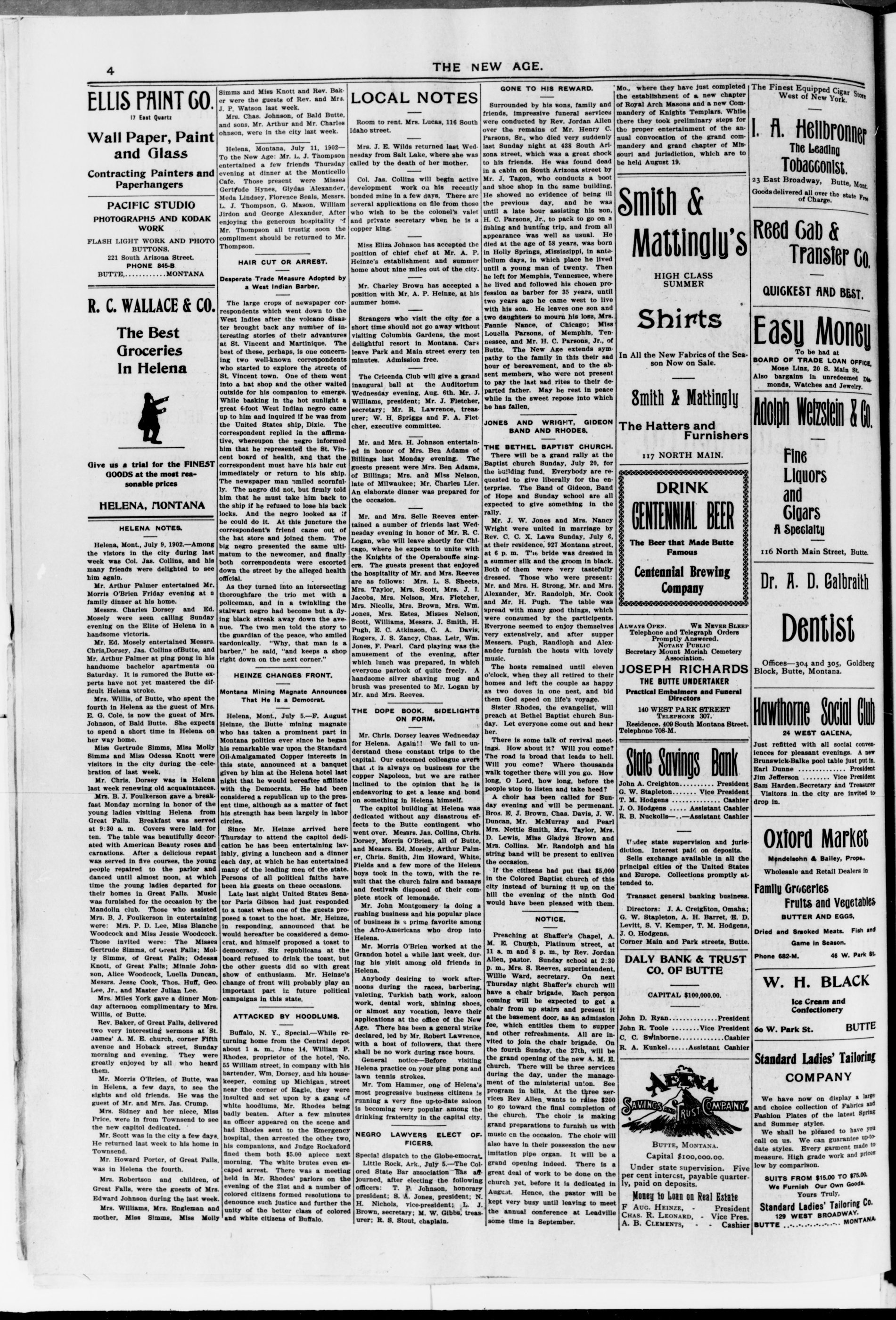
Helena, Mont., July 9, 1902.—Among the vistors in the city during last week was Col. Jas. Collins, and his many friends were delighted to see him again.
Mr. Arthur Palmer entertained Mr. Morris O'Brien Friday evening at a family dinner at his home.
Messrs. Charles Dorsey and Ed. Mosely were seen calling Sunday evening on the Elite of Helena in a handsome victoria.
Mr. Ed. Mosely entertained Messrs. Chris,Dorsey, Jas. Collins ofButte, and Mr. Arthur Palmer at ping pong in his handsome bachelor apartments on Saturday. It is rumored the Butte experts have not yet mastered the difficult Helena stroke.
Mrs. Willis, of Butte, who spent the fourth in Helena as the guest of Mrs. E. G. Cole, is now the guest of Mrs. Johnson, of Bald Butte. She expects to spend a short time in Helena on her way home.
Miss Gertrude Simms, Miss Molly Simms and Miss Odessa Knott were visitors in the city during the celebration of last week.
Mr. Chris. Dorsey was in Helena last week renewing old acquaintances.
last week renewing old acquaintances. Mrs. B. J. Foulkerson gave a breakfast Monday morning in honor of the young ladies visiting Helena from Great Falls. Breakfast was served at 9:30 a. m. Covers were laid for ten. The table was beautifully decorated with American Beauty roses and carnations. After a delicious repast was served in five courses, the young people repaired to the parlor and danced until almost noon, at which time the young ladies departed for their homes in Great Falls. Music was furnished for the occasion by the Mandolin club. Those who assisted Mrs. B. J. Foulkerson in entertaining were: Mrs. P. P. D. Lee, Miss Blanche Woodcock and Miss Jessie Woodcock Those invited were: The Misses Gertrude Simms, of Great Falls; Moly Simms, of Great Falls; Odessa Klynts, of Great Falls; Minnie Johnson, Alice Woodcock, Luella Duncan Messars, Jesse Cook, Thos. Huff, Geo Lee, Jr., and Master Julian Lee.
Mrs. Miles York gave a dinner Monday afternoon complimentary to Mrs. Willis, of Butte.
Rev. Baker, of Great Falls, delivered two very interesting sermons at St. James' A. M. E. church, corner Fifth avenue and Hoback street, Sunday morning and evening. They were greatly enjoyed by all who heard them.
Mr. Morris O'Brien, of Butte, was in Helena, a few days, to see the sights and old friends. He was the guest of Mr. and Mrs. Jas. Crump.
Mrs. Sidney and her niece, Miss Price, were in from Townsend to see the new capitol dedicated.
Mr. Scott was in the city a few days, He returned last week to his home in Townsend.
Mr. Howard Porter, of Great Falls, was in Helena the fourth.
Mrs. Robertson and children, of Great Falls, were the guests of Mrs. Edward Johnson during the last week. Mrs. Williams, Mrs. Engleman and mother, Miss Smits, Miss Molly
Simms and Miss Knott and Rev. Baker were the guests of Rev. and Mrs. J. P. Watson last week.
Mrs. Chas. Johnson, of Bald Butte, and sons, Mr. Arthur and Mr. Charles Johnson, were in the city last week.
Helena, Montana, July 11, 1902—To the New Age: Mr. L. J. Thompson entertained a few friends Thursday evening at dinner at the Monticello Cafe. Those present were Missea Gertfude Hynes, Glydas Alexander, Media Lindsey, Florence Seals, Messrs. L. J. Thompson, G. Mason, William Jirdon and George Alexander. After enjoying the generous hospitality of Mr. Thompson all trustig soon the compliment should be returned to Mr. Thompson.
HAIR CUT OR ARREST.
Desperate Trade Measure Adopted by a West Indian Barber.
The large crops of newspaper correspondents which went down to the West Indies after the volcano disaster brought back any number of interesting stories of their adventures at St. Vincent and Martinique. The best of these, perhaps, is one concerning two well-known correspondents who started to explore the streets of St. Vincent town. One of them went into a hat shop and the other waited outside for his companion to emerge. While basking in the hot sunlight a great 6-foot West Indian negro came up to him and inquired if he was from the United States ship, Dixie. The correspondent replied in the affirmative, whereupon the negro informed him that he represented the St. Vincent board of health, and that the correspondent must have his hair cut immediately or return to his ship. The newspaper man smiled scornfully. The negro did not, but firmly told him that he must take him back to the ship if he refused to lose his back locks. And the negro looked as if he could do it. At this juncture the correspondent's friend came out of the hat store and joined them. The big negro presented the same ultimatum to the newcomer, and finally both correspondents were escorted down the street by the alleged health official.
As they turned into an intersecting thoroughfare the trio met with a policeman, and in a twinkling the stalwart negro had become but a flying black streak away down the avenue. The two men told the story to the guardian of the peace, who smiled sardonically. "Why, that man is a barber," he said, "and keeps a shop right down on the next corner."
HEINZE CHANGES FRONT.
Montana Mining Magnate Announces That He Is a Democrat.
Helena, Mont., July 5.—F. August Heinze, the Butte mining magnate who has taken a prominent part in Montana politics ever since he began his remarkable war upon the Standard Oil-Amalgamated Copper interests in this state, announced at a banquet given by him at the Helena hotel last night that he would hereafter affiliate with the Democrats. He had been considered a republican up to the present time, although as a matter of fact his strength has been largely in labor circles.
Since Mr. Heinze arrived here Thursday to attend the capitol dedication he has been entertaining lavishly, giving a luncheon and a dinner each day, at which he has entertained many of the leading men of the state. Persons of all political faiths have been his guests on these occasions. Late last night United States Senator Paris Gibson had just responded to a toast when one of the guests proposed a toast to the host. Mr. Heinze, in responding, announced that he would hereafter be considered a democrat, and himself proposed a toast to democracy. Six republicans at the board refused to drink the toast, but the other guests did so with great show of enthusiasm. Mr. Heinze's change of front will probably play an important part in future political campaigns in this state.
ATTACKED BY HOODLUMS.
Buffalo, N. Y., Special.—While returning home from the Central depot about 1 a. m., June 14, William P. Rhodes, proprietor of the hotel, No. 55 William street, in company with his bartender, Wm. Dorsey, and his housekeeper, coming up Michigan, street near the corner of Eagle, they were insulted and set upon by a gang of white hoodlums, Mr. Rhodes being badly beaten. After a few minutes an officer appeared on the scene and had Rhodes sent to the Emergency hospital, then arrested the other two, his companions, and Judge Rockaford fined them both $5.00 apiece next morning. The white brutes even escaped arrest. There was a meeting held in Mr. Rhodes' parlors on the evening of the 21st and a number of colored citizens formed resolutions to denounce such justice and further the unity of the better class of colored and white citizens of Buffalo.
THE NEW AGE.
LOCAL NOTES
LOCAL NOTES
Room to rent. Mrs. Lucas, 116 South Idaho street.
Mrs. J. E. Wilds returned last Wednesday from Salt Lake, where she was called by the death of her mother.
Col. Jas. Collins will begin active development work on his recently bonded mine in a few days. There are several applications on file from those who wish to be the colonel's valet and private secretary when he is a copper king.
Miss Eliza Johnson has accepted the position of chief chef at Mr. A. P. Heinze's establishment and summer home about nine miles out of the city.
Mr. Charley Brown has accepted a position with Mr. A. P. Heinze, at his summer home.
Strangers who visit the city for a short time should not go away without visiting Columbia Gardens, the most delightful resort in Montana. Cars leave Park and Main street every ten minutes. Admission free.
The Cricenda Club will give a grand inaugural ball at the Auditorium Wednesday evening, Aug. 6th. Mr. J. Williams, president; Mr. J. Fletcher, secretary; Mr. R. Lawrence, treasurer; W. H. Spriggs and F. A. Fletcher, executive committee.
Mr. and Mrs. H. Johnson entertained in honor of Mrs. Ben Adams of Billings last Monday evening. The guests present were Mrs. Ben Adams of Billings; Mrs. and Miss Nelson, late of Milwaukee; Mr. Charles Lier. An elaborate dinner was prepared for the occasion.
Mr. and Mrs. Selle Reeves entertained a number of friends last Wednesday evening in honor of Mr. R. C. Logan, who will leave shortly for Chicago, where he expects to unite with the Knights of the Operabouffe singers. The guests present that enjoyed the hospitality of Mr. and Mrs. Reeves are as follows: Mrs. L. S. Sheets, Mrs. Taylor, Mrs. Scott, Mrs. J. I. Jacobs, Mrs. Nelson, Mrs. Fletcher, Mrs. Nicolls, Mrs. Brown, Mrs. Wm Jones, Mrs. Estes, Misses Nelson, Scott, Williams, Messrs. J. Smith, H. Pugh, E. C. Atkinson, C. A. Davis Rogers, J. S. Zancy, Chas. Leir, Wm Jones, F. Pearl. Card playing was the amusement of the evening, after which lunch was prepared, in which everyone partook of quite freely. A handsome silver shaving mug and brush was presented to Mr. Logan by Mr. and Mrs. Reeves.
THE DOPE BOOK. SIDELIGHTS ON FORM.
Mr. Chris. Dorsey leaves Wednesday for Helena. Again! We fail to understand these constant trips to the capital. Our esteemed colleague averts that it is always on business for the copper Napoleon, but we are rather inclined to the opinion that he is endeavoring to get a lease and bond on something in Helena himself.
The capitol building at Helena was dedicated without any disastrous effects to the Butte contingent who went over. Messrs. Jas. Collins, Chris. Dorsey, Morris O'Brien, all of Butte, and Messrs. Ed. Mosely, Arthur Palmer, Chris. Smith, Jim Howard, White Fields and a few more of the Helena boys took in the town, with the result that the church fairs and bazaars and festivals disposed of their complete stock of lemonade.
Mr. John Montgomery is doing a rushing business and his popular place of business is a prime favorite among the Afro-Americans who drop into Helena.
Mr. Morris O'Brien worked at the Grandon hotel a while last week, during his visit among old friends in Helena.
Anybody desiring to work afternoons during the races, barbering, valeting, Turkish bath work, saloon work, dental work, shining shoes, or almost any vocation, leave their applications at the office of the New Age. There has been a general strike declared, led by Mr. Robert Lawrence, with a host of followers, that there shall be no work during race hours.
General notice—Before visiting Helena practice on your ping pong and lawn tennis strokes.
Mr. Tom Hammer, one of Helena's most progressive business citizens is running a very fine up-to-date saloon is becoming very popular among the drinking fraternity in the capital city.
NEGRO LAWYERS ELECT
FICERS
Special dispatch to the Globe-emocrat. Little Rock, Ark., July 5.—The Colored State Bar association has adjourned, after electing the following officers: T. R. Johnson, honorary president; S. A. Jones, president; N. H. Nichols, vice-president; L. J. Brown, secretary; M. W. Gibbs, treasurer; R. S. Stout, chaplain.
GONE TO HIS REWARD.
Surrounded by his sons, family and friends, impressive funeral services were conducted by Rev. Jordan Allen over the remains of Mr. Henry C. Parsons, Sr., who died very suddenly last Sunday night at 438 South Arizona street, which was a great shock to his friends. He was found dead in a cabin on South Arizona street by Mr. J. Tagon, who conducts a boot and shoe shop in the same building, He showed no evidence of being ill the previous day, and he was until a late hour assisting his son, H. C. Parsons, Jr., to pack to go on a fishing and hunting trip, and from all appearance was well as usual. He died at the age of 58 years, was born in Holly Springs, Mississippi, in antebellum days, in which place he lived until a young man of twenty. Then he left for Memphis, Tennessee, where he lived and followed his chosen profession as barber for 35 years, until two years ago he came west to live with his son. He leaves one son and two daughters to mourn his loss, Mrs. Fannie Nance, of Chicago; Miss Louella Parsons, of Memphis, Tennessee, and Mr. H. C. Parsons, Jr., of Butte. The New Age extends sympathy to the family in this their sad hour of bereavement, and the absent members, who were not present to pay the last sad rites to their departed father. May he rest in peace while in the sweet repose into which he has fallen.
JONES AND WRIGHT, GIDEON
BAND AND RHOES.
THE BETHEL BAPTIST CHURCH. There will be a grand rally at the Baptist church Sunday, July 20, for the building fund. Everybody are requested to give liberally for the enterprise. The Band of Gideon, Band of Hope and Sunday school are all expected to give something in the rally.
Mr. J. W. Jones and Mrs. Nancy Wright were united in marriage by Rev. C. C. X. Laws Sunday, July 6, at their residence, 927 Montana street, at 6 p. m. The bride was dressed in a summer silk and the groom in black. Both of them were very tastefully dressed. Those who were present: Mr. and Mrs. H. Strong, Mr. and Mrs. Alexander, Mr. Randolph, Mr. Cook and Mr. H. Pugh. The table was spread with many good things, which were consumed by the participants. Everyone seemed to enjoy themselves very extensively, and after supper Messers. Pugh, Randloph and Alexander furnish the hosts with lovely music.
The hosts remained until eleven o'clock, when they all retired to their homes and left the couple as happy as two doves in one nest, and bid them God speed on life's voyage.
Sister Rhodes, the evangelist, will preach at Bethel Baptist Church Sunday. Let everyone come out and hear her.
There is some talk of revival meetings. How about it? Will you come? The road is broad that leads to hell. Will you come? Where thousands walk together there will you go. How long, O Lord, how long, before the people stop to listen and take heed?
A choir has been called for Sunday evening and will be permanent. Bros. E. J. Brown, Chas. Davis, J. W. Duncan, Mr. McMurray and Pearl Mrs. Nettle Smith, Mrs. Taylor, Mrs. D. Lewis, Miss Gladys Brown and Mrs. Collins. Mr. Randolph and his string band will be present to enliven the occasion.
If the citizens had put that $5,000 in the Colored Baptist church of this city instead of burning it up on the hill the evening of the ninth God would have been pleased with them.
Preaching at Shaffer's Chapel, A. M. E. Church, Platinum street, at 11 a. m. and 8 p. m., by Rev. Jordan Allen, pastor. Sunday school at 2:30 p. m., mrs. S. Reeves, superintendent, Willie Ward, secretary. On next Thursday night Shaffer's church will have a chair brigade. Each person coming will be expected to get a chair from up stairs and present it at the basement door, as an admission fee, which entitles them to supper and other refreshments. All are invited to join the chair brigade. On the fourth Sunday, the 27th, will be the grand opening of the new A. M. E. church. There will be three services during the day, under the management of the ministerial union. See program in bills. At the three services Rev Allen wants to raise $200 to go toward the final completion of the church. The choir is making grand preparations to furnish us with music on the occasion. The choir will also have in their possession the new imitation pipe organ. It will be a grand opening indeed. There is a great deal of work to be done on the church yet, before it is dedicated in August. Hence, the pastor will be kept very busy until leaving to meet the annual conference at Leadville some time in September.
NOTICE.
Mo., where they have just completed the establishment of a new chapter of Royal Arch Masons and a new Commandery of Knights Templars. While there they took preliminary steps for the proper entertainment of the annual convocation of the grand commandery and grand chapter of Missouri and jurisdiction, which are to be held August 19.
Smith & Mattingly's
HIGH CLASS
SUMMER
Shirts
In All the New Fabrics of the Season Now on Sale.
Smith & Mattingly
The Hatters and
Furnishers
117 NORTH MAIN.
DRINK
CENTENNIAL BEER
The Beer that Made Butte
Famous
Centennial Brewing Company
ALWAYS OPEN. WE NEVER SLEEP
Telephone and Telegraph Orders
Promptly Answered.
NOTARY PUBLIC
Secretary Mount Moriah Cemetery
Association.
JOSEPH RICHARDS
THE BUTTE UNDERTAKER
Practical Embalmers and Funeral
Directors
140 WEST PARK STREET
TELEPHONE 307.
Residence. 409 South Montana Street.
Telephone 708-M.
State Savings Bank
John A. Creighton..... President
G. W. Stapleton..... Vice President
T. M. Hodgens..... Cashier
J. O. Hodgens..... Assistant Cashier
R. B. Nuckolls——Assistant Cashier
Under state supervision and jurisdiction. Interest paid on deposits. Sells exchange available in all the principal cities of the United States and Europe. Collections promptly attended to.
Transact general banking business.
Directors: J. A. Creighton, Omaha;
G. W. Stapleton, A. H. Barret, E. D. Levitt, S. V. Kemper, T. M. Hodgens,
J. O. Hodgens.
Corner Main and Park streets, Butte.
DALY BANK & TRUST CO. OF BUTTE
CAPITAL $100,000.00.
John D. Ryan.....President
John R. Toole.....Vice President
C. C. Swinborne.....Cashier
R. A. Kunkel.....Assistant Cashier
SAVINGS AND TRUST COMPANY.
Under state supervision. Five per cent interest, payable quarterly, paid on deposits.
Money to Loan on Real Estate
F AUG. HEINZE, - President
CHAS. R. LEONARD, - Vice Pres.
A. B. CLEMENTS, - Cashier
The Finest Equipped Cigar Store
West of New York.
I. A. Hellbronner
The Leading
Tobaccoist.
23 East Broadway, Butte, Mont.
Goods delivered all over the state Free
of Charge.
Reed Gab &
Transfer Co.
QUICKEST AND BEST.
Easy Money
To be had at
BOARD OF TRADE LOAN OFFICE,
Mose Linz, 20 S. Main St.
Also bargains in unredeemed Diamonds, Watches and Jewelry.
Adolph Wetzstein & Co.
Fine
Liquors
and
Gigars
A Specialty
116 North Main Street, Butte.
Dr. A. D. Galbraith
Dentist
Offices—304 and 305. Goldberg Block, Butte, Montana
Hawthorne Social Club
Just refitted with all social conveniences for pleasant evenings. A new Brunswick-Balke pool table just put in. Earl Dunne ..... President Jim Jefferson ..... Vice President Sam Harden.Secretary and Treasurer Visitors in the city are invited to drop in.
Oxford Market
Mendelsohn & Bailey, Props.
Wholesale and Retail Dealers in
Family Groceries
Fruits and Vegetables
BUTTER AND EGGS,
Dried and Smoked Meats. Fish and
Game in Season.
Phone 682-M. 46 W. Park St.
W. H. BLACK
Ice Cream and Confectionery
60 W. Park St. BUTTE
Standard Ladies' Tailoring COMPANY
We have now on display a large and choice collection of Fabrics and Fashion Plates of the latest Spring and Summer styles.
We shall be pleased to have you call on us. We can guarantee up-to-date styles. Every garment made to measure. High grade work and prices low by comparison.
SUITS FROM $15.00 TO $75.00.
We Furnish Our Own Goods.
Yours Truly.
Standard Ladies' Tailoring Co.
129 WEST BROADWAY.
BUTTE MONTANA
---