The New Age (Butte)
Saturday, October 11, 1902
Butte, Montana
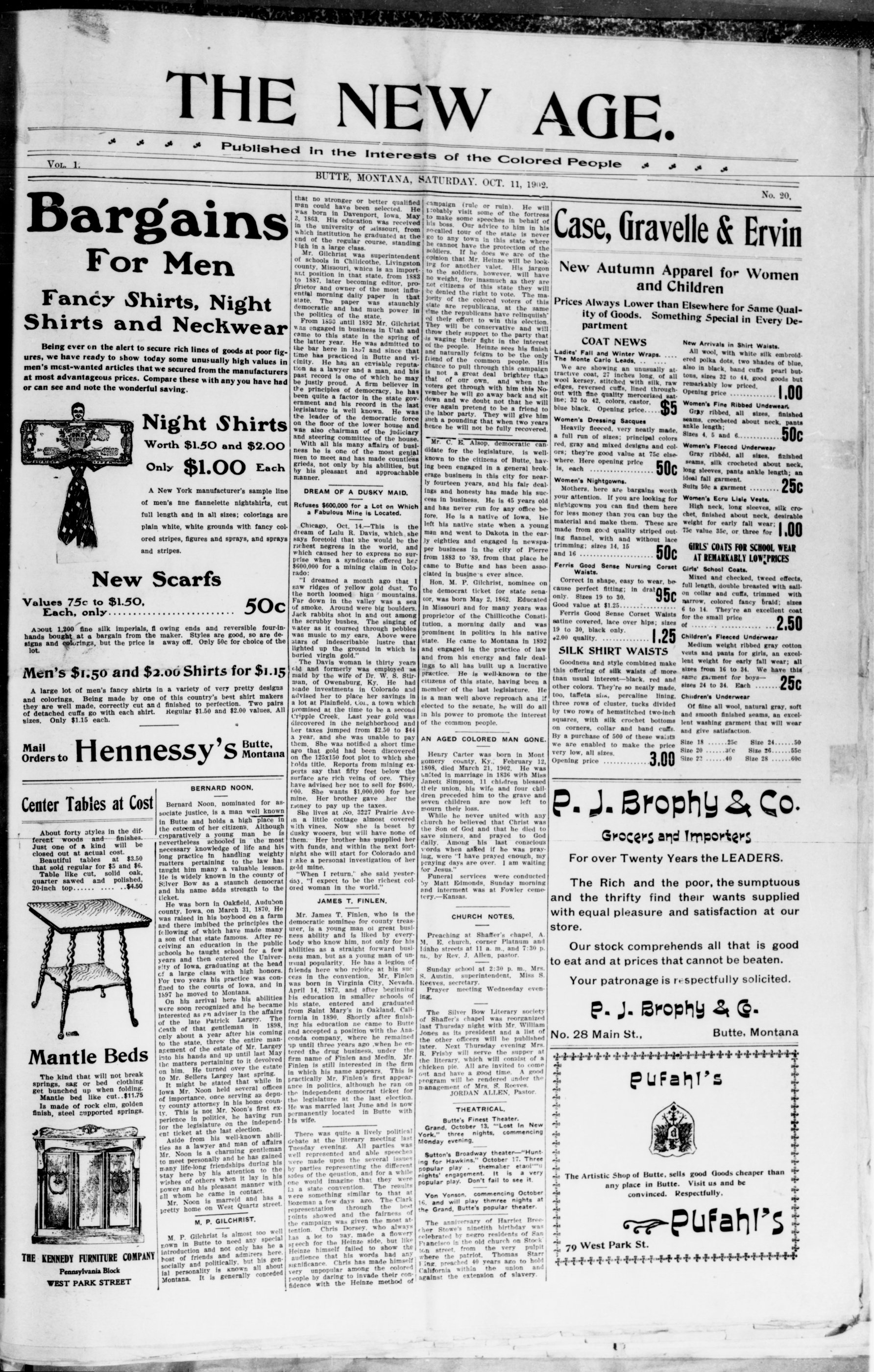
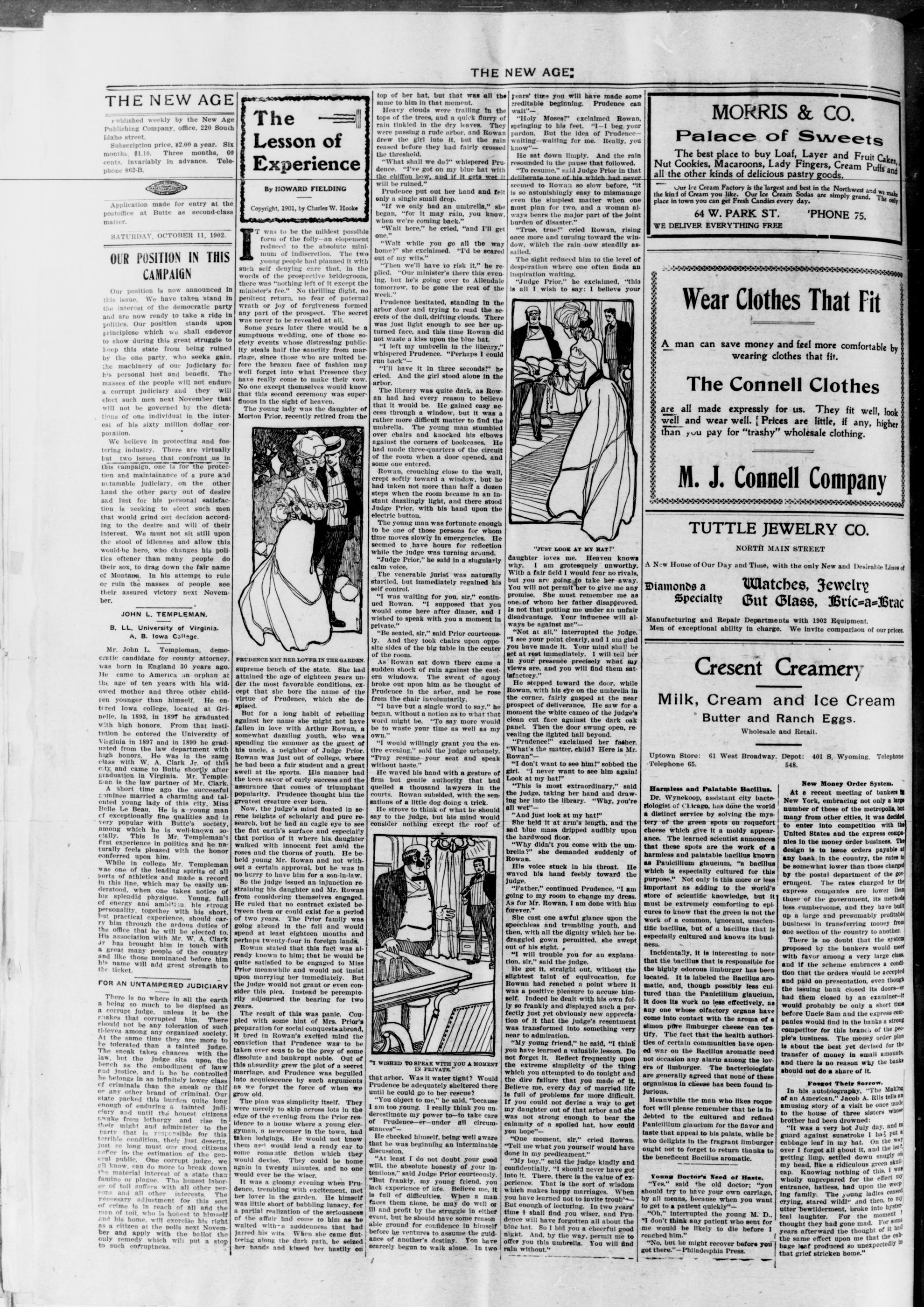
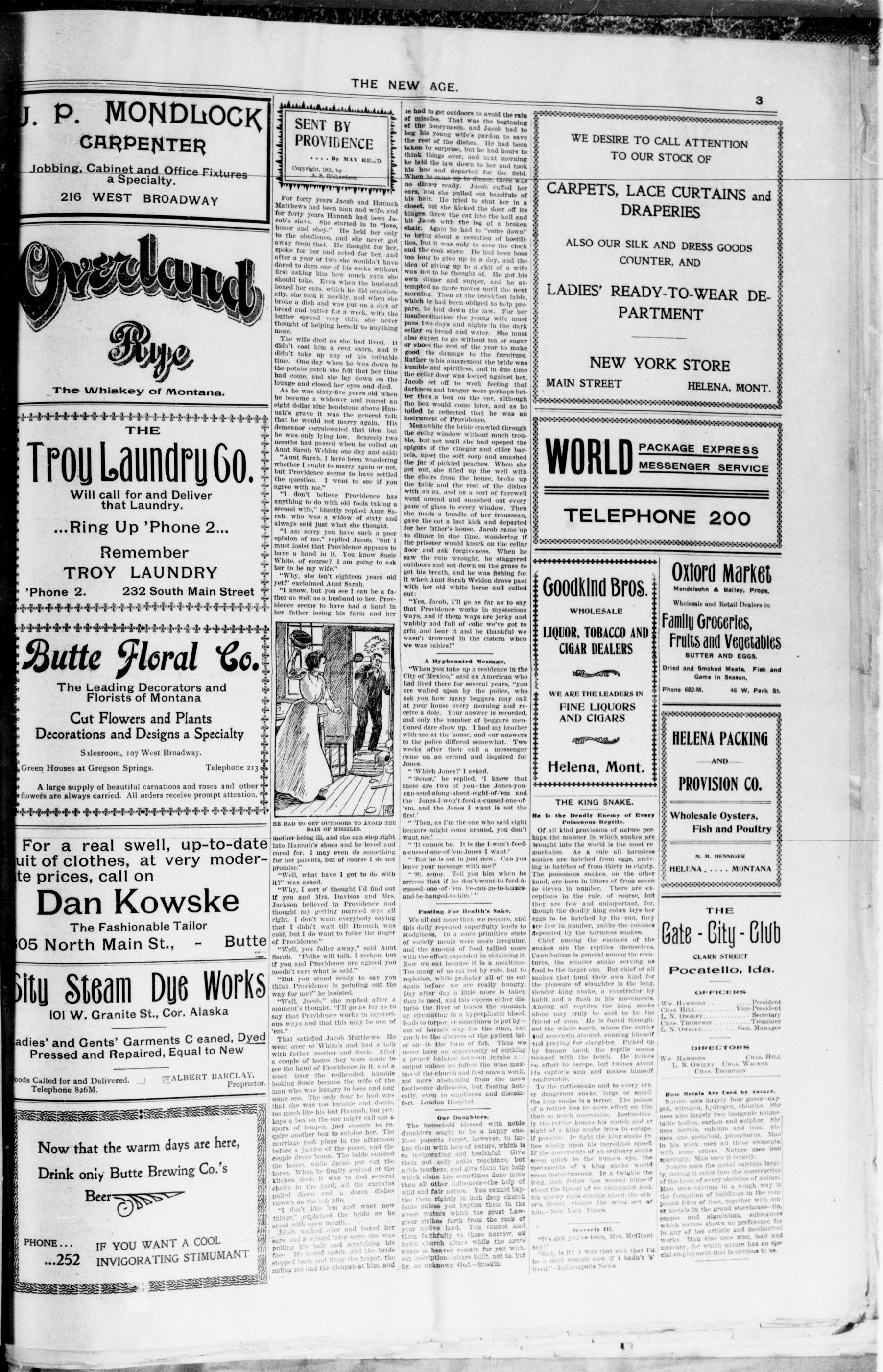
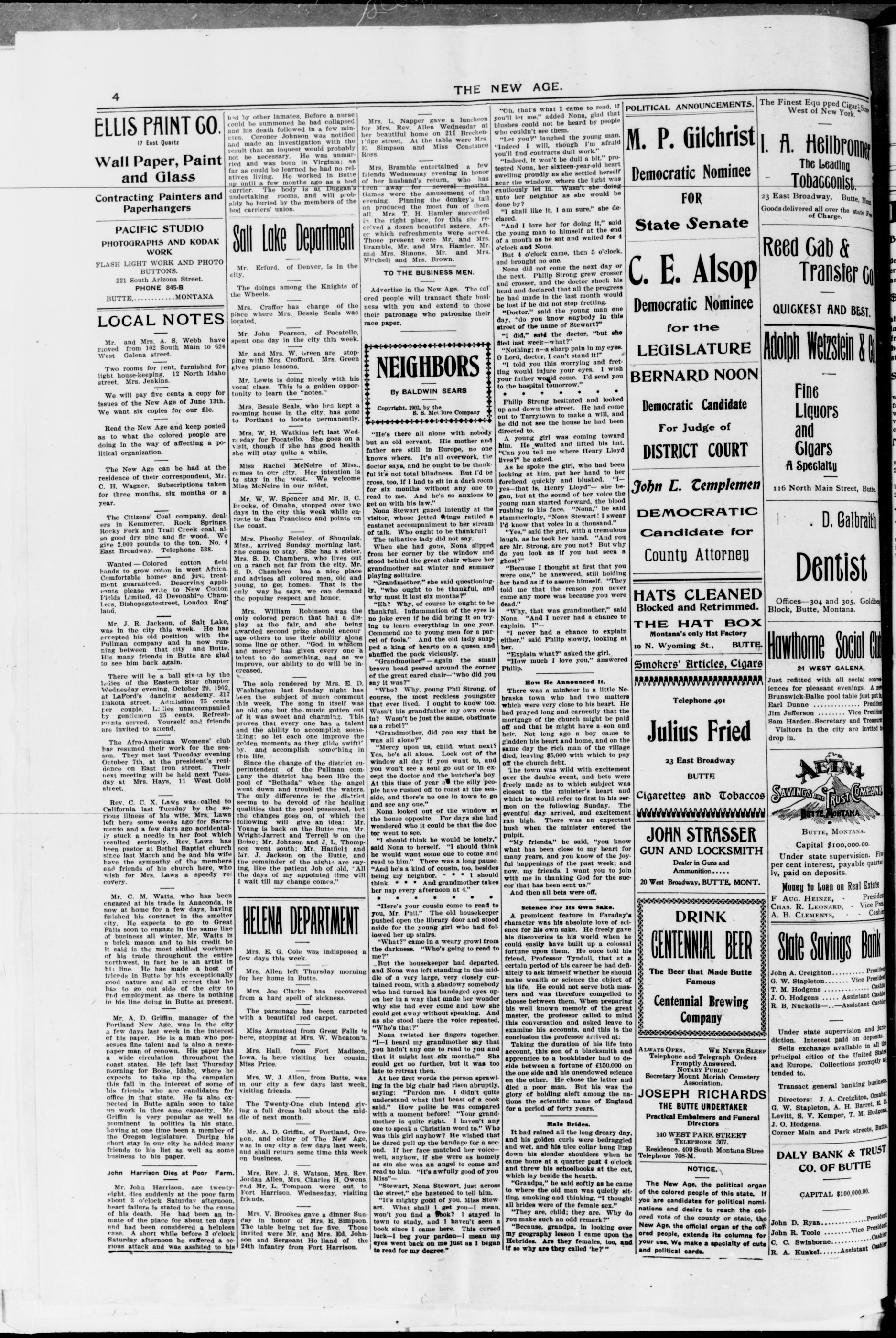
Page text (machine-generated)
Bargains For Men
Fancy Shirts, Night Shirts and Neckwear
Being ever on the alert to secure rich lines of goods at poor figures, we have ready to show today some unusually high values in men's most-wanted articles that we secured from the manufacturers at most advantageous prices. Compare these with any you have had or can see and note the wonderful saving.
THE
BANK OF
BURKE STATE
100
100
New Scarfs
New Scarfs
Values 75c to $1.50,
Each, only.....
About 1,200 fine silk imperials, f
hands bought at a bargain from the
signs and colorings, but the price is
lot.
Men's $1.50 and $1.50
A large lot of men's fancy shirts
and colorings. Being made by one
they are well made, correctly cut and
of detached cuffs go with each shirt,
sizes. Only $1.15 each.
Mail
Orders to Henne
Values 75c to $1.50,
Each, only..... 50c
About 1,200 fine silk imperials, flowing ends and reversible four-in-
hands bought at a bargain from the maker. Styles are good, so are
designs and colorings, but the price is away off. Only 50c for choice of the
lot.
Men's $1.50 and $2.00 Shirts for $1.15
A large lot of men's fancy shirts in a variety of very pretty designs and colorings. Being made by one of this country's best shirt makers they are well made, correctly cut and finished to perfection. Two pairs of detached cuffs go with each shirt. Regular $1.50 and $2.00 values. All sizes. Only $1.15 each.
Mail Orders to Hennessy's Butte, Montana
Center Tables at Cost
About forty styles in the different woods and—finishes.
Just one of a kind will be closed out at actual cost.
Beautiful tables at $3.50
that sold regular for $5 and $6.
Table like cut, solid oak,
quarter sawed and polished.
20-inch top ..... $4.50
1770.
Mantle Beds
The kind that will not break springs, sag or bed clothing get bunched up when folding. Mantle bed like cut..$11.75 Is made of rock elm, golden finish, steel supported springs.
THE KENNEDY FURNITURE COMPANY
Pennsylvania Block
WEST PARK STREET
Vol. 1.
THE NEW AGE.
A New York manufacturer's sample line of men's fine flannelette nightshirts, cut full length and in all sizes; colorings are plain white, white grounds with fancy colored stripes, figures and sprays, and sprays and stripes.
50c
mals, fl owing ends and reversible four-in-
on the maker. Styles are good, so are de-
ceice is away off. Only 50c for choice of the
$2.00 Shirts for $1.15
shirts in a variety of very pretty designs
one of this country's best shirt makers
out and finished to perfection. Two pairs
shirt. Regular $1.50 and $2.00 values. All
nessy's Butte,
Montana
BERNARD NOON.
Bernard Noon, nominated for associate justice, is a man well known in Butte and holds a high place in the esteem of her citizens. Although comparatively a young man he is nevertheless schooled in the most necessary knowledge of life and his long practice in handling weighty matters pertaining to the law has taught him many a valuable lesson. He is widely known in the county of Silver Bow as a staunch democrat and his name adds strength to the ticket.
He was born in Oakfield, Audubon county, Iowa, on March 31, 1870. He was raised in his boyhood on a farm and there imbibed the principles the following of which have made many a son of that state famous. After receiving an education in the public schools he taught school for a few years and then entered the University of Iowa, graduating at the head of a large class with high honors. For two years his practice was confined to the courts of Iowa, and in 1887 he moved to Montana.
On his arrival here his abilities were soon recognized and he became interested as an adviser in the affairs of the late Patrick Largey. The death of that gentleman in 1898, only about a year after his coming to the state, threw the entire management of the estate of Mr. Largey into his hands and up until last May the matters pertaining to it devolved on him. He turned over the estate to Mr. Sellers Largey last spring. It might be stated that while in Iowa Mr. Noon held several offices of importance, once serving as deputy county attorney in his home county. This is not Mr. Noon's first experience in politics, he having run for the legislature on the independent ticket at the last election.
ent ticket at the
Aside from his well-known abilities as a lawyer and man of affairs Mr. Noon is a charming gentleman to meet personally and he has gained many life-long friendships during his stay here by his attention to the wishes of others when it lay in his power and his pleasant manner with all whom he came in contact.
pretty home on West Quartz street
Mr. Noon is married and has a
pretty home on West Quartz street
M. P. GILCHRIST.
M. P. Gilchrist is almost too well known in Butte to need any special introduction and not only has he a host of friends and admirers here, socially and politically, but his general personality is known all about Montana. It is generally conceded
that no stronger or better qualified man could have been selected. He was born in Davenport, Iowa, May 3, 1863. His education was received in the university of Missouri, from which institution he graduated at the end of the regular course, standing high in a large class.
Mr. Gilchrist was superintendent of schools in Chilicothe, Livingston county, Missouri, whica is an important position in that state, from 1883 to 1887, later becoming editor, proprietor and owner of the most influential morning daily paper in that state. The paper was staunchly democratic and had much power in the politics of the state.
campaign (rule or ruin). He will probably visit some of the fortress to make some speeches in behalf of his boss. Our advice to him in his so-called tour of the state is never to go to any town in this state where he cannot have the protection of the soldiers. If he does we are of the opinion that Mr. Heinze will be looking for another valet. His jargon to the soldiers, however, will have no weight, for inasmuch as they are not citizens of this state they will be denied the right to vote. The majority of the colored voters of this state are republicans, at the same time the republicans have relinquished
From 1850 until 1892 Mr. Gilchrist was engaged in business in Utah and came to this state in the spring of the latter year. He was admitted to the bar here in 1897 and since that time has practiced in Butte and vicinity. He has an enviable reputation as a lawyer and a man, and his past record is one of which he may be justly proud. A firm believer in the principles of democracy, he has been quite a factor in the state government and his record in the last legislature is well known. He was the leader of the democratic force on the floor of the lower house and was also chairman of the judiciary and steering committee of the house. With all his many affairs of business he is one of the most general men to meet and has made countless grieds, not only by his abilities, but by his pleasant and approachable manner.
DREAM OF A DUSKY MAID.
Refuses $600,000 for a Lot on Which
a Fabulous Mine is Located.
Chicago, Oct, 14.—This is the dream of Lulu R. Davis, which she says foretold that she would be the richest negress in the world, and which caused her to express no surprise when a syndicate offered her $600,000 for a mining claim in Colorado:
"I dreamed a month ago that I saw ridges of yellow gold dust. To the north loomed high mountains. Far down in the valley was a sea of smoke. Around were big boulders. Jack rabbits shot in and out among the scrubby bushes. The singing of water as it coursed through pebbles was music to my ears. Above were stars of indescribable lustre that lighted up the ground in which is buried virgin gold."
The Davis woman is thirty years old and formerly was employed as maid by the wife of Dr. W. S. Stirman, of Owensburg, Ky. He had made investments in Colorado and advised her to place her savings in a lot at Plainfield, Col., a town which promised at the time to be a second Cripple Creek. Last year gold was discovered in the neighborhood and her taxes jumped from $2.50 to $44 a year, and she was unable to pay them. She was notified a short time ago that gold had been discovered on the 125x150 foot plot to which she holds title. Reports from mining experts say that fifty feet below the surface are rich veins of ore. They have advised her not to sell for $600.00. She wants $1,000,000 for her mine. Her brother gave her the money to pay up the taxes.
She lives at No. 3227 Prairie Ave in a little cottage almost covered with vines. Now she is beset by dusky wooers, but will have none of them. Her brother has supplied her with funds, and within the next forty-night she will start for Colorado and take a personal investigation of her gold mine.
"When I return," she said yesterday, "I expect to be the richest colored woman in the world."
JAMES T. FINLEN.
Mr. James T. Finlen, who is the democratic nominee for county treasurer, is a young man of great business ability and is liked by everybody who know him, not only for his abilities as a straight forward business man, but as a young man of unusual popularity. He has a legion of friends here who rejoice at his success in the convention. Mr. Finlen was born in Virginia City, Nevada, April 14, 1873, and after beginning his education in smaller schools of his state, entered and graduated from Saint Mary's in Oakland, California in 1890. Shortly after finishing his education he came to Butte and accepted a position with the Anaconda company, where he remained up until three years ago, when he entered the drug business, under the firm name of Finlen and Medlin. Mr. Finlen is still interested in the firm in which his name appears. This is practically Mr. Finlen's first appearance in politics, although he ran on the independent democrat ticket for the legislature at the last election. He was married last June and is now permanently located in Butte with its wife.
There was quite a lively political debate at the literary meeting last Tuesday evening. All parties was well represented and able speeches were made upon the several issues by parties representing the different sides of the question, and for a while one would imagine that they were in a state convention. The results were something similar to that at Bozeman a few days ago. The Clark representation through the best points showed and the fairness of the campaign was given the most attention. Chris Dorsey, who always has a lot to say, made a flowery speech for the Heinze side, but like Heinze himself failed to show the audience that his words had any significance. Chris has made himself very unpopular among the colored people by daring to invade their confidence with the Heinze method of
campaign (rule or ruin). He will probably visit some of the fortress to make some speeches in behalf of his boss. Our advice to him in his so-called tour of the state is he go to any town in this state where he cannot have the protection of the soldiers. If he does we are the opinion that Mr. Heinze will be looking for another valet. His jargon to the soldiers, however, will have no weight, for inasmuch as they are not citizens of this state they will be denied the right to vote. The majority of the colored voters of this state are republicans, at the same time the republicans have relinquished their effort to win this election. They will be conservative and will throw their support to the party that is waging their fight in the interest of the people. Heinze sees his finish and naturally feigns to be the only friend of the common people. His chance to pull through this campaign is not a great deal brighter than that of our own, and when the voters get through with him this November he will go away back and sit down and we doubt not that he will ever again pretend to be a friend to the labor party. They will give him such a pounding that when two years hence he will not be fully recovered.
Mr. C. E. Alsop, democratic candidate for the legislature, is well-known to the citizens of Butte, having been engaged in a general brokerage business in this city for nearly fourteen years, and his fair dealings and honesty has made his success in business. He is 45 years old and has never run for any office before. He is a native of Iowa. He left his native state when a young man and went to Dakota in the early eighties and engaged in newspaper business in the city of Pierre from 1883 to '89, from that place he came to Butte and has been associated in business ever since.
Hon. M. P. Gilchrist, nominee on the democrat ticket for state senator, was born May 2, 1862. Educated in Missouri and for many years was proprietor of the Chillicothe Constitution, a morning daily and was prominent in politics in his native state. He came to Montana in 1892 and engaged in the practice of law and from his energy and fair dealings to all has built up a lucrative practice. He is well-known to the citizens of this state, having been a member of the last legislature. He is a man well above reproach and if elected to the senate, he will do all in his power to promote the interest of the common people.
AN AGED COLORED MAN GONE
Henry Carter was born in Montgomery county, Ky., February 12, 1808, died March 21, 1902. He was united in marriage in 1836 with Miss Janett Simpson, 11 children blessed their union, his wife and four children preceded him to the grave and seven children are now left to mourn their loss.
While he never united with any church he believed that Christ was the Son of God and that he died to save sinners, and prayed to God daily. Among his last conscious words when asked if he was praying, were "I have prayed enough, my praying days are over. I am waiting for Jesus."
Funeral services were conducted by Matt Edmonds, Sunday morning and interment was at Fowler cemetery.—Kansas.
CHURCH NOTES.
Preaching at Shaffer's chapel, A. M. E. church, corner Platnum and Idaho streets at 11 a. m., and 7:30 p. m., by Rev. J. Allen, pastor.
Sunday school at 2:30 p. m., Mrs. S. Austin, superintendent, Miss S. Reeves, secretary.
Prayer meeting Wednesday evening.
The Silver Bow Literary society of Shaffer's chapel was reorganized last Thursday night with Mr. William Jones as its president and a list of the other officers will be published later. Next Thursday evening Mrs. R. Frisby will serve the supper at the literary, which will consist of a chicken pile. All are invited to come out and have a good time. A good program will be rendered under the management of Mrs. S. Reeves.
THEATRICAL
Butte's Finest theater.
Grand, October 13, "Lost In New York," three nights, commencing Monday evening.
Sutton's Broadway theater—"Hunting for Hawkins," October 17. Three popular play . . . theather etaoi" nights' engagement. It is a very popular play. Don't fail to see it.
Yon Yonson, commencing October 16, and will play three nights at the Grand, Butte's popular theater.
The anniversary of Harriet Breecher Stowe's nineth birthday was celebrated by negro residents of San Francisco in the old church on Stockton street, from the very pulpit where the patriot. Thomas Starr Ling, preached 40 years ago to hold California within the union and against the extension of slavery.
Case, Gravelle & Ervin
New Autumn Apparel for Women and Children
Prices Always Lower than Elsewhere for Same Quality of Goods. Something Special in Every Department
COAT NEWS
Ladies' Fall and Winter Wraps. The Monte Carlo Leads.
We are showing an unusually attractive coat, 27 inches long, of all wool kersey, stitched with silk, raw edges, reversed cuffs, lined through out with fine quality mercerized satine; 32 to 42, colors, castor, blue black. Opening price....$5
Women's Dressing Sacques
Heavily fleeced, very neatly made, a full run of sizes; principal colors, red, gray and mixed designs and colors; they're good value at 75c else where. Here opening price is, each ..... 50c
Women's Nightgowns.
Mothers, here are bargains worth your attention. If you are looking for nightgowns you can find them here for less money than you can buy the material and make them. These are made from good quality striped outing flannel, with and without lace trimming; sizes 14, 15 and 16 ..... 50c
Ferris Good Sense Nursing Corset Waist.
Correct in shape, easy to wear, because perfect fitting; in draal only. Sizes 19 to 30. Good value at $1.25 ..... 95c
Ferris Good Sense Corset Walts
satin covered, lace over hips; sizes
19 to 30, black only. 1.25
*2.00 quality.
SILK SHIRT WAISTS
Goodness and style combined make this offering of silk waists of more than usual interest—black, red and other colors. They're so neatly made, too, taffeta sin., percaline lining, three rows of cluster, tucks divided by two rows of hemstitched two-inch squares, with silk crochet bottoms on corners, collar and band cuffs. By a purchase of 500 of these waists we are enabled to make the price very low, all sizes. Opening price 3.00
P. J. Brop
P. J. Brophy & Co.
Grocers and Importers
For over Twenty Ye The Rich and the and the thrifty find with equal pleasure a
For over Twenty Years the LEADERS.
The Rich and the poor, the sumptuous and the thrifty find their wants supplied with equal pleasure and satisfaction at our store.
Our stock comprehends all that is good to eat and at prices that cannot be beaten.
Your patronage is respectfully solicited.
P. J. Brophy & Co.
Pufahl's
The Artistic Shop of Butte, sells good Goods cheaper than any place in Butte. Visit us and be convinced. Respectfully.
Pufahl's
79 West Park St.
Women's Nightgowns.
New Arrivals in Shirt Waists.
All wool, with white silk embroidered polka dots, two shades of blue, also in black, band cuffs pearl buttons, sizes 32 to 44, good goods but remarkably low priced.
Opening price 1.00
Women's Fine Ribbed Undewear.
Gray ribbed, all sizes, finished seams, crocheted about neck, pants ankle length;
Sizes 4, 5 and 6. 50c
Women's Fiecced Underwear
Gray ribbed, all sizes, finished seams, silk crocheted about neck, long sleeves, pants ankle length; an ideal fall garment.
Suits 50c a garment 25c
Women's Eurie Lable Vests
High neck, long sleeves, silk crochet, finished about neck, desirable weight for early fall wear; 1.00
75c value 35c, or three for
GIRLS' COATS FOR SCHOOL WEAR AT REMARKABLY LOW'PRICES
Mixed and checked, tweed effects,
full length, double breasted with sailon
collar and cuffs, trimmed with
narrow, colored fancy braid; sizes
6 to 14. They're an excellent coat
for the small price
of ..... 2.50
**Children's Fleeced Underwear**
Medium weight ribbed gray cotton
veats and pants for girls, an excellent
weight for early fall wear; all
sizes from 16 to 34. We have this
same garment for boys—
sizes 24 to 34. Each ..... 25c
**Children's Underwear**
Of fine all wool, natural gray, soft
and smooth finished seams, an excellent
washing garment that will wear
and give satisfaction.
Size 18 ..... 25c Size 24 ..... 50
Size 20 ..... 30c Size 26 ..... 55c
Size 22 ..... 40 Size 28 ..... 60c
phy & Co. Importersears the LEADERS. poor, the sumptuous their wants supplied satisfaction at our
No. 20.
THE NEW AGE
published weekly by the New Age Publishing Company, office, 220 South Idaho street.
Subscription price, $2.00 a year. Six months, $1.10. Three months, 60 cents, invariably in advance. Telephone 862-B.
Application made for entry at the postoffice at Butte as second-class matter.
SATURDAY OCTOBER 11, 1902.
OUR POSITION IN THIS CAMPAIGN
Our position is now announced in this issue. We have taken stand in the interest of the democratic party and are now ready to take a ride in politics. Our position stands upon principlese which we shall endevor to show during this great struggle to keep this state from being ruined by the one party, who seeks gain, the machinery of our judiciary for his personal lust and benefit. The masses of the people will not endure a corrupt judiciary and they will elect such men next November that will not be governed by the dictations of one individual in the interest of his sixty million dollar corporation.
We believe in protecting and fostering industry. There are virtually but two issues that confront us in this campaign, one is for the protection and maintenance of a pure and untamable judiciary, on the other hand the other party out of desire and lust for his personal satisfaction is seeking to elect such men that would grind out decision according to the desire and will of their interest. We must not sit still upon the stool of idleness and allow this would-be hero, who changes his politics oftener than many people do their sox, to drag down the fair name of Montana. In his attempt to rule or ruin the masses of people see their assured victory next November.
JOHN L. TEMPLEMAN.
B. LL. University of Virginia.
A. B. Iowa College.
Mr. John L. Templeman, democratic candidate for county attorney, was born in England 30 years ago. He came to America an orphan at the age of ten years with his widowed mother and three other children younger than himself. He entered Iowa college, located at Grinelle, in 1893, in 1897 he graduated with high honors. From that institution he entered the University of Virginia in 1897 and in 1899 he graduated from the law department with high honors. He was in the same class with W. A. Clark Jr. of this city, and came to Butte shortly after graduation in Virginia. Mr. Templeman is the law partner of Mr. Clark
A short time ago the successful rominee married a charming and talented young lady of this city, Miss Belle Le Beau. He is a young man of exceptionally fine qualities and is very popular with Butte's society, among which he is well-known socially. This is Mr. Templeman's first experience in politics and he naturally feels pleased with the honor conferred upon him.
While in college Mr. Templeman was one of the leading spirits of all sorts of athletics and made a record in this line, which may be easily understood, when one takes notice of his splendid physique. Young, full of energy and ambition, his strong personality, together with his short, but practical experience, should carry him through the arduous duties of the office that he will be elected to. His association with Mr. W. A. Clark Jr has brought him in touch with a great many people of the country and like those nominated before him his name will add great strength to the ticket.
FOR AN UNTAMPERED JUDICIARY
There is no where in all the earth a being so much to be displaced as a corrupt judge, unless it be the snakes that corrupted him. There should not be any toleration of such thieves among any organized society. At the same time they are more to be tolerated than a tainted judge. The sneak takes chances with the law, but the judge sits upon the bench as the embodiment of law and justice, and in he be controlled he belongs in an infinitely lower class of criminals than the sneak or thif or any other brand of criminal. Our state packed this burden quite long enough of enduring a tainted judiciary and until the honest citizens awake from lethargy and rise in their might and administer to the party that is responsible for this terrible condition, their just deserts, just so long must our good citizens suffer in the estimation of the general public. One corrupt judge, we all know, can do more to break down the material interest of a state than famine or plague. The honest laborer of toll suffers with all other persons and all other interests. The necessary adjustment for this sort of crime is in reach of all and the man of toil, who is honest to himself and his home, will exercise his right as a citizen at the polls next November and apply with the ballot the only remedy which will put a stop to such corruptness.
The Lesson of Experience
By HOWARD FIELDING
Copyright, 1901, by Charles W. Hooke
It was to be the mildest possible form of the folly—an elopement reduced to the absolute minimum of indiscretion. The two young people had planned it with such self denying care that, in the words of the prospective bridegroom, there was "nothing left of it except the minister's fee." No thrilling flight, no penitent return, no fear of paternal wrath or joy of forgiveness formed any part of the prospect. The secret was never to be revealed at all.
Some years later there would be a sumptuous wedding, one of those society events whose distressing publicity steals half the sanctity from marriage, since those who are united before the brazen face of fashion may well forget into what Presence they have really come to make their vow. No one except themselves would know that this second ceremony was superfluous in the sight of heaven. The young lady was the daughter of Morton Prior, recently retired from the
1
supreme bench of the state. She had attained the age of eighteen years under the most favorable conditions, except that she bore the name of the virtue of Prudence, which she despised.
But for a long habit of rebelling against her name she might not have fallen in love with Arthur Rowan, a somewhat dazzling youth, who was spending the summer as the guest of his uncle, a neighbor of Judge Prior. Rowan was just out of college, where he had been a fair student and a great swell at the sports. His manner had the keen savor of early success and the assurance that comes of triumphant popularity. Prudence thought him the greatest creature ever born.
Now, the judge's mind floated in serene heights of scholarly and pure research, but he had an eagle eye to see the flat earth's surface and especially that portion of it where his daughter walked with innocent feet amid the roses and the thorns of youth. He beheld young Mr. Rowan and not without a certain approval, but he was in no hurry to have him for a son-in-law. So the judge issued an injunction restraining his daughter and Mr. Rowan from considering themselves engaged. He ruled that no contract existed between them or could exist for a period of two years. The Prior family was going abroad in the fall and would spend at least eighteen months and perhaps twenty-four in foreign lands.
Rowan stated that this fact was already known to him; that he would be quite satisfied to be engaged to Miss Prior meanwhile and would not insist upon marrying her immediately. But the judge would not grant or even consider this plea. Instead he peremptorily adjourned the hearing for two years.
The result of this was panic. Coupled with some hint of Mrs. Prior's preparation for social conquests abroad, it bred in Rowan's excited mind the conviction that Prudence was to be taken over seas to be the prey of some dissolute and bankrupt noble. Out of this absurdity grew the plot of a secret marriage, and Prudence was beguiled into acquiescence by such arguments as we forget the force of when we grow old.
The plan was simplicity itself. They were merely to skip across lots in the edge of the evening from the Prior residence to a house where a young elegyman, a newcomer in the town, had taken lodgings. He would not know them and would lend a ready ear to some romantic fiction which they would devise. They could be home again in twenty minutes, and no one would ever be the wiser.
It was a gloomy evening when Prudence, trembling with excitement, met her lover in the garden. He himself was little short of babbling lunacy, for a partial realization of the seriousness of the affair had come to him as he waited with a suddenness that had jarred his wits. When she came fluttering along the dark path, he seized her hands and kissed her hastily on
THE NEW AGE
top of her hat, but that was all the same to him in that moment.
Heavy clouds were trailing in the tops of the trees, and a quick flurry of rain tinkled in the dry leaves. They were passing a rude arbor, and Rowan drew the girl into it, but the rain ceased before they had fairly crossed the threshold.
“What shall we do?” whispered Prudence. “I’ve got on my blue hat with the chiffon bow, and if it gets wet it will be ruined.”
Prudence put out her hand and felt only a single small drop.
“If we only had an umbrella,” she began, “for it may rain, you know, when we’re coming back.”
“Walt here,” he cried, “and I’ll get one.”
“Walt while you go all the way home?” she exclaimed. “I’d be scared out of my wits.”
"Then we'll have to risk it," he replied. "Our minister's there this evening, but he's going over to Allendale tomorrow, to be gone the rest of the week."
Prudence hesitated, standing in the arbor door and trying to read the secrets of the dull, drifting clouds. There was just light enough to see her upturned face, and this time Rowan did not waste a kiss upon the blue hat.
"I left my umbrella in the library," whispered Prudence. "Perhaps I could run back"—
"I'll have it in three seconds!" he cried. And the girl stood alone in the arbor.
The library was quite dark, as Rowan had had every reason to believe that it would be. He gained easy access through a window, but it was a rather more difficult matter to find the umbrella. The young man stumbled over chairs and knocked his elbows against the corners of bookcases. He had made three quarters of the circuit of the room when a door opened, and some one entred.
Rowan, crouching close to the wall, crept softly toward a window, but he had taken not more than half a dozen steps when the room became in an instant dazzlingly light, and there stood Judge Prior, with his hand upon the electric button.
The young man was fortunate enough to be one of those persons for whom time moves slowly in emergencies. He seemed to have hours for reflection while the judge was turning around.
"Judge Prior," he said in a singularly calm voice.
The venerable jurist was naturally startled, but immediately regained his self control.
"I was waiting for you, sir," continued Rowan. "I supposed that you would come here after dinner, and I wished to speak with you a moment in private."
"Be seated, sir," said Prior courteously. And they took chairs upon opposite sides of the big table in the center of the room.
As Rowan sat down there came a sudden shock of rain against the eastern windows. The sweat of agony broke out upon him as he thought of Prudence in the arbor, and he rose from the chair involuntarily.
"I have but a single word to say," he began, without a notion as to what that word might be. "To say more would be to waste your time as well as my own."
"I would willingly grant you the entire evening," said the judge urbanly. "Pray resume, your seat and speak without haste." He waved his hand with a gesture of firm but gentle authority that had quelled a thousand lawyers in the courts. Rowan subsided, with the sensations of a little dog doing a trick. He strove to think of what he should say to the judge, but his mind would consider nothing except the roof of
THE MASTER'S GUEST
"I WISHED TO SPEAK WITH YOU A MOMENT IN PRIVATE."
that arbor. Was it water tight? Would Prudence be adequately sheltered there until he could go to her rescue?
"You object to me," he said, "because I am too young. I really think you underestimate my power to—to take care of Prudence—under all circumstances"—
He cheered himself, being well aware that he was beginning an interminable discussion.
"At least I do not doubt your good will, the absolute honesty of your intentions," said Judge Prior courteously. "But frankly, my young friend, you lack experience of life. Believe me, it is full of difficulties. When a man faces them alone, he may do well or ill and profit by the struggle in either event, but he should have some reasonable ground for confidence in himself before he ventures to assume the guidance of another's destiny. You have scarcely begun to walk alone. In two
years' time you will have made some creditable beginning. Prudence can wait"—
"Holy Moses!" exclaimed Rowan, springing to his feet. "I-I beg your pardon. But the idea of Prudence—waiting—waiting for me. Really, you know"—
He sat down limply. And the rain resounded in the pause that followed.
"To resume," said Judge Prior in that deliberate tone of his which had never seemed to Rowan so slow before, "it is so astonishingly easy to mismanage even the simplest matter when one must plan for two, and a woman always bears the major part of the joint burden of disaster."
"True, true!" cried Rowan, rising once more and turning toward the window, which the rain now steadily assailed.
The sight reduced him to the level of desperation where one often finds an inspiration waiting.
"Judge Prior," he exclaimed, "this is all I wish to say: I believe your
A woman in a long dress is stepping forward, holding a book in her hands. A man in a suit is standing behind her, looking at her. Another man in a suit is standing in the background, looking at the scene.
"JUST LOOK AT MY HAT"
daughter loves me. Heaven knows why. I am grotesquely unworthy. With a fair field I would fear no rivals, but you are going to take her away. You will not permit her to give me any promise. She must remember me as one of whom her father disapproved. Is not that putting me under an unfair disadvantage. Your influence will always be against me"—
"Not at all," interrupted the judge. "I see your point clearly, and I am glad you have made it. Your mind shall be set at rest immediately. I will tell her in your presence precisely what my views are, and you will find them satisfactory."
He stepped toward the door, while Rowan, with his eye on the umbrella in the corner, fairly gasped at the near prospect of deliverance. He saw for a moment the white cameo of the judge's clean cut face against the dark oak panel. Then the door swung open, revealing the lighted hall beyond.
"Prudencee!" exclaimed her fasher. "What's the matter, child? Here is Mr. Rowan"—
"I don't want to see him!" sobbed the girl. "I never want to see him again! Look at my hat!"
"This is most extraordinary," said the judge, taking her hand and drawing her into the library. "Why, you're all wet"—
"And just look at my hat!"
She held it at arm's length, and the sad blue mass dripped audibly upon the hardwood floor.
"Why didn't you come with the umbrella?" she demanded suddenly of Rowan.
His voice stuck in his throat. He waved his hand feebly toward the judge.
"Father," continued Prudence, "I am going to my room to change my dress. As for Mr. Rowan, I am done with him forever."
She cast one awful glance upon the speechless and trembling youth, and then, with all the dignity which her bed dragged gown permitted, she swept out of his sight.
"I will trouble you for an explanation, sir," said the judge.
He got it, straight out, without the slightest taint of equivocation, for Rowan had reached a point where it was a positive pleasure to accuse himself. Indeed he dealt with his own folly so frankly and displayed such a perfectly just yet obviously new appreciation of it that the judge's resentment was transformed into something very near to admiration.
"My young friend," he said, "I think you have learned a valuable lesson. Do not forget it. Reflect frequently upon the extreme simplicity of the thing which you attempted to do tonight and the dire failure that you made of it. Believe me, every day of married life is full of problems far more difficult. If you could not devise a way to get my daughter out of that arbor and she was not strong enough to bear the calamity of a spoiled hat, how could you hope"— "One moment, sir," cried Rowan. "Tell me what you yourself would have done in my predicament."
"My boy," said the judge kindly and confidentially, "I should never have got into it. There, there is the value of experience. That is the sort of wisdom which makes happy marriages. When you have learned not to invite troub'—But enough of lecturing. In two years' time I shall find you wiser, and Prudence will have forgotten all about the blue hat. So I bid you a cheerful good night. And, by the way, permit me to offer you this umbrella. You will find rain without."
The best place to buy Loaf, Layer and Fruit Cakes, Nut Cookies, Macaroons, Lady Fingers, Cream Puffs and all the other kinds of delicious pastry goods.
Our Ice Cream Factory is the largest and best in the Northwest and we make the kind of Cream you like. Our Ice Cream Sodas are simply grand. The only place in town you can get Fresh Candies every day.
64 W. PARK ST. 'PHONE 75.
WE DELIVER EVERYTHING FREE
Wear Clothes That Fit
A man can save money and feel more comfortable by wearing clothes that fit.
are all made expressly for us. They fit well, look well and wear well. [Prices are little, if any, higher than you pay for "trashy" wholesale clothing.
M. J. Connell Company
TUTTLE JEWELRY CO.
NORTH MAIN STREET A New House of Our Day and Time, with the only New and Desirable Lines of
Manufacturing and Repair Department Men of exceptional ability in charge
Manufacturing and Repair Departments with 1902 Equipment. Men of exceptional ability in charge. We invite comparison of our prices.
Cresent Creamery
Milk, Cream and
Butter and
Wholesale
Uptown Store: 61 West Broadway
Telephone 65.
Wholesale and Retail.
Uptown Store: 61 West Broadway. Depot: 401 S. Wyoming. Telephone
Telephone 65. 548.
Harmless and Palatable Bacillus.
Dr. Wynekoop, assistant city bacterologist of Chicago, has done the world a distinct service by solving the mystery of the green spots on roquefort cheese which give it a moldy appearance. The learned scientist announces that these spots are the work of a harmless and palatable bacillus known as Paenicillium glaucum, "a bacillus which is especially cultured for this purpose." Not only is this more or less important as adding to the world's store of scientific knowledge, but it must be extremely comforting to epicures to know that the green is not the work of a common, ignorant, unscientific bacillus, but of a bacillus that is especially cultured and knows its business.
Incidentally, it is interesting to note that the bacillus that is responsible for the highly odorous limburger has been located. It is labeled the Bacillus aromatic, and, though possibly less cultured than the Panicillium glaucium, it does its work no less effectively, as any one whose olfactory organs have come into contact with the aroma of a simon pure limburger cheese can testify. The fact that the health authorities of certain communities have opened war on the Bacillus aromatic need not occasion any alarm among the lovers of limburger. The bacteriologists are generally agreed that none of these organisms in cheese has been found injurious.
Meanwhile the man who likes roquefort will please remember that he is Injebted to the cultured and refined Panicillium glaucium for the flavor and taste that appeal to his palate, while he who delights in the fragrant limburger ought not to forget to return thanks to the beneficent Bacillus aromatic.
"Yes," said the old doctor; "you should try to have your own carriage, by all means, because when you want to get to a patient quickly"—
"Oh." interrupted the young M. D. "I don't think any patient who sent for me would be likely to die before I reached him."
"No, but he might recover before you got there."—Philadelphia Press.
Diamonds a Specialty
with the only New and Desirable Lines of
Ches, Jewelry
Glass, Bric=a=Brac
ents with 1902 Equipment.
e. We invite comparison of our prices.
and Ice Cream
Ranch Eggs.
and Retail.
Depot: 401 S. Wyoming. Telephone
548.
New Money Order System
At a recent meeting of bankers in New York, embracing not only a large number of those of the metropolis, but many from other cities, it was decided to enter into competition with the United States and the express companies in the money order business. The design is to issue orders payable at any bank in the country, the rates to be somewhat lower than those charged by the postal department of the government. The rates charged by the express companies are lower than those of the government, its methods less cumbersome, and they have built up a large and presumably profitable business in transferring money from one section of the country to another.
There is no doubt that the system proposed by the bankers would meet with favor among a very large class, and if the scheme embraces a condition that the orders would be accepted and paid on presentation, even though the issuing bank closed its doors-of had them closed by an examiner-it would probably be only a short time before Uncle Sam and the express companies would find in the banks a strong competitor for this branch of the people's business. The money order plan is about the best yet devised for the transfer of money in small amounts, and there is no reason why the banks should not do a share of it.
Forgot Their Sorrow.
In his autobiography, "The Making of an American," Jacob A. Rils tells an amusing story of a visit he once made to the house of three sisters whose brother had been drowned:
"It was a very hot July day, and to guard against sunstroke I haj! put a cabbage leaf in my hat. On the way over I forgot all about it, and the leaf getting limp, settled down snugly on my head. Like a ridiculous green skullcap. Knowing nothing of this, I was wholly unprepared for the effect my entrance, hatless, had upon the weeping family. The young ladies ceased crying, stared wildly and then, to my utter bewilderment, broke into hysterical laughter. For the moment I thought they had gone mad. For some years afterward the thought of it had the same effect upon me that the cabbage leaf produced so unexpectedly in that grief stricken home."
Wall Paper, Paint and Glass Contracting Painters and Paperhangers
PHOTOGRAPHS AND KODAK WORK
FLASH LIGHT WORK AND PHOTO BUTTONS.
221 South Arizona Street.
PHONE 845-B
LOCAL NOTES
Mr. and Mrs. A. S. Webb have moved from 102 South Main to 624 West Galena street.
Two rooms for rent, furnished for light house-keeping. 12 North Idaho street. Mrs. Jenkins.
We will pay five cents a copy for issues of the New Age of June 13th. We want six copies for our file.
Read the New Age and keep posted as to what the colored people are doing in the way of affecting a political organization.
The New Age can be had at the residence of their correspondent, Mr. C. H. Wagner. Subscriptions taken for three months, six months or a year.
The Citizens' Coal company, dealers in Kemmerer, Rock Springs, Rocky Fork and Trail Creek coal, so good dry pine and fir wood. We give 2,000 pounds to the ton. No. 4 East Broadway. Telephone 538.
Wanted—Colored cotton field bands to grow cotton in west Africa. Comfortable homes and just treatment guaranteed. Deserving applicants please wrte to New Cotton Fields Limited, 43 Devonshire Chambers, Bishopsgatestreet, London England.
Mr. J. R. Jackson, of Salt Lake, was in the city this week. He has accepted his old position with the Pullman company and is now running between that city and Butte. His many friends in Butte are glad to see him back again.
There will be a ball given by the ladies of the Eastern Star chapter Wednesday evening, October 29, 1962, at LaFord's dancing academy, 317 Dakota street. Admission 75 cents per couple. Ladies unaccompanied by gentlemen 25 cents. Refreshments served. Yourself and friends are invited to attend.
The Afro-American Womens' club has resumed their work for the season. They met last Tuesday evening October 7th, at the president's residence on East Iron street. Their next meeting will be held next Tuesday at Mrs. Hays, 11 West Gold street.
Rev. C. C. X. Laws was called to California last Tuesday by the serious illness of his wife, Mrs. Laws left here some weeks ago for Sacramento and a few days ago accidentally stuck a needle in her foot which resulted seriously. Rev. Laws has been pastor at Bethel Baptist church since last March and be and his wife have the sympathy of the members and friends of his church here, who wish for Mrs. Laws a speedy recovery.
Mr. C. M. Watts, who has been engaged at his trade in Anaconda, is now at home for a few days, having finished his contract in the smelter city. He expects to go to Great Falls soon to engage in the same line of business all winter. Mr. Watts is a brick mason and to his credit he it said is the most skilled workman of his trade throughout the entire northwest, in fact he is the most hurt in his trade, a host of friends in Butte by his exceptionally good nature and all regret that he has to go out side of the city to find employment, as there is nothing in his line doing in Butte at present.
Mr. A. D. Griffin, manager of the Portland New Age, was in the city a few days last week in the interest of his paper. He is a man who possesses fine talent and is also a newspaper man of renown. His paper has a wide circulation throughout the coast states. He left last Thursday morning for Boise, Idaho, where he expects to take up the campaign this fall in the interest of some of his friends who are candidates for office in that state. He is also expected in Butte again soon to take up work in these ame capacity. Mr. Griffin is very popular as well as prominent in politics in his state, leaving at one time been a member of the Oregon legislature. During his short stay in our city he added many friends to his list as well as some business to his paper.
John Harrison Dies at Poor Farm.
Mr. John Harrison, are twenty-eight, dies suddenly at the poor farm about 3 o'clock Saturday afternoon, heart failure is stated to be the cause of his death. He had been an inmate of the place for about ten days and had been considered a helpless case. A short while before 3 o'clock Saturday afternoon he suffered a serious attack and was assisted to his
bed by other inmates. Before a nurse could be summoned he had collapsed and his death followed in a few minutes. Coroner Johnson was notified and made an investigation with the result that an inquest would probably not be necessary. He was unmarried and was born in Virginia; as far as could be learned he had no relatives living. He worked in Butte up until a few months ago as a hod carrier. The body is at Duggan's undertaking rooms, and will probably be buried by the members of the hod carriers' union.
Salt Lake Department
Mr. Erford, of Denver, is in the city.
The doings among the Knights of the Wheels.
Mrs. Craffor has charge of the place where Mrs. Bessie Seals was located.
Mr. John Pearson, of Pocatello, spent one day in the city this week.
Mr. and Mrs. W. Green are stopping with Mrs. Crofford. Mrs. Green gives piano lessons.
Mr. Lewis is doing nicely with his vocal class. This is a golden opportunity to learn the "notes."
Mrs. Bessie Seals, who has kept a rooming house in the city, has gone to Portland to locate permanently.
Mrs. W. H. Watkins left last Wednesday for Pocatello. She goes on a visit, though if she has good health she will stay quite a while.
Miss Rachel McNeire of Miss., comes to our city. Her intention is to stay in the west. We welcome Miss McNeire in our midst.
Mr. W. W. Spencer and Mr. B. C. Brooks, of Omaha, stopped over two days in the city this week while enroute to San Francisco and points on the coast.
Mrs. Pheoby Beisley, of Shuqlak, Miss., arrived Sunday morning last. She comes to stay. She has a sister, Mrs. S. D. Chambers, who lives out on a ranch not far from the city. Mr. S. D. Chambers has a nice place and advises all colored men, old and young, to get homes. That is the only way he says, we can demand the popular respect and honor.
Mrs. William Robinson was the only colored person that had a display at the fair, and she being awarded second prize should encourage age others to use their ability along some line or other. "God, in wisdom and mercy" has given every one a talent to do something, and as we improve, our ability to do will be increased.
The solo rendered by Mrs. E. D. Washington last Sunday night has been the subject of much comment this week. The song in itself was an old one but the music gotten out of our sweet and charming. "This proves that every one has talent and the ability to accomplish something; so let each one improve the golden moments as they glide swiftly, and accomplish something in this life.
Since the change of the district superintendent of the Pullman company the district has been like the pool of "Bethsda" when the angel went down and troubled the waters. The only difference is the district seems to be devoid of the healing qualities that the pool possessed, but the changes go on, of which the following will give an idea: Mr. Young is back on the Butte run, Mr. Wright-Jarrett and Terrell is on the Boise; Mr. Johnson and J. L. Thompson went south; Mr. Hatfield1 and Mr. J. Jackson on the Butte, and the remainder of the nights are saying, like the patient Job of old, "All the days of my appointed time will I wait till my change comes."
HELENA DEPARTMENT
Mrs. E. G. Cole was indisposed a few days this week.
Mrs. Allen left Thursday morning for her home in Butte.
Mrs. Joe Clarke has recovered from a hard spell of sickness.
The parsonage has been carpeted with a beautiful red carpet.
Miss Armstead from Great Falls is here, stopping at Mrs. W. Wheaton's.
Mrs. Hall, from Fort Madison, Iowa, is here visiting her cousin, Miss Price.
Mrs. W. J. Allen, from Butte, was in our city a few days last week, visiting friends.
The Twenty-One club intend giving a full dress ball about the middle of next month.
Mr. A. D. Griffin, of Portland, Oregon, and editor of The New Age, was in our city a few days last week, and shall return some time this week on business.
Mrs. Rev. J. S. Watson, Mrs. Rev. Jordan Allen, Mrs. Charles H. Owens, ptd. Mr. L. Tompson were out to Fort Harrison, Wednesday, visiting friends.
Mrs. V. Brookes gave a dinner Sunday in honor of Mrs. E. Simpson. The table being set for five, Those invited were Mr. and Mrs. Ed. Johnson and Sergeant Ho Island of the 24th infantry from Fort Harrison.
THE NEW AGE.
Mrs. L. Napper gave a luncheon for Mrs. Rev. Allen Wednesday at her beautiful home on 21f Breckenridge street. At the table were Mrs. E. Simpson and Miss Constance Ross.
Mrs. Bramble entertained a few friends Wednesday evening in honor of her husband's return, who has been away for several months. Games were the amusement of the evening. Pinning the donkey's tail on produced the most fun of them all. Mrs. T. H. Hamler succeeded in the right place, for this she received a dozen beautiful asters. After which refreshments were served. Those present were Mr. and Mrs. Bramble, Mr. and Mrs. Hamler, Mr. and Mrs. Simons, Mr. and Mrs. Mitchell and Mrs. Brown.
Advertise in the New Age. The col'ored people will transact their business with you and extend to those their patronage who patronize their race paper.
NEIGHBORS
"He's there all alone with nobody but an old servant. His mother and father are still in Europe, no one knows where. It's all overwork, the doctor says, and he ought to be thankful it's not total blindness. But I'd be cross, too, if I had to sit in a dark room for six months without any one to read to me. And he's so anxious to get on with his law."
Nona Stewart gazed intently at the visitor, whose jetted Winge rattled a castanet accompaniment to her stream of talk. Who ought to be thankful?
The talkative lady did not say.
When she had gone, Nona slipped from her corner by the window and stood behind the great chair where her grandmother sat winter and summer playing solitaire.
"Grandmother," she said questioningly, "who ought to be thankful, and why must it last six months?"
"Eh? Why, of course he ought to be thankful. Inflammation of the eyes is no joke even if he did bring it on trying to learn everything in one year. Commend me to young men for a parcel of fools." And the old lady snapped a king of hearts on a queen and shuffled the pack viciously.
"Grandmother"—again the small brown head peered around the corner of the great eared chair—"who did you say it was?"
"Who? Why, young Phil Strong, of course, the most reckless youngster that ever lived. I ought to know too. Wasn't his grandfather my own cousin? Wasn't he just the same, obstinate as a rebel?"
"Grandmother, did you say that he was all alone?"
"Mercy upon us, child, what next? Yes, he all alone. Look out of the window all day if you want to, and you won't see a soul go out or in except the doctor and the butcher's boy At this time of year as the silly people have rushed to roast at the seaside, and there's no one in town to go and see any one." Nona looked out of the window at the house opposite. For days she had wondered it could be that the doctor went to see. "I should think he would be lonely," said Nona to herself. "I should think he would want some one to come and read to him." There was a long pause. "And he's a kind of cousin, too, besides being my neighbor. ~ * * I should think. * * * And grandmother takes her nap every afternoon at 4."
"Here's your cousin come to read to you, Mr. Phil." The old housekeeper pushed open the library door and stood aside for the young girl who had followed her up stairs.
"What?" came in a weary growl from the darkness. "Who's going to read to me?"
But the housekeeper had departed, and Nona was left standing in the middle of a very large, very closely curtained room, with a shadowy somebody who had turned his bandaged eyes upon her in a way that made her wonder why she had ever come and how she could get away without speaking. And as she stood there the voice repeated, "Who's that?"
Nona twisted her fingers together. "I-I heard my grandmother say that you hadn't any one to read to you and that it might last six months." She could get no further, but it was too late to retreat then.
At her first words the person sprawling in the big chair had risen abruptly, saying: "Pardon me. I didn't quite understand what that beast of a cook said." How polite he was compared with a moment before! "Your grandmother is quite right. I haven't any one to speak a Christian word to." Who was this girl anyhow? He wished that he dared pull up the bandage for a second. If her face matched her voice—well, anyhow, if she were as homely as sin she was an angel to come and read to him. "It's awfully good of you Miss"— "Stewart, Nona Stewart, just across the street," she hastened to tell him. "It's mighty good of you. Miss Stewart. What shall I get you—I mean, won't you find a book? I stayed in town to study, and I haven't seen a book since I came here. This cursed luck—I beg your pardon—I mean my eyes went back on me just as I began to read for my degree."
TO THE BUSINESS MEN.
"Oh, that's what I came to read, if you'll let me," added Nona, glad that blushes could not be heard by people who couldn't see them.
"Let you?" laughed the young man. "Indeed I will, though I'm afraid you'll find contracts dull work." "Indeed, it won't be dull a bit," protested Nona, her sixteen-year-old heart swelling proudly as she settled herself near the window, where the light was cautiously let in. Wasn't she doing unto her neighbor as she would be done by?
"I shall like it, I am sure," she declared.
"And I love her for doing it," said the young man to himself at the end of a month as he sat and waited for 4 o'clock and Nona.
But 4 o'clock came, then 5 o'clock, and brought no one.
Nona did not come the next day or the next. Philip Strong grew crosser and crosser, and the doctor shook his head and declared that all the progress he had made in the last month would be lost if he did not stop fretting.
"Doctor," said the young man one day, "do you know anybody in this street of the name of Stewart?"
"I did," said the doctor, "but she fled last week—what?"
nited last week. "Nothing; a—a sharp pain in my eyes. O Lord, doctor, I can't stand it!" "I told you this worrying and freeting would injure your eyes. I wish your father would come. I'd send you to the hospital tomorrow."
Philip Strong hesitated and looked up and down the street. He had come out to Tarrytown to make a will, and he did not see the house he had been directed to.
A young girl was coming toward him. He waited and lifted his hat. "Can you tell me where Henry Lloyd lives?" he asked.
As he spoke the girl, who had been looking at him, put her hand to her forehead quickly and blushed. "I—yes—that is, Henry Lloyd"—she began, but at the sound of her voice the young man started forward, the blood rushing to his face. "Nona," he said stammeringly, "Nona Stewart! I swear I'd know that voice in a thousand."
"Yes," said the girl, with a tremulous laugh, as he took her hand. "And you are Mr. Strong, are you not? But why do you look as if you had seen a ghost?"
"Because I thought at first that you were one," he answered, still holding her hand as if to assure himself. "They told me that the reason you never came any more was because you were dead."
"Why, that was grandmother," said Nona. "And I never had a chance to explain. I"—
"I never had a chance to explain either," said Phillip slowly, looking at her.
"Explain what?" asked the girl.
"How much I love you," answered Philip.
How He Announced It.
There was a minister in a little Nebraska town who had two matters which were very close to his heart. He had prayed long and earnestly that the mortgage of the church might be paid off and that he might have a son and heir. Not long ago a boy came to gladden his heart and home, and on the same day the rich man of the village died, leaving $5,000 with which to pay off the church debt.
The town was wild with excitement over the double event, and bets were freely made as to which subject was closest to the minister's heart and which he would refer to first in his sermon on the following Sunday. The eventful day arrived, and excitement ran high. There was an expectant hush when the minister entered the pulpit.
"My friends," he said, "you know what has been close to my heart for many years, and you know of the joyful happenings of the past week; and now, my friends, I want you to join with me in thanking God for the succor that has been sent us." And then all bets were off.
Science For Its Own Sake.
A prominent feature in Faraday's character was his absolute love of science for his own sake. He freely gave his discoveries to his world when he could easily have built up a colossal fortune upon them. He once told his friend, Professor Tyndall, that at a certain period of his career he had definitely to ask himself whether he should make wealth or science the object of his life. He could not serve both masters and was therefore compelled to choose between them. When preparing his well known memoir of the great master, the professor called to mind this conversation and asked leave to examine his accounts, and this is the conclusion the professor arrived at:
Taking the duration of his life into account, this son of a blacksmith and apprentice to a bookbinder had to decide between a fortune of £150,000 on the one side and his unendowed science on the other. He chose the latter and died a poor man. But his was the glory of holding aloft among the nations the scientific name of England for a period of forty years.
It had rained all the long dreary day, and his golden curls were bedraggled and wet, and his nice collar hung limp down his slender shoulders when he came home at a quarter past 4 o'clock and threw his schoolbooks at the cat, which lay beside the hearth.
"Grandpa," he said softly as he came to where the old man was quietly sitting, smoking and thinking, "I thought all brides were of the female sex."
"They are, child; they are. Why do you make such an odd remark?"
"Because, grandpa, in looking over my geography lesson I came upon the Hebrides. Are they females, too, and if so why are they called 'he?'
Male Brides.
POLITICAL ANNOUNCEMENTS. M. P. Gilchrist Democratic Nominee
State Senate
C. E. Alsop
Democratic Nominee
for the
LEGISLATURE
BERNARD NOON
Democratic Candidate For Judge of DISTRICT COURT
John L. Templemen
DEMOCRATIC
Candidate for
County Attorney
HATS CLEANED
Blocked and Retrimmed.
THE HAT BOX
Montana's only Hat Factory
10 N. Wyoming St., BUTTE.
Smokers' Articles, Cigars
Telephone 491
Julius Fried
23 East Broadway
BUTTE
Cigarettes and Tobaccos
JOHN STRASSER
GUN AND LOCKSMITH
Dealer in Guns and
Ammunition .....
20 West Broadway BUTTE MONT
DRINK
CENTENNIAL BEER
The Beer that Made Butte
Famous
Centennial Brewing
Company
ALWAYS OPEN. WE NEVER SLEEP
Telephone and Telegraph Orders
Fromptly Answered.
NOTARY PUBLIC
Secretary Mount Moriah Cemetery
Association.
JOSEPH RICHARDS
THE BUTTE UNDERTAKER
Practical Embalmers and Funeral
Directors
140 WEST PARK STREET
TELEPHONE 307.
Residence. 409 South Montana Stree
Telephone 708-M.
NOTICE.
The New Age, the political organ of the colored people of this state. If you are candidates for political nominations and desire to reach the colored vote of the county or state, the New Age, the official organ of the colored people, extends its columns for your use. We make a specialty of cuts and political cards.
The Finest Equipped Cigar Store
West of New York.
I. A. Heilbronner
The Leading
Tobaccoist.
23 East Broadway, Butte, Mont.
Goods delivered all over the state Free
of Charge.
Reed Gab &
Transfer Co.
QUIGKEST AND BEST. Adolph Wetzstein & Co
Fine
Liquors
and
Gigars
A Specialty
116 North Main Street, Butte
D. Galbraith
Dentist
Offices—304 and 305, Goldber
Block, Butte, Montana.
Hawthorne Social Club
24 WEST GALENA,
Just refitted with all social conveniences for pleasant evenings. A new Brunswick-Balke pool table just put in Earl Dunne ..... President
Jim Jefferson ..... Vice President
Sam Harden.Secretary and Treasurer
Visitors in the city are invited to drop in.
AETM
SAVINGS AND TRUST COMPANY
NOTTE PORTANA
Under state supervision. Free
per cent interest, payable quarter-
ly, paid on deposits.
Money to Loan on Real Estate
F AUG. HEINZE, - President
CHAS. R. LEONARD, - Vice Pres
A. B. CLEMENTS, - Cashier
State Savings Bank
John A. Creighton.....President
G. W. Stapleton.....Vice President
T. M. Hodgens.....Cashier
J. O. Hodgens.....Assistant Cashier
R. B. Nuckolls.....Assistant Cashier
Under state supervision and jurisdiction. Interest paid on deposits. Sells exchange available in all the principal cities of the United States and Europe. Collections promptly attended to.
Directors: J. A. Creighton, Omaha;
G. W. Stapleton, A. H. Barret, E. D.
Levitt, S. V. Kemper, T. M. Hodgens,
J. O. Hodgens.
Corner Main and Park streets, Butte
DALY BANK & TRUST
CO. OF BUTTE
CAPITAL $100,000.00.
John D. Ryan.....President
John R. Toole.....Vice President
C. C. Swinborne.....Cashier
R. A. Kunkel.....Assistant Cashier